Share
Embed
How to Calculate the Right Solar Plant Capacity for Your Solar plant capacity for commercial buildings
To read the full blog go through this link : https://www.deeurosolar.com/solar-plant-capacity-commercial-buildings/
DE EURO SOLAR ENERGY PVT. LTD.
November 13, 2026
Transcript
8 slides
-
DE EURO SOLAR Commercial Solar Sizing: Finding the Right Capacity
Electricity is a major operating expense for commercial facilities. Discover how to balance cost versus savings by avoiding under-sizing or over-sizing your rooftop solar plant based on consumption, space, and operating hours. -
Step 1 Understanding Your Electricity Consumption DE EURO SOLAR Proper
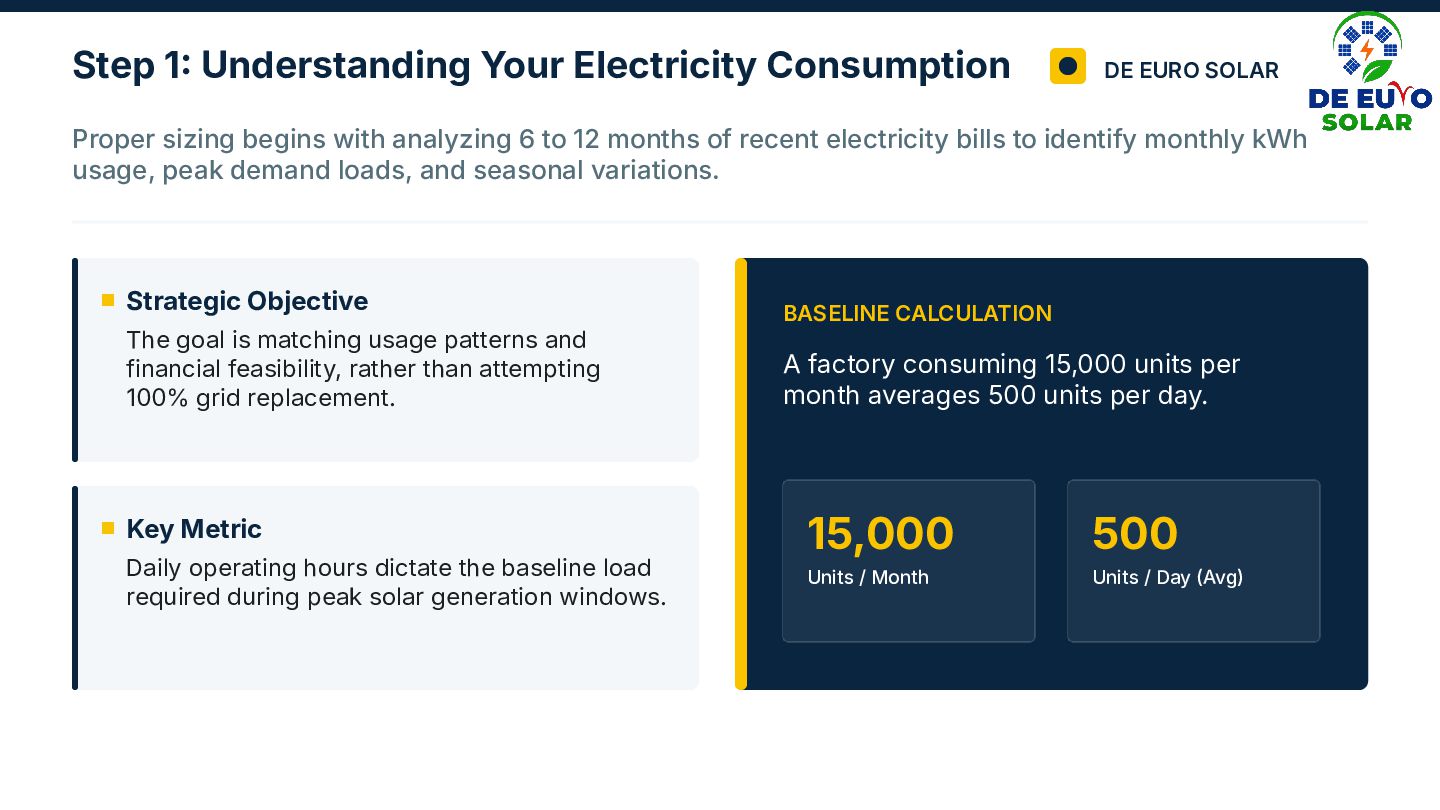
sizing begins with analyzing 6 to 12 months of recent electricity bills to identify monthly kWh usage, peak demand loads, and seasonal variations. Strategic Objective The goal is matching usage patterns and financial feasibility, rather than attempting 100% grid replacement. Key Metric Daily operating hours dictate the baseline load required during peak solar generation windows. BASELINE CALCULATION A factory consuming 15,000 units per month averages 500 units per day. 15,000 500 Units / Month Units / Day Avg -
Step 2 Evaluating Rooftop Space and Technical Feasibility Available roof
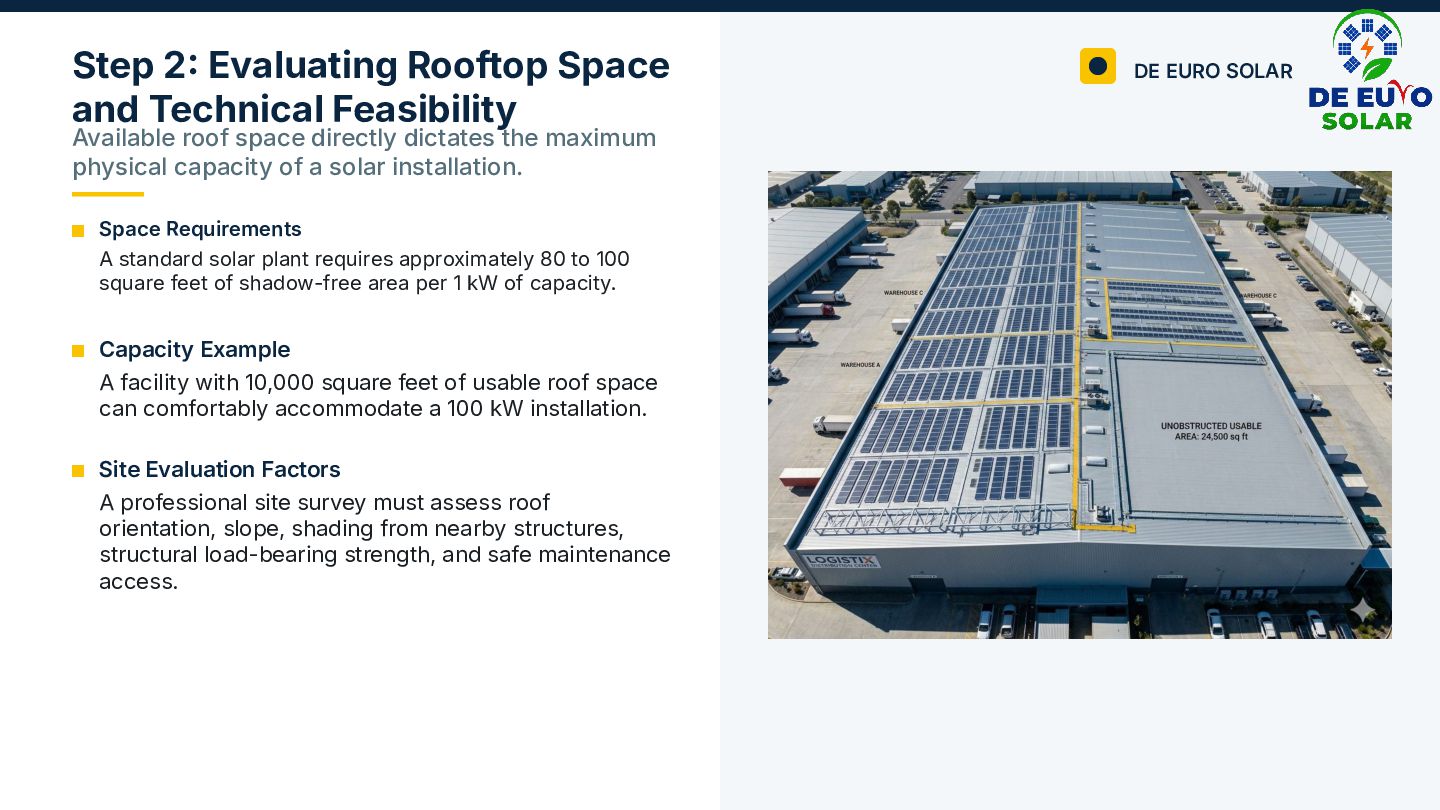
space directly dictates the maximum physical capacity of a solar installation. Space Requirements A standard solar plant requires approximately 80 to 100 square feet of shadow-free area per 1 kW of capacity. Capacity Example A facility with 10,000 square feet of usable roof space can comfortably accommodate a 100 kW installation. Site Evaluation Factors A professional site survey must assess roof orientation, slope, shading from nearby structures, structural load-bearing strength, and safe maintenance access. DE EURO SOLAR -
Step 3 Matching Solar Generation with Operating Hours DE EURO
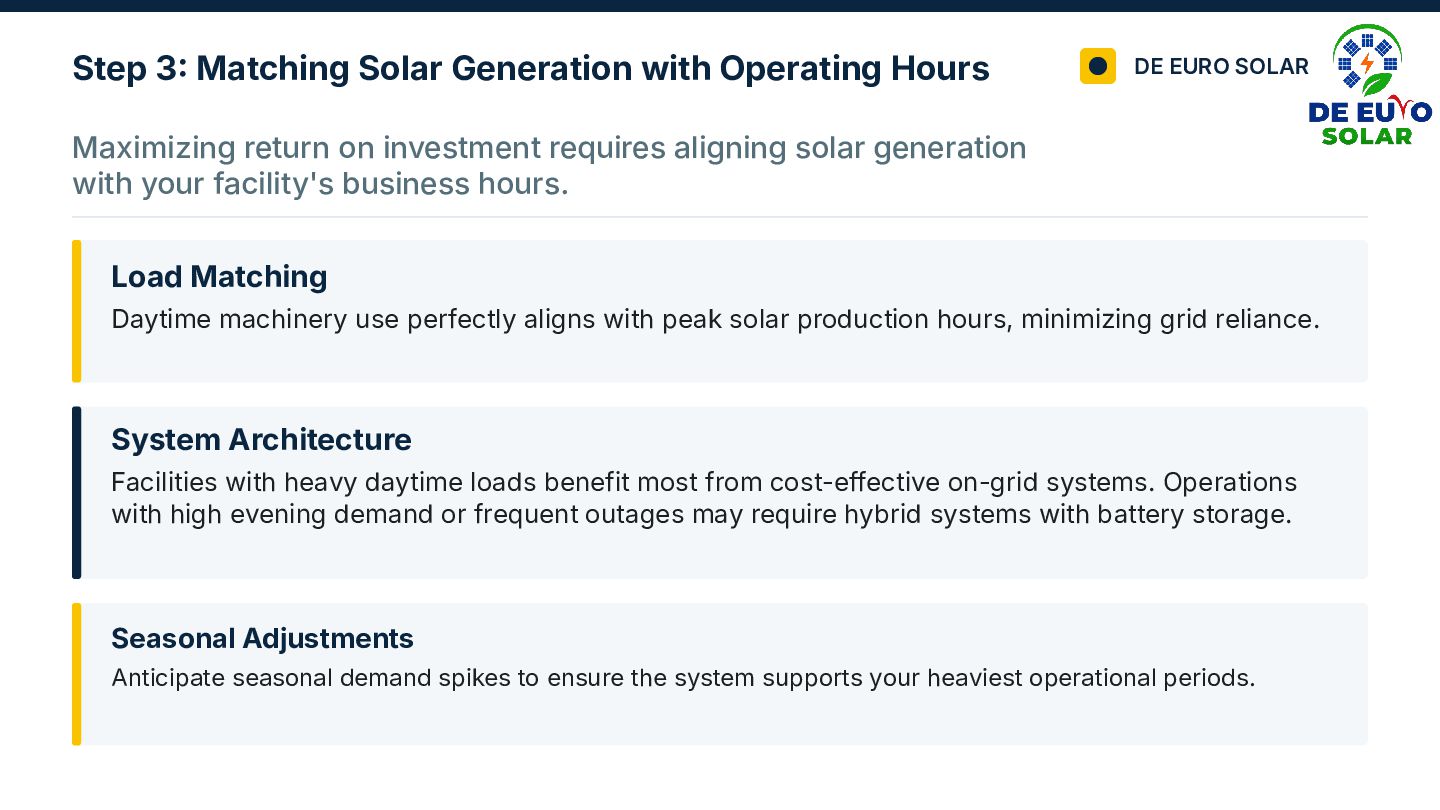
SOLAR Maximizing return on investment requires aligning solar generation with your facility's business hours. Load Matching Daytime machinery use perfectly aligns with peak solar production hours, minimizing grid reliance. System Architecture Facilities with heavy daytime loads benefit most from cost-effective on-grid systems. Operations with high evening demand or frequent outages may require hybrid systems with battery storage. Seasonal Adjustments Anticipate seasonal demand spikes to ensure the system supports your heaviest operational periods. -
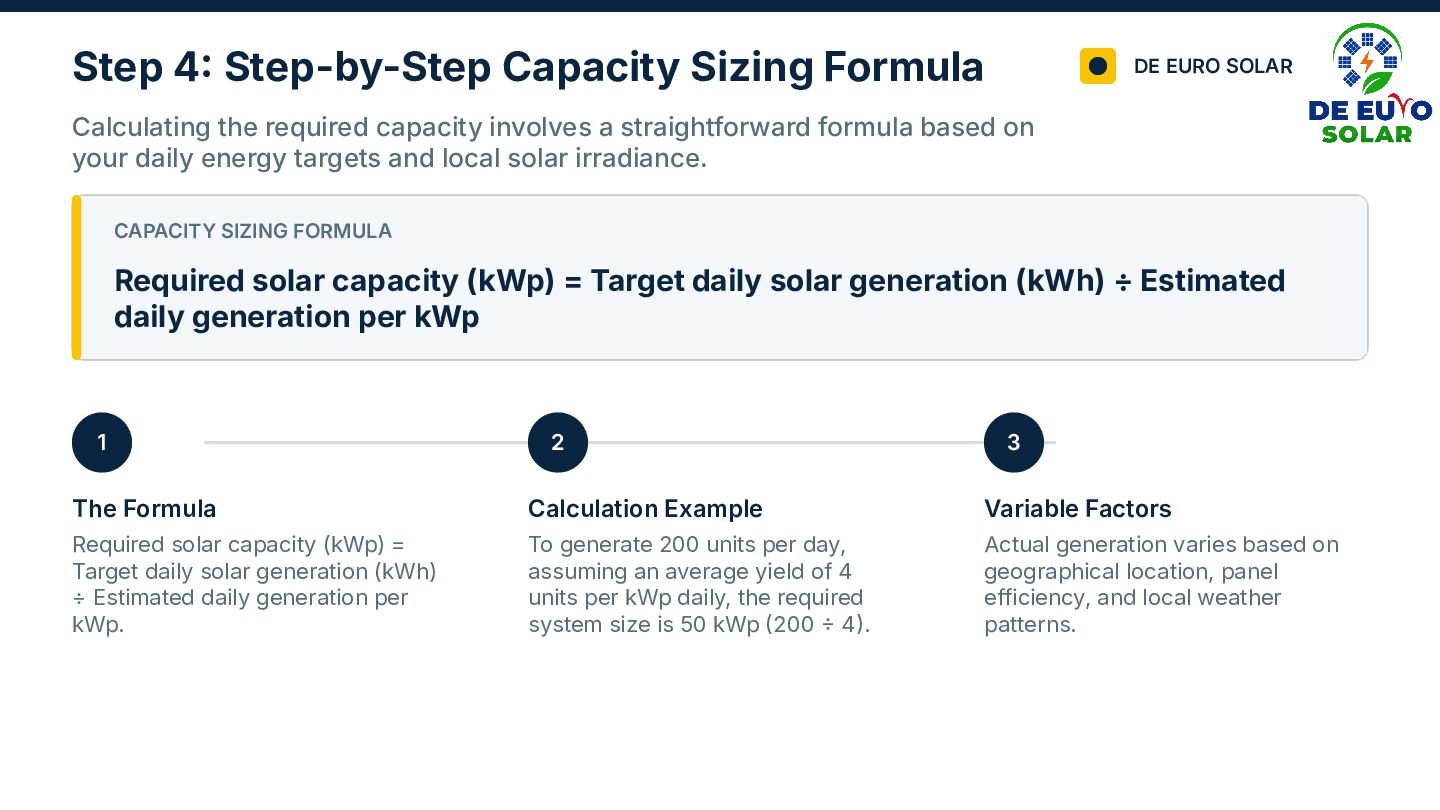
Step 4 Step-by-Step Capacity Sizing Formula DE EURO SOLAR Calculating
the required capacity involves a straightforward formula based on your daily energy targets and local solar irradiance. CAPACITY SIZING FORMULA Required solar capacity (kWp) = Target daily solar generation (kWh) ÷ Estimated daily generation per kWp 1 2 3 The Formula Calculation Example Variable Factors Required solar capacity (kWp) = Target daily solar generation (kWh) ÷ Estimated daily generation per kWp. To generate 200 units per day, assuming an average yield of 4 units per kWp daily, the required system size is 50 kWp 200 4. Actual generation varies based on geographical location, panel efficiency, and local weather patterns. -
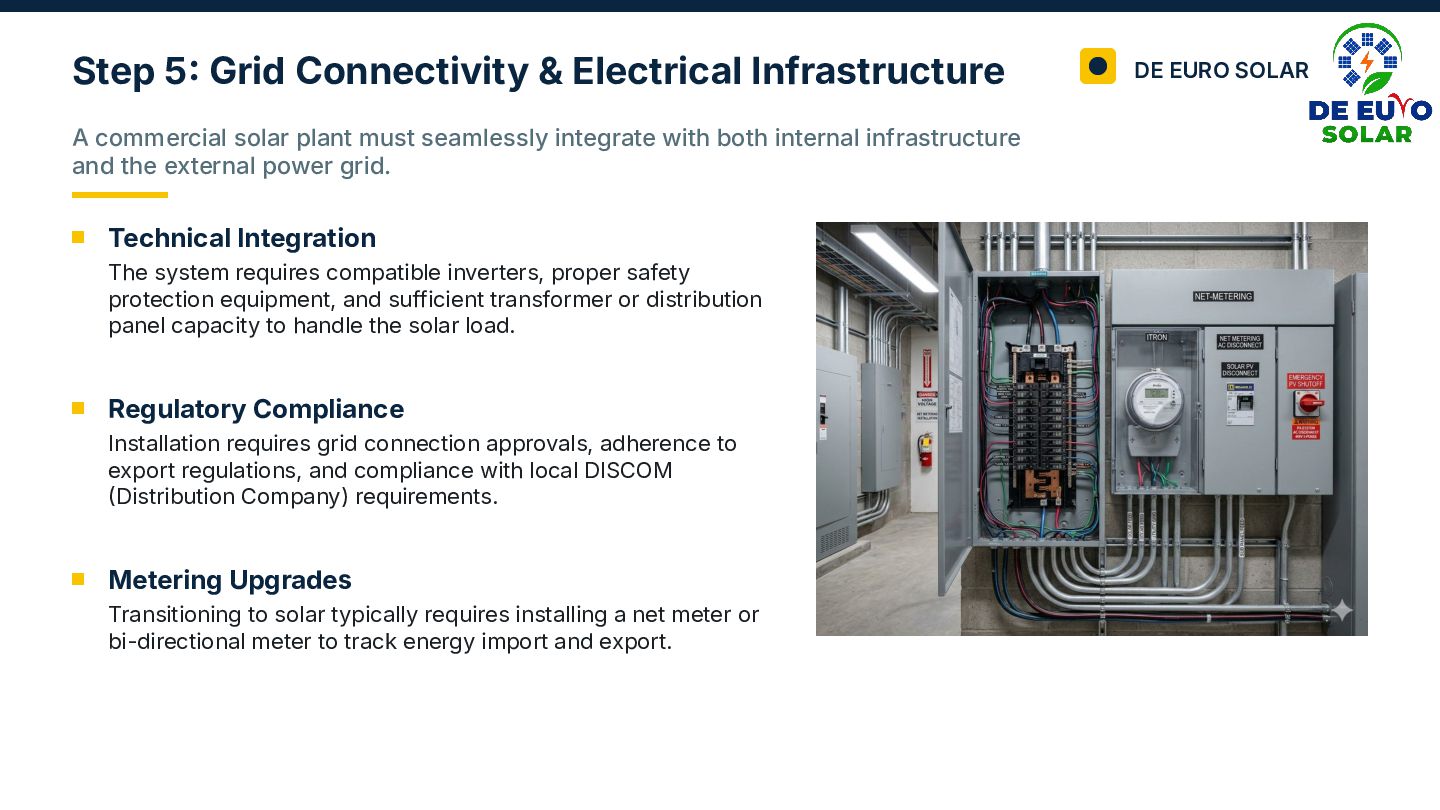
Step 5 Grid Connectivity & Electrical Infrastructure A commercial solar
plant must seamlessly integrate with both internal infrastructure and the external power grid. Technical Integration The system requires compatible inverters, proper safety protection equipment, and sufficient transformer or distribution panel capacity to handle the solar load. Regulatory Compliance Installation requires grid connection approvals, adherence to export regulations, and compliance with local DISCOM Distribution Company) requirements. Metering Upgrades Transitioning to solar typically requires installing a net meter or bi-directional meter to track energy import and export. DE EURO SOLAR -
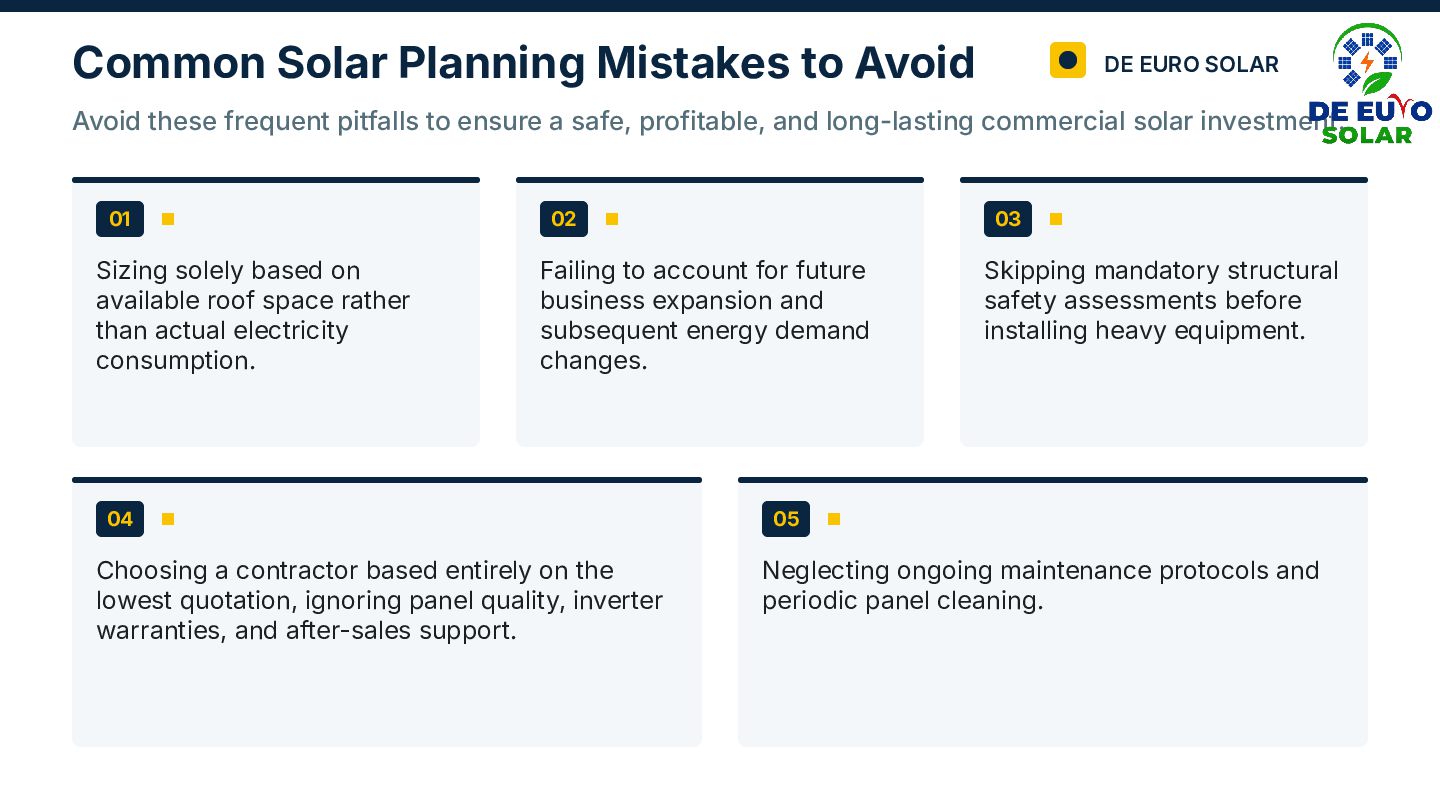
Common Solar Planning Mistakes to Avoid DE EURO SOLAR Avoid
these frequent pitfalls to ensure a safe, profitable, and long-lasting commercial solar investment. 01 02 03 Sizing solely based on available roof space rather than actual electricity consumption. Failing to account for future business expansion and subsequent energy demand changes. Skipping mandatory structural safety assessments before installing heavy equipment. 04 05 Choosing a contractor based entirely on the lowest quotation, ignoring panel quality, inverter warranties, and after-sales support. Neglecting ongoing maintenance protocols and periodic panel cleaning. -
DE EURO SOLAR Next Steps: Planning Your Solar Project with
De Euro Solar Transitioning to commercial solar requires expert technical assessment and precise project planning. Expert Partnership Tailored Solutions De Euro Solar provides customized technical assessments, accurate capacity sizing, and end-to-end project management. We evaluate your specific energy needs, structural constraints, and financial goals to design the optimal solar architecture. Take Action Contact De Euro Solar today to schedule your comprehensive site evaluation and begin exploring your commercial installation options.