Oleg Broslavsky, Nikita Oleksov F5 Networks Tomsk State University Information Security and Cryptography Department Top 10 Web Hacking Techniques of 2014 Special Edition ZeroNights (13-14 November 2014) Moscow, Russia SibeCrypt (8-13 September 2014) Ekaterinburg, Russia
engineer at F5 Networks – PhD, associate professor at Tomsk State University Information Security and Cryptography Department • Oleg Broslavsky – 3rd year student at Tomsk State University Information Security and Cryptography Department – Member of TSU’s SiBears Capture the Flag team • Nikita Oleksov – 3rd year student at Tomsk State University Information Security and Cryptography Department – Member of TSU’s SiBears Capture the Flag team 2
new covert timing channels based on HTTP cache headers We discovered previously unknown techniques and introduced them on the ZeroNights and SibeCrypt security conferences in 2014 In the current list of «Top 10 Web Hacking Techniques of 2014» there are many valuable and significant attacks and, of course, we don’t think that our work is the best. We are considering participation in 2014 Hacks as opportunity for feedback and information sharing 3
based on main HTTP cache headers We explored different properties of these covert channels (e.g., throughput, anonymity, reliability) We implemented most efficient ETag-based covert channel in Browser Exploitation Framework (BeEF) for covert communications Also we implemented ETag-based covert timing channel providing anonymity property to attackers in Google Drive environment 4
used to transfer information in a way not intended by the system's designers (CWE-514) A covert storage channel transfers information through the setting of bits by one program and the reading of those bits by another (CWE-515) Covert timing channels conveys information by modulating some aspect of system behavior over time, so that the program receiving the information can observe system behavior and infer protected information (CWE-385) 5
the Internet so detections of the covert channels over the HTTP is an important research area HTTP timing channels have received little attention in computer security The main HTTP covert timing channel throughput is equal to 1.82 bps [1]. This channel doesn’t use any HTTP mechanisms and is based on TCP/IP timing channel Server-to-Client DNS-tunnel [3] implemented in BeEF has throughput equal to 10 bit/s 6
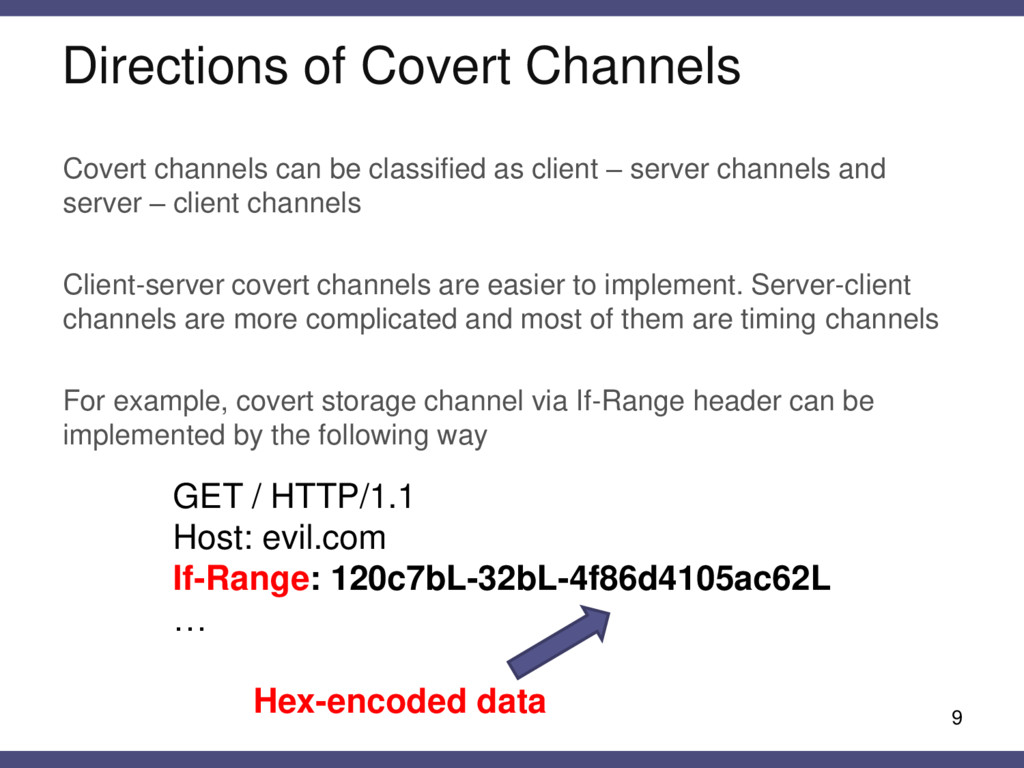
channels and server – client channels Client-server covert channels are easier to implement. Server-client channels are more complicated and most of them are timing channels For example, covert storage channel via If-Range header can be implemented by the following way Directions of Covert Channels GET / HTTP/1.1 Host: evil.com If-Range: 120c7bL-32bL-4f86d4105ac62L … Hex-encoded data
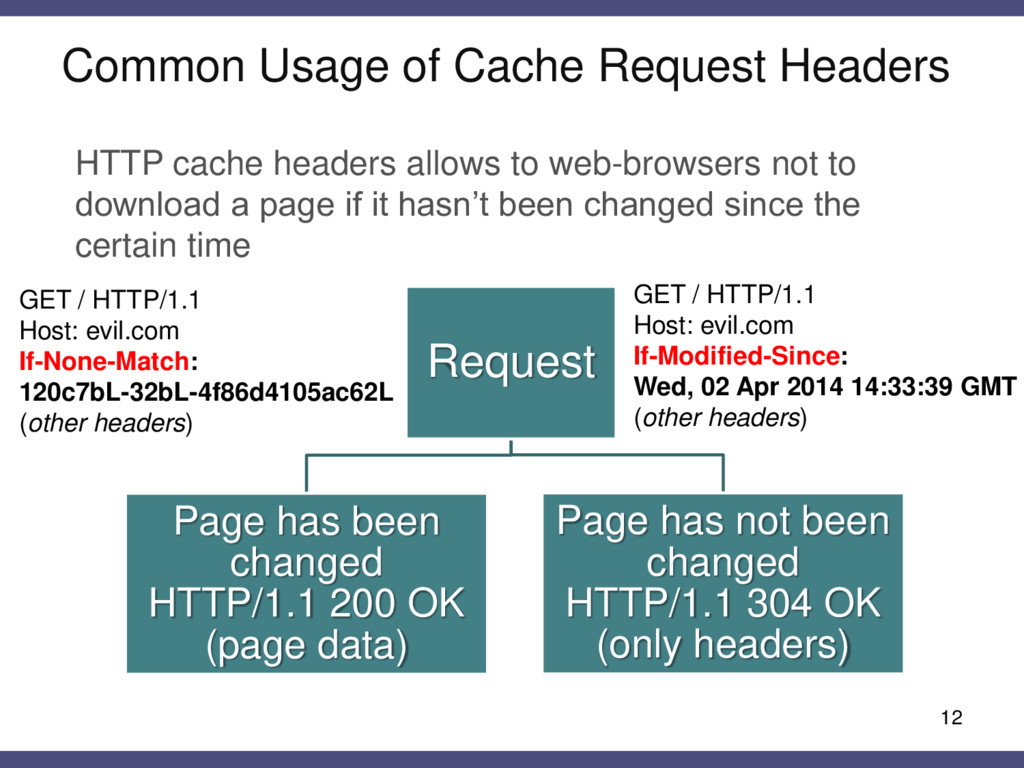
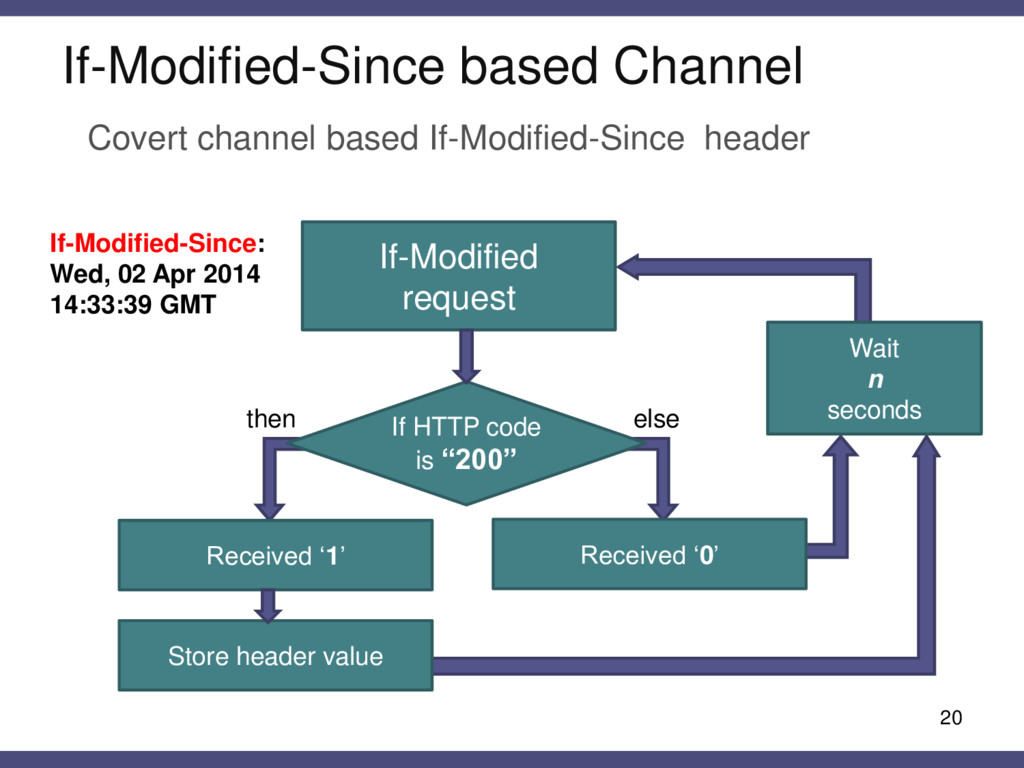
allows to web-browsers not to download a page if it hasn’t been changed since the certain time Request Page has been changed HTTP/1.1 200 OK (page data) Page has not been changed HTTP/1.1 304 OK (only headers) GET / HTTP/1.1 Host: evil.com If-Modified-Since: Wed, 02 Apr 2014 14:33:39 GMT (other headers) GET / HTTP/1.1 Host: evil.com If-None-Match: 120c7bL-32bL-4f86d4105ac62L (other headers)
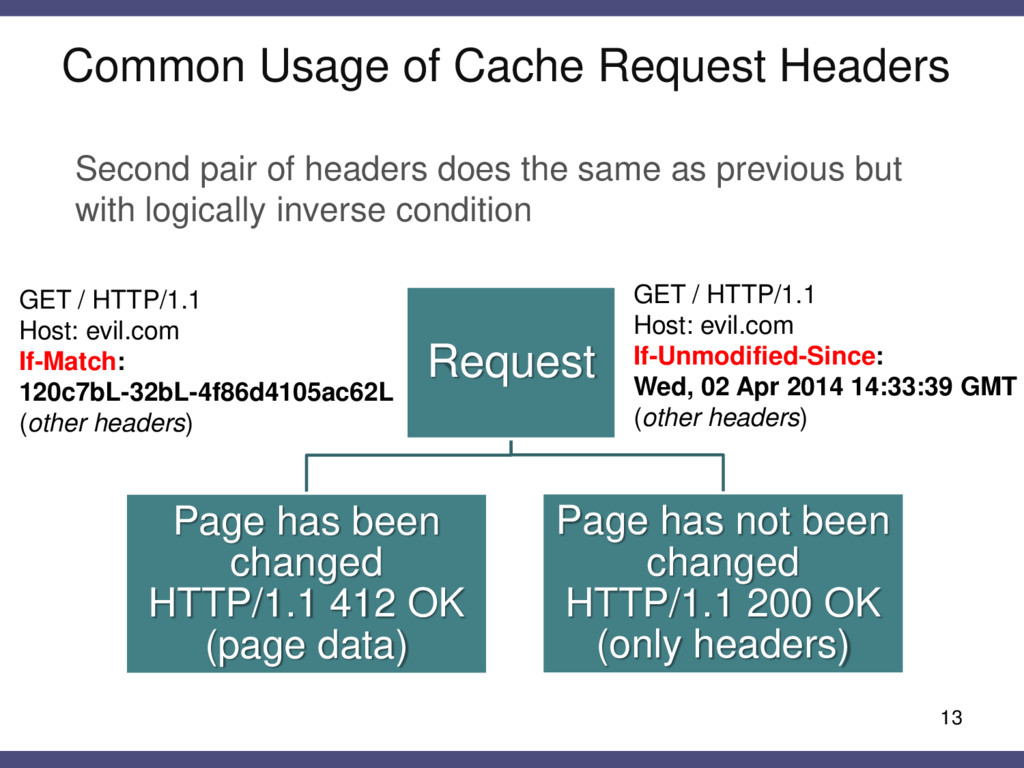
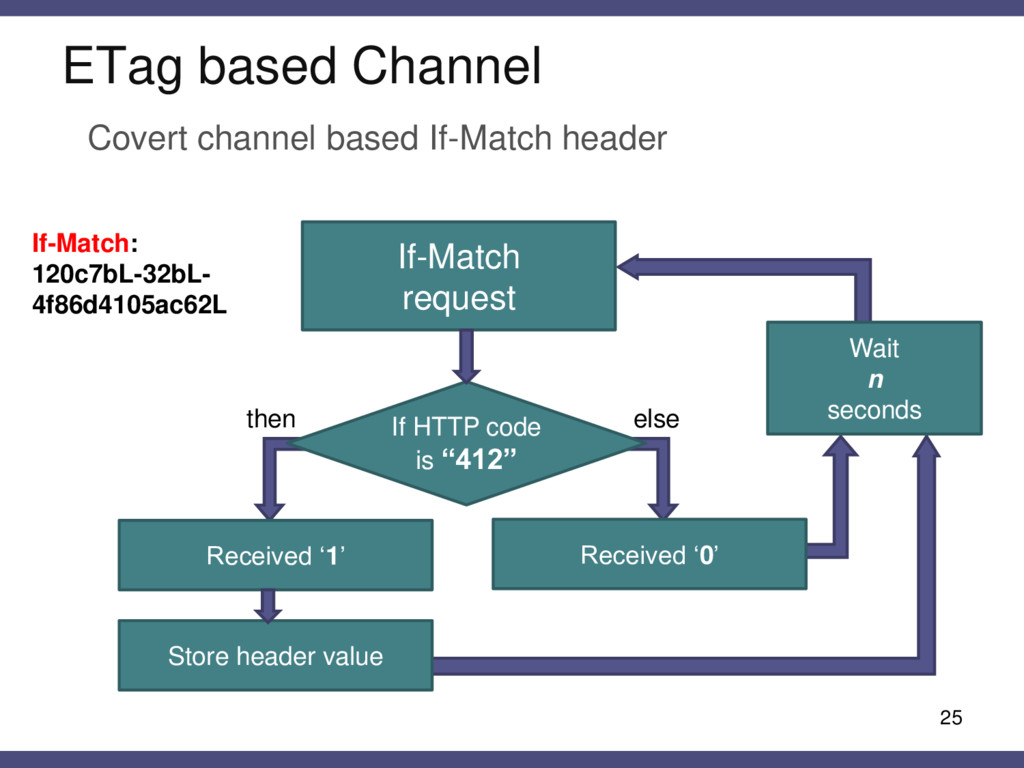
headers does the same as previous but with logically inverse condition Request Page has been changed HTTP/1.1 412 OK (page data) Page has not been changed HTTP/1.1 200 OK (only headers) GET / HTTP/1.1 Host: evil.com If-Unmodified-Since: Wed, 02 Apr 2014 14:33:39 GMT (other headers) GET / HTTP/1.1 Host: evil.com If-Match: 120c7bL-32bL-4f86d4105ac62L (other headers)
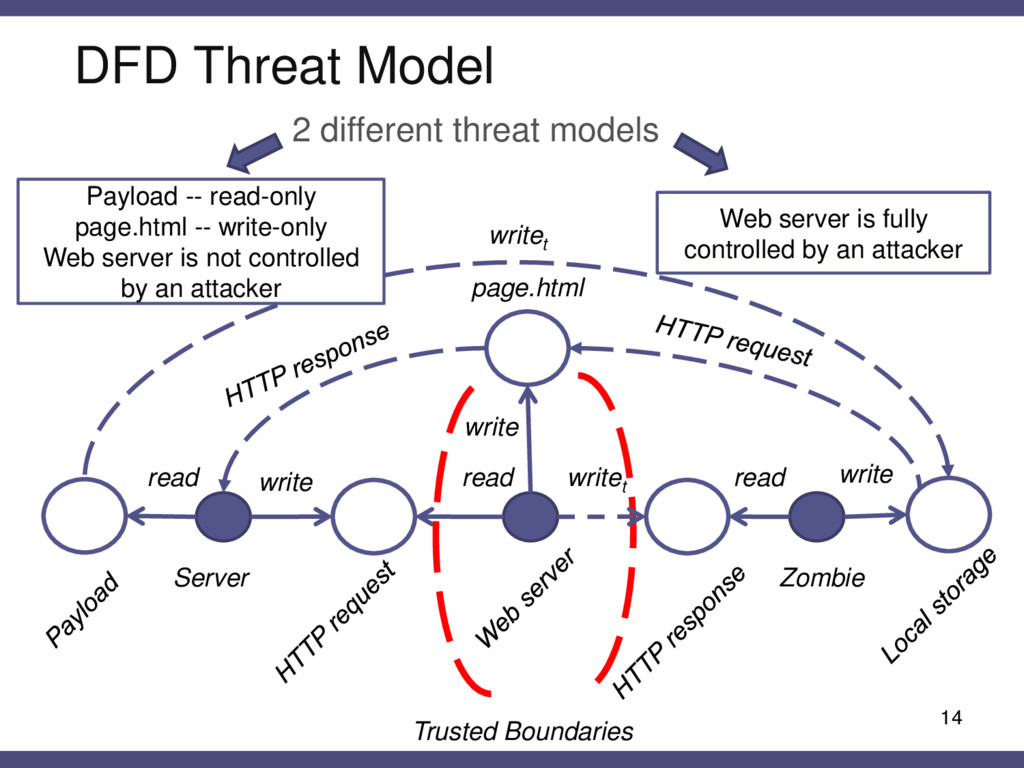
read writet read write 2 different threat models Web server is fully controlled by an attacker Payload -- read-only page.html -- write-only Web server is not controlled by an attacker write Trusted Boundaries
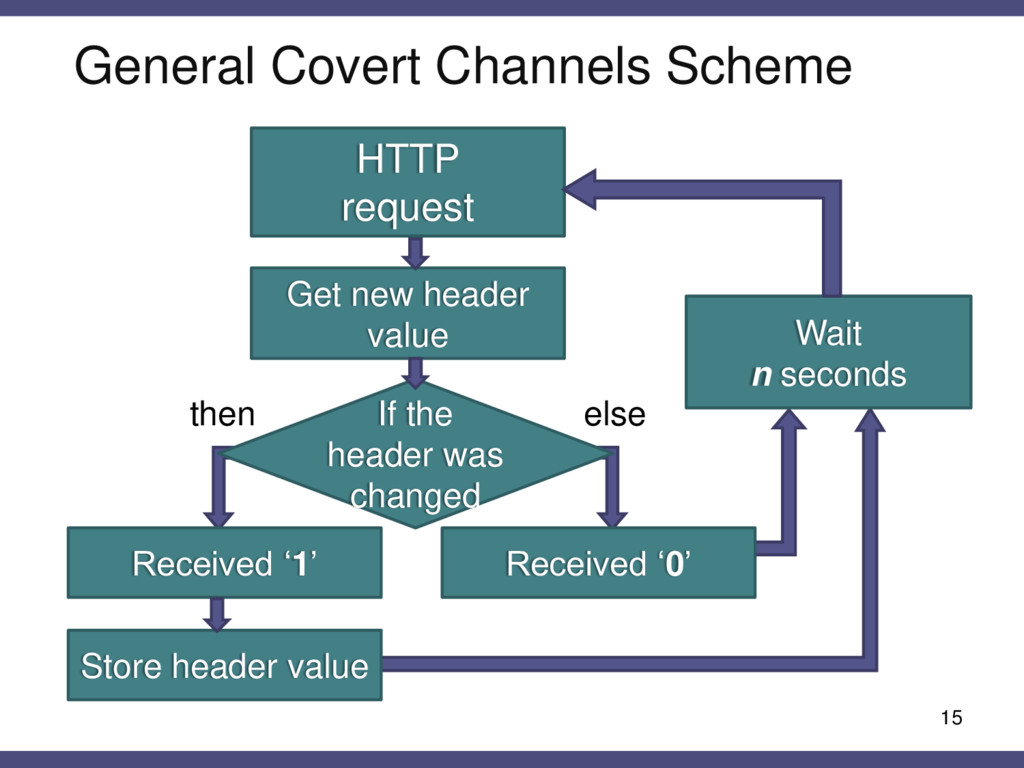
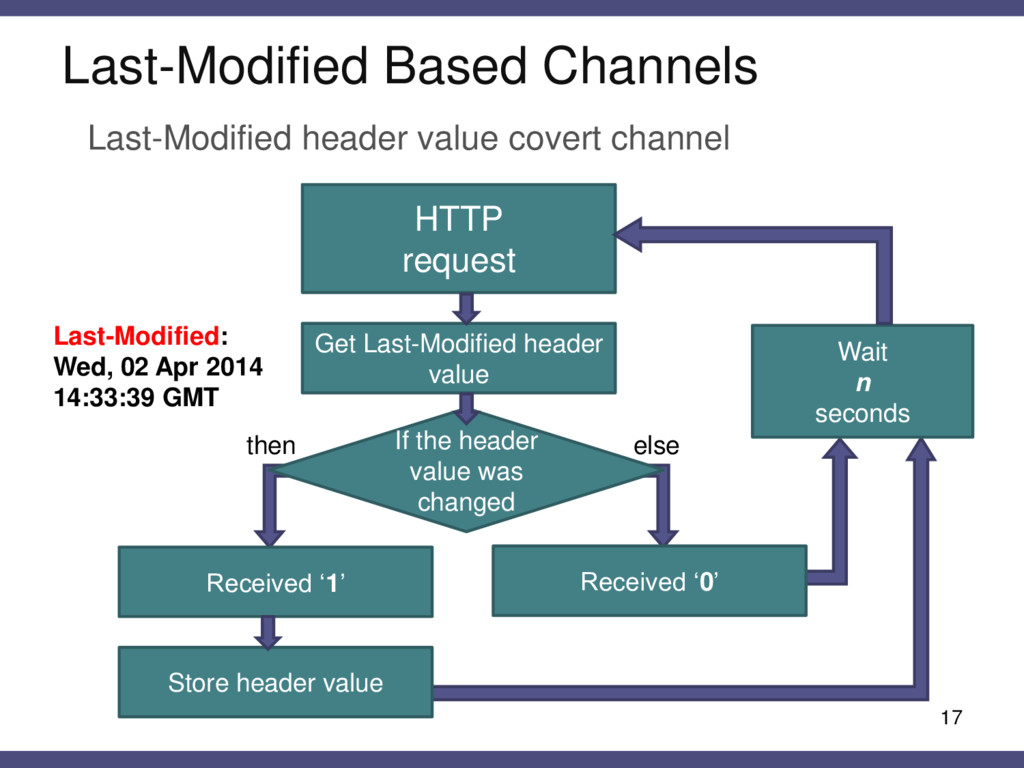
Received ‘1’ If the header value was changed Store header value Received ‘0’ Wait n seconds then else Last-Modified header value covert channel Last-Modified: Wed, 02 Apr 2014 14:33:39 GMT
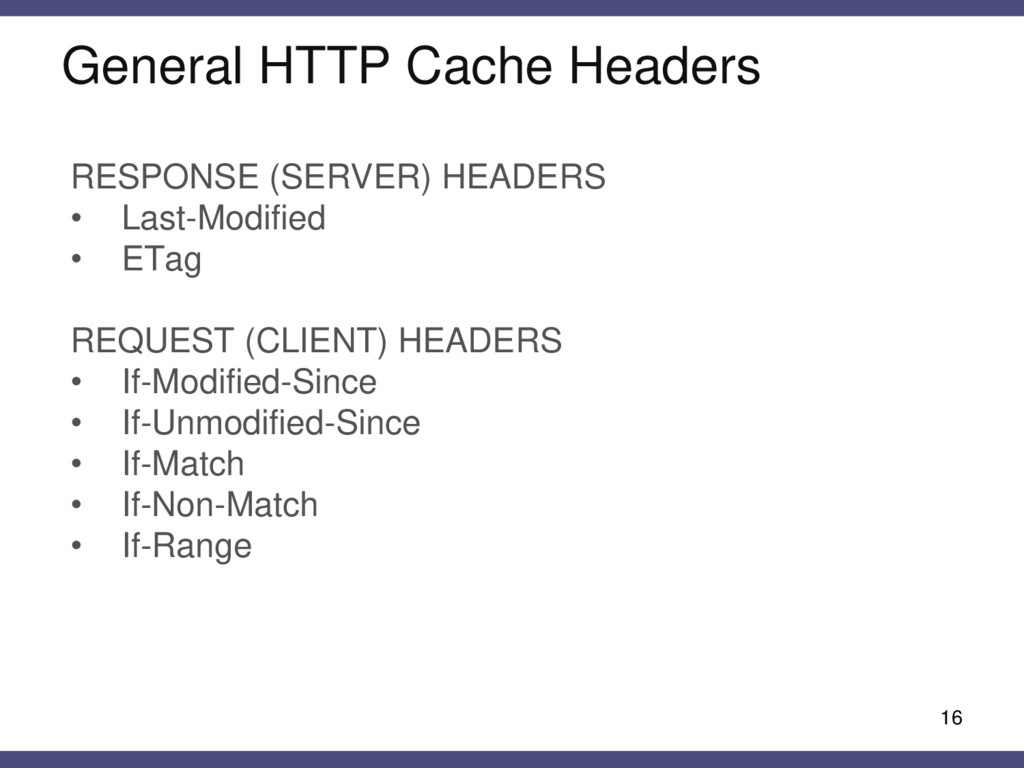
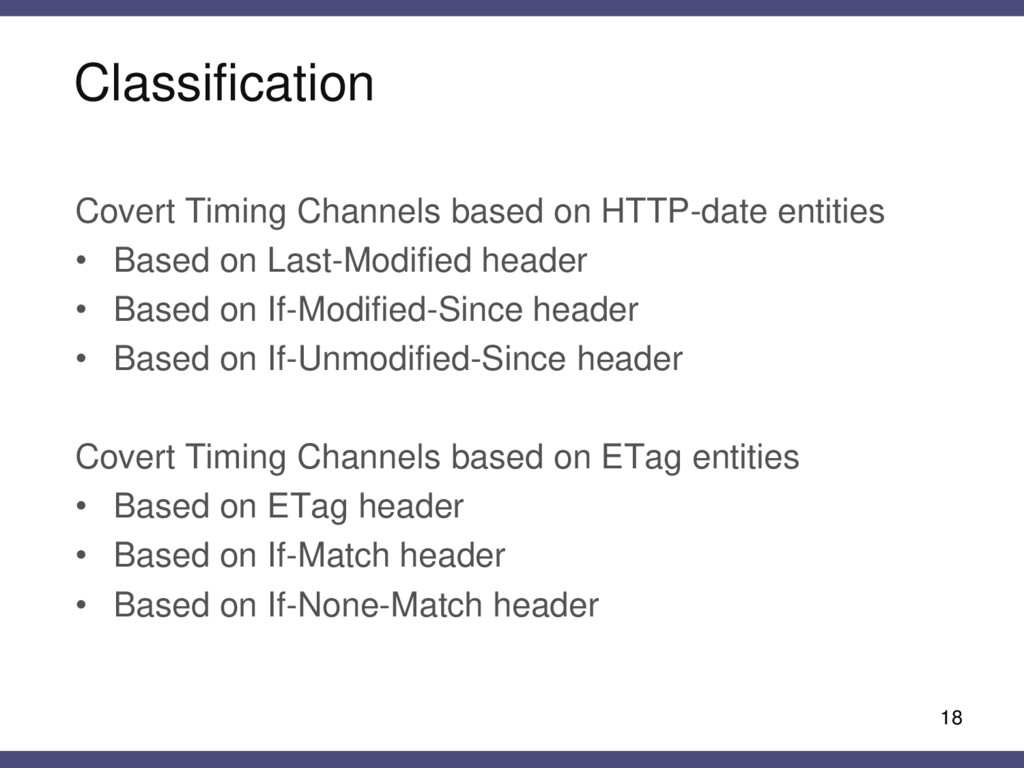
Based on Last-Modified header • Based on If-Modified-Since header • Based on If-Unmodified-Since header Covert Timing Channels based on ETag entities • Based on ETag header • Based on If-Match header • Based on If-None-Match header
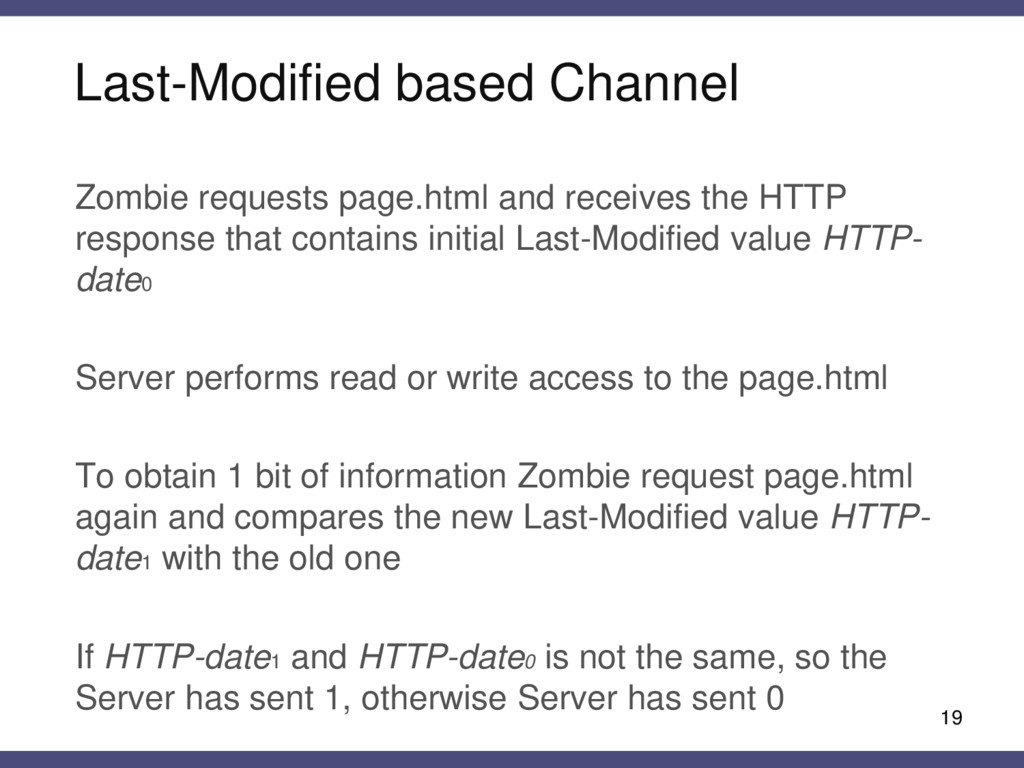
HTTP response that contains initial Last-Modified value HTTP- date0 Server performs read or write access to the page.html To obtain 1 bit of information Zombie request page.html again and compares the new Last-Modified value HTTP- date1 with the old one If HTTP-date1 and HTTP-date0 is not the same, so the Server has sent 1, otherwise Server has sent 0
code is “412” Store header value Received ‘0’ Wait n seconds then else Covert channel based on If-Unmodified-Since header If-Unmodified-Since: Wed, 02 Apr 2014 14:33:39 GMT
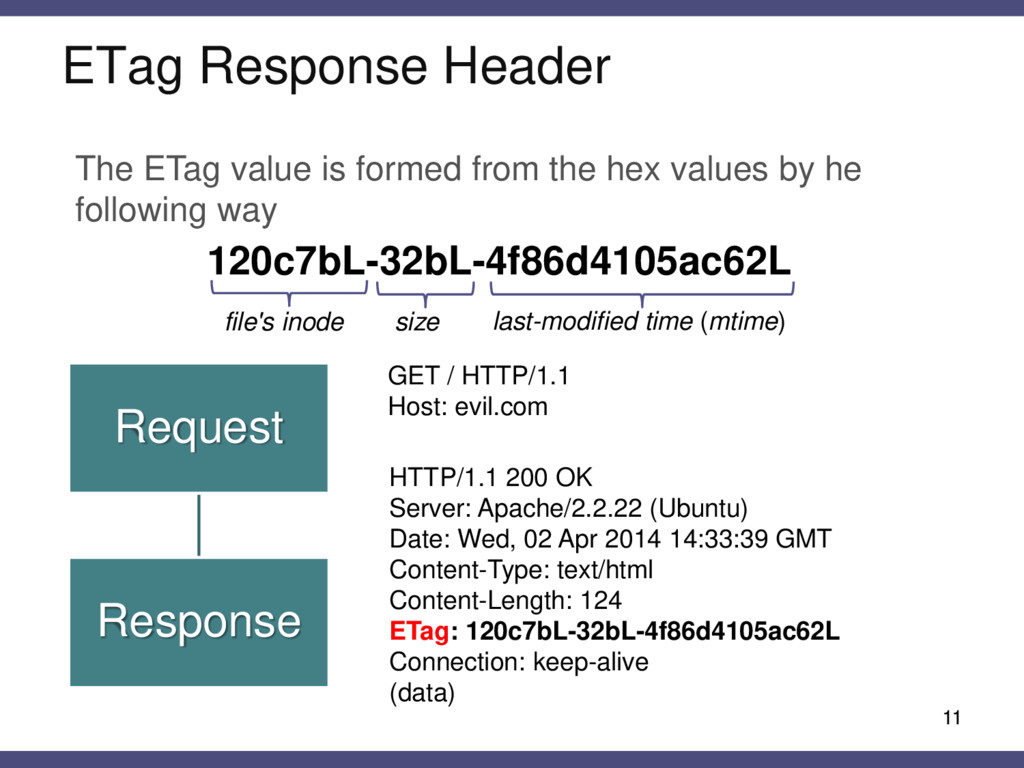
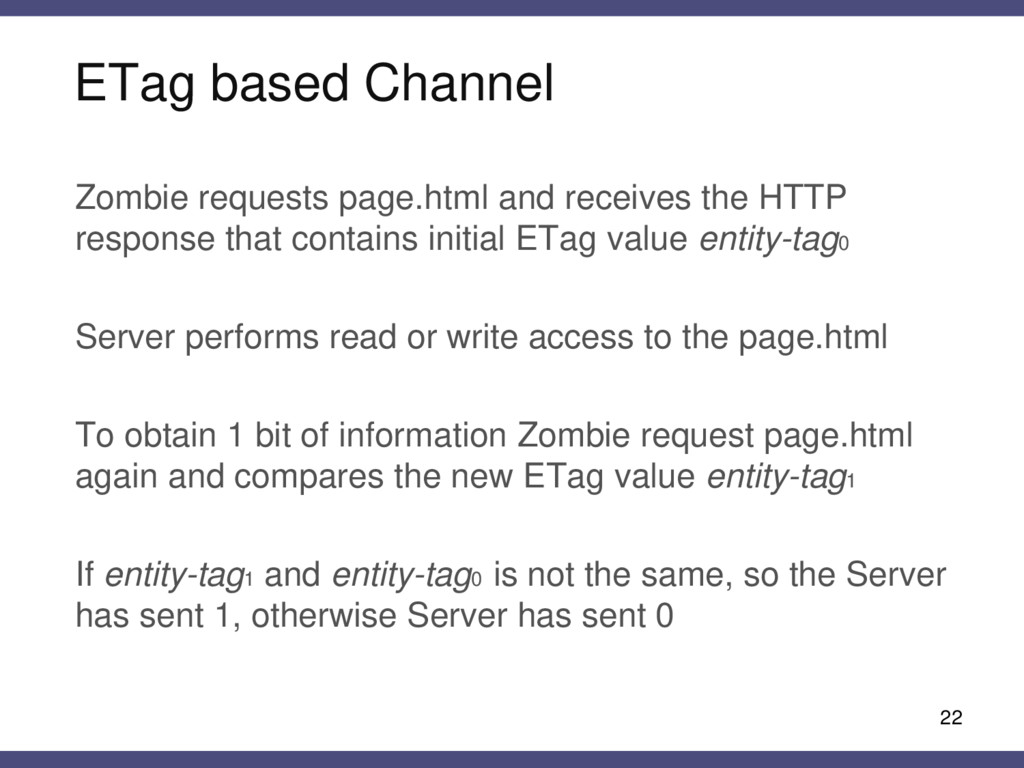
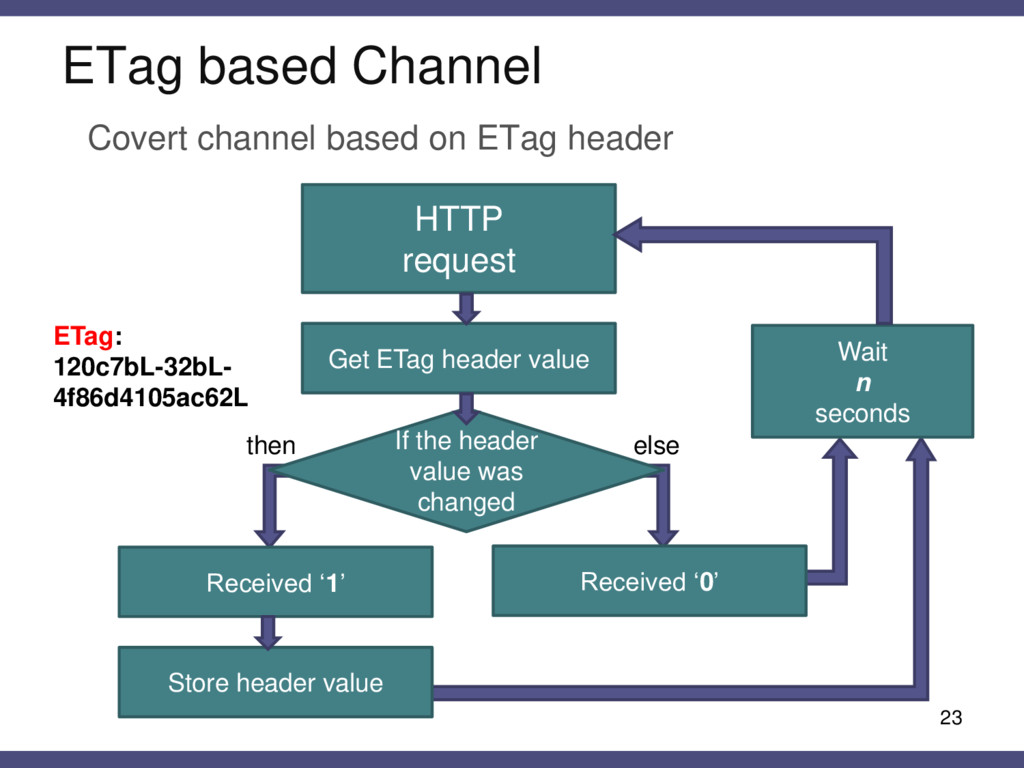
HTTP response that contains initial ETag value entity-tag0 Server performs read or write access to the page.html To obtain 1 bit of information Zombie request page.html again and compares the new ETag value entity-tag1 If entity-tag1 and entity-tag0 is not the same, so the Server has sent 1, otherwise Server has sent 0
ETag: 120c7bL-32bL- 4f86d4105ac62L HTTP request Get ETag header value Received ‘1’ If the header value was changed Store header value Received ‘0’ Wait n seconds then else
If-None-Match: 120c7bL-32bL- 4f86d4105ac62L If-None-Match request Received ‘1’ If HTTP code is “200” Store header value Received ‘0’ Wait n seconds then else
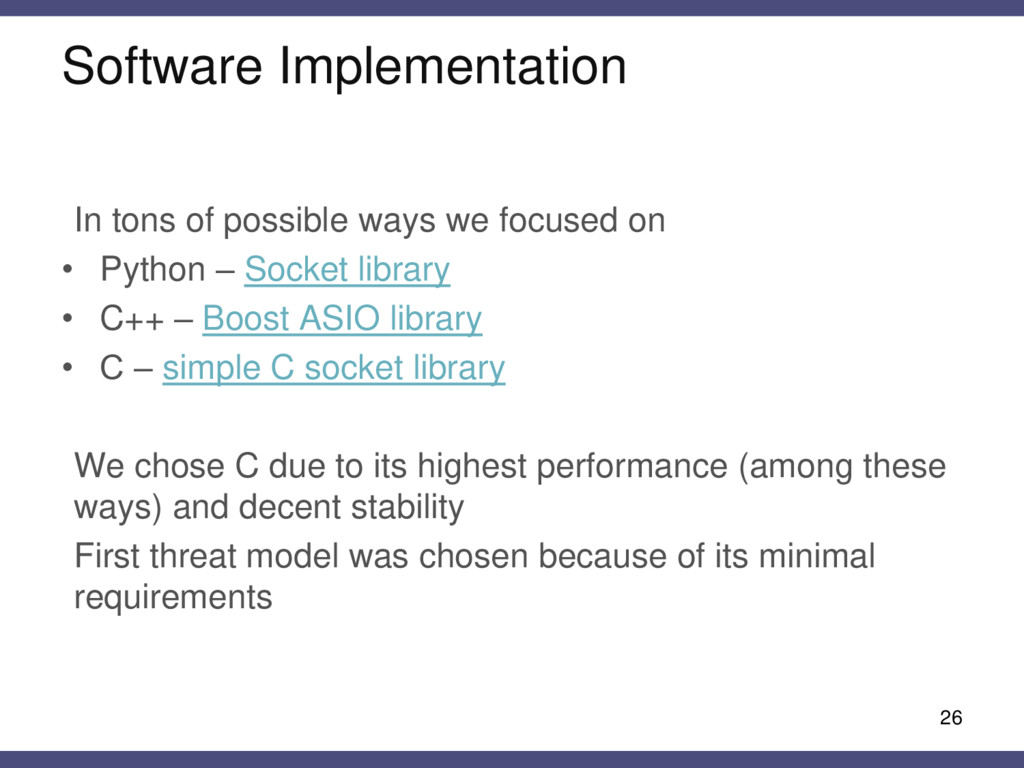
• Python – Socket library • C++ – Boost ASIO library • С – simple C socket library We chose C due to its highest performance (among these ways) and decent stability First threat model was chosen because of its minimal requirements 26
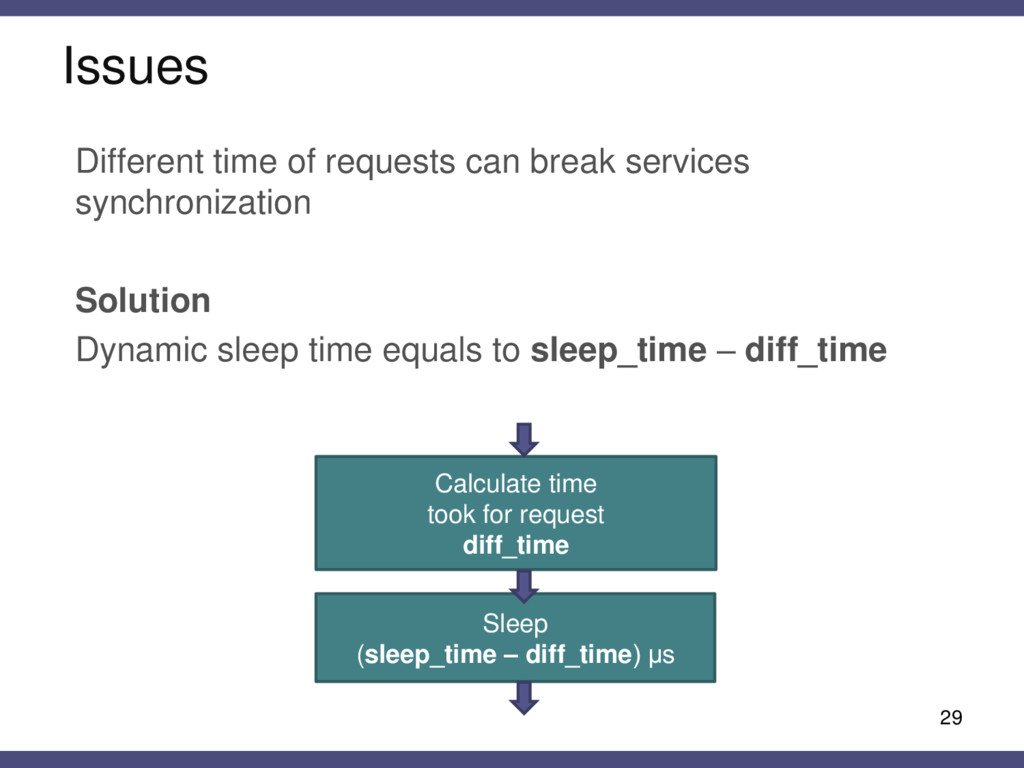
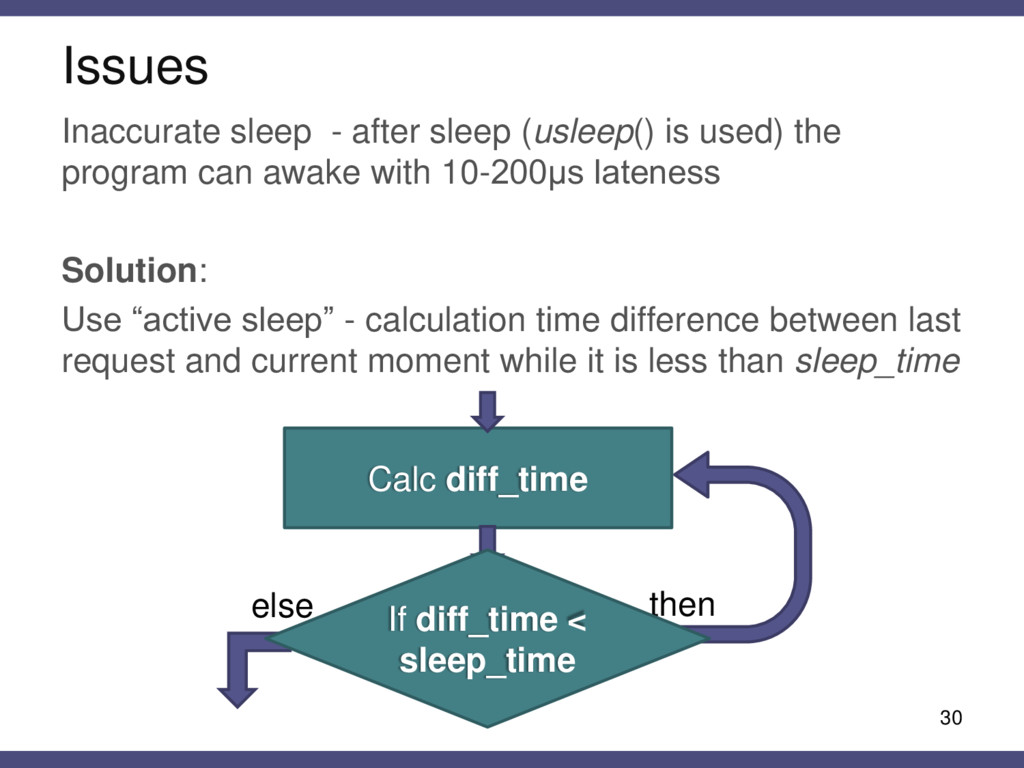
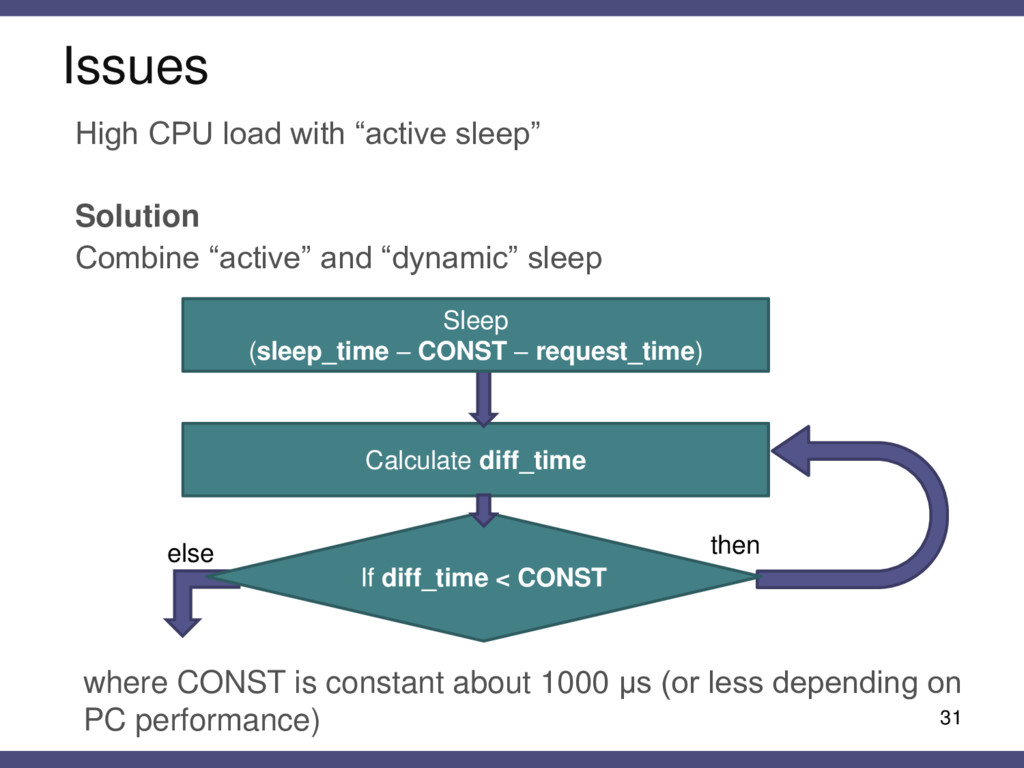
of requests Dynamic sleep time Lateness after sleep “Active” sleep High CPU load with “active sleep” “Dynamic” and “active” sleep combination 27 Some problems we solved during implementation
been changed then else Necessity of synchronization “read” (web client) and “write” (host) services Solution Synchronizing function that does requests at a maximum speed (without sleep) Issues
program can awake with 10-200μs lateness Solution: Use “active sleep” - calculation time difference between last request and current moment while it is less than sleep_time Issues Calc diff_time then else If diff_time < sleep_time
and “dynamic” sleep Calculate diff_time If diff_time < CONST then else Sleep (sleep_time – CONST – request_time) where CONST is constant about 1000 µs (or less depending on PC performance) Issues
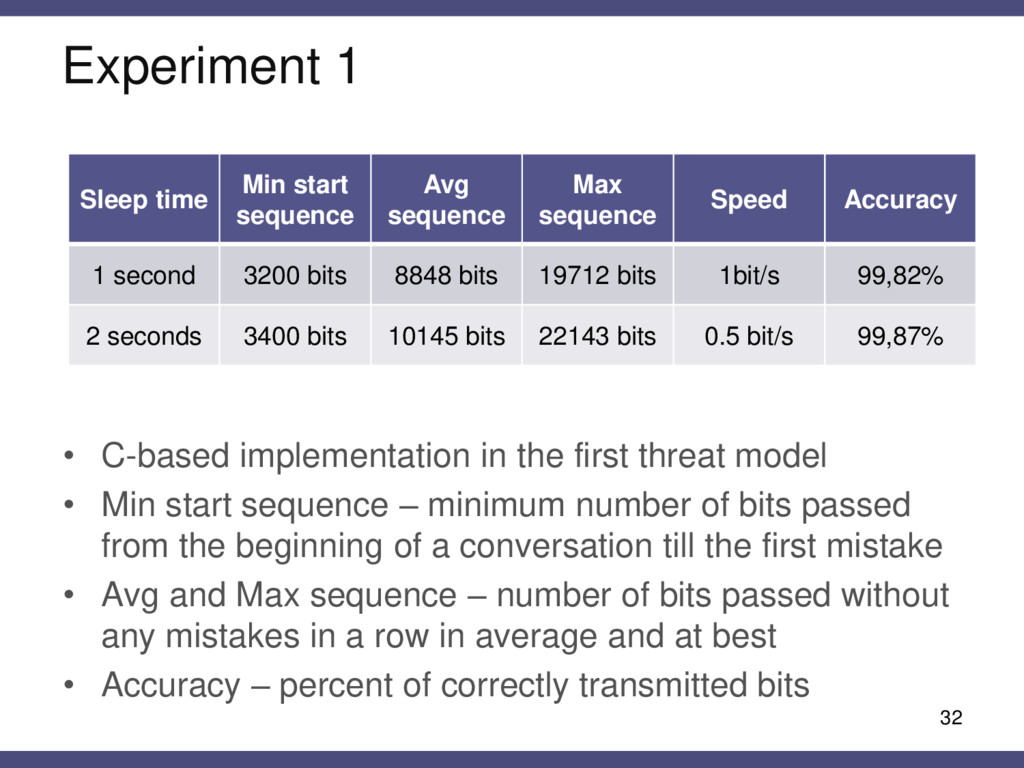
Speed Accuracy 1 second 3200 bits 8848 bits 19712 bits 1bit/s 99,82% 2 seconds 3400 bits 10145 bits 22143 bits 0.5 bit/s 99,87% • C-based implementation in the first threat model • Min start sequence – minimum number of bits passed from the beginning of a conversation till the first mistake • Avg and Max sequence – number of bits passed without any mistakes in a row in average and at best • Accuracy – percent of correctly transmitted bits Experiment 1
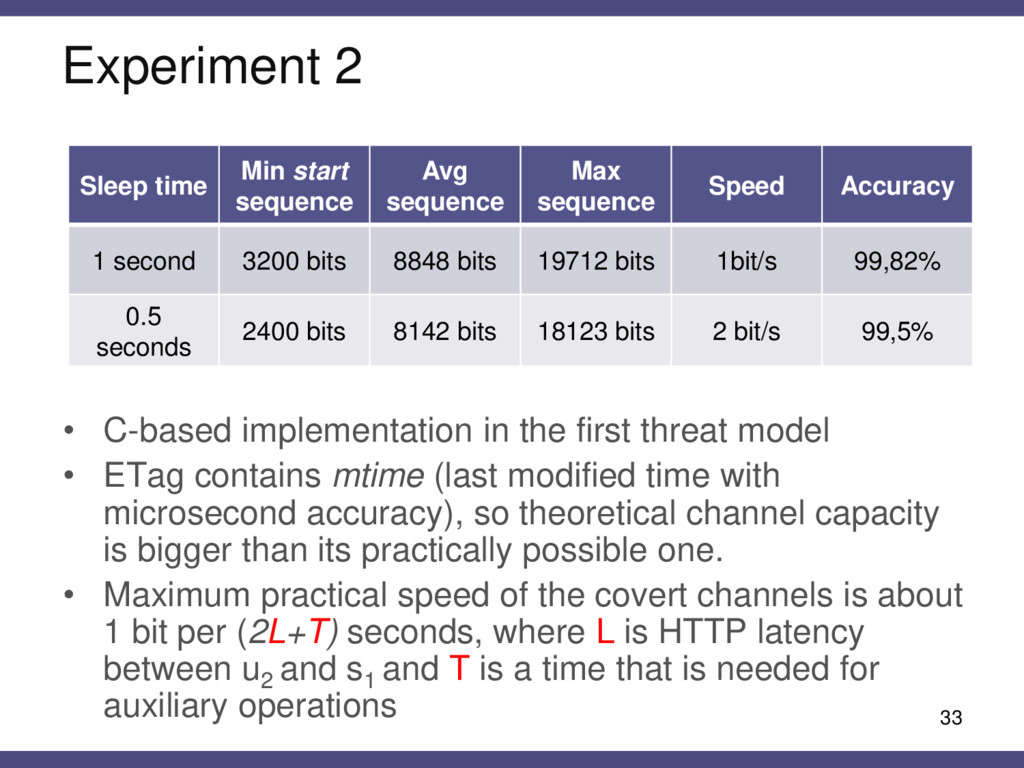
Speed Accuracy 1 second 3200 bits 8848 bits 19712 bits 1bit/s 99,82% 0.5 seconds 2400 bits 8142 bits 18123 bits 2 bit/s 99,5% • C-based implementation in the first threat model • ETag contains mtime (last modified time with microsecond accuracy), so theoretical channel capacity is bigger than its practically possible one. • Maximum practical speed of the covert channels is about 1 bit per (2L+T) seconds, where L is HTTP latency between u2 and s1 and T is a time that is needed for auxiliary operations Experiment 2
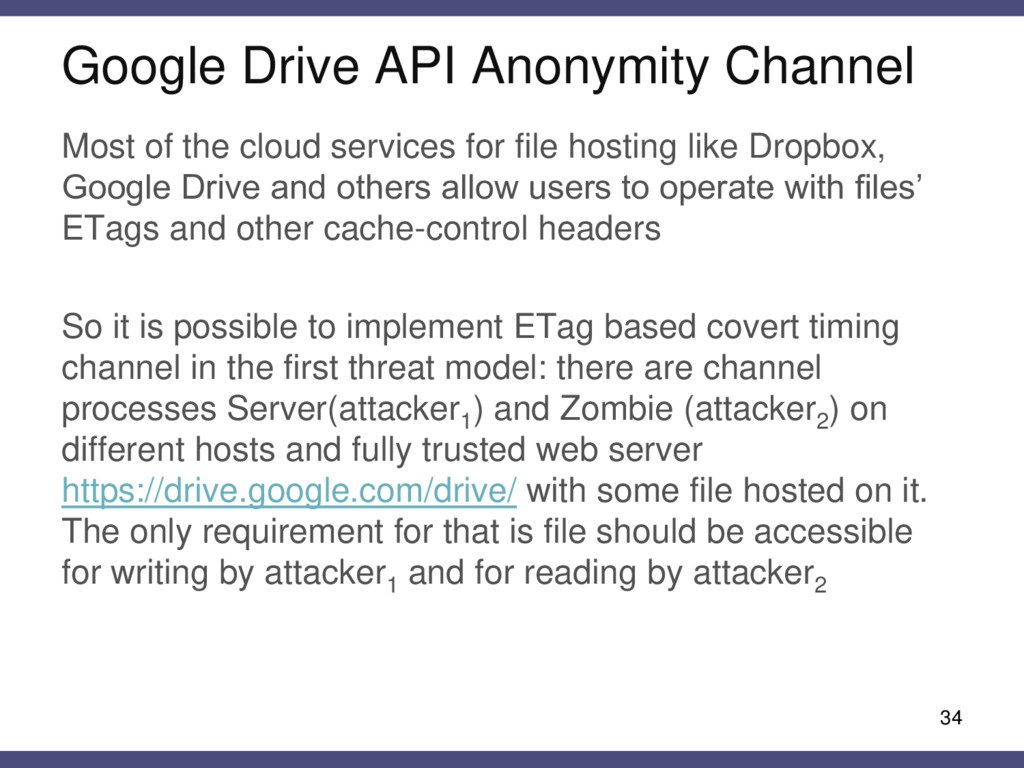
services for file hosting like Dropbox, Google Drive and others allow users to operate with files’ ETags and other cache-control headers So it is possible to implement ETag based covert timing channel in the first threat model: there are channel processes Server(attacker1 ) and Zombie (attacker2 ) on different hosts and fully trusted web server https://drive.google.com/drive/ with some file hosted on it. The only requirement for that is file should be accessible for writing by attacker1 and for reading by attacker2
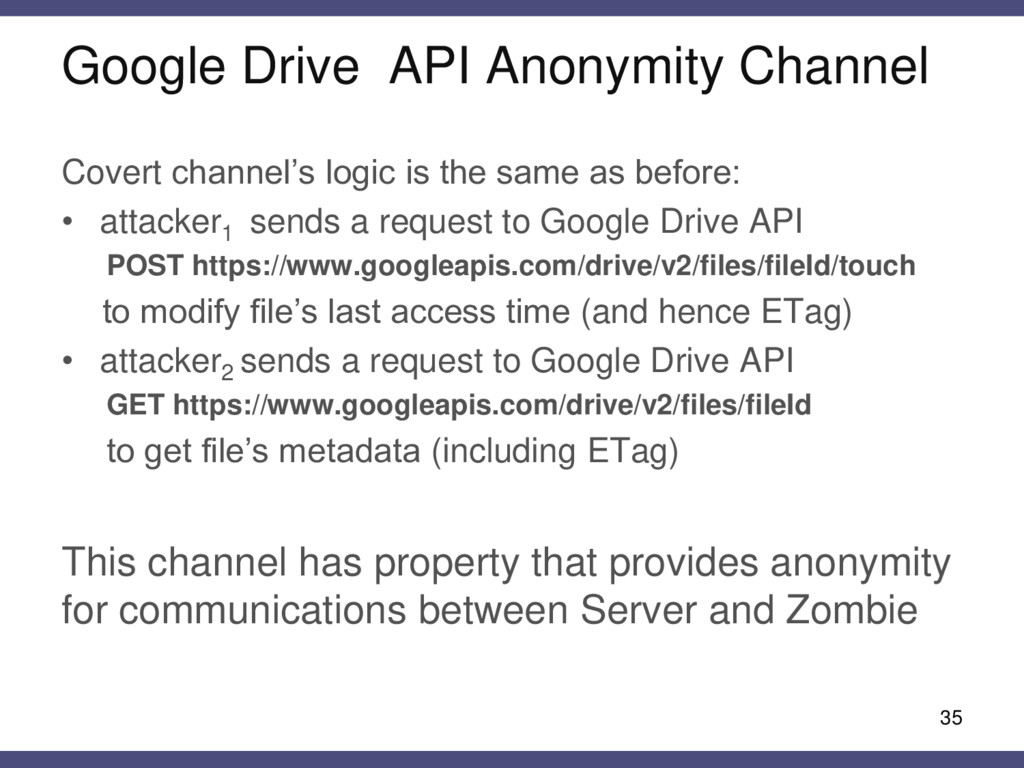
same as before: • attacker1 sends a request to Google Drive API POST https://www.googleapis.com/drive/v2/files/fileId/touch to modify file’s last access time (and hence ETag) • attacker2 sends a request to Google Drive API GET https://www.googleapis.com/drive/v2/files/fileId to get file’s metadata (including ETag) This channel has property that provides anonymity for communications between Server and Zombie 35
bit 2048 bit 4096 bit Accuracy 99.87% 99.84% 99.8% 99.8% 99.78% Average throughput 2.92 bit/s 2.9 bit/s 2.88 bit/s 2.88 bit/s 2.86 bit/s Google Drive API anonymity covert channel based on ETag header
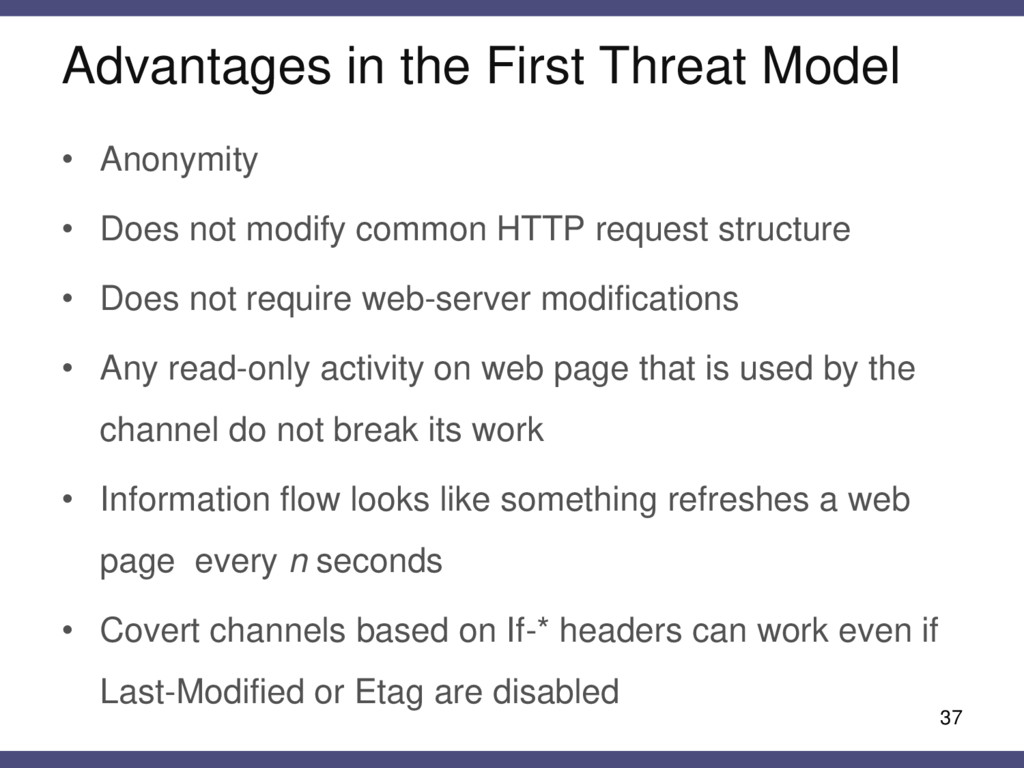
Does not modify common HTTP request structure • Does not require web-server modifications • Any read-only activity on web page that is used by the channel do not break its work • Information flow looks like something refreshes a web page every n seconds • Covert channels based on If-* headers can work even if Last-Modified or Etag are disabled
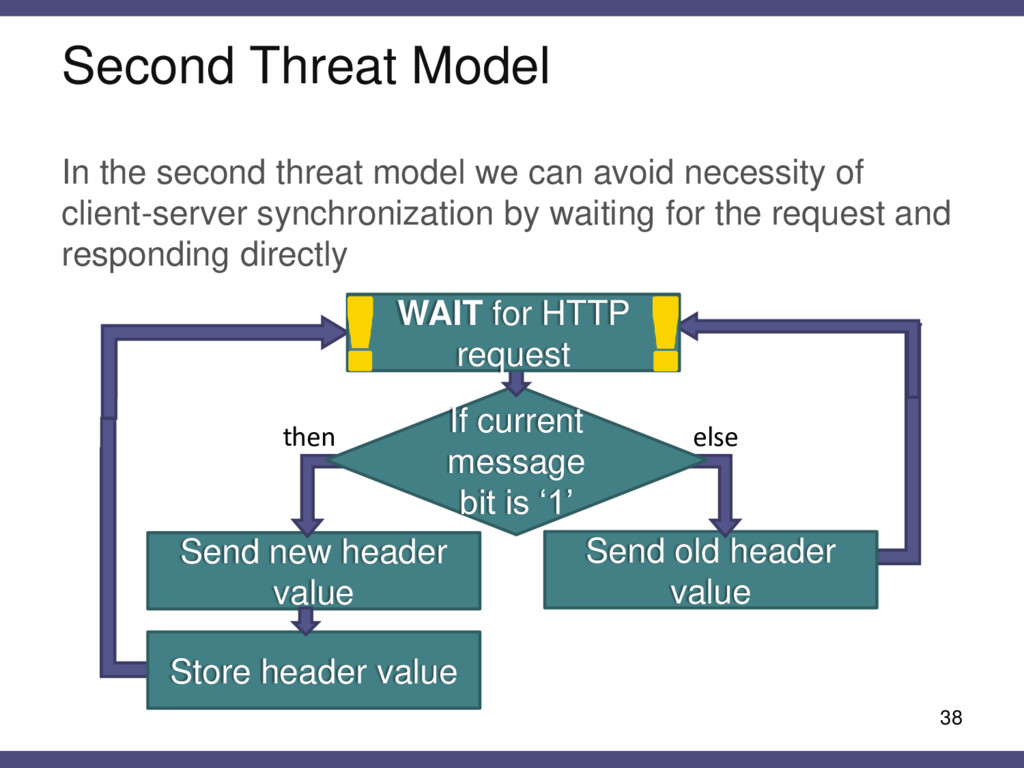
avoid necessity of client-server synchronization by waiting for the request and responding directly 38 Send new header value Send old header value If current message bit is ‘1’ Store header value then else WAIT for HTTP request
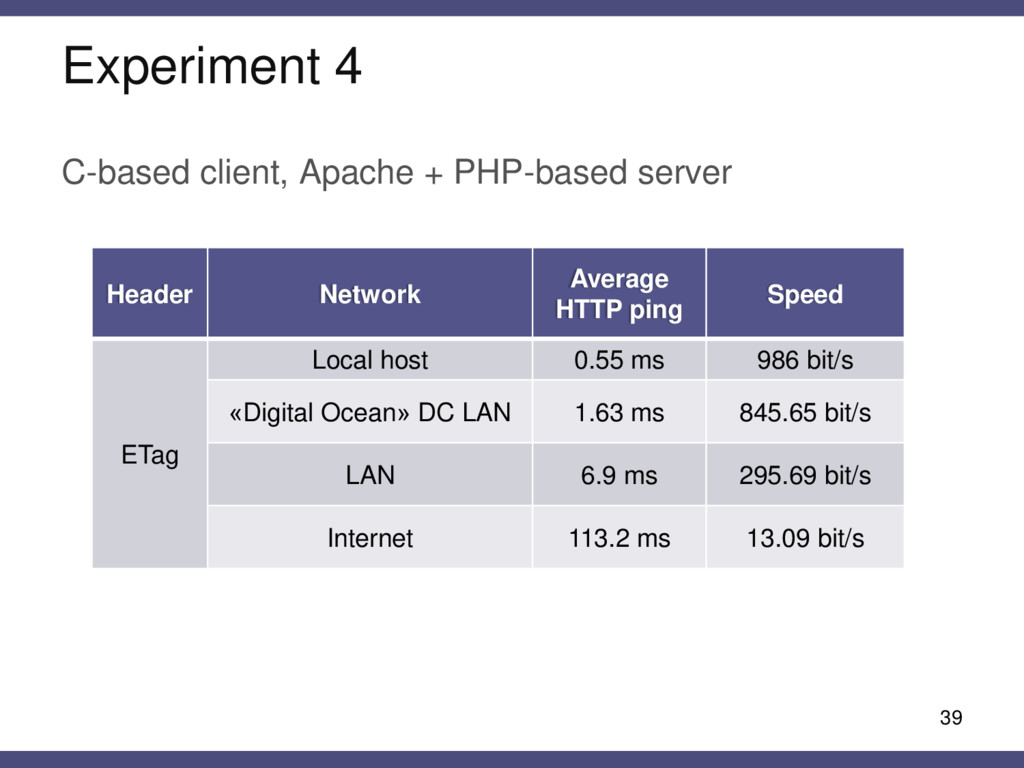
Network Average HTTP ping Speed ETag Local host 0.55 ms 986 bit/s «Digital Ocean» DC LAN 1.63 ms 845.65 bit/s LAN 6.9 ms 295.69 bit/s Internet 113.2 ms 13.09 bit/s
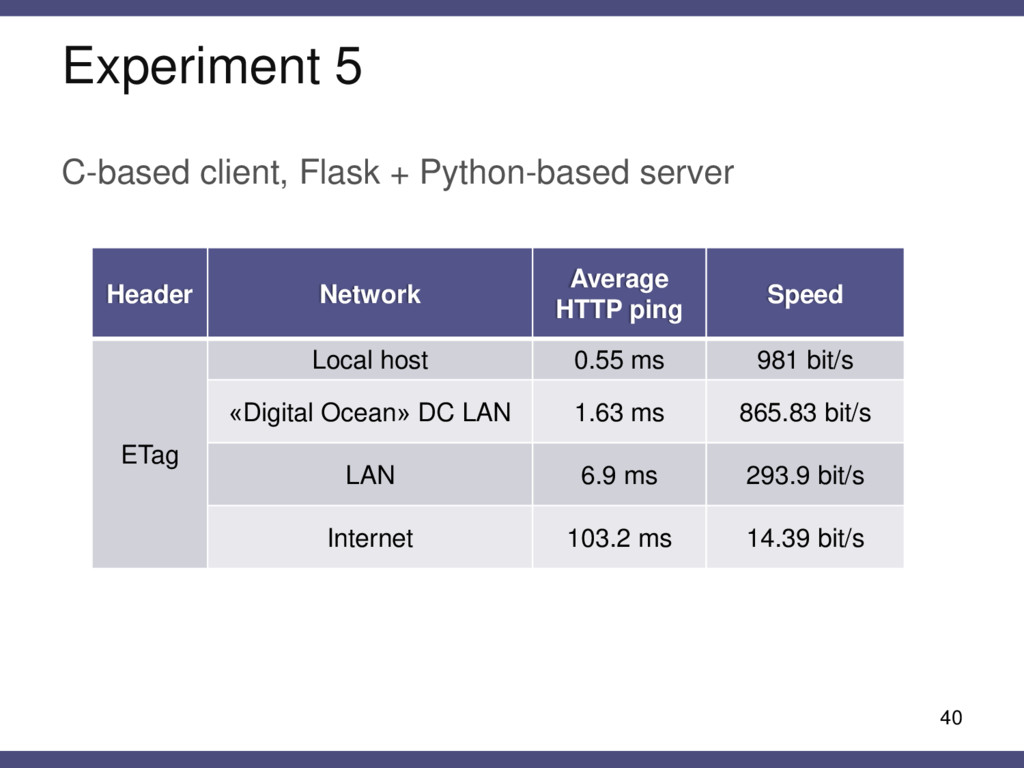
Network Average HTTP ping Speed ETag Local host 0.55 ms 981 bit/s «Digital Ocean» DC LAN 1.63 ms 865.83 bit/s LAN 6.9 ms 293.9 bit/s Internet 103.2 ms 14.39 bit/s
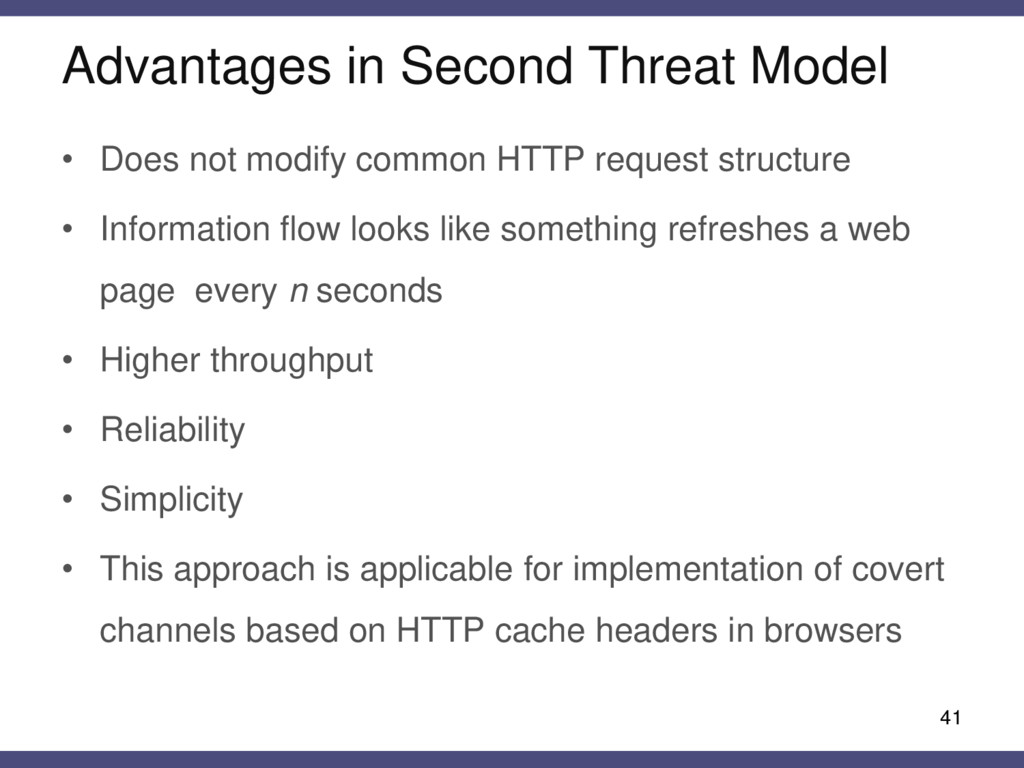
common HTTP request structure • Information flow looks like something refreshes a web page every n seconds • Higher throughput • Reliability • Simplicity • This approach is applicable for implementation of covert channels based on HTTP cache headers in browsers
function • Low accuracy of existing time management functions • Difficulties with synchronization of covert channel’s server and client So implementation of the used model is pointless, but it is possible to implement covert channels in these restrictions using controlled web server in the second threat model 42
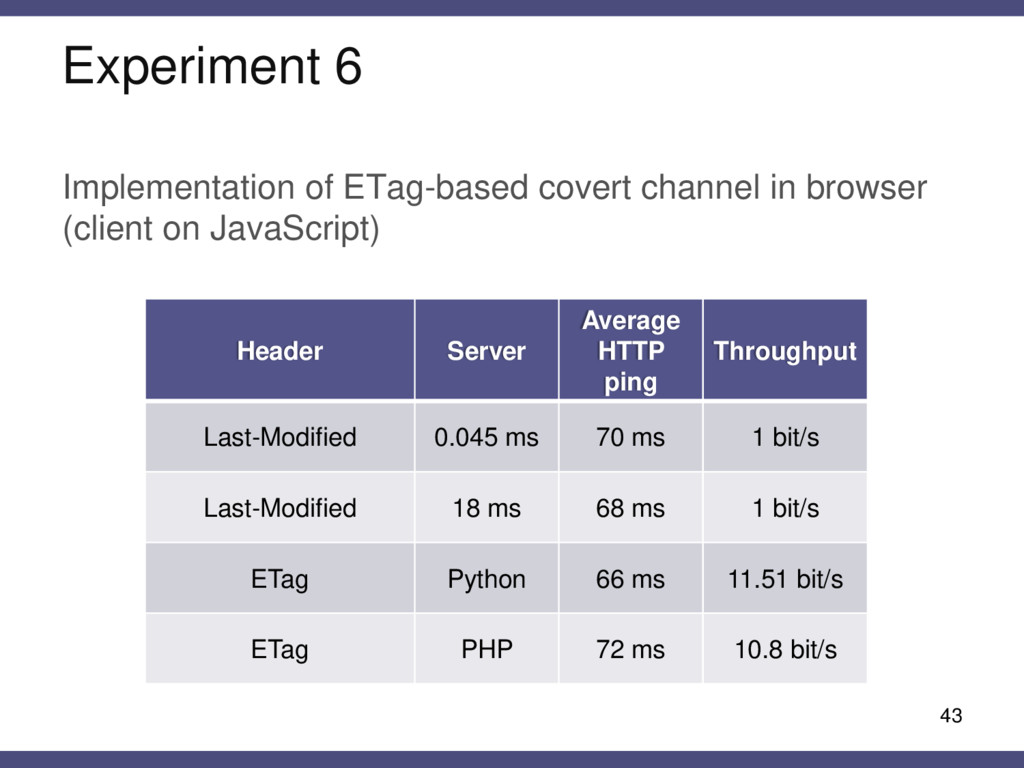
43 Experiment 6 Header Server Average HTTP ping Throughput Last-Modified 0.045 ms 70 ms 1 bit/s Last-Modified 18 ms 68 ms 1 bit/s ETag Python 66 ms 11.51 bit/s ETag PHP 72 ms 10.8 bit/s
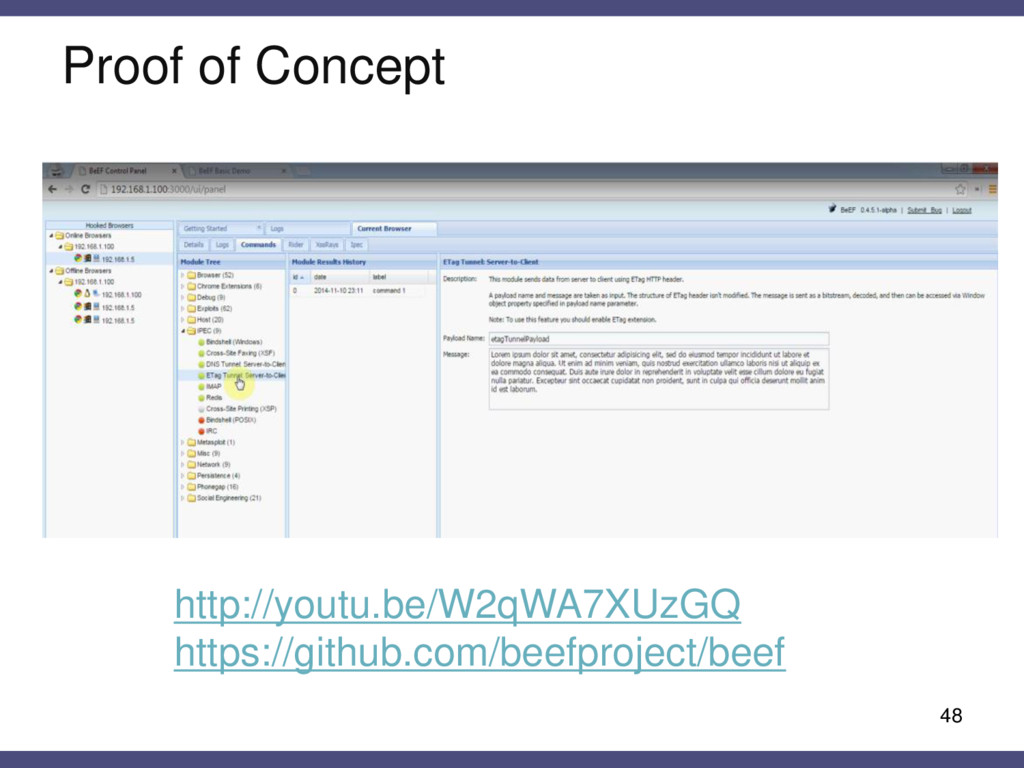
to assess the actual security posture of a target environment by using client-side attack vectors.” The main idea was proposed in Kenton Born’s paper “Browser-based covert data exfiltration” [2] and is being used in BeEF [3] To investigate covert timing channels in browsers we implemented server-to-client DNS and ETag Tunnels using AJAX and then added them to BeEF 44
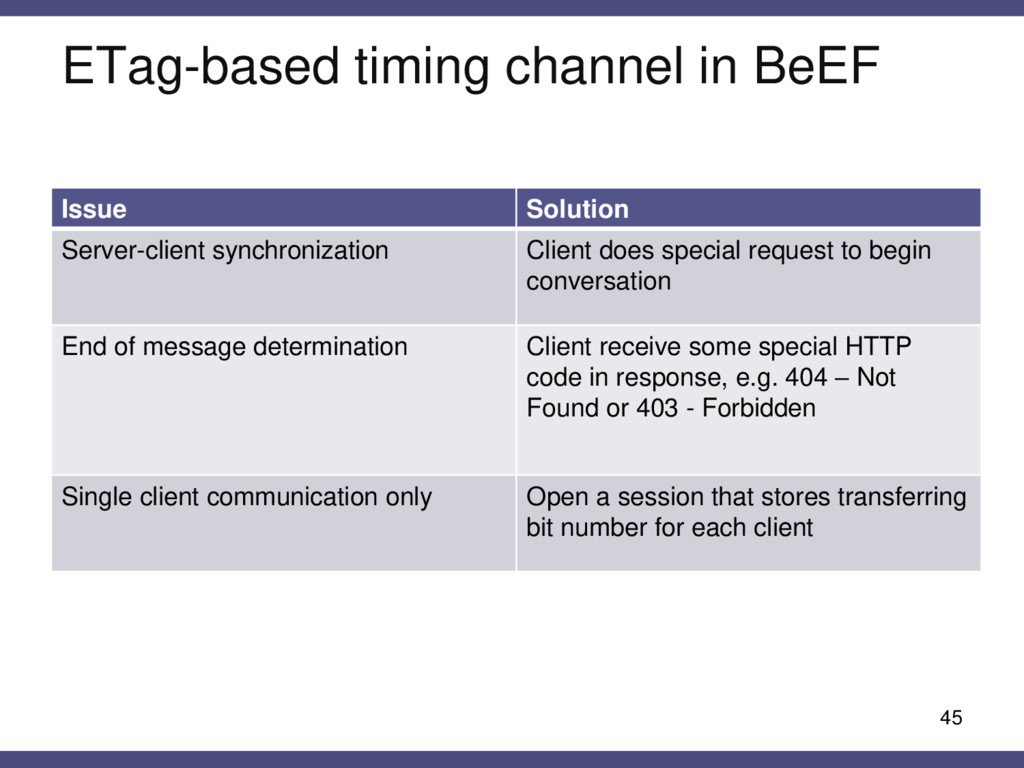
Client does special request to begin conversation End of message determination Client receive some special HTTP code in response, e.g. 404 – Not Found or 403 - Forbidden Single client communication only Open a session that stores transferring bit number for each client
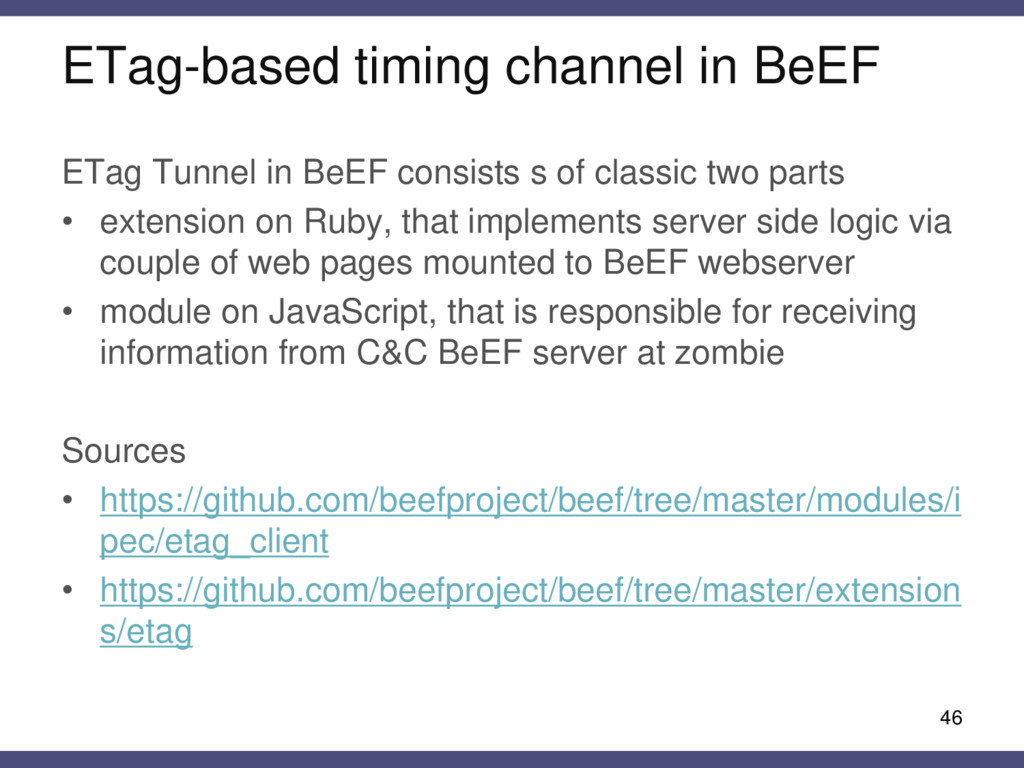
consists s of classic two parts • extension on Ruby, that implements server side logic via couple of web pages mounted to BeEF webserver • module on JavaScript, that is responsible for receiving information from C&C BeEF server at zombie Sources • https://github.com/beefproject/beef/tree/master/modules/i pec/etag_client • https://github.com/beefproject/beef/tree/master/extension s/etag
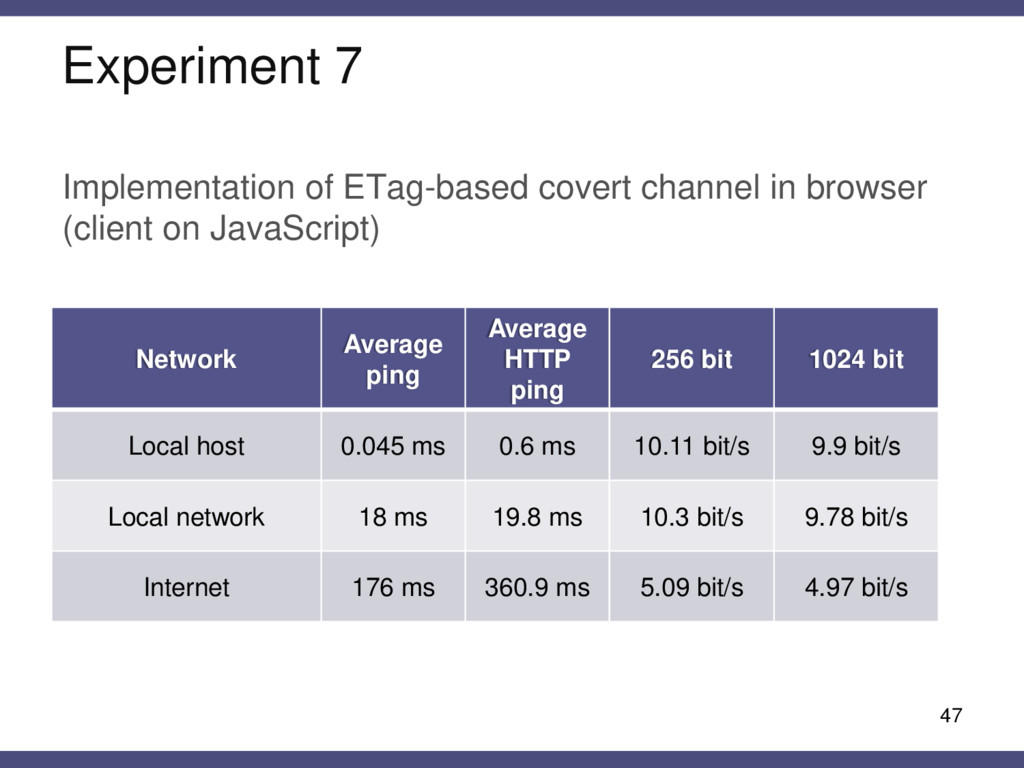
47 Experiment 7 Network Average ping Average HTTP ping 256 bit 1024 bit Local host 0.045 ms 0.6 ms 10.11 bit/s 9.9 bit/s Local network 18 ms 19.8 ms 10.3 bit/s 9.78 bit/s Internet 176 ms 360.9 ms 5.09 bit/s 4.97 bit/s
E. Covert channels in the HTTP network protocol: Channel characterization and detecting man-in-the- middle attacks. URL: https://ritdml.rit.edu/handle/1850/14797 2. Kenton Born. «Browser-based covert data exfiltration». URL: http://arxiv.org/ftp/arxiv/papers/1004/1004.4357.pdf 3. W. Alcorn, C. Frichot, M. Orru. «The Browser Hacker’s Handbook». URL: http://eu.wiley.com/WileyCDA/WileyTitle/productCd- 1118662091.html


 dnkolegov
.png) satai
satai
 signer
 tattaka
 reokashiwa
 ftakahashi
 institutdelelevage
 yukiar
 kogoro
 youten622
 beale
beale
 stktu
stktu
 addyosmani
 maltzj
 keathley
 elsirapls
 jct
jct
 reverentgeek
 deanohume
 holman
 helmedeiros
 trallard
 techseoconnect










![50 Denis Kolegov [email protected] @dnkolegov Oleg Broslavsky [email protected] @yalegko Nikita](https://files.speakerdeck.com/presentations/396463786fb04e73b7d9acdf958f9d7b/slide_49.jpg)