Upgrade to Pro — share decks privately, control downloads, hide ads and more …

Helping Searchers Satisfice through Query Under...

Helping Searchers Satisfice through Query Understanding

This 2023 Walmart AI Summit keynote describes how behavioral economics transformed how we think about human decision making, rejecting expected utility maximization for the real world of heuristics, biases, and satisficing. It argues that our thinking about search engines needs a similar transformation. It compares the Probability Ranking Principle to expected utility maximization and offer ways that AI can help searchers satisfice through query understanding.

Avatar for Daniel Tunkelang

Daniel Tunkelang

May 24, 2026

More Decks by Daniel Tunkelang

Other Decks in Technology

Transcript

  1. Overview • A Brief Introduction to Behavioral Economics • The

    Probability Ranking Principle and its Discontents • Can Dense Retrieval Help? • Problems that Dense Retrieval is still Neglecting • Helping Searchers Satisfice through Query Understanding
  2. Classical Economics: Expected Utility Maximization • People make decisions between

    alternatives everyday. • Utility maximization: people choose alternative with higher utility. • When outcomes are uncertain, people maximize expected utility. • Risk aversion makes people discount utility of risky outcomes. • Assumes people are rational and have complete information. • Homo economicus model dominated economics for a long time.
  3. Behavioral Economics: What People Really Do • People make decisions

    using bounded rationality. (Herb Simon, 1955) ◦ Limited information and limited resources to act on it. ◦ Instead of maximizing expected utility, people “satisfice”. • People act irrationally within their constraints. (Tversky and Kahneman, 1974) ◦ Risk evaluation depends on framing (e.g, winning vs. losing). ◦ Utility of an outcome depends on other options. ◦ Heuristics and biases maps people “predictably irrational”.
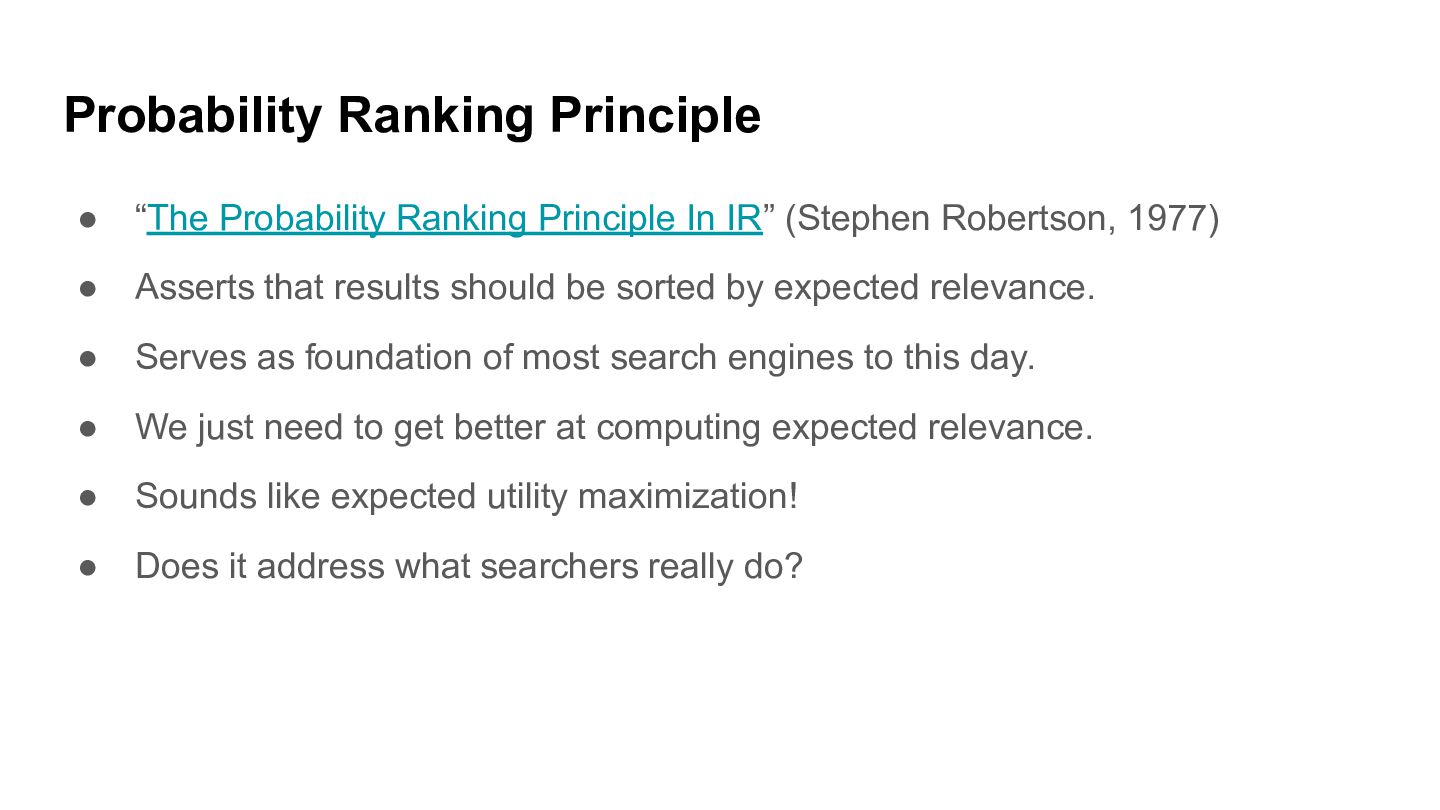
  4. Probability Ranking Principle • “The Probability Ranking Principle In IR”

    (Stephen Robertson, 1977) • Asserts that results should be sorted by expected relevance. • Serves as foundation of most search engines to this day. • We just need to get better at computing expected relevance. • Sounds like expected utility maximization! • Does it address what searchers really do?
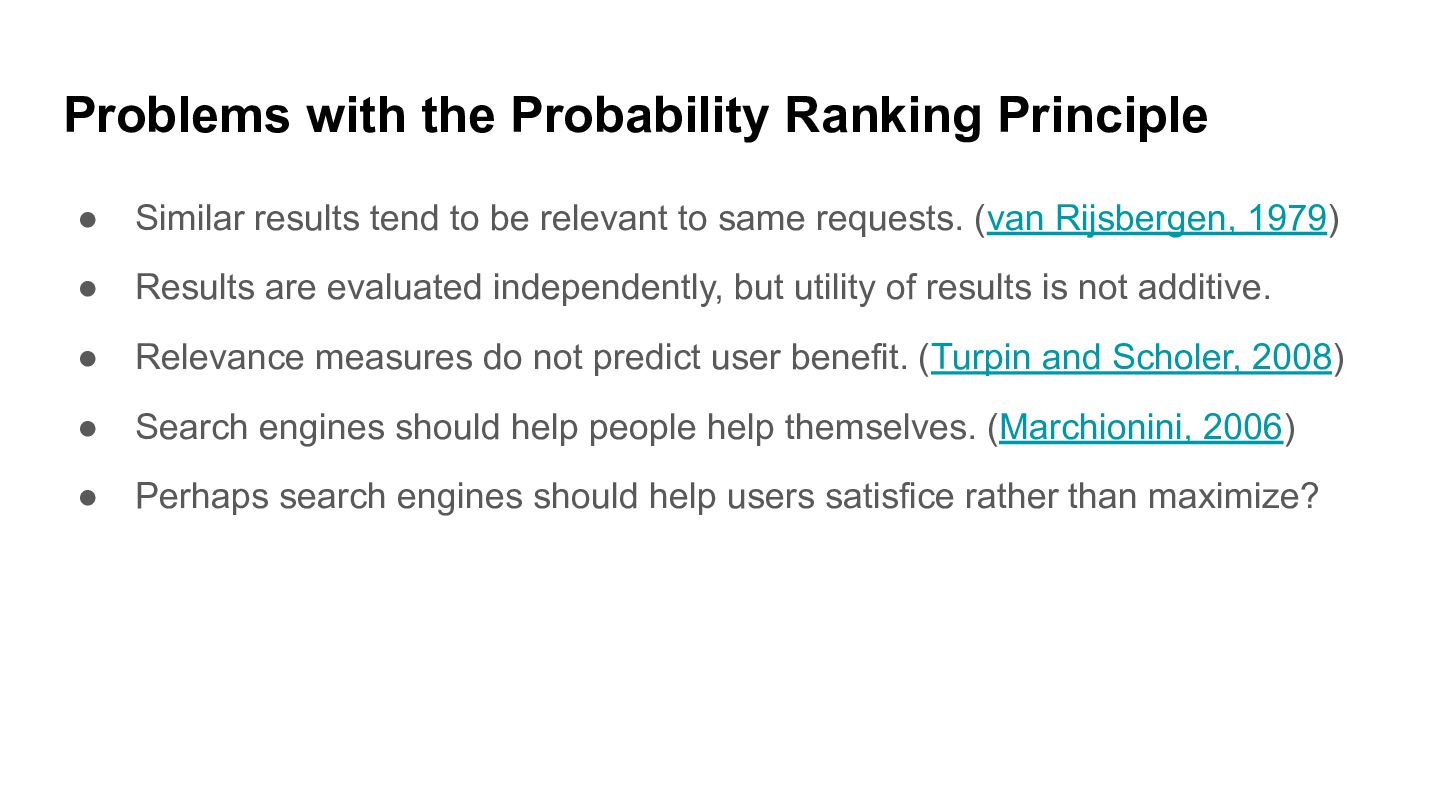
  5. Problems with the Probability Ranking Principle • Similar results tend

    to be relevant to same requests. (van Rijsbergen, 1979) • Results are evaluated independently, but utility of results is not additive. • Relevance measures do not predict user benefit. (Turpin and Scholer, 2008) • Search engines should help people help themselves. (Marchionini, 2006) • Perhaps search engines should help users satisfice rather than maximize?
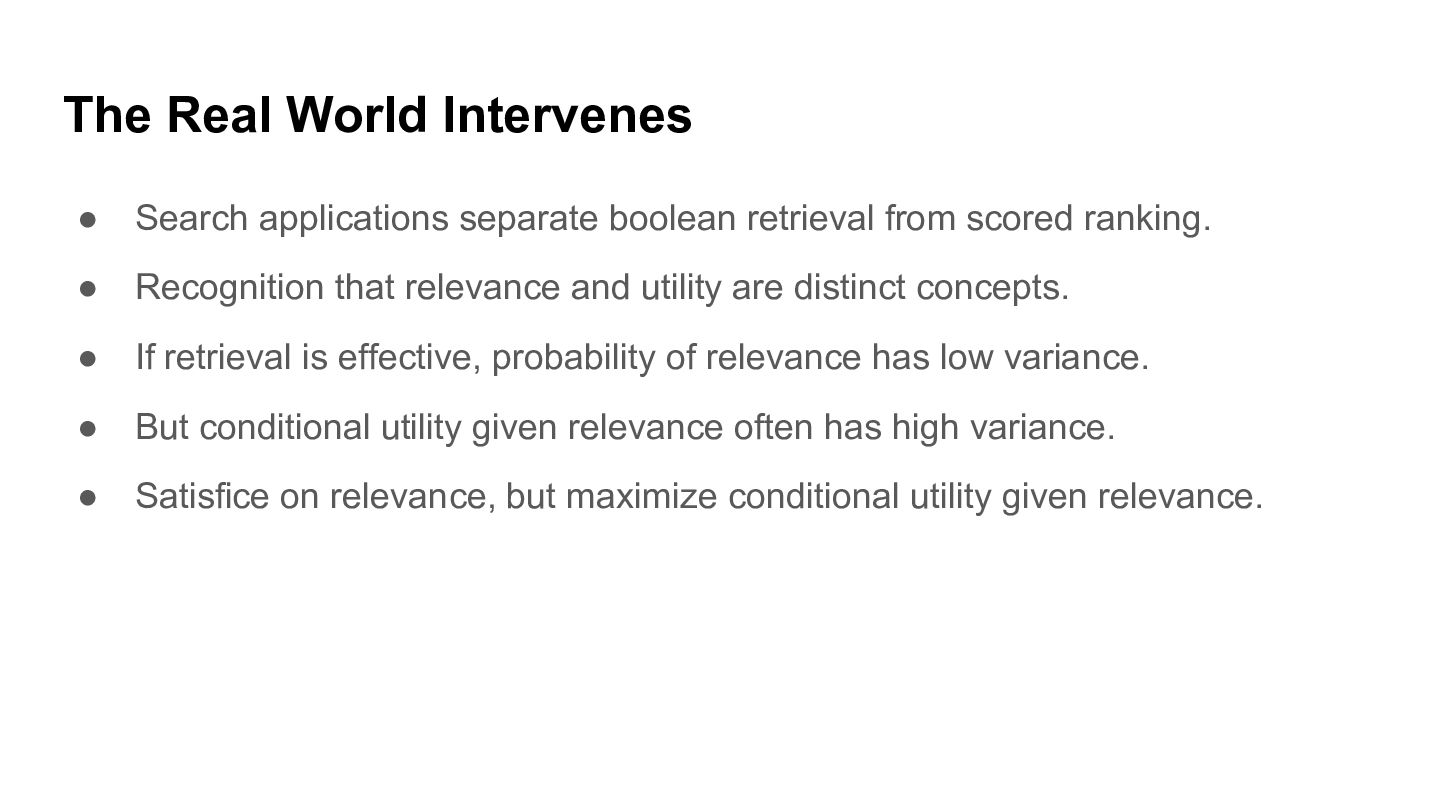
  6. The Real World Intervenes • Search applications separate boolean retrieval

    from scored ranking. • Recognition that relevance and utility are distinct concepts. • If retrieval is effective, probability of relevance has low variance. • But conditional utility given relevance often has high variance. • Satisfice on relevance, but maximize conditional utility given relevance.
  7. Techniques that Have Worked • Multi-stage ranking for computational efficiency.

    • Reranking results to increase diversity. • Training a separate relevance model. • Suggesting refinements to elicit more specific intents. • Autocomplete to nudge users to better queries. • Content and query understanding.
  8. AI Enables the Vector Space Model on Steroids! • Embeddings

    transform content and queries into vectors. • Similarity-based nearest-neighbor retrieval. • But it is still a vector space model! (Salton, 1974) • Efforts to improve embedding quality and efficiency. • Expected utility maximization, but with better tools.
  9. But does this really help? • Most queries are still

    short, often a single entity. • Eliciting searcher's intent still as big a challenge as ranking. • Relevance still feels binary for most applications. • Which is a challenge for similarity-based retrieval. • Fine-grained scoring is poor fit for short queries. • Focus is expected utility maximization, not satisficing.
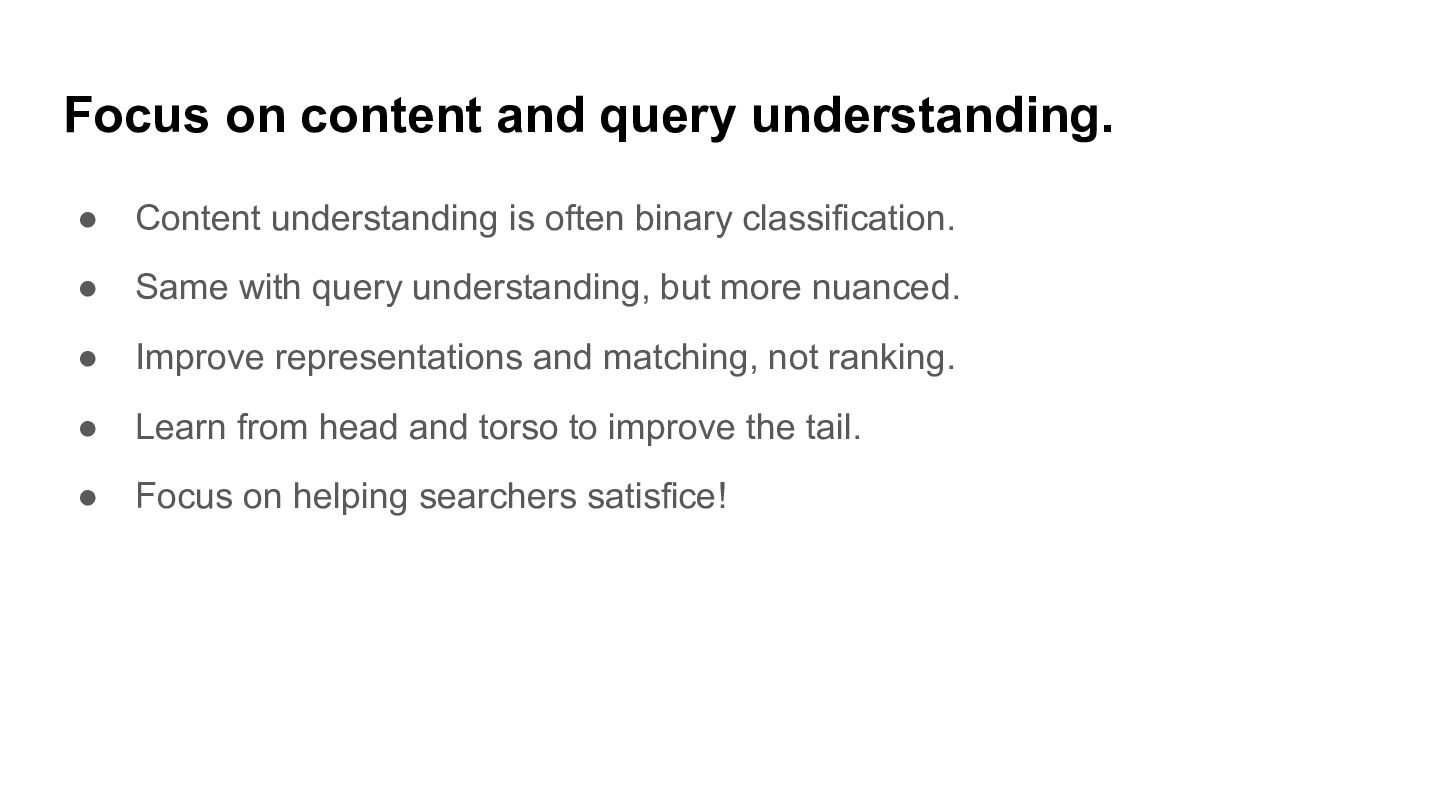
  10. Focus on content and query understanding. • Content understanding is

    often binary classification. • Same with query understanding, but more nuanced. • Improve representations and matching, not ranking. • Learn from head and torso to improve the tail. • Focus on helping searchers satisfice!
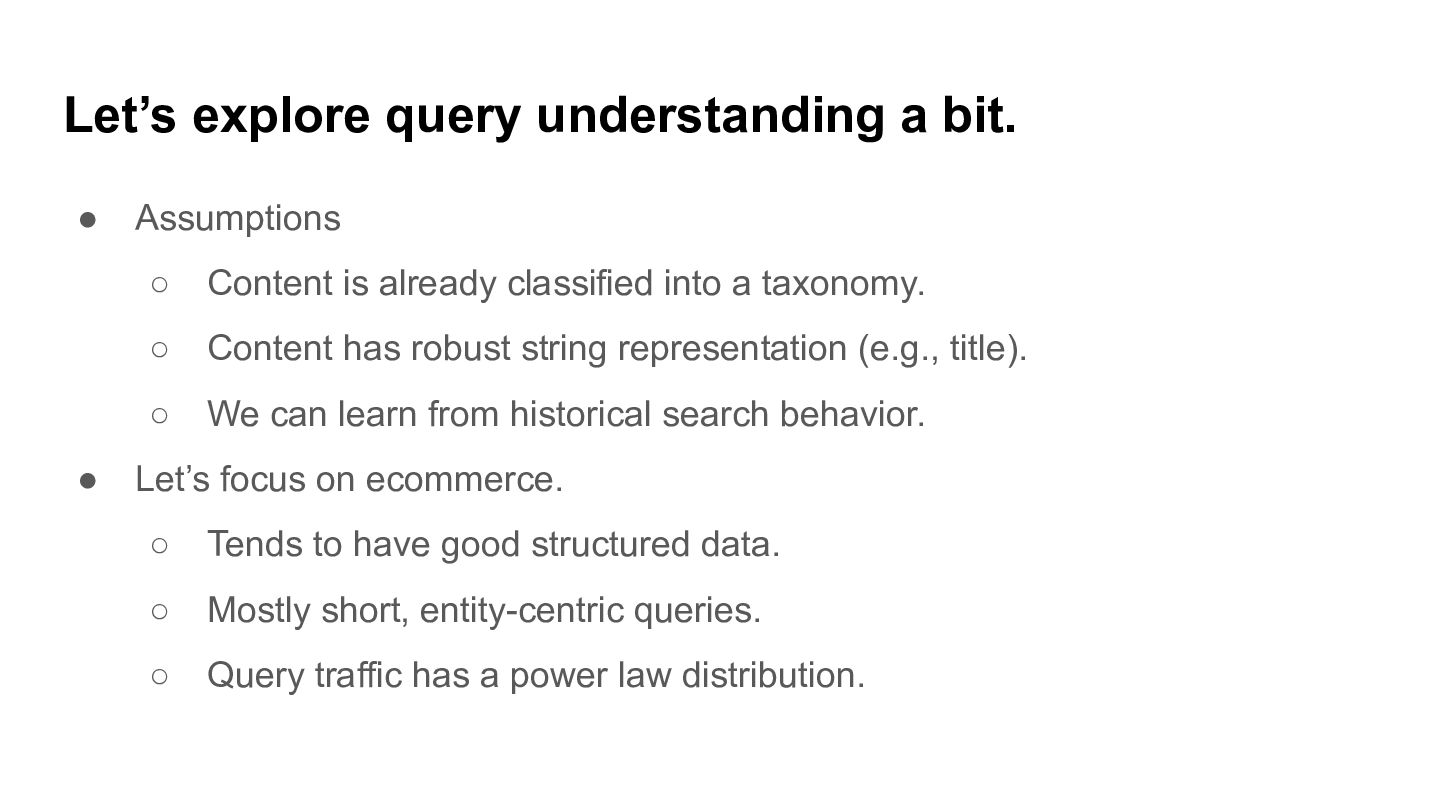
  11. Let’s explore query understanding a bit. • Assumptions ◦ Content

    is already classified into a taxonomy. ◦ Content has robust string representation (e.g., title). ◦ We can learn from historical search behavior. • Let’s focus on ecommerce. ◦ Tends to have good structured data. ◦ Mostly short, entity-centric queries. ◦ Query traffic has a power law distribution.
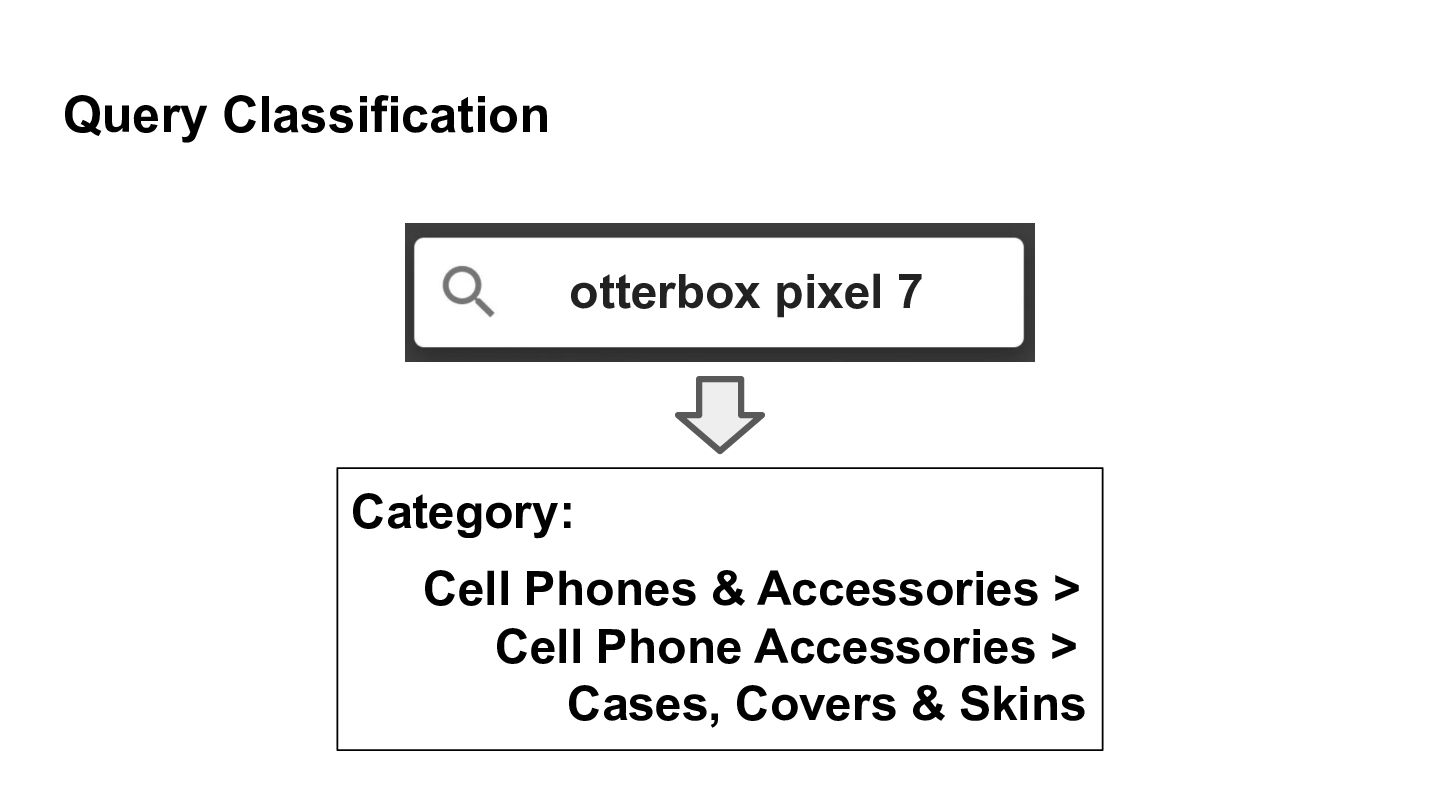
  12. Query Classification Category: Cell Phones & Accessories > Cell Phone

    Accessories > Cases, Covers & Skins otterbox pixel 7
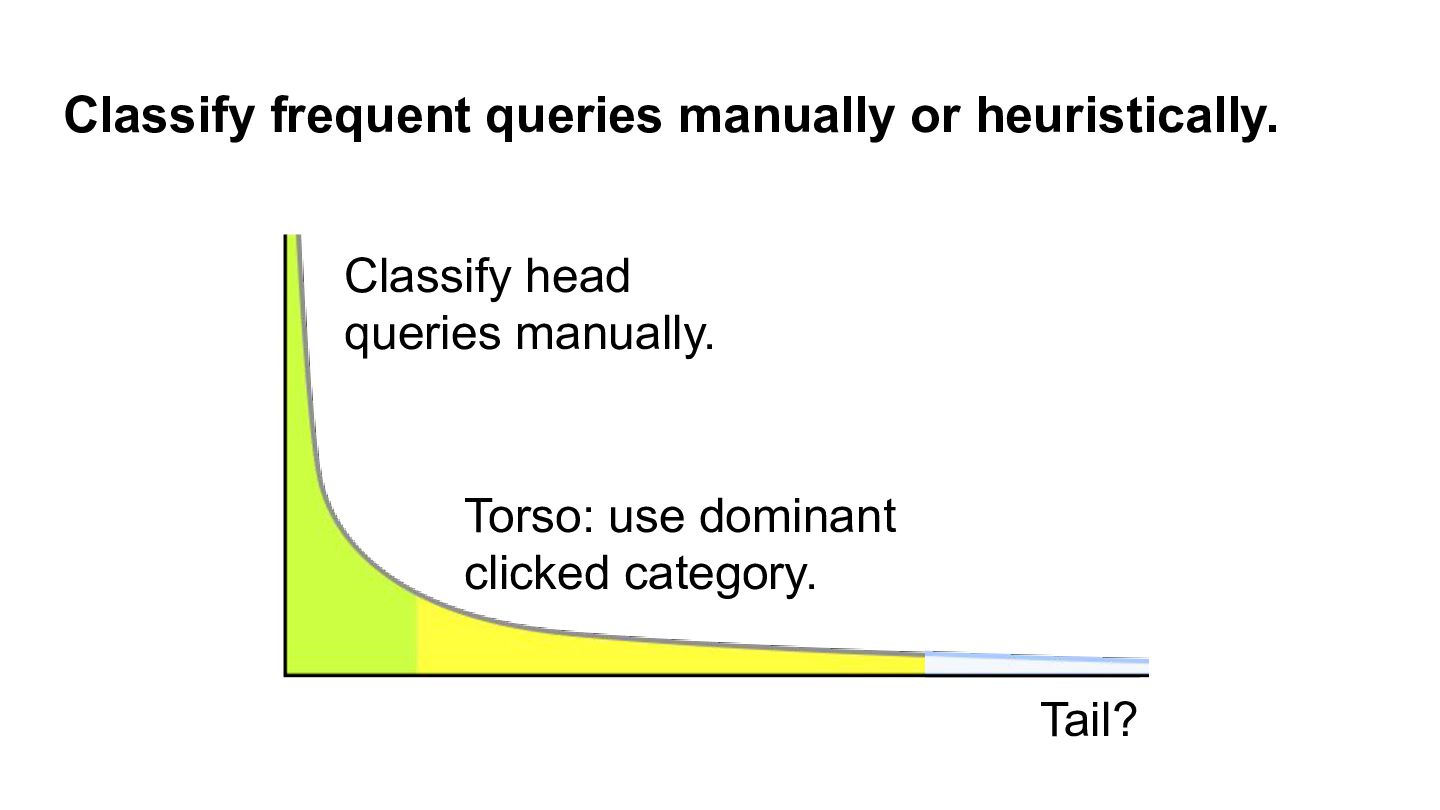
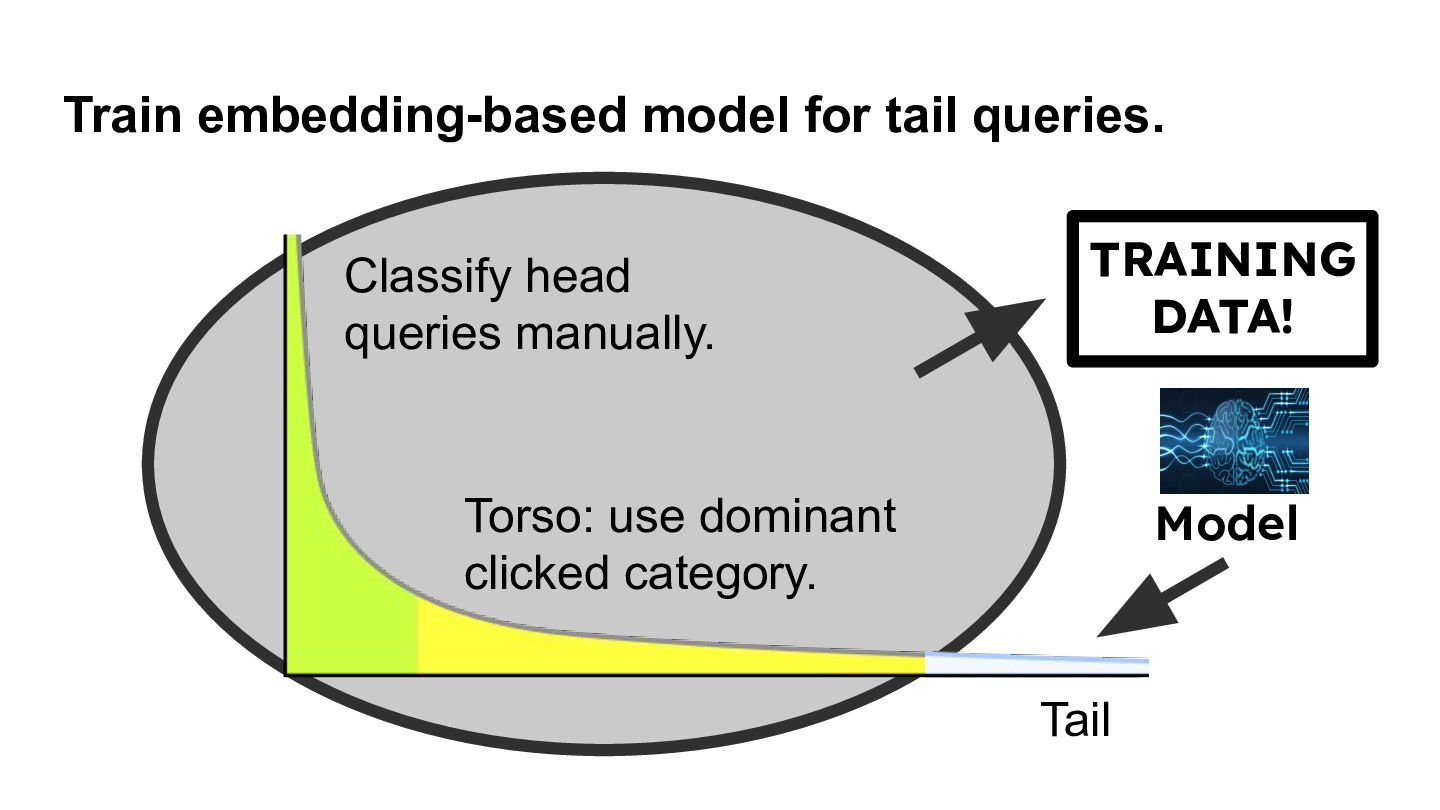
  13. Train embedding-based model for tail queries. Torso: use dominant clicked

    category. Classify head queries manually. Tail TRAINING DATA! Model
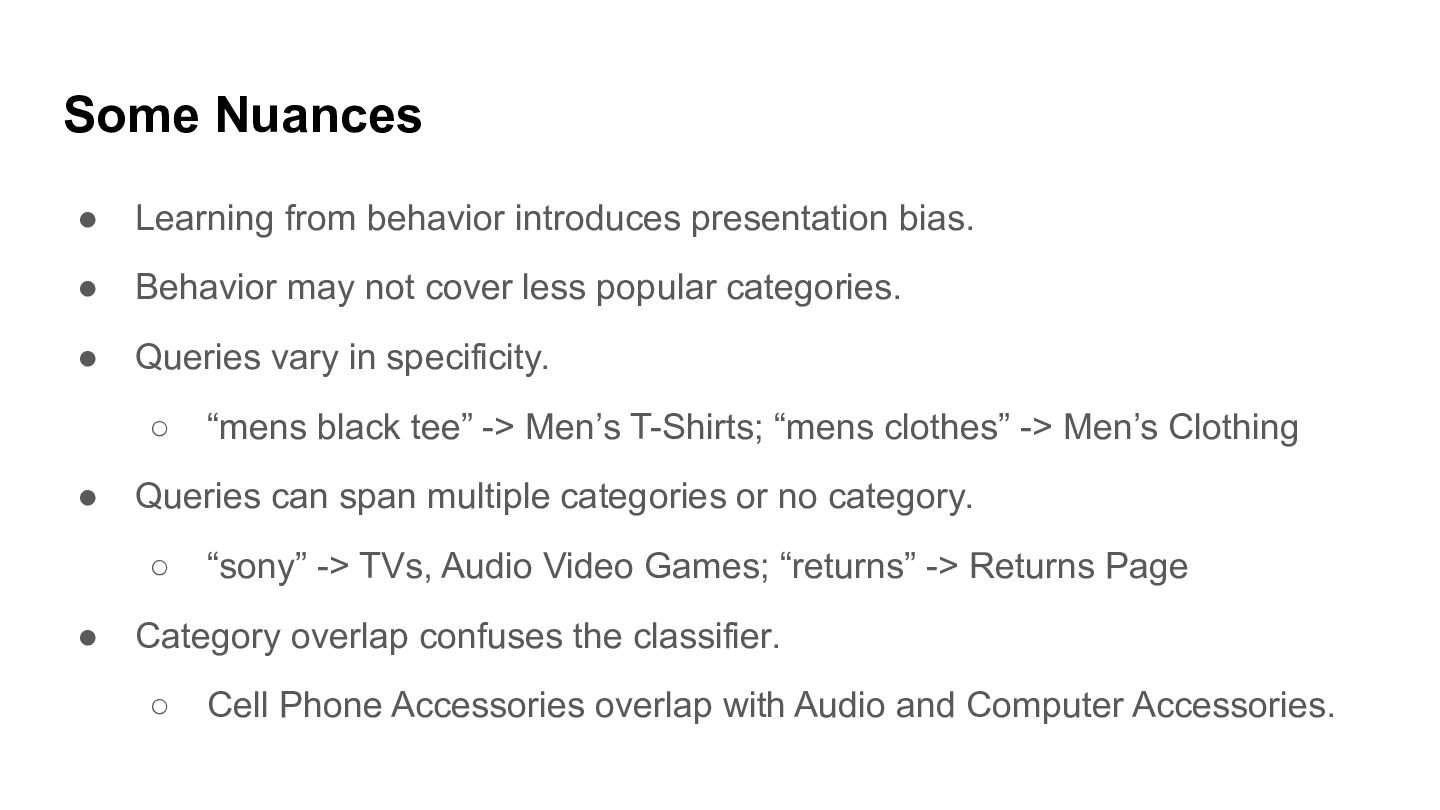
  14. Some Nuances • Learning from behavior introduces presentation bias. •

    Behavior may not cover less popular categories. • Queries vary in specificity. ◦ “mens black tee” -> Men’s T-Shirts; “mens clothes” -> Men’s Clothing • Queries can span multiple categories or no category. ◦ “sony” -> TVs, Audio Video Games; “returns” -> Returns Page • Category overlap confuses the classifier. ◦ Cell Phone Accessories overlap with Audio and Computer Accessories.
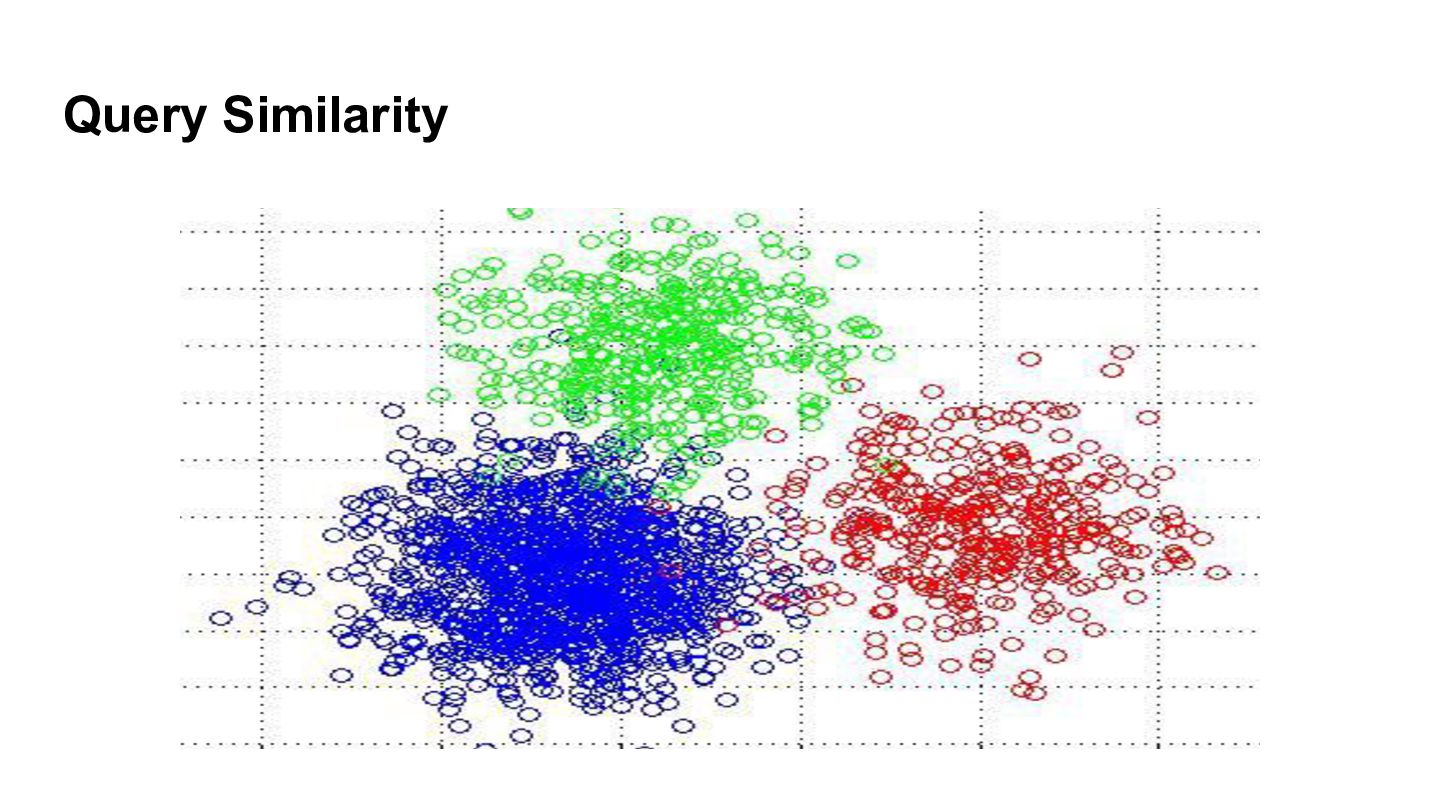
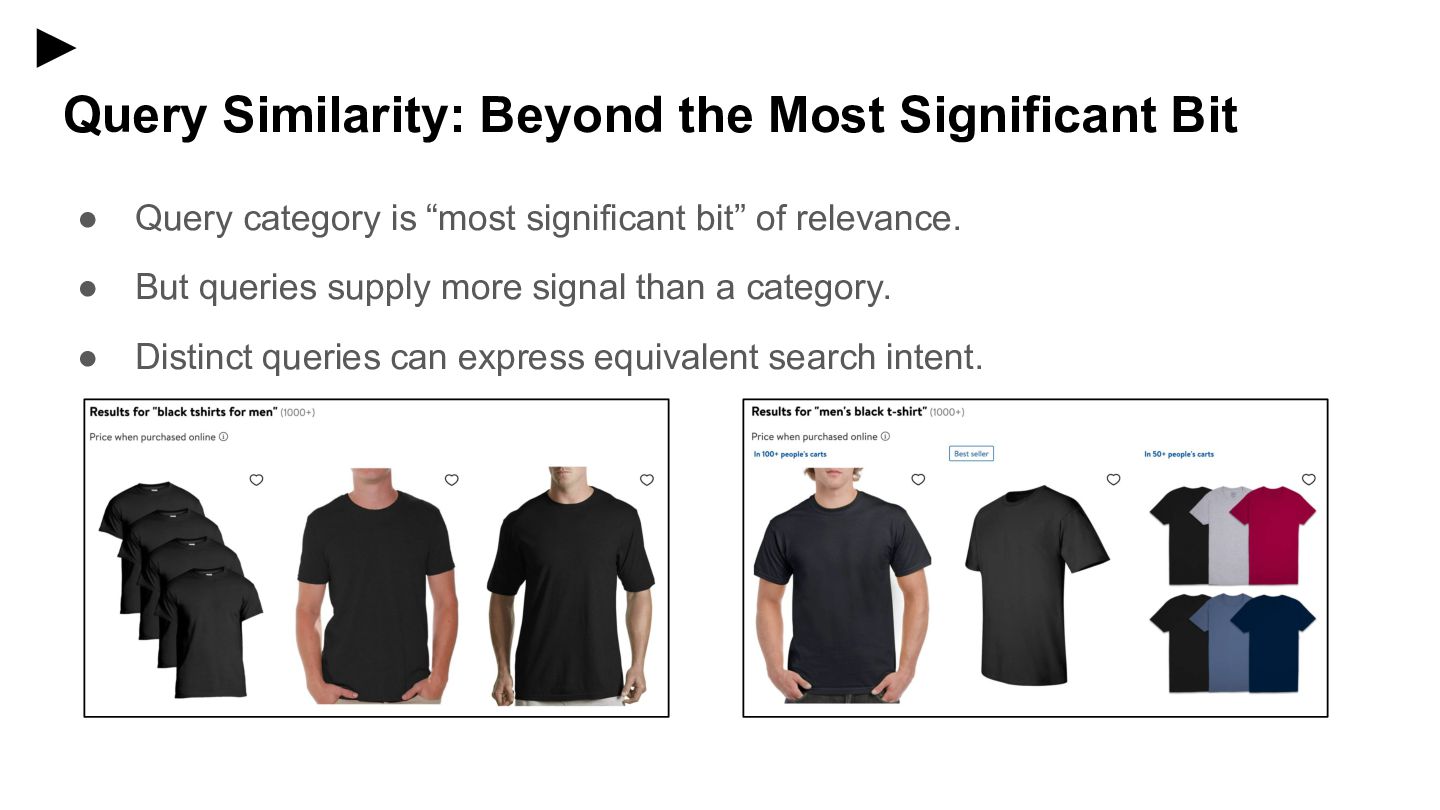
  15. Query Similarity: Beyond the Most Significant Bit • Query category

    is “most significant bit” of relevance. • But queries supply more signal than a category. • Distinct queries can express equivalent search intent. ►
  16. How do we compute query similarity? • Superficial Query Similarity

    ◦ Variations in stemming, word order, stop words, etc. ◦ Effective but limited approach. ◦ Needs guardrails for precision, e.g., shirt dress != dress shirt. • Embeddings ◦ Looks beyond tokens and superficial signals. ◦ But most queries are short!
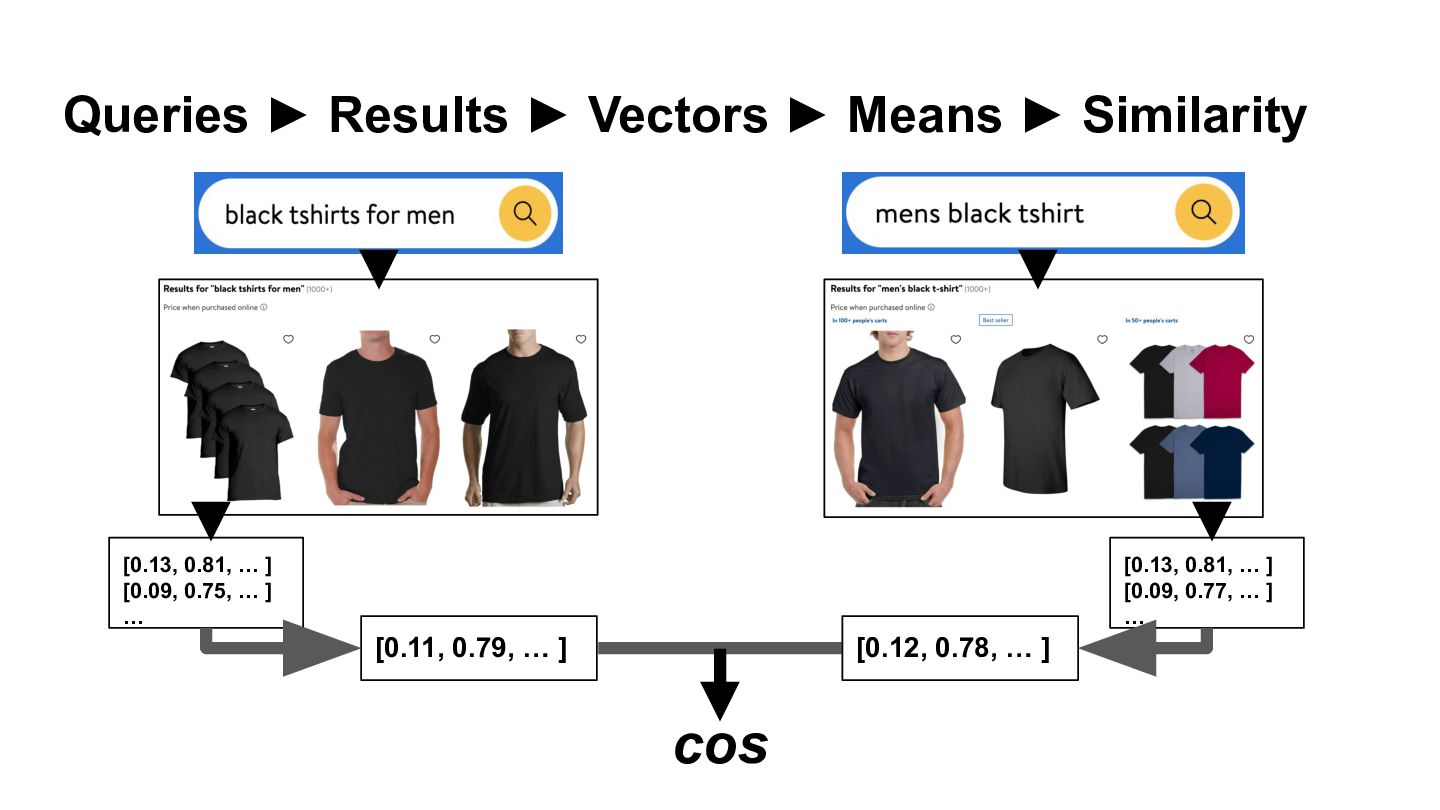
  17. Compute query vector as mean of document vectors. • Aggregate

    mean of document vectors for clicks or purchases. • Documents have more robust string representations than queries. • Aggregating document vectors reduces noise and variance. • Even works well with “primitive” embeddings like fastText. • Requires retrieval and ranking to be good enough. • Biggest risk: no engagement for unretrieved results.
  18. Queries ► Results ► Vectors ► Means ► Similarity ►

    ► [0.13, 0.81, … ] [0.09, 0.75, … ] … ► [0.11, 0.79, … ] [0.13, 0.81, … ] [0.09, 0.77, … ] … ► [0.12, 0.78, … ] ► cos
  19. Simple, effective, but limited to offline computation. • Only works

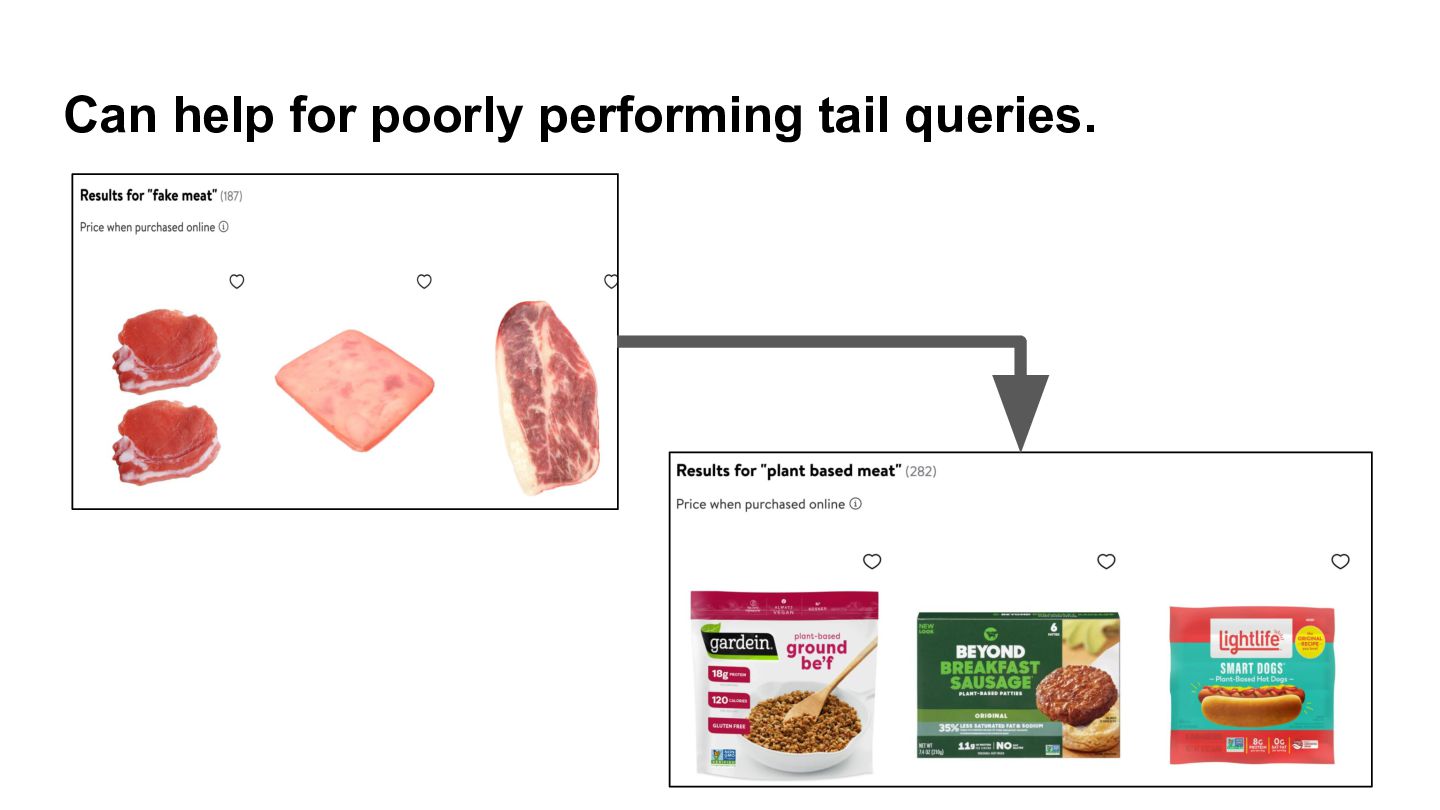
    for queries that have engagement history. • Would be expensive to compute aggregates online. • Still, head and torso queries are a large fraction of traffic. • Can use nearest neighbors to improve recall. • Can replace query-level analytics with intent-level analytics. • But what do we do for tail queries?
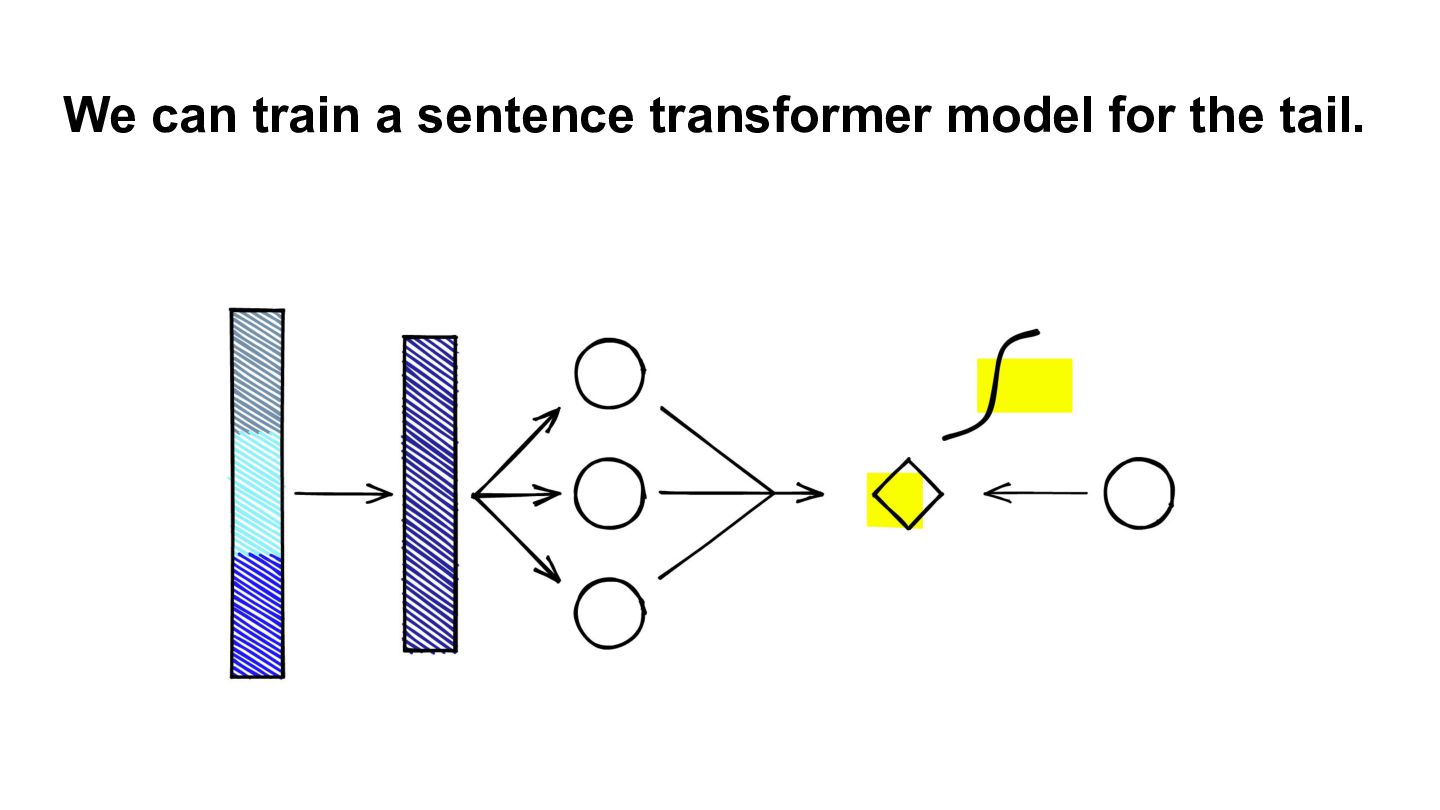
  20. Same trick: use head and torso queries for training. •

    Training data consists of (query 1 , query 2 , similarity) triples. • We focus on how well query 2 substitutes for query 1 . • Below a certain similarity, we don’t care about precise score. • Important to oversample relatively similar query pairs. • Fine-tune a pre-trained sentence transformer model. • Can use output of query classifier as an input. • Generalizes “bag of documents” model to tail queries.
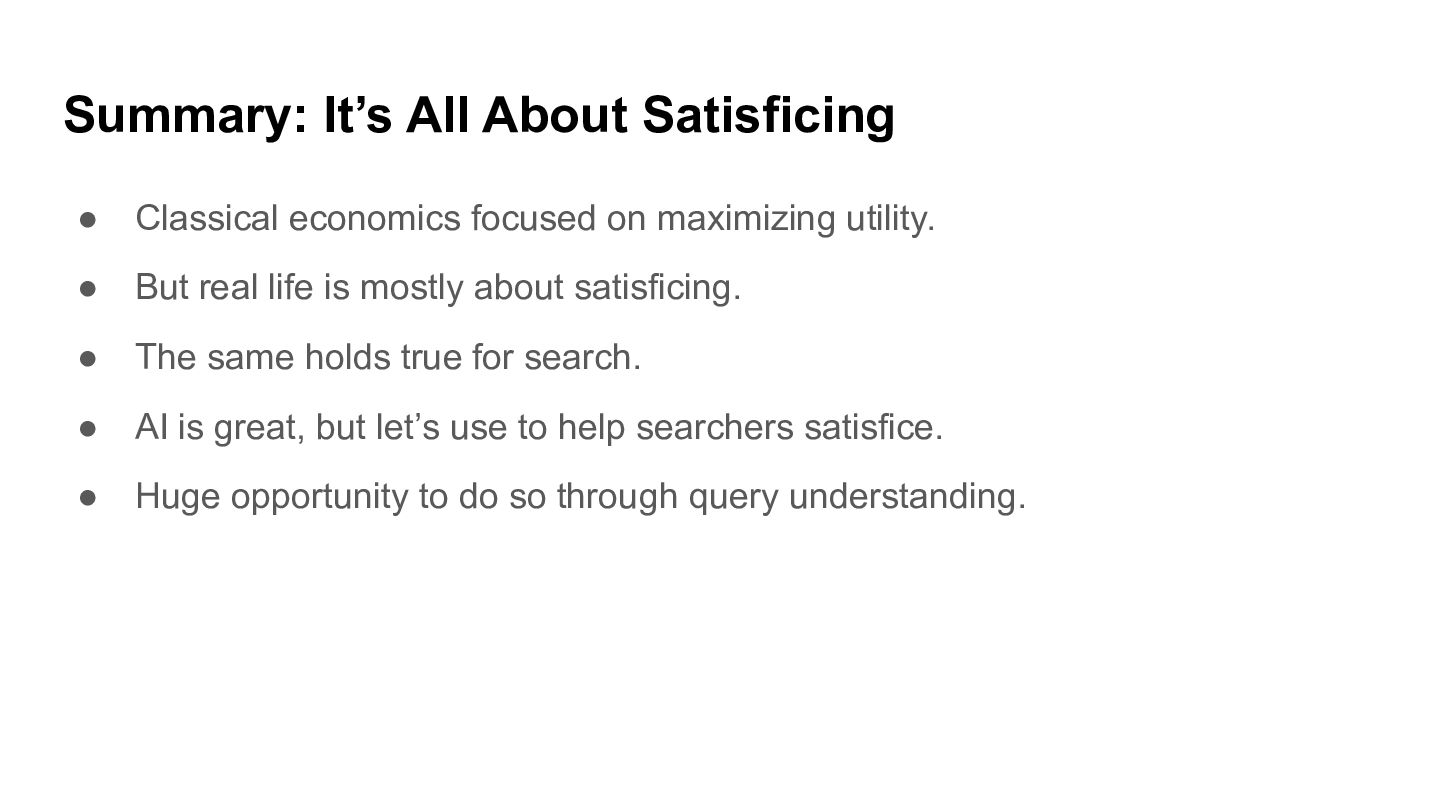
  21. Summary: It’s All About Satisficing • Classical economics focused on

    maximizing utility. • But real life is mostly about satisficing. • The same holds true for search. • AI is great, but let’s use to help searchers satisfice. • Huge opportunity to do so through query understanding.