Share
Embed
Scientific best-practices for recurring problems in computer security R& D

Daniyel Yaacov
April 03, 2014
Transcript
34 slides
-
Scien&fic Best-‐Prac&ces for Recurring Problems in Computer Security R
& D Daniel Bilar Director of Research, Siege Technologies Manchester, New Hampshire, USA [email protected] @daniel_bilar SyScan 2014 Singapore April 3rd, 2014 1 -
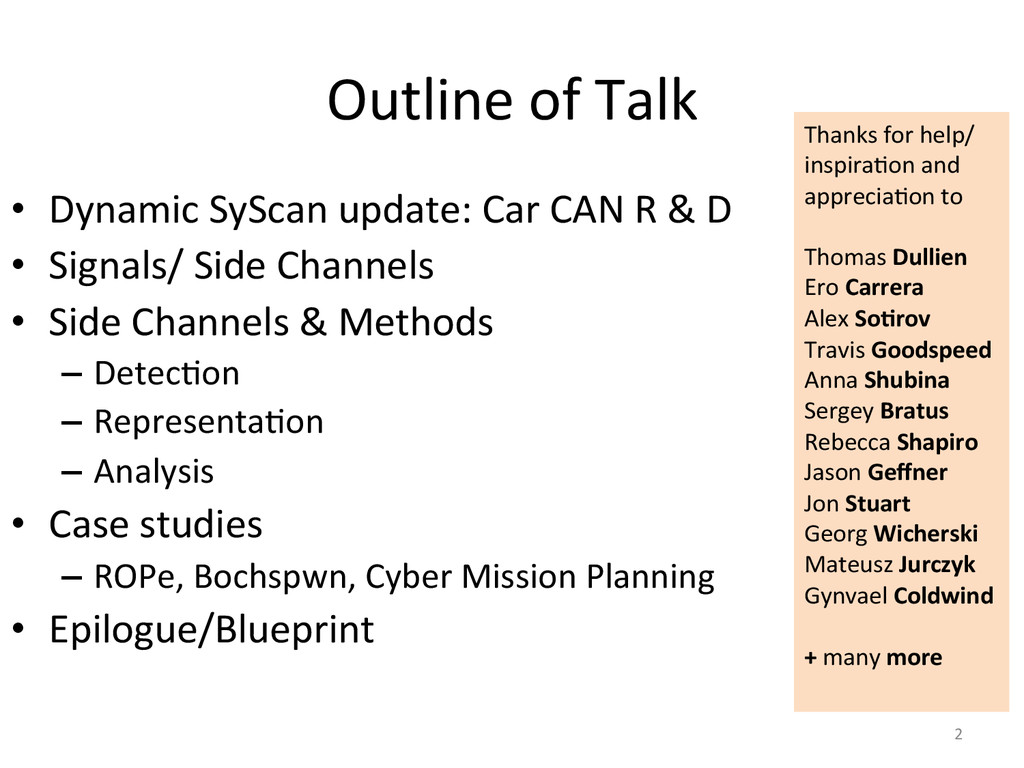
• Dynamic SyScan update: Car CAN R & D
• Signals/ Side Channels • Side Channels & Methods – Detec&on – Representa&on – Analysis • Case studies – ROPe, Bochspwn, Cyber Mission Planning • Epilogue/Blueprint Outline of Talk 2 Thanks for help/ inspira&on and apprecia&on to Thomas Dullien Ero Carrera Alex So-rov Travis Goodspeed Anna Shubina Sergey Bratus Rebecca Shapiro Jason Geffner Jon Stuart Georg Wicherski Mateusz Jurczyk Gynvael Coldwind + many more -
Addendum: Car CAN bus hacking • Did a subset
of what Chris and Charlie did in March 2013, presented at RECon June 2013 • “Hot-Wiring of the Future” – Lots of &ps, (free, $) tools, workflow/methodology, Costs: $6k (2 cars) • Sponsored 3 undergraduate students (knew nothing at all about RE) who learned how to reverse, hook up boards, use goodThopter and denial of view/manipula&on of CAN dashboard in 3 months 3 GoodThopter10 CAN Bus So`ware Package User hap://&nyurl.com/CarCAN2013 -
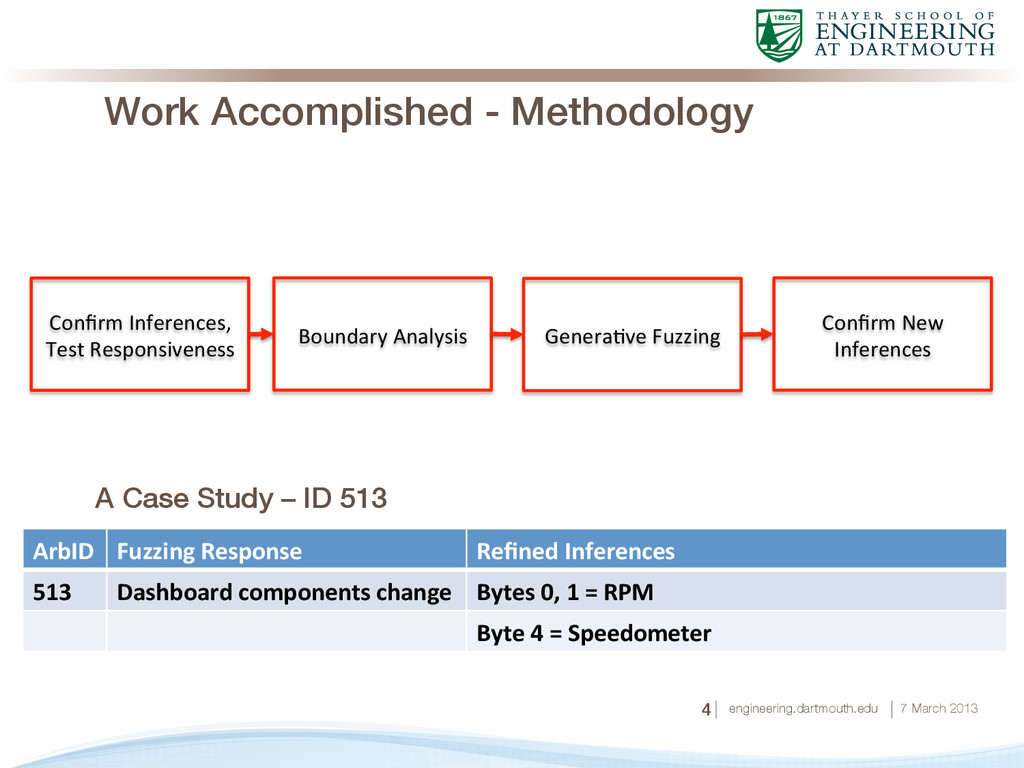
Work Accomplished - Methodology Confirm Inferences, Test Responsiveness
Boundary Analysis Genera&ve Fuzzing Confirm New Inferences 4! ArbID Fuzzing Response Refined Inferences 513 Dashboard components change Bytes 0, 1 = RPM Byte 4 = Speedometer A Case Study – ID 513 engineering.dartmouth.edu 7 March 2013 -
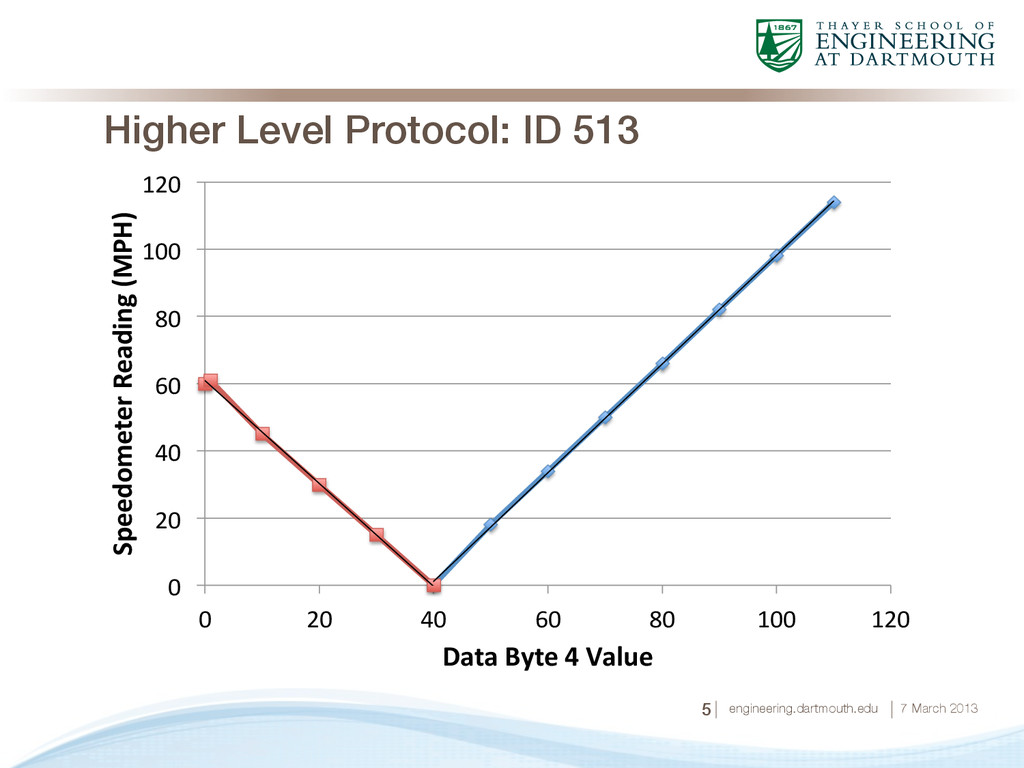
0 20 40 60 80
100 120 0 20 40 60 80 100 120 Speedometer Reading (MPH) Data Byte 4 Value 5! Higher Level Protocol: ID 513 engineering.dartmouth.edu 7 March 2013 -
Higher Level Protocol: ID 1056 1056 DLC =
8 Engine Temp Odometer Ba[ery Charge Engine Clock Dashboard Warnings Check Fuel Cap Unused Counter S O F Arbitra&on ID Control Field Data Field E O F 6! engineering.dartmouth.edu 7 March 2013 -
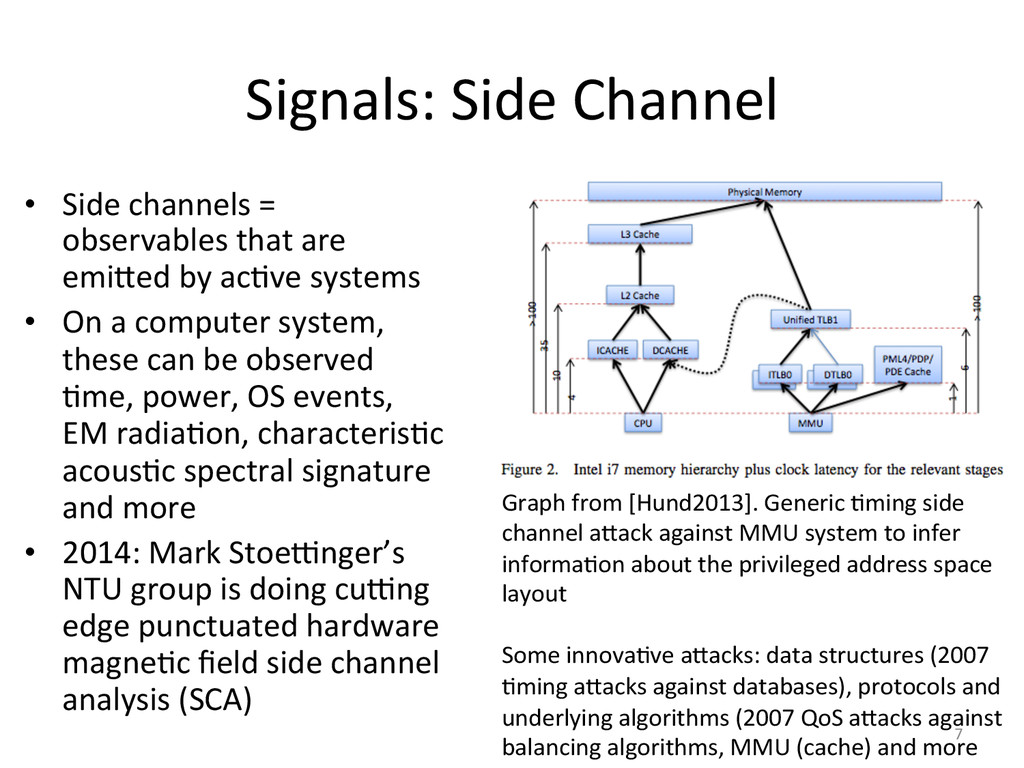
Signals: Side Channel • Side channels = observables
that are emiaed by ac&ve systems • On a computer system, these can be observed &me, power, OS events, EM radia&on, characteris&c acous&c spectral signature and more • 2014: Mark Stoefnger’s NTU group is doing cufng edge punctuated hardware magne&c field side channel analysis (SCA) Graph from [Hund2013]. Generic &ming side channel aaack against MMU system to infer informa&on about the privileged address space layout Some innova&ve aaacks: data structures (2007 &ming aaacks against databases), protocols and underlying algorithms (2007 QoS aaacks against balancing algorithms, MMU (cache) and more 7 -
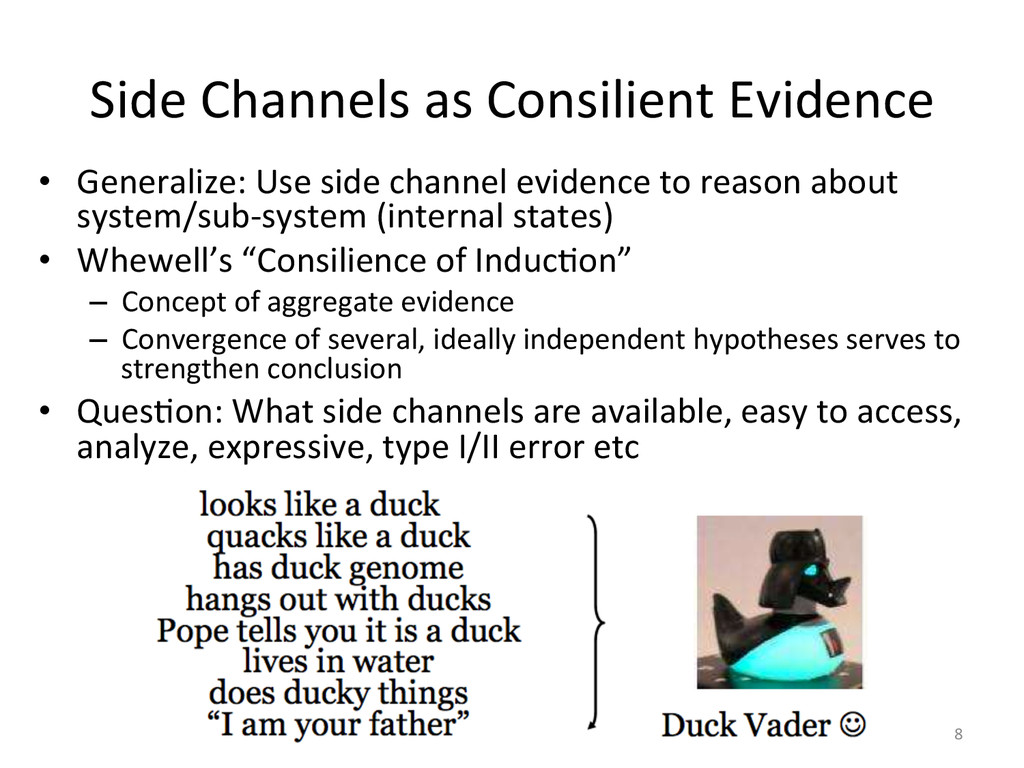
Side Channels as Consilient Evidence • Generalize: Use side
channel evidence to reason about system/sub-‐system (internal states) • Whewell’s “Consilience of Induc&on” – Concept of aggregate evidence – Convergence of several, ideally independent hypotheses serves to strengthen conclusion • Ques&on: What side channels are available, easy to access, analyze, expressive, type I/II error etc 8 -
Three Ques&ons on Signals • Want ac&onable handling of
higher dimensional signal dynamics as they occur in live computer systems as side channels – Ac&onable is to be understood as useful in prac&ce – Higher dimensional refers to six or more data dimensions – Dynamics emphasizes the signal’s unfolding in temporal and feature space • We’ll discuss – How to represent such signals – How to detect signals with various characteris&cs – How to prevent or mi&gate the leaking of such signals 9 -
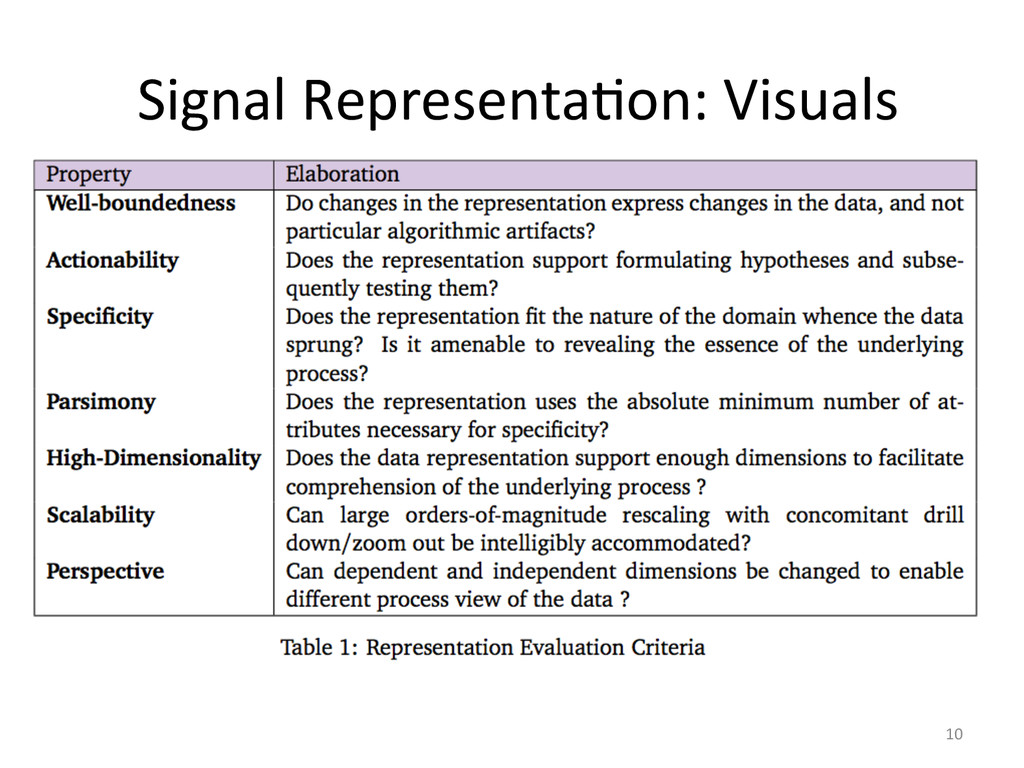
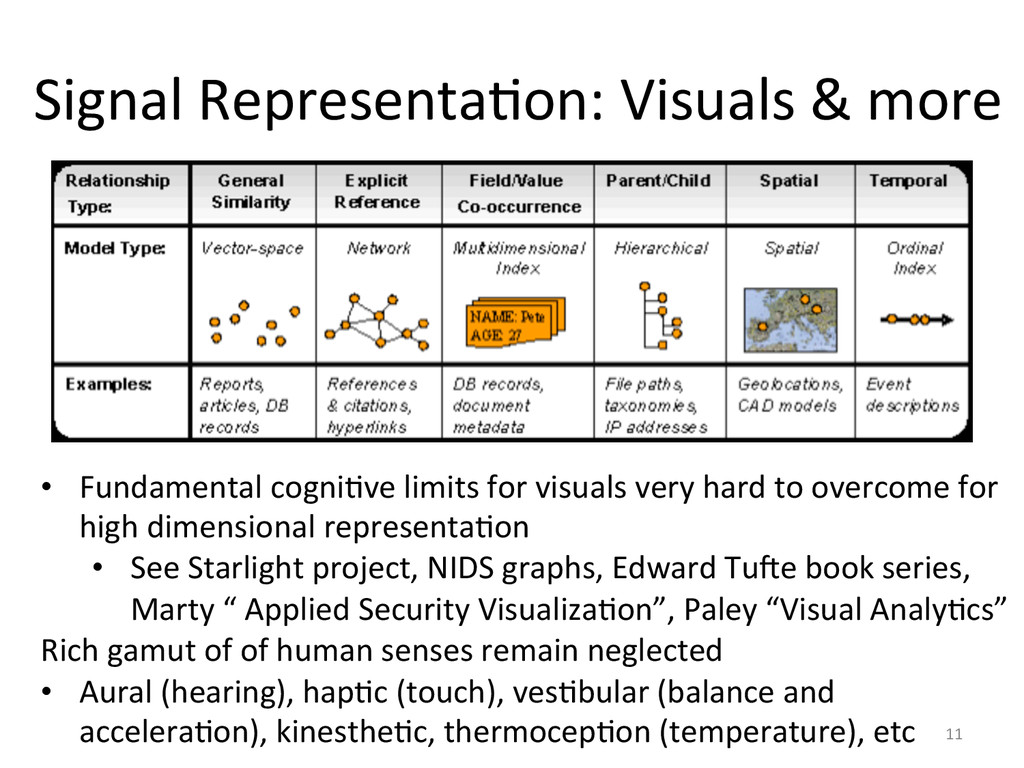
Signal Representa&on: Visuals & more • Fundamental cogni&ve limits
for visuals very hard to overcome for high dimensional representa&on • See Starlight project, NIDS graphs, Edward Tu`e book series, Marty “ Applied Security Visualiza&on”, Paley “Visual Analy&cs” Rich gamut of of human senses remain neglected • Aural (hearing), hap&c (touch), ves&bular (balance and accelera&on), kinesthe&c, thermocep&on (temperature), etc 11 -
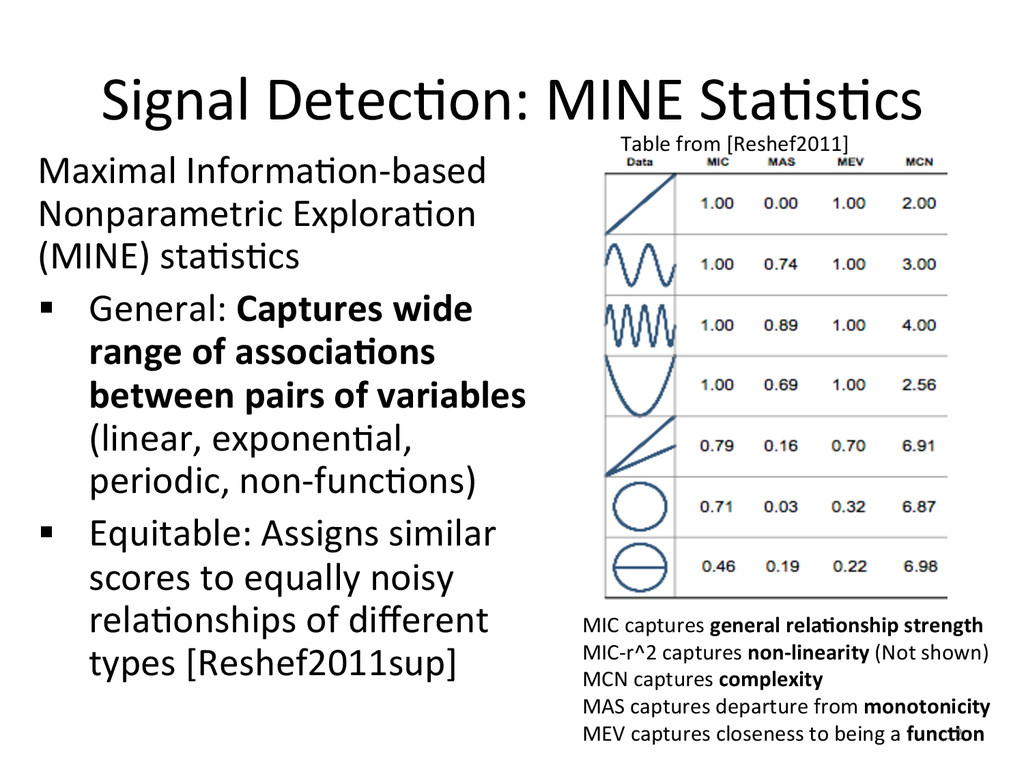
Maximal Informa&on-‐based Nonparametric Explora&on (MINE) sta&s&cs §
General: Captures wide range of associa-ons between pairs of variables (linear, exponen&al, periodic, non-‐func&ons) § Equitable: Assigns similar scores to equally noisy rela&onships of different types [Reshef2011sup] Signal Detec&on: MINE Sta&s&cs Table from [Reshef2011] 12 MIC captures general rela-onship strength MIC-‐r^2 captures non-‐linearity (Not shown) MCN captures complexity MAS captures departure from monotonicity MEV captures closeness to being a func-on -
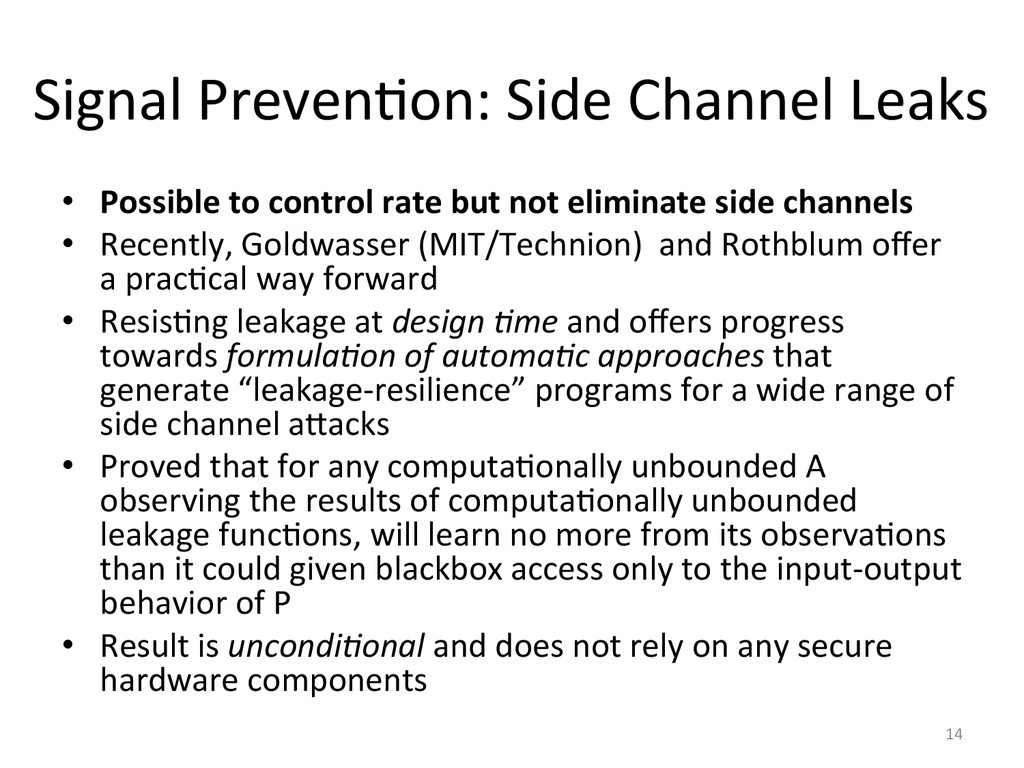
Signal Preven&on: Side Channel Leaks • Possible to
control rate but not eliminate side channels • Recently, Goldwasser (MIT/Technion) and Rothblum offer a prac&cal way forward • Resis&ng leakage at design (me and offers progress towards formula(on of automa(c approaches that generate “leakage-‐resilience” programs for a wide range of side channel aaacks • Proved that for any computa&onally unbounded A observing the results of computa&onally unbounded leakage func&ons, will learn no more from its observa&ons than it could given blackbox access only to the input-‐output behavior of P • Result is uncondi(onal and does not rely on any secure hardware components 14 -
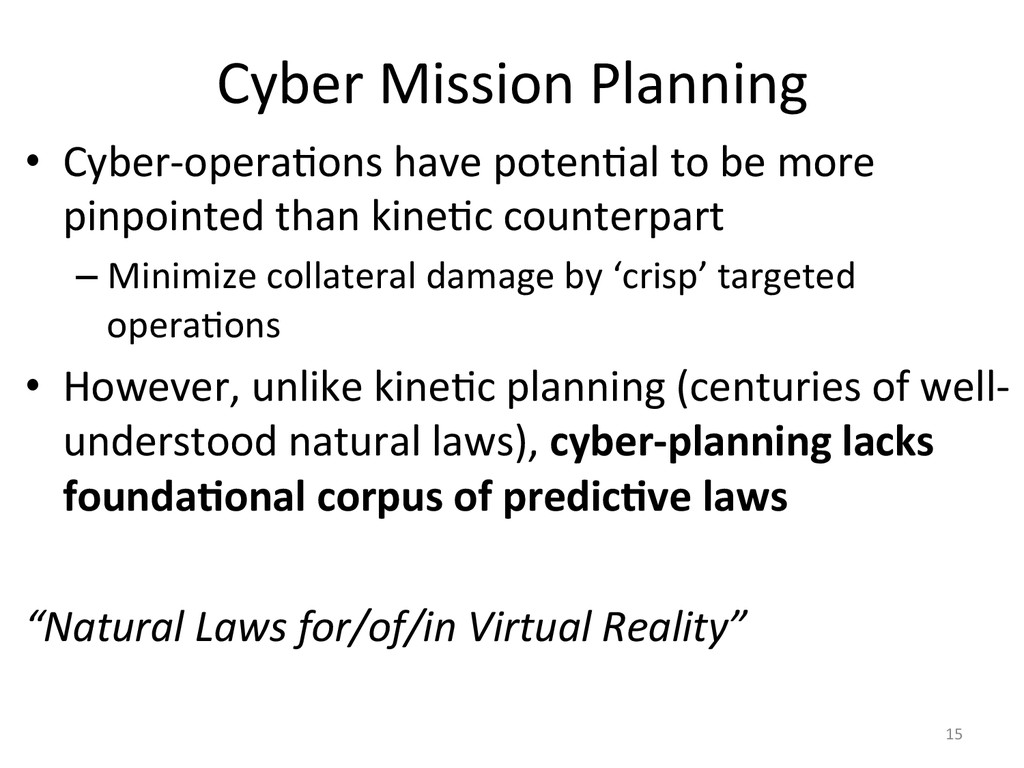
Cyber Mission Planning • Cyber-‐opera&ons have poten&al to be
more pinpointed than kine&c counterpart – Minimize collateral damage by ‘crisp’ targeted opera&ons • However, unlike kine&c planning (centuries of well-‐ understood natural laws), cyber-‐planning lacks founda-onal corpus of predic-ve laws “Natural Laws for/of/in Virtual Reality” 15 -
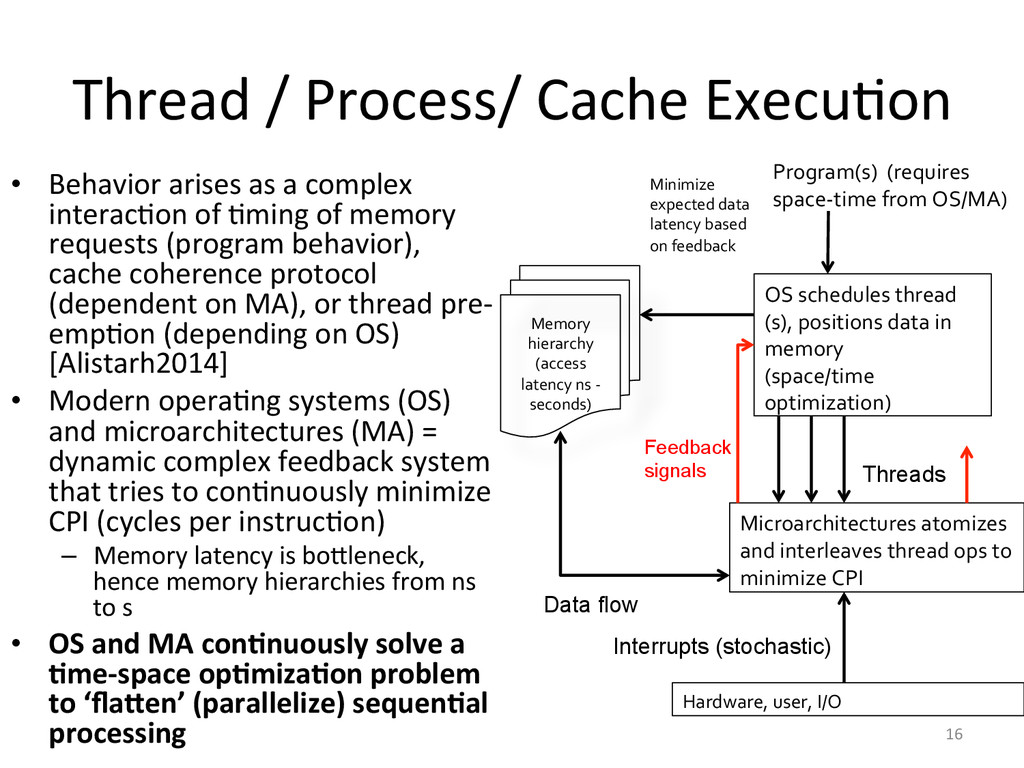
Thread / Process/ Cache Execu&on • Behavior arises as
a complex interac&on of &ming of memory requests (program behavior), cache coherence protocol (dependent on MA), or thread pre-‐ emp&on (depending on OS) [Alistarh2014] • Modern opera&ng systems (OS) and microarchitectures (MA) = dynamic complex feedback system that tries to con&nuously minimize CPI (cycles per instruc&on) – Memory latency is boaleneck, hence memory hierarchies from ns to s • OS and MA con-nuously solve a -me-‐space op-miza-on problem to ‘fla[en’ (parallelize) sequen-al processing 16 OS schedules thread (s), positions data in memory (space/time optimization) Microarchitectures atomizes and interleaves thread ops to minimize CPI Memory hierarchy (access latency ns -‐ seconds) Threads Data flow Feedback signals Hardware, user, I/O Interrupts (stochastic) Minimize expected data latency based on feedback Program(s) (requires space-‐time from OS/MA) -
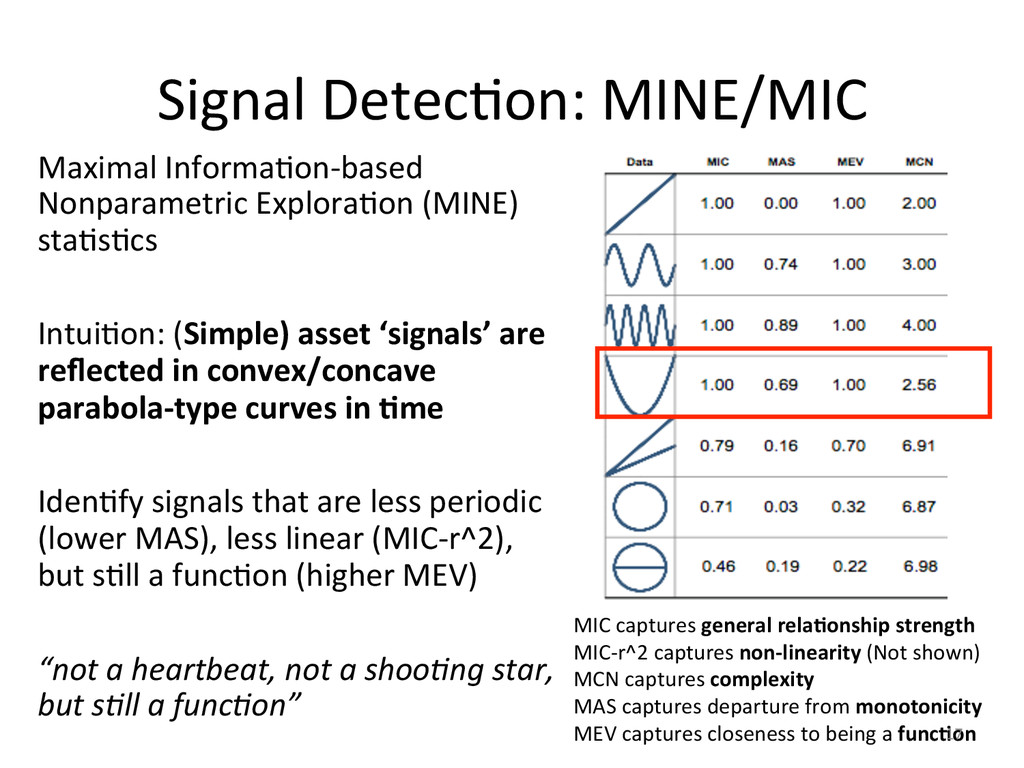
Maximal Informa&on-‐based Nonparametric Explora&on (MINE) sta&s&cs
Intui&on: (Simple) asset ‘signals’ are reflected in convex/concave parabola-‐type curves in -me Iden&fy signals that are less periodic (lower MAS), less linear (MIC-‐r^2), but s&ll a func&on (higher MEV) “not a heartbeat, not a shoo(ng star, but s(ll a func(on” Signal Detec&on: MINE/MIC MIC captures general rela-onship strength MIC-‐r^2 captures non-‐linearity (Not shown) MCN captures complexity MAS captures departure from monotonicity MEV captures closeness to being a func-on 17 -
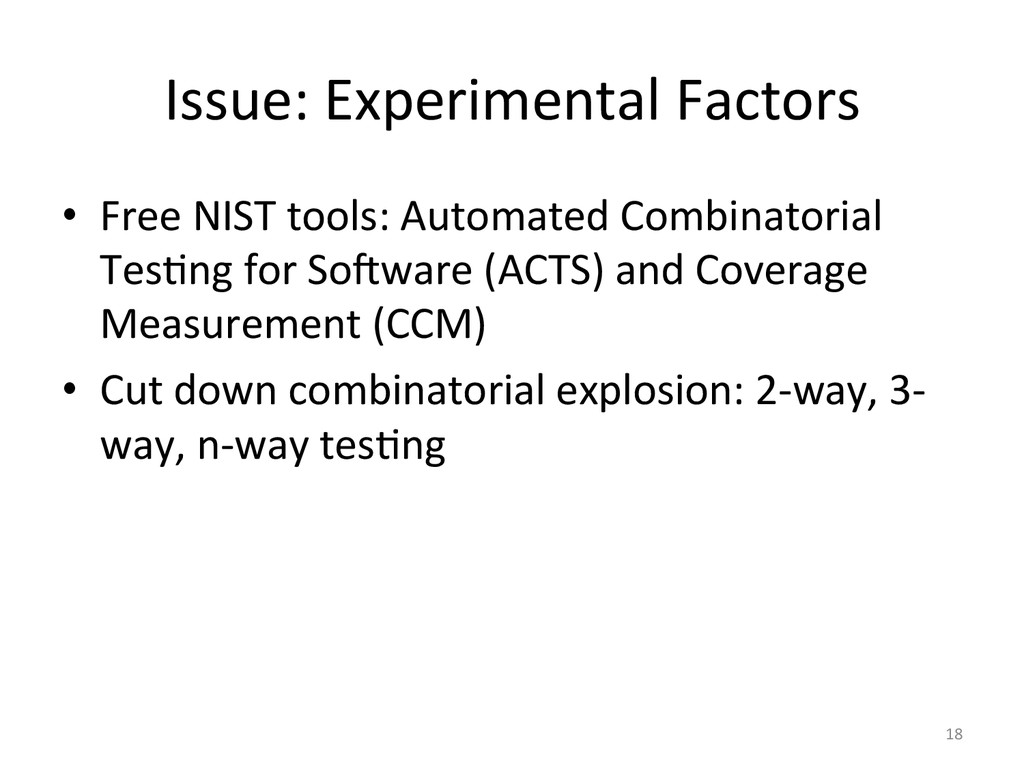
Issue: Experimental Factors • Free NIST tools: Automated Combinatorial
Tes&ng for So`ware (ACTS) and Coverage Measurement (CCM) • Cut down combinatorial explosion: 2-‐way, 3-‐ way, n-‐way tes&ng 18 -
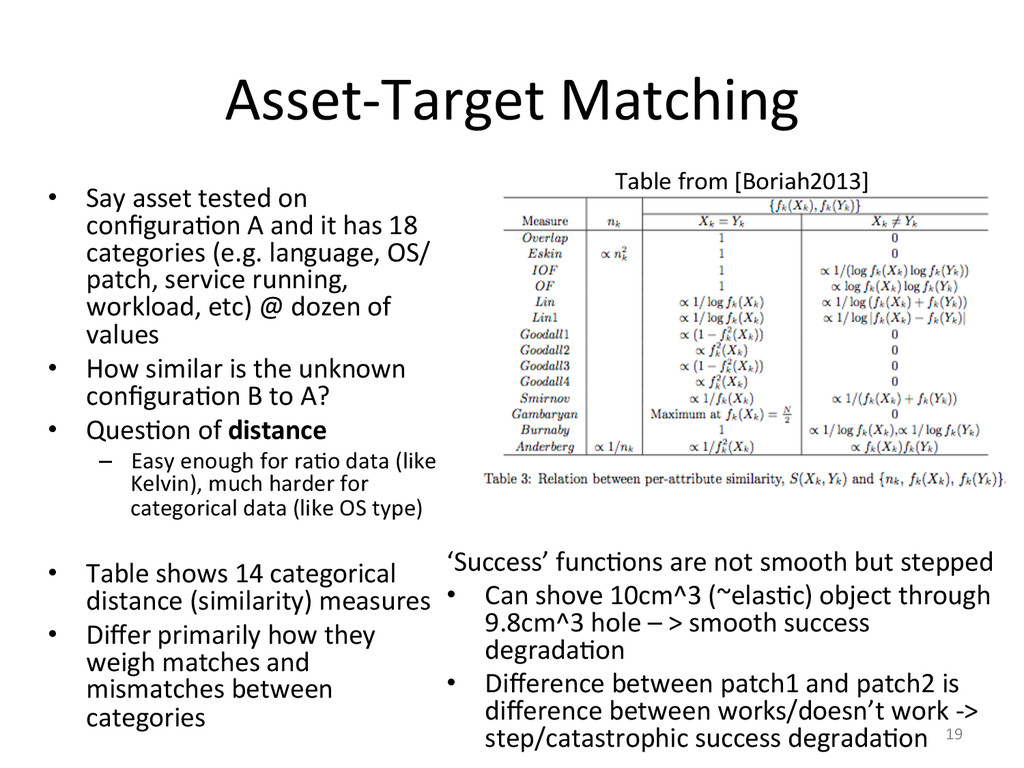
Asset-‐Target Matching • Say asset tested on
configura&on A and it has 18 categories (e.g. language, OS/ patch, service running, workload, etc) @ dozen of values • How similar is the unknown configura&on B to A? • Ques&on of distance – Easy enough for ra&o data (like Kelvin), much harder for categorical data (like OS type) • Table shows 14 categorical distance (similarity) measures • Differ primarily how they weigh matches and mismatches between categories ‘Success’ func&ons are not smooth but stepped • Can shove 10cm^3 (~elas&c) object through 9.8cm^3 hole – > smooth success degrada&on • Difference between patch1 and patch2 is difference between works/doesn’t work -‐> step/catastrophic success degrada&on 19 Table from [Boriah2013] -
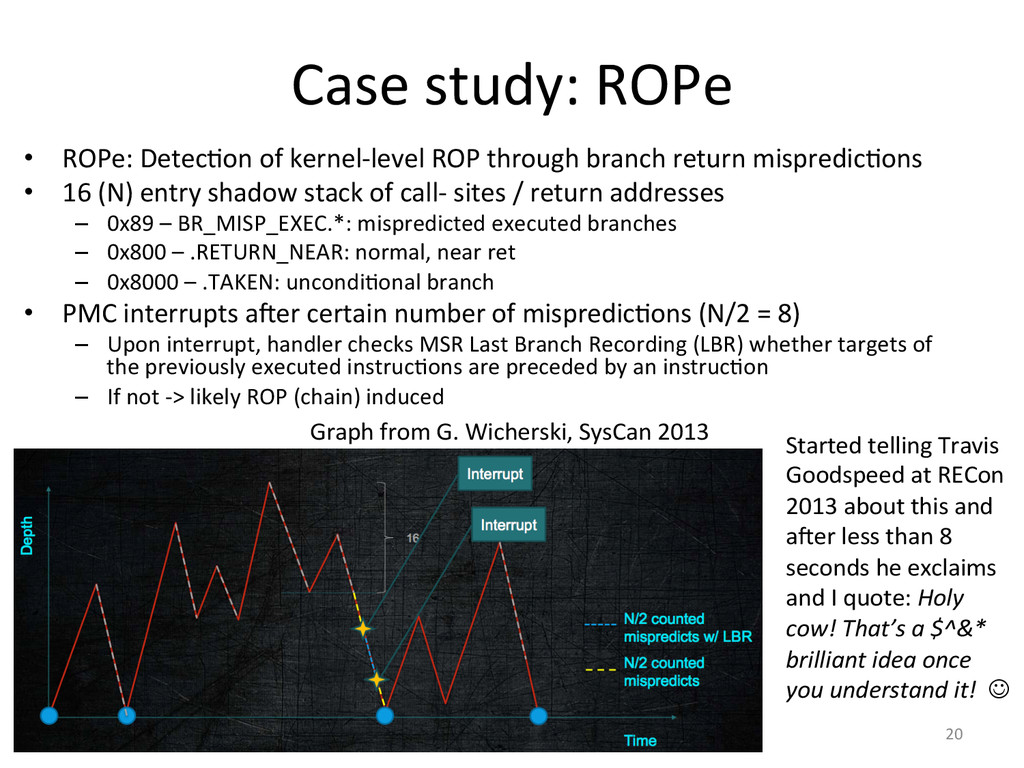
Case study: ROPe • ROPe: Detec&on of kernel-‐level ROP
through branch return mispredic&ons • 16 (N) entry shadow stack of call-‐ sites / return addresses – 0x89 – BR_MISP_EXEC.*: mispredicted executed branches – 0x800 – .RETURN_NEAR: normal, near ret – 0x8000 – .TAKEN: uncondi&onal branch • PMC interrupts a`er certain number of mispredic&ons (N/2 = 8) – Upon interrupt, handler checks MSR Last Branch Recording (LBR) whether targets of the previously executed instruc&ons are preceded by an instruc&on – If not -‐> likely ROP (chain) induced 20 Started telling Travis Goodspeed at RECon 2013 about this and a`er less than 8 seconds he exclaims and I quote: Holy cow! That’s a $^&* brilliant idea once you understand it! J Graph from G. Wicherski, SysCan 2013 -
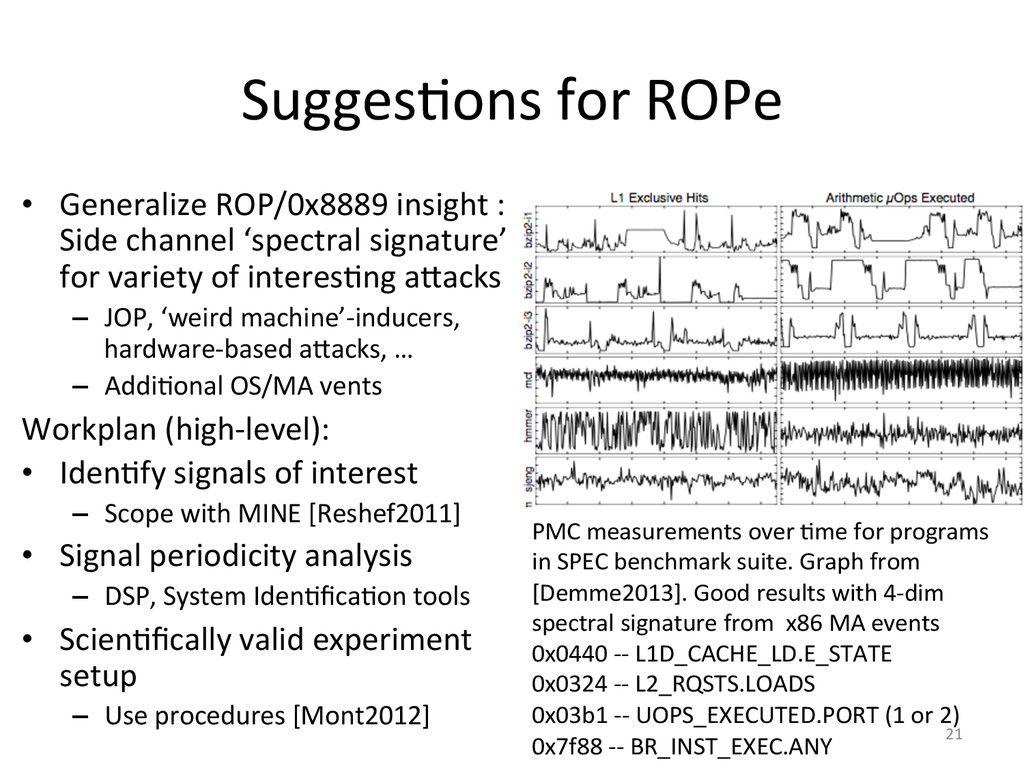
Sugges&ons for ROPe • Generalize ROP/0x8889 insight :
Side channel ‘spectral signature’ for variety of interes&ng aaacks – JOP, ‘weird machine’-‐inducers, hardware-‐based aaacks, … – Addi&onal OS/MA vents Workplan (high-‐level): • Iden&fy signals of interest – Scope with MINE [Reshef2011] • Signal periodicity analysis – DSP, System Iden&fica&on tools • Scien&fically valid experiment setup – Use procedures [Mont2012] 21 PMC measurements over &me for programs in SPEC benchmark suite. Graph from [Demme2013]. Good results with 4-‐dim spectral signature from x86 MA events 0x0440 -‐-‐ L1D_CACHE_LD.E_STATE 0x0324 -‐-‐ L2_RQSTS.LOADS 0x03b1 -‐-‐ UOPS_EXECUTED.PORT (1 or 2) 0x7f88 -‐-‐ BR_INST_EXEC.ANY -
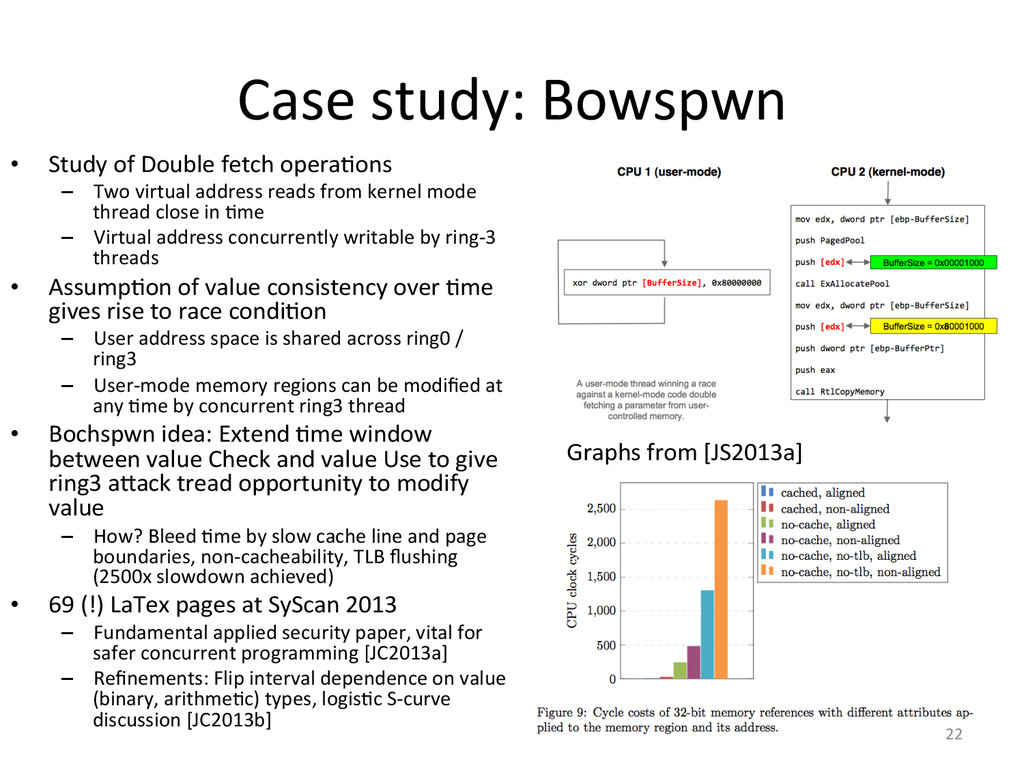
Case study: Bowspwn • Study of Double fetch opera&ons
– Two virtual address reads from kernel mode thread close in &me – Virtual address concurrently writable by ring-‐3 threads • Assump&on of value consistency over &me gives rise to race condi&on – User address space is shared across ring0 / ring3 – User-‐mode memory regions can be modified at any &me by concurrent ring3 thread • Bochspwn idea: Extend &me window between value Check and value Use to give ring3 aaack tread opportunity to modify value – How? Bleed &me by slow cache line and page boundaries, non-‐cacheability, TLB flushing (2500x slowdown achieved) • 69 (!) LaTex pages at SyScan 2013 – Fundamental applied security paper, vital for safer concurrent programming [JC2013a] – Refinements: Flip interval dependence on value (binary, arithme&c) types, logis&c S-‐curve discussion [JC2013b] 22 Graphs from [JS2013a] -
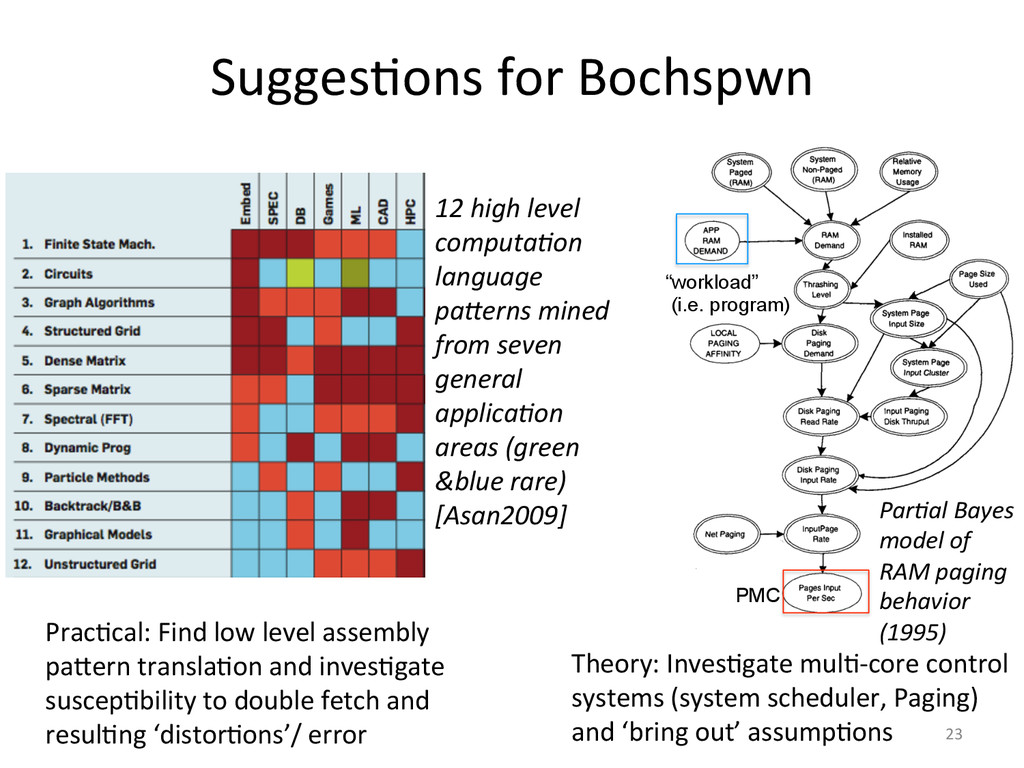
“workload” (i.e. program) PMC Sugges&ons for Bochspwn 23
Par(al Bayes model of RAM paging behavior (1995) Theory: Inves&gate mul&-‐core control systems (system scheduler, Paging) and ‘bring out’ assump&ons 12 high level computa(on language paRerns mined from seven general applica(on areas (green &blue rare) [Asan2009] Prac&cal: Find low level assembly paaern transla&on and inves&gate suscep&bility to double fetch and resul&ng ‘distor&ons’/ error -
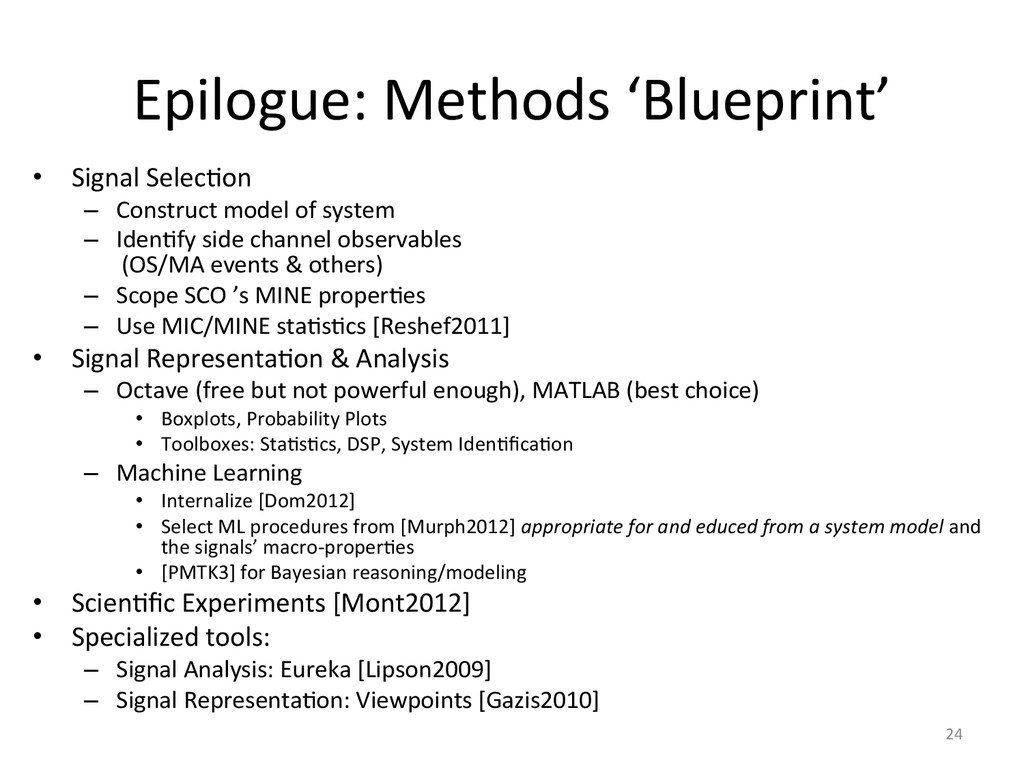
Epilogue: Methods ‘Blueprint’ • Signal Selec&on – Construct
model of system – Iden&fy side channel observables (OS/MA events & others) – Scope SCO ’s MINE proper&es – Use MIC/MINE sta&s&cs [Reshef2011] • Signal Representa&on & Analysis – Octave (free but not powerful enough), MATLAB (best choice) • Boxplots, Probability Plots • Toolboxes: Sta&s&cs, DSP, System Iden&fica&on – Machine Learning • Internalize [Dom2012] • Select ML procedures from [Murph2012] appropriate for and educed from a system model and the signals’ macro-‐proper&es • [PMTK3] for Bayesian reasoning/modeling • Scien&fic Experiments [Mont2012] • Specialized tools: – Signal Analysis: Eureka [Lipson2009] – Signal Representa&on: Viewpoints [Gazis2010] 24 -
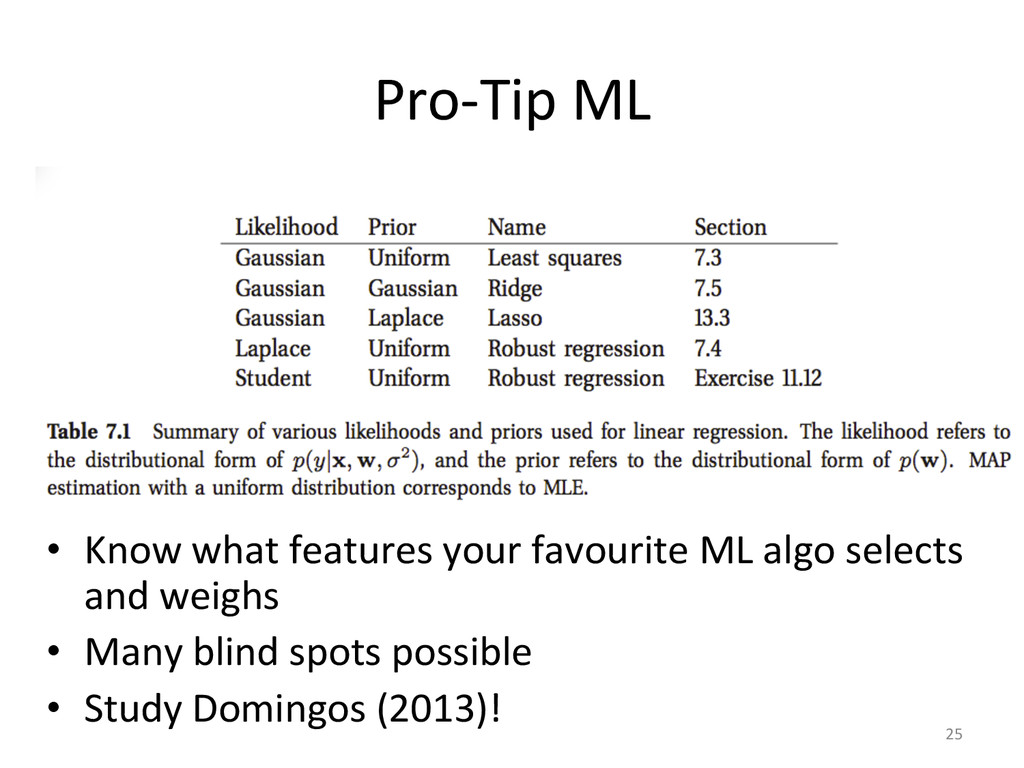
Pro-‐Tip ML 25 • Know what features your
favourite ML algo selects and weighs • Many blind spots possible • Study Domingos (2013)! -
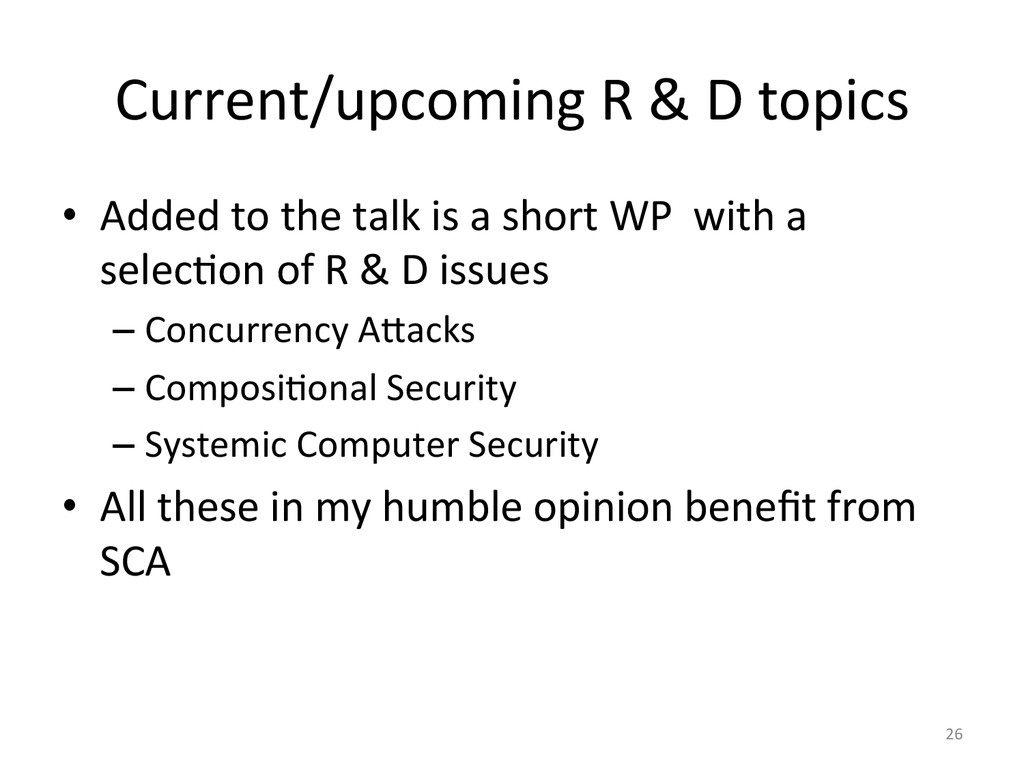
Current/upcoming R & D topics • Added to the
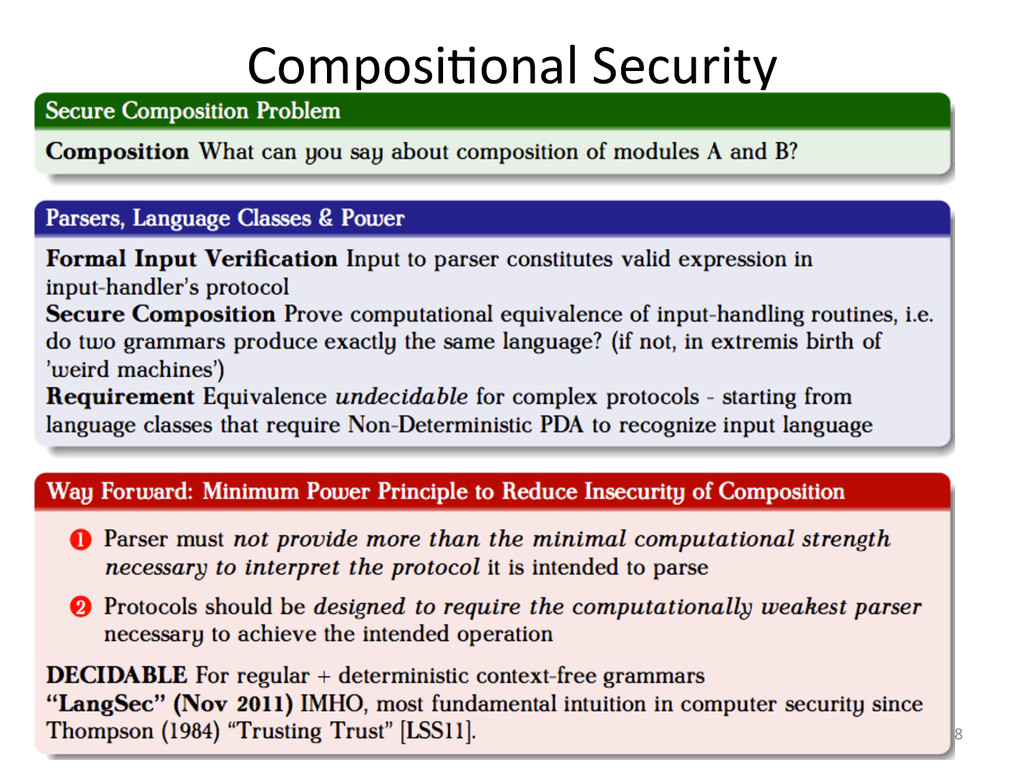
talk is a short WP with a selec&on of R & D issues – Concurrency Aaacks – Composi&onal Security – Systemic Computer Security • All these in my humble opinion benefit from SCA 26 -
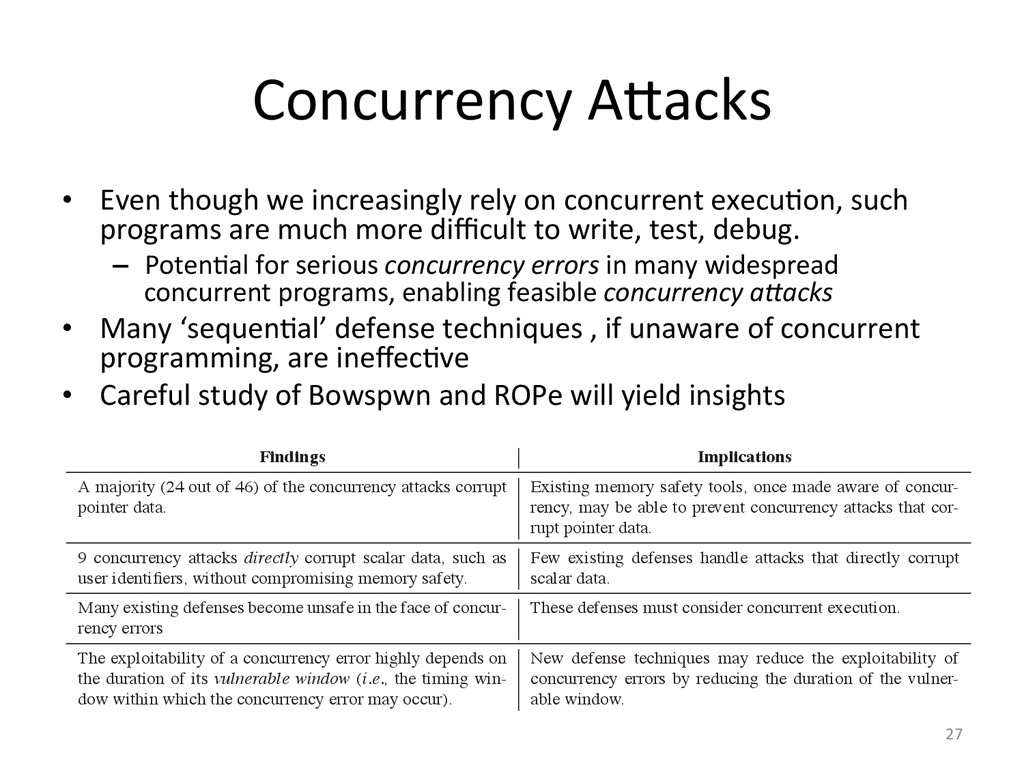
Concurrency Aaacks • Even though we increasingly rely on
concurrent execu&on, such programs are much more difficult to write, test, debug. – Poten&al for serious concurrency errors in many widespread concurrent programs, enabling feasible concurrency aRacks • Many ‘sequen&al’ defense techniques , if unaware of concurrent programming, are ineffec&ve • Careful study of Bowspwn and ROPe will yield insights 27 Findings Implications A majority (24 out of 46) of the concurrency attacks corrupt pointer data. Existing memory safety tools, once made aware of concur- rency, may be able to prevent concurrency attacks that cor- rupt pointer data. 9 concurrency attacks directly corrupt scalar data, such as user identifiers, without compromising memory safety. Few existing defenses handle attacks that directly corrupt scalar data. Many existing defenses become unsafe in the face of concur- rency errors These defenses must consider concurrent execution. The exploitability of a concurrency error highly depends on the duration of its vulnerable window (i.e., the timing win- dow within which the concurrency error may occur). New defense techniques may reduce the exploitability of concurrency errors by reducing the duration of the vulner- able window. Table 1: Summary of Findings. -
Systemic Computer Security • Mo&va&on: Flash Crash (May
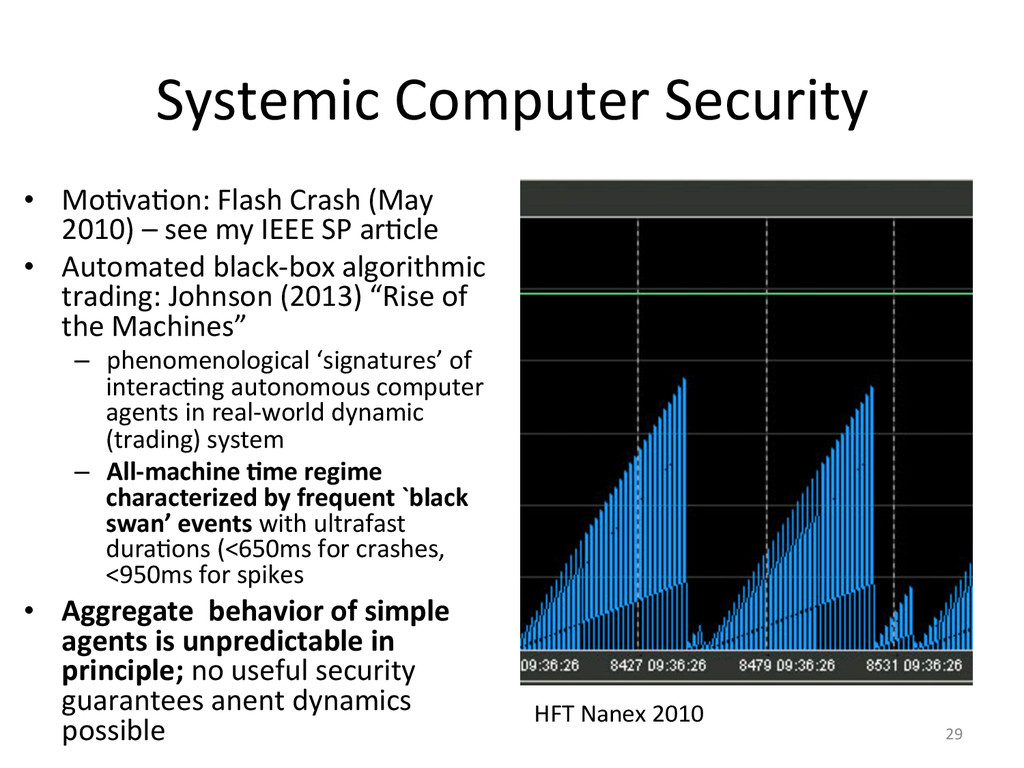
2010) – see my IEEE SP ar&cle • Automated black-‐box algorithmic trading: Johnson (2013) “Rise of the Machines” – phenomenological ‘signatures’ of interac&ng autonomous computer agents in real-‐world dynamic (trading) system – All-‐machine -me regime characterized by frequent `black swan’ events with ultrafast dura&ons (<650ms for crashes, <950ms for spikes • Aggregate behavior of simple agents is unpredictable in principle; no useful security guarantees anent dynamics possible 29 HFT Nanex 2010 -
Systemic Computer Security II • Aggregate behavior of simple
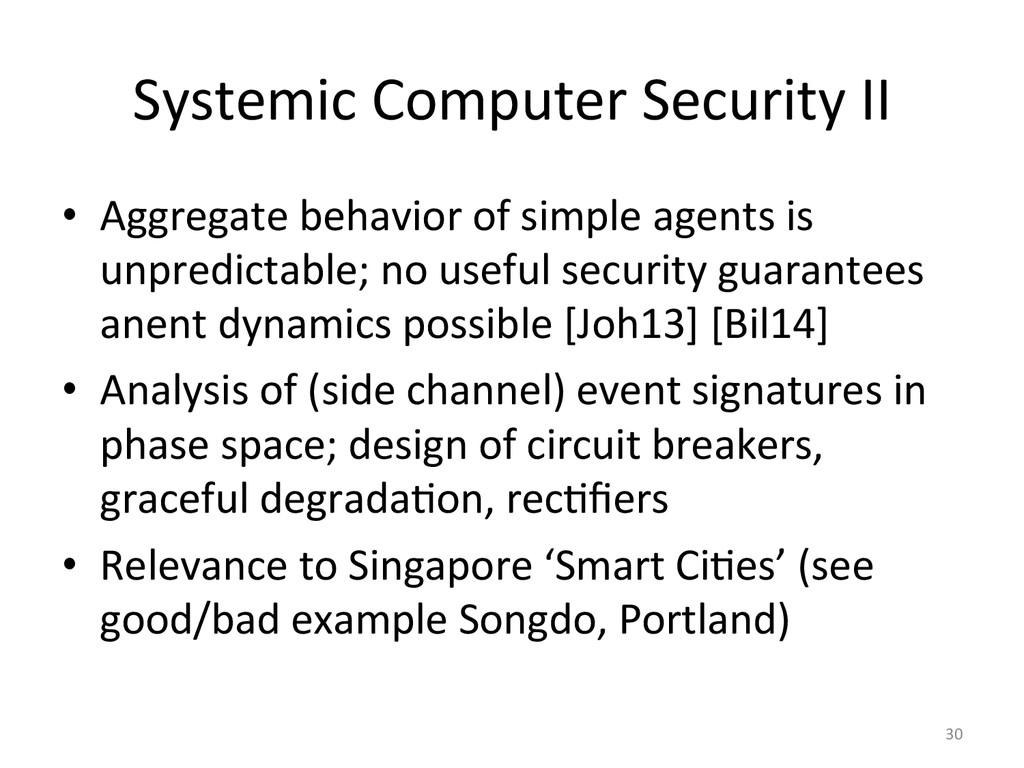
agents is unpredictable; no useful security guarantees anent dynamics possible [Joh13] [Bil14] • Analysis of (side channel) event signatures in phase space; design of circuit breakers, graceful degrada&on, rec&fiers • Relevance to Singapore ‘Smart Ci&es’ (see good/bad example Songdo, Portland) 30 -
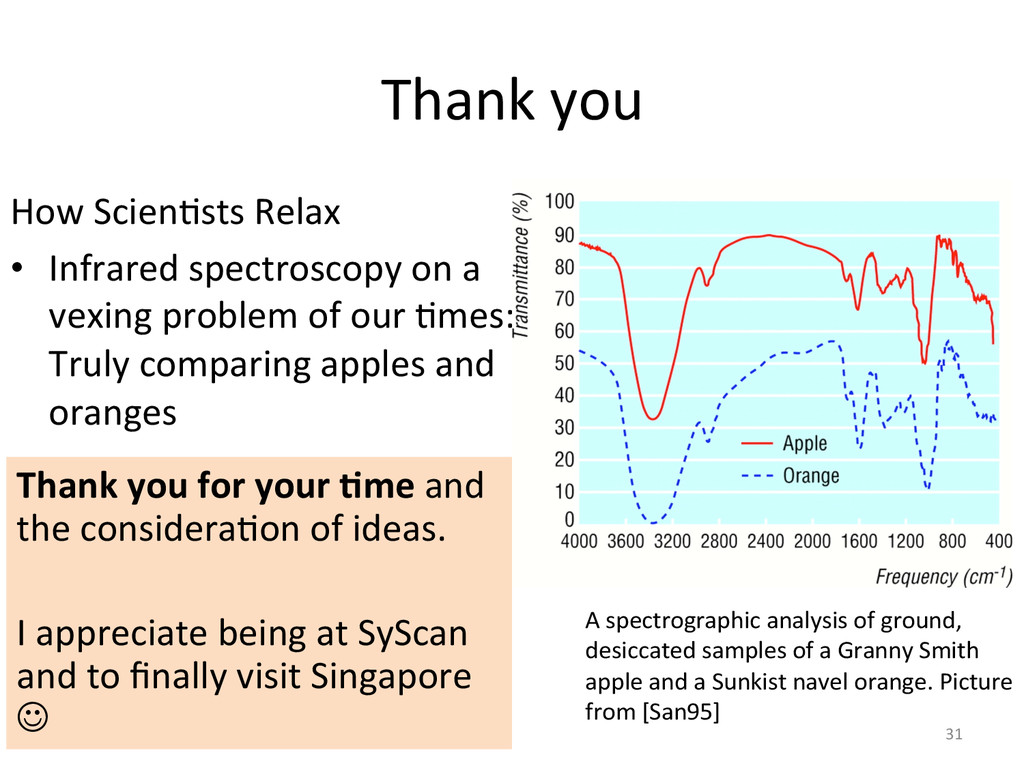
Thank you How Scien&sts Relax • Infrared spectroscopy
on a vexing problem of our &mes: Truly comparing apples and oranges 31 A spectrographic analysis of ground, desiccated samples of a Granny Smith apple and a Sunkist navel orange. Picture from [San95] Thank you for your -me and the considera&on of ideas. I appreciate being at SyScan and to finally visit Singapore J -
References I [Asan2009] K. Asanovic et al “A view
of the parallel compu&ng landscape”, CACM 52:10, Oct2009, pp. 56-‐67 hap://dl.acm.org/cita&on.cfm?id=1562764.1562783 [Boriah2008] S. Boriah et al, “Similarity Measures for Categorical Data”, SIAM red, 30:2, 2008 hap://www-‐users.cs.umn.edu/~sboriah/PDFs/BoriahBCK2008.pdf [Goldw2012] S. Goldwasser and G. Rothblum, "How to Compute in the Presence of Leakage," FOCS, Oct. 2012, pp.31-‐40 hap://eccc.hpi-‐web.de/report/2012/010/download/ [Hund2013] R.Hund et al, “Prac&cal Timing Side Channel Aaacks Against Kernel Space ASLR” IEEE S & P, 2013 , pp. 191-‐205 hap://www.ieee-‐security.org/TC/SP2013/papers/4977a191.pdf [Yang2012] J. Yang et al, “Concurrency aaacks”, USENIX HotPar, 2012 haps://www.usenix.org/system/files/conference/hotpar12/hotpar12-‐final44.pdf [JC2013a] M. Jurczyk &G. Coldwind, “Iden&fying and Exploi&ng Windows Kernel Race Condi&ons via Memory Access Paaerns”, SyScan, April 2013 hap://j00ru.vexillium.org/?p=1695 32 -
References II [Dom2012] P. Domingos, “A Few Useful Things
to Know about Machine Learning”, CACM 55:10, Oct 2012, pp. 78-‐87 haps://t.co/NsAnRUrPtq [Demme2013] J. Demme et al, “On the Feasibility of Online Malware Detec&on with Performance Counters” ISCA, 2013, pp. 559-‐570 hap://www.cs.columbia.edu/~jdd/papers/isca13_malware.pdf [Mont2012] D. Montgomery, Design and Analysis of Experiments, Wiley Press, 2012, ch. 1 hap://higheredbcs.wiley.com/legacy/college/montgomery/1118146921/supp_material/ch01.doc [Murph2012] K. Murphy, Machine Learning, MIT, 2012 hap://www.cs.ubc.ca/~murphyk/MLbook/ [Reshef2011] D. Reshef et al. "Detec&ng Novel Associa&ons in Large Data Sets" Science 334.6062 (2011): 1518-‐1524 hap://www.sciencemag.org/cgi/rapidpdf/334/6062/1518? ijkey=cRCIlh2G7AjiA&keytype=ref&siteid=sci [Reshef2011sup] D. Reshef et al. SOM [Reshef2011], Science 334.6062 (2011) hap://www.sciencemag.org/content/334/6062/1502.full?ijkey=l9Qe0i/ BE6ZOI&keytype=ref&siteid=sci [Wich2013] G. Wicherski "Taming the ROPe on Sandy Bridge”, SyScan, April 2013 hap://www.syscan.org/index.php/download/get/3c6891f2e90e661ea23224cd8f419262/ SyScan2013_DAY1_SPEAKER05_Georg_WIcherski_Taming_ROP_ON_SANDY_BRIDGE_syscan.zip 33 -
References III [JC2013b] M. Jurczyk and G. Coldwind, “Kernel
double-‐fetch race condi&on exploita&on on x86 – further thoughts”, blog, June 2013, hap://j00ru.vexillium.org/?p=1880 [Snyder2008] L. Snyder, “The whole box of tools: William Whewell and the logic of induc&on”, Handbook of the History of Logic (Bri(sh Logic in the Nineteenth Century), Ed. : D. Gabbay, Vol 4, 2008, pp.163–228 [Lipson2009] M. Schmidt and H. Lipson "Dis&lling Free-‐Form Natural Laws from Experimental Data," Science 324:5923, 2009, pp. 81 – 85 hap://ccsl.mae.cornell.edu/sites/default/files/Science09_Schmidt.pdf [Gazis2010] P. Gazis et al., “Viewpoints: A High-‐Performance High-‐Dimensional Exploratory Data Analysis Tool”, Publica&ons of the Astronomical Society of the Pacific, 122(898), 2010, pp. 1518-‐1525, hap://www.giss.nasa.gov/staff/mway/Gazis_Levit_Way2010.pdf [PMTK3] K. Murphy, M. Dunham et al, “probabilis&c modeling toolkit for Matlab/Octave”, 2011, haps://github.com/probml/pmtk3 [San1995] S. Sandford, “Apples and oranges: a comparison”, Annals of Improbable Research 1:3, 1995 hap://www.improbable.com/airchives/paperair/volume1/v1i3/air-‐1-‐3-‐apples.html [Alistarh2014] N. Shavit et al, “Are Lock-‐Free Concurrent Algorithms Prac&cally Wait-‐Free?”, 2014, hap://research.microso`.com/pubs/209106/paper.pdf 34
 dybilar
 peterdesmet
 yu4u
 brainpadpr
 hayashiyus884
 trycycle
 institutdelelevage
 akasan
 xspa2012
 ykiyota
 xleitix
 rmaruy
 sachag
 marcduiker
 tammielis
 inesmontani
 samlambert
 csswizardry
 tamaranovitovic
 vanstee
 codingconduct
 helenjbeal
 kimpetersen