What Is a Technical SEO Audit? From Warnings to...

Share
Embed
What Is a Technical SEO Audit? From Warnings to Diagnosis
What is a technical SEO audit, and how can teams turn conflicting crawl, Search Console, and server-log evidence into a testable diagnosis? This workshop shows how to trace a shared-template indexing defect, define implementation ownership, and verify the correction with acceptance tests. For a longer answer to what is a technical SEO audit, read the guide: https://guaranteedseoservices.com/what-is-a-technical-seo-audit/?utm_source=speakerdeck&utm_medium=referral&utm_campaign=blog-what-is-a-technical-seo-audit

GuaranteedSEOServices
October 26, 2026
Transcript
20 slides
-
What Is a Technical SEO Audit? Turn Conflicting Evidence Into
a Testable Diagnosis A workshop for developers and technical SEOs: move from warning floods to reproducible findings, scoped fixes and acceptance tests that the implementation team can verify. GuaranteedSEOServices.com October 27, 2026 -
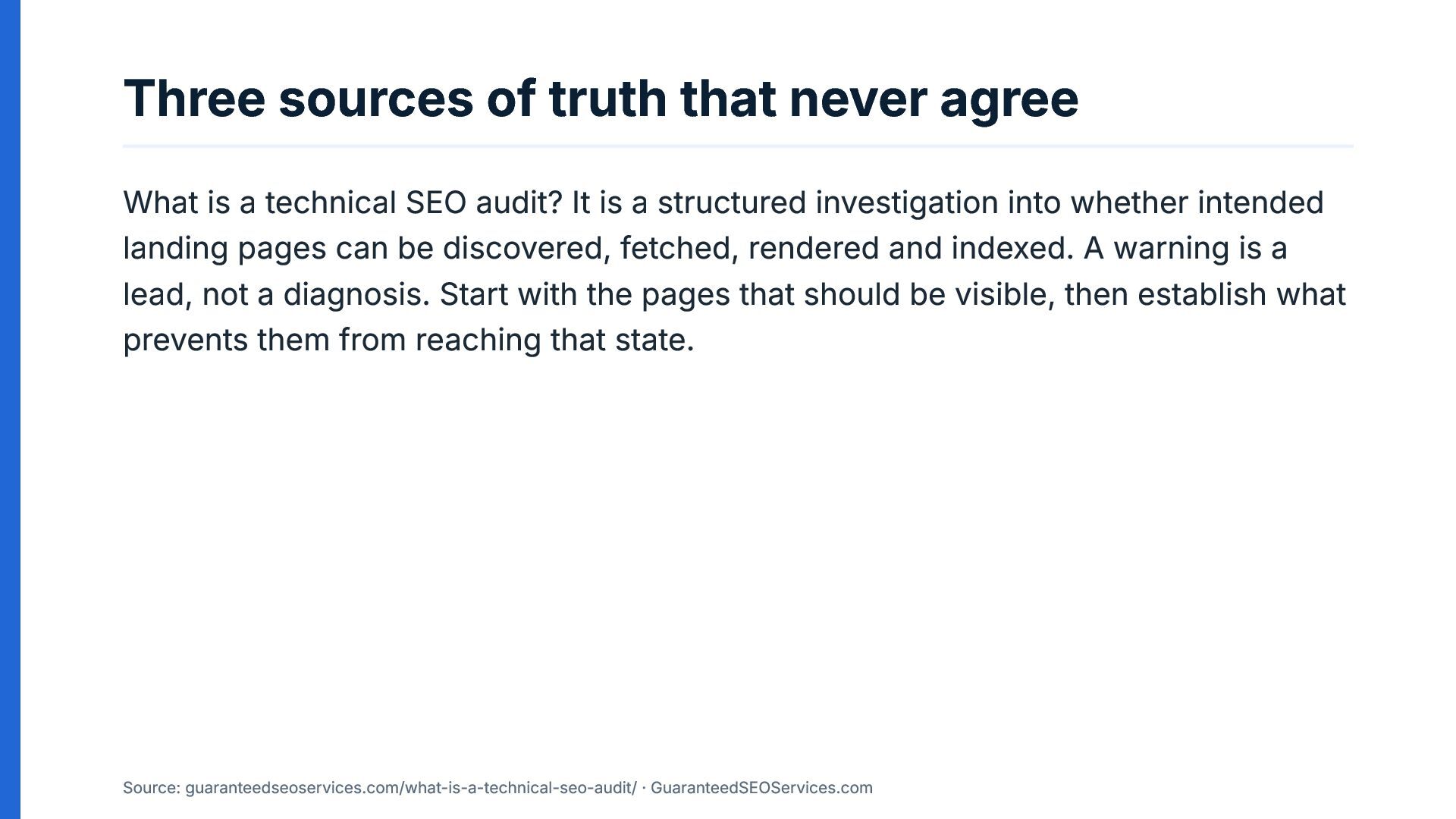
Three sources of truth that never agree What is a
technical SEO audit? It is a structured investigation into whether intended landing pages can be discovered, fetched, rendered and indexed. A warning is a lead, not a diagnosis. Start with the pages that should be visible, then establish what prevents them from reaching that state. Source: guaranteedseoservices.com/what-is-a-technical-seo-audit/ · GuaranteedSEOServices.com -
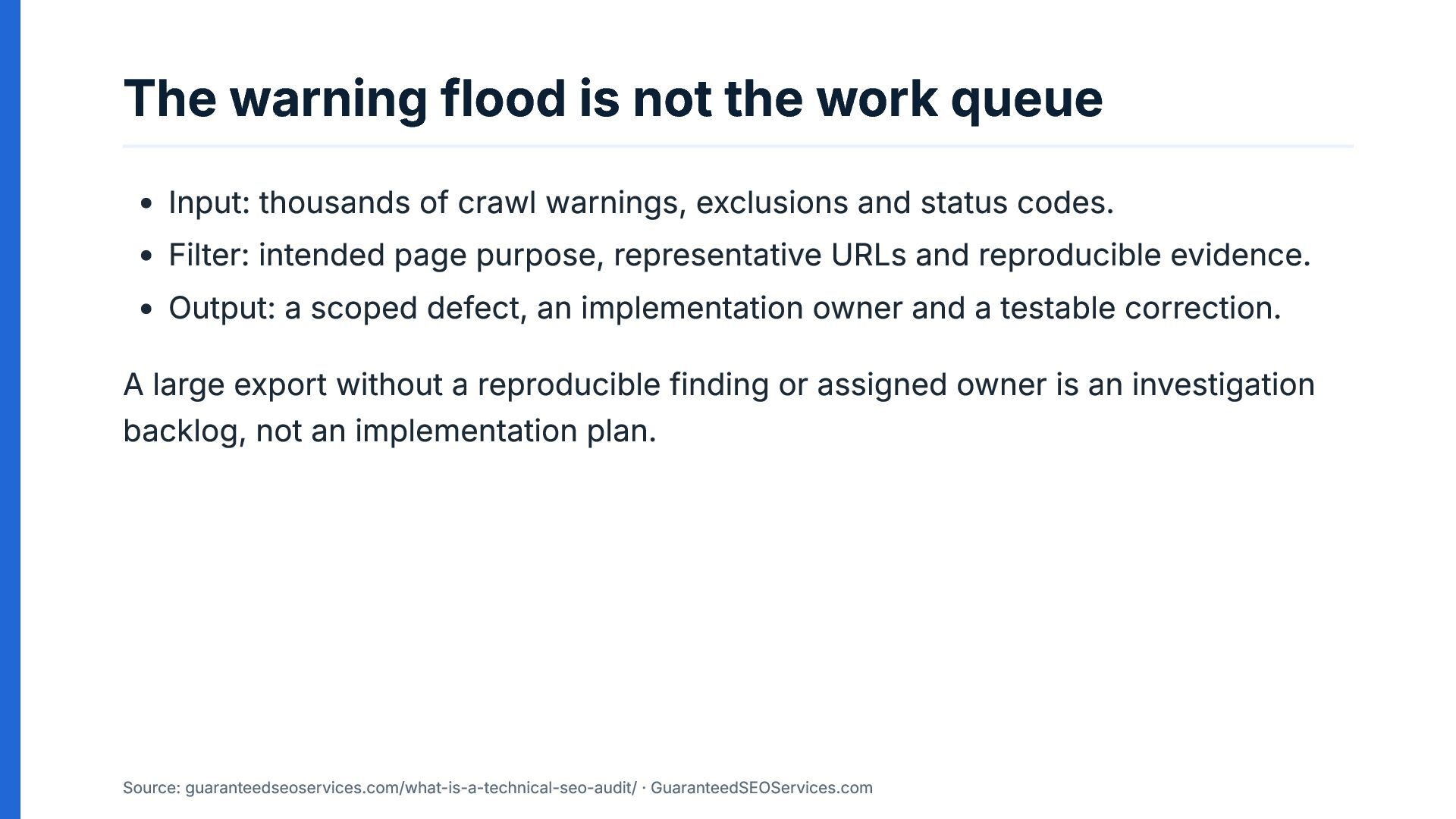
The warning flood is not the work queue Input: thousands
of crawl warnings, exclusions and status codes. Filter: intended page purpose, representative URLs and reproducible evidence. Output: a scoped defect, an implementation owner and a testable correction. A large export without a reproducible finding or assigned owner is an investigation backlog, not an implementation plan. Source: guaranteedseoservices.com/what-is-a-technical-seo-audit/ · GuaranteedSEOServices.com -
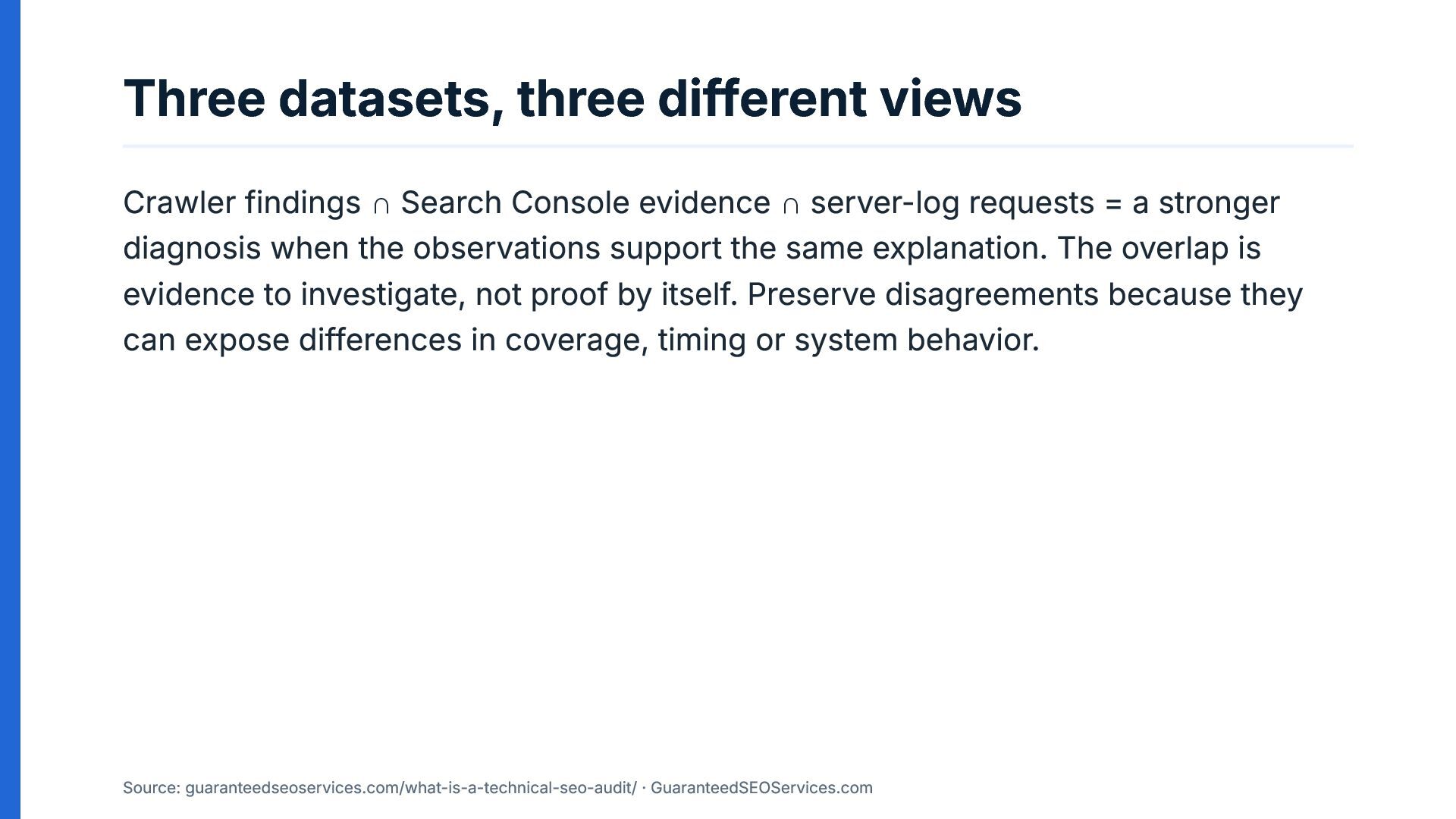
Three datasets, three different views Crawler findings ∩ Search Console
evidence ∩ server-log requests = a stronger diagnosis when the observations support the same explanation. The overlap is evidence to investigate, not proof by itself. Preserve disagreements because they can expose differences in coverage, timing or system behavior. Source: guaranteedseoservices.com/what-is-a-technical-seo-audit/ · GuaranteedSEOServices.com -
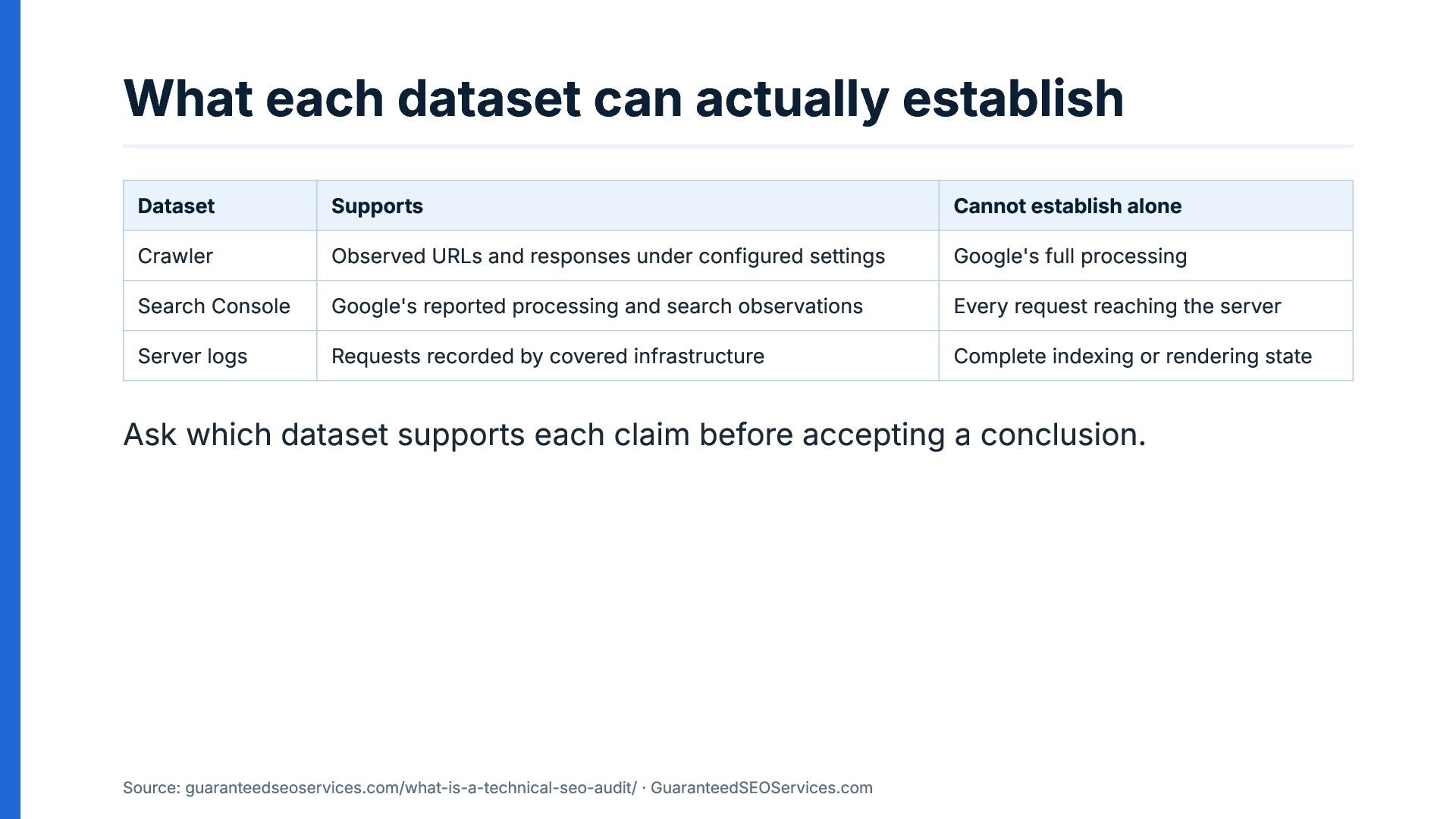
What each dataset can actually establish Dataset Supports Cannot establish
alone Crawler Observed URLs and responses under configured settings Google's full processing Search Console Google's reported processing and search observations Every request reaching the server Server logs Requests recorded by covered infrastructure Complete indexing or rendering state Ask which dataset supports each claim before accepting a conclusion. Source: guaranteedseoservices.com/what-is-a-technical-seo-audit/ · GuaranteedSEOServices.com -
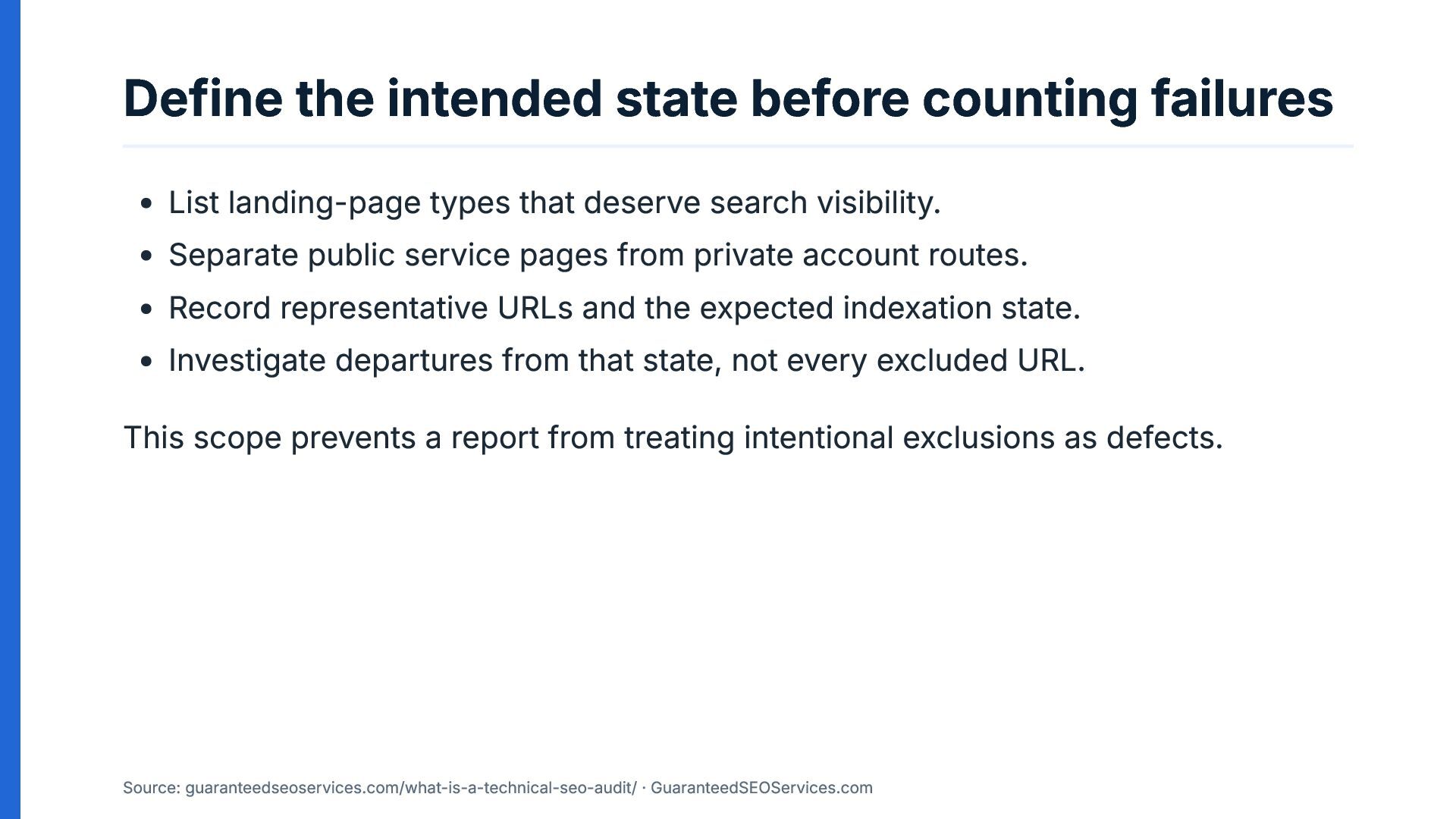
Define the intended state before counting failures List landing-page types
that deserve search visibility. Separate public service pages from private account routes. Record representative URLs and the expected indexation state. Investigate departures from that state, not every excluded URL. This scope prevents a report from treating intentional exclusions as defects. Source: guaranteedseoservices.com/what-is-a-technical-seo-audit/ · GuaranteedSEOServices.com -
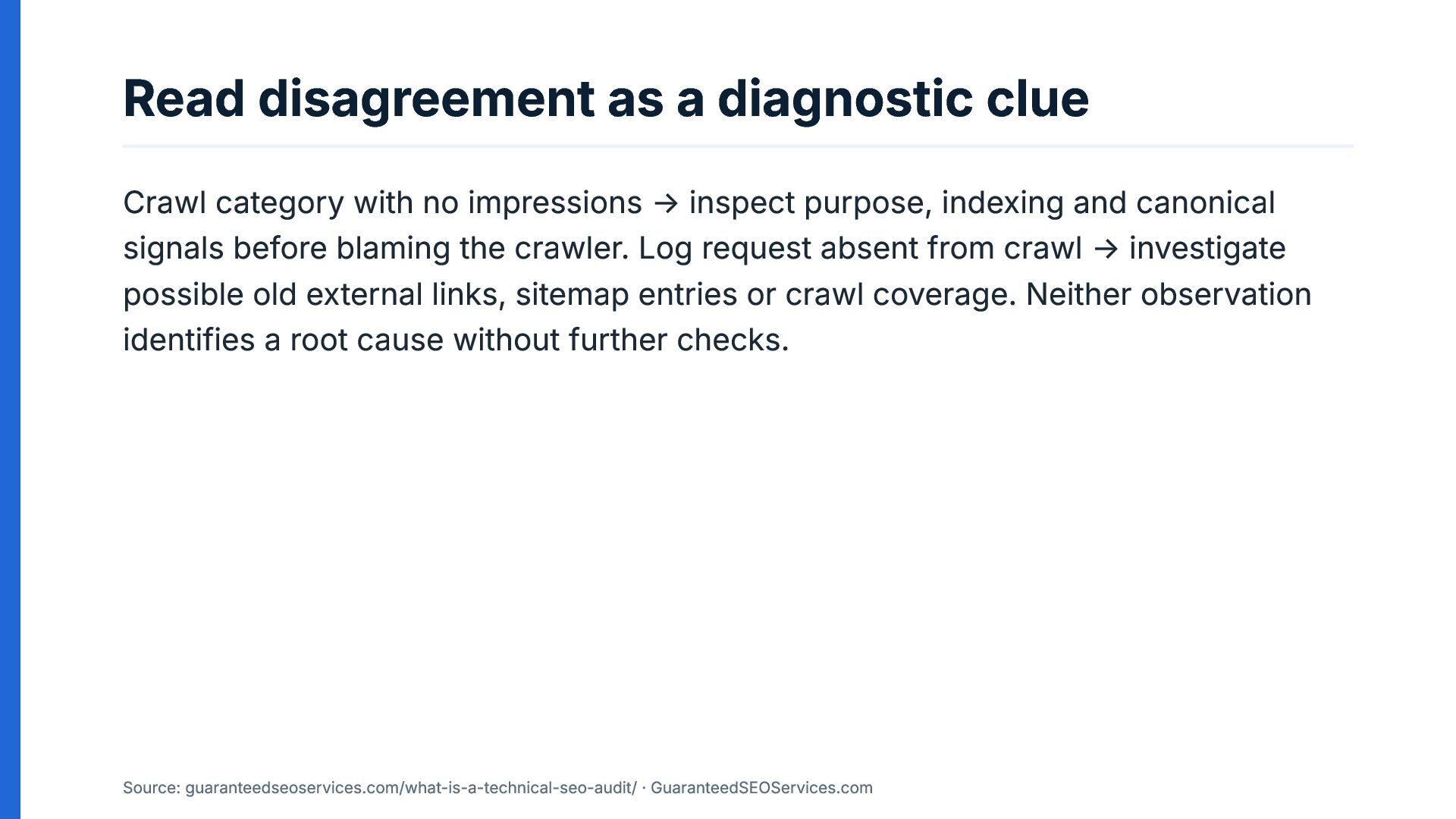
Read disagreement as a diagnostic clue Crawl category with no
impressions → inspect purpose, indexing and canonical signals before blaming the crawler. Log request absent from crawl → investigate possible old external links, sitemap entries or crawl coverage. Neither observation identifies a root cause without further checks. Source: guaranteedseoservices.com/what-is-a-technical-seo-audit/ · GuaranteedSEOServices.com -
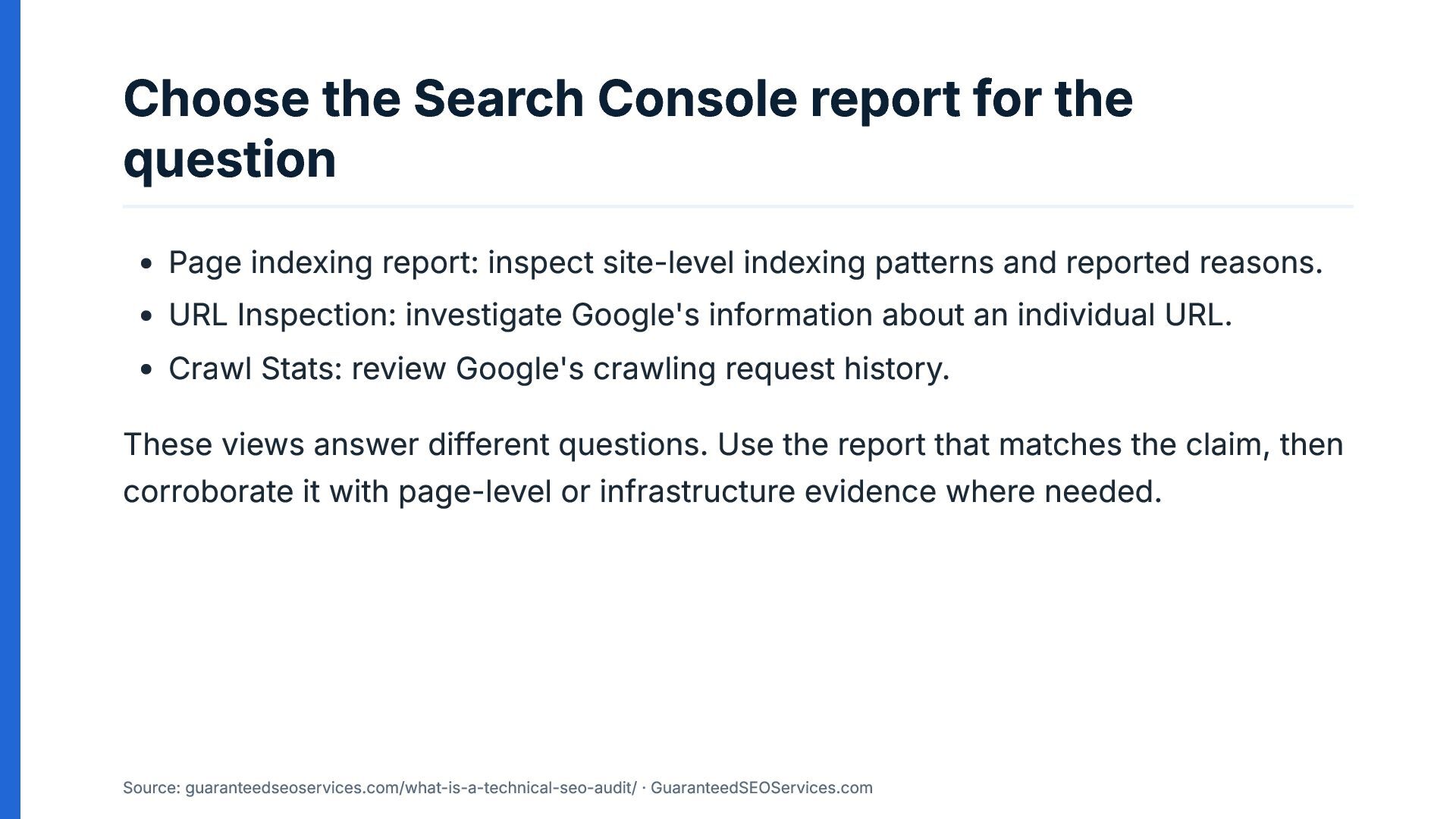
Choose the Search Console report for the question Page indexing
report: inspect site-level indexing patterns and reported reasons. URL Inspection: investigate Google's information about an individual URL. Crawl Stats: review Google's crawling request history. These views answer different questions. Use the report that matches the claim, then corroborate it with page-level or infrastructure evidence where needed. Source: guaranteedseoservices.com/what-is-a-technical-seo-audit/ · GuaranteedSEOServices.com -
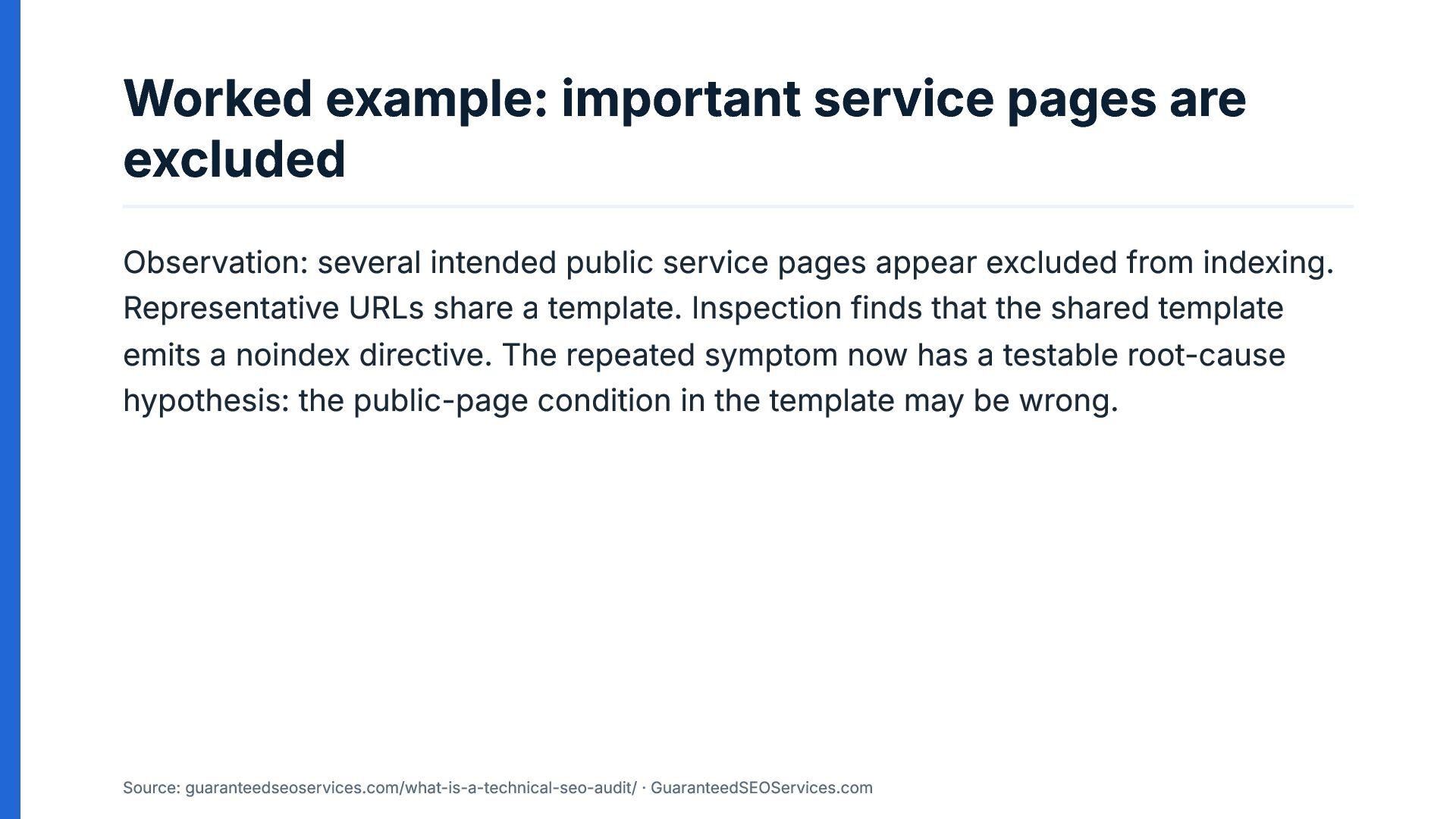
Worked example: important service pages are excluded Observation: several intended
public service pages appear excluded from indexing. Representative URLs share a template. Inspection finds that the shared template emits a noindex directive. The repeated symptom now has a testable root-cause hypothesis: the public-page condition in the template may be wrong. Source: guaranteedseoservices.com/what-is-a-technical-seo-audit/ · GuaranteedSEOServices.com -
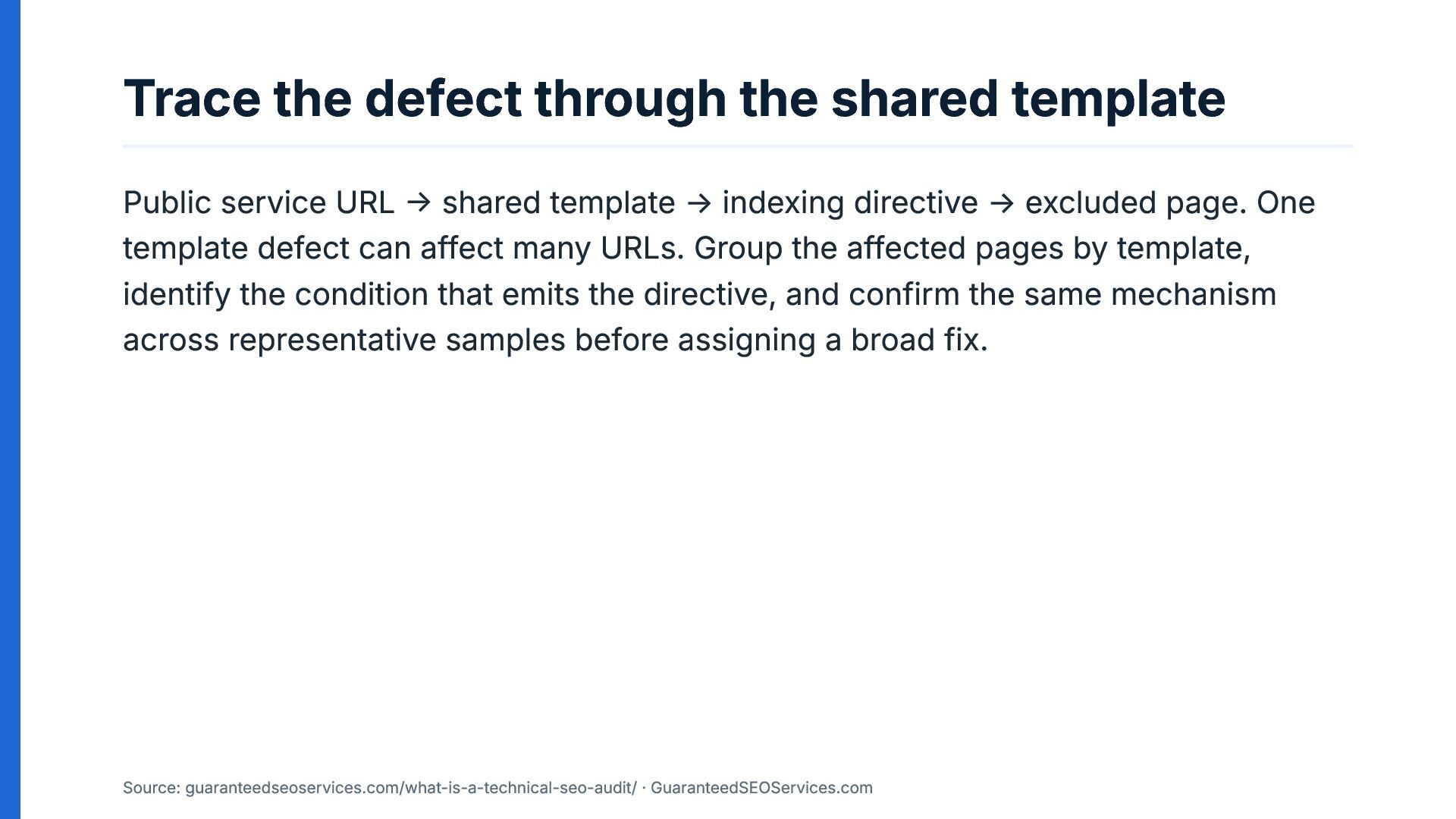
Trace the defect through the shared template Public service URL
→ shared template → indexing directive → excluded page. One template defect can affect many URLs. Group the affected pages by template, identify the condition that emits the directive, and confirm the same mechanism across representative samples before assigning a broad fix. Source: guaranteedseoservices.com/what-is-a-technical-seo-audit/ · GuaranteedSEOServices.com -
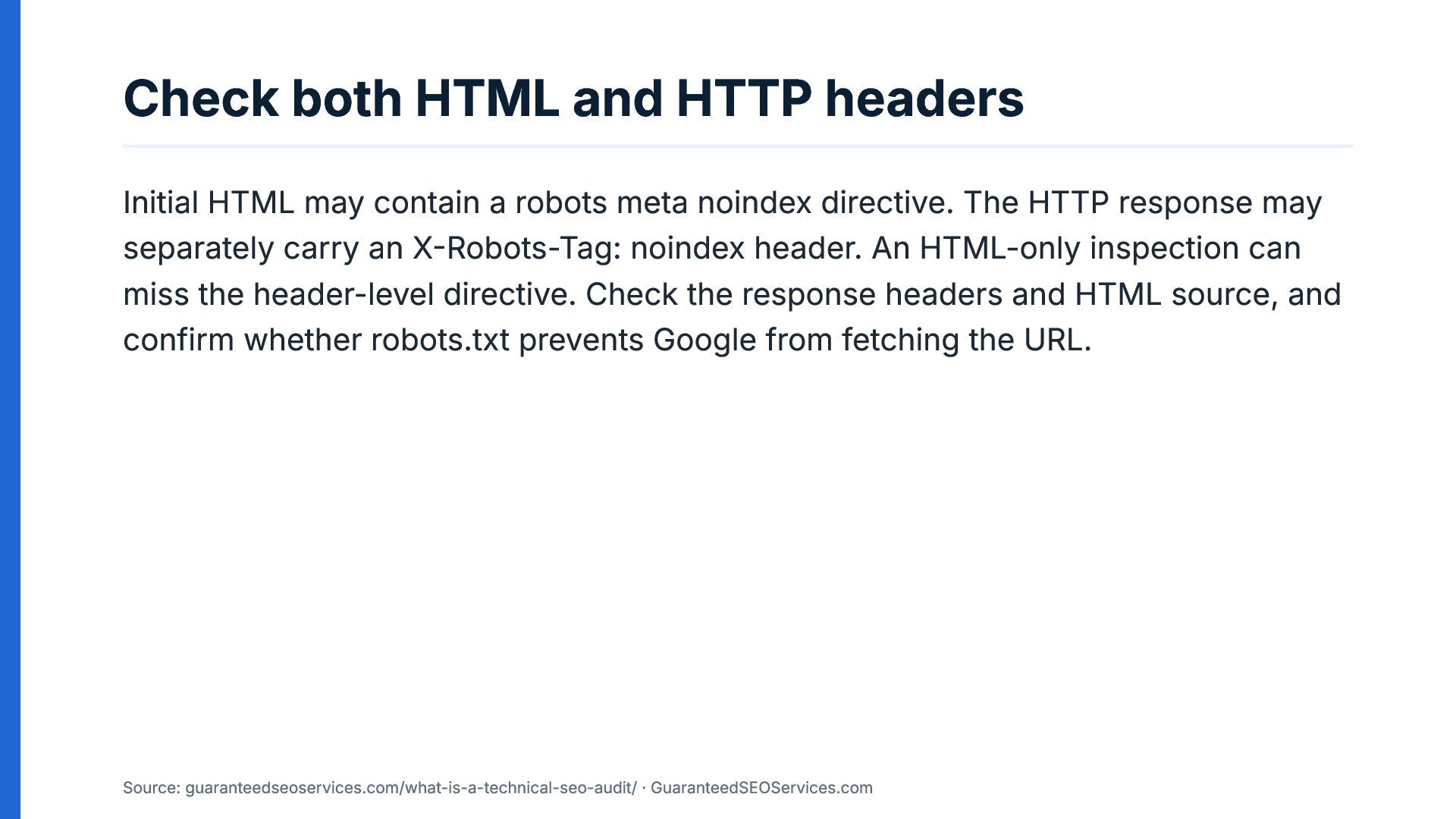
Check both HTML and HTTP headers Initial HTML may contain
a robots meta noindex directive. The HTTP response may separately carry an X-Robots-Tag: noindex header. An HTML-only inspection can miss the header-level directive. Check the response headers and HTML source, and confirm whether robots.txt prevents Google from fetching the URL. Source: guaranteedseoservices.com/what-is-a-technical-seo-audit/ · GuaranteedSEOServices.com -
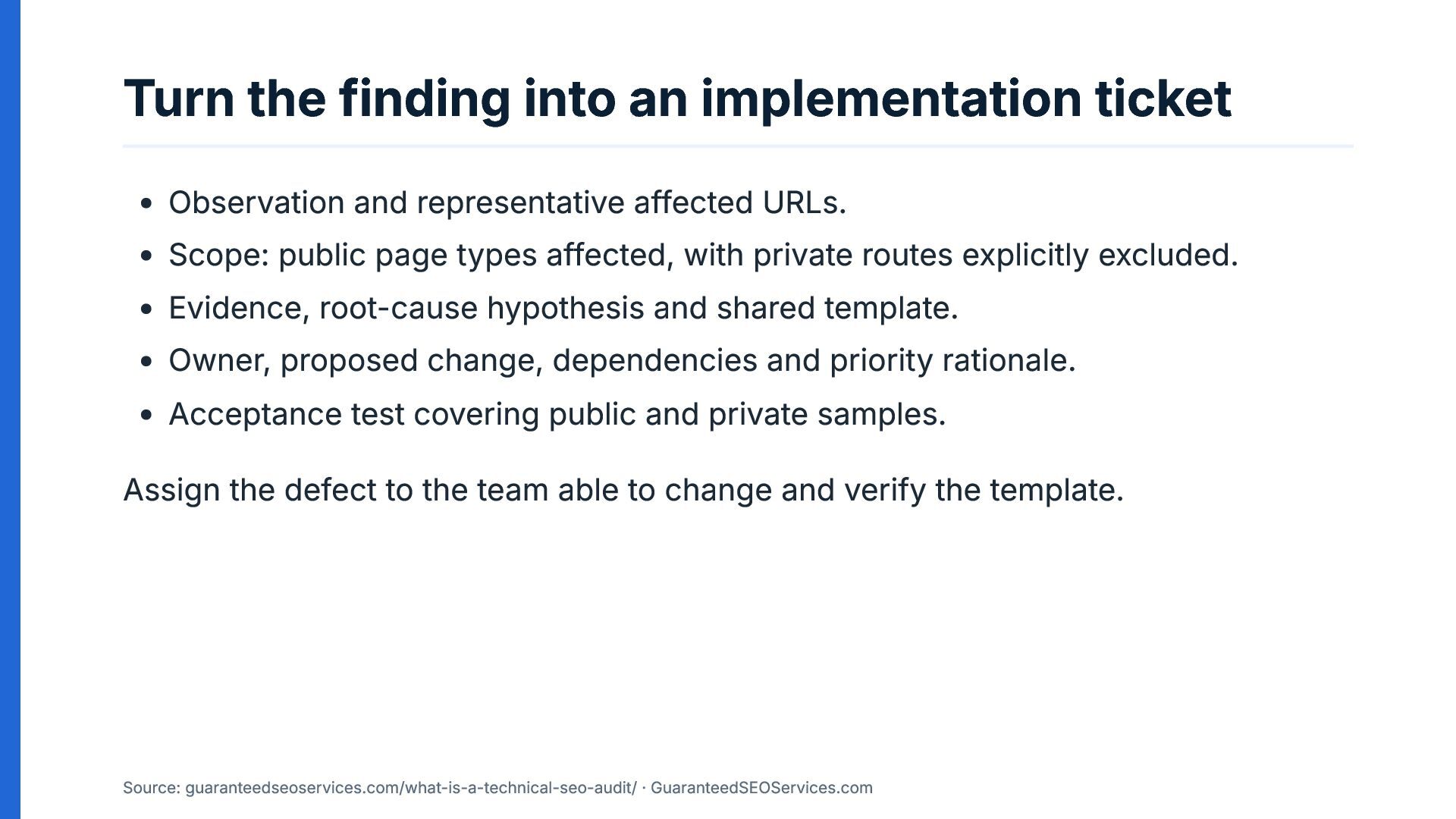
Turn the finding into an implementation ticket Observation and representative
affected URLs. Scope: public page types affected, with private routes explicitly excluded. Evidence, root-cause hypothesis and shared template. Owner, proposed change, dependencies and priority rationale. Acceptance test covering public and private samples. Assign the defect to the team able to change and verify the template. Source: guaranteedseoservices.com/what-is-a-technical-seo-audit/ · GuaranteedSEOServices.com -
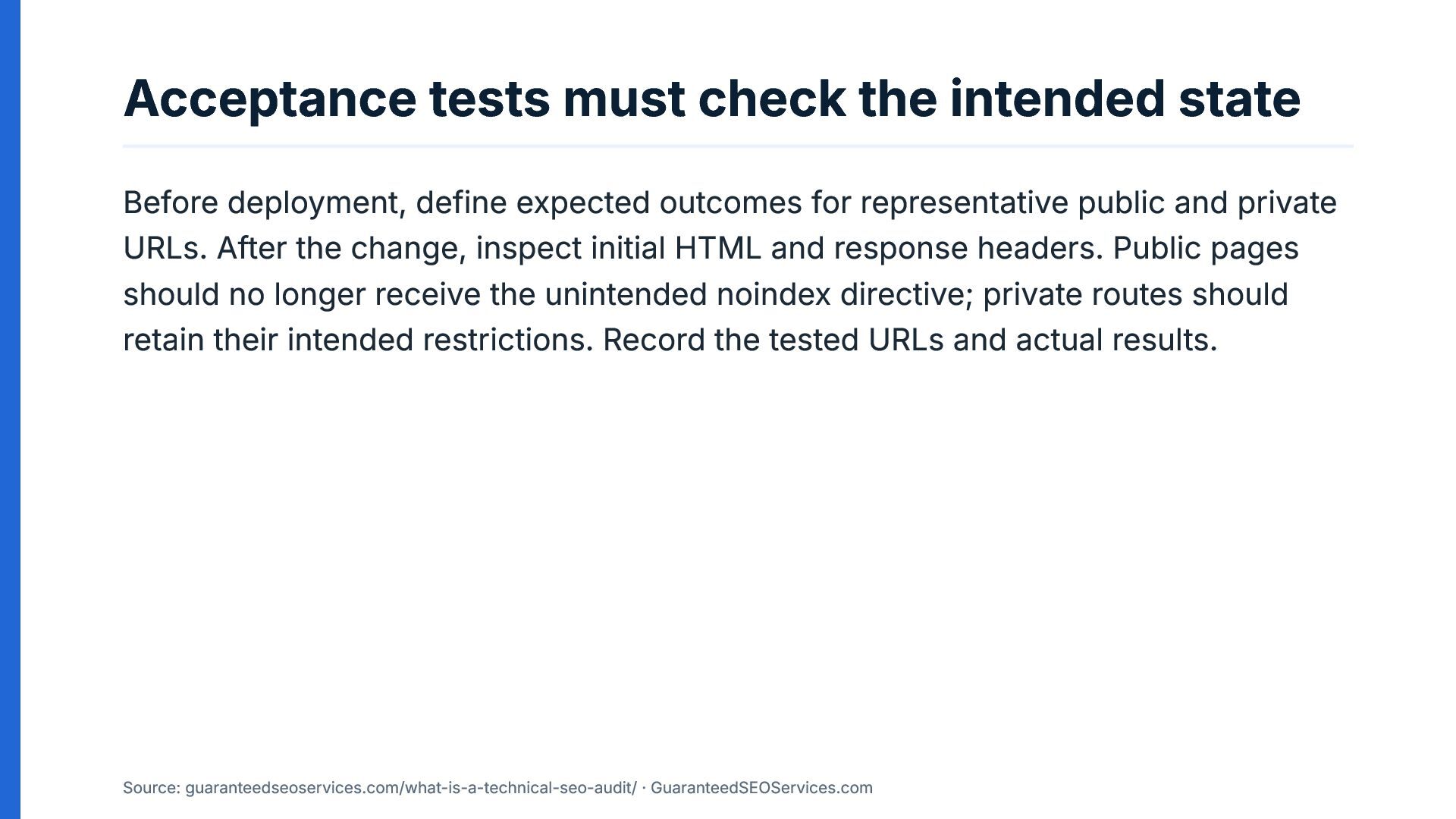
Acceptance tests must check the intended state Before deployment, define
expected outcomes for representative public and private URLs. After the change, inspect initial HTML and response headers. Public pages should no longer receive the unintended noindex directive; private routes should retain their intended restrictions. Record the tested URLs and actual results. Source: guaranteedseoservices.com/what-is-a-technical-seo-audit/ · GuaranteedSEOServices.com -
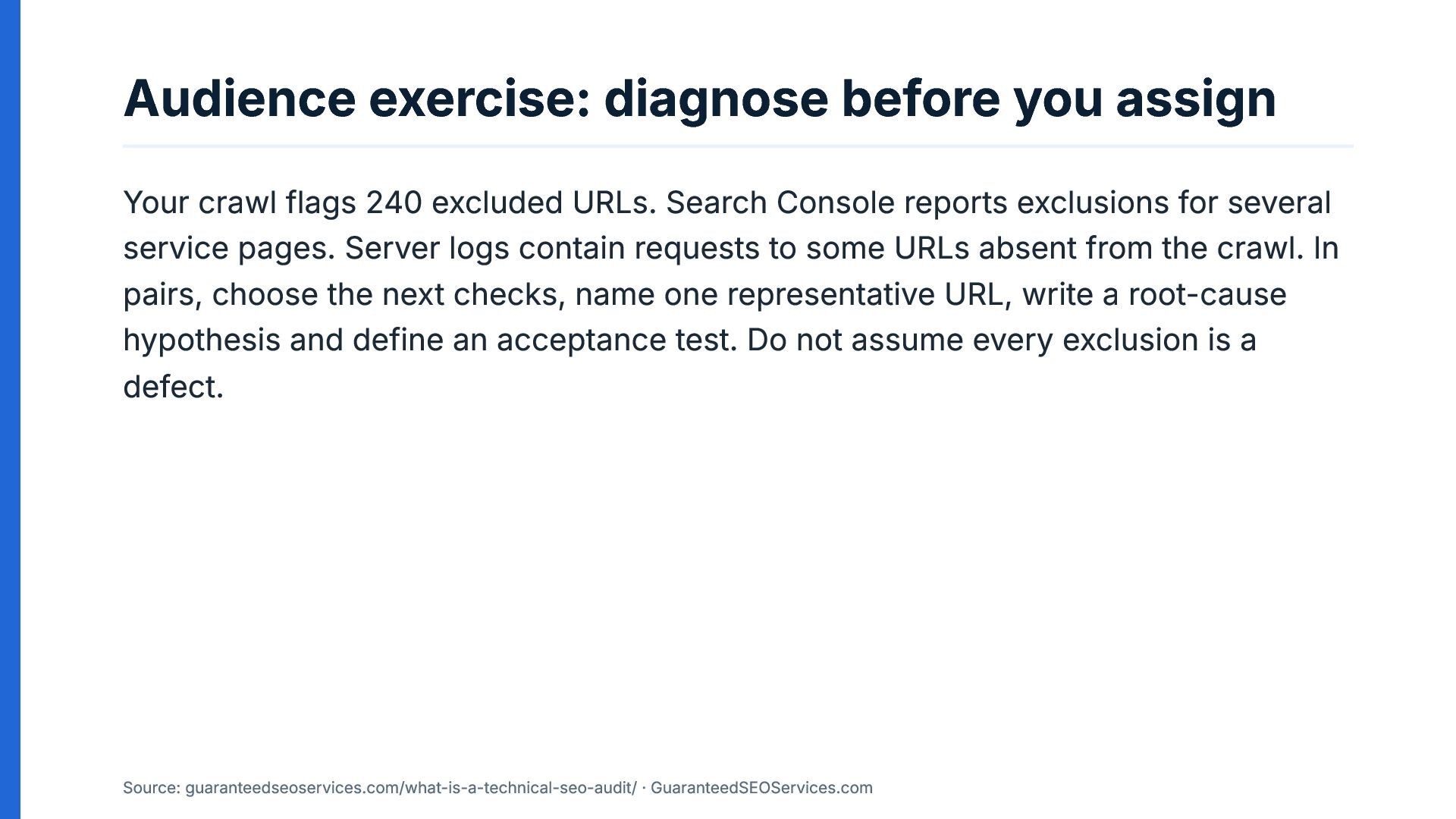
Audience exercise: diagnose before you assign Your crawl flags 240
excluded URLs. Search Console reports exclusions for several service pages. Server logs contain requests to some URLs absent from the crawl. In pairs, choose the next checks, name one representative URL, write a root-cause hypothesis and define an acceptance test. Do not assume every exclusion is a defect. Source: guaranteedseoservices.com/what-is-a-technical-seo-audit/ · GuaranteedSEOServices.com -
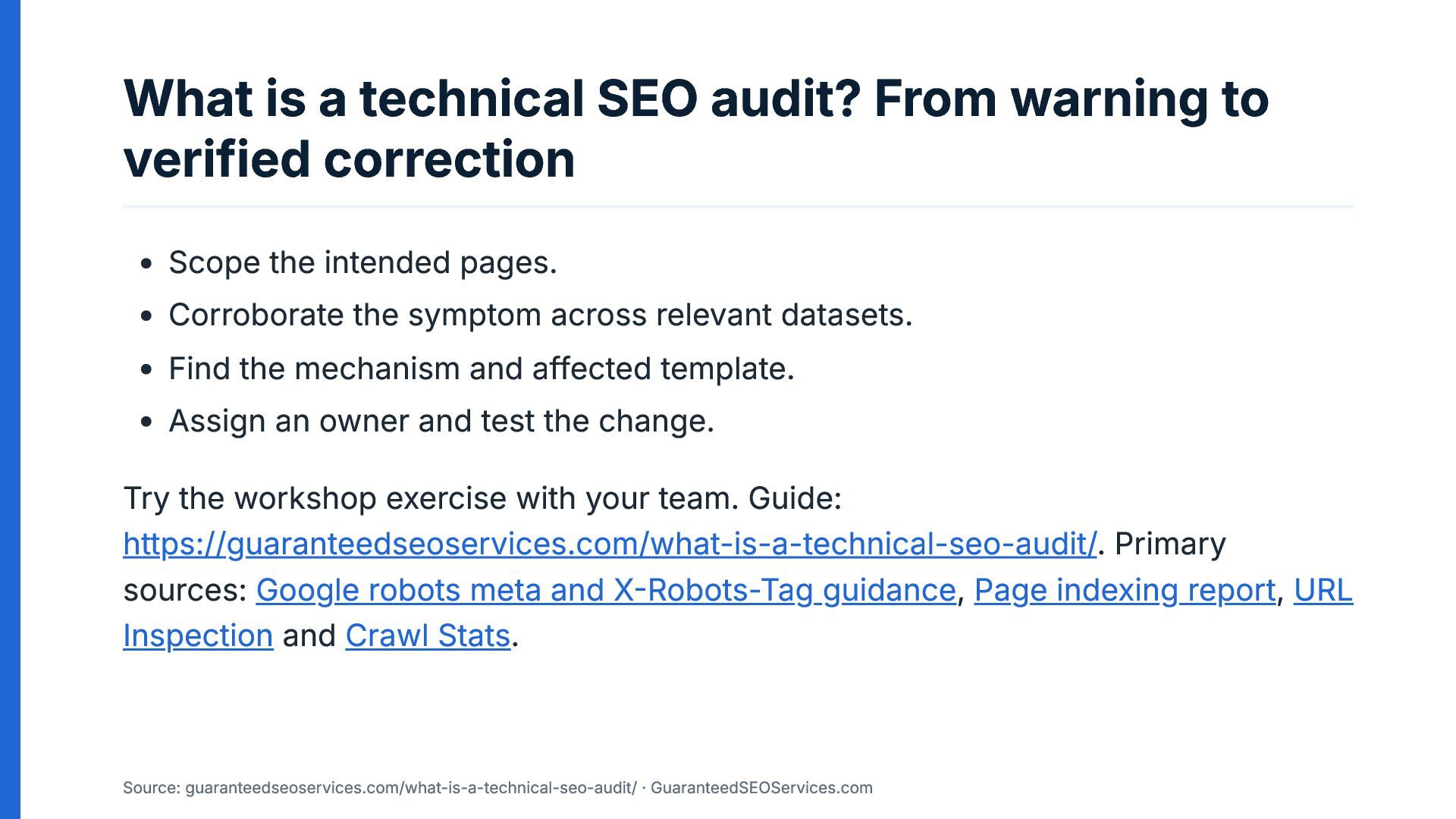
What is a technical SEO audit? From warning to verified
correction Scope the intended pages. Corroborate the symptom across relevant datasets. Find the mechanism and affected template. Assign an owner and test the change. Try the workshop exercise with your team. Guide: https://guaranteedseoservices.com/what-is-a-technical-seo-audit/. Primary sources: Google robots meta and X-Robots-Tag guidance, Page indexing report, URL Inspection and Crawl Stats. Source: guaranteedseoservices.com/what-is-a-technical-seo-audit/ · GuaranteedSEOServices.com -
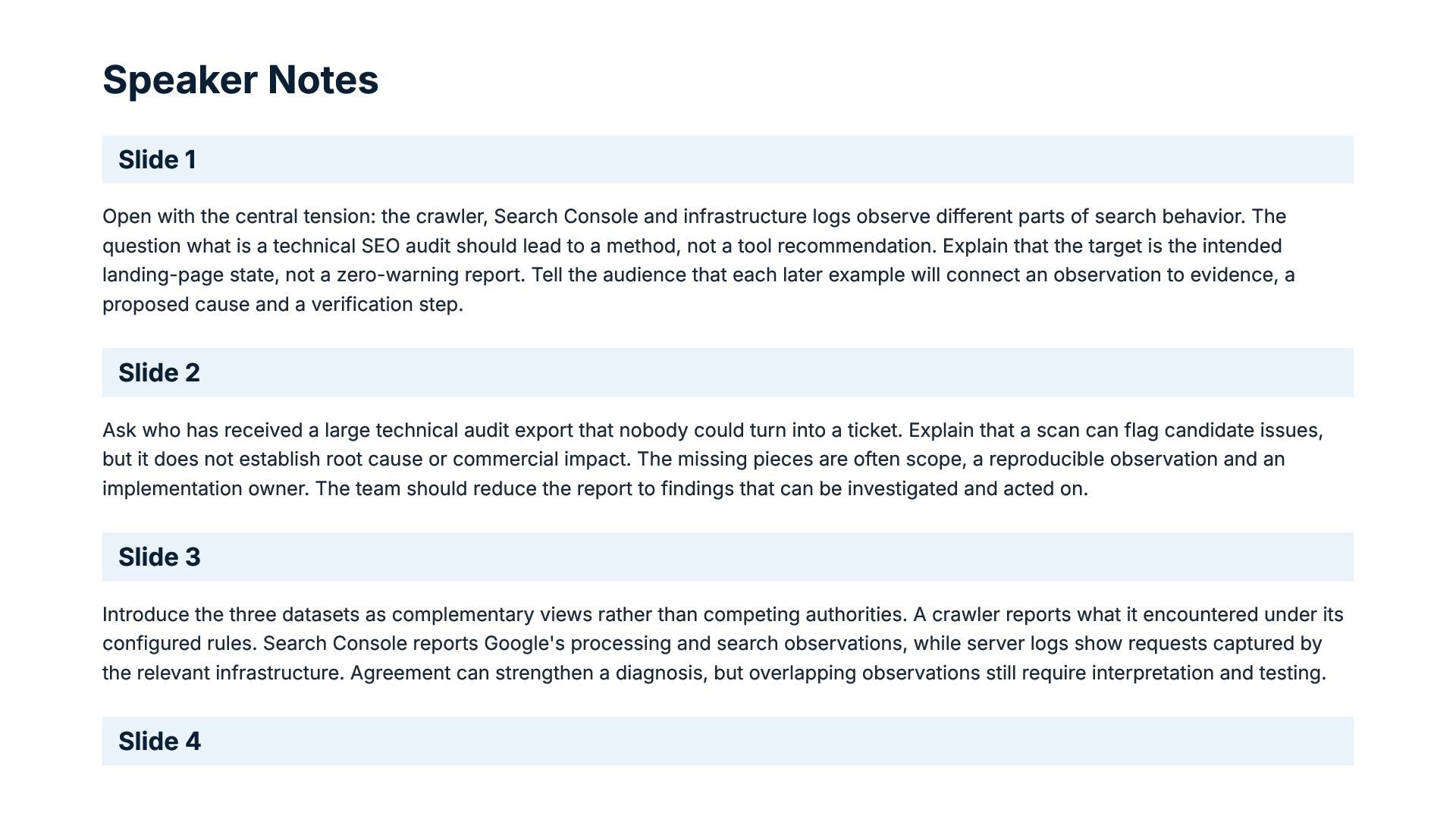
Speaker Notes Slide 1 Open with the central tension: the
crawler, Search Console and infrastructure logs observe different parts of search behavior. The question what is a technical SEO audit should lead to a method, not a tool recommendation. Explain that the target is the intended landing-page state, not a zero-warning report. Tell the audience that each later example will connect an observation to evidence, a proposed cause and a verification step. Slide 2 Ask who has received a large technical audit export that nobody could turn into a ticket. Explain that a scan can flag candidate issues, but it does not establish root cause or commercial impact. The missing pieces are often scope, a reproducible observation and an implementation owner. The team should reduce the report to findings that can be investigated and acted on. Slide 3 Introduce the three datasets as complementary views rather than competing authorities. A crawler reports what it encountered under its configured rules. Search Console reports Google's processing and search observations, while server logs show requests captured by the relevant infrastructure. Agreement can strengthen a diagnosis, but overlapping observations still require interpretation and testing. Slide 4 -
Walk through each row and ask what the dataset cannot
answer. A crawl may not reproduce Google's processing of a URL. Search Console is not a complete record of all requests reaching the origin server. Logs cannot independently confirm whether a page is indexed. Teach the audience to qualify statements according to the evidence actually available. Slide 5 Start with business and site purpose: which public landing pages are intended to appear in search? Separate those from private account pages, utility URLs and other routes that may be intentionally excluded. This inventory becomes the reference state against which the evidence is evaluated. Without it, teams can waste time fixing behavior that is correct by design. Slide 6 Emphasize that disagreement is useful because it points to the next question. If a crawl finds a category with no impressions, check the page's purpose, indexing state, canonical signals and possible demand before assigning blame. If logs contain a URL the crawler did not find, investigate old external links, sitemap entries and crawl coverage. These are candidate explanations, not established causes. Slide 7 Distinguish the three Search Console views by the question each answers. The Page indexing report provides a site-level view of indexing patterns and reported reasons. URL Inspection focuses on a specific URL. Crawl Stats provides information about Google's crawling requests over time. Encourage attendees to document the actual evidence and its scope instead of writing that Search Console simply confirms an issue. Slide 8 -
Present the service-page case as an investigation sequence. The initial
observation is that intended public pages appear excluded. A shared template provides a plausible common dependency, and inspection finds a noindex directive emitted by that template. The hypothesis becomes stronger when the same behavior is reproduced on representative affected URLs. The finding still needs an implementation-level correction and a test. Slide 9 Explain why a template-level defect changes the scope of the work. Separate URL counts from root causes: many affected URLs can originate from one conditional rule. Ask developers to identify where the directive is generated and which page types use that component. The ticket should cover the public-page condition and list private routes that must remain excluded. Do not generalize the fix beyond verified scope. Slide 10 Show how an HTML-only check can produce an incomplete diagnosis. Google documents that X-Robots-Tag can carry indexing rules in the HTTP response header, including rules also available through a robots meta tag. Inspect both the initial HTML and the response headers. Also check robots.txt because a disallowed URL may prevent Google from seeing and applying page-level indexing directives. Slide 11 Turn the finding into a ticket a developer can implement without reconstructing the investigation. Include representative URLs, the affected template, the evidence, the suspected condition and the desired change. Name an owner and any dependencies. Explicitly exclude private routes from the public-page fix. A useful priority rationale explains why the intended pages matter without inventing traffic or revenue estimates. Slide 12 -
Acceptance criteria should describe observable behavior, not vague intentions such
as fixing indexing. Before deployment, identify public and private sample URLs and define the expected response. After deployment, inspect HTML and headers to verify that public pages no longer receive the unintended noindex directive and private routes retain their intended restrictions. Record results, then monitor Search Console after deployment without promising an indexing or ranking outcome. Slide 13 Give pairs a few minutes to propose their next checks. The exercise is not a contest to explain all 240 exclusions. Ask each pair to select one intended service page, identify the relevant Search Console evidence, inspect the HTML and response headers, and consider what the logs can establish. Require a testable hypothesis and a clear acceptance test before accepting a proposed fix. Slide 14 Answer key: first establish which excluded URLs are intended public landing pages, then select representative examples and inspect URL Inspection and the Page indexing report. Compare crawler observations with initial HTML, response headers and relevant server logs. If a shared template emits noindex on public pages, assign the template condition to its owner and verify public and private samples after deployment. Do not remove every noindex directive, because some routes need it. The practical meaning of what is a technical SEO audit is a repeatable process that turns evidence into a scoped, testable diagnosis, not a promise of rankings or commercial impact. -
Sources What Is a Technical SEO Audit? Google Search Central:
Robots meta tag, data-nosnippet, and X-Robots-Tag Google Search Console Help: Page indexing report Google Search Console Help: URL Inspection tool Google Search Console Help: Crawl Stats report
 guaranteedseoservices
 cargoodrich
 clarasoteras
 sophiebrannon
 guaca
 charlesmeaden
 whitworthseo
 speedyindexteam
 frankvandijk
 yunheechoi
 baasie
 inesmontani
 bryan
 cassininazir
 csswizardry
 akademiya2063
 aleyda
 marcoroth
 lara
 jdejongh
 stuffmc
 eitanlees