Upgrade to Pro — share decks privately, control downloads, hide ads and more …

Do 301 Redirects Hurt SEO? Trace a Retired Prod...

Do 301 Redirects Hurt SEO? Trace a Retired Product URL

Do 301 redirects hurt SEO? This workshop deck traces a retired product URL through HTTP responses, redirect chains, loops and soft 404s. Practice choosing a response based on replacement relevance, then test valid and invalid routes with your team. To understand the answer to do 301 redirects hurt SEO, read the guide: https://guaranteedseoservices.com/redirects-404s-broken-links-seo/?utm_source=speakerdeck&utm_medium=referral&utm_campaign=blog-redirects-404s-broken-links-seo

Avatar for GuaranteedSEOServices

GuaranteedSEOServices

October 26, 2026

More Decks by GuaranteedSEOServices

Other Decks in Marketing & SEO

Transcript

  1. Do 301 Redirects Hurt SEO? Trace a Retired Product URL

    Through Response and Destination A mechanism-first workshop for backend developers and SREs who need to choose the right HTTP response, trace routing failures, and validate the destination without treating every 404 as a defect. GuaranteedSEOServices.com October 27, 2026
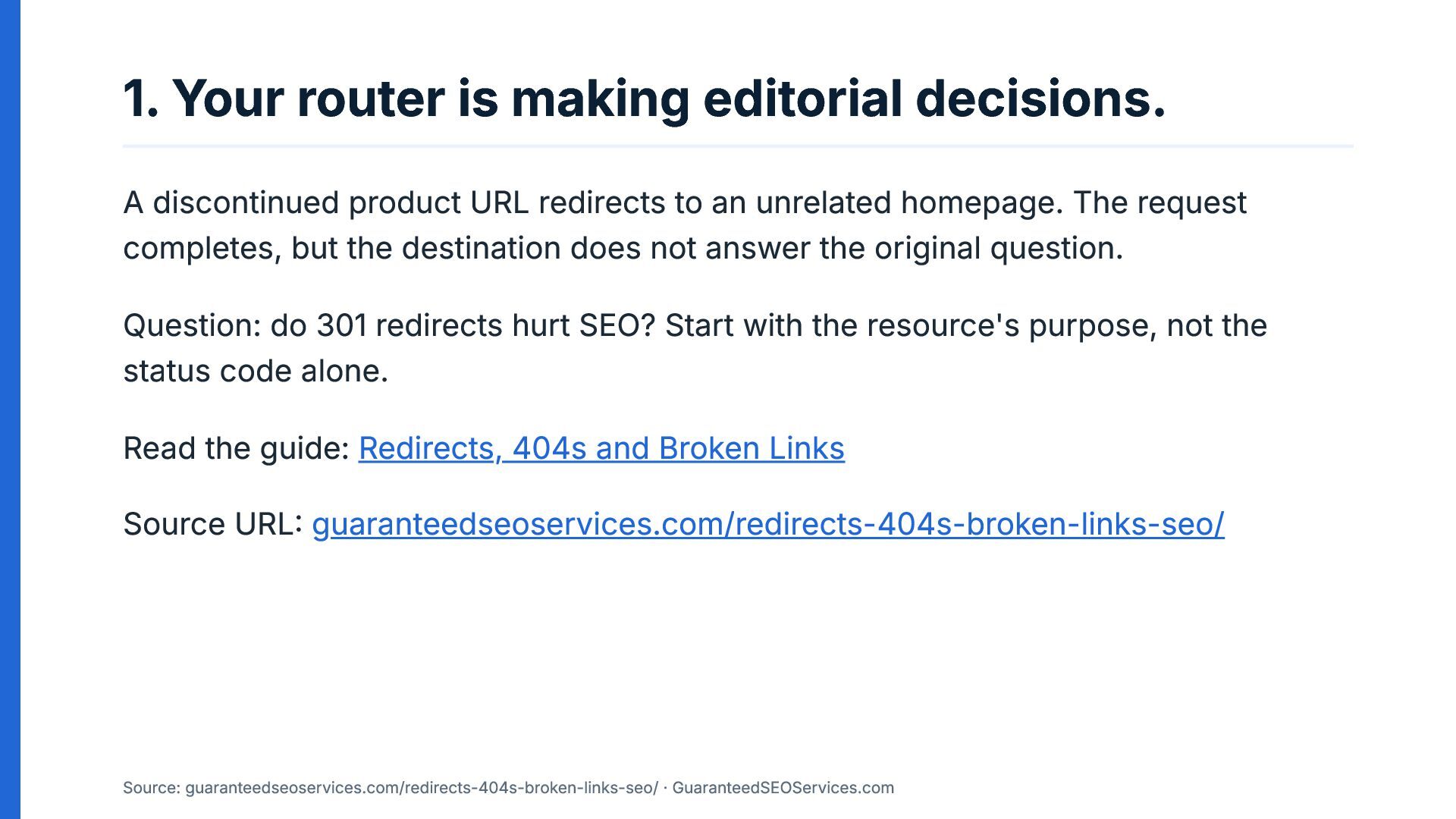
  2. 1. Your router is making editorial decisions. A discontinued product

    URL redirects to an unrelated homepage. The request completes, but the destination does not answer the original question. Question: do 301 redirects hurt SEO? Start with the resource's purpose, not the status code alone. Read the guide: Redirects, 404s and Broken Links Source URL: guaranteedseoservices.com/redirects-404s-broken-links-seo/ Source: guaranteedseoservices.com/redirects-404s-broken-links-seo/ · GuaranteedSEOServices.com
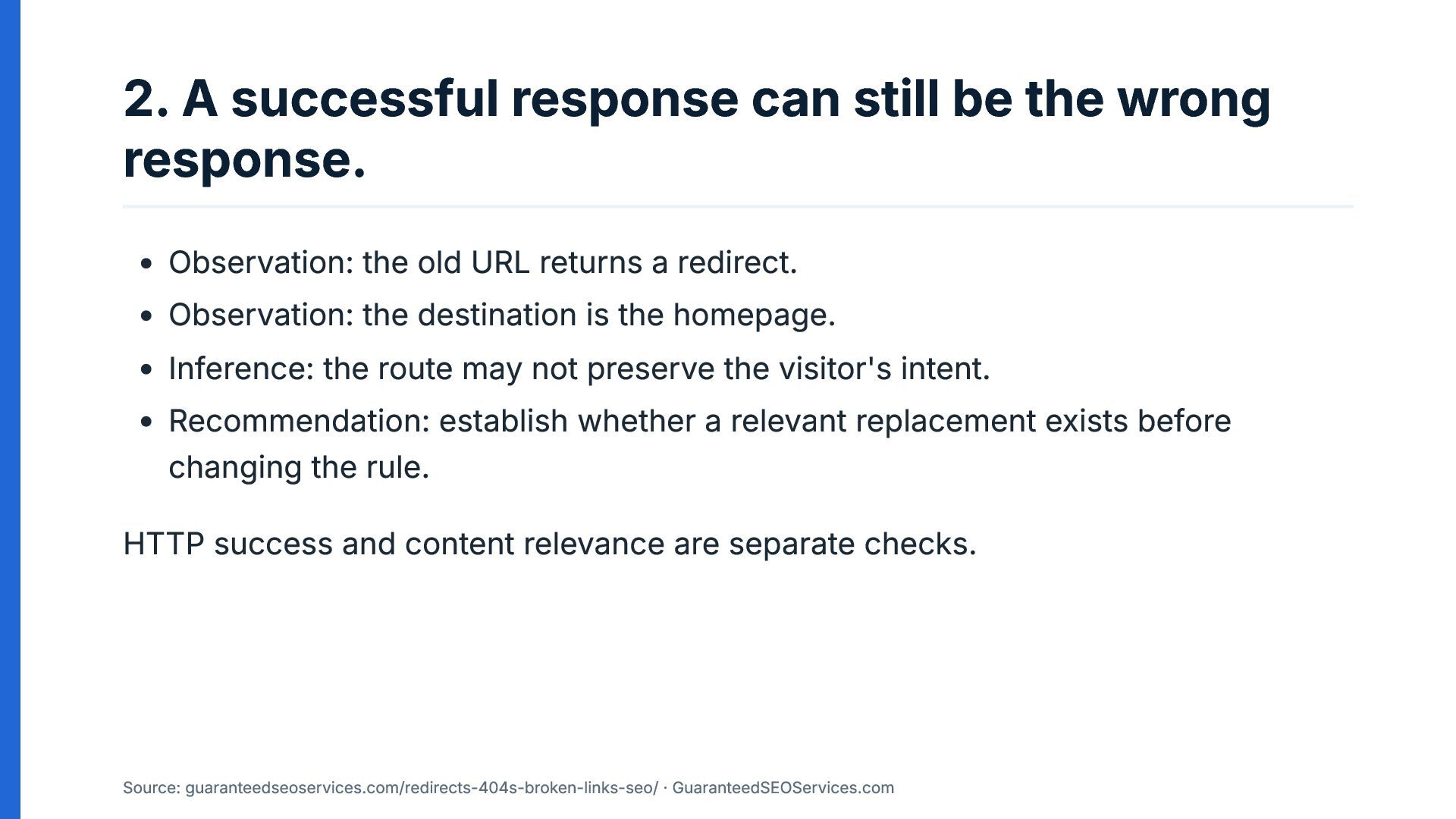
  3. 2. A successful response can still be the wrong response.

    Observation: the old URL returns a redirect. Observation: the destination is the homepage. Inference: the route may not preserve the visitor's intent. Recommendation: establish whether a relevant replacement exists before changing the rule. HTTP success and content relevance are separate checks. Source: guaranteedseoservices.com/redirects-404s-broken-links-seo/ · GuaranteedSEOServices.com
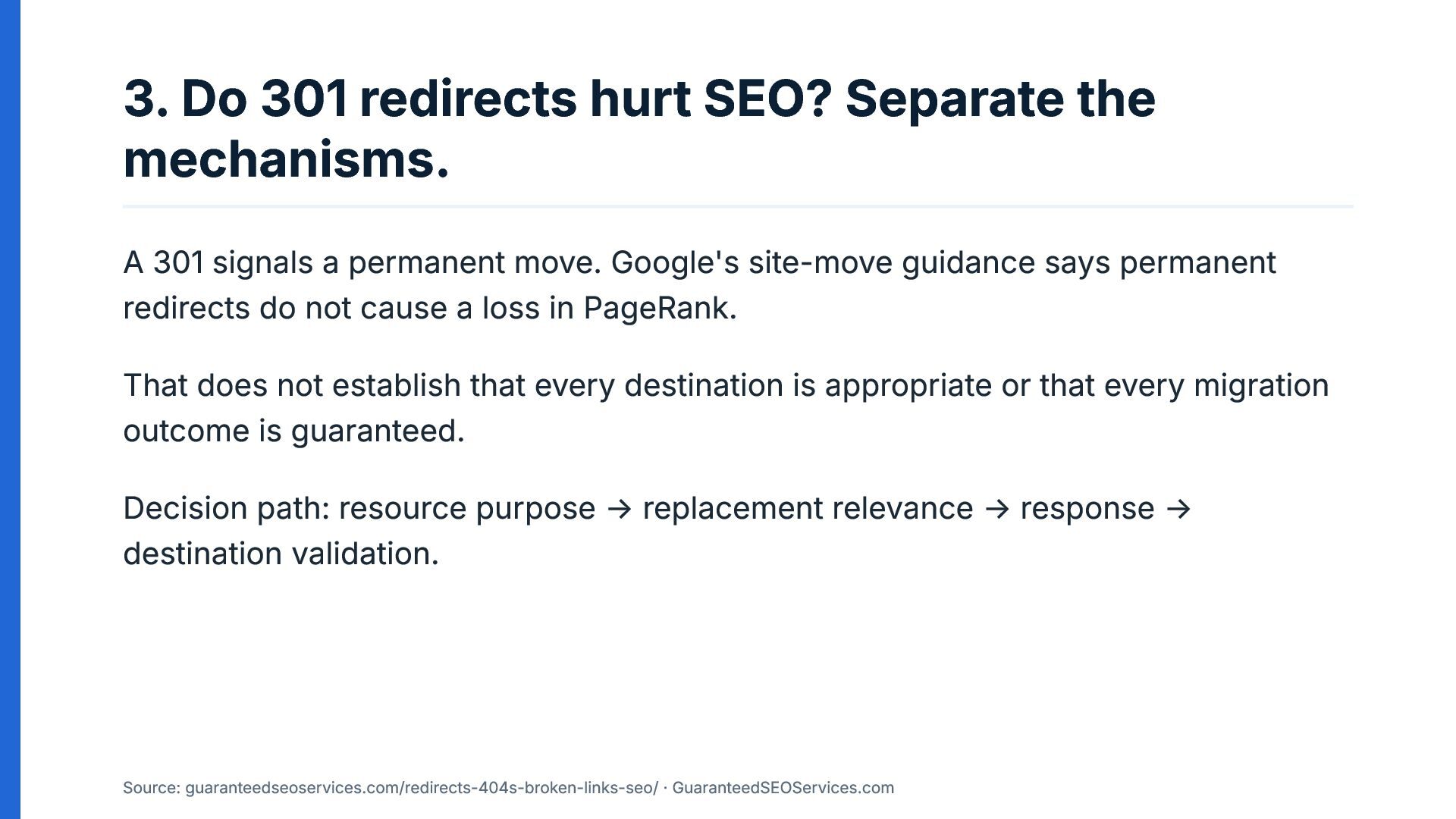
  4. 3. Do 301 redirects hurt SEO? Separate the mechanisms. A

    301 signals a permanent move. Google's site-move guidance says permanent redirects do not cause a loss in PageRank. That does not establish that every destination is appropriate or that every migration outcome is guaranteed. Decision path: resource purpose → replacement relevance → response → destination validation. Source: guaranteedseoservices.com/redirects-404s-broken-links-seo/ · GuaranteedSEOServices.com
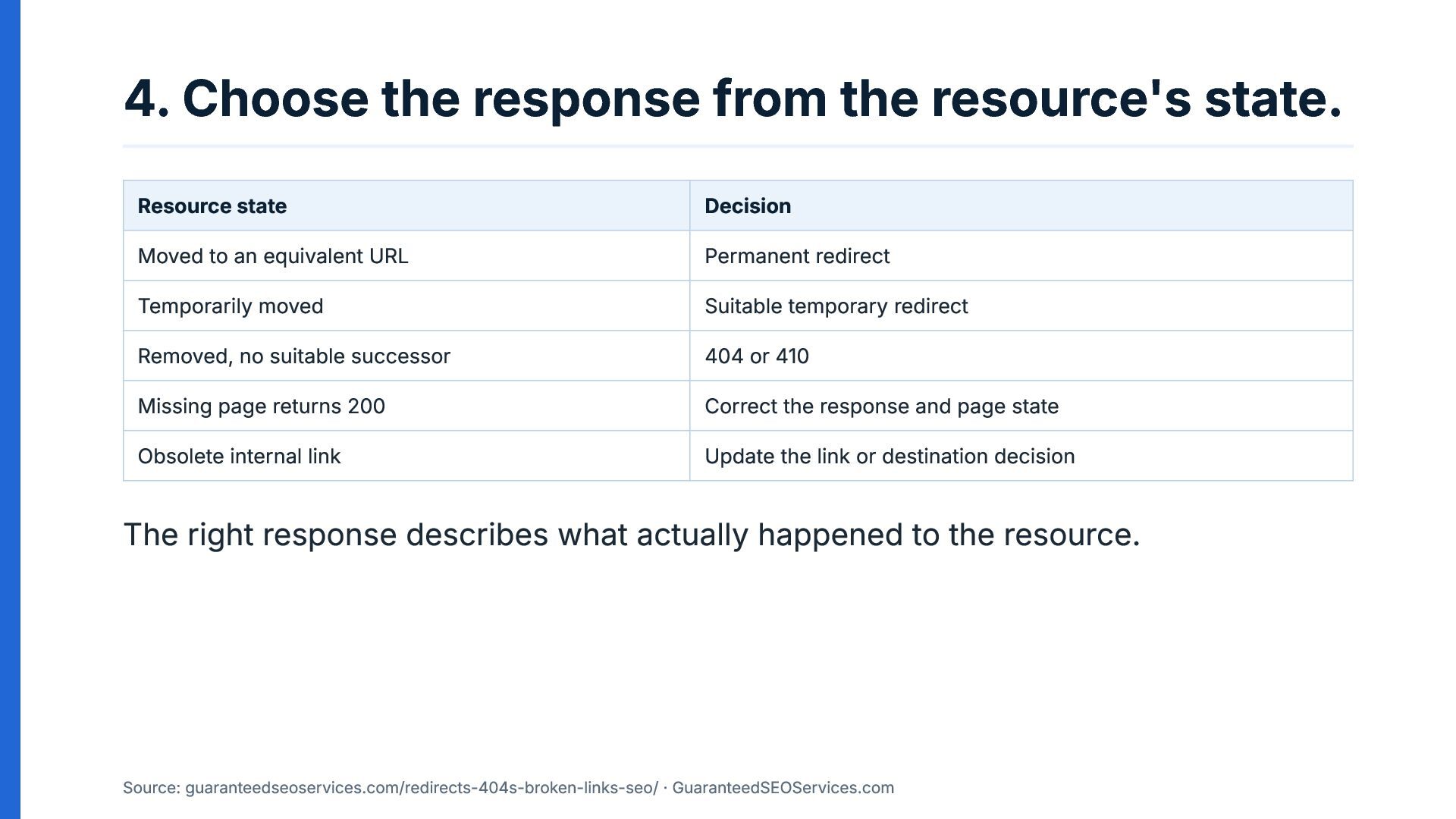
  5. 4. Choose the response from the resource's state. Resource state

    Decision Moved to an equivalent URL Permanent redirect Temporarily moved Suitable temporary redirect Removed, no suitable successor 404 or 410 Missing page returns 200 Correct the response and page state Obsolete internal link Update the link or destination decision The right response describes what actually happened to the resource. Source: guaranteedseoservices.com/redirects-404s-broken-links-seo/ · GuaranteedSEOServices.com
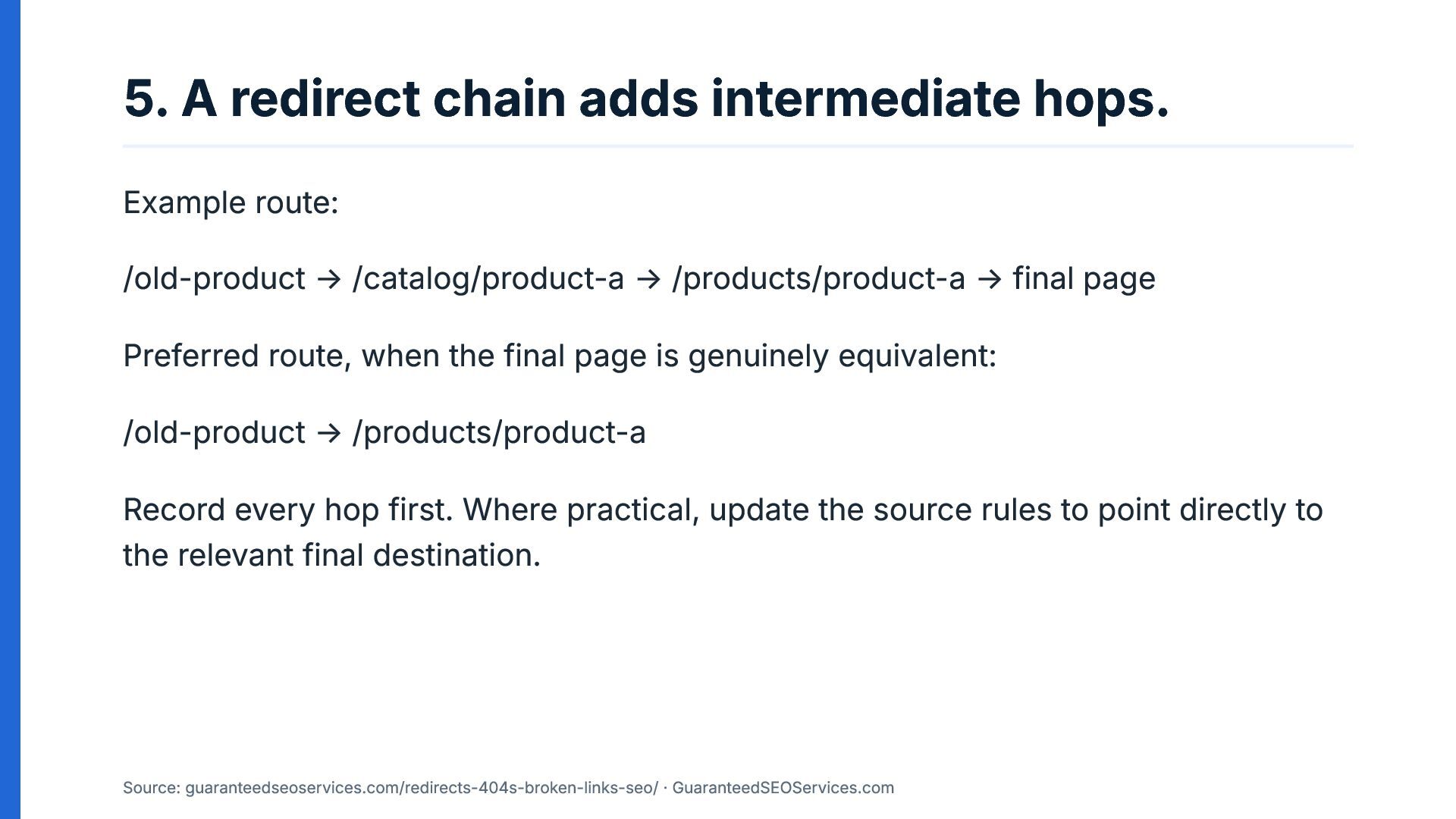
  6. 5. A redirect chain adds intermediate hops. Example route: /old-product

    → /catalog/product-a → /products/product-a → final page Preferred route, when the final page is genuinely equivalent: /old-product → /products/product-a Record every hop first. Where practical, update the source rules to point directly to the relevant final destination. Source: guaranteedseoservices.com/redirects-404s-broken-links-seo/ · GuaranteedSEOServices.com
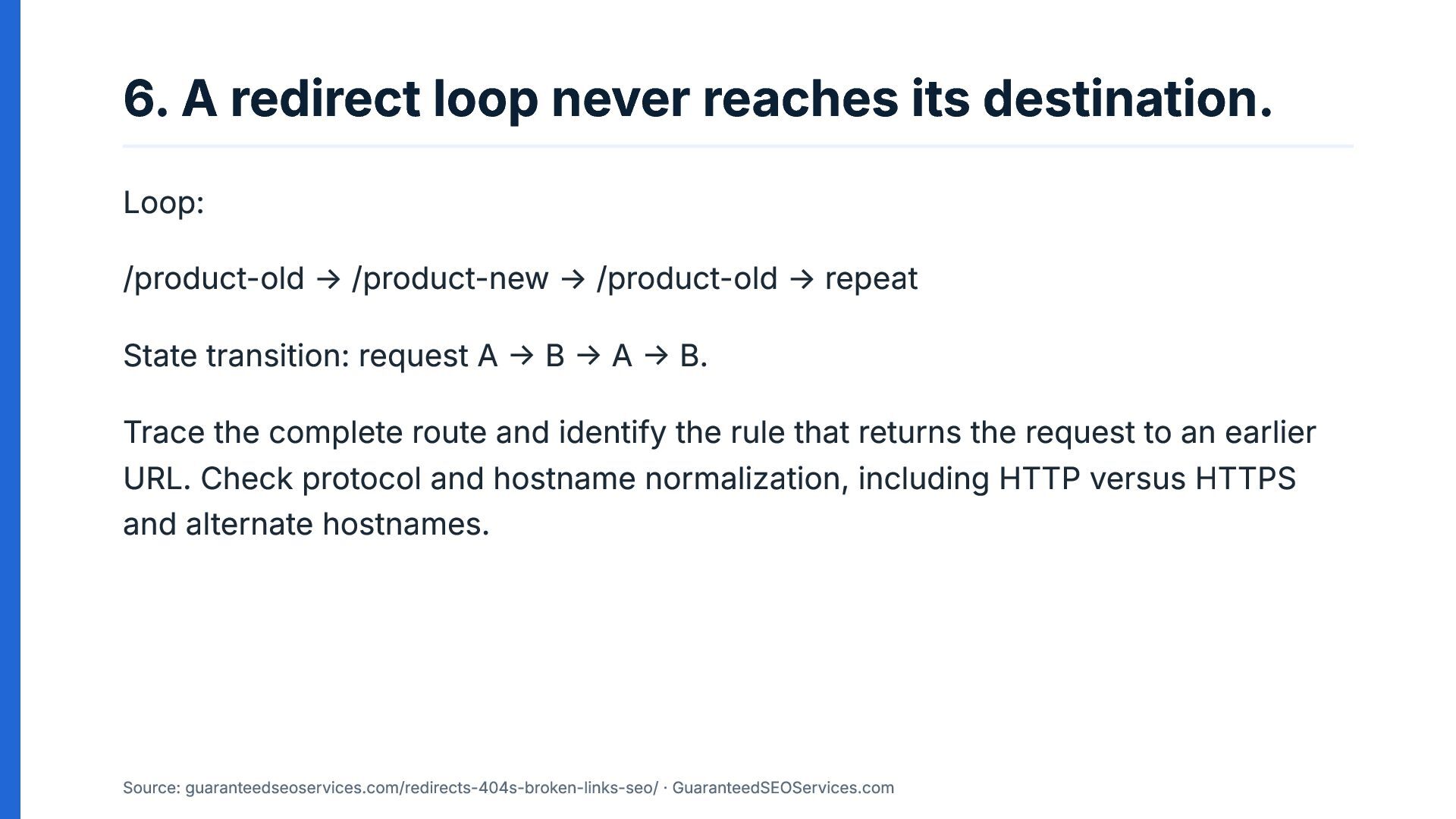
  7. 6. A redirect loop never reaches its destination. Loop: /product-old

    → /product-new → /product-old → repeat State transition: request A → B → A → B. Trace the complete route and identify the rule that returns the request to an earlier URL. Check protocol and hostname normalization, including HTTP versus HTTPS and alternate hostnames. Source: guaranteedseoservices.com/redirects-404s-broken-links-seo/ · GuaranteedSEOServices.com
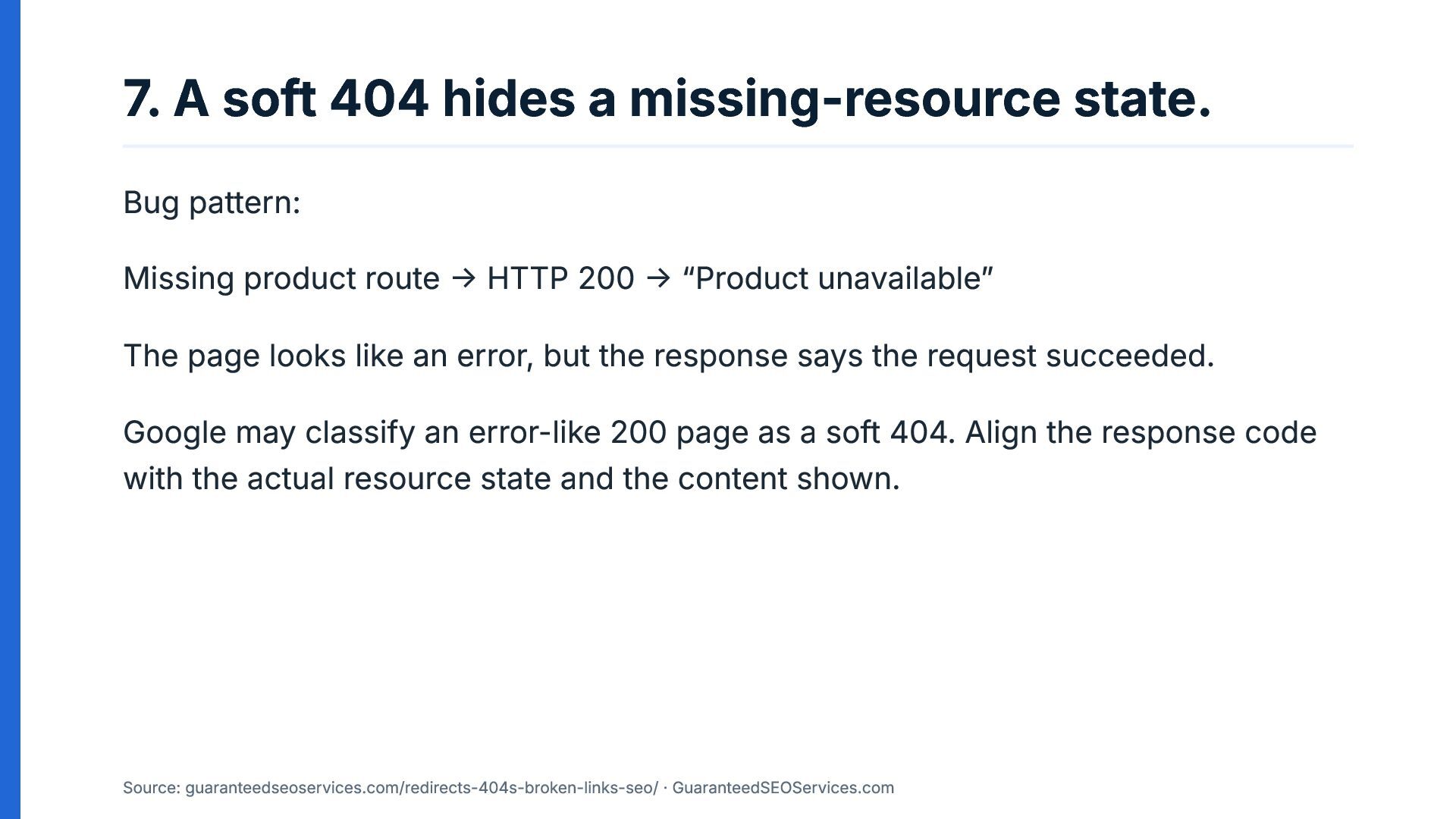
  8. 7. A soft 404 hides a missing-resource state. Bug pattern:

    Missing product route → HTTP 200 → “Product unavailable” The page looks like an error, but the response says the request succeeded. Google may classify an error-like 200 page as a soft 404. Align the response code with the actual resource state and the content shown. Source: guaranteedseoservices.com/redirects-404s-broken-links-seo/ · GuaranteedSEOServices.com
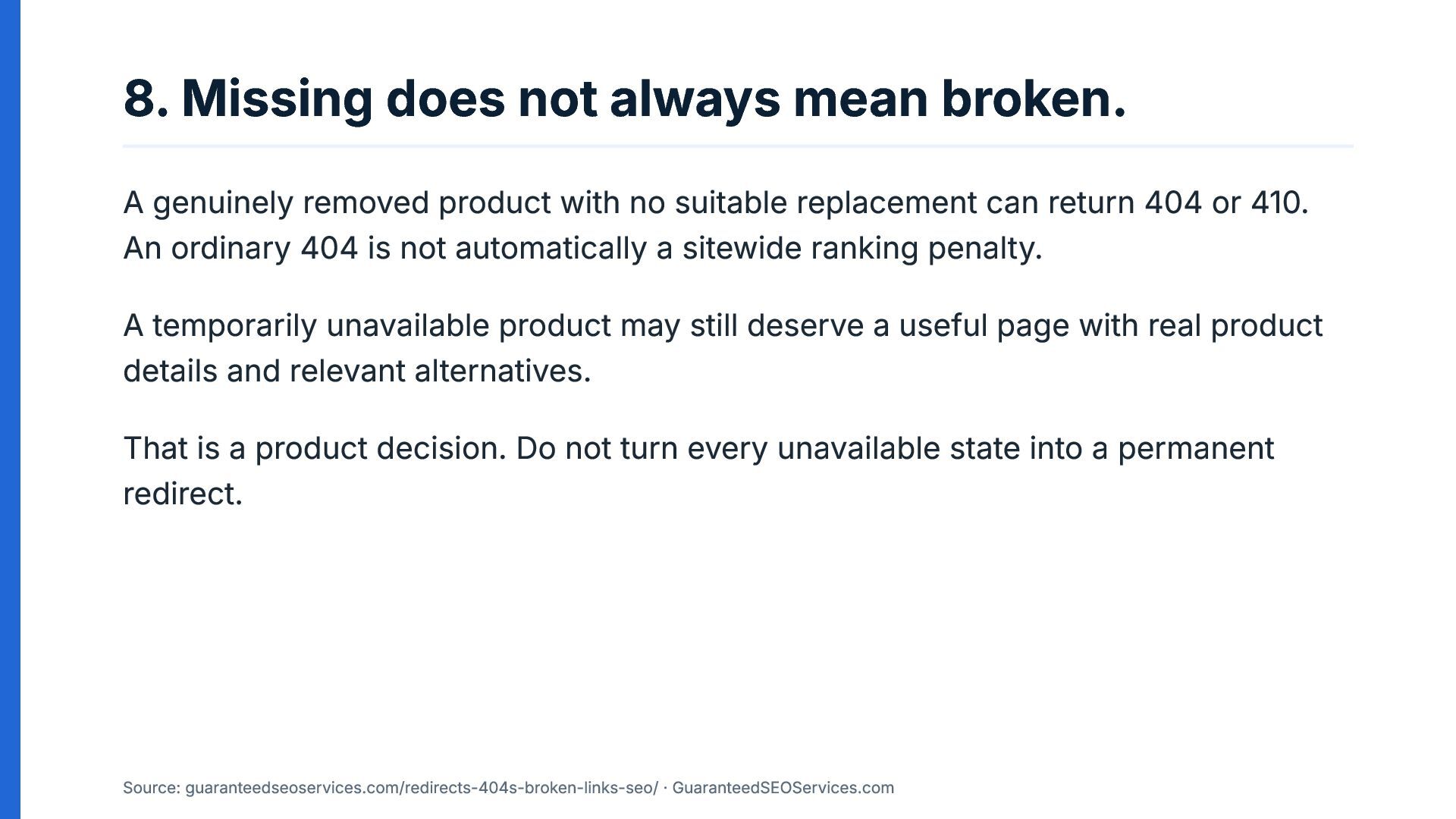
  9. 8. Missing does not always mean broken. A genuinely removed

    product with no suitable replacement can return 404 or 410. An ordinary 404 is not automatically a sitewide ranking penalty. A temporarily unavailable product may still deserve a useful page with real product details and relevant alternatives. That is a product decision. Do not turn every unavailable state into a permanent redirect. Source: guaranteedseoservices.com/redirects-404s-broken-links-seo/ · GuaranteedSEOServices.com
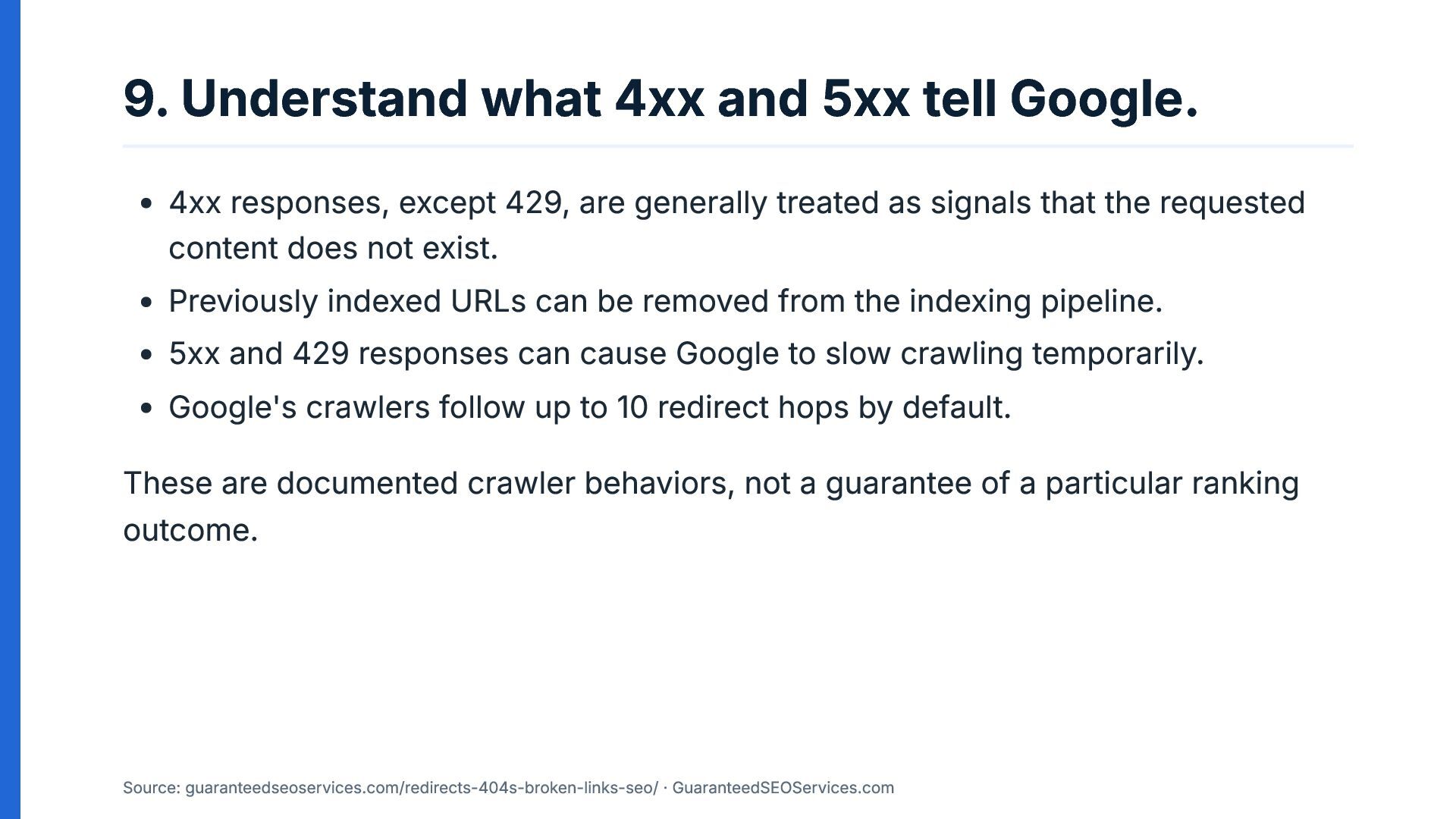
  10. 9. Understand what 4xx and 5xx tell Google. 4xx responses,

    except 429, are generally treated as signals that the requested content does not exist. Previously indexed URLs can be removed from the indexing pipeline. 5xx and 429 responses can cause Google to slow crawling temporarily. Google's crawlers follow up to 10 redirect hops by default. These are documented crawler behaviors, not a guarantee of a particular ranking outcome. Source: guaranteedseoservices.com/redirects-404s-broken-links-seo/ · GuaranteedSEOServices.com
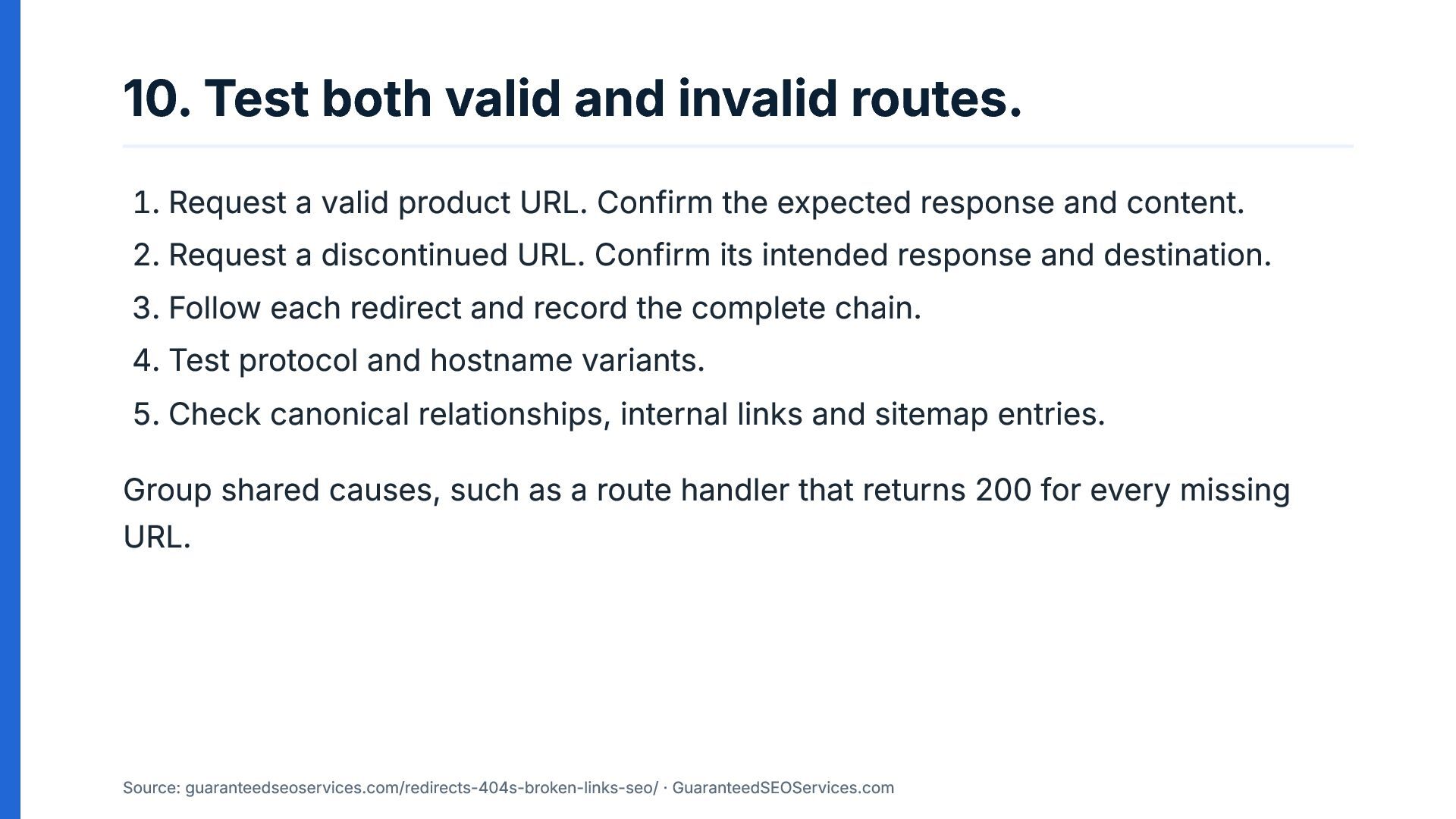
  11. 10. Test both valid and invalid routes. 1. Request a

    valid product URL. Confirm the expected response and content. 2. Request a discontinued URL. Confirm its intended response and destination. 3. Follow each redirect and record the complete chain. 4. Test protocol and hostname variants. 5. Check canonical relationships, internal links and sitemap entries. Group shared causes, such as a route handler that returns 200 for every missing URL. Source: guaranteedseoservices.com/redirects-404s-broken-links-seo/ · GuaranteedSEOServices.com
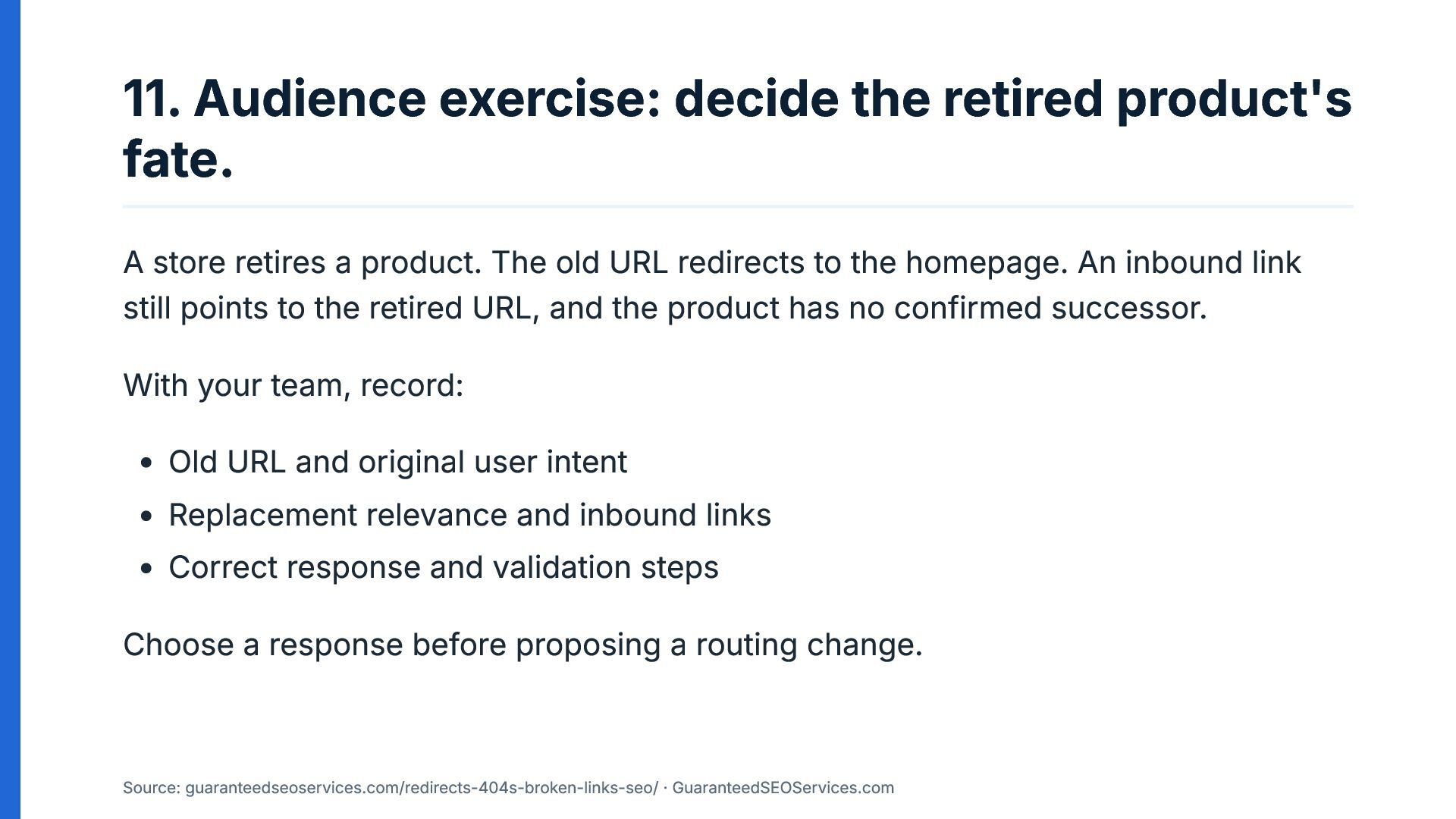
  12. 11. Audience exercise: decide the retired product's fate. A store

    retires a product. The old URL redirects to the homepage. An inbound link still points to the retired URL, and the product has no confirmed successor. With your team, record: Old URL and original user intent Replacement relevance and inbound links Correct response and validation steps Choose a response before proposing a routing change. Source: guaranteedseoservices.com/redirects-404s-broken-links-seo/ · GuaranteedSEOServices.com
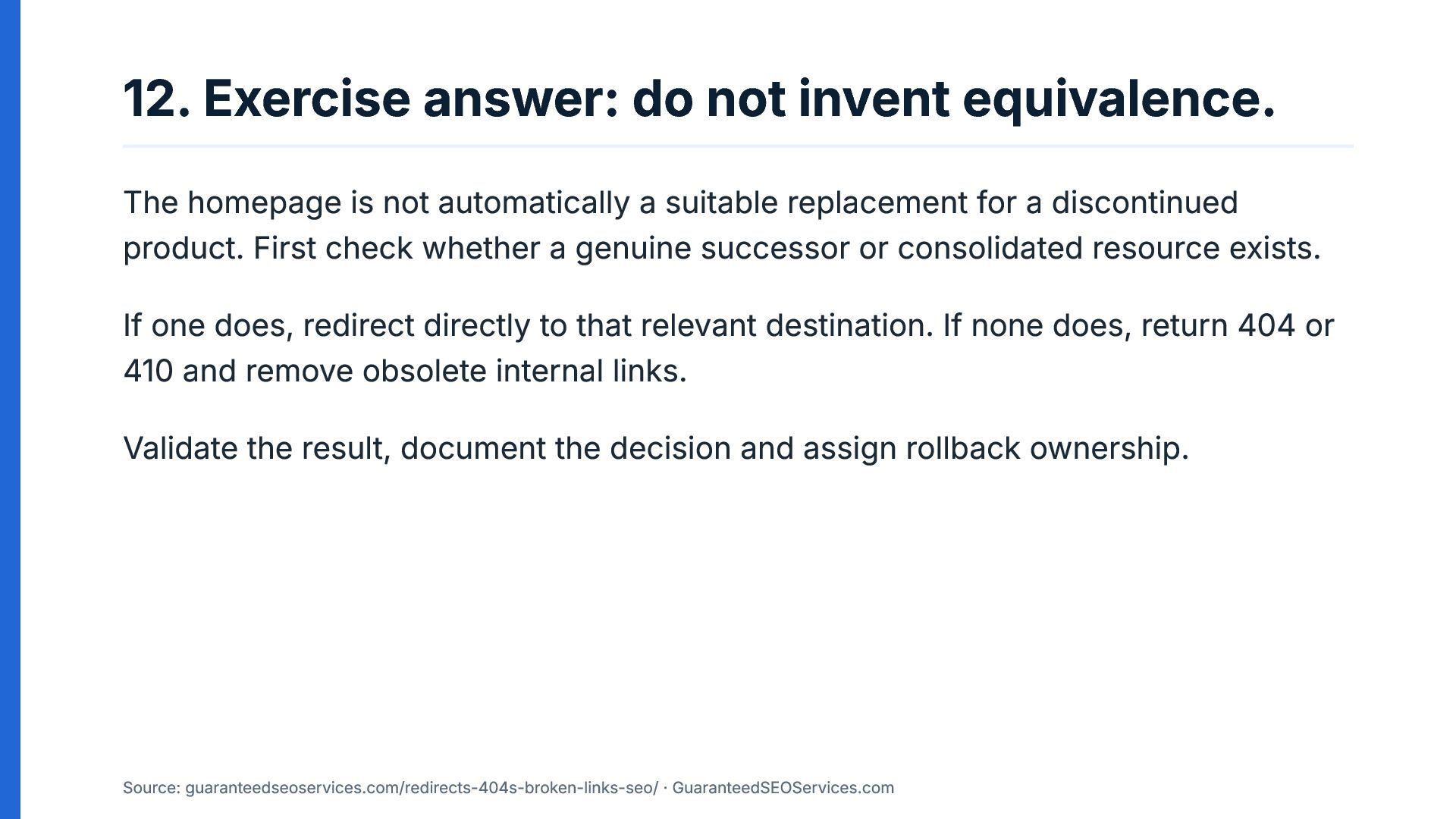
  13. 12. Exercise answer: do not invent equivalence. The homepage is

    not automatically a suitable replacement for a discontinued product. First check whether a genuine successor or consolidated resource exists. If one does, redirect directly to that relevant destination. If none does, return 404 or 410 and remove obsolete internal links. Validate the result, document the decision and assign rollback ownership. Source: guaranteedseoservices.com/redirects-404s-broken-links-seo/ · GuaranteedSEOServices.com
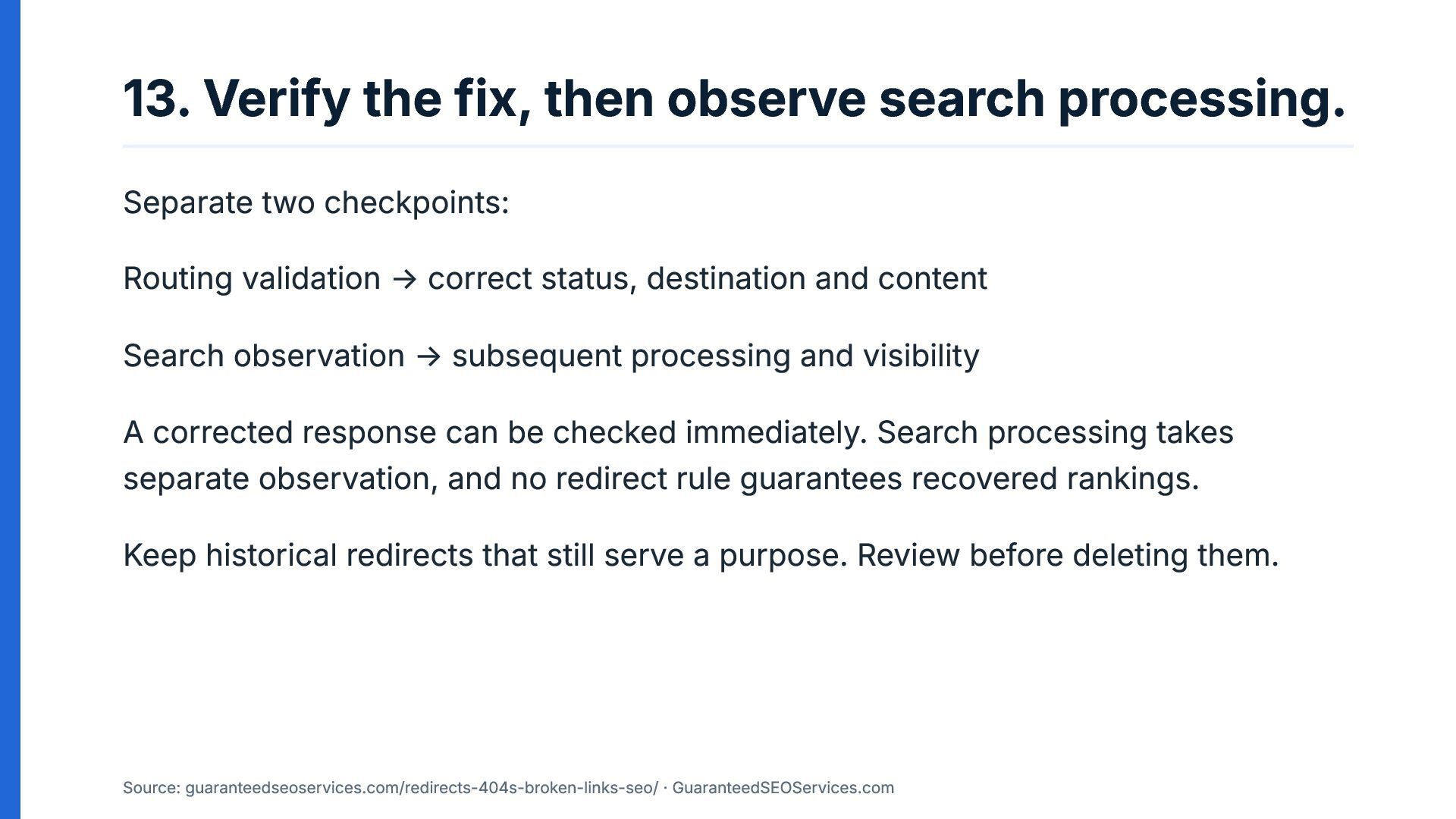
  14. 13. Verify the fix, then observe search processing. Separate two

    checkpoints: Routing validation → correct status, destination and content Search observation → subsequent processing and visibility A corrected response can be checked immediately. Search processing takes separate observation, and no redirect rule guarantees recovered rankings. Keep historical redirects that still serve a purpose. Review before deleting them. Source: guaranteedseoservices.com/redirects-404s-broken-links-seo/ · GuaranteedSEOServices.com
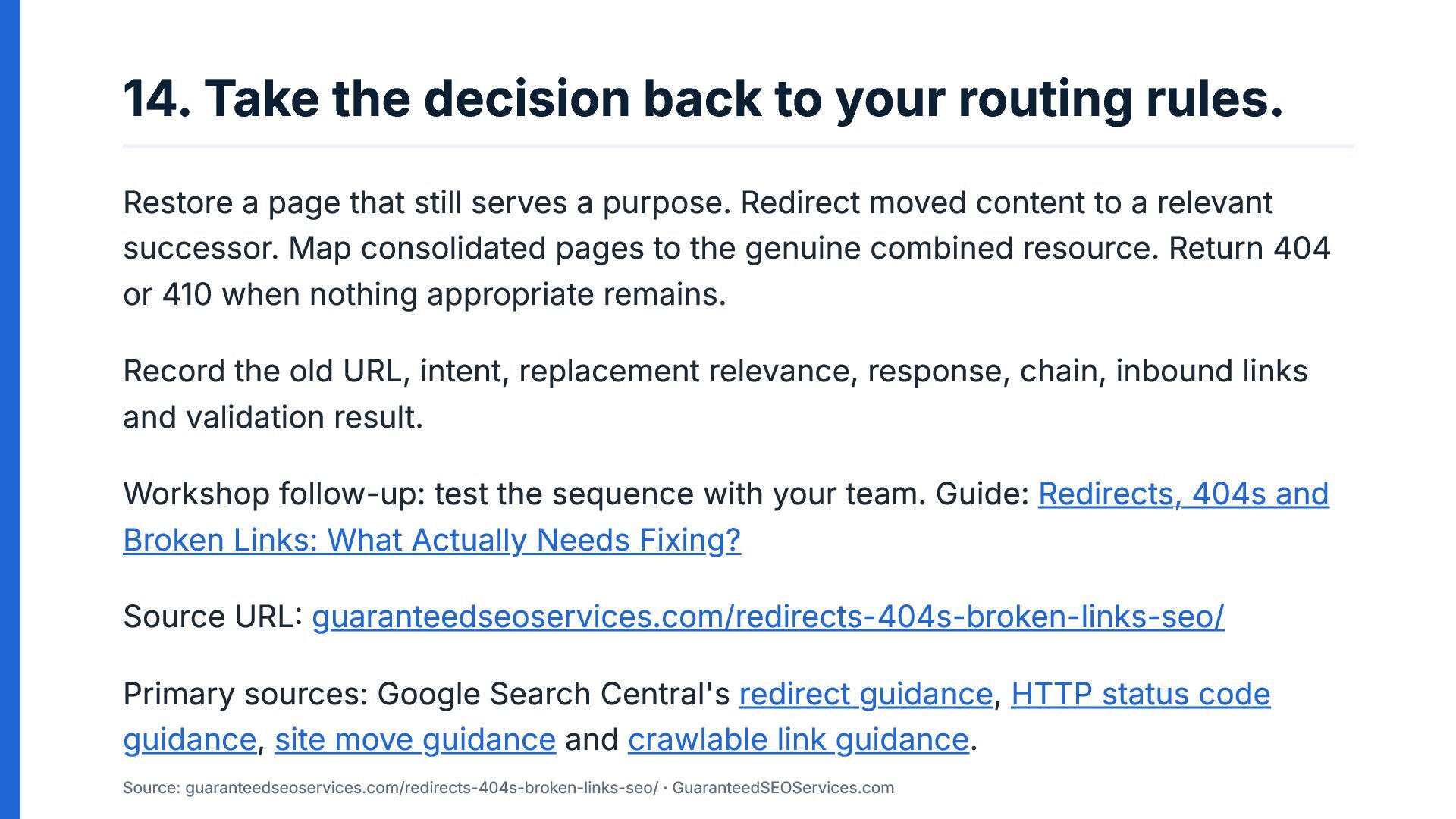
  15. 14. Take the decision back to your routing rules. Restore

    a page that still serves a purpose. Redirect moved content to a relevant successor. Map consolidated pages to the genuine combined resource. Return 404 or 410 when nothing appropriate remains. Record the old URL, intent, replacement relevance, response, chain, inbound links and validation result. Workshop follow-up: test the sequence with your team. Guide: Redirects, 404s and Broken Links: What Actually Needs Fixing? Source URL: guaranteedseoservices.com/redirects-404s-broken-links-seo/ Primary sources: Google Search Central's redirect guidance, HTTP status code guidance, site move guidance and crawlable link guidance. Source: guaranteedseoservices.com/redirects-404s-broken-links-seo/ · GuaranteedSEOServices.com
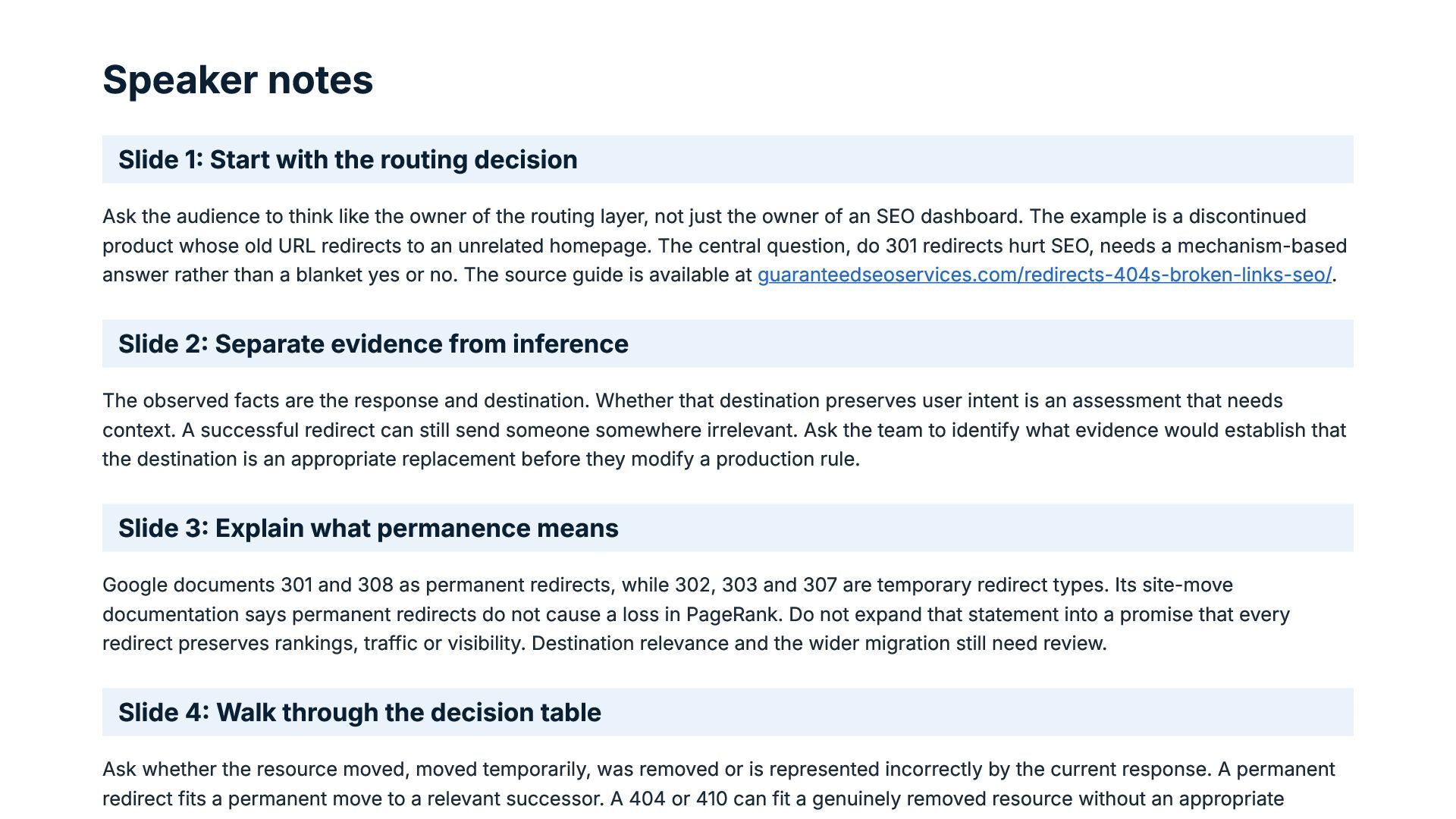
  16. Speaker notes Slide 1: Start with the routing decision Ask

    the audience to think like the owner of the routing layer, not just the owner of an SEO dashboard. The example is a discontinued product whose old URL redirects to an unrelated homepage. The central question, do 301 redirects hurt SEO, needs a mechanism-based answer rather than a blanket yes or no. The source guide is available at guaranteedseoservices.com/redirects-404s-broken-links-seo/. Slide 2: Separate evidence from inference The observed facts are the response and destination. Whether that destination preserves user intent is an assessment that needs context. A successful redirect can still send someone somewhere irrelevant. Ask the team to identify what evidence would establish that the destination is an appropriate replacement before they modify a production rule. Slide 3: Explain what permanence means Google documents 301 and 308 as permanent redirects, while 302, 303 and 307 are temporary redirect types. Its site-move documentation says permanent redirects do not cause a loss in PageRank. Do not expand that statement into a promise that every redirect preserves rankings, traffic or visibility. Destination relevance and the wider migration still need review. Slide 4: Walk through the decision table Ask whether the resource moved, moved temporarily, was removed or is represented incorrectly by the current response. A permanent redirect fits a permanent move to a relevant successor. A 404 or 410 can fit a genuinely removed resource without an appropriate
  17. successor. If an error page returns 200, investigate the route

    handler and align the response with the page state. Slide 5: Trace every hop A chain means a request passes through intermediate redirect destinations before reaching its final page. Collect the full path before changing rules, because several independent rules may contribute to it. Where the final destination is relevant, point the old URL directly to it when practical. Do not assume that shortening a chain makes an irrelevant destination appropriate. Slide 6: Find the loop's return edge A loop occurs when routing returns a request to a URL already encountered, preventing completion. Inspect redirect rules and normalization logic together. HTTP-to-HTTPS enforcement and hostname changes can interact with application-level redirects, so test the combinations your site supports. Change the rule responsible for the cycle and retest the complete path. Slide 7: Show why the status matters A soft 404 occurs when the response suggests success but the content indicates that the resource is missing or effectively empty. A missing product route that returns 200 with only an unavailable message is a useful diagnostic example. Google's documentation explains that error-like 200 pages can be treated as soft 404s. Correct the application response and ensure the content matches the intended state. Slide 8: Challenge the urge to redirect everything Make the distinction between an unavailable resource and a broken route. An ordinary 404 does not automatically create a sitewide ranking penalty. If a product is temporarily unavailable, the business may choose to keep a useful page with accurate details and
  18. alternatives. If it is permanently gone without a relevant successor,

    a missing-resource response may be more honest than redirecting to the homepage. Slide 9: Interpret crawler behavior carefully Google's HTTP status guidance states that 4xx errors, except 429, are treated alike for crawling and indexing purposes. Previously indexed URLs can be removed from the indexing pipeline, while 5xx and 429 errors can cause crawling to slow temporarily. The documented default is up to 10 redirect hops. These behaviors explain processing, but do not predict a specific ranking change for an individual URL. Slide 10: Validate the whole routing surface Testing only the retired URL is insufficient if a shared route handler or rewrite rule affects other pages. Check representative valid and invalid URLs after every change. Verify status, destination, content, canonical relationships, internal links and sitemap treatment. Update internal links to current destinations and use descriptive, crawlable links where relevant. Keep a clear owner for rollback. Slide 11: Let the audience make the call Give participants a few minutes to fill in the working fields before showing the answer. Ask them to distinguish the original user intent from the current destination and to identify whether a genuine successor exists. The inbound link is a reason to investigate the URL's continuing value, not proof that a homepage redirect is appropriate. Require the team to name its validation checks. Slide 12: Explain the answer The given facts do not establish an equivalent successor. Therefore, the homepage redirect should not be retained merely to avoid a 404. Check the product catalog and any consolidated resource first. If a relevant replacement exists, redirect to it; otherwise, return 404
  19. or 410 and remove obsolete internal links. Record the decision

    so future maintainers understand why the route behaves that way. Slide 13: Separate routing from search outcomes A response code, redirect destination and page content can be tested directly after deployment. Search systems may take additional time to process changes, and visibility must be observed separately. Do not report the successful HTTP test as proof that rankings have recovered. Retain redirects that continue to serve useful routes, and assign responsibility for monitoring and rollback. Slide 14: Close with a repeatable rule Ask each participant to summarize the decision sequence in their own words: establish the resource's purpose, determine whether a relevant replacement exists, choose the appropriate response, and validate the result. The keyword question, do 301 redirects hurt SEO, is answered by checking the mechanism and context rather than treating the status code as a guarantee. Finish by pointing the audience to the full guide and the primary Google documentation linked on the slide.
  20. Sources Redirects, 404s and Broken Links: What Actually Needs Fixing?

    Redirects and Google Search HTTP status codes and network errors Site moves with URL changes Google's link crawling guidance