What Is GEO vs SEO? Compare Search and AI Answers
Sponsored
·
 SiteGround - Reliable hosting with speed, security, and support you can count on.
→
SiteGround - Reliable hosting with speed, security, and support you can count on.
→

Share
Embed
What Is GEO vs SEO? Compare Search and AI Answers
What is GEO vs SEO? Compare search results and generative answers by examining retrieval, source selection, shared technical foundations and five distinct measurement definitions. Use the workshop exercise to audit overlapping proposals and assign budgets based on documented work and evidence. If your team keeps asking what is GEO vs SEO, start with the full guide: https://guaranteedseoservices.com/geo-vs-aeo-vs-seo/?utm_source=speakerdeck&utm_medium=referral&utm_campaign=blog-geo-vs-aeo-vs-seo

GuaranteedSEOServices
October 26, 2026
Transcript
21 slides
-
What Is GEO vs SEO? Compare Search Results and AI
Answers Through One User Task Same web. Different interface. Different measurement problem. A workshop for comparing SEO, AEO and GEO proposals by their actual work, evidence and outcomes before assigning separate budgets. GuaranteedSEOServices.com October 27, 2026 -
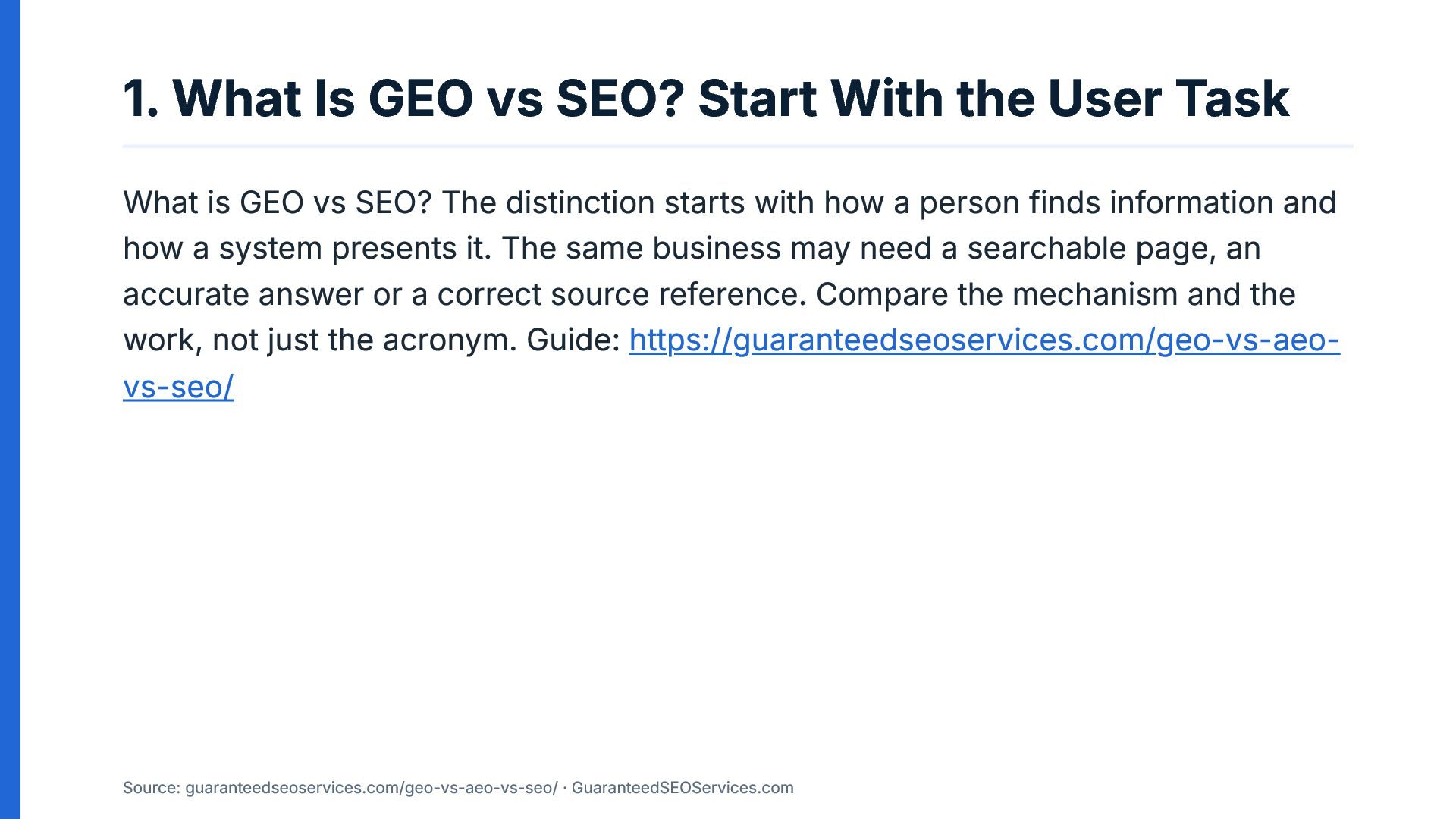
1. What Is GEO vs SEO? Start With the User
Task What is GEO vs SEO? The distinction starts with how a person finds information and how a system presents it. The same business may need a searchable page, an accurate answer or a correct source reference. Compare the mechanism and the work, not just the acronym. Guide: https://guaranteedseoservices.com/geo-vs-aeovs-seo/ Source: guaranteedseoservices.com/geo-vs-aeo-vs-seo/ · GuaranteedSEOServices.com -
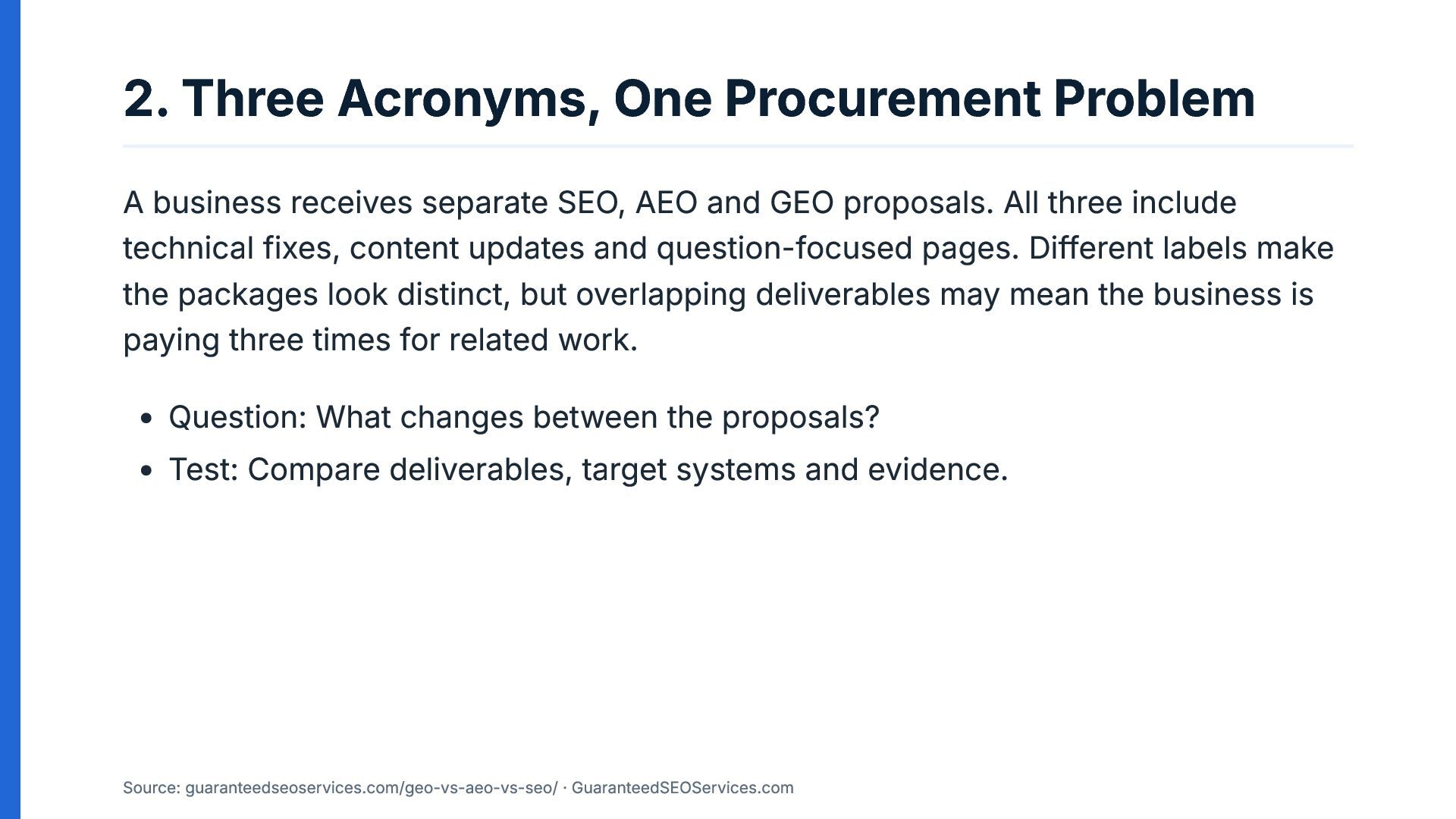
2. Three Acronyms, One Procurement Problem A business receives separate
SEO, AEO and GEO proposals. All three include technical fixes, content updates and question-focused pages. Different labels make the packages look distinct, but overlapping deliverables may mean the business is paying three times for related work. Question: What changes between the proposals? Test: Compare deliverables, target systems and evidence. Source: guaranteedseoservices.com/geo-vs-aeo-vs-seo/ · GuaranteedSEOServices.com -
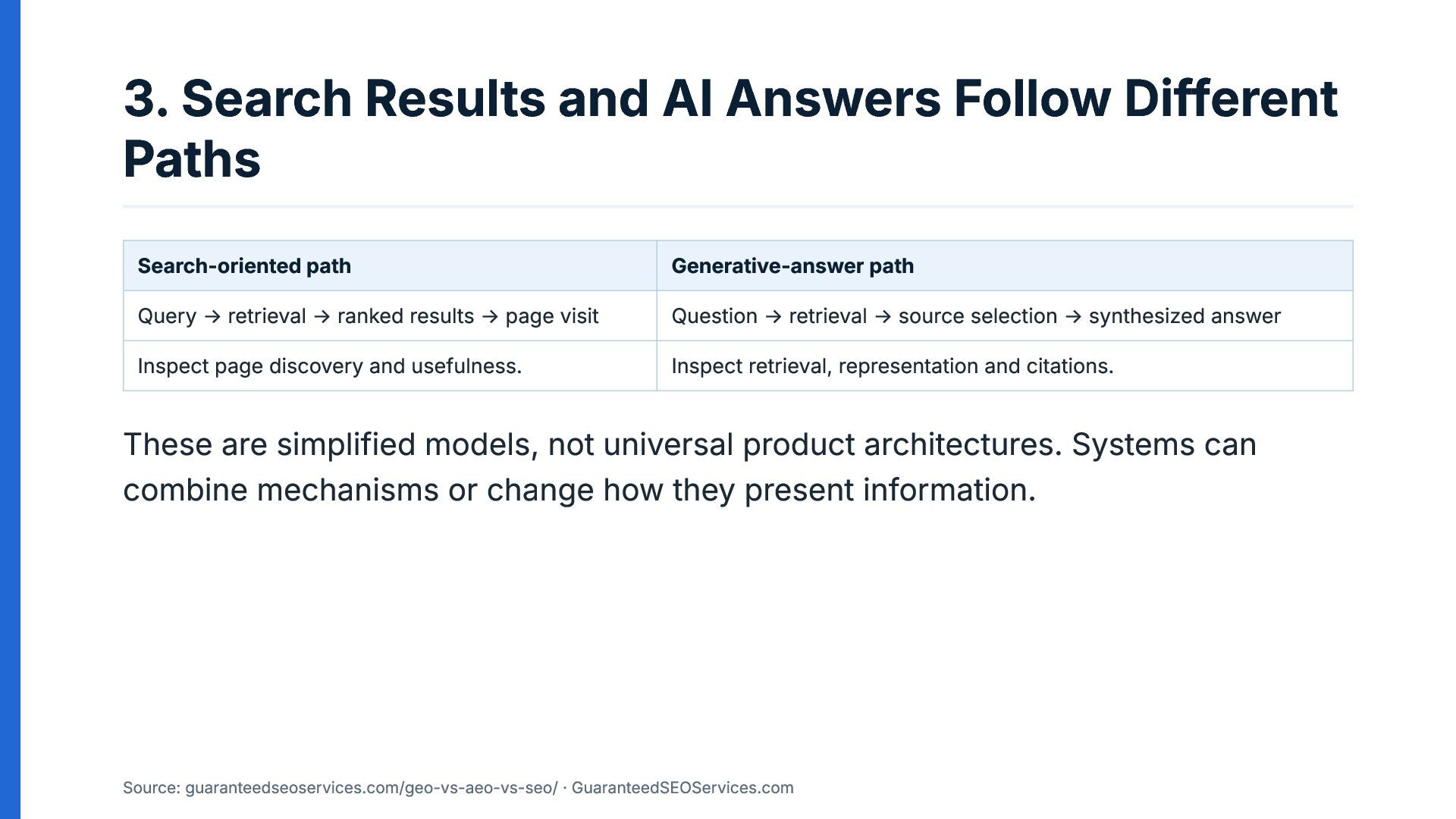
3. Search Results and AI Answers Follow Different Paths Search-oriented
path Generative-answer path Query → retrieval → ranked results → page visit Question → retrieval → source selection → synthesized answer Inspect page discovery and usefulness. Inspect retrieval, representation and citations. These are simplified models, not universal product architectures. Systems can combine mechanisms or change how they present information. Source: guaranteedseoservices.com/geo-vs-aeo-vs-seo/ · GuaranteedSEOServices.com -
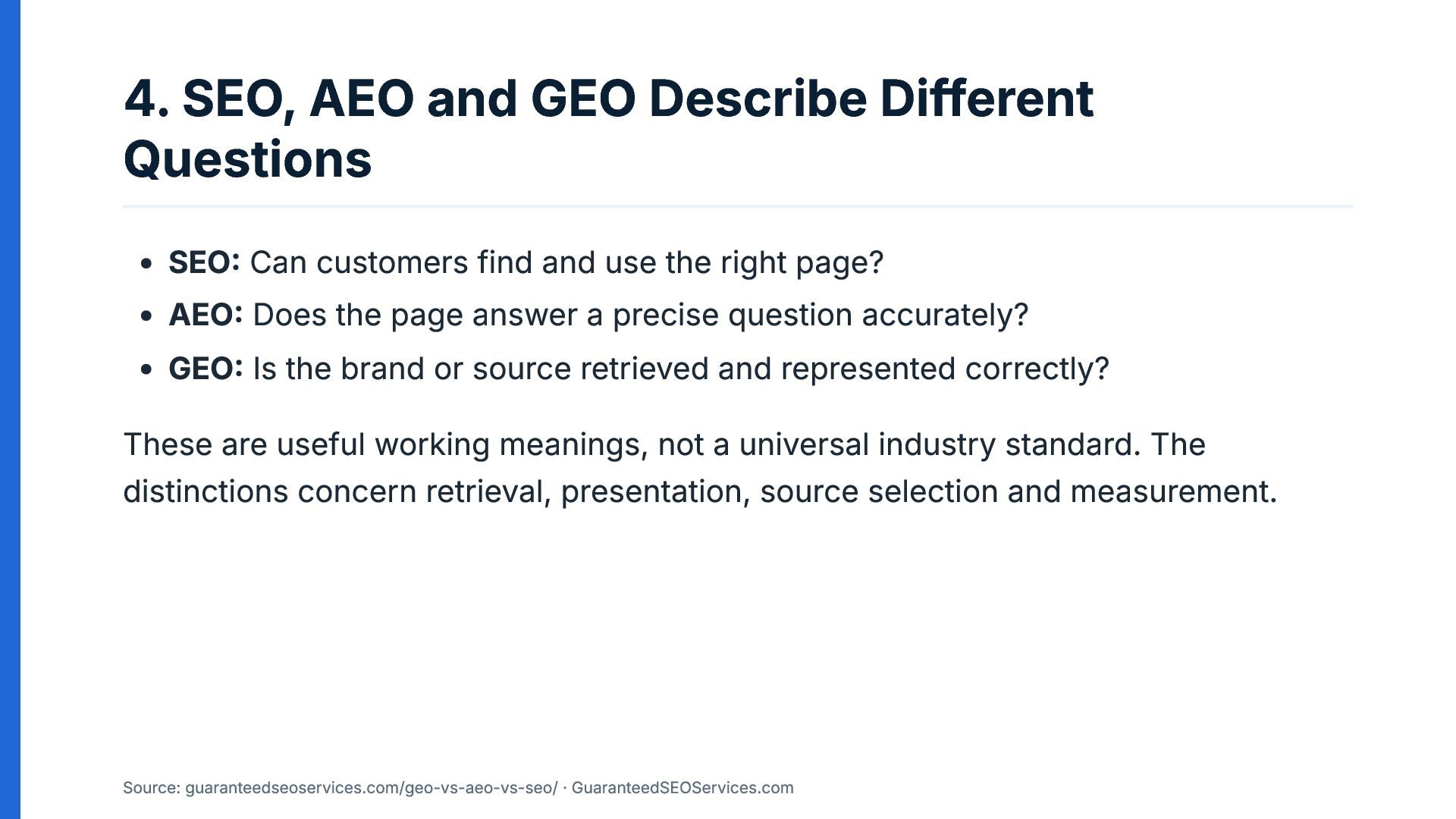
4. SEO, AEO and GEO Describe Different Questions SEO: Can
customers find and use the right page? AEO: Does the page answer a precise question accurately? GEO: Is the brand or source retrieved and represented correctly? These are useful working meanings, not a universal industry standard. The distinctions concern retrieval, presentation, source selection and measurement. Source: guaranteedseoservices.com/geo-vs-aeo-vs-seo/ · GuaranteedSEOServices.com -
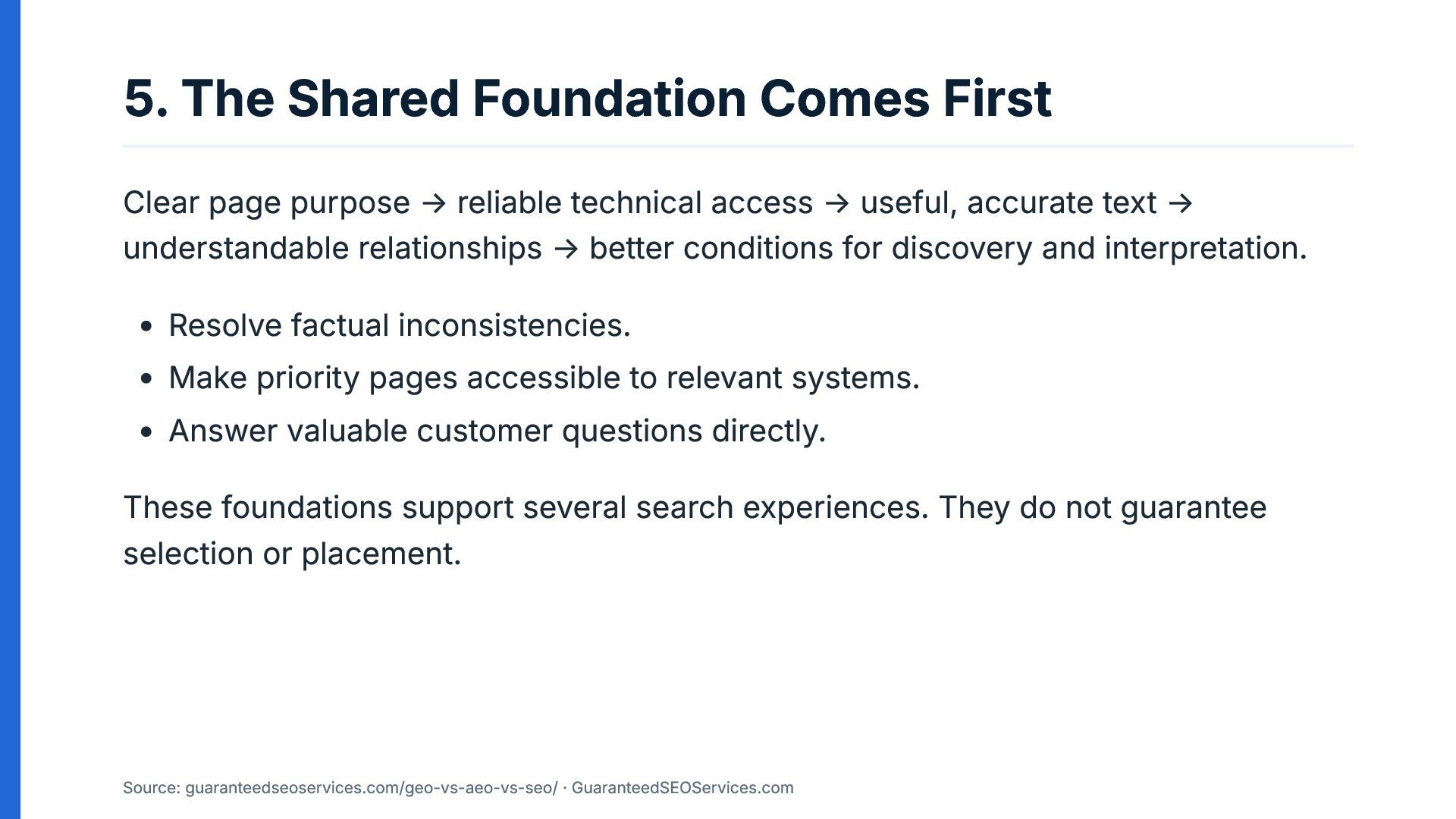
5. The Shared Foundation Comes First Clear page purpose →
reliable technical access → useful, accurate text → understandable relationships → better conditions for discovery and interpretation. Resolve factual inconsistencies. Make priority pages accessible to relevant systems. Answer valuable customer questions directly. These foundations support several search experiences. They do not guarantee selection or placement. Source: guaranteedseoservices.com/geo-vs-aeo-vs-seo/ · GuaranteedSEOServices.com -
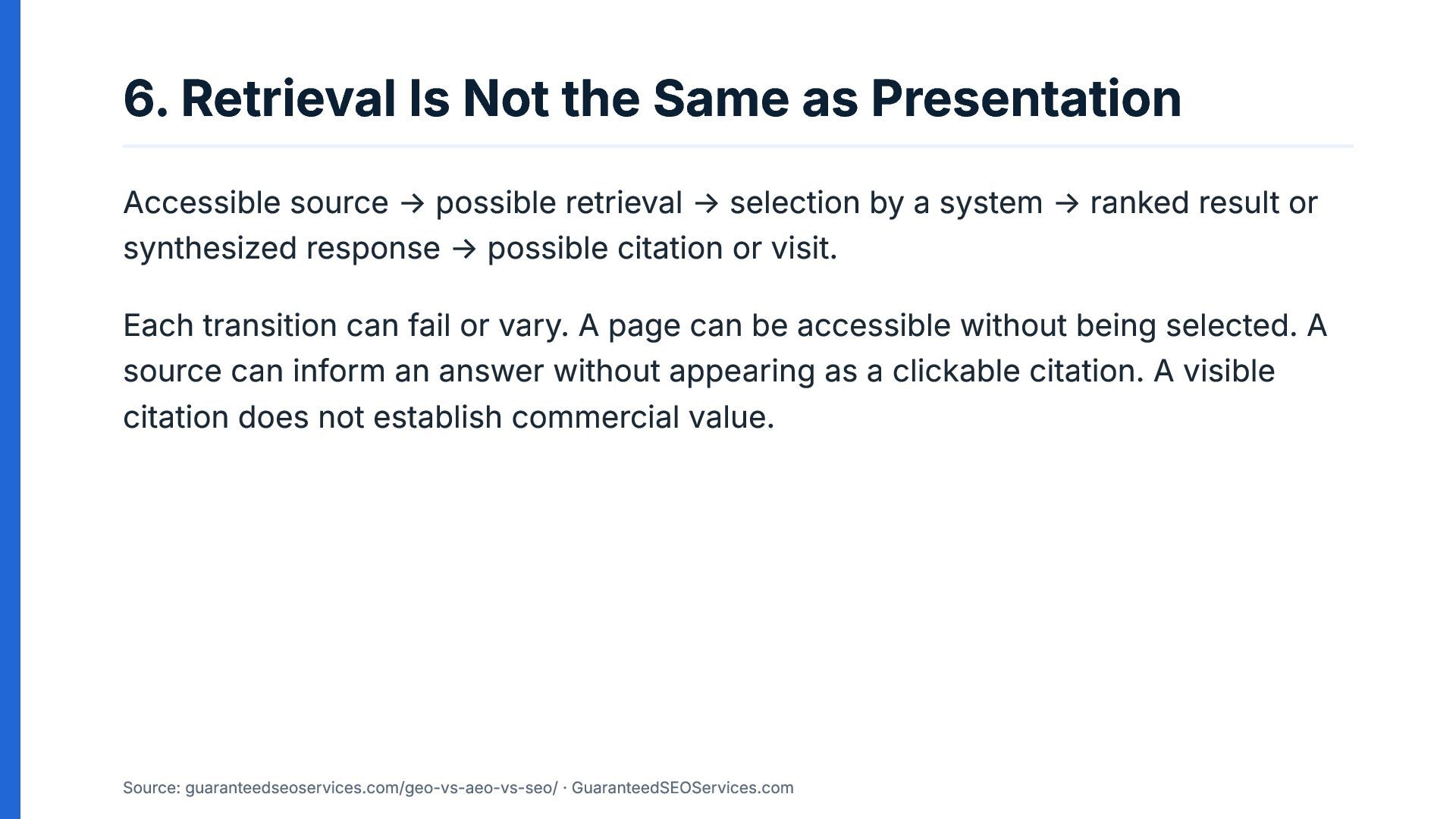
6. Retrieval Is Not the Same as Presentation Accessible source
→ possible retrieval → selection by a system → ranked result or synthesized response → possible citation or visit. Each transition can fail or vary. A page can be accessible without being selected. A source can inform an answer without appearing as a clickable citation. A visible citation does not establish commercial value. Source: guaranteedseoservices.com/geo-vs-aeo-vs-seo/ · GuaranteedSEOServices.com -
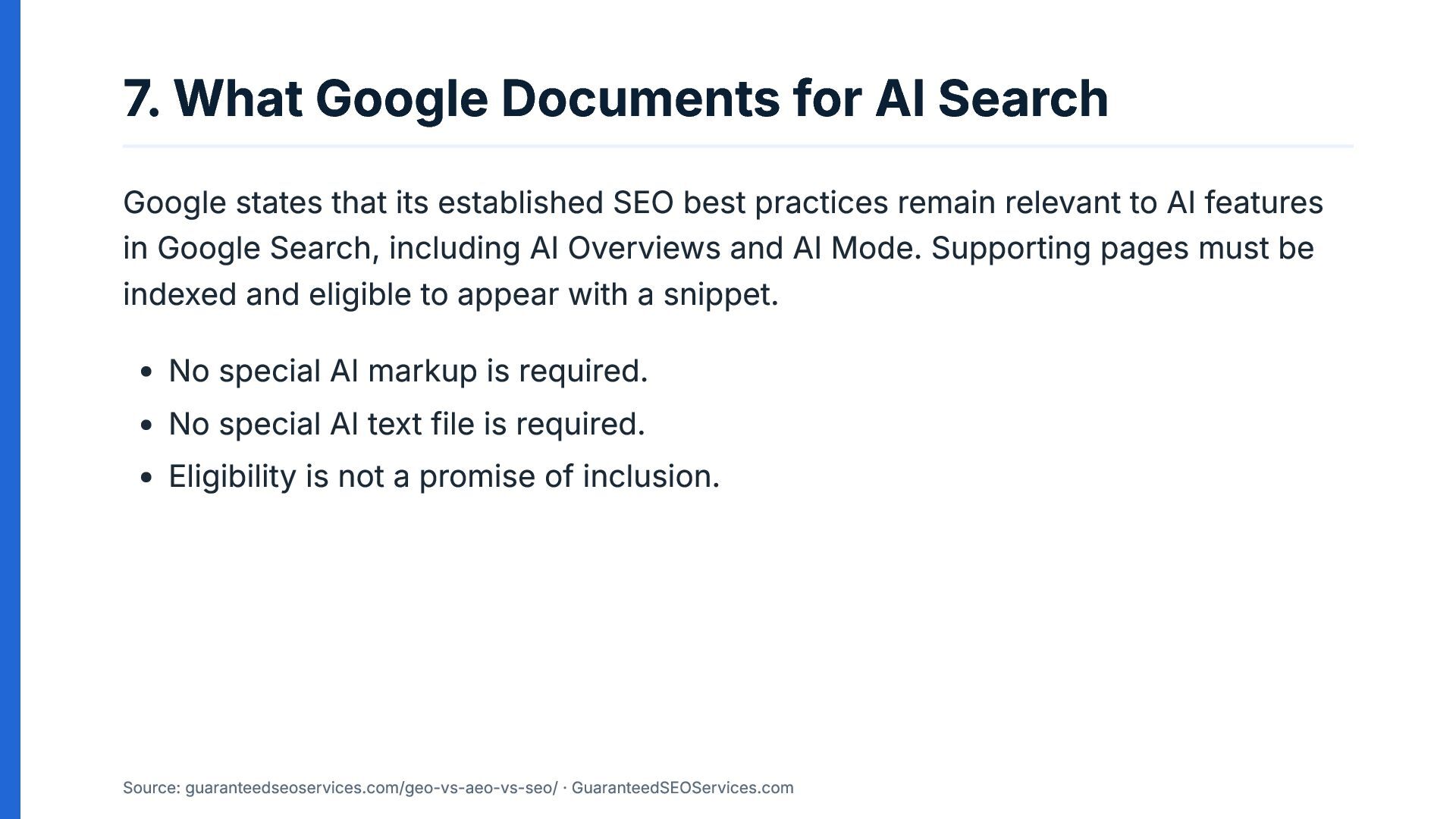
7. What Google Documents for AI Search Google states that
its established SEO best practices remain relevant to AI features in Google Search, including AI Overviews and AI Mode. Supporting pages must be indexed and eligible to appear with a snippet. No special AI markup is required. No special AI text file is required. Eligibility is not a promise of inclusion. Source: guaranteedseoservices.com/geo-vs-aeo-vs-seo/ · GuaranteedSEOServices.com -
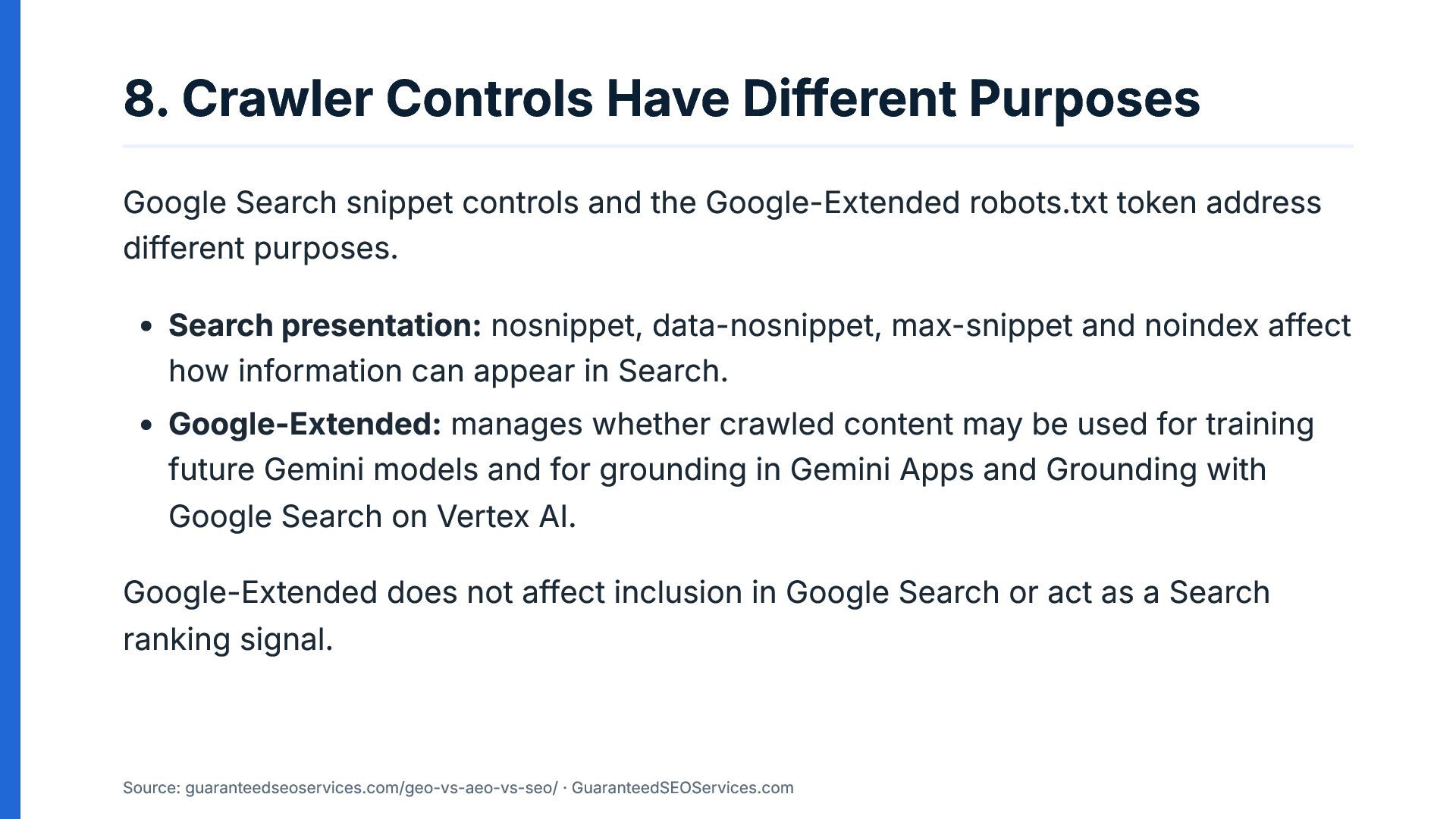
8. Crawler Controls Have Different Purposes Google Search snippet controls
and the Google-Extended robots.txt token address different purposes. Search presentation: nosnippet, data-nosnippet, max-snippet and noindex affect how information can appear in Search. Google-Extended: manages whether crawled content may be used for training future Gemini models and for grounding in Gemini Apps and Grounding with Google Search on Vertex AI. Google-Extended does not affect inclusion in Google Search or act as a Search ranking signal. Source: guaranteedseoservices.com/geo-vs-aeo-vs-seo/ · GuaranteedSEOServices.com -
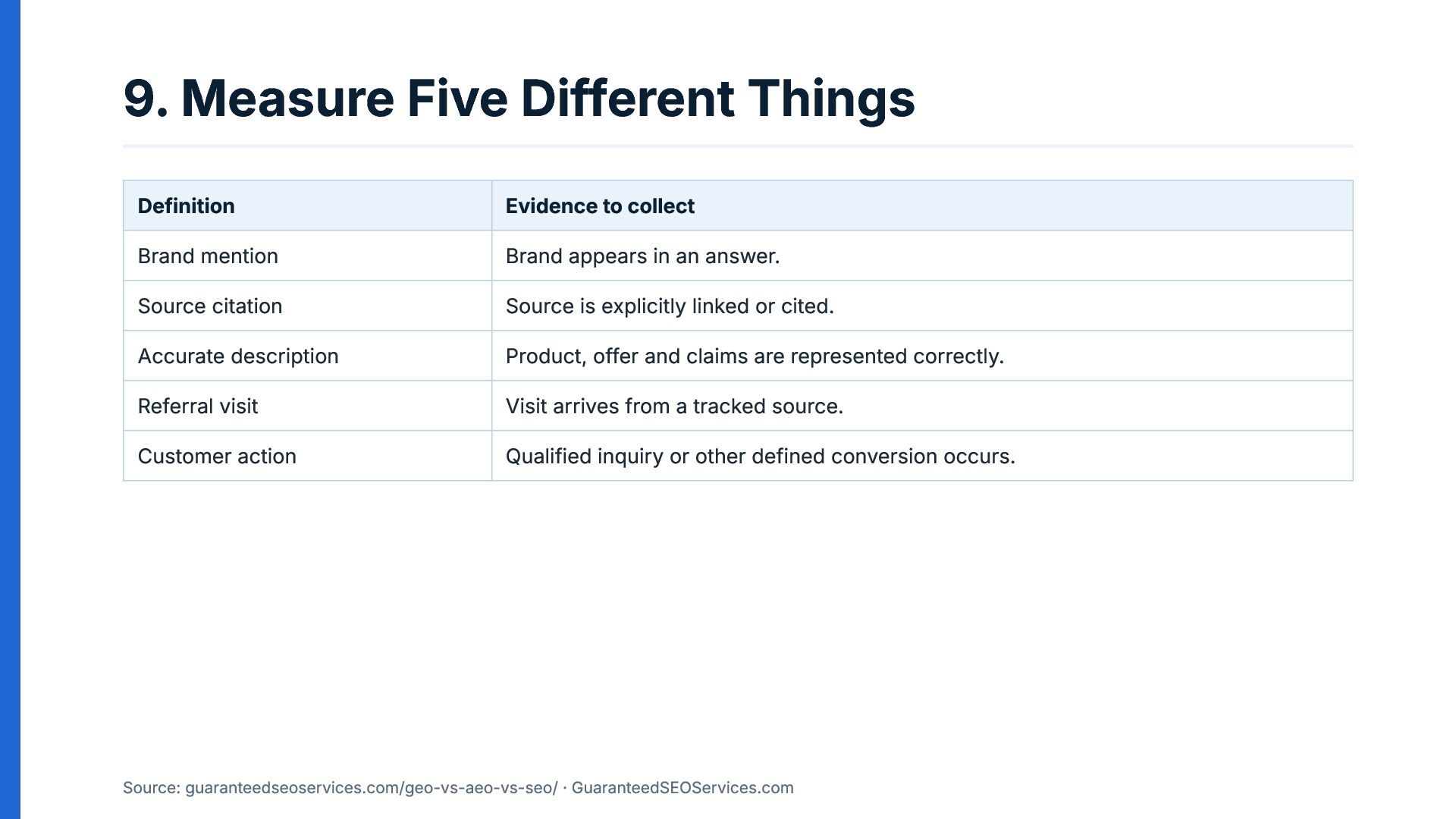
9. Measure Five Different Things Definition Evidence to collect Brand
mention Brand appears in an answer. Source citation Source is explicitly linked or cited. Accurate description Product, offer and claims are represented correctly. Referral visit Visit arrives from a tracked source. Customer action Qualified inquiry or other defined conversion occurs. Source: guaranteedseoservices.com/geo-vs-aeo-vs-seo/ · GuaranteedSEOServices.com -
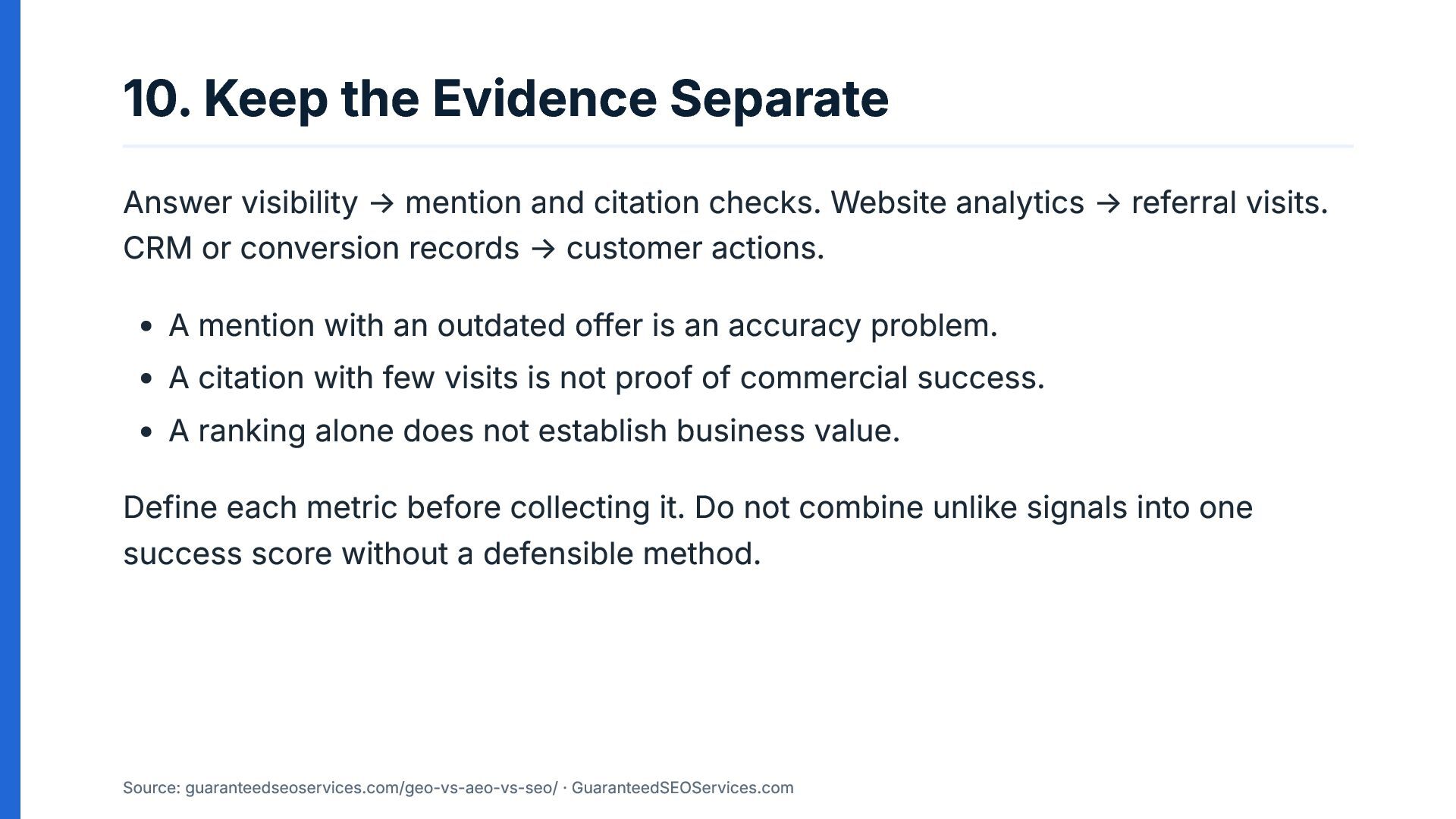
10. Keep the Evidence Separate Answer visibility → mention and
citation checks. Website analytics → referral visits. CRM or conversion records → customer actions. A mention with an outdated offer is an accuracy problem. A citation with few visits is not proof of commercial success. A ranking alone does not establish business value. Define each metric before collecting it. Do not combine unlike signals into one success score without a defensible method. Source: guaranteedseoservices.com/geo-vs-aeo-vs-seo/ · GuaranteedSEOServices.com -
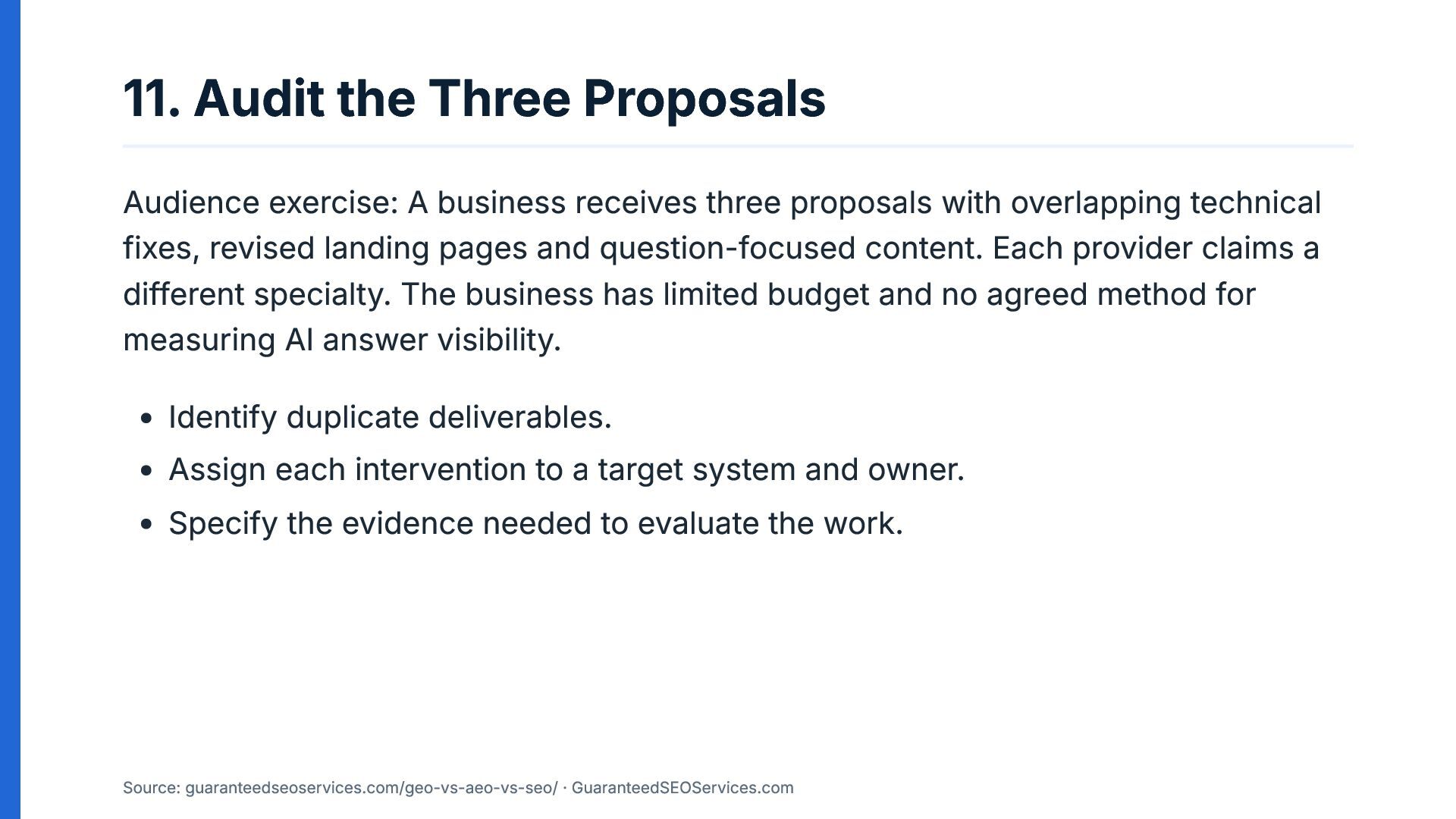
11. Audit the Three Proposals Audience exercise: A business receives
three proposals with overlapping technical fixes, revised landing pages and question-focused content. Each provider claims a different specialty. The business has limited budget and no agreed method for measuring AI answer visibility. Identify duplicate deliverables. Assign each intervention to a target system and owner. Specify the evidence needed to evaluate the work. Source: guaranteedseoservices.com/geo-vs-aeo-vs-seo/ · GuaranteedSEOServices.com -
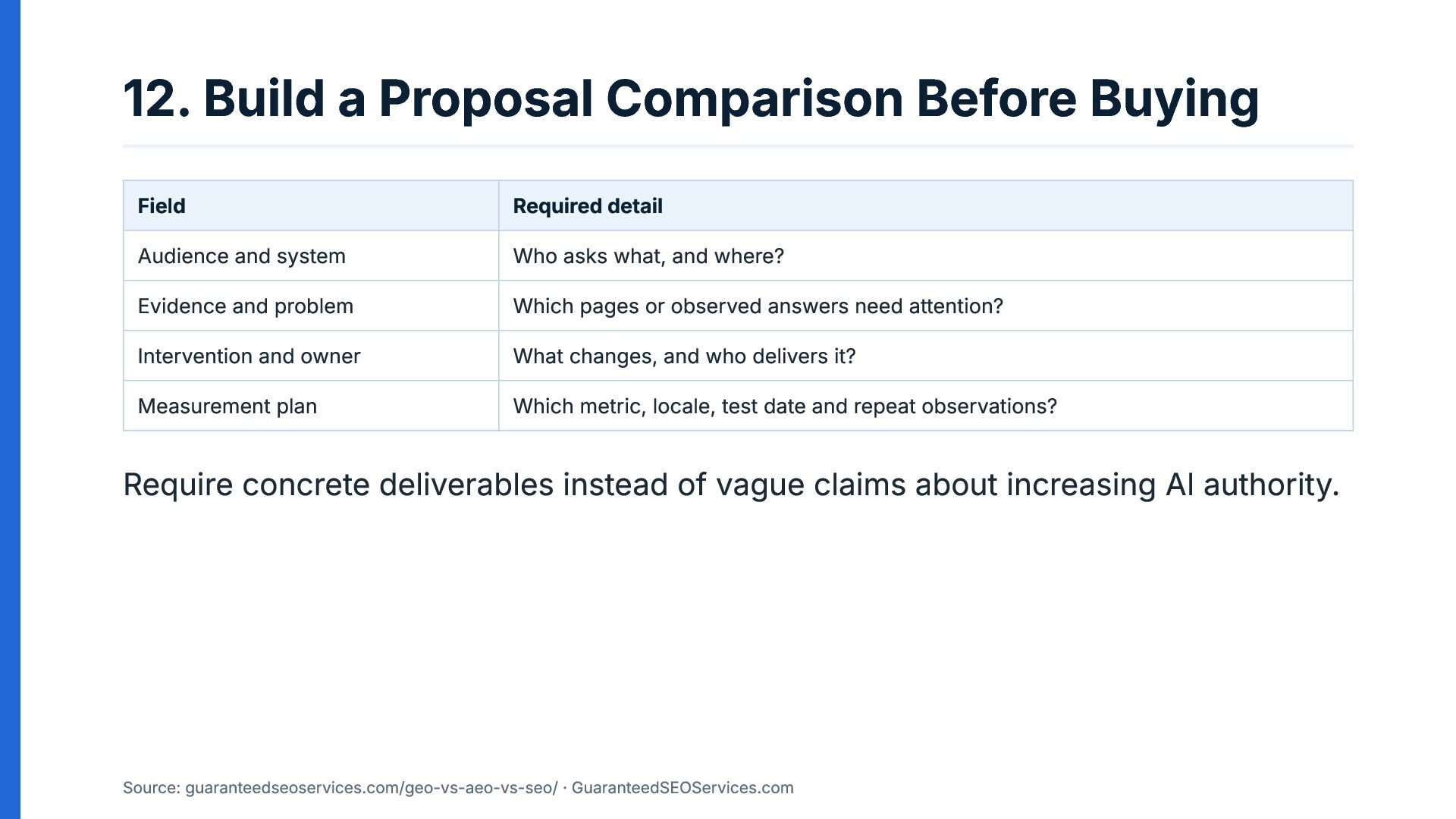
12. Build a Proposal Comparison Before Buying Field Required detail
Audience and system Who asks what, and where? Evidence and problem Which pages or observed answers need attention? Intervention and owner What changes, and who delivers it? Measurement plan Which metric, locale, test date and repeat observations? Require concrete deliverables instead of vague claims about increasing AI authority. Source: guaranteedseoservices.com/geo-vs-aeo-vs-seo/ · GuaranteedSEOServices.com -
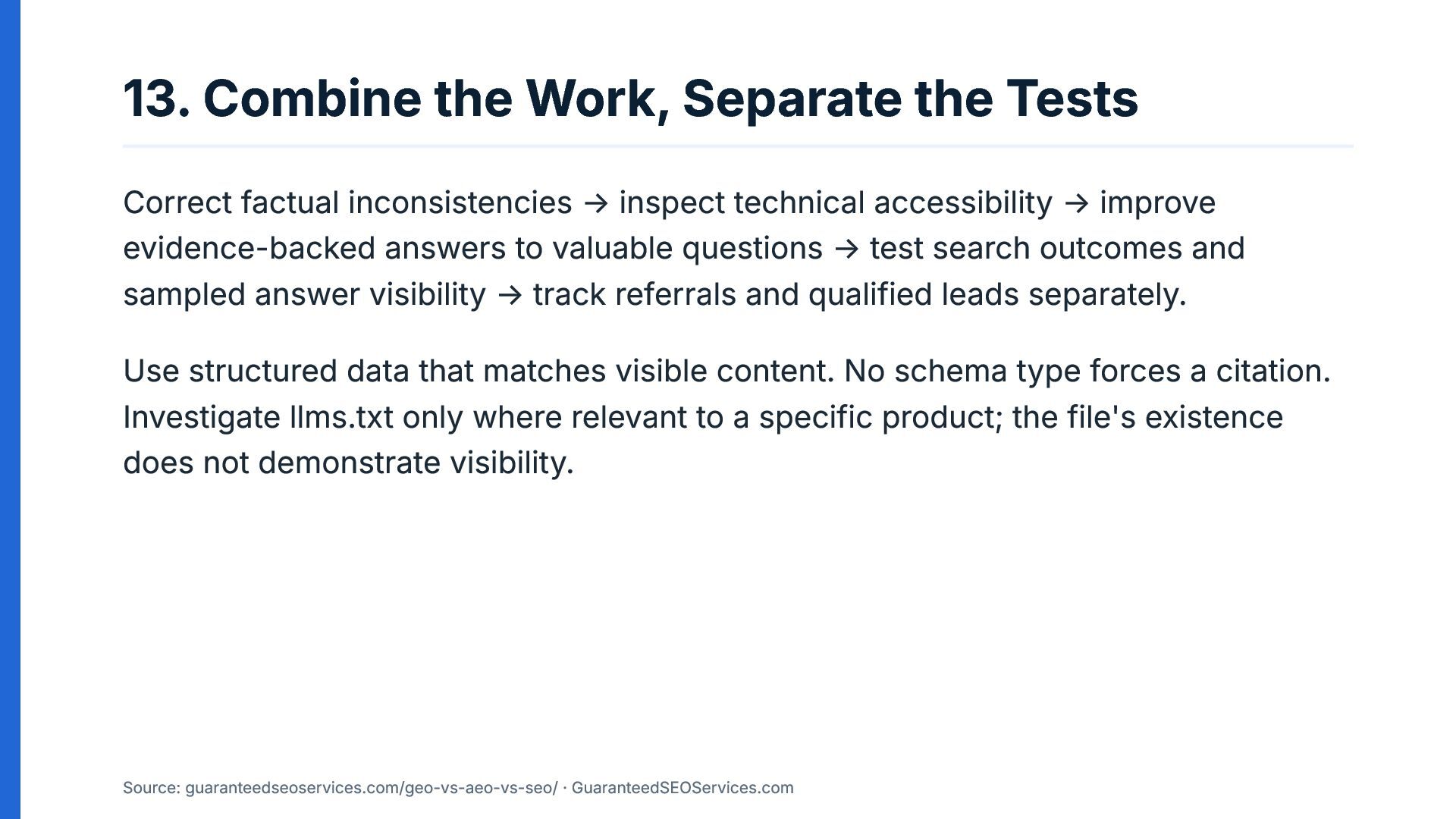
13. Combine the Work, Separate the Tests Correct factual inconsistencies
→ inspect technical accessibility → improve evidence-backed answers to valuable questions → test search outcomes and sampled answer visibility → track referrals and qualified leads separately. Use structured data that matches visible content. No schema type forces a citation. Investigate llms.txt only where relevant to a specific product; the file's existence does not demonstrate visibility. Source: guaranteedseoservices.com/geo-vs-aeo-vs-seo/ · GuaranteedSEOServices.com -
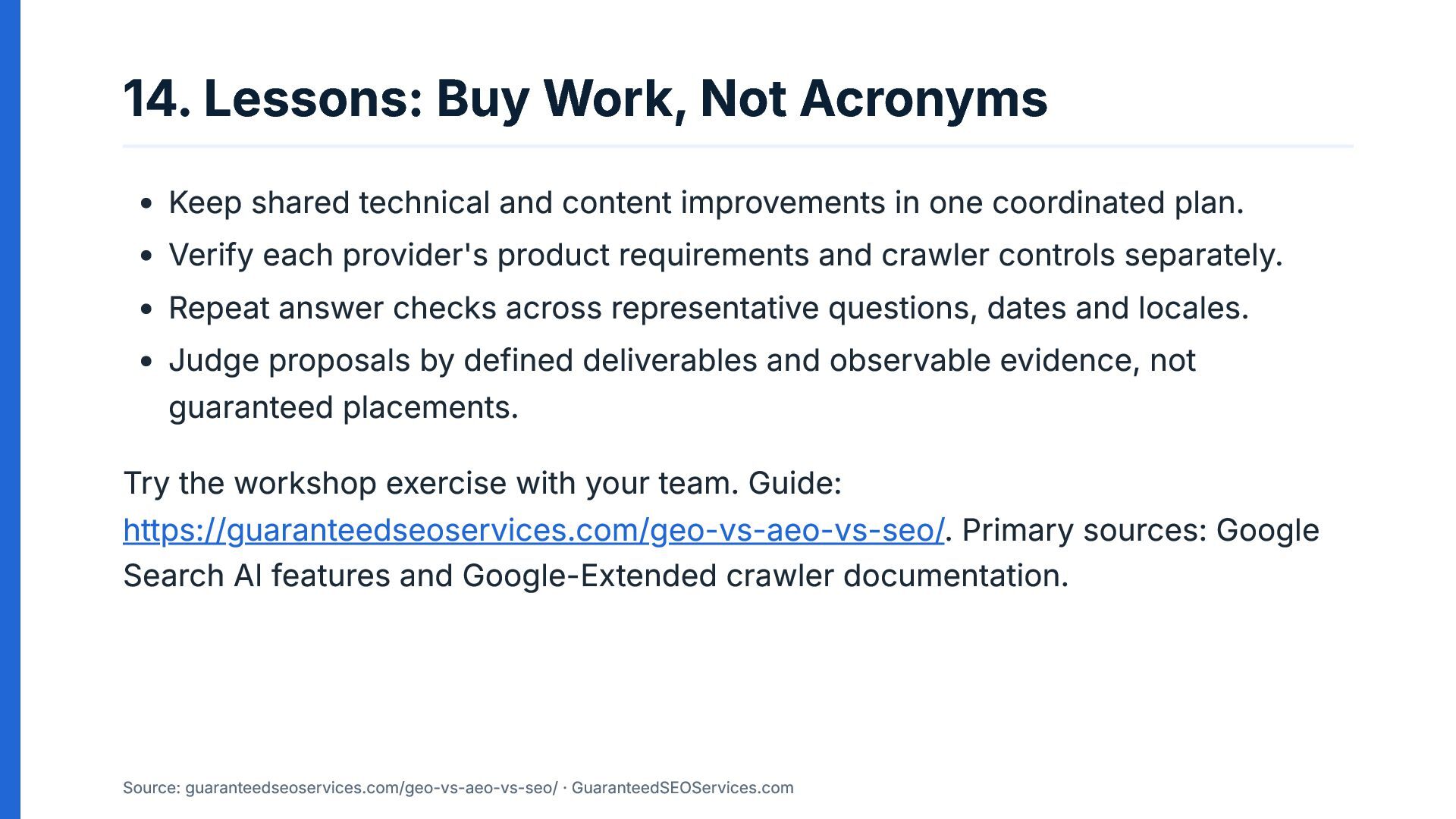
14. Lessons: Buy Work, Not Acronyms Keep shared technical and
content improvements in one coordinated plan. Verify each provider's product requirements and crawler controls separately. Repeat answer checks across representative questions, dates and locales. Judge proposals by defined deliverables and observable evidence, not guaranteed placements. Try the workshop exercise with your team. Guide: https://guaranteedseoservices.com/geo-vs-aeo-vs-seo/. Primary sources: Google Search AI features and Google-Extended crawler documentation. Source: guaranteedseoservices.com/geo-vs-aeo-vs-seo/ · GuaranteedSEOServices.com -
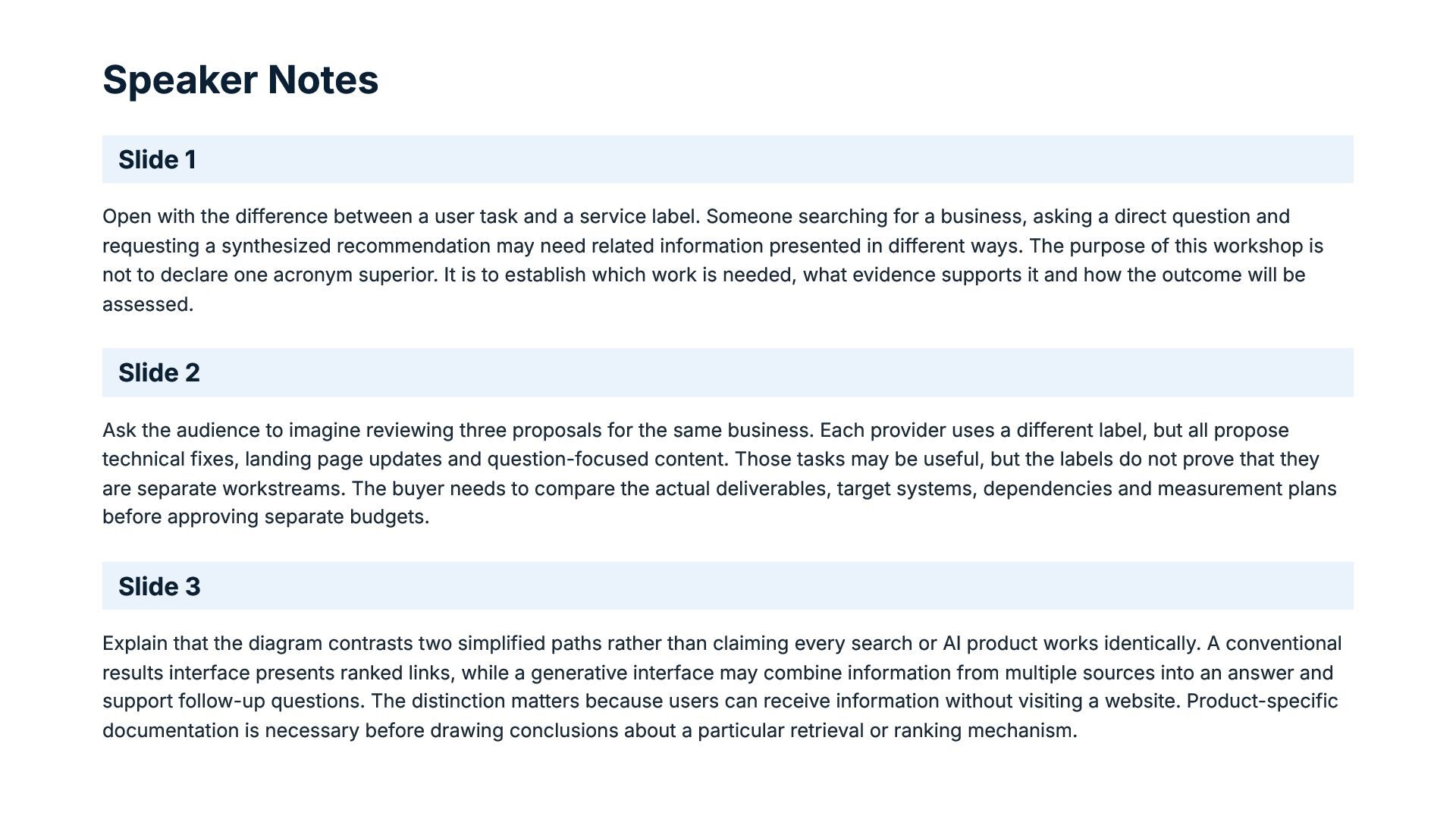
Speaker Notes Slide 1 Open with the difference between a
user task and a service label. Someone searching for a business, asking a direct question and requesting a synthesized recommendation may need related information presented in different ways. The purpose of this workshop is not to declare one acronym superior. It is to establish which work is needed, what evidence supports it and how the outcome will be assessed. Slide 2 Ask the audience to imagine reviewing three proposals for the same business. Each provider uses a different label, but all propose technical fixes, landing page updates and question-focused content. Those tasks may be useful, but the labels do not prove that they are separate workstreams. The buyer needs to compare the actual deliverables, target systems, dependencies and measurement plans before approving separate budgets. Slide 3 Explain that the diagram contrasts two simplified paths rather than claiming every search or AI product works identically. A conventional results interface presents ranked links, while a generative interface may combine information from multiple sources into an answer and support follow-up questions. The distinction matters because users can receive information without visiting a website. Product-specific documentation is necessary before drawing conclusions about a particular retrieval or ranking mechanism. -
Slide 4 Present SEO, AEO and GEO as practical working
definitions. SEO asks whether the right page can be found and used. AEO focuses on answering a specific question accurately, while GEO examines whether a brand or source appears correctly in generative responses. The boundaries overlap, and the terminology is not a universal standard. Ask participants to describe the proposed work in plain language before deciding which label fits. Slide 5 Show how the shared foundation connects technical work to content usefulness. A page needs a clear purpose, reliable access, accurate information and relationships that readers and systems can understand. These conditions can support multiple discovery experiences, so teams should not automatically duplicate foundational work under separate service names. They should also avoid creating near-identical pages solely for different AI acronyms. Better foundations improve readiness, not guaranteed selection. Slide 6 Walk through each state in the diagram. Technical accessibility does not prove that a system retrieved a page, and retrieval does not prove that the page was selected for a displayed answer. Selection and presentation can also differ between products and runs. A source might inform a synthesized response without receiving a visible citation. Keep these stages separate when diagnosing problems, because each stage calls for different evidence and possible interventions. Slide 7 Use Google's own documentation to ground the discussion in a current product rather than general claims about AI search. Google says established SEO best practices remain relevant to its AI features in Search. Its documented eligibility requirements still matter, including -
indexing and eligibility to appear with a snippet. Explain that
these requirements do not guarantee that a page will appear in an AIgenerated response. Avoid inventing extra technical requirements. Slide 8 Emphasize the difference between controls intended for Search presentation and the Google-Extended product token. Google documents Google-Extended as a way to manage whether crawled content may be used for training future Gemini models and for grounding in Gemini Apps and Grounding with Google Search on Vertex AI. It does not change a site's inclusion in Google Search or act as a Search ranking signal. Do not generalize this behavior to other providers. Check the current documentation for every relevant crawler, product and purpose before recommending a rule. Slide 9 Introduce the five definitions as separate observations, not interchangeable measures of success. A brand mention records presence in an answer. A source citation records attribution, while an accuracy check examines whether the information is correct. A referral visit requires evidence of a visit from a tracked source. A customer action requires a separately defined conversion record. Agree on these definitions before collecting data so that teams can compare findings without changing the meaning of success midway through a test. Slide 10 Explain why a single visibility score can hide important differences. An answer may mention a brand but repeat an outdated price or offer. A citation may appear without producing a measurable referral, and a visit may not lead to a qualified inquiry. None of these observations alone proves the full business impact of the work. Use the appropriate evidence source for each metric, document estimation limits and avoid presenting correlations as proof of causation. Slide 11 -
Give participants a few minutes to review the three overlapping
proposals. Ask them to mark repeated deliverables, identify any genuinely distinct interventions and list missing evidence. The exercise is about purchasing decisions, not deciding which acronym sounds most advanced. Each proposed task should have a target audience or system, a documented problem, an accountable owner and a testable outcome. Ask teams to explain which work they would combine and which measurements must remain separate. Slide 12 Complete the exercise by building one comparison table across all three proposals. First, group duplicate tasks such as shared technical fixes and content revisions. Second, retain distinct work only when a provider can explain the target system, observed problem and intervention. Third, assign owners and define the test date, locale, representative questions and repeat observations. A suitable answer is one coordinated delivery plan with separate measurement definitions, rather than three budgets justified by acronyms alone. Slide 13 Translate the comparison into a practical sequence. Correct inconsistent facts first, then investigate whether priority pages are technically accessible. Improve answers to valuable questions with relevant evidence, and check whether structured data matches the visible page. Track search performance, sampled answer visibility, referral visits and qualified leads independently. Treat llms.txt as a product-specific question to investigate, not proof that a site has gained visibility. The available evidence should determine the next intervention. Slide 14 Close by returning to the purchasing decision. The business should pay for clearly defined work that addresses observed problems, not for a promise that a particular acronym will produce visibility. Ask the team to test the same representative questions repeatedly and record the locale, date, answer, citation and accuracy. Compare these observations with website and conversion data without conflating -
them. The central question, what is GEO vs SEO, becomes
useful when it helps teams distinguish mechanisms, choose interventions and evaluate evidence. -
Sources GEO vs AEO vs SEO: What's Actually Different and
What Isn't Google Search Central: AI features and your website Google Search Central: Google common crawlers
 guaranteedseoservices
 gurzu
 decabbit
 tribal
 syphaiwong
 aleyda
 rosshudgens
 cargoodrich
 tenshoku_draft
 speedyindexteam
 clarasoteras
 katarinadahlin
 palkan
 ivargrimstad
 dougneiner
 lemiorhan
 philnash
 skipperchong
 ammeep
 emna__ayadi
 rocio
 akademiya2063
 chriscoyier