How to Prioritize Technical SEO Fixes: From War...
Sponsored
·
 Your Podcast. Everywhere. Effortlessly.
Share. Educate. Inspire. Entertain. You do you. We'll handle the rest.
→
Your Podcast. Everywhere. Effortlessly.
Share. Educate. Inspire. Entertain. You do you. We'll handle the rest.
→

Share
Embed
How to Prioritize Technical SEO Fixes: From Warnings to Action
Learn how to prioritize technical SEO fixes when crawler warnings outnumber available developer hours. This workshop shows you how to group symptoms by root cause, map dependencies, define acceptance tests, and manage release risk. Use the workshop exercise with your team to practice how to prioritize technical SEO fixes: https://guaranteedseoservices.com/prioritize-technical-seo-fixes/?utm_source=speakerdeck&utm_medium=referral&utm_campaign=blog-prioritize-technical-seo-fixes

GuaranteedSEOServices
October 26, 2026
Transcript
21 slides
-
How to Prioritize Technical SEO Fixes: From Warning Flood to
Sprint Queue A mechanism-first workshop for developers and tech leads: trace repeated crawl symptoms to verified causes, map dependencies, define acceptance tests, and choose the next change without mistaking issue counts for business impact. Guide: https://guaranteedseoservices.com/prioritize-technical-seo-fixes/ GuaranteedSEOServices.com October 27, 2026 -
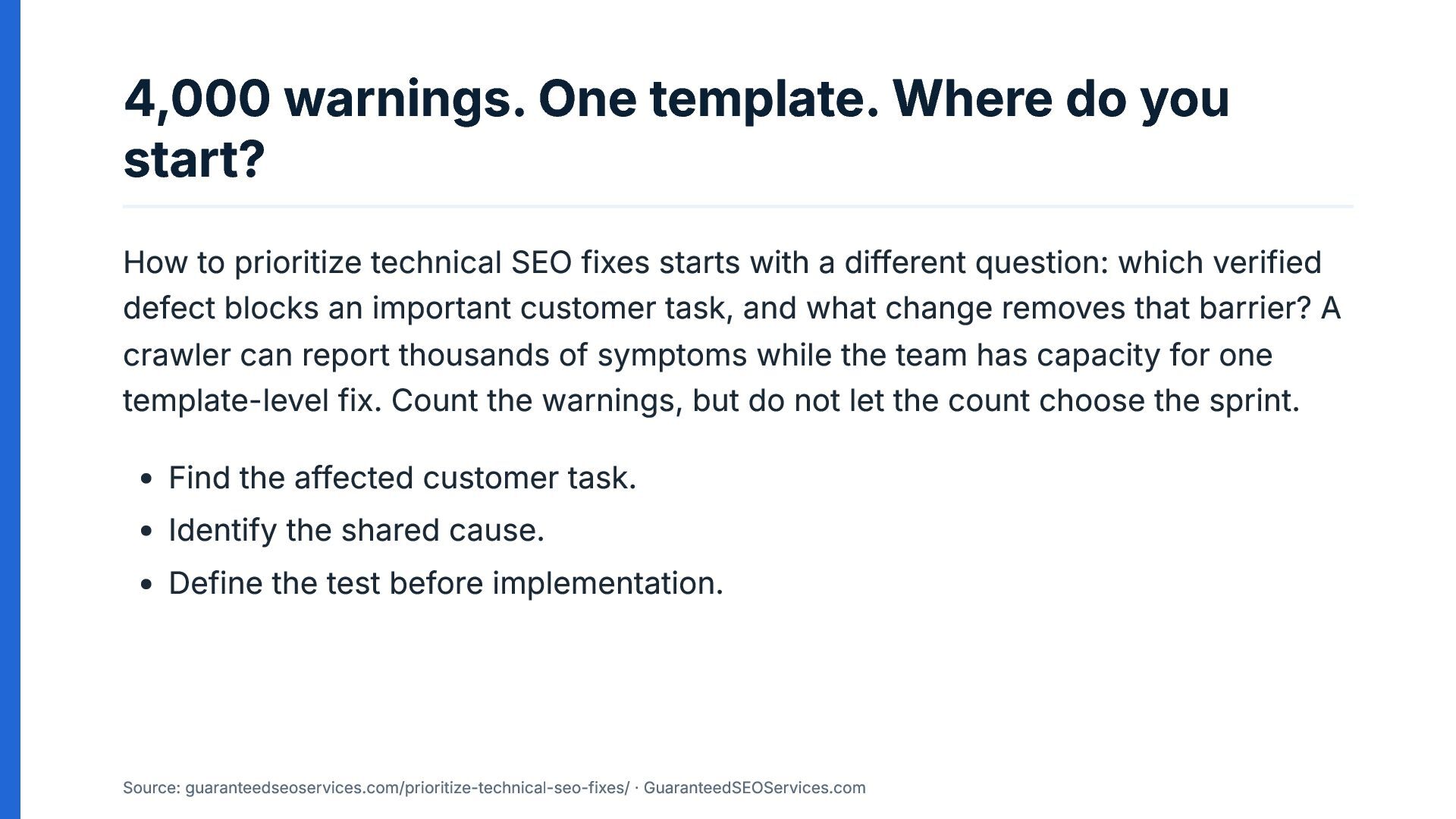
4,000 warnings. One template. Where do you start? How to
prioritize technical SEO fixes starts with a different question: which verified defect blocks an important customer task, and what change removes that barrier? A crawler can report thousands of symptoms while the team has capacity for one template-level fix. Count the warnings, but do not let the count choose the sprint. Find the affected customer task. Identify the shared cause. Define the test before implementation. Source: guaranteedseoservices.com/prioritize-technical-seo-fixes/ · GuaranteedSEOServices.com -
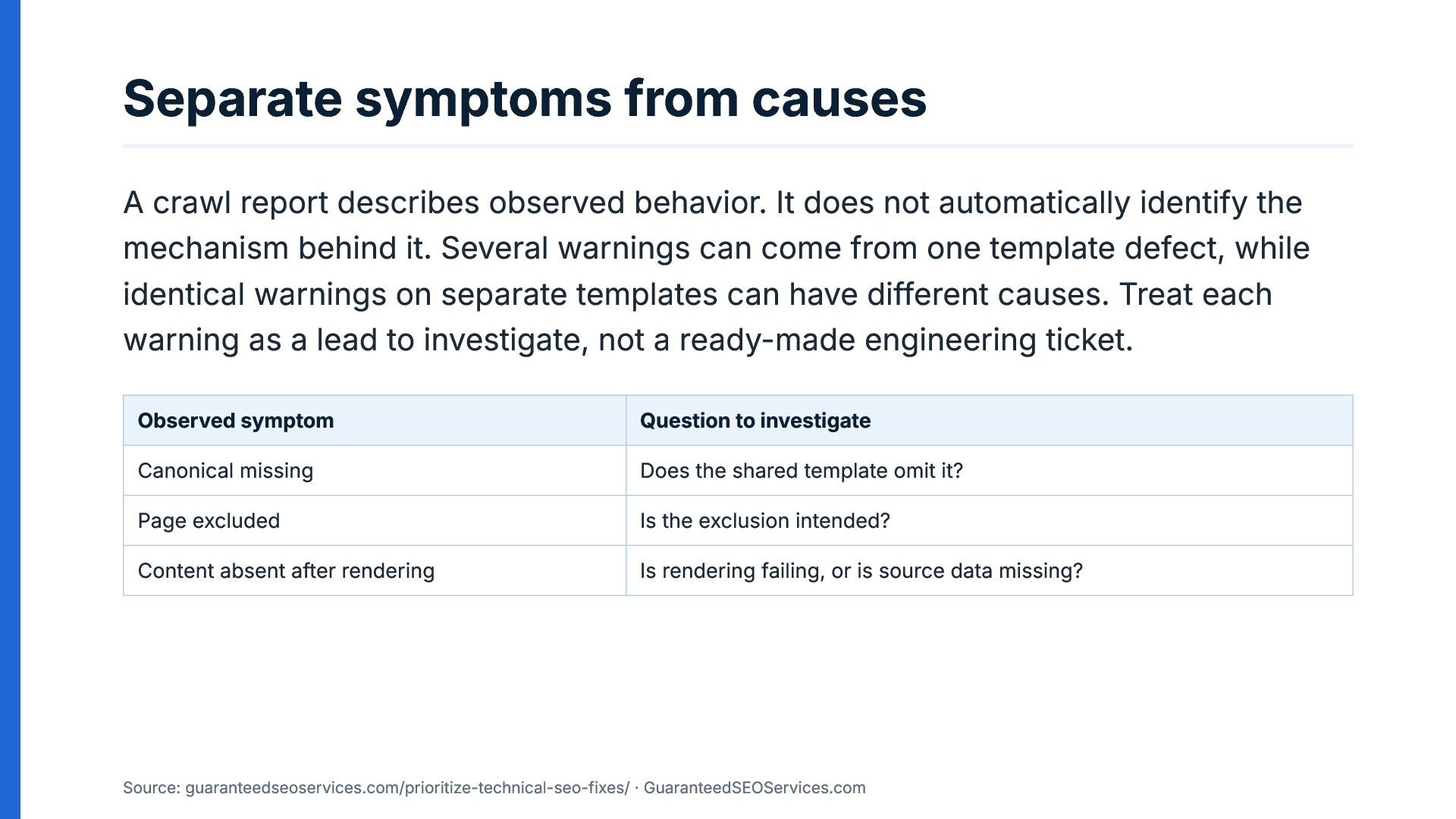
Separate symptoms from causes A crawl report describes observed behavior.
It does not automatically identify the mechanism behind it. Several warnings can come from one template defect, while identical warnings on separate templates can have different causes. Treat each warning as a lead to investigate, not a ready-made engineering ticket. Observed symptom Question to investigate Canonical missing Does the shared template omit it? Page excluded Is the exclusion intended? Content absent after rendering Is rendering failing, or is source data missing? Source: guaranteedseoservices.com/prioritize-technical-seo-fixes/ · GuaranteedSEOServices.com -
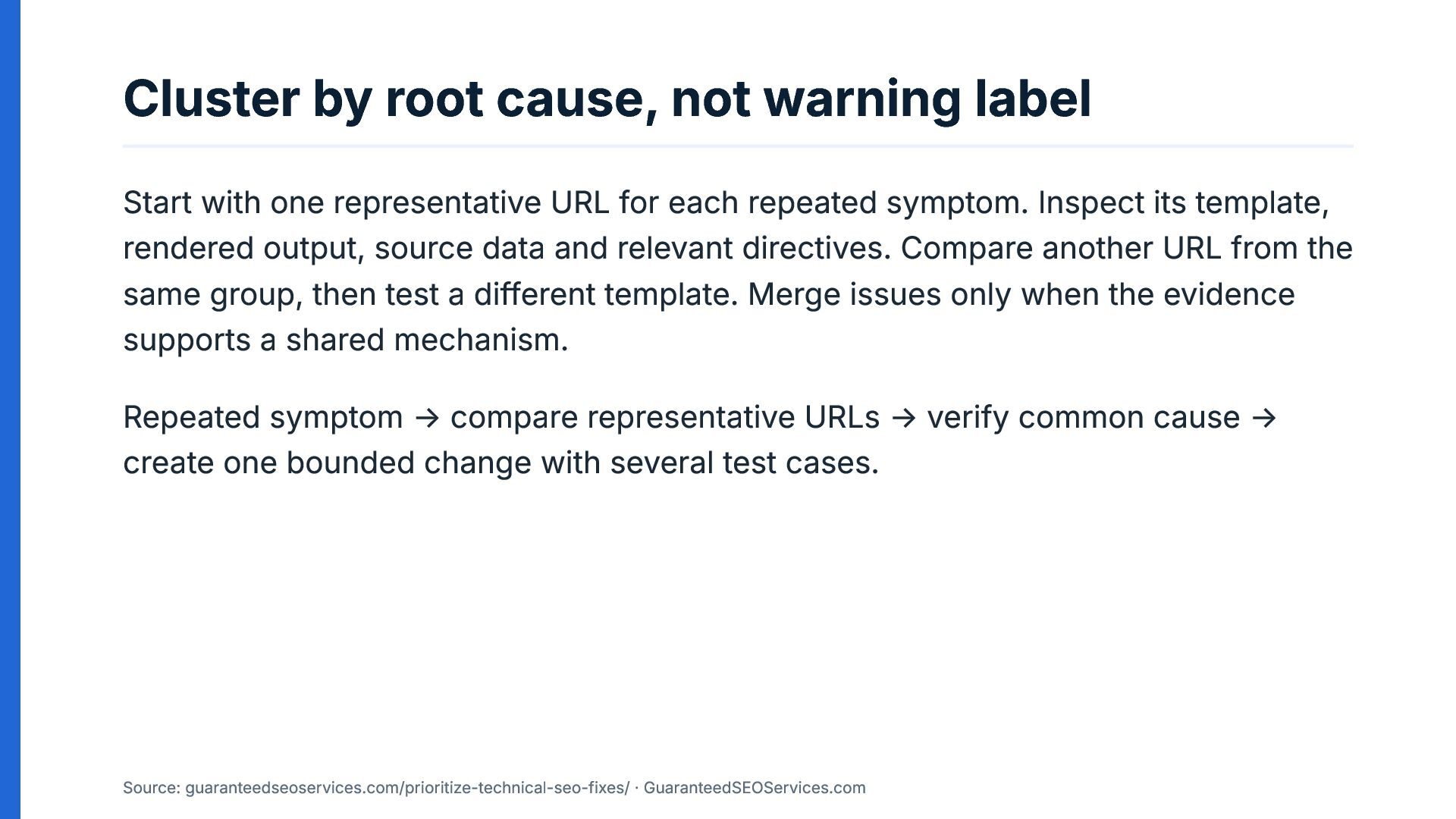
Cluster by root cause, not warning label Start with one
representative URL for each repeated symptom. Inspect its template, rendered output, source data and relevant directives. Compare another URL from the same group, then test a different template. Merge issues only when the evidence supports a shared mechanism. Repeated symptom → compare representative URLs → verify common cause → create one bounded change with several test cases. Source: guaranteedseoservices.com/prioritize-technical-seo-fixes/ · GuaranteedSEOServices.com -
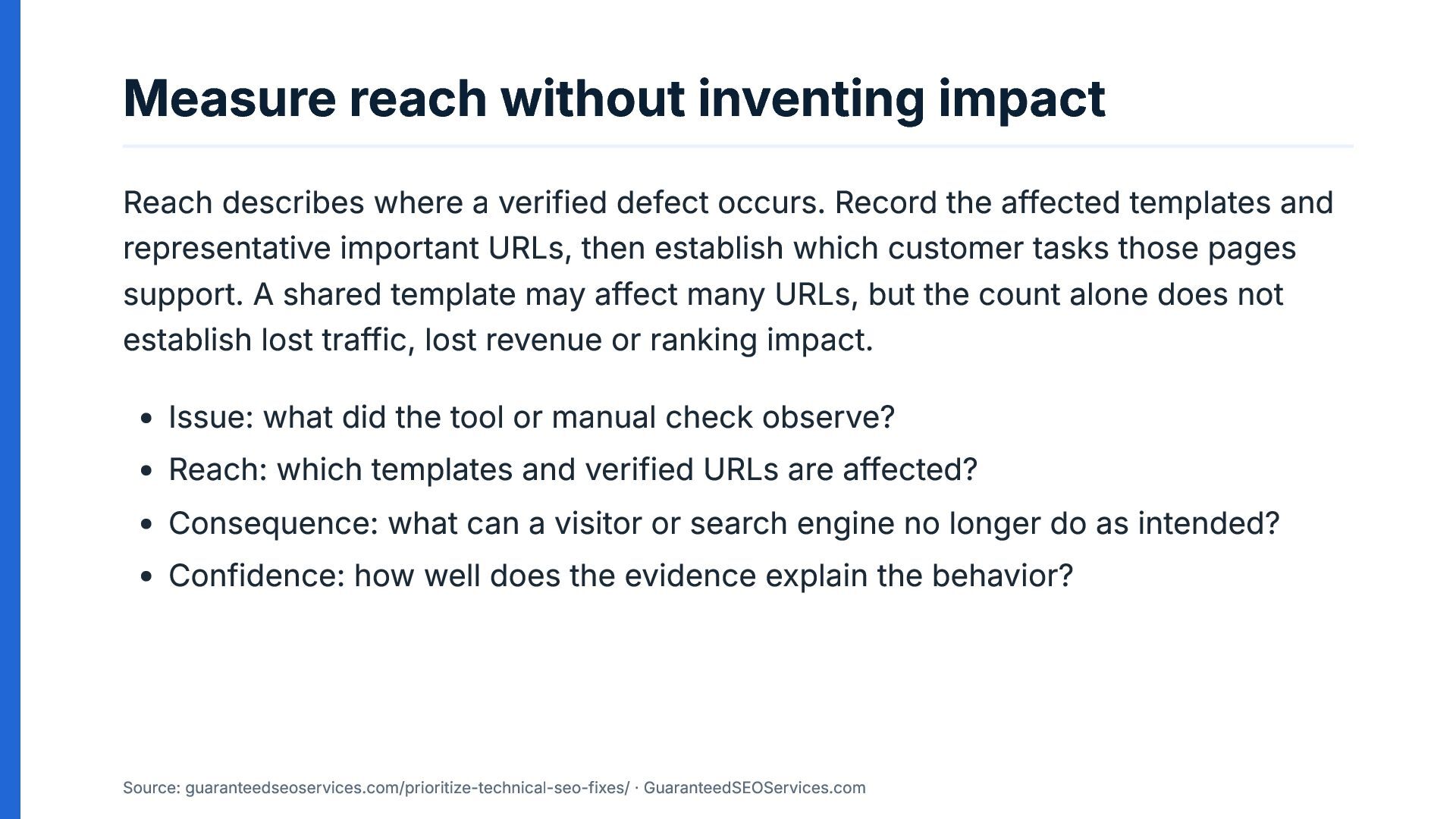
Measure reach without inventing impact Reach describes where a verified
defect occurs. Record the affected templates and representative important URLs, then establish which customer tasks those pages support. A shared template may affect many URLs, but the count alone does not establish lost traffic, lost revenue or ranking impact. Issue: what did the tool or manual check observe? Reach: which templates and verified URLs are affected? Consequence: what can a visitor or search engine no longer do as intended? Confidence: how well does the evidence explain the behavior? Source: guaranteedseoservices.com/prioritize-technical-seo-fixes/ · GuaranteedSEOServices.com -
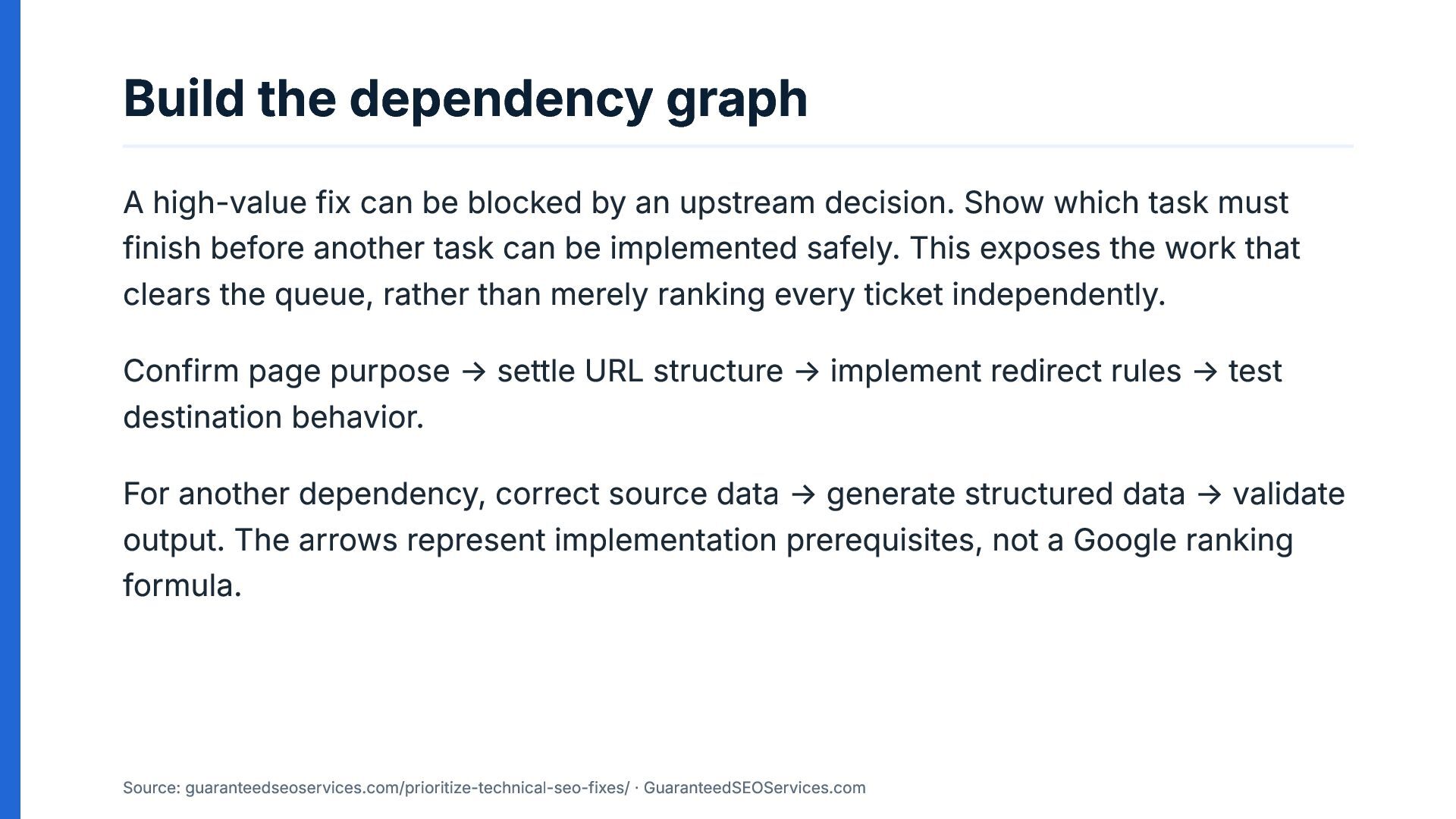
Build the dependency graph A high-value fix can be blocked
by an upstream decision. Show which task must finish before another task can be implemented safely. This exposes the work that clears the queue, rather than merely ranking every ticket independently. Confirm page purpose → settle URL structure → implement redirect rules → test destination behavior. For another dependency, correct source data → generate structured data → validate output. The arrows represent implementation prerequisites, not a Google ranking formula. Source: guaranteedseoservices.com/prioritize-technical-seo-fixes/ · GuaranteedSEOServices.com -
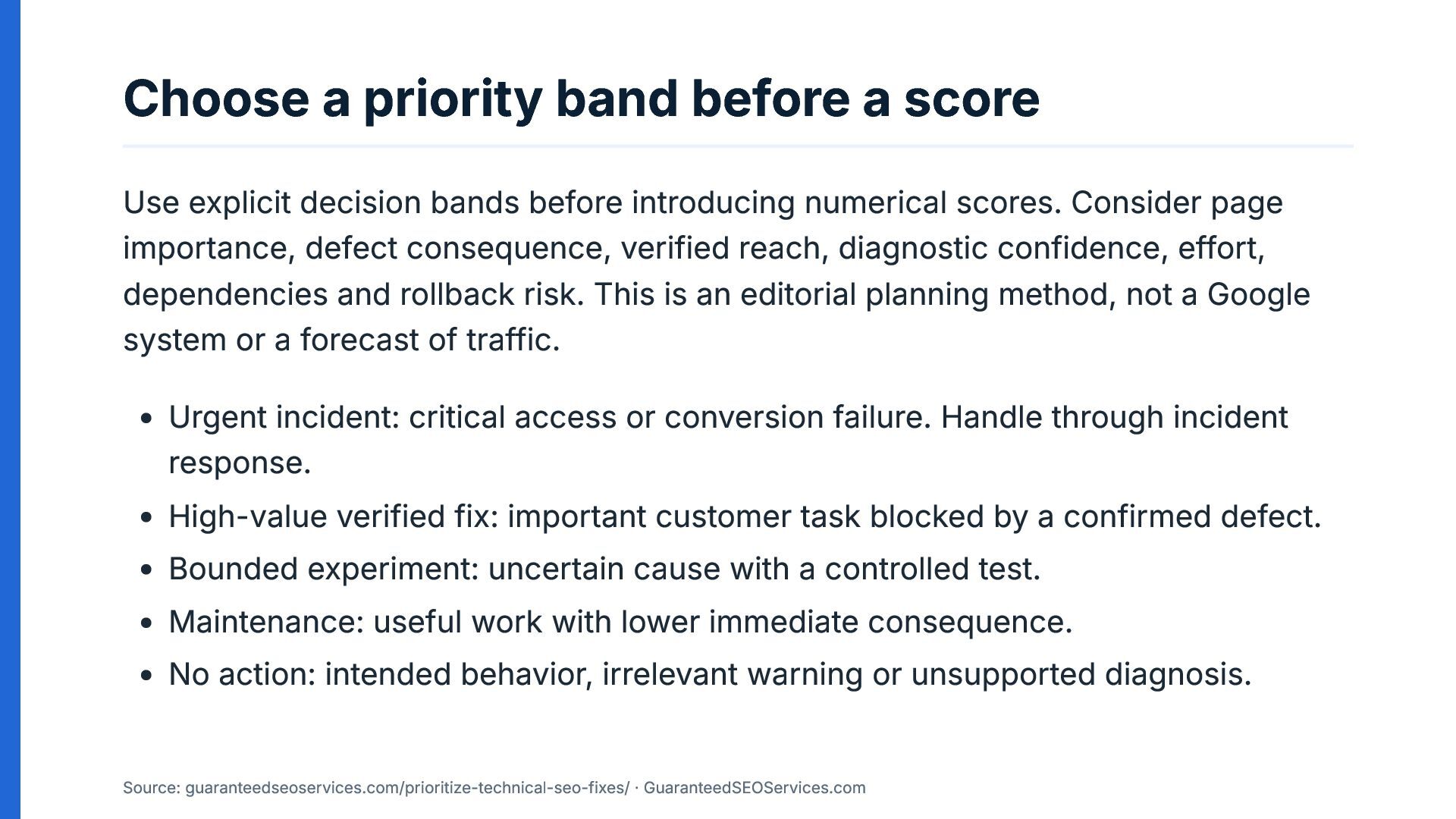
Choose a priority band before a score Use explicit decision
bands before introducing numerical scores. Consider page importance, defect consequence, verified reach, diagnostic confidence, effort, dependencies and rollback risk. This is an editorial planning method, not a Google system or a forecast of traffic. Urgent incident: critical access or conversion failure. Handle through incident response. High-value verified fix: important customer task blocked by a confirmed defect. Bounded experiment: uncertain cause with a controlled test. Maintenance: useful work with lower immediate consequence. No action: intended behavior, irrelevant warning or unsupported diagnosis. Source: guaranteedseoservices.com/prioritize-technical-seo-fixes/ · GuaranteedSEOServices.com -
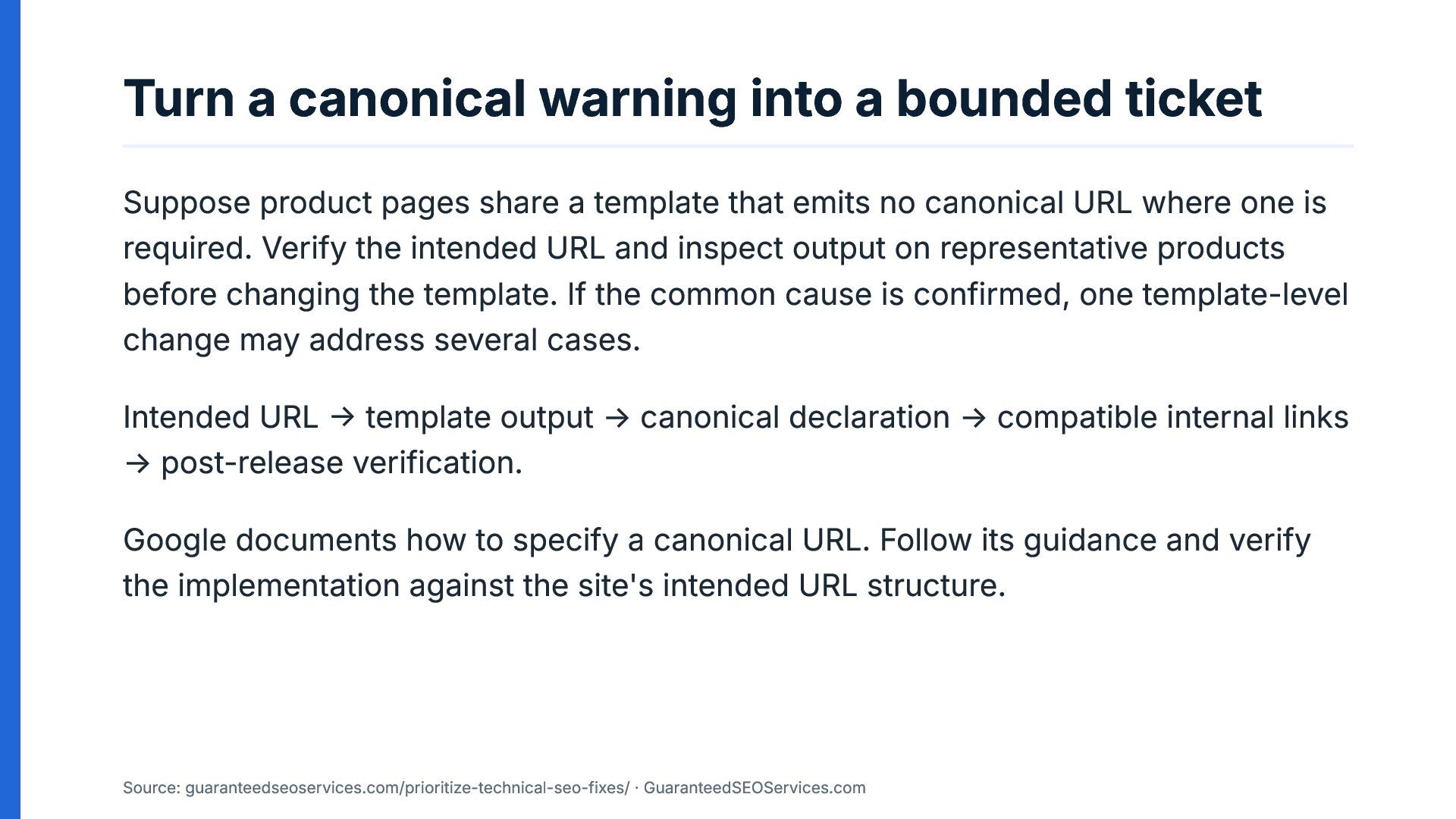
Turn a canonical warning into a bounded ticket Suppose product
pages share a template that emits no canonical URL where one is required. Verify the intended URL and inspect output on representative products before changing the template. If the common cause is confirmed, one template-level change may address several cases. Intended URL → template output → canonical declaration → compatible internal links → post-release verification. Google documents how to specify a canonical URL. Follow its guidance and verify the implementation against the site's intended URL structure. Source: guaranteedseoservices.com/prioritize-technical-seo-fixes/ · GuaranteedSEOServices.com -
Define done before assigning the fix A ticket needs an
observable starting state and an explicit intended state. Record the test date, representative URLs, affected templates and the acceptance criteria. For a canonical change, successful deployment is not enough if other routes change unexpectedly. Expected canonical output appears on every affected template. Internal links point to the intended URL structure. Excluded or unrelated routes retain their intended behavior. Post-release checks pass on representative URLs and relevant edge cases. Acceptance criteria describe delivery. They do not promise future rankings. Source: guaranteedseoservices.com/prioritize-technical-seo-fixes/ · GuaranteedSEOServices.com -
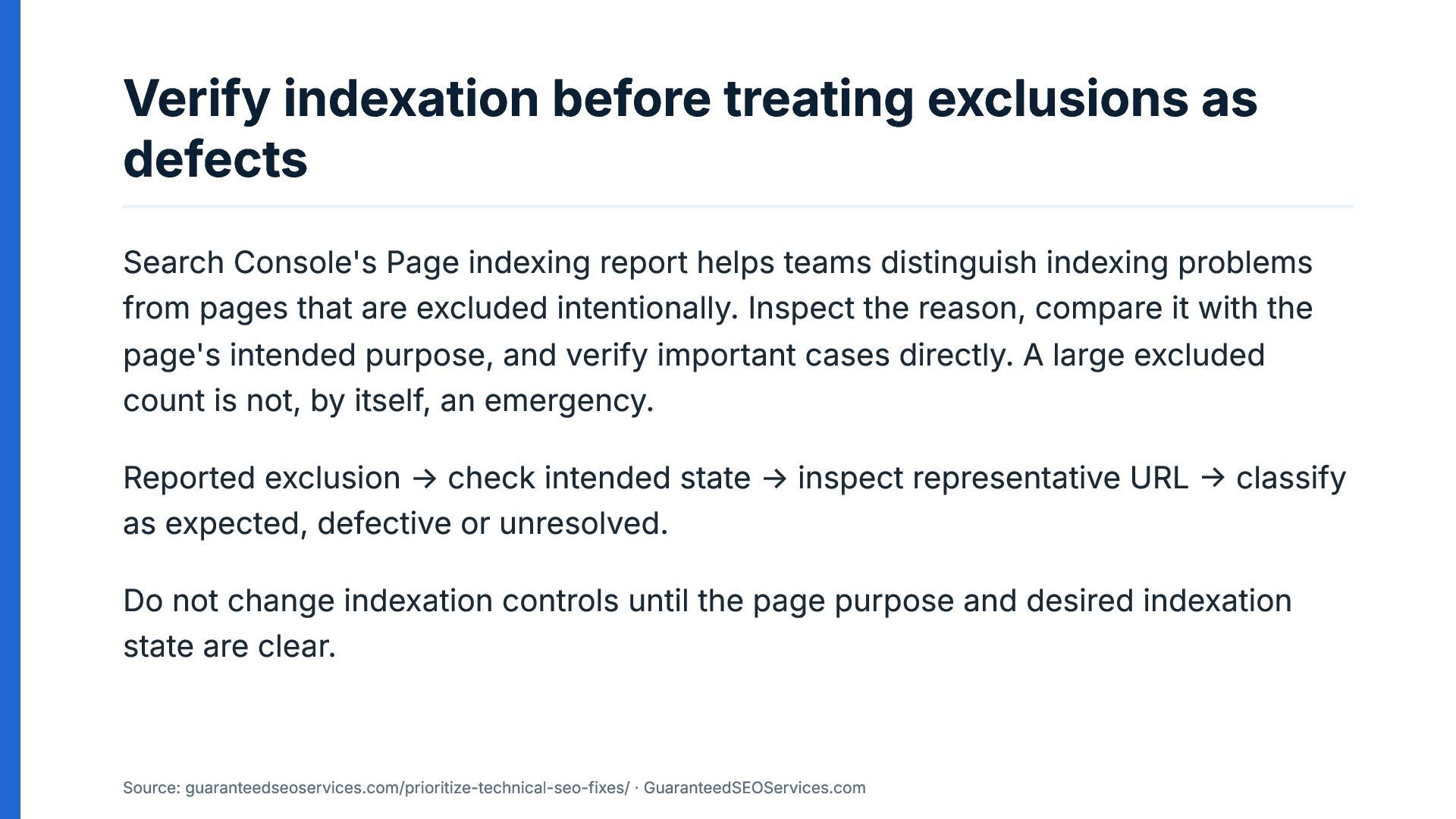
Verify indexation before treating exclusions as defects Search Console's Page
indexing report helps teams distinguish indexing problems from pages that are excluded intentionally. Inspect the reason, compare it with the page's intended purpose, and verify important cases directly. A large excluded count is not, by itself, an emergency. Reported exclusion → check intended state → inspect representative URL → classify as expected, defective or unresolved. Do not change indexation controls until the page purpose and desired indexation state are clear. Source: guaranteedseoservices.com/prioritize-technical-seo-fixes/ · GuaranteedSEOServices.com -
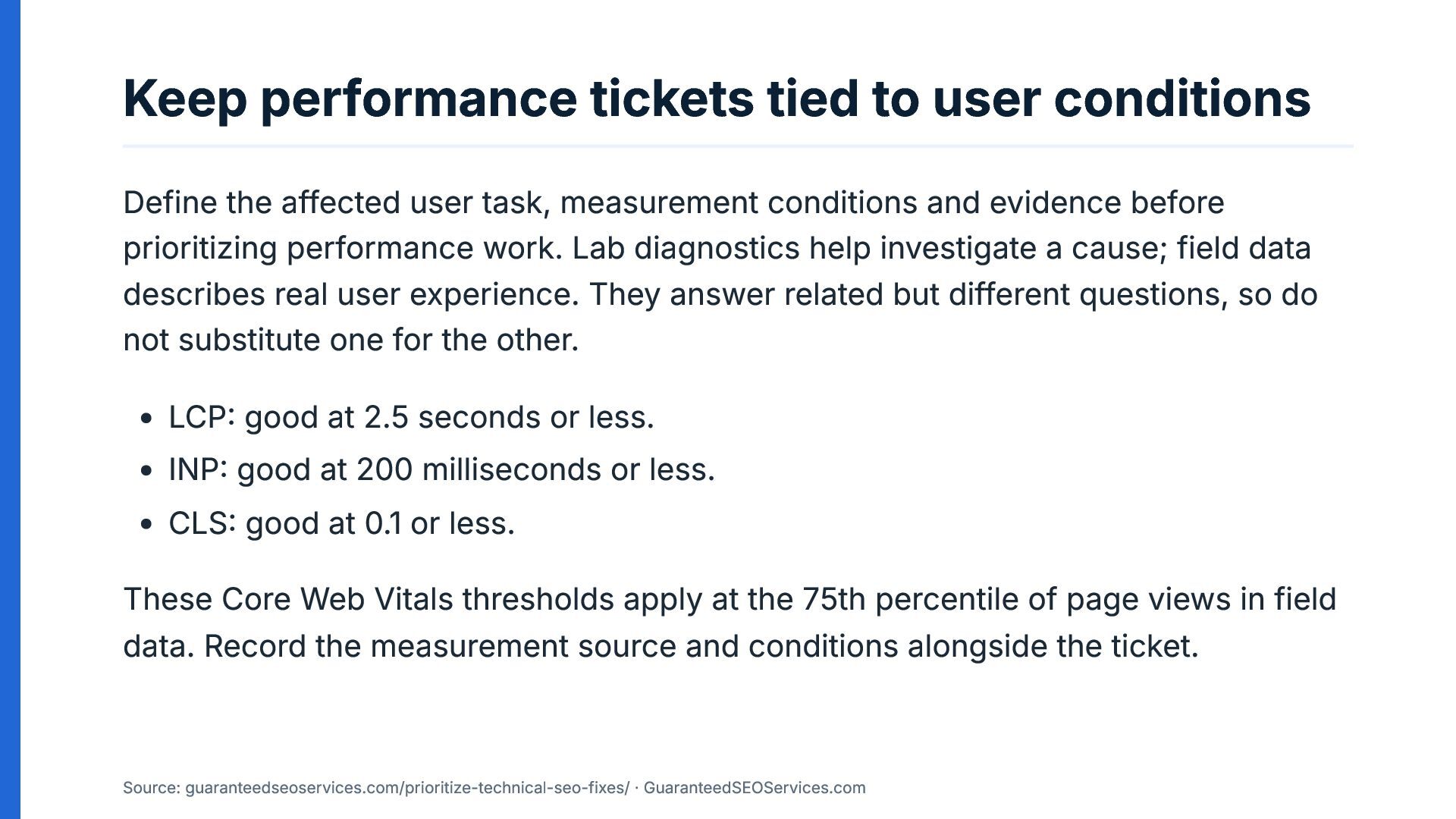
Keep performance tickets tied to user conditions Define the affected
user task, measurement conditions and evidence before prioritizing performance work. Lab diagnostics help investigate a cause; field data describes real user experience. They answer related but different questions, so do not substitute one for the other. LCP: good at 2.5 seconds or less. INP: good at 200 milliseconds or less. CLS: good at 0.1 or less. These Core Web Vitals thresholds apply at the 75th percentile of page views in field data. Record the measurement source and conditions alongside the ticket. Source: guaranteedseoservices.com/prioritize-technical-seo-fixes/ · GuaranteedSEOServices.com -
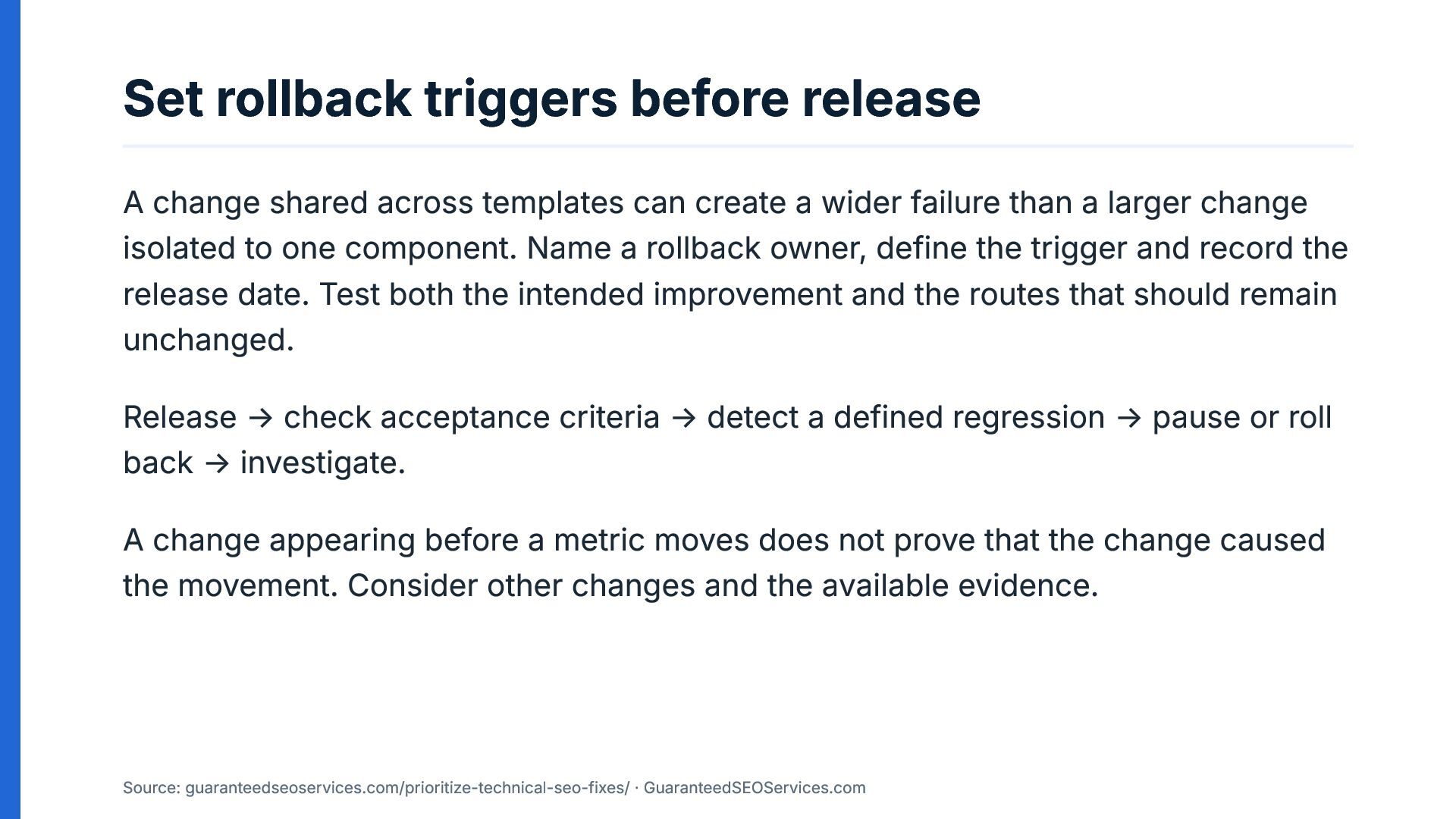
Set rollback triggers before release A change shared across templates
can create a wider failure than a larger change isolated to one component. Name a rollback owner, define the trigger and record the release date. Test both the intended improvement and the routes that should remain unchanged. Release → check acceptance criteria → detect a defined regression → pause or roll back → investigate. A change appearing before a metric moves does not prove that the change caused the movement. Consider other changes and the available evidence. Source: guaranteedseoservices.com/prioritize-technical-seo-fixes/ · GuaranteedSEOServices.com -
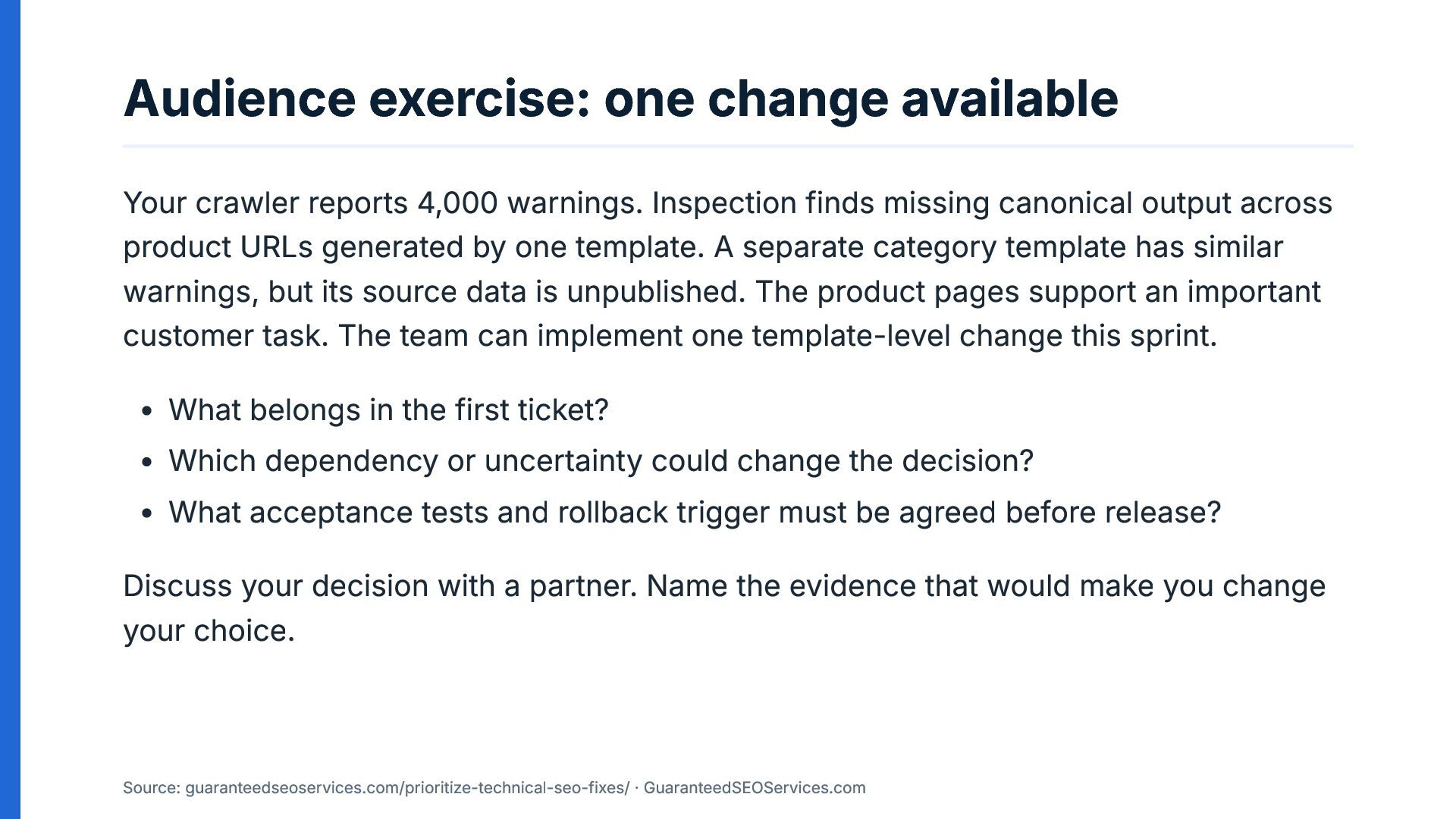
Audience exercise: one change available Your crawler reports 4,000 warnings.
Inspection finds missing canonical output across product URLs generated by one template. A separate category template has similar warnings, but its source data is unpublished. The product pages support an important customer task. The team can implement one template-level change this sprint. What belongs in the first ticket? Which dependency or uncertainty could change the decision? What acceptance tests and rollback trigger must be agreed before release? Discuss your decision with a partner. Name the evidence that would make you change your choice. Source: guaranteedseoservices.com/prioritize-technical-seo-fixes/ · GuaranteedSEOServices.com -
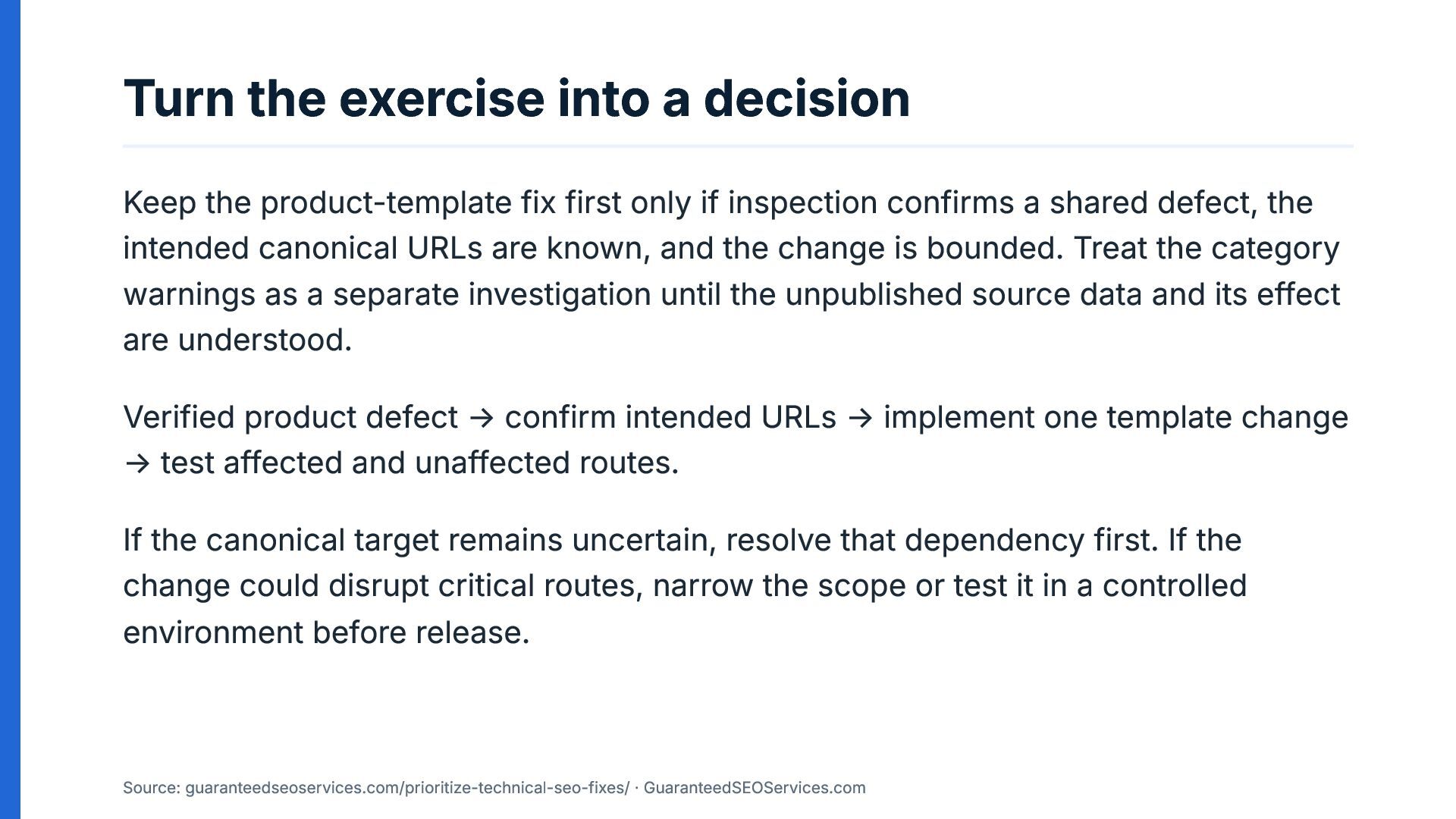
Turn the exercise into a decision Keep the product-template fix
first only if inspection confirms a shared defect, the intended canonical URLs are known, and the change is bounded. Treat the category warnings as a separate investigation until the unpublished source data and its effect are understood. Verified product defect → confirm intended URLs → implement one template change → test affected and unaffected routes. If the canonical target remains uncertain, resolve that dependency first. If the change could disrupt critical routes, narrow the scope or test it in a controlled environment before release. Source: guaranteedseoservices.com/prioritize-technical-seo-fixes/ · GuaranteedSEOServices.com -
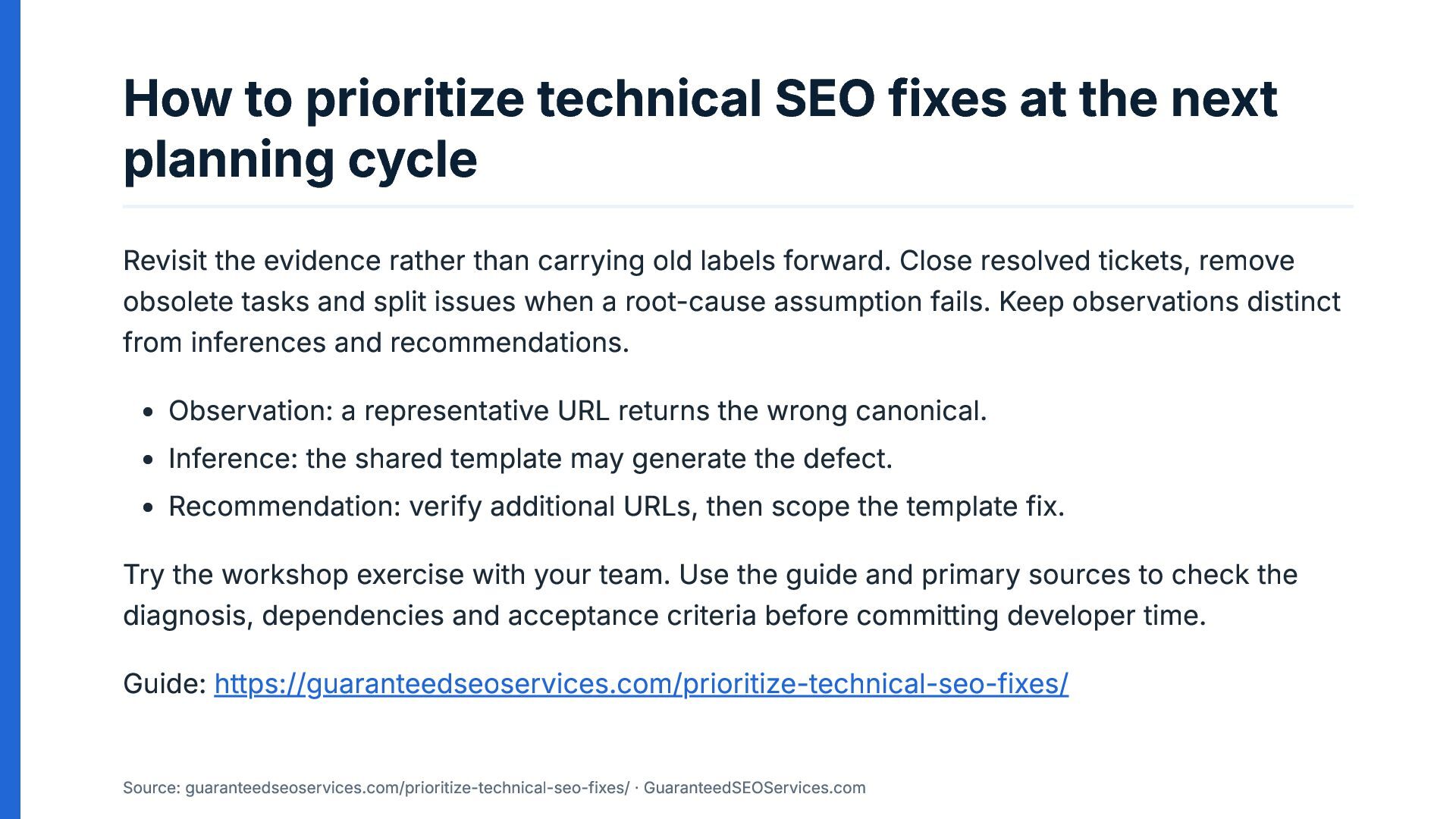
How to prioritize technical SEO fixes at the next planning
cycle Revisit the evidence rather than carrying old labels forward. Close resolved tickets, remove obsolete tasks and split issues when a root-cause assumption fails. Keep observations distinct from inferences and recommendations. Observation: a representative URL returns the wrong canonical. Inference: the shared template may generate the defect. Recommendation: verify additional URLs, then scope the template fix. Try the workshop exercise with your team. Use the guide and primary sources to check the diagnosis, dependencies and acceptance criteria before committing developer time. Guide: https://guaranteedseoservices.com/prioritize-technical-seo-fixes/ Source: guaranteedseoservices.com/prioritize-technical-seo-fixes/ · GuaranteedSEOServices.com -
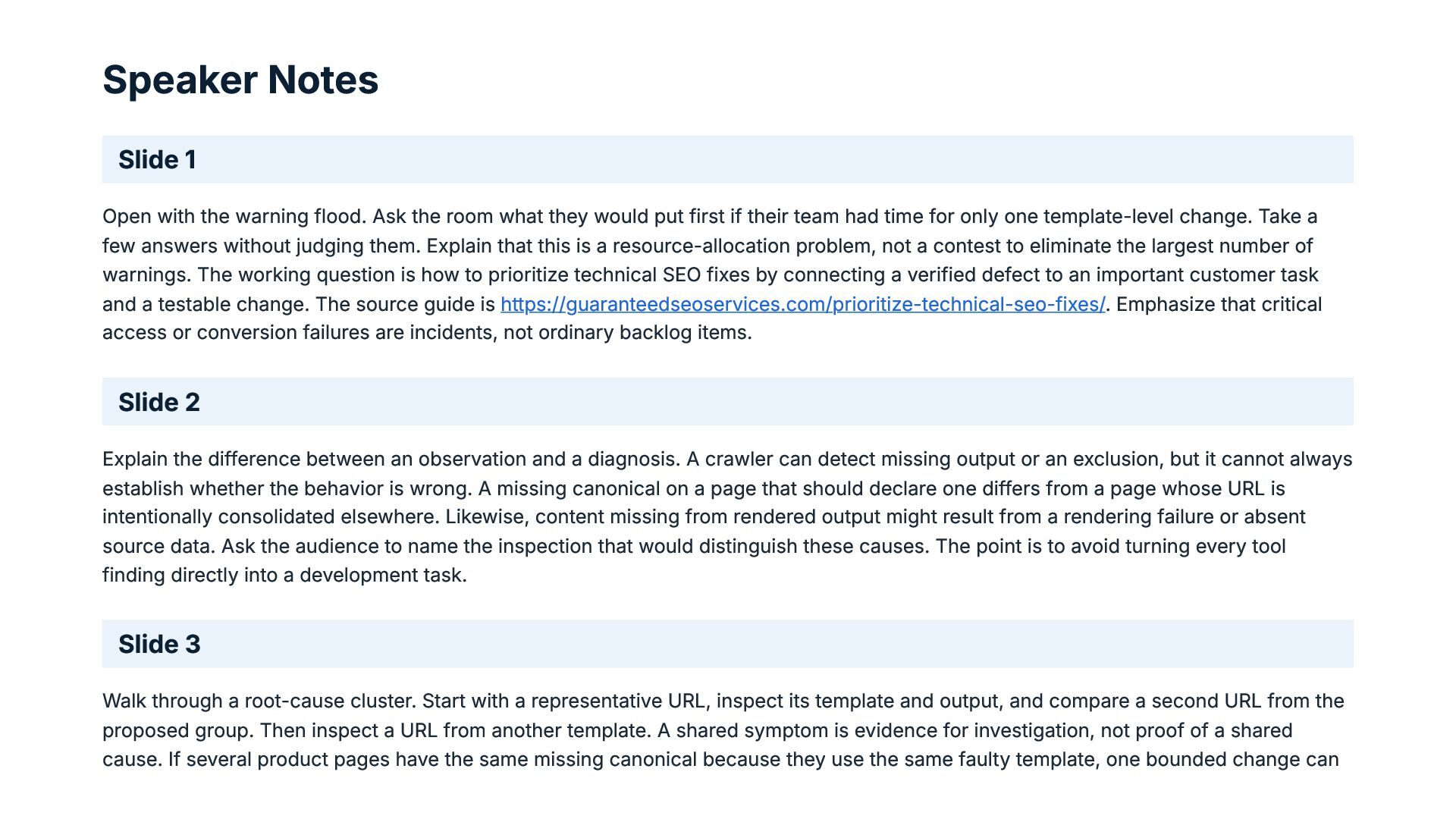
Speaker Notes Slide 1 Open with the warning flood. Ask
the room what they would put first if their team had time for only one template-level change. Take a few answers without judging them. Explain that this is a resource-allocation problem, not a contest to eliminate the largest number of warnings. The working question is how to prioritize technical SEO fixes by connecting a verified defect to an important customer task and a testable change. The source guide is https://guaranteedseoservices.com/prioritize-technical-seo-fixes/. Emphasize that critical access or conversion failures are incidents, not ordinary backlog items. Slide 2 Explain the difference between an observation and a diagnosis. A crawler can detect missing output or an exclusion, but it cannot always establish whether the behavior is wrong. A missing canonical on a page that should declare one differs from a page whose URL is intentionally consolidated elsewhere. Likewise, content missing from rendered output might result from a rendering failure or absent source data. Ask the audience to name the inspection that would distinguish these causes. The point is to avoid turning every tool finding directly into a development task. Slide 3 Walk through a root-cause cluster. Start with a representative URL, inspect its template and output, and compare a second URL from the proposed group. Then inspect a URL from another template. A shared symptom is evidence for investigation, not proof of a shared cause. If several product pages have the same missing canonical because they use the same faulty template, one bounded change can -
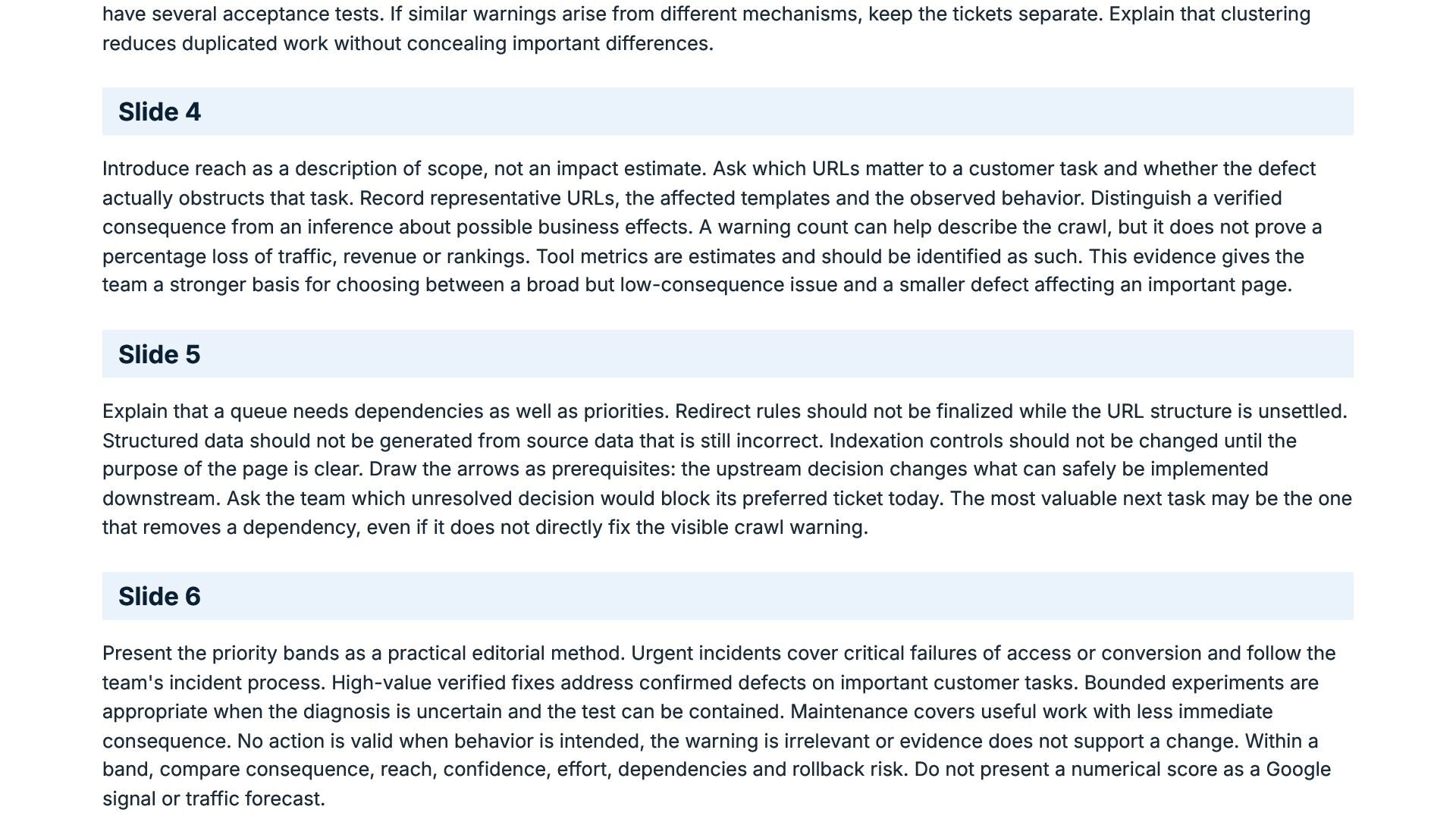
have several acceptance tests. If similar warnings arise from different
mechanisms, keep the tickets separate. Explain that clustering reduces duplicated work without concealing important differences. Slide 4 Introduce reach as a description of scope, not an impact estimate. Ask which URLs matter to a customer task and whether the defect actually obstructs that task. Record representative URLs, the affected templates and the observed behavior. Distinguish a verified consequence from an inference about possible business effects. A warning count can help describe the crawl, but it does not prove a percentage loss of traffic, revenue or rankings. Tool metrics are estimates and should be identified as such. This evidence gives the team a stronger basis for choosing between a broad but low-consequence issue and a smaller defect affecting an important page. Slide 5 Explain that a queue needs dependencies as well as priorities. Redirect rules should not be finalized while the URL structure is unsettled. Structured data should not be generated from source data that is still incorrect. Indexation controls should not be changed until the purpose of the page is clear. Draw the arrows as prerequisites: the upstream decision changes what can safely be implemented downstream. Ask the team which unresolved decision would block its preferred ticket today. The most valuable next task may be the one that removes a dependency, even if it does not directly fix the visible crawl warning. Slide 6 Present the priority bands as a practical editorial method. Urgent incidents cover critical failures of access or conversion and follow the team's incident process. High-value verified fixes address confirmed defects on important customer tasks. Bounded experiments are appropriate when the diagnosis is uncertain and the test can be contained. Maintenance covers useful work with less immediate consequence. No action is valid when behavior is intended, the warning is irrelevant or evidence does not support a change. Within a band, compare consequence, reach, confidence, effort, dependencies and rollback risk. Do not present a numerical score as a Google signal or traffic forecast. -
Slide 7 Use the canonical example to make root-cause grouping
concrete. Before coding, confirm which URL should be canonical for each representative product page and inspect the actual output. If the missing declaration comes from a shared template, a template-level fix may address multiple URLs. Check that the intended URL structure is consistent with internal links and the site's purpose. Google's documentation on consolidating duplicate URLs explains canonicalization guidance. Avoid implying that a canonical declaration guarantees indexing or rankings. The engineering objective is correct, consistent output and predictable behavior across the routes included in the change. Slide 8 Ask the audience to imagine receiving a ticket that says only, "Fix canonicals." Explain why that is insufficient: the developer cannot tell which URLs are in scope, what output is intended or how success will be checked. A useful ticket records observed behavior, representative URLs, affected templates, the test date and the intended state. Acceptance criteria should cover the affected routes and relevant unaffected routes. Internal links must remain compatible with the intended URL structure. Post-release checks confirm that the implementation matches the specification. Passing these checks means the change was delivered as intended, not that future organic performance is guaranteed. Slide 9 Show how the Page indexing report helps distinguish a problem from expected exclusion. Start with the reason shown in Search Console, then ask whether the page is meant to appear in search results. Inspect representative URLs and compare their actual behavior with that intended state. A high excluded-page count can be normal for a site with many duplicate, alternate or otherwise intentionally excluded URLs. It can also contain defects, so neither automatic reassurance nor automatic escalation is justified by the count alone. The diagnostic sequence is to establish purpose, check evidence and classify the case before changing controls. -
Slide 10 Separate laboratory measurements from field outcomes. A lab
test can help reproduce and investigate a performance problem under defined conditions. Field data captures actual user experience across page views. Record the page or customer task, device or test conditions where relevant, data source and measurement period so comparisons are meaningful. The good Core Web Vitals thresholds are LCP at or below 2.5 seconds, INP at or below 200 milliseconds and CLS at or below 0.1. Field assessment uses the 75th percentile of page views. These thresholds describe user experience classifications, not a promise of ranking gains. Consult the Web Vitals overview and the threshold documentation for definitions and context. Slide 11 Explain why blast radius matters. A tiny code change shared by every template can carry more risk than a larger change confined to one component. Before release, name the person responsible for rollback and write down the specific condition that triggers it. Check both the target behavior and routes that should remain unaffected. Record release dates so later analysis has a timeline. If a metric changes after deployment, timing alone is not evidence that the release caused the change. Review other releases, data conditions and plausible causes before drawing conclusions. The release plan should specify what the team will do if acceptance criteria fail. Slide 12 Give participants two or three minutes to discuss the case. Do not reveal the answer immediately. Ask them to identify the highest-value verified defect, the uncertainty in the category template and the tests needed before release. Encourage them to state what evidence would change their decision. The case is deliberately constrained to one template-level change, so participants must distinguish a bounded, verified implementation from a second issue whose apparent similarity does not establish a shared cause. The exercise tests the complete diagnostic sequence rather than memorization of a severity label. Slide 13 -
The complete exercise answer is to prioritize the product-template change
only after confirming that the missing canonical output is a real defect, the intended canonical targets are known and the change can be safely scoped. The product pages support an important customer task, and a confirmed shared template defect offers a bounded implementation path. Acceptance tests should check correct canonical output across representative affected product URLs, compatibility of internal links and unchanged behavior on excluded or unrelated routes. Post-release checks must repeat the relevant tests. The rollback owner and trigger should be agreed before release. The category warnings do not automatically join the same ticket: unpublished source data indicates a potentially different cause that needs its own diagnosis. If the product canonical targets are unclear, resolve that dependency before implementation. If the shared change has an unacceptable blast radius, narrow the scope or validate it in a controlled environment first. Slide 14 Close by asking the room to name one ticket they would rewrite using the fields from the workshop. The queue should be reviewed each planning cycle because fixes ship, dependencies change, evidence improves and old tasks become irrelevant. Keep observations, inferences and recommendations visibly separate. Use the guide to revisit the method and the primary sources to verify canonical, indexation and performance guidance. Try the workshop exercise with your team, and use the result to improve how to prioritize technical SEO fixes through a documented diagnosis, dependency-aware implementation plan and testable acceptance criteria. The aim is a defensible engineering decision, not a promised search outcome. -
Sources https://guaranteedseoservices.com/prioritize-technical-seo-fixes/ Defining Core Web Vitals thresholds, web.dev Web Vitals
overview, web.dev Page indexing report, Search Console Help Consolidate duplicate URLs, Google Search Central
 guaranteedseoservices
 samanyougarg
 portentint
 joshbly
 speedyindexteam
 pavelungr
 tamaranovitovic
 pelogia
 clarasoteras
 sarosaro
 aleyda
 yoshiesan
 alexmossuk
 trallard
 baasie
 destraynor
 lara
 shpigford
 mfonobong
 inesmontani
 reverentgeek
 charlesmeaden
 jct
 szymonslowik