What Should an SEO Report Include? Explain Chan...

Share
Embed
What Should an SEO Report Include? Explain Changes With Evidence
What should an SEO report include to separate measured outcomes, completed work and causal hypotheses? This workshop deck covers measurement scope, tracking caveats and a practical exercise for testing explanations before making the next decision. For the full answer to what should an SEO report include, read the guide: https://guaranteedseoservices.com/seo-report/?utm_source=speakerdeck&utm_medium=referral&utm_campaign=blog-seo-report

GuaranteedSEOServices
October 26, 2026
Transcript
20 slides
-
What Should an SEO Report Include? Explain Changes With Evidence
“Google disliked the redesign” is not an explanation. A useful SEO report separates observed outcomes, completed work and causal hypotheses so a team can decide what to investigate next. GuaranteedSEOServices.com October 27, 2026 -
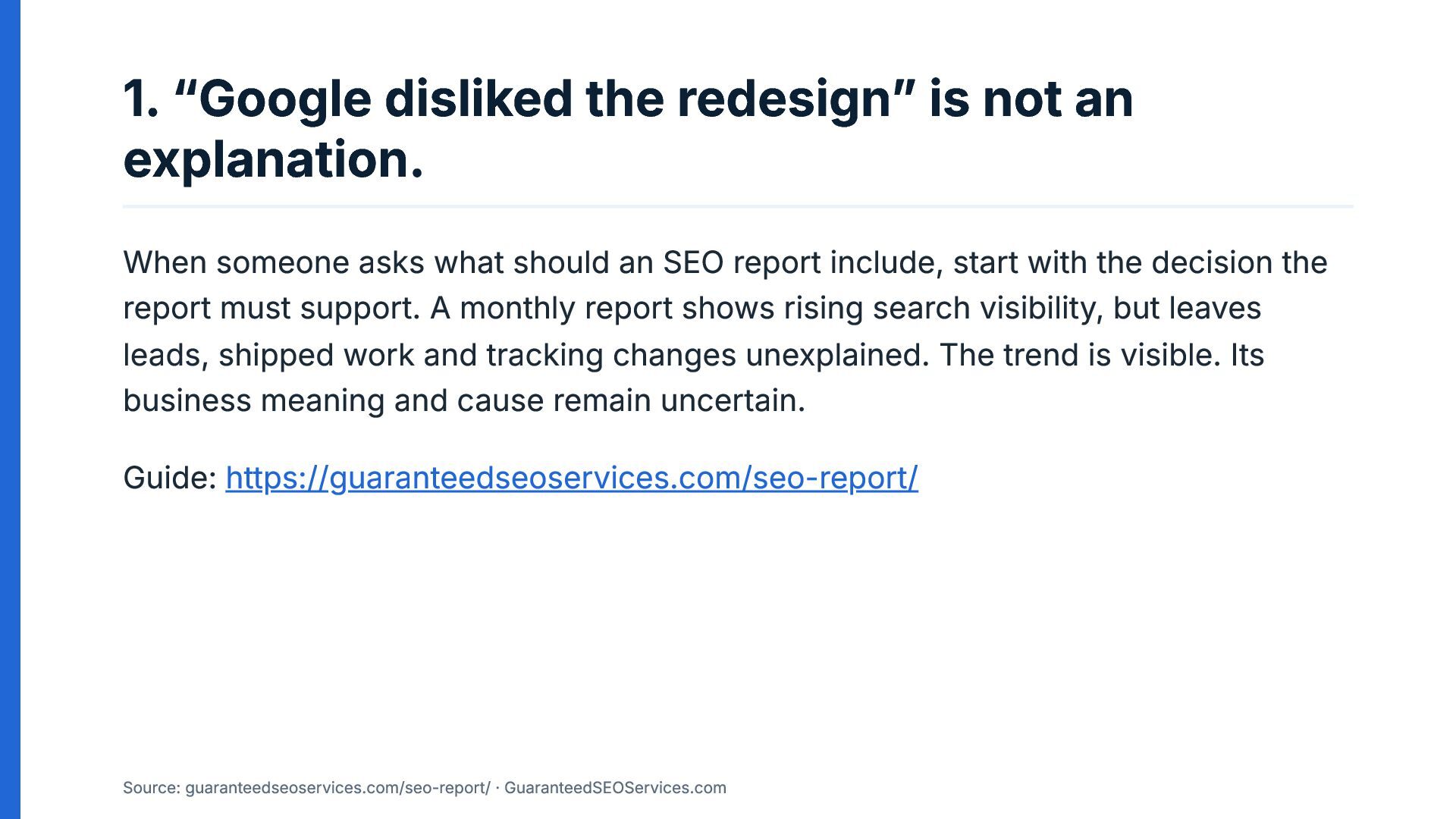
1. “Google disliked the redesign” is not an explanation. When
someone asks what should an SEO report include, start with the decision the report must support. A monthly report shows rising search visibility, but leaves leads, shipped work and tracking changes unexplained. The trend is visible. Its business meaning and cause remain uncertain. Guide: https://guaranteedseoservices.com/seo-report/ Source: guaranteedseoservices.com/seo-report/ · GuaranteedSEOServices.com -
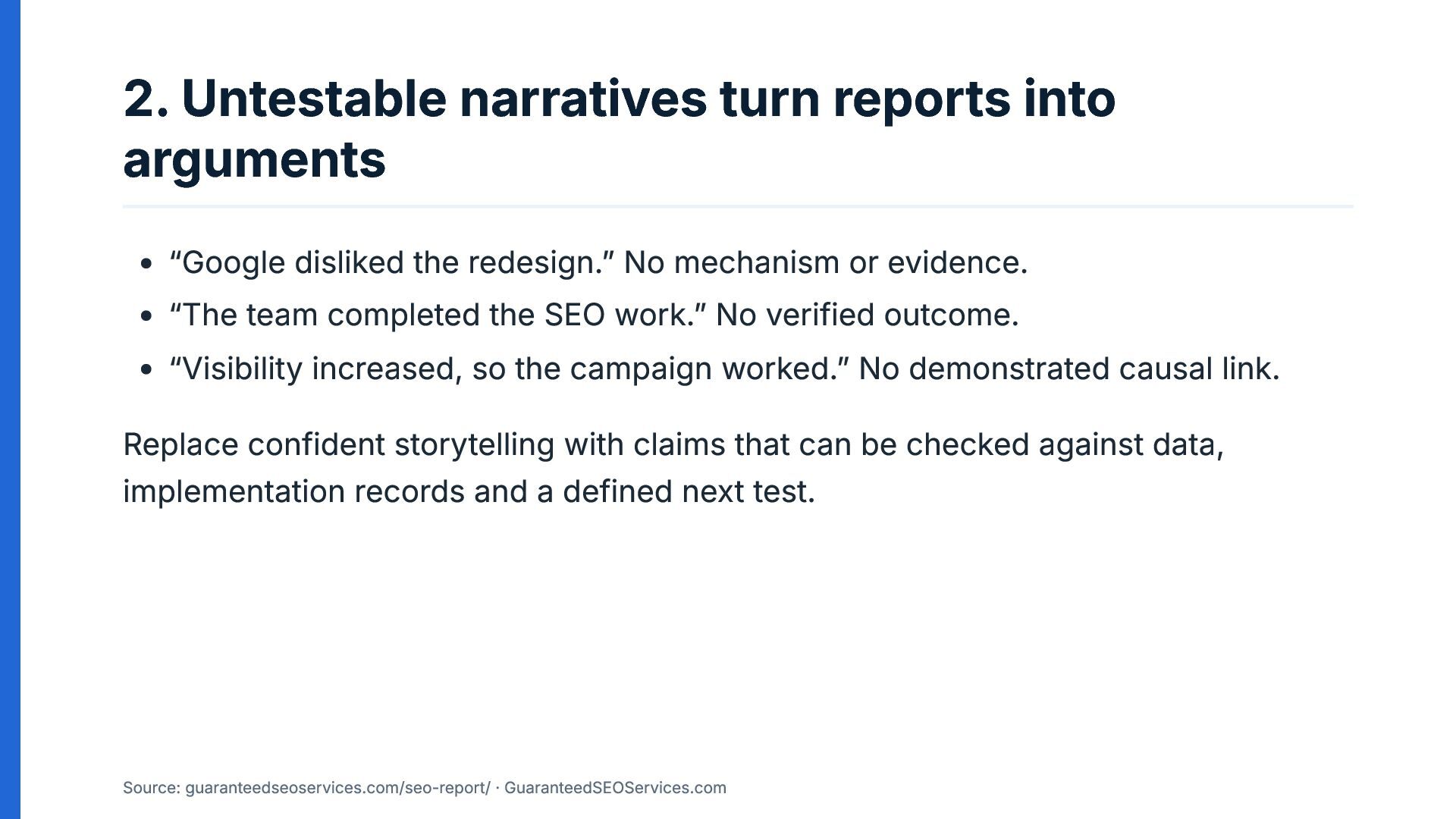
2. Untestable narratives turn reports into arguments “Google disliked the
redesign.” No mechanism or evidence. “The team completed the SEO work.” No verified outcome. “Visibility increased, so the campaign worked.” No demonstrated causal link. Replace confident storytelling with claims that can be checked against data, implementation records and a defined next test. Source: guaranteedseoservices.com/seo-report/ · GuaranteedSEOServices.com -
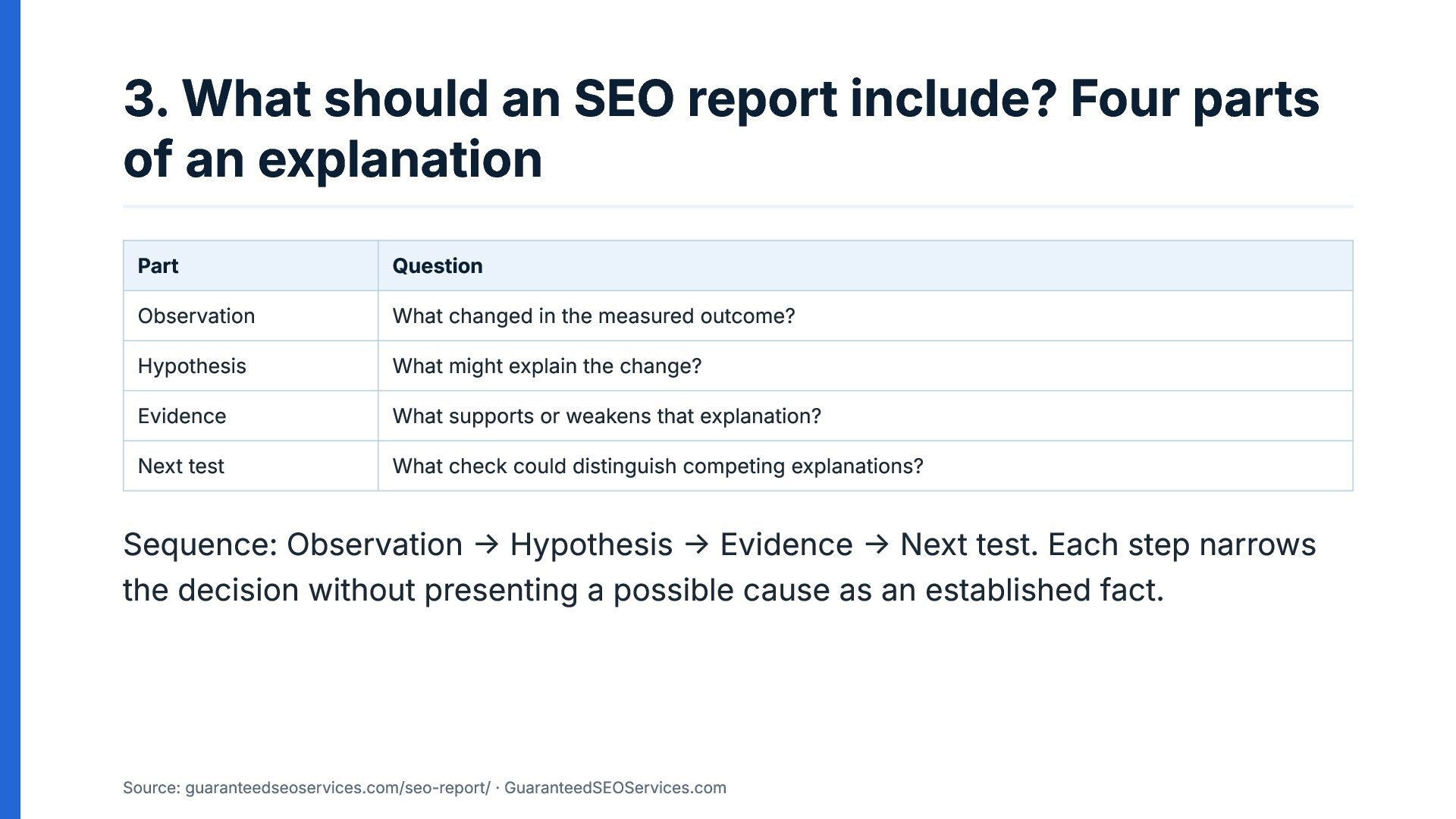
3. What should an SEO report include? Four parts of
an explanation Part Question Observation What changed in the measured outcome? Hypothesis What might explain the change? Evidence What supports or weakens that explanation? Next test What check could distinguish competing explanations? Sequence: Observation → Hypothesis → Evidence → Next test. Each step narrows the decision without presenting a possible cause as an established fact. Source: guaranteedseoservices.com/seo-report/ · GuaranteedSEOServices.com -
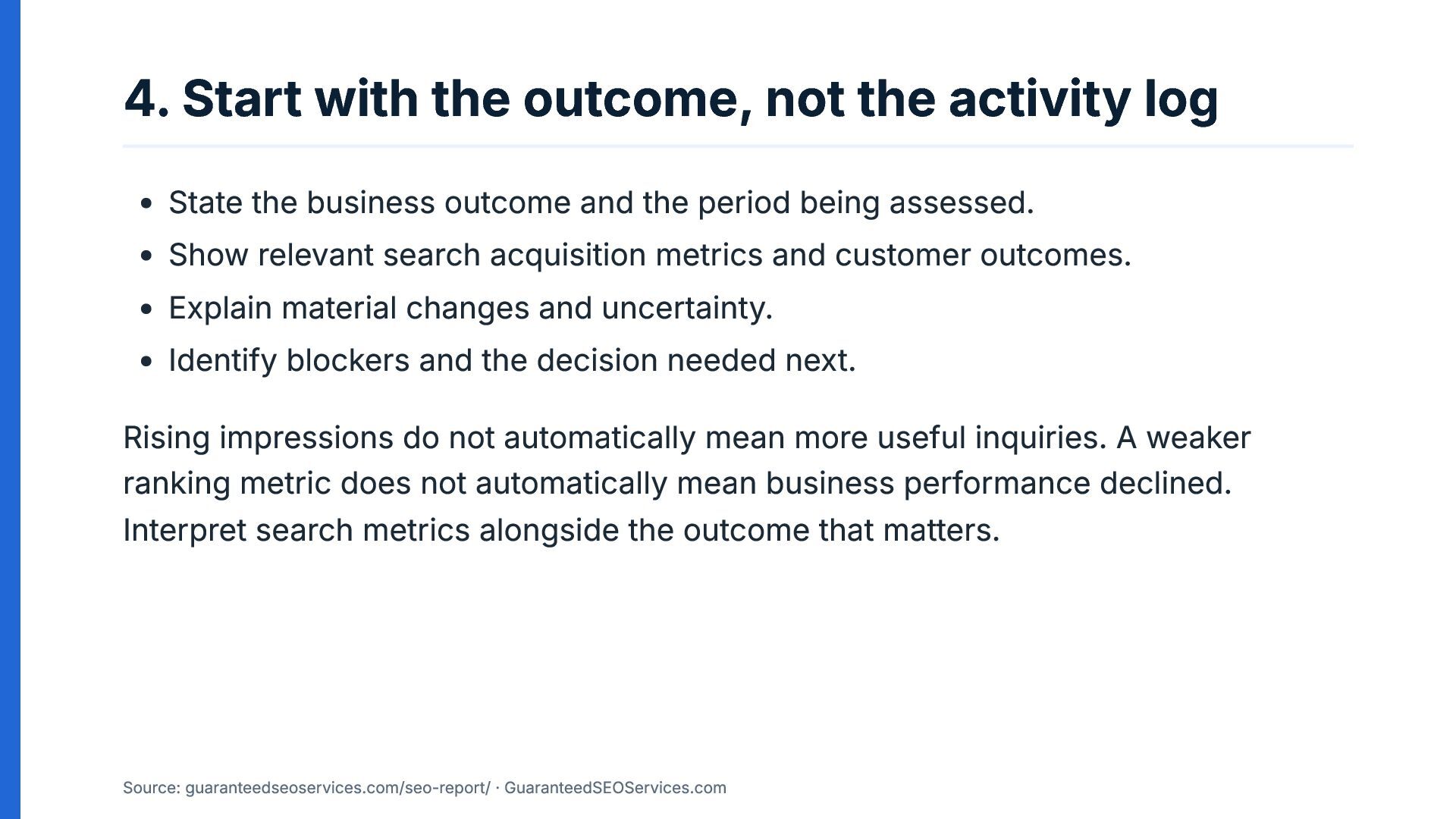
4. Start with the outcome, not the activity log State
the business outcome and the period being assessed. Show relevant search acquisition metrics and customer outcomes. Explain material changes and uncertainty. Identify blockers and the decision needed next. Rising impressions do not automatically mean more useful inquiries. A weaker ranking metric does not automatically mean business performance declined. Interpret search metrics alongside the outcome that matters. Source: guaranteedseoservices.com/seo-report/ · GuaranteedSEOServices.com -
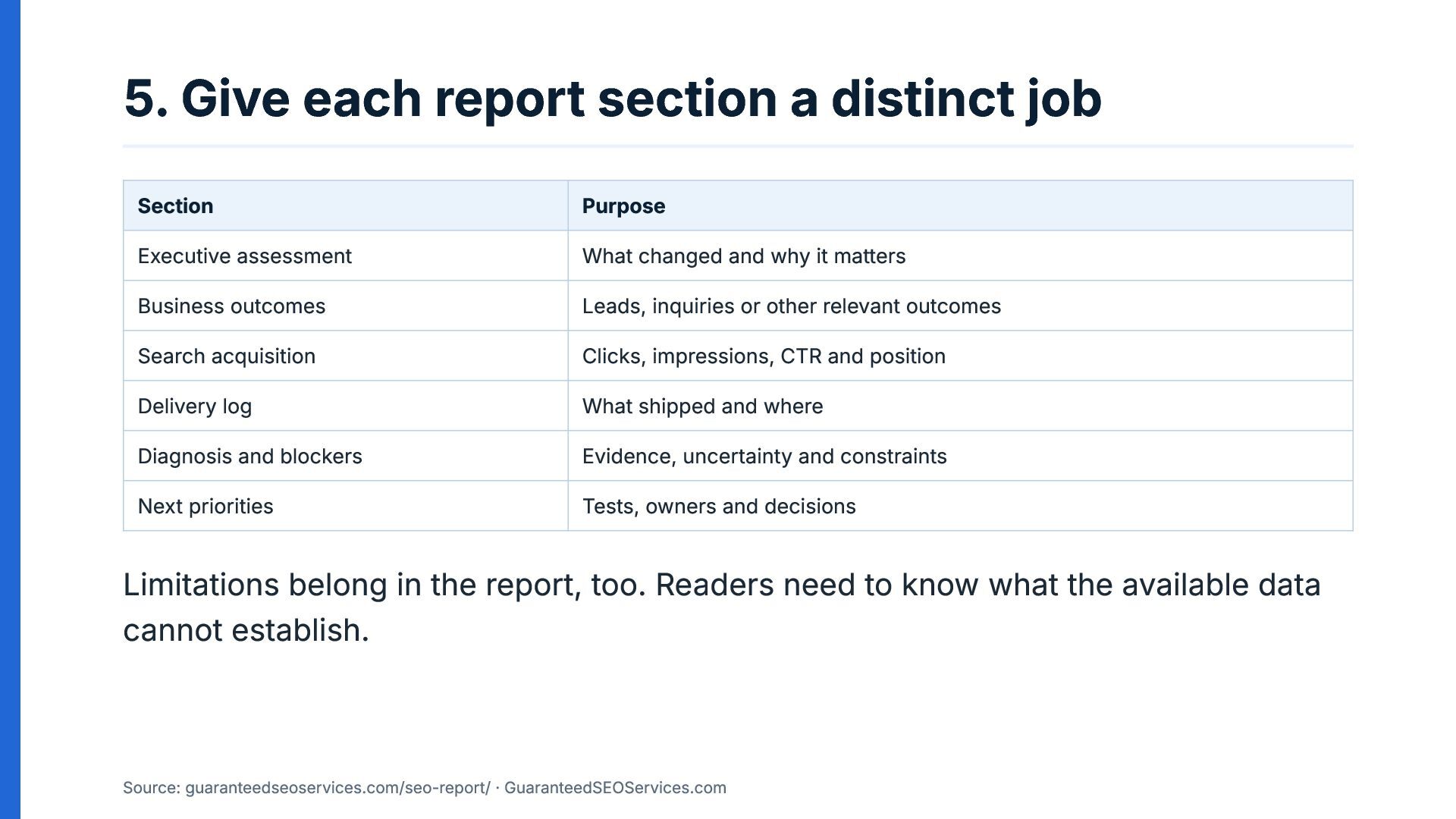
5. Give each report section a distinct job Section Purpose
Executive assessment What changed and why it matters Business outcomes Leads, inquiries or other relevant outcomes Search acquisition Clicks, impressions, CTR and position Delivery log What shipped and where Diagnosis and blockers Evidence, uncertainty and constraints Next priorities Tests, owners and decisions Limitations belong in the report, too. Readers need to know what the available data cannot establish. Source: guaranteedseoservices.com/seo-report/ · GuaranteedSEOServices.com -
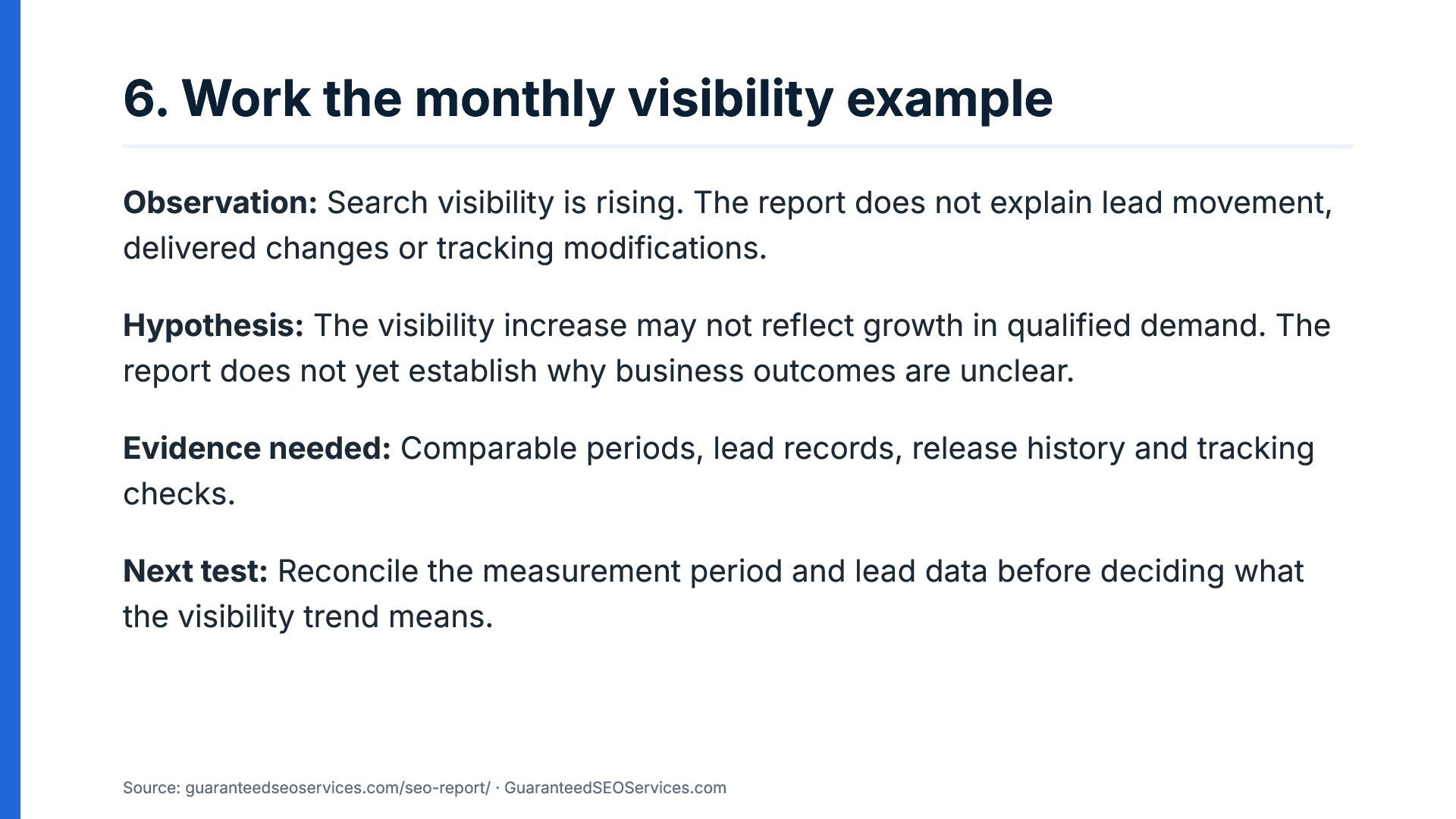
6. Work the monthly visibility example Observation: Search visibility is
rising. The report does not explain lead movement, delivered changes or tracking modifications. Hypothesis: The visibility increase may not reflect growth in qualified demand. The report does not yet establish why business outcomes are unclear. Evidence needed: Comparable periods, lead records, release history and tracking checks. Next test: Reconcile the measurement period and lead data before deciding what the visibility trend means. Source: guaranteedseoservices.com/seo-report/ · GuaranteedSEOServices.com -
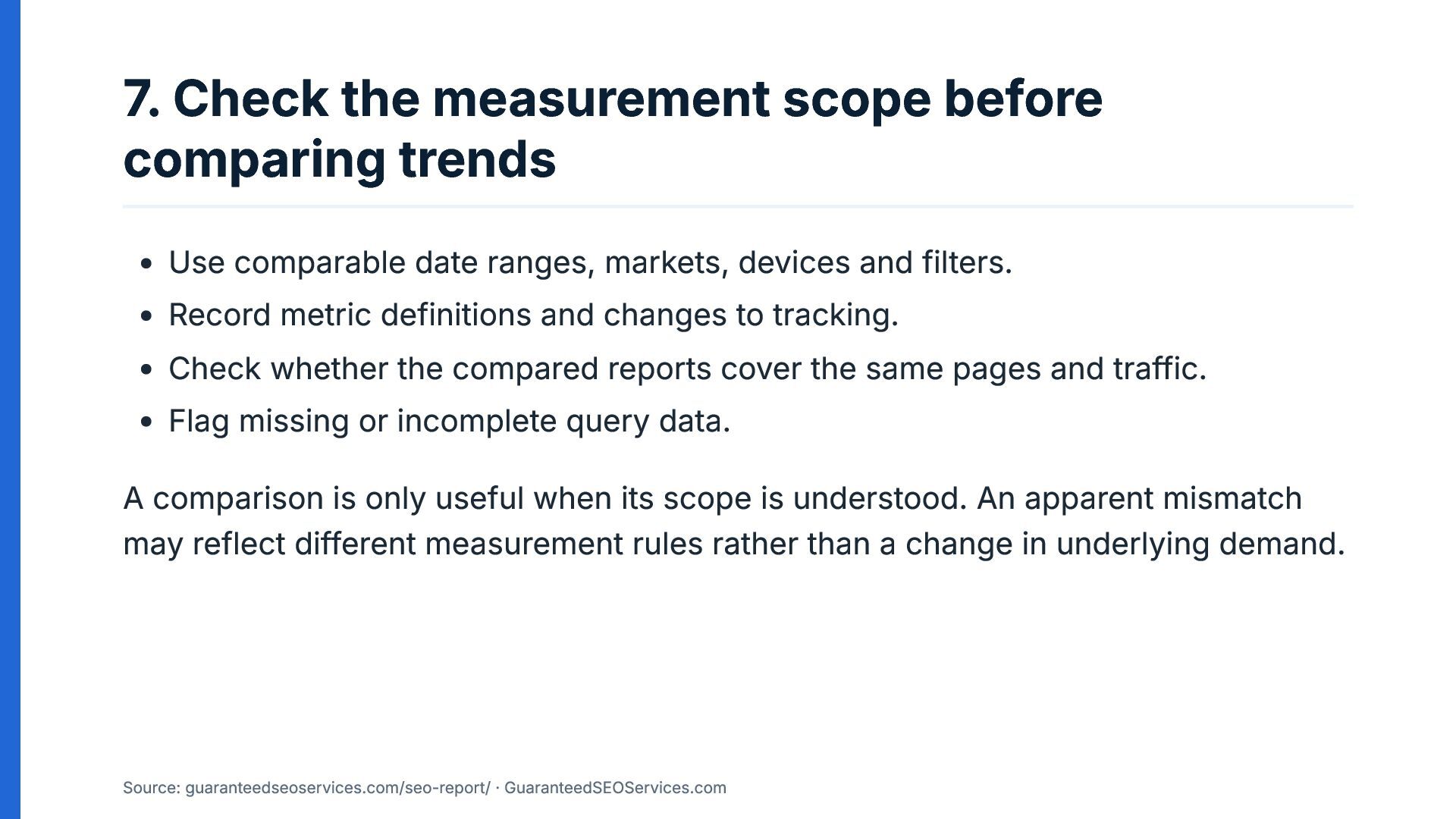
7. Check the measurement scope before comparing trends Use comparable
date ranges, markets, devices and filters. Record metric definitions and changes to tracking. Check whether the compared reports cover the same pages and traffic. Flag missing or incomplete query data. A comparison is only useful when its scope is understood. An apparent mismatch may reflect different measurement rules rather than a change in underlying demand. Source: guaranteedseoservices.com/seo-report/ · GuaranteedSEOServices.com -
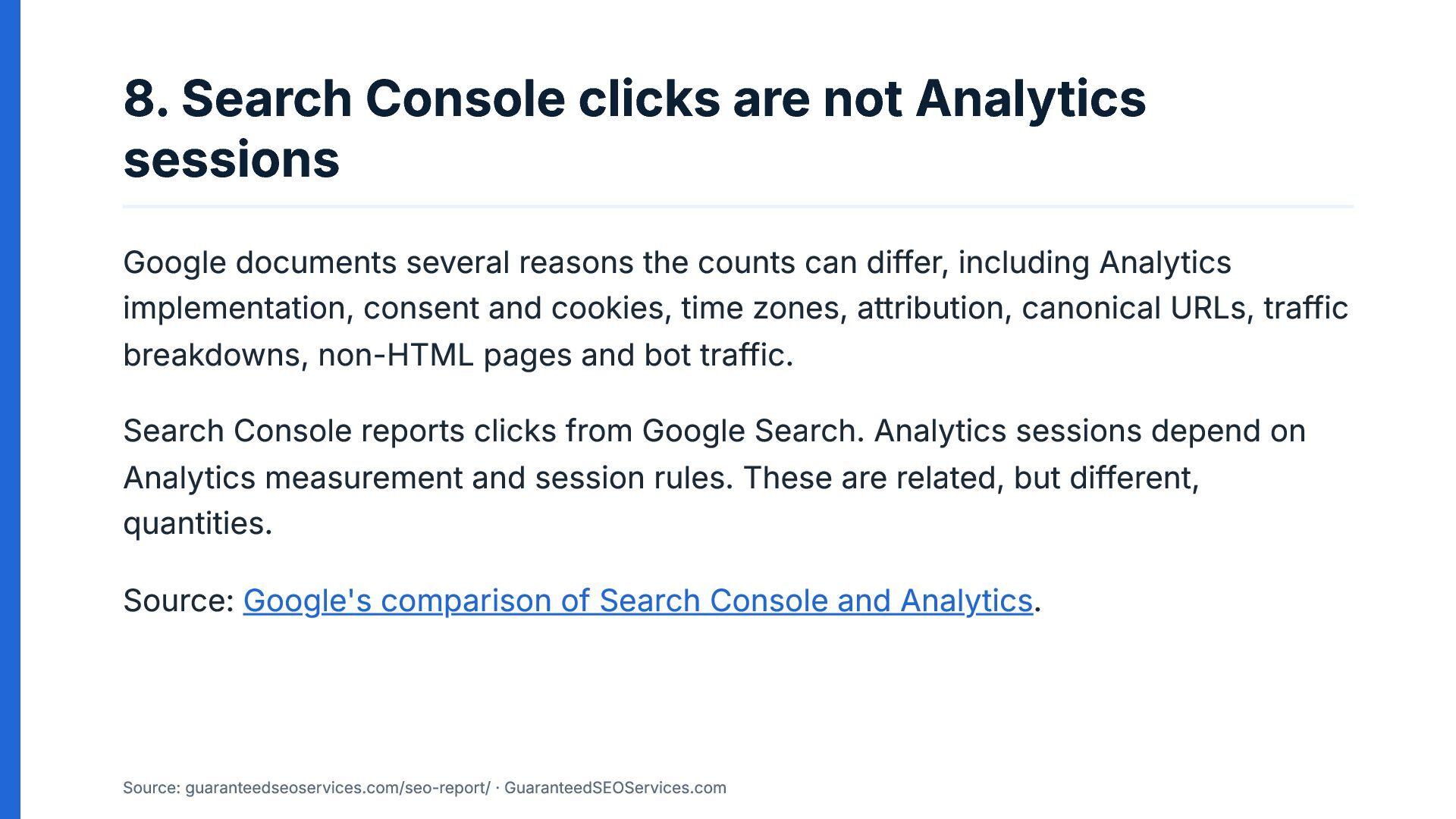
8. Search Console clicks are not Analytics sessions Google documents
several reasons the counts can differ, including Analytics implementation, consent and cookies, time zones, attribution, canonical URLs, traffic breakdowns, non-HTML pages and bot traffic. Search Console reports clicks from Google Search. Analytics sessions depend on Analytics measurement and session rules. These are related, but different, quantities. Source: Google's comparison of Search Console and Analytics. Source: guaranteedseoservices.com/seo-report/ · GuaranteedSEOServices.com -
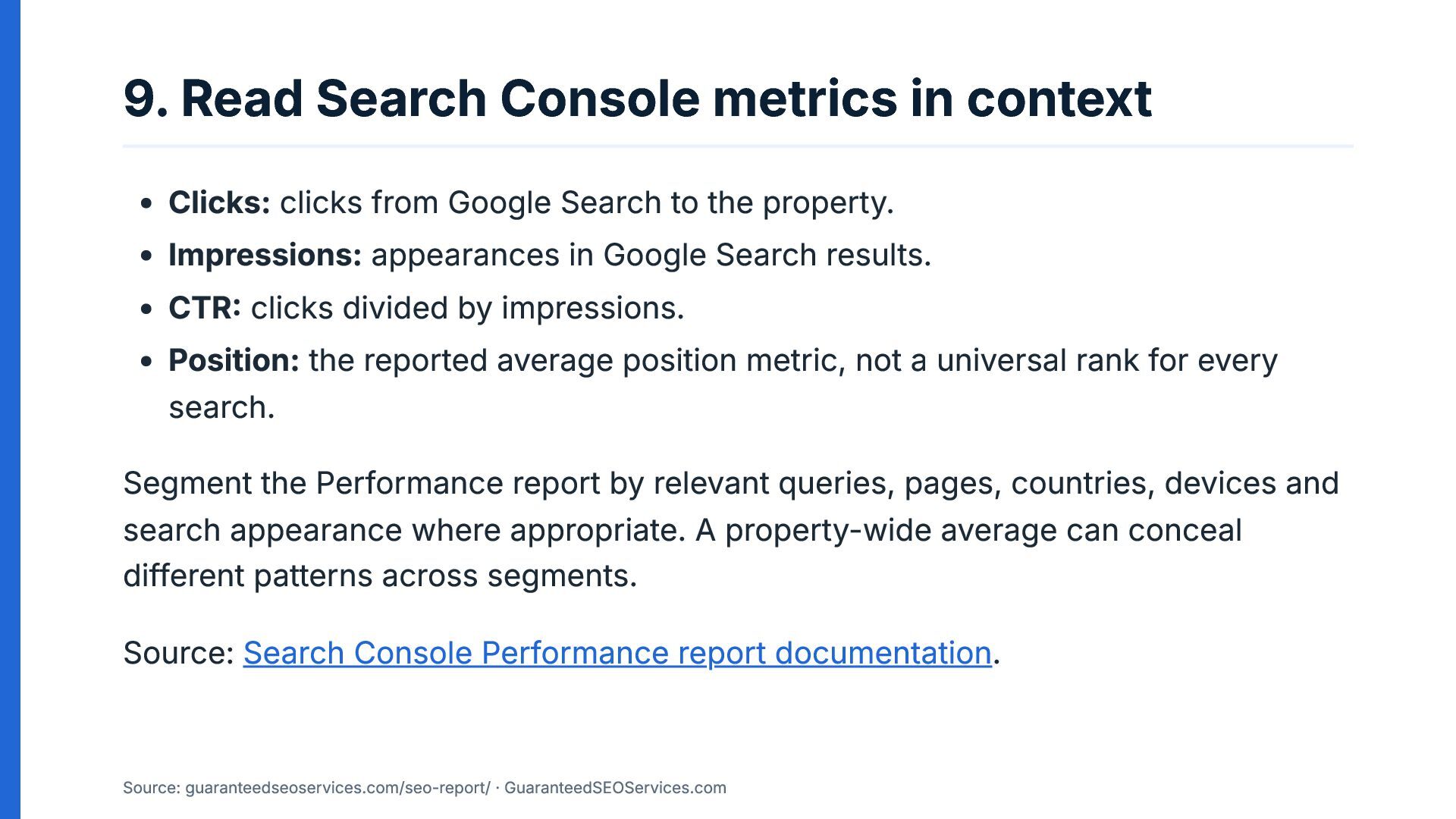
9. Read Search Console metrics in context Clicks: clicks from
Google Search to the property. Impressions: appearances in Google Search results. CTR: clicks divided by impressions. Position: the reported average position metric, not a universal rank for every search. Segment the Performance report by relevant queries, pages, countries, devices and search appearance where appropriate. A property-wide average can conceal different patterns across segments. Source: Search Console Performance report documentation. Source: guaranteedseoservices.com/seo-report/ · GuaranteedSEOServices.com -
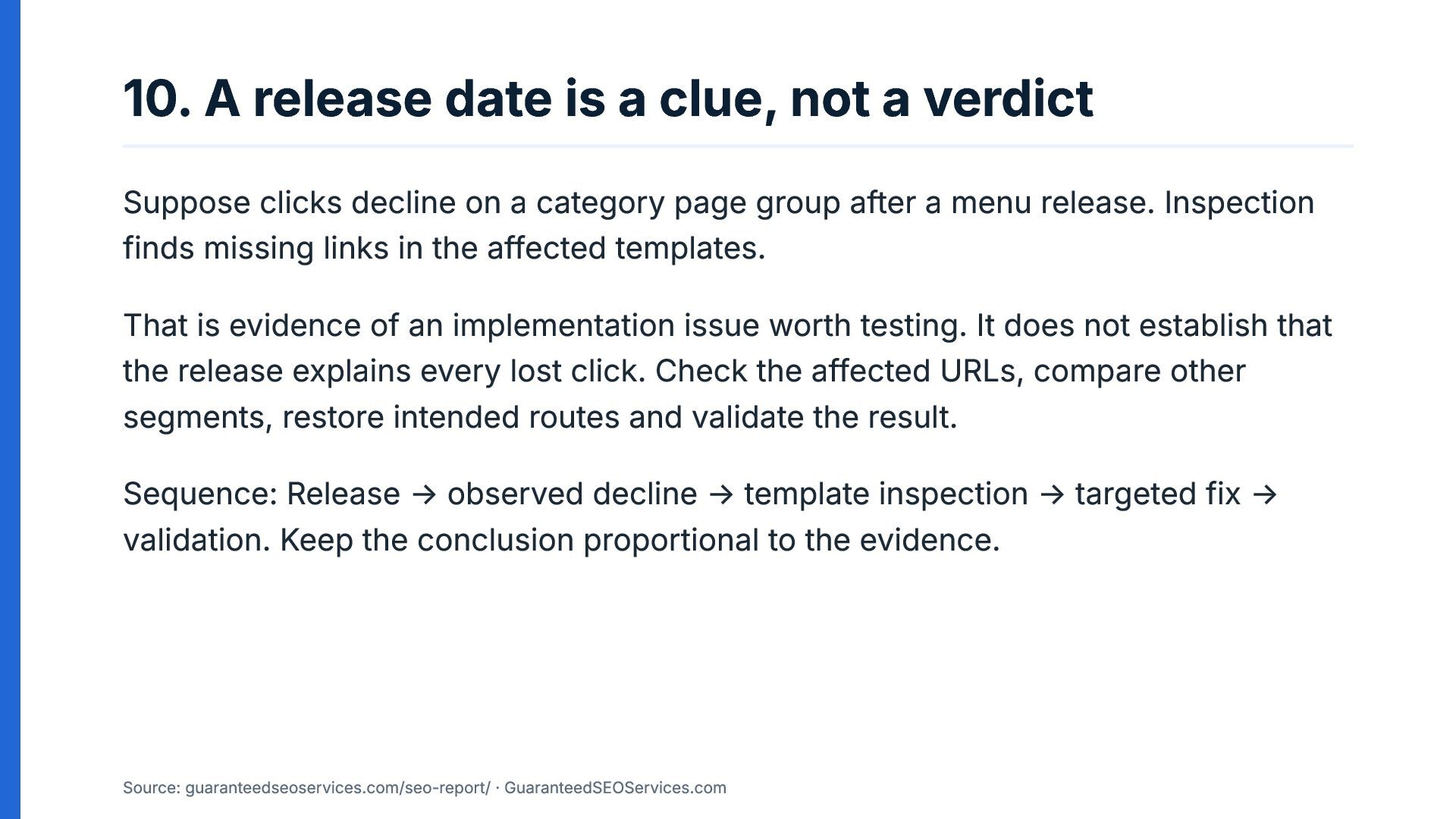
10. A release date is a clue, not a verdict
Suppose clicks decline on a category page group after a menu release. Inspection finds missing links in the affected templates. That is evidence of an implementation issue worth testing. It does not establish that the release explains every lost click. Check the affected URLs, compare other segments, restore intended routes and validate the result. Sequence: Release → observed decline → template inspection → targeted fix → validation. Keep the conclusion proportional to the evidence. Source: guaranteedseoservices.com/seo-report/ · GuaranteedSEOServices.com -
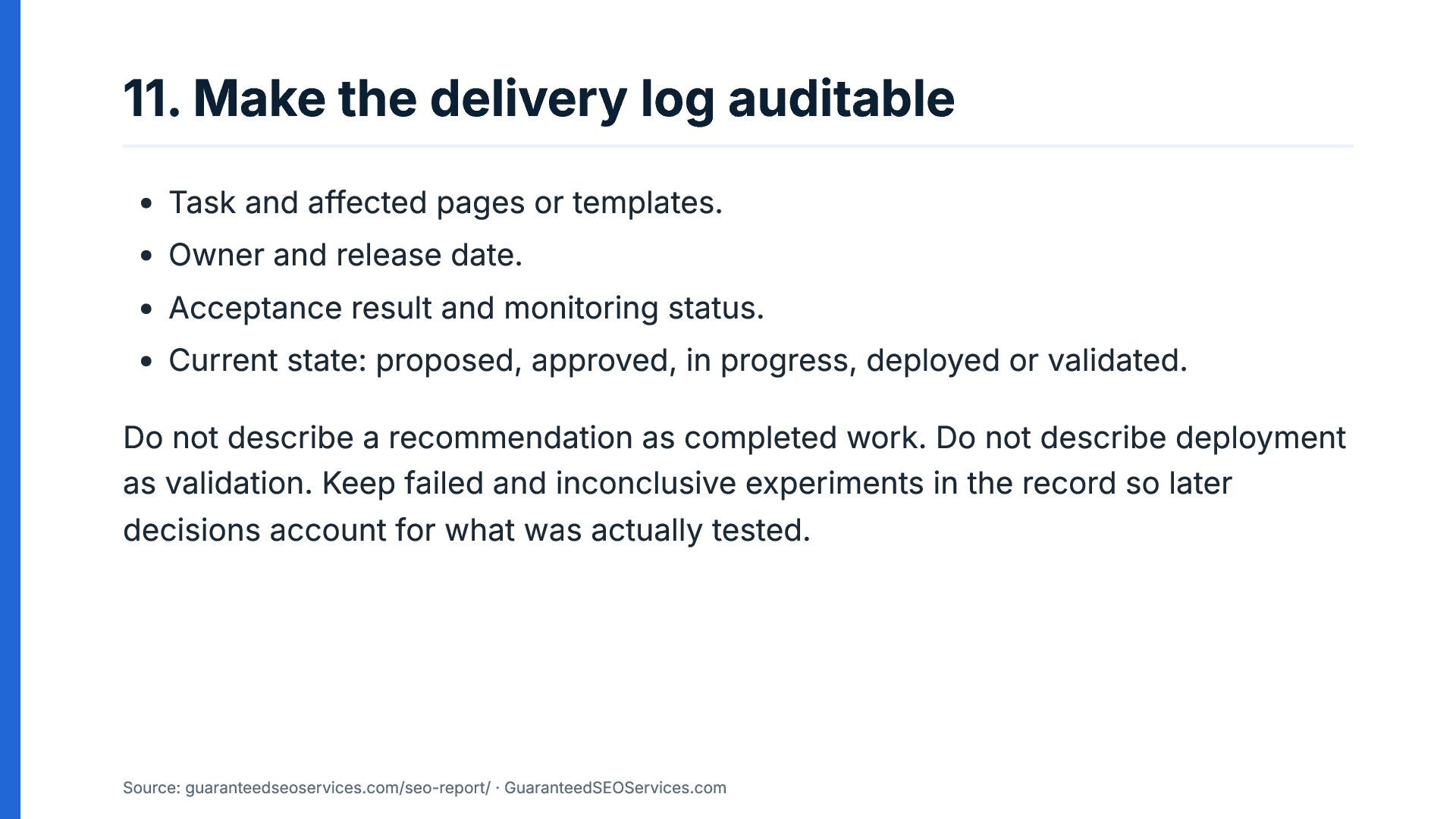
11. Make the delivery log auditable Task and affected pages
or templates. Owner and release date. Acceptance result and monitoring status. Current state: proposed, approved, in progress, deployed or validated. Do not describe a recommendation as completed work. Do not describe deployment as validation. Keep failed and inconclusive experiments in the record so later decisions account for what was actually tested. Source: guaranteedseoservices.com/seo-report/ · GuaranteedSEOServices.com -
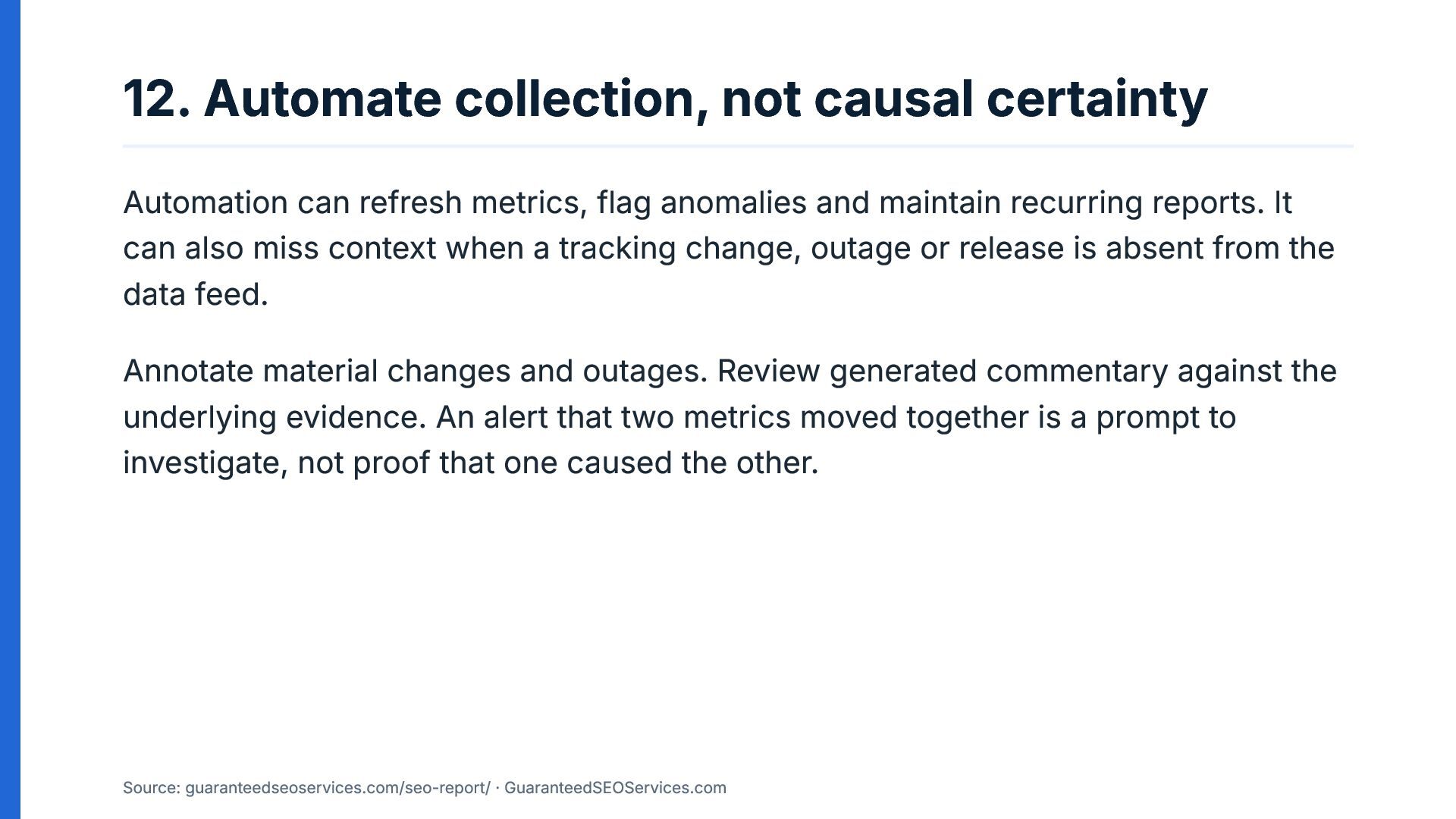
12. Automate collection, not causal certainty Automation can refresh metrics,
flag anomalies and maintain recurring reports. It can also miss context when a tracking change, outage or release is absent from the data feed. Annotate material changes and outages. Review generated commentary against the underlying evidence. An alert that two metrics moved together is a prompt to investigate, not proof that one caused the other. Source: guaranteedseoservices.com/seo-report/ · GuaranteedSEOServices.com -
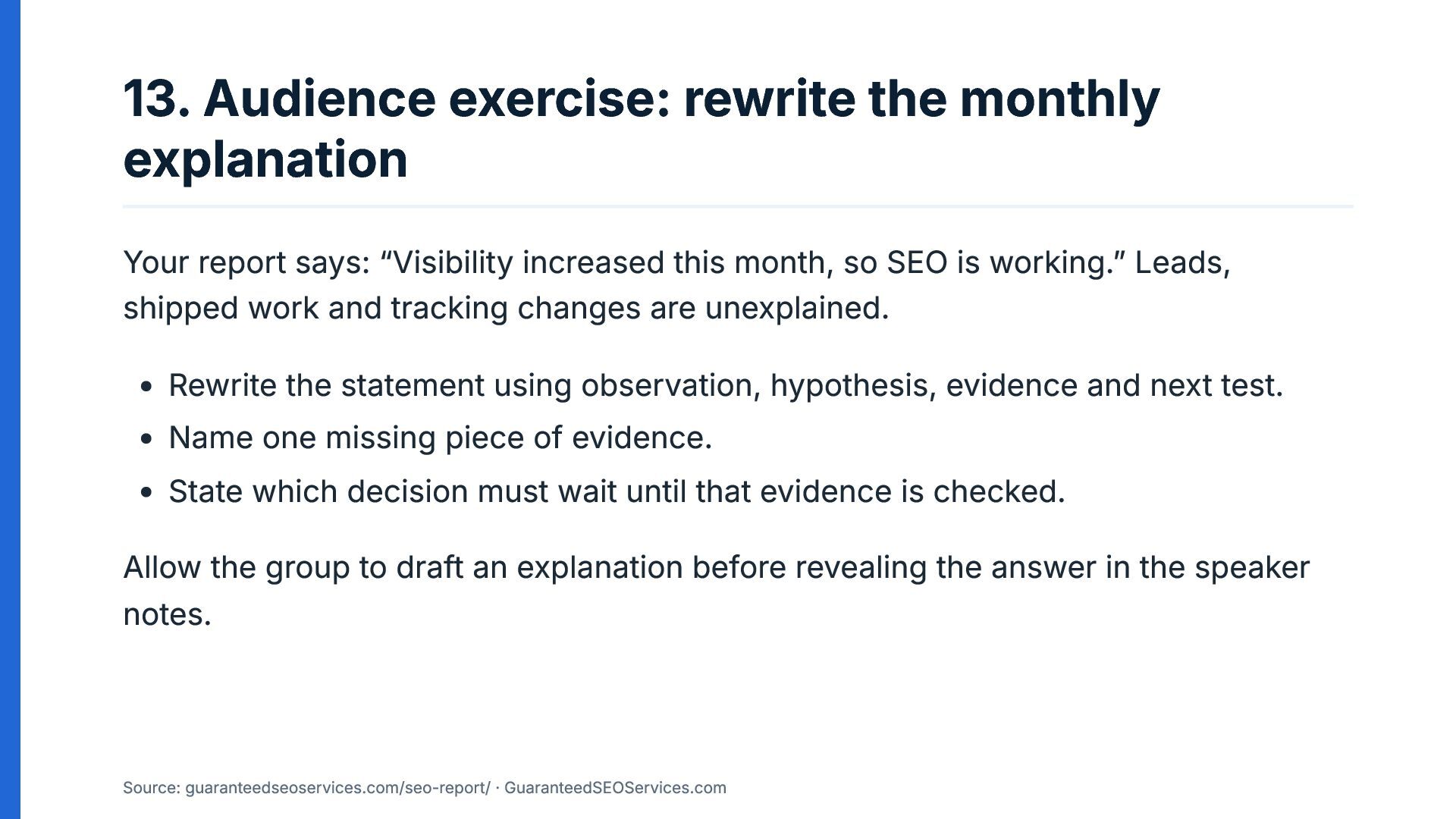
13. Audience exercise: rewrite the monthly explanation Your report says:
“Visibility increased this month, so SEO is working.” Leads, shipped work and tracking changes are unexplained. Rewrite the statement using observation, hypothesis, evidence and next test. Name one missing piece of evidence. State which decision must wait until that evidence is checked. Allow the group to draft an explanation before revealing the answer in the speaker notes. Source: guaranteedseoservices.com/seo-report/ · GuaranteedSEOServices.com -
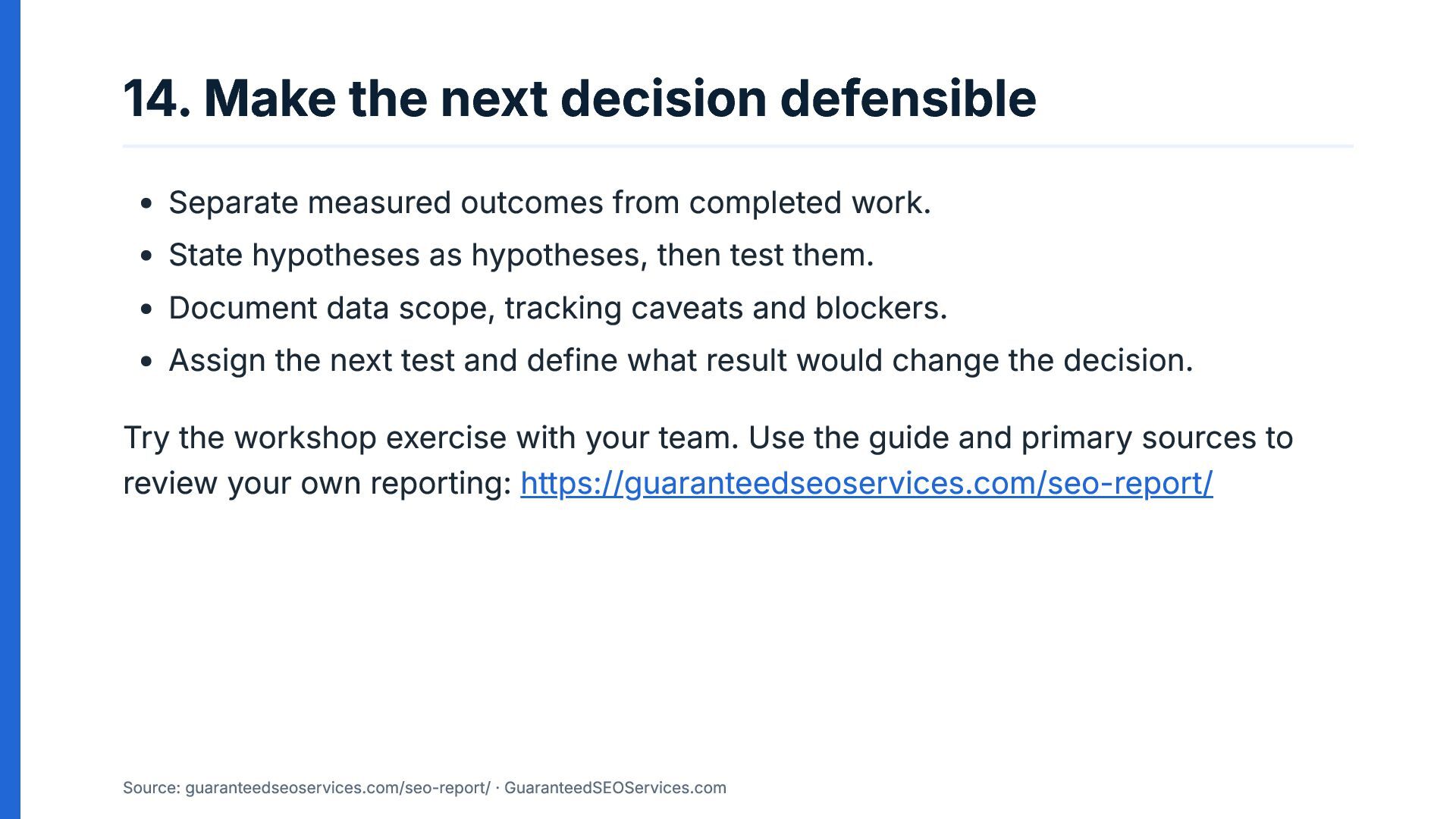
14. Make the next decision defensible Separate measured outcomes from
completed work. State hypotheses as hypotheses, then test them. Document data scope, tracking caveats and blockers. Assign the next test and define what result would change the decision. Try the workshop exercise with your team. Use the guide and primary sources to review your own reporting: https://guaranteedseoservices.com/seo-report/ Source: guaranteedseoservices.com/seo-report/ · GuaranteedSEOServices.com -
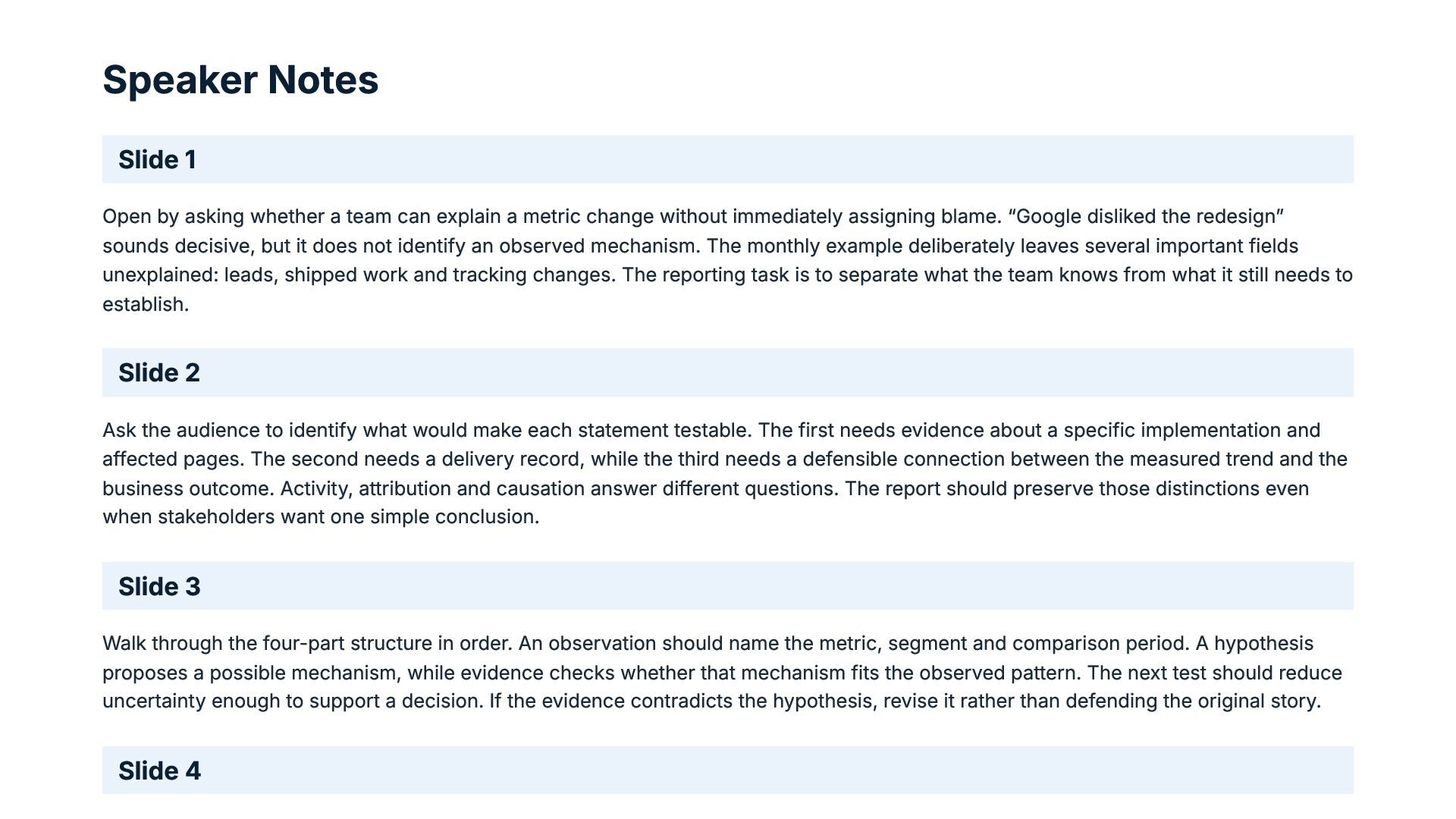
Speaker Notes Slide 1 Open by asking whether a team
can explain a metric change without immediately assigning blame. “Google disliked the redesign” sounds decisive, but it does not identify an observed mechanism. The monthly example deliberately leaves several important fields unexplained: leads, shipped work and tracking changes. The reporting task is to separate what the team knows from what it still needs to establish. Slide 2 Ask the audience to identify what would make each statement testable. The first needs evidence about a specific implementation and affected pages. The second needs a delivery record, while the third needs a defensible connection between the measured trend and the business outcome. Activity, attribution and causation answer different questions. The report should preserve those distinctions even when stakeholders want one simple conclusion. Slide 3 Walk through the four-part structure in order. An observation should name the metric, segment and comparison period. A hypothesis proposes a possible mechanism, while evidence checks whether that mechanism fits the observed pattern. The next test should reduce uncertainty enough to support a decision. If the evidence contradicts the hypothesis, revise it rather than defending the original story. Slide 4 -
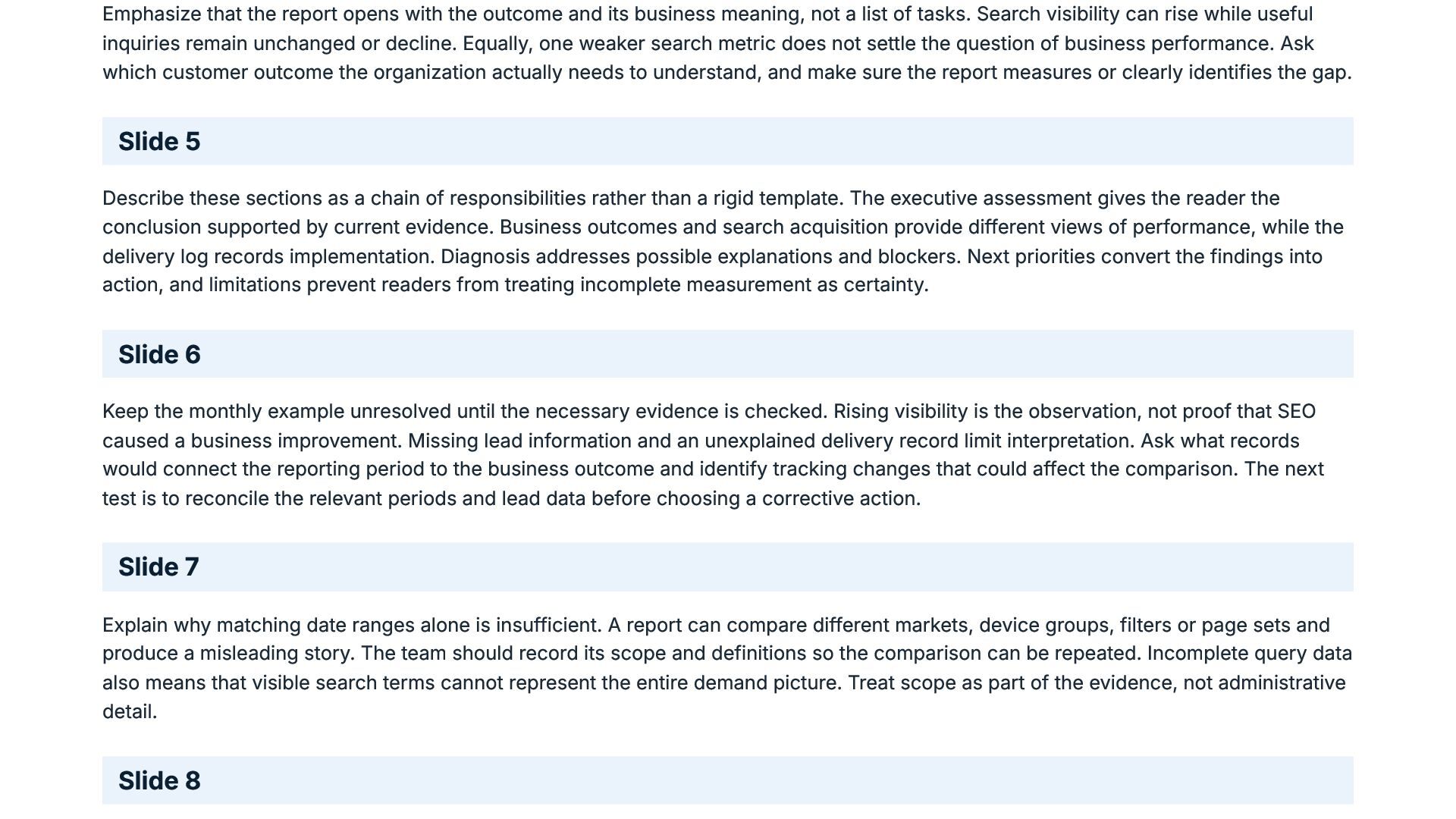
Emphasize that the report opens with the outcome and its
business meaning, not a list of tasks. Search visibility can rise while useful inquiries remain unchanged or decline. Equally, one weaker search metric does not settle the question of business performance. Ask which customer outcome the organization actually needs to understand, and make sure the report measures or clearly identifies the gap. Slide 5 Describe these sections as a chain of responsibilities rather than a rigid template. The executive assessment gives the reader the conclusion supported by current evidence. Business outcomes and search acquisition provide different views of performance, while the delivery log records implementation. Diagnosis addresses possible explanations and blockers. Next priorities convert the findings into action, and limitations prevent readers from treating incomplete measurement as certainty. Slide 6 Keep the monthly example unresolved until the necessary evidence is checked. Rising visibility is the observation, not proof that SEO caused a business improvement. Missing lead information and an unexplained delivery record limit interpretation. Ask what records would connect the reporting period to the business outcome and identify tracking changes that could affect the comparison. The next test is to reconcile the relevant periods and lead data before choosing a corrective action. Slide 7 Explain why matching date ranges alone is insufficient. A report can compare different markets, device groups, filters or page sets and produce a misleading story. The team should record its scope and definitions so the comparison can be repeated. Incomplete query data also means that visible search terms cannot represent the entire demand picture. Treat scope as part of the evidence, not administrative detail. Slide 8 -
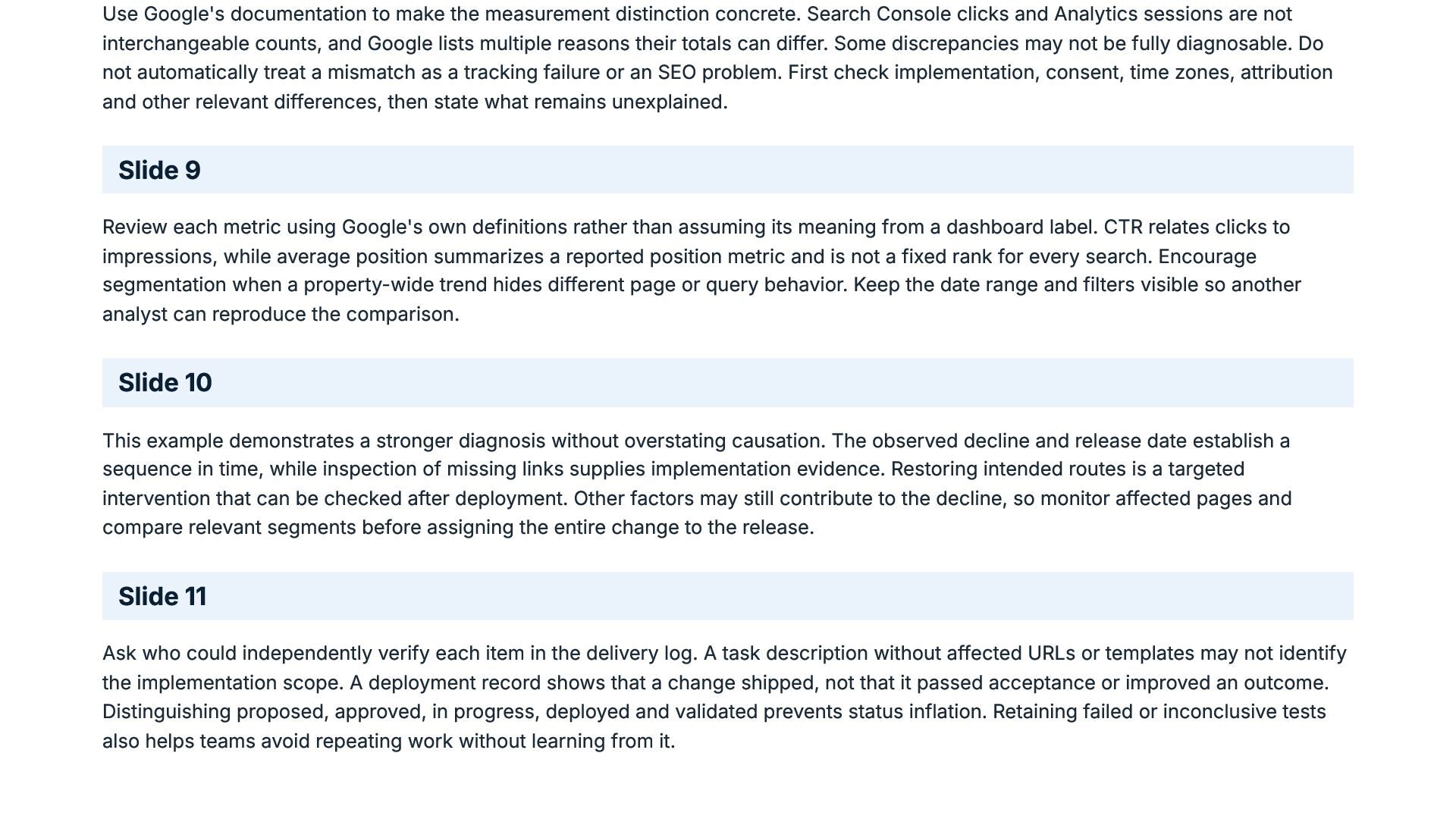
Use Google's documentation to make the measurement distinction concrete. Search
Console clicks and Analytics sessions are not interchangeable counts, and Google lists multiple reasons their totals can differ. Some discrepancies may not be fully diagnosable. Do not automatically treat a mismatch as a tracking failure or an SEO problem. First check implementation, consent, time zones, attribution and other relevant differences, then state what remains unexplained. Slide 9 Review each metric using Google's own definitions rather than assuming its meaning from a dashboard label. CTR relates clicks to impressions, while average position summarizes a reported position metric and is not a fixed rank for every search. Encourage segmentation when a property-wide trend hides different page or query behavior. Keep the date range and filters visible so another analyst can reproduce the comparison. Slide 10 This example demonstrates a stronger diagnosis without overstating causation. The observed decline and release date establish a sequence in time, while inspection of missing links supplies implementation evidence. Restoring intended routes is a targeted intervention that can be checked after deployment. Other factors may still contribute to the decline, so monitor affected pages and compare relevant segments before assigning the entire change to the release. Slide 11 Ask who could independently verify each item in the delivery log. A task description without affected URLs or templates may not identify the implementation scope. A deployment record shows that a change shipped, not that it passed acceptance or improved an outcome. Distinguishing proposed, approved, in progress, deployed and validated prevents status inflation. Retaining failed or inconclusive tests also helps teams avoid repeating work without learning from it. -
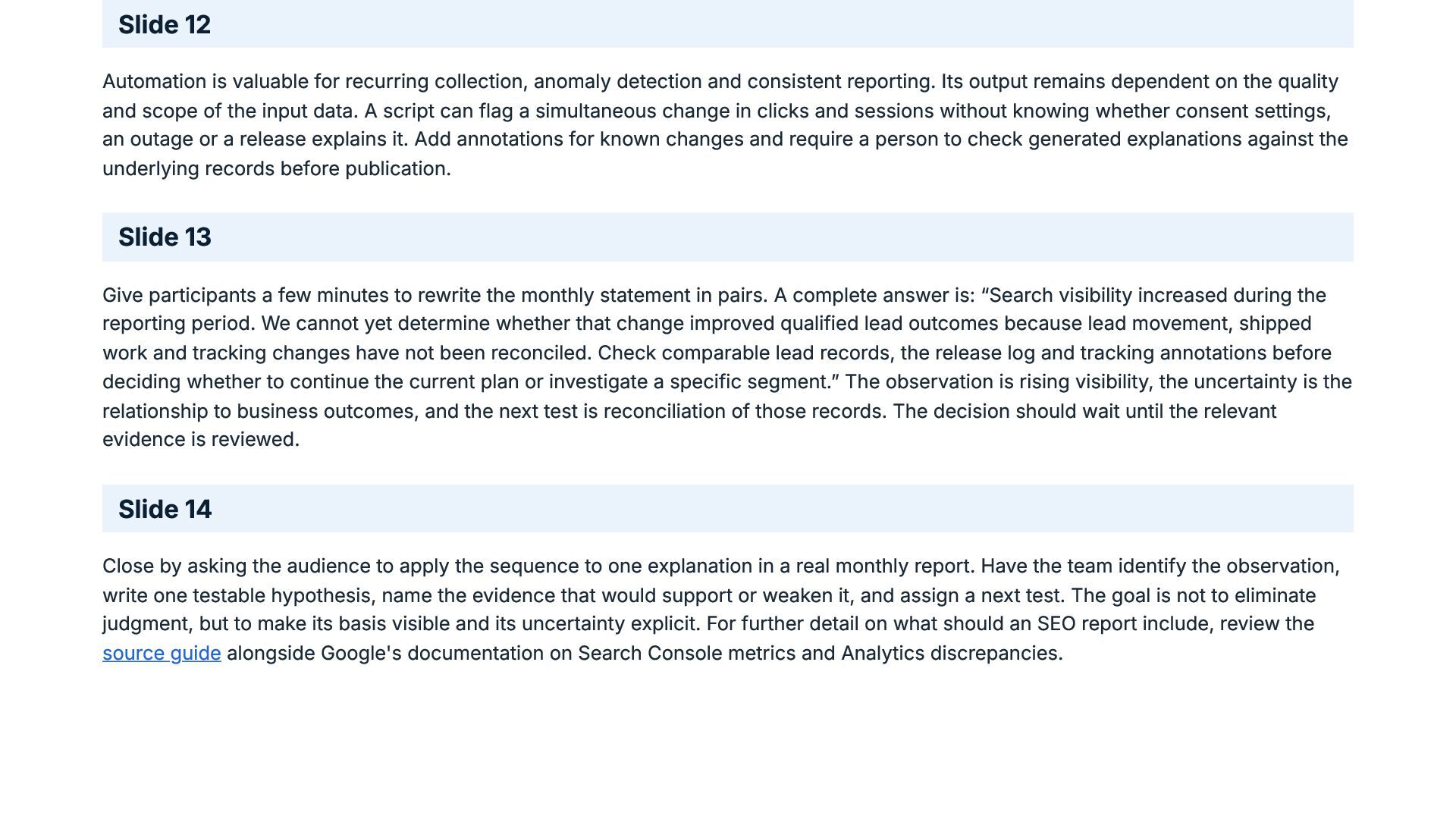
Slide 12 Automation is valuable for recurring collection, anomaly detection
and consistent reporting. Its output remains dependent on the quality and scope of the input data. A script can flag a simultaneous change in clicks and sessions without knowing whether consent settings, an outage or a release explains it. Add annotations for known changes and require a person to check generated explanations against the underlying records before publication. Slide 13 Give participants a few minutes to rewrite the monthly statement in pairs. A complete answer is: “Search visibility increased during the reporting period. We cannot yet determine whether that change improved qualified lead outcomes because lead movement, shipped work and tracking changes have not been reconciled. Check comparable lead records, the release log and tracking annotations before deciding whether to continue the current plan or investigate a specific segment.” The observation is rising visibility, the uncertainty is the relationship to business outcomes, and the next test is reconciliation of those records. The decision should wait until the relevant evidence is reviewed. Slide 14 Close by asking the audience to apply the sequence to one explanation in a real monthly report. Have the team identify the observation, write one testable hypothesis, name the evidence that would support or weaken it, and assign a next test. The goal is not to eliminate judgment, but to make its basis visible and its uncertainty explicit. For further detail on what should an SEO report include, review the source guide alongside Google's documentation on Search Console metrics and Analytics discrepancies. -
Sources What an SEO Report Should Include (and How to
Read One), https://guaranteedseoservices.com/seo-report/ Google Search Central: Compare Google Analytics and Search Console data Google Search Console Help: Performance report
 guaranteedseoservices
 marcogiordano96
 125483
 awsjcpm
 katarinadahlin
 charlesmeaden
 portentint
 pelogia
 samtorres
 whitworthseo
 zjchahalis
 chrisleverseo
 badams
 tamaranovitovic
 lfama
 kimpetersen
 tenderlove
 mongodb
 reverentgeek
 keavy
 chikuwait
 destraynor
 lara
 jonoalderson