How to Do an SEO Migration: URL Mapping and Rel...
Sponsored
·
 Your Podcast. Everywhere. Effortlessly.
Share. Educate. Inspire. Entertain. You do you. We'll handle the rest.
→
Your Podcast. Everywhere. Effortlessly.
Share. Educate. Inspire. Entertain. You do you. We'll handle the rest.
→

Share
Embed
How to Do an SEO Migration: URL Mapping and Release Checks
How to do an SEO migration starts with clear URL decisions, tested redirects and release criteria. Learn how to inventory old URLs, batch-test destinations and investigate failures before launch. For a practical guide on how to do an SEO migration, read: https://guaranteedseoservices.com/seo-site-migration/?utm_source=speakerdeck&utm_medium=referral&utm_campaign=blog-seo-site-migration

GuaranteedSEOServices
October 26, 2026
Transcript
19 slides
-
How to Do an SEO Migration: Rehearse URL Mapping to
Release Checks A practical workshop for engineering teams to turn URL decisions, redirect tests and release conditions into an explicit migration go or no-go decision. GuaranteedSEOServices.com October 27, 2026 -
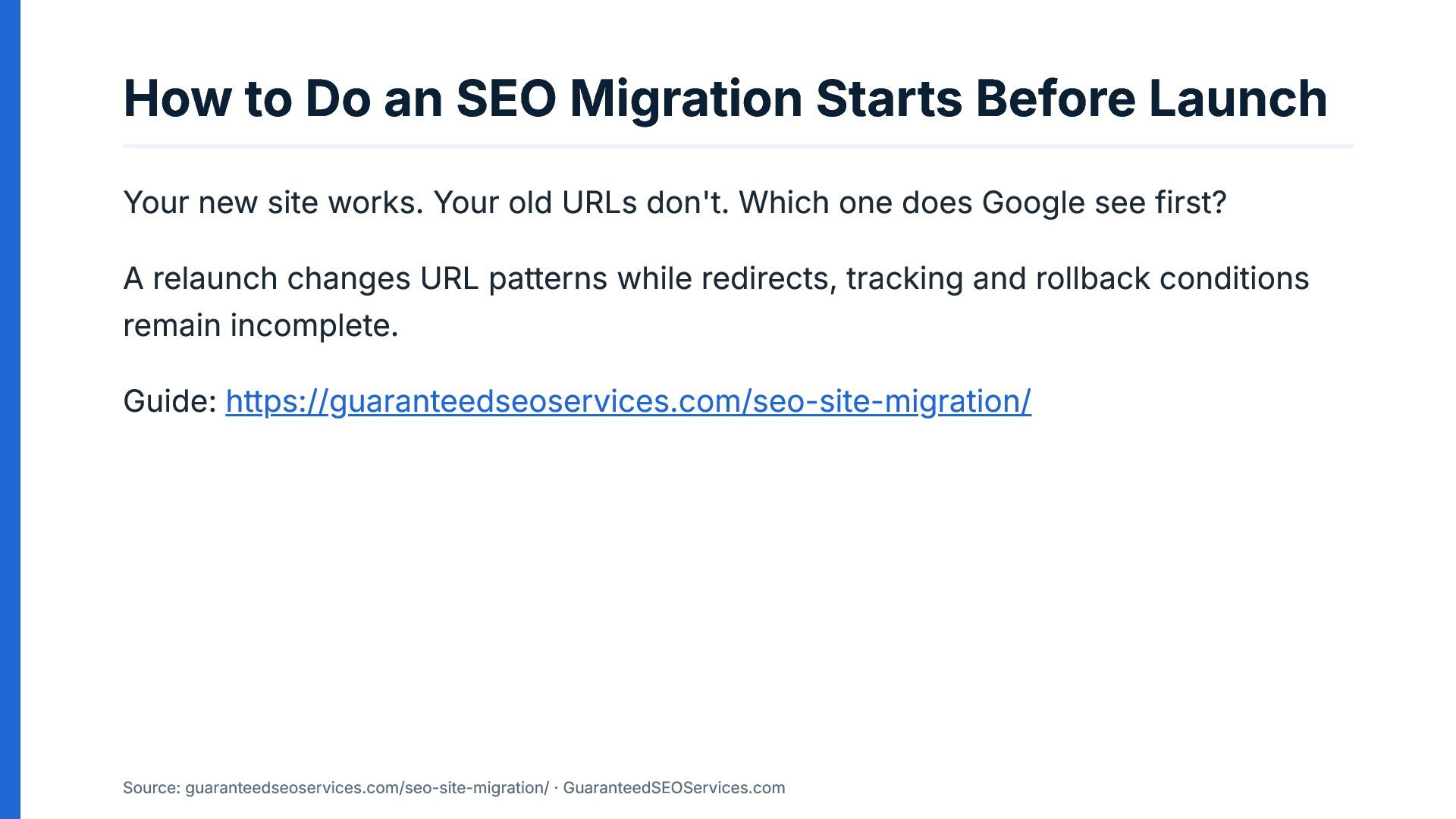
How to Do an SEO Migration Starts Before Launch Your
new site works. Your old URLs don't. Which one does Google see first? A relaunch changes URL patterns while redirects, tracking and rollback conditions remain incomplete. Guide: https://guaranteedseoservices.com/seo-site-migration/ Source: guaranteedseoservices.com/seo-site-migration/ · GuaranteedSEOServices.com -
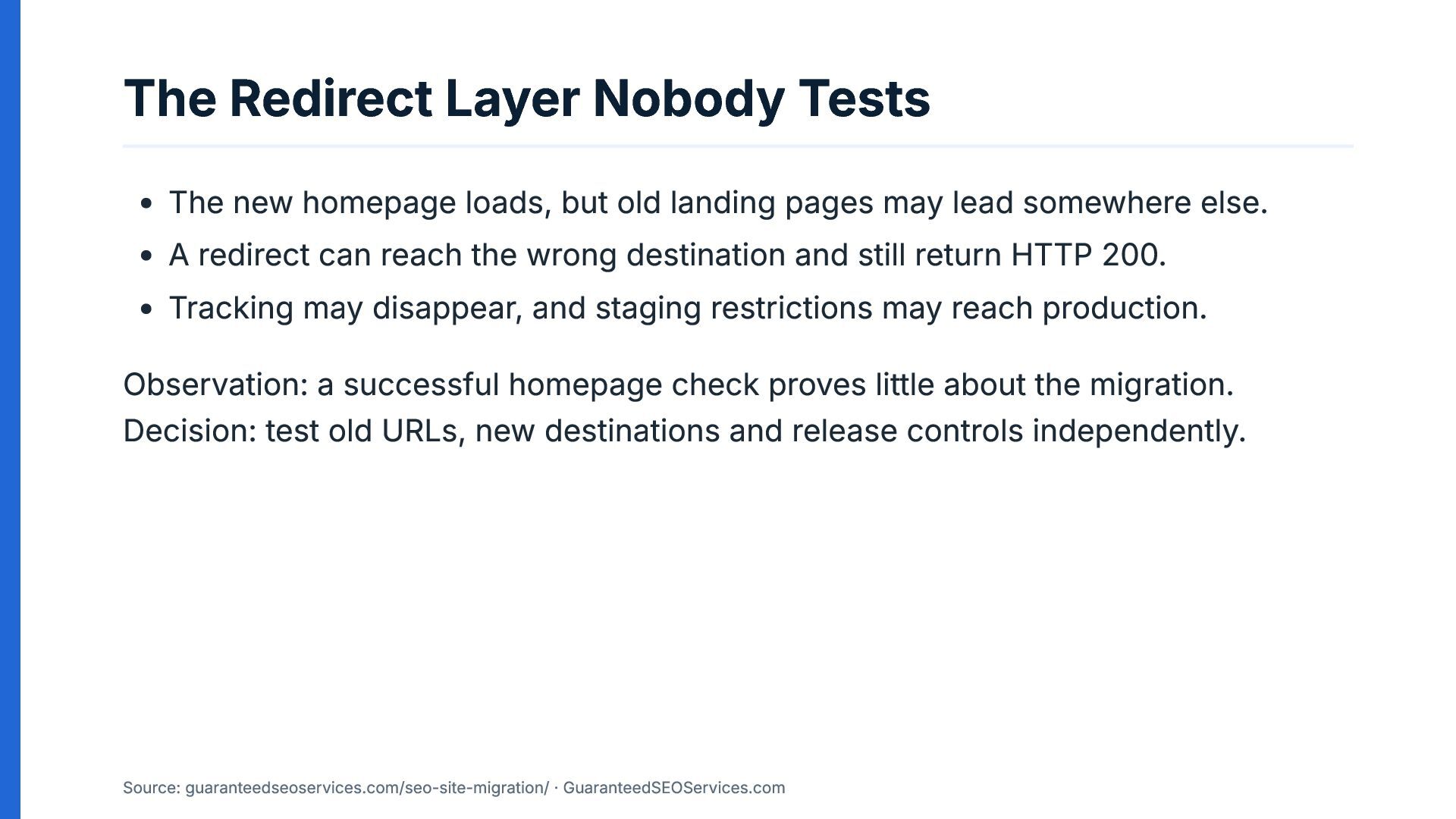
The Redirect Layer Nobody Tests The new homepage loads, but
old landing pages may lead somewhere else. A redirect can reach the wrong destination and still return HTTP 200. Tracking may disappear, and staging restrictions may reach production. Observation: a successful homepage check proves little about the migration. Decision: test old URLs, new destinations and release controls independently. Source: guaranteedseoservices.com/seo-site-migration/ · GuaranteedSEOServices.com -
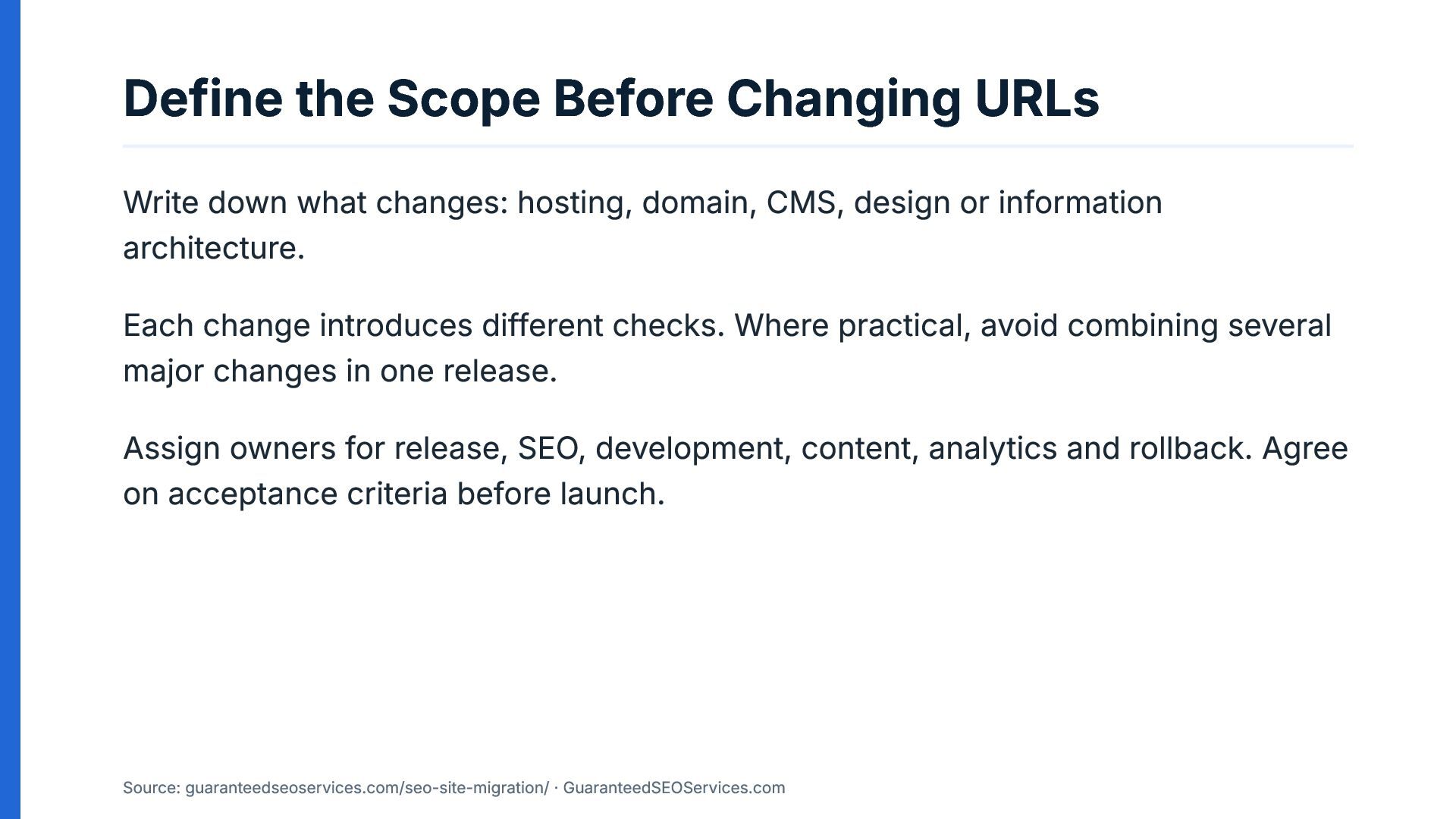
Define the Scope Before Changing URLs Write down what changes:
hosting, domain, CMS, design or information architecture. Each change introduces different checks. Where practical, avoid combining several major changes in one release. Assign owners for release, SEO, development, content, analytics and rollback. Agree on acceptance criteria before launch. Source: guaranteedseoservices.com/seo-site-migration/ · GuaranteedSEOServices.com -
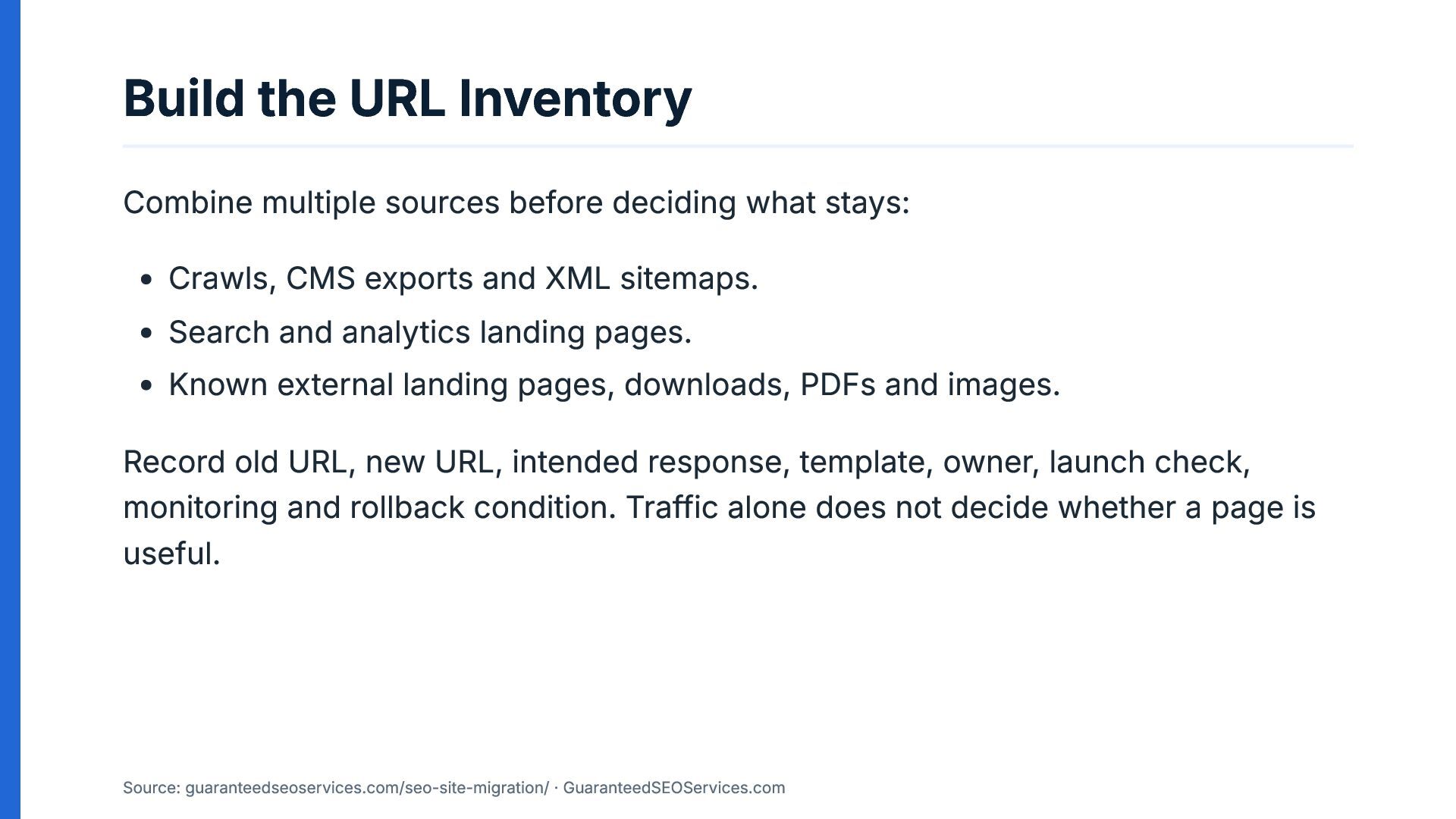
Build the URL Inventory Combine multiple sources before deciding what
stays: Crawls, CMS exports and XML sitemaps. Search and analytics landing pages. Known external landing pages, downloads, PDFs and images. Record old URL, new URL, intended response, template, owner, launch check, monitoring and rollback condition. Traffic alone does not decide whether a page is useful. Source: guaranteedseoservices.com/seo-site-migration/ · GuaranteedSEOServices.com -
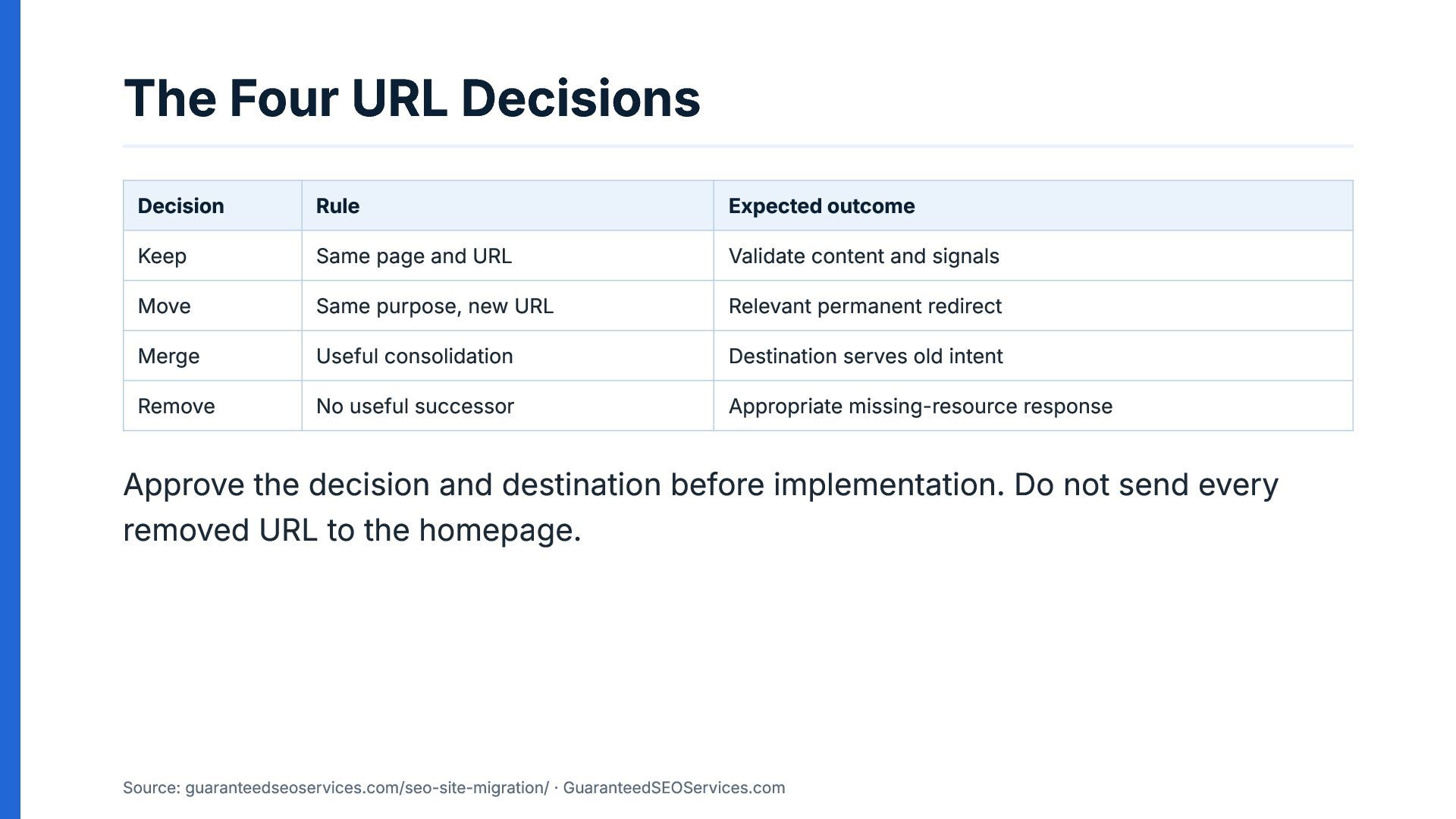
The Four URL Decisions Decision Rule Expected outcome Keep Same
page and URL Validate content and signals Move Same purpose, new URL Relevant permanent redirect Merge Useful consolidation Destination serves old intent Remove No useful successor Appropriate missing-resource response Approve the decision and destination before implementation. Do not send every removed URL to the homepage. Source: guaranteedseoservices.com/seo-site-migration/ · GuaranteedSEOServices.com -
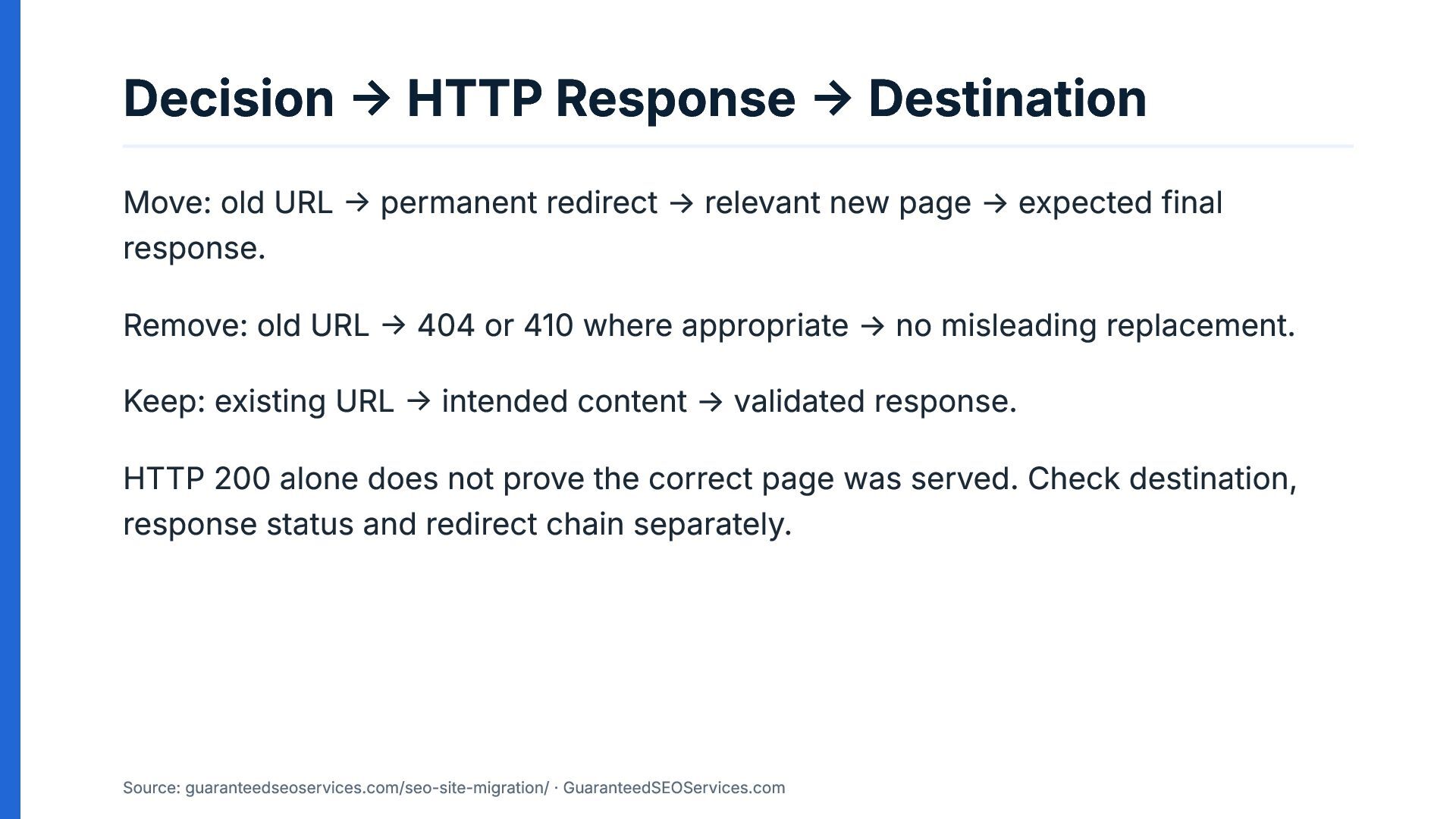
Decision → HTTP Response → Destination Move: old URL →
permanent redirect → relevant new page → expected final response. Remove: old URL → 404 or 410 where appropriate → no misleading replacement. Keep: existing URL → intended content → validated response. HTTP 200 alone does not prove the correct page was served. Check destination, response status and redirect chain separately. Source: guaranteedseoservices.com/seo-site-migration/ · GuaranteedSEOServices.com -
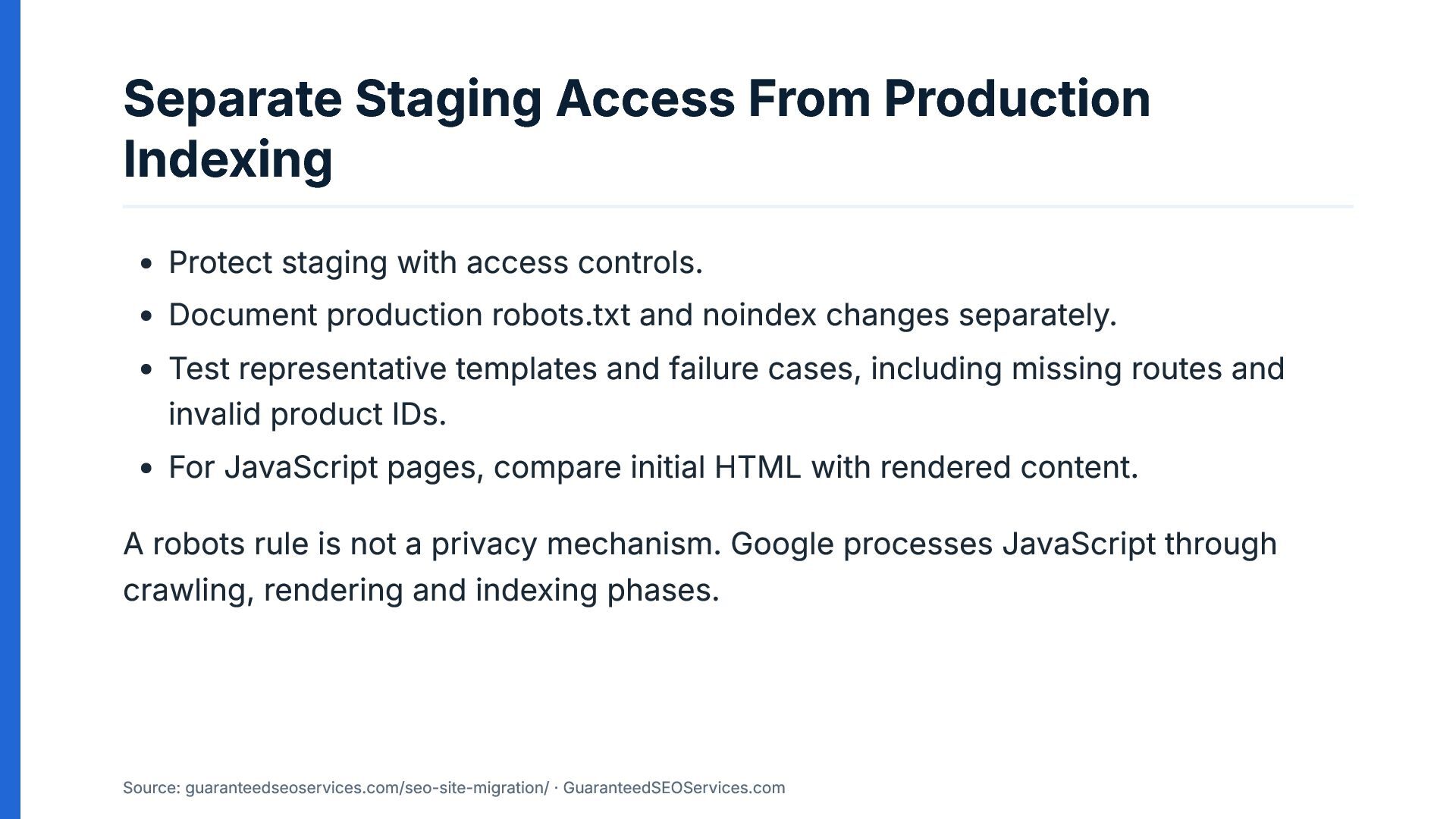
Separate Staging Access From Production Indexing Protect staging with access
controls. Document production robots.txt and noindex changes separately. Test representative templates and failure cases, including missing routes and invalid product IDs. For JavaScript pages, compare initial HTML with rendered content. A robots rule is not a privacy mechanism. Google processes JavaScript through crawling, rendering and indexing phases. Source: guaranteedseoservices.com/seo-site-migration/ · GuaranteedSEOServices.com -
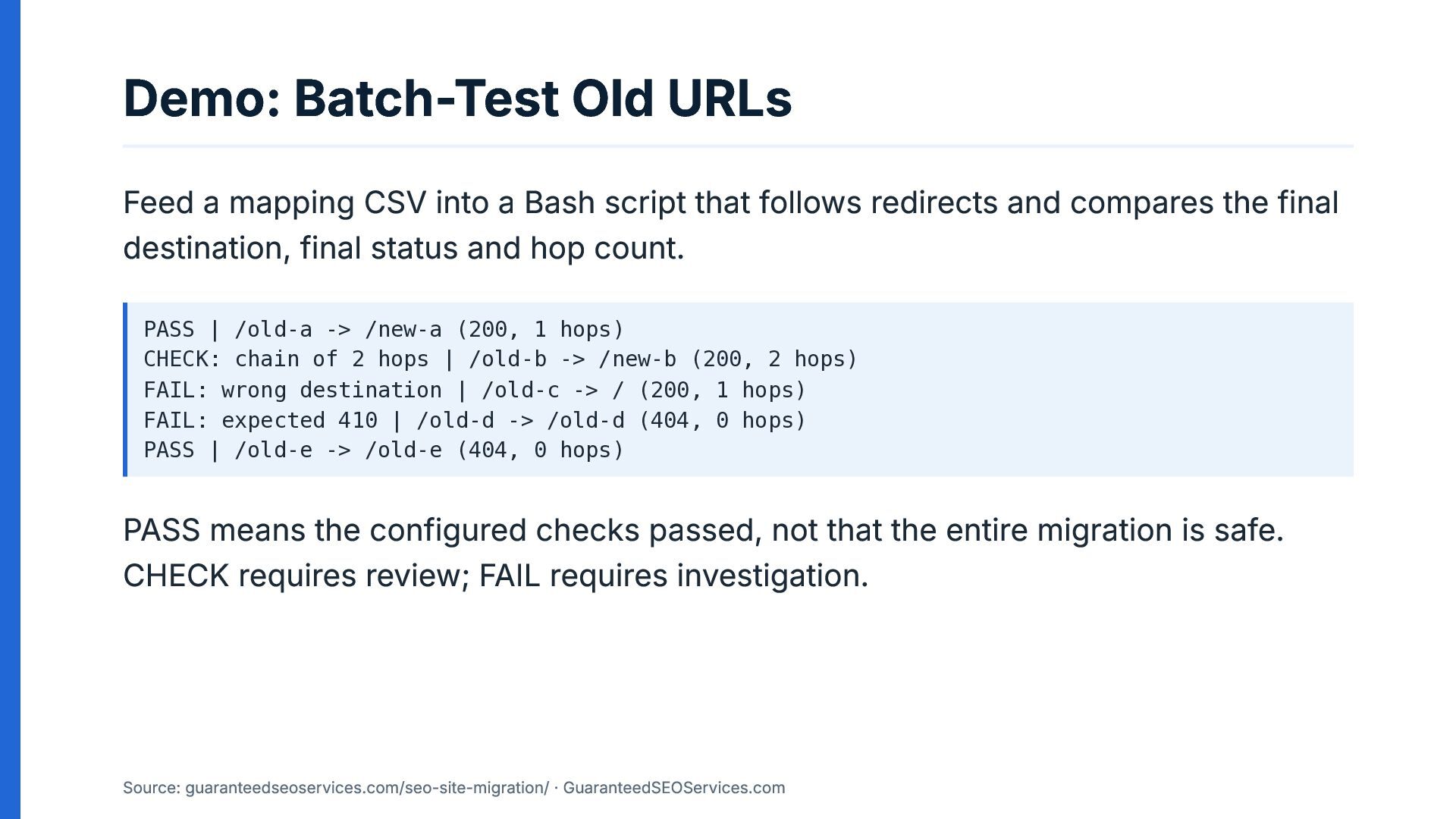
Demo: Batch-Test Old URLs Feed a mapping CSV into a
Bash script that follows redirects and compares the final destination, final status and hop count. PASS | /old-a -> /new-a (200, 1 hops) CHECK: chain of 2 hops | /old-b -> /new-b (200, 2 hops) FAIL: wrong destination | /old-c -> / (200, 1 hops) FAIL: expected 410 | /old-d -> /old-d (404, 0 hops) PASS | /old-e -> /old-e (404, 0 hops) PASS means the configured checks passed, not that the entire migration is safe. CHECK requires review; FAIL requires investigation. Source: guaranteedseoservices.com/seo-site-migration/ · GuaranteedSEOServices.com -
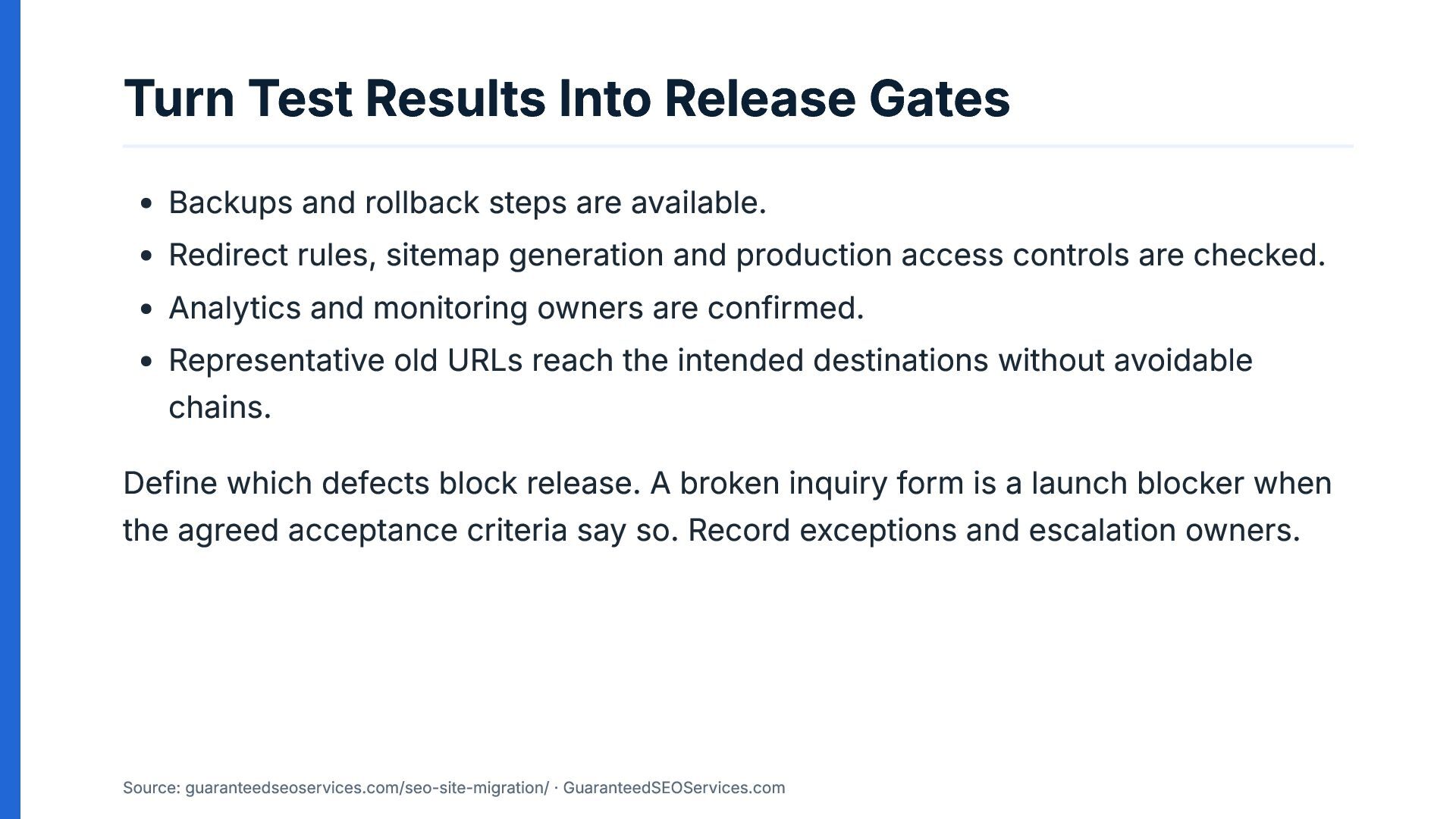
Turn Test Results Into Release Gates Backups and rollback steps
are available. Redirect rules, sitemap generation and production access controls are checked. Analytics and monitoring owners are confirmed. Representative old URLs reach the intended destinations without avoidable chains. Define which defects block release. A broken inquiry form is a launch blocker when the agreed acceptance criteria say so. Record exceptions and escalation owners. Source: guaranteedseoservices.com/seo-site-migration/ · GuaranteedSEOServices.com -
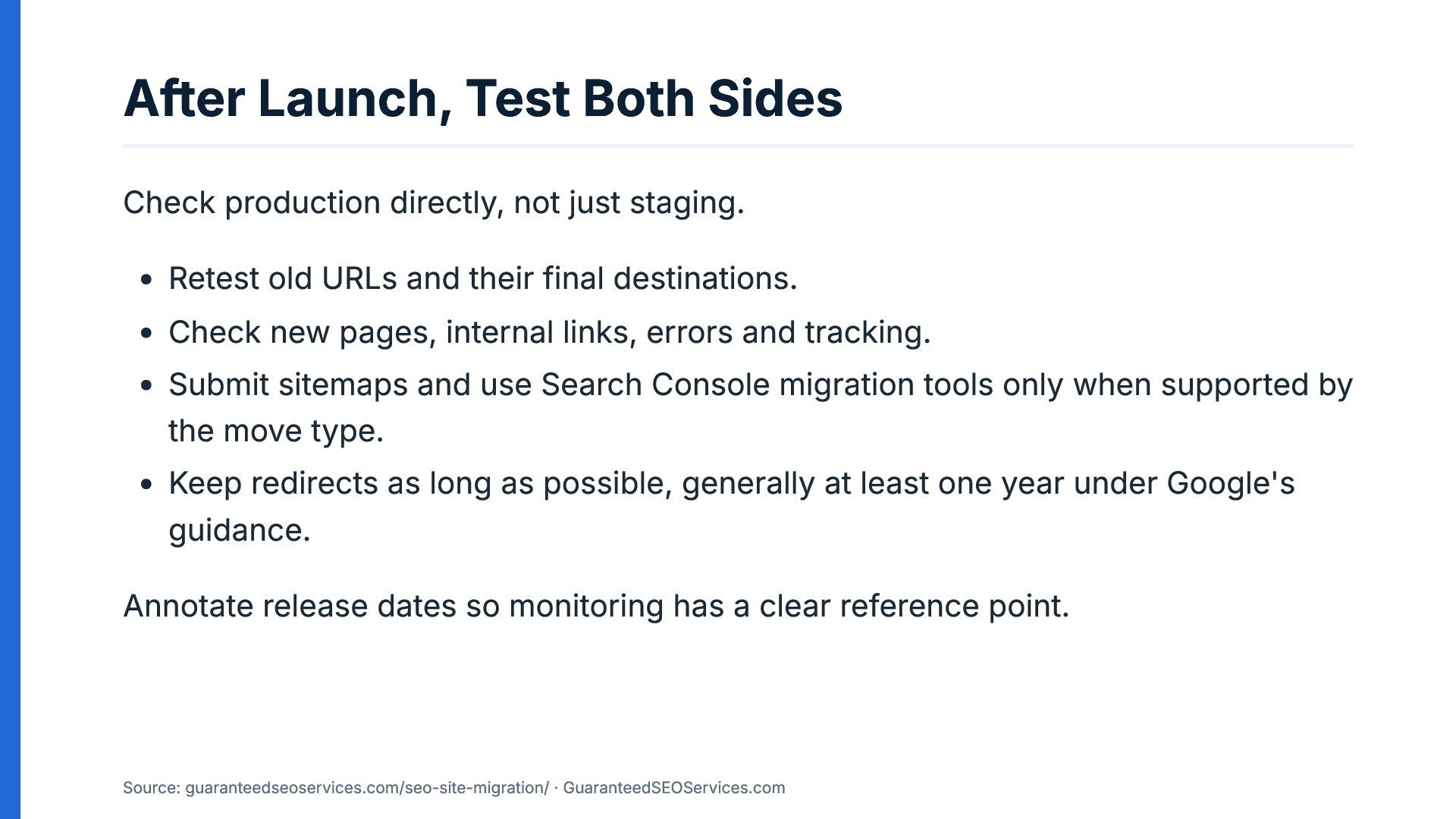
After Launch, Test Both Sides Check production directly, not just
staging. Retest old URLs and their final destinations. Check new pages, internal links, errors and tracking. Submit sitemaps and use Search Console migration tools only when supported by the move type. Keep redirects as long as possible, generally at least one year under Google's guidance. Annotate release dates so monitoring has a clear reference point. Source: guaranteedseoservices.com/seo-site-migration/ · GuaranteedSEOServices.com -
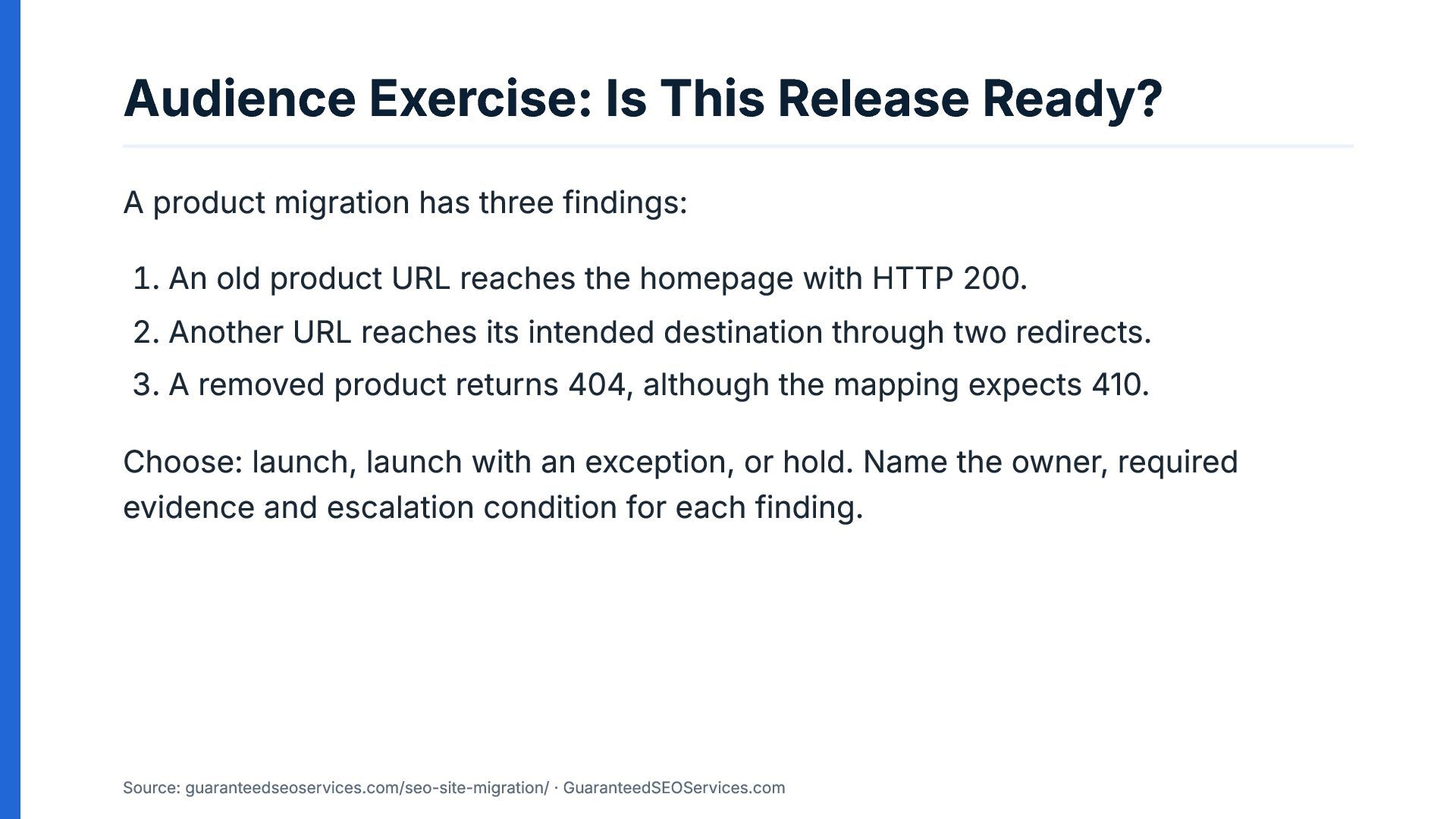
Audience Exercise: Is This Release Ready? A product migration has
three findings: 1. An old product URL reaches the homepage with HTTP 200. 2. Another URL reaches its intended destination through two redirects. 3. A removed product returns 404, although the mapping expects 410. Choose: launch, launch with an exception, or hold. Name the owner, required evidence and escalation condition for each finding. Source: guaranteedseoservices.com/seo-site-migration/ · GuaranteedSEOServices.com -
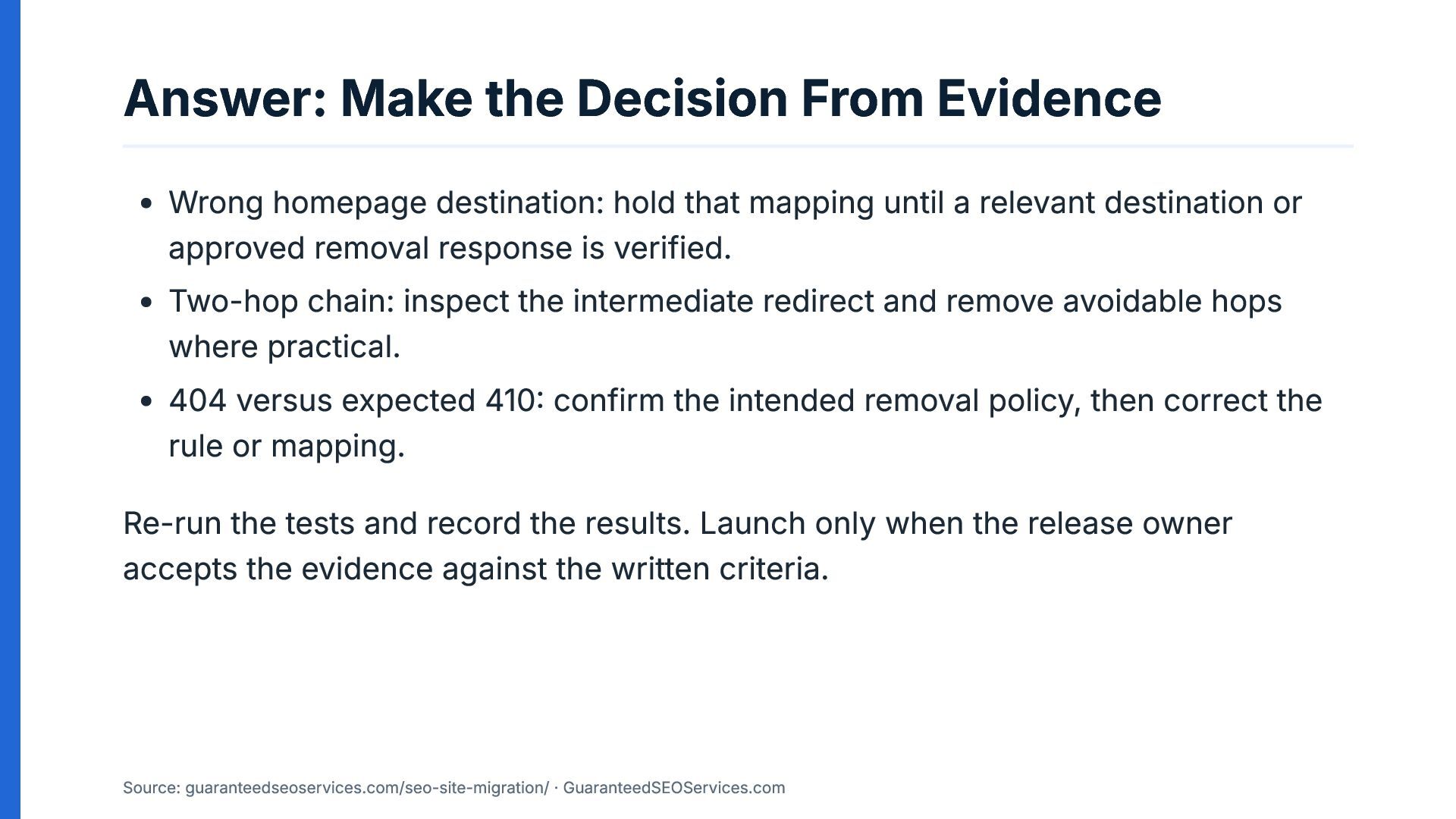
Answer: Make the Decision From Evidence Wrong homepage destination: hold
that mapping until a relevant destination or approved removal response is verified. Two-hop chain: inspect the intermediate redirect and remove avoidable hops where practical. 404 versus expected 410: confirm the intended removal policy, then correct the rule or mapping. Re-run the tests and record the results. Launch only when the release owner accepts the evidence against the written criteria. Source: guaranteedseoservices.com/seo-site-migration/ · GuaranteedSEOServices.com -
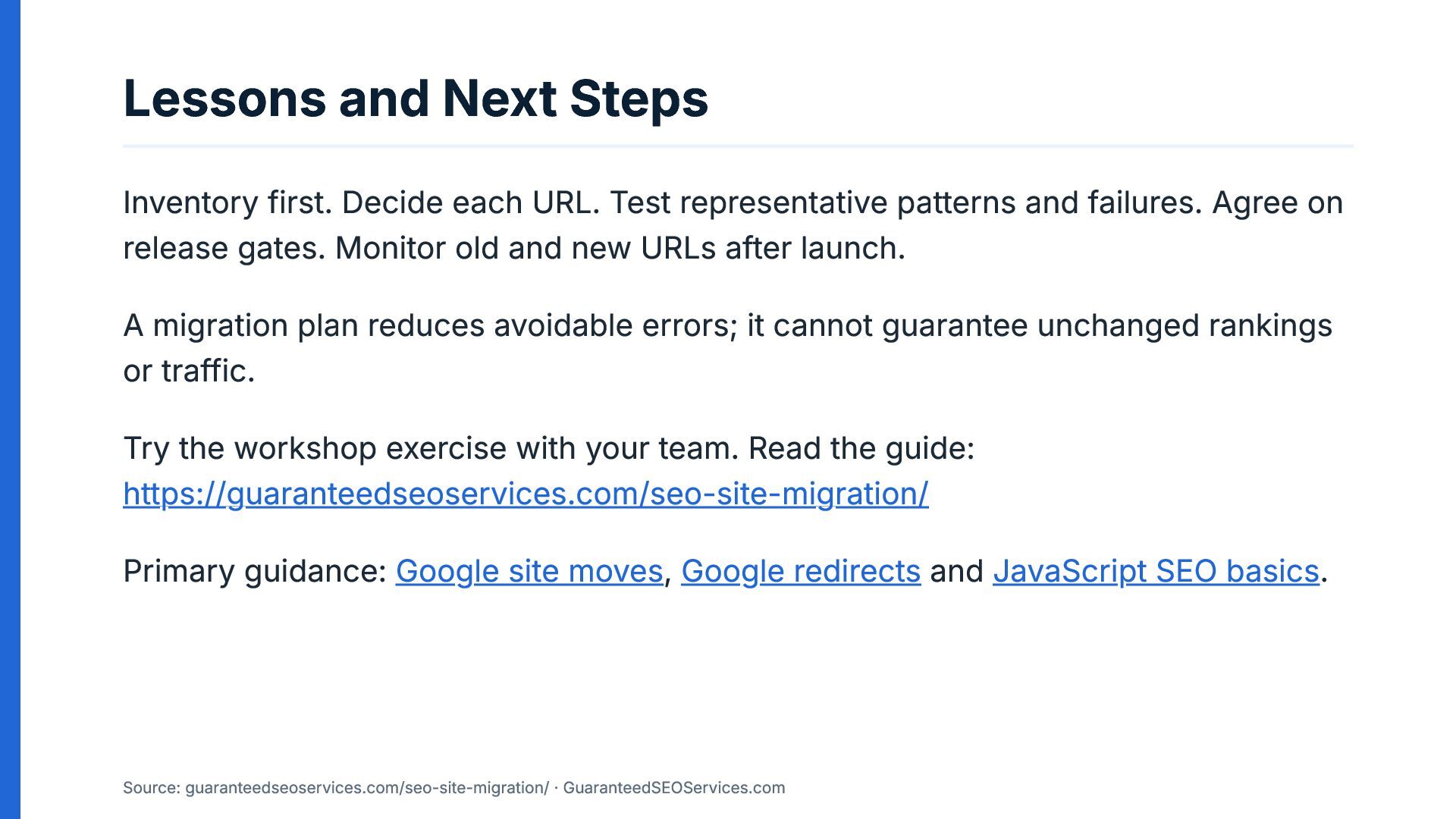
Lessons and Next Steps Inventory first. Decide each URL. Test
representative patterns and failures. Agree on release gates. Monitor old and new URLs after launch. A migration plan reduces avoidable errors; it cannot guarantee unchanged rankings or traffic. Try the workshop exercise with your team. Read the guide: https://guaranteedseoservices.com/seo-site-migration/ Primary guidance: Google site moves, Google redirects and JavaScript SEO basics. Source: guaranteedseoservices.com/seo-site-migration/ · GuaranteedSEOServices.com -
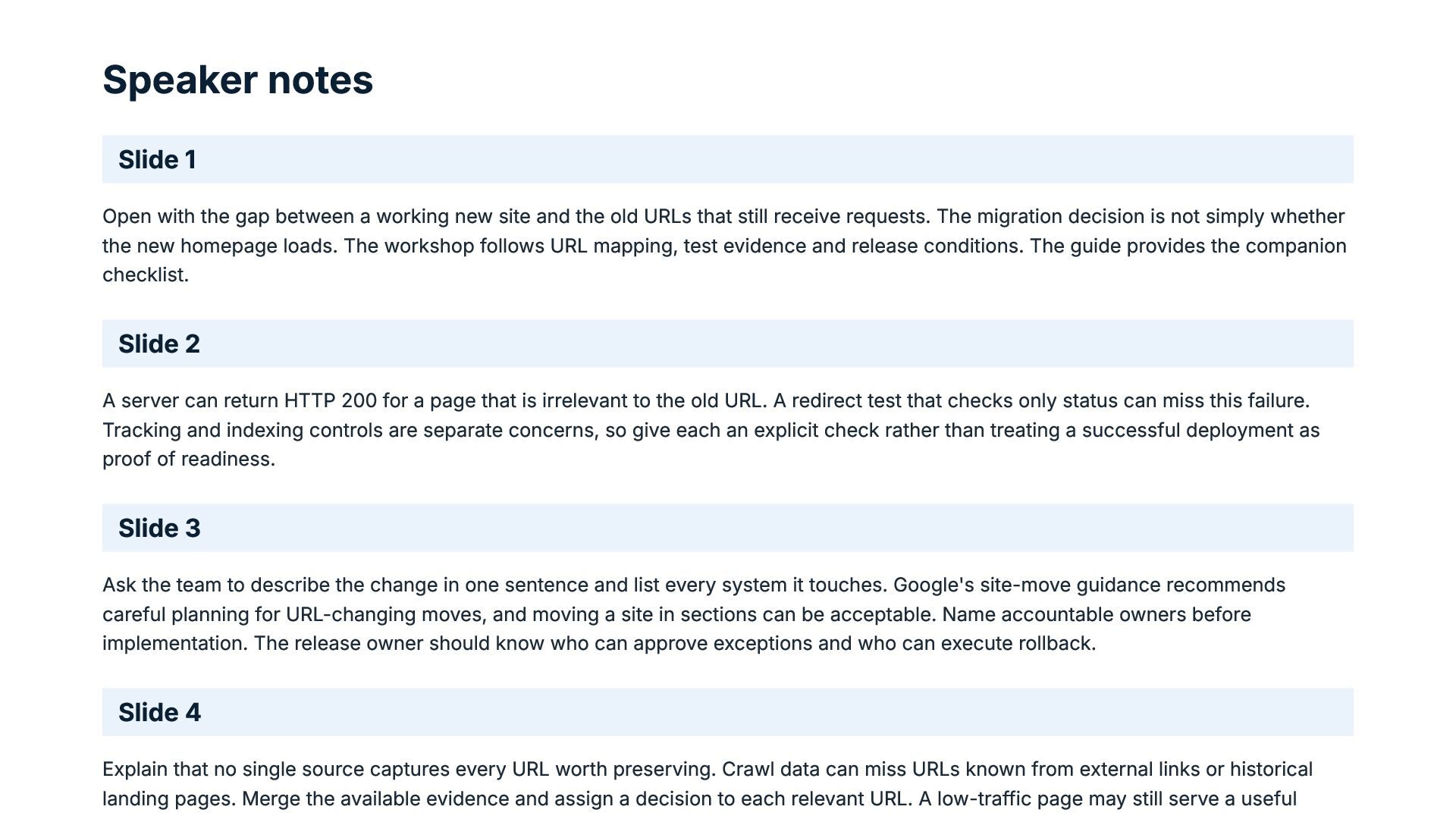
Speaker notes Slide 1 Open with the gap between a
working new site and the old URLs that still receive requests. The migration decision is not simply whether the new homepage loads. The workshop follows URL mapping, test evidence and release conditions. The guide provides the companion checklist. Slide 2 A server can return HTTP 200 for a page that is irrelevant to the old URL. A redirect test that checks only status can miss this failure. Tracking and indexing controls are separate concerns, so give each an explicit check rather than treating a successful deployment as proof of readiness. Slide 3 Ask the team to describe the change in one sentence and list every system it touches. Google's site-move guidance recommends careful planning for URL-changing moves, and moving a site in sections can be acceptable. Name accountable owners before implementation. The release owner should know who can approve exceptions and who can execute rollback. Slide 4 Explain that no single source captures every URL worth preserving. Crawl data can miss URLs known from external links or historical landing pages. Merge the available evidence and assign a decision to each relevant URL. A low-traffic page may still serve a useful -
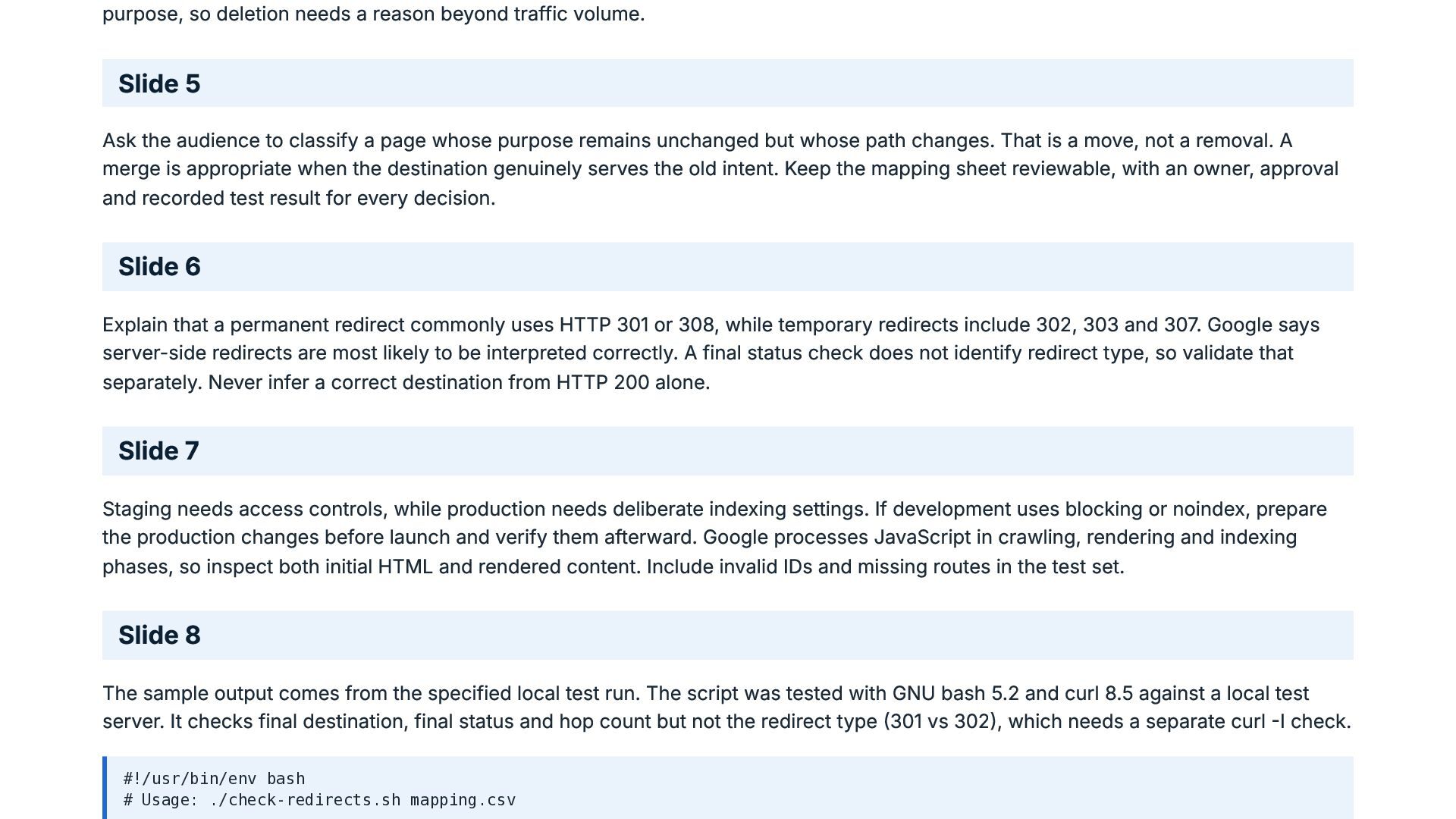
purpose, so deletion needs a reason beyond traffic volume. Slide
5 Ask the audience to classify a page whose purpose remains unchanged but whose path changes. That is a move, not a removal. A merge is appropriate when the destination genuinely serves the old intent. Keep the mapping sheet reviewable, with an owner, approval and recorded test result for every decision. Slide 6 Explain that a permanent redirect commonly uses HTTP 301 or 308, while temporary redirects include 302, 303 and 307. Google says server-side redirects are most likely to be interpreted correctly. A final status check does not identify redirect type, so validate that separately. Never infer a correct destination from HTTP 200 alone. Slide 7 Staging needs access controls, while production needs deliberate indexing settings. If development uses blocking or noindex, prepare the production changes before launch and verify them afterward. Google processes JavaScript in crawling, rendering and indexing phases, so inspect both initial HTML and rendered content. Include invalid IDs and missing routes in the test set. Slide 8 The sample output comes from the specified local test run. The script was tested with GNU bash 5.2 and curl 8.5 against a local test server. It checks final destination, final status and hop count but not the redirect type (301 vs 302), which needs a separate curl -I check. #!/usr/bin/env bash # Usage: ./check-redirects.sh mapping.csv -
# Each row: old_url,expected (expected = final URL, or 404
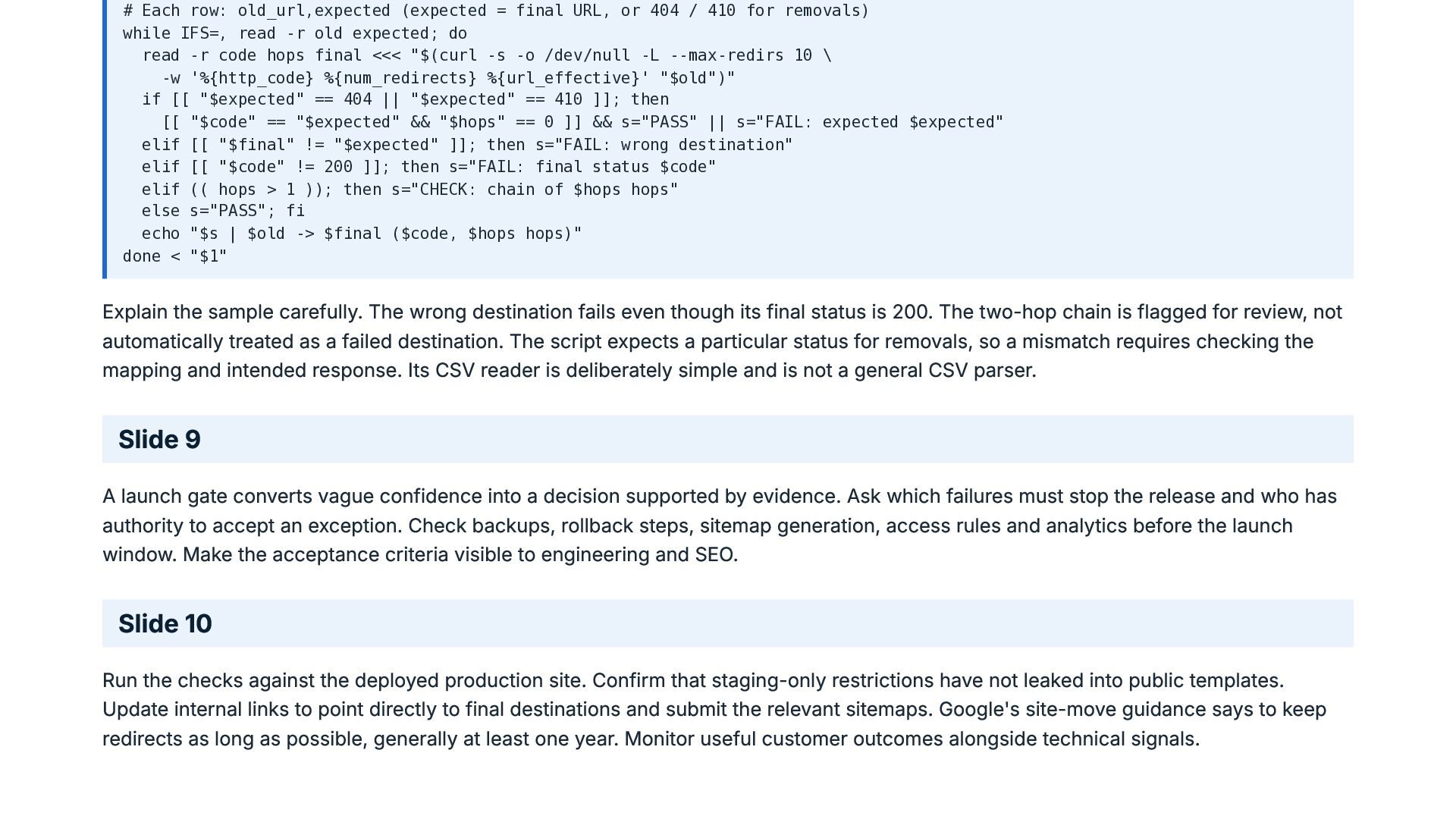
/ 410 for removals) while IFS=, read -r old expected; do read -r code hops final <<< "$(curl -s -o /dev/null -L --max-redirs 10 \ -w '%{http_code} %{num_redirects} %{url_effective}' "$old")" if [[ "$expected" == 404 || "$expected" == 410 ]]; then [[ "$code" == "$expected" && "$hops" == 0 ]] && s="PASS" || s="FAIL: expected $expected" elif [[ "$final" != "$expected" ]]; then s="FAIL: wrong destination" elif [[ "$code" != 200 ]]; then s="FAIL: final status $code" elif (( hops > 1 )); then s="CHECK: chain of $hops hops" else s="PASS"; fi echo "$s | $old -> $final ($code, $hops hops)" done < "$1" Explain the sample carefully. The wrong destination fails even though its final status is 200. The two-hop chain is flagged for review, not automatically treated as a failed destination. The script expects a particular status for removals, so a mismatch requires checking the mapping and intended response. Its CSV reader is deliberately simple and is not a general CSV parser. Slide 9 A launch gate converts vague confidence into a decision supported by evidence. Ask which failures must stop the release and who has authority to accept an exception. Check backups, rollback steps, sitemap generation, access rules and analytics before the launch window. Make the acceptance criteria visible to engineering and SEO. Slide 10 Run the checks against the deployed production site. Confirm that staging-only restrictions have not leaked into public templates. Update internal links to point directly to final destinations and submit the relevant sitemaps. Google's site-move guidance says to keep redirects as long as possible, generally at least one year. Monitor useful customer outcomes alongside technical signals. -
Slide 11 Give the audience a short pause to make
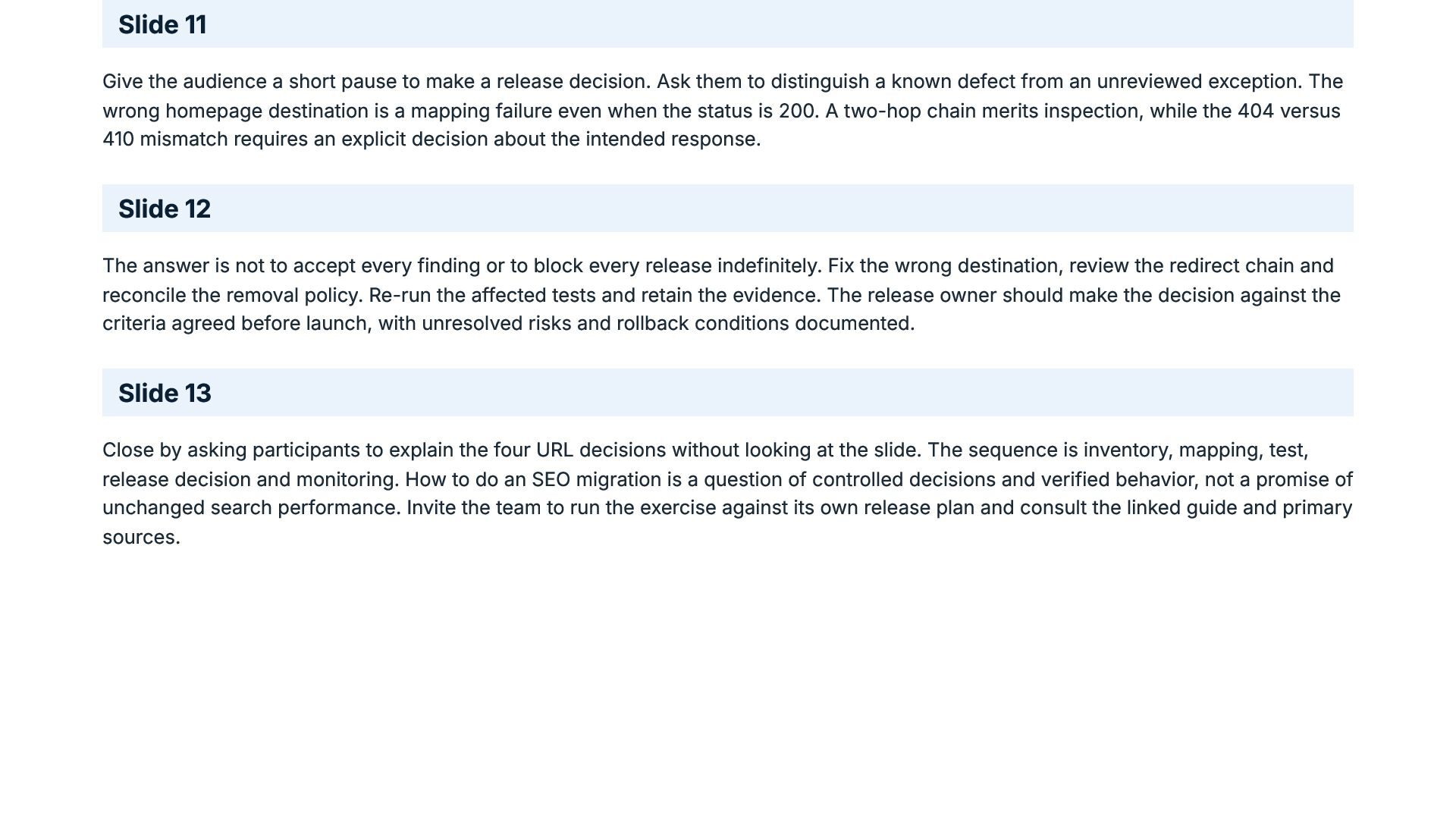
a release decision. Ask them to distinguish a known defect from an unreviewed exception. The wrong homepage destination is a mapping failure even when the status is 200. A two-hop chain merits inspection, while the 404 versus 410 mismatch requires an explicit decision about the intended response. Slide 12 The answer is not to accept every finding or to block every release indefinitely. Fix the wrong destination, review the redirect chain and reconcile the removal policy. Re-run the affected tests and retain the evidence. The release owner should make the decision against the criteria agreed before launch, with unresolved risks and rollback conditions documented. Slide 13 Close by asking participants to explain the four URL decisions without looking at the slide. The sequence is inventory, mapping, test, release decision and monitoring. How to do an SEO migration is a question of controlled decisions and verified behavior, not a promise of unchanged search performance. Invite the team to run the exercise against its own release plan and consult the linked guide and primary sources. -
Sources SEO Site Migration: A Practical Plan for Changing a
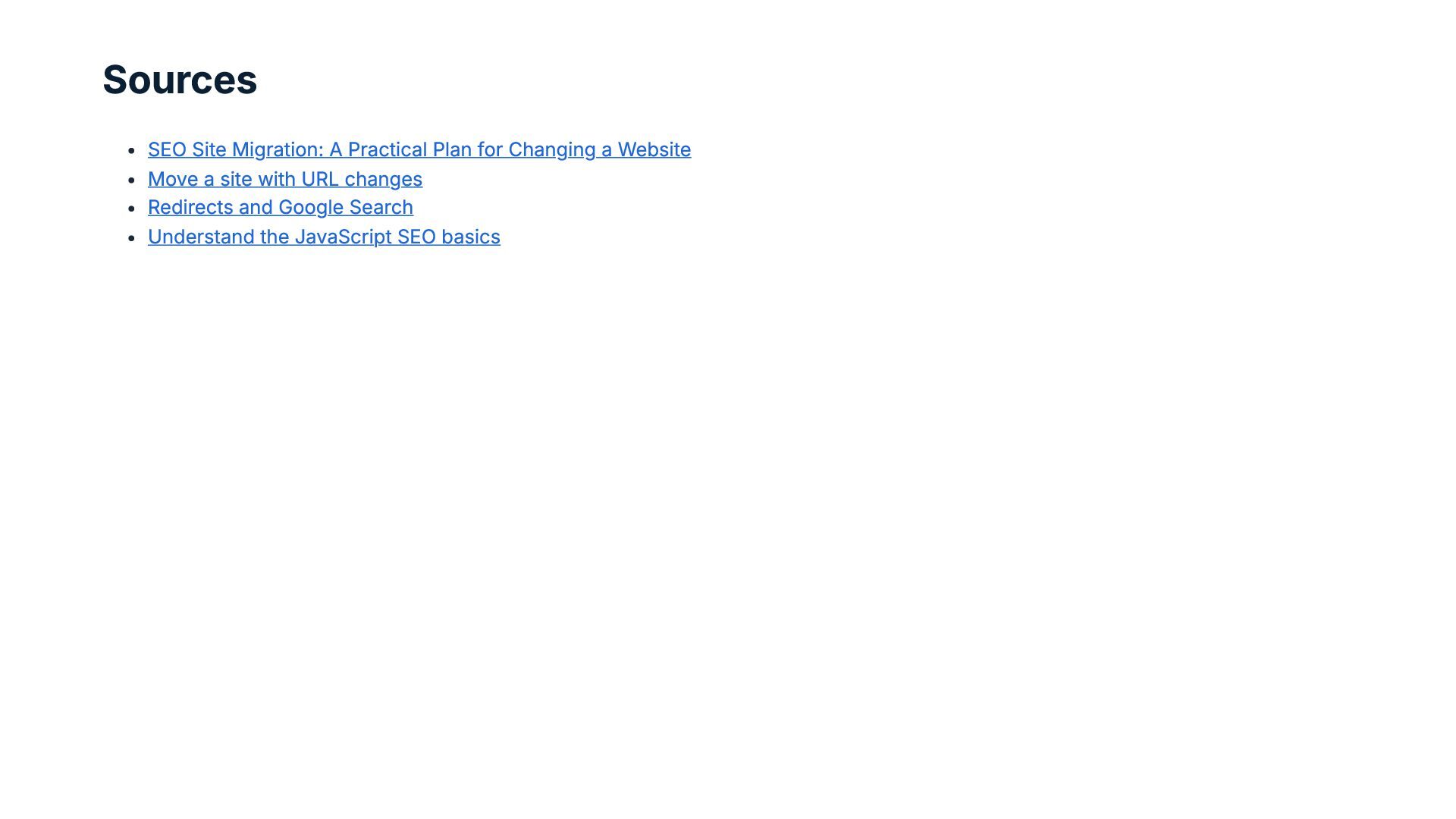
Website Move a site with URL changes Redirects and Google Search Understand the JavaScript SEO basics
 guaranteedseoservices
 speedyindexteam
 cargoodrich
 syphaiwong
 samtorres
 tasky_ai
 pavelungr
 rosshudgens
 alexmossuk
 aleyda
 clarasoteras
 pojda
 jonoalderson
 kastner
 aemeredith
 inesmontani
 signer
 vanstee
 akashhashmi
 palkan
 nikkihalliwell
 lfama
 emna__ayadi
 reverentgeek