How to Show Up in AI Overviews SEO: Diagnose th...
Sponsored
·
 Your Podcast. Everywhere. Effortlessly.
Share. Educate. Inspire. Entertain. You do you. We'll handle the rest.
→
Your Podcast. Everywhere. Effortlessly.
Share. Educate. Inspire. Entertain. You do you. We'll handle the rest.
→

Share
Embed
How to Show Up in AI Overviews SEO: Diagnose the Three Gates
How to show up in AI Overviews SEO starts with checking access, indexing and snippet eligibility before rewriting content. This workshop explains how to separate documented technical requirements from Google's source-selection decisions, with a practical exercise on schema claims. For the full guide to how to show up in AI Overviews SEO, visit https://guaranteedseoservices.com/how-to-appear-in-google-ai-overviews/?utm_source=speakerdeck&utm_medium=referral&utm_campaign=blog-how-to-appear-in-google-ai-overviews

GuaranteedSEOServices
October 26, 2026
Transcript
22 slides
-
How to Show Up in AI Overviews SEO: Diagnose the
Three Gates A technical workshop for developers and SEOs: check access, indexing and snippet eligibility before changing content, then separate eligibility from source selection. GuaranteedSEOServices.com October 27, 2026 -
1. Three gates. You control two of them. How to
show up in AI Overviews SEO starts with a diagnostic sequence, not a content rewrite. A page must pass Search eligibility checks before it can be considered as a supporting link. Even then, Google decides whether to select it. Guide: https://guaranteedseoservices.com/how-to-appear-in-google-ai-overviews/ Source: guaranteedseoservices.com/how-to-appear-in-google-ai-overviews/ · GuaranteedSEOServices.com -
2. Why content rewrites can miss the cause A team
rewrites a page to make its answer clearer, but the URL redirects incorrectly or important content is inaccessible. The rewrite does not fix the underlying eligibility issue. Diagnostic order: response and access → indexing and snippet eligibility → content usefulness → observed selection. Source: guaranteedseoservices.com/how-to-appear-in-google-ai-overviews/ · GuaranteedSEOServices.com -
3. Gate one: can Google access the page? Inspect the
requested URL and its response. Check redirects, robots.txt restrictions, authentication, server behavior and whether important content is available to Google. Confirm that the intended page, rather than an error or empty response, is being served. Access failure → repair delivery or access rules → test again. Source: guaranteedseoservices.com/how-to-appear-in-google-ai-overviews/ · GuaranteedSEOServices.com -
4. Separate crawling from indexing Successful fetching does not prove
that a page is indexed. Review indexing directives, canonical relationships and the page's current Search status. A crawlable URL can still be excluded from the index or represented by another canonical URL. Fetched successfully ≠ indexed ≠ eligible for a snippet. Source: guaranteedseoservices.com/how-to-appear-in-google-ai-overviews/ · GuaranteedSEOServices.com -
5. Gate two: index and snippet eligibility Google's AI features
documentation says a supporting page must be indexed and eligible to appear in Search with a snippet. These are documented eligibility conditions, not a promise of visibility in an AI Overview. Reference: https://developers.google.com/search/docs/appearance/ai-features Source: guaranteedseoservices.com/how-to-appear-in-google-ai-overviews/ · GuaranteedSEOServices.com -
6. Demo: live test versus indexed data Open URL Inspection
for the target URL. Compare the default indexed information with the live test. The first reflects Google's most recently indexed version; the second tests the current page's potential indexability. Neither predicts AI Overview selection. Guide: https://support.google.com/webmasters/answer/9012289 Source: guaranteedseoservices.com/how-to-appear-in-google-ai-overviews/ · GuaranteedSEOServices.com -
7. Read the inspection results carefully Check the reported indexing
state, crawl information, declared and selected canonical where available, and detected indexing restrictions. A live test can help diagnose current access, but it cannot establish which version Google will ultimately select as canonical. Live test passes → investigate indexed state → verify the canonical relationship. Source: guaranteedseoservices.com/how-to-appear-in-google-ai-overviews/ · GuaranteedSEOServices.com -
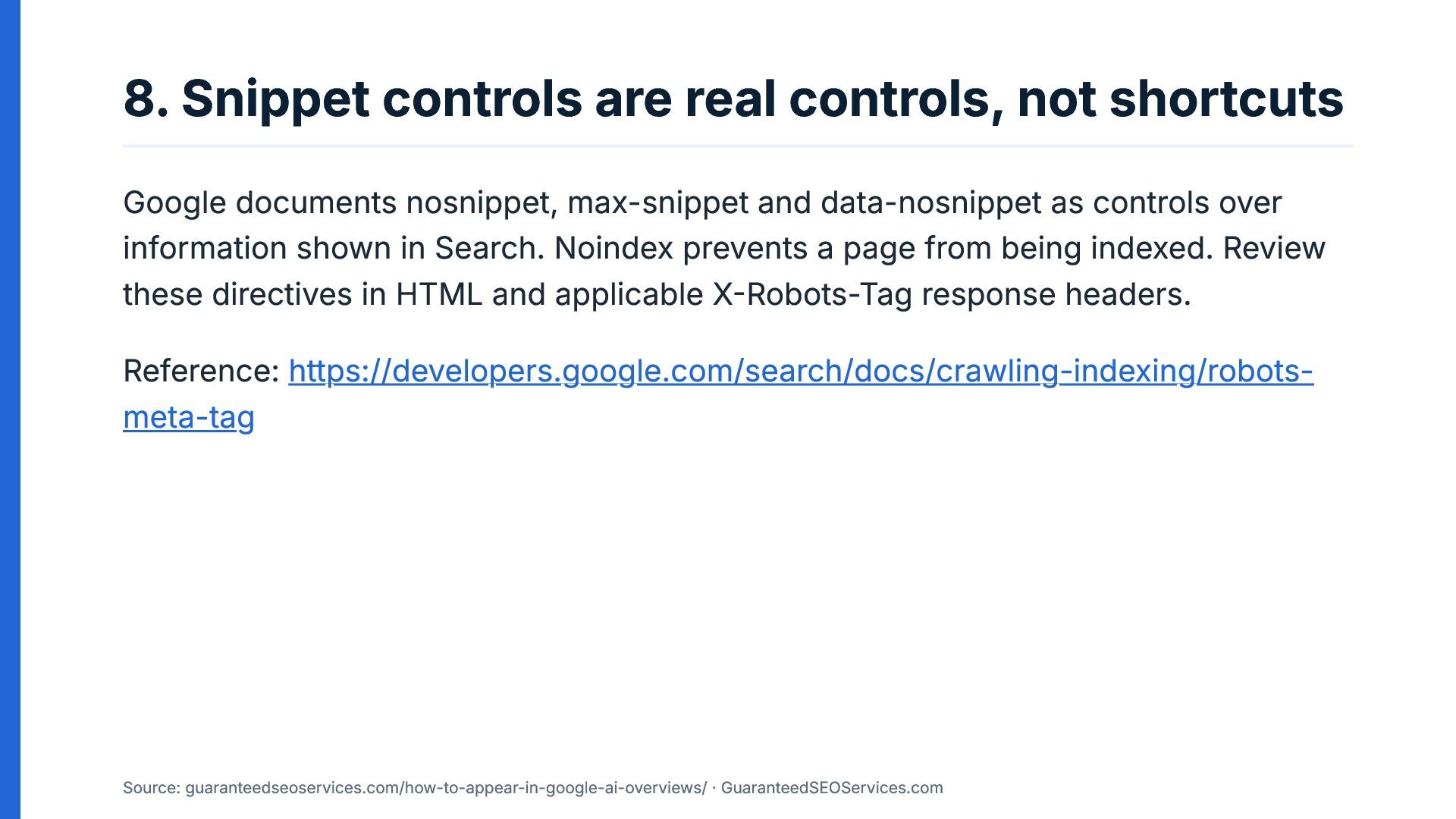
8. Snippet controls are real controls, not shortcuts Google documents
nosnippet, max-snippet and data-nosnippet as controls over information shown in Search. Noindex prevents a page from being indexed. Review these directives in HTML and applicable X-Robots-Tag response headers. Reference: https://developers.google.com/search/docs/crawling-indexing/robotsmeta-tag Source: guaranteedseoservices.com/how-to-appear-in-google-ai-overviews/ · GuaranteedSEOServices.com -
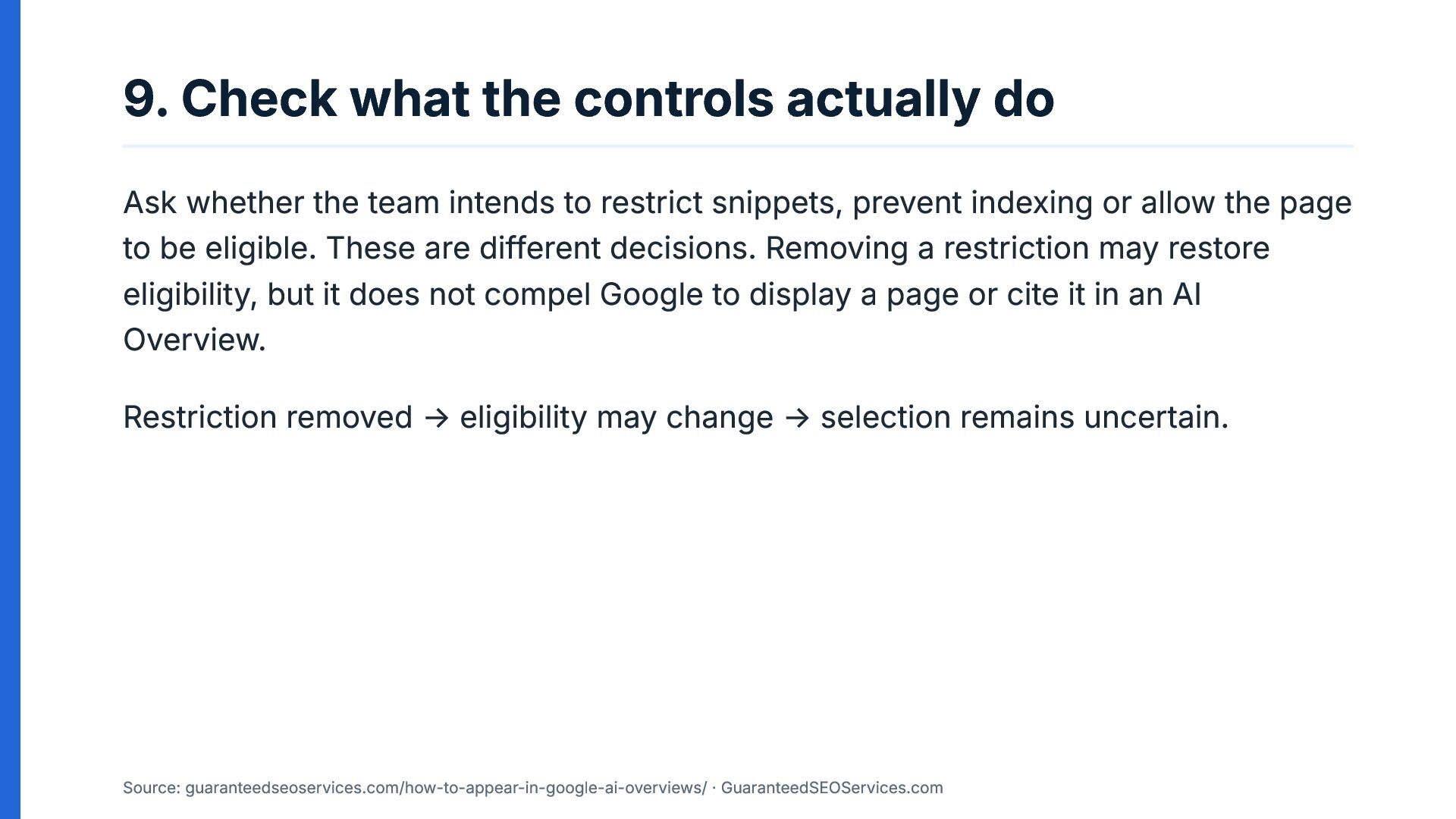
9. Check what the controls actually do Ask whether the
team intends to restrict snippets, prevent indexing or allow the page to be eligible. These are different decisions. Removing a restriction may restore eligibility, but it does not compel Google to display a page or cite it in an AI Overview. Restriction removed → eligibility may change → selection remains uncertain. Source: guaranteedseoservices.com/how-to-appear-in-google-ai-overviews/ · GuaranteedSEOServices.com -
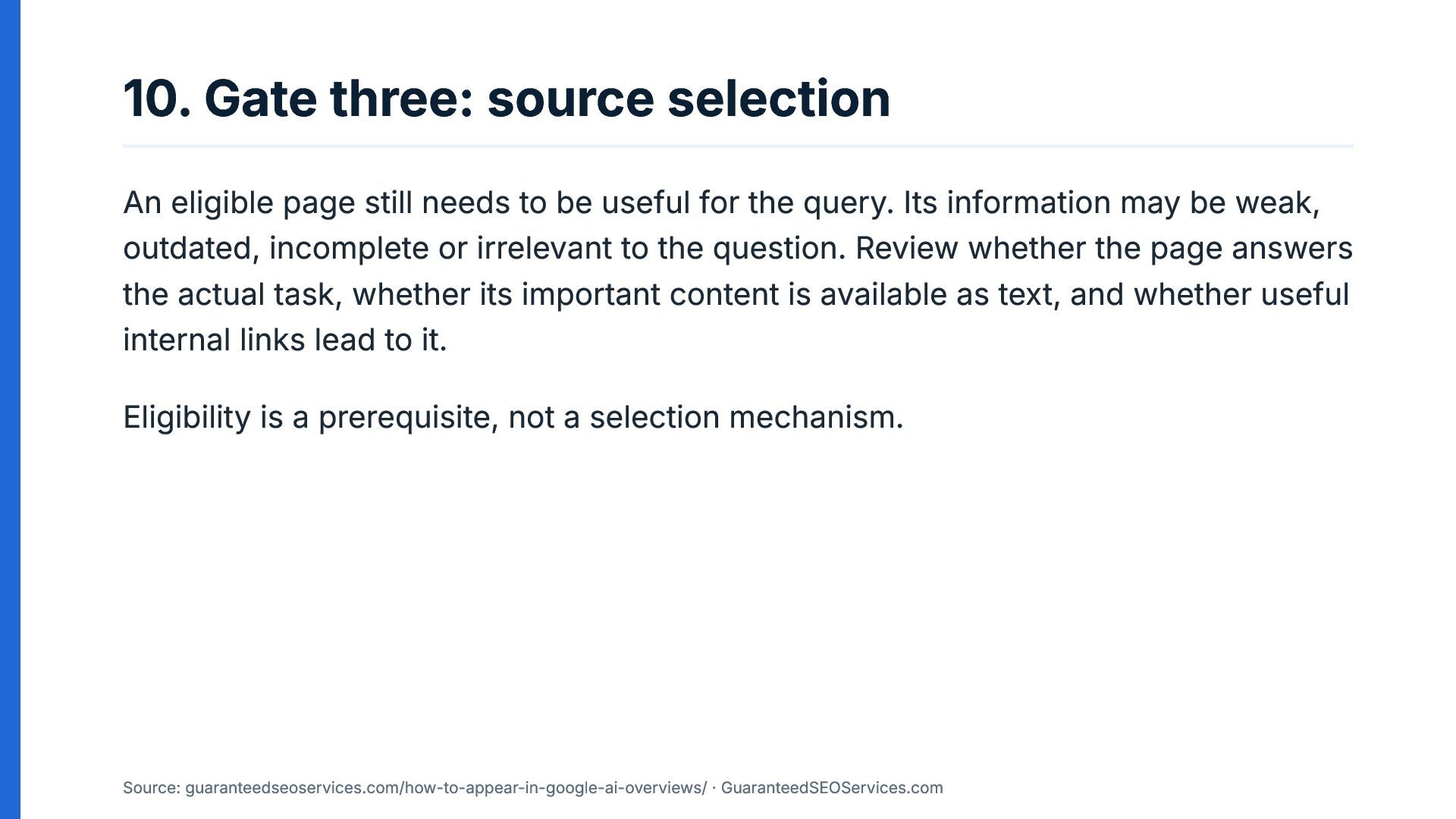
10. Gate three: source selection An eligible page still needs
to be useful for the query. Its information may be weak, outdated, incomplete or irrelevant to the question. Review whether the page answers the actual task, whether its important content is available as text, and whether useful internal links lead to it. Eligibility is a prerequisite, not a selection mechanism. Source: guaranteedseoservices.com/how-to-appear-in-google-ai-overviews/ · GuaranteedSEOServices.com -
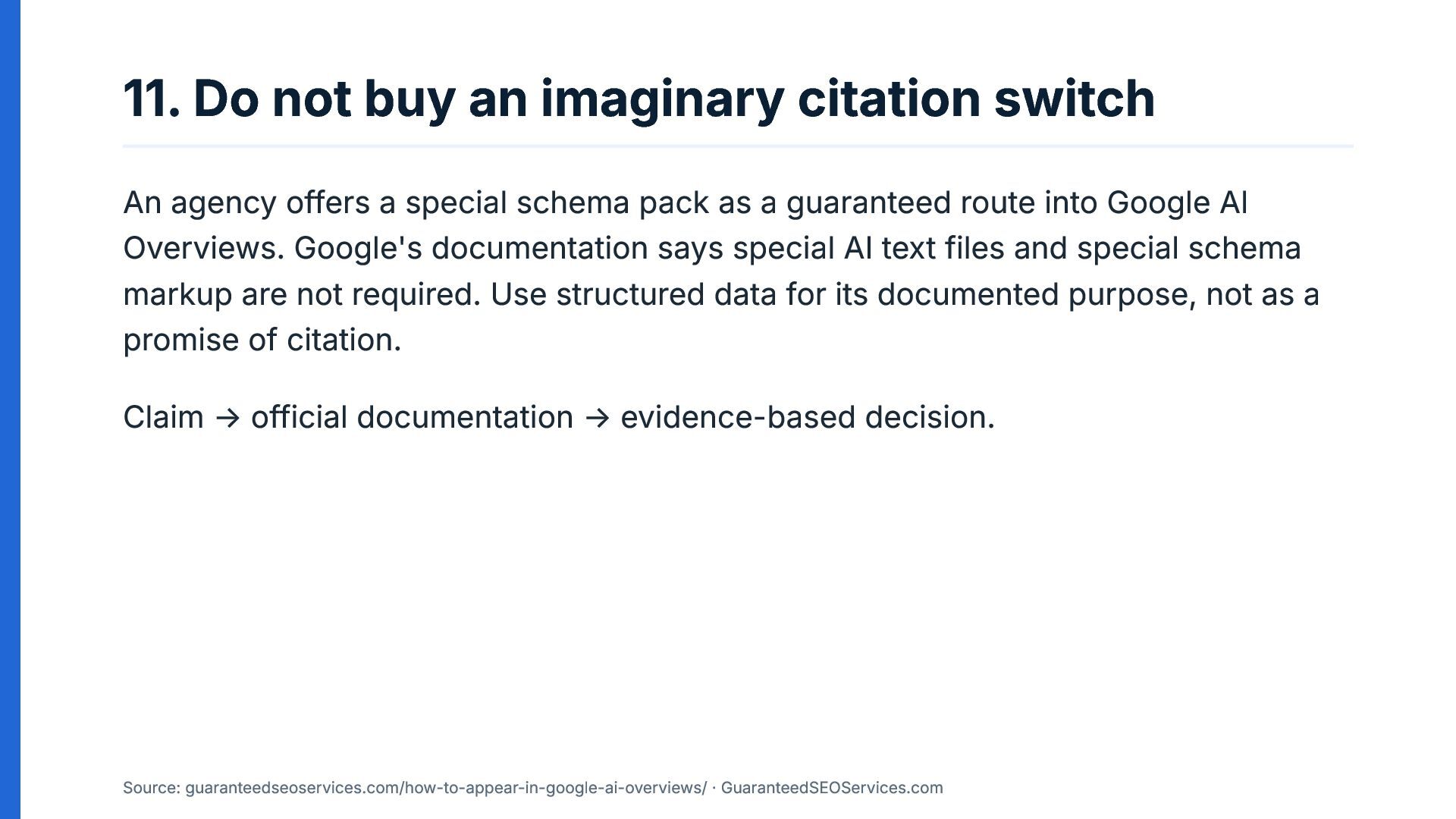
11. Do not buy an imaginary citation switch An agency
offers a special schema pack as a guaranteed route into Google AI Overviews. Google's documentation says special AI text files and special schema markup are not required. Use structured data for its documented purpose, not as a promise of citation. Claim → official documentation → evidence-based decision. Source: guaranteedseoservices.com/how-to-appear-in-google-ai-overviews/ · GuaranteedSEOServices.com -
12. Audience exercise: evaluate the schema-pack offer In pairs, assess
the agency's claim. What evidence would you request before recommending the purchase? Identify the documented eligibility checks, the role of structured data, the selection uncertainty and the measurement needed to evaluate the claim. Decide which parts of the offer are verifiable and which promise an outcome the seller cannot establish. Source: guaranteedseoservices.com/how-to-appear-in-google-ai-overviews/ · GuaranteedSEOServices.com -
13. Measurement: define the observation first Build a small, representative
question panel. Record each query, locale, date, device and product. Track separately whether an AI Overview appeared, whether the brand was mentioned, whether the target URL was cited and whether the description was accurate. One screenshot = one observation, not proof of a stable pattern. Source: guaranteedseoservices.com/how-to-appear-in-google-ai-overviews/ · GuaranteedSEOServices.com -
14. Interpret results without overstating them Repeat observations across the
selected questions and conditions. Keep eligibility findings separate from observed citations. A citation does not establish a conversion, and a missing citation in one observation does not prove a permanent exclusion. Observed result → repeat and compare → report the limits of the evidence. Source: guaranteedseoservices.com/how-to-appear-in-google-ai-overviews/ · GuaranteedSEOServices.com -
15. How to show up in AI Overviews SEO: the
diagnostic sequence Start with access and response behavior. Verify indexing, canonical relationships and snippet eligibility. Then assess whether the page serves the query well. Measure actual appearances and citations without treating eligibility as a guarantee. Try the workshop exercise with your team. Guide: https://guaranteedseoservices.com/how-to-appear-in-google-ai-overviews/ Source: guaranteedseoservices.com/how-to-appear-in-google-ai-overviews/ · GuaranteedSEOServices.com -
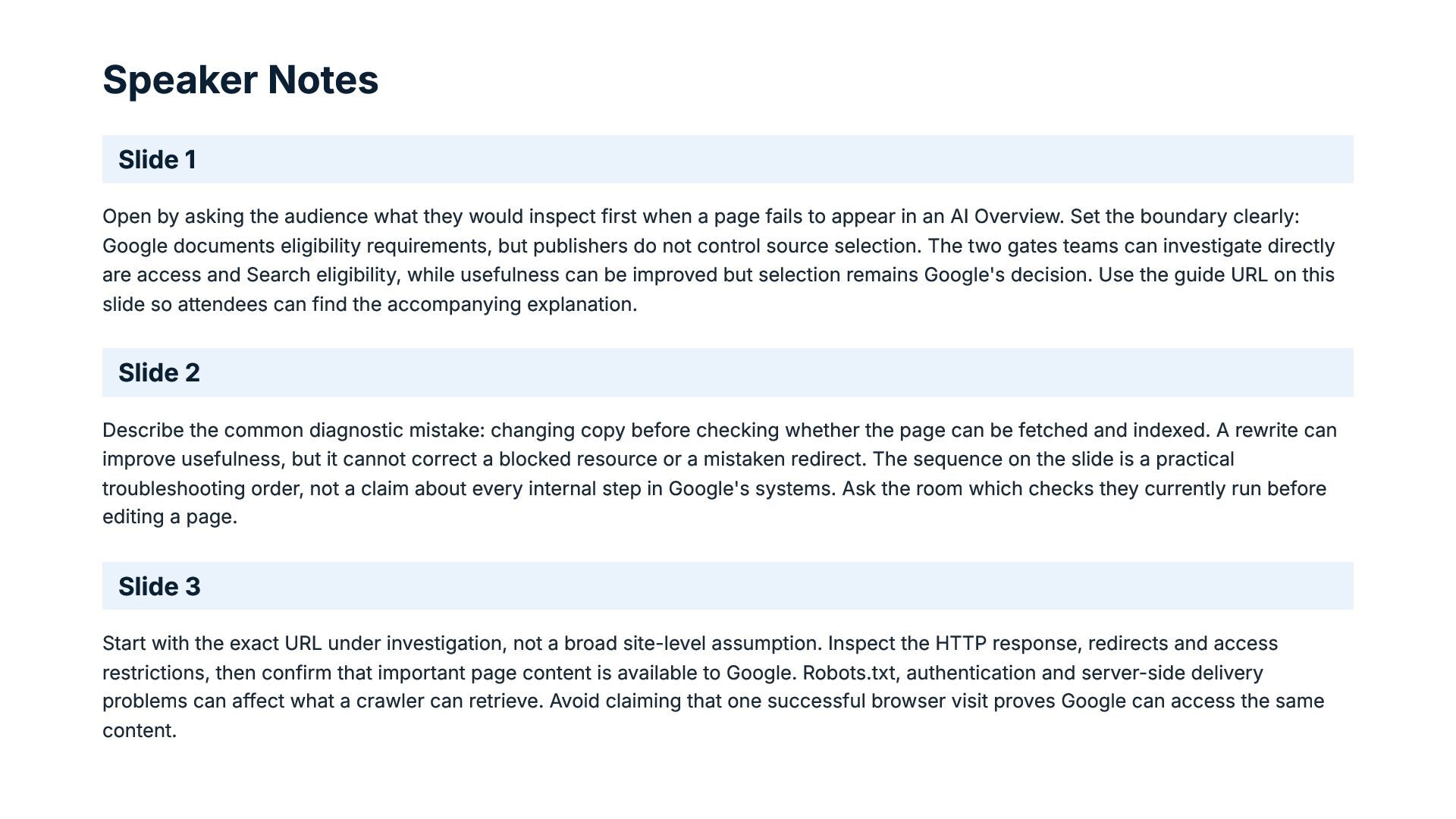
Speaker Notes Slide 1 Open by asking the audience what
they would inspect first when a page fails to appear in an AI Overview. Set the boundary clearly: Google documents eligibility requirements, but publishers do not control source selection. The two gates teams can investigate directly are access and Search eligibility, while usefulness can be improved but selection remains Google's decision. Use the guide URL on this slide so attendees can find the accompanying explanation. Slide 2 Describe the common diagnostic mistake: changing copy before checking whether the page can be fetched and indexed. A rewrite can improve usefulness, but it cannot correct a blocked resource or a mistaken redirect. The sequence on the slide is a practical troubleshooting order, not a claim about every internal step in Google's systems. Ask the room which checks they currently run before editing a page. Slide 3 Start with the exact URL under investigation, not a broad site-level assumption. Inspect the HTTP response, redirects and access restrictions, then confirm that important page content is available to Google. Robots.txt, authentication and server-side delivery problems can affect what a crawler can retrieve. Avoid claiming that one successful browser visit proves Google can access the same content. -
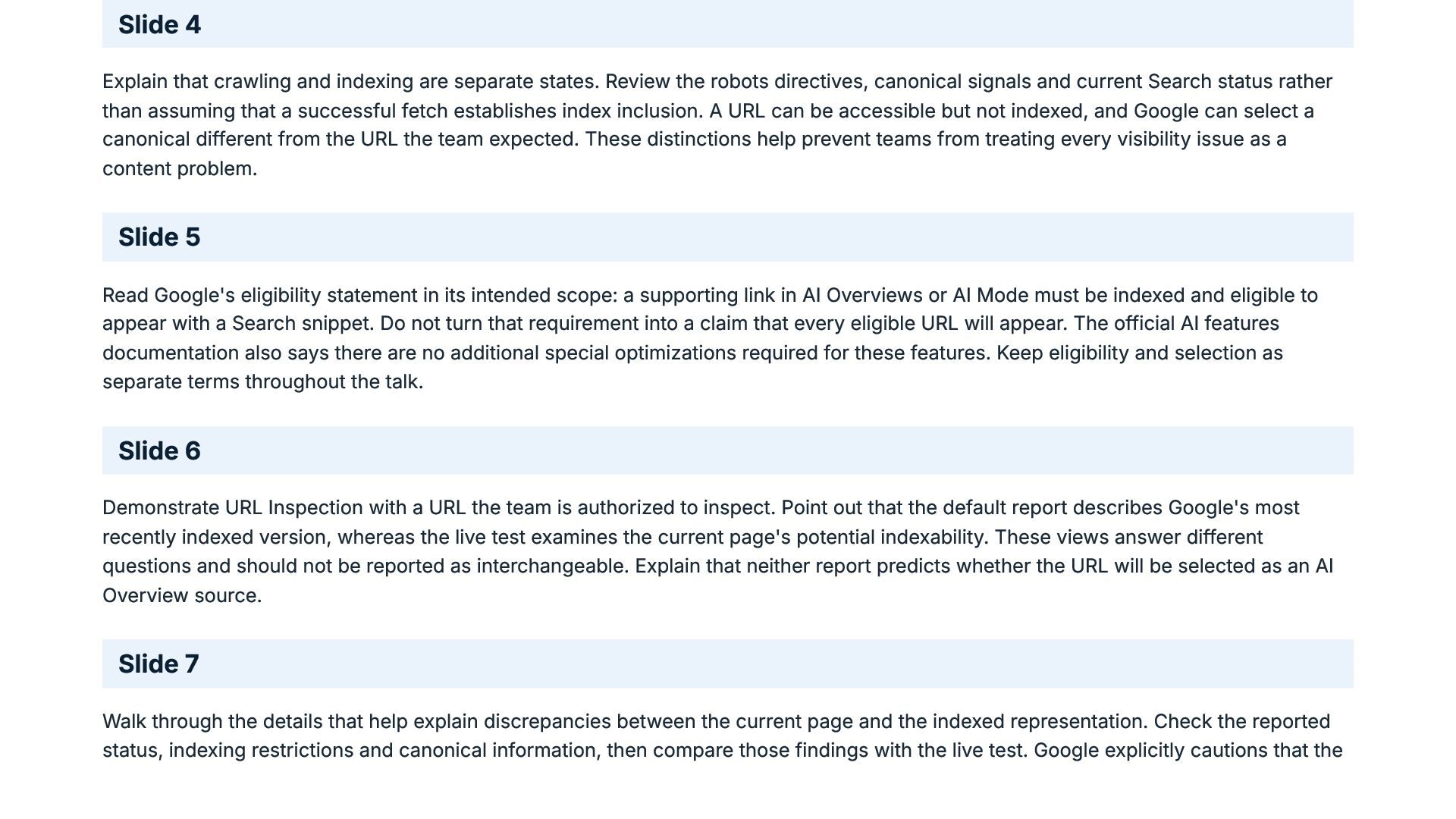
Slide 4 Explain that crawling and indexing are separate states.
Review the robots directives, canonical signals and current Search status rather than assuming that a successful fetch establishes index inclusion. A URL can be accessible but not indexed, and Google can select a canonical different from the URL the team expected. These distinctions help prevent teams from treating every visibility issue as a content problem. Slide 5 Read Google's eligibility statement in its intended scope: a supporting link in AI Overviews or AI Mode must be indexed and eligible to appear with a Search snippet. Do not turn that requirement into a claim that every eligible URL will appear. The official AI features documentation also says there are no additional special optimizations required for these features. Keep eligibility and selection as separate terms throughout the talk. Slide 6 Demonstrate URL Inspection with a URL the team is authorized to inspect. Point out that the default report describes Google's most recently indexed version, whereas the live test examines the current page's potential indexability. These views answer different questions and should not be reported as interchangeable. Explain that neither report predicts whether the URL will be selected as an AI Overview source. Slide 7 Walk through the details that help explain discrepancies between the current page and the indexed representation. Check the reported status, indexing restrictions and canonical information, then compare those findings with the live test. Google explicitly cautions that the -
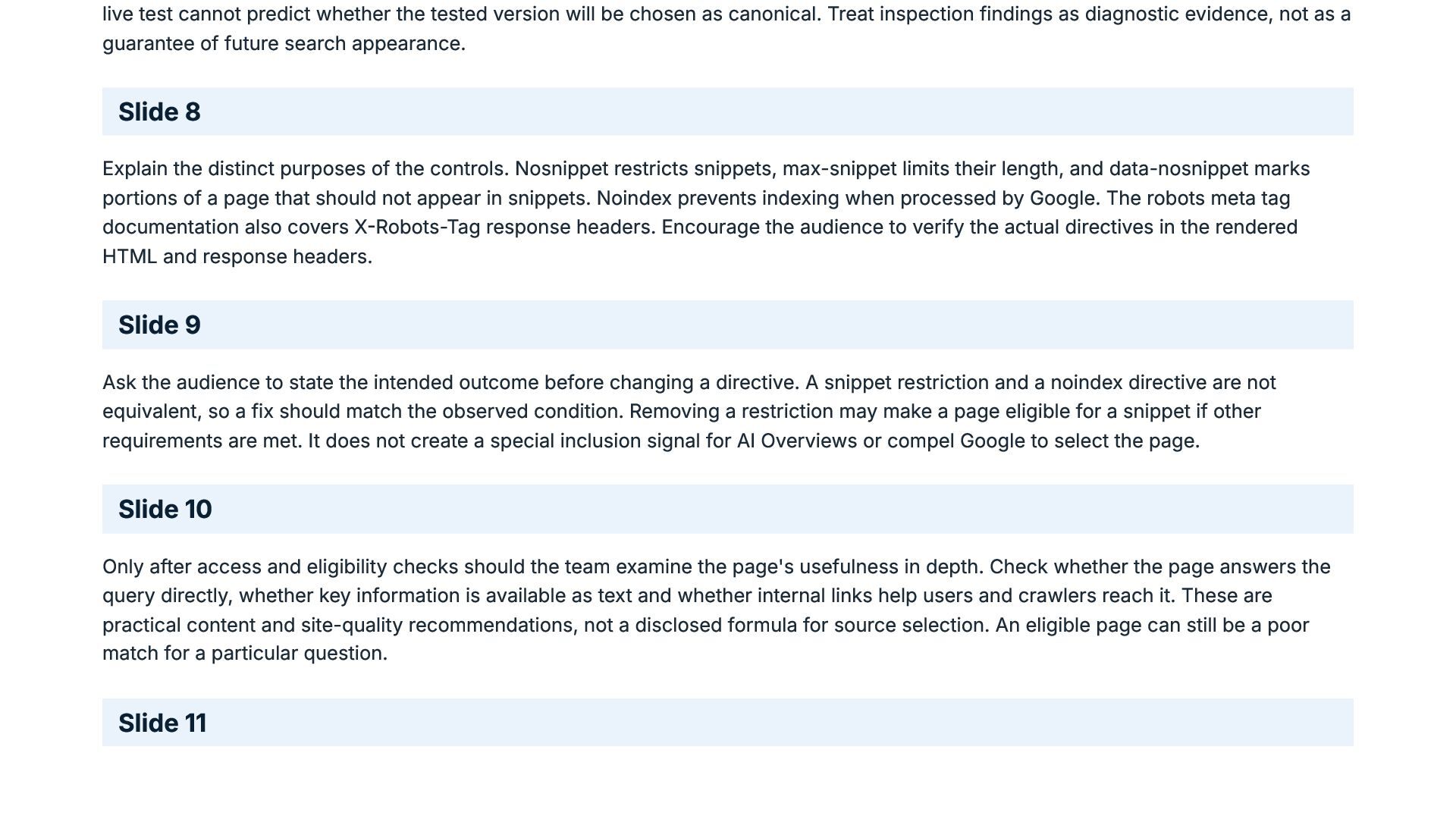
live test cannot predict whether the tested version will be
chosen as canonical. Treat inspection findings as diagnostic evidence, not as a guarantee of future search appearance. Slide 8 Explain the distinct purposes of the controls. Nosnippet restricts snippets, max-snippet limits their length, and data-nosnippet marks portions of a page that should not appear in snippets. Noindex prevents indexing when processed by Google. The robots meta tag documentation also covers X-Robots-Tag response headers. Encourage the audience to verify the actual directives in the rendered HTML and response headers. Slide 9 Ask the audience to state the intended outcome before changing a directive. A snippet restriction and a noindex directive are not equivalent, so a fix should match the observed condition. Removing a restriction may make a page eligible for a snippet if other requirements are met. It does not create a special inclusion signal for AI Overviews or compel Google to select the page. Slide 10 Only after access and eligibility checks should the team examine the page's usefulness in depth. Check whether the page answers the query directly, whether key information is available as text and whether internal links help users and crawlers reach it. These are practical content and site-quality recommendations, not a disclosed formula for source selection. An eligible page can still be a poor match for a particular question. Slide 11 -
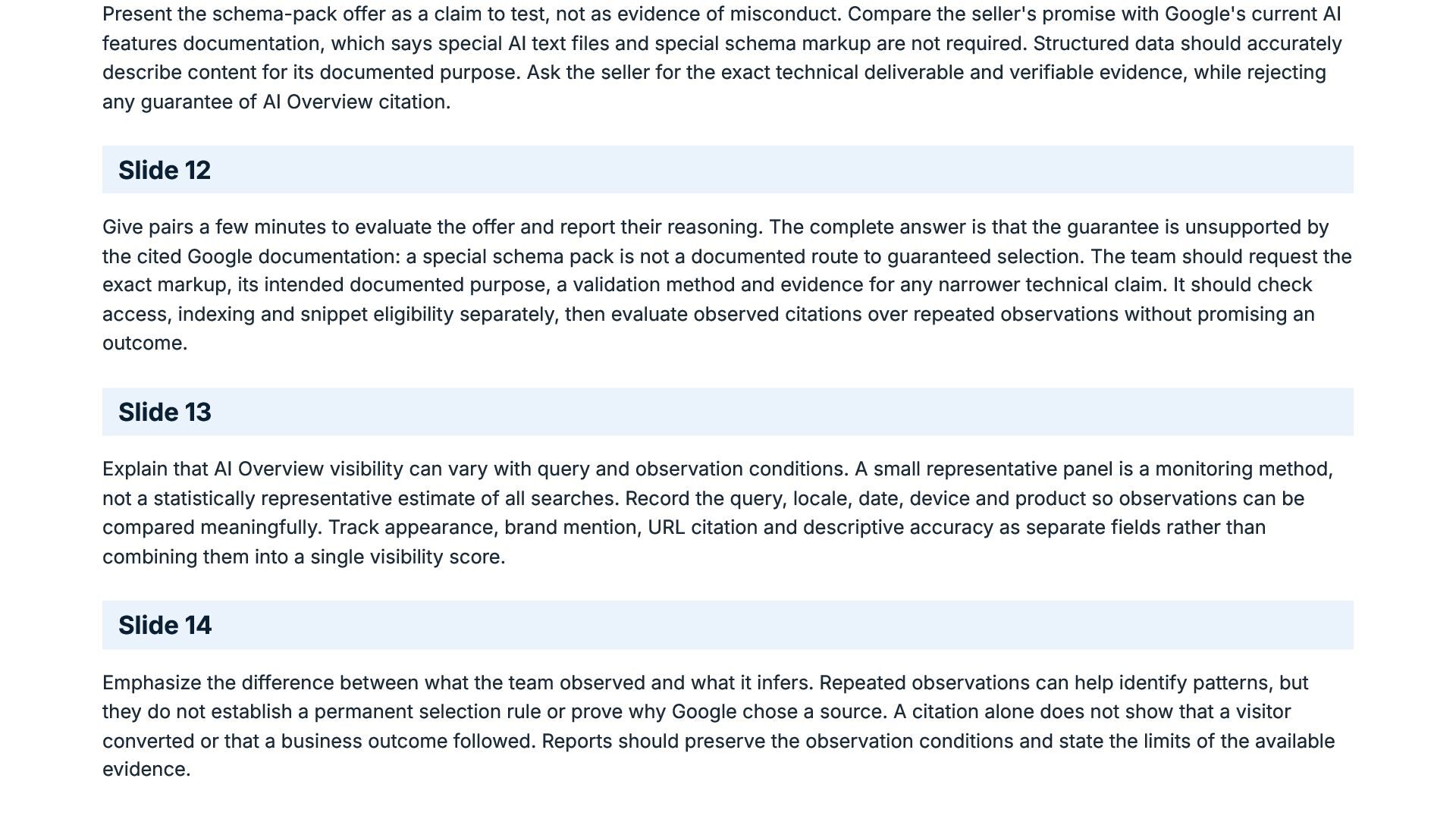
Present the schema-pack offer as a claim to test, not
as evidence of misconduct. Compare the seller's promise with Google's current AI features documentation, which says special AI text files and special schema markup are not required. Structured data should accurately describe content for its documented purpose. Ask the seller for the exact technical deliverable and verifiable evidence, while rejecting any guarantee of AI Overview citation. Slide 12 Give pairs a few minutes to evaluate the offer and report their reasoning. The complete answer is that the guarantee is unsupported by the cited Google documentation: a special schema pack is not a documented route to guaranteed selection. The team should request the exact markup, its intended documented purpose, a validation method and evidence for any narrower technical claim. It should check access, indexing and snippet eligibility separately, then evaluate observed citations over repeated observations without promising an outcome. Slide 13 Explain that AI Overview visibility can vary with query and observation conditions. A small representative panel is a monitoring method, not a statistically representative estimate of all searches. Record the query, locale, date, device and product so observations can be compared meaningfully. Track appearance, brand mention, URL citation and descriptive accuracy as separate fields rather than combining them into a single visibility score. Slide 14 Emphasize the difference between what the team observed and what it infers. Repeated observations can help identify patterns, but they do not establish a permanent selection rule or prove why Google chose a source. A citation alone does not show that a visitor converted or that a business outcome followed. Reports should preserve the observation conditions and state the limits of the available evidence. -
Slide 15 Close by asking attendees to name the first
check they will add to their own troubleshooting process. Reinforce the order: response and access, index and snippet eligibility, usefulness, then observed selection. Keep the guide URL visible and direct attendees to the official Google documentation linked in the sources section. The practical takeaway for how to show up in AI Overviews SEO is to verify eligibility before rewriting content and never present eligibility as a citation guarantee. -
Sources https://guaranteedseoservices.com/how-to-appear-in-google-ai-overviews/ Google Search Central: AI features and your website
Google Search Console Help: URL Inspection tool Google Search Central: Robots meta tag, data-nosnippet and X-Robots-Tag
 guaranteedseoservices
 owainlw
 zjchahalis
 greggifford
 portentint
 aleyda
 chrisleverseo
 badams
 speedyindexteam
 diije
 gkoivikko
 pelogia
 sergeychernyshev
 axbom
 csswizardry
 chrisshort
 davidcarrasco
 katarinadahlin
 tammyeverts
 marketingsoph
 jonoalderson
 mraible
 bluesmoon
 trishagee