? Primary developer of SE-PostgreSQL 5 year's experience in Linux kernel development Especially, SELinux and Security related. Experience in PostgreSQL About 8 years as a user :-) About 2 years for development of SE-PostgreSQL
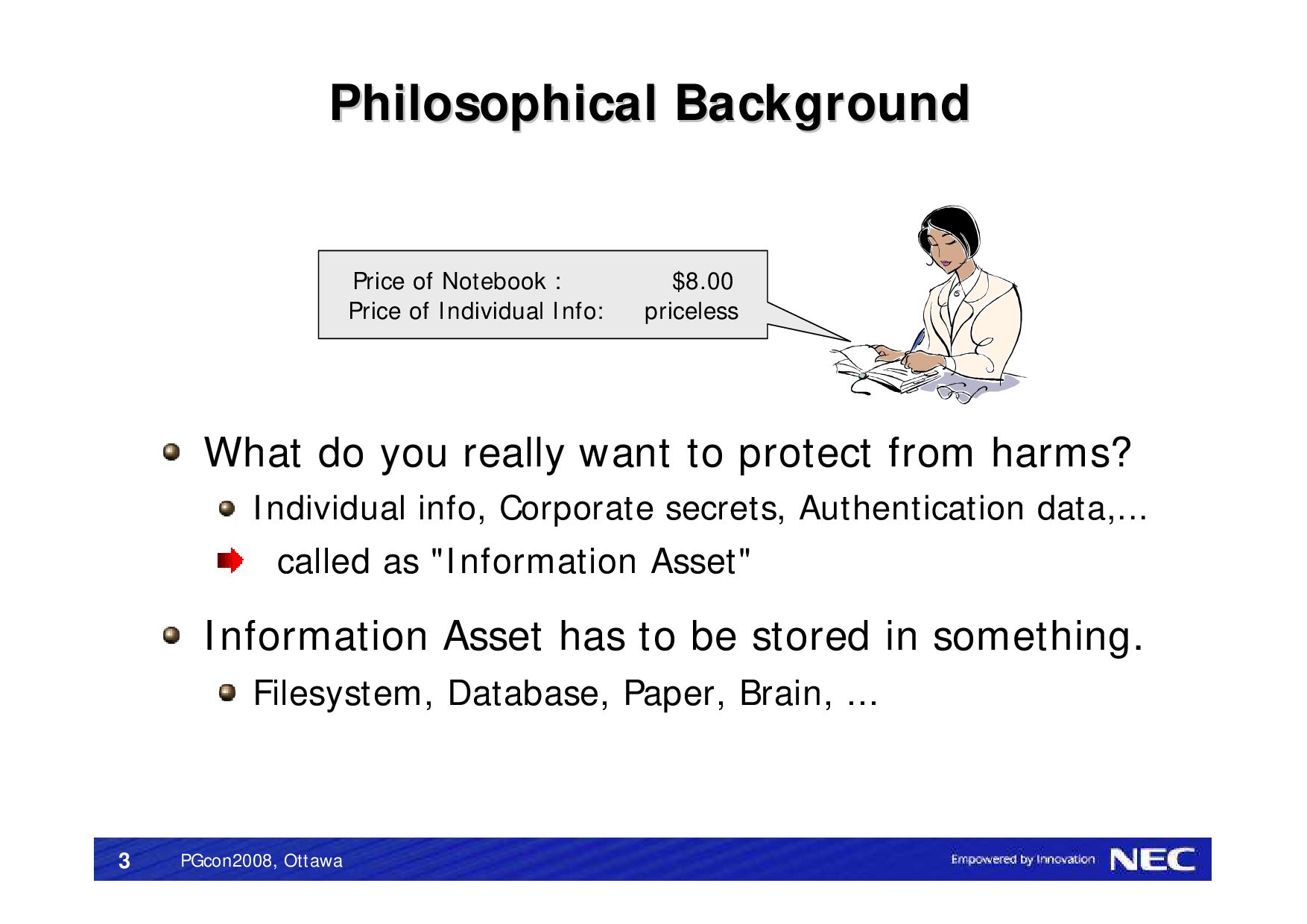
really want to protect from harms? Individual info, Corporate secrets, Authentication data,... called as "Information Asset" Information Asset has to be stored in something. Filesystem, Database, Paper, Brain, ... Price of Notebook : $8.00 Price of Individual Info: priceless
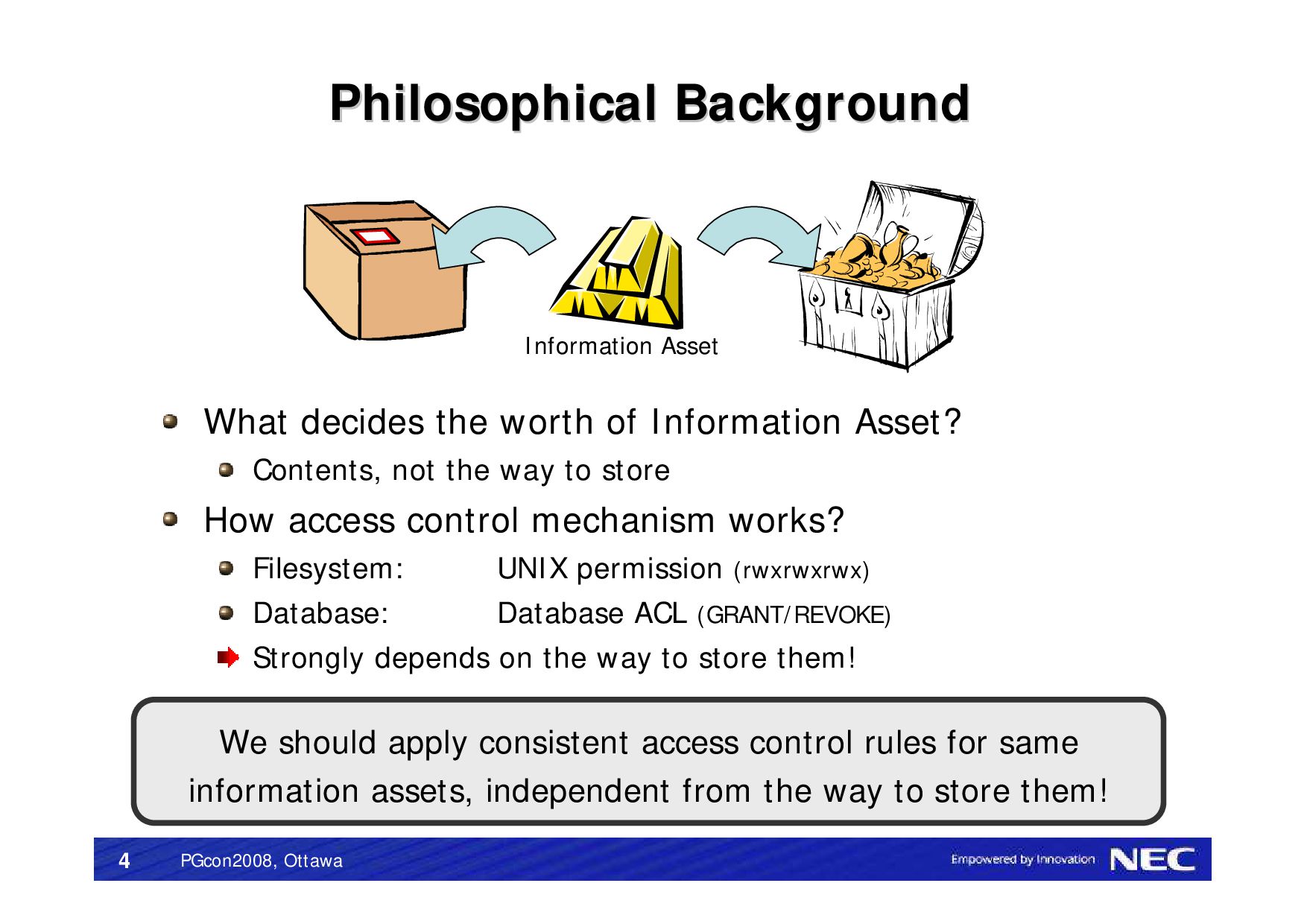
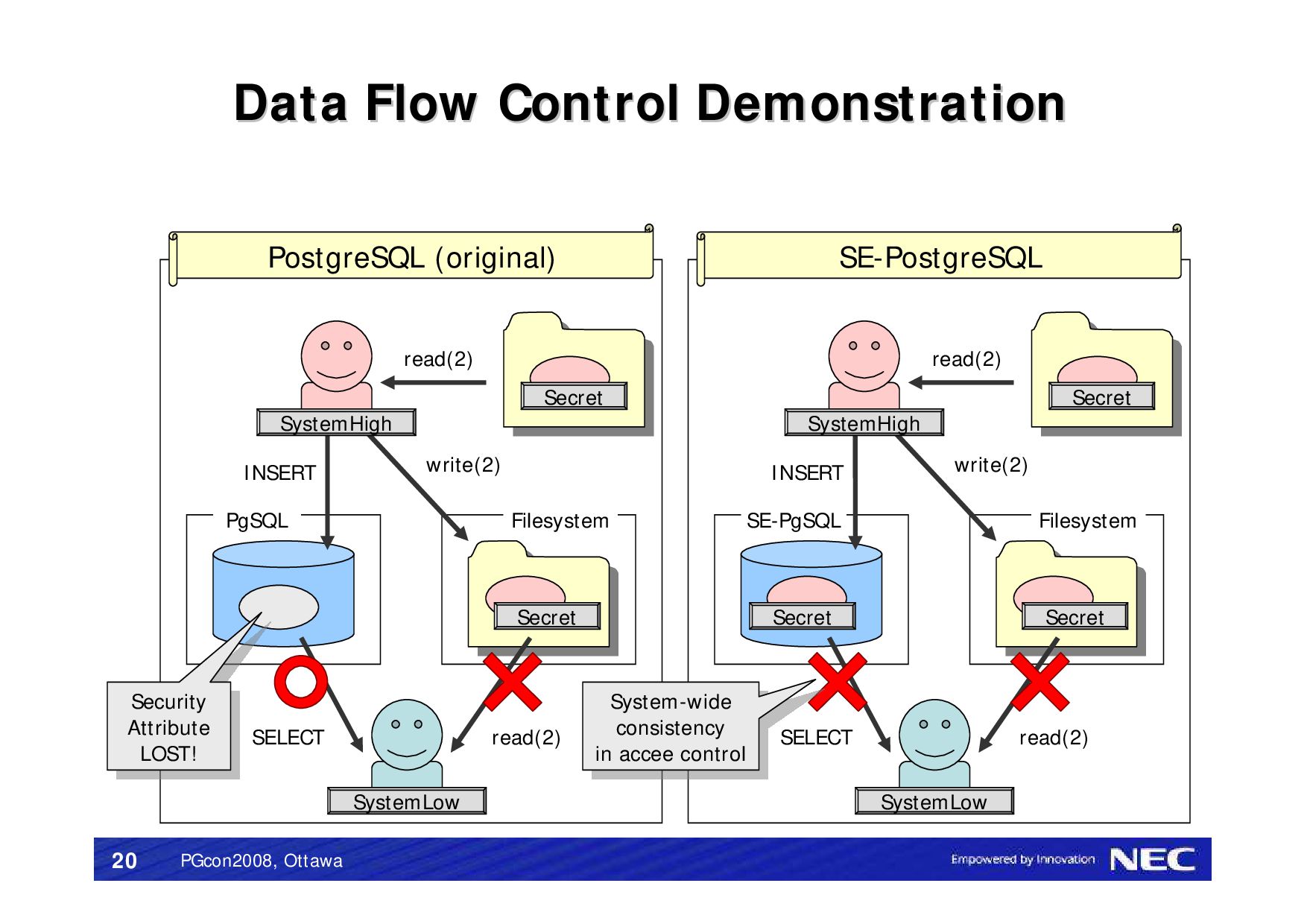
worth of Information Asset? Contents, not the way to store How access control mechanism works? Filesystem: UNIX permission (rwxrwxrwx) Database: Database ACL (GRANT/REVOKE) Strongly depends on the way to store them! Information Asset We should apply consistent access control rules for same information assets, independent from the way to store them!
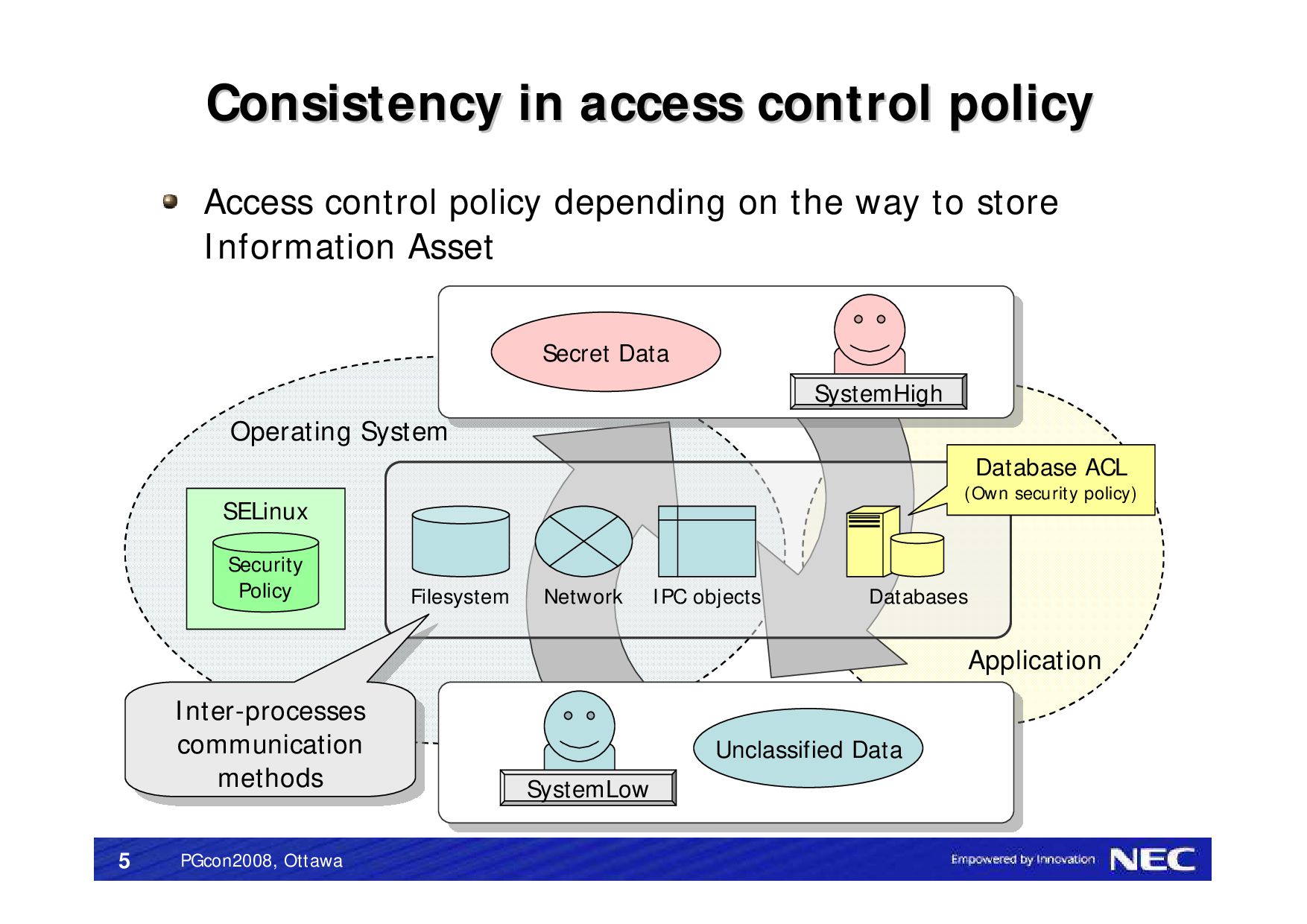
policy Consistency in access control policy Unclassified Data Filesystem Network IPC objects Databases Secret Data SELinux Security Policy Database ACL (Own security policy) SystemLow SystemHigh Access control policy depending on the way to store Information Asset Inter-processes communication methods Inter-processes communication methods
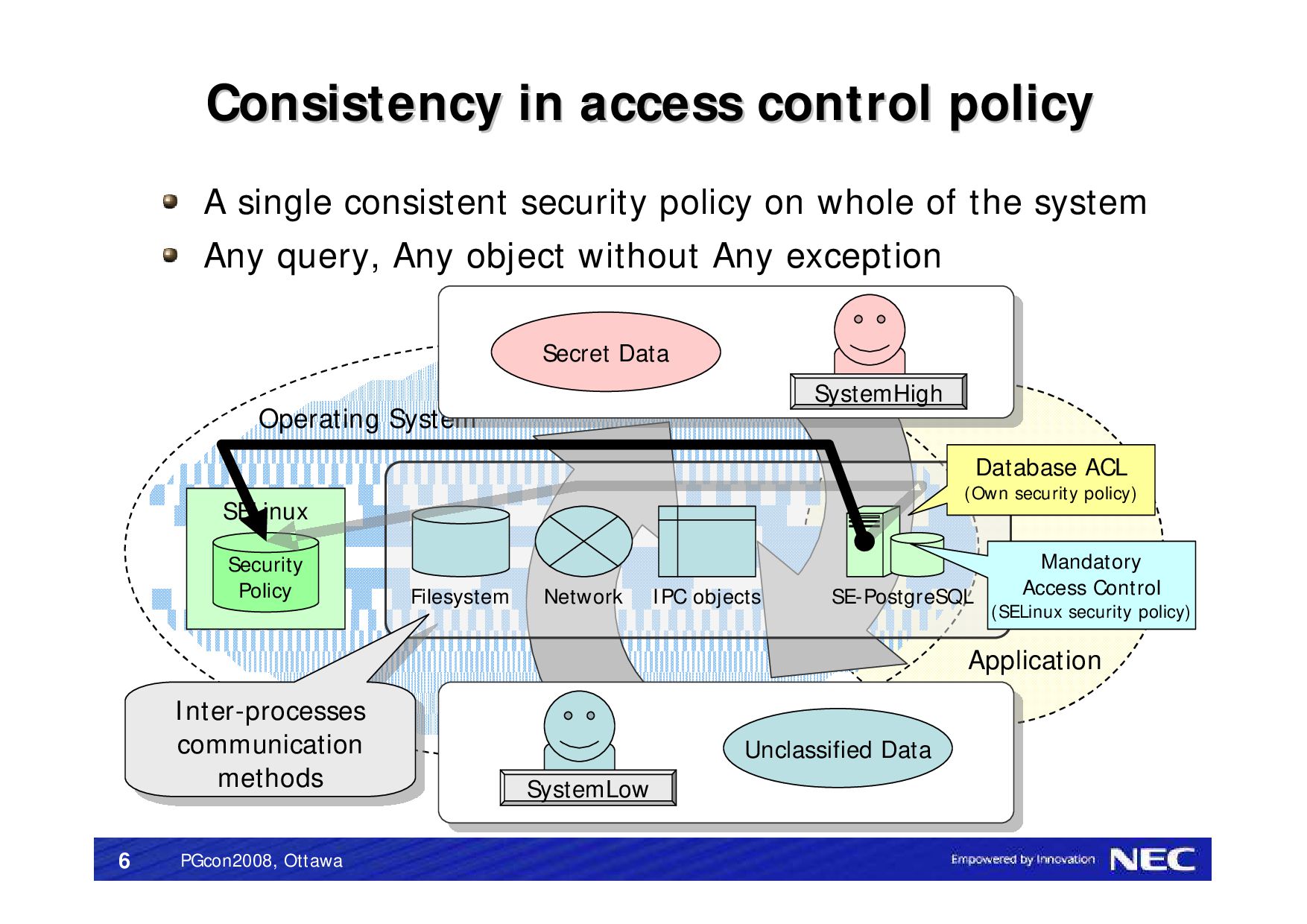
policy Consistency in access control policy Unclassified Data Filesystem Network IPC objects SE-PostgreSQL Secret Data SELinux Security Policy Database ACL (Own security policy) SystemLow SystemHigh A single consistent security policy on whole of the system Any query, Any object without Any exception Inter-processes communication methods Inter-processes communication methods Mandatory Access Control (SELinux security policy)
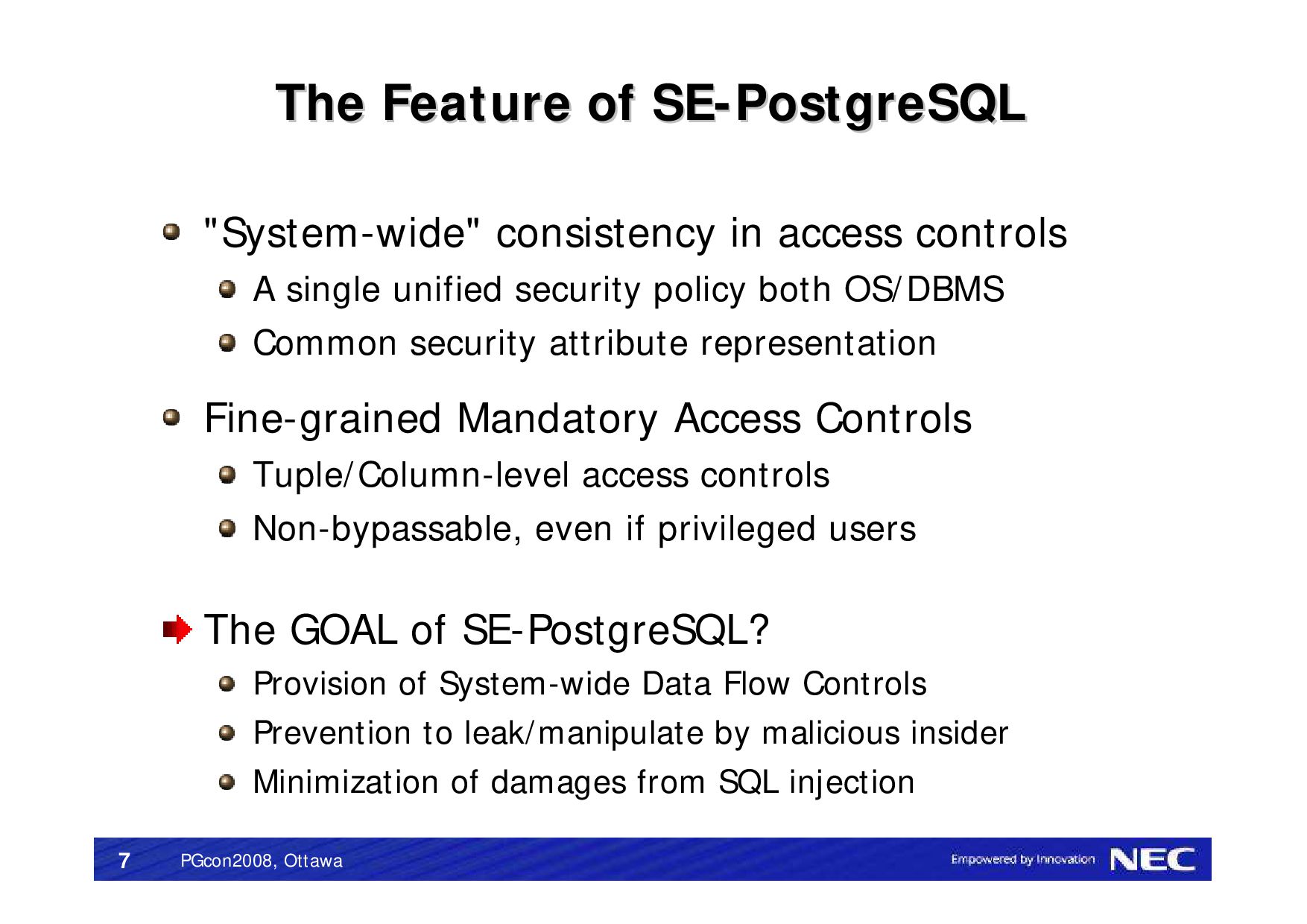
SE- -PostgreSQL PostgreSQL "System-wide" consistency in access controls A single unified security policy both OS/DBMS Common security attribute representation Fine-grained Mandatory Access Controls Tuple/Column-level access controls Non-bypassable, even if privileged users The GOAL of SE-PostgreSQL? Provision of System-wide Data Flow Controls Prevention to leak/manipulate by malicious insider Minimization of damages from SQL injection
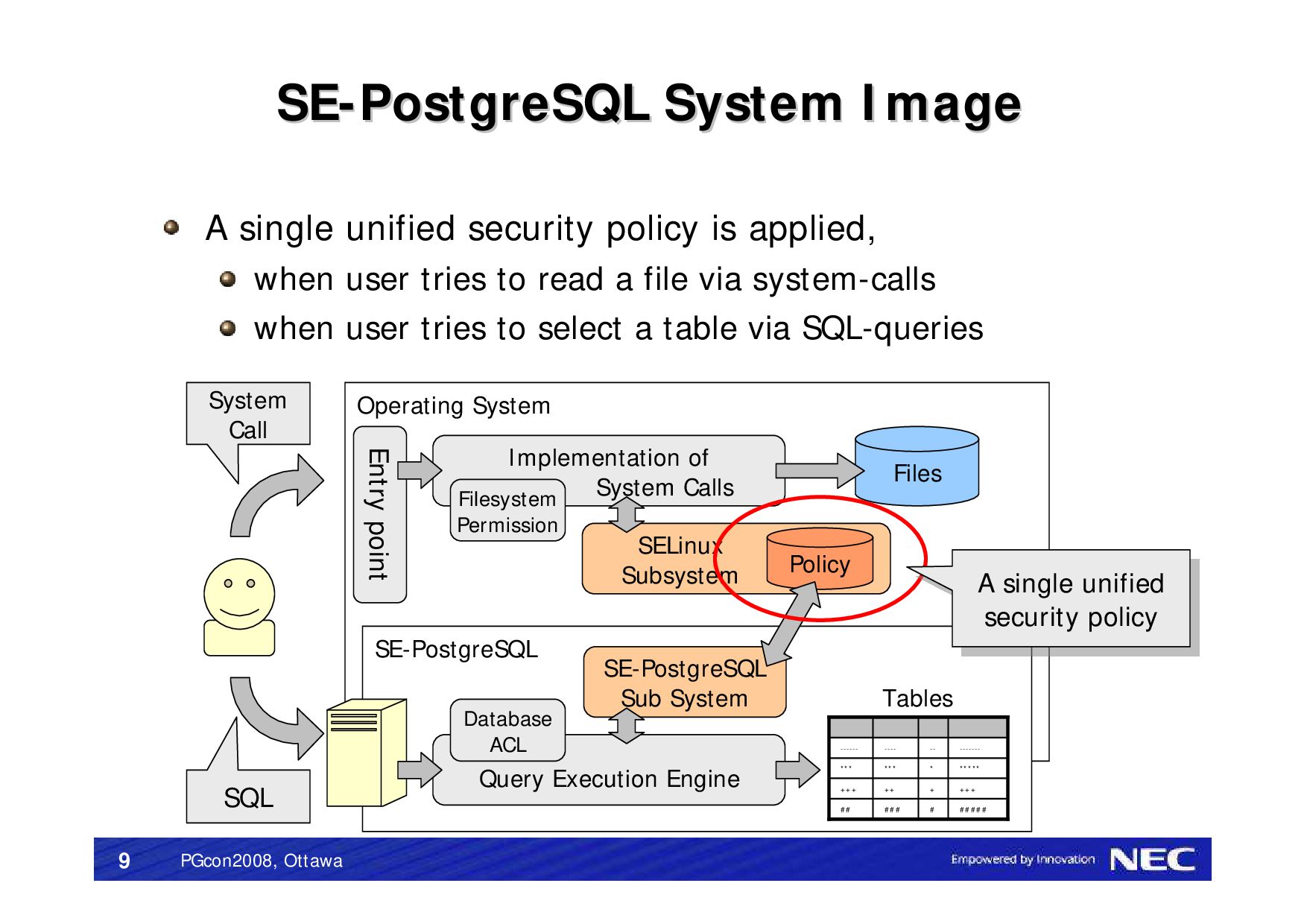
PostgreSQL System Image A single unified security policy is applied, when user tries to read a file via system-calls when user tries to select a table via SQL-queries SE-PostgreSQL Query Execution Engine SE-PostgreSQL Sub System ------- -- ---- ------ ##### # ### ## +++ + ++ +++ ***** * *** *** Policy Implementation of System Calls Files Entry point SQL System Call SELinux Subsystem Database ACL Filesystem Permission Tables A single unified security policy A single unified security policy
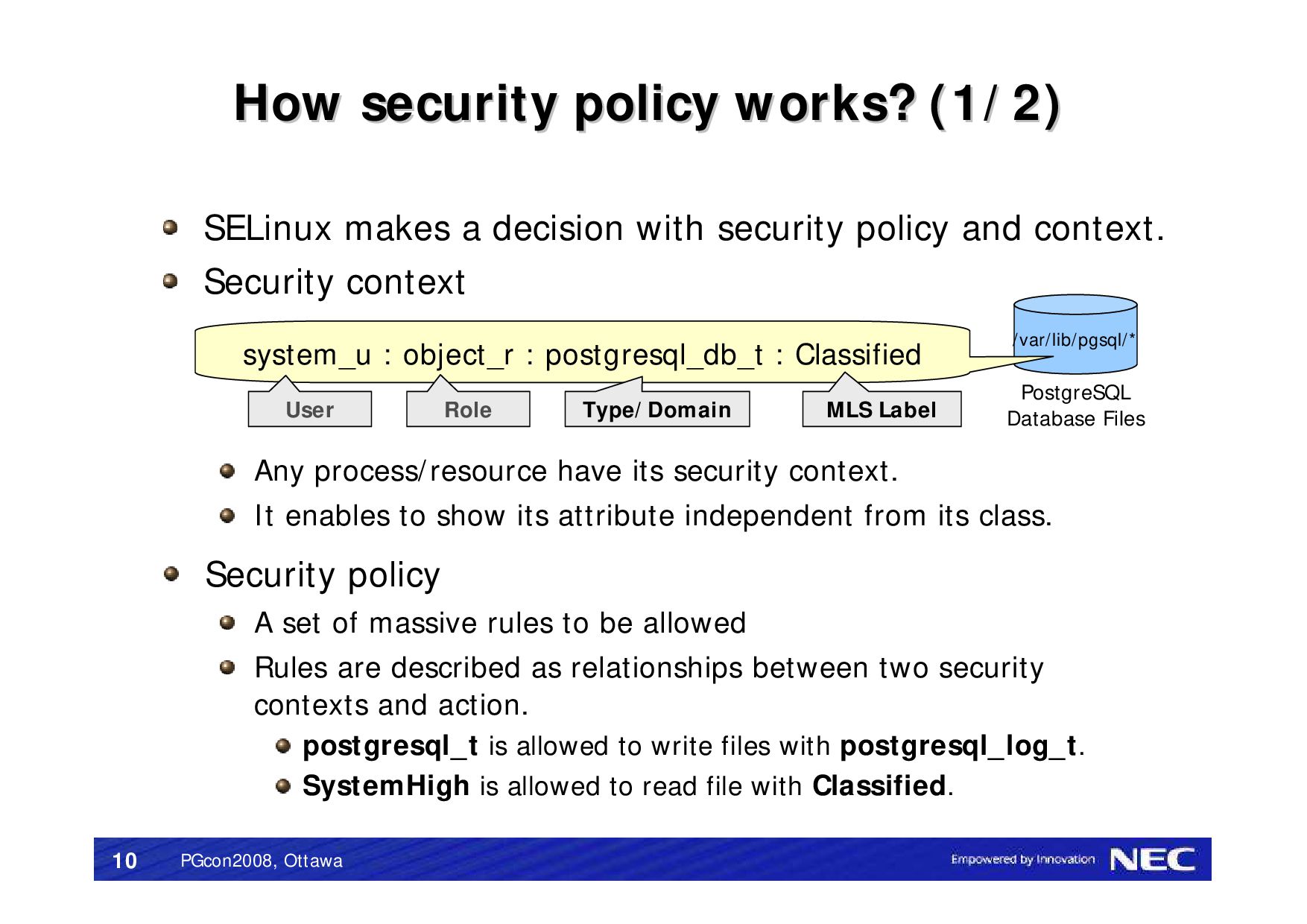
policy works? (1/2) SELinux makes a decision with security policy and context. Security context Any process/resource have its security context. It enables to show its attribute independent from its class. Security policy A set of massive rules to be allowed Rules are described as relationships between two security contexts and action. postgresql_t is allowed to write files with postgresql_log_t. SystemHigh is allowed to read file with Classified. /var/lib/pgsql/* system_u : object_r : postgresql_db_t : Classified User Role Type/Domain MLS Label PostgreSQL Database Files
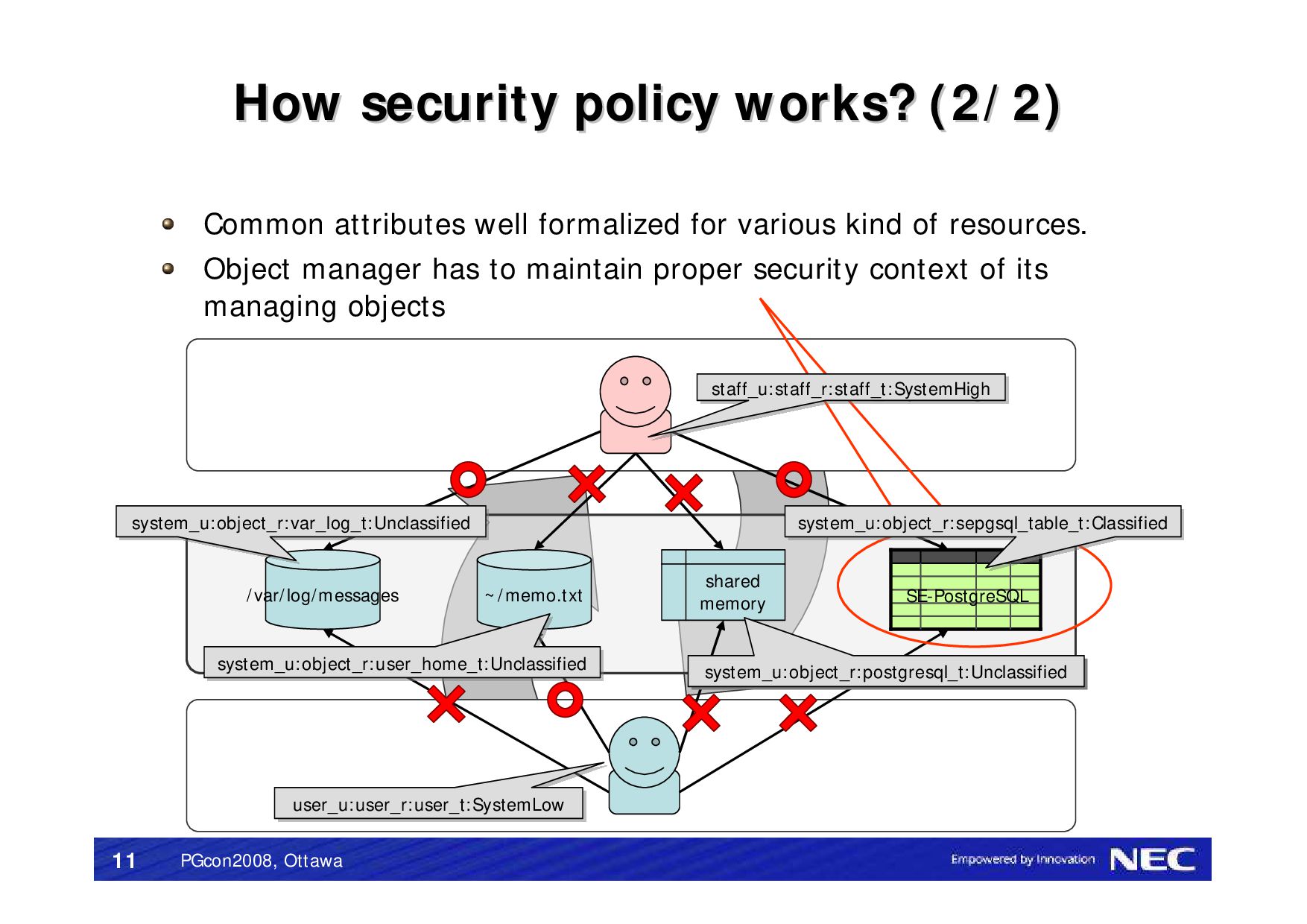
policy works? (2/2) /var/log/messages shared memory ~/memo.txt SE-PostgreSQL Common attributes well formalized for various kind of resources. Object manager has to maintain proper security context of its managing objects user_u:user_r:user_t:SystemLow user_u:user_r:user_t:SystemLow system_u:object_r:postgresql_t:Unclassified system_u:object_r:postgresql_t:Unclassified system_u:object_r:user_home_t:Unclassified system_u:object_r:user_home_t:Unclassified system_u:object_r:var_log_t:Unclassified system_u:object_r:var_log_t:Unclassified staff_u:staff_r:staff_t:SystemHigh staff_u:staff_r:staff_t:SystemHigh system_u:object_r:sepgsql_table_t:Classified system_u:object_r:sepgsql_table_t:Classified
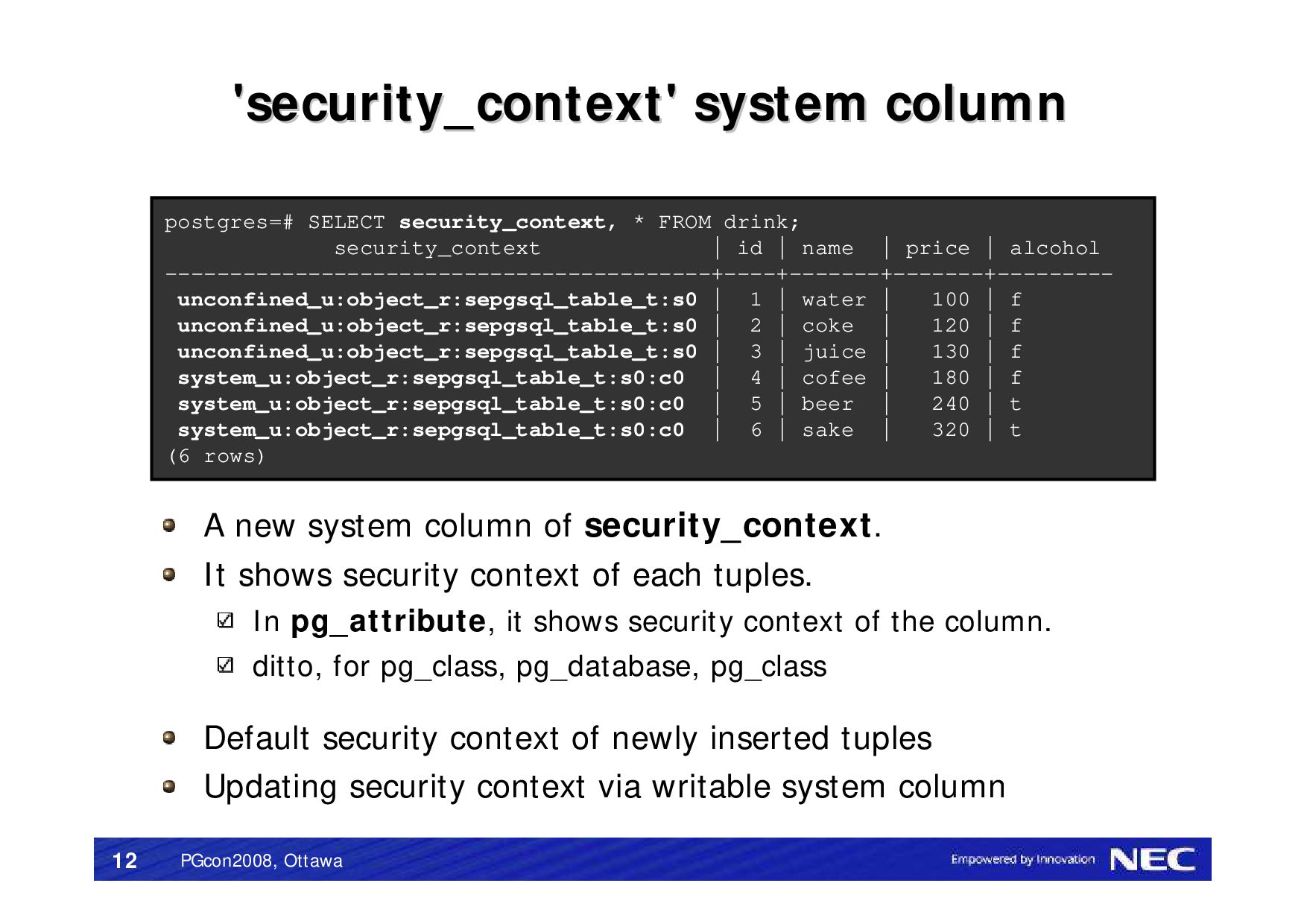
new system column of security_context. It shows security context of each tuples. In pg_attribute, it shows security context of the column. ditto, for pg_class, pg_database, pg_class Default security context of newly inserted tuples Updating security context via writable system column postgres=# SELECT security_context, * FROM drink; security_context | id | name | price | alcohol ------------------------------------------+----+-------+-------+--------- unconfined_u:object_r:sepgsql_table_t:s0 | 1 | water | 100 | f unconfined_u:object_r:sepgsql_table_t:s0 | 2 | coke | 120 | f unconfined_u:object_r:sepgsql_table_t:s0 | 3 | juice | 130 | f system_u:object_r:sepgsql_table_t:s0:c0 | 4 | cofee | 180 | f system_u:object_r:sepgsql_table_t:s0:c0 | 5 | beer | 240 | t system_u:object_r:sepgsql_table_t:s0:c0 | 6 | sake | 320 | t (6 rows)
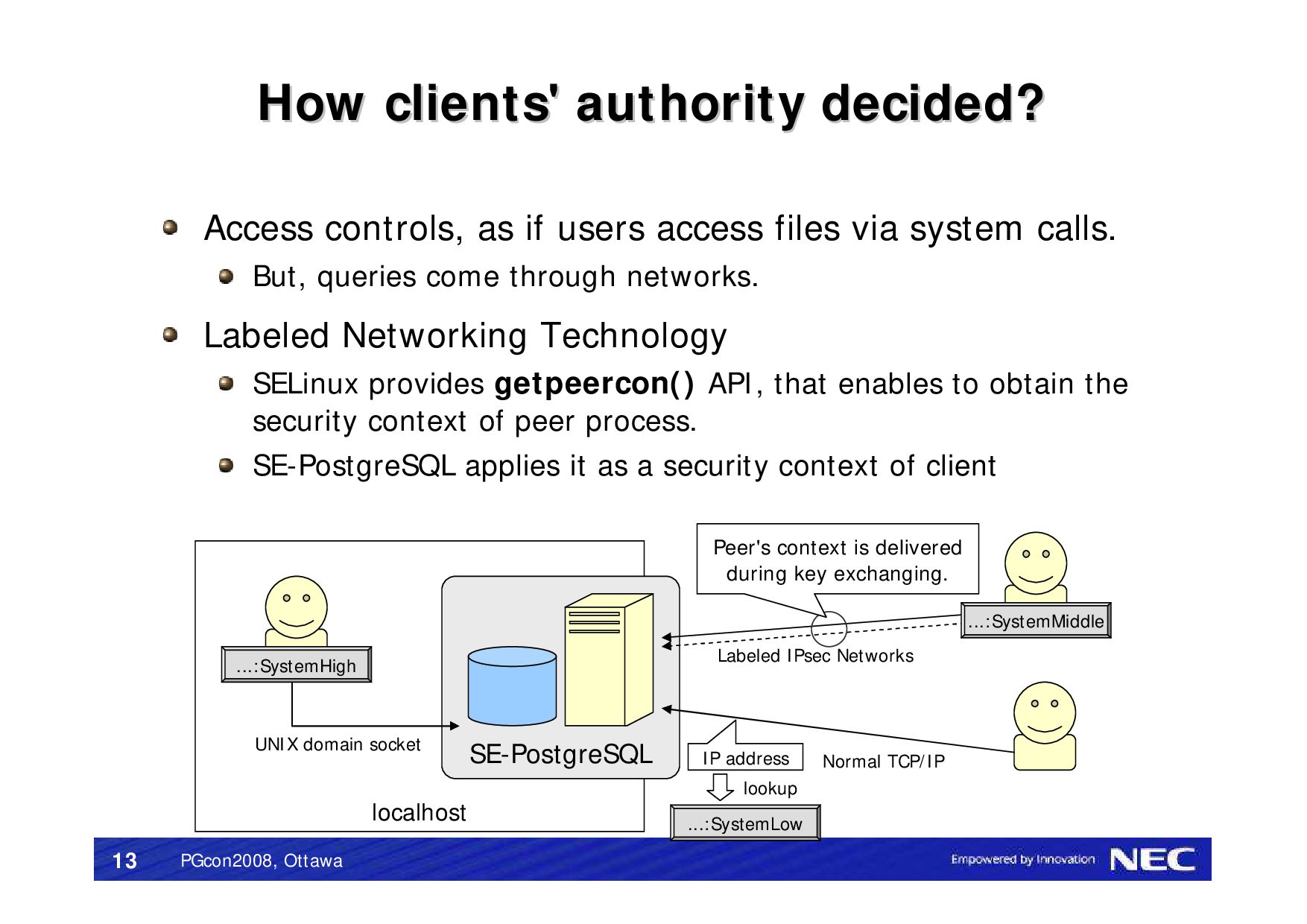
clients' authority decided? Access controls, as if users access files via system calls. But, queries come through networks. Labeled Networking Technology SELinux provides getpeercon() API, that enables to obtain the security context of peer process. SE-PostgreSQL applies it as a security context of client ...:SystemLow ...:SystemHigh UNIX domain socket Labeled IPsec Networks Normal TCP/IP ...:SystemMiddle IP address lookup Peer's context is delivered during key exchanging.
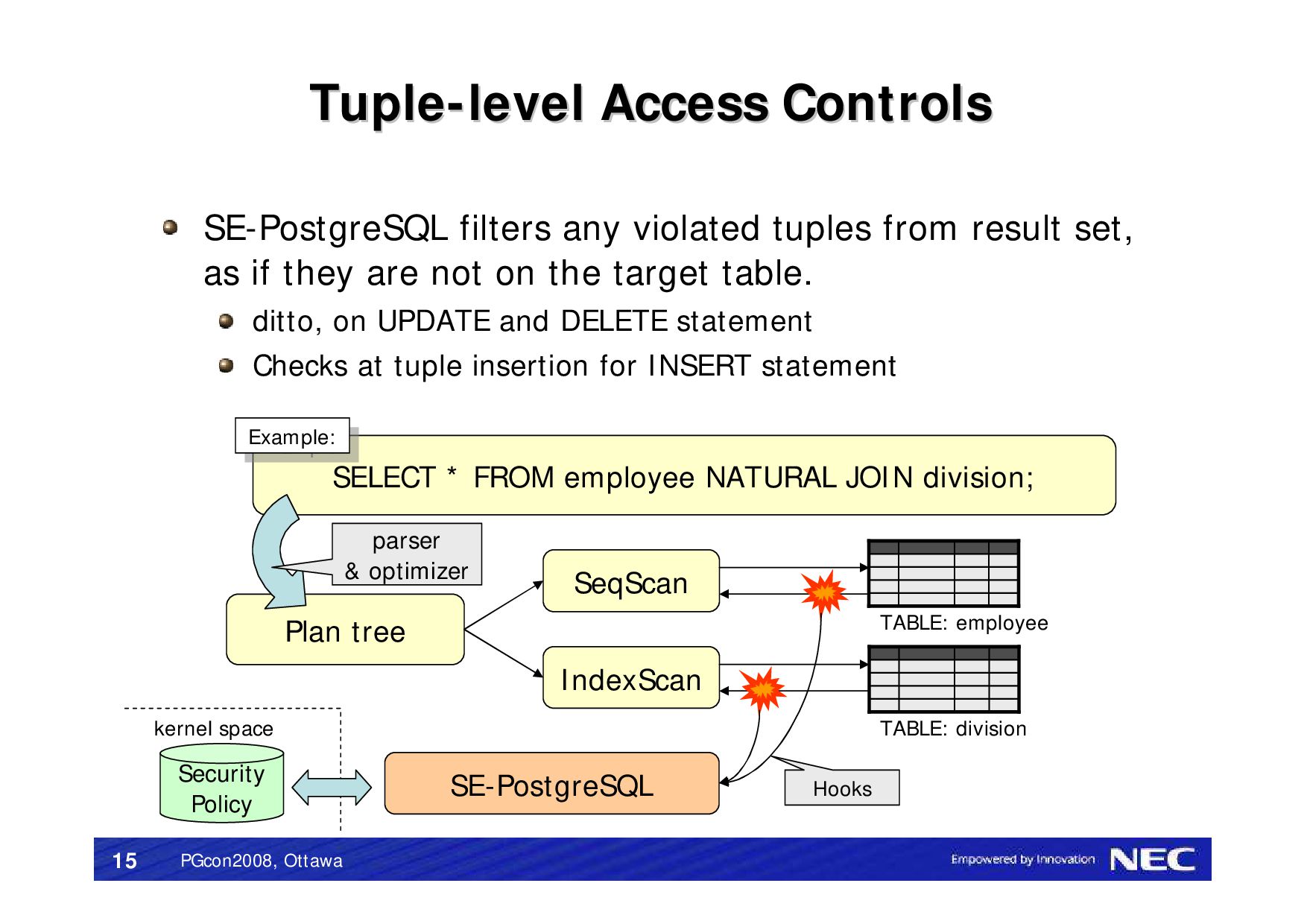
Controls SE-PostgreSQL filters any violated tuples from result set, as if they are not on the target table. ditto, on UPDATE and DELETE statement Checks at tuple insertion for INSERT statement SELECT * FROM employee NATURAL JOIN division; Example: Example: Plan tree parser & optimizer SeqScan IndexScan TABLE: employee TABLE: division SE-PostgreSQL Hooks kernel space Security Policy
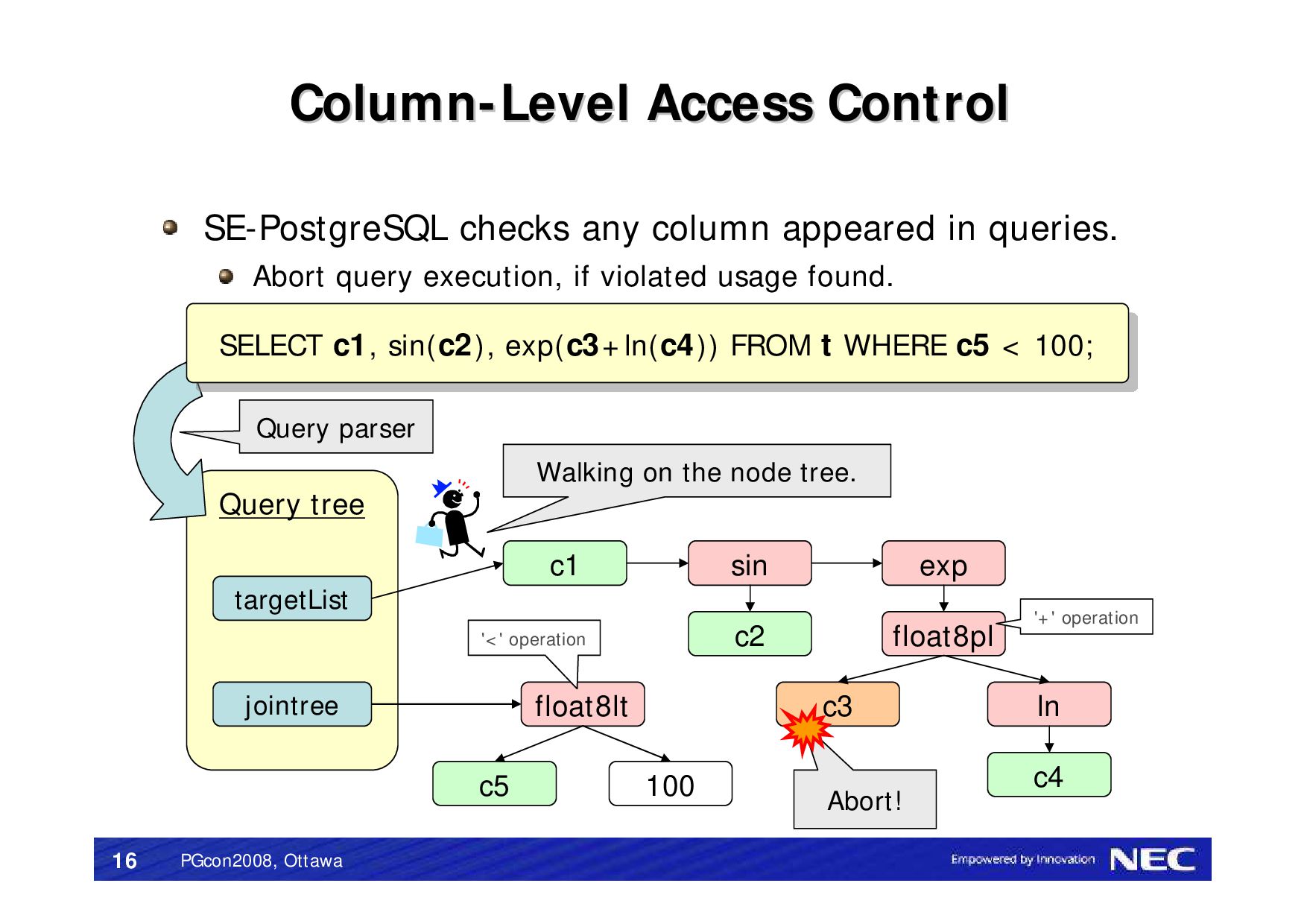
Control SE-PostgreSQL checks any column appeared in queries. Abort query execution, if violated usage found. Query tree Query parser c1 sin c2 exp ln c3 float8pl c4 float8lt c5 100 '<' operation '+' operation Walking on the node tree. SELECT c1, sin(c2), exp(c3+ln(c4)) FROM t WHERE c5 < 100; SELECT c1, sin(c2), exp(c3+ln(c4)) FROM t WHERE c5 < 100; Abort! targetList jointree
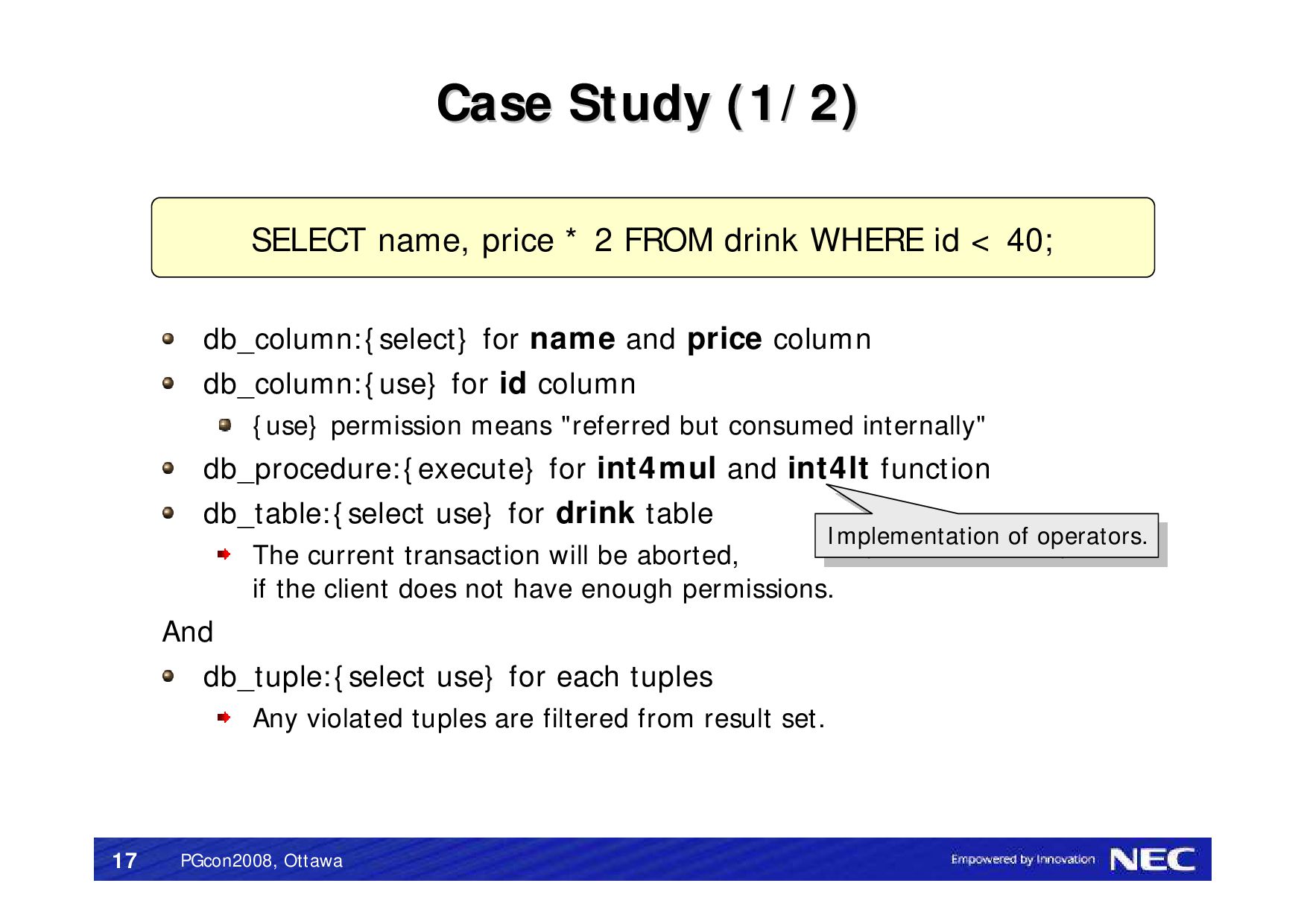
for name and price column db_column:{use} for id column {use} permission means "referred but consumed internally" db_procedure:{execute} for int4mul and int4lt function db_table:{select use} for drink table The current transaction will be aborted, if the client does not have enough permissions. And db_tuple:{select use} for each tuples Any violated tuples are filtered from result set. SELECT name, price * 2 FROM drink WHERE id < 40; Implementation of operators. Implementation of operators.
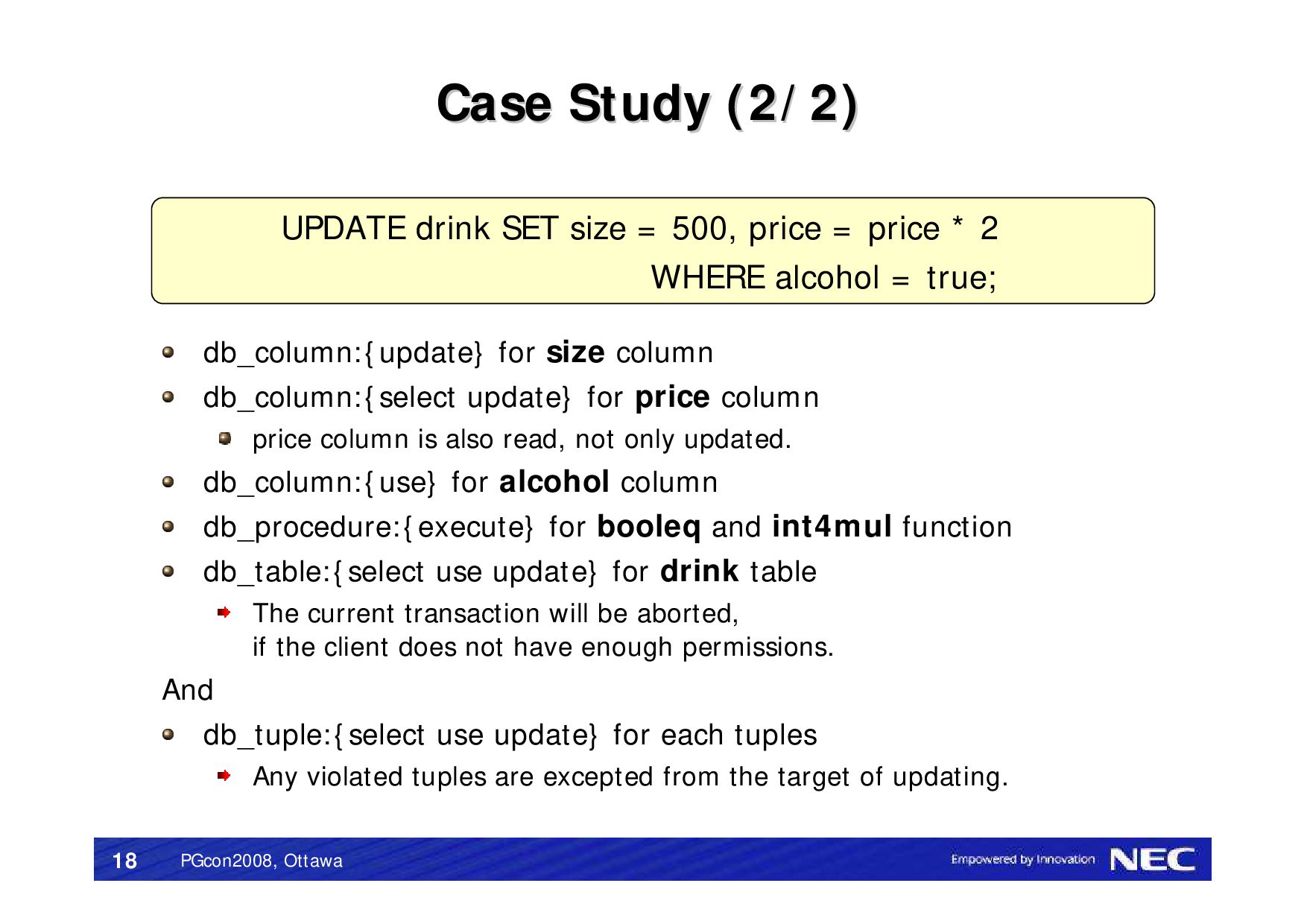
for size column db_column:{select update} for price column price column is also read, not only updated. db_column:{use} for alcohol column db_procedure:{execute} for booleq and int4mul function db_table:{select use update} for drink table The current transaction will be aborted, if the client does not have enough permissions. And db_tuple:{select use update} for each tuples Any violated tuples are excepted from the target of updating. UPDATE drink SET size = 500, price = price * 2 WHERE alcohol = true;
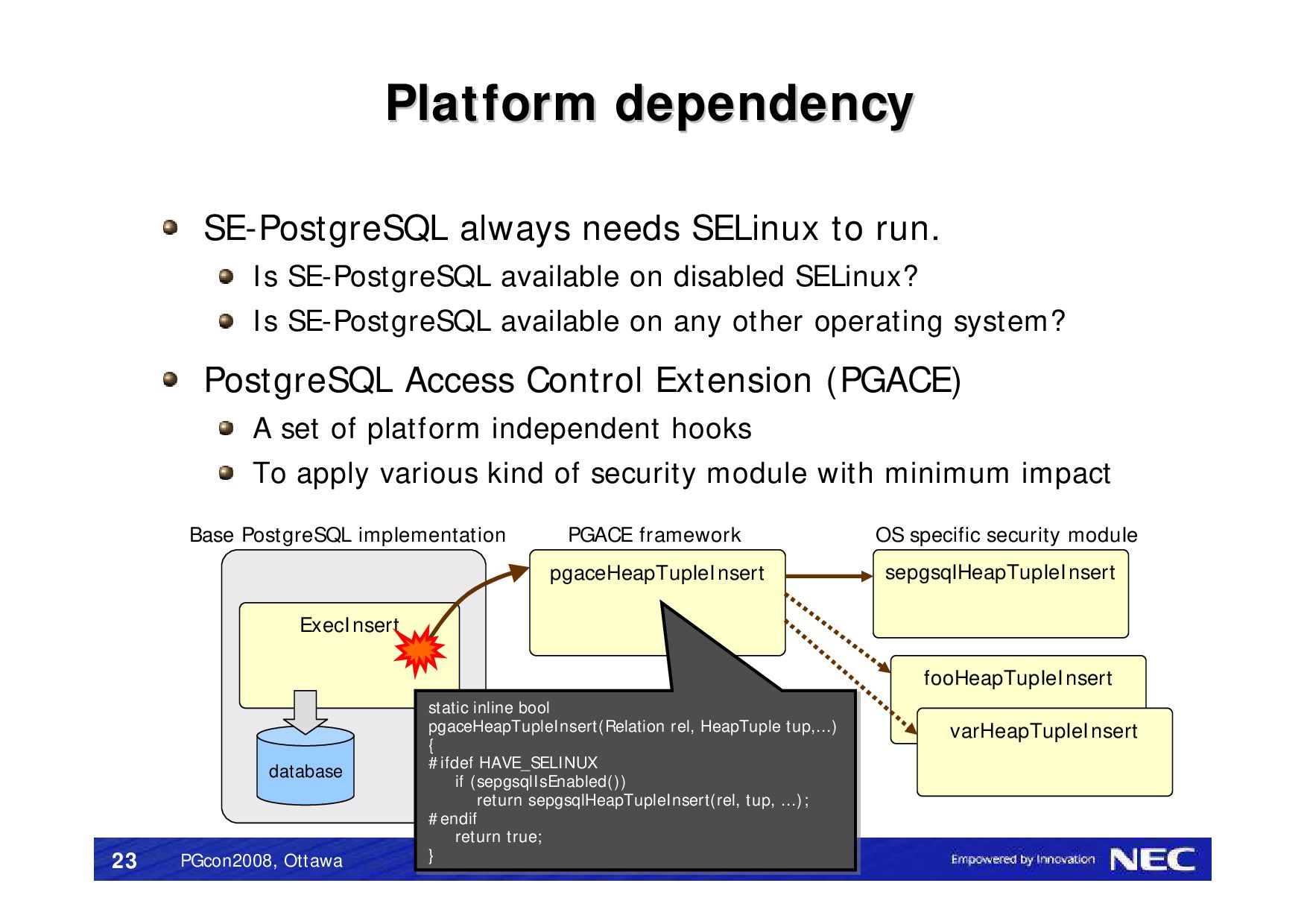
SELinux to run. Is SE-PostgreSQL available on disabled SELinux? Is SE-PostgreSQL available on any other operating system? PostgreSQL Access Control Extension (PGACE) A set of platform independent hooks To apply various kind of security module with minimum impact ExecInsert Base PostgreSQL implementation pgaceHeapTupleInsert sepgsqlHeapTupleInsert fooHeapTupleInsert varHeapTupleInsert static inline bool pgaceHeapTupleInsert(Relation rel, HeapTuple tup,...) { #ifdef HAVE_SELINUX if (sepgsqlIsEnabled()) return sepgsqlHeapTupleInsert(rel, tup, ...); #endif return true; } static inline bool pgaceHeapTupleInsert(Relation rel, HeapTuple tup,...) { #ifdef HAVE_SELINUX if (sepgsqlIsEnabled()) return sepgsqlHeapTupleInsert(rel, tup, ...); #endif return true; } database PGACE framework OS specific security module
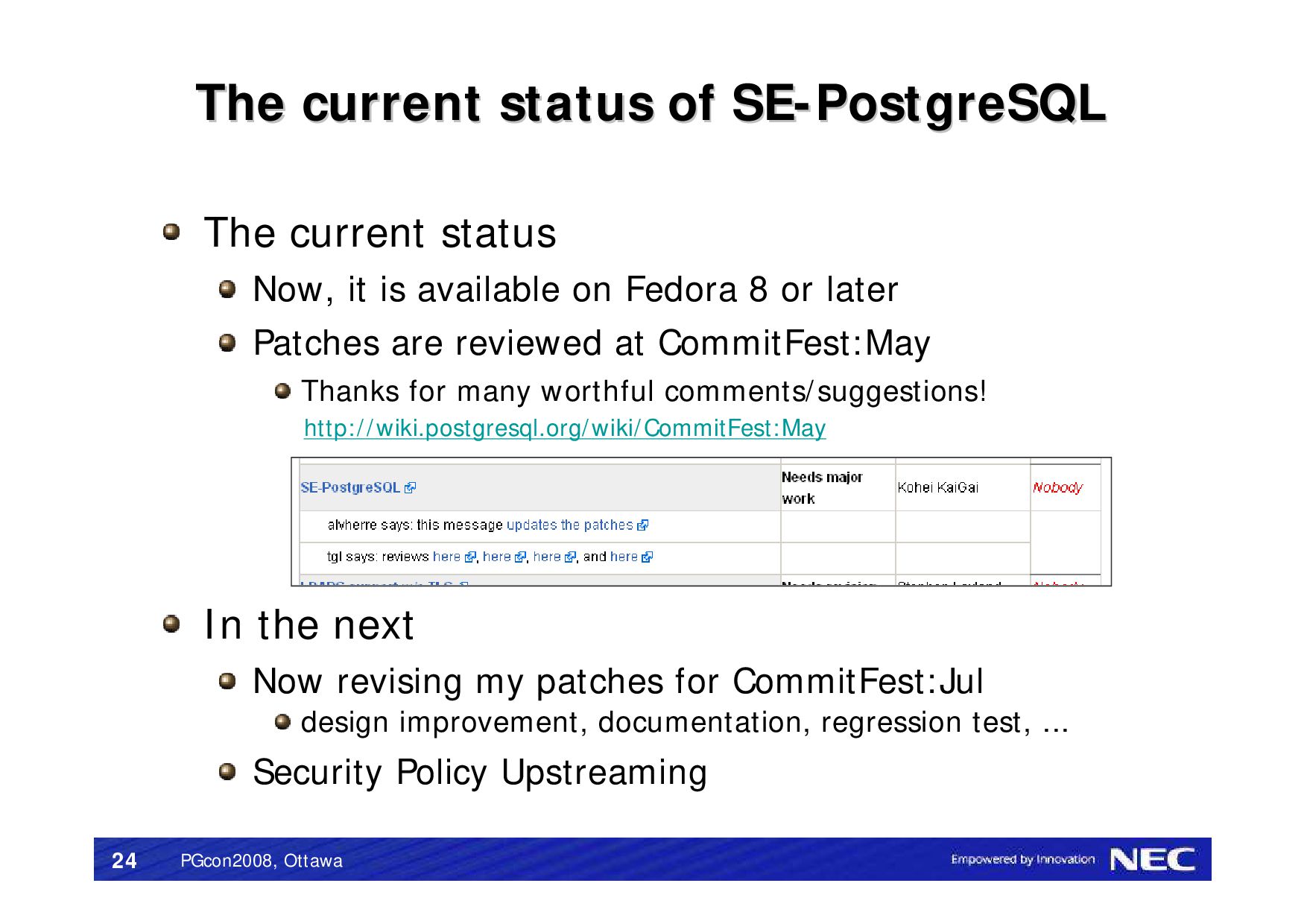
status of SE- -PostgreSQL PostgreSQL The current status Now, it is available on Fedora 8 or later Patches are reviewed at CommitFest:May Thanks for many worthful comments/suggestions! In the next Now revising my patches for CommitFest:Jul design improvement, documentation, regression test, ... Security Policy Upstreaming http://wiki.postgresql.org/wiki/CommitFest:May
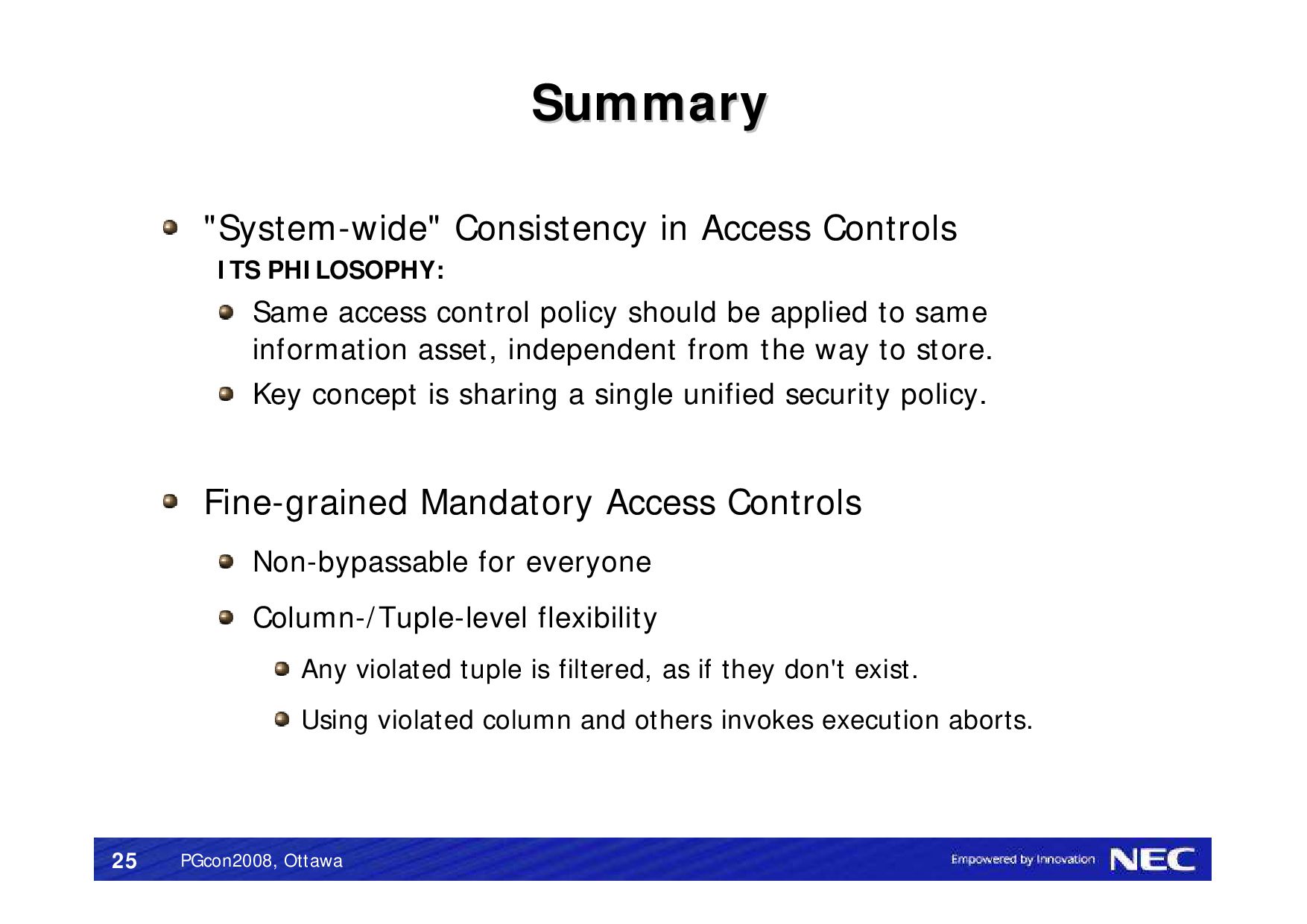
ITS PHILOSOPHY: Same access control policy should be applied to same information asset, independent from the way to store. Key concept is sharing a single unified security policy. Fine-grained Mandatory Access Controls Non-bypassable for everyone Column-/Tuple-level flexibility Any violated tuple is filtered, as if they don't exist. Using violated column and others invokes execution aborts.
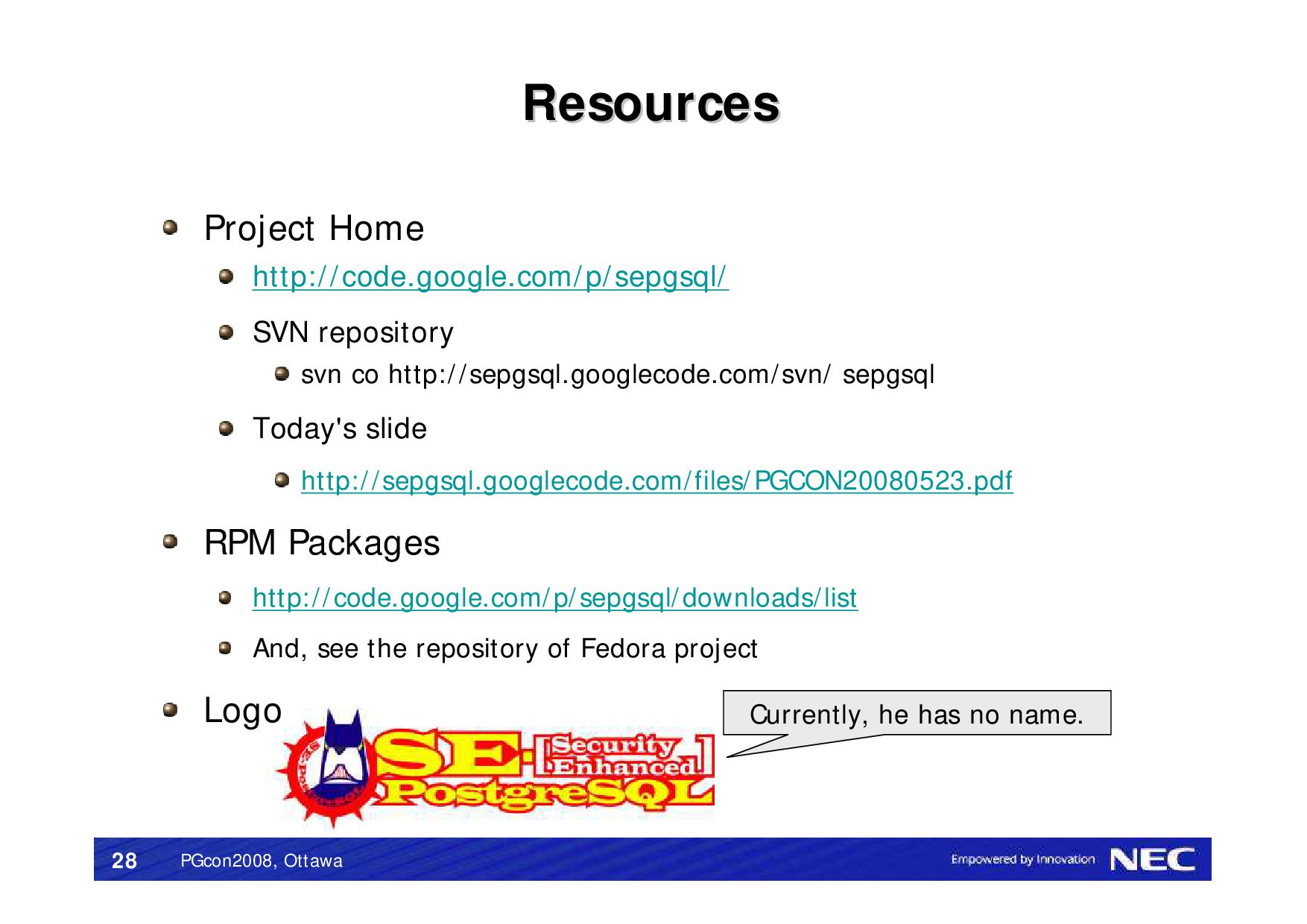
svn co http://sepgsql.googlecode.com/svn/ sepgsql Today's slide http://sepgsql.googlecode.com/files/PGCON20080523.pdf RPM Packages http://code.google.com/p/sepgsql/downloads/list And, see the repository of Fedora project Logo Currently, he has no name.


 kaigai
 kakehashi
 kameitomohiro
 dada4386
 vivion
 sansantech
 toshimaru
 oracle4engineer
 yakumo
 hironobuiga
 tanakaseiya
 mkdev10
 eileencodes
 lynnandtonic
 letsgokoyo
 sstephenson
 tammyeverts
 destraynor
 aleyda
 holman
 katiecoart
 davidcarrasco
 stephaniewalter
 mraible