Upgrade to Pro — share decks privately, control downloads, hide ads and more …

Weekly Office Plant Maintenance Scheduling Hand...

Sponsored · Ship Features Fearlessly Turn features on and off without deploys. Used by thousands of Ruby developers. →

Weekly Office Plant Maintenance Scheduling Handbook: Building a Reliable Care Rhythm

This handbook provides a structured way to think about weekly office plant maintenance and the role consistent service can play in keeping workplace plant programs organized. It covers the purpose of recurring visits, variables that affect care needs, the importance of using the same decision process from visit to visit, and how observations should be reviewed and communicated over time. A practical worksheet helps workplace teams evaluate lighting, plant condition, placement, and service considerations. The document is designed for organizations that value predictable responsibility instead of informal or inconsistent plant-care arrangements.

Avatar for Kelly Green

Kelly Green

August 30, 2026

Other Decks in Business

Transcript

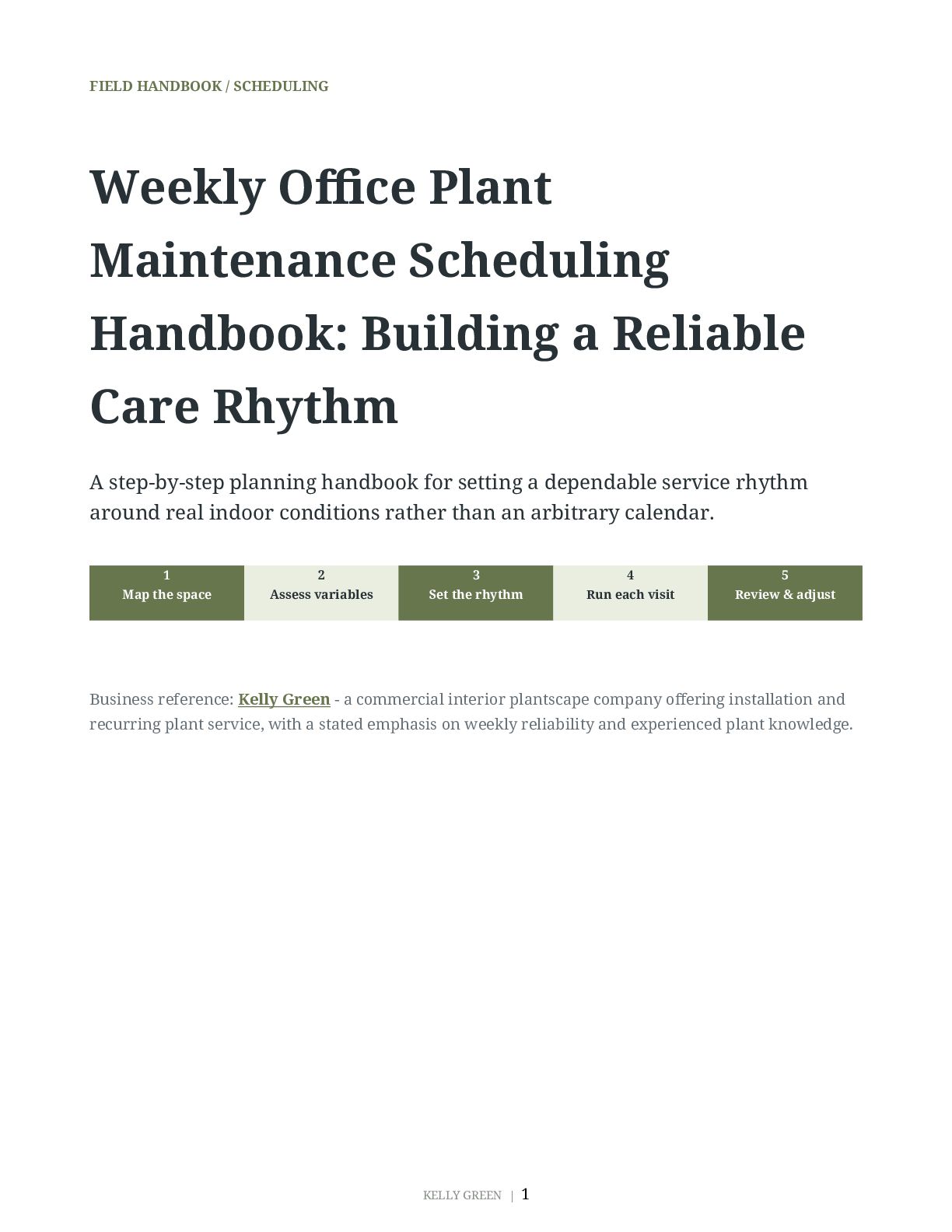
  1. FIELD HANDBOOK / SCHEDULING Weekly Office Plant Maintenance Scheduling Handbook:

    Building a Reliable Care Rhythm A step-by-step planning handbook for setting a dependable service rhythm around real indoor conditions rather than an arbitrary calendar. 1 2 3 4 5 Map the space Assess variables Set the rhythm Run each visit Review & adjust Business reference: Kelly Green - a commercial interior plantscape company offering installation and recurring plant service, with a stated emphasis on weekly reliability and experienced plant knowledge. KELLY GREEN | 1
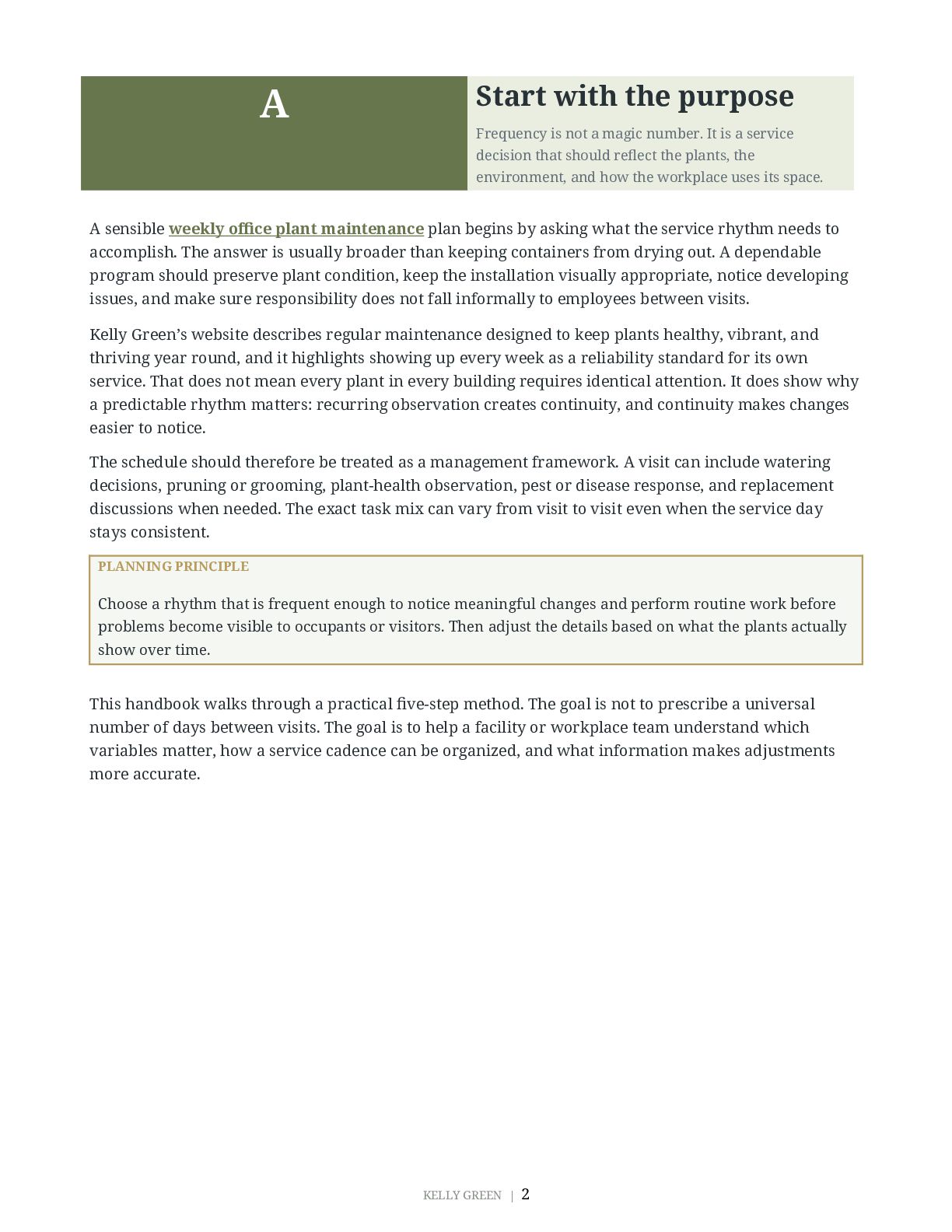
  2. A Start with the purpose Frequency is not a magic

    number. It is a service decision that should reflect the plants, the environment, and how the workplace uses its space. A sensible weekly office plant maintenance plan begins by asking what the service rhythm needs to accomplish. The answer is usually broader than keeping containers from drying out. A dependable program should preserve plant condition, keep the installation visually appropriate, notice developing issues, and make sure responsibility does not fall informally to employees between visits. Kelly Green’s website describes regular maintenance designed to keep plants healthy, vibrant, and thriving year round, and it highlights showing up every week as a reliability standard for its own service. That does not mean every plant in every building requires identical attention. It does show why a predictable rhythm matters: recurring observation creates continuity, and continuity makes changes easier to notice. The schedule should therefore be treated as a management framework. A visit can include watering decisions, pruning or grooming, plant-health observation, pest or disease response, and replacement discussions when needed. The exact task mix can vary from visit to visit even when the service day stays consistent. PLANNING PRINCIPLE Choose a rhythm that is frequent enough to notice meaningful changes and perform routine work before problems become visible to occupants or visitors. Then adjust the details based on what the plants actually show over time. This handbook walks through a practical five-step method. The goal is not to prescribe a universal number of days between visits. The goal is to help a facility or workplace team understand which variables matter, how a service cadence can be organized, and what information makes adjustments more accurate. KELLY GREEN | 2
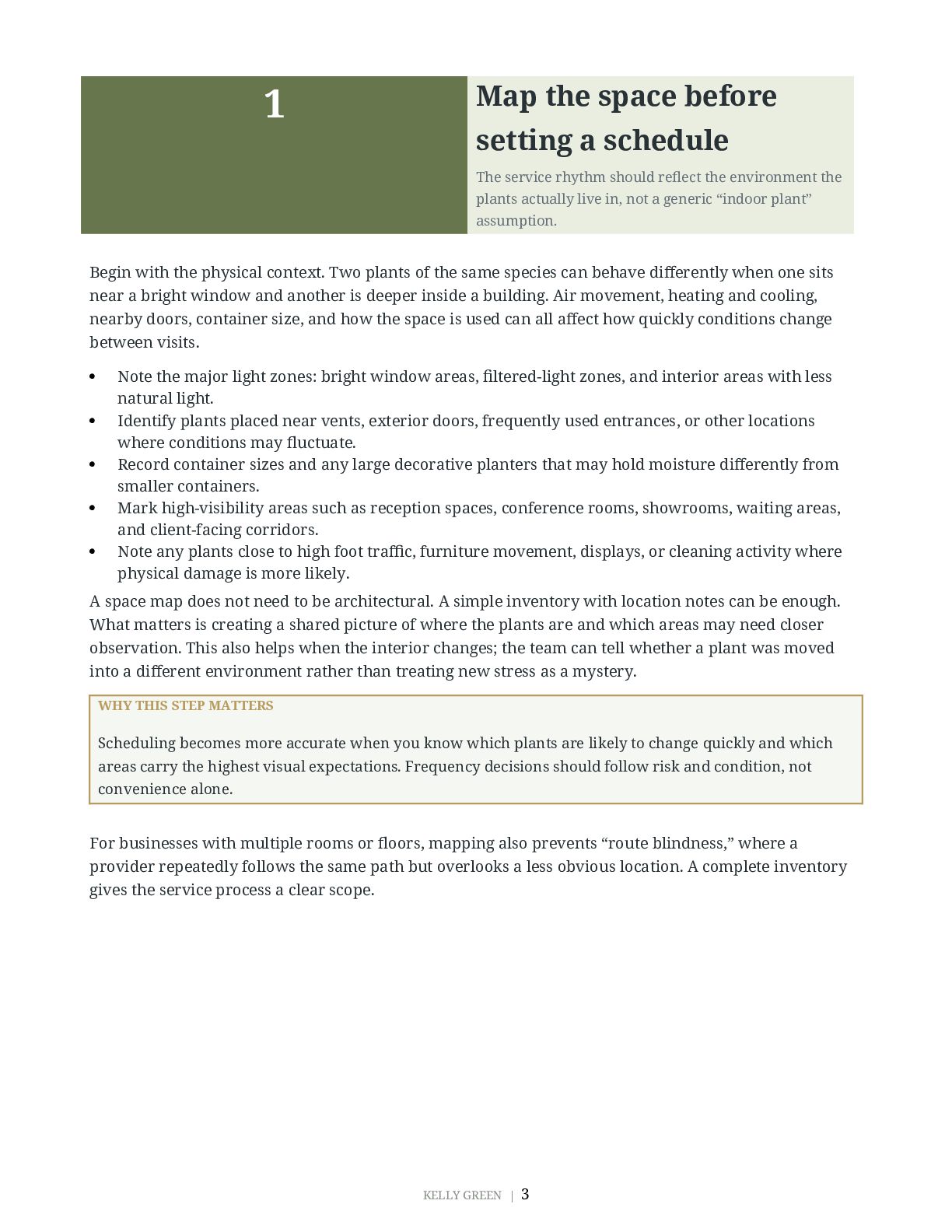
  3. 1 Map the space before setting a schedule The service

    rhythm should reflect the environment the plants actually live in, not a generic “indoor plant” assumption. Begin with the physical context. Two plants of the same species can behave differently when one sits near a bright window and another is deeper inside a building. Air movement, heating and cooling, nearby doors, container size, and how the space is used can all affect how quickly conditions change between visits.      Note the major light zones: bright window areas, filtered-light zones, and interior areas with less natural light. Identify plants placed near vents, exterior doors, frequently used entrances, or other locations where conditions may fluctuate. Record container sizes and any large decorative planters that may hold moisture differently from smaller containers. Mark high-visibility areas such as reception spaces, conference rooms, showrooms, waiting areas, and client-facing corridors. Note any plants close to high foot traffic, furniture movement, displays, or cleaning activity where physical damage is more likely. A space map does not need to be architectural. A simple inventory with location notes can be enough. What matters is creating a shared picture of where the plants are and which areas may need closer observation. This also helps when the interior changes; the team can tell whether a plant was moved into a different environment rather than treating new stress as a mystery. WHY THIS STEP MATTERS Scheduling becomes more accurate when you know which plants are likely to change quickly and which areas carry the highest visual expectations. Frequency decisions should follow risk and condition, not convenience alone. For businesses with multiple rooms or floors, mapping also prevents “route blindness,” where a provider repeatedly follows the same path but overlooks a less obvious location. A complete inventory gives the service process a clear scope. KELLY GREEN | 3
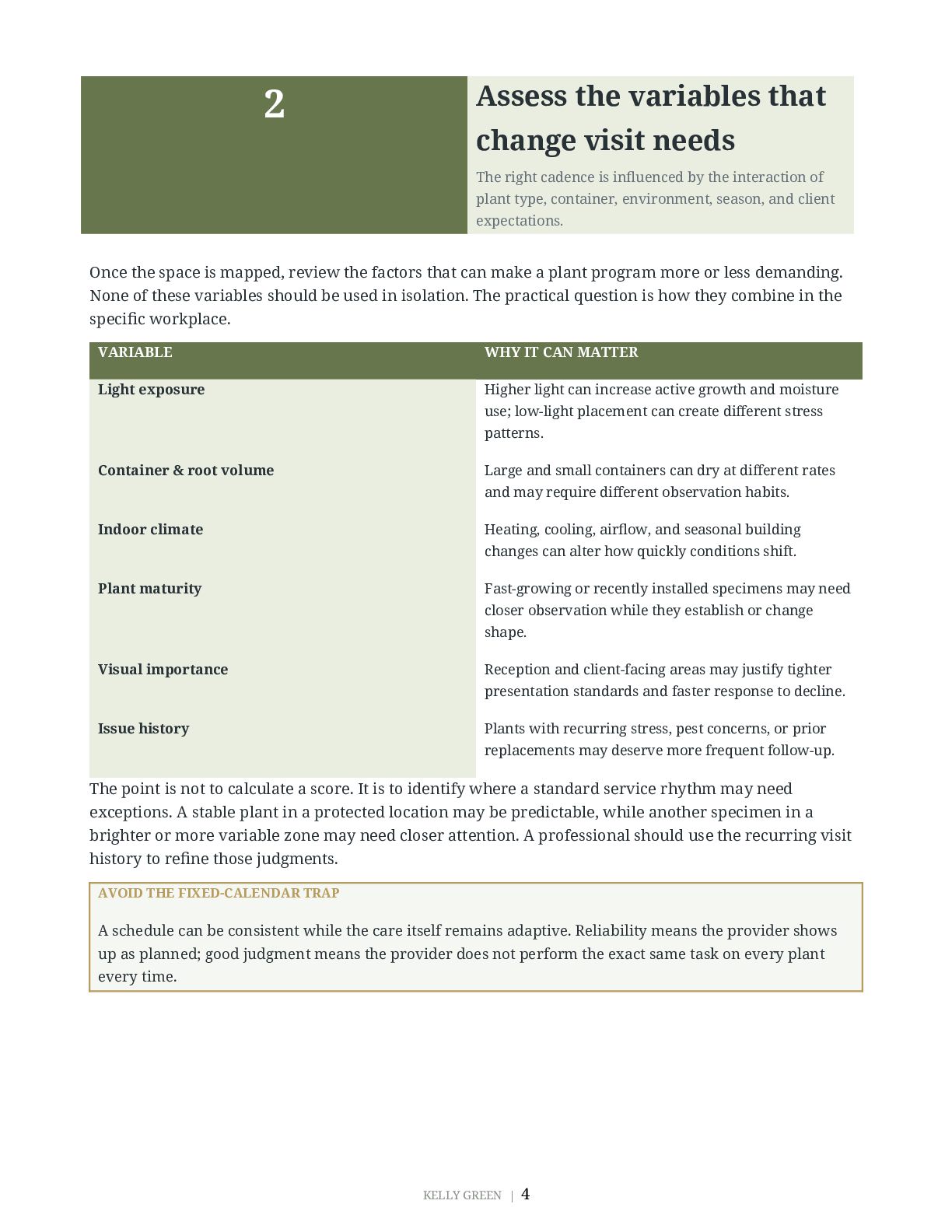
  4. 2 Assess the variables that change visit needs The right

    cadence is influenced by the interaction of plant type, container, environment, season, and client expectations. Once the space is mapped, review the factors that can make a plant program more or less demanding. None of these variables should be used in isolation. The practical question is how they combine in the specific workplace. VARIABLE WHY IT CAN MATTER Light exposure Higher light can increase active growth and moisture use; low-light placement can create different stress patterns. Container & root volume Large and small containers can dry at different rates and may require different observation habits. Indoor climate Heating, cooling, airflow, and seasonal building changes can alter how quickly conditions shift. Plant maturity Fast-growing or recently installed specimens may need closer observation while they establish or change shape. Visual importance Reception and client-facing areas may justify tighter presentation standards and faster response to decline. Issue history Plants with recurring stress, pest concerns, or prior replacements may deserve more frequent follow-up. The point is not to calculate a score. It is to identify where a standard service rhythm may need exceptions. A stable plant in a protected location may be predictable, while another specimen in a brighter or more variable zone may need closer attention. A professional should use the recurring visit history to refine those judgments. AVOID THE FIXED-CALENDAR TRAP A schedule can be consistent while the care itself remains adaptive. Reliability means the provider shows up as planned; good judgment means the provider does not perform the exact same task on every plant every time. KELLY GREEN | 4
  5. Set a dependable service 3 rhythm Choose a repeatable cadence,

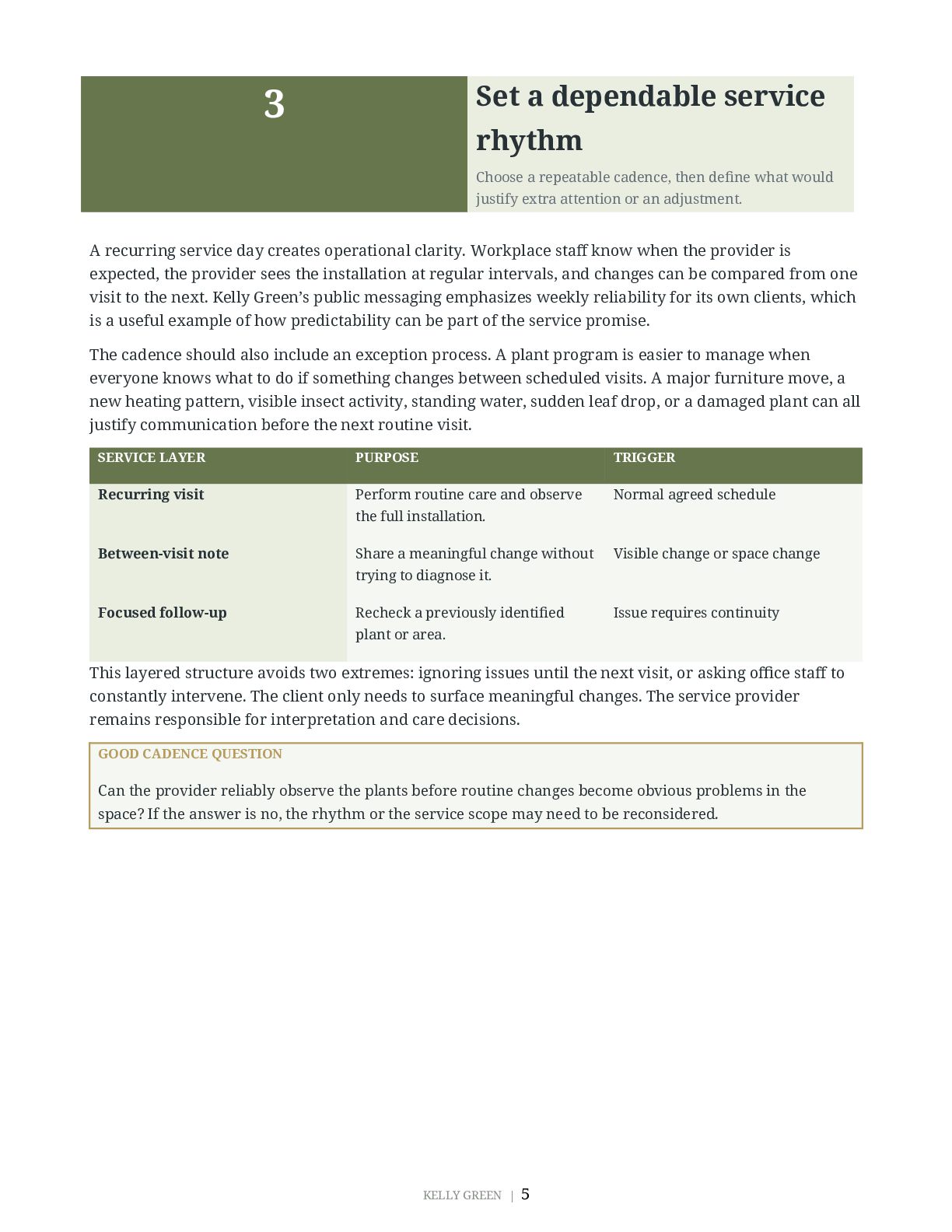
    then define what would justify extra attention or an adjustment. A recurring service day creates operational clarity. Workplace staff know when the provider is expected, the provider sees the installation at regular intervals, and changes can be compared from one visit to the next. Kelly Green’s public messaging emphasizes weekly reliability for its own clients, which is a useful example of how predictability can be part of the service promise. The cadence should also include an exception process. A plant program is easier to manage when everyone knows what to do if something changes between scheduled visits. A major furniture move, a new heating pattern, visible insect activity, standing water, sudden leaf drop, or a damaged plant can all justify communication before the next routine visit. SERVICE LAYER PURPOSE TRIGGER Recurring visit Perform routine care and observe Normal agreed schedule the full installation. Between-visit note Share a meaningful change without Visible change or space change trying to diagnose it. Focused follow-up Recheck a previously identified Issue requires continuity plant or area. This layered structure avoids two extremes: ignoring issues until the next visit, or asking office staff to constantly intervene. The client only needs to surface meaningful changes. The service provider remains responsible for interpretation and care decisions. GOOD CADENCE QUESTION Can the provider reliably observe the plants before routine changes become obvious problems in the space? If the answer is no, the rhythm or the service scope may need to be reconsidered. KELLY GREEN | 5
  6. 4 Run each visit with the same decision sequence Consistency

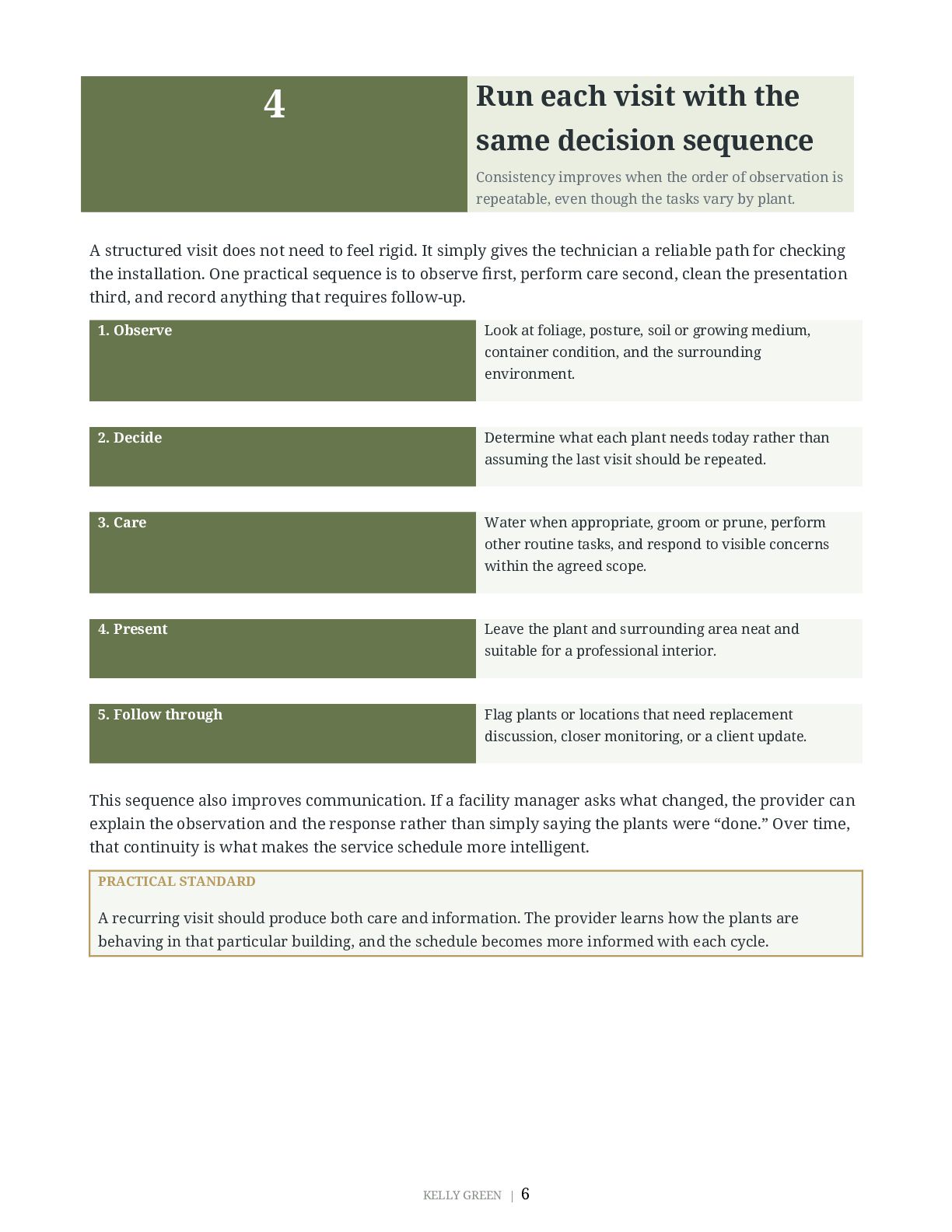
    improves when the order of observation is repeatable, even though the tasks vary by plant. A structured visit does not need to feel rigid. It simply gives the technician a reliable path for checking the installation. One practical sequence is to observe first, perform care second, clean the presentation third, and record anything that requires follow-up. 1. Observe Look at foliage, posture, soil or growing medium, container condition, and the surrounding environment. 2. Decide Determine what each plant needs today rather than assuming the last visit should be repeated. 3. Care Water when appropriate, groom or prune, perform other routine tasks, and respond to visible concerns within the agreed scope. 4. Present Leave the plant and surrounding area neat and suitable for a professional interior. 5. Follow through Flag plants or locations that need replacement discussion, closer monitoring, or a client update. This sequence also improves communication. If a facility manager asks what changed, the provider can explain the observation and the response rather than simply saying the plants were “done.” Over time, that continuity is what makes the service schedule more intelligent. PRACTICAL STANDARD A recurring visit should produce both care and information. The provider learns how the plants are behaving in that particular building, and the schedule becomes more informed with each cycle. KELLY GREEN | 6
  7. 5 Review, communicate, and adjust The schedule is a starting

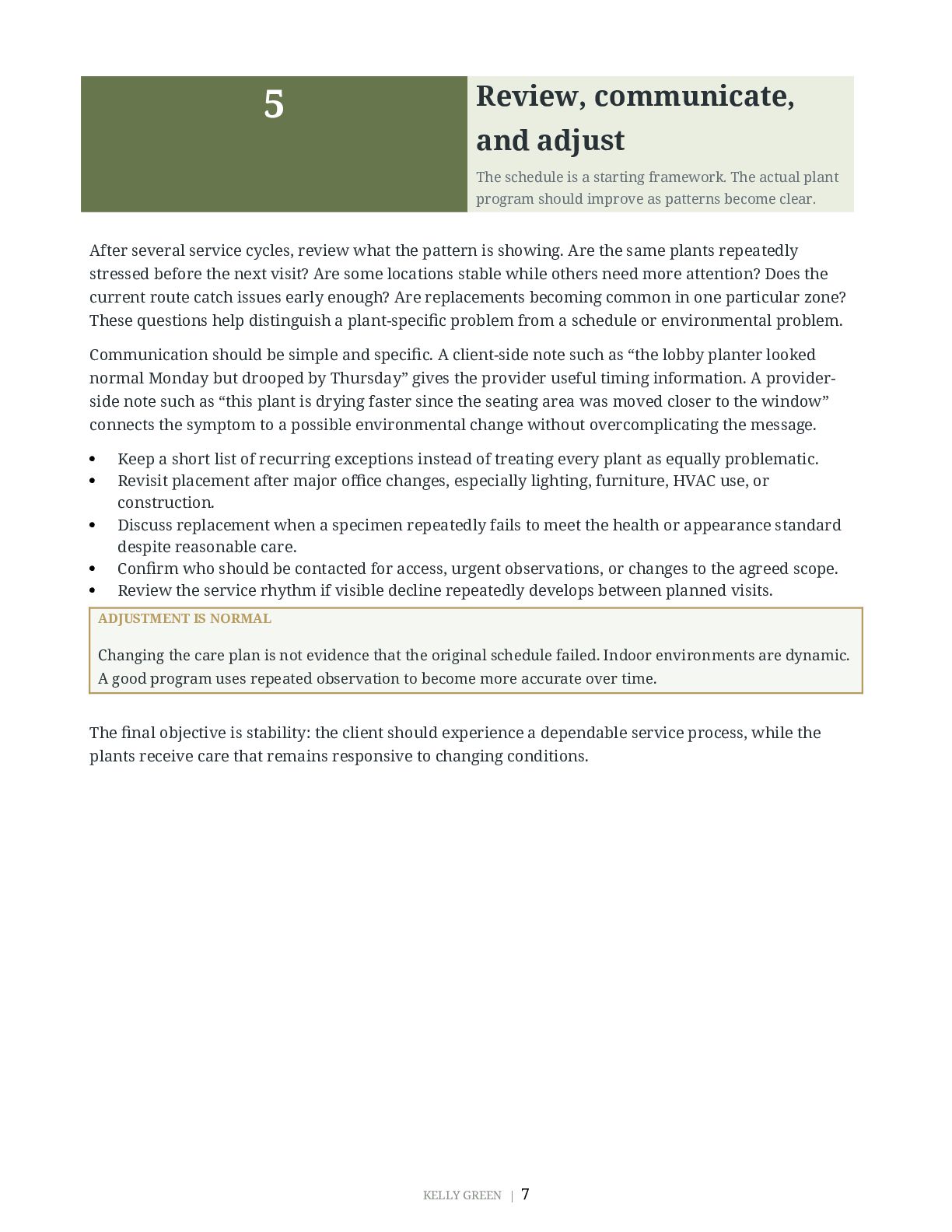
    framework. The actual plant program should improve as patterns become clear. After several service cycles, review what the pattern is showing. Are the same plants repeatedly stressed before the next visit? Are some locations stable while others need more attention? Does the current route catch issues early enough? Are replacements becoming common in one particular zone? These questions help distinguish a plant-specific problem from a schedule or environmental problem. Communication should be simple and specific. A client-side note such as “the lobby planter looked normal Monday but drooped by Thursday” gives the provider useful timing information. A providerside note such as “this plant is drying faster since the seating area was moved closer to the window” connects the symptom to a possible environmental change without overcomplicating the message.      Keep a short list of recurring exceptions instead of treating every plant as equally problematic. Revisit placement after major office changes, especially lighting, furniture, HVAC use, or construction. Discuss replacement when a specimen repeatedly fails to meet the health or appearance standard despite reasonable care. Confirm who should be contacted for access, urgent observations, or changes to the agreed scope. Review the service rhythm if visible decline repeatedly develops between planned visits. ADJUSTMENT IS NORMAL Changing the care plan is not evidence that the original schedule failed. Indoor environments are dynamic. A good program uses repeated observation to become more accurate over time. The final objective is stability: the client should experience a dependable service process, while the plants receive care that remains responsive to changing conditions. KELLY GREEN | 7
  8. P Planning worksheet Use this page as a practical action

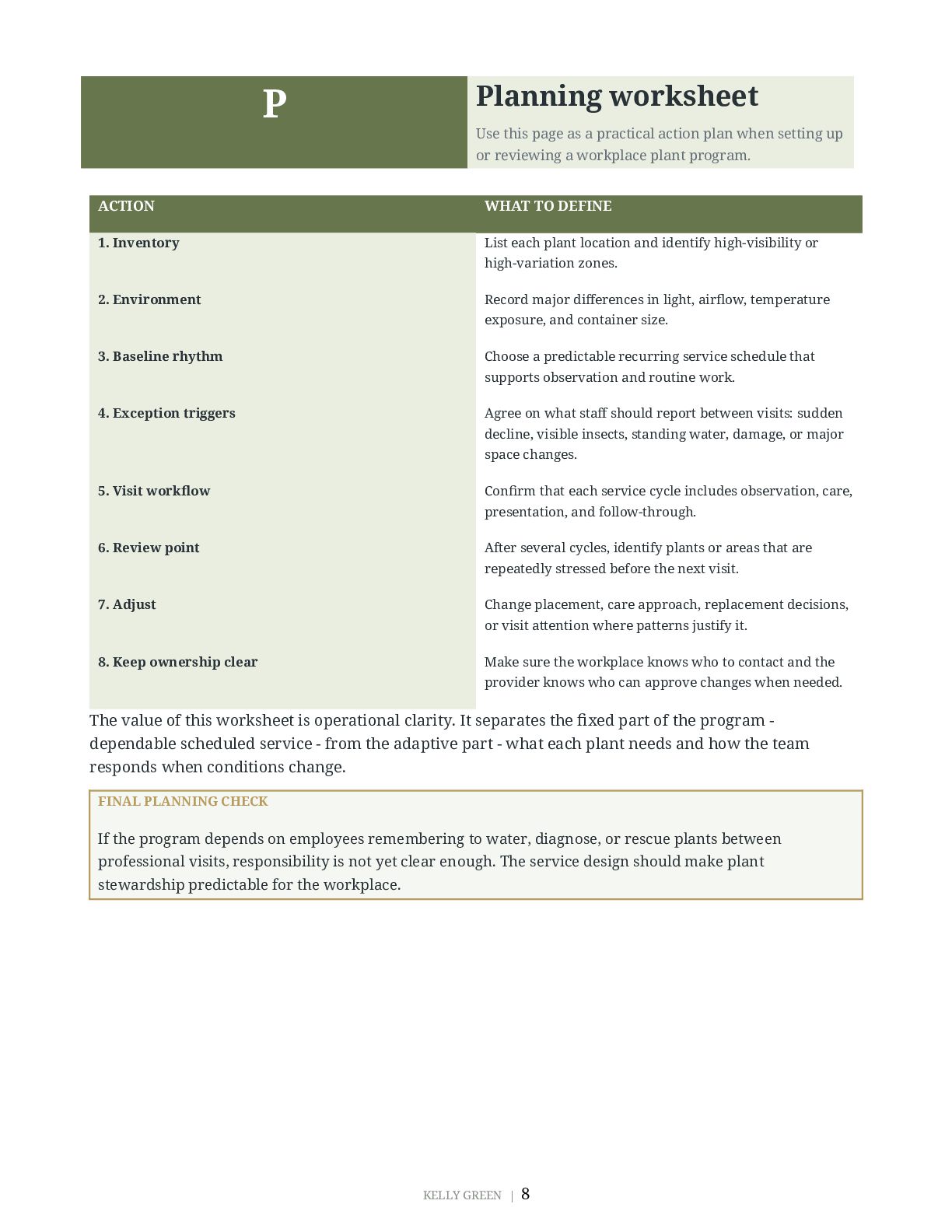
    plan when setting up or reviewing a workplace plant program. ACTION WHAT TO DEFINE 1. Inventory List each plant location and identify high-visibility or high-variation zones. 2. Environment Record major differences in light, airflow, temperature exposure, and container size. 3. Baseline rhythm Choose a predictable recurring service schedule that supports observation and routine work. 4. Exception triggers Agree on what staff should report between visits: sudden decline, visible insects, standing water, damage, or major space changes. 5. Visit workflow Confirm that each service cycle includes observation, care, presentation, and follow-through. 6. Review point After several cycles, identify plants or areas that are repeatedly stressed before the next visit. 7. Adjust Change placement, care approach, replacement decisions, or visit attention where patterns justify it. 8. Keep ownership clear Make sure the workplace knows who to contact and the provider knows who can approve changes when needed. The value of this worksheet is operational clarity. It separates the fixed part of the program dependable scheduled service - from the adaptive part - what each plant needs and how the team responds when conditions change. FINAL PLANNING CHECK If the program depends on employees remembering to water, diagnose, or rescue plants between professional visits, responsibility is not yet clear enough. The service design should make plant stewardship predictable for the workplace. KELLY GREEN | 8
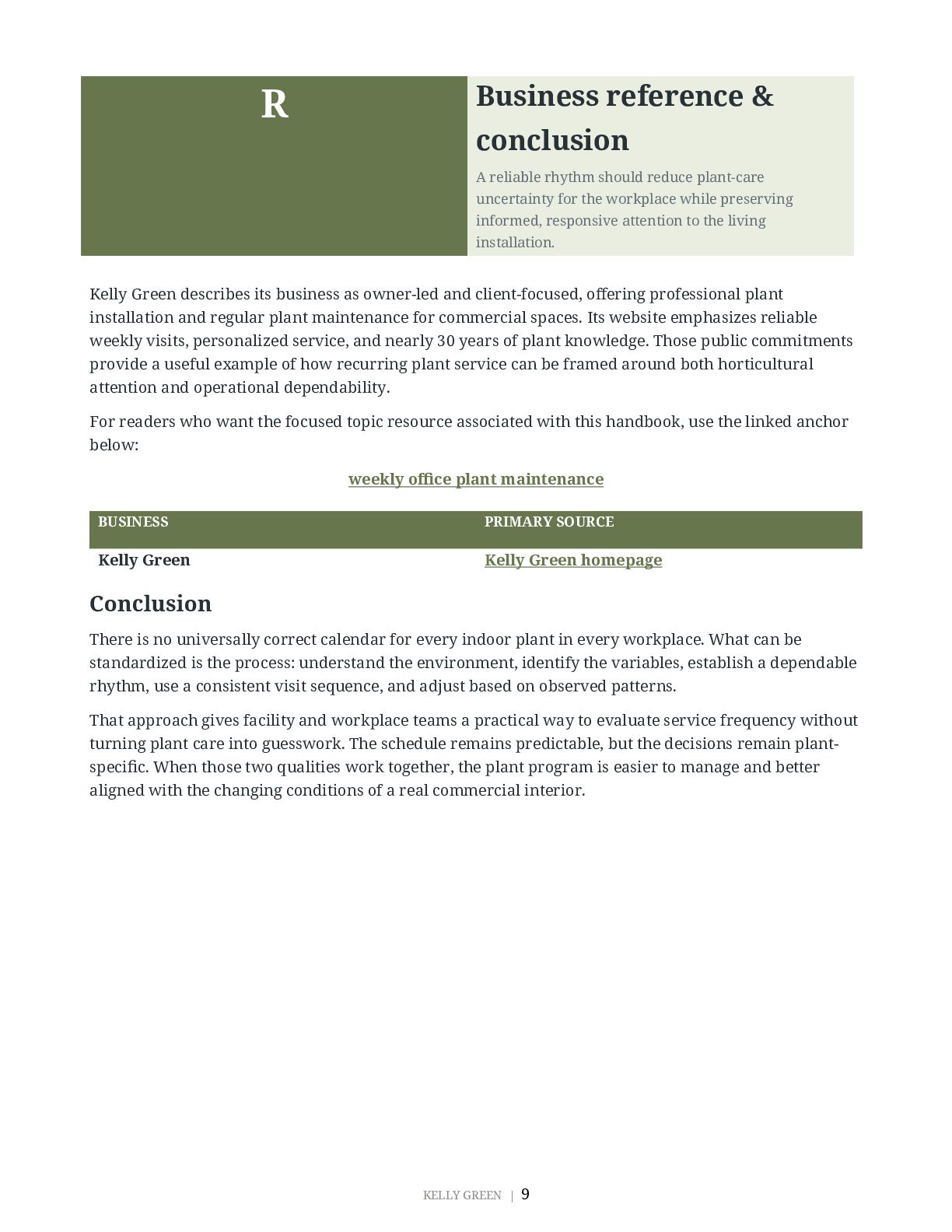
  9. R Business reference & conclusion A reliable rhythm should reduce

    plant-care uncertainty for the workplace while preserving informed, responsive attention to the living installation. Kelly Green describes its business as owner-led and client-focused, offering professional plant installation and regular plant maintenance for commercial spaces. Its website emphasizes reliable weekly visits, personalized service, and nearly 30 years of plant knowledge. Those public commitments provide a useful example of how recurring plant service can be framed around both horticultural attention and operational dependability. For readers who want the focused topic resource associated with this handbook, use the linked anchor below: weekly office plant maintenance BUSINESS PRIMARY SOURCE Kelly Green Kelly Green homepage Conclusion There is no universally correct calendar for every indoor plant in every workplace. What can be standardized is the process: understand the environment, identify the variables, establish a dependable rhythm, use a consistent visit sequence, and adjust based on observed patterns. That approach gives facility and workplace teams a practical way to evaluate service frequency without turning plant care into guesswork. The schedule remains predictable, but the decisions remain plantspecific. When those two qualities work together, the plant program is easier to manage and better aligned with the changing conditions of a real commercial interior. KELLY GREEN | 9