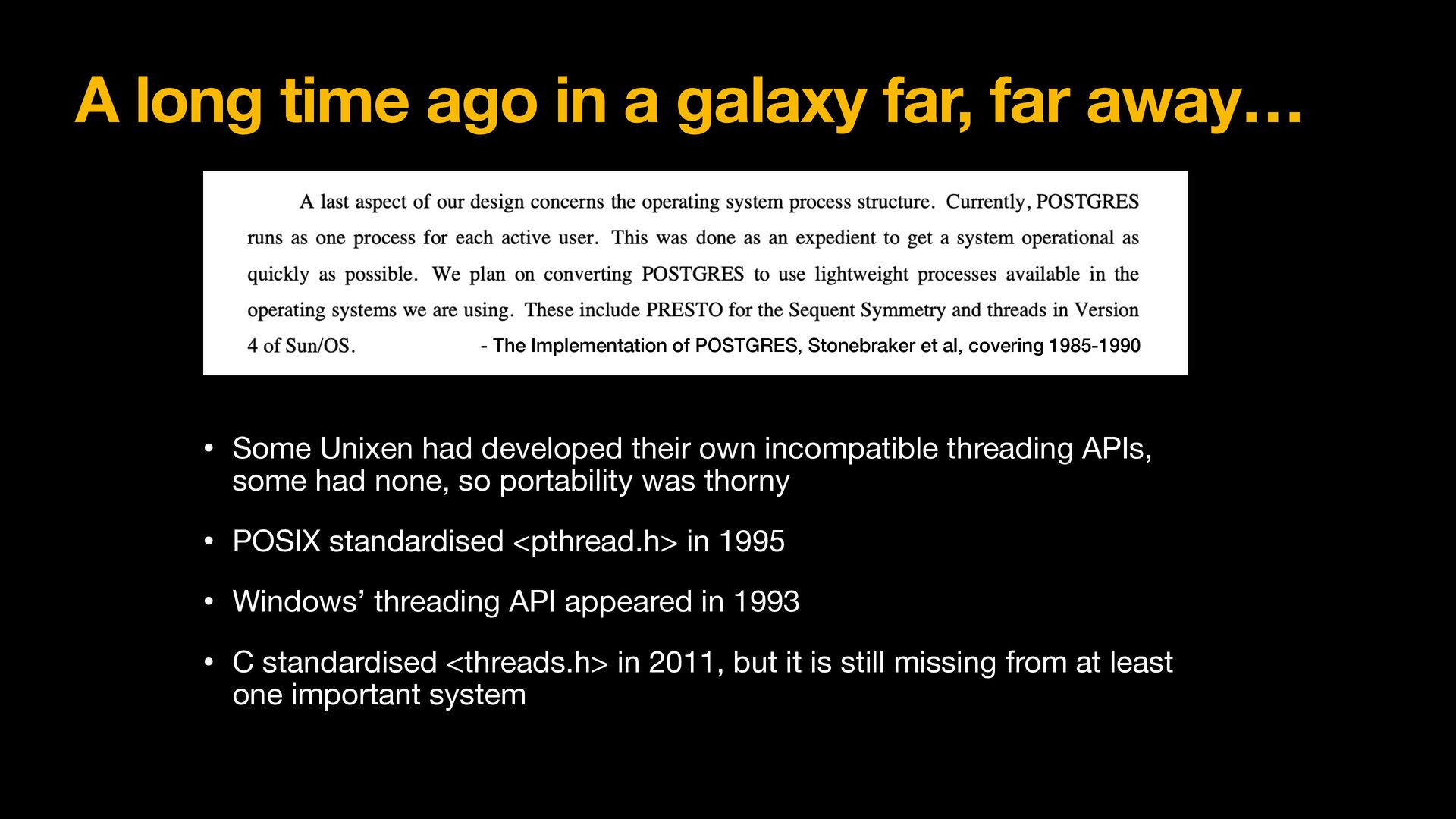
• Some Unixen had developed their own incompatible threading APIs, some had none, so portability was thorny • POSIX standardised <pthread.h> in 1995 • Windows’ threading API appeared in 1993 • C standardised <threads.h> in 2011, but it is still missing from at least one important system - The Implementation of POSTGRES, Stonebraker et al, covering 1985-1990
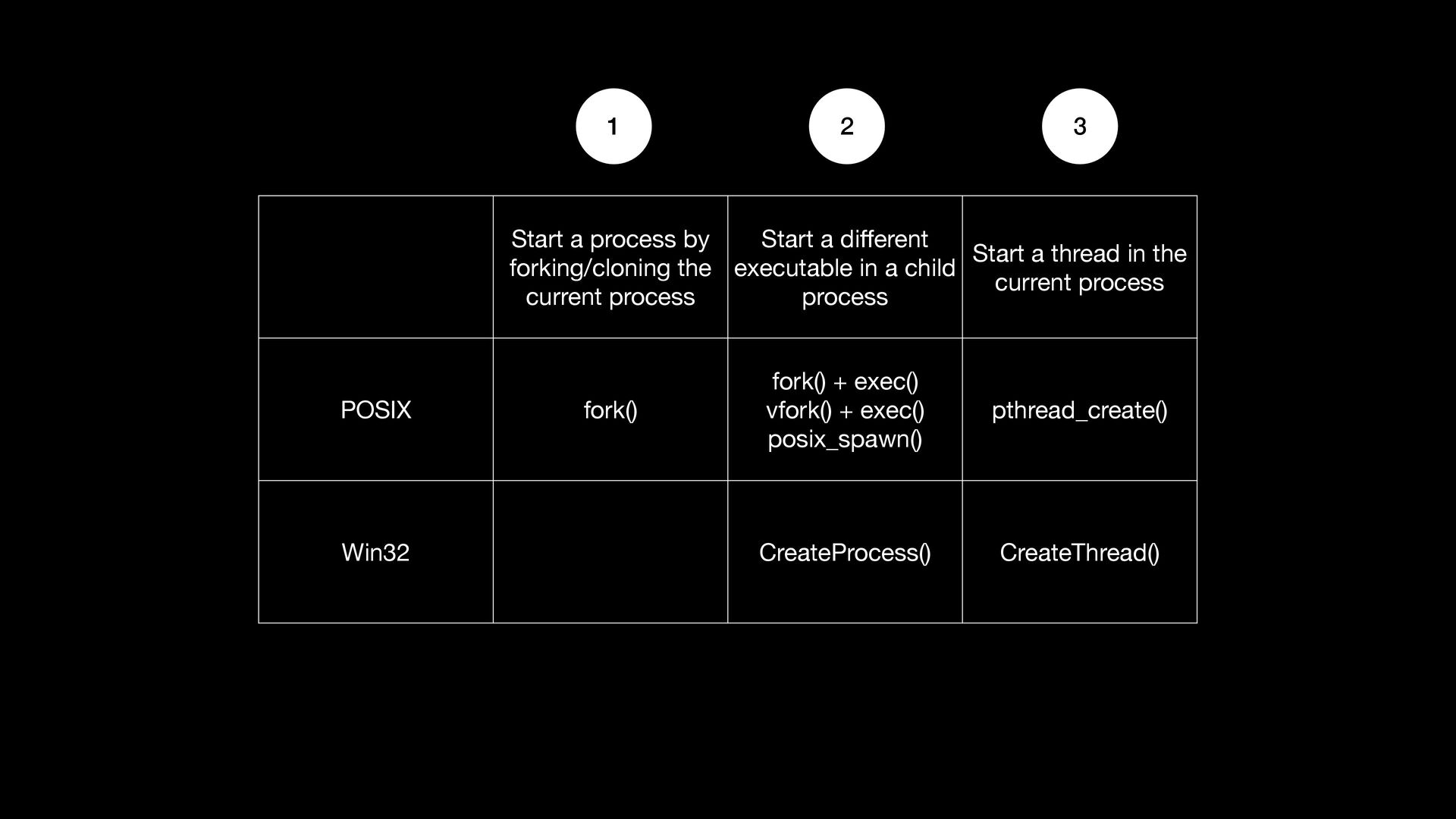
di ff erent executable in a child process Start a thread in the current process POSIX fork() fork() + exec() vfork() + exec() posix_spawn() pthread_create() Win32 CreateProcess() CreateThread() 1 2 3
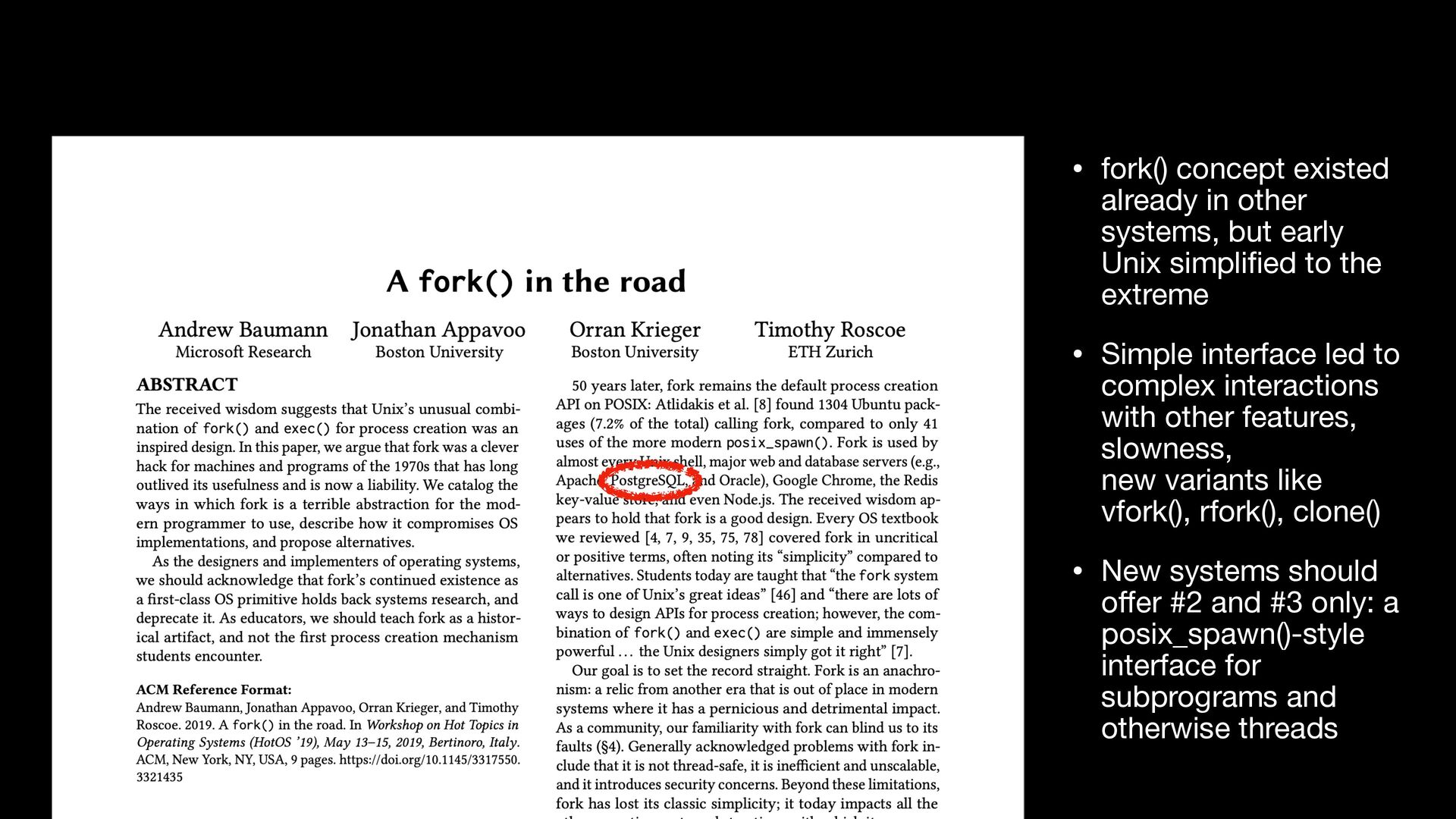
Unix simpli fi ed to the extreme • Simple interface led to complex interactions with other features, slowness, new variants like vfork(), rfork(), clone() • New systems should o ff er #2 and #3 only: a posix_spawn()-style interface for subprograms and otherwise threads
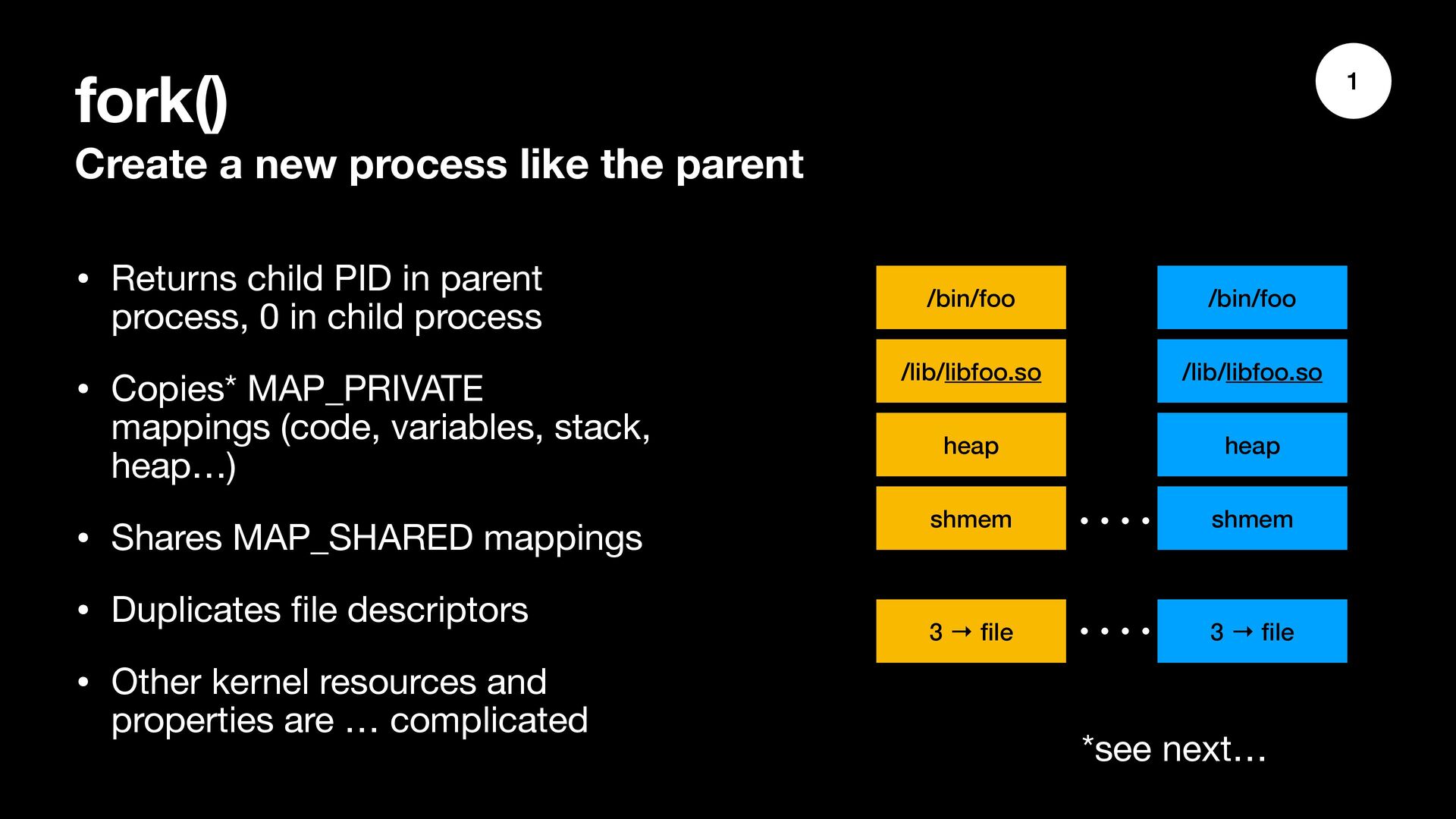
child PID in parent process, 0 in child process • Copies* MAP_PRIVATE mappings (code, variables, stack, heap…) • Shares MAP_SHARED mappings • Duplicates fi le descriptors • Other kernel resources and properties are … complicated /bin/foo /bin/foo /lib/libfoo.so /lib/libfoo.so heap heap shmem shmem 3 → fi le 3 → fi le *see next… 1
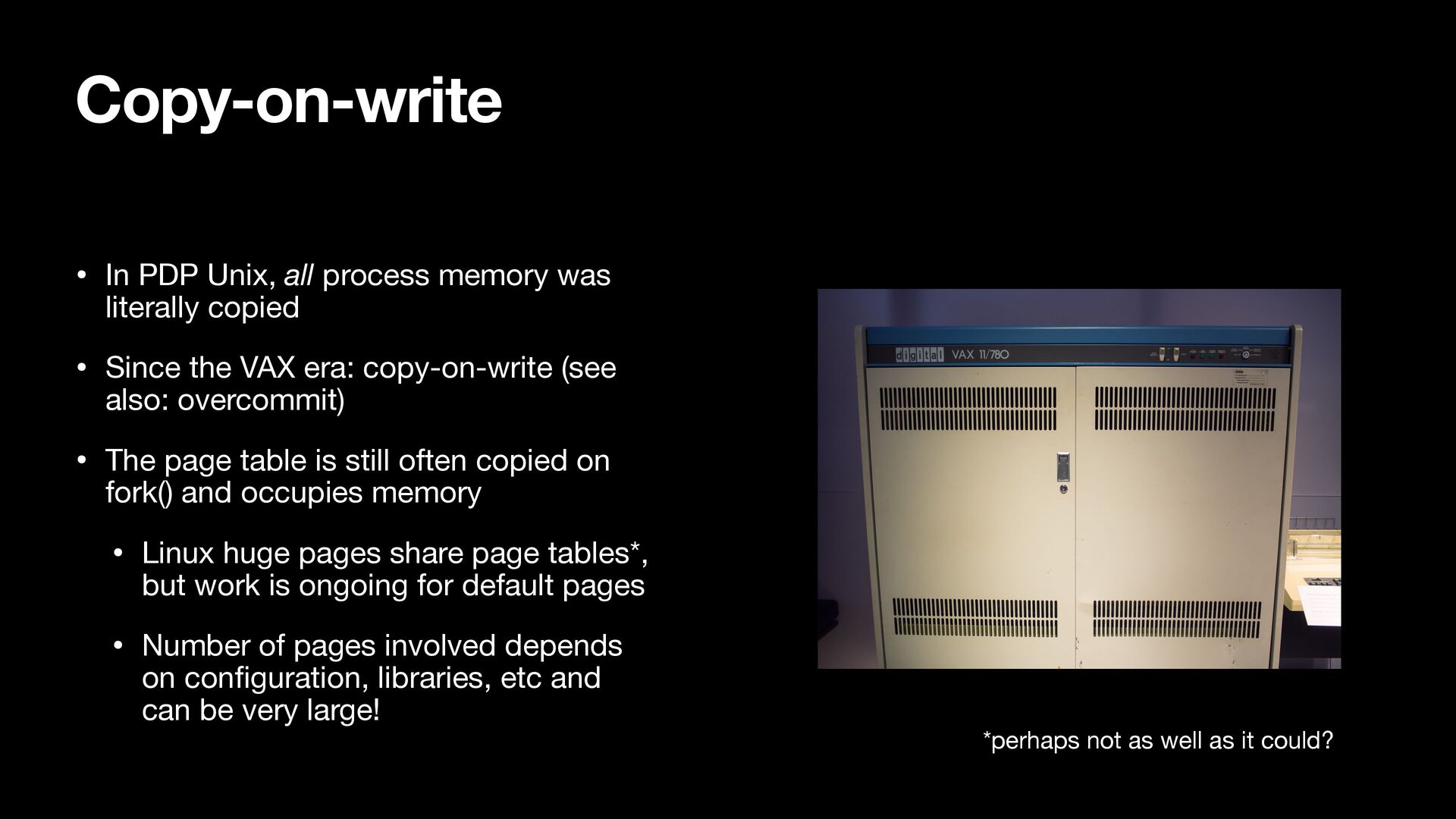
copied • Since the VAX era: copy-on-write (see also: overcommit) • The page table is still often copied on fork() and occupies memory • Linux huge pages share page tables*, but work is ongoing for default pages • Number of pages involved depends on con fi guration, libraries, etc and can be very large! *perhaps not as well as it could?
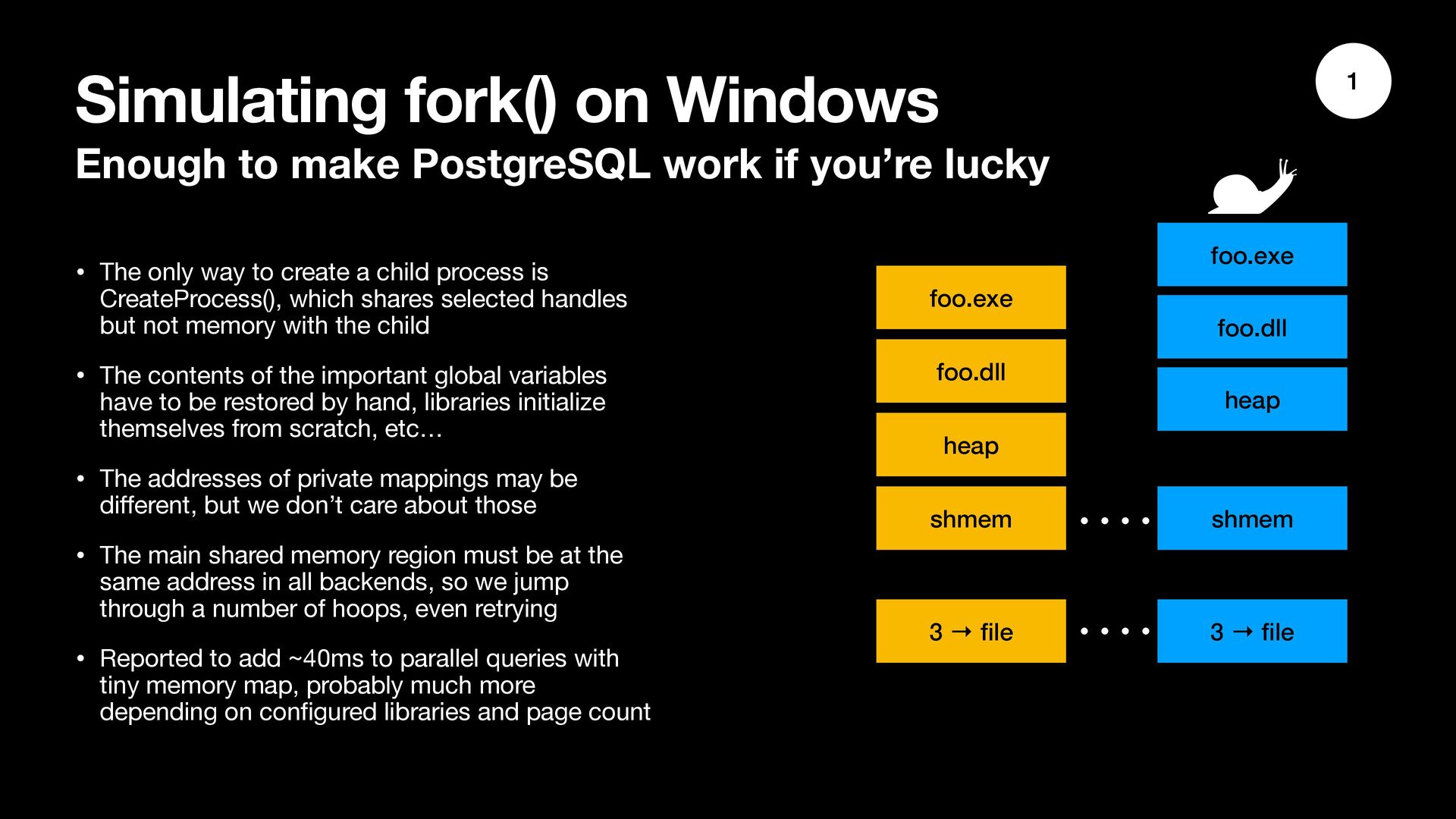
you’re lucky • The only way to create a child process is CreateProcess(), which shares selected handles but not memory with the child • The contents of the important global variables have to be restored by hand, libraries initialize themselves from scratch, etc… • The addresses of private mappings may be di ff erent, but we don’t care about those • The main shared memory region must be at the same address in all backends, so we jump through a number of hoops, even retrying • Reported to add ~40ms to parallel queries with tiny memory map, probably much more depending on con fi gured libraries and page count foo.exe foo.exe foo.dll foo.dll heap heap shmem shmem 3 → fi le 3 → fi le 1
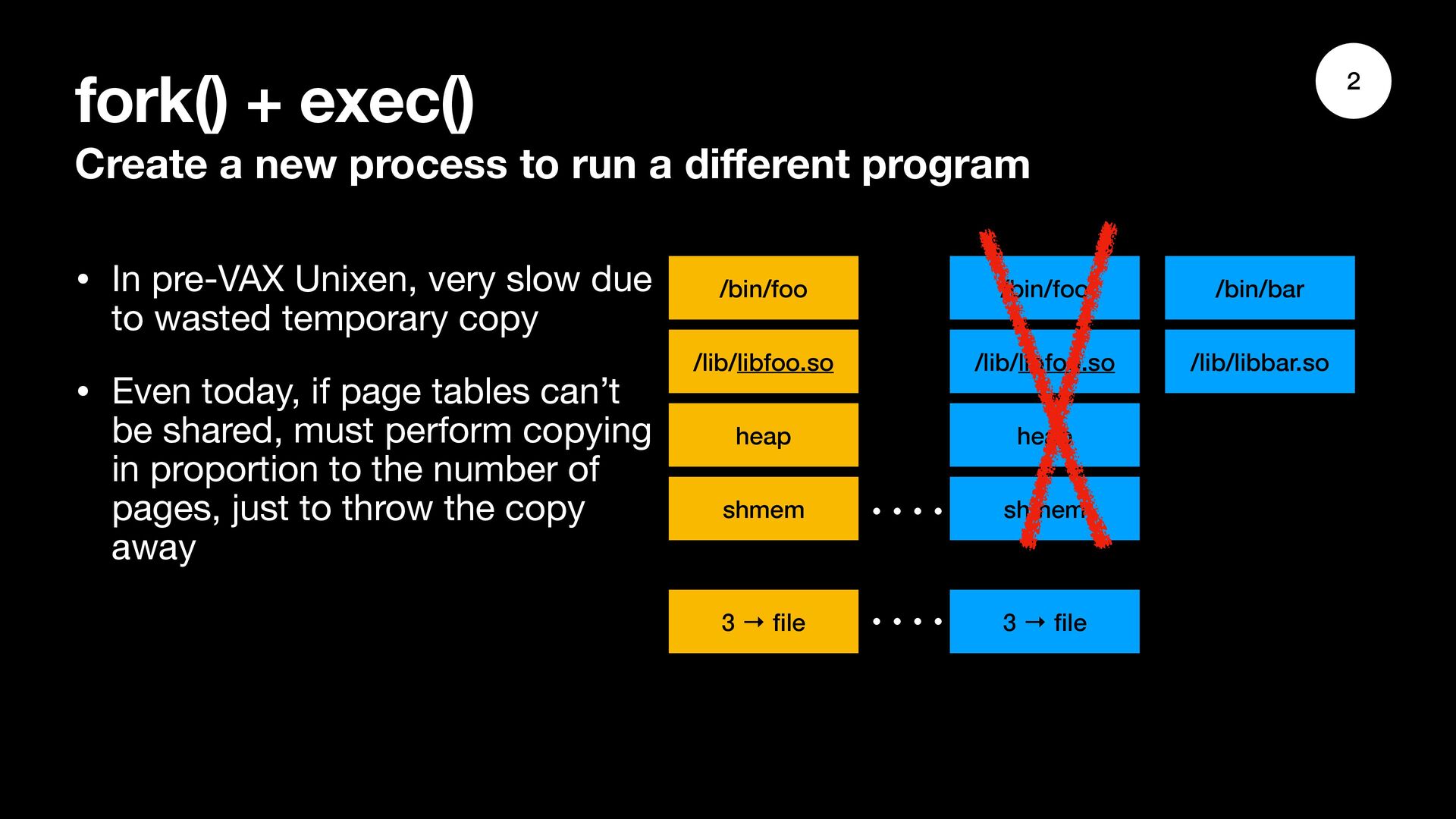
di ff erent program /bin/foo /bin/foo /lib/libfoo.so /lib/libfoo.so heap heap shmem shmem 3 → fi le 3 → fi le /bin/bar • In pre-VAX Unixen, very slow due to wasted temporary copy • Even today, if page tables can’t be shared, must perform copying in proportion to the number of pages, just to throw the copy away /lib/libbar.so 2
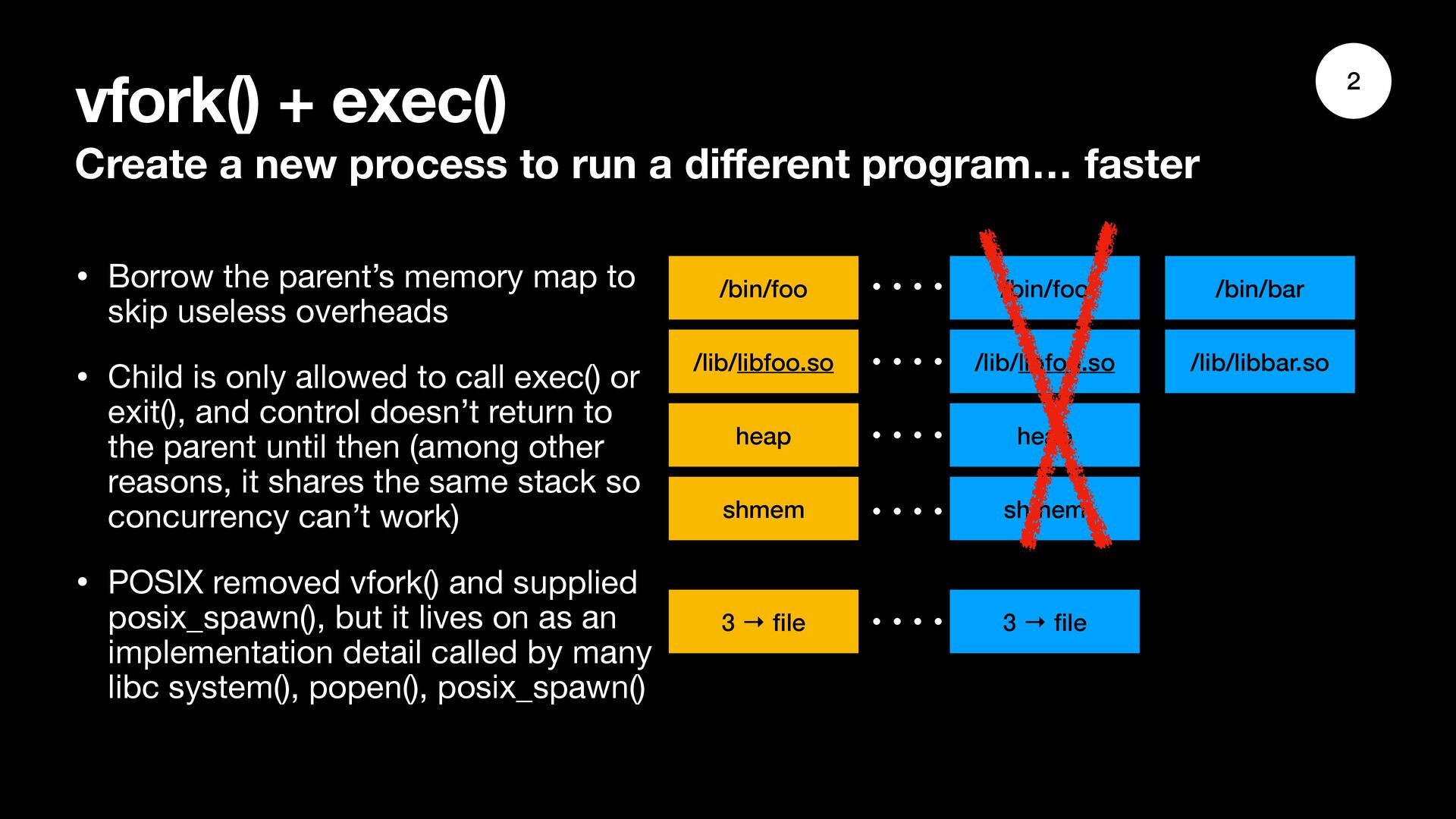
di ff erent program… faster • Borrow the parent’s memory map to skip useless overheads • Child is only allowed to call exec() or exit(), and control doesn’t return to the parent until then (among other reasons, it shares the same stack so concurrency can’t work) • POSIX removed vfork() and supplied posix_spawn(), but it lives on as an implementation detail called by many libc system(), popen(), posix_spawn() /bin/foo /bin/foo /lib/libfoo.so /lib/libfoo.so heap heap shmem shmem 3 → fi le 3 → fi le /bin/bar 2 /lib/libbar.so
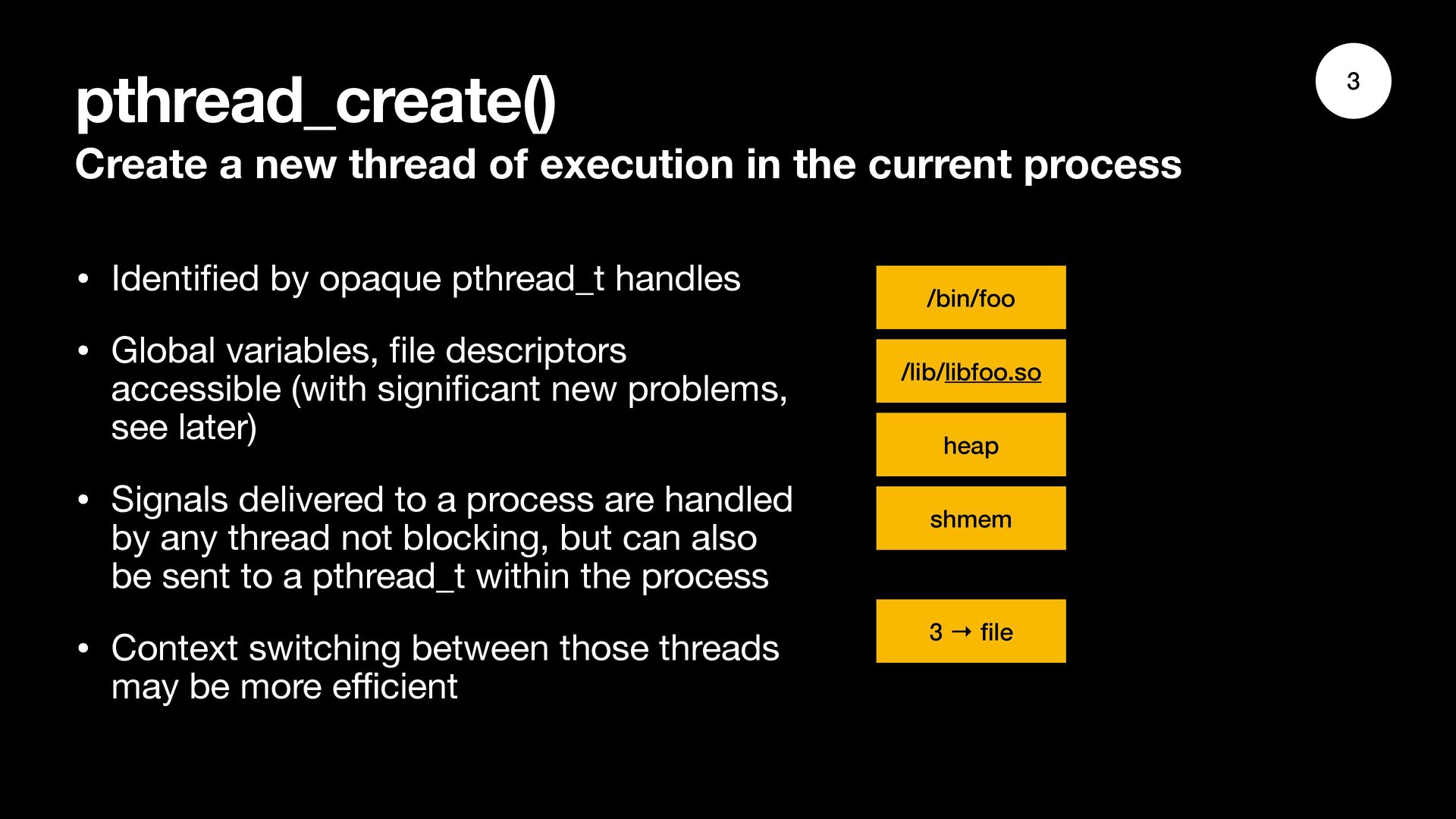
process • Identi fi ed by opaque pthread_t handles • Global variables, fi le descriptors accessible (with signi fi cant new problems, see later) • Signals delivered to a process are handled by any thread not blocking, but can also be sent to a pthread_t within the process • Context switching between those threads may be more e ffi cient /bin/foo /lib/libfoo.so heap shmem 3 → fi le 3
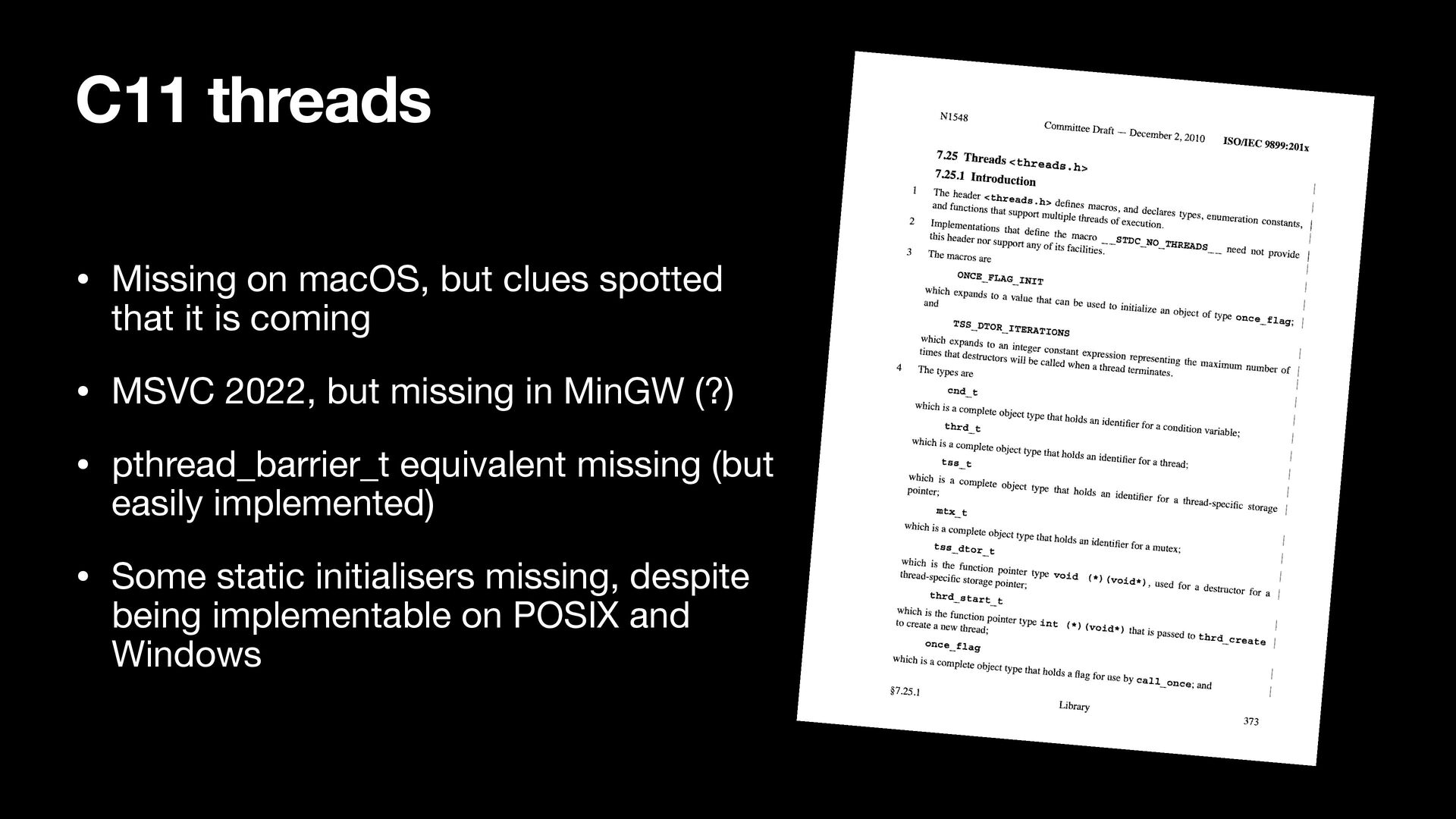
it is coming • MSVC 2022, but missing in MinGW (?) • pthread_barrier_t equivalent missing (but easily implemented) • Some static initialisers missing, despite being implementable on POSIX and Windows
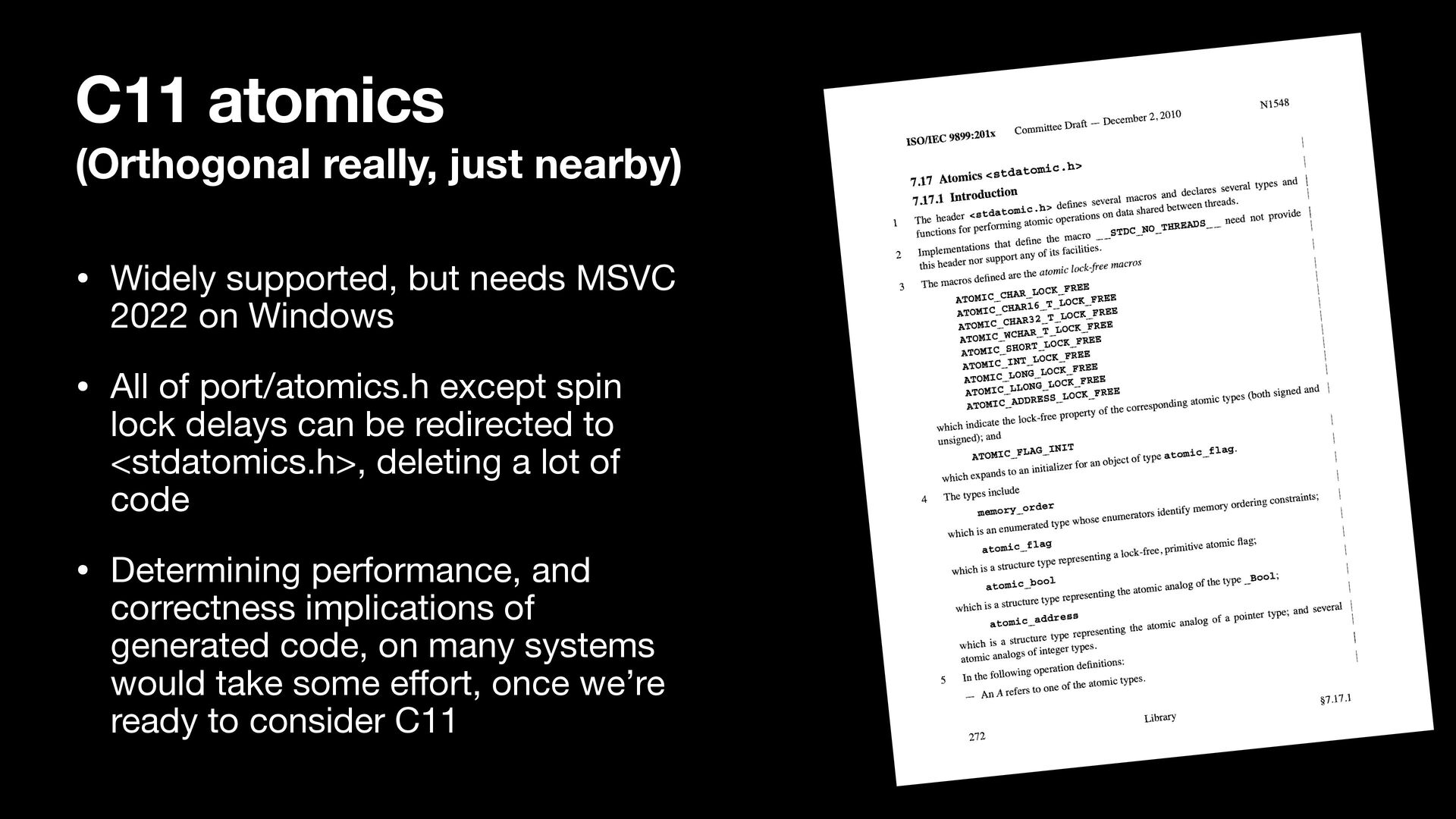
Windows • All of port/atomics.h except spin lock delays can be redirected to <stdatomics.h>, deleting a lot of code • Determining performance, and correctness implications of generated code, on many systems would take some e ff ort, once we’re ready to consider C11 (Orthogonal really, just nearby)
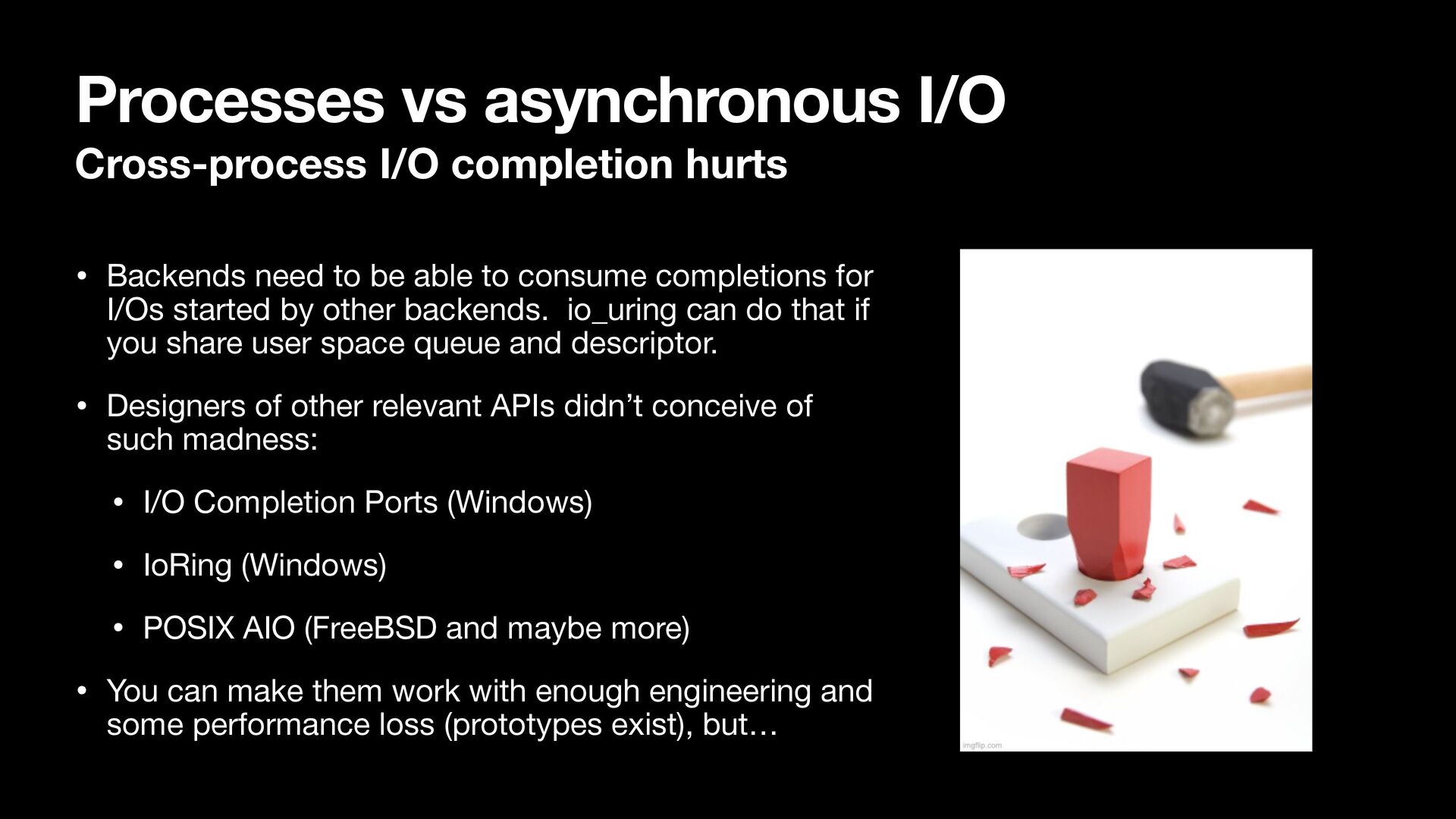
need to be able to consume completions for I/Os started by other backends. io_uring can do that if you share user space queue and descriptor. • Designers of other relevant APIs didn’t conceive of such madness: • I/O Completion Ports (Windows) • IoRing (Windows) • POSIX AIO (FreeBSD and maybe more) • You can make them work with enough engineering and some performance loss (prototypes exist), but…
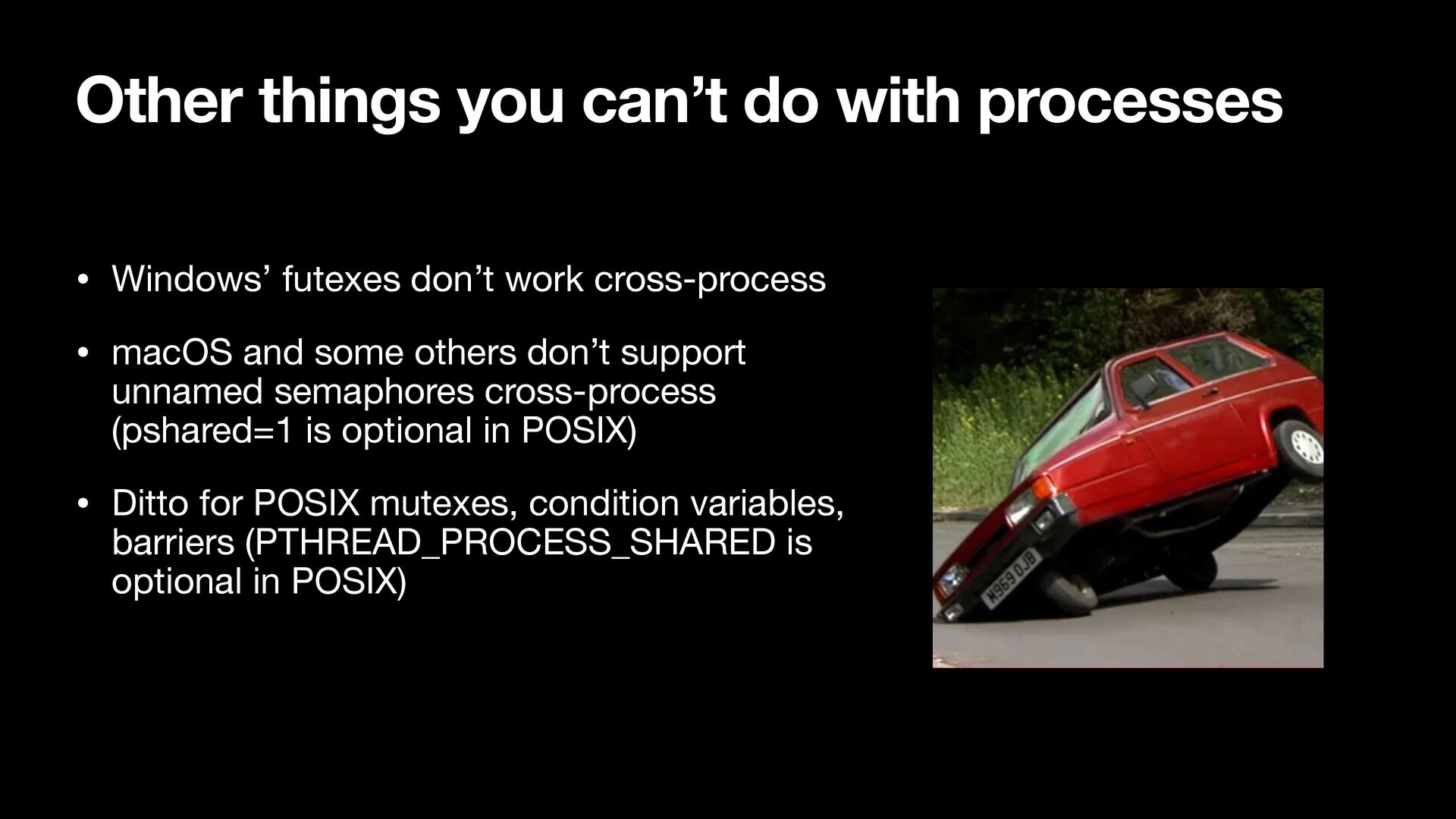
don’t work cross-process • macOS and some others don’t support unnamed semaphores cross-process (pshared=1 is optional in POSIX) • Ditto for POSIX mutexes, condition variables, barriers (PTHREAD_PROCESS_SHARED is optional in POSIX)
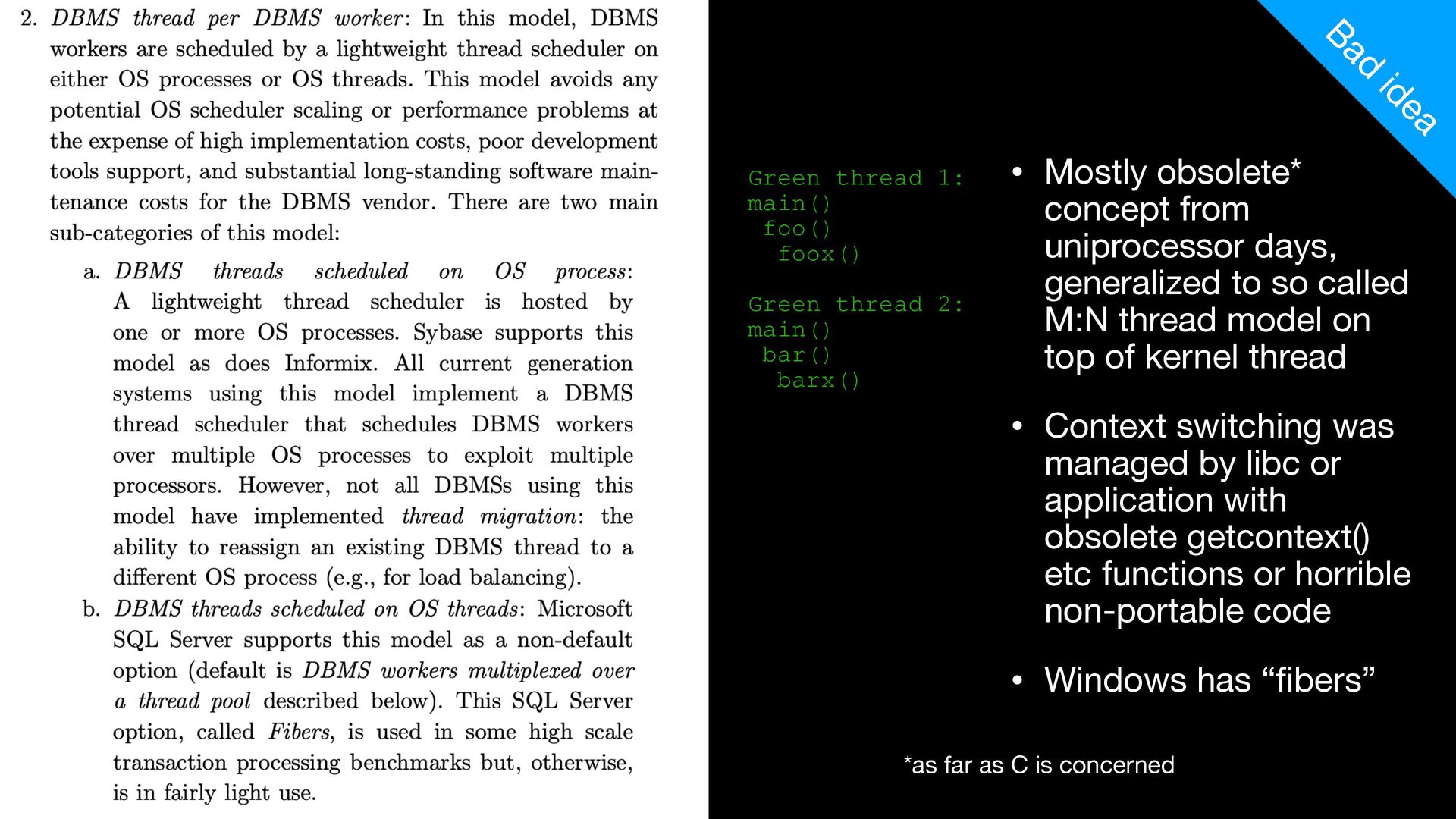
called M:N thread model on top of kernel thread • Context switching was managed by libc or application with obsolete getcontext() etc functions or horrible non-portable code • Windows has “ fi bers” *as far as C is concerned Green thread 1: main() foo() foox() Green thread 2: main() bar() barx() Bad idea
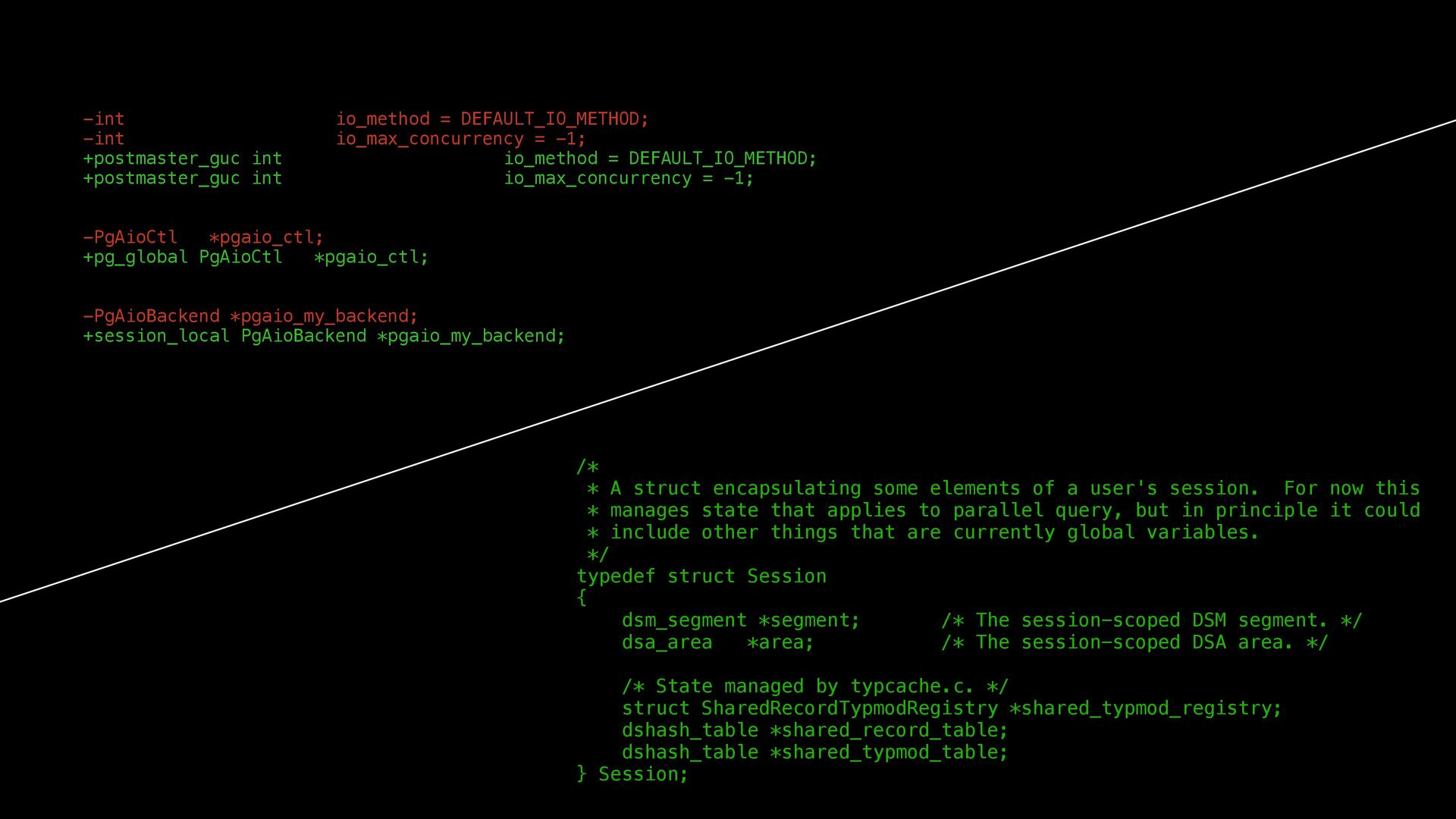
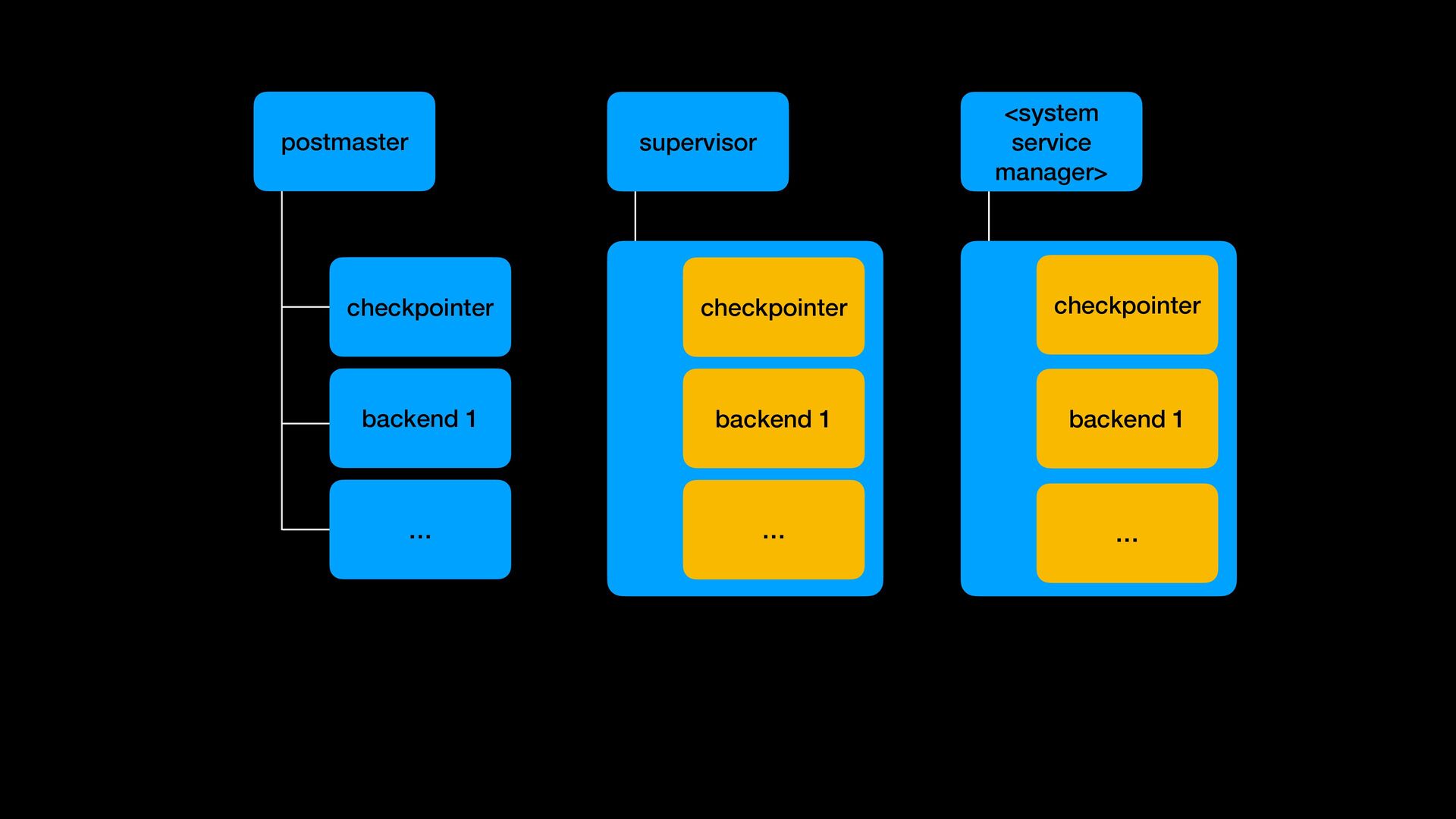
session. For now this * manages state that applies to parallel query, but in principle it could * include other things that are currently global variables. */ typedef struct Session { dsm_segment *segment; /* The session-scoped DSM segment. */ dsa_area *area; /* The session-scoped DSA area. */ /* State managed by typcache.c. */ struct SharedRecordTypmodRegistry *shared_typmod_registry; dshash_table *shared_record_table; dshash_table *shared_typmod_table; } Session; /* GUCs */ -int io_method = DEFAULT_IO_METHOD; -int io_max_concurrency = -1; +postmaster_guc int io_method = DEFAULT_IO_METHOD; +postmaster_guc int io_max_concurrency = -1; /* global control for AIO */ -PgAioCtl *pgaio_ctl; +pg_global PgAioCtl *pgaio_ctl; /* current backend's per-backend state */ -PgAioBackend *pgaio_my_backend; +session_local PgAioBackend *pgaio_my_backend;
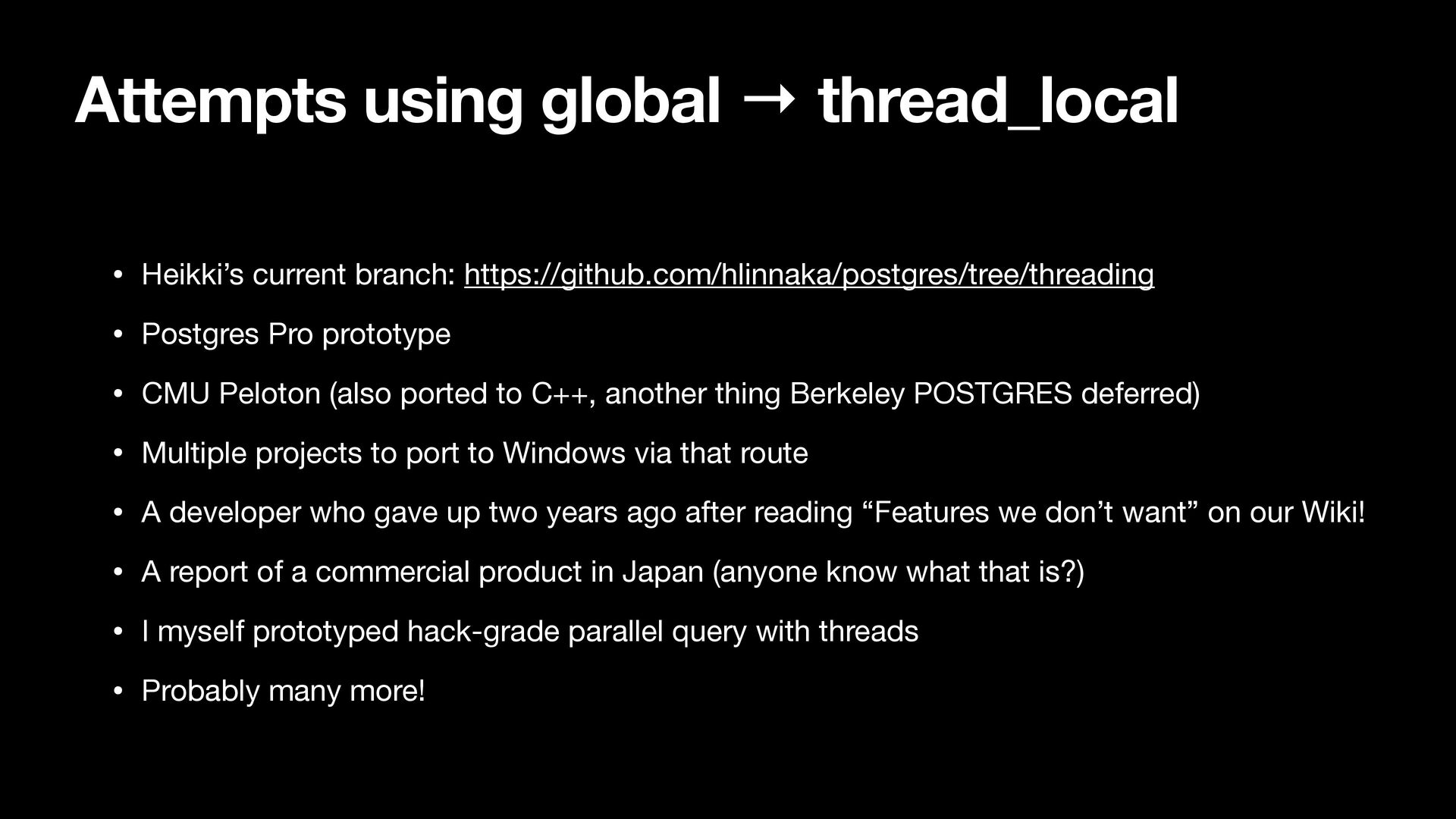
• Postgres Pro prototype • CMU Peloton (also ported to C++, another thing Berkeley POSTGRES deferred) • Multiple projects to port to Windows via that route • A developer who gave up two years ago after reading “Features we don’t want” on our Wiki! • A report of a commercial product in Japan (anyone know what that is?) • I myself prototyped hack-grade parallel query with threads • Probably many more!
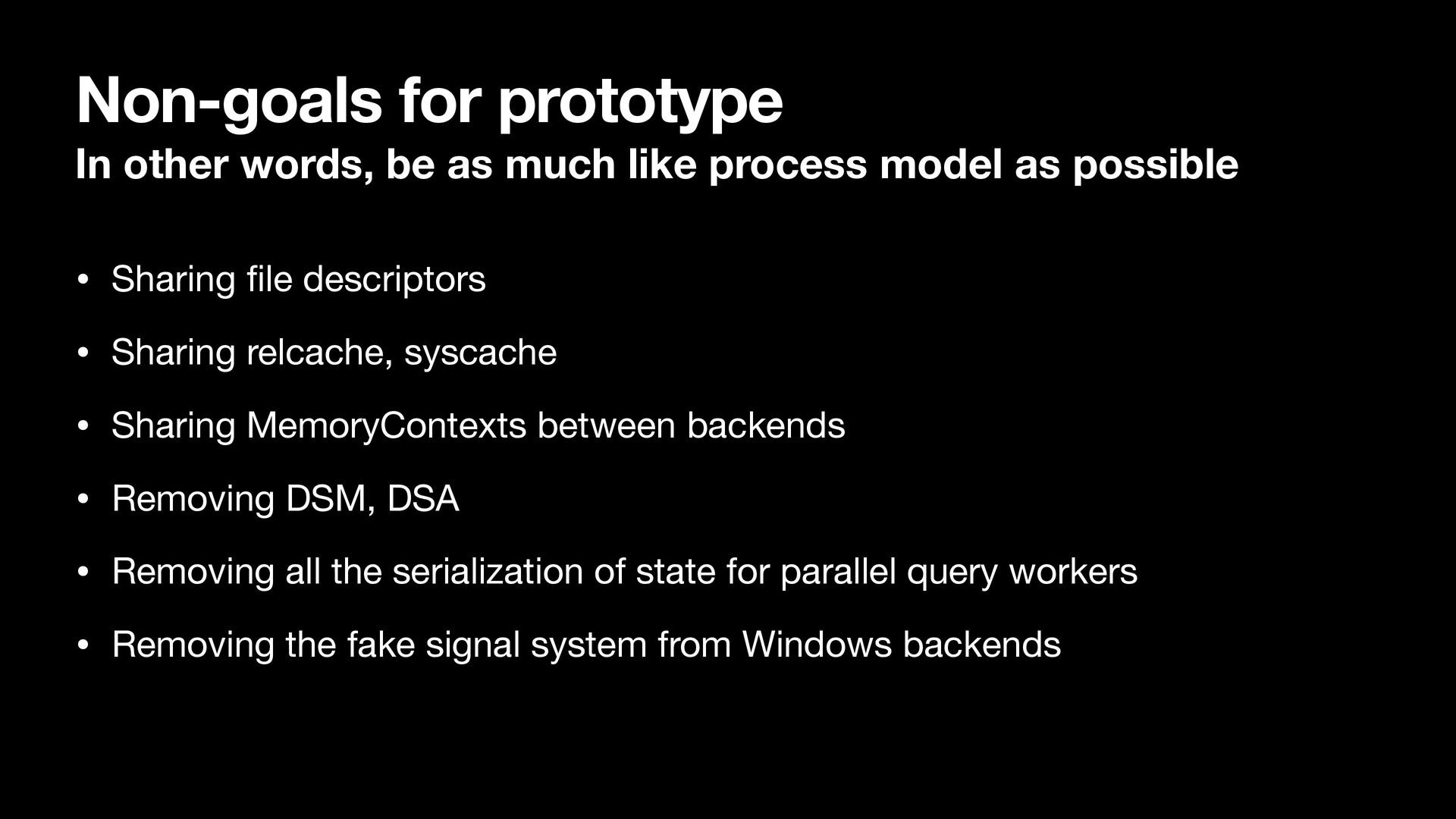
process model as possible • Sharing fi le descriptors • Sharing relcache, syscache • Sharing MemoryContexts between backends • Removing DSM, DSA • Removing all the serialization of state for parallel query workers • Removing the fake signal system from Windows backends
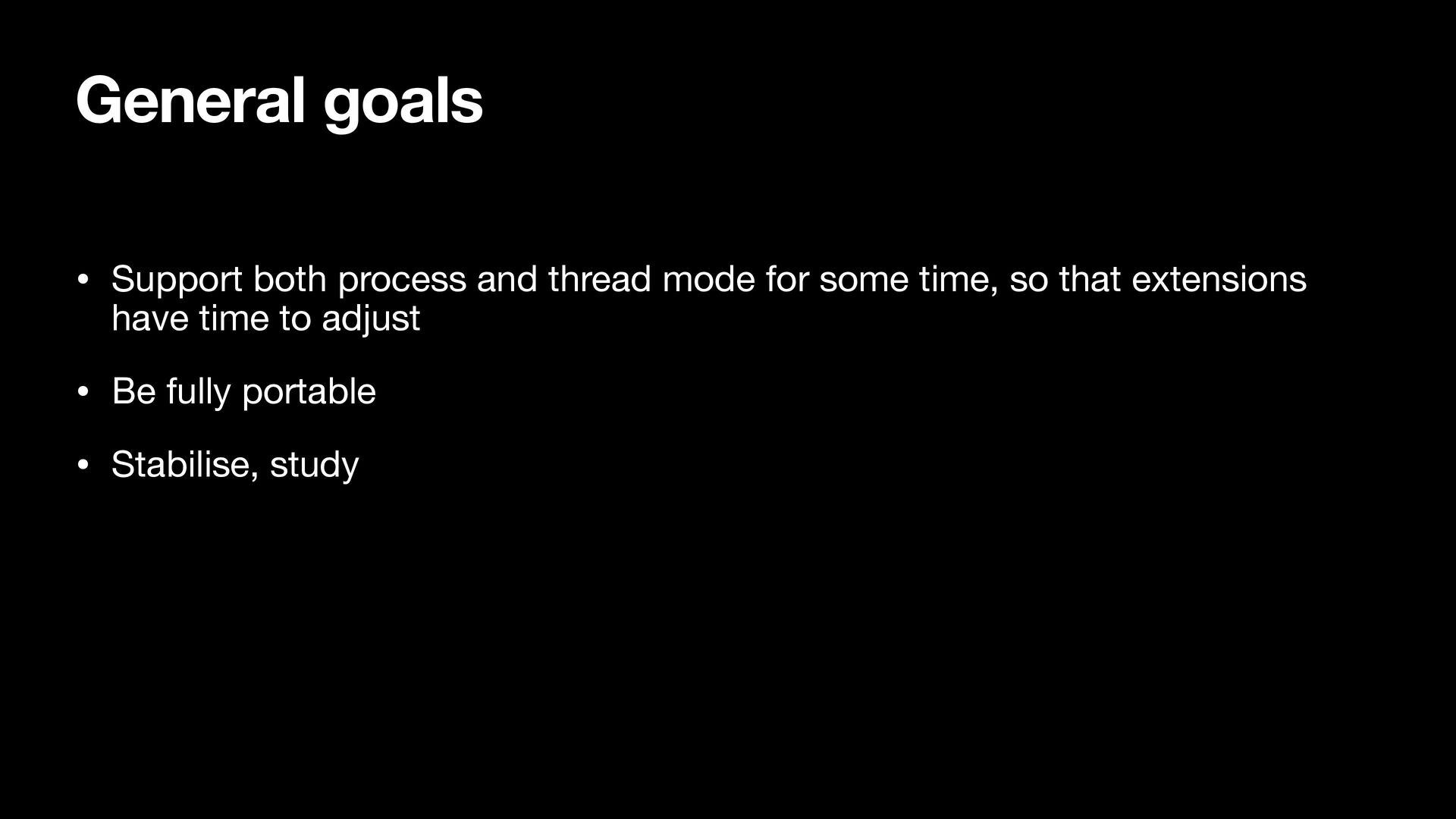
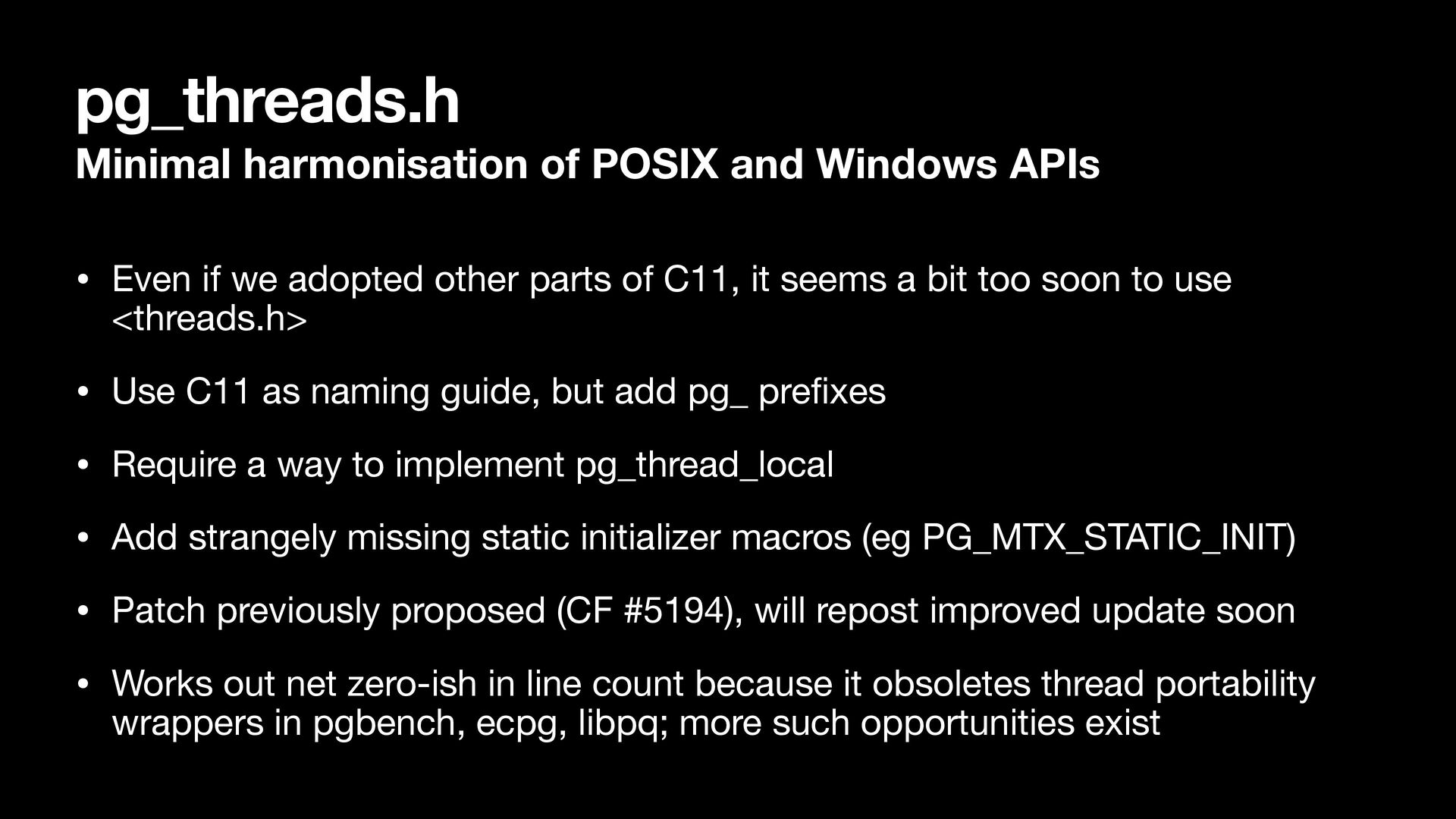
if we adopted other parts of C11, it seems a bit too soon to use <threads.h> • Use C11 as naming guide, but add pg_ pre fi xes • Require a way to implement pg_thread_local • Add strangely missing static initializer macros (eg PG_MTX_STATIC_INIT) • Patch previously proposed (CF #5194), will repost improved update soon • Works out net zero-ish in line count because it obsoletes thread portability wrappers in pgbench, ecpg, libpq; more such opportunities exist
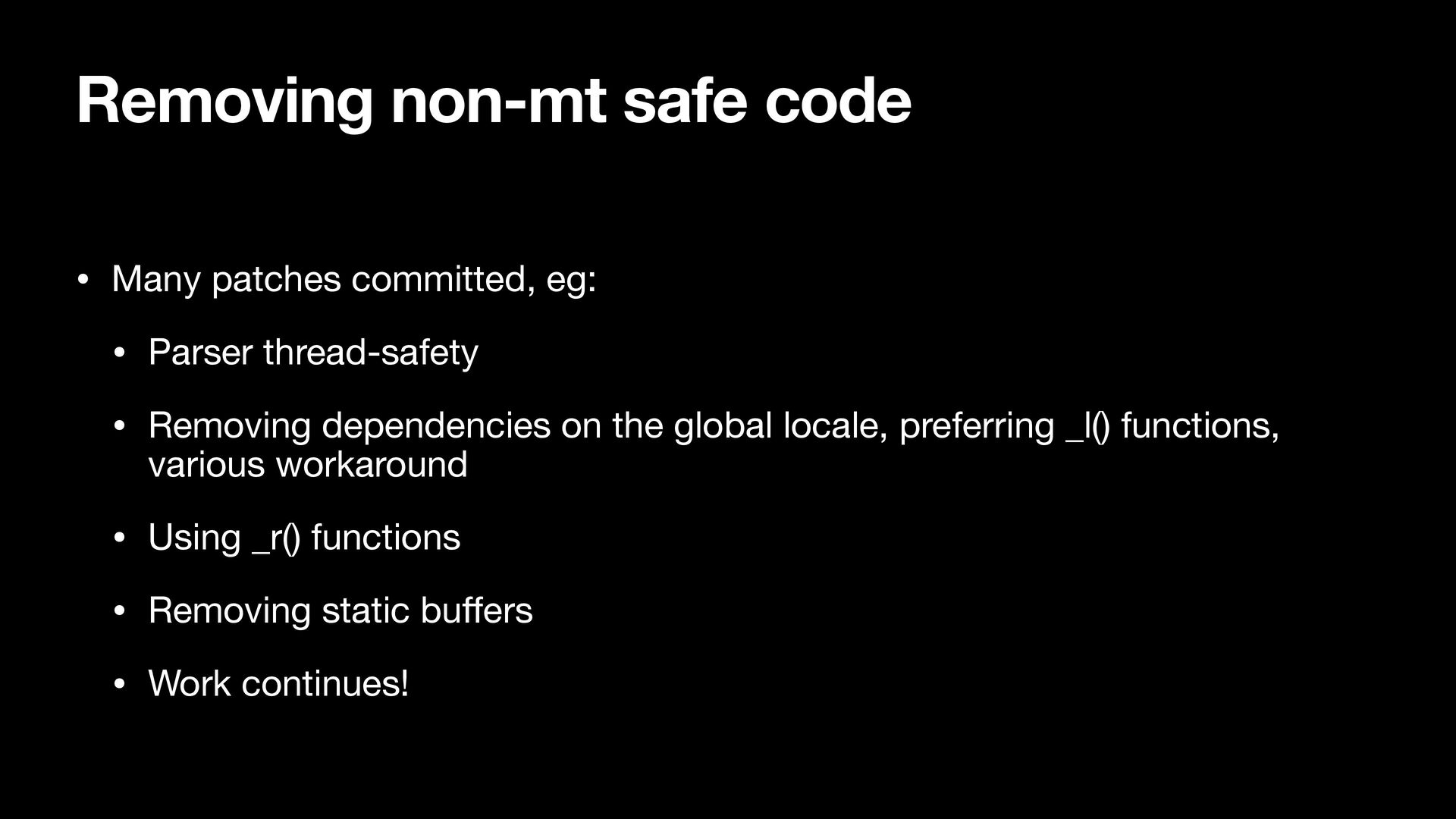
Parser thread-safety • Removing dependencies on the global locale, preferring _l() functions, various workaround • Using _r() functions • Removing static bu ff ers • Work continues!
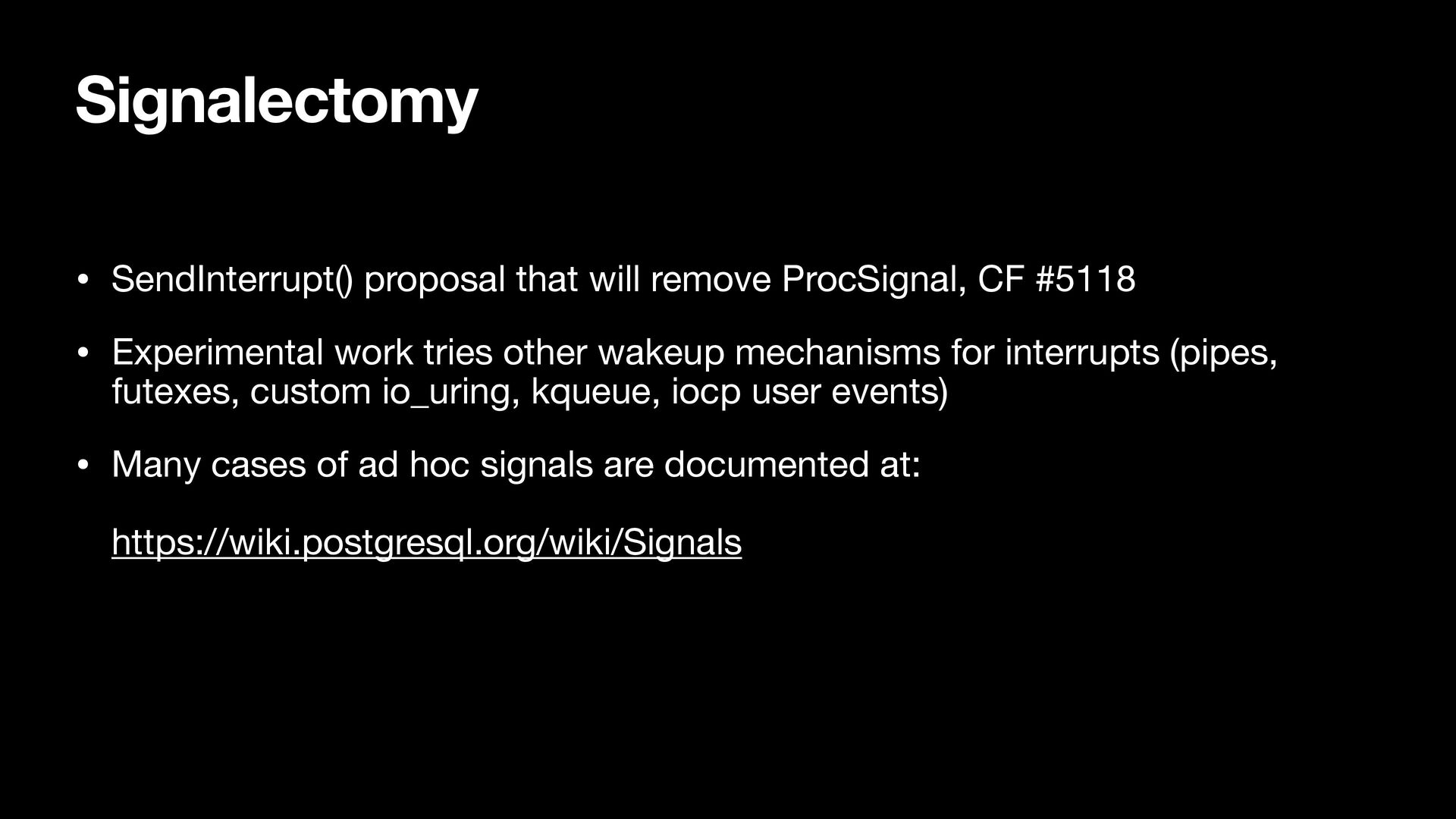
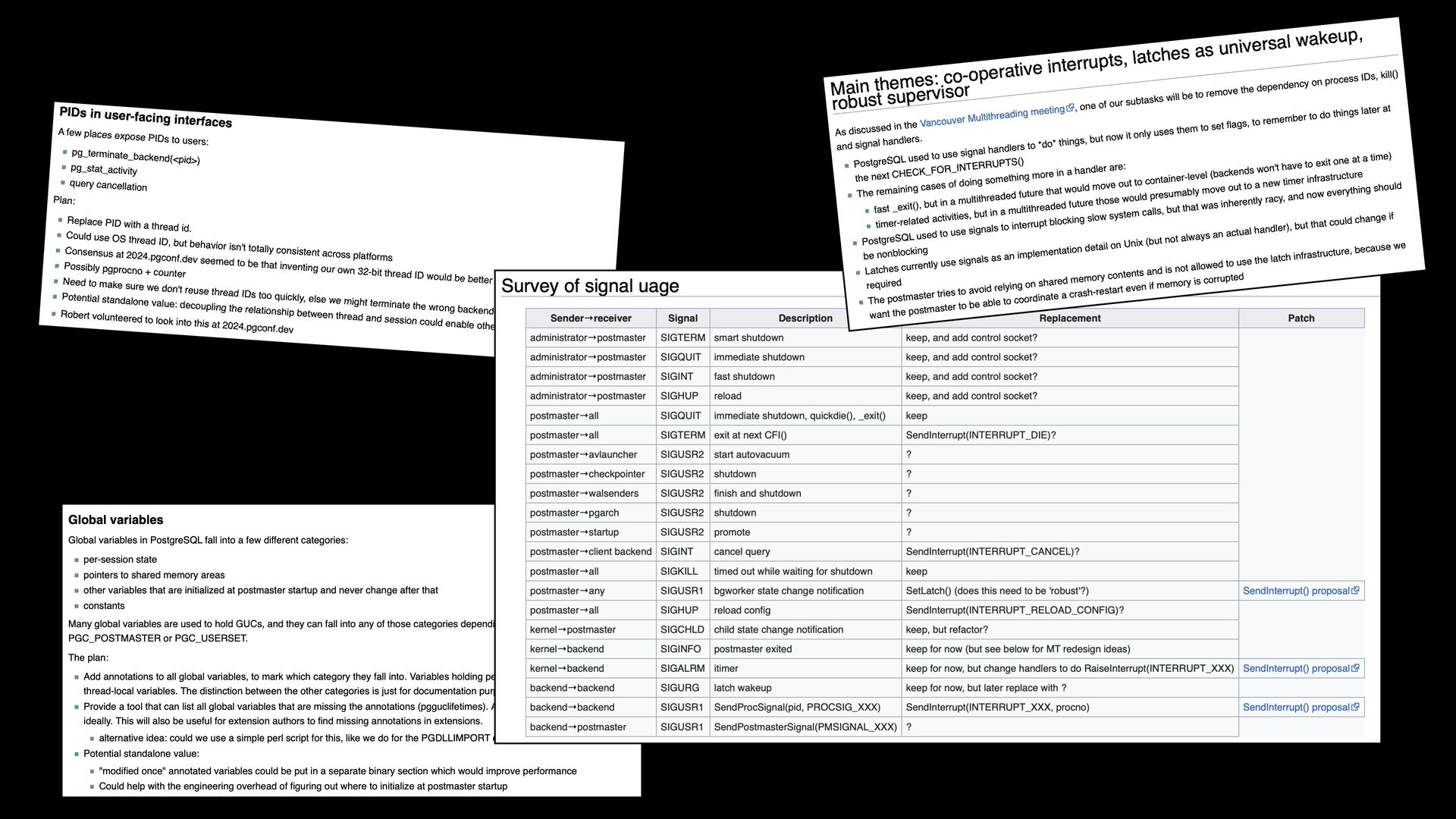
• Experimental work tries other wakeup mechanisms for interrupts (pipes, futexes, custom io_uring, kqueue, iocp user events) • Many cases of ad hoc signals are documented at: https://wiki.postgresql.org/wiki/Signals


 macdice
 iwatsukayura
 mofurune
 satoshi256kbyte
 y0hgi
y0hgi
 minodriven
 kishida
 colorful12
 uyuki234
 seike460
 rkaga
rkaga
 steliosf
 varn
varn
 techseoconnect
 eitanlees
 palkan
 cassininazir
 samlambert
 destraynor
 garrettdimon
 eileencodes
 addyosmani
 jonyablonski