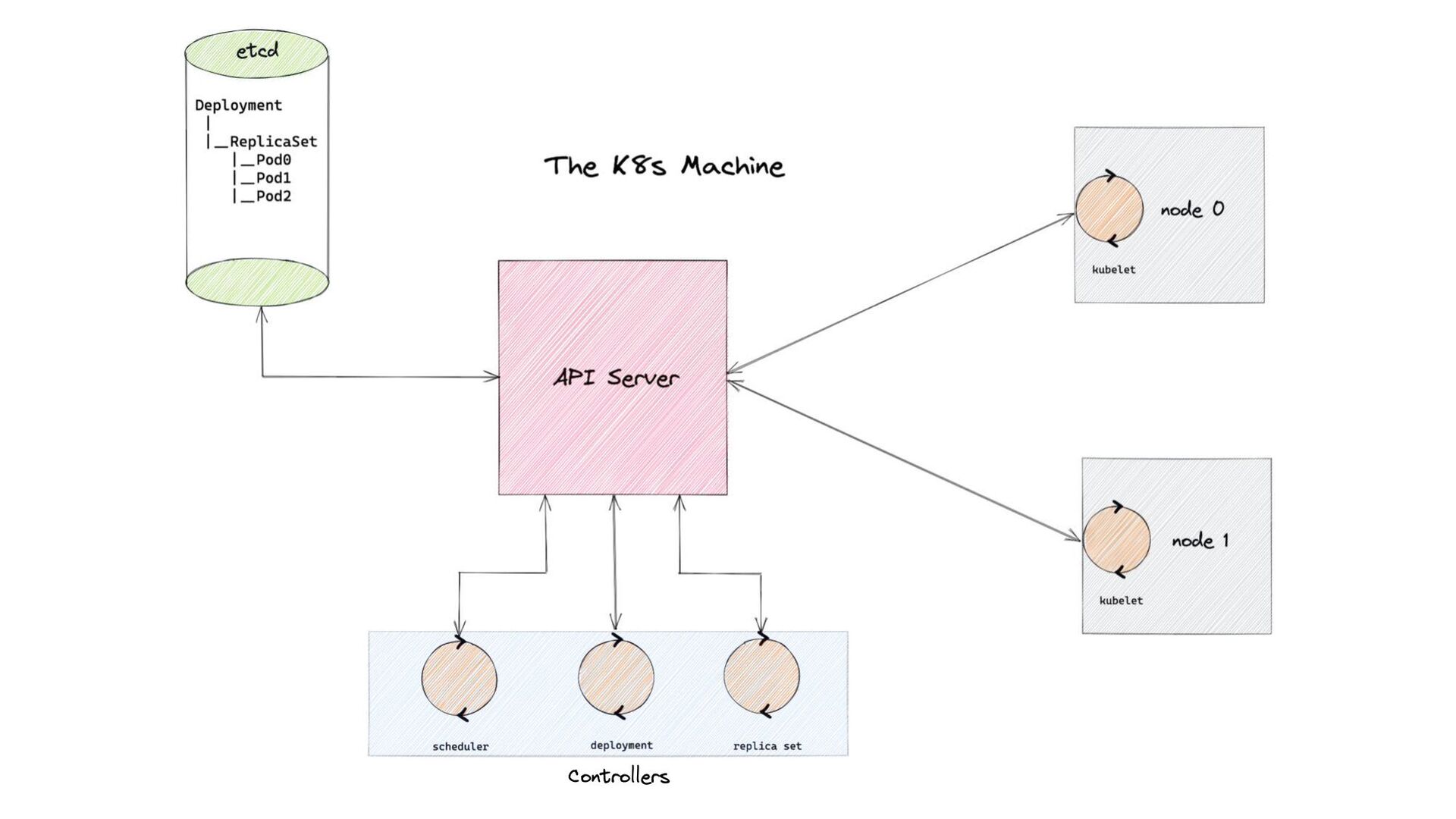
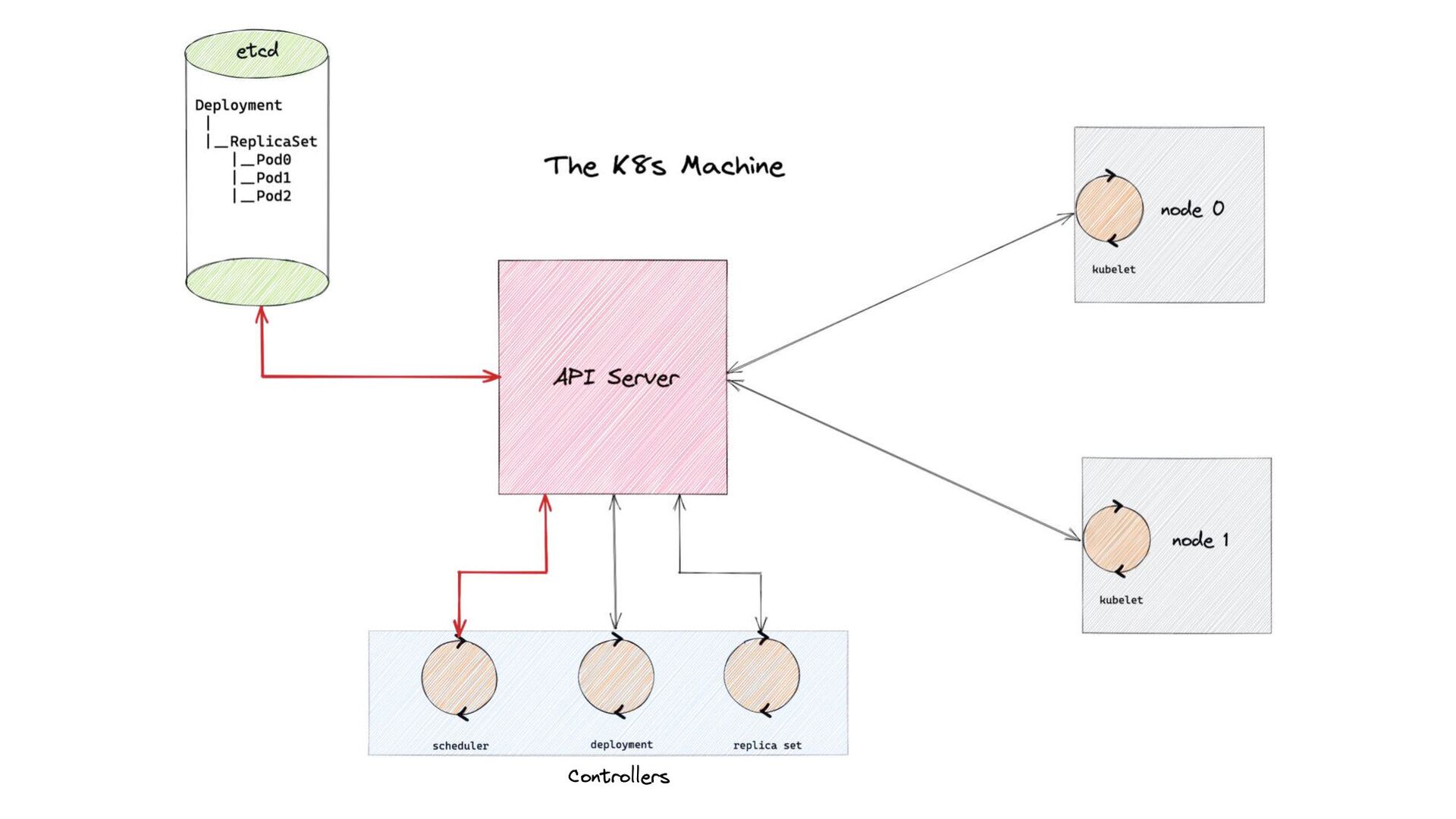
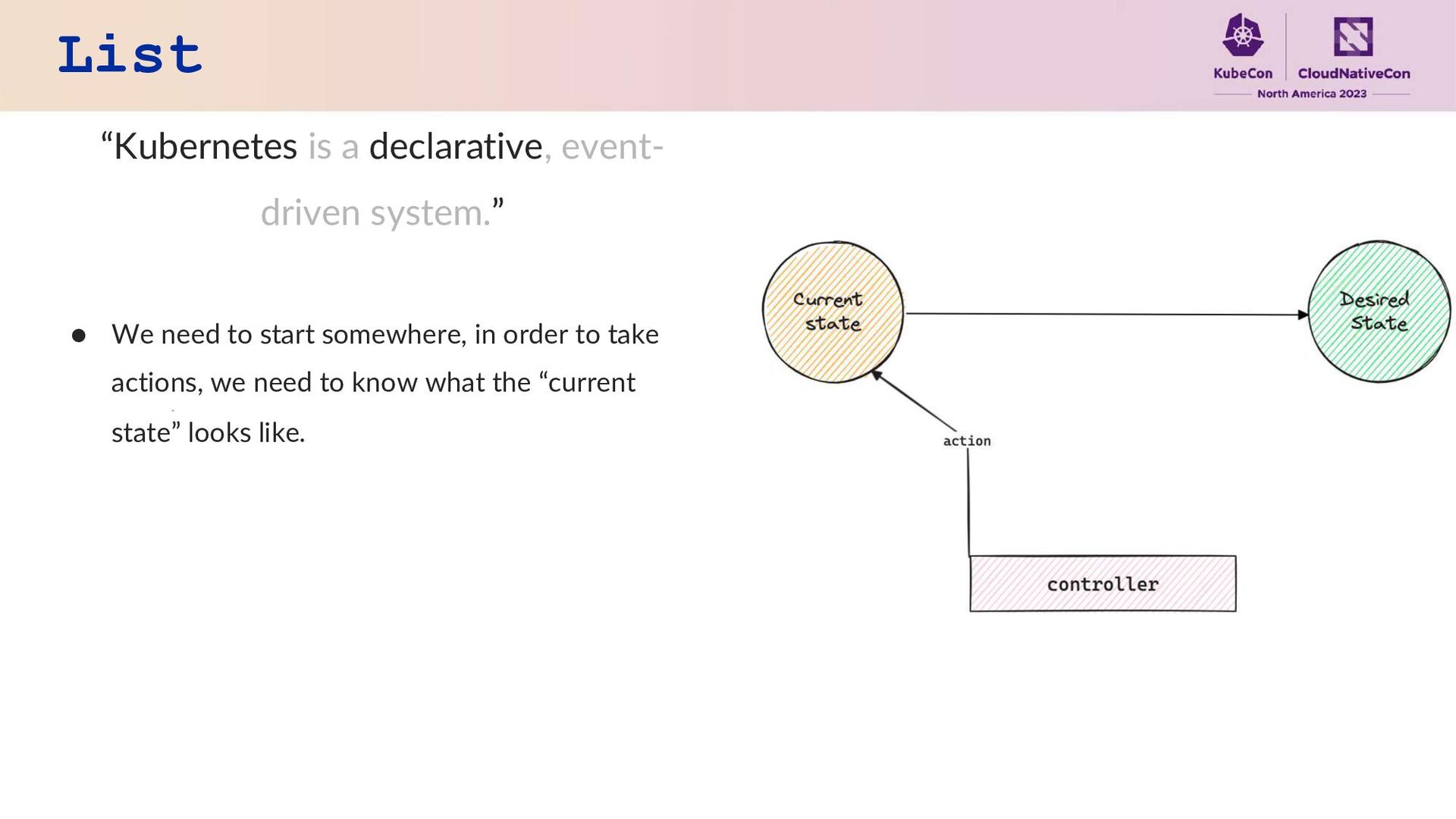
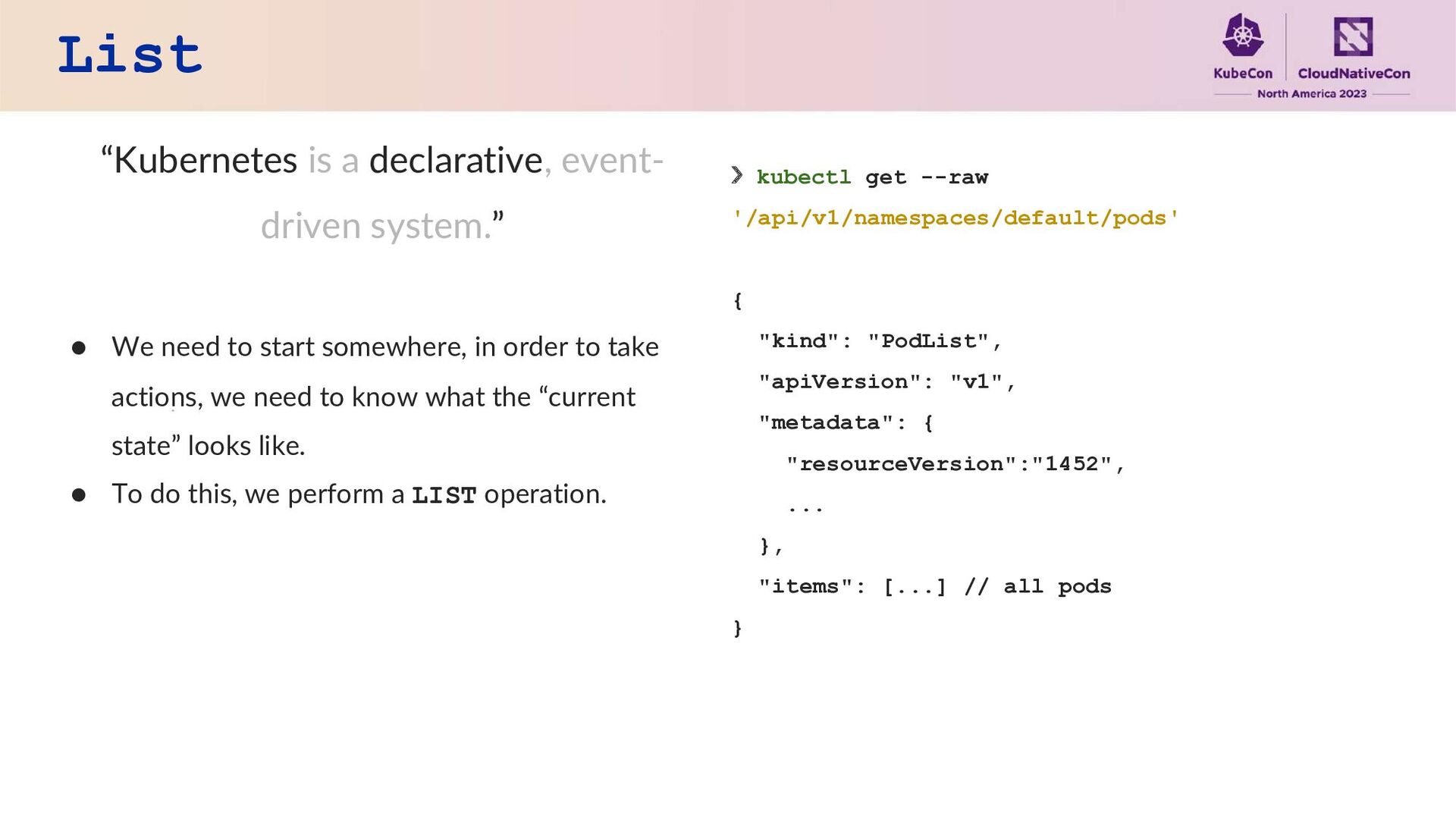
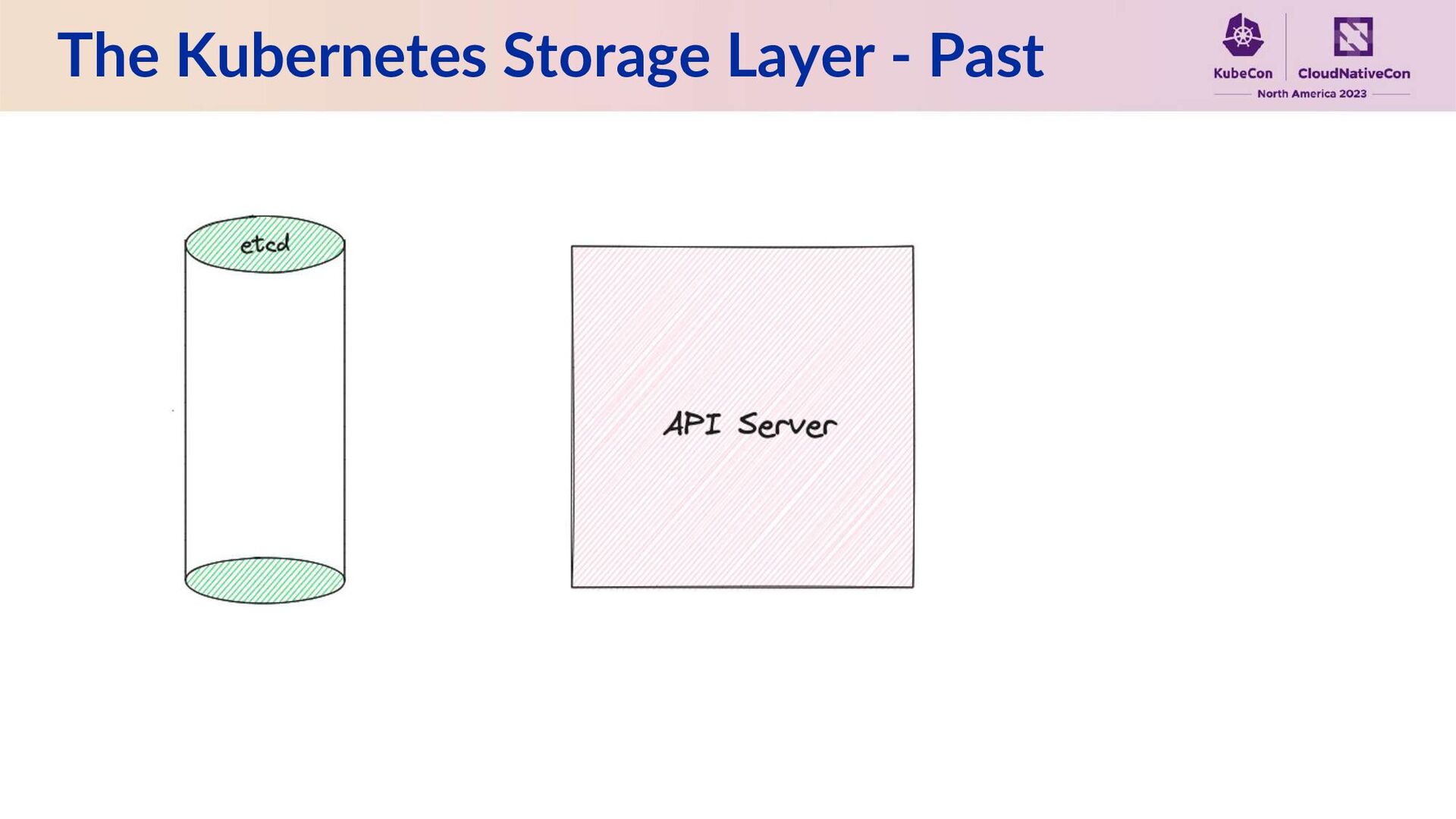
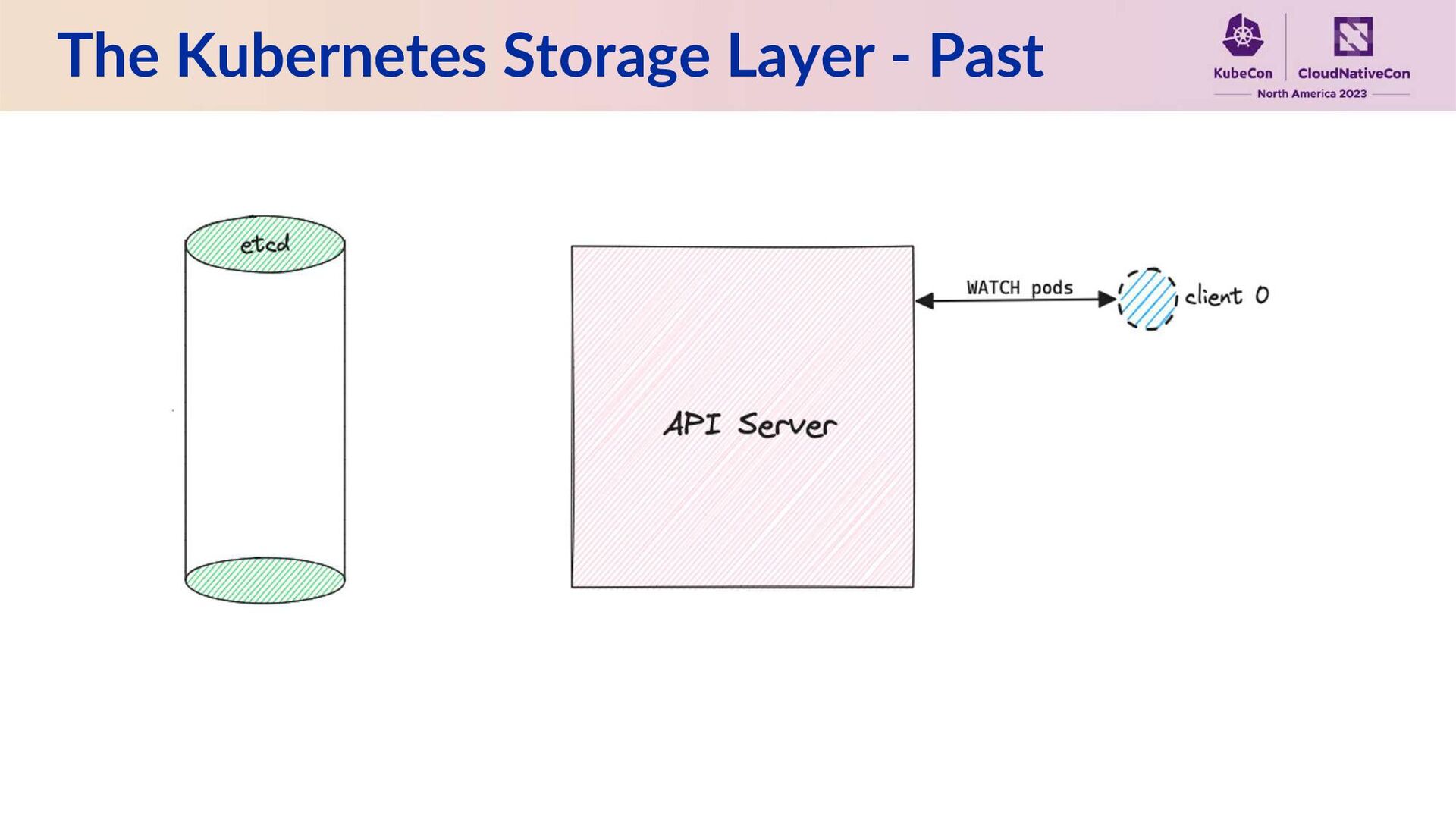
need to start somewhere, in order to take actions, we need to know what the “current state” looks like. • To do this, we perform a LIST operation. ❯ kubectl get --raw '/api/v1/namespaces/default/pods' { "kind": "PodList", "apiVersion": "v1", "metadata": { "resourceVersion":"1452", ... }, "items": [...] // all pods }
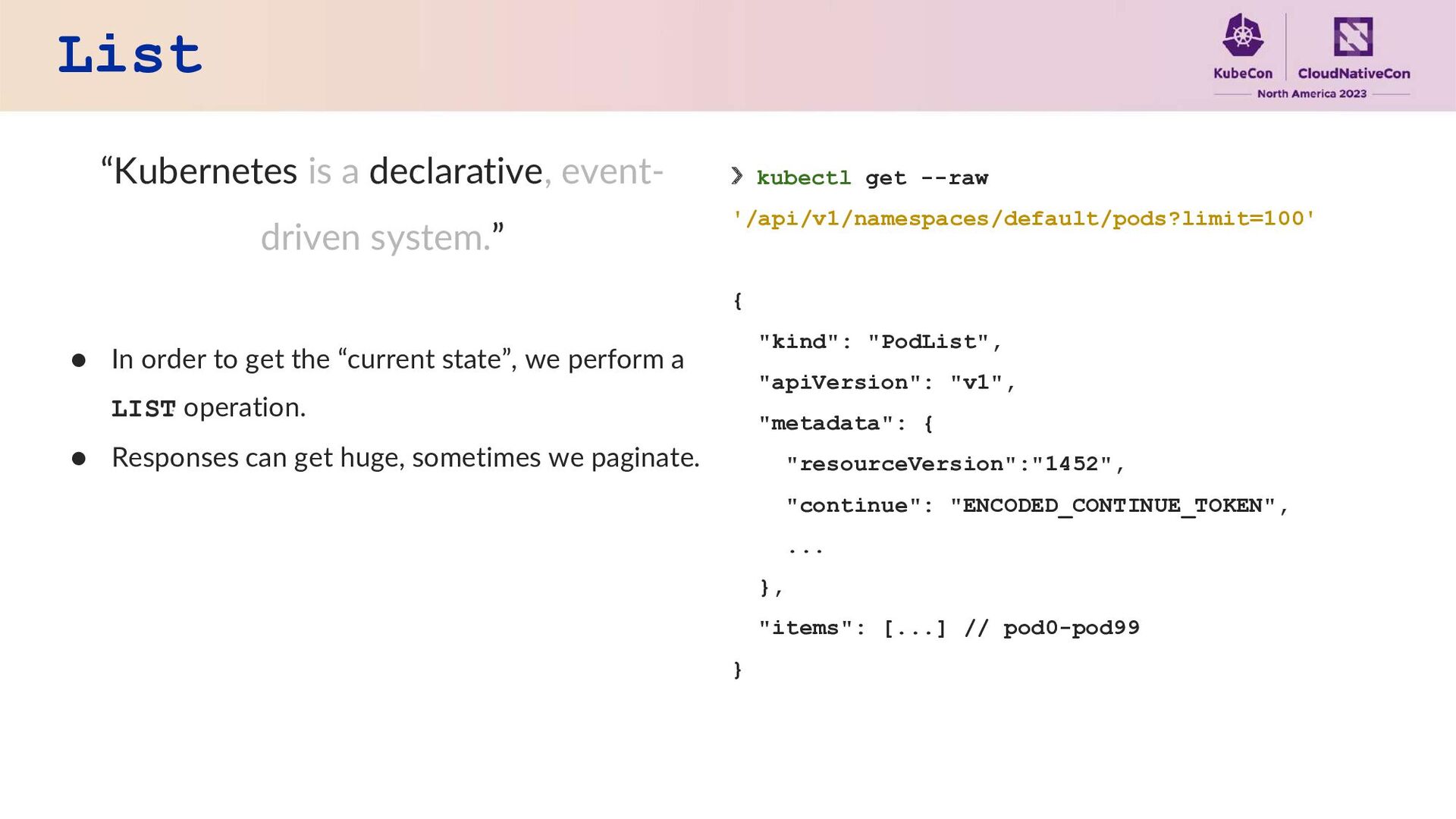
order to get the “current state”, we perform a LIST operation. • Responses can get huge, sometimes we paginate. ❯ kubectl get --raw '/api/v1/namespaces/default/pods?limit=100' { "kind": "PodList", "apiVersion": "v1", "metadata": { "resourceVersion":"1452", "continue": "ENCODED_CONTINUE_TOKEN", ... }, "items": [...] // pod0-pod99 }
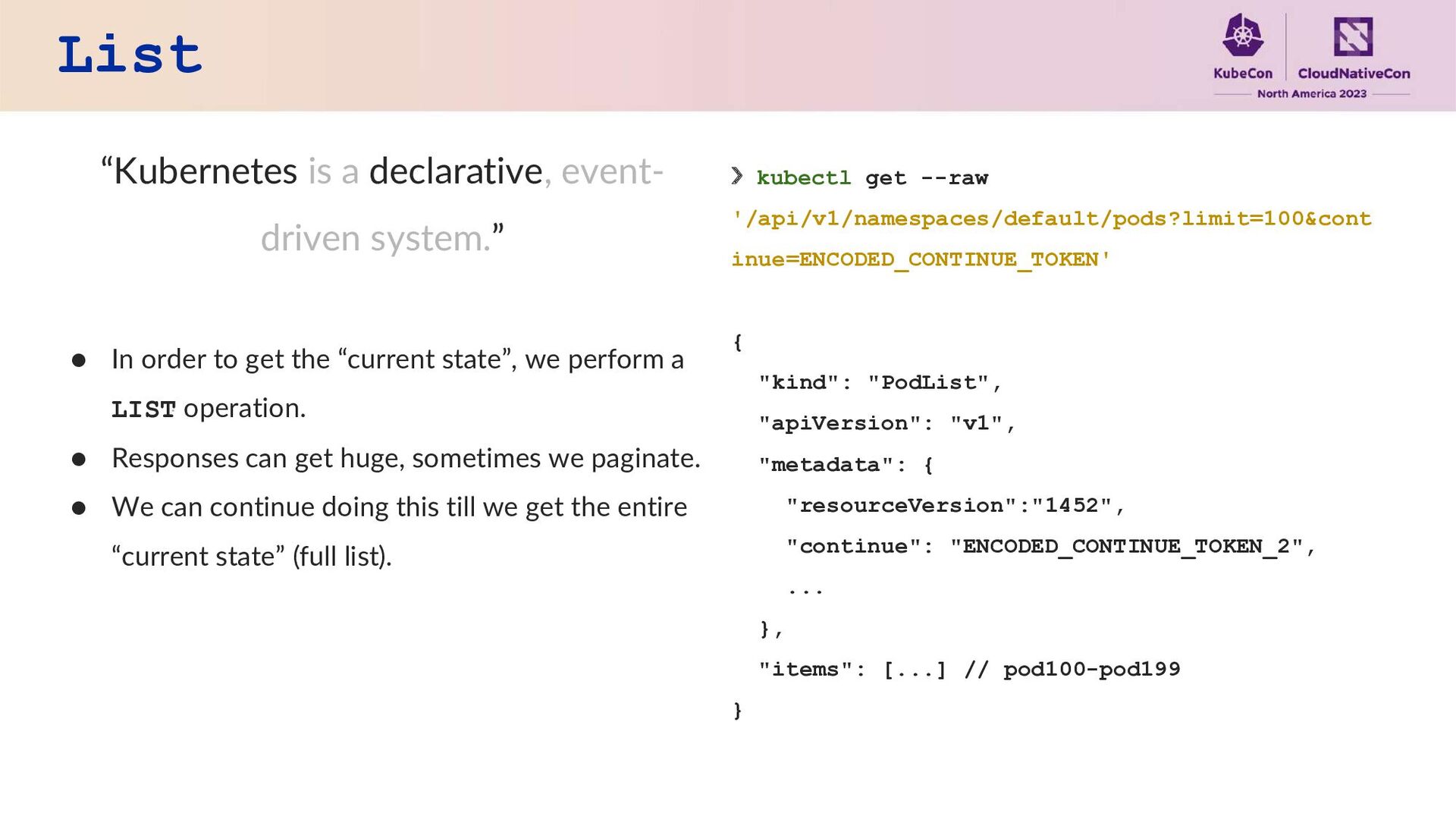
order to get the “current state”, we perform a LIST operation. • Responses can get huge, sometimes we paginate. • We can continue doing this till we get the entire “current state” (full list). ❯ kubectl get --raw '/api/v1/namespaces/default/pods?limit=100&cont inue=ENCODED_CONTINUE_TOKEN' { "kind": "PodList", "apiVersion": "v1", "metadata": { "resourceVersion":"1452", "continue": "ENCODED_CONTINUE_TOKEN_2", ... }, "items": [...] // pod100-pod199 }
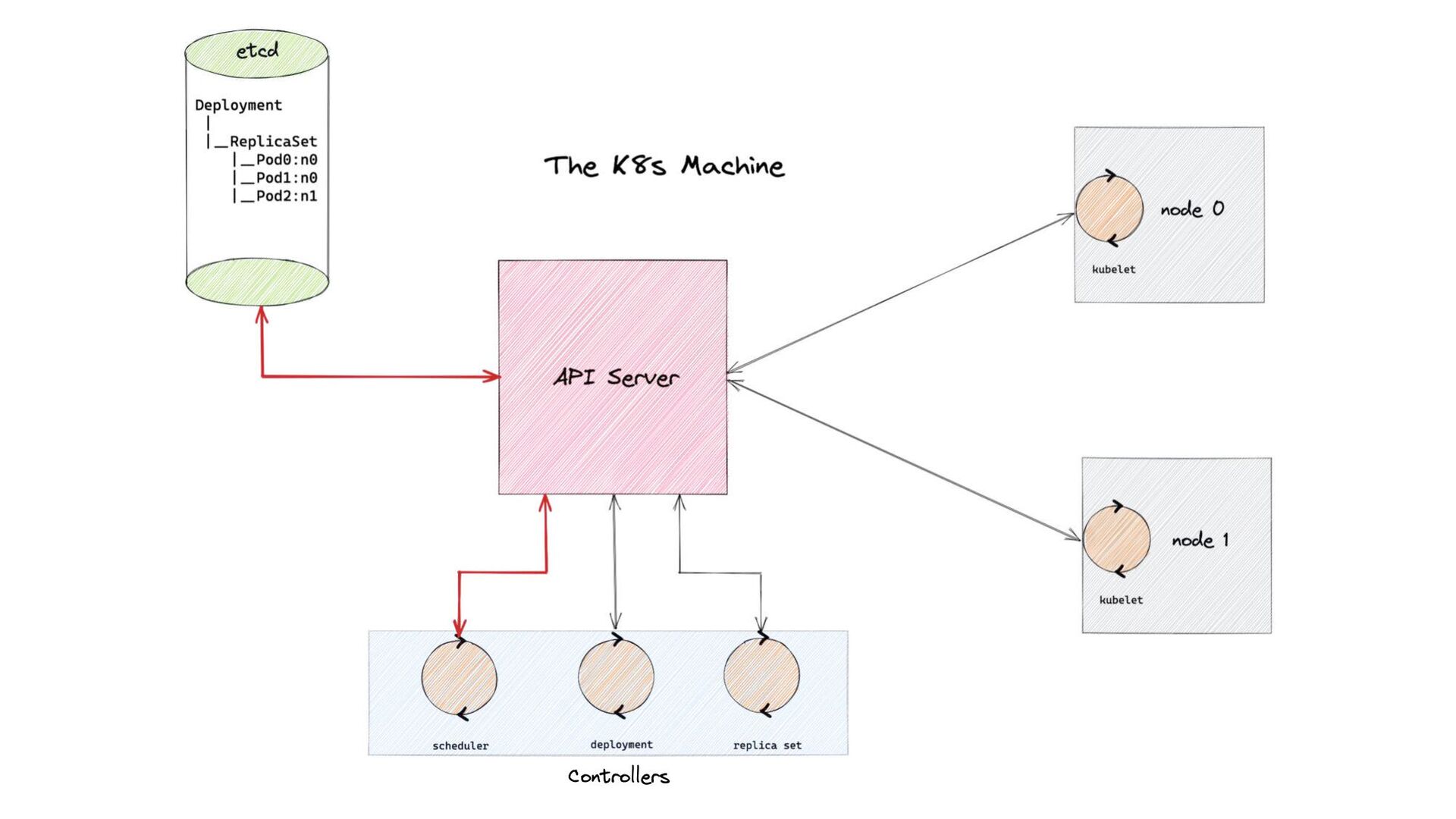
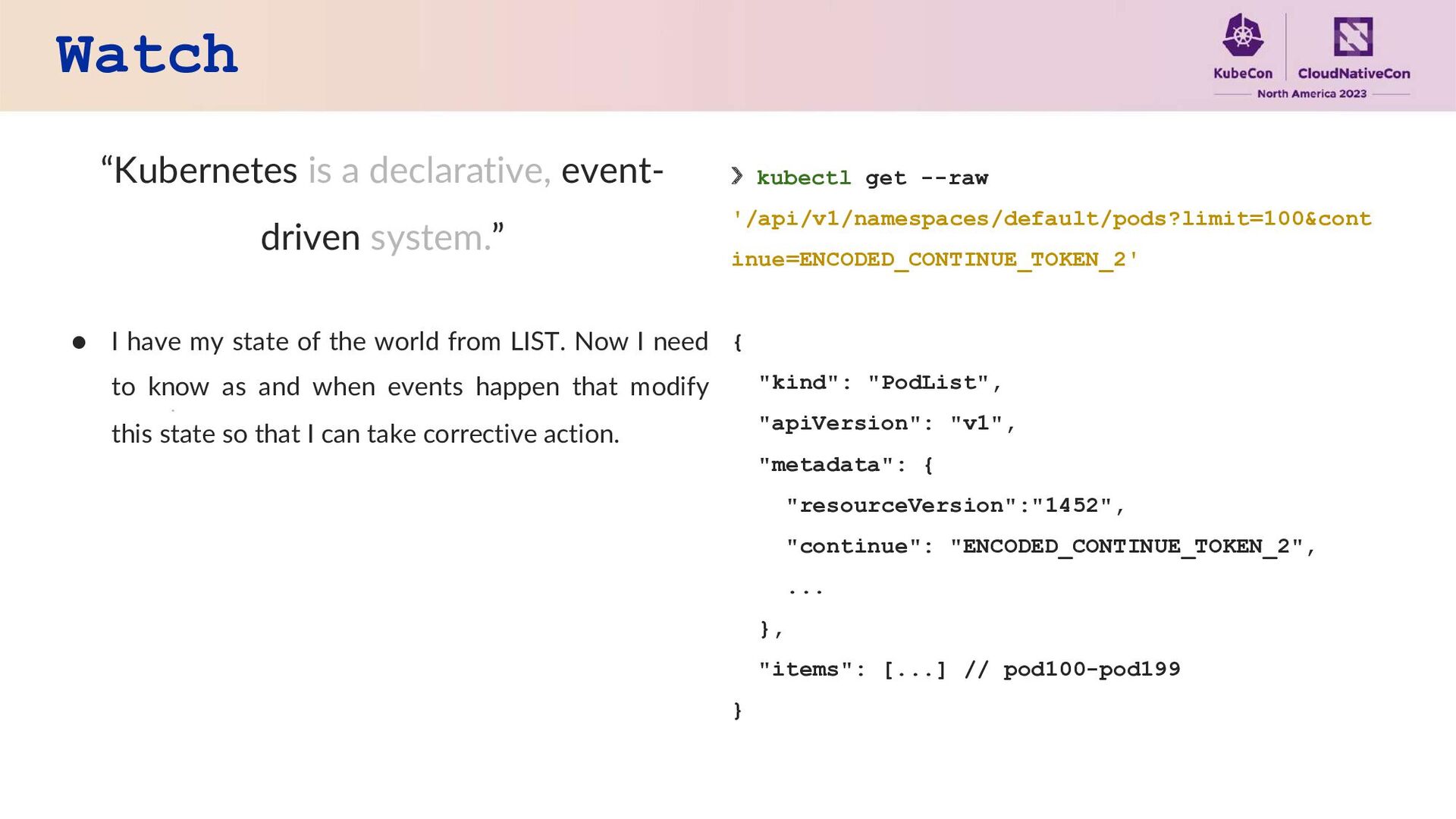
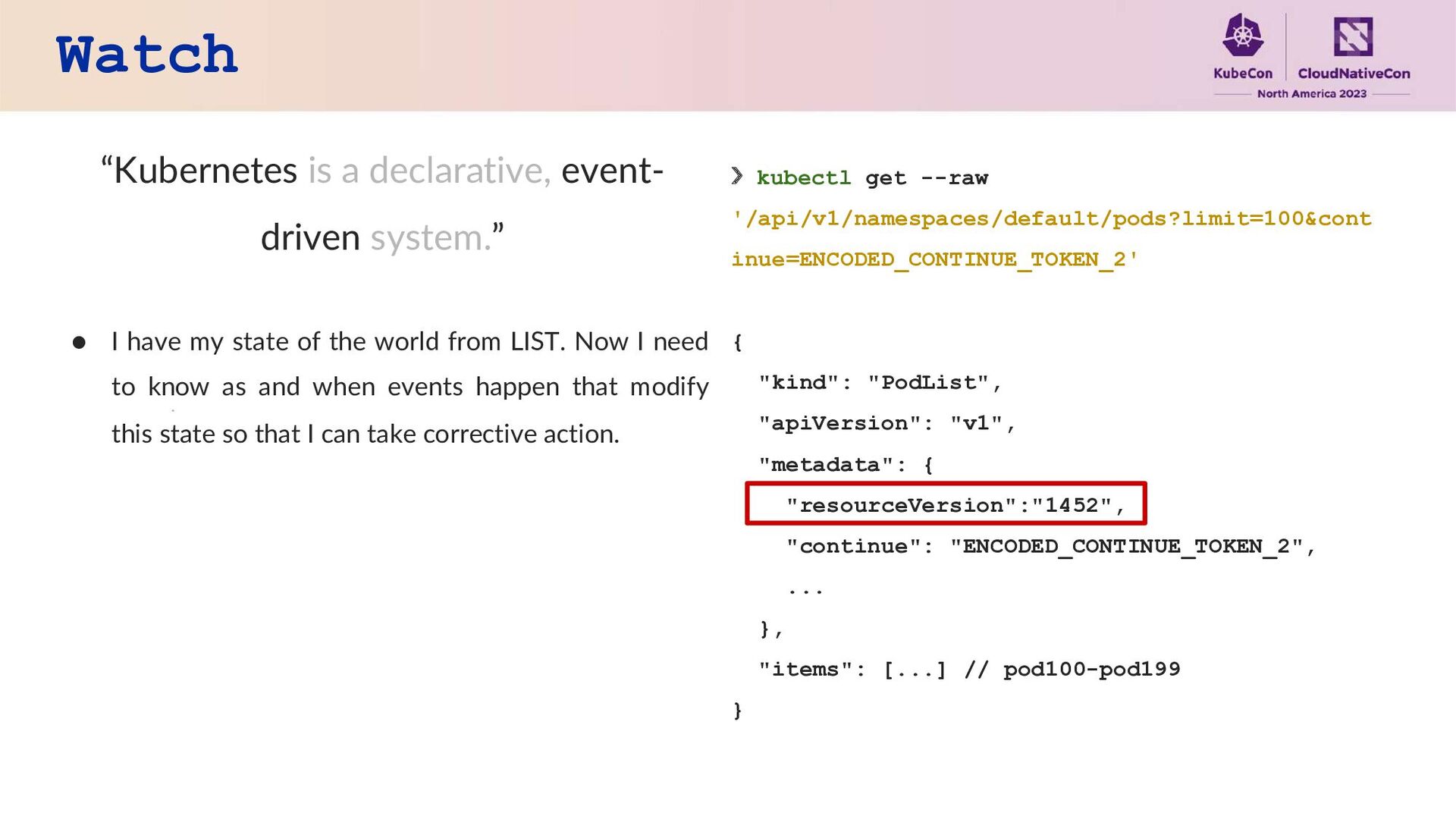
have my state of the world from LIST. Now I need to know as and when events happen that modify this state so that I can take corrective action. ❯ kubectl get --raw '/api/v1/namespaces/default/pods?limit=100&cont inue=ENCODED_CONTINUE_TOKEN_2' { "kind": "PodList", "apiVersion": "v1", "metadata": { "resourceVersion":"1452", "continue": "ENCODED_CONTINUE_TOKEN_2", ... }, "items": [...] // pod100-pod199 }
have my state of the world from LIST. Now I need to know as and when events happen that modify this state so that I can take corrective action. ❯ kubectl get --raw '/api/v1/namespaces/default/pods?limit=100&cont inue=ENCODED_CONTINUE_TOKEN_2' { "kind": "PodList", "apiVersion": "v1", "metadata": { "resourceVersion":"1452", "continue": "ENCODED_CONTINUE_TOKEN_2", ... }, "items": [...] // pod100-pod199 }
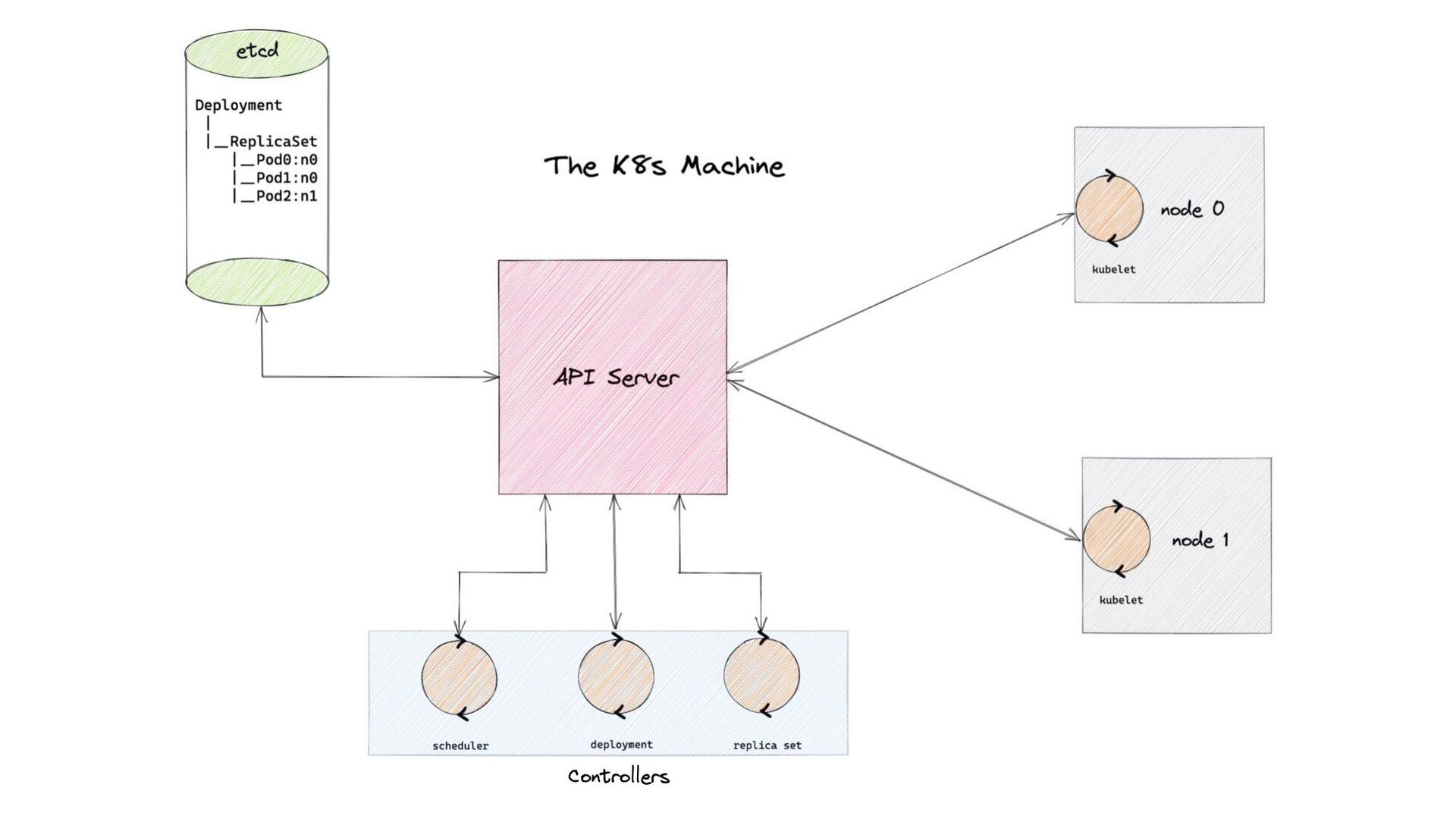
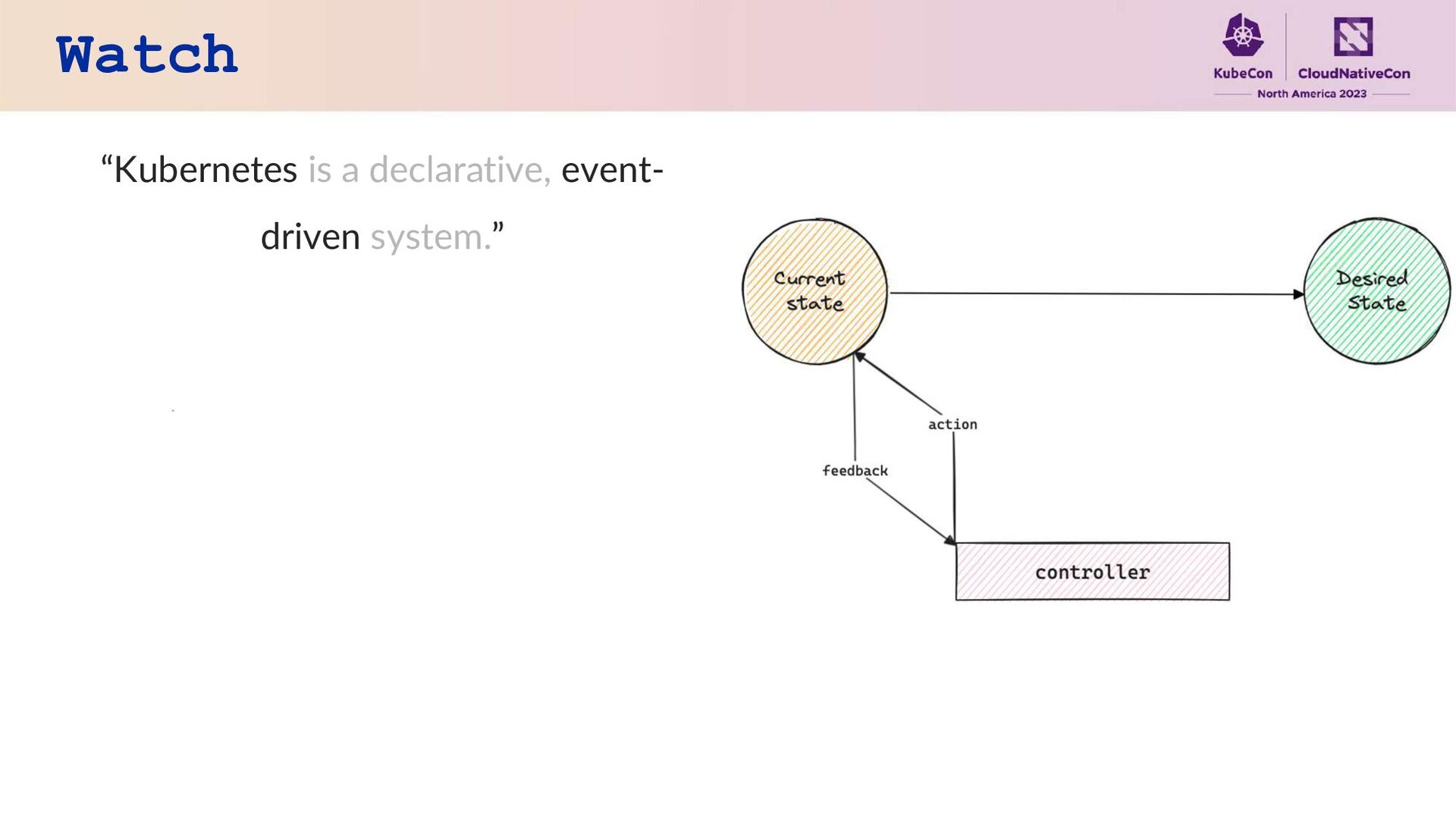
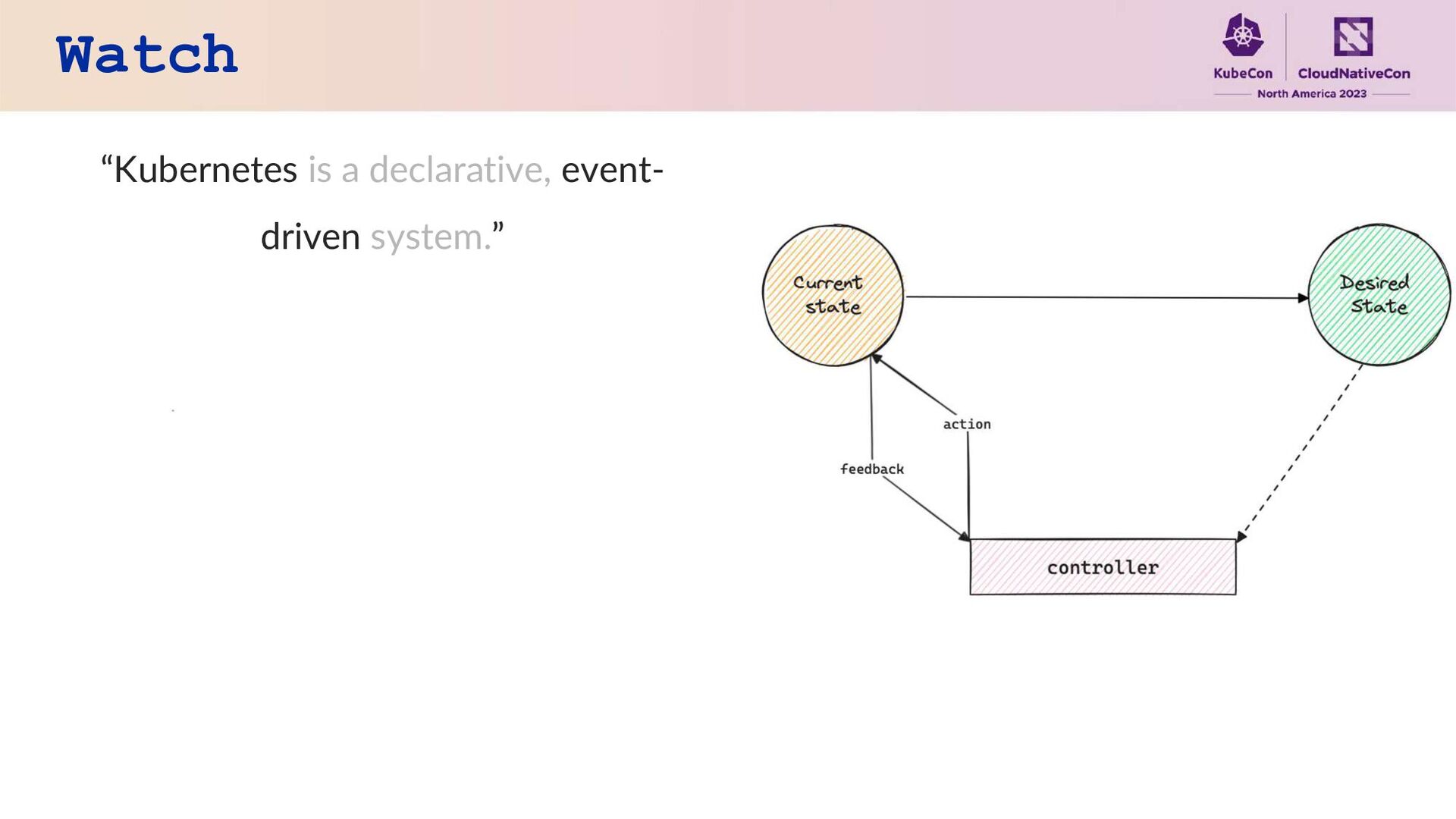
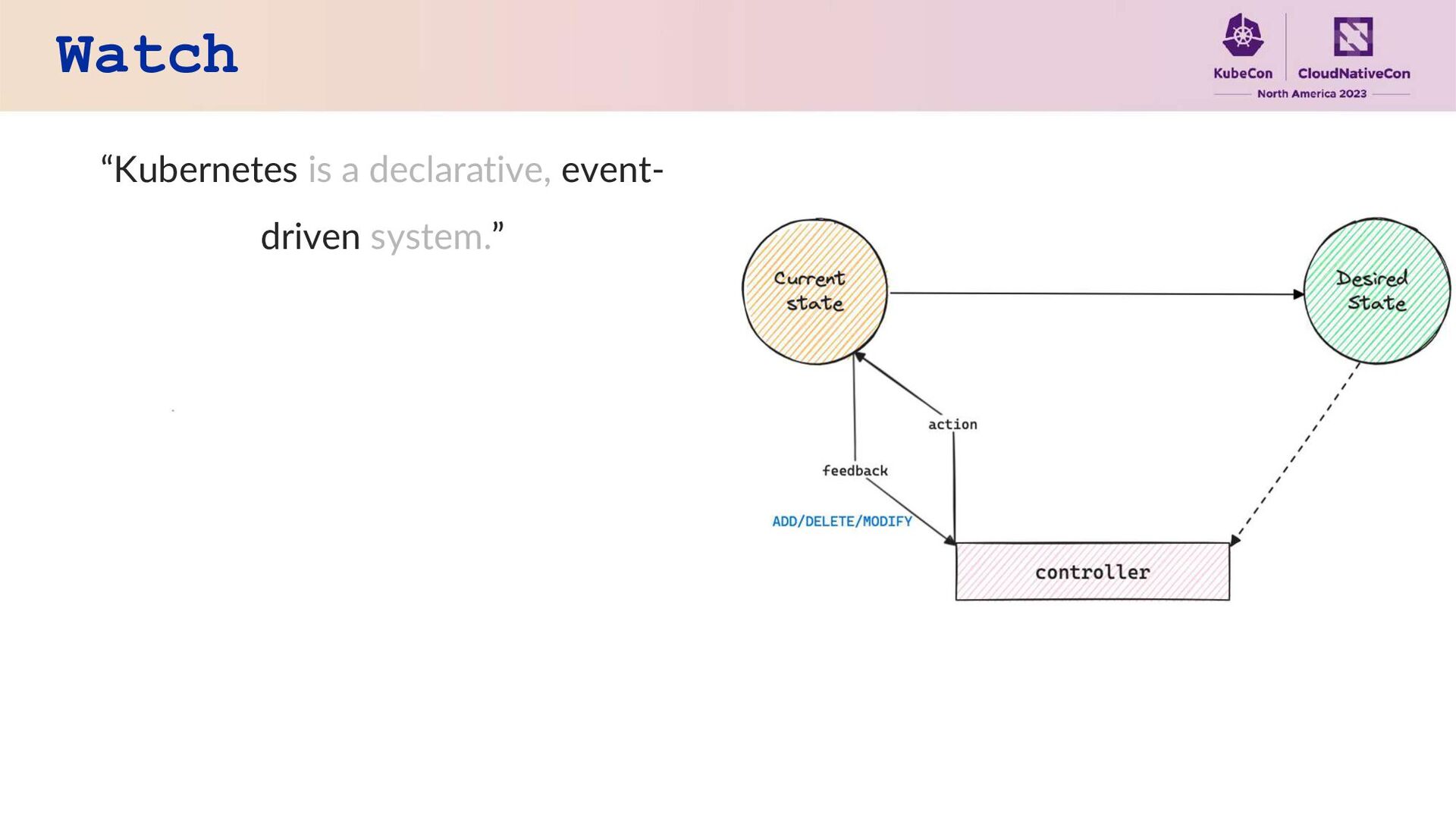
"object": { "kind": "Pod", "apiVersion": "v1", "metadata": {"resourceVersion":"1650", ...}, ...} } ... { "type": "DELETED", "object": { "kind": "Pod", "apiVersion": "v1", "metadata": {"resourceVersion":"1734", ...}, ...} } “Kubernetes is a declarative, event- driven system.” • I have my state of the world from LIST. Now I need to know as and when events happen that modify this state so that I can take corrective action. • WATCH for changes. The API Server gives us a stream of notifications on a single connection that we can “react” to.
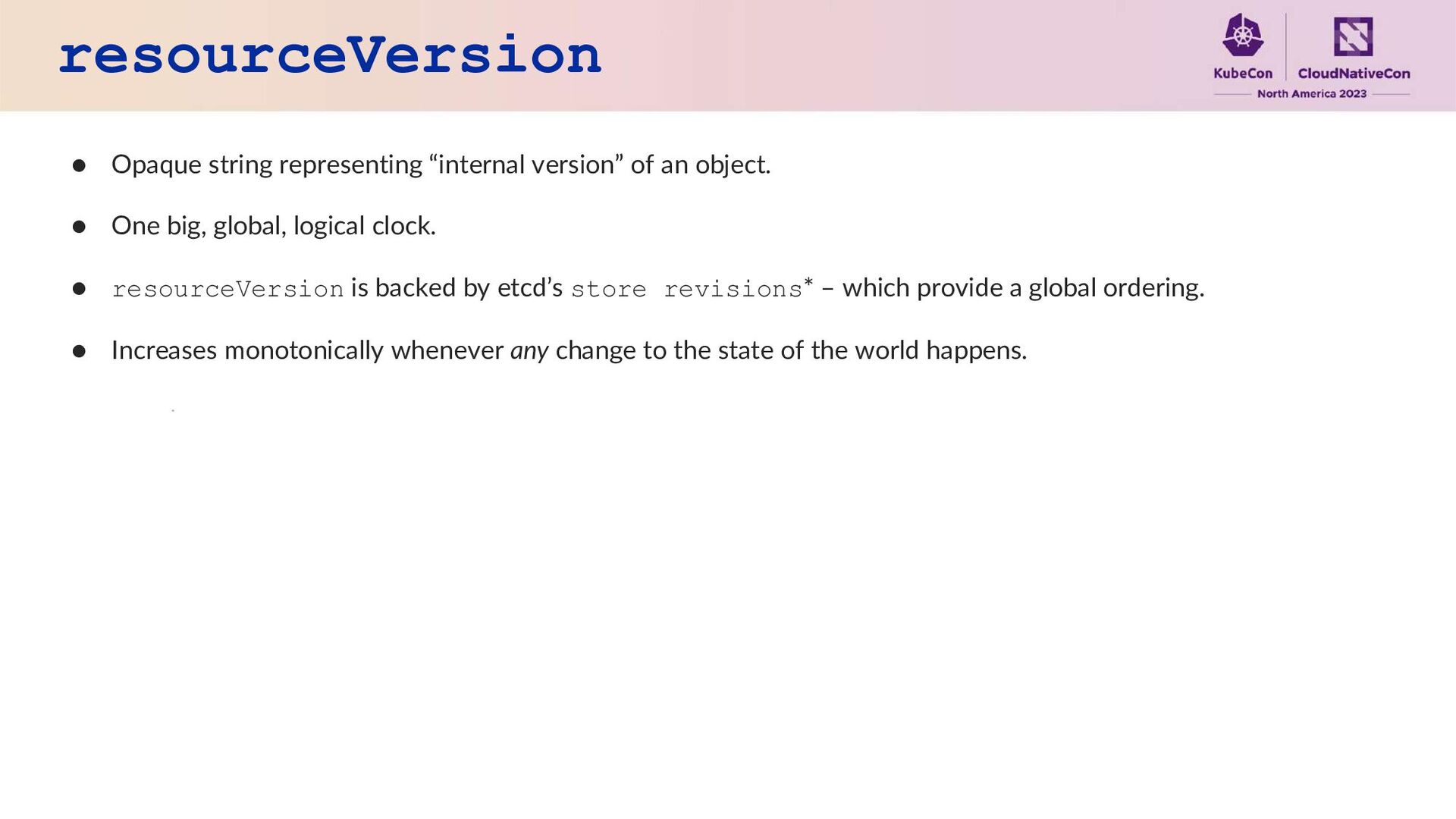
• One big, global, logical clock. • resourceVersion is backed by etcd’s store revisions* – which provide a global ordering. • Increases monotonically whenever any change to the state of the world happens.
• One big, global, logical clock. • resourceVersion is backed by etcd’s store revisions* – which provide a global ordering. • Increases monotonically whenever any change to the state of the world happens. • Gives you a global order of events that happen in the system. • Most importantly - they enable optimistic concurrency control.
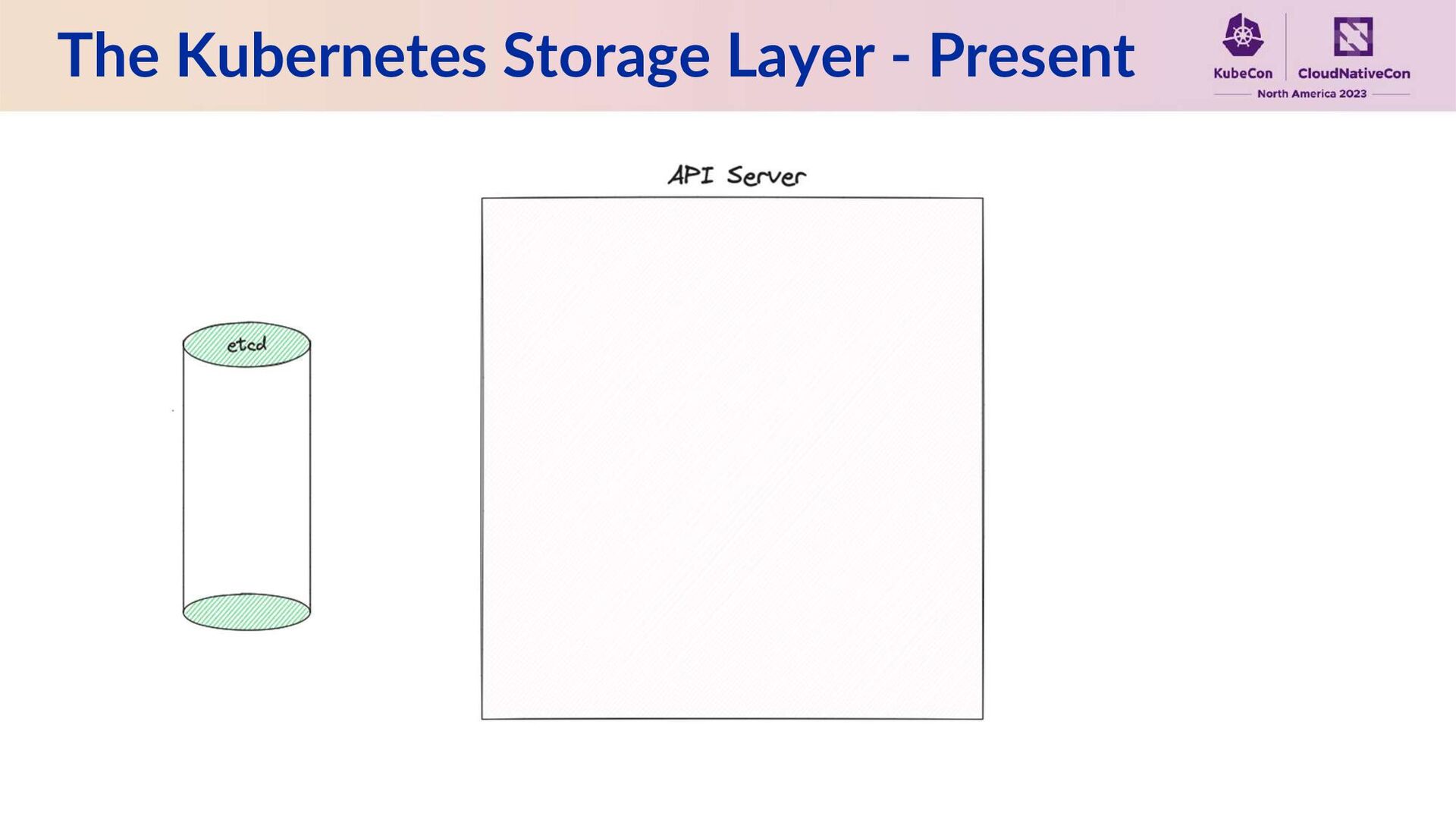
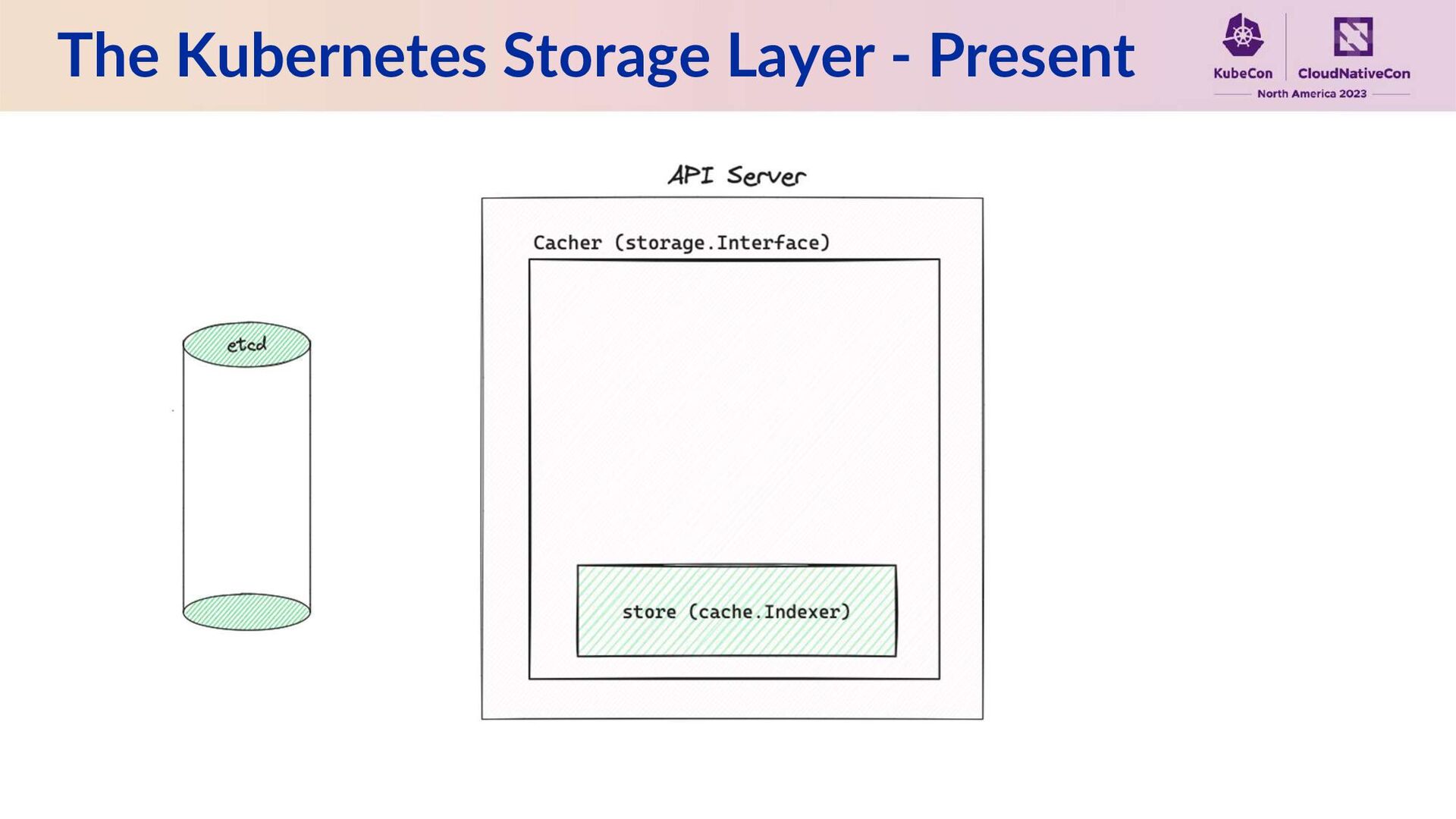
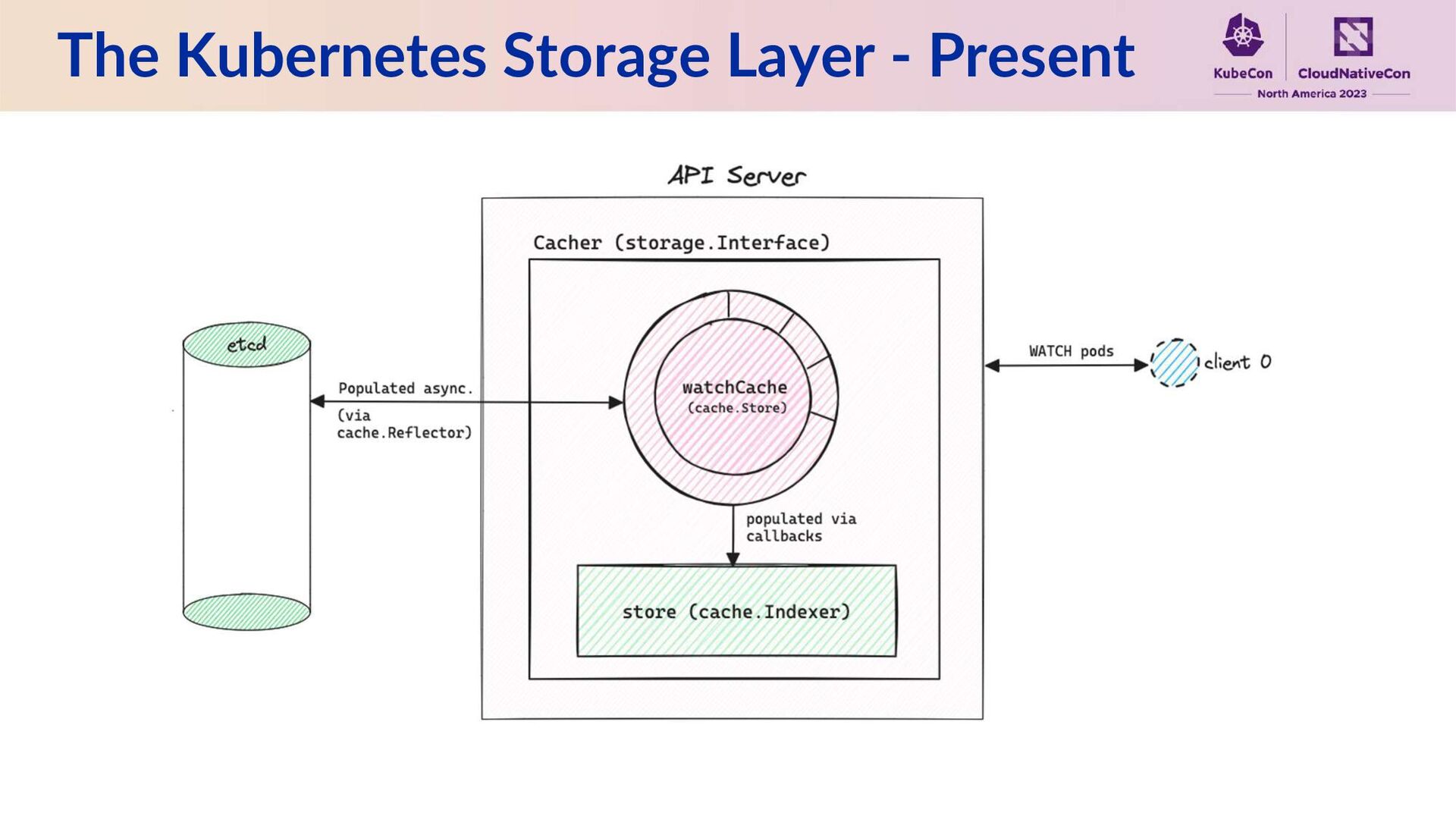
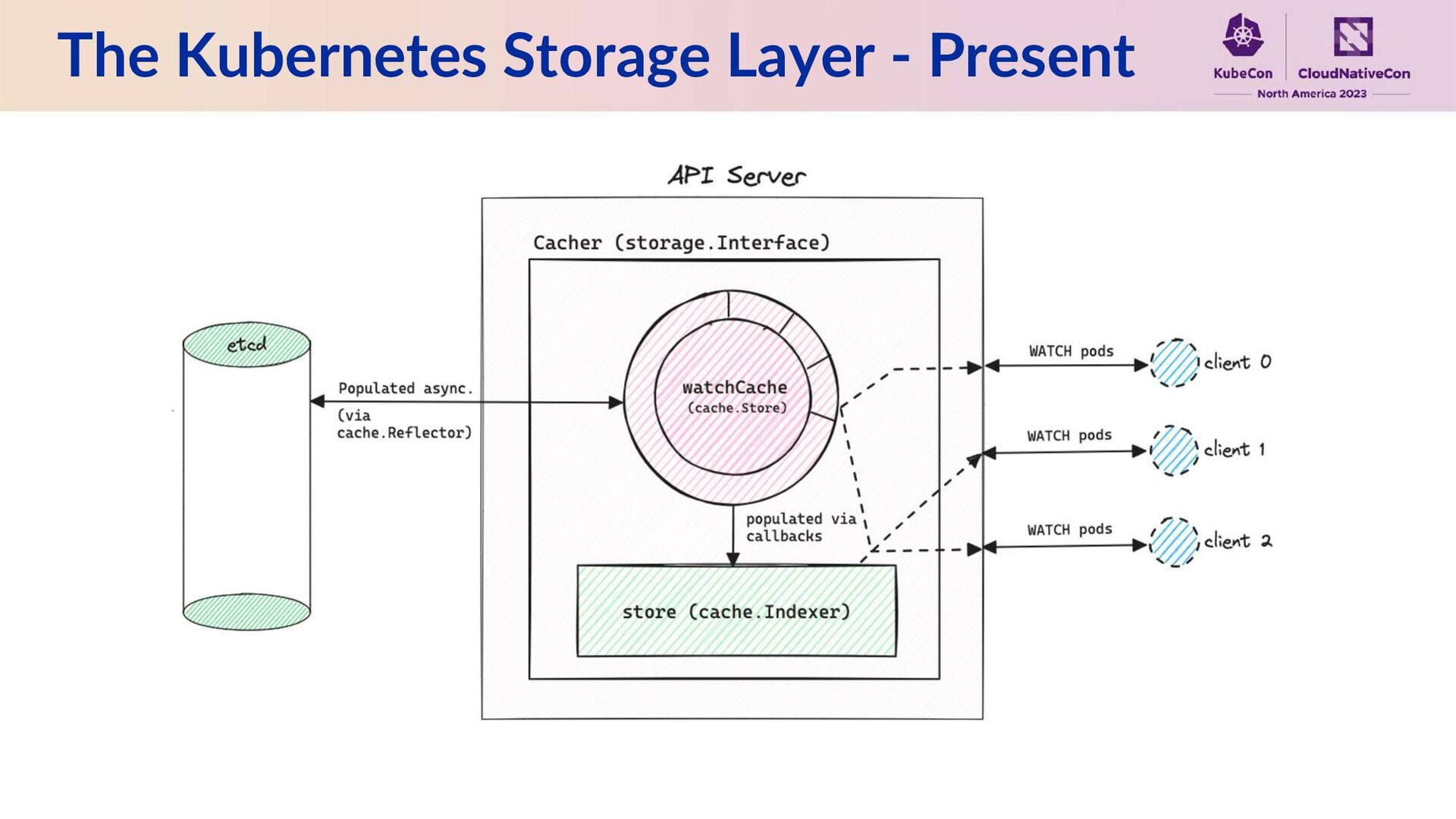
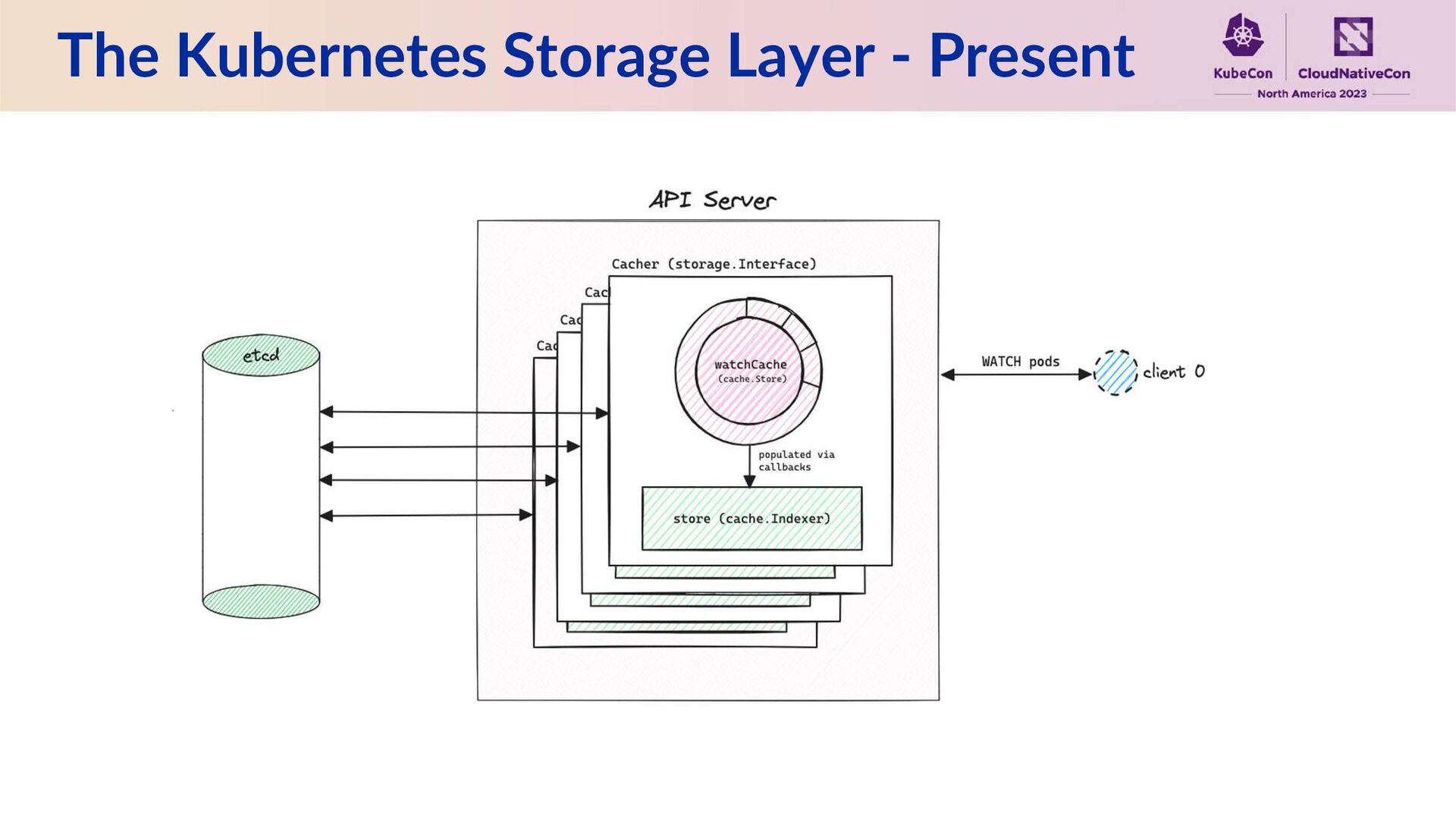
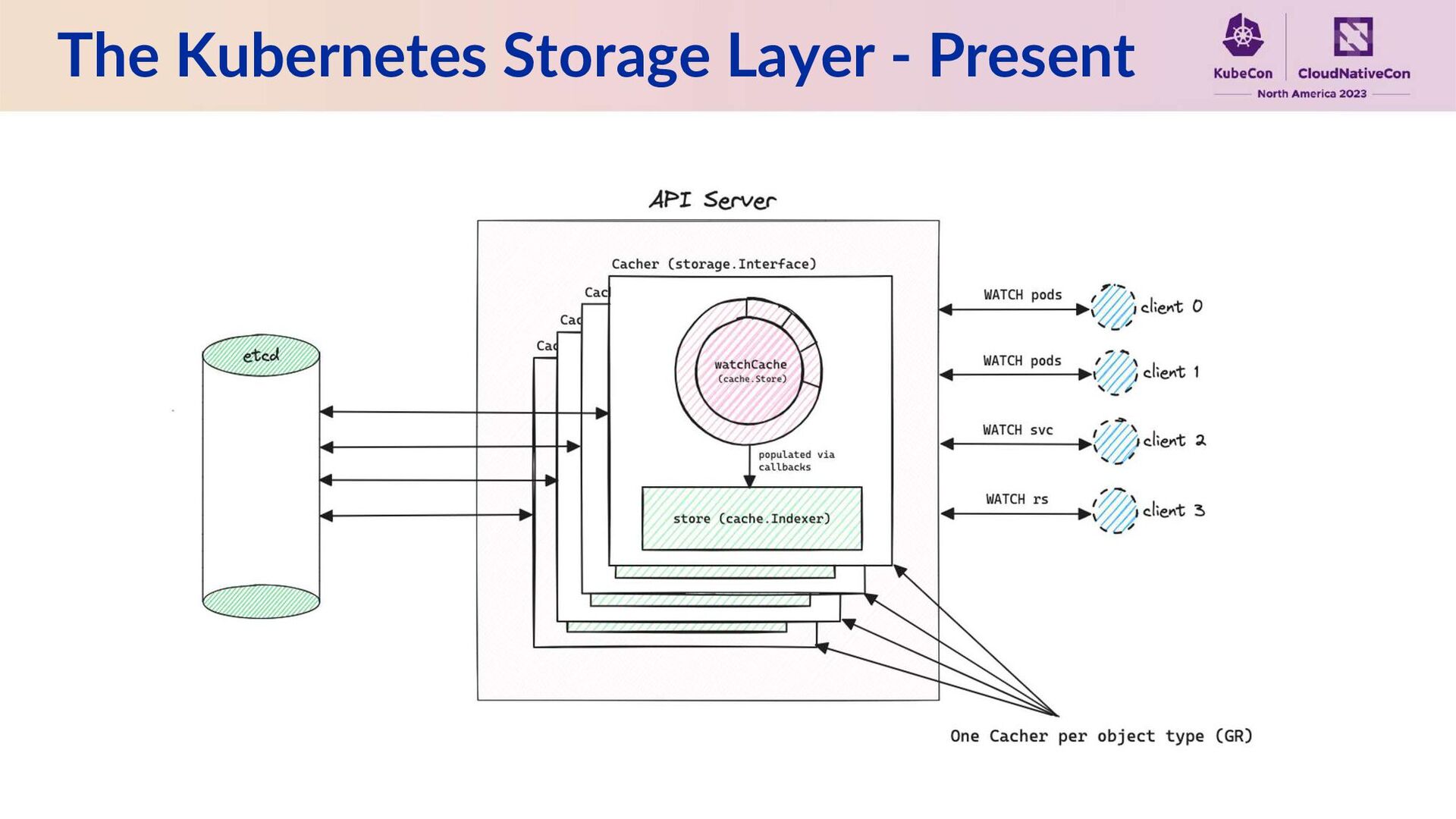
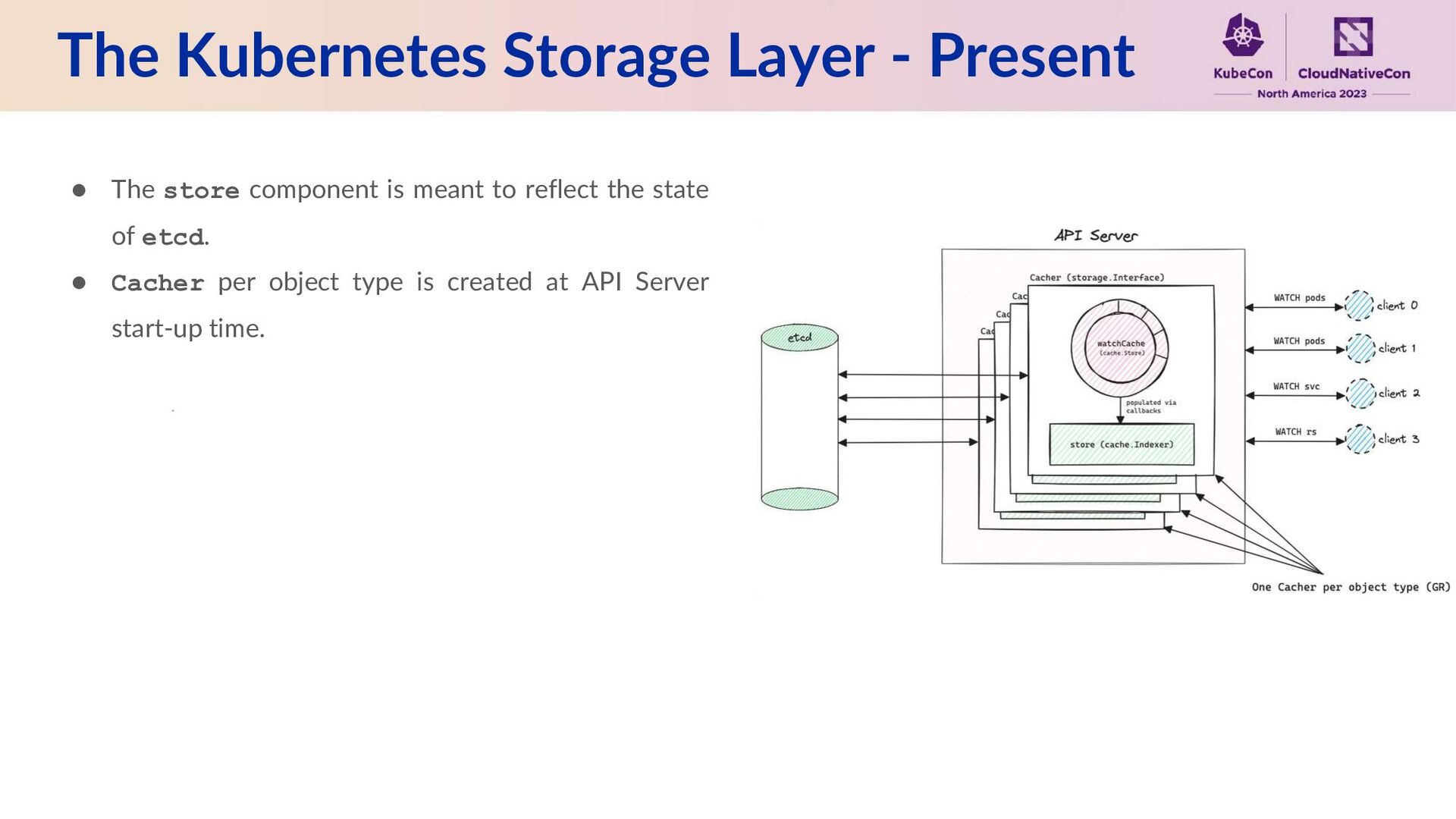
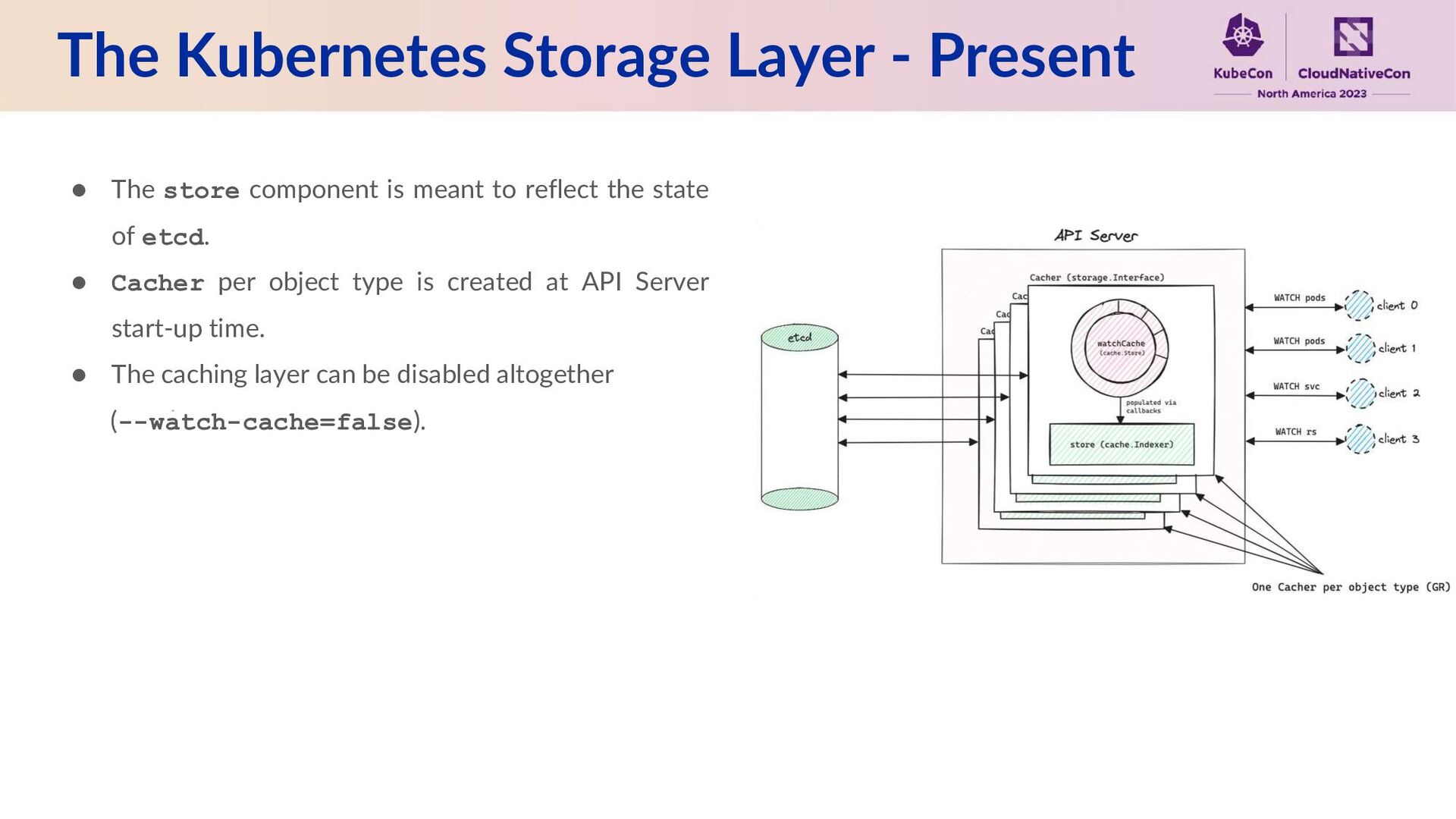
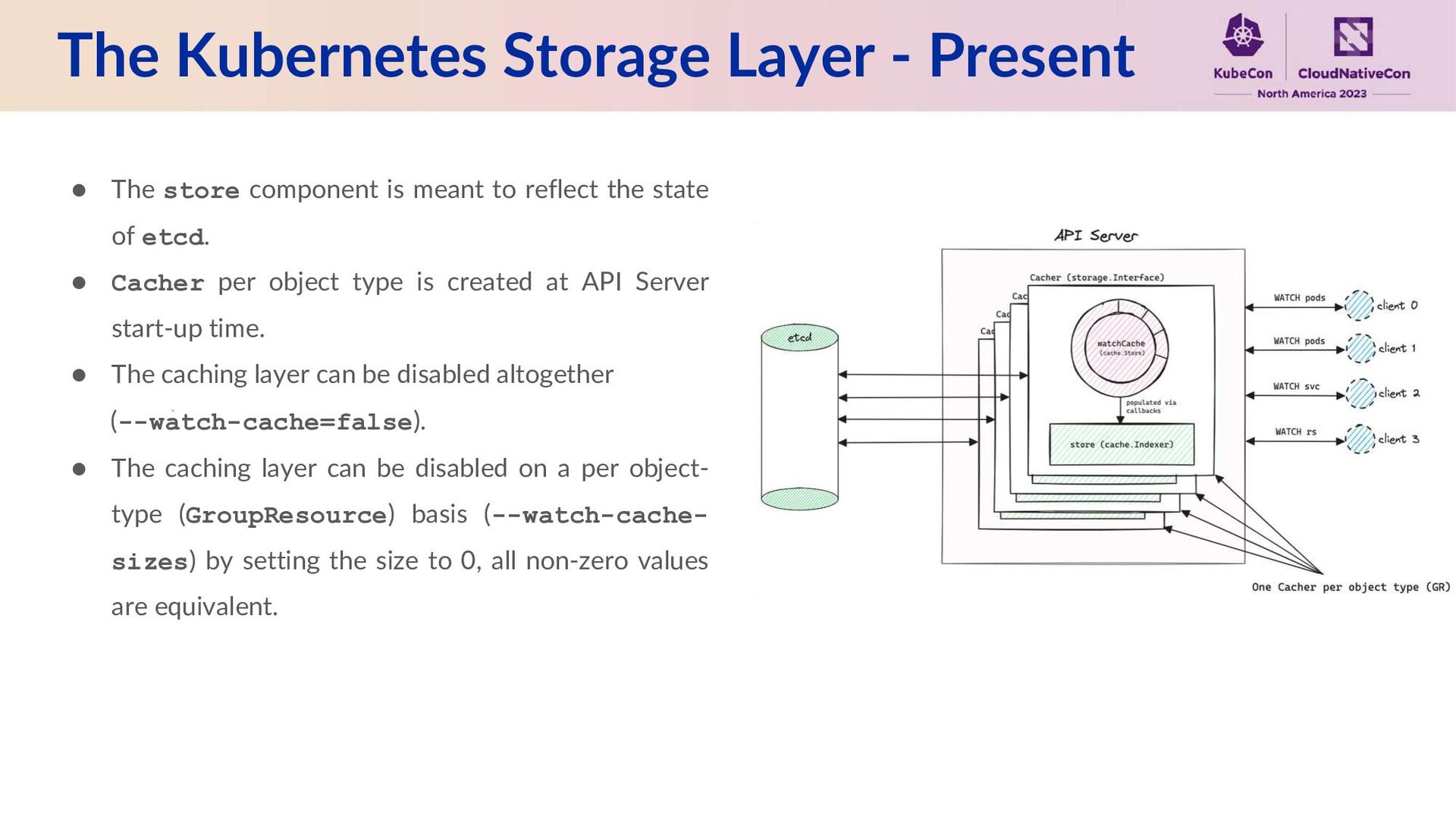
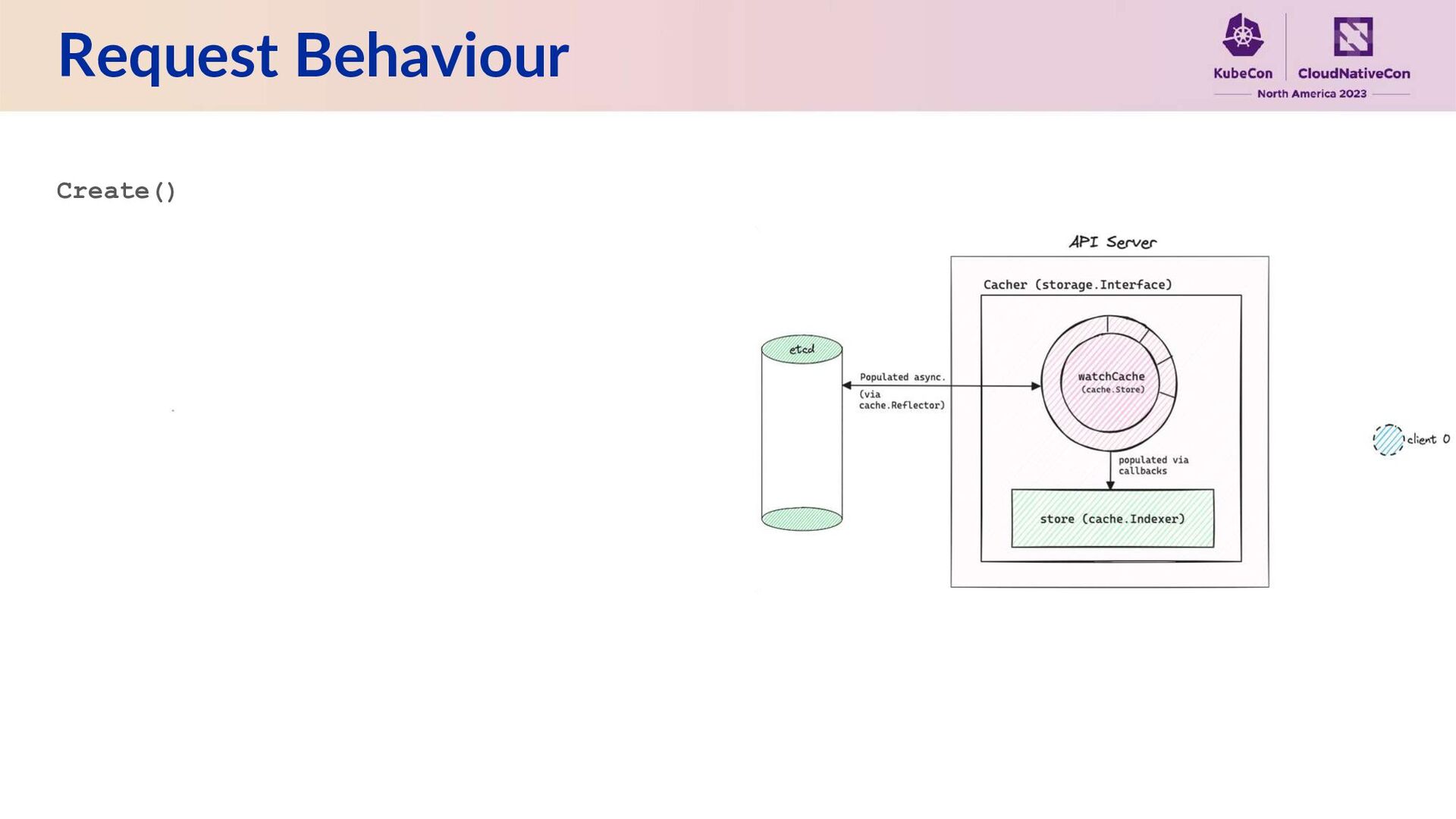
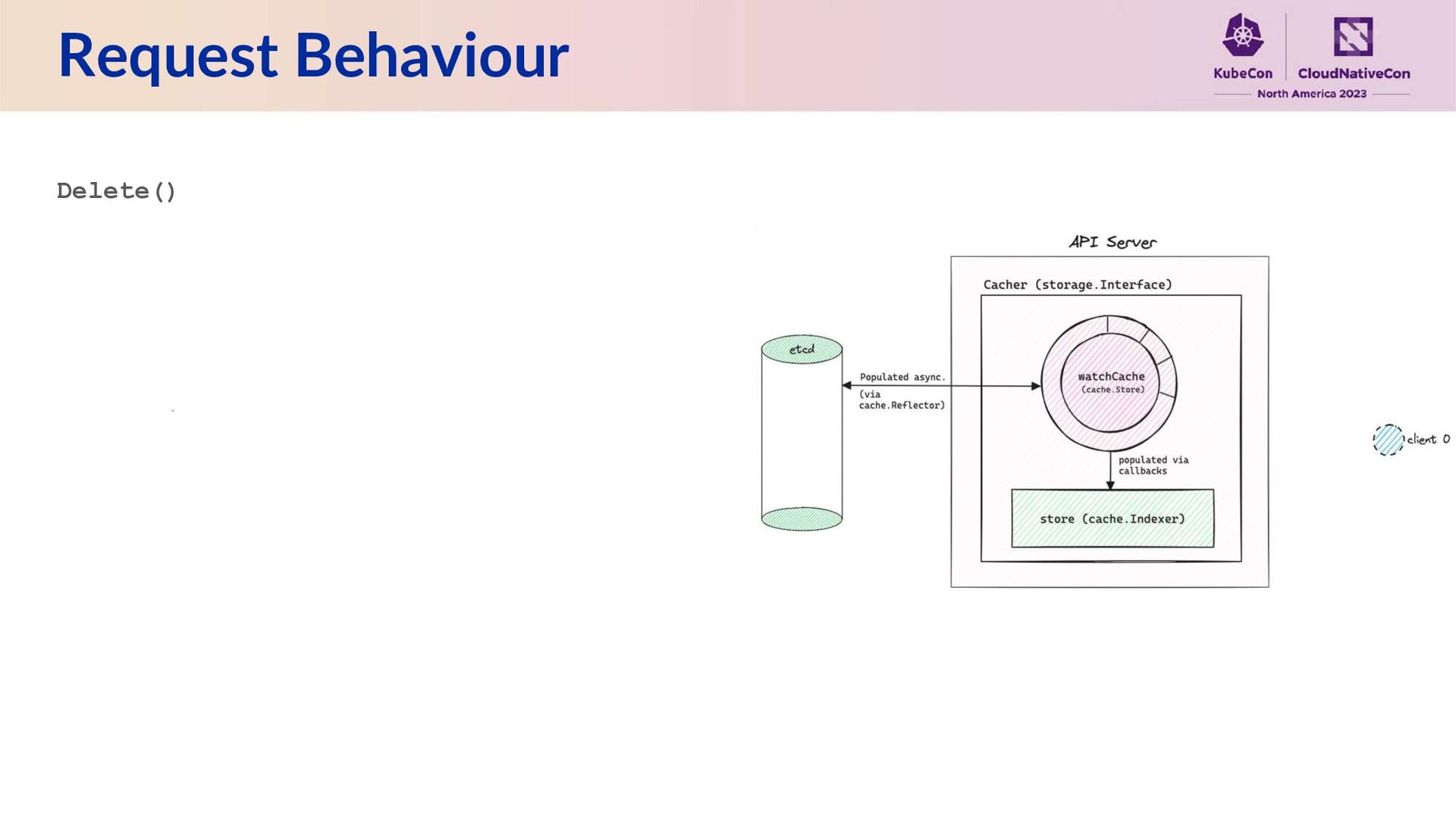
is meant to reflect the state of etcd. • Cacher per object type is created at API Server start-up time. • The caching layer can be disabled altogether (--watch-cache=false).
is meant to reflect the state of etcd. • Cacher per object type is created at API Server start-up time. • The caching layer can be disabled altogether (--watch-cache=false). • The caching layer can be disabled on a per object- type (GroupResource) basis (--watch-cache- sizes) by setting the size to 0, all non-zero values are equivalent.
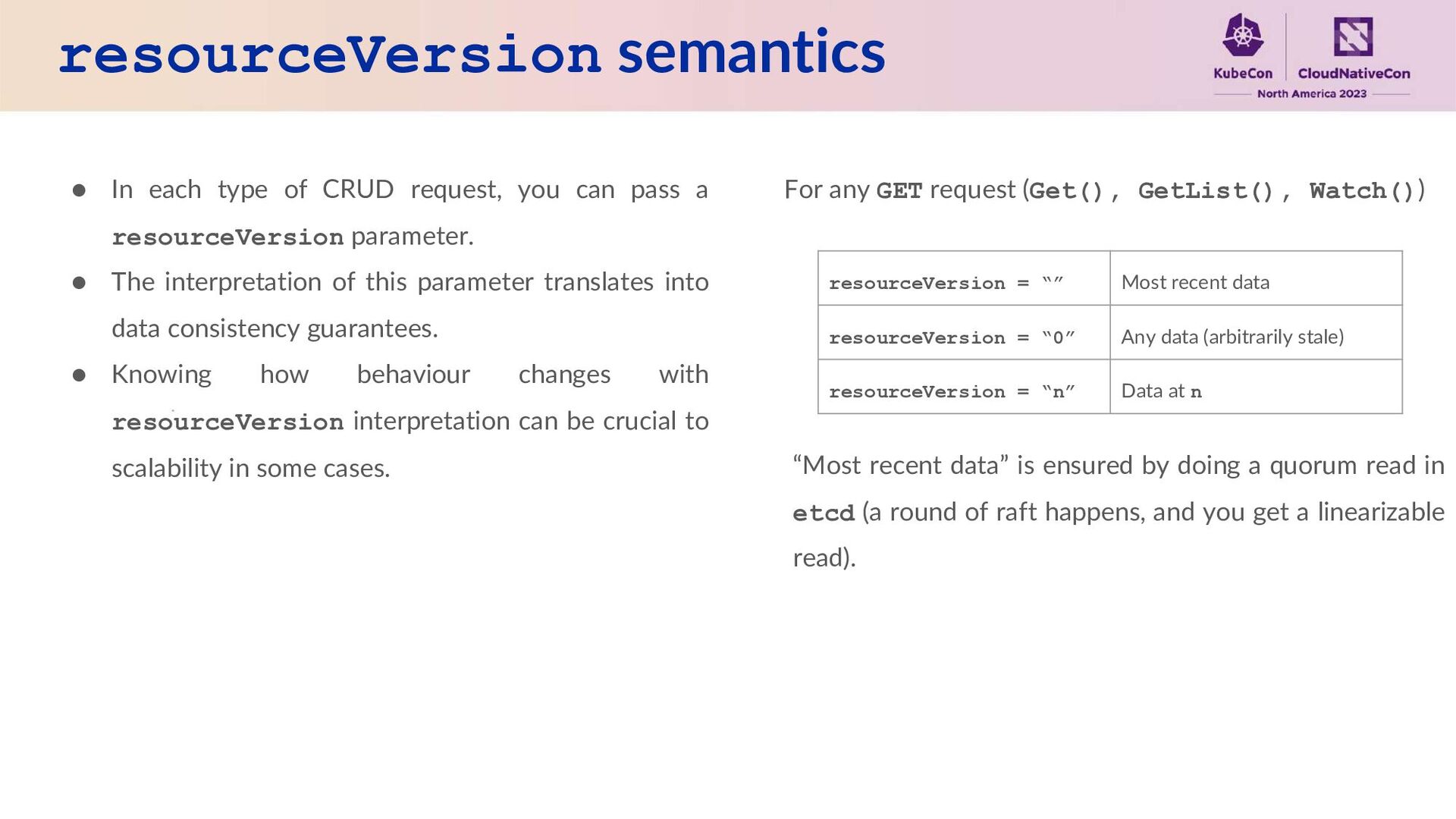
can pass a resourceVersion parameter. • The interpretation of this parameter translates into data consistency guarantees. • Knowing how behaviour changes with resourceVersion interpretation can be crucial to scalability in some cases.
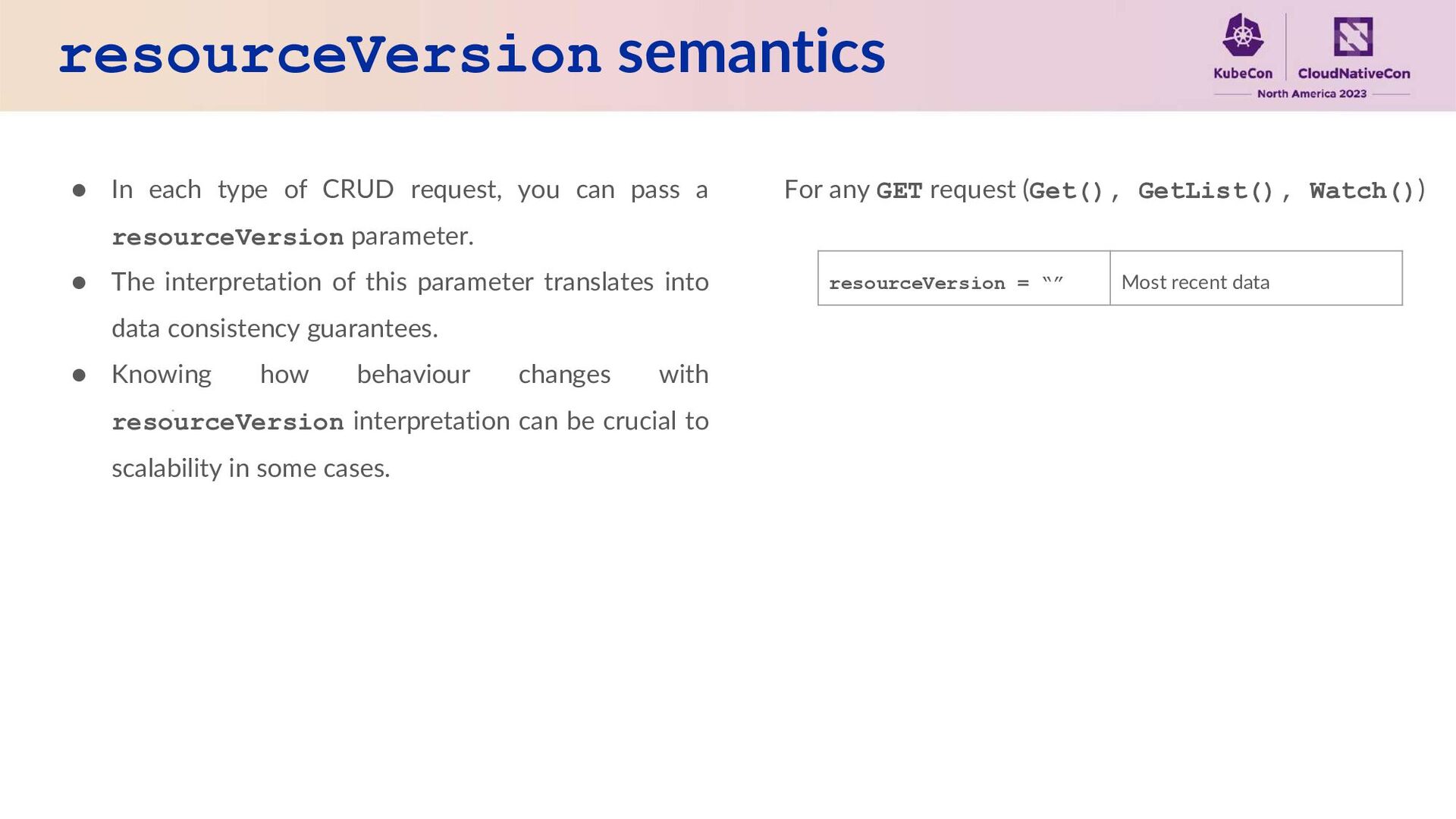
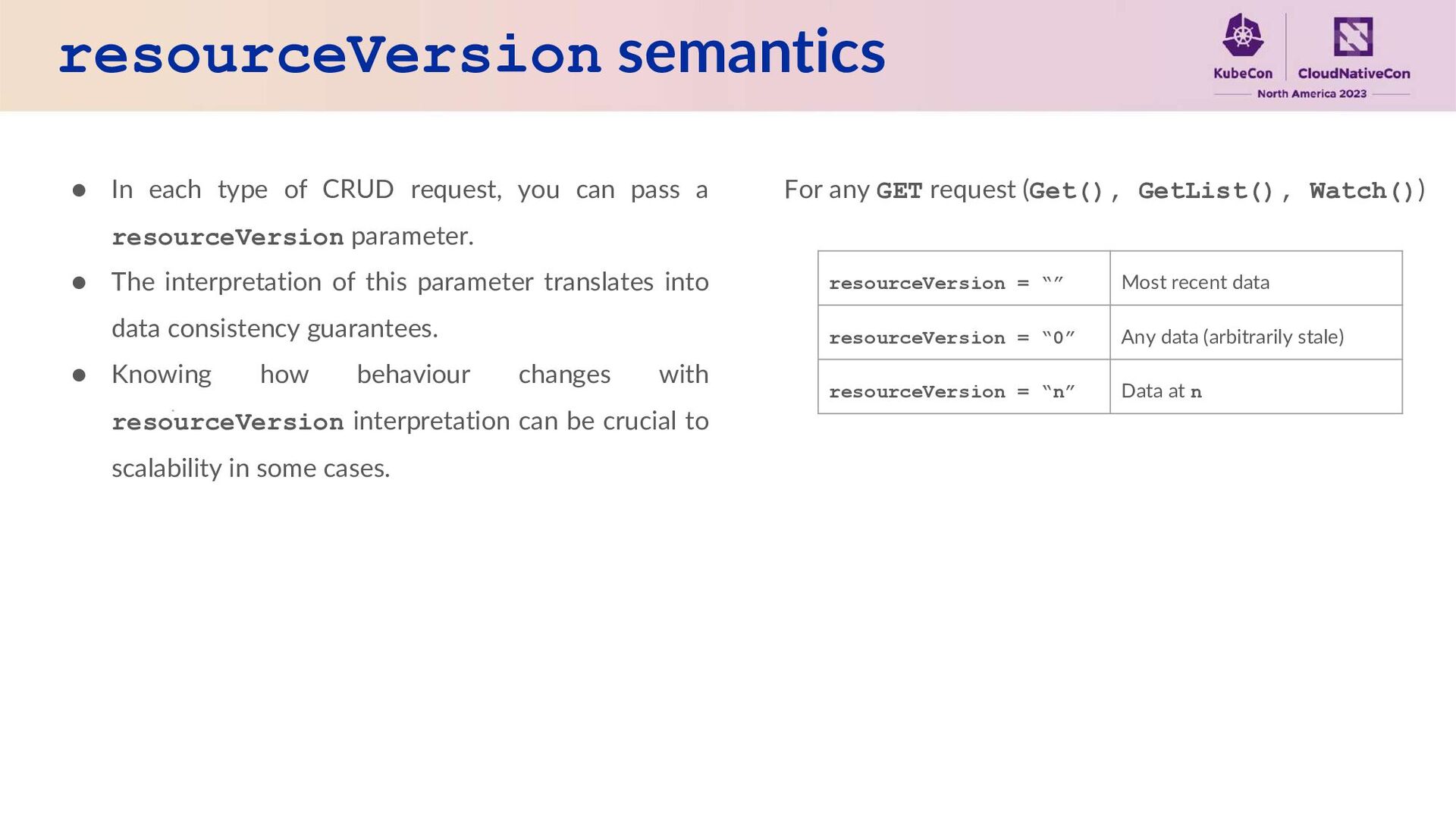
can pass a resourceVersion parameter. • The interpretation of this parameter translates into data consistency guarantees. • Knowing how behaviour changes with resourceVersion interpretation can be crucial to scalability in some cases. For any GET request (Get(), GetList(), Watch())
can pass a resourceVersion parameter. • The interpretation of this parameter translates into data consistency guarantees. • Knowing how behaviour changes with resourceVersion interpretation can be crucial to scalability in some cases. For any GET request (Get(), GetList(), Watch()) resourceVersion = “” Most recent data
can pass a resourceVersion parameter. • The interpretation of this parameter translates into data consistency guarantees. • Knowing how behaviour changes with resourceVersion interpretation can be crucial to scalability in some cases. For any GET request (Get(), GetList(), Watch()) resourceVersion = “” Most recent data resourceVersion = “0” Any data (arbitrarily stale)
can pass a resourceVersion parameter. • The interpretation of this parameter translates into data consistency guarantees. • Knowing how behaviour changes with resourceVersion interpretation can be crucial to scalability in some cases. For any GET request (Get(), GetList(), Watch()) resourceVersion = “” Most recent data resourceVersion = “0” Any data (arbitrarily stale) resourceVersion = “n” Data at n
can pass a resourceVersion parameter. • The interpretation of this parameter translates into data consistency guarantees. • Knowing how behaviour changes with resourceVersion interpretation can be crucial to scalability in some cases. For any GET request (Get(), GetList(), Watch()) resourceVersion = “” Most recent data resourceVersion = “0” Any data (arbitrarily stale) resourceVersion = “n” Data at n “Most recent data” is ensured by doing a quorum read in etcd (a round of raft happens, and you get a linearizable read).
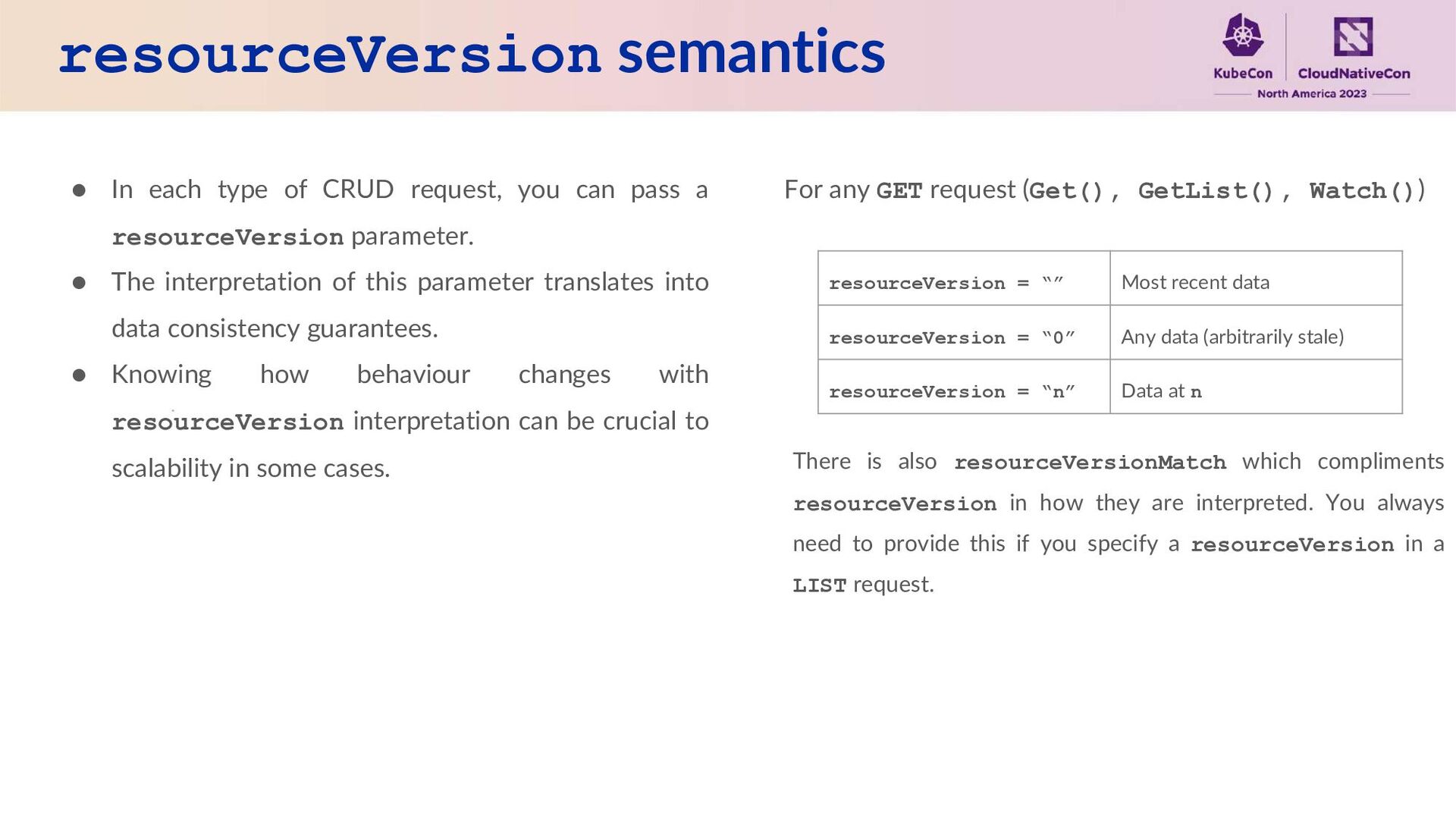
can pass a resourceVersion parameter. • The interpretation of this parameter translates into data consistency guarantees. • Knowing how behaviour changes with resourceVersion interpretation can be crucial to scalability in some cases. For any GET request (Get(), GetList(), Watch()) resourceVersion = “” Most recent data resourceVersion = “0” Any data (arbitrarily stale) resourceVersion = “n” Data at n There is also resourceVersionMatch which compliments resourceVersion in how they are interpreted. You always need to provide this if you specify a resourceVersion in a LIST request.
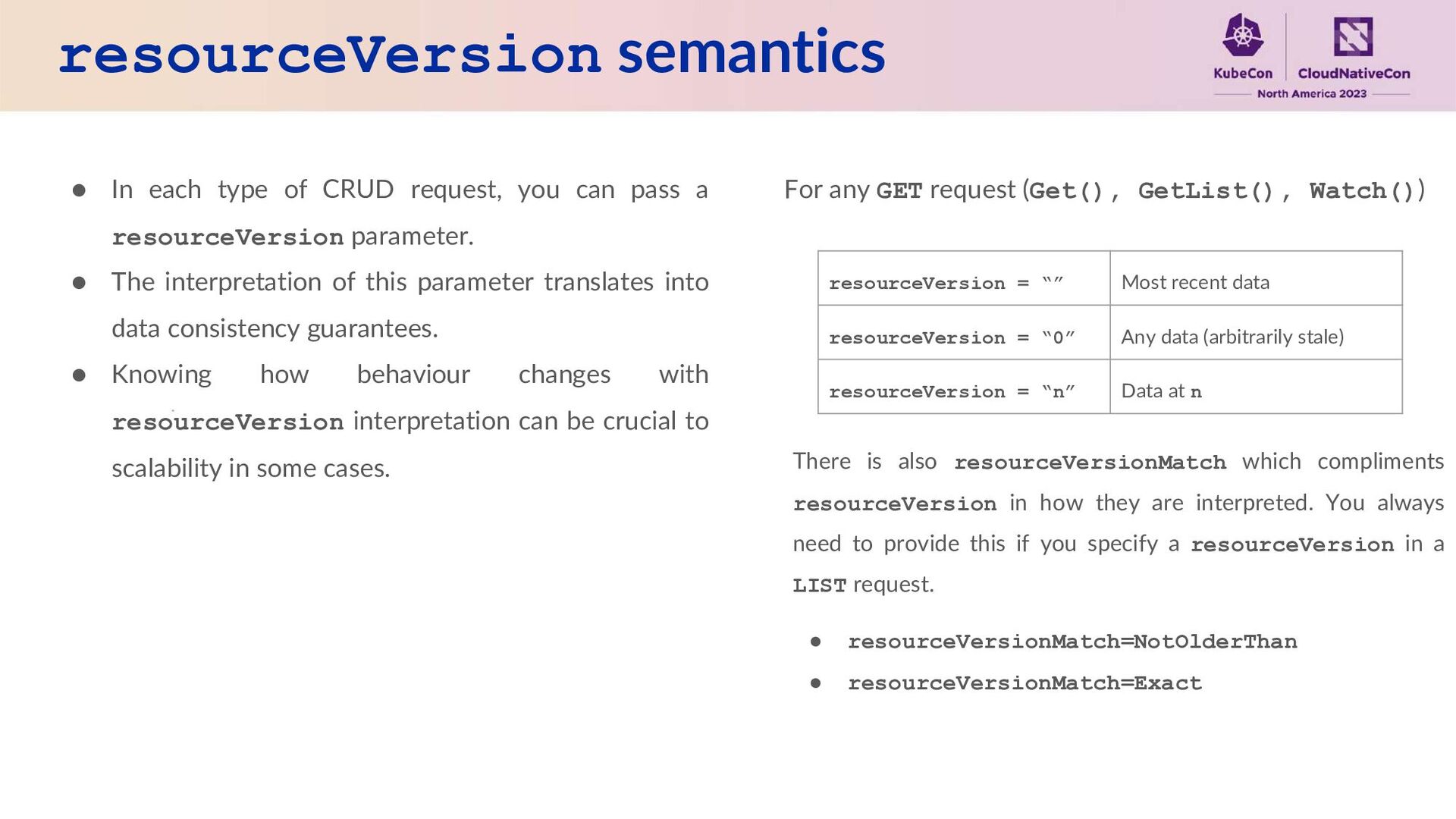
can pass a resourceVersion parameter. • The interpretation of this parameter translates into data consistency guarantees. • Knowing how behaviour changes with resourceVersion interpretation can be crucial to scalability in some cases. For any GET request (Get(), GetList(), Watch()) resourceVersion = “” Most recent data resourceVersion = “0” Any data (arbitrarily stale) resourceVersion = “n” Data at n There is also resourceVersionMatch which compliments resourceVersion in how they are interpreted. You always need to provide this if you specify a resourceVersion in a LIST request. • resourceVersionMatch=NotOlderThan • resourceVersionMatch=Exact
can pass a resourceVersion parameter. • The interpretation of this parameter translates into data consistency guarantees. • Knowing how behaviour changes with resourceVersion interpretation can be crucial to scalability in some cases. For any GET request (Get(), GetList(), Watch()) resourceVersion = “” Most recent data resourceVersion = “0” Any data (arbitrarily stale) resourceVersion = “n” Data at n This still isn’t the full picture! Please see: https://kubernetes.io/docs/reference/using-api/api-concepts/#resource-versions
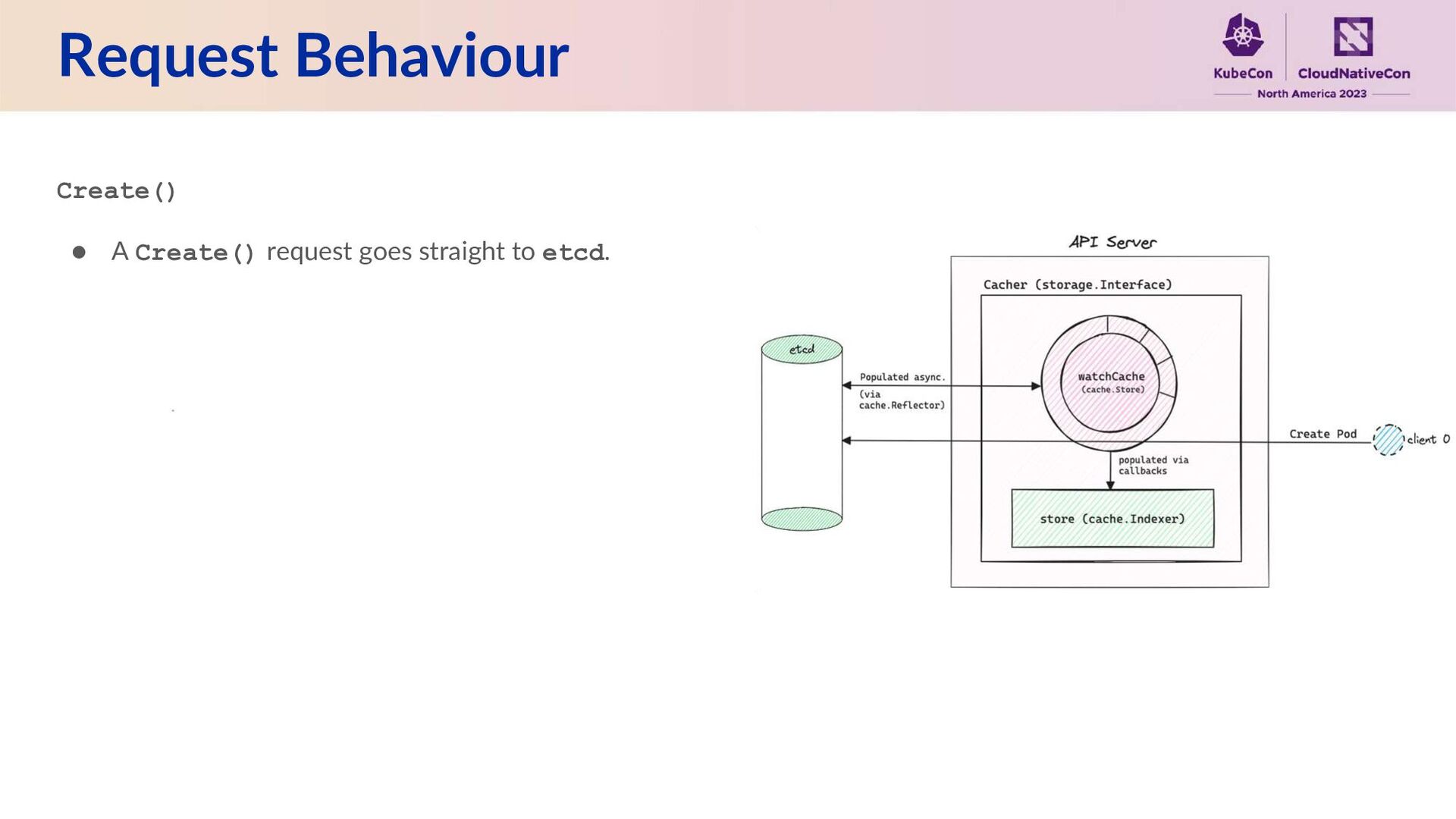
different layers of the Kubernetes Storage Layer come into play and their scalability aspects, is to look at how different type of requests are served.
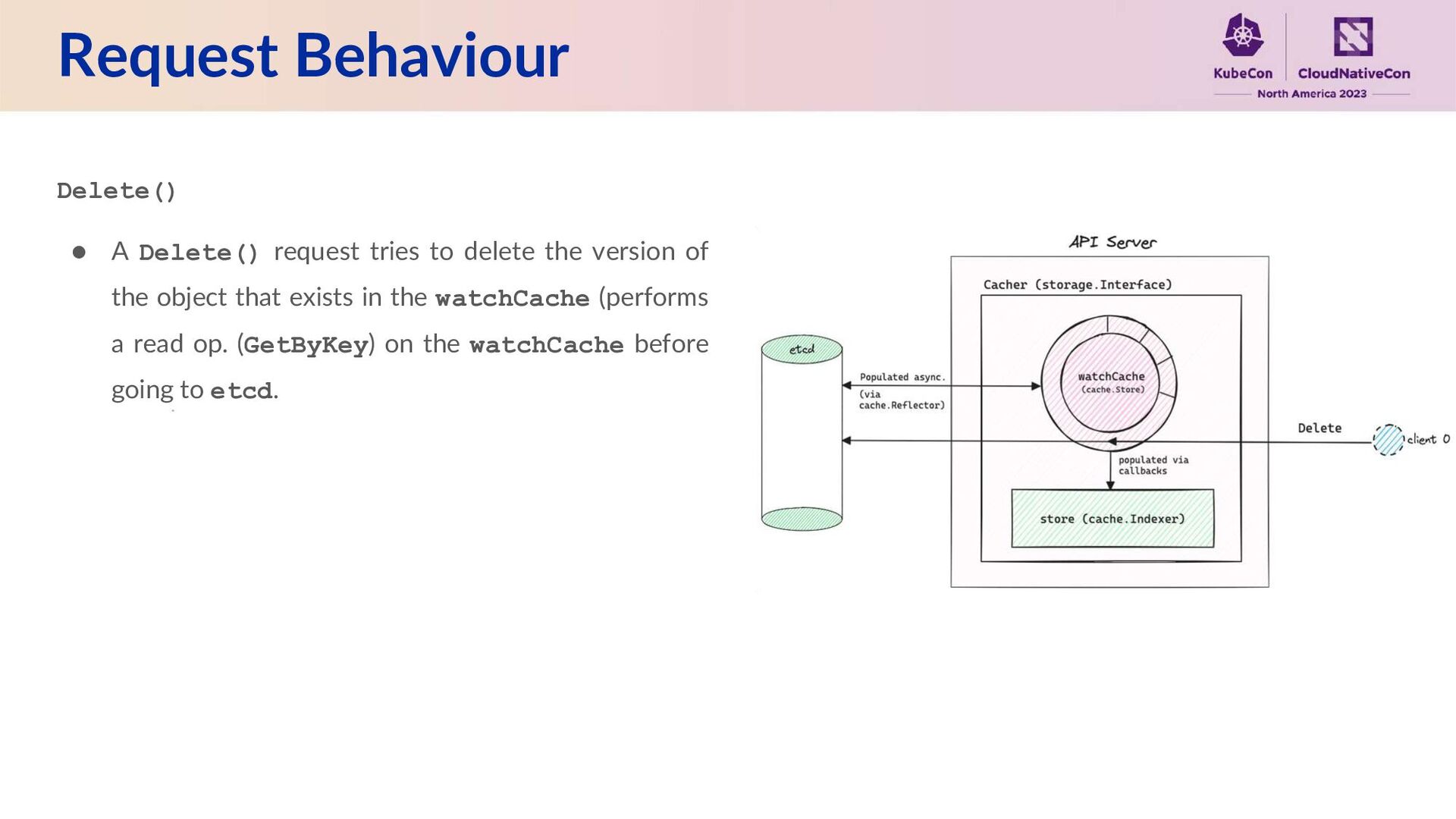
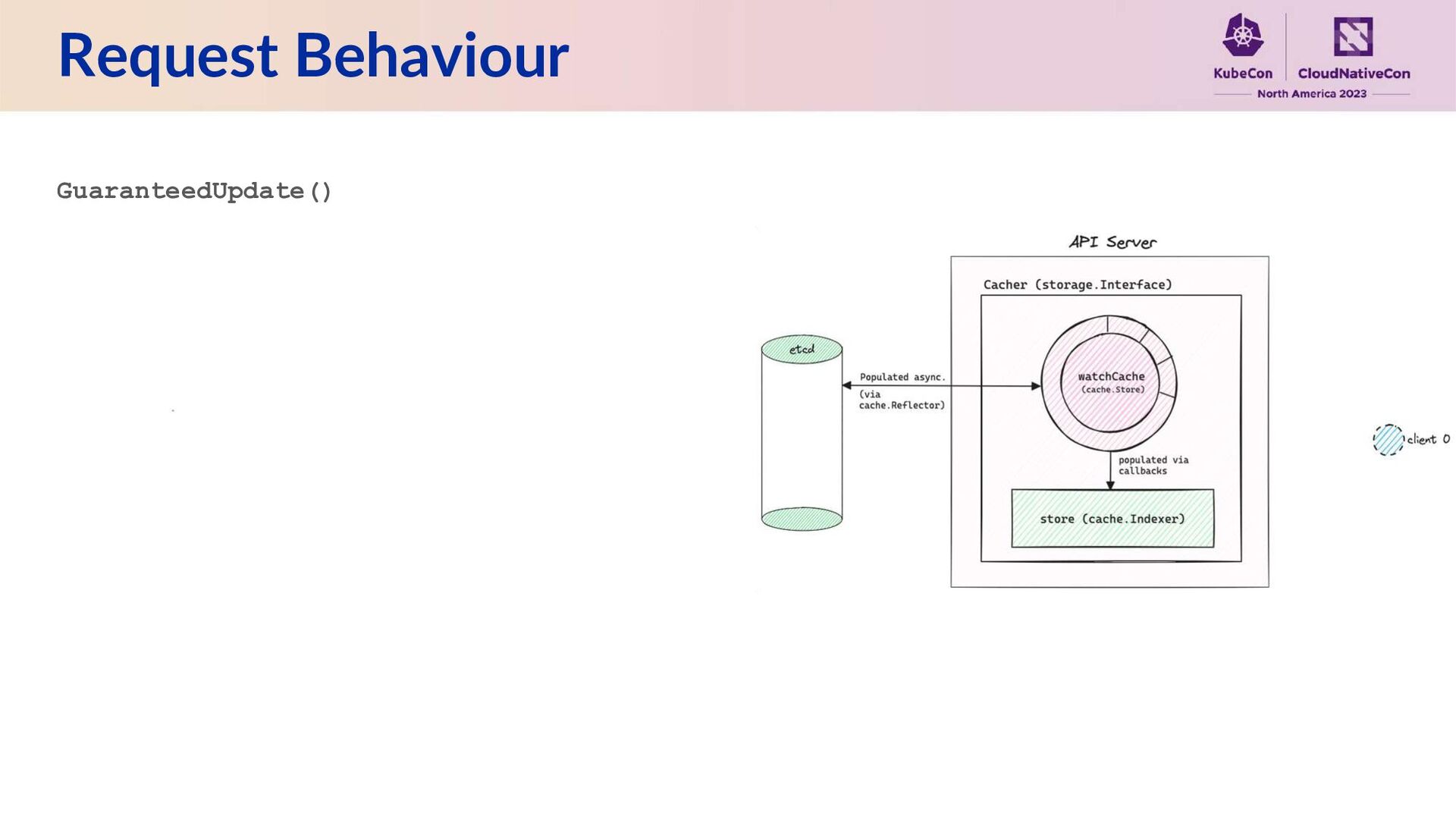
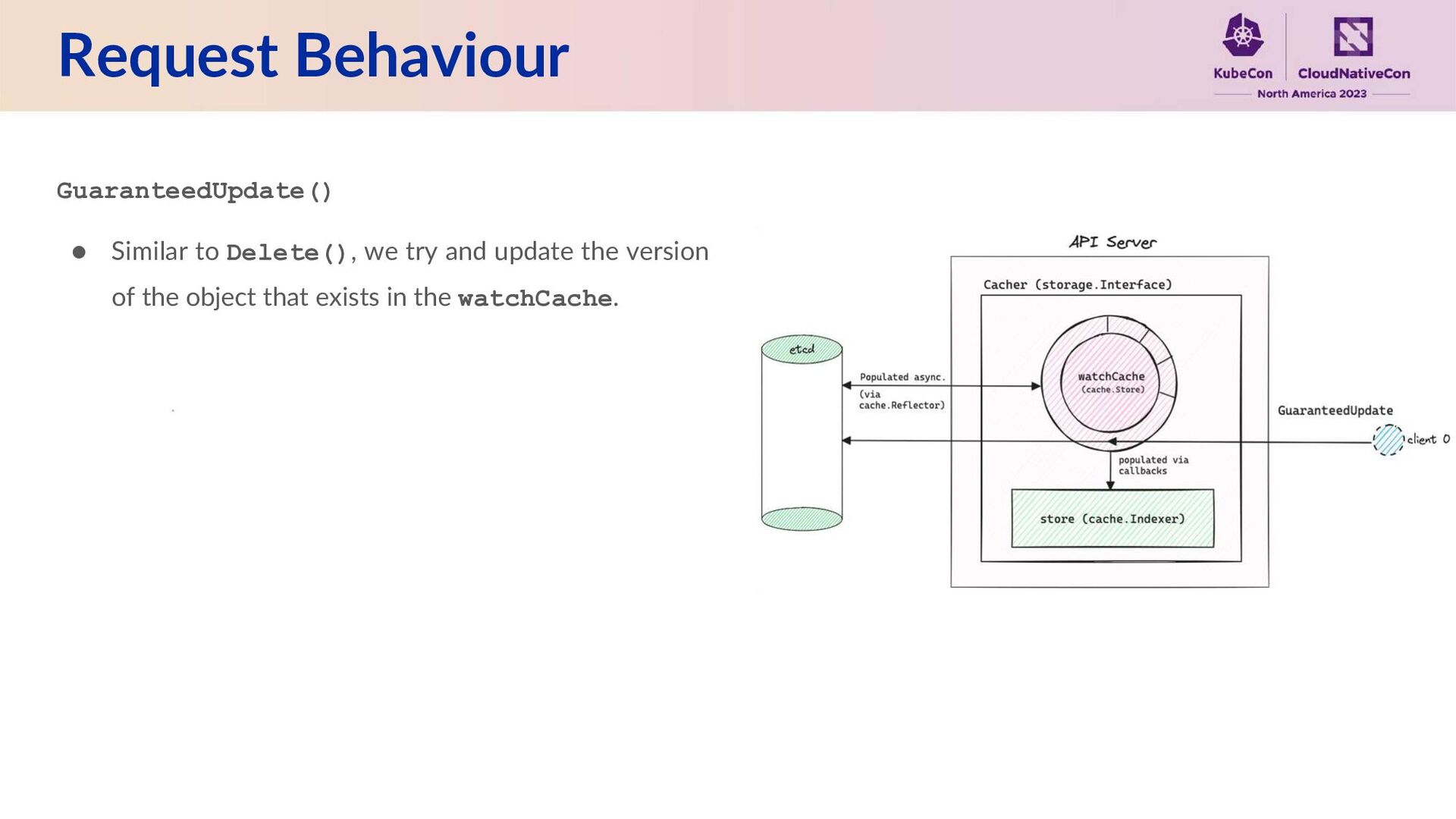
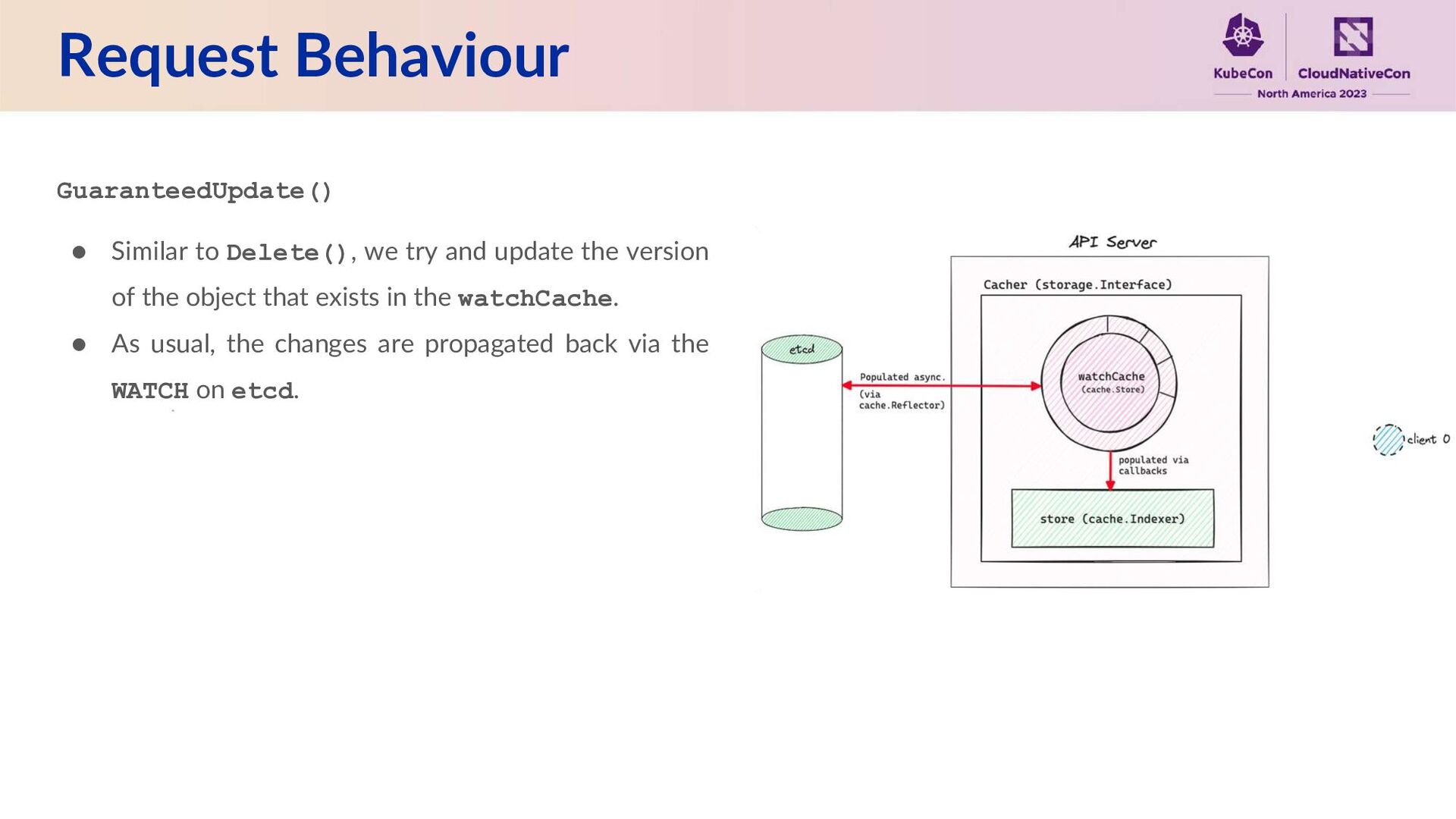
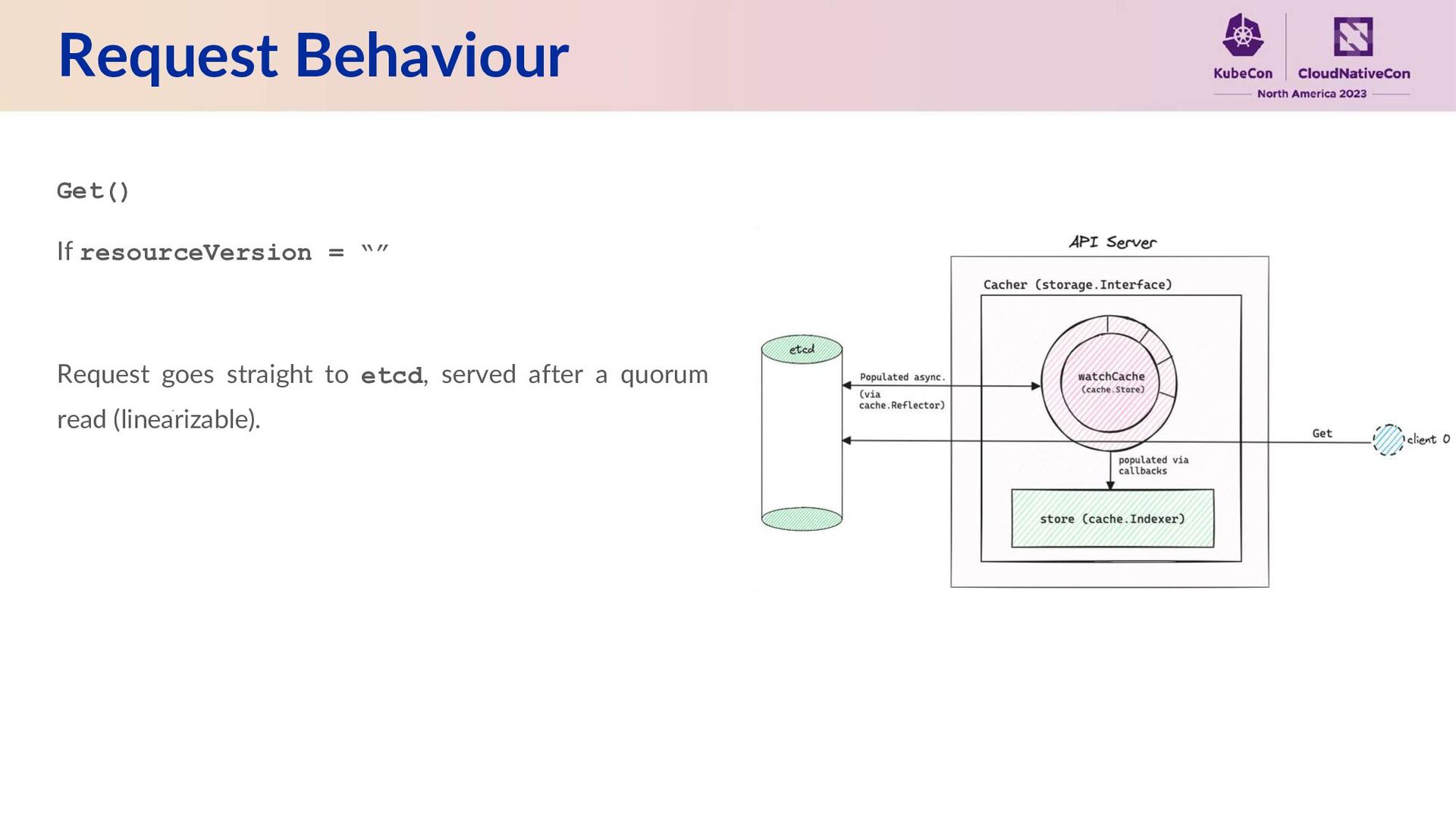
the version of the object that exists in the watchCache (performs a read op. (GetByKey) on the watchCache before going to etcd. • As usual, the changes are propagated back via the WATCH on etcd.
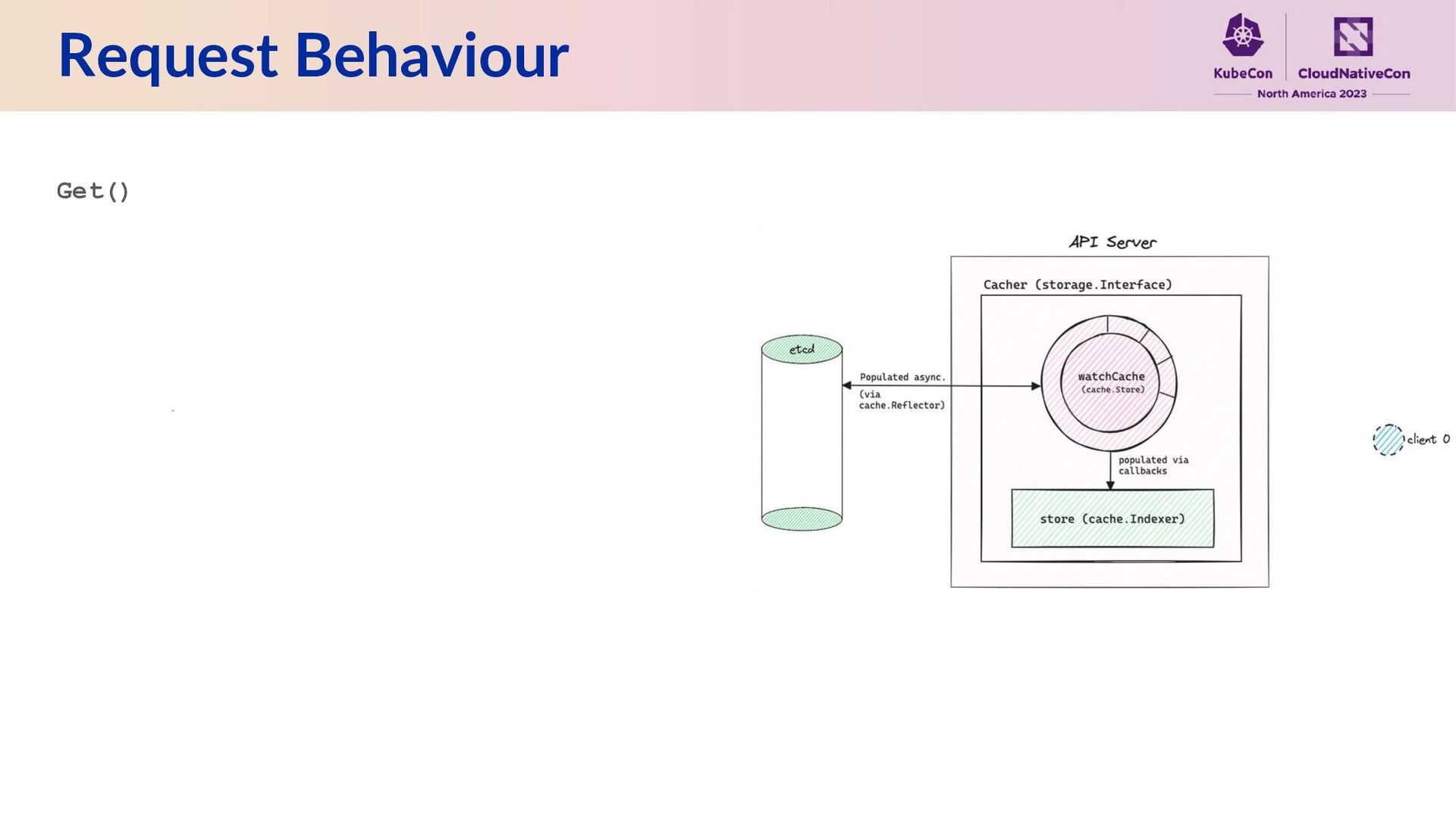
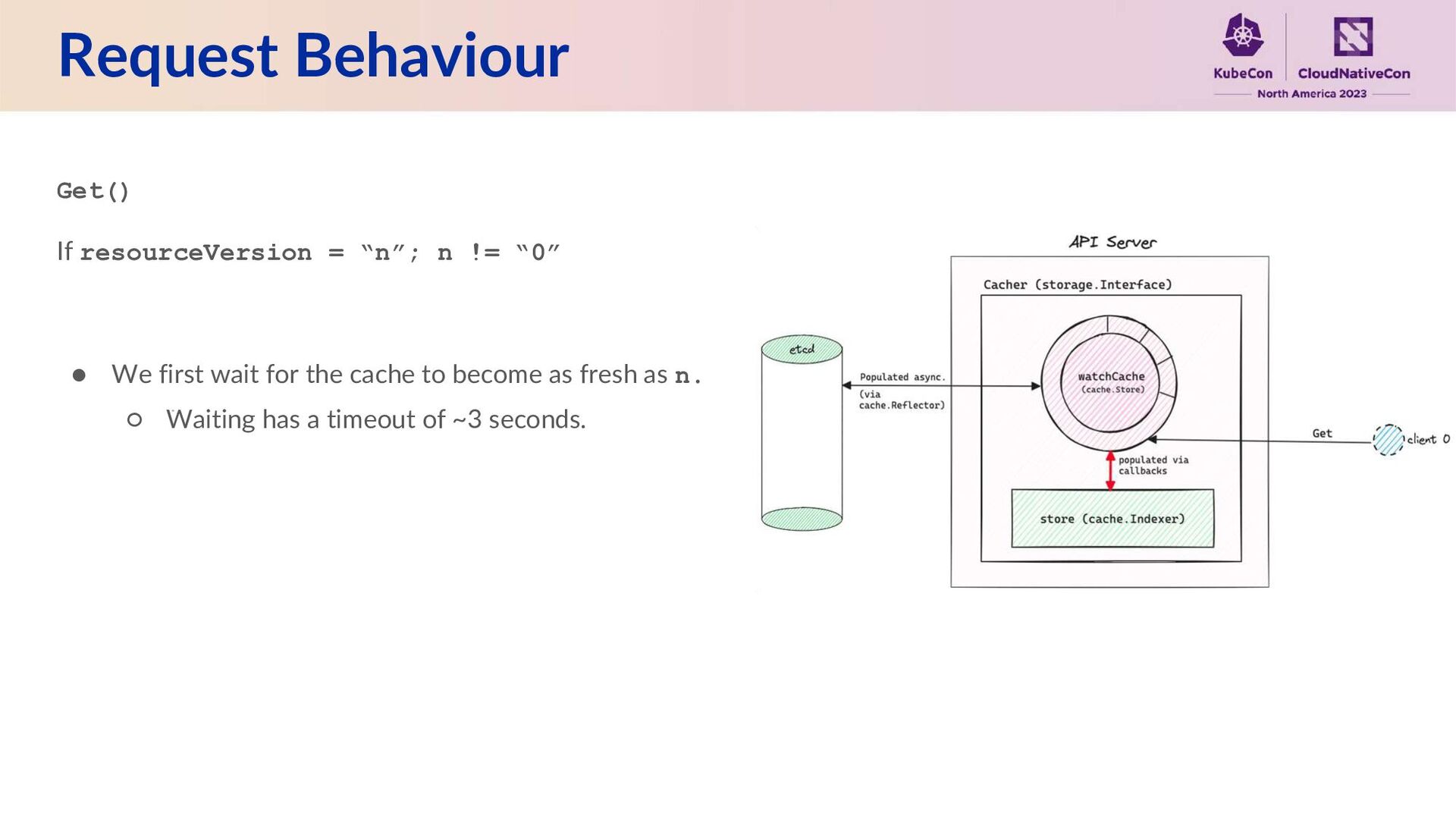
• We first wait for the cache to become as fresh as n. ◦ Waiting has a timeout of ~3 seconds. • Once that happens, the read happens on the watchCache (which queries the underlying store) to return the result.
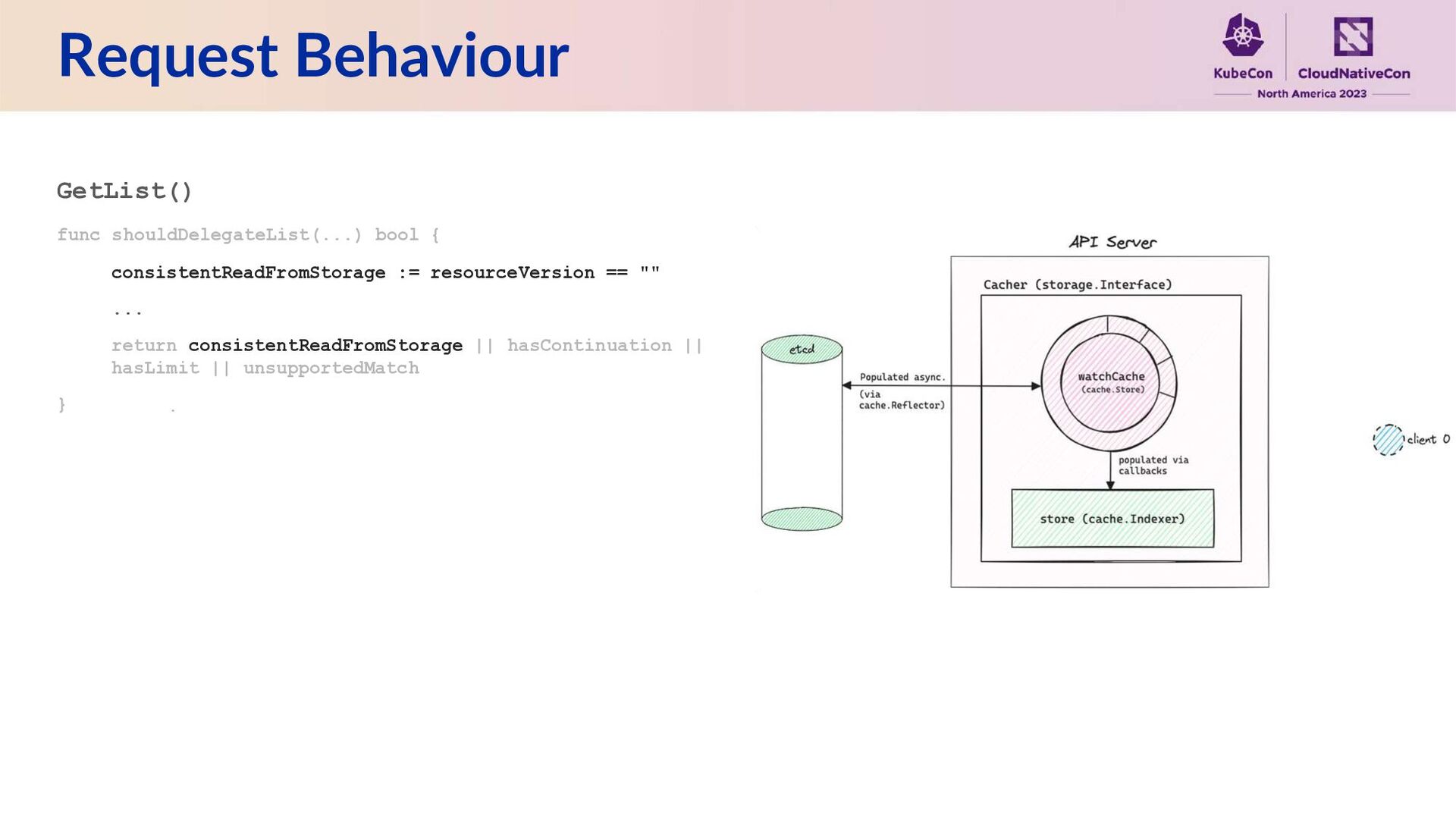
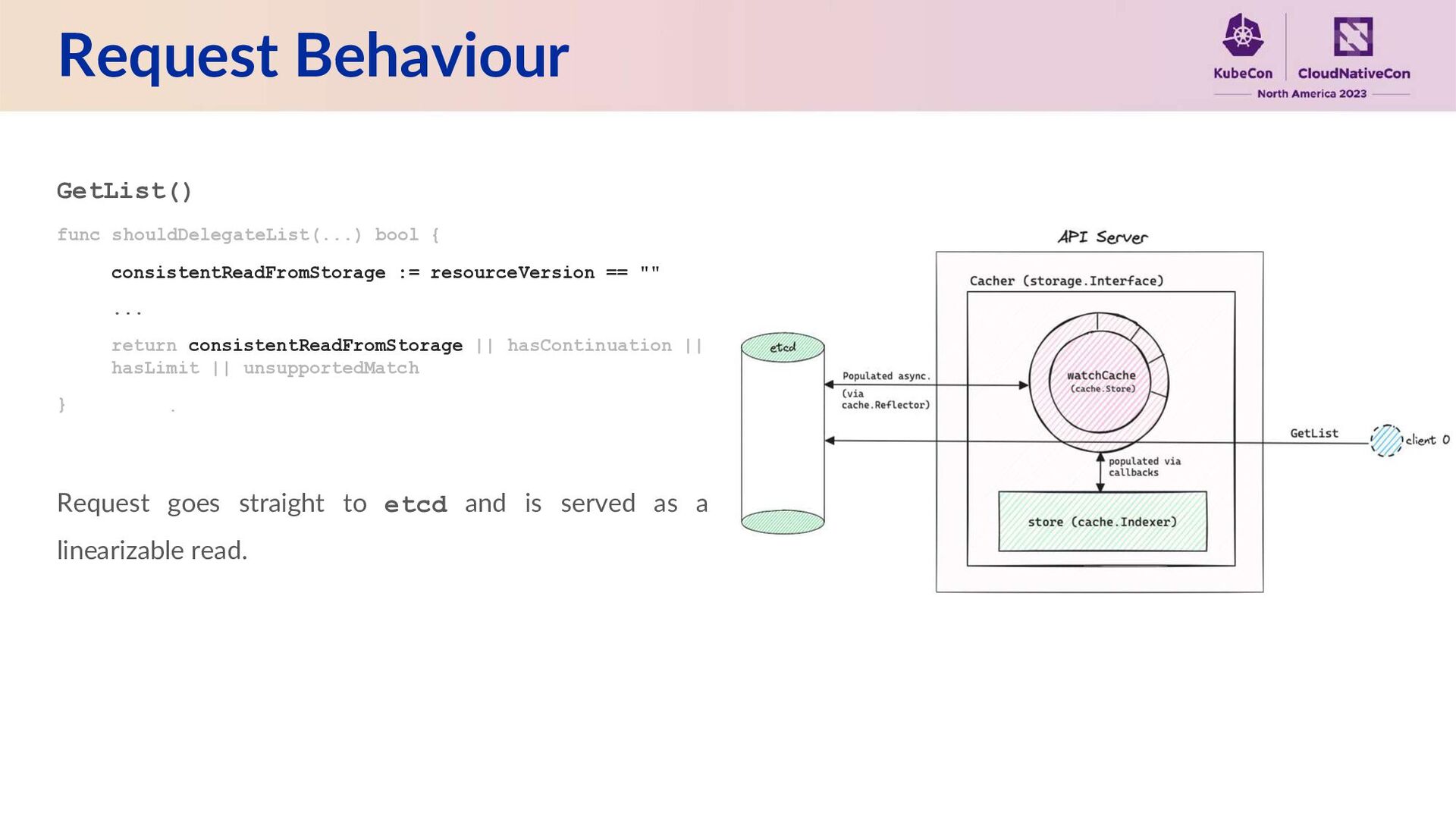
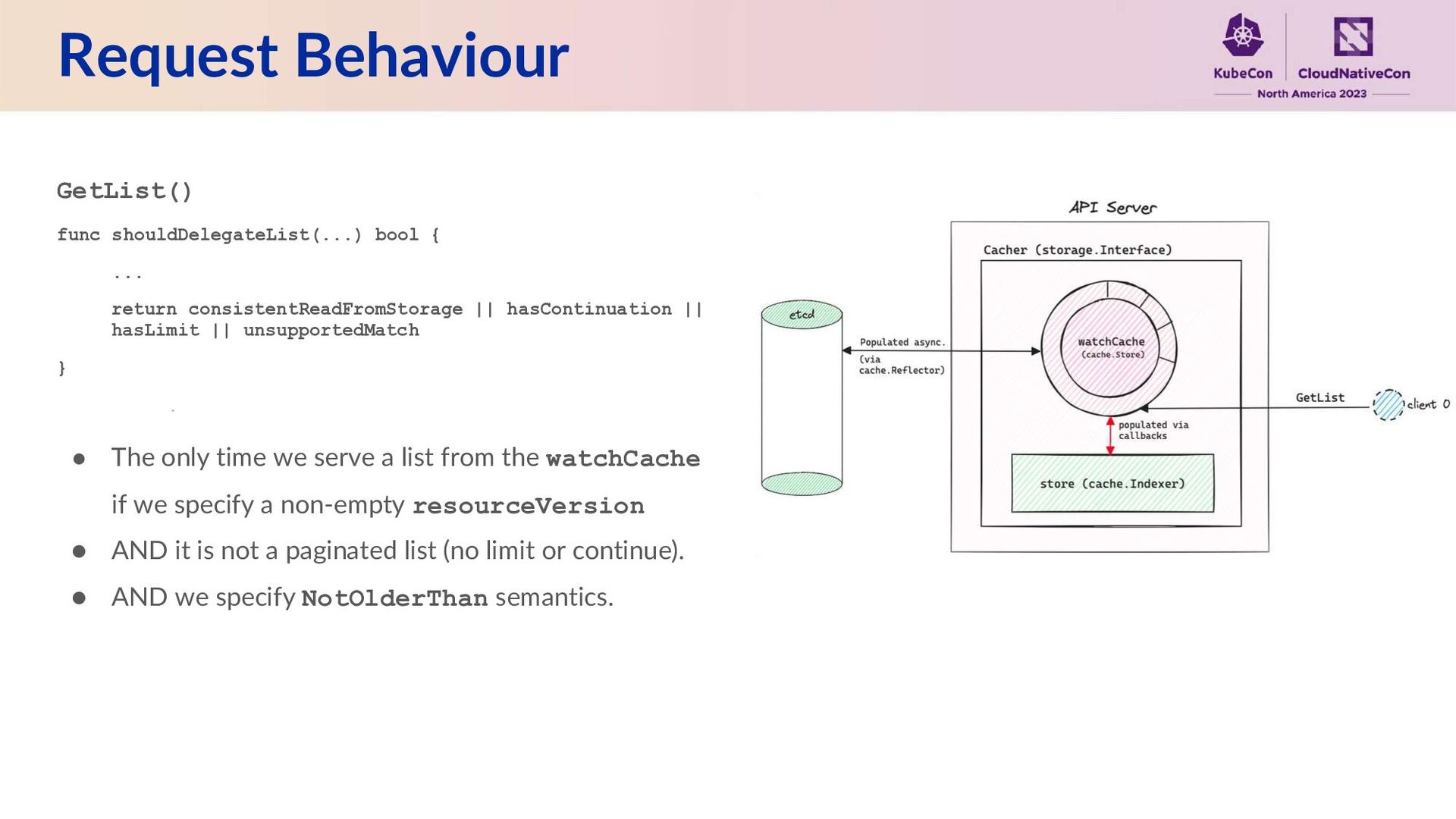
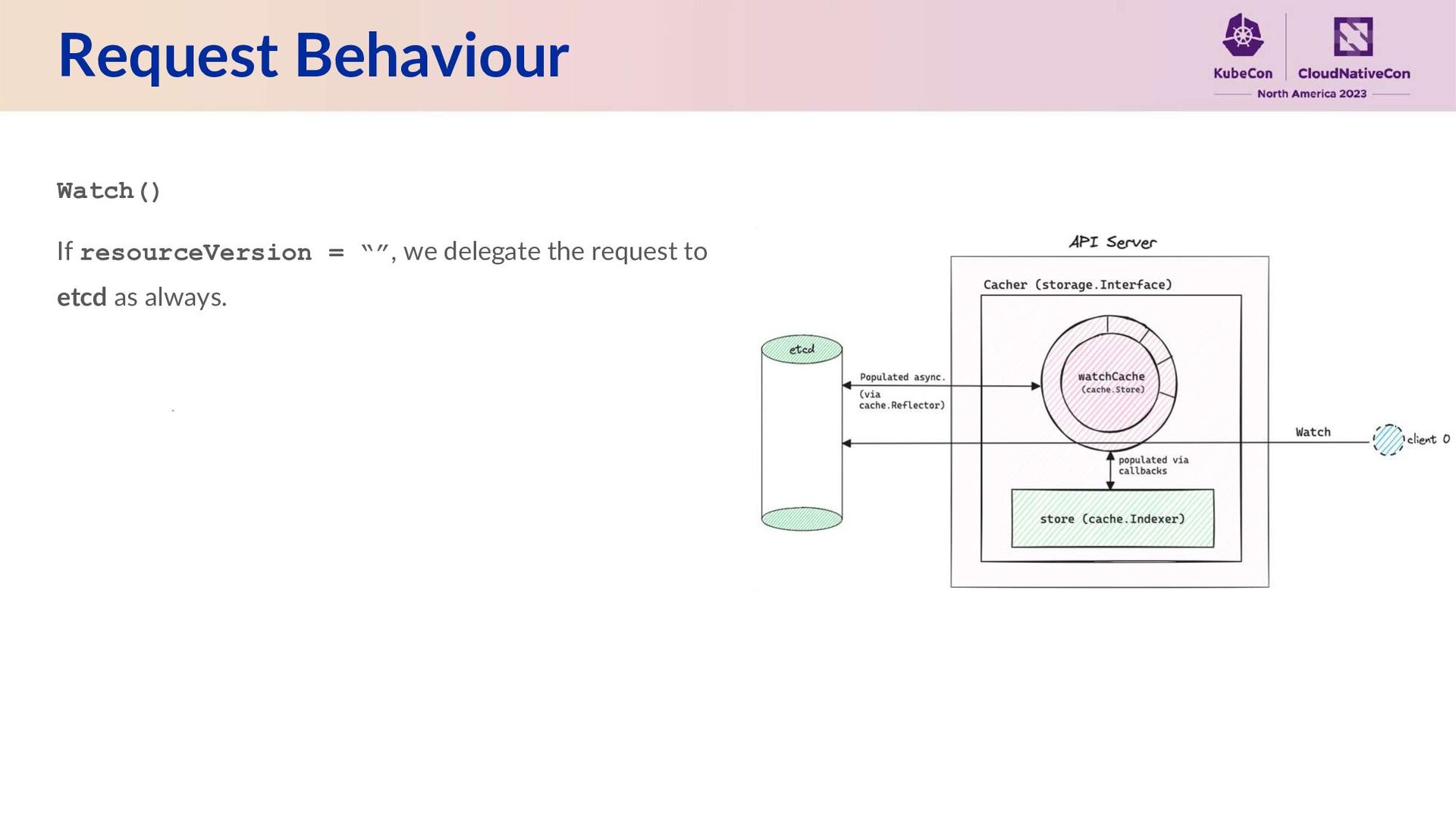
== "" ... return consistentReadFromStorage || hasContinuation || hasLimit || unsupportedMatch } Request goes straight to etcd and is served as a linearizable read.
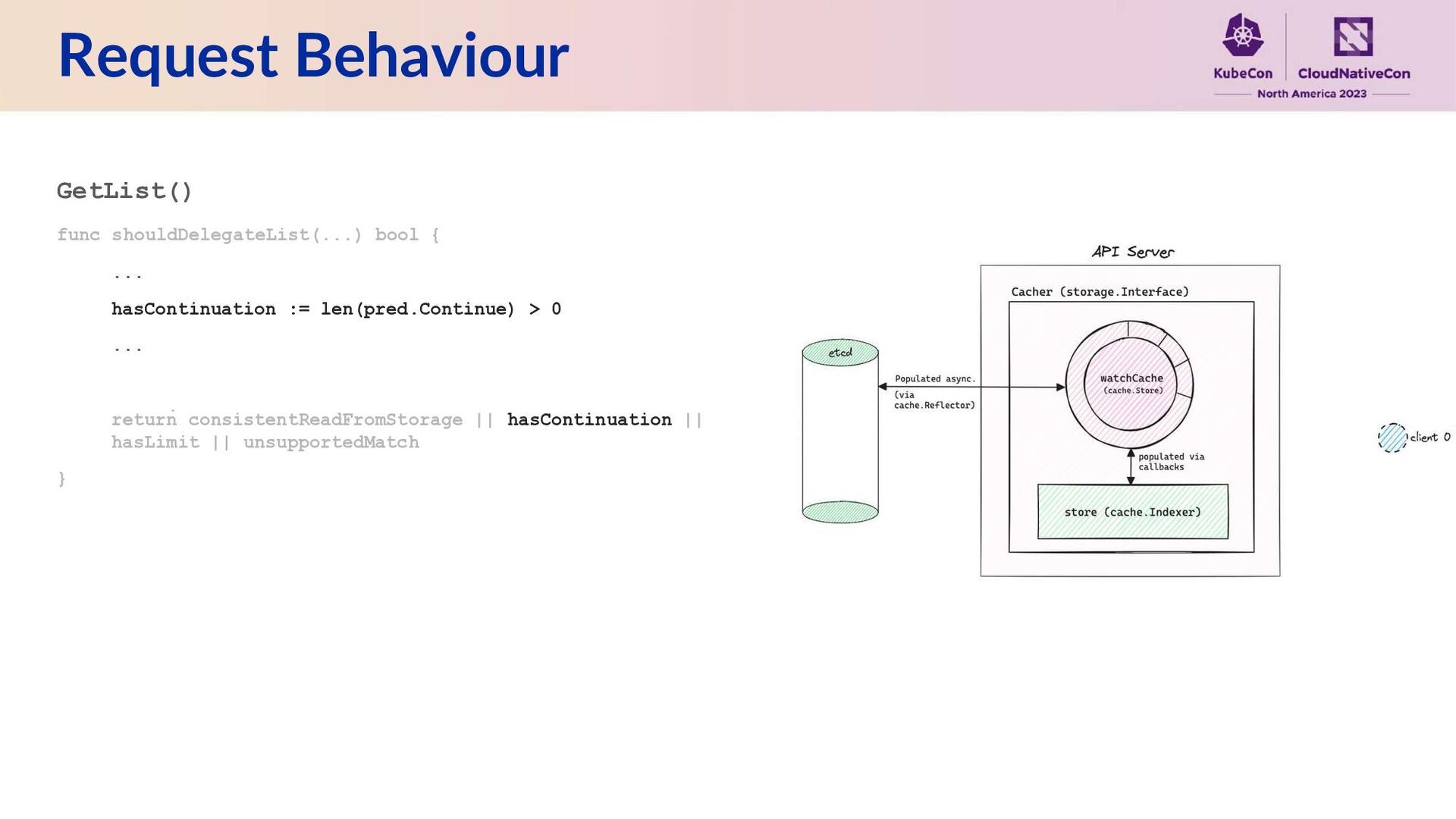
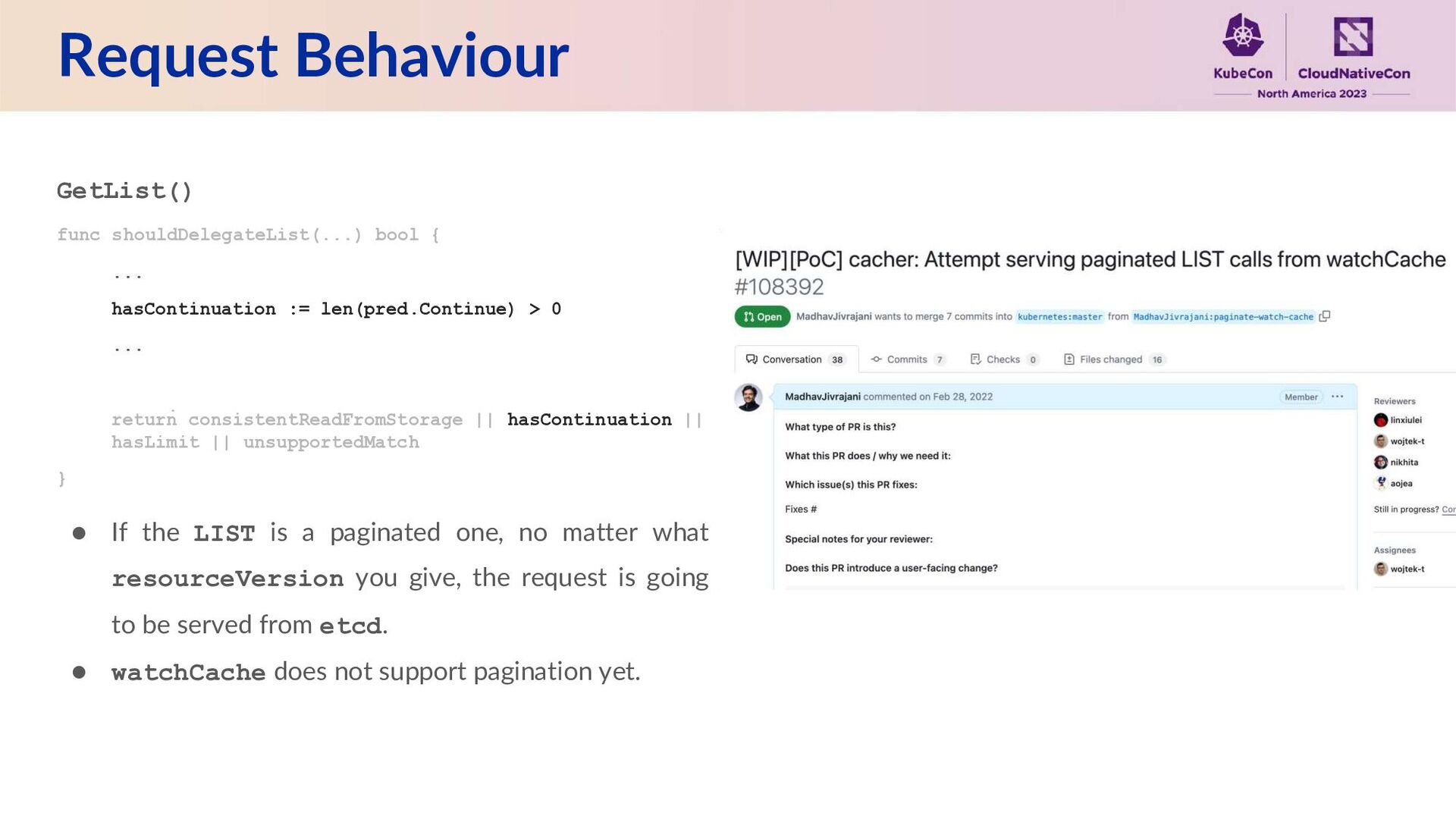
len(pred.Continue) > 0 ... return consistentReadFromStorage || hasContinuation || hasLimit || unsupportedMatch } • If the LIST is a paginated one, no matter what resourceVersion you give, the request is going to be served from etcd. • watchCache does not support pagination yet.
len(pred.Continue) > 0 ... return consistentReadFromStorage || hasContinuation || hasLimit || unsupportedMatch } • If the LIST is a paginated one, no matter what resourceVersion you give, the request is going to be served from etcd. • watchCache does not support pagination yet.
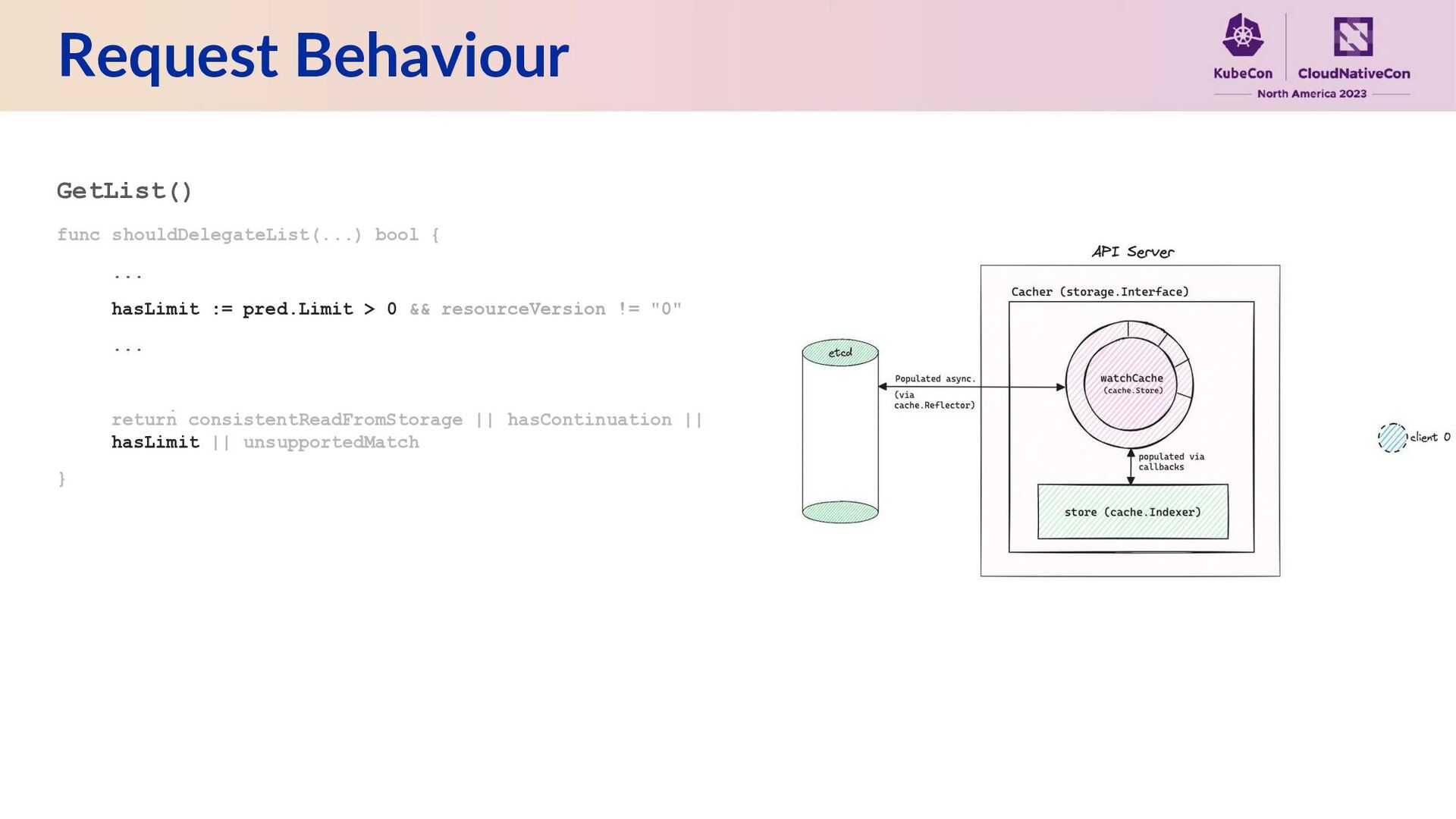
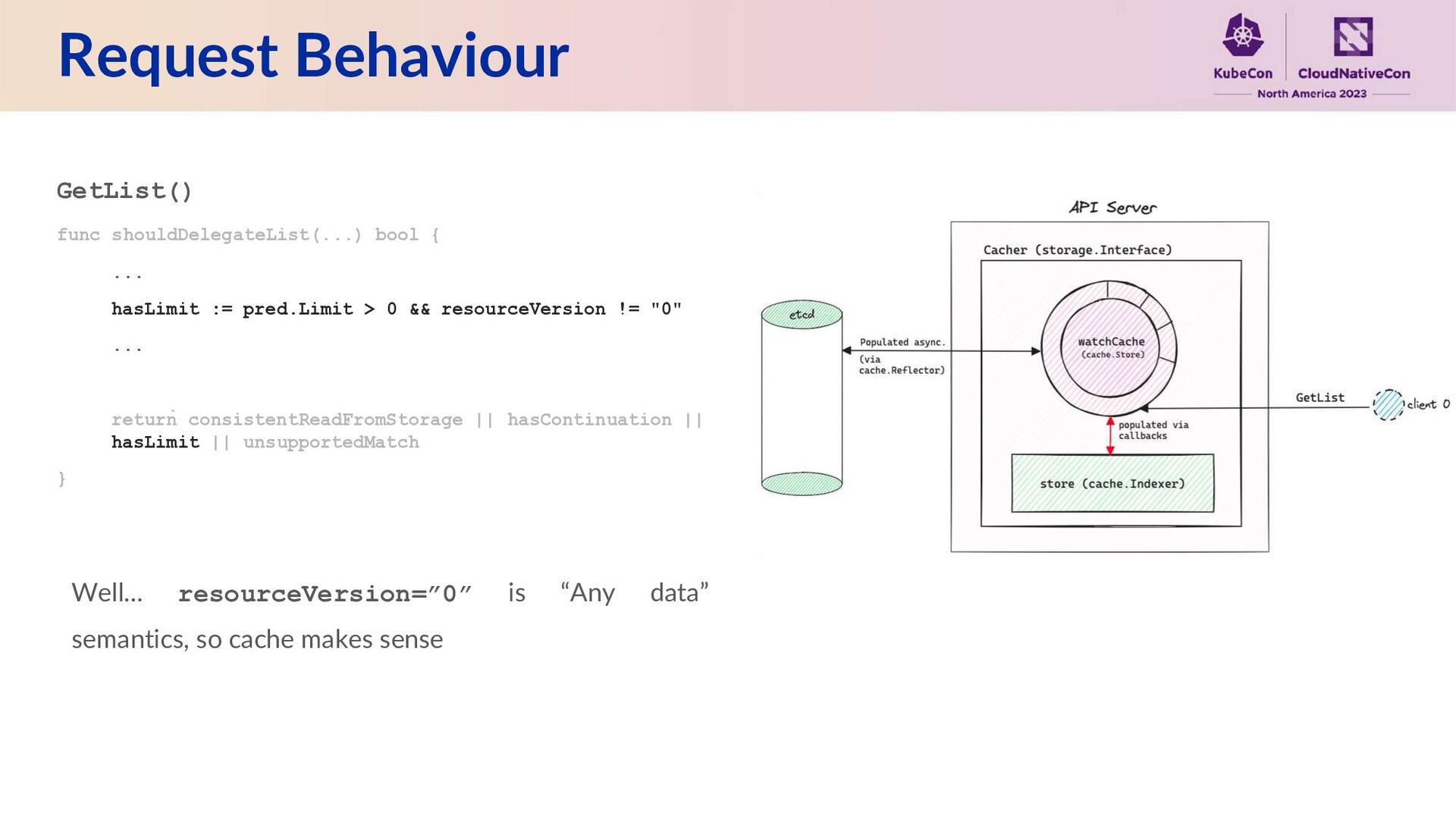
pred.Limit > 0 && resourceVersion != "0" ... return consistentReadFromStorage || hasContinuation || hasLimit || unsupportedMatch } • If we have a limit set on our LIST with a non-zero resourceVersion, we send it to etcd. • Doesn’t matter if we have consistent data in the cache or not, we cannot support a continue from this limit later anyway.
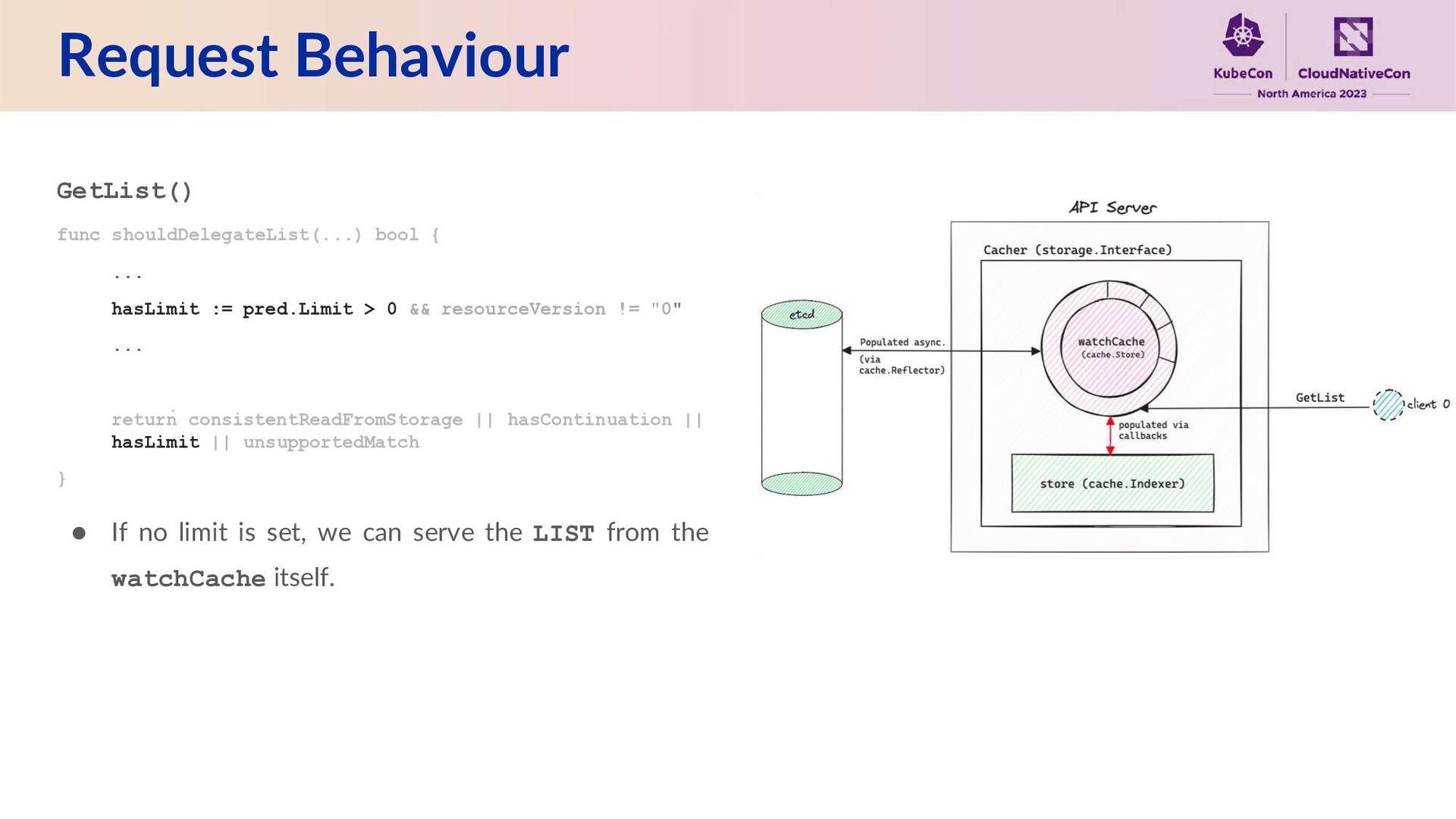
pred.Limit > 0 && resourceVersion != "0" ... return consistentReadFromStorage || hasContinuation || hasLimit || unsupportedMatch } • If no limit is set, we can serve the LIST from the watchCache itself.
pred.Limit > 0 && resourceVersion != "0" ... return consistentReadFromStorage || hasContinuation || hasLimit || unsupportedMatch } • But… if we set a limit and put resourceVersion as 0, we essentially ignore the limit and list from the cache anyway? Why?
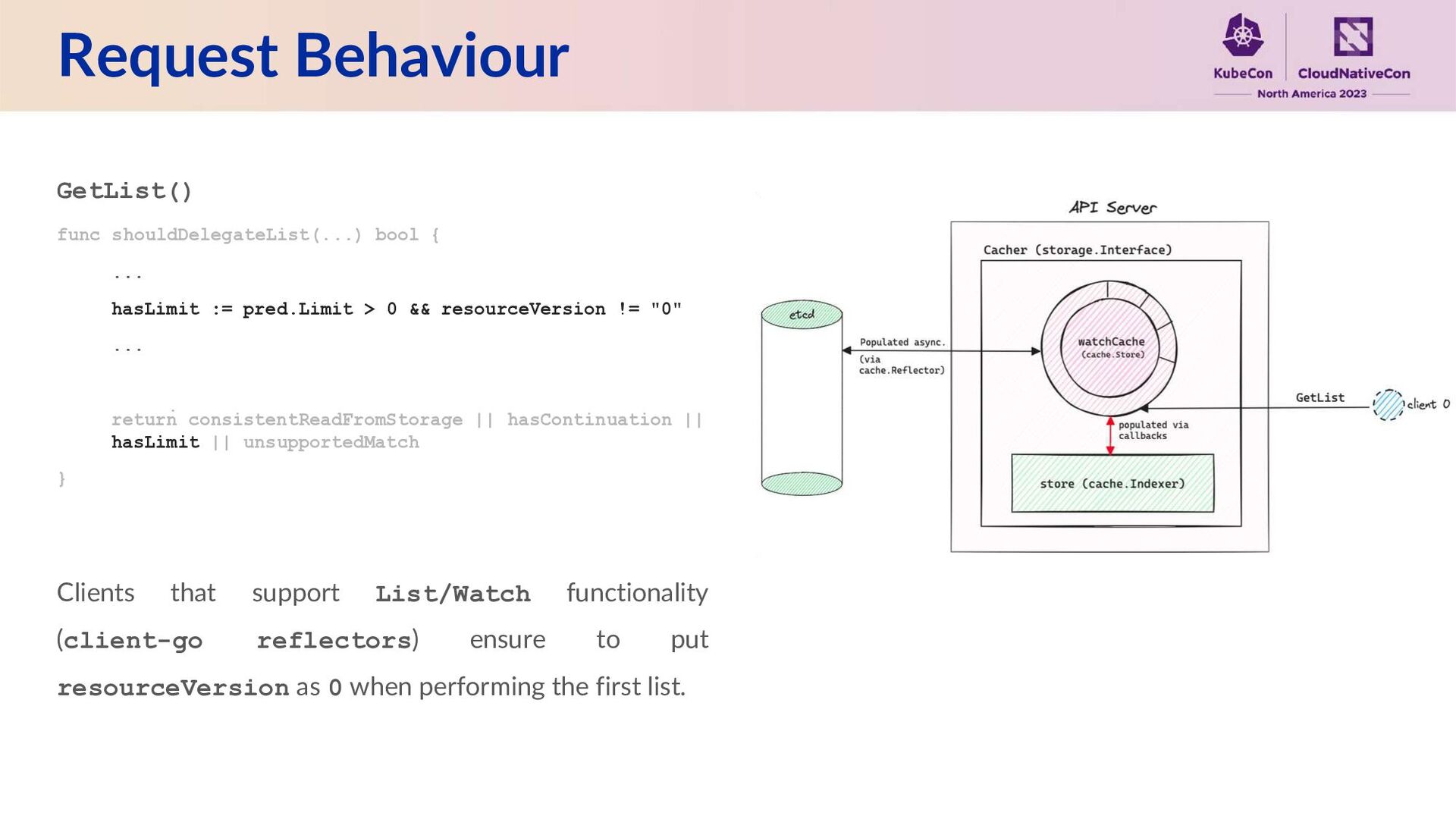
pred.Limit > 0 && resourceVersion != "0" ... return consistentReadFromStorage || hasContinuation || hasLimit || unsupportedMatch } More importantly, it allows us to support listing whose responses we know have a good chance of being massive thus reducing the load on etcd, i.e. initial lists.
pred.Limit > 0 && resourceVersion != "0" ... return consistentReadFromStorage || hasContinuation || hasLimit || unsupportedMatch } Ex: - a ~large cluster can have O(1000) nodes, each node having O(100) pods, so if a kubelet or a StatefulSet controller were to perform a list on the pods…
pred.Limit > 0 && resourceVersion != "0" ... return consistentReadFromStorage || hasContinuation || hasLimit || unsupportedMatch } Clients that support List/Watch functionality (client-go reflectors) ensure to put resourceVersion as 0 when performing the first list.
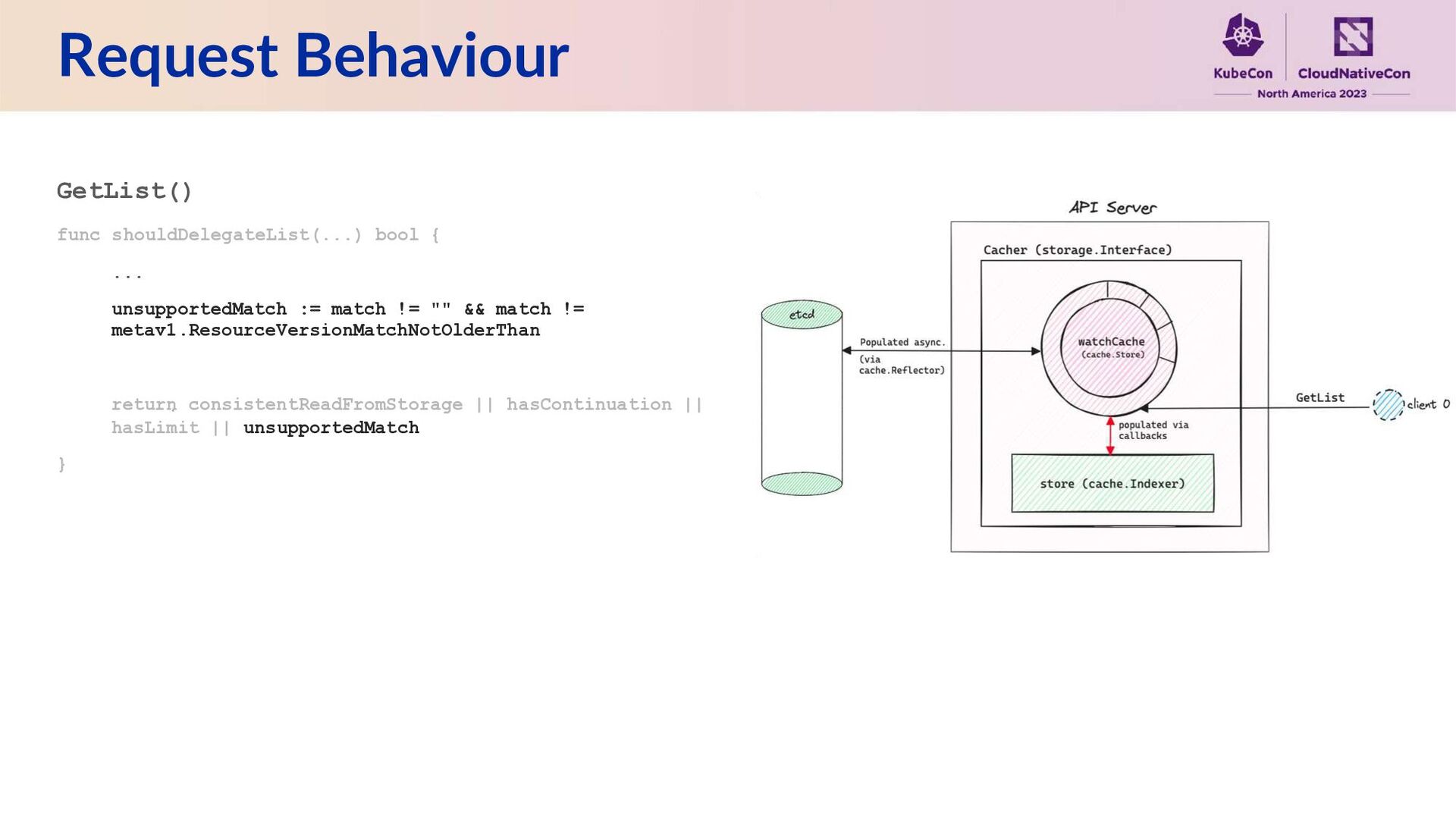
match != "" && match != metav1.ResourceVersionMatchNotOlderThan return consistentReadFromStorage || hasContinuation || hasLimit || unsupportedMatch } • The watchCache only supports NotOlderThan, so if that is set, we serve the list from the watchCache.
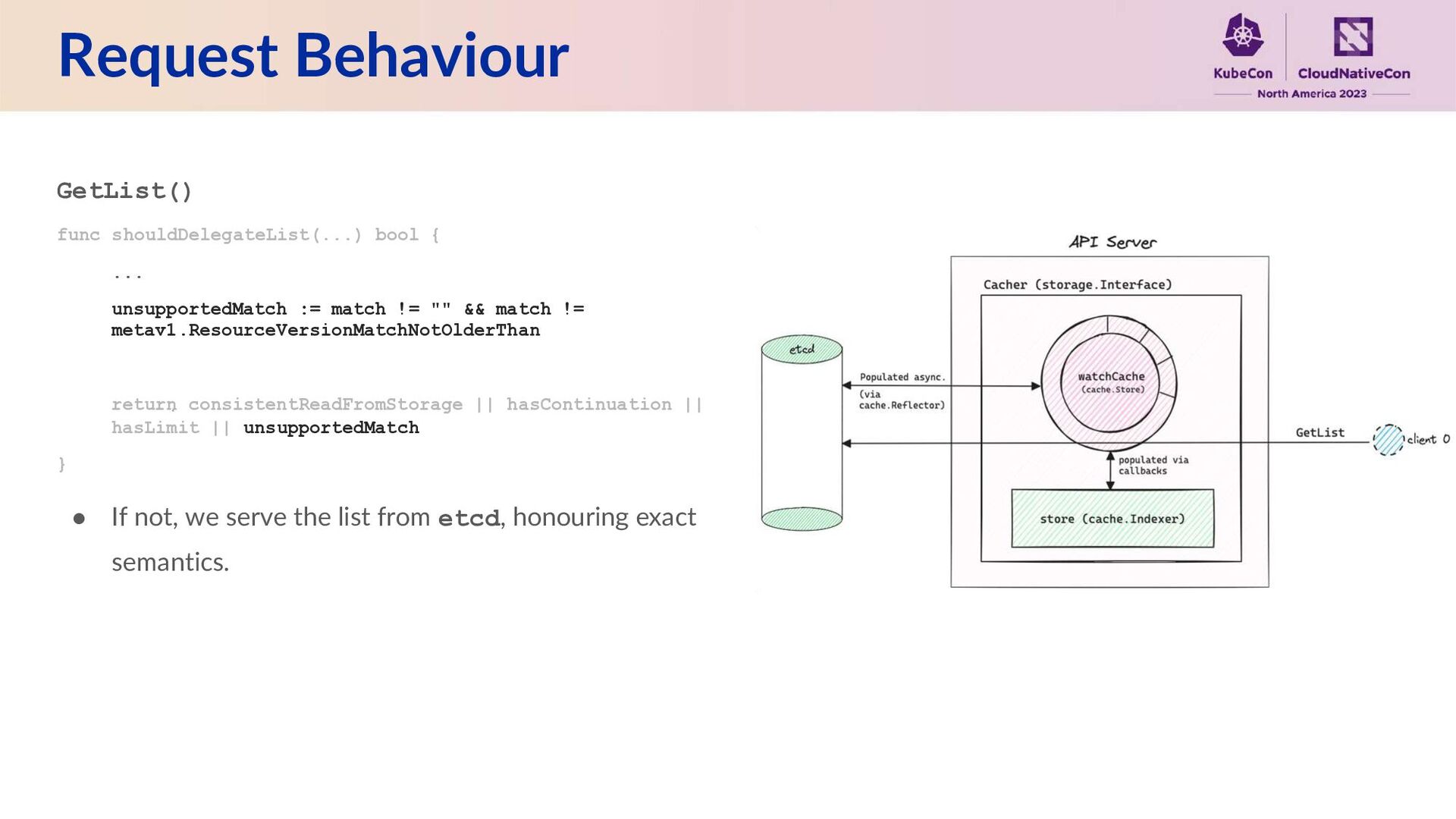
match != "" && match != metav1.ResourceVersionMatchNotOlderThan return consistentReadFromStorage || hasContinuation || hasLimit || unsupportedMatch } • If not, we serve the list from etcd, honouring exact semantics.
|| hasContinuation || hasLimit || unsupportedMatch } • The only time we serve a list from the watchCache if we specify a non-empty resourceVersion • AND it is not a paginated list (no limit or continue). • AND we specify NotOlderThan semantics.
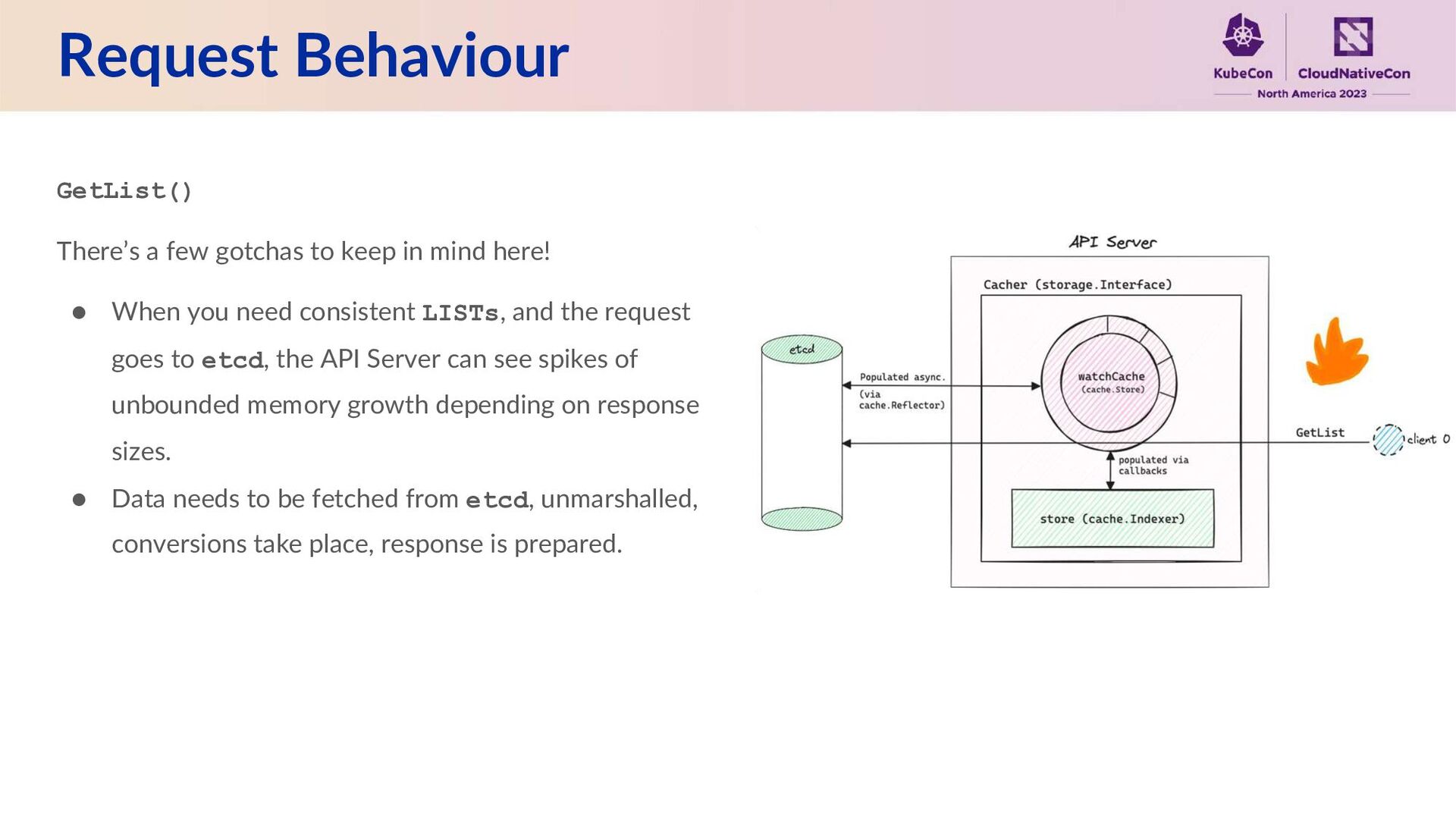
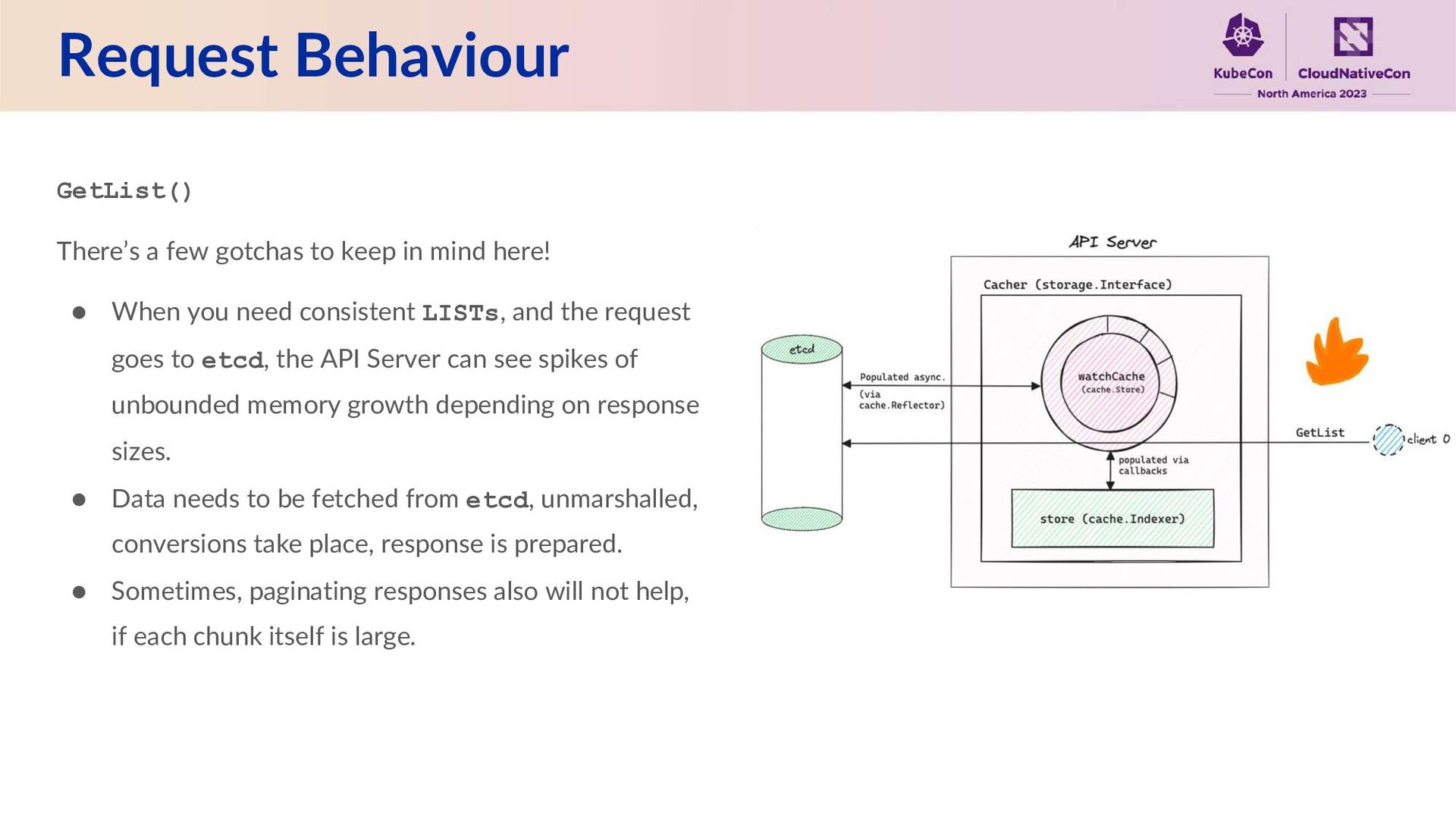
mind here! • When you need consistent LISTs, and the request goes to etcd, the API Server can see spikes of unbounded memory growth depending on response sizes.
mind here! • When you need consistent LISTs, and the request goes to etcd, the API Server can see spikes of unbounded memory growth depending on response sizes. • Data needs to be fetched from etcd, unmarshalled, conversions take place, response is prepared.
mind here! • When you need consistent LISTs, and the request goes to etcd, the API Server can see spikes of unbounded memory growth depending on response sizes. • Data needs to be fetched from etcd, unmarshalled, conversions take place, response is prepared. • Sometimes, paginating responses also will not help, if each chunk itself is large.
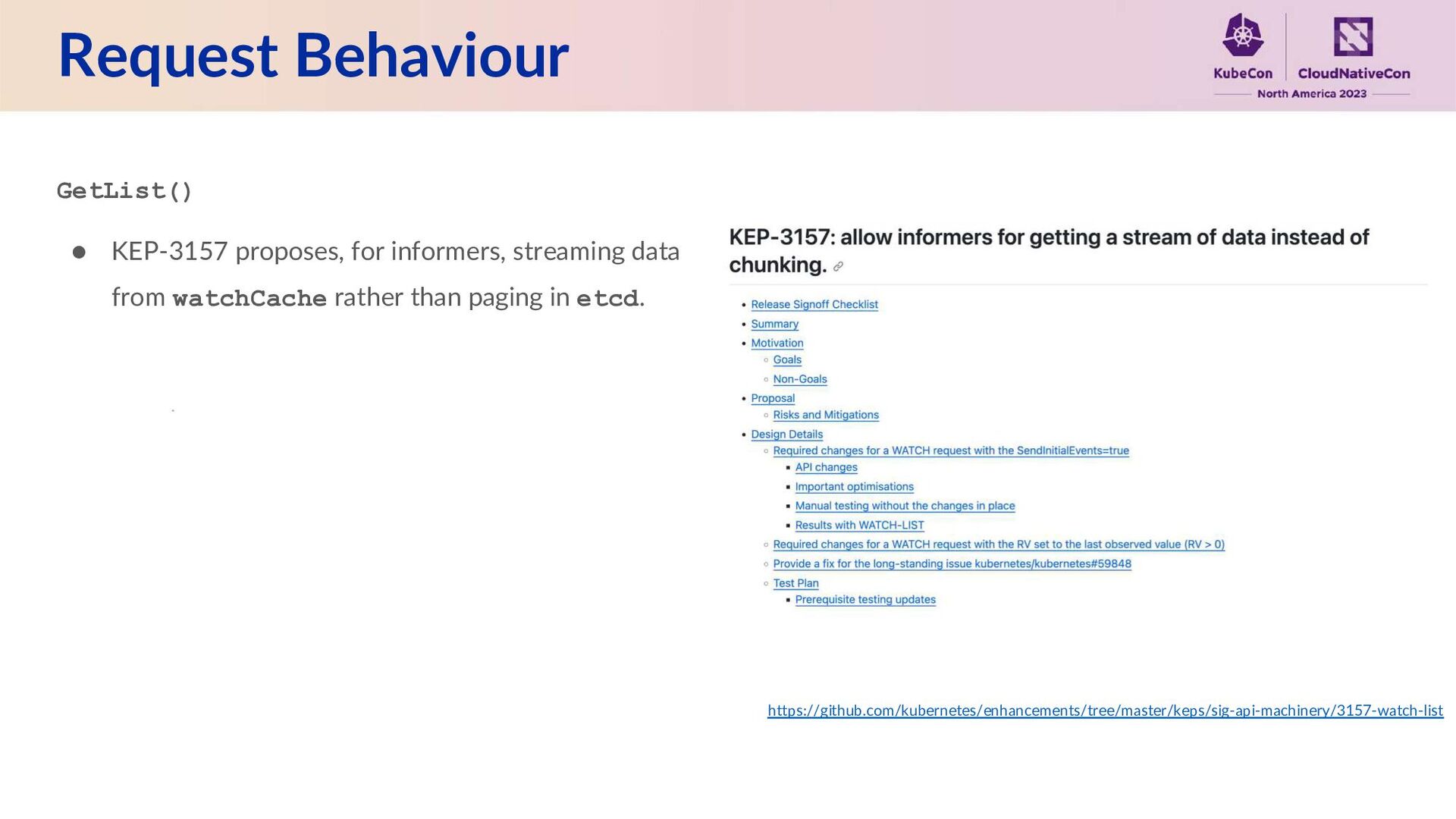
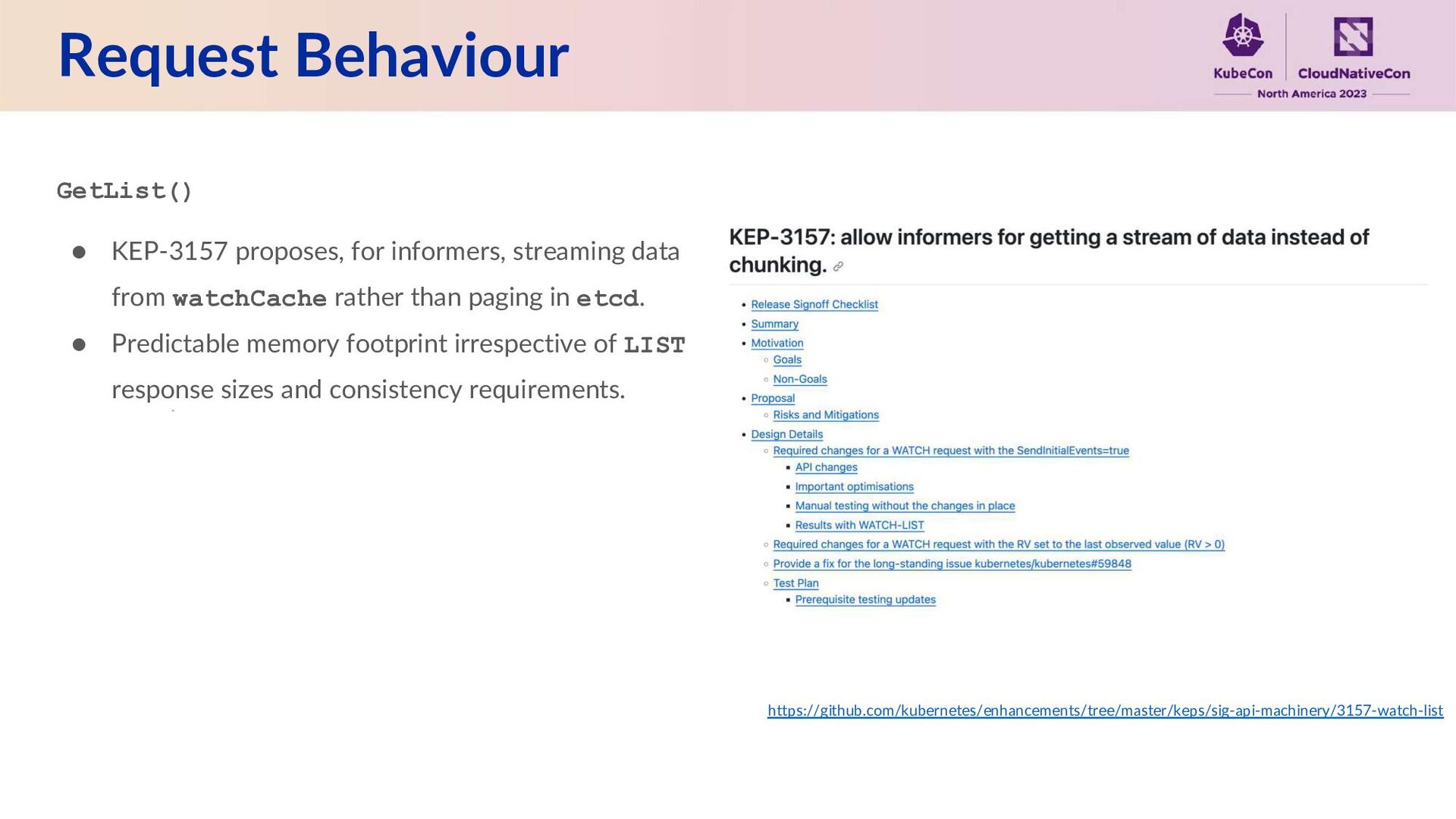
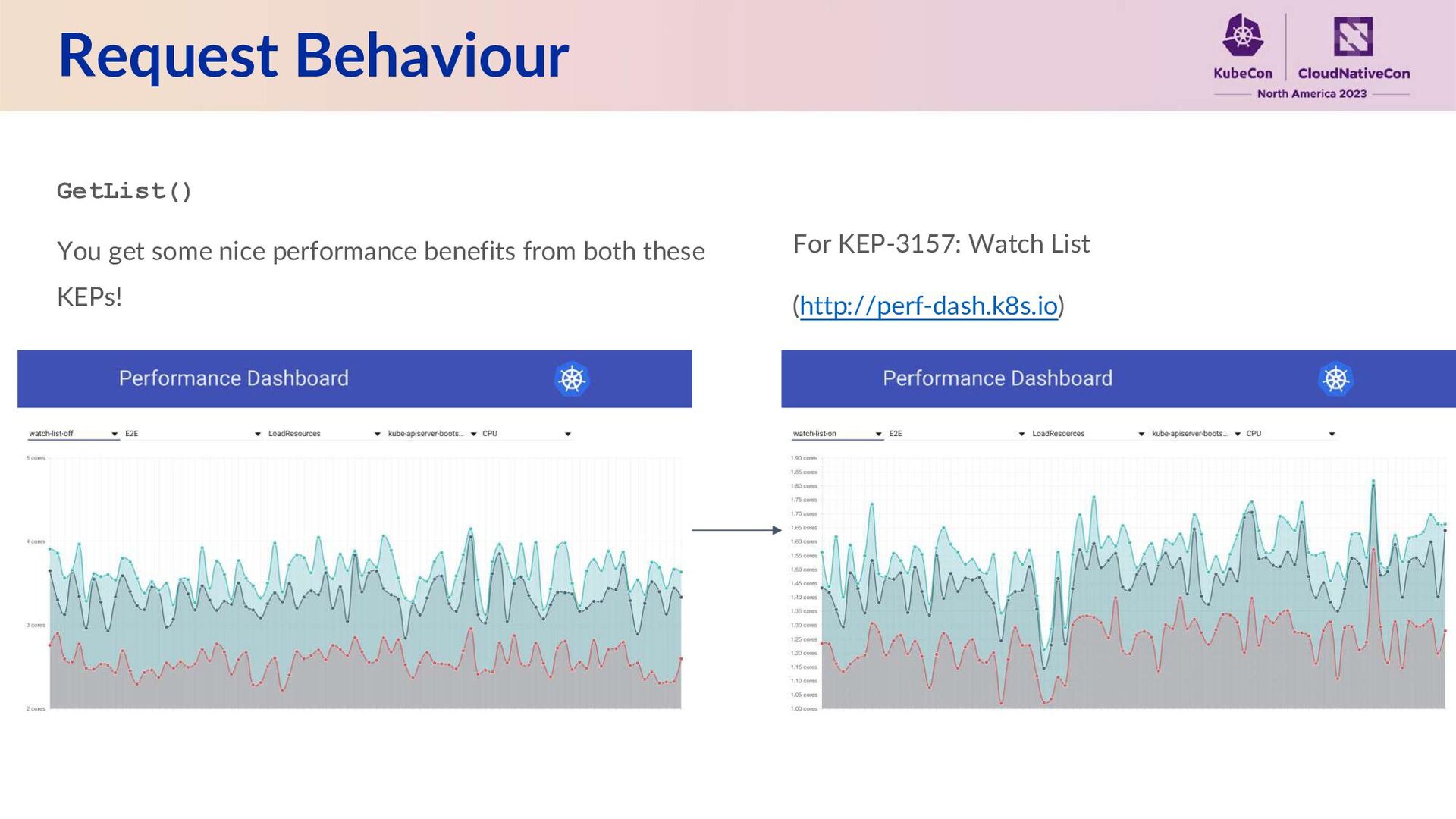
from watchCache rather than paging in etcd. • Predictable memory footprint irrespective of LIST response sizes and consistency requirements. https://github.com/kubernetes/enhancements/tree/master/keps/sig-api-machinery/3157-watch-list
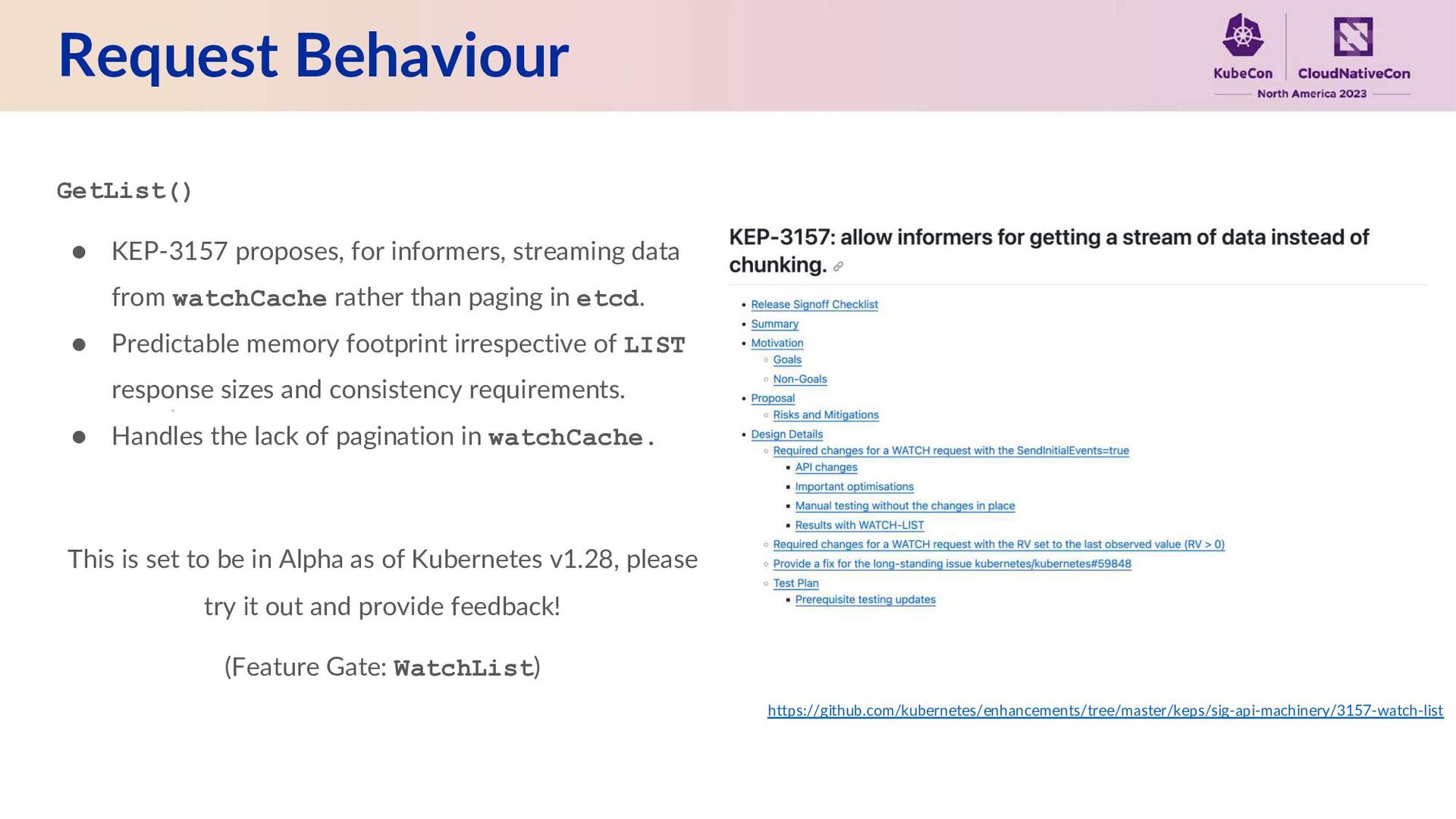
from watchCache rather than paging in etcd. • Predictable memory footprint irrespective of LIST response sizes and consistency requirements. • Handles the lack of pagination in watchCache. https://github.com/kubernetes/enhancements/tree/master/keps/sig-api-machinery/3157-watch-list
from watchCache rather than paging in etcd. • Predictable memory footprint irrespective of LIST response sizes and consistency requirements. • Handles the lack of pagination in watchCache. This is set to be in Alpha as of Kubernetes v1.28, please try it out and provide feedback! (Feature Gate: WatchList) https://github.com/kubernetes/enhancements/tree/master/keps/sig-api-machinery/3157-watch-list
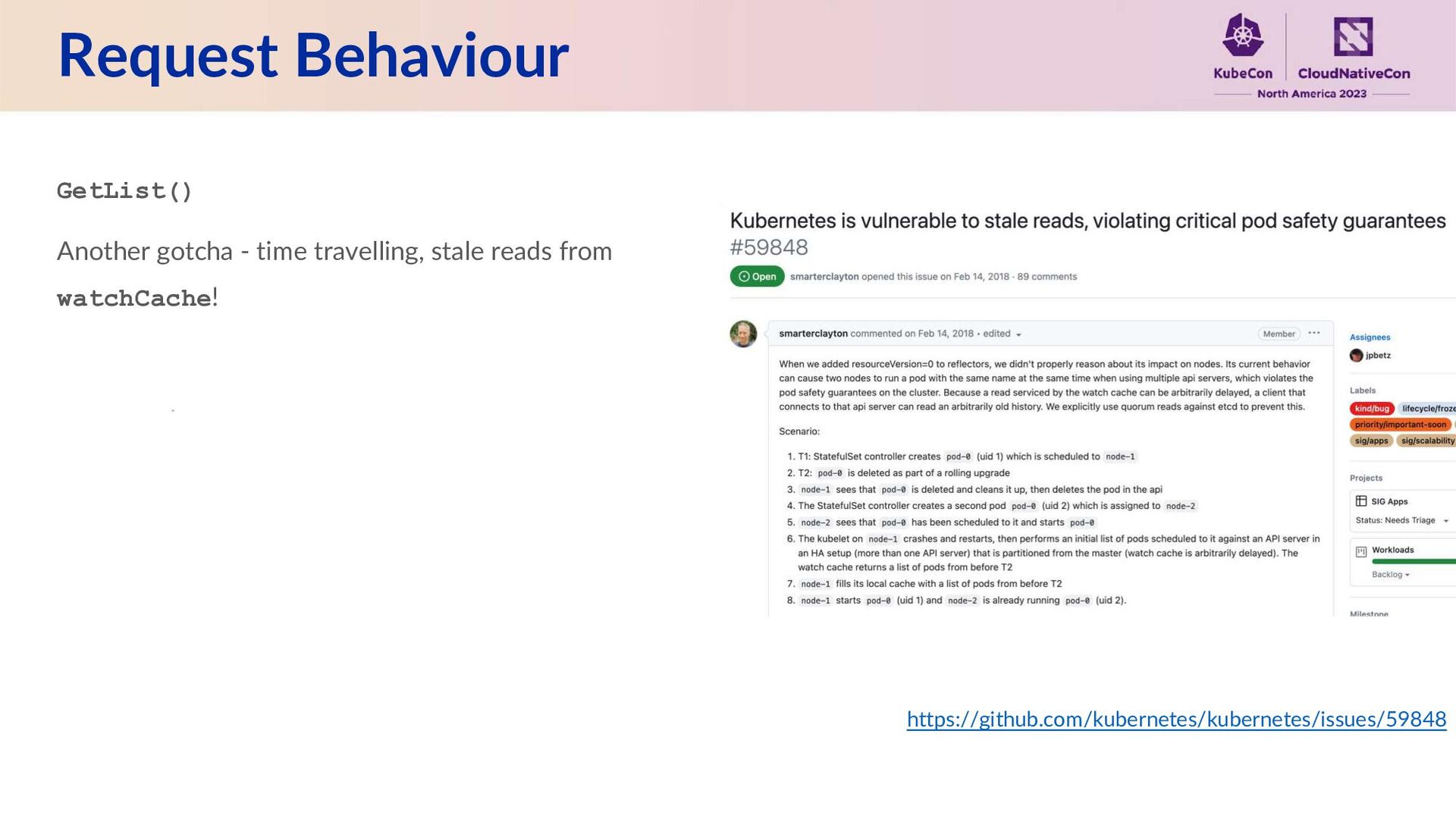
from watchCache! • If you have an HA setup, with watchCache enabled, one of them can be far behind the other. • Since informers/reflectors default to resourceVersion=“0” for their first LIST due scalability reasons, and these LISTs are served from the watchCache, we can get “data from the past”.
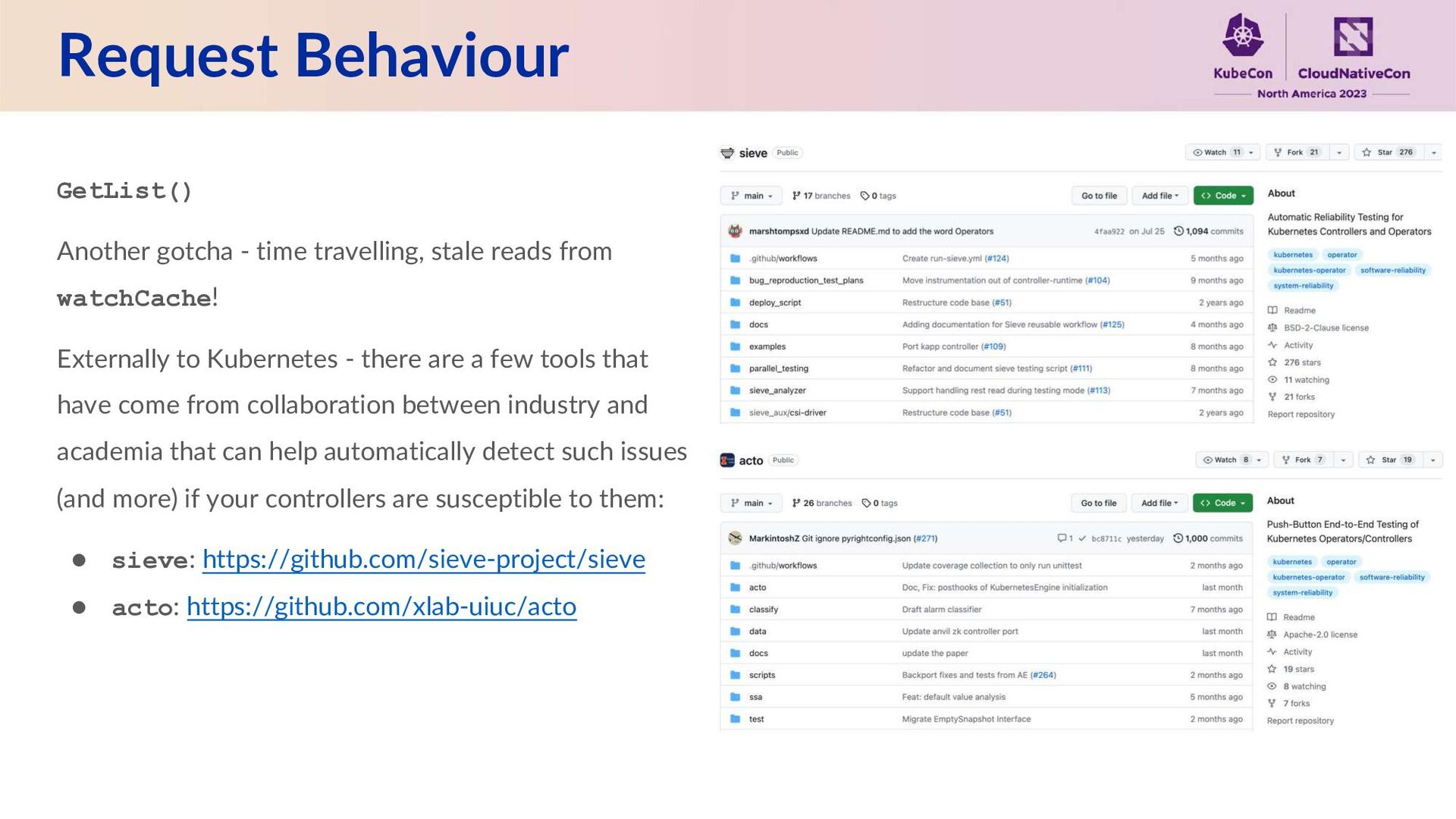
from watchCache! Externally to Kubernetes - there are a few tools that have come from collaboration between industry and academia that can help automatically detect such issues (and more) if your controllers are susceptible to them: • sieve: https://github.com/sieve-project/sieve • acto: https://github.com/xlab-uiuc/acto
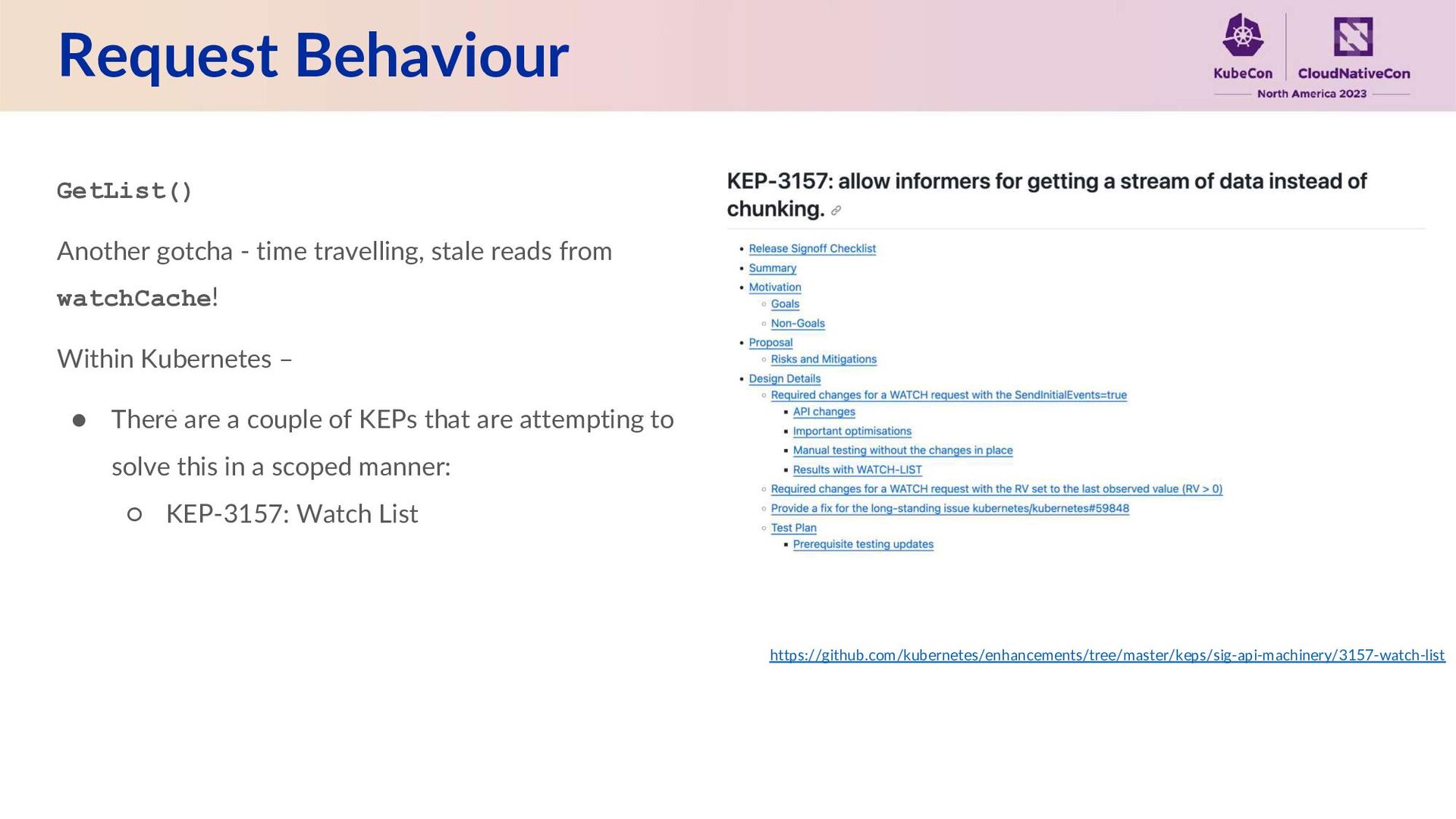
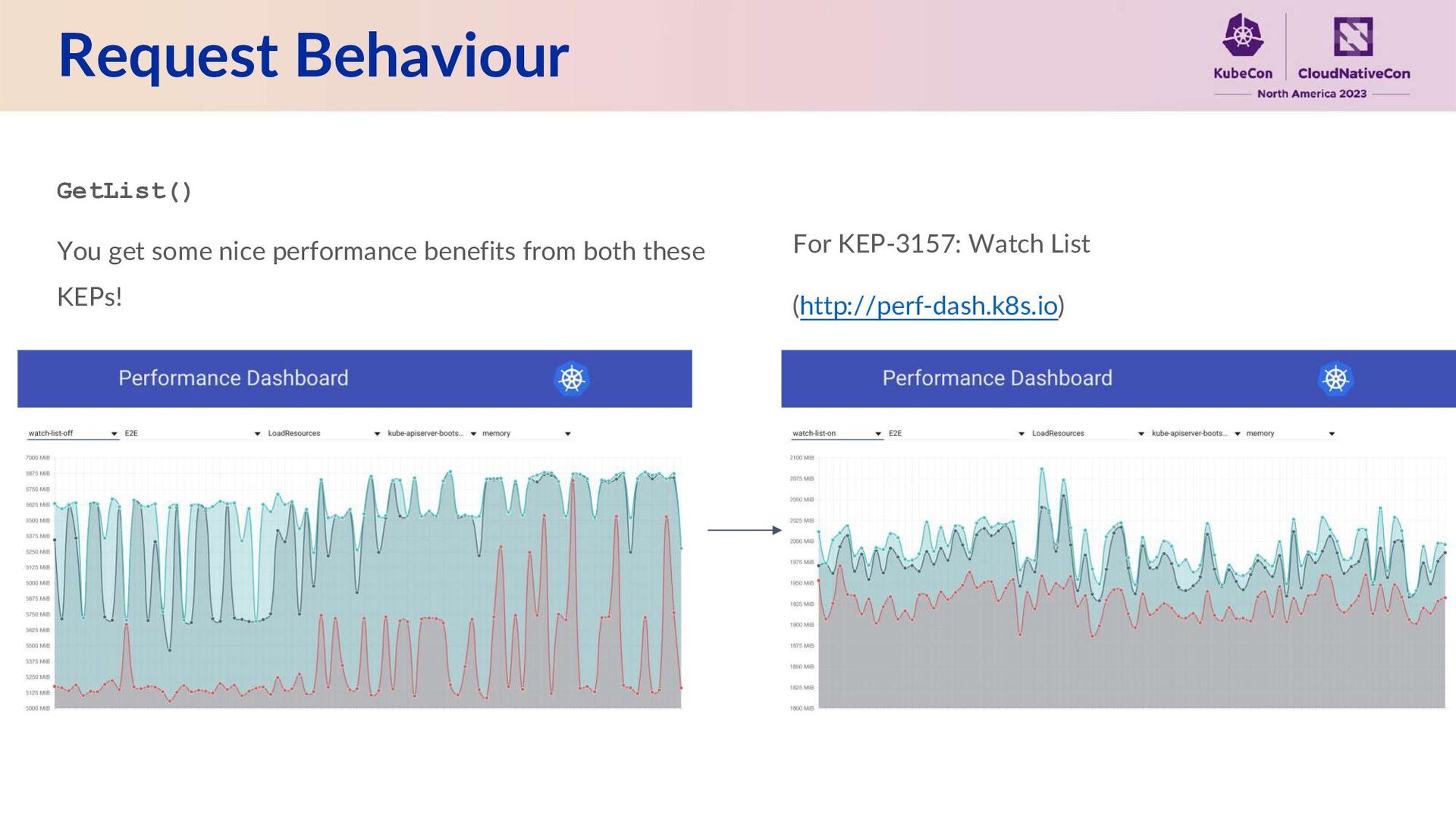
from watchCache! Within Kubernetes – • There are a couple of KEPs that are attempting to solve this in a scoped manner: ◦ KEP-3157: Watch List https://github.com/kubernetes/enhancements/tree/master/keps/sig-api-machinery/3157-watch-list
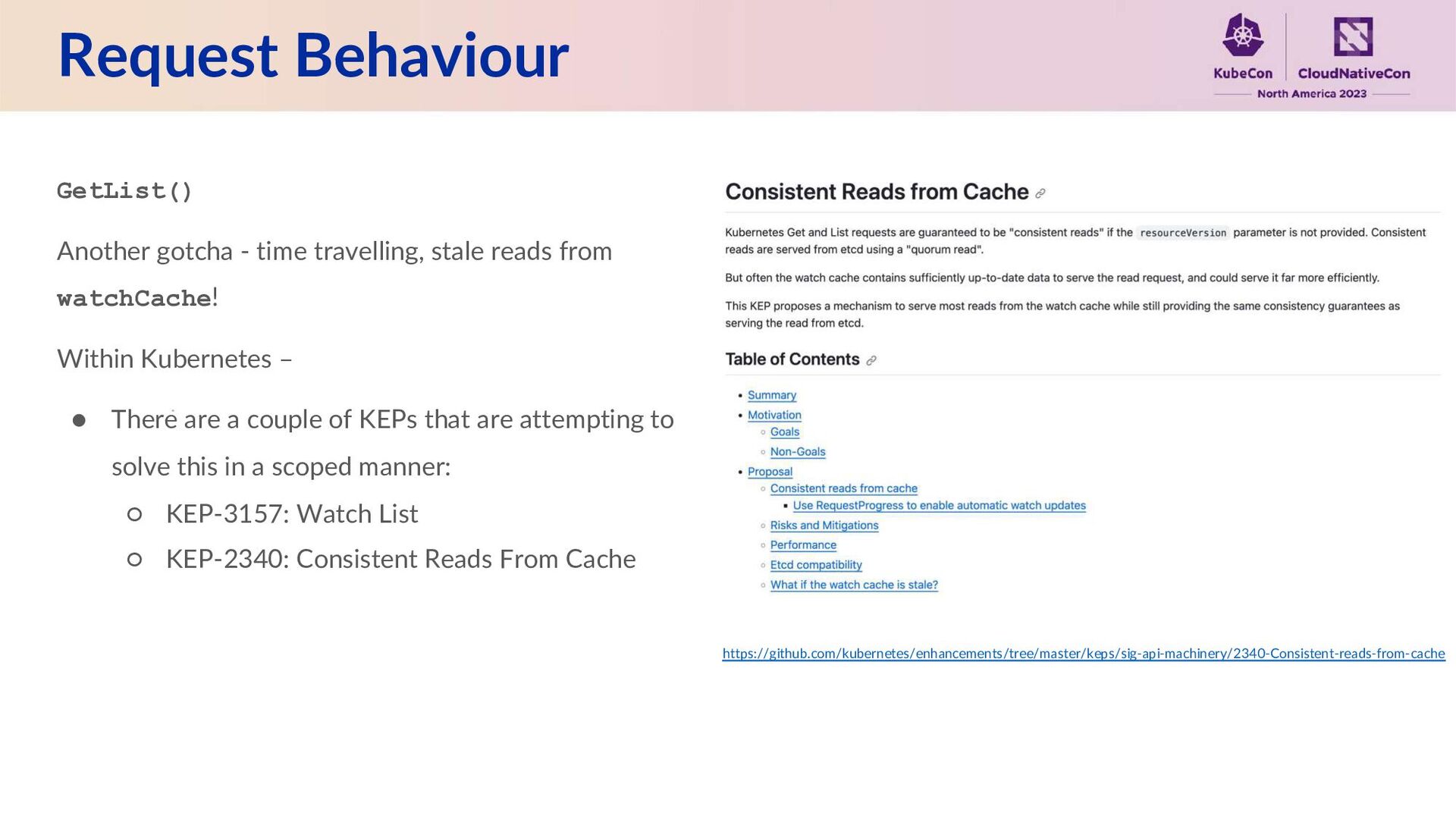
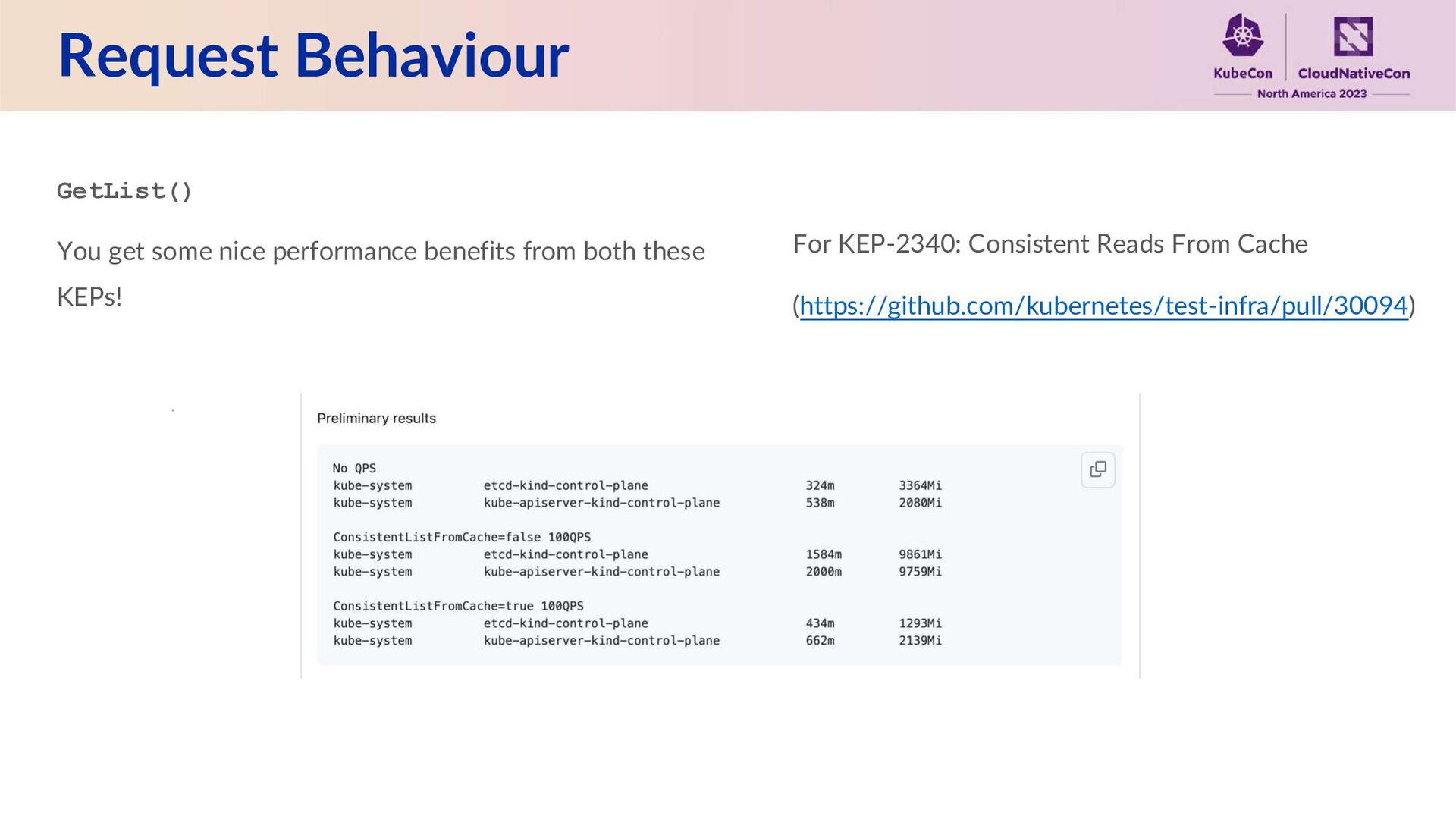
from watchCache! Within Kubernetes – • There are a couple of KEPs that are attempting to solve this in a scoped manner: ◦ KEP-3157: Watch List ◦ KEP-2340: Consistent Reads From Cache https://github.com/kubernetes/enhancements/tree/master/keps/sig-api-machinery/2340-Consistent-reads-from-cache
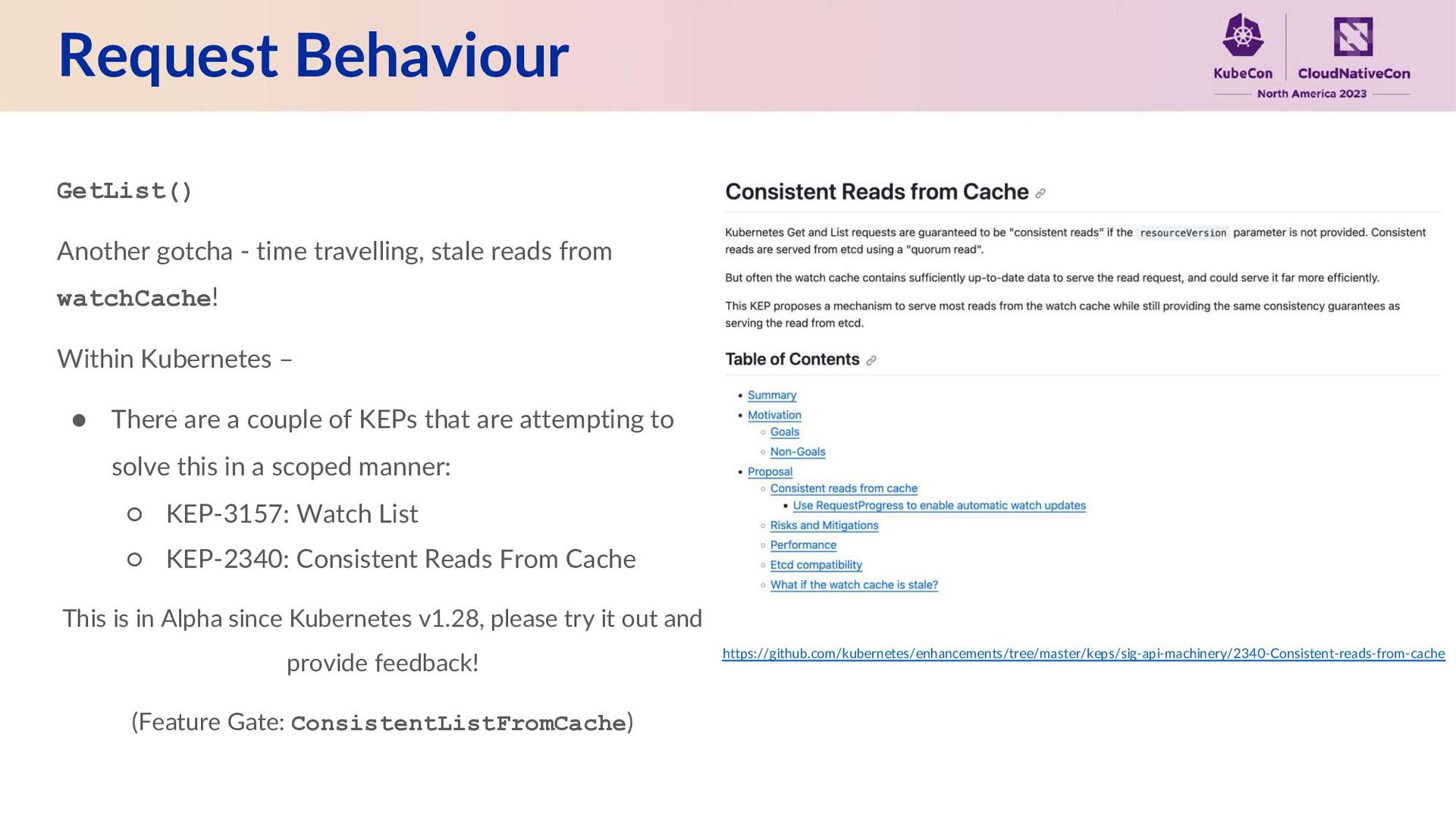
from watchCache! Within Kubernetes – • There are a couple of KEPs that are attempting to solve this in a scoped manner: ◦ KEP-3157: Watch List ◦ KEP-2340: Consistent Reads From Cache This is in Alpha since Kubernetes v1.28, please try it out and provide feedback! (Feature Gate: ConsistentListFromCache) https://github.com/kubernetes/enhancements/tree/master/keps/sig-api-machinery/2340-Consistent-reads-from-cache
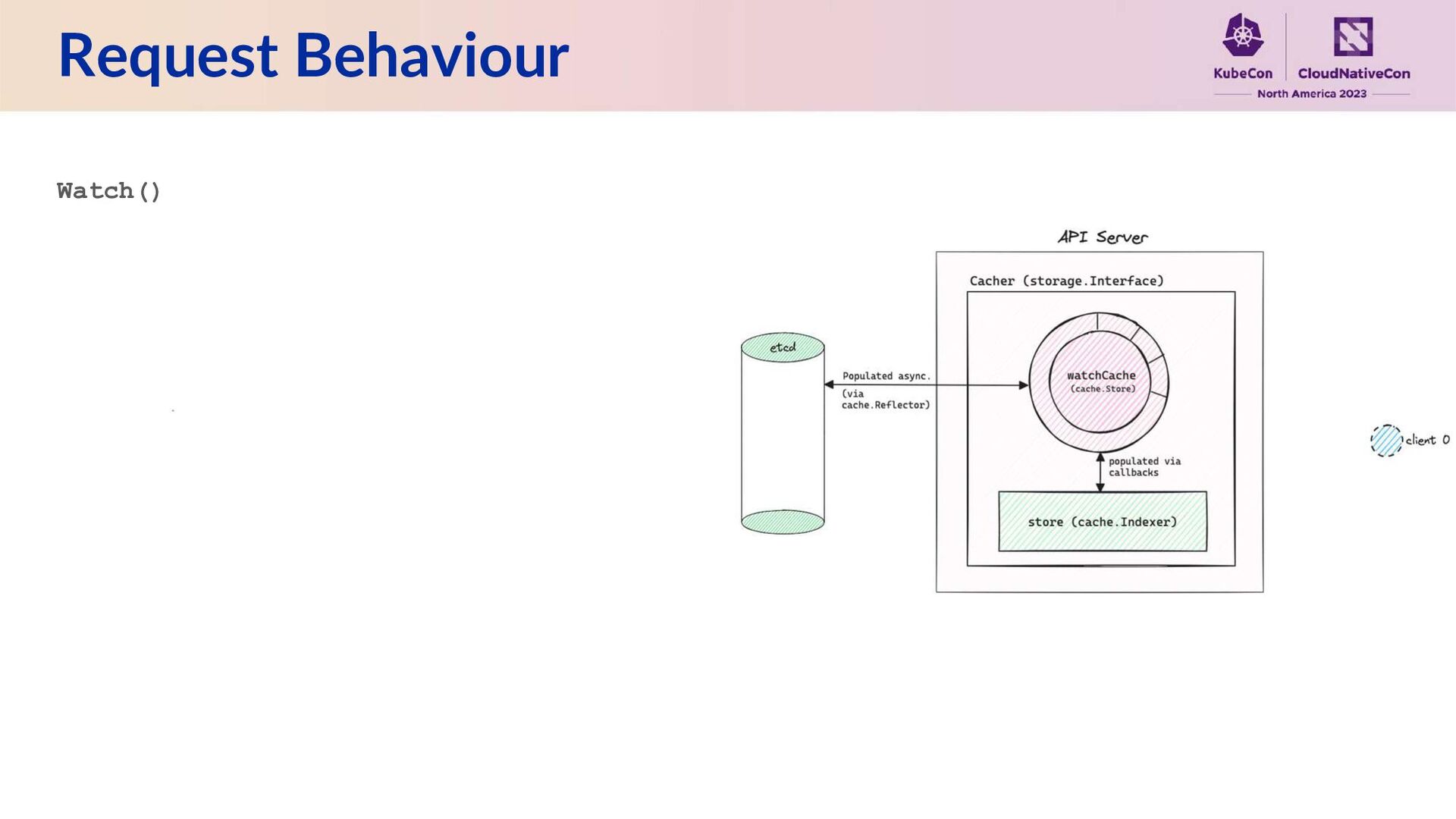
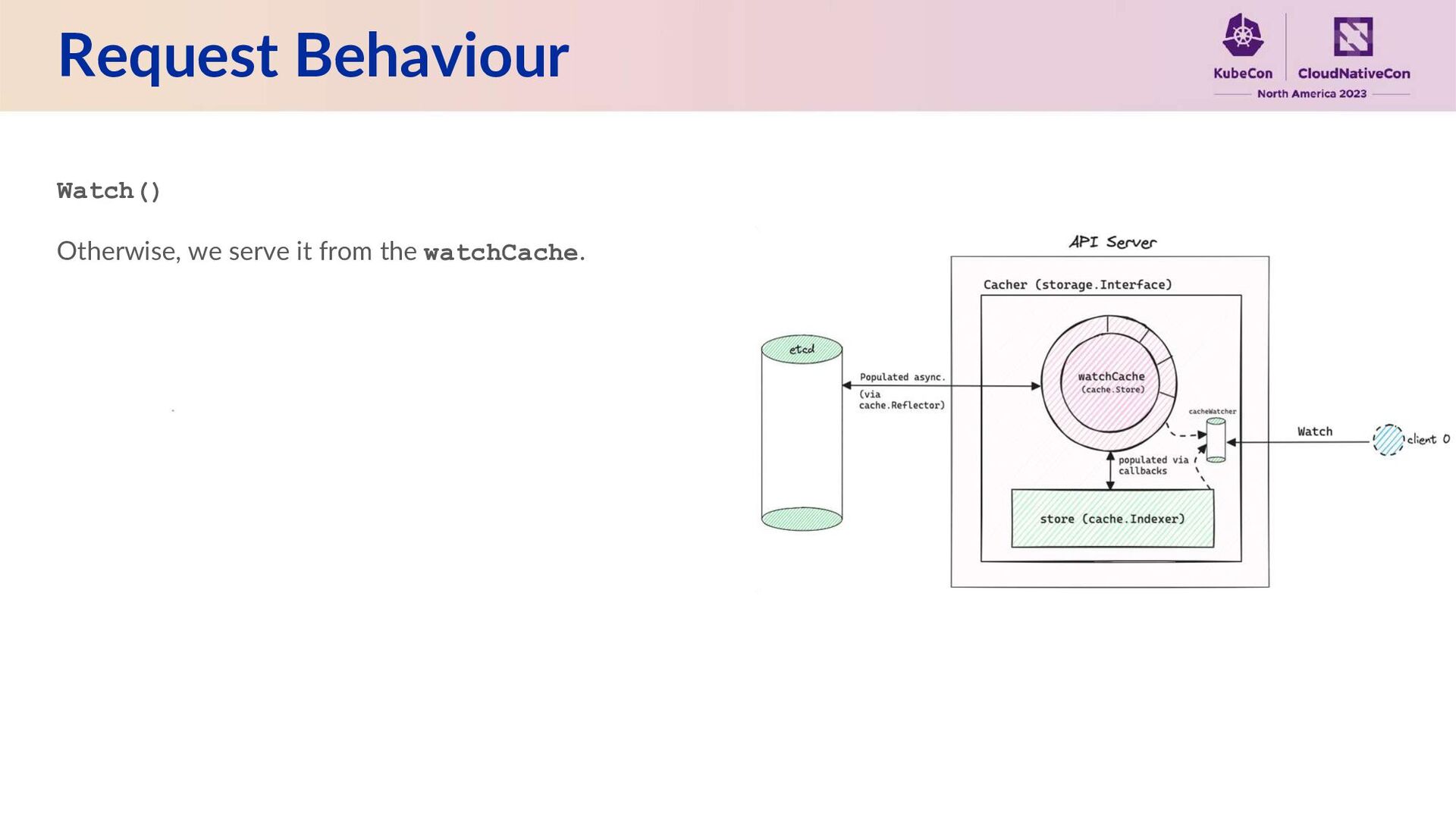
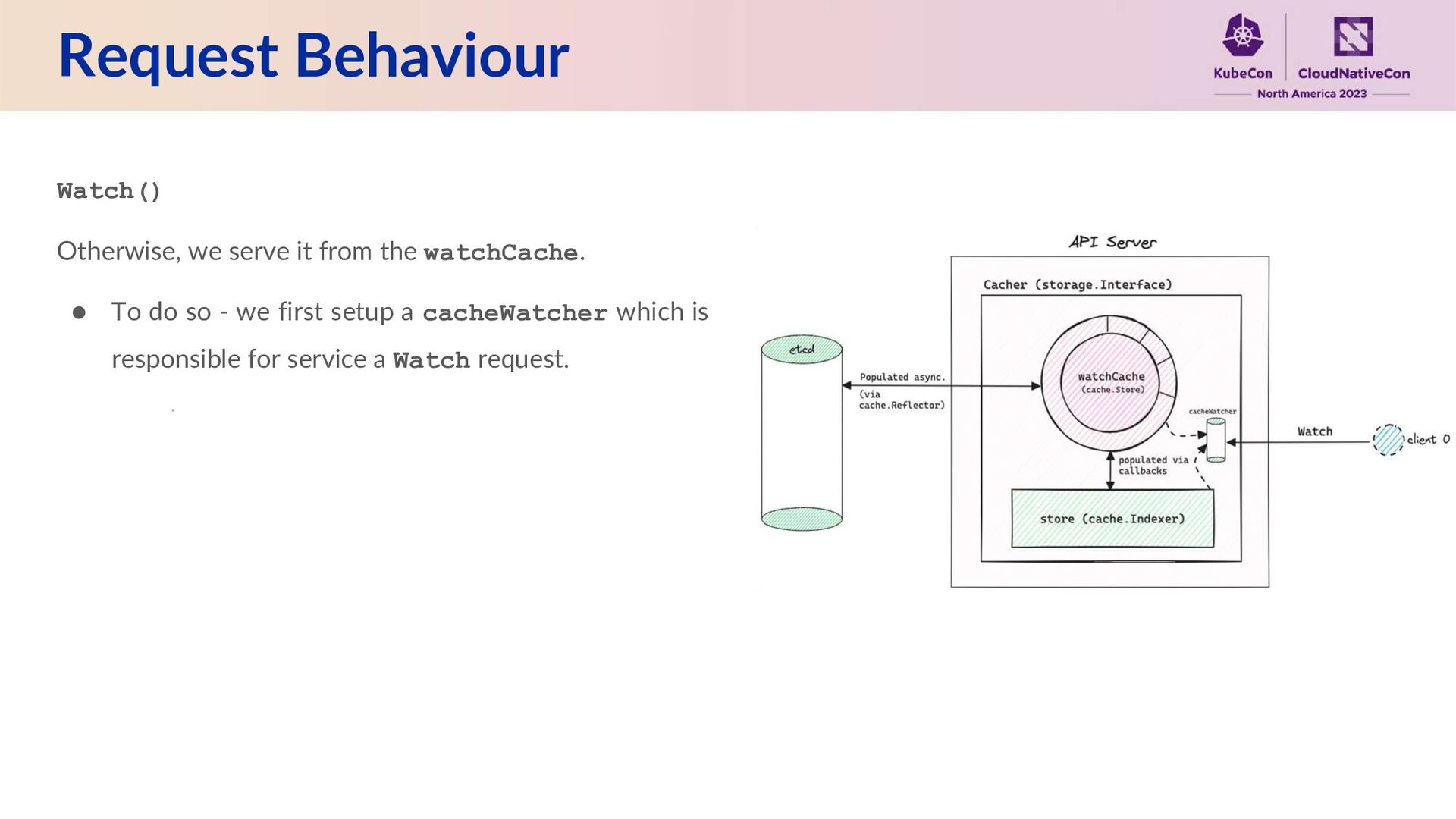
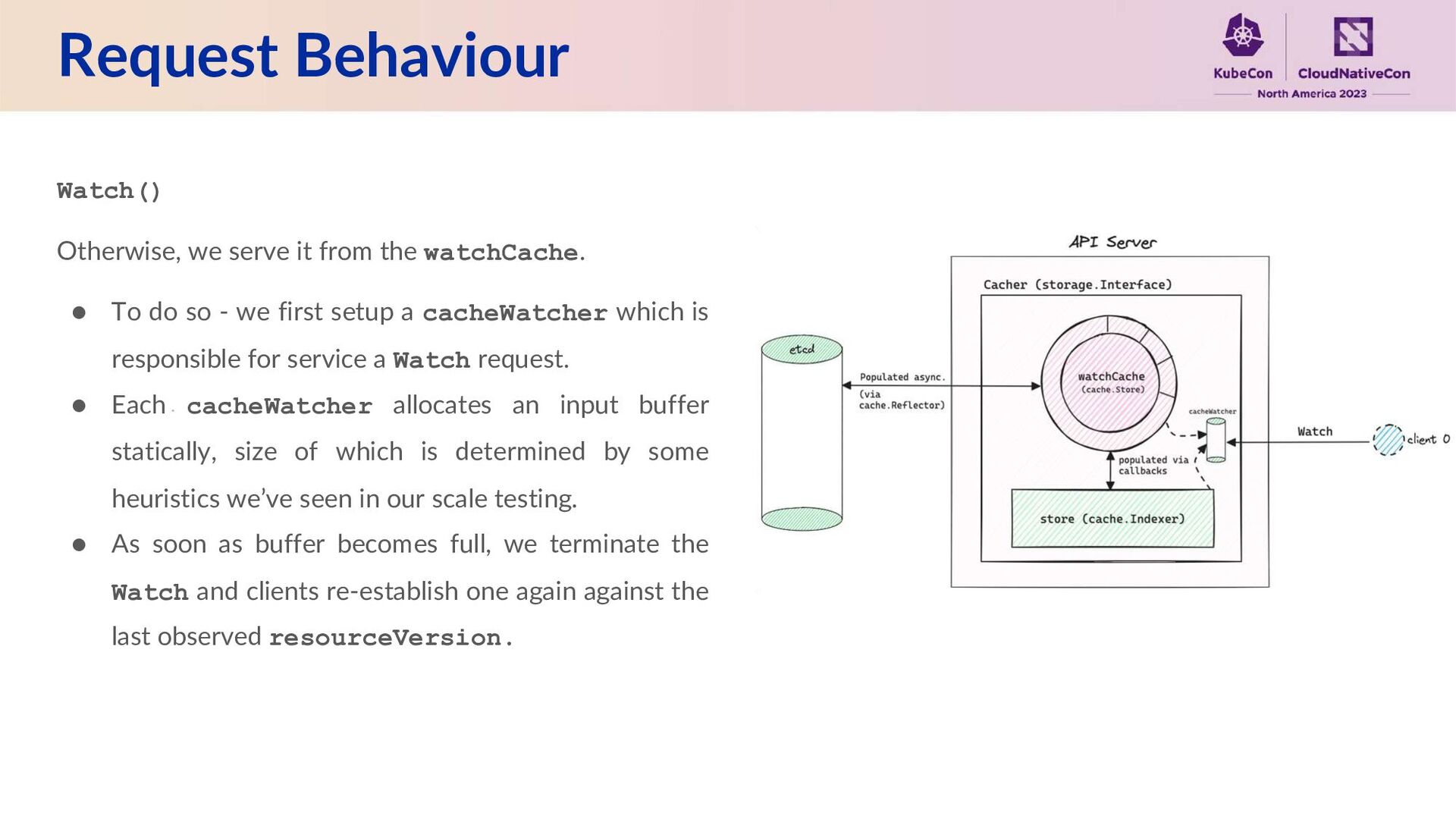
• To do so - we first setup a cacheWatcher which is responsible for service a Watch request. • Each cacheWatcher allocates an input buffer statically, size of which is determined by some heuristics we’ve seen in our scale testing.
• To do so - we first setup a cacheWatcher which is responsible for service a Watch request. • Each cacheWatcher allocates an input buffer statically, size of which is determined by some heuristics we’ve seen in our scale testing. • As soon as buffer becomes full, we terminate the Watch and clients re-establish one again against the last observed resourceVersion.
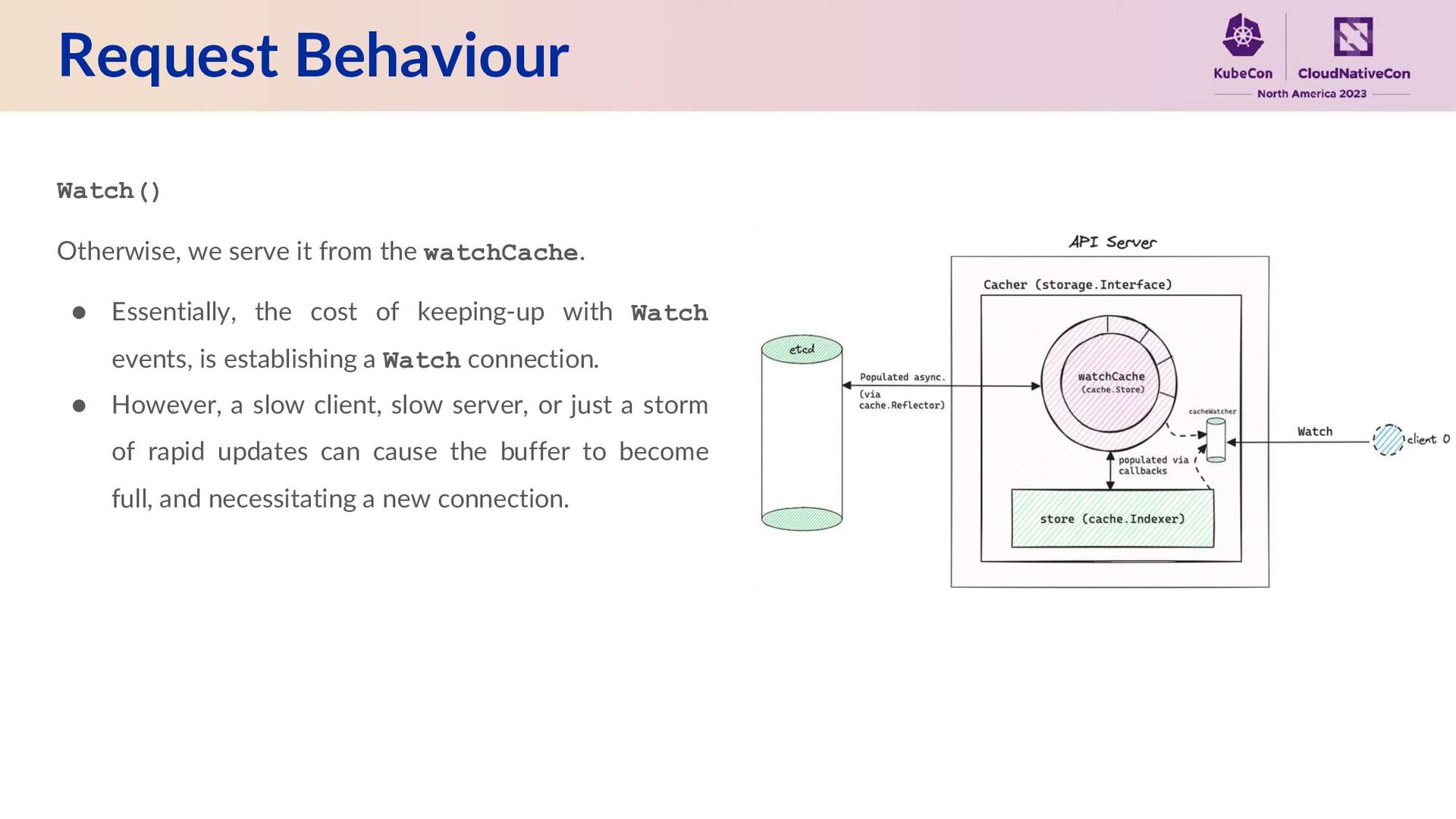
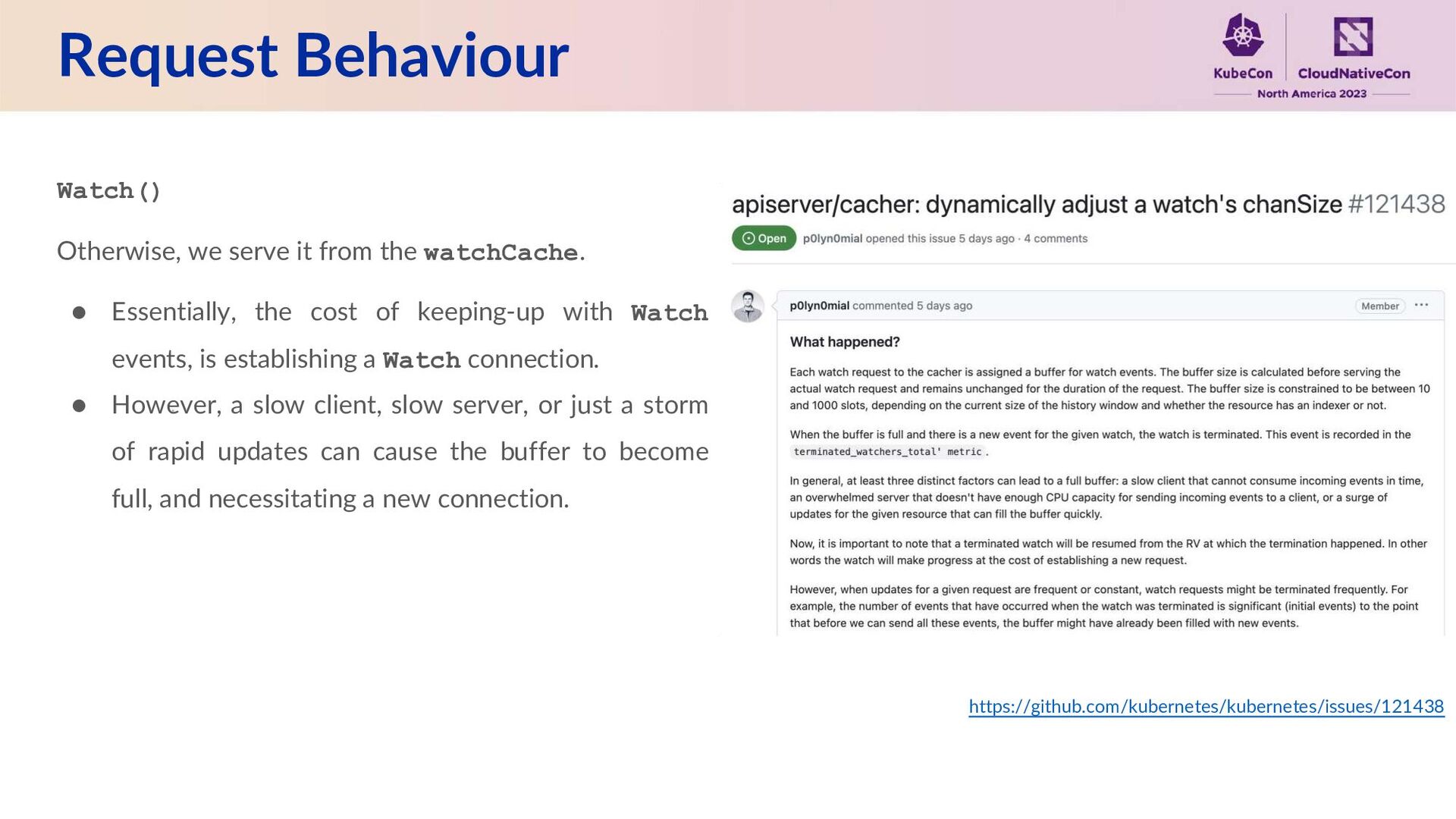
• Essentially, the cost of keeping-up with Watch events, is establishing a Watch connection. • However, a slow client, slow server, or just a storm of rapid updates can cause the buffer to become full, and necessitating a new connection.
• Essentially, the cost of keeping-up with Watch events, is establishing a Watch connection. • However, a slow client, slow server, or just a storm of rapid updates can cause the buffer to become full, and necessitating a new connection. https://github.com/kubernetes/kubernetes/issues/121438
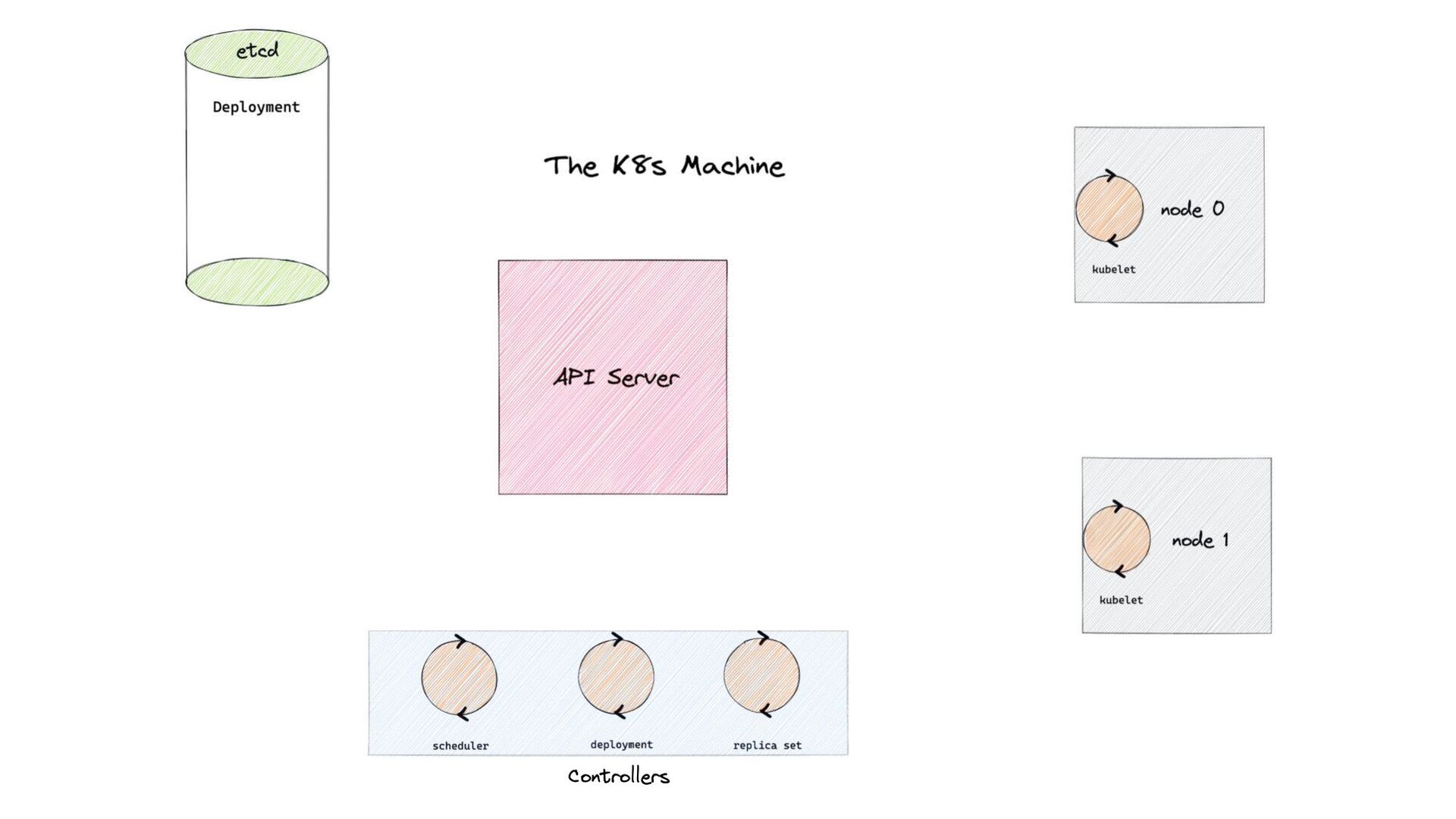
theme to how the Kubernetes machine works, and helps enable the controller pattern. • Different requests interact differently with each of the layers depending on the type of request and the value of the resourceVersion (and resourceVersionMatch) specified. • Specification of resourceVersion and resourceVersionMatch can help you make the tradeoff between data consistency and latency, majorly impacting the scalability of your cluster. • Unless you have strict consistency requitements, trust the watchCache, but beware of time travel queries!


 madhavjivrajani
 yama3133
 kworkdev
 aoto
aoto
 yakumo
 mochizuki875
 pauli
pauli
 ishiirikie
 kameitomohiro
 shreyas1009
 tomzoh
 oracle4engineer
 ufried
 marketingsoph
 lcolladotor
 honzajavorek
 akihiro_kokubo
 soysaucechin
 eileencodes
 denniskardys
 carmenintech
 paigeccino
 reverentgeek
 holman
 honnibal




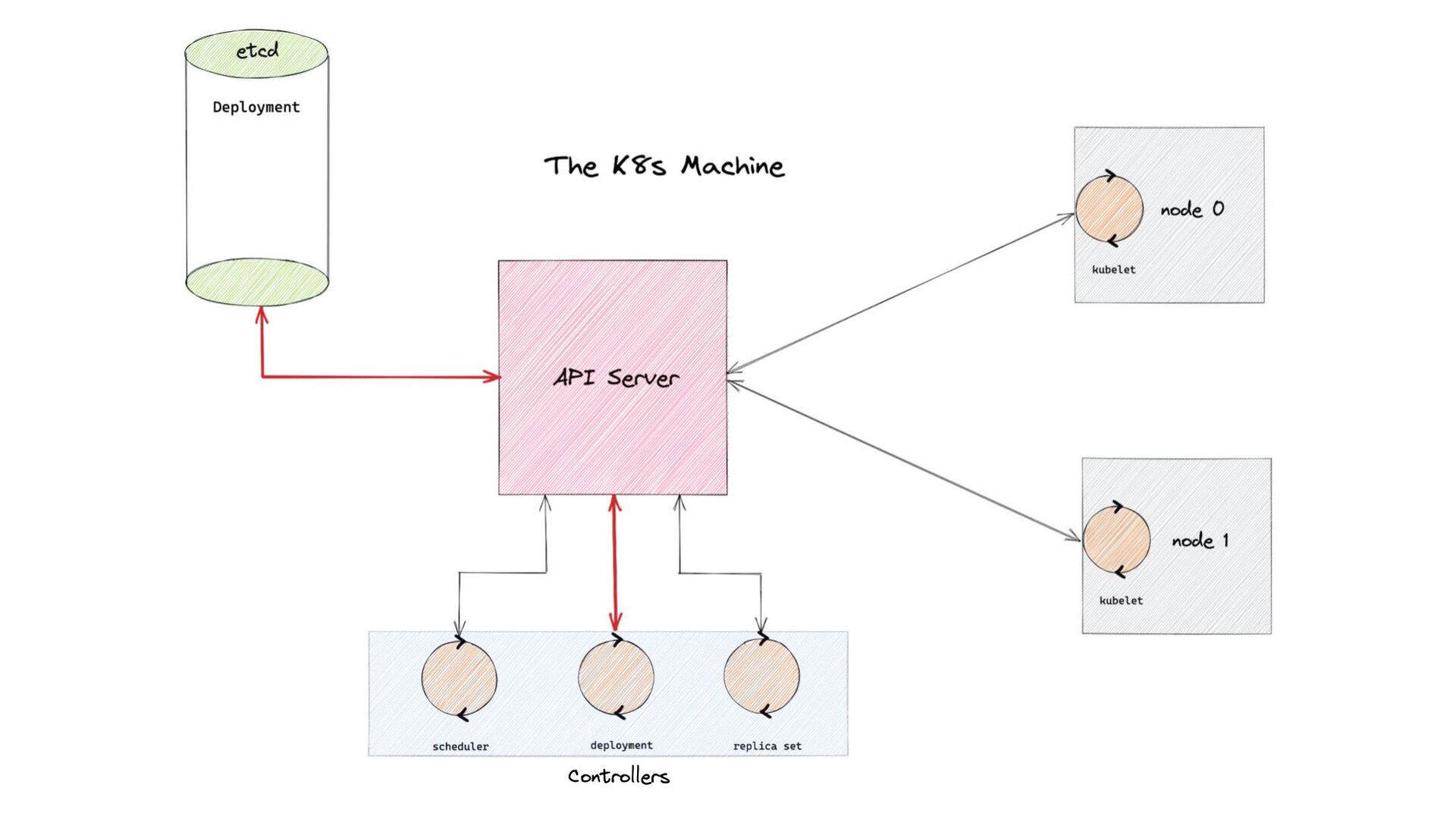
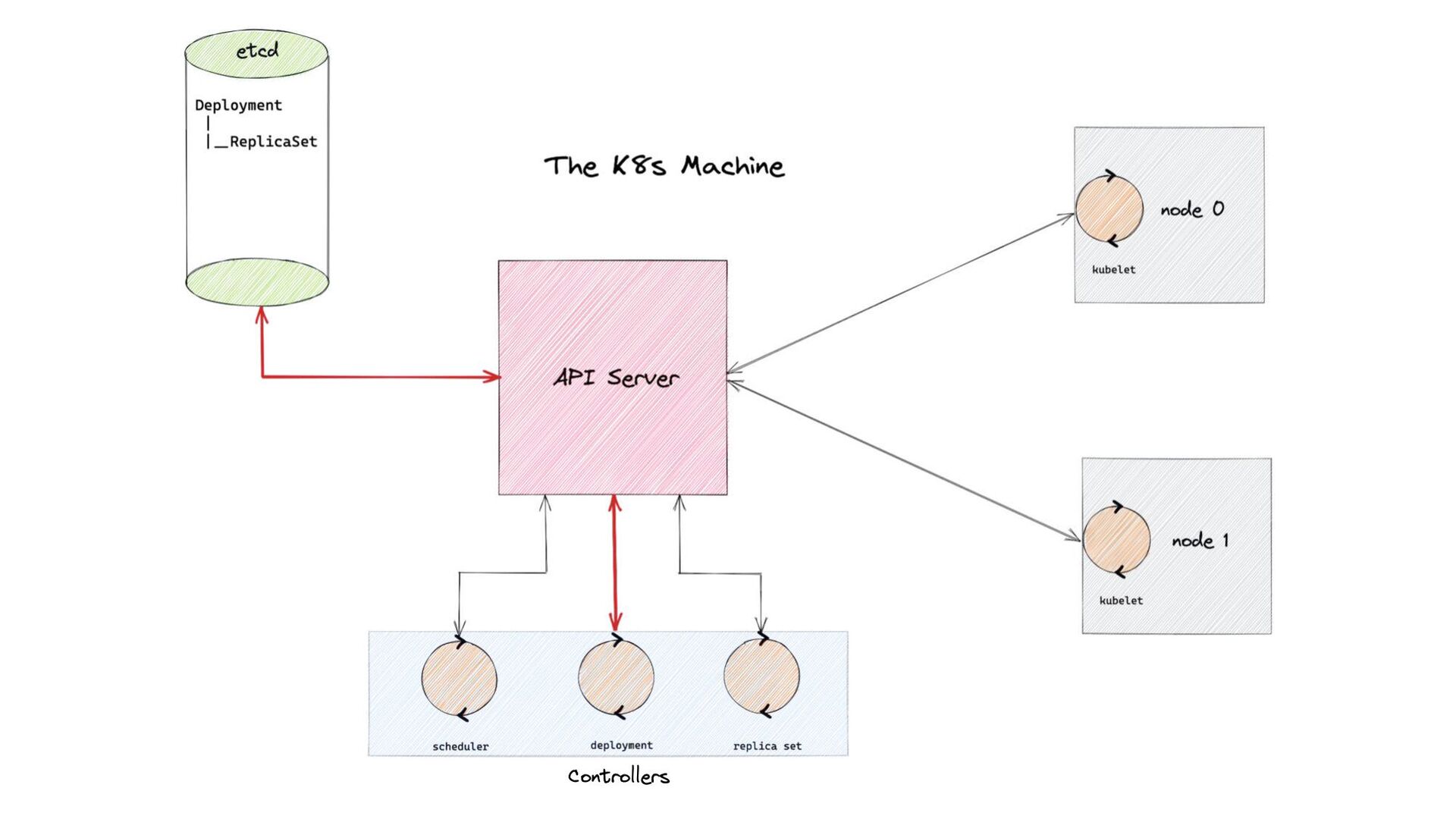
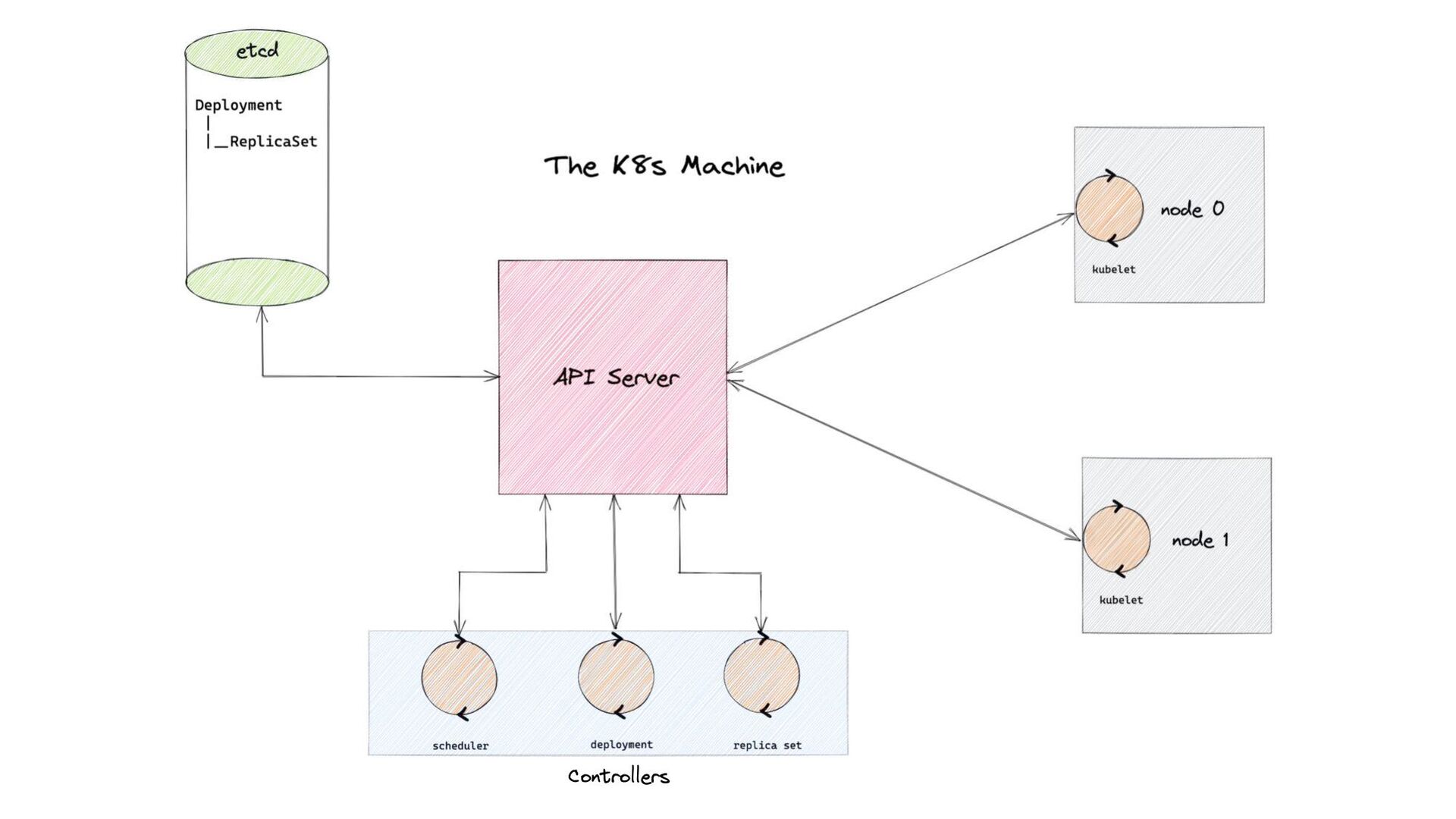
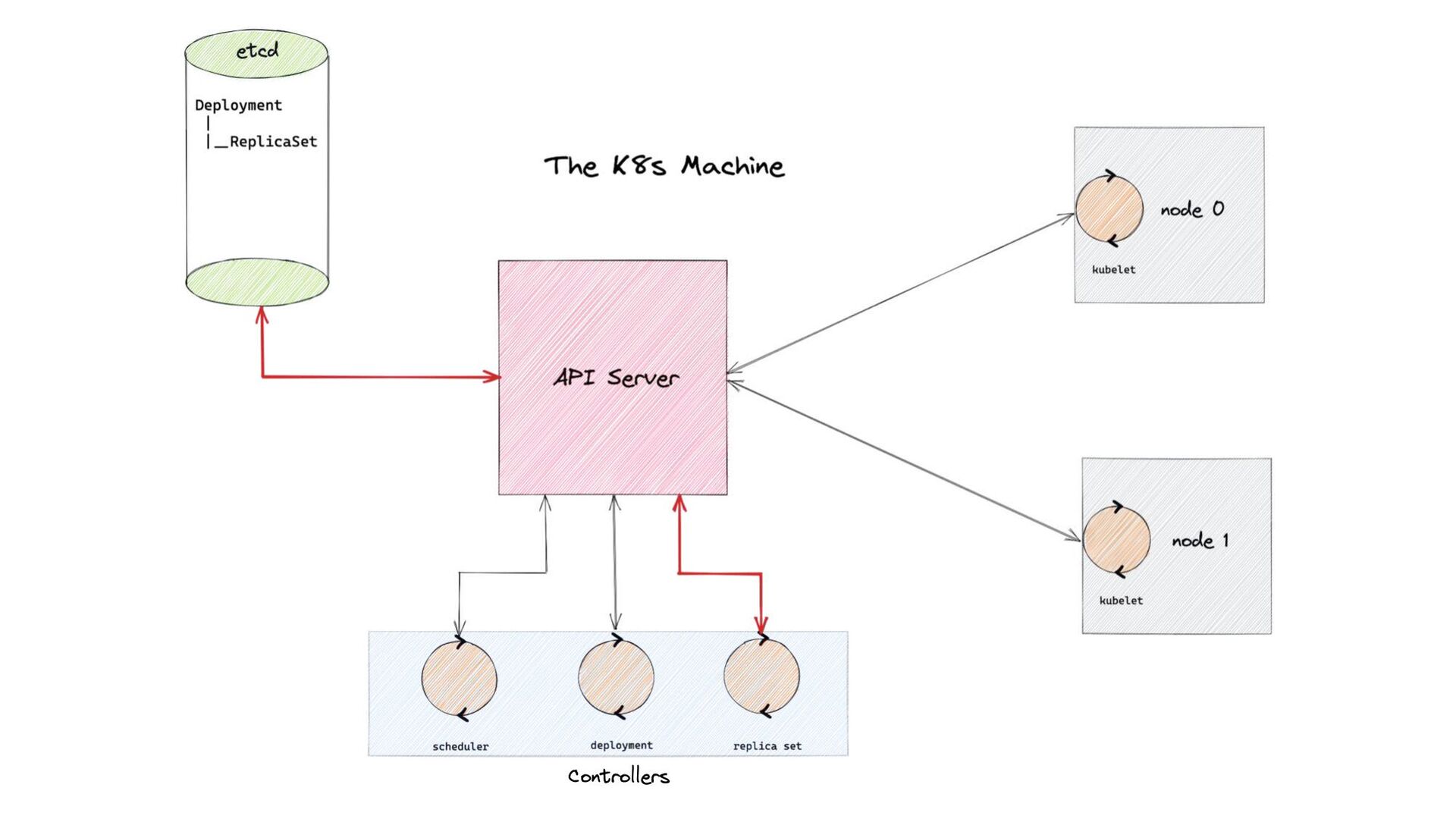














































![References • [Design Proposal] New storage layer design • Cacher](https://files.speakerdeck.com/presentations/14ffad7769324da8bd67e91f5b4c9ab7/slide_161.jpg)