Share
Embed
CraftConf Budapest 2018: Break your event chains! Complex event flows in distributed systems
@berndruecker @martinschimak => May 10th, 2018 => Budapest => CraftConf
Martin Schimak
May 10, 2018
Transcript
64 slides
-
Break your event chains! Complex event flows in distributed systems.
@berndruecker @martinschimak -
Vienna, Austria [email protected] @martinschimak Martin Schimak Into and onto de|coding
domain language with Plexiti -
Example process / Event Storming! Goods shipped Order placed Goods
fetched Payment received Events are a concept easy to grasp for everybody in the room. -
Events are … Payment received Payment Strong consistency It already
happened. Events let us look into the past. -
Events help to decouple services. Order summary Payment received Payment
UI raises projected onto Payment Service Order Service -
Events help with cross-cutting concerns. Payment received Inform customer listened
to by Payment Service Notification Service -
What about purely event-driven architectures? Order placed Payment Service Payment
received Inventory Service Goods fetched Shipment Service Goods shipped When relying only on events, „intent“ is always formed inside the event consumer. -
Autonomous services can make their own decisions. To change the
order of two services, we touch 4 sticky notes… but wait, even three services! Shipment Service Goods shipped Order placed Inventory Service Goods fetched Payment Service Payment received -
Our policies decide to act on facts – with commands
Domain Event Policy Command listened to by triggers -
Who owns the policy in a pure event choreography? Payment
received Start Fetching Policy Fetch goods listened to by triggers Payment Service Inventory Service -
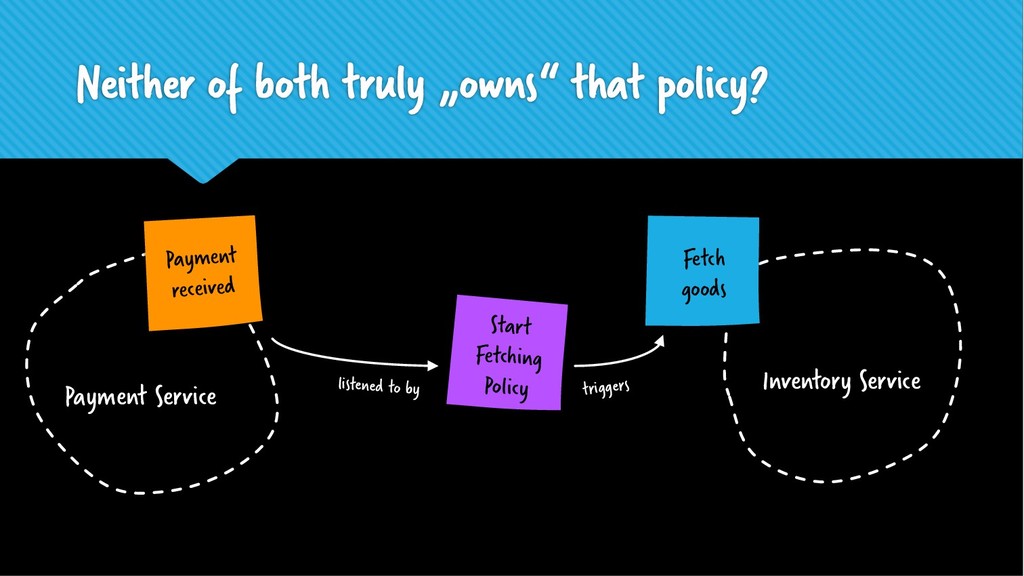
Neither of both truly „owns“ that policy? Payment received Fetch
goods listened to by triggers Payment Service Inventory Service Start Fetching Policy -
Extracting the policy into a mediator service Payment received Fetch
goods listened to by triggers Payment Service Inventory Service Order Service Start Fetching Policy -
The order as the company‘s core business Place order Order
placed Request payment Order Service Payment received Fetch goods Goods fetched Ship goods Goods shipped “When the order is placed…” “When the payment is received…” “When the goods are fetched…” “Then we are done!” Mark order as fulfilled Order fulfilled Payment Service Inventory Service Shipment Service -
Double check: what happens when we charge later? Place order
Order placed Request payment Order Service Payment received Fetch goods Goods fetched Ship goods Goods shipped “When the order is placed…” “When the payment is received…” “When the goods are fetched…” “Then we are done!” Mark order as fulfilled Order fulfilled Payment Service Inventory Service Shipment Service “When the order is placed…” “When the payment is received…” “When the goods are fetched…” -
Multiple services need to collaborate Payment Shipping Order Inventory https://www.infoworld.com/article/3254777/application-development/
3-common-pitfalls-of-microservices-integrationand-how-to-avoid-them.html -
Check-in Barcode Generator Web-UI Me Output Mgmt Current situation –
the bad part Stateful Retry -
We are having some technical difficulties and cannot present you
your boarding pass right away. But we do actively retry ourselves, so lean back, relax and we will send it on time. …I just made this up… -
Check-in Barcode Generator Web-UI Me Output Mgmt Possible situation –
much better! Stateful Retry -
Check-in Barcode Generator Web-UI Me Output Mgmt Stateful Retry Possible
situation – much better! The failure never leaves this scope! -
Persist thing (Entity, Document, Actor, …) State machine or workflow
engine Typical concerns DIY = effort, accidental complexity Complex, proprietary, heavyweight, slow, don‘t scale, developer adverse Scheduling, Versioning, operating, visibility, scalability, … Handling State -
It is impossible to differentiate certain failure scenarios. Independant of
communication style! Service Provider Client -
Distributed systems introduce complexity you have to tackle! Credit Card
Payment REST Do it reliably -
God services? Credit Card Payment A few smart god services
tell anemic CRUD services what to do Sam Newmann Order -
God services? Credit Card Payment Order A few smart god
services tell anemic CRUD services what to do Sam Newmann -
„By delegating our problems to our clients we force them
into mitigation. They become god services.“ Credit card failed Retry with new credit card details Charge credit card listened to by triggers Payment Service Order Service -
Just the first requirements for a payment service Request payment
Payment received Payment requested Charge credit card Depending on account balance Withdraw amount from account Amount Withdrawn Credit card charged Credit card failed Update credit card details Account details Credit card details updated Whenever card details are updated After two weeks Depending on the amount Amount credited Mark payment received Mark payment canceled Payment canceled Credit amount to account Whenever payment is canceled Mark payment received Payment received -
Payment as a „long-running“ service Request payment Payment received Payment
canceled 1) creates value – serving a result its client is really interested in 2) assumes responsibility – instead of delegating troubles with internal steps to its client 3) may go asynchronous – if needed for composite execution Payment Service -
@Saga class Payment { private var paymentAmount = 0F @StartSaga
@SagaEventHandler(associationProperty = "paymentId") fun on(event: PaymentRequested) { } } e.g. Axon Messaging & Saga Management is cool, but Java works as well! :-) 1) Correlate domain event 2) Save process state 3) Evaluate business policy 4) Create and issue command -
Credit amount back to account Withdraw amount from cust. account
Charge amount by credit card e.g. with Camunda as message-driven workflow Charge amount by credit card Credit amount back to account Update credit card details Check customer account balance Payment requested Depending on account balance Charge credit card Withdraw amount from account Credit card charged Whenever credit card is charged Mark payment received Payment received Amount Withdrawn Depending on the amount Mark payment received Payment received Mark paym. partly covered Payment partly covered Whenever payment p. covered Charge credit card Credit card failed Whenever credit card failed Update credit card details Credit card details updated Whenever card details are updated Charge credit card After two weeks Mark payment canceled Payment canceled Whenever payment is canceled Credit amount to account Amount credited Every two days Remind customer Customer reminded Withdraw amount from cust. account -
DDD? Long-running services respect bounded contexts! Order service Payment service
Request payment Payment received Request payment Payment canceled -
Integration of Axon Messaging with Camunda. Order service Payment service
Request payment Payment received Payment canceled Request payment plexiti de|coding domain language @martinschimak https://github.com/plexiti/axon-camunda-poc -
Flowing retail example: https://github.com/flowing/flowing-retail/ Using Java + Spring Boot or
C# REST or Kafka Camunda or Zeebe -
[email protected] @berndruecker http://bernd-ruecker.com/ [email protected] @martinschimak http://plexiti.com/ https://github.com/plexiti/axon-camunda-poc/ http://github.com/flowing/flowing-retail/ https://www.infoq.com/articles/events- workflow-automation
Contact: Contact: Examples: https://www.infoworld.com/article/3254777/ application-development/ 3-common-pitfalls-of-microservices- integrationand-how-to-avoid-them.html With thoughts from http://flowing.io @berndruecker | @martinschimak