Neural machine translation by jointly learning to align and translate. arXiv preprint arXiv:1409.0473, 2014. [2] Christopher M. Bishop. Pattern Recognition and Machine Learning. Springer, 2006. [3] Tom B. Brown, Benjamin Mann, Nick Ryder, Melanie Subbiah, Jared Kaplan, Prafulla Dhariwal, Arvind Neelakantan, Pranav Shyam, Girish Sastry, Amanda Askell, Sandhini Agarwal, Ariel Herbert-Voss, Gretchen Krueger, Tom Henighan, Rewon Child, Aditya Ramesh, Daniel Ziegler, Jeffrey Wu, Clemens Winter, Christopher Hesse, Mark Chen, Eric Sigler, Mateusz Litwin, Scott Gray, Benjamin Chess, Jack Clark, Christopher Berner, Sam McCandlish, Alec Radford, Ilya Sutskever, and Dario Amodei. Language models are few-shot learners. 18 / 26


 mickey_kubo
 kinsofficial
 hansodeeeeee
 caitechhr
 kintonepapers
 fullerene_inc
 gw_recruit
 uemura2024
 tbpgr
tbpgr
.jpg) ikuodanaka
ikuodanaka
 mj6237
 mraible
 kimpetersen
 tammyeverts
 signer
 marktimemedia
 philnash
 tenderlove
 panda_program
 eileencodes
 paigeccino
 palkan
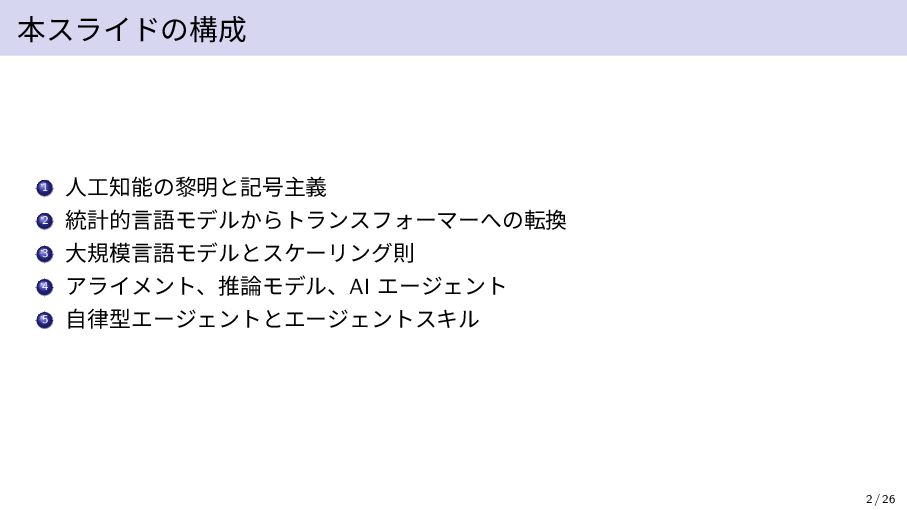
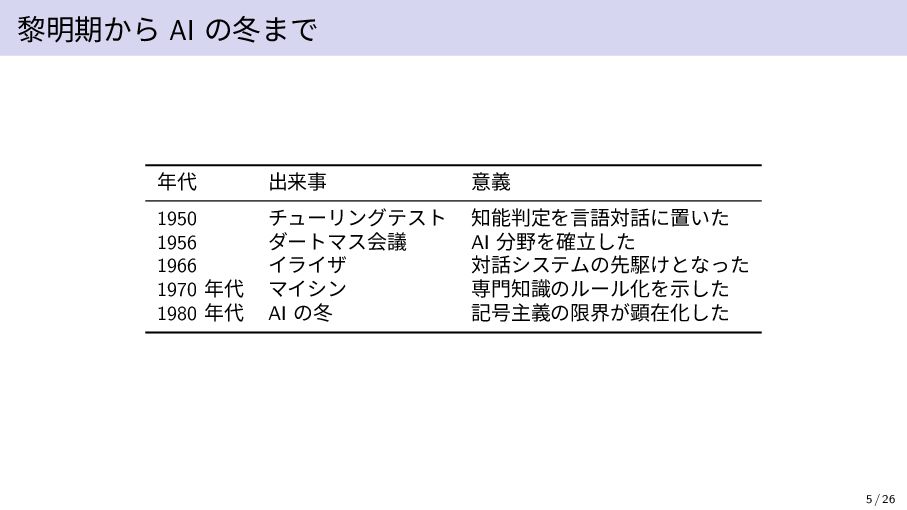
![人工知能研究の出発点 人工知能、AI、は記号論理に基づく推論から始まった チューリングは、機械が人間と見分けがつかない対話を行えるかを問うチューリン グテストを提案した [25] ダートマス会議では、人工知能という研究分野が明示的に定義された [12] 初期の課題は、知能を規則、探索、論理として表現できるかだった 3 /](https://files.speakerdeck.com/presentations/dbbb7da774b14a71b561ef8bc28c7fb7/slide_2.jpg)
![初期実装とエキスパートシステム SNARC は、人工ニューラルネットワークをハードウェアで実装しようとした先駆的 試み [13] イライザは、自然言語対話インターフェースの可能性と限界を示した [28] マイシンは、専門家知識をルールとして記述するエキスパートシステムの代表例 [24] 記号主義](https://files.speakerdeck.com/presentations/dbbb7da774b14a71b561ef8bc28c7fb7/slide_3.jpg)
![記号主義から統計主義へ 1990 年代以降、インターネットと計算資源の拡大により、大規模データから学習す る方向へ移行した 機械学習は、明示的なルールではなく、データに含まれる統計的パターンを獲得す る方法 [2] ディープラーニングは、特徴量を人手で設計するのではなく、多層ニューラルネッ トワークで表現を学習する この転換が、後の大規模言語モデル、LLM、の基礎となった](https://files.speakerdeck.com/presentations/dbbb7da774b14a71b561ef8bc28c7fb7/slide_5.jpg)
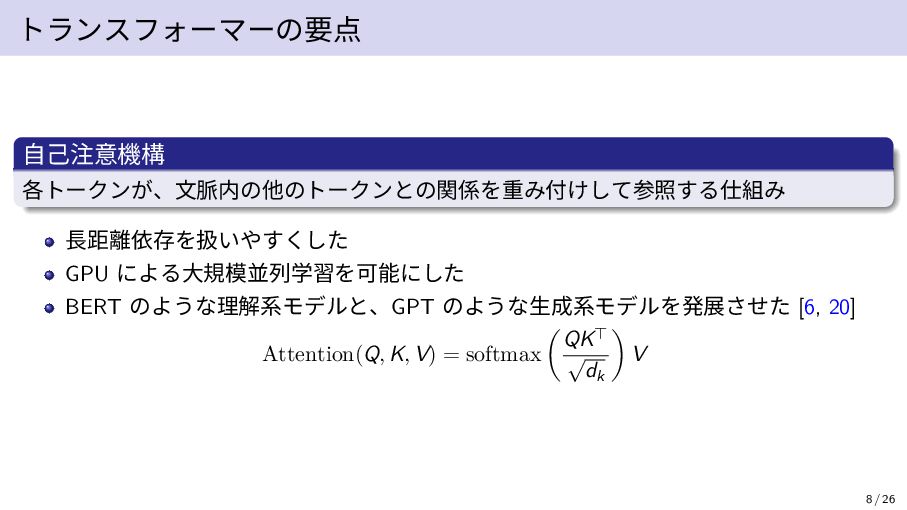
![リカレントニューラルネットワークから注意機構へ リカレントニューラルネットワーク、RNN、は系列処理に強いが、長距離依存と並 列計算に課題があった LSTM は長期記憶を扱うための重要な改良であった [7] 注意機構、アテンション、は入力内の重要な関係を直接参照する仕組み [1] トランスフォーマーは、自己注意機構により系列処理を大きく並列化した [26]](https://files.speakerdeck.com/presentations/dbbb7da774b14a71b561ef8bc28c7fb7/slide_6.jpg)
![GPT 系列とスケーリング則 GPT 系列は、事前学習された生成型言語モデルを段階的に大規模化した流れ [20, 21, 3] スケーリング則は、モデル規模、データ量、計算量の拡大により性能が予測可能に 向上することを示した [8]](https://files.speakerdeck.com/presentations/dbbb7da774b14a71b561ef8bc28c7fb7/slide_8.jpg)
![アライメントとチャット GPT アライメントは、モデル出力を人間の意図、価値、制約に合わせるための技術群 インストラクト GPT は、人間のフィードバックによる強化学習、RLHF、を用いて 指示追従性能を高めた [18] チャット GPT](https://files.speakerdeck.com/presentations/dbbb7da774b14a71b561ef8bc28c7fb7/slide_9.jpg)
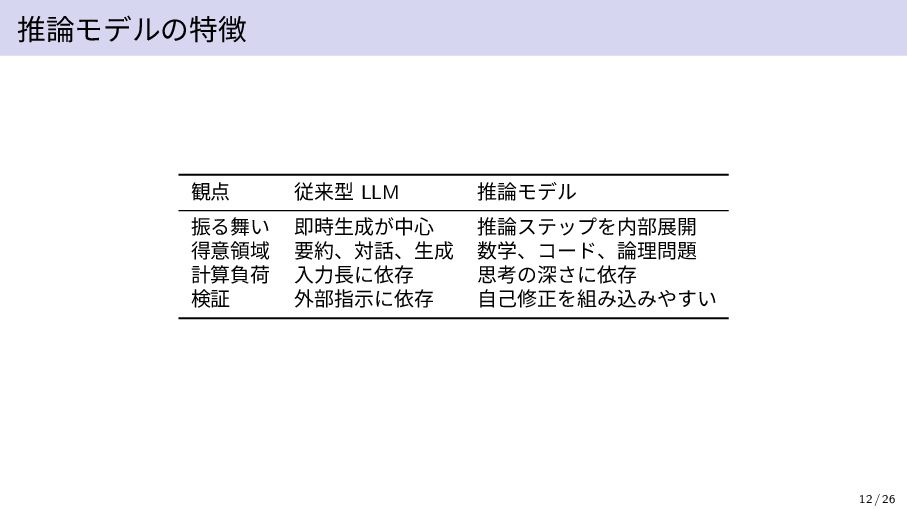
![推論モデルへの進化 従来の LLM は、入力に対して即時に次トークンを生成する傾向が強かった 推論モデルは、最終回答の前に内部的な思考ステップを用いて問題を解くモデル [27] 推論時間スケーリングとは、回答前の計算時間を増やすほど精度が上がるという考 え方 [17] ディープシーク](https://files.speakerdeck.com/presentations/dbbb7da774b14a71b561ef8bc28c7fb7/slide_10.jpg)
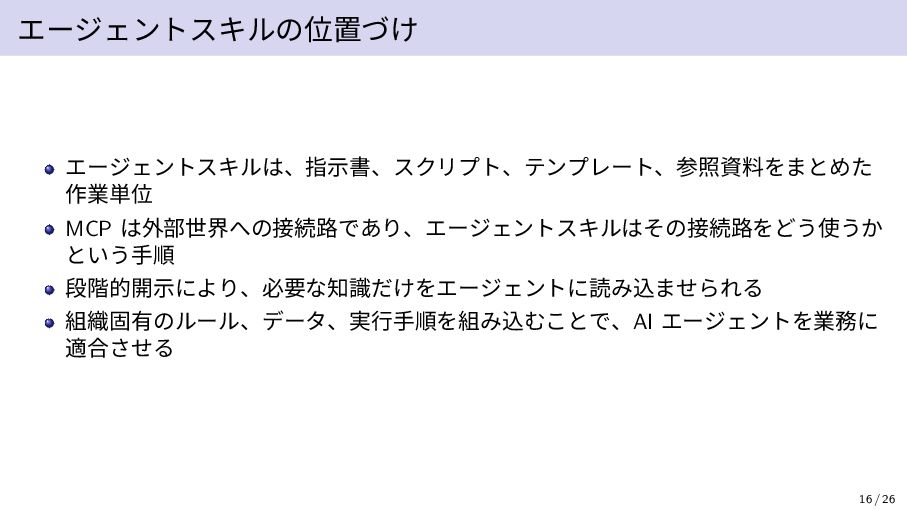
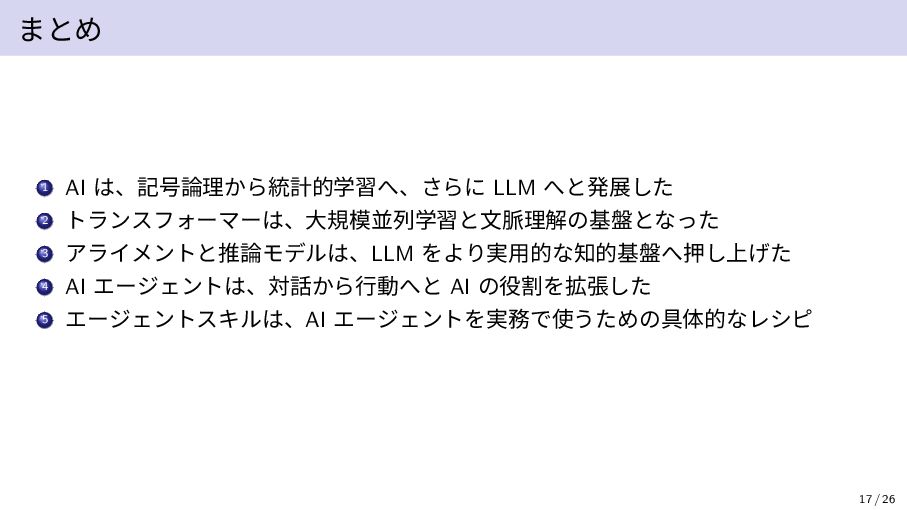
![チャットボットから AI エージェントへ AI エージェントは、LLM が言葉を生成するだけでなく、目標に向かって行動する形 態 [29, 23] 受動的に回答するチャットボットに対し、エージェントは計画、実行、観測、再試](https://files.speakerdeck.com/presentations/dbbb7da774b14a71b561ef8bc28c7fb7/slide_12.jpg)
![自律型エージェントの加速 オート GPT とベイビー AGI は、2023 年に自律型エージェントの可能性を広く示し た [22, 14]](https://files.speakerdeck.com/presentations/dbbb7da774b14a71b561ef8bc28c7fb7/slide_13.jpg)
![オーケストレーションの台頭 ラングチェーン、ランググラフ、オートジェン、クルー AI は、複雑なエージェント 処理を構造化する枠組み [9, 10, 30, 4] 単一の万能エージェントではなく、役割分担された複数エージェントの連携が重要](https://files.speakerdeck.com/presentations/dbbb7da774b14a71b561ef8bc28c7fb7/slide_14.jpg)
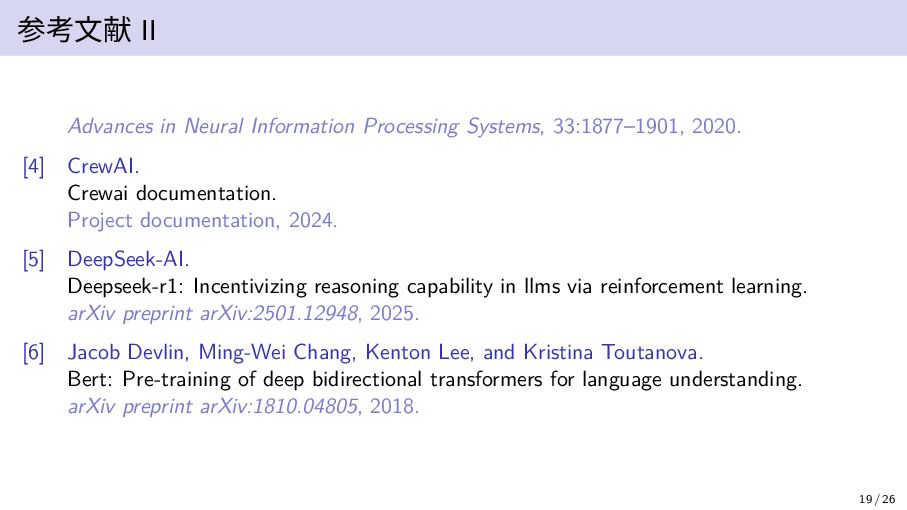
![参考文献 I [1] Dzmitry Bahdanau, Kyunghyun Cho, and Yoshua Bengio.](https://files.speakerdeck.com/presentations/dbbb7da774b14a71b561ef8bc28c7fb7/slide_17.jpg)
![参考文献 III [7] Sepp Hochreiter and J”urgen Schmidhuber. Long short-term](https://files.speakerdeck.com/presentations/dbbb7da774b14a71b561ef8bc28c7fb7/slide_19.jpg)
![参考文献 IV [11] James Lighthill. Artificial intelligence: A general survey.](https://files.speakerdeck.com/presentations/dbbb7da774b14a71b561ef8bc28c7fb7/slide_20.jpg)
![参考文献 V [15] OpenAI. Introducing chatgpt. OpenAI Blog, 2022. [16]](https://files.speakerdeck.com/presentations/dbbb7da774b14a71b561ef8bc28c7fb7/slide_21.jpg)
![参考文献 VI [19] Joon Sung Park, Joseph O’Brien, Carrie Cai,](https://files.speakerdeck.com/presentations/dbbb7da774b14a71b561ef8bc28c7fb7/slide_22.jpg)
![参考文献 VII [22] Significant Gravitas Team Richards. Auto-gpt: An autonomous](https://files.speakerdeck.com/presentations/dbbb7da774b14a71b561ef8bc28c7fb7/slide_23.jpg)
![参考文献 VIII [26] Ashish Vaswani, Noam Shazeer, Niki Parmar, Jakob](https://files.speakerdeck.com/presentations/dbbb7da774b14a71b561ef8bc28c7fb7/slide_24.jpg)
![参考文献 IX [29] Michael Wooldridge. An Introduction to MultiAgent Systems.](https://files.speakerdeck.com/presentations/dbbb7da774b14a71b561ef8bc28c7fb7/slide_25.jpg)