Key terms 3 The Caesar cipher — and why it fails 4 RSA: the padlock idea 5 RSA math — worked example 6 WhatsApp end-to-end encryption 7 WhatsApp vs. Signal 8 Myths, habits, and a final challenge Kannan Murugapandian (DPS International School) Cracking the Code May 2026 2 / 18
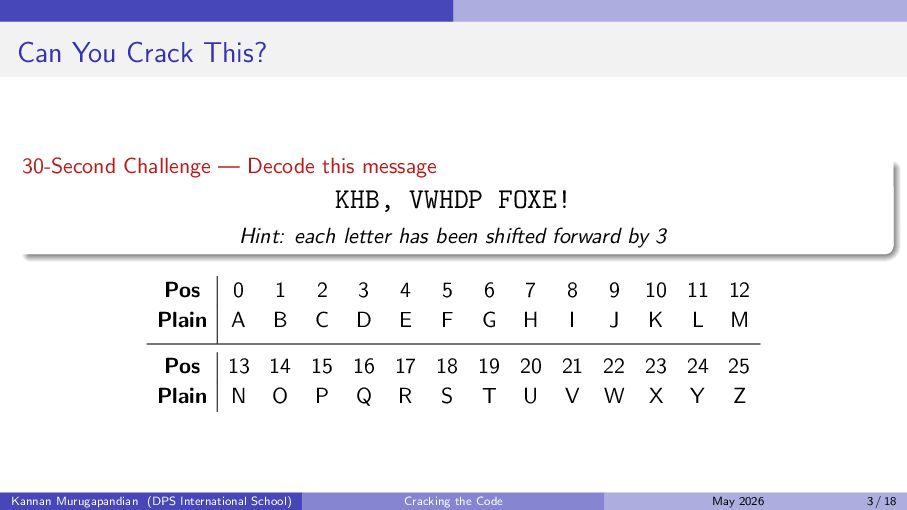
KHB, VWHDP FOXE! Hint: each letter has been shifted forward by 3 Pos 0 1 2 3 4 5 6 7 8 9 10 11 12 Plain A B C D E F G H I J K L M Pos 13 14 15 16 17 18 19 20 21 22 23 24 25 Plain N O P Q R S T U V W X Y Z Kannan Murugapandian (DPS International School) Cracking the Code May 2026 3 / 18
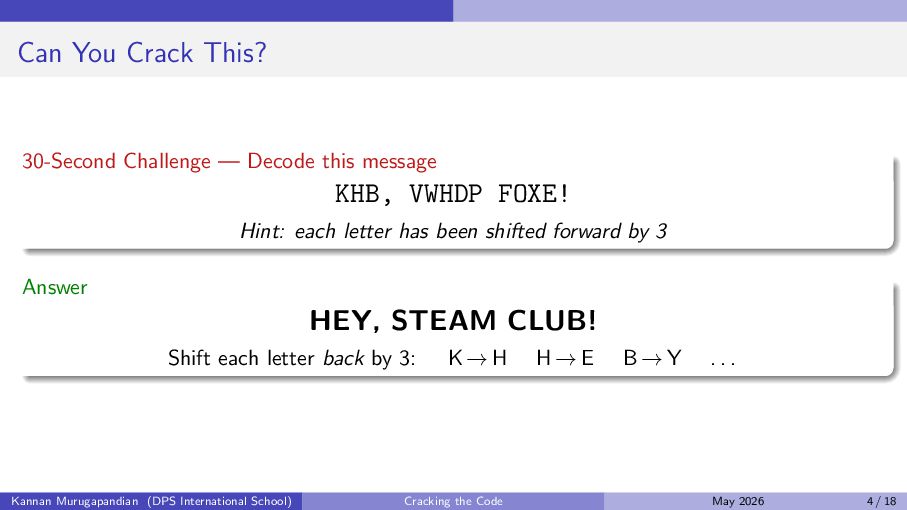
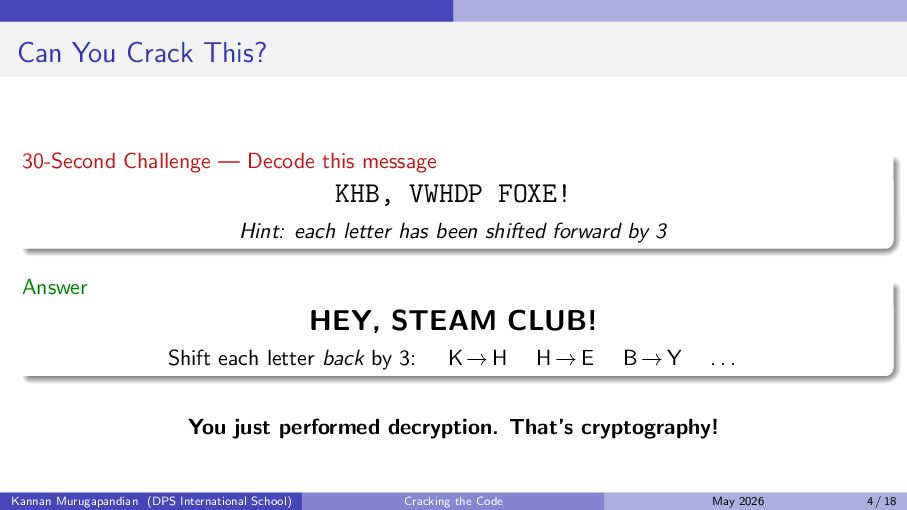
KHB, VWHDP FOXE! Hint: each letter has been shifted forward by 3 Answer HEY, STEAM CLUB! Shift each letter back by 3: K → H H → E B → Y . . . Kannan Murugapandian (DPS International School) Cracking the Code May 2026 4 / 18
KHB, VWHDP FOXE! Hint: each letter has been shifted forward by 3 Answer HEY, STEAM CLUB! Shift each letter back by 3: K → H H → E B → Y . . . You just performed decryption. That’s cryptography! Kannan Murugapandian (DPS International School) Cracking the Code May 2026 4 / 18
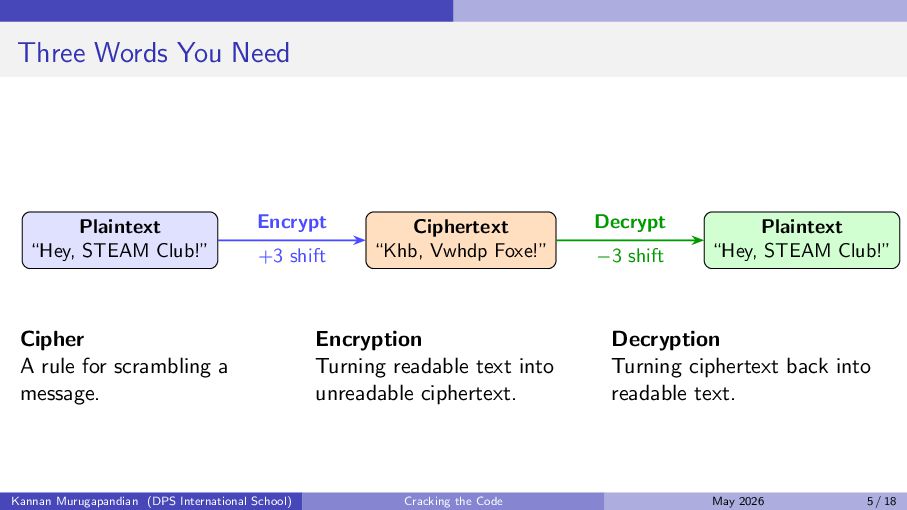
Vwhdp Foxe!” Plaintext “Hey, STEAM Club!” Encrypt +3 shift Decrypt −3 shift Cipher A rule for scrambling a message. Encryption Turning readable text into unreadable ciphertext. Decryption Turning ciphertext back into readable text. Kannan Murugapandian (DPS International School) Cracking the Code May 2026 5 / 18
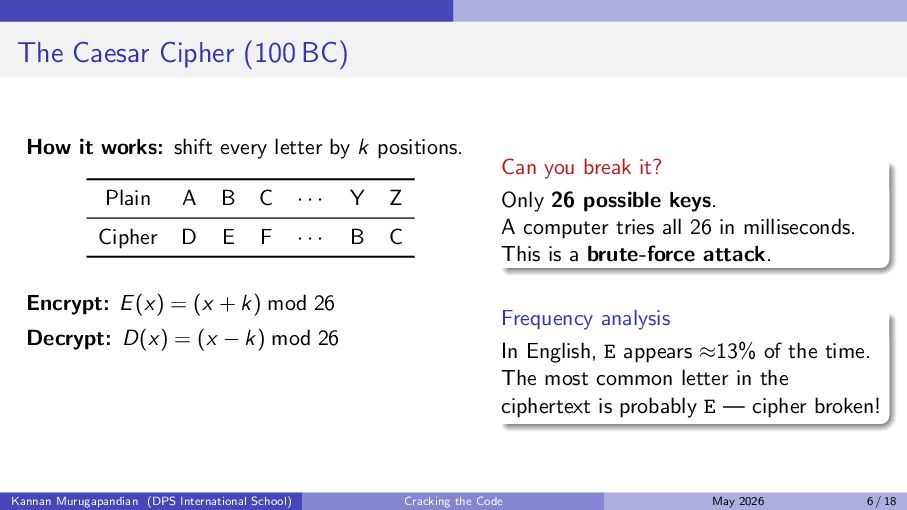
letter by k positions. Plain A B C · · · Y Z Cipher D E F · · · B C Encrypt: E(x) = (x + k) mod 26 Decrypt: D(x) = (x − k) mod 26 Can you break it? Only 26 possible keys. A computer tries all 26 in milliseconds. This is a brute-force attack. Frequency analysis In English, E appears ≈13% of the time. The most common letter in the ciphertext is probably E — cipher broken! Kannan Murugapandian (DPS International School) Cracking the Code May 2026 6 / 18
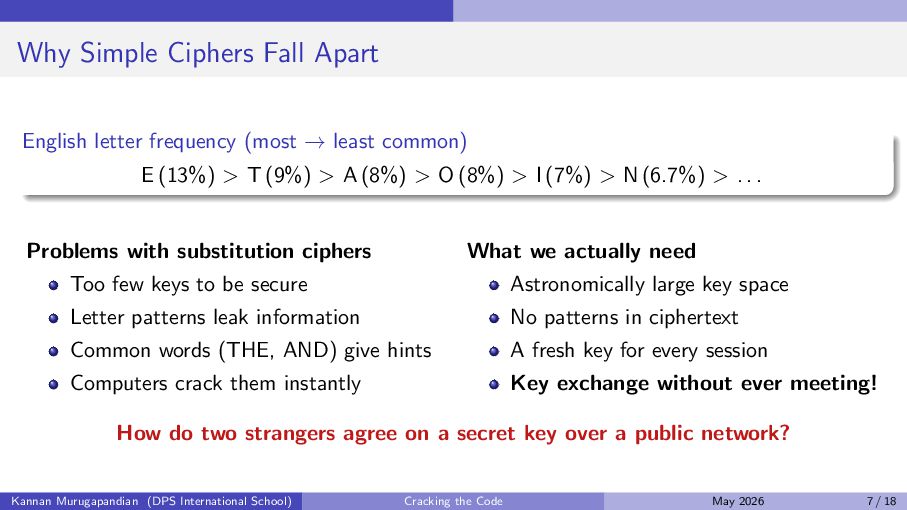
least common) E (13%) > T (9%) > A (8%) > O (8%) > I (7%) > N (6.7%) > . . . Problems with substitution ciphers Too few keys to be secure Letter patterns leak information Common words (THE, AND) give hints Computers crack them instantly What we actually need Astronomically large key space No patterns in ciphertext A fresh key for every session Key exchange without ever meeting! How do two strangers agree on a secret key over a public network? Kannan Murugapandian (DPS International School) Cracking the Code May 2026 7 / 18
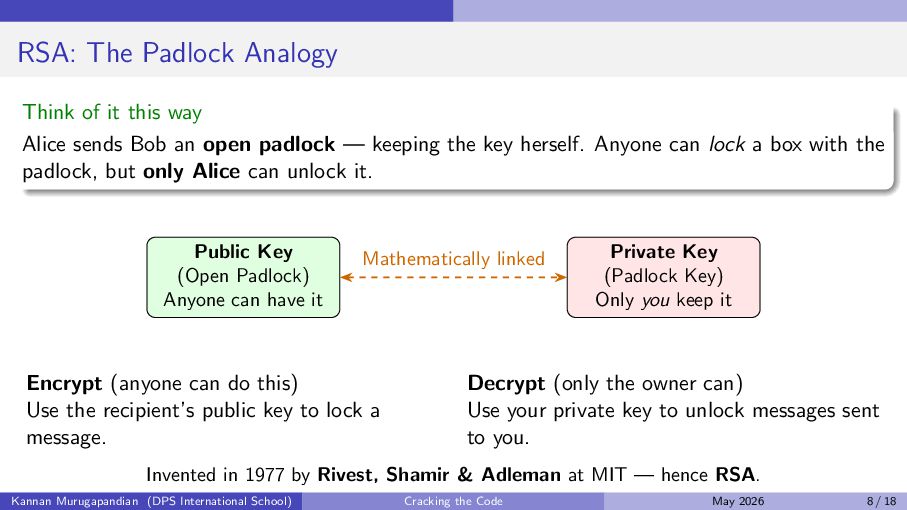
sends Bob an open padlock — keeping the key herself. Anyone can lock a box with the padlock, but only Alice can unlock it. Public Key (Open Padlock) Anyone can have it Private Key (Padlock Key) Only you keep it Mathematically linked Encrypt (anyone can do this) Use the recipient’s public key to lock a message. Decrypt (only the owner can) Use your private key to unlock messages sent to you. Invented in 1977 by Rivest, Shamir & Adleman at MIT — hence RSA. Kannan Murugapandian (DPS International School) Cracking the Code May 2026 8 / 18
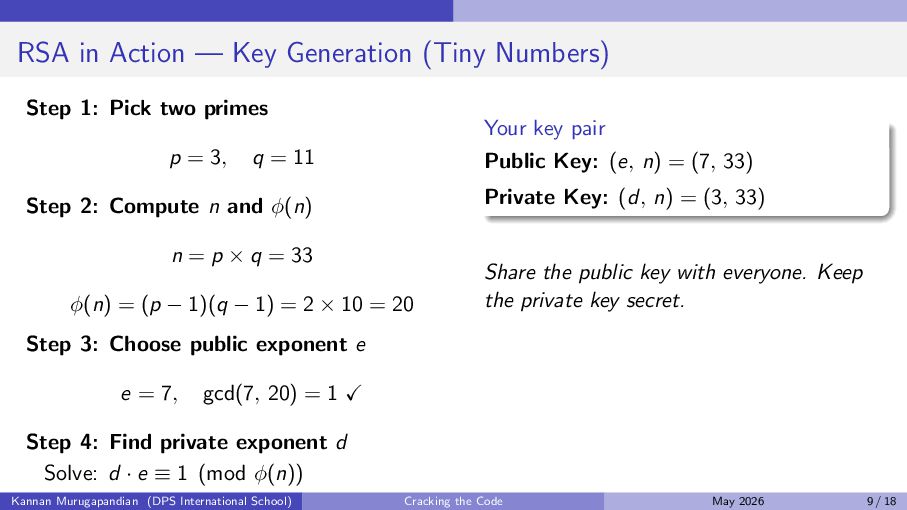
Pick two primes p = 3, q = 11 Step 2: Compute n and ϕ(n) n = p × q = 33 ϕ(n) = (p − 1)(q − 1) = 2 × 10 = 20 Step 3: Choose public exponent e e = 7, gcd(7, 20) = 1 ✓ Step 4: Find private exponent d Solve: d · e ≡ 1 (mod ϕ(n)) Your key pair Public Key: (e, n) = (7, 33) Private Key: (d, n) = (3, 33) Share the public key with everyone. Keep the private key secret. Kannan Murugapandian (DPS International School) Cracking the Code May 2026 9 / 18
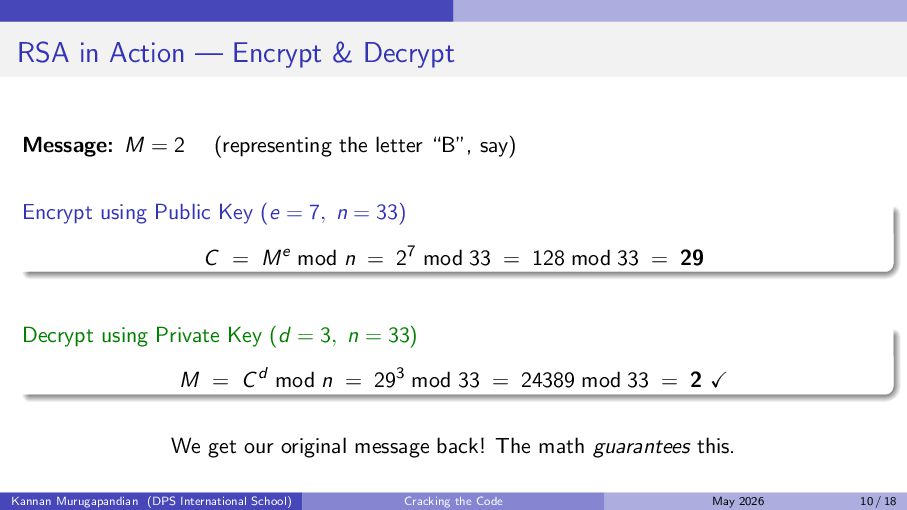
2 (representing the letter “B”, say) Encrypt using Public Key (e = 7, n = 33) C = Me mod n = 27 mod 33 = 128 mod 33 = 29 Decrypt using Private Key (d = 3, n = 33) M = Cd mod n = 293 mod 33 = 24389 mod 33 = 2 ✓ We get our original message back! The math guarantees this. Kannan Murugapandian (DPS International School) Cracking the Code May 2026 10 / 18
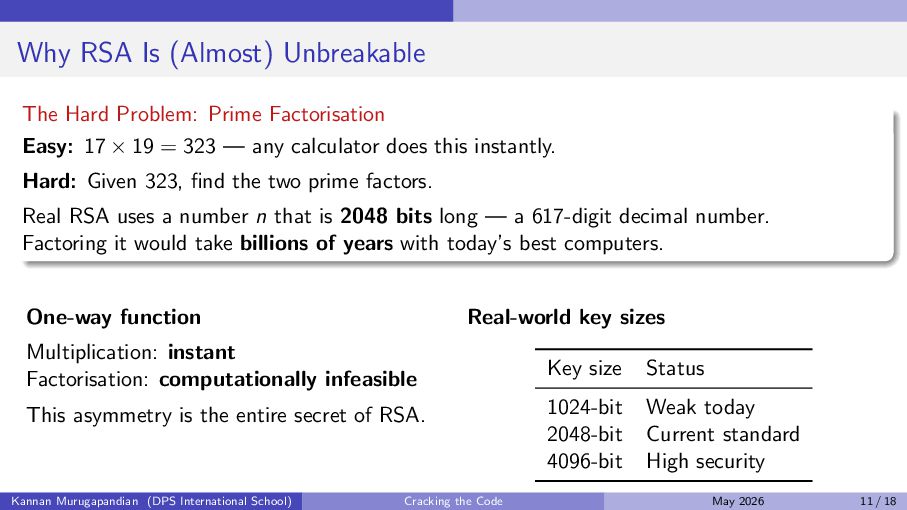
Easy: 17 × 19 = 323 — any calculator does this instantly. Hard: Given 323, find the two prime factors. Real RSA uses a number n that is 2048 bits long — a 617-digit decimal number. Factoring it would take billions of years with today’s best computers. One-way function Multiplication: instant Factorisation: computationally infeasible This asymmetry is the entire secret of RSA. Real-world key sizes Key size Status 1024-bit Weak today 2048-bit Current standard 4096-bit High security Kannan Murugapandian (DPS International School) Cracking the Code May 2026 11 / 18
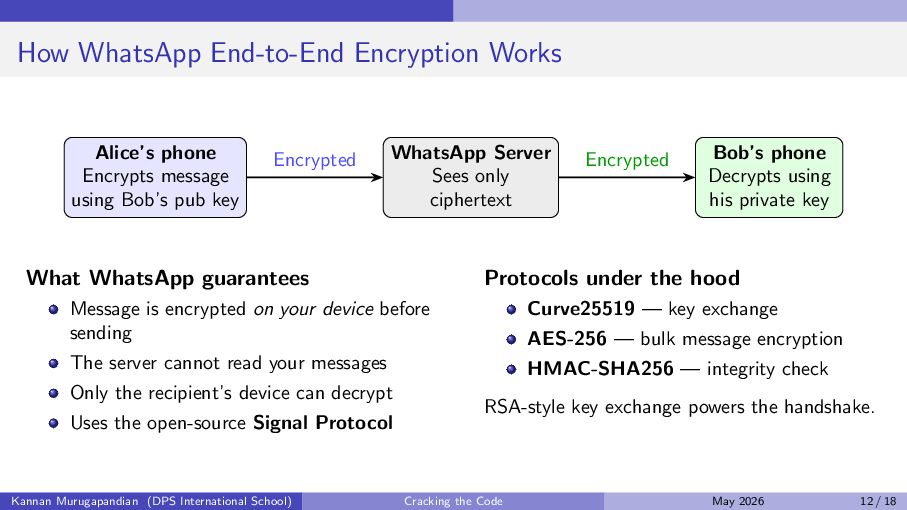
Bob’s pub key WhatsApp Server Sees only ciphertext Bob’s phone Decrypts using his private key Encrypted Encrypted What WhatsApp guarantees Message is encrypted on your device before sending The server cannot read your messages Only the recipient’s device can decrypt Uses the open-source Signal Protocol Protocols under the hood Curve25519 — key exchange AES-256 — bulk message encryption HMAC-SHA256 — integrity check RSA-style key exchange powers the handshake. Kannan Murugapandian (DPS International School) Cracking the Code May 2026 12 / 18
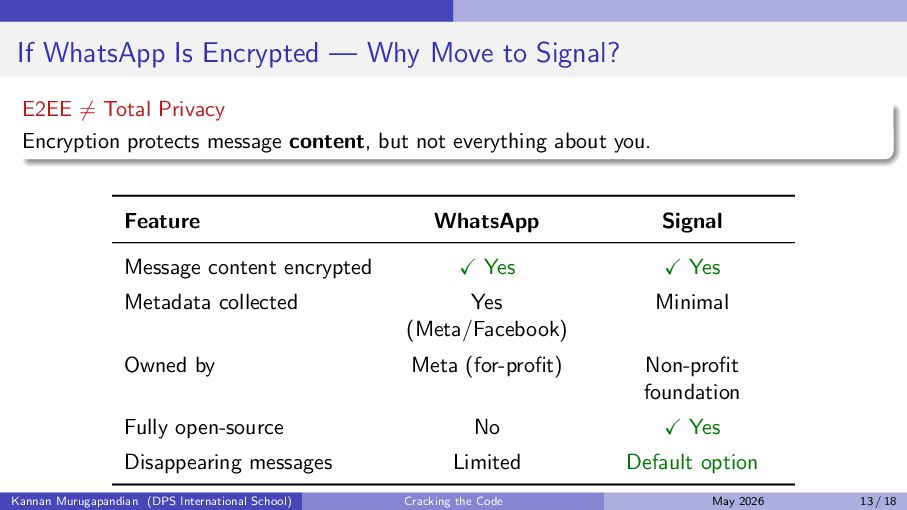
̸= Total Privacy Encryption protects message content, but not everything about you. Feature WhatsApp Signal Message content encrypted ✓ Yes ✓ Yes Metadata collected Yes (Meta/Facebook) Minimal Owned by Meta (for-profit) Non-profit foundation Fully open-source No ✓ Yes Disappearing messages Limited Default option Kannan Murugapandian (DPS International School) Cracking the Code May 2026 13 / 18
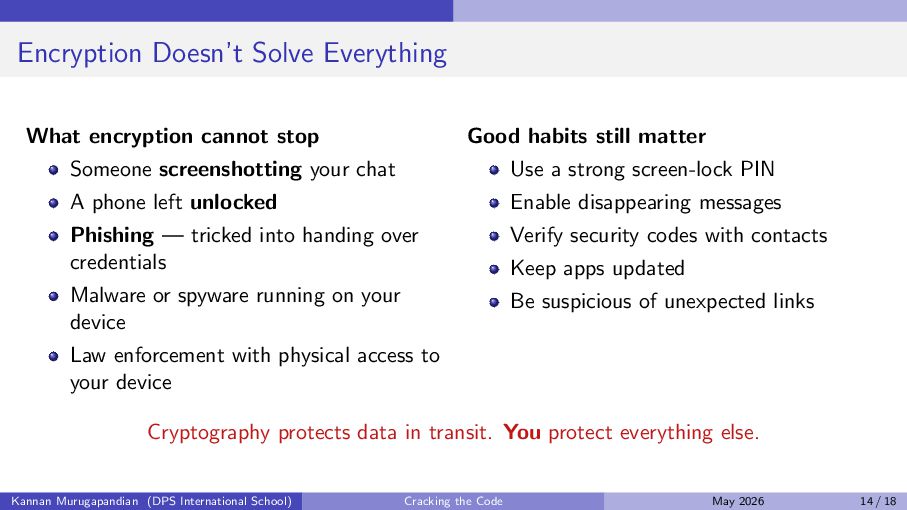
your chat A phone left unlocked Phishing — tricked into handing over credentials Malware or spyware running on your device Law enforcement with physical access to your device Good habits still matter Use a strong screen-lock PIN Enable disappearing messages Verify security codes with contacts Keep apps updated Be suspicious of unexpected links Cryptography protects data in transit. You protect everything else. Kannan Murugapandian (DPS International School) Cracking the Code May 2026 14 / 18
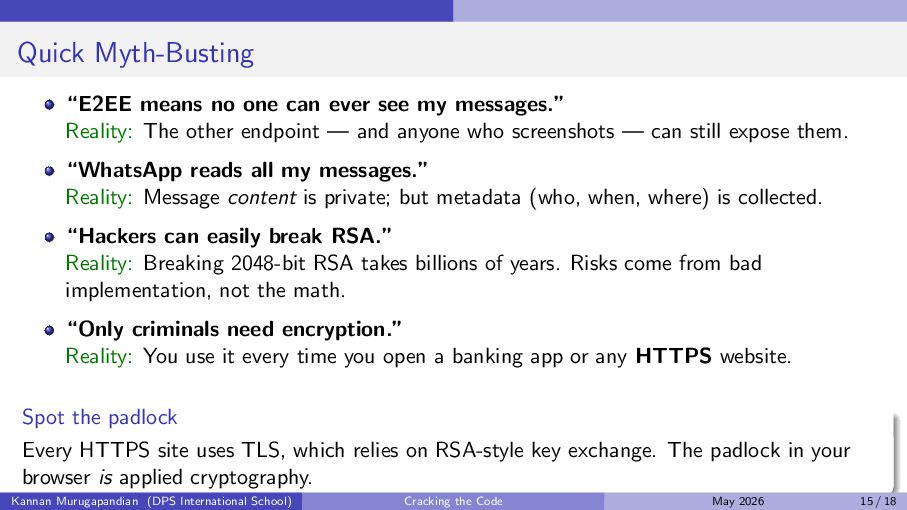
messages.” Reality: The other endpoint — and anyone who screenshots — can still expose them. “WhatsApp reads all my messages.” Reality: Message content is private; but metadata (who, when, where) is collected. “Hackers can easily break RSA.” Reality: Breaking 2048-bit RSA takes billions of years. Risks come from bad implementation, not the math. “Only criminals need encryption.” Reality: You use it every time you open a banking app or any HTTPS website. Spot the padlock Every HTTPS site uses TLS, which relies on RSA-style key exchange. The padlock in your browser is applied cryptography. Kannan Murugapandian (DPS International School) Cracking the Code May 2026 15 / 18
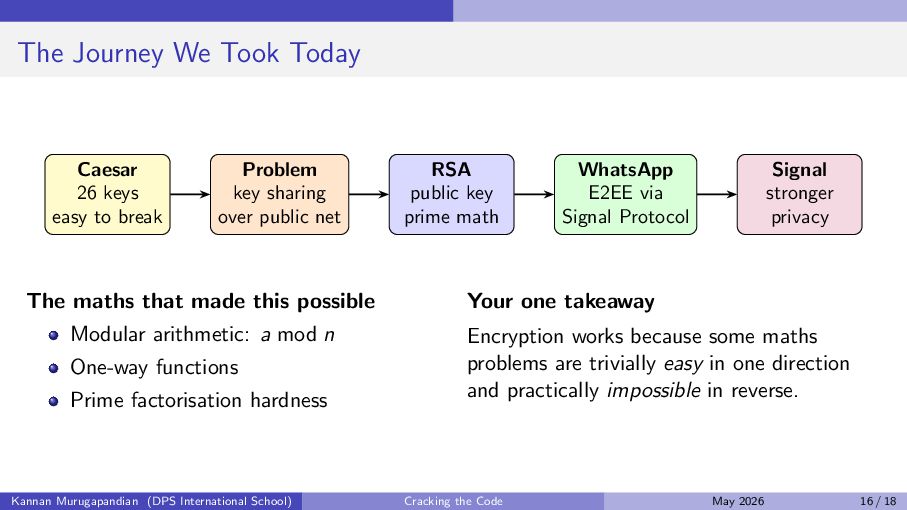
break Problem key sharing over public net RSA public key prime math WhatsApp E2EE via Signal Protocol Signal stronger privacy The maths that made this possible Modular arithmetic: a mod n One-way functions Prime factorisation hardness Your one takeaway Encryption works because some maths problems are trivially easy in one direction and practically impossible in reverse. Kannan Murugapandian (DPS International School) Cracking the Code May 2026 16 / 18
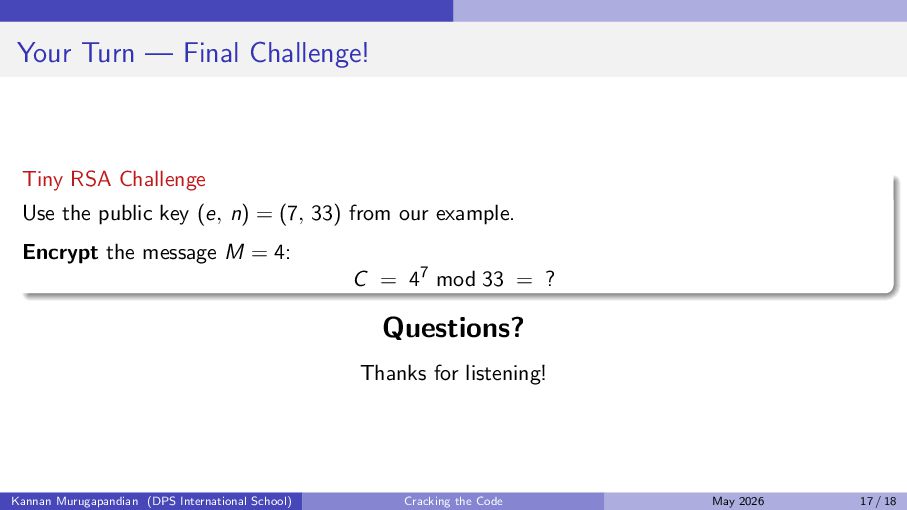
public key (e, n) = (7, 33) from our example. Encrypt the message M = 4: C = 47 mod 33 = ? Questions? Thanks for listening! Kannan Murugapandian (DPS International School) Cracking the Code May 2026 17 / 18


 mkannan2k9
 tattaka
 rfujii
 shunk031
 rikkabotan7
 casualconc
 wataruuuuu
 mickey_0226
 nzw0301
 corochann
 hariby
 eumesy
 datascientistsociety
 sergeychernyshev
 427marketing
 palkan
 danielanewman
 tessaabrams
 baasie
 sugarenia
 geshan
 codingconduct
 malarkey
 addyosmani