Upgrade to Pro
— share decks privately, control downloads, hide ads and more …
Speaker Deck
Sign up for free
Menu
Search
Features
All features
Private URLs
Password Protection
Custom URLS
Scheduled publishing
Remove Branding
Restrict embedding
Deck Collections
Notes
Features
All features
Private URLs
Password Protection
Custom URLS
Scheduled publishing
Remove Branding
Restrict embedding
Deck Collections
Notes
Explore
Featured decks
Featured speakers
Programming
Technology
Storyboards
Explore
Featured decks
Featured speakers
Programming
Technology
Storyboards
Pricing
Search
Sign in
Sign up for free
Deep generative modeling for single-cell trans...
Search
Sponsored
·
Your Podcast. Everywhere. Effortlessly.
Share. Educate. Inspire. Entertain. You do you. We'll handle the rest.
→
Kazuya Nishimura
April 23, 2025
Research
5
0
Share
Embed
Copy iframe code
Copy JS code
Copy link
Start on current slide
Deep generative modeling for single-cell transcriptomics
Kazuya Nishimura
April 23, 2025
More Decks by Kazuya Nishimura
See All by Kazuya Nishimura
Paper reading party (ICCV 2023): End-to-End Semi-Supervised Object Detection with Soft Teacher
naivete5656
0
11
(CVPR2022) Integrative Few-Shot Learning for Classification and Segmentation
naivete5656
0
14
(ECCV2024) Multistain Pretraining for Slide Representation Learning in Pathology
naivete5656
0
10
(CVPR2024) Modeling Dense Multimodal Interactions Between Biological Pathways and Histology for Survival Prediction
naivete5656
0
10
(Neurips 2024) HEST-1k: A Dataset for Spatial Transcriptomics and Histology Image Analysis
naivete5656
0
13
(CVPR2024) Eyes Wide Shut? Exploring the Visual Shortcomings of Multimodal LLMs
naivete5656
0
10
Other Decks in Research
See All in Research
20260624 NLP colloquium: 単一のhubテキストがCLIPを壊す:hubnessによる埋め込みの脆弱性特定
de9uch1
2
300
Kaggle|AI Agent Security — しくじり先生、俺みたいになるな
pomcho555
1
120
IA for theory
gpeyre
1
500
GLIM とMegaParticles:正規分布近似の限界とタイトカップリング&パーティクルフィルタの進展 / GLIM and MegaParticles : Progress of the distribution representation in SLAM
koide3
0
960
COMETAを用いたデータ民主化運動の歴史
sazimai
0
280
進化?迷走?CasualConc ファミリーアプリの現在地 @ 英語コーパス学会 2026
casualconc
0
150
実例から見るLLMのマンガ理解:実務VQAタスクによる長期的文脈と視覚情報の定性評価
kzmssk
0
190
2025年度秋葉原ウォーカブルプロジェクト調査報告 「アキバらしいウォーカブル」とは何か
izumiyama_lab
1
250
Volatilité des marchés et sécheresse historique, l’élevage bovin viande sous contraintes en 2026
institutdelelevage
PRO
0
120
湯村研究室の紹介2026 / yumulab2026
yumulab
0
130
MIRU2026 チュートリアル講演2:三次元データ処理の動向
nnchiba
8
5.4k
Language and AI
ayaniwa
0
320
Featured
See All Featured
Dealing with People You Can't Stand - Big Design 2015
cassininazir
367
27k
Winning Ecommerce Organic Search in an AI Era - #searchnstuff2025
aleyda
2
2.2k
Believing is Seeing
oripsolob
1
240
Digital Ethics as a Driver of Design Innovation
axbom
PRO
1
460
The Cost Of JavaScript in 2023
addyosmani
55
10k
Fireside Chat
paigeccino
43
4.1k
Fight the Zombie Pattern Library - RWD Summit 2016
marcelosomers
234
18k
Creating an realtime collaboration tool: Agile Flush - .NET Oxford
marcduiker
35
2.6k
Darren the Foodie - Storyboard
khoart
PRO
4
4k
The AI Revolution Will Not Be Monopolized: How open-source beats economies of scale, even for LLMs
inesmontani
PRO
3
3.8k
Kristin Tynski - Automating Marketing Tasks With AI
techseoconnect
PRO
0
550
The Invisible Side of Design
smashingmag
301
52k
Transcript
Deep generative modeling for single-cell transcriptomics Kazuya Nishimura
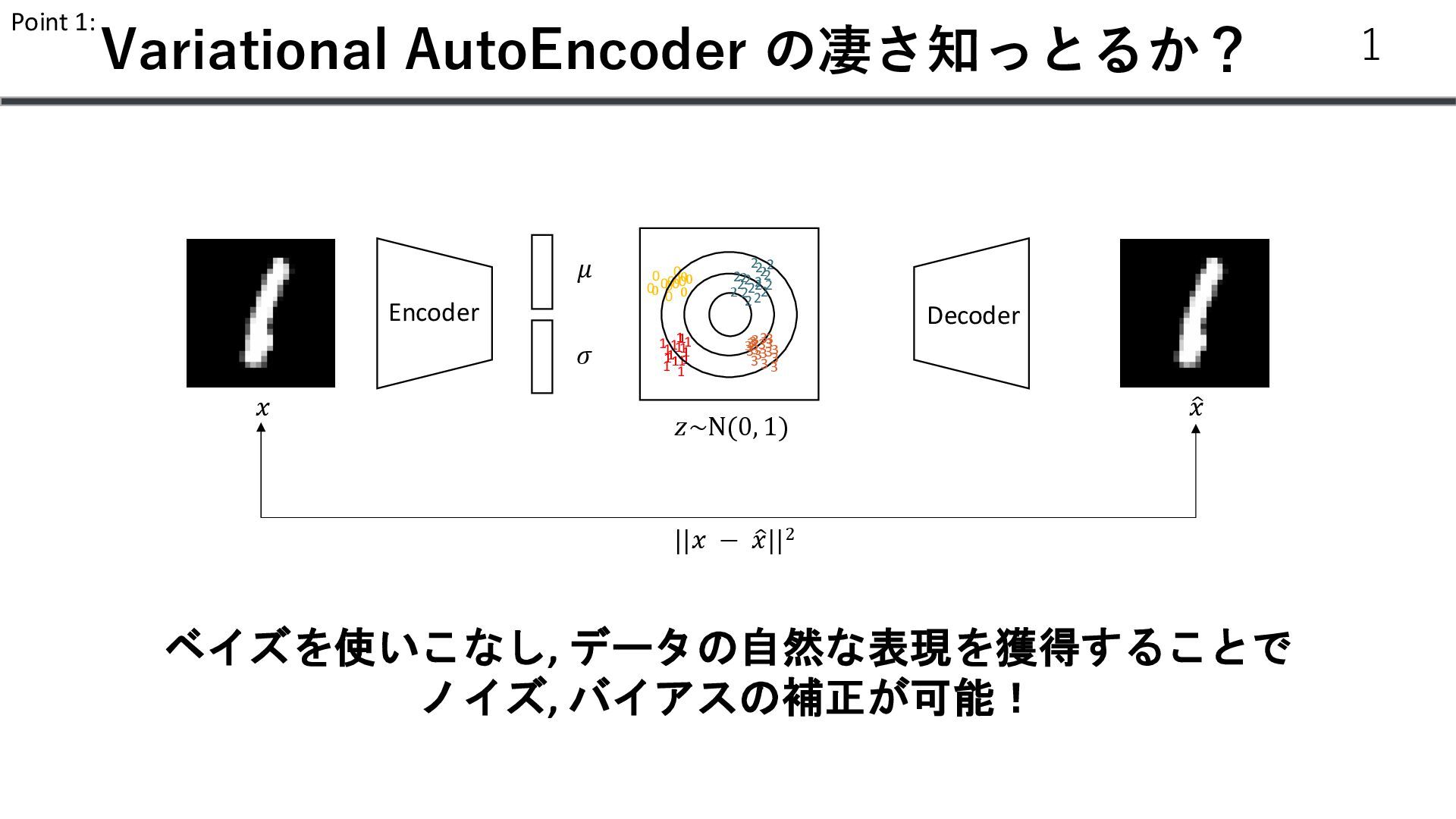
Variational AutoEncoder の凄さ知っとるか? 1 00 0 0 00 00 00
00 0 0 1 11 1 1 1 1 1 1 1 1 1 1 1 1 1 𝑧~N(0, 1) Encoder Decoder 𝜇 𝜎 ||𝑥 − ො 𝑥||2 𝑥 ො 𝑥 ベイズを使いこなし, データの自然な表現を獲得することで ノイズ, バイアスの補正が可能! 2 2 2 2 2 2 2 2 2 2 2 2 2 2 2 2 2 2 3 3 3 3 3 3 3 3 3 333 3 3 3 3 3 3 3 Point 1:
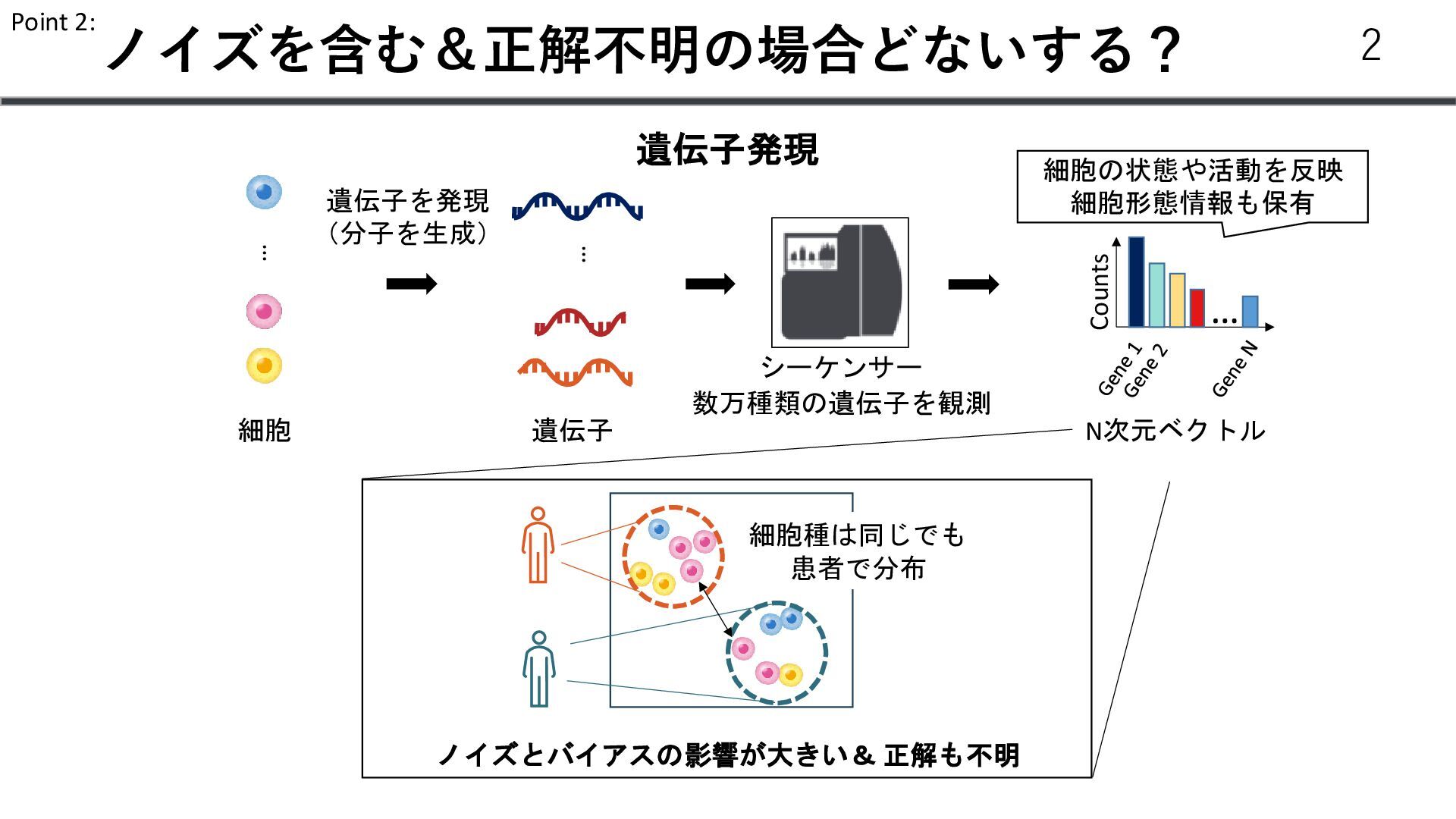
ノイズを含む&正解不明の場合どないする? 2 遺伝子を発現 (分子を生成) … シーケンサー N次元ベクトル … Counts 細胞の状態や活動を反映
細胞形態情報も保有 遺伝子発現 細胞 遺伝子 Point 2: … ノイズとバイアスの影響が大きい& 正解も不明 数万種類の遺伝子を観測 細胞種は同じでも 患者で分布
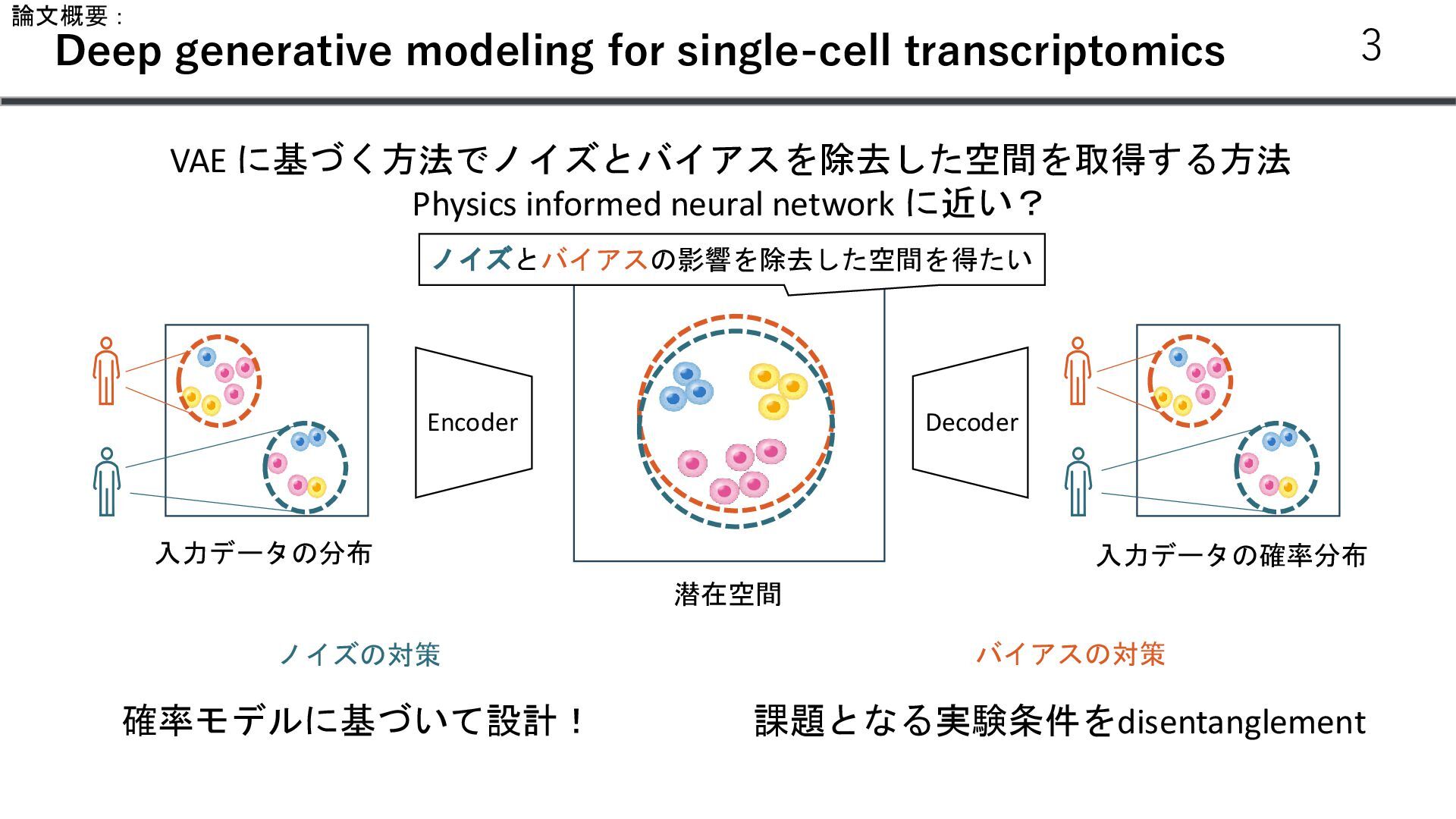
Deep generative modeling for single-cell transcriptomics 3 論文概要: VAE に基づく方法でノイズとバイアスを除去した空間を取得する方法
Physics informed neural network に近い? 入力データの分布 潜在空間 Encoder Decoder ノイズとバイアスの影響を除去した空間を得たい ノイズの対策 確率モデルに基づいて設計! バイアスの対策 課題となる実験条件をdisentanglement 入力データの確率分布
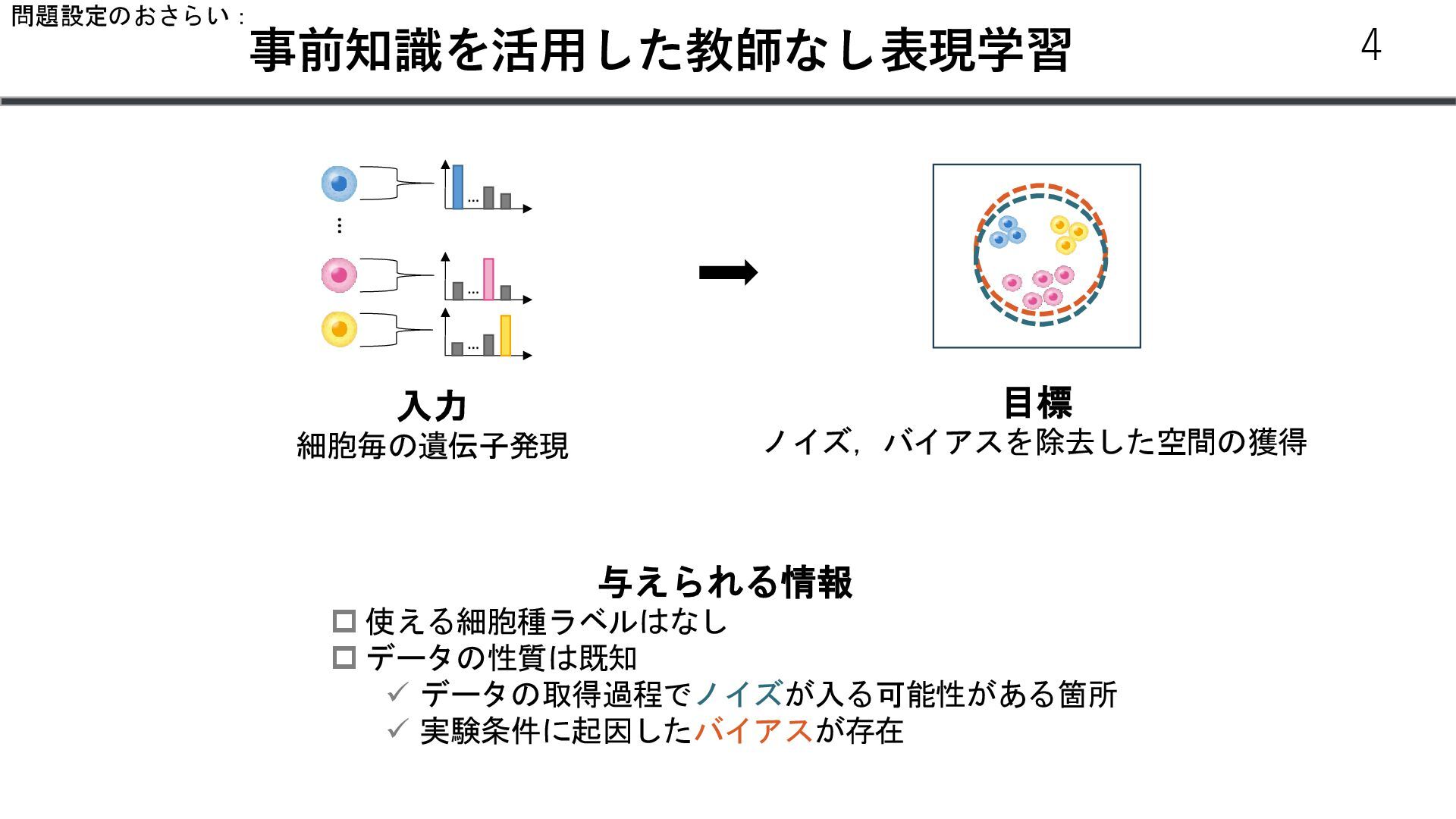
事前知識を活用した教師なし表現学習 4 問題設定のおさらい: … … … … 目標 ノイズ,バイアスを除去した空間の獲得 入力
細胞毎の遺伝子発現 与えられる情報 使える細胞種ラベルはなし データの性質は既知 ✓ データの取得過程でノイズが入る可能性がある箇所 ✓ 実験条件に起因したバイアスが存在
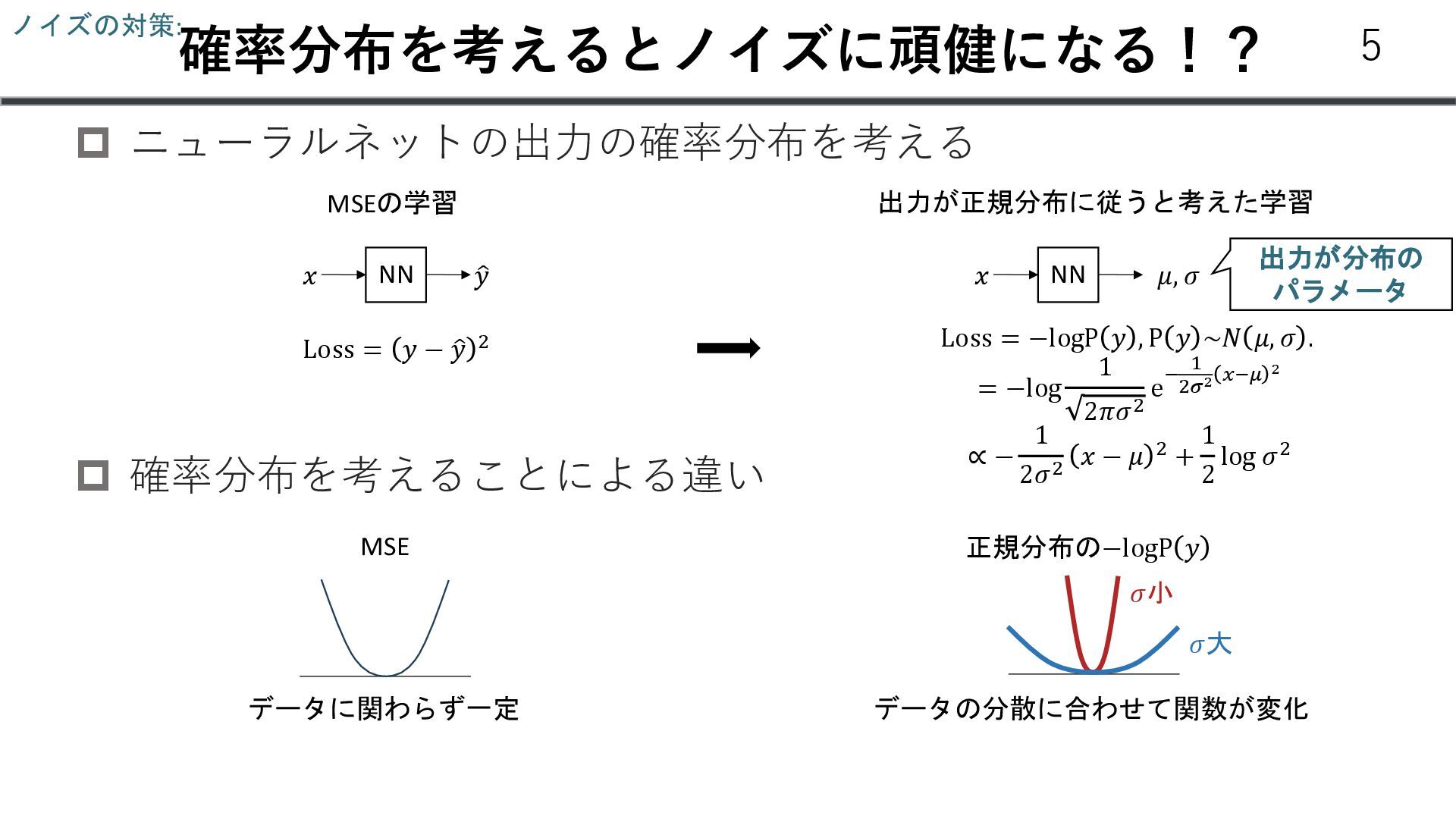
確率分布を考えるとノイズに頑健になる!? ニューラルネットの出力の確率分布を考える 確率分布を考えることによる違い 5 ノイズの対策: 𝑥 NN ො
𝑦 Loss = 𝑦 − ො 𝑦 2 𝑥 NN Loss = −logP 𝑦 , P 𝑦 ~𝑁 𝜇, 𝜎 . = −log 1 2𝜋𝜎2 e− 1 2𝜎2 𝑥−𝜇 2 ∝ − 1 2𝜎2 𝑥 − 𝜇 2 + 1 2 log 𝜎2 𝜇, 𝜎 MSEの学習 出力が正規分布に従うと考えた学習 MSE データに関わらず一定 正規分布の−logP 𝑦 データの分散に合わせて関数が変化 𝜎大 𝜎小 出力が分布の パラメータ
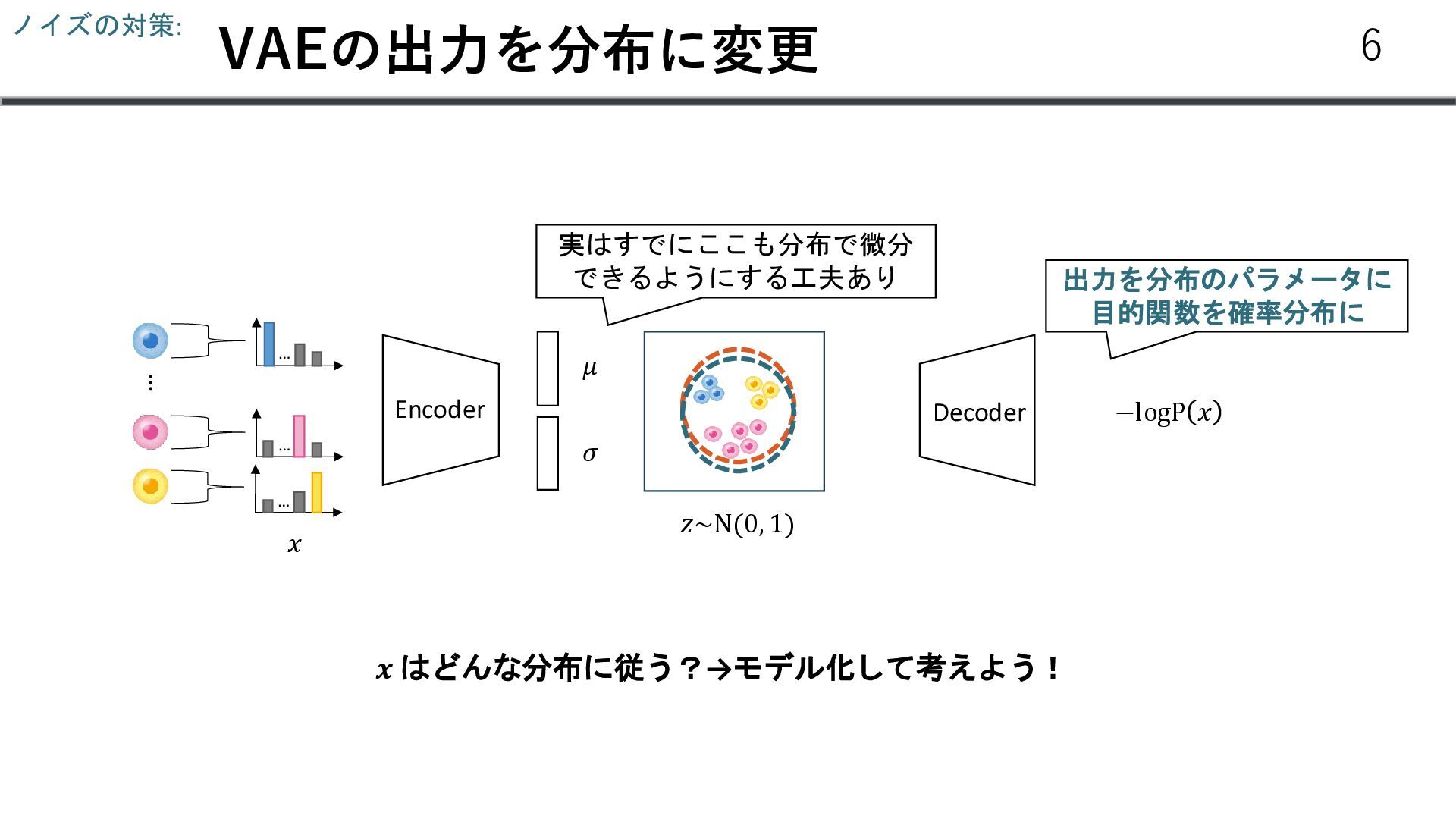
VAEの出力を分布に変更 6 𝑧~N(0, 1) Encoder Decoder 𝜇 𝜎 … …
… … −logP 𝑥 出力を分布のパラメータに 目的関数を確率分布に 実はすでにここも分布で微分 できるようにする工夫あり ノイズの対策: 𝑥 𝒙 はどんな分布に従う?→モデル化して考えよう!
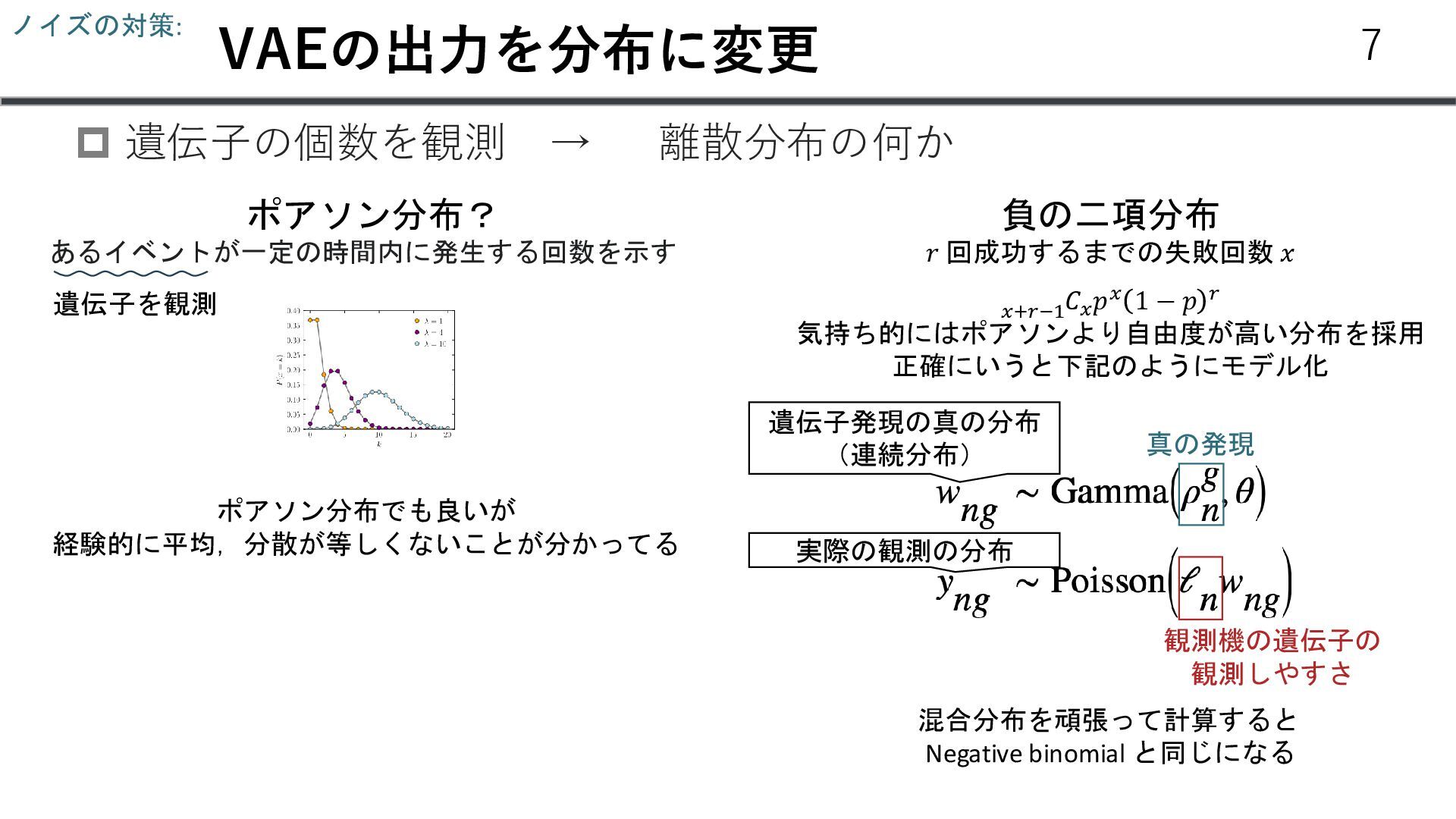
VAEの出力を分布に変更 遺伝子の個数を観測 → 離散分布の何か 7 ノイズの対策: ポアソン分布? あるイベントが一定の時間内に発生する回数を示す 遺伝子を観測
ポアソン分布でも良いが 経験的に平均,分散が等しくないことが分かってる 負の二項分布 𝑟 回成功するまでの失敗回数 𝑥 𝑥+𝑟−1 𝐶𝑥 𝑝𝑥 1 − 𝑝 𝑟 気持ち的にはポアソンより自由度が高い分布を採用 正確にいうと下記のようにモデル化 真の発現 遺伝子発現の真の分布 (連続分布) 実際の観測の分布 観測機の遺伝子の 観測しやすさ 混合分布を頑張って計算すると Negative binomial と同じになる
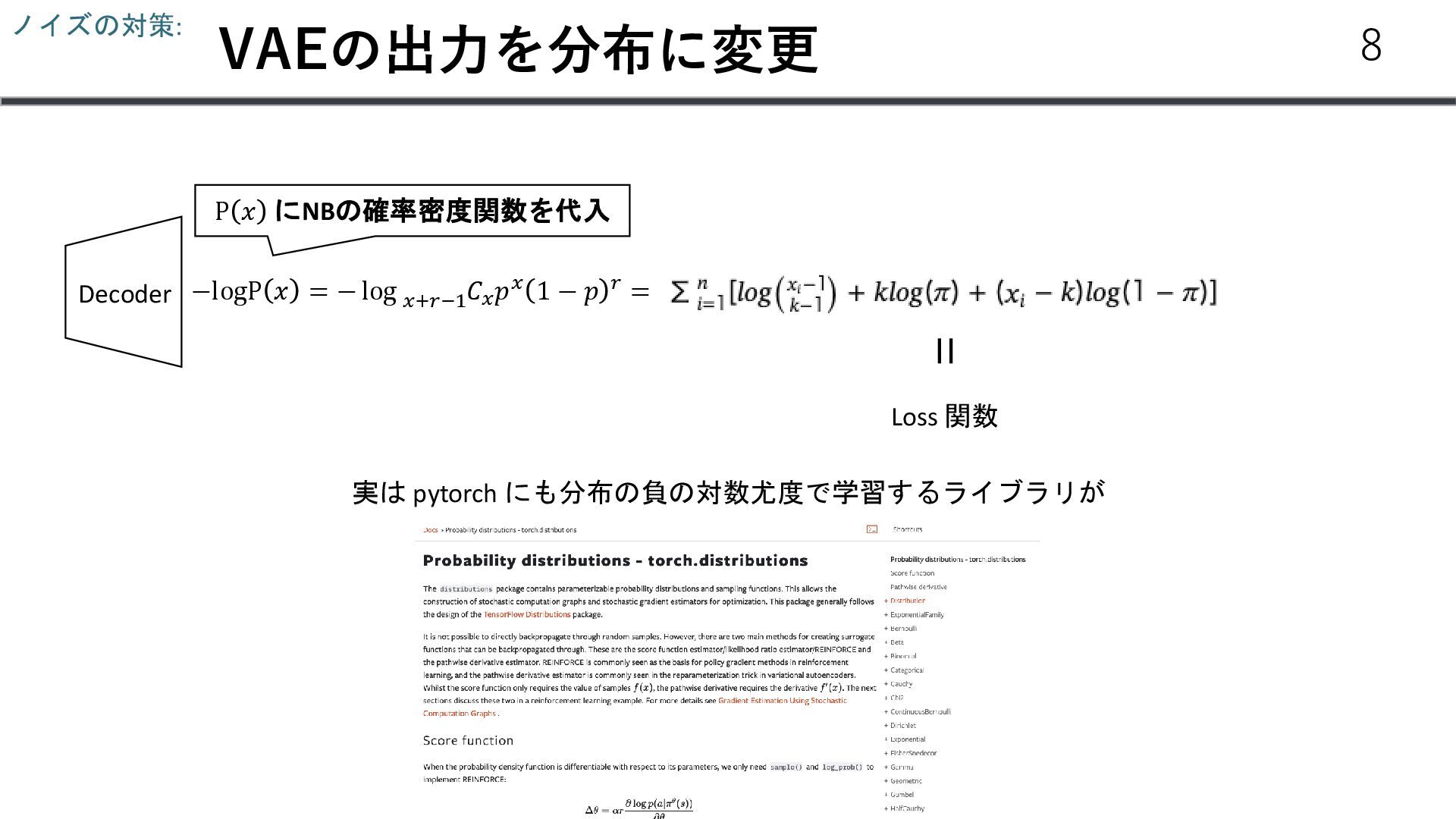
VAEの出力を分布に変更 8 Decoder −logP 𝑥 = − log 𝑥+𝑟−1 𝐶𝑥
𝑝𝑥 1 − 𝑝 𝑟 = ノイズの対策: P 𝑥 にNBの確率密度関数を代入 実は pytorch にも分布の負の対数尤度で学習するライブラリが Loss 関数
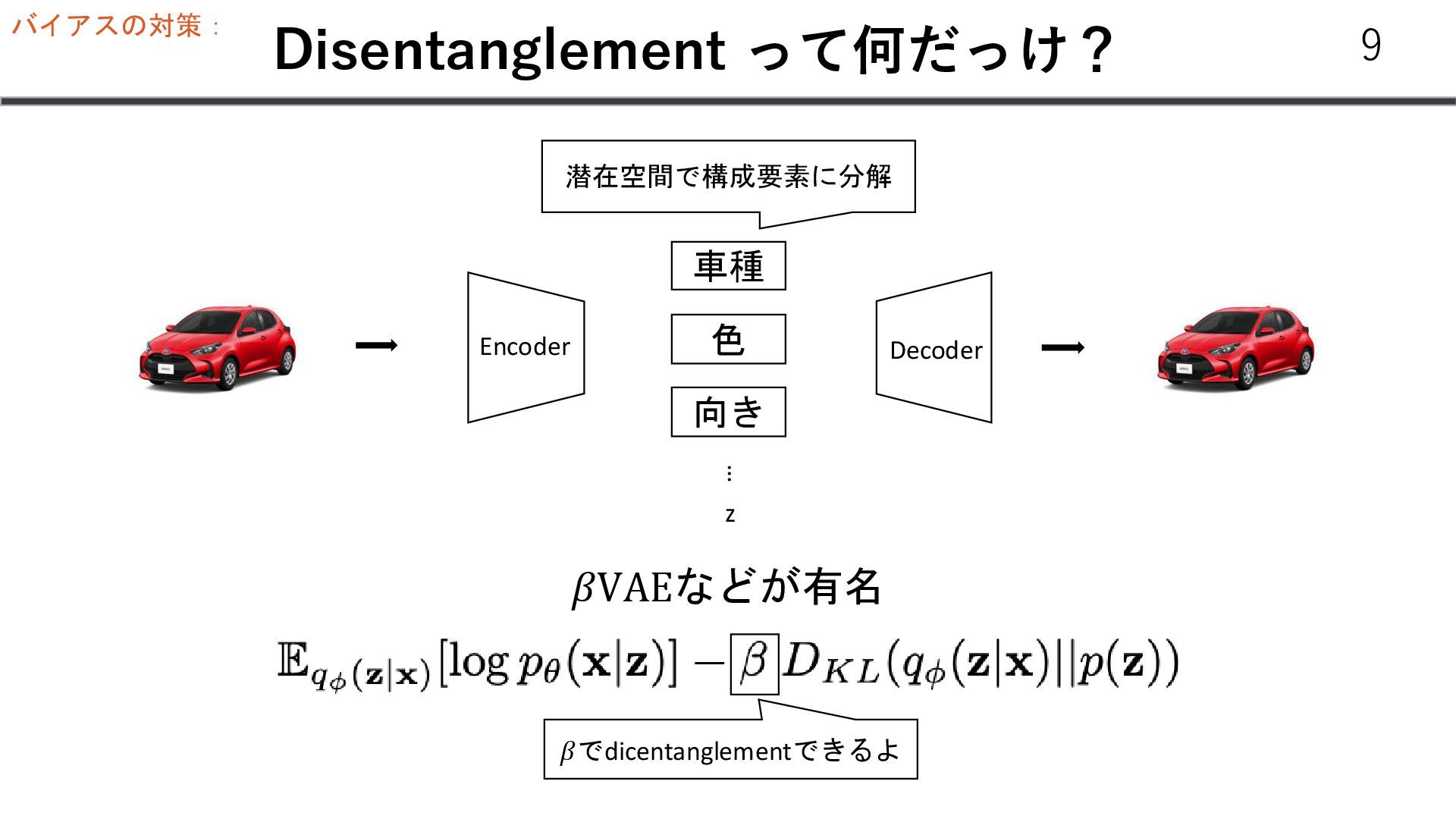
Disentanglement って何だっけ? 9 バイアスの対策: Encoder Decoder 車種 色 向き …
潜在空間で構成要素に分解 z 𝛽VAEなどが有名 𝛽でdicentanglementできるよ
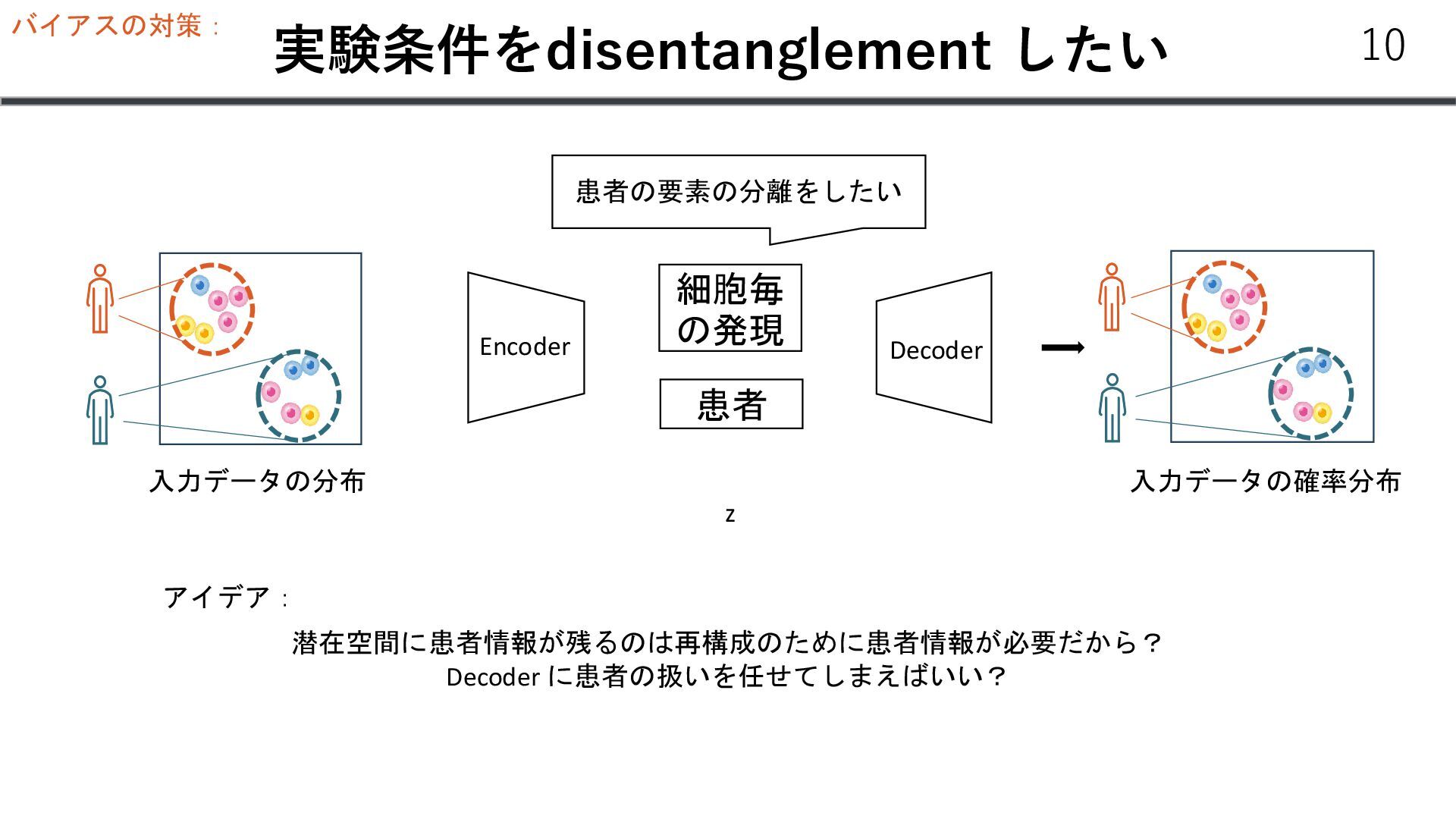
実験条件をdisentanglement したい 10 バイアスの対策: 入力データの分布 Encoder Decoder 細胞毎 の発現 患者
z 入力データの確率分布 患者の要素の分離をしたい 潜在空間に患者情報が残るのは再構成のために患者情報が必要だから? Decoder に患者の扱いを任せてしまえばいい? アイデア:
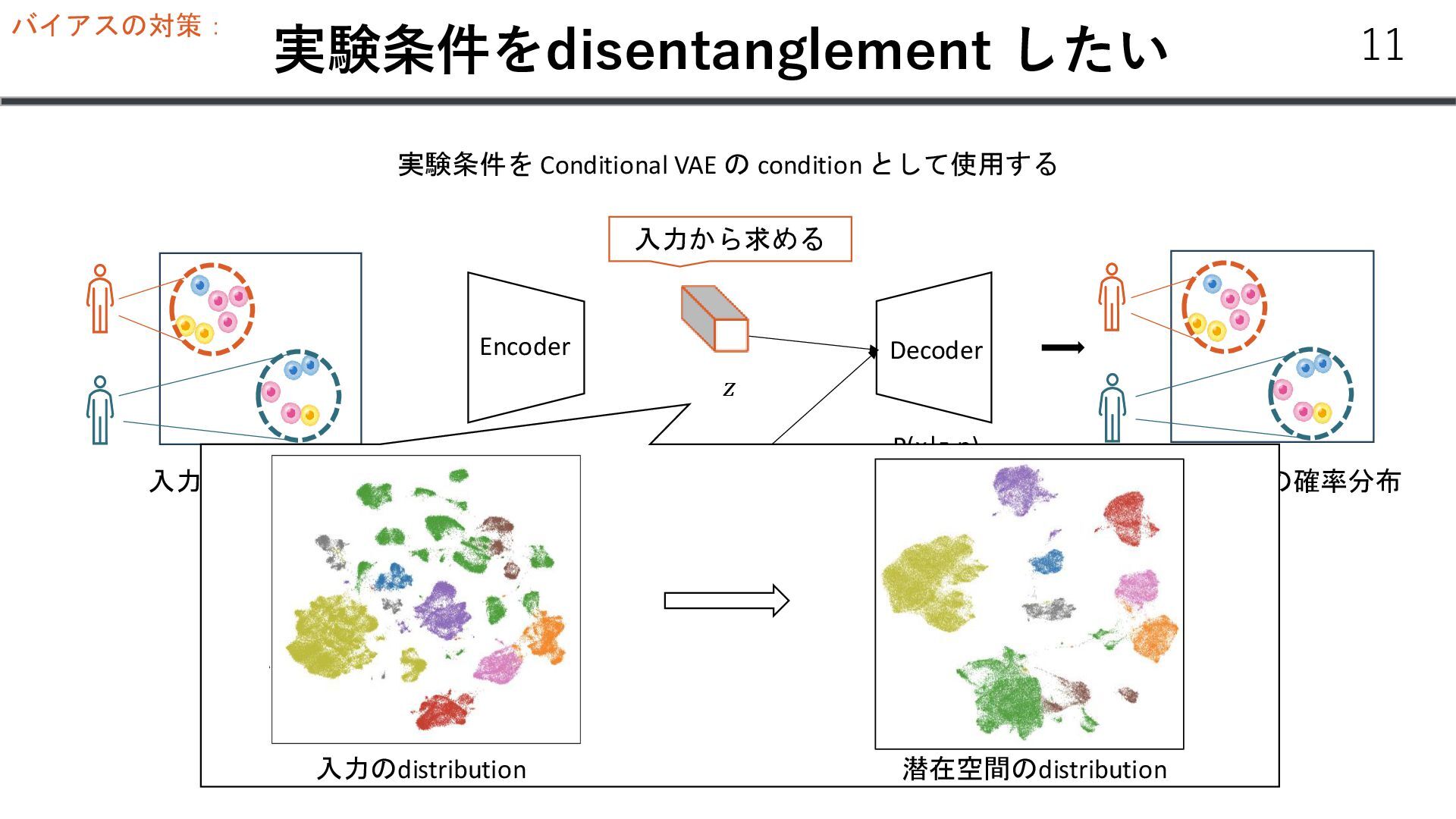
実験条件をdisentanglement したい 11 バイアスの対策: 入力データの分布 Encoder Decoder 入力データの確率分布 𝑠 患者ラベル
𝑧 入力から求める 患者ラベルで条件付け P(x|z,p) 実験条件を Conditional VAE の condition として使用する 入力のdistribution 潜在空間のdistribution
Single cell VAE の概要 [Lopez+, nature method 2018] 12 Encoder
𝑞(z|x) 個数 Gene 1 4 Gene 2 0 … … Gene N 13 𝑥𝑖 :遺伝子発現 𝑠: 患者𝐼𝐷 𝜇 v 𝑧1 𝑁(𝜇, v) 𝑠 患者ID 𝑥𝑖 ~𝑁𝐵 𝑝, 𝑟 r: 失敗回数 p: 成功確率 𝑧1 ~𝑁 0, 1 𝑙 ~ LogNormal(𝑙𝜇 𝑠𝑛 , 𝑙𝜎 𝑠𝑛 ) 𝐾𝐿(𝑞(𝑧1 |𝑥)||𝑝(𝑧1 )) 𝑧 = 𝑞𝑚 𝑞 𝑥𝑖 + 𝜖 𝑞𝑣 (𝑞(𝑥𝑖 )) 𝑧~𝑁 0, 1 , 𝑧 ∈ 𝑅𝑁𝑙 𝜇 = 𝑞𝑚 𝑞 𝑥𝑖 𝑣 = 𝑞𝑣 (𝑞 𝑥𝑖
Single cell VAE の概要 [Lopez+, nature method 2018] Encoder 𝑞(z|x)
個数 Gene 1 4 Gene 2 0 … … Gene N 13 𝑥𝑖 :遺伝子発現 𝑠: 患者𝐼𝐷 𝜇 v 𝑧 𝑁(𝜇, v) 𝑠 患者ID 𝑥𝑖 ~𝑍𝑁𝐵 𝑟, 𝑝, 𝜋 r: 失敗回数 P: 成功確率 𝜋: zeroになる確率 𝑧1 ~𝑁 0, 1 𝐿𝑒𝑙𝑏𝑜 = 𝐾𝐿(𝑞(𝑧1 |𝑥)| 𝑝 𝑧1 − 𝔼𝑞(𝑧|𝑥) [log 𝑝(𝑥|𝑧1 )] 𝑙 ∈ ℝ𝑁𝑠 𝜇 𝜎 ∈ ℝ𝑁𝑔 Trainable vector 𝑁𝐵 𝑝, 𝑟 𝑝𝑠 Softmax Decoder p(x|z, s) 13 𝑙 = log(∑𝑥)
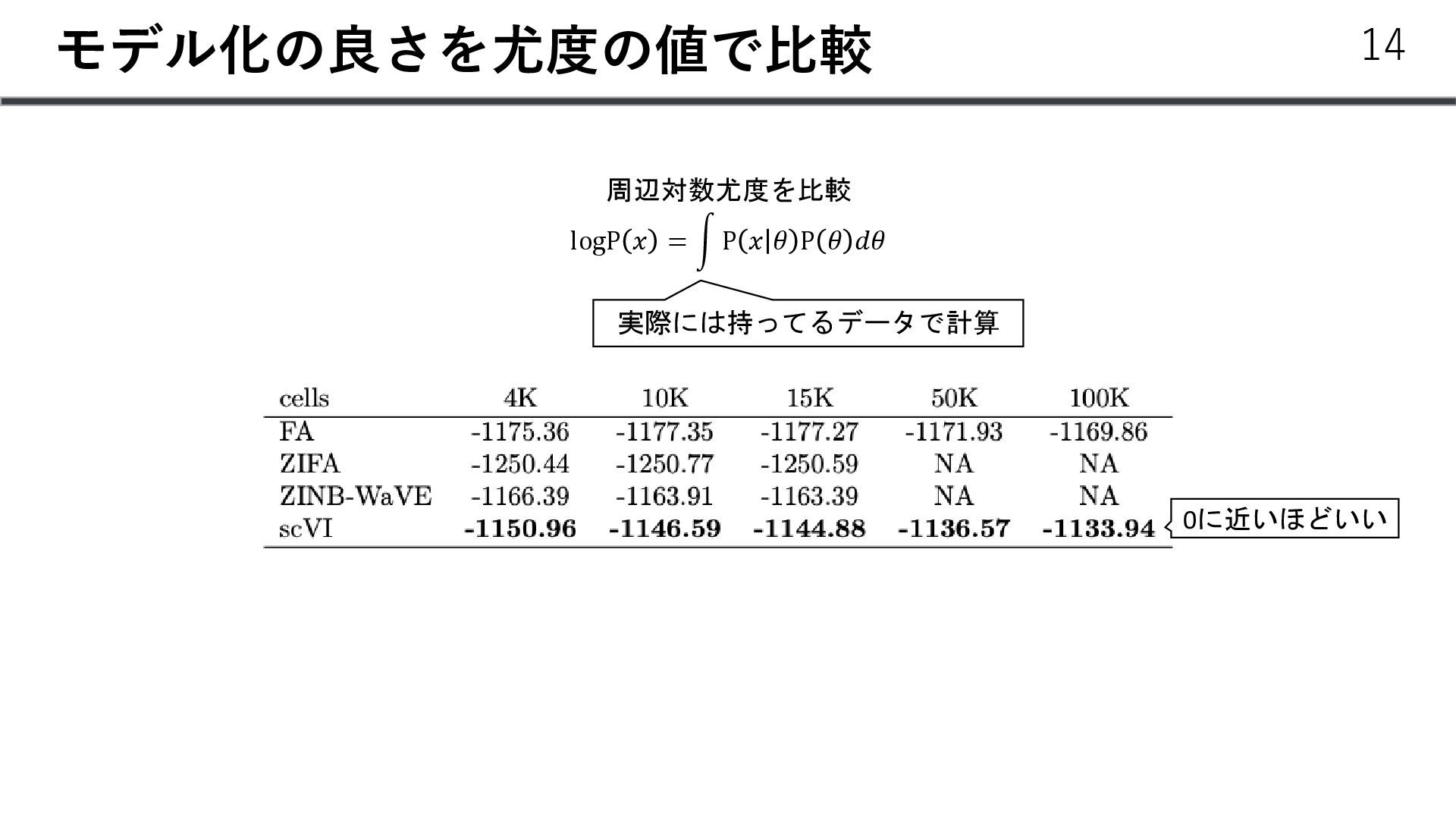
モデル化の良さを尤度の値で比較 14 周辺対数尤度を比較 0に近いほどいい logP 𝑥 = න P 𝑥
𝜃 P 𝜃 𝑑𝜃 実際には持ってるデータで計算
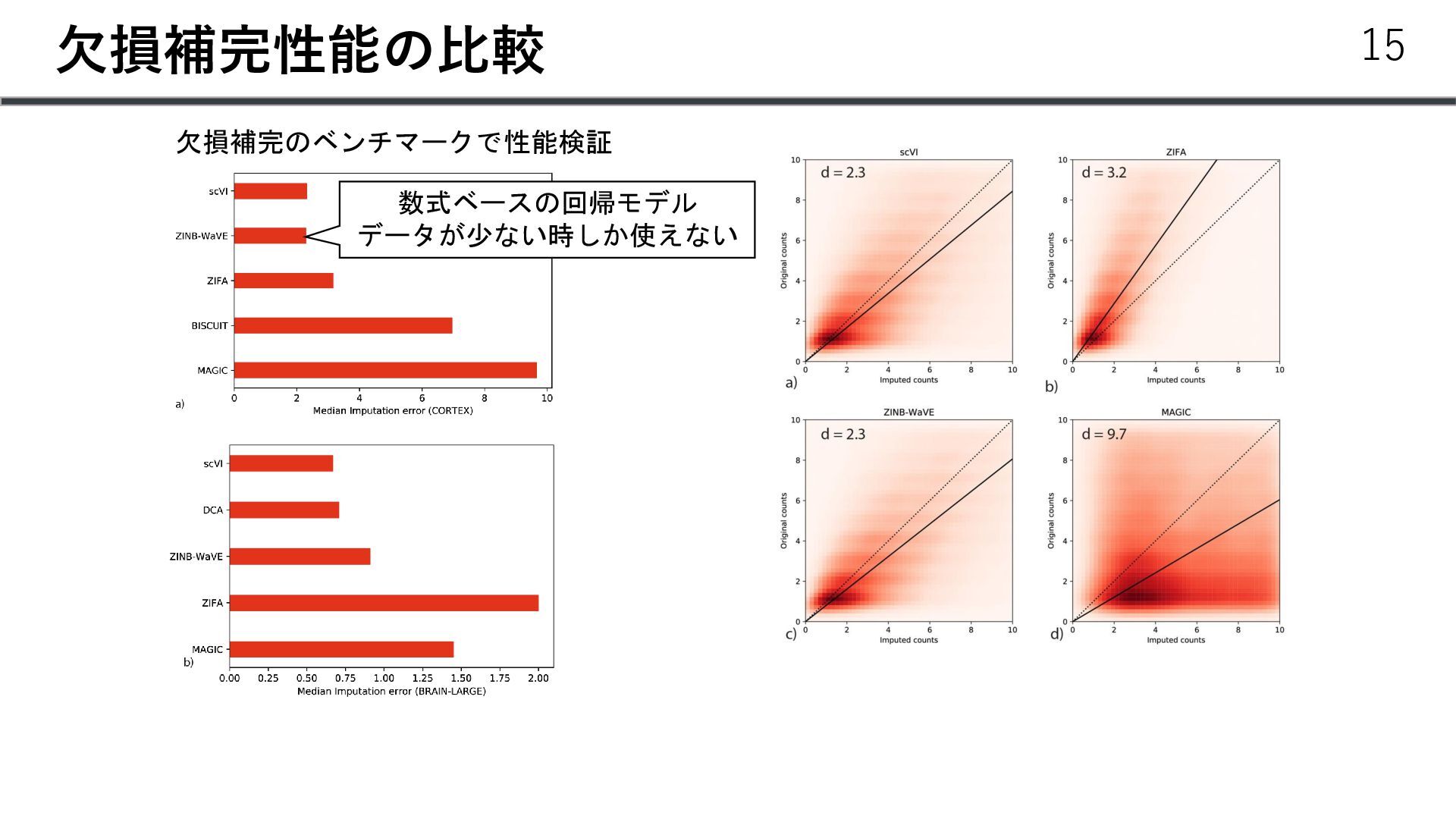
欠損補完性能の比較 15 欠損補完のベンチマークで性能検証 数式ベースの回帰モデル データが少ない時しか使えない
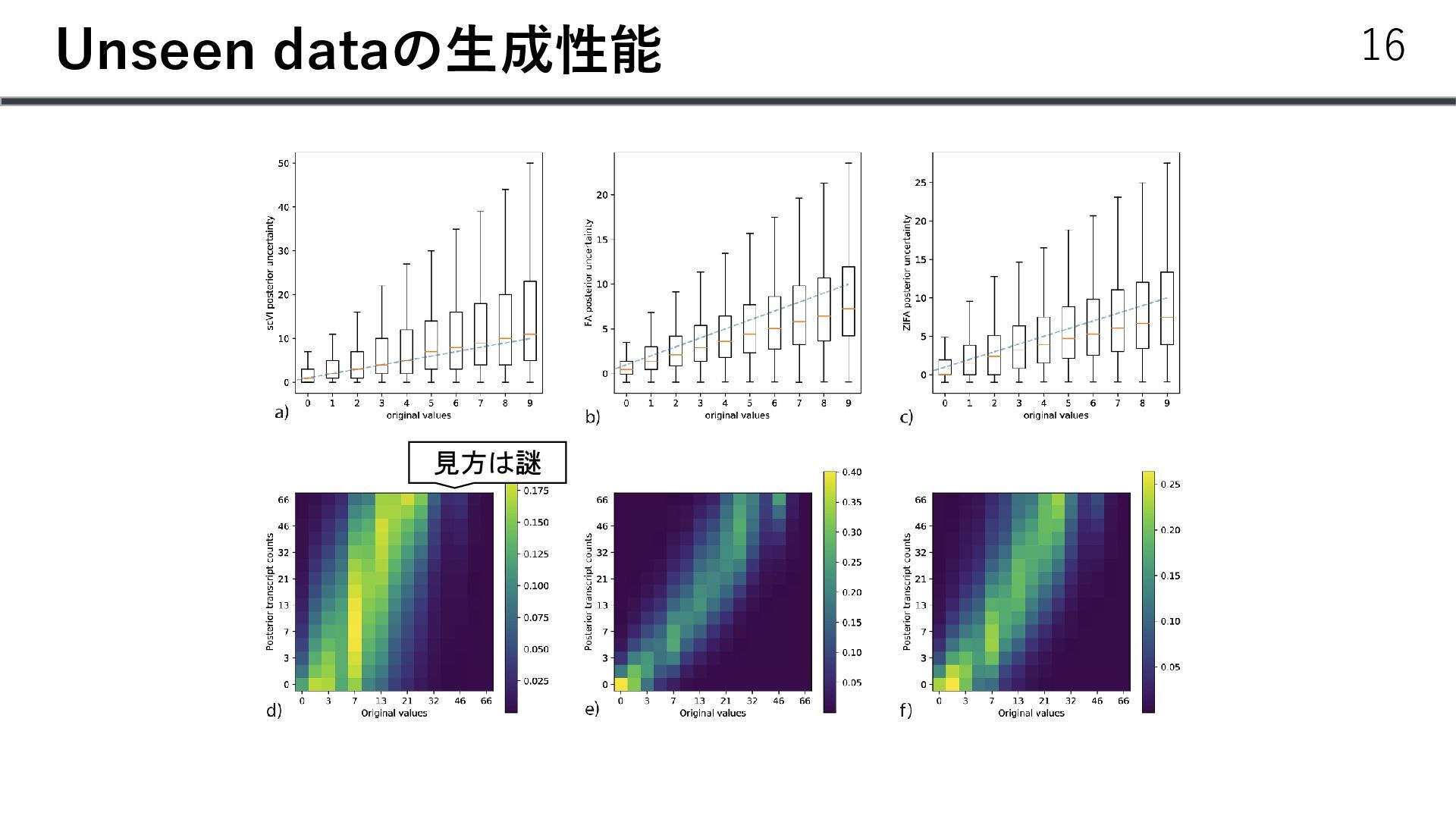
Unseen dataの生成性能 16 見方は謎
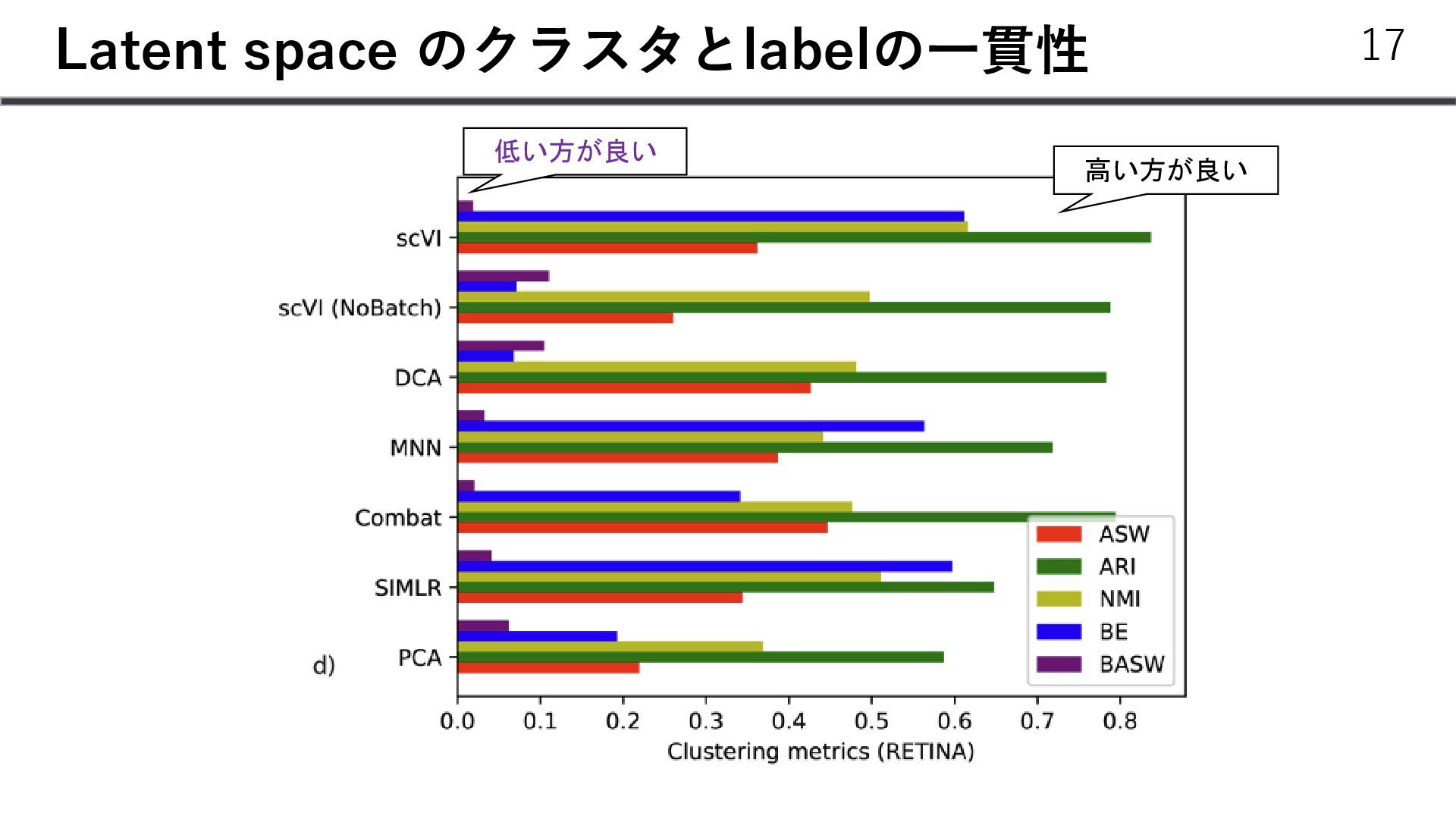
Latent space のクラスタとlabelの一貫性 17 低い方が良い 高い方が良い
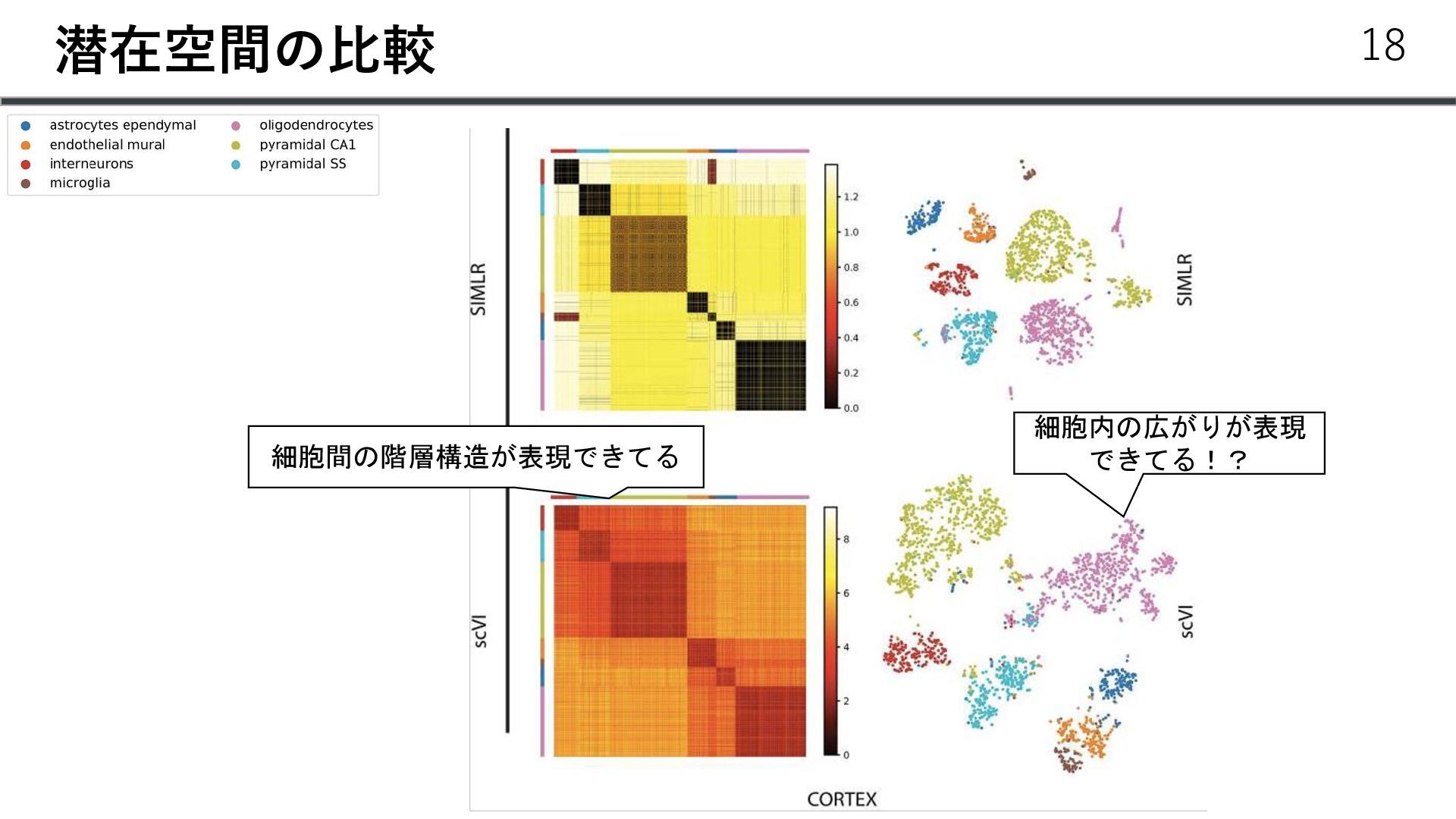
潜在空間の比較 18 細胞内の広がりが表現 できてる!? 細胞間の階層構造が表現できてる
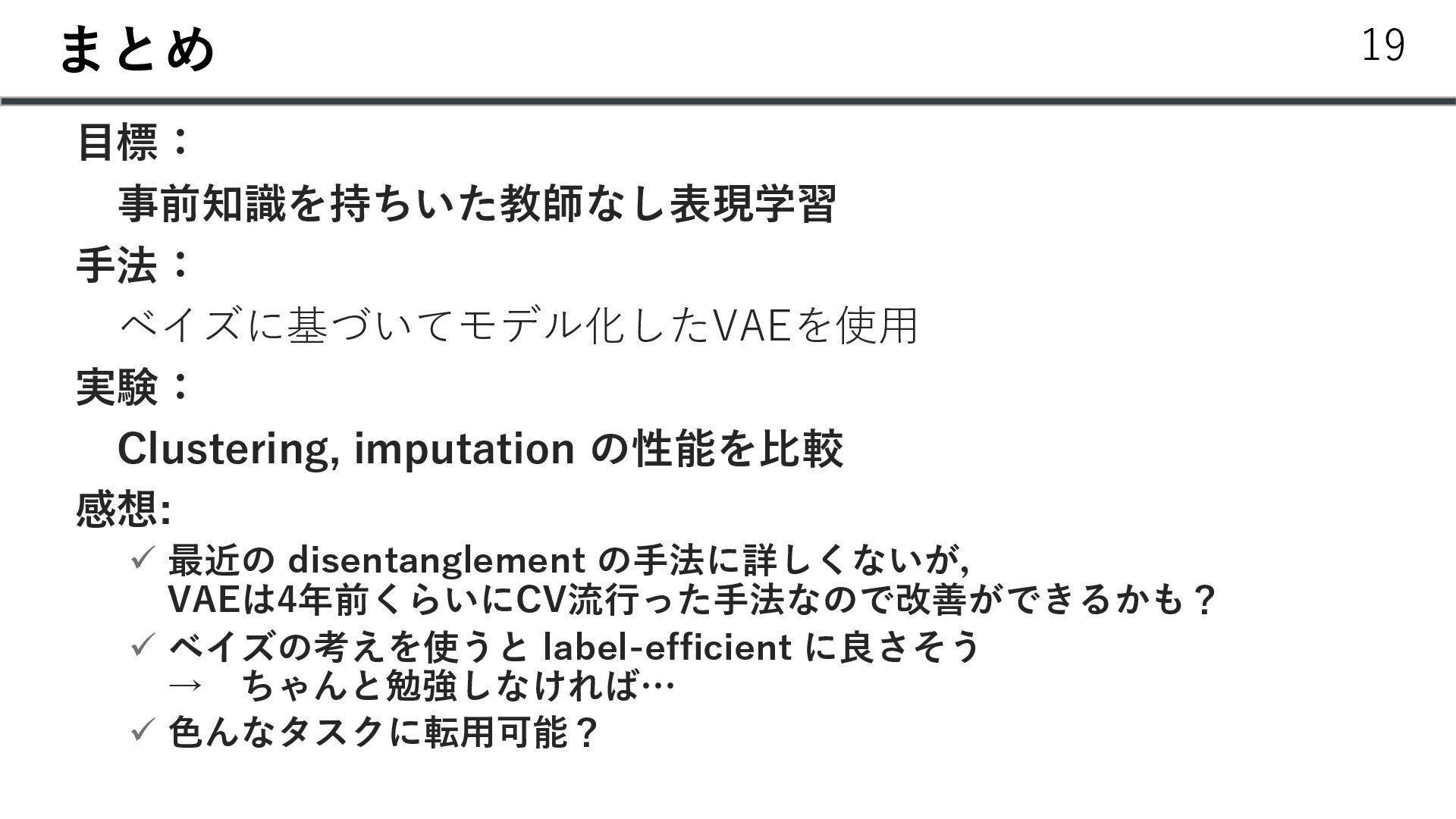
まとめ 目標: 事前知識を持ちいた教師なし表現学習 手法: ベイズに基づいてモデル化したVAEを使用 実験: Clustering, imputation の性能を比較 感想:
✓ 最近の disentanglement の手法に詳しくないが, VAEは4年前くらいにCV流行った手法なので改善ができるかも? ✓ ベイズの考えを使うと label-efficient に良さそう → ちゃんと勉強しなければ… ✓ 色んなタスクに転用可能? 19
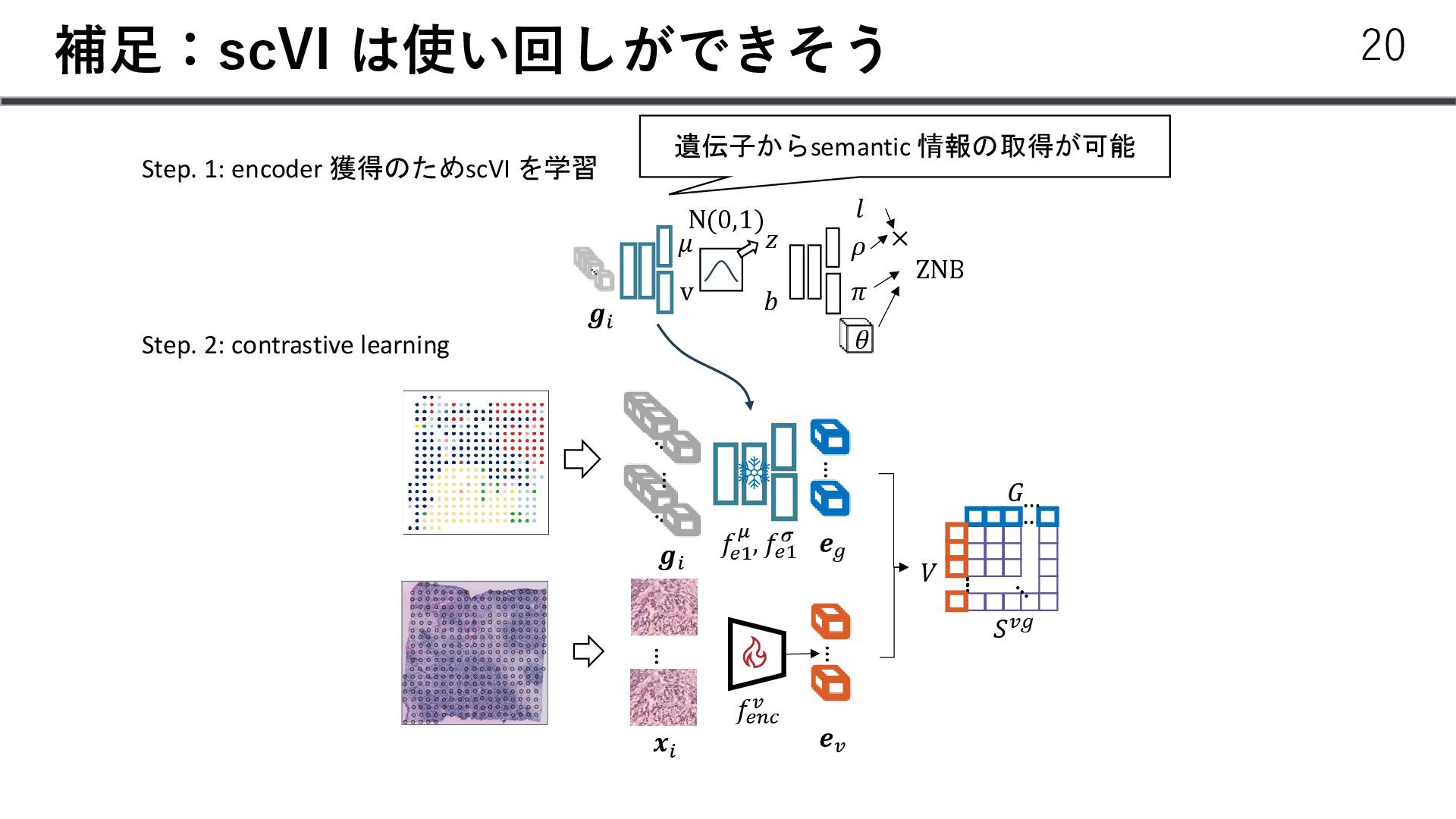
補足:scVI は使い回しができそう 20 𝜇 v 𝑧 N(0,1) 𝒈𝑖 𝑏 ZNB
𝑙 𝜌 𝜋 × 𝜃 … 𝑓𝑒1 𝜇 , 𝑓𝑒1 𝜎 𝒙𝑖 𝒆𝑣 𝐺 𝑆𝑣𝑔 … … … 𝑉 … 𝑓𝑒𝑛𝑐 𝑣 … … 𝒈𝑖 𝒆𝑔 … Step. 1: encoder 獲得のためscVI を学習 Step. 2: contrastive learning 遺伝子からsemantic 情報の取得が可能


 naivete5656
 de9uch1
 pomcho555
 gpeyre
 koide3
 sazimai
 casualconc
 kzmssk
 izumiyama_lab
 institutdelelevage
 yumulab
 nnchiba
 ayaniwa
 cassininazir
 aleyda
 oripsolob
 axbom
 addyosmani
 paigeccino
 marcelosomers
 marcduiker
 khoart
 inesmontani
 techseoconnect
 smashingmag