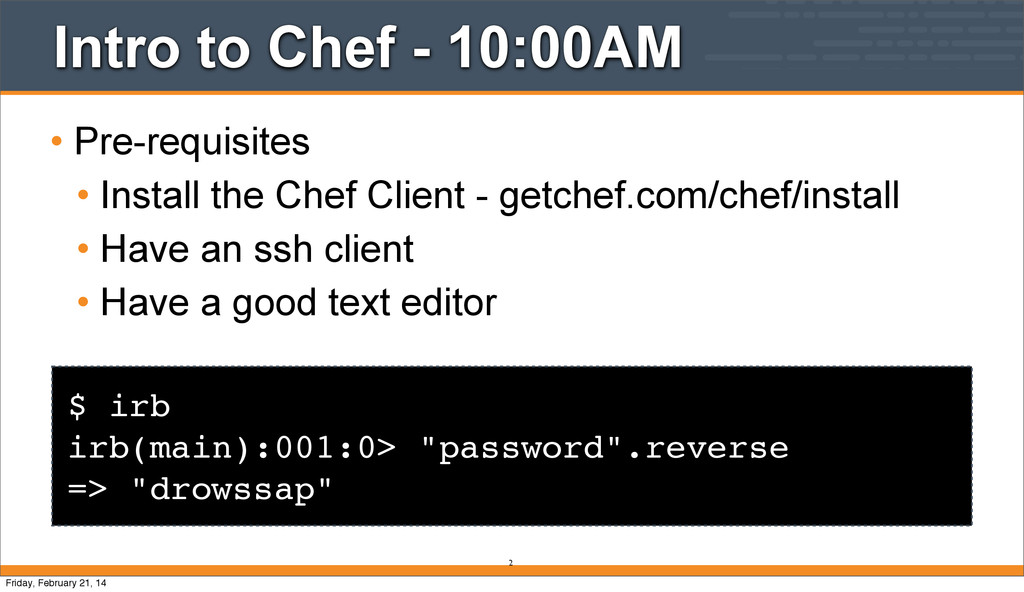
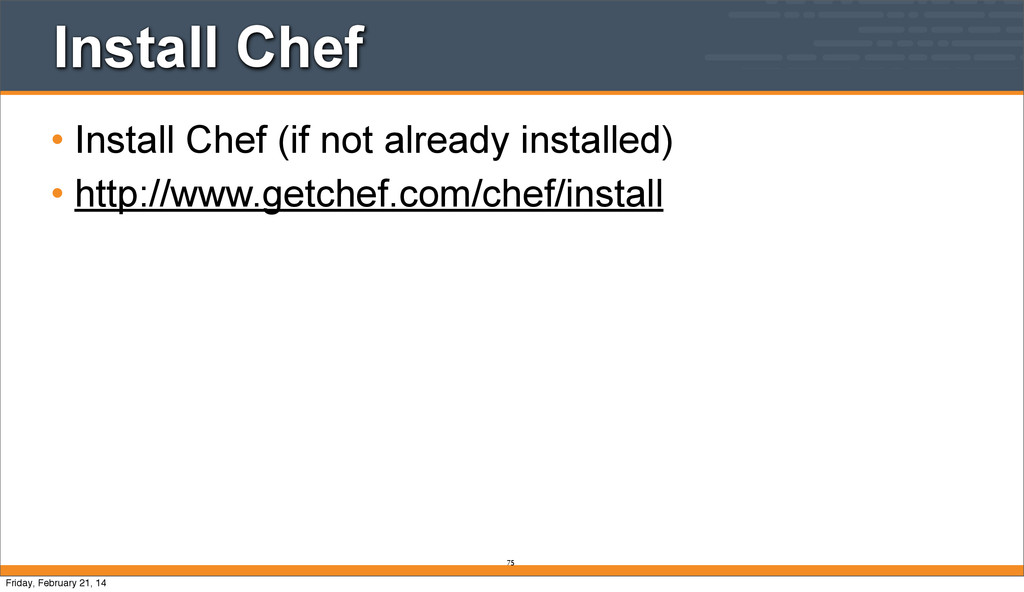
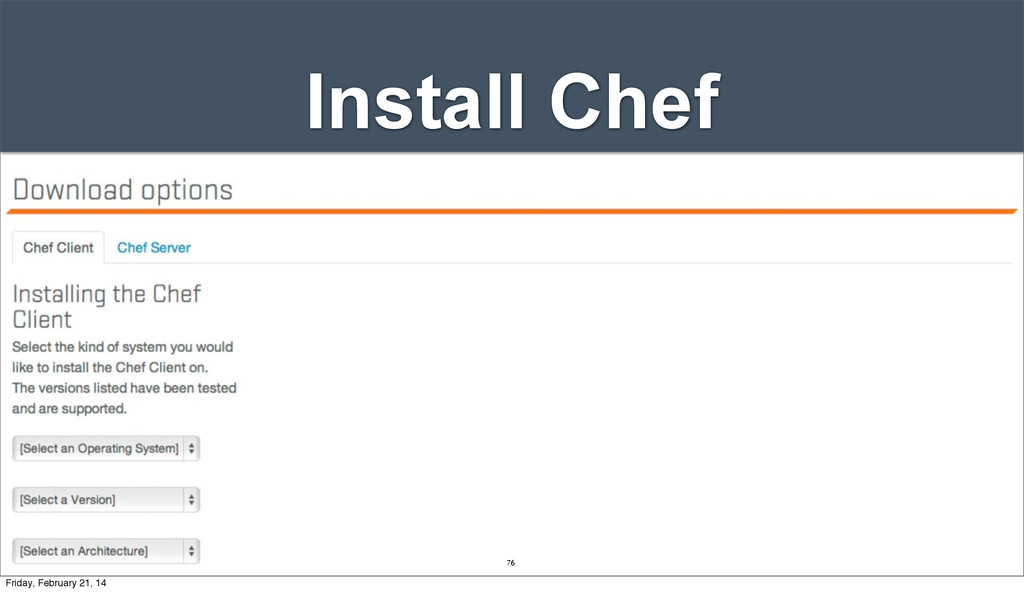
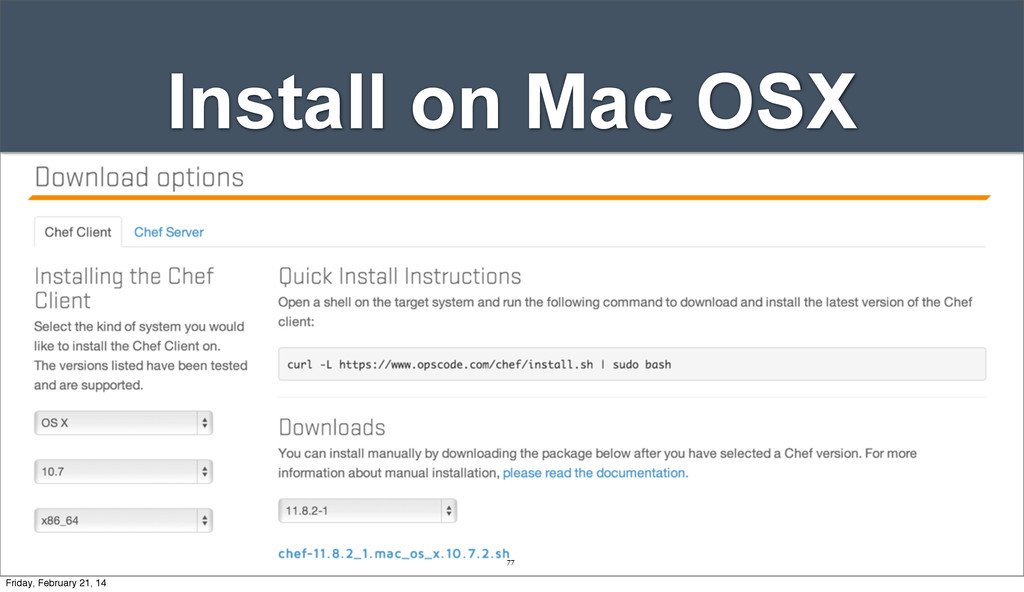
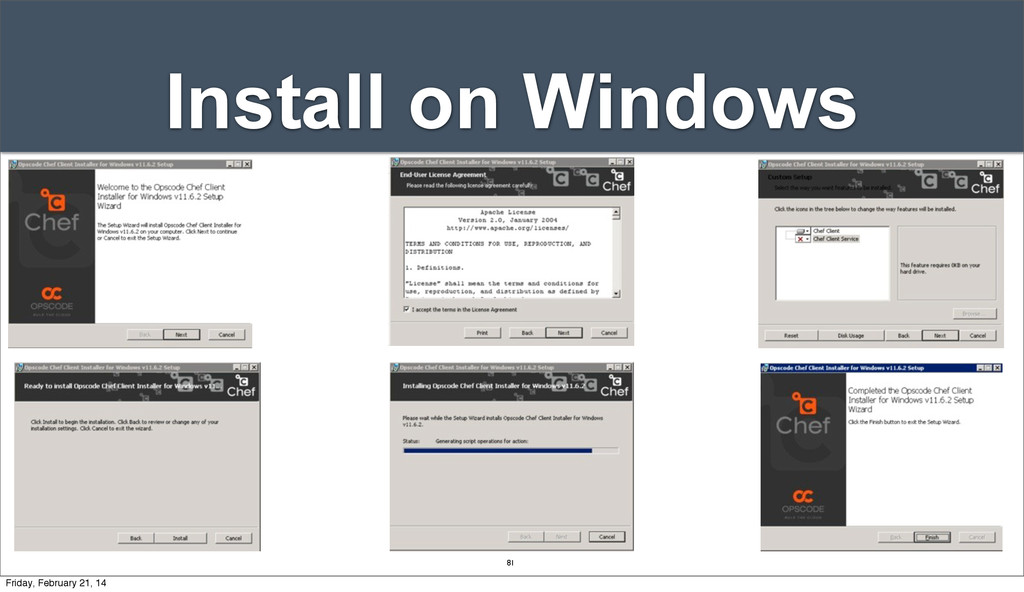
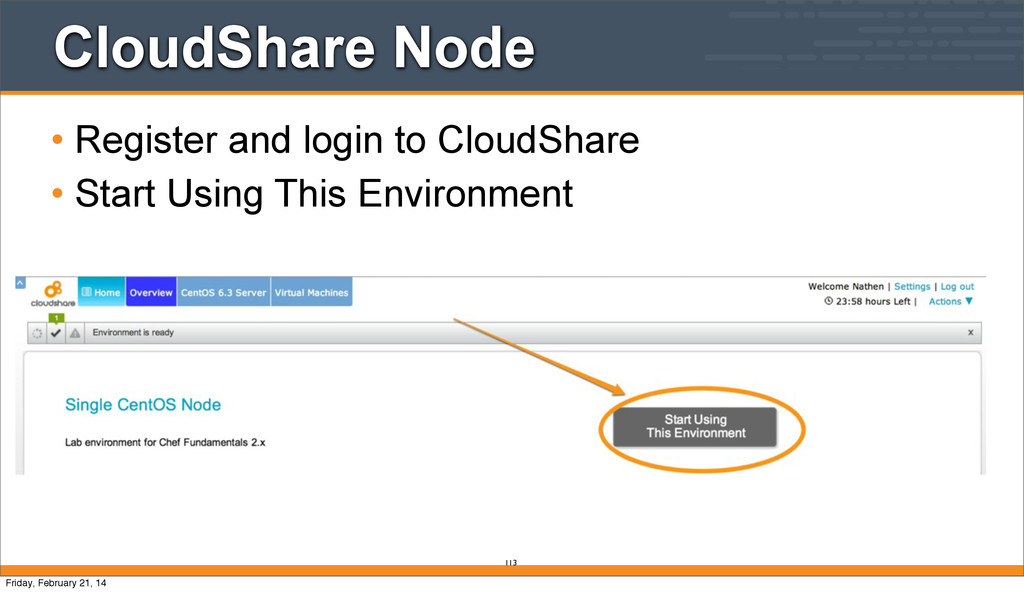
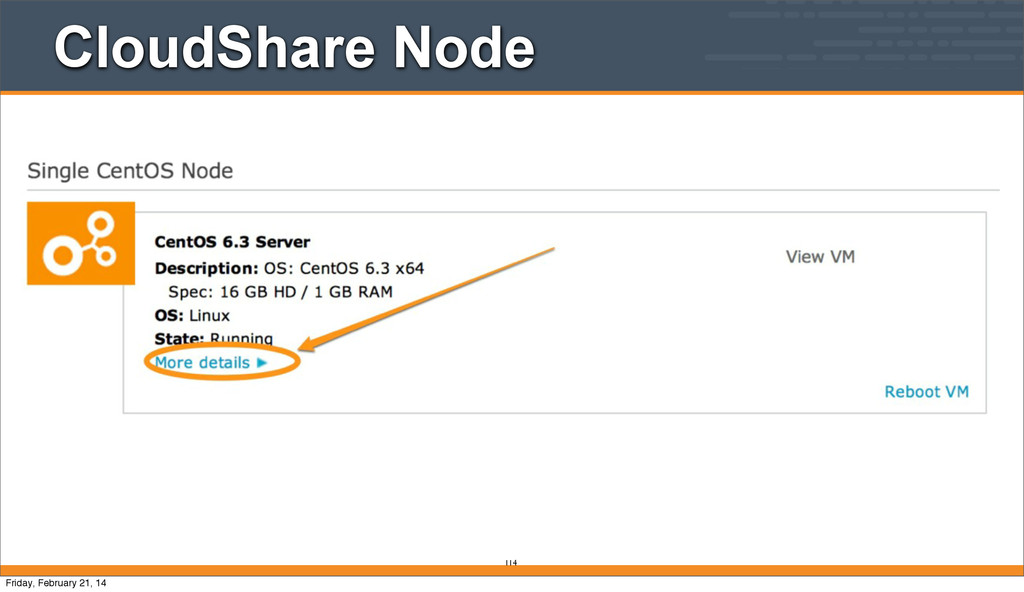
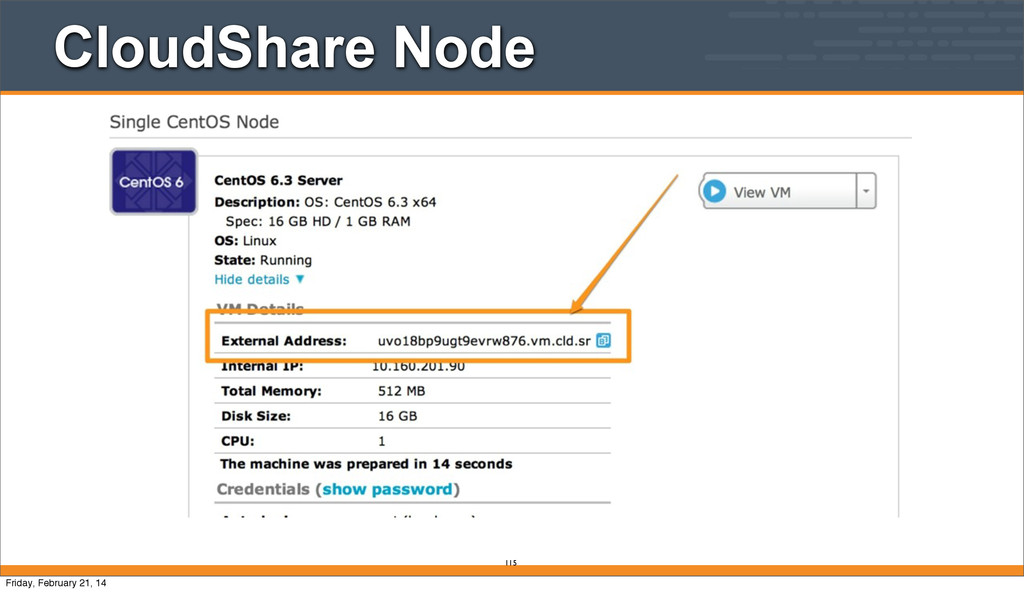
the Chef Client - getchef.com/chef/install • Have an ssh client • Have a good text editor $ irb irb(main):001:0> "password".reverse => "drowssap" Friday, February 21, 14
Director Community & #learnchef • Previous job roles/background: Web Operations, Customer Support, Web Development • Experience with Chef/Config Management: Been using Chef for about 4 years. • Favorite Text Editor: Sublime Text 4 Friday, February 21, 14
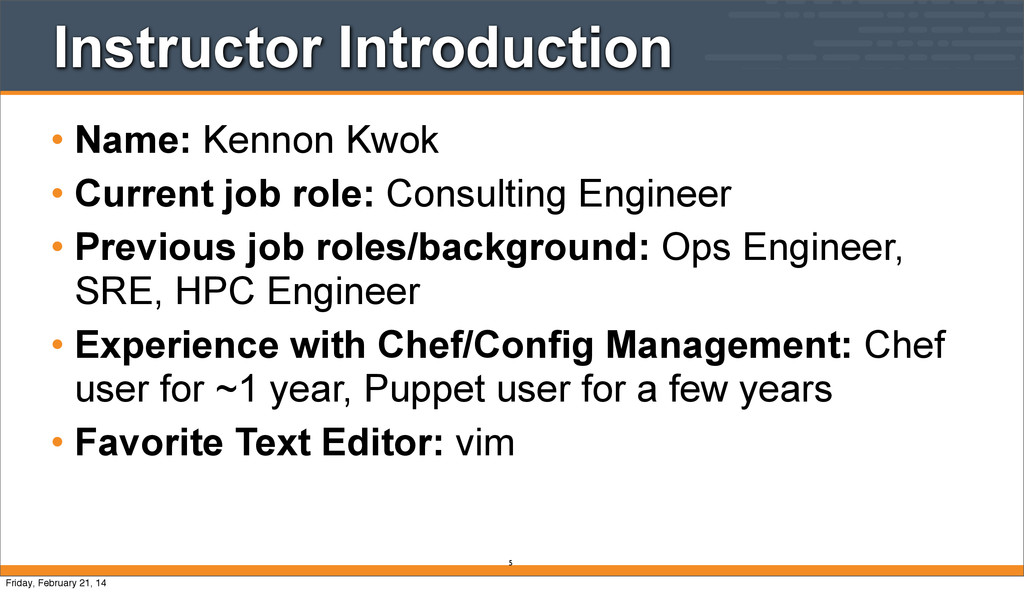
Consulting Engineer • Previous job roles/background: Ops Engineer, SRE, HPC Engineer • Experience with Chef/Config Management: Chef user for ~1 year, Puppet user for a few years • Favorite Text Editor: vim 5 Friday, February 21, 14
• List the components of Chef • Create a new cookbook • Use some primitives of Chef recipes • Follow some common workflows used by experienced Chef users/developers Friday, February 21, 14
course. • We will do some hands on exercises. • You should get a taste for automating with Chef. • You should have received instructions for prerequisites prior to this tutorial • Chef works and runs on Windows, but the exercises for this tutorial are Linux-based Friday, February 21, 14
about your business and problems • Chef provides a framework for solving those problems • Our job is to work together to teach you how to express solutions to your problems with Chef 12 Friday, February 21, 14
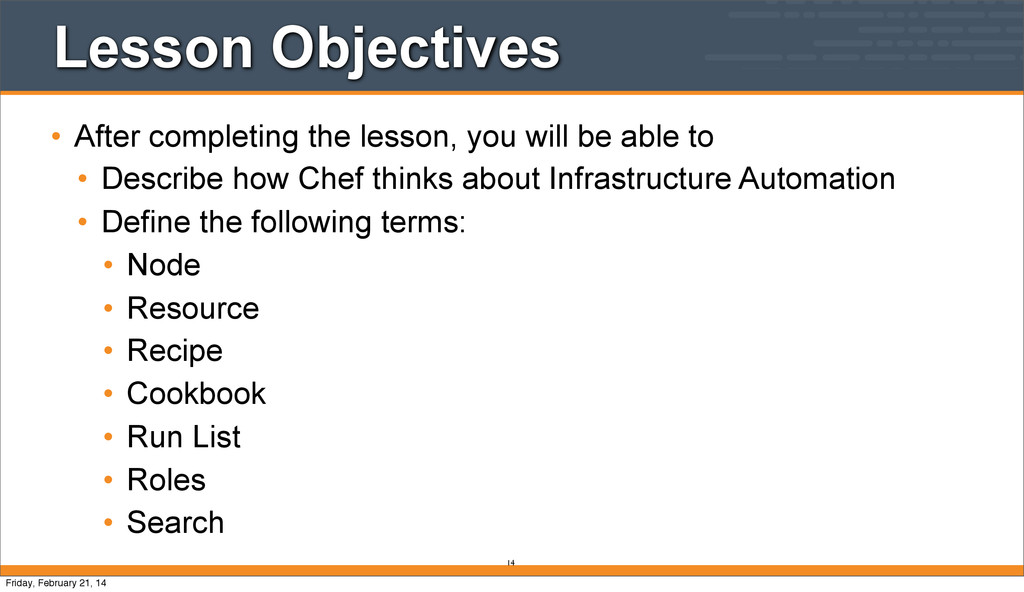
able to • Describe how Chef thinks about Infrastructure Automation • Define the following terms: • Node • Resource • Recipe • Cookbook • Run List • Roles • Search 14 Friday, February 21, 14
components • Treat like any other code base • Reconstruct business from code repository, data backup, and compute resources http://www.flickr.com/photos/louisb/4555295187/ 34 Friday, February 21, 14
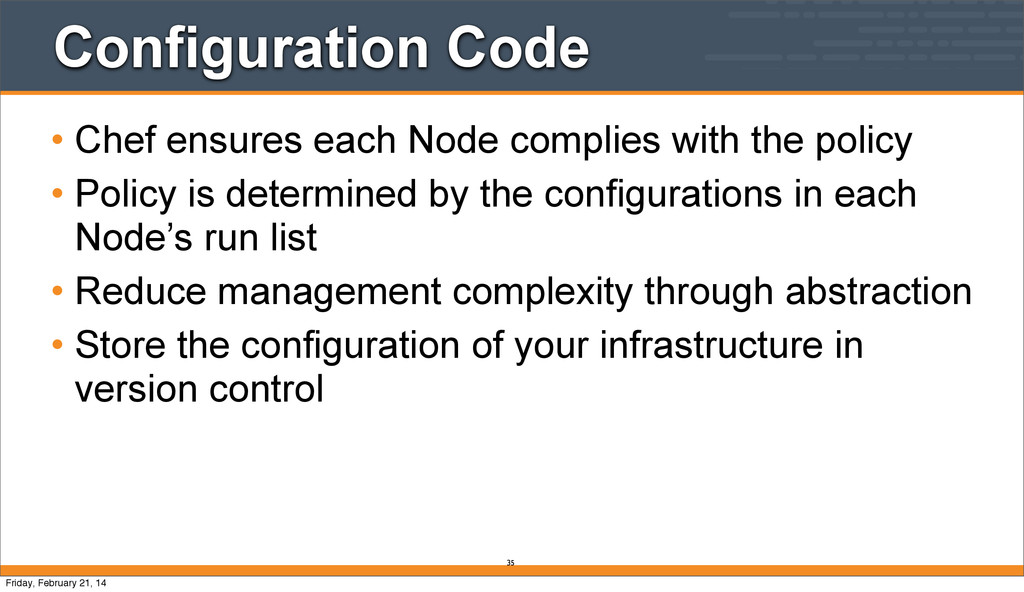
policy • Policy is determined by the configurations in each Node’s run list • Reduce management complexity through abstraction • Store the configuration of your infrastructure in version control 35 Friday, February 21, 14
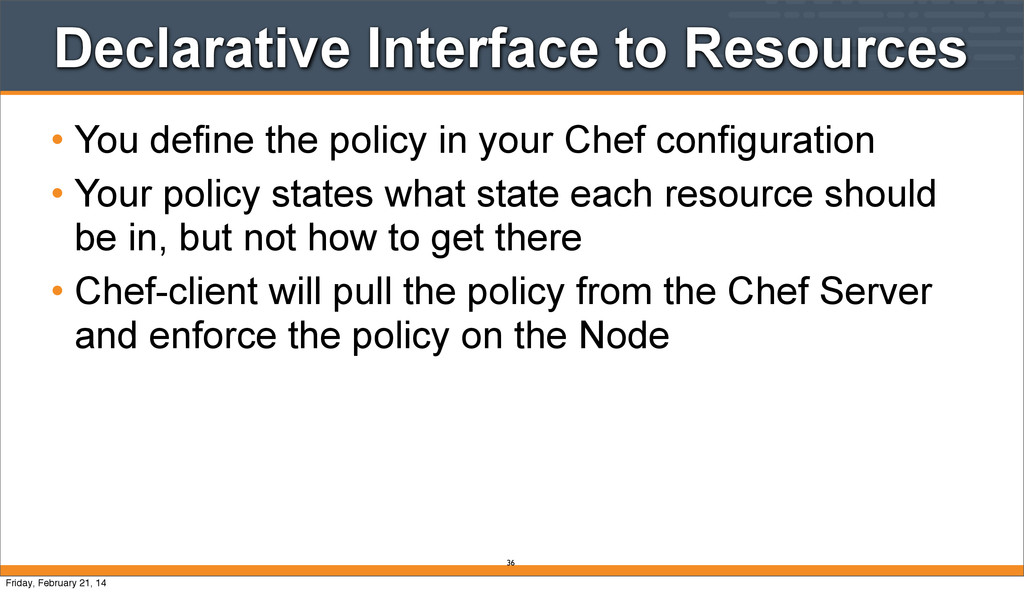
your Chef configuration • Your policy states what state each resource should be in, but not how to get there • Chef-client will pull the policy from the Chef Server and enforce the policy on the Node 36 Friday, February 21, 14
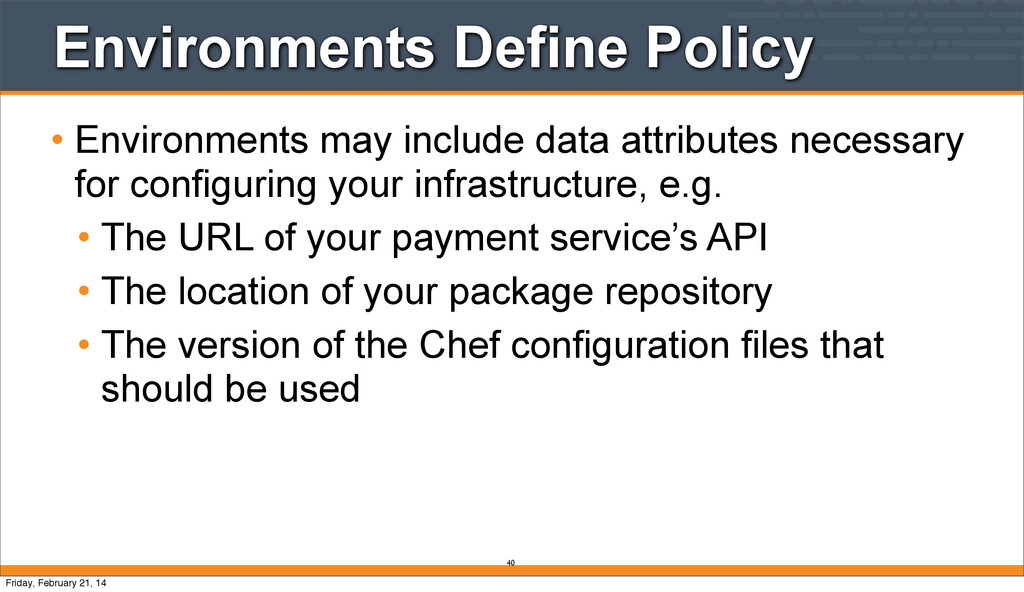
for configuring your infrastructure, e.g. • The URL of your payment service’s API • The location of your package repository • The version of the Chef configuration files that should be used 40 Friday, February 21, 14
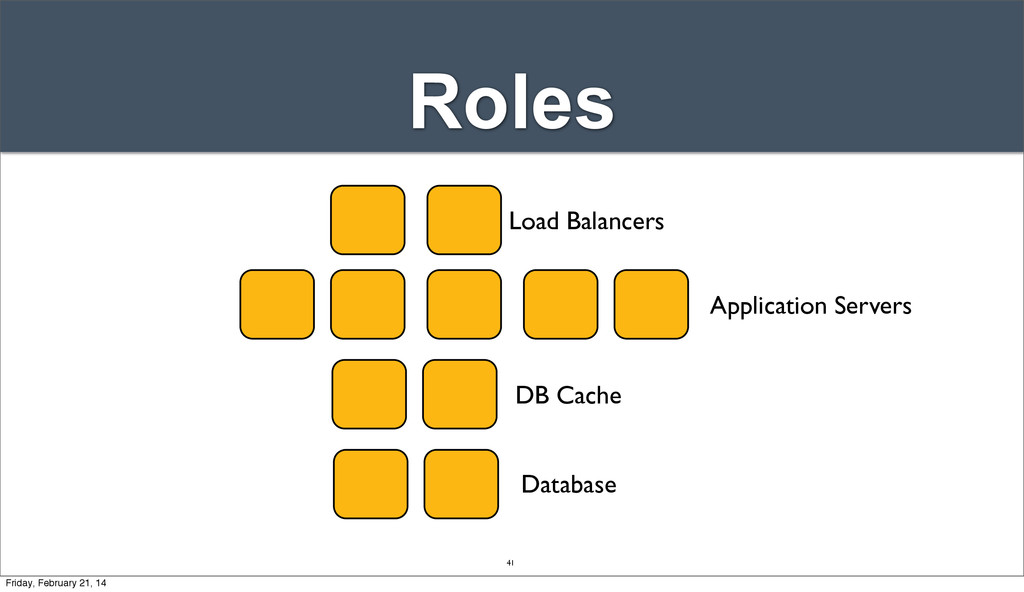
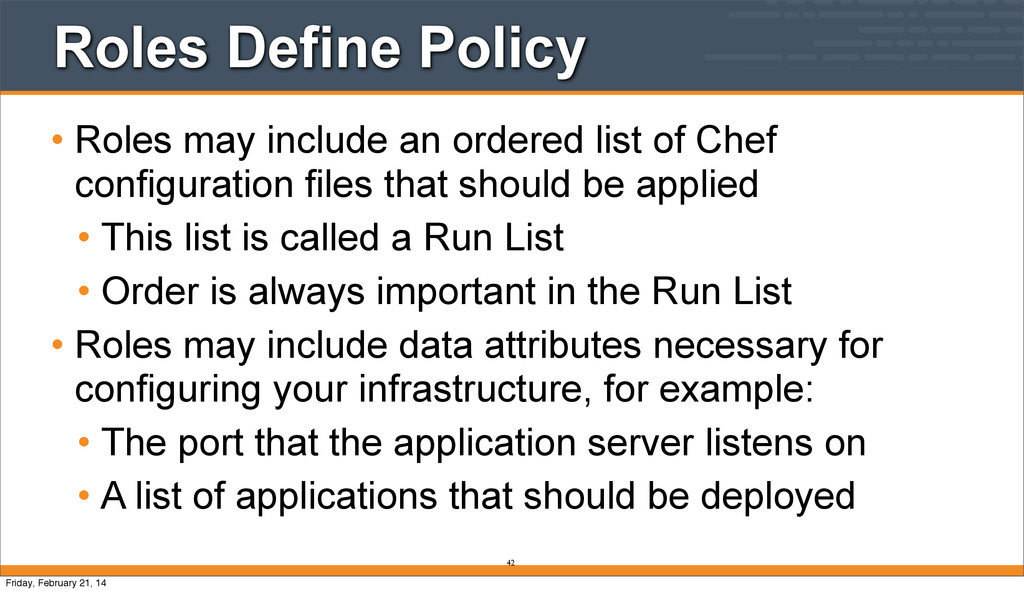
of Chef configuration files that should be applied • This list is called a Run List • Order is always important in the Run List • Roles may include data attributes necessary for configuring your infrastructure, for example: • The port that the application server listens on • A list of applications that should be deployed 42 Friday, February 21, 14
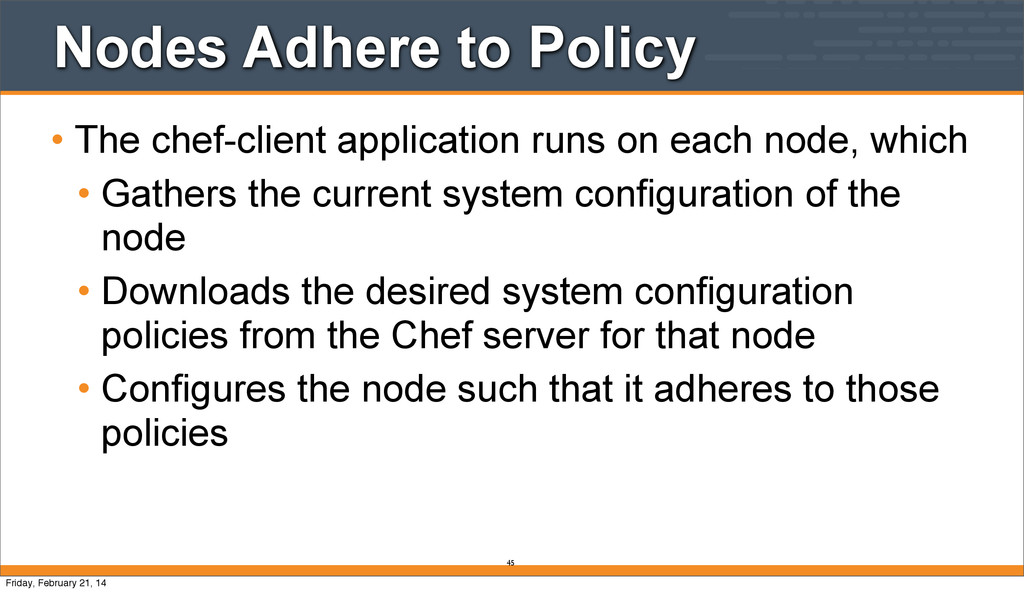
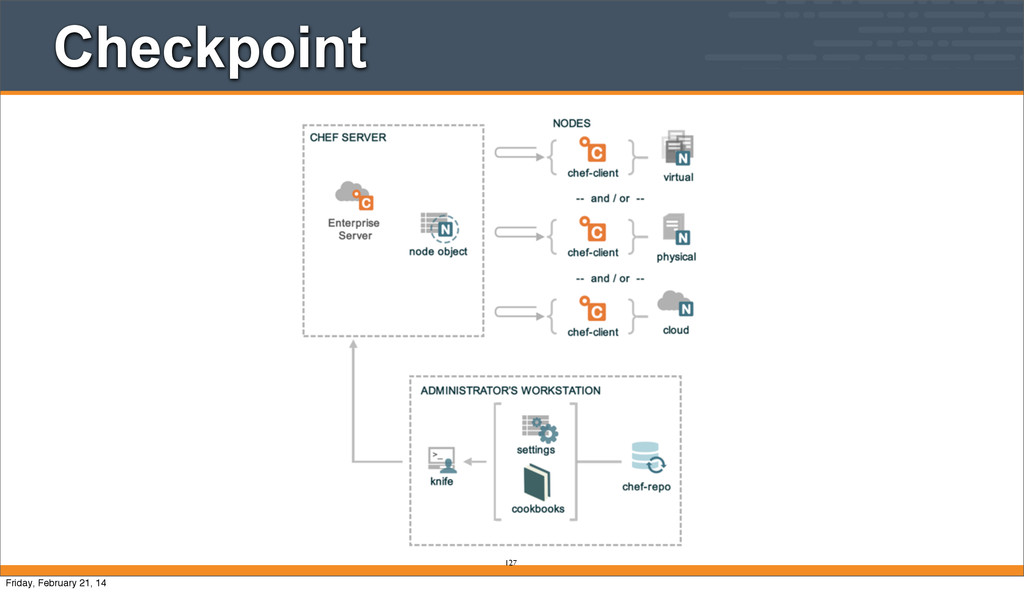
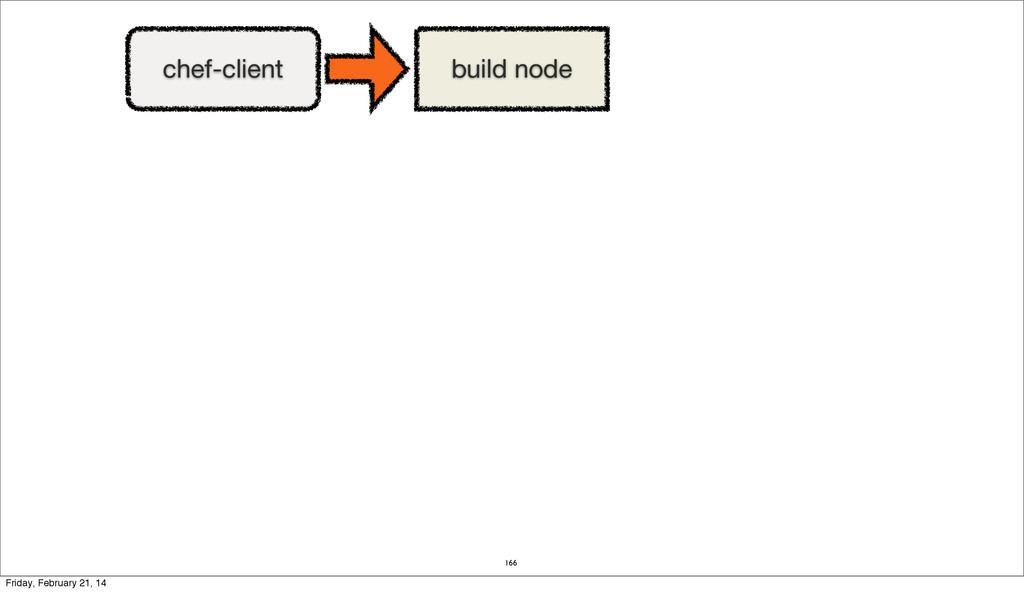
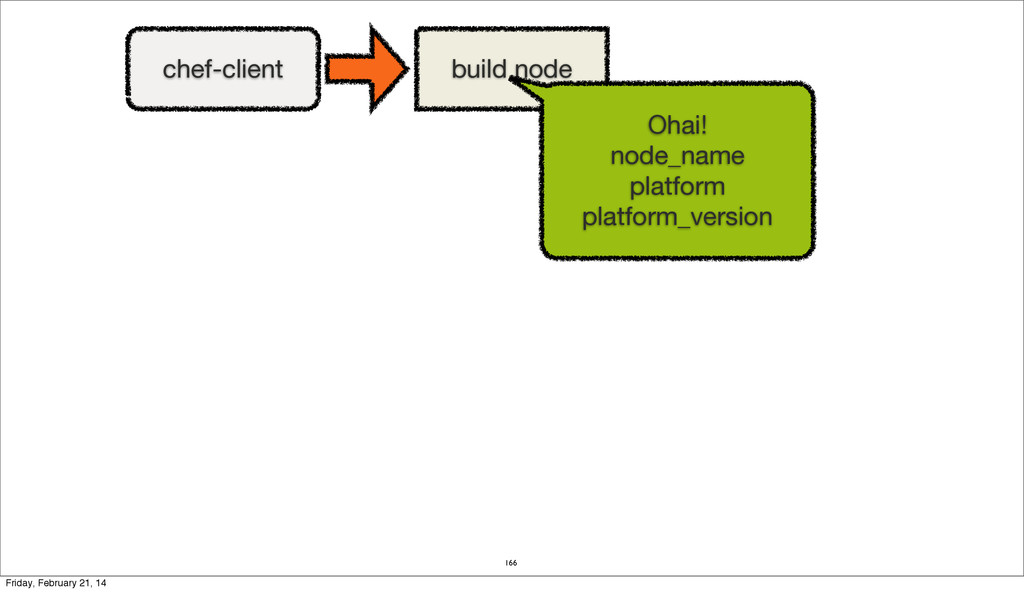
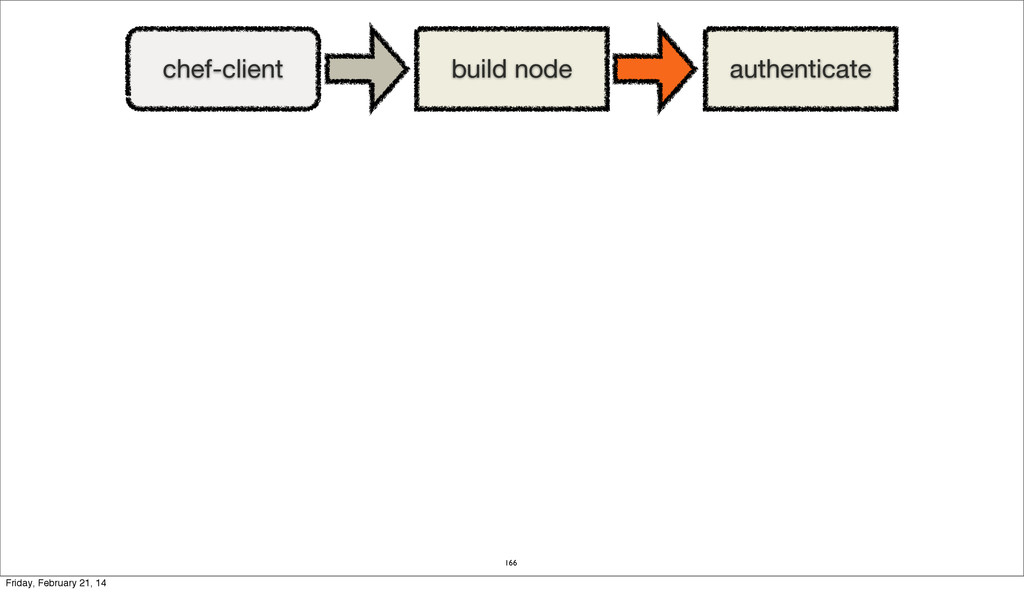
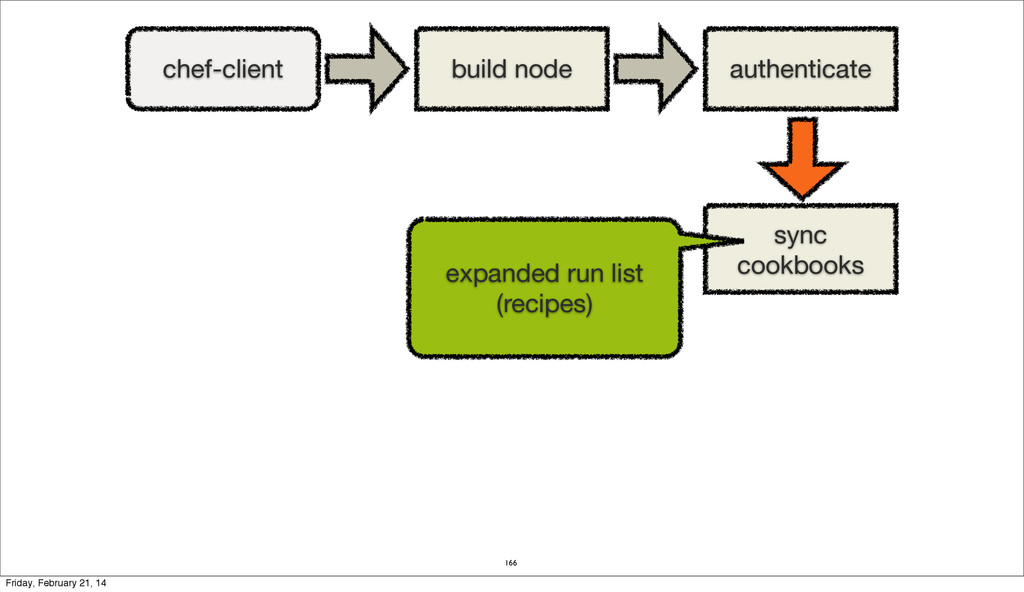
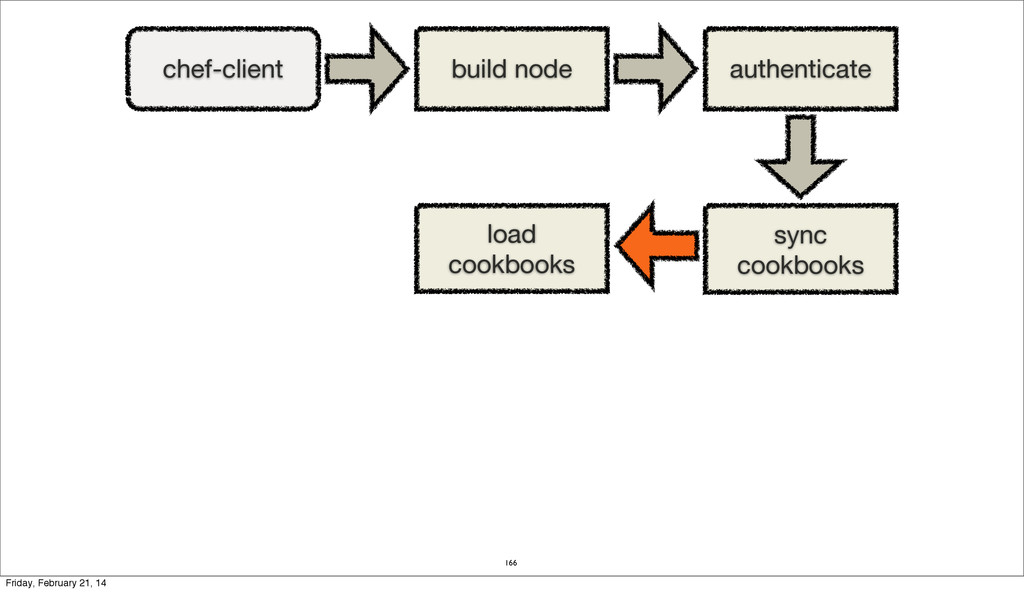
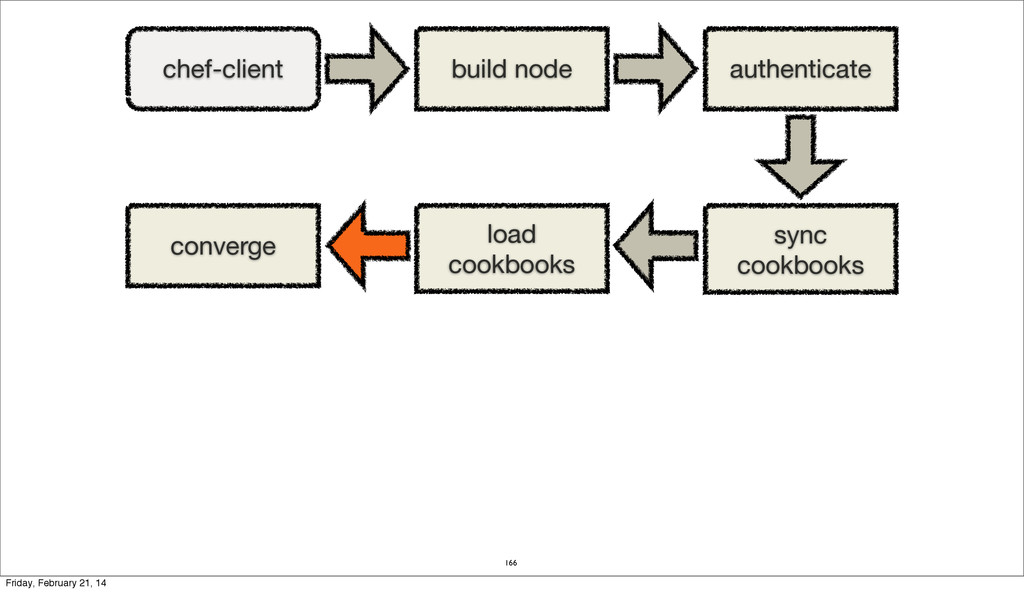
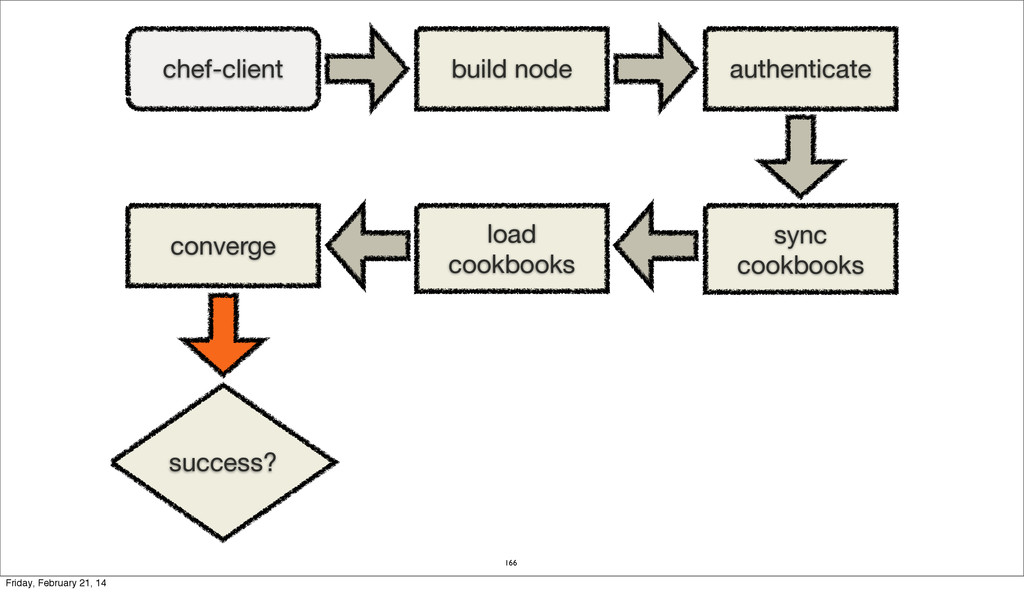
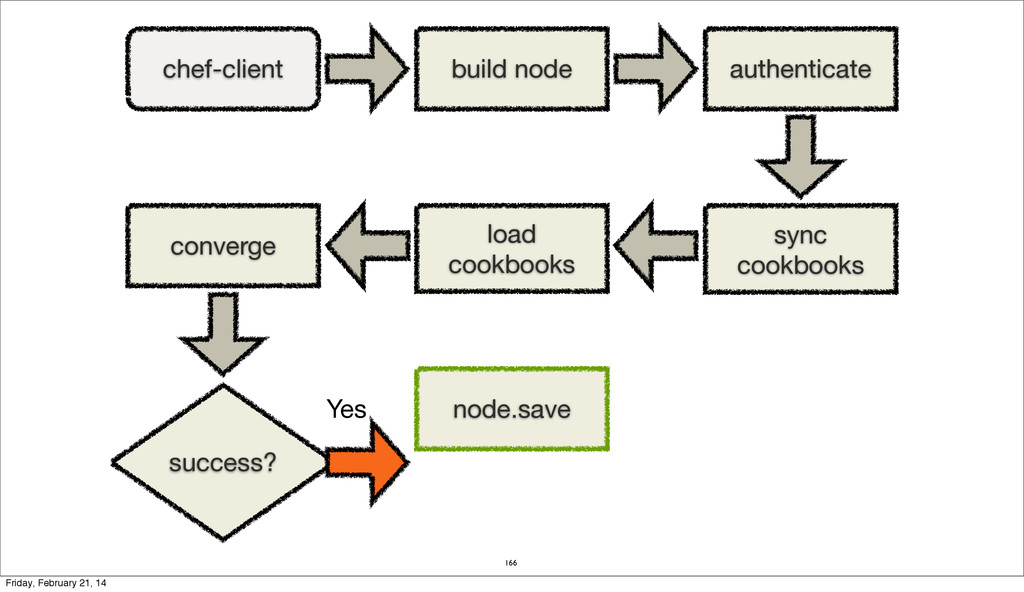
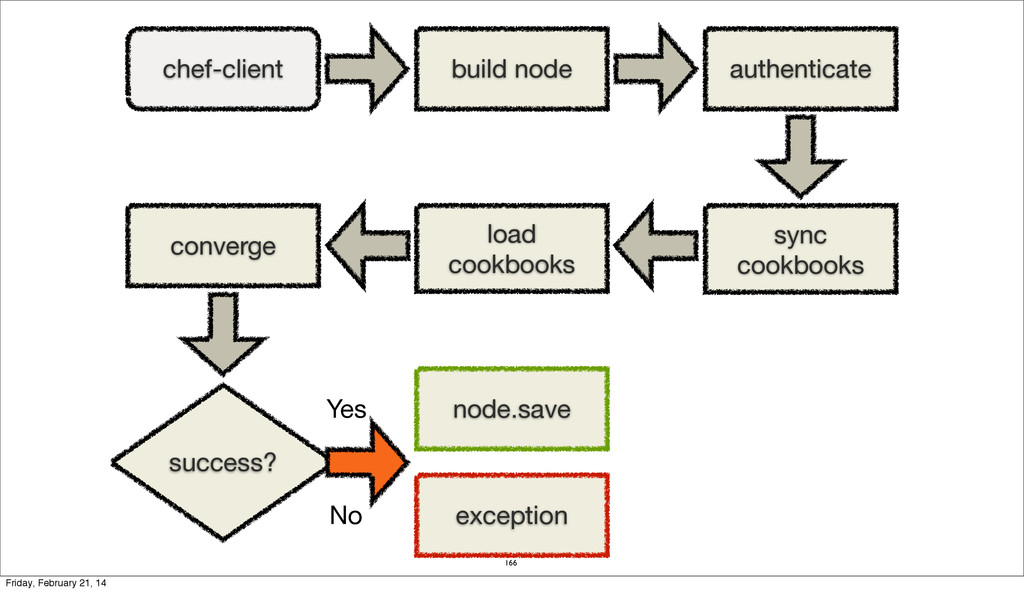
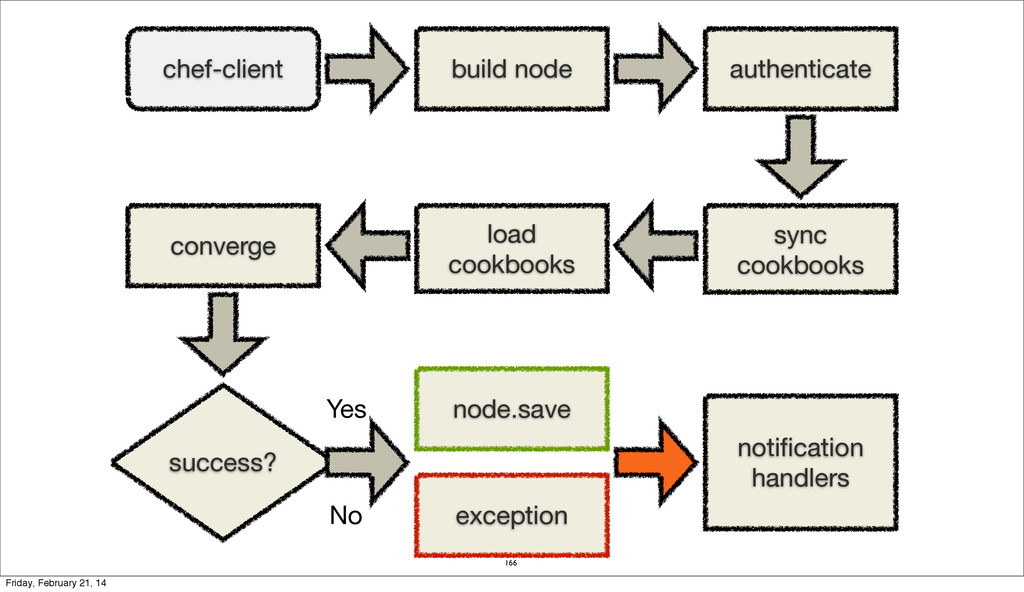
each node, which • Gathers the current system configuration of the node • Downloads the desired system configuration policies from the Chef server for that node • Configures the node such that it adheres to those policies 45 Friday, February 21, 14
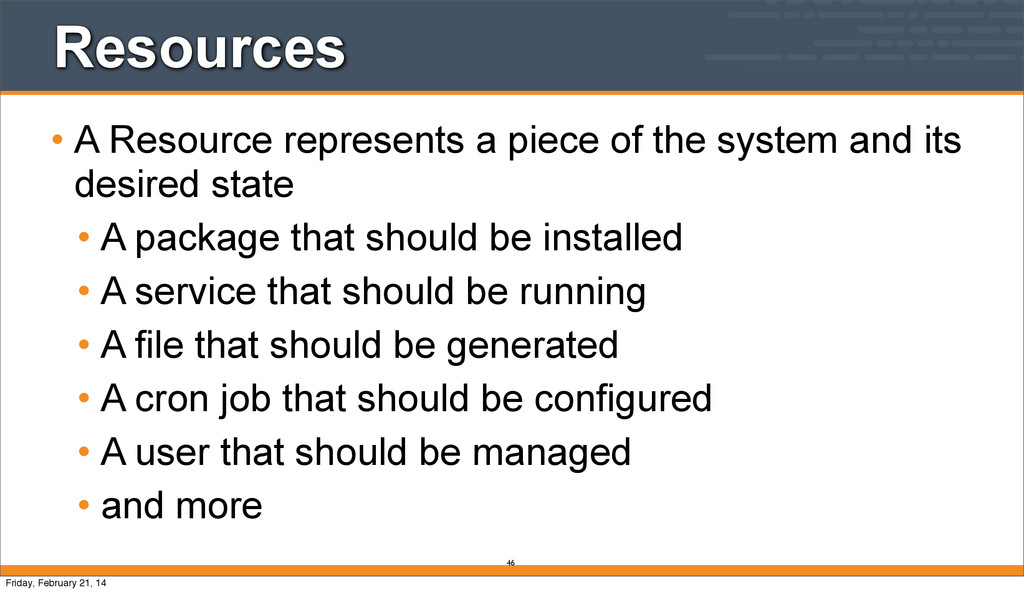
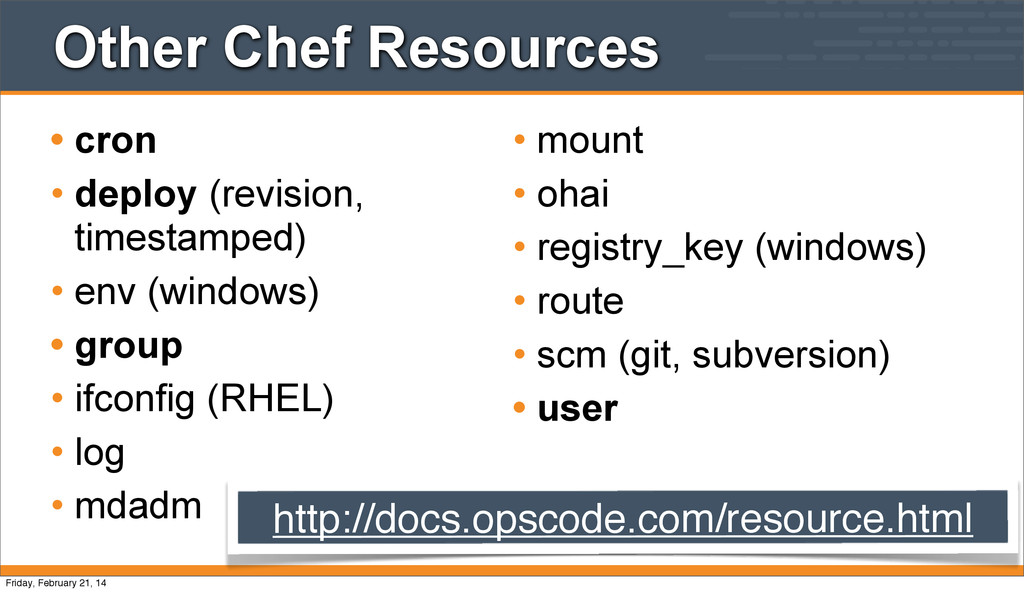
and its desired state • A package that should be installed • A service that should be running • A file that should be generated • A cron job that should be configured • A user that should be managed • and more 46 Friday, February 21, 14
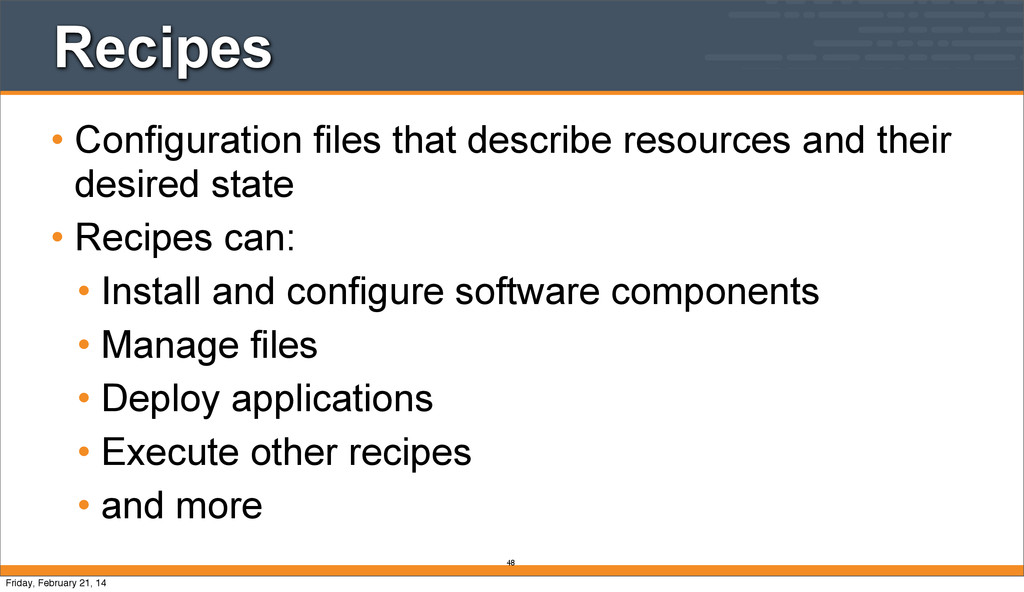
state • Recipes can: • Install and configure software components • Manage files • Deploy applications • Execute other recipes • and more 48 Friday, February 21, 14
"root" group "root" mode "0644" variables(:allow_override => "All") notifies :reload, "service[apache2]" end service "apache2" do action [:enable,:start] supports :reload => true end 49 Friday, February 21, 14
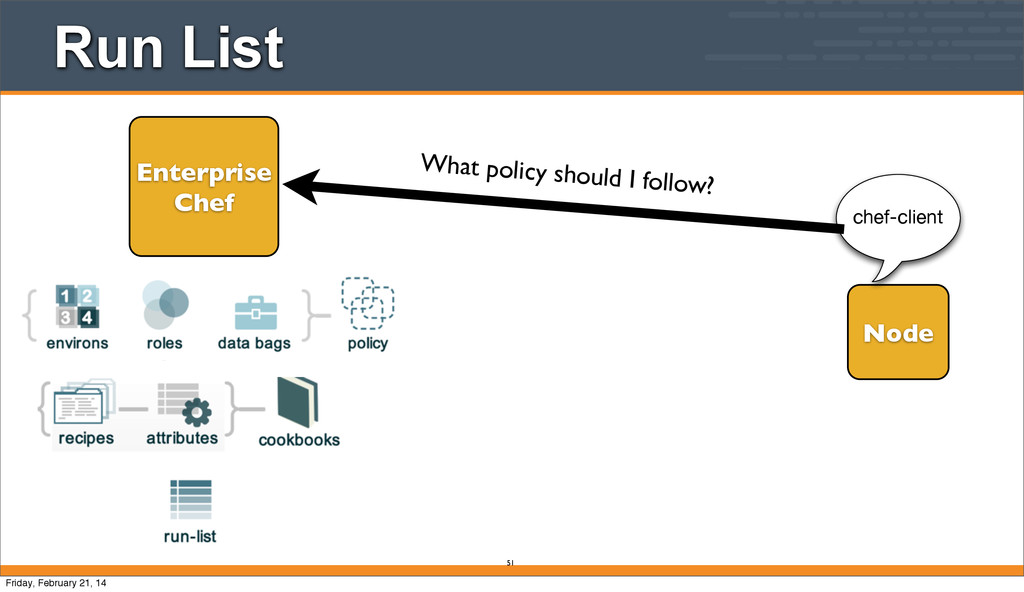
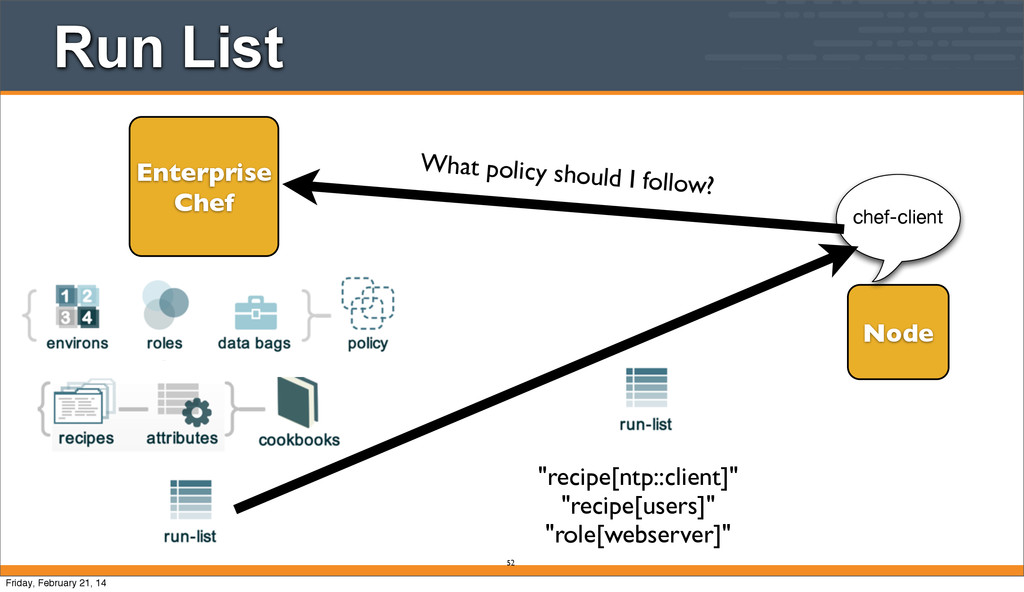
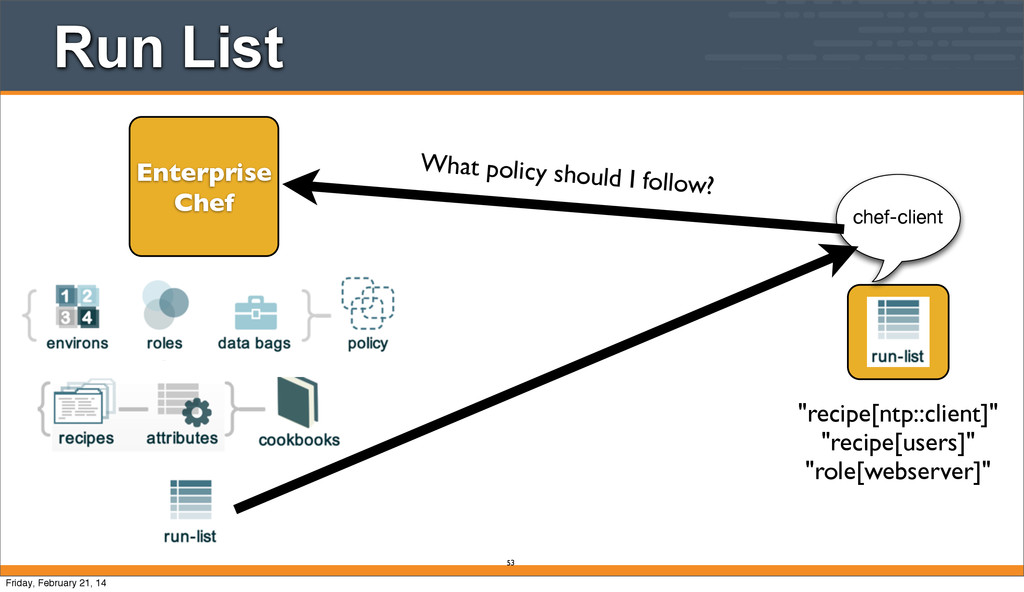
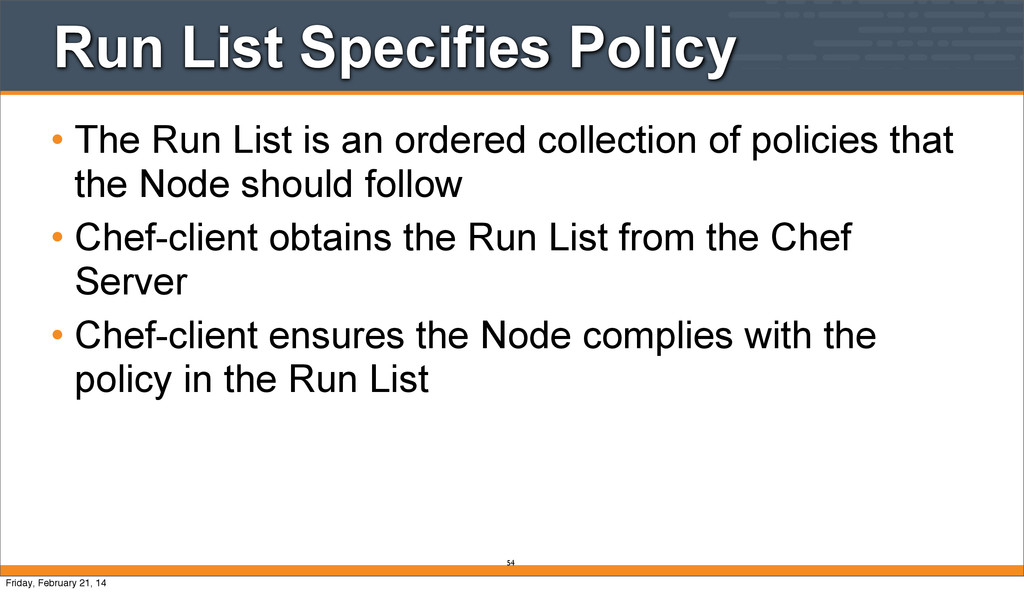
ordered collection of policies that the Node should follow • Chef-client obtains the Run List from the Chef Server • Chef-client ensures the Node complies with the policy in the Run List 54 Friday, February 21, 14
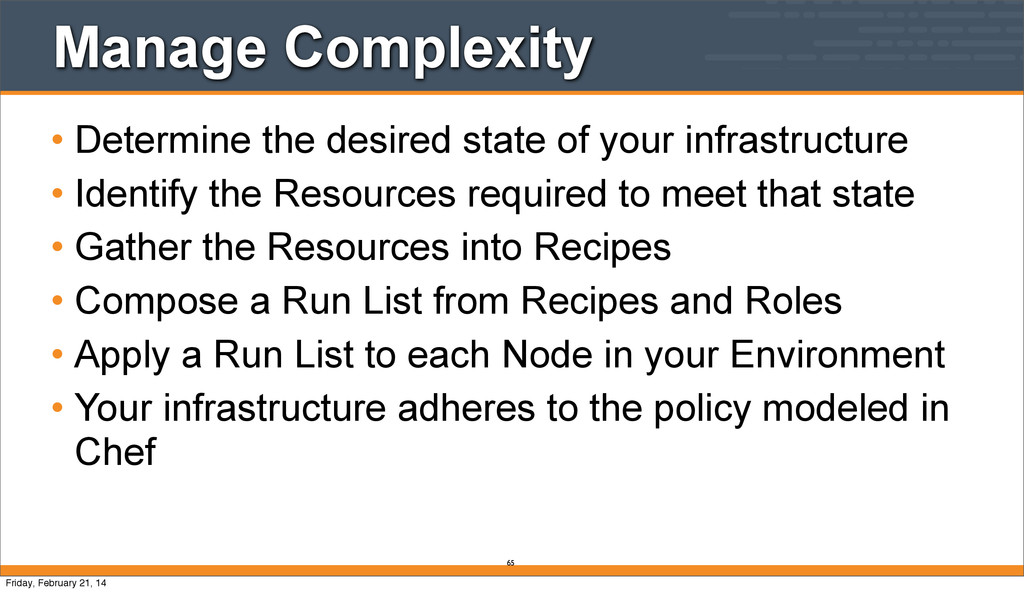
• Identify the Resources required to meet that state • Gather the Resources into Recipes • Compose a Run List from Recipes and Roles • Apply a Run List to each Node in your Environment • Your infrastructure adheres to the policy modeled in Chef 65 Friday, February 21, 14
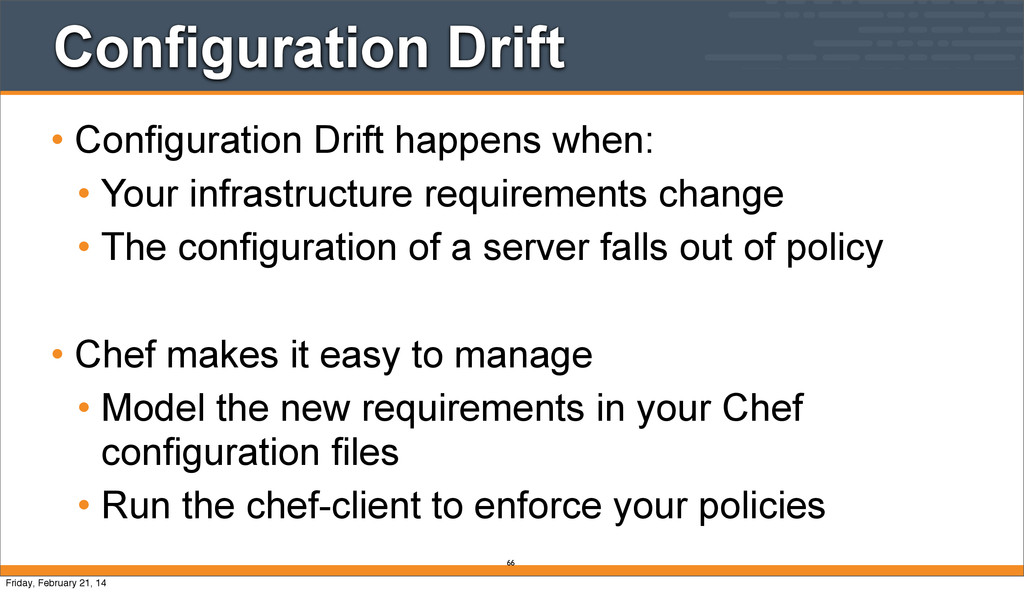
requirements change • The configuration of a server falls out of policy • Chef makes it easy to manage • Model the new requirements in your Chef configuration files • Run the chef-client to enforce your policies 66 Friday, February 21, 14
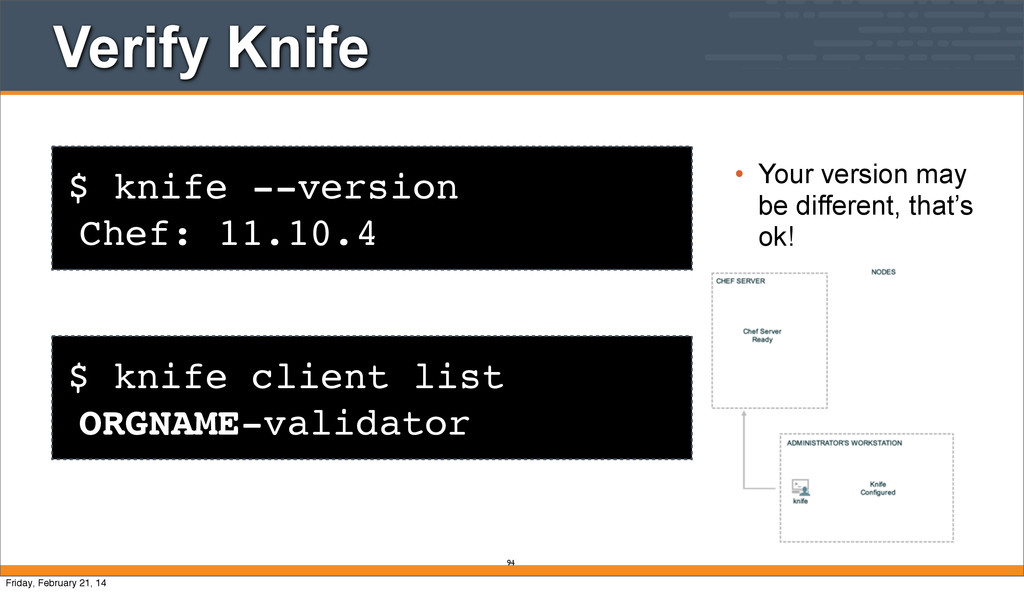
able to • Login to Enterprise Chef • View your Organization in Enterprise Chef • Describe Knife, the Chef command line utility • Use Knife on your Workstation 68 Friday, February 21, 14
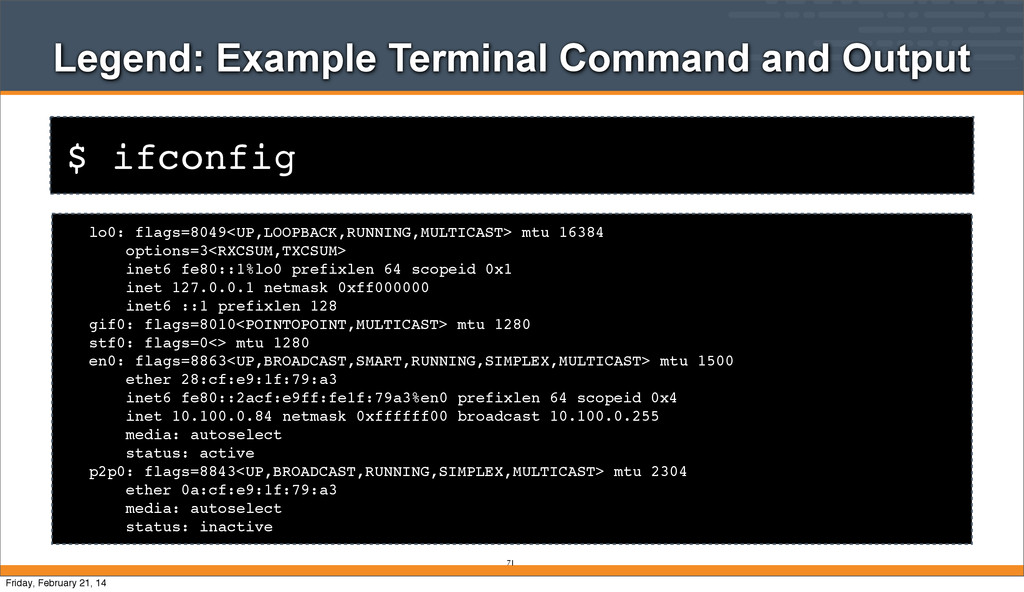
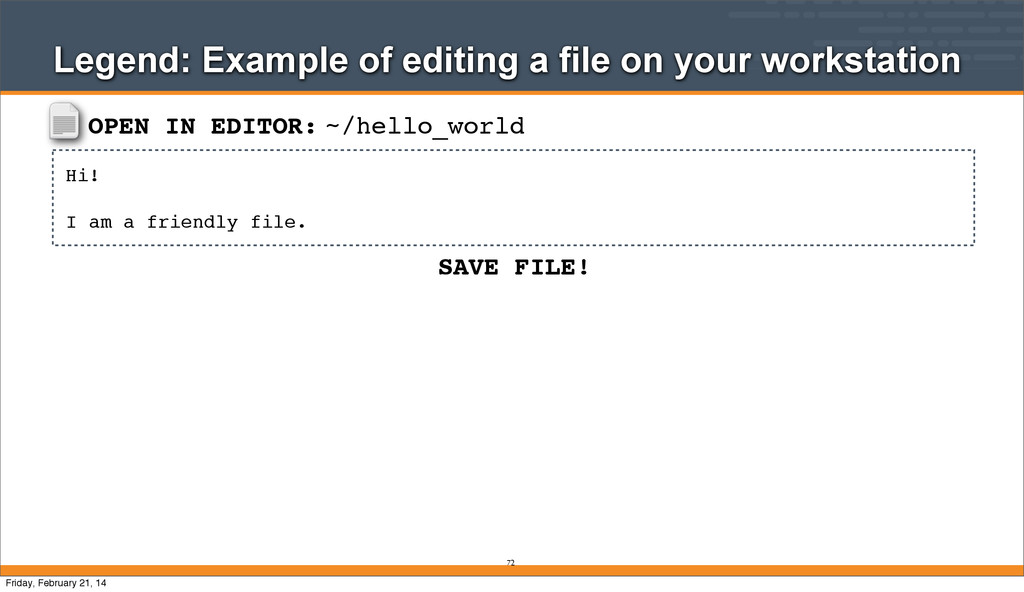
whoami i-am-a-workstation This is an example of a command to run on your workstation user@hostname:~$ whoami i-am-a-chef-node This is an example of a command to run on your target node via SSH. 70 Friday, February 21, 14
Mac OS X / Linux % Total % Received % Xferd Average Speed Time Time Time Current Dload Upload Total Spent Left Speed 100 14100 100 14100 0 0 8814 0 0:00:01 0:00:01 --:--:-- 8812 Downloading Chef for mac_os_x... downloading http://www.getchef.com/chef/metadata?v=&prerelease=false&p=mac_os_x&pv=10.7&m=x86_64 to file /tmp/install.sh.79770/metadata.txt trying curl... url! http://opscode-omnibus-packages.s3.amazonaws.com/mac_os_x/10.7/x86_64/chef-11.8.2_1.mac_os_x. 10.7.2.sh md5! af157c6ef941e52f69a9dd6a3b57f597 sha256! c003c0951d80245b1f02c4588f9157a55e7b94a00dd6ac163aed8ef2e854619a downloaded metadata file looks valid... downloading http://opscode-omnibus-packages.s3.amazonaws.com/mac_os_x/10.7/x86_64/ chef-11.8.2_1.mac_os_x.10.7.2.sh to file /tmp/install.sh.79770/chef--mac_os_x-10.7-x86_64.sh trying curl... ............................................................................ Thank you for installing Chef! 79 Friday, February 21, 14
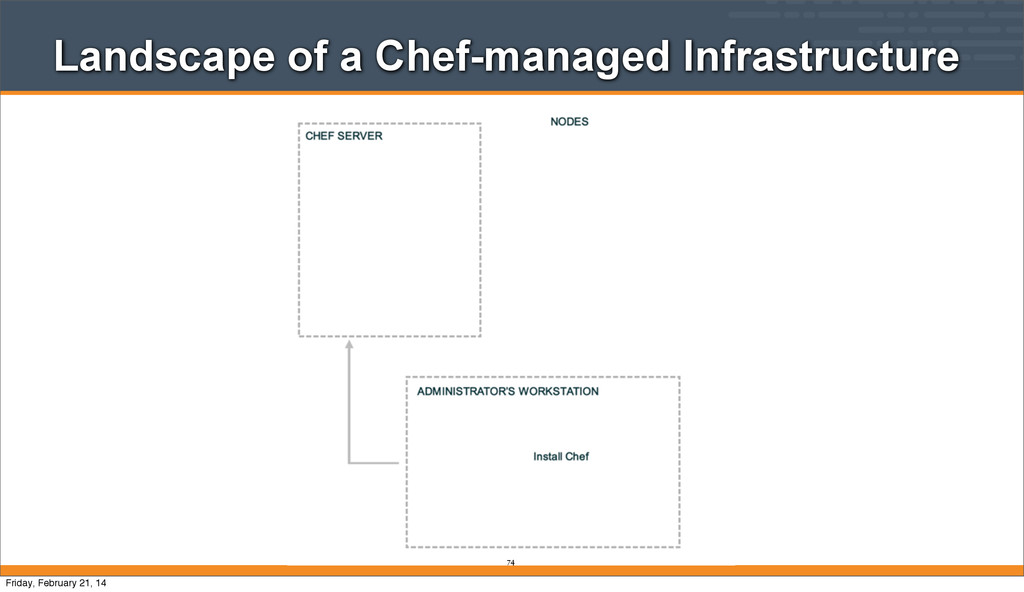
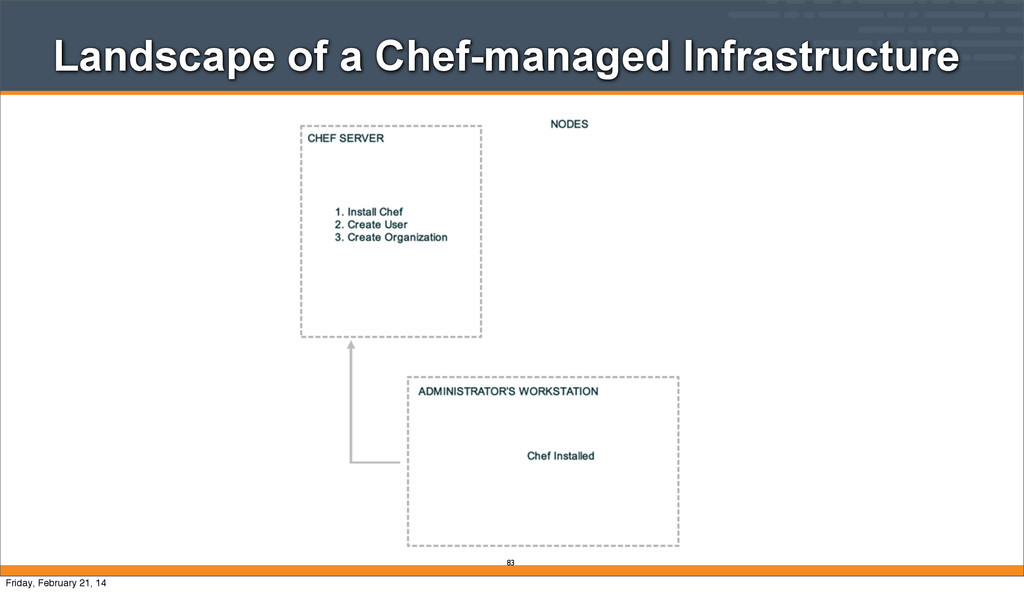
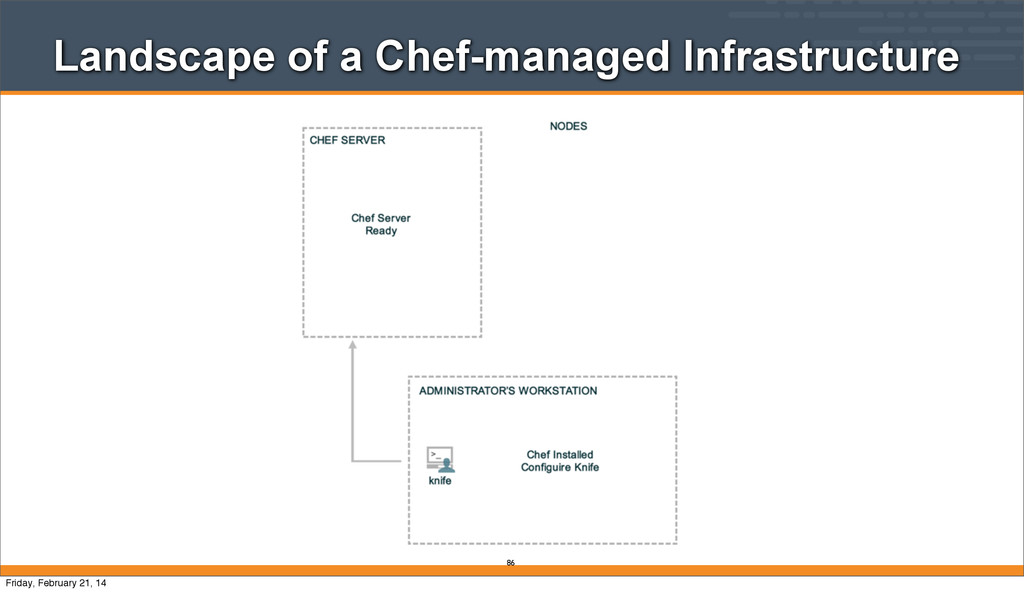
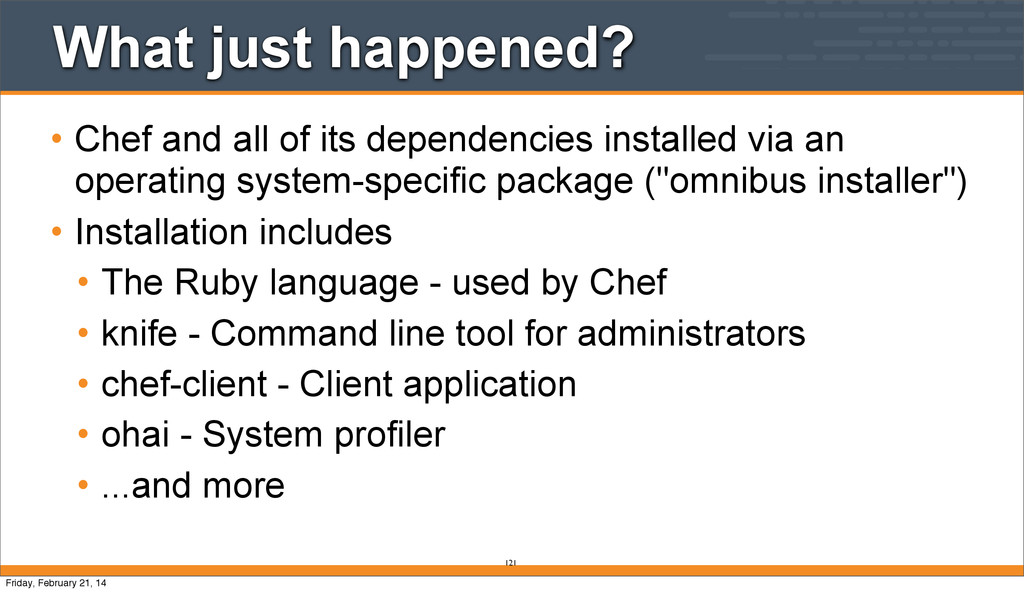
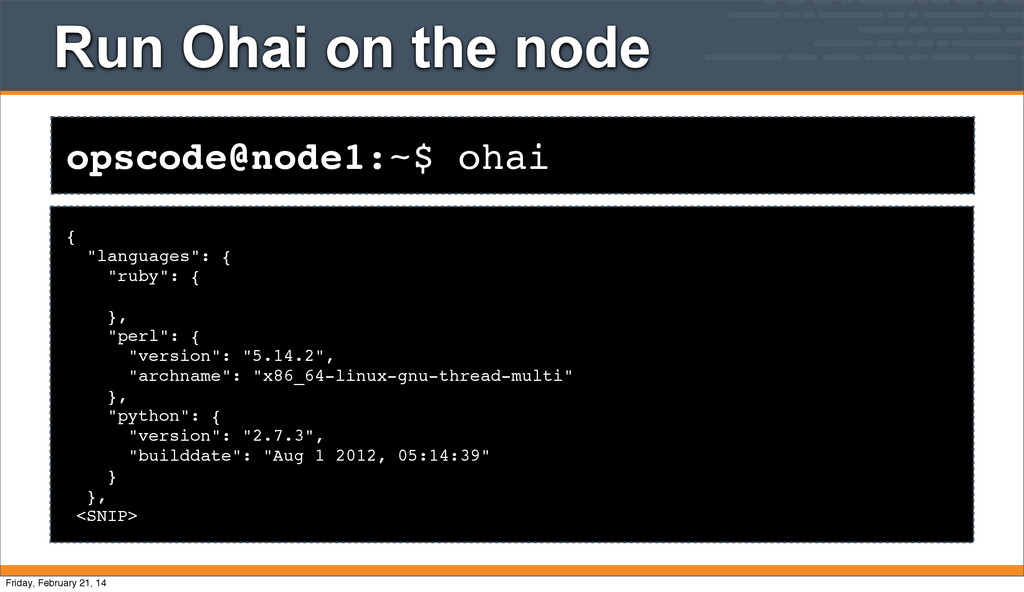
installed via an operating system-specific package ("omnibus installer") • Installation includes • The Ruby language - used by Chef • knife - Command line tool for administrators • chef-client - Client application • ohai - System profiler • ...and more 82 Friday, February 21, 14
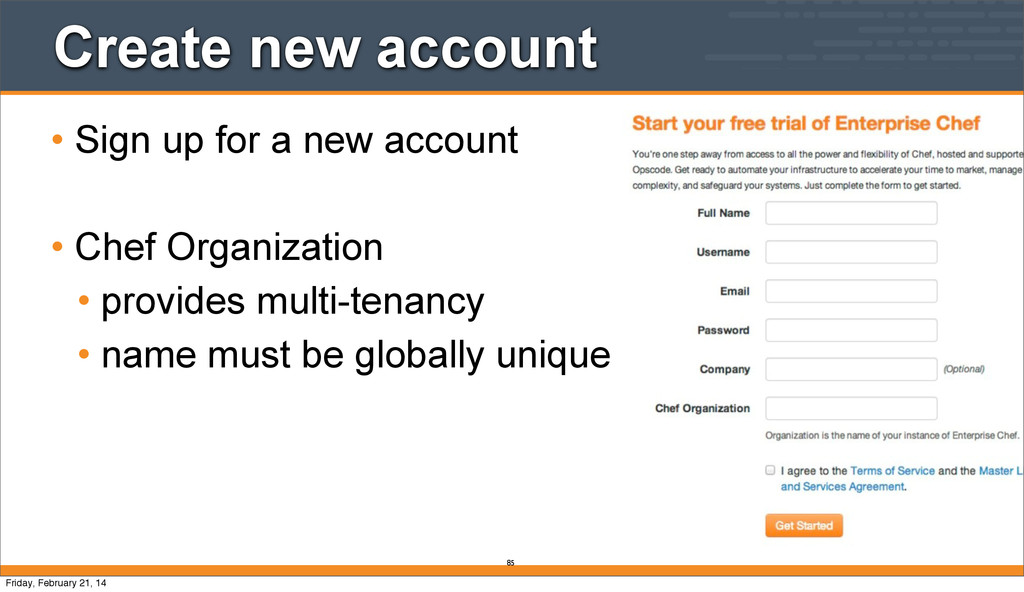
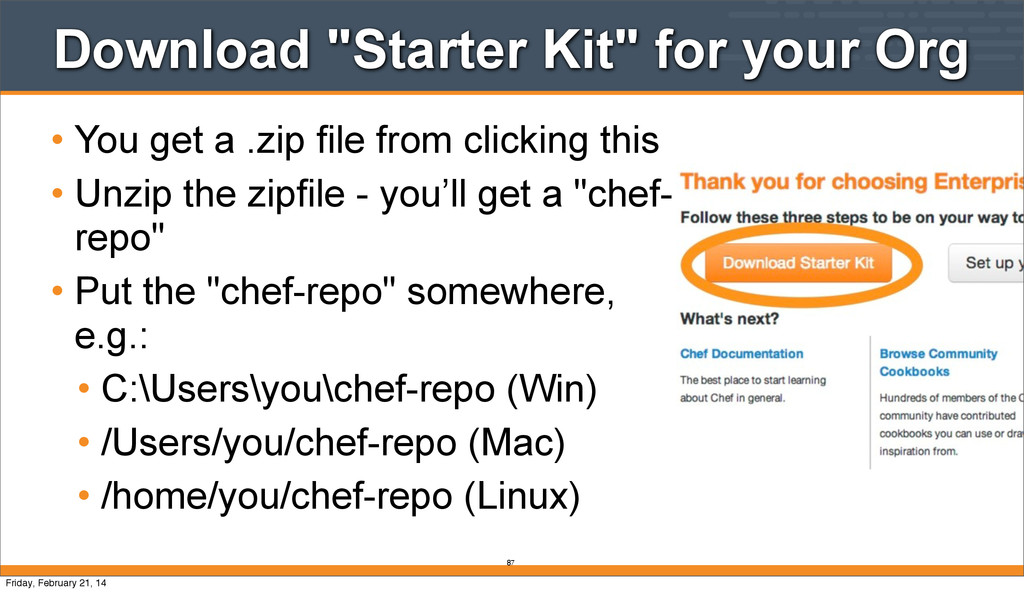
.zip file from clicking this • Unzip the zipfile - you’ll get a "chef- repo" • Put the "chef-repo" somewhere, e.g.: • C:\Users\you\chef-repo (Win) • /Users/you/chef-repo (Mac) • /home/you/chef-repo (Linux) 87 Friday, February 21, 14
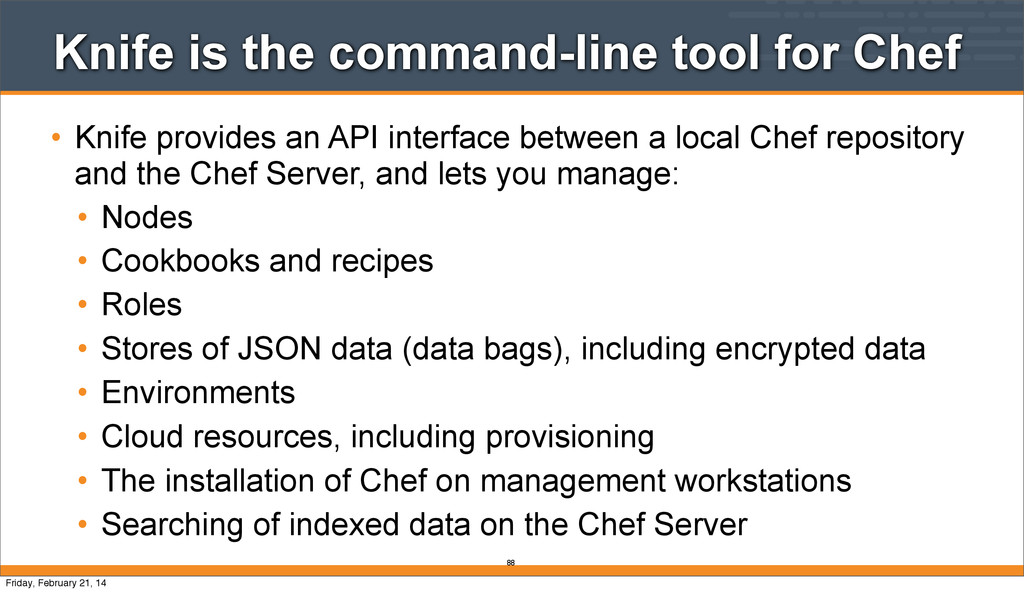
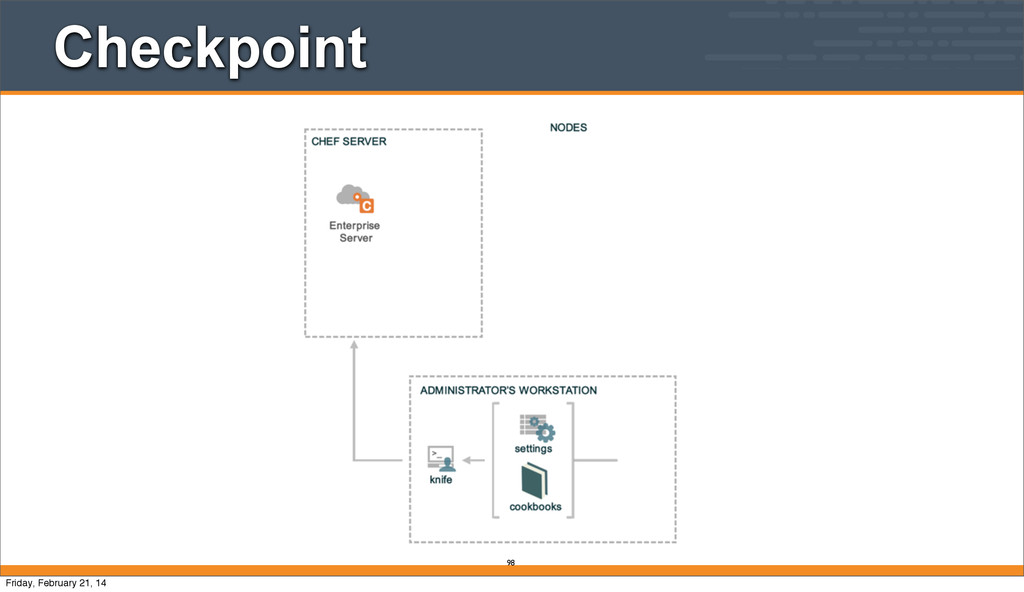
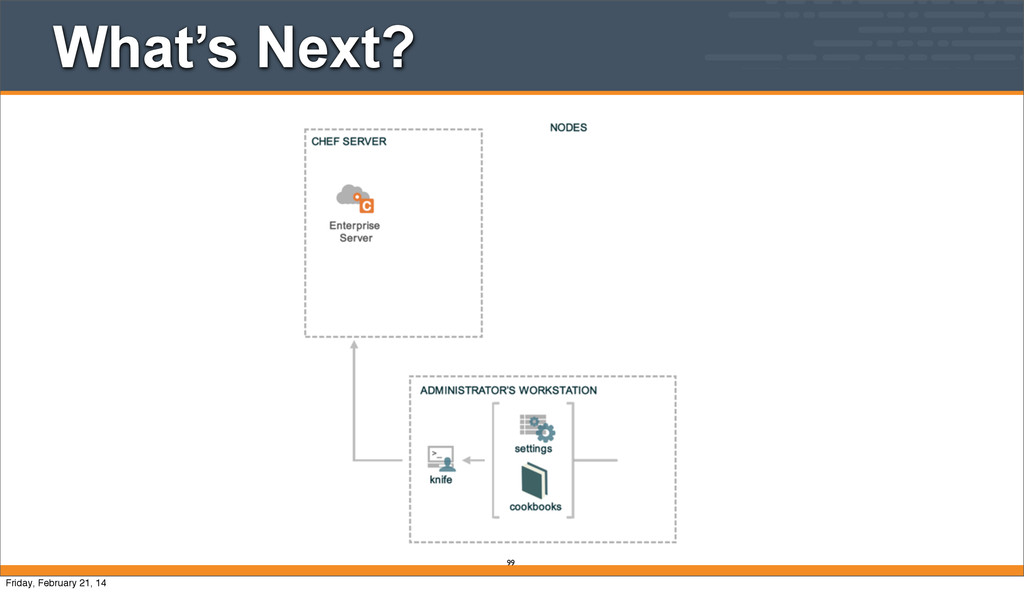
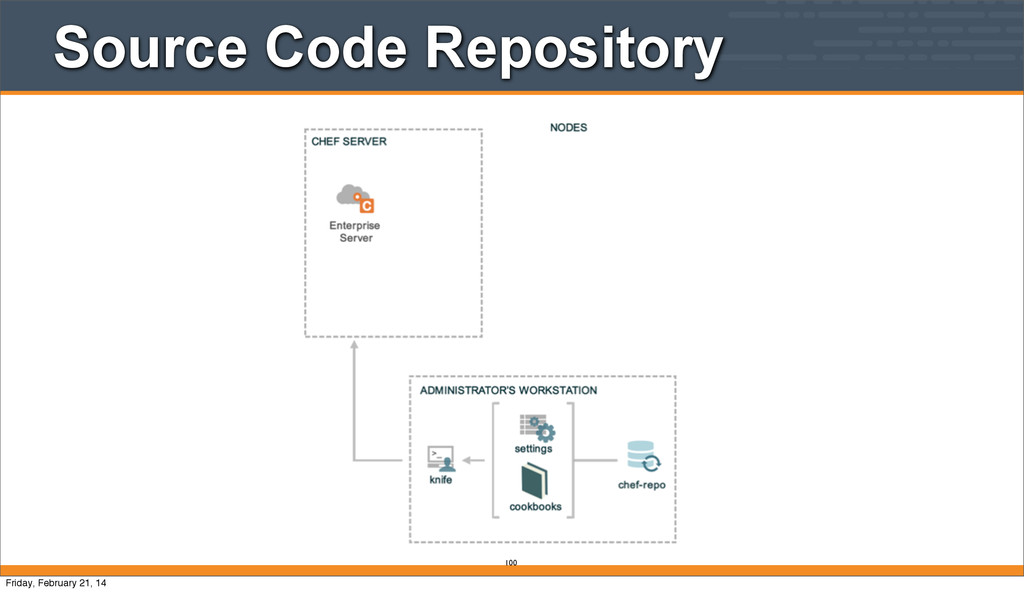
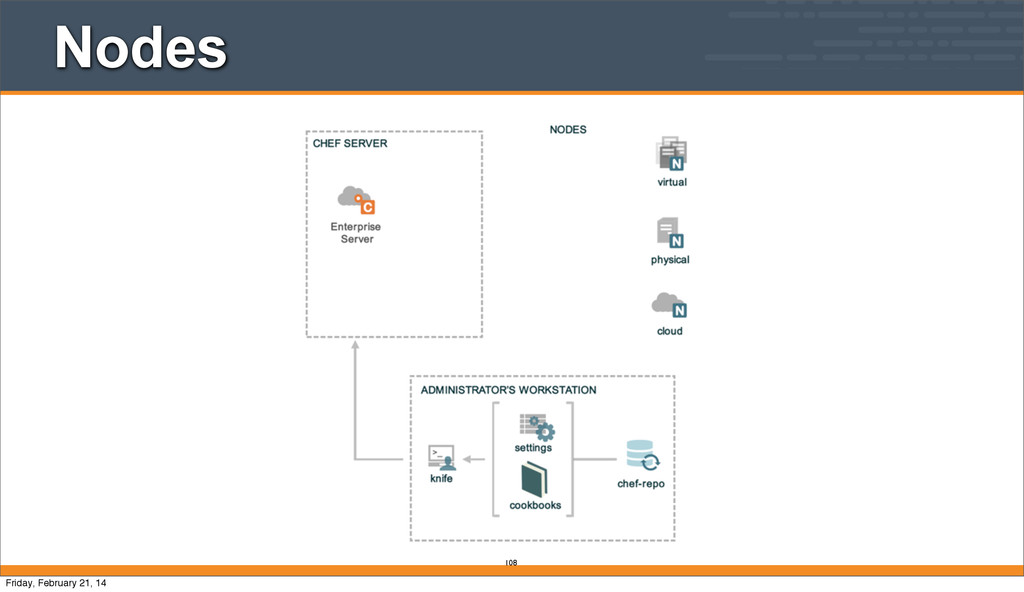
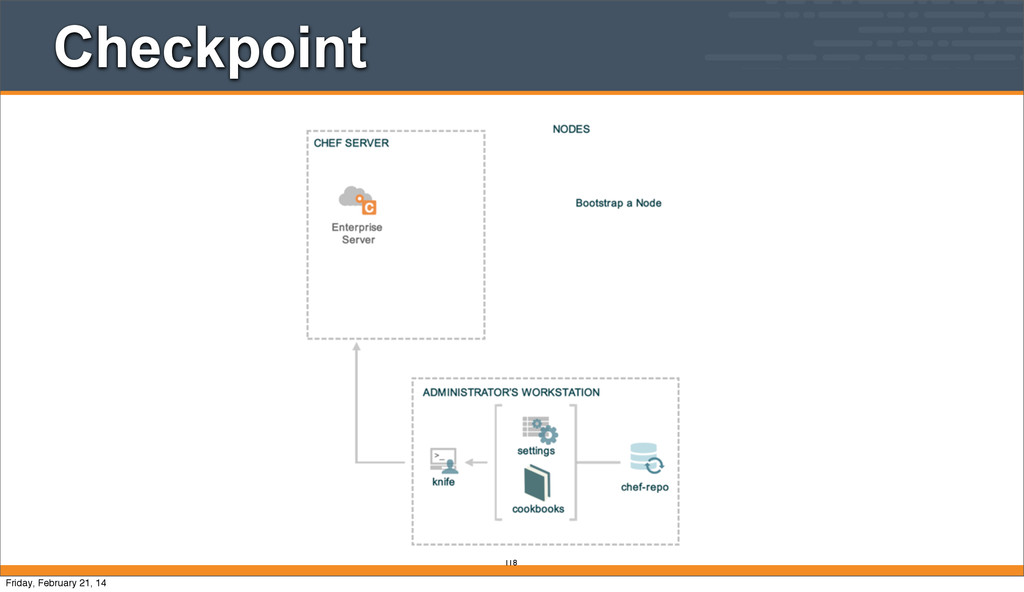
an API interface between a local Chef repository and the Chef Server, and lets you manage: • Nodes • Cookbooks and recipes • Roles • Stores of JSON data (data bags), including encrypted data • Environments • Cloud resources, including provisioning • The installation of Chef on management workstations • Searching of indexed data on the Chef Server 88 Friday, February 21, 14
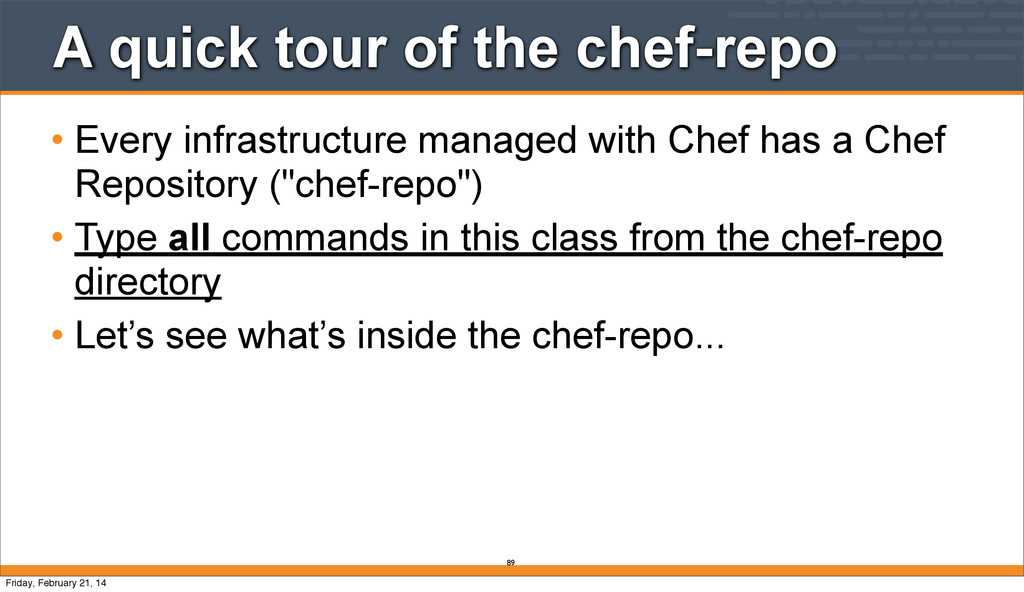
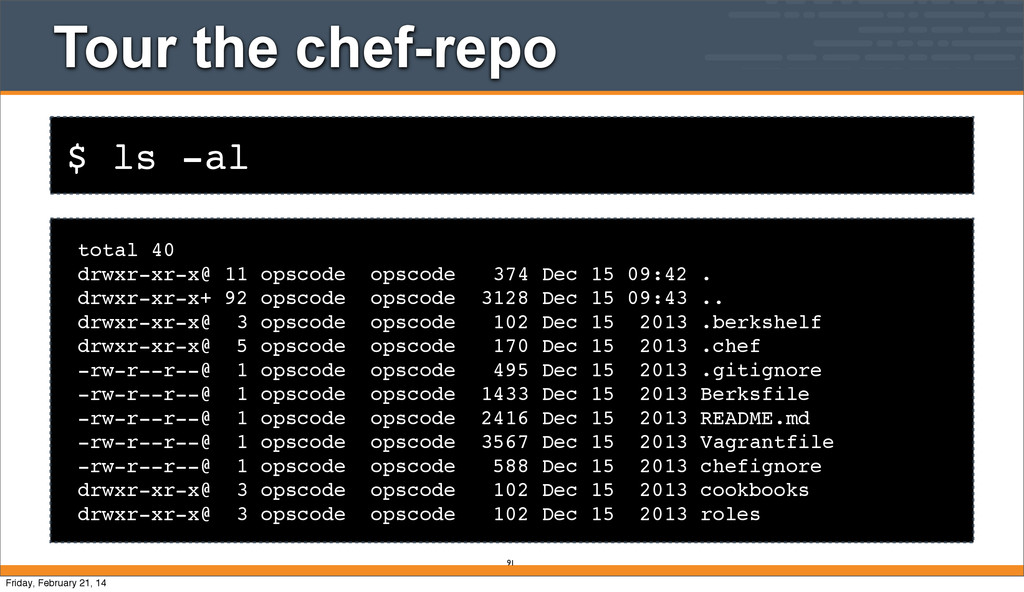
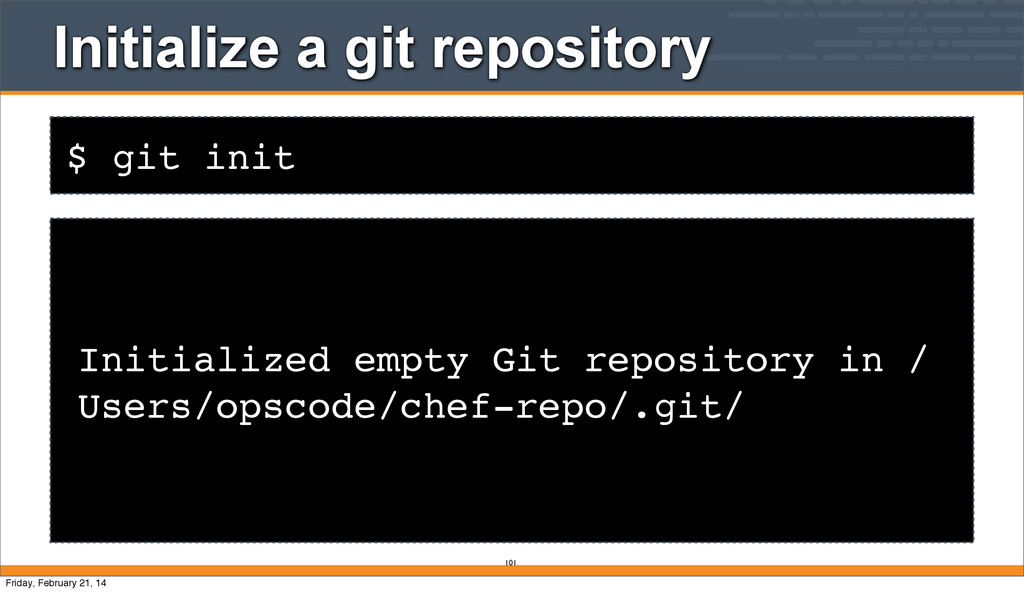
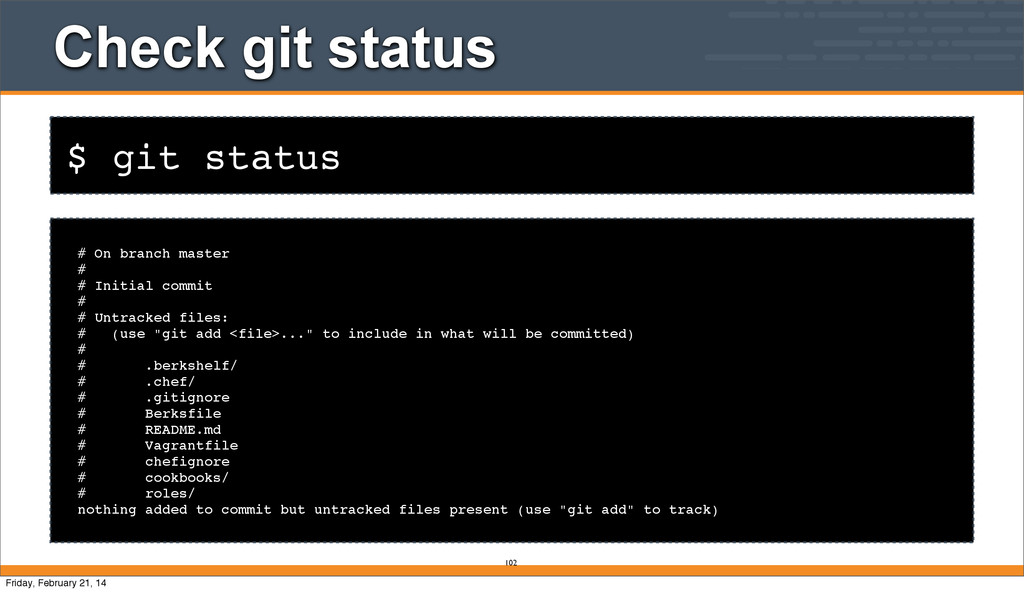
with Chef has a Chef Repository ("chef-repo") • Type all commands in this class from the chef-repo directory • Let’s see what’s inside the chef-repo... 89 Friday, February 21, 14
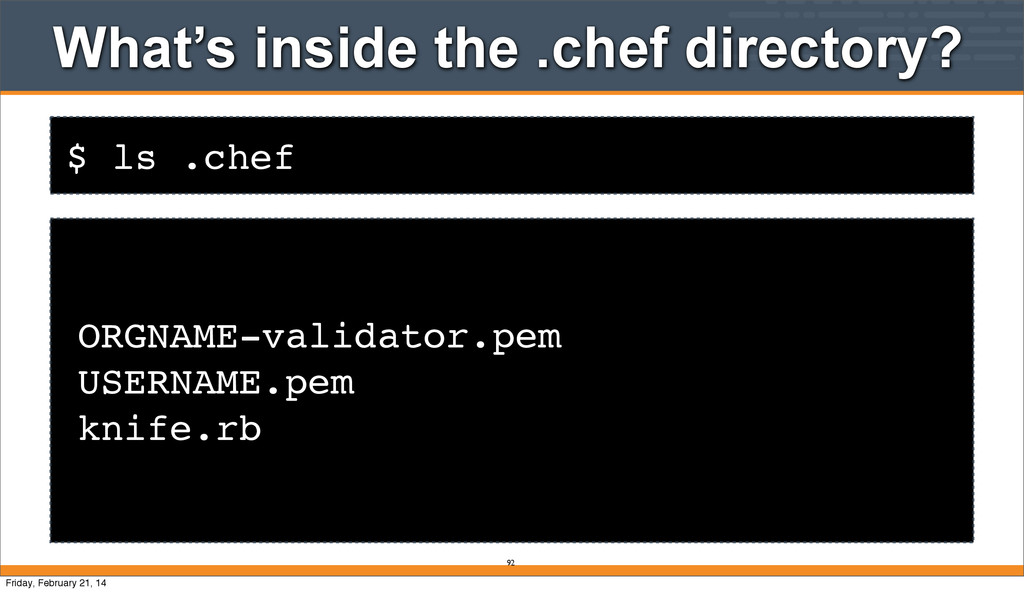
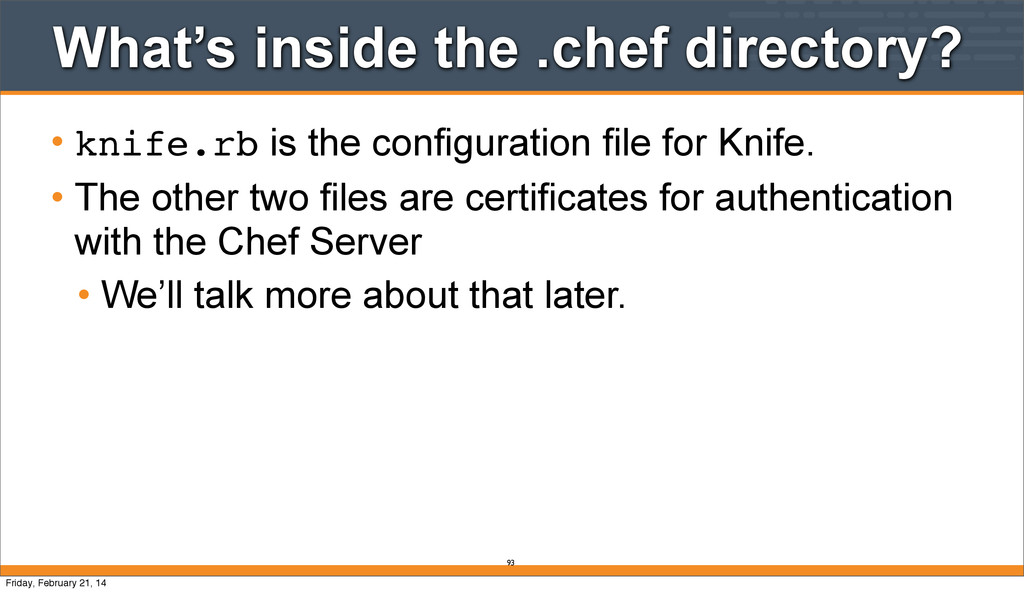
file for Knife. • The other two files are certificates for authentication with the Chef Server • We’ll talk more about that later. 93 Friday, February 21, 14
or equivalent • Chef is about Infrastructure as Code • People who code for a living use text editors that are designed for the task • Vim, Emacs, Sublime Text, Notepad++, etc. 95 Friday, February 21, 14
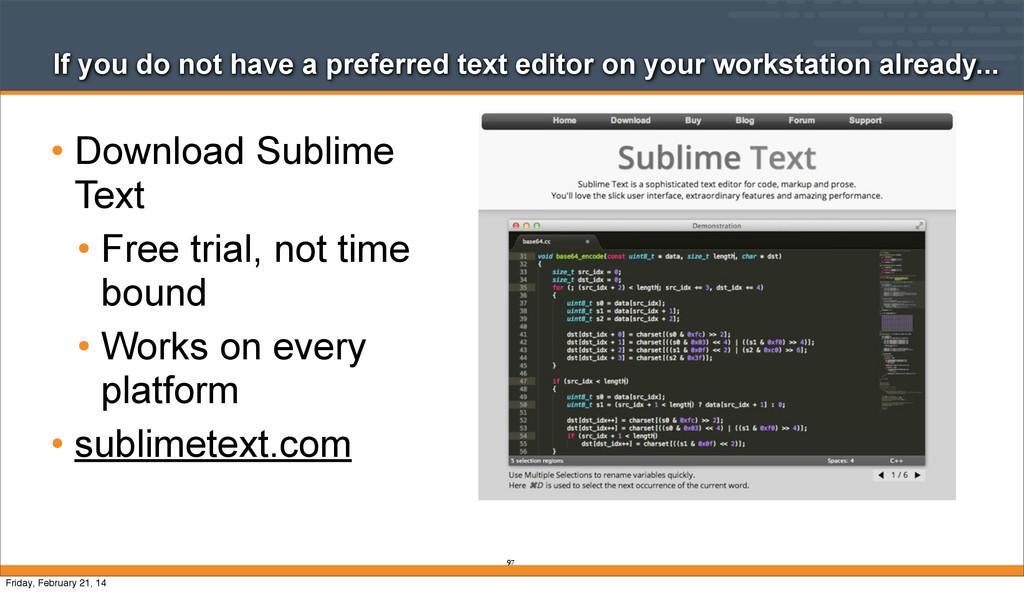
your workstation already... • Download Sublime Text • Free trial, not time bound • Works on every platform • sublimetext.com 97 Friday, February 21, 14
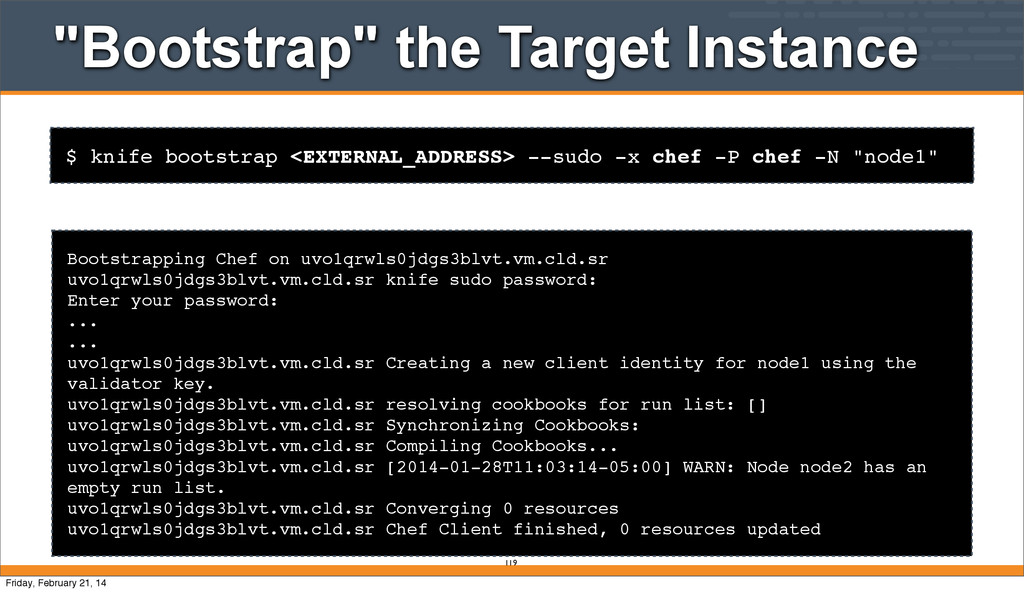
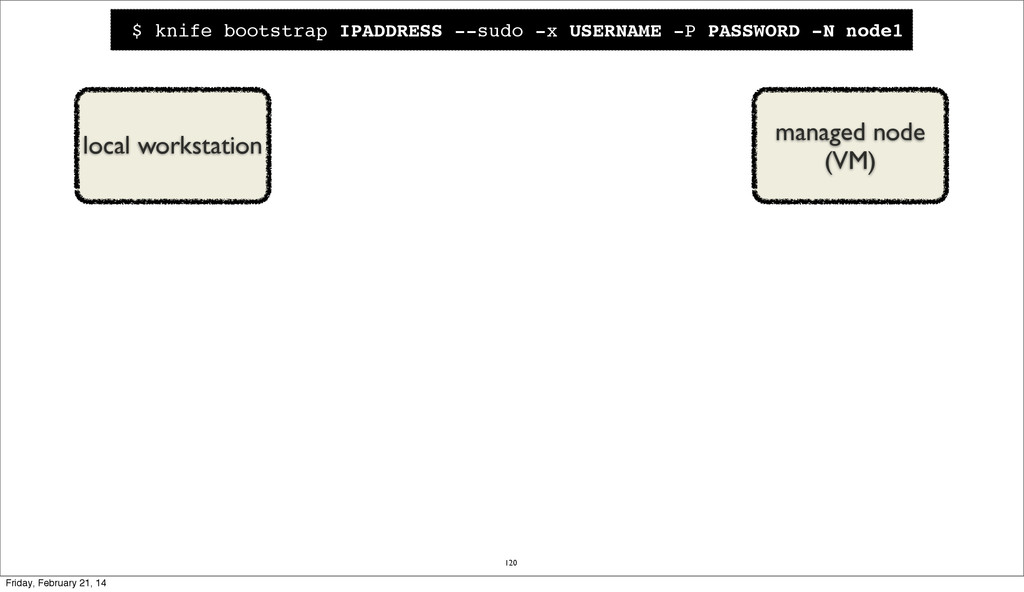
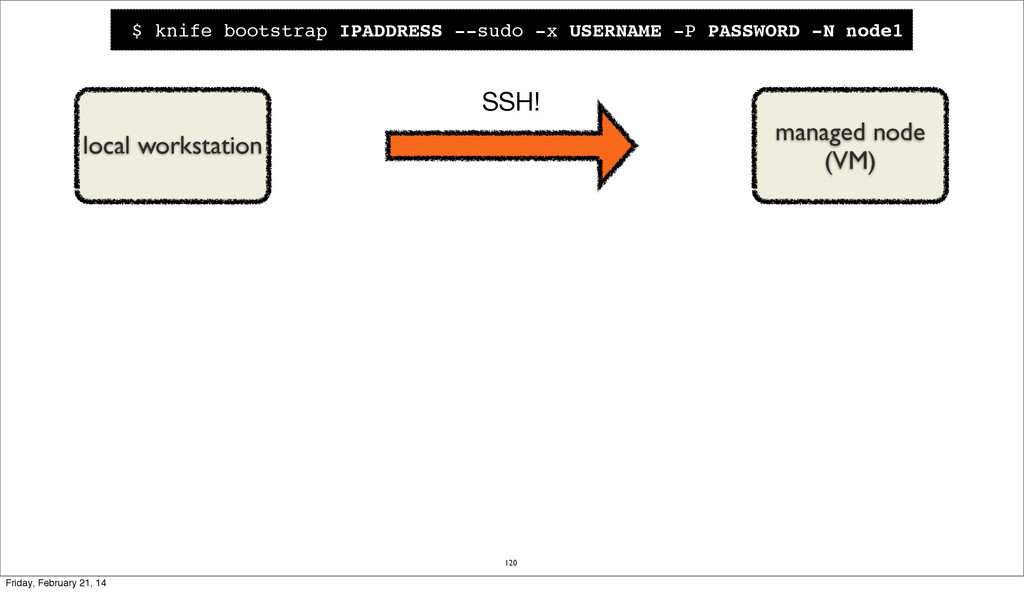
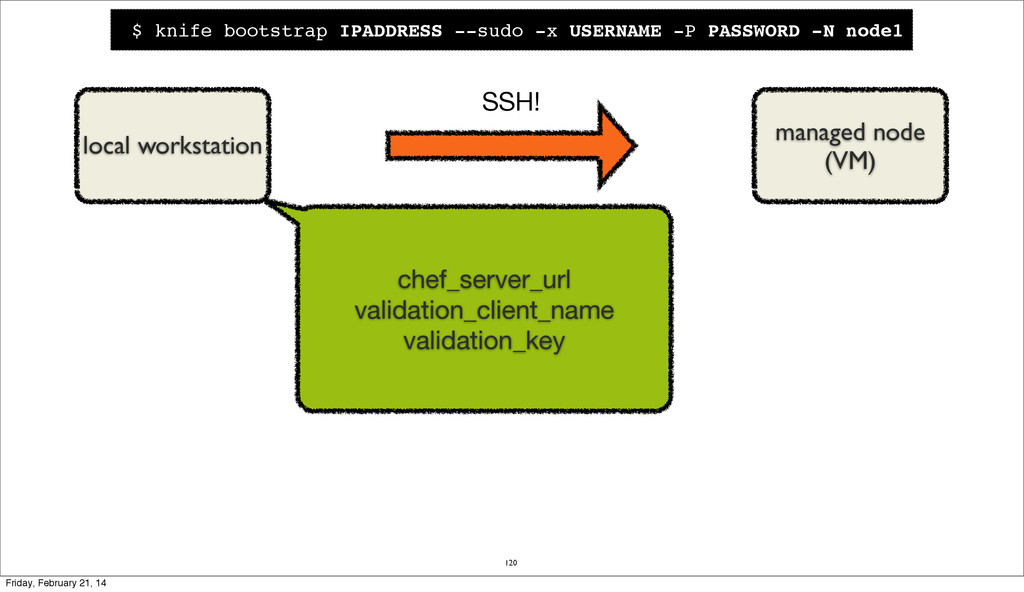
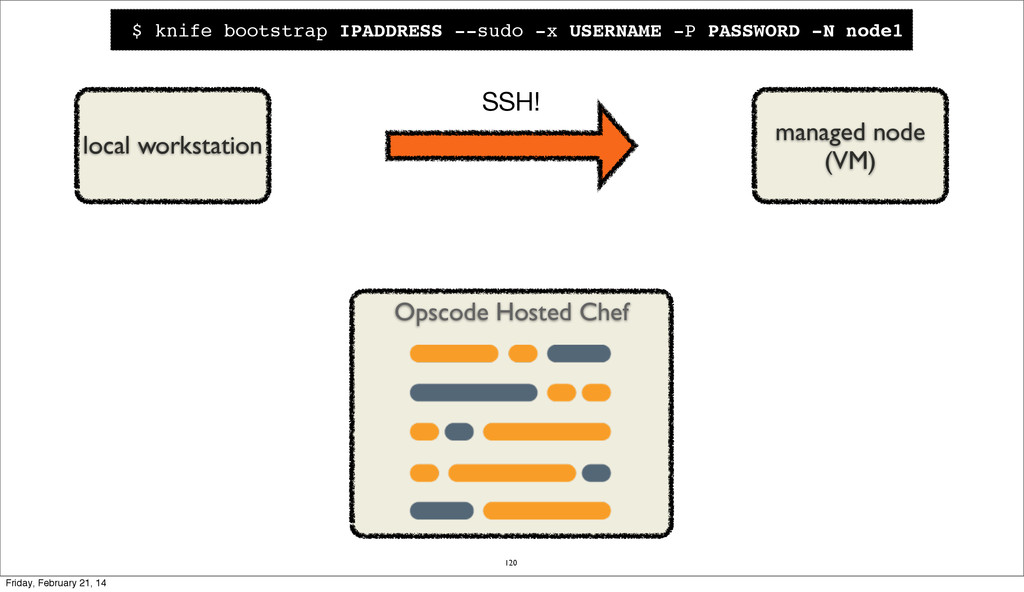
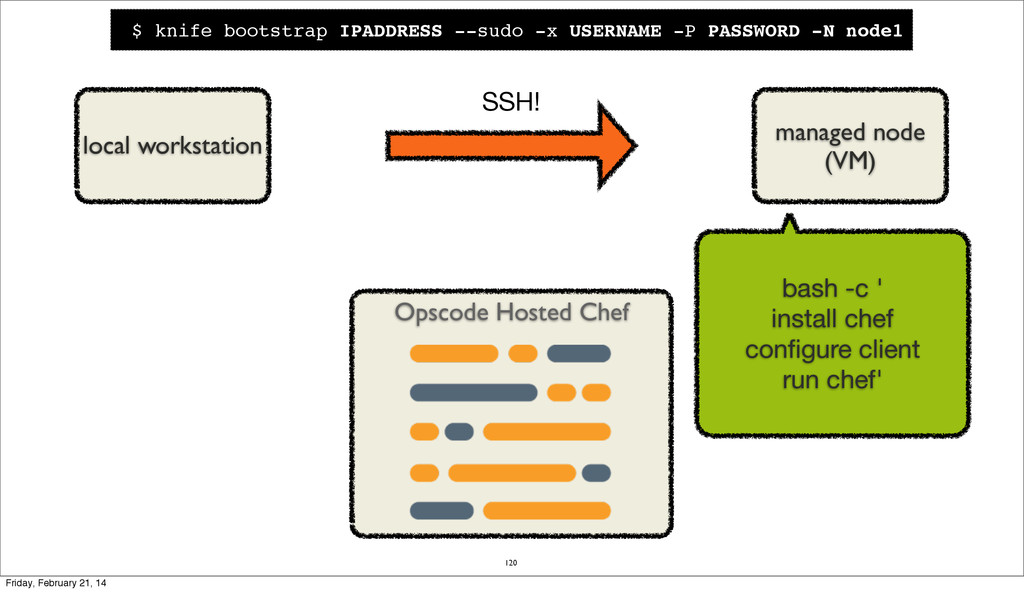
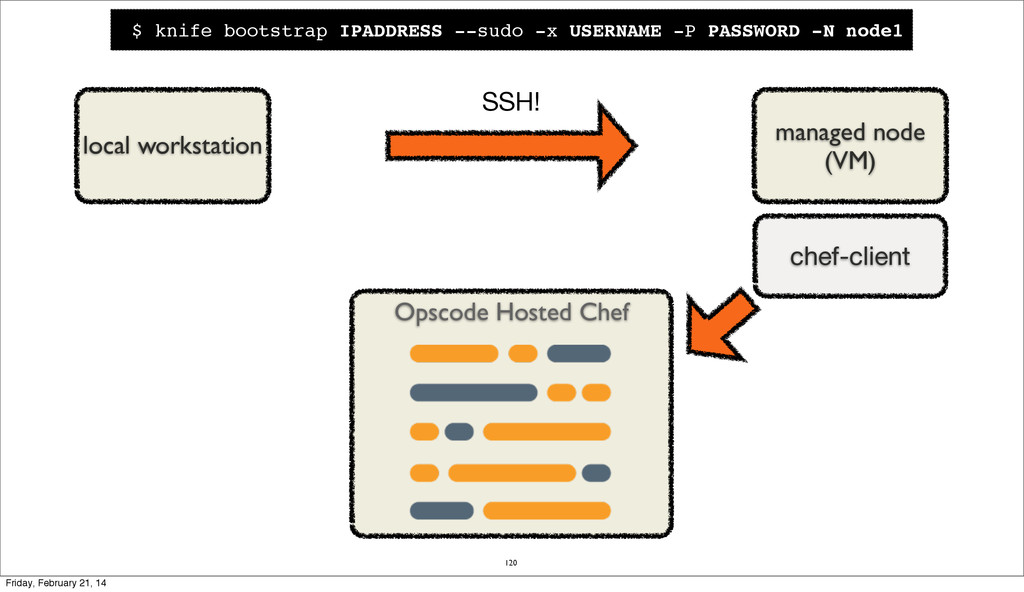
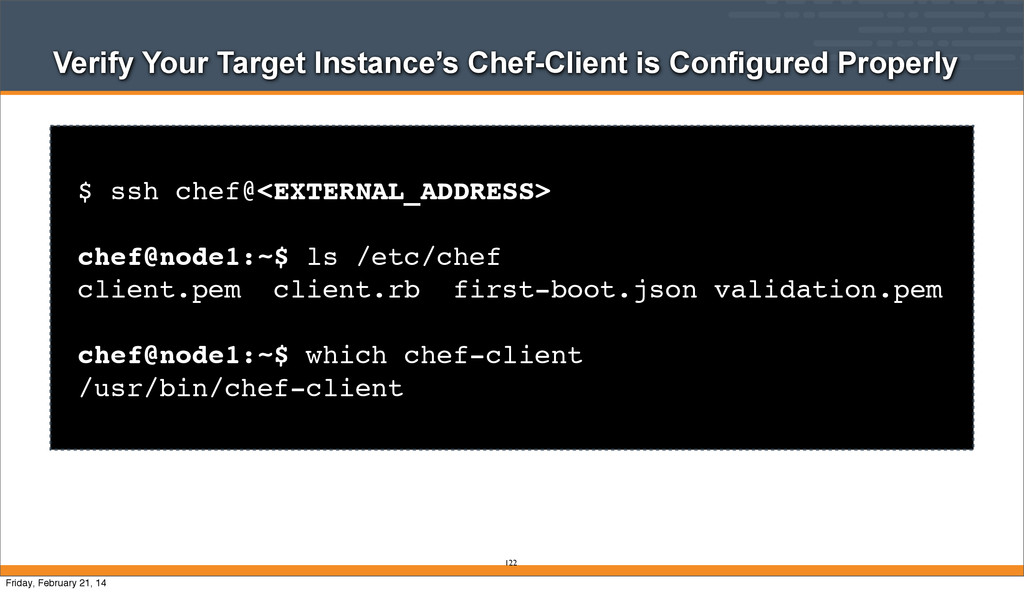
able to • Install Chef nodes using "knife bootstrap" • Explain how knife bootstrap configures a node to use the Organization created in the previous section • Explain the basic configuration needed to run chef- client 107 Friday, February 21, 14
'uvo1qrwls0jdgs3blvt.vm.cld.sr (69.195.232.110)' can't be established. RSA key fingerprint is d9:95:a3:b9:02:27:e9:cd: 74:e4:a2:34:23:f5:a6:8b. Are you sure you want to continue connecting (yes/no)? yes Warning: Permanently added 'uvo1qrwls0jdgs3blvt.vm.cld.sr, 69.195.232.110' (RSA) to the list of known hosts. [email protected]'s password: Last login: Mon Jan 6 16:26:24 2014 from host86-145-117-53.range86-145.btcentralplus.com [chef@CentOS63 ~]$ 116 Friday, February 21, 14
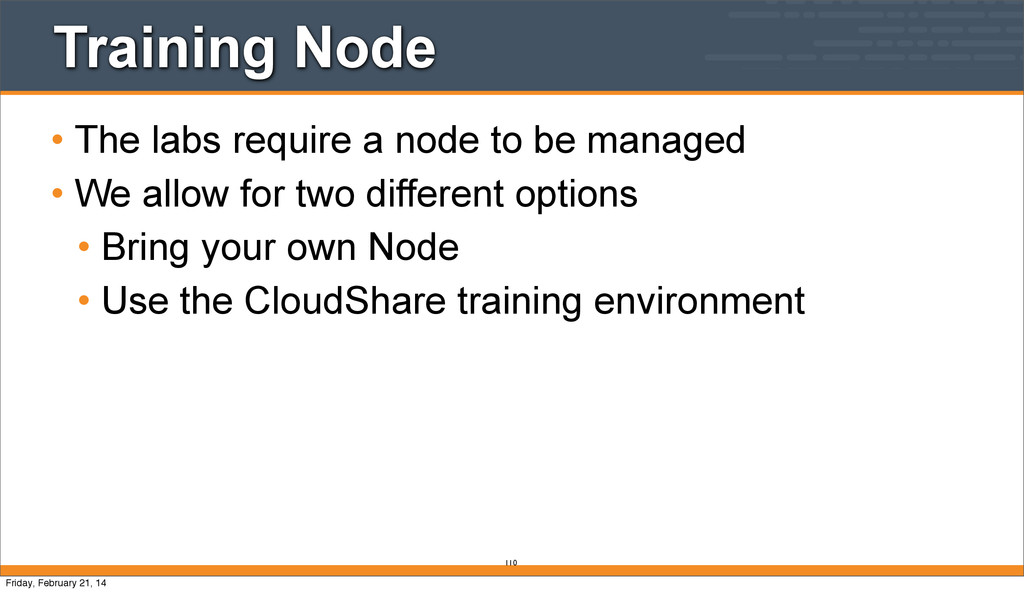
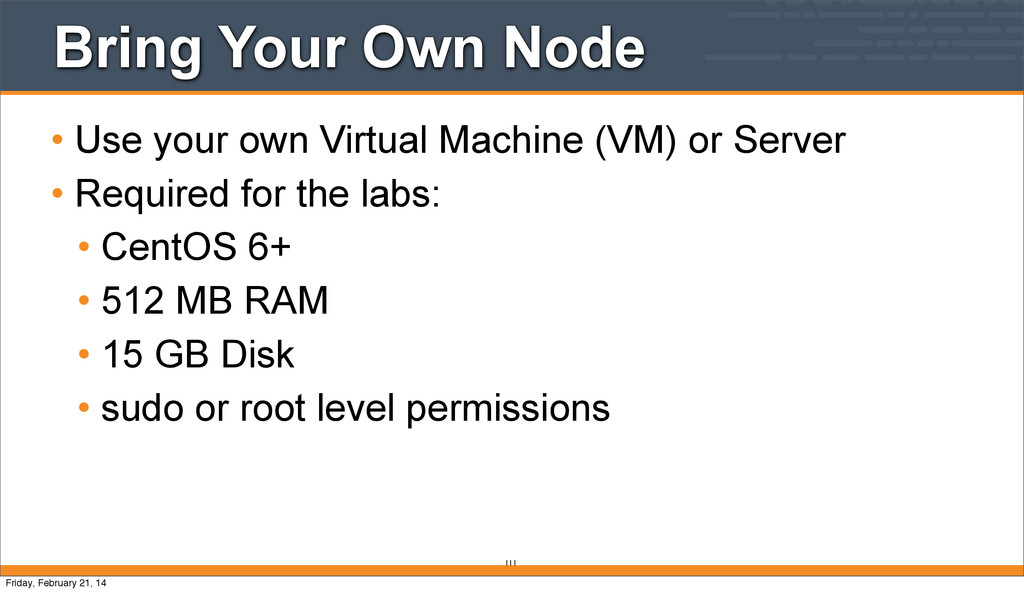
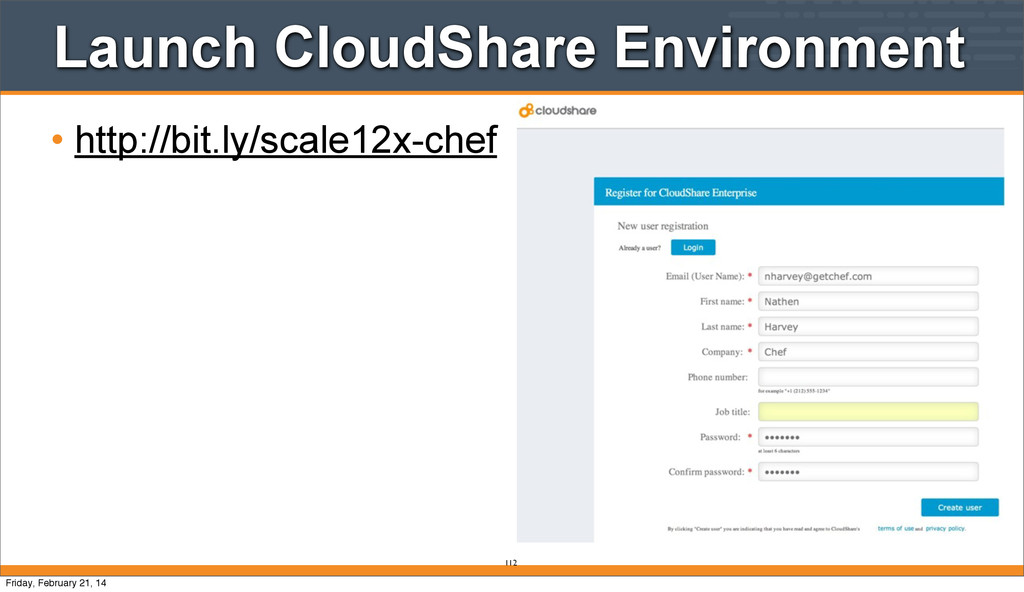
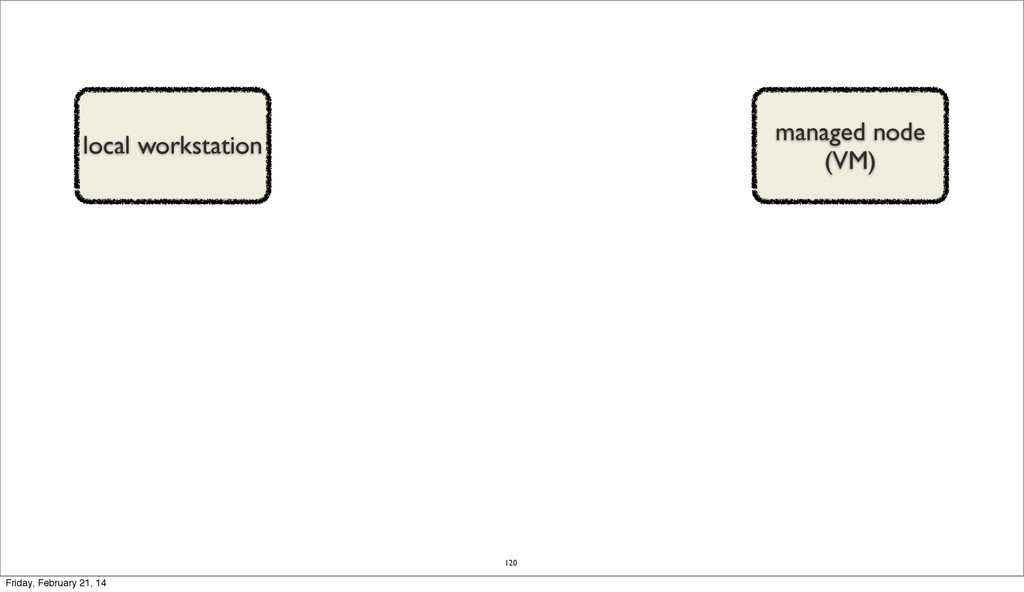
virtual machine (VM) or server that you’ll use for the lab exercises • The IP address or public hostname • An application for establishing an ssh connection • 'sudo' or 'root' permissions on the VM 117 Friday, February 21, 14
"node1" "Bootstrap" the Target Instance Bootstrapping Chef on uvo1qrwls0jdgs3blvt.vm.cld.sr uvo1qrwls0jdgs3blvt.vm.cld.sr knife sudo password: Enter your password: ... ... uvo1qrwls0jdgs3blvt.vm.cld.sr Creating a new client identity for node1 using the validator key. uvo1qrwls0jdgs3blvt.vm.cld.sr resolving cookbooks for run list: [] uvo1qrwls0jdgs3blvt.vm.cld.sr Synchronizing Cookbooks: uvo1qrwls0jdgs3blvt.vm.cld.sr Compiling Cookbooks... uvo1qrwls0jdgs3blvt.vm.cld.sr [2014-01-28T11:03:14-05:00] WARN: Node node2 has an empty run list. uvo1qrwls0jdgs3blvt.vm.cld.sr Converging 0 resources uvo1qrwls0jdgs3blvt.vm.cld.sr Chef Client finished, 0 resources updated 119 Friday, February 21, 14
installed via an operating system-specific package ("omnibus installer") • Installation includes • The Ruby language - used by Chef • knife - Command line tool for administrators • chef-client - Client application • ohai - System profiler • ...and more 121 Friday, February 21, 14
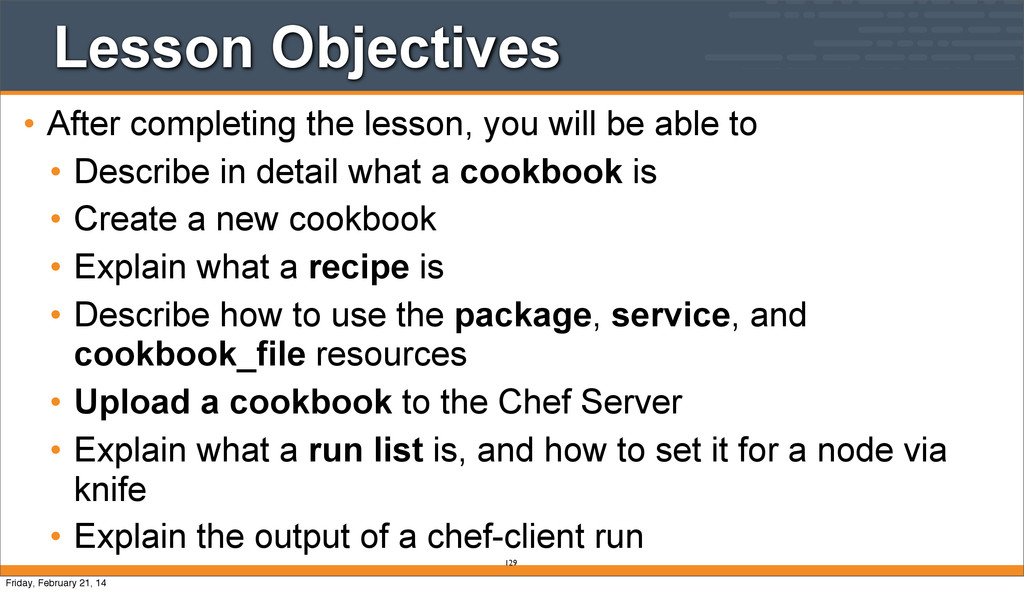
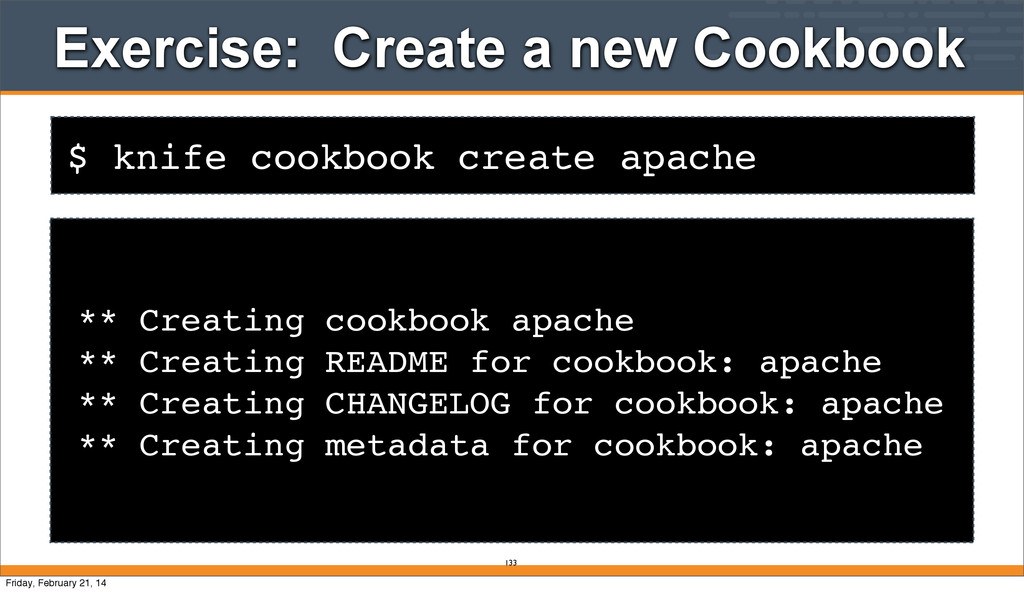
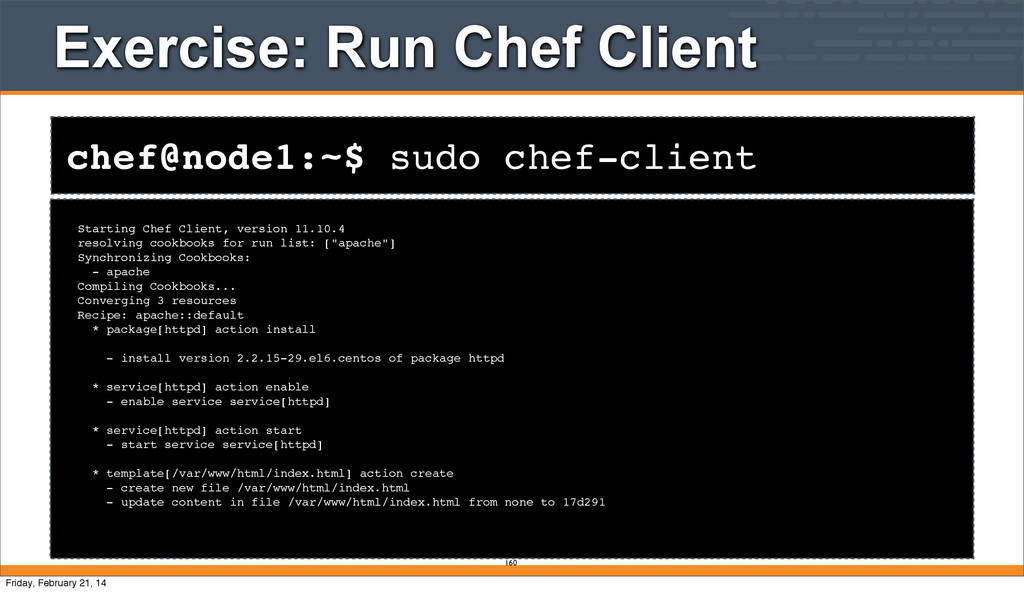
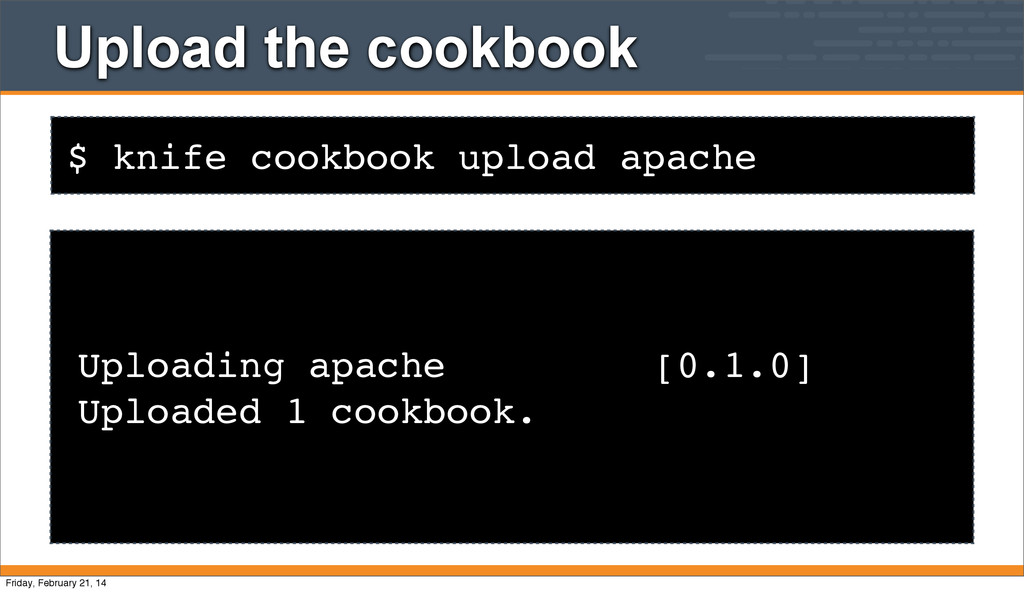
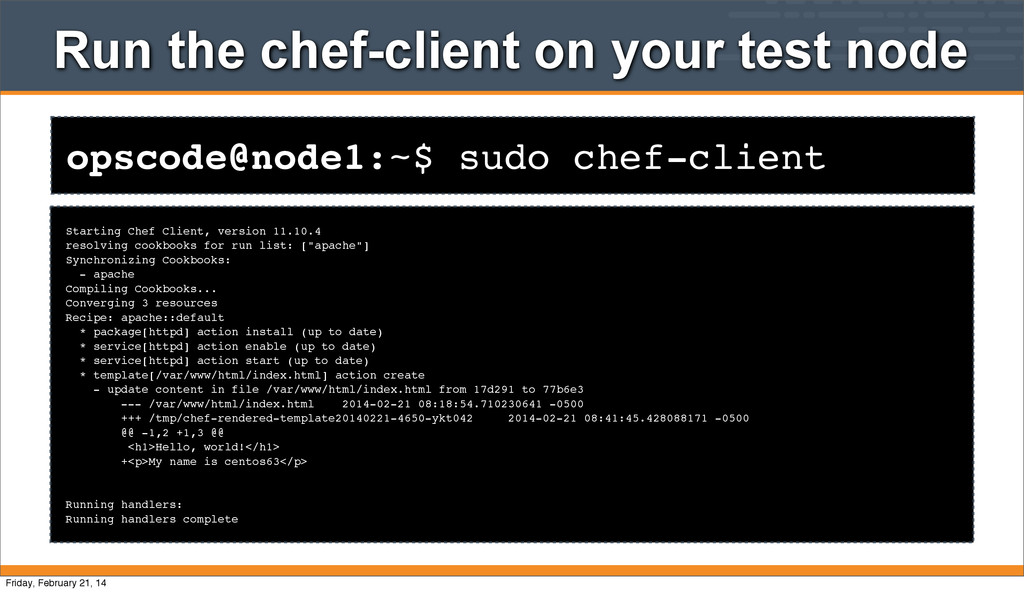
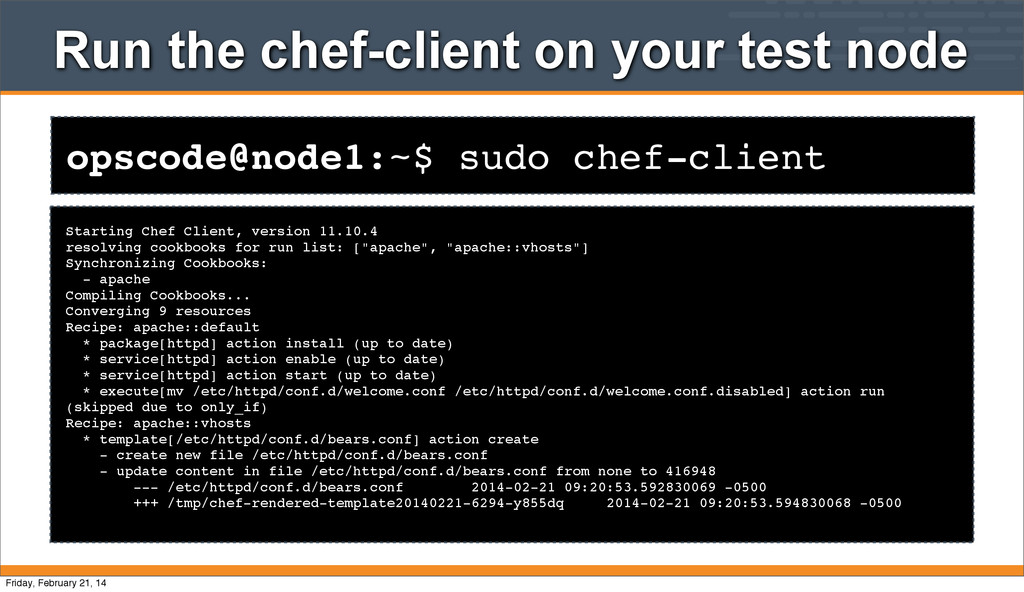
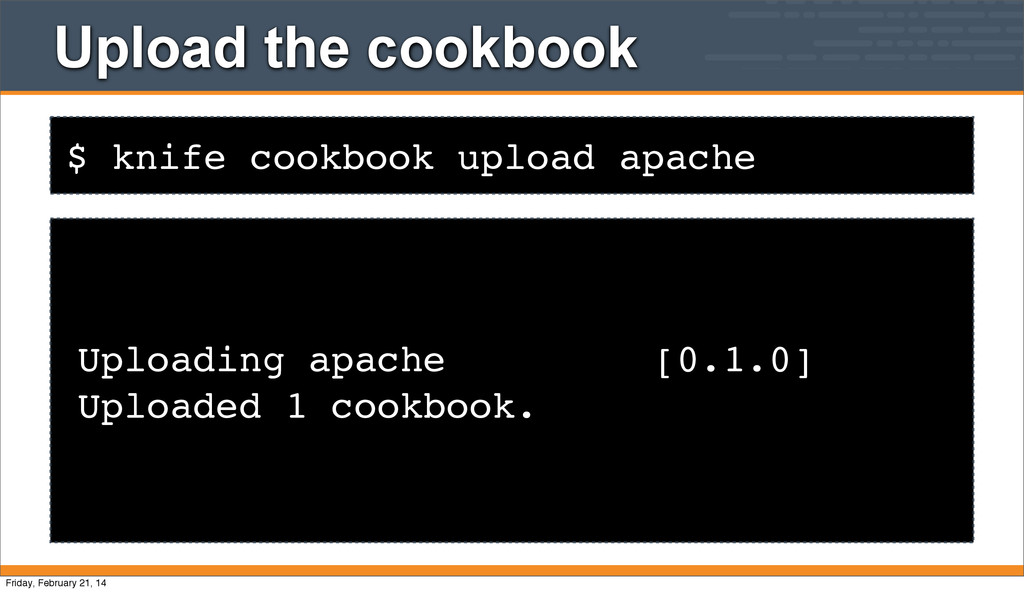
able to • Describe in detail what a cookbook is • Create a new cookbook • Explain what a recipe is • Describe how to use the package, service, and cookbook_file resources • Upload a cookbook to the Chef Server • Explain what a run list is, and how to set it for a node via knife • Explain the output of a chef-client run 129 Friday, February 21, 14
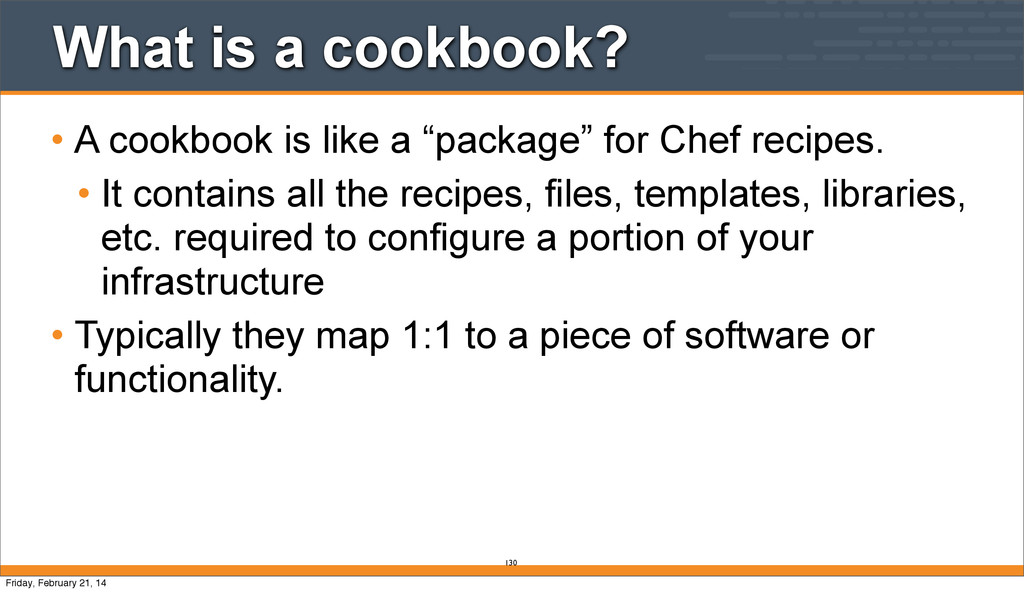
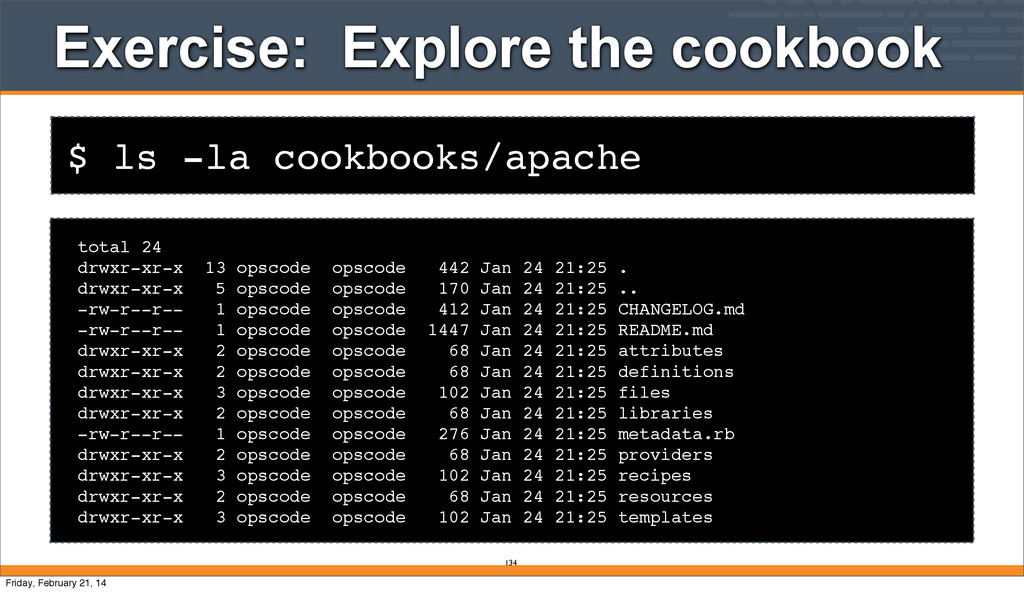
“package” for Chef recipes. • It contains all the recipes, files, templates, libraries, etc. required to configure a portion of your infrastructure • Typically they map 1:1 to a piece of software or functionality. 130 Friday, February 21, 14
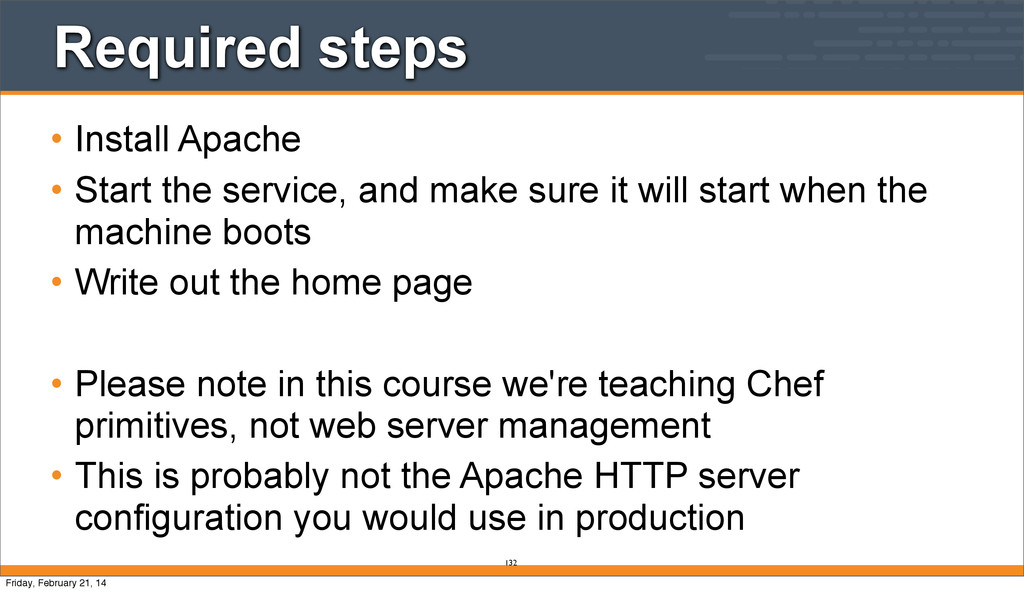
make sure it will start when the machine boots • Write out the home page • Please note in this course we're teaching Chef primitives, not web server management • This is probably not the Apache HTTP server configuration you would use in production 132 Friday, February 21, 14
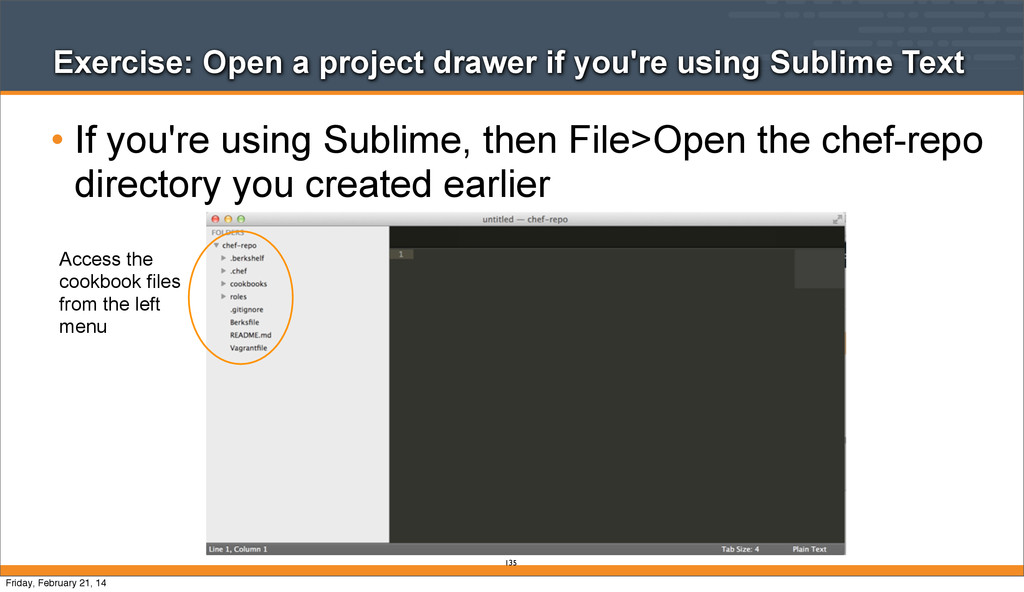
• If you're using Sublime, then File>Open the chef-repo directory you created earlier 135 Access the cookbook files from the left menu Friday, February 21, 14
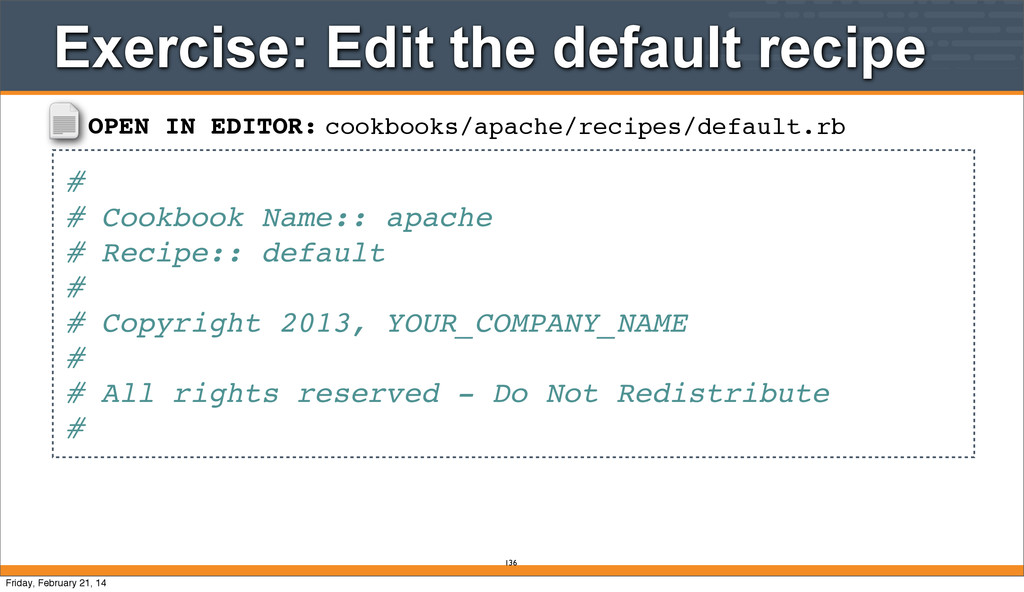
Recipe:: default # # Copyright 2013, YOUR_COMPANY_NAME # # All rights reserved - Do Not Redistribute # Exercise: Edit the default recipe 136 Friday, February 21, 14
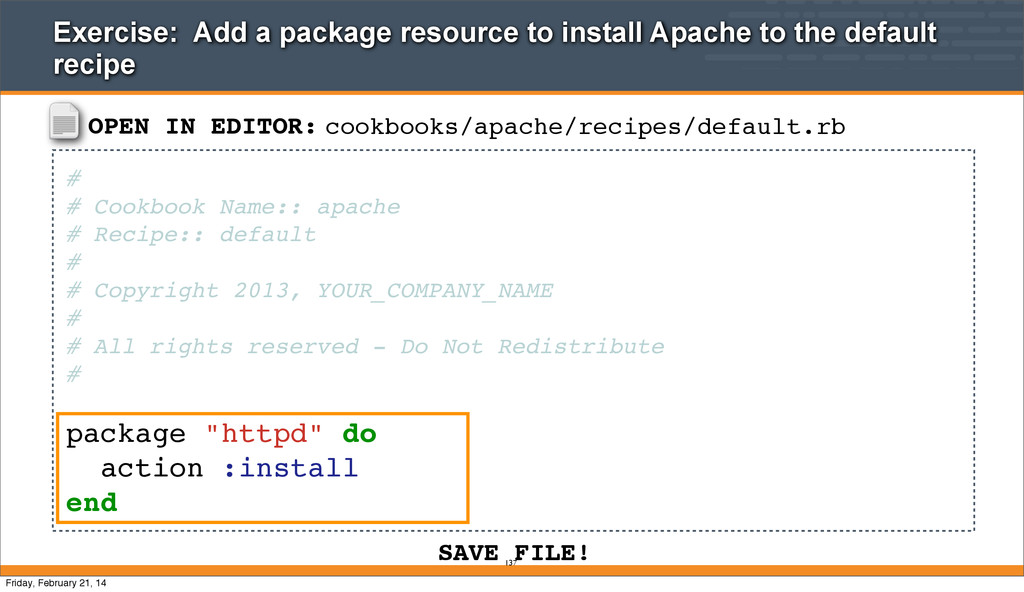
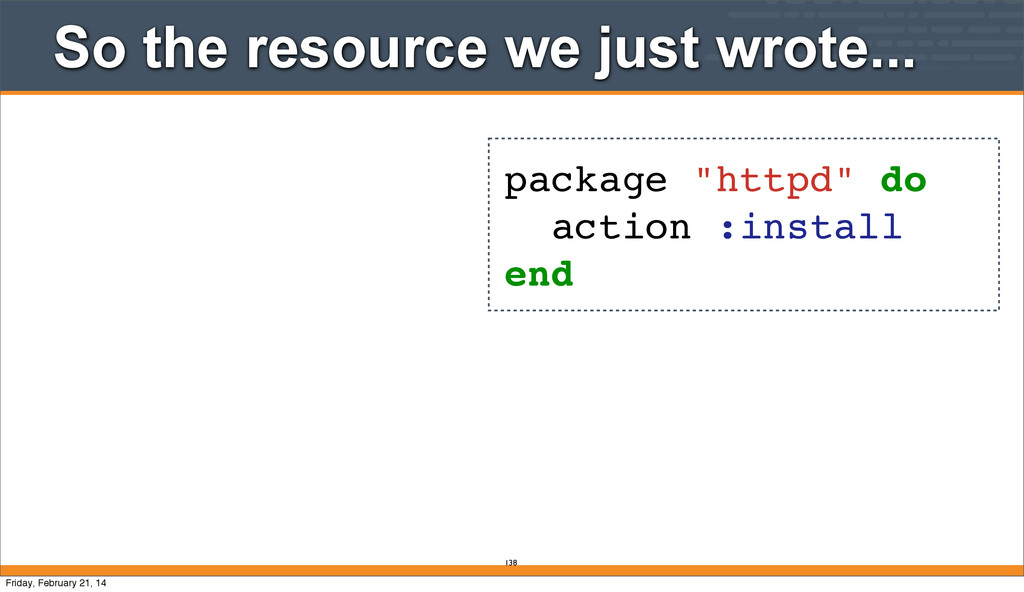
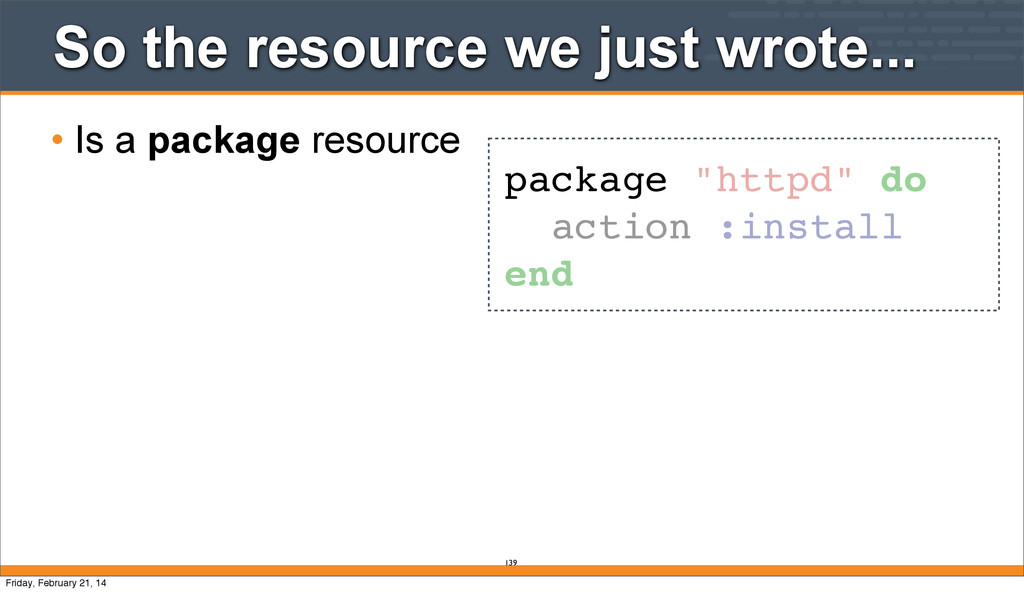
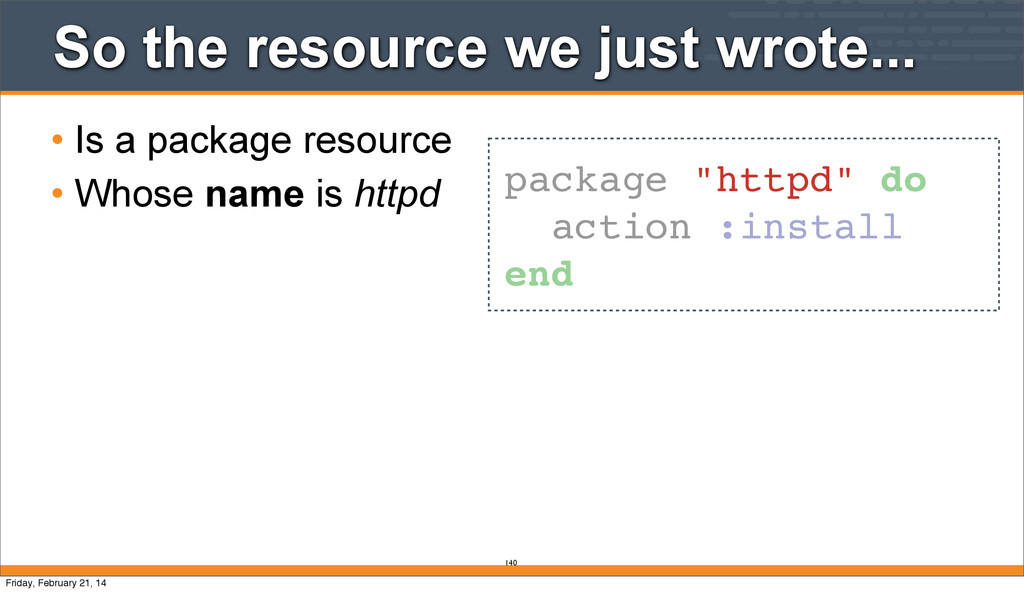
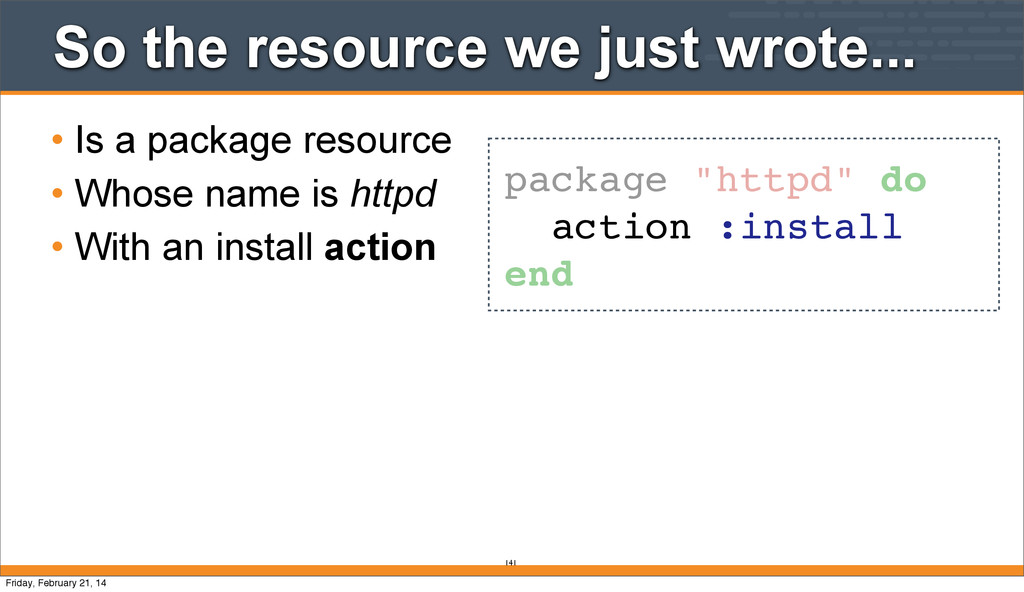
# # Copyright 2013, YOUR_COMPANY_NAME # # All rights reserved - Do Not Redistribute # package "httpd" do action :install end Exercise: Add a package resource to install Apache to the default recipe OPEN IN EDITOR: cookbooks/apache/recipes/default.rb 137 Friday, February 21, 14
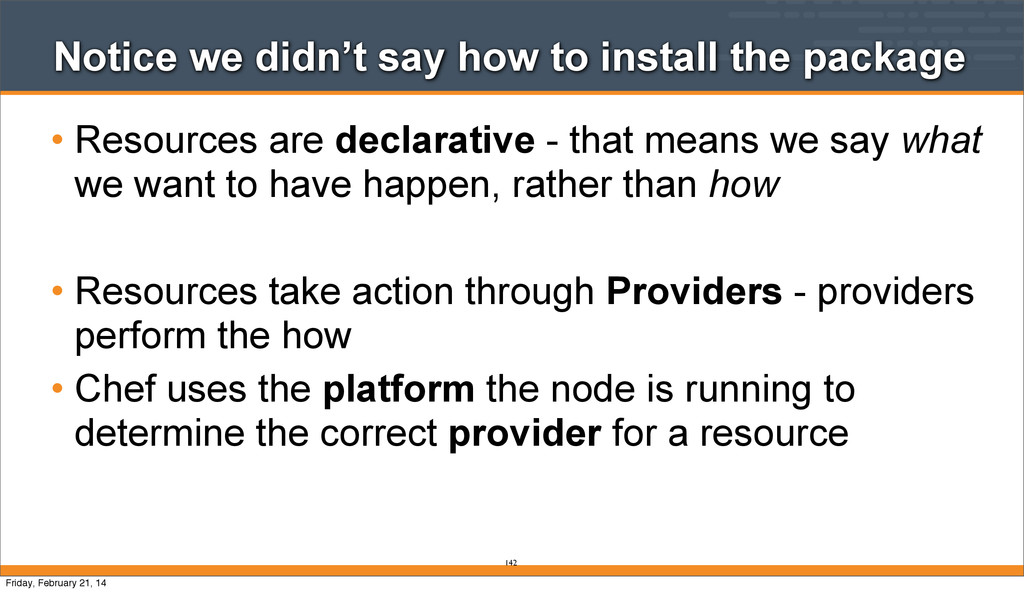
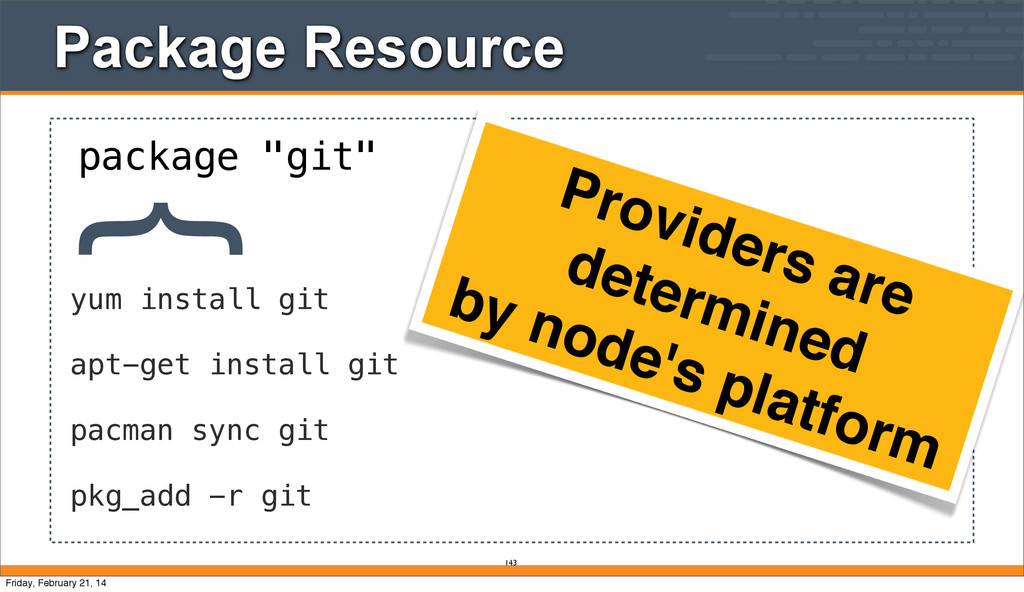
Resources are declarative - that means we say what we want to have happen, rather than how • Resources take action through Providers - providers perform the how • Chef uses the platform the node is running to determine the correct provider for a resource 142 Friday, February 21, 14
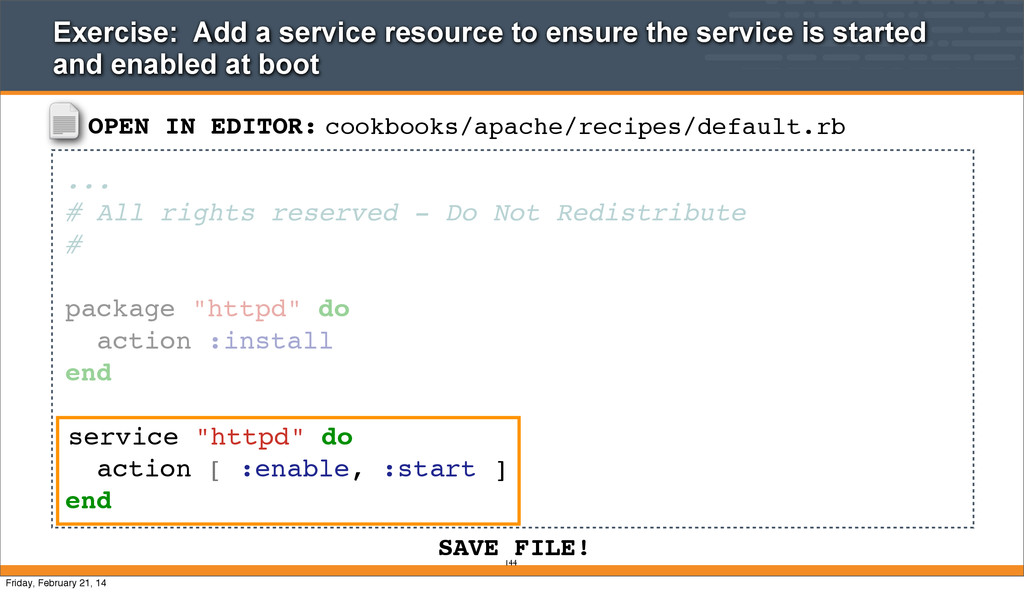
Redistribute # package "httpd" do action :install end service "httpd" do action [ :enable, :start ] end Exercise: Add a service resource to ensure the service is started and enabled at boot OPEN IN EDITOR: cookbooks/apache/recipes/default.rb 144 Friday, February 21, 14
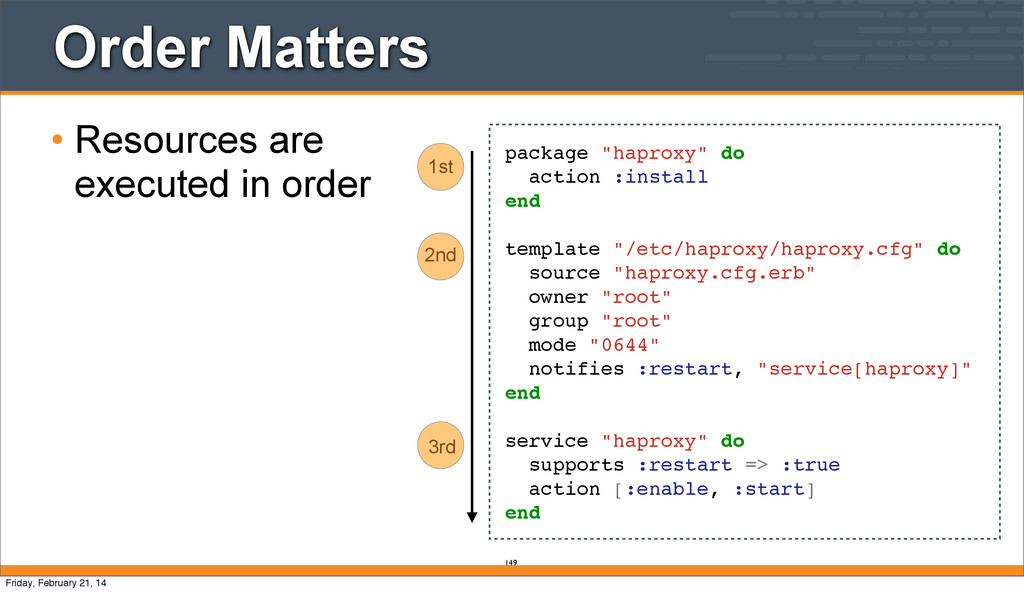
Level Three • Body Level Four • Body Level Five Order Matters package "haproxy" do action :install end template "/etc/haproxy/haproxy.cfg" do source "haproxy.cfg.erb" owner "root" group "root" mode "0644" notifies :restart, "service[haproxy]" end service "haproxy" do supports :restart => :true action [:enable, :start] end • Resources are executed in order 1st 2nd 3rd 149 Friday, February 21, 14
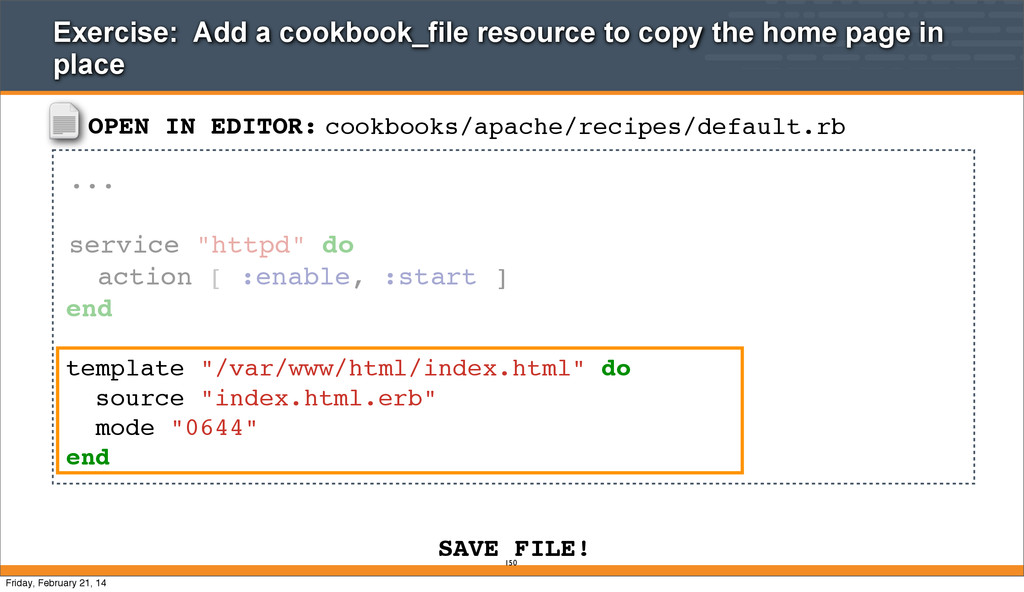
] end template "/var/www/html/index.html" do source "index.html.erb" mode "0644" end Exercise: Add a cookbook_file resource to copy the home page in place OPEN IN EDITOR: cookbooks/apache/recipes/default.rb 150 Friday, February 21, 14
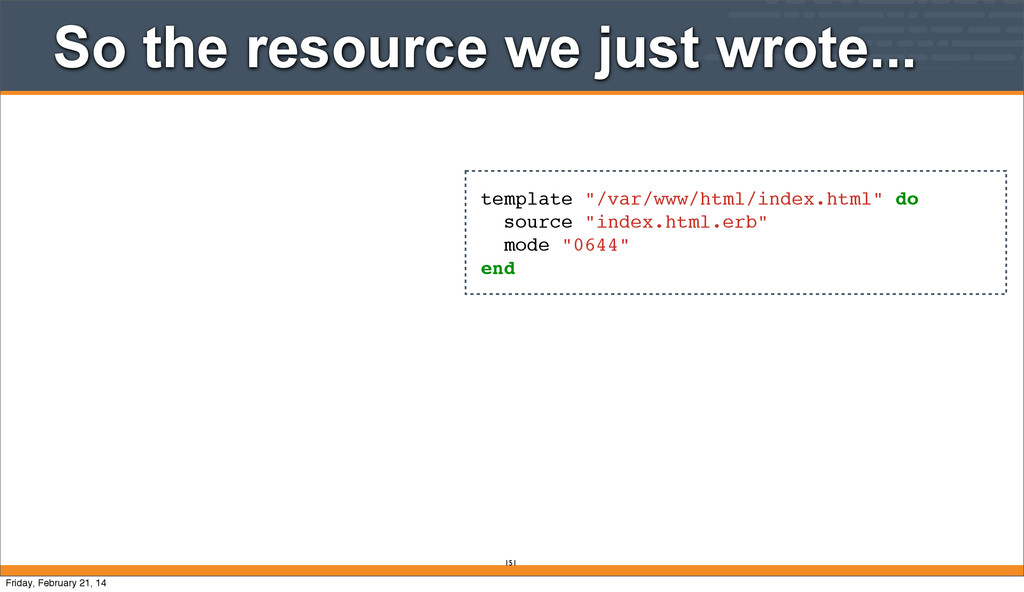
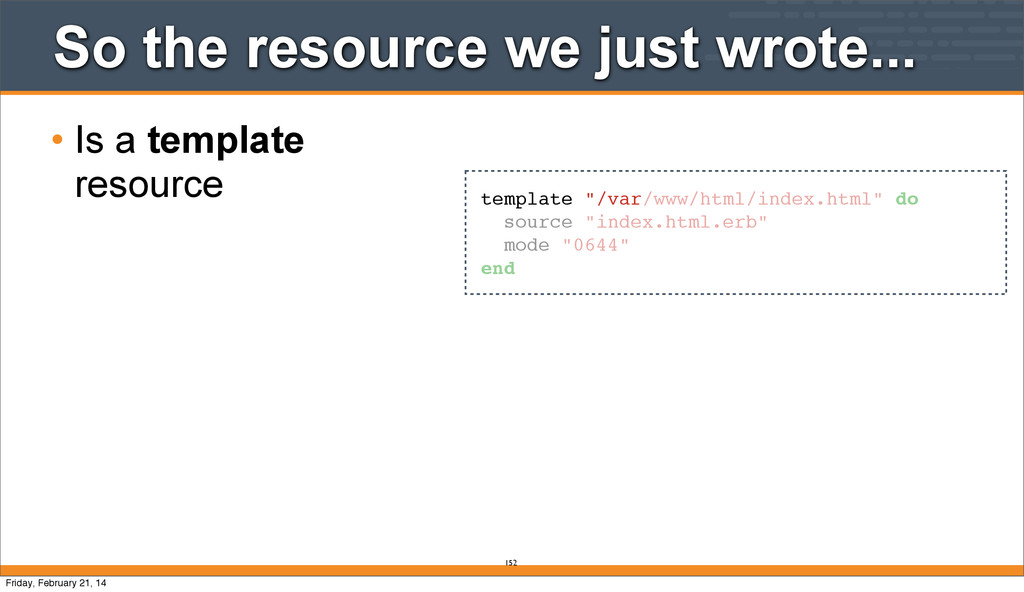
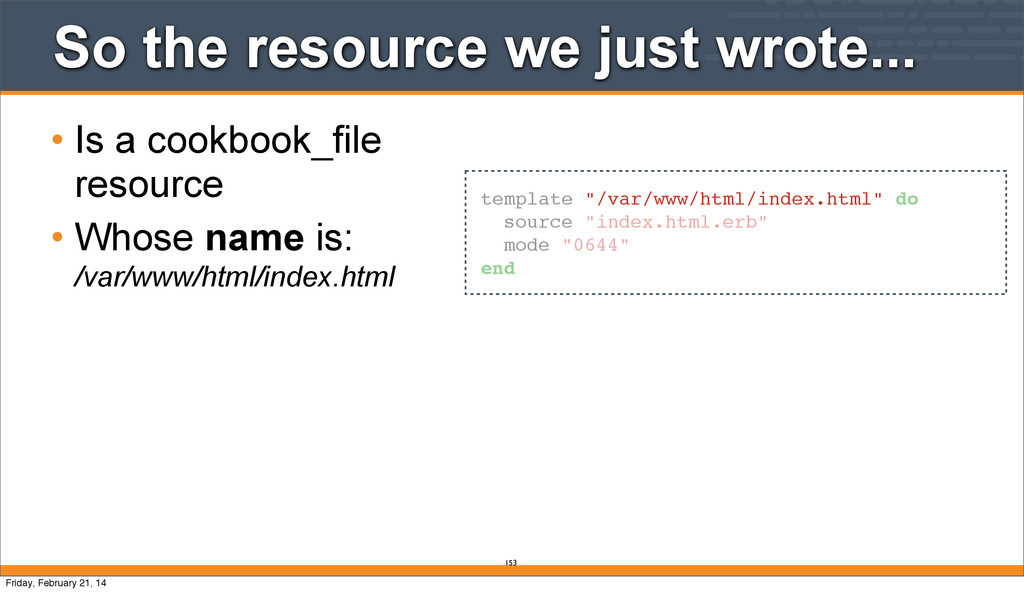
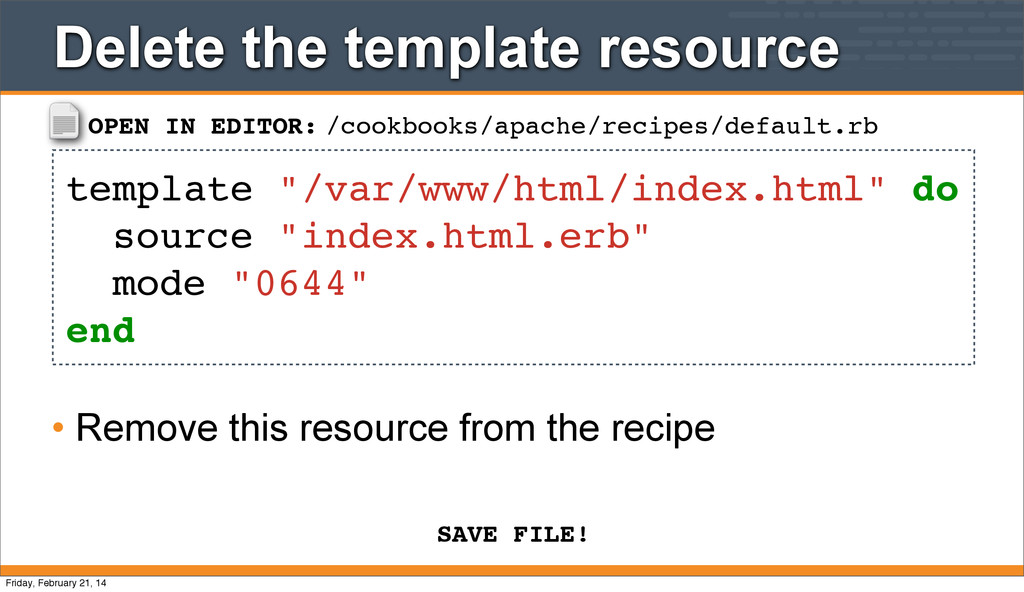
resource • Whose name is: /var/www/html/index.html template "/var/www/html/index.html" do source "index.html.erb" mode "0644" end 153 Friday, February 21, 14
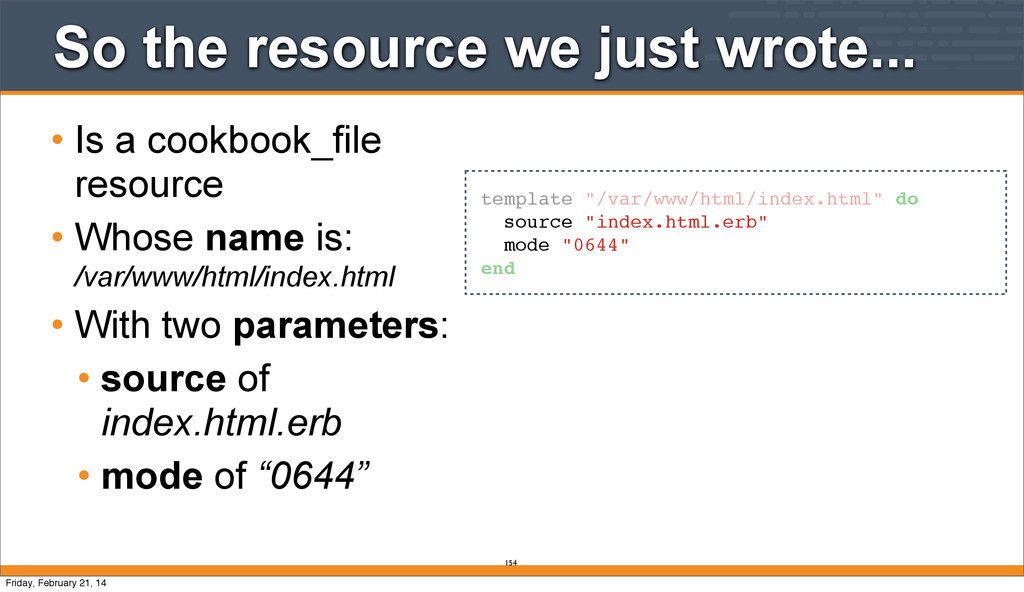
resource • Whose name is: /var/www/html/index.html • With two parameters: • source of index.html.erb • mode of “0644” template "/var/www/html/index.html" do source "index.html.erb" mode "0644" end 154 Friday, February 21, 14
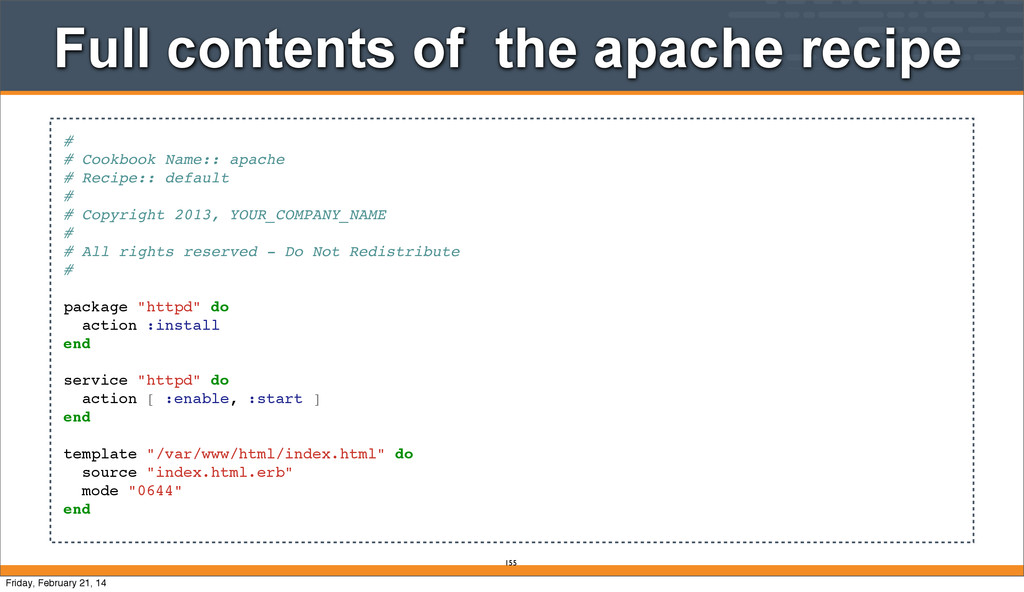
apache # Recipe:: default # # Copyright 2013, YOUR_COMPANY_NAME # # All rights reserved - Do Not Redistribute # package "httpd" do action :install end service "httpd" do action [ :enable, :start ] end template "/var/www/html/index.html" do source "index.html.erb" mode "0644" end 155 Friday, February 21, 14
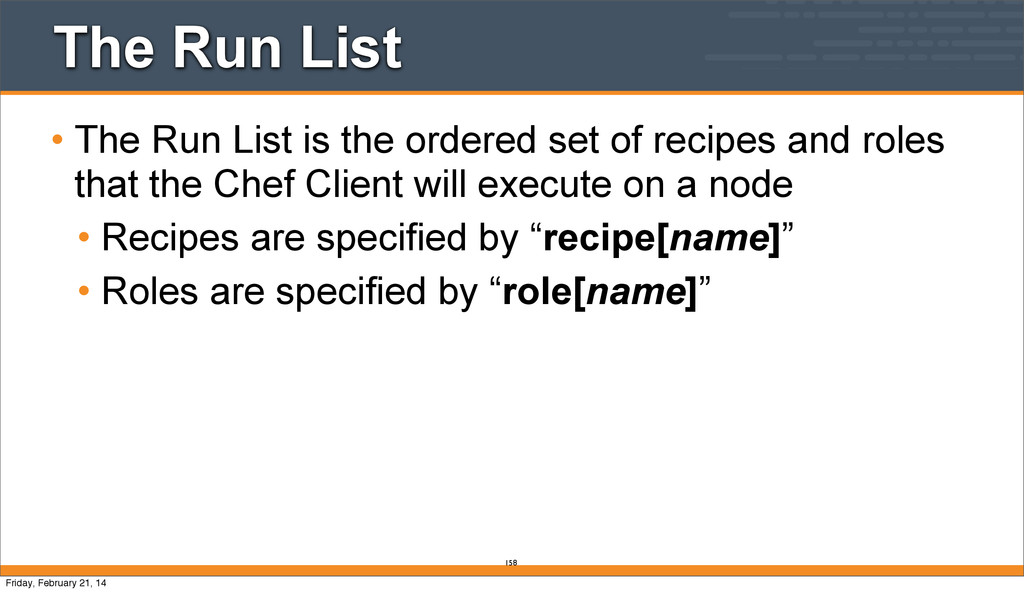
set of recipes and roles that the Chef Client will execute on a node • Recipes are specified by “recipe[name]” • Roles are specified by “role[name]” 158 Friday, February 21, 14
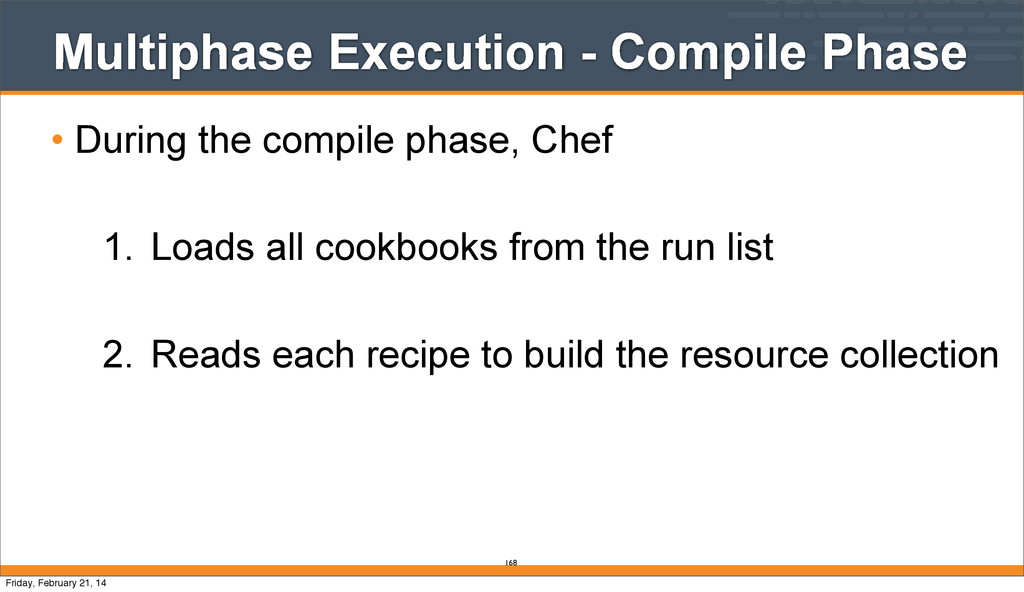
able to • List all the steps taken by a chef-client during a run • Explain the basic security model of Chef • Explain the concepts of the Resource Collection 165 Friday, February 21, 14
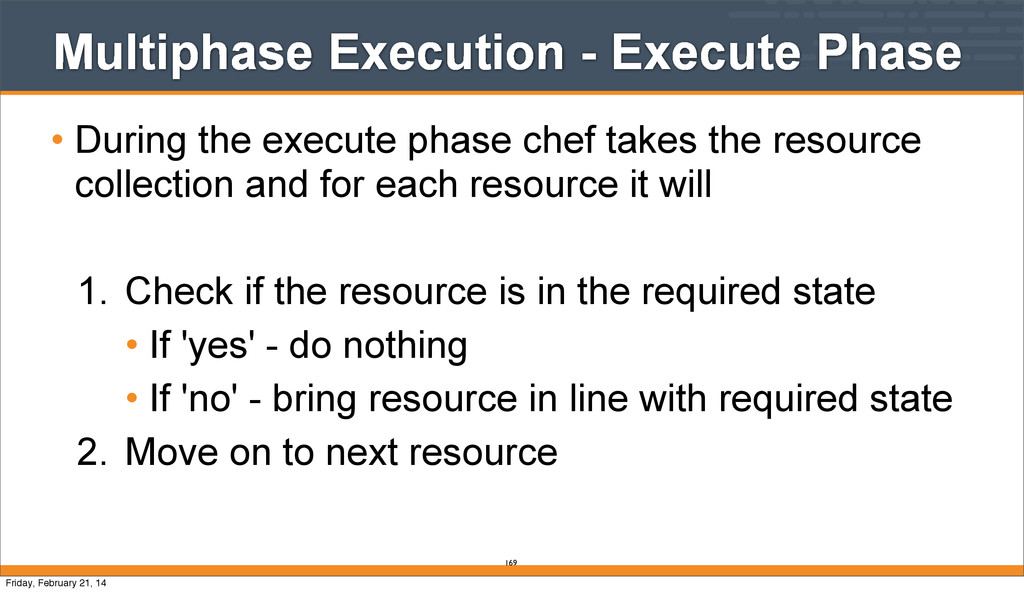
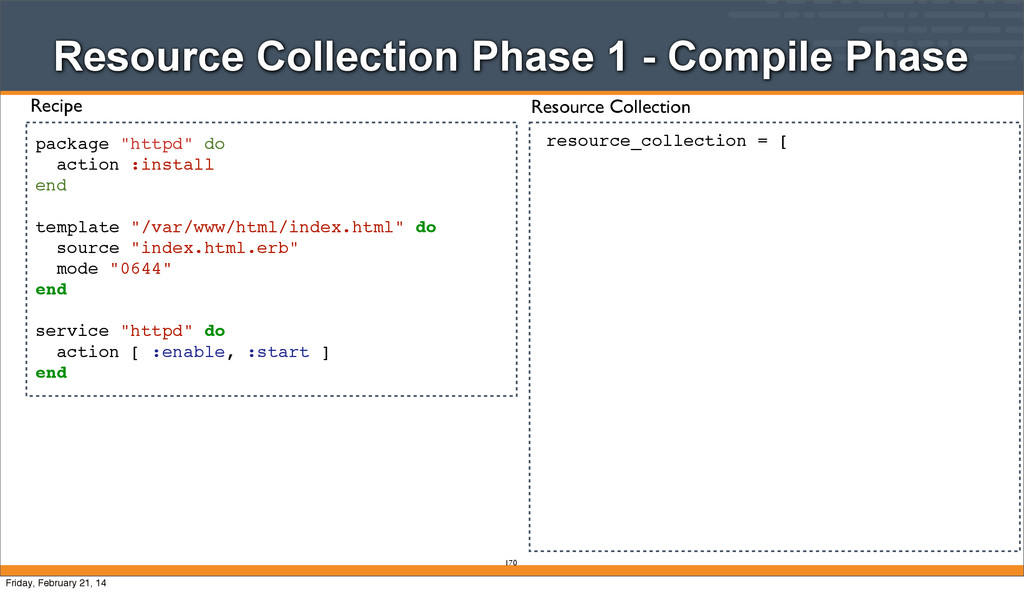
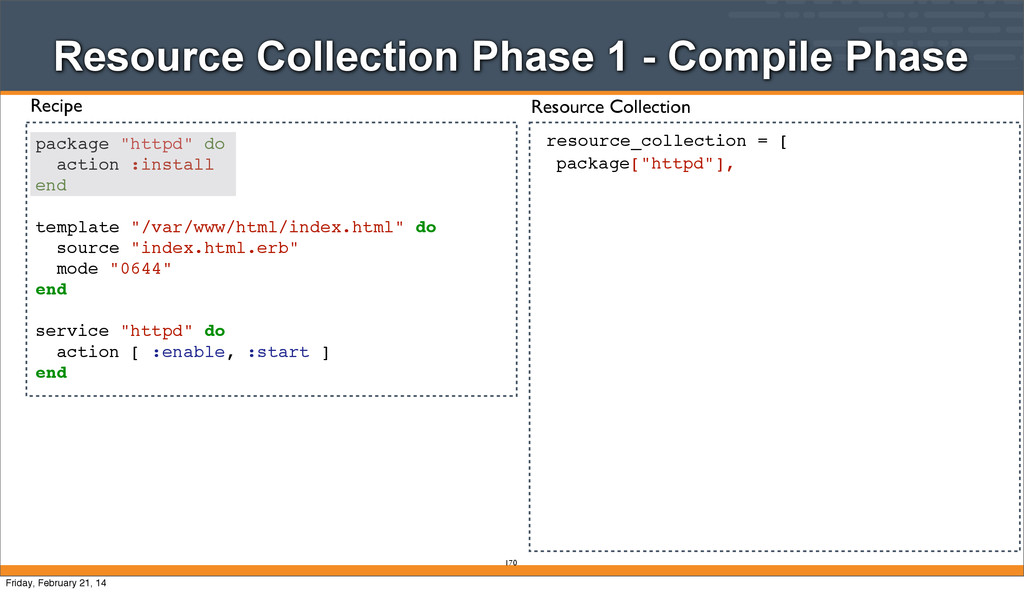
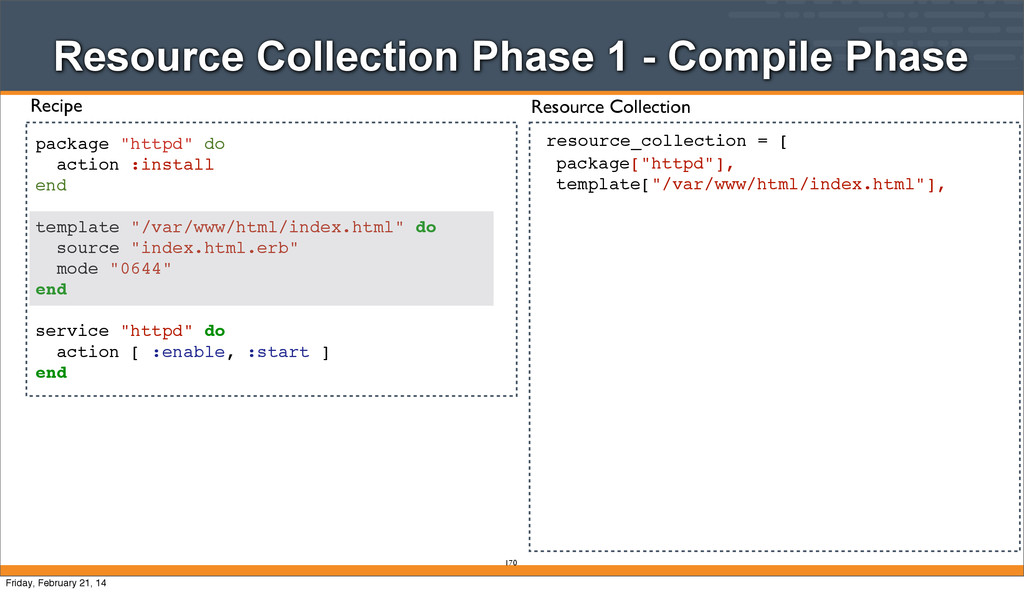
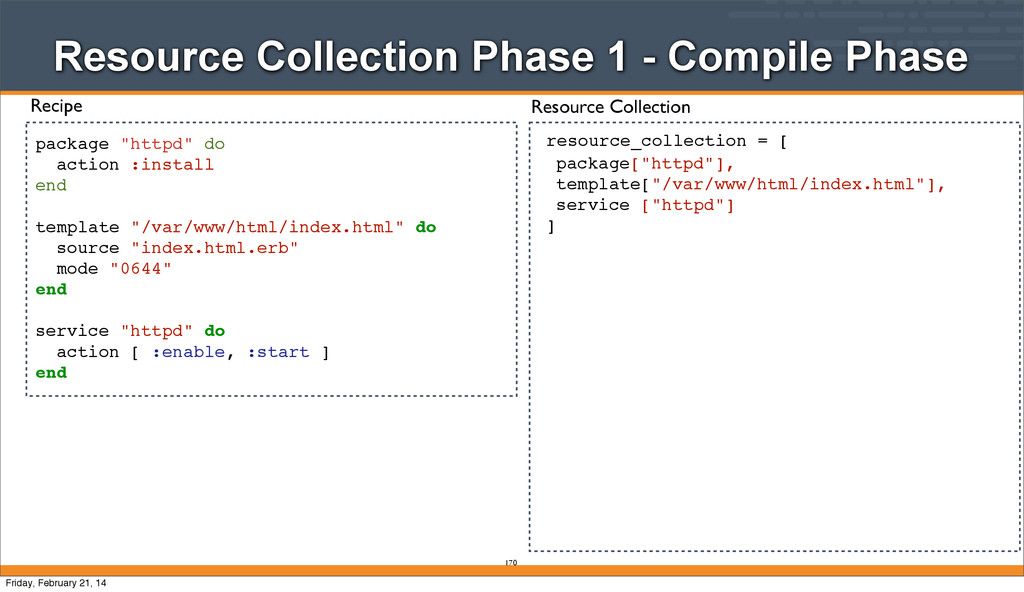
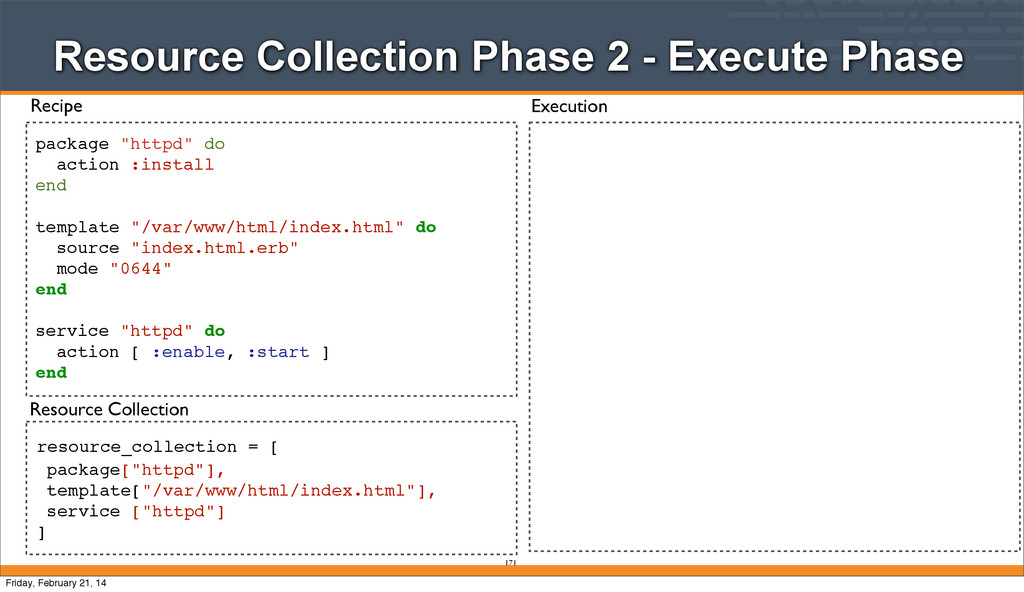
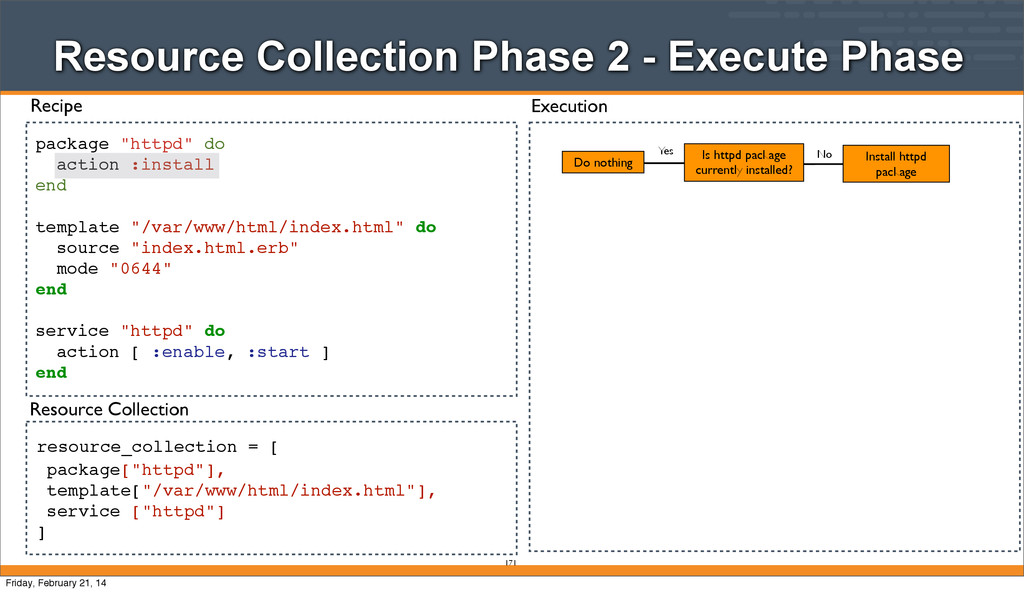
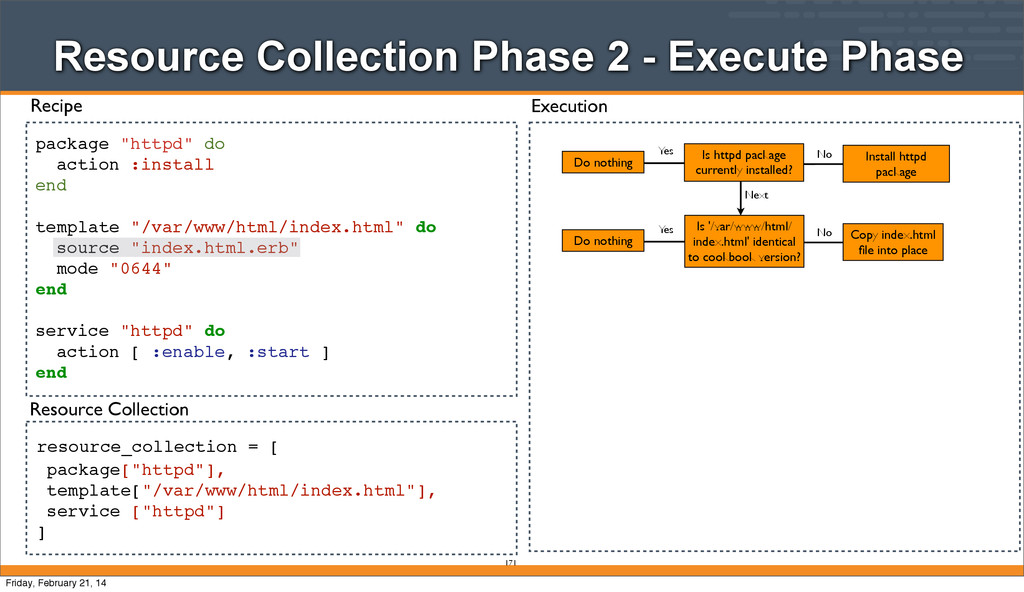
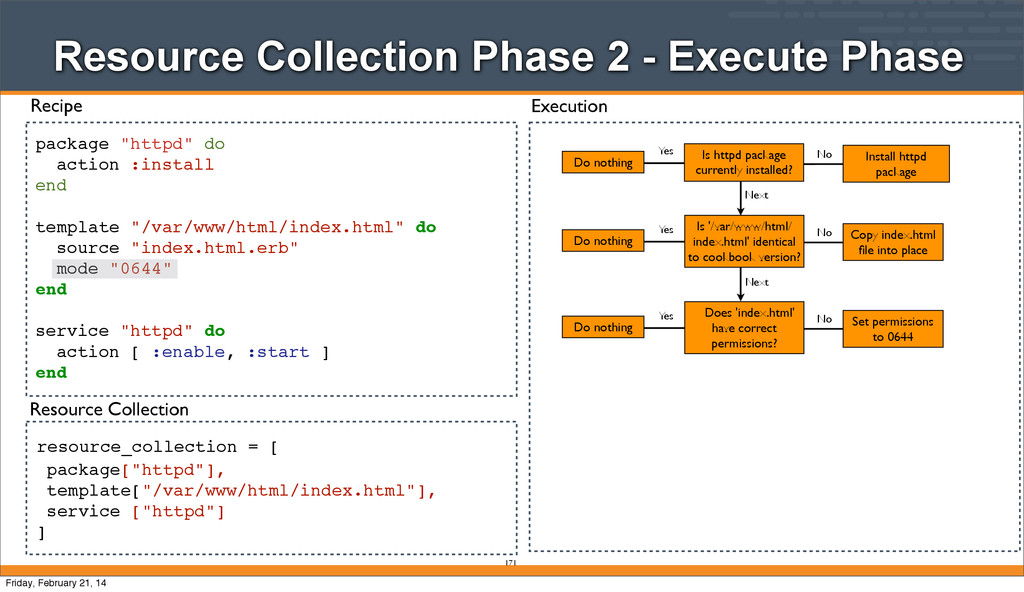
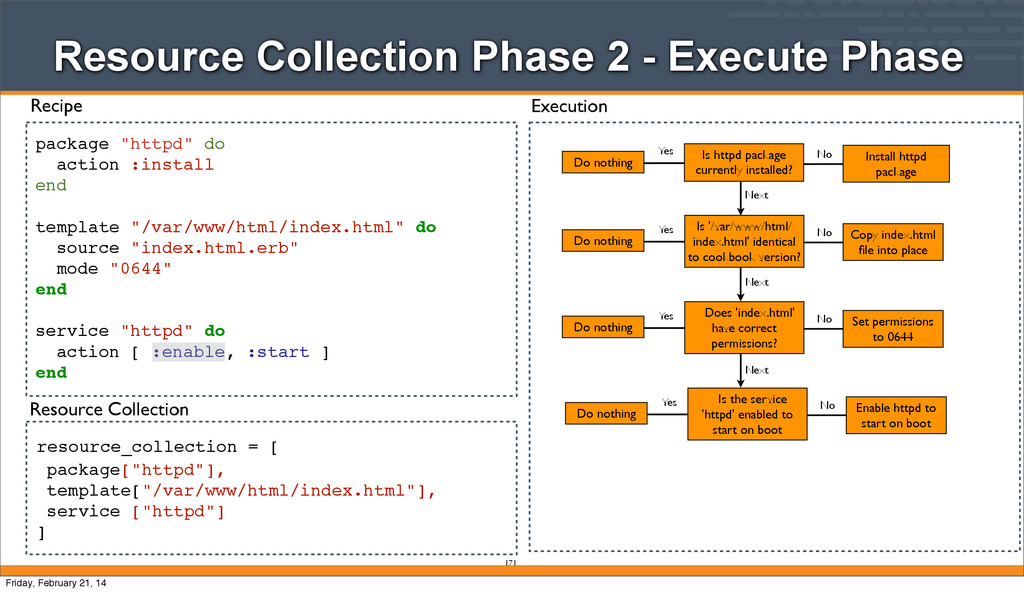
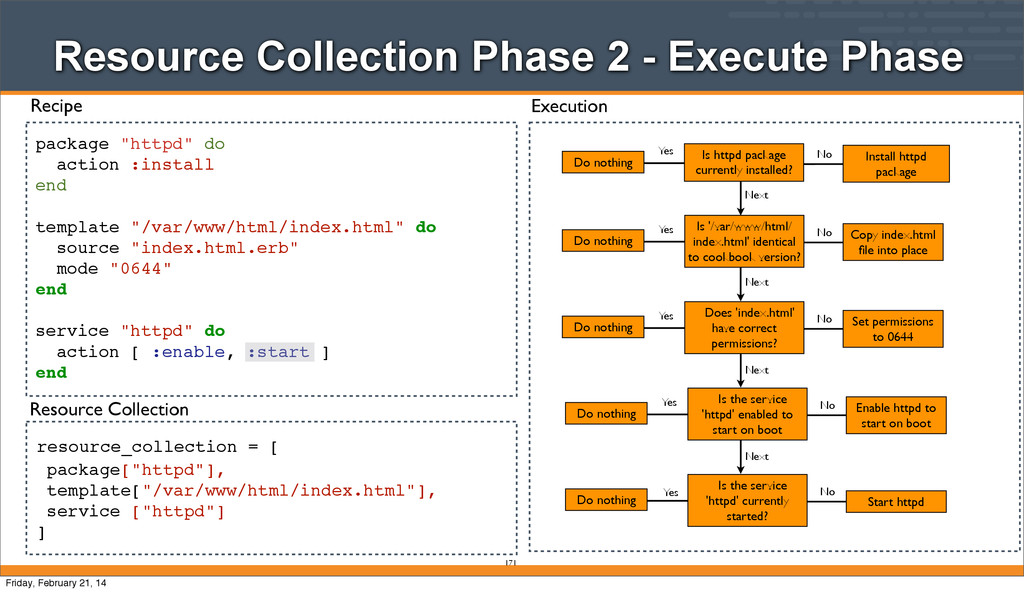
chef takes the resource collection and for each resource it will 1. Check if the resource is in the required state • If 'yes' - do nothing • If 'no' - bring resource in line with required state 2. Move on to next resource 169 Friday, February 21, 14
do action :install end template "/var/www/html/index.html" do source "index.html.erb" mode "0644" end service "httpd" do action [ :enable, :start ] end Resource Collection resource_collection = [ Recipe Friday, February 21, 14
do action :install end template "/var/www/html/index.html" do source "index.html.erb" mode "0644" end service "httpd" do action [ :enable, :start ] end Resource Collection package["httpd"], resource_collection = [ Recipe Friday, February 21, 14
do action :install end template "/var/www/html/index.html" do source "index.html.erb" mode "0644" end service "httpd" do action [ :enable, :start ] end Resource Collection package["httpd"], template["/var/www/html/index.html"], resource_collection = [ Recipe Friday, February 21, 14
do action :install end template "/var/www/html/index.html" do source "index.html.erb" mode "0644" end service "httpd" do action [ :enable, :start ] end Resource Collection package["httpd"], template["/var/www/html/index.html"], service ["httpd"] ] resource_collection = [ Recipe Friday, February 21, 14
do action :install end template "/var/www/html/index.html" do source "index.html.erb" mode "0644" end service "httpd" do action [ :enable, :start ] end Resource Collection Recipe package["httpd"], template["/var/www/html/index.html"], service ["httpd"] ] resource_collection = [ Execution Friday, February 21, 14
do action :install end template "/var/www/html/index.html" do source "index.html.erb" mode "0644" end service "httpd" do action [ :enable, :start ] end Resource Collection Recipe package["httpd"], template["/var/www/html/index.html"], service ["httpd"] ] resource_collection = [ Execution Is httpd package currently installed? Do nothing Install httpd package Yes No Friday, February 21, 14
do action :install end template "/var/www/html/index.html" do source "index.html.erb" mode "0644" end service "httpd" do action [ :enable, :start ] end Resource Collection Recipe package["httpd"], template["/var/www/html/index.html"], service ["httpd"] ] resource_collection = [ Execution Is httpd package currently installed? Do nothing Install httpd package Yes No Is '/var/www/html/ index.html' identical to cookbook version? Do nothing Copy index.html file into place Yes No Next Friday, February 21, 14
do action :install end template "/var/www/html/index.html" do source "index.html.erb" mode "0644" end service "httpd" do action [ :enable, :start ] end Resource Collection Recipe package["httpd"], template["/var/www/html/index.html"], service ["httpd"] ] resource_collection = [ Execution Is httpd package currently installed? Do nothing Install httpd package Yes No Does 'index.html' have correct permissions? Do nothing Set permissions to 0644 Yes No Next Is '/var/www/html/ index.html' identical to cookbook version? Do nothing Copy index.html file into place Yes No Next Friday, February 21, 14
do action :install end template "/var/www/html/index.html" do source "index.html.erb" mode "0644" end service "httpd" do action [ :enable, :start ] end Resource Collection Recipe package["httpd"], template["/var/www/html/index.html"], service ["httpd"] ] resource_collection = [ Execution Is httpd package currently installed? Do nothing Install httpd package Yes No Does 'index.html' have correct permissions? Do nothing Set permissions to 0644 Yes No Next Is '/var/www/html/ index.html' identical to cookbook version? Do nothing Copy index.html file into place Yes No Next Is the service 'httpd' enabled to start on boot Do nothing Enable httpd to start on boot Yes No Next Friday, February 21, 14
do action :install end template "/var/www/html/index.html" do source "index.html.erb" mode "0644" end service "httpd" do action [ :enable, :start ] end Resource Collection Recipe package["httpd"], template["/var/www/html/index.html"], service ["httpd"] ] resource_collection = [ Execution Is httpd package currently installed? Do nothing Install httpd package Yes No Does 'index.html' have correct permissions? Do nothing Set permissions to 0644 Yes No Next Is '/var/www/html/ index.html' identical to cookbook version? Do nothing Copy index.html file into place Yes No Next Is the service 'httpd' enabled to start on boot Do nothing Enable httpd to start on boot Yes No Next Yes Is the service 'httpd' currently started? Do nothing Start httpd No Next Friday, February 21, 14
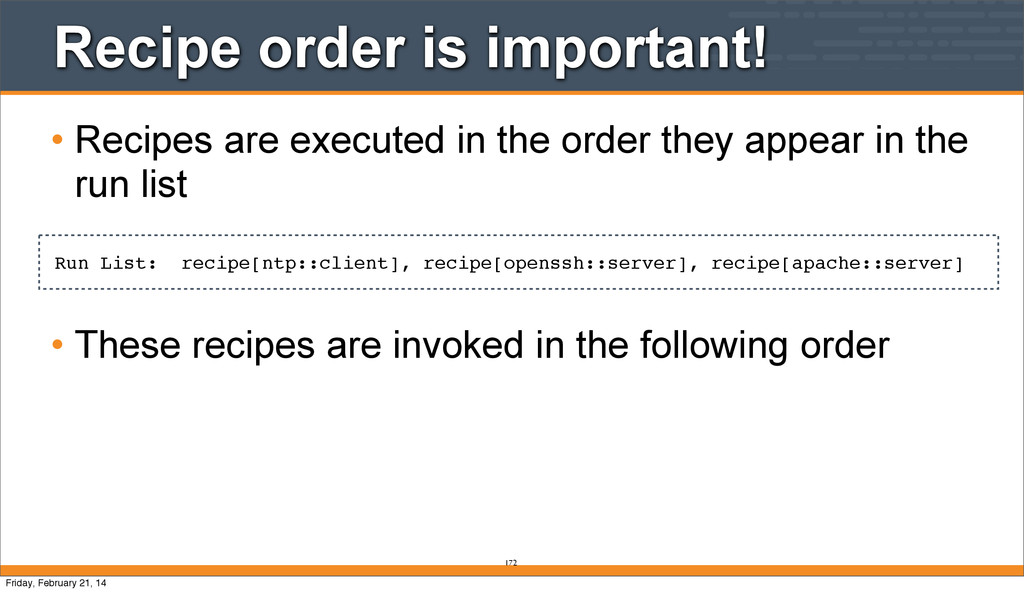
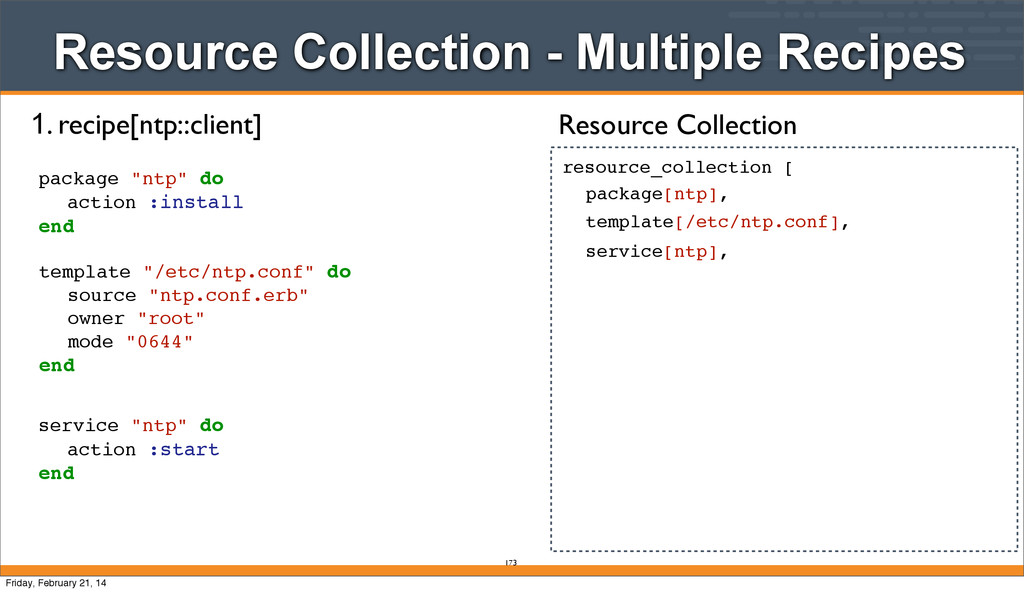
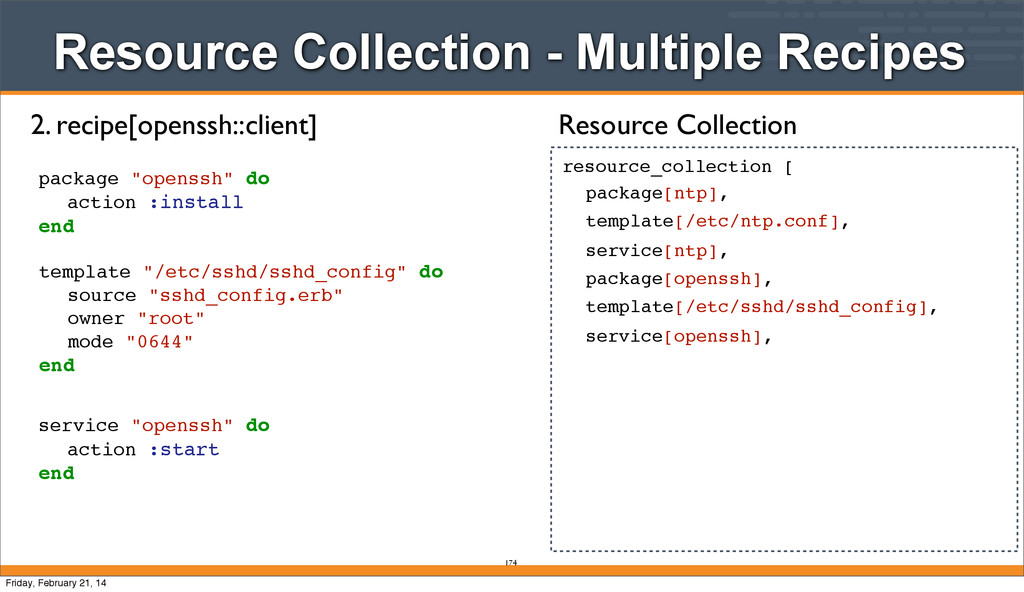
order they appear in the run list • These recipes are invoked in the following order 172 Run List: recipe[ntp::client], recipe[openssh::server], recipe[apache::server] Friday, February 21, 14
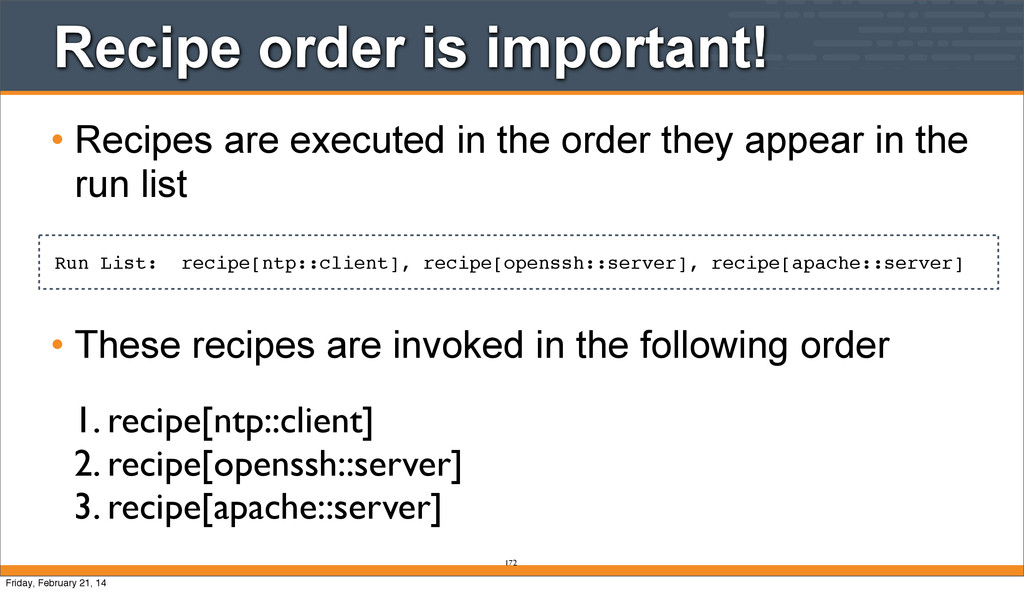
order they appear in the run list • These recipes are invoked in the following order 172 1. recipe[ntp::client] 2. recipe[openssh::server] 3. recipe[apache::server] Run List: recipe[ntp::client], recipe[openssh::server], recipe[apache::server] Friday, February 21, 14
in the following order during the execute phase 176 package[ntp] template[/etc/ntp.conf] service[ntp] package[openssh] template[/etc/sshd/sshd_config] service[openssh] package[httpd] service[httpd] cookbook_file[/var/www/html/index.html] Friday, February 21, 14
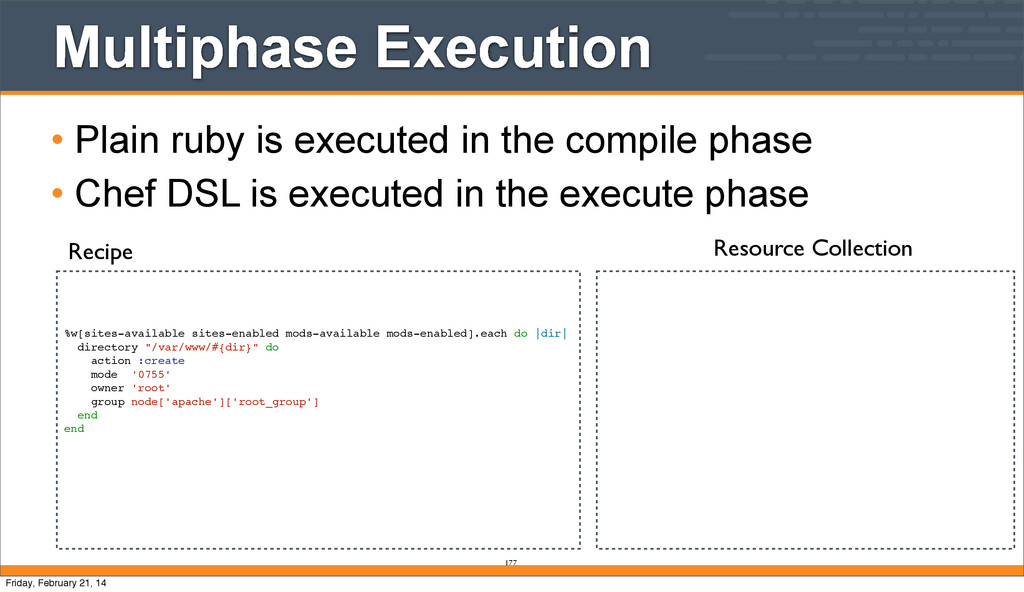
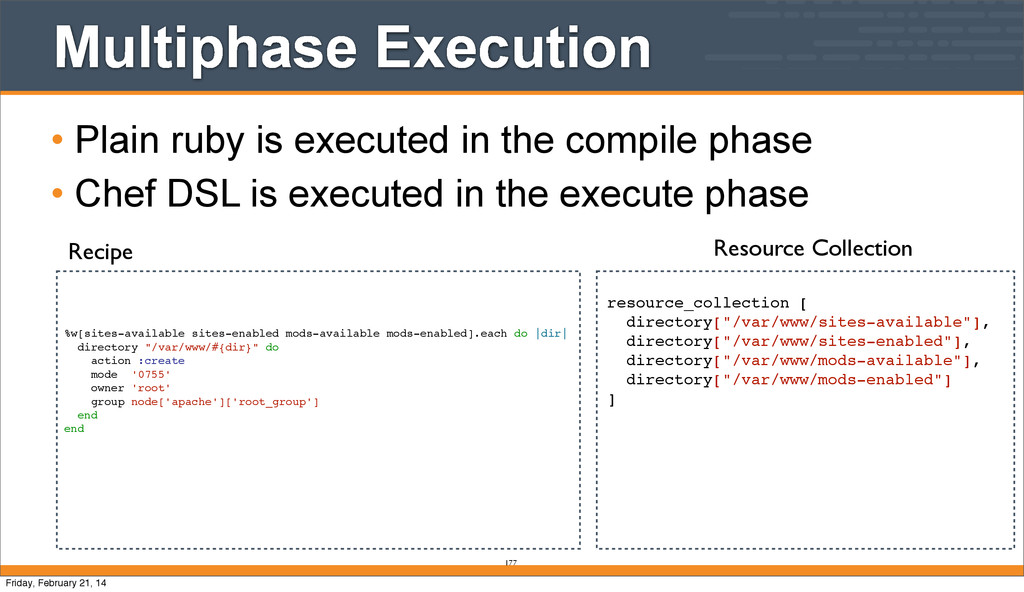
phase • Chef DSL is executed in the execute phase 177 %w[sites-available sites-enabled mods-available mods-enabled].each do |dir| directory "/var/www/#{dir}" do action :create mode '0755' owner 'root' group node['apache']['root_group'] end end Resource Collection Recipe Friday, February 21, 14
phase • Chef DSL is executed in the execute phase 177 %w[sites-available sites-enabled mods-available mods-enabled].each do |dir| directory "/var/www/#{dir}" do action :create mode '0755' owner 'root' group node['apache']['root_group'] end end Resource Collection Recipe resource_collection [ directory["/var/www/sites-available"], directory["/var/www/sites-enabled"], directory["/var/www/mods-available"], directory["/var/www/mods-enabled"] ] Friday, February 21, 14
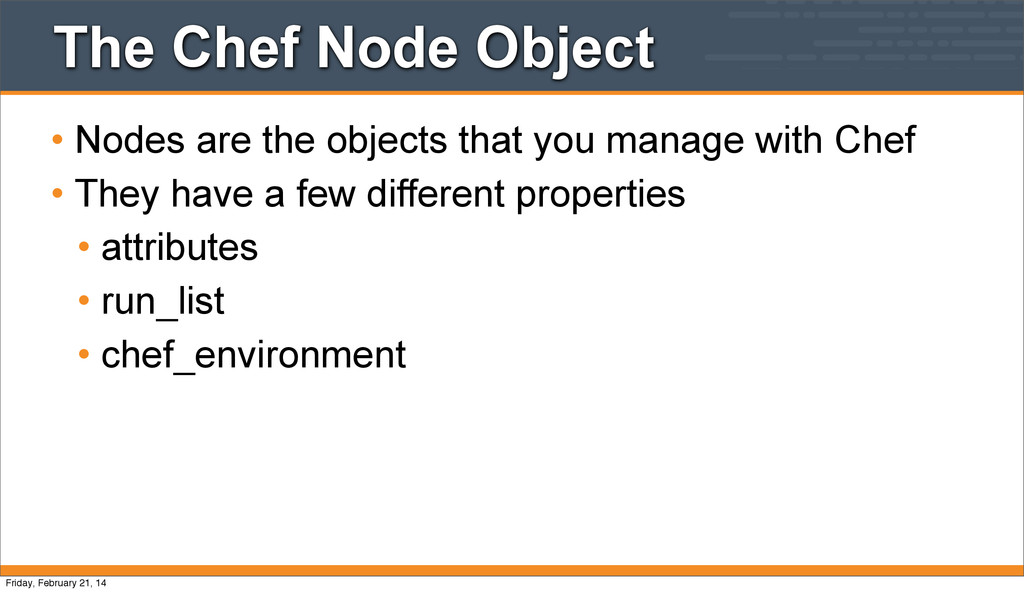
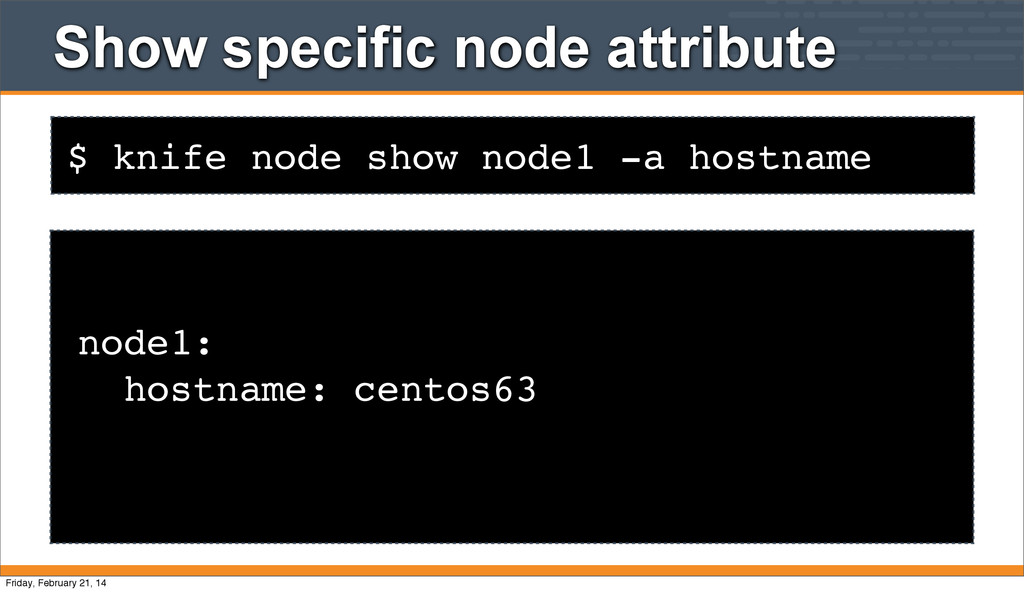
able to • Explain what the Node object represents in Chef • Show details about a Node • Describe what Node Attributes are • Retrieve a node attribute 179 Friday, February 21, 14
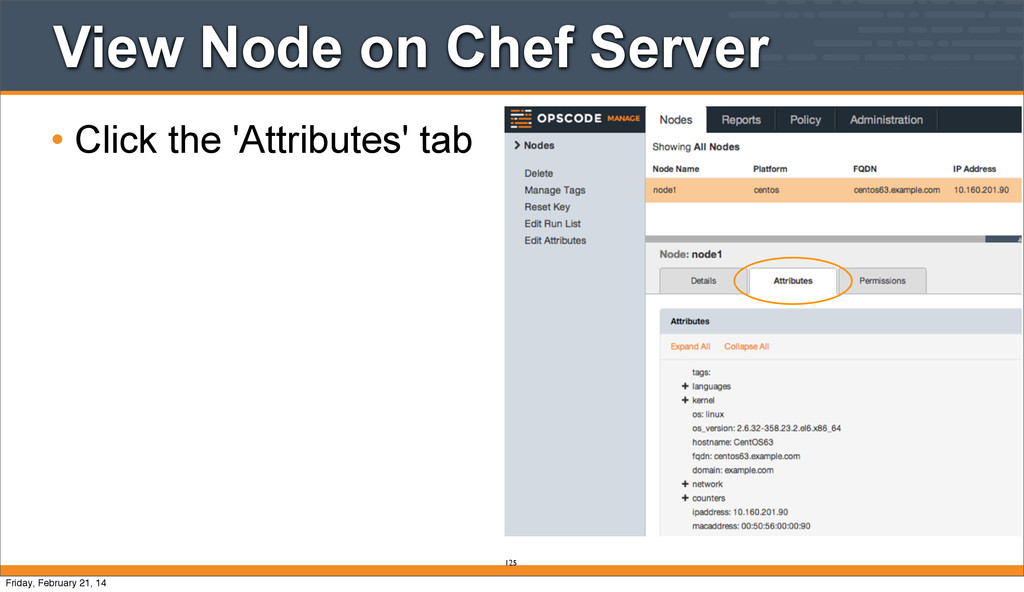
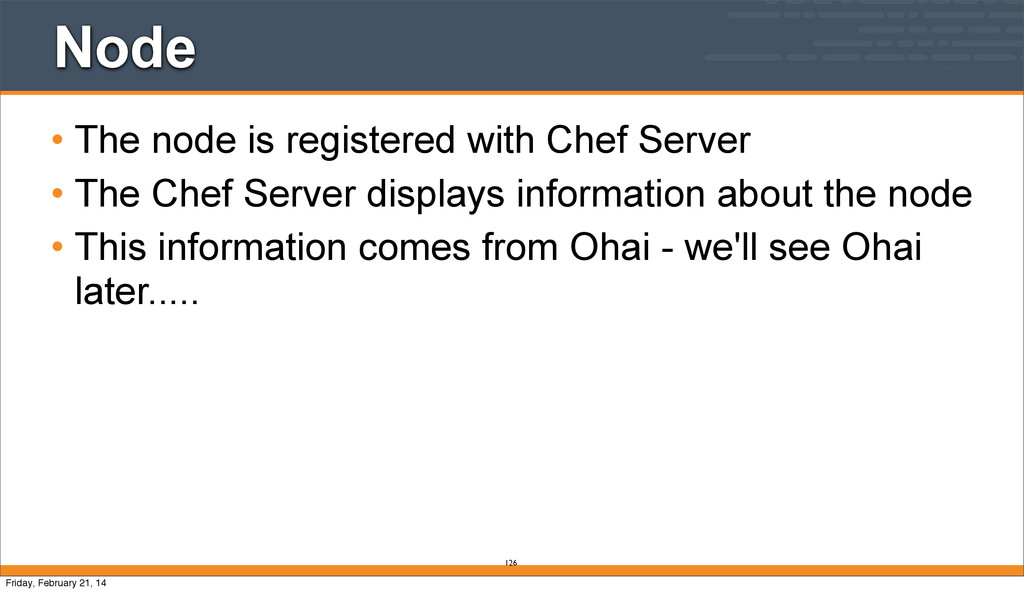
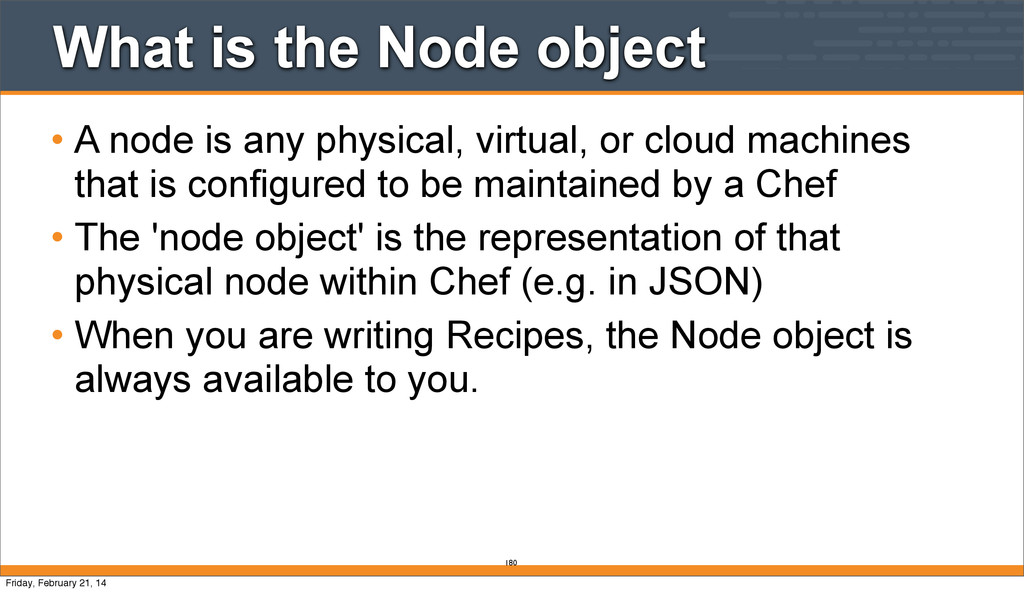
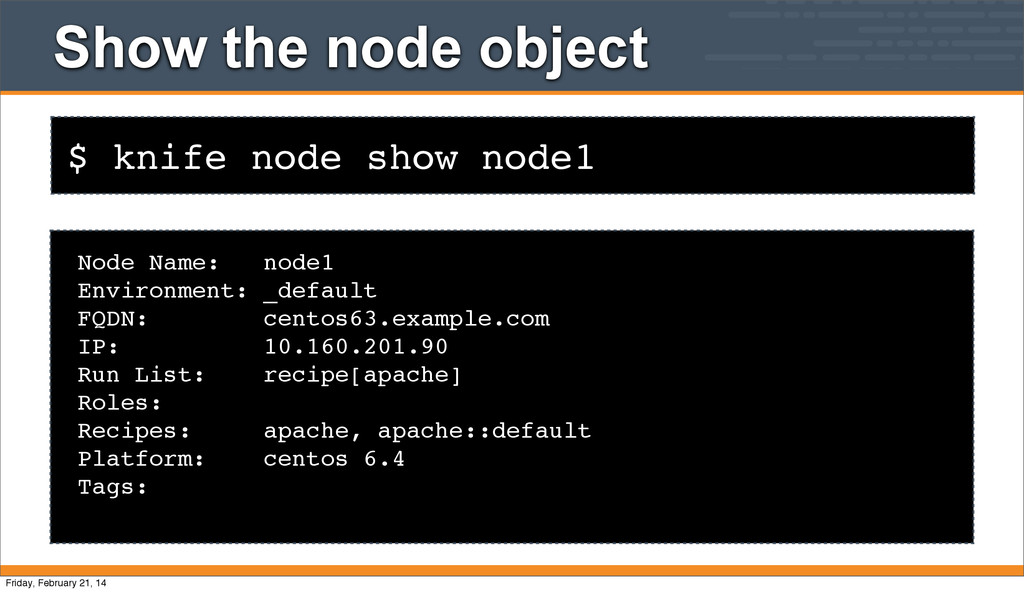
physical, virtual, or cloud machines that is configured to be maintained by a Chef • The 'node object' is the representation of that physical node within Chef (e.g. in JSON) • When you are writing Recipes, the Node object is always available to you. 180 Friday, February 21, 14
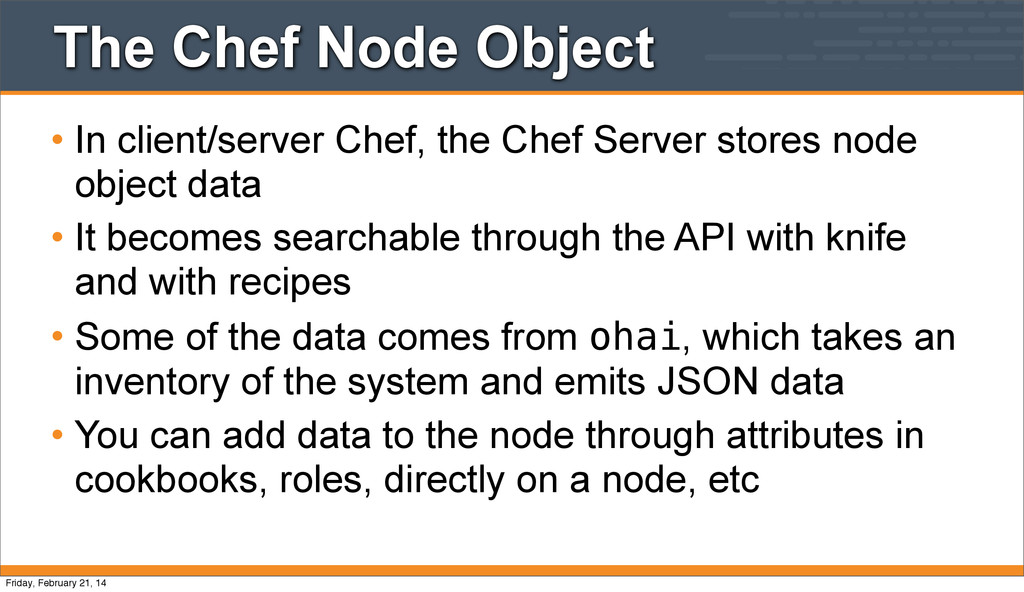
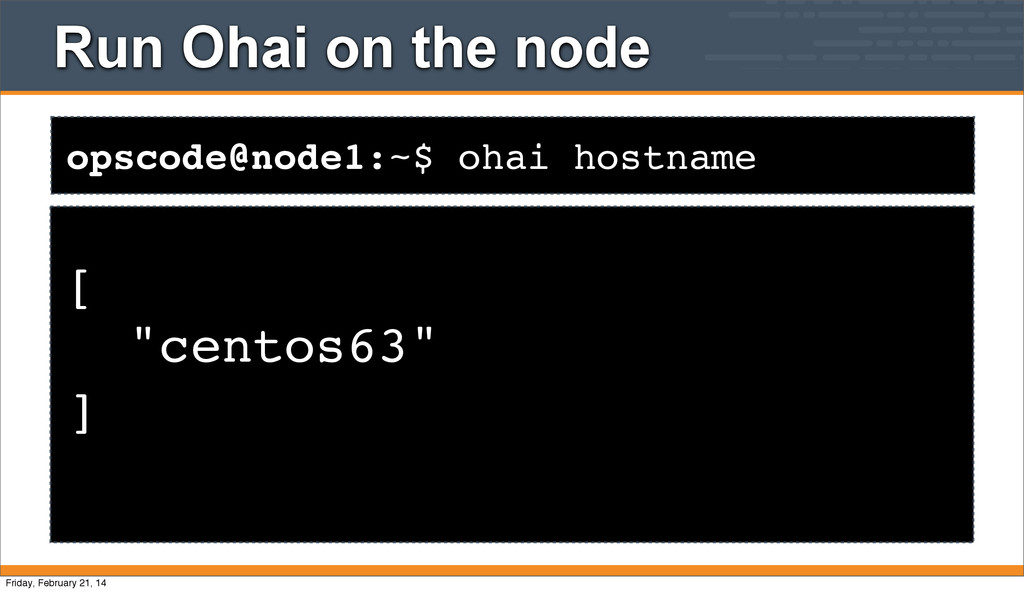
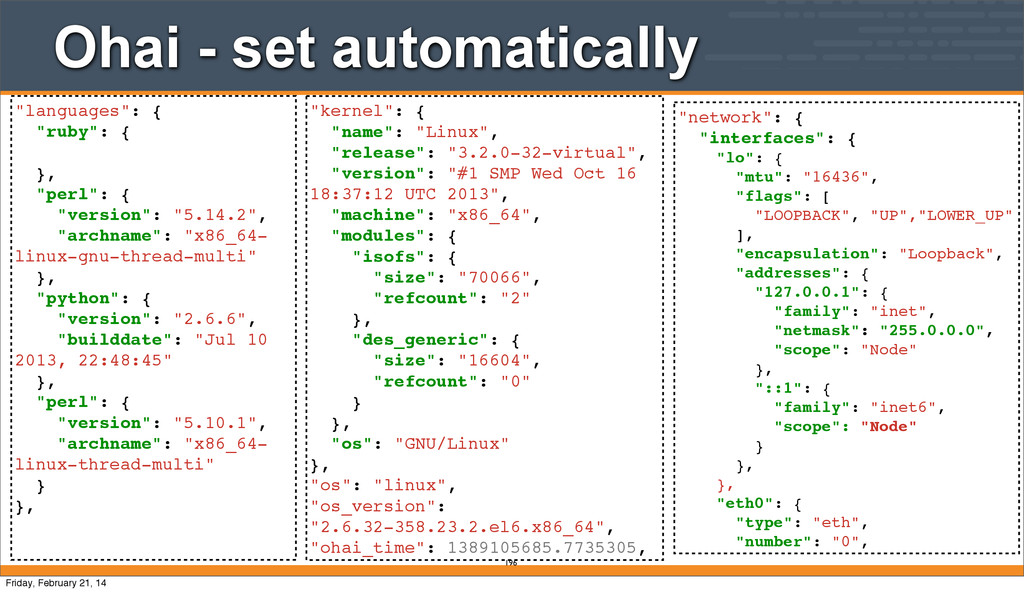
Server stores node object data • It becomes searchable through the API with knife and with recipes • Some of the data comes from ohai, which takes an inventory of the system and emits JSON data • You can add data to the node through attributes in cookbooks, roles, directly on a node, etc Friday, February 21, 14
able to • Describe where and how attributes are set • Explain the attribute merge order and precedence rules • Declare an attribute with a recipe and set its value 193 Friday, February 21, 14
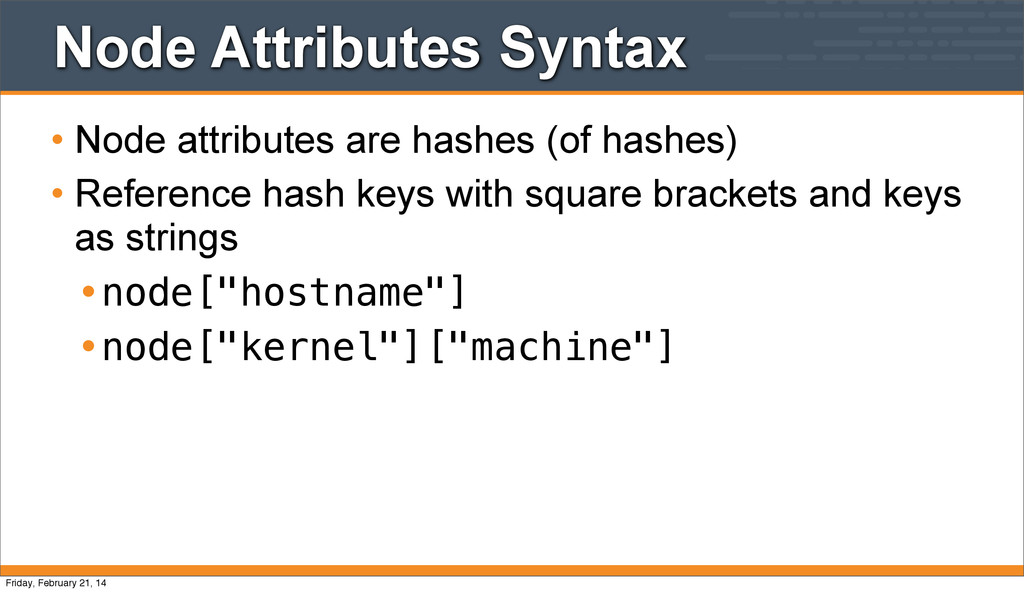
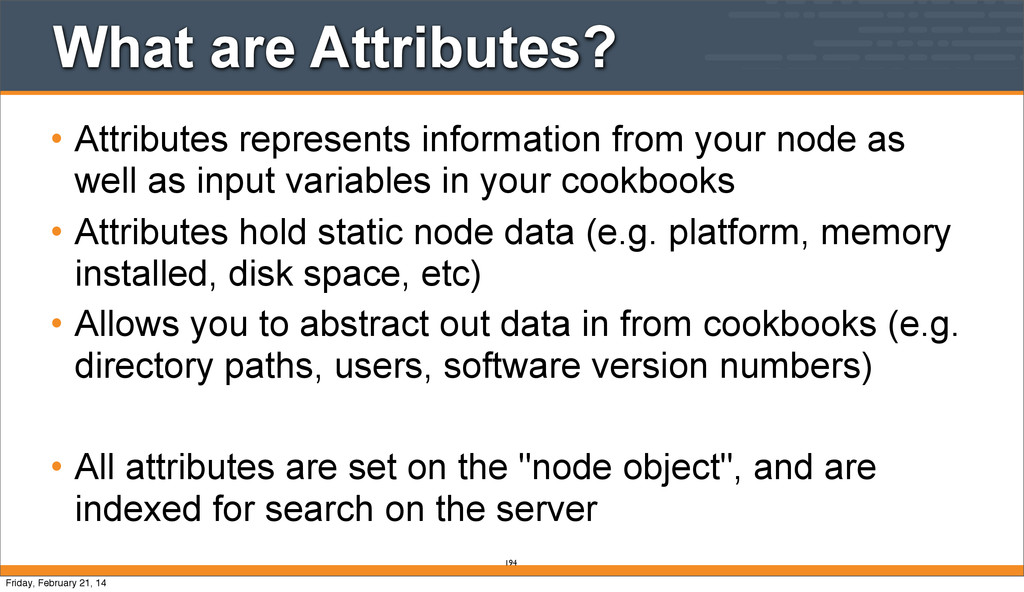
as well as input variables in your cookbooks • Attributes hold static node data (e.g. platform, memory installed, disk space, etc) • Allows you to abstract out data in from cookbooks (e.g. directory paths, users, software version numbers) • All attributes are set on the "node object", and are indexed for search on the server 194 Friday, February 21, 14
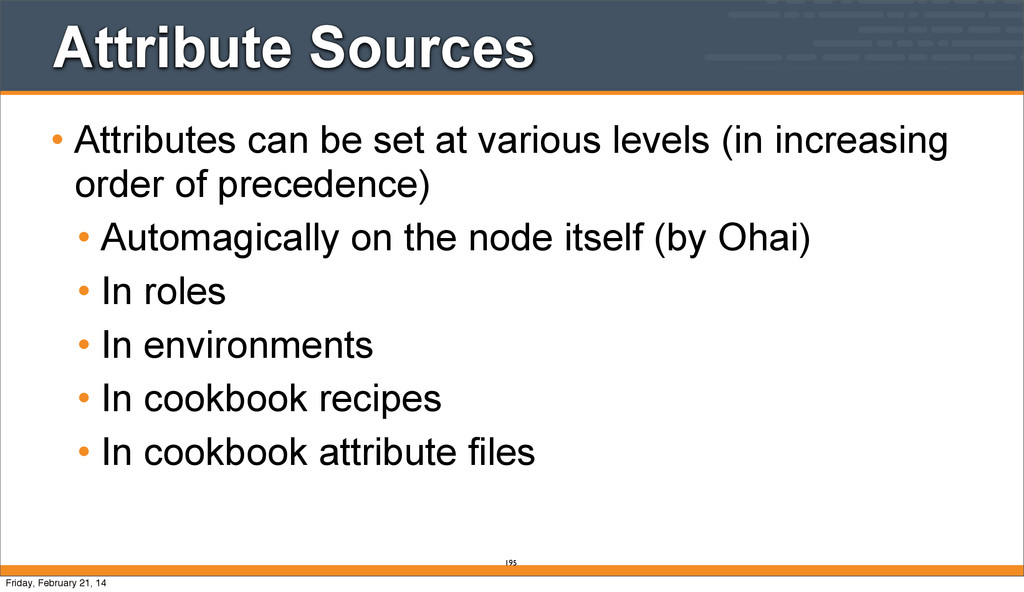
(in increasing order of precedence) • Automagically on the node itself (by Ohai) • In roles • In environments • In cookbook recipes • In cookbook attribute files 195 Friday, February 21, 14
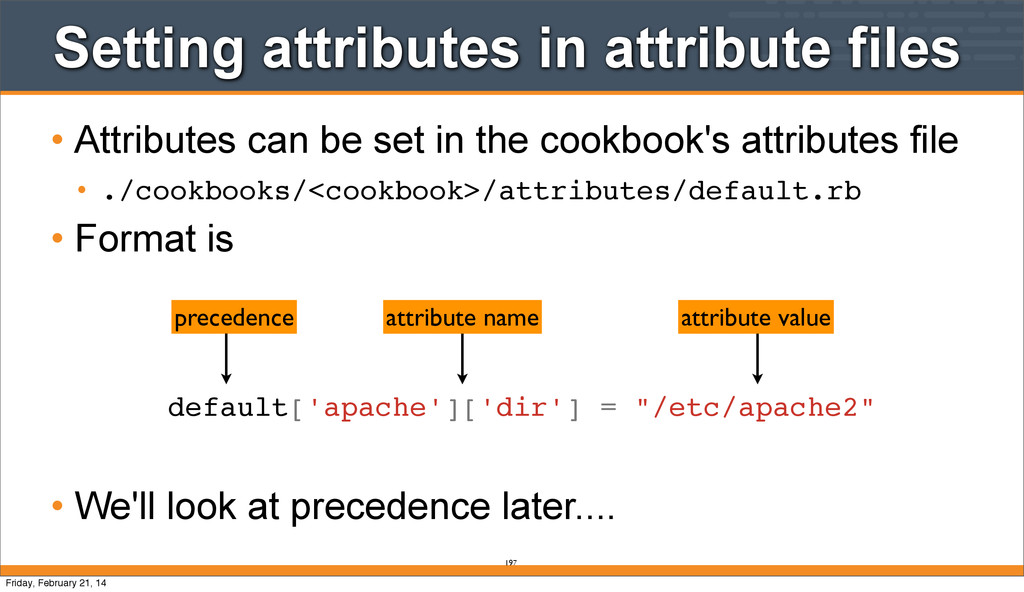
in the cookbook's attributes file • ./cookbooks/<cookbook>/attributes/default.rb • Format is • We'll look at precedence later.... precedence attribute name attribute value default['apache']['dir'] = "/etc/apache2" 197 Friday, February 21, 14
able to • Use Data Bags for data-driven recipes • Use multiple recipes for a node's run list • Control execution of arbitrary commands with Chef's resource guards Friday, February 21, 14
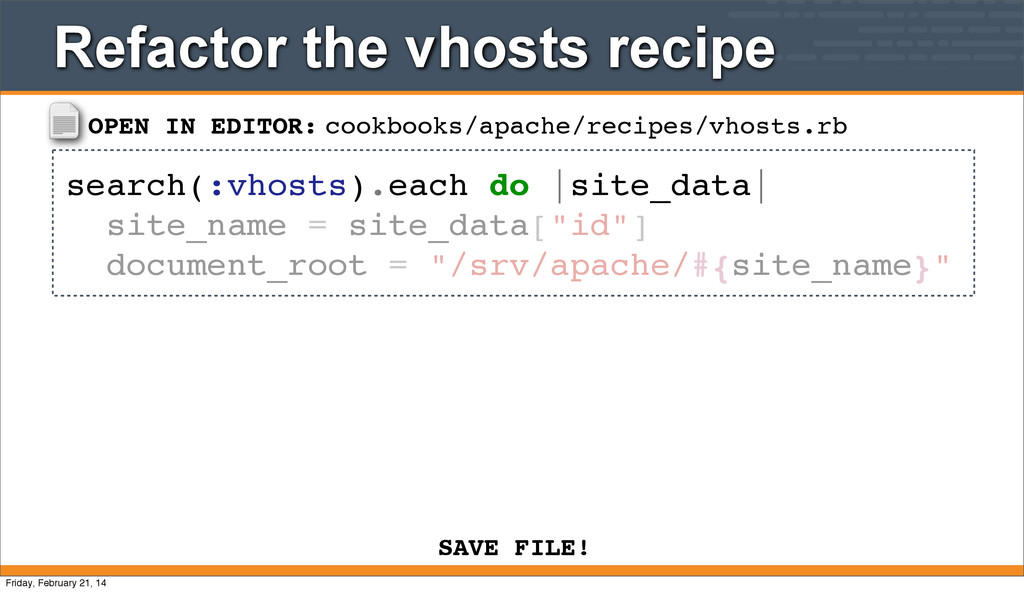
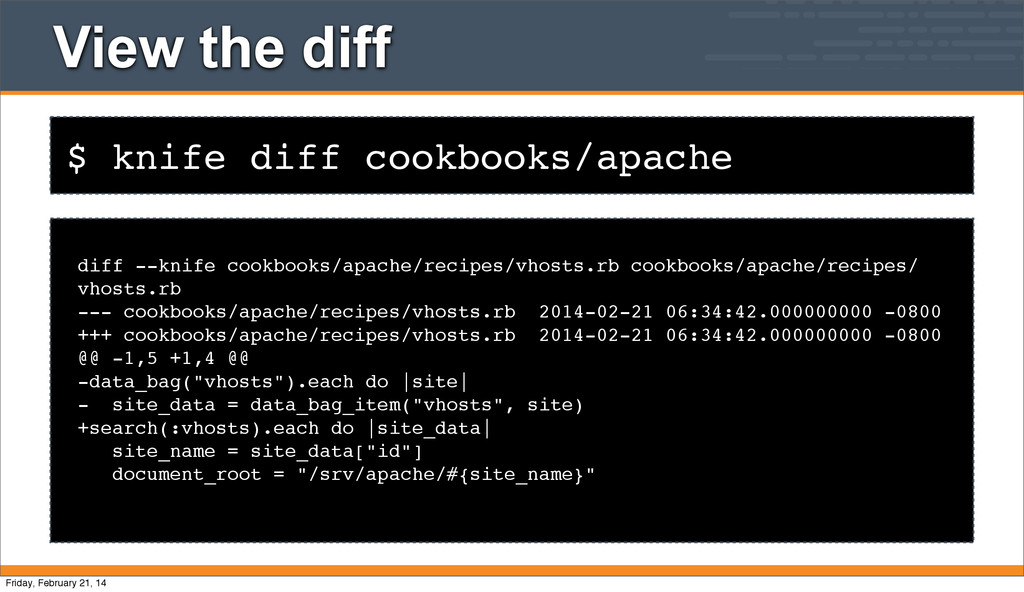
are generic, arbitrary stores of information about the infrastructure. • Data Bag Items are JSON data • Our apache cookbook provides a good baseline • We'll drive site-specific virtual hosts with data bags Friday, February 21, 14
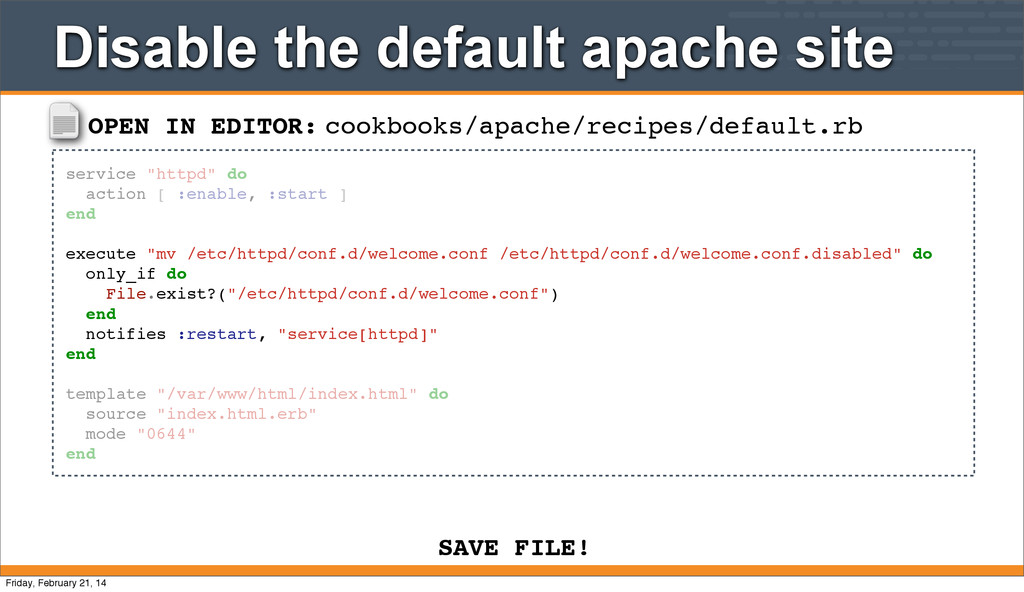
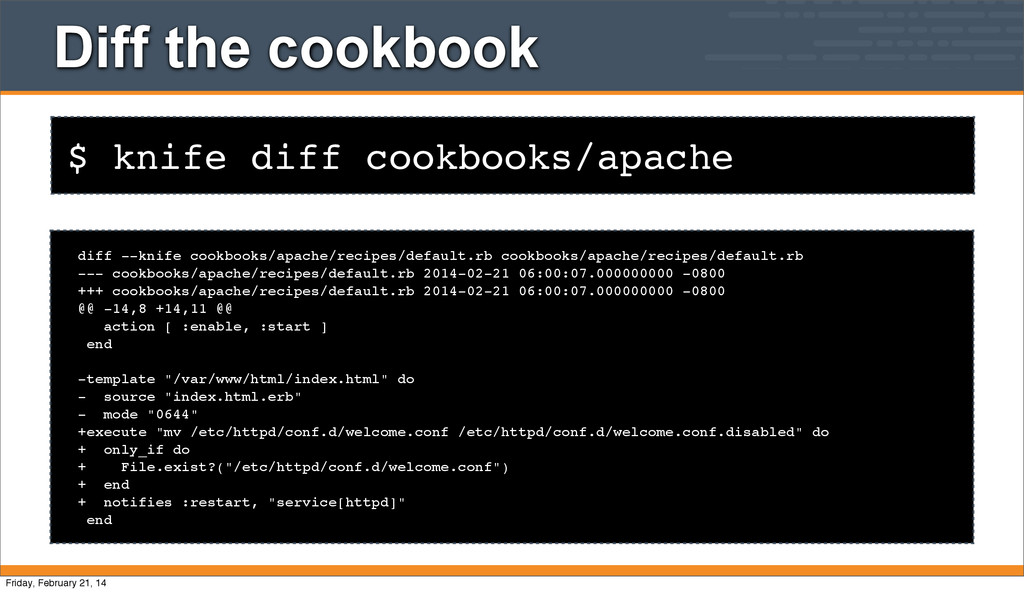
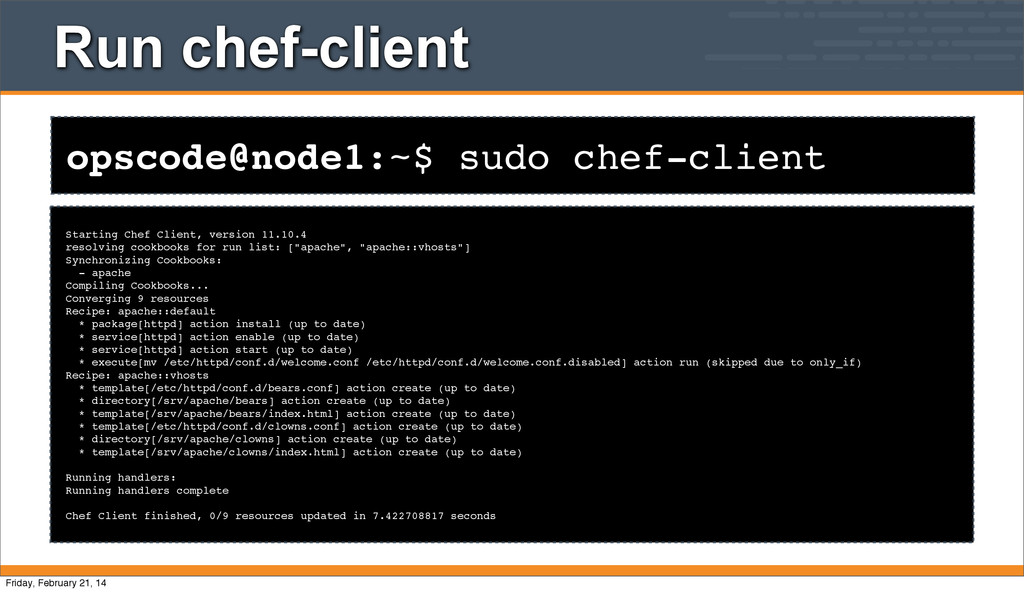
[ :enable, :start ] end execute "mv /etc/httpd/conf.d/welcome.conf /etc/httpd/conf.d/welcome.conf.disabled" do only_if do File.exist?("/etc/httpd/conf.d/welcome.conf") end notifies :restart, "service[httpd]" end template "/var/www/html/index.html" do source "index.html.erb" mode "0644" end Disable the default apache site Friday, February 21, 14
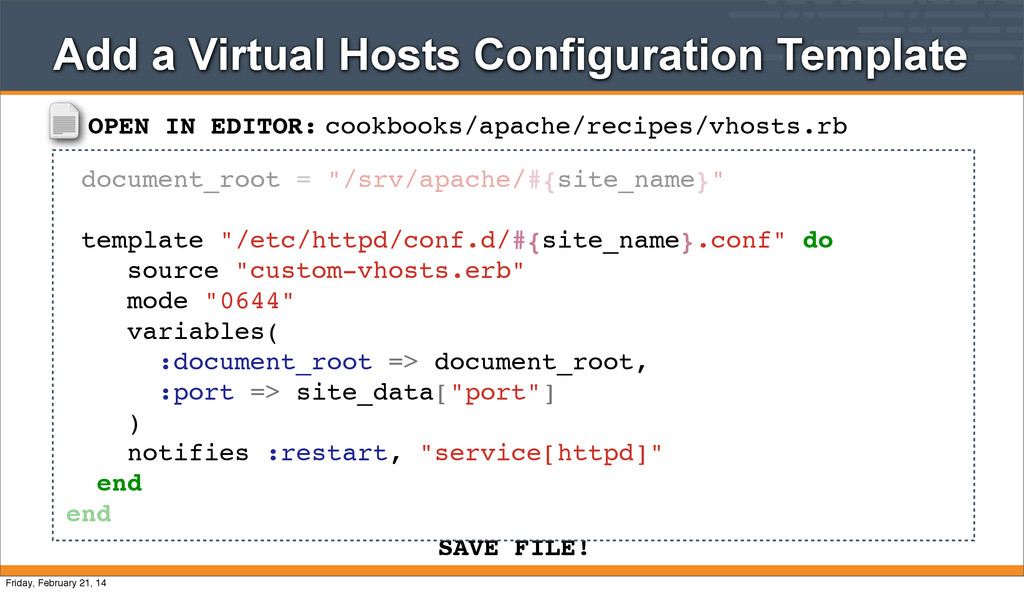
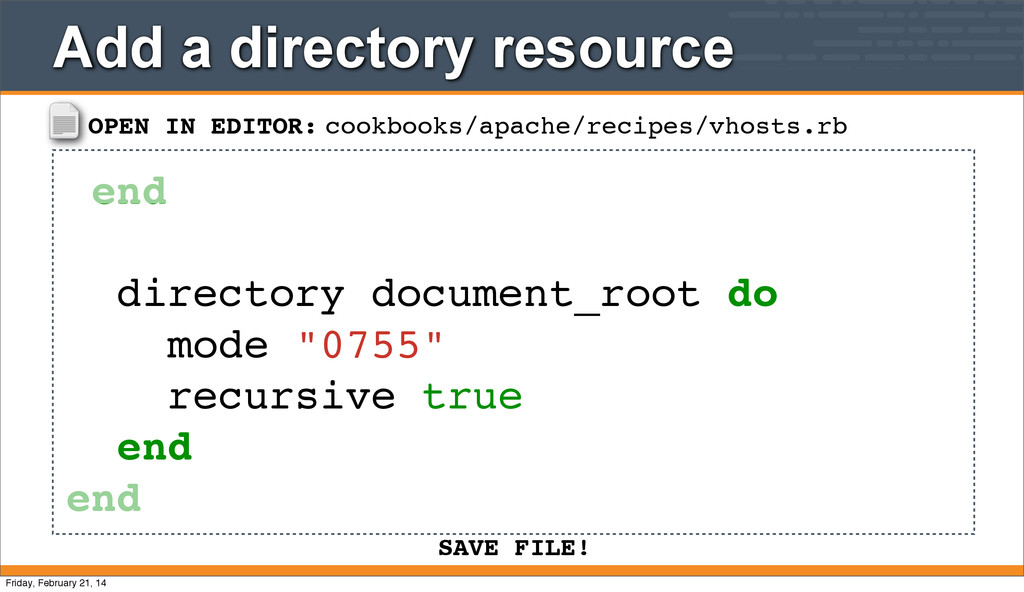
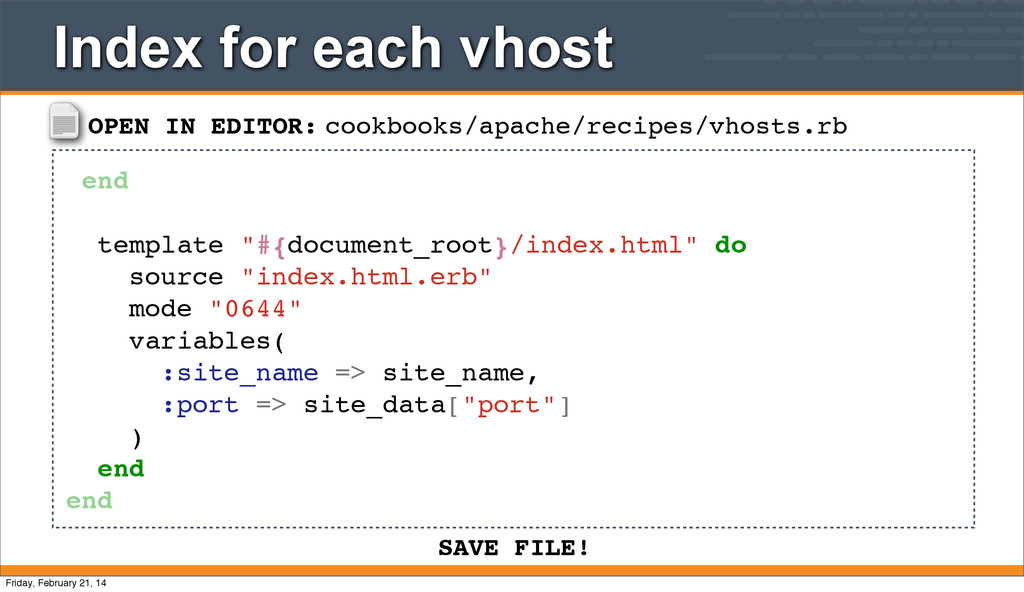
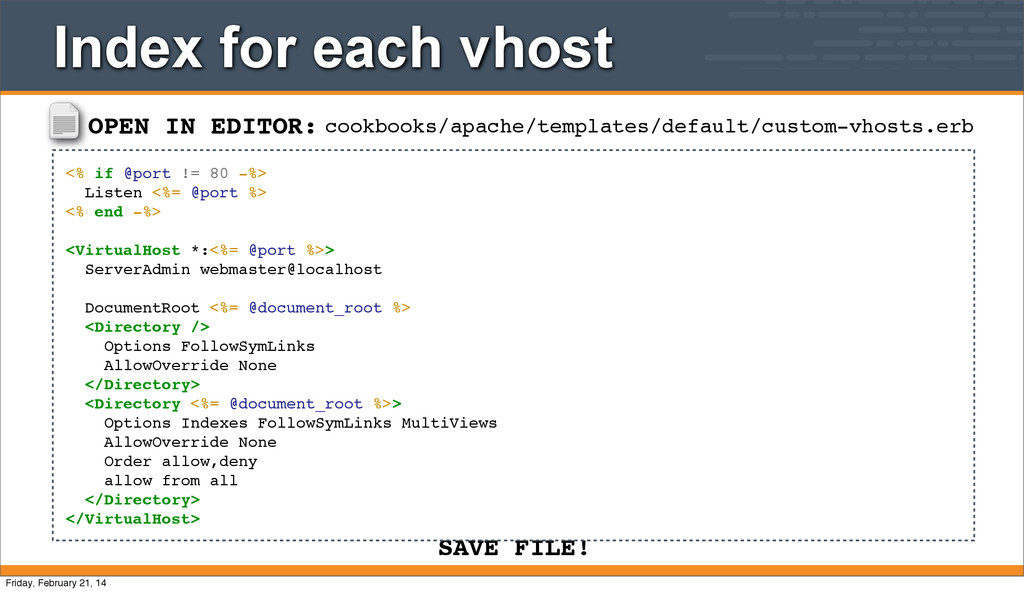
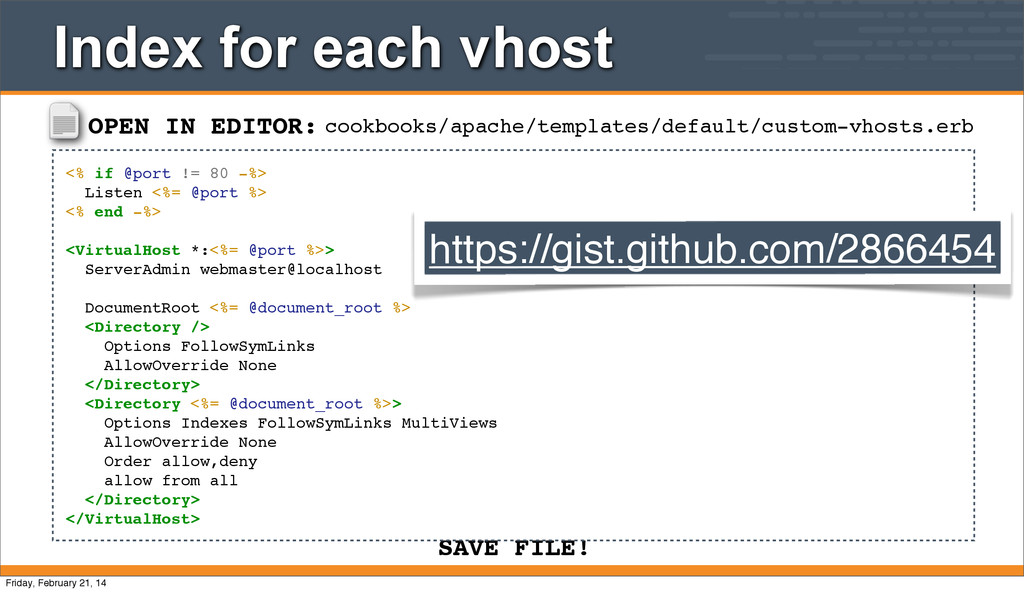
apache::vhosts recipe to manage the virtual hosts we created in data bag items • There's a number of new things to talk about in this recipe • We'll take this nice and slow :) Friday, February 21, 14
source "index.html.erb" mode "0644" variables( :site_name => site_name, :port => site_data["port"] ) end end Index for each vhost Friday, February 21, 14
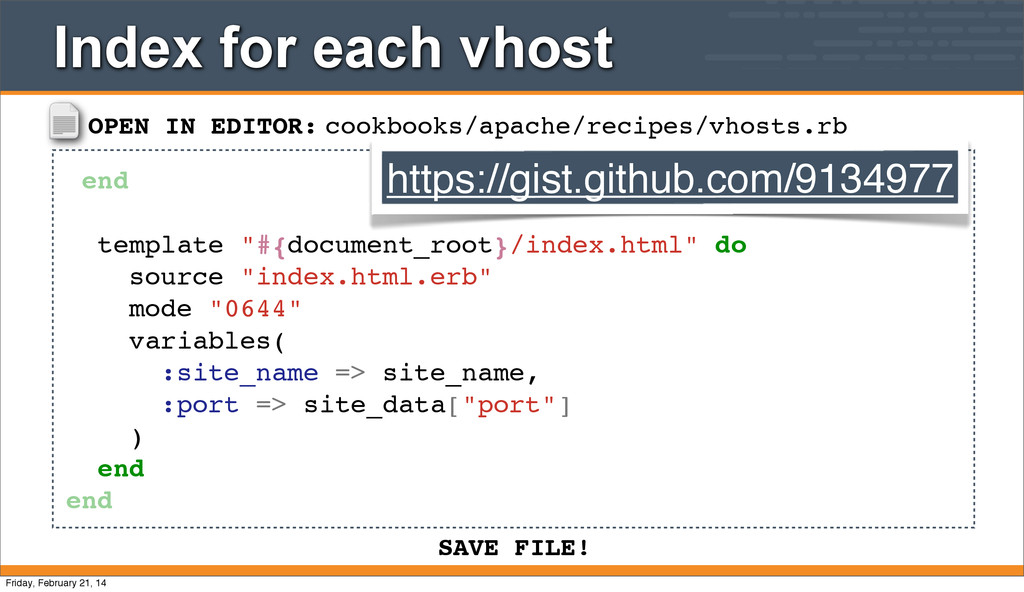
source "index.html.erb" mode "0644" variables( :site_name => site_name, :port => site_data["port"] ) end end Index for each vhost https://gist.github.com/9134977 Friday, February 21, 14
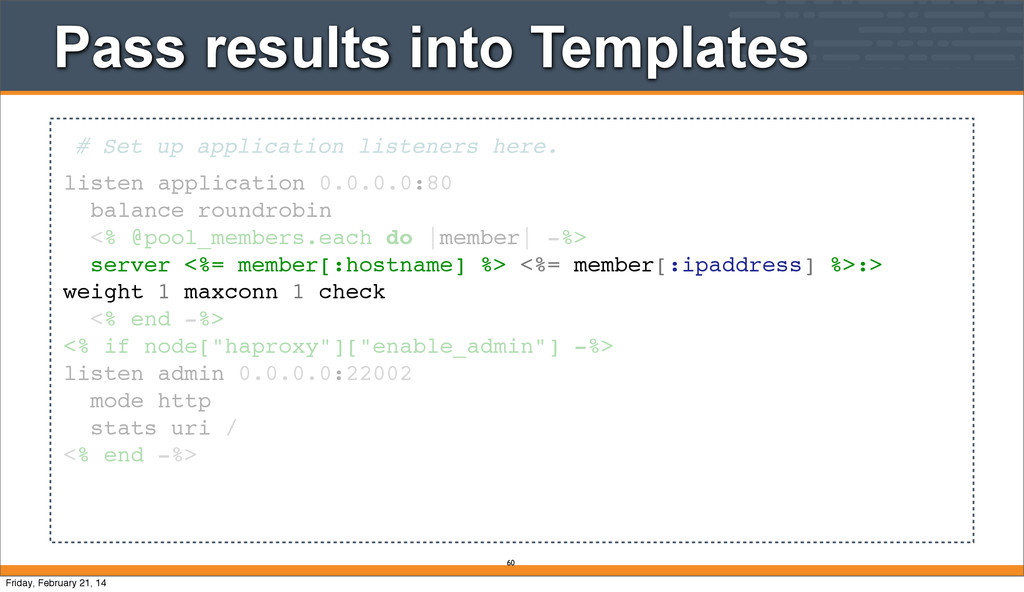
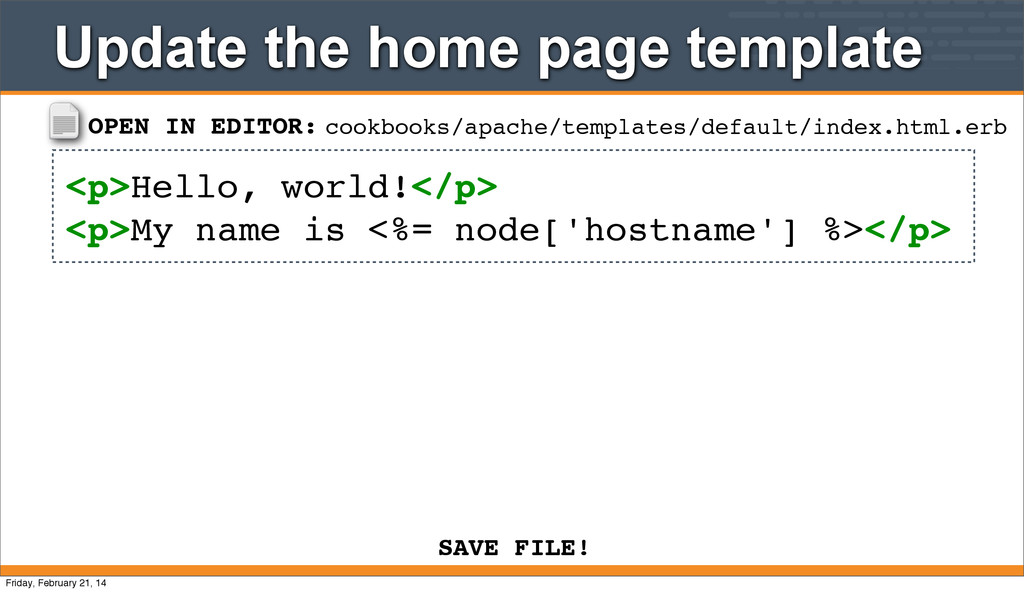
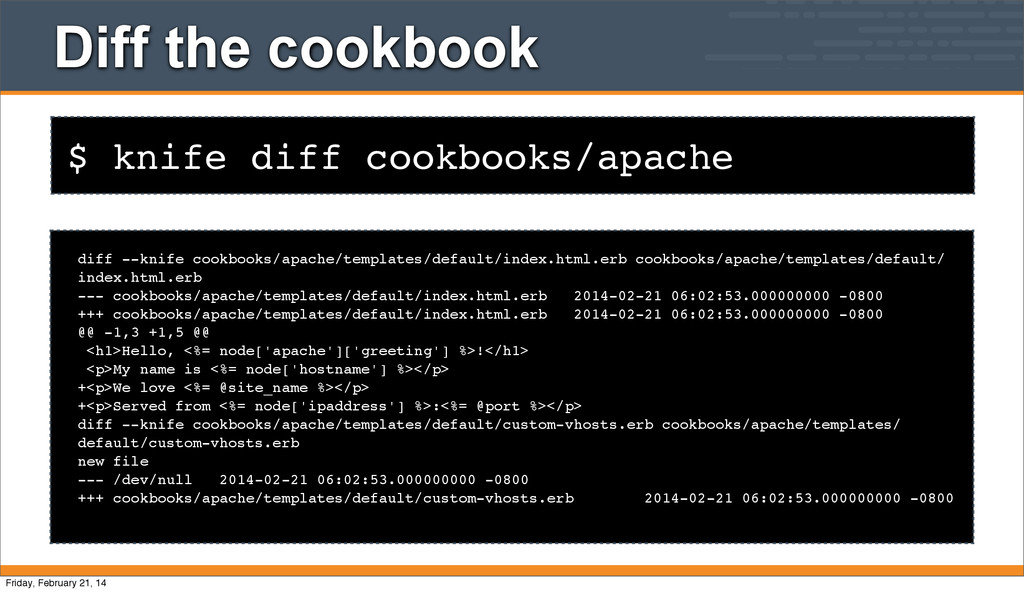
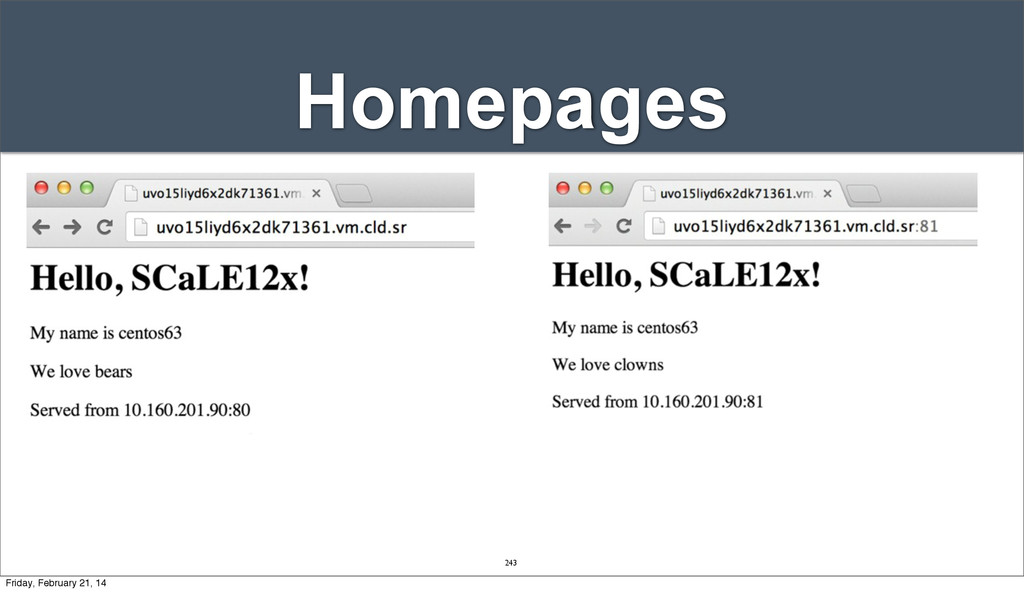
<p>My name is <%= node['hostname'] %></p> <p>We love <%= @site_name %></p> <p>Served from <%= node['ipaddress'] %>:<%= @port %></p> Update the index.html template Friday, February 21, 14
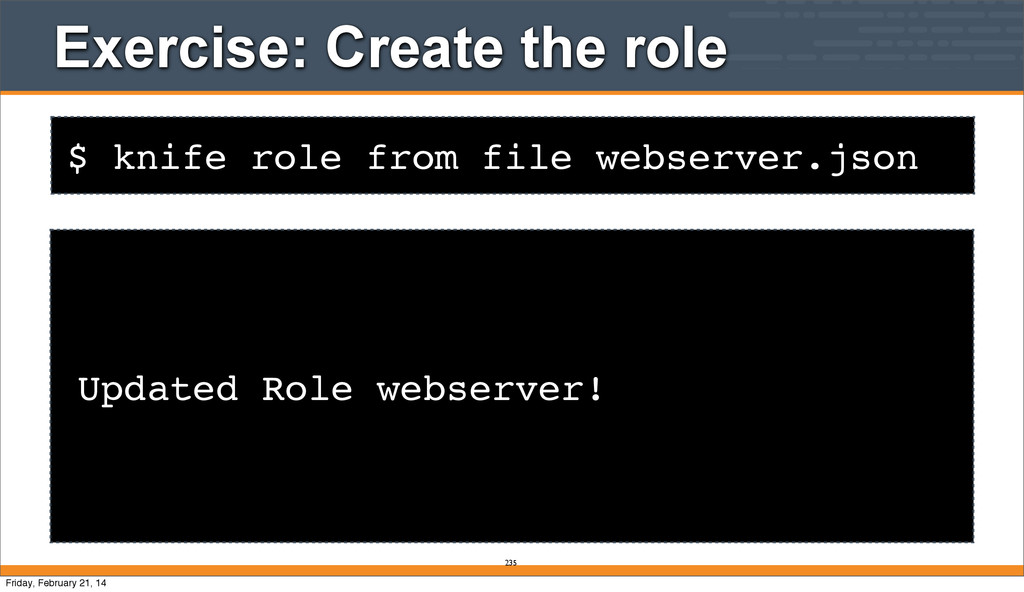
able to • Explain what Roles are, and how they are used to provide clarity • Discuss the Role JSON DSL • Explain how merge order affects the precedence hierarchy 230 Friday, February 21, 14
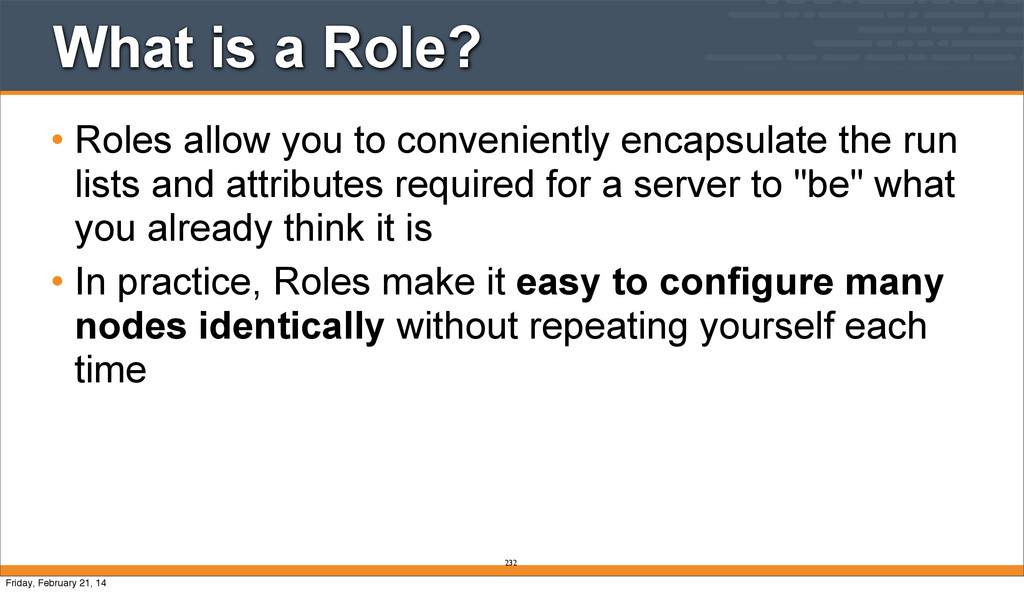
adding recipes directly to a single node • But that’s not how your infrastructure works - think about how you refer to servers • "It’s a web server" • "It’s a database server" • "It’s a monitoring server" 231 Friday, February 21, 14
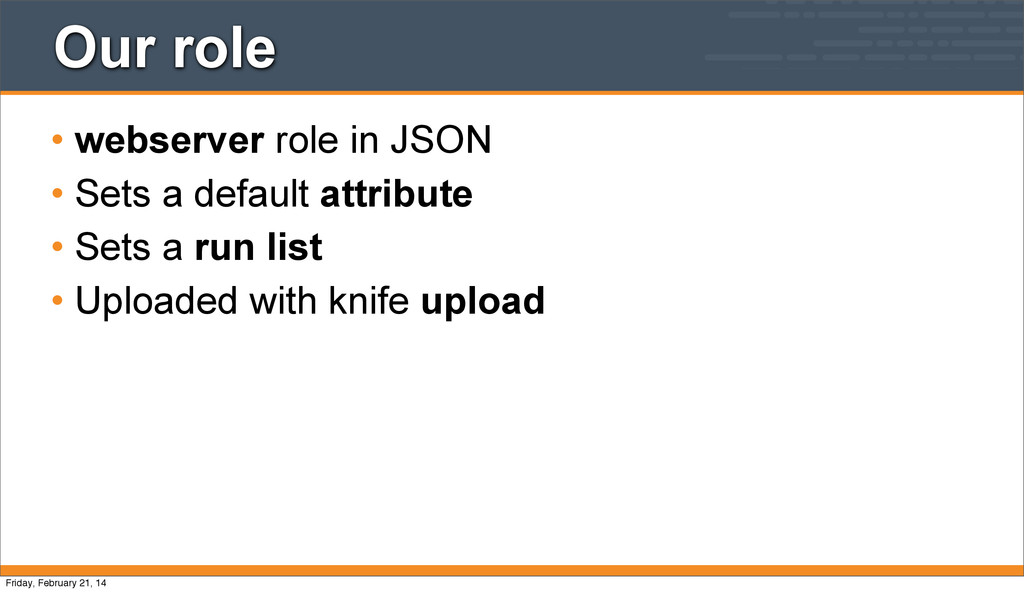
encapsulate the run lists and attributes required for a server to "be" what you already think it is • In practice, Roles make it easy to configure many nodes identically without repeating yourself each time 232 Friday, February 21, 14
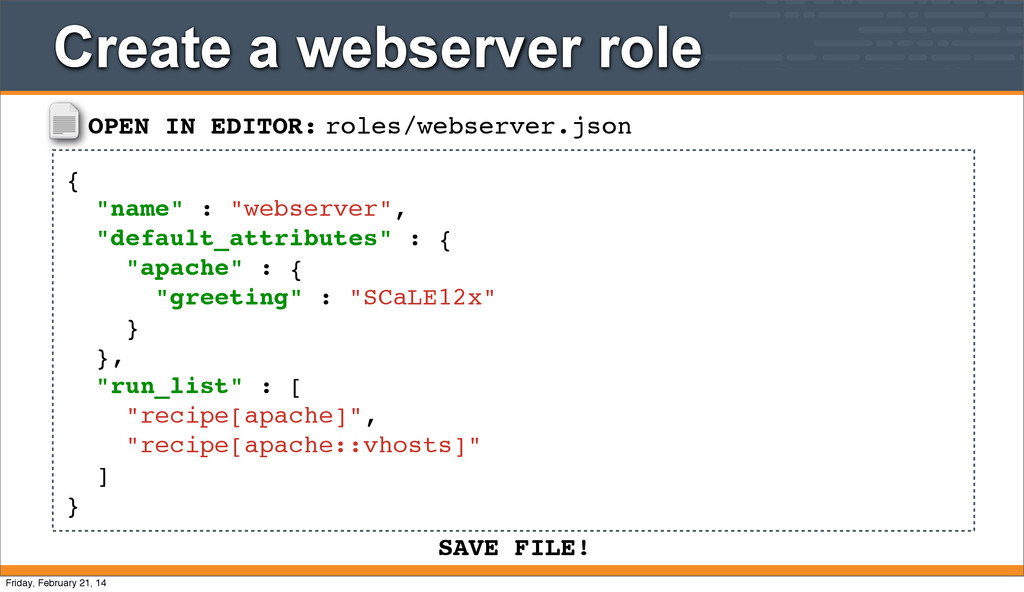
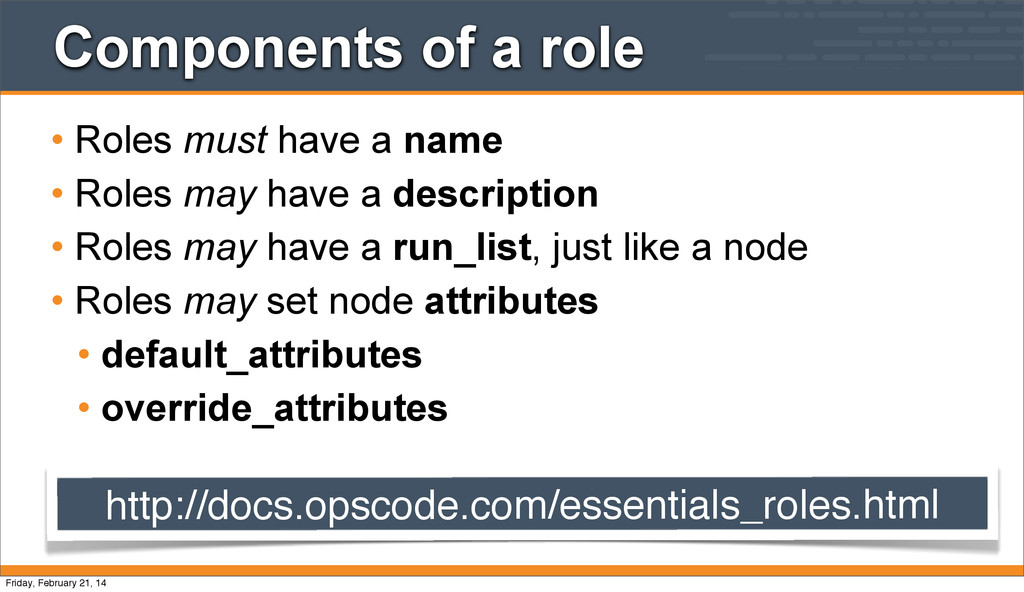
• Roles may have a description • Roles may have a run_list, just like a node • Roles may set node attributes • default_attributes • override_attributes http://docs.opscode.com/essentials_roles.html Friday, February 21, 14
flexibility • Set a "sane default" that will be used in a cookbook • Override it easily in a role (higher priority) • In all, there are 15 places where attributes come from (!!) • In practice, you'll use 2-3 most of the time. • The others are there when you need them. • http://docs.opscode.com/chef_overview_attributes.html Friday, February 21, 14
are not attributes • Data bags are a separate API end point • Data bags are not tied to a specific node or role in the infrastructure • Not even necessarily tied to anything, just data you want to store Friday, February 21, 14
could apply just this role on more nodes to scale out our Virtual Hosting service. • Roles are a great way to assign attributes for specific purposes Friday, February 21, 14
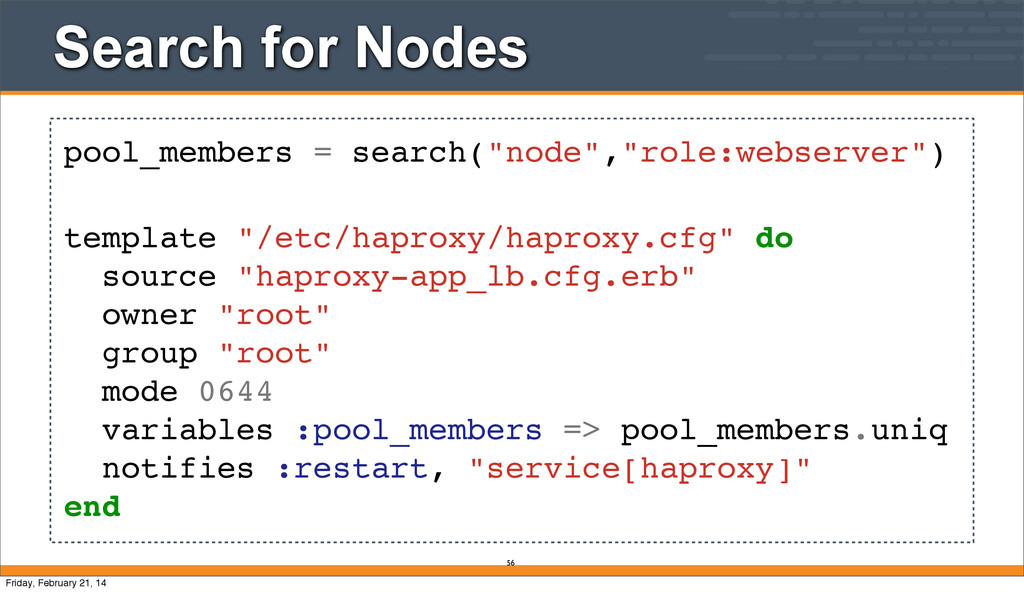
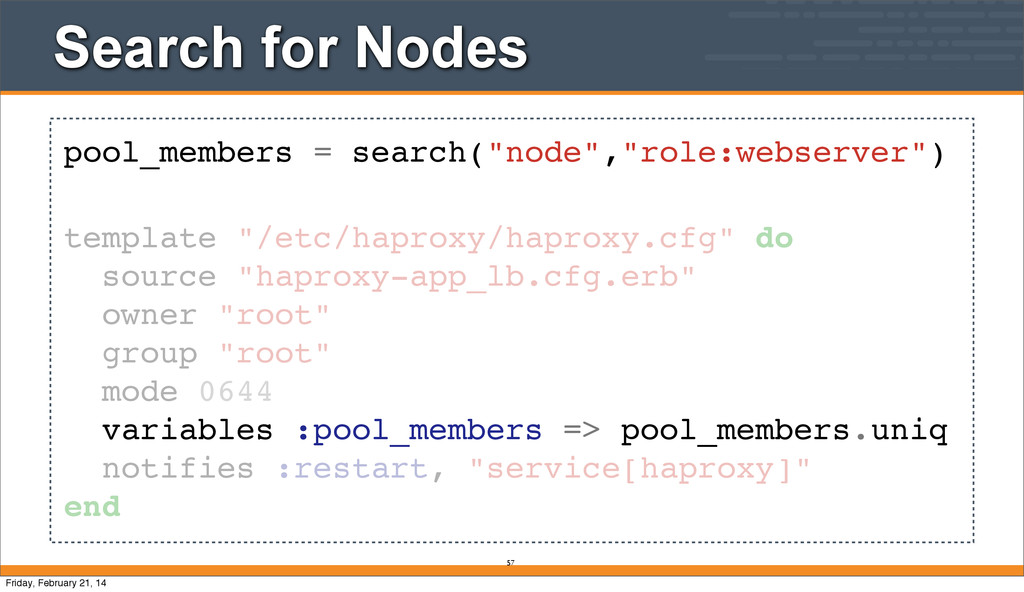
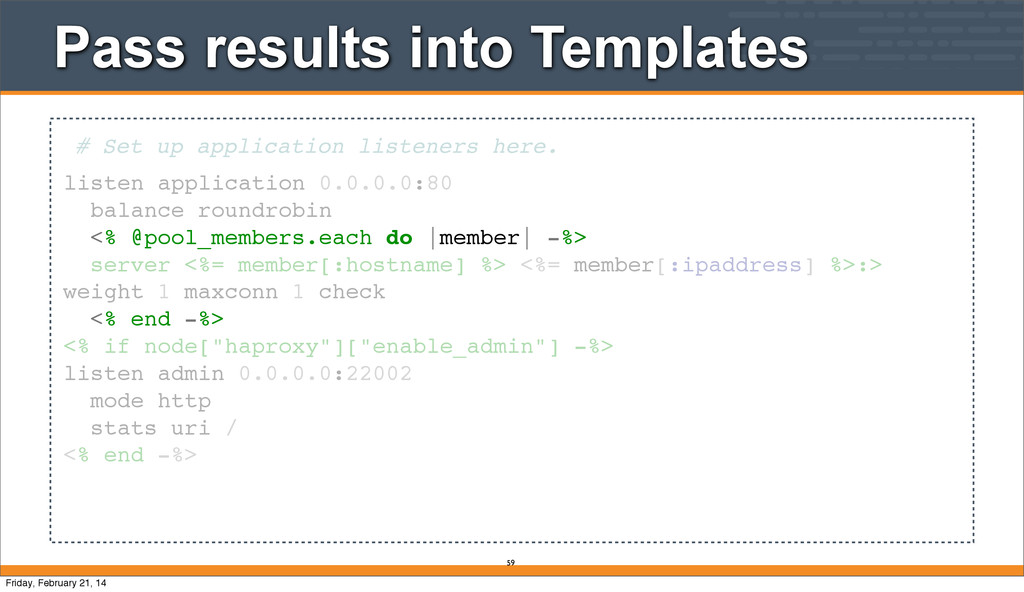
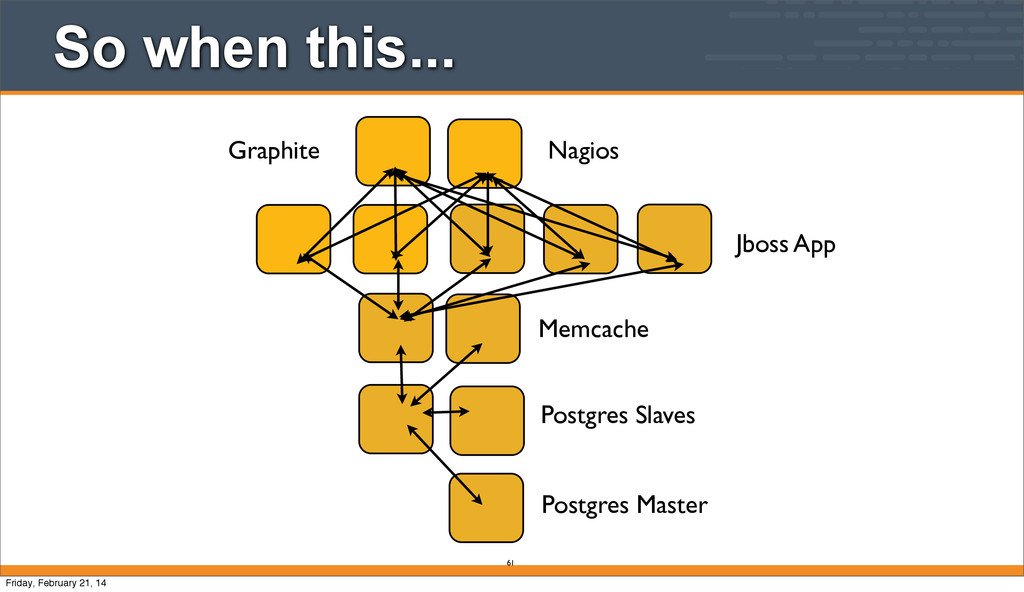
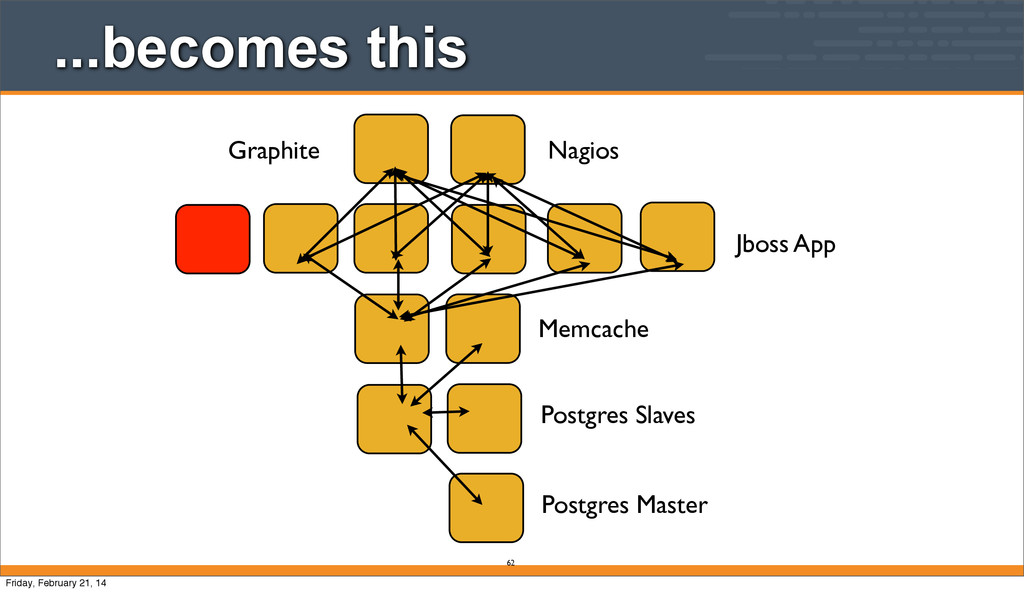
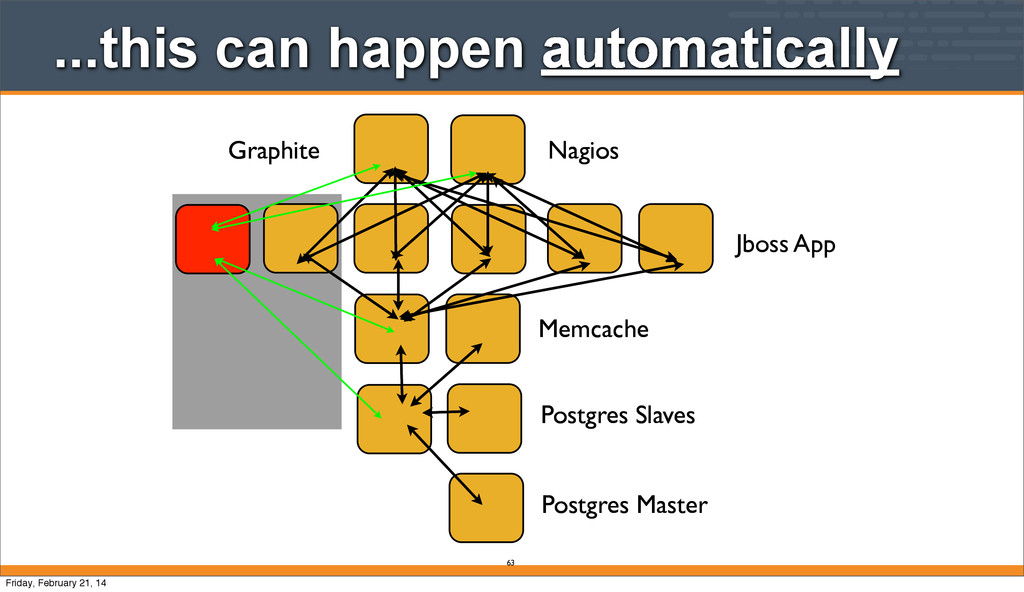
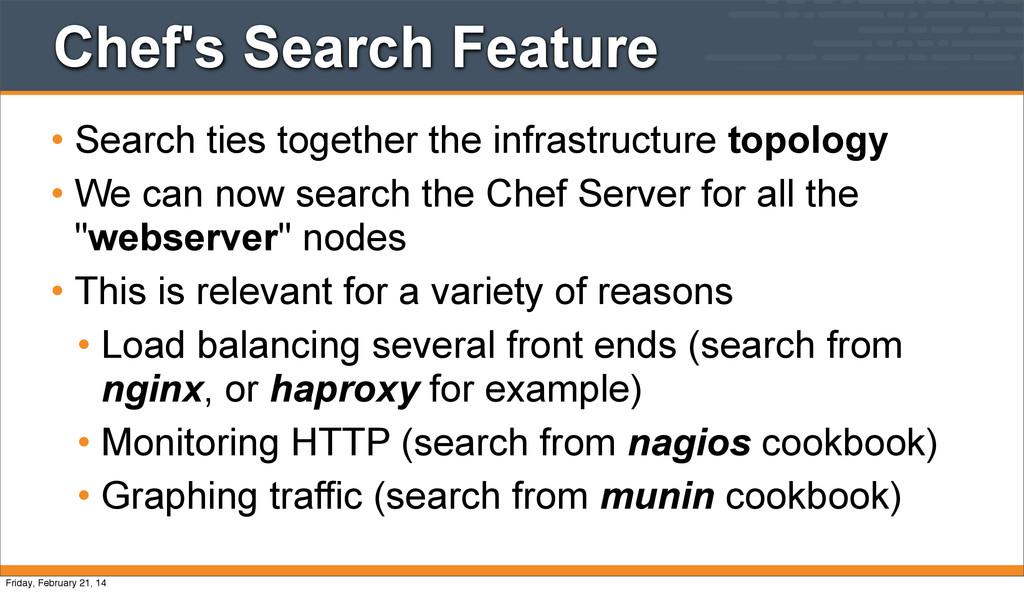
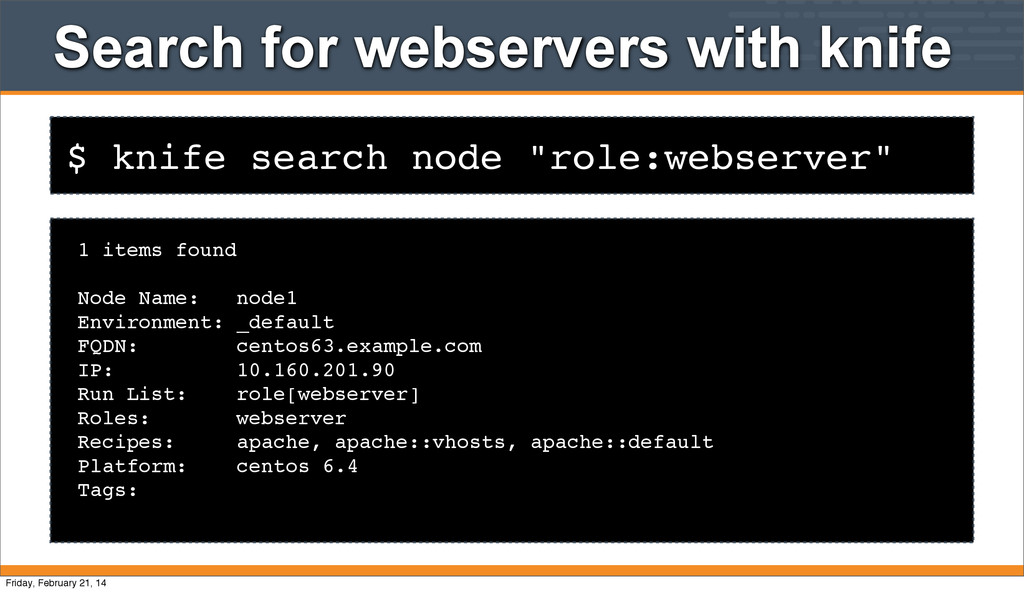
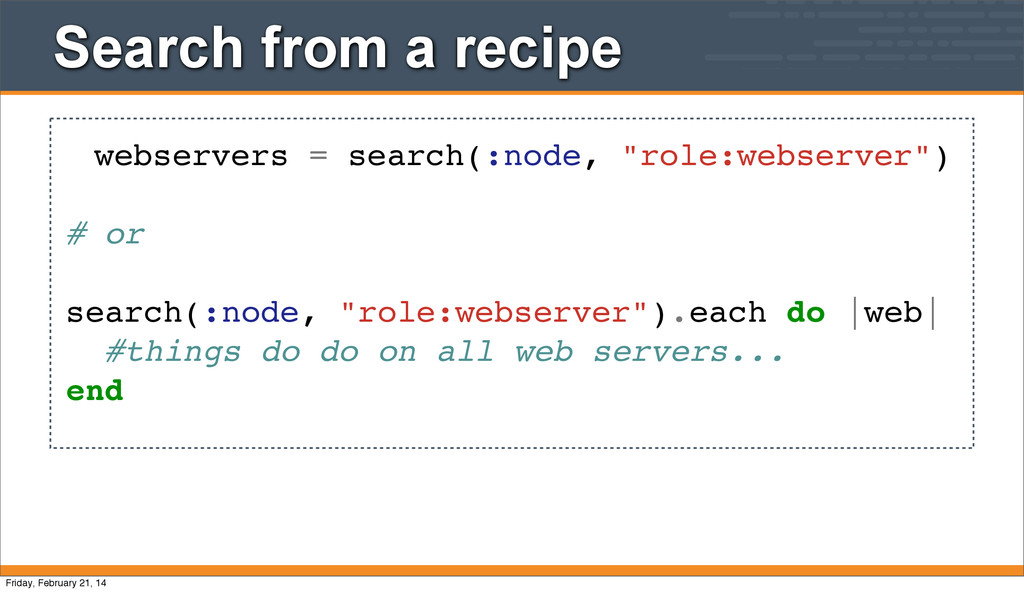
• We can now search the Chef Server for all the "webserver" nodes • This is relevant for a variety of reasons • Load balancing several front ends (search from nginx, or haproxy for example) • Monitoring HTTP (search from nagios cookbook) • Graphing traffic (search from munin cookbook) Friday, February 21, 14
an environment that is really setup for doing search • But we will talk about what kind of search we do with the command-line, or in a recipe Friday, February 21, 14
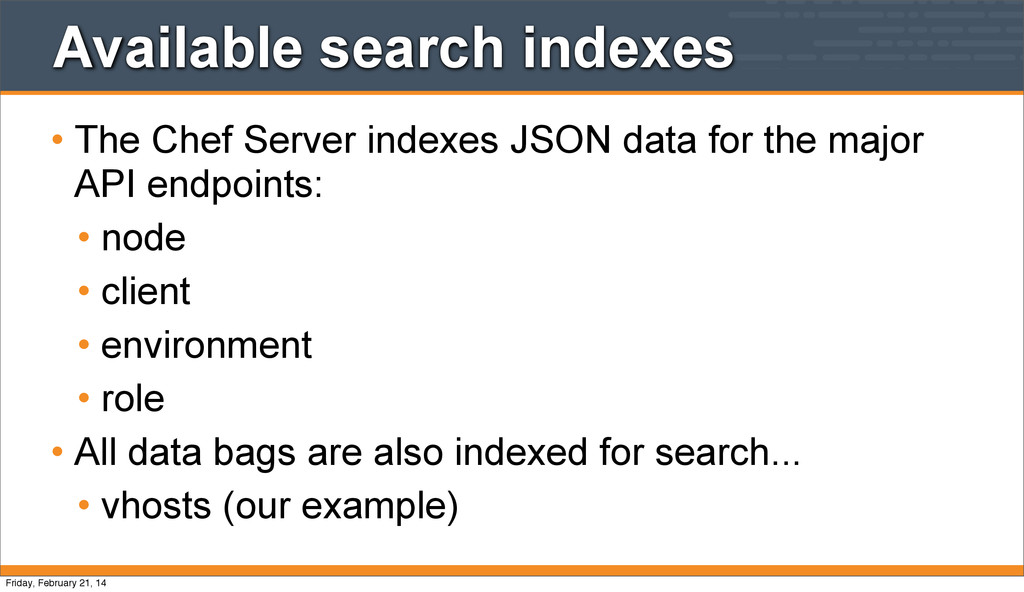
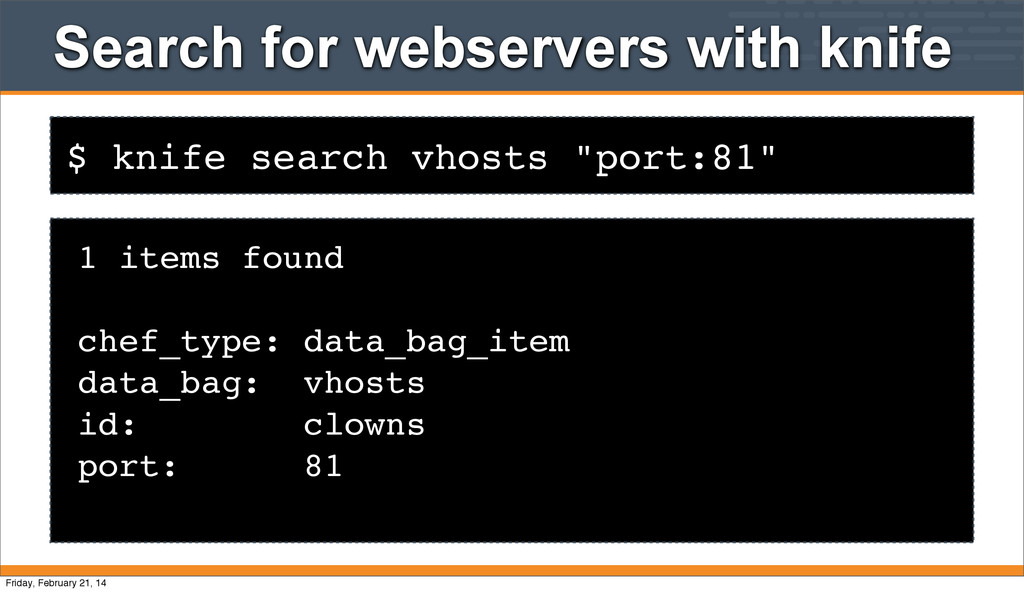
for the major API endpoints: • node • client • environment • role • All data bags are also indexed for search... • vhosts (our example) Friday, February 21, 14
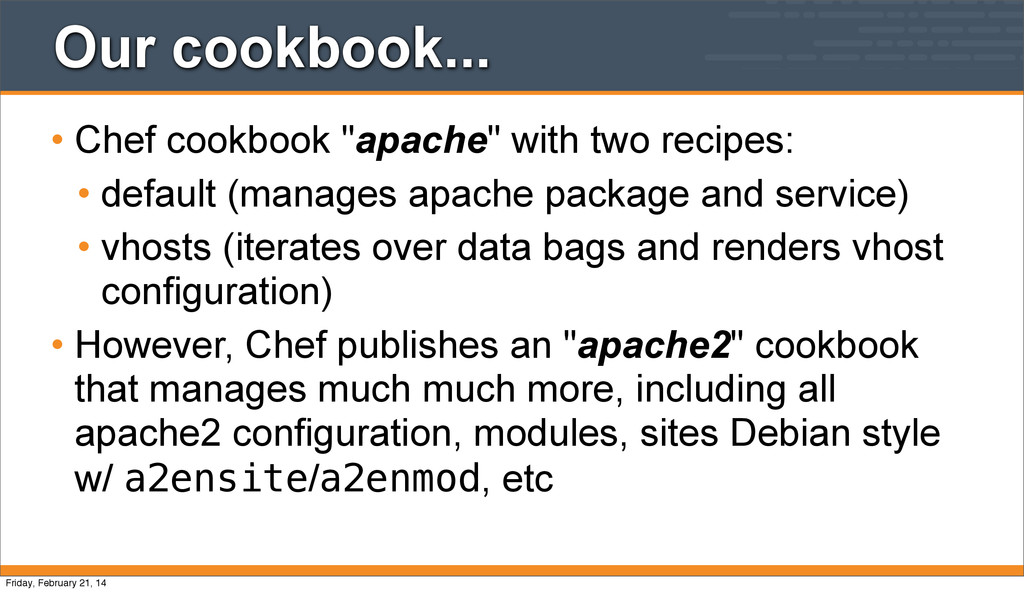
default (manages apache package and service) • vhosts (iterates over data bags and renders vhost configuration) • However, Chef publishes an "apache2" cookbook that manages much much more, including all apache2 configuration, modules, sites Debian style w/ a2ensite/a2enmod, etc Friday, February 21, 14
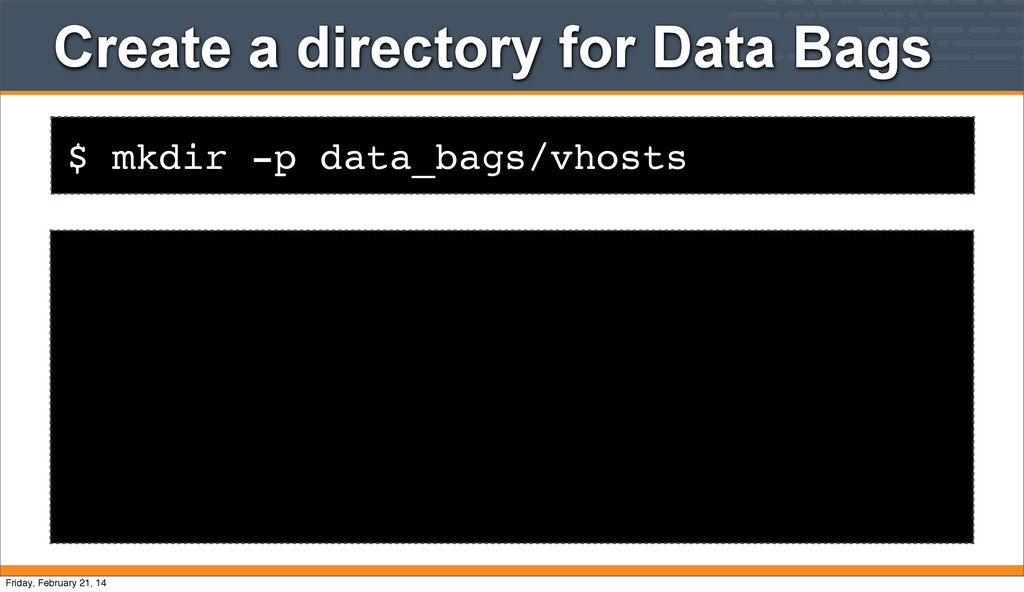
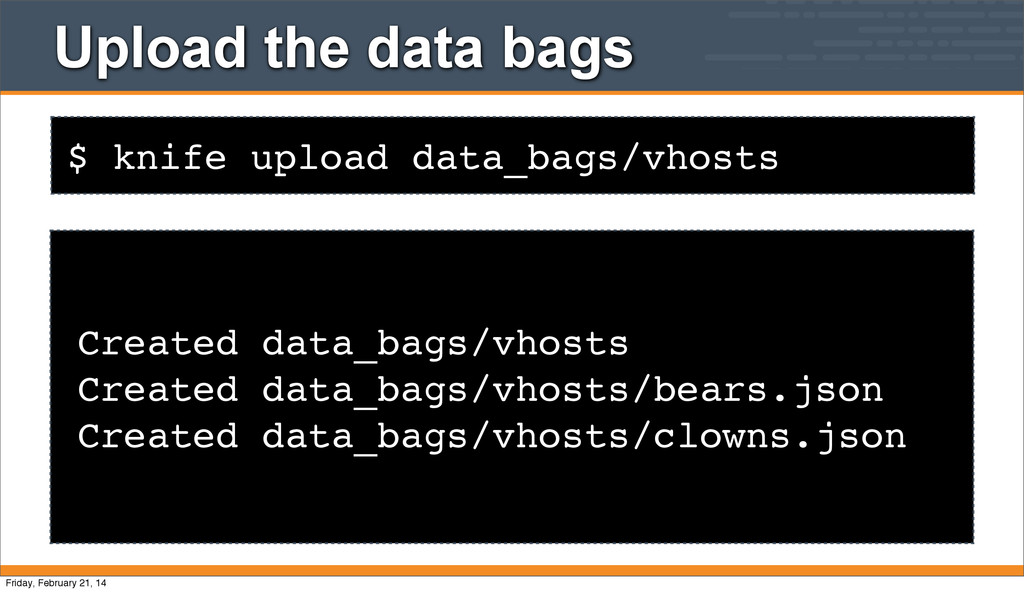
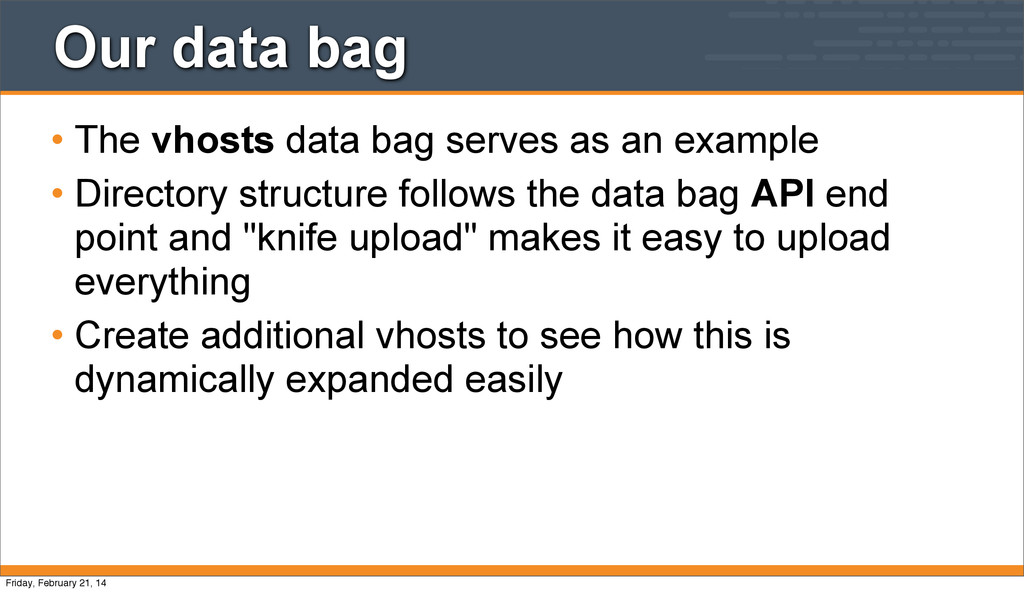
an example • Directory structure follows the data bag API end point and "knife upload" makes it easy to upload everything • Create additional vhosts to see how this is dynamically expanded easily Friday, February 21, 14
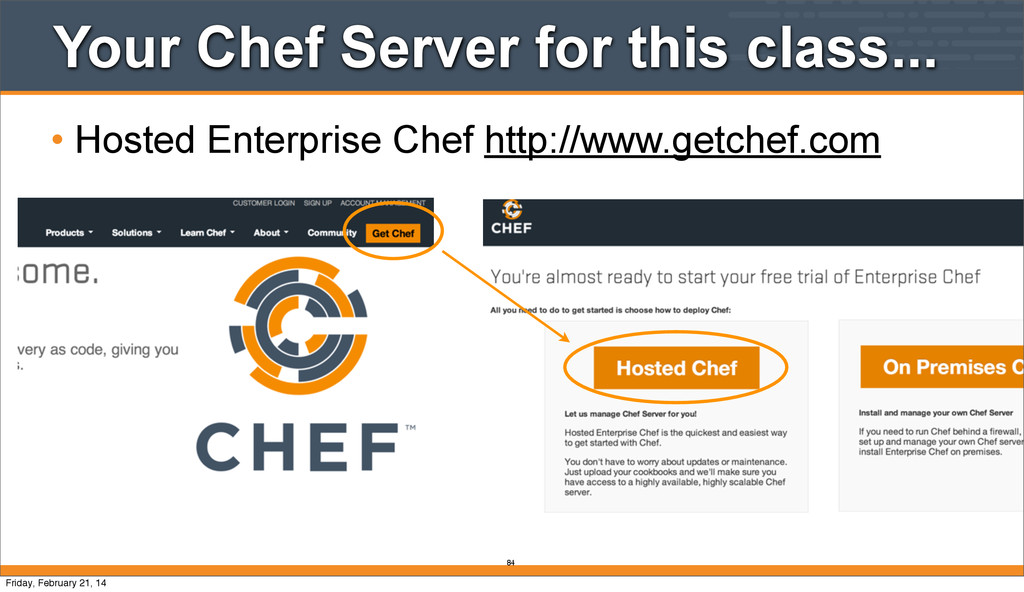
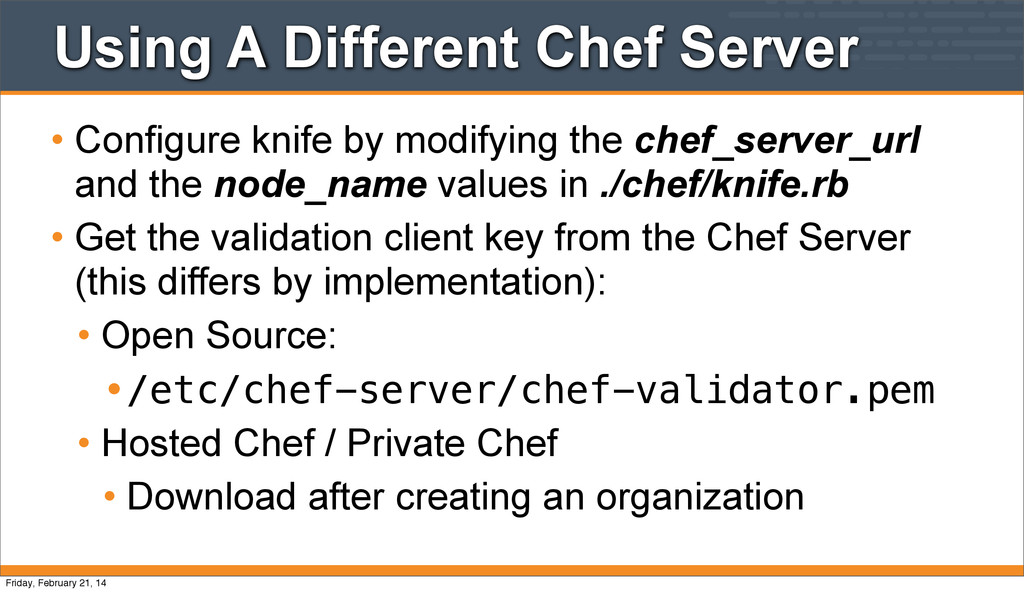
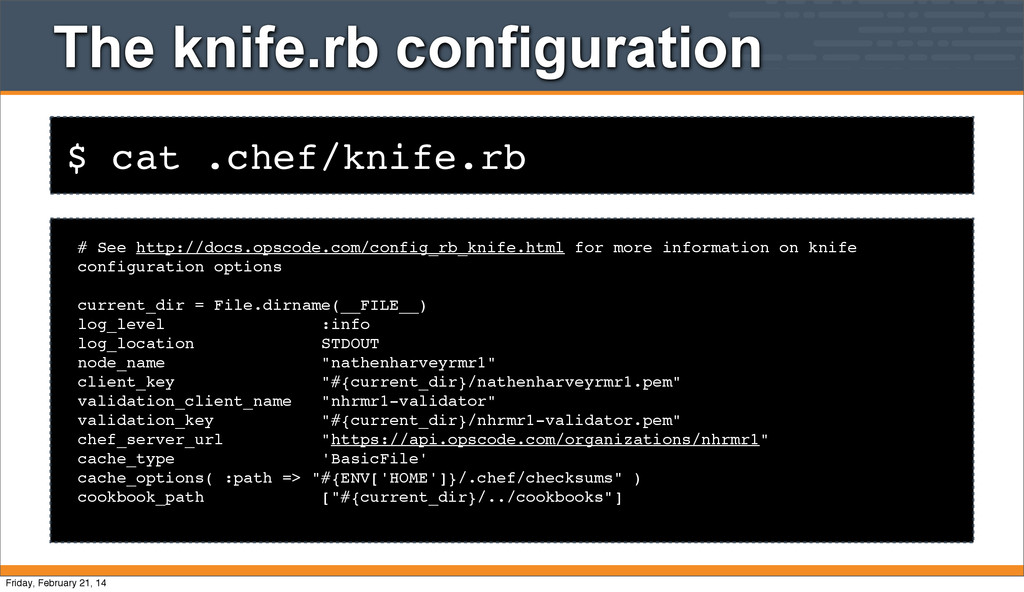
the chef_server_url and the node_name values in ./chef/knife.rb • Get the validation client key from the Chef Server (this differs by implementation): • Open Source: •/etc/chef-server/chef-validator.pem • Hosted Chef / Private Chef • Download after creating an organization Friday, February 21, 14
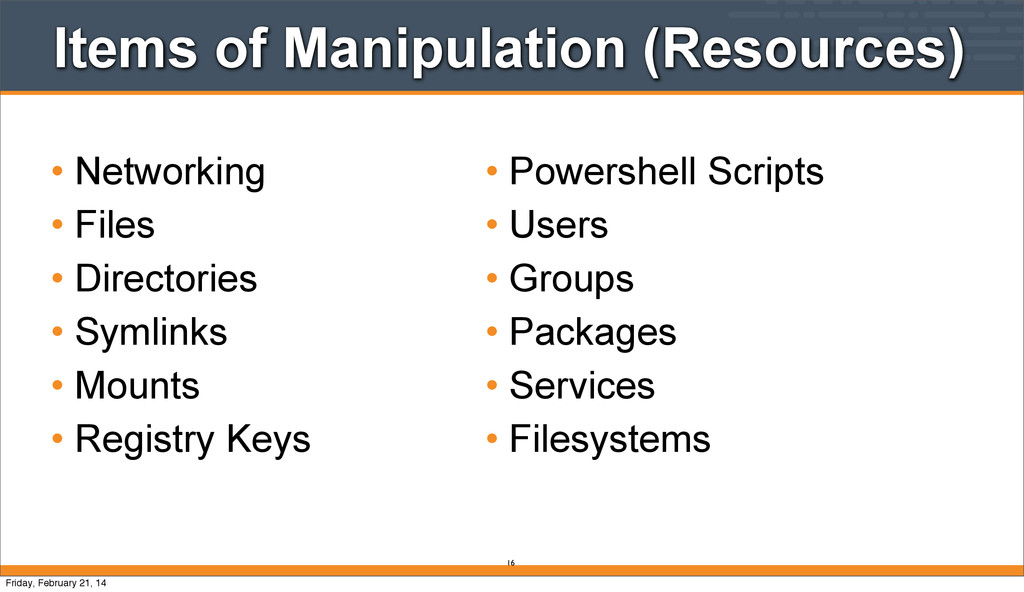
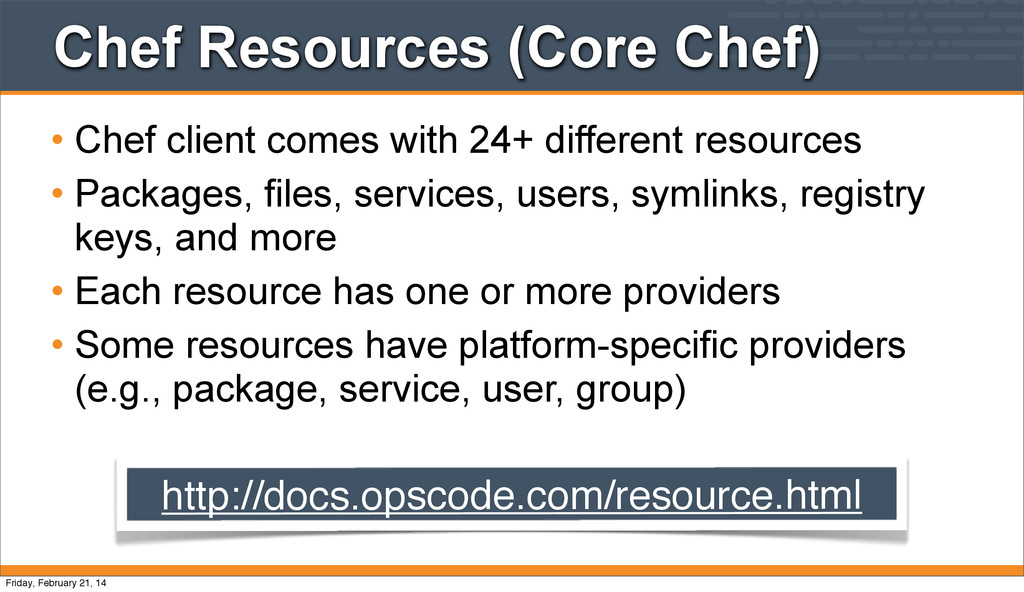
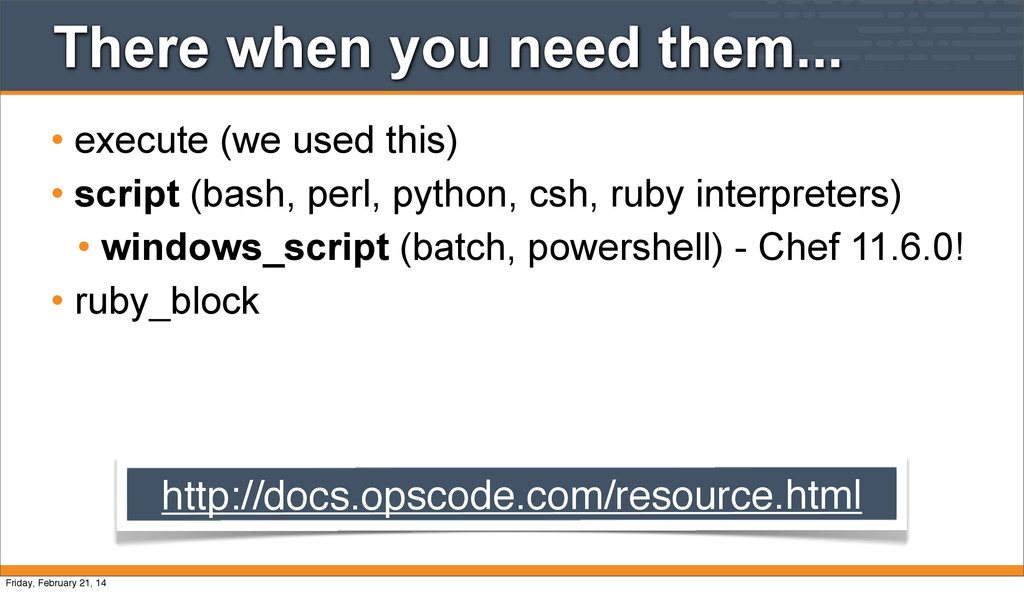
different resources • Packages, files, services, users, symlinks, registry keys, and more • Each resource has one or more providers • Some resources have platform-specific providers (e.g., package, service, user, group) http://docs.opscode.com/resource.html Friday, February 21, 14
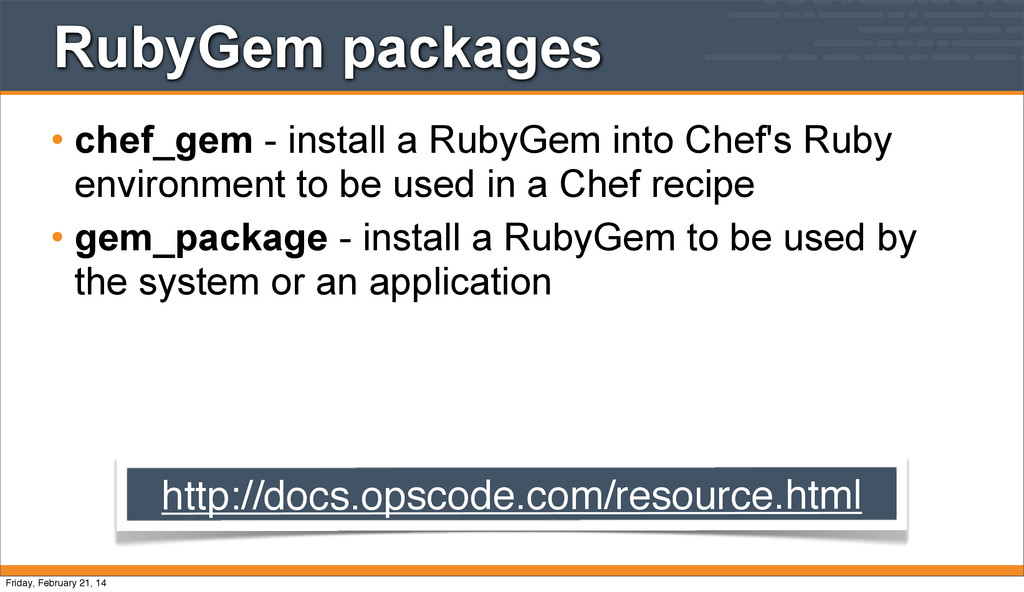
Ruby environment to be used in a Chef recipe • gem_package - install a RubyGem to be used by the system or an application http://docs.opscode.com/resource.html Friday, February 21, 14
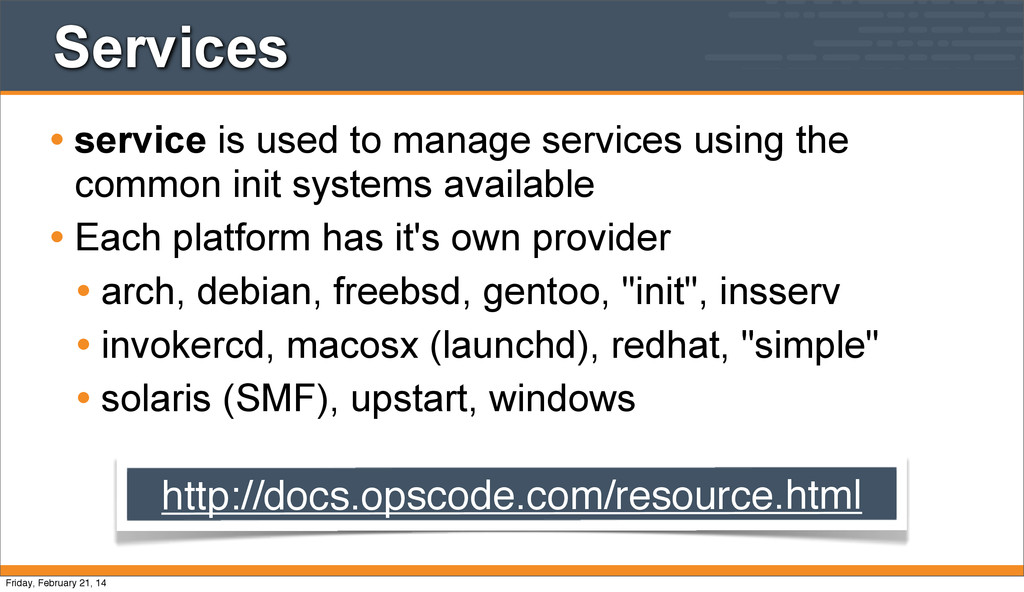
common init systems available • Each platform has it's own provider • arch, debian, freebsd, gentoo, "init", insserv • invokercd, macosx (launchd), redhat, "simple" • solaris (SMF), upstart, windows http://docs.opscode.com/resource.html Friday, February 21, 14
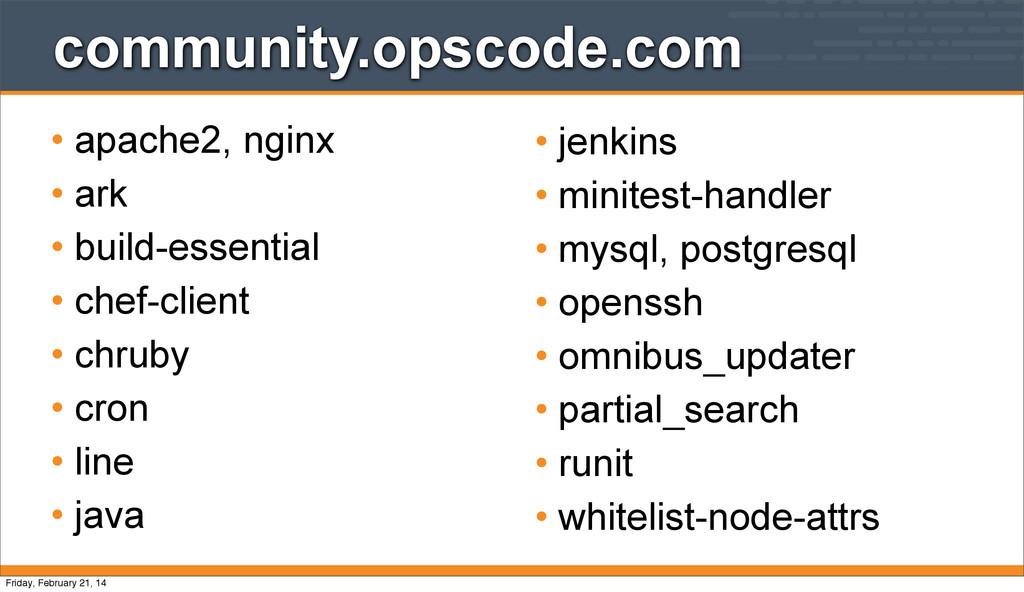
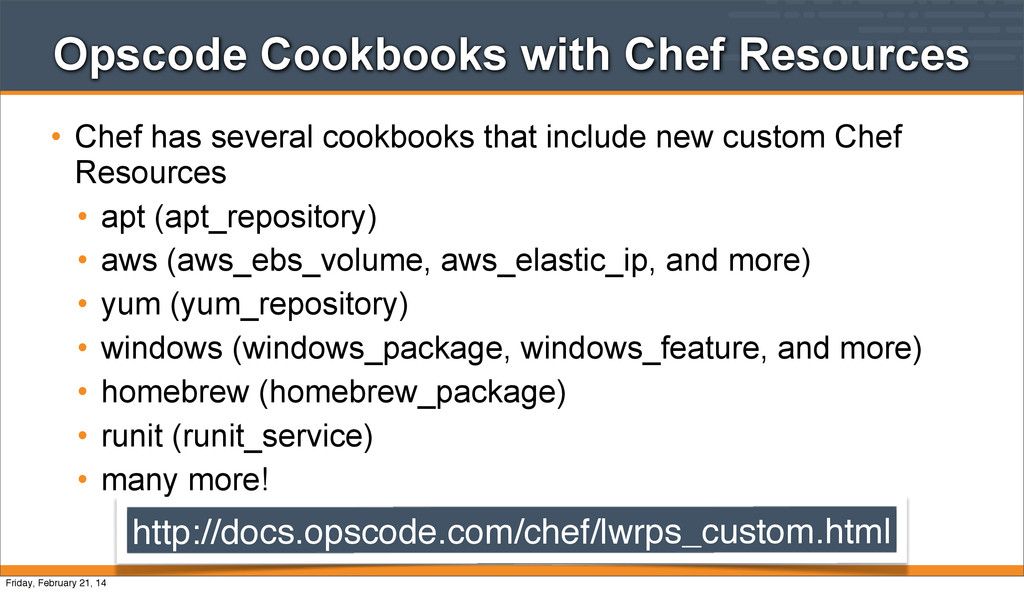
that include new custom Chef Resources • apt (apt_repository) • aws (aws_ebs_volume, aws_elastic_ip, and more) • yum (yum_repository) • windows (windows_package, windows_feature, and more) • homebrew (homebrew_package) • runit (runit_service) • many more! http://docs.opscode.com/chef/lwrps_custom.html Friday, February 21, 14
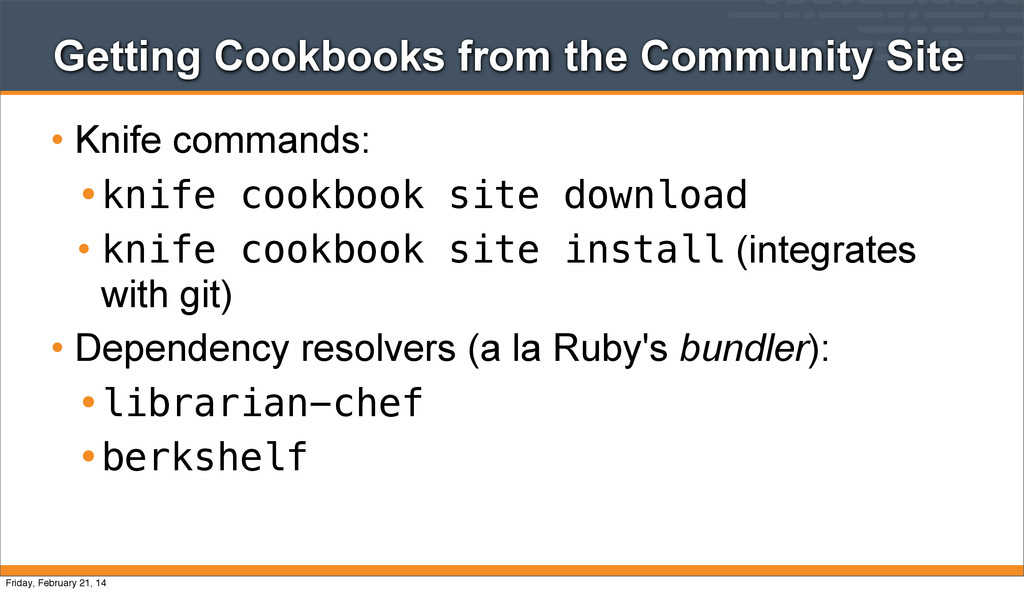
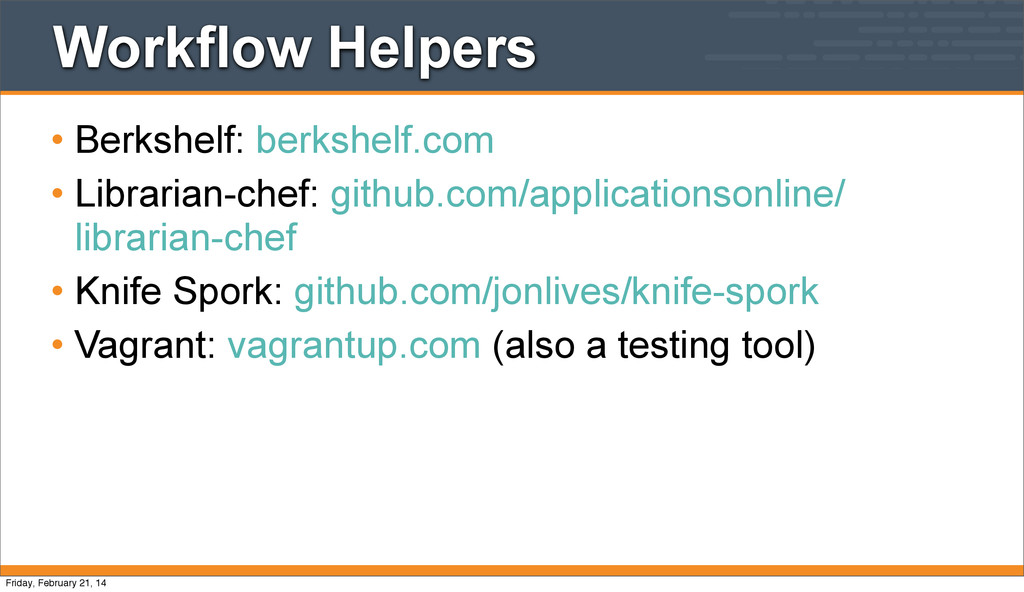
cookbook site download • knife cookbook site install (integrates with git) • Dependency resolvers (a la Ruby's bundler): •librarian-chef •berkshelf Friday, February 21, 14
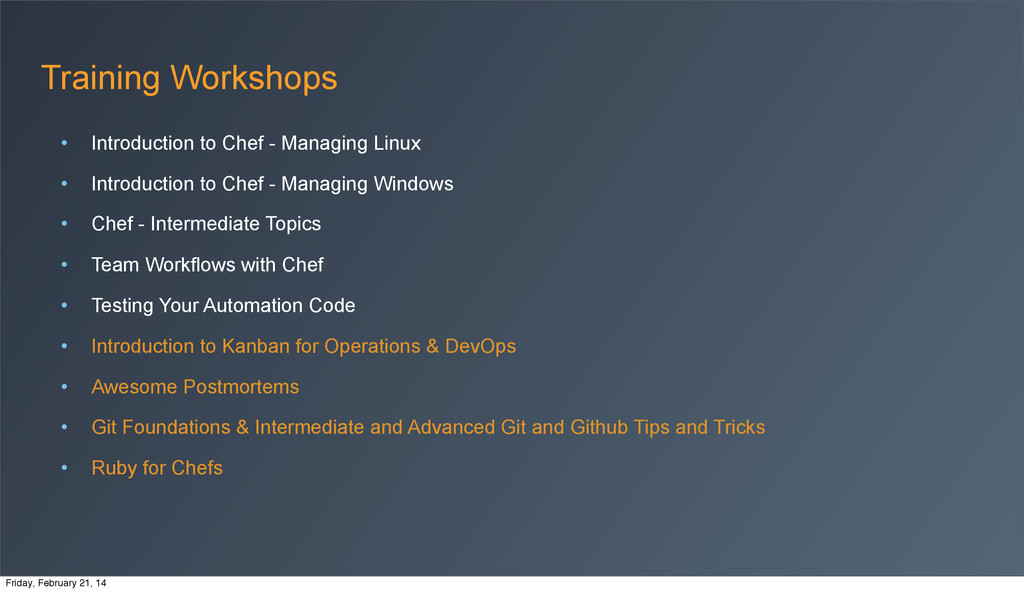
Introduction to Chef - Managing Windows • Chef - Intermediate Topics • Team Workflows with Chef • Testing Your Automation Code • Introduction to Kanban for Operations & DevOps • Awesome Postmortems • Git Foundations & Intermediate and Advanced Git and Github Tips and Tricks • Ruby for Chefs Friday, February 21, 14