Upgrade to Pro — share decks privately, control downloads, hide ads and more …

Flutter testing & debugging

Flutter testing & debugging

Flutter is a popular open-source framework used for developing cross-platform mobile
applications with a single codebase. While building applications, ensuring that the app
functions correctly and is free from errors is very important. This is where testing and
debugging play a crucial role. Testing is the process of verifying that the application
behaves as expected, while debugging involves identifying, analyzing, and fixing errors or bugs in the code. Together, testing and debugging help developers improve the quality, performance, and reliability of Flutter applications, ultimately providing a better user experience.
for more details visit: https://offensotech.com/advanced-flutter-app-certification/

Avatar for Nithya Sibi

Nithya Sibi

May 06, 2026

Other Decks in Education

Transcript

  1. Flutter is a popular open-source framework used for developing cross-platform

    mobile applications with a single codebase. While building applications, ensuring that the app functions correctly and is free from errors is very important. This is where testing and debugging play a crucial role. Testing is the process of verifying that the application behaves as expected, while debugging involves identifying, analyzing, and fixing errors or bugs in the code. Together, testing and debugging help developers improve the quality, performance, and reliability of Flutter applications, ultimately providing a better user experience.
  2. 01 Why Testing and Debugging are Important Testing and debugging

    are essential parts of the Flutter app development process and are key topics covered in a Flutter course. These concepts help learners understand how to ensure that an application works smoothly and efficiently. Testing helps in identifying issues at an early stage, reducing the risk of failures after deployment. Debugging, on the other hand, allows developers to locate and fix errors quickly, improving the overall stability of the application. By learning testing and debugging in a Flutter course, students can develop high-quality applications, save development time, and provide a better user experience.
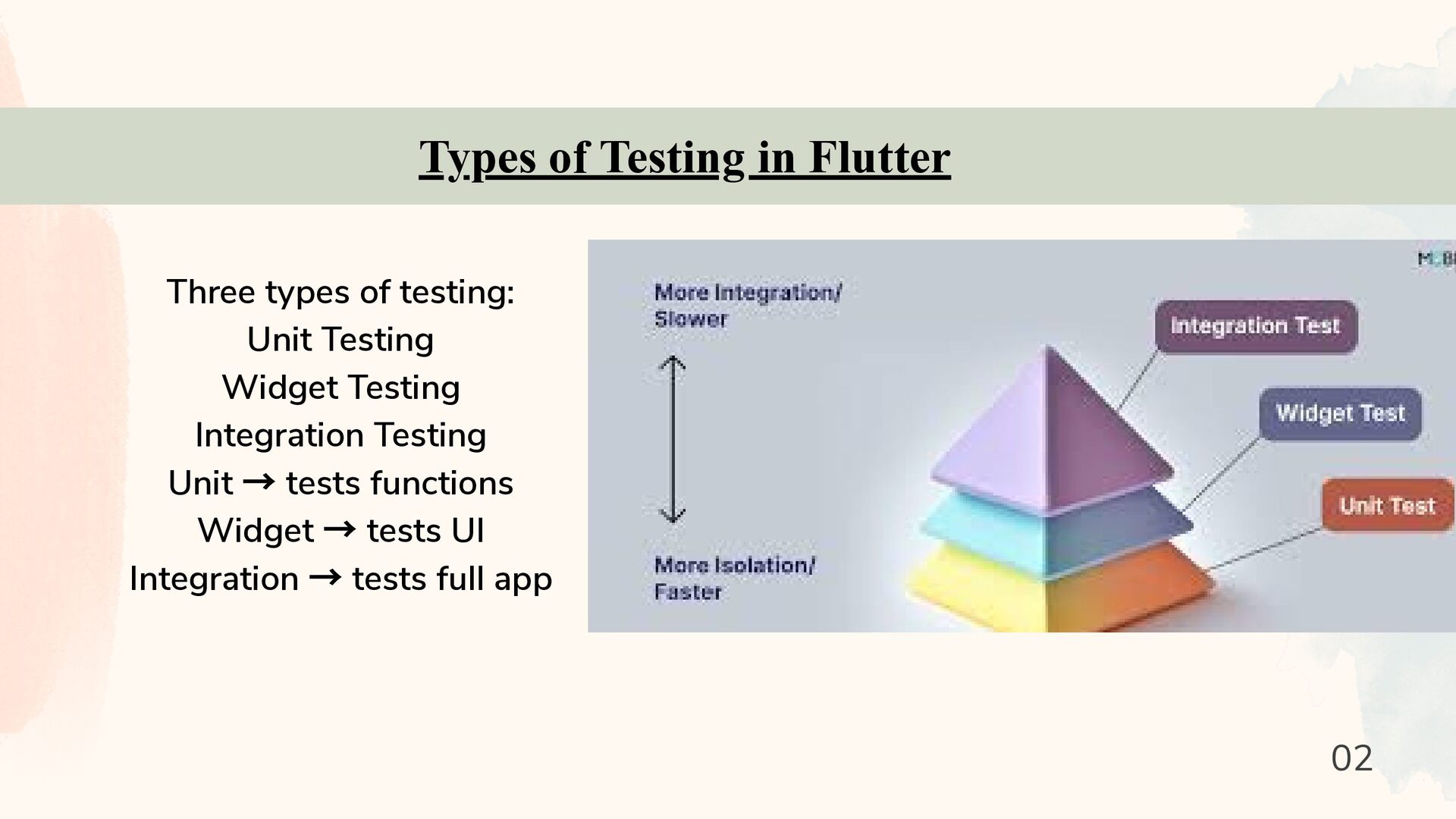
  3. 02 Types of Testing in Flutter Three types of testing:

    Unit Testing Widget Testing Integration Testing Unit → tests functions Widget → tests UI Integration → tests full app
  4. 03 Debugging in Flutter Debugging in Flutter is the process

    of identifying and fixing errors or bugs in an application. It plays an important role in improving the performance and reliability of the app. Developers use various methods such as print statements and debug mode to track issues in the code. Flutter also provides powerful tools like DevTools and IDE debuggers to analyze and resolve problems efficiently. By applying proper debugging techniques, developers can ensure that their applications run smoothly and provide a better user experience.
  5. 04 Advantages of Testing & Debugging Testing and debugging offer

    several advantages in Flutter app development. They help improve the overall quality of the application by identifying and fixing errors early in the development process. This reduces the chances of app failures after deployment and ensures smooth performance. Additionally, testing and debugging save development time by preventing repeated issues and making the code more reliable. By using these techniques, developers can create efficient, stable, and user-friendly applications that provide a better overall user experience.
  6. 05 Common Errors in Flutter Developers may face common errors

    while working with Flutter, such as UI not updating due to incorrect use of state management, API errors due to incorrect data handling, and null safety issues. Identifying and fixing these errors is an important part of debugging.
  7. 06 Real-Time Usage of Testing and Debugging In real-world Flutter

    application development, testing and debugging play a crucial role in ensuring the quality and reliability of the app. Developers regularly test their applications to make sure that new features work correctly without affecting existing functionalities. Debugging helps in identifying issues quickly, especially when applications become complex. By using proper testing and debugging techniques, developers can deliver stable, efficient, and user-friendly applications. These practices are widely followed in professional environments and are important skills learned in a Flutter course.
  8. 07 Best Practices in Flutter Testing and Debugging Following best

    practices can improve the effectiveness of testing and debugging in Flutter. Developers should write test cases regularly and test small parts of the code to identify issues early. Using tools like Flutter DevTools and maintaining clean and structured code makes debugging easier. It is also important to handle errors properly and update the application regularly. By following these practices, developers can reduce bugs, improve performance, and build high-quality applications.
  9. 10 Conclusion In conclusion, testing and debugging are essential parts

    of Flutter app development that ensure the application is reliable, efficient, and user-friendly. They help in identifying and fixing errors, improving performance, and maintaining code quality throughout the development process. By applying proper techniques and best practices, developers can create stable and high-quality applications. Therefore, learning testing and debugging is not only important for academic purposes but also essential for building a successful career as a Flutter developer.