Upgrade to Pro — share decks privately, control downloads, hide ads and more …

Digital Finance Case Study: a model to get Fina...

Avatar for Pierre Neis Pierre Neis
February 02, 2020

Digital Finance Case Study: a model to get Finance Agile

My client is a well known global company. He asked me to help the company to transform its Finance and Administration department (4000 p) into an agile enterprise.
We didn't start from scratch, and a severe model had to be considered, the NextGen Model.
Together, we designed a model shifting the tradition organisational matrix into a multi-sided platform.
That program is still running today, and it's enormous. But, the very fundamentals of an agile organisation have been set up.

Avatar for Pierre Neis

Pierre Neis

February 02, 2020

Other Decks in Business

Transcript

  1. > < agile² GmbH [email protected] > < agile² GmbH [email protected]

    This document is a proposal to move from a locked-in situation, and your mission is to challenge it from an “irritant-constructive” manner. It means that only a counter proposition matters. The last two years, the agile organizational model has positively experimented in the IT department. AO is a light, agile organization model focusing on systems dynamics and behaviour in these systems. The approach is “organic” and empirical: give voice to the system, align, improve.
  2. > < next agile² GmbH [email protected] AO is an organization

    model created by Pierre E. Neis, www.myao.blog. RA or Requisite Agility is the agile evolution of Requisite Organization ( https:// requisiteagility.org/) designed by Elliot Jacques. RA has been designed by Amit Arora, Geordie Keitt, Kashmir Birk, Patrick Hoverstadt, Stephen Clement, Scott Pochron, Heidi Mehltretter, Sabine Neuenschwander, Benjamin P. Taylor, Christoph Reinicke, George Romme, Frank Ewert, Pierre E. Neis. The documents labelled with the Stern Stewart logo are quotes from NextGen referring to the consulting company owned approach. Note 3
  3. > < next agile² GmbH [email protected] 01 02 03 The

    Situation Making Stern Stewart agile Plexus 04 05 06 Organizational process Challenge Action plan 2020 Table of Contents 4 07 08 Working model Appendix
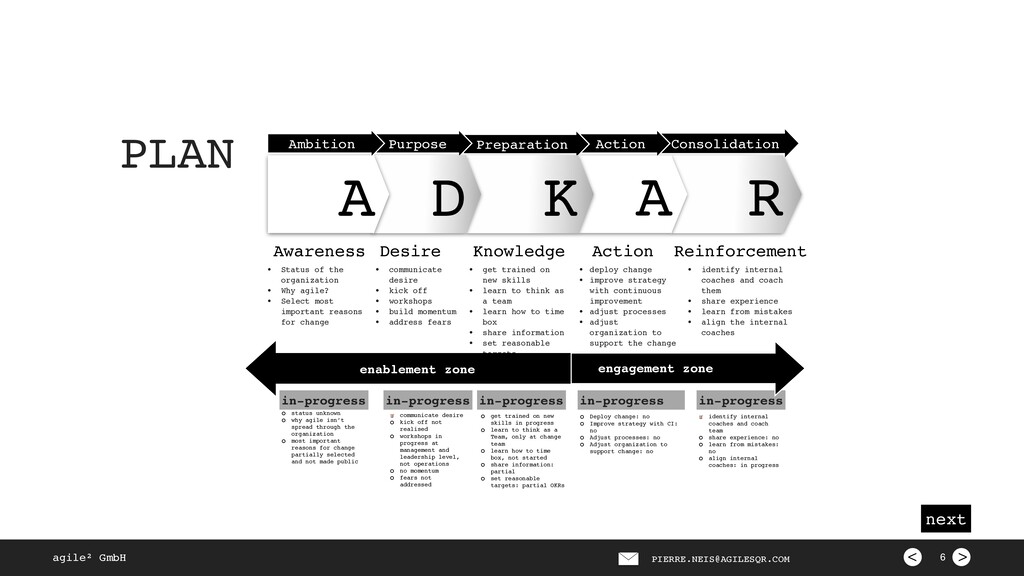
  4. > < next agile² GmbH [email protected] 6 Consolidation Action Preparation

    Purpose R A K D A Ambition Awareness Desire Knowledge Action Reinforcement • Status of the organization • Why agile? • Select most important reasons for change • communicate desire • kick off • workshops • build momentum • address fears • get trained on new skills • learn to think as a team • learn how to time box • share information • set reasonable targets • deploy change • improve strategy with continuous improvement • adjust processes • adjust organization to support the change • identify internal coaches and coach them • share experience • learn from mistakes • align the internal coaches enablement zone in-progress in-progress in-progress in-progress in-progress status unknown why agile isn’t spread through the organization most important reasons for change partially selected and not made public communicate desire kick off not realised workshops in progress at management and leadership level, not operations no momentum fears not addressed get trained on new skills in progress learn to think as a Team, only at change team learn how to time box, not started share information: partial set reasonable targets: partial OKRs Deploy change: no Improve strategy with CI: no Adjust processes: no Adjust organization to support change: no identify internal coaches and coach team share experience: no learn from mistakes: no align internal coaches: in progress engagement zone PLAN
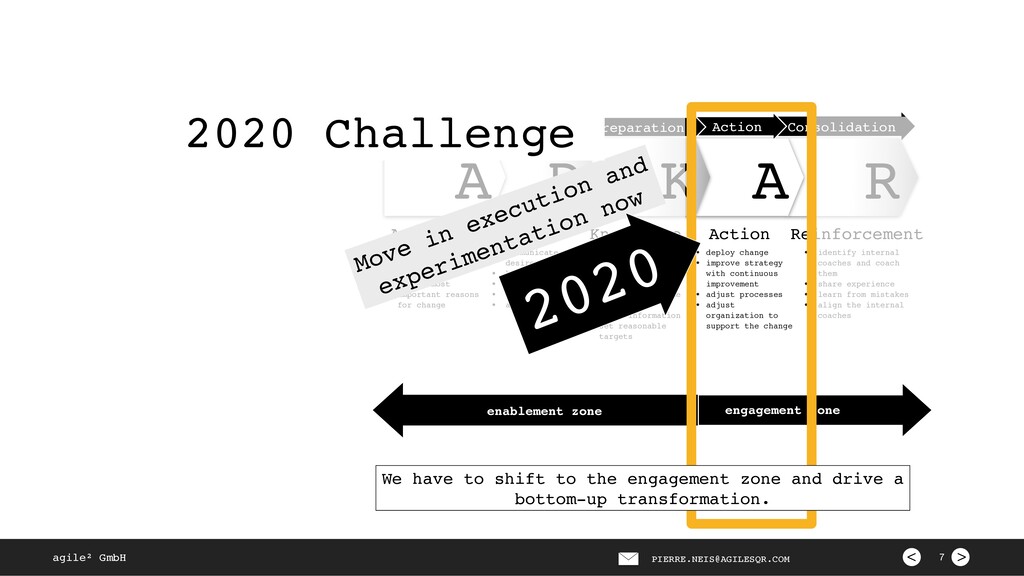
  5. > < agile² GmbH [email protected] 7 Consolidation Action Preparation Purpose

    R A K D A Ambition Awareness Desire Knowledge Action Reinforcement • Status of the organization • Why agile? • Select most important reasons for change • communicate desire • kick off • workshops • build momentum • address fears • get trained on new skills • learn to think as a team • learn how to time box • share information • set reasonable targets • deploy change • improve strategy with continuous improvement • adjust processes • adjust organization to support the change • identify internal coaches and coach them • share experience • learn from mistakes • align the internal coaches enablement zone engagement zone Move in execution and experimentation now 2020 We have to shift to the engagement zone and drive a bottom-up transformation. 2020 Challenge
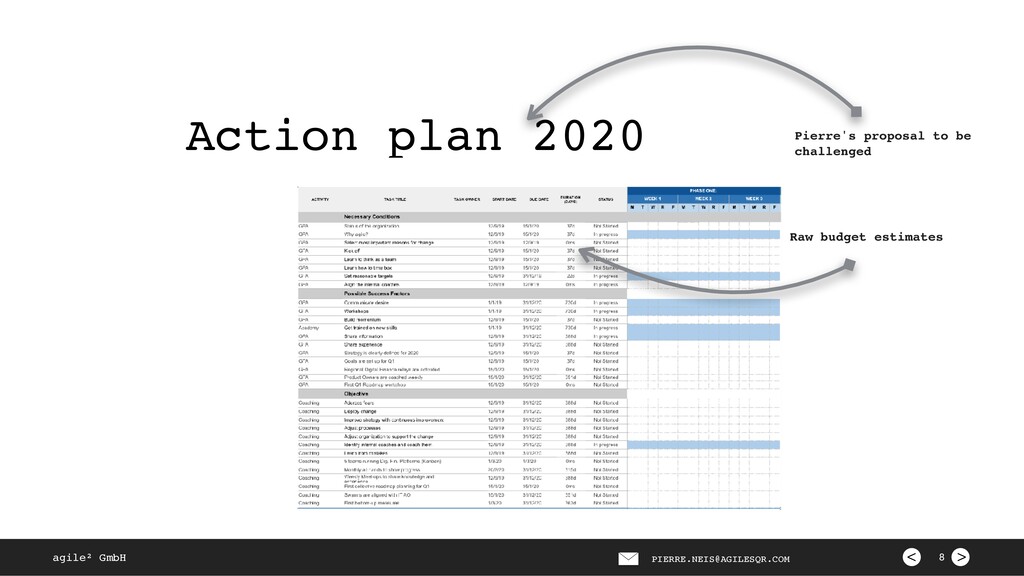
  6. > < agile² GmbH [email protected] Action plan 2020 8 Pierre's

    proposal to be challenged Raw budget estimates
  7. > < agile² GmbH [email protected] Stern Stewart NextGen vs ao

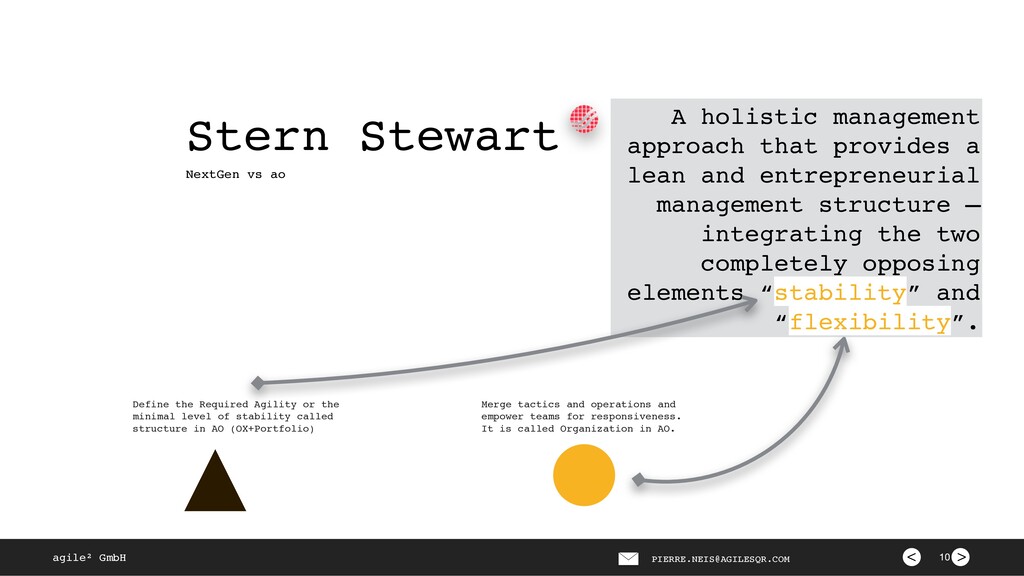
    10 A holistic management approach that provides a lean and entrepreneurial management structure – integrating the two completely opposing elements “stability” and “flexibility”. Define the Required Agility or the minimal level of stability called structure in AO (OX+Portfolio) Merge tactics and operations and empower teams for responsiveness. It is called Organization in AO.
  8. > < agile² GmbH [email protected] Stern Stewart NextGen in a

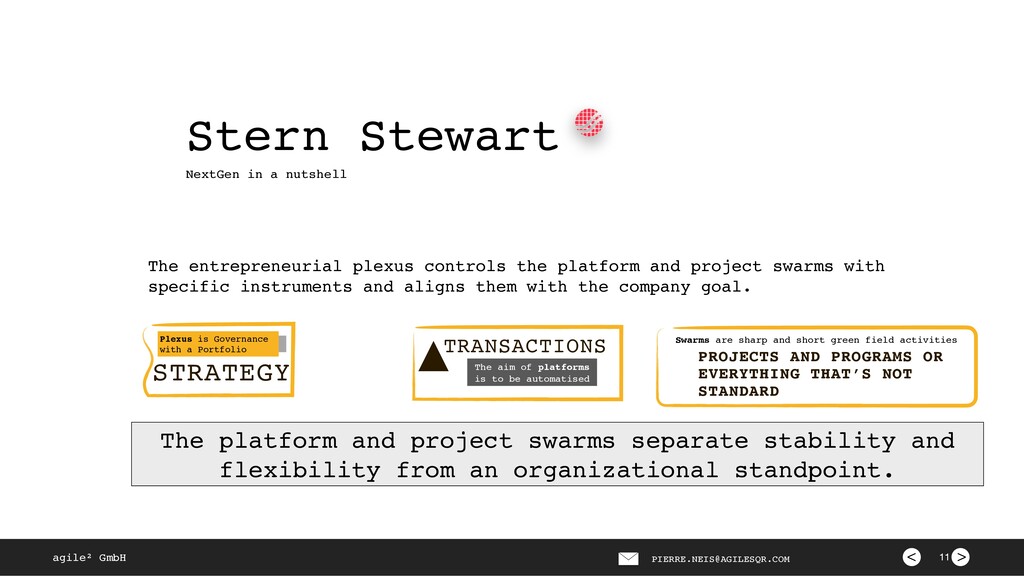
    nutshell 11 The entrepreneurial plexus controls the platform and project swarms with specific instruments and aligns them with the company goal. STRATEGY Plexus is Governance with a Portfolio The aim of platforms is to be automatised TRANSACTIONS Swarms are sharp and short green field activities PROJECTS AND PROGRAMS OR EVERYTHING THAT’S NOT STANDARD The platform and project swarms separate stability and flexibility from an organizational standpoint.
  9. > < next agile² GmbH [email protected] PLEXUS PLATFORM PROJECT SWARM

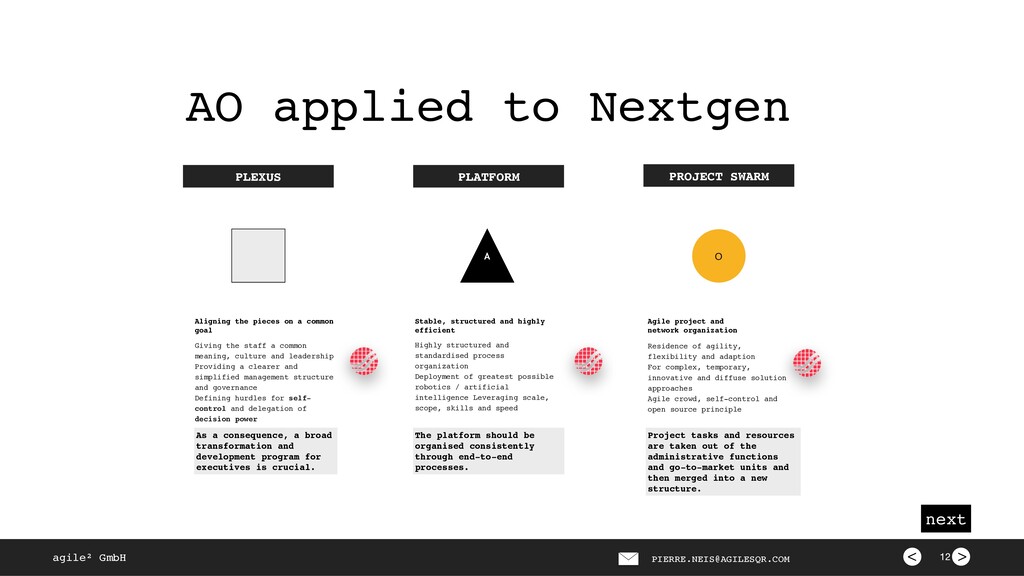
    AO applied to Nextgen 12 Aligning the pieces on a common goal Giving the staff a common meaning, culture and leadership Providing a clearer and simplified management structure and governance Defining hurdles for self- control and delegation of decision power As a consequence, a broad transformation and development program for executives is crucial. Stable, structured and highly efficient Highly structured and standardised process organization Deployment of greatest possible robotics / artificial intelligence Leveraging scale, scope, skills and speed The platform should be organised consistently through end-to-end processes. Agile project and network organization Residence of agility, flexibility and adaption For complex, temporary, innovative and diffuse solution approaches Agile crowd, self-control and open source principle Project tasks and resources are taken out of the administrative functions and go-to-market units and then merged into a new structure. A O
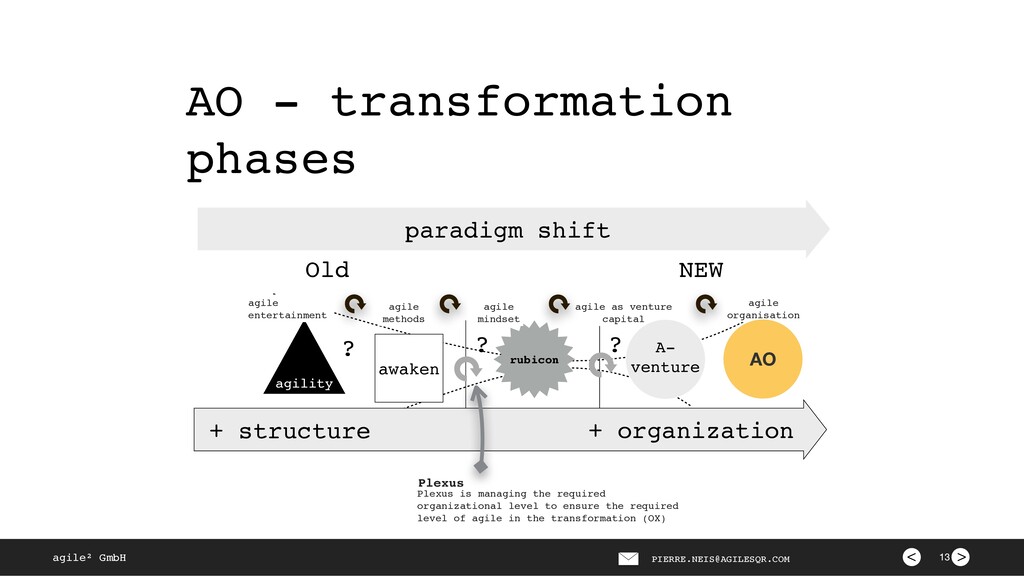
  10. > < agile² GmbH [email protected] AO - transformation phases 13

    agility ? ? ? awaken rubicon + organization agile entertainment agile methods agile mindset agile as venture capital agile organisation paradigm shift Old NEW Plexus Plexus is managing the required organizational level to ensure the required level of agile in the transformation (OX) A- venture AO + structure
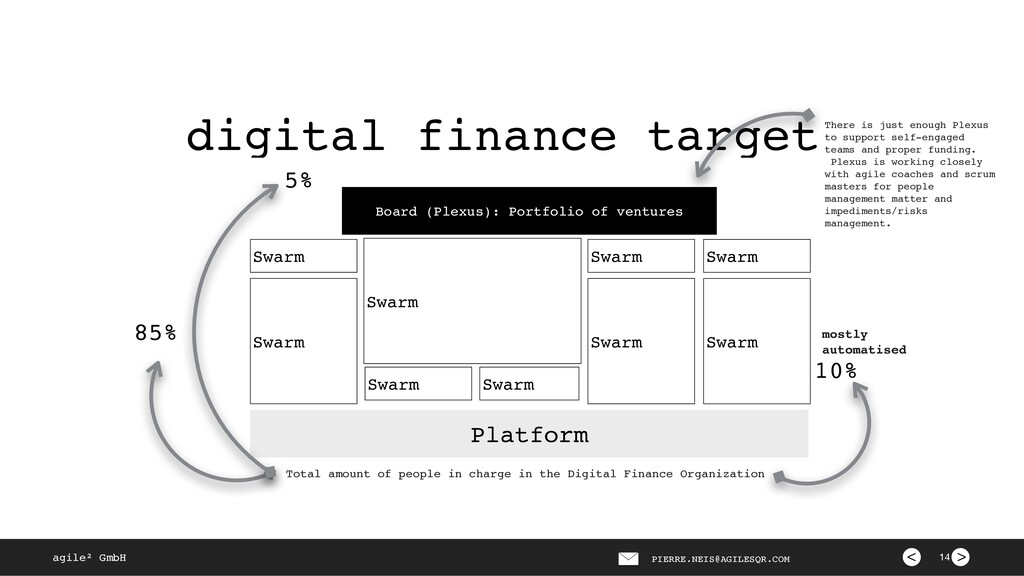
  11. > < agile² GmbH [email protected] digital finance target 14 Board

    (Plexus): Portfolio of ventures Swarm Swarm Swarm Swarm Swarm Swarm Swarm Swarm Swarm Platform There is just enough Plexus to support self-engaged teams and proper funding. Plexus is working closely with agile coaches and scrum masters for people management matter and impediments/risks management. 10% 5% Total amount of people in charge in the Digital Finance Organization 85% mostly automatised
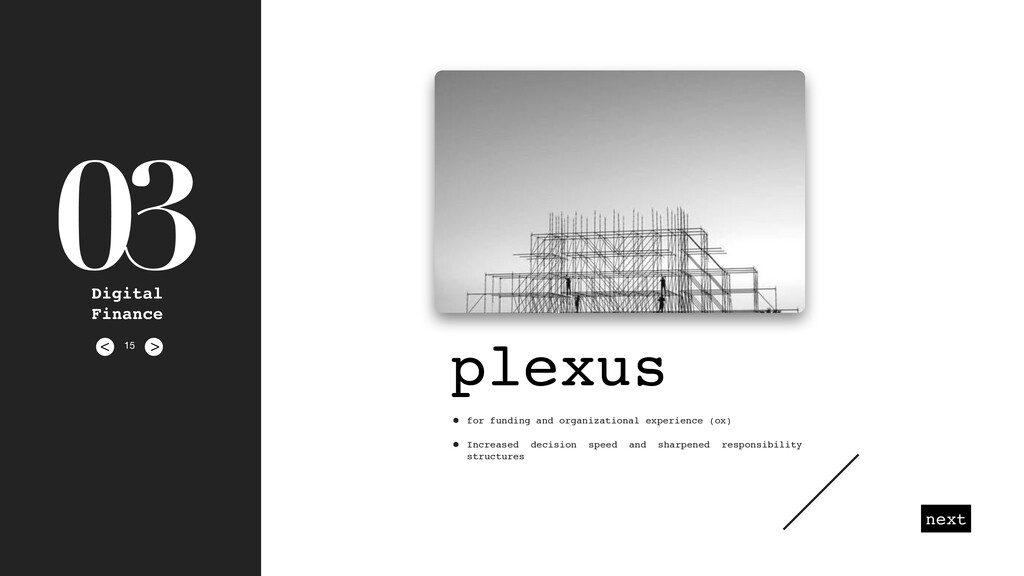
  12. > < next 03 Digital Finance • for funding and

    organizational experience (ox) • Increased decision speed and sharpened responsibility structures plexus 15
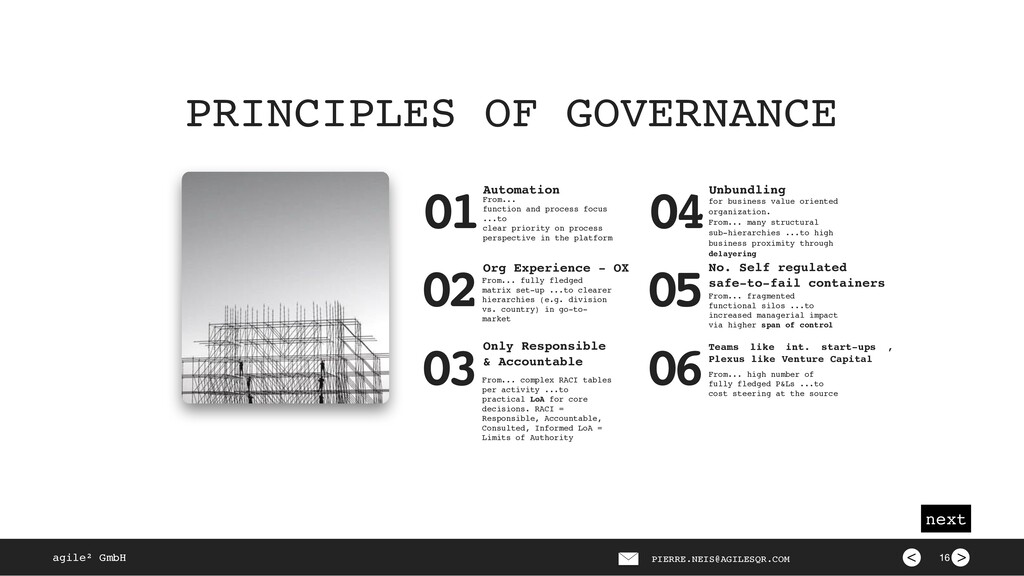
  13. > < next agile² GmbH [email protected] 01 02 03 Automation

    From... function and process focus ...to clear priority on process perspective in the platform Org Experience - OX From... fully fledged matrix set-up ...to clearer hierarchies (e.g. division vs. country) in go-to- market Only Responsible & Accountable From... complex RACI tables per activity ...to practical LoA for core decisions. RACI = Responsible, Accountable, Consulted, Informed LoA = Limits of Authority 04 05 06 Unbundling for business value oriented organization. From... many structural sub-hierarchies ...to high business proximity through delayering No. Self regulated safe-to-fail containers From... fragmented functional silos ...to increased managerial impact via higher span of control Teams like int. start-ups , Plexus like Venture Capital From... high number of fully fledged P&Ls ...to cost steering at the source PRINCIPLES OF GOVERNANCE 16
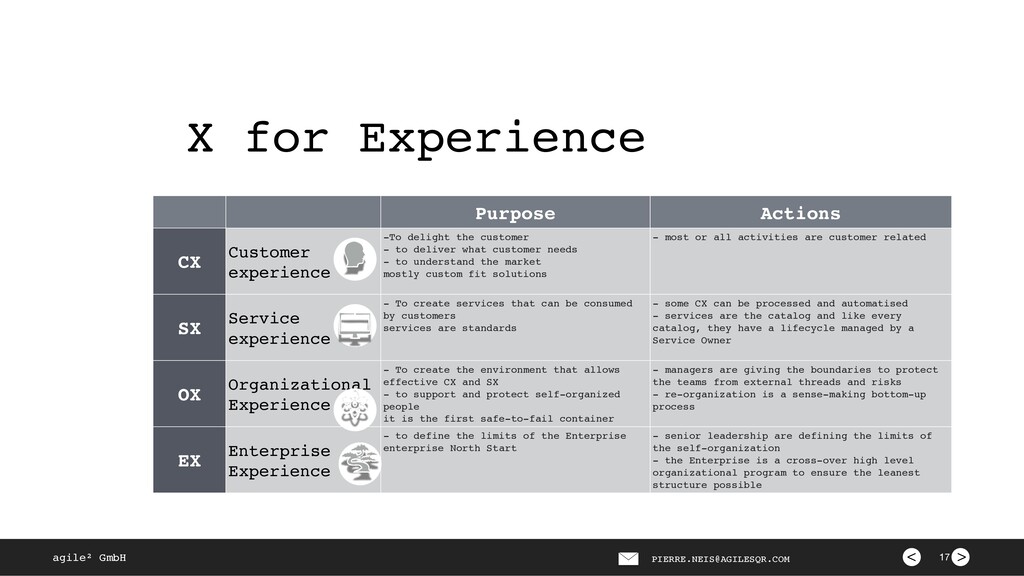
  14. > < agile² GmbH [email protected] X for Experience 17 Purpose

    Actions CX Customer experience -To delight the customer
 - to deliver what customer needs
 - to understand the market
 mostly custom fit solutions - most or all activities are customer related SX Service experience - To create services that can be consumed by customers
 services are standards - some CX can be processed and automatised
 - services are the catalog and like every catalog, they have a lifecycle managed by a Service Owner OX Organizational Experience - To create the environment that allows effective CX and SX
 - to support and protect self-organized people
 it is the first safe-to-fail container - managers are giving the boundaries to protect the teams from external threads and risks
 - re-organization is a sense-making bottom-up process EX Enterprise Experience - to define the limits of the Enterprise
 enterprise North Start - senior leadership are defining the limits of the self-organization
 - the Enterprise is a cross-over high level organizational program to ensure the leanest structure possible
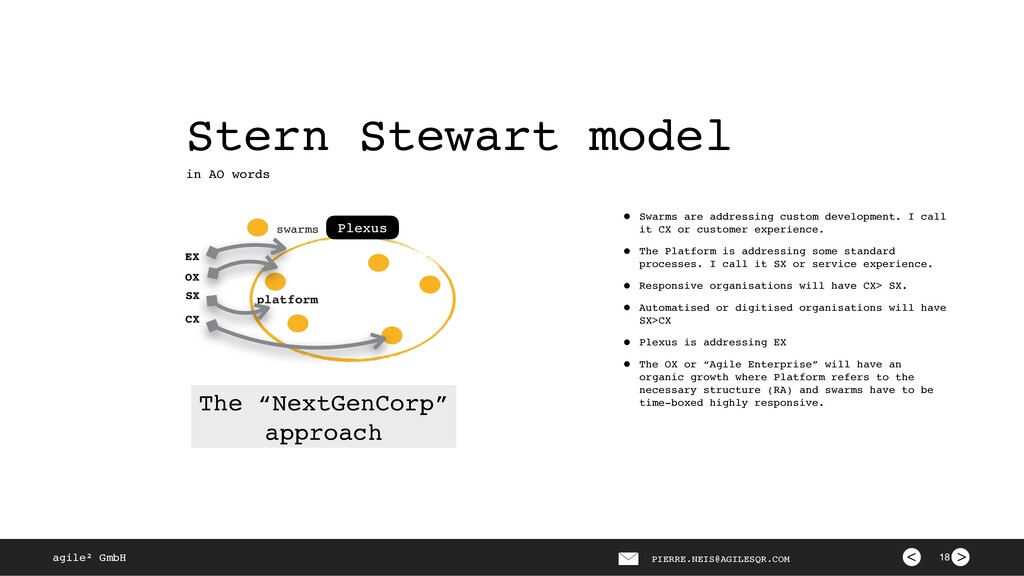
  15. > < agile² GmbH [email protected] Stern Stewart model in AO

    words 18 platform Plexus swarms EX OX SX CX • Swarms are addressing custom development. I call it CX or customer experience. • The Platform is addressing some standard processes. I call it SX or service experience. • Responsive organisations will have CX> SX. • Automatised or digitised organisations will have SX>CX • Plexus is addressing EX • The OX or “Agile Enterprise” will have an organic growth where Platform refers to the necessary structure (RA) and swarms have to be time-boxed highly responsive. The “NextGenCorp” approach
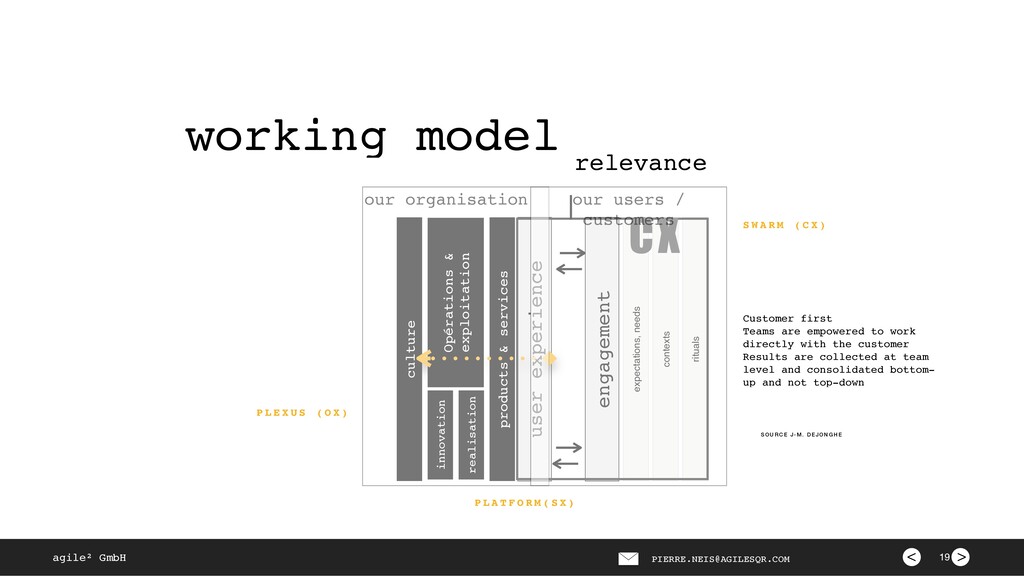
  16. > < agile² GmbH [email protected] working model 19 culture innovation

    realisation Opérations & exploitation products & services user experience engagement expectations, needs contexts rituals relevance SOURCE J-M. DE JONG HE S W A R M ( C X ) P L A T F O R M ( S X ) P L E X U S ( O X ) CX Customer first Teams are empowered to work directly with the customer Results are collected at team level and consolidated bottom- up and not top-down our organisation our users / customers
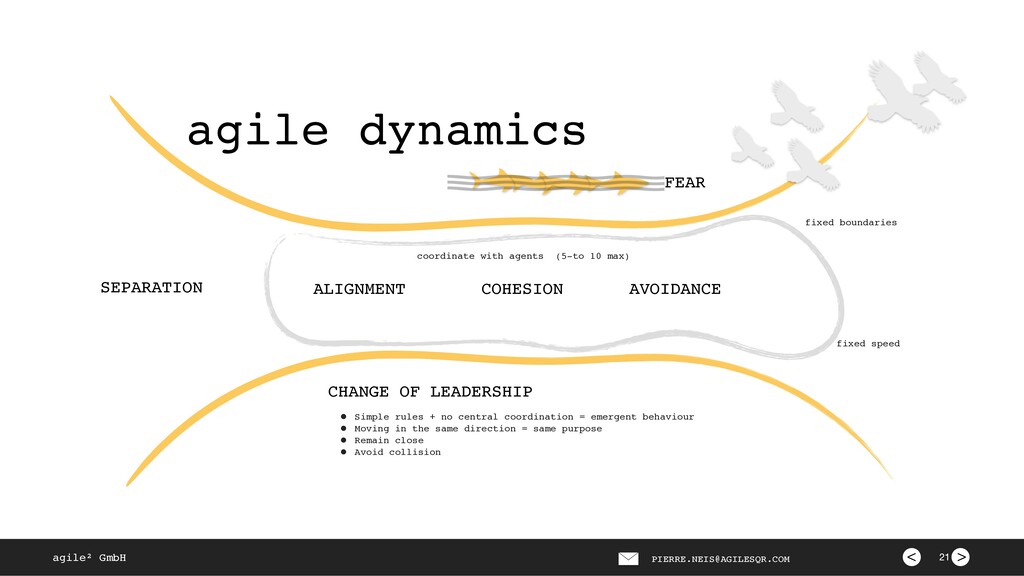
  17. > < agile² GmbH [email protected] agile dynamics 21 SEPARATION ALIGNMENT

    COHESION AVOIDANCE CHANGE OF LEADERSHIP fixed boundaries coordinate with agents (5-to 10 max) fixed speed • Simple rules + no central coordination = emergent behaviour • Moving in the same direction = same purpose • Remain close • Avoid collision FEAR
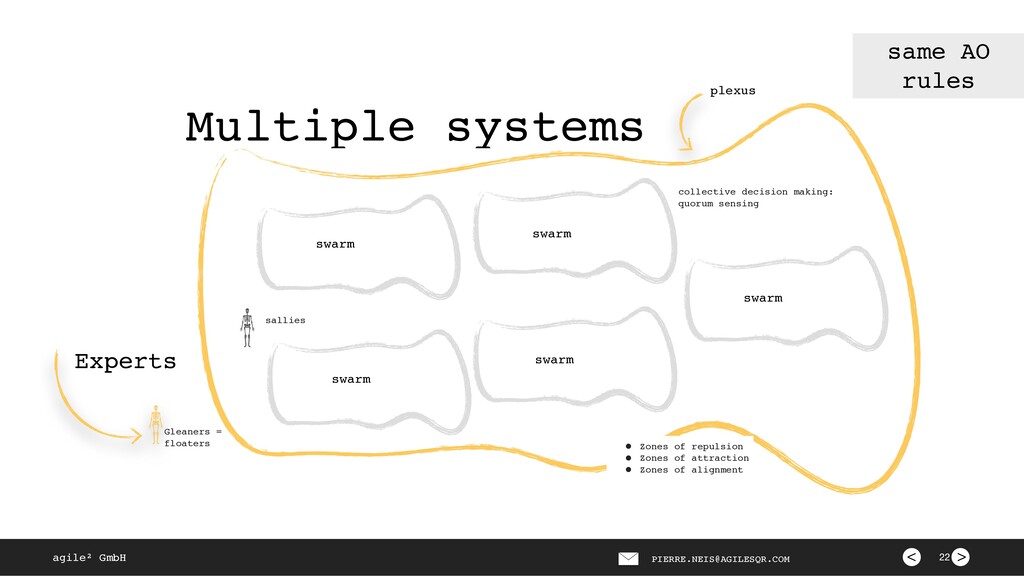
  18. > < agile² GmbH [email protected] Multiple systems 22 sallies Gleaners

    = floaters collective decision making: quorum sensing • Zones of repulsion • Zones of attraction • Zones of alignment plexus swarm swarm swarm swarm swarm Experts same AO rules
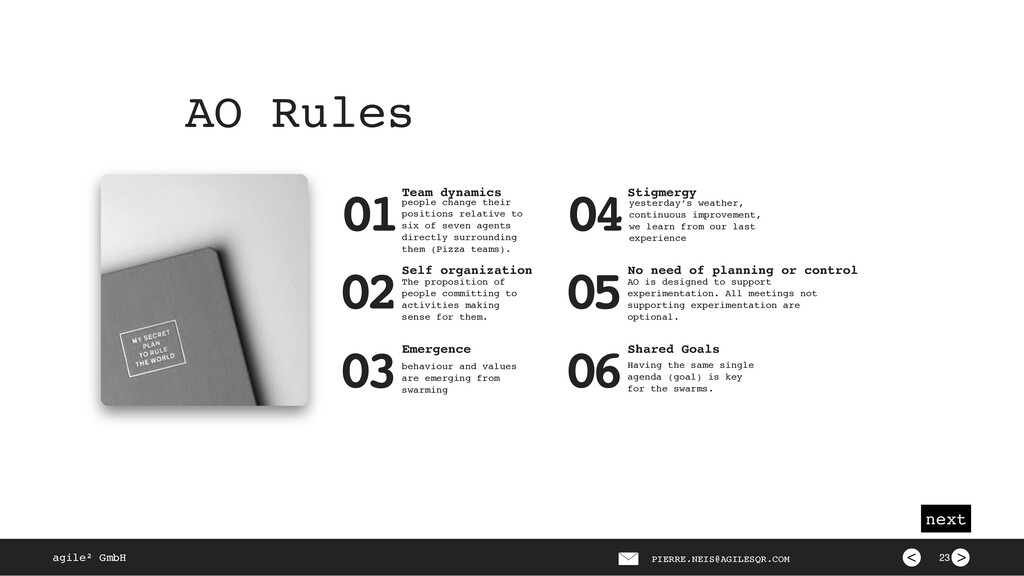
  19. > < next agile² GmbH [email protected] 01 02 03 Team

    dynamics people change their positions relative to six of seven agents directly surrounding them (Pizza teams). Self organization The proposition of people committing to activities making sense for them. Emergence behaviour and values are emerging from swarming 04 05 06 Stigmergy yesterday’s weather, continuous improvement, we learn from our last experience No need of planning or control AO is designed to support experimentation. All meetings not supporting experimentation are optional. Shared Goals Having the same single agenda (goal) is key for the swarms. AO Rules 23
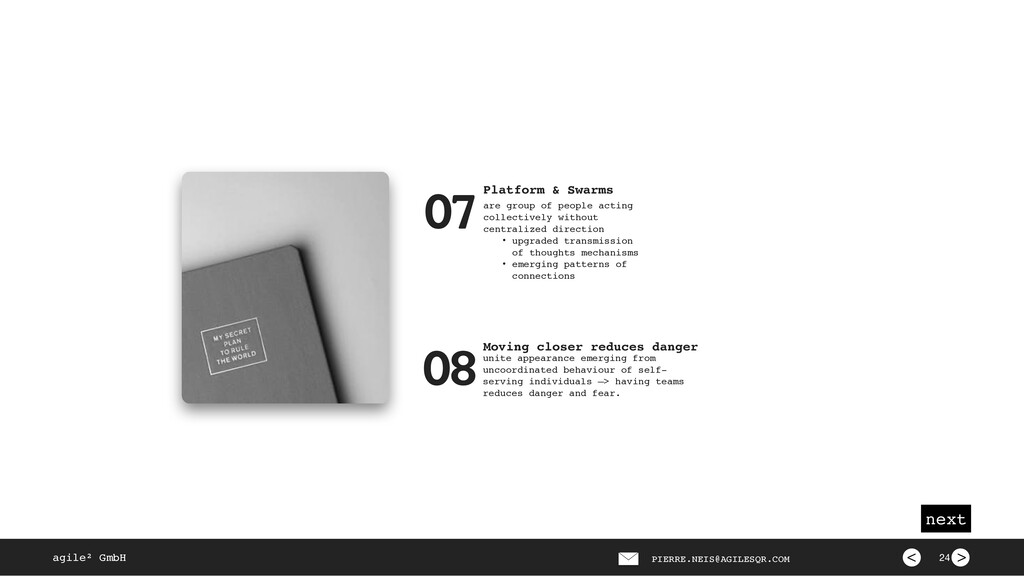
  20. > < next agile² GmbH [email protected] 07 08 Platform &

    Swarms are group of people acting collectively without centralized direction • upgraded transmission of thoughts mechanisms • emerging patterns of connections Moving closer reduces danger unite appearance emerging from uncoordinated behaviour of self- serving individuals —> having teams reduces danger and fear. 24
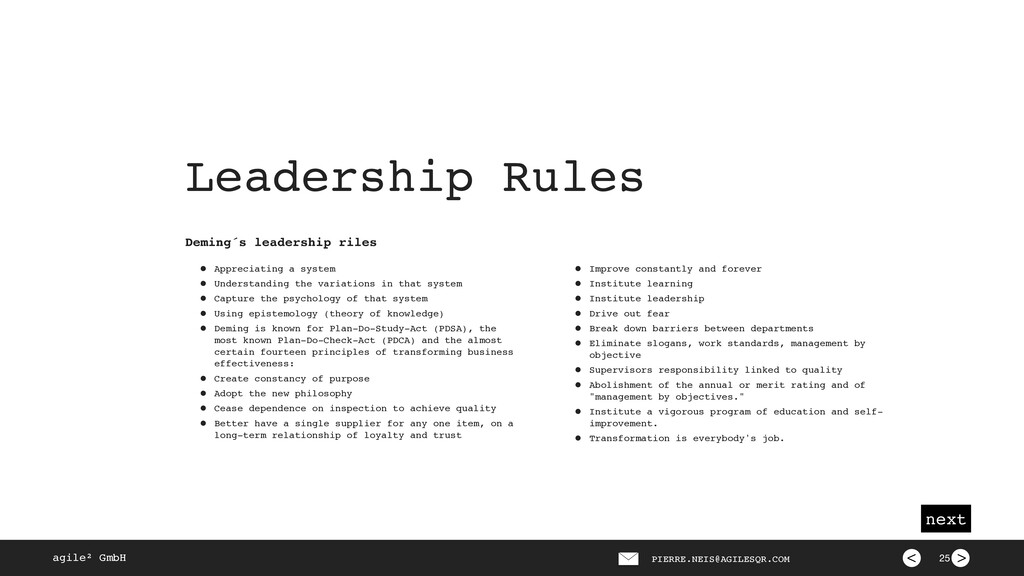
  21. > < next agile² GmbH [email protected] • Appreciating a system

    • Understanding the variations in that system • Capture the psychology of that system • Using epistemology (theory of knowledge) • Deming is known for Plan-Do-Study-Act (PDSA), the most known Plan-Do-Check-Act (PDCA) and the almost certain fourteen principles of transforming business effectiveness: • Create constancy of purpose • Adopt the new philosophy • Cease dependence on inspection to achieve quality • Better have a single supplier for any one item, on a long-term relationship of loyalty and trust • Improve constantly and forever • Institute learning • Institute leadership • Drive out fear • Break down barriers between departments • Eliminate slogans, work standards, management by objective • Supervisors responsibility linked to quality • Abolishment of the annual or merit rating and of "management by objectives." • Institute a vigorous program of education and self- improvement. • Transformation is everybody's job. Deming´s leadership riles Leadership Rules 25
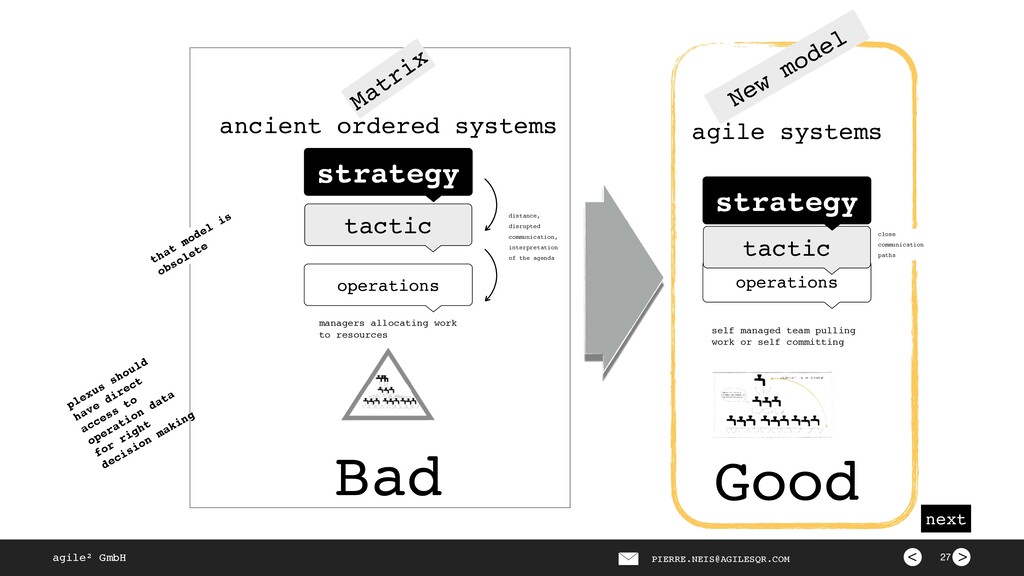
  22. > < next agile² GmbH [email protected] 27 plexus should have

    direct access to operation data for right decision making operations tactic strategy ancient ordered systems Matrix managers allocating work to resources Bad that model is obsolete distance, disrupted communication, interpretation of the agenda agile systems self managed team pulling work or self committing Good New model operations tactic strategy close communication paths
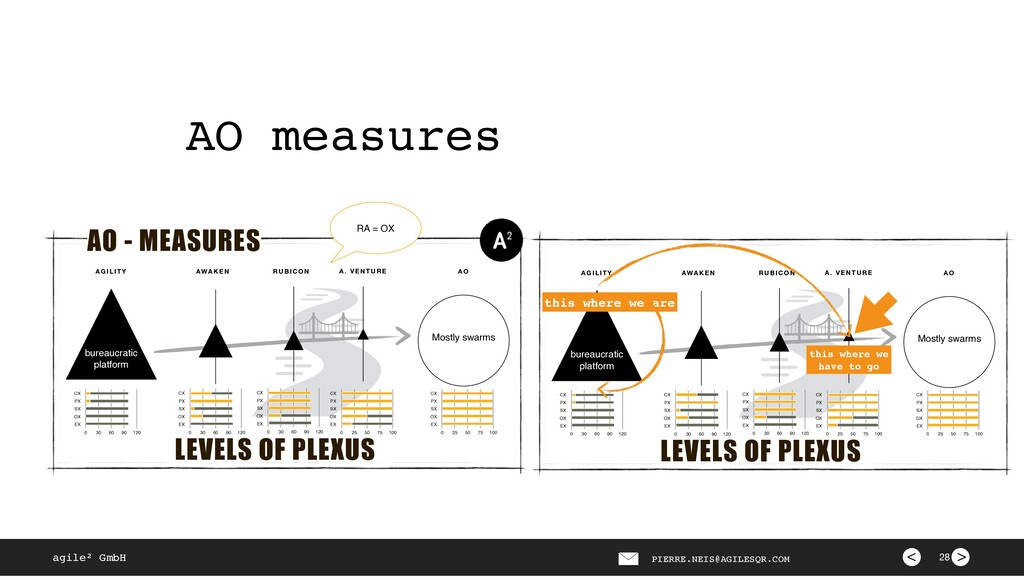
  23. > < agile² GmbH [email protected] AO measures 28 A GI

    L I T Y AWAK E N R UB I CON A. V ENT URE AO CX PX SX OX EX 0 30 60 90 120 CX PX SX OX EX 0 30 60 90 120 CX PX SX OX EX 0 30 60 90 120 CX PX SX OX EX 0 25 50 75 100 CX PX SX OX EX 0 25 50 75 100 AO - MEASURES RA = OX bureaucratic platform Mostly swarms LEVELS OF PLEXUS AG ILI TY AWA KEN RUBICO N A. V ENTUR E AO CX PX SX OX EX 0 30 60 90 120 CX PX SX OX EX 0 30 60 90 120 CX PX SX OX EX 0 30 60 90 120 CX PX SX OX EX 0 25 50 75 100 CX PX SX OX EX 0 25 50 75 100 bureaucratic platform Mostly swarms LEVELS OF PLEXUS this where we are this where we have to go
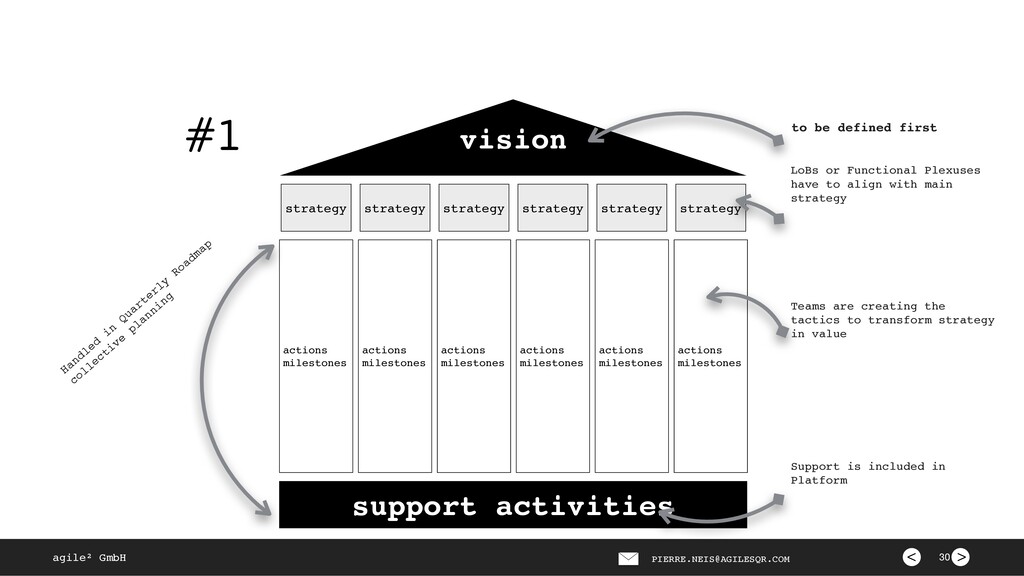
  24. > < agile² GmbH [email protected] #1 30 support activities actions

    milestones actions milestones actions milestones actions milestones actions milestones actions milestones strategy strategy strategy strategy strategy strategy vision to be defined first LoBs or Functional Plexuses have to align with main strategy Teams are creating the tactics to transform strategy in value Support is included in Platform Handled in Quarterly Roadmap collective planning
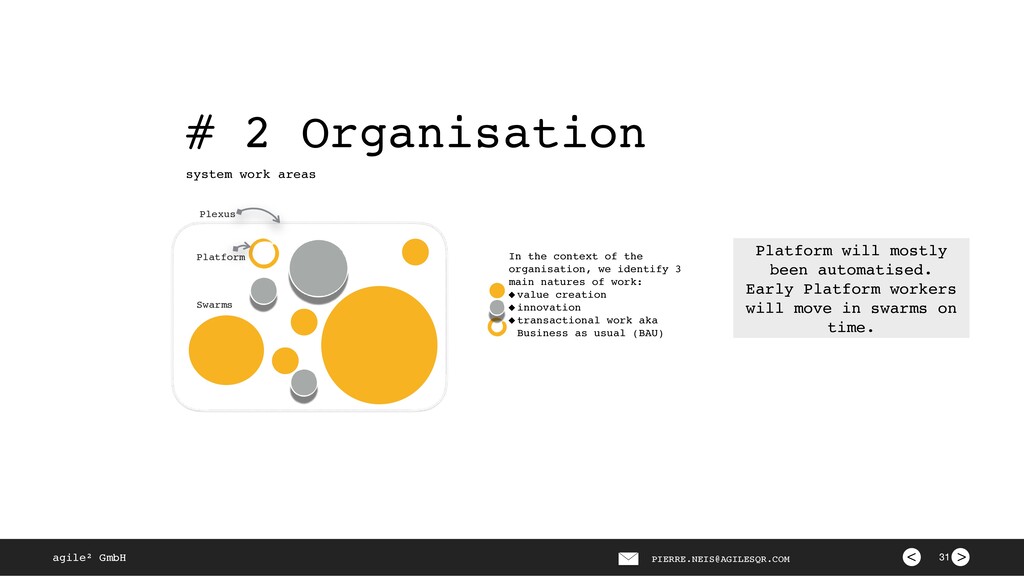
  25. > < agile² GmbH [email protected] # 2 Organisation system work

    areas 31 Plexus Swarms Platform In the context of the organisation, we identify 3 main natures of work: value creation innovation transactional work aka Business as usual (BAU) Platform will mostly been automatised.
 Early Platform workers will move in swarms on time.
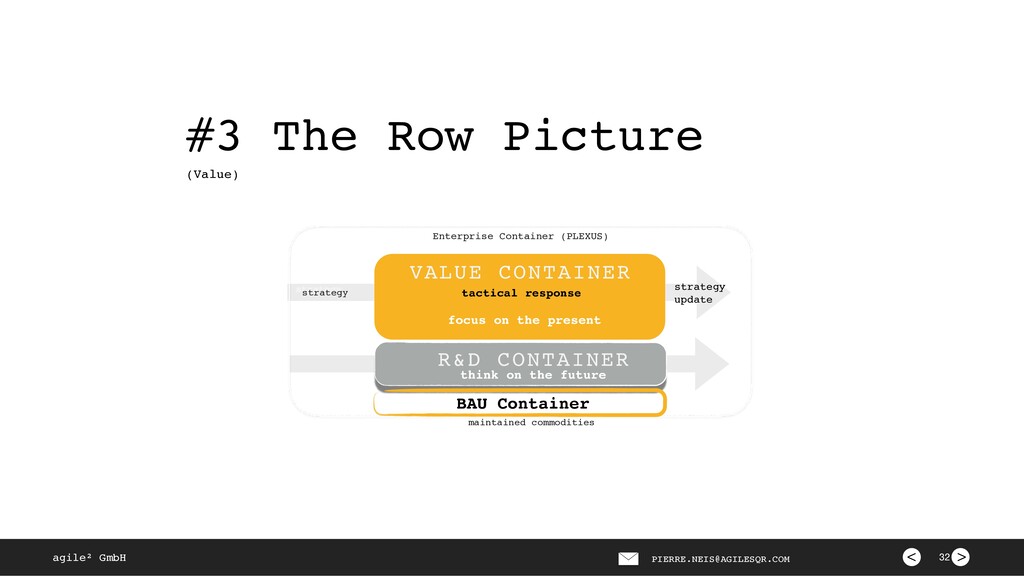
  26. > < agile² GmbH [email protected] #3 The Row Picture (Value)

    32 Enterprise Container (PLEXUS) VALUE CONTAINER R&D CONTAINER BAU Container strategy strategy update tactical response focus on the present think on the future maintained commodities
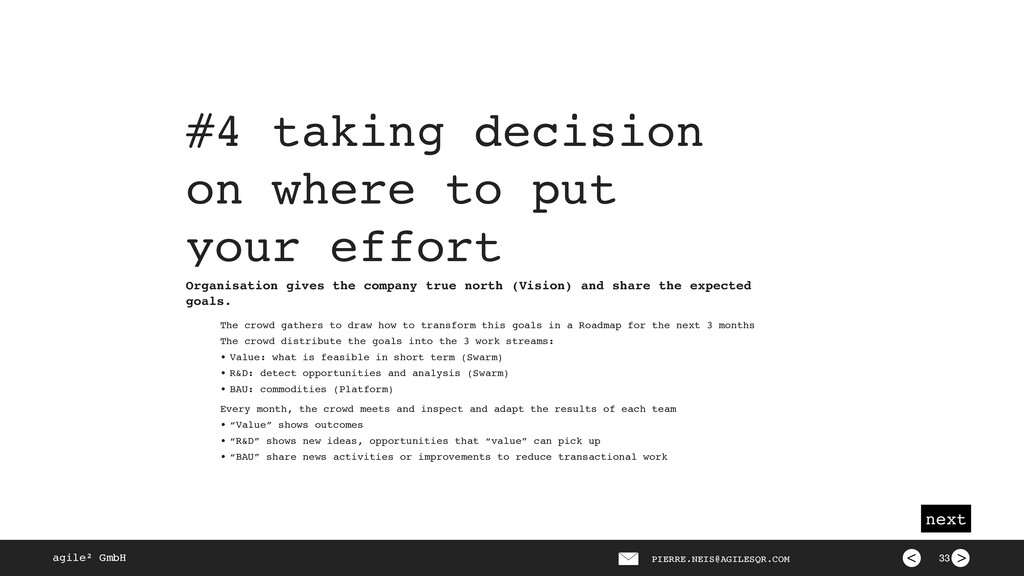
  27. > < next agile² GmbH [email protected] The crowd gathers to

    draw how to transform this goals in a Roadmap for the next 3 months The crowd distribute the goals into the 3 work streams: • Value: what is feasible in short term (Swarm) • R&D: detect opportunities and analysis (Swarm) • BAU: commodities (Platform) Every month, the crowd meets and inspect and adapt the results of each team • “Value” shows outcomes • “R&D” shows new ideas, opportunities that “value” can pick up • “BAU” share news activities or improvements to reduce transactional work Organisation gives the company true north (Vision) and share the expected goals. #4 taking decision on where to put your effort 33
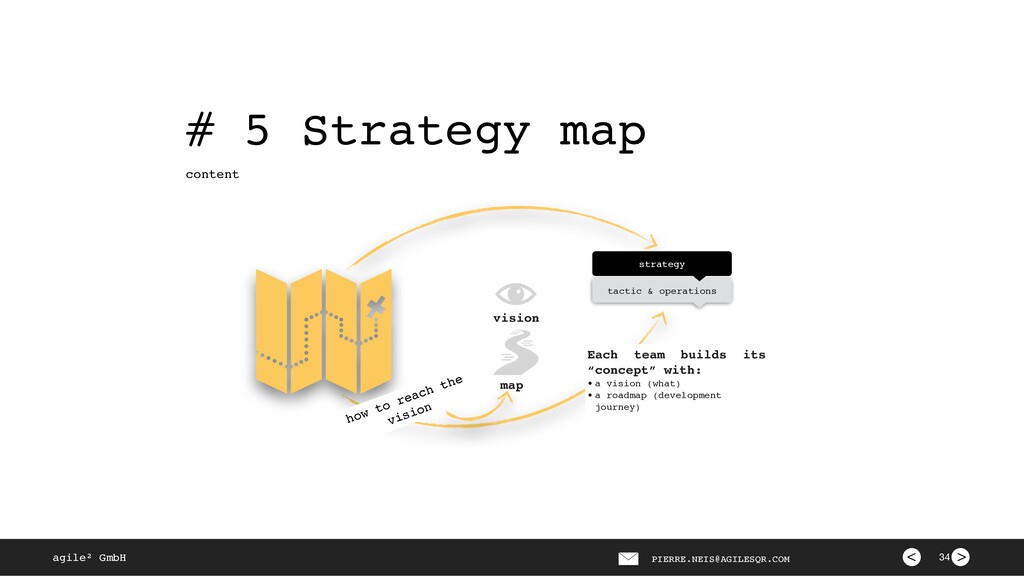
  28. > < agile² GmbH [email protected] # 5 Strategy map content

    34 vision map Each team builds its “concept” with: • a vision (what) • a roadmap (development journey) how to reach the vision tactic & operations strategy
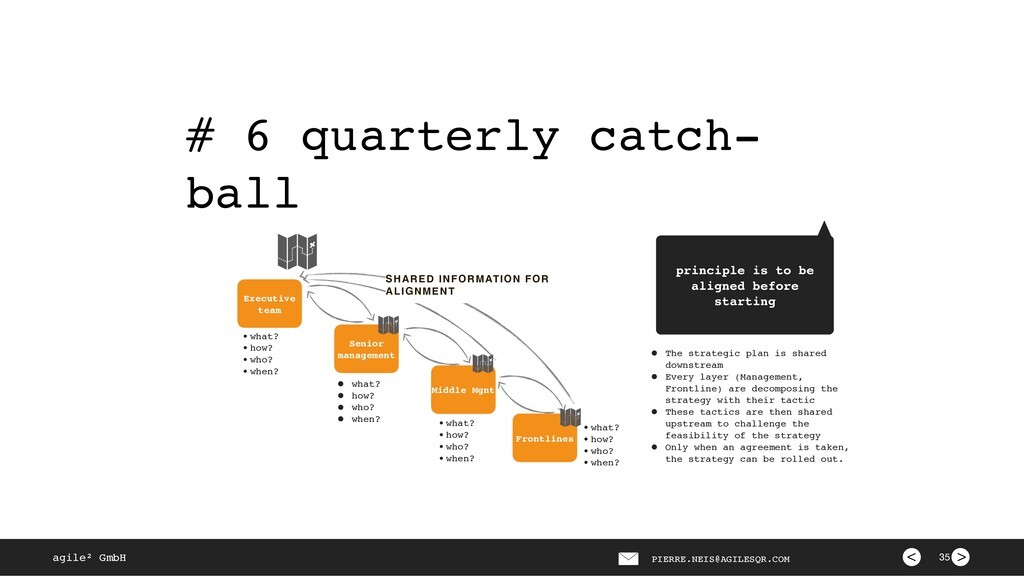
  29. > < agile² GmbH [email protected] # 6 quarterly catch- ball

    35 Executive team Senior management Middle Mgnt Frontlines • what? • how? • who? • when? principle is to be aligned before starting • what? • how? • who? • when? • what? • how? • who? • when? • what? • how? • who? • when? SHARED INFORMATION FOR ALIGNMENT • The strategic plan is shared downstream • Every layer (Management, Frontline) are decomposing the strategy with their tactic • These tactics are then shared upstream to challenge the feasibility of the strategy • Only when an agreement is taken, the strategy can be rolled out.
  30. > < next agile² GmbH [email protected] It seems easy, but

    the reality is that you are increasing the complexity of work (lack of coherence) by accepting all kinds of jobs into team feet (lack of prioritisation). In that order, a team backlog contains three main workflows: • value: all the development activities and support of the last version delivered • R&D: includes all the events not related to the sprint goal or post sprint activities (for the next sprints) like technical spikes, business analysis, or testing (technical, functional, UAT) • BAU: are all the activities which are neither R&D nor Value. Usually, the BAU are “acceptable impediments” like information meetings, or time-sheet management, recruiting, etc… This approach allows the team to allocated themselves what capacity on what stream and that daily (daily scrum). When Sprint is over, at the review, the team highlight their achievements, discoveries according to their portfolio. The Organisation Portfolio is just the consolidation of all team portfolios. Its mission is: to align all portfolio according to organisation true north or goals drive the banking stream to allocate budget During the last decade, we discover that the “single” product backlog of scrum teams has evolved to team backlog. It is a collection of work that the team has to deliver in a specific time. That includes the development of new solutions as the support of the older once. # 7 Backlogs as Portfolios 36
  31. > < next agile² GmbH [email protected] The Banking Track is

    working like a Bank where you can ask budget and resource at the end of each monthly cycle. Banking Track is part of the monthly release update meeting or Cycle review. The Banking Track is managed in a BAU stream and takes these basic rules into account: teams are stable during at least a month cycle exceptions are possible for R&D due to their specific purposes the budgeting do not accept contingencies nor buffers teams can provide savings teams are the only responsible for their budget or their product owners or scrum masters: budgeting is the team’s game. The budget should be able to support business agility and funding is a quite uncomfortable yearly political fight. # 8 Banking Track 37
  32. > < next agile² GmbH [email protected] 05 06 07 Innovation

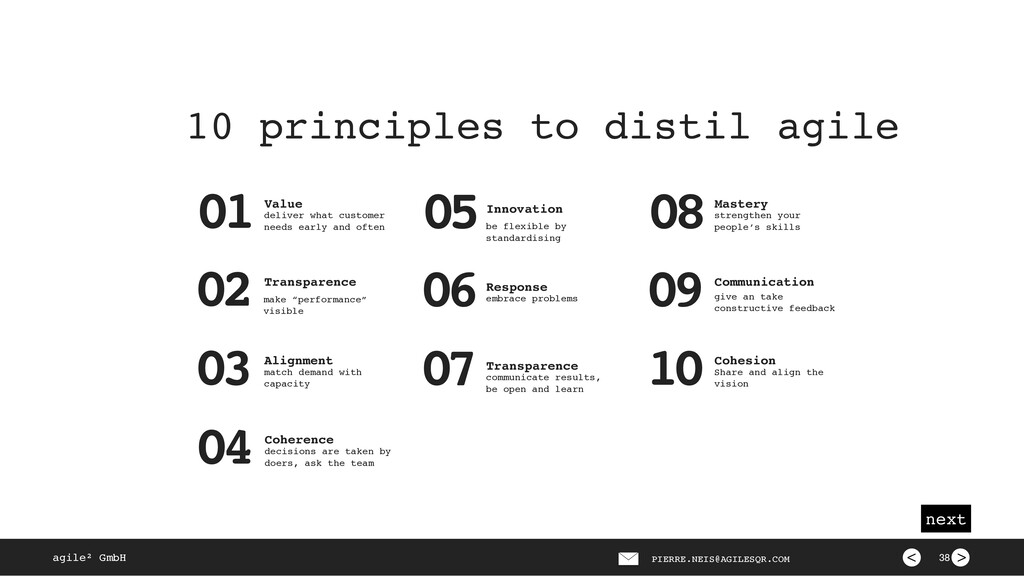
    be flexible by standardising Response embrace problems Transparence communicate results, be open and learn 08 09 10 Mastery strengthen your people’s skills Communication give an take constructive feedback Cohesion Share and align the vision 10 principles to distil agile 38 01 02 03 Value deliver what customer needs early and often Transparence make “performance” visible Alignment match demand with capacity 04 Coherence decisions are taken by doers, ask the team
  33. > < agile² GmbH [email protected] Release Review Roadmap Update Retrospective

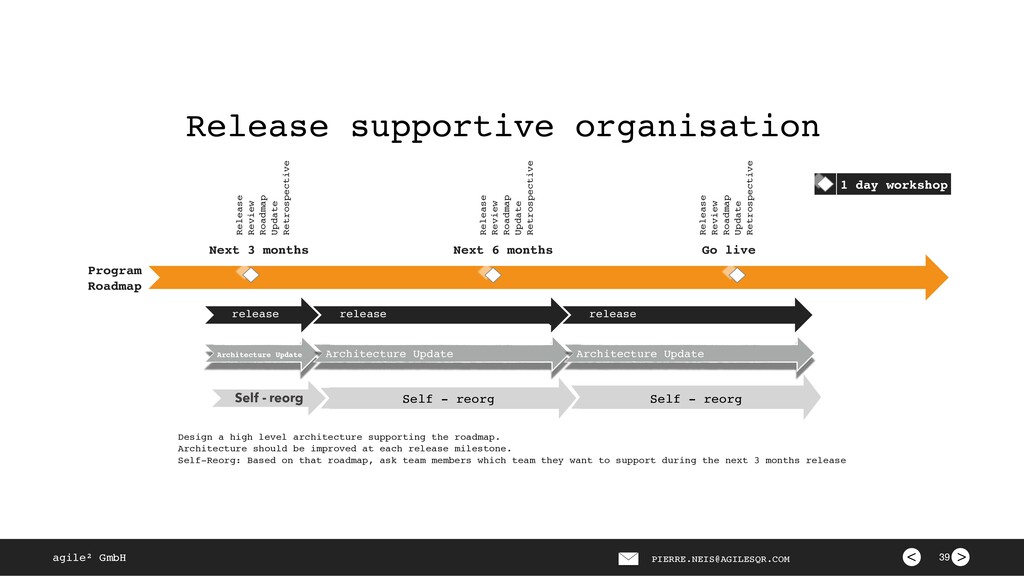
    Release Review Roadmap Update Retrospective Release supportive organisation 39 Next 3 months Next 6 months Go live Program Roadmap Design a high level architecture supporting the roadmap. Architecture should be improved at each release milestone. Self-Reorg: Based on that roadmap, ask team members which team they want to support during the next 3 months release Release Review Roadmap Update Retrospective 1 day workshop Architecture Update Architecture Update Architecture Update release release release Self - reorg Self - reorg Self - reorg
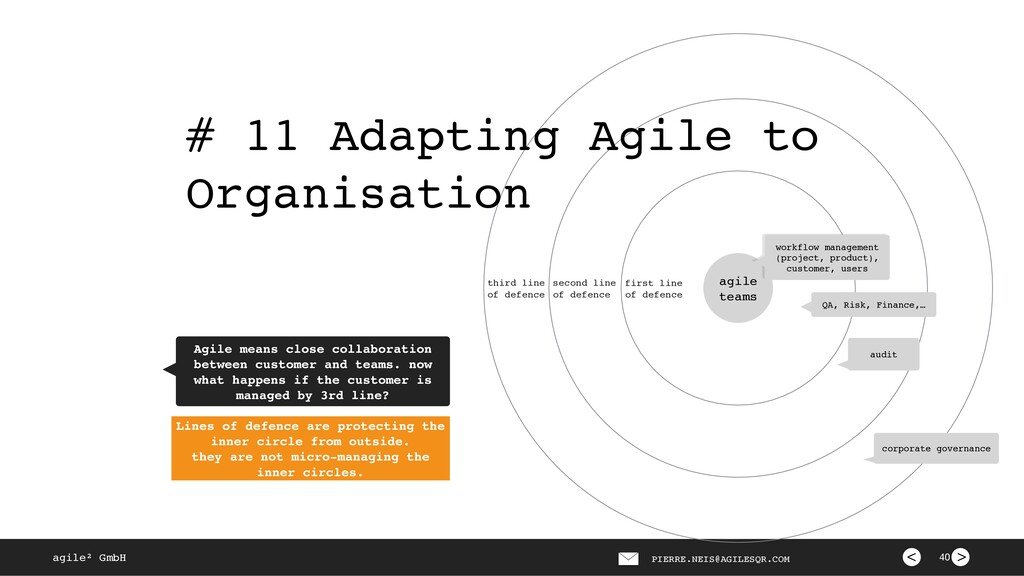
  34. > < agile² GmbH [email protected] agile teams first line of

    defence second line of defence third line of defence # 11 Adapting Agile to Organisation 40 workflow management (project, product), customer, users QA, Risk, Finance,… audit corporate governance Agile means close collaboration between customer and teams. now what happens if the customer is managed by 3rd line? Lines of defence are protecting the inner circle from outside. they are not micro-managing the inner circles.
  35. > < agile² GmbH [email protected] # 12 Organisation over structure

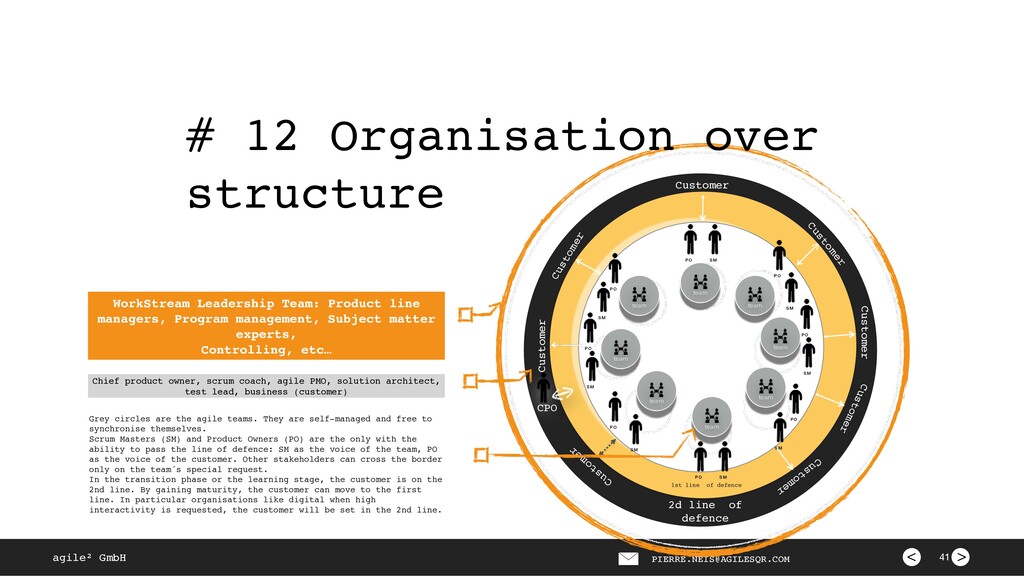
    41 Chief product owner, scrum coach, agile PMO, solution architect, test lead, business (customer) WorkStream Leadership Team: Product line managers, Program management, Subject matter experts, Controlling, etc… Grey circles are the agile teams. They are self-managed and free to synchronise themselves. Scrum Masters (SM) and Product Owners (PO) are the only with the ability to pass the line of defence: SM as the voice of the team, PO as the voice of the customer. Other stakeholders can cross the border only on the team´s special request. In the transition phase or the learning stage, the customer is on the 2nd line. By gaining maturity, the customer can move to the first line. In particular organisations like digital when high interactivity is requested, the customer will be set in the 2nd line. 1st line of defence 2d line of defence 3rd line of defence Customer Customer Customer Customer Customer Customer Customer Customer CPO team P O S M team P O S M team P O S M P O S M team team P O S M team team team P O S M P O S M P O S M team team team team team team team team
  36. > < agile² GmbH [email protected] # 13 Who? what? When?

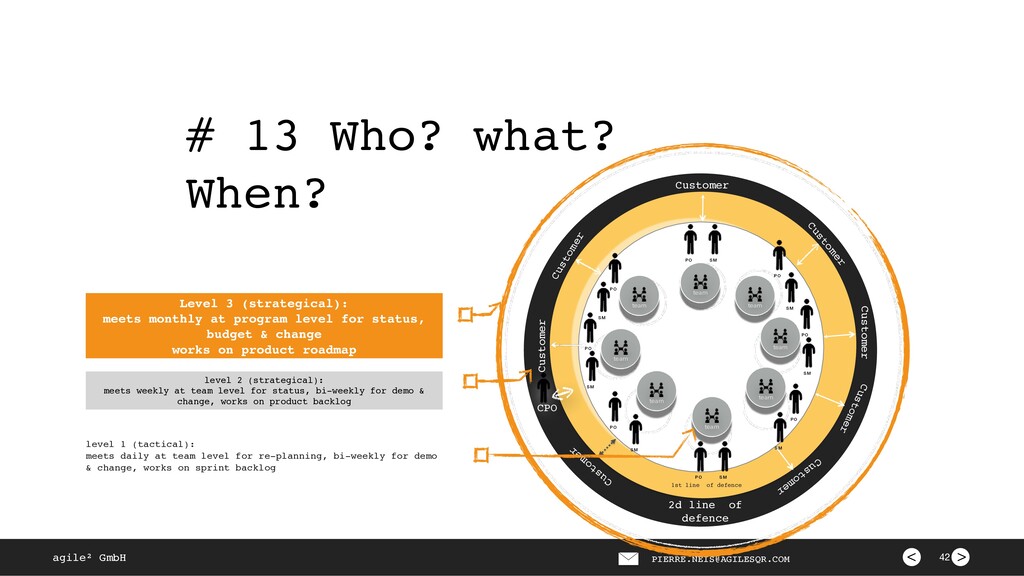
    42 level 2 (strategical): meets weekly at team level for status, bi-weekly for demo & change, works on product backlog Level 3 (strategical): meets monthly at program level for status, budget & change works on product roadmap level 1 (tactical): meets daily at team level for re-planning, bi-weekly for demo & change, works on sprint backlog 1st line of defence 2d line of defence 3rd line of defence Customer Customer Customer Customer Customer Customer Customer Customer CPO team P O S M team P O S M team P O S M P O S M team team P O S M team team team P O S M P O S M P O S M team team team team team team team team
  37. > < agile² GmbH [email protected] # 14 ORG Level Meeting

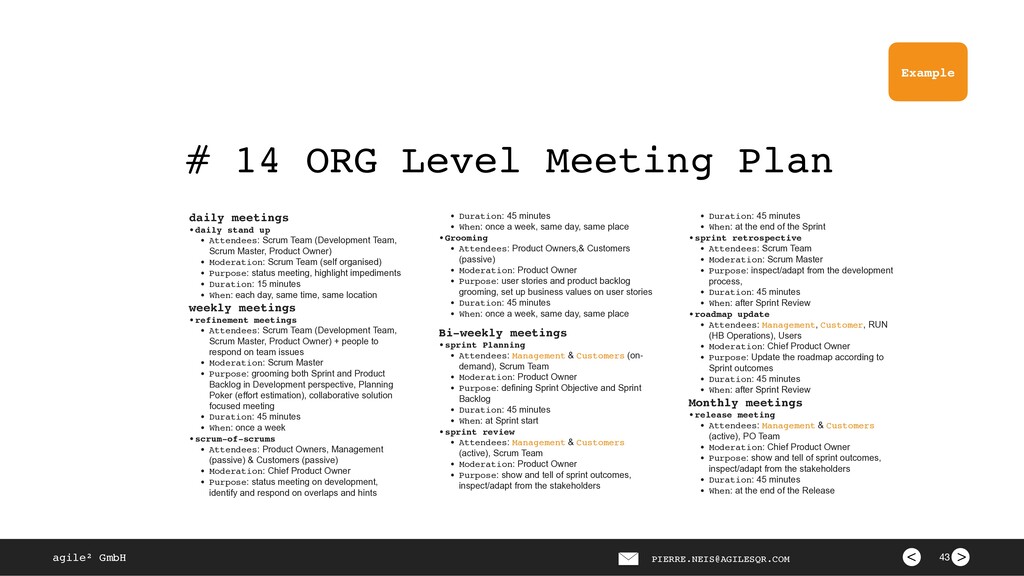
    Plan 43 Example daily meetings •daily stand up • Attendees: Scrum Team (Development Team, Scrum Master, Product Owner) • Moderation: Scrum Team (self organised) • Purpose: status meeting, highlight impediments • Duration: 15 minutes • When: each day, same time, same location weekly meetings •refinement meetings • Attendees: Scrum Team (Development Team, Scrum Master, Product Owner) + people to respond on team issues • Moderation: Scrum Master • Purpose: grooming both Sprint and Product Backlog in Development perspective, Planning Poker (effort estimation), collaborative solution focused meeting • Duration: 45 minutes • When: once a week •scrum-of-scrums • Attendees: Product Owners, Management (passive) & Customers (passive) • Moderation: Chief Product Owner • Purpose: status meeting on development, identify and respond on overlaps and hints • Duration: 45 minutes • When: once a week, same day, same place •Grooming • Attendees: Product Owners,& Customers (passive) • Moderation: Product Owner • Purpose: user stories and product backlog grooming, set up business values on user stories • Duration: 45 minutes • When: once a week, same day, same place Bi-weekly meetings •sprint Planning • Attendees: Management & Customers (on- demand), Scrum Team • Moderation: Product Owner • Purpose: defining Sprint Objective and Sprint Backlog • Duration: 45 minutes • When: at Sprint start •sprint review • Attendees: Management & Customers (active), Scrum Team • Moderation: Product Owner • Purpose: show and tell of sprint outcomes, inspect/adapt from the stakeholders • Duration: 45 minutes • When: at the end of the Sprint •sprint retrospective • Attendees: Scrum Team • Moderation: Scrum Master • Purpose: inspect/adapt from the development process, • Duration: 45 minutes • When: after Sprint Review •roadmap update • Attendees: Management, Customer, RUN (HB Operations), Users • Moderation: Chief Product Owner • Purpose: Update the roadmap according to Sprint outcomes • Duration: 45 minutes • When: after Sprint Review Monthly meetings •release meeting • Attendees: Management & Customers (active), PO Team • Moderation: Chief Product Owner • Purpose: show and tell of sprint outcomes, inspect/adapt from the stakeholders • Duration: 45 minutes • When: at the end of the Release
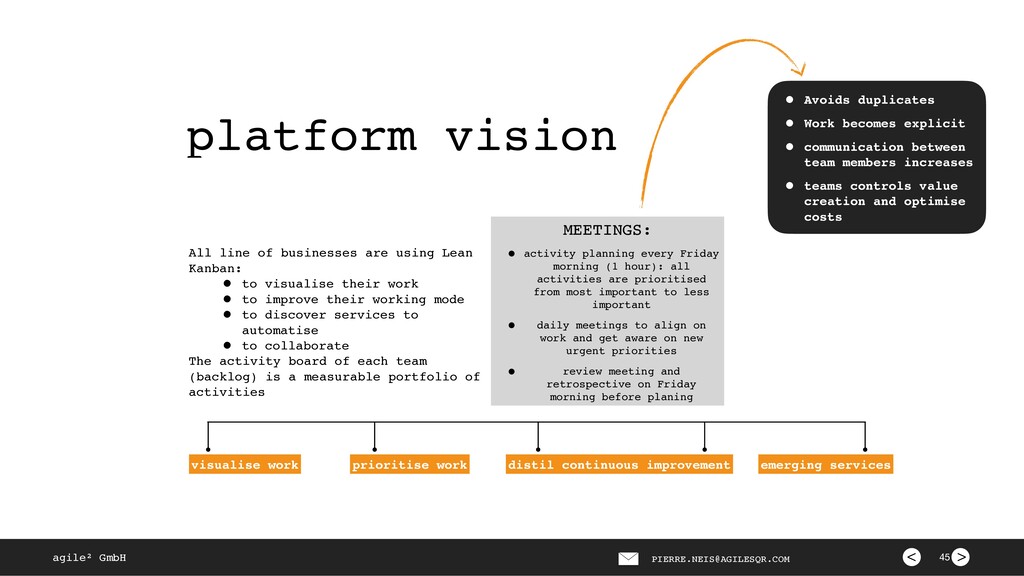
  38. > < agile² GmbH [email protected] platform vision 45 All line

    of businesses are using Lean Kanban: • to visualise their work • to improve their working mode • to discover services to automatise • to collaborate The activity board of each team (backlog) is a measurable portfolio of activities MEETINGS: • activity planning every Friday morning (1 hour): all activities are prioritised from most important to less important • daily meetings to align on work and get aware on new urgent priorities • review meeting and retrospective on Friday morning before planing • Avoids duplicates • Work becomes explicit • communication between team members increases • teams controls value creation and optimise costs visualise work prioritise work distil continuous improvement emerging services
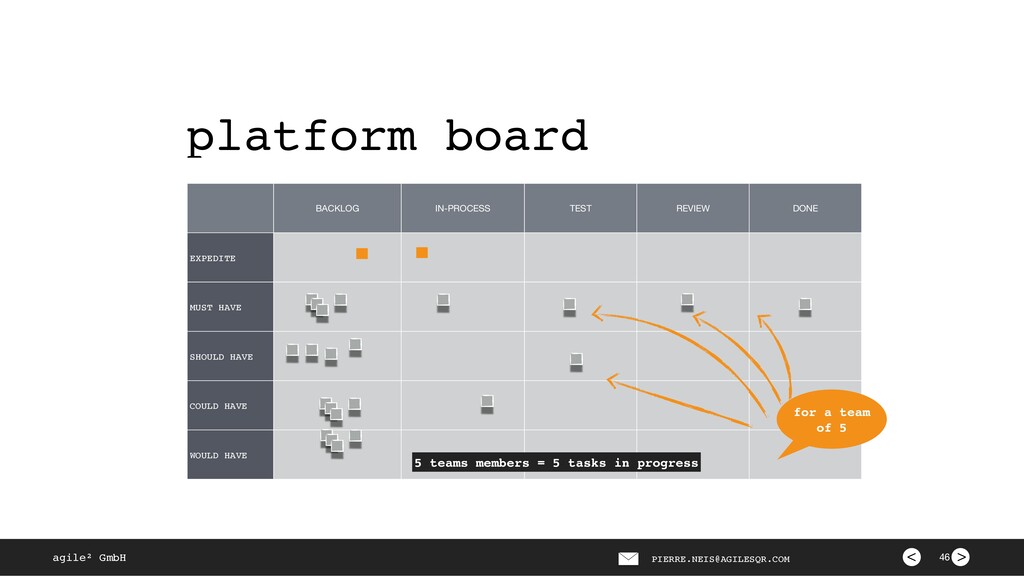
  39. > < agile² GmbH [email protected] platform board 46 BACKLOG IN-PROCESS

    TEST REVIEW DONE EXPEDITE MUST HAVE SHOULD HAVE COULD HAVE WOULD HAVE for a team of 5 5 teams members = 5 tasks in progress
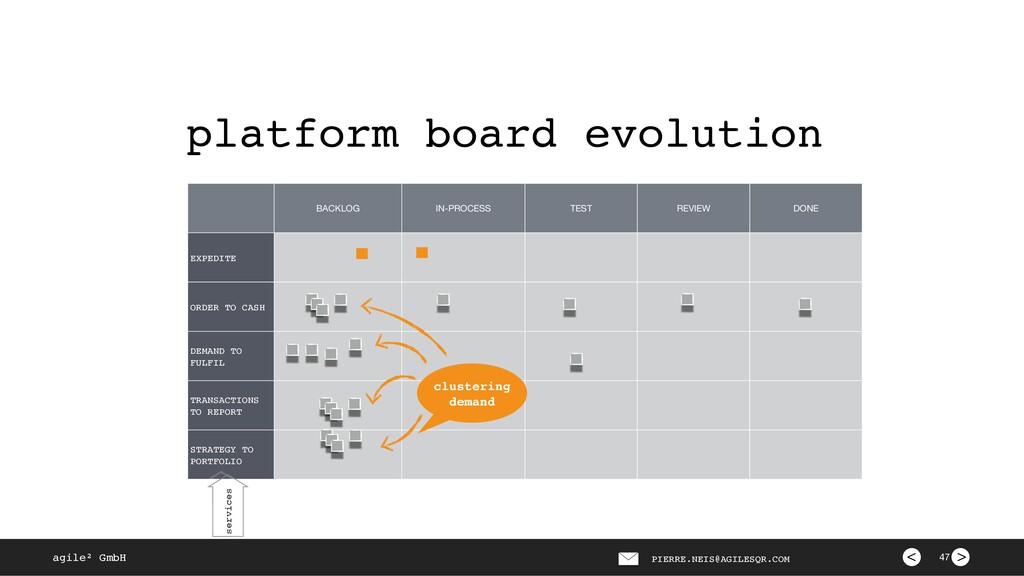
  40. > < agile² GmbH [email protected] platform board evolution 47 BACKLOG

    IN-PROCESS TEST REVIEW DONE EXPEDITE ORDER TO CASH DEMAND TO FULFIL TRANSACTIONS TO REPORT STRATEGY TO PORTFOLIO clustering demand services
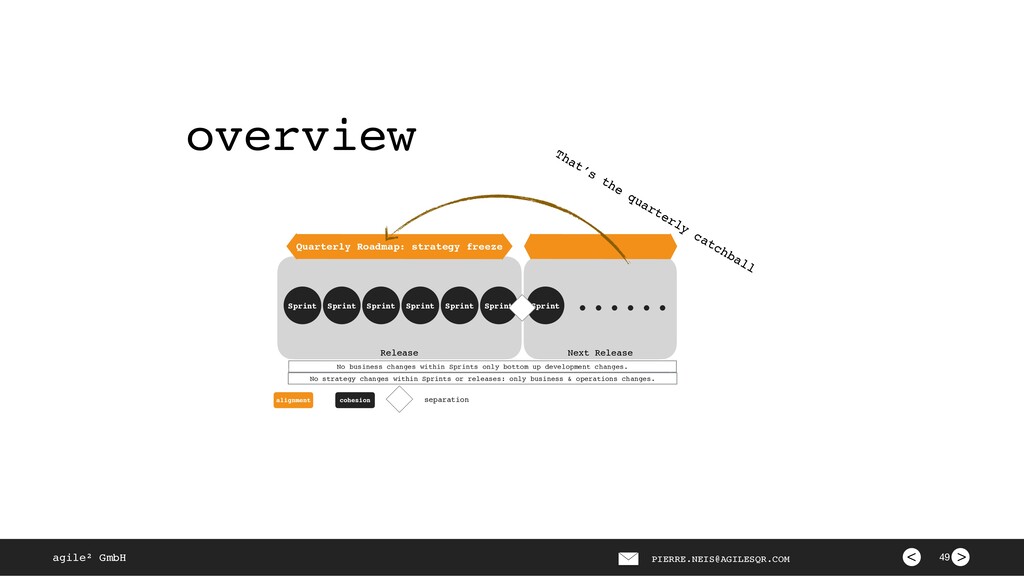
  41. > < agile² GmbH [email protected] overview 49 alignment cohesion separation

    No business changes within Sprints only bottom up development changes. Release Sprint Sprint Sprint Sprint Sprint Sprint Next Release Sprint Quarterly Roadmap: strategy freeze No strategy changes within Sprints or releases: only business & operations changes. That’s the quarterly catchball
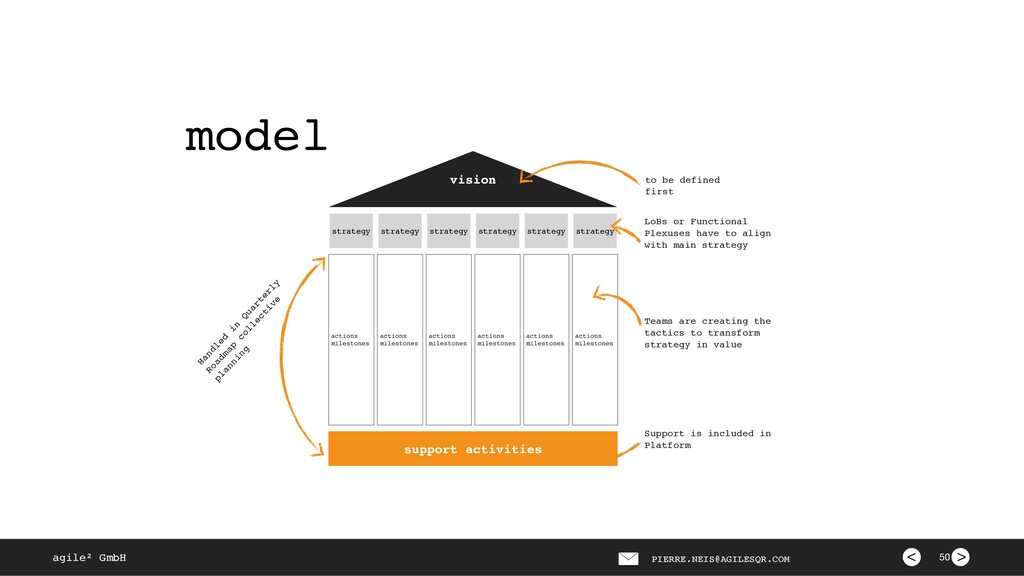
  42. > < agile² GmbH [email protected] model 50 support activities actions

    milestones actions milestones actions milestones actions milestones actions milestones actions milestones strategy strategy strategy strategy strategy strategy vision to be defined first LoBs or Functional Plexuses have to align with main strategy Teams are creating the tactics to transform strategy in value Support is included in Platform Handled in Quarterly Roadmap collective planning
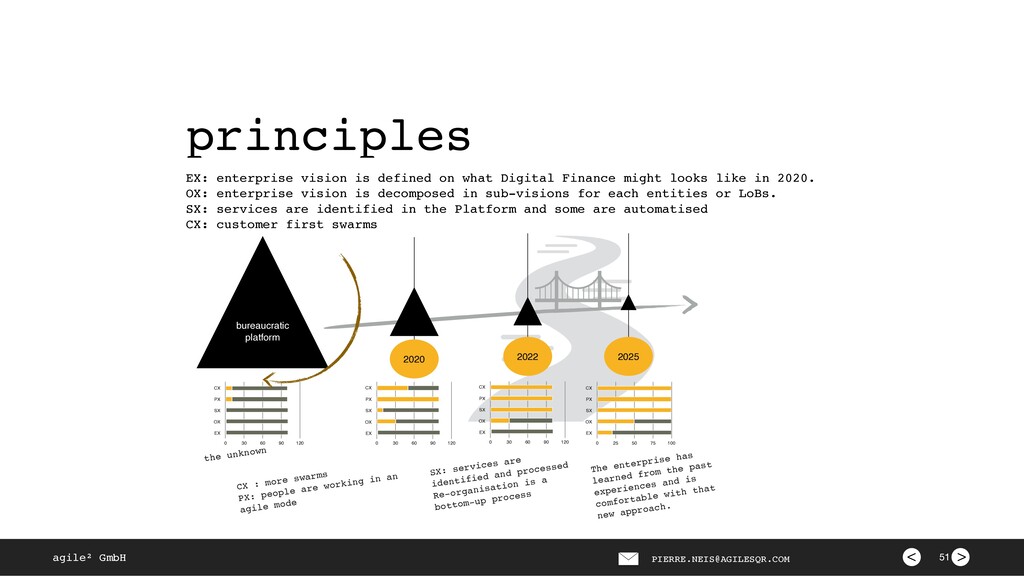
  43. > < agile² GmbH [email protected] principles EX: enterprise vision is

    defined on what Digital Finance might looks like in 2020. OX: enterprise vision is decomposed in sub-visions for each entities or LoBs. SX: services are identified in the Platform and some are automatised CX: customer first swarms 51 CX PX SX OX EX 0 30 60 90 120 CX PX SX OX EX 0 30 60 90 120 CX PX SX OX EX 0 30 60 90 120 CX PX SX OX EX 0 25 50 75 100 bureaucratic platform the unknown CX : more swarms PX: people are working in an agile mode 2020 2022 2025 SX: services are identified and processed Re-organisation is a bottom-up process The enterprise has learned from the past experiences and is comfortable with that new approach.
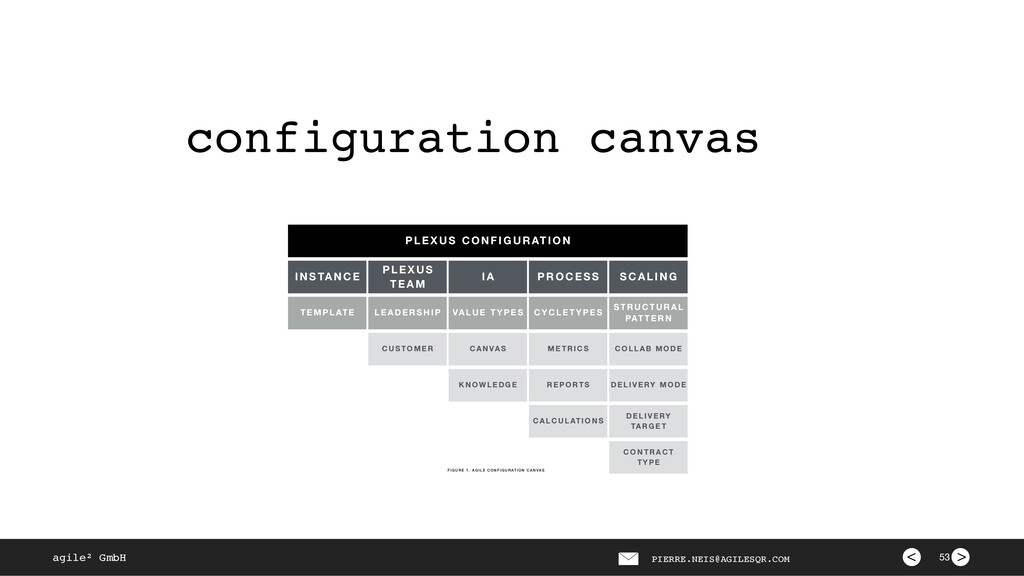
  44. > < agile² GmbH [email protected] configuration canvas 53 PLEXUS CO

    NFI GURATION INSTANCE PLEXUS TEAM IA PROCESS SCALING T EM PLATE L EAD ERSH IP VALU E TYPES CY C LE TY PE S S TR UC TU R A L PATTE R N C US T OM E R C AN VA S ME TRIC S COL L A B MO DE K N OW L ED G E R E PORTS DE L IV ERY MODE C ALC UL ATIONS DE L IV ERY TA RG E T CON TRA CT TY PE F IGU R E 1. AG ILE C ON F IGU R AT ION C AN VAS
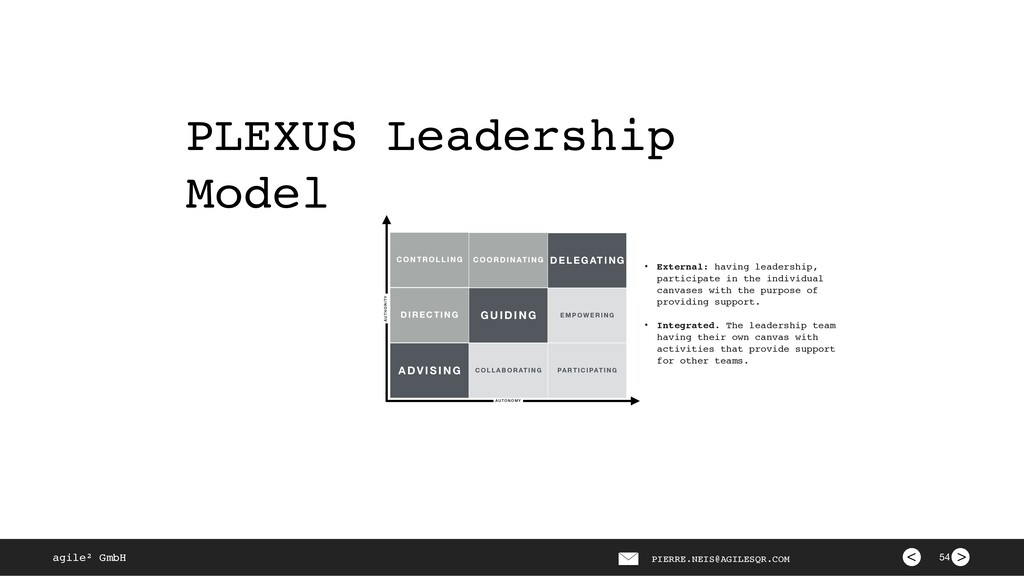
  45. > < agile² GmbH [email protected] PLEXUS Leadership Model 54 ADVISING

    GUIDING D E L E GAT I N G DIRECT ING C ON T R OL LI N G C OOR D I N AT I N G COL LAB OR AT I NG PARTICI PATING EMP OWERI NG A UT H ORIT Y A UT ON OMY • External: having leadership, participate in the individual canvases with the purpose of providing support. • Integrated. The leadership team having their own canvas with activities that provide support for other teams.
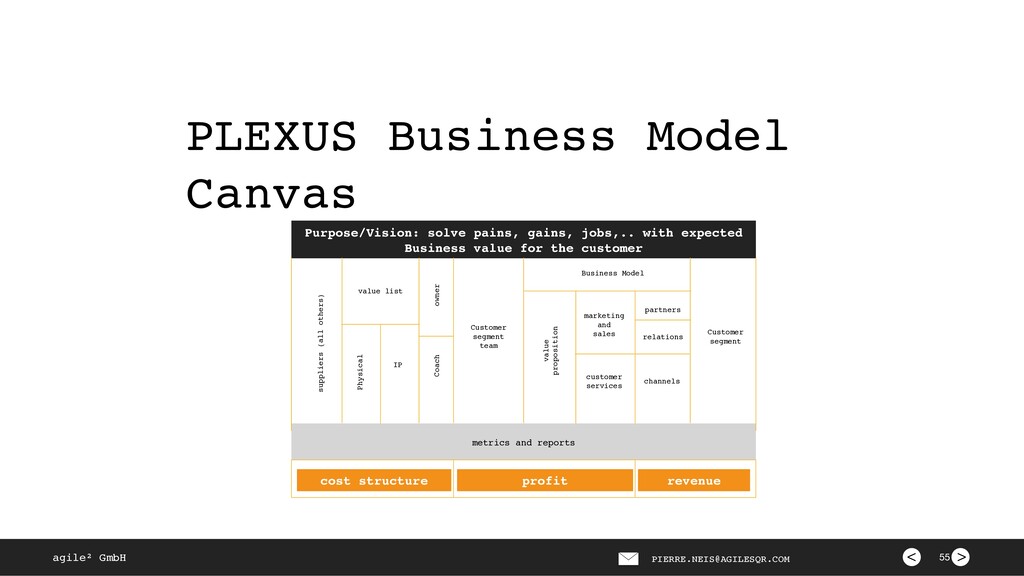
  46. > < agile² GmbH [email protected] PLEXUS Business Model Canvas 55

    Purpose/Vision: solve pains, gains, jobs,.. with expected Business value for the customer metrics and reports Business Model Customer segment team owner Coach value list IP Physical suppliers (all others) value proposition marketing and sales customer services partners relations channels Customer segment cost structure profit revenue
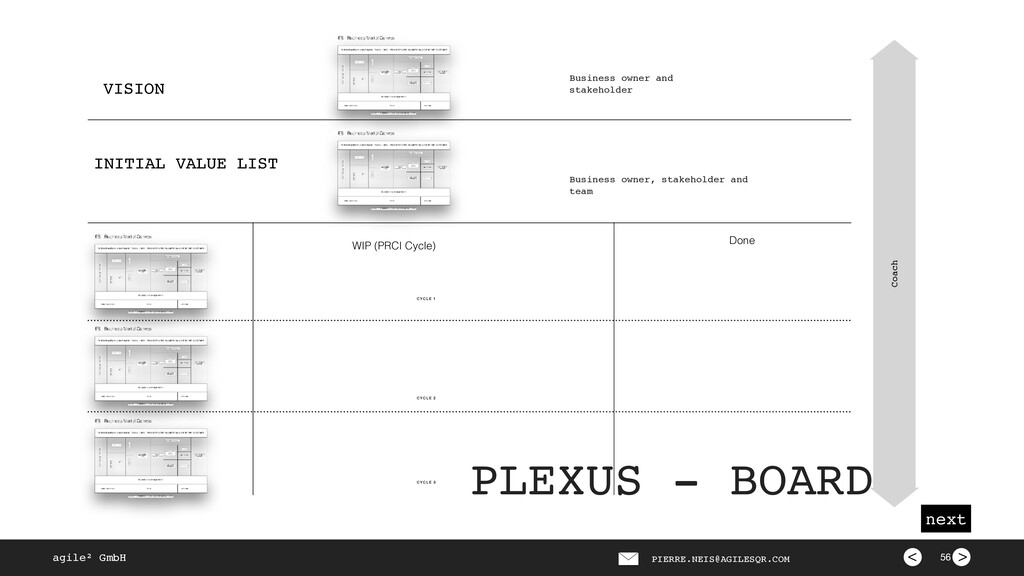
  47. > < next agile² GmbH [email protected] PLEXUS - BOARD 56

    VISION INITIAL VALUE LIST WIP (PRCI Cycle) Done C Y CLE 1 C Y CLE 2 C Y CLE 3 Business owner and stakeholder Business owner, stakeholder and team Coach
  48. > < next agile² GmbH [email protected] 57 B US IN

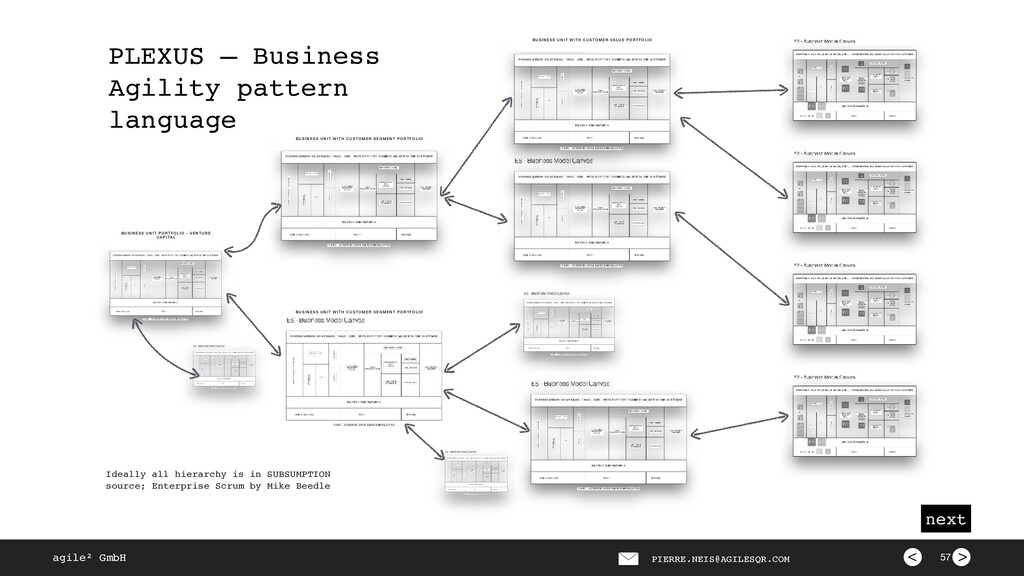
    E S S U N I T P O RTF O L IO - V EN T U RE C A P I TA L BU S IN ES S U N IT W ITH C US T OM E R S E G ME N T PO RTF OL IO BU S IN ES S U N IT W ITH C US T OM E R S E G ME N T PO RTF OL IO BU S IN ESS UNIT WI TH CUSTOM ER VAL UE PORTFOLI O PLEXUS – Business Agility pattern language Ideally all hierarchy is in SUBSUMPTION source; Enterprise Scrum by Mike Beedle