Use this comprehensive primer to simplify exporting, discover exportable products and services, and determine and select the best target market entry alternative while ensuring that you get paid.
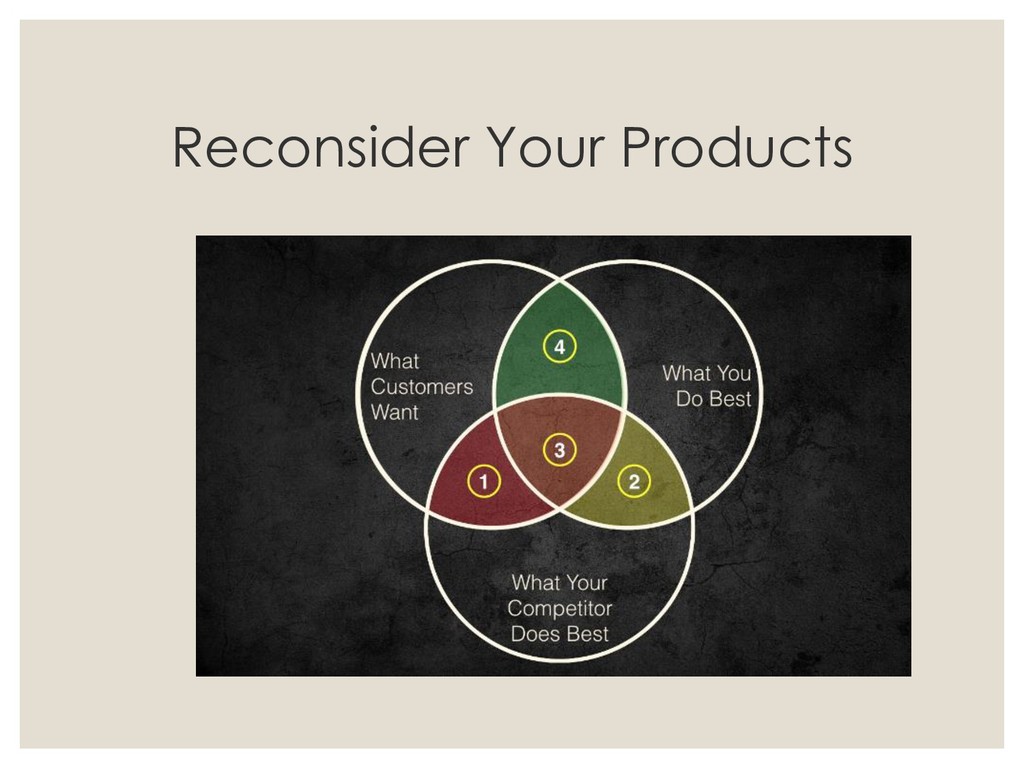
market using our proprietary set of tools • You build a product or deliver services based on you have learned • You market the product to your target segments
that carry our goods to port are vital connections to the only force which can balance our trade deficit: export. We must keep doing what we do best if we are going to get America out of the red." – Jo Ann Emerson, U.S. Representative for Missouri's 8th congressional district.
can improve its international standing and its national security by expanding trade and strengthening its relationships…" – Richard Neal U.S. Representative for Massachusetts's 2nd congressional district June 16, 2015
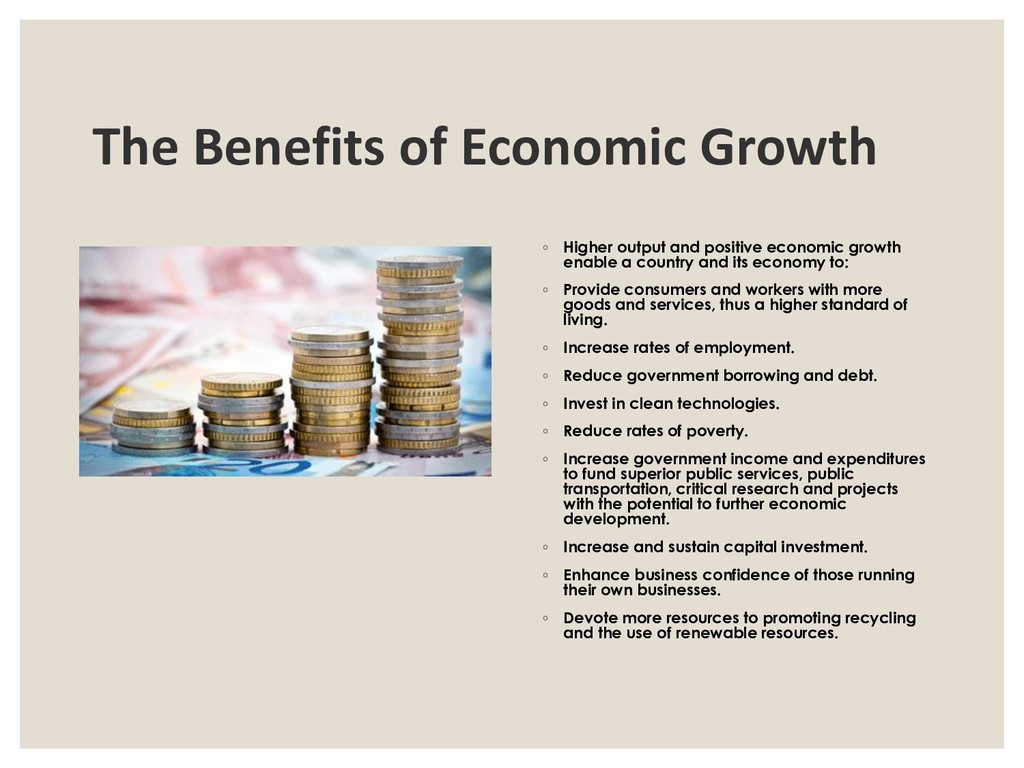
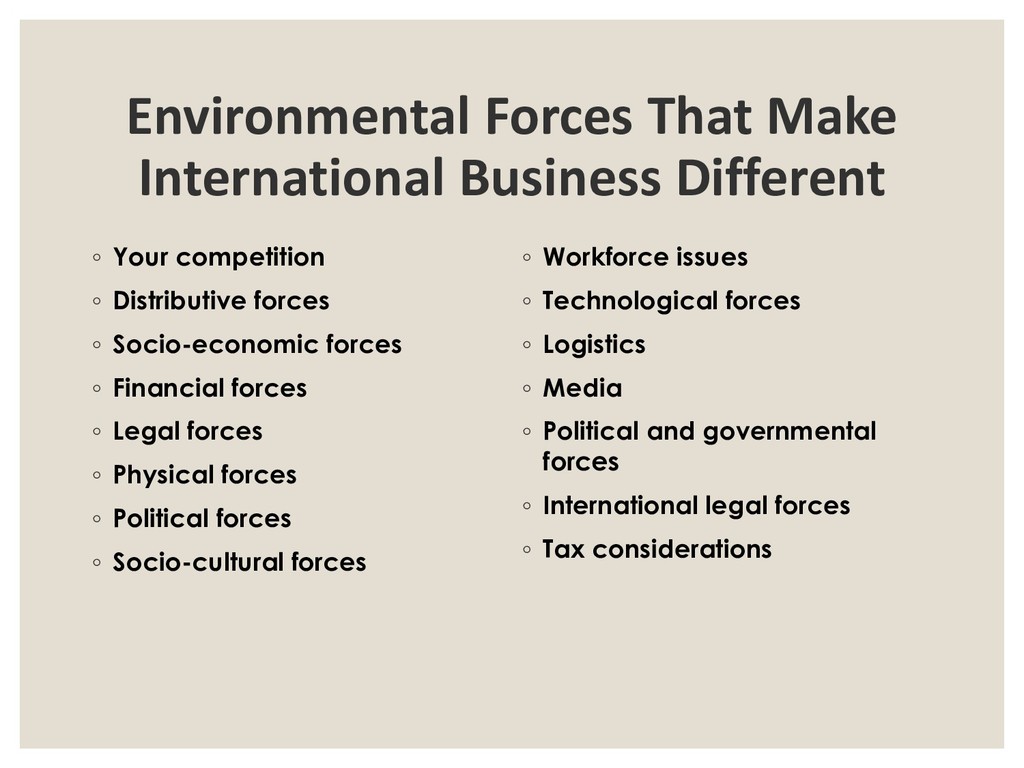
economic growth enable a country and its economy to: ◦ Provide consumers and workers with more goods and services, thus a higher standard of living. ◦ Increase rates of employment. ◦ Reduce government borrowing and debt. ◦ Invest in clean technologies. ◦ Reduce rates of poverty. ◦ Increase government income and expenditures to fund superior public services, public transportation, critical research and projects with the potential to further economic development. ◦ Increase and sustain capital investment. ◦ Enhance business confidence of those running their own businesses. ◦ Devote more resources to promoting recycling and the use of renewable resources.
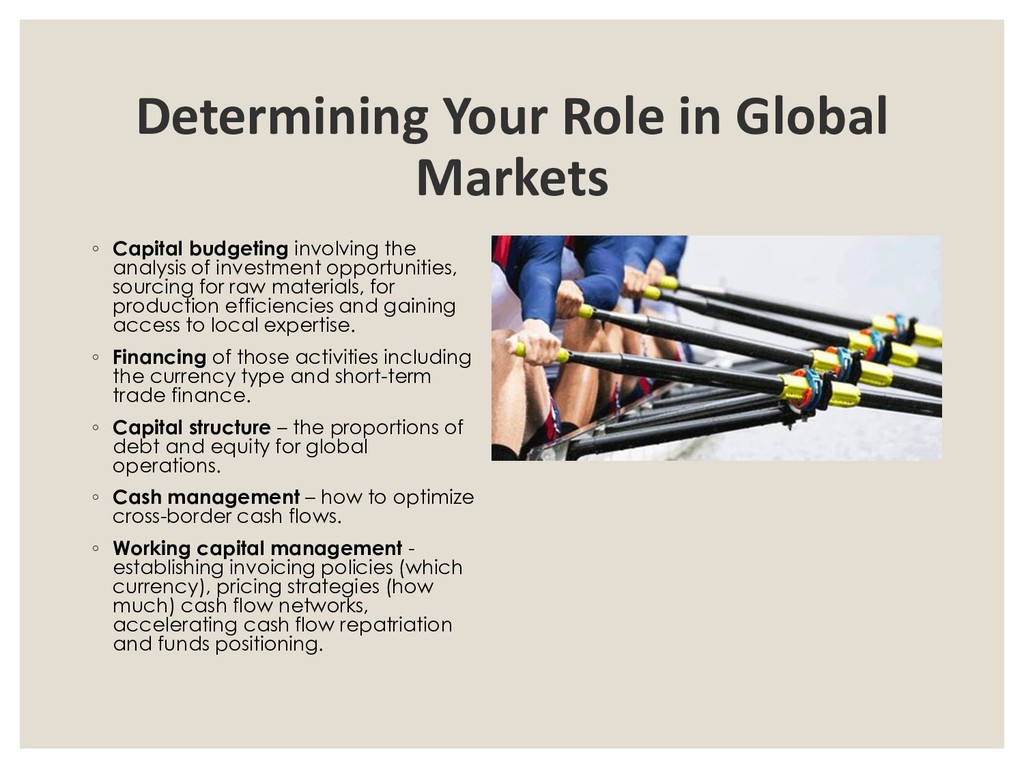
the analysis of investment opportunities, sourcing for raw materials, for production efficiencies and gaining access to local expertise. ◦ Financing of those activities including the currency type and short-term trade finance. ◦ Capital structure – the proportions of debt and equity for global operations. ◦ Cash management – how to optimize cross-border cash flows. ◦ Working capital management - establishing invoicing policies (which currency), pricing strategies (how much) cash flow networks, accelerating cash flow repatriation and funds positioning.
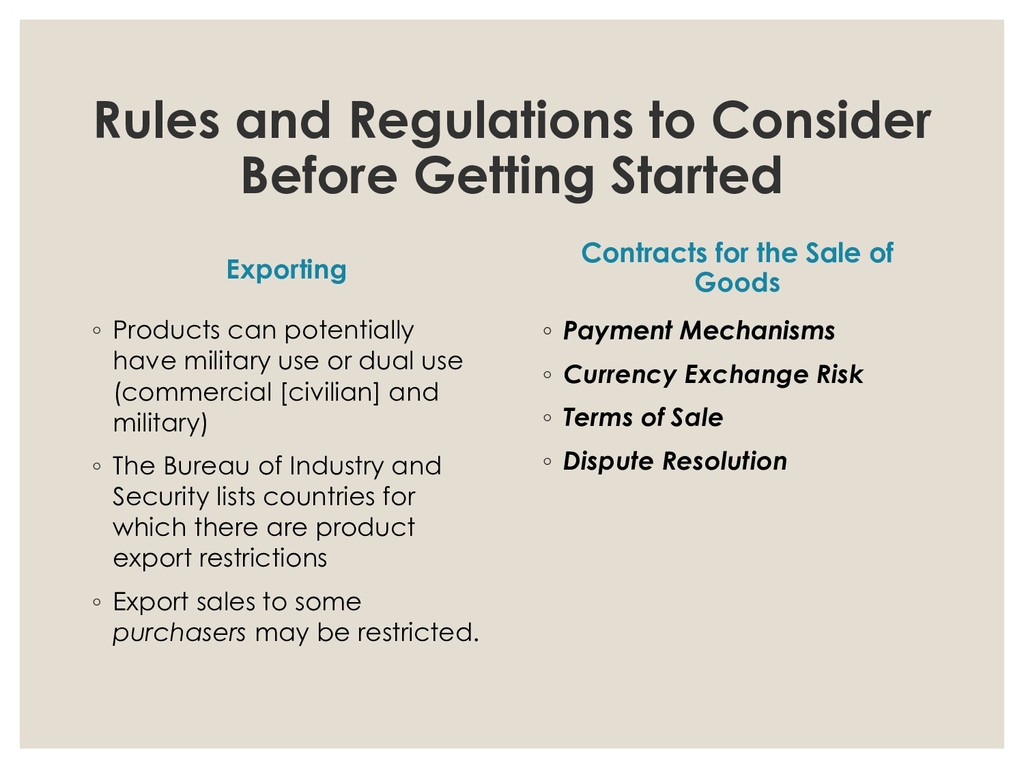
Products can potentially have military use or dual use (commercial [civilian] and military) ◦ The Bureau of Industry and Security lists countries for which there are product export restrictions ◦ Export sales to some purchasers may be restricted. Contracts for the Sale of Goods ◦ Payment Mechanisms ◦ Currency Exchange Risk ◦ Terms of Sale ◦ Dispute Resolution
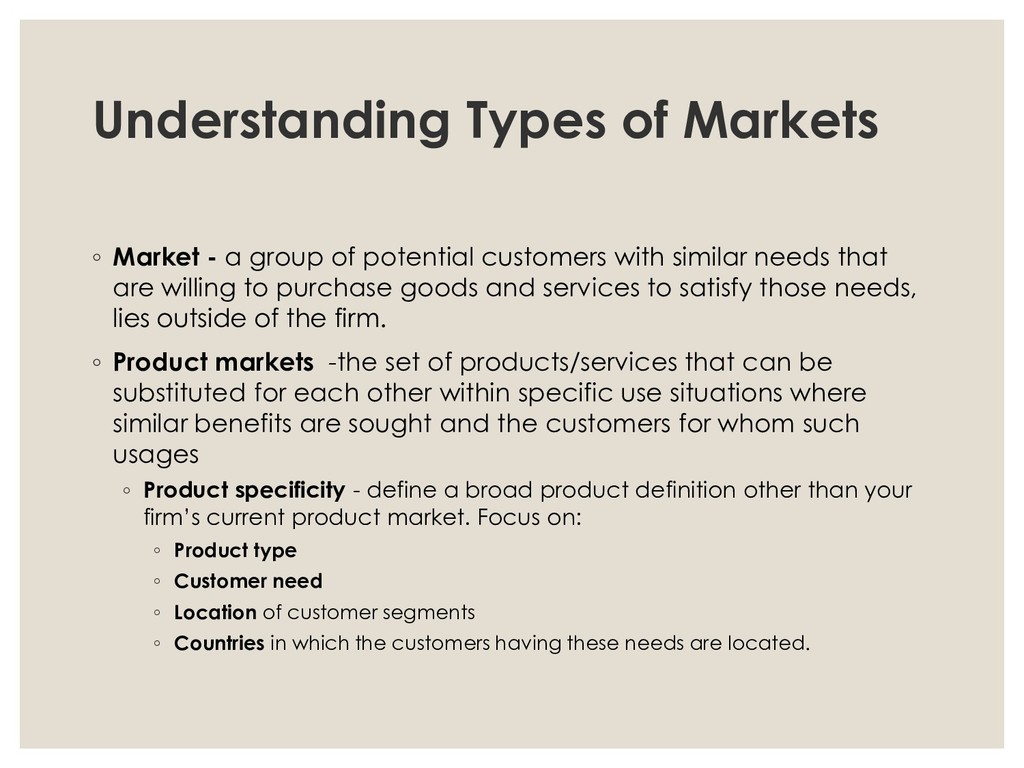
potential customers with similar needs that are willing to purchase goods and services to satisfy those needs, lies outside of the firm. ◦ Product markets -the set of products/services that can be substituted for each other within specific use situations where similar benefits are sought and the customers for whom such usages ◦ Product specificity - define a broad product definition other than your firm’s current product market. Focus on: ◦ Product type ◦ Customer need ◦ Location of customer segments ◦ Countries in which the customers having these needs are located.
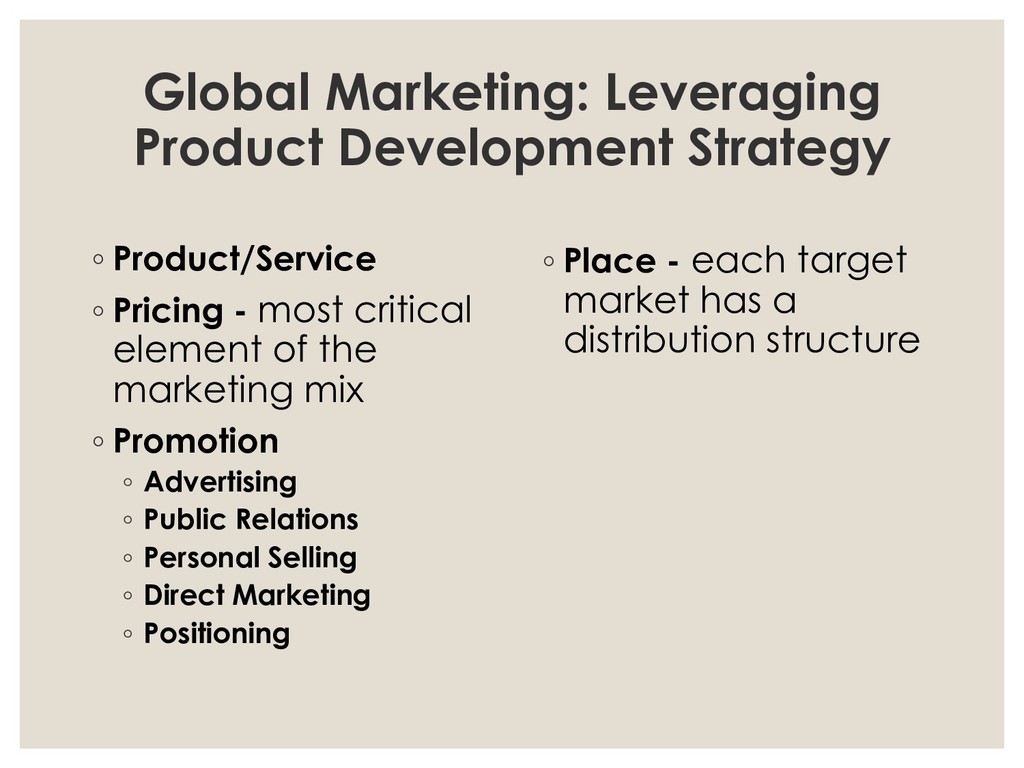
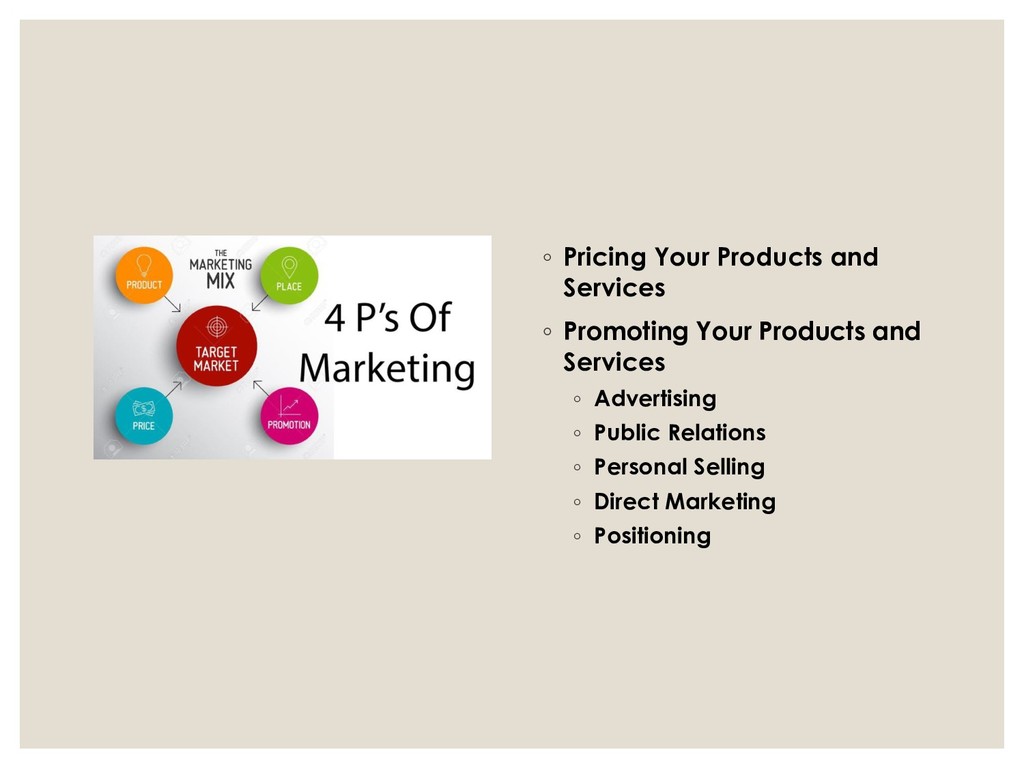
- most critical element of the marketing mix ◦ Promotion ◦ Advertising ◦ Public Relations ◦ Personal Selling ◦ Direct Marketing ◦ Positioning ◦ Place - each target market has a distribution structure
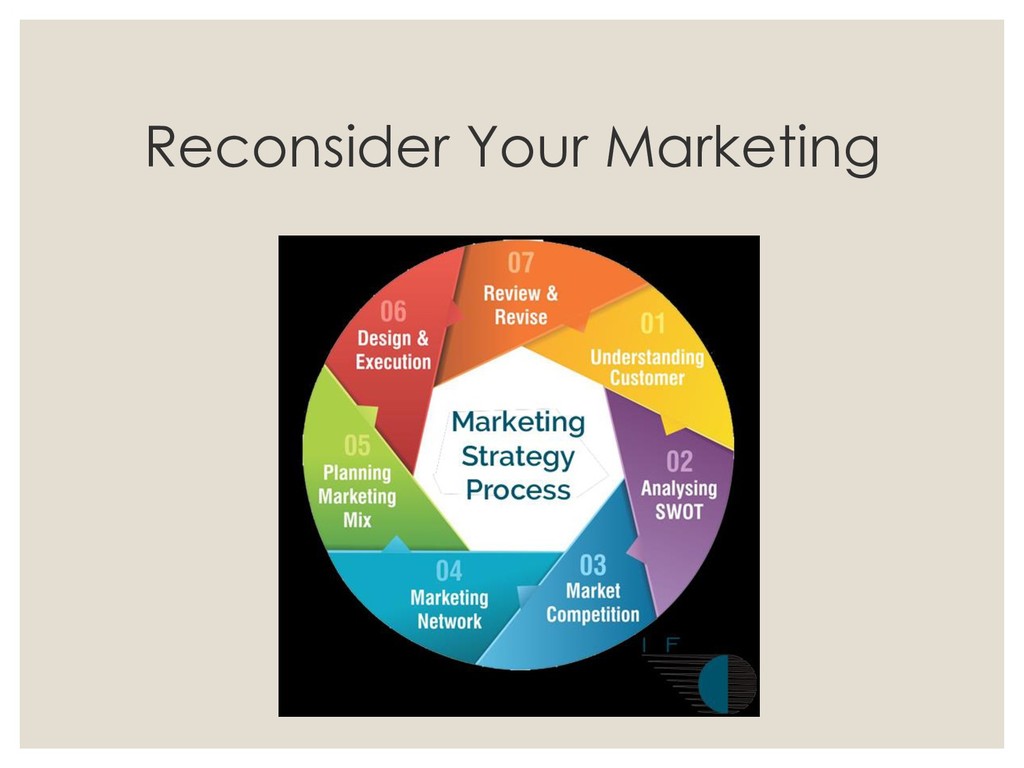
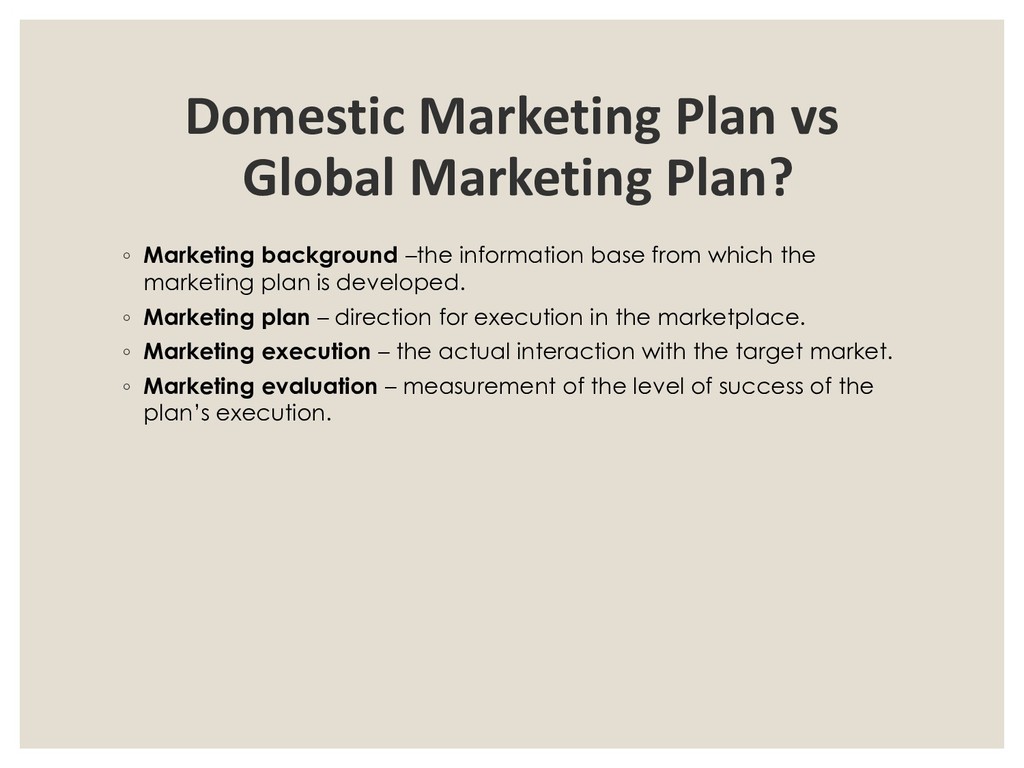
–the information base from which the marketing plan is developed. ◦ Marketing plan – direction for execution in the marketplace. ◦ Marketing execution – the actual interaction with the target market. ◦ Marketing evaluation – measurement of the level of success of the plan’s execution.
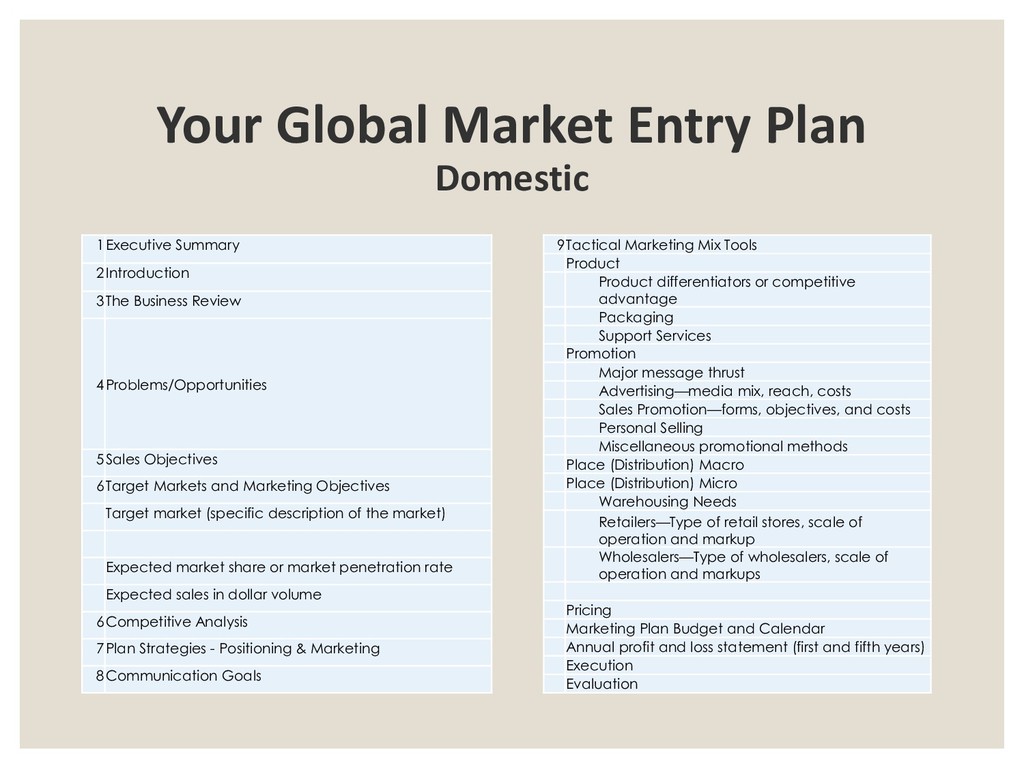
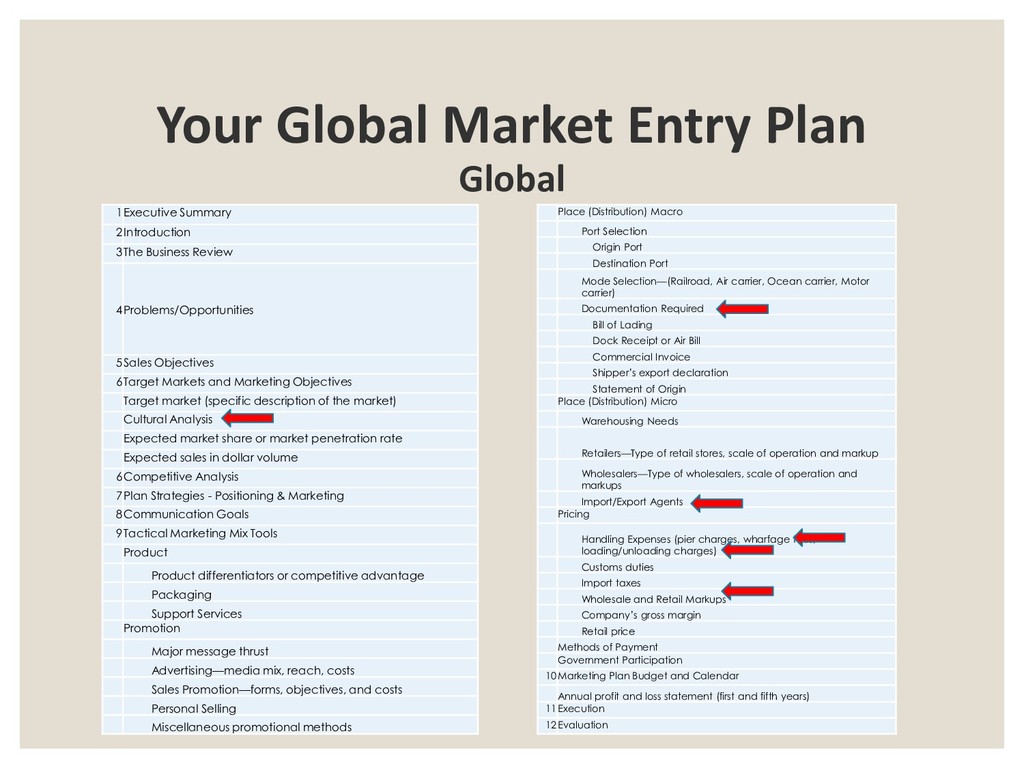
Product Product differentiators or competitive advantage Packaging Support Services Promotion Major message thrust Advertising—media mix, reach, costs Sales Promotion—forms, objectives, and costs Personal Selling Miscellaneous promotional methods Place (Distribution) Macro Place (Distribution) Micro Warehousing Needs Retailers—Type of retail stores, scale of operation and markup Wholesalers—Type of wholesalers, scale of operation and markups Pricing Marketing Plan Budget and Calendar Annual profit and loss statement (first and fifth years) Execution Evaluation 1Executive Summary 2Introduction 3The Business Review 4Problems/Opportunities 5Sales Objectives 6Target Markets and Marketing Objectives Target market (specific description of the market) Expected market share or market penetration rate Expected sales in dollar volume 6Competitive Analysis 7Plan Strategies - Positioning & Marketing 8Communication Goals
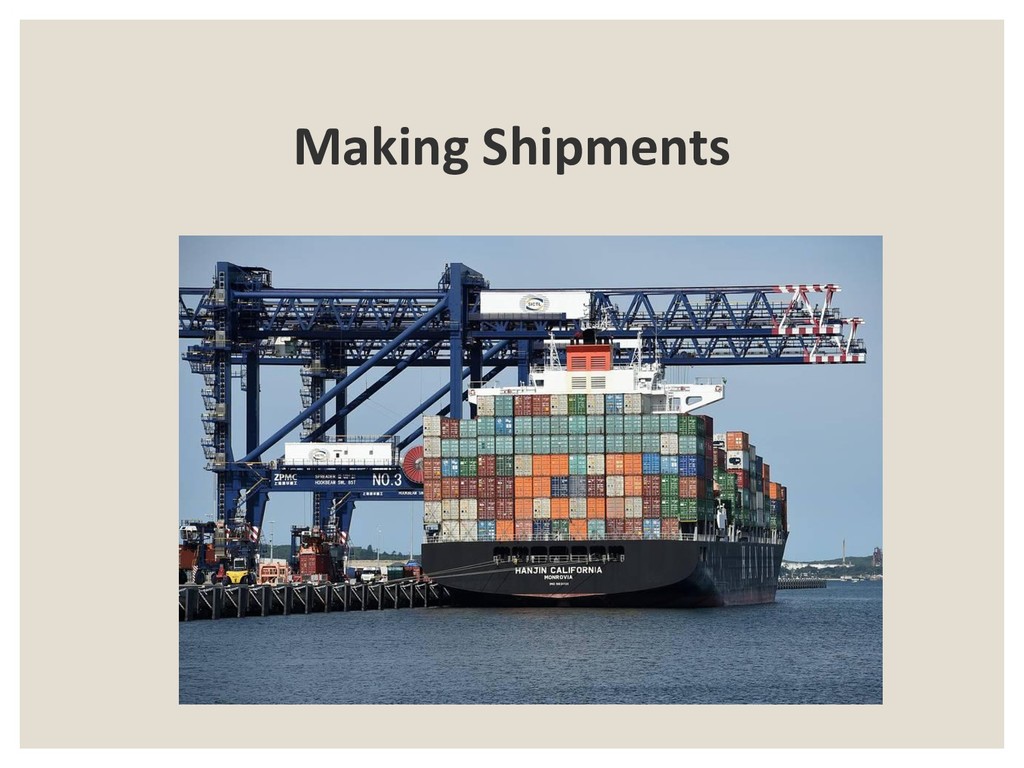
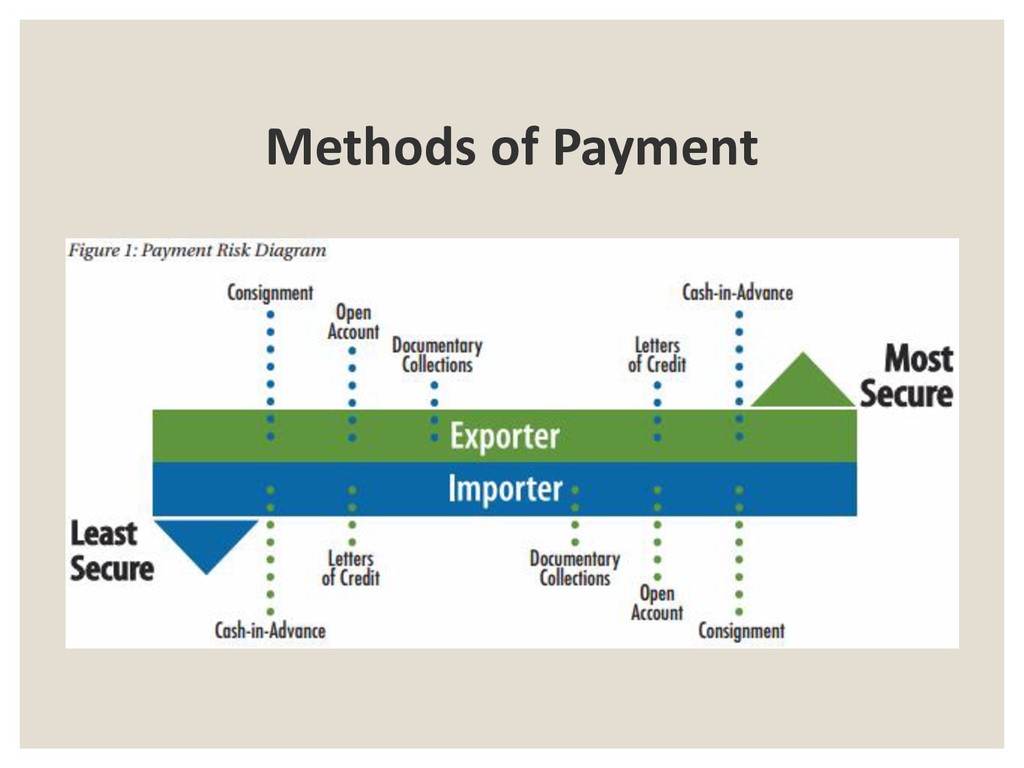
Business Review 4Problems/Opportunities 5Sales Objectives 6Target Markets and Marketing Objectives Target market (specific description of the market) Cultural Analysis Expected market share or market penetration rate Expected sales in dollar volume 6Competitive Analysis 7Plan Strategies - Positioning & Marketing 8Communication Goals 9Tactical Marketing Mix Tools Product Product differentiators or competitive advantage Packaging Support Services Promotion Major message thrust Advertising—media mix, reach, costs Sales Promotion—forms, objectives, and costs Personal Selling Miscellaneous promotional methods Place (Distribution) Macro Port Selection Origin Port Destination Port Mode Selection—(Railroad, Air carrier, Ocean carrier, Motor carrier) Documentation Required Bill of Lading Dock Receipt or Air Bill Commercial Invoice Shipper’s export declaration Statement of Origin Place (Distribution) Micro Warehousing Needs Retailers—Type of retail stores, scale of operation and markup Wholesalers—Type of wholesalers, scale of operation and markups Import/Export Agents Pricing Handling Expenses (pier charges, wharfage fees, loading/unloading charges) Customs duties Import taxes Wholesale and Retail Markups Company’s gross margin Retail price Methods of Payment Government Participation 10Marketing Plan Budget and Calendar Annual profit and loss statement (first and fifth years) 11Execution 12Evaluation
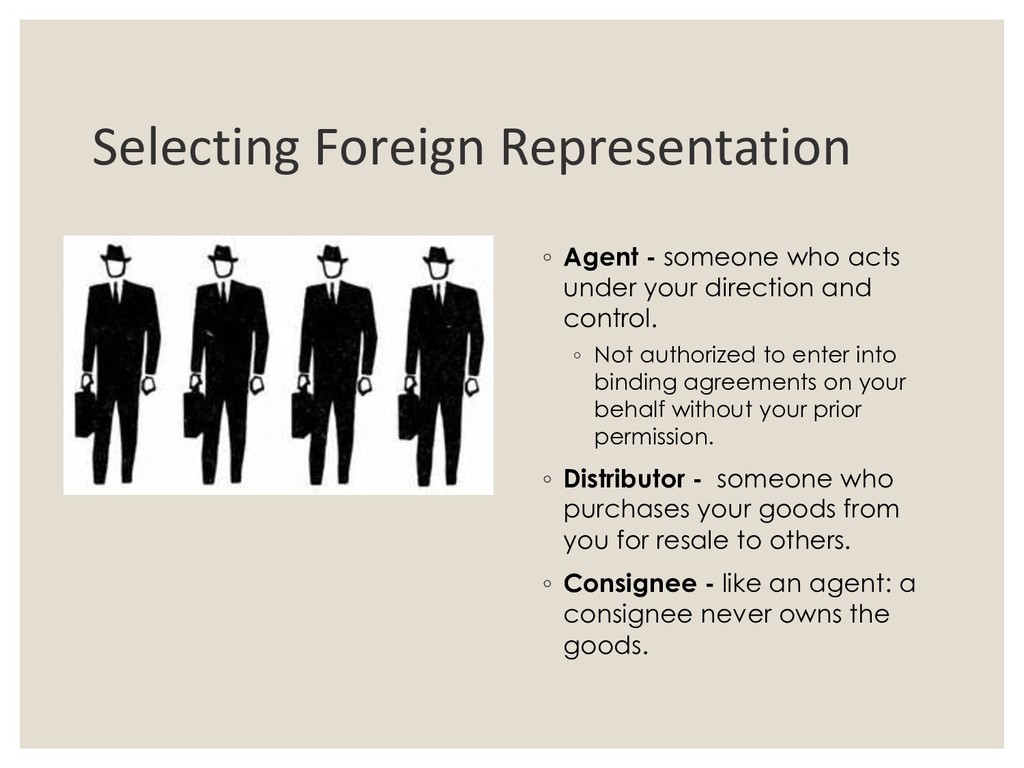
your direction and control. ◦ Not authorized to enter into binding agreements on your behalf without your prior permission. ◦ Distributor - someone who purchases your goods from you for resale to others. ◦ Consignee - like an agent: a consignee never owns the goods.
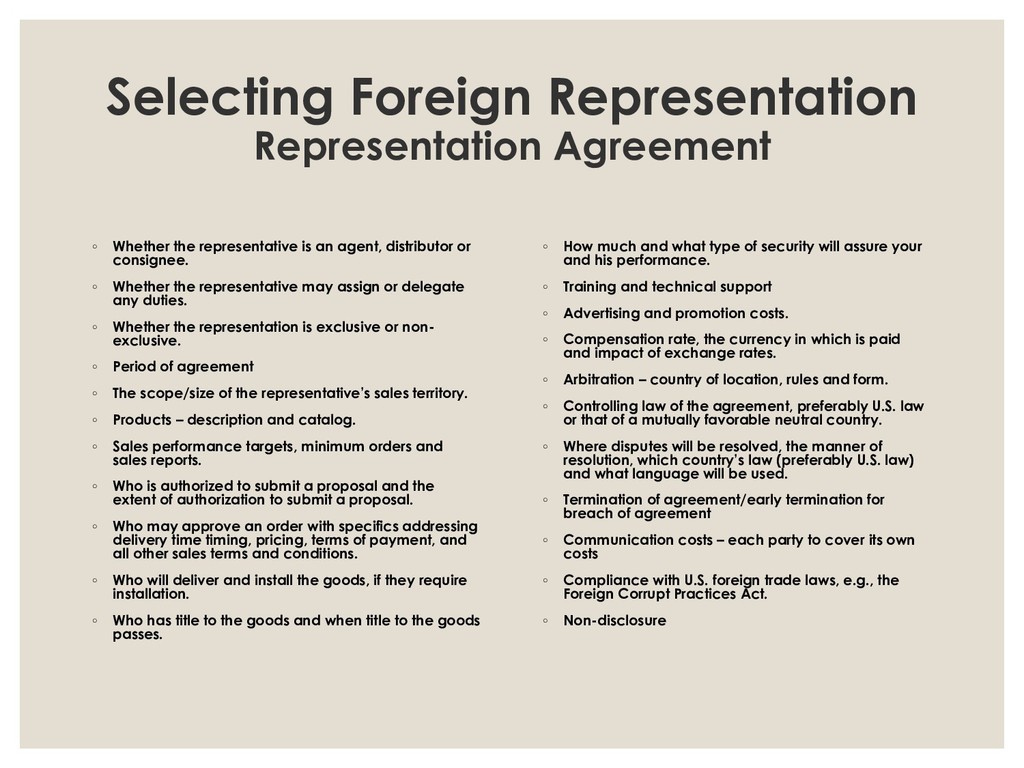
an agent, distributor or consignee. ◦ Whether the representative may assign or delegate any duties. ◦ Whether the representation is exclusive or non- exclusive. ◦ Period of agreement ◦ The scope/size of the representative’s sales territory. ◦ Products – description and catalog. ◦ Sales performance targets, minimum orders and sales reports. ◦ Who is authorized to submit a proposal and the extent of authorization to submit a proposal. ◦ Who may approve an order with specifics addressing delivery time timing, pricing, terms of payment, and all other sales terms and conditions. ◦ Who will deliver and install the goods, if they require installation. ◦ Who has title to the goods and when title to the goods passes. ◦ How much and what type of security will assure your and his performance. ◦ Training and technical support ◦ Advertising and promotion costs. ◦ Compensation rate, the currency in which is paid and impact of exchange rates. ◦ Arbitration – country of location, rules and form. ◦ Controlling law of the agreement, preferably U.S. law or that of a mutually favorable neutral country. ◦ Where disputes will be resolved, the manner of resolution, which country’s law (preferably U.S. law) and what language will be used. ◦ Termination of agreement/early termination for breach of agreement ◦ Communication costs – each party to cover its own costs ◦ Compliance with U.S. foreign trade laws, e.g., the Foreign Corrupt Practices Act. ◦ Non-disclosure
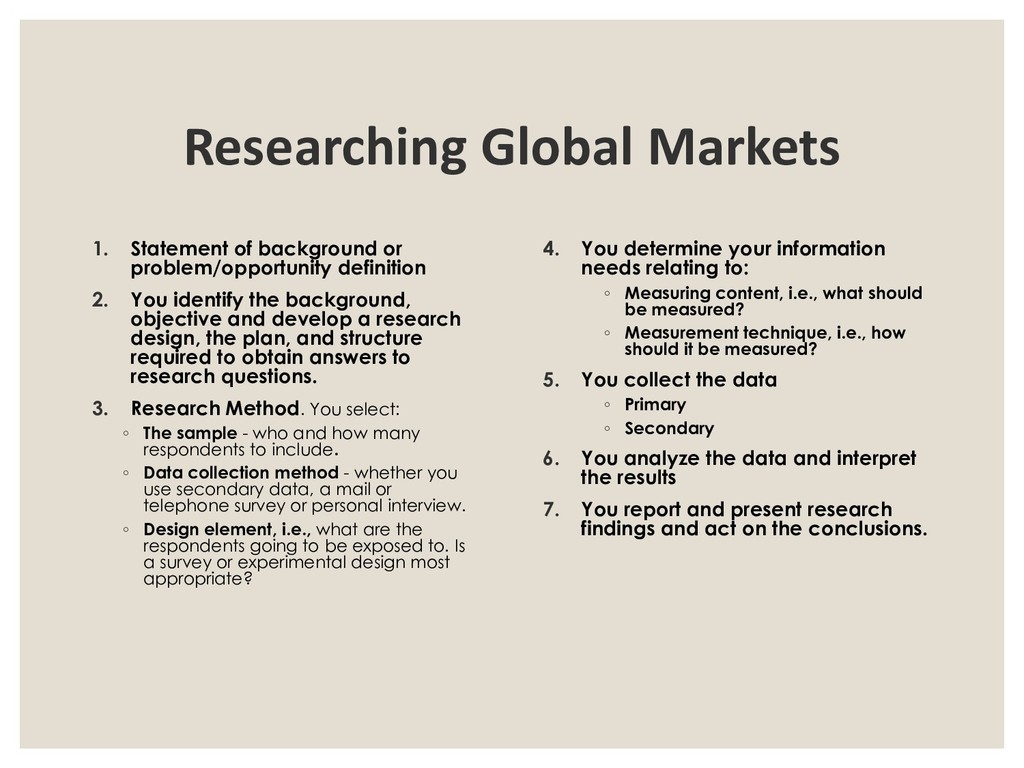
2. You identify the background, objective and develop a research design, the plan, and structure required to obtain answers to research questions. 3. Research Method. You select: ◦ The sample - who and how many respondents to include. ◦ Data collection method - whether you use secondary data, a mail or telephone survey or personal interview. ◦ Design element, i.e., what are the respondents going to be exposed to. Is a survey or experimental design most appropriate? 4. You determine your information needs relating to: ◦ Measuring content, i.e., what should be measured? ◦ Measurement technique, i.e., how should it be measured? 5. You collect the data ◦ Primary ◦ Secondary 6. You analyze the data and interpret the results 7. You report and present research findings and act on the conclusions.


 kaonavi
 stanby_inc
 superstudio
 uemura2024
 flux
 gatechnologies
 sukatsu1222
 malna
 neuroenergia
 uluru_hr
 hrm
 ozakiomumkj
 tammyeverts
 aarron
 kevinliebholz
 nikkihalliwell
 cassininazir
 lcolladotor
 techseoconnect
 moore
 kimpetersen
 philnash
 brad_frost