Upgrade to Pro — share decks privately, control downloads, hide ads and more …

India-US trade deal down to final 1%; time diff...

Sponsored · Ship Features Fearlessly Turn features on and off without deploys. Used by thousands of Ruby developers. →

India-US trade deal down to final 1%; time difference was 'nightmarish', says Goyal Read More: https://www.moneycontrol.com/news/trade/india-us/india-us-trade-deal-down-to-final-1-time-difference-was-nightmarish-says-goyal-13964459.html

🇮🇳 🇺🇸 India–US trade deal is now 99% complete , with only the final 1% left to negotiate. Commerce Minister Piyush Goyal said the biggest challenge was the time difference between New Delhi and Washington. The agreement is expected to boost exports, strengthen economic ties, and create new opportunities for Indian businesses.

#IndiaUSTradeDeal #BusinessNews #Trade #Economy #IndiaUS

Avatar for Subhodeep Paul

Subhodeep Paul

July 02, 2026

Other Decks in Business

Transcript

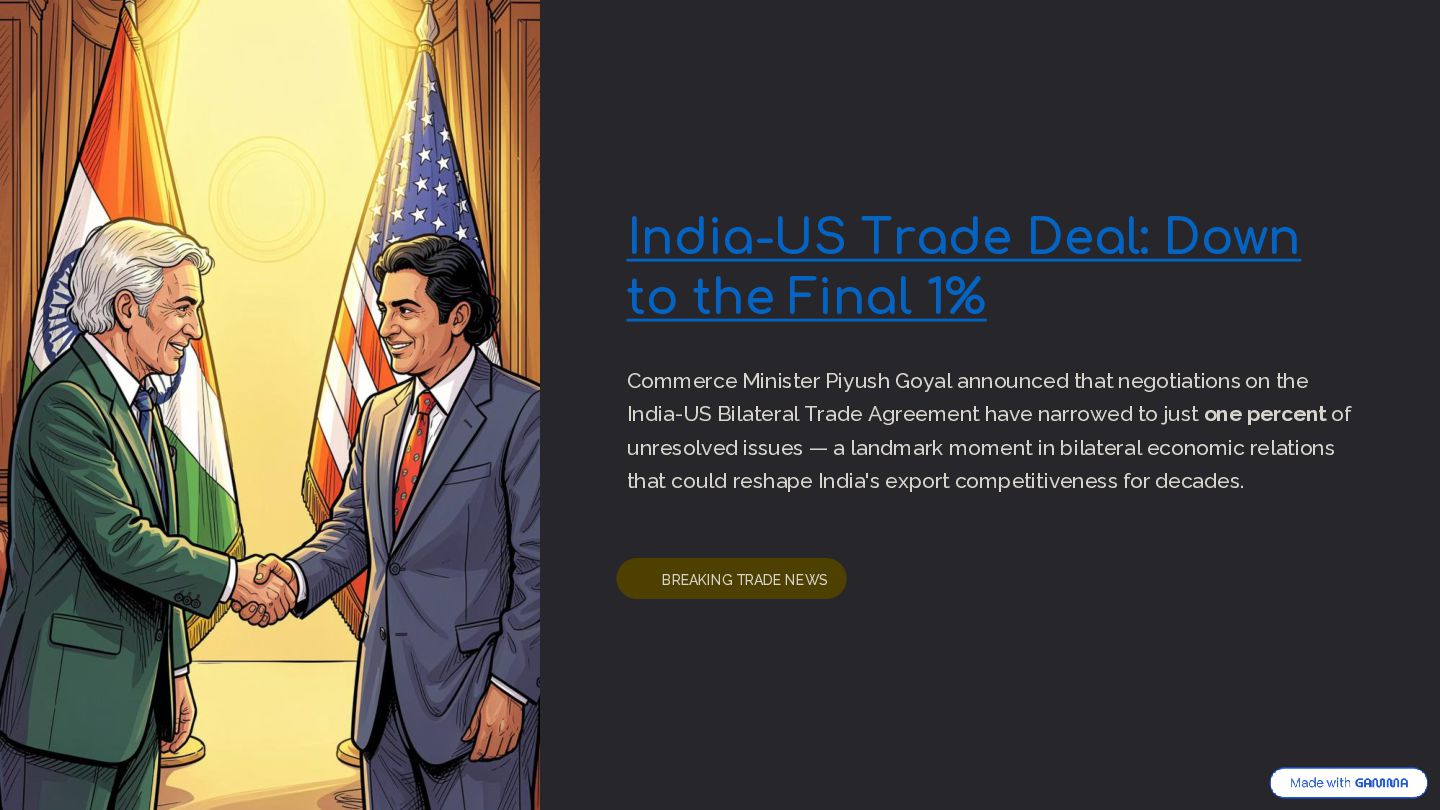
  1. India-US Trade Deal: Down to the Final 1% Commerce Minister

    Piyush Goyal announced that negotiations on the India-US Bilateral Trade Agreement have narrowed to just one percent of unresolved issues — a landmark moment in bilateral economic relations that could reshape India's export competitiveness for decades. BREAKING TRADE NEWS
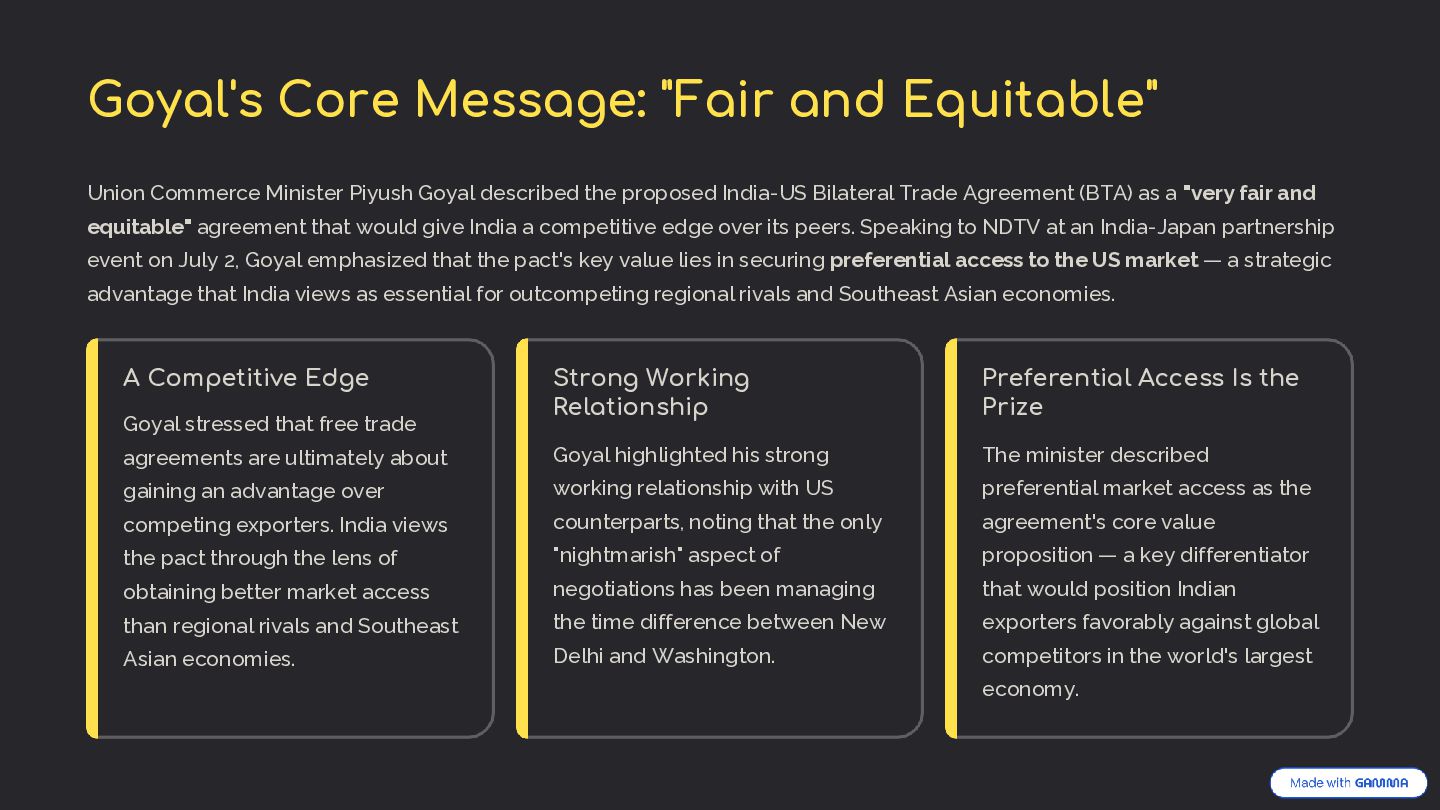
  2. Goyal's Core Message: "Fair and Equitable" Union Commerce Minister Piyush

    Goyal described the proposed India-US Bilateral Trade Agreement (BTA) as a "very fair and equitable" agreement that would give India a competitive edge over its peers. Speaking to NDTV at an India-Japan partnership event on July 2, Goyal emphasized that the pact's key value lies in securing preferential access to the US market — a strategic advantage that India views as essential for outcompeting regional rivals and Southeast Asian economies. A Competitive Edge Goyal stressed that free trade agreements are ultimately about gaining an advantage over competing exporters. India views the pact through the lens of obtaining better market access than regional rivals and Southeast Asian economies. Strong Working Relationship Goyal highlighted his strong working relationship with US counterparts, noting that the only "nightmarish" aspect of negotiations has been managing the time difference between New Delhi and Washington. Preferential Access Is the Prize The minister described preferential market access as the agreement's core value proposition — a key differentiator that would position Indian exporters favorably against global competitors in the world's largest economy.
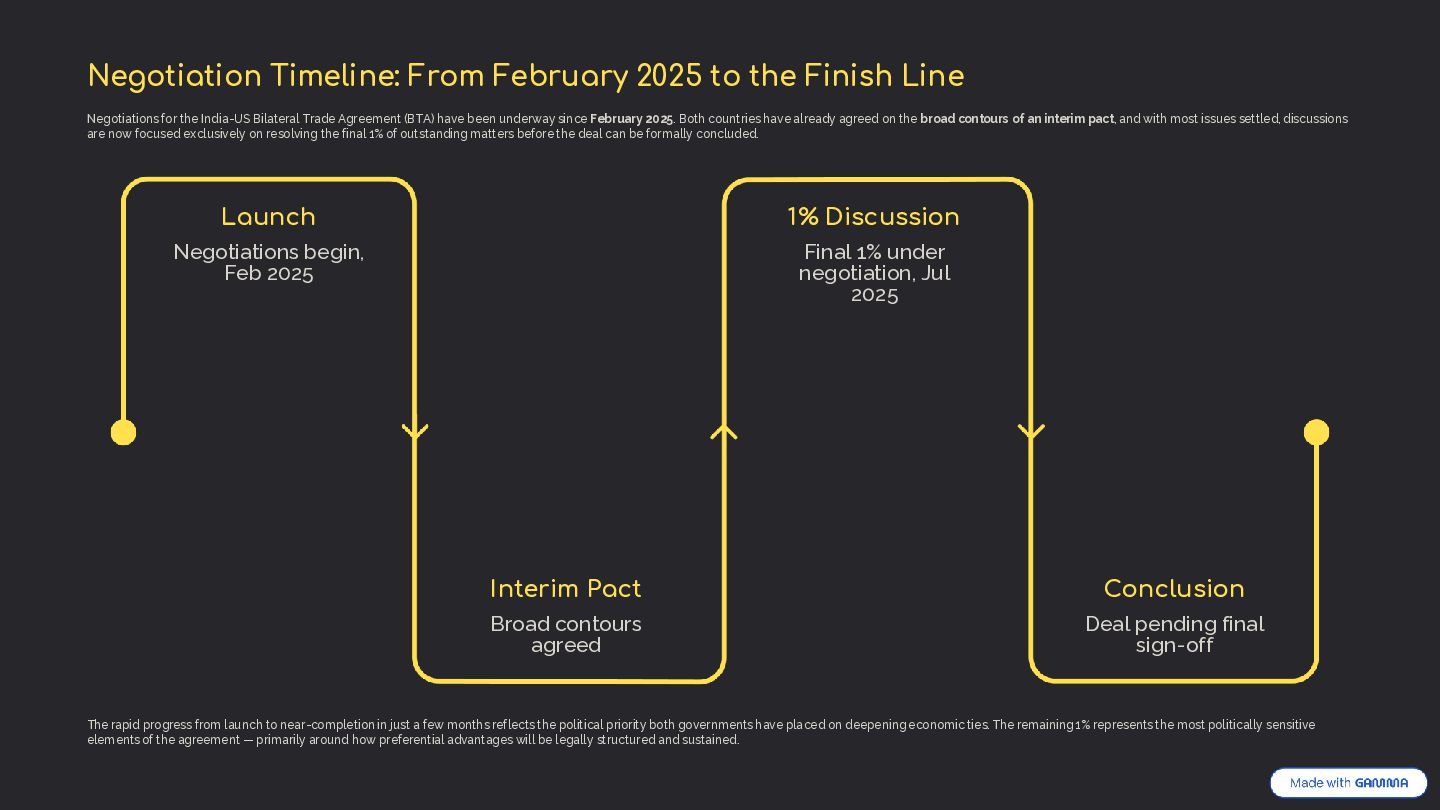
  3. Negotiation Timeline: From February 2025 to the Finish Line Negotiations

    for the India-US Bilateral Trade Agreement (BTA) have been underway since February 2025. Both countries have already agreed on the broad contours of an interim pact, and with most issues settled, discussions are now focused exclusively on resolving the final 1% of outstanding matters before the deal can be formally concluded. Interim Pact Broad contours agreed Conclusion Deal pending final sign-off Launch Negotiations begin, Feb 2025 1% Discussion Final 1% under negotiation, Jul 2025 The rapid progress from launch to near-completion in just a few months reflects the political priority both governments have placed on deepening economic ties. The remaining 1% represents the most politically sensitive elements of the agreement — primarily around how preferential advantages will be legally structured and sustained.
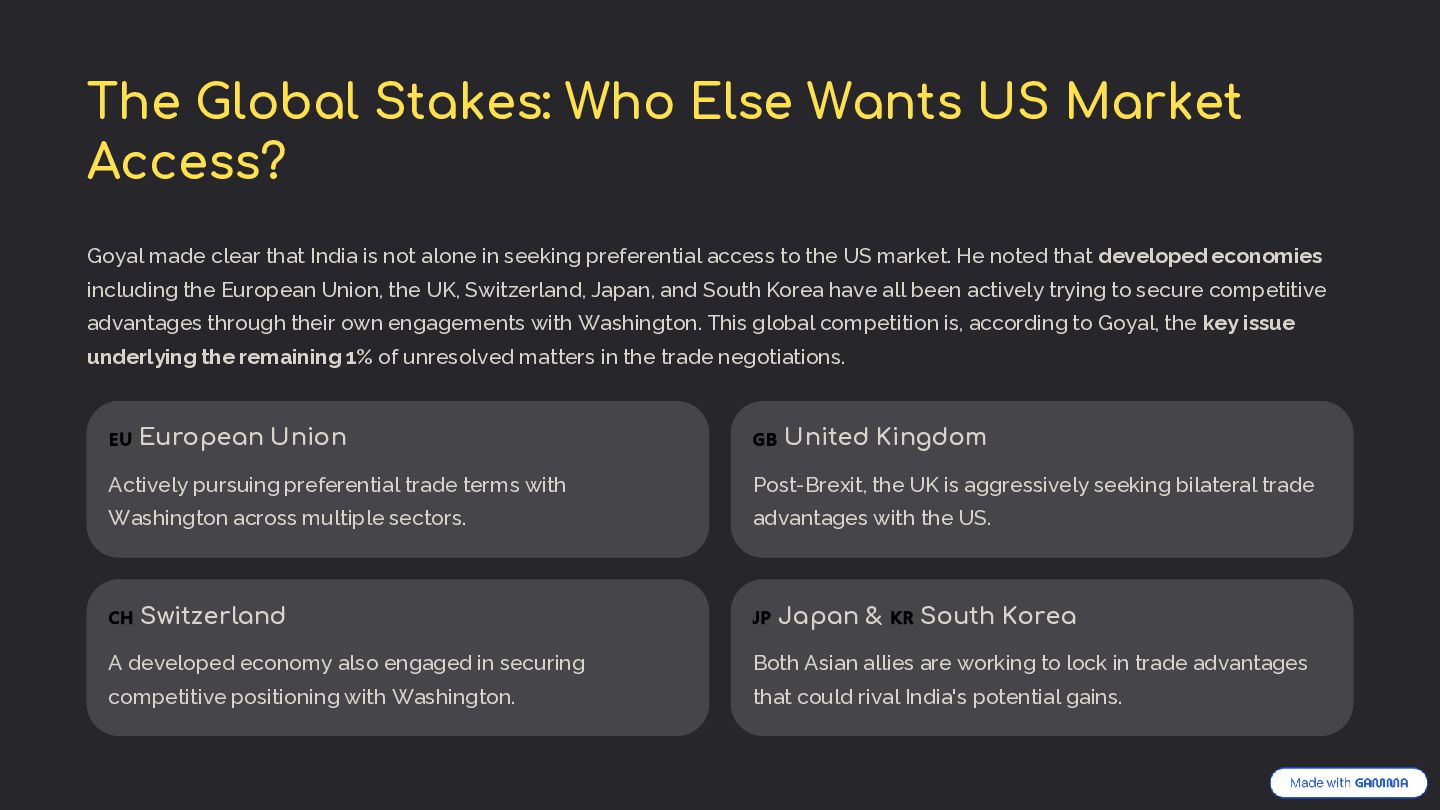
  4. The Global Stakes: Who Else Wants US Market Access? Goyal

    made clear that India is not alone in seeking preferential access to the US market. He noted that developed economies including the European Union, the UK, Switzerland, Japan, and South Korea have all been actively trying to secure competitive advantages through their own engagements with Washington. This global competition is, according to Goyal, the key issue underlying the remaining 1% of unresolved matters in the trade negotiations. 🇪🇺 European Union Actively pursuing preferential trade terms with Washington across multiple sectors. 🇬🇧 United Kingdom Post-Brexit, the UK is aggressively seeking bilateral trade advantages with the US. 🇨🇭 Switzerland A developed economy also engaged in securing competitive positioning with Washington. 🇯🇵 Japan & 🇰🇷 South Korea Both Asian allies are working to lock in trade advantages that could rival India's potential gains.
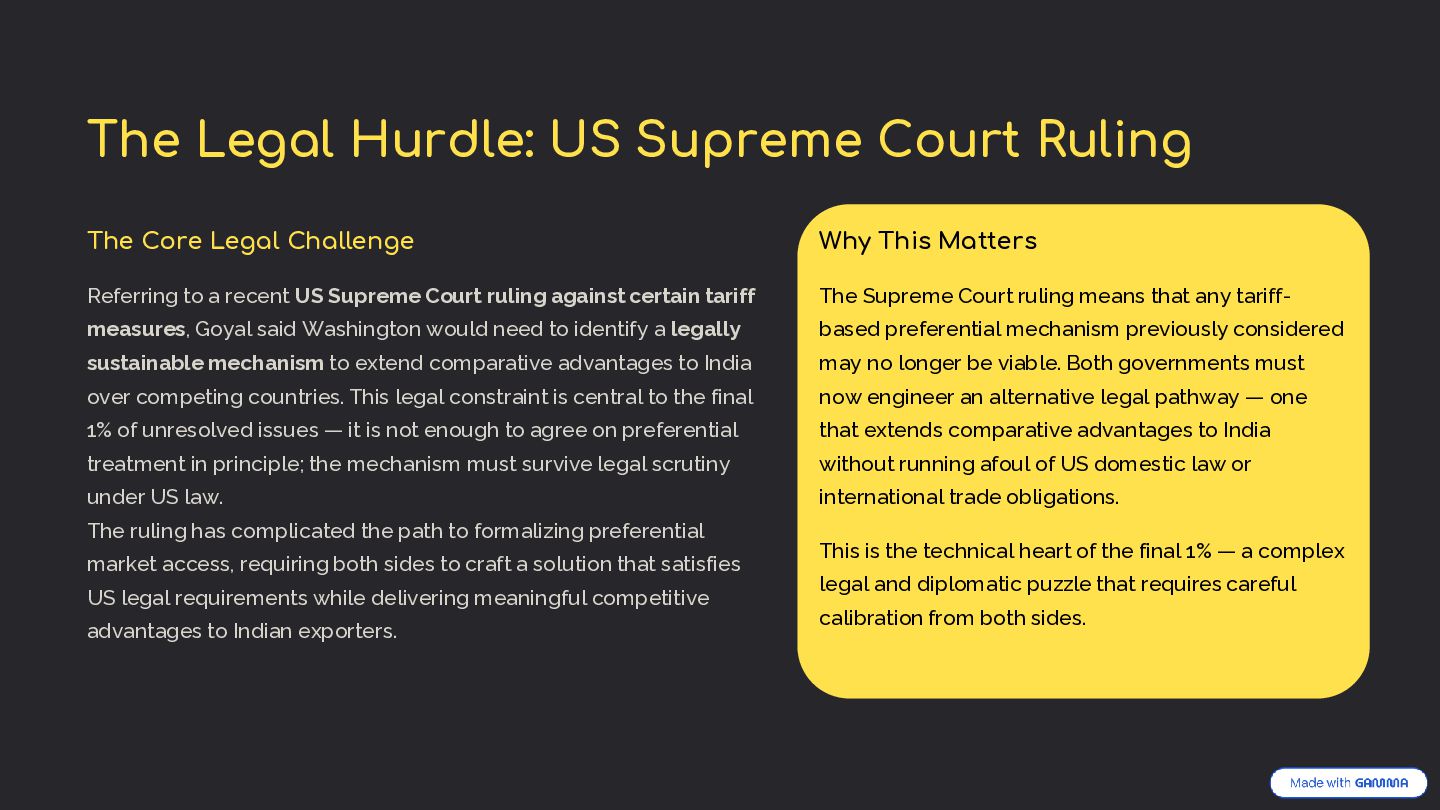
  5. The Legal Hurdle: US Supreme Court Ruling The Core Legal

    Challenge Referring to a recent US Supreme Court ruling against certain tariff measures, Goyal said Washington would need to identify a legally sustainable mechanism to extend comparative advantages to India over competing countries. This legal constraint is central to the final 1% of unresolved issues — it is not enough to agree on preferential treatment in principle; the mechanism must survive legal scrutiny under US law. The ruling has complicated the path to formalizing preferential market access, requiring both sides to craft a solution that satisfies US legal requirements while delivering meaningful competitive advantages to Indian exporters. Why This Matters The Supreme Court ruling means that any tariff- based preferential mechanism previously considered may no longer be viable. Both governments must now engineer an alternative legal pathway — one that extends comparative advantages to India without running afoul of US domestic law or international trade obligations. This is the technical heart of the final 1% — a complex legal and diplomatic puzzle that requires careful calibration from both sides.
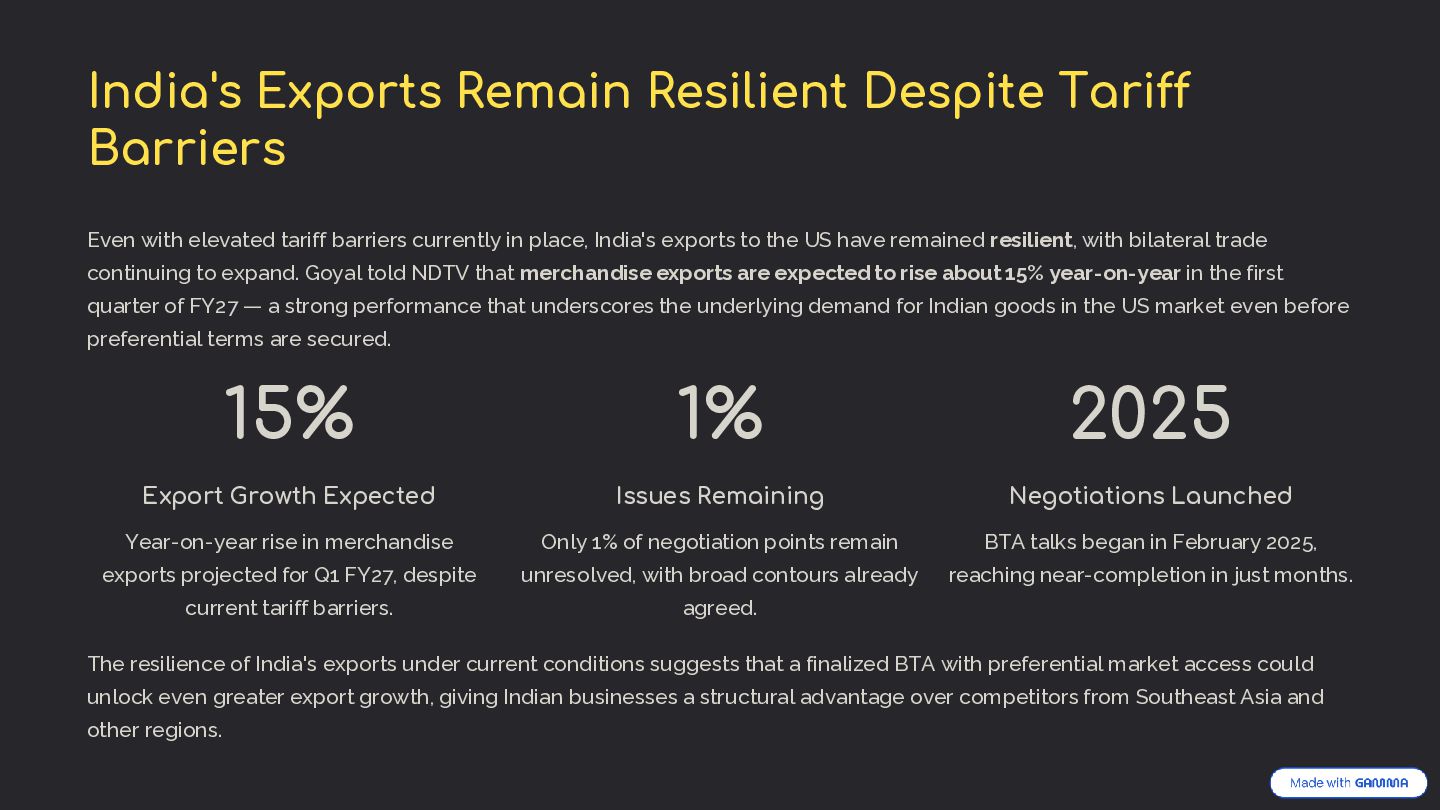
  6. India's Exports Remain Resilient Despite Tariff Barriers Even with elevated

    tariff barriers currently in place, India's exports to the US have remained resilient, with bilateral trade continuing to expand. Goyal told NDTV that merchandise exports are expected to rise about 15% year-on-year in the first quarter of FY27 — a strong performance that underscores the underlying demand for Indian goods in the US market even before preferential terms are secured. 15% Export Growth Expected Year-on-year rise in merchandise exports projected for Q1 FY27, despite current tariff barriers. 1% Issues Remaining Only 1% of negotiation points remain unresolved, with broad contours already agreed. 2025 Negotiations Launched BTA talks began in February 2025, reaching near-completion in just months. The resilience of India's exports under current conditions suggests that a finalized BTA with preferential market access could unlock even greater export growth, giving Indian businesses a structural advantage over competitors from Southeast Asia and other regions.
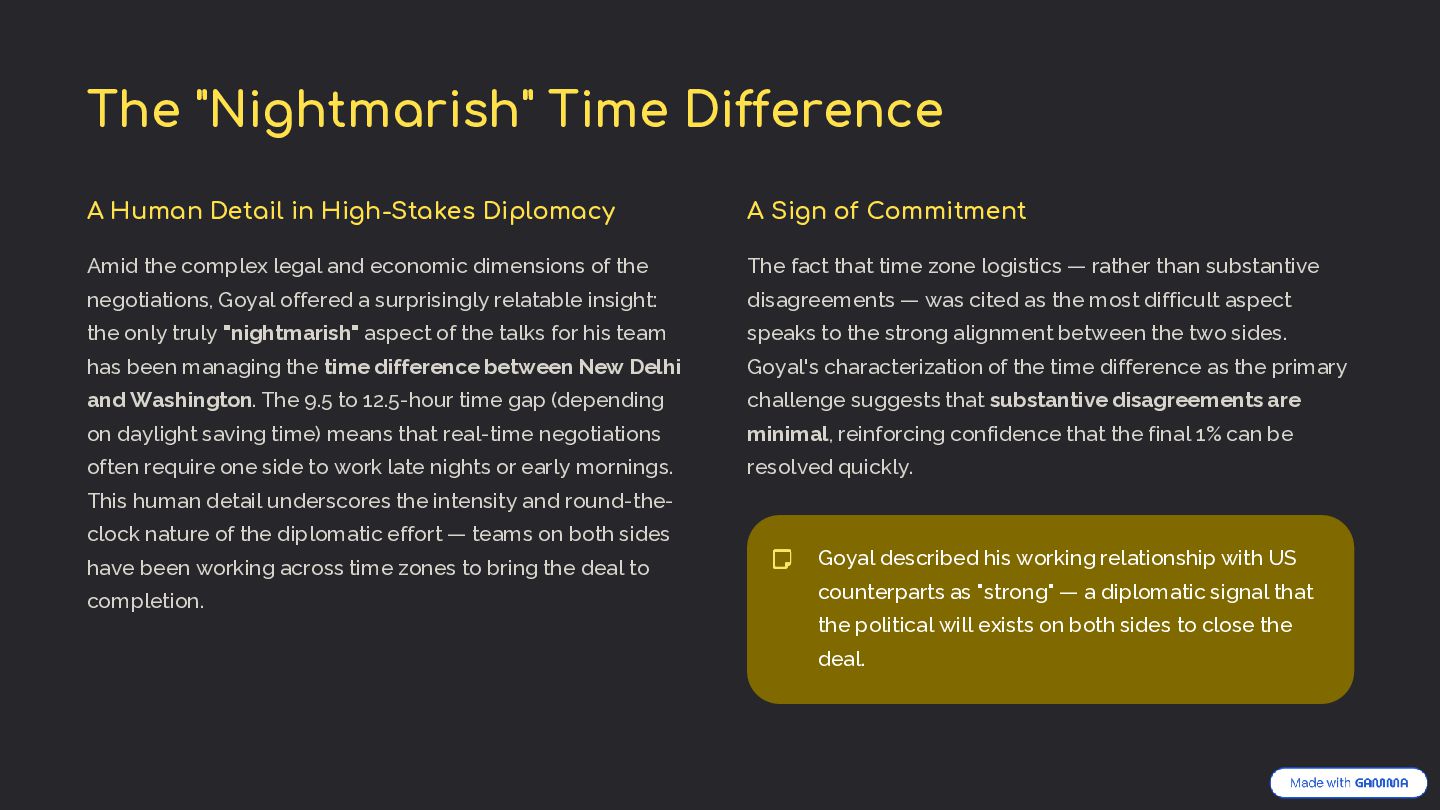
  7. The "Nightmarish" Time Difference A Human Detail in High-Stakes Diplomacy

    Amid the complex legal and economic dimensions of the negotiations, Goyal offered a surprisingly relatable insight: the only truly "nightmarish" aspect of the talks for his team has been managing the time difference between New Delhi and Washington. The 9.5 to 12.5-hour time gap (depending on daylight saving time) means that real-time negotiations often require one side to work late nights or early mornings. This human detail underscores the intensity and round-the- clock nature of the diplomatic effort — teams on both sides have been working across time zones to bring the deal to completion. A Sign of Commitment The fact that time zone logistics — rather than substantive disagreements — was cited as the most difficult aspect speaks to the strong alignment between the two sides. Goyal's characterization of the time difference as the primary challenge suggests that substantive disagreements are minimal, reinforcing confidence that the final 1% can be resolved quickly. Goyal described his working relationship with US counterparts as "strong" — a diplomatic signal that the political will exists on both sides to close the deal.
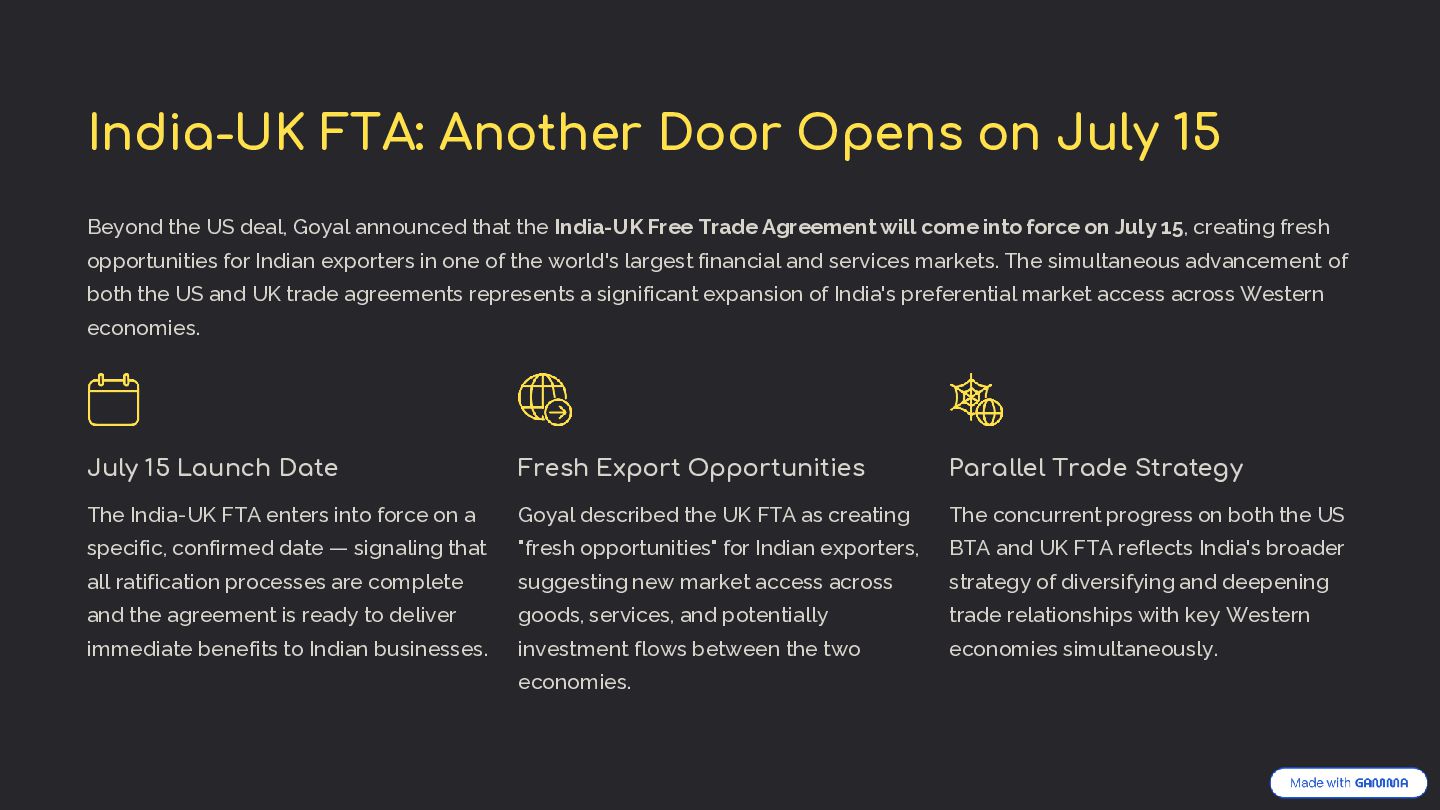
  8. India-UK FTA: Another Door Opens on July 15 Beyond the

    US deal, Goyal announced that the India-UK Free Trade Agreement will come into force on July 15, creating fresh opportunities for Indian exporters in one of the world's largest financial and services markets. The simultaneous advancement of both the US and UK trade agreements represents a significant expansion of India's preferential market access across Western economies. July 15 Launch Date The India-UK FTA enters into force on a specific, confirmed date — signaling that all ratification processes are complete and the agreement is ready to deliver immediate benefits to Indian businesses. Fresh Export Opportunities Goyal described the UK FTA as creating "fresh opportunities" for Indian exporters, suggesting new market access across goods, services, and potentially investment flows between the two economies. Parallel Trade Strategy The concurrent progress on both the US BTA and UK FTA reflects India's broader strategy of diversifying and deepening trade relationships with key Western economies simultaneously.
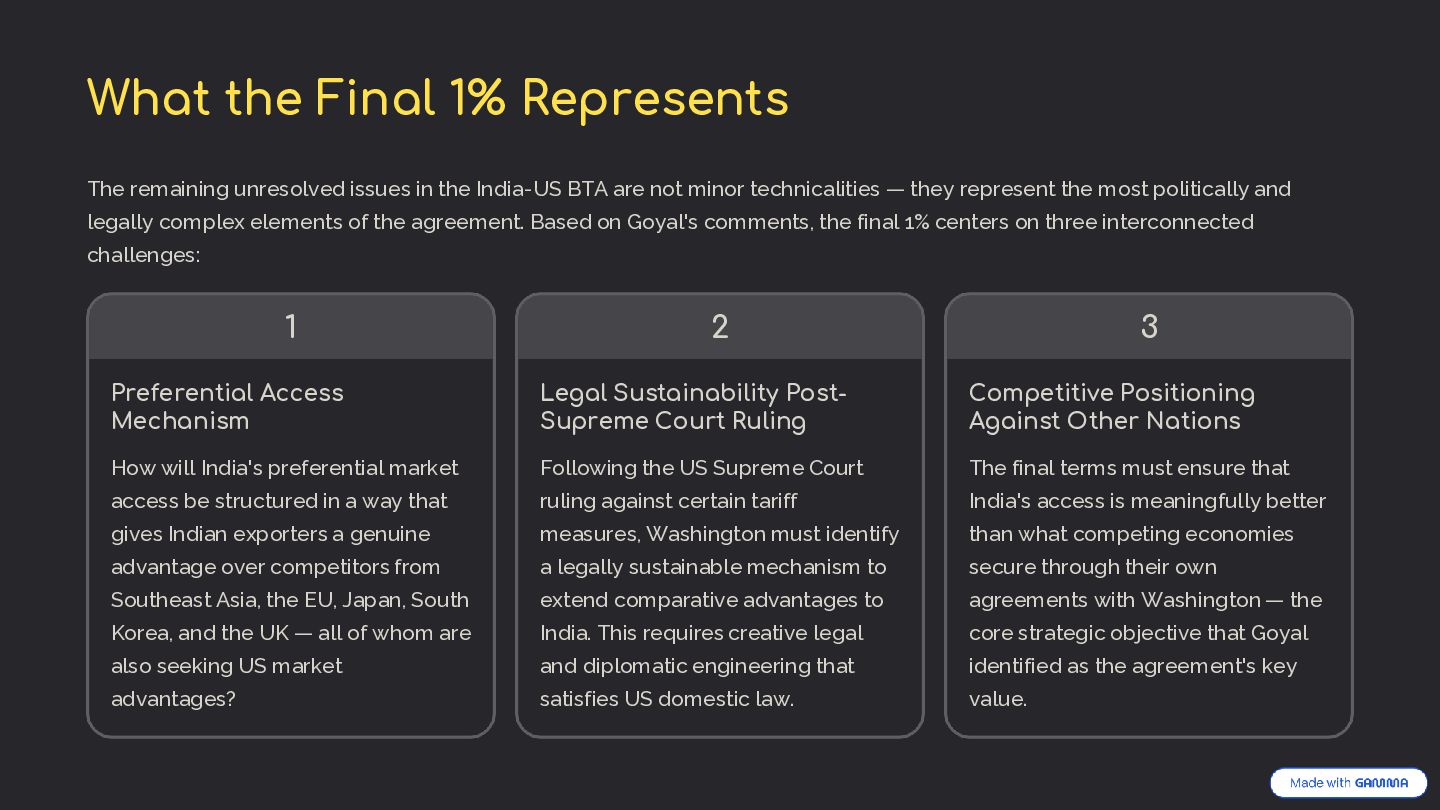
  9. What the Final 1% Represents The remaining unresolved issues in

    the India-US BTA are not minor technicalities — they represent the most politically and legally complex elements of the agreement. Based on Goyal's comments, the final 1% centers on three interconnected challenges: 1 Preferential Access Mechanism How will India's preferential market access be structured in a way that gives Indian exporters a genuine advantage over competitors from Southeast Asia, the EU, Japan, South Korea, and the UK — all of whom are also seeking US market advantages? 2 Legal Sustainability Post- Supreme Court Ruling Following the US Supreme Court ruling against certain tariff measures, Washington must identify a legally sustainable mechanism to extend comparative advantages to India. This requires creative legal and diplomatic engineering that satisfies US domestic law. 3 Competitive Positioning Against Other Nations The final terms must ensure that India's access is meaningfully better than what competing economies secure through their own agreements with Washington — the core strategic objective that Goyal identified as the agreement's key value.
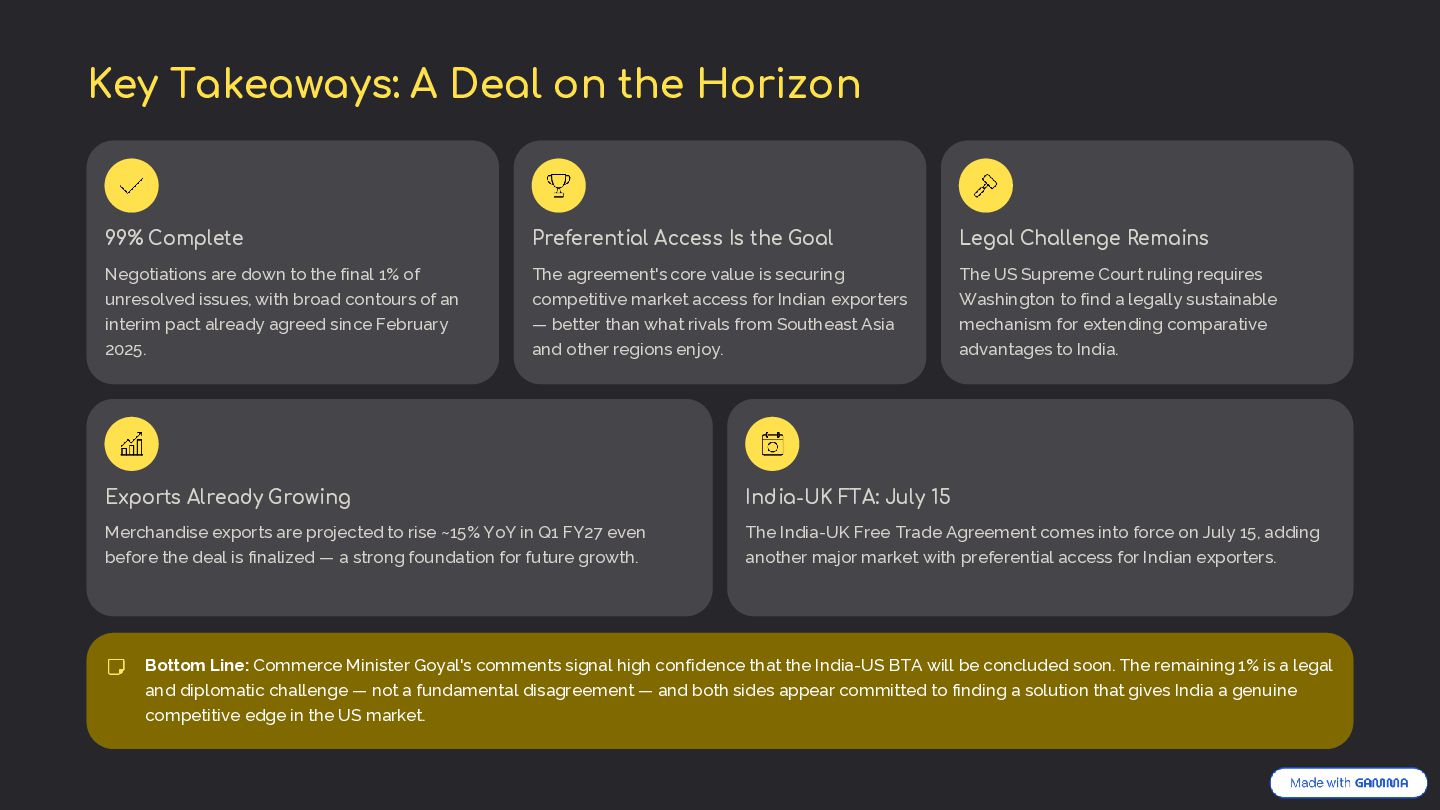
  10. Key Takeaways: A Deal on the Horizon 99% Complete Negotiations

    are down to the final 1% of unresolved issues, with broad contours of an interim pact already agreed since February 2025. Preferential Access Is the Goal The agreement's core value is securing competitive market access for Indian exporters — better than what rivals from Southeast Asia and other regions enjoy. Legal Challenge Remains The US Supreme Court ruling requires Washington to find a legally sustainable mechanism for extending comparative advantages to India. Exports Already Growing Merchandise exports are projected to rise ~15% YoY in Q1 FY27 even before the deal is finalized — a strong foundation for future growth. India-UK FTA: July 15 The India-UK Free Trade Agreement comes into force on July 15, adding another major market with preferential access for Indian exporters. Bottom Line: Commerce Minister Goyal's comments signal high confidence that the India-US BTA will be concluded soon. The remaining 1% is a legal and diplomatic challenge — not a fundamental disagreement — and both sides appear committed to finding a solution that gives India a genuine competitive edge in the US market.