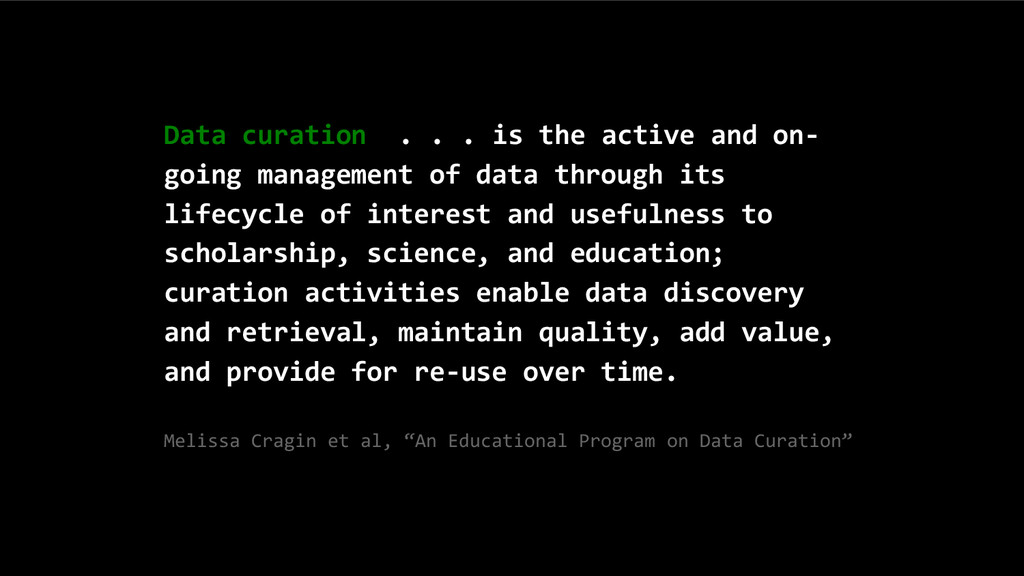
going management of data through its lifecycle of interest and usefulness to scholarship, science, and education; curation activities enable data discovery and retrieval, maintain quality, add value, and provide for re-use over time. Melissa Cragin et al, “An Educational Program on Data Curation”
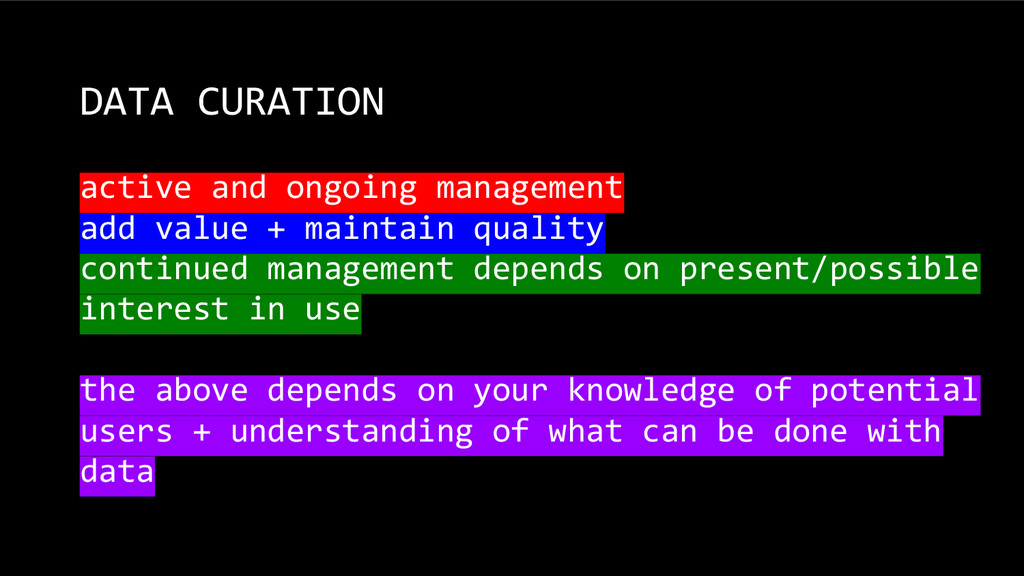
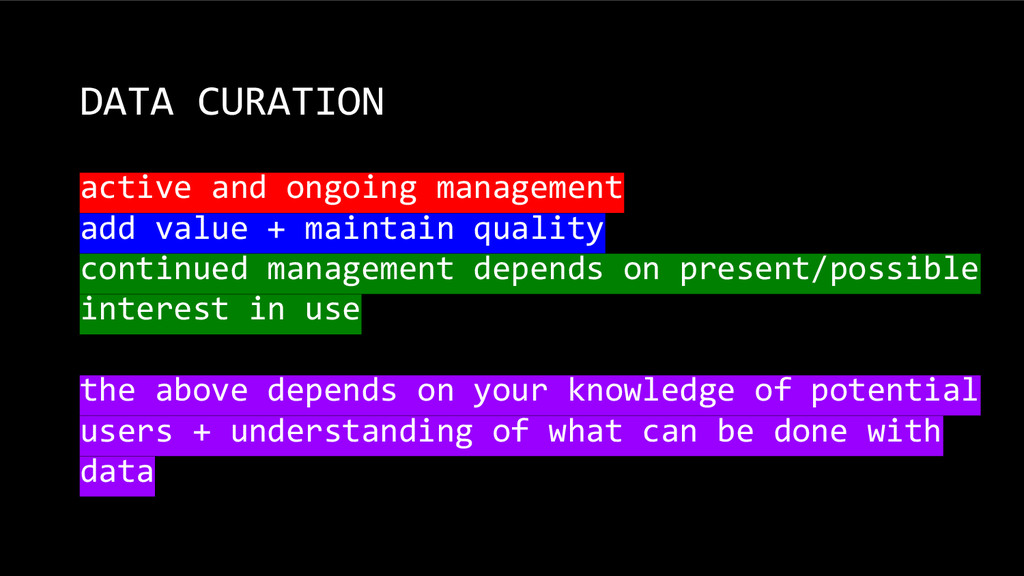
quality continued management depends on present/possible interest in use the above depends on your knowledge of potential users + understanding of what can be done with data
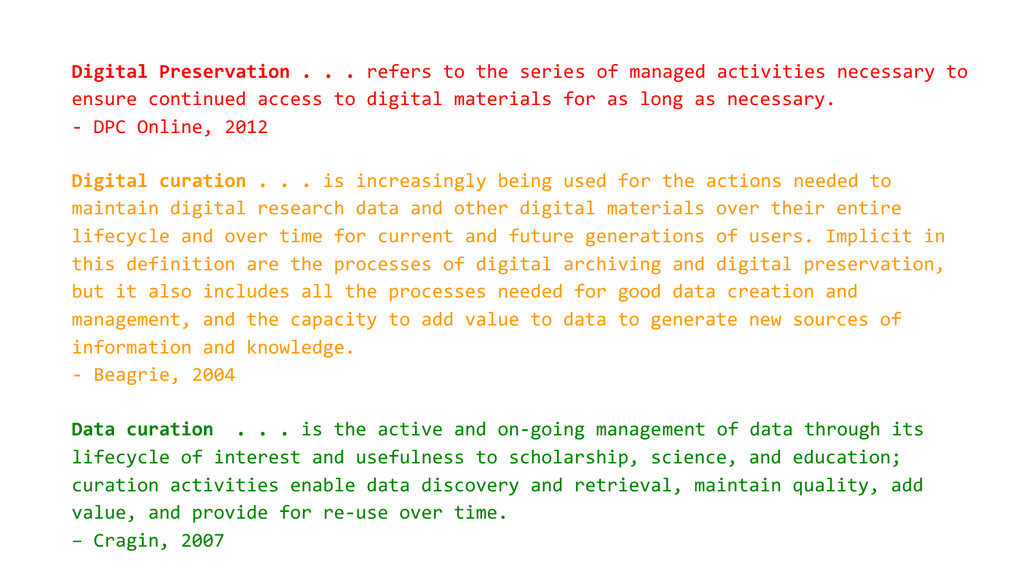
managed activities necessary to ensure continued access to digital materials for as long as necessary. - DPC Online, 2012 Digital curation . . . is increasingly being used for the actions needed to maintain digital research data and other digital materials over their entire lifecycle and over time for current and future generations of users. Implicit in this definition are the processes of digital archiving and digital preservation, but it also includes all the processes needed for good data creation and management, and the capacity to add value to data to generate new sources of information and knowledge. - Beagrie, 2004 Data curation . . . is the active and on-going management of data through its lifecycle of interest and usefulness to scholarship, science, and education; curation activities enable data discovery and retrieval, maintain quality, add value, and provide for re-use over time. – Cragin, 2007
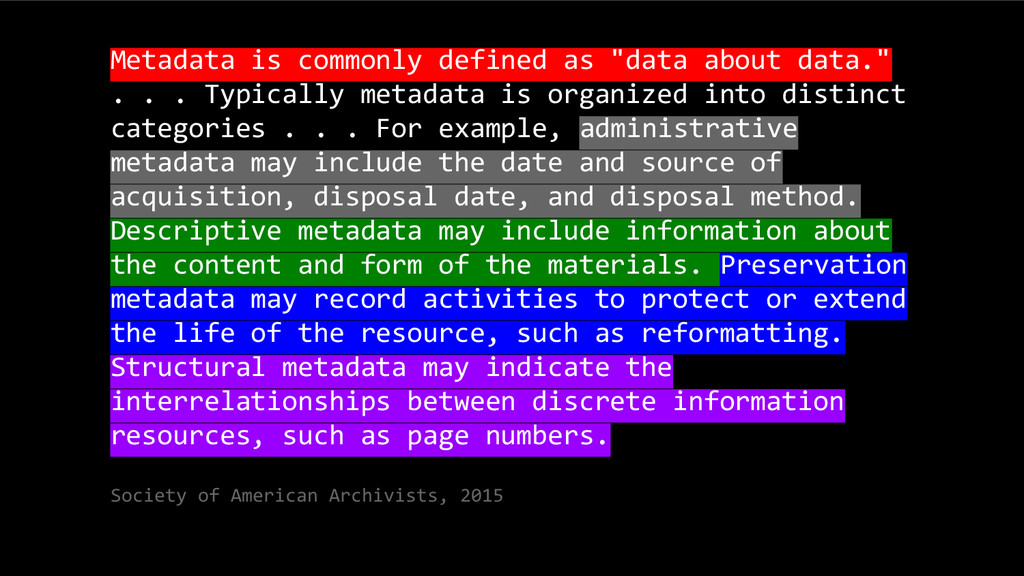
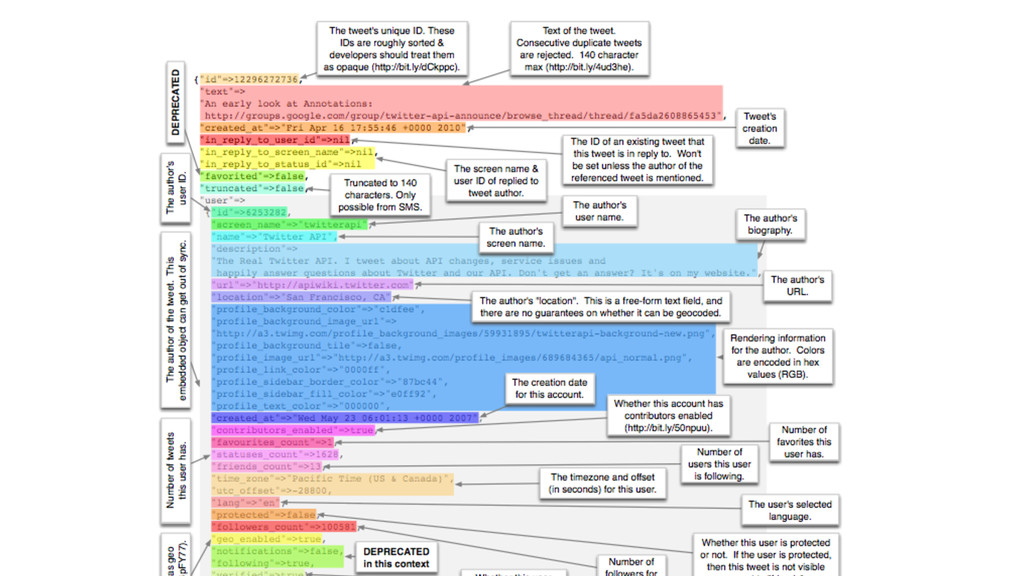
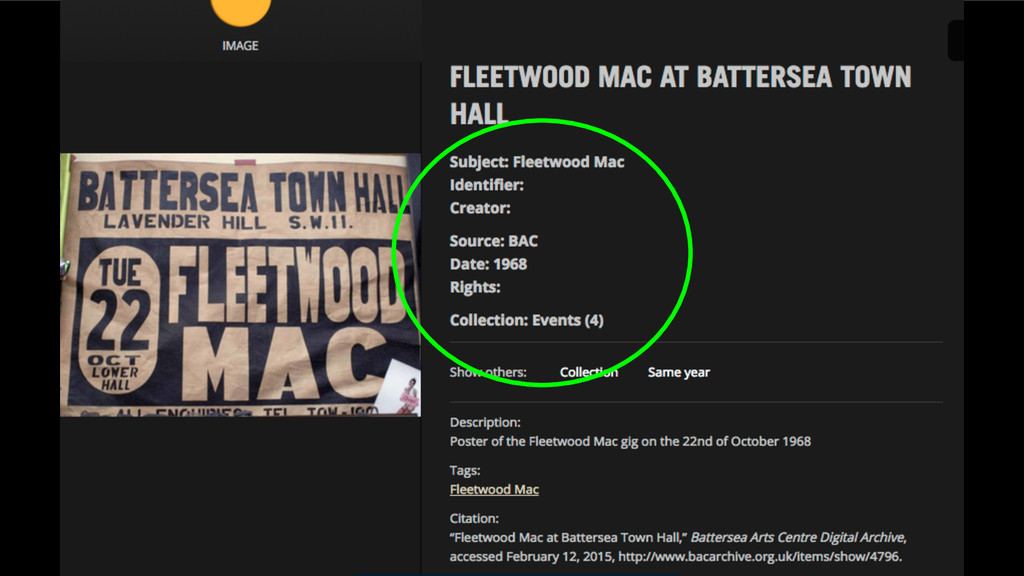
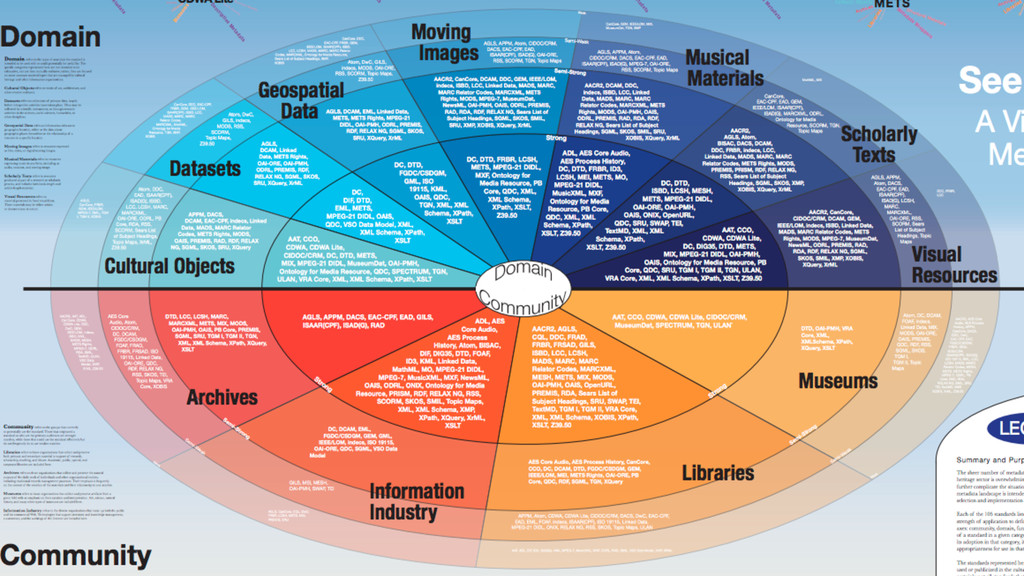
. Typically metadata is organized into distinct categories . . . For example, administrative metadata may include the date and source of acquisition, disposal date, and disposal method. Descriptive metadata may include information about the content and form of the materials. Preservation metadata may record activities to protect or extend the life of the resource, such as reformatting. Structural metadata may indicate the interrelationships between discrete information resources, such as page numbers. Society of American Archivists, 2015
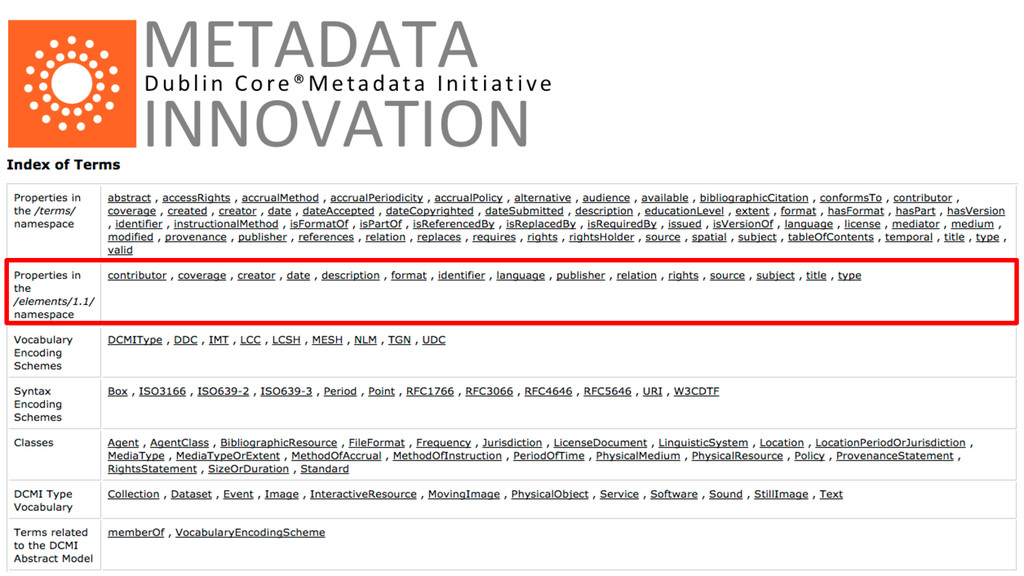
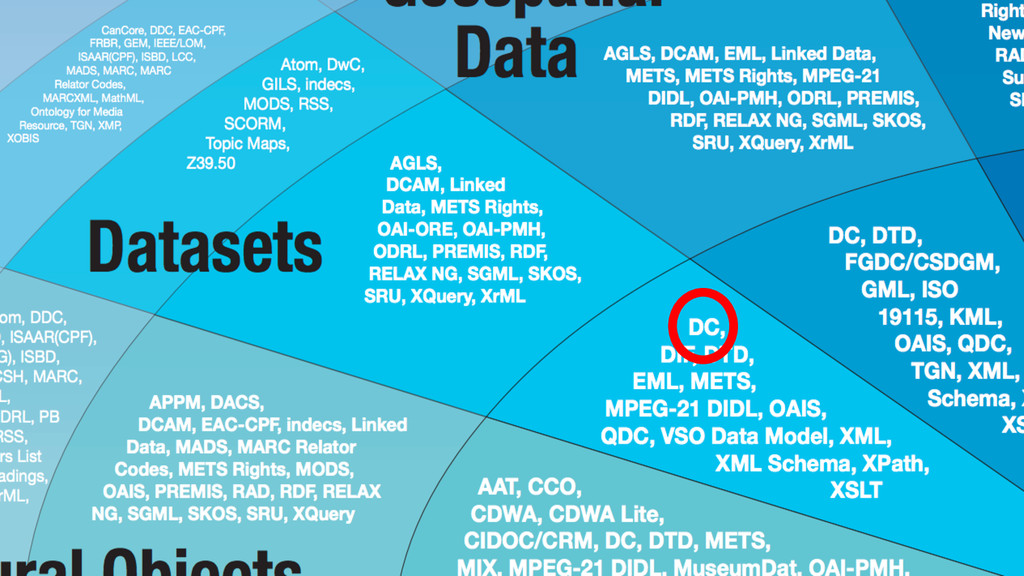
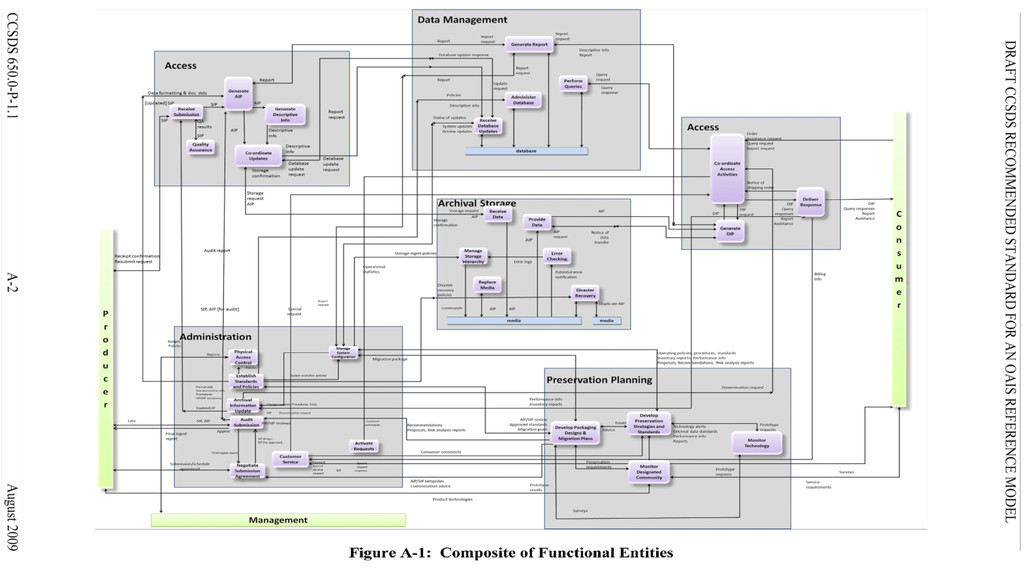
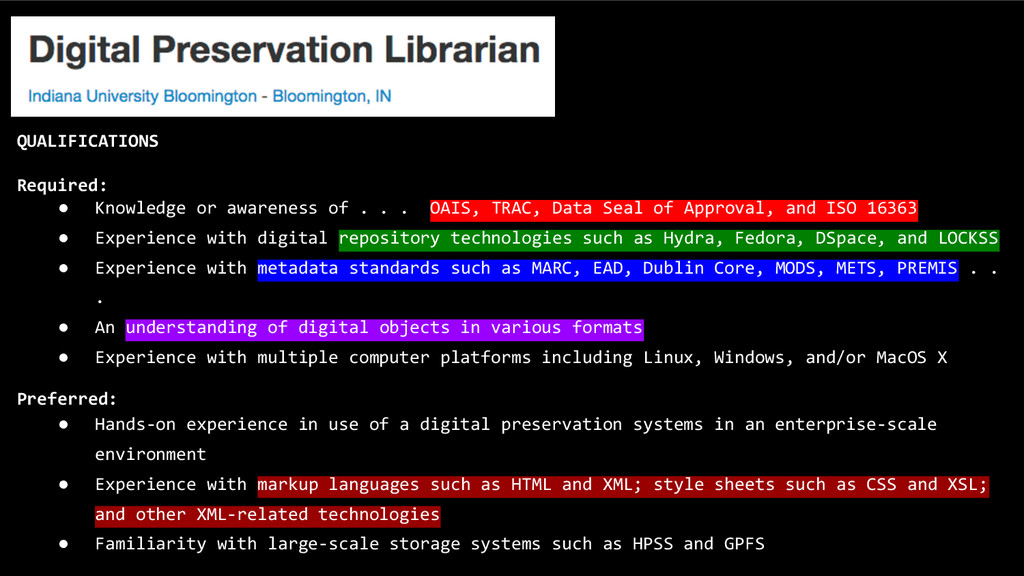
OAIS, TRAC, Data Seal of Approval, and ISO 16363 • Experience with digital repository technologies such as Hydra, Fedora, DSpace, and LOCKSS • Experience with metadata standards such as MARC, EAD, Dublin Core, MODS, METS, PREMIS . . . • An understanding of digital objects in various formats • Experience with multiple computer platforms including Linux, Windows, and/or MacOS X Preferred: • Hands-on experience in use of a digital preservation systems in an enterprise-scale environment • Experience with markup languages such as HTML and XML; style sheets such as CSS and XSL; and other XML-related technologies • Familiarity with large-scale storage systems such as HPSS and GPFS
the actions needed to maintain digital research data and other digital materials over their entire lifecycle and over time for current and future generations of users. Implicit in this definition are the processes of digital archiving and digital preservation, but it also includes all the processes needed for good data creation and management, and the capacity to add value to data to generate new sources of information and knowledge. Neil Beagrie, 2004
going management of data through its lifecycle of interest and usefulness to scholarship, science, and education; curation activities enable data discovery and retrieval, maintain quality, add value, and provide for re-use over time. Melissa Cragin et al, “An Educational Program on Data Curation”
quality continued management depends on present/possible interest in use the above depends on your knowledge of potential users + understanding of what can be done with data
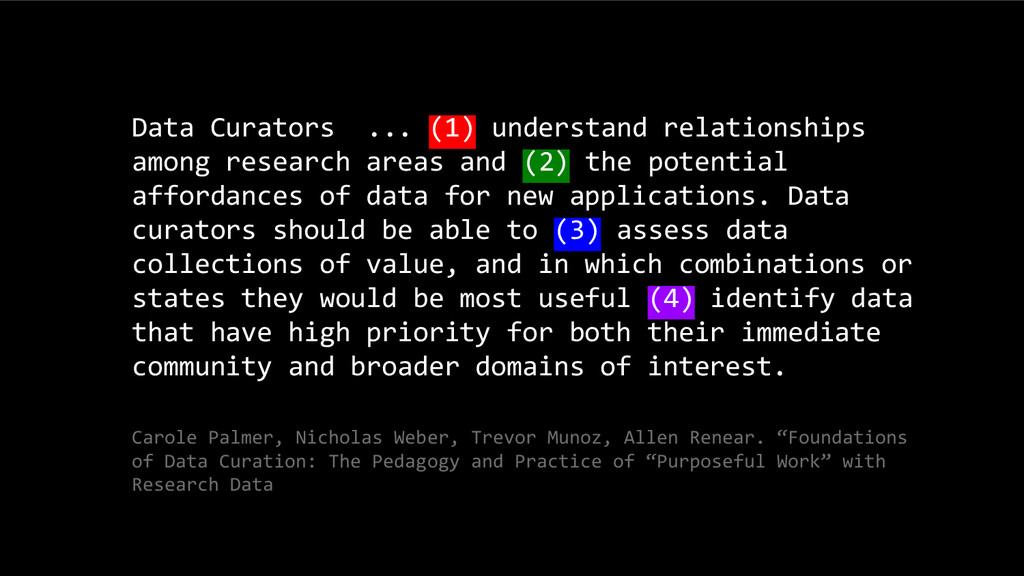
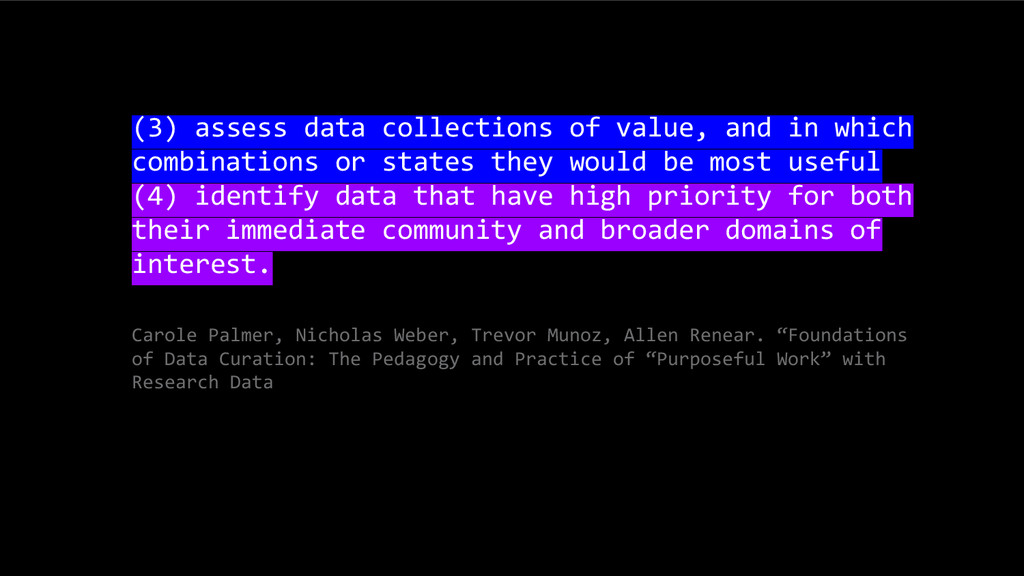
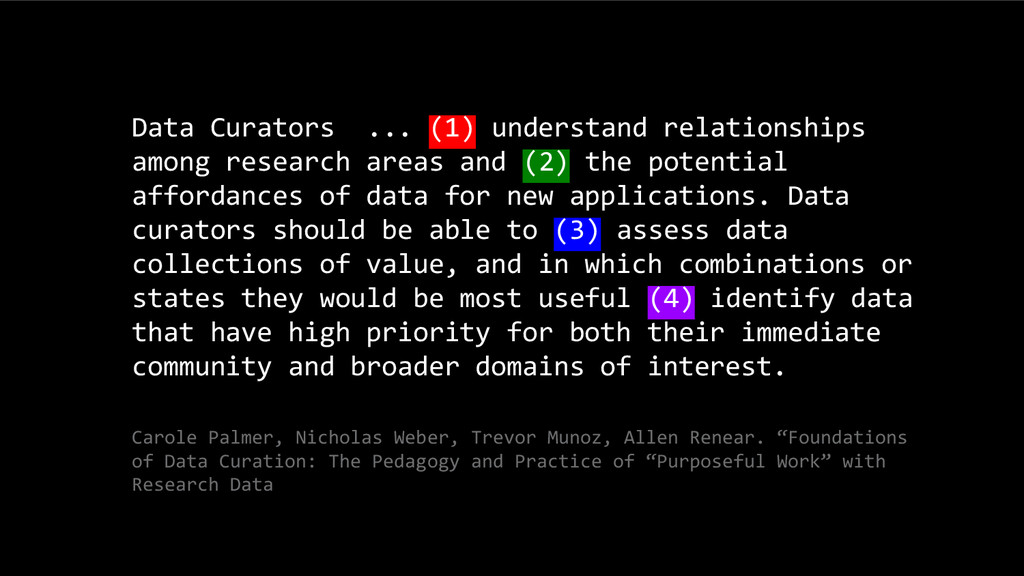
(2) the potential affordances of data for new applications. Data curators should be able to (3) assess data collections of value, and in which combinations or states they would be most useful (4) identify data that have high priority for both their immediate community and broader domains of interest. Carole Palmer, Nicholas Weber, Trevor Munoz, Allen Renear. “Foundations of Data Curation: The Pedagogy and Practice of “Purposeful Work” with Research Data
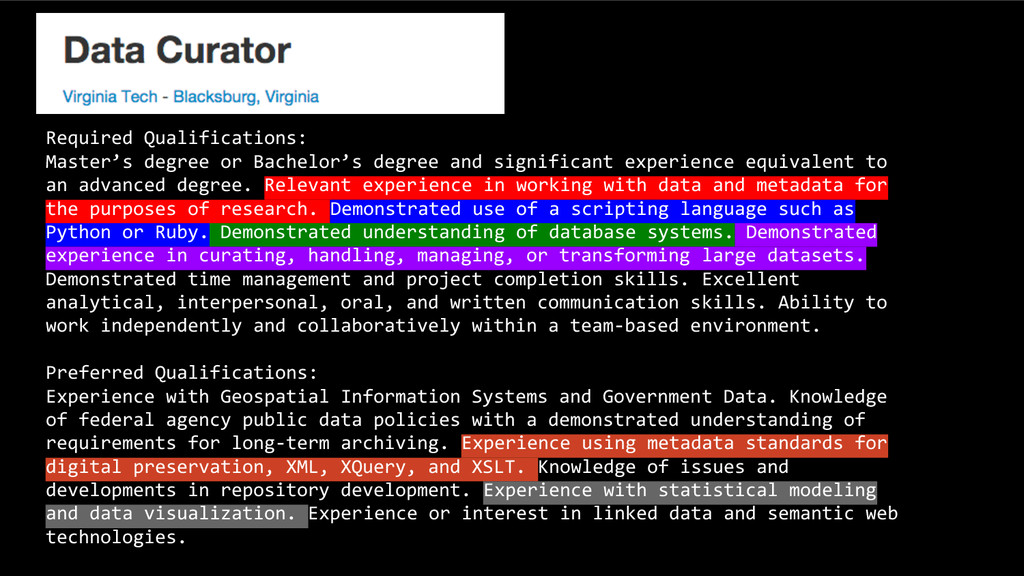
equivalent to an advanced degree. Relevant experience in working with data and metadata for the purposes of research. Demonstrated use of a scripting language such as Python or Ruby. Demonstrated understanding of database systems. Demonstrated experience in curating, handling, managing, or transforming large datasets. Demonstrated time management and project completion skills. Excellent analytical, interpersonal, oral, and written communication skills. Ability to work independently and collaboratively within a team-based environment. Preferred Qualifications: Experience with Geospatial Information Systems and Government Data. Knowledge of federal agency public data policies with a demonstrated understanding of requirements for long-term archiving. Experience using metadata standards for digital preservation, XML, XQuery, and XSLT. Knowledge of issues and developments in repository development. Experience with statistical modeling and data visualization. Experience or interest in linked data and semantic web technologies.
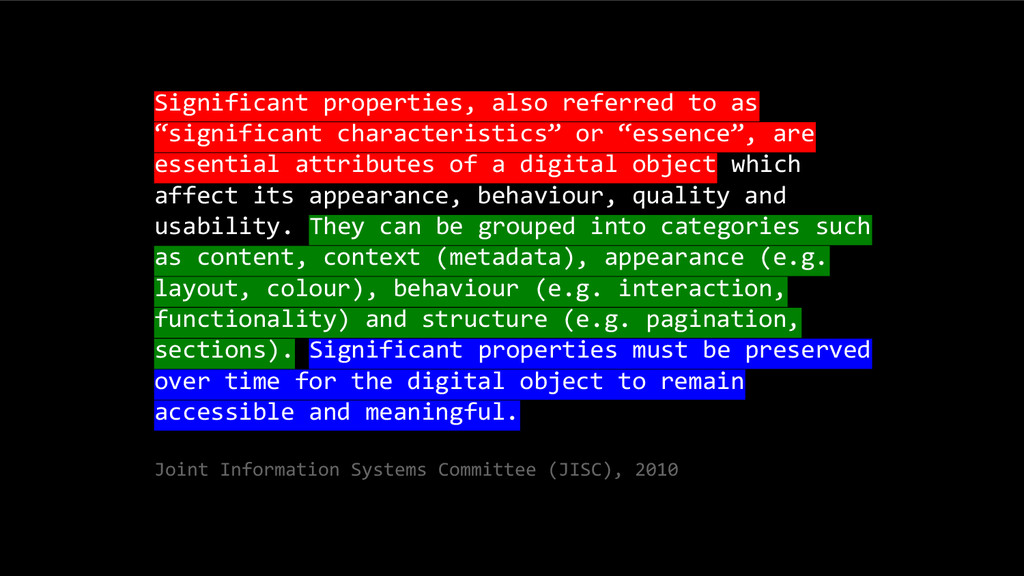
are essential attributes of a digital object which affect its appearance, behaviour, quality and usability. They can be grouped into categories such as content, context (metadata), appearance (e.g. layout, colour), behaviour (e.g. interaction, functionality) and structure (e.g. pagination, sections). Significant properties must be preserved over time for the digital object to remain accessible and meaningful. Joint Information Systems Committee (JISC), 2010
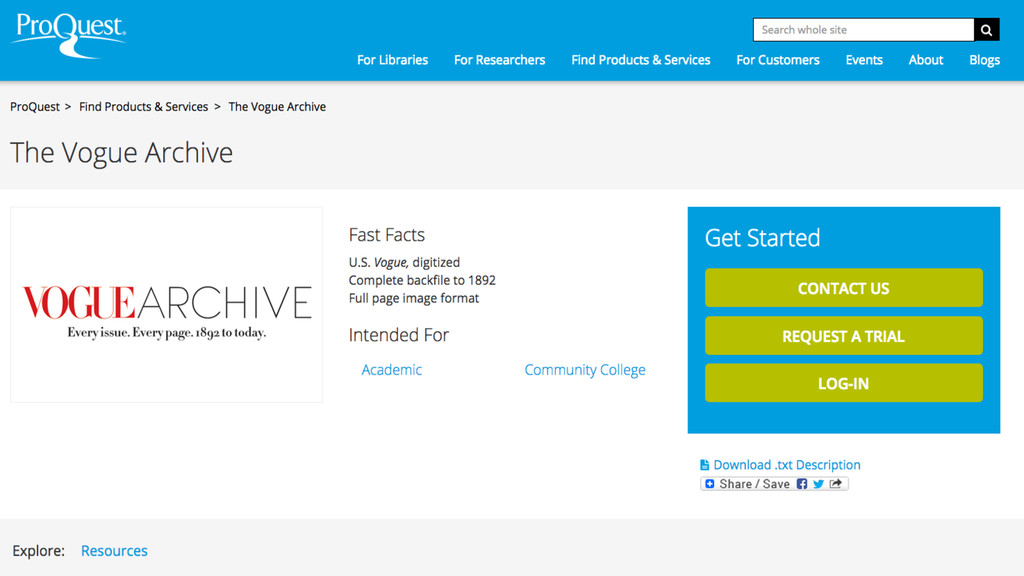
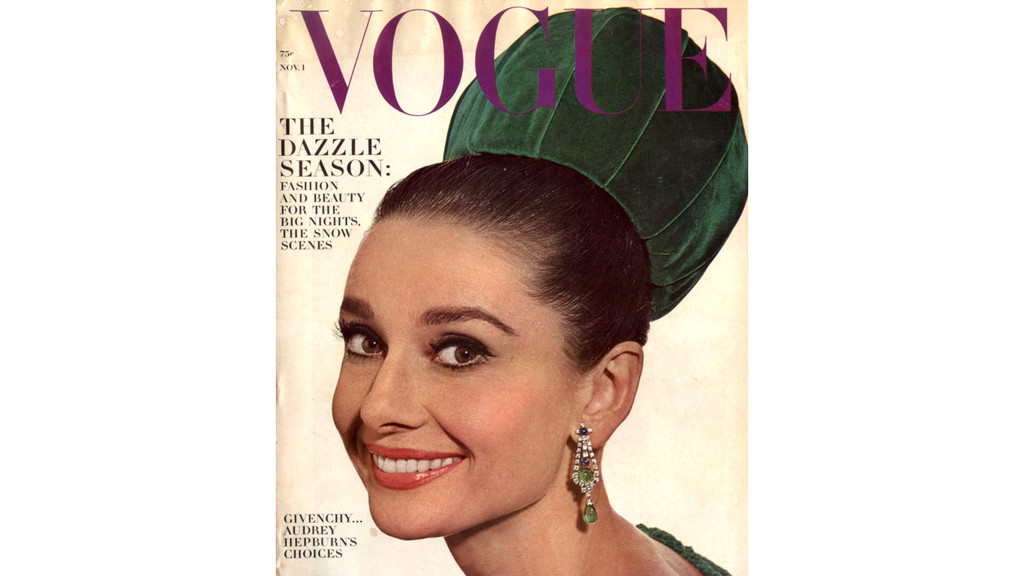
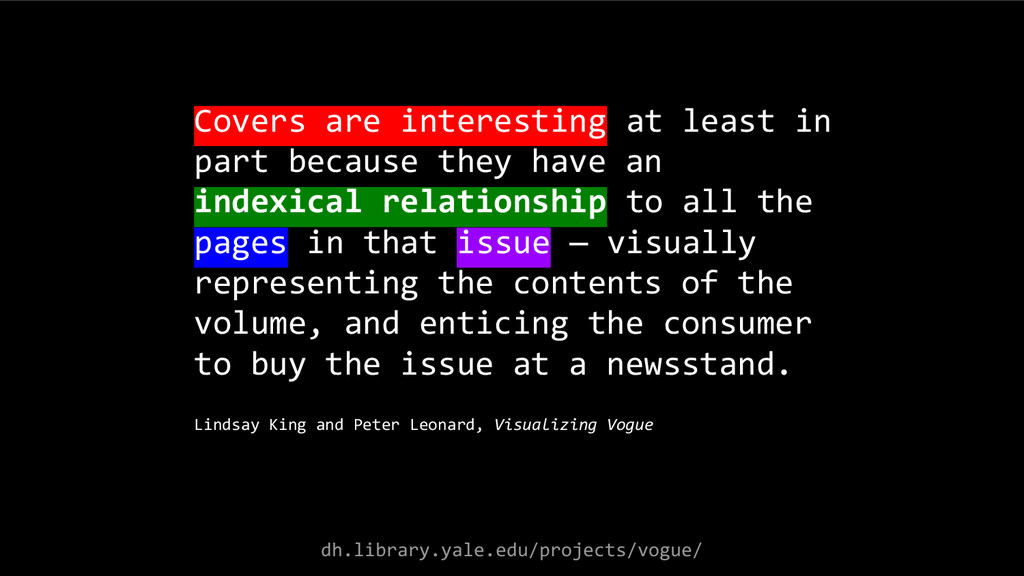
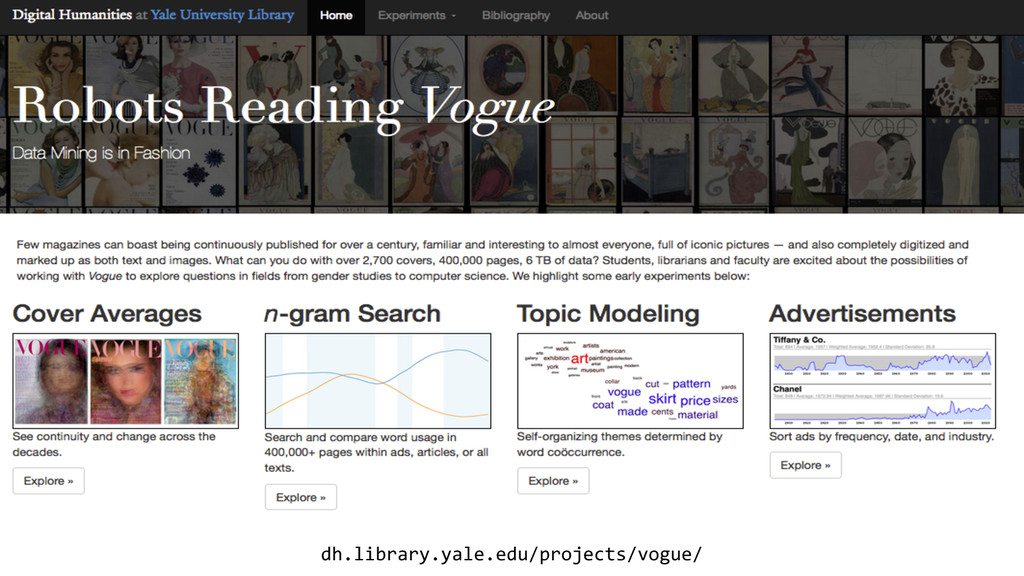
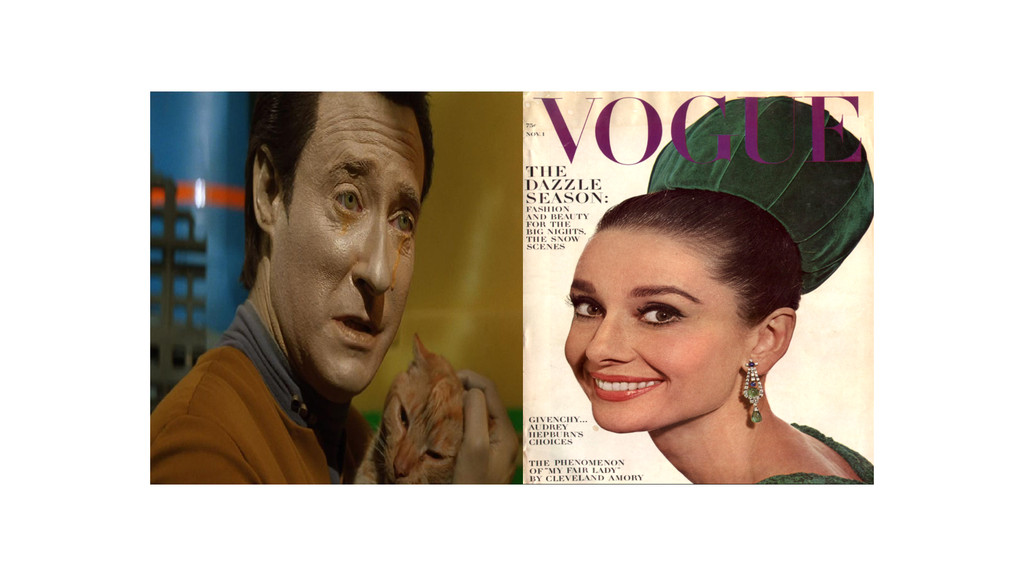
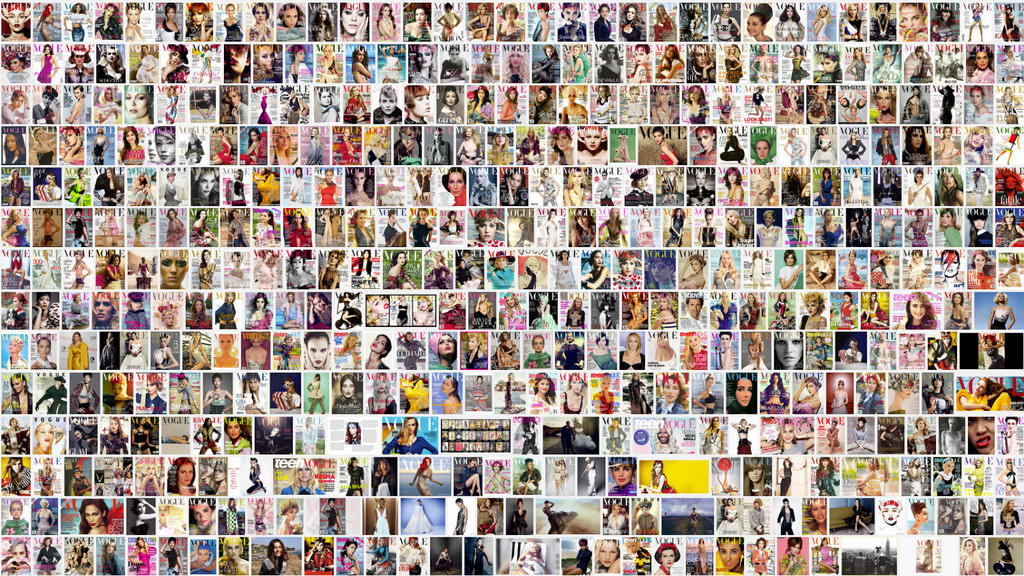
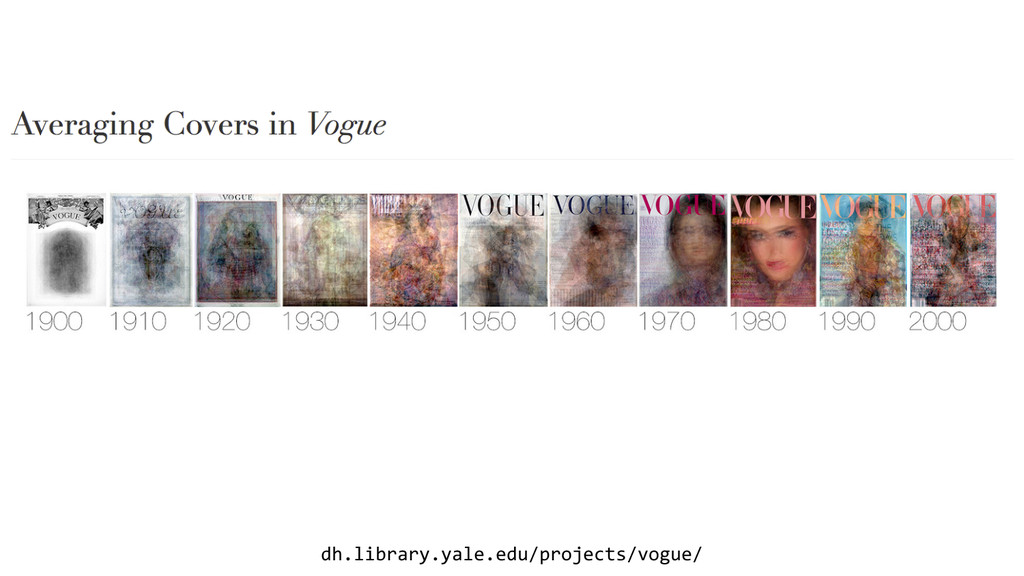
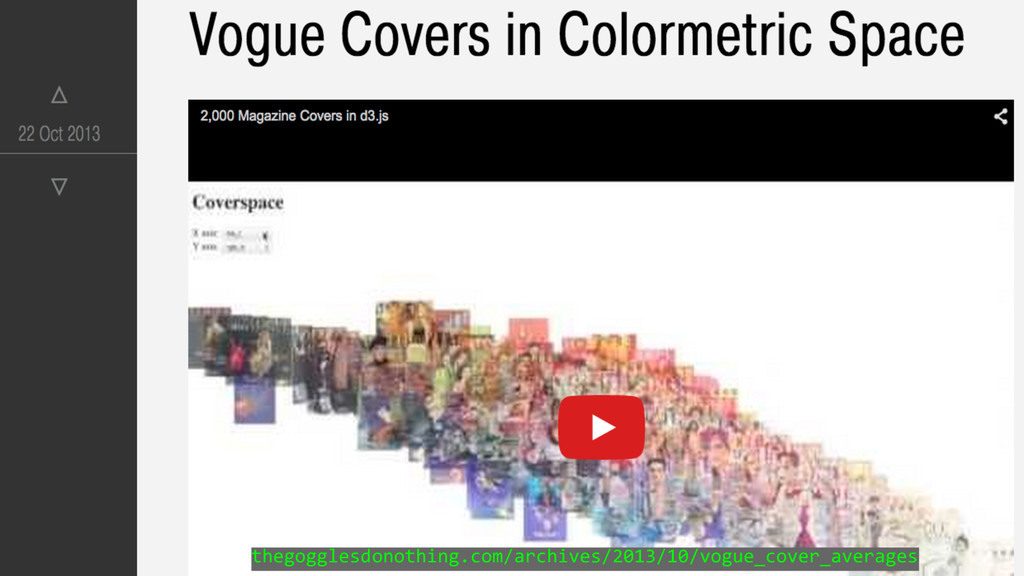
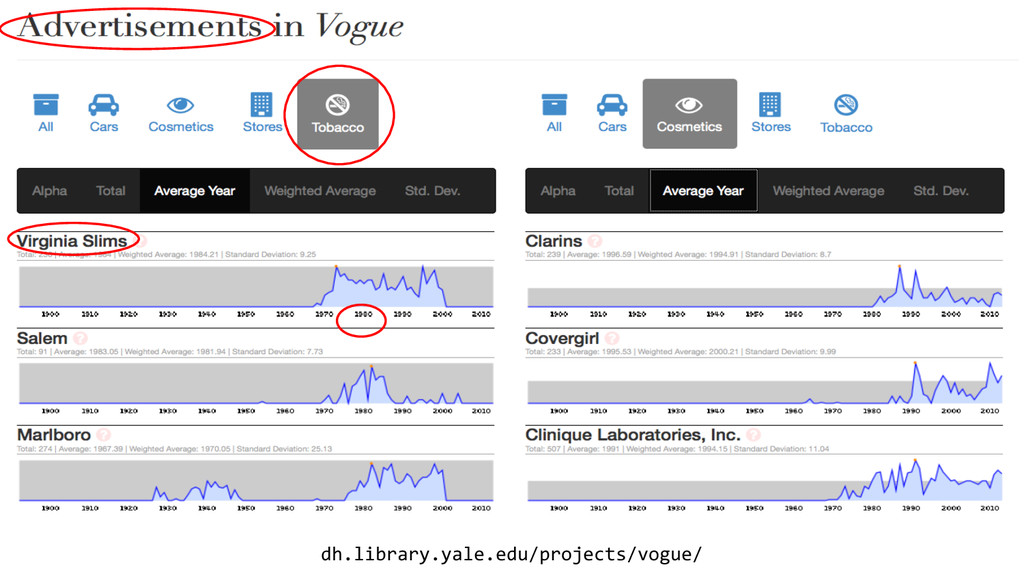
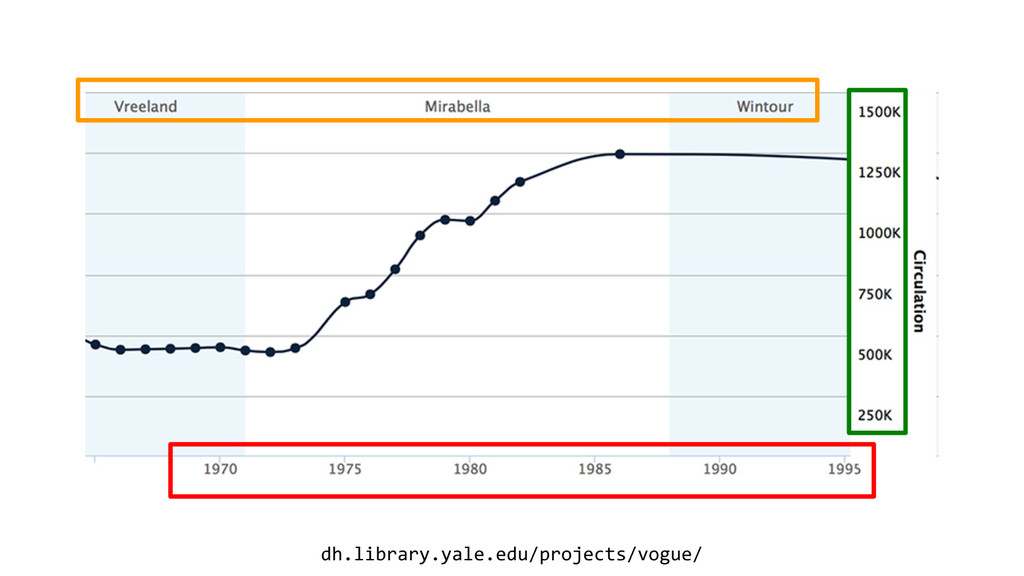
an indexical relationship to all the pages in that issue — visually representing the contents of the volume, and enticing the consumer to buy the issue at a newsstand. Lindsay King and Peter Leonard, Visualizing Vogue dh.library.yale.edu/projects/vogue/
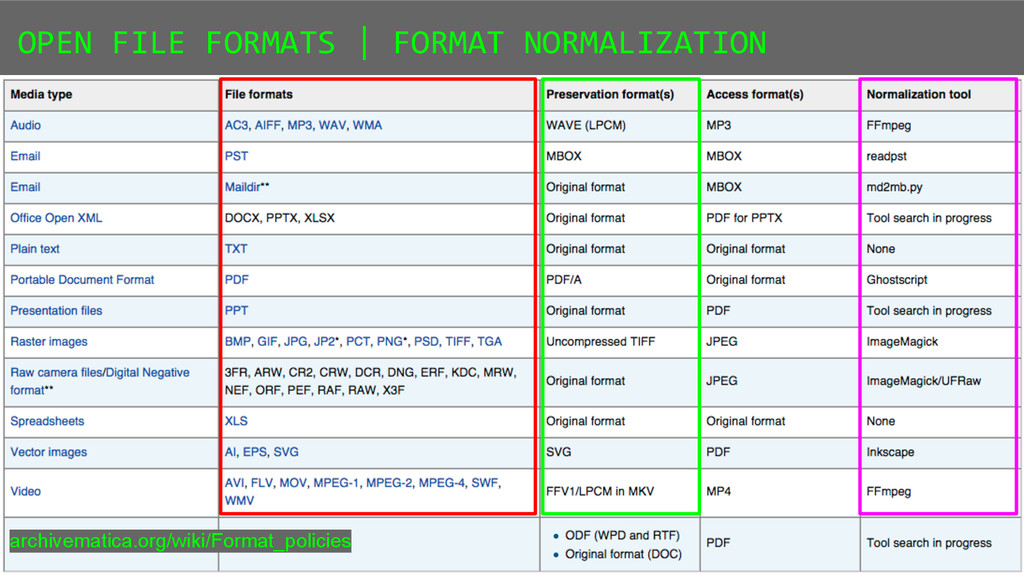
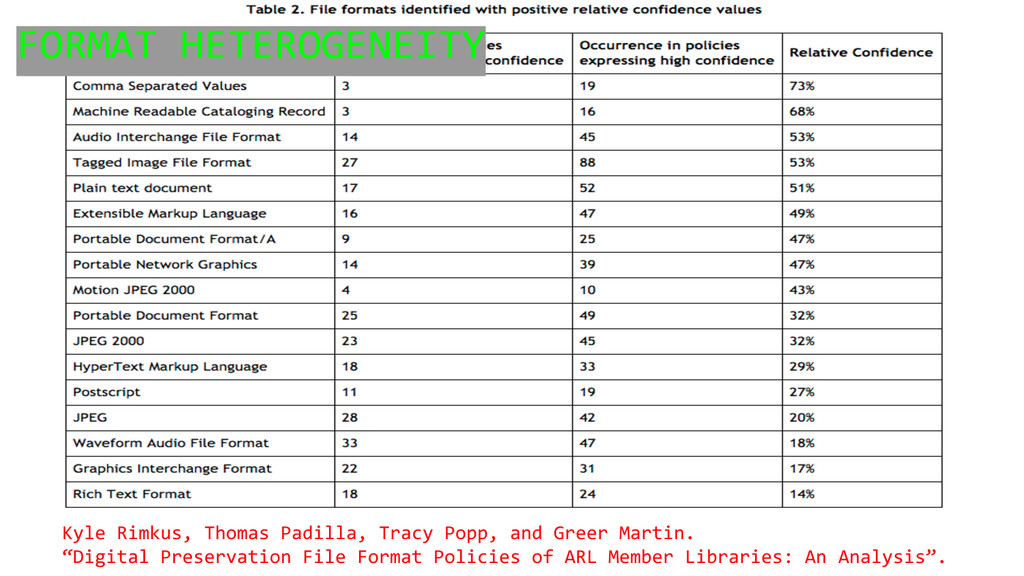
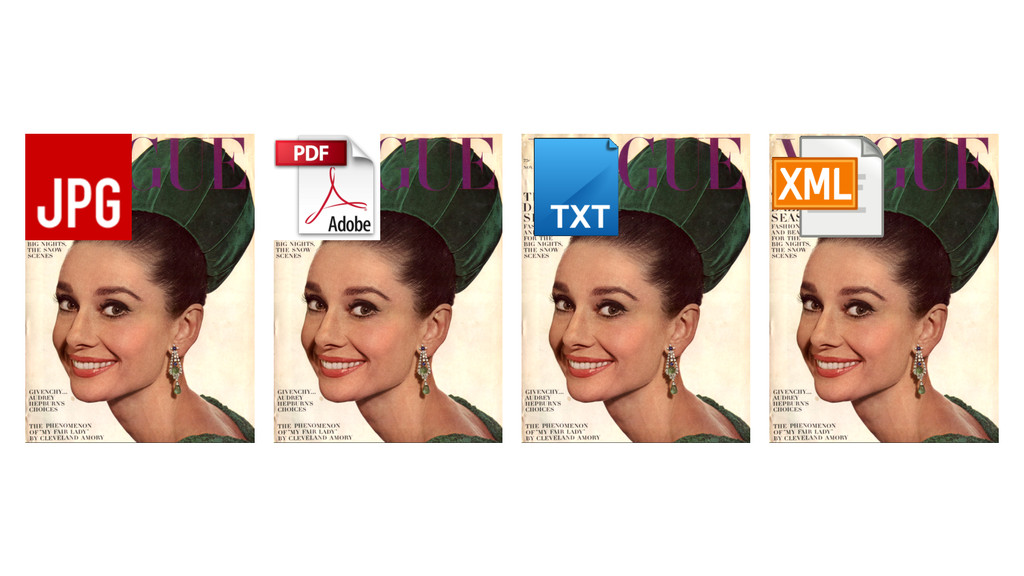
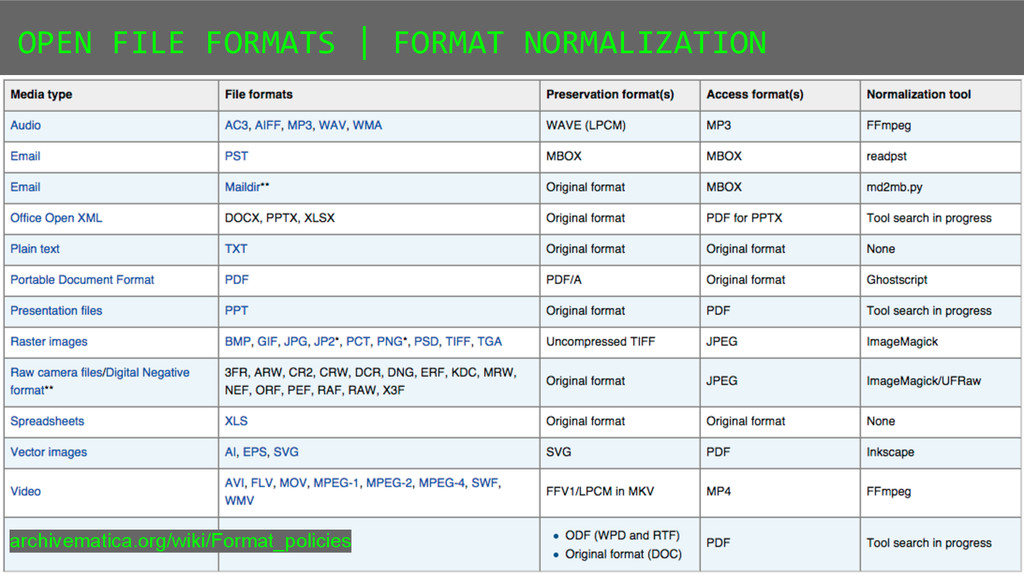
in a computer file, or a self-contained data-stream or package of related data-streams made available as a discrete entity to a computer's operating system and its programs . . . Essentially, anything that appears to a modern operating system's file browser as a packet of information represented by a character string, a dot, and an extension is considered a representative example of a file format. Kyle Rimkus, Thomas Padilla, Tracy Popp, and Greer Martin. “Digital Preservation File Format Policies of ARL Member Libraries: An Analysis”.
(2) the potential affordances of data for new applications. Data curators should be able to (3) assess data collections of value, and in which combinations or states they would be most useful (4) identify data that have high priority for both their immediate community and broader domains of interest. Carole Palmer, Nicholas Weber, Trevor Munoz, Allen Renear. “Foundations of Data Curation: The Pedagogy and Practice of “Purposeful Work” with Research Data
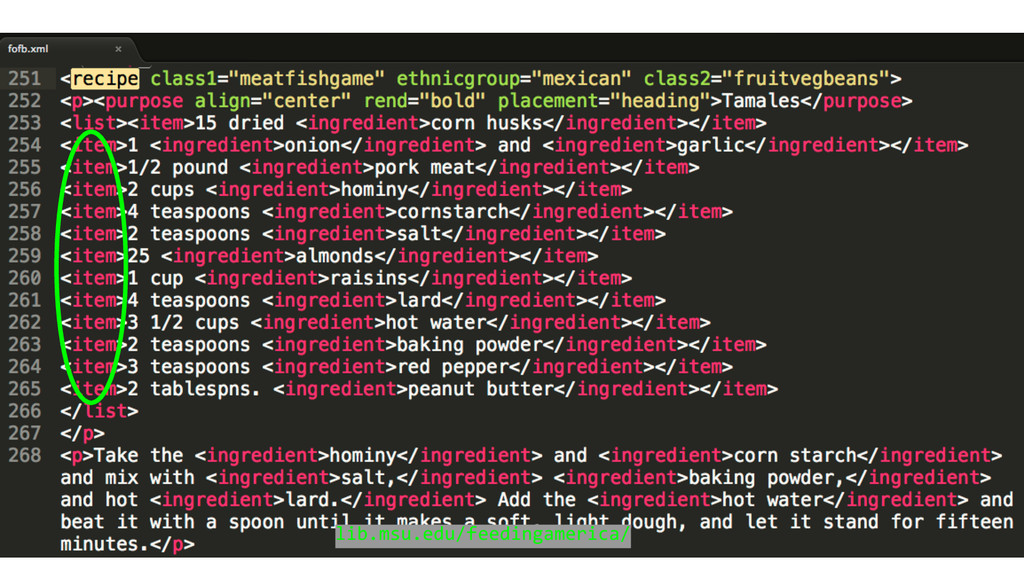
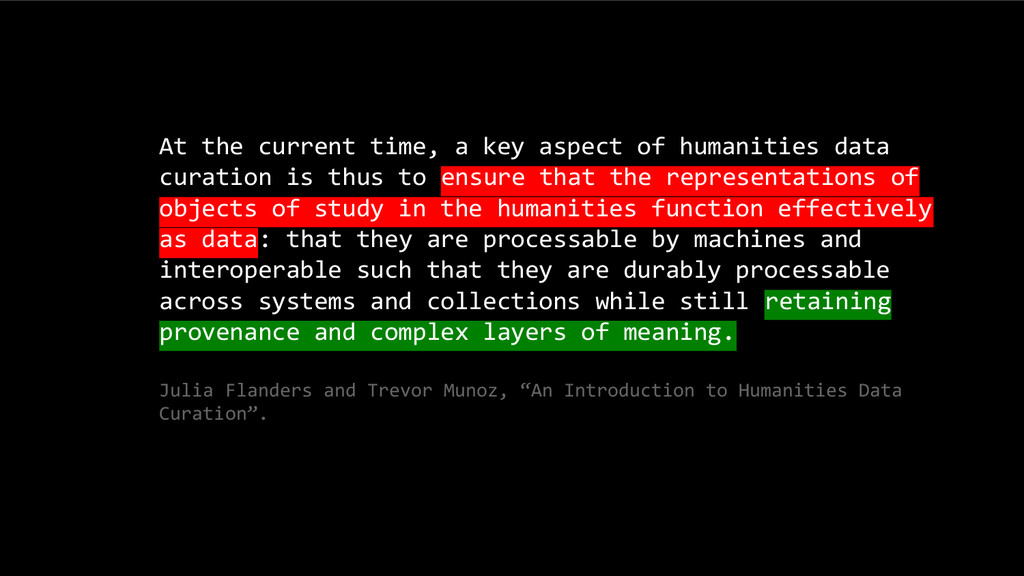
curation is thus to ensure that the representations of objects of study in the humanities function effectively as data: that they are processable by machines and interoperable such that they are durably processable across systems and collections while still retaining provenance and complex layers of meaning. Julia Flanders and Trevor Munoz, “An Introduction to Humanities Data Curation”.
or states they would be most useful (4) identify data that have high priority for both their immediate community and broader domains of interest. Carole Palmer, Nicholas Weber, Trevor Munoz, Allen Renear. “Foundations of Data Curation: The Pedagogy and Practice of “Purposeful Work” with Research Data
(2) the potential affordances of data for new applications. Data curators should be able to (3) assess data collections of value, and in which combinations or states they would be most useful (4) identify data that have high priority for both their immediate community and broader domains of interest. Carole Palmer, Nicholas Weber, Trevor Munoz, Allen Renear. “Foundations of Data Curation: The Pedagogy and Practice of “Purposeful Work” with Research Data
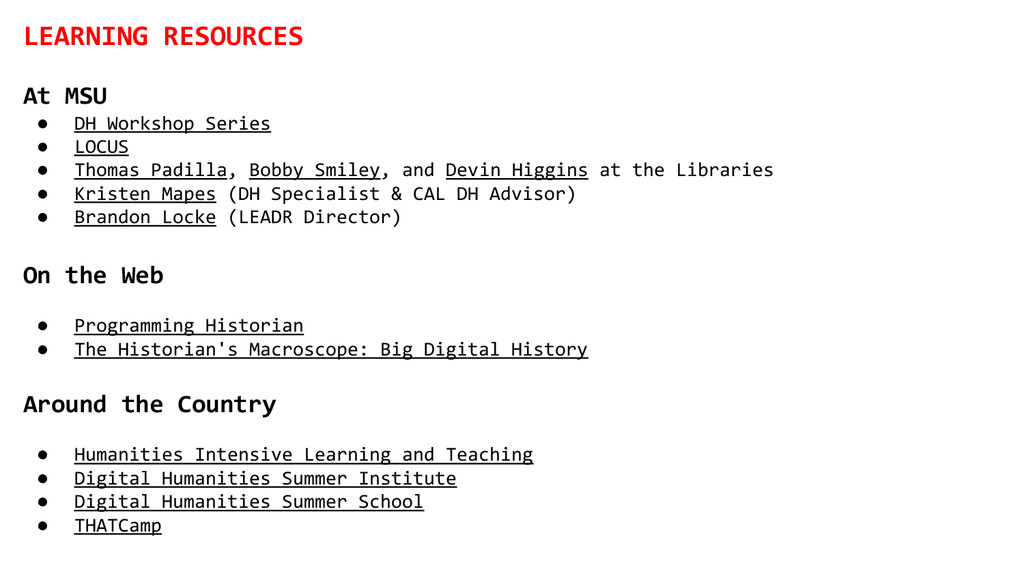
• Thomas Padilla, Bobby Smiley, and Devin Higgins at the Libraries • Kristen Mapes (DH Specialist & CAL DH Advisor) • Brandon Locke (LEADR Director) On the Web • Programming Historian • The Historian's Macroscope: Big Digital History Around the Country • Humanities Intensive Learning and Teaching • Digital Humanities Summer Institute • Digital Humanities Summer School • THATCamp


 thomasgpadilla
 yasslab
 bunnchinn3
 hiola
 frievea
 moriyuya
 bvr7352
 akiraasano
 pawan_pharm
 juanmartin2026
 mraible
 baasie
 honnibal
 jonoalderson
 addyosmani
 keavy
 mlcsv
 codingconduct
 trallard
 tammielis
 katiecoart
 mayatellez