Upgrade to Pro — share decks privately, control downloads, hide ads and more …

The seven pitfalls of AI (revised version)

Sponsored · Your Podcast. Everywhere. Effortlessly. Share. Educate. Inspire. Entertain. You do you. We'll handle the rest. →

The seven pitfalls of AI (revised version)

This slide deck discusses some of the open questions that usually do not get the required attention during the current ongoing AI transitions. It is a revised version of a former slide deck with the same title. As the AI domain is still rapidly evolving, some of the questions of the former slide deck became less relevant (or meanwhile receive the required attention) while the importance of other questions increased.

The pitfalls discussed are:
* the general problem of making informed decisions regarding AI due to a very distorted messaging based on the respective incentives of the players.
* confusing AI with humans on the one hand and with software on the other hand.
* the whole productivity discussion, split up into the usually unsolved productivity-responsibility dilemma on the one side and the problem of local optimizations and lack of effectiveness on the other side.
* the AI vampire, meaning that massive AI usage causes "brain fry" and addiction, and we still need to learn how to deal with it.
* the centralization-dependency-sovereignty problem, reinforced by taking the most convenient route all the time.
* the completely open question which novel ways of value creation and value capture AI will enable.

As so often, the voice track is missing, but I hope that the slides still give you a few ideas to ponder.

Avatar for Uwe Friedrichsen

Uwe Friedrichsen

October 01, 2026

More Decks by Uwe Friedrichsen

Other Decks in Technology

Transcript

  1. The seven pitfalls of AI (revised version) An overhauled glance

    at some usually neglected aspects Uwe Friedrichsen – codecentric AG – 2022-2026
  2. It is not about the technology. It is not about

    improving humanity. It is not about you.
  3. It is not about the technology. It is not about

    improving humanity. It is not about you.
  4. The valuation pitfall • Messages massively distorted • Goal is

    to push valuation • Backed by billions of marketing budget • Amplified by the free riders • Clarke's 3rd law acting as fire accelerant • Almost impossible to separate the wheat from the chaff
  5. Potential remedies • Be wary of the (social) media messages

    • Only believe what you see with your own eyes • Add AI critics to your timeline
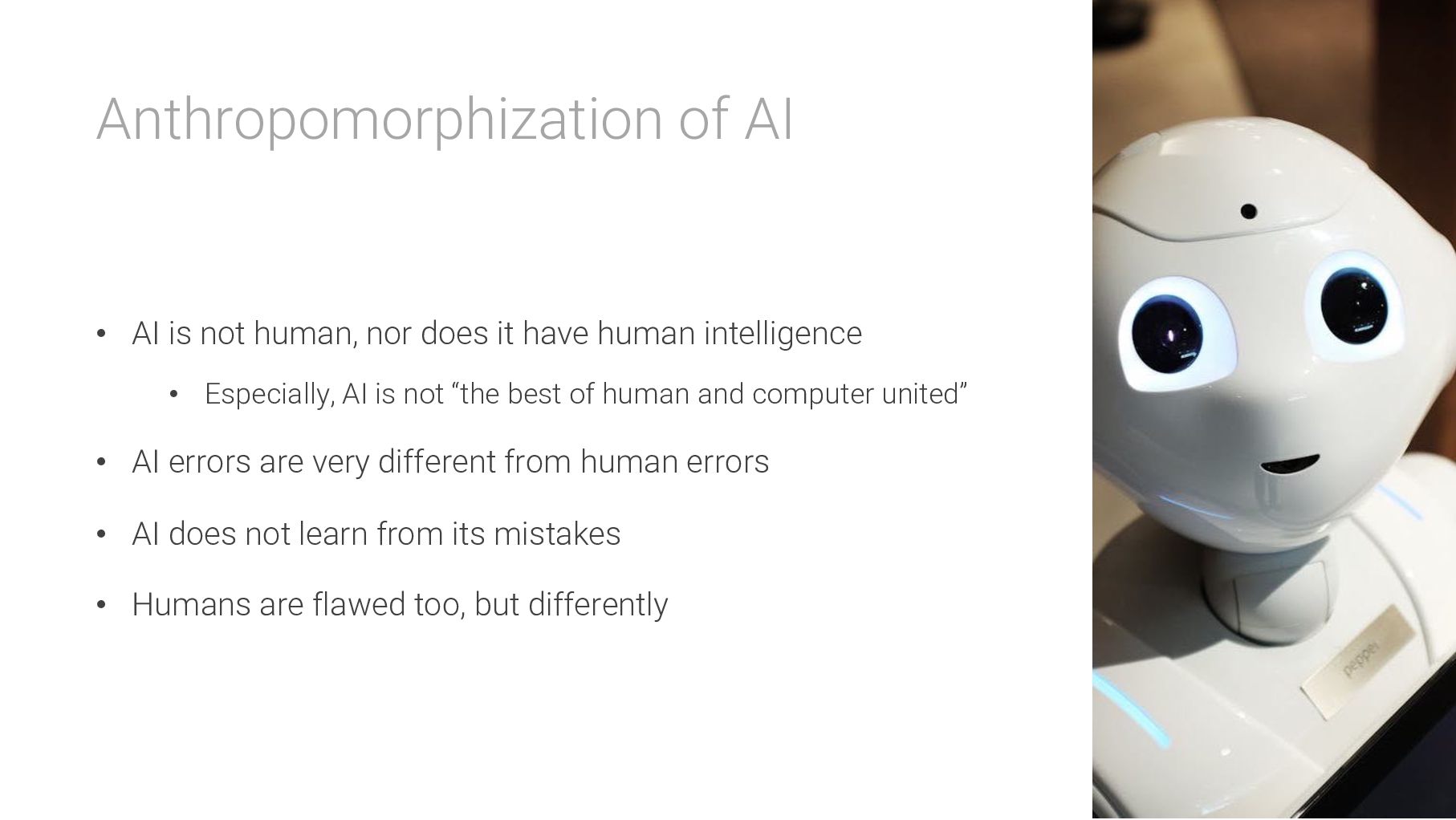
  6. Anthropomorphization of AI • AI is not human, nor does

    it have human intelligence • Especially, AI is not “the best of human and computer united” • AI errors are very different from human errors • AI does not learn from its mistakes • Humans are flawed too, but differently
  7. Potential remedies • Think of AI as a “thing”, not

    a person • Do not give it names or apply organizational roles • Manage your expectations (and your bias) • Be careful when it comes to result validation techniques
  8. AI versus software • Properties of software • Cumbersome interface,

    distant from human communication • Deterministic, reliable, predictable (even provable) • Stupid, cannot deal with ambiguity • Properties of AI • Close to human communication, easy interface • Non-deterministic, never fully reliable, never fully secure • Can deal with ambiguity (often surprisingly good)
  9. AI versus software (cont’d) • Properties of software and AI

    are very different • AI is not software, nor does it have software properties • Especially, AI is not “the best of human and computer united” • AI and software are different tools • Suitable for different types of jobs
  10. Potential remedies • Clearly distinguish between jobs and tools •

    Distinguish between software and AI as two different tools • First, explore the required properties of the job to be done • Including acceptable failure rates, dependability, etc. • Then decide about the right tool for the job • Accept AI as the “new kid on the block” • Not everything running on a computer needs to be software
  11. “Since our team adopted AI, expectations have tripled, stress has

    tripled, and actual productivity has only gone up by maybe 10%.” https://stepto.net/blog/ai-developer-burnout-machine-speed-2026
  12. “In our in-progress research, we discovered that AI tools didn’t

    reduce work, they consistently intensified it.” https://hbr.org/2026/02/ai-doesnt-reduce-work-it-intensifies-it
  13. “Ninety-six percent of C-suite executives expected AI to improve productivity.

    Seventy-seven percent of employees reported it actually increased their workload.” https://www.alexcloudstar.com/blog/ai-brain-fry-developer-burnout-2026/
  14. The productivity pitfall – Part I • Unrealistic efficiency gain

    expectations from management • Disconnect between management and people affected • Responsibility for success shifted to people affected
  15. Challenges for people affected • Incomplete abstraction • Significantly increases

    mental load of people affected • Review fatigue • Human inability to keep focus if problems occur only rarely • Deskilling by not doing the actual work anymore • The involuntary manager • Loss of control in combination with increased responsibility Lisanne Bainbridge, “Ironies of Automation”, Automatica, Vol. 19, No. 6, 1983
  16. Options • Augmentation • Human stays in the driver seat,

    AI augments • Solves the responsibility issue • Up to ~30% productivity gains (far below expectations) • “Dark factory” • AI takes over production (e.g., software dev) completely • Humans only design harnesses and loops • Solves productivity expectations, but not responsibility issue
  17. Potential remedies • Clear decision needed: either speed or responsibility

    • If productivity gains are preferred • Responsibility distribution must be defined anew • Leads to novel roles, organizations, processes, and guardrails • If responsibility model shall be maintained • Management must accept moderate productivity gains • Everything “in the middle” is not sustainable (burnout)
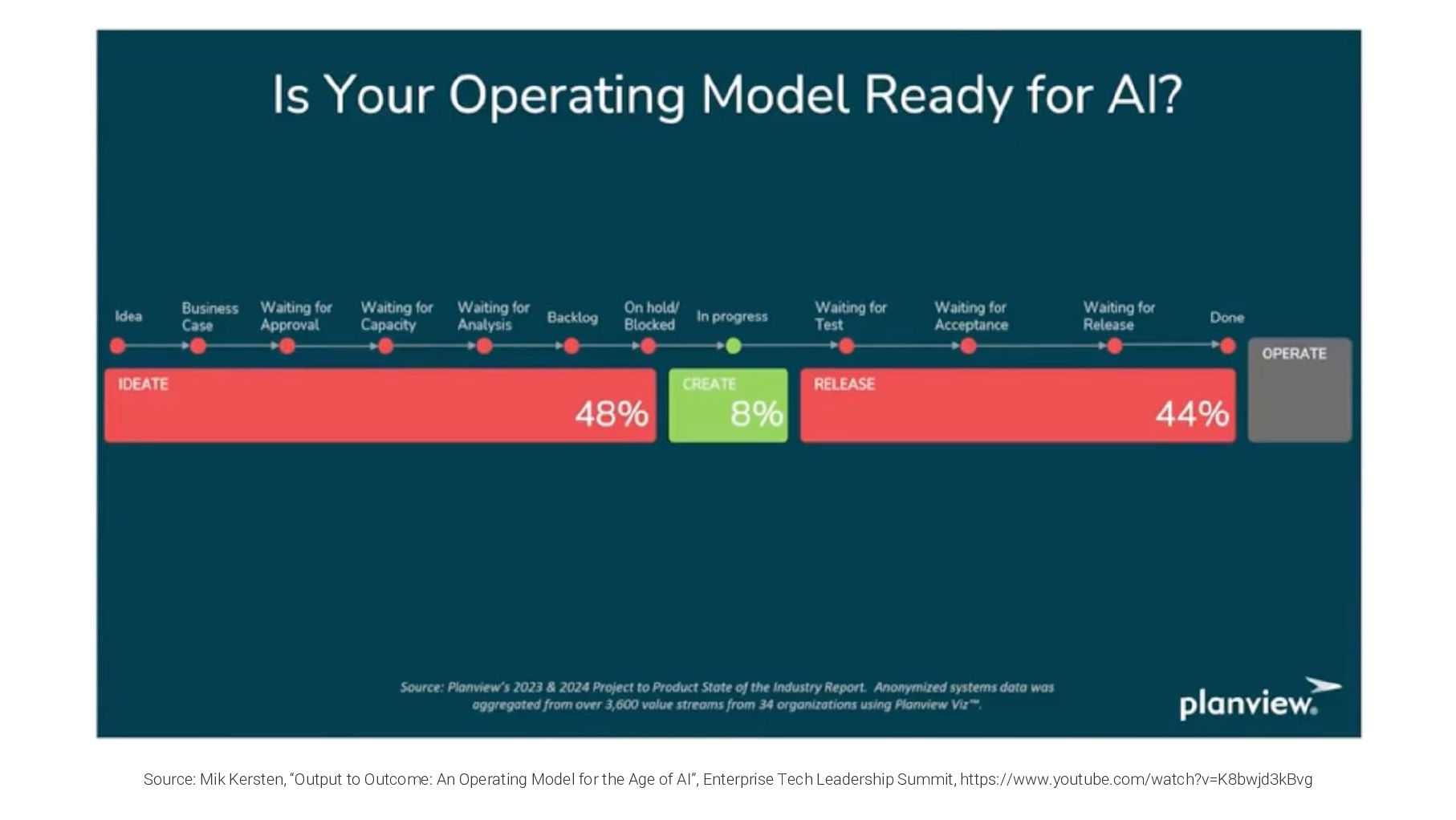
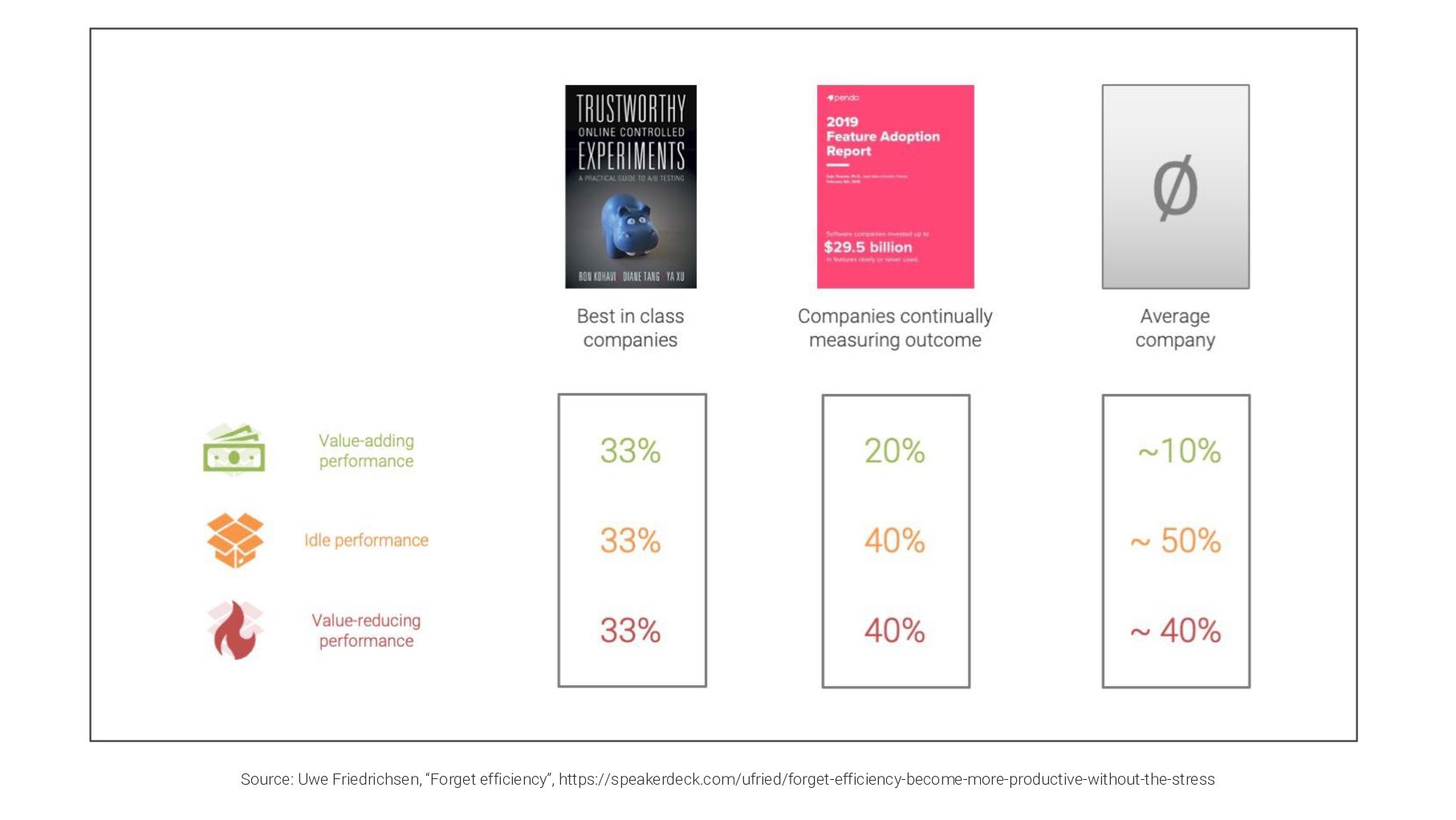
  18. Source: Mik Kersten, “Output to Outcome: An Operating Model for

    the Age of AI”, Enterprise Tech Leadership Summit, https://www.youtube.com/watch?v=K8bwjd3kBvg
  19. Without knowing how to be effective, AI will only let

    you create more waste in less time
  20. Potential remedies • Learn to become effective in highly dynamic

    markets • Favor lead times over throughput • Enable fast feedback and learning loops • Support hypothesis-driven development • Foster observability at the business level • Push automation • Rethink your value streams from end to end with AI • Be wary of local optimizations
  21. “AI is starting to kill us all, Colin Robinson style.

    If you’ll recall from What We Do In The Shadows (worth a watch, yo), Colin Robinson was an Energy Vampire. Being in the same room with him would drain people.” — Steve Yegge, “The AI Vampire” https://steve-yegge.medium.com/the-ai-vampire-eda6e4f07163
  22. “I was shipping more code than ever. My output was

    objectively higher. But by 3 PM most days, my brain felt like someone had microwaved it. Not tired in the normal ‘long day of coding’ way. A different kind of exhaustion. A fog that made it hard to make even simple decisions, like what to eat for dinner or whether a variable name was good enough.” https://www.alexcloudstar.com/blog/ai-brain-fry-developer-burnout-2026/
  23. “Based on a BCG study of 1,488 US workers across

    large companies, they found that AI brain fry can increase employee errors, decision overload, and, ultimately, intent to quit.” https://www.bcg.com/news/5march2026-when-using-ai-leads-brain-fry https://hbr.org/2026/03/when-using-ai-leads-to-brain-fry
  24. “[Agentic software building] doles out dopamine and adrenaline shots like

    they’re on a fire sale. Many have likened it to a slot machine. You pull a lever with each prompt, and get random rewards and sometimes amazing ‘payouts.’ No wonder it’s addictive.” https://steve-yegge.medium.com/the-ai-vampire-eda6e4f07163
  25. The AI vampire • Brain is running under full load

    for a long period • AI agents take away the brain recovery times • Human brains are not equipped for long periods of high load • Implicit task shift • Increased multitasking • Task expansion • Blurred work-life boundaries • Addiction of AI usage as reinforcing factor
  26. Potential remedies • Critically watch your AI usage • Take

    breaks • Be extremely careful with multitasking • Consider AI detox if you detect addiction symptoms
  27. Centralization and sovereignty • Convenience-first and only-the-best mindset • Frontier

    models feel a bit better out of the box • Behavior actively exploited by frontier model companies • Leads to a few players dominating AI • Those with enough financial backing will survive • A few players will control access and usage • Everyone will depend on a few players • Dependency prevents sovereignty
  28. Sovereignty means you can decide to stand up from the

    negotiating table and do not need to remain seated with your teeth gritted
  29. The AI cost trap • AI inference is still massively

    subsidized by providers • Estimated that multiple times higher inference costs are needed for frontier model providers to become profitable • Agentic AI already already can be several thousand euros per month and agent • What if the subsidy eventually stops?
  30. Potential remedies • Balance AI performance, sovereignty, and costs •

    Leverage open-weight/open-source solutions • May require some more upfront harness engineering effort • Use models that are “good enough” for the task
  31. Potential remedies • Do not put too much attention on

    immediate effects of AI • Instead, look for different ways of value capture based on the shifted constraints
  32. Those who understand the new options due to the shifted

    constraints will become the winners of the AI transformation
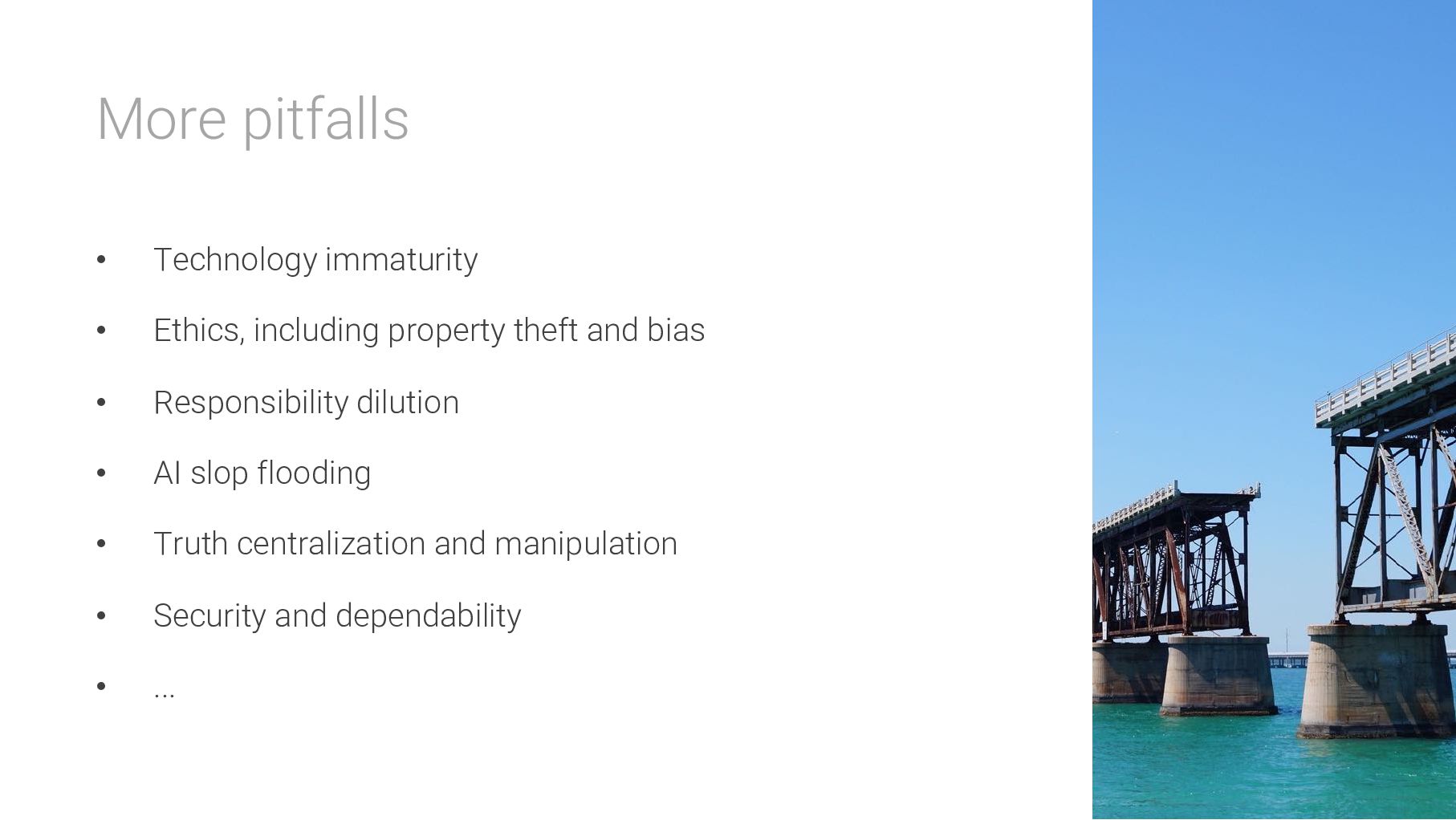
  33. More pitfalls • Technology immaturity • Ethics, including property theft

    and bias • Responsibility dilution • AI slop flooding • Truth centralization and manipulation • Security and dependability • ...
  34. Wrap-up • AI is a fascinating technology • Very powerful

    • Huge potential • Here to stay • But there are pitfalls • Misconceptions • Unsolved question and issues • A lot of work that still needs to be done
  35. However, do not expect the AI companies to solve the

    issues The only care about their valuations and profits
  36. Also, do not expect the free riders to provide useful

    answers The only care about their reach and influence
  37. We need to provide the answers If we want good

    answers, we cannot expect others to provide them
  38. “I don’t think there’s a damn thing we can do

    to stop the train. But we can certainly control the culture, since the culture is us.” https://steve-yegge.medium.com/the-ai-vampire-eda6e4f07163