Upgrade to Pro — share decks privately, control downloads, hide ads and more …

Spheres of Influence: Managing Hidden Risks

Sponsored · Your Podcast. Everywhere. Effortlessly. Share. Educate. Inspire. Entertain. You do you. We'll handle the rest. →

Spheres of Influence: Managing Hidden Risks

(Originally published in Risk Management Magazine)

Our increasingly interconnected world can expose your business to unanticipated dangers. Follow this approach to identify and mitigate hidden risks:
 
1. Imagine your business as the center of a sphere that contains all the factors and entities that influence it, and then analyze those relationships in terms of risk. 

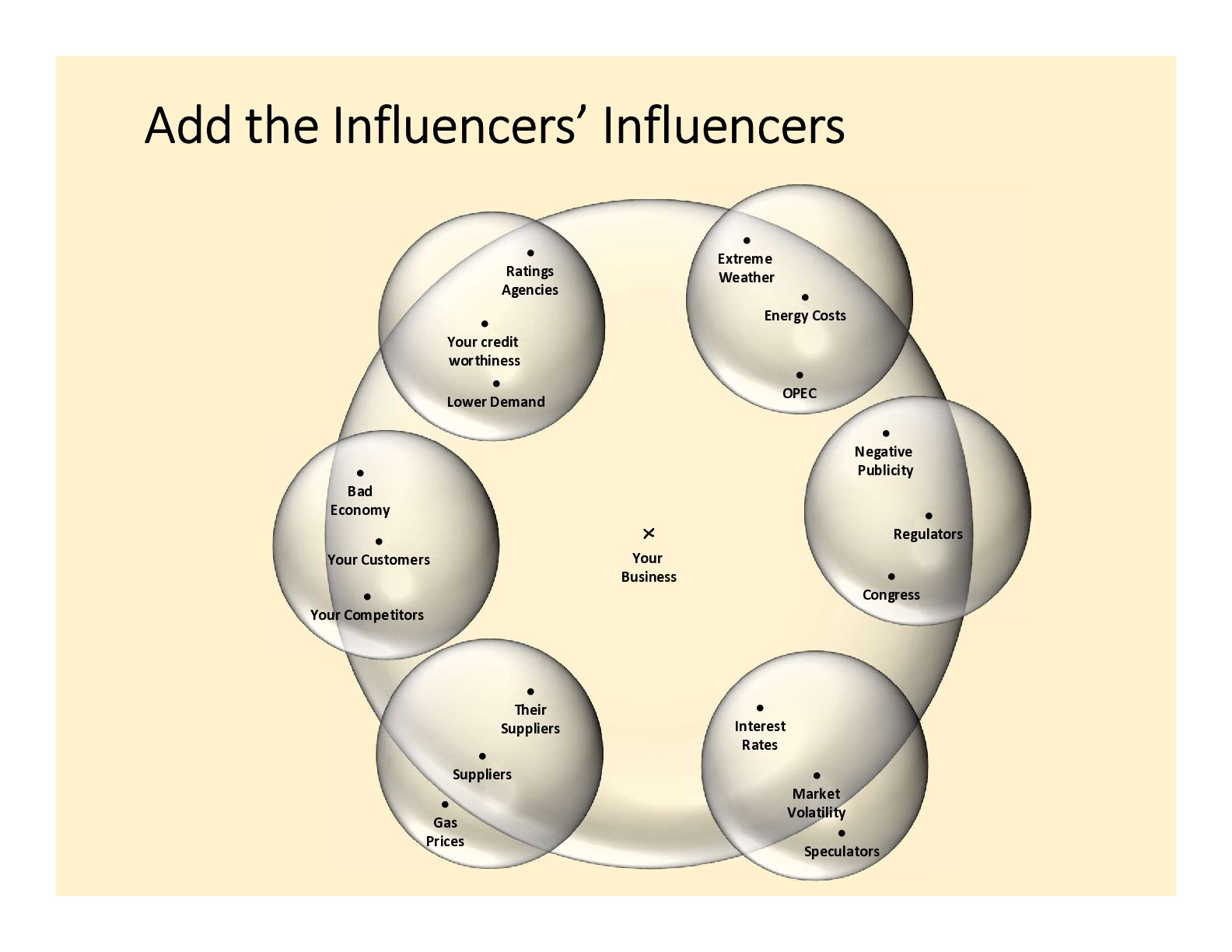
2. Give each of those influencers its own sphere, containing the factors and entities that impact it, and analyze how those relationships could indirectly influence you. 

3. Wargame possible events at different points on these chains of interconnection, and then consider how you can avoid, mitigate, or react to them.

#risk # riskmanagement #spheresofinfluence #wargaming #chainofeffect #chiefriskofficer

risk, risk management, spheres of influence, wargaming, chain of effect, Chief Risk Officer

Avatar for Vincent H. O'Neil

Vincent H. O'Neil

October 04, 2026

More Decks by Vincent H. O'Neil

Other Decks in Business

Transcript

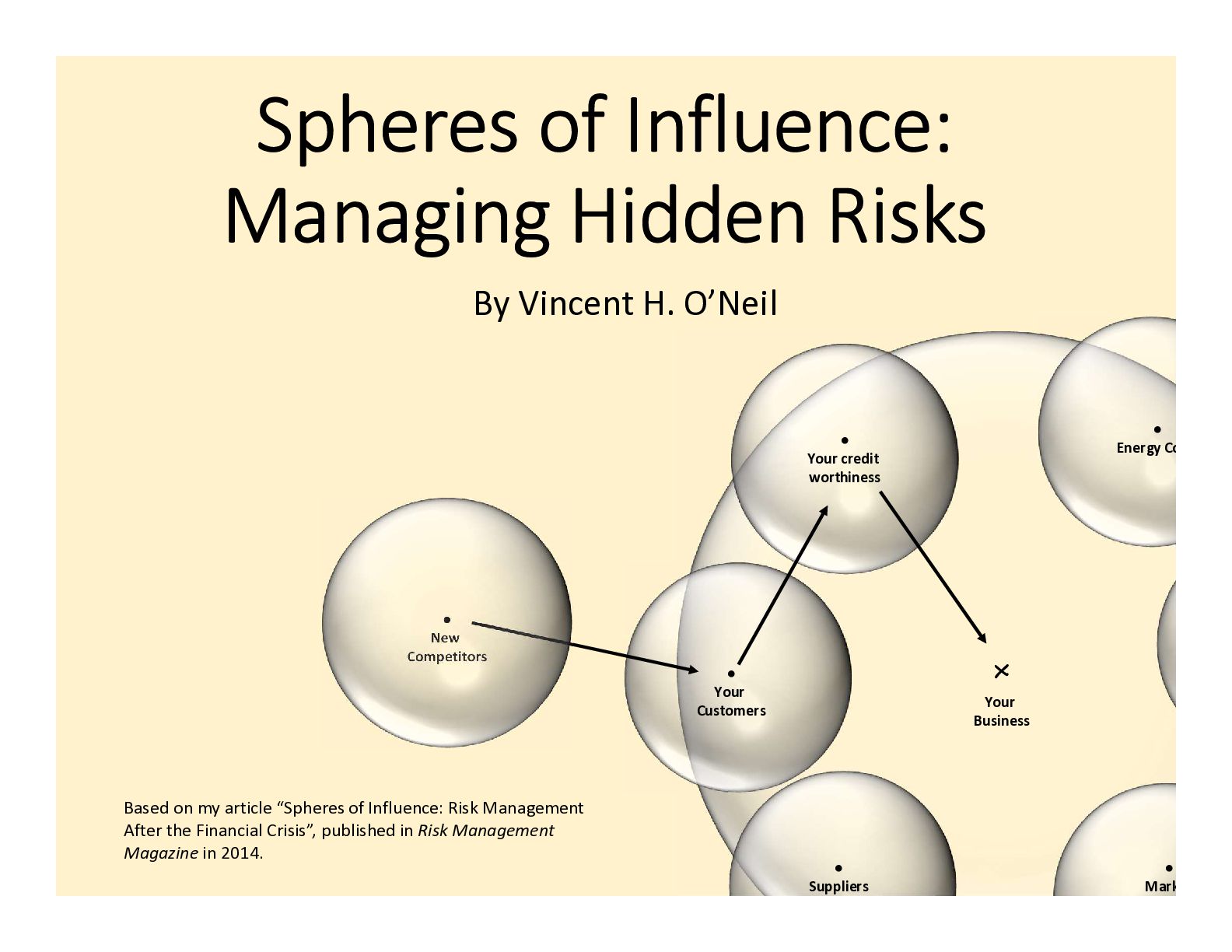
  1. Spheres of Influence: Managing Hidden Risks By Vincent H. O’Neil

    • Energy Costs • Your credit worthiness • New Competitors Based on my article “Spheres of Influence: Risk Management After the Financial Crisis”, published in Risk Management Magazine in 2014. × • Your Customers Your Business • Suppliers • Market Volatility
  2. Outline • Executive Summary • Introduction • Step 1: Identify

    your influencers • Step 2: Identify your influencers’ influencers • Step 3: Wargame events on that chain of interconnection • Summary
  3. Executive Summary Our increasingly interconnected world can expose your business

    to unanticipated dangers. Follow this approach to identify and mitigate hidden risks: 1. Imagine your business as the center of a sphere that contains all the factors and entities that influence it, and then analyze those relationships in terms of risk. 2. Give each of those influencers its own sphere, containing the factors and entities that impact it, and analyze how those relationships could indirectly influence you. 3. Wargame possible events at different points on these chains of interconnection, and then consider how you can avoid, mitigate, or react to them.
  4. Additional Benefits This process can do more than just help

    you prepare for possible misfortune. Following this approach can make you a better-informed manager of your business and a more engaged participant in your overall environment. Just as you’ll discover potential threats by analyzing these chains of interconnection, you’ll also uncover potential opportunities. Although this presentation has a business focus, this ”spheres of influence” approach can be applied in many different fields and endeavors.
  5. Hidden Risks Our interconnected world can expose your business to

    hidden dangers, including second- and third-order effects. Example: At the start of the 2008 sub-prime mortgage crash, the crisis seemed confined to mortgage companies, banks with mortgage business, investment banks that sold mortgage bonds, and the purchasers of those bonds. The dimensions of the problem were far greater, though. Large insurance companies had exposed themselves to this risk, with products that were not well known or understood. Their vulnerability sent shockwaves into other industries believed to be unconnected to the mortgage crisis. Identifying interconnections like these can help you identify hidden threats and prepare for them.
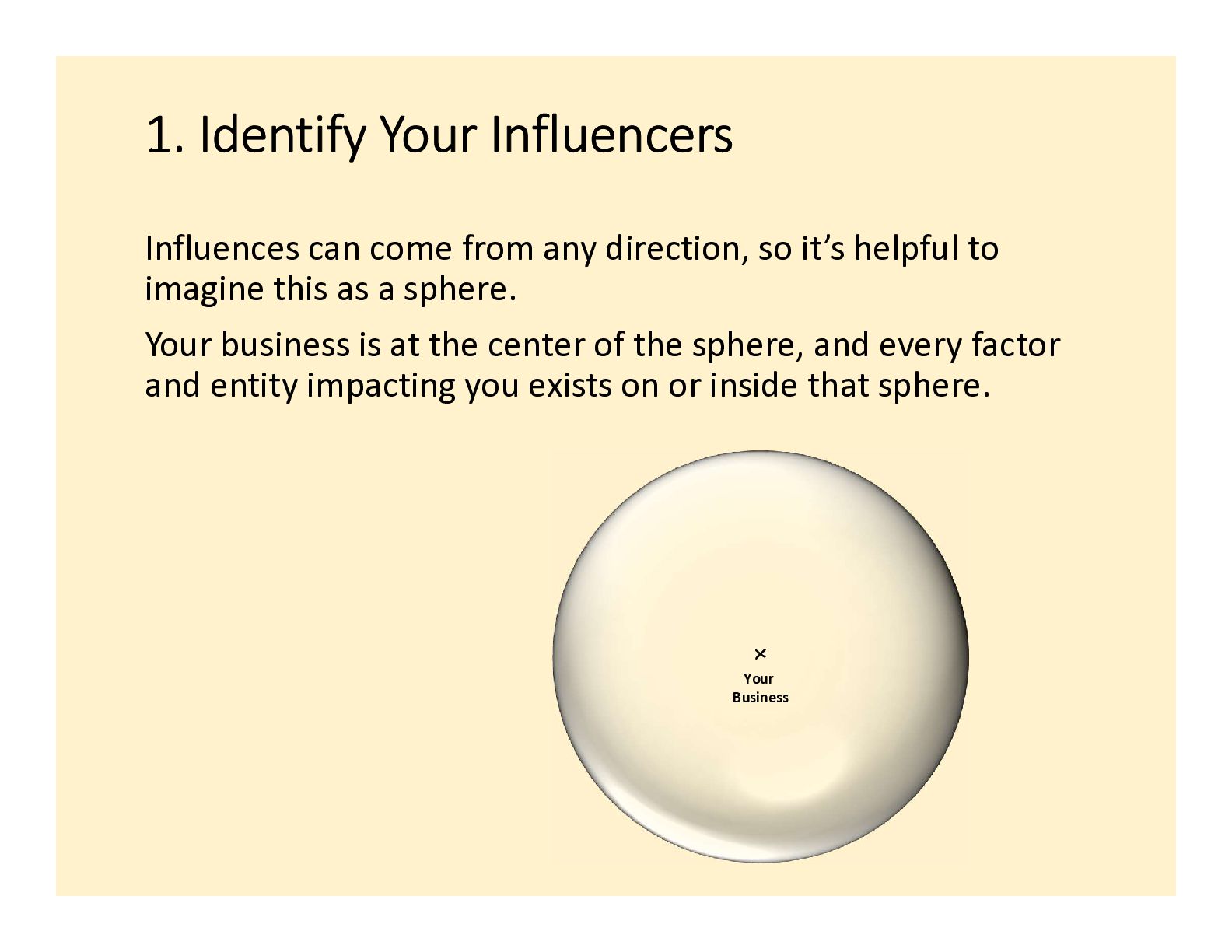
  6. 1. Identify Your Influencers Influences can come from any direction,

    so it’s helpful to imagine this as a sphere. Your business is at the center of the sphere, and every factor and entity impacting you exists on or inside that sphere. × Your Business
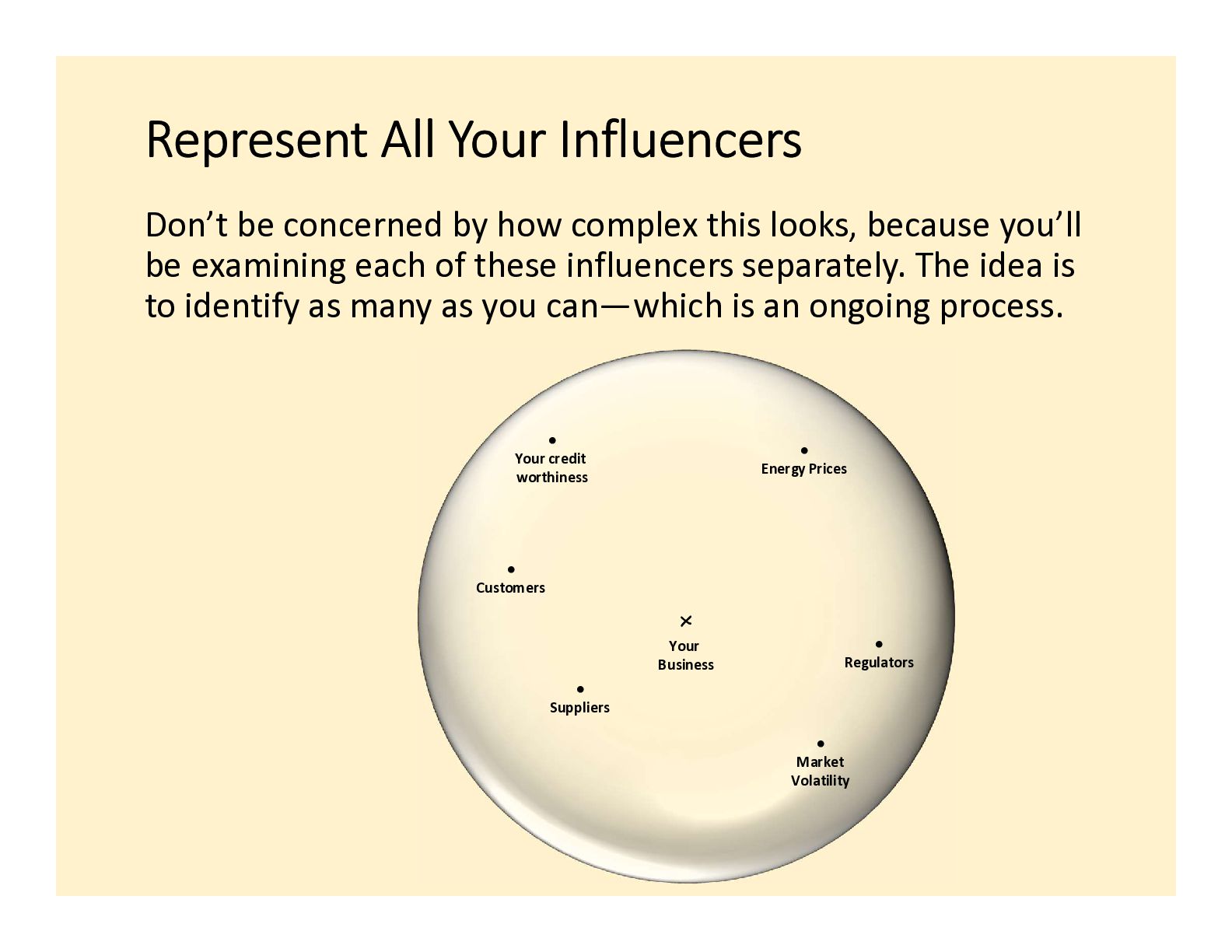
  7. Represent All Your Influencers Don’t be concerned by how complex

    this looks, because you’ll be examining each of these influencers separately. The idea is to identify as many as you can—which is an ongoing process. • Your credit worthiness • Energy Prices • Customers × Your Business • Regulators • Suppliers • Market Volatility
  8. Terms For this presentation: Risk is defined as the threat

    of harm to your business, caused by external or internal vulnerabilities, which may be avoided through preemptive action. Influencers are anything that can cause you to do something, change how you do something, or prevent you from doing something. They can impact you by their actions—and by their absence. Their effect can be good as well as bad, and they should be analyzed for both conditions. In our discussion, there are two kinds of influencers: factors and entities.
  9. Influencers-Factors Factors are influencers that aren’t actual organizations or people,

    such as: • Demand for things your business sells • Availability of things your business needs • Energy costs • Your creditworthiness • Market volatility
  10. Influencers-Entities Entities are influencers that are actual organizations or people,

    such as: • Customers • Regulators • Competitors • Suppliers • Analysts and reviewers The influencers listed so far are mostly external. Internal influencers are also important, and will be discussed later.
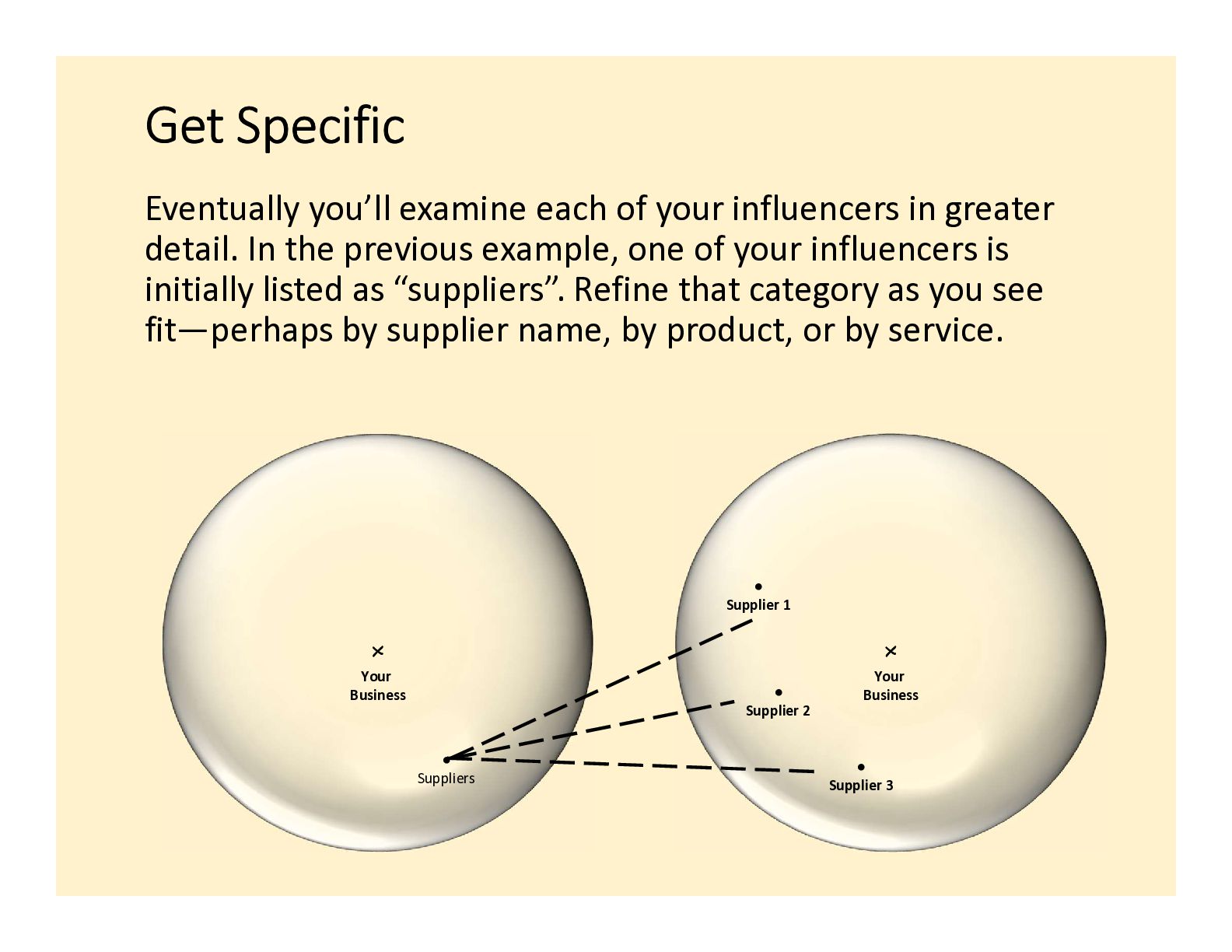
  11. Get Specific Eventually you’ll examine each of your influencers in

    greater detail. In the previous example, one of your influencers is initially listed as “suppliers”. Refine that category as you see fit—perhaps by supplier name, by product, or by service. • Supplier 1 × × Your Business • Supplier 2 • Suppliers Your Business • Supplier 3
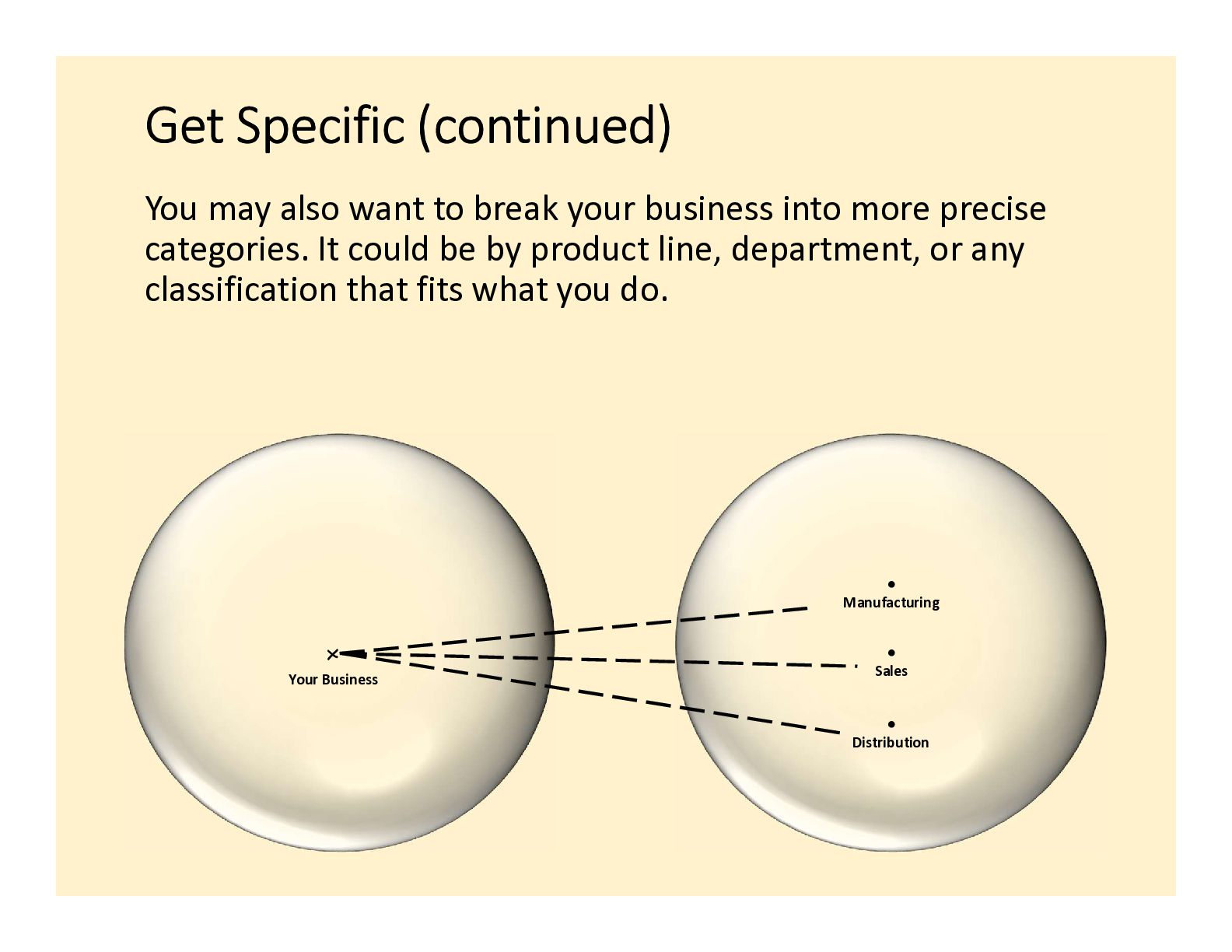
  12. Get Specific (continued) You may also want to break your

    business into more precise categories. It could be by product line, department, or any classification that fits what you do. • Manufacturing × Your Business • Sales • Distribution
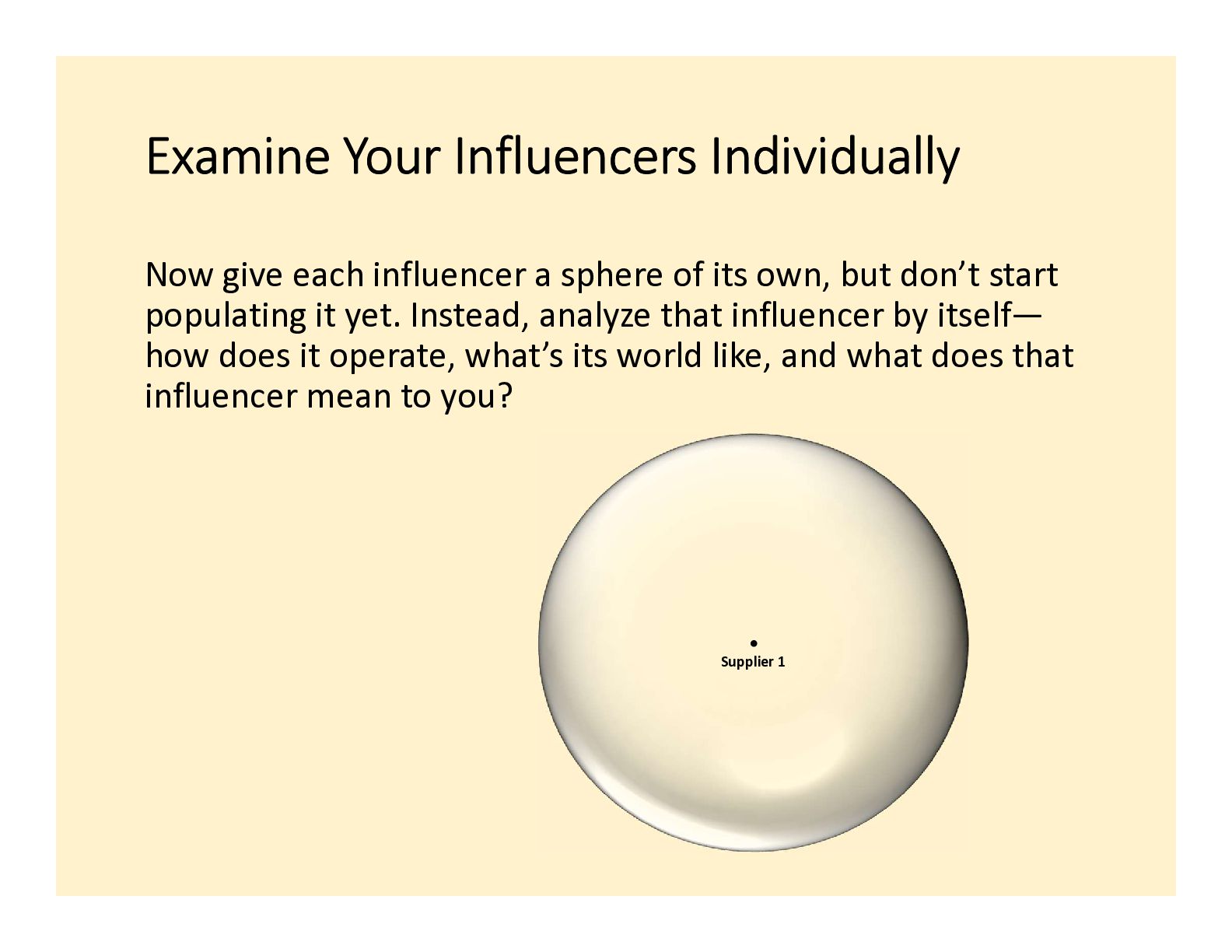
  13. Examine Your Influencers Individually Now give each influencer a sphere

    of its own, but don’t start populating it yet. Instead, analyze that influencer by itself— how does it operate, what’s its world like, and what does that influencer mean to you? • Supplier 1
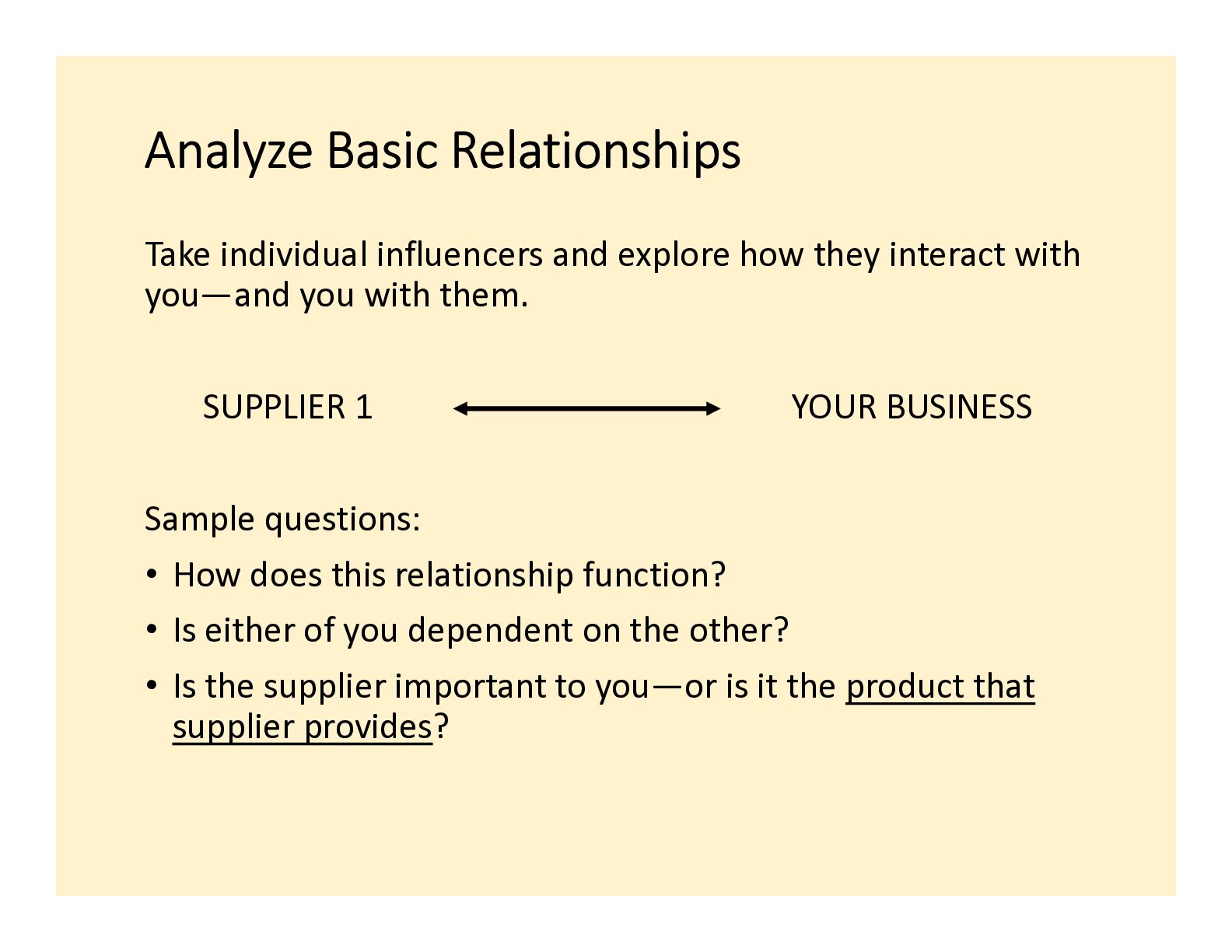
  14. Analyze Basic Relationships Take individual influencers and explore how they

    interact with you—and you with them. SUPPLIER 1 YOUR BUSINESS Sample questions: • How does this relationship function? • Is either of you dependent on the other? • Is the supplier important to you—or is it the product that supplier provides?
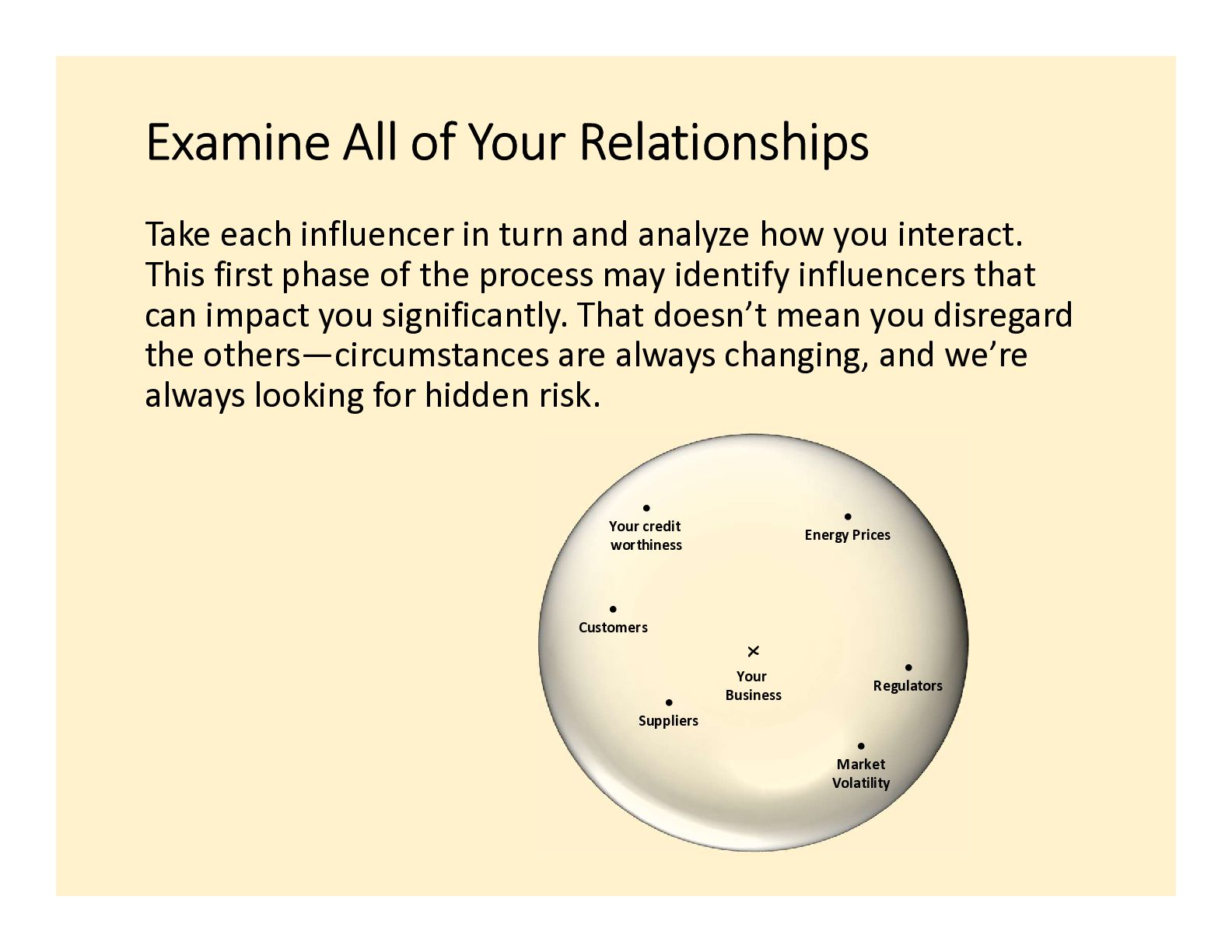
  15. Examine All of Your Relationships Take each influencer in turn

    and analyze how you interact. This first phase of the process may identify influencers that can impact you significantly. That doesn’t mean you disregard the others—circumstances are always changing, and we’re always looking for hidden risk. • Your credit worthiness • Customers • Suppliers • Energy Prices × Your Business • Regulators • Market Volatility
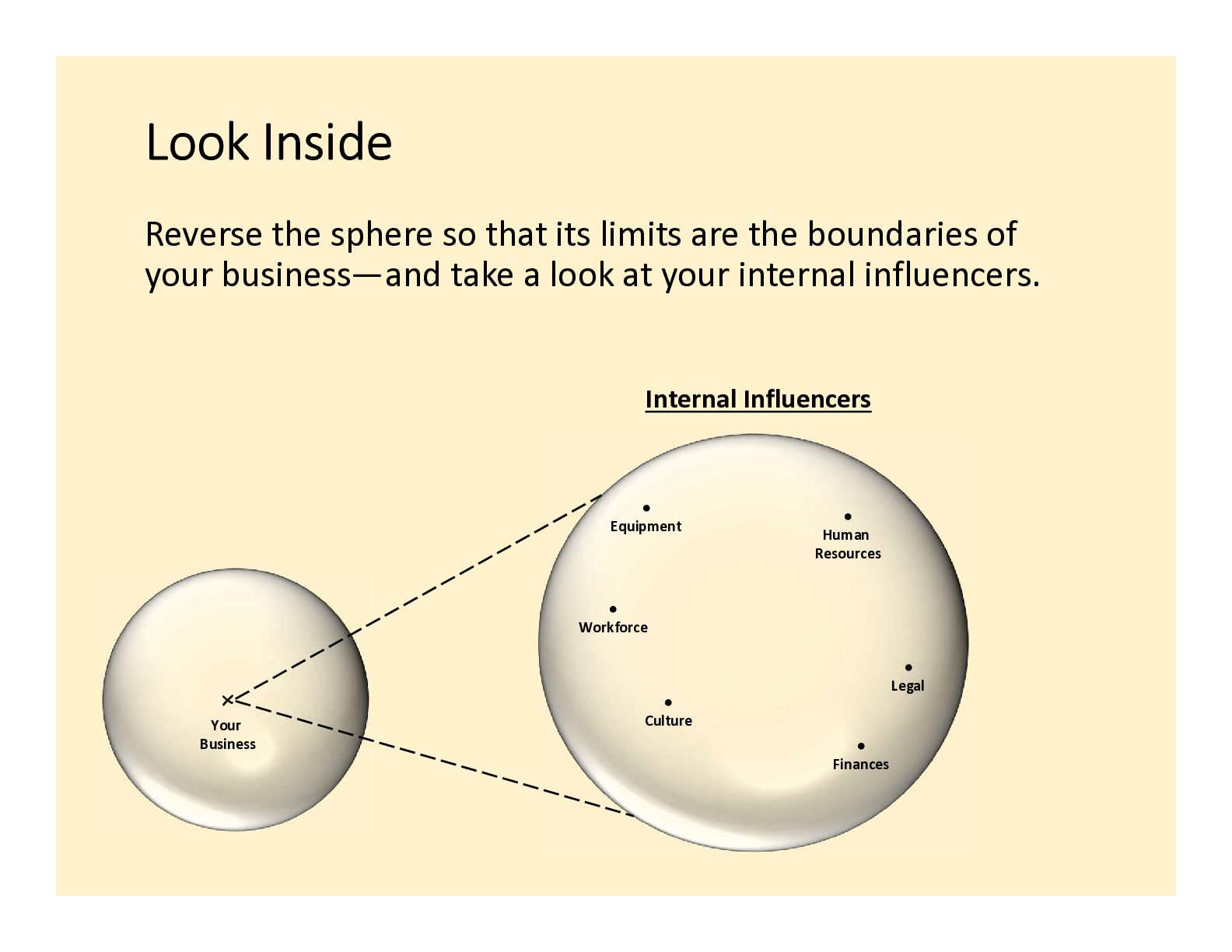
  16. Look Inside Reverse the sphere so that its limits are

    the boundaries of your business—and take a look at your internal influencers. Internal Influencers • Equipment • Human Resources • Workforce × Your Business • Legal • Culture • Finances
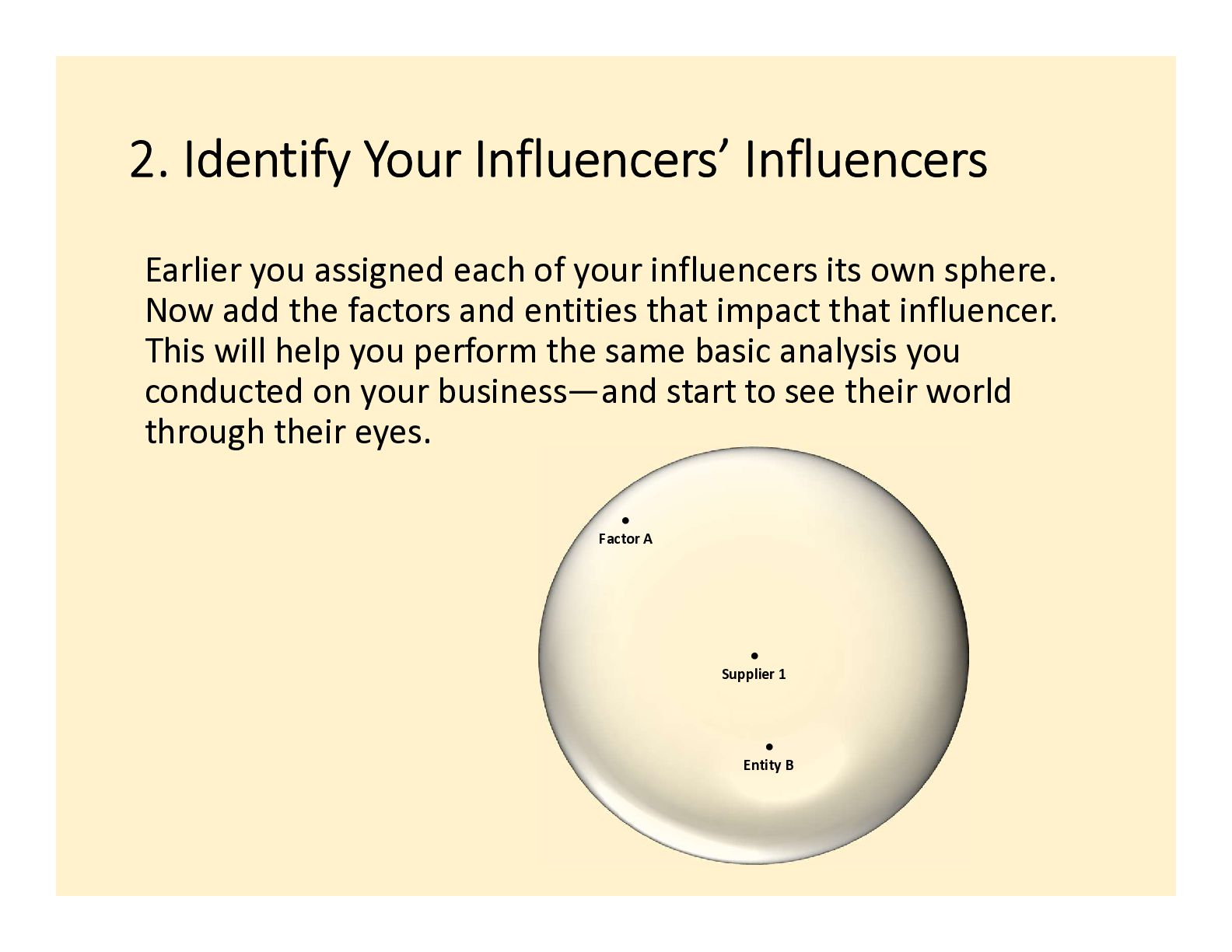
  17. 2. Identify Your Influencers’ Influencers Earlier you assigned each of

    your influencers its own sphere. Now add the factors and entities that impact that influencer. This will help you perform the same basic analysis you conducted on your business—and start to see their world through their eyes. • Factor A • Supplier 1 • Entity B
  18. Study Your Influencers’ Environments Understanding someone else’s circumstances can be

    challenging. Here are some ways to get this information: • Read professional journals, from your industry and theirs. • Consult your own employees—they see a lot, from quality concerns to customer attitudes. • Interact with your peers and partners and ask fundamental questions. • Example: In the run-up to the subprime mortgage crisis of 2008, there were clear signs that lending standards had deteriorated and that bonds composed of those dangerous home loans were receiving inflated credit ratings. (See Michael Lewis’s book The Big Short.)
  19. Leverage Your Connections Hypothetical Example: A business you rely on

    abruptly announces it’s being acquired by one of your competitors. This is a double whammy, in that you’ve lost an important relationship that’s now helping your competition. It’s a triple whammy if it was common knowledge among that entity’s peers that this acquisition had been proposed before. Information like that can help you get prepared—so build up and maintain a network of professional connections both inside and outside your field.
  20. Seek Out Existing Wisdom Identify people who’ve been in your

    shoes, and get their input. Don’t just get to know your peers—get to know the people who would have been your peers years ago and leverage their experience. Example: After NFL Coach Bill Belichick won his second Superbowl with the Patriots, he consulted Coach Jimmie Johnson about the ways that multiple championships can affect coaches and teams. This was unknown territory for Belichick, and he gained valuable insights from Johnson. (See David Halberstam’s book The Education of a Coach.)
  21. Learn From History Example: In 1918, Russia’s new Communist government

    negotiated a treaty that ended the fighting on Europe’s Eastern Front. That freed up roughly one million German troops that were then sent to the Western Front. British, French, and other Allied forces suffered heavy casualties before American reinforcements helped turn the tide. What you can learn from this: To put this example in business terms, one of your key partners experiences an internal power struggle. The new management team severs your relationship, forcing you to seek a replacement partner. Knowing about this dissension in advance could help you prepare for this possible development.
  22. Question What You’re Learning As you’re expanding your sources of

    information, find ways of to verify what you discover. Remember: • Opinion is frequently offered as fact. • Unscrupulous or incompetent actors can mislead you. • Ratings agencies and analysts can be wrong, and regulators can be asleep at the switch. • Assumptions and estimates don’t have to be completely wrong to harm you—just a little bit off.
  23. Combine the Spheres Now take the separate spheres for each

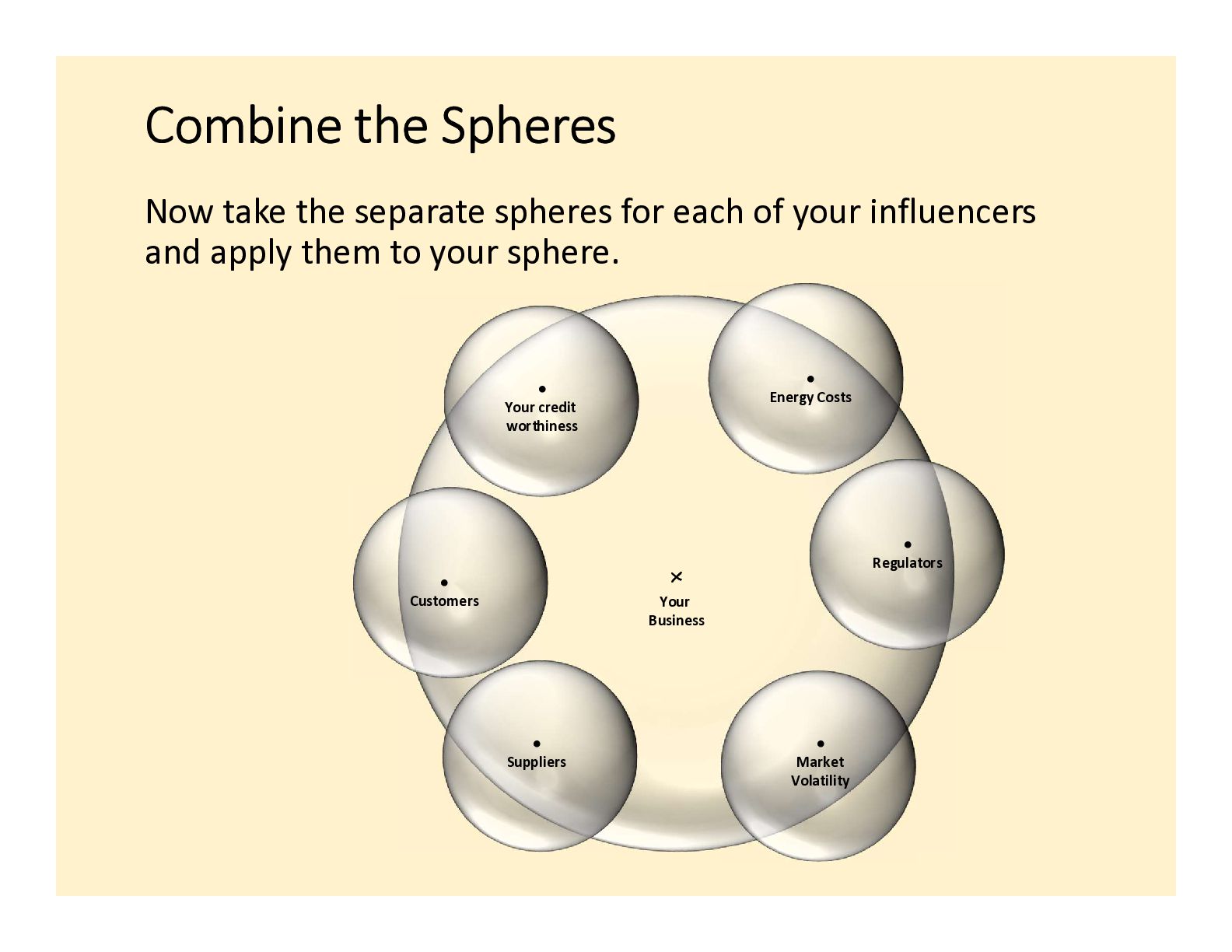
    of your influencers and apply them to your sphere. • Energy Costs • Your credit worthiness • Regulators × • Customers Your Business • Suppliers • Market Volatility
  24. Combine the Spheres (continued) Don’t get caught up in the

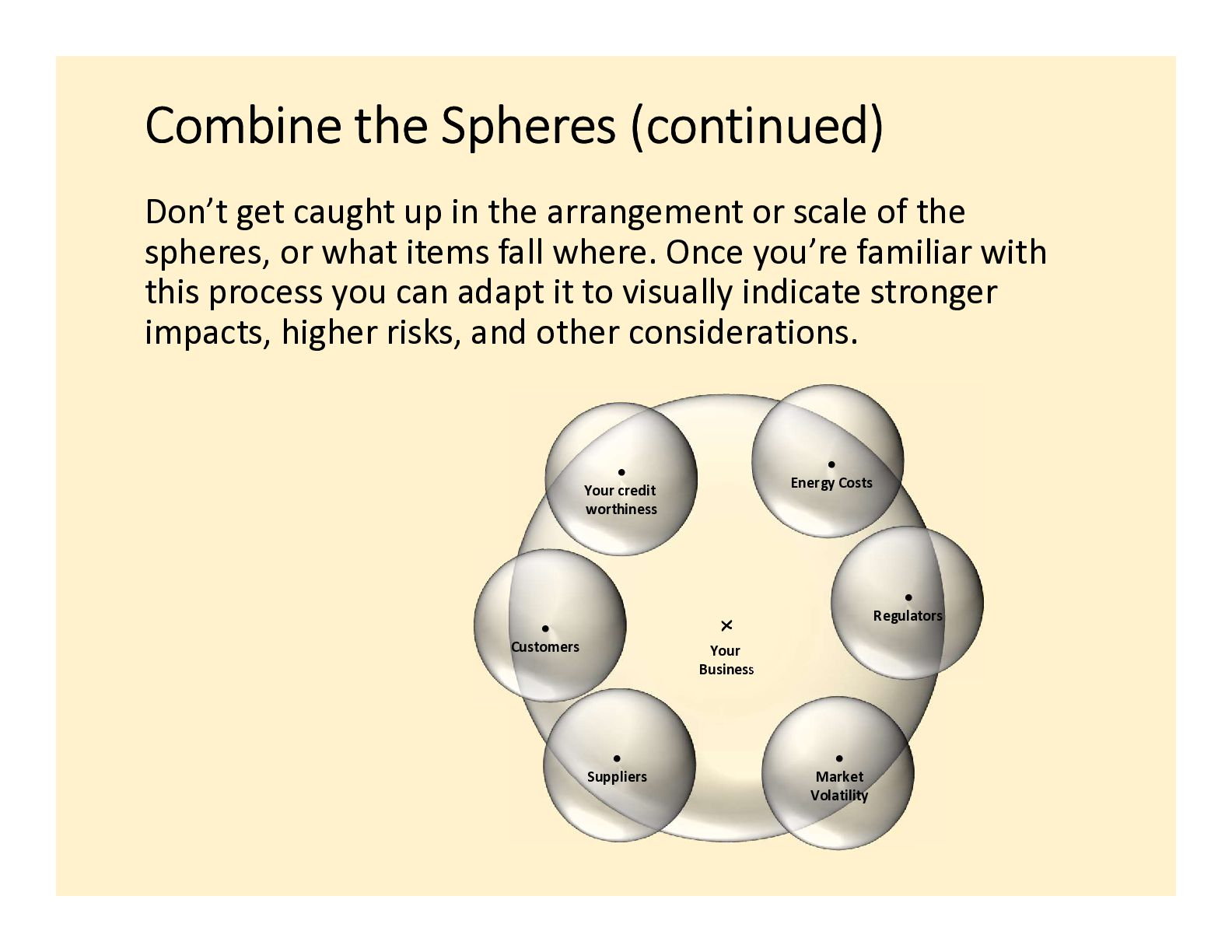
    arrangement or scale of the spheres, or what items fall where. Once you’re familiar with this process you can adapt it to visually indicate stronger impacts, higher risks, and other considerations. • Energy Costs • Your credit worthiness • Regulators × • Customers Your Business • Suppliers • Market Volatility
  25. Add the Influencers’ Influencers • Extreme Weather • Ratings Agencies

    • Energy Costs • Your credit worthiness • Lower Demand • OPEC • Negative Publicity • Bad Economy • Regulators × • Your Customers Your Business • Congress • Your Competitors • Their Suppliers • Suppliers • Gas Prices • Interest Rates • Market Volatility • Speculators
  26. Analyze Potential Vulnerabilities Now that you’ve identified the factors and

    entities impacting you and your influencers, you can start analyzing potential vulnerabilities. Some are obvious. If your “Customers” sphere shows your clients have numerous options for the product or service you provide, you may want to find ways to differentiate yourself from your competitors. Combining the spheres in this way allows you to visualize more complex developments that could potentially impact you—sometimes as second-order effects.
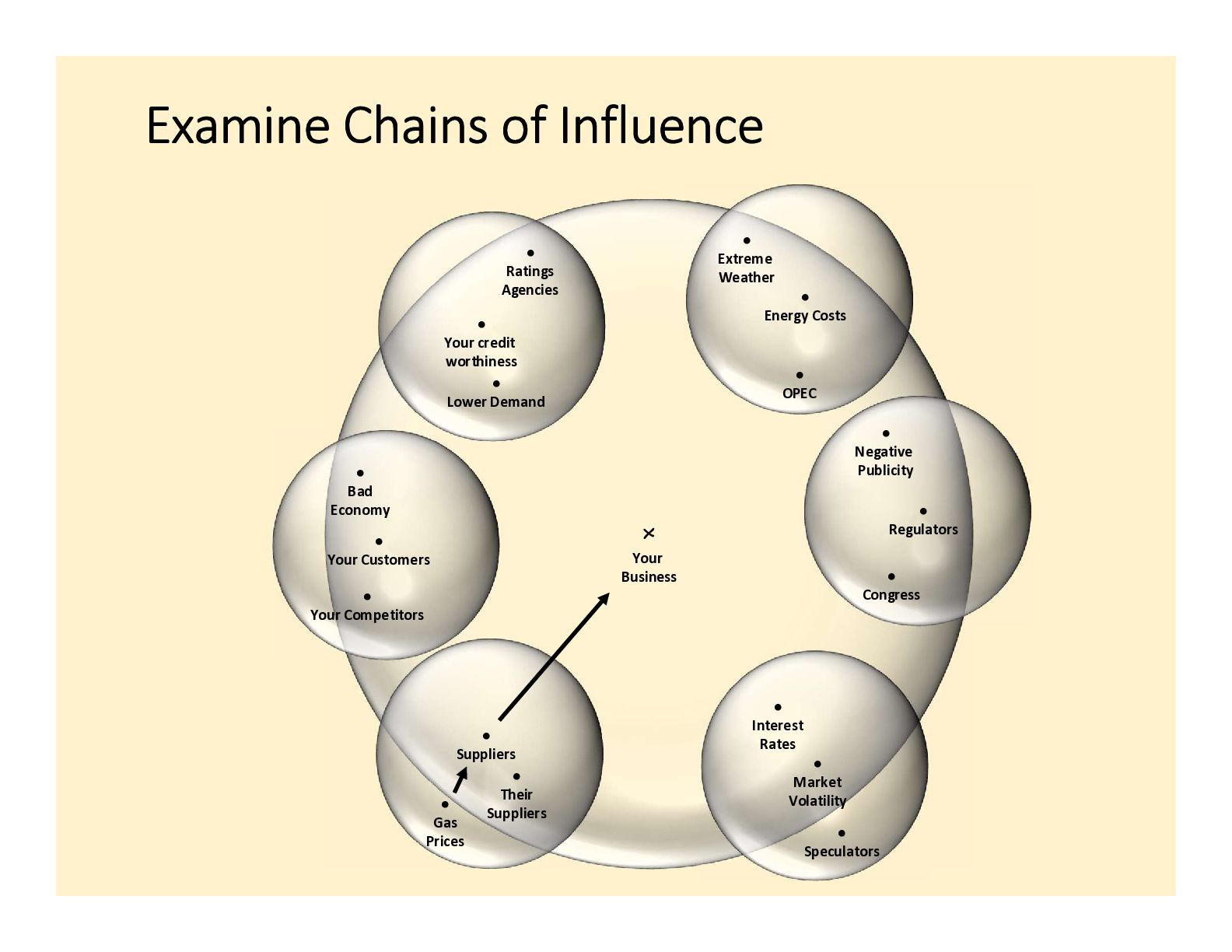
  27. Examine Chains of Influence • Extreme Weather • Ratings Agencies

    • Energy Costs • Your credit worthiness • Lower Demand • OPEC • Negative Publicity • Bad Economy • Your Customers • Regulators × Your Business • Congress • Your Competitors • Suppliers • Their • Suppliers Gas Prices • Interest Rates • Market Volatility • Speculators
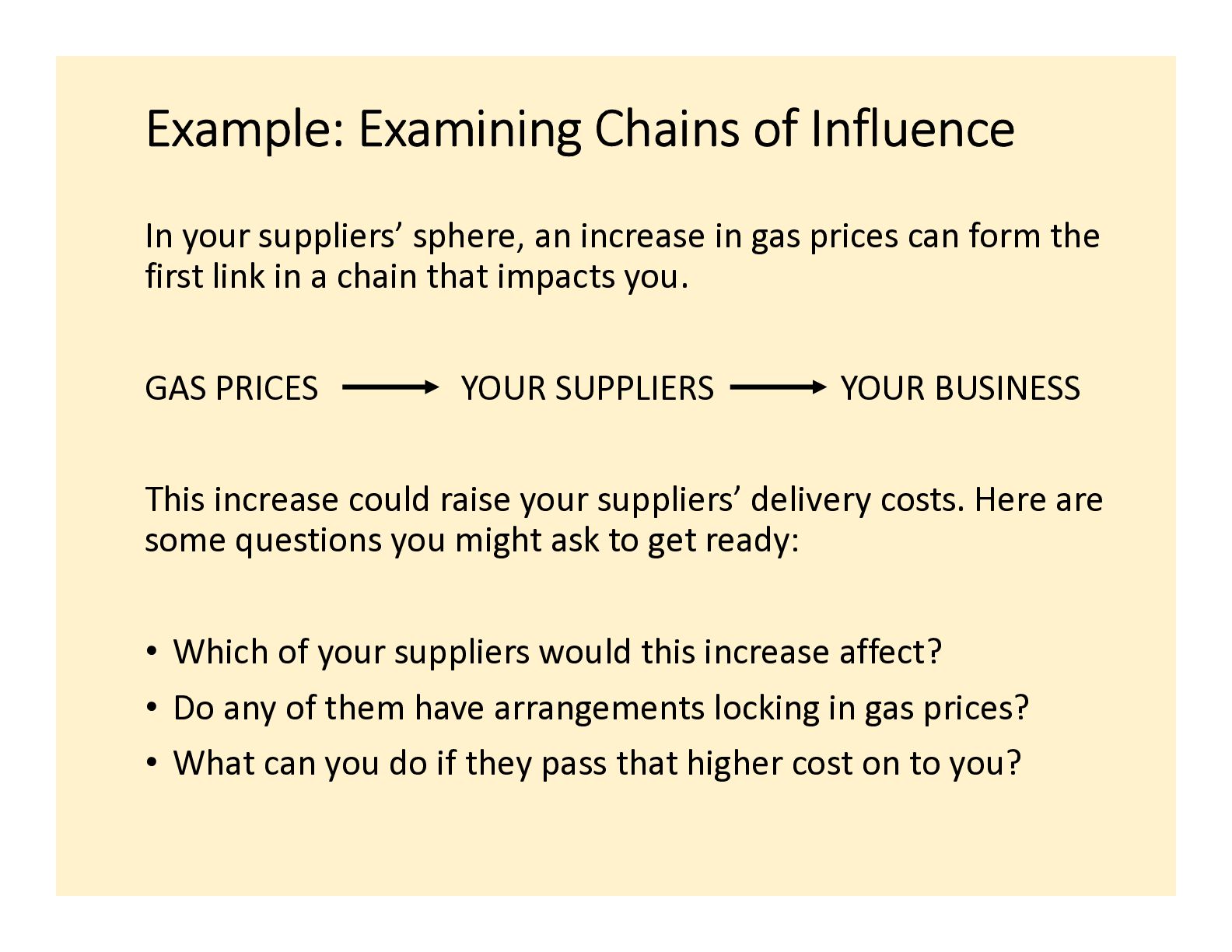
  28. Example: Examining Chains of Influence In your suppliers’ sphere, an

    increase in gas prices can form the first link in a chain that impacts you. GAS PRICES YOUR SUPPLIERS YOUR BUSINESS This increase could raise your suppliers’ delivery costs. Here are some questions you might ask to get ready: • Which of your suppliers would this increase affect? • Do any of them have arrangements locking in gas prices? • What can you do if they pass that higher cost on to you?
  29. 3. Wargame Potential Scenarios Now let’s use the spheres to

    examine possible events at different points on these chains of interconnection. Plotting out these potential developments can identify first-, second-, and third-order effects and help you prepare for them. Worst-case analysis has a place in this process. Remember that “we never thought this could happen” is a common refrain in a crisis.
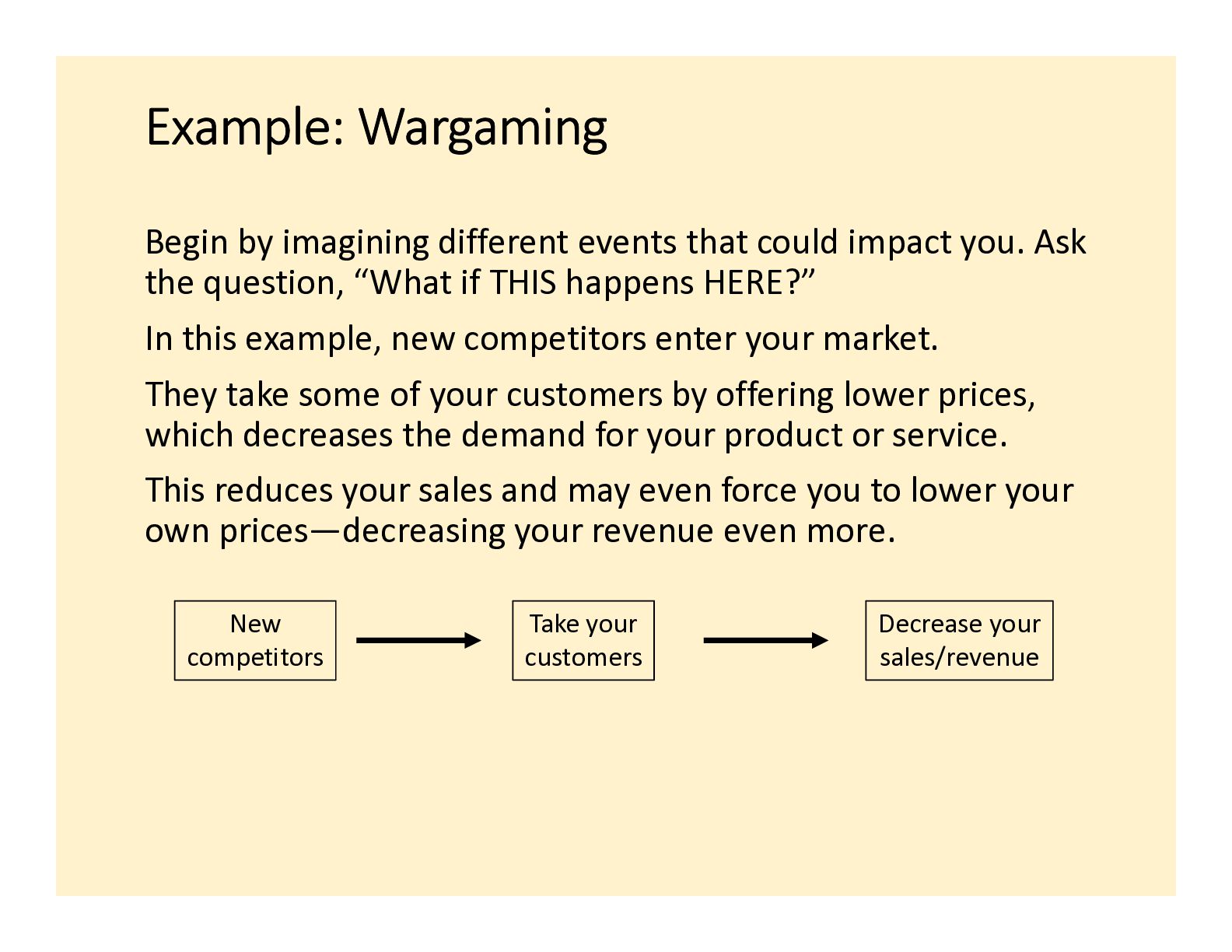
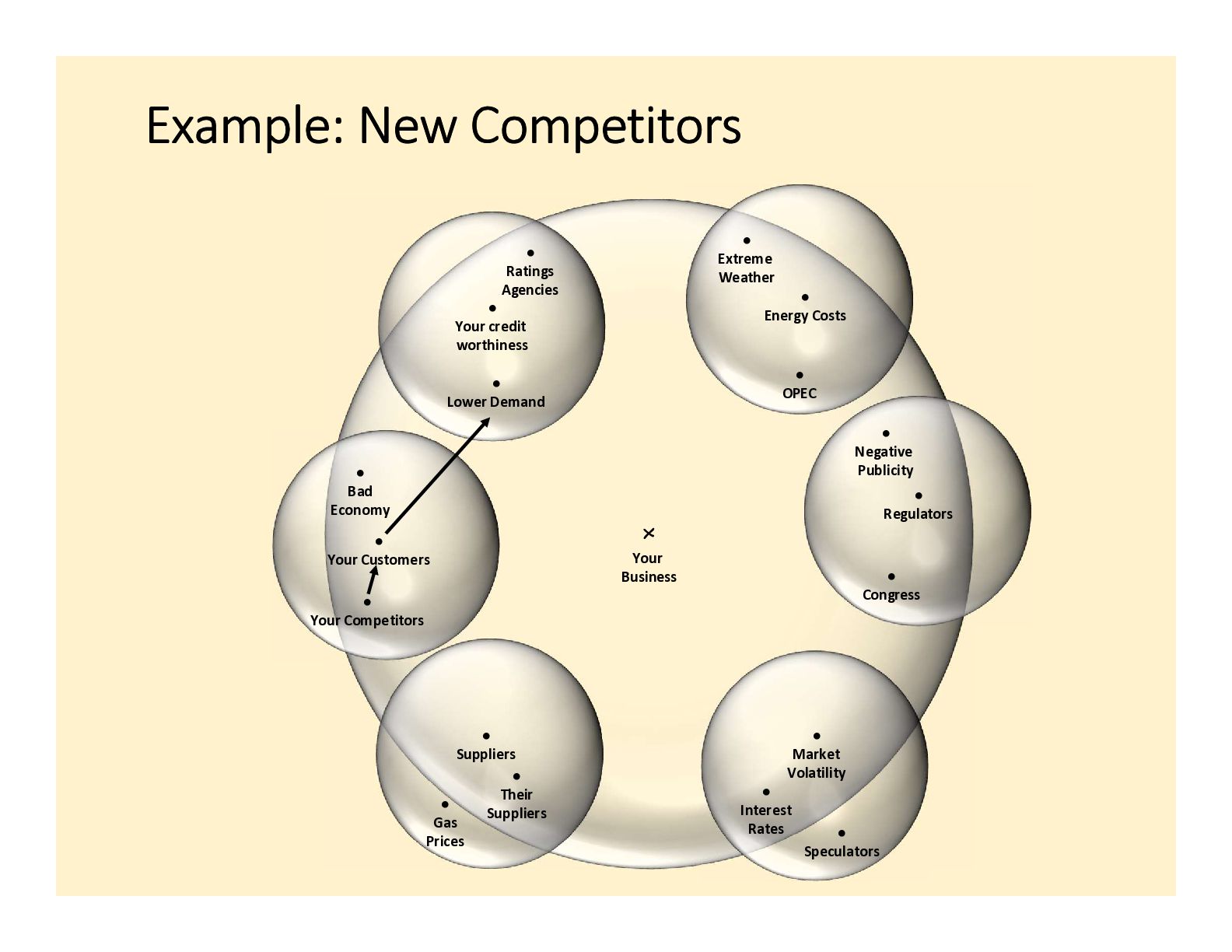
  30. Example: Wargaming Begin by imagining different events that could impact

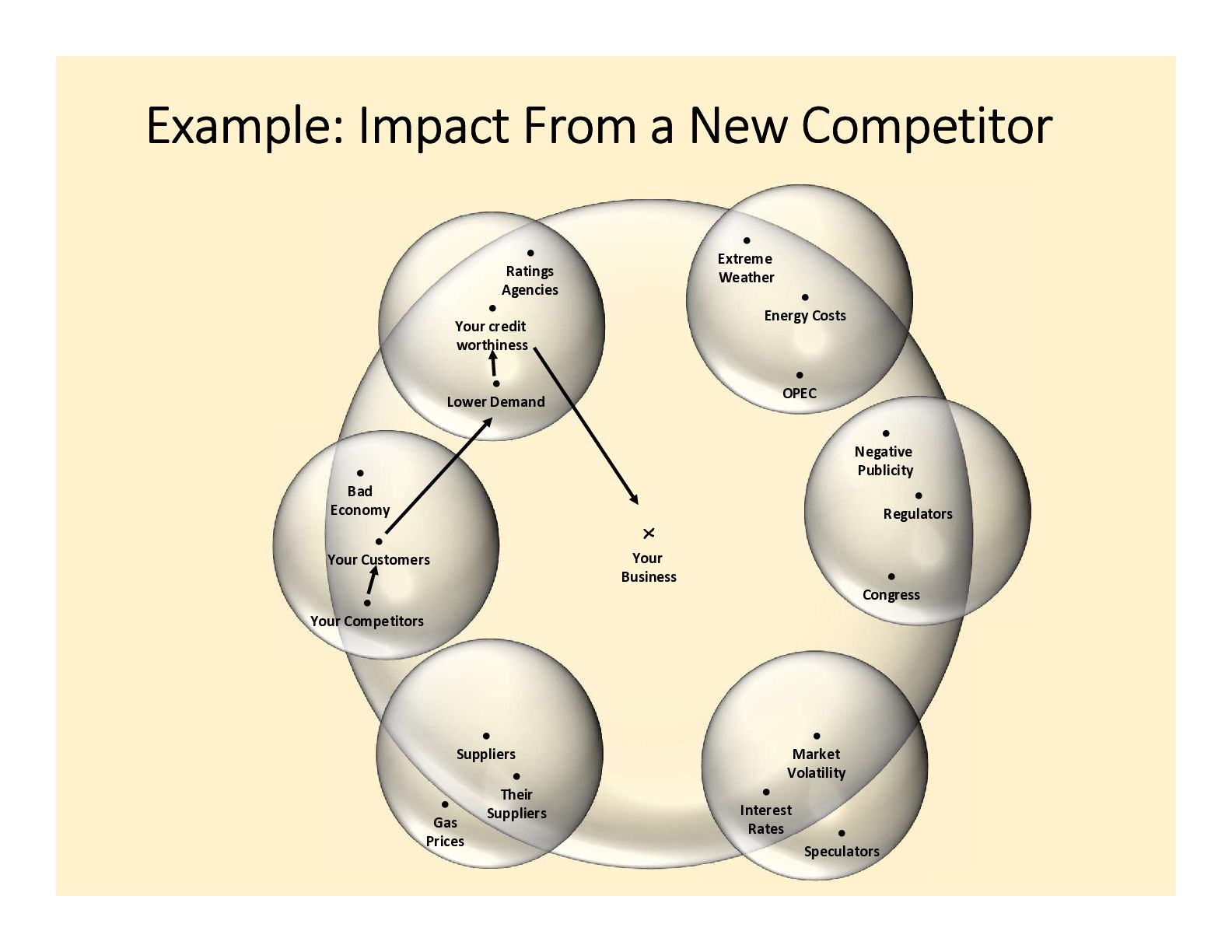
    you. Ask the question, “What if THIS happens HERE?” In this example, new competitors enter your market. They take some of your customers by offering lower prices, which decreases the demand for your product or service. This reduces your sales and may even force you to lower your own prices—decreasing your revenue even more. New competitors Take your customers Decrease your sales/revenue
  31. Example: New Competitors • Extreme Weather • Ratings Agencies •

    Energy Costs • Your credit worthiness • OPEC • Lower Demand • Negative Publicity • Bad Economy • Your Customers • Regulators × Your Business • Congress • Your Competitors • Suppliers • Their • Suppliers Gas Prices • Market Volatility • Interest Rates • Speculators
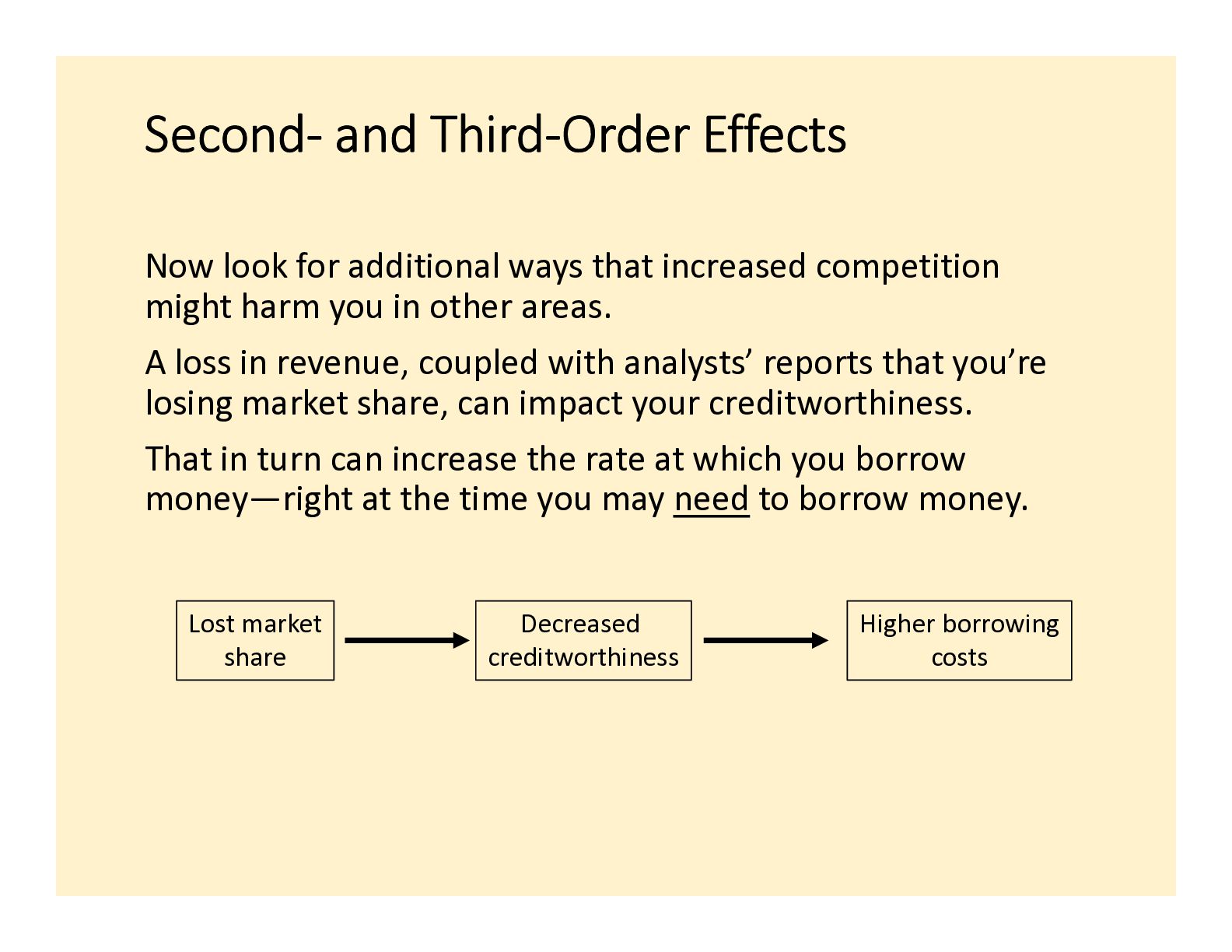
  32. Second- and Third-Order Effects Now look for additional ways that

    increased competition might harm you in other areas. A loss in revenue, coupled with analysts’ reports that you’re losing market share, can impact your creditworthiness. That in turn can increase the rate at which you borrow money—right at the time you may need to borrow money. Lost market share Decreased creditworthiness Higher borrowing costs
  33. Example: Impact From a New Competitor • Extreme Weather •

    Ratings Agencies • Energy Costs • Your credit worthiness • OPEC • Lower Demand • Negative Publicity • Bad Economy • Your Customers • Regulators × Your Business • Congress • Your Competitors • Suppliers • Their • Suppliers Gas Prices • Market Volatility • Interest Rates • Speculators
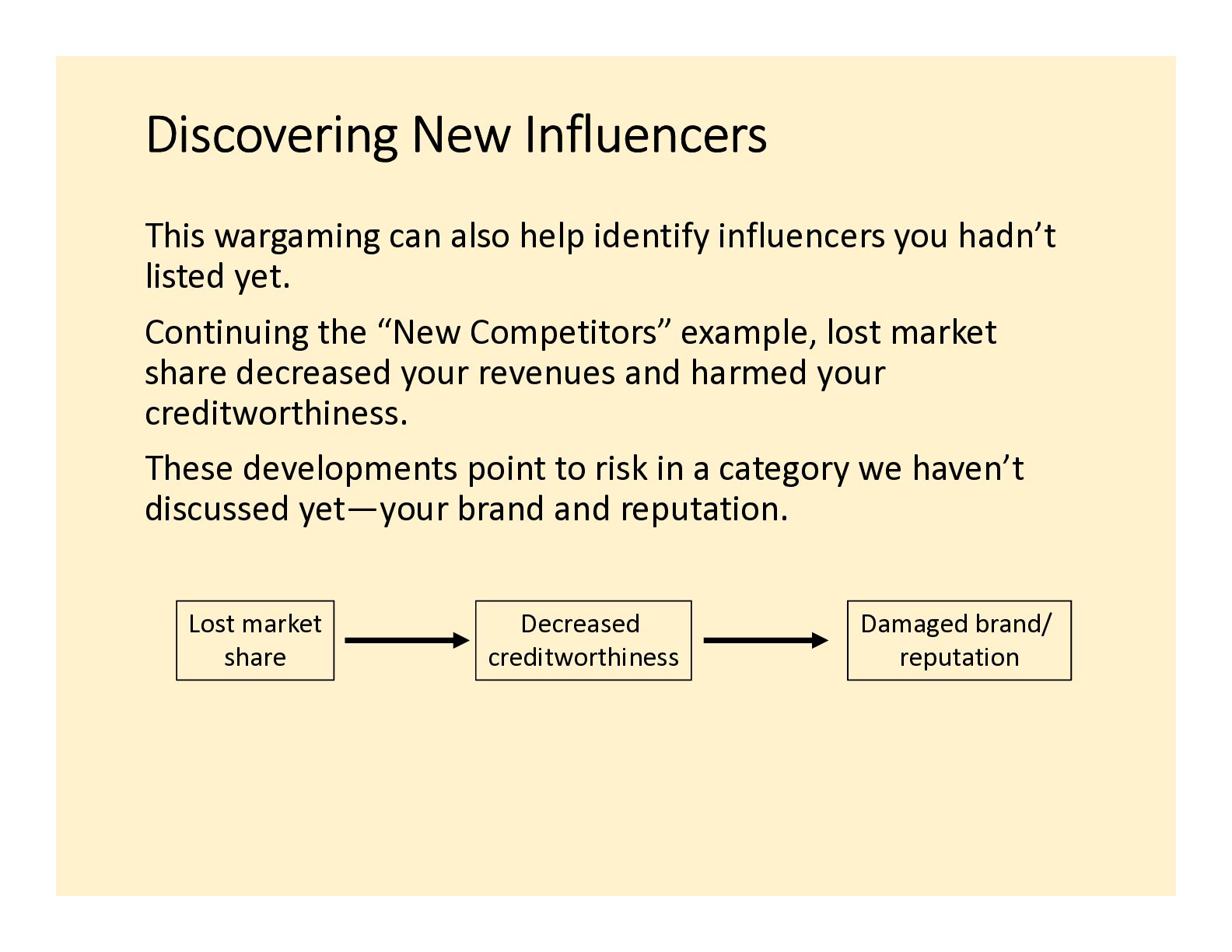
  34. Discovering New Influencers This wargaming can also help identify influencers

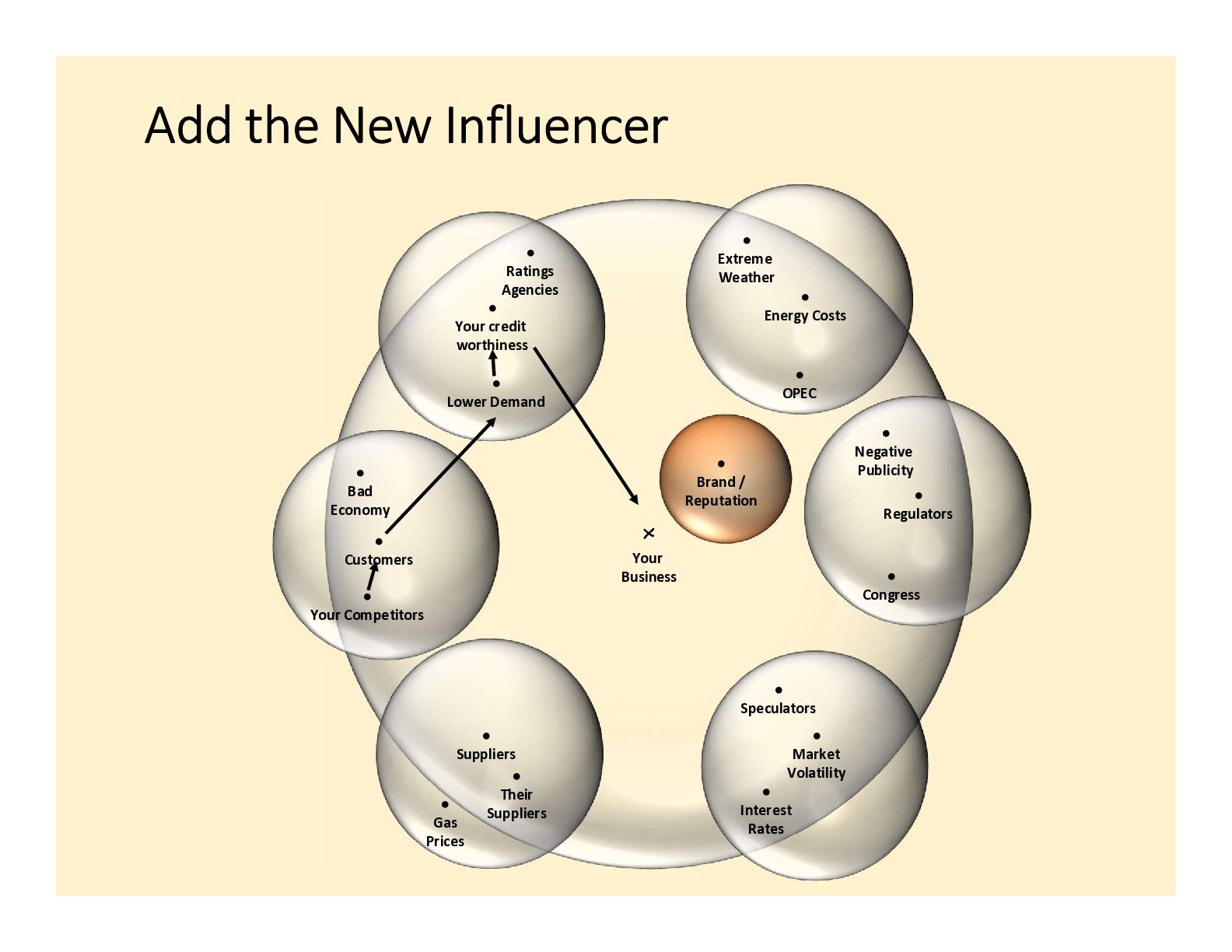
    you hadn’t listed yet. Continuing the “New Competitors” example, lost market share decreased your revenues and harmed your creditworthiness. These developments point to risk in a category we haven’t discussed yet—your brand and reputation. Lost market share Decreased creditworthiness Damaged brand/ reputation
  35. Add the New Influencer • Extreme Weather • Ratings Agencies

    • Energy Costs • Your credit worthiness • OPEC • Lower Demand • Negative Publicity • Brand / Reputation • Bad Economy • Regulators × • Customers Your Business • Congress • Your Competitors • Speculators • Suppliers • Their • Suppliers Gas Prices • Market Volatility • Interest Rates
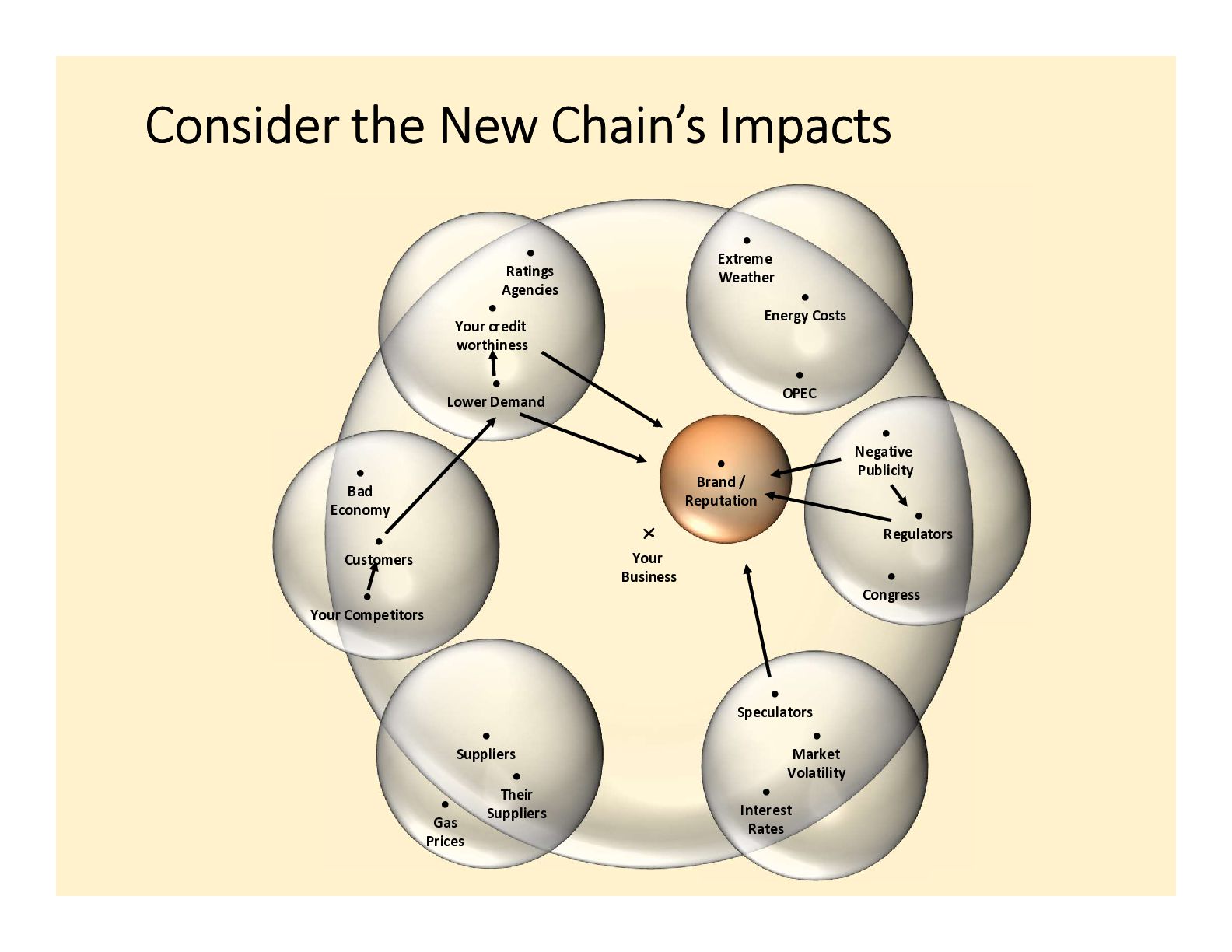
  36. Explore the New Chain Damage to your reputation can have

    grave consequences. It’s important to have a response plan in place ahead of time, because this can snowball quickly: • We already mentioned that analysts publicly questioning your stability can hurt your creditworthiness. • This could also prompt speculators to start generating rumors about your business. • Regulators might then impose heightened standards and more frequent reviews on you. • Your customers and clients may even initiate their own worst-case assessments concerning your relationship.
  37. Consider the New Chain’s Impacts • Extreme Weather • Ratings

    Agencies • Energy Costs • Your credit worthiness • OPEC • Lower Demand • Negative Publicity • Brand / Reputation • Bad Economy • Regulators × • Customers Your Business • Congress • Your Competitors • Speculators • Suppliers • Their • Suppliers Gas Prices • Market Volatility • Interest Rates
  38. Manage Risk Preemptively The previous example showed a range of

    negative results that all stemmed from a new competitor entering your market. Once you’ve identified a potential threat, consider ways to respond to it ahead of time. For example: • Take good care of your customers and clients, so they’ll stay with you when a competitor makes them an offer. • Identify what makes you different from your competition, and stress that—in your operations and your publicity. • Know your market—be prepared to handle a price war.
  39. It’s Not All Bad We’ve been focused on identifying and

    managing hidden risks, but this process can also yield more positive results. Although it’s not possible to identify everything that can go wrong, this approach generates an awareness that helps you identify resources, explore options, and respond when the truly unexpected occurs. Additionally, a process that seeks out hidden risks can also reveal hidden opportunities. Be on the lookout for those positive discoveries as you examine chains of interconnection.
  40. Moving Forward Once you’ve identified a vulnerability, take action to

    reduce or avoid it before trouble arrives. Perform this analysis on a continuous basis—circumstances change, and new complications can arise. Modify the sphere approach to suit your needs. Consider breaking down each influencer (and your business) into smaller categories for more precise analysis. Test different ways of representing the relationships, such as color coding or enlarged sizes, to represent different kinds of influencers.
  41. Summary Follow this approach to identify and manage hidden risks:

    1. Imagine your business as the center of a sphere that contains all the factors and entities that influence it, and then analyze those relationships in terms of risk. 2. Give each of those influencers its own sphere, containing the factors and entities that impact it, and analyze how those relationships could indirectly influence you. 3. Wargame possible events at different points on these chains of interconnection, and then consider how you can avoid, mitigate, or react to them.
  42. About the Author Vincent H. O’Neil is an experienced risk

    manager, writer, and public speaker. He holds a bachelor’s degree from West Point and a master’s degree from The Fletcher School. He’s also the author of the Frank Cole mystery novels from St. Martin’s Press and the Sim War science fiction series (written as Henry V. O’Neil) from HarperCollins. www.vincenthoneil.com www.linkedin.com/in/vincenthoneil