Upgrade to Pro — share decks privately, control downloads, hide ads and more …

Active Defense: Shaping the Threat Environment

Active Defense: Shaping the Threat Environment

(Originally published on January 9, 2025 in the US Army Futures Command Mad Scientist Initiative’s blog)

In this era of increasing state-on-state violence and decreasing reaction times, passive defense postures may no longer be tenable. Defense strategists now need a more active approach that provides early warning and discourages attacks. This approach is called active defense.

Active defense is a proactive security program that pairs comprehensive intelligence collection with operations designed to distract, disrupt, and degrade a hostile party’s offensive capabilities.

While this article discusses active defense in terms of a nation managing its security, it can apply to any group of people facing a genuine threat of organized violence. Active defense is especially useful for entities that aren’t strong enough to defeat armed aggression.

#NationalSecurity #PublicPolicy #ForeignPolicy #Defense #DefenseStrategy

foreign policy, national security, public policy, defense, defense strategy

Avatar for Vincent H. O'Neil

Vincent H. O'Neil

October 04, 2026

More Decks by Vincent H. O'Neil

Other Decks in Business

Transcript

  1. By Vincent H. O’Neil Published on January 9, 2025 in

    the US Army Futures Command Mad Scientist Initiative’s blog. https://madsciblog.tradoc.army.mil/519-active-defense-shaping-the-threat-environment Disclaimer: The views expressed in this blog post do not necessarily reflect those of the U.S. Department of Defense, Department of the Army, Army Futures Command (AFC), or Training and Doctrine Command (TRADOC).
  2. Introduction In this era of increasing state-on-state violence and decreasing

    reaction times, passive defense postures may no longer be tenable. Defense strategists now need a more active approach that provides early warning and discourages attacks. This approach is called active defense. Active defense is a proactive security program that pairs comprehensive intelligence collection with operations designed to degrade a hostile party’s offensive capabilities. While this article discusses active defense in terms of a nation managing its security, it can apply to any group of people facing a genuine threat of organized violence. Active defense is especially useful for entities that aren’t strong enough to defeat armed aggression.
  3. 1. Intelligence Collection For this discussion, intelligence is defined as

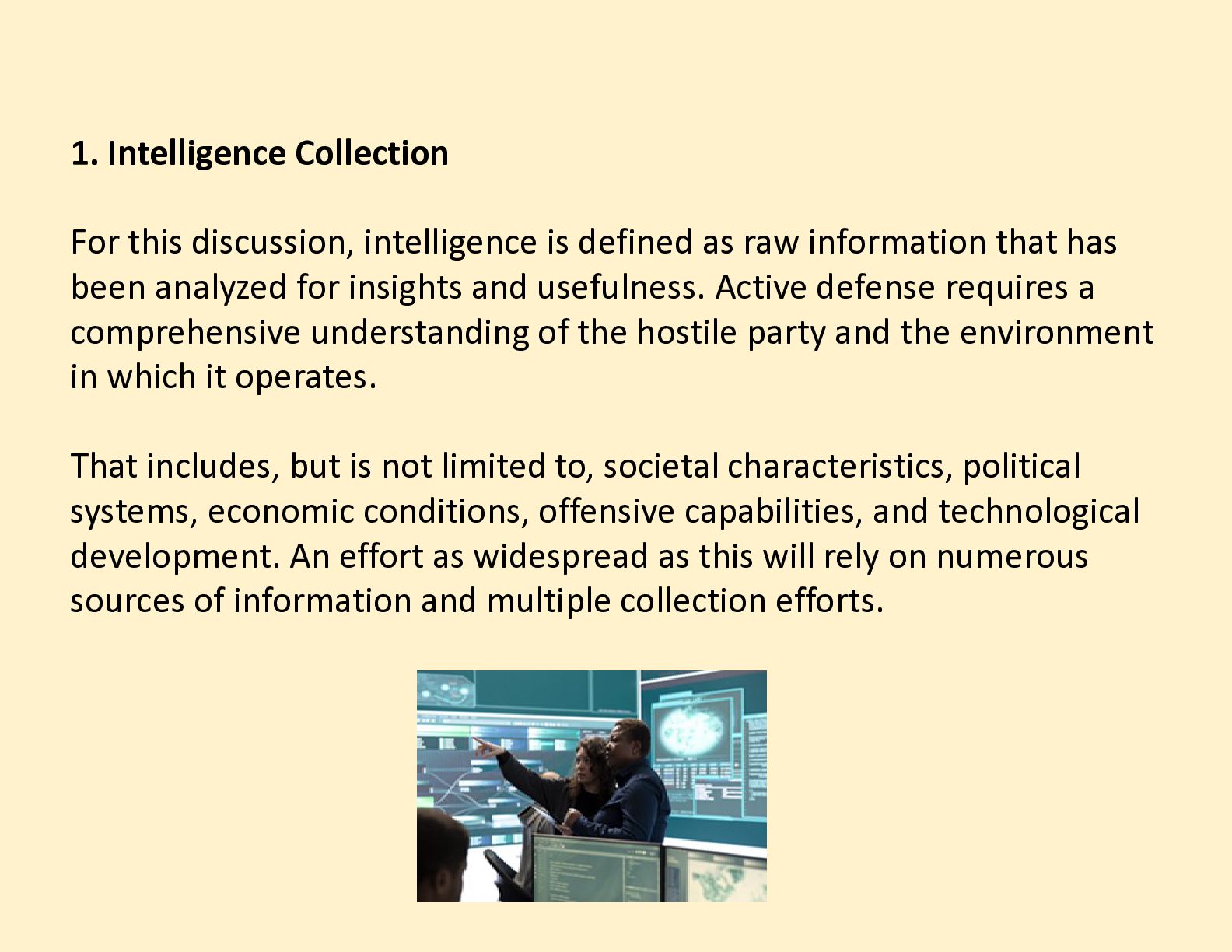
    raw information that has been analyzed for insights and usefulness. Active defense requires a comprehensive understanding of the hostile party and the environment in which it operates. That includes, but is not limited to, societal characteristics, political systems, economic conditions, offensive capabilities, and technological development. An effort as widespread as this will rely on numerous sources of information and multiple collection efforts.
  4. Innovative intelligence efforts The intelligence environment changes constantly, so the

    methods for gathering information must continuously evolve. Studying entities outside the intelligence community that also gather and analyze information can help enhance existing procedures. Here are some possible sources of inspiration: • International law enforcement: These agencies leverage both electronic and human sources across the globe to surveil and infiltrate criminal organizations, an approach that fits active defense. • Corporate security forces: The full-spectrum, never-ending nature of this work is similar to a nation defending itself from external aggressors. • Private investigators: Their ability to recruit knowledgeable people willing to divulge derogatory information has similar application in active defense intelligence collection.
  5. Establish the information’s accuracy Verification of intelligence is crucial, and

    it can come from a portion of the collection effort different from the part that generated the lead. To properly vet new information, an intelligence collection effort must be put in place long before a threat gets in motion. Establishing sources during periods of peace also provides time to determine which ones are reliable and drop those which are not. Additionally, a robust verification network can provide feedback on the effectiveness of active defense operations launched to thwart an opponent’s aggressive planning.
  6. Keep the footprint small Active defense works best when the

    opponent is unaware of it. When undercover operatives are deployed inside an adversary’s borders, their numbers should be kept to a minimum. Recruit reliable local resources who speak the language, understand the culture, and know its politics. Practitioners of active defense should leverage existing entities that are already a problem for a belligerent regime. Creating opposition groups in the adversary’s territory is difficult, and can be traced back to its sponsors. Shaping the conflict environment naturally, by exploiting organic entities and ongoing frictions, can help keep an active defense program hidden. These existing groups do not necessarily have to know they are being used in this fashion.
  7. Develop a wide range of human sources Active defense uses

    the full spectrum of intelligence collection, from satellite imagery to paid informants. When practitioners lack high-tech capabilities, they may have to rely more heavily on human sources. These contacts can be found or created using techniques both new and old. For example, covert operatives can recruit members of an opponent’s government as informants or trick them into divulging secrets. Disgruntled employees and disenchanted supporters are exploitable weak spots in otherwise sound security systems.
  8. Identify unlikely sources No matter how tight a hostile party’s

    security might be, there are always people who know things they shouldn’t. Managers of a regime’s communications systems, maintenance workers in government buildings, and even the family members of an opponent’s leadership can detect signs that a big operation is imminent. Active defense practitioners need to use imagination to locate and exploit such people. Paid informants are a prime source of early warning, even when they have no direct link to the adversary regime. Some everyday citizens know the difference between routine military maneuvers and preparations for an attack. While a single individual sending a warning may not be actionable, developing a network of human sources can help confirm or disqualify that alert.
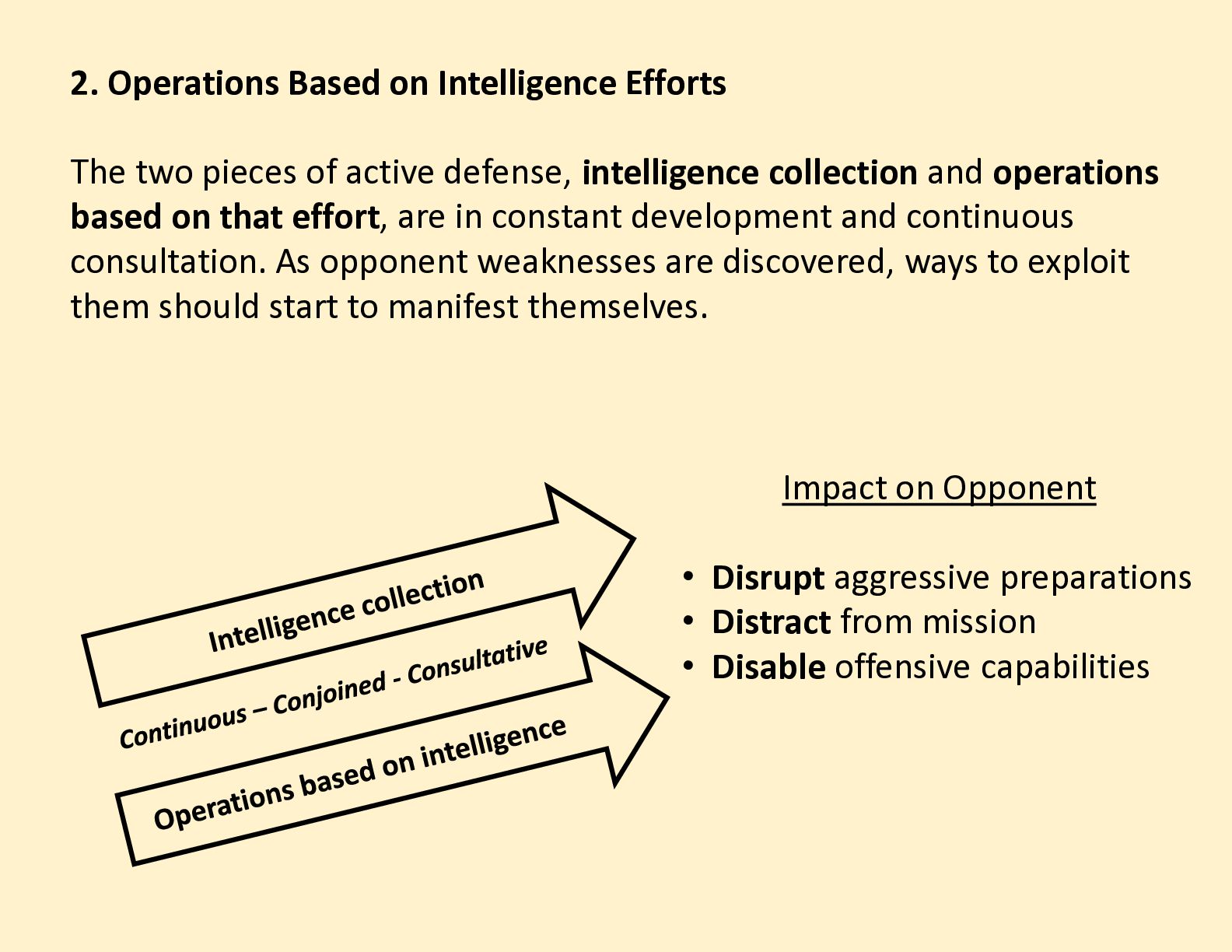
  9. 2. Operations Based on Intelligence Efforts The two pieces of

    active defense, intelligence collection and operations based on that effort, are in constant development and continuous consultation. As opponent weaknesses are discovered, ways to exploit them should start to manifest themselves. Impact on Opponent • Disrupt aggressive preparations • Distract from mission • Disable offensive capabilities
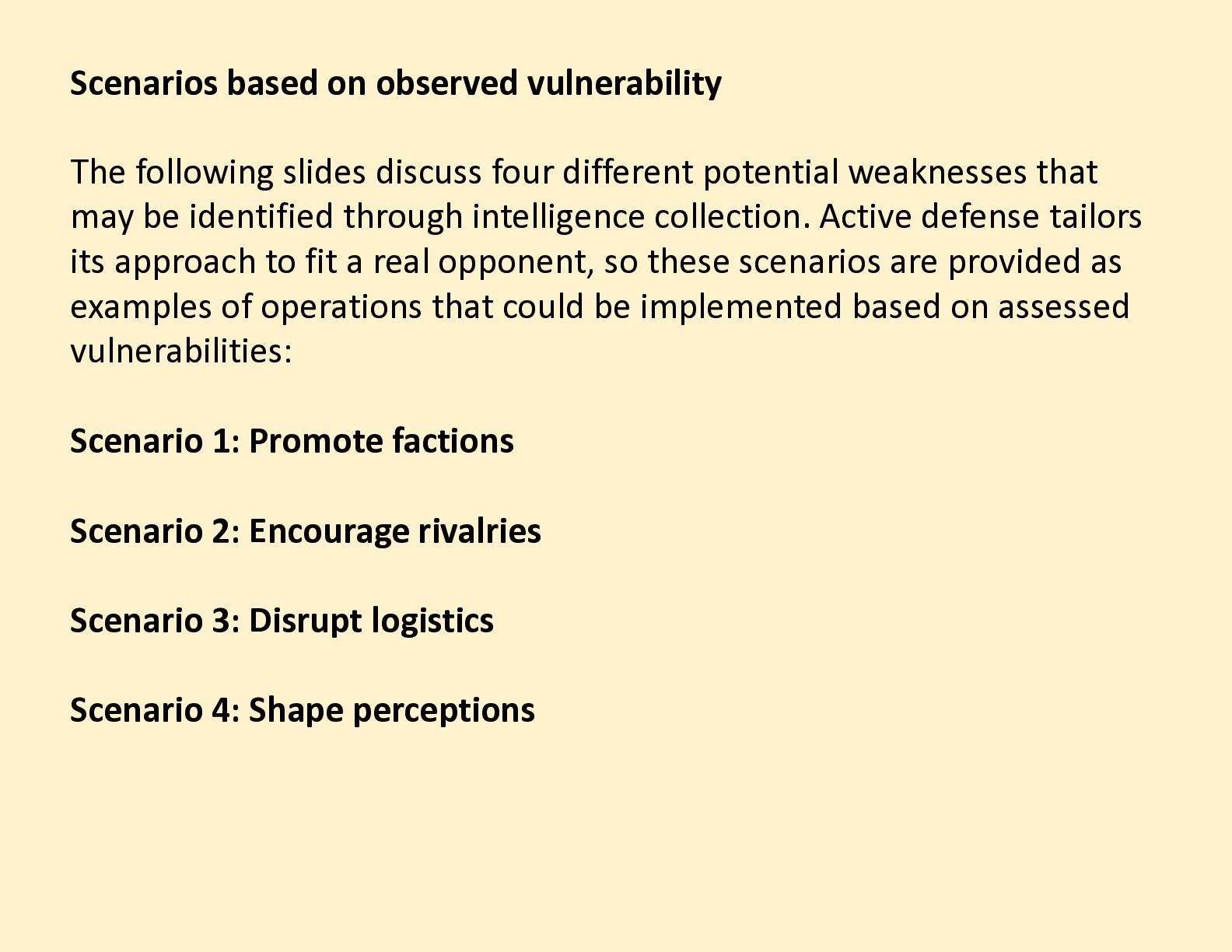
  10. Scenarios based on observed vulnerability The following slides discuss four

    different potential weaknesses that may be identified through intelligence collection. Active defense tailors its approach to fit a real opponent, so these scenarios are provided as examples of operations that could be implemented based on assessed vulnerabilities: Scenario 1: Promote factions Scenario 2: Encourage rivalries Scenario 3: Disrupt logistics Scenario 4: Shape perceptions
  11. Scenario 1: Promote factions Very few regimes or organizations are

    uniform in their views. Even groups who espouse the same ideology will have differences of opinion. If dissenting views are ignored, it creates resentment and factionalism. Leveraging those divisions can reduce an opponent’s ability to strike. Factions can be also provide intelligence, with their intimate knowledge of a regime and/or motivation to share information harmful to it. Encouraging factional disputes can be passive or active. An extreme dissident group might accept an offer of monetary or technical assistance while a more moderate faction may require a less direct approach. In both cases, concealing the presence of an active defense campaign shields the recipients from the taint of outside influence.
  12. Methods for promoting factions • If the news media operates

    freely inside the opponent nation, leverage it to praise the dissidents or incite them to greater effort. If social media is available, use it to raise awareness of the faction and broadcast its argument. In places where news and the Internet are restricted, learn how opinions are covertly expressed. Identify channels of dissenting opinion that have worked in the past, and utilize them. • If a faction is openly publicizing its views, boost that signal. If they aren’t speaking out, do it for them. Use all available means of communication, from the Internet to word of mouth, to let people know there is an alternative to the regime and its policies. • Promote factions externally through diplomacy. Raise their status by insisting that dissenting parties are named and included in negotiations. Refer to them as serious players in public statements, and convince other nations to show them respect.
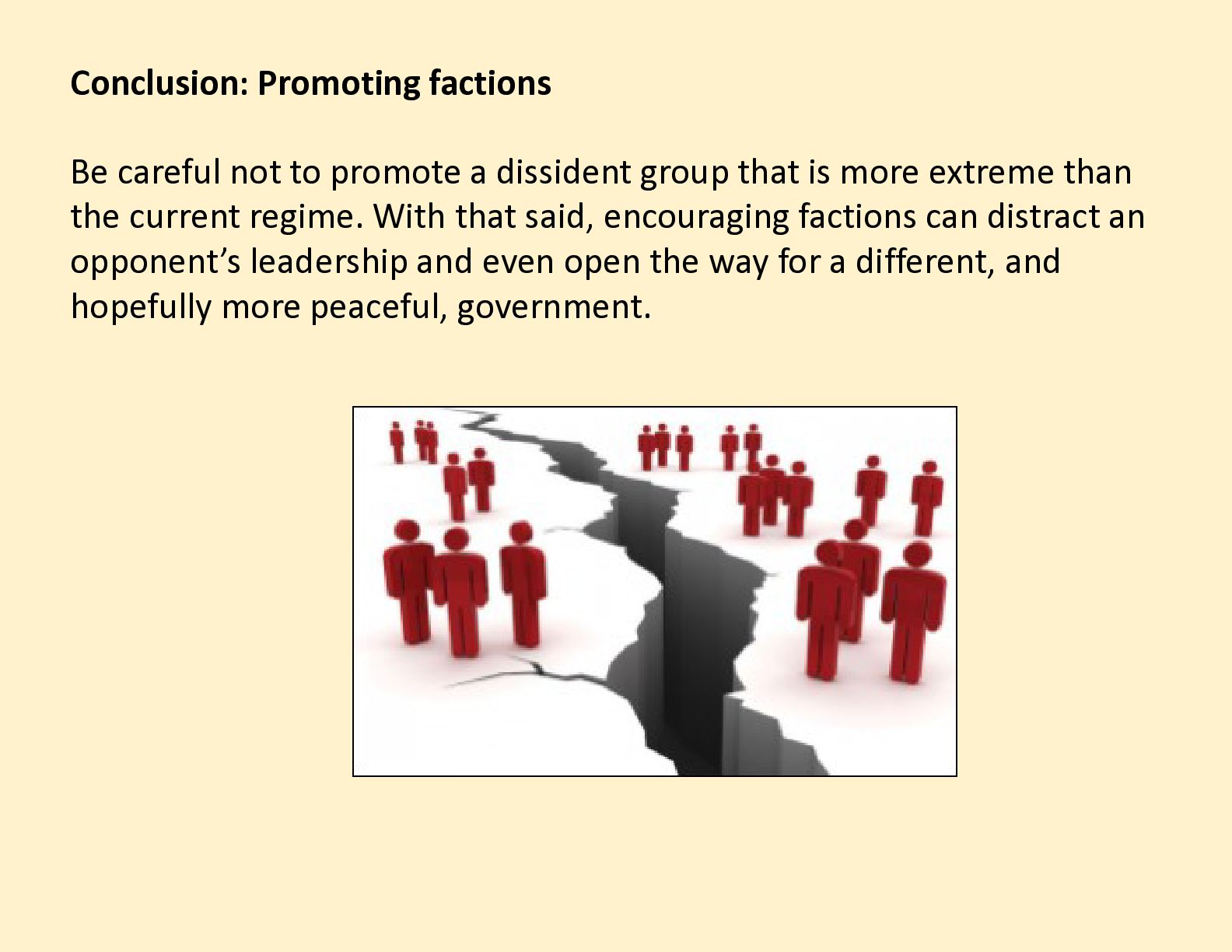
  13. Conclusion: Promoting factions Be careful not to promote a dissident

    group that is more extreme than the current regime. With that said, encouraging factions can distract an opponent’s leadership and even open the way for a different, and hopefully more peaceful, government.
  14. Scenario 2: Encourage rivalries This potential weakness exists on at

    least two levels: 1) inside the regime where leaders may be feuding, and 2) outside the opponent nation where competitors oppose its aims. • Internal rivals: Consider relative position. If one player outranks the other, the subordinate may be jealous while the senior feels insecure. Use news reports, official statements, intentionally leaked intelligence estimates, and rumors to praise one and prod the other. • External competitors: Aggravate the major points of contention, such as control of contested territory or seniority in international affairs. Provide the rival with key intelligence, improved technology, or material support to force an adversary to reorient its focus on that danger. If the conflict is existential, both parties will have to dedicate time and resources to defending themselves.
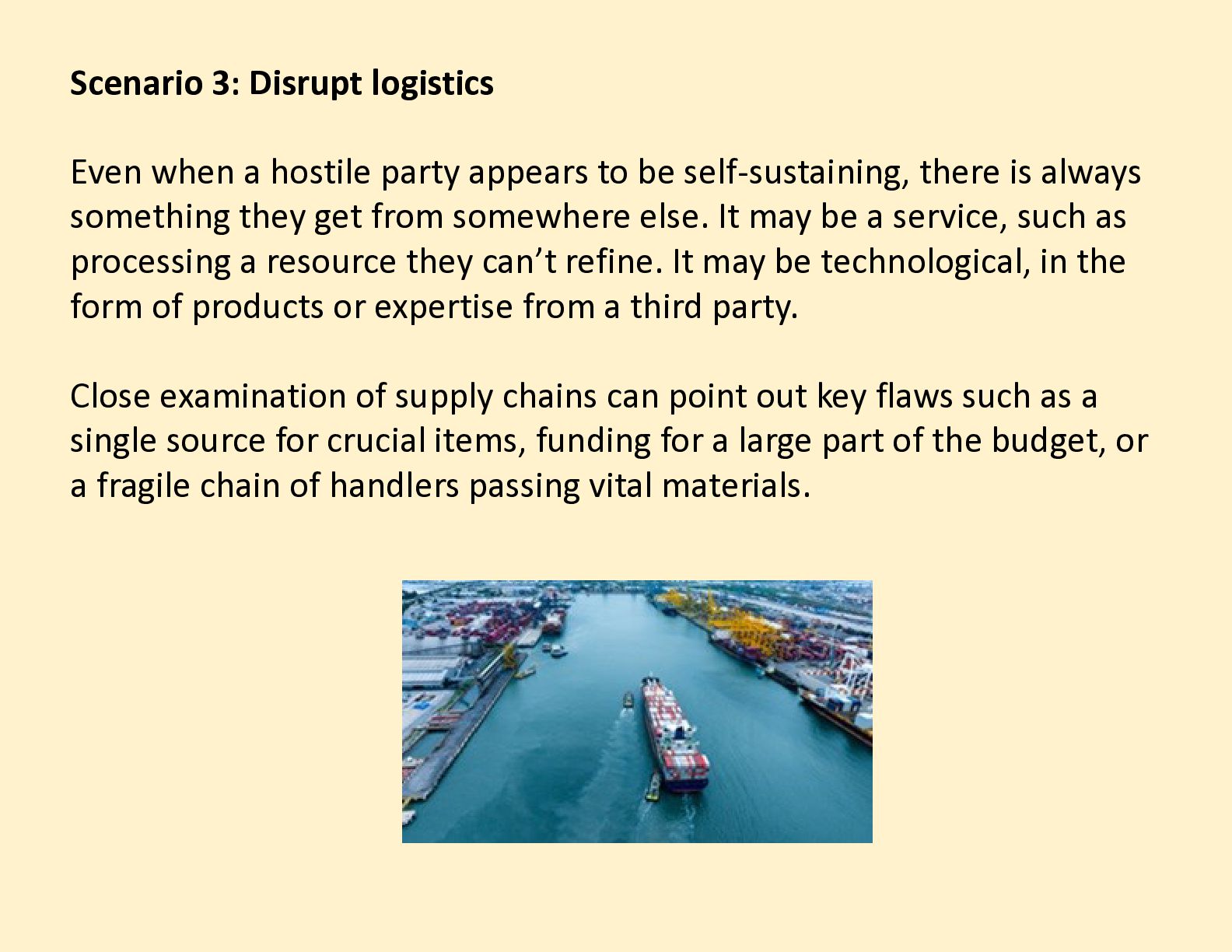
  15. Scenario 3: Disrupt logistics Even when a hostile party appears

    to be self-sustaining, there is always something they get from somewhere else. It may be a service, such as processing a resource they can’t refine. It may be technological, in the form of products or expertise from a third party. Close examination of supply chains can point out key flaws such as a single source for crucial items, funding for a large part of the budget, or a fragile chain of handlers passing vital materials.
  16. Methods for disrupting logistics • Leverage the law. If a

    hostile party’s suppliers are breaking any law in any way, collect evidence and report them. Get international bodies involved, to confuse the adversary about who is disrupting the supply lines and raise a public outcry against their misdeeds. Threaten their access to the electronic money transfer system to complicate payments and convince legitimate suppliers to stop supporting them. • Make simple things hurt. When supply lines can’t be severed, making them less accessible or more expensive still harms the recipient. Active defense operates on multiple axes, so forcing an adversary to wait longer and pay more for needed assistance complements other efforts. • Increase doubts. If a hostile party’s supply chain is open to physical interference, add substandard items to that flow. The receipt of dud ammunition, faulty electronics, or half-empty crates may generate accusations and denials—which may end the entire relationship.
  17. Scenario 4: Shape perceptions A hostile regime or organization that

    actively promotes a narrative about itself may live in fear of the truth. Spotlighting contradictions between the image and the reality can give voice to alternative movements or leadership. • Combat lies with facts. A belligerent regime may create a propaganda campaign to make itself look better and blame the conflict on its intended victim. The ongoing collection of intelligence in active defense may provide evidence to the contrary. Publicize derogatory information about the opponent, along with proof, to disprove propaganda. • Sway public opinion among the adversary’s constituents. If the regime forces its people to live in austerity while funding military needs, popular disapproval should already exist. Give those voices the tools to make themselves heard.
  18. Guidance for shaping perceptions Intelligence collection inside the hostile party’s

    borders should indicate which means (social media, word of mouth, or some other method) can be used to fan existing discontent. Base this approach in the truth, but don’t forget there is a role for satire as well. Regimes that rule by fear are greatly threatened by public ridicule. Some regimes base their legitimacy on the promised defeat of another entity. Disrupting their attack plans and logistics can cause repeated postponements. In the face of such prolonged inaction, the regime may find itself endangered by demands for a change in policy. While such a development is a goal of active defense, remember that an opponent facing internal dissent may launch an attack just to stay in power. Never assume a hostile party is a rational actor.
  19. Conclusion Active defense seizes the initiative, preventing opponents from preparing

    at their leisure and attacking when they choose. While it cannot take the place of an armed force trained and ready to oppose aggression, it can greatly assist that security effort. While active defense is tailored to fit a given opponent, practitioners should keep the following guidance in mind: • Create a self-verifying intelligence effort long before it’s needed. • Seek inspiration from actors outside traditional defense organizations. • Conceal the campaign by leveraging local entities and frictions. • Evolve new techniques to stay ahead of the changing environment.
  20. About the author Vincent H. O’Neil is an award-winning novelist

    in the mystery and science fiction genres. He holds a master’s degree in international relations from The Fletcher School and a bachelor’s degree from West Point. He is also a graduate of the Defense Language Institute’s Mandarin Chinese program and the U.S. Army Command & General Staff College. His website is www.vincenthoneil.com