Share
Embed
The Never-ending brainstorm: Tips for writers and other creatives
In this presentation, award-winning novelist Vincent H. O'Neil shows the different ways to diagram brainstorming ideas so that new ideas keep coming.
#writing #writingtips #brainstorming #ideas #creative #stortytelling
writing, writing tips, brainstorming, ideas, creative, storytelling
Vincent H. O'Neil
October 19, 2026
Transcript
37 slides
-
The Never-ending Brainstorm Taking your inspiration from a gentle breeze
to a full-blown hurricane Vincent H. O’Neil (aka Henry V. O’Neil) www.vincenthoneil.com -
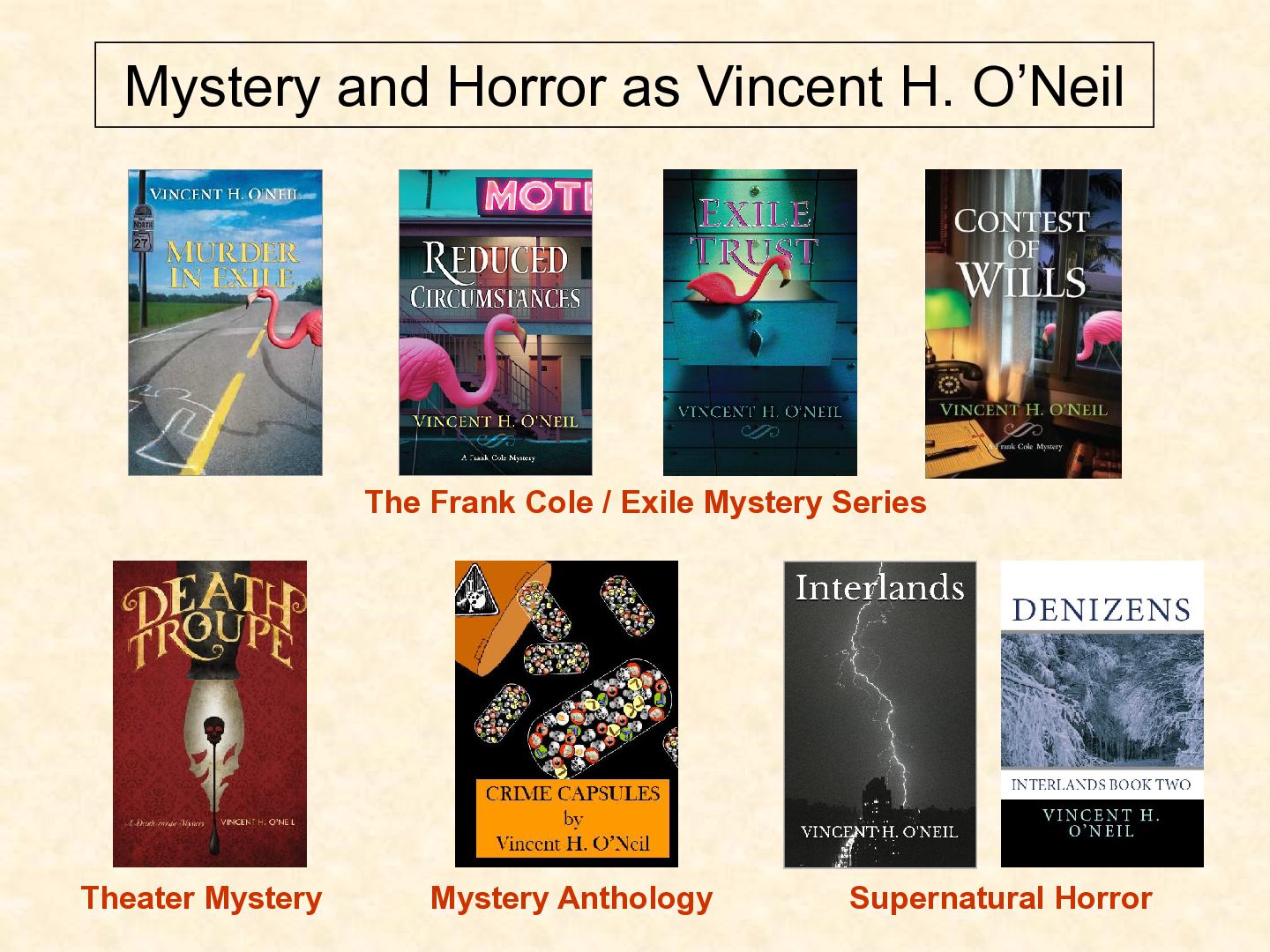
Mystery and Horror as Vincent H. O’Neil The Frank Cole
/ Exile Mystery Series Theater Mystery Mystery Anthology Supernatural Horror -
Purpose Ever get halfway through writing a story and then
think of a better way to tell it? That might be because brainstorming isn’t just something we do in the planning phase: Brainstorming is an ongoing process -
Outline • Standard brainstorming • Developing the initial ideas •
Digging deeper • Revisiting the story • Other techniques -
Brainstorming • Even if you have a full-blown story in
your head, ready to be written, take the time to brainstorm it • Brainstorming lets one good idea lead to another • It really pays off -
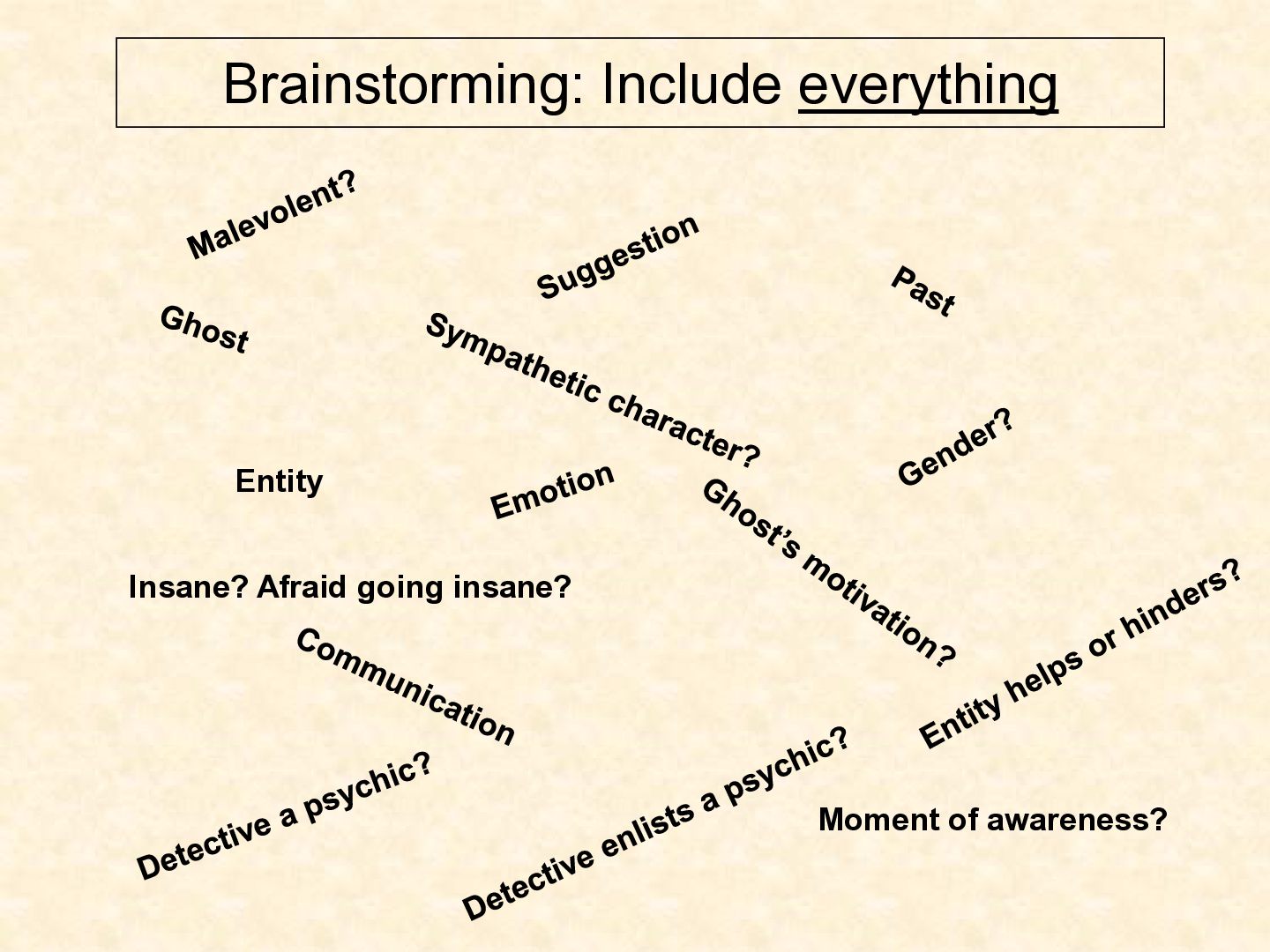
Standard brainstorming • Do some research (if applicable) • Write
phrases and words on a sheet / sheets of paper in random order • Jot down everything that comes to mind, no matter how irrelevant it might seem • Don’t try to connect the ideas yet -
Example topic In this presentation, the example topic is a
murder mystery involving a supernatural entity (helping solve the crime, suggesting the crime, whatever) The resulting short story, “Secret Suggestion”, can be found in my mystery anthology Crime Capsules -
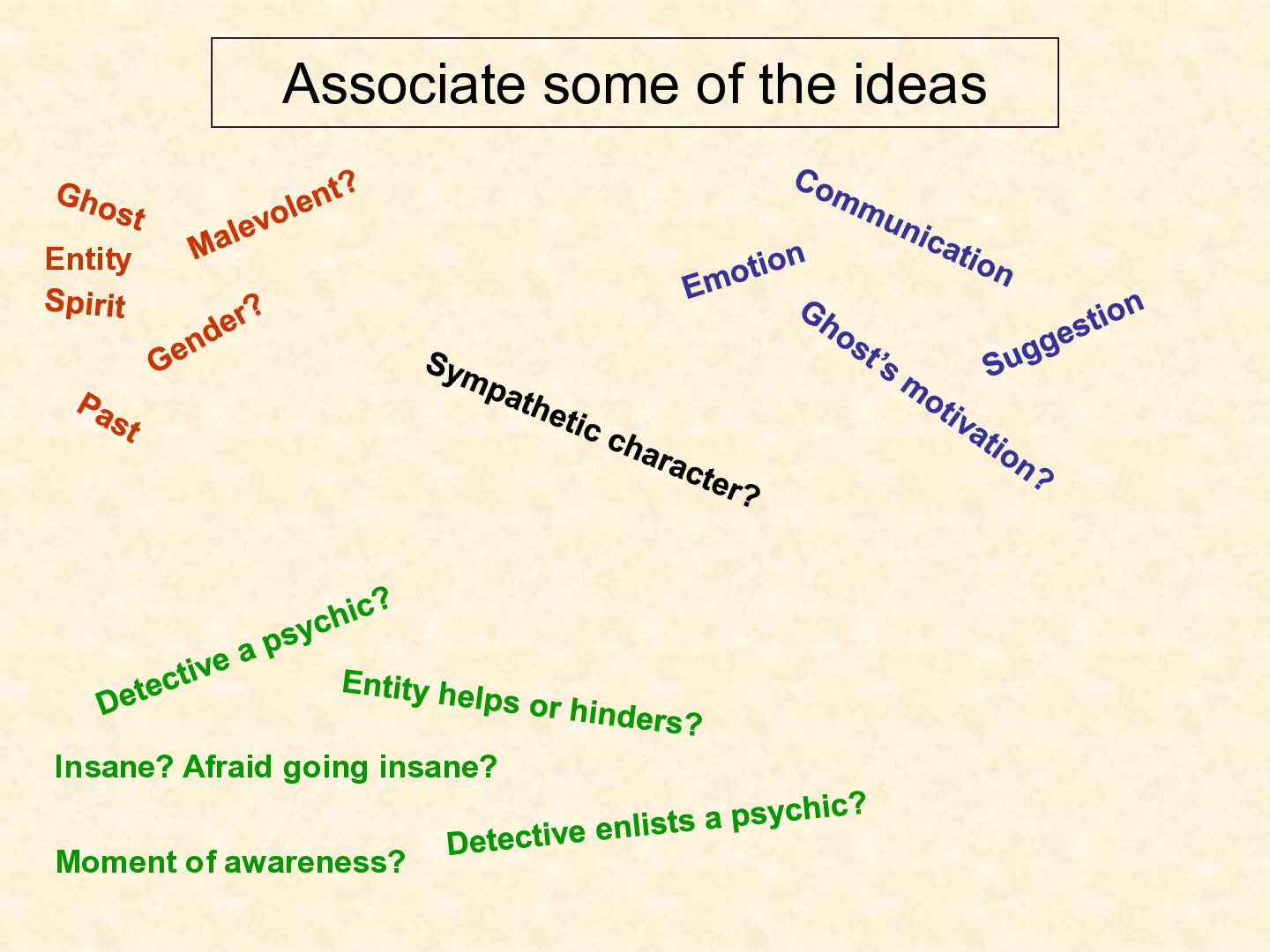
Associate some of the ideas Entity Insane? Afraid going insane?
Moment of awareness? -
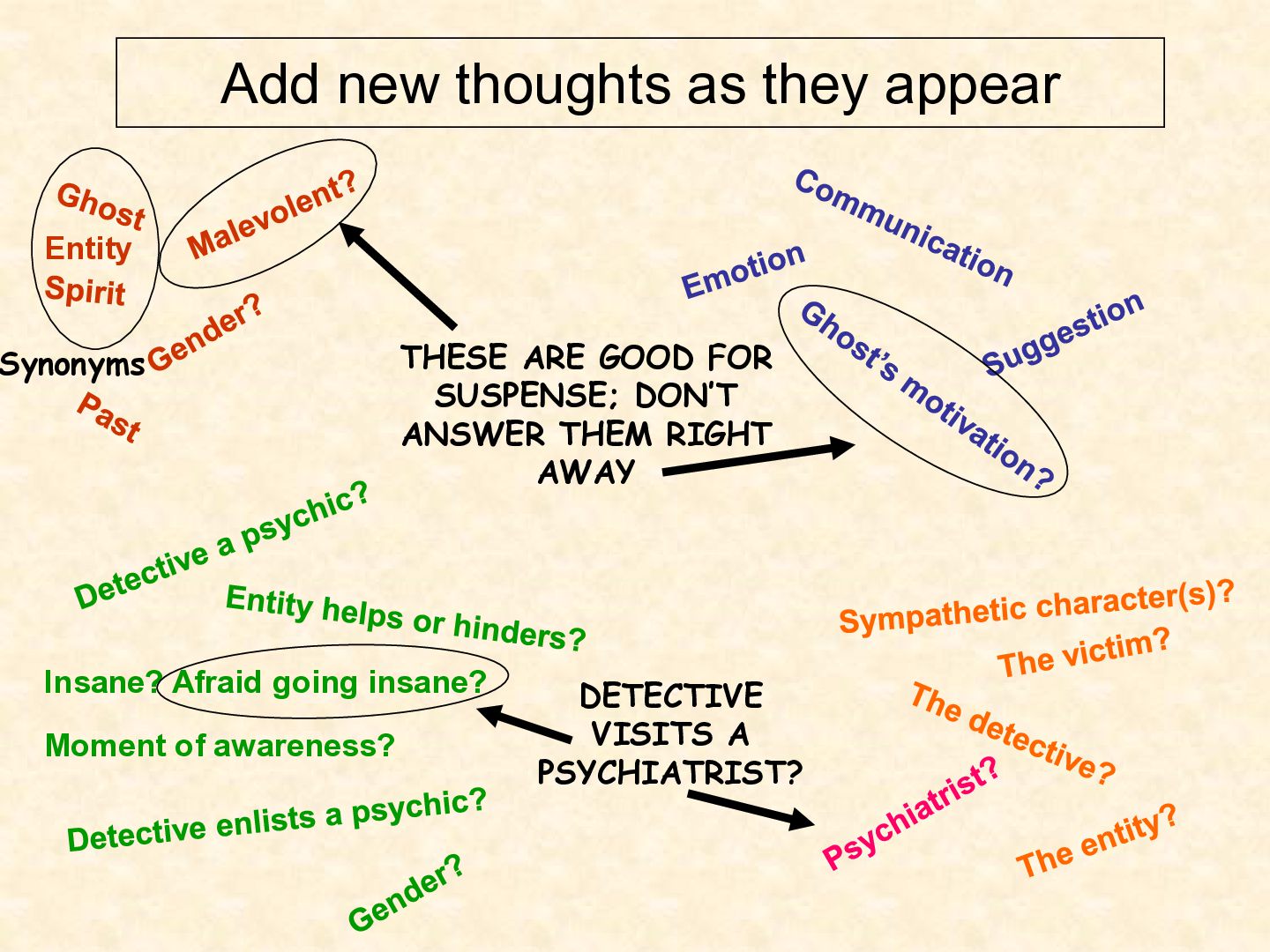
Add new thoughts as they appear Entity Synonyms THESE ARE
GOOD FOR SUSPENSE; DON’T ANSWER THEM RIGHT AWAY Insane? Afraid going insane? Moment of awareness? DETECTIVE VISITS A PSYCHIATRIST? -
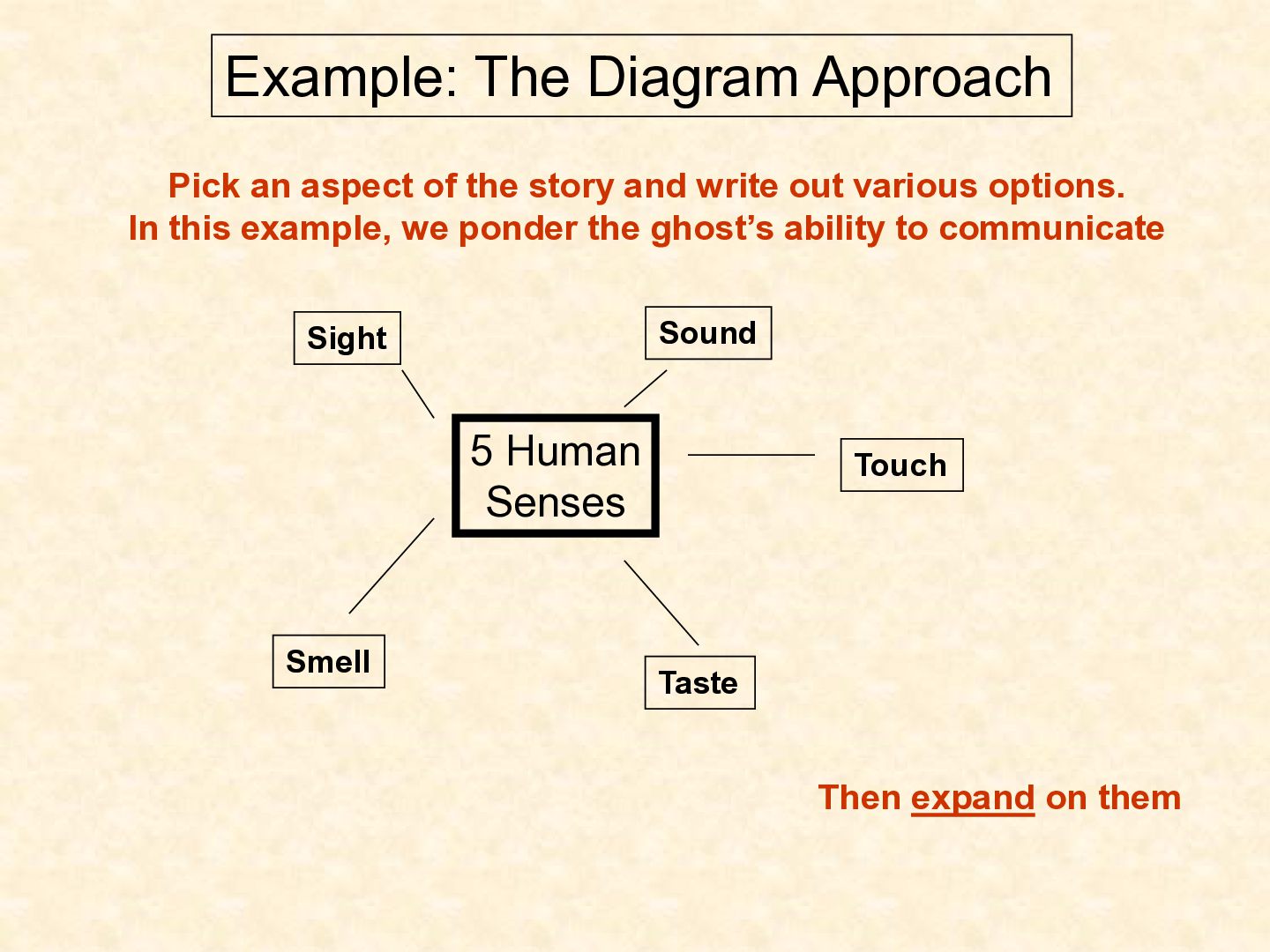
Example: The Diagram Approach Pick an aspect of the story
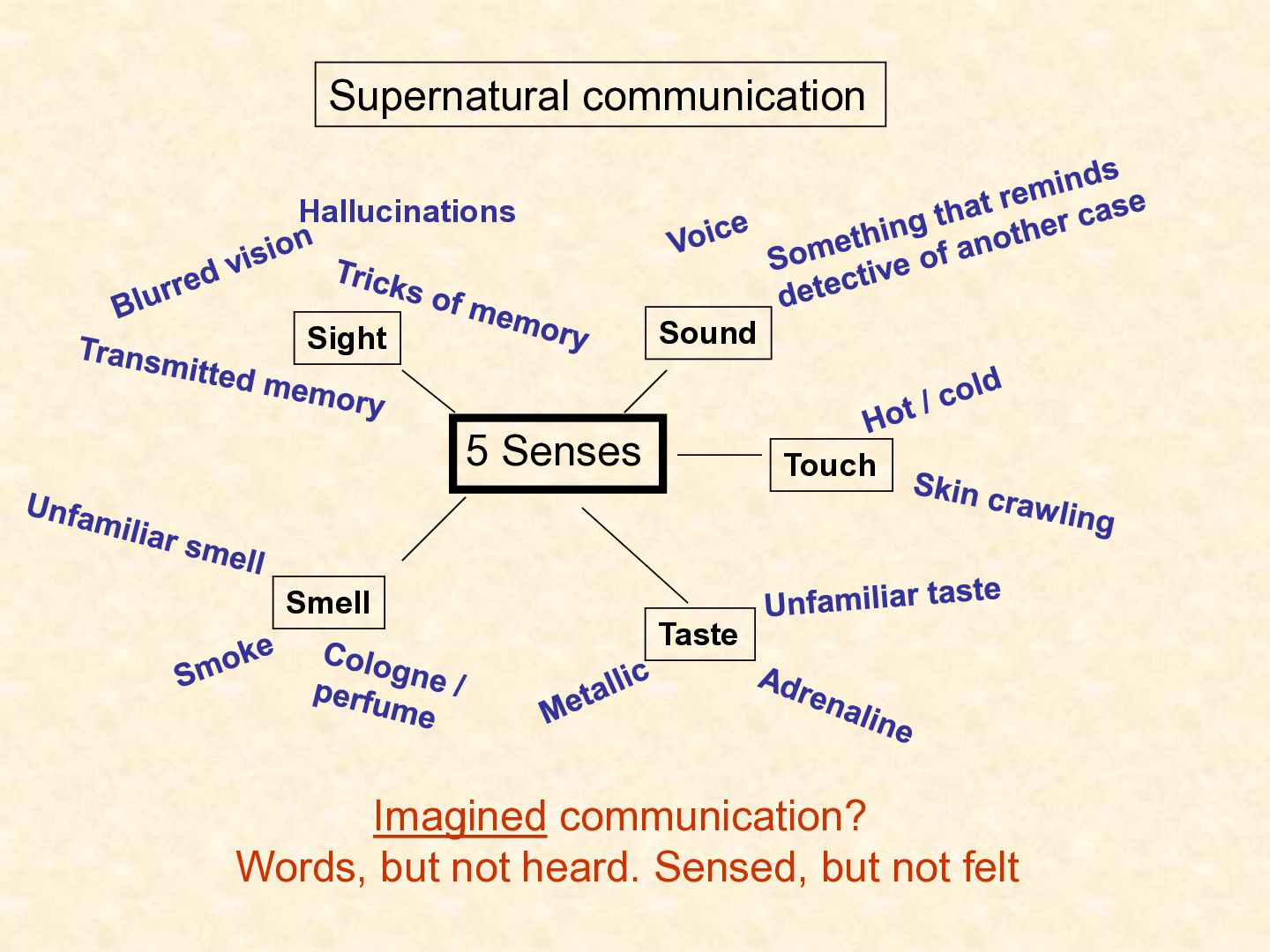
and write out various options. In this example, we ponder the ghost’s ability to communicate Sound Sight 5 Human Senses Smell Touch Taste Then expand on them -
Supernatural communication Hallucinations Sound Sight 5 Senses Smell Touch Taste
Imagined communication? Words, but not heard. Sensed, but not felt -
Developing the initial ideas Take the results of the first
rounds of brainstorming and start exploring the different questions that they raise -
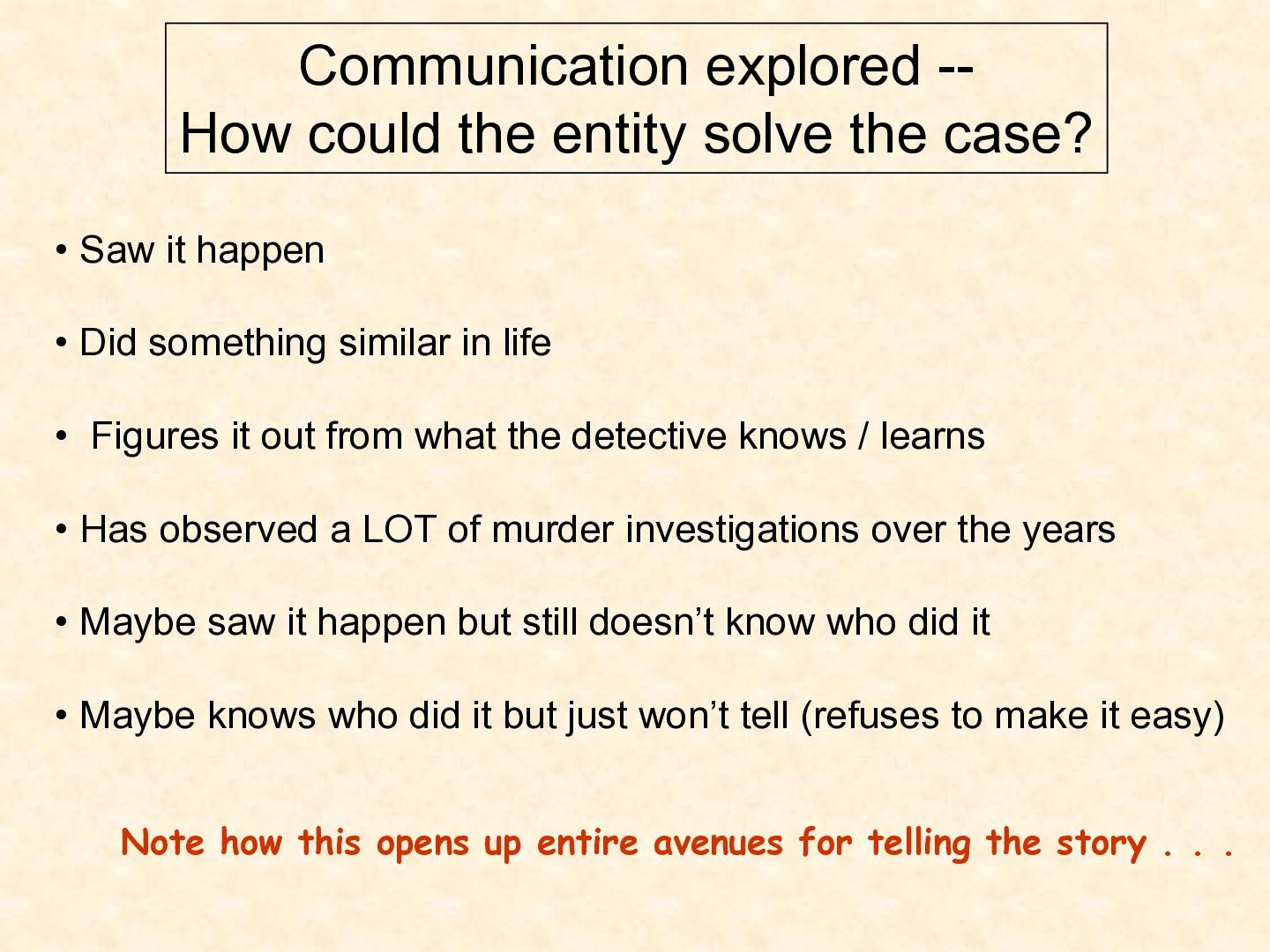
Communication explored -How could the entity solve the case? •
Saw it happen • Did something similar in life • Figures it out from what the detective knows / learns • Has observed a LOT of murder investigations over the years • Maybe saw it happen but still doesn’t know who did it • Maybe knows who did it but just won’t tell (refuses to make it easy) Note how this opens up entire avenues for telling the story . . . -
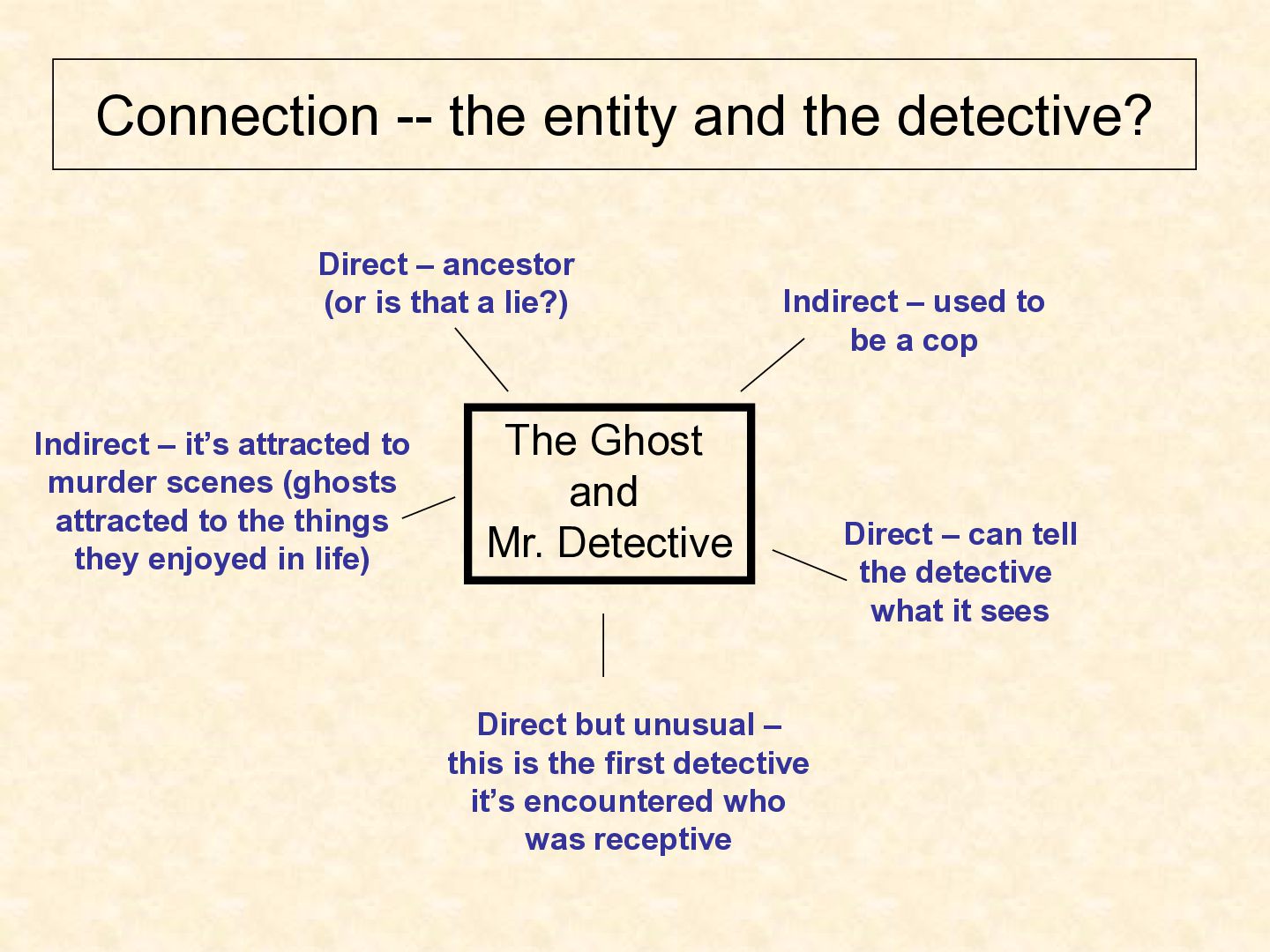
Connection -- the entity and the detective? Direct – ancestor
(or is that a lie?) Indirect – it’s attracted to murder scenes (ghosts attracted to the things they enjoyed in life) Indirect – used to be a cop The Ghost and Mr. Detective Direct but unusual – this is the first detective it’s encountered who was receptive Direct – can tell the detective what it sees -
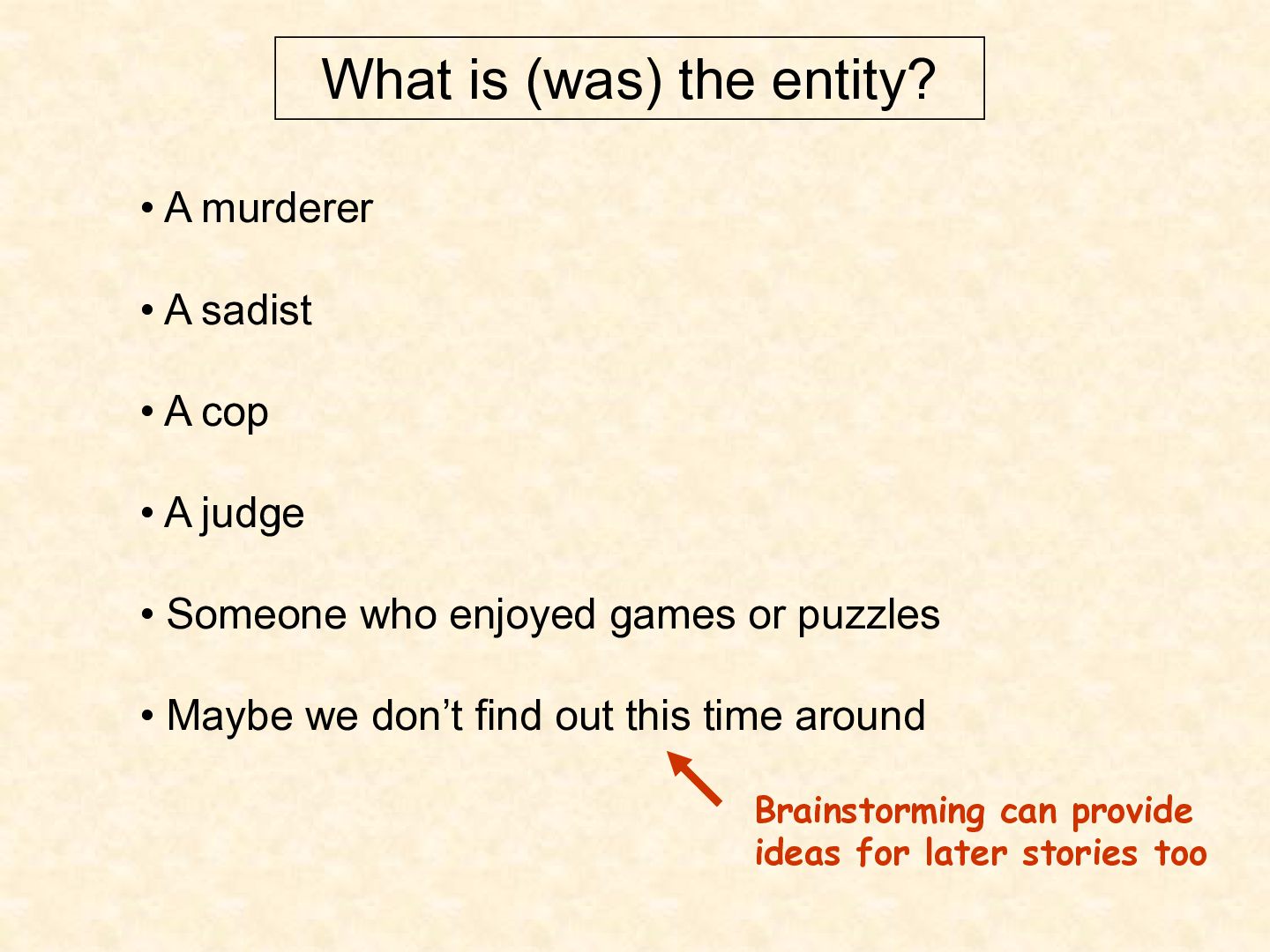
What is (was) the entity? • A murderer • A
sadist • A cop • A judge • Someone who enjoyed games or puzzles • Maybe we don’t find out this time around Brainstorming can provide ideas for later stories too -
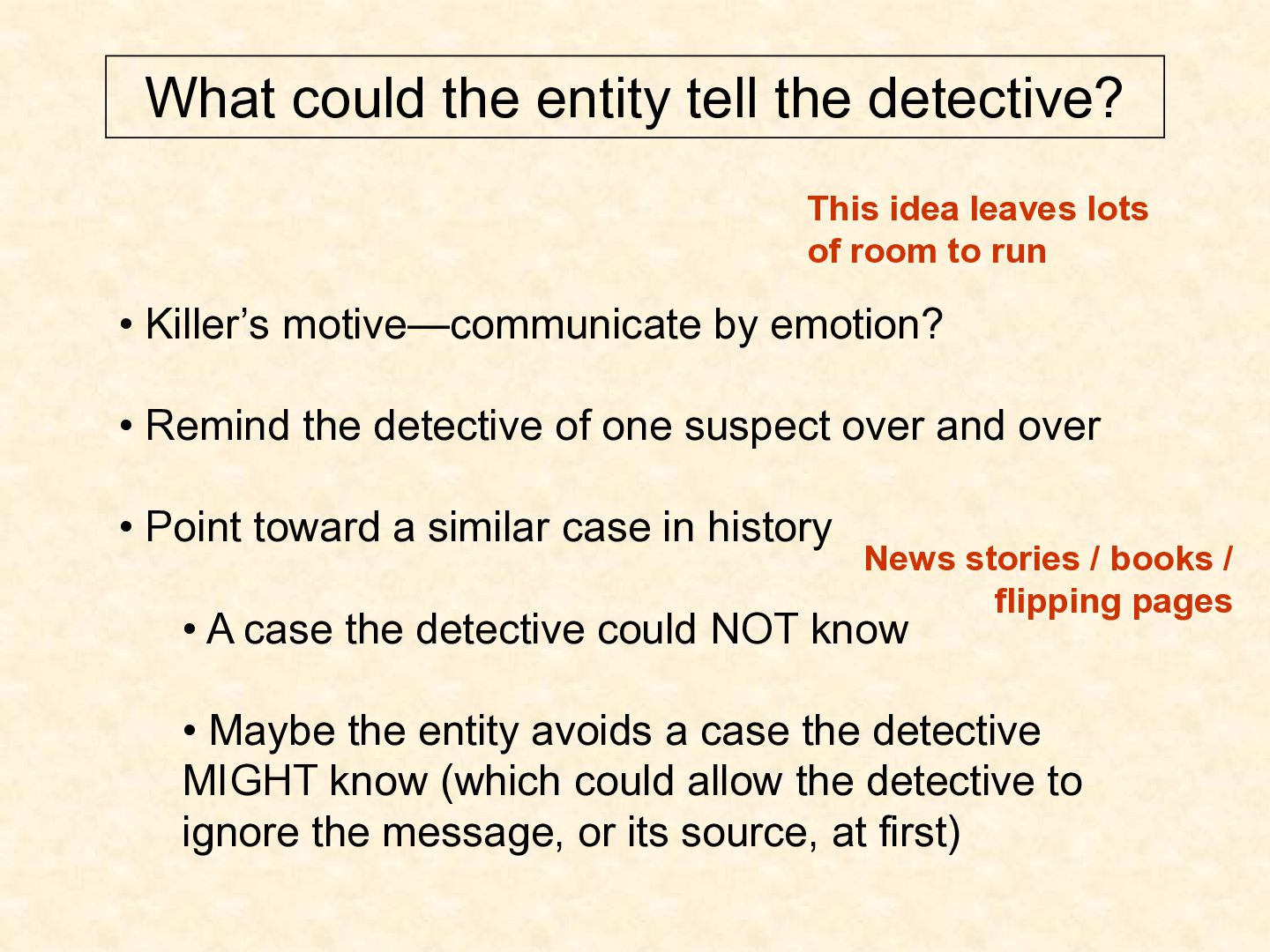
What could the entity tell the detective? This idea leaves
lots of room to run • Killer’s motive—communicate by emotion? • Remind the detective of one suspect over and over • Point toward a similar case in history News stories / books / flipping pages • A case the detective could NOT know • Maybe the entity avoids a case the detective MIGHT know (which could allow the detective to ignore the message, or its source, at first) -
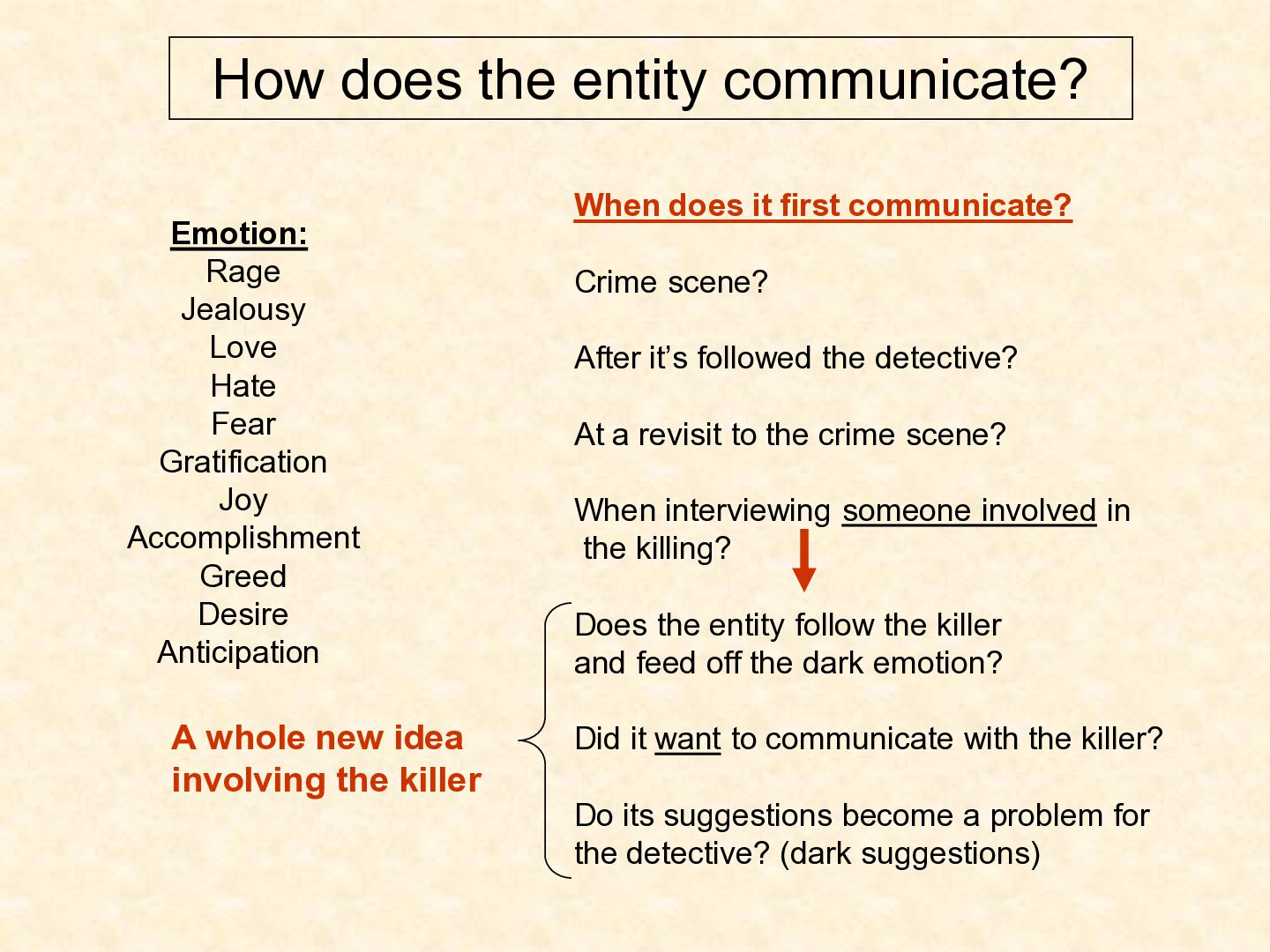
How does the entity communicate? Emotion: Rage Jealousy Love Hate
Fear Gratification Joy Accomplishment Greed Desire Anticipation A whole new idea involving the killer When does it first communicate? Crime scene? After it’s followed the detective? At a revisit to the crime scene? When interviewing someone involved in the killing? Does the entity follow the killer and feed off the dark emotion? Did it want to communicate with the killer? Do its suggestions become a problem for the detective? (dark suggestions) -
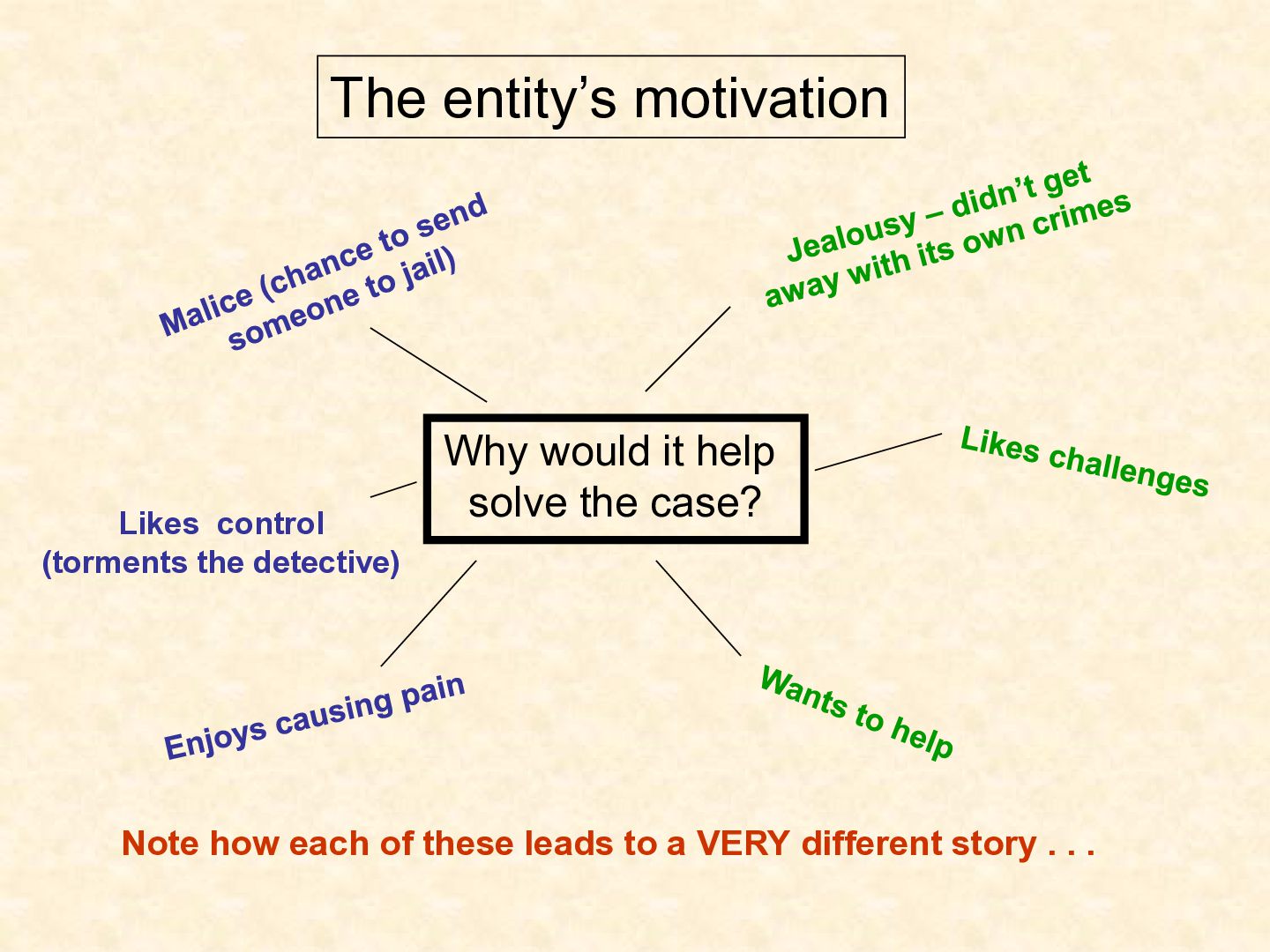
The entity’s motivation Likes control (torments the detective) Why would
it help solve the case? Note how each of these leads to a VERY different story . . . -
Digging Deeper Right about now you’re starting to piece the
results together into a story line. Don’t stop there. -
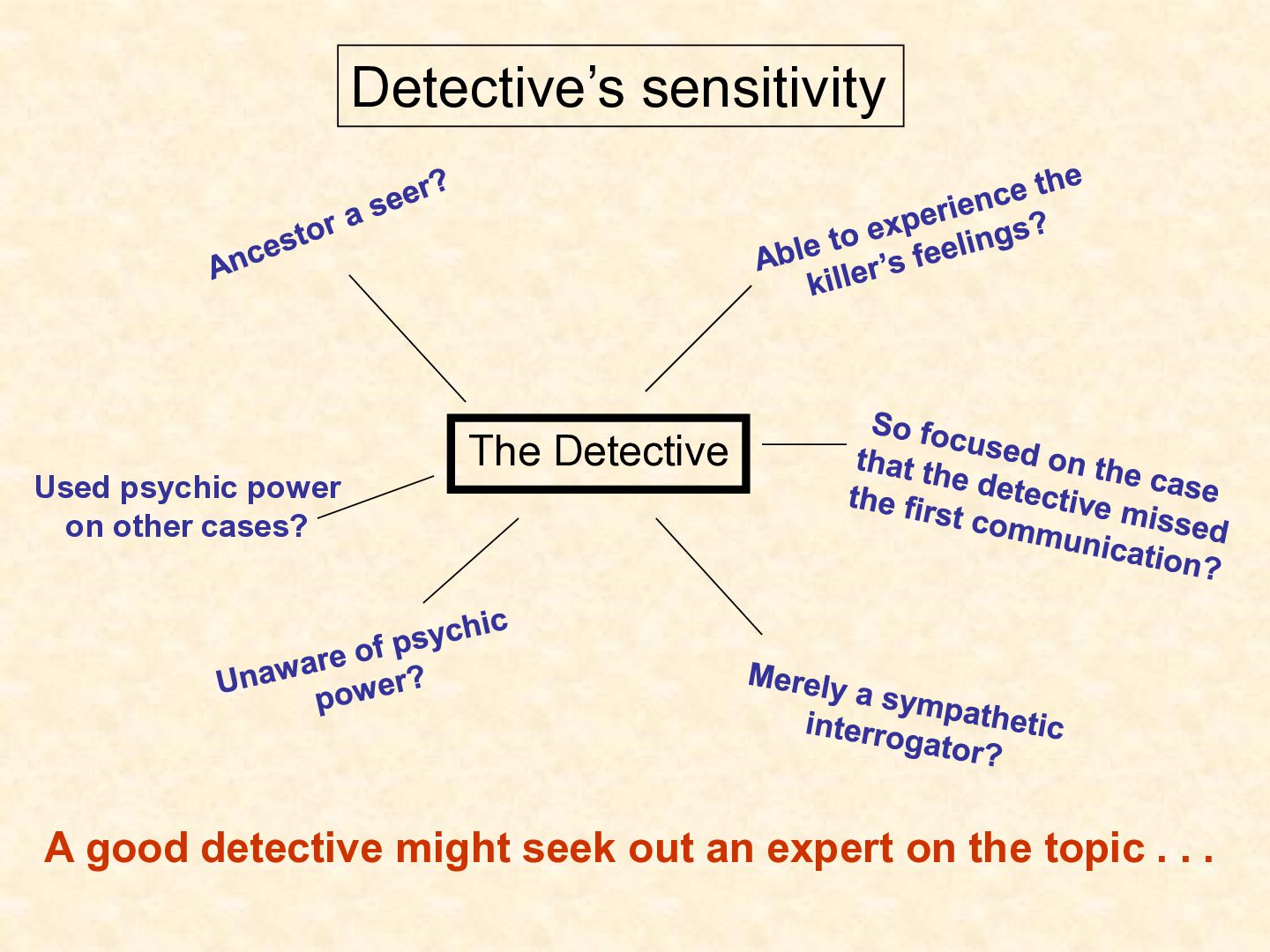
Detective’s sensitivity Used psychic power on other cases? The Detective
A good detective might seek out an expert on the topic . . . -
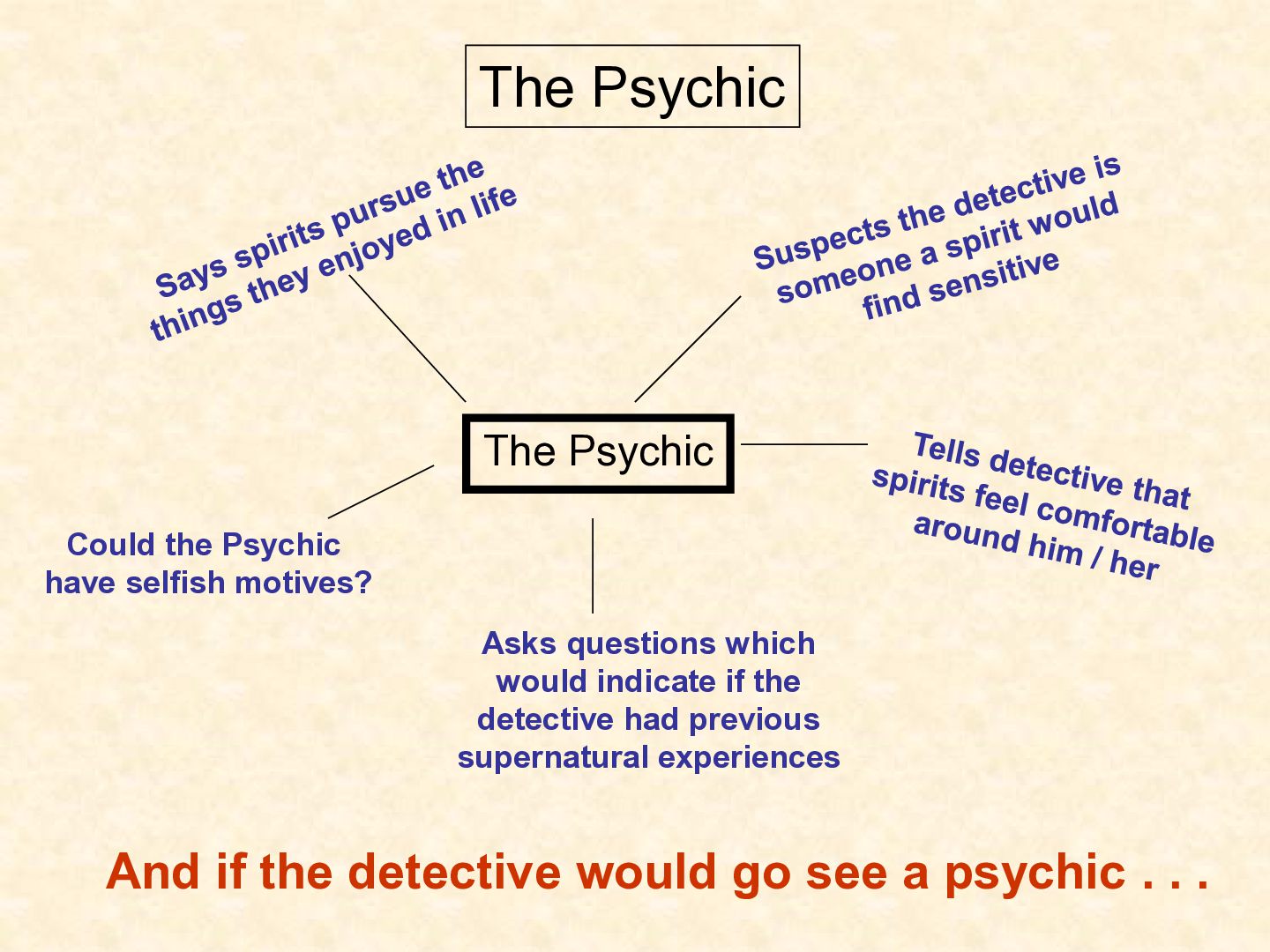
The Psychic The Psychic Could the Psychic have selfish motives?
Asks questions which would indicate if the detective had previous supernatural experiences And if the detective would go see a psychic . . . -
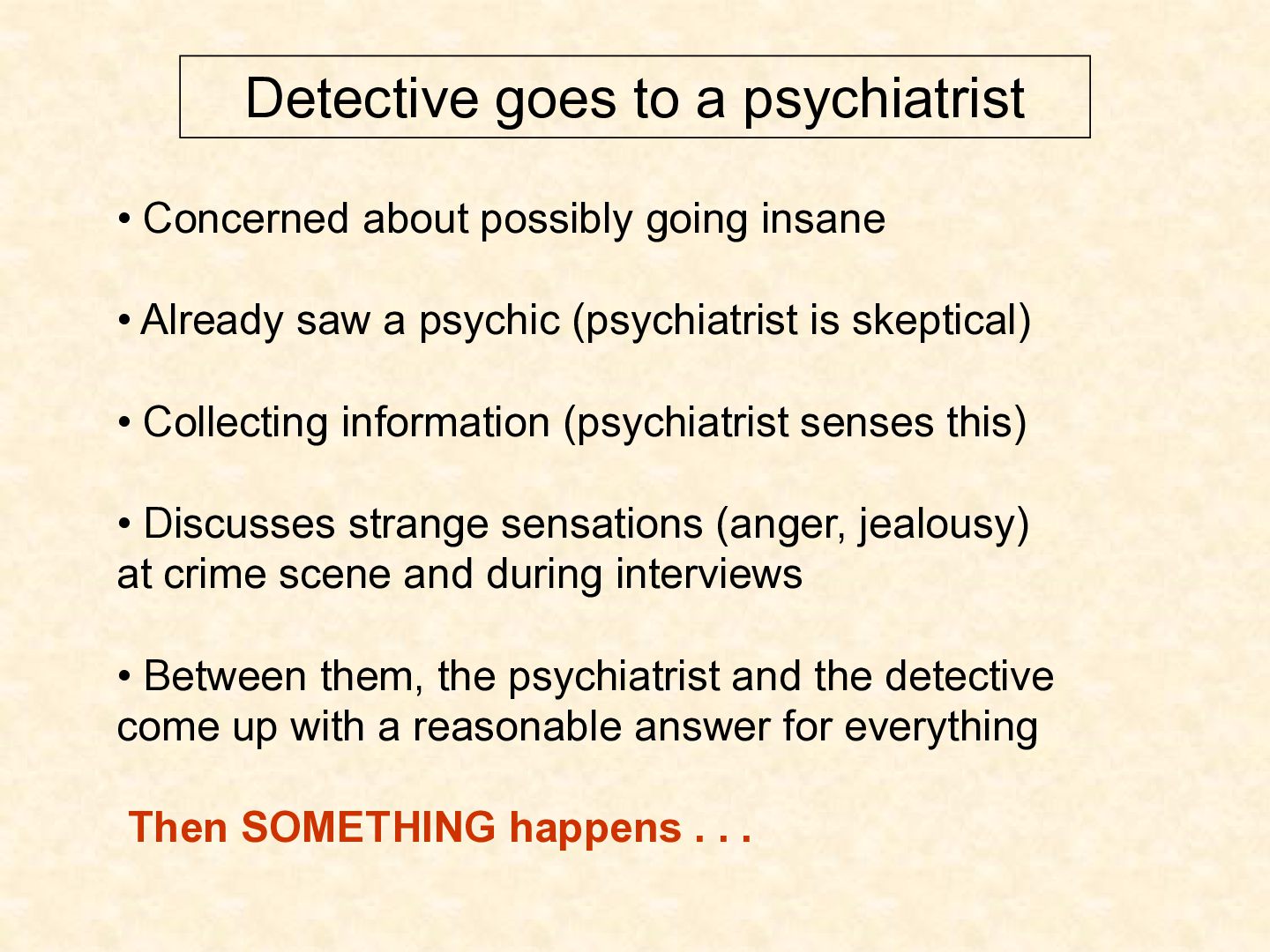
Detective goes to a psychiatrist • Concerned about possibly going
insane • Already saw a psychic (psychiatrist is skeptical) • Collecting information (psychiatrist senses this) • Discusses strange sensations (anger, jealousy) at crime scene and during interviews • Between them, the psychiatrist and the detective come up with a reasonable answer for everything Then SOMETHING happens . . . -
Revisit the story You’re well along now. You’ve got a
storyline going from beginning to middle to end. You’re even starting to fill in the blanks. Time to reconsider. -
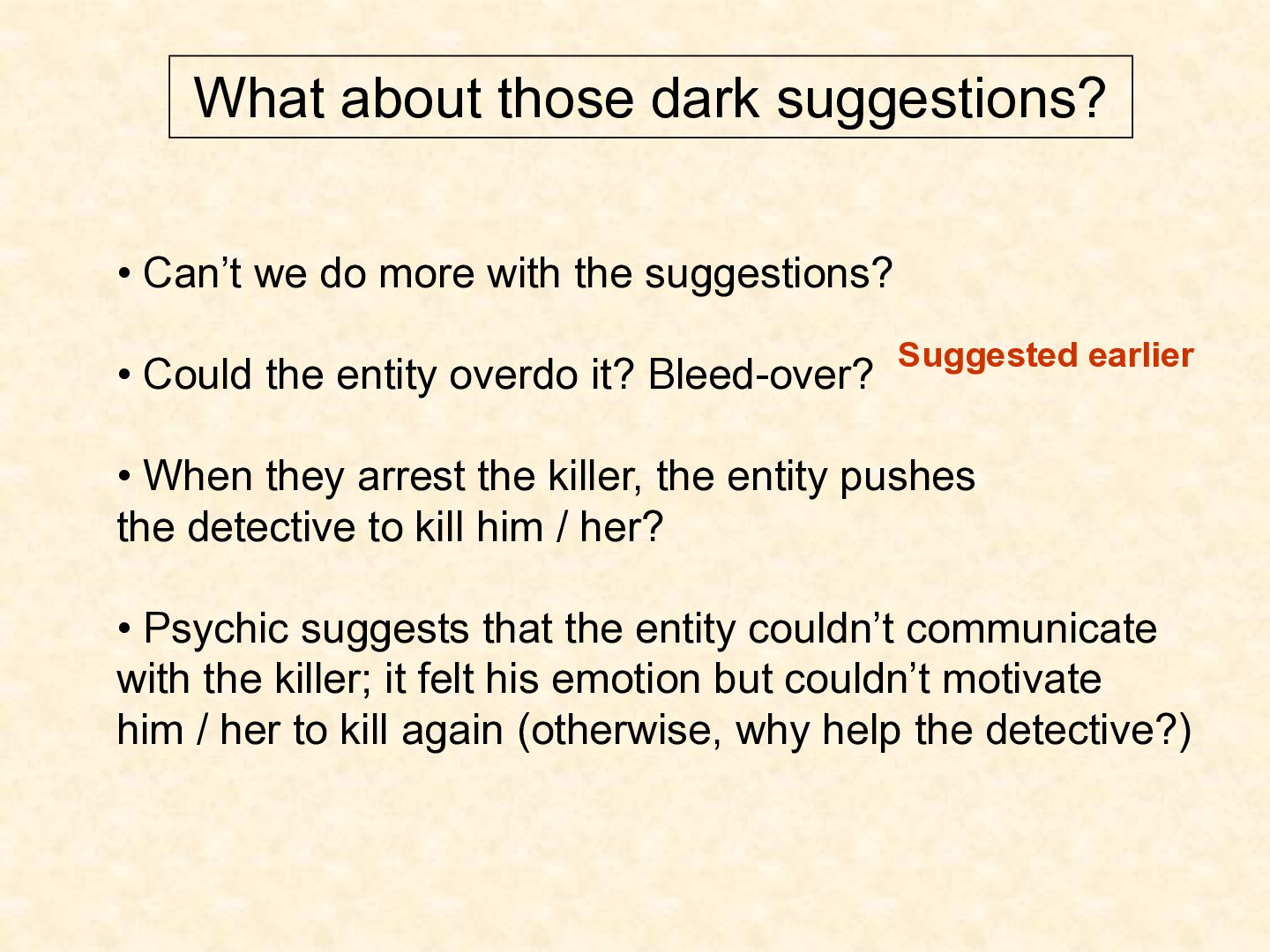
What about those dark suggestions? • Can’t we do more
with the suggestions? • Could the entity overdo it? Bleed-over? Suggested earlier • When they arrest the killer, the entity pushes the detective to kill him / her? • Psychic suggests that the entity couldn’t communicate with the killer; it felt his emotion but couldn’t motivate him / her to kill again (otherwise, why help the detective?) -
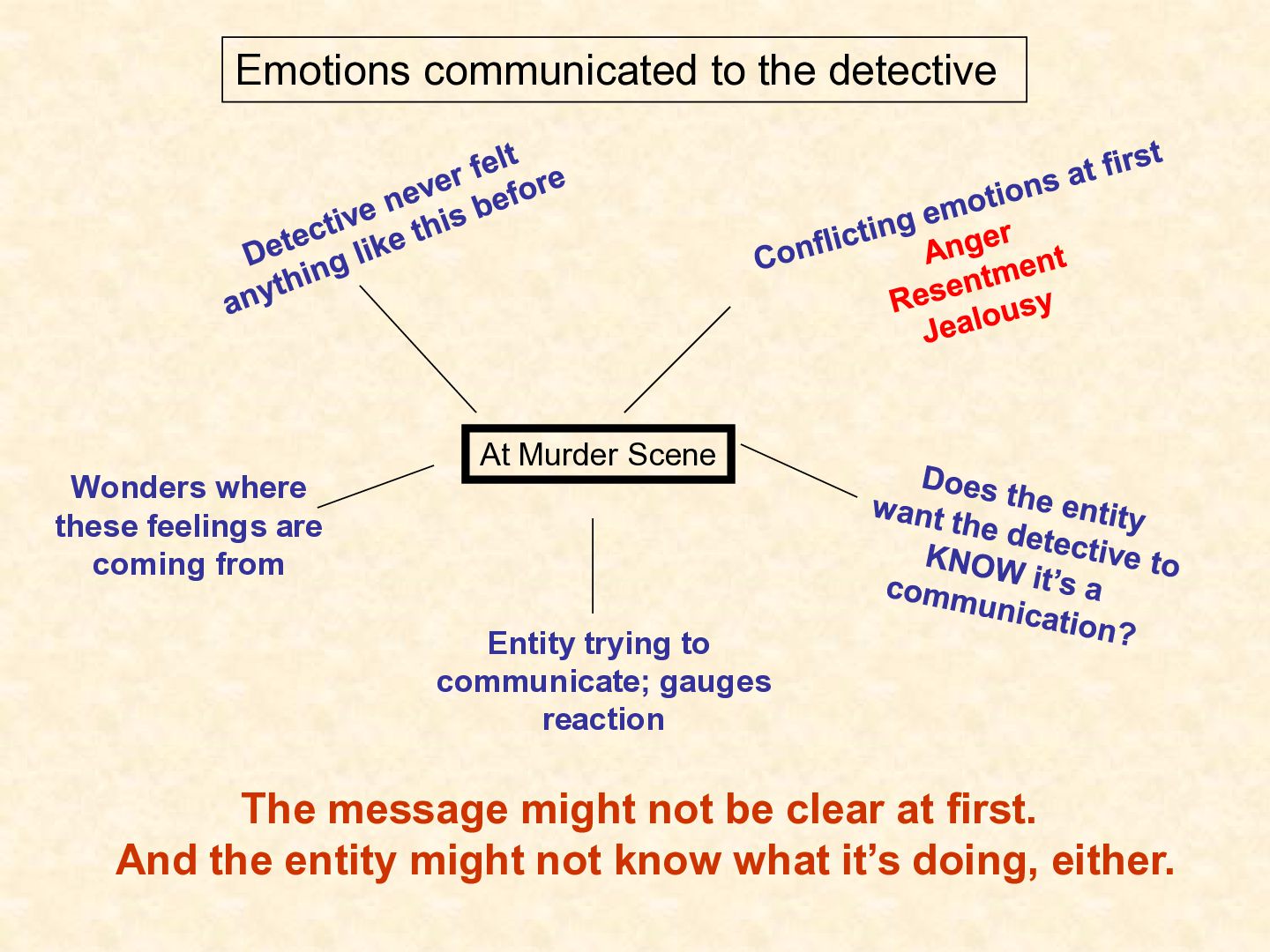
Emotions communicated to the detective Wonders where these feelings are
coming from At Murder Scene Entity trying to communicate; gauges reaction The message might not be clear at first. And the entity might not know what it’s doing, either. -
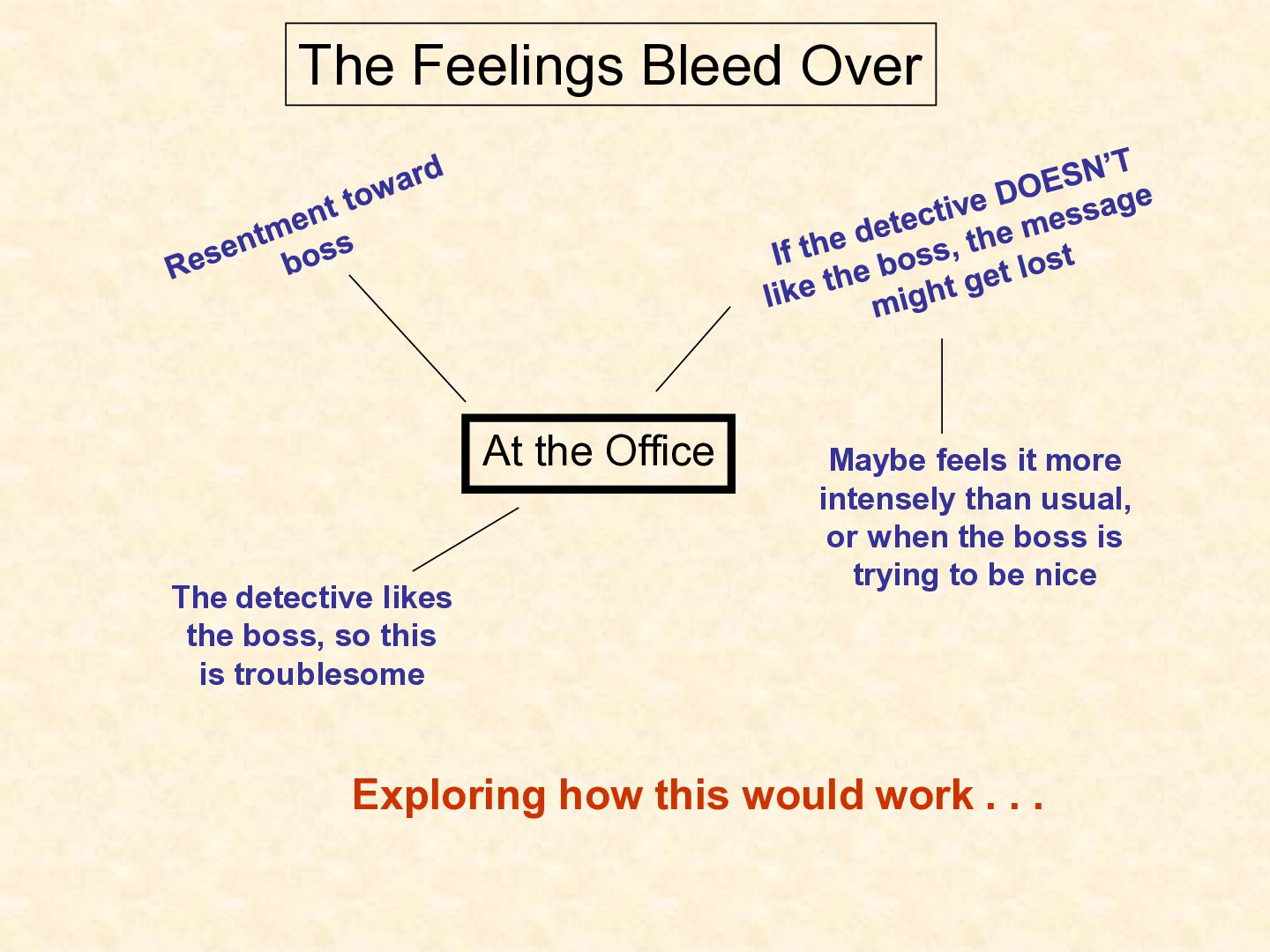
The Feelings Bleed Over At the Office The detective likes
the boss, so this is troublesome Maybe feels it more intensely than usual, or when the boss is trying to be nice Exploring how this would work . . . -
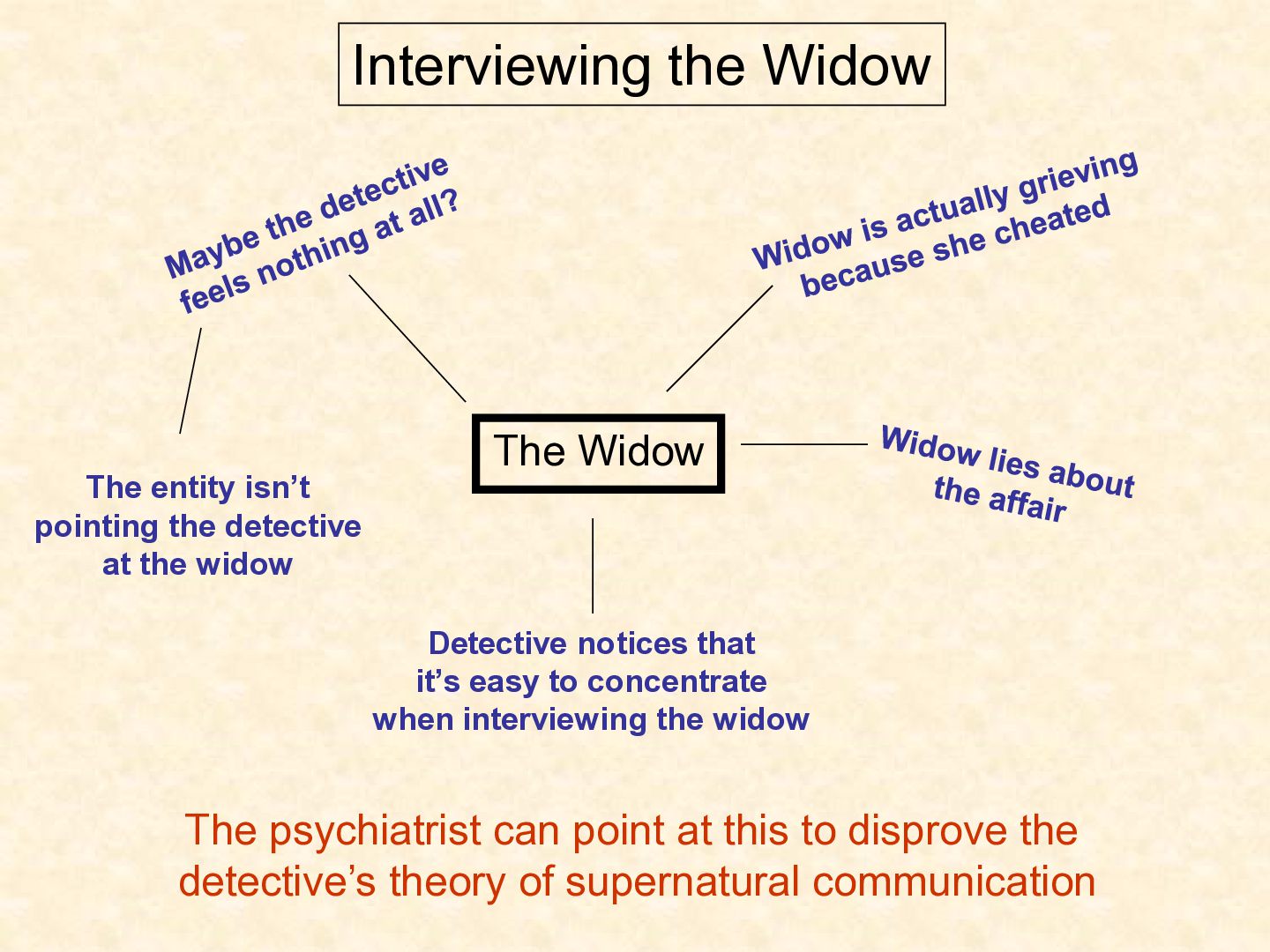
Interviewing the Widow The entity isn’t pointing the detective at
the widow The Widow Detective notices that it’s easy to concentrate when interviewing the widow The psychiatrist can point at this to disprove the detective’s theory of supernatural communication -
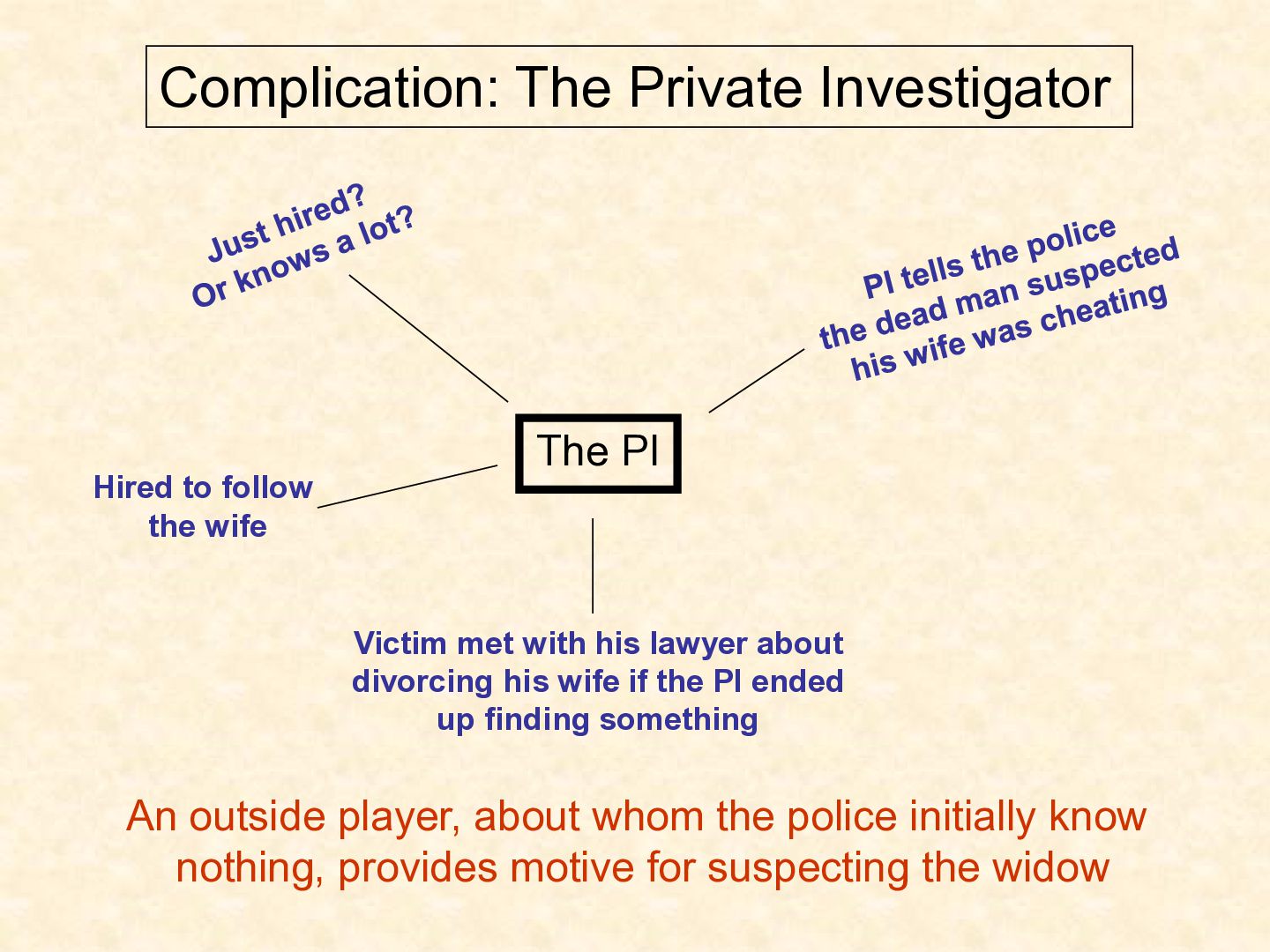
Complication: The Private Investigator Hired to follow the wife The
PI Victim met with his lawyer about divorcing his wife if the PI ended up finding something An outside player, about whom the police initially know nothing, provides motive for suspecting the widow -
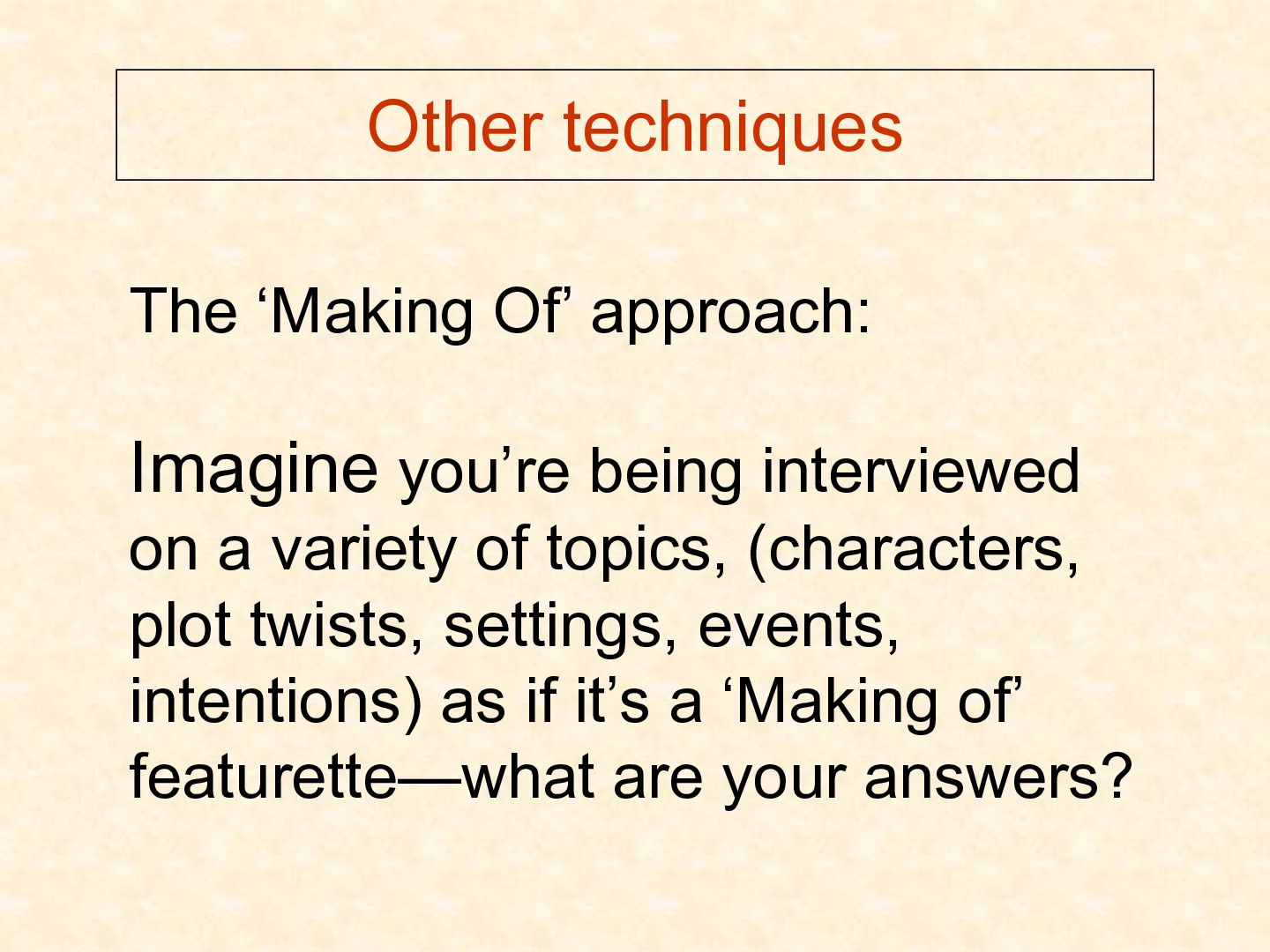
Other techniques The ‘Making Of’ approach: Imagine you’re being interviewed
on a variety of topics, (characters, plot twists, settings, events, intentions) as if it’s a ‘Making of’ featurette—what are your answers? -
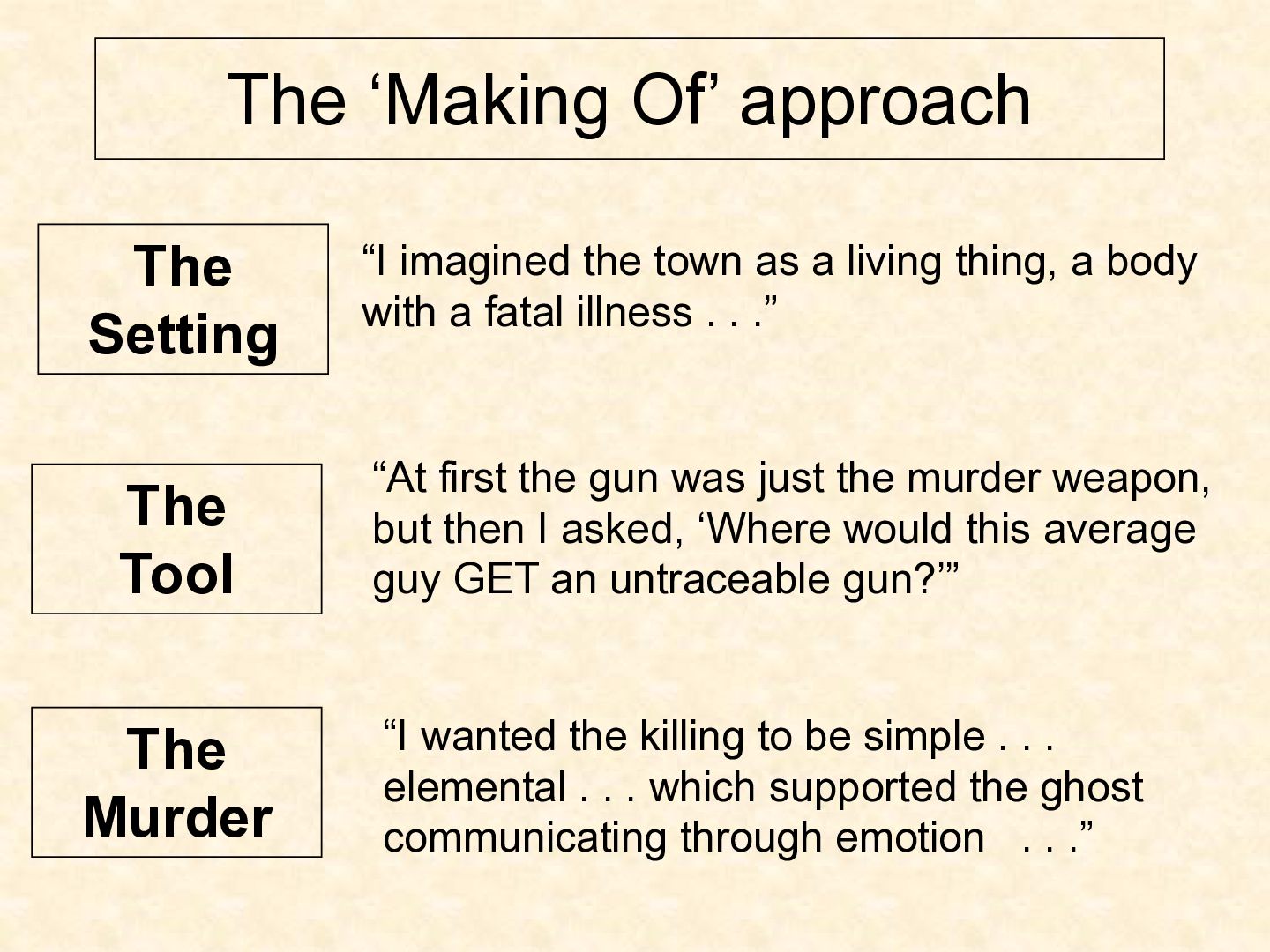
The ‘Making Of’ approach The Setting “I imagined the town
as a living thing, a body with a fatal illness . . .” The Tool “At first the gun was just the murder weapon, but then I asked, ‘Where would this average guy GET an untraceable gun?’” The Murder “I wanted the killing to be simple . . . elemental . . . which supported the ghost communicating through emotion . . .” -
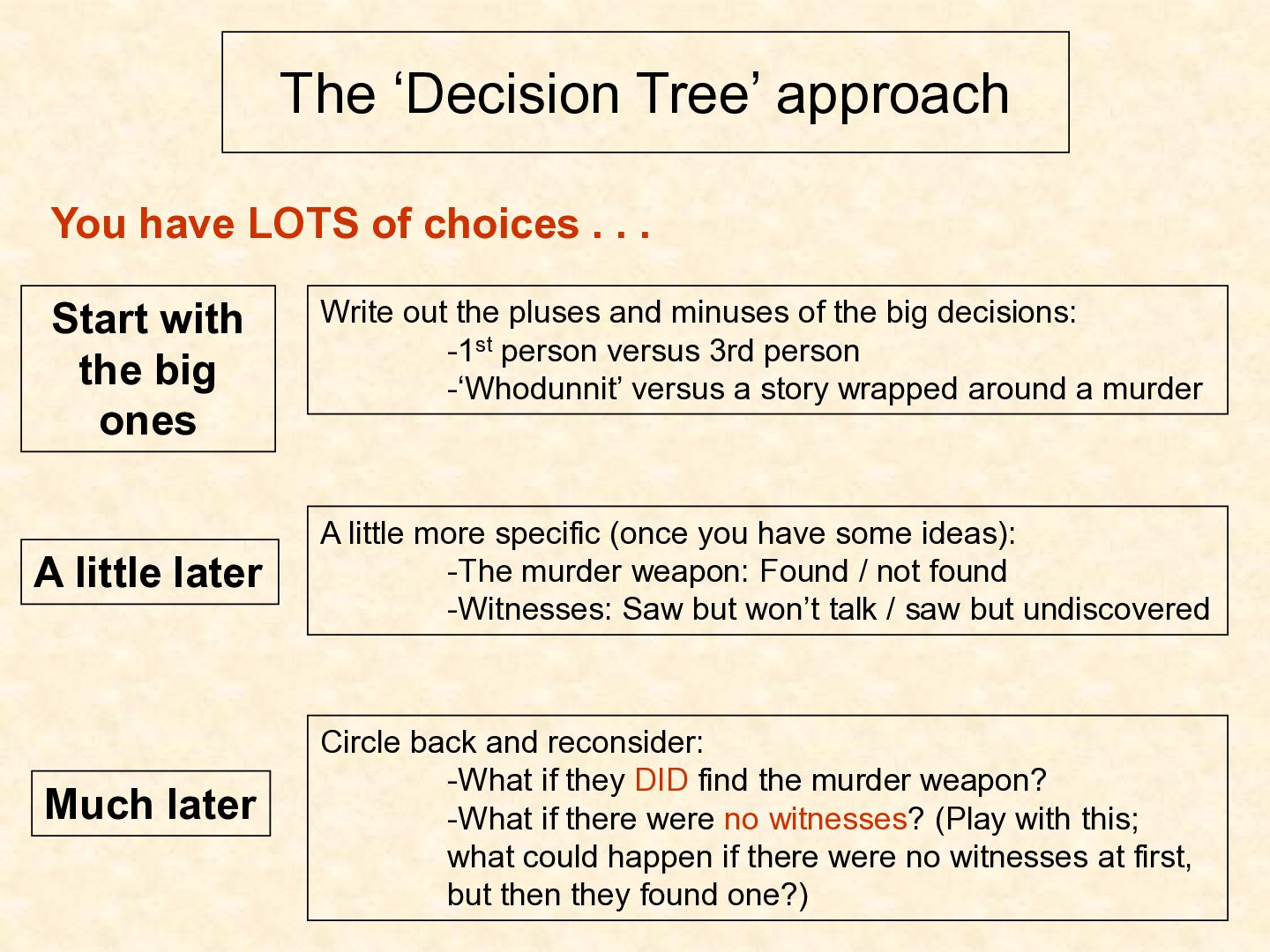
The ‘Decision Tree’ approach You have LOTS of choices .
. . Start with the big ones Write out the pluses and minuses of the big decisions: -1st person versus 3rd person -‘Whodunnit’ versus a story wrapped around a murder A little later A little more specific (once you have some ideas): -The murder weapon: Found / not found -Witnesses: Saw but won’t talk / saw but undiscovered Much later Circle back and reconsider: -What if they DID find the murder weapon? -What if there were no witnesses? (Play with this; what could happen if there were no witnesses at first, but then they found one?) -
Be the director • Treat each scene as live rehearsal
with actors • Get the most out of it (action, thrills, drama) • Hit the high notes in your story • Imagine you’re discussing a scene with actors playing the different characters Choices, actions, revelations • Imagine you're convincing an actor to play one of the characters Motivations, behaviors, big moments -
Research as inspiration • The Complete Idiot’s Guides • YouTube
(how-to’s, interviews, music) • Online imagery (Google, Bing, etc.) • Keep your mind open to what these sources are suggesting to you -
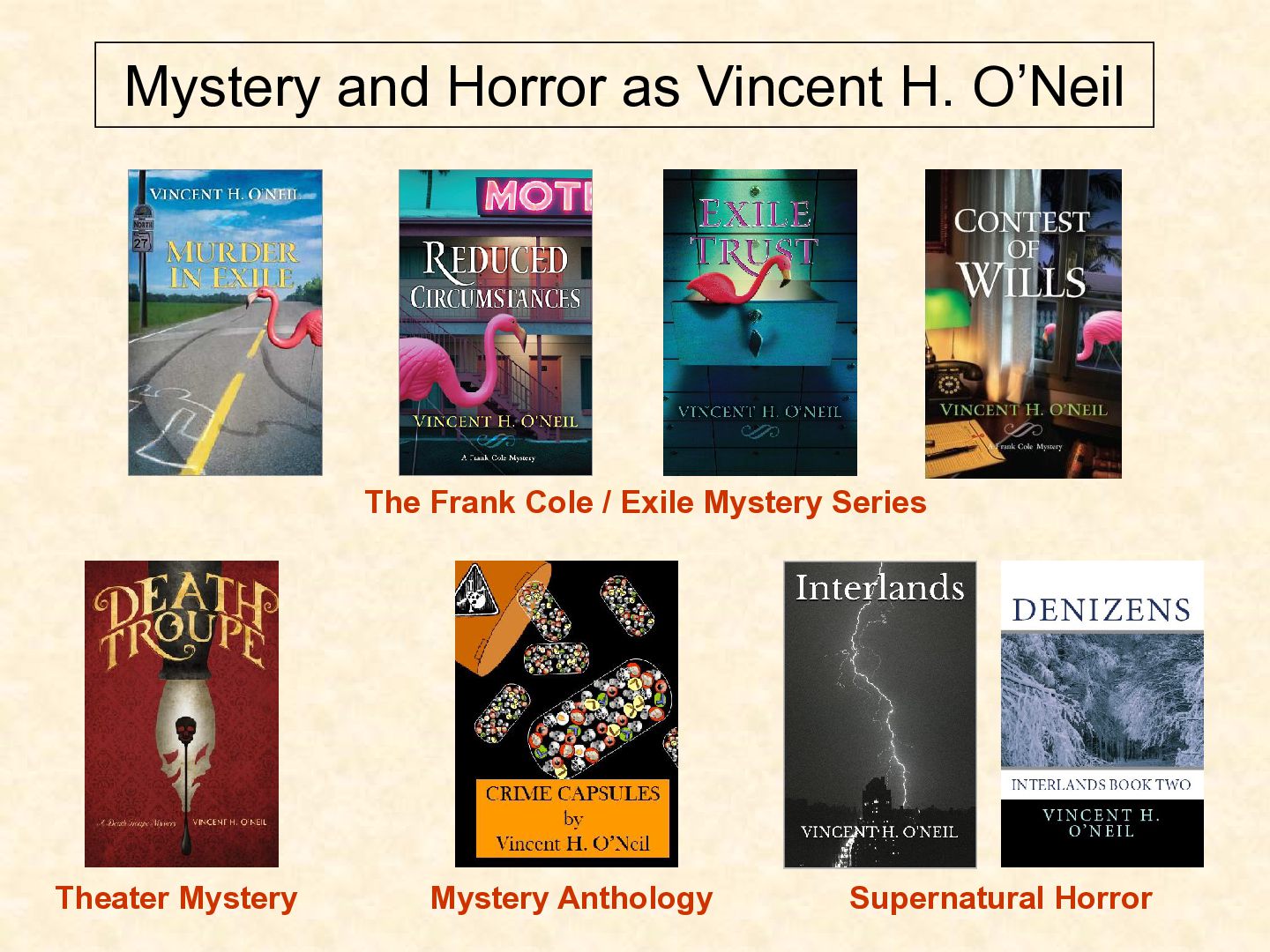
Mystery and Horror as Vincent H. O’Neil The Frank Cole
/ Exile Mystery Series Theater Mystery Mystery Anthology Supernatural Horror