Upgrade to Pro — share decks privately, control downloads, hide ads and more …

Yes, you can write!

Sponsored · Your Podcast. Everywhere. Effortlessly. Share. Educate. Inspire. Entertain. You do you. We'll handle the rest. →

Yes, you can write!

In this presentation, award-winning novelist Vincent H. O'Neil starts with the idea that anyone can be a writer.

If you can tell a story at a party that holds your listeners' attention, you can write--because writing is just telling that same story in words on a page.

With a step-by-step process loaded with examples, he then takes you through the basics of writing a story. Yes, you can write.

#writing #writing tips #creative #beawriter

writing, writing tips, creative, creative process, writer

Avatar for Vincent H. O'Neil

Vincent H. O'Neil

October 19, 2026

More Decks by Vincent H. O'Neil

Other Decks in Education

Transcript

  1. Yes, You Can Write! And here’s how . . .

    Vincent H. O’Neil www.vincenthoneil.com
  2. Writing is nothing more than telling a story. And if

    you’ve ever told a joke at a party and held your listeners’ attention, then you can tell a story.
  3. A guy walks into a bar . . . If

    you think about it, a piece of writing is the same thing as a story someone told to a group of listeners—just written down
  4. If you can talk, you can write If you were

    telling an anecdote, using an introduction, development, and a conclusion, and someone wrote down what you were saying, that would be a written story And if you wrote it down yourself, you’d be a writer
  5. Elements of a story Every story has a beginning, a

    middle, and an end. No surprise, right?
  6. The Beginning There are many ways to start telling a

    story, but the one thing to remember is that you have to get your audience’s attention
  7. The Introduction (or “the Hook”) Here are a few opening

    lines from a spoken story that would probably get attention: • “You are not going to believe what just happened to me.” • “I really shouldn't be telling you this . . .” • “Ever have one of those days?”
  8. Introductions It was the best of times, it was the

    worst of times . . . --Charles Dickens, A Tale of Two Cities This opening is an excellent hook because it promises the reader a wide range of experiences, from joy to sorrow, involving everything from success to disaster.
  9. Introductions (cont’d) Listen: Billy Pilgrim has come unstuck in time.

    --Kurt Vonnegut, Slaughterhouse Five This opening intrigues the reader because we don’t know who Billy Pilgrim is, or how anyone could become ‘unstuck’ in time. Notice how the word ‘listen’ implies a spoken story instead of a written one.
  10. Introductions (cont’d) Tom glanced behind him and saw the man

    coming out of the Green Cage, coming his way. Tom walked faster. There was no doubt the man was after him. Tom had noticed him five minutes ago, eyeing him carefully from a table, as if he weren’t quite sure, but almost. He had looked sure enough for Tom to down his drink in a hurry, pay and get out. --Patricia Highsmith, The Talented Mr. Ripley This opening starts with action, putting the reader right into the story. It identifies the main character Tom and hints that he has reason to fear being followed.
  11. The Beginning -- concluded Once you’ve got the readers’ attention,

    you have to keep it. We often have a pretty good idea of the beginning and end of the story, and so the challenge is to keep the readers reading through the middle portion. In the following slides we’ll use the tale of “Jack and Jill” as an example.
  12. The Middle: Developing the Story Don’t just fill the space

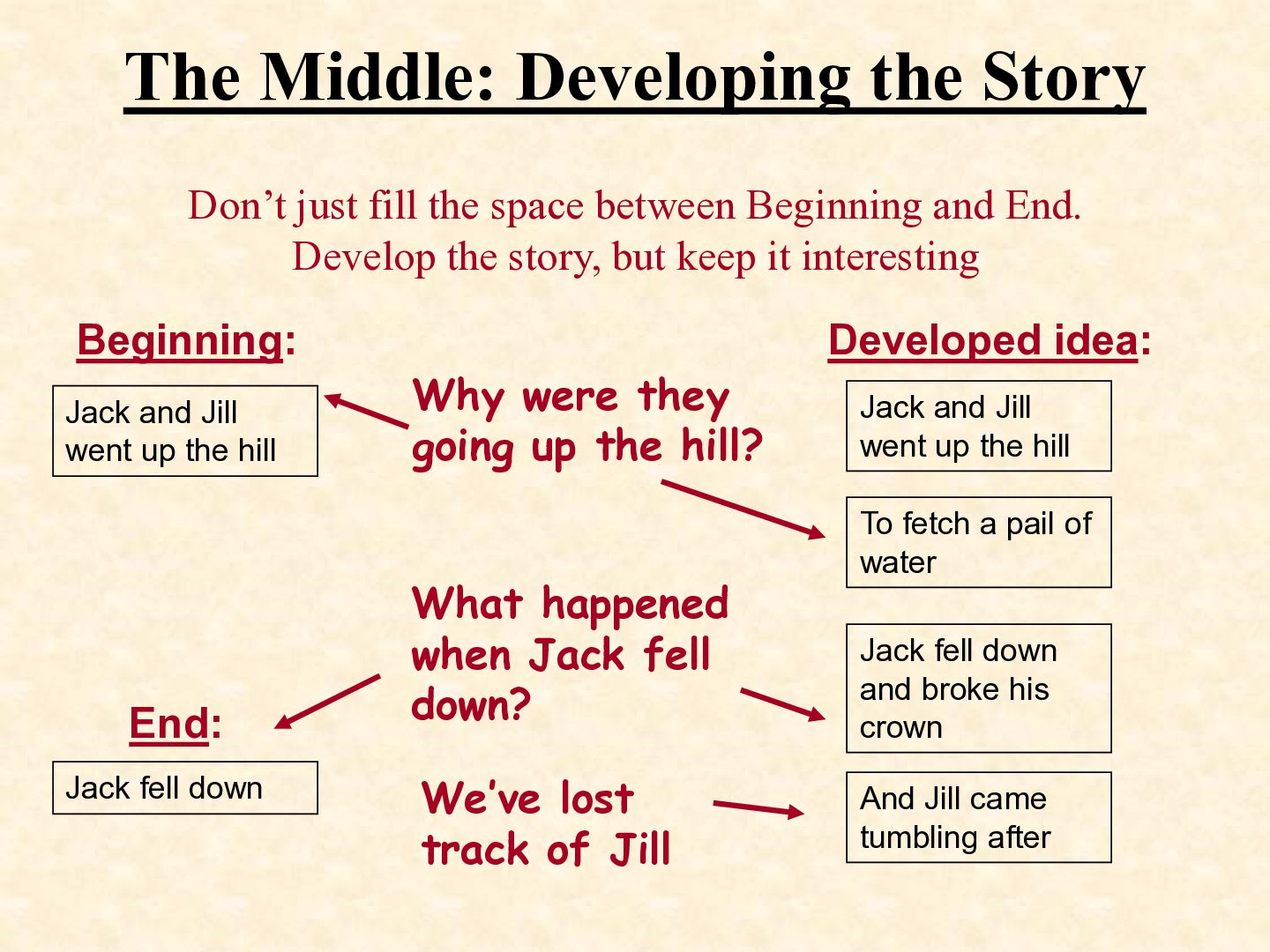
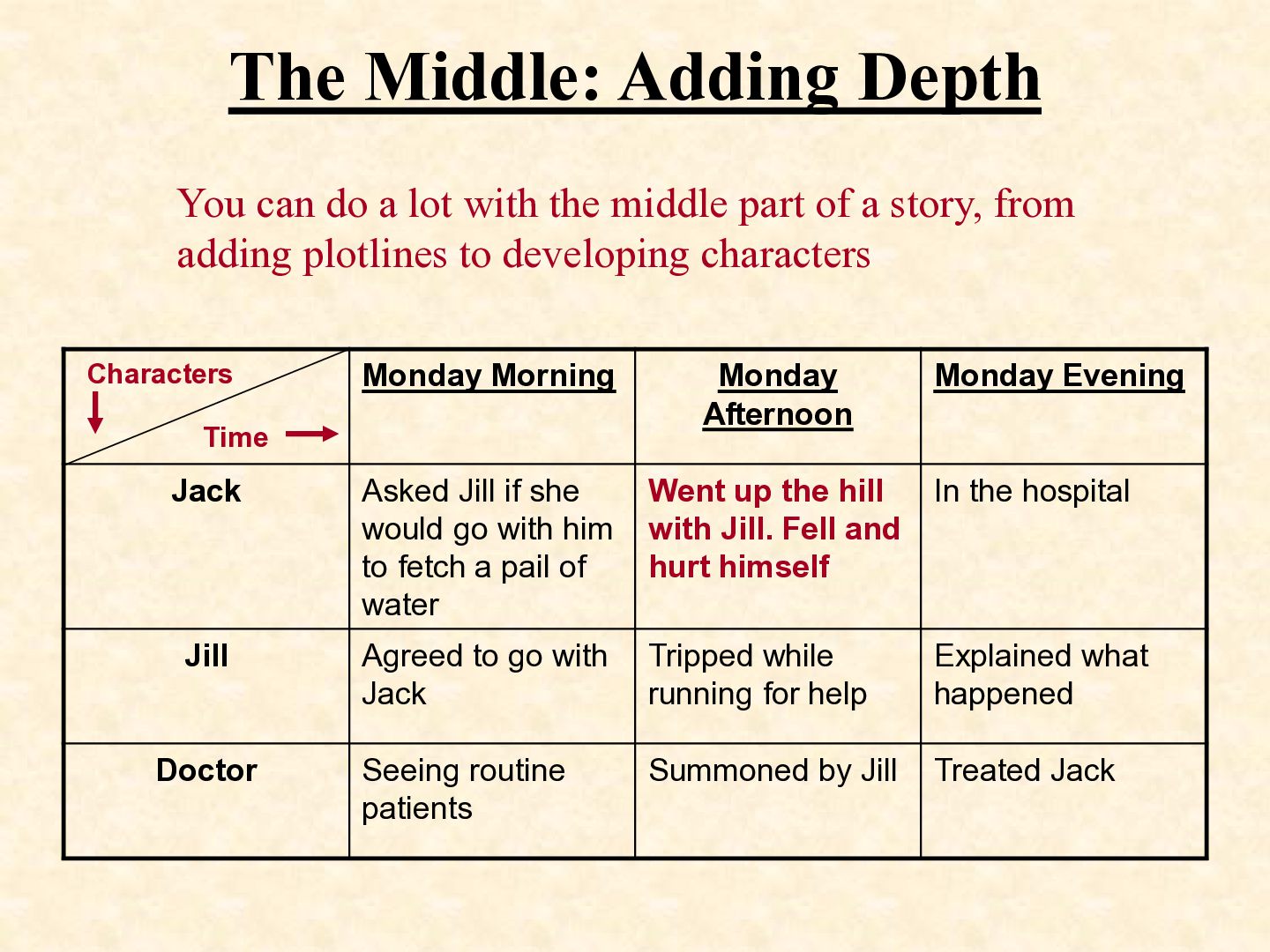
    between Beginning and End. Develop the story, but keep it interesting Beginning: Jack and Jill went up the hill End: Jack fell down Why were they going up the hill? What happened when Jack fell down? We’ve lost track of Jill Developed idea: Jack and Jill went up the hill To fetch a pail of water Jack fell down and broke his crown And Jill came tumbling after
  13. The Middle: Adding Depth You can do a lot with

    the middle part of a story, from adding plotlines to developing characters Characters Monday Morning Monday Afternoon Jack Asked Jill if she would go with him to fetch a pail of water Went up the hill with Jill. Fell and hurt himself In the hospital Jill Agreed to go with Jack Tripped while running for help Explained what happened Doctor Seeing routine patients Summoned by Jill Treated Jack Time Monday Evening
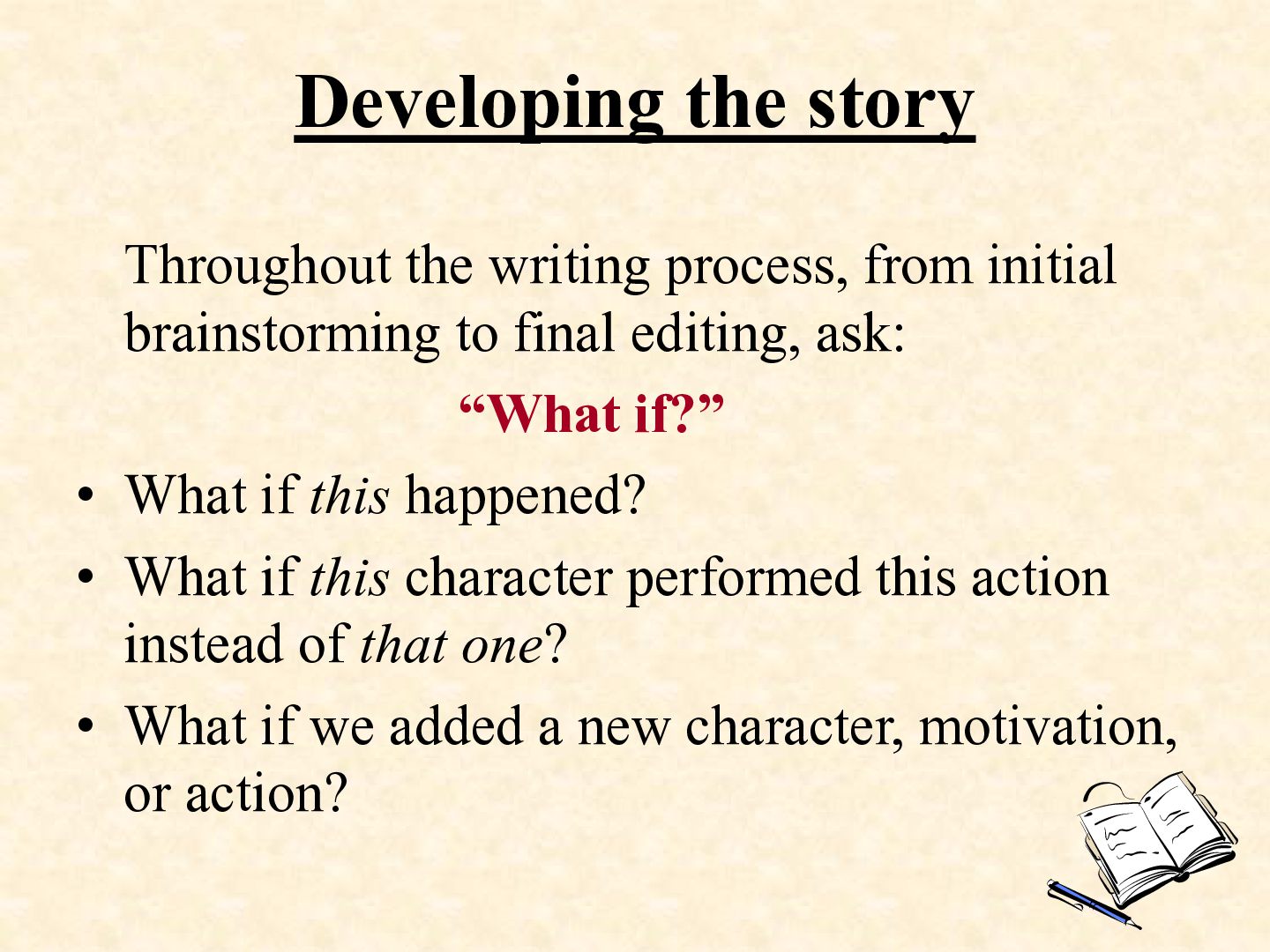
  14. Developing the story Throughout the writing process, from initial brainstorming

    to final editing, ask: “What if?” • What if this happened? • What if this character performed this action instead of that one? • What if we added a new character, motivation, or action?
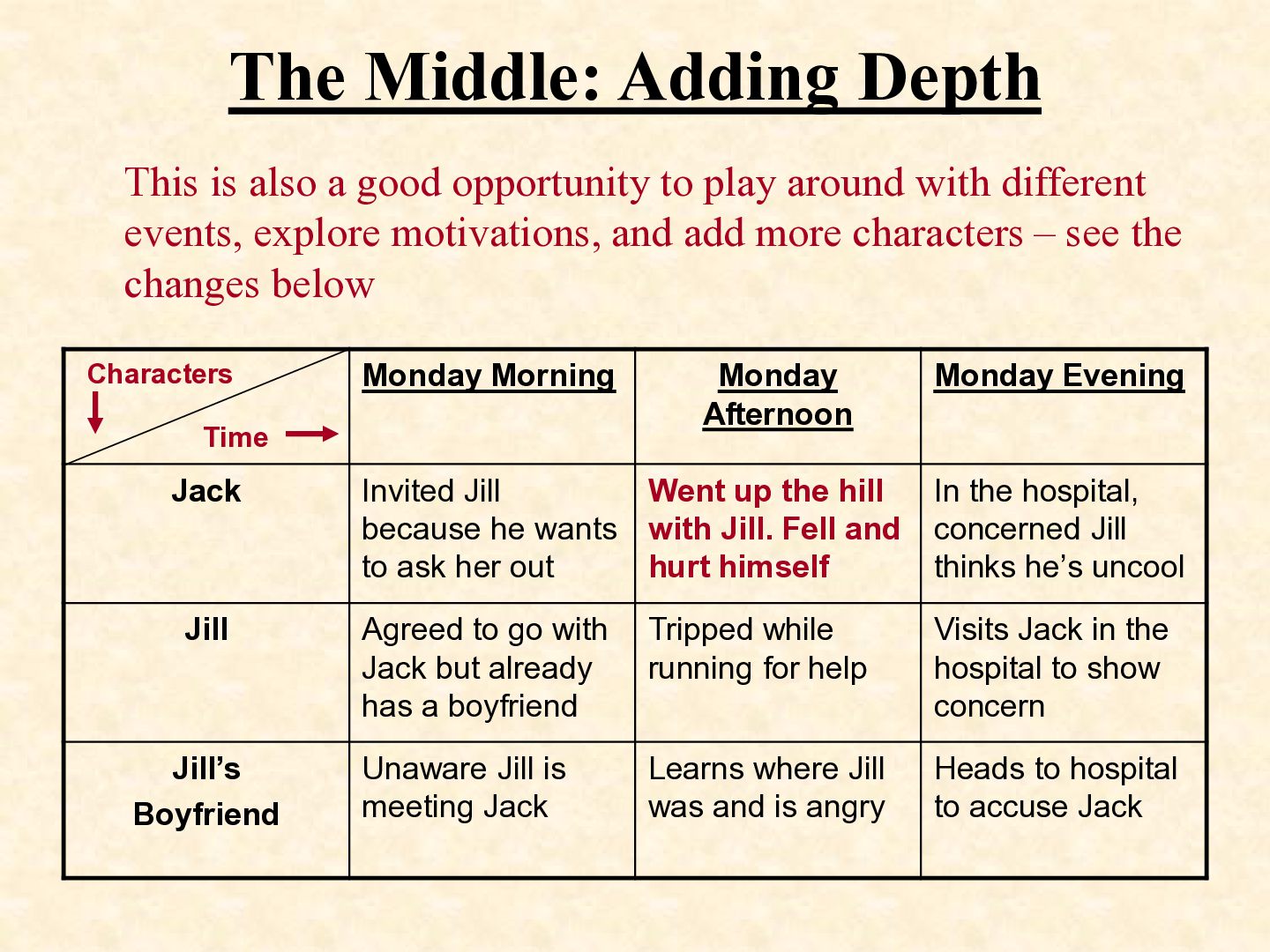
  15. The Middle: Adding Depth This is also a good opportunity

    to play around with different events, explore motivations, and add more characters – see the changes below Characters Monday Morning Time Monday Afternoon Monday Evening Jack Invited Jill Went up the hill because he wants with Jill. Fell and to ask her out hurt himself In the hospital, concerned Jill thinks he’s uncool Jill Agreed to go with Jack but already has a boyfriend Tripped while running for help Visits Jack in the hospital to show concern Jill’s Boyfriend Unaware Jill is meeting Jack Learns where Jill was and is angry Heads to hospital to accuse Jack
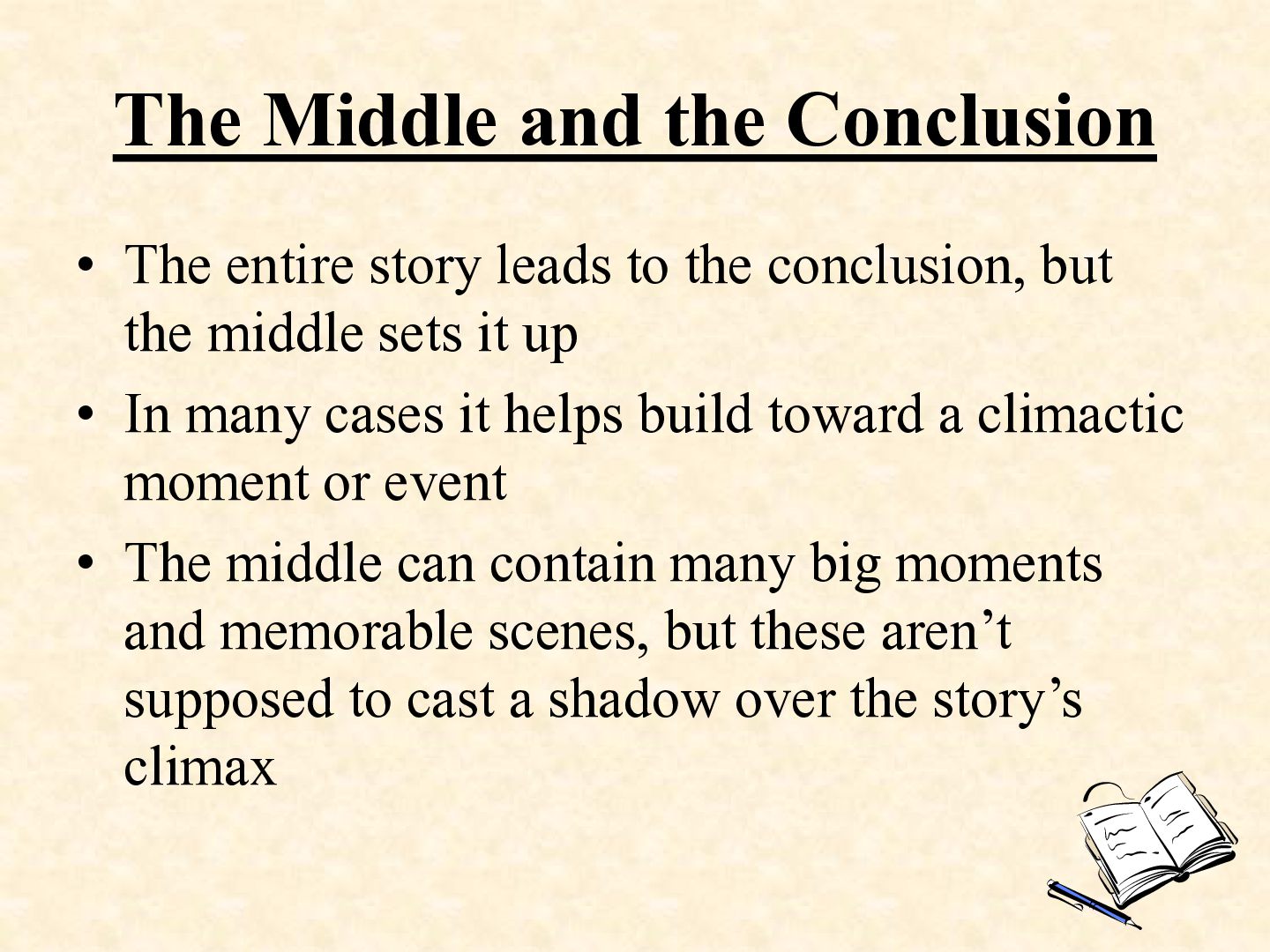
  16. The Middle and the Conclusion • The entire story leads

    to the conclusion, but the middle sets it up • In many cases it helps build toward a climactic moment or event • The middle can contain many big moments and memorable scenes, but these aren’t supposed to cast a shadow over the story’s climax
  17. The Conclusion “Wow them in the end, and you’ve got

    a hit.” – Brian Cox in the movie Adaptation • This doesn’t mean you need a car chase, a death, or an explosion BUT • The conclusion is the payoff of the whole story, so it doesn’t hurt to have the readers say “Wow!” or “Ah . . .” or laugh out loud
  18. The Conclusion Provide resolution without overdoing the explanations: • Answer

    the readers’ unanswered questions— don’t leave them hanging BUT • Don’t be afraid to leave some loose ends; the readers are able to figure out a lot of things, and you may want to write a sequel someday
  19. Getting started Always remember you’re not writing—you’re telling a story

    • Start small. Remember a story you once told successfully, and try to write that • Identify the ways you got your listeners’ attention, held it, and made them react at the end
  20. Example Ever lock your keys in your car? Well I

    did it while the car was still running. Luckily I was at home at the time, so I went inside and got my spare keys. I was in a rush, so I was fumbling with them as I walked, and the next thing I knew I dropped them straight into a rain gutter. So there I was, looking down at my spare keys through a heavy metal grate and wondering when my car was going to run out of gas. Never thought I’d hear myself saying this, but thank God for nosy neighbors who can fish things out of rain gutters using nothing but a wire hanger.
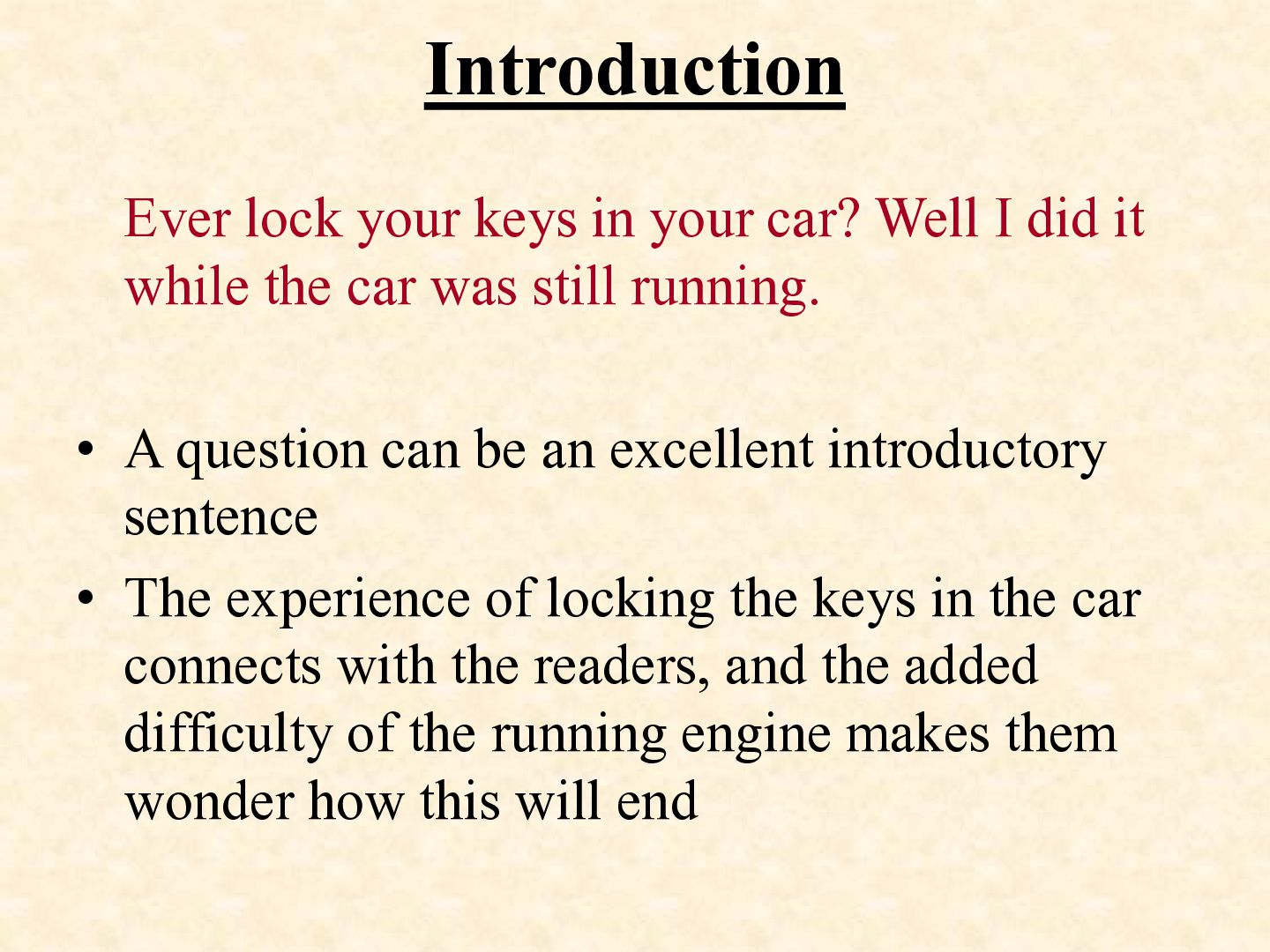
  21. Introduction Ever lock your keys in your car? Well I

    did it while the car was still running. • A question can be an excellent introductory sentence • The experience of locking the keys in the car connects with the readers, and the added difficulty of the running engine makes them wonder how this will end
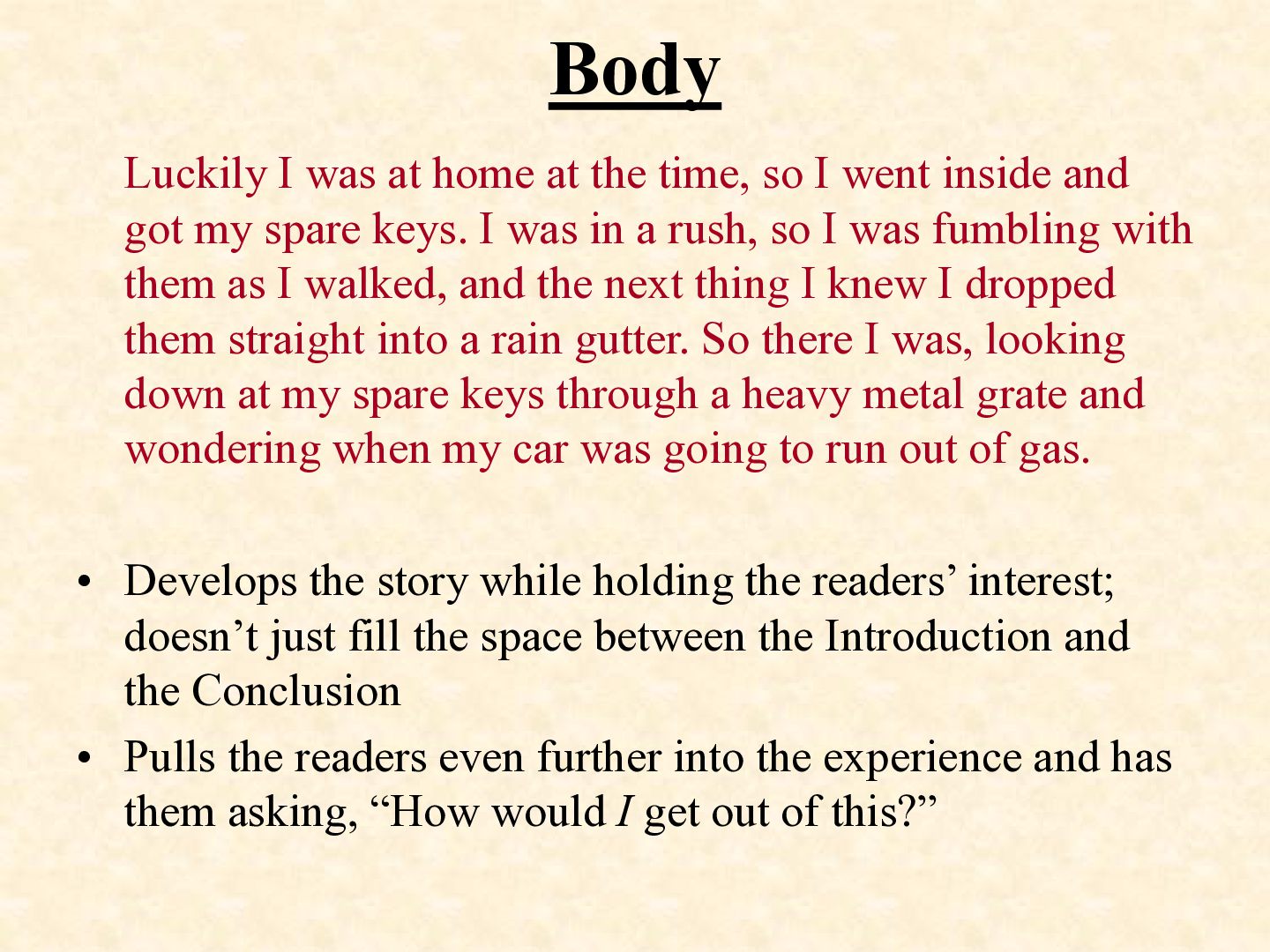
  22. Body Luckily I was at home at the time, so

    I went inside and got my spare keys. I was in a rush, so I was fumbling with them as I walked, and the next thing I knew I dropped them straight into a rain gutter. So there I was, looking down at my spare keys through a heavy metal grate and wondering when my car was going to run out of gas. • Develops the story while holding the readers’ interest; doesn’t just fill the space between the Introduction and the Conclusion • Pulls the readers even further into the experience and has them asking, “How would I get out of this?”
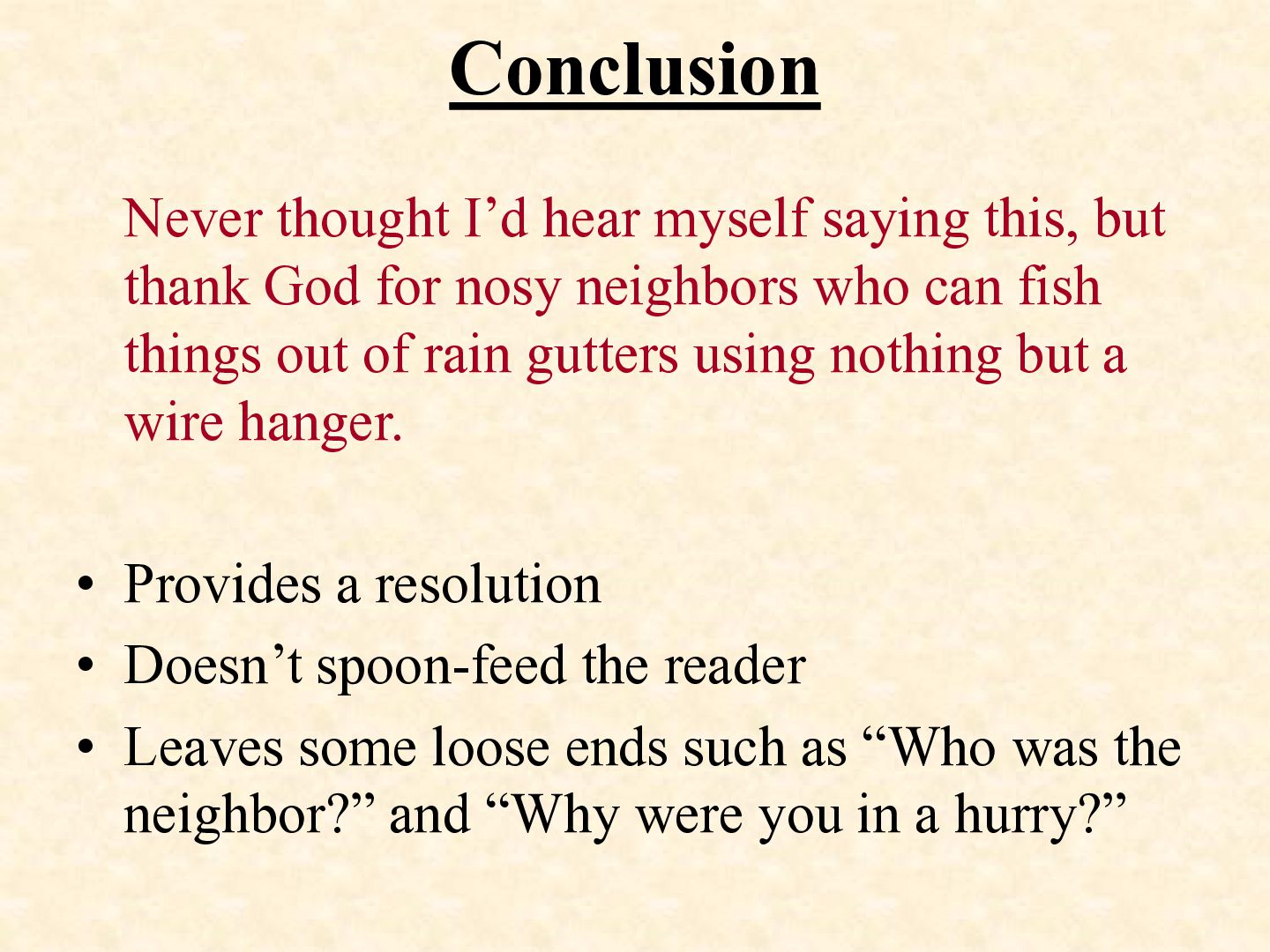
  23. Conclusion Never thought I’d hear myself saying this, but thank

    God for nosy neighbors who can fish things out of rain gutters using nothing but a wire hanger. • Provides a resolution • Doesn’t spoon-feed the reader • Leaves some loose ends such as “Who was the neighbor?” and “Why were you in a hurry?”
  24. Finally You’re not a writer—you’re a story-teller So if you

    ever get stuck, imagine an audience is listening to your tale Imagine what you’d say next, and write that When all else fails, tell the story
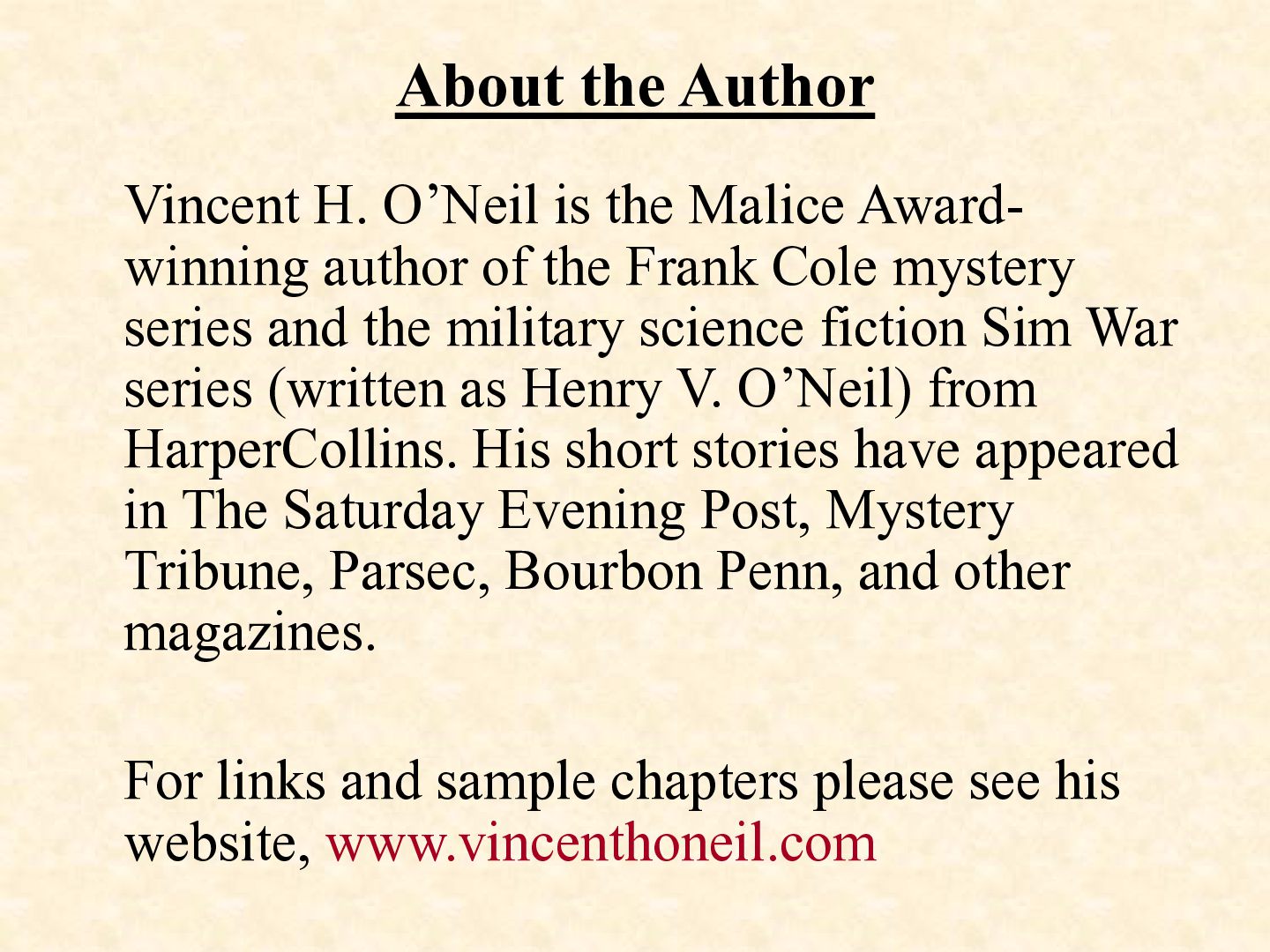
  25. About the Author Vincent H. O’Neil is the Malice Awardwinning

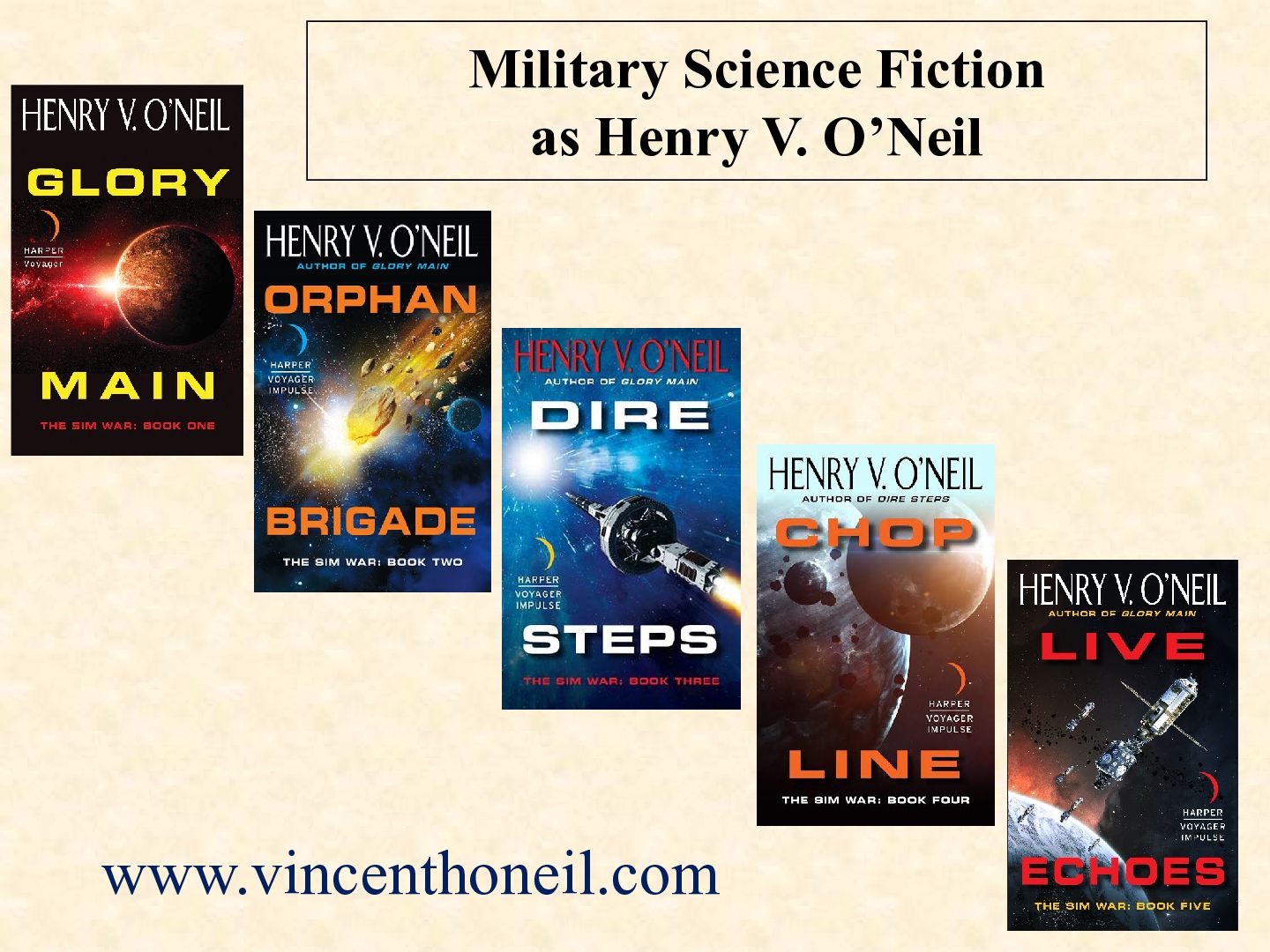
    author of the Frank Cole mystery series and the military science fiction Sim War series (written as Henry V. O’Neil) from HarperCollins. His short stories have appeared in The Saturday Evening Post, Mystery Tribune, Parsec, Bourbon Penn, and other magazines. For links and sample chapters please see his website, www.vincenthoneil.com
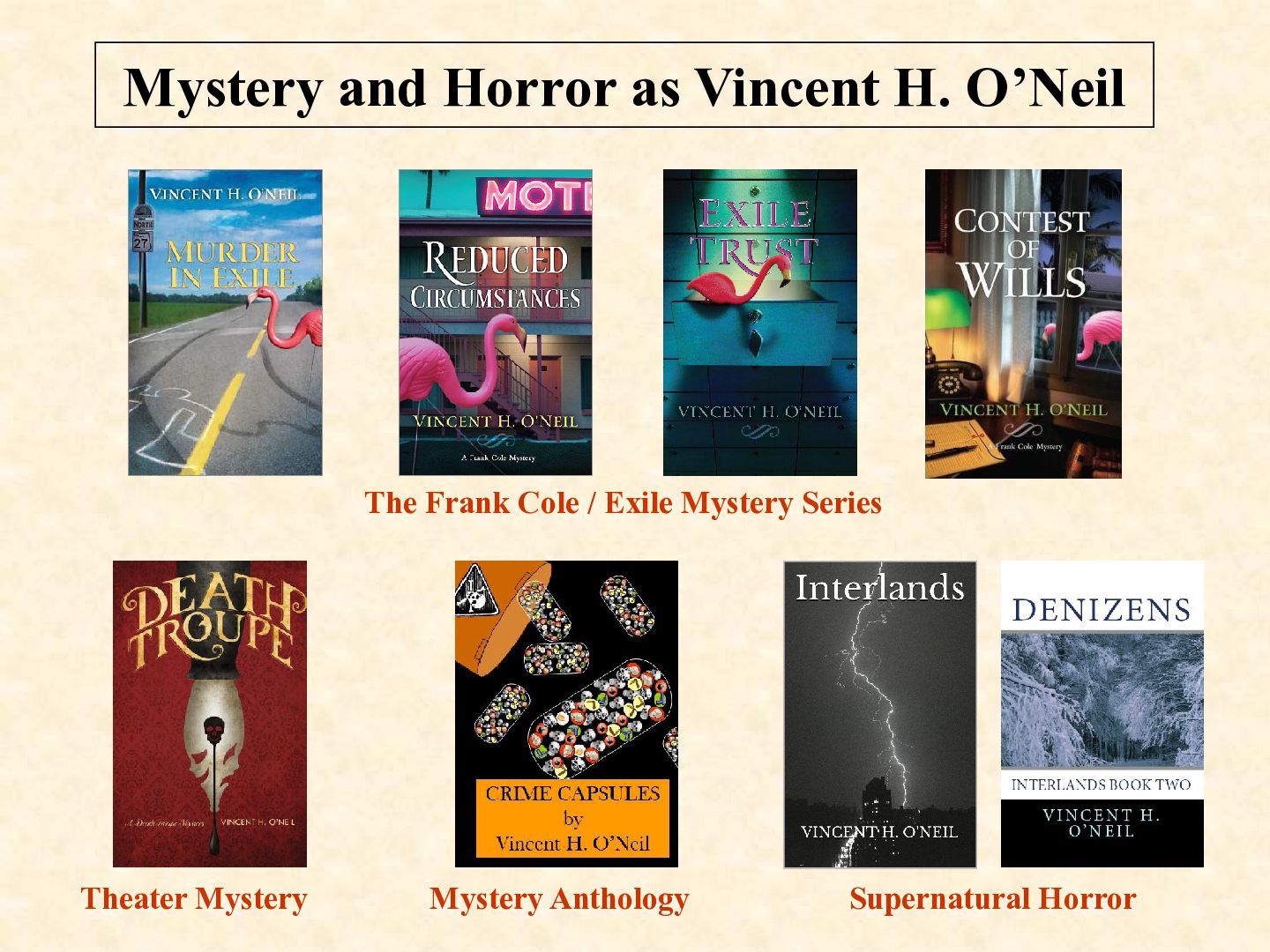
  26. Mystery and Horror as Vincent H. O’Neil The Frank Cole

    / Exile Mystery Series Theater Mystery Mystery Anthology Supernatural Horror