scope; it is a methodology guide for conducting Kampala diagnostics in the country not a country diagnostic manual or NASIP formulation toolkit (a section on scope and limits that defines what it is and what it is not) and its place in the overall CAADP implementation guidelines ▪ Countries face data and analytical capacity gaps; ✓But this challenge could be overcome by tapping into the existing capacities within countries universities/think tanks, foundational work (SAMs available for nearly all AU member states) & additional capacity building e.g. through the AGRODEP network, AKADEMIYA2063 & other technical partners www.akademiya2063.org
number of Kampala target indicators (Table 4.1 refers to 24 Kampala target indicators while the declaration refers to 22) ✓Standardize/explain the thematic area (8) in the toolkit vs Six (6) strategic objective areas ▪ Methodology, indicators, & data; need for one complete data dictionary (cross reference with the technical guidelines for the CAADP BR data?) ✓Likelihood of different/conflicting data sources and how countries can handle data conflicts between sources (data reconciliation procedures) www.akademiya2063.org
non-specialist (policy makers & country teams) ✓Need for a simplified non-technical description of the model ✓More clear description of the assumptions behind each scenario ✓For KGM, could it be possible to have a hierarchy of analysis; Tier 1 [trend & gap analysis using statistical models); Tier 2 [partial equilibrium/sector models]; Tier 3 [full CGPE modelling] ▪ The SAP, KGM, and PPO are complementary, but the toolkit could specify more explicitly how their findings should be combined…into one integrating matrix (Synthesis brief?) www.akademiya2063.org
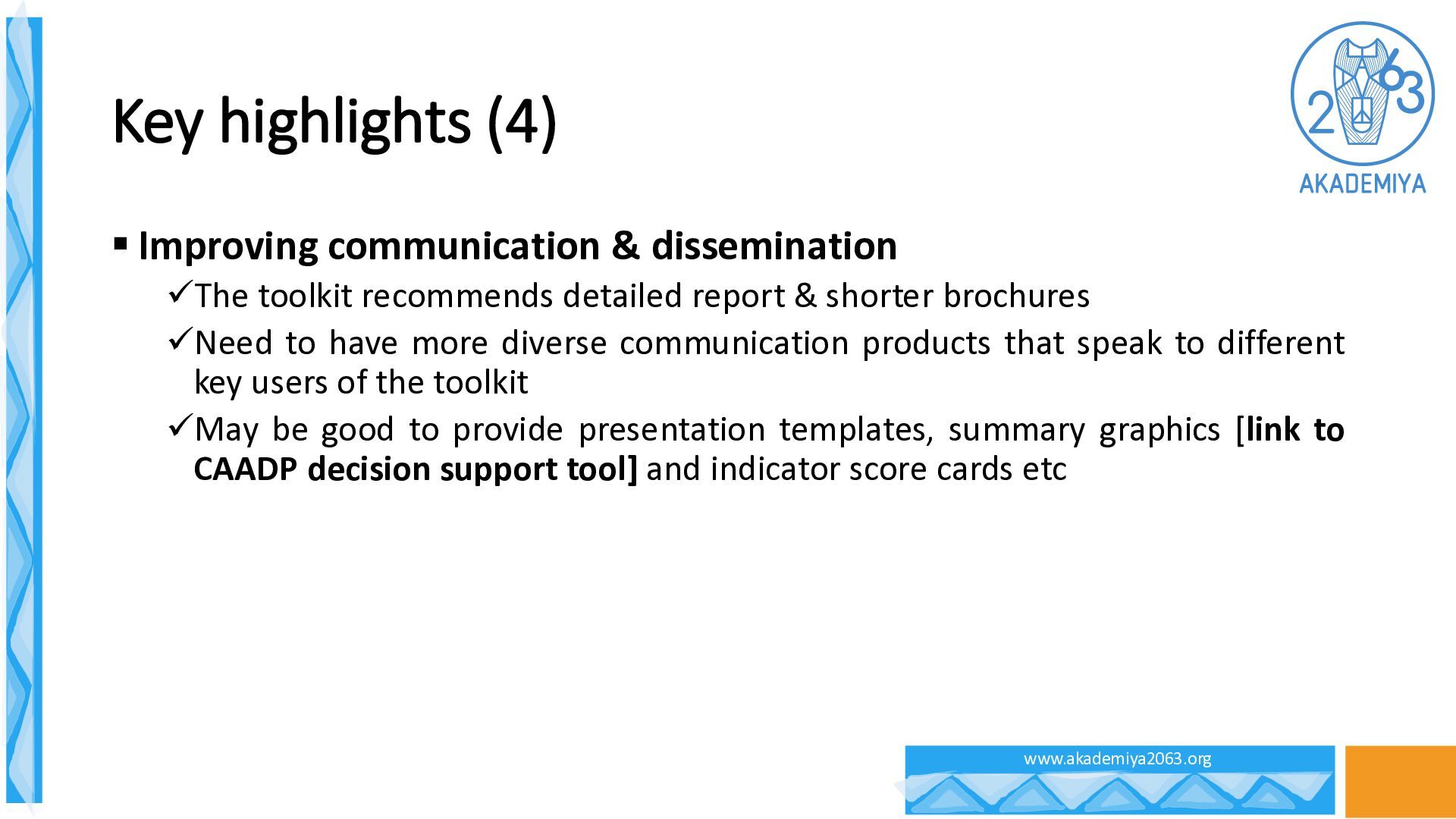
recommends detailed report & shorter brochures ✓Need to have more diverse communication products that speak to different key users of the toolkit ✓May be good to provide presentation templates, summary graphics [link to CAADP decision support tool] and indicator score cards etc www.akademiya2063.org
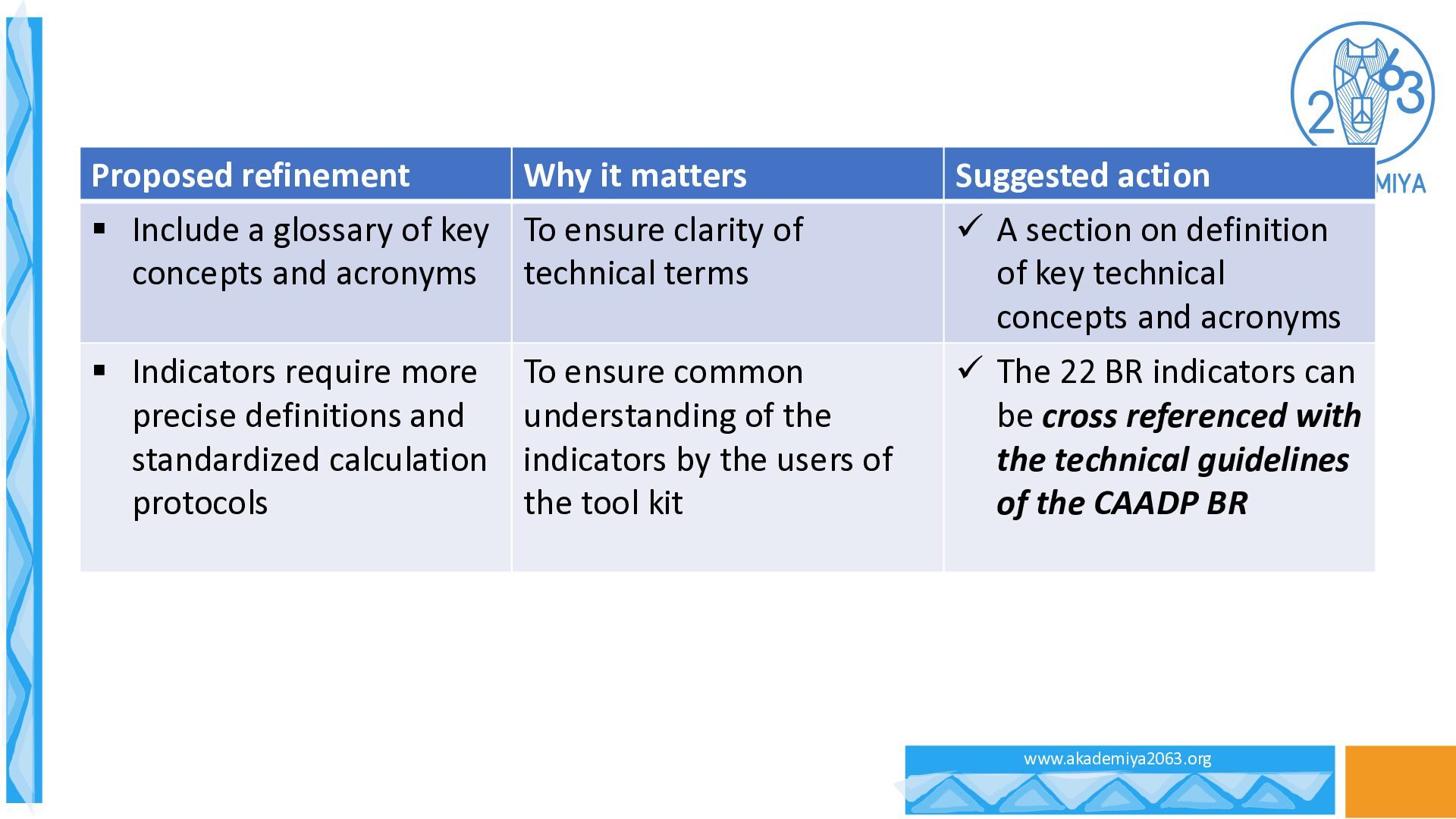
glossary of key To ensure clarity of concepts and acronyms technical terms ✓ A section on definition of key technical concepts and acronyms ▪ Indicators require more precise definitions and standardized calculation protocols ✓ The 22 BR indicators can be cross referenced with the technical guidelines of the CAADP BR To ensure common understanding of the indicators by the users of the tool kit www.akademiya2063.org
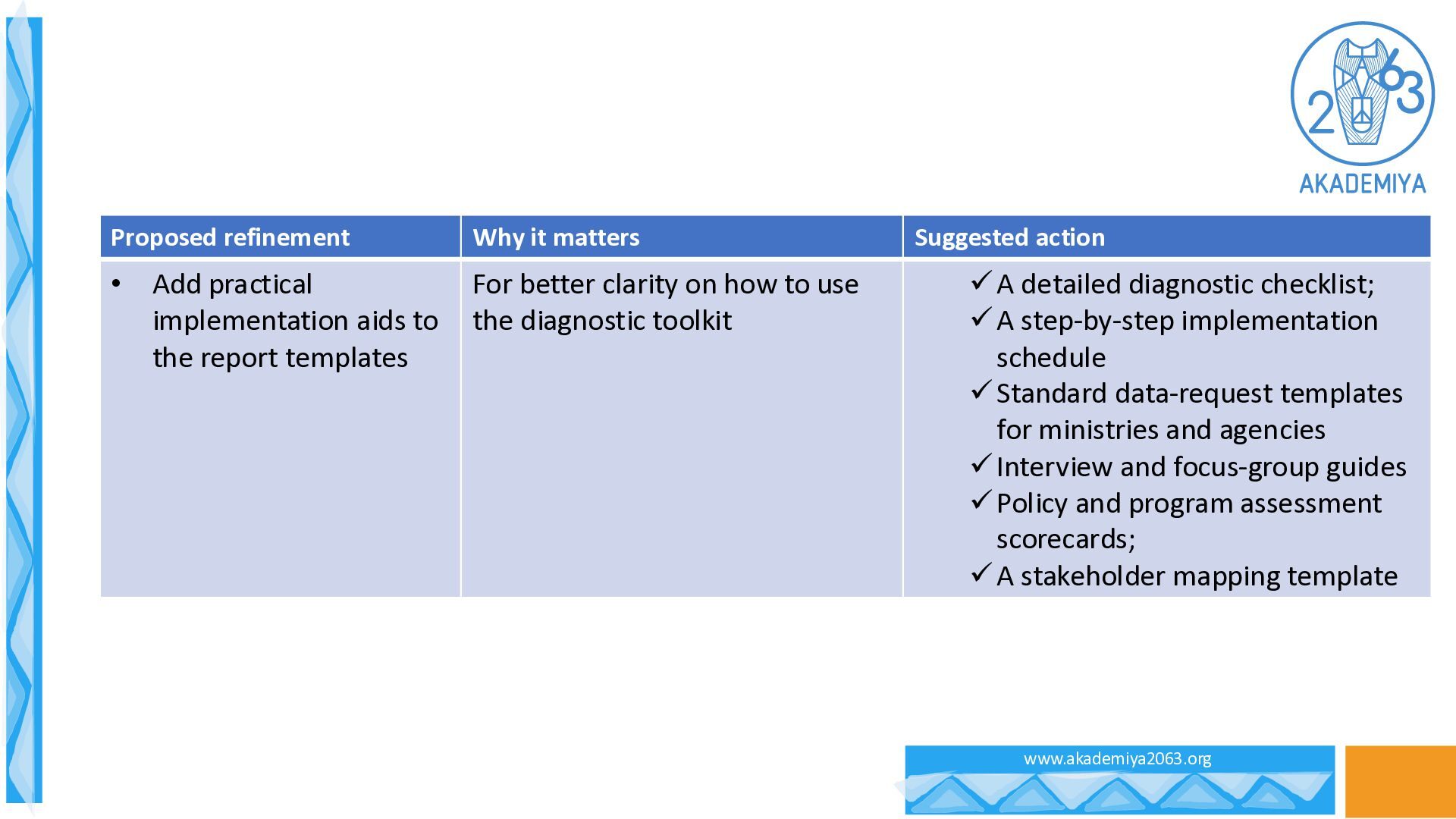
to the report templates For better clarity on how to use the diagnostic toolkit Suggested action ✓ A detailed diagnostic checklist; ✓ A step-by-step implementation schedule ✓ Standard data-request templates for ministries and agencies ✓ Interview and focus-group guides ✓ Policy and program assessment scorecards; ✓ A stakeholder mapping template www.akademiya2063.org
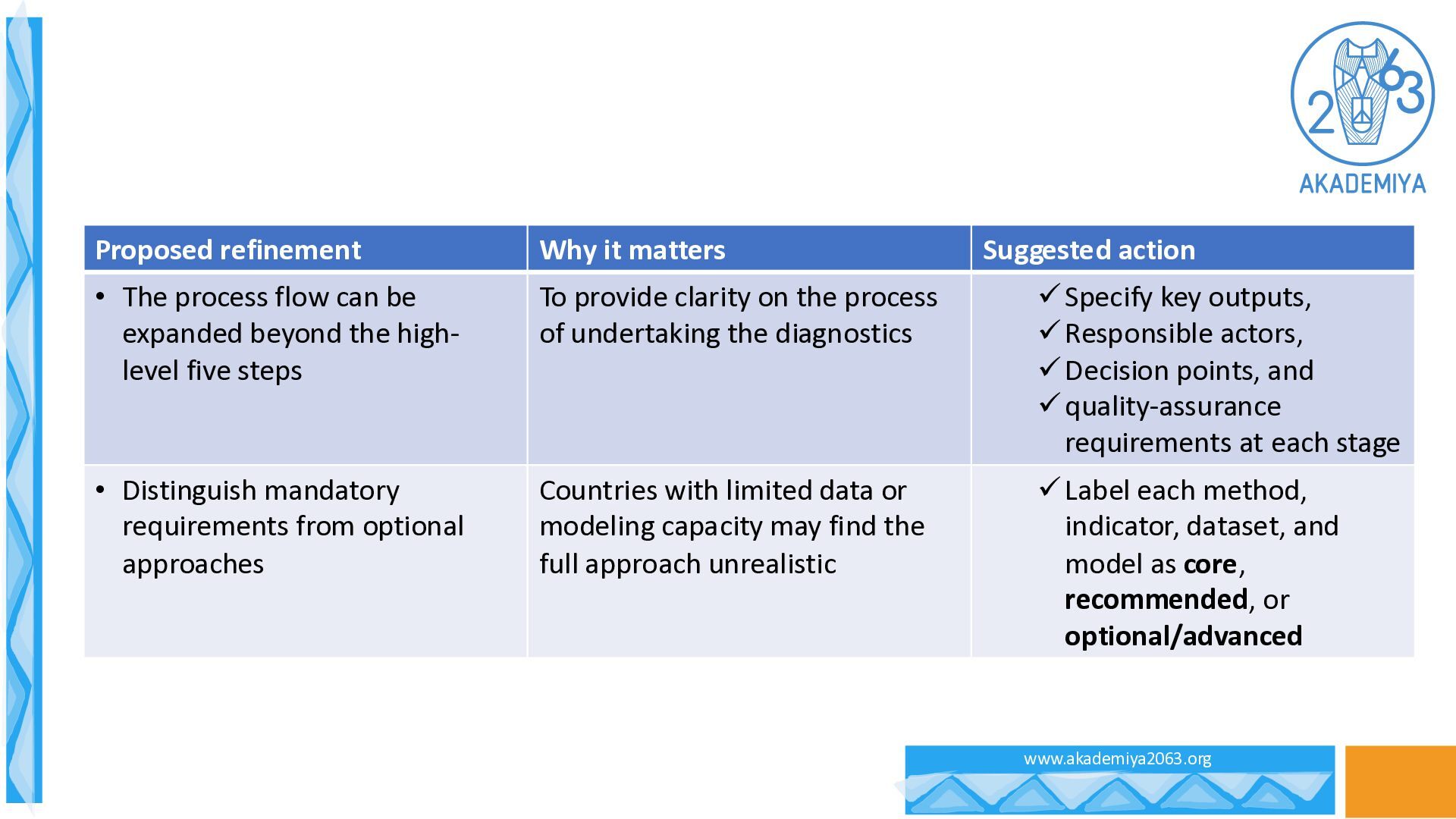
flow can be expanded beyond the highlevel five steps To provide clarity on the process of undertaking the diagnostics ✓ Specify key outputs, ✓ Responsible actors, ✓ Decision points, and ✓ quality-assurance requirements at each stage • Distinguish mandatory requirements from optional approaches Countries with limited data or modeling capacity may find the full approach unrealistic ✓ Label each method, indicator, dataset, and model as core, recommended, or optional/advanced www.akademiya2063.org
with the need for evidence-based, nationally owned NASIPs ▪ Its next stage of refinement should focus less on adding further analytical complexity and more on; ✓ Improving coherence, prioritization, implementation guidance usability, data quality, and ✓A revised version should provide countries with a stronger bridge from diagnostic findings to costed NASIP decisions www.akademiya2063.org


 akademiya2063
 microbaseinc
 nzw0301
 de9uch1
 fkske
fkske
 ayaniwa
 mikimhk
 tomonom
 sokikatayama
 koide3
 shiell
 ontheslope
.png) satai
satai
 eitanlees
 mongodb
 axbom
axbom
 aleyda
 elsirapls
 smashingmag
 hatefulcrawdad
 bcantrill
 brettharned
 ivargrimstad
 marktimemedia
 inesmontani