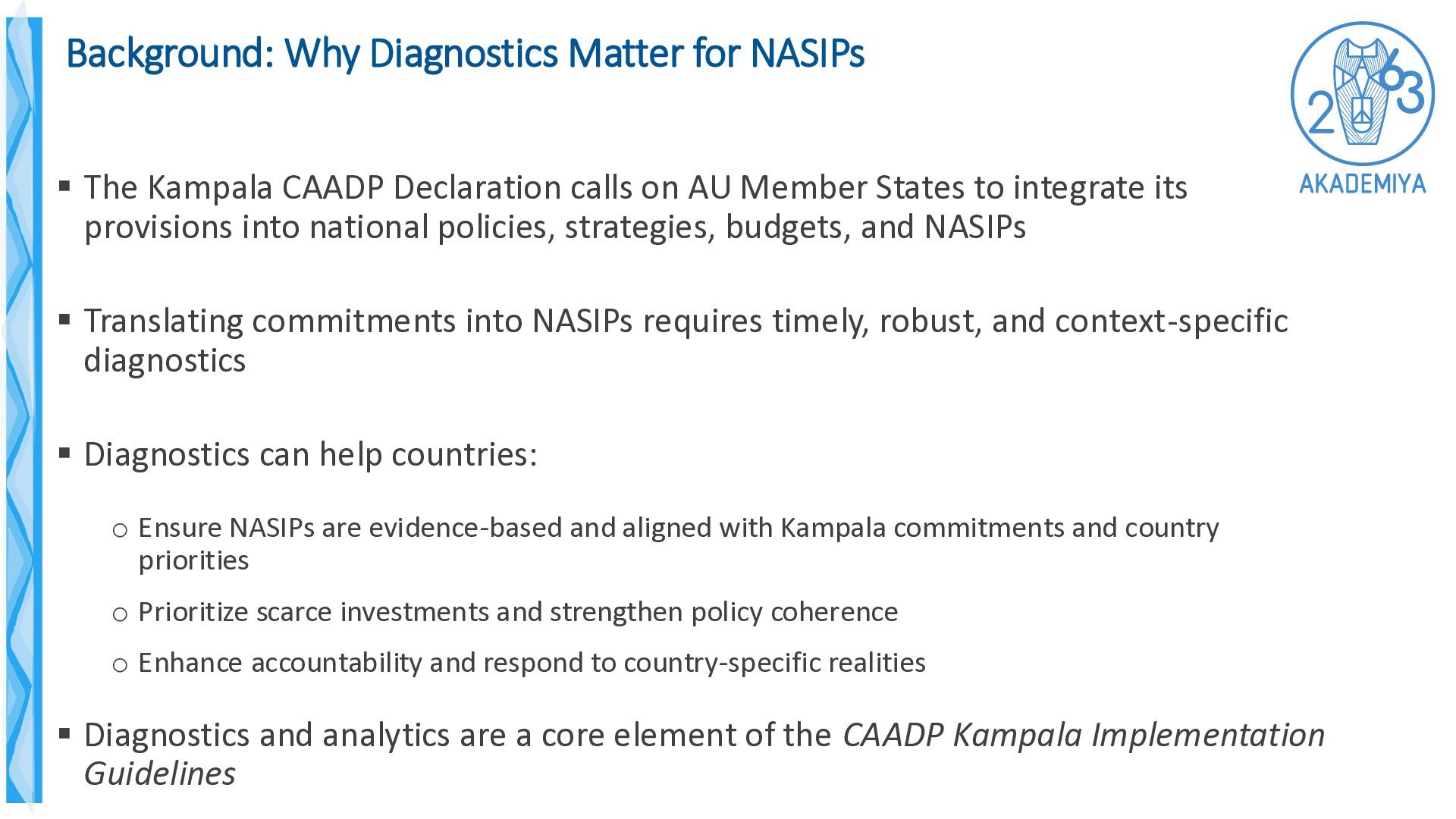
Declaration calls on AU Member States to integrate its provisions into national policies, strategies, budgets, and NASIPs ▪ Translating commitments into NASIPs requires timely, robust, and context-specific diagnostics ▪ Diagnostics can help countries: o Ensure NASIPs are evidence-based and aligned with Kampala commitments and country priorities o Prioritize scarce investments and strengthen policy coherence o Enhance accountability and respond to country-specific realities ▪ Diagnostics and analytics are a core element of the CAADP Kampala Implementation www.akademiya2063.org Guidelines
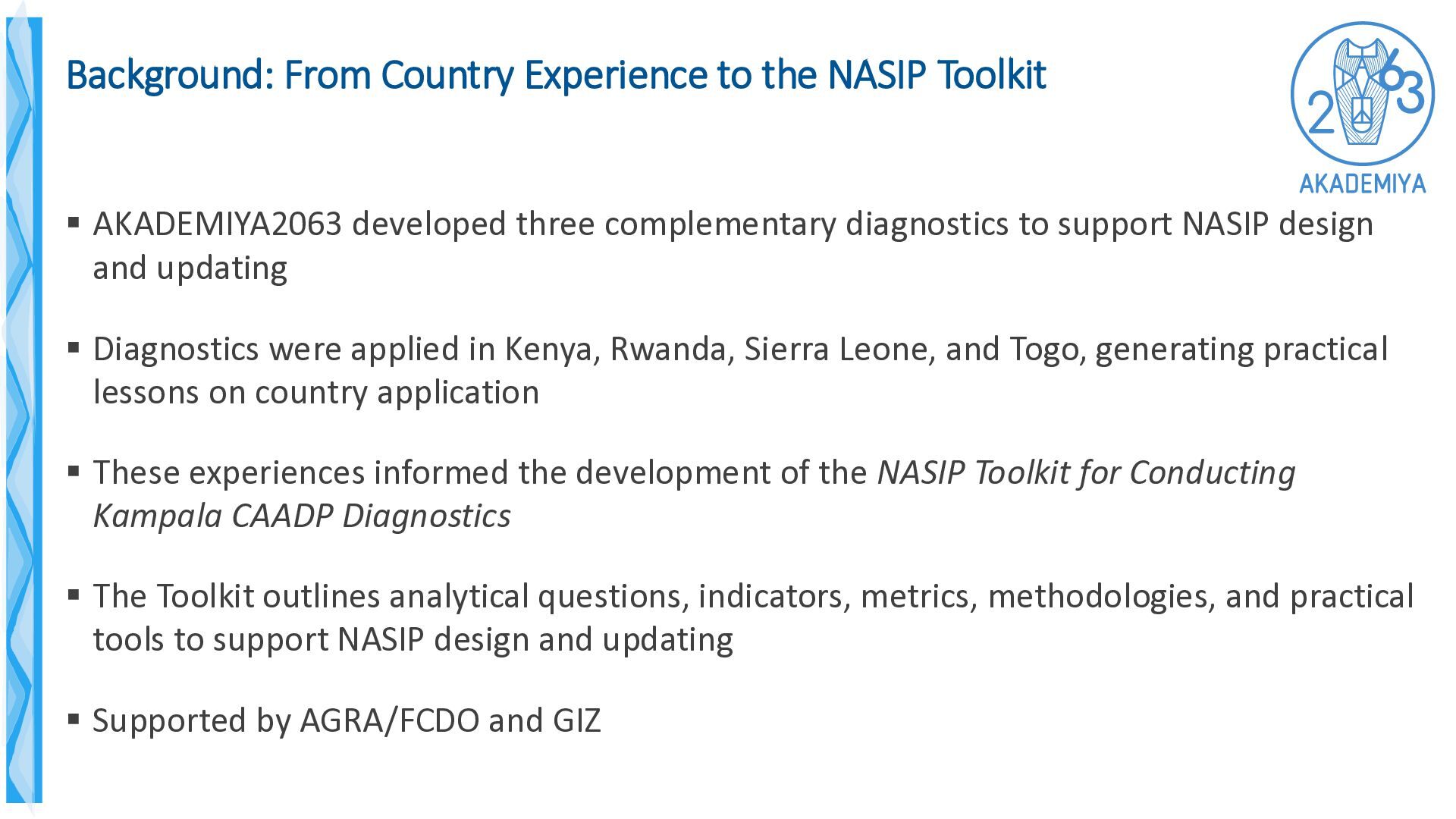
developed three complementary diagnostics to support NASIP design and updating ▪ Diagnostics were applied in Kenya, Rwanda, Sierra Leone, and Togo, generating practical lessons on country application ▪ These experiences informed the development of the NASIP Toolkit for Conducting Kampala CAADP Diagnostics ▪ The Toolkit outlines analytical questions, indicators, metrics, methodologies, and practical tools to support NASIP design and updating ▪ Supported by AGRA/FCDO and GIZ www.akademiya2063.org
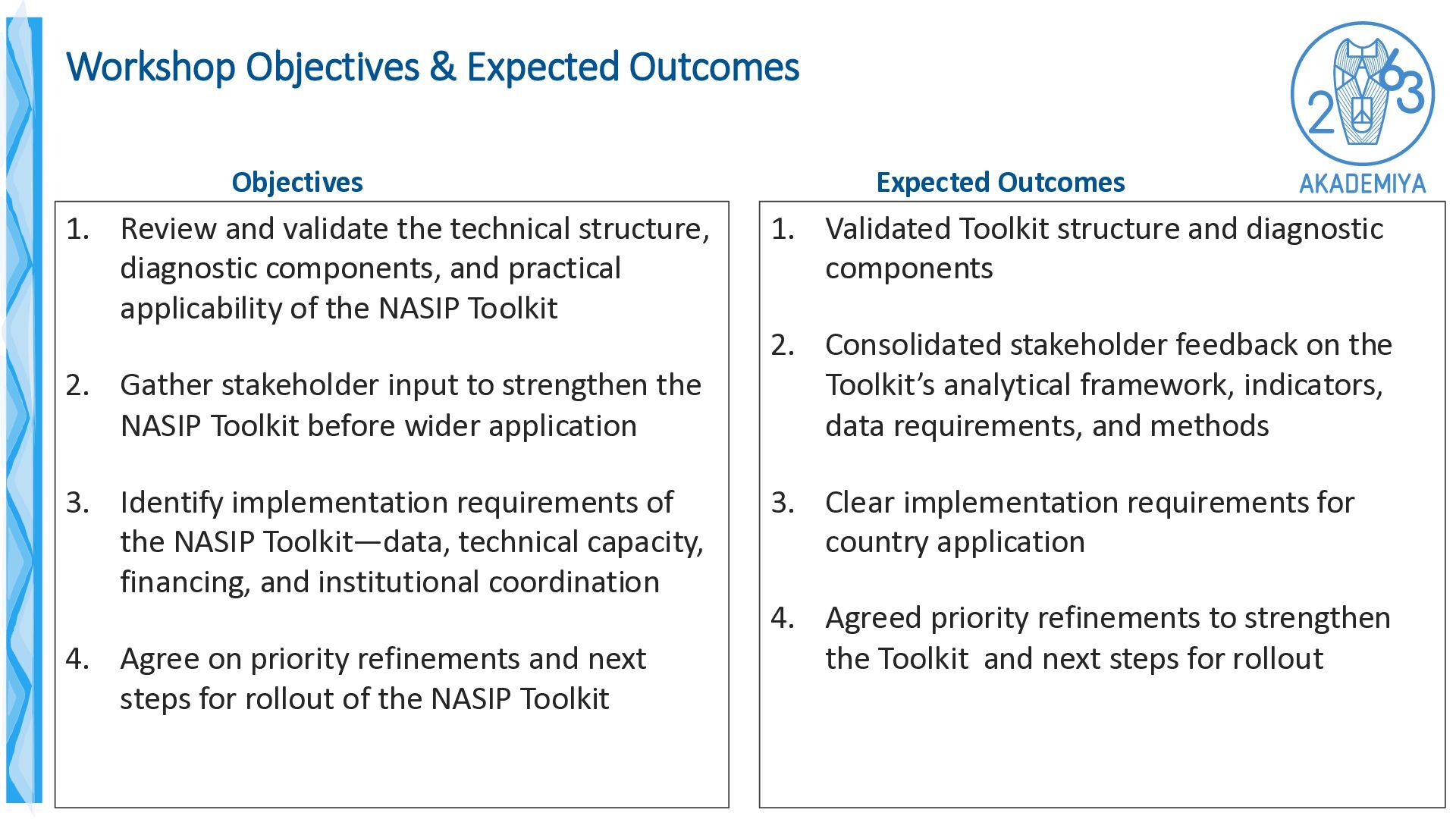
the technical structure, diagnostic components, and practical applicability of the NASIP Toolkit 2. Gather stakeholder input to strengthen the NASIP Toolkit before wider application 3. Identify implementation requirements of the NASIP Toolkit—data, technical capacity, financing, and institutional coordination 4. Agree on priority refinements and next steps for rollout of the NASIP Toolkit Expected Outcomes 1. Validated Toolkit structure and diagnostic components 2. Consolidated stakeholder feedback on the Toolkit’s analytical framework, indicators, data requirements, and methods 3. Clear implementation requirements for country application 4. Agreed priority refinements to strengthen the Toolkit and next steps for rollout www.akademiya2063.org
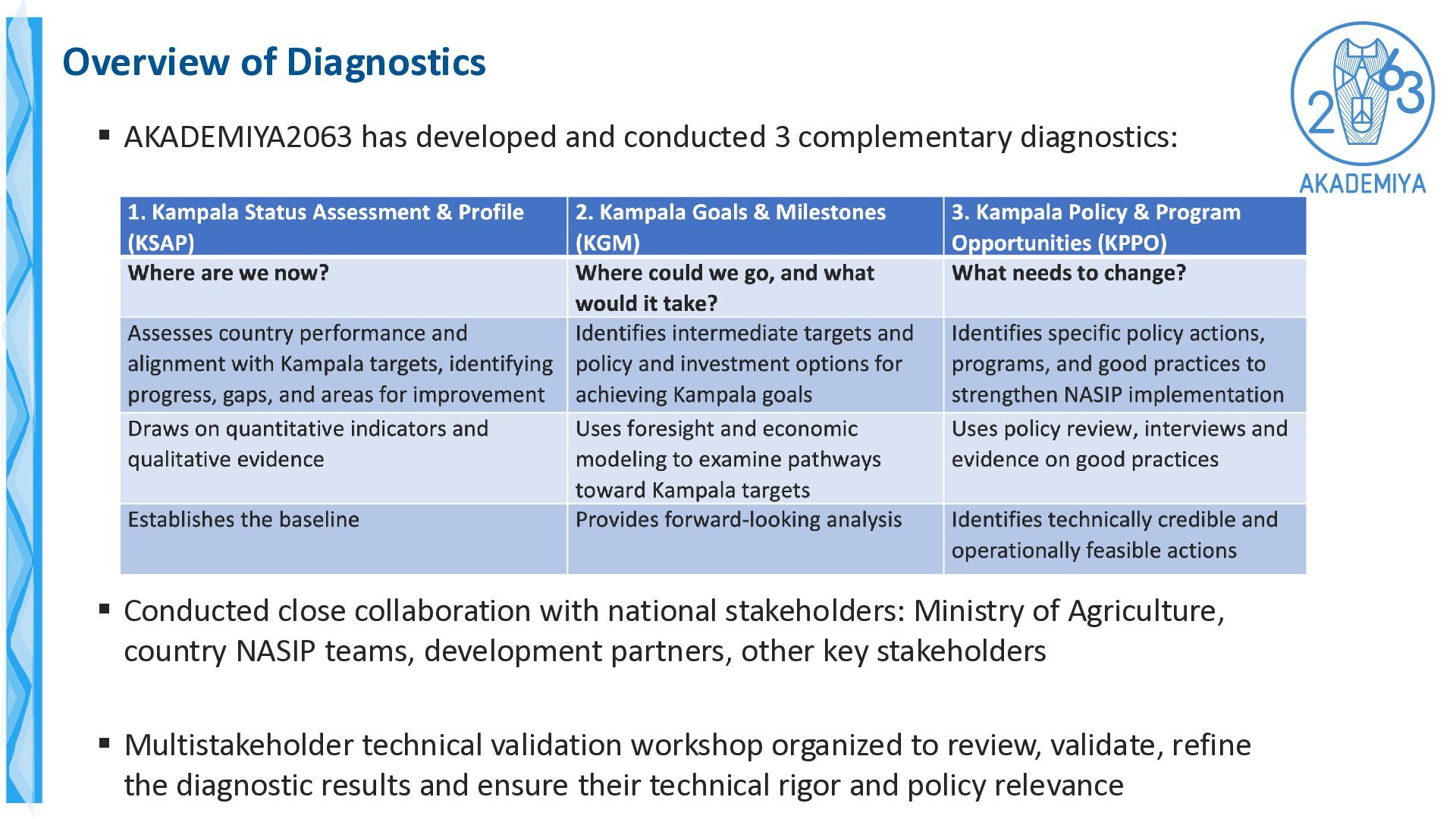
complementary diagnostics: ▪ Conducted close collaboration with national stakeholders: Ministry of Agriculture, country NASIP teams, development partners, other key stakeholders ▪ Multistakeholder technical validation workshop organized to review, validate, refine www.akademiya2063.org the diagnostic results and ensure their technical rigor and policy relevance
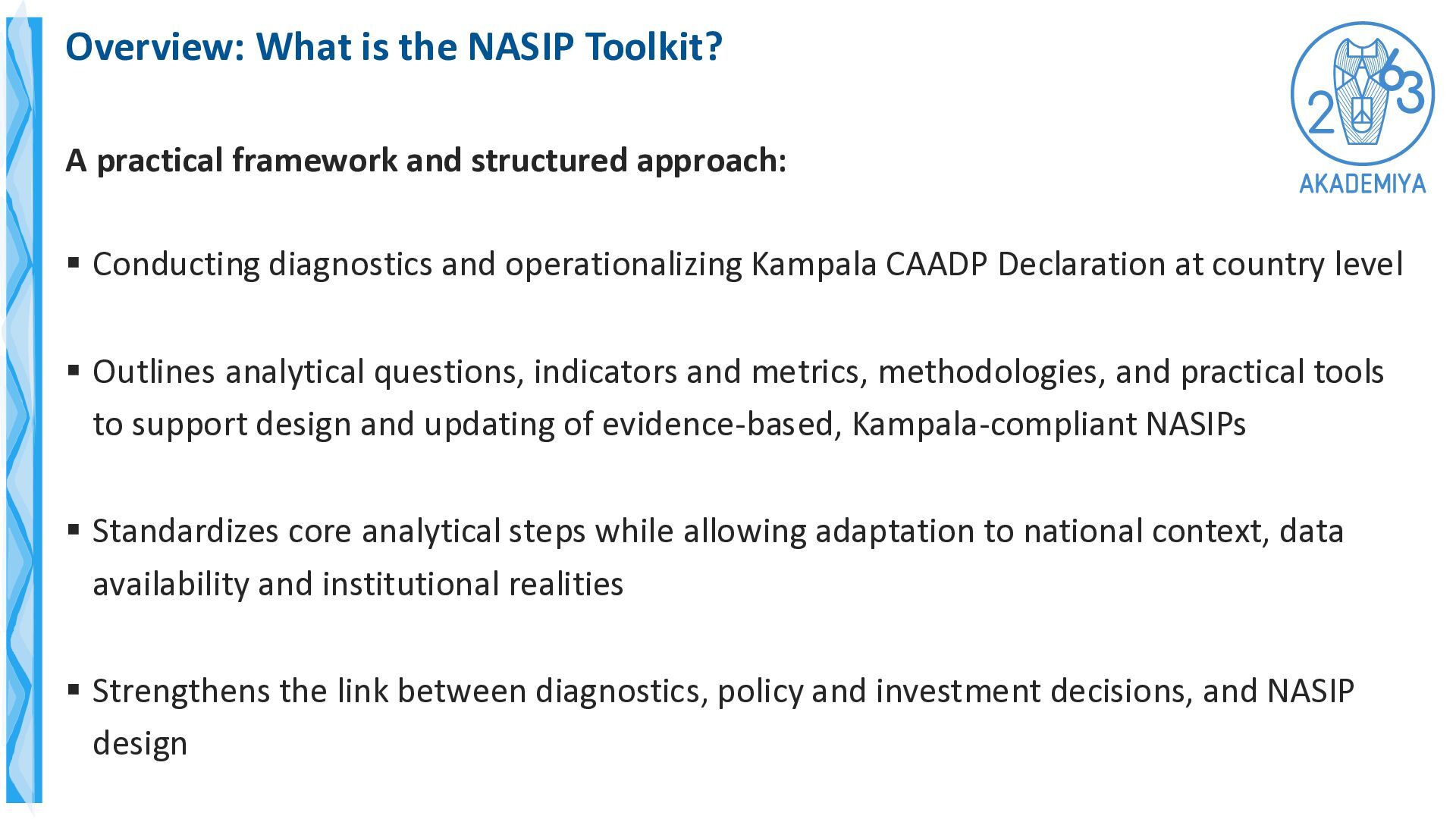
structured approach: ▪ Conducting diagnostics and operationalizing Kampala CAADP Declaration at country level ▪ Outlines analytical questions, indicators and metrics, methodologies, and practical tools to support design and updating of evidence-based, Kampala-compliant NASIPs ▪ Standardizes core analytical steps while allowing adaptation to national context, data availability and institutional realities ▪ Strengthens the link between diagnostics, policy and investment decisions, and NASIP design www.akademiya2063.org
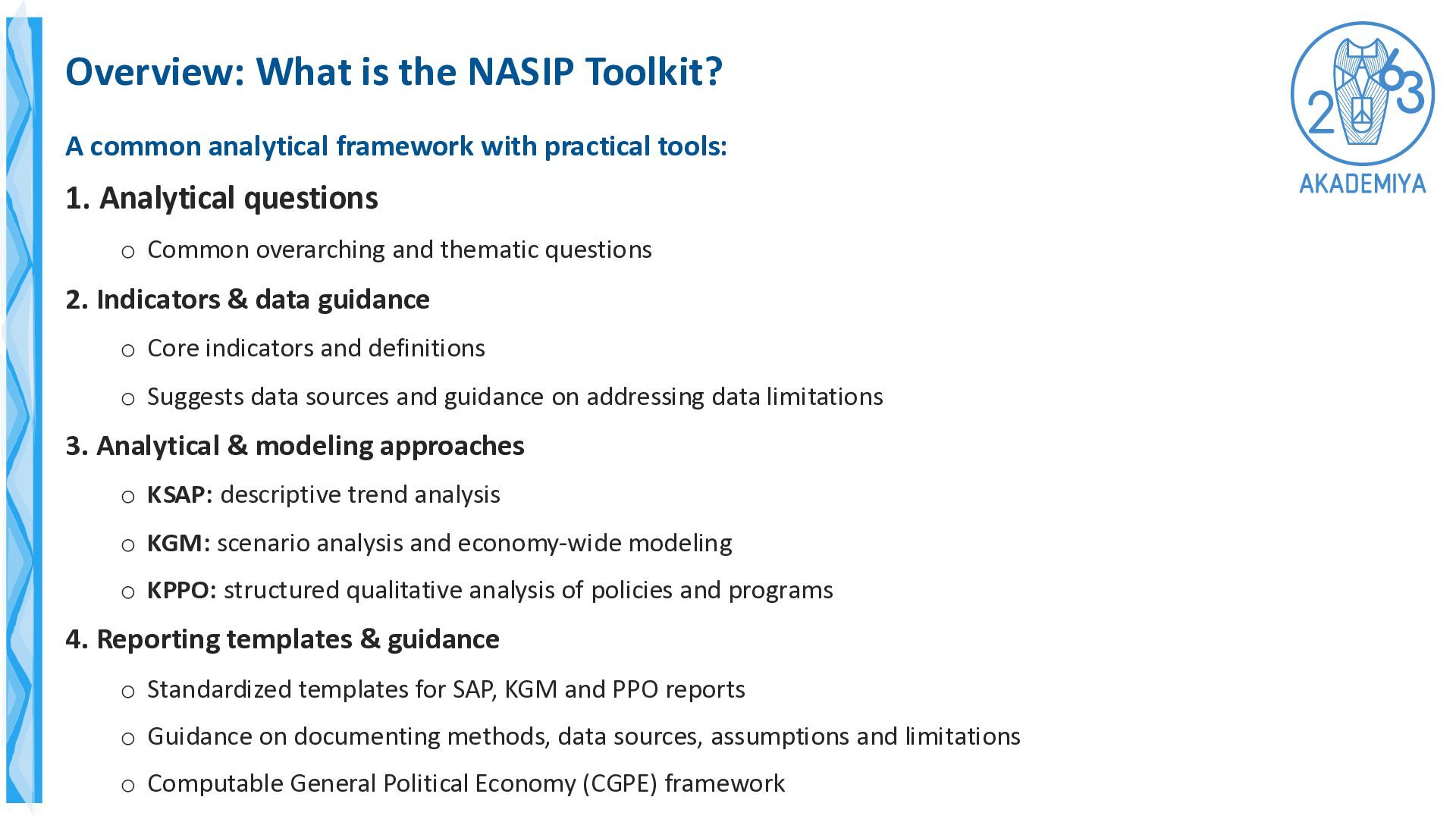
with practical tools: 1. Analytical questions o Common overarching and thematic questions 2. Indicators & data guidance o Core indicators and definitions o Suggests data sources and guidance on addressing data limitations 3. Analytical & modeling approaches o KSAP: descriptive trend analysis o KGM: scenario analysis and economy-wide modeling o KPPO: structured qualitative analysis of policies and programs 4. Reporting templates & guidance o Standardized templates for SAP, KGM and PPO reports o Guidance on documenting methods, data sources, assumptions and limitations o Computable General Political Economy (CGPE) framework www.akademiya2063.org
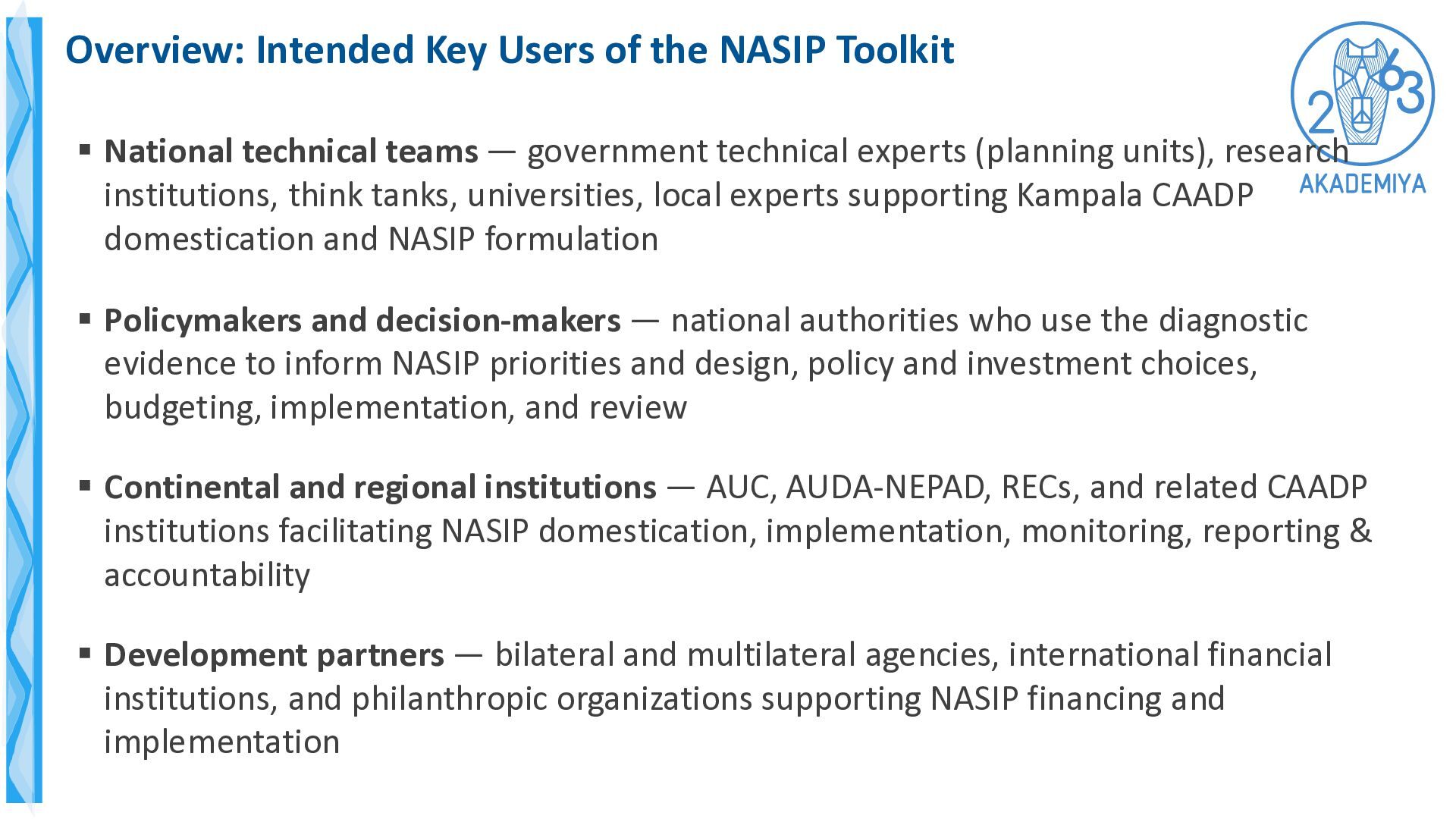
technical teams — government technical experts (planning units), research institutions, think tanks, universities, local experts supporting Kampala CAADP domestication and NASIP formulation ▪ Policymakers and decision-makers — national authorities who use the diagnostic evidence to inform NASIP priorities and design, policy and investment choices, budgeting, implementation, and review ▪ Continental and regional institutions — AUC, AUDA-NEPAD, RECs, and related CAADP institutions facilitating NASIP domestication, implementation, monitoring, reporting & accountability ▪ Development partners — bilateral and multilateral agencies, international financial institutions, and philanthropic organizations supporting NASIP financing and implementation www.akademiya2063.org
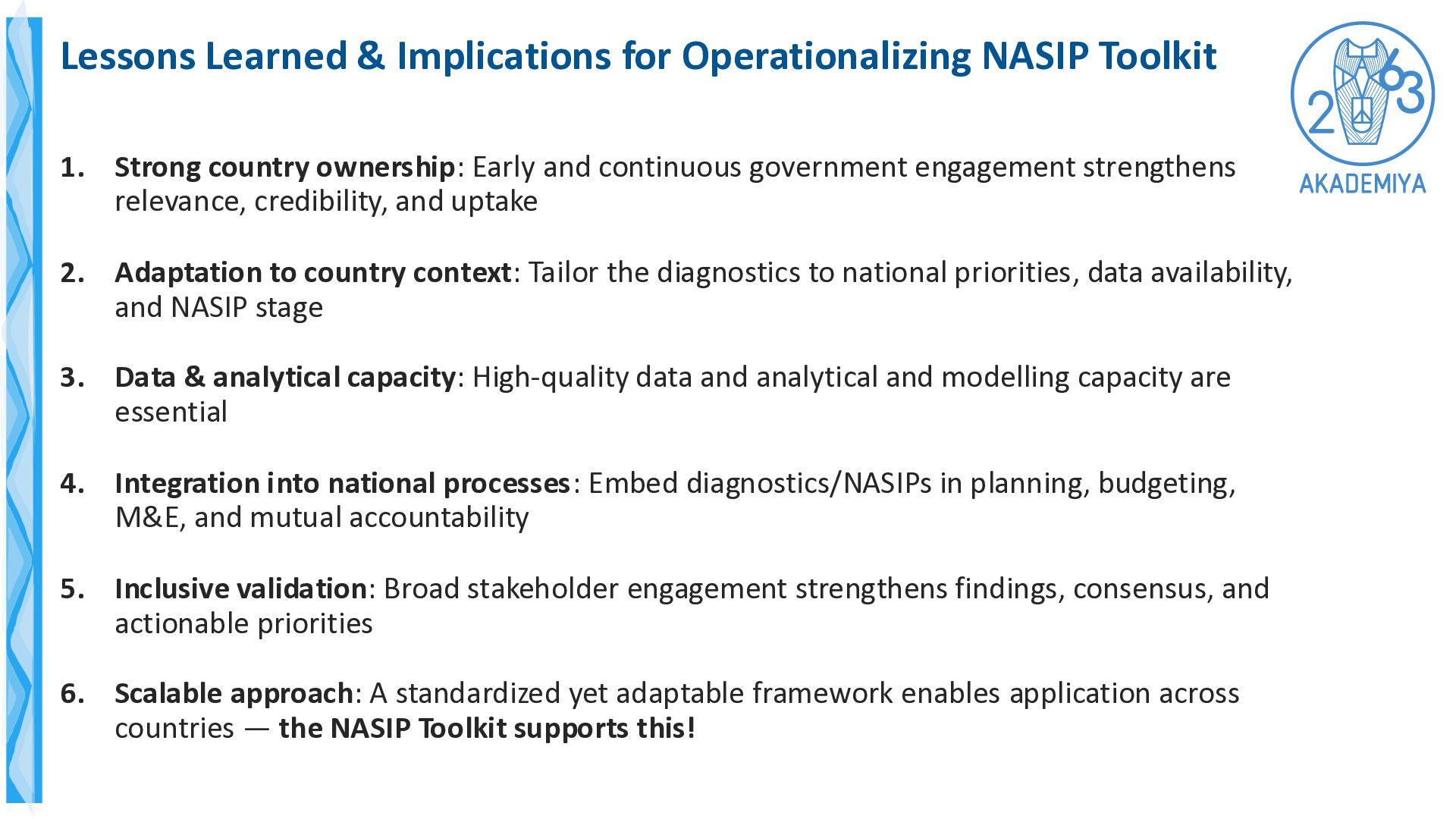
country ownership: Early and continuous government engagement strengthens relevance, credibility, and uptake 2. Adaptation to country context: Tailor the diagnostics to national priorities, data availability, and NASIP stage 3. Data & analytical capacity: High-quality data and analytical and modelling capacity are essential 4. Integration into national processes: Embed diagnostics/NASIPs in planning, budgeting, M&E, and mutual accountability 5. Inclusive validation: Broad stakeholder engagement strengthens findings, consensus, and actionable priorities 6. Scalable approach: A standardized yet adaptable framework enables application across countries — the NASIP Toolkit supports this! www.akademiya2063.org
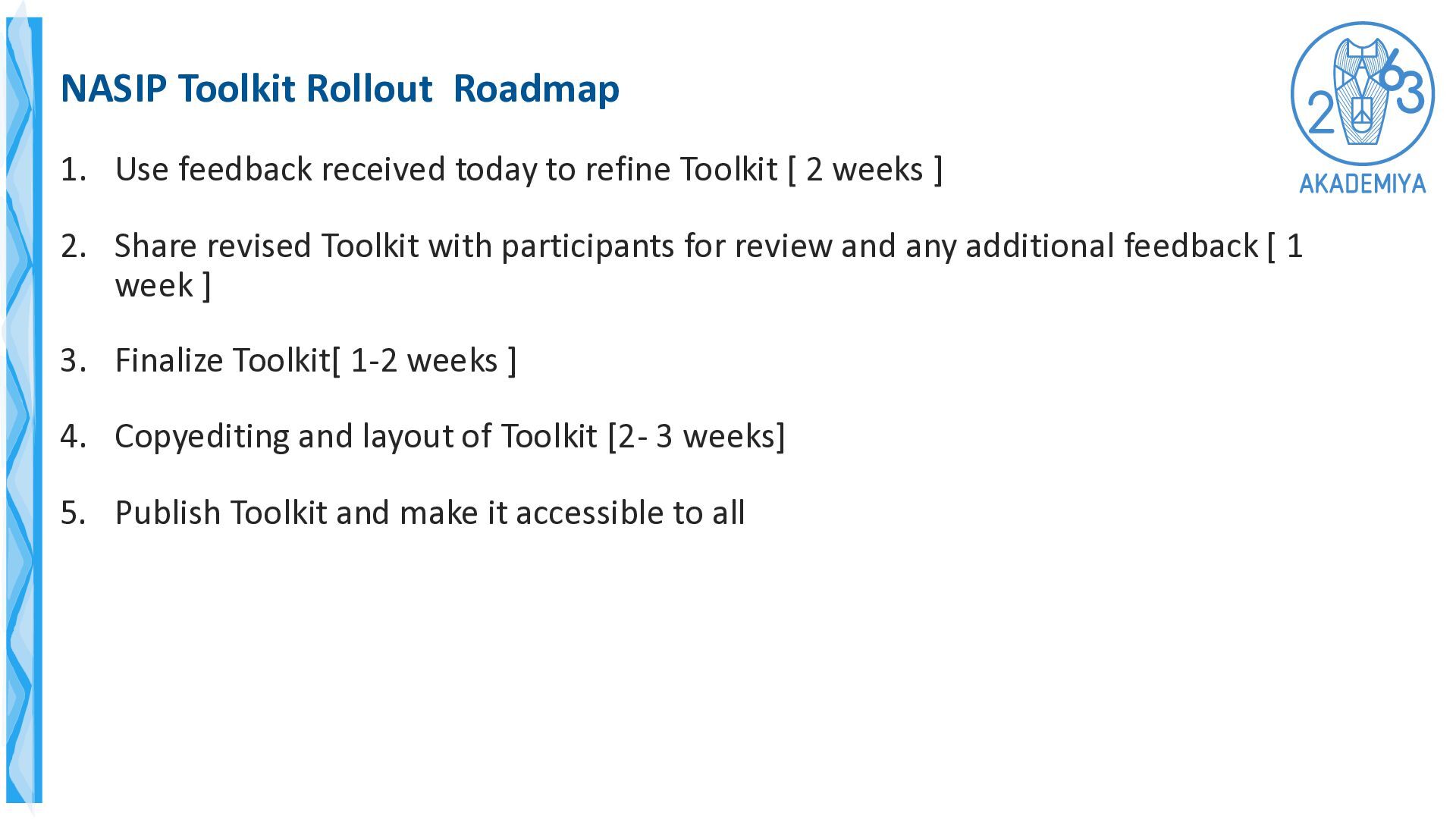
refine Toolkit [ 2 weeks ] 2. Share revised Toolkit with participants for review and any additional feedback [ 1 week ] 3. Finalize Toolkit[ 1-2 weeks ] 4. Copyediting and layout of Toolkit [2- 3 weeks] 5. Publish Toolkit and make it accessible to all www.akademiya2063.org


 akademiya2063
 institutdelelevage
 mikimhk
 tkng
tkng
 s_mizuki_nlp
 hellosct1
 ayaniwa
 nzw0301
 mickey_0226
 microbaseinc
.png) satai
satai
 casualconc
 scottboms
 maggiecrowley
 moore
moore
 bryan
bryan
 trishagee
 livdayseo
 lindahogenes
 sabderemane
 emna__ayadi
 keathley
 zakiyama
 kneath