What Is AI Visibility in SEO? A Repeatable Obse...

Share
Embed
What Is AI Visibility in SEO? A Repeatable Observation Protocol
The question "what is AI visibility in SEO?" is easier to answer when teams define the observation, record its conditions, and separate mentions, citations, accuracy, referrals, and business outcomes. This workshop explains a repeatable protocol for analytics engineers and technical marketers, including the limits of GA4 and Search Console joins. Which field or join in your current AI search reporting would you validate first, and what evidence would convince your team it is reliable? If your team keeps asking what is AI visibility in SEO, start with the full guide: https://guaranteedseoservices.com/measure-ai-search-visibility/?utm_source=speakerdeck&utm_medium=referral&utm_campaign=blog-measure-ai-search-visibility

GuaranteedSEOServices
October 26, 2026
Transcript
22 slides
-
What Is AI Visibility in SEO? Build a Repeatable AI
Answer Observation Protocol A mechanism-first workshop for analytics engineers and technical marketers. Define the observation, record the conditions, separate the events, and report what the evidence actually supports. GuaranteedSEOServices.com October 27, 2026 -
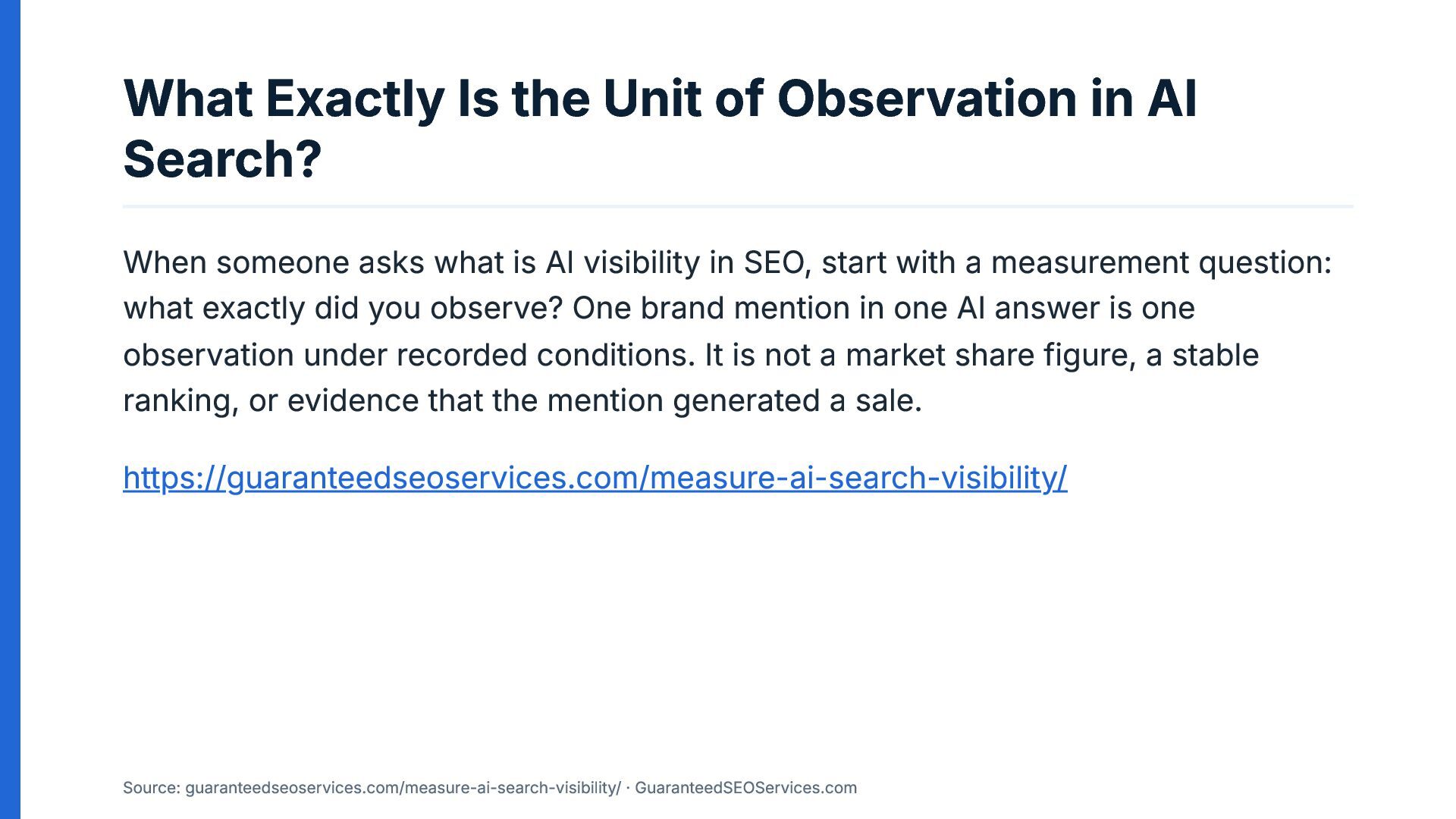
What Exactly Is the Unit of Observation in AI Search?
When someone asks what is AI visibility in SEO, start with a measurement question: what exactly did you observe? One brand mention in one AI answer is one observation under recorded conditions. It is not a market share figure, a stable ranking, or evidence that the mention generated a sale. https://guaranteedseoservices.com/measure-ai-search-visibility/ Source: guaranteedseoservices.com/measure-ai-search-visibility/ · GuaranteedSEOServices.com -
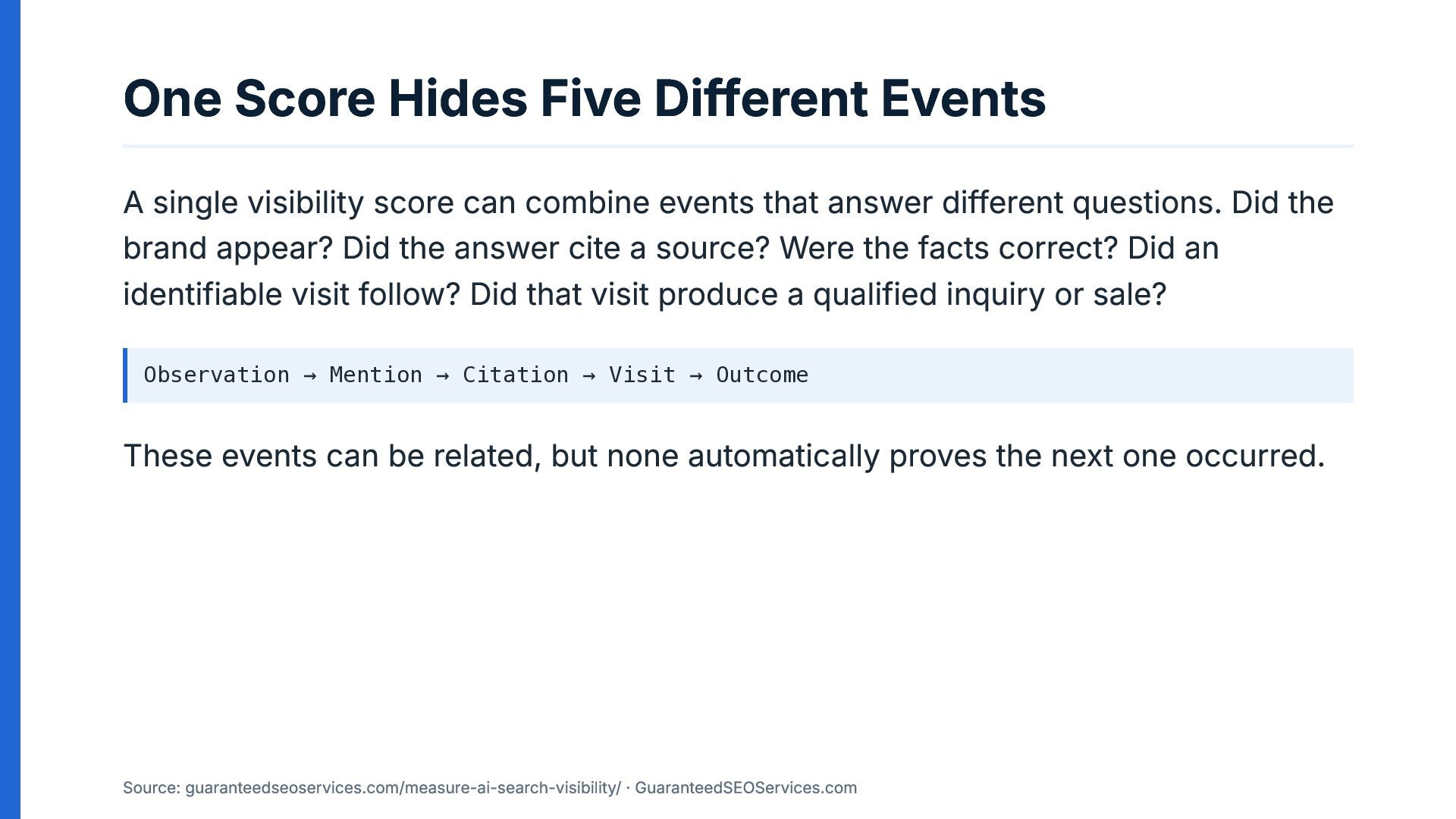
One Score Hides Five Different Events A single visibility score
can combine events that answer different questions. Did the brand appear? Did the answer cite a source? Were the facts correct? Did an identifiable visit follow? Did that visit produce a qualified inquiry or sale? Observation → Mention → Citation → Visit → Outcome These events can be related, but none automatically proves the next one occurred. Source: guaranteedseoservices.com/measure-ai-search-visibility/ · GuaranteedSEOServices.com -
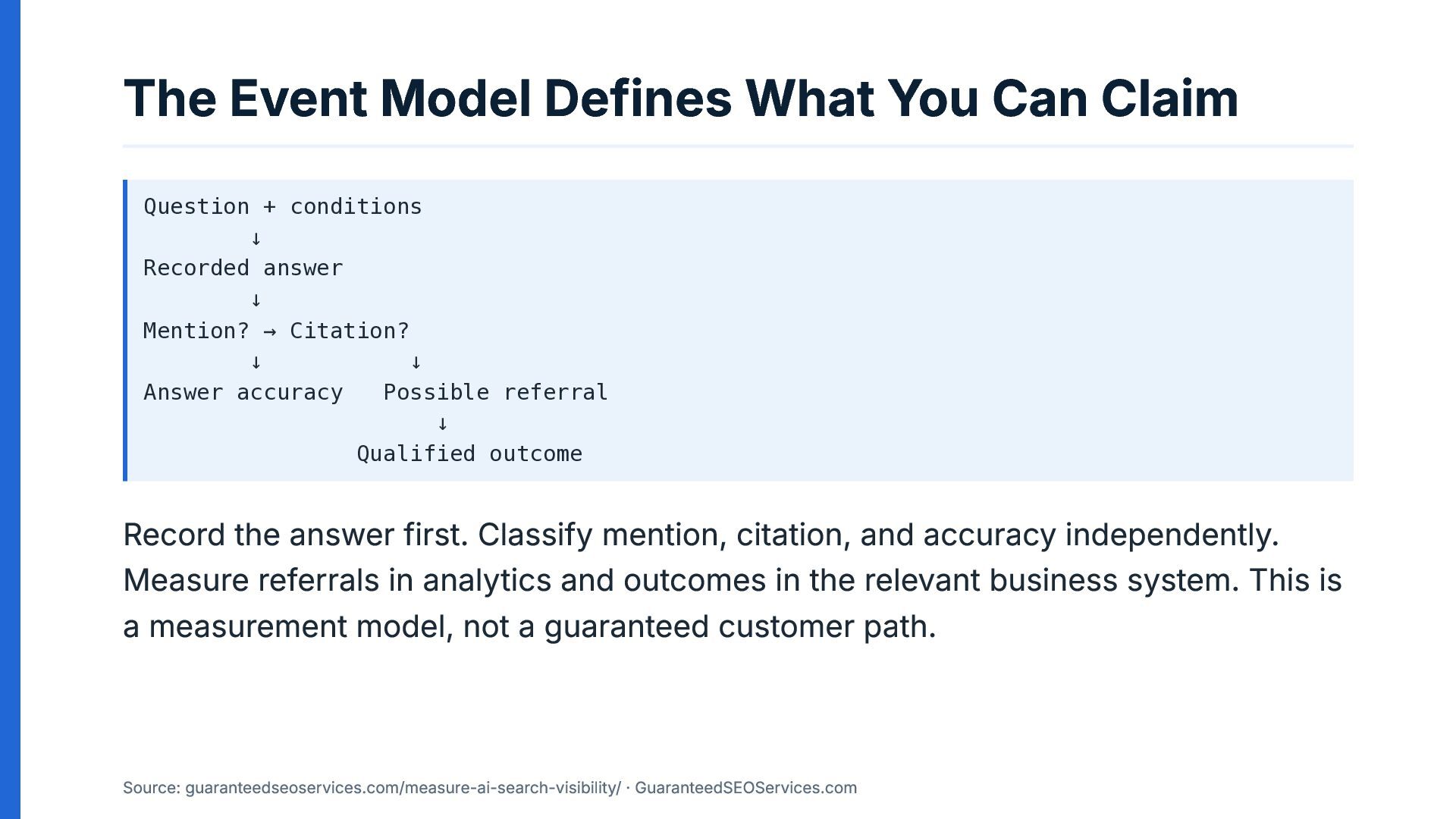
The Event Model Defines What You Can Claim Question +
conditions ↓ Recorded answer ↓ Mention? → Citation? ↓ ↓ Answer accuracy Possible referral ↓ Qualified outcome Record the answer first. Classify mention, citation, and accuracy independently. Measure referrals in analytics and outcomes in the relevant business system. This is a measurement model, not a guaranteed customer path. Source: guaranteedseoservices.com/measure-ai-search-visibility/ · GuaranteedSEOServices.com -
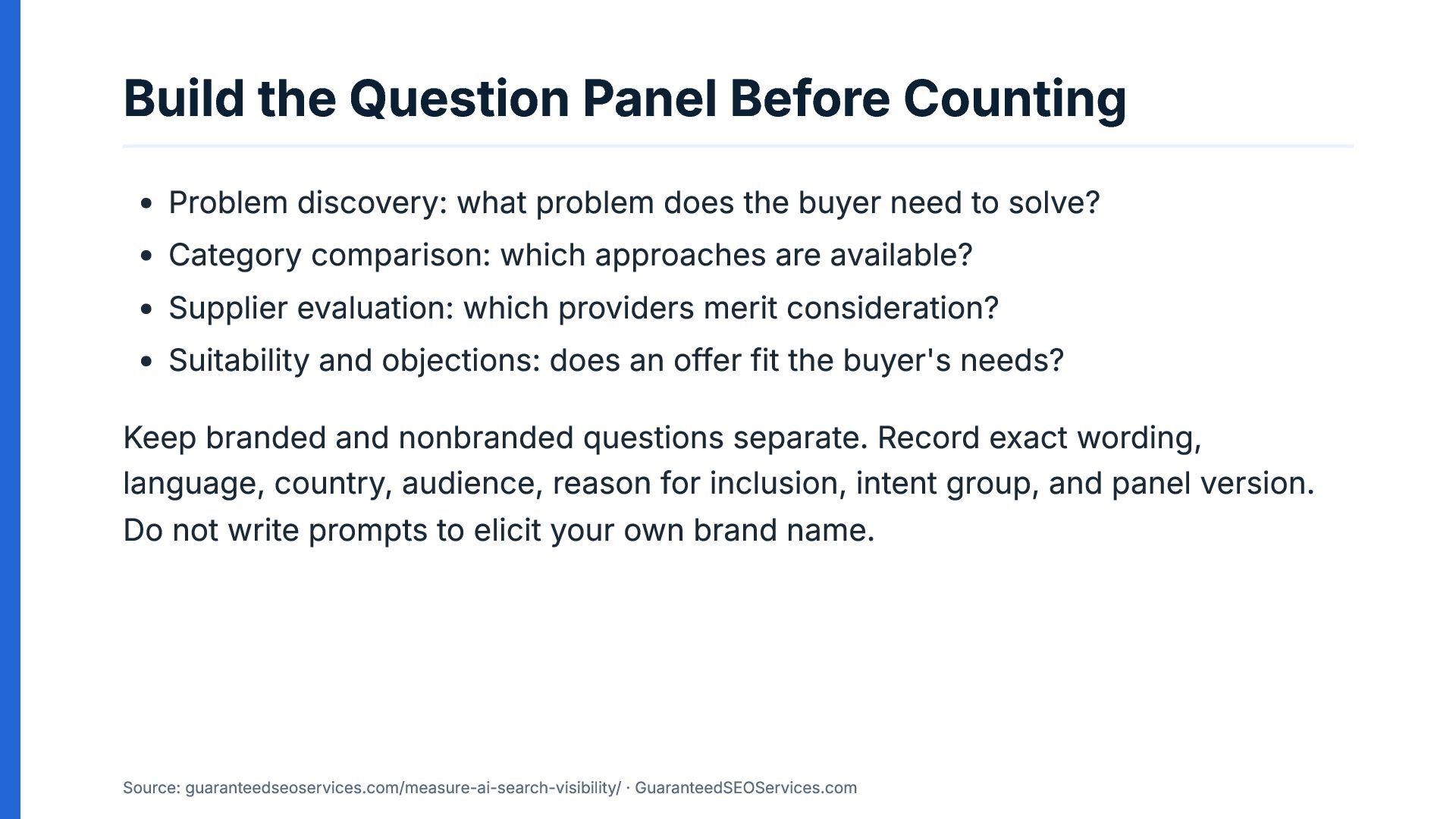
Build the Question Panel Before Counting Problem discovery: what problem
does the buyer need to solve? Category comparison: which approaches are available? Supplier evaluation: which providers merit consideration? Suitability and objections: does an offer fit the buyer's needs? Keep branded and nonbranded questions separate. Record exact wording, language, country, audience, reason for inclusion, intent group, and panel version. Do not write prompts to elicit your own brand name. Source: guaranteedseoservices.com/measure-ai-search-visibility/ · GuaranteedSEOServices.com -
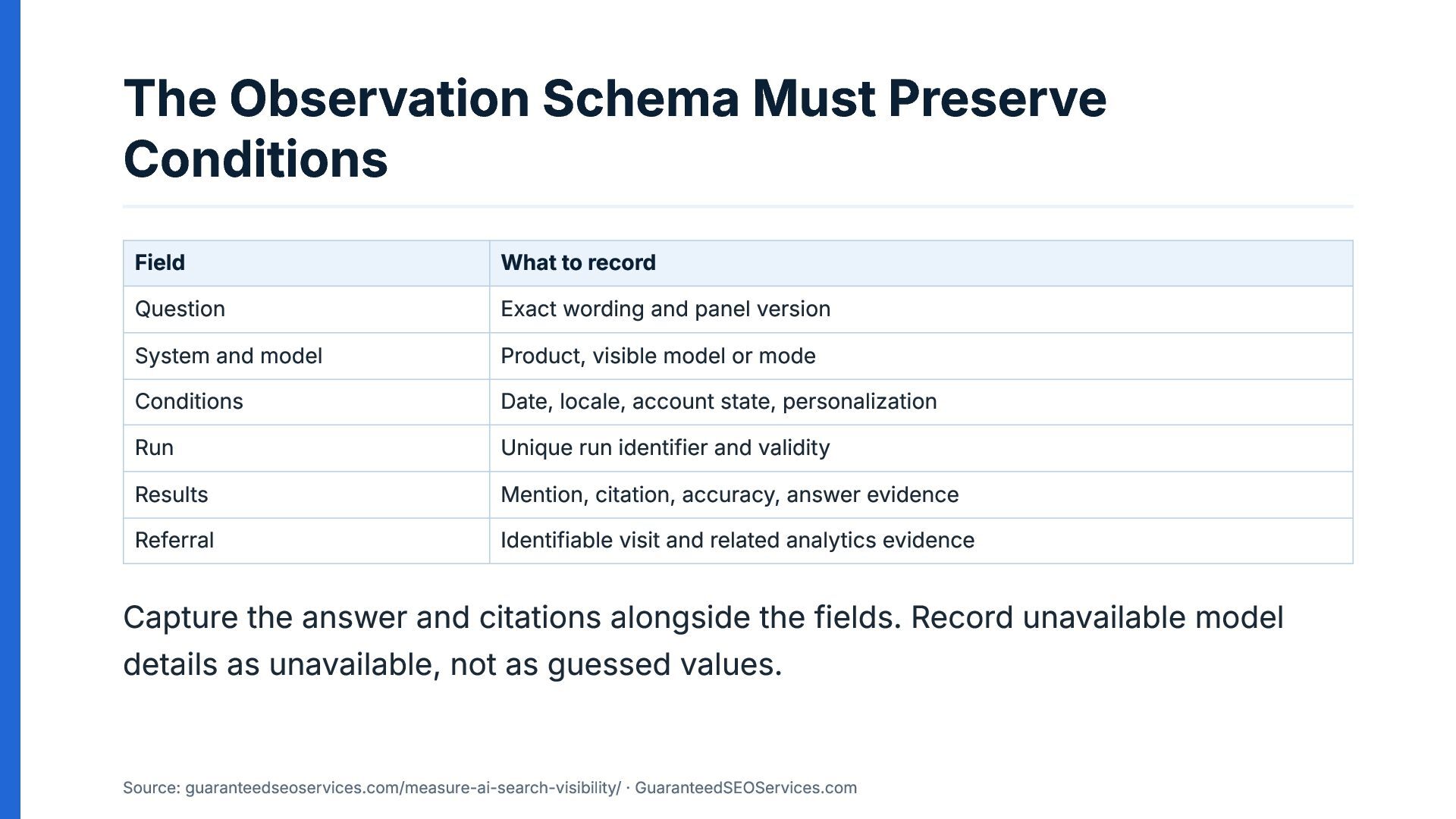
The Observation Schema Must Preserve Conditions Field What to record
Question Exact wording and panel version System and model Product, visible model or mode Conditions Date, locale, account state, personalization Run Unique run identifier and validity Results Mention, citation, accuracy, answer evidence Referral Identifiable visit and related analytics evidence Capture the answer and citations alongside the fields. Record unavailable model details as unavailable, not as guessed values. Source: guaranteedseoservices.com/measure-ai-search-visibility/ · GuaranteedSEOServices.com -
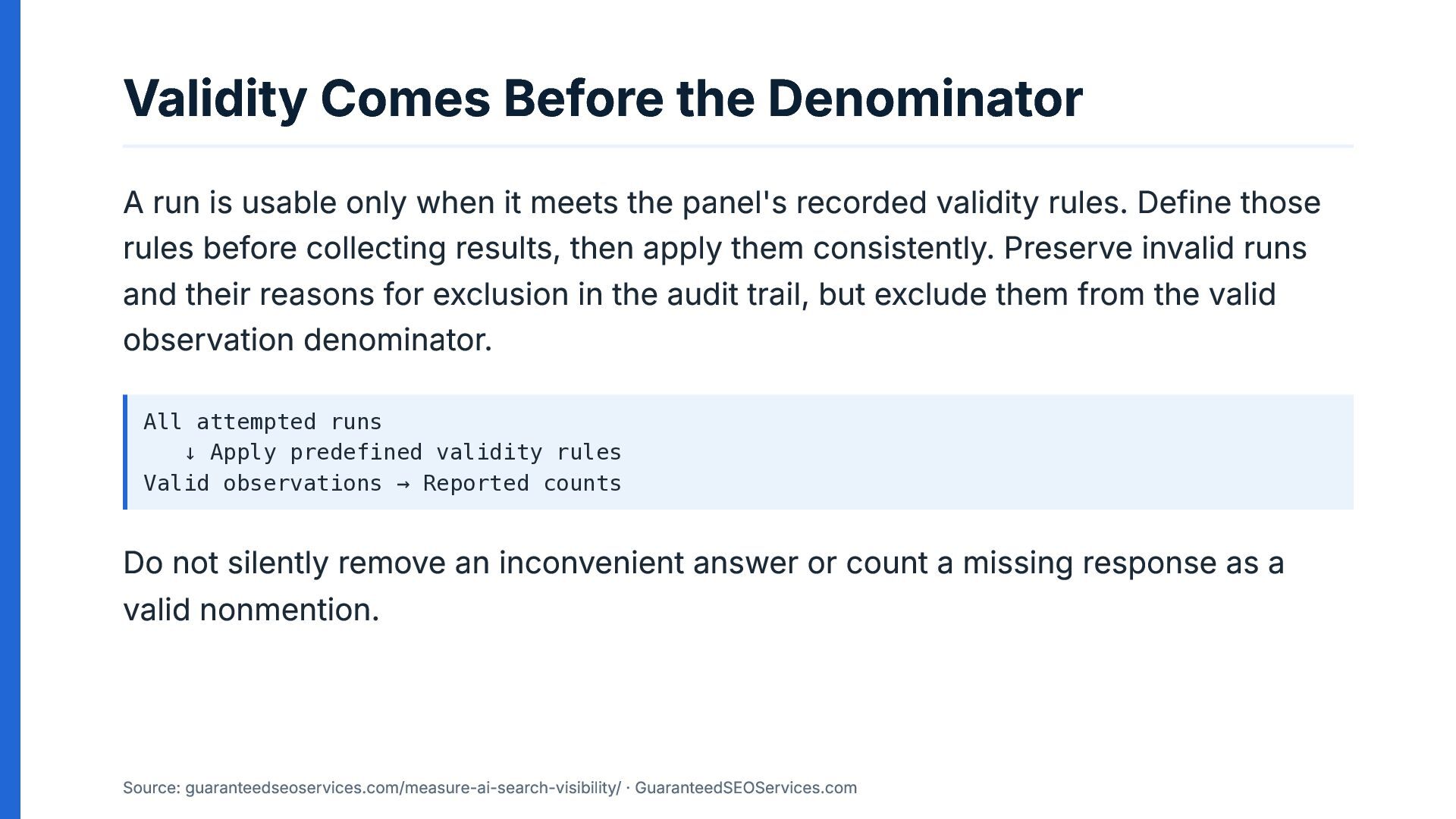
Validity Comes Before the Denominator A run is usable only
when it meets the panel's recorded validity rules. Define those rules before collecting results, then apply them consistently. Preserve invalid runs and their reasons for exclusion in the audit trail, but exclude them from the valid observation denominator. All attempted runs ↓ Apply predefined validity rules Valid observations → Reported counts Do not silently remove an inconvenient answer or count a missing response as a valid nonmention. Source: guaranteedseoservices.com/measure-ai-search-visibility/ · GuaranteedSEOServices.com -
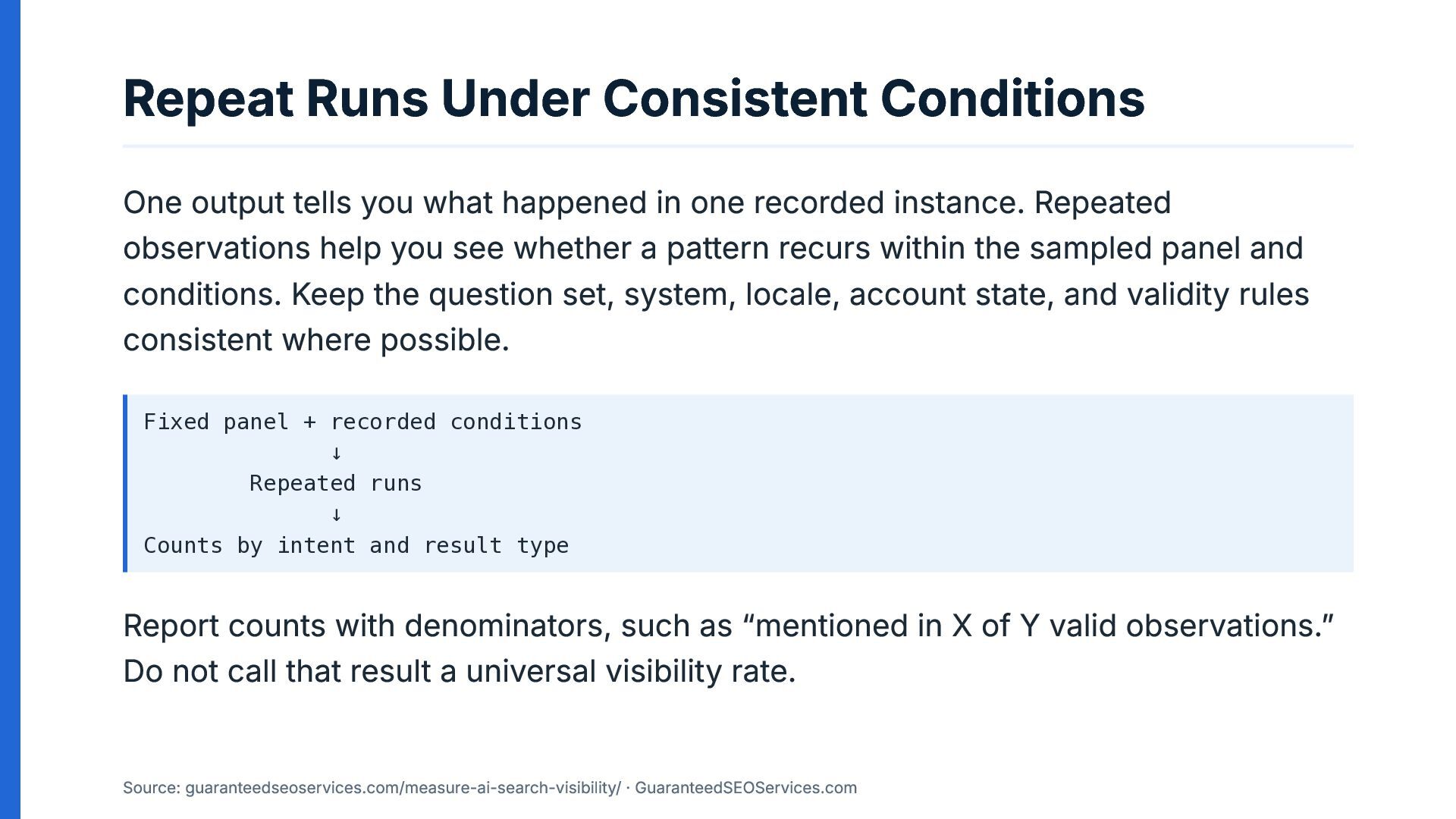
Repeat Runs Under Consistent Conditions One output tells you what
happened in one recorded instance. Repeated observations help you see whether a pattern recurs within the sampled panel and conditions. Keep the question set, system, locale, account state, and validity rules consistent where possible. Fixed panel + recorded conditions ↓ Repeated runs ↓ Counts by intent and result type Report counts with denominators, such as “mentioned in X of Y valid observations.” Do not call that result a universal visibility rate. Source: guaranteedseoservices.com/measure-ai-search-visibility/ · GuaranteedSEOServices.com -
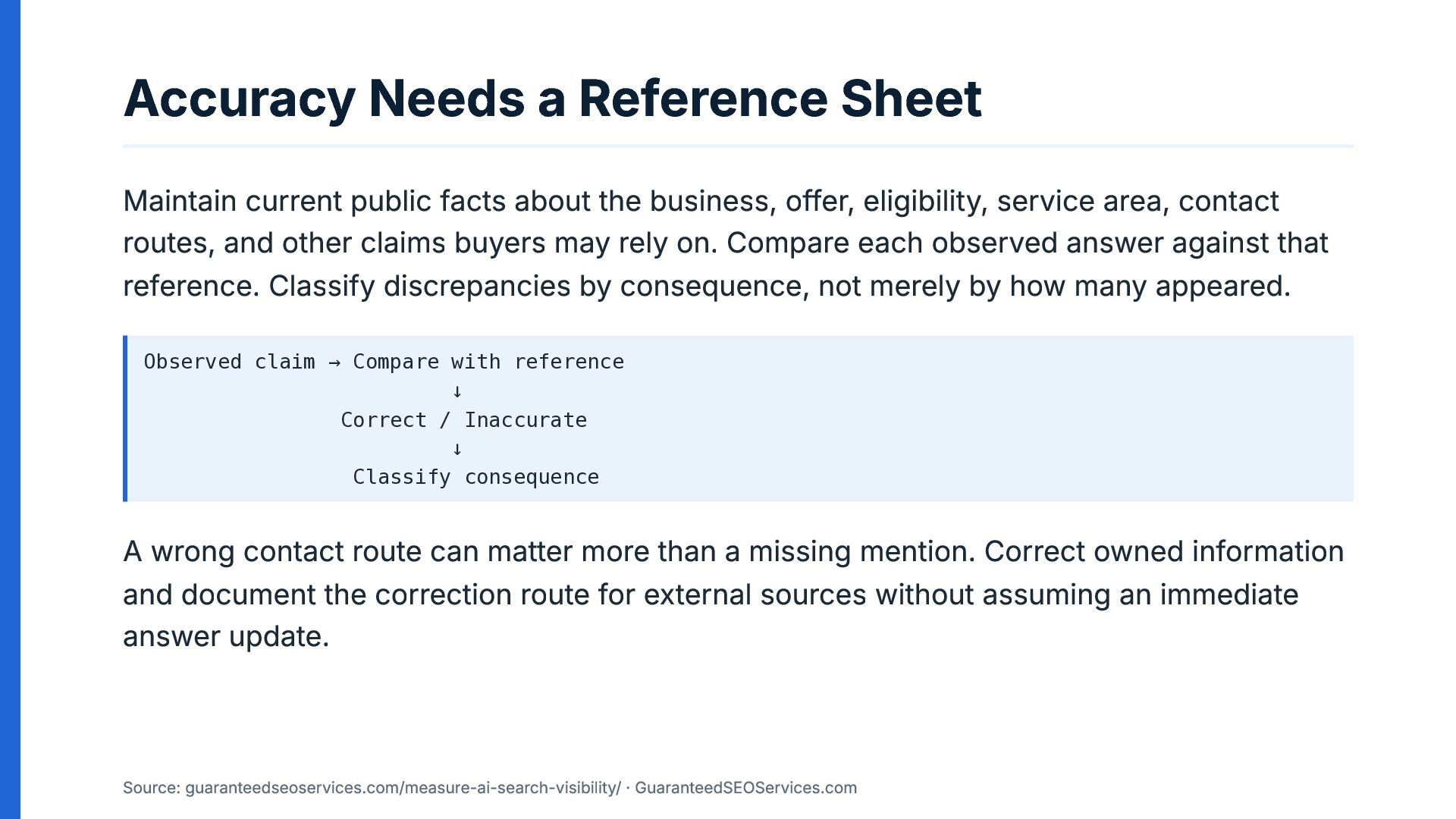
Accuracy Needs a Reference Sheet Maintain current public facts about
the business, offer, eligibility, service area, contact routes, and other claims buyers may rely on. Compare each observed answer against that reference. Classify discrepancies by consequence, not merely by how many appeared. Observed claim → Compare with reference ↓ Correct / Inaccurate ↓ Classify consequence A wrong contact route can matter more than a missing mention. Correct owned information and document the correction route for external sources without assuming an immediate answer update. Source: guaranteedseoservices.com/measure-ai-search-visibility/ · GuaranteedSEOServices.com -
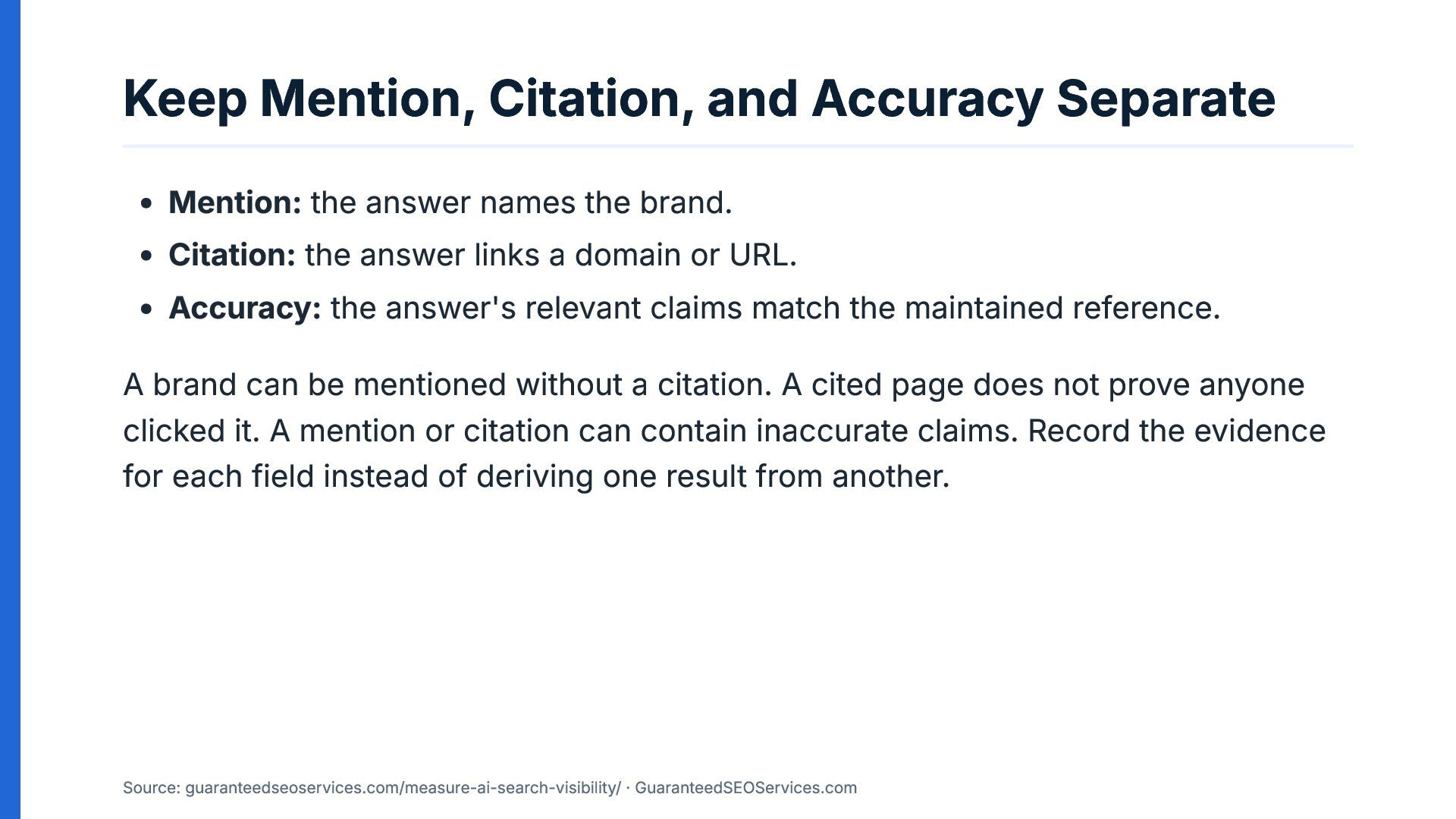
Keep Mention, Citation, and Accuracy Separate Mention: the answer names
the brand. Citation: the answer links a domain or URL. Accuracy: the answer's relevant claims match the maintained reference. A brand can be mentioned without a citation. A cited page does not prove anyone clicked it. A mention or citation can contain inaccurate claims. Record the evidence for each field instead of deriving one result from another. Source: guaranteedseoservices.com/measure-ai-search-visibility/ · GuaranteedSEOServices.com -
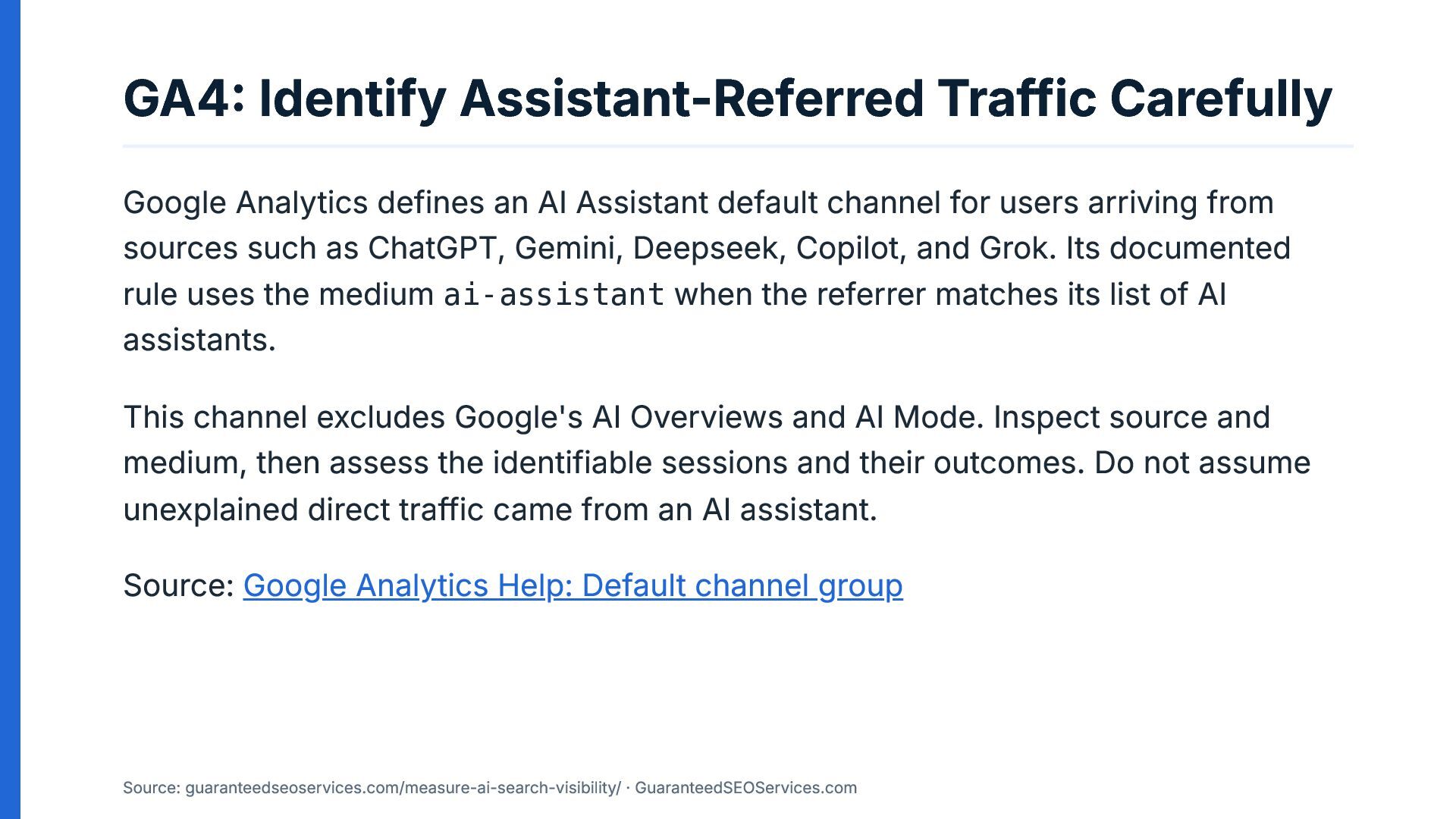
GA4: Identify Assistant-Referred Traffic Carefully Google Analytics defines an AI
Assistant default channel for users arriving from sources such as ChatGPT, Gemini, Deepseek, Copilot, and Grok. Its documented rule uses the medium ai-assistant when the referrer matches its list of AI assistants. This channel excludes Google's AI Overviews and AI Mode. Inspect source and medium, then assess the identifiable sessions and their outcomes. Do not assume unexplained direct traffic came from an AI assistant. Source: Google Analytics Help: Default channel group Source: guaranteedseoservices.com/measure-ai-search-visibility/ · GuaranteedSEOServices.com -
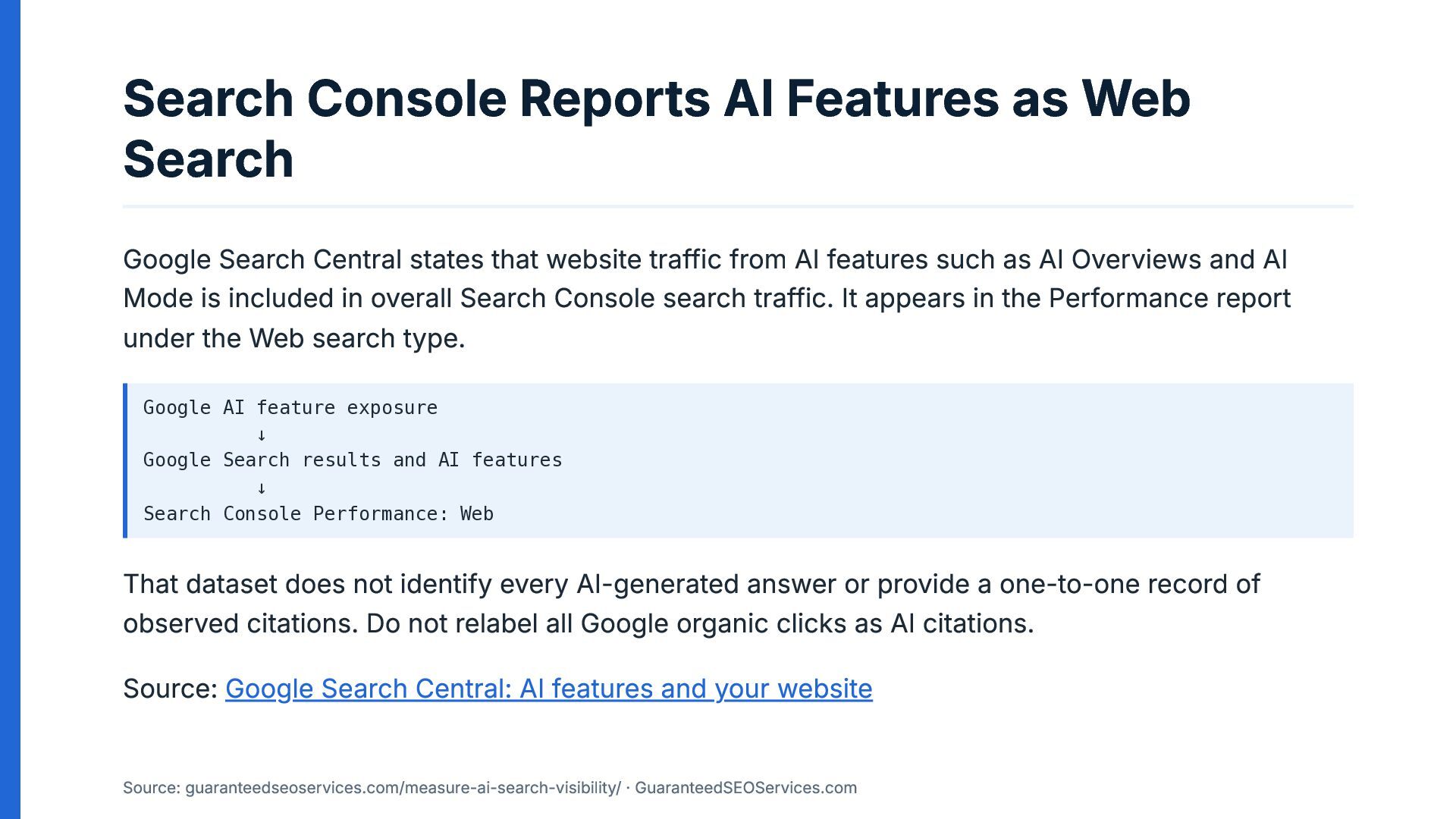
Search Console Reports AI Features as Web Search Google Search
Central states that website traffic from AI features such as AI Overviews and AI Mode is included in overall Search Console search traffic. It appears in the Performance report under the Web search type. Google AI feature exposure ↓ Google Search results and AI features ↓ Search Console Performance: Web That dataset does not identify every AI-generated answer or provide a one-to-one record of observed citations. Do not relabel all Google organic clicks as AI citations. Source: Google Search Central: AI features and your website Source: guaranteedseoservices.com/measure-ai-search-visibility/ · GuaranteedSEOServices.com -
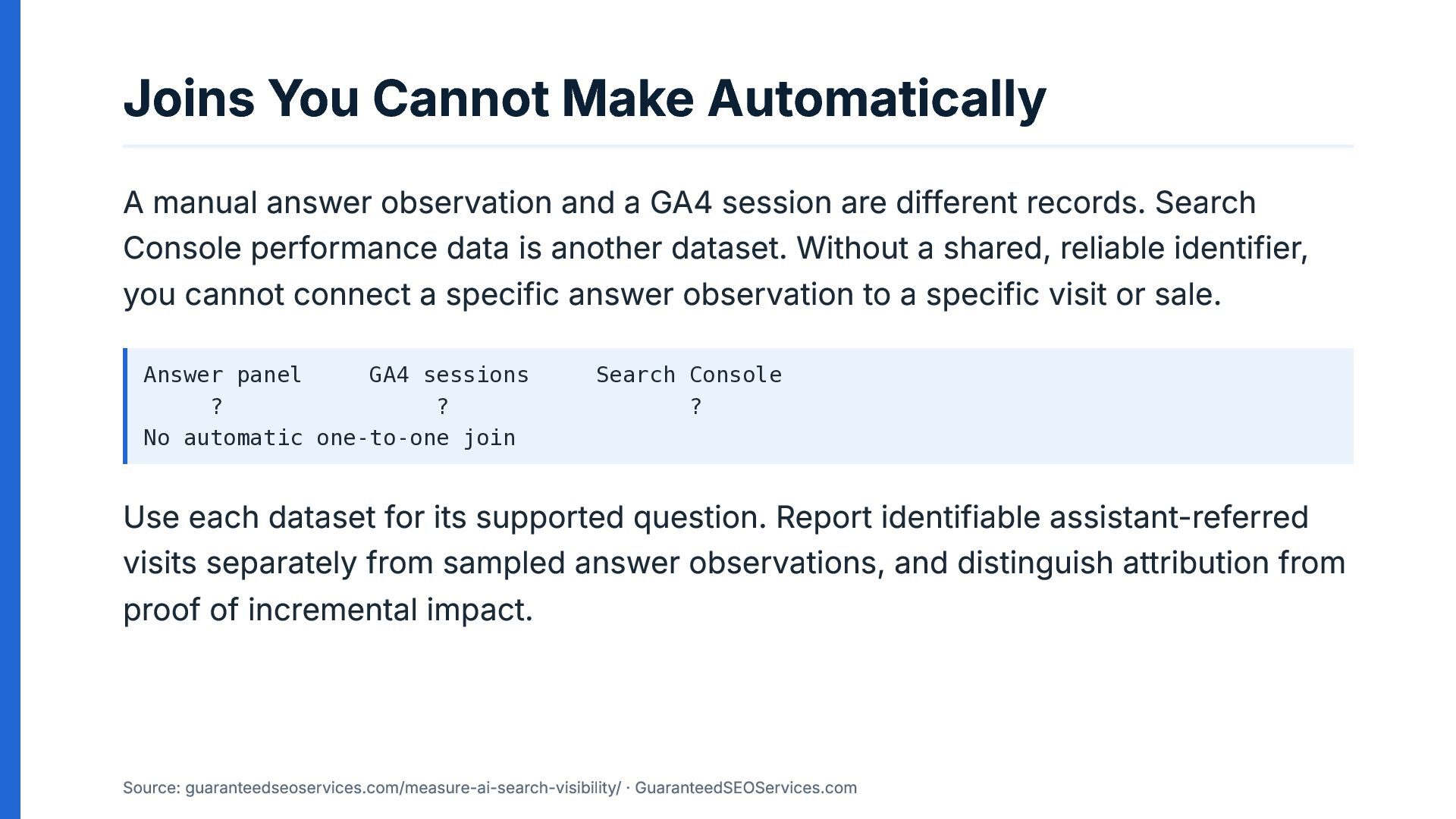
Joins You Cannot Make Automatically A manual answer observation and
a GA4 session are different records. Search Console performance data is another dataset. Without a shared, reliable identifier, you cannot connect a specific answer observation to a specific visit or sale. Answer panel GA4 sessions ? ? No automatic one-to-one join Search Console ? Use each dataset for its supported question. Report identifiable assistant-referred visits separately from sampled answer observations, and distinguish attribution from proof of incremental impact. Source: guaranteedseoservices.com/measure-ai-search-visibility/ · GuaranteedSEOServices.com -
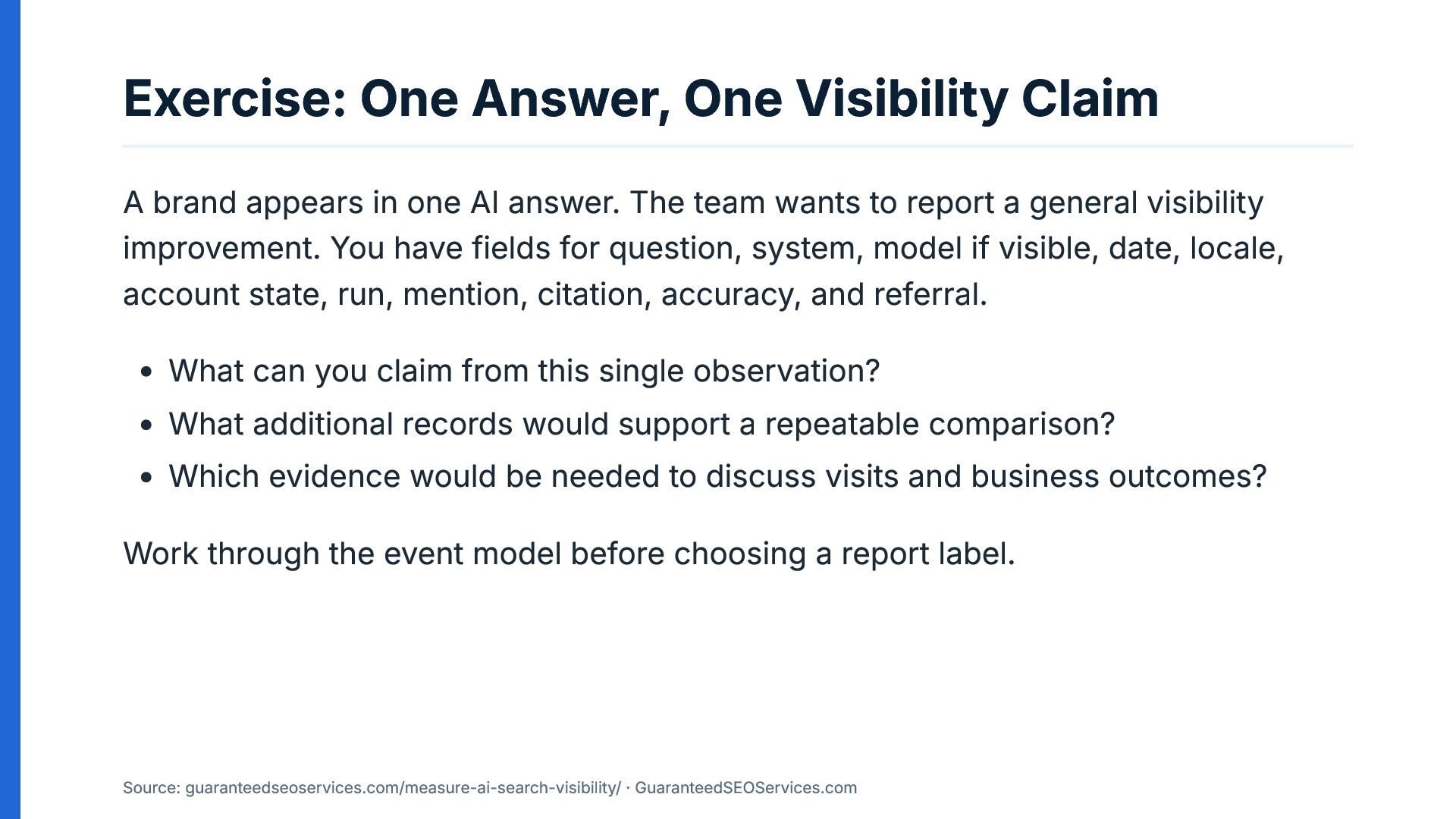
Exercise: One Answer, One Visibility Claim A brand appears in
one AI answer. The team wants to report a general visibility improvement. You have fields for question, system, model if visible, date, locale, account state, run, mention, citation, accuracy, and referral. What can you claim from this single observation? What additional records would support a repeatable comparison? Which evidence would be needed to discuss visits and business outcomes? Work through the event model before choosing a report label. Source: guaranteedseoservices.com/measure-ai-search-visibility/ · GuaranteedSEOServices.com -
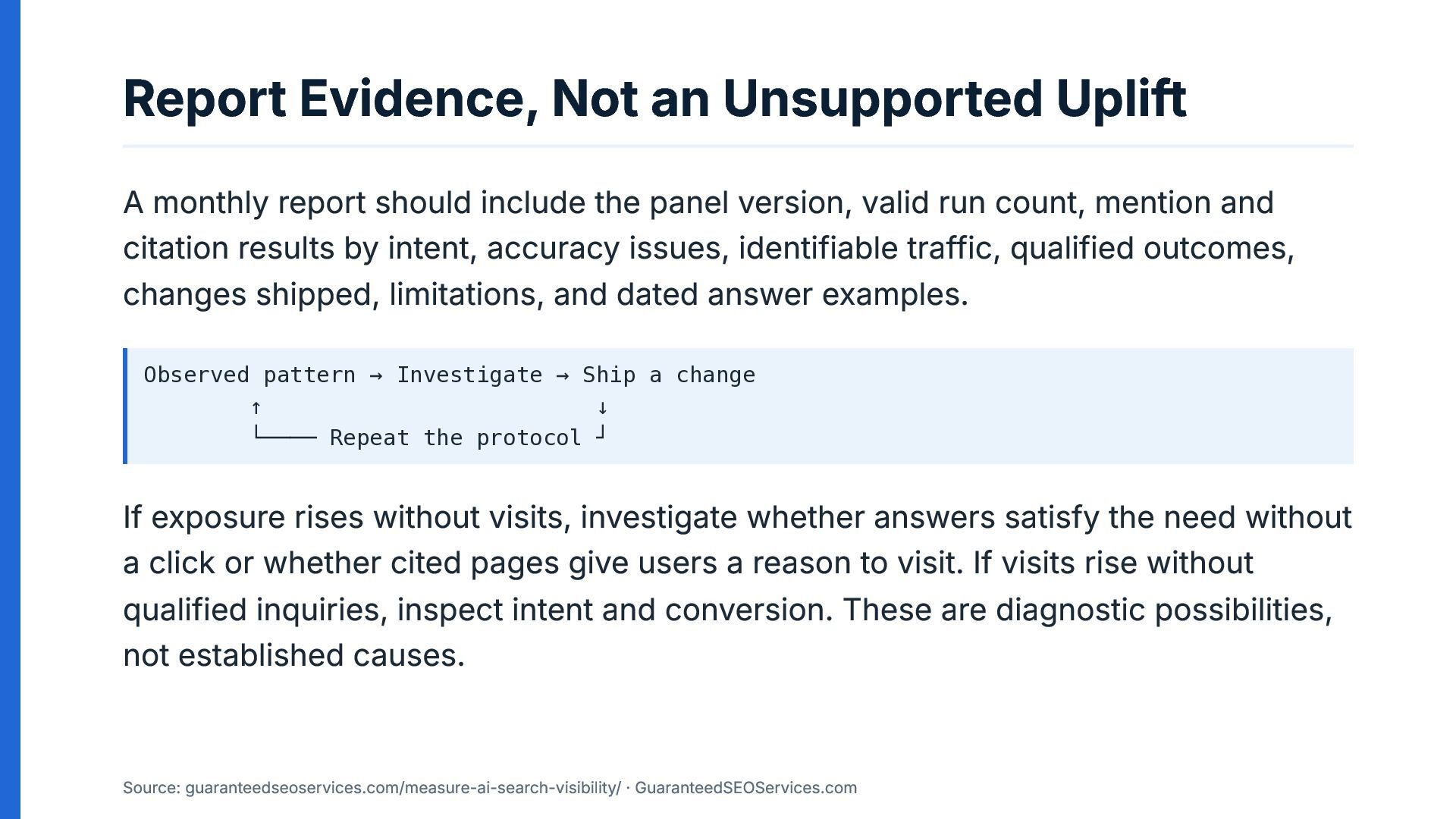
Report Evidence, Not an Unsupported Uplift A monthly report should
include the panel version, valid run count, mention and citation results by intent, accuracy issues, identifiable traffic, qualified outcomes, changes shipped, limitations, and dated answer examples. Observed pattern → Investigate → Ship a change ↑ ↓ └──── Repeat the protocol ┘ If exposure rises without visits, investigate whether answers satisfy the need without a click or whether cited pages give users a reason to visit. If visits rise without qualified inquiries, inspect intent and conversion. These are diagnostic possibilities, not established causes. Source: guaranteedseoservices.com/measure-ai-search-visibility/ · GuaranteedSEOServices.com -
What Is AI Visibility in SEO? Apply the Protocol Measure
the answer that appeared, the conditions under which it appeared, the evidence it contained, and the downstream events you can independently verify. Keep panel results, analytics, and business outcomes separate until a defensible relationship can be established. Try the workshop exercise with your team. Use the guide and primary sources to agree on your event definitions, validity rules, and reporting language. https://guaranteedseoservices.com/measure-ai-search-visibility/ Which field or join in your current AI search reporting would you validate first, and what evidence would convince your team it is reliable? Source: guaranteedseoservices.com/measure-ai-search-visibility/ · GuaranteedSEOServices.com -
Speaker Notes Slide 1 Open with the unit of observation,
not with a dashboard or a score. Ask the room what evidence they would need before describing one answer as a change in visibility. Explain that the question “what is AI visibility in SEO” has a measurement answer only after the team defines what it observes and records. The guide provides the broader measurement framework, but this workshop focuses on turning that framework into a repeatable protocol. Slide 2 Ask participants to imagine five columns in a reporting sheet, one for each event in the model. A mention answers whether the brand appeared in the observed answer, while a citation answers whether a domain or URL was linked. Accuracy evaluates the claims in the answer against current facts, and acquisition and outcomes require separate evidence. Explain that combining these into a single score can hide missing evidence and make comparisons hard to interpret. Slide 3 Walk from the question and its recorded conditions to the answer that was actually observed. The answer is the primary evidence for classifying mention, citation, and accuracy. A referral is a separate event that may be identifiable in analytics, and an outcome is a further business event that must be measured independently. The arrows describe a useful model for organizing evidence, not a claim that every answer produces a visit or every visit produces a sale. -
Slide 4 Explain that the question panel is a sampling
decision, not a collection of prompts designed to make a brand look good. Real customer decisions provide a useful organizing structure because problem discovery and supplier evaluation ask different questions. Keep branded and nonbranded questions separate so that the reason for a mention remains interpretable. Version the panel whenever wording, inclusion criteria, locale, or intent grouping changes, and retain the reason for each question's inclusion. Slide 5 Show the schema as a minimum record that allows another analyst to understand what happened and under which conditions. The system, visible model or mode, date, locale, and account state help describe the context of the observation. The run identifier distinguishes repeated attempts, while mention, citation, accuracy, and referral retain their separate meanings. Capture the answer and citation evidence too, and never enter confidential customer information into an assistant just to make a test feel realistic. Slide 6 Ask the team to agree on validity before looking at the results. A predefined rule might address whether the intended system responded, whether the recorded answer can be assessed, and whether the required conditions were captured. The exact rule depends on the protocol, so document it rather than pretending there is one universal rule for every system. Keep excluded attempts and reasons in the audit trail so that another analyst can understand how the final denominator was obtained. Slide 7 Repetition helps establish whether a finding recurs in a defined sample, but it does not turn the sample into every answer that real users might receive. Keep the panel and conditions as consistent as practical, and document changes that could affect comparisons. The phrase “mentioned in X of Y valid observations” preserves both the count and its denominator without inventing a rate. Explain that -
commercial monitoring tools may use their own panels and methods,
so results from different systems should not be treated as directly interchangeable without examining those methods. Slide 8 Explain why an accuracy reference needs an owner and a maintenance routine. Without current public facts, the reviewer has no stable basis for deciding whether a claim about an offer, contact route, or eligibility requirement is correct. Classify errors by their potential consequence so the team can prioritize meaningful inaccuracies rather than merely counting them. For information published by external sources, record the correction route and status, but do not promise that an external answer or assistant will update immediately. Slide 9 Use three separate result fields and ask the audience to provide an example of each. A brand name in an answer can qualify as a mention even when no link appears. A link is evidence of a citation, not evidence of a click. Accuracy is a comparison against the reference sheet, so it requires its own review even when a mention and citation are both present. Keep the raw evidence so that future reviewers can check how each classification was made. Slide 10 Distinguish assistant-referred acquisition from the observation panel. Google Analytics documents an AI Assistant default channel for eligible traffic from named assistant sources when the relevant referrer and medium rules apply. It specifically excludes Google AI Overviews and AI Mode from that channel definition, so do not use the channel as a complete measure of AI search exposure. Inspect source and medium, and avoid reclassifying direct traffic as assistant traffic without evidence. A session, a first-user acquisition dimension, and an event attribution result are also different measures, so name the one actually being reported. Slide 11 -
Google's documentation places traffic from AI features such as AI
Overviews and AI Mode within overall Search Console search traffic in the Web search type. That reporting is useful for understanding eligible Google search performance, but it does not give the team a row for each manually observed answer. A rise in Web search clicks therefore does not independently prove that the sampled answer panel produced more citations. Keep the source system and the measurement question explicit whenever these numbers appear together in a report. Slide 12 Draw attention to the question marks between the three datasets. A manual observation, a GA4 session, and a Search Console performance record do not automatically share a reliable identifier that links them to the same answer event. The team may compare trends or investigate dated examples, but it should not claim a direct join without evidence that supports it. Even when analytics attributes a session to an assistant source, that attribution alone does not establish that a particular observed answer caused the session or that the session was incremental. Slide 13 Give participants a few minutes to work in pairs. The complete answer is that one valid recorded output supports only a statement about that output under its recorded conditions: the brand was mentioned in that answer, with whatever citation and accuracy evidence the record actually shows. It does not support a general visibility improvement because there is no repeated comparable panel, baseline, or denominator. To compare visibility, the team needs a versioned question panel, valid repeated runs under documented conditions, and separate mention and citation counts by intent. To discuss acquisition and outcomes, it needs identifiable referral evidence and qualified business records, while acknowledging that attribution does not prove incrementality. Slide 14 Close this section with a practical reporting standard rather than a universal AI visibility score. The monthly report should preserve the panel version and valid denominator, break mention and citation results down by intent, document accuracy problems, and report -
identifiable traffic and qualified outcomes separately. Include the changes shipped,
the limitations of the sample, and dated answer examples so the next reporting cycle can be compared responsibly. When exposure rises without visits, investigate possible explanations rather than declaring a cause; when visits rise without qualified inquiries, inspect intent and conversion before deciding what to change. Slide 15 Use the final slide to bring the workshop back to its central measurement question: what is AI visibility in SEO when the evidence consists of separate observations, citations, referrals, and business outcomes? Ask participants to identify one field or join in their current reporting that deserves validation before they publish a visibility claim. Encourage them to use the guide and primary sources to define the observation protocol and document its limitations. The question “what is AI visibility in SEO” should lead your team back to the evidence model, so ask: Which field or join in your current AI search reporting would you validate first, and what evidence would convince your team it is reliable? -
Sources https://guaranteedseoservices.com/measure-ai-search-visibility/ Google Analytics Help: Default channel group Google Search
Central: AI features and your website
 guaranteedseoservices
 thomaspeham
 zjchahalis
 guaca
 aleyda
 speedyindexteam
 portentint
 tribal
 clarasoteras
 alexgalinos
 katarinadahlin
 madoxten
 productmarketing
 wayneb77
 jonoalderson
 coloredviolet
 baasie
 mfonobong
 addyosmani
 rabernat