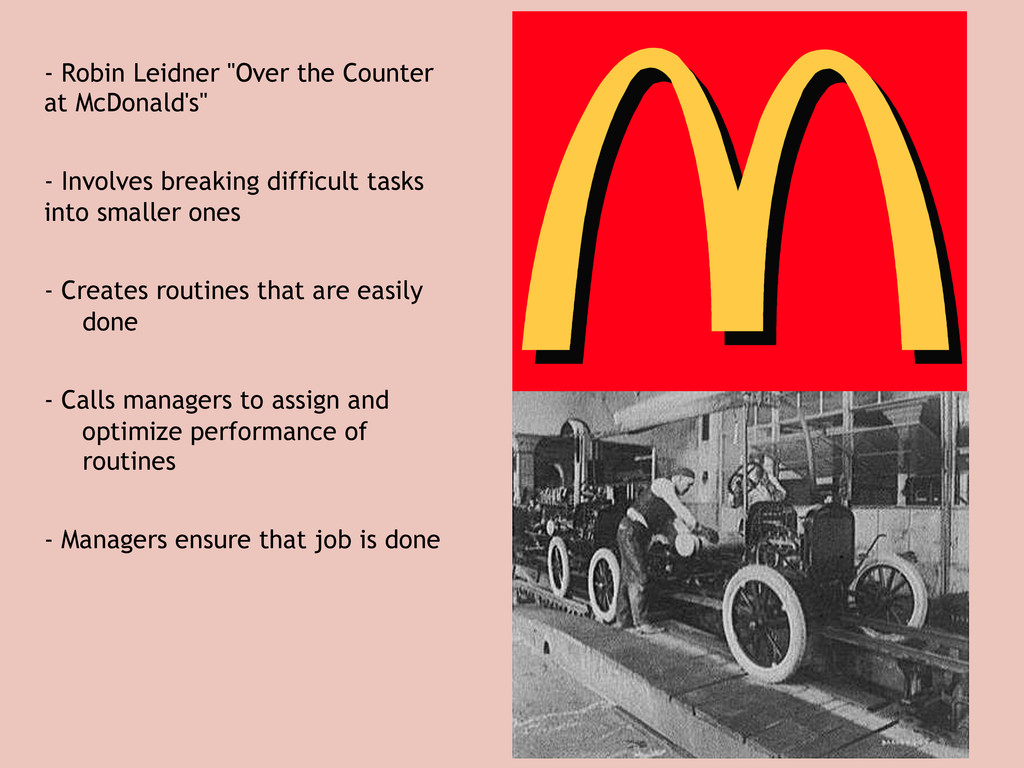
breaking difficult tasks into smaller ones - Creates routines that are easily done - Calls managers to assign and optimize performance of routines - Managers ensure that job is done
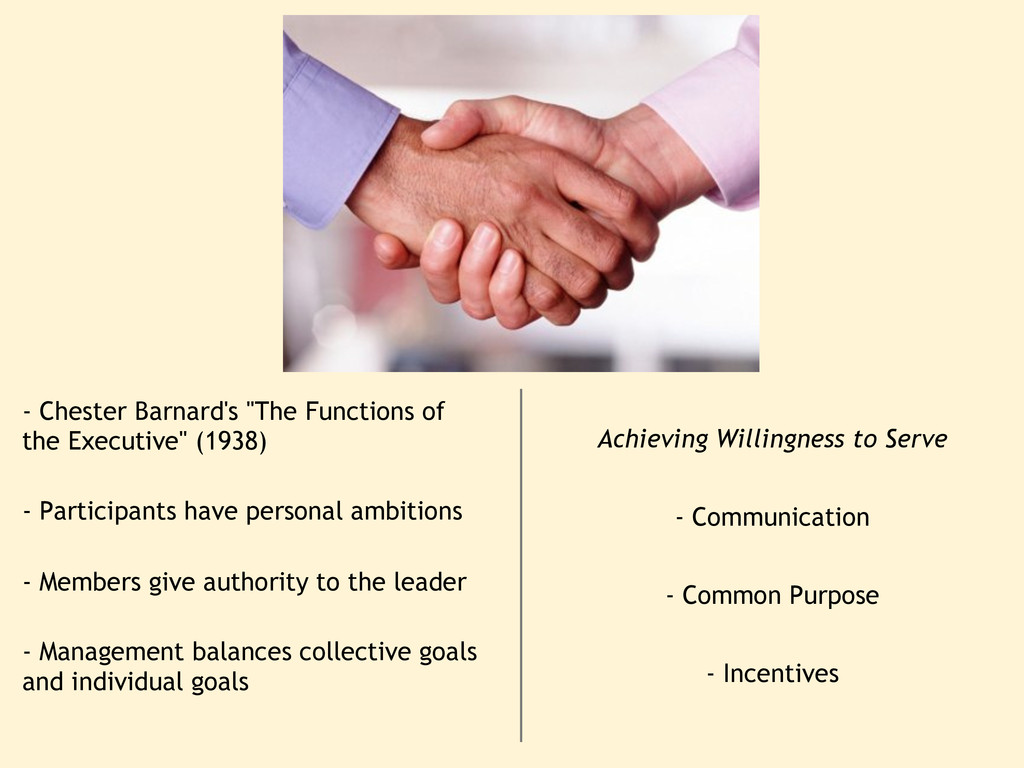
Incentives - Chester Barnard's "The Functions of the Executive" (1938) - Participants have personal ambitions - Members give authority to the leader - Management balances collective goals and individual goals
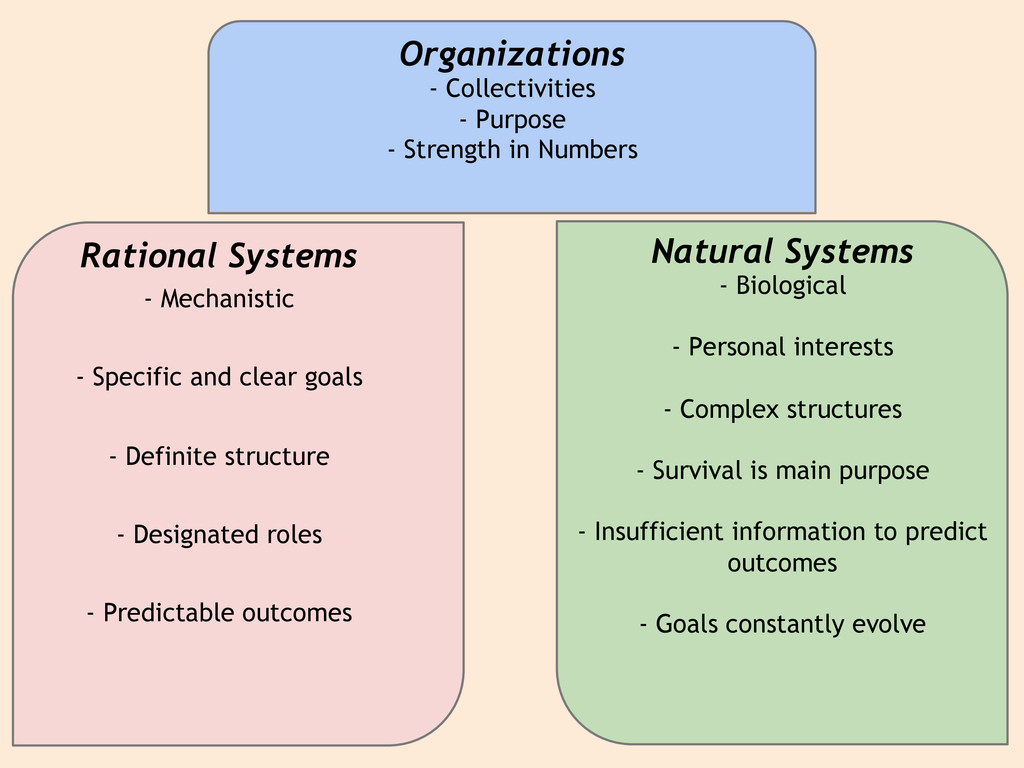
Islam - Fulfill community's religious/spiritual needs Achieving this unique goal requires a hybrid system which combines practices under routinization/cooperative systems.The mosque (masjid) needs to implement both theories to function properly. The lack thereof equates to failure. THESIS
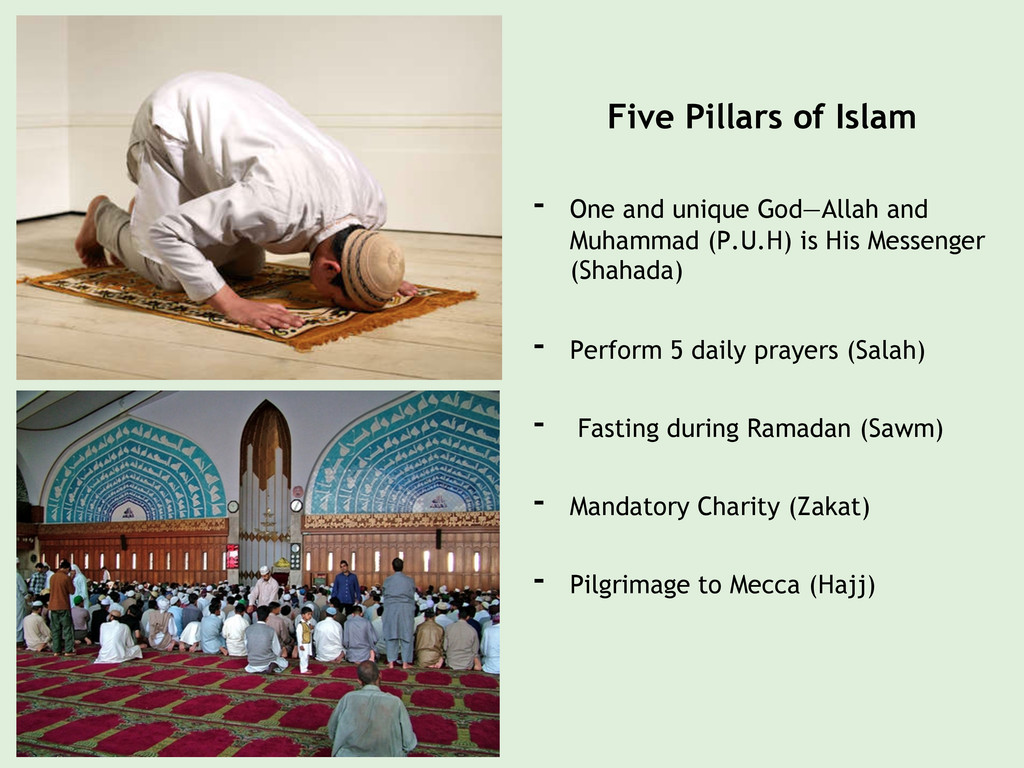
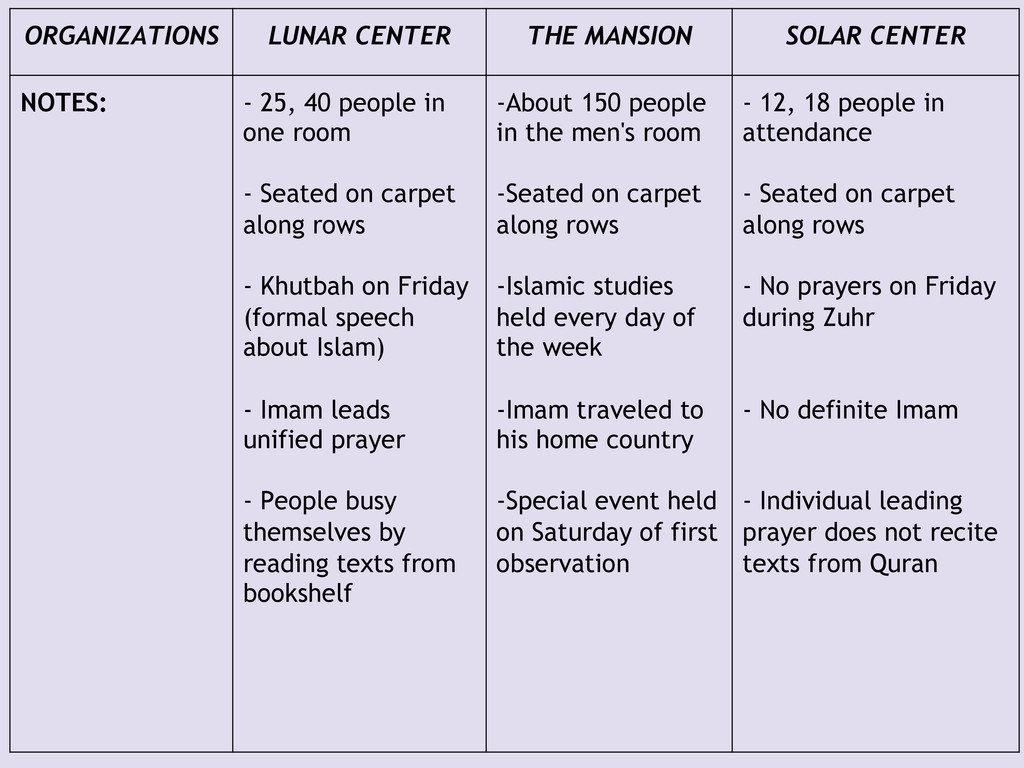
40 people in one room - Seated on carpet along rows - Khutbah on Friday (formal speech about Islam) - Imam leads unified prayer - People busy themselves by reading texts from bookshelf -About 150 people in the men's room -Seated on carpet along rows -Islamic studies held every day of the week -Imam traveled to his home country -Special event held on Saturday of first observation - 12, 18 people in attendance - Seated on carpet along rows - No prayers on Friday during Zuhr - No definite Imam - Individual leading prayer does not recite texts from Quran
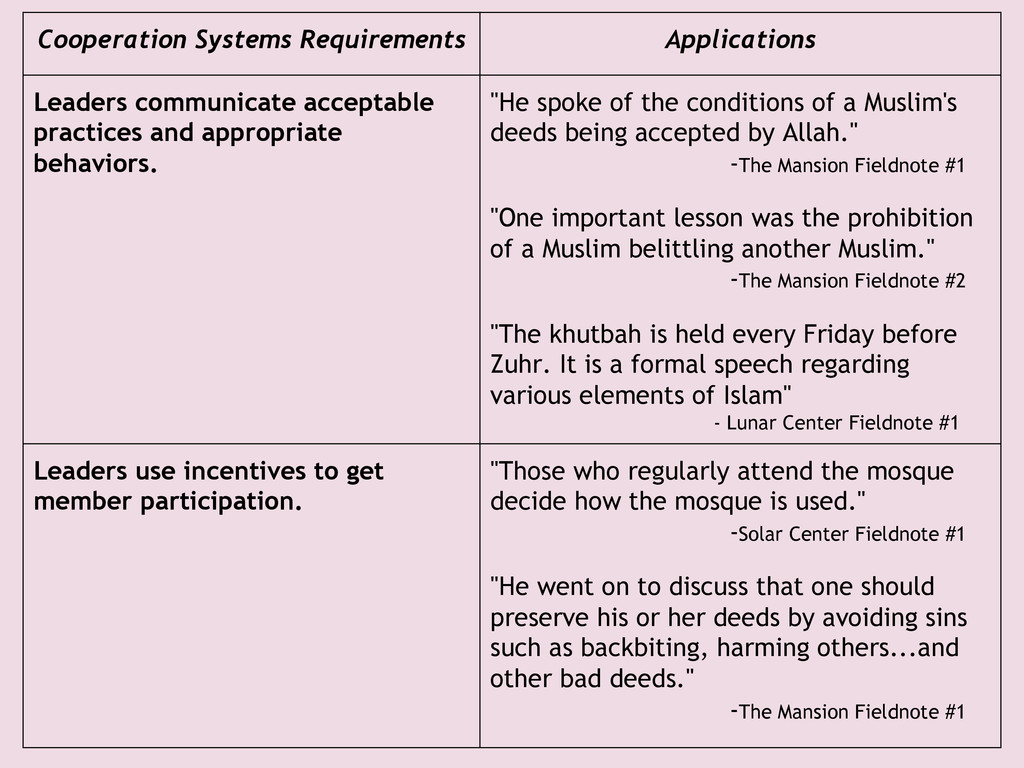
behaviors. "He spoke of the conditions of a Muslim's deeds being accepted by Allah." -The Mansion Fieldnote #1 "One important lesson was the prohibition of a Muslim belittling another Muslim." -The Mansion Fieldnote #2 "The khutbah is held every Friday before Zuhr. It is a formal speech regarding various elements of Islam" - Lunar Center Fieldnote #1 Leaders use incentives to get member participation. "Those who regularly attend the mosque decide how the mosque is used." -Solar Center Fieldnote #1 "He went on to discuss that one should preserve his or her deeds by avoiding sins such as backbiting, harming others...and other bad deeds." -The Mansion Fieldnote #1
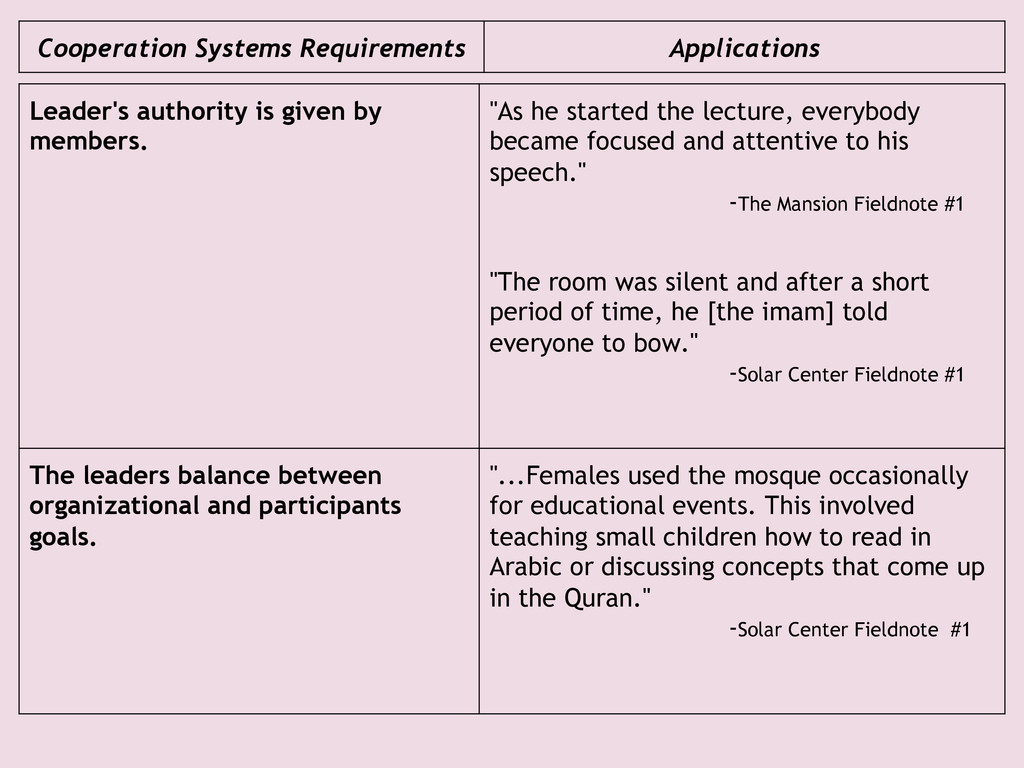
lecture, everybody became focused and attentive to his speech." -The Mansion Fieldnote #1 "The room was silent and after a short period of time, he [the imam] told everyone to bow." -Solar Center Fieldnote #1 The leaders balance between organizational and participants goals. "...Females used the mosque occasionally for educational events. This involved teaching small children how to read in Arabic or discussing concepts that come up in the Quran." -Solar Center Fieldnote #1 Cooperation Systems Requirements Applications
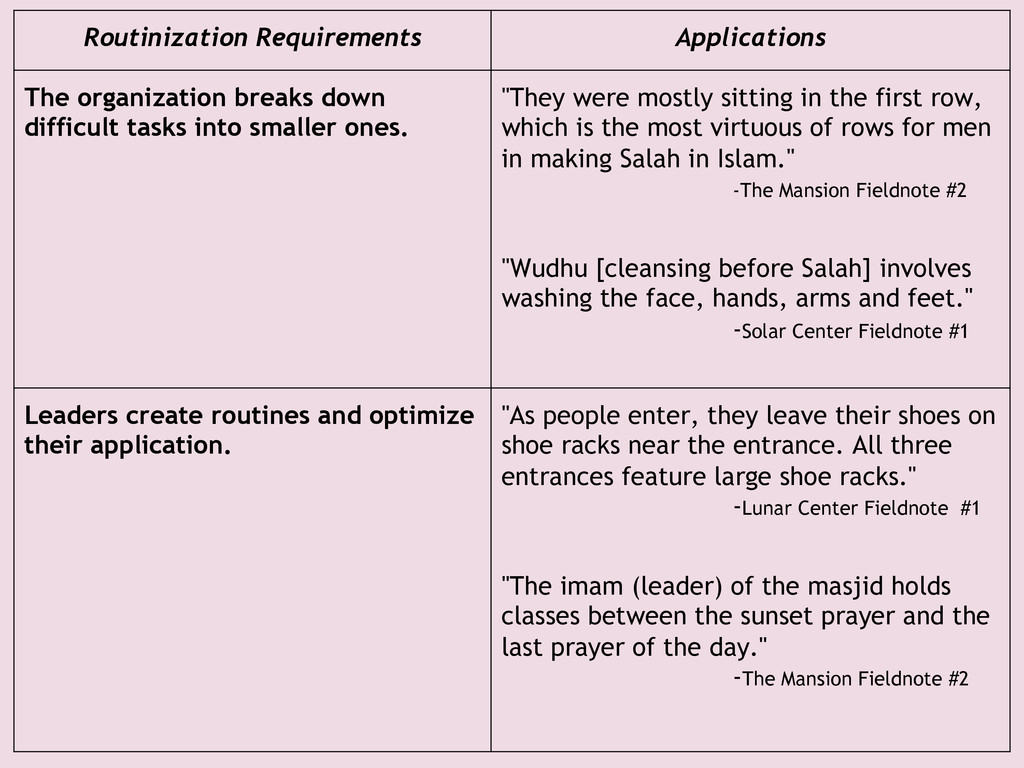
smaller ones. "They were mostly sitting in the first row, which is the most virtuous of rows for men in making Salah in Islam." -The Mansion Fieldnote #2 "Wudhu [cleansing before Salah] involves washing the face, hands, arms and feet." -Solar Center Fieldnote #1 Leaders create routines and optimize their application. "As people enter, they leave their shoes on shoe racks near the entrance. All three entrances feature large shoe racks." -Lunar Center Fieldnote #1 "The imam (leader) of the masjid holds classes between the sunset prayer and the last prayer of the day." -The Mansion Fieldnote #2
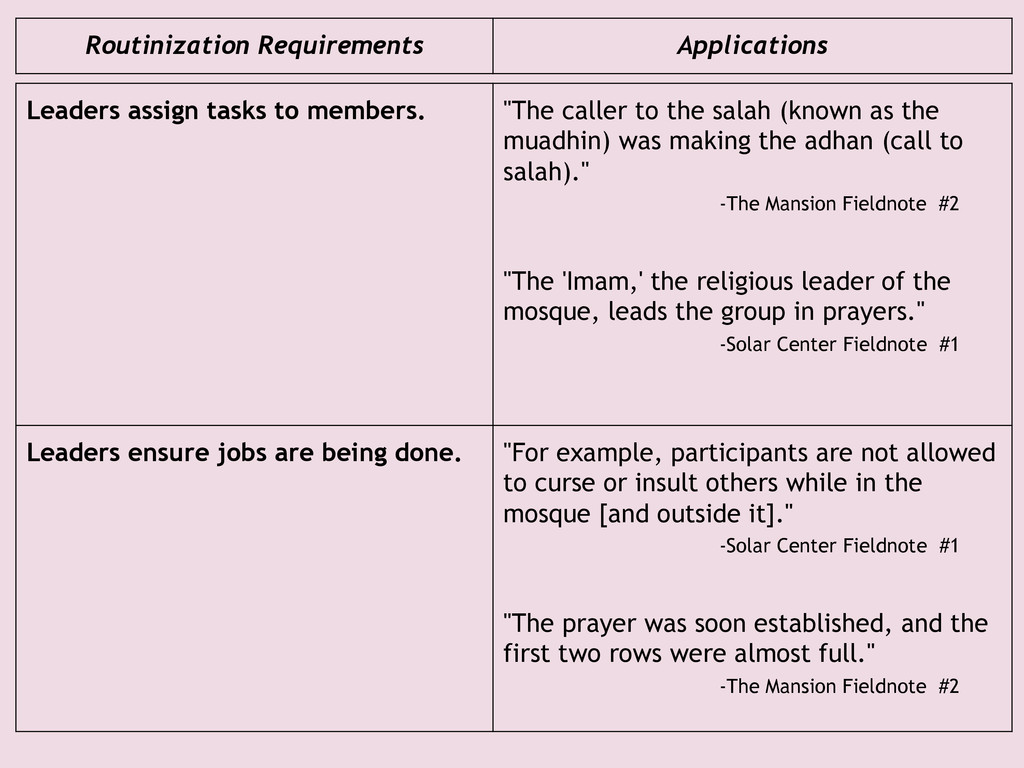
(known as the muadhin) was making the adhan (call to salah)." -The Mansion Fieldnote #2 "The 'Imam,' the religious leader of the mosque, leads the group in prayers." -Solar Center Fieldnote #1 Leaders ensure jobs are being done. "For example, participants are not allowed to curse or insult others while in the mosque [and outside it]." -Solar Center Fieldnote #1 "The prayer was soon established, and the first two rows were almost full." -The Mansion Fieldnote #2 Routinization Requirements Applications
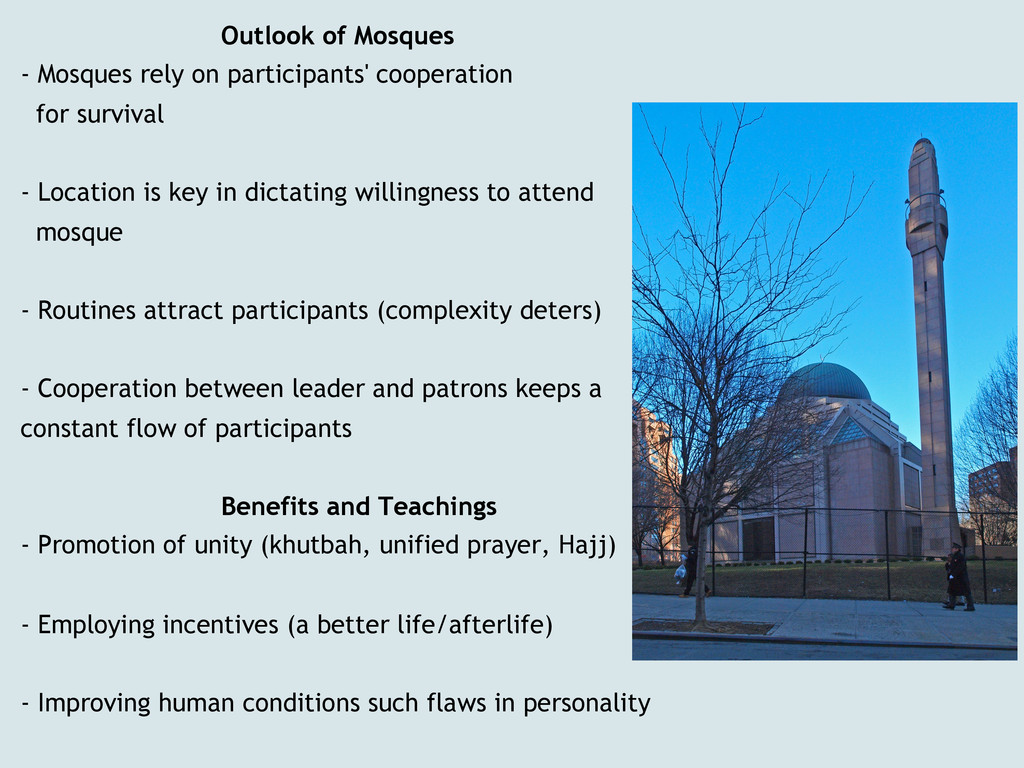
survival - Location is key in dictating willingness to attend mosque - Routines attract participants (complexity deters) - Cooperation between leader and patrons keeps a constant flow of participants Benefits and Teachings - Promotion of unity (khutbah, unified prayer, Hajj) - Employing incentives (a better life/afterlife) - Improving human conditions such flaws in personality
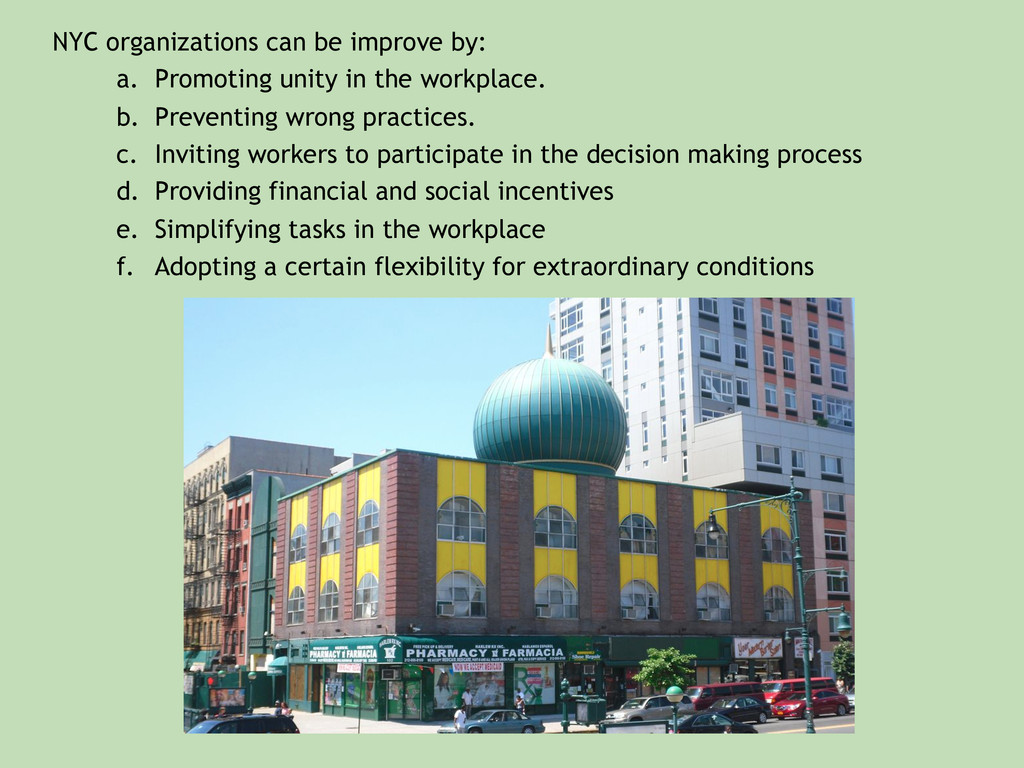
the workplace. b. Preventing wrong practices. c. Inviting workers to participate in the decision making process d. Providing financial and social incentives e. Simplifying tasks in the workplace f. Adopting a certain flexibility for extraordinary conditions
Texts -Leidner, Robin. 1993. "Over the Counter McDonald's." Excerpt from Fast Food, Fast Talk. Berkeley, CA: University of California Press. -Scott, W. Richard, Gerald F. Davis. 2003. Organizations and Organizing: Rational, Natural and Open System Perspectives.. pp. 26-34 and 70-72. Upper Saddle River, New Jersey, 07458: Prentice Hall.


 rfujii
 satai
 institutdelelevage
 mikimhk
 sishi
 hotchpotch
 signer
 rikkabotan7
 imai448
 orderedlist
 destraynor
 rocio
 lfama
 kimpetersen
 aleyda
 leimatthew05
 aarron
 tamaranovitovic
 keavy
 bryan