LABSIM (LABoratoire de SIMulation), created mid-October 2010, was initially designed to support ; human-system interaction in aeronautics, rotary-wings operations & systems research studies in order to reveal innovative interaction concepts, prototype & evaluate them in piloted simulation.
VR principles, the LABSIM capabilities can be classified into 3 categories Biophysical Sensors “Quantifying & modeling the human behavior” Sensory-motor devices “Exploring next-gen piloting interfaces”
“Modelling the flight behaviour with high fidelity” Following the VR principles, the LABSIM capabilities can be classified into 3 categories Biophysical Sensors “Quantifying & modeling the human behavior” Sensory-motor devices “Exploring next-gen piloting interfaces”
maintain three physical means : LIPS laboratory for pilot/system interaction studies SCHEME prototyping bench for innovative interfaces PYCSHEL prototyping & conception of systems for helicopters
bench stand for PrototYping & Conception of Systems for HELicopter. It allows the researcher to design, prototype and test systems for Helicopters. It is composed of a CAVE for immersive display, four tactile-screen for avionics and two seated cockpit : one with passive helicopeters sticks and another one with active side-sticks.
bench is composed of a cylindrical 180° immersive display & a single operator station. It is primary used to design/prototype new interaction means & study the subject behaviour & cognitive state through bio-physiological metric such as eye-tracking, mo-cap, ECG, EMG, EEG & GSR. Moreover, this bench is the LABSIM hybrid-reality bridge to real-world UAV.
laboratory is mainly used for the human-system interaction studies. It allows the interaction of up to 10 operators (ATC’s, pilots, UAV payload operators, UAV pilots,…) in a complex scenario with up to 128 vehicles. It grant the possibility to study the interactions between the operators and the systems or between the different operators
bench stand for PrototYping & Conception of Systems for HELicopter. It allows the researcher to design, prototype and test systems for Helicopters. It is composed of a CAVE for immersive display, four tactile-screen for avionics and two seated cockpit : one with passive helicopeters sticks and another one with active side-sticks. SCHEME This bench is composed of a cylindrical 180° immersive display & a single operator station. It is primary used to design/prototype new interaction means & study the subject behaviour & cognitive state through bio-physiological metric such as eye-tracking, mo-cap, ECG, EMG, EEG & GSR. Moreover, this bench is the LABSIM hybrid-reality bridge to real-world UAV. LIPS This laboratory is mainly used for the human-system interaction studies. It allows the interaction of up to 10 operators (ATC’s, pilots, UAV payload operators, UAV pilots,…) in a complex scenario with up to 128 vehicles. It grant the possibility to study the interactions between the operators and the systems or between the different operators
to allow fast & early conception/evaluation cycle of innovative concept in situ ? » Analysis • rapid system prototyping • by the way, time is money, so if you want something to be setup quickly it has to be a cheap or relatively afordable solution => software simulation
to allow fast & early conception/evaluation cycle of innovative concept in situ ? » Analysis • to evaluate something, we need to be representative/immersive enough • it also mean that we will probably have to handle wide range of heterogenous data sensor • and because we are scientist, we will have to provide a data warranty => consistency
to allow fast & early conception/evaluation cycle of innovative concept in situ ? » Analysis • Innovation arises from domain specific experts • innovation could also emerge from a blend, a fusion of various scientific domain • we do computer sciences so we should leaverage this aspect from users => focus on key competencies (reminder: initials conditions)
to allow fast & early conception/evaluation cycle of innovative concept in situ ? » Analysis • human is in the loop => human centered design • human don’t lag so we should focus on performance with near real-time requirements => soft real-time ~100Hz • human centered + computer science => Virtual Reality principles ! • lastly, because we are an in-house ONERA's lab, by human we mean pilot, UAV/ATC operator,…
Performance is a critical metric • studying the effect of various latencies on the human sense of control over an automated system (agency) • prototyping a representative flight dynamic mode requiring regular continuous time clock and tight time resolution • exploring the optimality of a movement produced by the human motricity system during a specific piloting task • dealing with humans in a simulated virtual environment
performant WYSIWYG (What You See Is What You Get) tools to setup a simulation A DIY (Do It Yourself) pipeline shortcut through a fully XML (eXtended Markup Langage) based environment for the guru Tooling
UI BL BL DB DB Users fondamentally don’t want to implement these DB models but they have to because of their need of data. It’s an environmental constraint.
LABSIM ecosystem MODEL B MODEL B MODEL A MODEL A UI 1 UI 1 UI 0 UI 0 DATA Scheme 0 DATA Scheme 0 MODEL A MODEL A Bridge Bridge UI 2 UI 2 UI 0 UI 0 DATA Scheme 1 DATA Scheme 1 MODEL C MODEL C
LABSIM ecosystem (DDS) with BLADE Gateway (HLA) MODEL B MODEL B MODEL A MODEL A UI 1 UI 1 UI 0 UI 0 DATA Scheme 0 DATA Scheme 0 MODEL A MODEL A Bridge Bridge UI 2 UI 2 UI 0 UI 0 DATA Scheme 1 DATA Scheme 1 BLING BLING
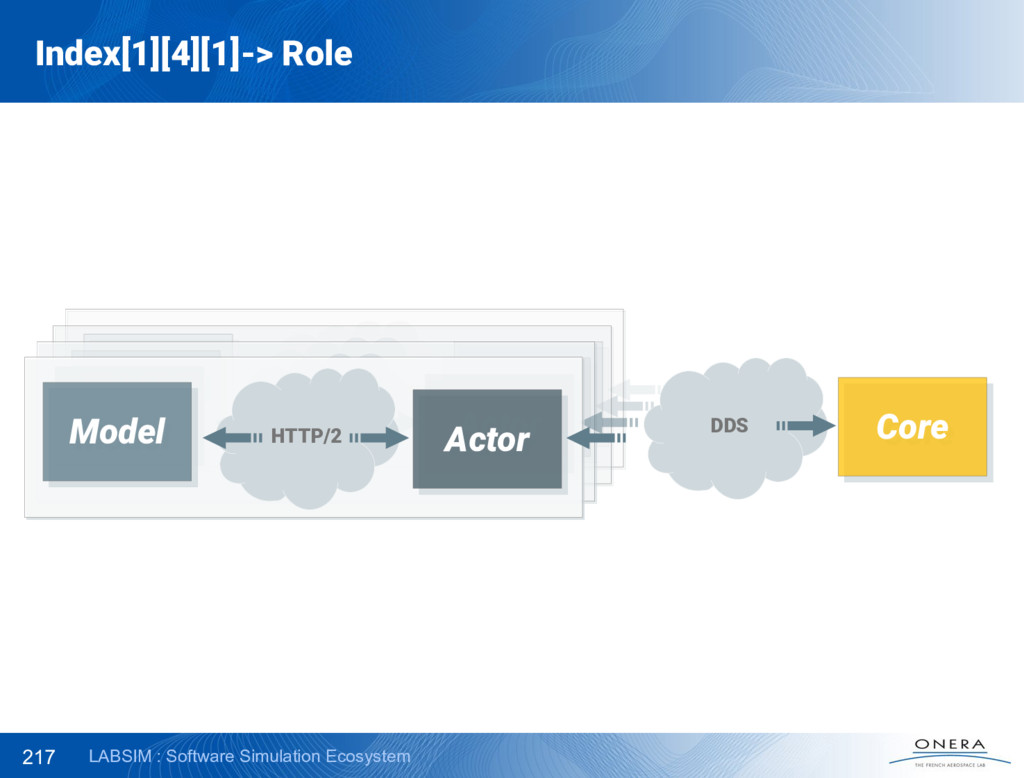
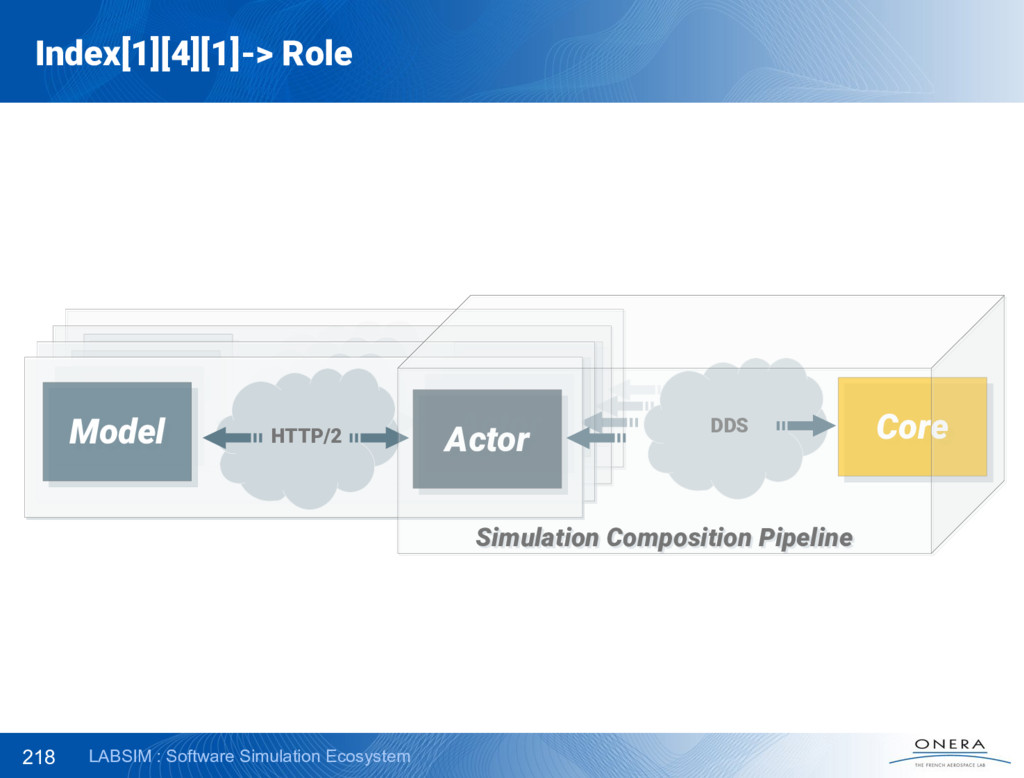
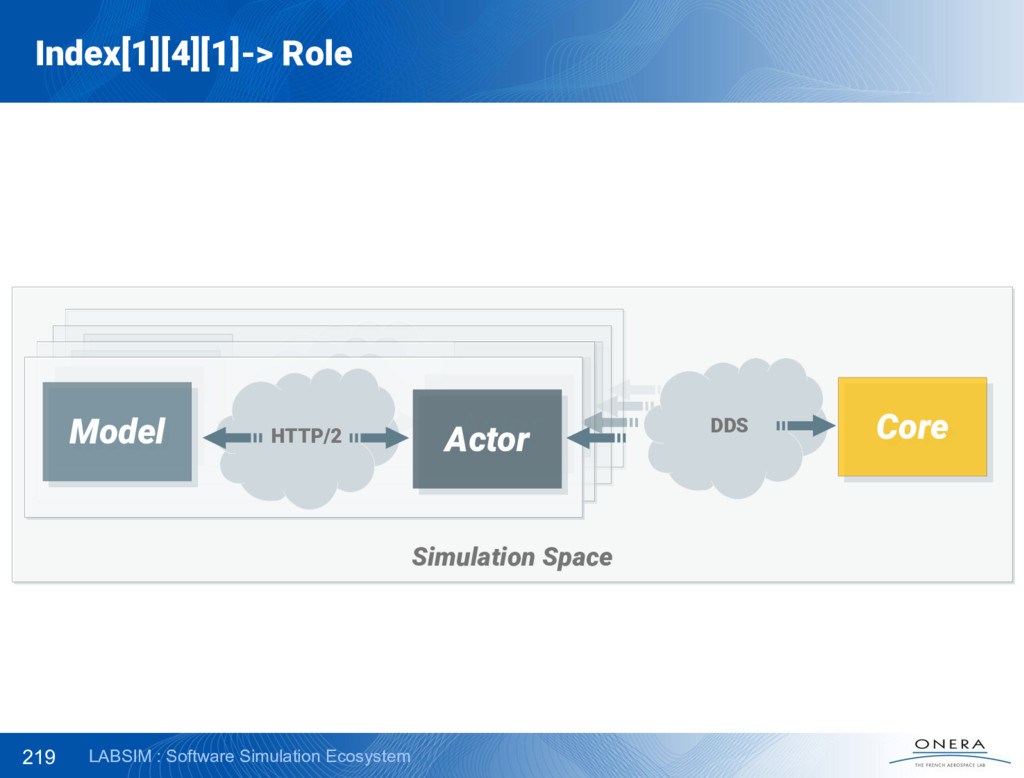
Ecosystem gRPC is an open source remote procedure call (RPC) system initially developed at Google. It uses HTTP/2 for transport, Protocol Buffers as the interface description language, and provides features such as authentication, bidirectional streaming and flow control, blocking or nonblocking bindings, and cancellation and timeouts. It generates cross-platform client and server bindings for many languages.
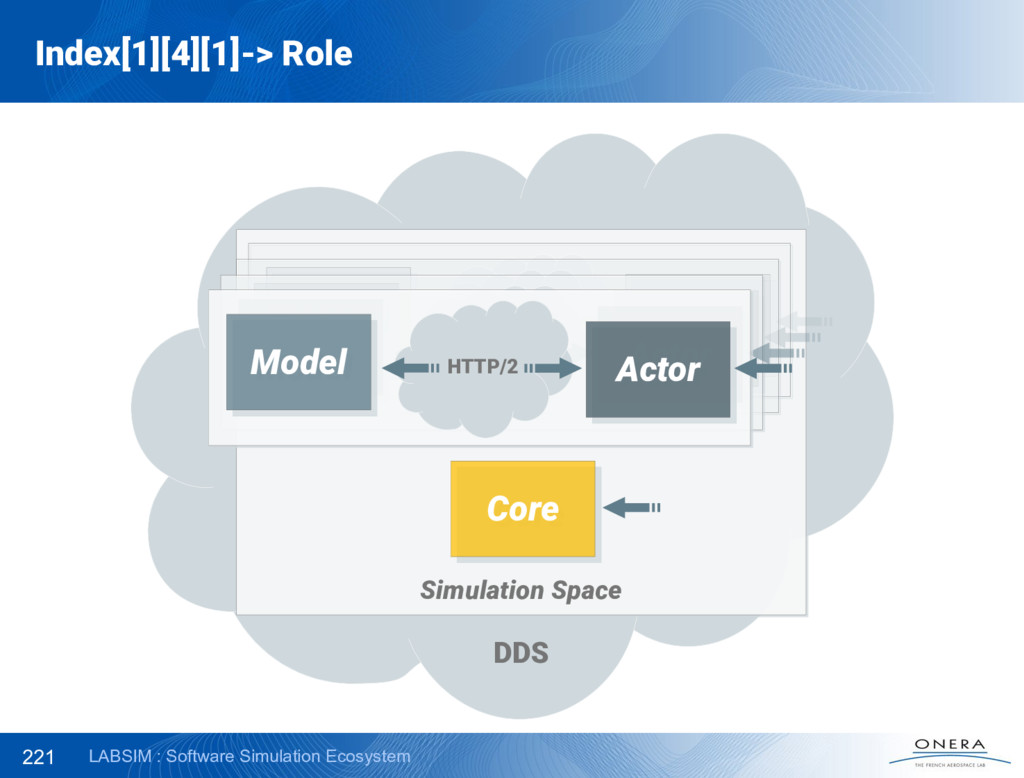
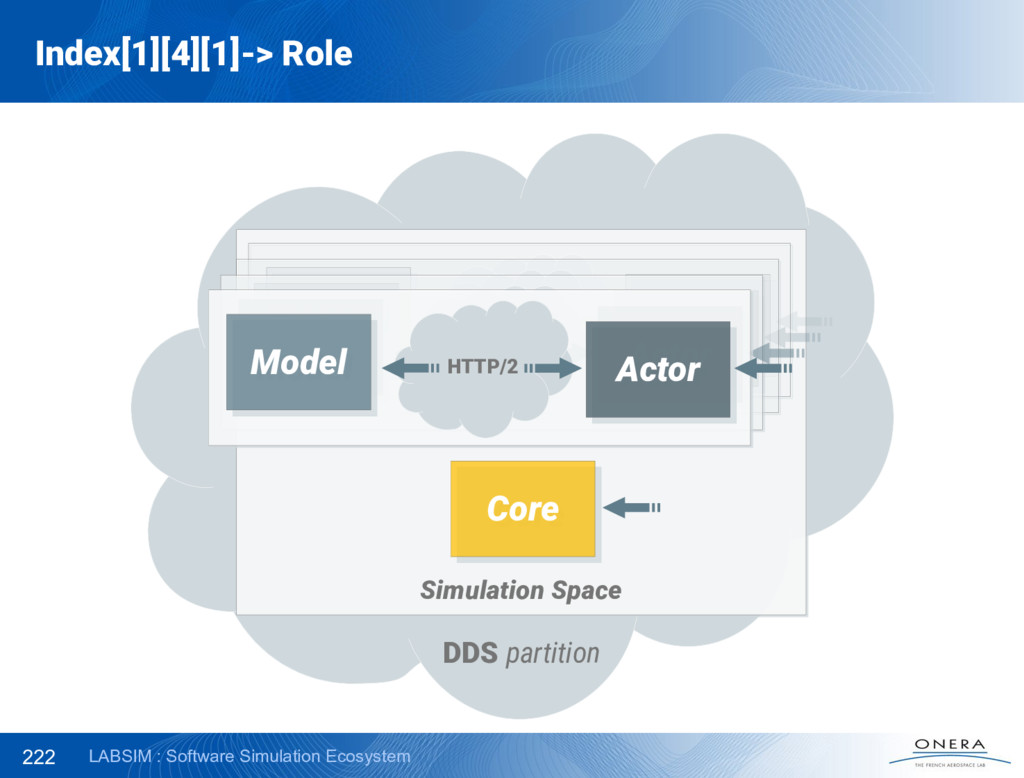
OMG (Object Management Group) DDS (Data Distribution Service) standard is a cloud-based middleware introduced in 2004. It stand as a standard technology for ubiquitous, interoperable, secure, platform independent, and real-time data sharing across network connected devices. DDS behaviour and semantics can be controlled via a rich set of QoS (Quality of Service) Policies.
HTTP/2 Actor Actor Model Model Index[1][4][1]-> Role 218 LABSIM : Software Simulation Ecosystem HTTP/2 Actor Actor Core Core Model Model DDS Simulation Composition Pipeline Simulation Composition Pipeline
Actor Actor Model Model HTTP/2 Actor Actor Model Model Index[1][4][1]-> Role 219 LABSIM : Software Simulation Ecosystem HTTP/2 Actor Actor Core Core Model Model DDS
Actor Actor Model Model HTTP/2 Actor Actor Model Model Index[1][4][1]-> Role 220 LABSIM : Software Simulation Ecosystem HTTP/2 Actor Actor Core Core Model Model
HTTP/2 Actor Actor Model Model HTTP/2 Actor Actor Model Model Index[1][4][1]-> Role 221 LABSIM : Software Simulation Ecosystem HTTP/2 Actor Actor Core Core Model Model
Model HTTP/2 Actor Actor Model Model HTTP/2 Actor Actor Model Model Index[1][4][1]-> Role 222 LABSIM : Software Simulation Ecosystem HTTP/2 Actor Actor Core Core Model Model
Simulation Ecosystem Core Core DDS region-0 Simulation Space Simulation Space DDS region-0 Simulation Space Simulation Space DDS region-0 Simulation Space Simulation Space DDS partition Simulation Space Simulation Space
: Software Simulation Ecosystem Core Core DDS region-0 Simulation Space Simulation Space DDS region-0 Simulation Space Simulation Space DDS region-0 Simulation Space Simulation Space DDS partition Simulation Space Simulation Space
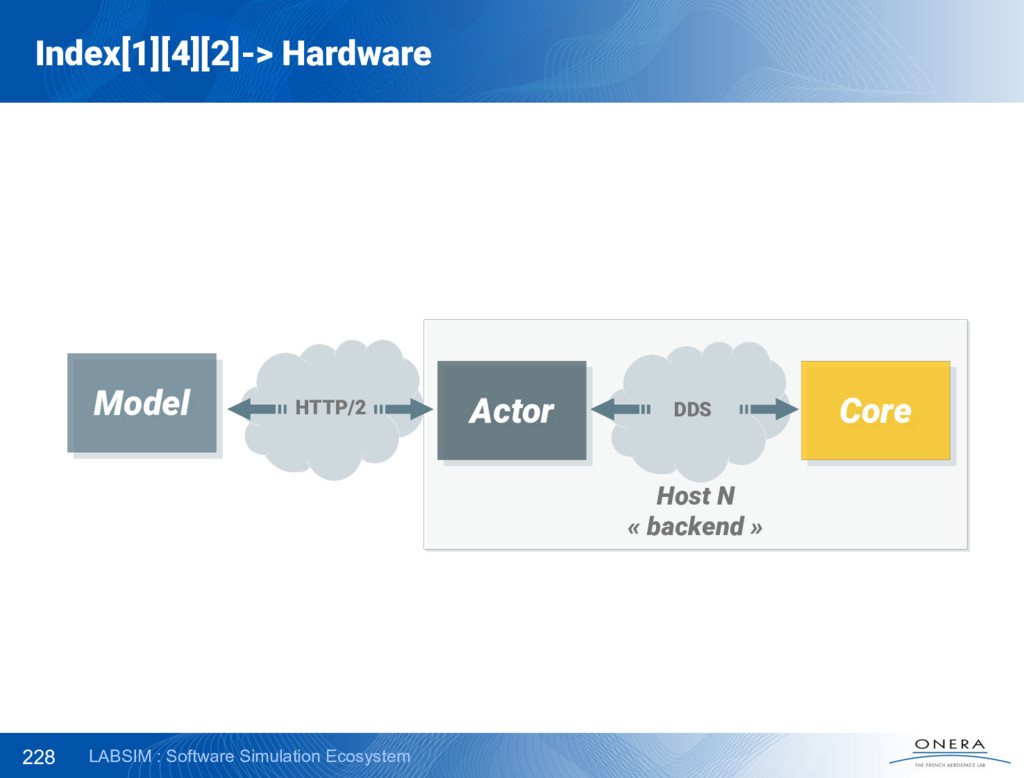
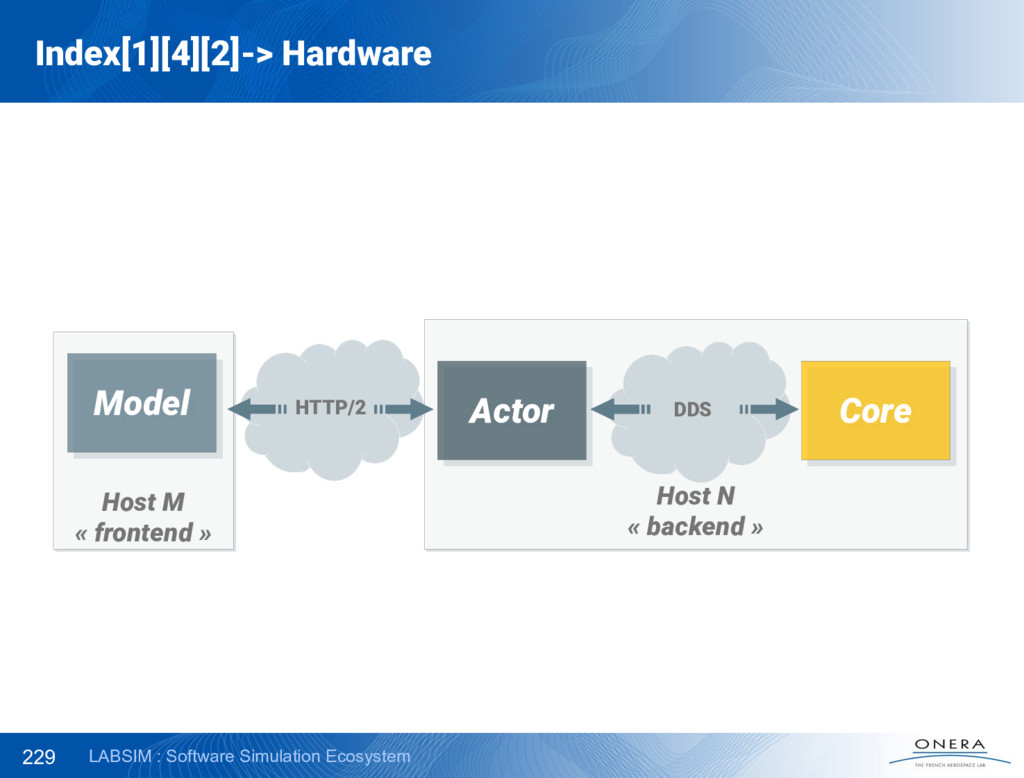
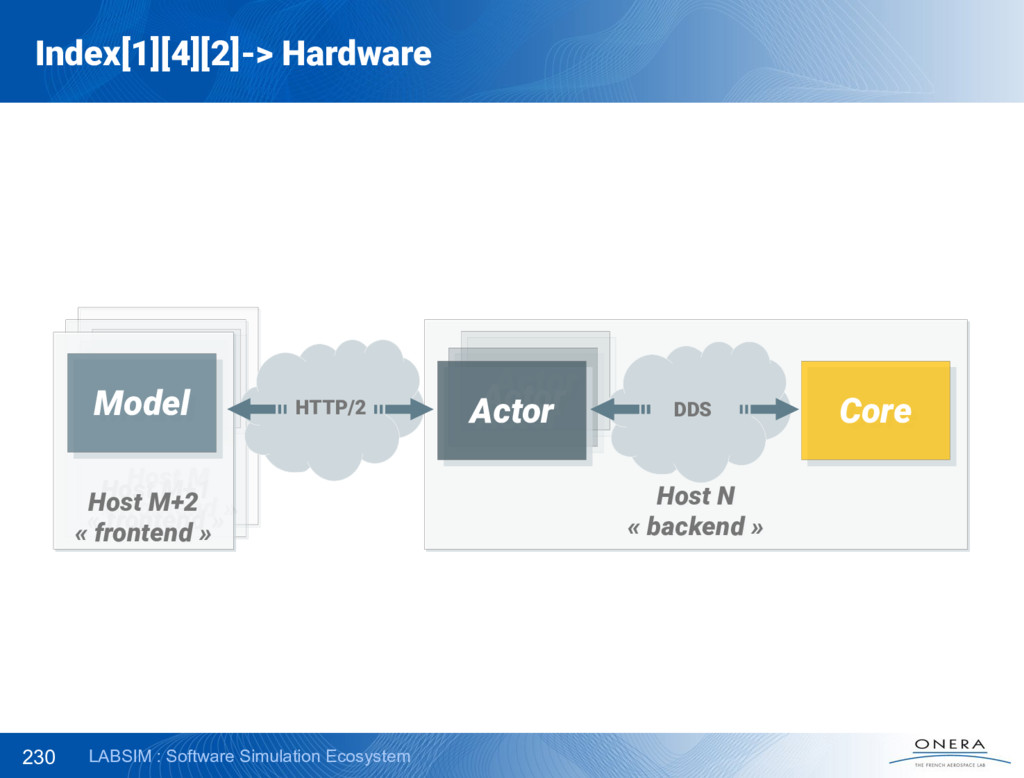
Host N « backend » Host N « backend » Index[1][4][2]-> Hardware 229 LABSIM : Software Simulation Ecosystem HTTP/2 DDS Actor Actor Core Core Model Model
Actor Actor Actor Actor Host M « frontend » Host M « frontend » Model Model Host M+1 « frontend » Host M+1 « frontend » Model Model Host M+2 « frontend » Host M+2 « frontend » Index[1][4][2]-> Hardware 230 LABSIM : Software Simulation Ecosystem HTTP/2 DDS Actor Actor Core Core Model Model
HTTP/2 Model Integration Pipeline THETYS [frontend] KRONOS [slave] DDS-PSM-Cxx [ISO/IEC C++ 2003] Model + ALU THETYS [backend] C# Java Python Go Simulink Labview Node.js CXX gRPC gRPC Properties • Supported OS : Linux & Windows • HTTP/2 transport layer via gRPC & Protobuf • Fully configured through XML


 nkinani
 takasehideki
 beale
beale
 hf149
hf149
 koide3
 institutdelelevage
 sishi2026
 kohlerjohannes
 analokmaus
 enochan
 sishi
sishi
 rikkabotan7
 nnchiba
 holman
 trallard
 schroneko
 davetheseo
 auna
auna
 helmedeiros
 mfonobong
 reverentgeek
 retrage
 stephaniewalter
 brad_frost
 morganepeng


![Outline 3 LABSIM : Software Simulation Ecosystem • [0] The](https://files.speakerdeck.com/presentations/ff8b86dbf17e446ba739836fd869e4f9/slide_2.jpg)
![4 Index[0] = The LABSIM • [0] History • [1]](https://files.speakerdeck.com/presentations/ff8b86dbf17e446ba739836fd869e4f9/slide_3.jpg)
![Index[0][0]-> History 5 LABSIM : Software Simulation Ecosystem](https://files.speakerdeck.com/presentations/ff8b86dbf17e446ba739836fd869e4f9/slide_4.jpg)
![Index[0]-> History 6 LABSIM : Software Simulation Ecosystem The ONERA](https://files.speakerdeck.com/presentations/ff8b86dbf17e446ba739836fd869e4f9/slide_5.jpg)
![Index[0][1]-> Scientific fields 7 LABSIM : Software Simulation Ecosystem](https://files.speakerdeck.com/presentations/ff8b86dbf17e446ba739836fd869e4f9/slide_6.jpg)
![Index[0][1]-> Scientific fields 8 LABSIM : Software Simulation Ecosystem Computer](https://files.speakerdeck.com/presentations/ff8b86dbf17e446ba739836fd869e4f9/slide_7.jpg)
![Computer Science Index[0][1]-> Scientific fields 9 LABSIM : Software Simulation](https://files.speakerdeck.com/presentations/ff8b86dbf17e446ba739836fd869e4f9/slide_8.jpg)
![Computer Science Index[0][1]-> Scientific fields 10 LABSIM : Software Simulation](https://files.speakerdeck.com/presentations/ff8b86dbf17e446ba739836fd869e4f9/slide_9.jpg)
![Computer Science Index[0][1]-> Scientific fields 11 LABSIM : Software Simulation](https://files.speakerdeck.com/presentations/ff8b86dbf17e446ba739836fd869e4f9/slide_10.jpg)
![Computer Science Index[0][1]-> Scientific fields 12 LABSIM : Software Simulation](https://files.speakerdeck.com/presentations/ff8b86dbf17e446ba739836fd869e4f9/slide_11.jpg)
![Computer Science Index[0][1]-> Scientific fields 13 LABSIM : Software Simulation](https://files.speakerdeck.com/presentations/ff8b86dbf17e446ba739836fd869e4f9/slide_12.jpg)
![Computer Science Index[0][1]-> Scientific fields 14 LABSIM : Software Simulation](https://files.speakerdeck.com/presentations/ff8b86dbf17e446ba739836fd869e4f9/slide_13.jpg)
![Index[0][1]-> Scientific fields 15 LABSIM : Software Simulation Ecosystem](https://files.speakerdeck.com/presentations/ff8b86dbf17e446ba739836fd869e4f9/slide_14.jpg)
![Index[0][1]-> Scientific fields 16 LABSIM : Software Simulation Ecosystem](https://files.speakerdeck.com/presentations/ff8b86dbf17e446ba739836fd869e4f9/slide_15.jpg)
![Index[0][1]-> Scientific fields 17 LABSIM : Software Simulation Ecosystem Technocentric](https://files.speakerdeck.com/presentations/ff8b86dbf17e446ba739836fd869e4f9/slide_16.jpg)
![Index[0][1]-> Scientific fields 18 LABSIM : Software Simulation Ecosystem Perception-Cognition-Action](https://files.speakerdeck.com/presentations/ff8b86dbf17e446ba739836fd869e4f9/slide_17.jpg)
![Index[0][2]-> Capabilities 19 LABSIM : Software Simulation Ecosystem](https://files.speakerdeck.com/presentations/ff8b86dbf17e446ba739836fd869e4f9/slide_18.jpg)
![Index[0][2]-> Capabilities 20 LABSIM : Software Simulation Ecosystem Following the](https://files.speakerdeck.com/presentations/ff8b86dbf17e446ba739836fd869e4f9/slide_19.jpg)
![Index[0][2]-> Capabilities 21 LABSIM : Software Simulation Ecosystem Following the](https://files.speakerdeck.com/presentations/ff8b86dbf17e446ba739836fd869e4f9/slide_20.jpg)
![Index[0][2]-> Capabilities 22 LABSIM : Software Simulation Ecosystem Following the](https://files.speakerdeck.com/presentations/ff8b86dbf17e446ba739836fd869e4f9/slide_21.jpg)
![Index[0][2]-> Capabilities 23 LABSIM : Software Simulation Ecosystem Expert Models](https://files.speakerdeck.com/presentations/ff8b86dbf17e446ba739836fd869e4f9/slide_22.jpg)
![Index[0][2]-> Capabilities 24 LABSIM : Software Simulation Ecosystem](https://files.speakerdeck.com/presentations/ff8b86dbf17e446ba739836fd869e4f9/slide_23.jpg)
![Index[0][2]-> Capabilities 25 LABSIM : Software Simulation Ecosystem Sensory-motor devices](https://files.speakerdeck.com/presentations/ff8b86dbf17e446ba739836fd869e4f9/slide_24.jpg)
![Index[0][2]-> Capabilities 26 LABSIM : Software Simulation Ecosystem Biophysical Sensors](https://files.speakerdeck.com/presentations/ff8b86dbf17e446ba739836fd869e4f9/slide_25.jpg)
![Index[0][2]-> Capabilities 27 LABSIM : Software Simulation Ecosystem Expert Models](https://files.speakerdeck.com/presentations/ff8b86dbf17e446ba739836fd869e4f9/slide_26.jpg)
![Index[0][2]-> Capabilities 28 LABSIM : Software Simulation Ecosystem Sensory-motor devices](https://files.speakerdeck.com/presentations/ff8b86dbf17e446ba739836fd869e4f9/slide_27.jpg)
![Index[0][3]-> Facilities 29 LABSIM : Software Simulation Ecosystem](https://files.speakerdeck.com/presentations/ff8b86dbf17e446ba739836fd869e4f9/slide_28.jpg)
![Index[0][3]-> Facilities 30 LABSIM : Software Simulation Ecosystem Actually, we](https://files.speakerdeck.com/presentations/ff8b86dbf17e446ba739836fd869e4f9/slide_29.jpg)
![Index[0][3]-> Facilities 31 LABSIM : Software Simulation Ecosystem Actually, we](https://files.speakerdeck.com/presentations/ff8b86dbf17e446ba739836fd869e4f9/slide_30.jpg)
![Index[0][3]-> Facilities 32 LABSIM : Software Simulation Ecosystem Actually, we](https://files.speakerdeck.com/presentations/ff8b86dbf17e446ba739836fd869e4f9/slide_31.jpg)
![Index[0][3]-> Facilities 33 LABSIM : Software Simulation Ecosystem Actually, we](https://files.speakerdeck.com/presentations/ff8b86dbf17e446ba739836fd869e4f9/slide_32.jpg)
![Index[0][3]-> Facilities 34 LABSIM : Software Simulation Ecosystem](https://files.speakerdeck.com/presentations/ff8b86dbf17e446ba739836fd869e4f9/slide_33.jpg)
![Index[0][3]-> Facilities 35 LABSIM : Software Simulation Ecosystem PYCSHEL This](https://files.speakerdeck.com/presentations/ff8b86dbf17e446ba739836fd869e4f9/slide_34.jpg)
![Index[0][3]-> Facilities 36 LABSIM : Software Simulation Ecosystem SCHEME This](https://files.speakerdeck.com/presentations/ff8b86dbf17e446ba739836fd869e4f9/slide_35.jpg)
![Index[0][3]-> Facilities 37 LABSIM : Software Simulation Ecosystem LIPS This](https://files.speakerdeck.com/presentations/ff8b86dbf17e446ba739836fd869e4f9/slide_36.jpg)
![Index[0][3]-> Facilities 38 LABSIM : Software Simulation Ecosystem PYCSHEL This](https://files.speakerdeck.com/presentations/ff8b86dbf17e446ba739836fd869e4f9/slide_37.jpg)
![Index[0][3]-> Facilities 39 LABSIM : Software Simulation Ecosystem](https://files.speakerdeck.com/presentations/ff8b86dbf17e446ba739836fd869e4f9/slide_38.jpg)
![Index[0][3]-> Facilities 40 LABSIM : Software Simulation Ecosystem](https://files.speakerdeck.com/presentations/ff8b86dbf17e446ba739836fd869e4f9/slide_39.jpg)
![Index[0][3]-> Facilities 41 LABSIM : Software Simulation Ecosystem Multi-touch screen](https://files.speakerdeck.com/presentations/ff8b86dbf17e446ba739836fd869e4f9/slide_40.jpg)
![Index[0][3]-> Facilities 42 LABSIM : Software Simulation Ecosystem Multi-touch screen](https://files.speakerdeck.com/presentations/ff8b86dbf17e446ba739836fd869e4f9/slide_41.jpg)
![Index[0][3]-> Facilities 43 LABSIM : Software Simulation Ecosystem Multi-touch screen](https://files.speakerdeck.com/presentations/ff8b86dbf17e446ba739836fd869e4f9/slide_42.jpg)
![Index[0][3]-> Facilities 44 LABSIM : Software Simulation Ecosystem Multi-touch screen](https://files.speakerdeck.com/presentations/ff8b86dbf17e446ba739836fd869e4f9/slide_43.jpg)
![Index[0][3]-> Facilities 45 LABSIM : Software Simulation Ecosystem](https://files.speakerdeck.com/presentations/ff8b86dbf17e446ba739836fd869e4f9/slide_44.jpg)
![Index[0][3]-> Facilities 46 LABSIM : Software Simulation Ecosystem Simpit Icarus](https://files.speakerdeck.com/presentations/ff8b86dbf17e446ba739836fd869e4f9/slide_45.jpg)
![Index[0][3]-> Facilities 47 LABSIM : Software Simulation Ecosystem Simpit Icarus](https://files.speakerdeck.com/presentations/ff8b86dbf17e446ba739836fd869e4f9/slide_46.jpg)
![Index[0][3]-> Facilities 48 LABSIM : Software Simulation Ecosystem](https://files.speakerdeck.com/presentations/ff8b86dbf17e446ba739836fd869e4f9/slide_47.jpg)
![Index[0][3]-> Facilities 49 LABSIM : Software Simulation Ecosystem Simple experiment](https://files.speakerdeck.com/presentations/ff8b86dbf17e446ba739836fd869e4f9/slide_48.jpg)
![Index[0][3]-> Facilities 50 LABSIM : Software Simulation Ecosystem Simple experiment](https://files.speakerdeck.com/presentations/ff8b86dbf17e446ba739836fd869e4f9/slide_49.jpg)
![Index[0][4]-> Members 51 LABSIM : Software Simulation Ecosystem](https://files.speakerdeck.com/presentations/ff8b86dbf17e446ba739836fd869e4f9/slide_50.jpg)
![Index[0][4]-> Members 52 LABSIM : Software Simulation Ecosystem Gregory BONIN](https://files.speakerdeck.com/presentations/ff8b86dbf17e446ba739836fd869e4f9/slide_51.jpg)
![Index[0][4]-> Members 53 LABSIM : Software Simulation Ecosystem Christian SCHULTE](https://files.speakerdeck.com/presentations/ff8b86dbf17e446ba739836fd869e4f9/slide_52.jpg)
![Index[0][4]-> Members 54 LABSIM : Software Simulation Ecosystem Christian SCHULTE](https://files.speakerdeck.com/presentations/ff8b86dbf17e446ba739836fd869e4f9/slide_53.jpg)
![Index[0][4]-> Members 55 LABSIM : Software Simulation Ecosystem Christian SCHULTE](https://files.speakerdeck.com/presentations/ff8b86dbf17e446ba739836fd869e4f9/slide_54.jpg)
![Index[0][4]-> Members 56 LABSIM : Software Simulation Ecosystem Christian SCHULTE](https://files.speakerdeck.com/presentations/ff8b86dbf17e446ba739836fd869e4f9/slide_55.jpg)
![Index[0][4]-> Members 57 LABSIM : Software Simulation Ecosystem Christian SCHULTE](https://files.speakerdeck.com/presentations/ff8b86dbf17e446ba739836fd869e4f9/slide_56.jpg)
![Index[0][4]-> Members 58 LABSIM : Software Simulation Ecosystem Christian SCHULTE](https://files.speakerdeck.com/presentations/ff8b86dbf17e446ba739836fd869e4f9/slide_57.jpg)
![Index[0][4]-> Members 59 LABSIM : Software Simulation Ecosystem Christian SCHULTE](https://files.speakerdeck.com/presentations/ff8b86dbf17e446ba739836fd869e4f9/slide_58.jpg)
![60 Index[1] = The Simulation Software Ecosystem • [0] Problematic](https://files.speakerdeck.com/presentations/ff8b86dbf17e446ba739836fd869e4f9/slide_59.jpg)
![Index[1][0]-> Problematic 61 LABSIM : Software Simulation Ecosystem](https://files.speakerdeck.com/presentations/ff8b86dbf17e446ba739836fd869e4f9/slide_60.jpg)
![Index[1][0]-> Problematic 62 LABSIM : Software Simulation Ecosystem LABSIM team](https://files.speakerdeck.com/presentations/ff8b86dbf17e446ba739836fd869e4f9/slide_61.jpg)
![Index[1][0]-> Problematic 63 LABSIM : Software Simulation Ecosystem CONCEPTION DEVELOPMENT](https://files.speakerdeck.com/presentations/ff8b86dbf17e446ba739836fd869e4f9/slide_62.jpg)
![Index[1][0]-> Problematic 64 LABSIM : Software Simulation Ecosystem CONCEPTION DEVELOPMENT](https://files.speakerdeck.com/presentations/ff8b86dbf17e446ba739836fd869e4f9/slide_63.jpg)
![Index[1][0]-> Problematic 65 LABSIM : Software Simulation Ecosystem CONCEPTION DEVELOPMENT](https://files.speakerdeck.com/presentations/ff8b86dbf17e446ba739836fd869e4f9/slide_64.jpg)
![Index[1][0]-> Problematic 66 LABSIM : Software Simulation Ecosystem CONCEPTION DEVELOPMENT](https://files.speakerdeck.com/presentations/ff8b86dbf17e446ba739836fd869e4f9/slide_65.jpg)
![Index[1][0]-> Problematic 67 LABSIM : Software Simulation Ecosystem CONCEPTION DEVELOPMENT](https://files.speakerdeck.com/presentations/ff8b86dbf17e446ba739836fd869e4f9/slide_66.jpg)
![Index[1][0]-> Problematic 68 LABSIM : Software Simulation Ecosystem CONCEPTION DEVELOPMENT](https://files.speakerdeck.com/presentations/ff8b86dbf17e446ba739836fd869e4f9/slide_67.jpg)
![Index[1][0]-> Problematic 69 LABSIM : Software Simulation Ecosystem CONCEPTION DEVELOPMENT](https://files.speakerdeck.com/presentations/ff8b86dbf17e446ba739836fd869e4f9/slide_68.jpg)
![Index[1][0]-> Problematic 70 LABSIM : Software Simulation Ecosystem CONCEPTION DEVELOPMENT](https://files.speakerdeck.com/presentations/ff8b86dbf17e446ba739836fd869e4f9/slide_69.jpg)
![Index[1][0]-> Problematic 71 LABSIM : Software Simulation Ecosystem « How](https://files.speakerdeck.com/presentations/ff8b86dbf17e446ba739836fd869e4f9/slide_70.jpg)
![Index[1][0]-> Problematic 72 LABSIM : Software Simulation Ecosystem « How](https://files.speakerdeck.com/presentations/ff8b86dbf17e446ba739836fd869e4f9/slide_71.jpg)
![Index[1][0]-> Problematic 73 LABSIM : Software Simulation Ecosystem « How](https://files.speakerdeck.com/presentations/ff8b86dbf17e446ba739836fd869e4f9/slide_72.jpg)
![Index[1][0]-> Problematic 74 LABSIM : Software Simulation Ecosystem « How](https://files.speakerdeck.com/presentations/ff8b86dbf17e446ba739836fd869e4f9/slide_73.jpg)
![Index[1][0]-> Problematic 75 LABSIM : Software Simulation Ecosystem « How](https://files.speakerdeck.com/presentations/ff8b86dbf17e446ba739836fd869e4f9/slide_74.jpg)
![Index[1][0]-> Problematic 76 LABSIM : Software Simulation Ecosystem « How](https://files.speakerdeck.com/presentations/ff8b86dbf17e446ba739836fd869e4f9/slide_75.jpg)
![Index[1][1]-> Guidelines 77 LABSIM : Software Simulation Ecosystem](https://files.speakerdeck.com/presentations/ff8b86dbf17e446ba739836fd869e4f9/slide_76.jpg)
![Index[1][1]-> Guidelines 78 LABSIM : Software Simulation Ecosystem](https://files.speakerdeck.com/presentations/ff8b86dbf17e446ba739836fd869e4f9/slide_77.jpg)
![Index[1][1]-> Guidelines 79 LABSIM : Software Simulation Ecosystem Human-centered](https://files.speakerdeck.com/presentations/ff8b86dbf17e446ba739836fd869e4f9/slide_78.jpg)
![Index[1][1]-> Guidelines 80 LABSIM : Software Simulation Ecosystem Human-centered Soft](https://files.speakerdeck.com/presentations/ff8b86dbf17e446ba739836fd869e4f9/slide_79.jpg)
![Index[1][1]-> Guidelines 81 LABSIM : Software Simulation Ecosystem Human-centered Evaluations](https://files.speakerdeck.com/presentations/ff8b86dbf17e446ba739836fd869e4f9/slide_80.jpg)
![Index[1][1]-> Guidelines 82 LABSIM : Software Simulation Ecosystem Human-centered Evaluations](https://files.speakerdeck.com/presentations/ff8b86dbf17e446ba739836fd869e4f9/slide_81.jpg)
![Index[1][1]-> Guidelines 83 LABSIM : Software Simulation Ecosystem Performance focused](https://files.speakerdeck.com/presentations/ff8b86dbf17e446ba739836fd869e4f9/slide_82.jpg)
![Index[1][1]-> Guidelines 84 LABSIM : Software Simulation Ecosystem Performance focused](https://files.speakerdeck.com/presentations/ff8b86dbf17e446ba739836fd869e4f9/slide_83.jpg)
![Index[1][1]-> Guidelines 85 LABSIM : Software Simulation Ecosystem Code-less](https://files.speakerdeck.com/presentations/ff8b86dbf17e446ba739836fd869e4f9/slide_84.jpg)
![Index[1][1]-> Guidelines 86 LABSIM : Software Simulation Ecosystem Code-less Abstracting](https://files.speakerdeck.com/presentations/ff8b86dbf17e446ba739836fd869e4f9/slide_85.jpg)
![Index[1][1]-> Guidelines 87 LABSIM : Software Simulation Ecosystem Code-less Abstracting](https://files.speakerdeck.com/presentations/ff8b86dbf17e446ba739836fd869e4f9/slide_86.jpg)
![Index[1][1]-> Guidelines 88 LABSIM : Software Simulation Ecosystem Code-less Abstracting](https://files.speakerdeck.com/presentations/ff8b86dbf17e446ba739836fd869e4f9/slide_87.jpg)
![Index[1][1]-> Guidelines 89 LABSIM : Software Simulation Ecosystem Code-less Generic](https://files.speakerdeck.com/presentations/ff8b86dbf17e446ba739836fd869e4f9/slide_88.jpg)
![Index[1][1]-> Guidelines 90 LABSIM : Software Simulation Ecosystem Code-less A](https://files.speakerdeck.com/presentations/ff8b86dbf17e446ba739836fd869e4f9/slide_89.jpg)
![Index[1][1]-> Guidelines 91 LABSIM : Software Simulation Ecosystem Multi-disciplinar](https://files.speakerdeck.com/presentations/ff8b86dbf17e446ba739836fd869e4f9/slide_90.jpg)
![Index[1][1]-> Guidelines 92 LABSIM : Software Simulation Ecosystem Multi-disciplinar Integrate](https://files.speakerdeck.com/presentations/ff8b86dbf17e446ba739836fd869e4f9/slide_91.jpg)
![Index[1][1]-> Guidelines 93 LABSIM : Software Simulation Ecosystem Multi-disciplinar Integrate](https://files.speakerdeck.com/presentations/ff8b86dbf17e446ba739836fd869e4f9/slide_92.jpg)
![Index[1][1]-> Guidelines 94 LABSIM : Software Simulation Ecosystem Multi-disciplinar Human](https://files.speakerdeck.com/presentations/ff8b86dbf17e446ba739836fd869e4f9/slide_93.jpg)
![Index[1][1]-> Guidelines 95 LABSIM : Software Simulation Ecosystem Multi-disciplinar Human](https://files.speakerdeck.com/presentations/ff8b86dbf17e446ba739836fd869e4f9/slide_94.jpg)
![Index[1][1]-> Guidelines 96 LABSIM : Software Simulation Ecosystem Multi-disciplinar Human](https://files.speakerdeck.com/presentations/ff8b86dbf17e446ba739836fd869e4f9/slide_95.jpg)
![Index[1][1]-> Guidelines 97 LABSIM : Software Simulation Ecosystem Multi-disciplinar Human](https://files.speakerdeck.com/presentations/ff8b86dbf17e446ba739836fd869e4f9/slide_96.jpg)
![Index[1][1]-> Guidelines 98 LABSIM : Software Simulation Ecosystem Modular](https://files.speakerdeck.com/presentations/ff8b86dbf17e446ba739836fd869e4f9/slide_97.jpg)
![Index[1][1]-> Guidelines 99 LABSIM : Software Simulation Ecosystem Modular Dynamic](https://files.speakerdeck.com/presentations/ff8b86dbf17e446ba739836fd869e4f9/slide_98.jpg)
![Index[1][1]-> Guidelines 100 LABSIM : Software Simulation Ecosystem Modular iteration](https://files.speakerdeck.com/presentations/ff8b86dbf17e446ba739836fd869e4f9/slide_99.jpg)
![Index[1][1]-> Guidelines 101 LABSIM : Software Simulation Ecosystem Modular iteration](https://files.speakerdeck.com/presentations/ff8b86dbf17e446ba739836fd869e4f9/slide_100.jpg)
![Index[1][1]-> Guidelines 102 LABSIM : Software Simulation Ecosystem Modular iteration](https://files.speakerdeck.com/presentations/ff8b86dbf17e446ba739836fd869e4f9/slide_101.jpg)
![Index[1][1]-> Guidelines 103 LABSIM : Software Simulation Ecosystem Modular iteration](https://files.speakerdeck.com/presentations/ff8b86dbf17e446ba739836fd869e4f9/slide_102.jpg)
![Index[1][2]-> High-level architecture 104 LABSIM : Software Simulation Ecosystem](https://files.speakerdeck.com/presentations/ff8b86dbf17e446ba739836fd869e4f9/slide_103.jpg)
![Index[1][2]-> High-level architecture 105 LABSIM : Software Simulation Ecosystem Traditional](https://files.speakerdeck.com/presentations/ff8b86dbf17e446ba739836fd869e4f9/slide_104.jpg)
![Index[1][2]-> High-level architecture 106 LABSIM : Software Simulation Ecosystem Traditional](https://files.speakerdeck.com/presentations/ff8b86dbf17e446ba739836fd869e4f9/slide_105.jpg)
![Index[1][2]-> High-level architecture 107 LABSIM : Software Simulation Ecosystem Traditional](https://files.speakerdeck.com/presentations/ff8b86dbf17e446ba739836fd869e4f9/slide_106.jpg)
![Index[1][2]-> High-level architecture 108 LABSIM : Software Simulation Ecosystem Traditional](https://files.speakerdeck.com/presentations/ff8b86dbf17e446ba739836fd869e4f9/slide_107.jpg)
![Index[1][2]-> High-level architecture 109 LABSIM : Software Simulation Ecosystem UI](https://files.speakerdeck.com/presentations/ff8b86dbf17e446ba739836fd869e4f9/slide_108.jpg)
![Index[1][2]-> High-level architecture 110 LABSIM : Software Simulation Ecosystem UI](https://files.speakerdeck.com/presentations/ff8b86dbf17e446ba739836fd869e4f9/slide_109.jpg)
![Index[1][2]-> High-level architecture 111 LABSIM : Software Simulation Ecosystem UI](https://files.speakerdeck.com/presentations/ff8b86dbf17e446ba739836fd869e4f9/slide_110.jpg)
![Index[1][2]-> High-level architecture 112 LABSIM : Software Simulation Ecosystem UI](https://files.speakerdeck.com/presentations/ff8b86dbf17e446ba739836fd869e4f9/slide_111.jpg)
![Index[1][2]-> High-level architecture 113 LABSIM : Software Simulation Ecosystem UI](https://files.speakerdeck.com/presentations/ff8b86dbf17e446ba739836fd869e4f9/slide_112.jpg)
![Index[1][2]-> High-level architecture 114 LABSIM : Software Simulation Ecosystem UI](https://files.speakerdeck.com/presentations/ff8b86dbf17e446ba739836fd869e4f9/slide_113.jpg)
![Index[1][2]-> High-level architecture 115 LABSIM : Software Simulation Ecosystem UI](https://files.speakerdeck.com/presentations/ff8b86dbf17e446ba739836fd869e4f9/slide_114.jpg)
![Index[1][2]-> High-level architecture 116 LABSIM : Software Simulation Ecosystem UI](https://files.speakerdeck.com/presentations/ff8b86dbf17e446ba739836fd869e4f9/slide_115.jpg)
![Index[1][2]-> High-level architecture 117 LABSIM : Software Simulation Ecosystem UI](https://files.speakerdeck.com/presentations/ff8b86dbf17e446ba739836fd869e4f9/slide_116.jpg)
![Index[1][2]-> High-level architecture 118 LABSIM : Software Simulation Ecosystem UI](https://files.speakerdeck.com/presentations/ff8b86dbf17e446ba739836fd869e4f9/slide_117.jpg)
![Index[1][2]-> High-level architecture 119 LABSIM : Software Simulation Ecosystem UI](https://files.speakerdeck.com/presentations/ff8b86dbf17e446ba739836fd869e4f9/slide_118.jpg)
![Index[1][2]-> High-level architecture 120 LABSIM : Software Simulation Ecosystem UI](https://files.speakerdeck.com/presentations/ff8b86dbf17e446ba739836fd869e4f9/slide_119.jpg)
![Index[1][2]-> High-level architecture 121 LABSIM : Software Simulation Ecosystem UI](https://files.speakerdeck.com/presentations/ff8b86dbf17e446ba739836fd869e4f9/slide_120.jpg)
![Index[1][2]-> High-level architecture 122 LABSIM : Software Simulation Ecosystem UI](https://files.speakerdeck.com/presentations/ff8b86dbf17e446ba739836fd869e4f9/slide_121.jpg)
![Index[1][2]-> High-level architecture 123 LABSIM : Software Simulation Ecosystem DATA](https://files.speakerdeck.com/presentations/ff8b86dbf17e446ba739836fd869e4f9/slide_122.jpg)
![Index[1][2]-> High-level architecture 124 LABSIM : Software Simulation Ecosystem Provided](https://files.speakerdeck.com/presentations/ff8b86dbf17e446ba739836fd869e4f9/slide_123.jpg)
![Index[1][2]-> High-level architecture 125 LABSIM : Software Simulation Ecosystem MODEL](https://files.speakerdeck.com/presentations/ff8b86dbf17e446ba739836fd869e4f9/slide_124.jpg)
![Index[1][2]-> High-level architecture 126 LABSIM : Software Simulation Ecosystem Multi-clouds](https://files.speakerdeck.com/presentations/ff8b86dbf17e446ba739836fd869e4f9/slide_125.jpg)
![Index[1][2]-> High-level architecture 127 LABSIM : Software Simulation Ecosystem Multi-clouds](https://files.speakerdeck.com/presentations/ff8b86dbf17e446ba739836fd869e4f9/slide_126.jpg)
![Index[1][3]-> Low-level architecture 128 LABSIM : Software Simulation Ecosystem](https://files.speakerdeck.com/presentations/ff8b86dbf17e446ba739836fd869e4f9/slide_127.jpg)
![Index[1][3]-> Low-level architecture 129 LABSIM : Software Simulation Ecosystem ALU.xml](https://files.speakerdeck.com/presentations/ff8b86dbf17e446ba739836fd869e4f9/slide_128.jpg)
![Index[1][3]-> Low-level architecture 130 LABSIM : Software Simulation Ecosystem ALU.xml](https://files.speakerdeck.com/presentations/ff8b86dbf17e446ba739836fd869e4f9/slide_129.jpg)
![Index[1][3]-> Low-level architecture 131 LABSIM : Software Simulation Ecosystem ALU.xml](https://files.speakerdeck.com/presentations/ff8b86dbf17e446ba739836fd869e4f9/slide_130.jpg)
![Index[1][3]-> Low-level architecture 132 LABSIM : Software Simulation Ecosystem ALU.xml](https://files.speakerdeck.com/presentations/ff8b86dbf17e446ba739836fd869e4f9/slide_131.jpg)
![Index[1][3]-> Low-level architecture 133 LABSIM : Software Simulation Ecosystem ALU.xml](https://files.speakerdeck.com/presentations/ff8b86dbf17e446ba739836fd869e4f9/slide_132.jpg)
![Index[1][3]-> Low-level architecture 134 LABSIM : Software Simulation Ecosystem ALU.xml](https://files.speakerdeck.com/presentations/ff8b86dbf17e446ba739836fd869e4f9/slide_133.jpg)
![Index[1][3]-> Low-level architecture 135 LABSIM : Software Simulation Ecosystem ALU.xml](https://files.speakerdeck.com/presentations/ff8b86dbf17e446ba739836fd869e4f9/slide_134.jpg)
![Index[1][3]-> Low-level architecture 136 LABSIM : Software Simulation Ecosystem ALU.xml](https://files.speakerdeck.com/presentations/ff8b86dbf17e446ba739836fd869e4f9/slide_135.jpg)
![Index[1][3]-> Low-level architecture 137 LABSIM : Software Simulation Ecosystem ALU.xml](https://files.speakerdeck.com/presentations/ff8b86dbf17e446ba739836fd869e4f9/slide_136.jpg)
![Index[1][3]-> Low-level architecture 138 LABSIM : Software Simulation Ecosystem ALU.xml](https://files.speakerdeck.com/presentations/ff8b86dbf17e446ba739836fd869e4f9/slide_137.jpg)
![Index[1][3]-> Low-level architecture 139 LABSIM : Software Simulation Ecosystem ALU.xml](https://files.speakerdeck.com/presentations/ff8b86dbf17e446ba739836fd869e4f9/slide_138.jpg)
![Index[1][3]-> Low-level architecture 140 LABSIM : Software Simulation Ecosystem HTTP/2](https://files.speakerdeck.com/presentations/ff8b86dbf17e446ba739836fd869e4f9/slide_139.jpg)
![Index[1][3]-> Low-level architecture 141 LABSIM : Software Simulation Ecosystem HTTP/2](https://files.speakerdeck.com/presentations/ff8b86dbf17e446ba739836fd869e4f9/slide_140.jpg)
![Index[1][3][0]-> gRPC & Protobuf overview 142 LABSIM : Software Simulation](https://files.speakerdeck.com/presentations/ff8b86dbf17e446ba739836fd869e4f9/slide_141.jpg)
![Index[1][3][0]-> gRPC & Protobuf overview 143 LABSIM : Software Simulation](https://files.speakerdeck.com/presentations/ff8b86dbf17e446ba739836fd869e4f9/slide_142.jpg)
![Index[1][3][0]-> gRPC & Protobuf overview 144 LABSIM : Software Simulation](https://files.speakerdeck.com/presentations/ff8b86dbf17e446ba739836fd869e4f9/slide_143.jpg)
![Index[1][3][0]-> gRPC & Protobuf overview 145 LABSIM : Software Simulation](https://files.speakerdeck.com/presentations/ff8b86dbf17e446ba739836fd869e4f9/slide_144.jpg)
![Index[1][3][0]-> gRPC & Protobuf overview 146 LABSIM : Software Simulation](https://files.speakerdeck.com/presentations/ff8b86dbf17e446ba739836fd869e4f9/slide_145.jpg)
![Index[1][3]-> Low-level architecture 147 LABSIM : Software Simulation Ecosystem HTTP/2](https://files.speakerdeck.com/presentations/ff8b86dbf17e446ba739836fd869e4f9/slide_146.jpg)
![Index[1][3]-> Low-level architecture 148 LABSIM : Software Simulation Ecosystem HTTP/2](https://files.speakerdeck.com/presentations/ff8b86dbf17e446ba739836fd869e4f9/slide_147.jpg)
![Index[1][3]-> Low-level architecture 149 LABSIM : Software Simulation Ecosystem HTTP/2](https://files.speakerdeck.com/presentations/ff8b86dbf17e446ba739836fd869e4f9/slide_148.jpg)
![Index[1][3]-> Low-level architecture 150 LABSIM : Software Simulation Ecosystem HTTP/2](https://files.speakerdeck.com/presentations/ff8b86dbf17e446ba739836fd869e4f9/slide_149.jpg)
![Index[1][3]-> Low-level architecture 151 LABSIM : Software Simulation Ecosystem HTTP/2](https://files.speakerdeck.com/presentations/ff8b86dbf17e446ba739836fd869e4f9/slide_150.jpg)
![Index[1][3]-> Low-level architecture 152 LABSIM : Software Simulation Ecosystem HTTP/2](https://files.speakerdeck.com/presentations/ff8b86dbf17e446ba739836fd869e4f9/slide_151.jpg)
![Index[1][3]-> Low-level architecture 153 LABSIM : Software Simulation Ecosystem TSDB](https://files.speakerdeck.com/presentations/ff8b86dbf17e446ba739836fd869e4f9/slide_152.jpg)
![Index[1][3]-> Low-level architecture 154 LABSIM : Software Simulation Ecosystem HTTP/2](https://files.speakerdeck.com/presentations/ff8b86dbf17e446ba739836fd869e4f9/slide_153.jpg)
![Index[1][3]-> Low-level architecture 155 LABSIM : Software Simulation Ecosystem HTTP/1.1](https://files.speakerdeck.com/presentations/ff8b86dbf17e446ba739836fd869e4f9/slide_154.jpg)
![Index[1][3]-> Low-level architecture 156 LABSIM : Software Simulation Ecosystem Supervisor](https://files.speakerdeck.com/presentations/ff8b86dbf17e446ba739836fd869e4f9/slide_155.jpg)
![Index[1][3]-> Low-level architecture 157 LABSIM : Software Simulation Ecosystem HTTP/1.1](https://files.speakerdeck.com/presentations/ff8b86dbf17e446ba739836fd869e4f9/slide_156.jpg)
![Index[1][3]-> Low-level architecture 158 LABSIM : Software Simulation Ecosystem MAUVE](https://files.speakerdeck.com/presentations/ff8b86dbf17e446ba739836fd869e4f9/slide_157.jpg)
![Index[1][3]-> Low-level architecture 159 LABSIM : Software Simulation Ecosystem HLA](https://files.speakerdeck.com/presentations/ff8b86dbf17e446ba739836fd869e4f9/slide_158.jpg)
![Index[1][3]-> Low-level architecture 160 LABSIM : Software Simulation Ecosystem HTTP/2](https://files.speakerdeck.com/presentations/ff8b86dbf17e446ba739836fd869e4f9/slide_159.jpg)
![Index[1][3]-> Low-level architecture 161 LABSIM : Software Simulation Ecosystem Frontend](https://files.speakerdeck.com/presentations/ff8b86dbf17e446ba739836fd869e4f9/slide_160.jpg)
![Index[1][3]-> Low-level architecture 162 LABSIM : Software Simulation Ecosystem Frontend](https://files.speakerdeck.com/presentations/ff8b86dbf17e446ba739836fd869e4f9/slide_161.jpg)
![Index[1][3]-> Low-level architecture 163 LABSIM : Software Simulation Ecosystem ISU.xml](https://files.speakerdeck.com/presentations/ff8b86dbf17e446ba739836fd869e4f9/slide_162.jpg)
![Index[1][3]-> Low-level architecture 164 LABSIM : Software Simulation Ecosystem HCU.xml](https://files.speakerdeck.com/presentations/ff8b86dbf17e446ba739836fd869e4f9/slide_163.jpg)
![Index[1][3]-> Low-level architecture 165 LABSIM : Software Simulation Ecosystem SLU.xml](https://files.speakerdeck.com/presentations/ff8b86dbf17e446ba739836fd869e4f9/slide_164.jpg)
![Index[1][3]-> Low-level architecture 166 LABSIM : Software Simulation Ecosystem Frontend](https://files.speakerdeck.com/presentations/ff8b86dbf17e446ba739836fd869e4f9/slide_165.jpg)
![Index[1][3]-> Low-level architecture 167 LABSIM : Software Simulation Ecosystem Frontend](https://files.speakerdeck.com/presentations/ff8b86dbf17e446ba739836fd869e4f9/slide_166.jpg)
![Index[1][3]-> Low-level architecture 168 LABSIM : Software Simulation Ecosystem Frontend](https://files.speakerdeck.com/presentations/ff8b86dbf17e446ba739836fd869e4f9/slide_167.jpg)
![Index[1][3]-> Low-level architecture 169 LABSIM : Software Simulation Ecosystem Frontend](https://files.speakerdeck.com/presentations/ff8b86dbf17e446ba739836fd869e4f9/slide_168.jpg)
![Index[1][3]-> Low-level architecture 170 LABSIM : Software Simulation Ecosystem Frontend](https://files.speakerdeck.com/presentations/ff8b86dbf17e446ba739836fd869e4f9/slide_169.jpg)
![Index[1][3]-> Low-level architecture 171 LABSIM : Software Simulation Ecosystem Frontend](https://files.speakerdeck.com/presentations/ff8b86dbf17e446ba739836fd869e4f9/slide_170.jpg)
![Index[1][3]-> Low-level architecture 172 LABSIM : Software Simulation Ecosystem Frontend](https://files.speakerdeck.com/presentations/ff8b86dbf17e446ba739836fd869e4f9/slide_171.jpg)
![Index[1][3]-> Low-level architecture 173 LABSIM : Software Simulation Ecosystem Frontend](https://files.speakerdeck.com/presentations/ff8b86dbf17e446ba739836fd869e4f9/slide_172.jpg)
![Index[1][3]-> Low-level architecture 174 LABSIM : Software Simulation Ecosystem Frontend](https://files.speakerdeck.com/presentations/ff8b86dbf17e446ba739836fd869e4f9/slide_173.jpg)
![Index[1][3]-> Low-level architecture 175 LABSIM : Software Simulation Ecosystem Frontend](https://files.speakerdeck.com/presentations/ff8b86dbf17e446ba739836fd869e4f9/slide_174.jpg)
![Index[1][3]-> Low-level architecture 176 LABSIM : Software Simulation Ecosystem Frontend](https://files.speakerdeck.com/presentations/ff8b86dbf17e446ba739836fd869e4f9/slide_175.jpg)
![Index[1][3]-> Low-level architecture 177 LABSIM : Software Simulation Ecosystem Frontend](https://files.speakerdeck.com/presentations/ff8b86dbf17e446ba739836fd869e4f9/slide_176.jpg)
![Index[1][3]-> Low-level architecture 178 LABSIM : Software Simulation Ecosystem Frontend](https://files.speakerdeck.com/presentations/ff8b86dbf17e446ba739836fd869e4f9/slide_177.jpg)
![Index[1][3][1]-> DDS overview 179 LABSIM : Software Simulation Ecosystem DDS](https://files.speakerdeck.com/presentations/ff8b86dbf17e446ba739836fd869e4f9/slide_178.jpg)
![Index[1][3][1]-> DDS overview 180 LABSIM : Software Simulation Ecosystem The](https://files.speakerdeck.com/presentations/ff8b86dbf17e446ba739836fd869e4f9/slide_179.jpg)
![Index[1][3][1]-> DDS overview 181 LABSIM : Software Simulation Ecosystem L7](https://files.speakerdeck.com/presentations/ff8b86dbf17e446ba739836fd869e4f9/slide_180.jpg)
![Index[1][3][1]-> DDS overview 182 LABSIM : Software Simulation Ecosystem](https://files.speakerdeck.com/presentations/ff8b86dbf17e446ba739836fd869e4f9/slide_181.jpg)
![Index[1][3][1]-> DDS overview 183 LABSIM : Software Simulation Ecosystem](https://files.speakerdeck.com/presentations/ff8b86dbf17e446ba739836fd869e4f9/slide_182.jpg)
![Index[1][3][1]-> DDS overview 184 LABSIM : Software Simulation Ecosystem](https://files.speakerdeck.com/presentations/ff8b86dbf17e446ba739836fd869e4f9/slide_183.jpg)
![Index[1][3][1]-> DDS overview 185 LABSIM : Software Simulation Ecosystem](https://files.speakerdeck.com/presentations/ff8b86dbf17e446ba739836fd869e4f9/slide_184.jpg)
![Index[1][3][1]-> DDS overview 186 LABSIM : Software Simulation Ecosystem](https://files.speakerdeck.com/presentations/ff8b86dbf17e446ba739836fd869e4f9/slide_185.jpg)
![Index[1][3][1]-> DDS overview 187 LABSIM : Software Simulation Ecosystem](https://files.speakerdeck.com/presentations/ff8b86dbf17e446ba739836fd869e4f9/slide_186.jpg)
![Index[1][3]-> Low-level architecture 188 LABSIM : Software Simulation Ecosystem Frontend](https://files.speakerdeck.com/presentations/ff8b86dbf17e446ba739836fd869e4f9/slide_187.jpg)
![Index[1][3]-> Low-level architecture 189 LABSIM : Software Simulation Ecosystem Frontend](https://files.speakerdeck.com/presentations/ff8b86dbf17e446ba739836fd869e4f9/slide_188.jpg)
![Index[1][3]-> Low-level architecture 190 LABSIM : Software Simulation Ecosystem Frontend](https://files.speakerdeck.com/presentations/ff8b86dbf17e446ba739836fd869e4f9/slide_189.jpg)
![Index[1][3]-> Low-level architecture 191 LABSIM : Software Simulation Ecosystem](https://files.speakerdeck.com/presentations/ff8b86dbf17e446ba739836fd869e4f9/slide_190.jpg)
![Index[1][3]-> Low-level architecture 192 LABSIM : Software Simulation Ecosystem your_awesome_code.*](https://files.speakerdeck.com/presentations/ff8b86dbf17e446ba739836fd869e4f9/slide_191.jpg)
![Index[1][3]-> Low-level architecture 193 LABSIM : Software Simulation Ecosystem ISU.xml](https://files.speakerdeck.com/presentations/ff8b86dbf17e446ba739836fd869e4f9/slide_192.jpg)
![Index[1][3]-> Low-level architecture 194 LABSIM : Software Simulation Ecosystem RHEA](https://files.speakerdeck.com/presentations/ff8b86dbf17e446ba739836fd869e4f9/slide_193.jpg)
![Index[1][3]-> Low-level architecture 195 LABSIM : Software Simulation Ecosystem RHEA](https://files.speakerdeck.com/presentations/ff8b86dbf17e446ba739836fd869e4f9/slide_194.jpg)
![Index[1][3]-> Low-level architecture 196 LABSIM : Software Simulation Ecosystem RHEA](https://files.speakerdeck.com/presentations/ff8b86dbf17e446ba739836fd869e4f9/slide_195.jpg)
![Index[1][4]-> Topologies 197 LABSIM : Software Simulation Ecosystem](https://files.speakerdeck.com/presentations/ff8b86dbf17e446ba739836fd869e4f9/slide_196.jpg)
![Index[1][4][0]-> Software 198 LABSIM : Software Simulation Ecosystem RHEA DDS-PSM-Cxx](https://files.speakerdeck.com/presentations/ff8b86dbf17e446ba739836fd869e4f9/slide_197.jpg)
![Index[1][4][0]-> Software 199 LABSIM : Software Simulation Ecosystem RHEA DDS-PSM-Cxx](https://files.speakerdeck.com/presentations/ff8b86dbf17e446ba739836fd869e4f9/slide_198.jpg)
![Index[1][4][0]-> Software 200 LABSIM : Software Simulation Ecosystem RHEA DDS-PSM-Cxx](https://files.speakerdeck.com/presentations/ff8b86dbf17e446ba739836fd869e4f9/slide_199.jpg)
![Index[1][4][0]-> Software 201 LABSIM : Software Simulation Ecosystem RHEA DDS-PSM-Cxx](https://files.speakerdeck.com/presentations/ff8b86dbf17e446ba739836fd869e4f9/slide_200.jpg)
![Index[1][4][0]-> Software 202 LABSIM : Software Simulation Ecosystem RHEA DDS-PSM-Cxx](https://files.speakerdeck.com/presentations/ff8b86dbf17e446ba739836fd869e4f9/slide_201.jpg)
![Index[1][4][0]-> Software 203 LABSIM : Software Simulation Ecosystem Frontend Backend](https://files.speakerdeck.com/presentations/ff8b86dbf17e446ba739836fd869e4f9/slide_202.jpg)
![Index[1][4][0]-> Software 204 LABSIM : Software Simulation Ecosystem TITANS Frontend](https://files.speakerdeck.com/presentations/ff8b86dbf17e446ba739836fd869e4f9/slide_203.jpg)
![Index[1][4][0]-> Software 205 LABSIM : Software Simulation Ecosystem TITANS XML](https://files.speakerdeck.com/presentations/ff8b86dbf17e446ba739836fd869e4f9/slide_204.jpg)
![Index[1][4][0]-> Software 206 LABSIM : Software Simulation Ecosystem TITANS XML](https://files.speakerdeck.com/presentations/ff8b86dbf17e446ba739836fd869e4f9/slide_205.jpg)
![Index[1][4][0]-> Software 207 LABSIM : Software Simulation Ecosystem TITANS XML](https://files.speakerdeck.com/presentations/ff8b86dbf17e446ba739836fd869e4f9/slide_206.jpg)
![Index[1][4][0]-> Software 208 LABSIM : Software Simulation Ecosystem TITANS XML](https://files.speakerdeck.com/presentations/ff8b86dbf17e446ba739836fd869e4f9/slide_207.jpg)
![Index[1][4][1]-> Role 209 LABSIM : Software Simulation Ecosystem](https://files.speakerdeck.com/presentations/ff8b86dbf17e446ba739836fd869e4f9/slide_208.jpg)
![Index[1][4][1]-> Role 210 LABSIM : Software Simulation Ecosystem RHEA DDS-PSM-Cxx](https://files.speakerdeck.com/presentations/ff8b86dbf17e446ba739836fd869e4f9/slide_209.jpg)
![Index[1][4][1]-> Role 211 LABSIM : Software Simulation Ecosystem DDS-PSM-Cxx [ISO/IEC](https://files.speakerdeck.com/presentations/ff8b86dbf17e446ba739836fd869e4f9/slide_210.jpg)
![Index[1][4][1]-> Role 212 LABSIM : Software Simulation Ecosystem DDS-PSM-Cxx [ISO/IEC](https://files.speakerdeck.com/presentations/ff8b86dbf17e446ba739836fd869e4f9/slide_211.jpg)
![Index[1][4][1]-> Role 213 LABSIM : Software Simulation Ecosystem DDS-PSM-Cxx [ISO/IEC](https://files.speakerdeck.com/presentations/ff8b86dbf17e446ba739836fd869e4f9/slide_212.jpg)
![Index[1][4][1]-> Role 214 LABSIM : Software Simulation Ecosystem DDS-PSM-Cxx [ISO/IEC](https://files.speakerdeck.com/presentations/ff8b86dbf17e446ba739836fd869e4f9/slide_213.jpg)
![Index[1][4][1]-> Role 215 LABSIM : Software Simulation Ecosystem HTTP/2 DDS](https://files.speakerdeck.com/presentations/ff8b86dbf17e446ba739836fd869e4f9/slide_214.jpg)
![Model Integration Pipeline Model Integration Pipeline Index[1][4][1]-> Role 216 LABSIM](https://files.speakerdeck.com/presentations/ff8b86dbf17e446ba739836fd869e4f9/slide_215.jpg)

![Index[1][4][1]-> Role 223 LABSIM : Software Simulation Ecosystem Simulation Space](https://files.speakerdeck.com/presentations/ff8b86dbf17e446ba739836fd869e4f9/slide_222.jpg)
![Simulation Grid Simulation Grid Index[1][4][1]-> Role 224 LABSIM : Software](https://files.speakerdeck.com/presentations/ff8b86dbf17e446ba739836fd869e4f9/slide_223.jpg)
![DDS domain Simulation Grid Simulation Grid Index[1][4][1]-> Role 225 LABSIM](https://files.speakerdeck.com/presentations/ff8b86dbf17e446ba739836fd869e4f9/slide_224.jpg)
![Index[1][4][2]-> Hardware 226 LABSIM : Software Simulation Ecosystem](https://files.speakerdeck.com/presentations/ff8b86dbf17e446ba739836fd869e4f9/slide_225.jpg)
![Index[1][4][2]-> Hardware 227 LABSIM : Software Simulation Ecosystem HTTP/2 DDS](https://files.speakerdeck.com/presentations/ff8b86dbf17e446ba739836fd869e4f9/slide_226.jpg)
![Index[1][4][3]-> Scientific 231 LABSIM : Software Simulation Ecosystem](https://files.speakerdeck.com/presentations/ff8b86dbf17e446ba739836fd869e4f9/slide_230.jpg)
![Index[1][4][3]-> Scientific 232 LABSIM : Software Simulation Ecosystem Virtual Reality](https://files.speakerdeck.com/presentations/ff8b86dbf17e446ba739836fd869e4f9/slide_231.jpg)
![Index[1][4][3]-> Scientific 233 LABSIM : Software Simulation Ecosystem Virtual Reality](https://files.speakerdeck.com/presentations/ff8b86dbf17e446ba739836fd869e4f9/slide_232.jpg)
![Index[1][4][3]-> Scientific 234 LABSIM : Software Simulation Ecosystem Virtual Reality](https://files.speakerdeck.com/presentations/ff8b86dbf17e446ba739836fd869e4f9/slide_233.jpg)
![Index[1][4][3]-> Scientific 235 LABSIM : Software Simulation Ecosystem Virtual Reality](https://files.speakerdeck.com/presentations/ff8b86dbf17e446ba739836fd869e4f9/slide_234.jpg)
![Index[1][4][3]-> Scientific 236 LABSIM : Software Simulation Ecosystem Virtual Reality](https://files.speakerdeck.com/presentations/ff8b86dbf17e446ba739836fd869e4f9/slide_235.jpg)
![Index[1][4][3]-> Scientific 237 LABSIM : Software Simulation Ecosystem Virtual Reality](https://files.speakerdeck.com/presentations/ff8b86dbf17e446ba739836fd869e4f9/slide_236.jpg)
![Index[1][4][3]-> Scientific 238 LABSIM : Software Simulation Ecosystem Virtual Reality](https://files.speakerdeck.com/presentations/ff8b86dbf17e446ba739836fd869e4f9/slide_237.jpg)
![Index[1][4][3]-> Scientific 239 LABSIM : Software Simulation Ecosystem Virtual Reality](https://files.speakerdeck.com/presentations/ff8b86dbf17e446ba739836fd869e4f9/slide_238.jpg)
![Index[1][4][3]-> Scientific 240 LABSIM : Software Simulation Ecosystem Virtual Reality](https://files.speakerdeck.com/presentations/ff8b86dbf17e446ba739836fd869e4f9/slide_239.jpg)
![Index[1][5]-> Pipelines 241 LABSIM : Software Simulation Ecosystem](https://files.speakerdeck.com/presentations/ff8b86dbf17e446ba739836fd869e4f9/slide_240.jpg)
![Index[1][5]-> Pipelines 242 LABSIM : Software Simulation Ecosystem](https://files.speakerdeck.com/presentations/ff8b86dbf17e446ba739836fd869e4f9/slide_241.jpg)
![COLOSSES Index[1][5]-> Pipelines 243 LABSIM : Software Simulation Ecosystem](https://files.speakerdeck.com/presentations/ff8b86dbf17e446ba739836fd869e4f9/slide_242.jpg)
![OLYMPIENS COLOSSES Index[1][5]-> Pipelines 244 LABSIM : Software Simulation Ecosystem](https://files.speakerdeck.com/presentations/ff8b86dbf17e446ba739836fd869e4f9/slide_243.jpg)
![XML OLYMPIENS COLOSSES Index[1][5]-> Pipelines 245 LABSIM : Software Simulation](https://files.speakerdeck.com/presentations/ff8b86dbf17e446ba739836fd869e4f9/slide_244.jpg)
![TITANS XML OLYMPIENS COLOSSES Index[1][5]-> Pipelines 246 LABSIM : Software](https://files.speakerdeck.com/presentations/ff8b86dbf17e446ba739836fd869e4f9/slide_245.jpg)
![TITANS XML OLYMPIENS COLOSSES Index[1][5]-> Pipelines 247 LABSIM : Software](https://files.speakerdeck.com/presentations/ff8b86dbf17e446ba739836fd869e4f9/slide_246.jpg)
![TITANS XML OLYMPIENS COLOSSES Index[1][5]-> Pipelines 248 LABSIM : Software](https://files.speakerdeck.com/presentations/ff8b86dbf17e446ba739836fd869e4f9/slide_247.jpg)
![TITANS XML OLYMPIENS COLOSSES Index[1][5]-> Pipelines 249 LABSIM : Software](https://files.speakerdeck.com/presentations/ff8b86dbf17e446ba739836fd869e4f9/slide_248.jpg)
![TITANS XML OLYMPIENS COLOSSES Index[1][5]-> Pipelines 250 LABSIM : Software](https://files.speakerdeck.com/presentations/ff8b86dbf17e446ba739836fd869e4f9/slide_249.jpg)
![TITANS XML OLYMPIENS COLOSSES Index[1][5]-> Pipelines 251 LABSIM : Software](https://files.speakerdeck.com/presentations/ff8b86dbf17e446ba739836fd869e4f9/slide_250.jpg)
![TITANS XML OLYMPIENS COLOSSES Index[1][5]-> Pipelines 252 LABSIM : Software](https://files.speakerdeck.com/presentations/ff8b86dbf17e446ba739836fd869e4f9/slide_251.jpg)
![TITANS XML OLYMPIENS COLOSSES Index[1][5]-> Pipelines 253 LABSIM : Software](https://files.speakerdeck.com/presentations/ff8b86dbf17e446ba739836fd869e4f9/slide_252.jpg)
![TITANS XML OLYMPIENS COLOSSES Index[1][5]-> Pipelines 254 LABSIM : Software](https://files.speakerdeck.com/presentations/ff8b86dbf17e446ba739836fd869e4f9/slide_253.jpg)
![TITANS XML OLYMPIENS COLOSSES Index[1][5]-> Pipelines 255 LABSIM : Software](https://files.speakerdeck.com/presentations/ff8b86dbf17e446ba739836fd869e4f9/slide_254.jpg)
![TITANS XML OLYMPIENS COLOSSES Index[1][5]-> Pipelines 256 LABSIM : Software](https://files.speakerdeck.com/presentations/ff8b86dbf17e446ba739836fd869e4f9/slide_255.jpg)
![TITANS XML OLYMPIENS COLOSSES Index[1][5]-> Pipelines 257 LABSIM : Software](https://files.speakerdeck.com/presentations/ff8b86dbf17e446ba739836fd869e4f9/slide_256.jpg)
![Index[1][5][0]-> Model integration pipeline 258 LABSIM : Software Simulation Ecosystem](https://files.speakerdeck.com/presentations/ff8b86dbf17e446ba739836fd869e4f9/slide_257.jpg)
![Index[1][5][0]-> Model integration pipeline 259 LABSIM : Software Simulation Ecosystem](https://files.speakerdeck.com/presentations/ff8b86dbf17e446ba739836fd869e4f9/slide_258.jpg)
![Index[1][5][0]-> Model integration pipeline 260 LABSIM : Software Simulation Ecosystem](https://files.speakerdeck.com/presentations/ff8b86dbf17e446ba739836fd869e4f9/slide_259.jpg)
![Index[1][5][0]-> Model integration pipeline 261 LABSIM : Software Simulation Ecosystem](https://files.speakerdeck.com/presentations/ff8b86dbf17e446ba739836fd869e4f9/slide_260.jpg)
![Index[1][5][0]-> Model integration pipeline 262 LABSIM : Software Simulation Ecosystem](https://files.speakerdeck.com/presentations/ff8b86dbf17e446ba739836fd869e4f9/slide_261.jpg)
![Index[1][5][0]-> Model integration pipeline 263 LABSIM : Software Simulation Ecosystem](https://files.speakerdeck.com/presentations/ff8b86dbf17e446ba739836fd869e4f9/slide_262.jpg)
![Index[1][5][0]-> Model integration pipeline 264 LABSIM : Software Simulation Ecosystem](https://files.speakerdeck.com/presentations/ff8b86dbf17e446ba739836fd869e4f9/slide_263.jpg)
![Index[1][5][1]-> Simulation Composition pipeline 265 LABSIM : Software Simulation Ecosystem](https://files.speakerdeck.com/presentations/ff8b86dbf17e446ba739836fd869e4f9/slide_264.jpg)
![Index[1][5][1]-> Simulation Composition pipeline 266 LABSIM : Software Simulation Ecosystem](https://files.speakerdeck.com/presentations/ff8b86dbf17e446ba739836fd869e4f9/slide_265.jpg)
![Index[1][5][1]-> Simulation Composition pipeline 267 LABSIM : Software Simulation Ecosystem](https://files.speakerdeck.com/presentations/ff8b86dbf17e446ba739836fd869e4f9/slide_266.jpg)
![Index[1][5][1]-> Simulation Composition pipeline 268 LABSIM : Software Simulation Ecosystem](https://files.speakerdeck.com/presentations/ff8b86dbf17e446ba739836fd869e4f9/slide_267.jpg)
![Index[1][5][1]-> Simulation Composition pipeline 269 LABSIM : Software Simulation Ecosystem](https://files.speakerdeck.com/presentations/ff8b86dbf17e446ba739836fd869e4f9/slide_268.jpg)
![Index[1][5][1]-> Simulation Composition pipeline 270 LABSIM : Software Simulation Ecosystem](https://files.speakerdeck.com/presentations/ff8b86dbf17e446ba739836fd869e4f9/slide_269.jpg)
![Index[1][5][1]-> Simulation Composition pipeline 271 LABSIM : Software Simulation Ecosystem](https://files.speakerdeck.com/presentations/ff8b86dbf17e446ba739836fd869e4f9/slide_270.jpg)