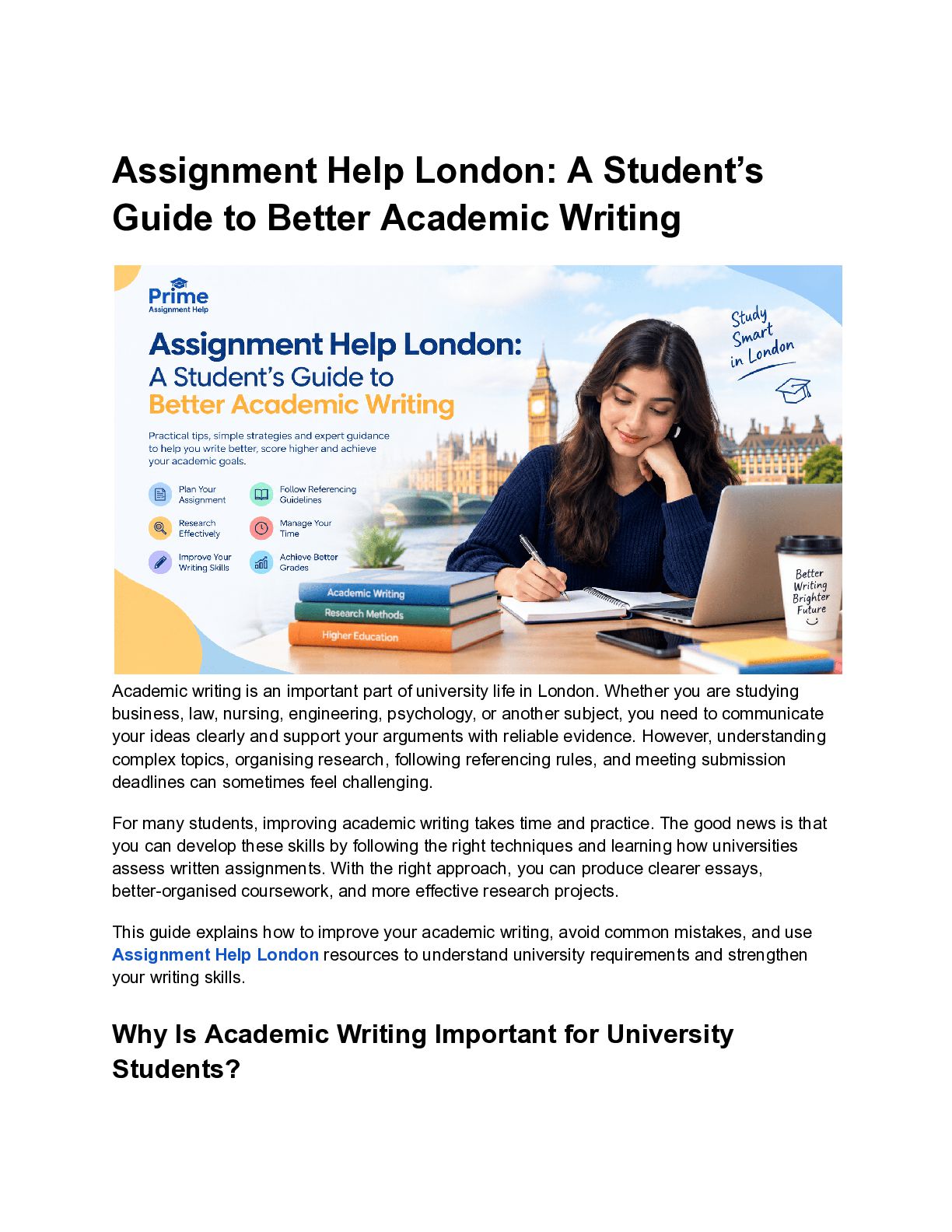
Assignment Help London: A Student’s Guide to Better Academic Writing
Learn how Assignment Help London can guide students in improving academic writing, structuring essays, conducting research, using correct referencing, and managing university deadlines with confidence.
Academic writing is an important part of university life in London. Whether you are studying business, law, nursing, engineering, psychology, or another subject, you need to communicate your ideas clearly and support your arguments with reliable evidence. However, understanding complex topics, organising research, following referencing rules, and meeting submission deadlines can sometimes feel challenging. For many students, improving academic writing takes time and practice. The good news is that you can develop these skills by following the right techniques and learning how universities assess written assignments. With the right approach, you can produce clearer essays, better-organised coursework, and more effective research projects. This guide explains how to improve your academic writing, avoid common mistakes, and use Assignment Help London resources to understand university requirements and strengthen your writing skills. Why Is Academic Writing Important for University Students?
ideas, and evaluate information critically. Unlike everyday writing, university assignments require a logical structure, appropriate language, reliable evidence, and accurate referencing. Students studying at London universities may need to prepare different types of academic work, including essays, case studies, reports, reflective assignments, and dissertations. Each format has its own requirements, so understanding the task before starting is essential. Good academic writing helps you: • • • • • Present ideas in a clear and logical order. Develop arguments using credible academic sources. Demonstrate critical thinking and independent understanding. Follow university guidelines and assessment criteria. Communicate findings in a professional and structured manner. Developing these skills can also prepare you for future employment, where clear communication, research, and problem-solving are valuable. 1. Understand the Assignment Question Before Writing One of the most common academic writing mistakes is starting an assignment without fully understanding the question. Students sometimes collect large amounts of information but discover later that their research does not address the actual task. Begin by reading the assignment brief carefully. Identify the main instruction word, the topic, the required format, and any specific questions you must answer. For example: • Analyse: Examine the subject in detail and explain how different factors relate to one another. • Evaluate: Consider the strengths and weaknesses of an argument before reaching a reasoned judgement. • Compare: Explain the similarities and differences between two or more subjects. • Discuss: Explore different viewpoints and develop a balanced argument. • Describe: Present the relevant characteristics, facts, or features of a subject. Check the marking rubric as well. It can explain how your work will be assessed, including research quality, critical analysis, structure, and referencing. If the instructions remain unclear, ask your lecturer or tutor for clarification before investing too much time in research.
academic writing begins with organised research. Instead of searching randomly across the internet, create a simple research plan based on the assignment question. Use credible sources such as peer-reviewed journal articles, academic books, official government publications, and relevant university resources. Google Scholar can help you discover scholarly research, while your university library may provide access to academic databases. As you research, record the author's name, publication year, title, and page numbers where relevant. Save the source details immediately so that you do not need to search for them again when preparing your references. It is also important to evaluate the information you find. Ask yourself whether the source is reliable, current enough for your subject, relevant to your argument, and supported by evidence. Good research is not simply about collecting quotations. It involves comparing different perspectives, identifying important findings, and deciding how the evidence supports your own analysis. 3. Create a Clear and Logical Assignment Structure A well-organised assignment helps readers understand your argument without unnecessary confusion. Although the structure depends on the task, many university assignments follow a similar format. Introduction Introduce the topic, provide relevant background information, and explain the purpose of your assignment. Your introduction should establish the main question or argument and briefly indicate what the reader can expect. Main Body Divide the main discussion into sections using clear paragraphs and suitable headings where appropriate. Each paragraph should focus on one main point, supported by relevant evidence and explanation. A useful paragraph structure is: 1. Point: Introduce the main idea. 2. Evidence: Support it with research, examples, or data. 3. Analysis: Explain what the evidence means and why it matters.
the next point. Conclusion Summarise the main findings and return to the central question. Avoid introducing substantial new arguments or evidence in the conclusion. Instead, provide a clear final judgement based on the discussion. Before submitting, check that every section contributes to the assignment's purpose. 4. Develop Critical Thinking Instead of Simply Describing Information Critical analysis is an important part of university-level academic writing. A common weakness is explaining what different authors say without examining their arguments. To improve your analysis, compare sources and consider whether their conclusions are supported by strong evidence. Look for limitations, conflicting findings, alternative explanations, and practical implications. For example, if two studies reach different conclusions about employee motivation, do not simply summarise each study. Examine their research methods, sample sizes, contexts, and possible reasons for the differences. You should also distinguish between facts, opinions, and your own interpretation. Academic arguments become stronger when your conclusions follow logically from the evidence you present. If you find this aspect difficult, Assignment Help London resources may provide useful guidance on interpreting assignment questions, organising arguments, and understanding the difference between descriptive and analytical writing. Use such resources to build your own skills and make sure the final submission reflects your understanding. 5. Improve Your Academic Language and Writing Style Academic writing should be formal, clear, and precise. You do not need to use complicated vocabulary to sound professional. In fact, unnecessarily long sentences and difficult words can make your argument harder to understand. Follow these practical tips: • Use clear sentences that communicate one main idea at a time. • Avoid slang, informal expressions, and unsupported claims. • Choose precise words rather than vague descriptions.
Maintain a consistent academic tone throughout the assignment. • Check grammar, punctuation, spelling, and sentence structure. For example, instead of writing, “A lot of people think this method is really good,” you could write, “Several studies suggest that this method may improve performance.” The second sentence is more precise, although you should still cite appropriate evidence when making a research-based claim. Reading well-written academic articles can also help you understand how researchers present arguments and connect evidence to conclusions. 6. Follow Referencing and Academic Integrity Rules Referencing is essential because it acknowledges the work of other researchers and allows readers to verify your evidence. Different universities and departments may require Harvard, APA, OSCOLA, or another referencing style. Always check your module guidelines before preparing citations and the reference list. Pay attention to punctuation, author names, publication dates, page numbers, and formatting requirements. You should also understand the difference between quoting, paraphrasing, and summarising. When paraphrasing, express the original idea in your own words and sentence structure while providing an appropriate citation. Simply replacing a few words from a source is not effective paraphrasing. Avoid copying material without acknowledgement, inventing references, or submitting work that misrepresents your own contribution. If you use AI tools, check your university's policy and disclose their use where required. These habits help you maintain academic integrity and produce work that demonstrates your own learning. 7. Manage Your Time and Proofread Carefully Poor time management can affect even well-researched assignments. Leaving everything until the last day often results in rushed writing, incomplete references, and avoidable errors. Break your assignment into smaller tasks, such as understanding the brief, researching, outlining, drafting, editing, and proofreading. Set realistic deadlines for each stage and allow extra time for unexpected difficulties.
reviewing it. This can make it easier to identify unclear sentences and gaps in your argument. During proofreading, check the following: • • • • • • Does the assignment answer the exact question? Are the arguments supported by relevant evidence? Is the structure easy to follow? Are citations and references consistent? Have you followed the required word count and formatting rules? Are there any grammatical errors or repeated ideas? Reading your work aloud can help you identify awkward sentences. A spelling or grammar checker may also be useful, but always review its suggestions rather than accepting every change automatically. How Can Assignment Help London Resources Support Your Learning? University students sometimes need additional guidance when dealing with unfamiliar subjects, complicated assessment criteria, or demanding deadlines. Appropriate academic support can help you understand what a task requires and identify areas where your writing needs improvement. When exploring Assignment Help London services, consider whether the provider offers clear explanations, subject-specific guidance, transparent pricing, confidentiality information, and support that follows your university's academic integrity rules. Useful support may include feedback on essay structure, guidance on referencing, explanations of research methods, proofreading advice, or help understanding difficult concepts. Choose support that encourages you to develop your own knowledge rather than simply relying on someone else to complete your academic work. Check your institution's rules about external assistance and make sure any submitted work represents your own learning and complies with those rules. Conclusion Better academic writing comes from consistent practice, careful planning, credible research, and a willingness to improve your work. By understanding assignment questions, building logical arguments, using appropriate evidence, following referencing rules, and proofreading thoroughly, you can develop stronger academic writing skills throughout your university studies.
useful approach is to focus on learning techniques that can be applied to future essays, reports, coursework, and dissertations. Take each assignment as an opportunity to improve your research, critical thinking, and communication skills. With a clear plan and the right learning resources, you can approach your university assignments with greater confidence and produce more organised, well-supported academic work.


 oliviasmith9
 eller86
 bvr7352
 yasslab
 pawan_pharm
 ytapples613
 sciencetokyo
 mariooc
 hiragahh
 ssmedikasda
 auctria
 moriyuya
 danielanewman
 inesmontani
 bluesmoon
 orderedlist
 aleyda
 shlominoach
 baasie
 holman
 addyosmani
 smashingmag
 marcelosomers