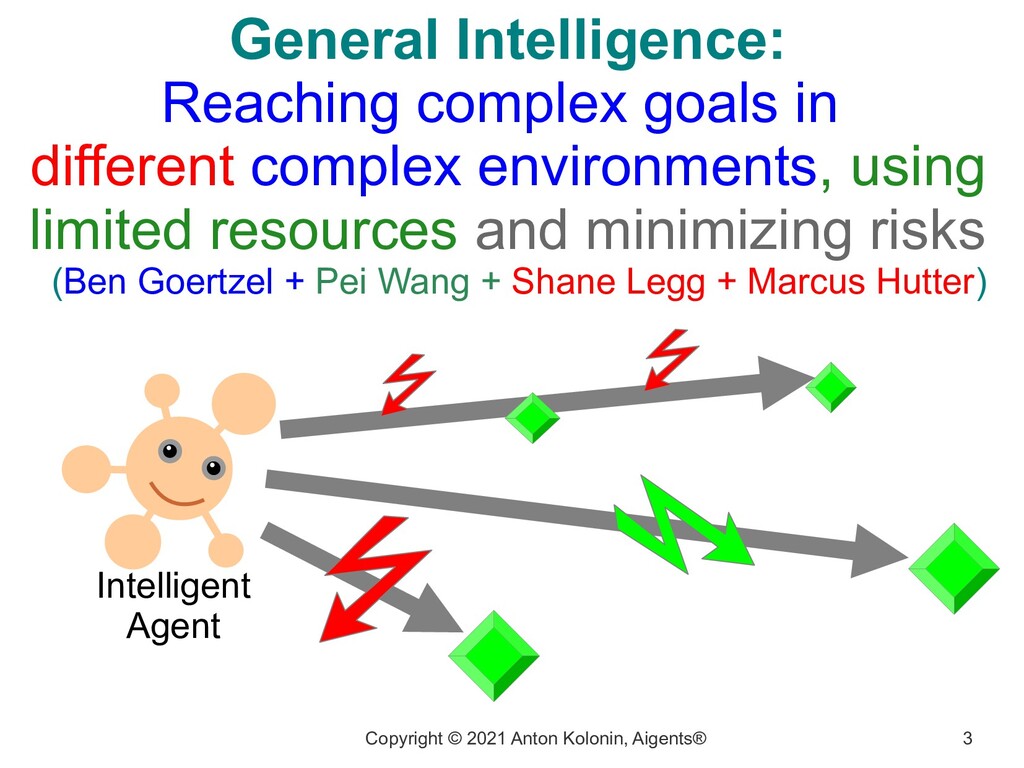
complex goals in different complex environments, using limited resources and minimizing risks (Ben Goertzel + Pei Wang + Shane Legg + Marcus Hutter) Intelligent Agent
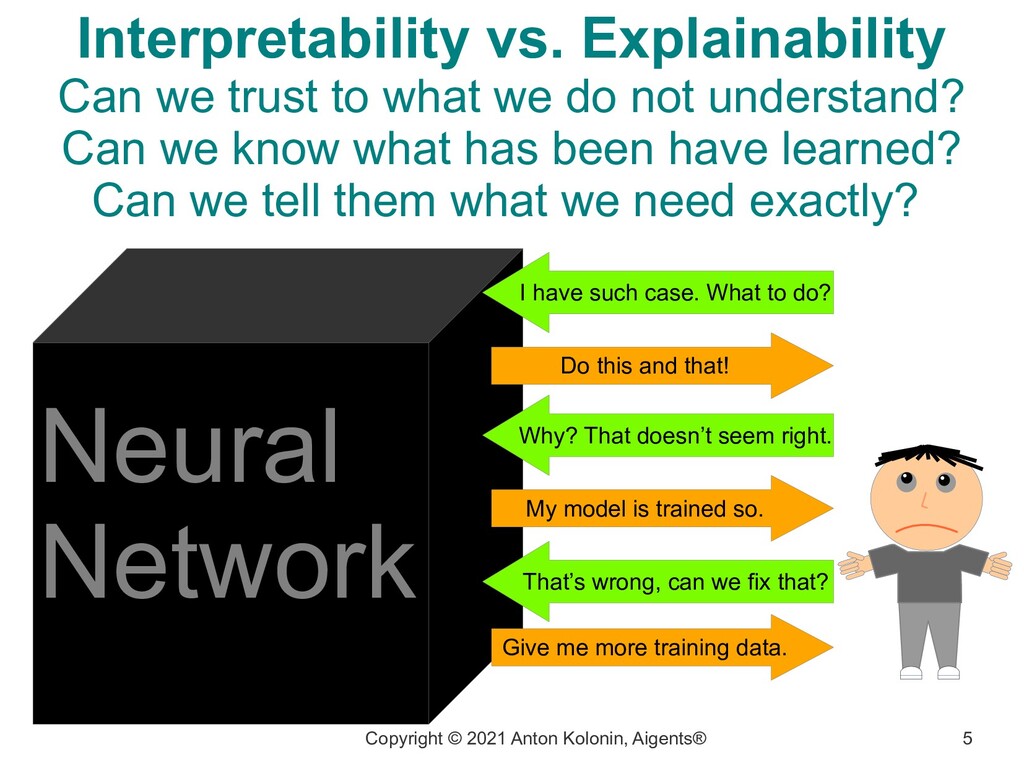
Can we trust to what we do not understand? Can we know what has been have learned? Can we tell them what we need exactly? I have such case. What to do? Do this and that! Why? That doesn’t seem right. My model is trained so. That’s wrong, can we fix that? Give me more training data. Neural Network
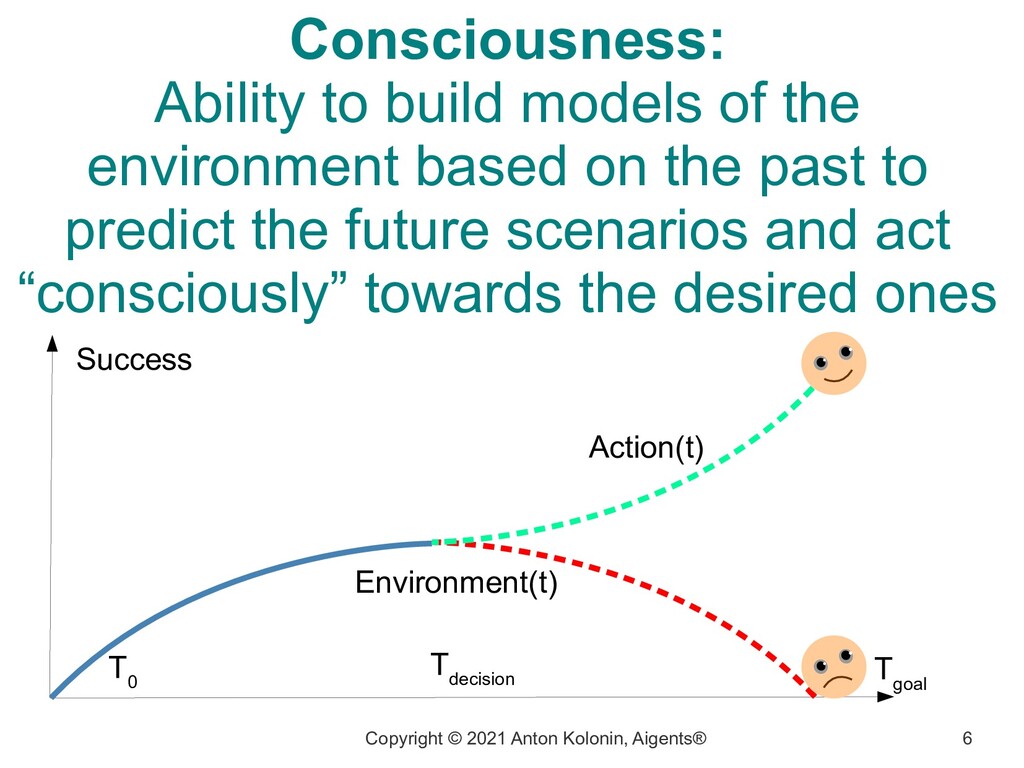
build models of the environment based on the past to predict the future scenarios and act “consciously” towards the desired ones T decision T 0 T goal Success Environment(t) Action(t)
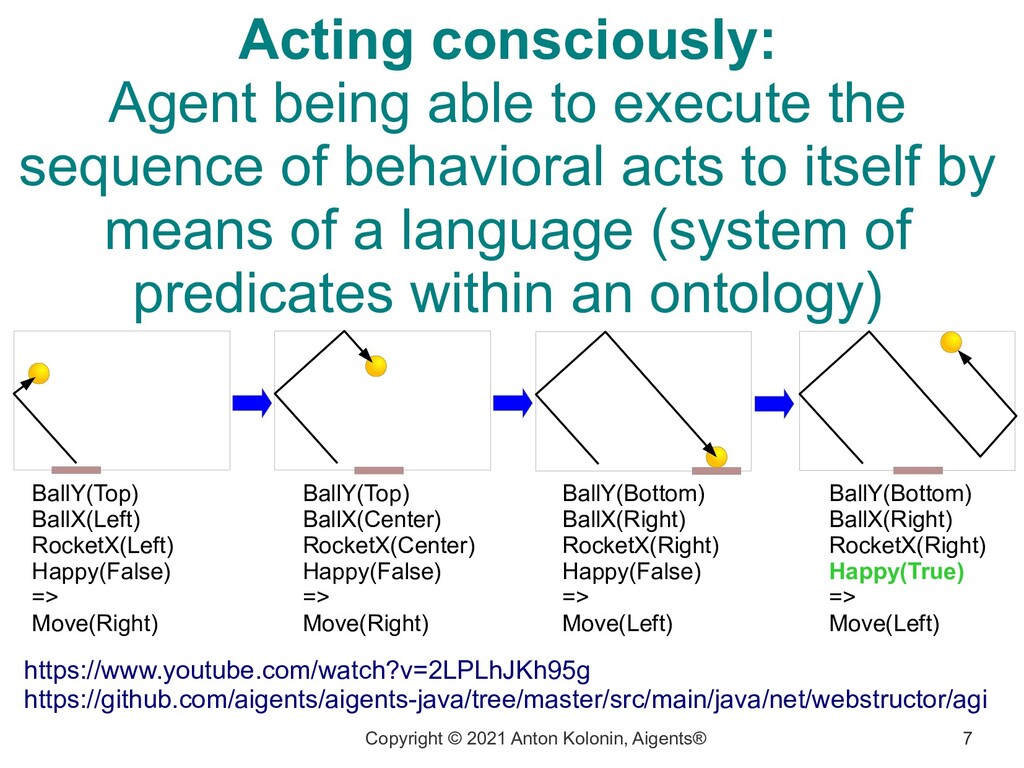
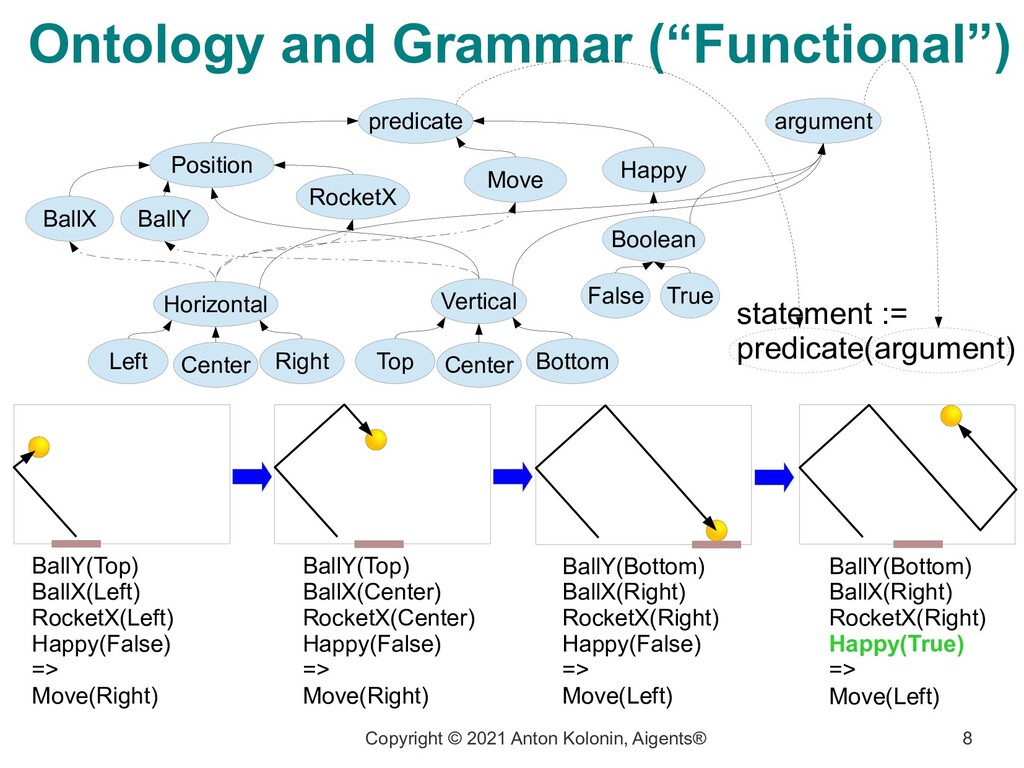
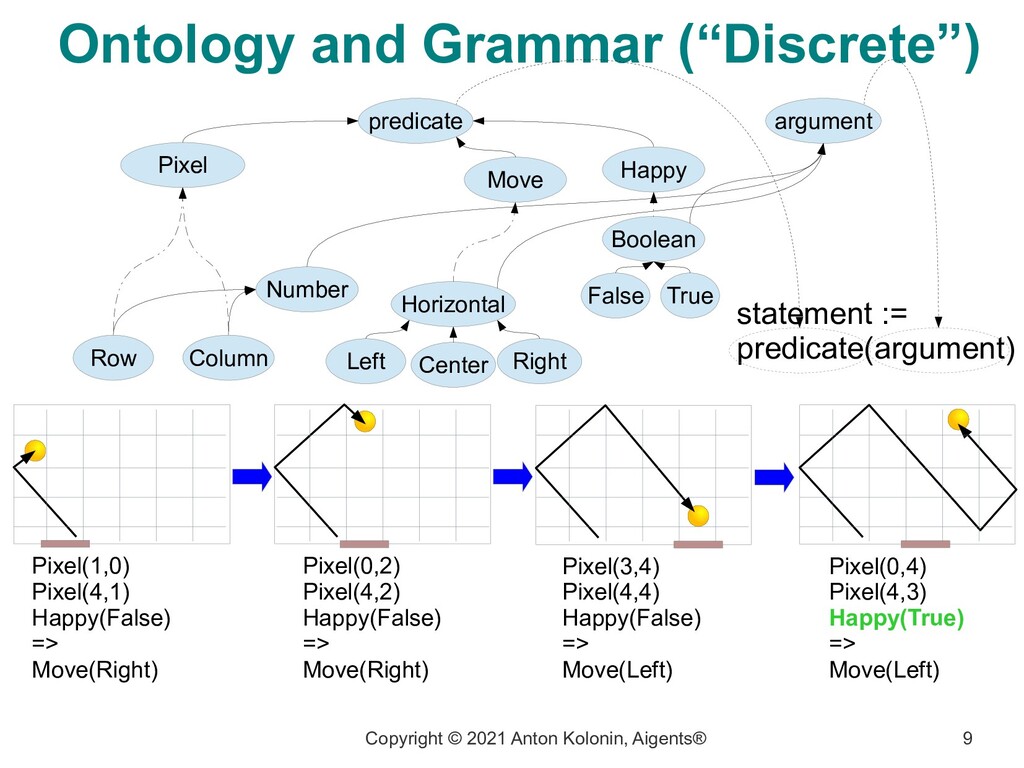
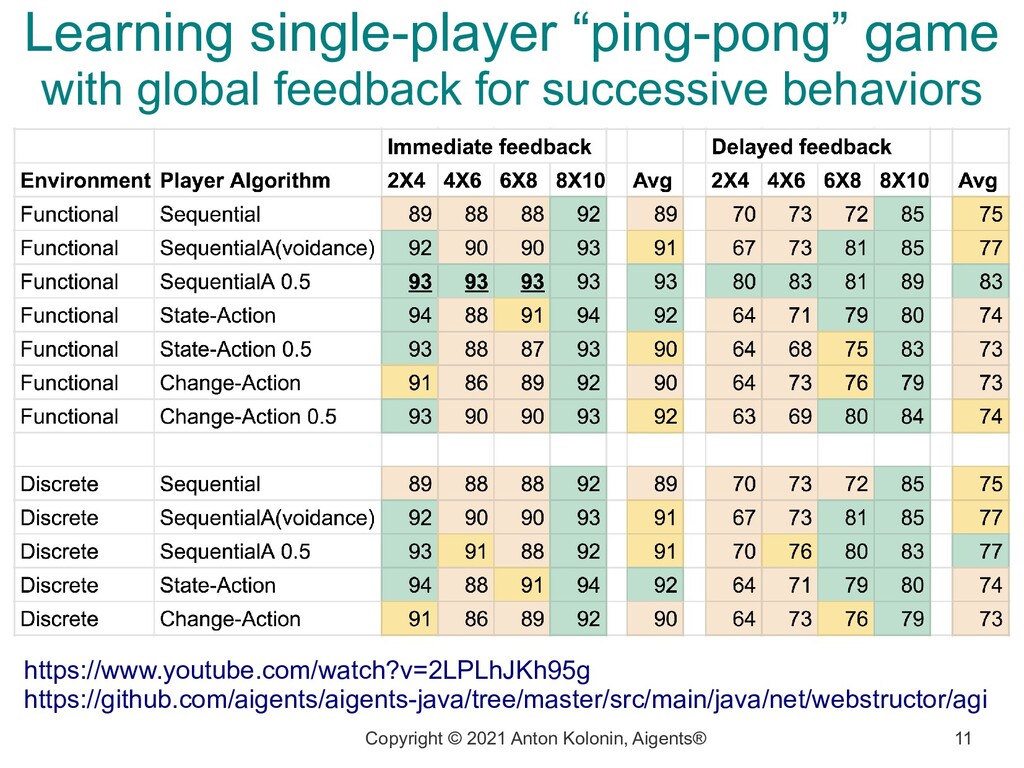
being able to execute the sequence of behavioral acts to itself by means of a language (system of predicates within an ontology) BallY(Top) BallX(Left) RocketX(Left) Happy(False) => Move(Right) https://www.youtube.com/watch?v=2LPLhJKh95g https://github.com/aigents/aigents-java/tree/master/src/main/java/net/webstructor/agi BallY(Top) BallX(Center) RocketX(Center) Happy(False) => Move(Right) BallY(Bottom) BallX(Right) RocketX(Right) Happy(False) => Move(Left) BallY(Bottom) BallX(Right) RocketX(Right) Happy(True) => Move(Left)
game with global feedback for successive behaviors https://www.youtube.com/watch?v=2LPLhJKh95g https://github.com/aigents/aigents-java/tree/master/src/main/java/net/webstructor/agi
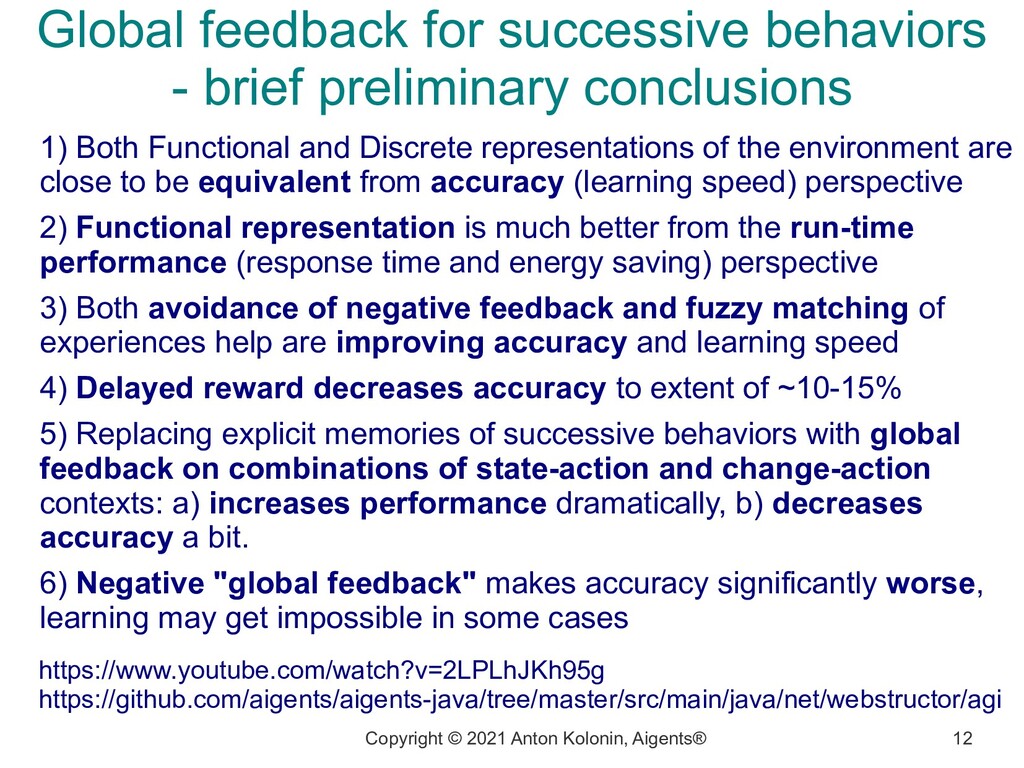
successive behaviors - brief preliminary conclusions https://www.youtube.com/watch?v=2LPLhJKh95g https://github.com/aigents/aigents-java/tree/master/src/main/java/net/webstructor/agi 1) Both Functional and Discrete representations of the environment are close to be equivalent from accuracy (learning speed) perspective 2) Functional representation is much better from the run-time performance (response time and energy saving) perspective 3) Both avoidance of negative feedback and fuzzy matching of experiences help are improving accuracy and learning speed 4) Delayed reward decreases accuracy to extent of ~10-15% 5) Replacing explicit memories of successive behaviors with global feedback on combinations of state-action and change-action contexts: a) increases performance dramatically, b) decreases accuracy a bit. 6) Negative "global feedback" makes accuracy significantly worse, learning may get impossible in some cases
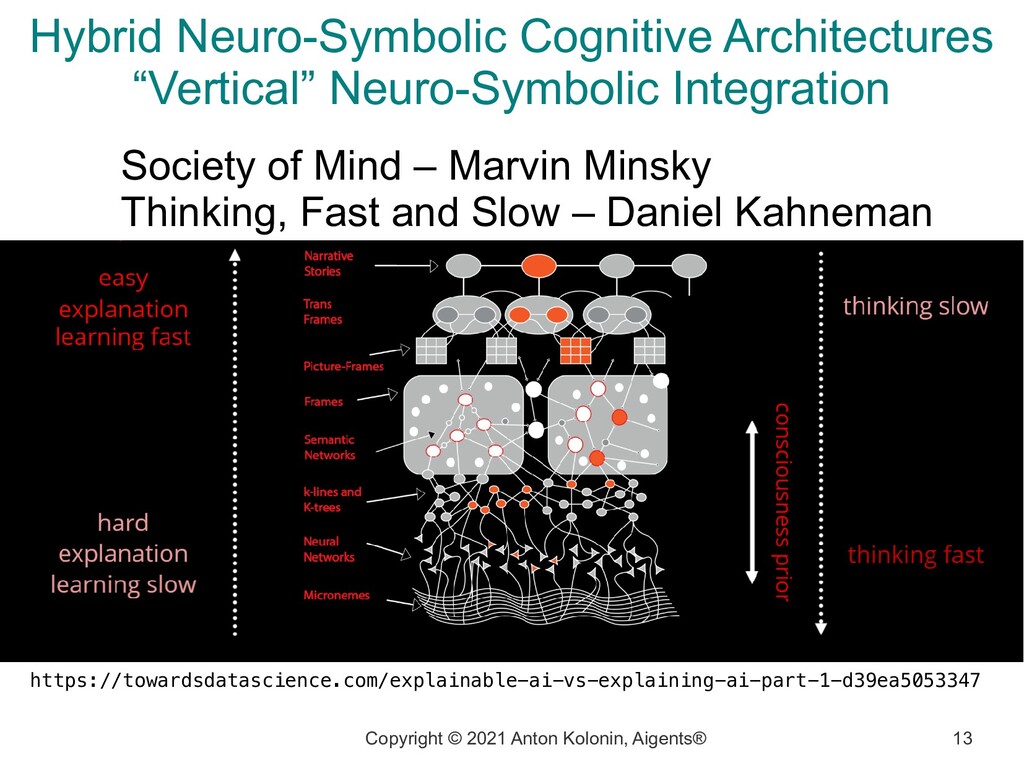
Architectures “Vertical” Neuro-Symbolic Integration https://towardsdatascience.com/explainable-ai-vs-explaining-ai-part-1-d39ea5053347 Society of Mind – Marvin Minsky Thinking, Fast and Slow – Daniel Kahneman
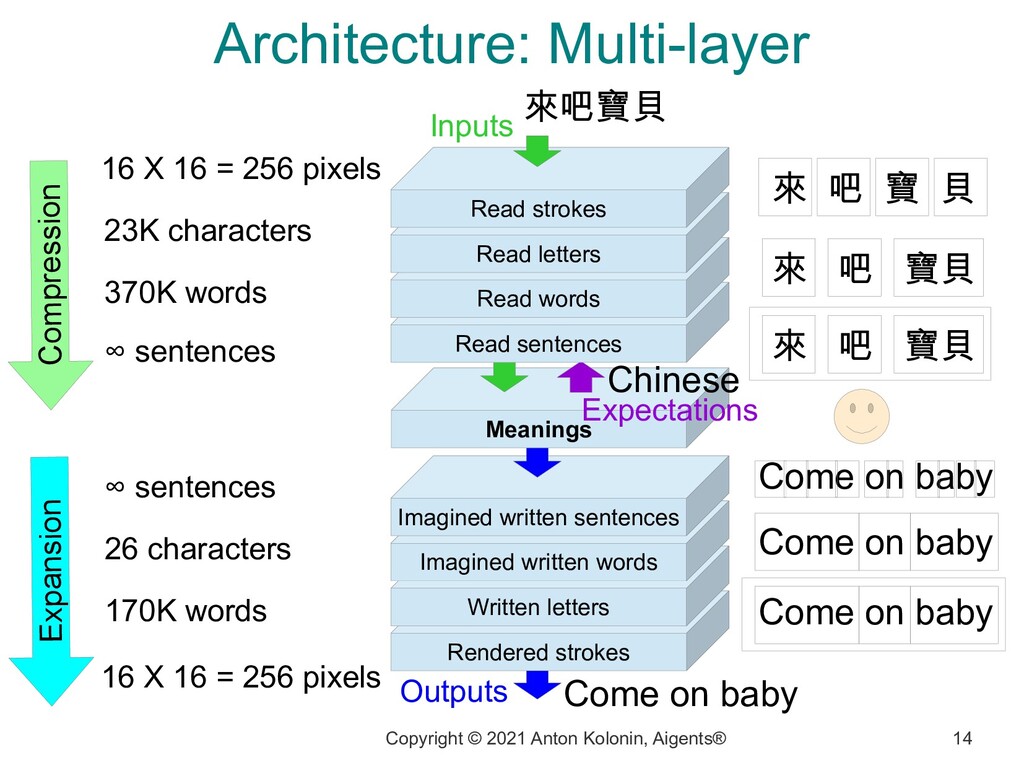
Rendered strokes Written letters Imagined written words Imagined written sentences Meanings Read sentences Read words Read letters Read strokes Outputs Expectations Inputs Come on baby 來 吧 寶 貝 來 吧 寶貝 來 吧 寶貝 Chinese 23K characters 16 X 16 = 256 pixels 370K words ∞ sentences ∞ sentences 16 X 16 = 256 pixels 26 characters 170K words Come on baby Come on baby Come on baby Compression Expansion
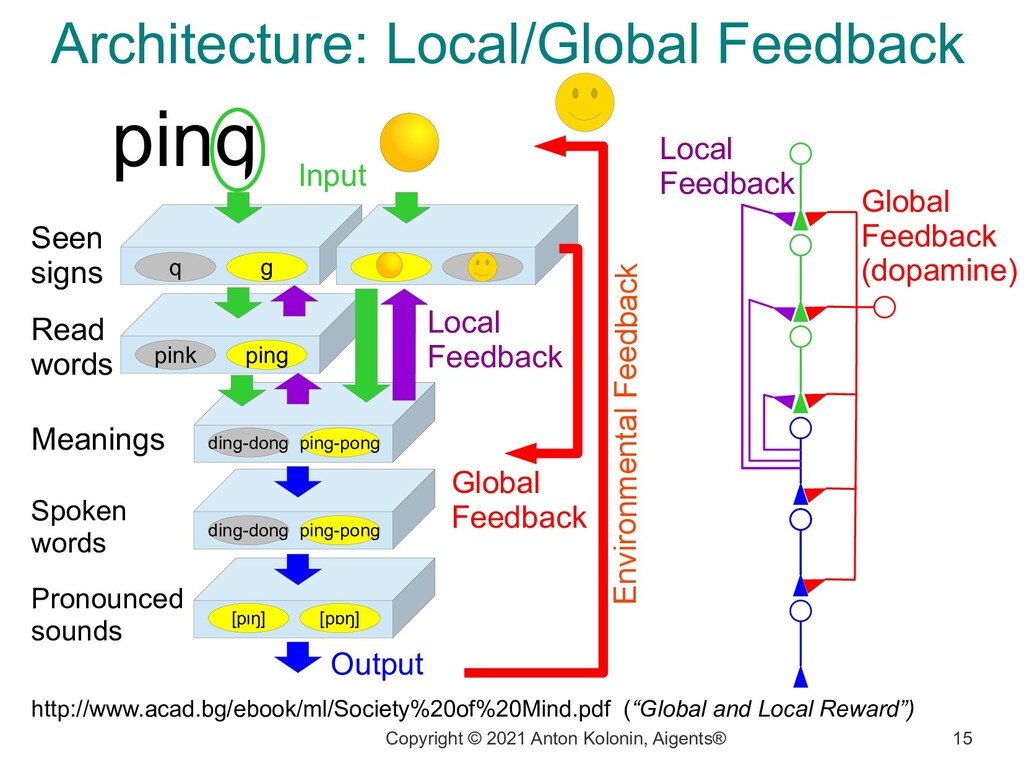
Local Feedback Input ping q g pink ping ding-dong ping-pong ding-dong ping-pong [pɪŋ] [pɒŋ] Seen signs Read words Meanings Spoken words Pronounced sounds Output Environmental Feedback Global Feedback Local Feedback Global Feedback (dopamine) http://www.acad.bg/ebook/ml/Society%20of%20Mind.pdf (“Global and Local Reward”)
gap for “explainable AI” and “transfer learning” - “Horizontal” Neuro-Symbolic Integration Hooves Tail White Black Brown AND AND AND OR Red Σ Σ Σ Σ Σ Σ (Hooves AND Tail) AND ((White and Black) OR Brown) => Horse 0.5 0.5 1.0 1.0 1.0 0.5 0.5 0.5 0.5 Transfer Explain 1.0
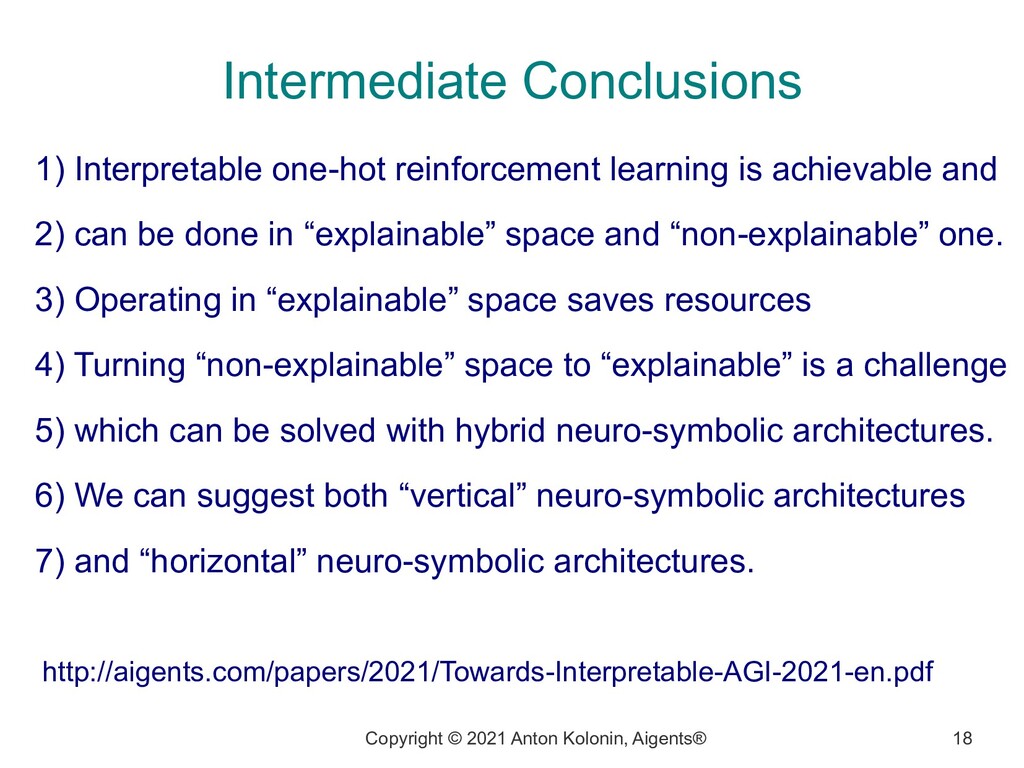
Interpretable one-hot reinforcement learning is achievable and 2) can be done in “explainable” space and “non-explainable” one. 3) Operating in “explainable” space saves resources 4) Turning “non-explainable” space to “explainable” is a challenge 5) which can be solved with hybrid neuro-symbolic architectures. 6) We can suggest both “vertical” neuro-symbolic architectures 7) and “horizontal” neuro-symbolic architectures. http://aigents.com/papers/2021/Towards-Interpretable-AGI-2021-en.pdf


 opentalks3
 kaonavi
 roms
roms
 pokotyamu
 tkt42u19421
 stanby_inc
 takeshisumida_
 m3c
m3c
 kamadamakoto
 ashisuto_career
 sukatsu1222
 tsuchihashi
 kuni29
 mayunak
 aleyda
 reverentgeek
 tonyrice
 pedronauck
 eitanlees
 axbom
axbom
 akosma
 popppiees
 skipperchong
 inesmontani
 kimpetersen