Upgrade to Pro — share decks privately, control downloads, hide ads and more …

Quality Control of Crude Drugs

Quality Control of Crude Drugs

**Quality Control of Crude Drugs** refers to the systematic process of verifying the identity, purity, safety, and potency of naturally derived medicinal raw materials (from plants, animals, or minerals) to ensure they meet established pharmacopeial standards before use in pharmaceutical formulations.

---

**Core Objectives**

* **Identification:** Confirming the correct botanical or zoological source and preventing misidentification.
* **Purity Assessment:** Detecting intentional or accidental adulteration, foreign organic matter, and contamination (such as sand, heavy metals, or microbes).
* **Potency & Consistency:** Ensuring therapeutic active constituents meet uniform concentration standards across different harvest batches.

---

**Standard Evaluation Methods**

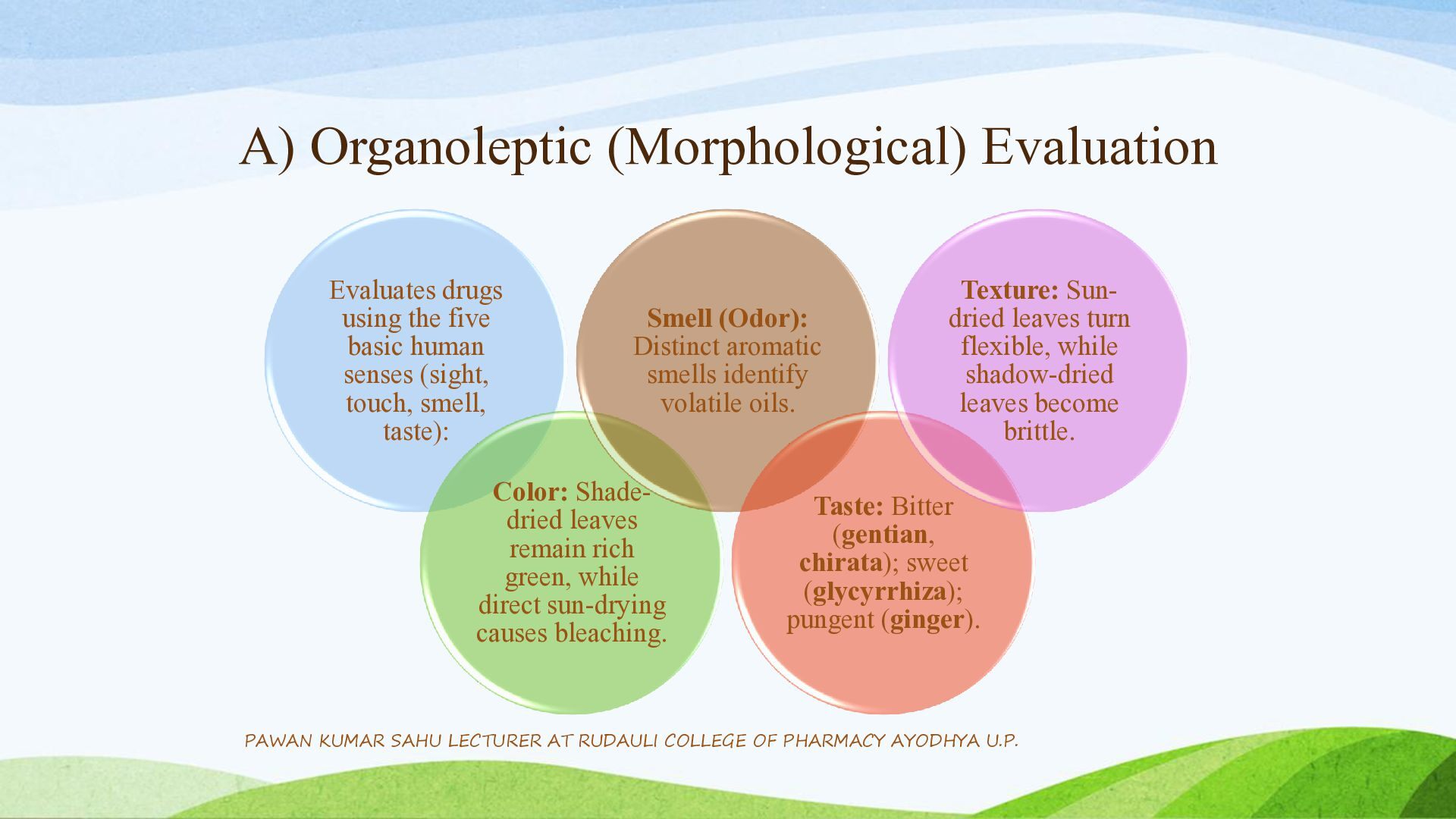
* **Organoleptic / Morphological Evaluation:** Initial screening using the five senses to inspect macroscopic traits such as color, odor, taste, size, shape, fracture, and surface texture.
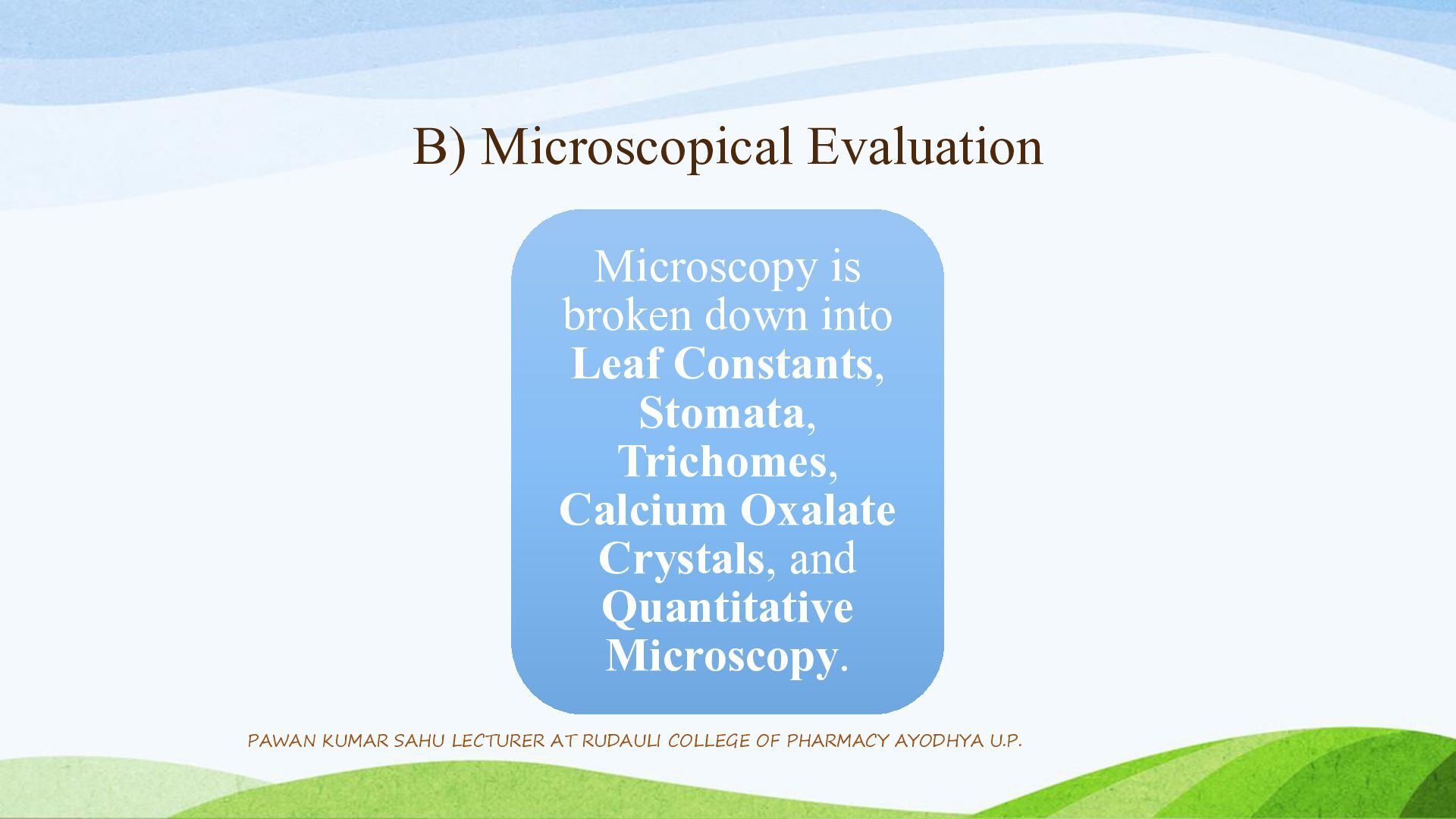
* **Microscopical Evaluation:** Examination of histological features (cellular structure, stomata types, leaf constants like stomatal index and palisade ratio, trichomes, and calcium oxalate crystals) as well as quantitative microscopy (e.g., Lycopodium spore method).
* **Physical Evaluation:** Determining specific physical constants to identify purity and quality, including:
* *Moisture content & Loss on Drying (LOD):* Prevents deterioration and microbial spoilage.
* *Ash values (Total ash, Acid-insoluble ash, Water-soluble ash):* Measures inorganic impurities and earthy contamination.
* *Extractive values (Alcohol-soluble, Water-soluble, Ether-soluble):* Estimates the amount of active constituents extractable by specific solvents.
* *Physical constants:* Melting point, refractive index, optical rotation, and viscosity.

* **Chemical Evaluation:** Qualitative and quantitative chemical analysis to identify active phytoconstituents (e.g., alkaloids, glycosides, tannins, flavonoids) through characteristic color reactions, titrations, chemical assays, and modern chromatographic/spectroscopic techniques (HPLC, HPTLC, GC, TLC, UV-Vis, IR).
* **Biological Evaluation (Bioassay):** Utilized when chemical assays cannot adequately measure the therapeutic activity; determines potency, effective dose ($ED_{50}$), or lethal dose ($LD_{50}$) using biological systems, standard reference preparations, or microbiological assays.

Avatar for Pawan Kumar Sahu

Pawan Kumar Sahu

September 08, 2026

More Decks by Pawan Kumar Sahu

Other Decks in Education

Transcript

  1. Quality Control of Crude Drugs Pawan Kumar Sahu Lecturer at

    Rudauli College of Pharmacy, Ayodhya, U.P.
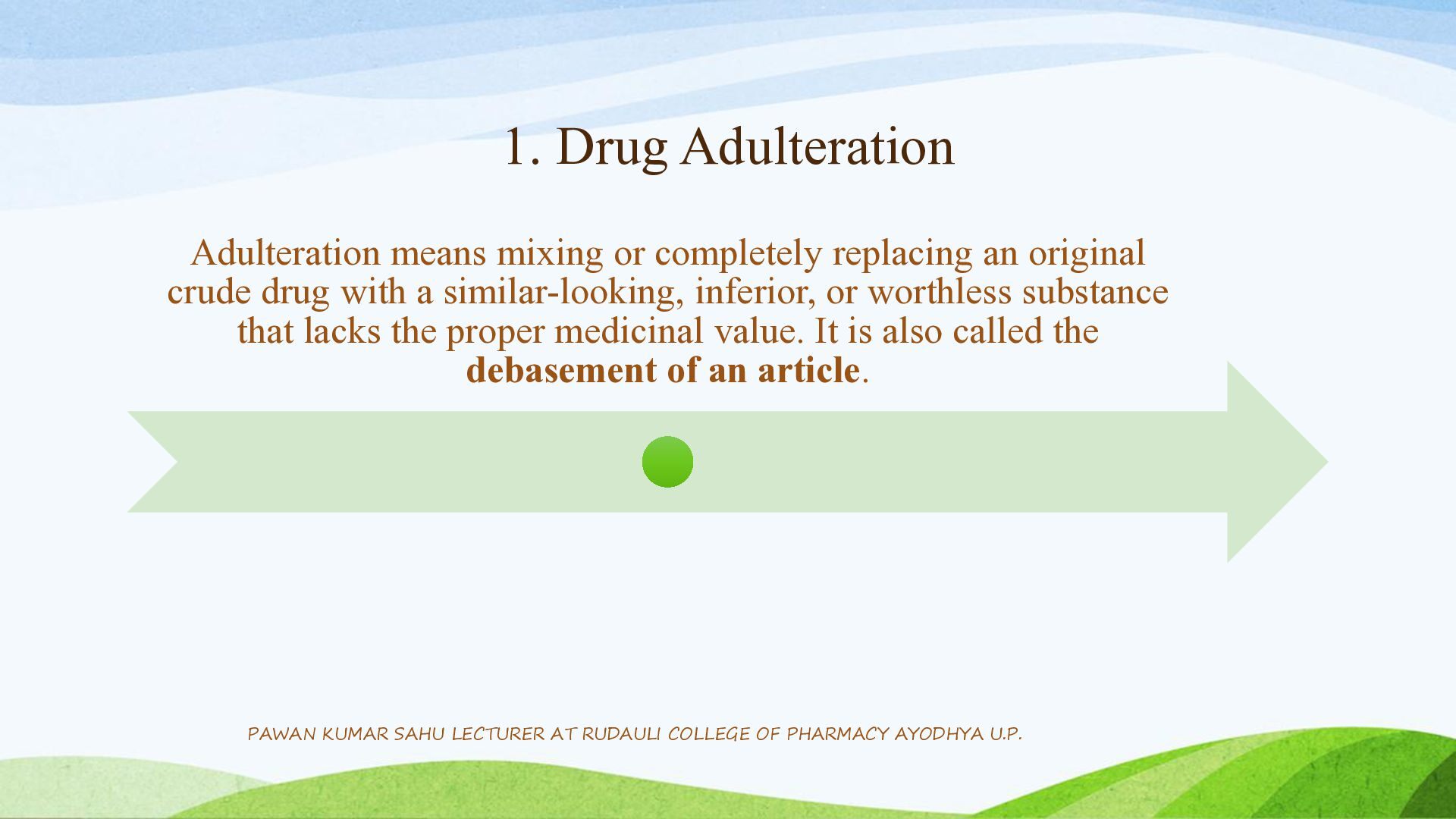
  2. 1. Drug Adulteration Adulteration means mixing or completely replacing an
    original crude drug with a similar-looking, inferior, or worthless substance that lacks the proper medicinal value. It is also called the debasement of an article. PAWAN KUMAR SAHU LECTURER AT RUDAULI COLLEGE OF PHARMACY AYODHYA U.P.
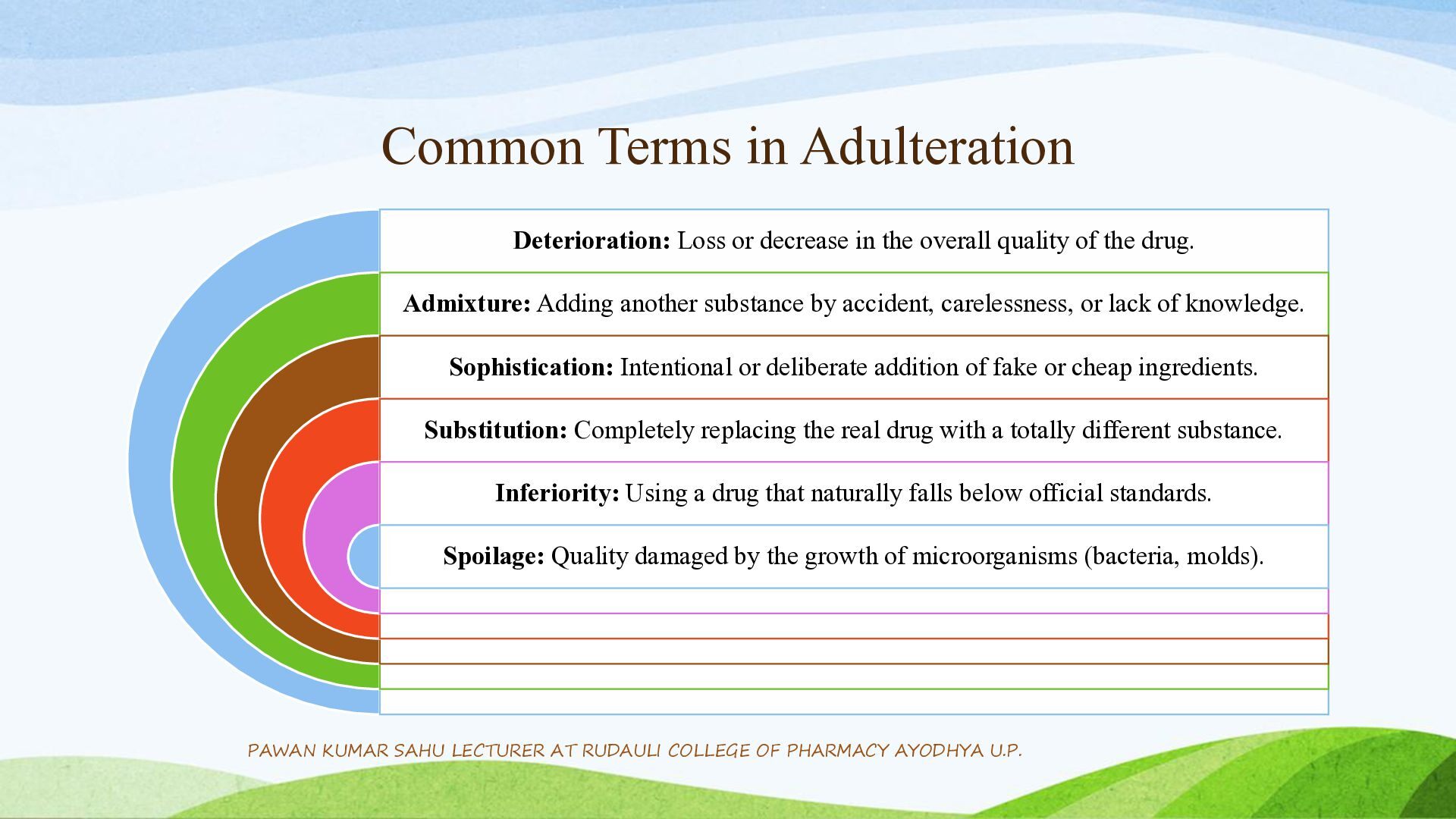
  3. Common Terms in Adulteration Deterioration: Loss or decrease in the

    overall quality of the drug. Admixture: Adding another substance by accident, carelessness, or lack of knowledge. Sophistication: Intentional or deliberate addition of fake or cheap ingredients. Substitution: Completely replacing the real drug with a totally different substance. Inferiority: Using a drug that naturally falls below official standards. Spoilage: Quality damaged by the growth of microorganisms (bacteria, molds). PAWAN KUMAR SAHU LECTURER AT RUDAULI COLLEGE OF PHARMACY AYODHYA U.P.
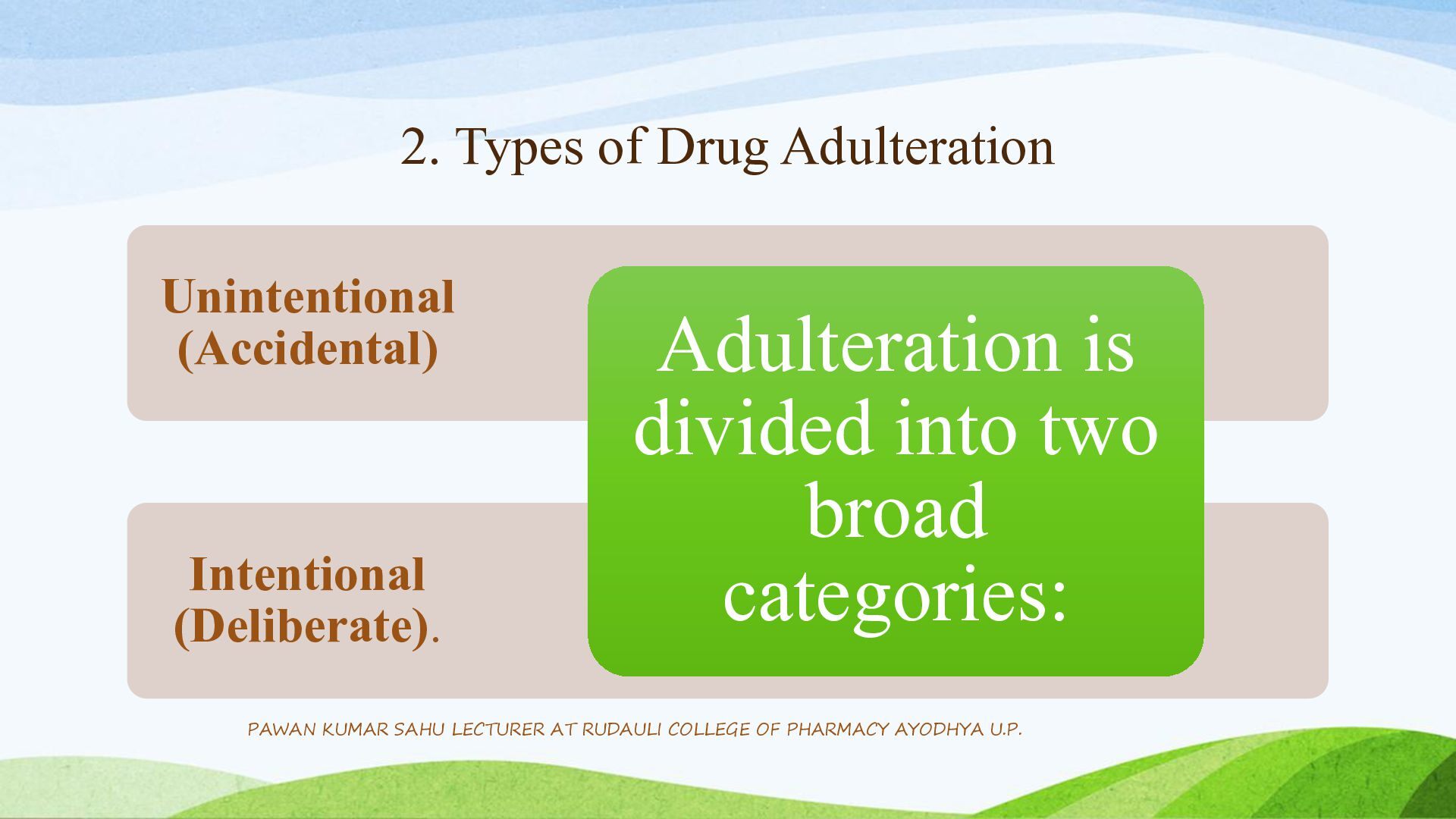
  4. 2. Types of Drug Adulteration Unintentional (Accidental) Intentional (Deliberate). Adulteration

    is divided into two broad categories: PAWAN KUMAR SAHU LECTURER AT RUDAULI COLLEGE OF PHARMACY AYODHYA U.P.
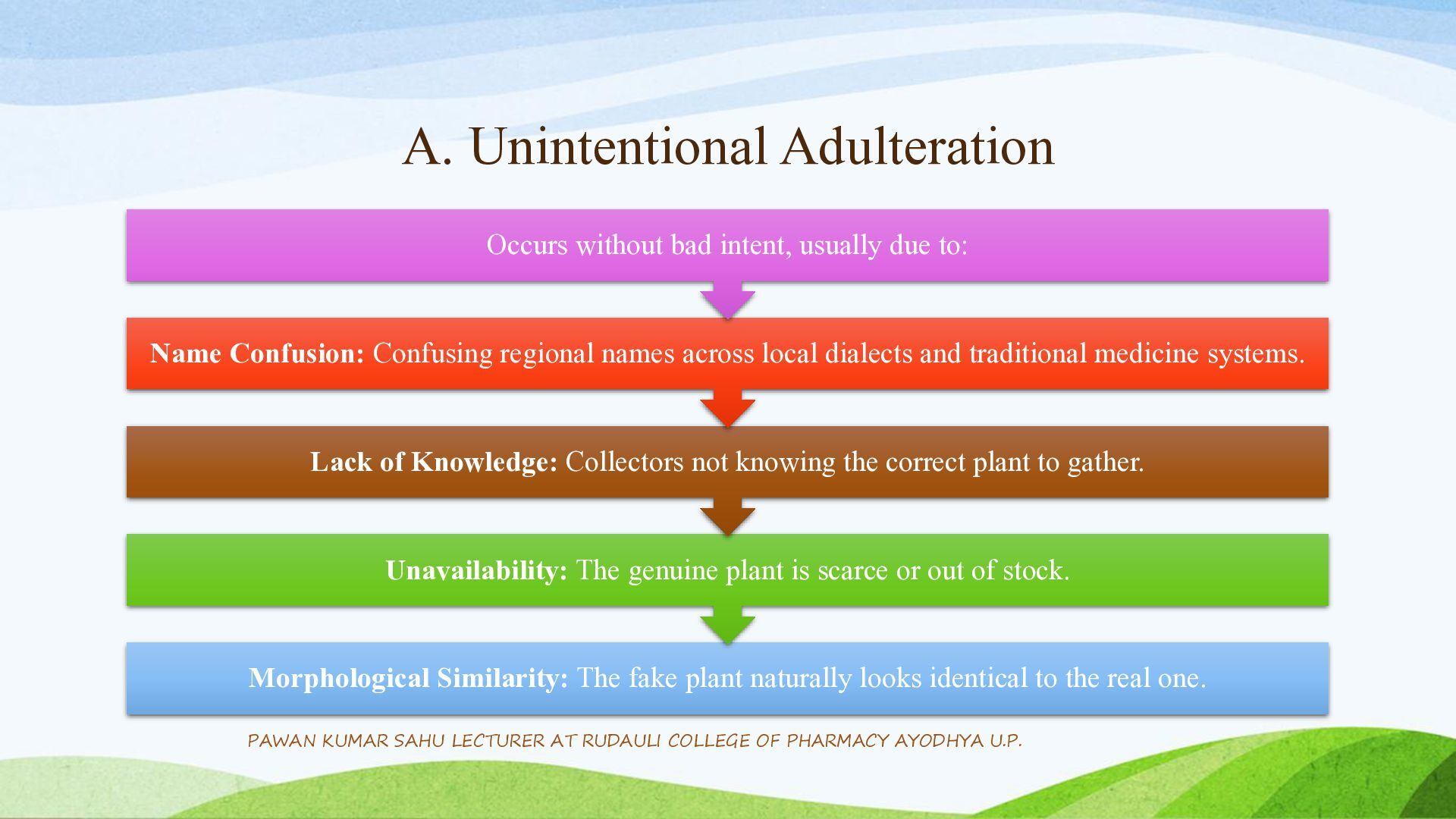
  5. A. Unintentional Adulteration Occurs without bad intent, usually due to:

    Name Confusion: Confusing regional names across local dialects and traditional medicine systems. Lack of Knowledge: Collectors not knowing the correct plant to gather. Unavailability: The genuine plant is scarce or out of stock. Morphological Similarity: The fake plant naturally looks identical to the real one. PAWAN KUMAR SAHU LECTURER AT RUDAULI COLLEGE OF PHARMACY AYODHYA U.P.
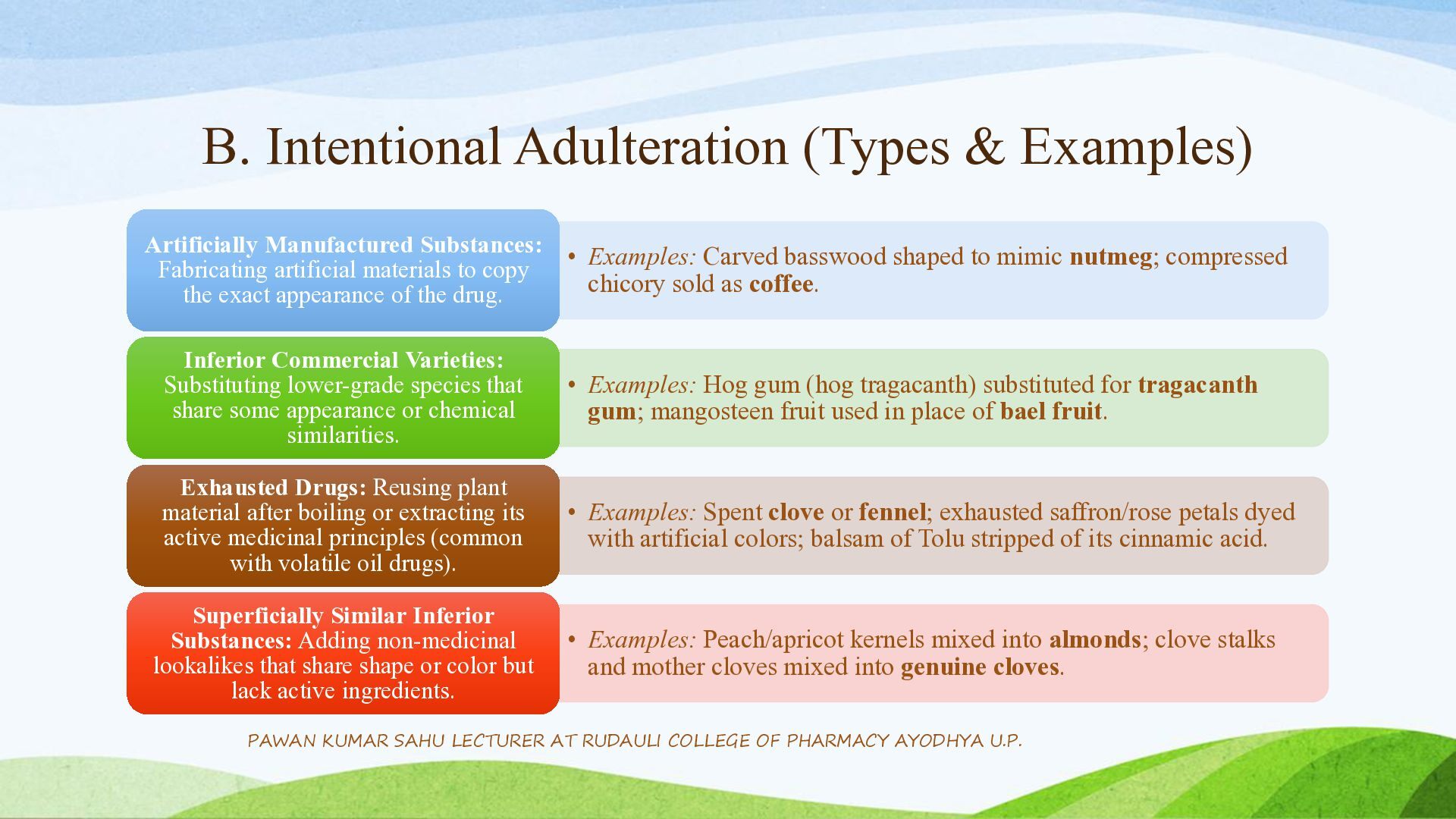
  6. B. Intentional Adulteration (Types & Examples) Artificially Manufactured Substances: Fabricating

    artificial materials to copy the exact appearance of the drug. • Examples: Carved basswood shaped to mimic nutmeg; compressed chicory sold as coffee. Inferior Commercial Varieties: Substituting lower-grade species that share some appearance or chemical similarities. • Examples: Hog gum (hog tragacanth) substituted for tragacanth gum; mangosteen fruit used in place of bael fruit. Exhausted Drugs: Reusing plant material after boiling or extracting its active medicinal principles (common with volatile oil drugs). • Examples: Spent clove or fennel; exhausted saffron/rose petals dyed with artificial colors; balsam of Tolu stripped of its cinnamic acid. Superficially Similar Inferior Substances: Adding non-medicinal lookalikes that share shape or color but lack active ingredients. • Examples: Peach/apricot kernels mixed into almonds; clove stalks and mother cloves mixed into genuine cloves. PAWAN KUMAR SAHU LECTURER AT RUDAULI COLLEGE OF PHARMACY AYODHYA U.P.
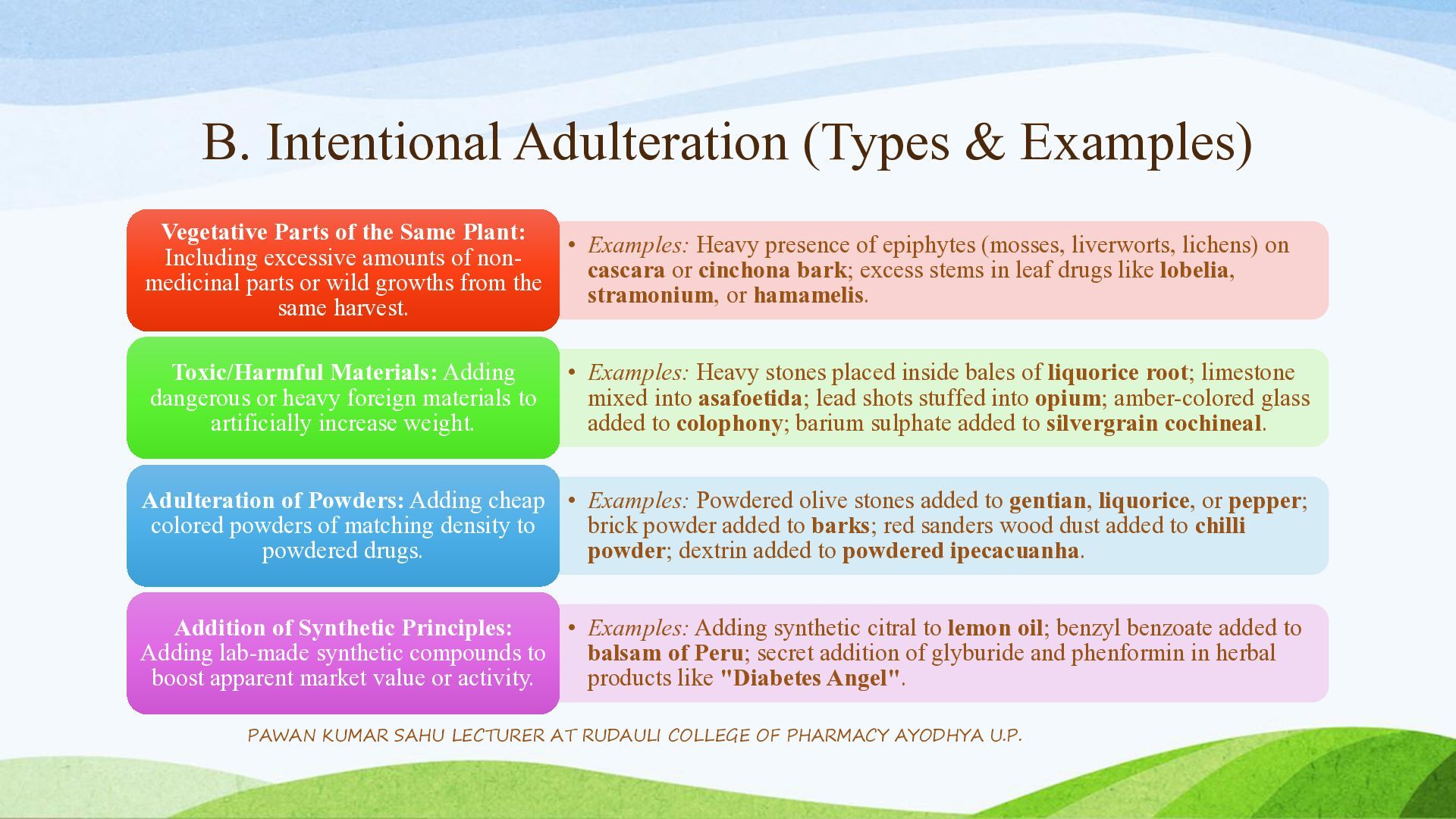
  7. B. Intentional Adulteration (Types & Examples) Vegetative Parts of the

    Same Plant: Including excessive amounts of nonmedicinal parts or wild growths from the same harvest. • Examples: Heavy presence of epiphytes (mosses, liverworts, lichens) on cascara or cinchona bark; excess stems in leaf drugs like lobelia, stramonium, or hamamelis. Toxic/Harmful Materials: Adding dangerous or heavy foreign materials to artificially increase weight. • Examples: Heavy stones placed inside bales of liquorice root; limestone mixed into asafoetida; lead shots stuffed into opium; amber-colored glass added to colophony; barium sulphate added to silvergrain cochineal. Adulteration of Powders: Adding cheap • Examples: Powdered olive stones added to gentian, liquorice, or pepper; colored powders of matching density to brick powder added to barks; red sanders wood dust added to chilli powdered drugs. powder; dextrin added to powdered ipecacuanha. Addition of Synthetic Principles: • Examples: Adding synthetic citral to lemon oil; benzyl benzoate added to Adding lab-made synthetic compounds to balsam of Peru; secret addition of glyburide and phenformin in herbal boost apparent market value or activity. products like "Diabetes Angel". PAWAN KUMAR SAHU LECTURER AT RUDAULI COLLEGE OF PHARMACY AYODHYA U.P.
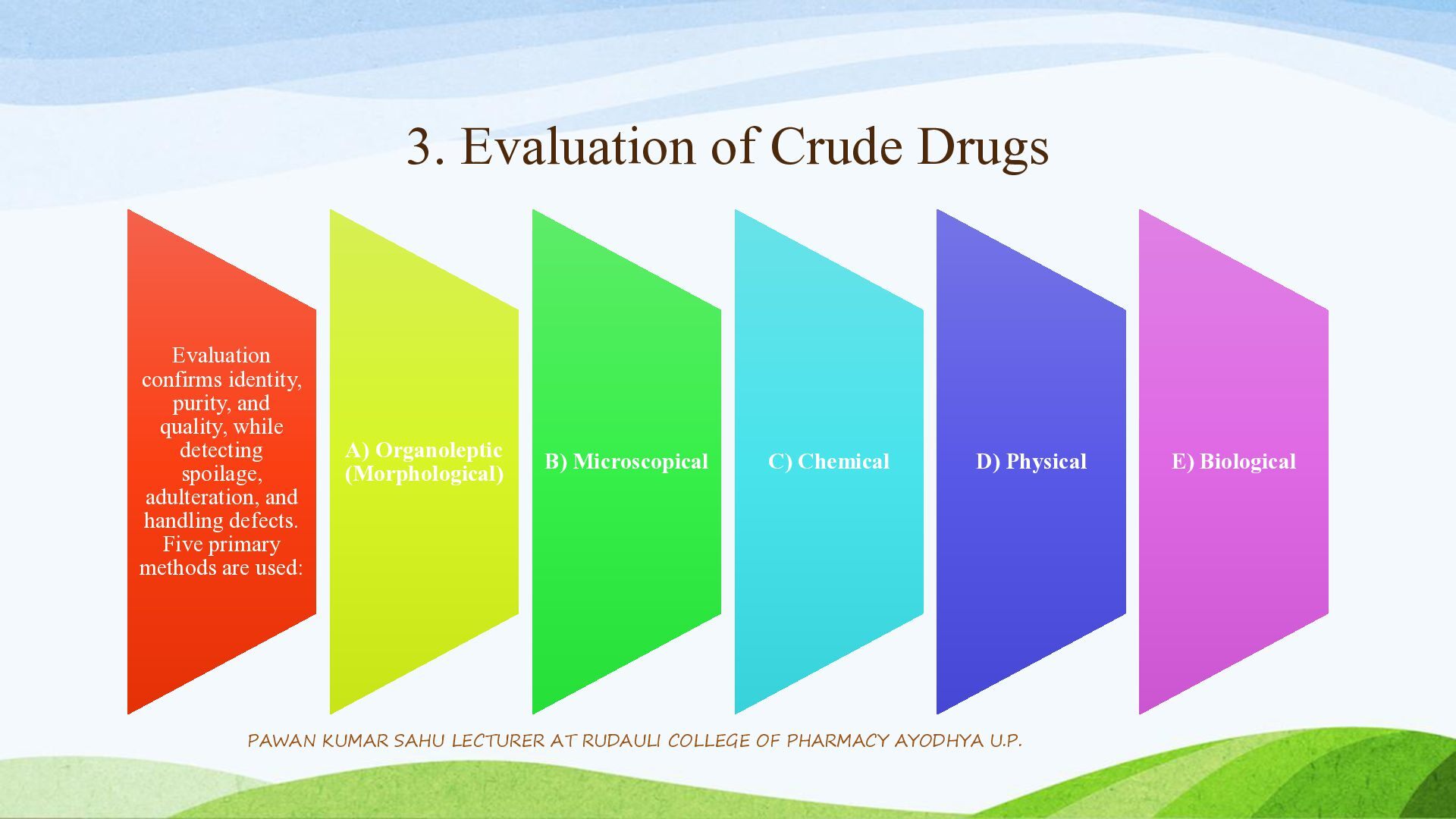
  8. 3. Evaluation of Crude Drugs Evaluation confirms identity, purity, and

    quality, while detecting spoilage, adulteration, and handling defects. Five primary methods are used: A) Organoleptic (Morphological) B) Microscopical C) Chemical D) Physical PAWAN KUMAR SAHU LECTURER AT RUDAULI COLLEGE OF PHARMACY AYODHYA U.P. E) Biological
  9. A) Organoleptic (Morphological) Evaluation Evaluates drugs using the five basic

    human senses (sight, touch, smell, taste): Smell (Odor): Distinct aromatic smells identify volatile oils. Color: Shadedried leaves remain rich green, while direct sun-drying causes bleaching. Texture: Sundried leaves turn flexible, while shadow-dried leaves become brittle. Taste: Bitter (gentian, chirata); sweet (glycyrrhiza); pungent (ginger). PAWAN KUMAR SAHU LECTURER AT RUDAULI COLLEGE OF PHARMACY AYODHYA U.P.
  10. B) Microscopical Evaluation Microscopy is broken down into Leaf Constants,

    Stomata, Trichomes, Calcium Oxalate Crystals, and Quantitative Microscopy. PAWAN KUMAR SAHU LECTURER AT RUDAULI COLLEGE OF PHARMACY AYODHYA U.P.
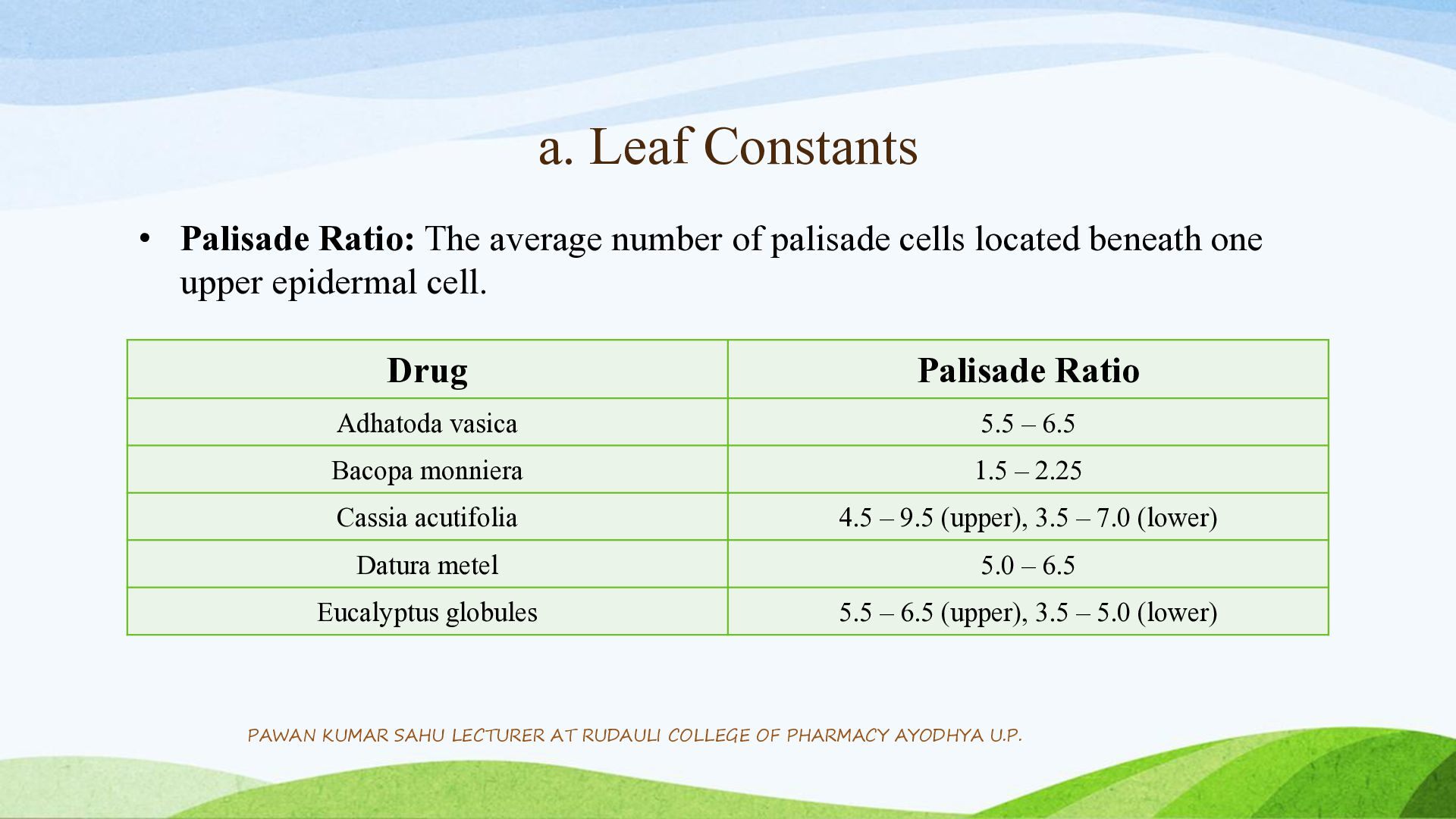
  11. a. Leaf Constants • Palisade Ratio: The average number of

    palisade cells located beneath one upper epidermal cell. Drug Palisade Ratio Adhatoda vasica 5.5 – 6.5 Bacopa monniera 1.5 – 2.25 Cassia acutifolia 4.5 – 9.5 (upper), 3.5 – 7.0 (lower) Datura metel 5.0 – 6.5 Eucalyptus globules 5.5 – 6.5 (upper), 3.5 – 5.0 (lower) PAWAN KUMAR SAHU LECTURER AT RUDAULI COLLEGE OF PHARMACY AYODHYA U.P.
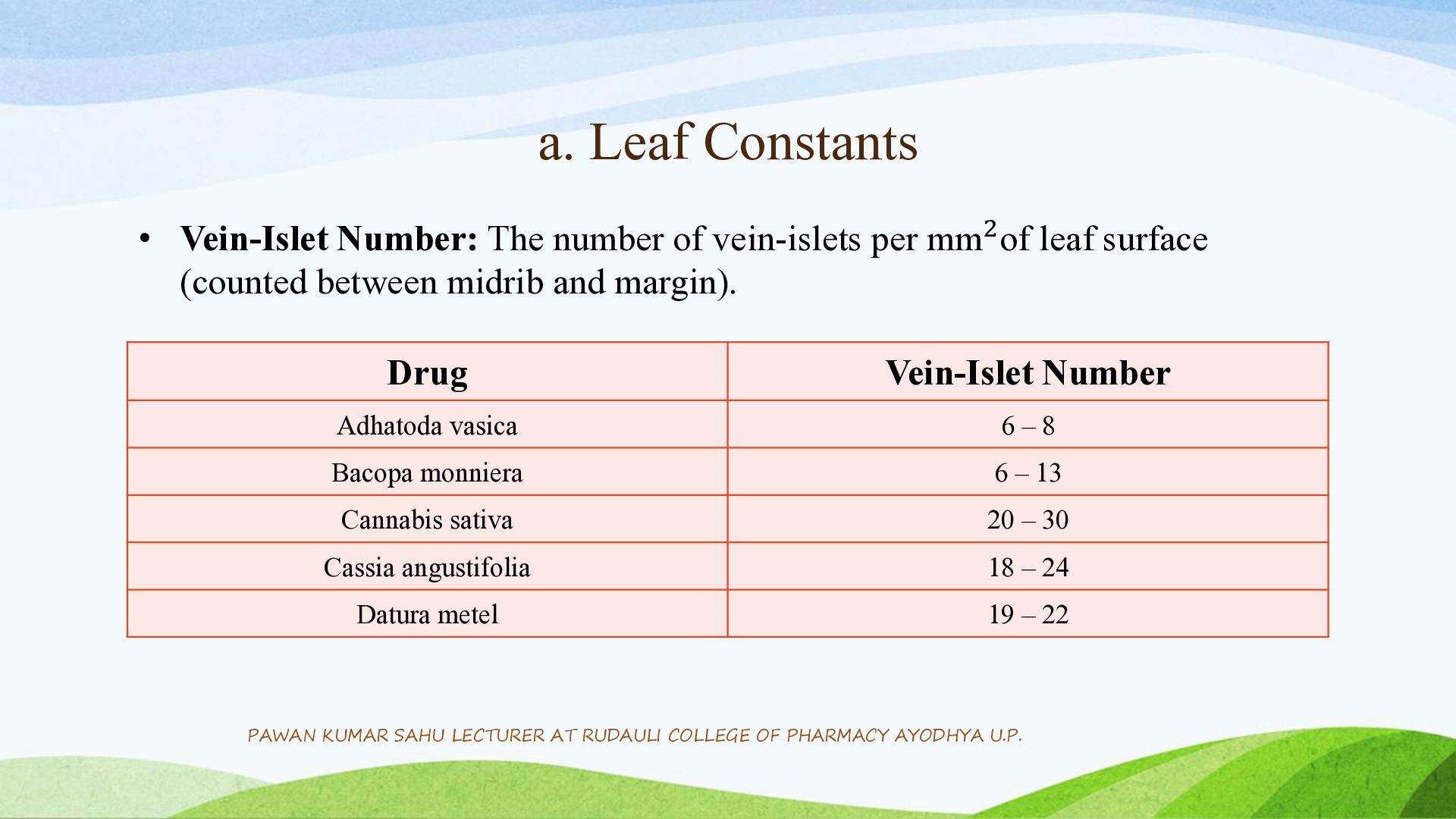
  12. a. Leaf Constants • Vein-Islet Number: The number of vein-islets

    per mm2 of leaf surface (counted between midrib and margin). Drug Vein-Islet Number Adhatoda vasica 6–8 Bacopa monniera 6 – 13 Cannabis sativa 20 – 30 Cassia angustifolia 18 – 24 Datura metel 19 – 22 PAWAN KUMAR SAHU LECTURER AT RUDAULI COLLEGE OF PHARMACY AYODHYA U.P.
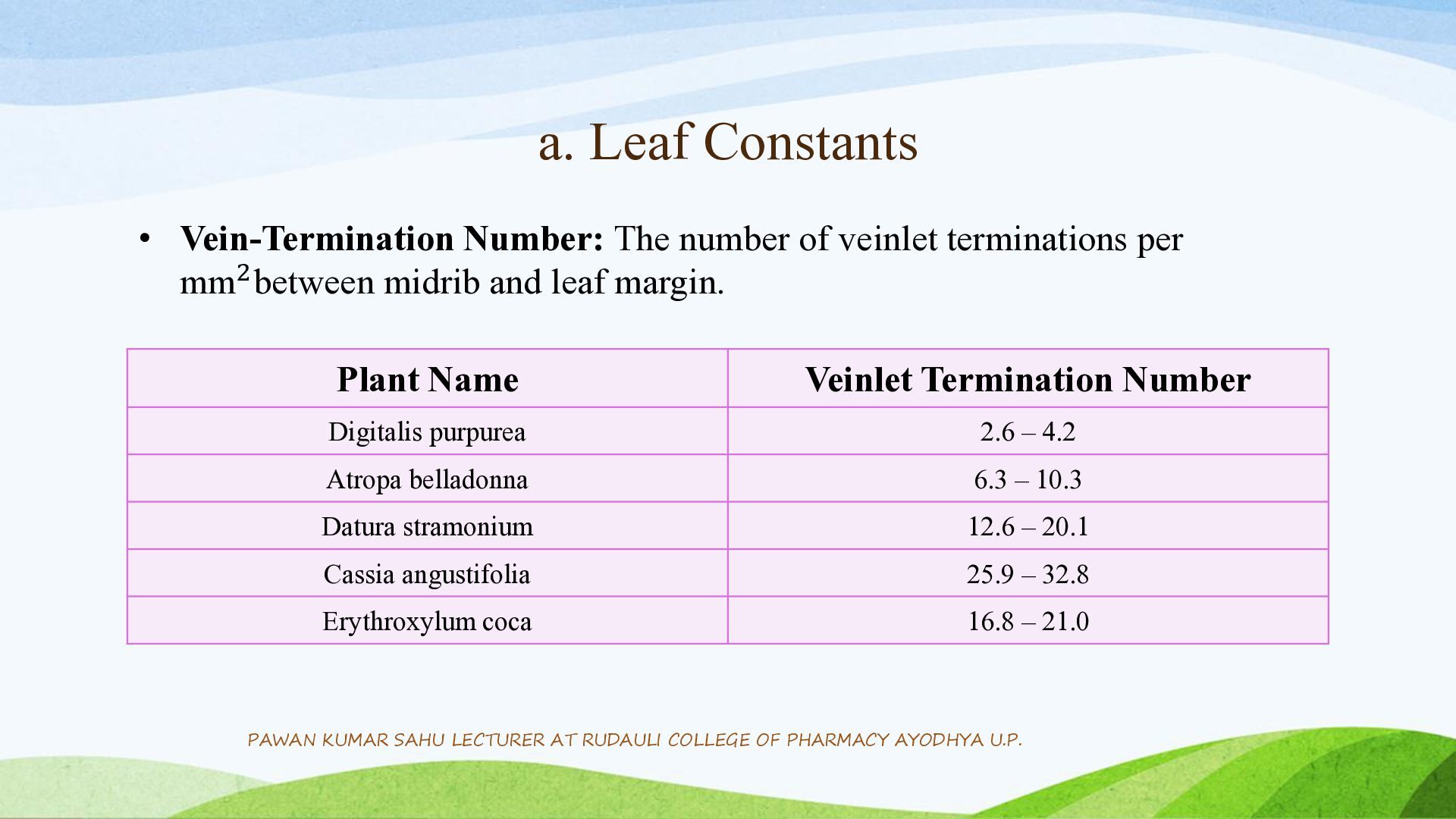
  13. a. Leaf Constants • Vein-Termination Number: The number of veinlet

    terminations per mm2 between midrib and leaf margin. Plant Name Veinlet Termination Number Digitalis purpurea 2.6 – 4.2 Atropa belladonna 6.3 – 10.3 Datura stramonium 12.6 – 20.1 Cassia angustifolia 25.9 – 32.8 Erythroxylum coca 16.8 – 21.0 PAWAN KUMAR SAHU LECTURER AT RUDAULI COLLEGE OF PHARMACY AYODHYA U.P.
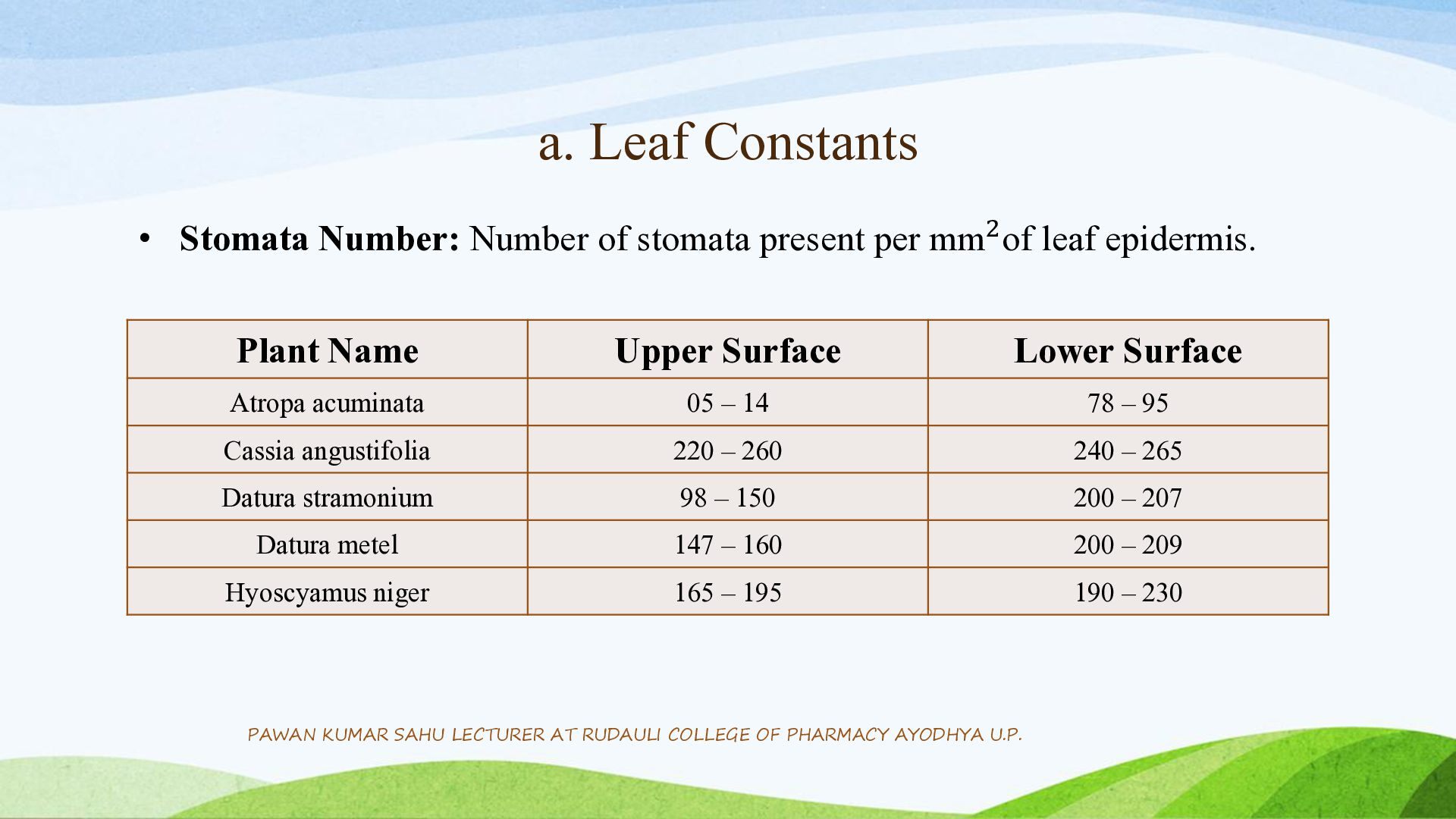
  14. a. Leaf Constants • Stomata Number: Number of stomata present

    per mm2 of leaf epidermis. Plant Name Upper Surface Lower Surface Atropa acuminata 05 – 14 78 – 95 Cassia angustifolia 220 – 260 240 – 265 Datura stramonium 98 – 150 200 – 207 Datura metel 147 – 160 200 – 209 Hyoscyamus niger 165 – 195 190 – 230 PAWAN KUMAR SAHU LECTURER AT RUDAULI COLLEGE OF PHARMACY AYODHYA U.P.
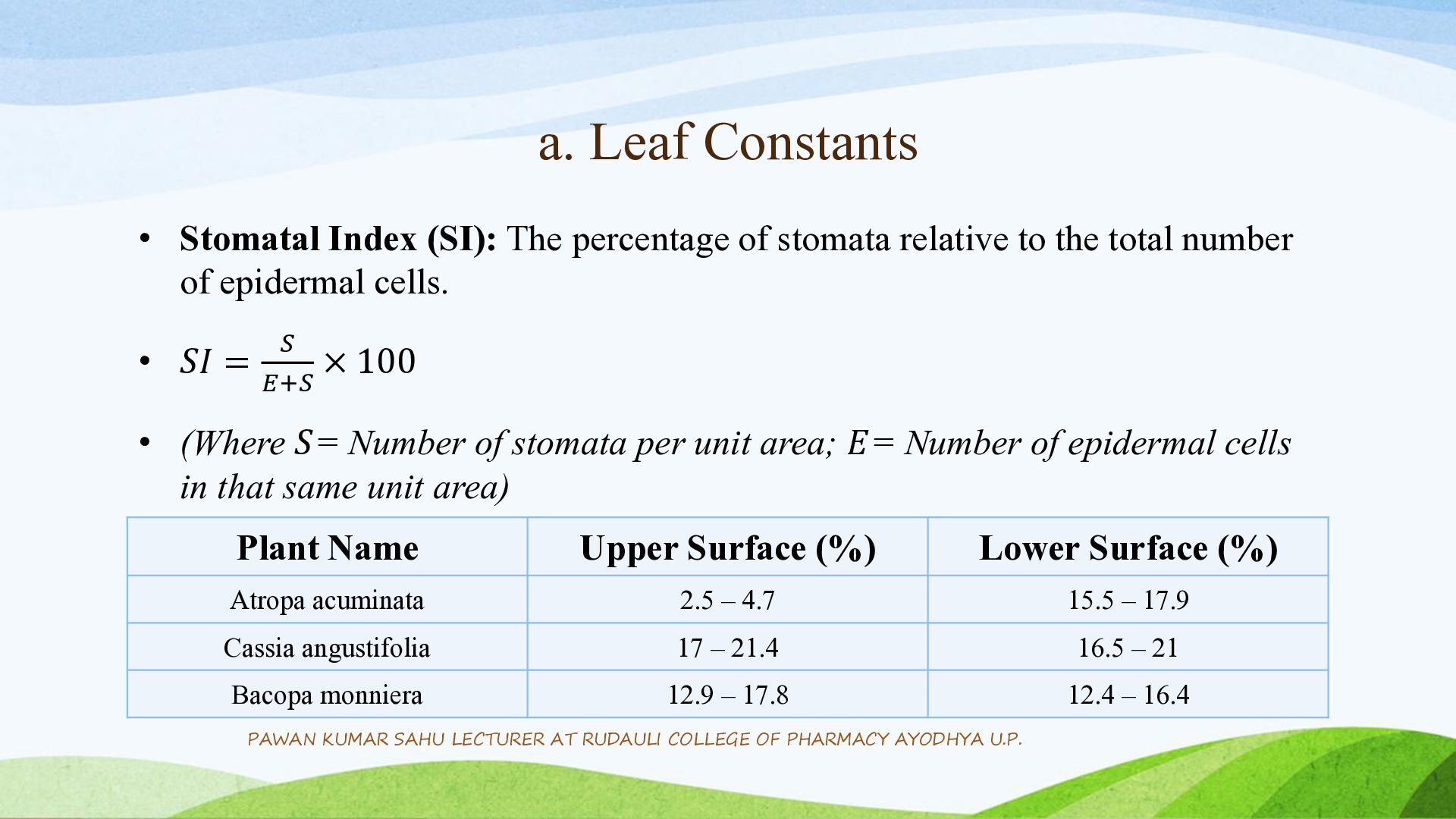
  15. a. Leaf Constants • Stomatal Index (SI): The percentage of

    stomata relative to the total number of epidermal cells. • 𝑆𝐼 = 𝑆 × 100 𝐸+𝑆 • (Where 𝑆= Number of stomata per unit area; 𝐸= Number of epidermal cells in that same unit area) Plant Name Upper Surface (%) Lower Surface (%) Atropa acuminata 2.5 – 4.7 15.5 – 17.9 Cassia angustifolia 17 – 21.4 16.5 – 21 Bacopa monniera 12.9 – 17.8 12.4 – 16.4 PAWAN KUMAR SAHU LECTURER AT RUDAULI COLLEGE OF PHARMACY AYODHYA U.P.
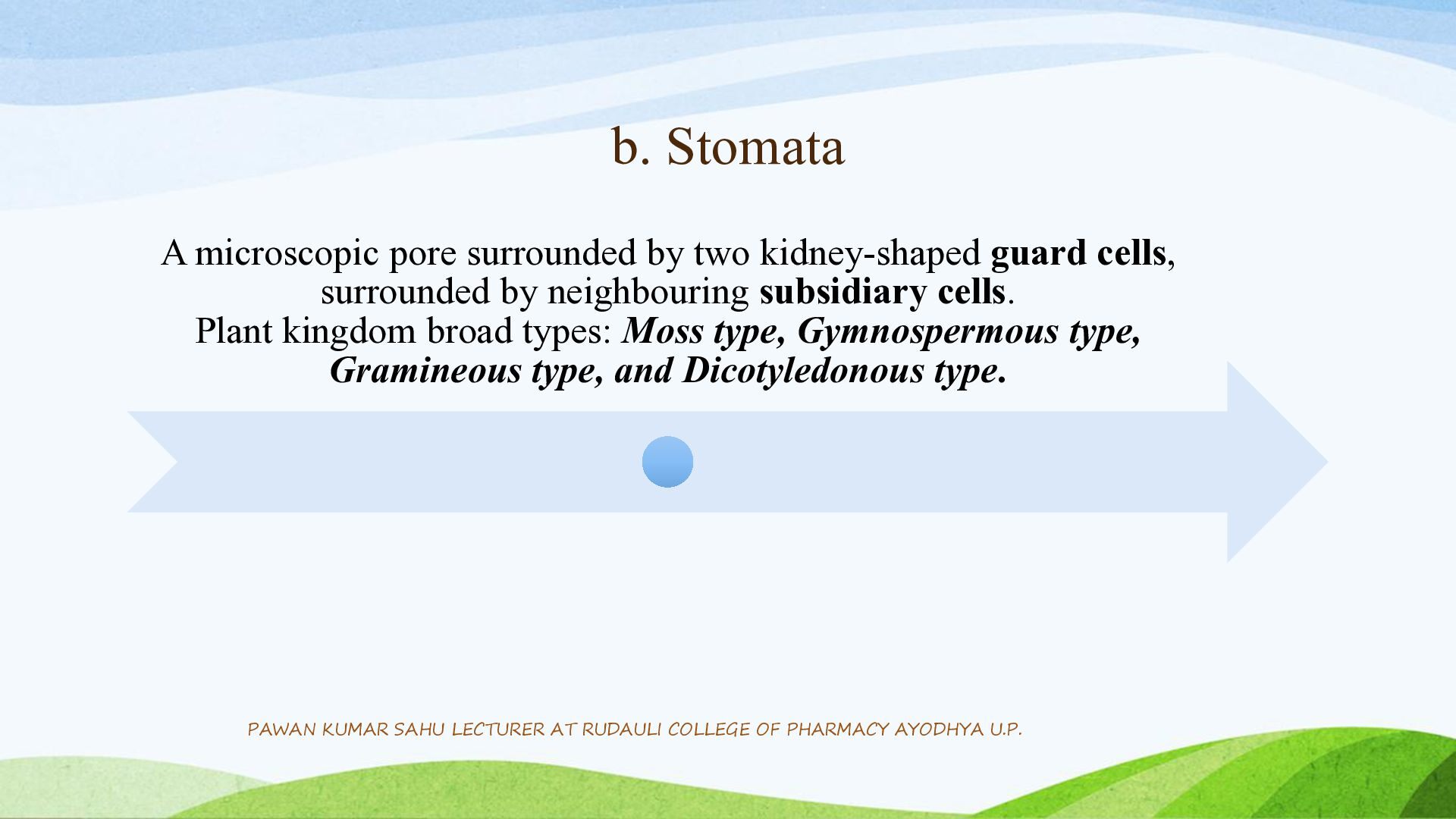
  16. b. Stomata A microscopic pore surrounded by two kidney-shaped guard

    cells, surrounded by neighbouring subsidiary cells. Plant kingdom broad types: Moss type, Gymnospermous type, Gramineous type, and Dicotyledonous type. PAWAN KUMAR SAHU LECTURER AT RUDAULI COLLEGE OF PHARMACY AYODHYA U.P.
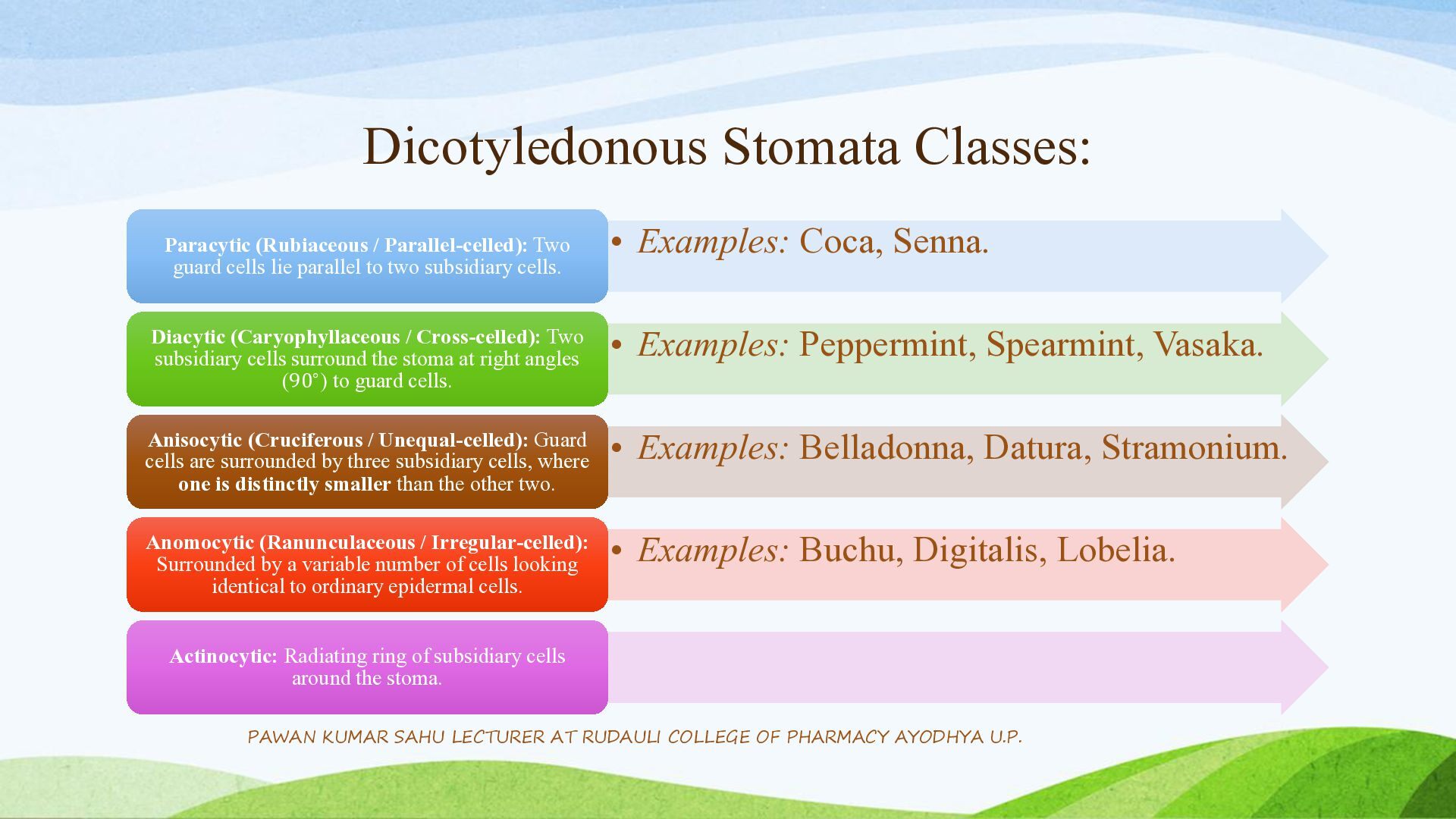
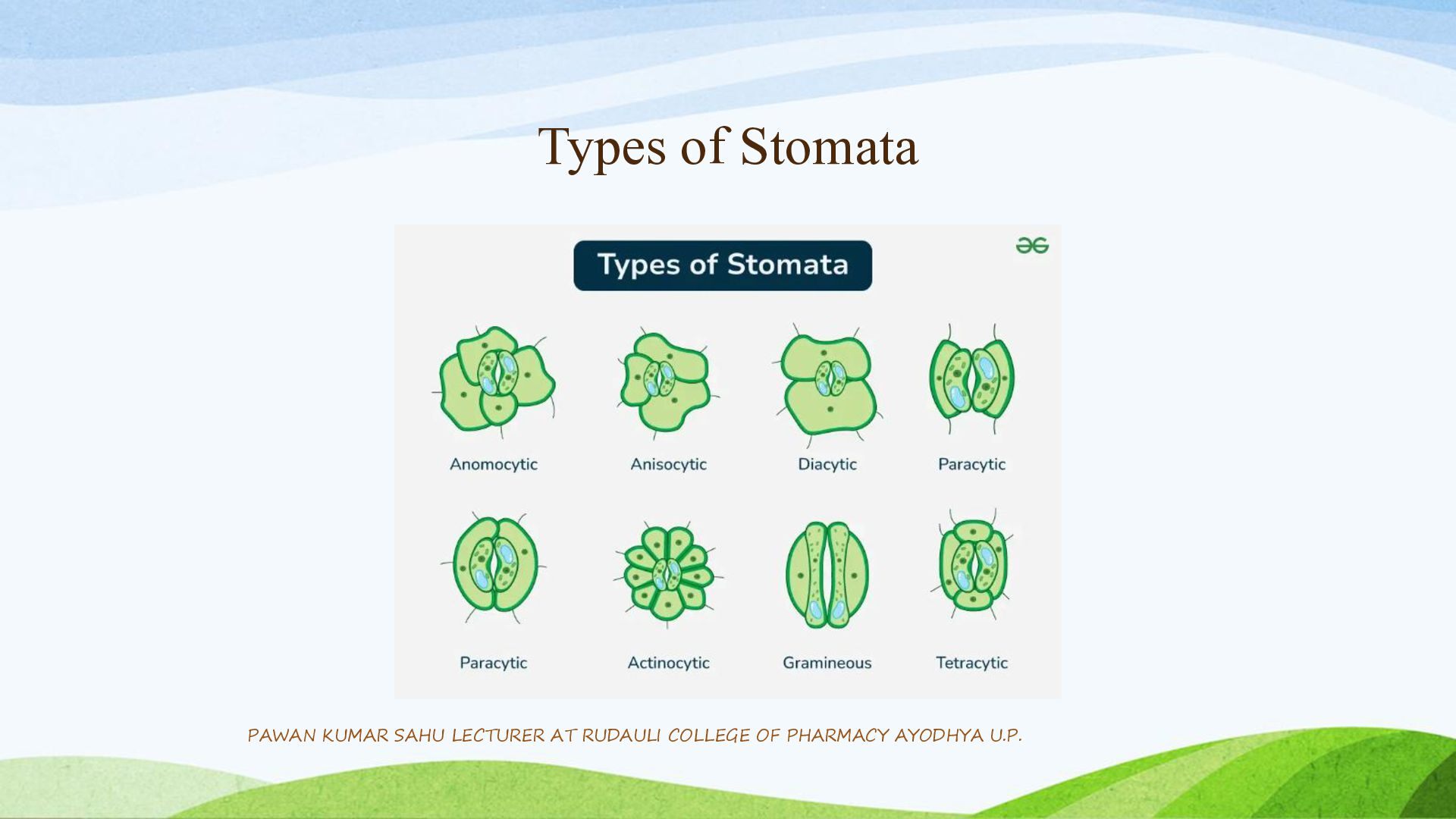
  17. Dicotyledonous Stomata Classes: Paracytic (Rubiaceous / Parallel-celled): Two guard cells

    lie parallel to two subsidiary cells. • Examples: Coca, Senna. Diacytic (Caryophyllaceous / Cross-celled): Two subsidiary cells surround the stoma at right angles (90∘ ) to guard cells. • Examples: Peppermint, Spearmint, Vasaka. Anisocytic (Cruciferous / Unequal-celled): Guard cells are surrounded by three subsidiary cells, where one is distinctly smaller than the other two. • Examples: Belladonna, Datura, Stramonium. Anomocytic (Ranunculaceous / Irregular-celled): Surrounded by a variable number of cells looking identical to ordinary epidermal cells. • Examples: Buchu, Digitalis, Lobelia. 90 to the ring operator Actinocytic: Radiating ring of subsidiary cells around the stoma. PAWAN KUMAR SAHU LECTURER AT RUDAULI COLLEGE OF PHARMACY AYODHYA U.P.
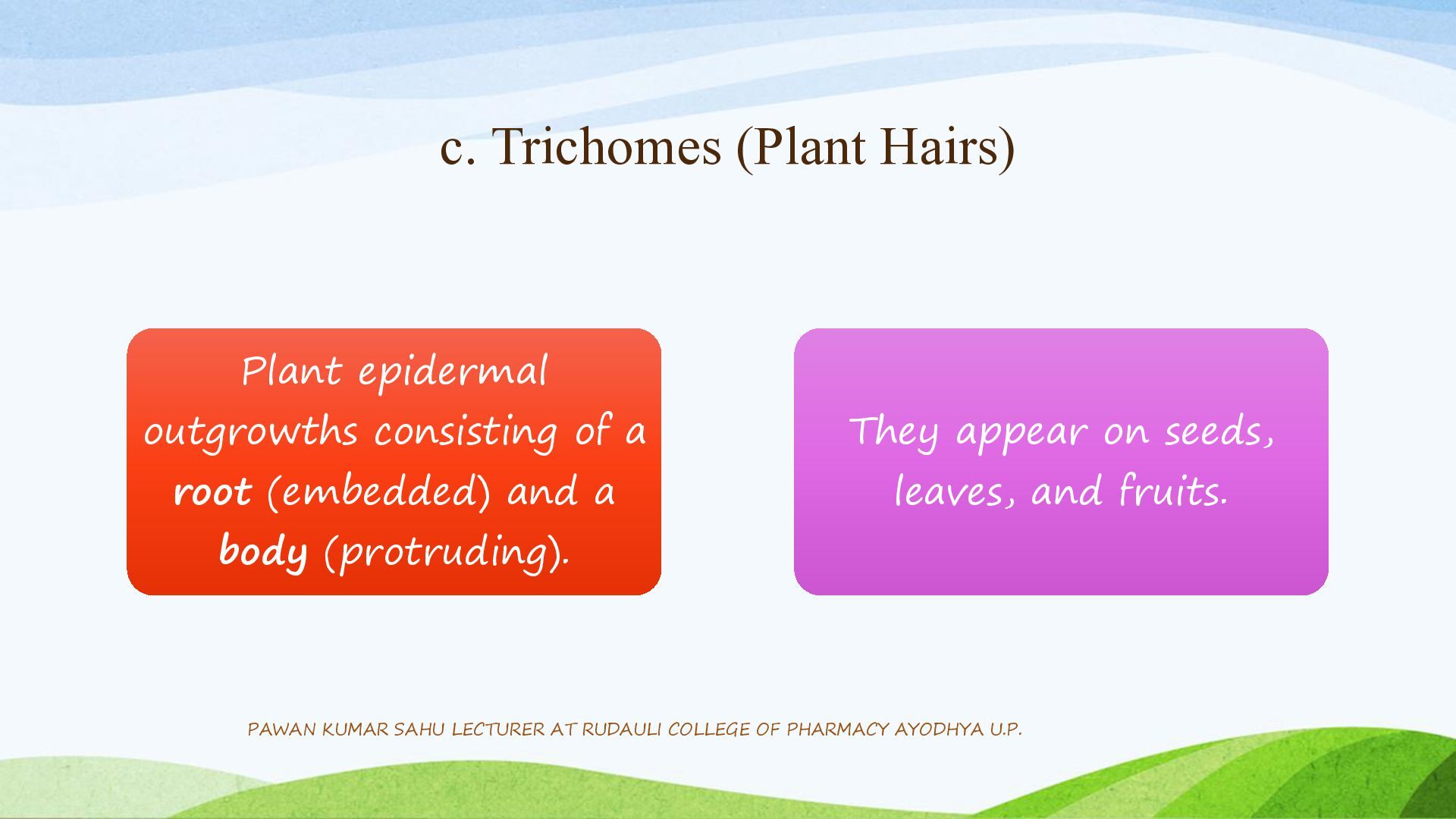
  18. c. Trichomes (Plant Hairs) Plant epidermal outgrowths consisting of a

    They appear on seeds, root (embedded) and a leaves, and fruits. body (protruding). PAWAN KUMAR SAHU LECTURER AT RUDAULI COLLEGE OF PHARMACY AYODHYA U.P.
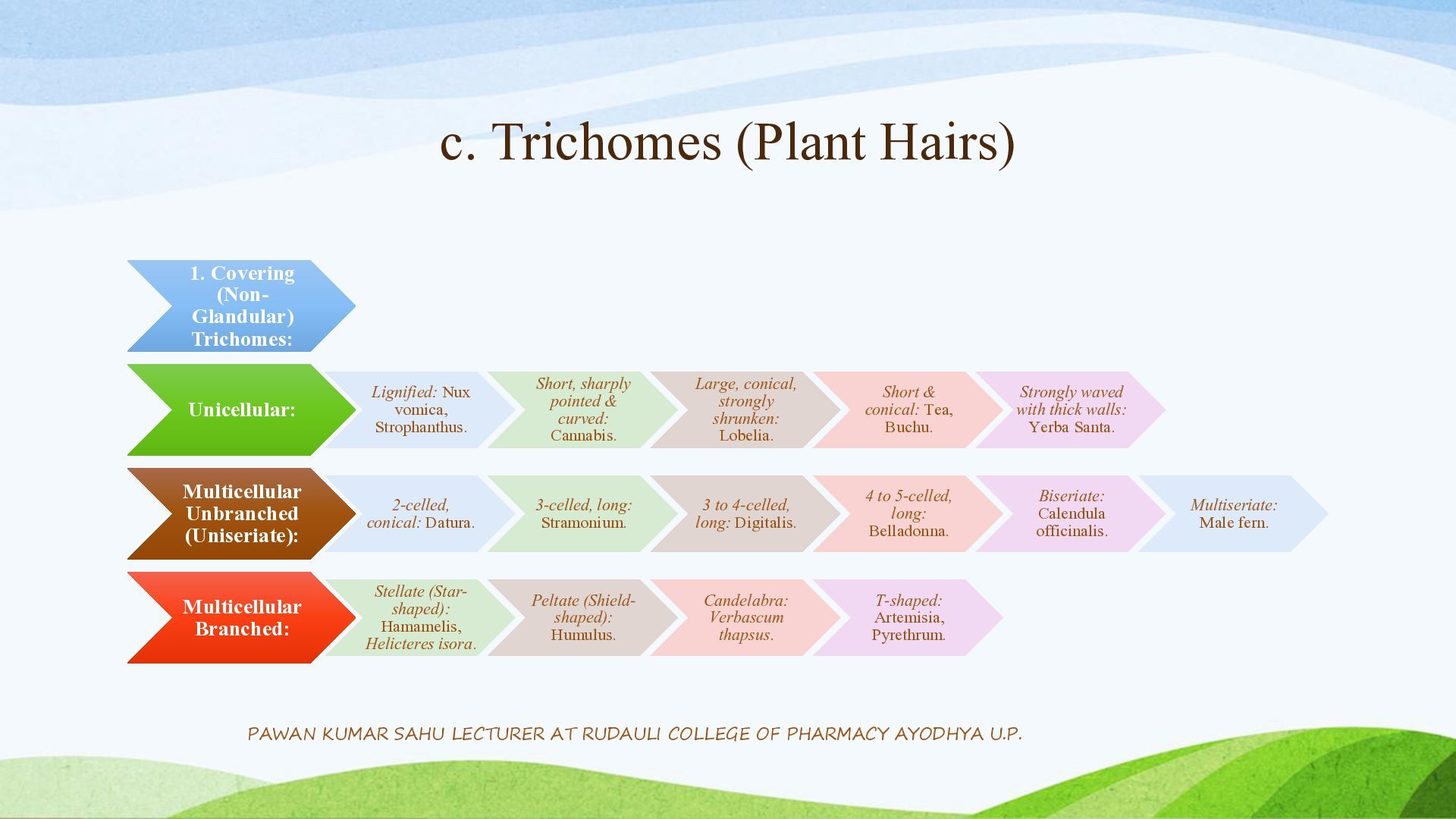
  19. c. Trichomes (Plant Hairs) 1. Covering (NonGlandular) Trichomes: Unicellular: Lignified:

    Nux vomica, Strophanthus. Short, sharply pointed & curved: Cannabis. Large, conical, strongly shrunken: Lobelia. Short & conical: Tea, Buchu. Strongly waved with thick walls: Yerba Santa. Multicellular Unbranched (Uniseriate): 2-celled, conical: Datura. 3-celled, long: Stramonium. 3 to 4-celled, long: Digitalis. 4 to 5-celled, long: Belladonna. Biseriate: Calendula officinalis. Multicellular Branched: Stellate (Starshaped): Hamamelis, Helicteres isora. Peltate (Shieldshaped): Humulus. Candelabra: Verbascum thapsus. T-shaped: Artemisia, Pyrethrum. PAWAN KUMAR SAHU LECTURER AT RUDAULI COLLEGE OF PHARMACY AYODHYA U.P. Multiseriate: Male fern.
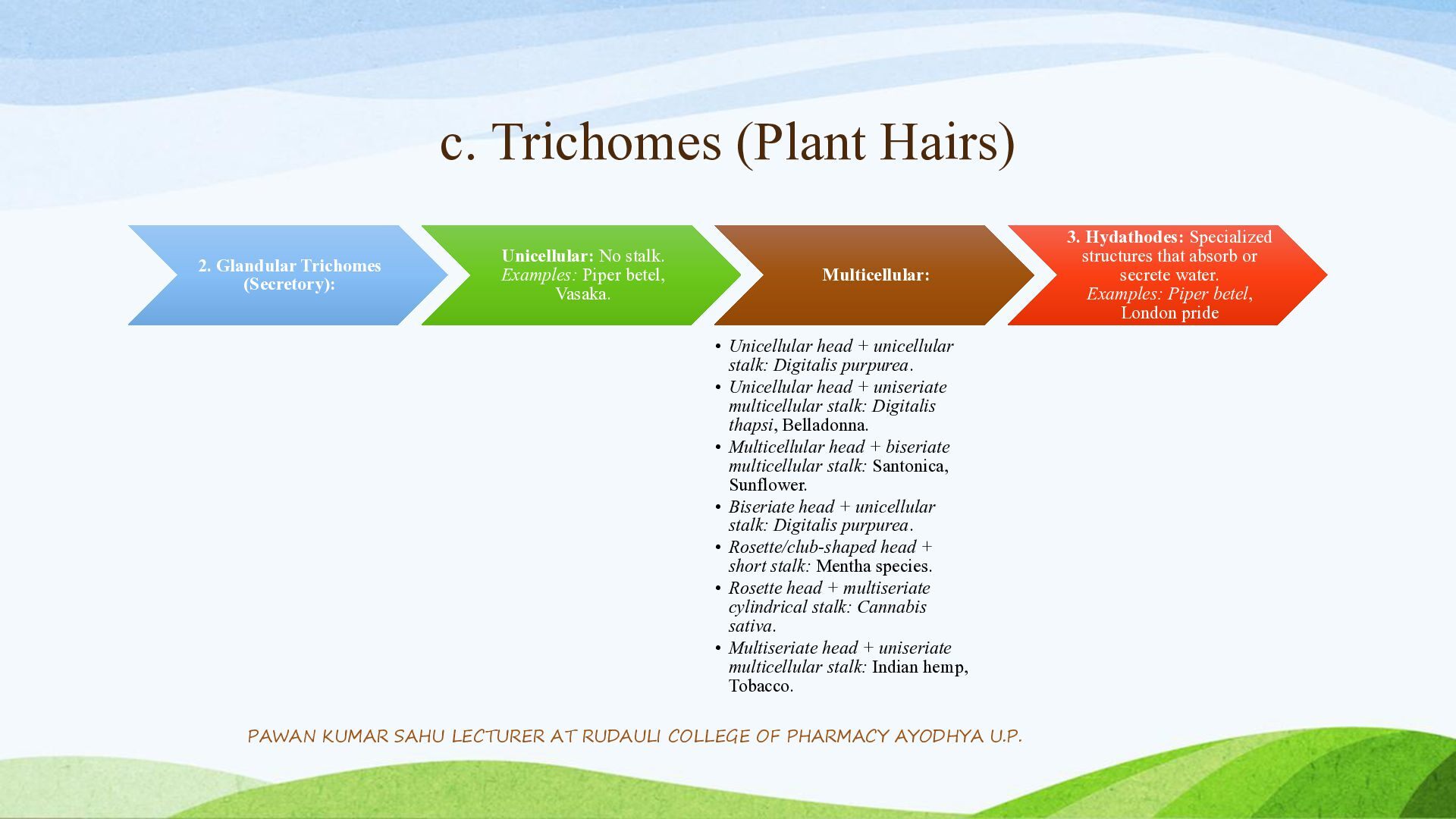
  20. c. Trichomes (Plant Hairs) 2. Glandular Trichomes (Secretory): Unicellular: No

    stalk. Examples: Piper betel, Vasaka. Multicellular: • Unicellular head + unicellular stalk: Digitalis purpurea. • Unicellular head + uniseriate multicellular stalk: Digitalis thapsi, Belladonna. • Multicellular head + biseriate multicellular stalk: Santonica, Sunflower. • Biseriate head + unicellular stalk: Digitalis purpurea. • Rosette/club-shaped head + short stalk: Mentha species. • Rosette head + multiseriate cylindrical stalk: Cannabis sativa. • Multiseriate head + uniseriate multicellular stalk: Indian hemp, Tobacco. PAWAN KUMAR SAHU LECTURER AT RUDAULI COLLEGE OF PHARMACY AYODHYA U.P. 3. Hydathodes: Specialized structures that absorb or secrete water. Examples: Piper betel, London pride
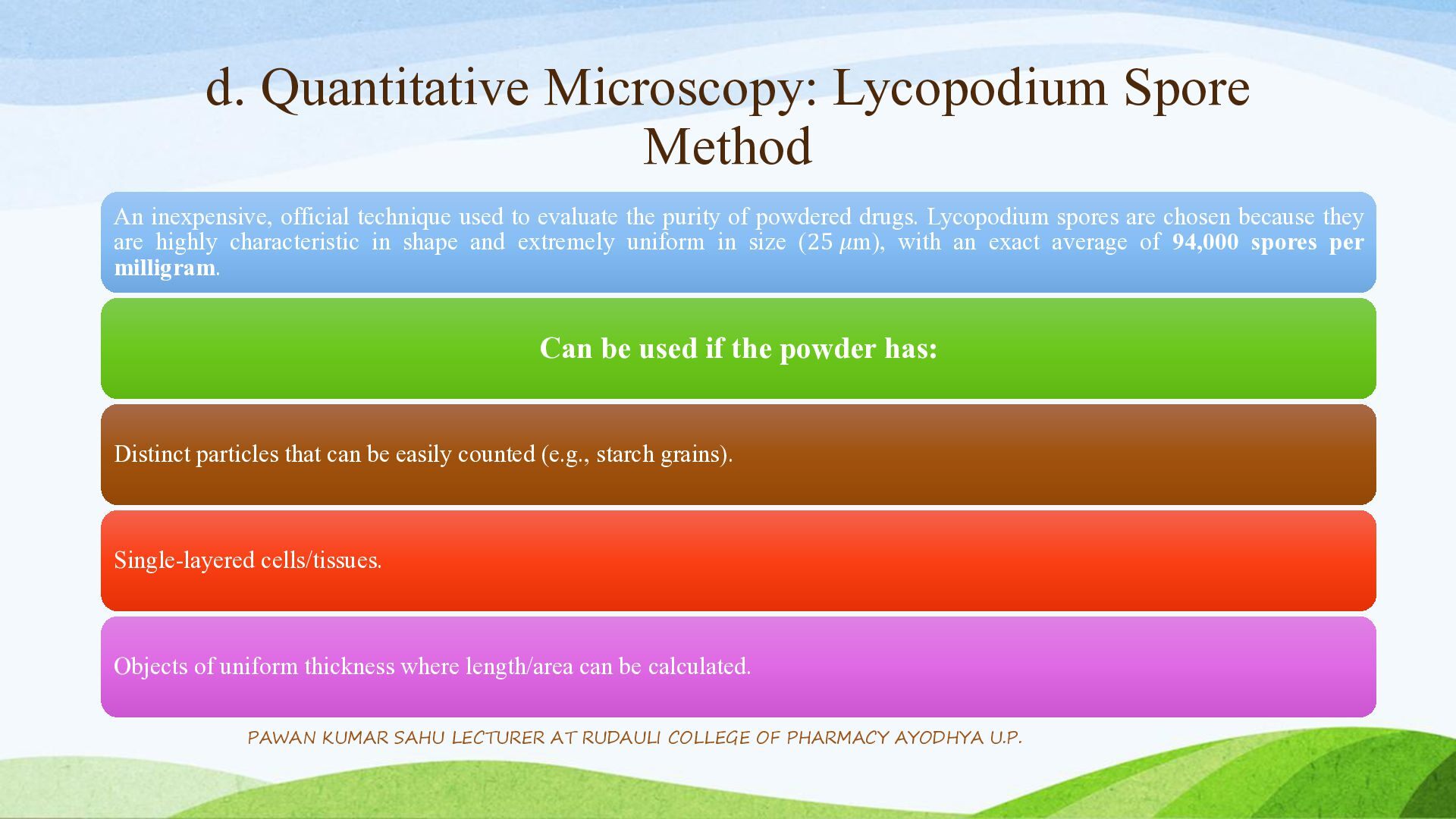
  21. d. Quantitative Microscopy: Lycopodium Spore Method An inexpensive, official technique

    used to evaluate the purity of powdered drugs. Lycopodium spores are chosen because they are highly characteristic in shape and extremely uniform in size (25 𝜇m), with an exact average of 94,000 spores per milligram. 25 , mu m Can be used if the powder has: Distinct particles that can be easily counted (e.g., starch grains). Single-layered cells/tissues. Objects of uniform thickness where length/area can be calculated. PAWAN KUMAR SAHU LECTURER AT RUDAULI COLLEGE OF PHARMACY AYODHYA U.P.
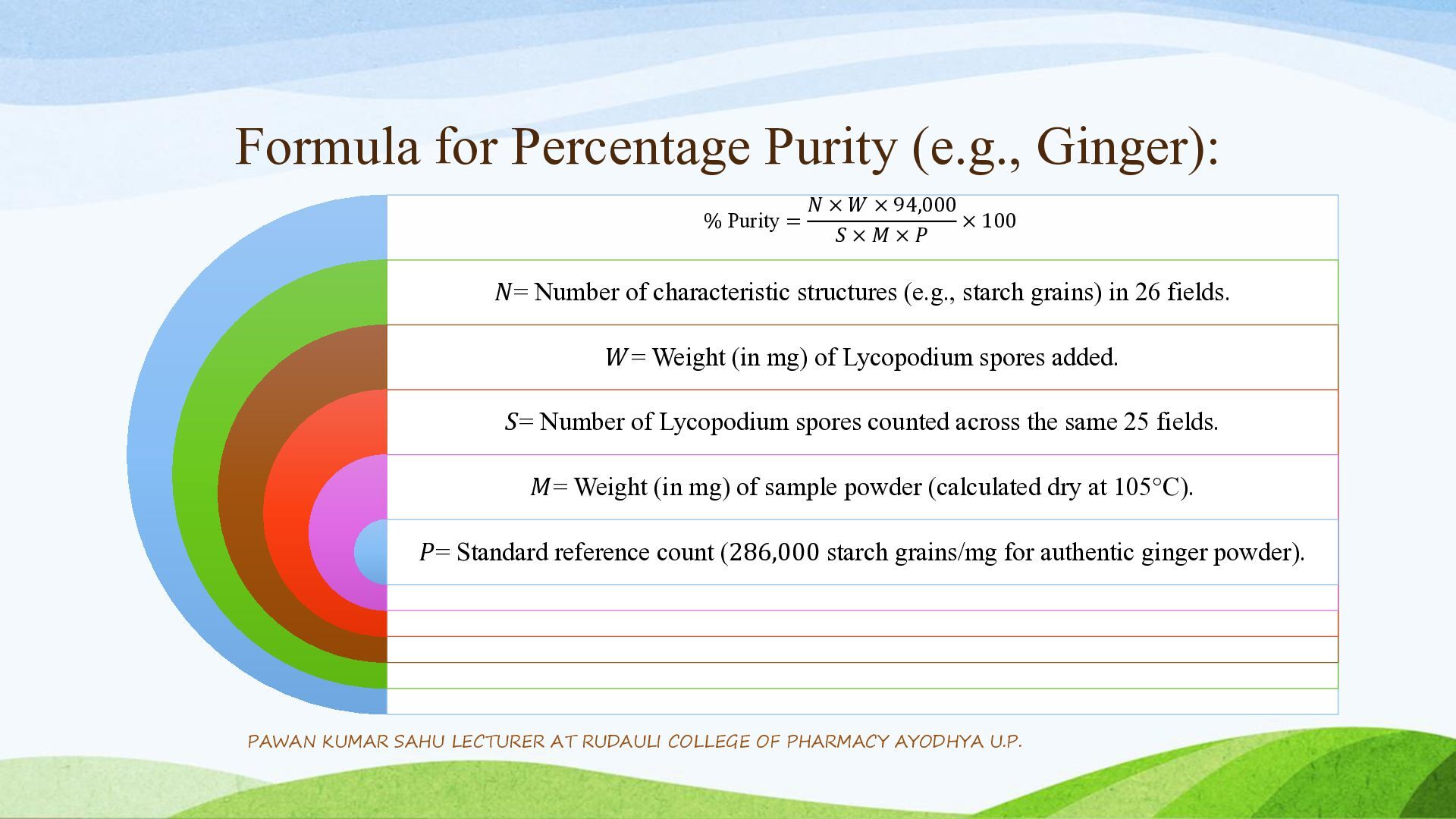
  22. Formula for Percentage Purity (e.g., Ginger): 𝑁 × 𝑊 ×

    94,000 × 100 𝑆×𝑀×𝑃 % Purity equals numerator , cap N times cap W times 94,000 end numerator , over denominator , cap S times cap M times cap P end denominator , times 100 % Purity = 𝑁= Number of characteristic structures (e.g., starch grains) in 26 fields. start equation cap N 𝑊= Weight (in mg) of Lycopodium spores added. start equation cap W 𝑆= Number of Lycopodium spores counted across the same 25 fields. start equation cap S 𝑀= Weight (in mg) of sample powder (calculated dry at 105°C). start equation cap M 𝑃= Standard reference count (286,000 starch grains/mg for authentic ginger powder). start equation cap P 286,000 PAWAN KUMAR SAHU LECTURER AT RUDAULI COLLEGE OF PHARMACY AYODHYA U.P.
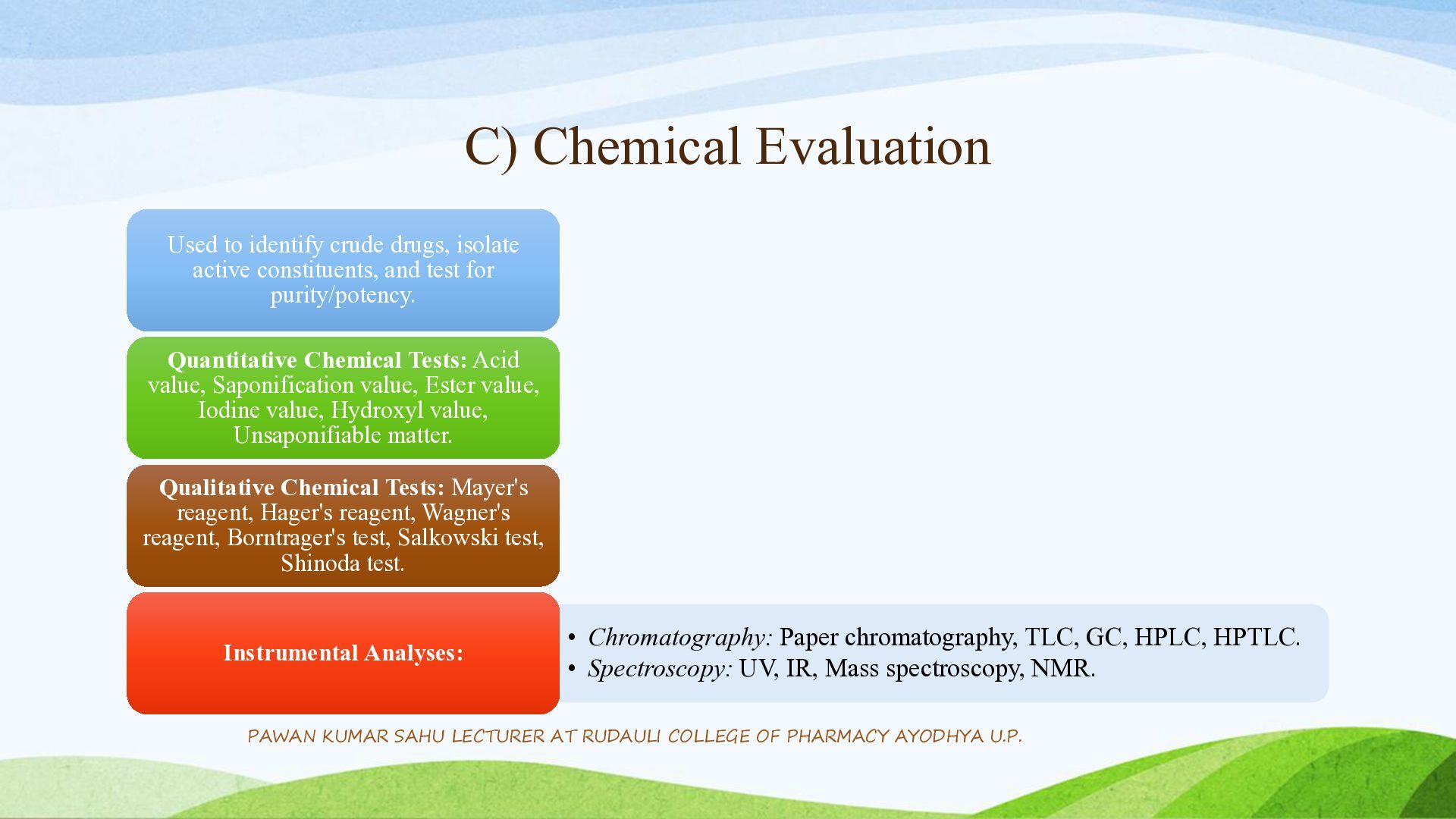
  23. C) Chemical Evaluation Used to identify crude drugs, isolate active

    constituents, and test for purity/potency. Quantitative Chemical Tests: Acid value, Saponification value, Ester value, Iodine value, Hydroxyl value, Unsaponifiable matter. Qualitative Chemical Tests: Mayer's reagent, Hager's reagent, Wagner's reagent, Borntrager's test, Salkowski test, Shinoda test. Instrumental Analyses: • Chromatography: Paper chromatography, TLC, GC, HPLC, HPTLC. • Spectroscopy: UV, IR, Mass spectroscopy, NMR. PAWAN KUMAR SAHU LECTURER AT RUDAULI COLLEGE OF PHARMACY AYODHYA U.P.
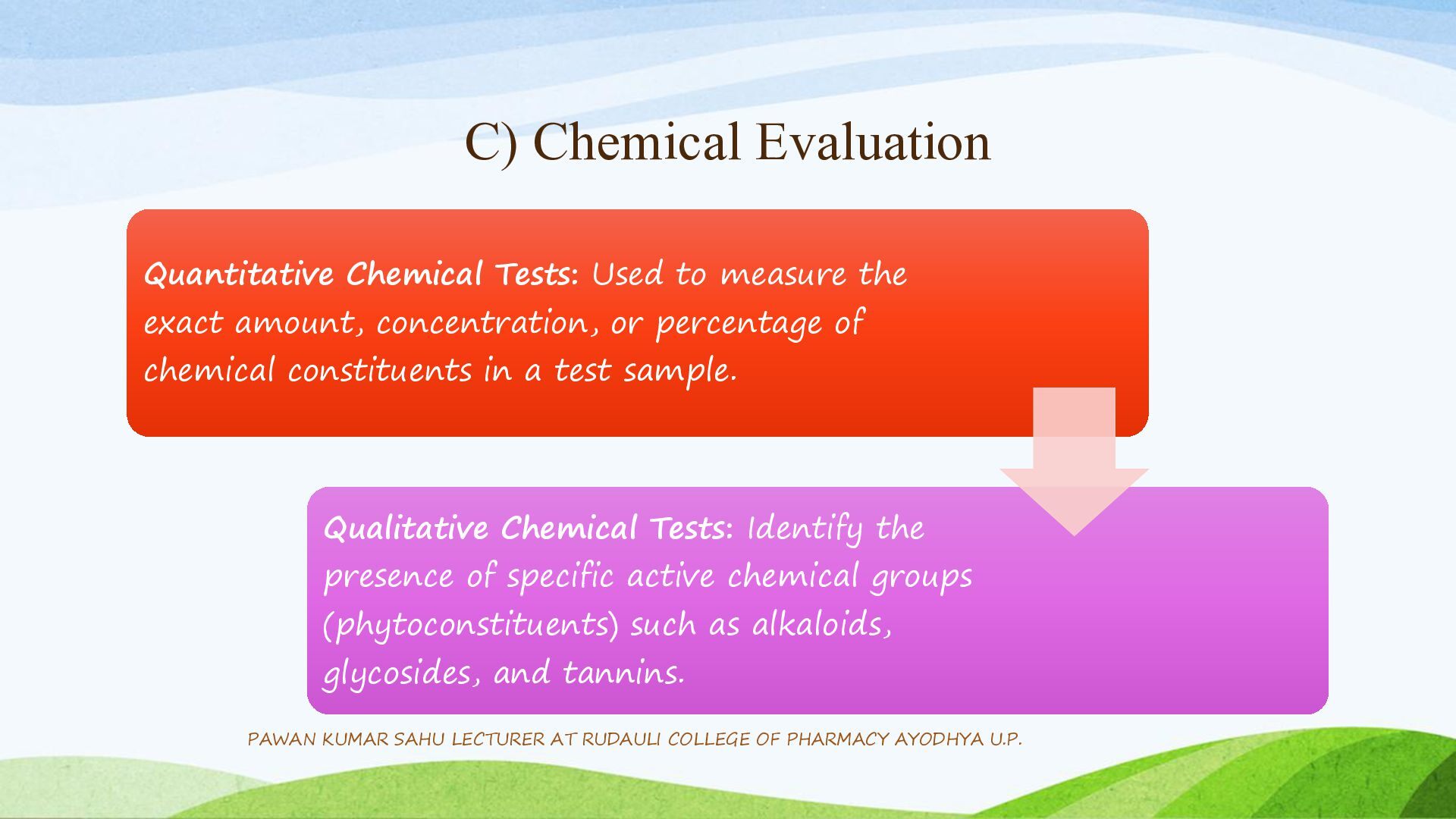
  24. C) Chemical Evaluation Quantitative Chemical Tests: Used to measure the

    exact amount, concentration, or percentage of chemical constituents in a test sample. Qualitative Chemical Tests: Identify the presence of specific active chemical groups (phytoconstituents) such as alkaloids, glycosides, and tannins. PAWAN KUMAR SAHU LECTURER AT RUDAULI COLLEGE OF PHARMACY AYODHYA U.P.
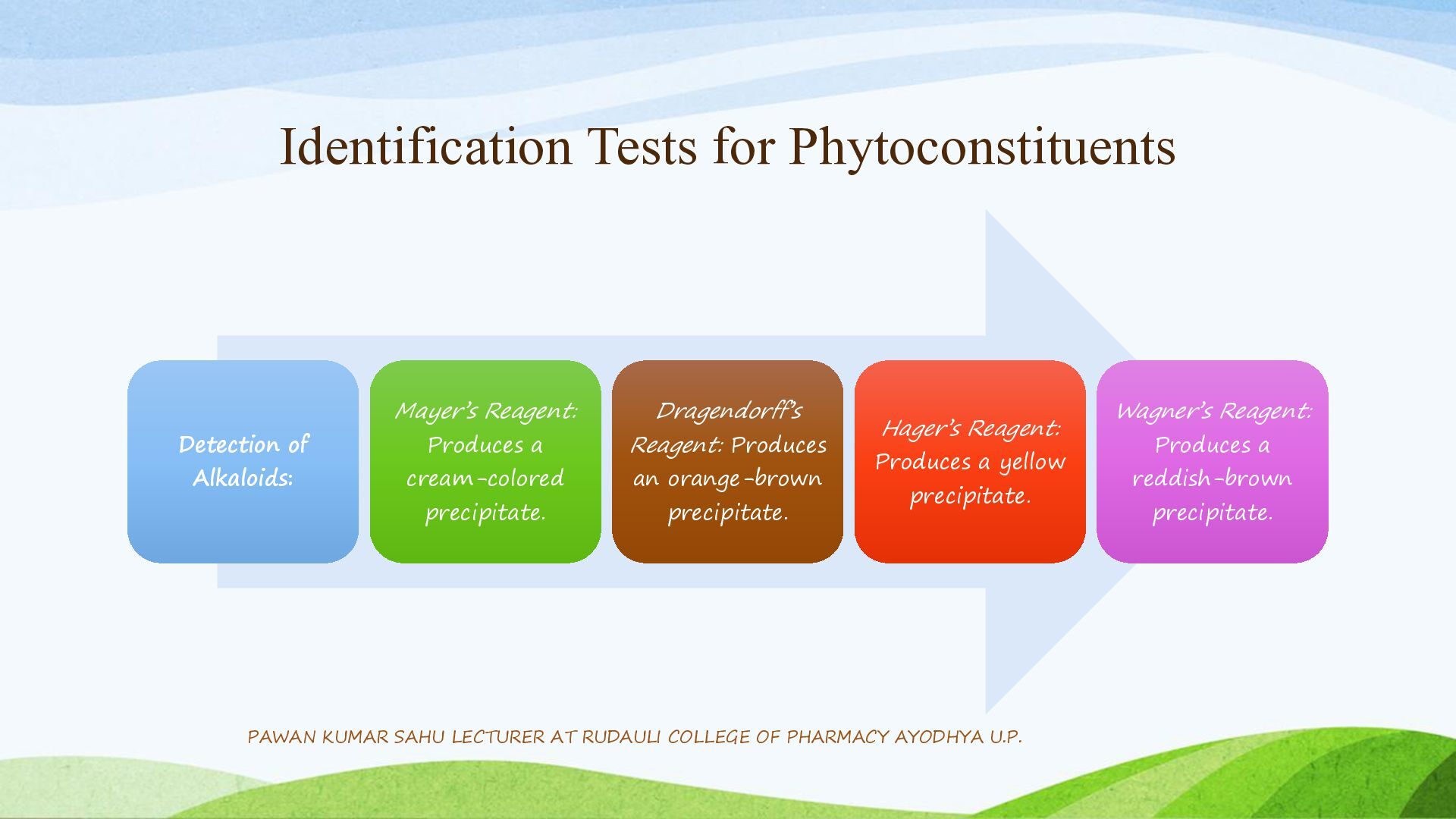
  25. Identification Tests for Phytoconstituents Mayer’s Reagent: Dragendorff’s Detection of Produces

    a Reagent: Produces Alkaloids: cream-colored an orange-brown precipitate. precipitate. Hager’s Reagent: Produces a yellow precipitate. PAWAN KUMAR SAHU LECTURER AT RUDAULI COLLEGE OF PHARMACY AYODHYA U.P. Wagner’s Reagent: Produces a reddish-brown precipitate.
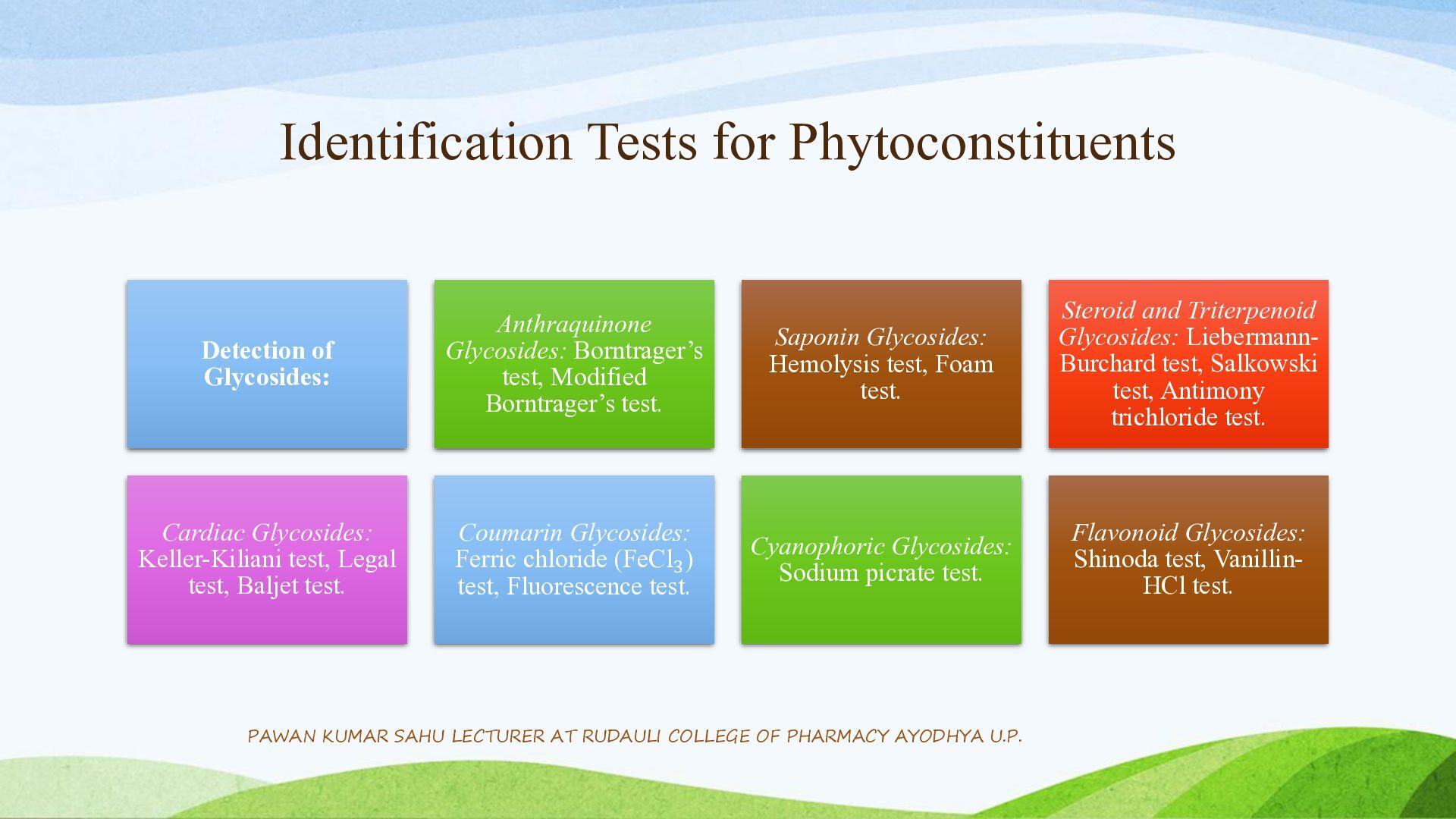
  26. Identification Tests for Phytoconstituents Detection of Glycosides: Anthraquinone Glycosides: Borntrager’s

    test, Modified Borntrager’s test. Saponin Glycosides: Hemolysis test, Foam test. Steroid and Triterpenoid Glycosides: LiebermannBurchard test, Salkowski test, Antimony trichloride test. Cardiac Glycosides: Keller-Kiliani test, Legal test, Baljet test. Coumarin Glycosides: Ferric chloride (FeCl3 ) test, Fluorescence test. Cyanophoric Glycosides: Sodium picrate test. Flavonoid Glycosides: Shinoda test, VanillinHCl test. subscript base , FeCl , end base , sub 3 PAWAN KUMAR SAHU LECTURER AT RUDAULI COLLEGE OF PHARMACY AYODHYA U.P.
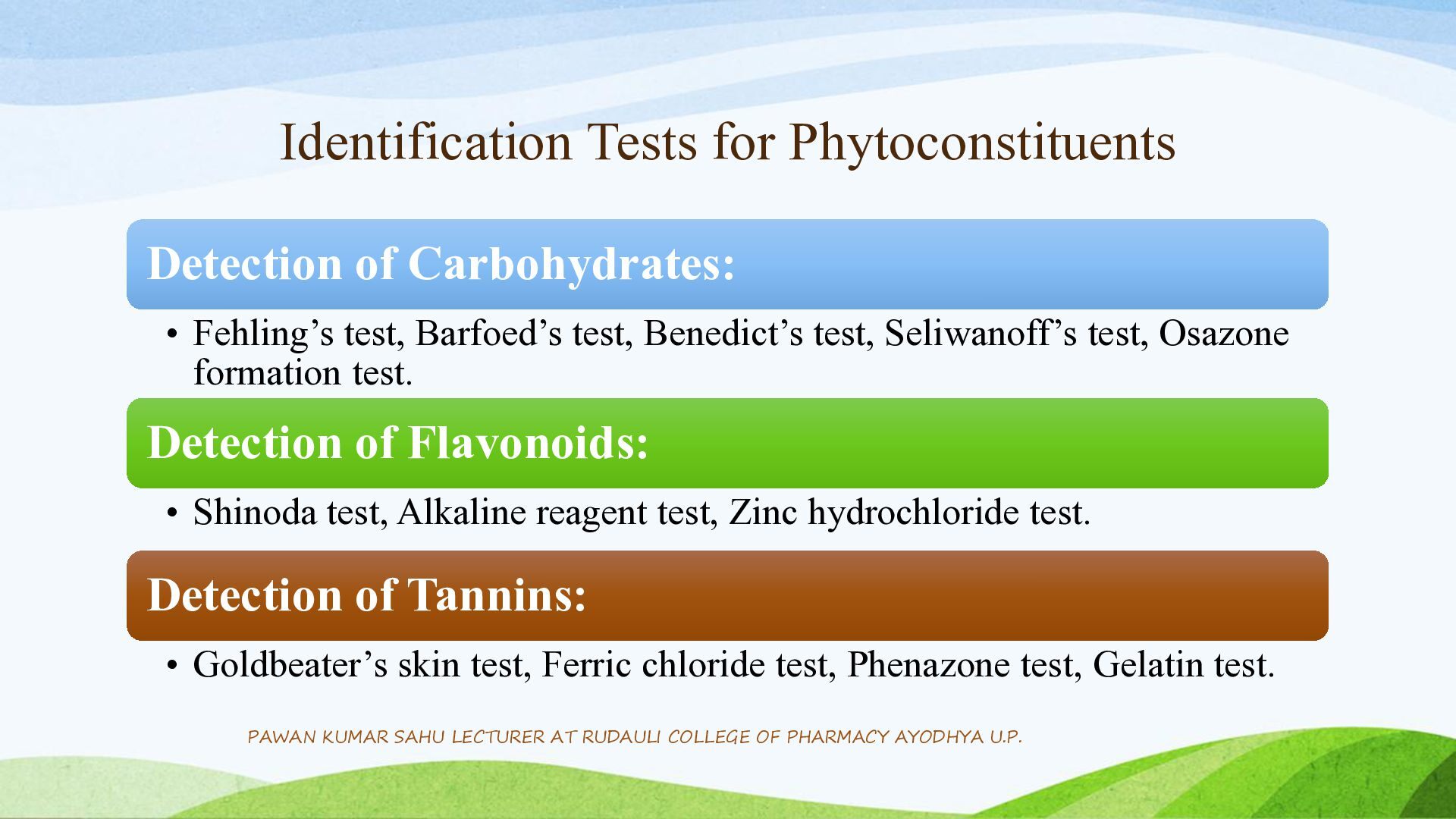
  27. Identification Tests for Phytoconstituents Detection of Carbohydrates: • Fehling’s test,

    Barfoed’s test, Benedict’s test, Seliwanoff’s test, Osazone formation test. Detection of Flavonoids: • Shinoda test, Alkaline reagent test, Zinc hydrochloride test. Detection of Tannins: • Goldbeater’s skin test, Ferric chloride test, Phenazone test, Gelatin test. PAWAN KUMAR SAHU LECTURER AT RUDAULI COLLEGE OF PHARMACY AYODHYA U.P.
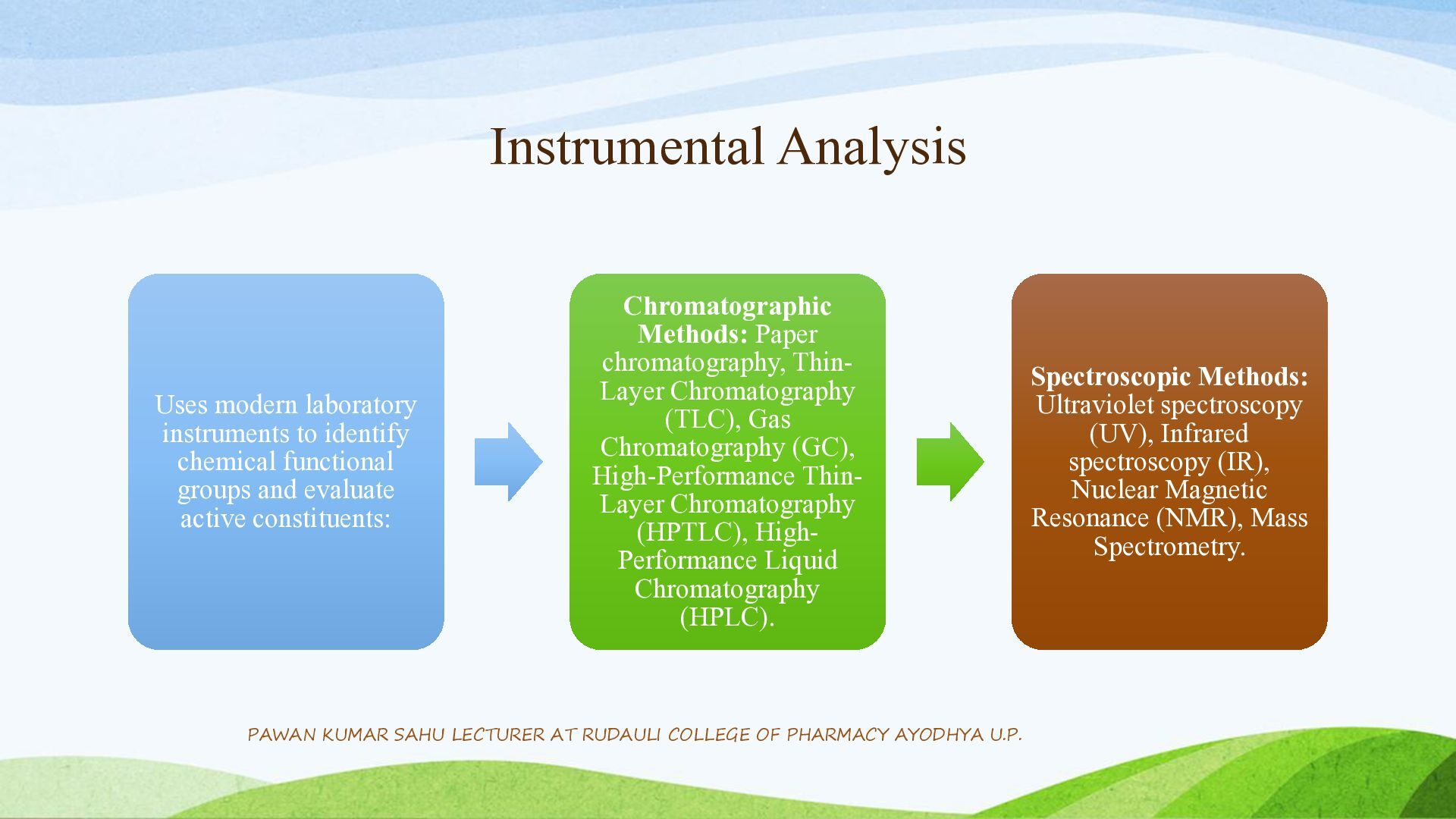
  28. Instrumental Analysis Uses modern laboratory instruments to identify chemical functional

    groups and evaluate active constituents: Chromatographic Methods: Paper chromatography, ThinLayer Chromatography (TLC), Gas Chromatography (GC), High-Performance ThinLayer Chromatography (HPTLC), HighPerformance Liquid Chromatography (HPLC). PAWAN KUMAR SAHU LECTURER AT RUDAULI COLLEGE OF PHARMACY AYODHYA U.P. Spectroscopic Methods: Ultraviolet spectroscopy (UV), Infrared spectroscopy (IR), Nuclear Magnetic Resonance (NMR), Mass Spectrometry.
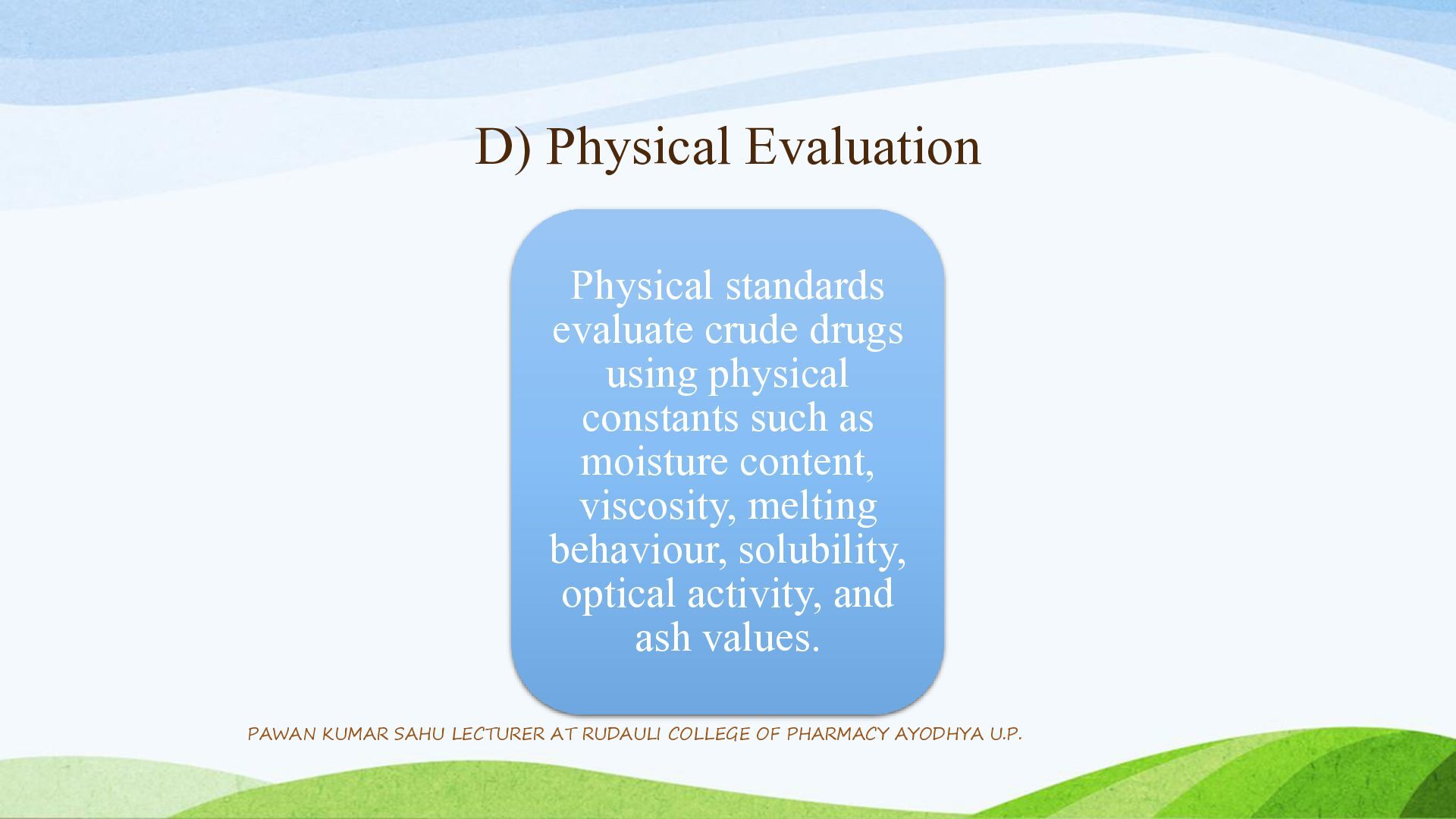
  29. D) Physical Evaluation Physical standards evaluate crude drugs using physical

    constants such as moisture content, viscosity, melting behaviour, solubility, optical activity, and ash values. PAWAN KUMAR SAHU LECTURER AT RUDAULI COLLEGE OF PHARMACY AYODHYA U.P.
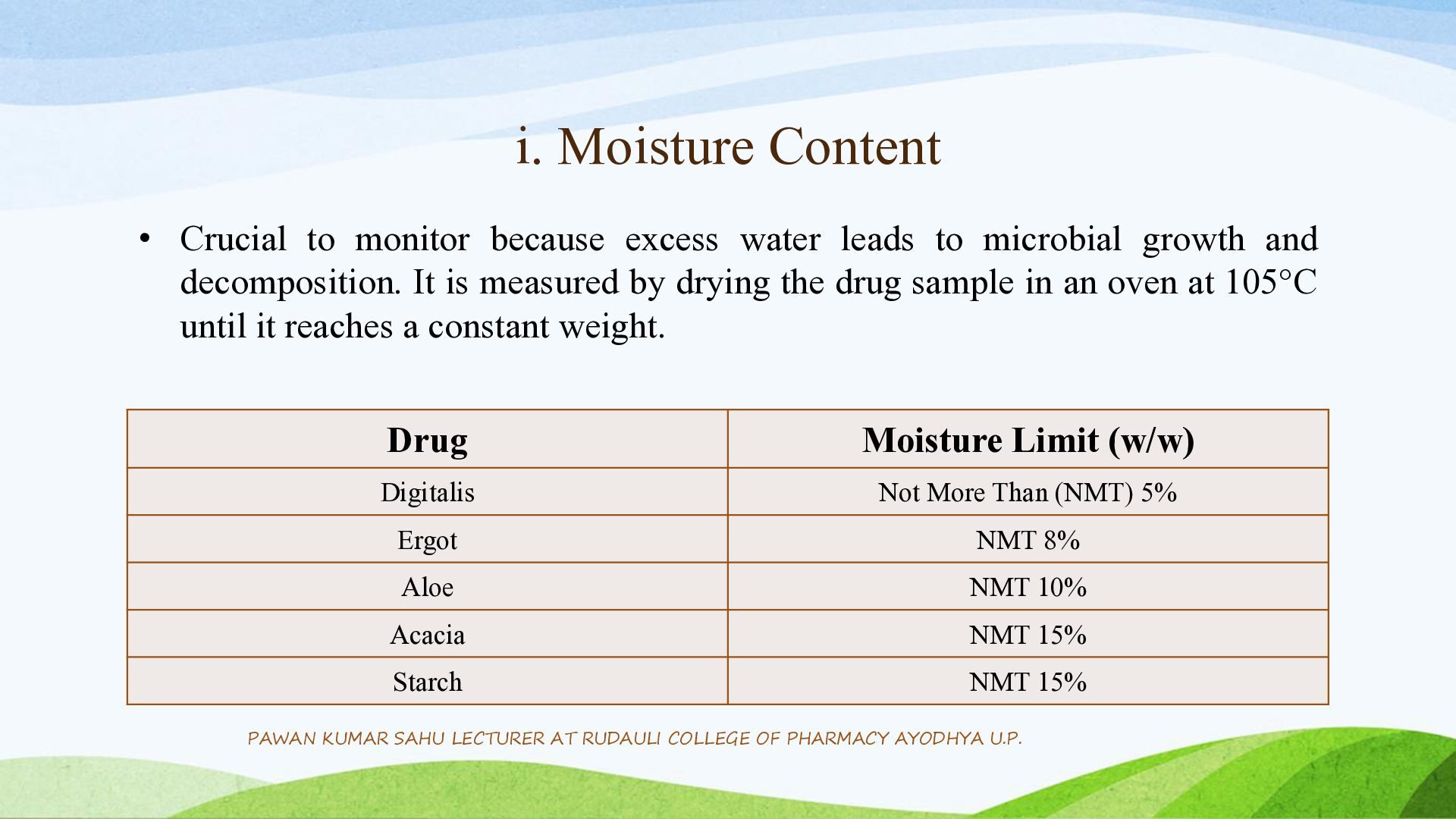
  30. i. Moisture Content • Crucial to monitor because excess water

    leads to microbial growth and decomposition. It is measured by drying the drug sample in an oven at 105°C until it reaches a constant weight. Drug Moisture Limit (w/w) Digitalis Not More Than (NMT) 5% Ergot NMT 8% Aloe NMT 10% Acacia NMT 15% Starch NMT 15% PAWAN KUMAR SAHU LECTURER AT RUDAULI COLLEGE OF PHARMACY AYODHYA U.P.
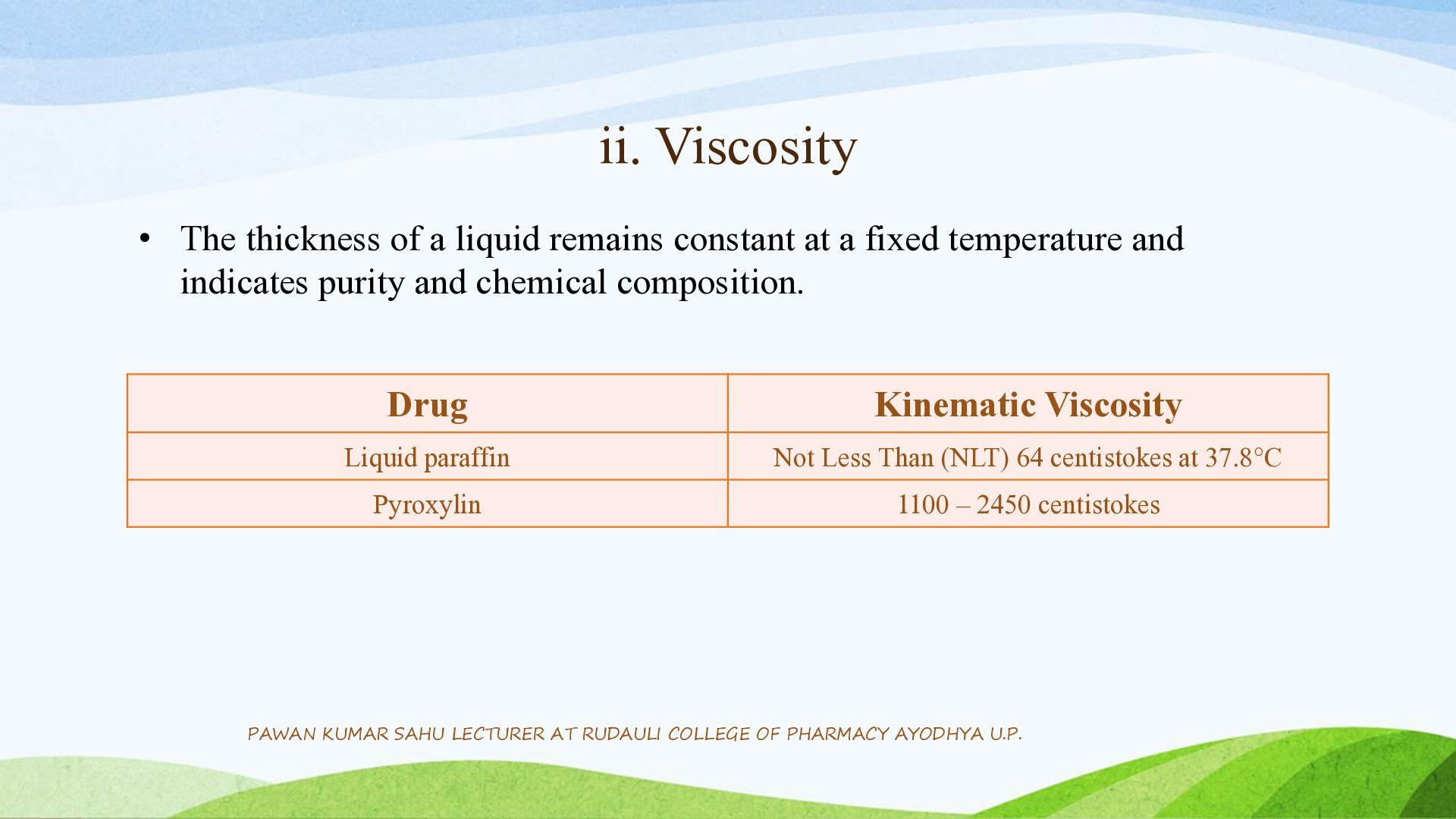
  31. ii. Viscosity • The thickness of a liquid remains constant

    at a fixed temperature and indicates purity and chemical composition. Drug Kinematic Viscosity Liquid paraffin Not Less Than (NLT) 64 centistokes at 37.8°C Pyroxylin 1100 – 2450 centistokes PAWAN KUMAR SAHU LECTURER AT RUDAULI COLLEGE OF PHARMACY AYODHYA U.P.
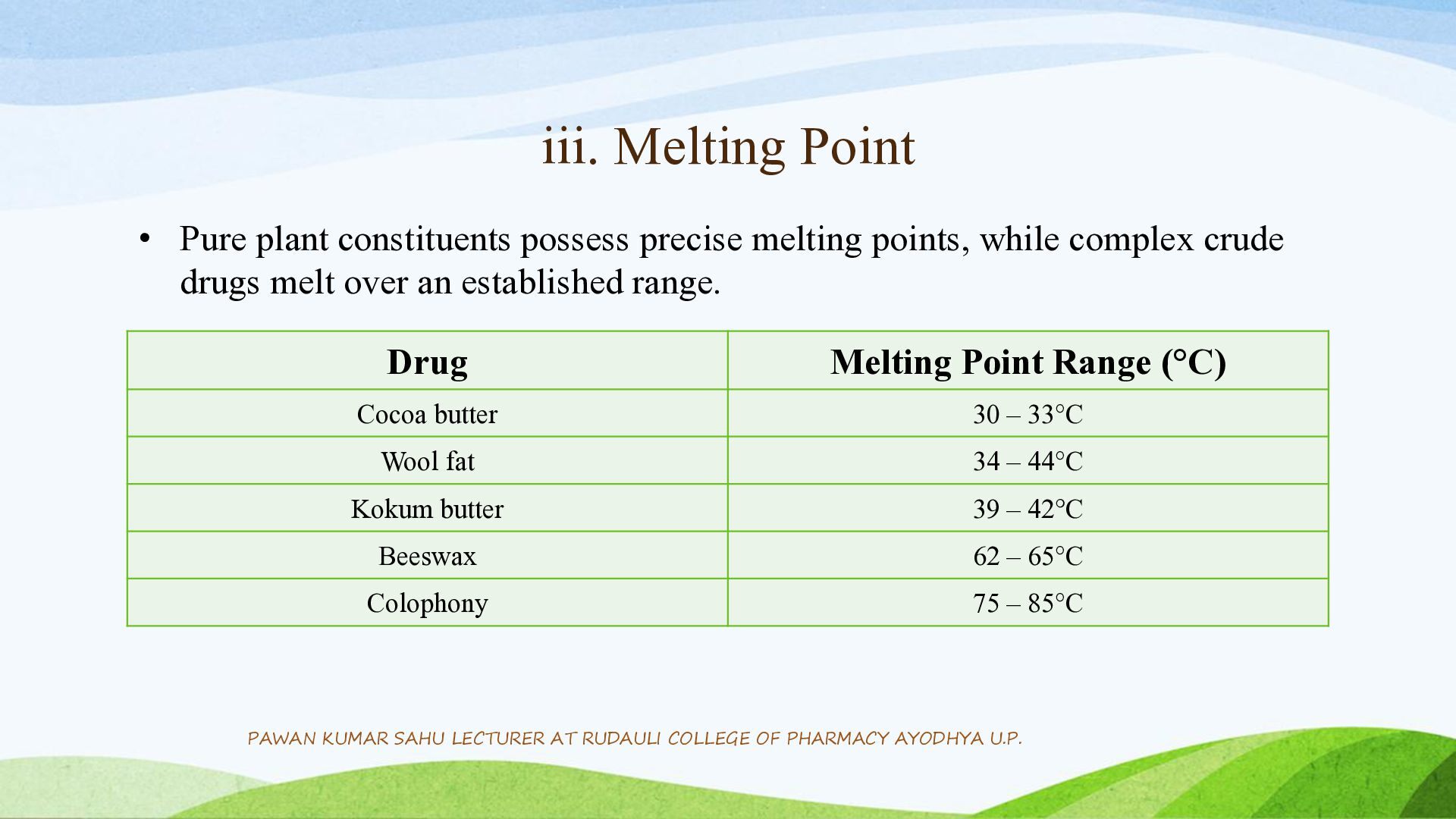
  32. iii. Melting Point • Pure plant constituents possess precise melting

    points, while complex crude drugs melt over an established range. Drug Melting Point Range (°C) Cocoa butter 30 – 33°C Wool fat 34 – 44°C Kokum butter 39 – 42°C Beeswax 62 – 65°C Colophony 75 – 85°C PAWAN KUMAR SAHU LECTURER AT RUDAULI COLLEGE OF PHARMACY AYODHYA U.P.
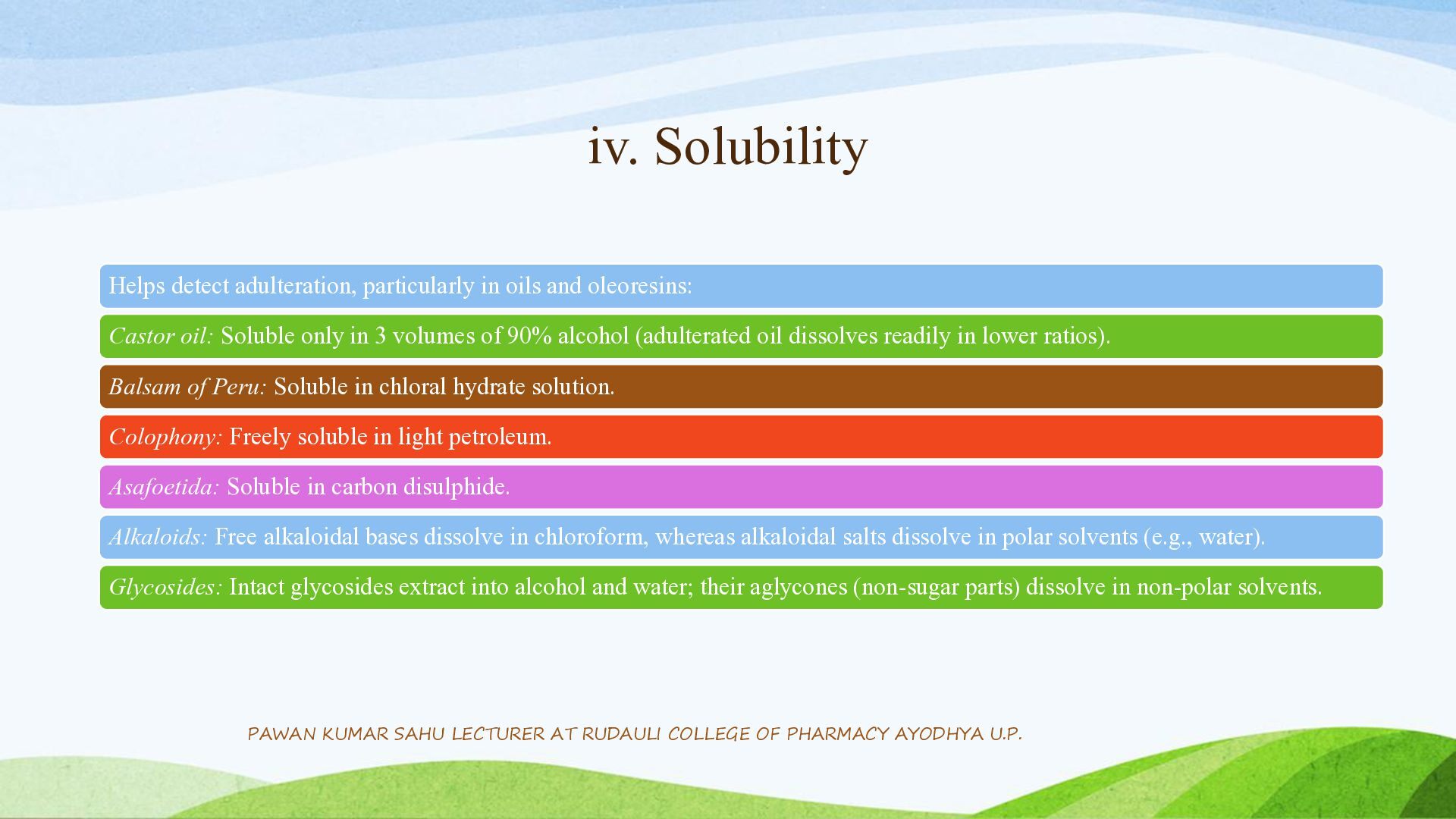
  33. iv. Solubility Helps detect adulteration, particularly in oils and oleoresins:

    Castor oil: Soluble only in 3 volumes of 90% alcohol (adulterated oil dissolves readily in lower ratios). Balsam of Peru: Soluble in chloral hydrate solution. Colophony: Freely soluble in light petroleum. Asafoetida: Soluble in carbon disulphide. Alkaloids: Free alkaloidal bases dissolve in chloroform, whereas alkaloidal salts dissolve in polar solvents (e.g., water). Glycosides: Intact glycosides extract into alcohol and water; their aglycones (non-sugar parts) dissolve in non-polar solvents. PAWAN KUMAR SAHU LECTURER AT RUDAULI COLLEGE OF PHARMACY AYODHYA U.P.
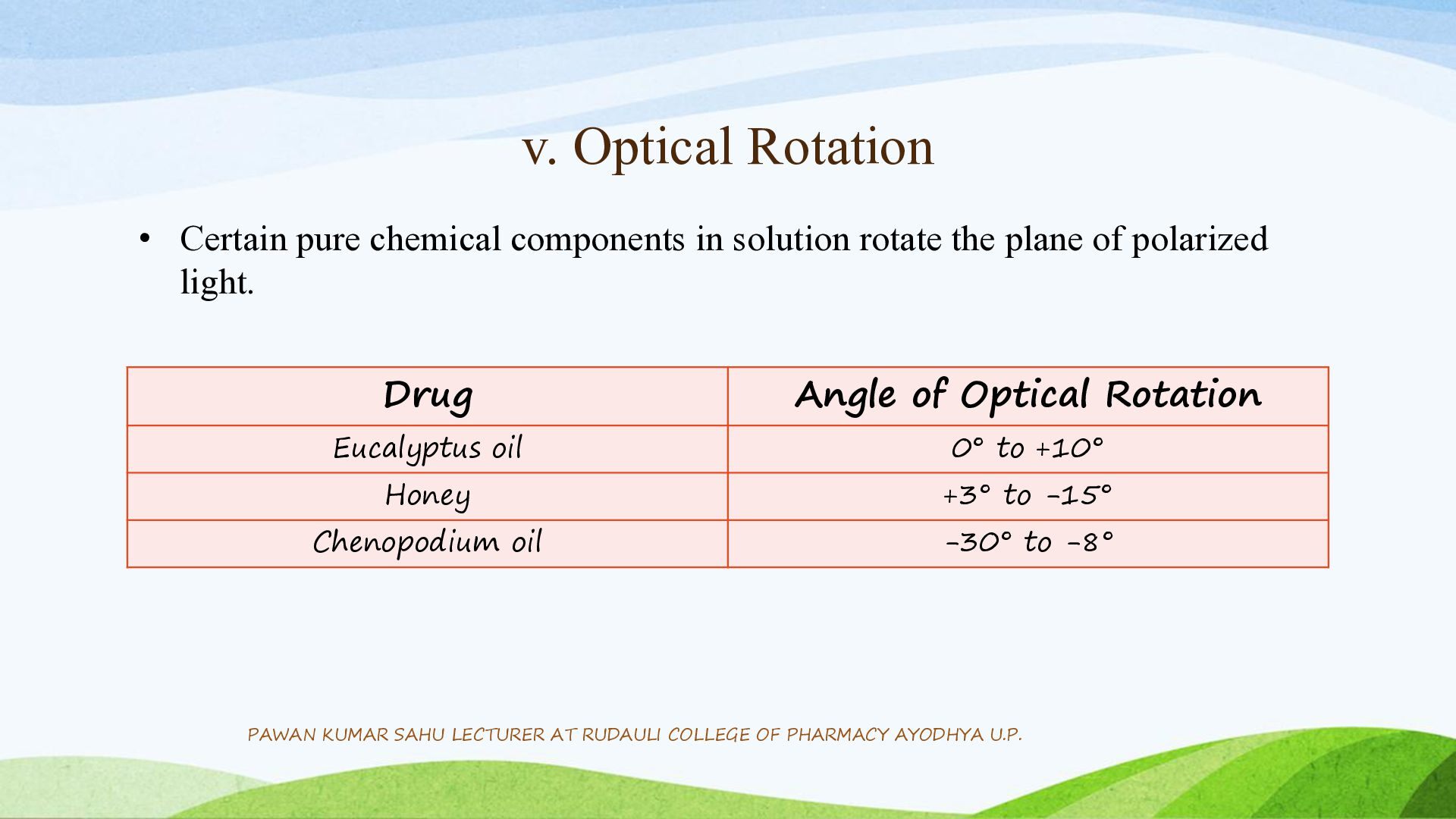
  34. v. Optical Rotation • Certain pure chemical components in solution

    rotate the plane of polarized light. Drug Angle of Optical Rotation Eucalyptus oil 0° to +10° Honey +3° to -15° Chenopodium oil -30° to -8° PAWAN KUMAR SAHU LECTURER AT RUDAULI COLLEGE OF PHARMACY AYODHYA U.P.
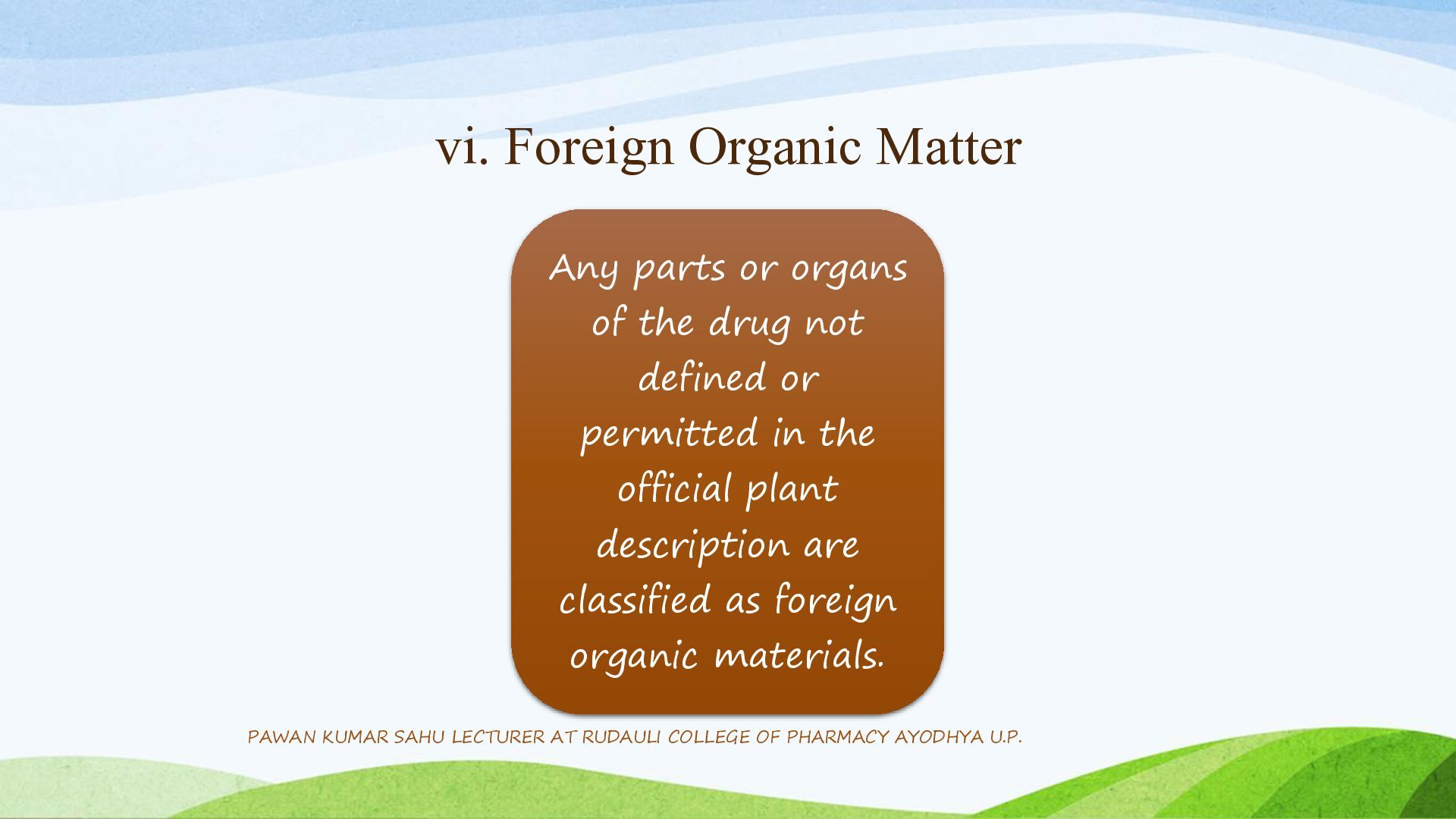
  35. vi. Foreign Organic Matter Any parts or organs of the

    drug not defined or permitted in the official plant description are classified as foreign organic materials. PAWAN KUMAR SAHU LECTURER AT RUDAULI COLLEGE OF PHARMACY AYODHYA U.P.
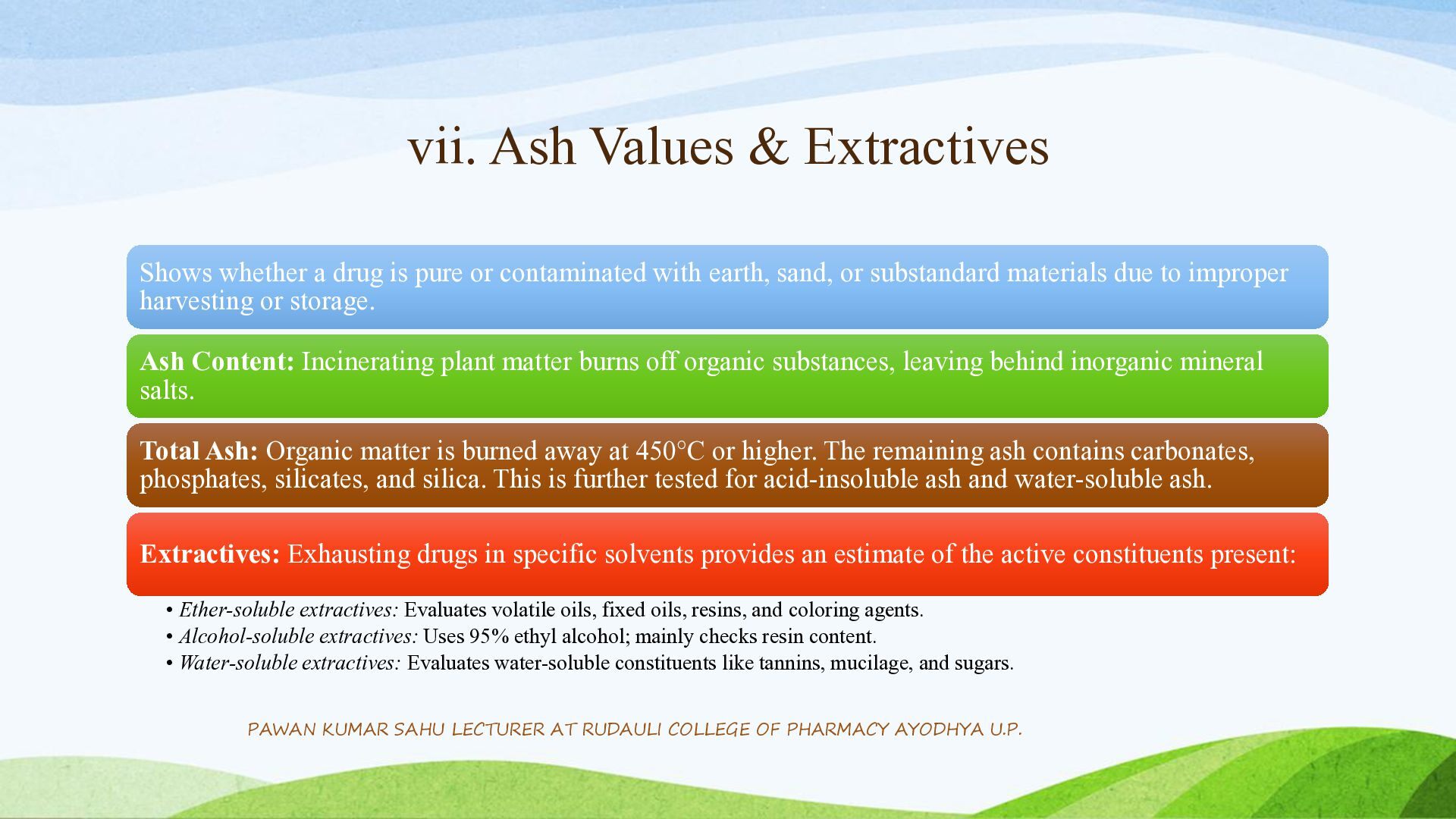
  36. vii. Ash Values & Extractives Shows whether a drug is

    pure or contaminated with earth, sand, or substandard materials due to improper harvesting or storage. Ash Content: Incinerating plant matter burns off organic substances, leaving behind inorganic mineral salts. Total Ash: Organic matter is burned away at 450°C or higher. The remaining ash contains carbonates, phosphates, silicates, and silica. This is further tested for acid-insoluble ash and water-soluble ash. Extractives: Exhausting drugs in specific solvents provides an estimate of the active constituents present: • Ether-soluble extractives: Evaluates volatile oils, fixed oils, resins, and coloring agents. • Alcohol-soluble extractives: Uses 95% ethyl alcohol; mainly checks resin content. • Water-soluble extractives: Evaluates water-soluble constituents like tannins, mucilage, and sugars. PAWAN KUMAR SAHU LECTURER AT RUDAULI COLLEGE OF PHARMACY AYODHYA U.P.
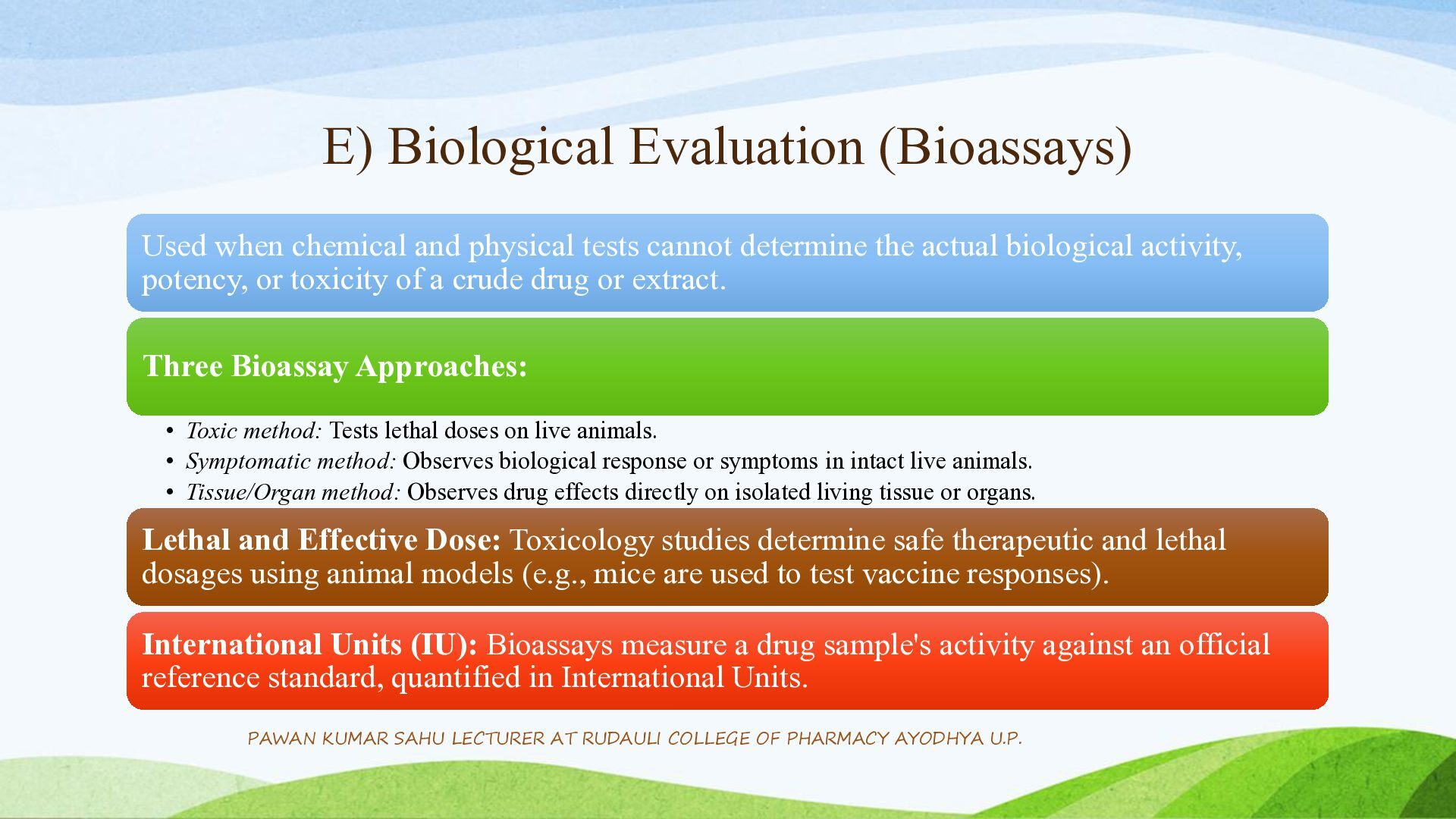
  37. E) Biological Evaluation (Bioassays) Used when chemical and physical tests

    cannot determine the actual biological activity, potency, or toxicity of a crude drug or extract. Three Bioassay Approaches: • Toxic method: Tests lethal doses on live animals. • Symptomatic method: Observes biological response or symptoms in intact live animals. • Tissue/Organ method: Observes drug effects directly on isolated living tissue or organs. Lethal and Effective Dose: Toxicology studies determine safe therapeutic and lethal dosages using animal models (e.g., mice are used to test vaccine responses). International Units (IU): Bioassays measure a drug sample's activity against an official reference standard, quantified in International Units. PAWAN KUMAR SAHU LECTURER AT RUDAULI COLLEGE OF PHARMACY AYODHYA U.P.
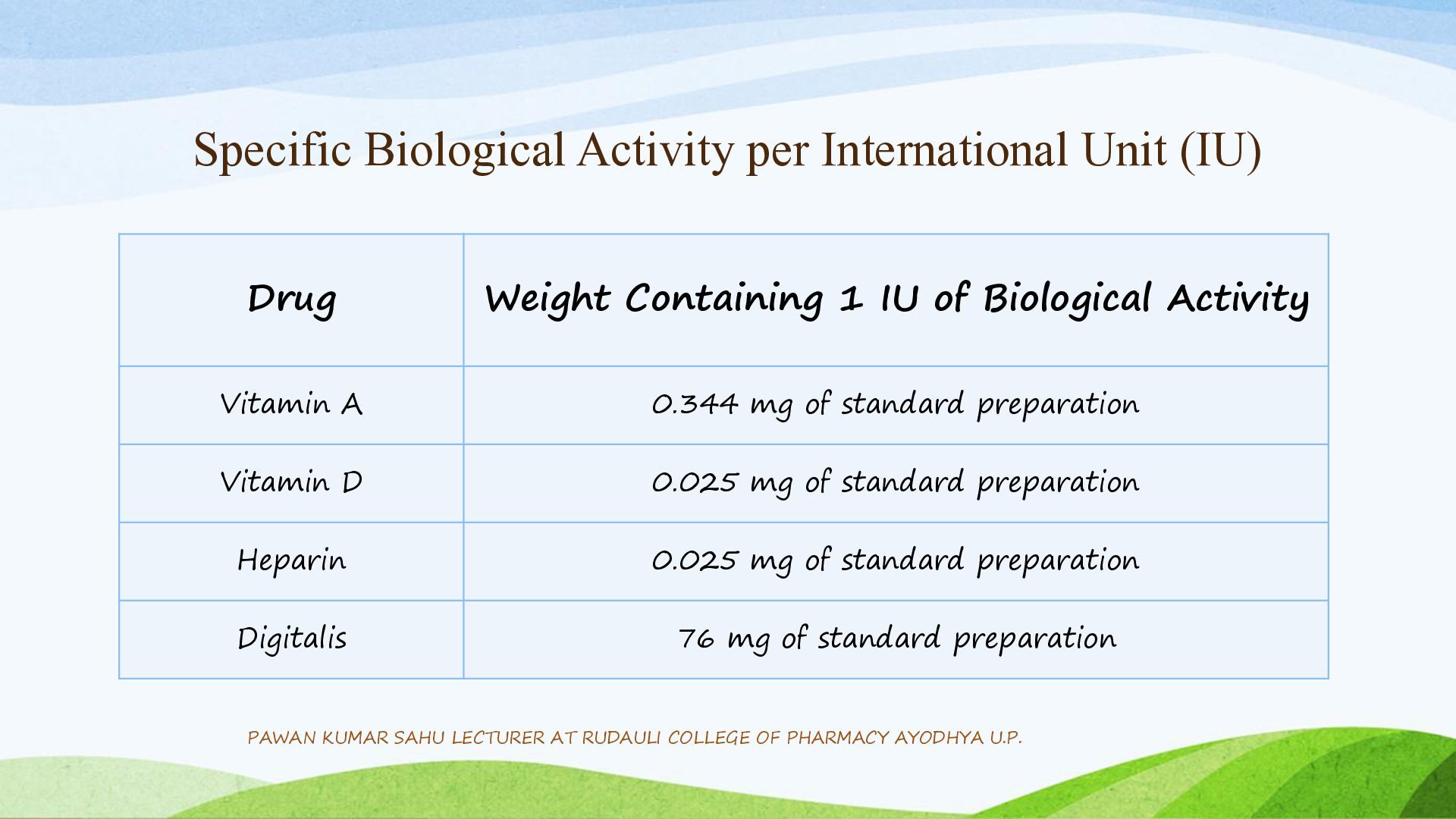
  38. Specific Biological Activity per International Unit (IU) Drug Weight Containing

    1 IU of Biological Activity Vitamin A 0.344 mg of standard preparation Vitamin D 0.025 mg of standard preparation Heparin 0.025 mg of standard preparation Digitalis 76 mg of standard preparation PAWAN KUMAR SAHU LECTURER AT RUDAULI COLLEGE OF PHARMACY AYODHYA U.P.