Upgrade to Pro — share decks privately, control downloads, hide ads and more …

Backlink Indexing Time by Link Type: Day 1–30 B...

Sponsored · SiteGround - Reliable hosting with speed, security, and support you can count on.

Backlink Indexing Time by Link Type: Day 1–30 Bands & Triggers

The report says the links are live — how long until they're actually indexed, and when should I worry?
Every timeline article answers with one averaged number, and Google's own AI Overview stretches it to "a few days to 10 weeks." This PDF answers the way campaigns actually run: backlink indexing time by link type, in six estimate bands — PR and news placements, guest posts, niche edits, Web 2.0 properties, forum and crowd links, and profile links — each with what moves the band and the exact day to escalate instead of wait.

https://en.speedyindex.com/

Avatar for Linda Bjorkvin

Linda Bjorkvin PRO

September 19, 2026

More Decks by Linda Bjorkvin

Other Decks in Marketing & SEO

Transcript

  1. S P E E D Y I N D E

    X · S E P T E M B E R 2 0 2 6 Backlink Indexing Time by Link Type: Day 1–30 Six placement types, six clocks — the estimate bands, what moves each one, and the day when waiting stops being the answer. Prepared by Linda Bjorkvin, Project Manager SpeedyIndex · en.speedyindex.com · 2026
  2. T H E O N E - L I N

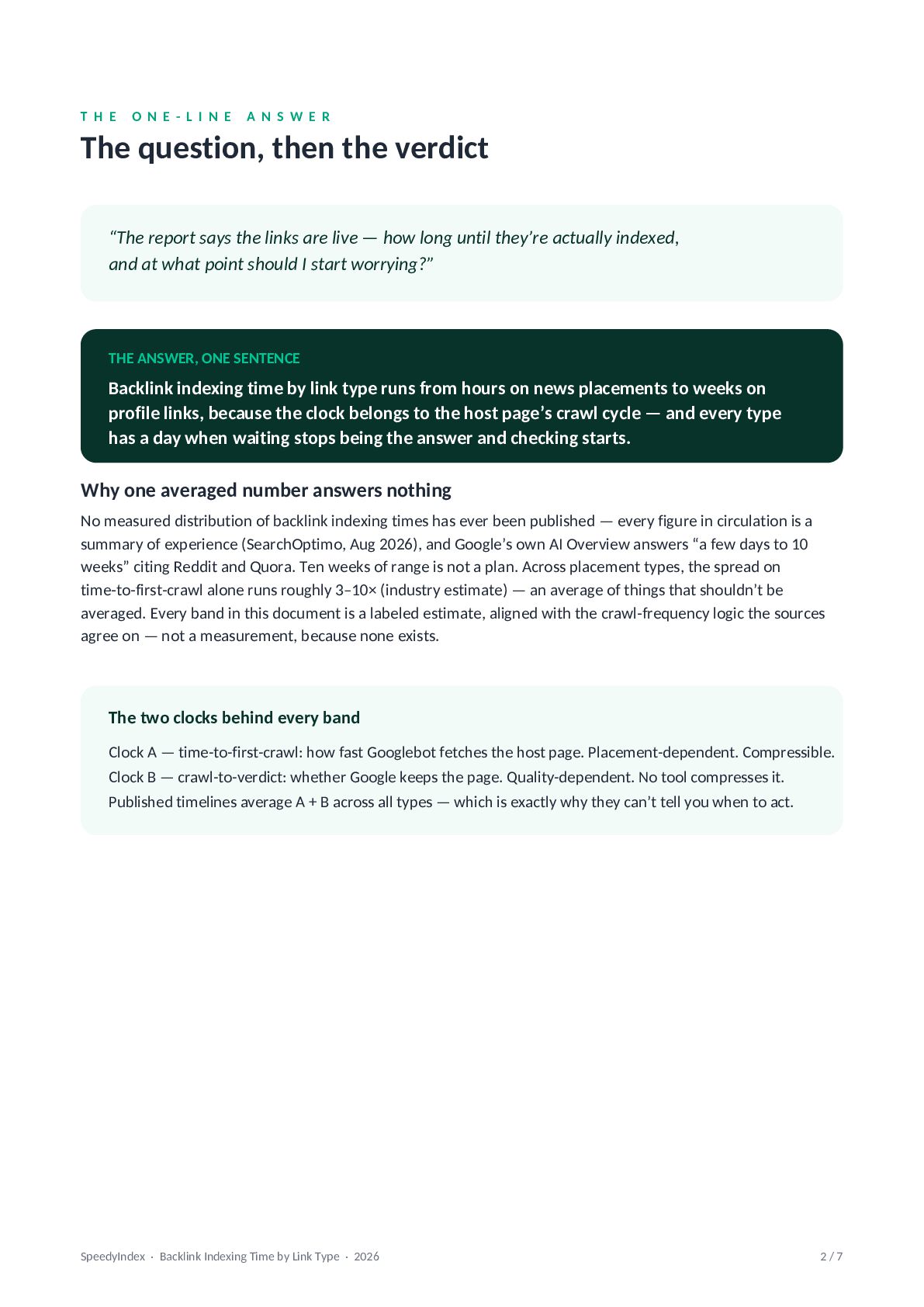
    E A N S W E R The question, then the verdict “The report says the links are live — how long until they’re actually indexed, and at what point should I start worrying?” THE ANSWER, ONE SENTENCE Backlink indexing time by link type runs from hours on news placements to weeks on profile links, because the clock belongs to the host page’s crawl cycle — and every type has a day when waiting stops being the answer and checking starts. Why one averaged number answers nothing No measured distribution of backlink indexing times has ever been published — every figure in circulation is a summary of experience (SearchOptimo, Aug 2026), and Google’s own AI Overview answers “a few days to 10 weeks” citing Reddit and Quora. Ten weeks of range is not a plan. Across placement types, the spread on time-to-first-crawl alone runs roughly 3–10× (industry estimate) — an average of things that shouldn’t be averaged. Every band in this document is a labeled estimate, aligned with the crawl-frequency logic the sources agree on — not a measurement, because none exists. The two clocks behind every band Clock A — time-to-first-crawl: how fast Googlebot fetches the host page. Placement-dependent. Compressible. Clock B — crawl-to-verdict: whether Google keeps the page. Quality-dependent. No tool compresses it. Published timelines average A + B across all types — which is exactly why they can’t tell you when to act. SpeedyIndex · Backlink Indexing Time by Link Type · 2026 2/7
  3. A S S E T 1 · B E N

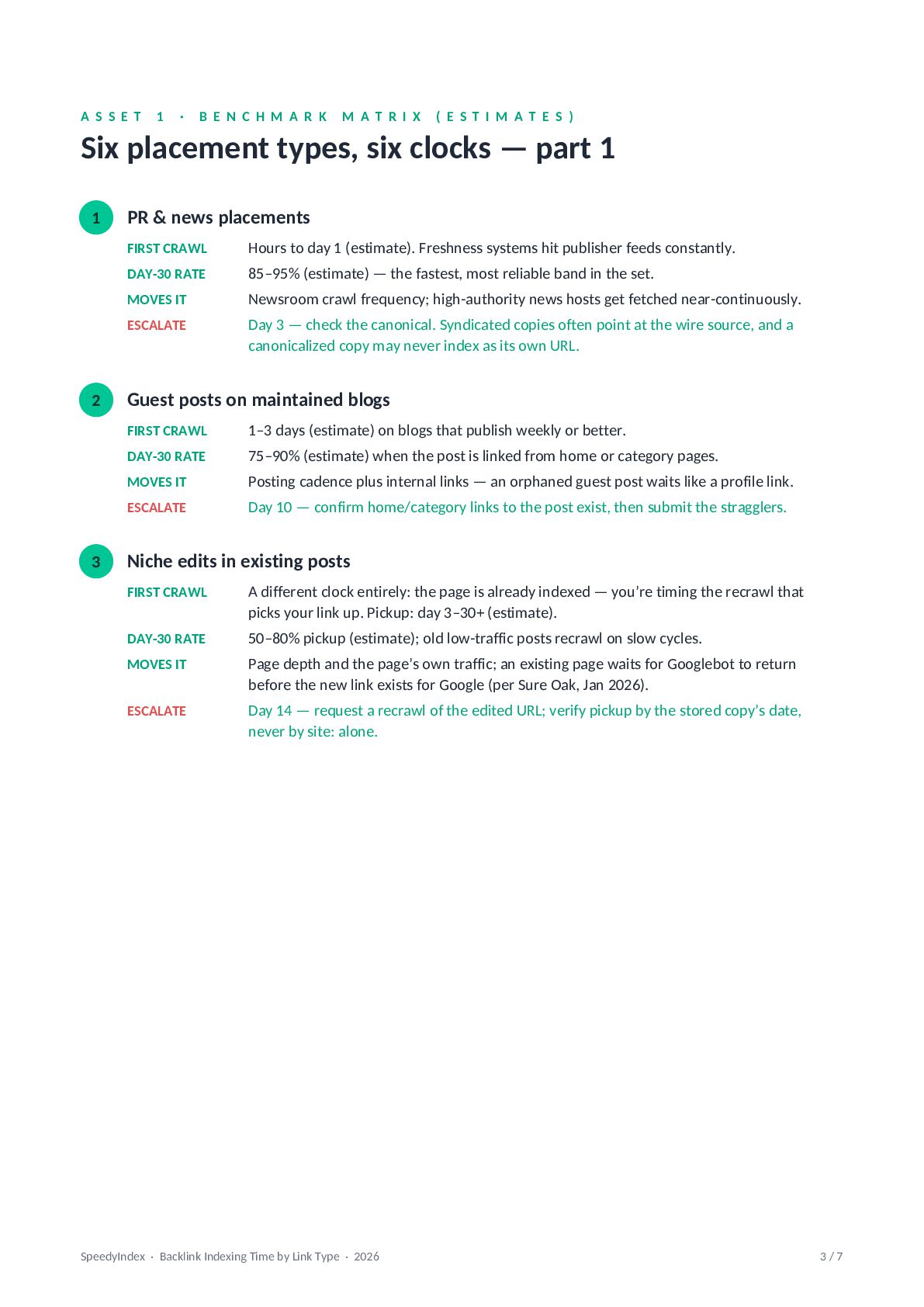
    C H M A R K M A T R I X ( E S T I M A T E S ) Six placement types, six clocks — part 1 1 2 3 PR & news placements FIRST CRAWL Hours to day 1 (estimate). Freshness systems hit publisher feeds constantly. DAY-30 RATE 85–95% (estimate) — the fastest, most reliable band in the set. MOVES IT Newsroom crawl frequency; high-authority news hosts get fetched near-continuously. ESCALATE Day 3 — check the canonical. Syndicated copies often point at the wire source, and a canonicalized copy may never index as its own URL. Guest posts on maintained blogs FIRST CRAWL 1–3 days (estimate) on blogs that publish weekly or better. DAY-30 RATE 75–90% (estimate) when the post is linked from home or category pages. MOVES IT Posting cadence plus internal links — an orphaned guest post waits like a profile link. ESCALATE Day 10 — confirm home/category links to the post exist, then submit the stragglers. Niche edits in existing posts FIRST CRAWL A different clock entirely: the page is already indexed — you’re timing the recrawl that picks your link up. Pickup: day 3–30+ (estimate). DAY-30 RATE 50–80% pickup (estimate); old low-traffic posts recrawl on slow cycles. MOVES IT Page depth and the page’s own traffic; an existing page waits for Googlebot to return before the new link exists for Google (per Sure Oak, Jan 2026). ESCALATE Day 14 — request a recrawl of the edited URL; verify pickup by the stored copy’s date, never by site: alone. SpeedyIndex · Backlink Indexing Time by Link Type · 2026 3/7
  4. A S S E T 1 · B E N

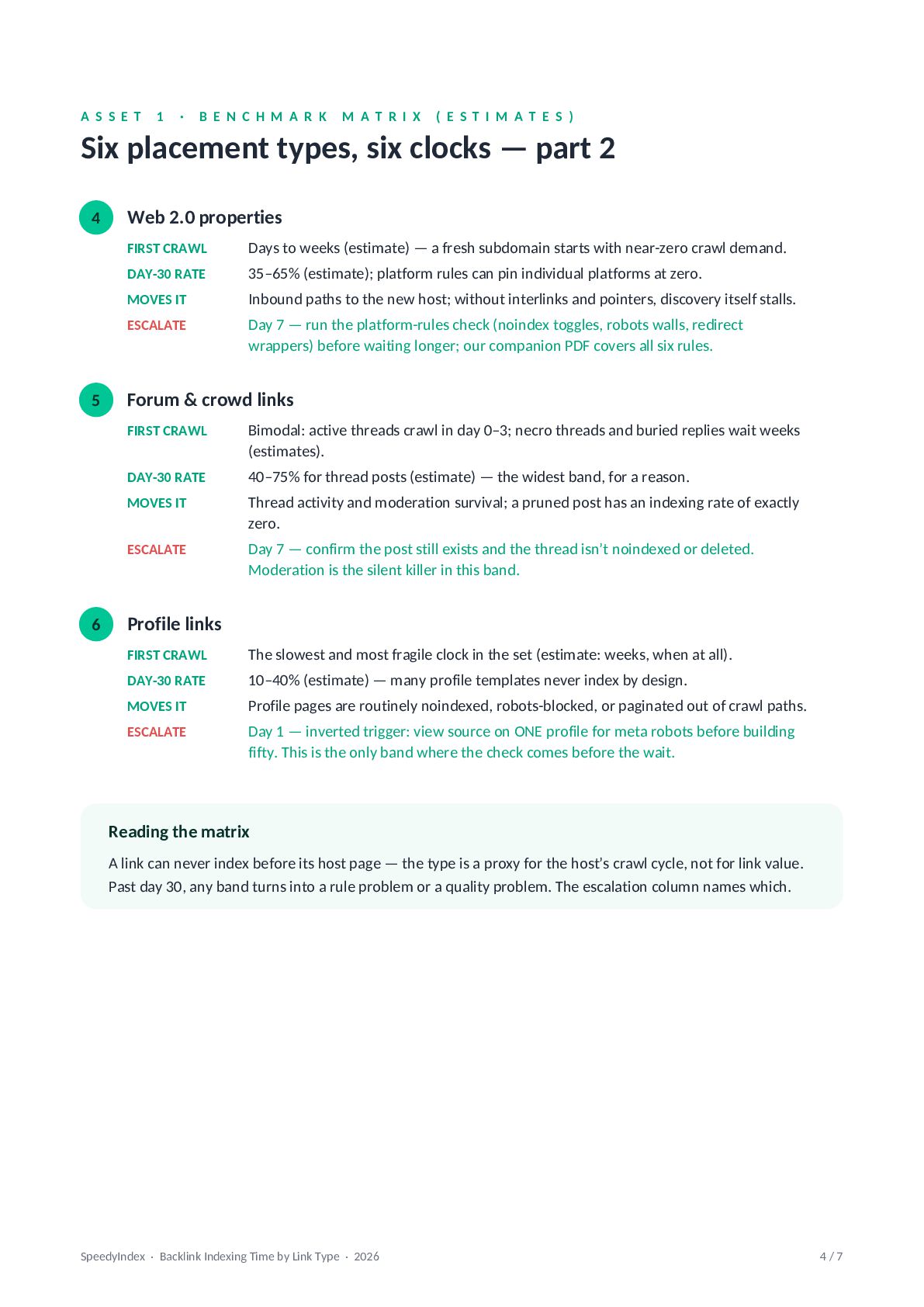
    C H M A R K M A T R I X ( E S T I M A T E S ) Six placement types, six clocks — part 2 4 5 6 Web 2.0 properties FIRST CRAWL Days to weeks (estimate) — a fresh subdomain starts with near-zero crawl demand. DAY-30 RATE 35–65% (estimate); platform rules can pin individual platforms at zero. MOVES IT Inbound paths to the new host; without interlinks and pointers, discovery itself stalls. ESCALATE Day 7 — run the platform-rules check (noindex toggles, robots walls, redirect wrappers) before waiting longer; our companion PDF covers all six rules. Forum & crowd links FIRST CRAWL Bimodal: active threads crawl in day 0–3; necro threads and buried replies wait weeks (estimates). DAY-30 RATE 40–75% for thread posts (estimate) — the widest band, for a reason. MOVES IT Thread activity and moderation survival; a pruned post has an indexing rate of exactly zero. ESCALATE Day 7 — confirm the post still exists and the thread isn’t noindexed or deleted. Moderation is the silent killer in this band. Profile links FIRST CRAWL The slowest and most fragile clock in the set (estimate: weeks, when at all). DAY-30 RATE 10–40% (estimate) — many profile templates never index by design. MOVES IT Profile pages are routinely noindexed, robots-blocked, or paginated out of crawl paths. ESCALATE Day 1 — inverted trigger: view source on ONE profile for meta robots before building fifty. This is the only band where the check comes before the wait. Reading the matrix A link can never index before its host page — the type is a proxy for the host’s crawl cycle, not for link value. Past day 30, any band turns into a rule problem or a quality problem. The escalation column names which. SpeedyIndex · Backlink Indexing Time by Link Type · 2026 4/7
  5. A S S E T 2 · T H E

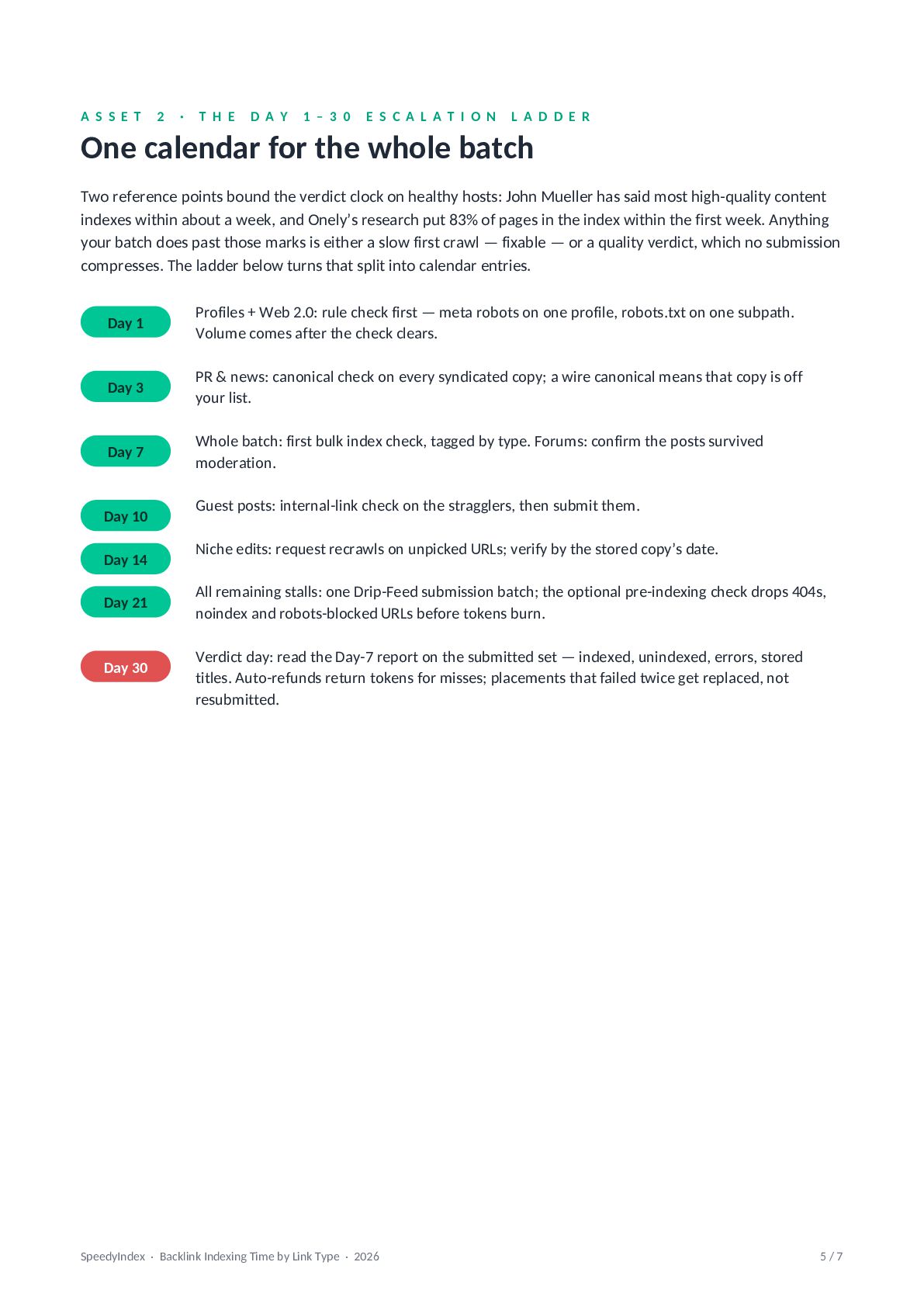
    D A Y 1 – 3 0 E S C A L A T I O N L A D D E R One calendar for the whole batch Two reference points bound the verdict clock on healthy hosts: John Mueller has said most high-quality content indexes within about a week, and Onely’s research put 83% of pages in the index within the first week. Anything your batch does past those marks is either a slow first crawl — fixable — or a quality verdict, which no submission compresses. The ladder below turns that split into calendar entries. Day 1 Profiles + Web 2.0: rule check first — meta robots on one profile, robots.txt on one subpath. Volume comes after the check clears. Day 3 PR & news: canonical check on every syndicated copy; a wire canonical means that copy is off your list. Day 7 Whole batch: first bulk index check, tagged by type. Forums: confirm the posts survived moderation. Day 10 Day 14 Day 21 Day 30 Guest posts: internal-link check on the stragglers, then submit them. Niche edits: request recrawls on unpicked URLs; verify by the stored copy’s date. All remaining stalls: one Drip-Feed submission batch; the optional pre-indexing check drops 404s, noindex and robots-blocked URLs before tokens burn. Verdict day: read the Day-7 report on the submitted set — indexed, unindexed, errors, stored titles. Auto-refunds return tokens for misses; placements that failed twice get replaced, not resubmitted. SpeedyIndex · Backlink Indexing Time by Link Type · 2026 5/7
  6. T H E W O R K F L O

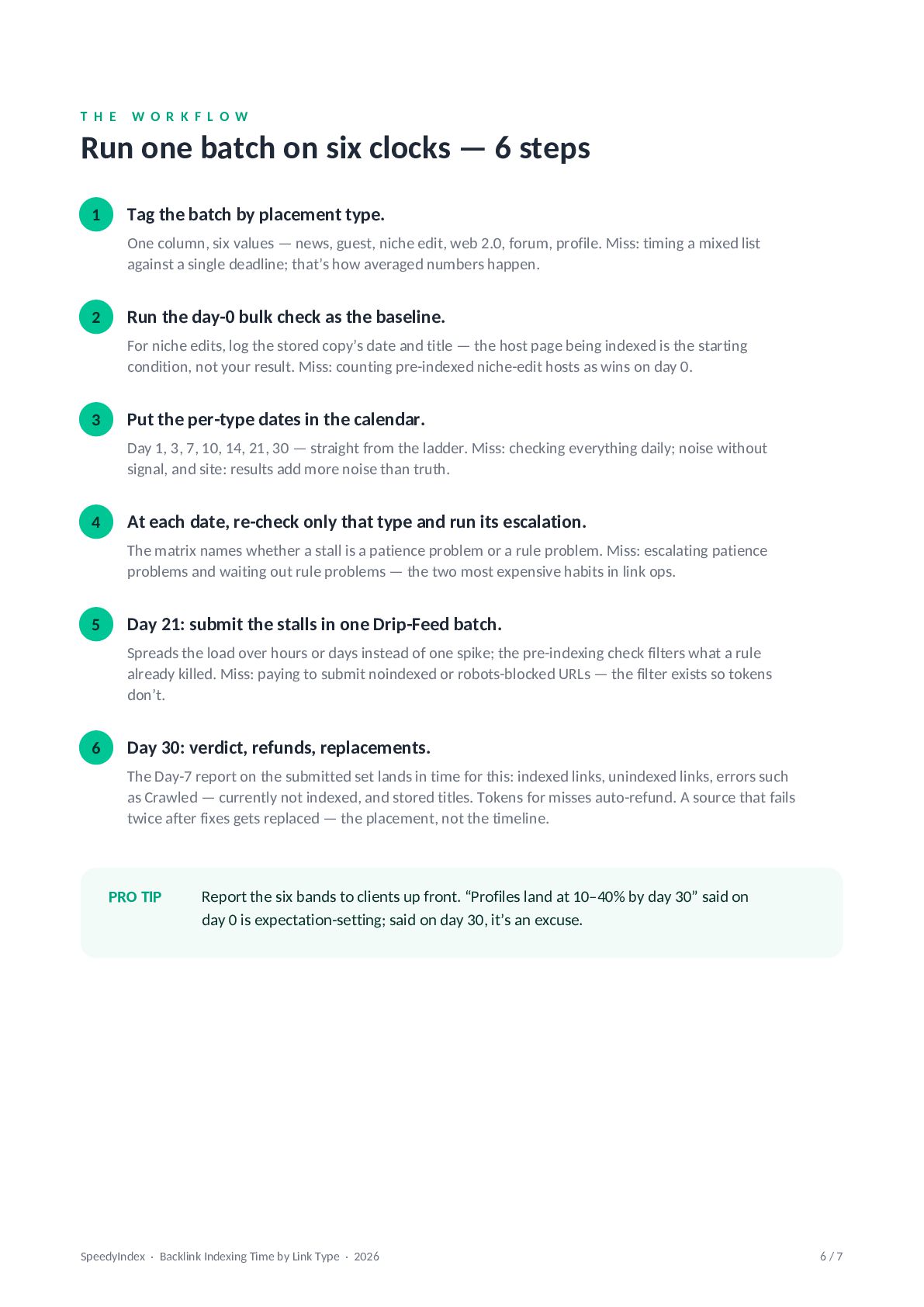
    W Run one batch on six clocks — 6 steps 1 Tag the batch by placement type. One column, six values — news, guest, niche edit, web 2.0, forum, profile. Miss: timing a mixed list against a single deadline; that’s how averaged numbers happen. 2 Run the day-0 bulk check as the baseline. For niche edits, log the stored copy’s date and title — the host page being indexed is the starting condition, not your result. Miss: counting pre-indexed niche-edit hosts as wins on day 0. 3 Put the per-type dates in the calendar. Day 1, 3, 7, 10, 14, 21, 30 — straight from the ladder. Miss: checking everything daily; noise without signal, and site: results add more noise than truth. 4 At each date, re-check only that type and run its escalation. The matrix names whether a stall is a patience problem or a rule problem. Miss: escalating patience problems and waiting out rule problems — the two most expensive habits in link ops. 5 Day 21: submit the stalls in one Drip-Feed batch. Spreads the load over hours or days instead of one spike; the pre-indexing check filters what a rule already killed. Miss: paying to submit noindexed or robots-blocked URLs — the filter exists so tokens don’t. 6 Day 30: verdict, refunds, replacements. The Day-7 report on the submitted set lands in time for this: indexed links, unindexed links, errors such as Crawled — currently not indexed, and stored titles. Tokens for misses auto-refund. A source that fails twice after fixes gets replaced — the placement, not the timeline. PRO TIP Report the six bands to clients up front. “Profiles land at 10–40% by day 30” said on day 0 is expectation-setting; said on day 30, it’s an excuse. SpeedyIndex · Backlink Indexing Time by Link Type · 2026 6/7
  7. T H E H O N E S T S

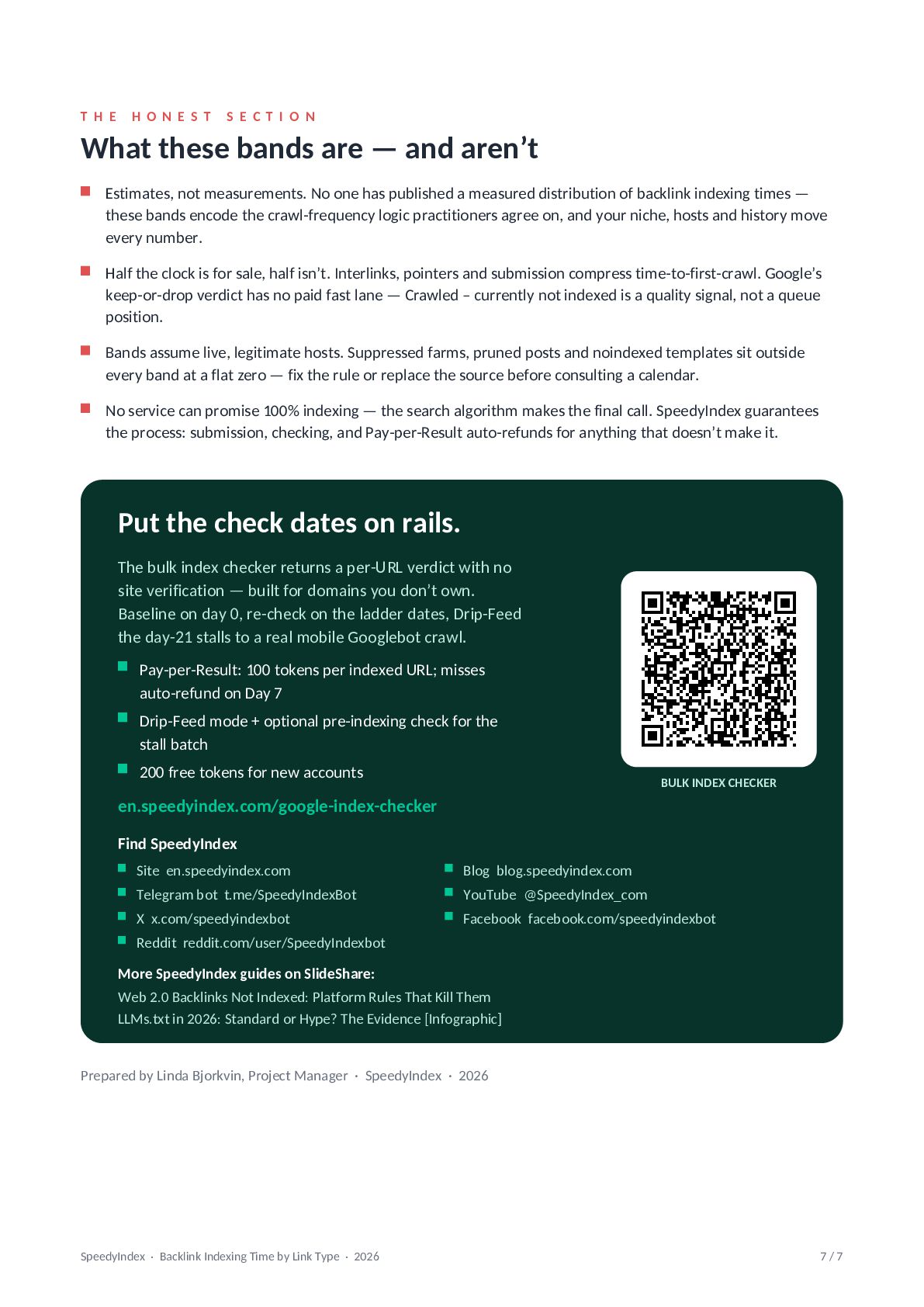
    E C T I O N What these bands are — and aren’t Estimates, not measurements. No one has published a measured distribution of backlink indexing times — these bands encode the crawl-frequency logic practitioners agree on, and your niche, hosts and history move every number. Half the clock is for sale, half isn’t. Interlinks, pointers and submission compress time-to-first-crawl. Google’s keep-or-drop verdict has no paid fast lane — Crawled – currently not indexed is a quality signal, not a queue position. Bands assume live, legitimate hosts. Suppressed farms, pruned posts and noindexed templates sit outside every band at a flat zero — fix the rule or replace the source before consulting a calendar. No service can promise 100% indexing — the search algorithm makes the final call. SpeedyIndex guarantees the process: submission, checking, and Pay-per-Result auto-refunds for anything that doesn’t make it. Put the check dates on rails. The bulk index checker returns a per-URL verdict with no site verification — built for domains you don’t own. Baseline on day 0, re-check on the ladder dates, Drip-Feed the day-21 stalls to a real mobile Googlebot crawl. Pay-per-Result: 100 tokens per indexed URL; misses auto-refund on Day 7 Drip-Feed mode + optional pre-indexing check for the stall batch 200 free tokens for new accounts BULK INDEX CHECKER en.speedyindex.com/google-index-checker Find SpeedyIndex Site en.speedyindex.com Blog blog.speedyindex.com Telegram bot t.me/SpeedyIndexBot YouTube @SpeedyIndex_com X x.com/speedyindexbot Facebook facebook.com/speedyindexbot Reddit reddit.com/user/SpeedyIndexbot More SpeedyIndex guides on SlideShare: Web 2.0 Backlinks Not Indexed: Platform Rules That Kill Them LLMs.txt in 2026: Standard or Hype? The Evidence [Infographic] Prepared by Linda Bjorkvin, Project Manager · SpeedyIndex · 2026 SpeedyIndex · Backlink Indexing Time by Link Type · 2026 7/7