Upgrade to Pro — share decks privately, control downloads, hide ads and more …

NEET Previous Year Question Papers (2020–2025):...

Sponsored · Your Podcast. Everywhere. Effortlessly. Share. Educate. Inspire. Entertain. You do you. We'll handle the rest. →

NEET Previous Year Question Papers (2020–2025): Complete PYQ Study Strategy Guide

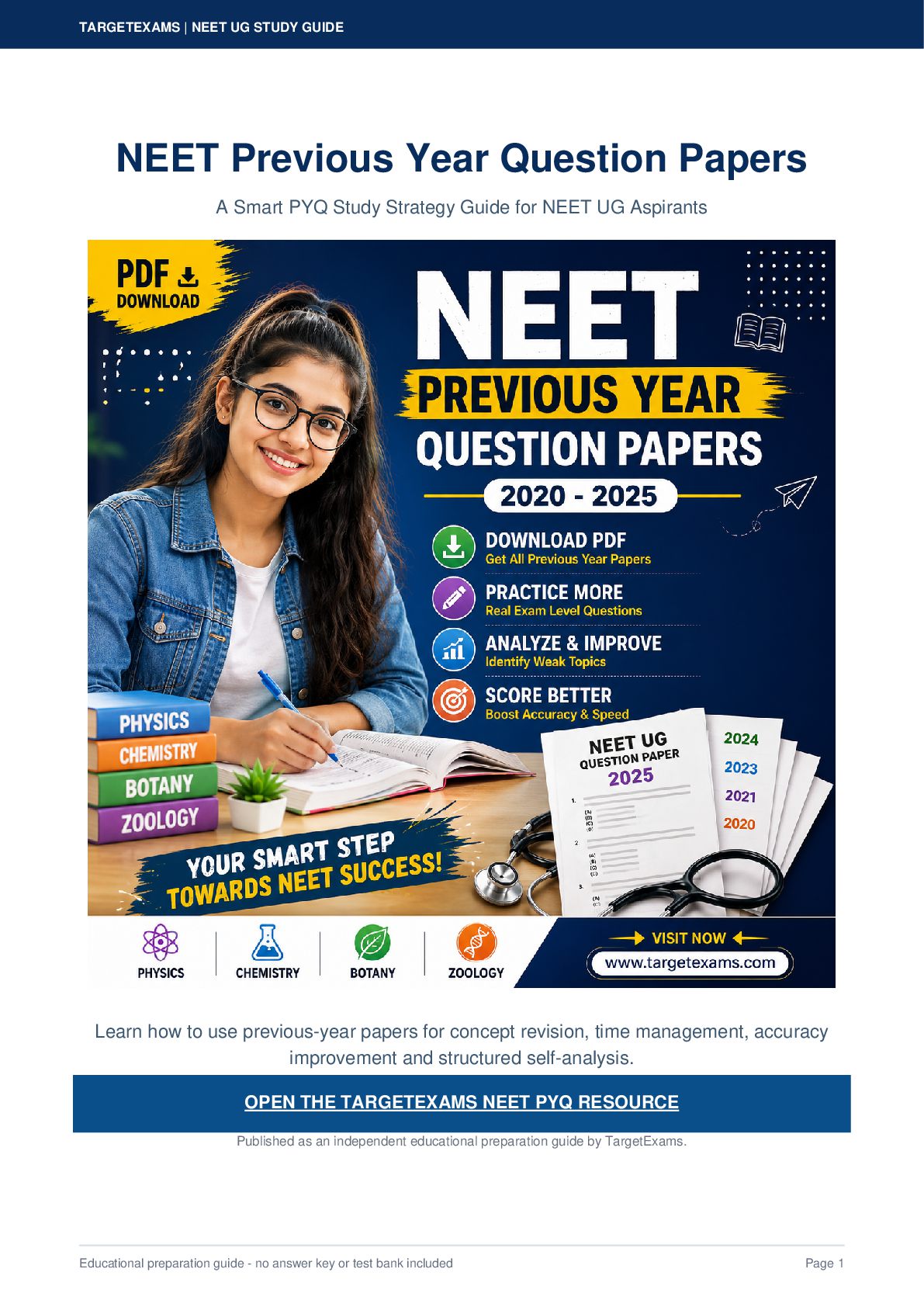
Prepare smarter for NEET UG with this practical study strategy guide to using NEET Previous Year Question Papers effectively. Learn how to analyse PYQs, identify weak topics, improve speed and accuracy, manage exam time, and combine NCERT study with previous papers and mock tests. The guide covers Physics, Chemistry, Botany and Zoology preparation strategies and explains how to turn previous year questions into an effective revision tool. Ideal for NEET aspirants looking for structured PYQ practice, revision strategies and exam-focused preparation. Access NEET Previous Year Question Papers and continue your practice at https://www.targetexams.com/neet-previous-year-question-papers

Avatar for Umar Rahman

Umar Rahman

August 30, 2026

Other Decks in Education

Transcript

  1. TARGETEXAMS | NEET UG STUDY GUIDE NEET Previous Year Question

    Papers A Smart PYQ Study Strategy Guide for NEET UG Aspirants Learn how to use previous-year papers for concept revision, time management, accuracy improvement and structured self-analysis. OPEN THE TARGETEXAMS NEET PYQ RESOURCE Published as an independent educational preparation guide by TargetExams. Educational preparation guide - no answer key or test bank included Page 1
  2. TARGETEXAMS | NEET UG STUDY GUIDE 1. Why Previous-Year Papers

    Belong in a Serious NEET Study Plan A large syllabus can create the illusion that preparation is mainly about reading more chapters and solving more questions. In reality, competitive-exam preparation also requires a student to understand how knowledge is tested. Previous-year questions are useful because they connect conceptual study with examination-style decision making. A PYQ session can reveal whether a student recognises the correct concept quickly, whether calculations are efficient, whether closely related options cause confusion, and whether the student remains accurate under time pressure. These are skills that ordinary reading cannot measure. The best use of PYQs is therefore not memorisation. The aim is to study the reasoning demanded by the question, identify gaps in preparation and use those gaps to decide what should be revised next. • Use PYQs after completing a chapter to test application. • Use mixed PYQ sessions to practise switching between concepts. • Use full-paper sessions later to build stamina and time discipline. • Review doubtful answers even when the final option happened to be correct. Important: This guide discusses preparation strategy only. It does not reproduce exam questions, answer keys or a test bank. VIEW NEET PREVIOUS-YEAR PAPER RESOURCES Educational preparation guide - no answer key or test bank included Page 2
  3. TARGETEXAMS | NEET UG STUDY GUIDE 2. The Attempt -

    Analyse - Revise Framework A previous-year paper becomes valuable only when the attempt is followed by analysis. A simple three-stage framework keeps practice purposeful. Attempt. Work independently. During chapter-wise practice, focus on accuracy and reasoning. During full-paper practice, use a timer and avoid checking explanations while the session is in progress. Analyse. After the session, classify every weak response. Was the concept unclear? Was the formula remembered incorrectly? Was the calculation too slow? Was a keyword in the question overlooked? Was the answer a guess? Revise. Return to the source concept. Re-read the relevant NCERT section or trusted study note, rewrite the formula if necessary, and practise a few fresh problems that test the same idea in a different way. • Wrong answer + clear reason = useful feedback. • Correct answer + guesswork = still a revision signal. • Slow correct answer = a speed problem worth fixing. • Repeated error = a priority topic for the next revision cycle. START WITH THE TARGETEXAMS NEET PYQ PAGE Educational preparation guide - no answer key or test bank included Page 3
  4. TARGETEXAMS | NEET UG STUDY GUIDE 3. Chapter-Wise PYQs vs

    Full-Paper Practice Both chapter-wise and year-wise practice have a place in NEET preparation, but they solve different problems. Chapter-wise practice works best while the syllabus is being completed. It gives immediate feedback after a topic has been studied and prevents students from postponing application practice until the end of the course. Full-paper practice becomes more important once a substantial part of the syllabus is complete. It tests concentration, subject switching, time allocation and the ability to leave a difficult question without losing momentum. A practical transition is to begin with chapter-level practice, move to subject-level mixed sessions, and then increase complete timed-paper practice as the examination approaches. • Early phase: concept study + chapter-wise PYQs. • Middle phase: mixed chapters + subject-wise practice. • Final phase: full timed papers + detailed post-test review. EXPLORE THE NEET PYQ COLLECTION Educational preparation guide - no answer key or test bank included Page 4
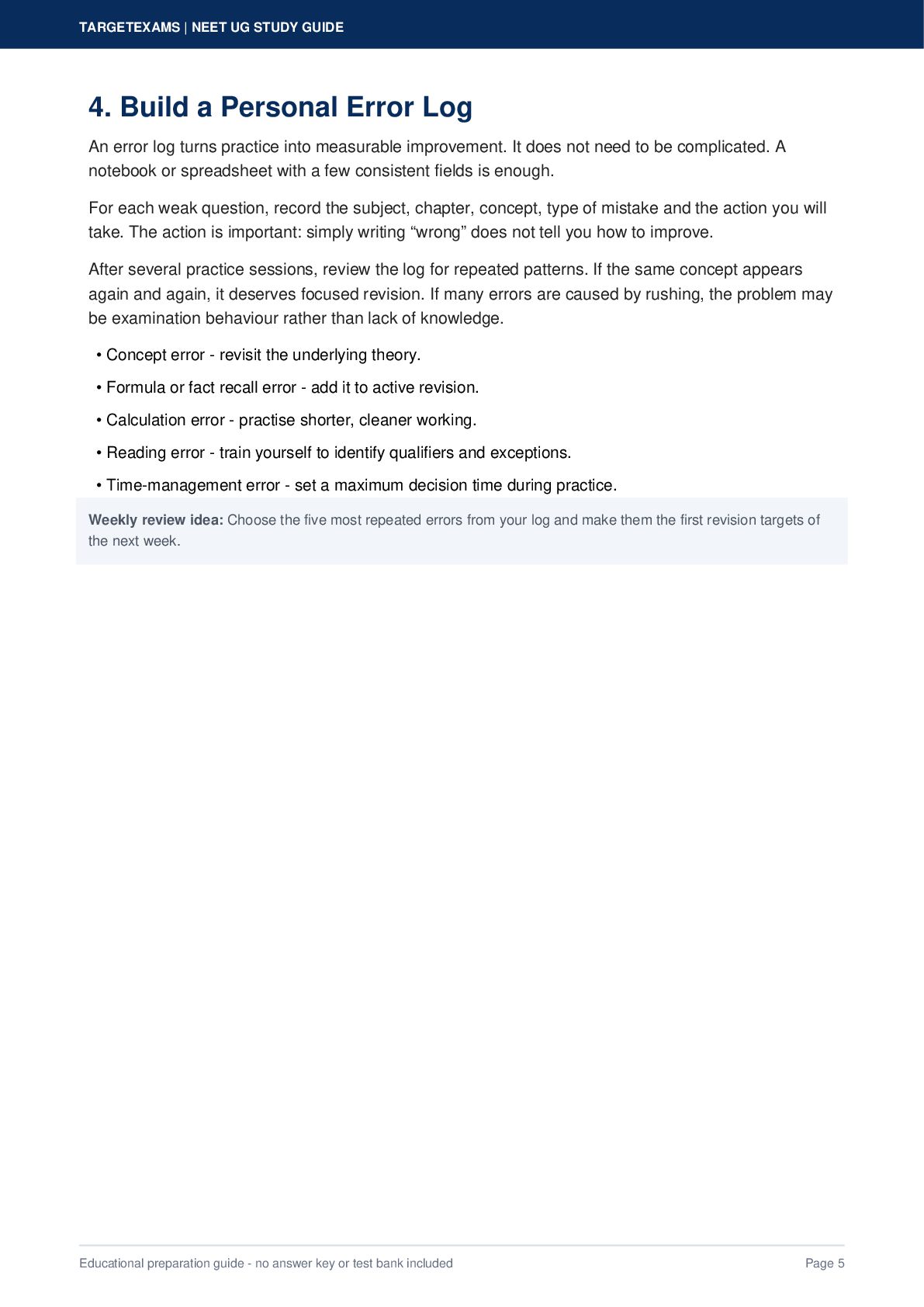
  5. TARGETEXAMS | NEET UG STUDY GUIDE 4. Build a Personal

    Error Log An error log turns practice into measurable improvement. It does not need to be complicated. A notebook or spreadsheet with a few consistent fields is enough. For each weak question, record the subject, chapter, concept, type of mistake and the action you will take. The action is important: simply writing “wrong” does not tell you how to improve. After several practice sessions, review the log for repeated patterns. If the same concept appears again and again, it deserves focused revision. If many errors are caused by rushing, the problem may be examination behaviour rather than lack of knowledge. • Concept error - revisit the underlying theory. • Formula or fact recall error - add it to active revision. • Calculation error - practise shorter, cleaner working. • Reading error - train yourself to identify qualifiers and exceptions. • Time-management error - set a maximum decision time during practice. Weekly review idea: Choose the five most repeated errors from your log and make them the first revision targets of the next week. Educational preparation guide - no answer key or test bank included Page 5
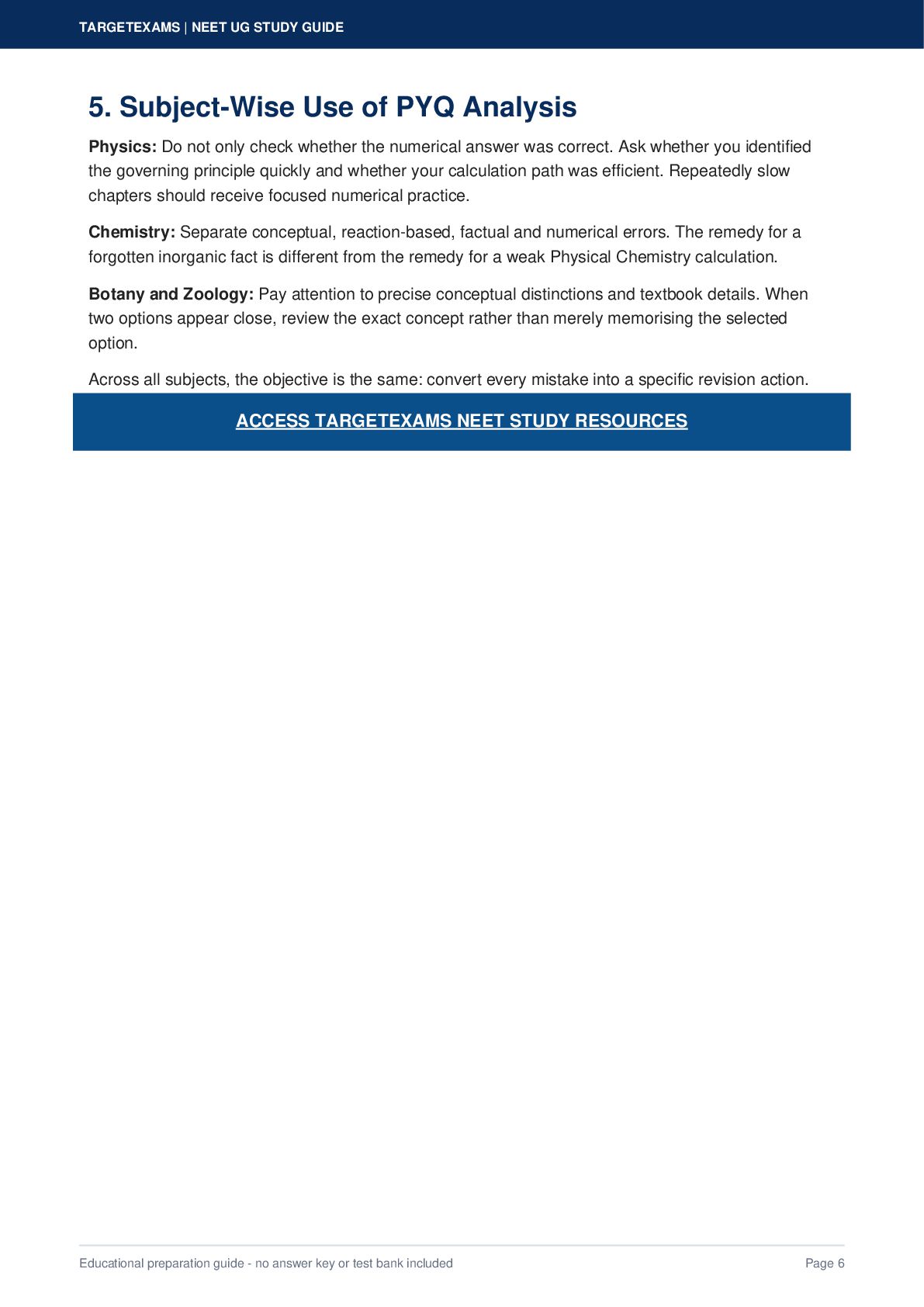
  6. TARGETEXAMS | NEET UG STUDY GUIDE 5. Subject-Wise Use of

    PYQ Analysis Physics: Do not only check whether the numerical answer was correct. Ask whether you identified the governing principle quickly and whether your calculation path was efficient. Repeatedly slow chapters should receive focused numerical practice. Chemistry: Separate conceptual, reaction-based, factual and numerical errors. The remedy for a forgotten inorganic fact is different from the remedy for a weak Physical Chemistry calculation. Botany and Zoology: Pay attention to precise conceptual distinctions and textbook details. When two options appear close, review the exact concept rather than merely memorising the selected option. Across all subjects, the objective is the same: convert every mistake into a specific revision action. ACCESS TARGETEXAMS NEET STUDY RESOURCES Educational preparation guide - no answer key or test bank included Page 6
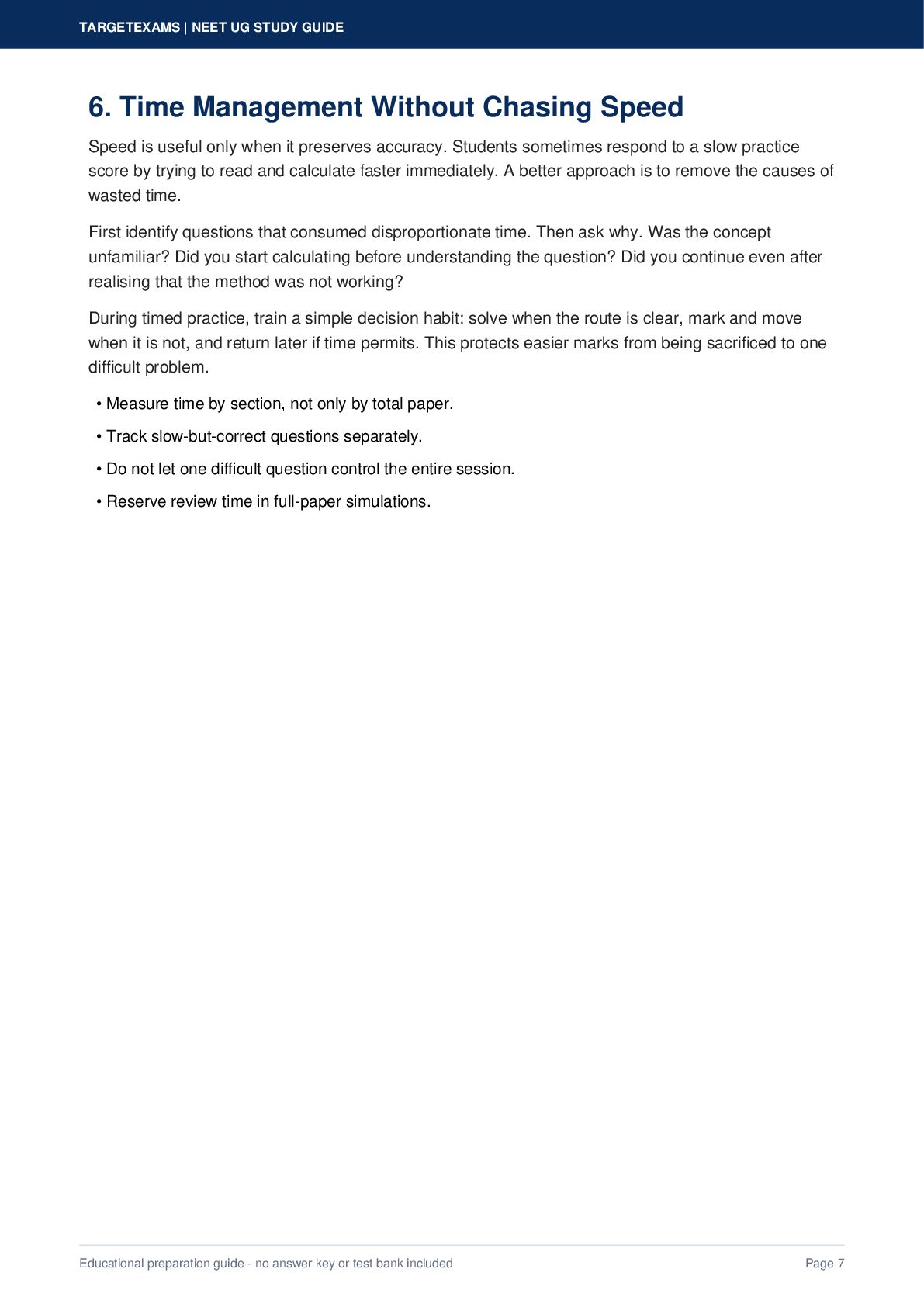
  7. TARGETEXAMS | NEET UG STUDY GUIDE 6. Time Management Without

    Chasing Speed Speed is useful only when it preserves accuracy. Students sometimes respond to a slow practice score by trying to read and calculate faster immediately. A better approach is to remove the causes of wasted time. First identify questions that consumed disproportionate time. Then ask why. Was the concept unfamiliar? Did you start calculating before understanding the question? Did you continue even after realising that the method was not working? During timed practice, train a simple decision habit: solve when the route is clear, mark and move when it is not, and return later if time permits. This protects easier marks from being sacrificed to one difficult problem. • Measure time by section, not only by total paper. • Track slow-but-correct questions separately. • Do not let one difficult question control the entire session. • Reserve review time in full-paper simulations. Educational preparation guide - no answer key or test bank included Page 7
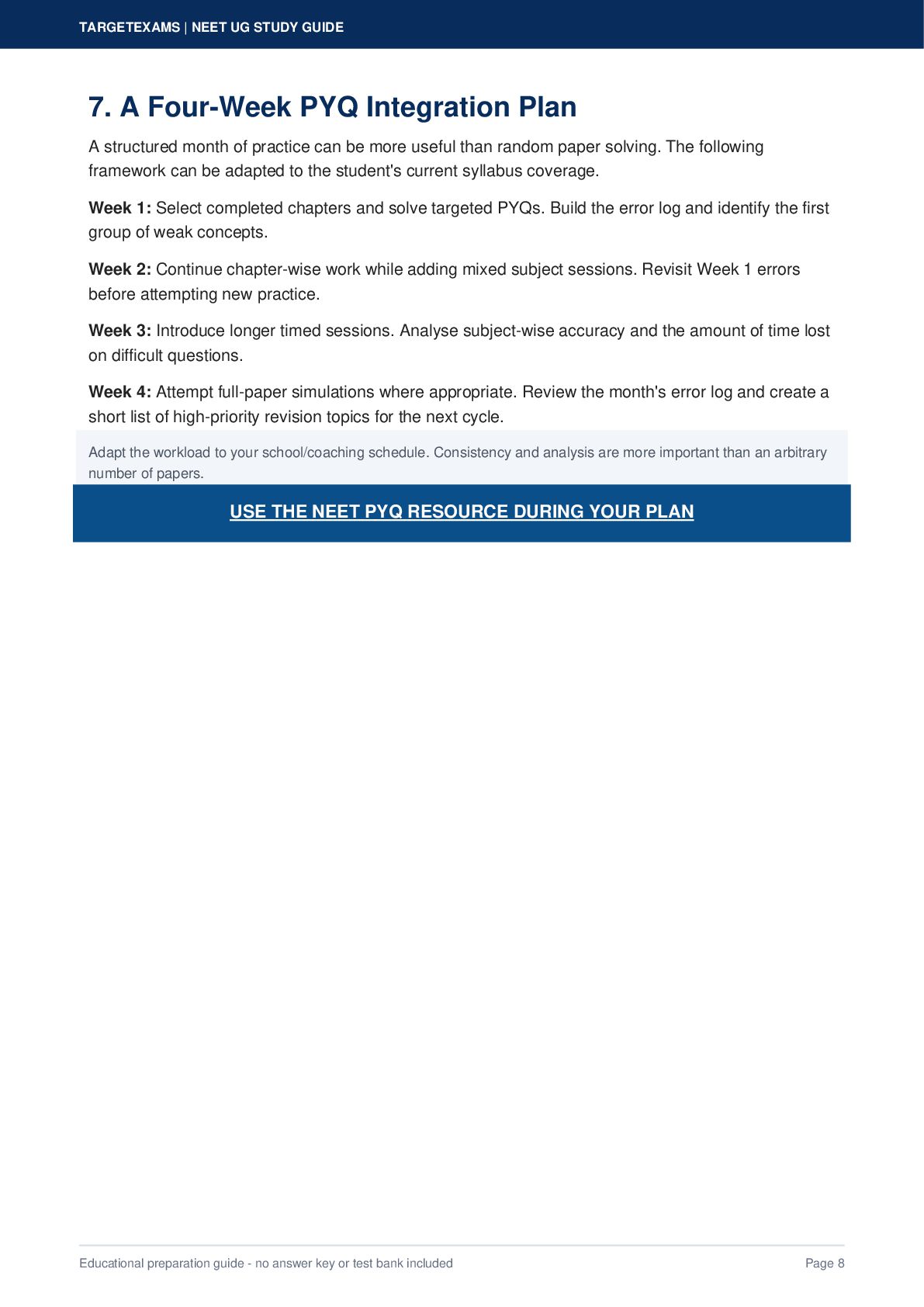
  8. TARGETEXAMS | NEET UG STUDY GUIDE 7. A Four-Week PYQ

    Integration Plan A structured month of practice can be more useful than random paper solving. The following framework can be adapted to the student's current syllabus coverage. Week 1: Select completed chapters and solve targeted PYQs. Build the error log and identify the first group of weak concepts. Week 2: Continue chapter-wise work while adding mixed subject sessions. Revisit Week 1 errors before attempting new practice. Week 3: Introduce longer timed sessions. Analyse subject-wise accuracy and the amount of time lost on difficult questions. Week 4: Attempt full-paper simulations where appropriate. Review the month's error log and create a short list of high-priority revision topics for the next cycle. Adapt the workload to your school/coaching schedule. Consistency and analysis are more important than an arbitrary number of papers. USE THE NEET PYQ RESOURCE DURING YOUR PLAN Educational preparation guide - no answer key or test bank included Page 8
  9. TARGETEXAMS | NEET UG STUDY GUIDE 8. What PYQs Can

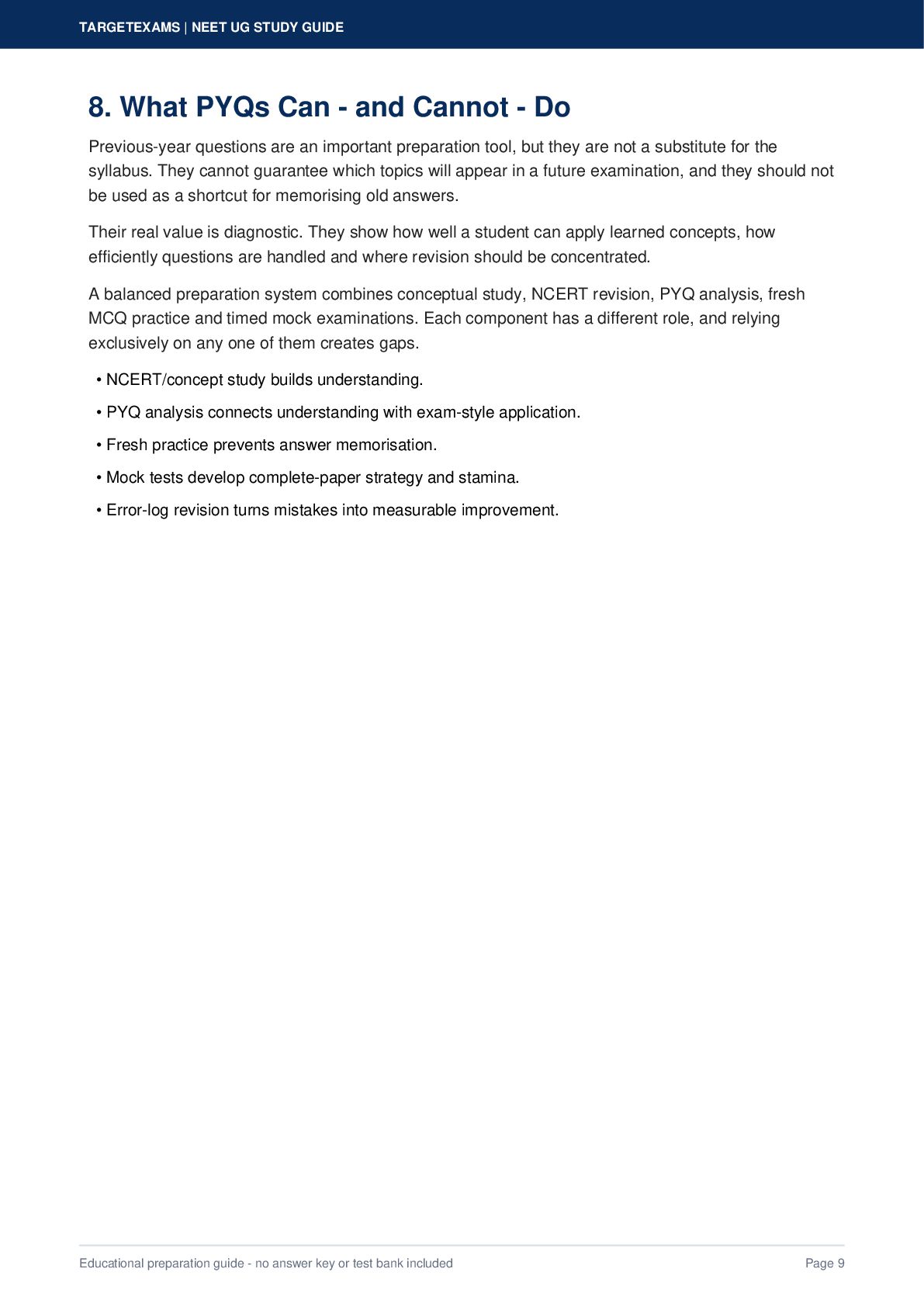
    - and Cannot - Do Previous-year questions are an important preparation tool, but they are not a substitute for the syllabus. They cannot guarantee which topics will appear in a future examination, and they should not be used as a shortcut for memorising old answers. Their real value is diagnostic. They show how well a student can apply learned concepts, how efficiently questions are handled and where revision should be concentrated. A balanced preparation system combines conceptual study, NCERT revision, PYQ analysis, fresh MCQ practice and timed mock examinations. Each component has a different role, and relying exclusively on any one of them creates gaps. • NCERT/concept study builds understanding. • PYQ analysis connects understanding with exam-style application. • Fresh practice prevents answer memorisation. • Mock tests develop complete-paper strategy and stamina. • Error-log revision turns mistakes into measurable improvement. Educational preparation guide - no answer key or test bank included Page 9
  10. TARGETEXAMS | NEET UG STUDY GUIDE 9. Final Checklist Before

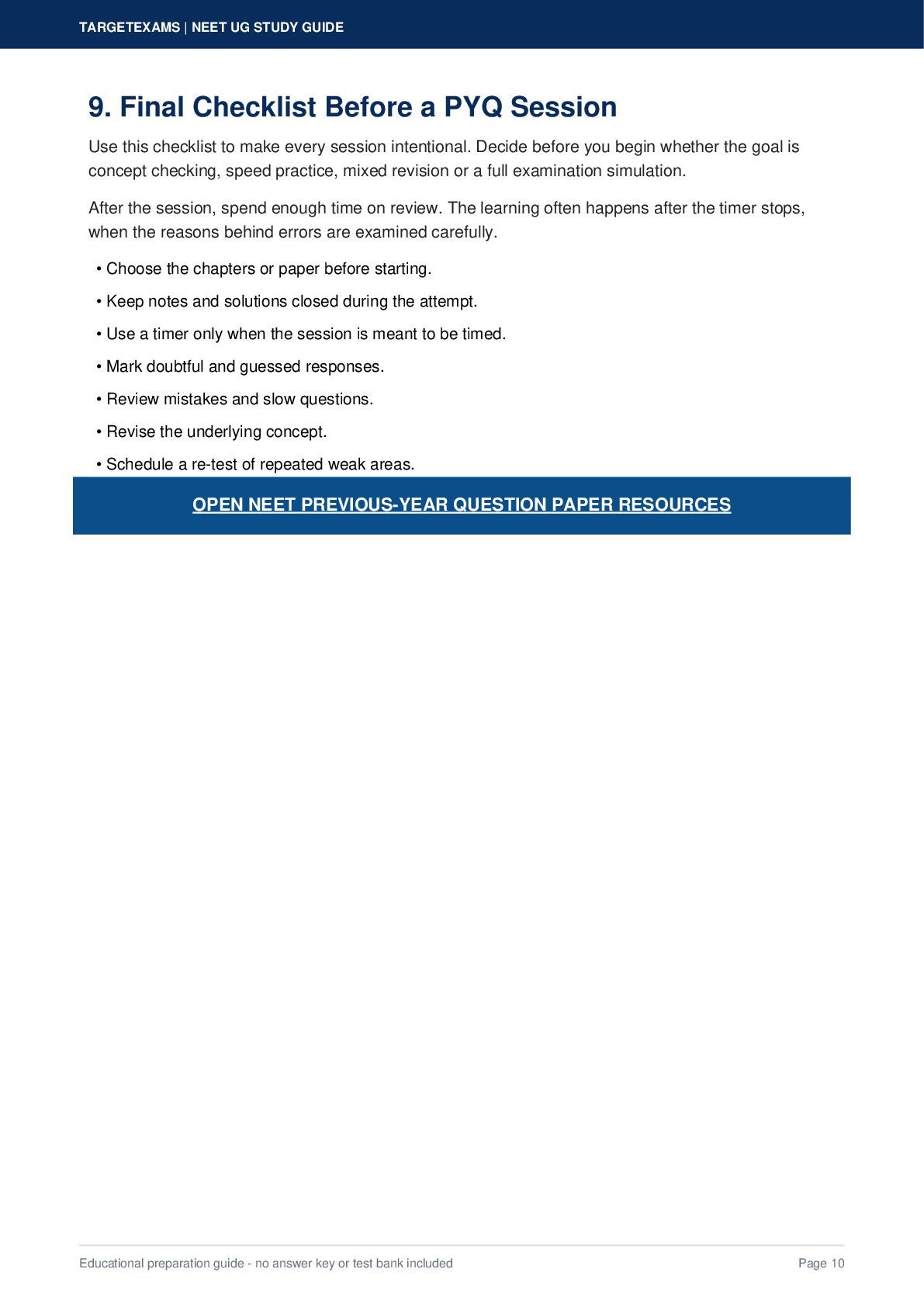
    a PYQ Session Use this checklist to make every session intentional. Decide before you begin whether the goal is concept checking, speed practice, mixed revision or a full examination simulation. After the session, spend enough time on review. The learning often happens after the timer stops, when the reasons behind errors are examined carefully. • Choose the chapters or paper before starting. • Keep notes and solutions closed during the attempt. • Use a timer only when the session is meant to be timed. • Mark doubtful and guessed responses. • Review mistakes and slow questions. • Revise the underlying concept. • Schedule a re-test of repeated weak areas. OPEN NEET PREVIOUS-YEAR QUESTION PAPER RESOURCES Educational preparation guide - no answer key or test bank included Page 10
  11. TARGETEXAMS | NEET UG STUDY GUIDE 10. Continue Your NEET

    Preparation Previous-year paper practice works best when it leads to a clear next step. Use your analysis to decide what to revise, which concepts need additional questions and when you are ready for longer timed practice. NEET Previous Year Question Papers & PYQ Resource https://www.targetexams.com/neet-previous-year-question-papers VISIT THE NEET PYQ RESOURCE TargetExams Main Website https://www.targetexams.com/ EXPLORE TARGETEXAMS Educational notice: This publication is an independent study-strategy guide. It does not reproduce examination questions, answer keys, test-bank content or guaranteed-result claims. TargetExams is not presented as NTA or as a government examination authority. Students should use the official examination authority for current notices, dates, eligibility rules and official instructions. Copyright notice: The explanatory text and layout in this guide are prepared for this publication. Only upload material for which you hold the necessary rights and permissions. TargetExams | Study smarter through structured practice and analysis. Educational preparation guide - no answer key or test bank included Page 11