Upgrade to Pro — share decks privately, control downloads, hide ads and more …

Commercial Recovery in India: Which Legal Route...

Commercial Recovery in India: Which Legal Route Should a Business Choose?

A practical board-level briefing on commercial recovery in India, covering legal routes, contractual disputes, MSME delayed payments, IBC proceedings, pre-institution mediation, evidence, and key factors businesses should consider before pursuing recovery.

Avatar for The SALT Legal

The SALT Legal

September 24, 2026

More Decks by The SALT Legal

Other Decks in Business

Transcript

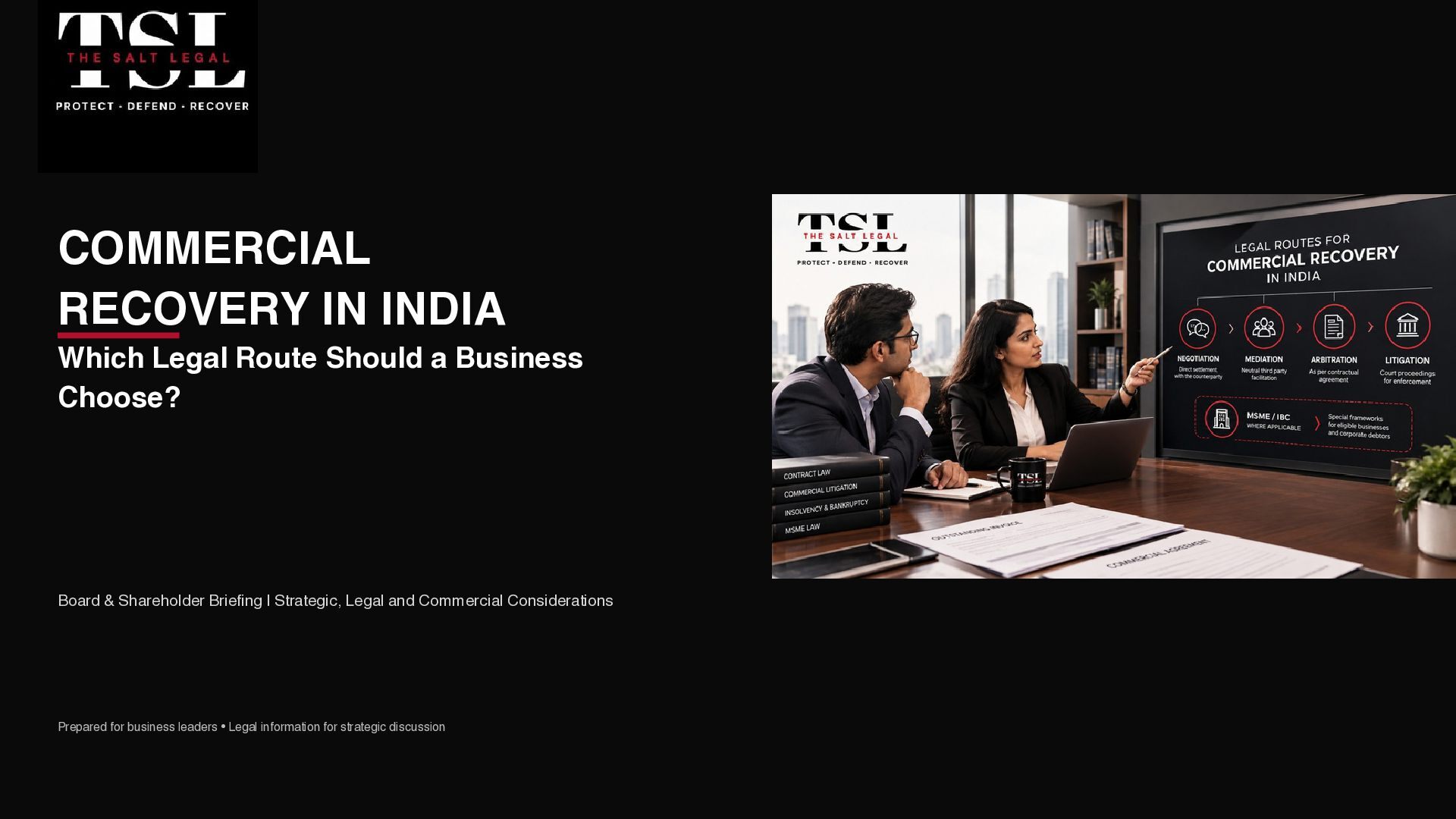
  1. COMMERCIAL RECOVERY IN INDIA Which Legal Route Should a Business

    Choose? Board & Shareholder Briefing | Strategic, Legal and Commercial Considerations Prepared for business leaders • Legal information for strategic discussion
  2. Executive Brief Thecentralissueisnotmerelywhethermoney is unpaid. It is how the claim

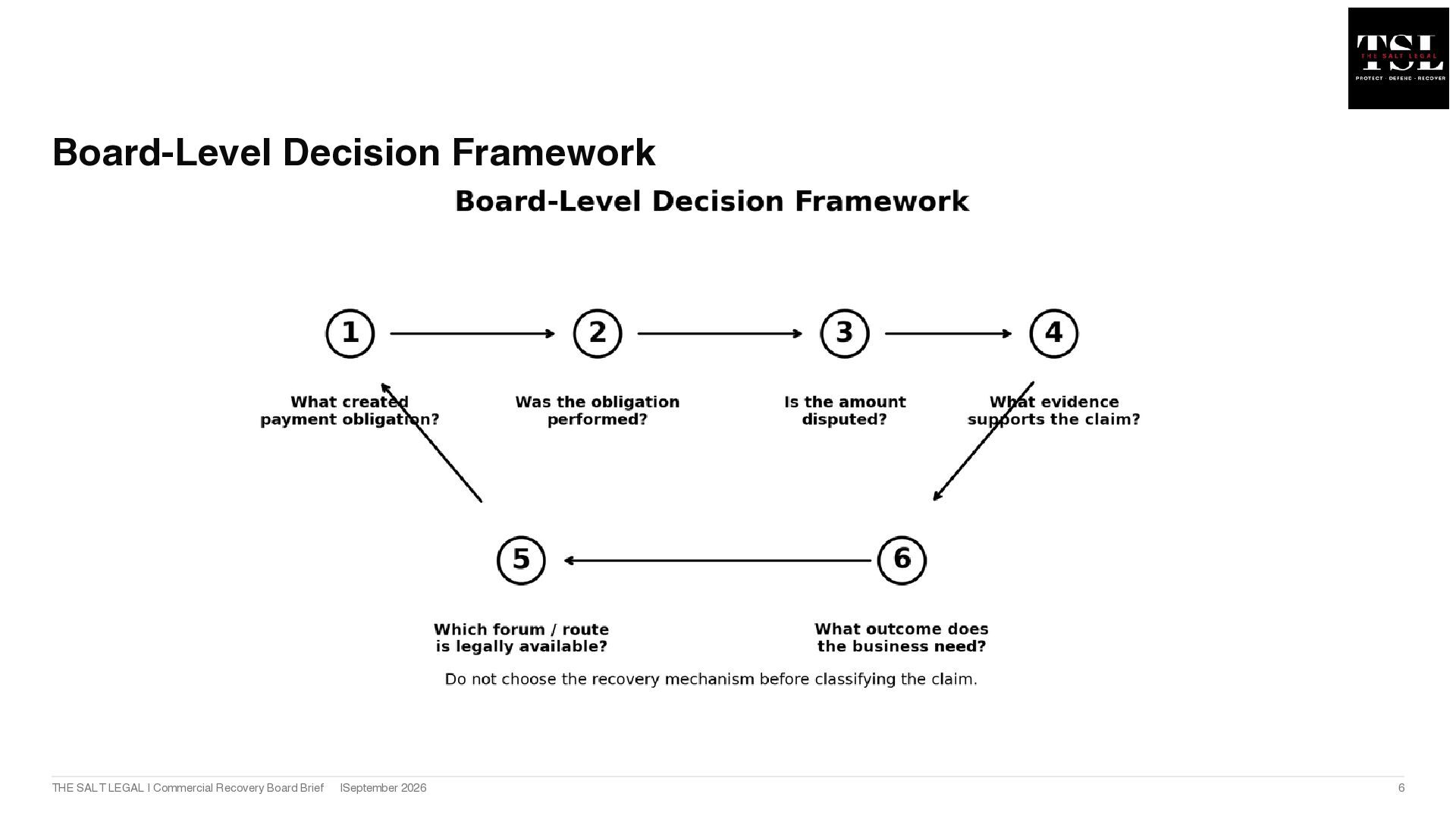
    should be classified and pursued. Board-level takeaway: a commercial recovery decision should align the legal mechanism with the contract, evidence, dispute profile, claimant eligibility and desired commercial outcome. One amount can lead to different legal routes. An undisputed invoice, a contractual performance dispute, an eligible MSME claim and a potential insolvency matter require different analysis. Contract review comes first. Arbitration clauses, payment terms, notice requirements and dispute-resolution provisions can shape the available route. Procedure matters. For qualifying commercial suits, Section 12A of the Commercial Courts Act provides for pre-institution mediation where urgent interim relief is not contemplated. MSME status can materially change the assessment. Government guidance identifies delayed-payment provisions under Sections 15–24 of the MSMED Act and the MSEFC mechanism for eligible Micro and Small Enterprises. IBC is a distinct framework. For an operational creditor, Sections 8 and 9 create a statutory demand/application pathway subject to the Code's requirements; insolvency should not be treated as an ordinary collection suit. THE SALT LEGAL | Commercial Recovery Board Brief |September 2026 2
  3. The Commercial Recovery Route Map Important: these are not interchangeable

    remedies. The applicable route depends on facts, contractual terms, statutory eligibility and procedural requirements. THE SALT LEGAL | Commercial Recovery Board Brief |September 2026 3
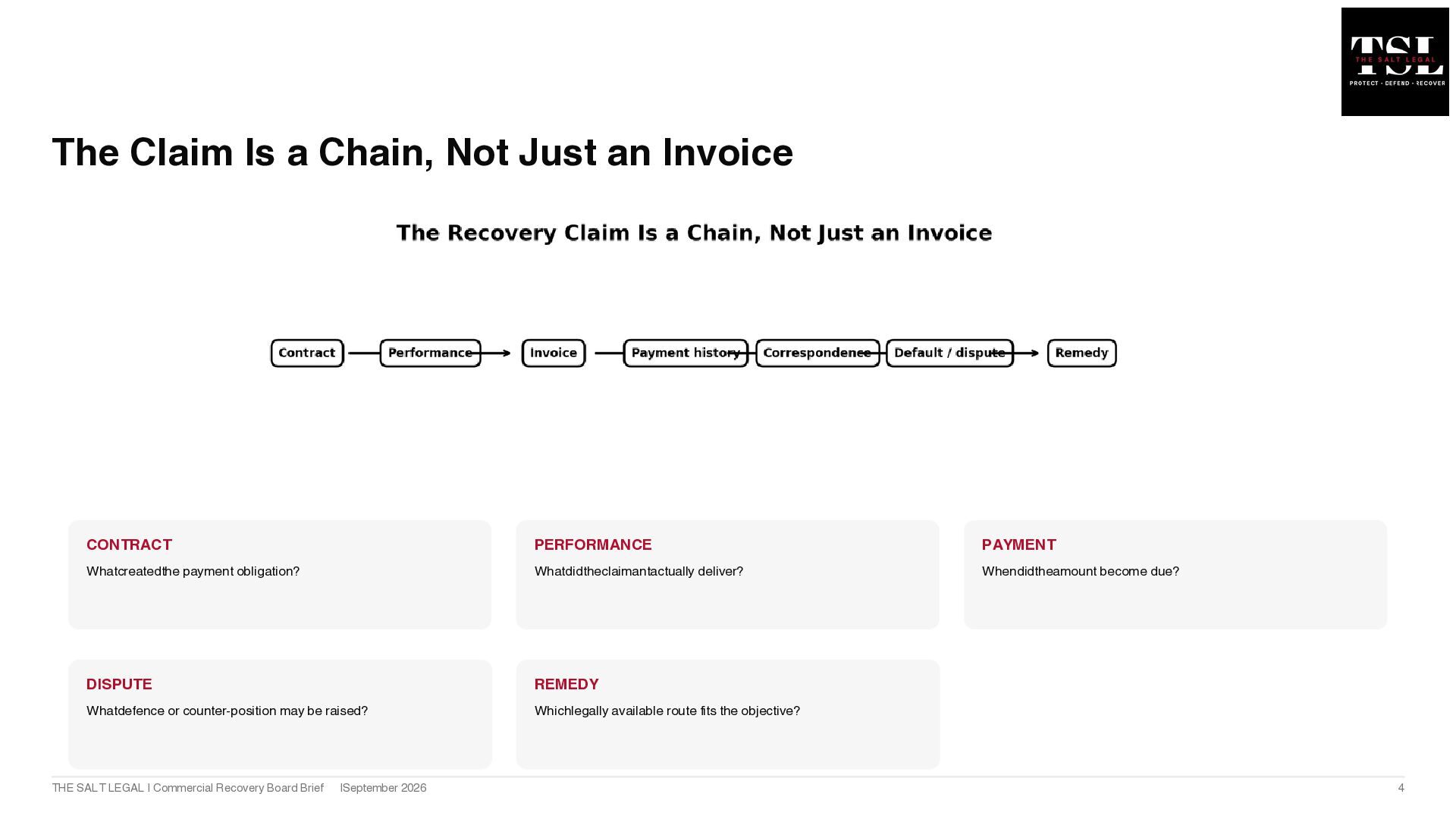
  4. The Claim Is a Chain, Not Just an Invoice CONTRACT

    PERFORMANCE PAYMENT Whatcreatedthe payment obligation? Whatdidtheclaimantactually deliver? Whendidtheamount become due? DISPUTE REMEDY Whatdefence or counter-position may be raised? Whichlegally available route fits the objective? THE SALT LEGAL | Commercial Recovery Board Brief |September 2026 4
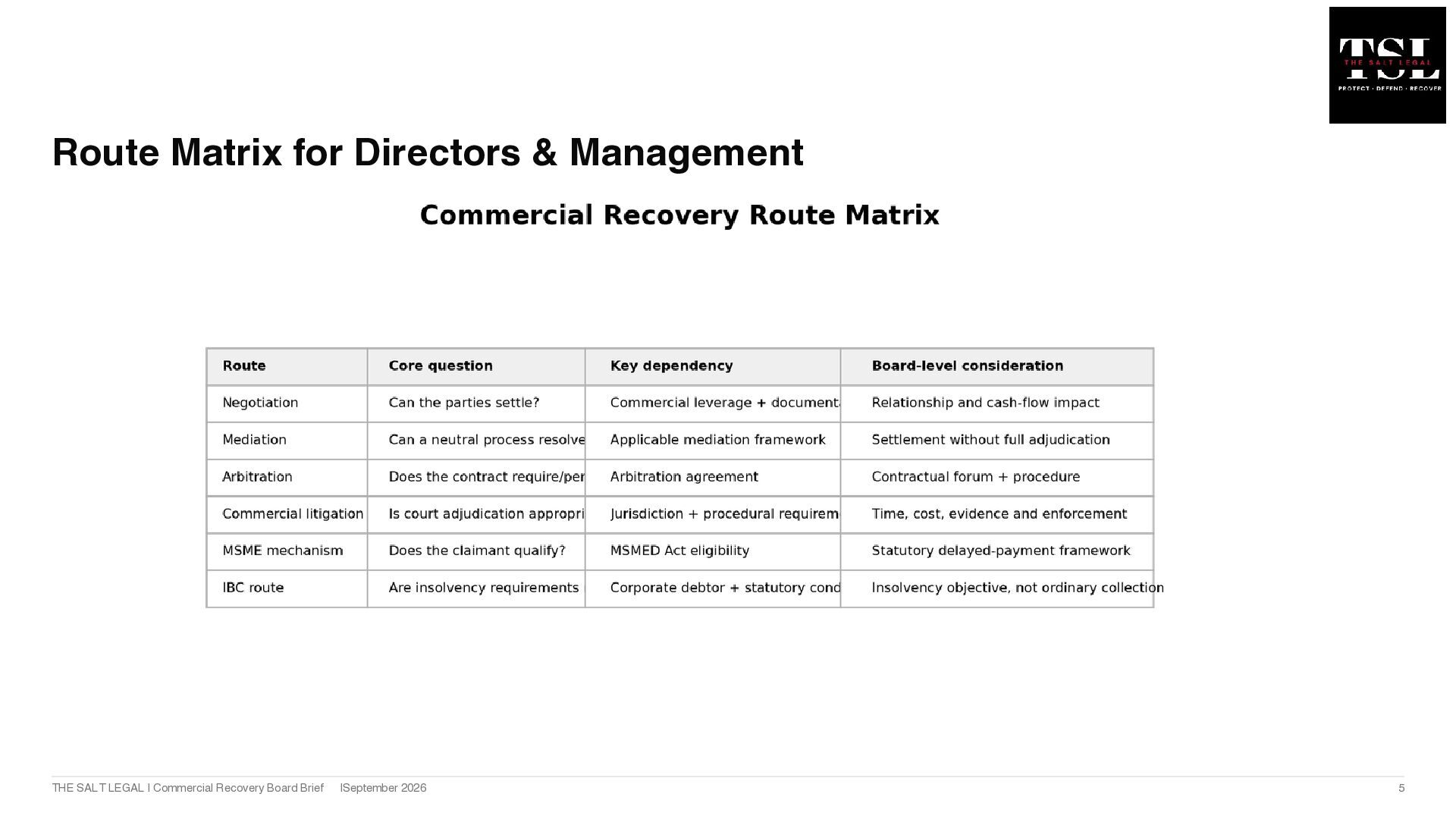
  5. Route Matrix for Directors & Management THE SALT LEGAL |

    Commercial Recovery Board Brief |September 2026 5
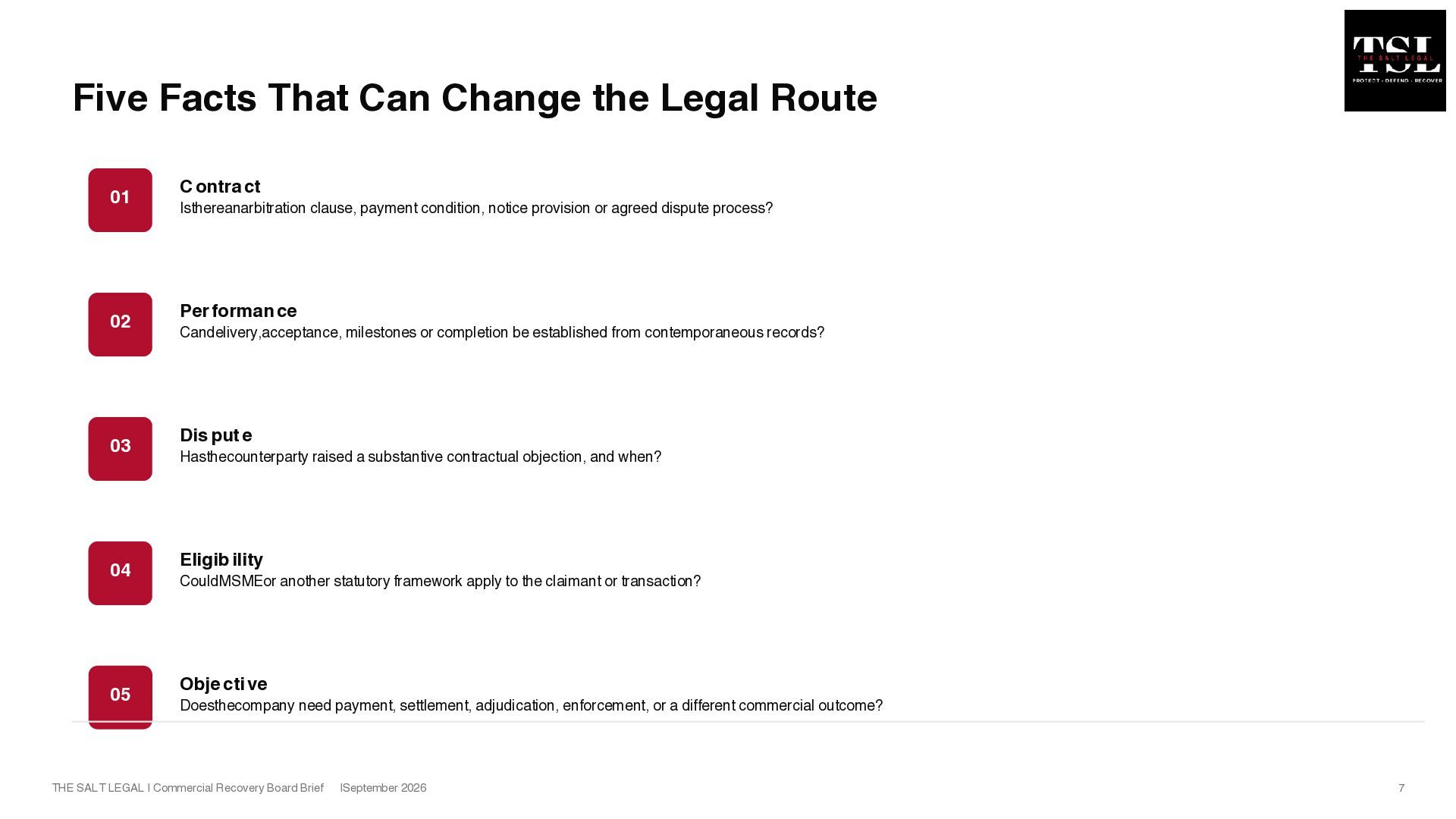
  6. Five Facts That Can Change the Legal Route 01 02

    03 04 05 C ontra ct Isthereanarbitration clause, payment condition, notice provision or agreed dispute process? Per forman ce Candelivery,acceptance, milestones or completion be established from contemporaneous records? Dis put e Hasthecounterparty raised a substantive contractual objection, and when? Eligib ility CouldMSMEor another statutory framework apply to the claimant or transaction? Obje cti ve Doesthecompany need payment, settlement, adjudication, enforcement, or a different commercial outcome? THE SALT LEGAL | Commercial Recovery Board Brief |September 2026 7
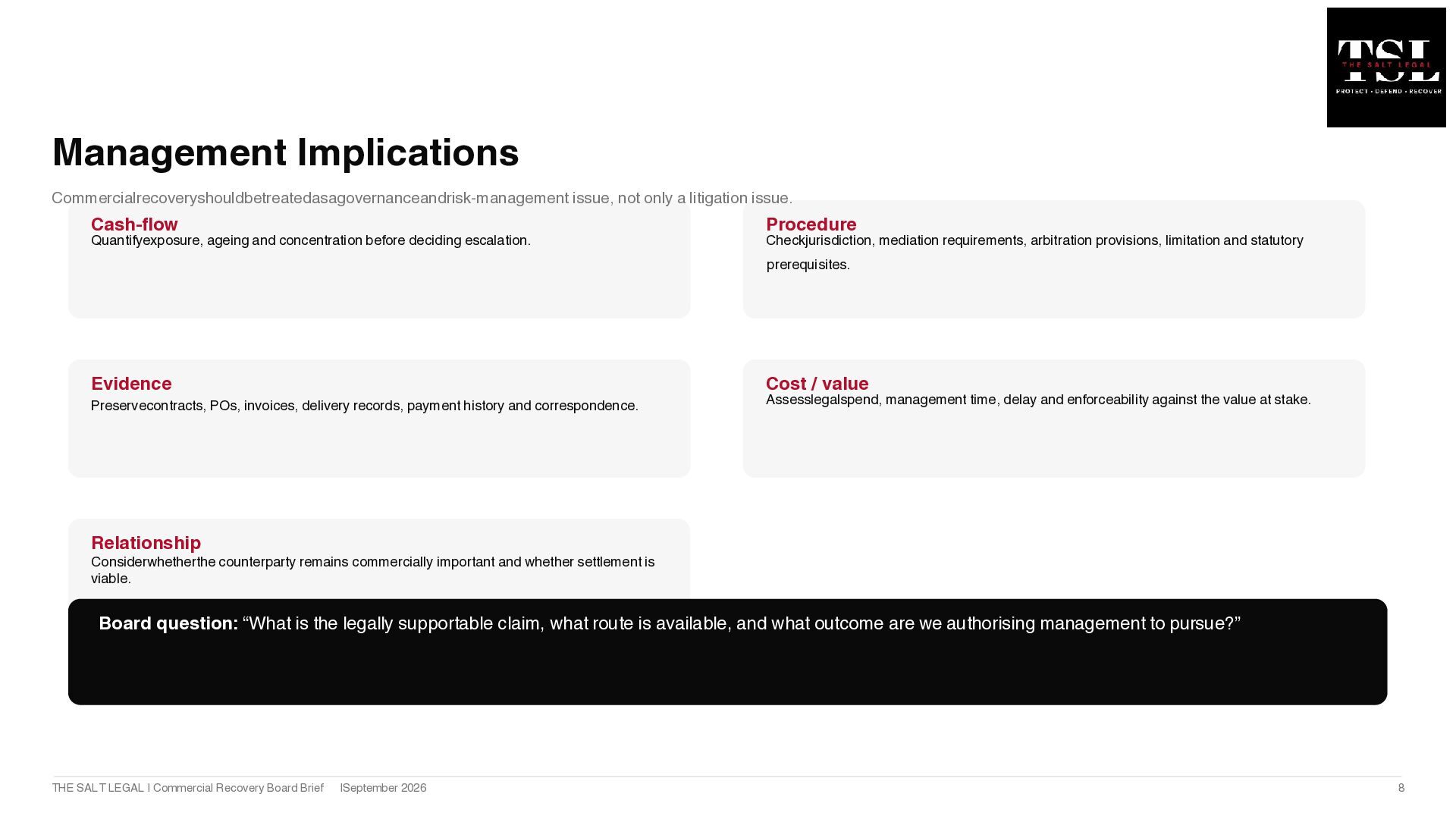
  7. Management Implications Commercialrecoveryshouldbetreatedasagovernanceandrisk-management issue, not only a litigation issue. Cash-flow

    Quantifyexposure, ageing and concentration before deciding escalation. Procedure Checkjurisdiction, mediation requirements, arbitration provisions, limitation and statutory prerequisites. Evidence Cost / value Preservecontracts, POs, invoices, delivery records, payment history and correspondence. Assesslegalspend, management time, delay and enforceability against the value at stake. Relationship Considerwhetherthe counterparty remains commercially important and whether settlement is viable. Board question: “What is the legally supportable claim, what route is available, and what outcome are we authorising management to pursue?” THE SALT LEGAL | Commercial Recovery Board Brief |September 2026 8
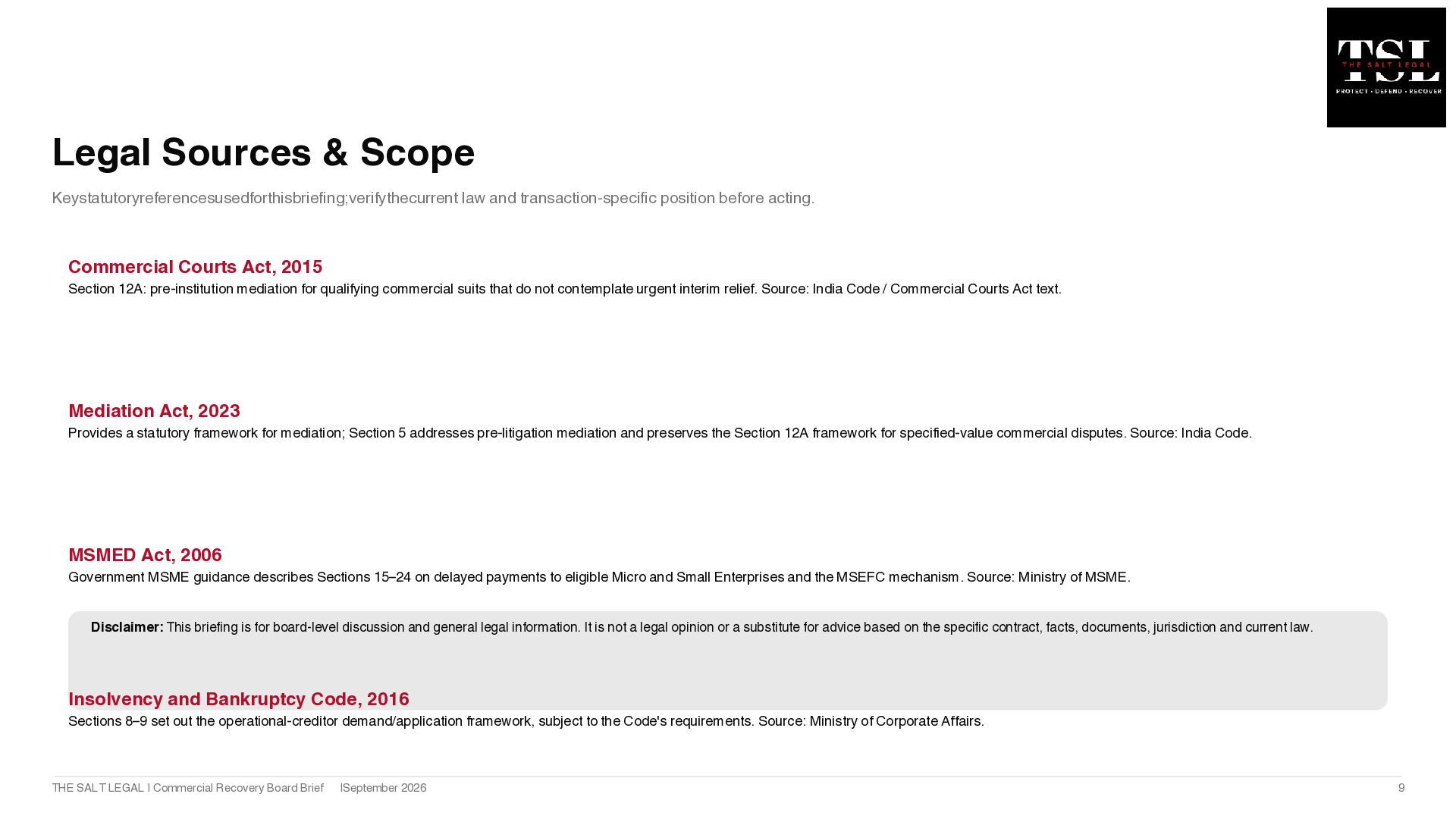
  8. Legal Sources & Scope Keystatutoryreferencesusedforthisbriefing;verifythecurrent law and transaction-specific position before

    acting. Commercial Courts Act, 2015 Section 12A: pre-institution mediation for qualifying commercial suits that do not contemplate urgent interim relief. Source: India Code / Commercial Courts Act text. Mediation Act, 2023 Provides a statutory framework for mediation; Section 5 addresses pre-litigation mediation and preserves the Section 12A framework for specified-value commercial disputes. Source: India Code. MSMED Act, 2006 Government MSME guidance describes Sections 15–24 on delayed payments to eligible Micro and Small Enterprises and the MSEFC mechanism. Source: Ministry of MSME. Disclaimer: This briefing is for board-level discussion and general legal information. It is not a legal opinion or a substitute for advice based on the specific contract, facts, documents, jurisdiction and current law. Insolvency and Bankruptcy Code, 2016 Sections 8–9 set out the operational-creditor demand/application framework, subject to the Code's requirements. Source: Ministry of Corporate Affairs. THE SALT LEGAL | Commercial Recovery Board Brief |September 2026 9
  9. Commercial Recovery Needs a Route, Not Just a Notice. The

    Salt Legal can help businesses assess the contractual basis of a claim, documentary record, potential dispute, available legal mechanisms and recovery strategy. ASSESS YOUR COMMERCIAL RECOVERY CLAIM The Salt Legal •Protect • Defend • Recover