converting units across every category Length • Area • Volume • Mass • Temperature • Time • Speed • Pressure • Energy • Power • Force • Torque Angle • Frequency • Digital data • Fuel economy • Density • Flow rate • Viscosity Electricity • Light • Radiation • Traditional Iranian units toolshed.click https://toolshed.click/ First edition • October 2026 https://toolshed.click/ • Page 1
in engineering, science, cooking, trade and daily life: a TV size in inches, tyre pressure in psi, car fuel economy in litres per 100 kilometres or miles per gallon, memory capacity in gigabytes and gibibytes. This book is written as a practical, comprehensive reference. For each category of quantity it gathers the list of units, exact factors, a conversion matrix, quick-reference tables, worked examples and key pitfalls, so that you can perform any conversion quickly and confidently without searching in many places. How to use this book • If you are not sure which category your conversion belongs to, consult the table of contents. Each chapter covers one category of quantity. • Chapter 1 (the SI system) and Chapter 2 (how to convert) explain the foundations and are recommended if you are new to the factor-label method. • In each chapter's conversion matrix, rows are "from" and columns are "to". The number at the intersection is the factor to multiply the starting value by. • Numbers are given to at most 6 significant figures. Very large or small numbers use scientific notation (for example 1.6×10⁻¹⁹). • Temperature, fuel economy and traditional Iranian units have their own chapters because their conversion is not a simple multiplication or has no fixed value. The online version of these conversion tools and updates to this reference are available at https://toolshed.click/ https://toolshed.click/ • Page 3
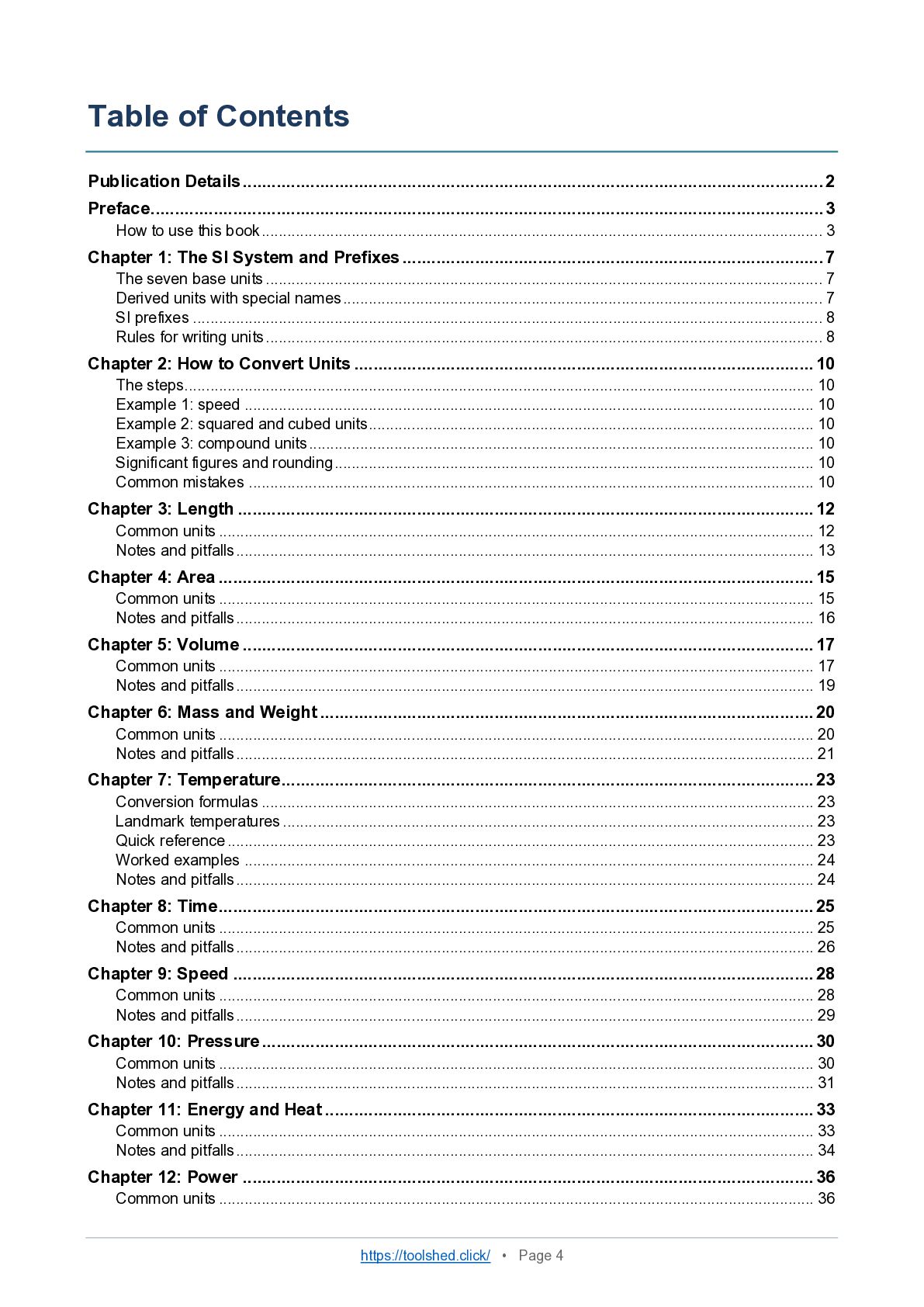
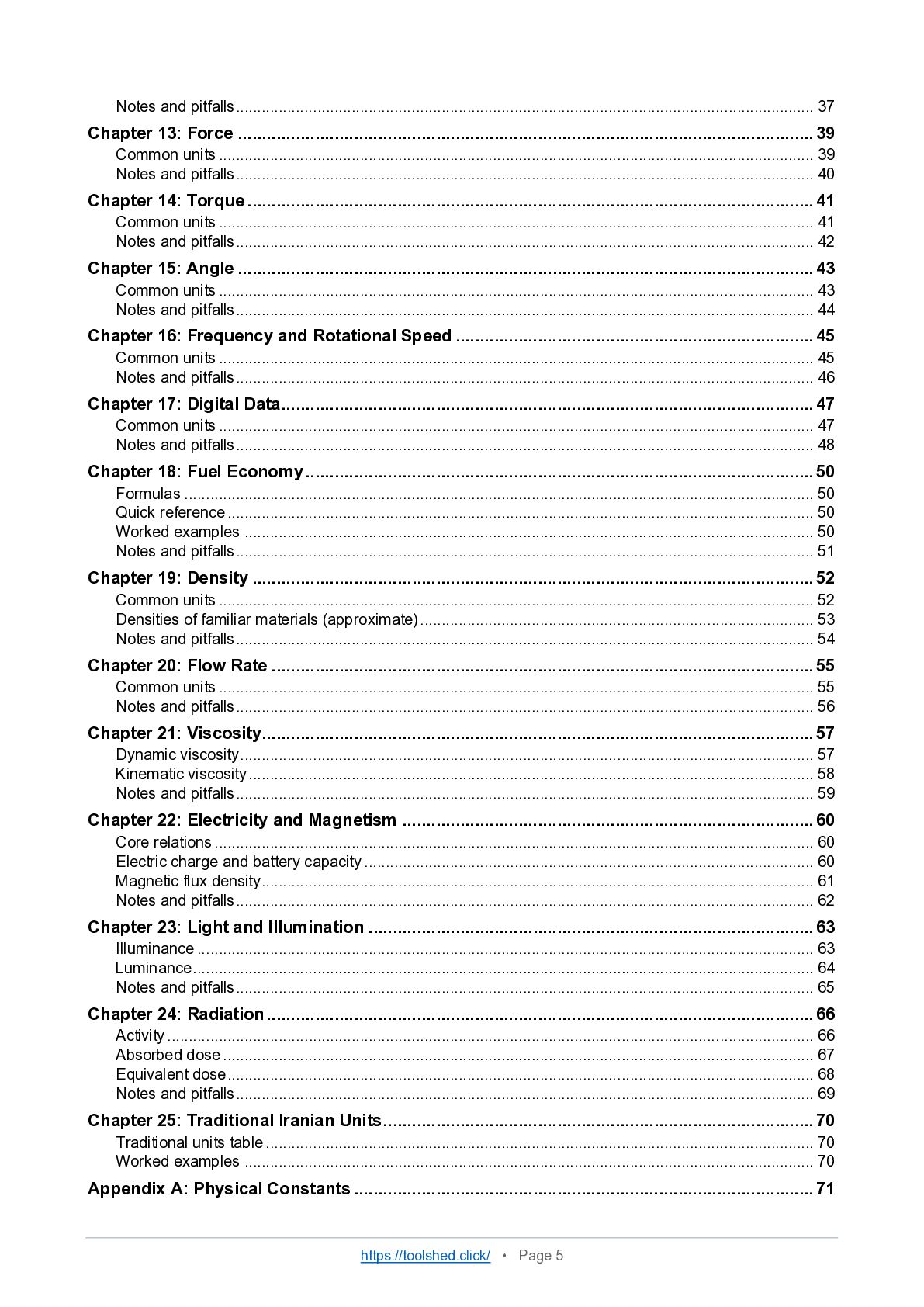
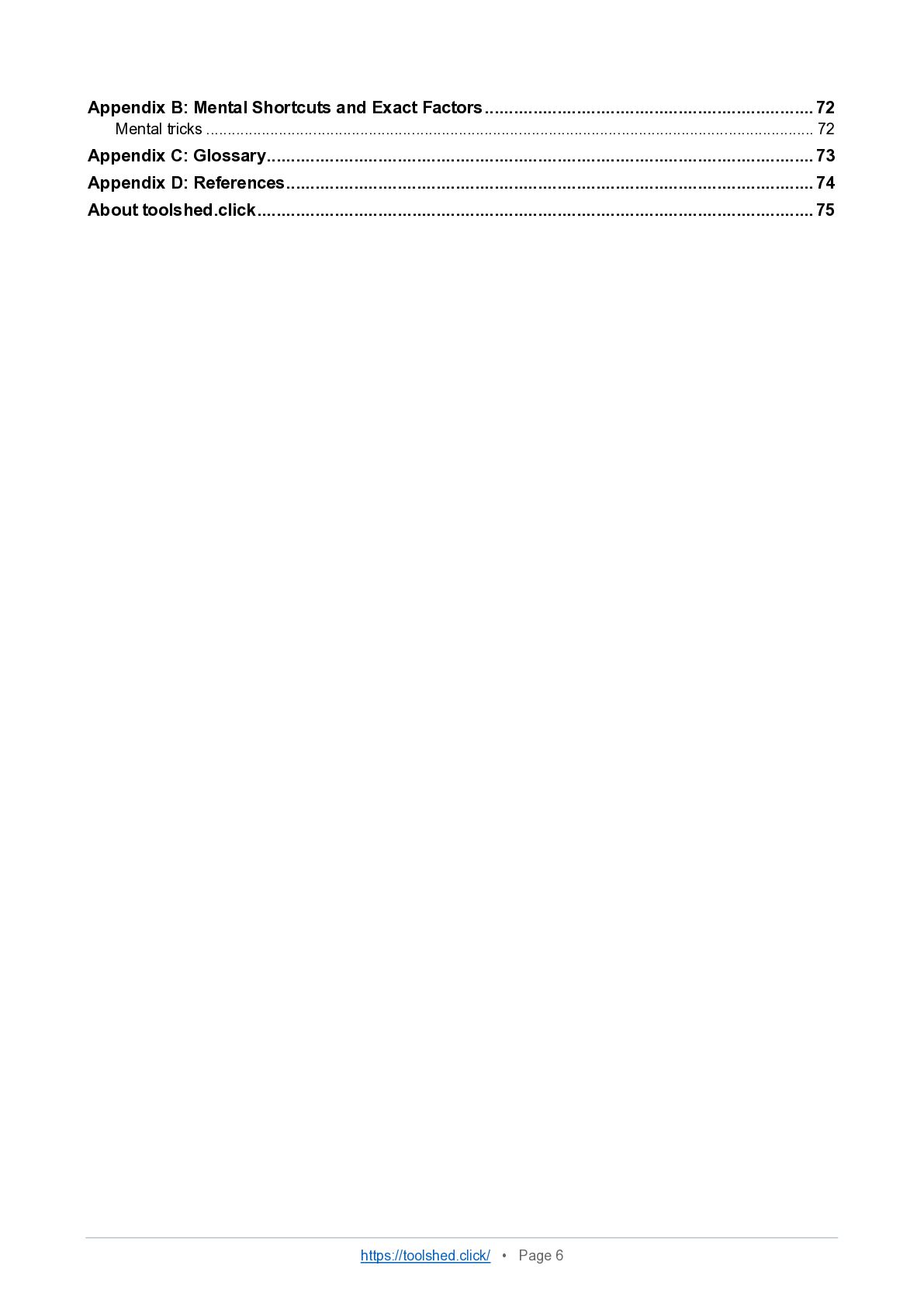
to use this book ................................................................................................................................... 3 Chapter 1: The SI System and Prefixes ....................................................................................... 7 The seven base units .................................................................................................................................. 7 Derived units with special names ................................................................................................................ 7 SI prefixes ................................................................................................................................................... 8 Rules for writing units .................................................................................................................................. 8 Chapter 2: How to Convert Units ............................................................................................... 10 The steps ................................................................................................................................................... 10 Example 1: speed ..................................................................................................................................... 10 Example 2: squared and cubed units ........................................................................................................ 10 Example 3: compound units ...................................................................................................................... 10 Significant figures and rounding ................................................................................................................ 10 Common mistakes .................................................................................................................................... 10 Chapter 3: Length ....................................................................................................................... 12 Common units ........................................................................................................................................... 12 Notes and pitfalls ....................................................................................................................................... 13 Chapter 4: Area ........................................................................................................................... 15 Common units ........................................................................................................................................... 15 Notes and pitfalls ....................................................................................................................................... 16 Chapter 5: Volume ...................................................................................................................... 17 Common units ........................................................................................................................................... 17 Notes and pitfalls ....................................................................................................................................... 19 Chapter 6: Mass and Weight ...................................................................................................... 20 Common units ........................................................................................................................................... 20 Notes and pitfalls ....................................................................................................................................... 21 Chapter 7: Temperature.............................................................................................................. 23 Conversion formulas ................................................................................................................................. 23 Landmark temperatures ............................................................................................................................ 23 Quick reference ......................................................................................................................................... 23 Worked examples ..................................................................................................................................... 24 Notes and pitfalls ....................................................................................................................................... 24 Chapter 8: Time ........................................................................................................................... 25 Common units ........................................................................................................................................... 25 Notes and pitfalls ....................................................................................................................................... 26 Chapter 9: Speed ........................................................................................................................ 28 Common units ........................................................................................................................................... 28 Notes and pitfalls ....................................................................................................................................... 29 Chapter 10: Pressure .................................................................................................................. 30 Common units ........................................................................................................................................... 30 Notes and pitfalls ....................................................................................................................................... 31 Chapter 11: Energy and Heat ..................................................................................................... 33 Common units ........................................................................................................................................... 33 Notes and pitfalls ....................................................................................................................................... 34 Chapter 12: Power ...................................................................................................................... 36 Common units ........................................................................................................................................... 36 https://toolshed.click/ • Page 4
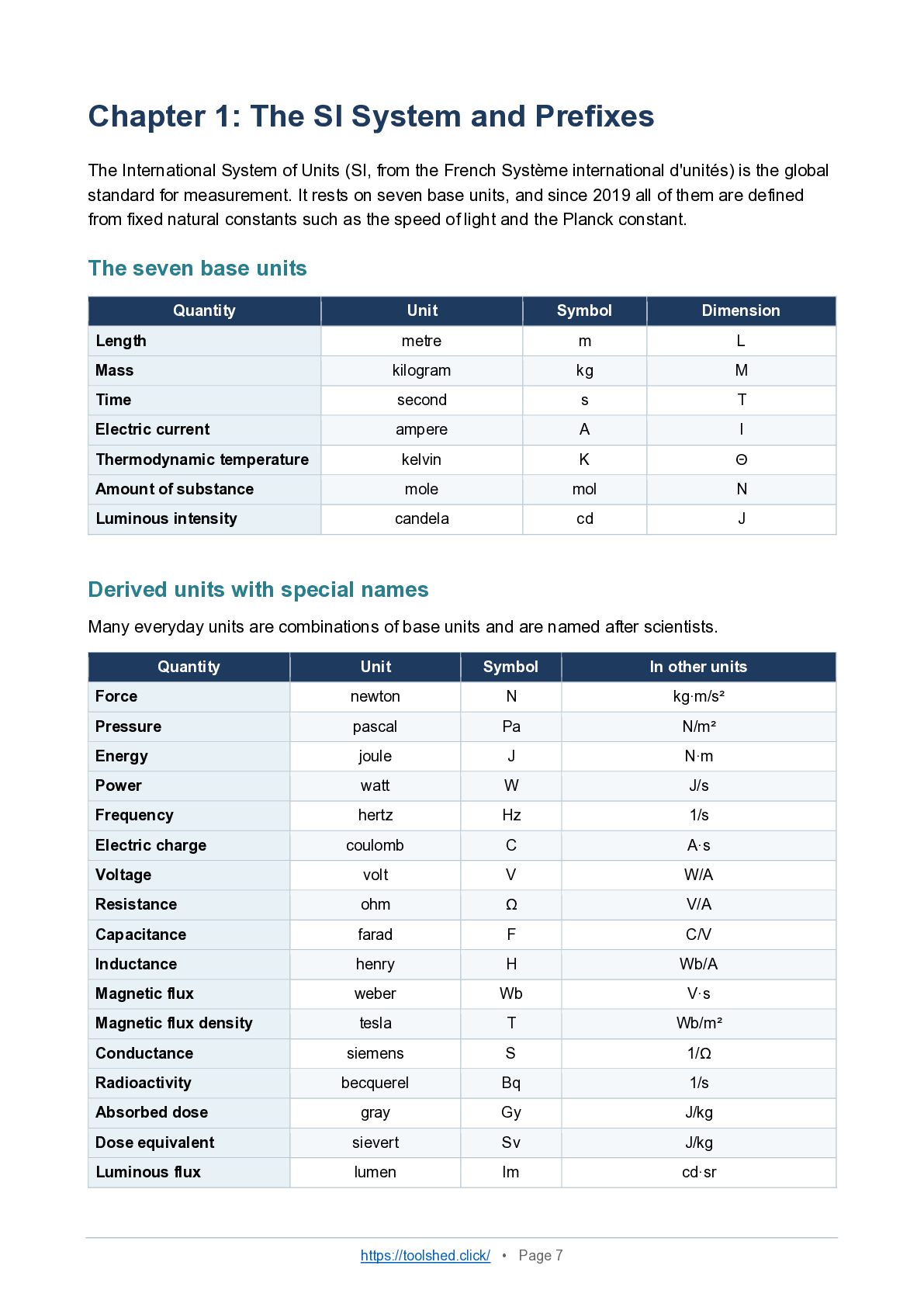
of Units (SI, from the French Système international d'unités) is the global standard for measurement. It rests on seven base units, and since 2019 all of them are defined from fixed natural constants such as the speed of light and the Planck constant. The seven base units Quantity Unit Symbol Dimension Length metre m L Mass kilogram kg M Time second s T Electric current ampere A I Thermodynamic temperature kelvin K Θ Amount of substance mole mol N Luminous intensity candela cd J Derived units with special names Many everyday units are combinations of base units and are named after scientists. Quantity Unit Symbol In other units Force newton N kg·m/s² Pressure pascal Pa N/m² Energy joule J N·m Power watt W J/s Frequency hertz Hz 1/s coulomb C A·s Voltage volt V W/A Resistance ohm Ω V/A Capacitance farad F C/V Inductance henry H Wb/A Magnetic flux weber Wb V·s Magnetic flux density tesla T Wb/m² Conductance siemens S 1/Ω Radioactivity becquerel Bq 1/s Absorbed dose gray Gy J/kg Dose equivalent sievert Sv J/kg Luminous flux lumen lm cd·sr Electric charge https://toolshed.click/ • Page 7
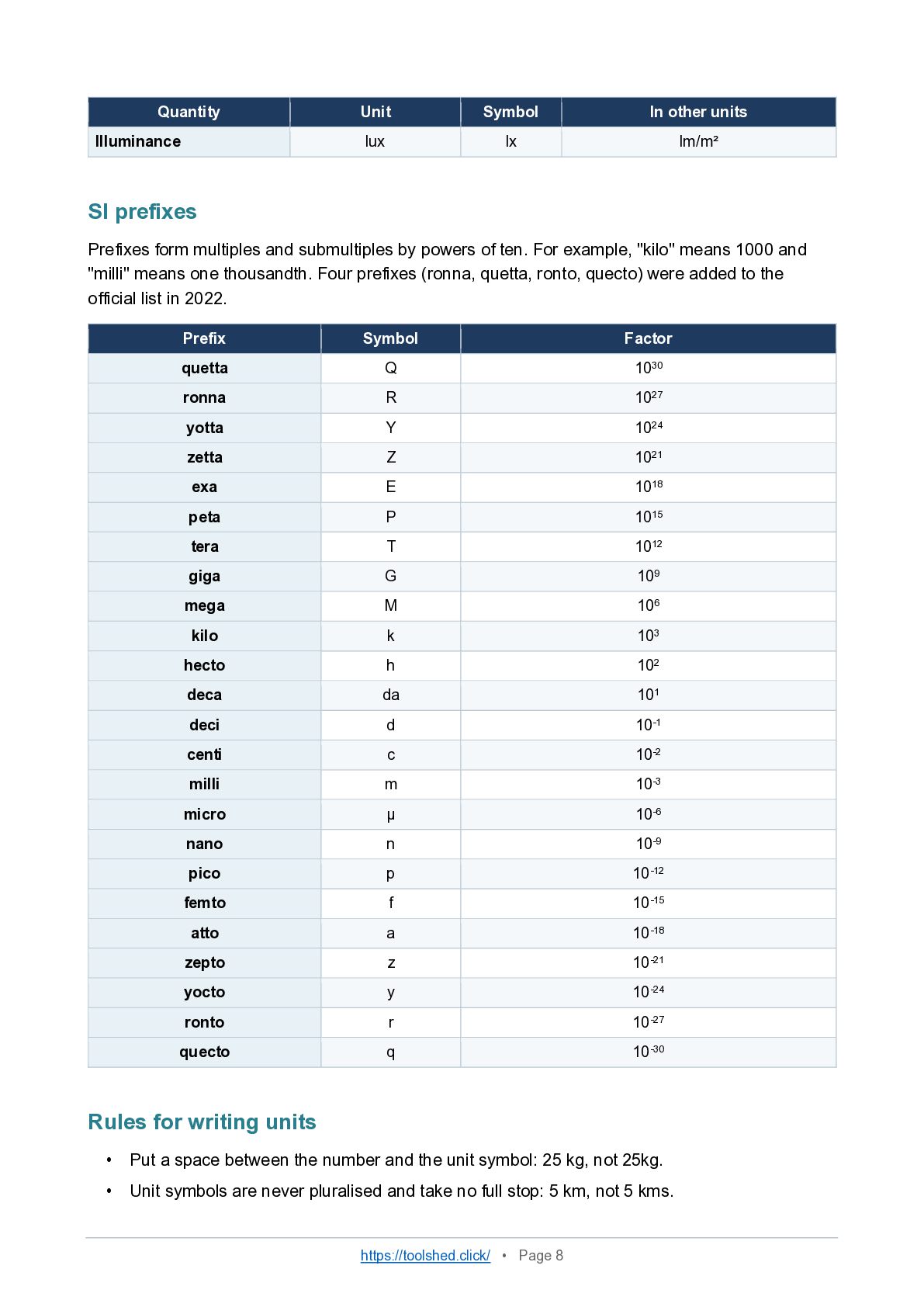
SI prefixes Prefixes form multiples and submultiples by powers of ten. For example, "kilo" means 1000 and "milli" means one thousandth. Four prefixes (ronna, quetta, ronto, quecto) were added to the official list in 2022. Prefix Symbol Factor quetta Q 1030 ronna R 1027 yotta Y 1024 zetta Z 1021 exa E 1018 peta P 1015 tera T 1012 giga G 109 mega M 106 kilo k 103 hecto h 102 deca da 101 deci d 10-1 centi c 10-2 milli m 10-3 micro µ 10-6 nano n 10-9 pico p 10-12 femto f 10-15 atto a 10-18 zepto z 10-21 yocto y 10-24 ronto r 10-27 quecto q 10-30 Rules for writing units • Put a space between the number and the unit symbol: 25 kg, not 25kg. • Unit symbols are never pluralised and take no full stop: 5 km, not 5 kms. https://toolshed.click/ • Page 8
capital letter (N, Pa, W, Hz), but the full unit names are lowercase (newton, watt). • Case matters: mm (millimetre) and Mm (megametre) are very different, and so are mb (millibar or millibit) and MB (megabyte). • The prefix kilo is a lowercase k (km, kg); capital K is the kelvin. • Compound prefixes are not allowed: write milligram, not microkilogram. The kilogram is the one base unit that already contains a prefix. Online tools: for quick, calculation-free conversion of SI units, visit https://toolshed.click/ https://toolshed.click/ • Page 9
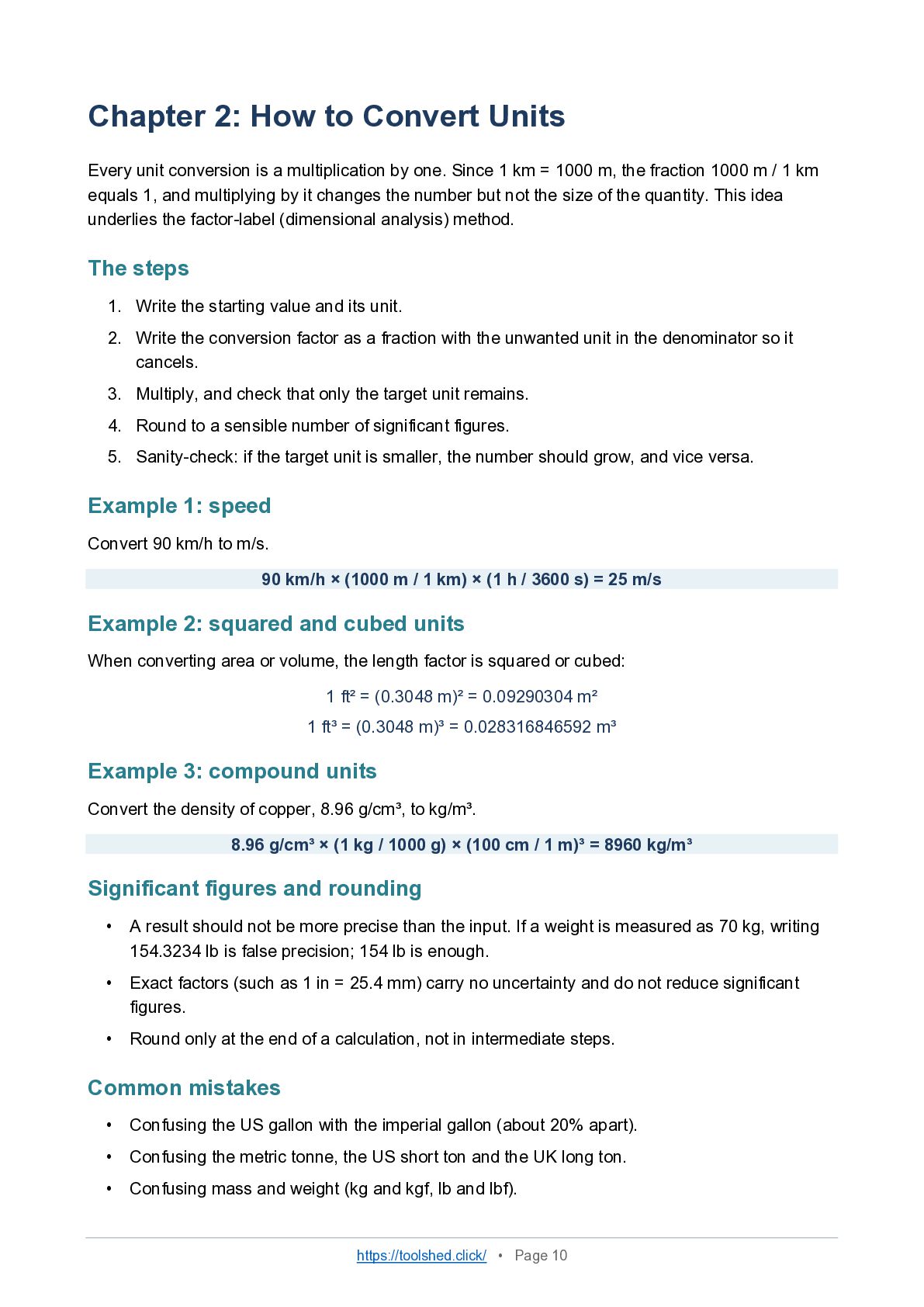
a multiplication by one. Since 1 km = 1000 m, the fraction 1000 m / 1 km equals 1, and multiplying by it changes the number but not the size of the quantity. This idea underlies the factor-label (dimensional analysis) method. The steps 1. Write the starting value and its unit. 2. Write the conversion factor as a fraction with the unwanted unit in the denominator so it cancels. 3. Multiply, and check that only the target unit remains. 4. Round to a sensible number of significant figures. 5. Sanity-check: if the target unit is smaller, the number should grow, and vice versa. Example 1: speed Convert 90 km/h to m/s. 90 km/h × (1000 m / 1 km) × (1 h / 3600 s) = 25 m/s Example 2: squared and cubed units When converting area or volume, the length factor is squared or cubed: 1 ft² = (0.3048 m)² = 0.09290304 m² 1 ft³ = (0.3048 m)³ = 0.028316846592 m³ Example 3: compound units Convert the density of copper, 8.96 g/cm³, to kg/m³. 8.96 g/cm³ × (1 kg / 1000 g) × (100 cm / 1 m)³ = 8960 kg/m³ Significant figures and rounding • A result should not be more precise than the input. If a weight is measured as 70 kg, writing 154.3234 lb is false precision; 154 lb is enough. • Exact factors (such as 1 in = 25.4 mm) carry no uncertainty and do not reduce significant figures. • Round only at the end of a calculation, not in intermediate steps. Common mistakes • Confusing the US gallon with the imperial gallon (about 20% apart). • Confusing the metric tonne, the US short ton and the UK long ton. • Confusing mass and weight (kg and kgf, lb and lbf). https://toolshed.click/ • Page 10
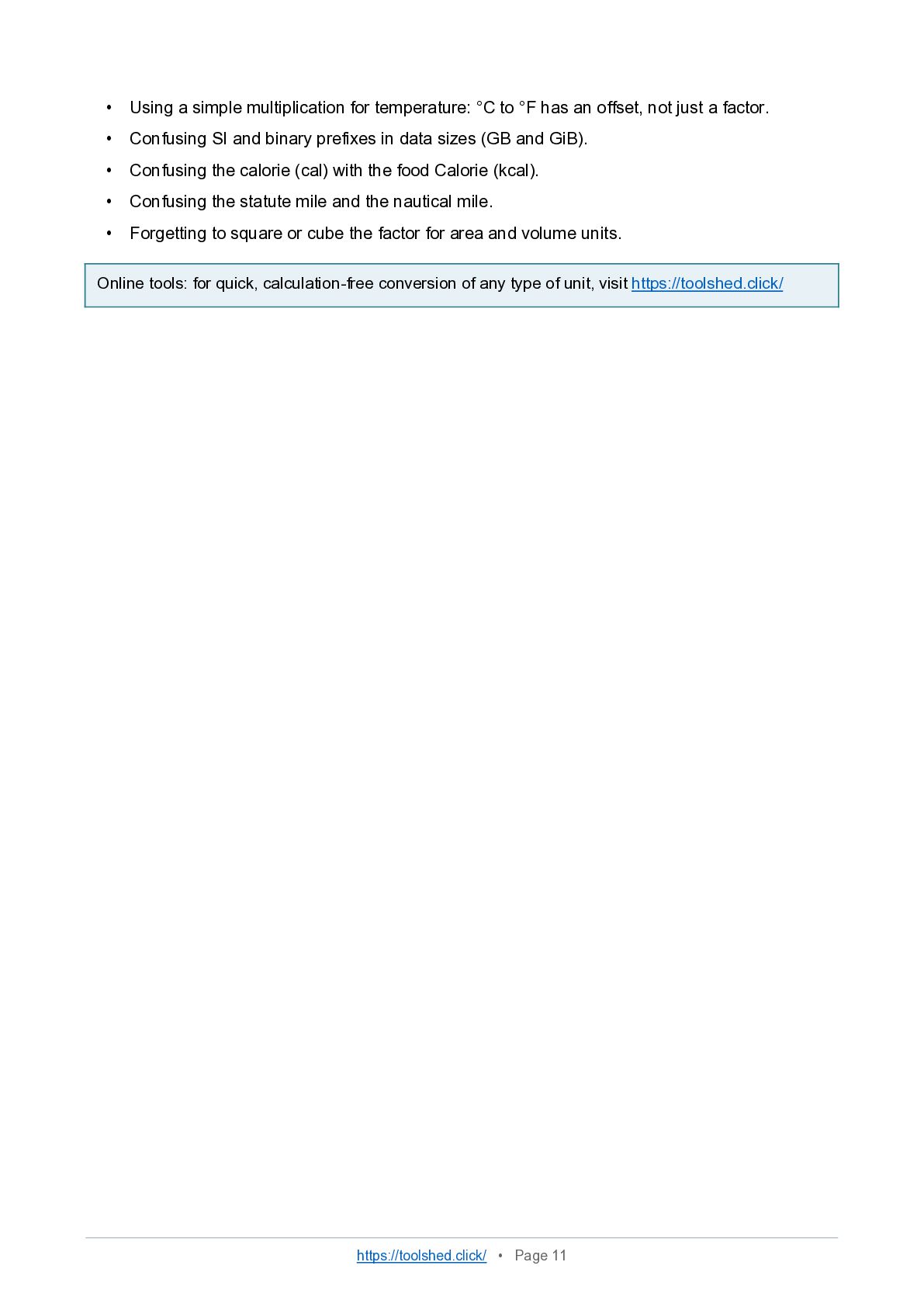
has an offset, not just a factor. • Confusing SI and binary prefixes in data sizes (GB and GiB). • Confusing the calorie (cal) with the food Calorie (kcal). • Confusing the statute mile and the nautical mile. • Forgetting to square or cube the factor for area and volume units. Online tools: for quick, calculation-free conversion of any type of unit, visit https://toolshed.click/ https://toolshed.click/ • Page 11
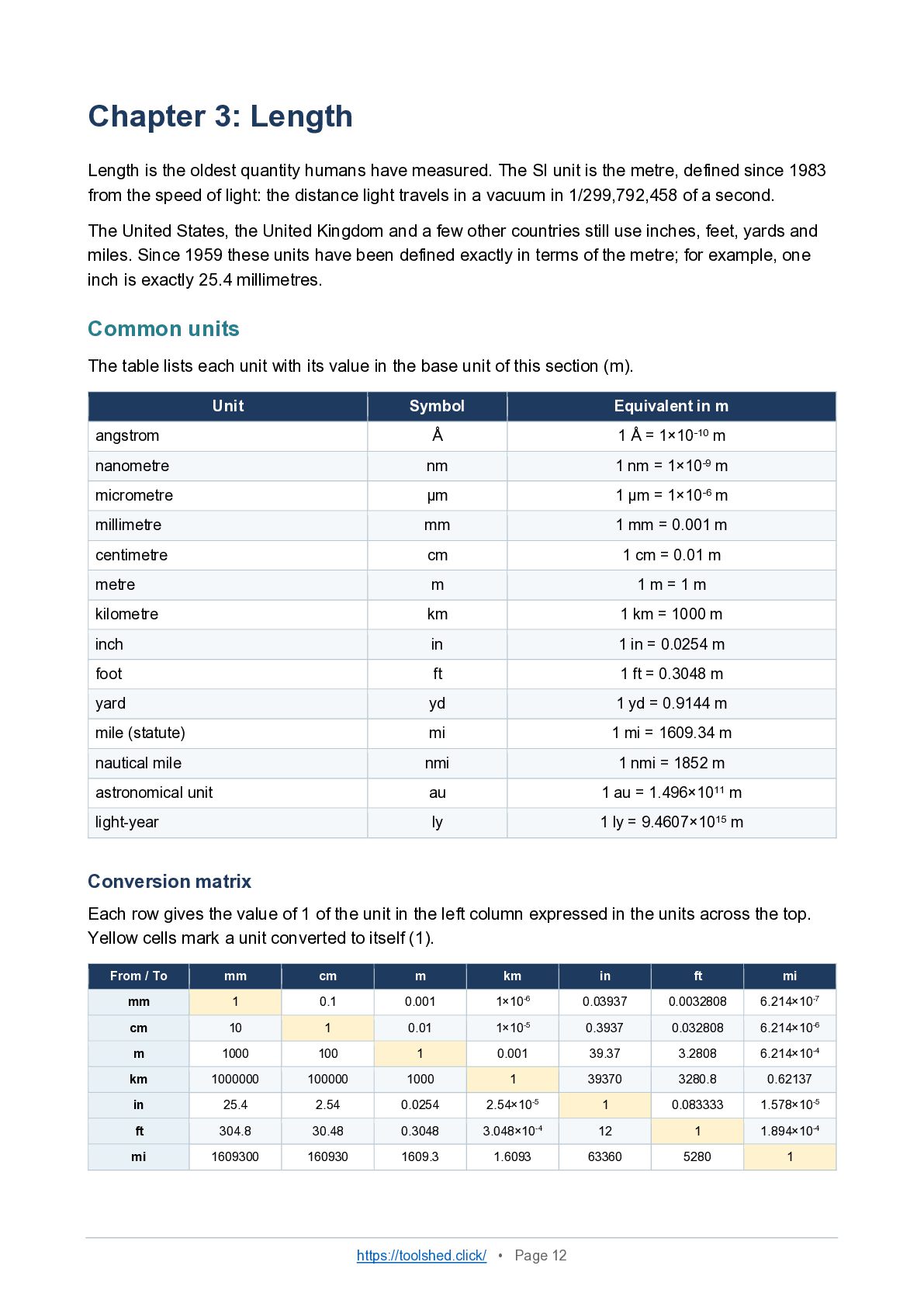
measured. The SI unit is the metre, defined since 1983 from the speed of light: the distance light travels in a vacuum in 1/299,792,458 of a second. The United States, the United Kingdom and a few other countries still use inches, feet, yards and miles. Since 1959 these units have been defined exactly in terms of the metre; for example, one inch is exactly 25.4 millimetres. Common units The table lists each unit with its value in the base unit of this section (m). Unit Symbol Equivalent in m angstrom Å 1 Å = 1×10⁻¹⁰ m nanometre nm 1 nm = 1×10⁻⁹ m micrometre µm 1 µm = 1×10⁻⁶ m millimetre mm 1 mm = 0.001 m centimetre cm 1 cm = 0.01 m metre m 1m=1m kilometre km 1 km = 1000 m inch in 1 in = 0.0254 m foot ft 1 ft = 0.3048 m yard yd 1 yd = 0.9144 m mile (statute) mi 1 mi = 1609.34 m nautical mile nmi 1 nmi = 1852 m astronomical unit au 1 au = 1.496×10¹¹ m light-year ly 1 ly = 9.4607×10¹⁵ m Conversion matrix Each row gives the value of 1 of the unit in the left column expressed in the units across the top. Yellow cells mark a unit converted to itself (1). From / To mm cm m km in ft mi mm 1 0.1 0.001 1×10⁻⁶ 0.03937 0.0032808 6.214×10⁻⁷ cm 10 1 0.01 1×10⁻⁵ 0.3937 0.032808 6.214×10⁻⁶ m 1000 100 1 0.001 39.37 3.2808 6.214×10⁻⁴ km 1000000 100000 1000 1 39370 3280.8 0.62137 -5 in 25.4 2.54 0.0254 2.54×10 1 0.083333 1.578×10⁻⁵ ft 304.8 30.48 0.3048 3.048×10⁻⁴ 12 1 1.894×10⁻⁴ mi 1609300 160930 1609.3 1.6093 63360 5280 1 https://toolshed.click/ • Page 12
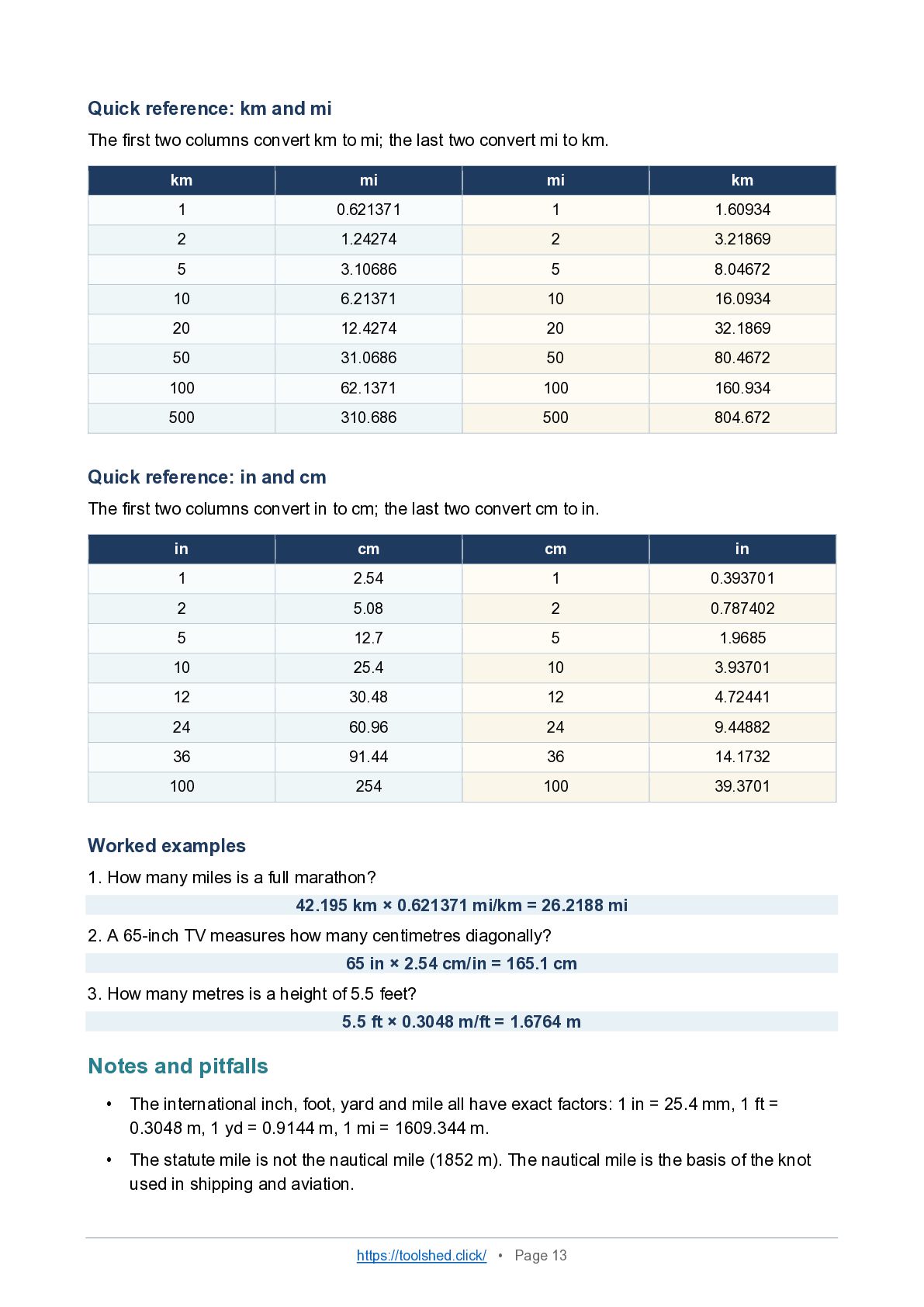
km to mi; the last two convert mi to km. km mi mi km 1 0.621371 1 1.60934 2 1.24274 2 3.21869 5 3.10686 5 8.04672 10 6.21371 10 16.0934 20 12.4274 20 32.1869 50 31.0686 50 80.4672 100 62.1371 100 160.934 500 310.686 500 804.672 Quick reference: in and cm The first two columns convert in to cm; the last two convert cm to in. in cm cm in 1 2.54 1 0.393701 2 5.08 2 0.787402 5 12.7 5 1.9685 10 25.4 10 3.93701 12 30.48 12 4.72441 24 60.96 24 9.44882 36 91.44 36 14.1732 100 254 100 39.3701 Worked examples 1. How many miles is a full marathon? 42.195 km × 0.621371 mi/km = 26.2188 mi 2. A 65-inch TV measures how many centimetres diagonally? 65 in × 2.54 cm/in = 165.1 cm 3. How many metres is a height of 5.5 feet? 5.5 ft × 0.3048 m/ft = 1.6764 m Notes and pitfalls • The international inch, foot, yard and mile all have exact factors: 1 in = 25.4 mm, 1 ft = 0.3048 m, 1 yd = 0.9144 m, 1 mi = 1609.344 m. • The statute mile is not the nautical mile (1852 m). The nautical mile is the basis of the knot used in shipping and aviation. https://toolshed.click/ • Page 13
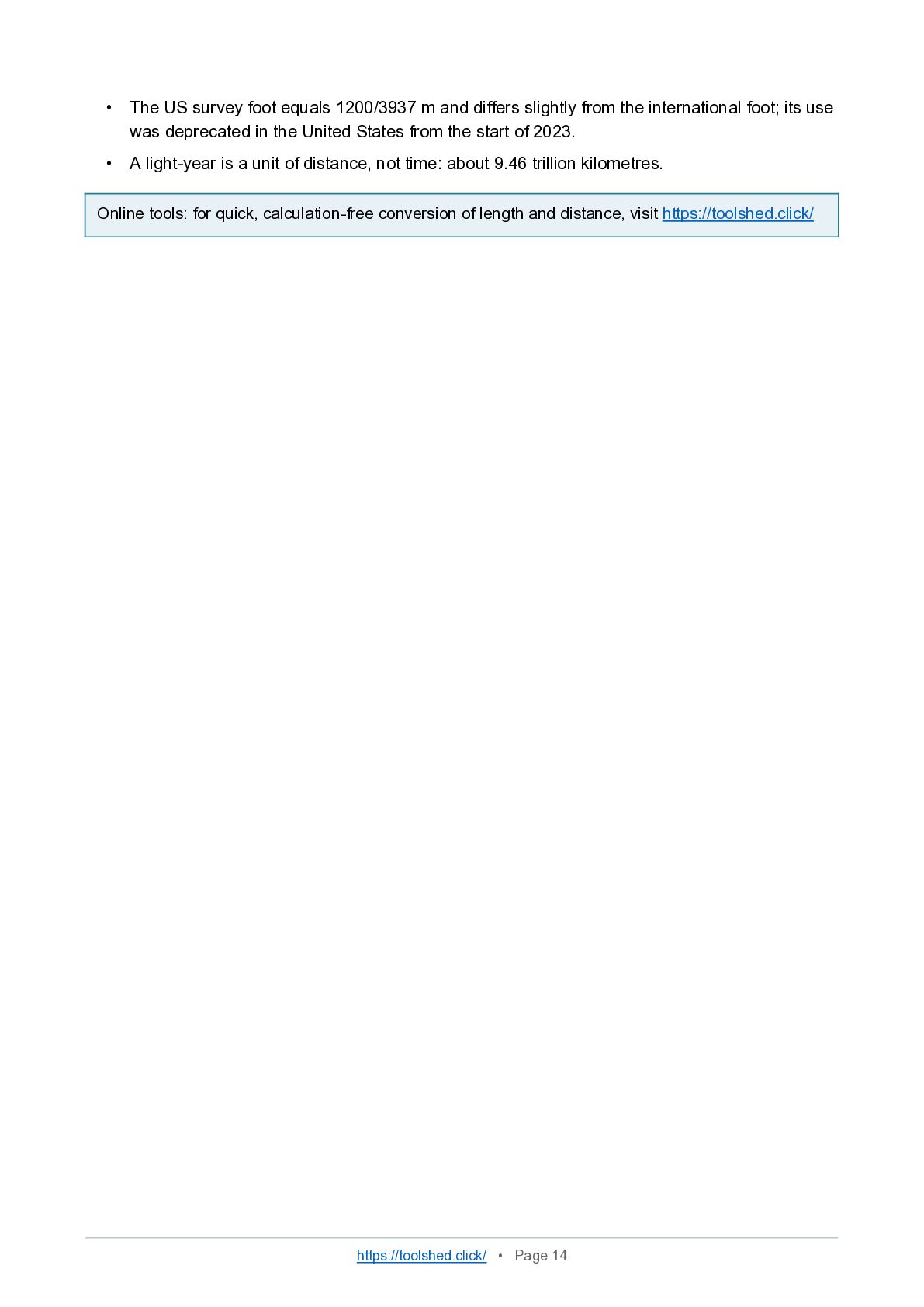
slightly from the international foot; its use was deprecated in the United States from the start of 2023. • A light-year is a unit of distance, not time: about 9.46 trillion kilometres. Online tools: for quick, calculation-free conversion of length and distance, visit https://toolshed.click/ https://toolshed.click/ • Page 14
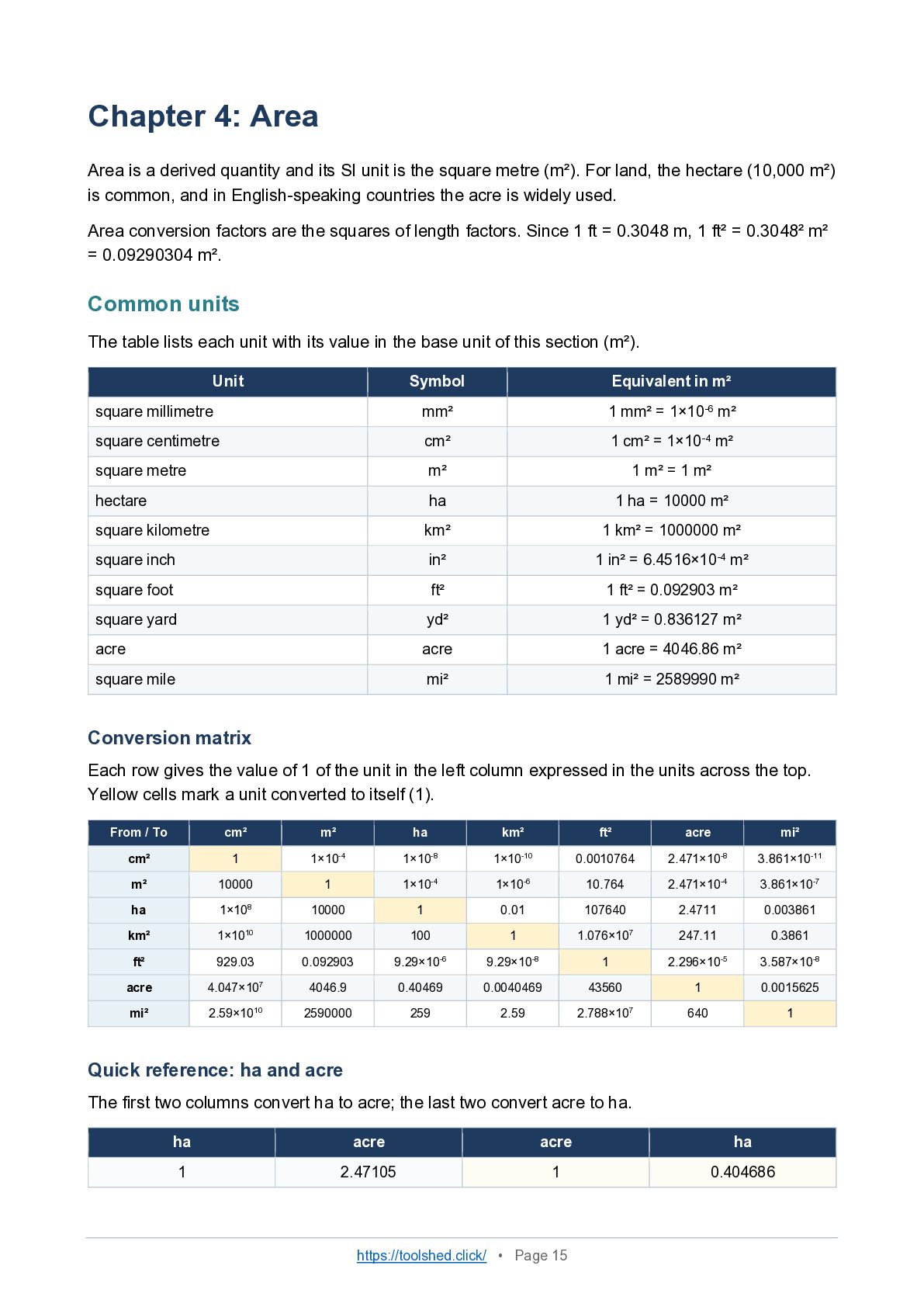
SI unit is the square metre (m²). For land, the hectare (10,000 m²) is common, and in English-speaking countries the acre is widely used. Area conversion factors are the squares of length factors. Since 1 ft = 0.3048 m, 1 ft² = 0.3048² m² = 0.09290304 m². Common units The table lists each unit with its value in the base unit of this section (m²). Unit Symbol Equivalent in m² square millimetre mm² 1 mm² = 1×10⁻⁶ m² square centimetre cm² 1 cm² = 1×10⁻⁴ m² square metre m² 1 m² = 1 m² hectare ha 1 ha = 10000 m² square kilometre km² 1 km² = 1000000 m² square inch in² 1 in² = 6.4516×10⁻⁴ m² square foot ft² 1 ft² = 0.092903 m² square yard yd² 1 yd² = 0.836127 m² acre acre 1 acre = 4046.86 m² square mile mi² 1 mi² = 2589990 m² Conversion matrix Each row gives the value of 1 of the unit in the left column expressed in the units across the top. Yellow cells mark a unit converted to itself (1). From / To cm² m² ha km² ft² acre mi² cm² 1 1×10⁻⁴ 1×10⁻⁸ 1×10⁻¹⁰ 0.0010764 2.471×10⁻⁸ 3.861×10⁻¹¹ m² 10000 1 1×10⁻⁴ 1×10⁻⁶ 10.764 2.471×10⁻⁴ 3.861×10⁻⁷ ha 1×10⁸ 10000 1 0.01 107640 2.4711 0.003861 km² 10 1×10 1000000 100 7 1 -6 1.076×10 -8 247.11 0.3861 -5 3.587×10⁻⁸ ft² 929.03 0.092903 9.29×10 9.29×10 1 2.296×10 acre 4.047×10⁷ 4046.9 0.40469 0.0040469 43560 1 0.0015625 mi² 2.59×10¹⁰ 2590000 259 2.59 2.788×10⁷ 640 1 Quick reference: ha and acre The first two columns convert ha to acre; the last two convert acre to ha. ha acre acre ha 1 2.47105 1 0.404686 https://toolshed.click/ • Page 15
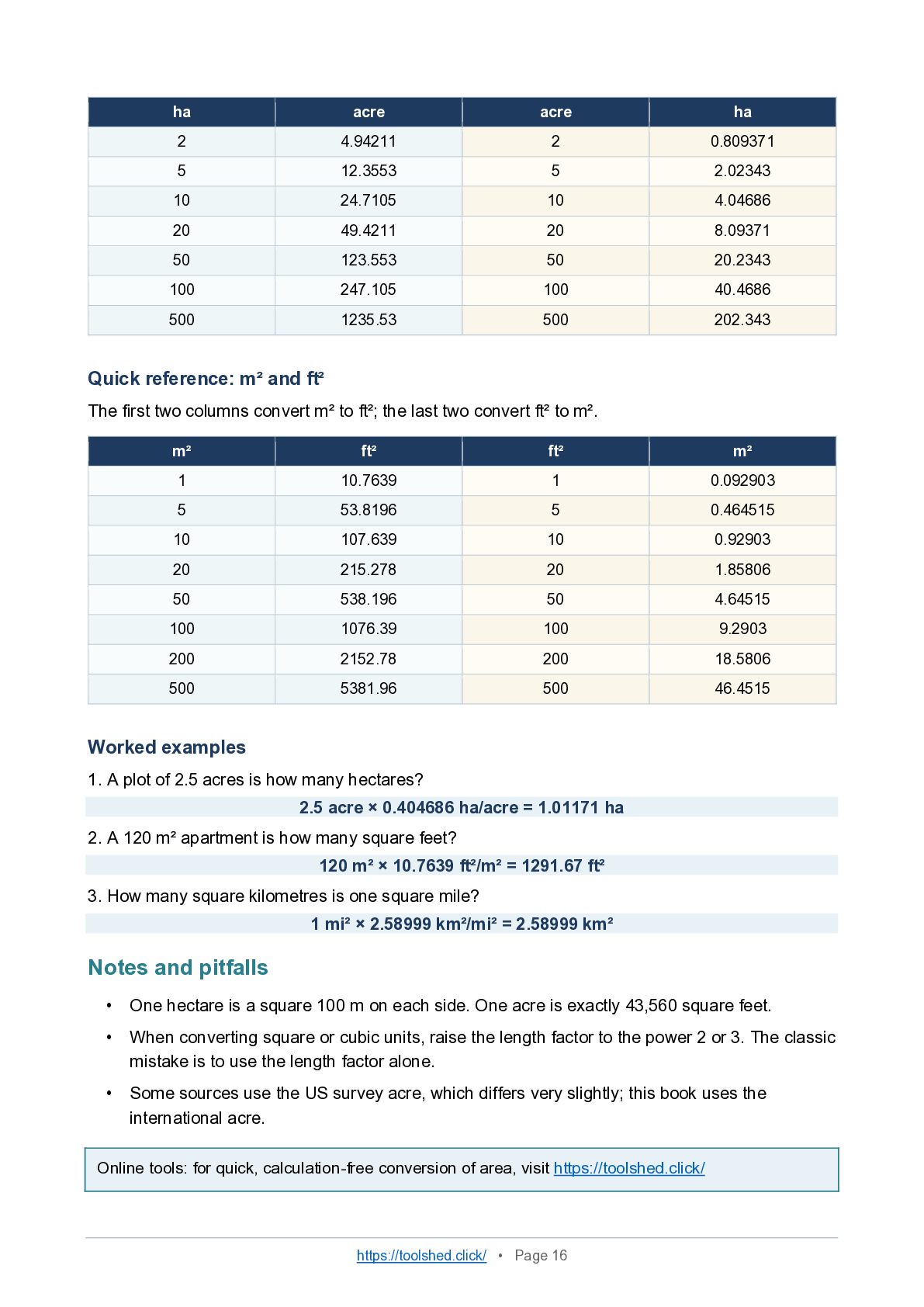
5 2.02343 10 24.7105 10 4.04686 20 49.4211 20 8.09371 50 123.553 50 20.2343 100 247.105 100 40.4686 500 1235.53 500 202.343 Quick reference: m² and ft² The first two columns convert m² to ft²; the last two convert ft² to m². m² ft² ft² m² 1 10.7639 1 0.092903 5 53.8196 5 0.464515 10 107.639 10 0.92903 20 215.278 20 1.85806 50 538.196 50 4.64515 100 1076.39 100 9.2903 200 2152.78 200 18.5806 500 5381.96 500 46.4515 Worked examples 1. A plot of 2.5 acres is how many hectares? 2.5 acre × 0.404686 ha/acre = 1.01171 ha 2. A 120 m² apartment is how many square feet? 120 m² × 10.7639 ft²/m² = 1291.67 ft² 3. How many square kilometres is one square mile? 1 mi² × 2.58999 km²/mi² = 2.58999 km² Notes and pitfalls • One hectare is a square 100 m on each side. One acre is exactly 43,560 square feet. • When converting square or cubic units, raise the length factor to the power 2 or 3. The classic mistake is to use the length factor alone. • Some sources use the US survey acre, which differs very slightly; this book uses the international acre. Online tools: for quick, calculation-free conversion of area, visit https://toolshed.click/ https://toolshed.click/ • Page 16
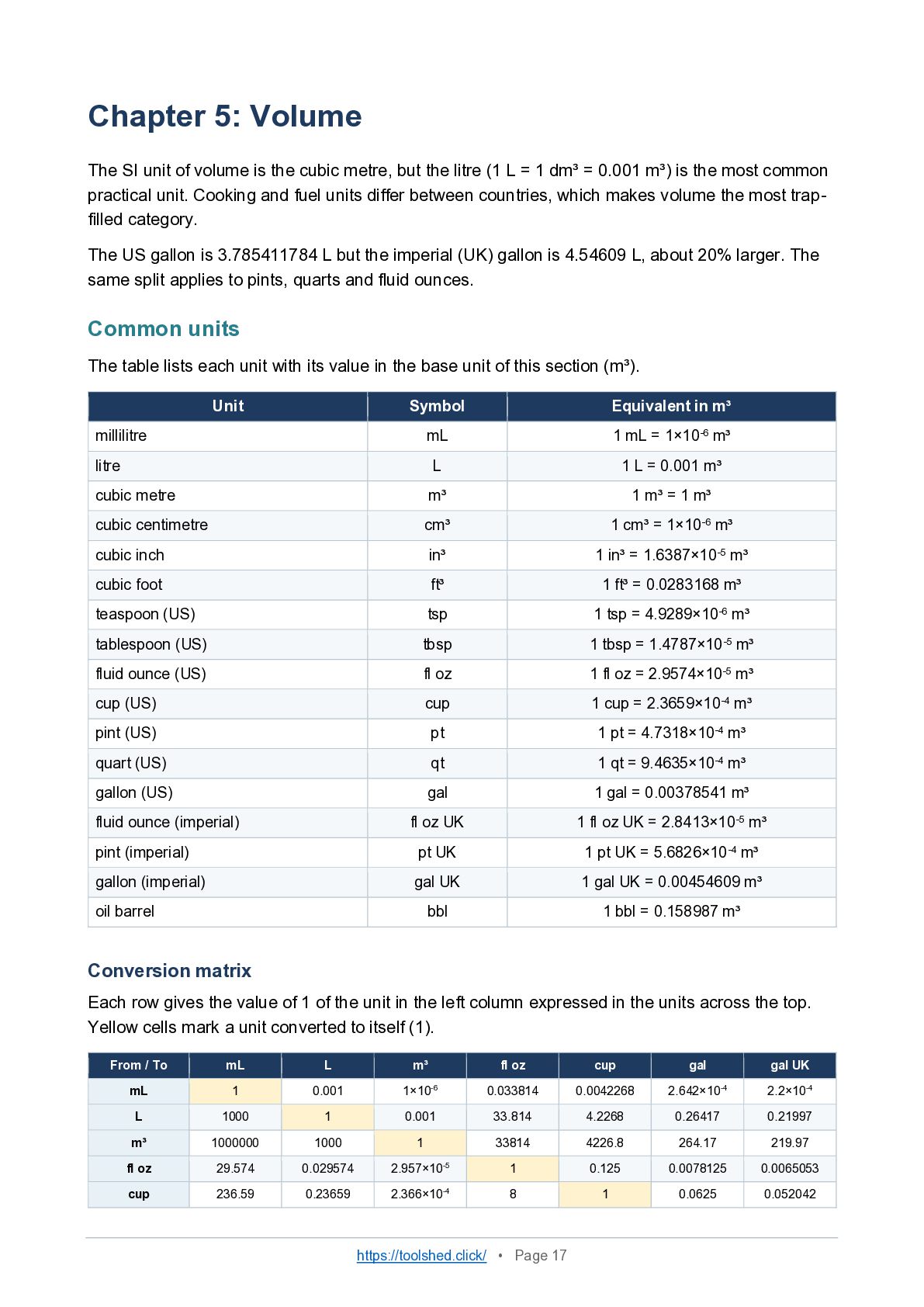
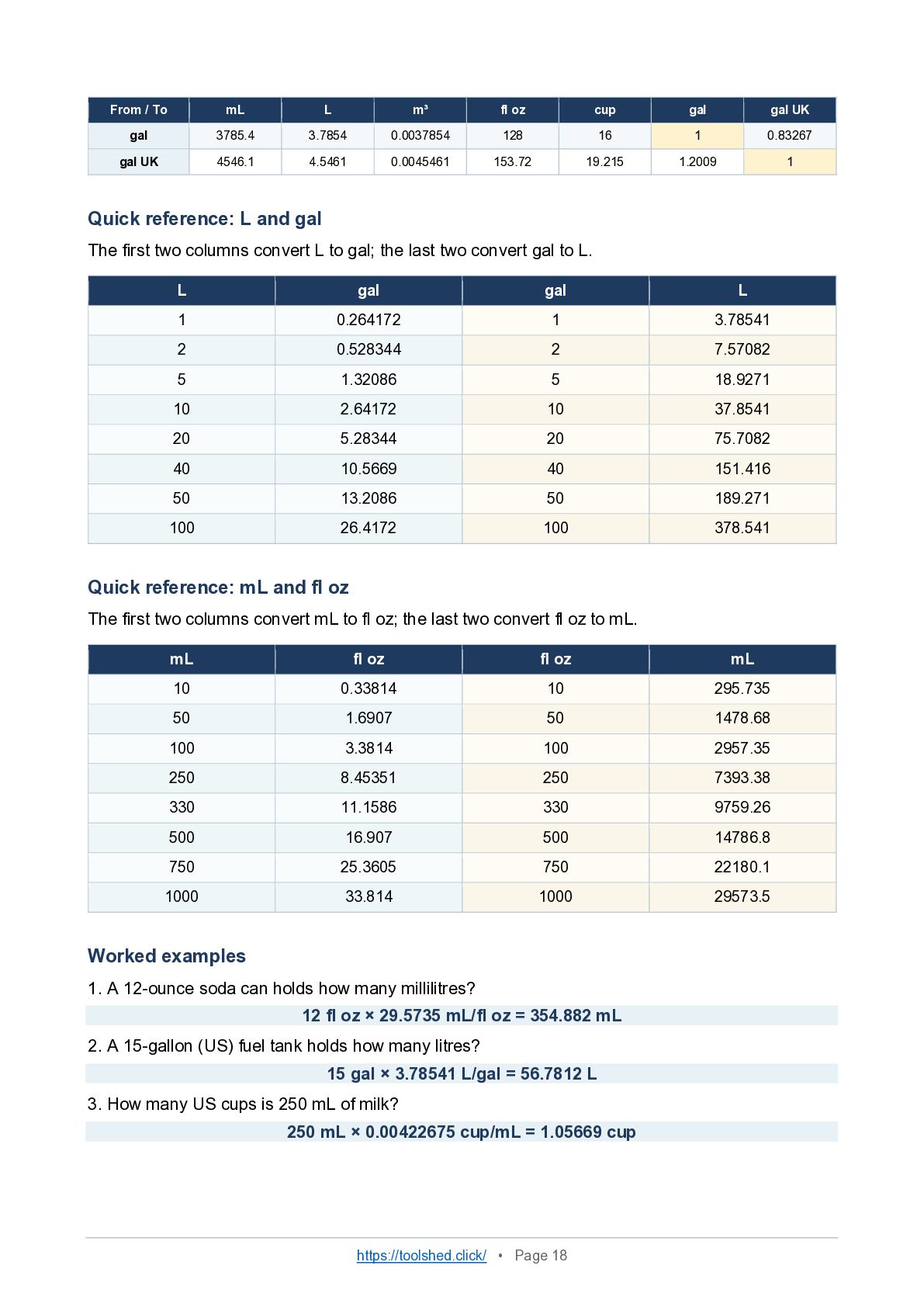
cubic metre, but the litre (1 L = 1 dm³ = 0.001 m³) is the most common practical unit. Cooking and fuel units differ between countries, which makes volume the most trapfilled category. The US gallon is 3.785411784 L but the imperial (UK) gallon is 4.54609 L, about 20% larger. The same split applies to pints, quarts and fluid ounces. Common units The table lists each unit with its value in the base unit of this section (m³). Unit Symbol Equivalent in m³ millilitre mL 1 mL = 1×10⁻⁶ m³ litre L 1 L = 0.001 m³ cubic metre m³ 1 m³ = 1 m³ cubic centimetre cm³ 1 cm³ = 1×10⁻⁶ m³ cubic inch in³ 1 in³ = 1.6387×10⁻⁵ m³ cubic foot ft³ 1 ft³ = 0.0283168 m³ teaspoon (US) tsp 1 tsp = 4.9289×10⁻⁶ m³ tablespoon (US) tbsp 1 tbsp = 1.4787×10⁻⁵ m³ fluid ounce (US) fl oz 1 fl oz = 2.9574×10⁻⁵ m³ cup (US) cup 1 cup = 2.3659×10⁻⁴ m³ pint (US) pt 1 pt = 4.7318×10⁻⁴ m³ quart (US) qt 1 qt = 9.4635×10⁻⁴ m³ gallon (US) gal 1 gal = 0.00378541 m³ fluid ounce (imperial) fl oz UK 1 fl oz UK = 2.8413×10⁻⁵ m³ pint (imperial) pt UK 1 pt UK = 5.6826×10⁻⁴ m³ gallon (imperial) gal UK 1 gal UK = 0.00454609 m³ bbl 1 bbl = 0.158987 m³ oil barrel Conversion matrix Each row gives the value of 1 of the unit in the left column expressed in the units across the top. Yellow cells mark a unit converted to itself (1). From / To mL L m³ fl oz -6 cup gal gal UK -4 2.2×10⁻⁴ mL 1 0.001 1×10 0.033814 0.0042268 2.642×10 L 1000 1 0.001 33.814 4.2268 0.26417 0.21997 m³ 1000000 1000 1 33814 4226.8 264.17 219.97 fl oz 29.574 0.029574 2.957×10⁻⁵ 1 0.125 0.0078125 0.0065053 cup 236.59 0.23659 2.366×10⁻⁴ 8 1 0.0625 0.052042 https://toolshed.click/ • Page 17
gal UK gal 3785.4 3.7854 0.0037854 128 16 1 0.83267 gal UK 4546.1 4.5461 0.0045461 153.72 19.215 1.2009 1 Quick reference: L and gal The first two columns convert L to gal; the last two convert gal to L. L gal gal L 1 0.264172 1 3.78541 2 0.528344 2 7.57082 5 1.32086 5 18.9271 10 2.64172 10 37.8541 20 5.28344 20 75.7082 40 10.5669 40 151.416 50 13.2086 50 189.271 100 26.4172 100 378.541 Quick reference: mL and fl oz The first two columns convert mL to fl oz; the last two convert fl oz to mL. mL fl oz fl oz mL 10 0.33814 10 295.735 50 1.6907 50 1478.68 100 3.3814 100 2957.35 250 8.45351 250 7393.38 330 11.1586 330 9759.26 500 16.907 500 14786.8 750 25.3605 750 22180.1 1000 33.814 1000 29573.5 Worked examples 1. A 12-ounce soda can holds how many millilitres? 12 fl oz × 29.5735 mL/fl oz = 354.882 mL 2. A 15-gallon (US) fuel tank holds how many litres? 15 gal × 3.78541 L/gal = 56.7812 L 3. How many US cups is 250 mL of milk? 250 mL × 0.00422675 cup/mL = 1.05669 cup https://toolshed.click/ • Page 18
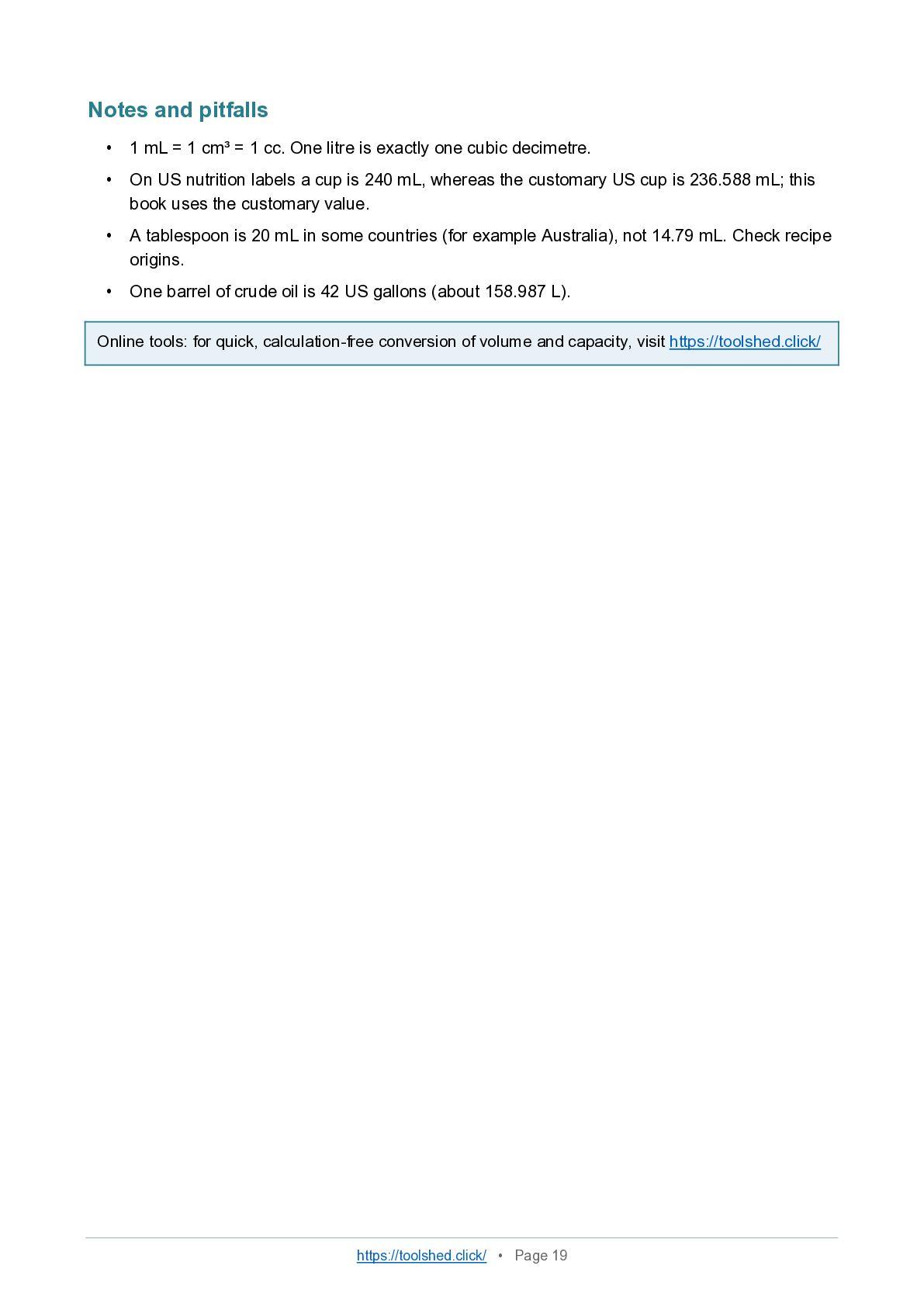
1 cc. One litre is exactly one cubic decimetre. • On US nutrition labels a cup is 240 mL, whereas the customary US cup is 236.588 mL; this book uses the customary value. • A tablespoon is 20 mL in some countries (for example Australia), not 14.79 mL. Check recipe origins. • One barrel of crude oil is 42 US gallons (about 158.987 L). Online tools: for quick, calculation-free conversion of volume and capacity, visit https://toolshed.click/ https://toolshed.click/ • Page 19
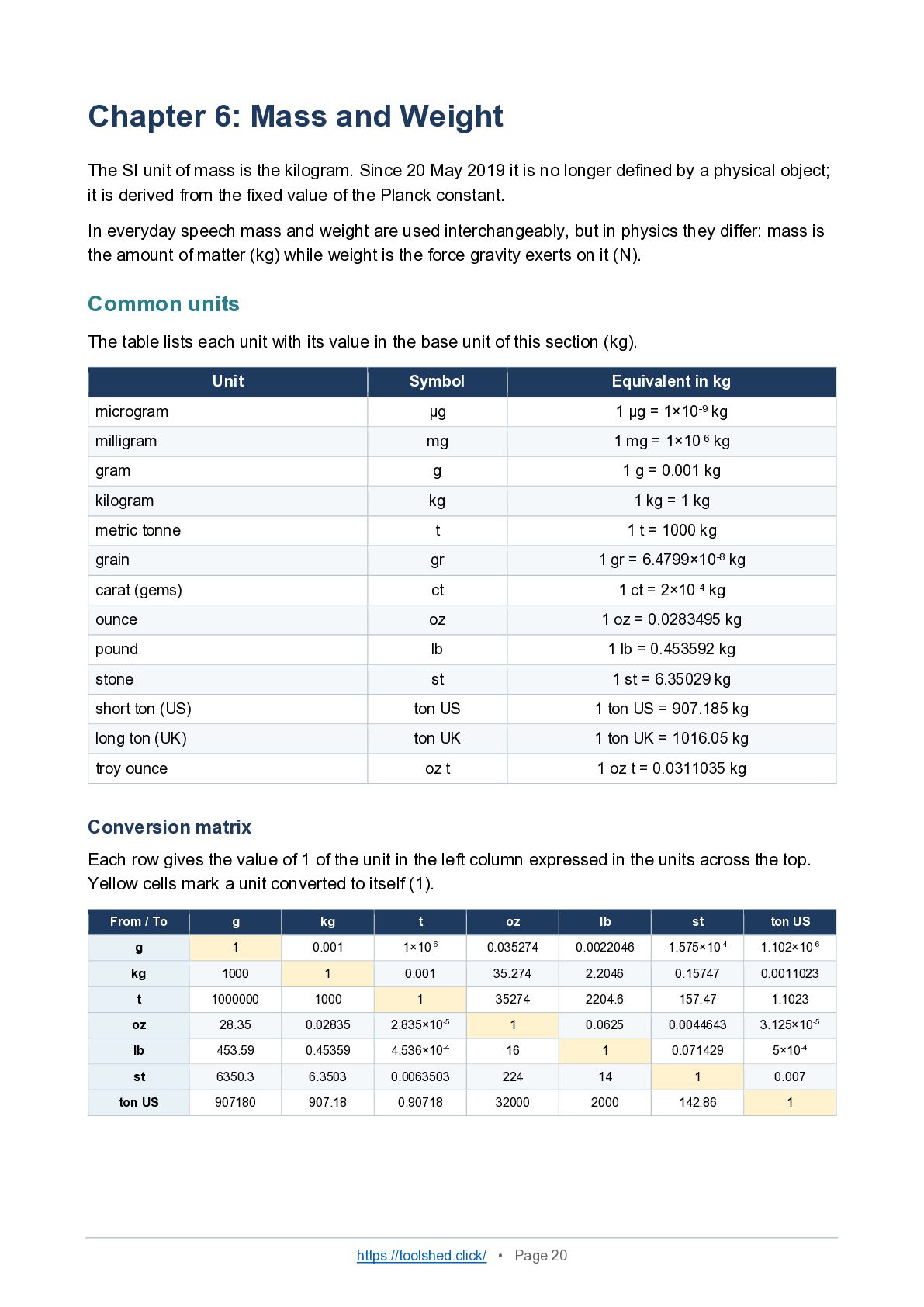
is the kilogram. Since 20 May 2019 it is no longer defined by a physical object; it is derived from the fixed value of the Planck constant. In everyday speech mass and weight are used interchangeably, but in physics they differ: mass is the amount of matter (kg) while weight is the force gravity exerts on it (N). Common units The table lists each unit with its value in the base unit of this section (kg). Unit Symbol Equivalent in kg microgram µg 1 µg = 1×10⁻⁹ kg milligram mg 1 mg = 1×10⁻⁶ kg gram g 1 g = 0.001 kg kilogram kg 1 kg = 1 kg metric tonne t 1 t = 1000 kg grain gr 1 gr = 6.4799×10⁻⁸ kg carat (gems) ct 1 ct = 2×10⁻⁴ kg ounce oz 1 oz = 0.0283495 kg pound lb 1 lb = 0.453592 kg stone st 1 st = 6.35029 kg short ton (US) ton US 1 ton US = 907.185 kg long ton (UK) ton UK 1 ton UK = 1016.05 kg troy ounce oz t 1 oz t = 0.0311035 kg Conversion matrix Each row gives the value of 1 of the unit in the left column expressed in the units across the top. Yellow cells mark a unit converted to itself (1). From / To g kg t oz -6 lb st ton US -4 1.102×10⁻⁶ g 1 0.001 1×10 0.035274 0.0022046 1.575×10 kg 1000 1 0.001 35.274 2.2046 0.15747 0.0011023 t 1000000 1000 1 35274 2204.6 157.47 1.1023 -5 oz 28.35 0.02835 2.835×10 1 0.0625 0.0044643 3.125×10⁻⁵ lb 453.59 0.45359 4.536×10⁻⁴ 16 1 0.071429 5×10⁻⁴ st 6350.3 6.3503 0.0063503 224 14 1 0.007 ton US 907180 907.18 0.90718 32000 2000 142.86 1 https://toolshed.click/ • Page 20
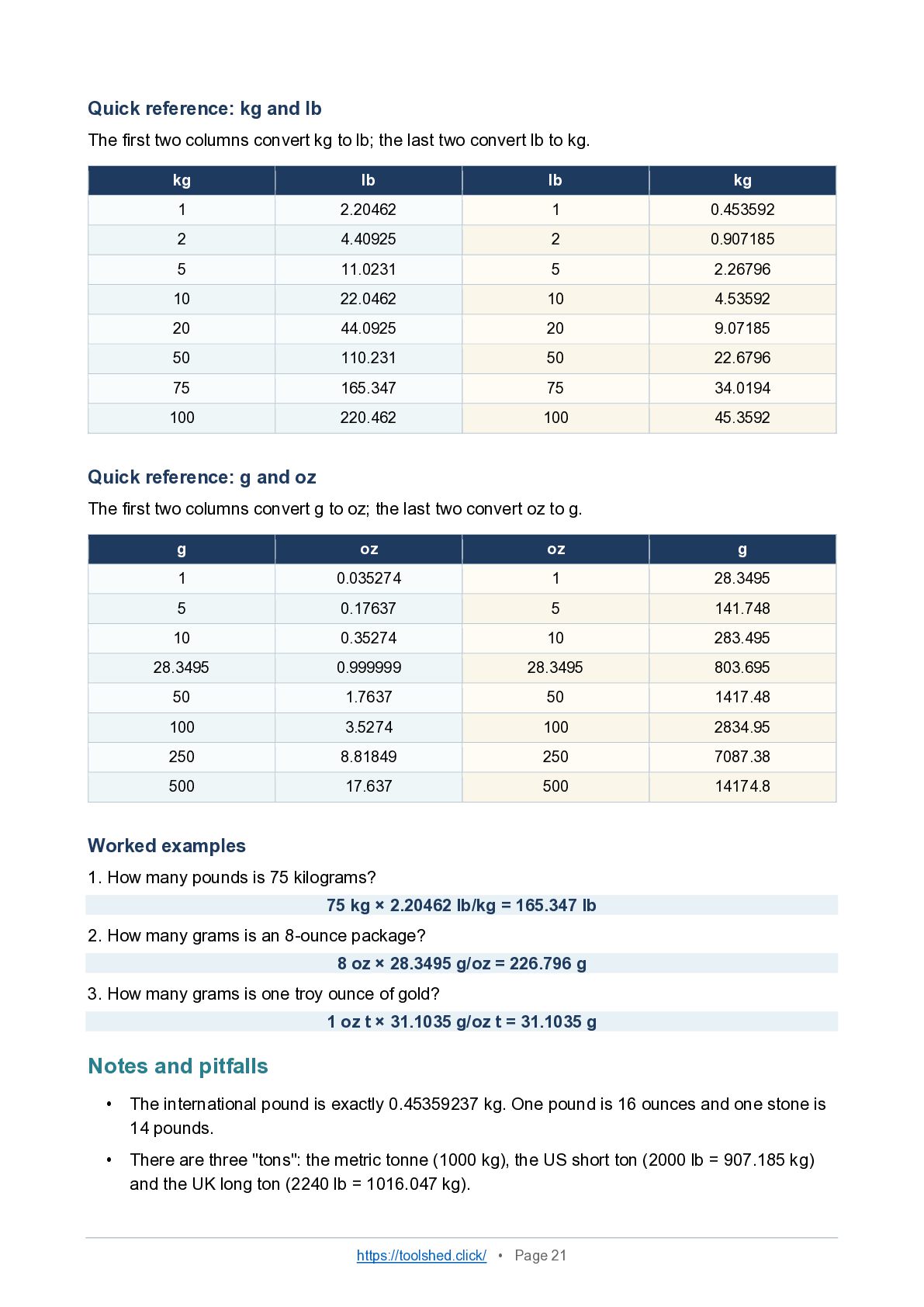
kg to lb; the last two convert lb to kg. kg lb lb kg 1 2.20462 1 0.453592 2 4.40925 2 0.907185 5 11.0231 5 2.26796 10 22.0462 10 4.53592 20 44.0925 20 9.07185 50 110.231 50 22.6796 75 165.347 75 34.0194 100 220.462 100 45.3592 Quick reference: g and oz The first two columns convert g to oz; the last two convert oz to g. g oz oz g 1 0.035274 1 28.3495 5 0.17637 5 141.748 10 0.35274 10 283.495 28.3495 0.999999 28.3495 803.695 50 1.7637 50 1417.48 100 3.5274 100 2834.95 250 8.81849 250 7087.38 500 17.637 500 14174.8 Worked examples 1. How many pounds is 75 kilograms? 75 kg × 2.20462 lb/kg = 165.347 lb 2. How many grams is an 8-ounce package? 8 oz × 28.3495 g/oz = 226.796 g 3. How many grams is one troy ounce of gold? 1 oz t × 31.1035 g/oz t = 31.1035 g Notes and pitfalls • The international pound is exactly 0.45359237 kg. One pound is 16 ounces and one stone is 14 pounds. • There are three "tons": the metric tonne (1000 kg), the US short ton (2000 lb = 907.185 kg) and the UK long ton (2240 lb = 1016.047 kg). https://toolshed.click/ • Page 21
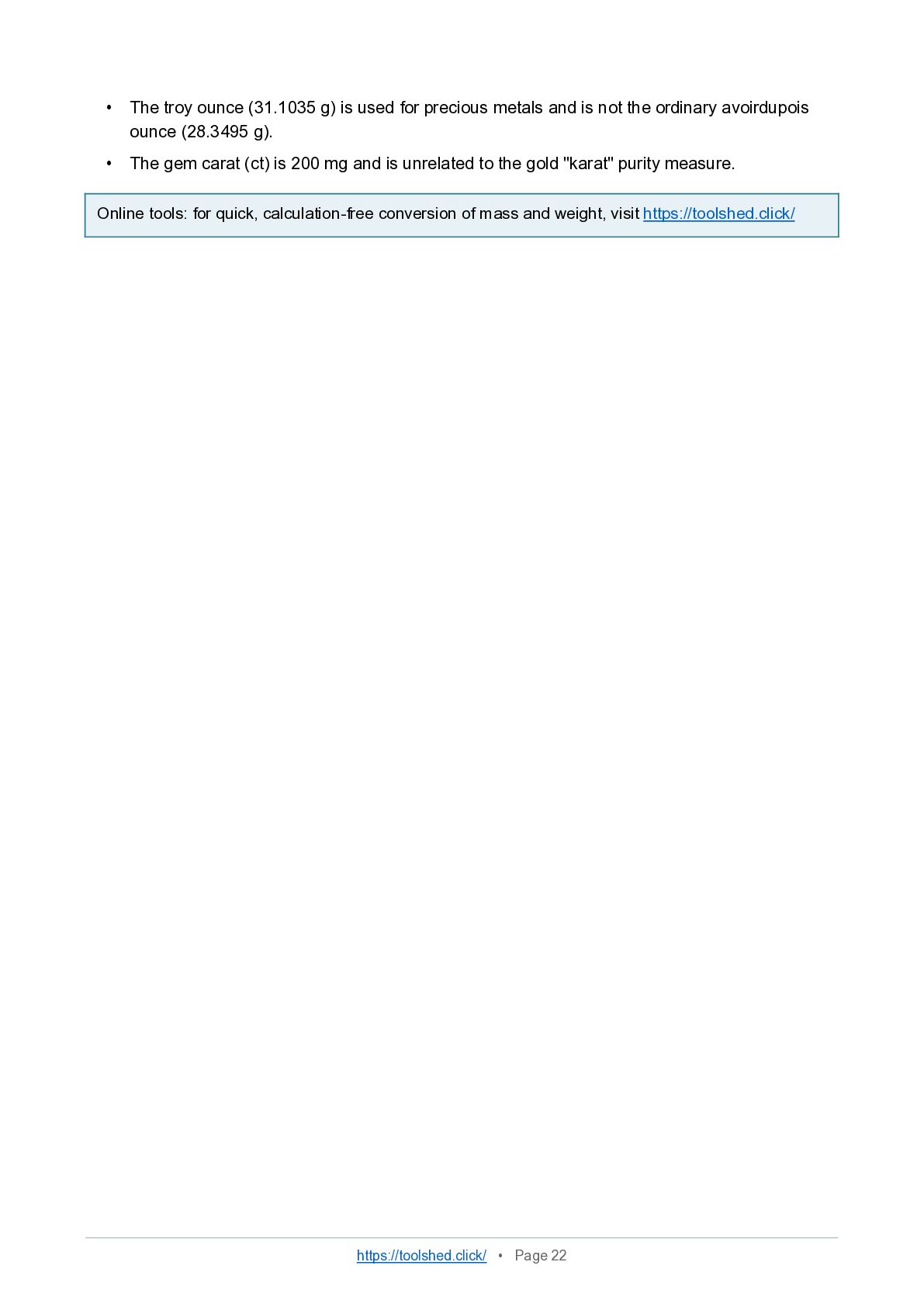
metals and is not the ordinary avoirdupois ounce (28.3495 g). • The gem carat (ct) is 200 mg and is unrelated to the gold "karat" purity measure. Online tools: for quick, calculation-free conversion of mass and weight, visit https://toolshed.click/ https://toolshed.click/ • Page 22
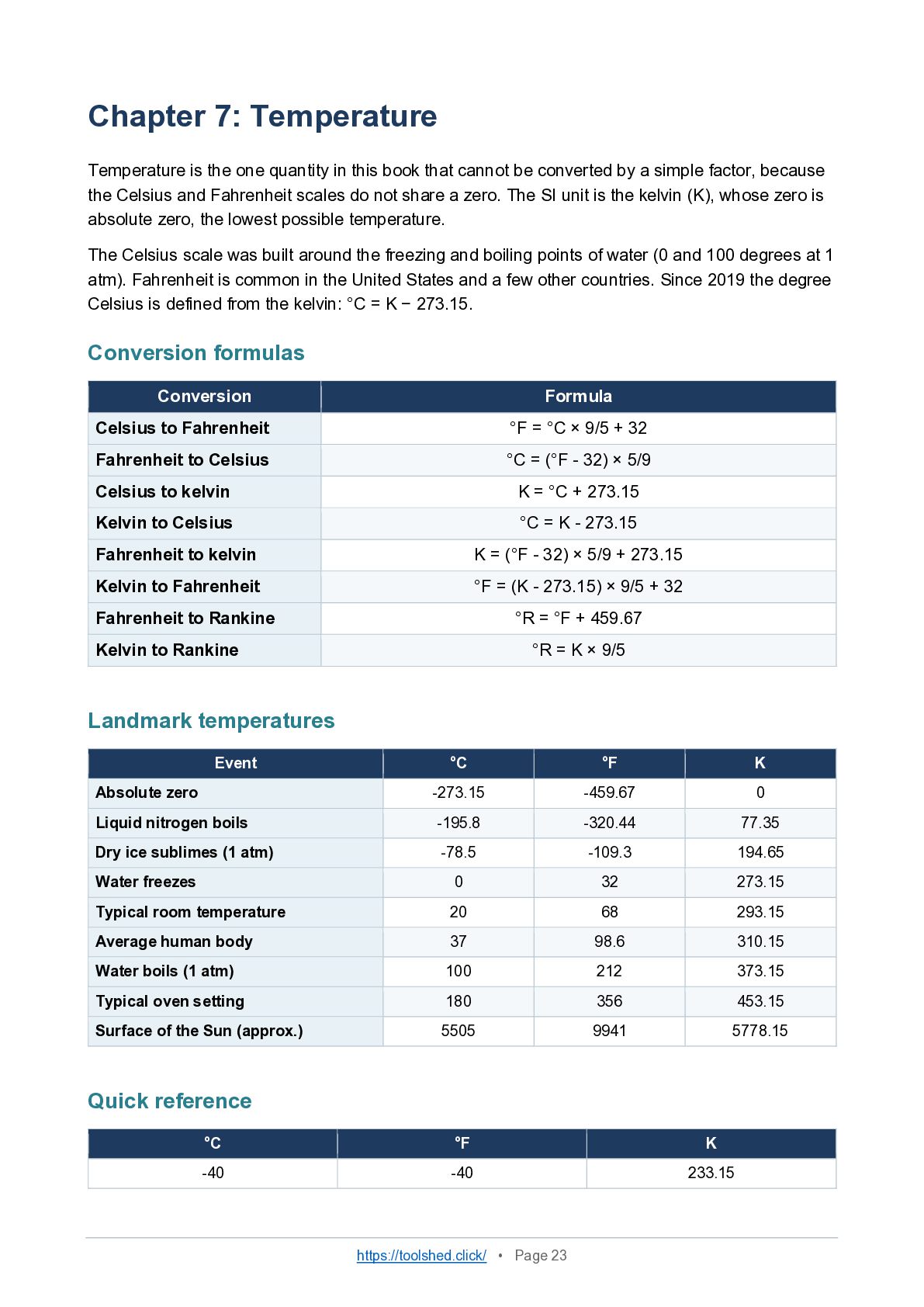
book that cannot be converted by a simple factor, because the Celsius and Fahrenheit scales do not share a zero. The SI unit is the kelvin (K), whose zero is absolute zero, the lowest possible temperature. The Celsius scale was built around the freezing and boiling points of water (0 and 100 degrees at 1 atm). Fahrenheit is common in the United States and a few other countries. Since 2019 the degree Celsius is defined from the kelvin: °C = K − 273.15. Conversion formulas Conversion Formula Celsius to Fahrenheit °F = °C × 9/5 + 32 Fahrenheit to Celsius °C = (°F - 32) × 5/9 Celsius to kelvin K = °C + 273.15 Kelvin to Celsius °C = K - 273.15 Fahrenheit to kelvin K = (°F - 32) × 5/9 + 273.15 Kelvin to Fahrenheit °F = (K - 273.15) × 9/5 + 32 Fahrenheit to Rankine °R = °F + 459.67 Kelvin to Rankine °R = K × 9/5 Landmark temperatures Event °C °F K Absolute zero -273.15 -459.67 0 Liquid nitrogen boils -195.8 -320.44 77.35 Dry ice sublimes (1 atm) -78.5 -109.3 194.65 Water freezes 0 32 273.15 Typical room temperature 20 68 293.15 Average human body 37 98.6 310.15 Water boils (1 atm) 100 212 373.15 Typical oven setting 180 356 453.15 Surface of the Sun (approx.) 5505 9941 5778.15 Quick reference °C °F K -40 -40 233.15 https://toolshed.click/ • Page 23
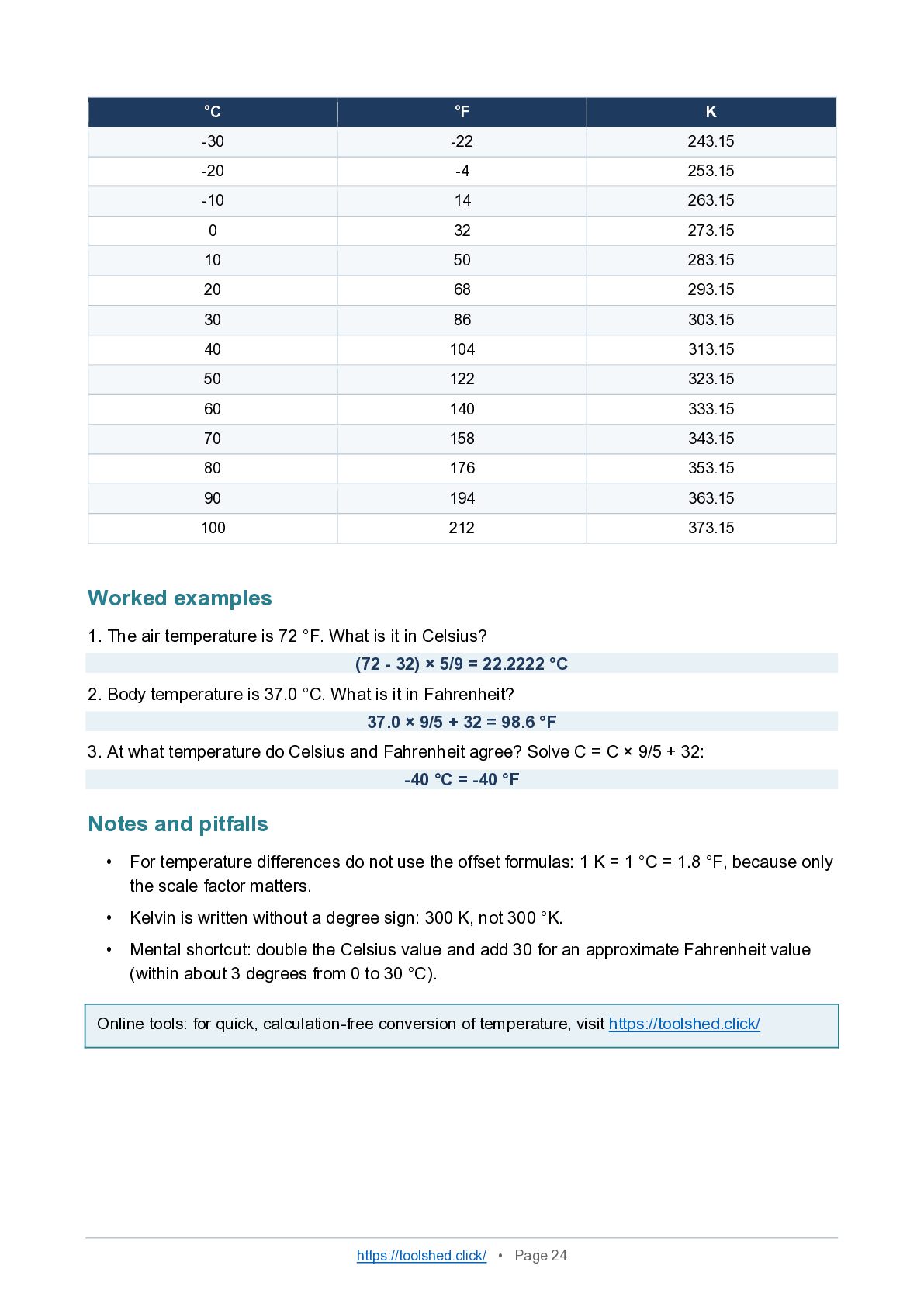
14 263.15 0 32 273.15 10 50 283.15 20 68 293.15 30 86 303.15 40 104 313.15 50 122 323.15 60 140 333.15 70 158 343.15 80 176 353.15 90 194 363.15 100 212 373.15 Worked examples 1. The air temperature is 72 °F. What is it in Celsius? (72 - 32) × 5/9 = 22.2222 °C 2. Body temperature is 37.0 °C. What is it in Fahrenheit? 37.0 × 9/5 + 32 = 98.6 °F 3. At what temperature do Celsius and Fahrenheit agree? Solve C = C × 9/5 + 32: -40 °C = -40 °F Notes and pitfalls • For temperature differences do not use the offset formulas: 1 K = 1 °C = 1.8 °F, because only the scale factor matters. • Kelvin is written without a degree sign: 300 K, not 300 °K. • Mental shortcut: double the Celsius value and add 30 for an approximate Fahrenheit value (within about 3 degrees from 0 to 30 °C). Online tools: for quick, calculation-free conversion of temperature, visit https://toolshed.click/ https://toolshed.click/ • Page 24
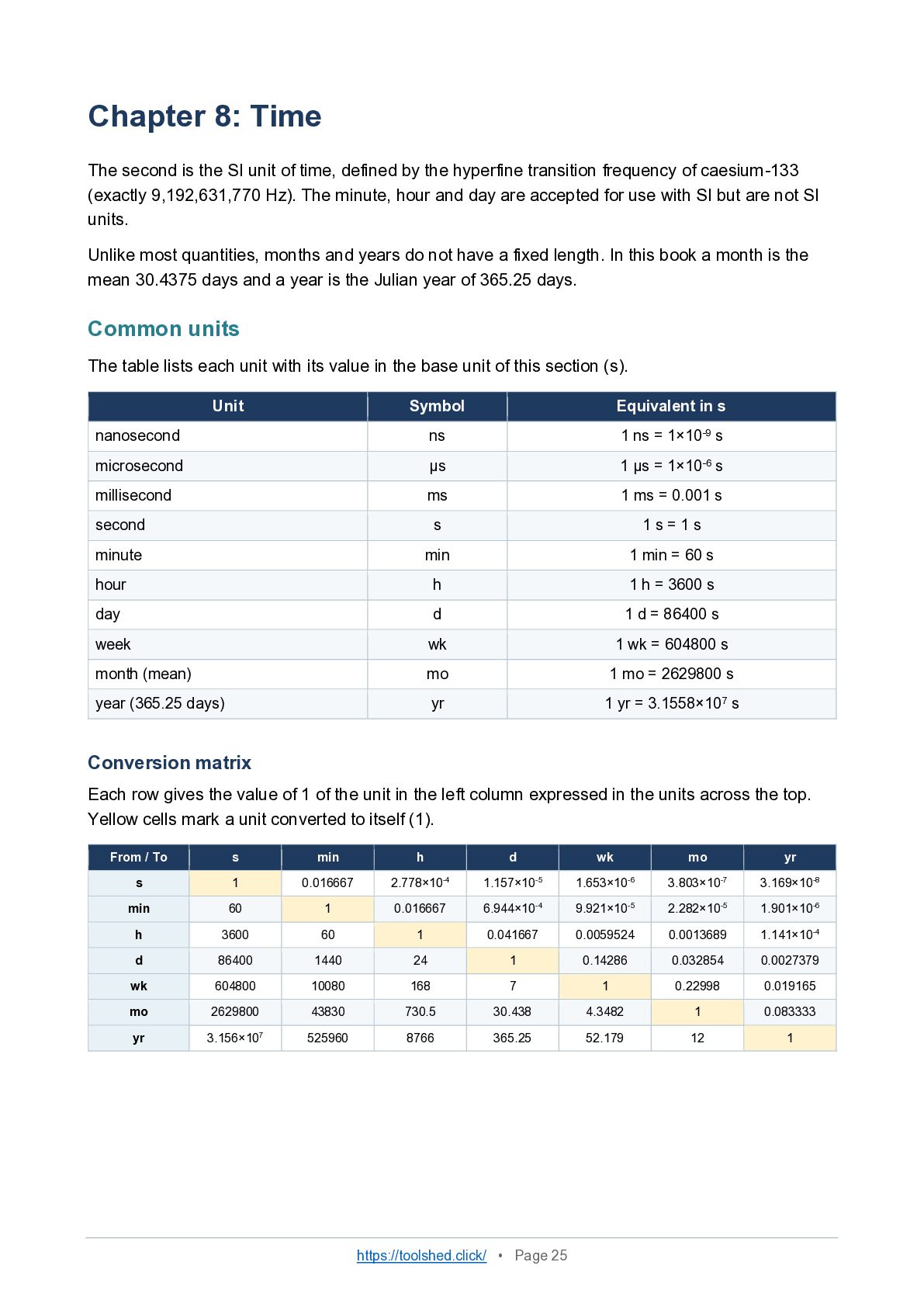
time, defined by the hyperfine transition frequency of caesium-133 (exactly 9,192,631,770 Hz). The minute, hour and day are accepted for use with SI but are not SI units. Unlike most quantities, months and years do not have a fixed length. In this book a month is the mean 30.4375 days and a year is the Julian year of 365.25 days. Common units The table lists each unit with its value in the base unit of this section (s). Unit Symbol Equivalent in s nanosecond ns 1 ns = 1×10⁻⁹ s microsecond µs 1 µs = 1×10⁻⁶ s millisecond ms 1 ms = 0.001 s second s 1s=1s minute min 1 min = 60 s hour h 1 h = 3600 s day d 1 d = 86400 s week wk 1 wk = 604800 s month (mean) mo 1 mo = 2629800 s year (365.25 days) yr 1 yr = 3.1558×10⁷ s Conversion matrix Each row gives the value of 1 of the unit in the left column expressed in the units across the top. Yellow cells mark a unit converted to itself (1). From / To s min h d wk mo yr s 1 0.016667 2.778×10⁻⁴ 1.157×10⁻⁵ 1.653×10⁻⁶ 3.803×10⁻⁷ 3.169×10⁻⁸ min 60 1 0.016667 6.944×10⁻⁴ 9.921×10⁻⁵ 2.282×10⁻⁵ 1.901×10⁻⁶ h 3600 60 1 0.041667 0.0059524 0.0013689 1.141×10⁻⁴ d 86400 1440 24 1 0.14286 0.032854 0.0027379 wk 604800 10080 168 7 1 0.22998 0.019165 mo 2629800 43830 730.5 30.438 4.3482 1 0.083333 yr 3.156×10⁷ 525960 8766 365.25 52.179 12 1 https://toolshed.click/ • Page 25
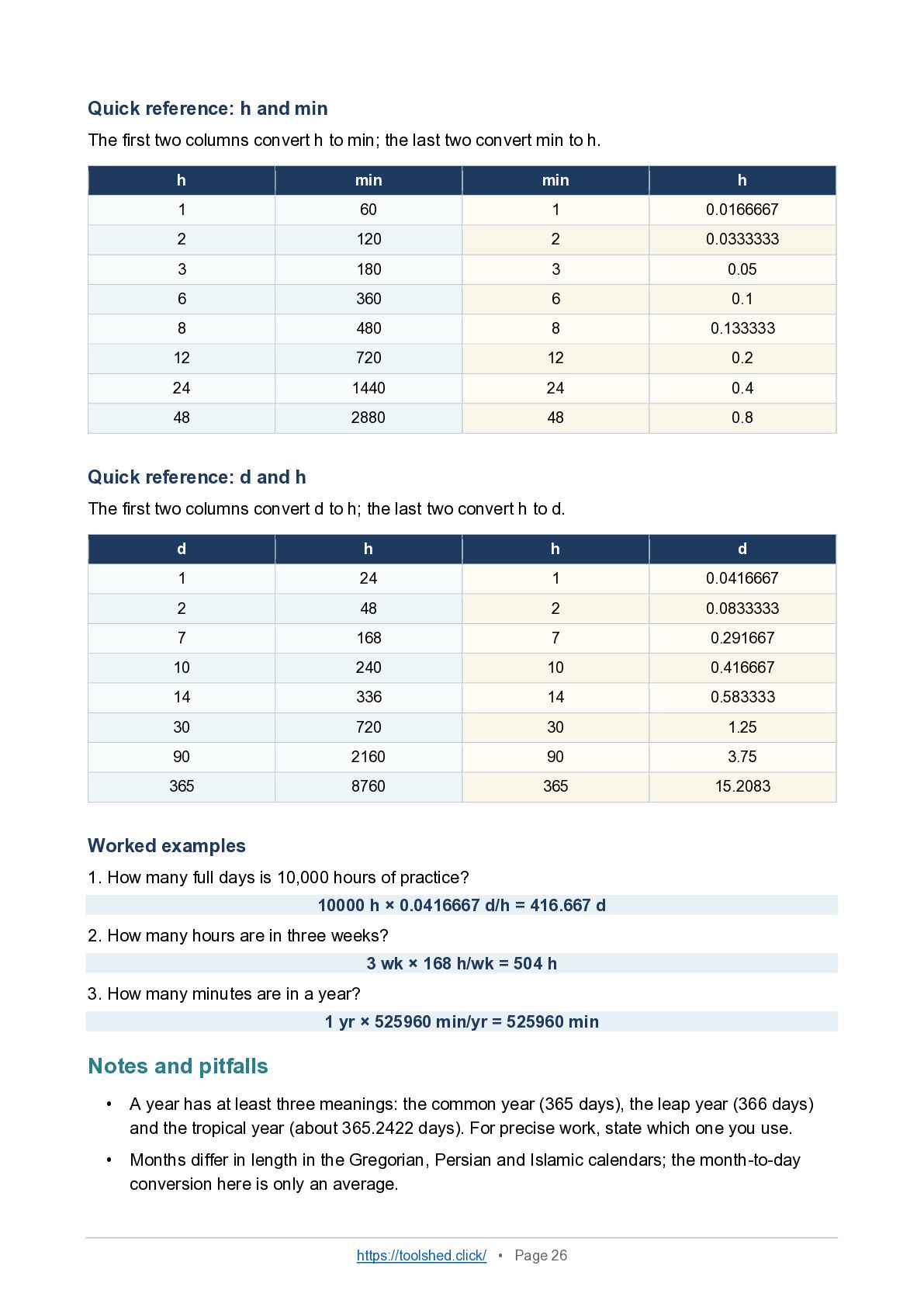
h to min; the last two convert min to h. h min min h 1 60 1 0.0166667 2 120 2 0.0333333 3 180 3 0.05 6 360 6 0.1 8 480 8 0.133333 12 720 12 0.2 24 1440 24 0.4 48 2880 48 0.8 Quick reference: d and h The first two columns convert d to h; the last two convert h to d. d h h d 1 24 1 0.0416667 2 48 2 0.0833333 7 168 7 0.291667 10 240 10 0.416667 14 336 14 0.583333 30 720 30 1.25 90 2160 90 3.75 365 8760 365 15.2083 Worked examples 1. How many full days is 10,000 hours of practice? 10000 h × 0.0416667 d/h = 416.667 d 2. How many hours are in three weeks? 3 wk × 168 h/wk = 504 h 3. How many minutes are in a year? 1 yr × 525960 min/yr = 525960 min Notes and pitfalls • A year has at least three meanings: the common year (365 days), the leap year (366 days) and the tropical year (about 365.2422 days). For precise work, state which one you use. • Months differ in length in the Gregorian, Persian and Islamic calendars; the month-to-day conversion here is only an average. https://toolshed.click/ • Page 26
that it stays in step with Earth's rotation. Online tools: for quick, calculation-free conversion of time, visit https://toolshed.click/ https://toolshed.click/ • Page 27
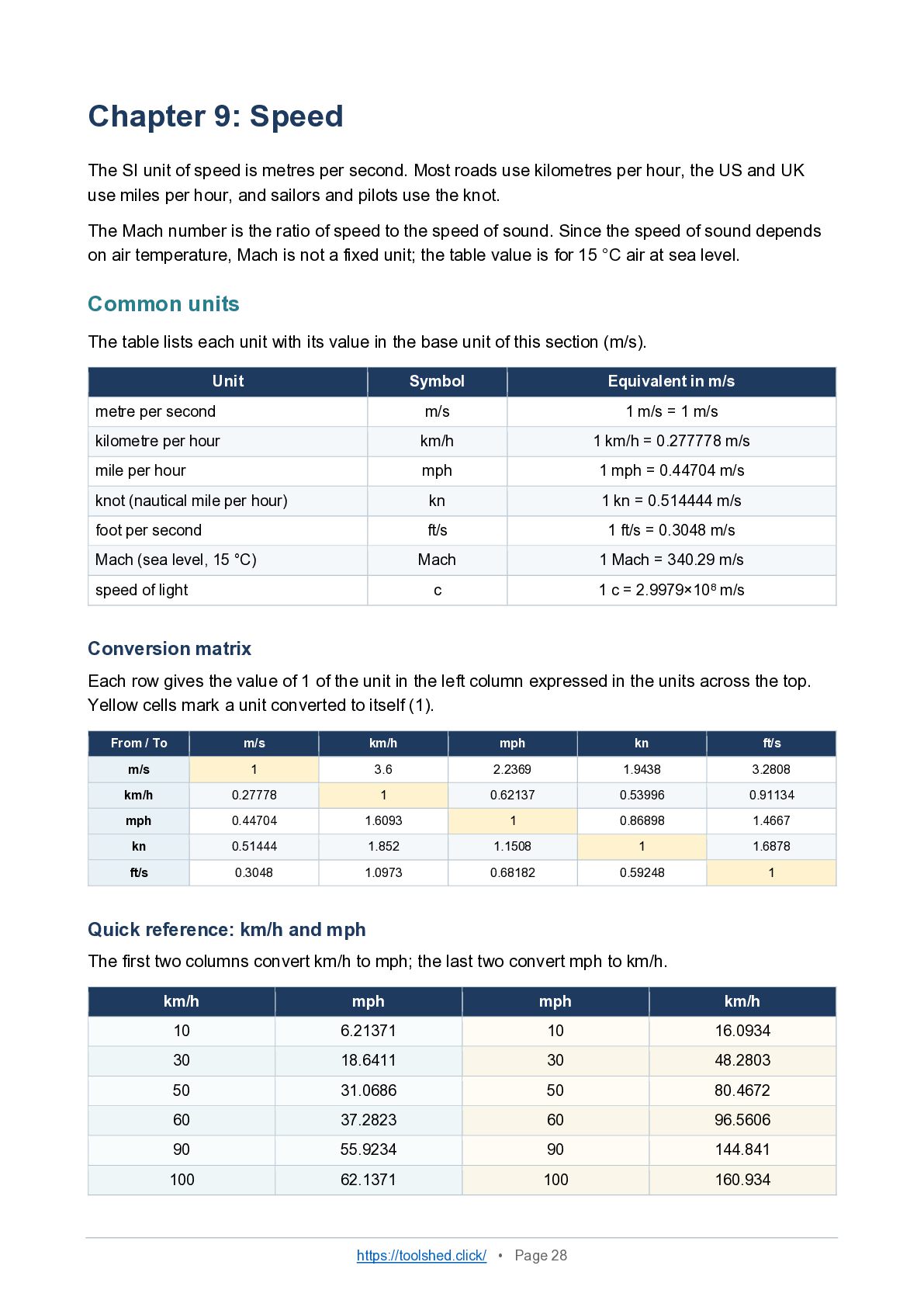
per second. Most roads use kilometres per hour, the US and UK use miles per hour, and sailors and pilots use the knot. The Mach number is the ratio of speed to the speed of sound. Since the speed of sound depends on air temperature, Mach is not a fixed unit; the table value is for 15 °C air at sea level. Common units The table lists each unit with its value in the base unit of this section (m/s). Unit Symbol Equivalent in m/s metre per second m/s 1 m/s = 1 m/s kilometre per hour km/h 1 km/h = 0.277778 m/s mile per hour mph 1 mph = 0.44704 m/s knot (nautical mile per hour) kn 1 kn = 0.514444 m/s foot per second ft/s 1 ft/s = 0.3048 m/s Mach (sea level, 15 °C) Mach 1 Mach = 340.29 m/s c 1 c = 2.9979×10⁸ m/s speed of light Conversion matrix Each row gives the value of 1 of the unit in the left column expressed in the units across the top. Yellow cells mark a unit converted to itself (1). From / To m/s km/h mph kn ft/s m/s 1 3.6 2.2369 1.9438 3.2808 km/h 0.27778 1 0.62137 0.53996 0.91134 mph 0.44704 1.6093 1 0.86898 1.4667 kn 0.51444 1.852 1.1508 1 1.6878 ft/s 0.3048 1.0973 0.68182 0.59248 1 Quick reference: km/h and mph The first two columns convert km/h to mph; the last two convert mph to km/h. km/h mph mph km/h 10 6.21371 10 16.0934 30 18.6411 30 48.2803 50 31.0686 50 80.4672 60 37.2823 60 96.5606 90 55.9234 90 144.841 100 62.1371 100 160.934 https://toolshed.click/ • Page 28
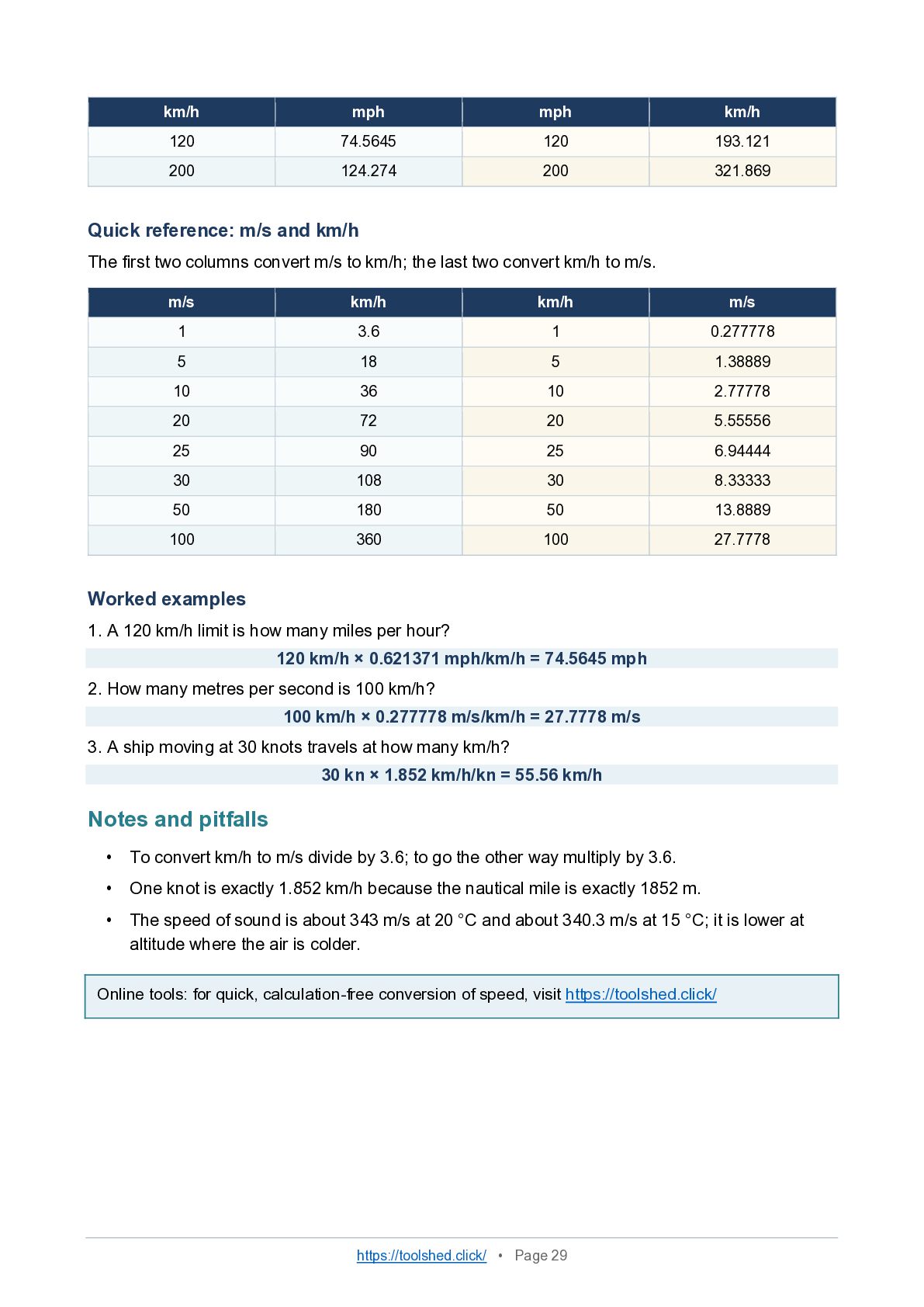
200 321.869 Quick reference: m/s and km/h The first two columns convert m/s to km/h; the last two convert km/h to m/s. m/s km/h km/h m/s 1 3.6 1 0.277778 5 18 5 1.38889 10 36 10 2.77778 20 72 20 5.55556 25 90 25 6.94444 30 108 30 8.33333 50 180 50 13.8889 100 360 100 27.7778 Worked examples 1. A 120 km/h limit is how many miles per hour? 120 km/h × 0.621371 mph/km/h = 74.5645 mph 2. How many metres per second is 100 km/h? 100 km/h × 0.277778 m/s/km/h = 27.7778 m/s 3. A ship moving at 30 knots travels at how many km/h? 30 kn × 1.852 km/h/kn = 55.56 km/h Notes and pitfalls • To convert km/h to m/s divide by 3.6; to go the other way multiply by 3.6. • One knot is exactly 1.852 km/h because the nautical mile is exactly 1852 m. • The speed of sound is about 343 m/s at 20 °C and about 340.3 m/s at 15 °C; it is lower at altitude where the air is colder. Online tools: for quick, calculation-free conversion of speed, visit https://toolshed.click/ https://toolshed.click/ • Page 29
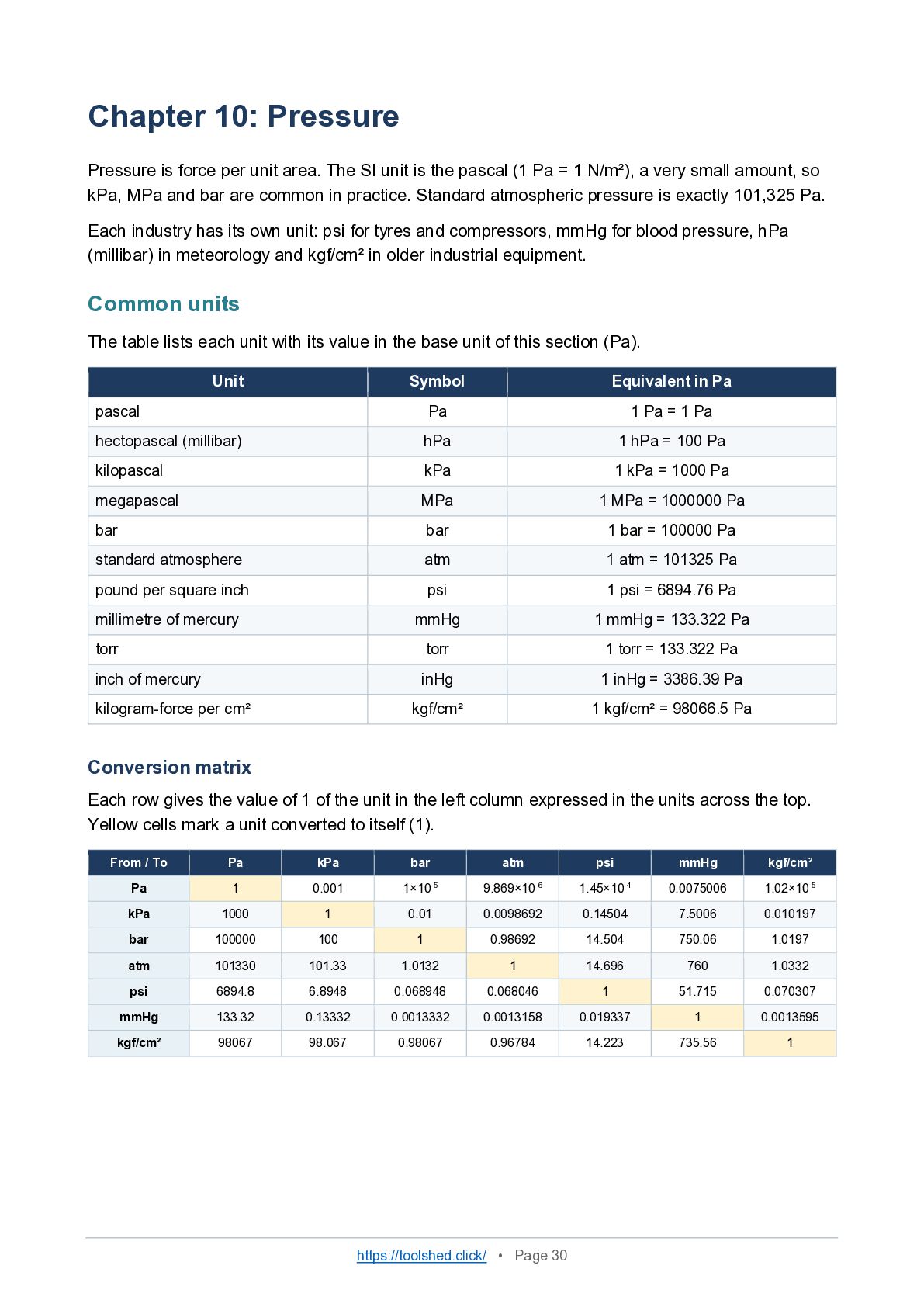
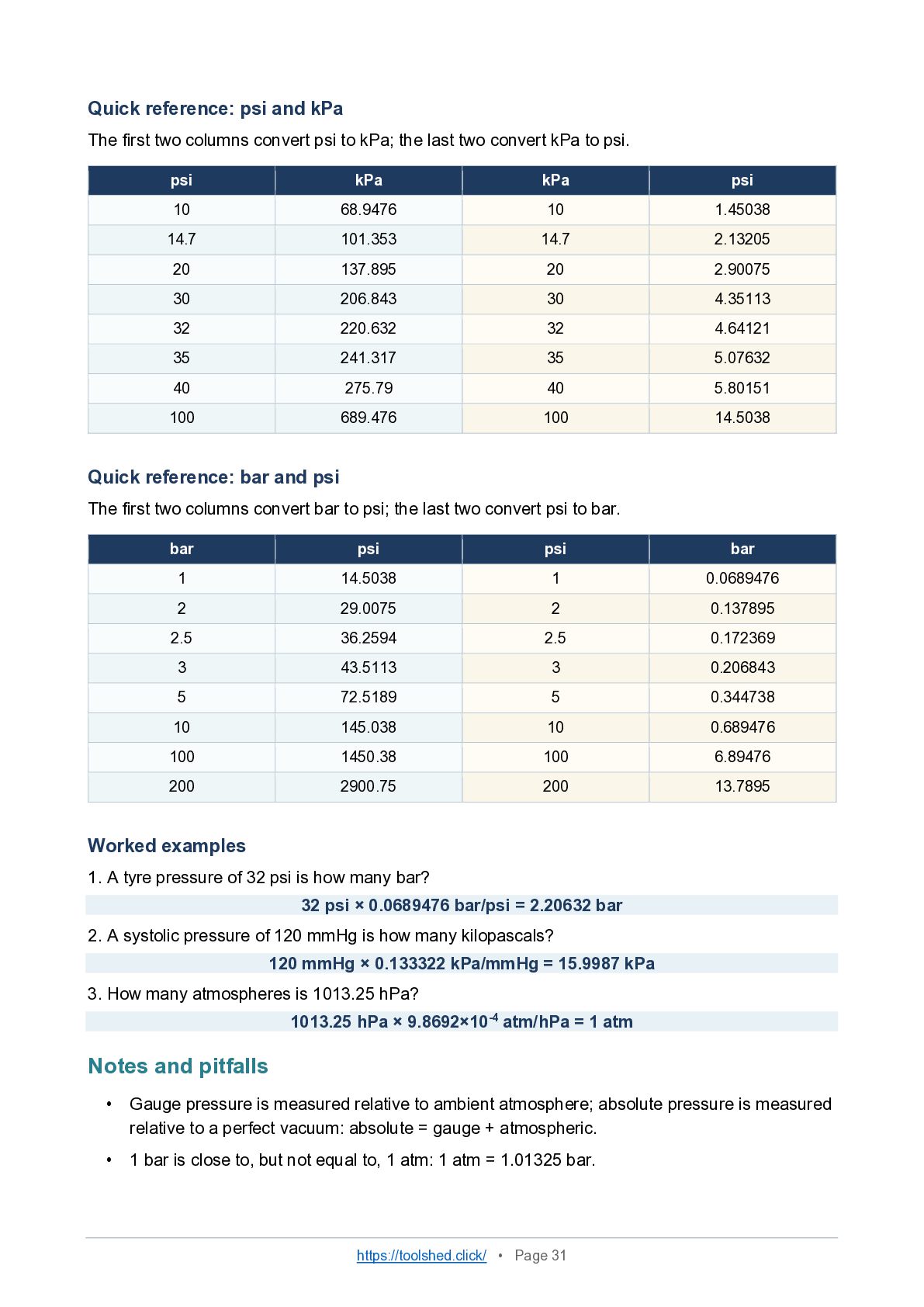
SI unit is the pascal (1 Pa = 1 N/m²), a very small amount, so kPa, MPa and bar are common in practice. Standard atmospheric pressure is exactly 101,325 Pa. Each industry has its own unit: psi for tyres and compressors, mmHg for blood pressure, hPa (millibar) in meteorology and kgf/cm² in older industrial equipment. Common units The table lists each unit with its value in the base unit of this section (Pa). Unit Symbol Equivalent in Pa pascal Pa 1 Pa = 1 Pa hectopascal (millibar) hPa 1 hPa = 100 Pa kilopascal kPa 1 kPa = 1000 Pa megapascal MPa 1 MPa = 1000000 Pa bar bar 1 bar = 100000 Pa standard atmosphere atm 1 atm = 101325 Pa pound per square inch psi 1 psi = 6894.76 Pa millimetre of mercury mmHg 1 mmHg = 133.322 Pa torr torr 1 torr = 133.322 Pa inch of mercury inHg 1 inHg = 3386.39 Pa kilogram-force per cm² kgf/cm² 1 kgf/cm² = 98066.5 Pa Conversion matrix Each row gives the value of 1 of the unit in the left column expressed in the units across the top. Yellow cells mark a unit converted to itself (1). From / To Pa kPa bar atm -5 psi -6 mmHg kgf/cm² Pa 1 0.001 1×10 9.869×10 1.45×10 0.0075006 1.02×10⁻⁵ kPa 1000 1 0.01 0.0098692 0.14504 7.5006 0.010197 bar 100000 100 1 0.98692 14.504 750.06 1.0197 atm 101330 101.33 1.0132 1 14.696 760 1.0332 psi 6894.8 6.8948 0.068948 0.068046 1 51.715 0.070307 mmHg 133.32 0.13332 0.0013332 0.0013158 0.019337 1 0.0013595 kgf/cm² 98067 98.067 0.98067 0.96784 14.223 735.56 1 https://toolshed.click/ • Page 30 -4
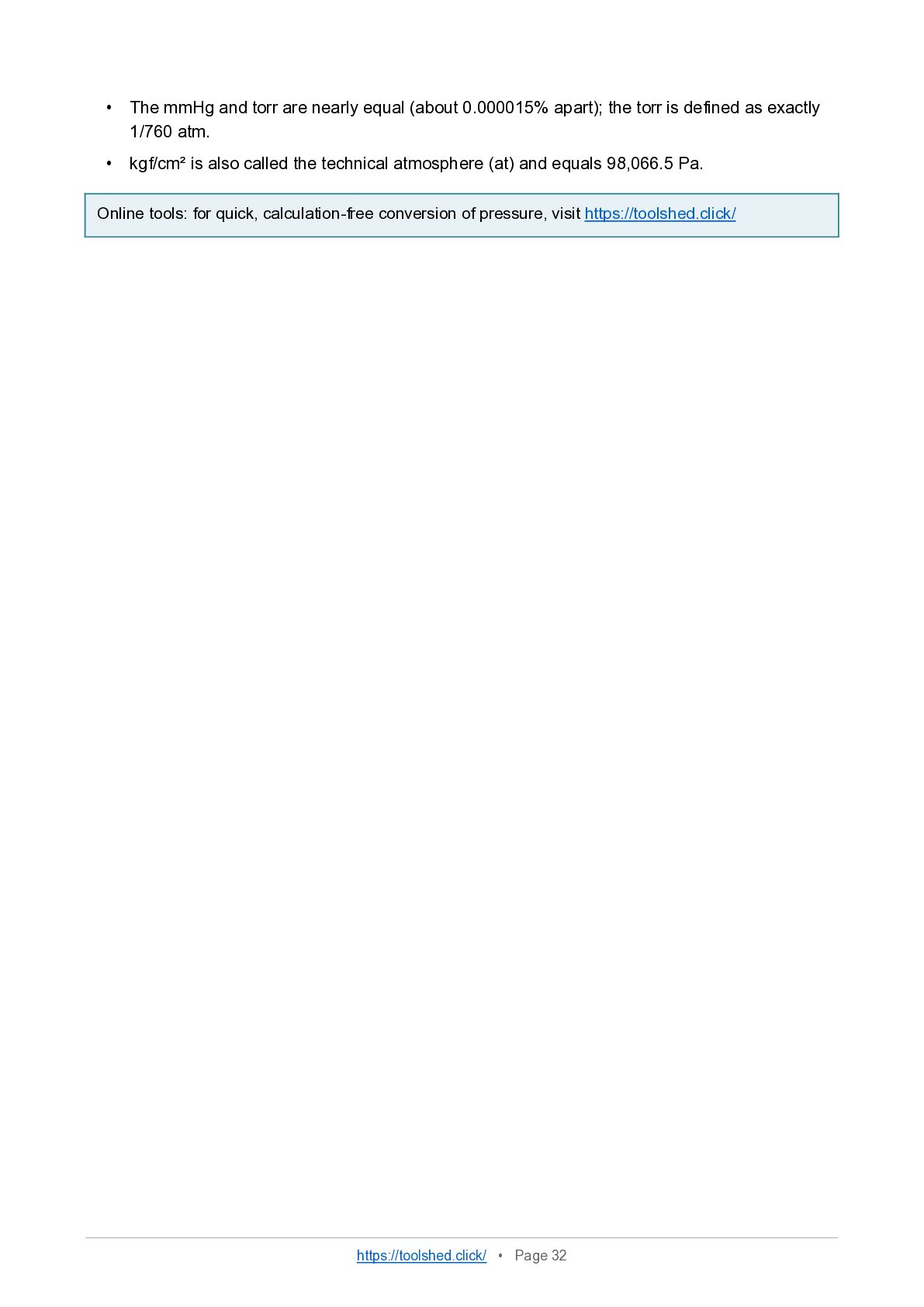
psi to kPa; the last two convert kPa to psi. psi kPa kPa psi 10 68.9476 10 1.45038 14.7 101.353 14.7 2.13205 20 137.895 20 2.90075 30 206.843 30 4.35113 32 220.632 32 4.64121 35 241.317 35 5.07632 40 275.79 40 5.80151 100 689.476 100 14.5038 Quick reference: bar and psi The first two columns convert bar to psi; the last two convert psi to bar. bar psi psi bar 1 14.5038 1 0.0689476 2 29.0075 2 0.137895 2.5 36.2594 2.5 0.172369 3 43.5113 3 0.206843 5 72.5189 5 0.344738 10 145.038 10 0.689476 100 1450.38 100 6.89476 200 2900.75 200 13.7895 Worked examples 1. A tyre pressure of 32 psi is how many bar? 32 psi × 0.0689476 bar/psi = 2.20632 bar 2. A systolic pressure of 120 mmHg is how many kilopascals? 120 mmHg × 0.133322 kPa/mmHg = 15.9987 kPa 3. How many atmospheres is 1013.25 hPa? 1013.25 hPa × 9.8692×10-4 atm/hPa = 1 atm Notes and pitfalls • Gauge pressure is measured relative to ambient atmosphere; absolute pressure is measured relative to a perfect vacuum: absolute = gauge + atmospheric. • 1 bar is close to, but not equal to, 1 atm: 1 atm = 1.01325 bar. https://toolshed.click/ • Page 31
apart); the torr is defined as exactly 1/760 atm. • kgf/cm² is also called the technical atmosphere (at) and equals 98,066.5 Pa. Online tools: for quick, calculation-free conversion of pressure, visit https://toolshed.click/ https://toolshed.click/ • Page 32
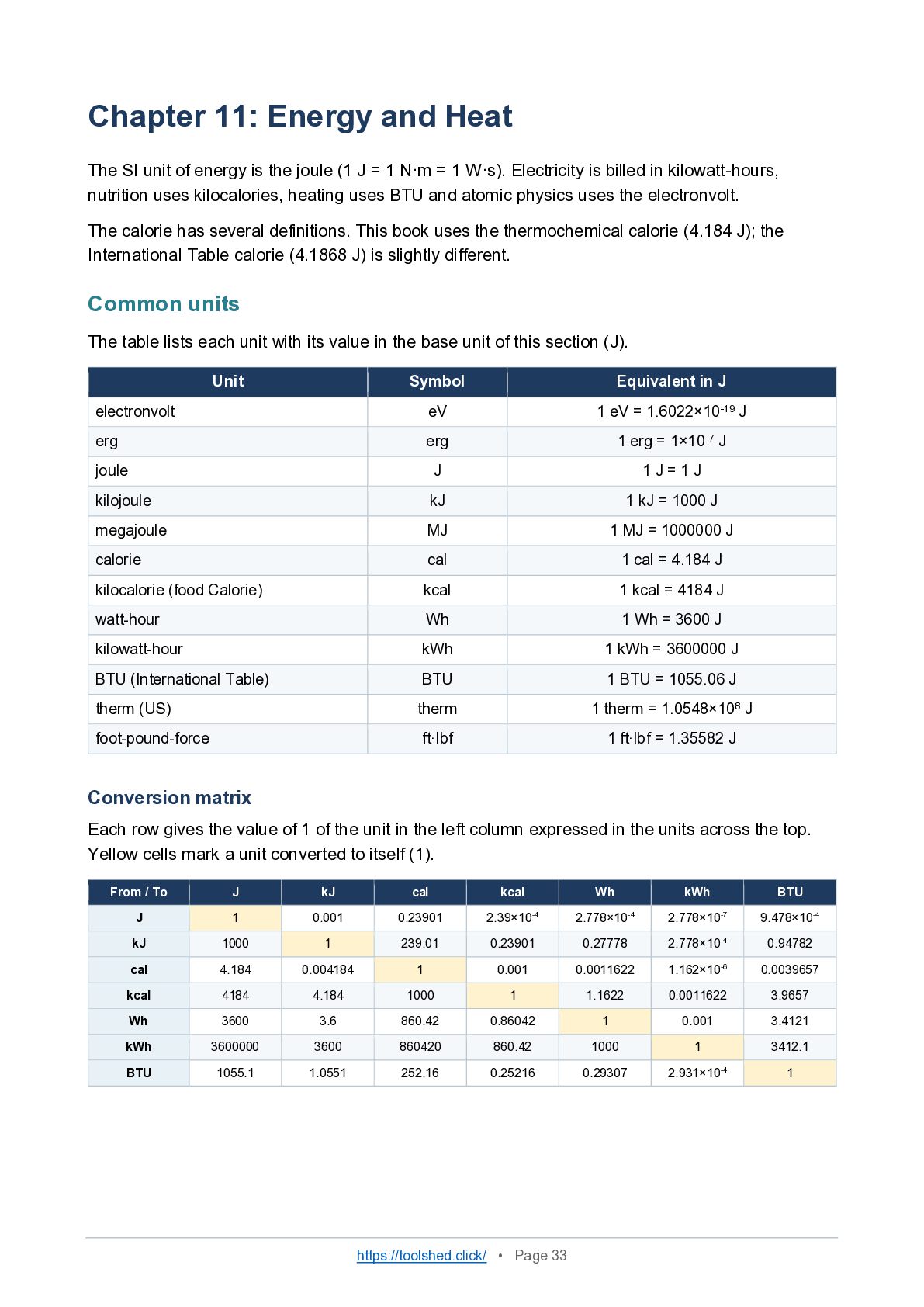
is the joule (1 J = 1 N·m = 1 W·s). Electricity is billed in kilowatt-hours, nutrition uses kilocalories, heating uses BTU and atomic physics uses the electronvolt. The calorie has several definitions. This book uses the thermochemical calorie (4.184 J); the International Table calorie (4.1868 J) is slightly different. Common units The table lists each unit with its value in the base unit of this section (J). Unit Symbol Equivalent in J electronvolt eV 1 eV = 1.6022×10⁻¹⁹ J erg erg 1 erg = 1×10⁻⁷ J joule J 1J=1J kilojoule kJ 1 kJ = 1000 J megajoule MJ 1 MJ = 1000000 J calorie cal 1 cal = 4.184 J kilocalorie (food Calorie) kcal 1 kcal = 4184 J watt-hour Wh 1 Wh = 3600 J kilowatt-hour kWh 1 kWh = 3600000 J BTU (International Table) BTU 1 BTU = 1055.06 J therm (US) therm 1 therm = 1.0548×10⁸ J foot-pound-force ft·lbf 1 ft·lbf = 1.35582 J Conversion matrix Each row gives the value of 1 of the unit in the left column expressed in the units across the top. Yellow cells mark a unit converted to itself (1). From / To J kJ cal kcal Wh -4 kWh -4 BTU -7 9.478×10⁻⁴ J 1 0.001 0.23901 2.39×10 2.778×10 2.778×10 kJ 1000 1 239.01 0.23901 0.27778 2.778×10⁻⁴ 0.94782 cal 4.184 0.004184 1 0.001 0.0011622 1.162×10⁻⁶ 0.0039657 kcal 4184 4.184 1000 1 1.1622 0.0011622 3.9657 Wh 3600 3.6 860.42 0.86042 1 0.001 3.4121 kWh 3600000 3600 860420 860.42 1000 1 BTU 1055.1 1.0551 252.16 0.25216 https://toolshed.click/ • Page 33 0.29307 2.931×10 3412.1 -4 1
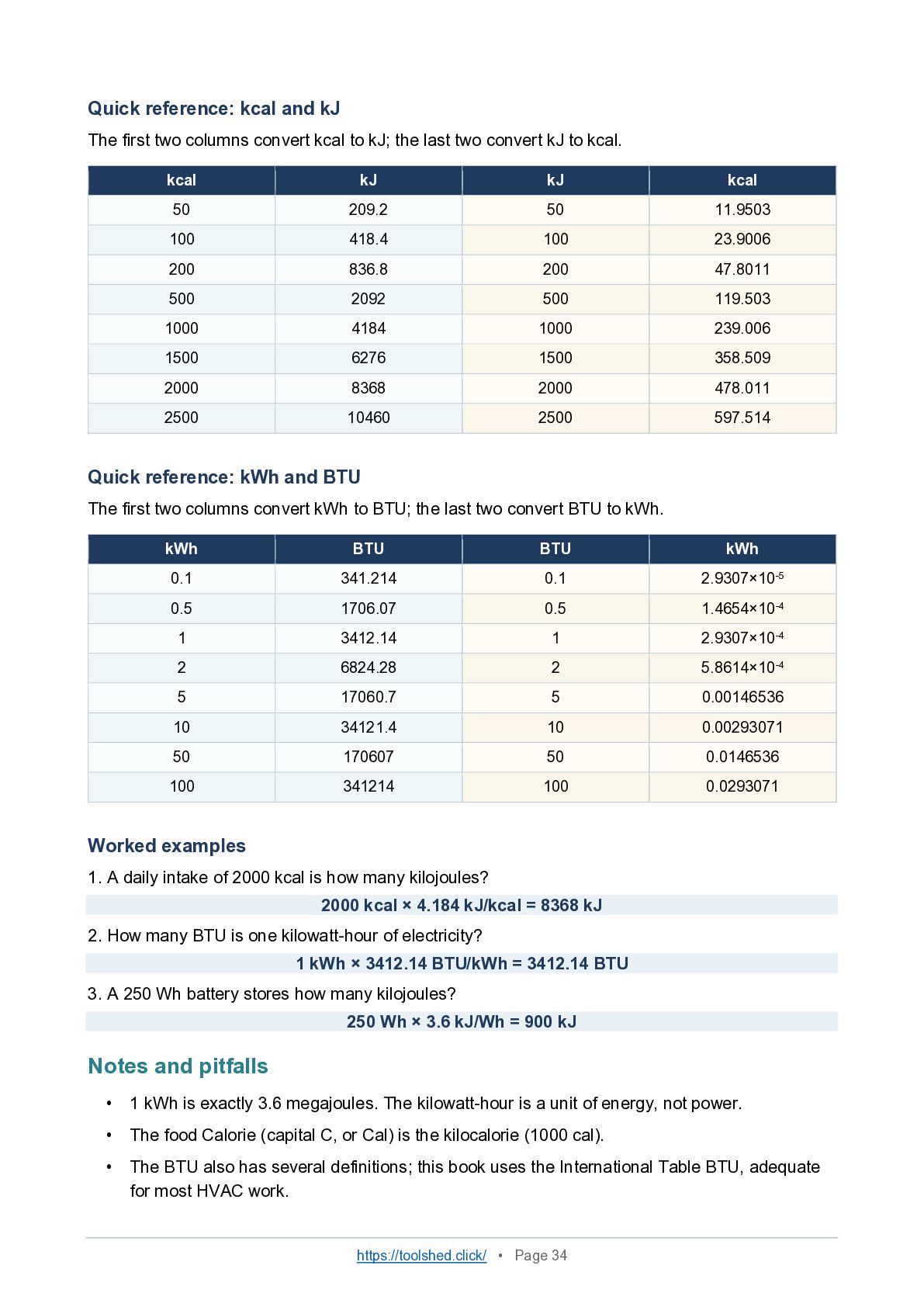
kcal to kJ; the last two convert kJ to kcal. kcal kJ kJ kcal 50 209.2 50 11.9503 100 418.4 100 23.9006 200 836.8 200 47.8011 500 2092 500 119.503 1000 4184 1000 239.006 1500 6276 1500 358.509 2000 8368 2000 478.011 2500 10460 2500 597.514 Quick reference: kWh and BTU The first two columns convert kWh to BTU; the last two convert BTU to kWh. kWh BTU BTU kWh 0.1 341.214 0.1 2.9307×10⁻⁵ 0.5 1706.07 0.5 1.4654×10⁻⁴ 1 3412.14 1 2.9307×10⁻⁴ 2 6824.28 2 5.8614×10⁻⁴ 5 17060.7 5 0.00146536 10 34121.4 10 0.00293071 50 170607 50 0.0146536 100 341214 100 0.0293071 Worked examples 1. A daily intake of 2000 kcal is how many kilojoules? 2000 kcal × 4.184 kJ/kcal = 8368 kJ 2. How many BTU is one kilowatt-hour of electricity? 1 kWh × 3412.14 BTU/kWh = 3412.14 BTU 3. A 250 Wh battery stores how many kilojoules? 250 Wh × 3.6 kJ/Wh = 900 kJ Notes and pitfalls • 1 kWh is exactly 3.6 megajoules. The kilowatt-hour is a unit of energy, not power. • The food Calorie (capital C, or Cal) is the kilocalorie (1000 cal). • The BTU also has several definitions; this book uses the International Table BTU, adequate for most HVAC work. https://toolshed.click/ • Page 34
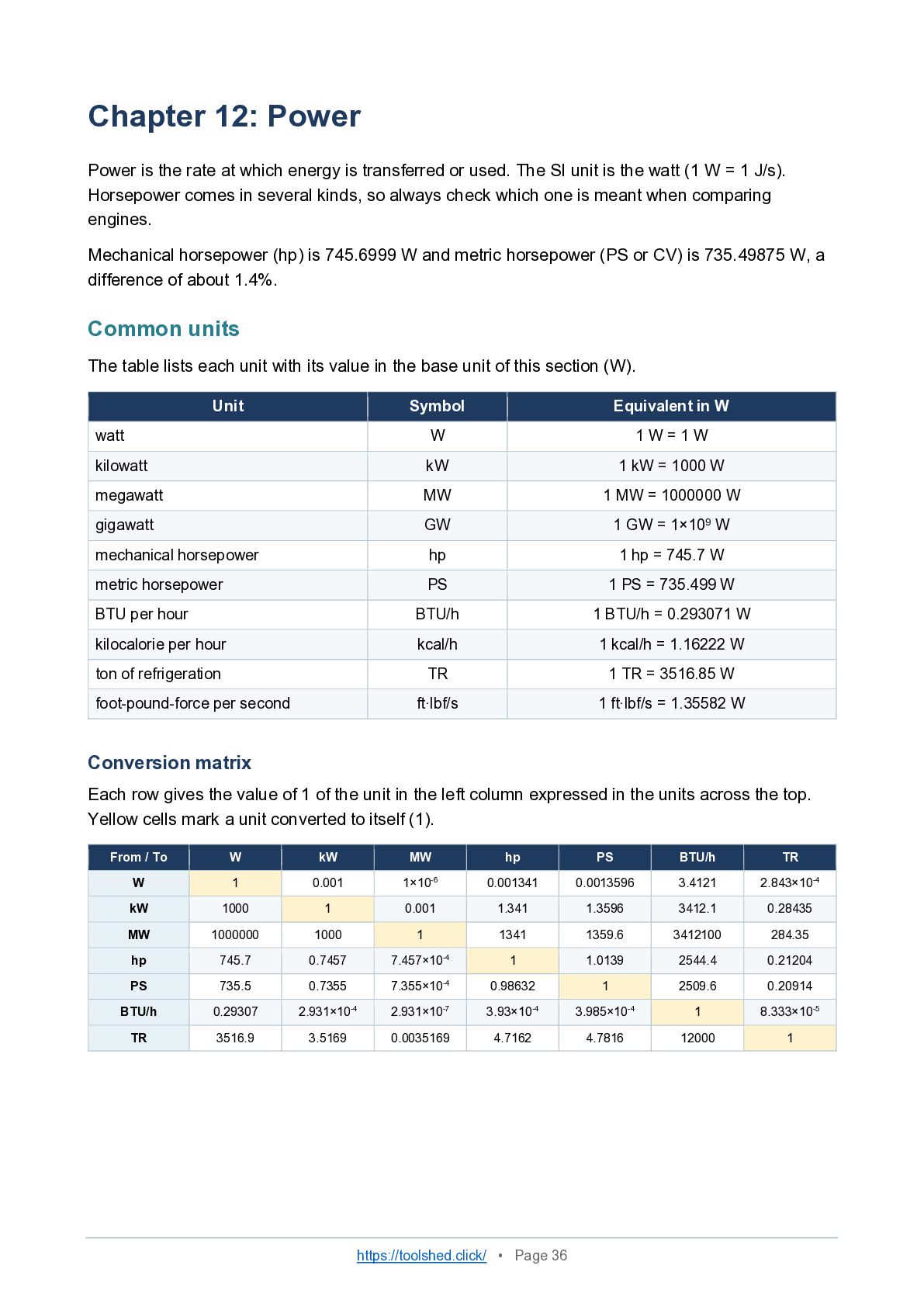
is transferred or used. The SI unit is the watt (1 W = 1 J/s). Horsepower comes in several kinds, so always check which one is meant when comparing engines. Mechanical horsepower (hp) is 745.6999 W and metric horsepower (PS or CV) is 735.49875 W, a difference of about 1.4%. Common units The table lists each unit with its value in the base unit of this section (W). Unit Symbol Equivalent in W watt W 1W=1W kilowatt kW 1 kW = 1000 W megawatt MW 1 MW = 1000000 W gigawatt GW 1 GW = 1×10⁹ W mechanical horsepower hp 1 hp = 745.7 W metric horsepower PS 1 PS = 735.499 W BTU per hour BTU/h 1 BTU/h = 0.293071 W kilocalorie per hour kcal/h 1 kcal/h = 1.16222 W ton of refrigeration TR 1 TR = 3516.85 W foot-pound-force per second ft·lbf/s 1 ft·lbf/s = 1.35582 W Conversion matrix Each row gives the value of 1 of the unit in the left column expressed in the units across the top. Yellow cells mark a unit converted to itself (1). From / To W kW MW hp PS BTU/h TR W 1 0.001 1×10⁻⁶ 0.001341 0.0013596 3.4121 2.843×10⁻⁴ kW 1000 1 0.001 1.341 1.3596 3412.1 0.28435 MW 1000000 1000 1 hp PS 745.7 735.5 0.7457 1341 1359.6 3412100 284.35 -4 1 1.0139 2544.4 0.21204 -4 0.98632 2509.6 0.20914 -7 -4 7.457×10 0.7355 7.355×10 -4 1 BTU/h 0.29307 2.931×10 2.931×10 3.93×10 3.985×10 1 8.333×10⁻⁵ TR 3516.9 3.5169 0.0035169 4.7162 4.7816 12000 1 https://toolshed.click/ • Page 36 -4
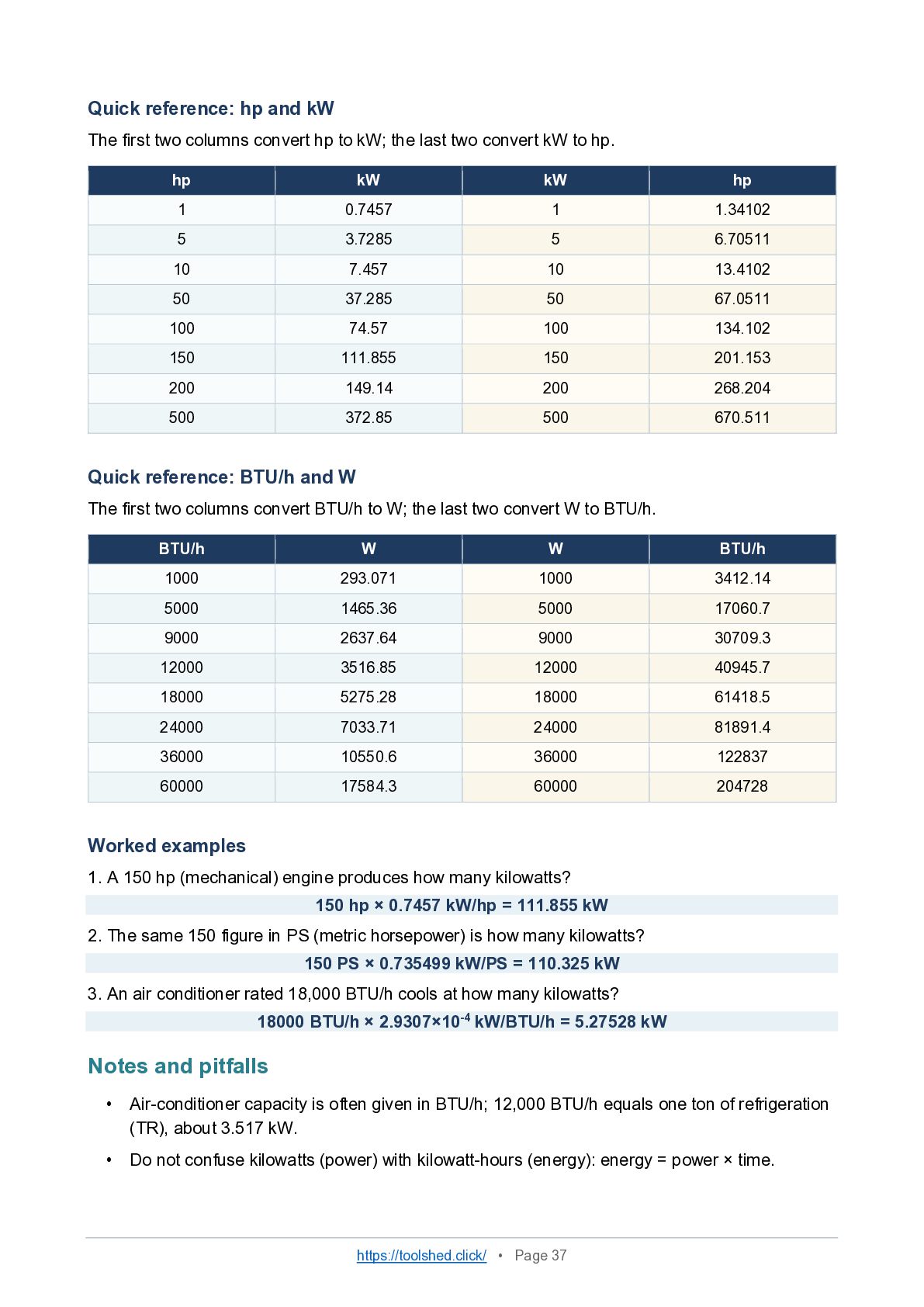
hp to kW; the last two convert kW to hp. hp kW kW hp 1 0.7457 1 1.34102 5 3.7285 5 6.70511 10 7.457 10 13.4102 50 37.285 50 67.0511 100 74.57 100 134.102 150 111.855 150 201.153 200 149.14 200 268.204 500 372.85 500 670.511 Quick reference: BTU/h and W The first two columns convert BTU/h to W; the last two convert W to BTU/h. BTU/h W W BTU/h 1000 293.071 1000 3412.14 5000 1465.36 5000 17060.7 9000 2637.64 9000 30709.3 12000 3516.85 12000 40945.7 18000 5275.28 18000 61418.5 24000 7033.71 24000 81891.4 36000 10550.6 36000 122837 60000 17584.3 60000 204728 Worked examples 1. A 150 hp (mechanical) engine produces how many kilowatts? 150 hp × 0.7457 kW/hp = 111.855 kW 2. The same 150 figure in PS (metric horsepower) is how many kilowatts? 150 PS × 0.735499 kW/PS = 110.325 kW 3. An air conditioner rated 18,000 BTU/h cools at how many kilowatts? 18000 BTU/h × 2.9307×10⁻⁴ kW/BTU/h = 5.27528 kW Notes and pitfalls • Air-conditioner capacity is often given in BTU/h; 12,000 BTU/h equals one ton of refrigeration (TR), about 3.517 kW. • Do not confuse kilowatts (power) with kilowatt-hours (energy): energy = power × time. https://toolshed.click/ • Page 37
quantity; unit conversion does not account for drivetrain losses. Online tools: for quick, calculation-free conversion of power, visit https://toolshed.click/ https://toolshed.click/ • Page 38
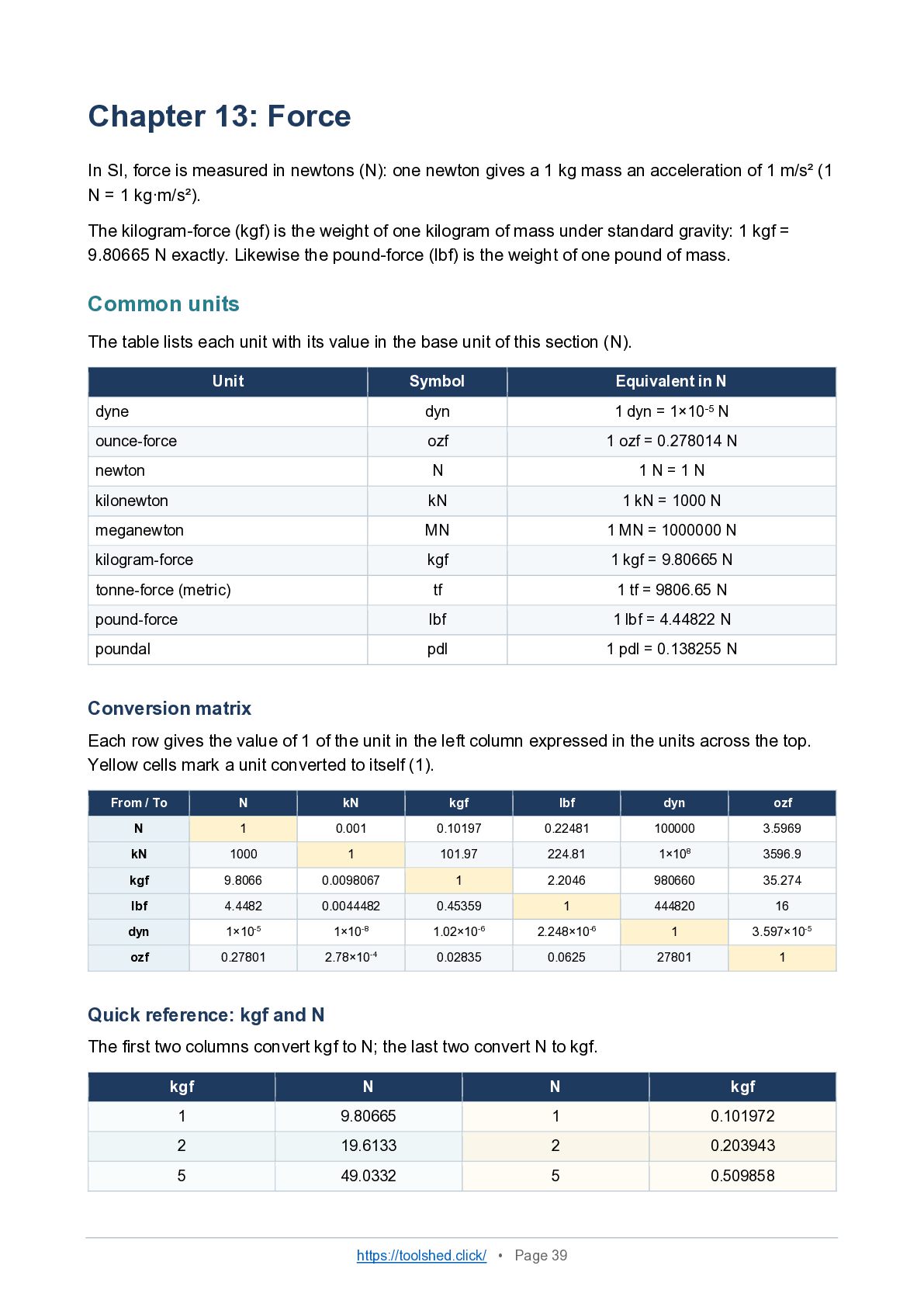
(N): one newton gives a 1 kg mass an acceleration of 1 m/s² (1 N = 1 kg·m/s²). The kilogram-force (kgf) is the weight of one kilogram of mass under standard gravity: 1 kgf = 9.80665 N exactly. Likewise the pound-force (lbf) is the weight of one pound of mass. Common units The table lists each unit with its value in the base unit of this section (N). Unit Symbol Equivalent in N dyne dyn 1 dyn = 1×10⁻⁵ N ounce-force ozf 1 ozf = 0.278014 N newton N 1N=1N kilonewton kN 1 kN = 1000 N meganewton MN 1 MN = 1000000 N kilogram-force kgf 1 kgf = 9.80665 N tonne-force (metric) tf 1 tf = 9806.65 N pound-force lbf 1 lbf = 4.44822 N poundal pdl 1 pdl = 0.138255 N Conversion matrix Each row gives the value of 1 of the unit in the left column expressed in the units across the top. Yellow cells mark a unit converted to itself (1). From / To N kN kgf lbf dyn ozf N 1 0.001 0.10197 0.22481 100000 3.5969 8 3596.9 kN 1000 1 101.97 224.81 1×10 kgf 9.8066 0.0098067 1 2.2046 980660 35.274 lbf 4.4482 0.0044482 0.45359 1 444820 16 dyn 1×10⁻⁵ 1×10⁻⁸ 1.02×10⁻⁶ 2.248×10⁻⁶ 1 3.597×10⁻⁵ ozf 0.27801 2.78×10⁻⁴ 0.02835 0.0625 27801 1 Quick reference: kgf and N The first two columns convert kgf to N; the last two convert N to kgf. kgf N N kgf 1 9.80665 1 0.101972 2 19.6133 2 0.203943 5 49.0332 5 0.509858 https://toolshed.click/ • Page 39
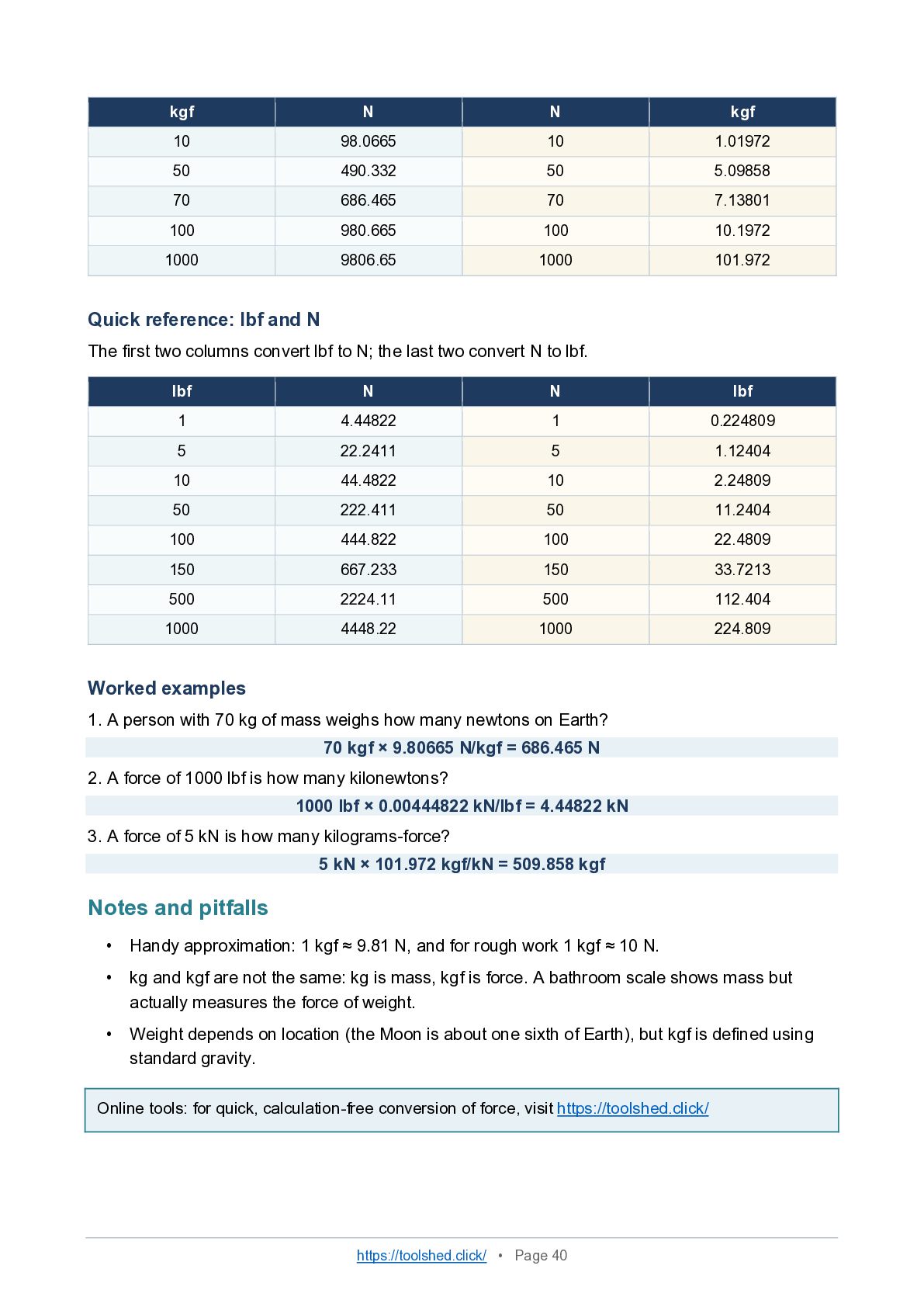
50 5.09858 70 686.465 70 7.13801 100 980.665 100 10.1972 1000 9806.65 1000 101.972 Quick reference: lbf and N The first two columns convert lbf to N; the last two convert N to lbf. lbf N N lbf 1 4.44822 1 0.224809 5 22.2411 5 1.12404 10 44.4822 10 2.24809 50 222.411 50 11.2404 100 444.822 100 22.4809 150 667.233 150 33.7213 500 2224.11 500 112.404 1000 4448.22 1000 224.809 Worked examples 1. A person with 70 kg of mass weighs how many newtons on Earth? 70 kgf × 9.80665 N/kgf = 686.465 N 2. A force of 1000 lbf is how many kilonewtons? 1000 lbf × 0.00444822 kN/lbf = 4.44822 kN 3. A force of 5 kN is how many kilograms-force? 5 kN × 101.972 kgf/kN = 509.858 kgf Notes and pitfalls • Handy approximation: 1 kgf ≈ 9.81 N, and for rough work 1 kgf ≈ 10 N. • kg and kgf are not the same: kg is mass, kgf is force. A bathroom scale shows mass but actually measures the force of weight. • Weight depends on location (the Moon is about one sixth of Earth), but kgf is defined using standard gravity. Online tools: for quick, calculation-free conversion of force, visit https://toolshed.click/ https://toolshed.click/ • Page 40
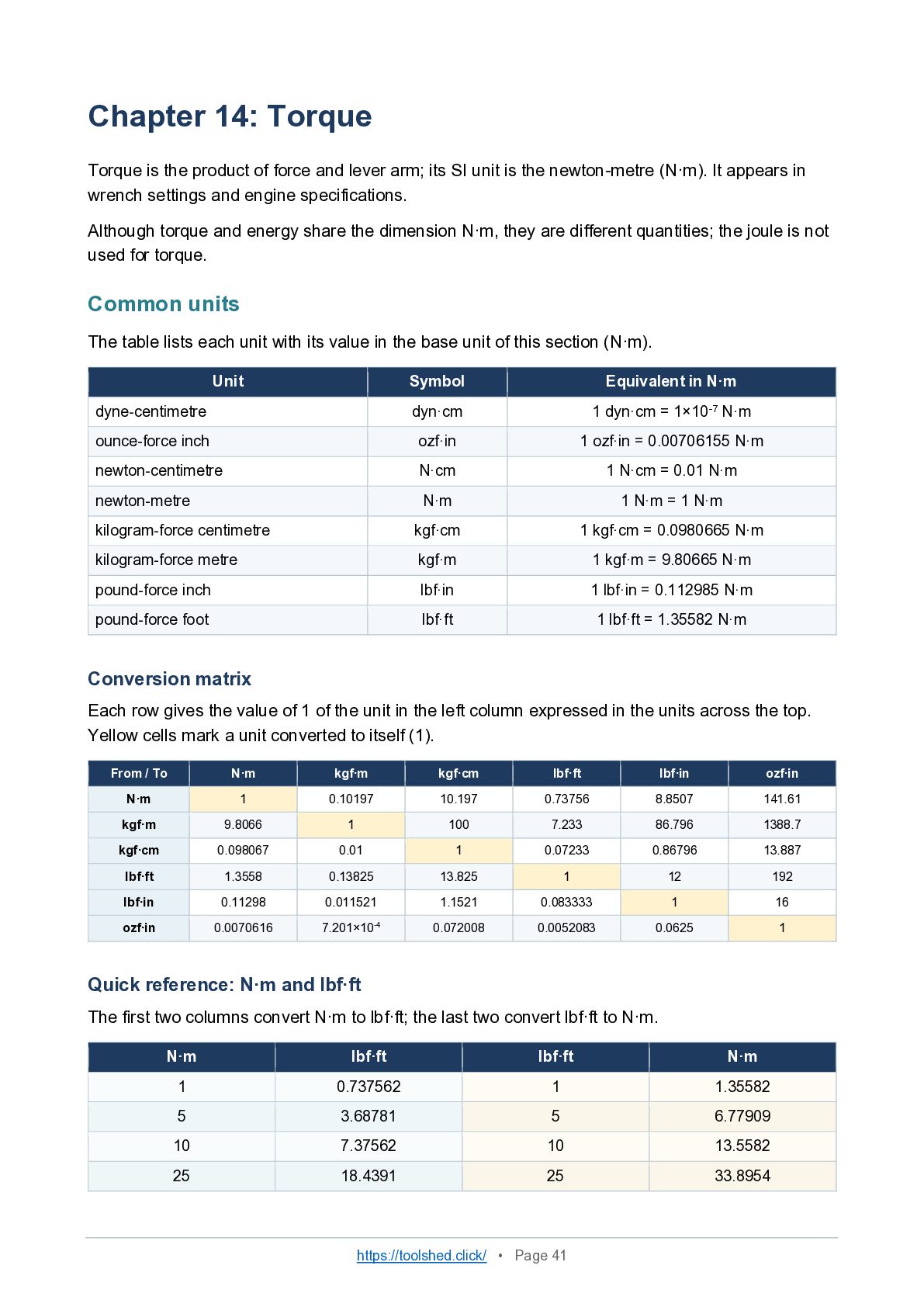
lever arm; its SI unit is the newton-metre (N·m). It appears in wrench settings and engine specifications. Although torque and energy share the dimension N·m, they are different quantities; the joule is not used for torque. Common units The table lists each unit with its value in the base unit of this section (N·m). Unit Symbol Equivalent in N·m dyne-centimetre dyn·cm 1 dyn·cm = 1×10⁻⁷ N·m ounce-force inch ozf·in 1 ozf·in = 0.00706155 N·m newton-centimetre N·cm 1 N·cm = 0.01 N·m newton-metre N·m 1 N·m = 1 N·m kilogram-force centimetre kgf·cm 1 kgf·cm = 0.0980665 N·m kilogram-force metre kgf·m 1 kgf·m = 9.80665 N·m pound-force inch lbf·in 1 lbf·in = 0.112985 N·m pound-force foot lbf·ft 1 lbf·ft = 1.35582 N·m Conversion matrix Each row gives the value of 1 of the unit in the left column expressed in the units across the top. Yellow cells mark a unit converted to itself (1). From / To N·m kgf·m kgf·cm lbf·ft lbf·in ozf·in N·m 1 0.10197 10.197 0.73756 8.8507 141.61 kgf·m 9.8066 1 100 7.233 86.796 1388.7 kgf·cm 0.098067 0.01 1 0.07233 0.86796 13.887 lbf·ft 1.3558 0.13825 13.825 1 12 192 lbf·in 0.11298 0.011521 1.1521 0.083333 1 16 ozf·in 0.0070616 7.201×10⁻⁴ 0.072008 0.0052083 0.0625 1 Quick reference: N·m and lbf·ft The first two columns convert N·m to lbf·ft; the last two convert lbf·ft to N·m. N·m lbf·ft lbf·ft N·m 1 0.737562 1 1.35582 5 3.68781 5 6.77909 10 7.37562 10 13.5582 25 18.4391 25 33.8954 https://toolshed.click/ • Page 41
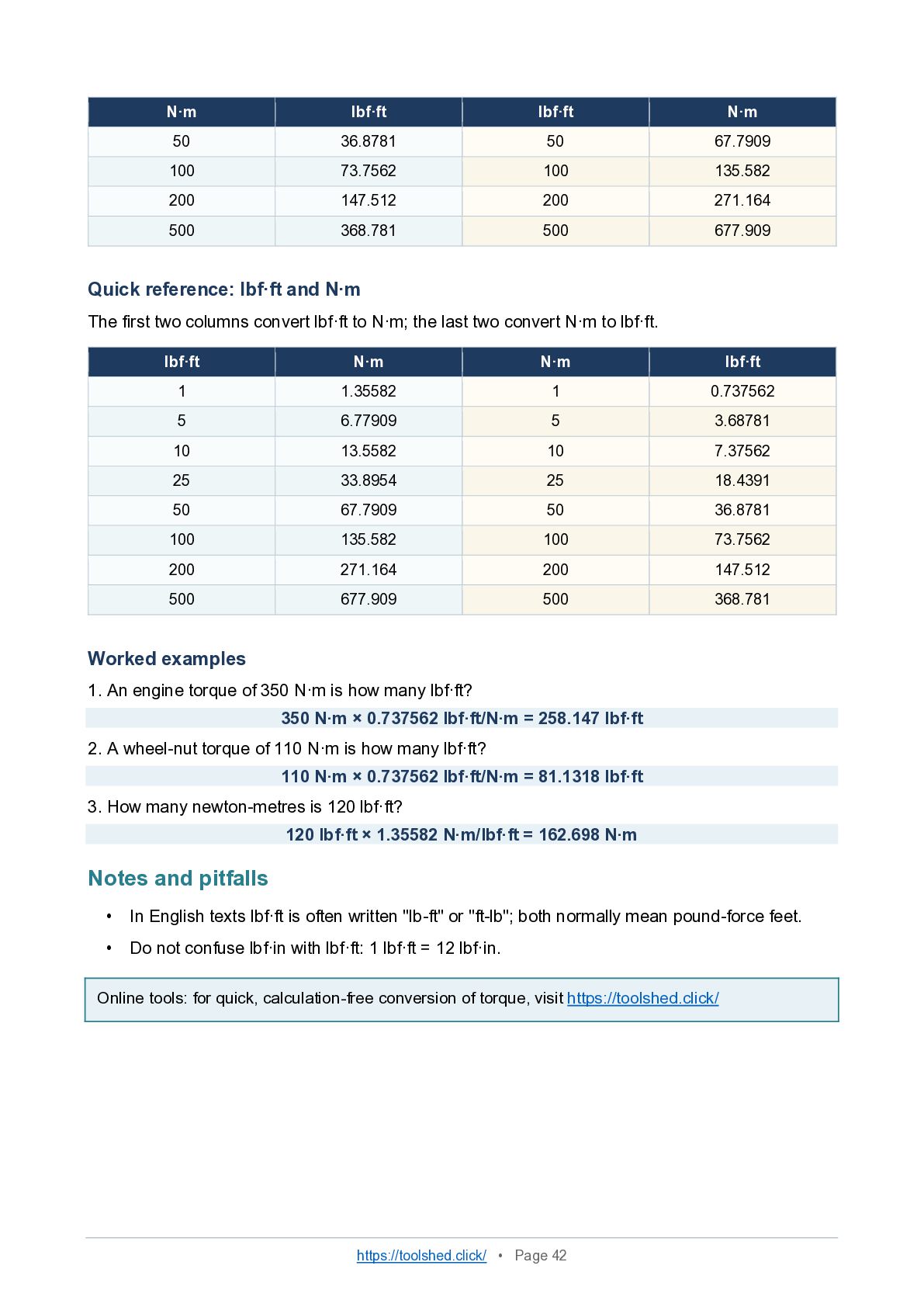
100 135.582 200 147.512 200 271.164 500 368.781 500 677.909 Quick reference: lbf·ft and N·m The first two columns convert lbf·ft to N·m; the last two convert N·m to lbf·ft. lbf·ft N·m N·m lbf·ft 1 1.35582 1 0.737562 5 6.77909 5 3.68781 10 13.5582 10 7.37562 25 33.8954 25 18.4391 50 67.7909 50 36.8781 100 135.582 100 73.7562 200 271.164 200 147.512 500 677.909 500 368.781 Worked examples 1. An engine torque of 350 N·m is how many lbf·ft? 350 N·m × 0.737562 lbf·ft/N·m = 258.147 lbf·ft 2. A wheel-nut torque of 110 N·m is how many lbf·ft? 110 N·m × 0.737562 lbf·ft/N·m = 81.1318 lbf·ft 3. How many newton-metres is 120 lbf·ft? 120 lbf·ft × 1.35582 N·m/lbf·ft = 162.698 N·m Notes and pitfalls • In English texts lbf·ft is often written "lb-ft" or "ft-lb"; both normally mean pound-force feet. • Do not confuse lbf·in with lbf·ft: 1 lbf·ft = 12 lbf·in. Online tools: for quick, calculation-free conversion of torque, visit https://toolshed.click/ https://toolshed.click/ • Page 42
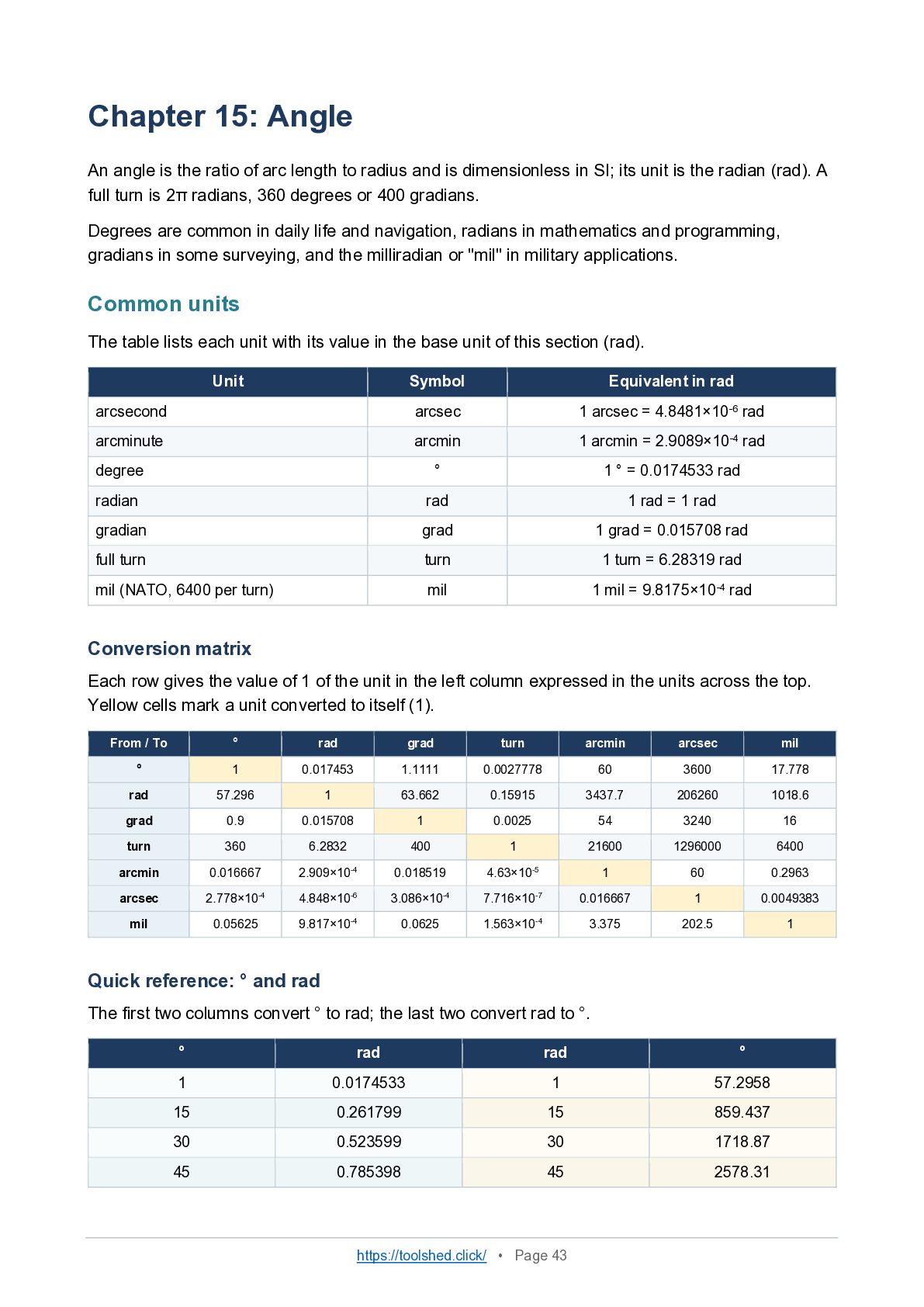
length to radius and is dimensionless in SI; its unit is the radian (rad). A full turn is 2π radians, 360 degrees or 400 gradians. Degrees are common in daily life and navigation, radians in mathematics and programming, gradians in some surveying, and the milliradian or "mil" in military applications. Common units The table lists each unit with its value in the base unit of this section (rad). Unit Symbol Equivalent in rad arcsecond arcsec 1 arcsec = 4.8481×10⁻⁶ rad arcminute arcmin 1 arcmin = 2.9089×10⁻⁴ rad degree ° 1 ° = 0.0174533 rad radian rad 1 rad = 1 rad gradian grad 1 grad = 0.015708 rad full turn turn 1 turn = 6.28319 rad mil (NATO, 6400 per turn) mil 1 mil = 9.8175×10⁻⁴ rad Conversion matrix Each row gives the value of 1 of the unit in the left column expressed in the units across the top. Yellow cells mark a unit converted to itself (1). From / To ° rad grad turn arcmin arcsec mil ° 1 0.017453 1.1111 0.0027778 60 3600 17.778 rad 57.296 1 63.662 0.15915 3437.7 206260 1018.6 grad 0.9 0.015708 1 0.0025 54 3240 16 turn 360 6.2832 400 1 arcmin 0.016667 arcsec -4 2.778×10 mil 0.05625 -4 0.018519 -6 -4 2.909×10 4.848×10 3.086×10 -4 9.817×10 0.0625 21600 1296000 6400 -5 1 60 0.2963 -7 0.016667 1 0.0049383 -4 3.375 202.5 1 4.63×10 7.716×10 1.563×10 Quick reference: ° and rad The first two columns convert ° to rad; the last two convert rad to °. ° rad rad ° 1 0.0174533 1 57.2958 15 0.261799 15 859.437 30 0.523599 30 1718.87 45 0.785398 45 2578.31 https://toolshed.click/ • Page 43
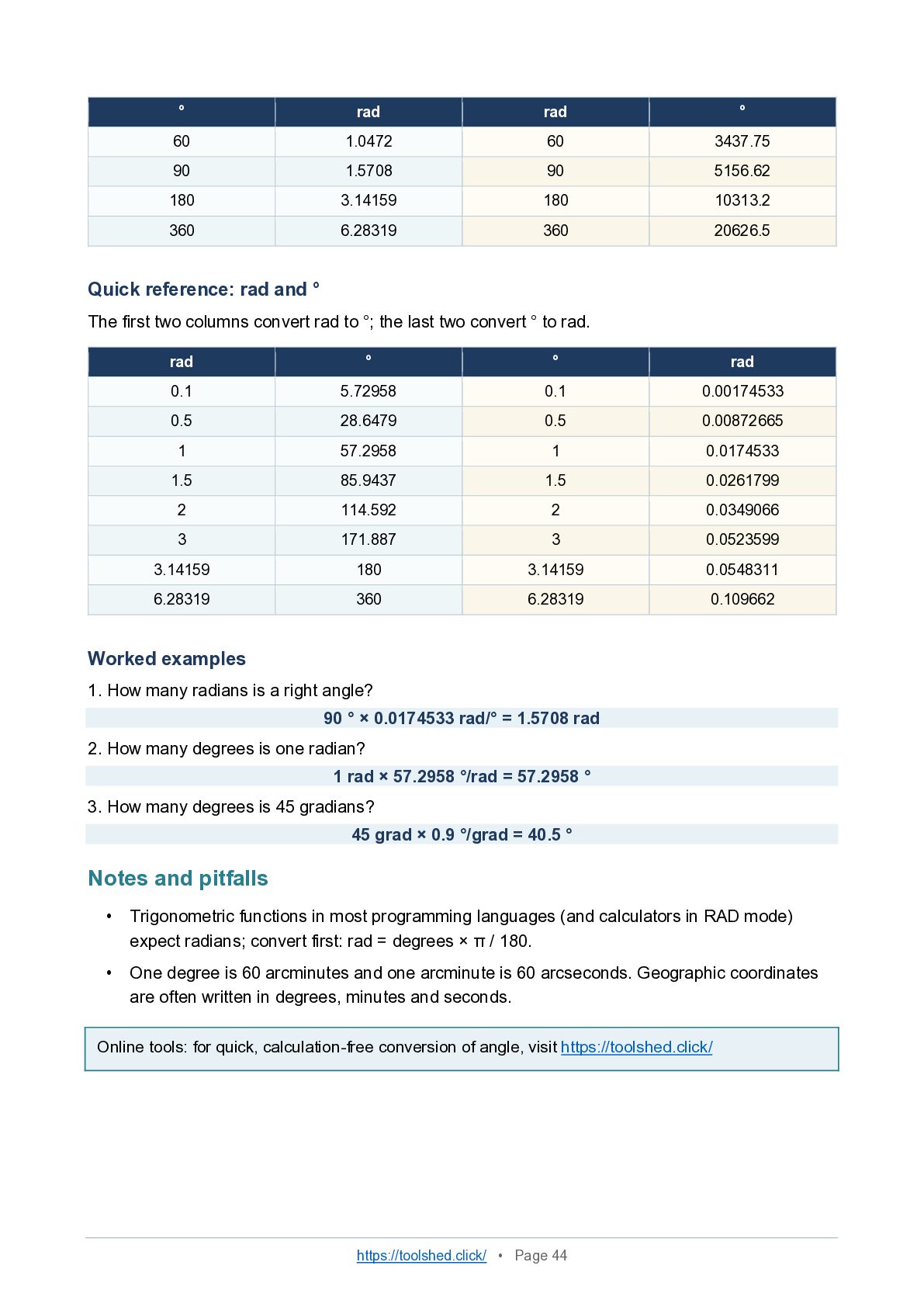
90 5156.62 180 3.14159 180 10313.2 360 6.28319 360 20626.5 Quick reference: rad and ° The first two columns convert rad to °; the last two convert ° to rad. rad ° ° rad 0.1 5.72958 0.1 0.00174533 0.5 28.6479 0.5 0.00872665 1 57.2958 1 0.0174533 1.5 85.9437 1.5 0.0261799 2 114.592 2 0.0349066 3 171.887 3 0.0523599 3.14159 180 3.14159 0.0548311 6.28319 360 6.28319 0.109662 Worked examples 1. How many radians is a right angle? 90 ° × 0.0174533 rad/° = 1.5708 rad 2. How many degrees is one radian? 1 rad × 57.2958 °/rad = 57.2958 ° 3. How many degrees is 45 gradians? 45 grad × 0.9 °/grad = 40.5 ° Notes and pitfalls • Trigonometric functions in most programming languages (and calculators in RAD mode) expect radians; convert first: rad = degrees × π / 180. • One degree is 60 arcminutes and one arcminute is 60 arcseconds. Geographic coordinates are often written in degrees, minutes and seconds. Online tools: for quick, calculation-free conversion of angle, visit https://toolshed.click/ https://toolshed.click/ • Page 44
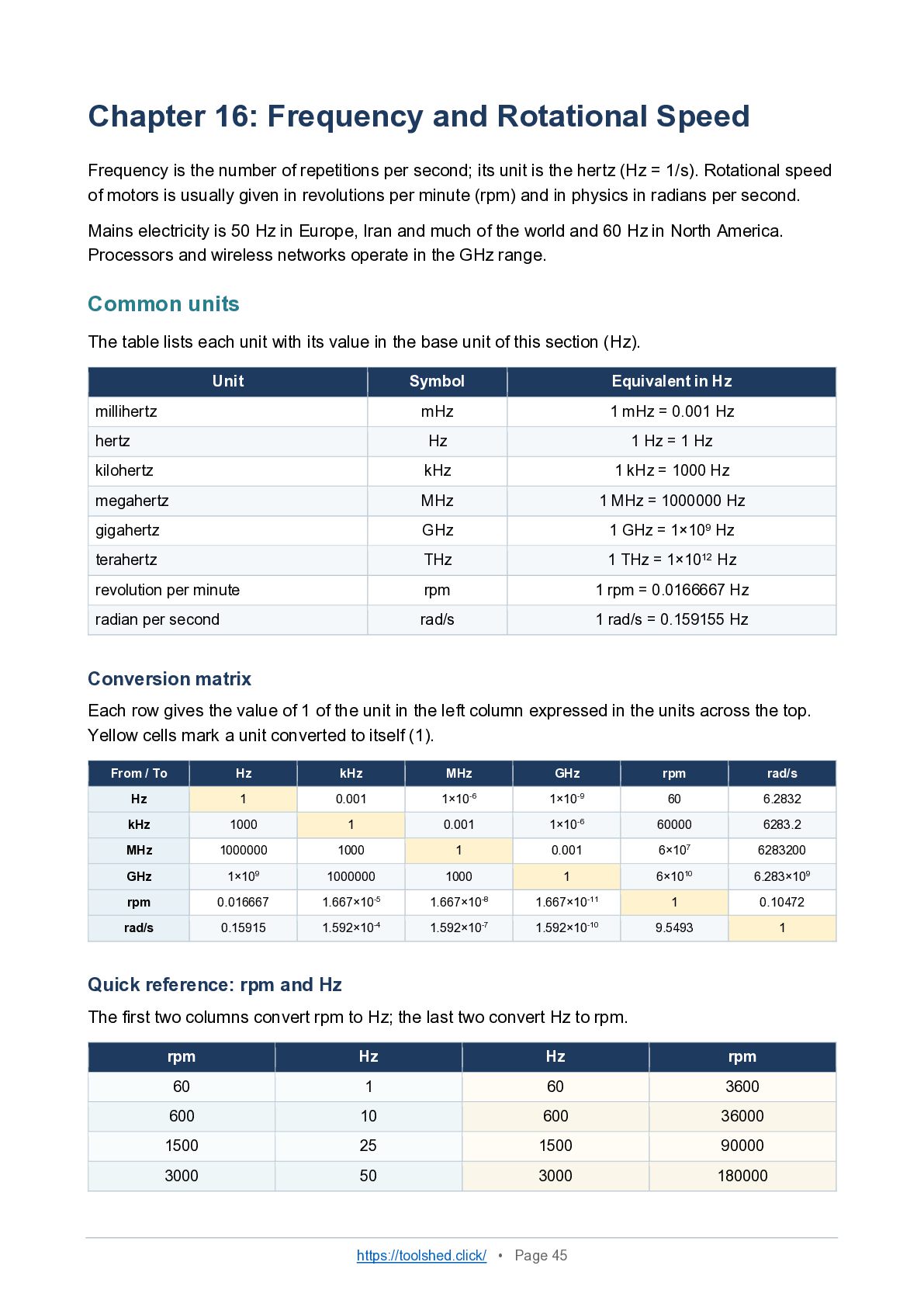
of repetitions per second; its unit is the hertz (Hz = 1/s). Rotational speed of motors is usually given in revolutions per minute (rpm) and in physics in radians per second. Mains electricity is 50 Hz in Europe, Iran and much of the world and 60 Hz in North America. Processors and wireless networks operate in the GHz range. Common units The table lists each unit with its value in the base unit of this section (Hz). Unit Symbol Equivalent in Hz millihertz mHz 1 mHz = 0.001 Hz hertz Hz 1 Hz = 1 Hz kilohertz kHz 1 kHz = 1000 Hz megahertz MHz 1 MHz = 1000000 Hz gigahertz GHz 1 GHz = 1×10⁹ Hz terahertz THz 1 THz = 1×10¹² Hz revolution per minute rpm 1 rpm = 0.0166667 Hz radian per second rad/s 1 rad/s = 0.159155 Hz Conversion matrix Each row gives the value of 1 of the unit in the left column expressed in the units across the top. Yellow cells mark a unit converted to itself (1). From / To Hz Hz 1 kHz kHz MHz GHz rpm rad/s 0.001 -6 -9 60 6.2832 -6 1×10 60000 6283.2 7 6283200 1000 1 1×10 0.001 1×10 MHz 1000000 1000 1 0.001 6×10 GHz 1×10⁹ 1000000 1000 1 6×10¹⁰ 6.283×10⁹ rpm 0.016667 1.667×10⁻⁵ 1.667×10⁻⁸ 1.667×10⁻¹¹ 1 0.10472 rad/s 0.15915 1.592×10⁻⁴ 1.592×10⁻⁷ 1.592×10⁻¹⁰ 9.5493 1 Quick reference: rpm and Hz The first two columns convert rpm to Hz; the last two convert Hz to rpm. rpm Hz Hz rpm 60 1 60 3600 600 10 600 36000 1500 25 1500 90000 3000 50 3000 180000 https://toolshed.click/ • Page 45
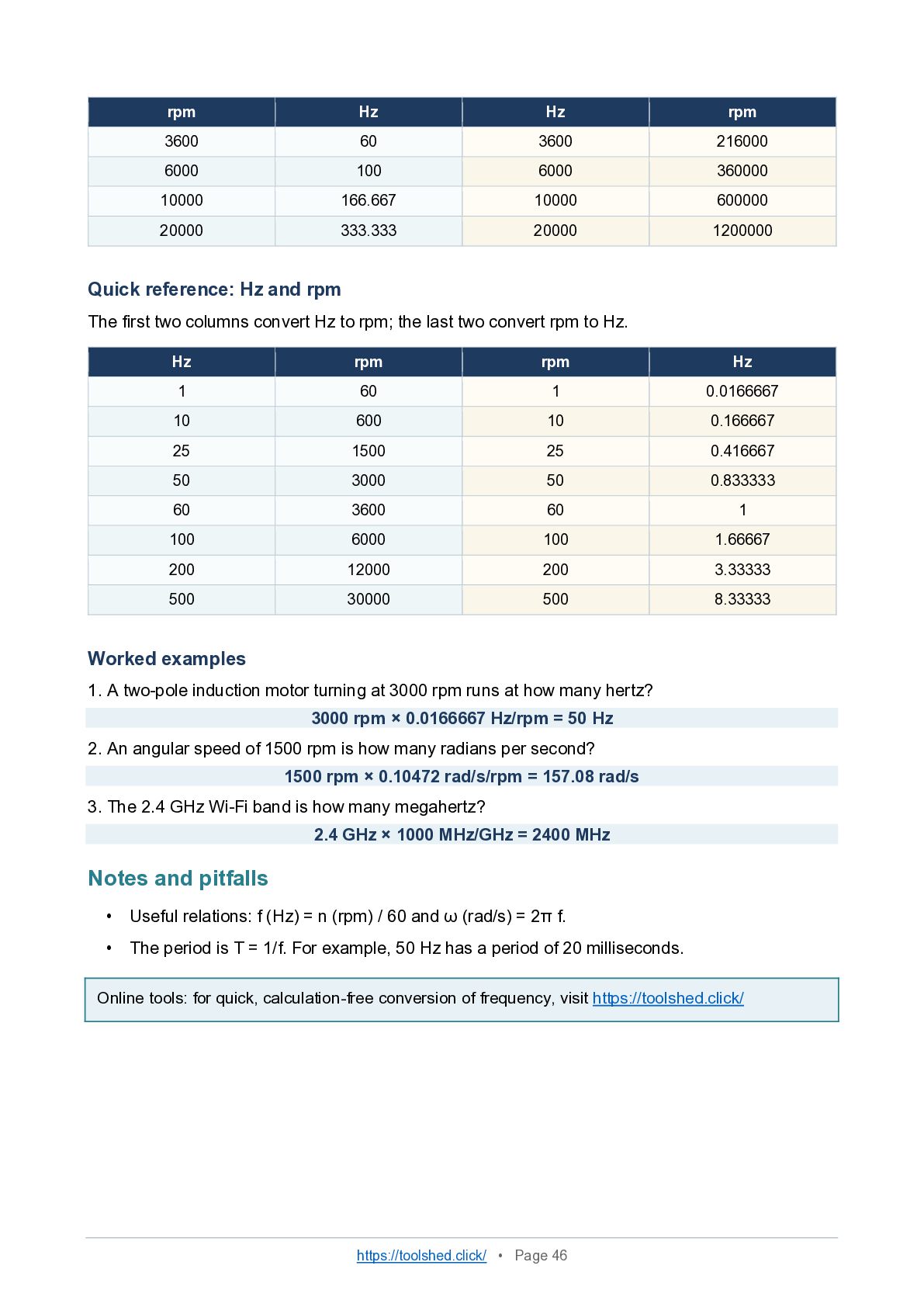
6000 360000 10000 166.667 10000 600000 20000 333.333 20000 1200000 Quick reference: Hz and rpm The first two columns convert Hz to rpm; the last two convert rpm to Hz. Hz rpm rpm Hz 1 60 1 0.0166667 10 600 10 0.166667 25 1500 25 0.416667 50 3000 50 0.833333 60 3600 60 1 100 6000 100 1.66667 200 12000 200 3.33333 500 30000 500 8.33333 Worked examples 1. A two-pole induction motor turning at 3000 rpm runs at how many hertz? 3000 rpm × 0.0166667 Hz/rpm = 50 Hz 2. An angular speed of 1500 rpm is how many radians per second? 1500 rpm × 0.10472 rad/s/rpm = 157.08 rad/s 3. The 2.4 GHz Wi-Fi band is how many megahertz? 2.4 GHz × 1000 MHz/GHz = 2400 MHz Notes and pitfalls • Useful relations: f (Hz) = n (rpm) / 60 and ω (rad/s) = 2π f. • The period is T = 1/f. For example, 50 Hz has a period of 20 milliseconds. Online tools: for quick, calculation-free conversion of frequency, visit https://toolshed.click/ https://toolshed.click/ • Page 46
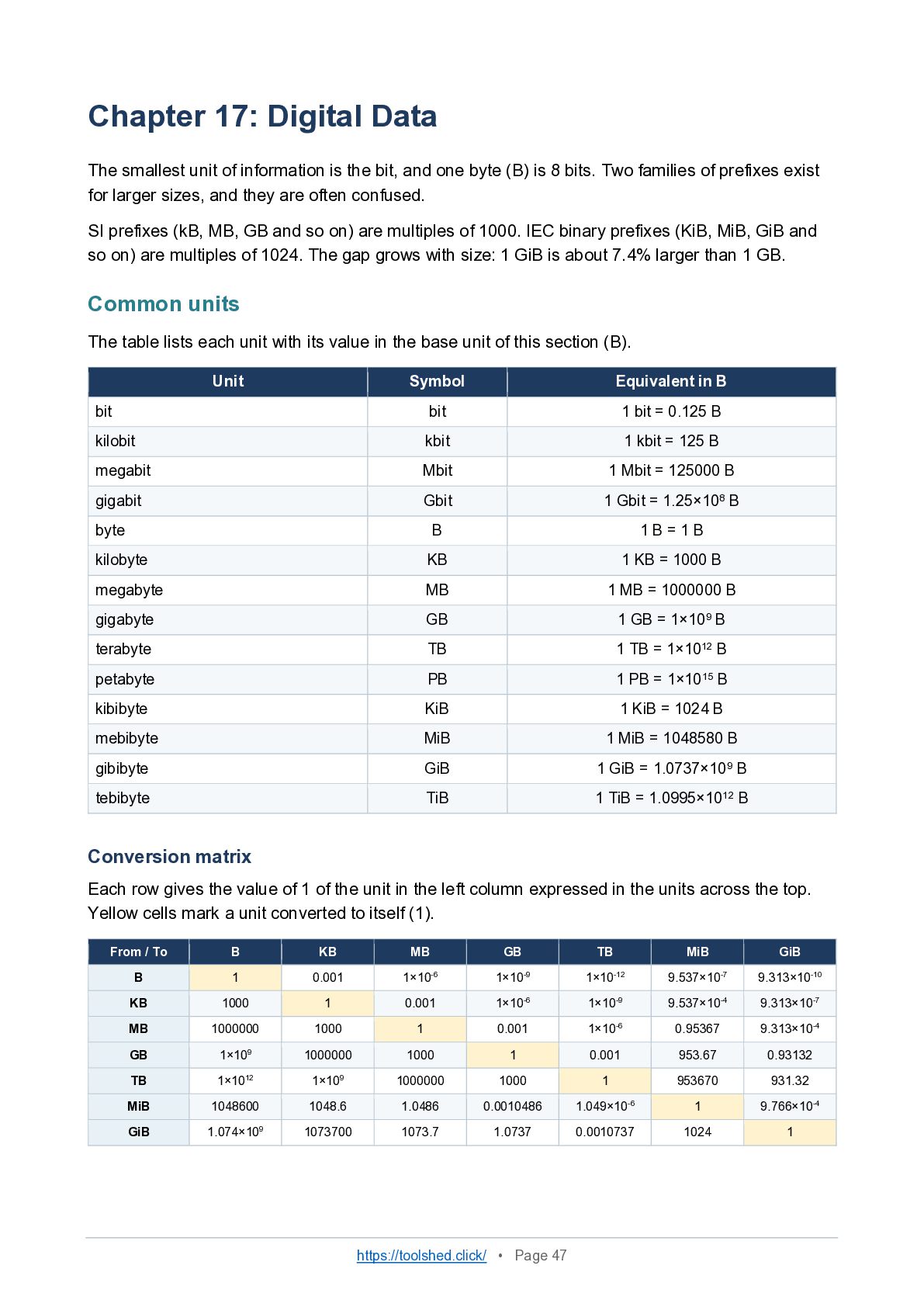
the bit, and one byte (B) is 8 bits. Two families of prefixes exist for larger sizes, and they are often confused. SI prefixes (kB, MB, GB and so on) are multiples of 1000. IEC binary prefixes (KiB, MiB, GiB and so on) are multiples of 1024. The gap grows with size: 1 GiB is about 7.4% larger than 1 GB. Common units The table lists each unit with its value in the base unit of this section (B). Unit Symbol Equivalent in B bit bit 1 bit = 0.125 B kilobit kbit 1 kbit = 125 B megabit Mbit 1 Mbit = 125000 B gigabit Gbit 1 Gbit = 1.25×10⁸ B byte B 1B=1B kilobyte KB 1 KB = 1000 B megabyte MB 1 MB = 1000000 B gigabyte GB 1 GB = 1×10⁹ B terabyte TB 1 TB = 1×10¹² B petabyte PB 1 PB = 1×10¹⁵ B kibibyte KiB 1 KiB = 1024 B mebibyte MiB 1 MiB = 1048580 B gibibyte GiB 1 GiB = 1.0737×10⁹ B tebibyte TiB 1 TiB = 1.0995×10¹² B Conversion matrix Each row gives the value of 1 of the unit in the left column expressed in the units across the top. Yellow cells mark a unit converted to itself (1). From / To B KB MB GB TB MiB GiB B 1 0.001 1×10⁻⁶ 1×10⁻⁹ 1×10-12 9.537×10⁻⁷ 9.313×10-10 KB 1000 1 0.001 1×10⁻⁶ 1×10⁻⁹ 9.537×10⁻⁴ 9.313×10-7 MB 1000000 1000 1 0.001 1×10⁻⁶ 0.95367 9.313×10-4 GB 1×10⁹ 1000000 TB 12 1000 1 0.001 953.67 0.93132 1×10 9 1×10 1000000 1000 1 953670 931.32 MiB 1048600 1048.6 1.0486 0.0010486 1.049×10⁻⁶ 1 9.766×10-4 GiB 1.074×10⁹ 1073700 1073.7 1.0737 0.0010737 1024 1 https://toolshed.click/ • Page 47
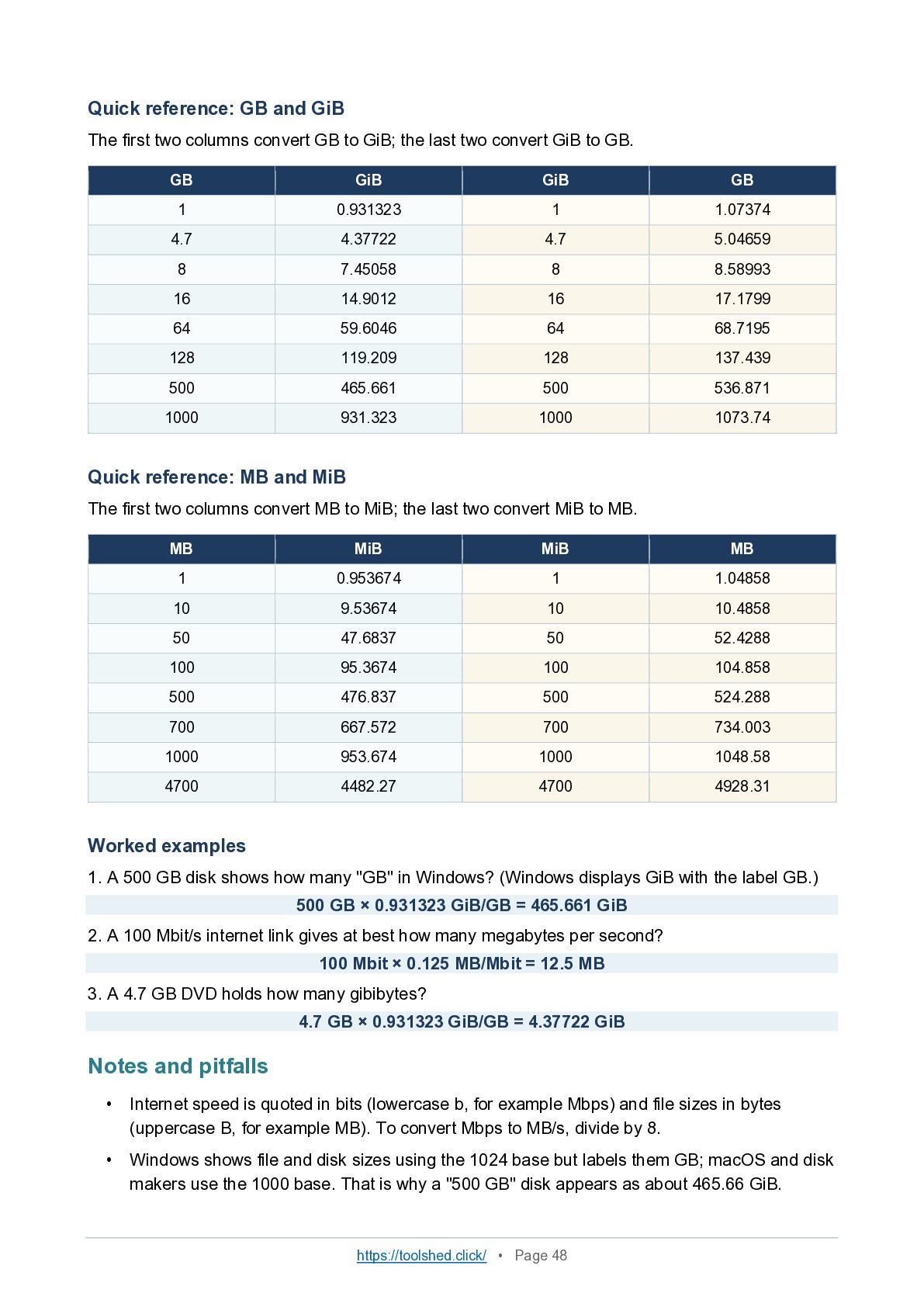
GB to GiB; the last two convert GiB to GB. GB GiB GiB GB 1 0.931323 1 1.07374 4.7 4.37722 4.7 5.04659 8 7.45058 8 8.58993 16 14.9012 16 17.1799 64 59.6046 64 68.7195 128 119.209 128 137.439 500 465.661 500 536.871 1000 931.323 1000 1073.74 Quick reference: MB and MiB The first two columns convert MB to MiB; the last two convert MiB to MB. MB MiB MiB MB 1 0.953674 1 1.04858 10 9.53674 10 10.4858 50 47.6837 50 52.4288 100 95.3674 100 104.858 500 476.837 500 524.288 700 667.572 700 734.003 1000 953.674 1000 1048.58 4700 4482.27 4700 4928.31 Worked examples 1. A 500 GB disk shows how many "GB" in Windows? (Windows displays GiB with the label GB.) 500 GB × 0.931323 GiB/GB = 465.661 GiB 2. A 100 Mbit/s internet link gives at best how many megabytes per second? 100 Mbit × 0.125 MB/Mbit = 12.5 MB 3. A 4.7 GB DVD holds how many gibibytes? 4.7 GB × 0.931323 GiB/GB = 4.37722 GiB Notes and pitfalls • Internet speed is quoted in bits (lowercase b, for example Mbps) and file sizes in bytes (uppercase B, for example MB). To convert Mbps to MB/s, divide by 8. • Windows shows file and disk sizes using the 1024 base but labels them GB; macOS and disk makers use the 1000 base. That is why a "500 GB" disk appears as about 465.66 GiB. https://toolshed.click/ • Page 48
1024 bytes. Online tools: for quick, calculation-free conversion of data size and transfer rate, visit https://toolshed.click/ https://toolshed.click/ • Page 49
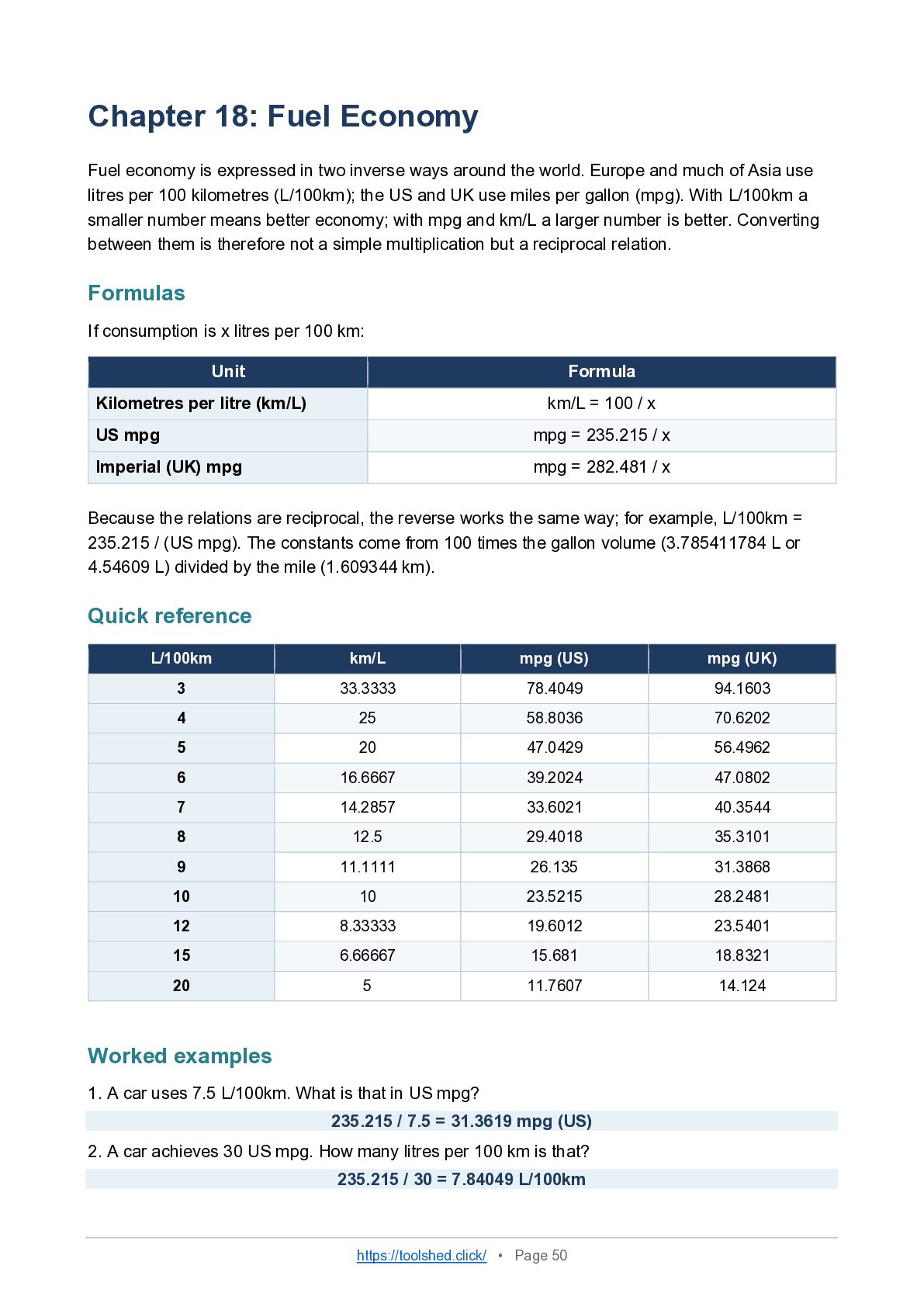
inverse ways around the world. Europe and much of Asia use litres per 100 kilometres (L/100km); the US and UK use miles per gallon (mpg). With L/100km a smaller number means better economy; with mpg and km/L a larger number is better. Converting between them is therefore not a simple multiplication but a reciprocal relation. Formulas If consumption is x litres per 100 km: Unit Formula Kilometres per litre (km/L) km/L = 100 / x US mpg mpg = 235.215 / x Imperial (UK) mpg mpg = 282.481 / x Because the relations are reciprocal, the reverse works the same way; for example, L/100km = 235.215 / (US mpg). The constants come from 100 times the gallon volume (3.785411784 L or 4.54609 L) divided by the mile (1.609344 km). Quick reference L/100km km/L mpg (US) mpg (UK) 3 33.3333 78.4049 94.1603 4 25 58.8036 70.6202 5 20 47.0429 56.4962 6 16.6667 39.2024 47.0802 7 14.2857 33.6021 40.3544 8 12.5 29.4018 35.3101 9 11.1111 26.135 31.3868 10 10 23.5215 28.2481 12 8.33333 19.6012 23.5401 15 6.66667 15.681 18.8321 20 5 11.7607 14.124 Worked examples 1. A car uses 7.5 L/100km. What is that in US mpg? 235.215 / 7.5 = 31.3619 mpg (US) 2. A car achieves 30 US mpg. How many litres per 100 km is that? 235.215 / 30 = 7.84049 L/100km https://toolshed.click/ • Page 50
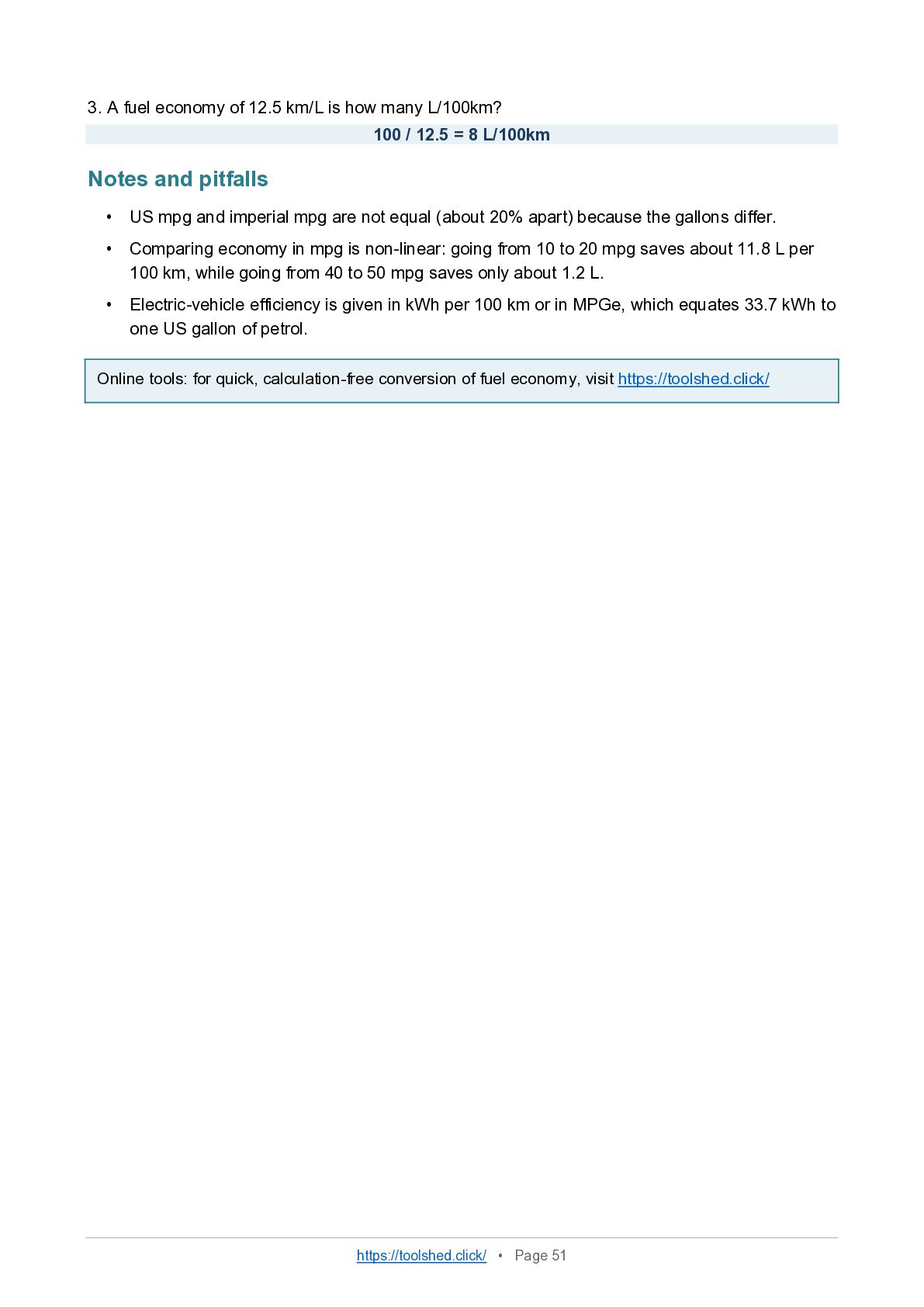
L/100km? 100 / 12.5 = 8 L/100km Notes and pitfalls • US mpg and imperial mpg are not equal (about 20% apart) because the gallons differ. • Comparing economy in mpg is non-linear: going from 10 to 20 mpg saves about 11.8 L per 100 km, while going from 40 to 50 mpg saves only about 1.2 L. • Electric-vehicle efficiency is given in kWh per 100 km or in MPGe, which equates 33.7 kWh to one US gallon of petrol. Online tools: for quick, calculation-free conversion of fuel economy, visit https://toolshed.click/ https://toolshed.click/ • Page 51
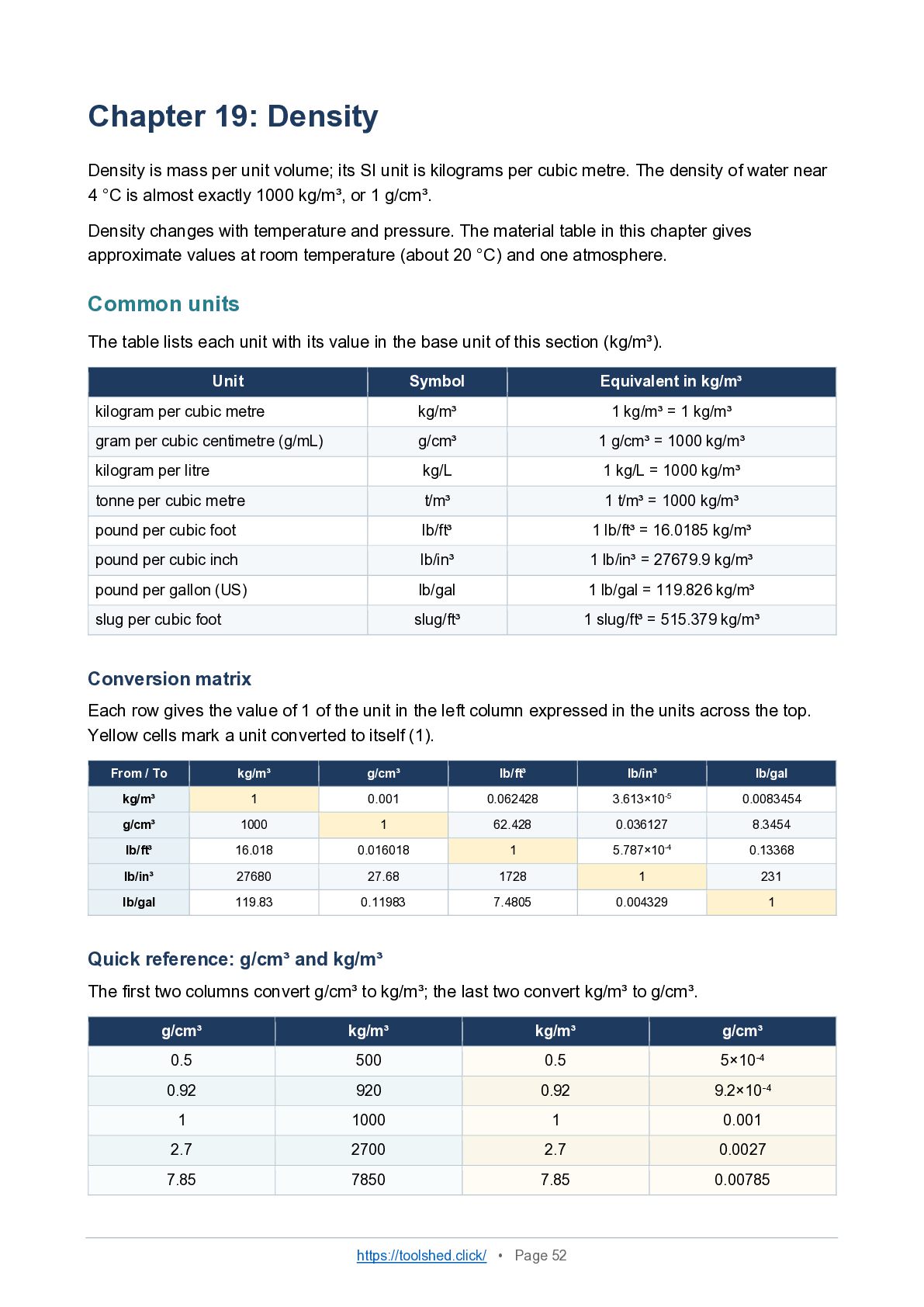
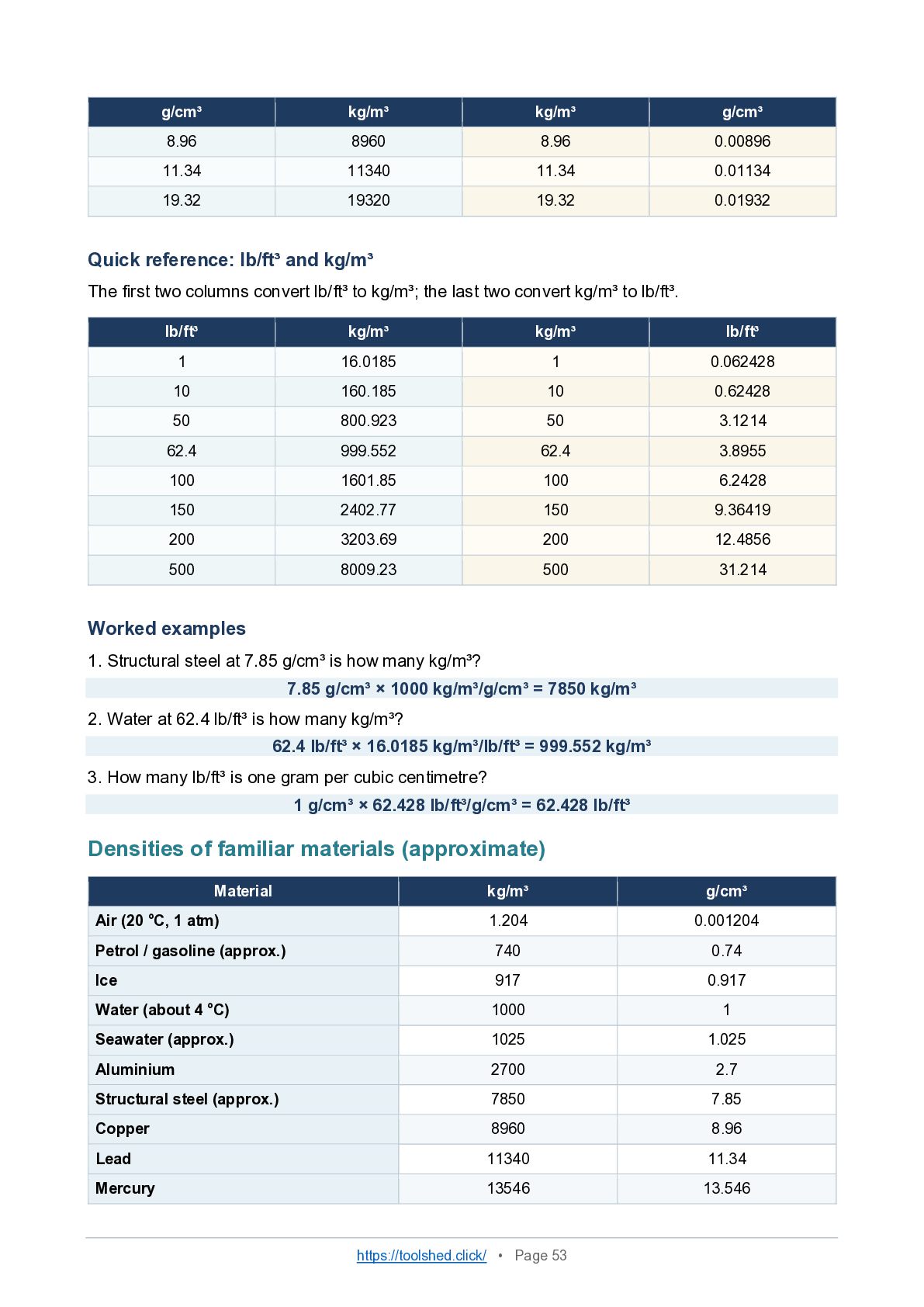
SI unit is kilograms per cubic metre. The density of water near 4 °C is almost exactly 1000 kg/m³, or 1 g/cm³. Density changes with temperature and pressure. The material table in this chapter gives approximate values at room temperature (about 20 °C) and one atmosphere. Common units The table lists each unit with its value in the base unit of this section (kg/m³). Unit Symbol Equivalent in kg/m³ kilogram per cubic metre kg/m³ 1 kg/m³ = 1 kg/m³ gram per cubic centimetre (g/mL) g/cm³ 1 g/cm³ = 1000 kg/m³ kilogram per litre kg/L 1 kg/L = 1000 kg/m³ tonne per cubic metre t/m³ 1 t/m³ = 1000 kg/m³ pound per cubic foot lb/ft³ 1 lb/ft³ = 16.0185 kg/m³ pound per cubic inch lb/in³ 1 lb/in³ = 27679.9 kg/m³ pound per gallon (US) lb/gal 1 lb/gal = 119.826 kg/m³ slug per cubic foot slug/ft³ 1 slug/ft³ = 515.379 kg/m³ Conversion matrix Each row gives the value of 1 of the unit in the left column expressed in the units across the top. Yellow cells mark a unit converted to itself (1). From / To kg/m³ g/cm³ lb/ft³ lb/in³ lb/gal -5 kg/m³ 1 0.001 0.062428 3.613×10 0.0083454 g/cm³ 1000 1 62.428 0.036127 8.3454 -4 lb/ft³ 16.018 0.016018 1 5.787×10 0.13368 lb/in³ 27680 27.68 1728 1 231 lb/gal 119.83 0.11983 7.4805 0.004329 1 Quick reference: g/cm³ and kg/m³ The first two columns convert g/cm³ to kg/m³; the last two convert kg/m³ to g/cm³. g/cm³ kg/m³ kg/m³ g/cm³ 0.5 500 0.5 5×10⁻⁴ 0.92 920 0.92 9.2×10⁻⁴ 1 1000 1 0.001 2.7 2700 2.7 0.0027 7.85 7850 7.85 0.00785 https://toolshed.click/ • Page 52
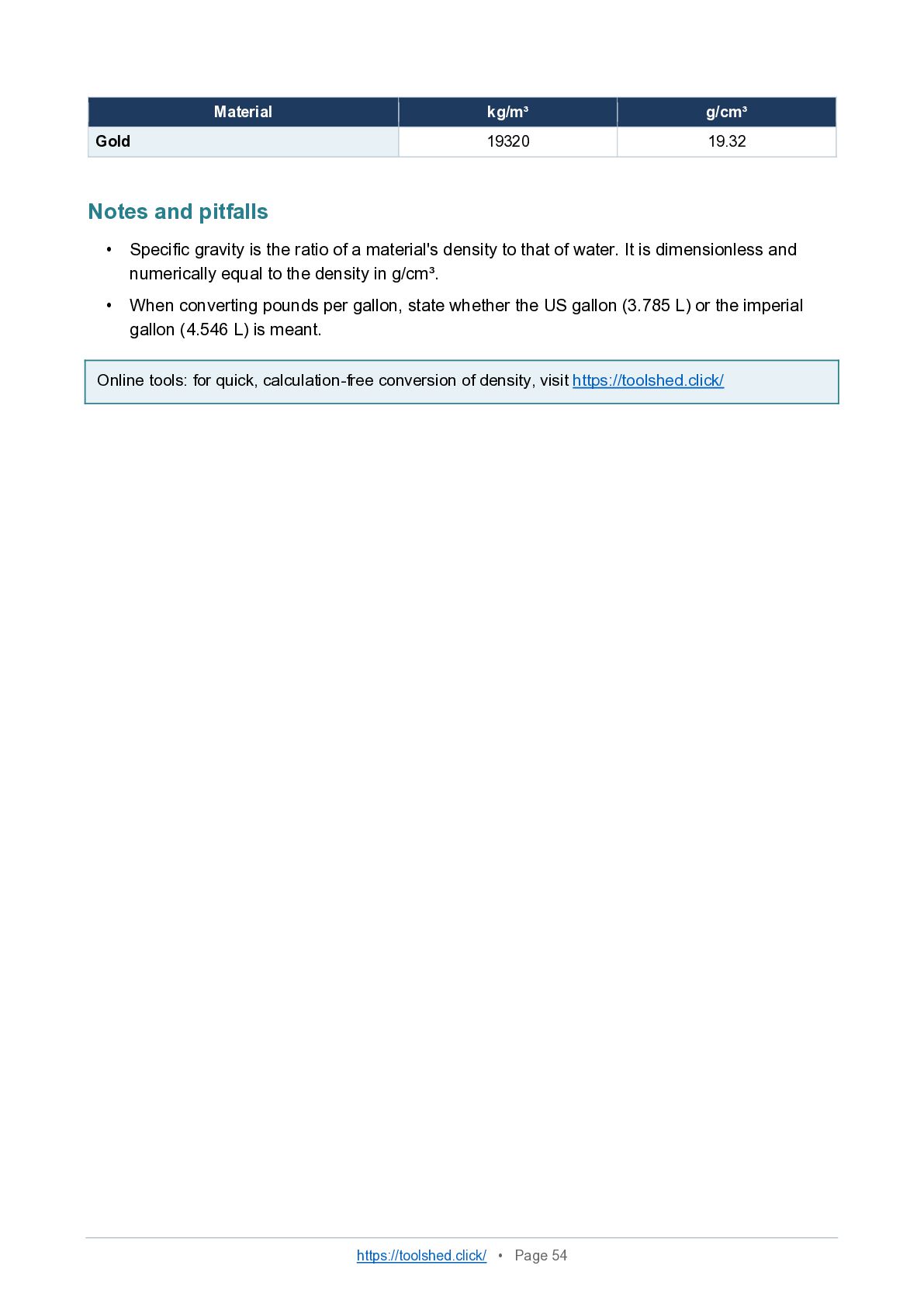
Specific gravity is the ratio of a material's density to that of water. It is dimensionless and numerically equal to the density in g/cm³. • When converting pounds per gallon, state whether the US gallon (3.785 L) or the imperial gallon (4.546 L) is meant. Online tools: for quick, calculation-free conversion of density, visit https://toolshed.click/ https://toolshed.click/ • Page 54
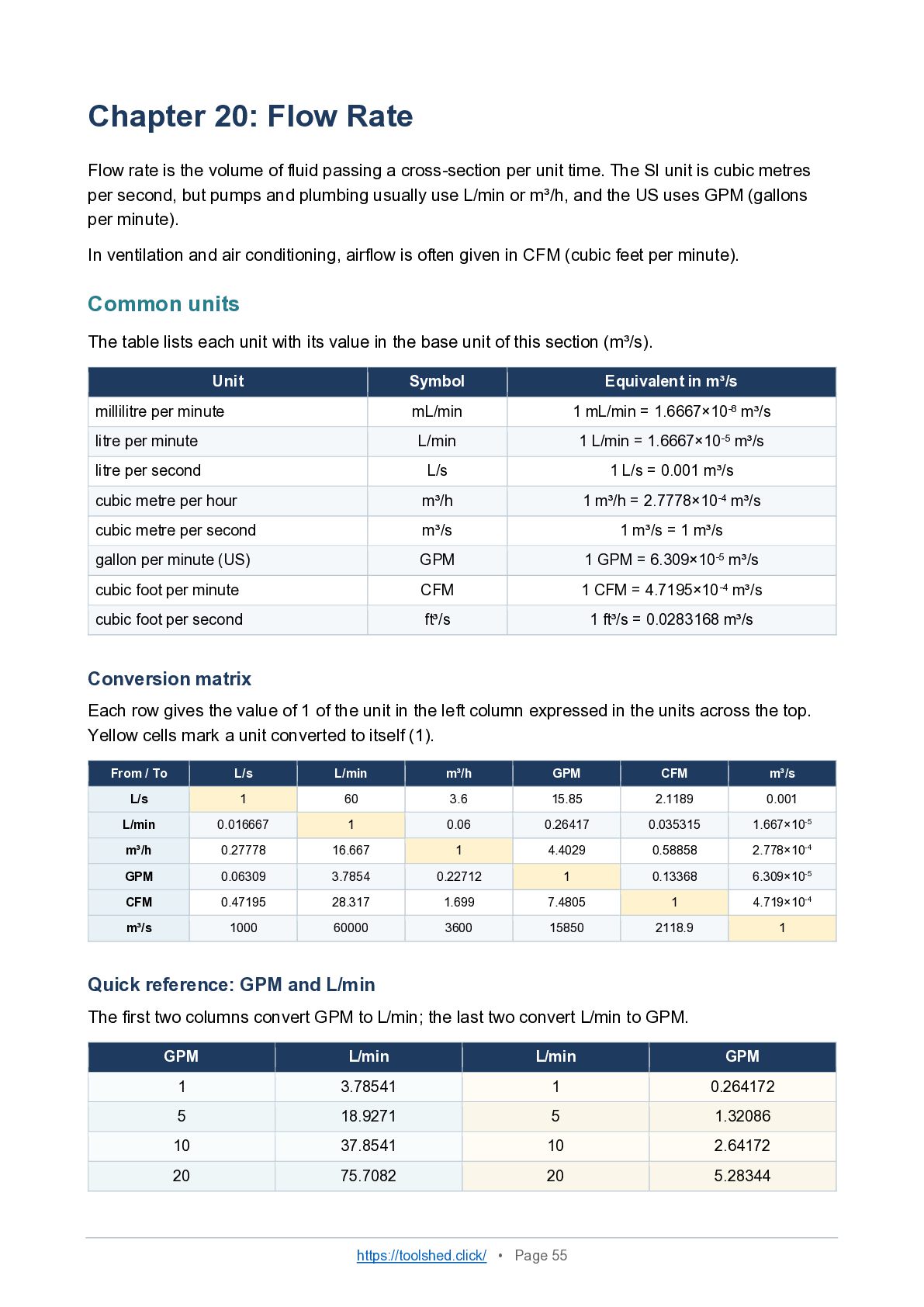
fluid passing a cross-section per unit time. The SI unit is cubic metres per second, but pumps and plumbing usually use L/min or m³/h, and the US uses GPM (gallons per minute). In ventilation and air conditioning, airflow is often given in CFM (cubic feet per minute). Common units The table lists each unit with its value in the base unit of this section (m³/s). Unit Symbol Equivalent in m³/s millilitre per minute mL/min 1 mL/min = 1.6667×10⁻⁸ m³/s litre per minute L/min 1 L/min = 1.6667×10⁻⁵ m³/s litre per second L/s 1 L/s = 0.001 m³/s cubic metre per hour m³/h 1 m³/h = 2.7778×10⁻⁴ m³/s cubic metre per second m³/s 1 m³/s = 1 m³/s gallon per minute (US) GPM 1 GPM = 6.309×10⁻⁵ m³/s cubic foot per minute CFM 1 CFM = 4.7195×10⁻⁴ m³/s cubic foot per second ft³/s 1 ft³/s = 0.0283168 m³/s Conversion matrix Each row gives the value of 1 of the unit in the left column expressed in the units across the top. Yellow cells mark a unit converted to itself (1). From / To L/s L/min m³/h GPM CFM m³/s L/s 1 60 3.6 15.85 2.1189 0.001 L/min 0.016667 1 0.06 0.26417 0.035315 1.667×10⁻⁵ m³/h 0.27778 16.667 1 4.4029 0.58858 2.778×10⁻⁴ GPM 0.06309 3.7854 0.22712 1 0.13368 6.309×10⁻⁵ CFM 0.47195 28.317 1.699 7.4805 1 4.719×10⁻⁴ m³/s 1000 60000 3600 15850 2118.9 1 Quick reference: GPM and L/min The first two columns convert GPM to L/min; the last two convert L/min to GPM. GPM L/min L/min GPM 1 3.78541 1 0.264172 5 18.9271 5 1.32086 10 37.8541 10 2.64172 20 75.7082 20 5.28344 https://toolshed.click/ • Page 55
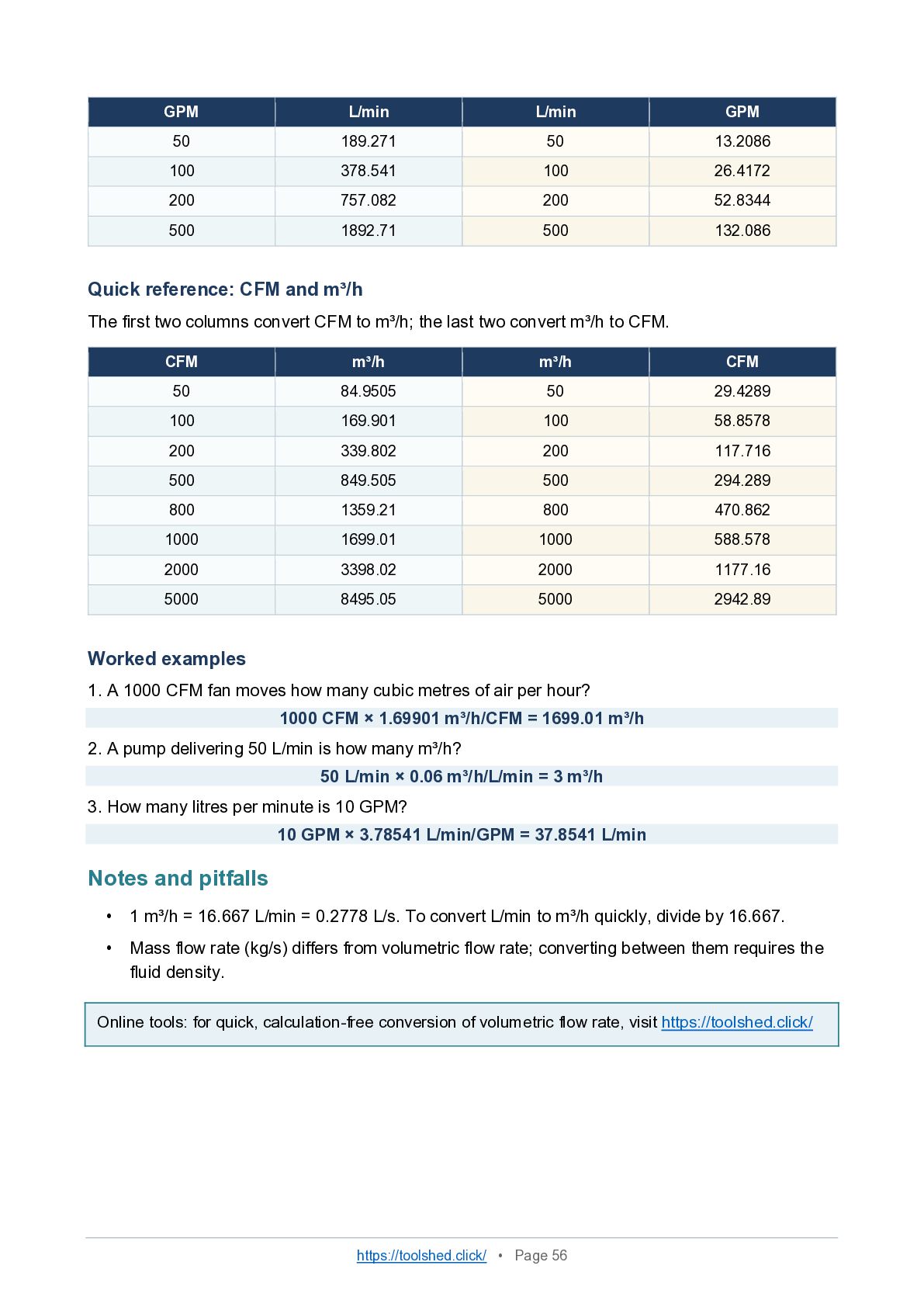
100 26.4172 200 757.082 200 52.8344 500 1892.71 500 132.086 Quick reference: CFM and m³/h The first two columns convert CFM to m³/h; the last two convert m³/h to CFM. CFM m³/h m³/h CFM 50 84.9505 50 29.4289 100 169.901 100 58.8578 200 339.802 200 117.716 500 849.505 500 294.289 800 1359.21 800 470.862 1000 1699.01 1000 588.578 2000 3398.02 2000 1177.16 5000 8495.05 5000 2942.89 Worked examples 1. A 1000 CFM fan moves how many cubic metres of air per hour? 1000 CFM × 1.69901 m³/h/CFM = 1699.01 m³/h 2. A pump delivering 50 L/min is how many m³/h? 50 L/min × 0.06 m³/h/L/min = 3 m³/h 3. How many litres per minute is 10 GPM? 10 GPM × 3.78541 L/min/GPM = 37.8541 L/min Notes and pitfalls • 1 m³/h = 16.667 L/min = 0.2778 L/s. To convert L/min to m³/h quickly, divide by 16.667. • Mass flow rate (kg/s) differs from volumetric flow rate; converting between them requires the fluid density. Online tools: for quick, calculation-free conversion of volumetric flow rate, visit https://toolshed.click/ https://toolshed.click/ • Page 56
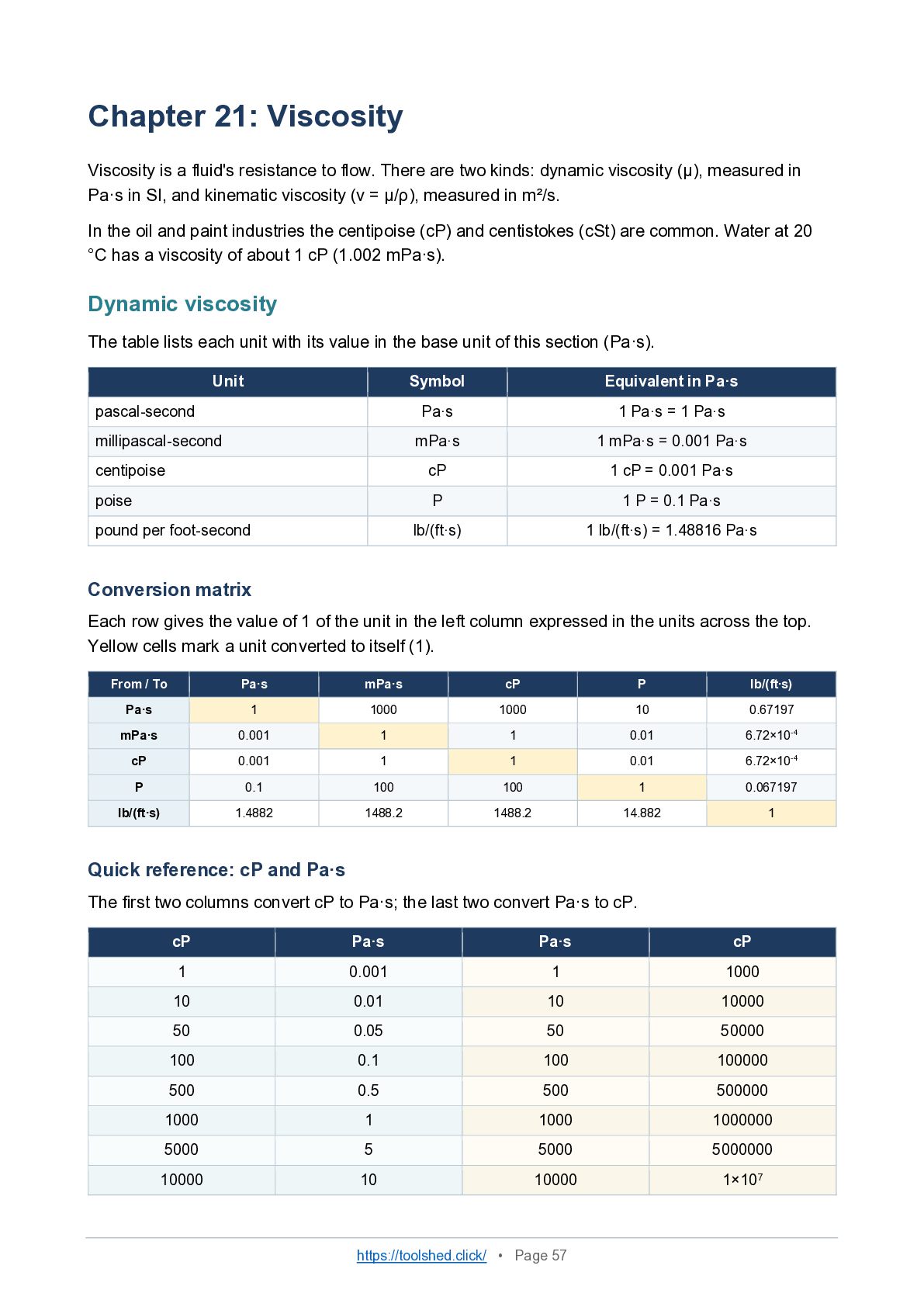
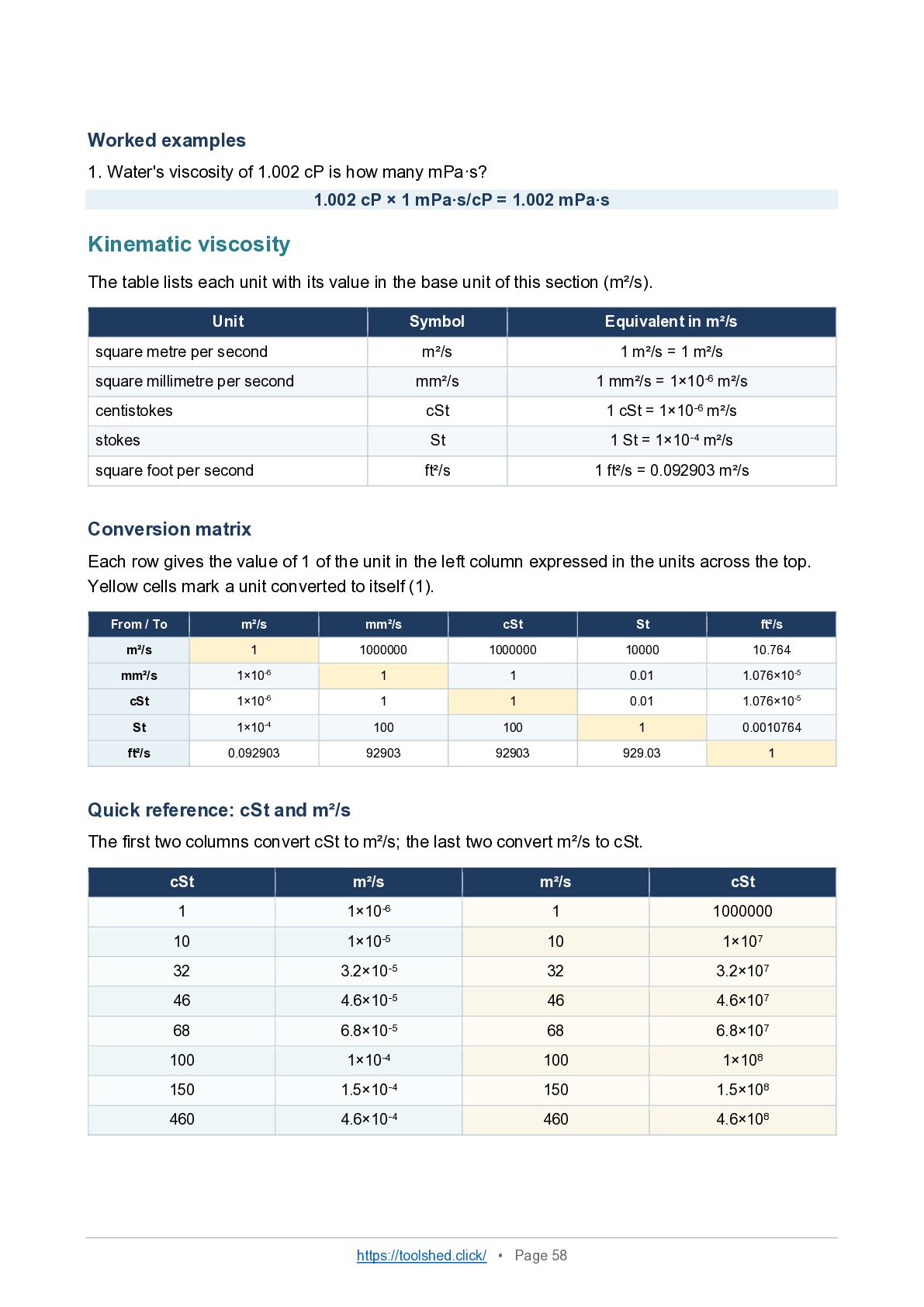
There are two kinds: dynamic viscosity (µ), measured in Pa·s in SI, and kinematic viscosity (ν = µ/ρ), measured in m²/s. In the oil and paint industries the centipoise (cP) and centistokes (cSt) are common. Water at 20 °C has a viscosity of about 1 cP (1.002 mPa·s). Dynamic viscosity The table lists each unit with its value in the base unit of this section (Pa·s). Unit Symbol Equivalent in Pa·s pascal-second Pa·s 1 Pa·s = 1 Pa·s millipascal-second mPa·s 1 mPa·s = 0.001 Pa·s centipoise cP 1 cP = 0.001 Pa·s poise P 1 P = 0.1 Pa·s lb/(ft·s) 1 lb/(ft·s) = 1.48816 Pa·s pound per foot-second Conversion matrix Each row gives the value of 1 of the unit in the left column expressed in the units across the top. Yellow cells mark a unit converted to itself (1). From / To Pa·s mPa·s cP P lb/(ft·s) Pa·s 1 1000 1000 10 0.67197 mPa·s 0.001 1 1 0.01 6.72×10⁻⁴ cP 0.001 1 1 0.01 6.72×10⁻⁴ P 0.1 100 100 1 0.067197 lb/(ft·s) 1.4882 1488.2 1488.2 14.882 1 Quick reference: cP and Pa·s The first two columns convert cP to Pa·s; the last two convert Pa·s to cP. cP Pa·s Pa·s cP 1 0.001 1 1000 10 0.01 10 10000 50 0.05 50 50000 100 0.1 100 100000 500 0.5 500 500000 1000 1 1000 1000000 5000 5 5000 5000000 10000 10 10000 1×10⁷ https://toolshed.click/ • Page 57
many mPa·s? 1.002 cP × 1 mPa·s/cP = 1.002 mPa·s Kinematic viscosity The table lists each unit with its value in the base unit of this section (m²/s). Unit Symbol Equivalent in m²/s square metre per second m²/s 1 m²/s = 1 m²/s square millimetre per second mm²/s 1 mm²/s = 1×10⁻⁶ m²/s centistokes cSt 1 cSt = 1×10⁻⁶ m²/s stokes St 1 St = 1×10⁻⁴ m²/s square foot per second ft²/s 1 ft²/s = 0.092903 m²/s Conversion matrix Each row gives the value of 1 of the unit in the left column expressed in the units across the top. Yellow cells mark a unit converted to itself (1). From / To m²/s mm²/s cSt St ft²/s m²/s 1 1000000 1000000 10000 10.764 mm²/s -6 1×10 1 1 0.01 1.076×10⁻⁵ cSt 1×10⁻⁶ 1 1 0.01 1.076×10⁻⁵ St 1×10⁻⁴ 100 100 1 0.0010764 ft²/s 0.092903 92903 92903 929.03 1 Quick reference: cSt and m²/s The first two columns convert cSt to m²/s; the last two convert m²/s to cSt. cSt m²/s m²/s cSt 1 1×10⁻⁶ 1 1000000 10 1×10⁻⁵ 10 1×10⁷ 32 3.2×10⁻⁵ 32 3.2×10⁷ 46 4.6×10⁻⁵ 46 4.6×10⁷ 68 6.8×10⁻⁵ 68 6.8×10⁷ 100 1×10⁻⁴ 100 1×10⁸ 150 1.5×10⁻⁴ 150 1.5×10⁸ 460 4.6×10⁻⁴ 460 4.6×10⁸ https://toolshed.click/ • Page 58
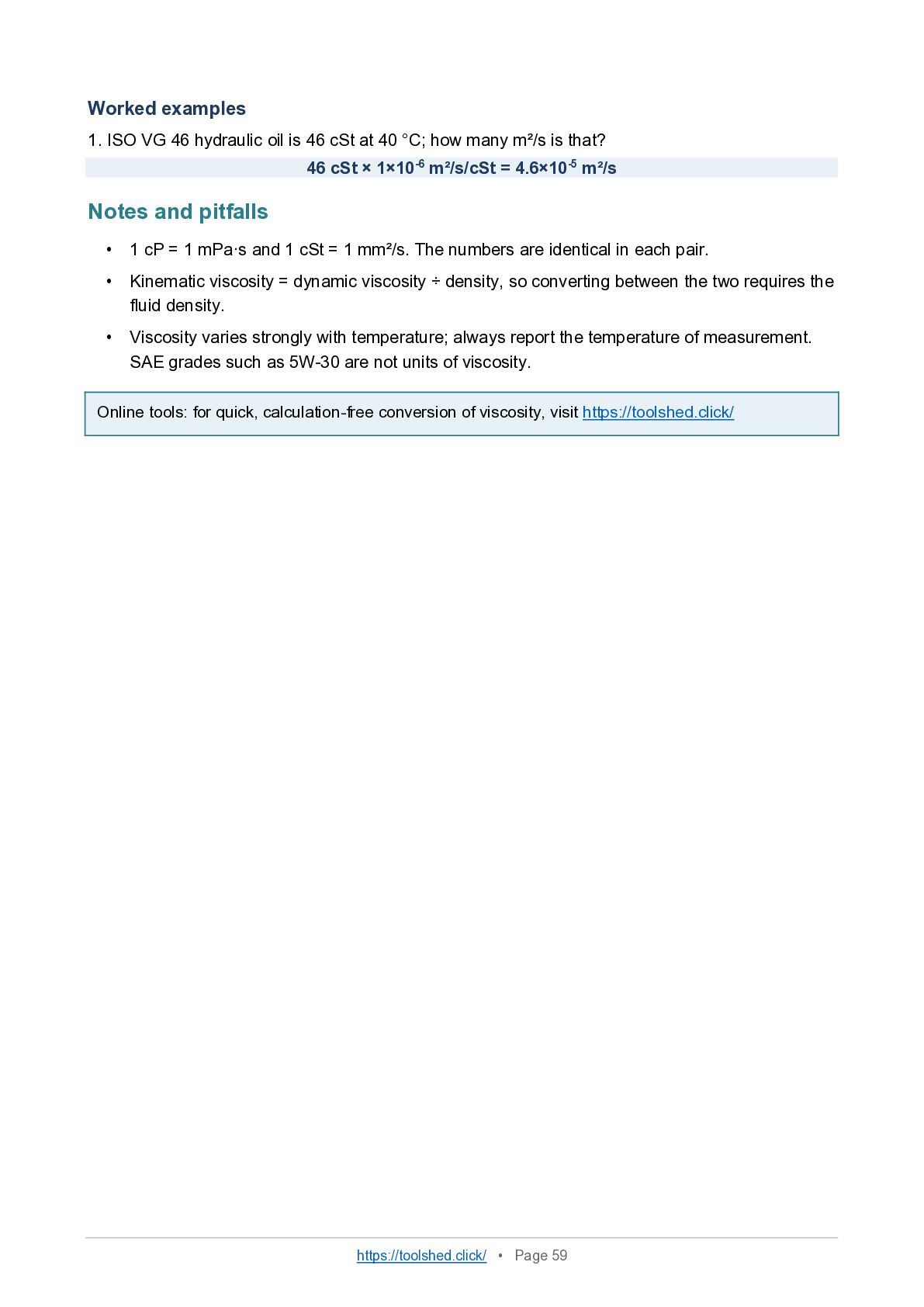
cSt at 40 °C; how many m²/s is that? 46 cSt × 1×10-6 m²/s/cSt = 4.6×10⁻⁵ m²/s Notes and pitfalls • 1 cP = 1 mPa·s and 1 cSt = 1 mm²/s. The numbers are identical in each pair. • Kinematic viscosity = dynamic viscosity ÷ density, so converting between the two requires the fluid density. • Viscosity varies strongly with temperature; always report the temperature of measurement. SAE grades such as 5W-30 are not units of viscosity. Online tools: for quick, calculation-free conversion of viscosity, visit https://toolshed.click/ https://toolshed.click/ • Page 59
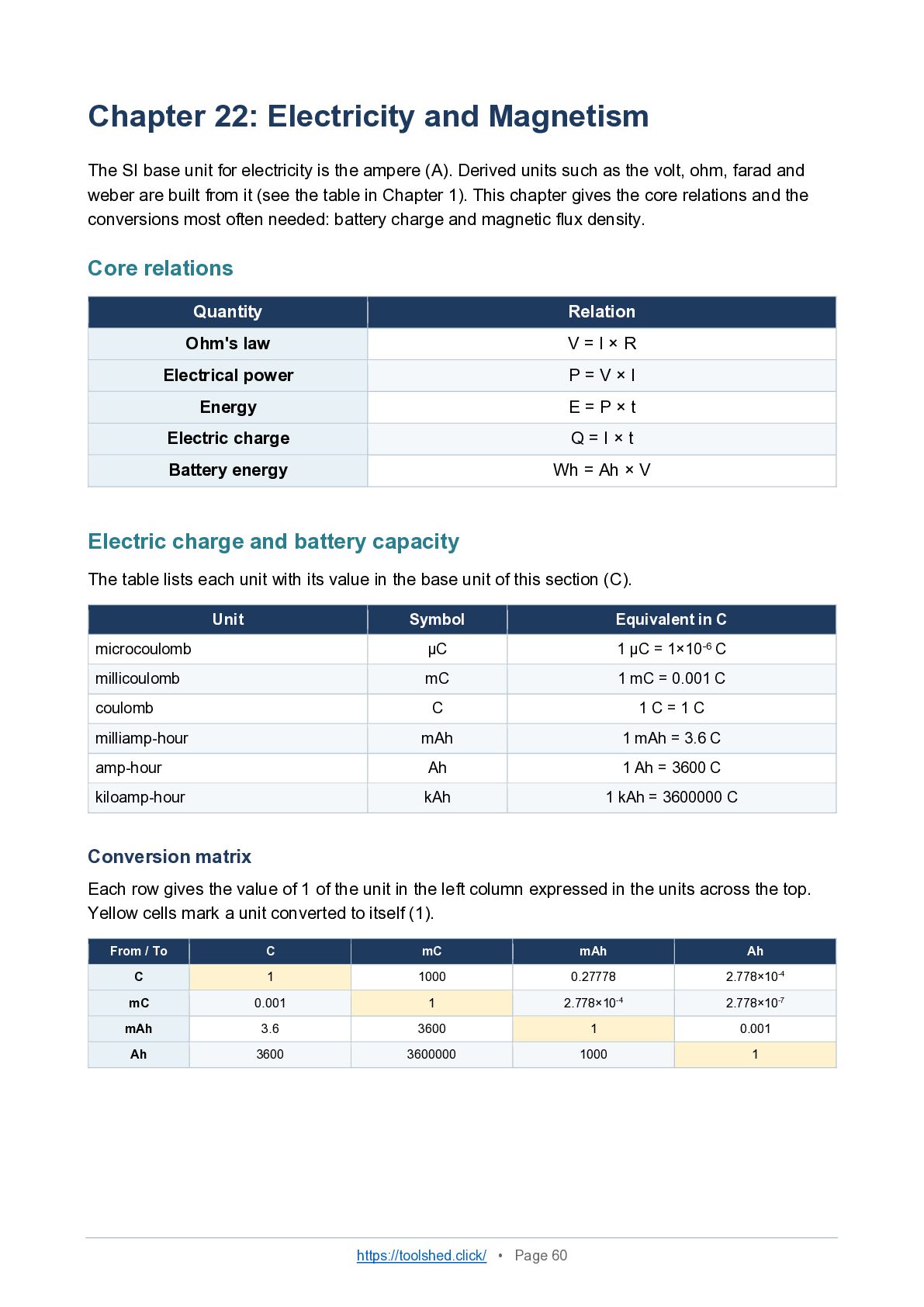
electricity is the ampere (A). Derived units such as the volt, ohm, farad and weber are built from it (see the table in Chapter 1). This chapter gives the core relations and the conversions most often needed: battery charge and magnetic flux density. Core relations Quantity Relation Ohm's law V=I×R Electrical power P=V×I Energy E=P×t Electric charge Q=I×t Battery energy Wh = Ah × V Electric charge and battery capacity The table lists each unit with its value in the base unit of this section (C). Unit Symbol Equivalent in C microcoulomb µC 1 µC = 1×10⁻⁶ C millicoulomb mC 1 mC = 0.001 C coulomb C 1C=1C milliamp-hour mAh 1 mAh = 3.6 C amp-hour Ah 1 Ah = 3600 C kiloamp-hour kAh 1 kAh = 3600000 C Conversion matrix Each row gives the value of 1 of the unit in the left column expressed in the units across the top. Yellow cells mark a unit converted to itself (1). From / To C mC mAh Ah C 1 1000 0.27778 2.778×10⁻⁴ mC 0.001 1 2.778×10⁻⁴ 2.778×10⁻⁷ mAh 3.6 3600 1 0.001 Ah 3600 3600000 1000 1 https://toolshed.click/ • Page 60
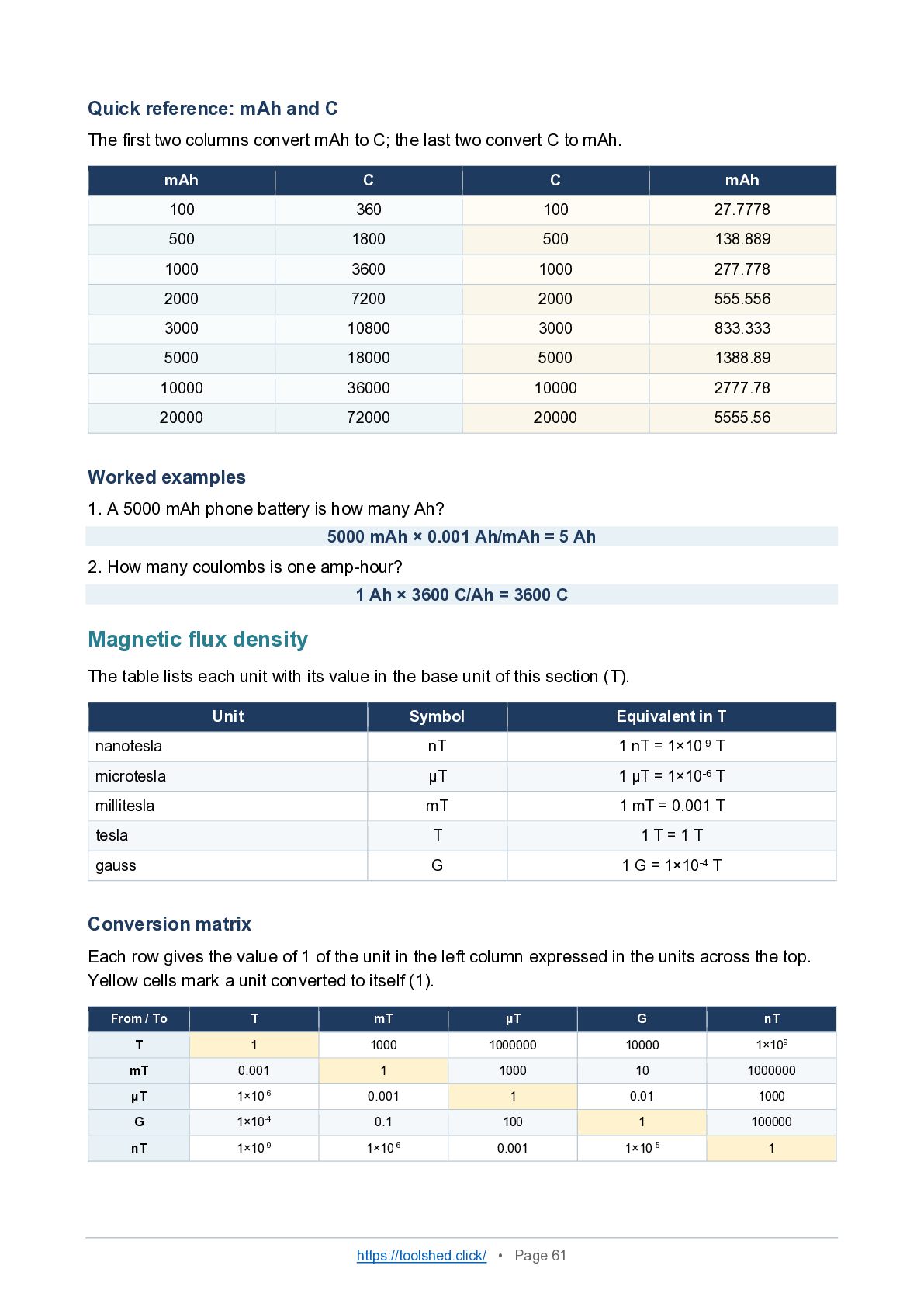
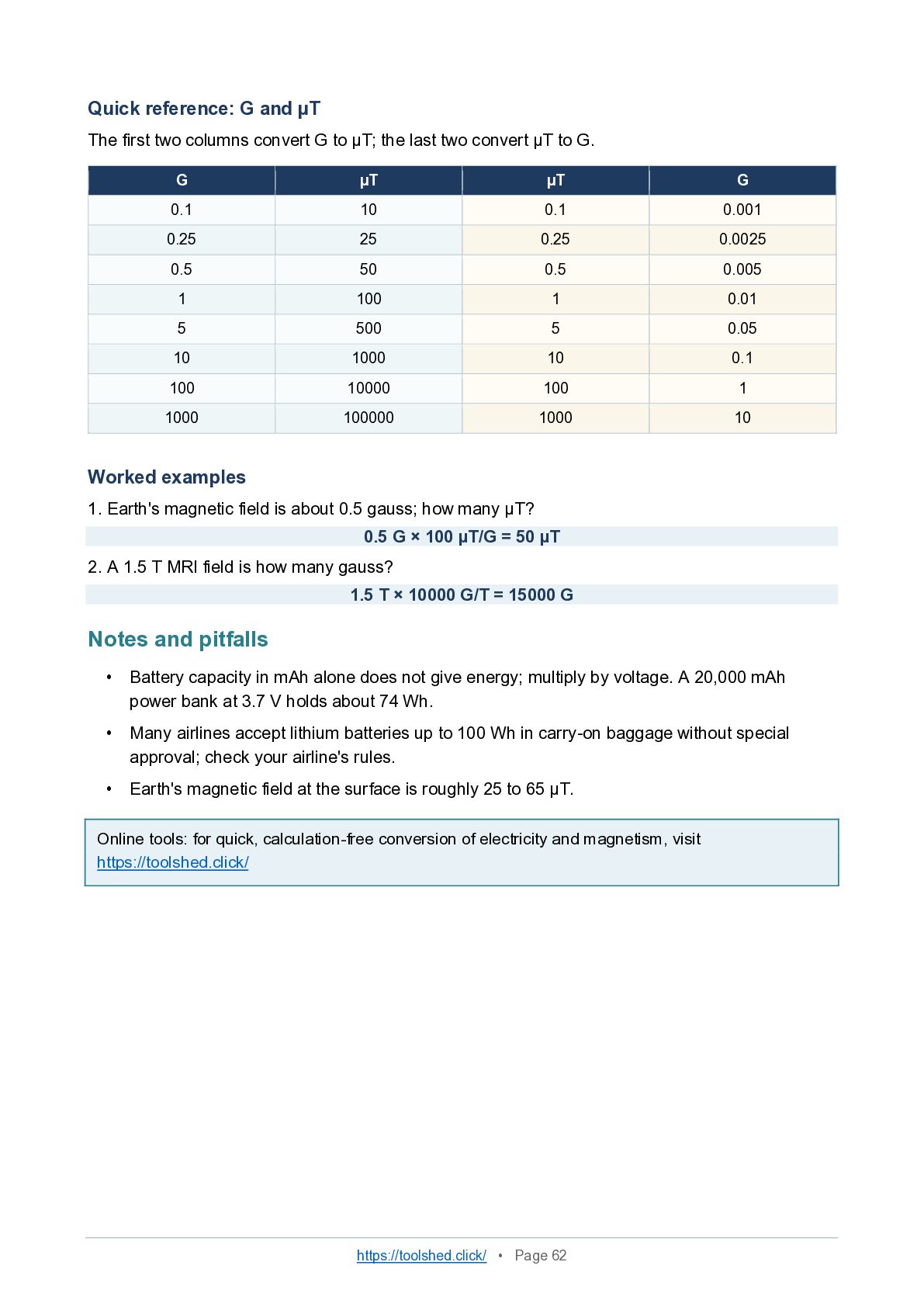
mAh to C; the last two convert C to mAh. mAh C C mAh 100 360 100 27.7778 500 1800 500 138.889 1000 3600 1000 277.778 2000 7200 2000 555.556 3000 10800 3000 833.333 5000 18000 5000 1388.89 10000 36000 10000 2777.78 20000 72000 20000 5555.56 Worked examples 1. A 5000 mAh phone battery is how many Ah? 5000 mAh × 0.001 Ah/mAh = 5 Ah 2. How many coulombs is one amp-hour? 1 Ah × 3600 C/Ah = 3600 C Magnetic flux density The table lists each unit with its value in the base unit of this section (T). Unit Symbol Equivalent in T nanotesla nT 1 nT = 1×10⁻⁹ T microtesla µT 1 µT = 1×10⁻⁶ T millitesla mT 1 mT = 0.001 T tesla T 1T=1T gauss G 1 G = 1×10⁻⁴ T Conversion matrix Each row gives the value of 1 of the unit in the left column expressed in the units across the top. Yellow cells mark a unit converted to itself (1). From / To T mT µT G nT T 1 1000 1000000 10000 1×10⁹ mT 0.001 1 1000 10 1000000 µT -6 0.001 1 0.01 1000 -4 0.1 100 1 100000 G nT 1×10 1×10 -9 1×10 -6 1×10 0.001 https://toolshed.click/ • Page 61 -5 1×10 1
G to µT; the last two convert µT to G. G µT µT G 0.1 10 0.1 0.001 0.25 25 0.25 0.0025 0.5 50 0.5 0.005 1 100 1 0.01 5 500 5 0.05 10 1000 10 0.1 100 10000 100 1 1000 100000 1000 10 Worked examples 1. Earth's magnetic field is about 0.5 gauss; how many µT? 0.5 G × 100 µT/G = 50 µT 2. A 1.5 T MRI field is how many gauss? 1.5 T × 10000 G/T = 15000 G Notes and pitfalls • Battery capacity in mAh alone does not give energy; multiply by voltage. A 20,000 mAh power bank at 3.7 V holds about 74 Wh. • Many airlines accept lithium batteries up to 100 Wh in carry-on baggage without special approval; check your airline's rules. • Earth's magnetic field at the surface is roughly 25 to 65 µT. Online tools: for quick, calculation-free conversion of electricity and magnetism, visit https://toolshed.click/ https://toolshed.click/ • Page 62
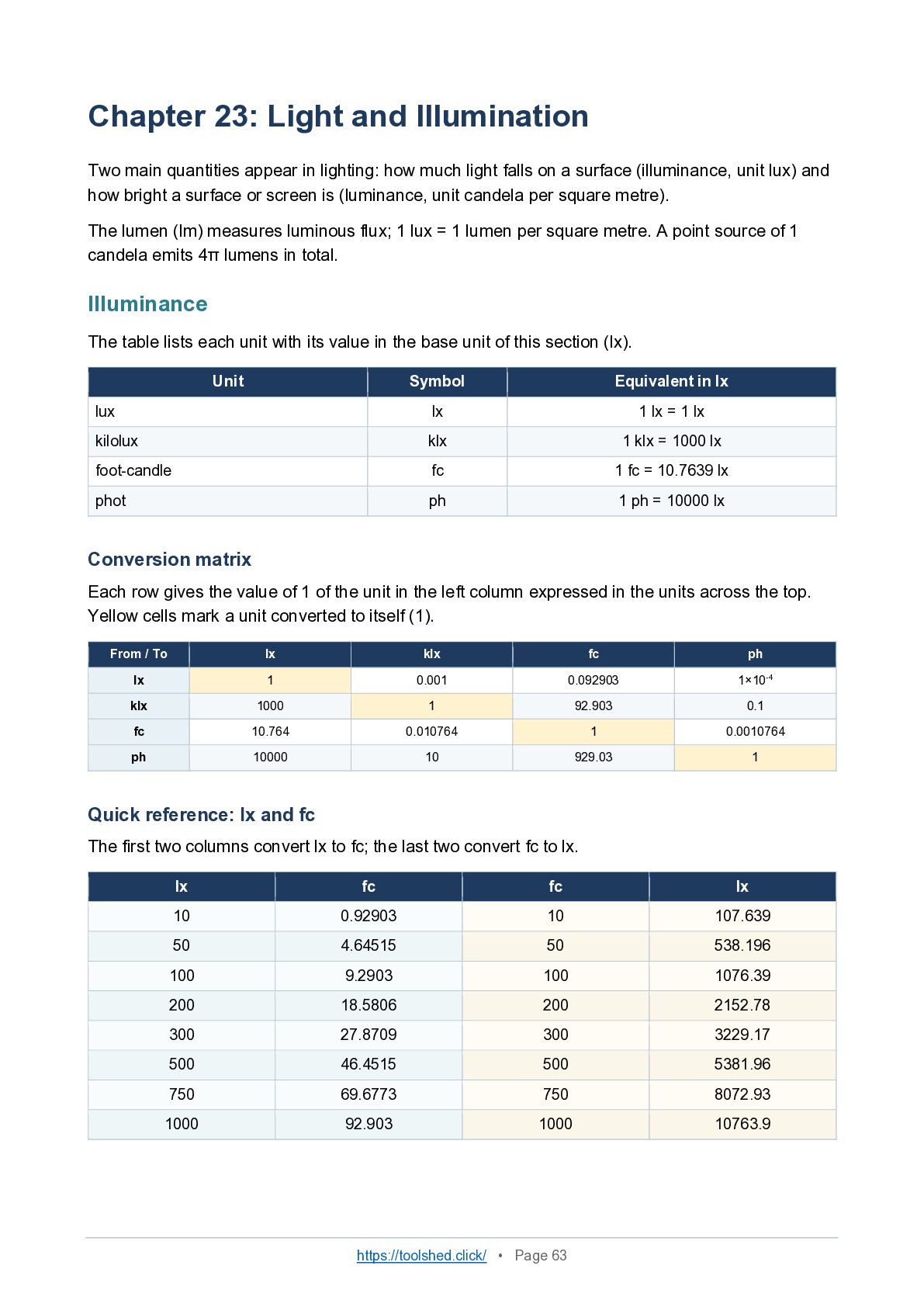
lighting: how much light falls on a surface (illuminance, unit lux) and how bright a surface or screen is (luminance, unit candela per square metre). The lumen (lm) measures luminous flux; 1 lux = 1 lumen per square metre. A point source of 1 candela emits 4π lumens in total. Illuminance The table lists each unit with its value in the base unit of this section (lx). Unit Symbol Equivalent in lx lux lx 1 lx = 1 lx kilolux klx 1 klx = 1000 lx foot-candle fc 1 fc = 10.7639 lx phot ph 1 ph = 10000 lx Conversion matrix Each row gives the value of 1 of the unit in the left column expressed in the units across the top. Yellow cells mark a unit converted to itself (1). From / To lx klx fc ph lx 1 0.001 0.092903 1×10-4 klx 1000 1 92.903 0.1 fc 10.764 0.010764 1 0.0010764 ph 10000 10 929.03 1 Quick reference: lx and fc The first two columns convert lx to fc; the last two convert fc to lx. lx fc fc lx 10 0.92903 10 107.639 50 4.64515 50 538.196 100 9.2903 100 1076.39 200 18.5806 200 2152.78 300 27.8709 300 3229.17 500 46.4515 500 5381.96 750 69.6773 750 8072.93 1000 92.903 1000 10763.9 https://toolshed.click/ • Page 63
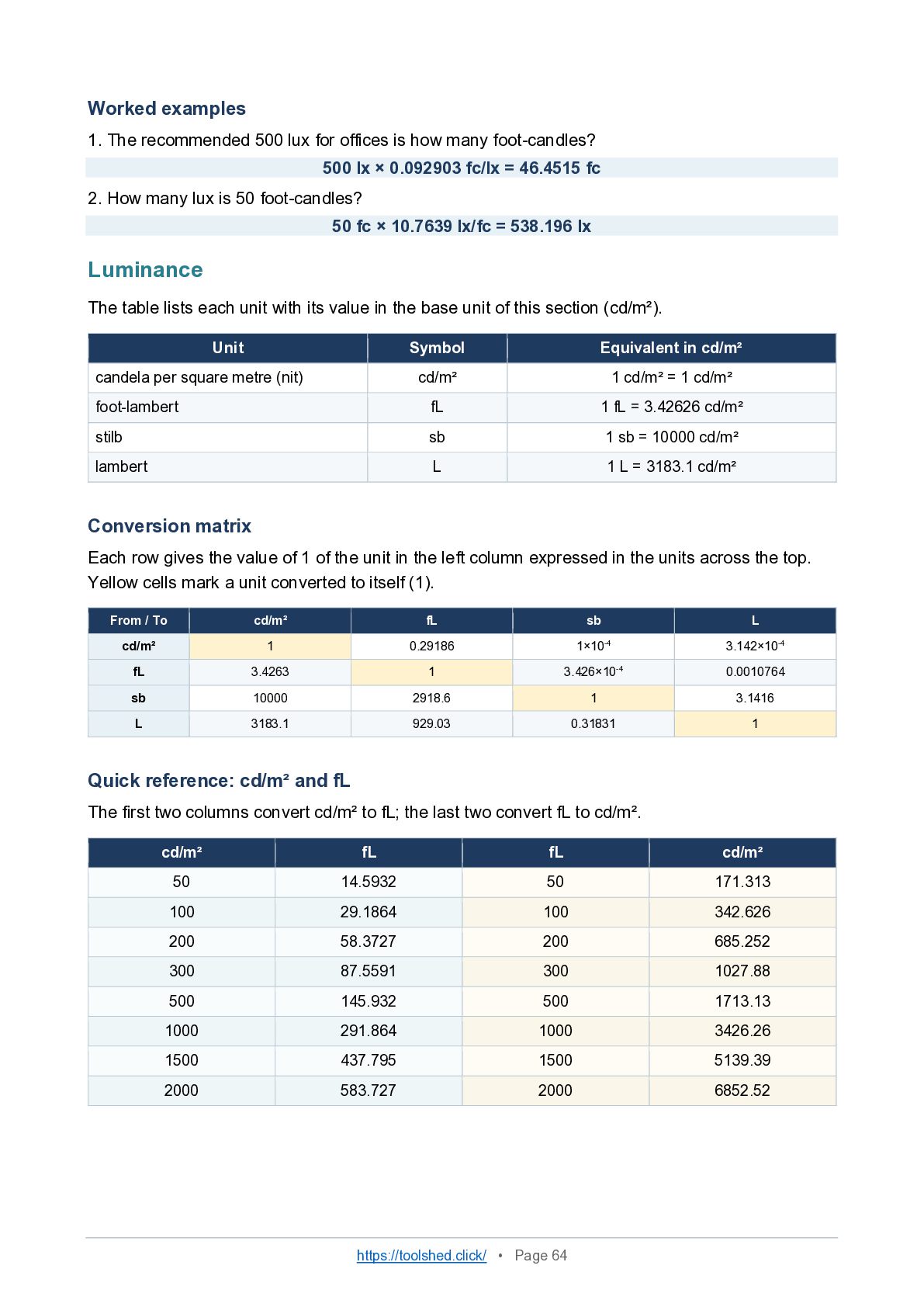
how many foot-candles? 500 lx × 0.092903 fc/lx = 46.4515 fc 2. How many lux is 50 foot-candles? 50 fc × 10.7639 lx/fc = 538.196 lx Luminance The table lists each unit with its value in the base unit of this section (cd/m²). Unit Symbol Equivalent in cd/m² cd/m² 1 cd/m² = 1 cd/m² foot-lambert fL 1 fL = 3.42626 cd/m² stilb sb 1 sb = 10000 cd/m² lambert L 1 L = 3183.1 cd/m² candela per square metre (nit) Conversion matrix Each row gives the value of 1 of the unit in the left column expressed in the units across the top. Yellow cells mark a unit converted to itself (1). From / To cd/m² fL sb L -4 cd/m² 1 0.29186 1×10 3.142×10⁻⁴ fL 3.4263 1 3.426×10⁻⁴ 0.0010764 sb 10000 2918.6 1 3.1416 L 3183.1 929.03 0.31831 1 Quick reference: cd/m² and fL The first two columns convert cd/m² to fL; the last two convert fL to cd/m². cd/m² fL fL cd/m² 50 14.5932 50 171.313 100 29.1864 100 342.626 200 58.3727 200 685.252 300 87.5591 300 1027.88 500 145.932 500 1713.13 1000 291.864 1000 3426.26 1500 437.795 1500 5139.39 2000 583.727 2000 6852.52 https://toolshed.click/ • Page 64
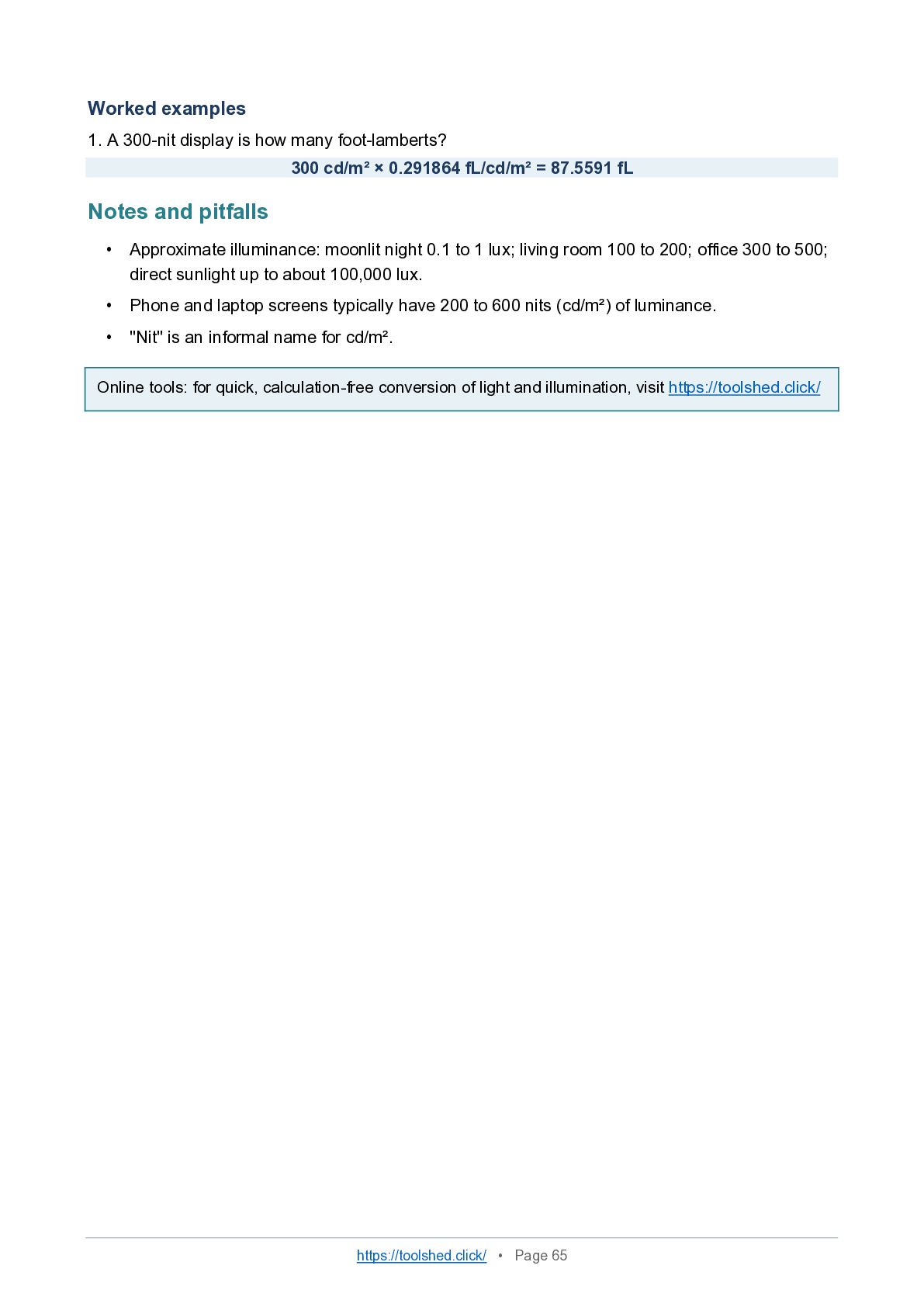
300 cd/m² × 0.291864 fL/cd/m² = 87.5591 fL Notes and pitfalls • Approximate illuminance: moonlit night 0.1 to 1 lux; living room 100 to 200; office 300 to 500; direct sunlight up to about 100,000 lux. • Phone and laptop screens typically have 200 to 600 nits (cd/m²) of luminance. • "Nit" is an informal name for cd/m². Online tools: for quick, calculation-free conversion of light and illumination, visit https://toolshed.click/ https://toolshed.click/ • Page 65
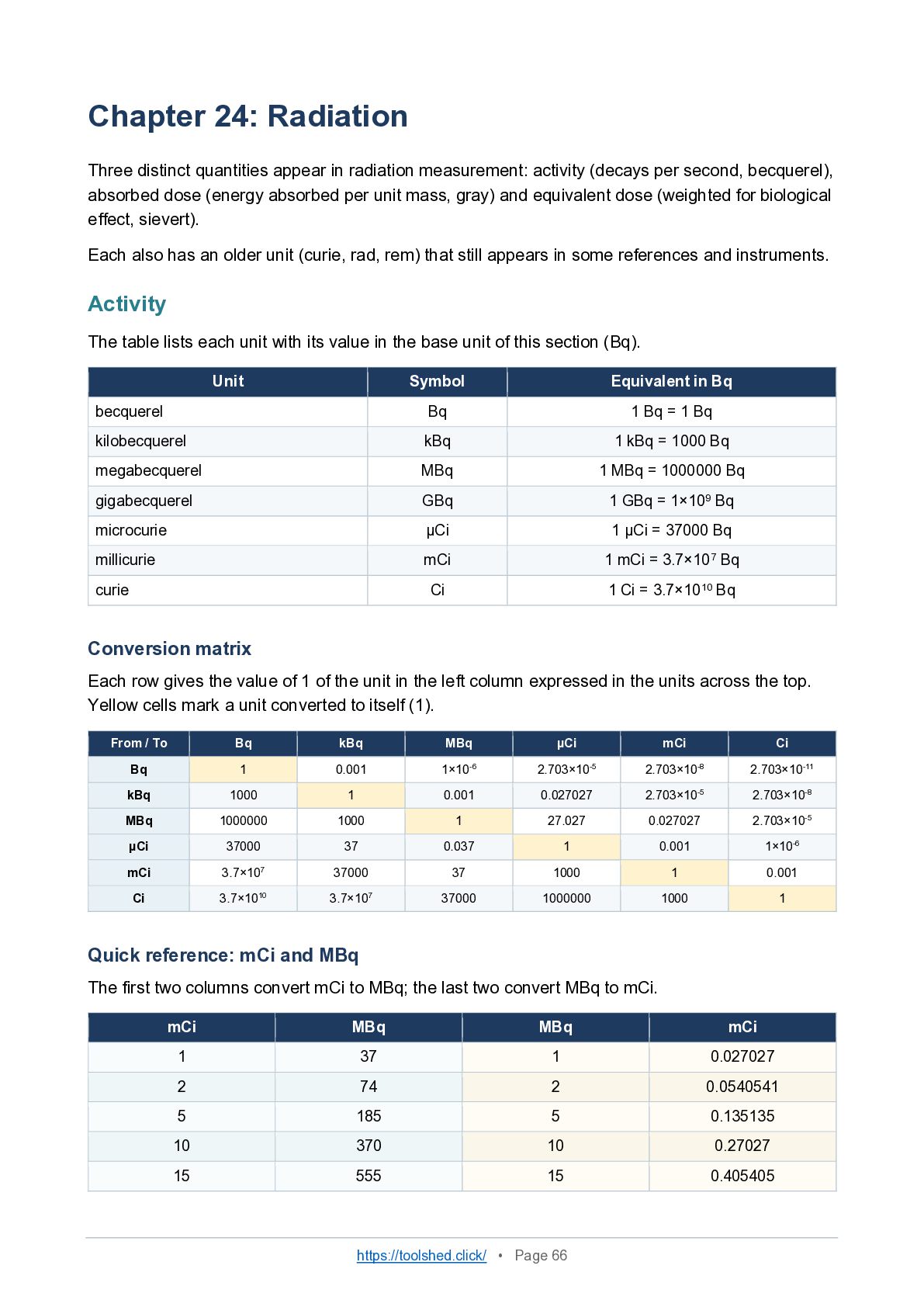
activity (decays per second, becquerel), absorbed dose (energy absorbed per unit mass, gray) and equivalent dose (weighted for biological effect, sievert). Each also has an older unit (curie, rad, rem) that still appears in some references and instruments. Activity The table lists each unit with its value in the base unit of this section (Bq). Unit Symbol Equivalent in Bq becquerel Bq 1 Bq = 1 Bq kilobecquerel kBq 1 kBq = 1000 Bq megabecquerel MBq 1 MBq = 1000000 Bq gigabecquerel GBq 1 GBq = 1×10⁹ Bq microcurie µCi 1 µCi = 37000 Bq millicurie mCi 1 mCi = 3.7×10⁷ Bq curie Ci 1 Ci = 3.7×10¹⁰ Bq Conversion matrix Each row gives the value of 1 of the unit in the left column expressed in the units across the top. Yellow cells mark a unit converted to itself (1). From / To Bq kBq MBq -6 µCi mCi -5 Ci -8 2.703×10⁻¹¹ Bq 1 0.001 1×10 2.703×10 2.703×10 kBq 1000 1 0.001 0.027027 2.703×10⁻⁵ 2.703×10⁻⁸ MBq 1000000 1000 1 27.027 0.027027 2.703×10⁻⁵ µCi 37000 37 0.037 1 0.001 1×10⁻⁶ mCi 3.7×10⁷ 37000 37 1000 1 0.001 10 7 37000 1000000 1000 1 Ci 3.7×10 3.7×10 Quick reference: mCi and MBq The first two columns convert mCi to MBq; the last two convert MBq to mCi. mCi MBq MBq mCi 1 37 1 0.027027 2 74 2 0.0540541 5 185 5 0.135135 10 370 10 0.27027 15 555 15 0.405405 https://toolshed.click/ • Page 66
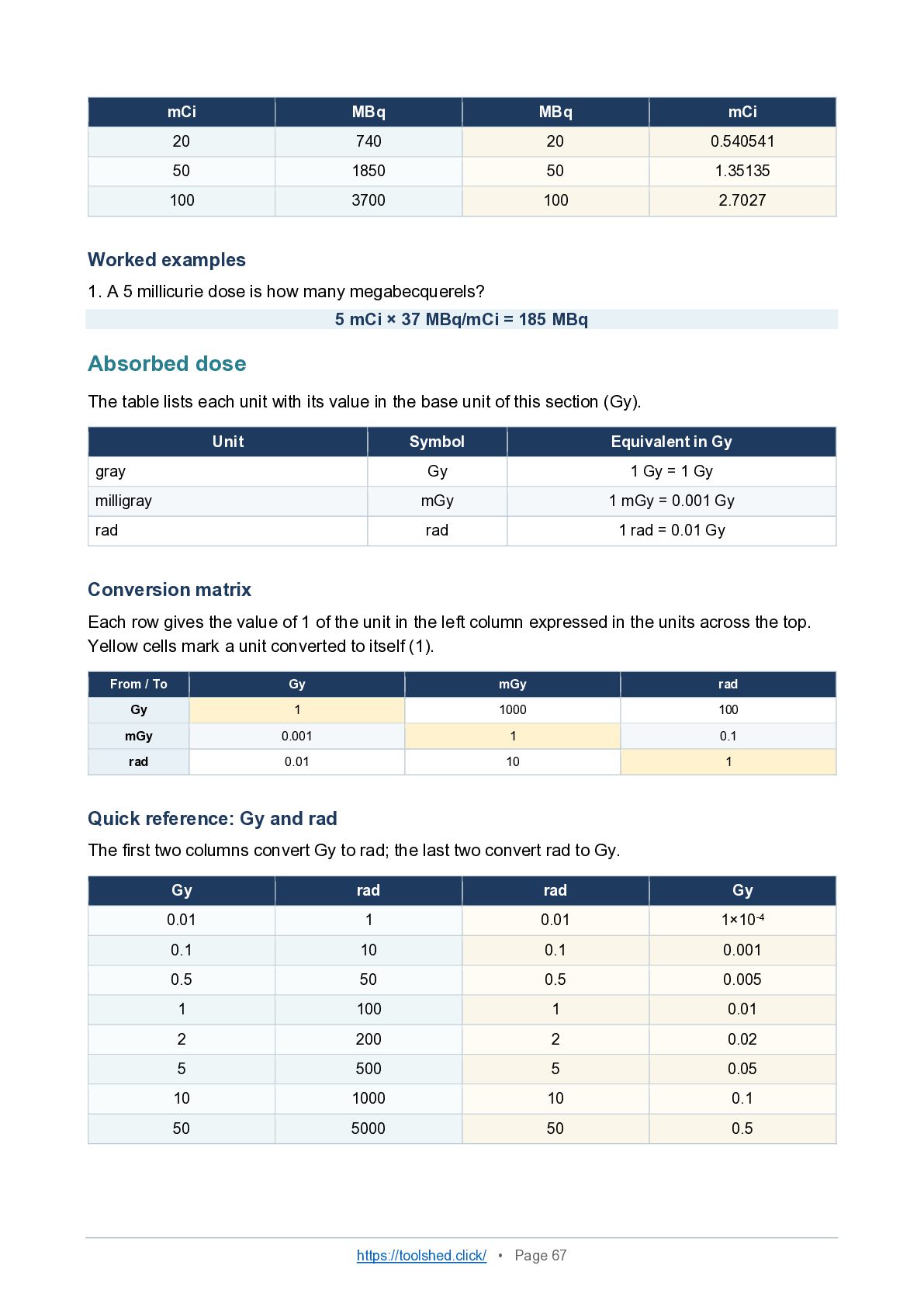
50 1.35135 100 3700 100 2.7027 Worked examples 1. A 5 millicurie dose is how many megabecquerels? 5 mCi × 37 MBq/mCi = 185 MBq Absorbed dose The table lists each unit with its value in the base unit of this section (Gy). Unit Symbol Equivalent in Gy gray Gy 1 Gy = 1 Gy milligray mGy 1 mGy = 0.001 Gy rad rad 1 rad = 0.01 Gy Conversion matrix Each row gives the value of 1 of the unit in the left column expressed in the units across the top. Yellow cells mark a unit converted to itself (1). From / To Gy mGy rad Gy 1 1000 100 mGy 0.001 1 0.1 rad 0.01 10 1 Quick reference: Gy and rad The first two columns convert Gy to rad; the last two convert rad to Gy. Gy rad rad Gy 0.01 1 0.01 1×10⁻⁴ 0.1 10 0.1 0.001 0.5 50 0.5 0.005 1 100 1 0.01 2 200 2 0.02 5 500 5 0.05 10 1000 10 0.1 50 5000 50 0.5 https://toolshed.click/ • Page 67
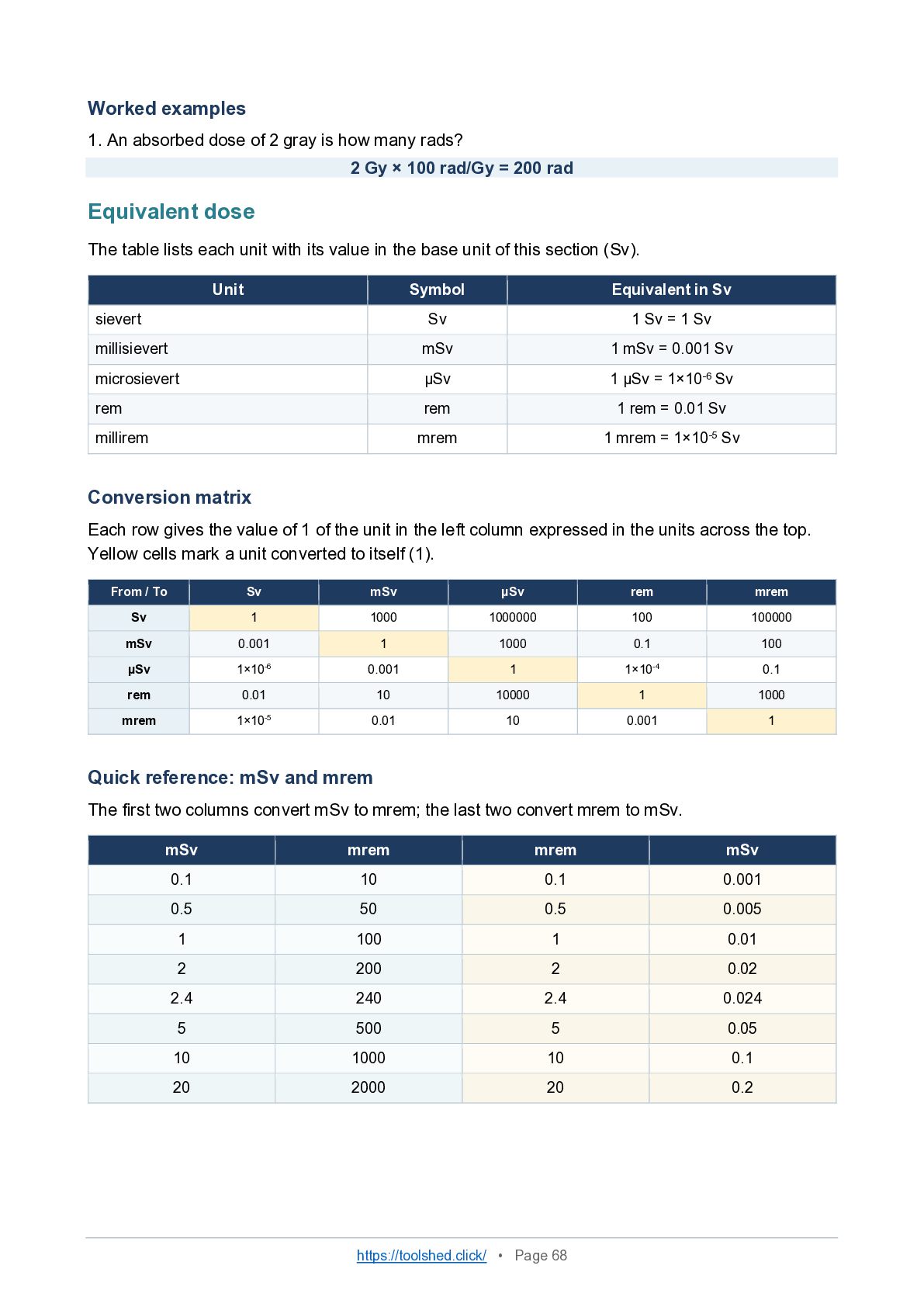
how many rads? 2 Gy × 100 rad/Gy = 200 rad Equivalent dose The table lists each unit with its value in the base unit of this section (Sv). Unit Symbol Equivalent in Sv sievert Sv 1 Sv = 1 Sv millisievert mSv 1 mSv = 0.001 Sv microsievert µSv 1 µSv = 1×10⁻⁶ Sv rem rem 1 rem = 0.01 Sv millirem mrem 1 mrem = 1×10⁻⁵ Sv Conversion matrix Each row gives the value of 1 of the unit in the left column expressed in the units across the top. Yellow cells mark a unit converted to itself (1). From / To Sv mSv µSv rem mrem Sv 1 1000 1000000 100 100000 mSv 0.001 1 1000 0.1 µSv -6 1×10 0.001 1 1×10 0.1 rem 0.01 10 10000 1 1000 mrem 1×10⁻⁵ 0.01 10 0.001 1 100 -4 Quick reference: mSv and mrem The first two columns convert mSv to mrem; the last two convert mrem to mSv. mSv mrem mrem mSv 0.1 10 0.1 0.001 0.5 50 0.5 0.005 1 100 1 0.01 2 200 2 0.02 2.4 240 2.4 0.024 5 500 5 0.05 10 1000 10 0.1 20 2000 20 0.2 https://toolshed.click/ • Page 68
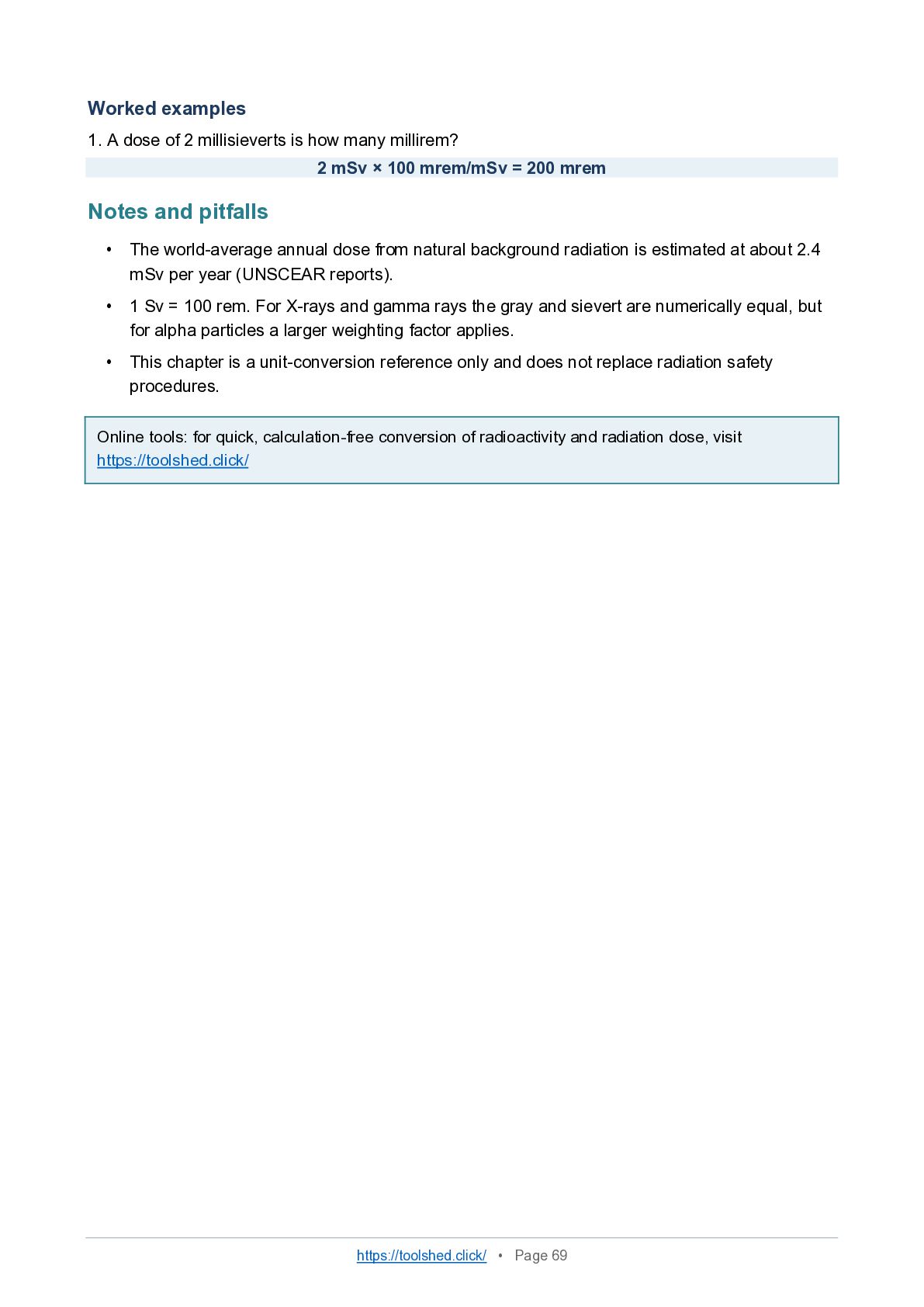
many millirem? 2 mSv × 100 mrem/mSv = 200 mrem Notes and pitfalls • The world-average annual dose from natural background radiation is estimated at about 2.4 mSv per year (UNSCEAR reports). • 1 Sv = 100 rem. For X-rays and gamma rays the gray and sievert are numerically equal, but for alpha particles a larger weighting factor applies. • This chapter is a unit-conversion reference only and does not replace radiation safety procedures. Online tools: for quick, calculation-free conversion of radioactivity and radiation dose, visit https://toolshed.click/ https://toolshed.click/ • Page 69
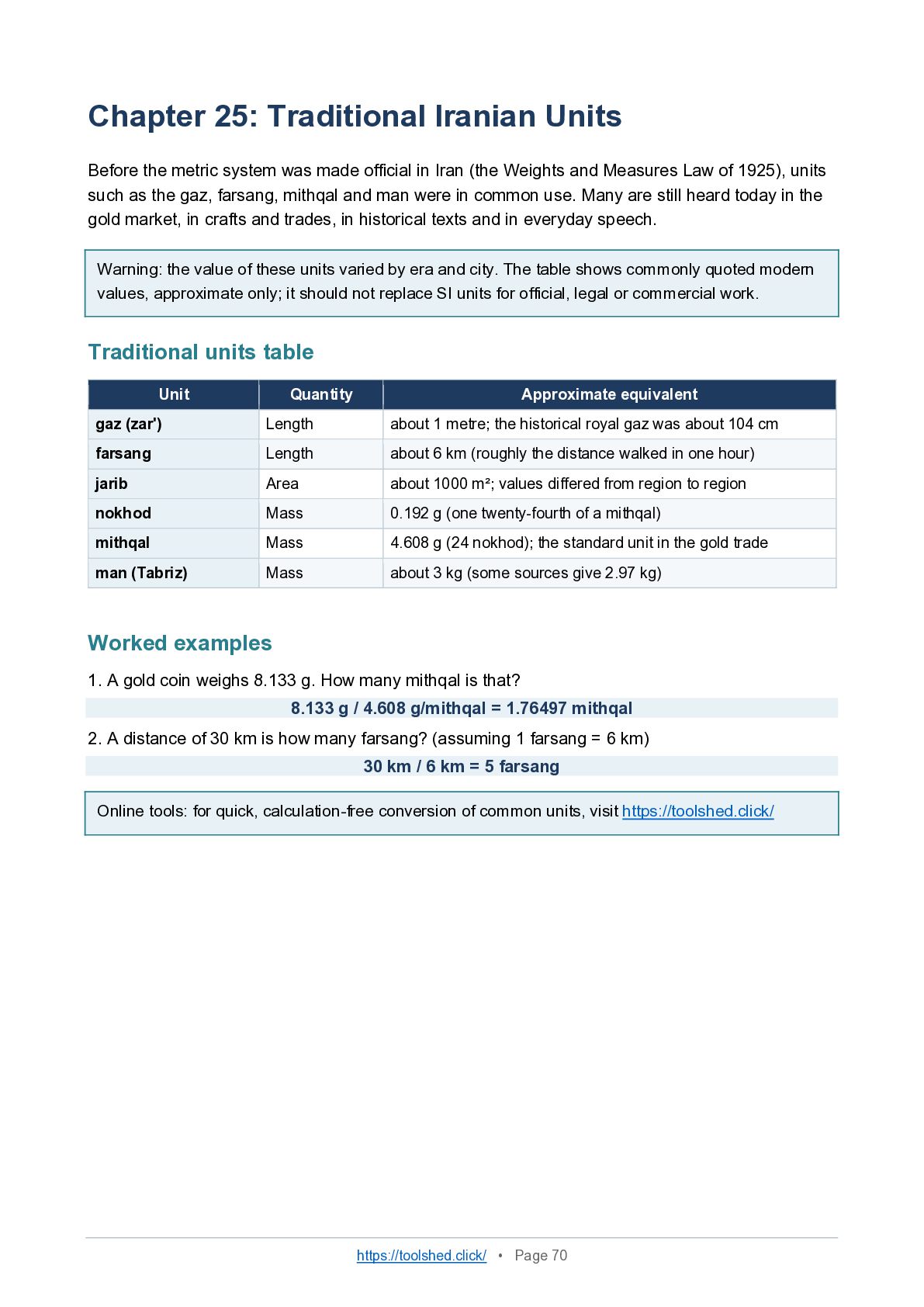
made official in Iran (the Weights and Measures Law of 1925), units such as the gaz, farsang, mithqal and man were in common use. Many are still heard today in the gold market, in crafts and trades, in historical texts and in everyday speech. Warning: the value of these units varied by era and city. The table shows commonly quoted modern values, approximate only; it should not replace SI units for official, legal or commercial work. Traditional units table Unit Quantity Approximate equivalent gaz (zar') Length about 1 metre; the historical royal gaz was about 104 cm farsang Length about 6 km (roughly the distance walked in one hour) jarib Area about 1000 m²; values differed from region to region nokhod Mass 0.192 g (one twenty-fourth of a mithqal) mithqal Mass 4.608 g (24 nokhod); the standard unit in the gold trade man (Tabriz) Mass about 3 kg (some sources give 2.97 kg) Worked examples 1. A gold coin weighs 8.133 g. How many mithqal is that? 8.133 g / 4.608 g/mithqal = 1.76497 mithqal 2. A distance of 30 km is how many farsang? (assuming 1 farsang = 6 km) 30 km / 6 km = 5 farsang Online tools: for quick, calculation-free conversion of common units, visit https://toolshed.click/ https://toolshed.click/ • Page 70
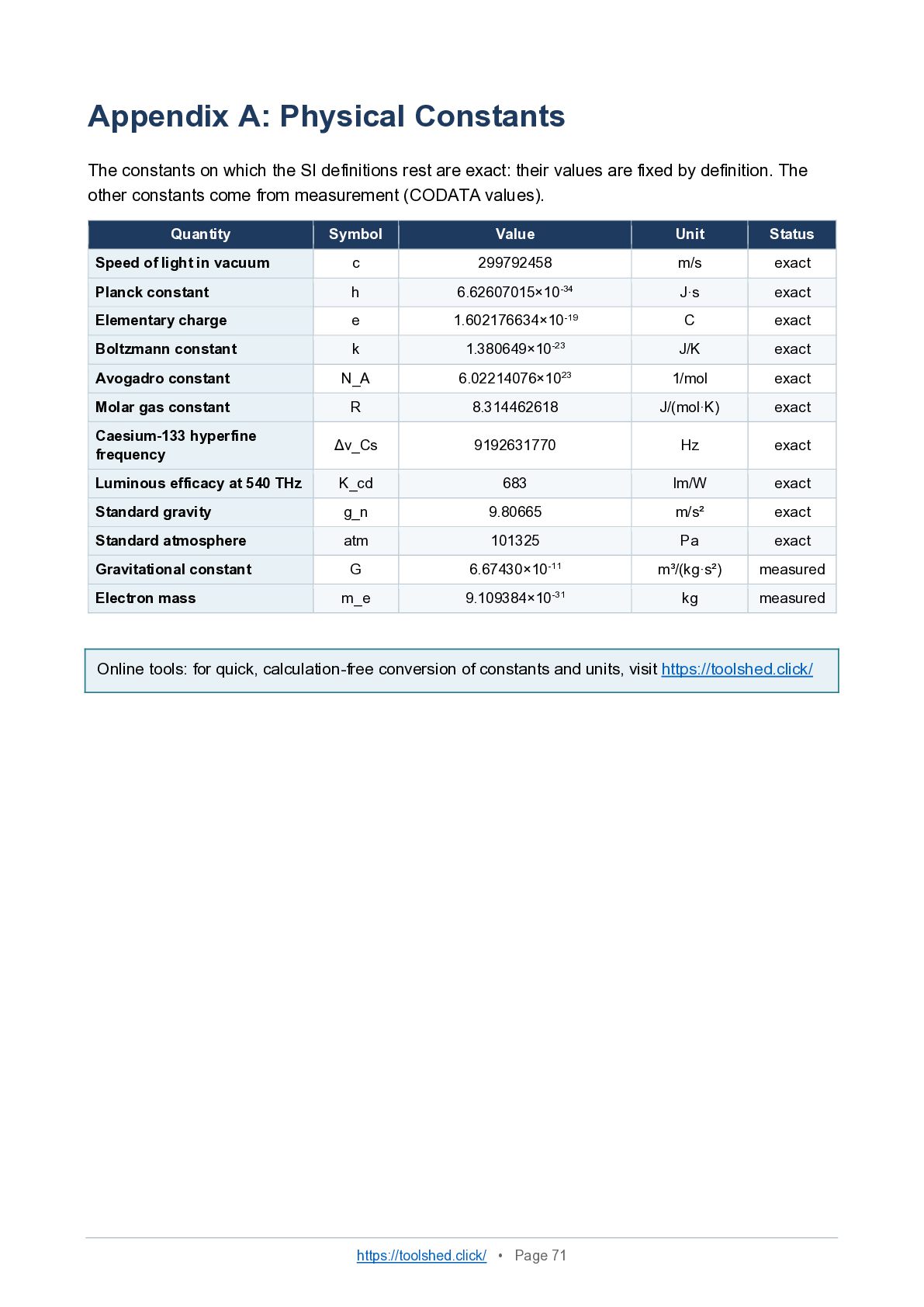
definitions rest are exact: their values are fixed by definition. The other constants come from measurement (CODATA values). Quantity Speed of light in vacuum Symbol Value c 299792458 Unit Status m/s exact -34 J·s exact Planck constant h 6.62607015×10 Elementary charge e 1.602176634×10⁻¹⁹ C exact Boltzmann constant k 1.380649×10⁻²³ J/K exact 1/mol exact 23 Avogadro constant N_A 6.02214076×10 Molar gas constant R 8.314462618 J/(mol·K) exact Caesium-133 hyperfine frequency Δν_Cs 9192631770 Hz exact Luminous efficacy at 540 THz K_cd 683 lm/W exact Standard gravity g_n 9.80665 m/s² exact Standard atmosphere atm 101325 Pa exact Gravitational constant G 6.67430×10⁻¹¹ m³/(kg·s²) measured Electron mass m_e 9.109384×10⁻³¹ kg measured Online tools: for quick, calculation-free conversion of constants and units, visit https://toolshed.click/ https://toolshed.click/ • Page 71
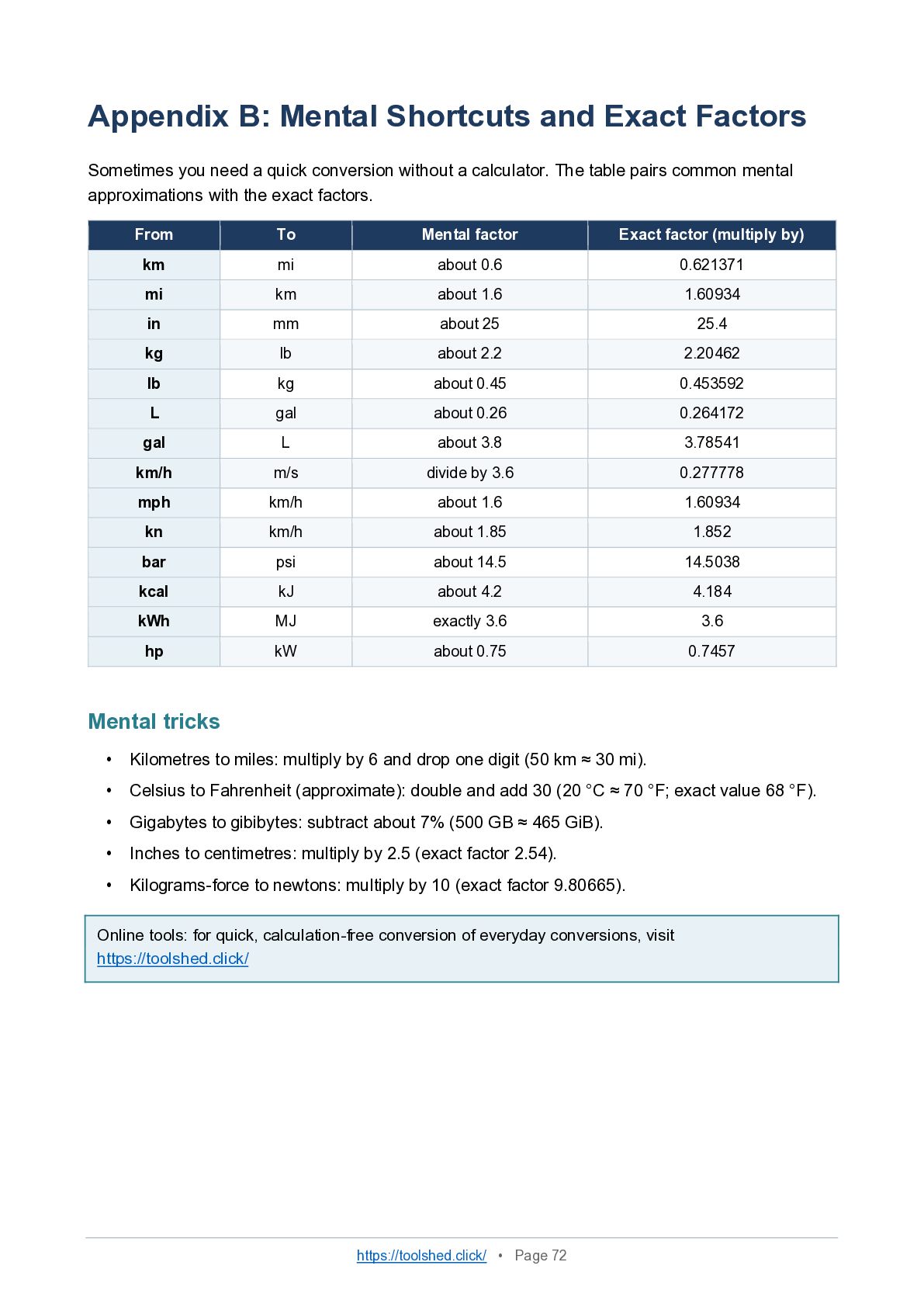
a quick conversion without a calculator. The table pairs common mental approximations with the exact factors. From To Mental factor Exact factor (multiply by) km mi about 0.6 0.621371 mi km about 1.6 1.60934 in mm about 25 25.4 kg lb about 2.2 2.20462 lb kg about 0.45 0.453592 L gal about 0.26 0.264172 gal L about 3.8 3.78541 km/h m/s divide by 3.6 0.277778 mph km/h about 1.6 1.60934 kn km/h about 1.85 1.852 bar psi about 14.5 14.5038 kcal kJ about 4.2 4.184 kWh MJ exactly 3.6 3.6 hp kW about 0.75 0.7457 Mental tricks • Kilometres to miles: multiply by 6 and drop one digit (50 km ≈ 30 mi). • Celsius to Fahrenheit (approximate): double and add 30 (20 °C ≈ 70 °F; exact value 68 °F). • Gigabytes to gibibytes: subtract about 7% (500 GB ≈ 465 GiB). • Inches to centimetres: multiply by 2.5 (exact factor 2.54). • Kilograms-force to newtons: multiply by 10 (exact factor 9.80665). Online tools: for quick, calculation-free conversion of everyday conversions, visit https://toolshed.click/ https://toolshed.click/ • Page 72
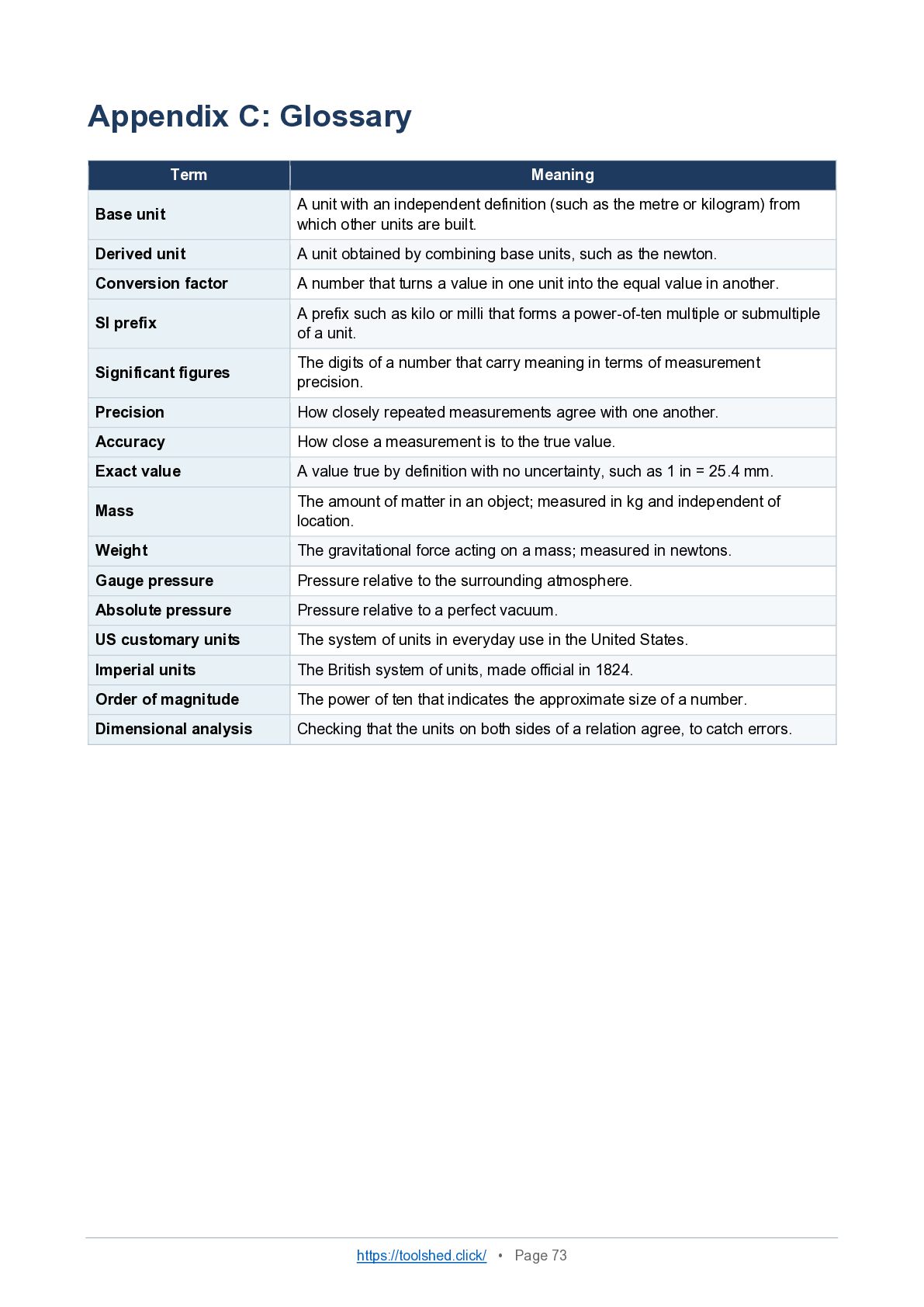
an independent definition (such as the metre or kilogram) from which other units are built. Derived unit A unit obtained by combining base units, such as the newton. Conversion factor A number that turns a value in one unit into the equal value in another. SI prefix A prefix such as kilo or milli that forms a power-of-ten multiple or submultiple of a unit. Significant figures The digits of a number that carry meaning in terms of measurement precision. Precision How closely repeated measurements agree with one another. Accuracy How close a measurement is to the true value. Exact value A value true by definition with no uncertainty, such as 1 in = 25.4 mm. Mass The amount of matter in an object; measured in kg and independent of location. Weight The gravitational force acting on a mass; measured in newtons. Gauge pressure Pressure relative to the surrounding atmosphere. Absolute pressure Pressure relative to a perfect vacuum. US customary units The system of units in everyday use in the United States. Imperial units The British system of units, made official in 1824. Order of magnitude The power of ten that indicates the approximate size of a number. Dimensional analysis Checking that the units on both sides of a relation agree, to catch errors. https://toolshed.click/ • Page 73
follow these official sources: [1] BIPM. The International System of Units (SI Brochure), 9th edition, 2019. [2] NIST Special Publication 330. The International System of Units (SI), 2019 edition. [3] NIST Special Publication 811. Guide for the Use of the International System of Units (SI), 2008 edition. [4] ISO 80000 series. Quantities and units. [5] IEC 80000-13. Quantities and units, Part 13: Information science and technology. [6] Tiesinga E., Mohr P. J., Newell D. B., Taylor B. N. CODATA recommended values of the fundamental physical constants: 2018. Reviews of Modern Physics 93, 025010 (2021). [7] International yard and pound agreement of 1959. [8] UNSCEAR. Sources and Effects of Ionizing Radiation, UNSCEAR 2008 Report. The online version, conversion tools and updates for this reference: https://toolshed.click/ https://toolshed.click/ • Page 74


 salt2
 kiyoshi
 xleitix
 okana2ki
 voginip
 trycycle
 taka88
 shumpei777
 signer
 x_ttyszk
 neutron63zf
 inesmontani
 helenjbeal
 mraible
 skoyamalab
 speakerdeck
 caitiem20
 greggifford
 smashingmag
 reverentgeek
 baasie
 chriscoyier
 lauravandoore