Upgrade to Pro — share decks privately, control downloads, hide ads and more …

Per Python ad Astra

Sponsored · Ship Features Fearlessly Turn features on and off without deploys. Used by thousands of Ruby developers. →

Per Python ad Astra

Slides of the talk "Per Python ad Astra" given at EuroPython Bilbao on July 20th, 2016.

Transcript

20 slides
  1. Who is this guy • Almost aerospace engineer • Python

    developer in finance at Indizen for BBVA • Mostly self-taught programmer (some Fortran 90 at the University) • Passionate about open culture – source, hardware, science • Chair of Python Spain non-profit and organizer of Python Madrid monthly meeting
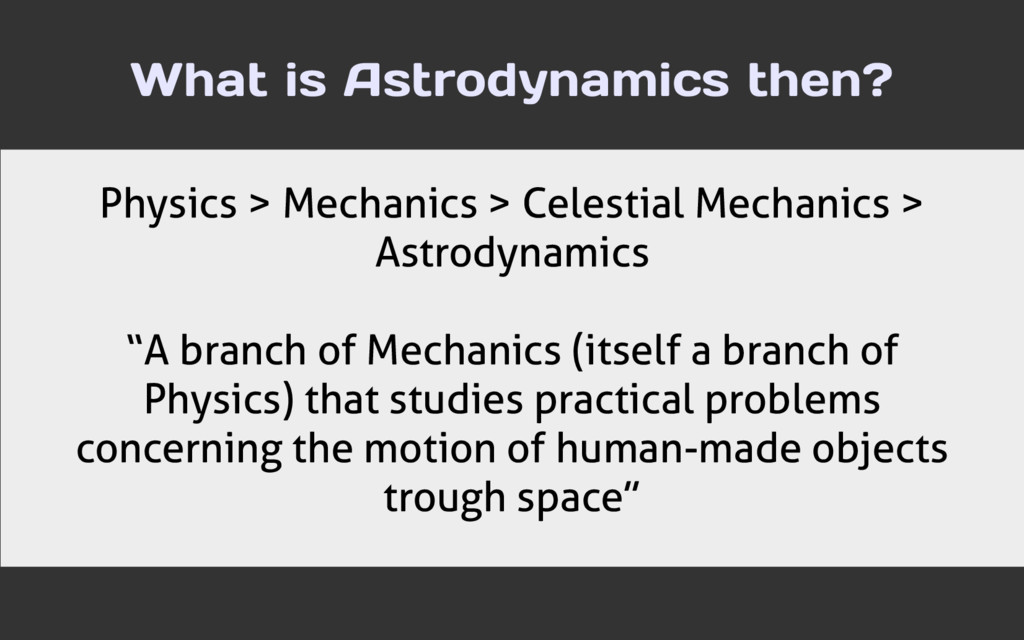
  2. What is Astrodynamics then? Physics > Mechanics > Celestial Mechanics

    > Astrodynamics “A branch of Mechanics (itself a branch of Physics) that studies practical problems concerning the motion of human-made objects trough space”
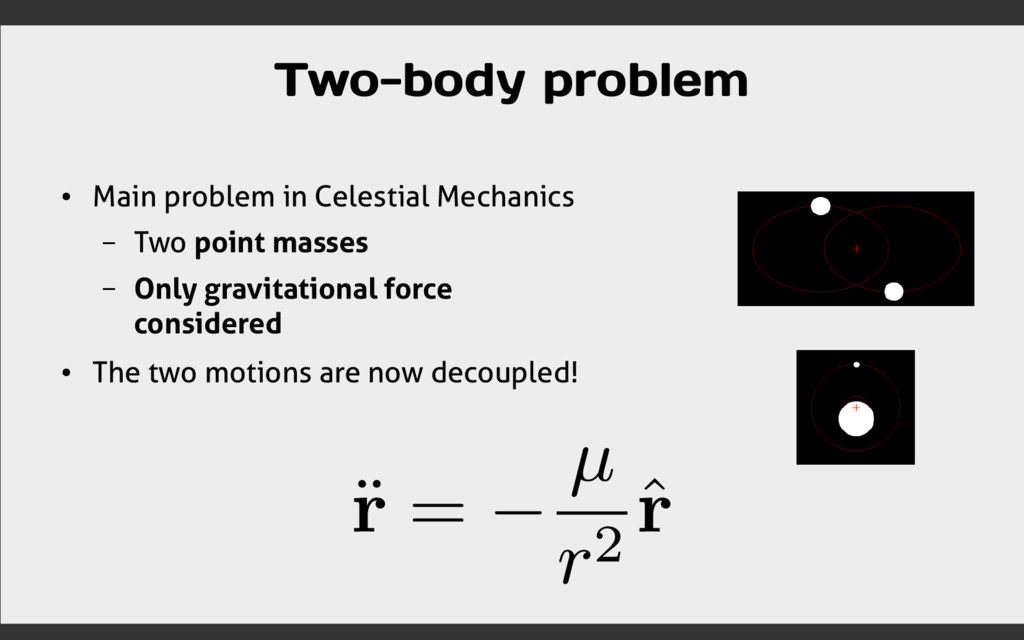
  3. Two-body problem • Main problem in Celestial Mechanics – Two

    point masses – Only gravitational force considered • The two motions are now decoupled!
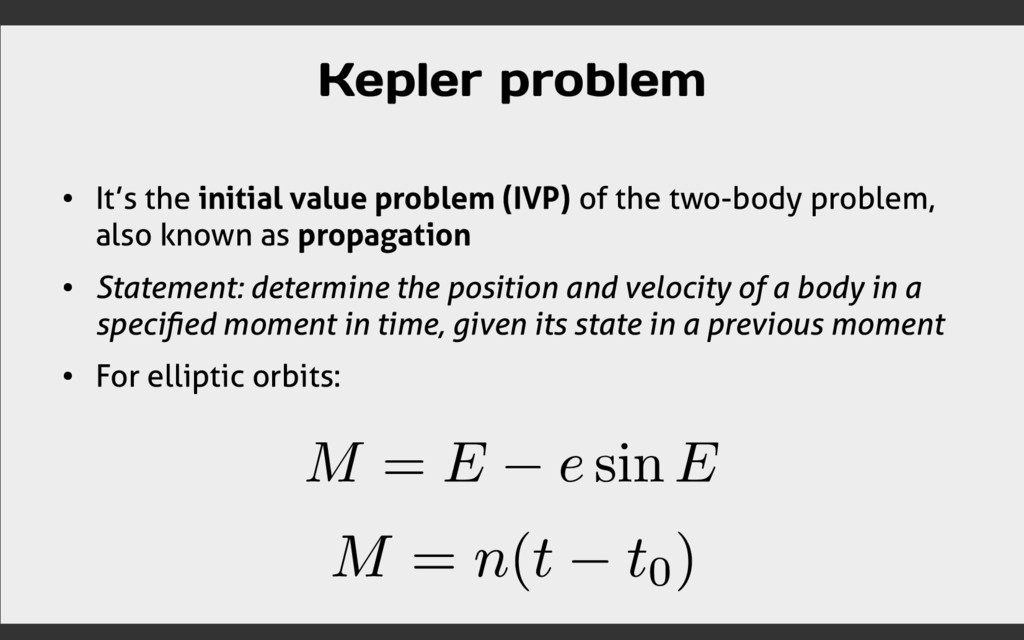
  4. Kepler problem • It’s the initial value problem (IVP) of

    the two-body problem, also known as propagation • Statement: determine the position and velocity of a body in a specified moment in time, given its state in a previous moment • For elliptic orbits:
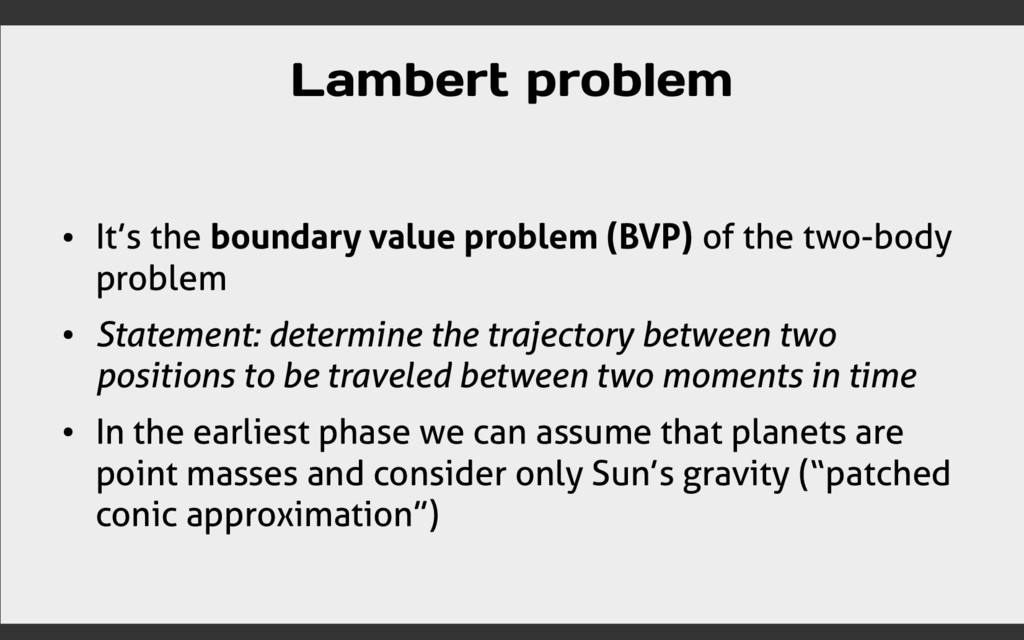
  5. Lambert problem • It’s the boundary value problem (BVP) of

    the two-body problem • Statement: determine the trajectory between two positions to be traveled between two moments in time • In the earliest phase we can assume that planets are point masses and consider only Sun’s gravity (“patched conic approximation”)
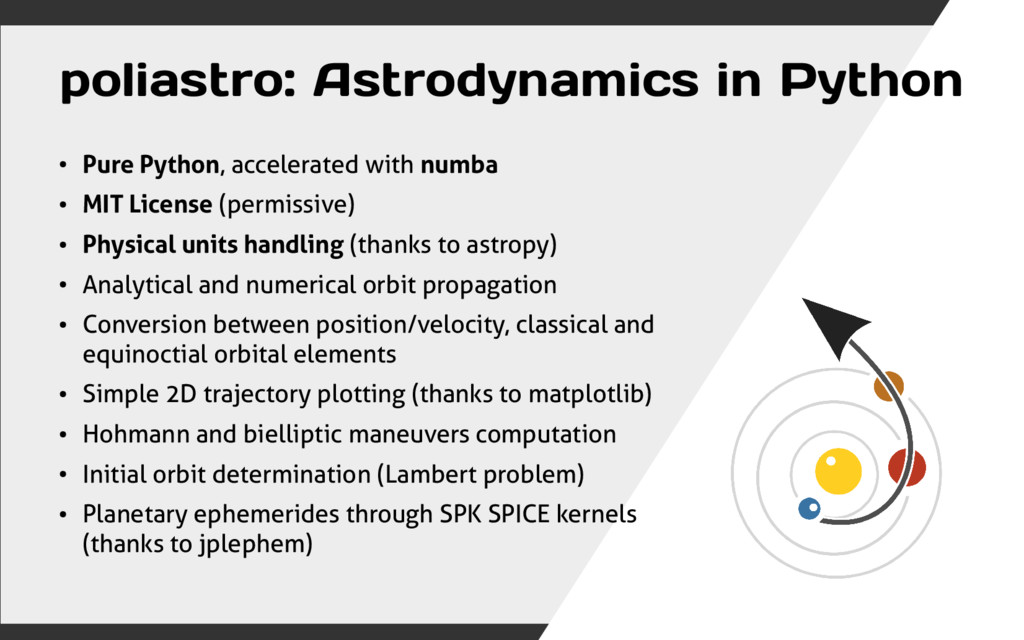
  6. poliastro: Astrodynamics in Python • Pure Python, accelerated with numba

    • MIT License (permissive) • Physical units handling (thanks to astropy) • Analytical and numerical orbit propagation • Conversion between position/velocity, classical and equinoctial orbital elements • Simple 2D trajectory plotting (thanks to matplotlib) • Hohmann and bielliptic maneuvers computation • Initial orbit determination (Lambert problem) • Planetary ephemerides through SPK SPICE kernels (thanks to jplephem)
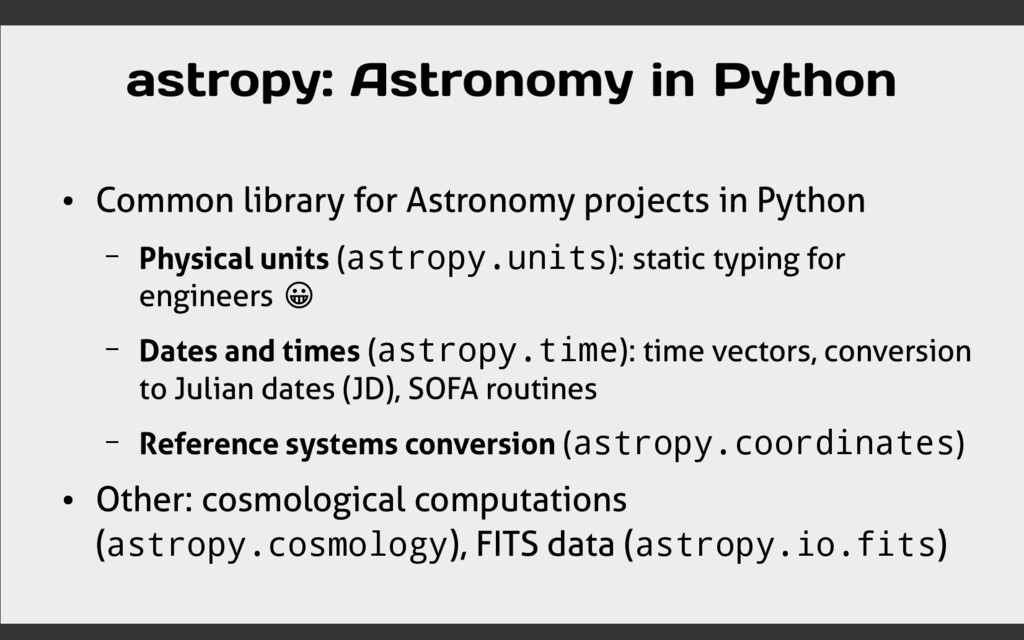
  7. astropy: Astronomy in Python • Common library for Astronomy projects

    in Python – Physical units (astropy.units): static typing for engineers – Dates and times (astropy.time): time vectors, conversion to Julian dates (JD), SOFA routines – Reference systems conversion (astropy.coordinates) • Other: cosmological computations (astropy.cosmology), FITS data (astropy.io.fits)
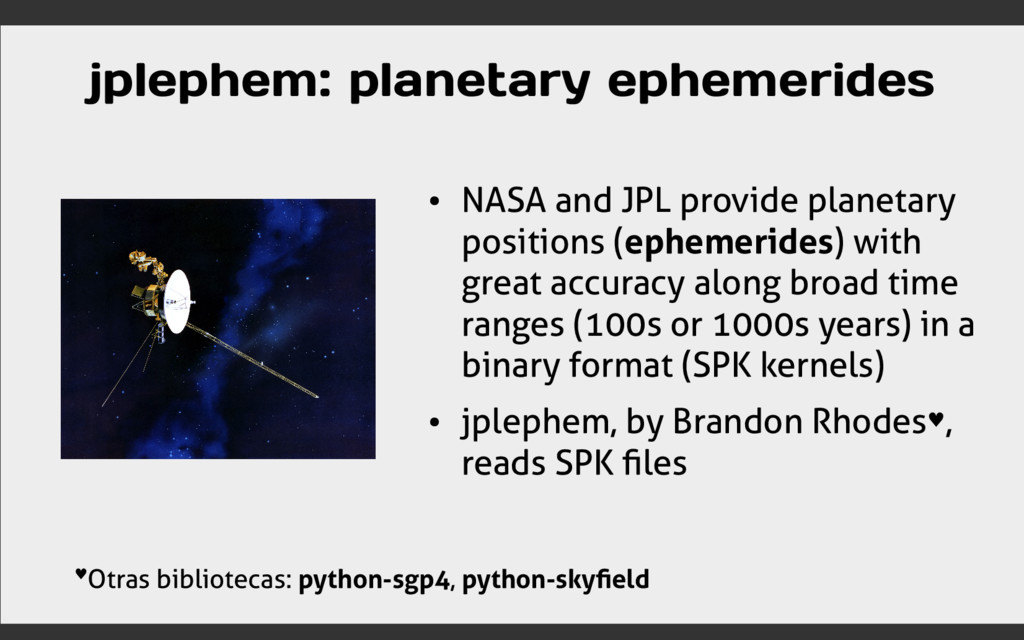
  8. jplephem: planetary ephemerides • NASA and JPL provide planetary positions

    (ephemerides) with great accuracy along broad time ranges (100s or 1000s years) in a binary format (SPK kernels) • jplephem, by Brandon Rhodes♥, reads SPK files ♥Otras bibliotecas: python-sgp4, python-skyfield
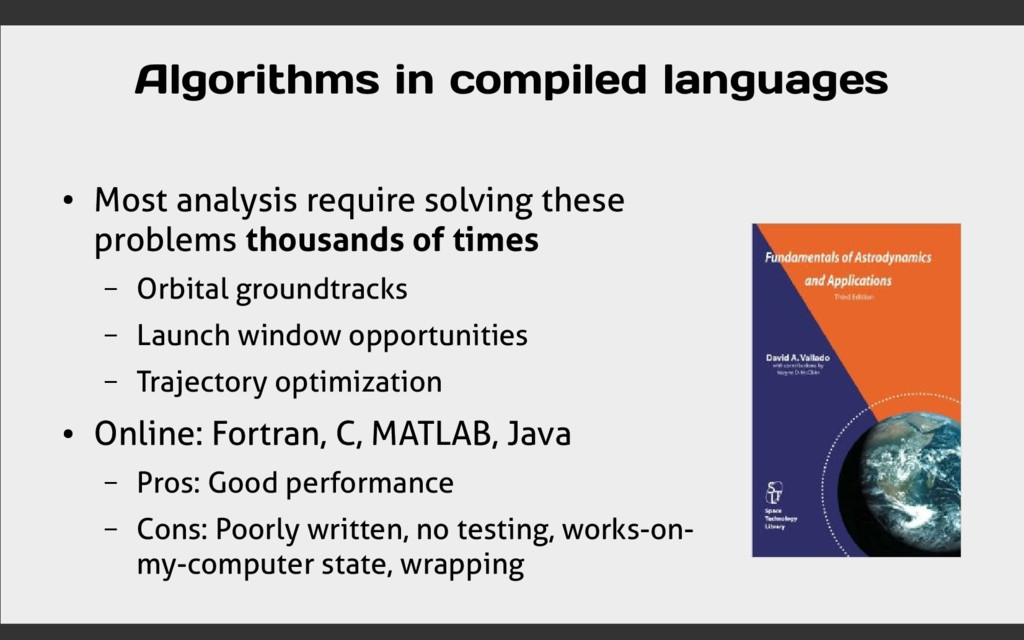
  9. Algorithms in compiled languages • Most analysis require solving these

    problems thousands of times – Orbital groundtracks – Launch window opportunities – Trajectory optimization • Online: Fortran, C, MATLAB, Java – Pros: Good performance – Cons: Poorly written, no testing, works-on- my-computer state, wrapping
  10. numba: JIT for numerical Python • numba is a BSD

    licensed, just-in-time compiler for numerical Python code • Optimized to work with NumPy arrays • Support for a (expanding) subset of the language (highly dynamical features tend to hurt performance) • Compiles to LLVM, hence leveraging its power to this powerful toolset • Support for GPUs too!
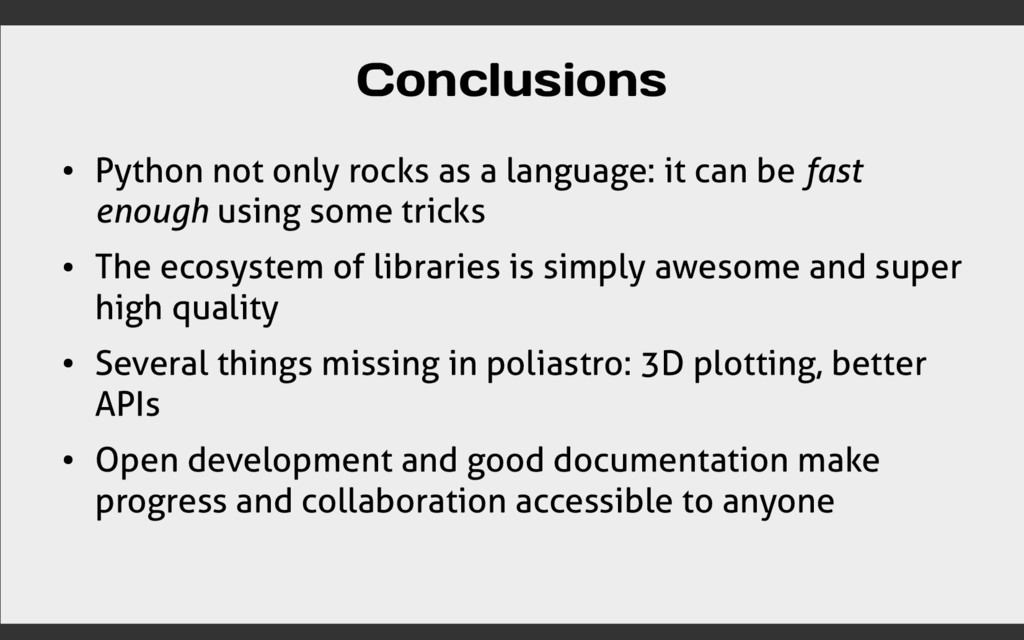
  11. Conclusions • Python not only rocks as a language: it

    can be fast enough using some tricks • The ecosystem of libraries is simply awesome and super high quality • Several things missing in poliastro: 3D plotting, better APIs • Open development and good documentation make progress and collaboration accessible to anyone

More Decks by Juan Luis Cano Rodríguez

Other Decks in Technology