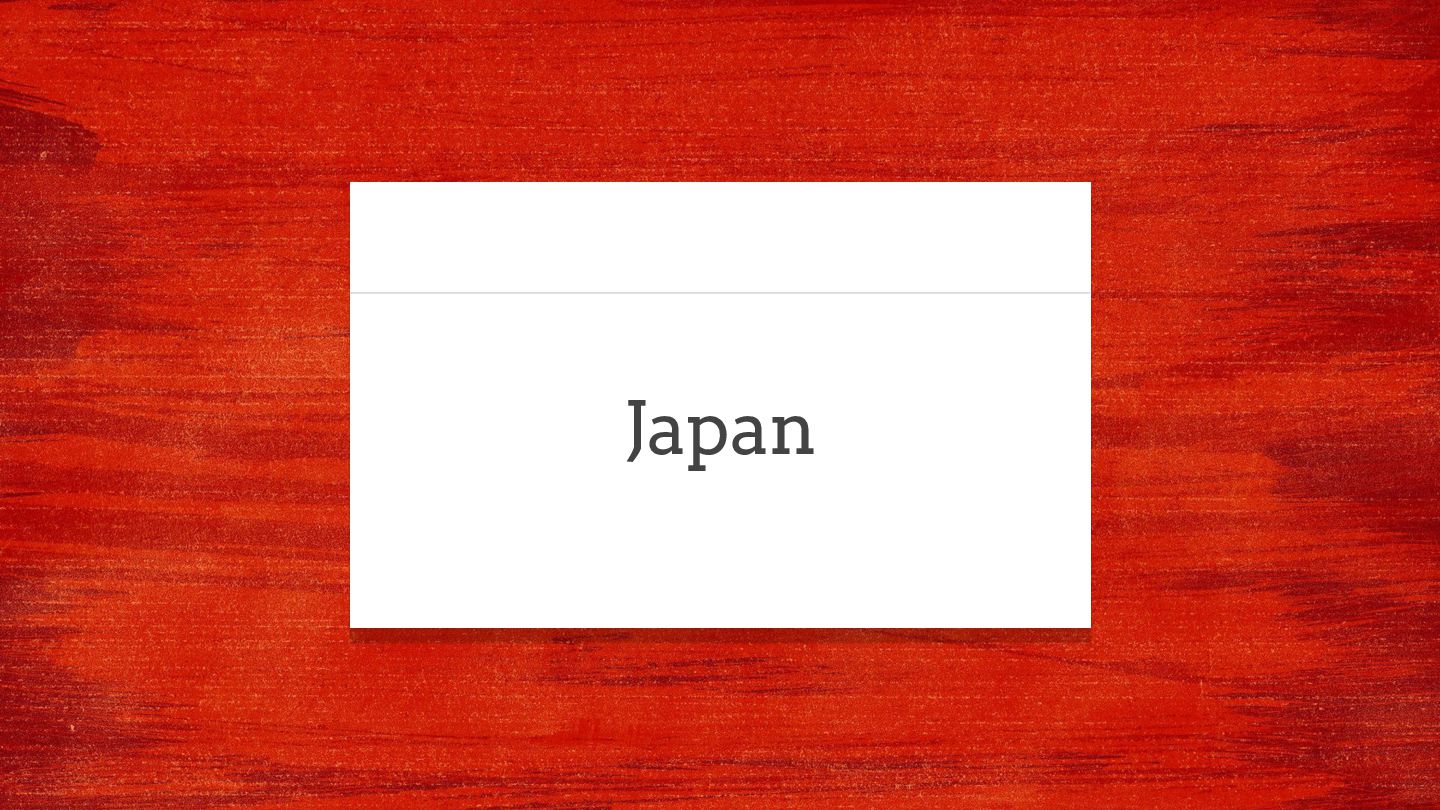
with the main and largest four being Honshu, Hokkaido, Kyushu and Shikoku. Honshu is the largest island in both size and population, containing many of the country’s main cities including its capital, Tokyo. Hokkaido is the second largest island, located at the northernmost point of Japan. Kyushu and Shikoku are the two smallest islands, each sitting south of Honshu. 2
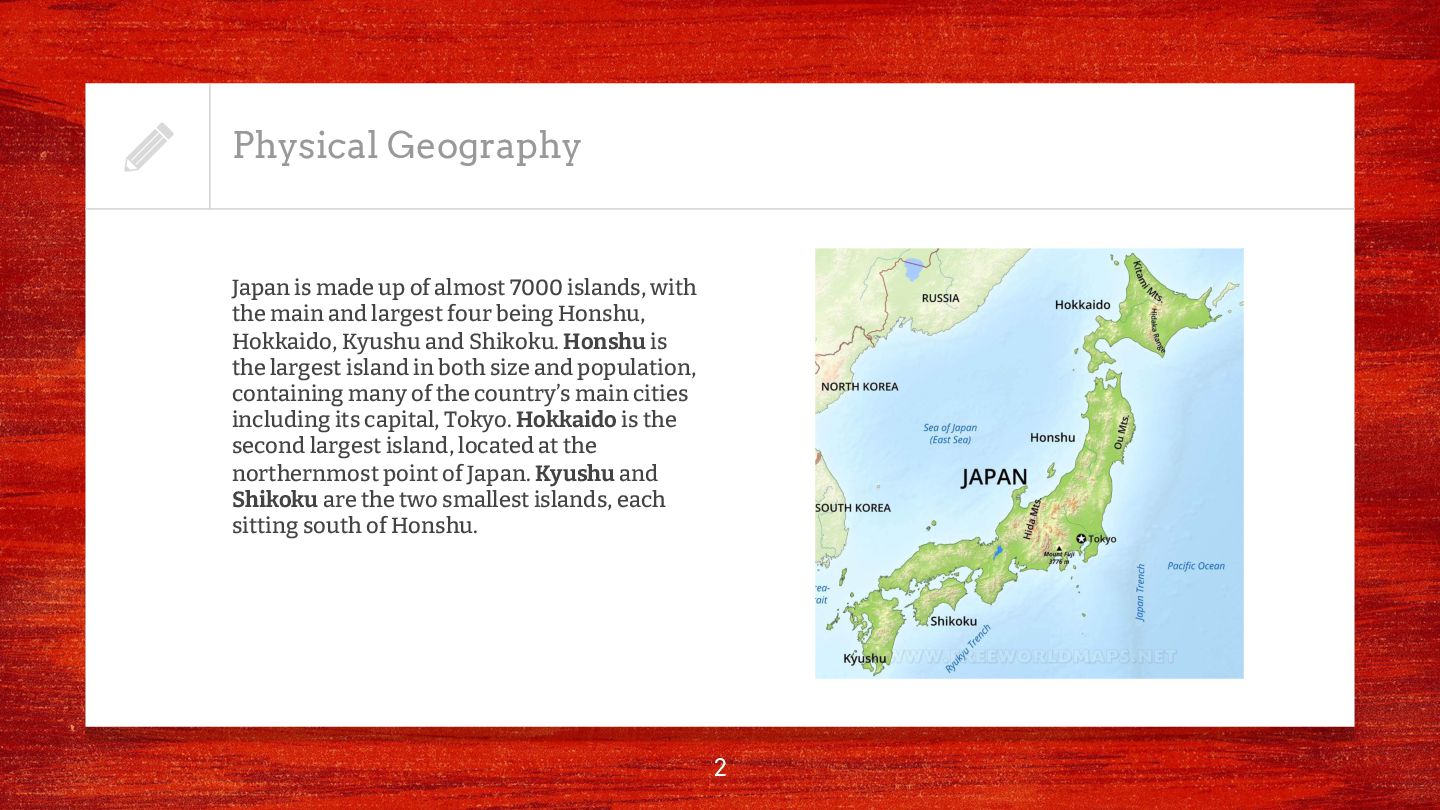
with the most recognizable mountain being Mt. Fuji, which has been a symbol of Japan for centuries. Fuji holds its status as the tallest mountain in the country, while also being an active volcano. Mt. Fuji, as well as various other mountains of Japan are part of the Ring of Fire, which is a chain of volcanoes located around the Pacific Ocean. Not only are volcanoes common in this area, but there are many earthquakes and tsunamis as well, all of which are a result of the excessive amounts of tectonic activity in the Pacific. 3
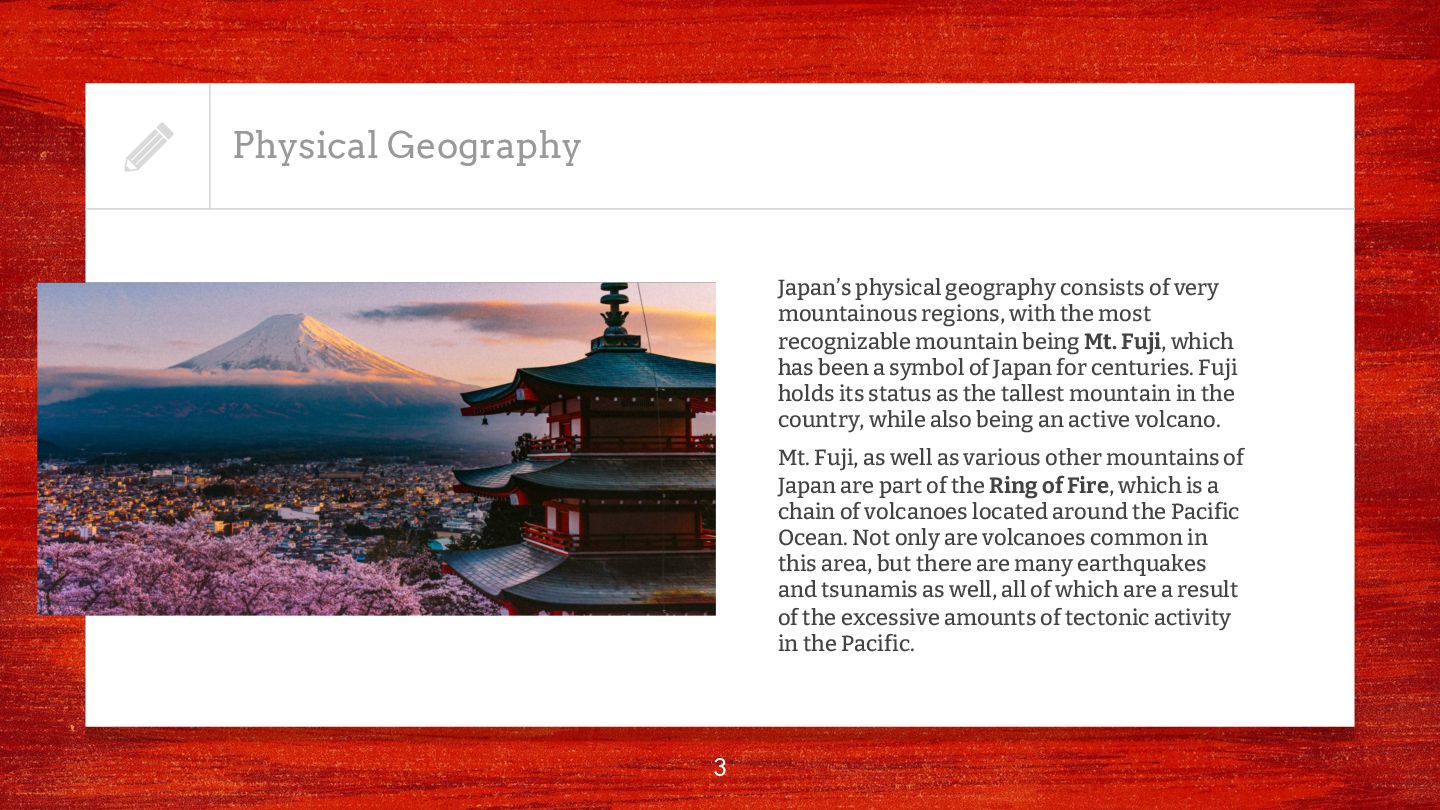
(Fuji Five Lakes), which consists of Lake Yamanaka, Lake Kawaguchi, Lake Sai, Lake Shoji and Lake Motosu. The lakes were each formed as a result of the Mt. Fuji’s lava flows. Fuji Goko is currently a popular tourist location, with various attractions including golf courses, hot springs, and amusement parks just to name a few. The area is highly developed, with advanced agriculture dependent on the area’s many streams. Not only that, but many ancient shrines and temples can be found all around the mountain. 4
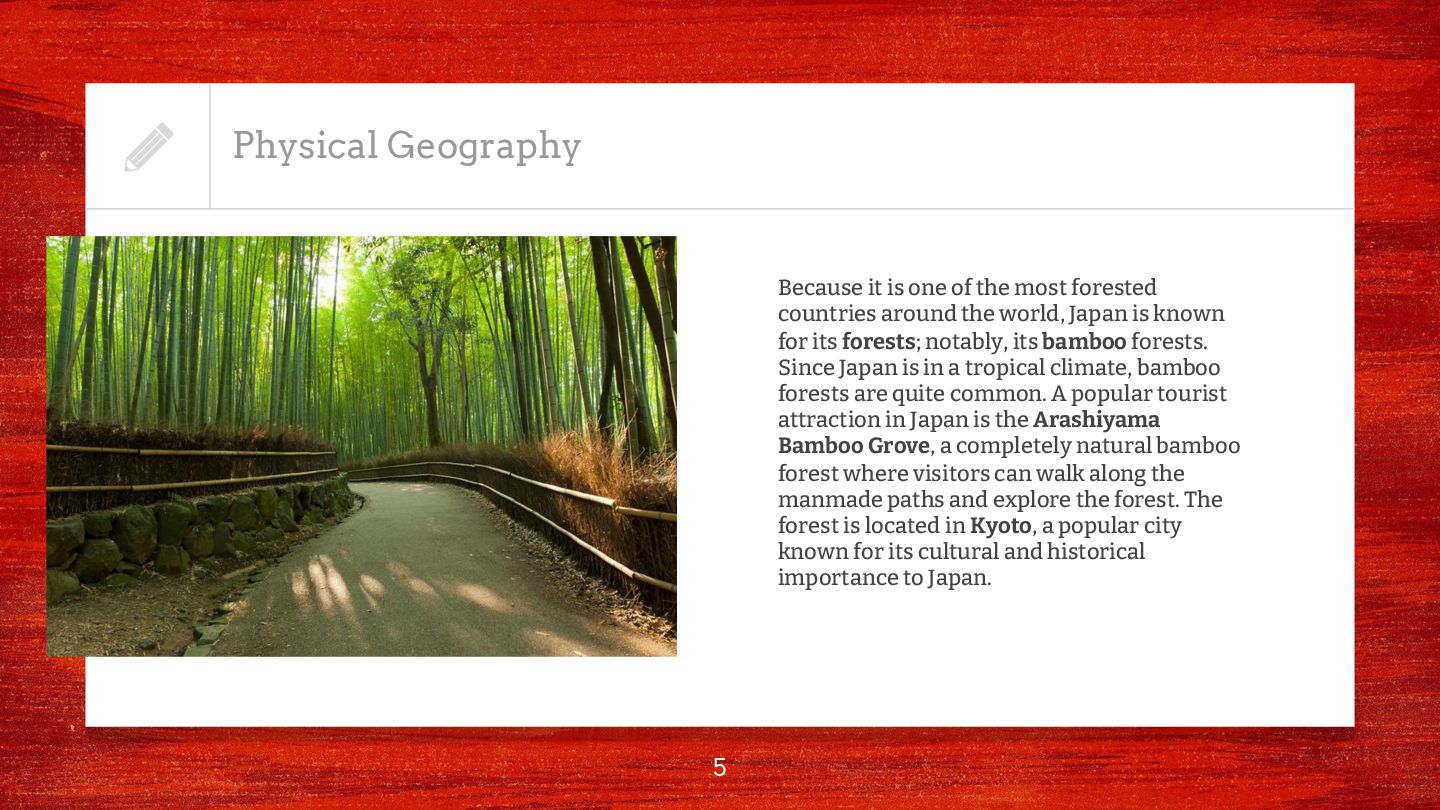
countries around the world, Japan is known for its forests; notably, its bamboo forests. Since Japan is in a tropical climate, bamboo forests are quite common. A popular tourist attraction in Japan is the Arashiyama Bamboo Grove, a completely natural bamboo forest where visitors can walk along the manmade paths and explore the forest. The forest is located in Kyoto, a popular city known for its cultural and historical importance to Japan. 5
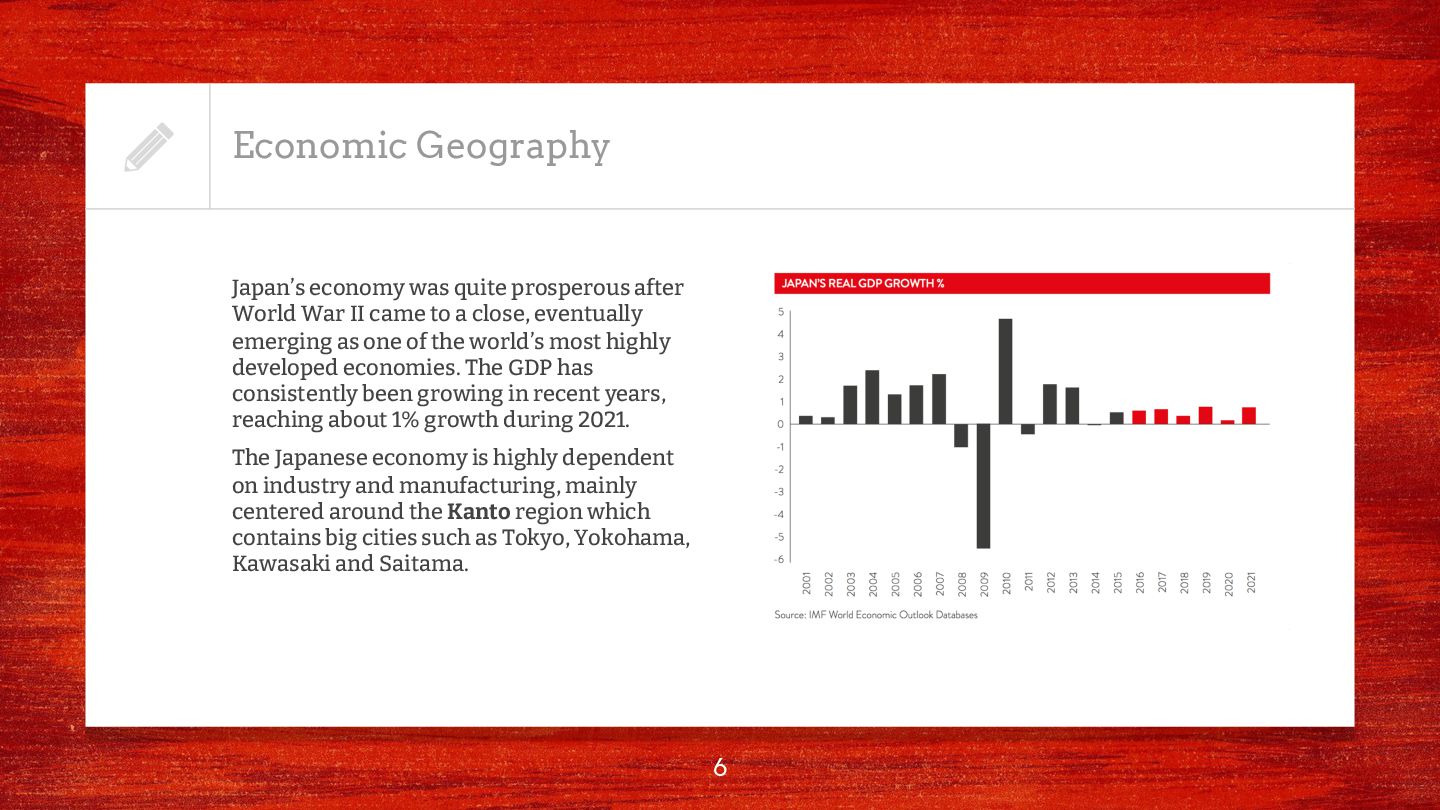
II came to a close, eventually emerging as one of the world’s most highly developed economies. The GDP has consistently been growing in recent years, reaching about 1% growth during 2021. The Japanese economy is highly dependent on industry and manufacturing, mainly centered around the Kanto region which contains big cities such as Tokyo, Yokohama, Kawasaki and Saitama. 6
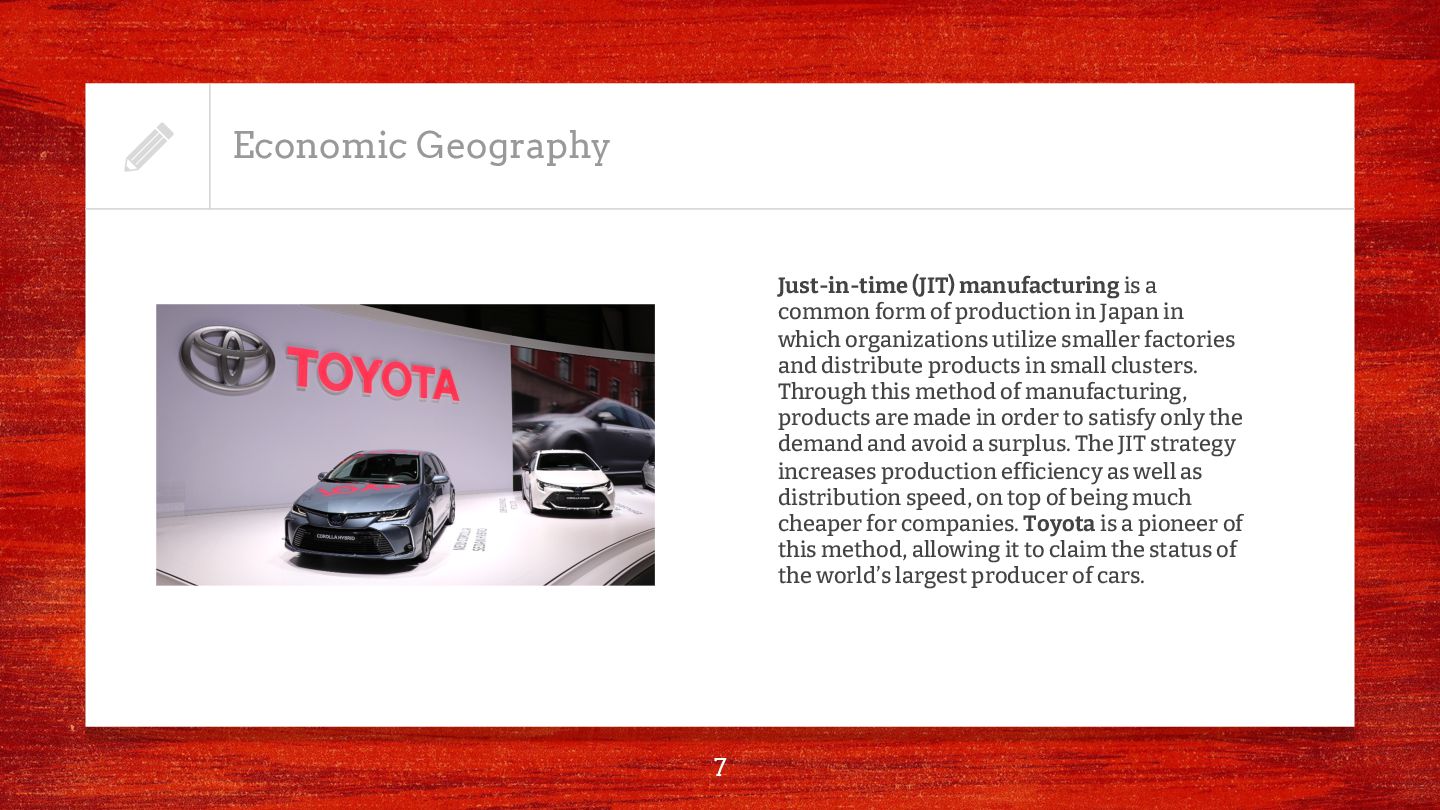
production in Japan in which organizations utilize smaller factories and distribute products in small clusters. Through this method of manufacturing, products are made in order to satisfy only the demand and avoid a surplus. The JIT strategy increases production efficiency as well as distribution speed, on top of being much cheaper for companies. Toyota is a pioneer of this method, allowing it to claim the status of the world’s largest producer of cars. 7
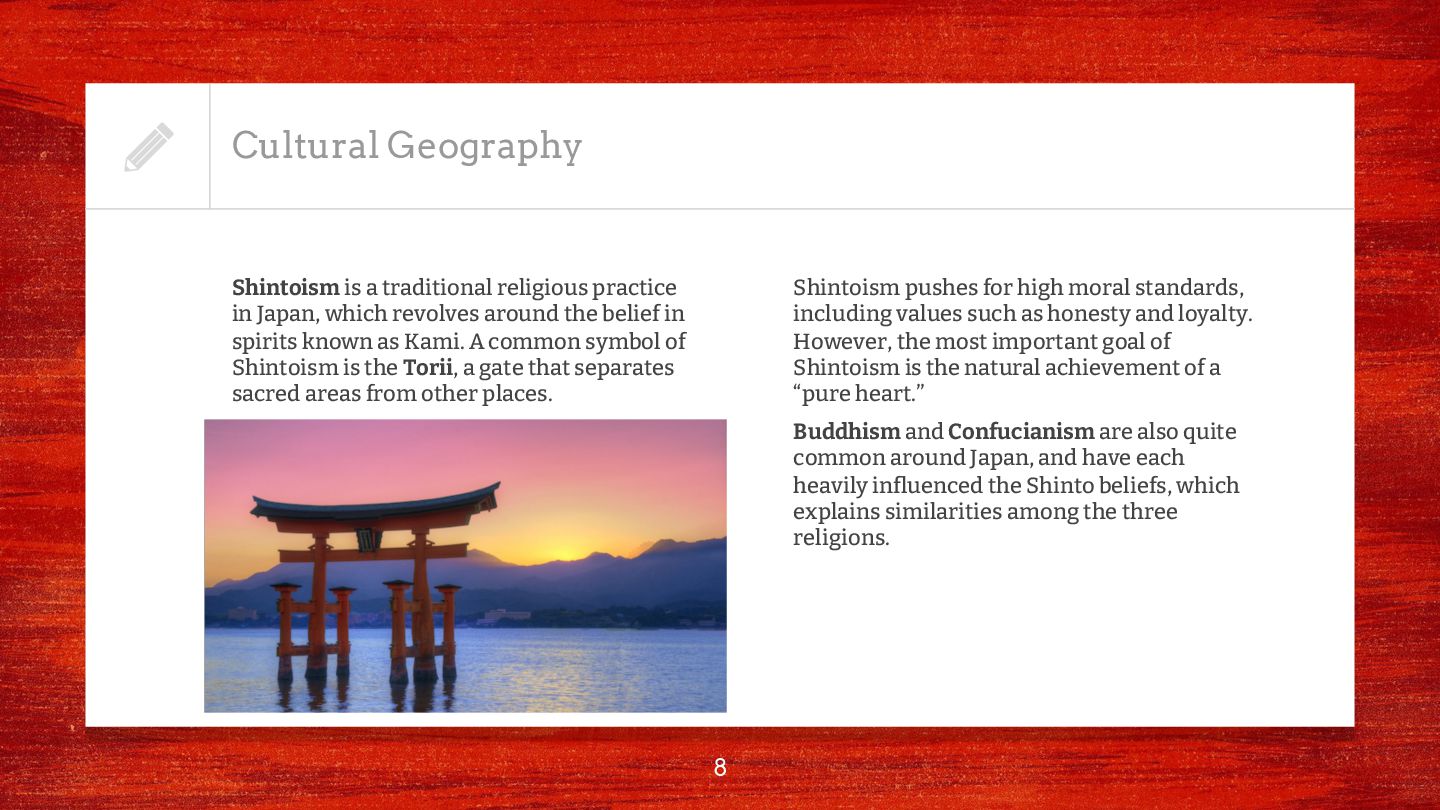
which revolves around the belief in spirits known as Kami. A common symbol of Shintoism is the Torii, a gate that separates sacred areas from other places. 8 Shintoism pushes for high moral standards, including values such as honesty and loyalty. However, the most important goal of Shintoism is the natural achievement of a “pure heart.” Buddhism and Confucianism are also quite common around Japan, and have each heavily influenced the Shinto beliefs, which explains similarities among the three religions.
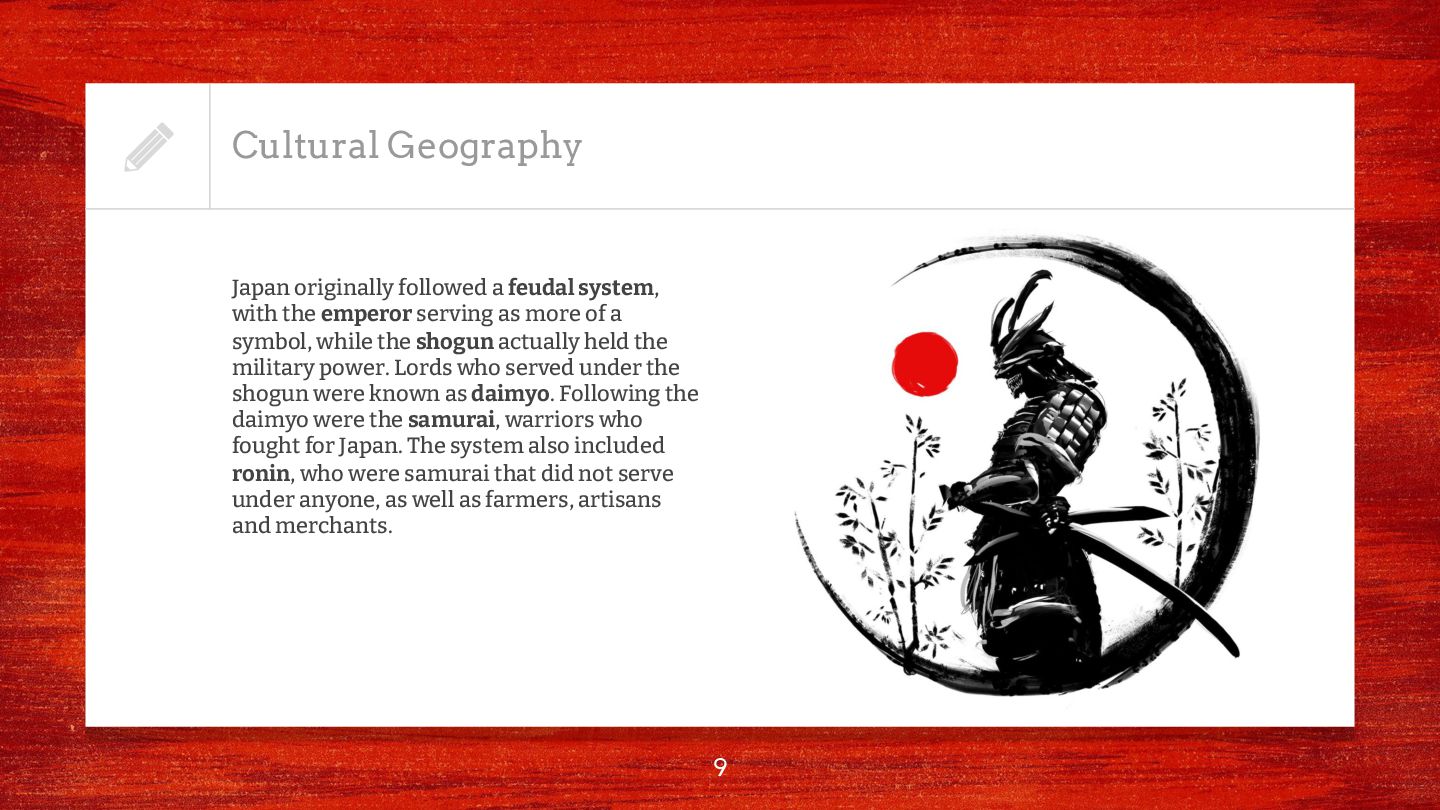
emperor serving as more of a symbol, while the shogun actually held the military power. Lords who served under the shogun were known as daimyo. Following the daimyo were the samurai, warriors who fought for Japan. The system also included ronin, who were samurai that did not serve under anyone, as well as farmers, artisans and merchants. 9
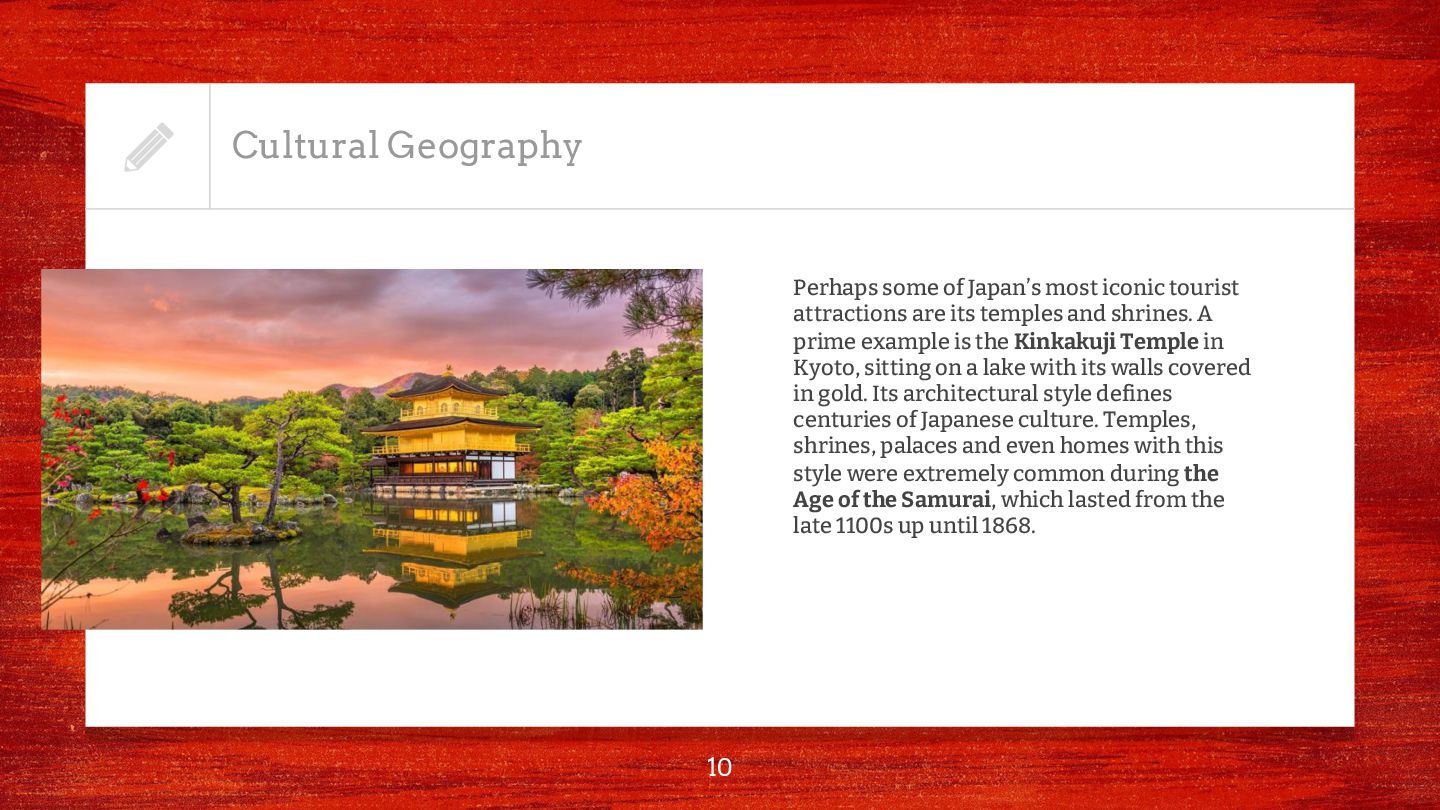
attractions are its temples and shrines. A prime example is the Kinkakuji Temple in Kyoto, sitting on a lake with its walls covered in gold. Its architectural style defines centuries of Japanese culture. Temples, shrines, palaces and even homes with this style were extremely common during the Age of the Samurai, which lasted from the late 1100s up until 1868.
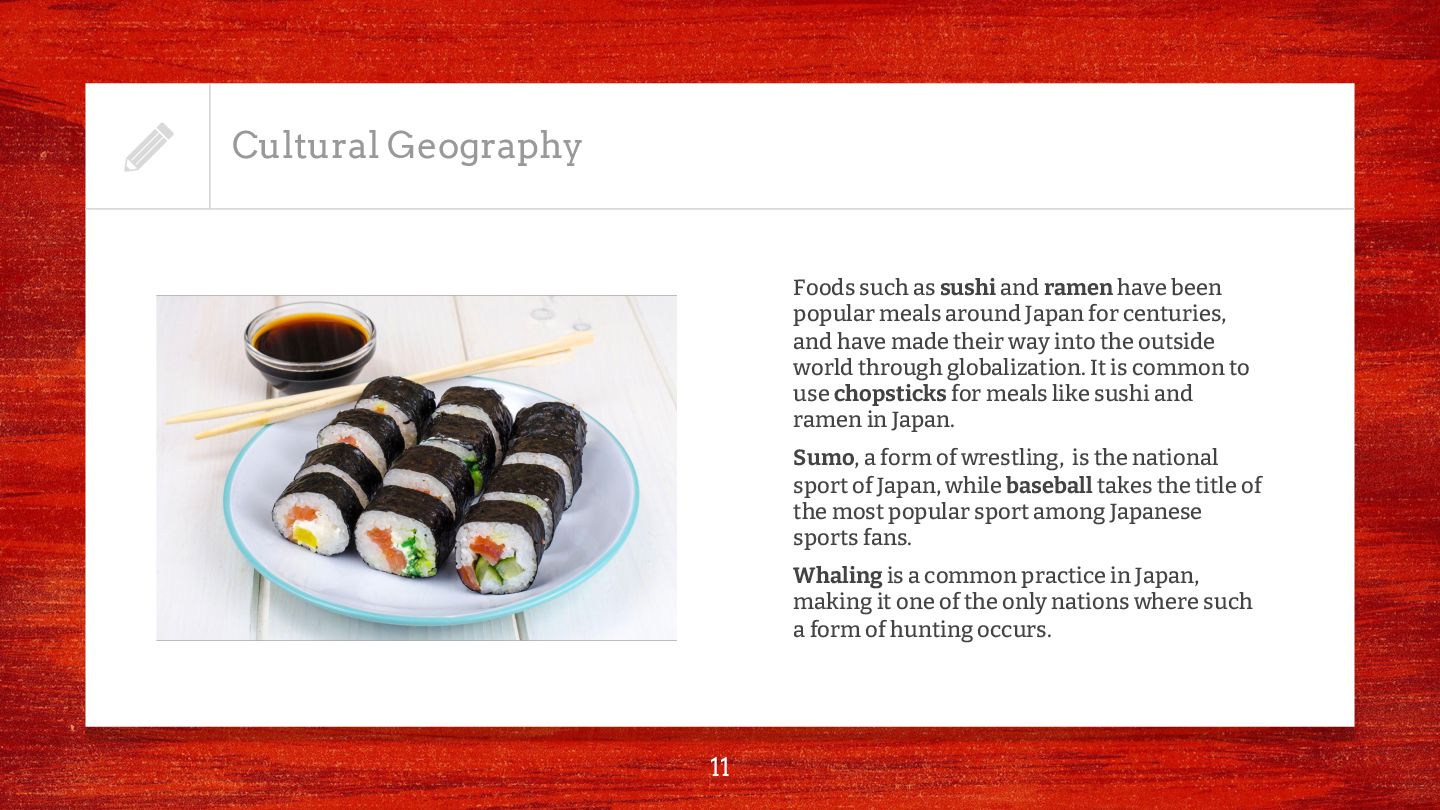
been popular meals around Japan for centuries, and have made their way into the outside world through globalization. It is common to use chopsticks for meals like sushi and ramen in Japan. Sumo, a form of wrestling, is the national sport of Japan, while baseball takes the title of the most popular sport among Japanese sports fans. Whaling is a common practice in Japan, making it one of the only nations where such a form of hunting occurs.
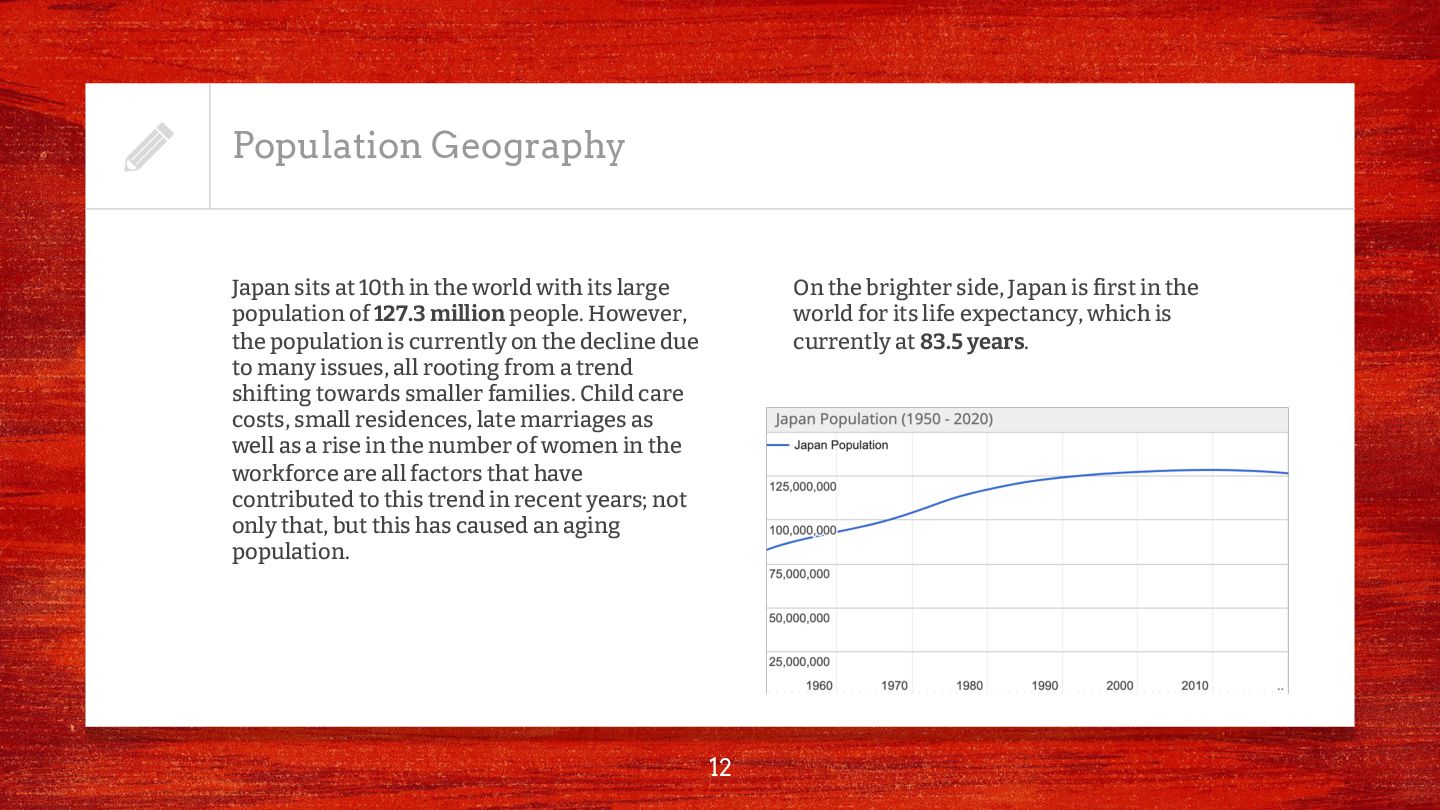
its large population of 127.3 million people. However, the population is currently on the decline due to many issues, all rooting from a trend shifting towards smaller families. Child care costs, small residences, late marriages as well as a rise in the number of women in the workforce are all factors that have contributed to this trend in recent years; not only that, but this has caused an aging population. 12 On the brighter side, Japan is first in the world for its life expectancy, which is currently at 83.5 years.
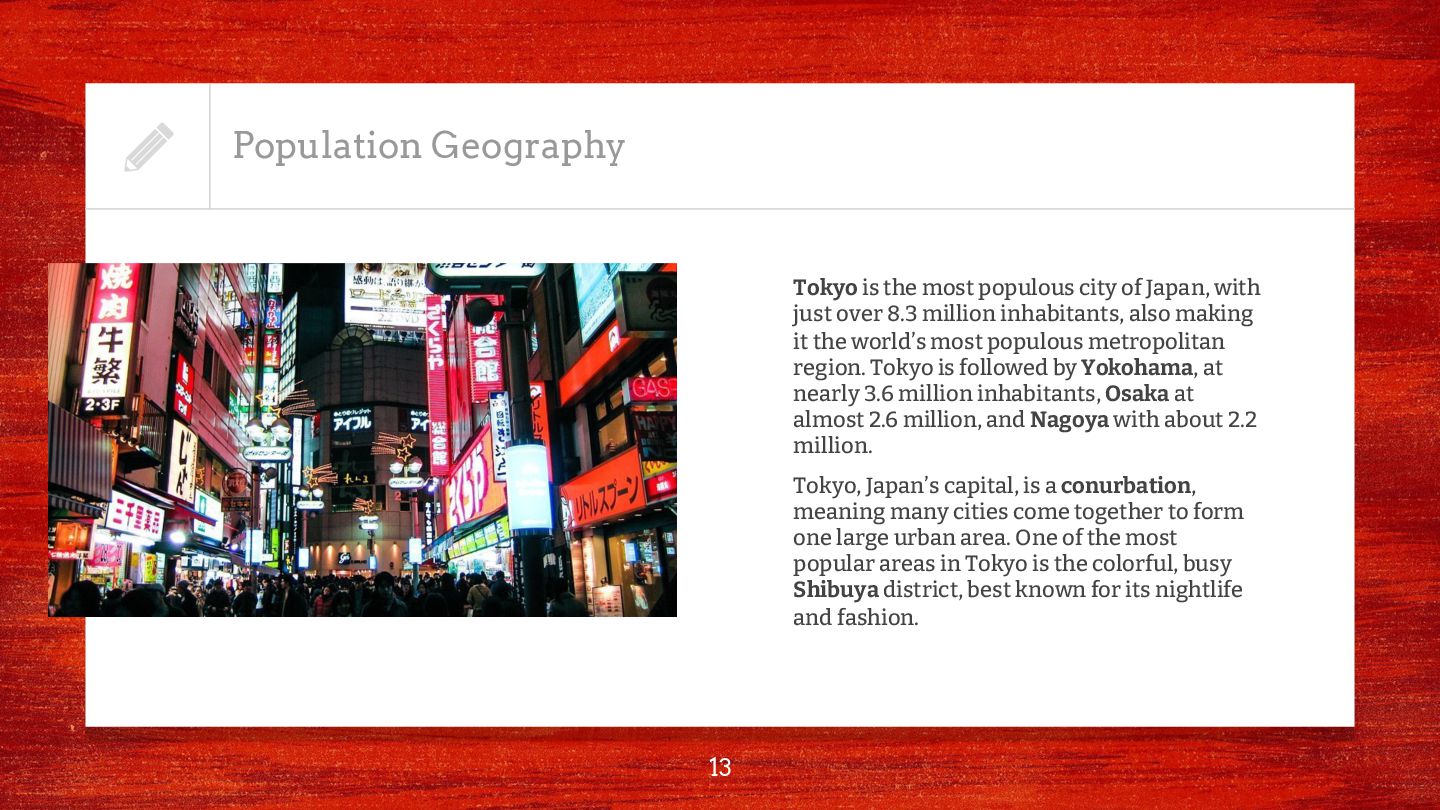
Japan, with just over 8.3 million inhabitants, also making it the world’s most populous metropolitan region. Tokyo is followed by Yokohama, at nearly 3.6 million inhabitants, Osaka at almost 2.6 million, and Nagoya with about 2.2 million. Tokyo, Japan’s capital, is a conurbation, meaning many cities come together to form one large urban area. One of the most popular areas in Tokyo is the colorful, busy Shibuya district, best known for its nightlife and fashion.
Fuji in a Weekend: Japan.” Passion Passport, 2 Feb. 2022, https://passionpassport.com/how-to-hike- mt-fuji-weekend/. World Religions Inter Faith Week – Striving for Peace Through Religious Harmony 16th November 2022, et al. “Shintoism in Japan.” The Review of Religions, 28 Apr. 2021, https://www.reviewofreligions.org/10622/shintoism-in-japan/. World Religions Places of Worship: Ellora Caves 22nd June 2022, et al. “The Way of the Warrior: Samurais and Spirituality.” The Review of Religions, 28 Jan. 2021, https://www.reviewofreligions.org/27921/the-way-of-the-warrior-samurais-and-spirituality/. “Arashiyama Bamboo Grove.” Inside Kyoto, 26 Apr. 2020, https://www.insidekyoto.com/arashiyama-bamboo-grove. Peirce, Arthur. “Top 10 Temples in Japan.” Travel Guide | Enchanting Travels, Enchanting Travels, 22 Oct. 2019, https://www.enchantingtravels.com/travel-blog/top-10-temples-in-japan/. Sheldon, Robert. “What Is Just-in-Time Manufacturing (JIT Manufacturing)?” WhatIs.com, TechTarget, 17 Oct. 2022, https://www.techtarget.com/whatis/definition/just-in-time-manufacturing-JIT- manufacturing#:~:text=Just%2Din%2Dtime%20manufacturing%20(JIT%20manufacturing)%20is%20a,and%20speed%20up%20produ ct%20delivery. “Sushi.” Encyclopædia Britannica, Encyclopædia Britannica, Inc., https://www.britannica.com/topic/sushi. 15


 blakedoman
 hisaokatsumi
 enochan
 nnchiba
 wataruuuuu
 ayatokanada
 yukako_nakano
 takasehideki
 sazimai
 tomonom
.png) satai
satai
 kzmssk
 institutdelelevage
 szymonslowik
 davetheseo
 morganepeng
 ryanjones
 ks91
ks91
 charlesmeaden
 eileencodes
 inesmontani
 mayunak
 techseoconnect
 marktimemedia
 schlessera