Upgrade to Pro — share decks privately, control downloads, hide ads and more …

GPT-6 Astra and Claude Fable 5.1

Avatar for Shimon Chohen Shimon Chohen
September 07, 2026

GPT-6 Astra and Claude Fable 5.1

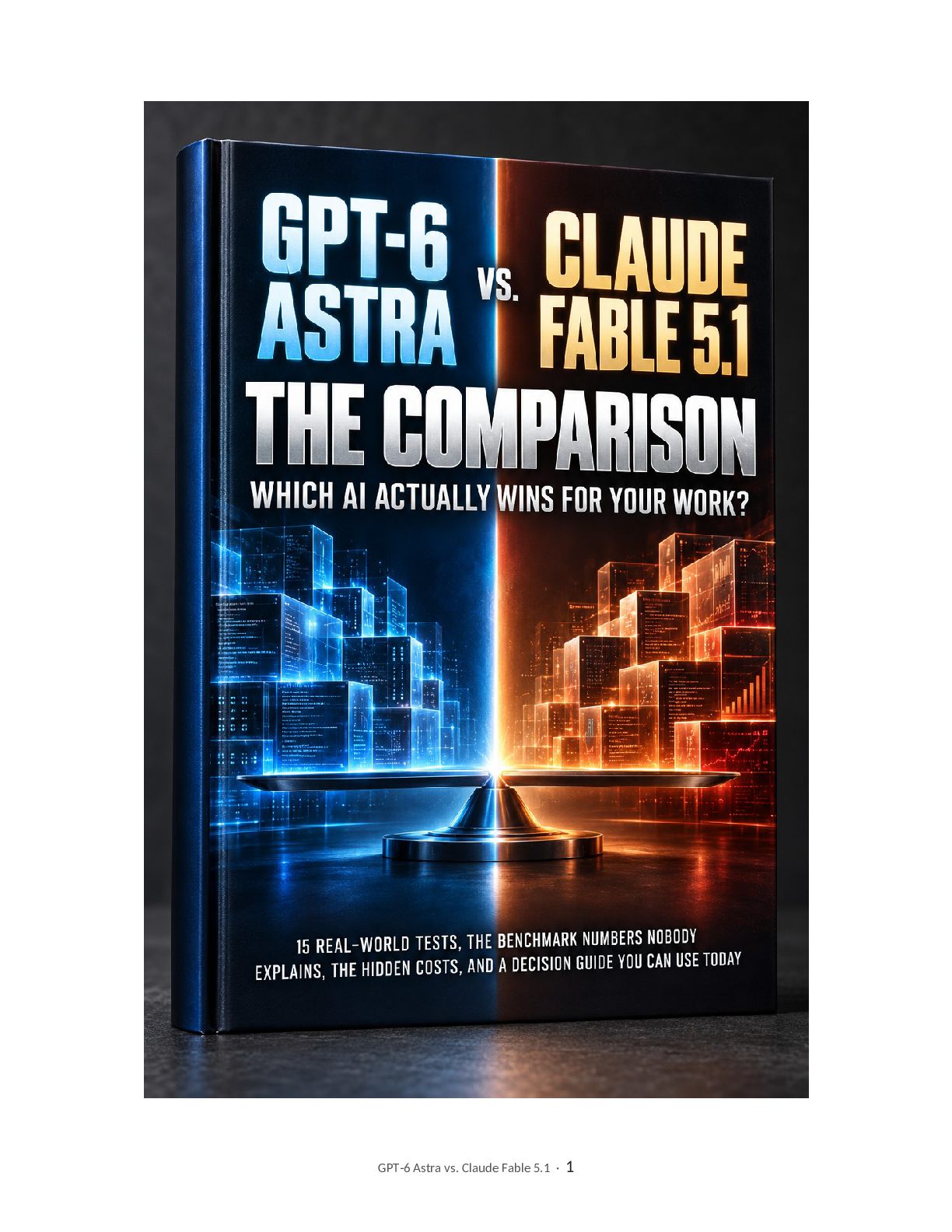
GPT-6 Astra and Claude Fable 5.1 each bring something unique to the table. I broke down the comparison in a free ebook so you can see which one fits your needs — whether that's work, creativity, or just staying ahead of the curve.

Avatar for Shimon Chohen

Shimon Chohen

September 07, 2026

Other Decks in Business

Transcript

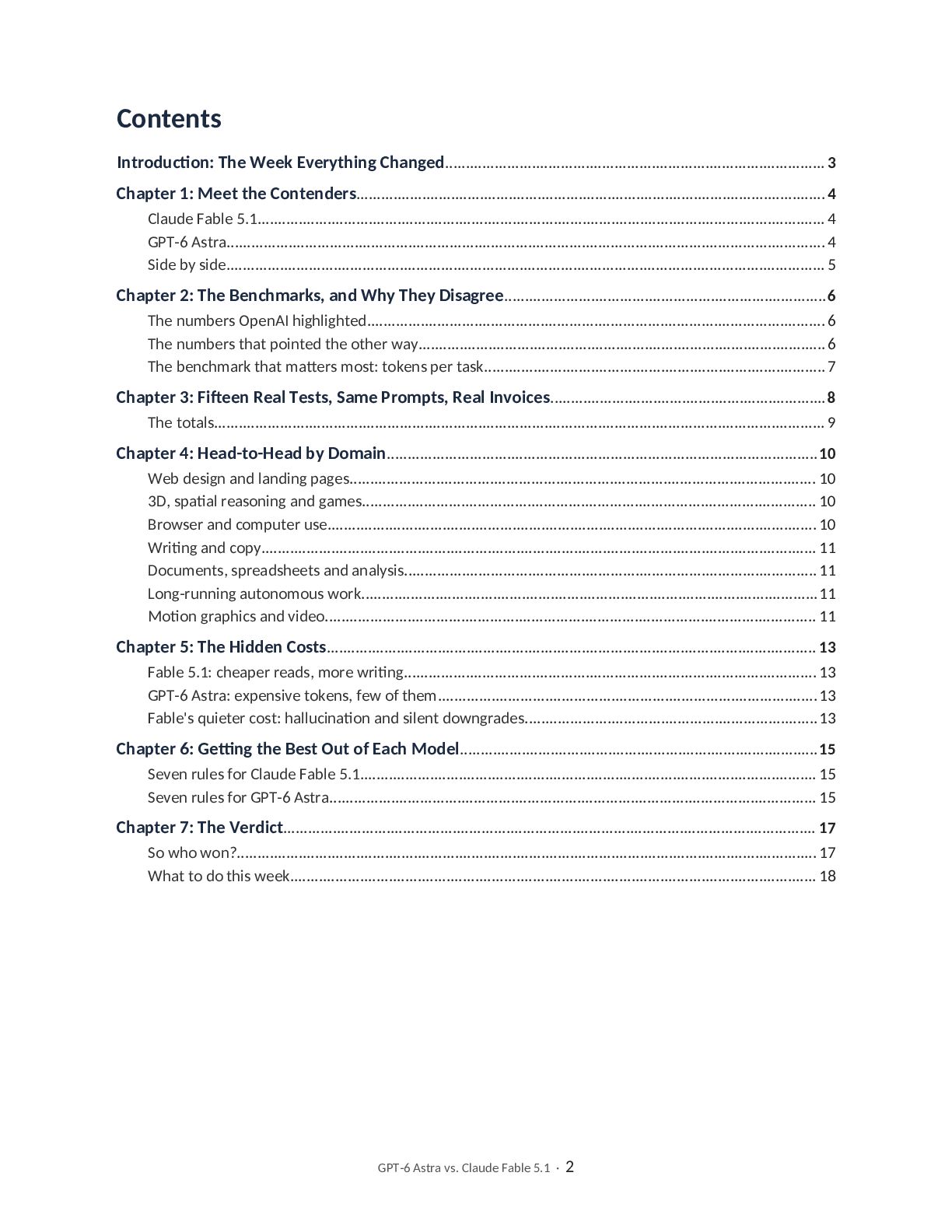
  1. Contents Introduction: The Week Everything Changed............................................................................................ 3 Chapter 1: Meet

    the Contenders.................................................................................................................. 4 Claude Fable 5.1.......................................................................................................................................... 4 GPT-6 Astra................................................................................................................................................. 4 Side by side................................................................................................................................................. 5 Chapter 2: The Benchmarks, and Why They Disagree..............................................................................6 The numbers OpenAI highlighted............................................................................................................... 6 The numbers that pointed the other way...................................................................................................6 The benchmark that matters most: tokens per task................................................................................... 7 Chapter 3: Fifteen Real Tests, Same Prompts, Real Invoices...................................................................8 The totals.................................................................................................................................................... 9 Chapter 4: Head-to-Head by Domain........................................................................................................10 Web design and landing pages................................................................................................................. 10 3D, spatial reasoning and games.............................................................................................................. 10 Browser and computer use....................................................................................................................... 10 Writing and copy....................................................................................................................................... 11 Documents, spreadsheets and analysis.................................................................................................... 11 Long-running autonomous work...............................................................................................................11 Motion graphics and video....................................................................................................................... 11 Chapter 5: The Hidden Costs....................................................................................................................... 13 Fable 5.1: cheaper reads, more writing.................................................................................................... 13 GPT-6 Astra: expensive tokens, few of them............................................................................................13 Fable's quieter cost: hallucination and silent downgrades.......................................................................13 Chapter 6: Getting the Best Out of Each Model.......................................................................................15 Seven rules for Claude Fable 5.1............................................................................................................... 15 Seven rules for GPT-6 Astra...................................................................................................................... 15 Chapter 7: The Verdict................................................................................................................................. 17 So who won?............................................................................................................................................. 17 What to do this week................................................................................................................................ 18 GPT-6 Astra vs. Claude Fable 5.1 · 2
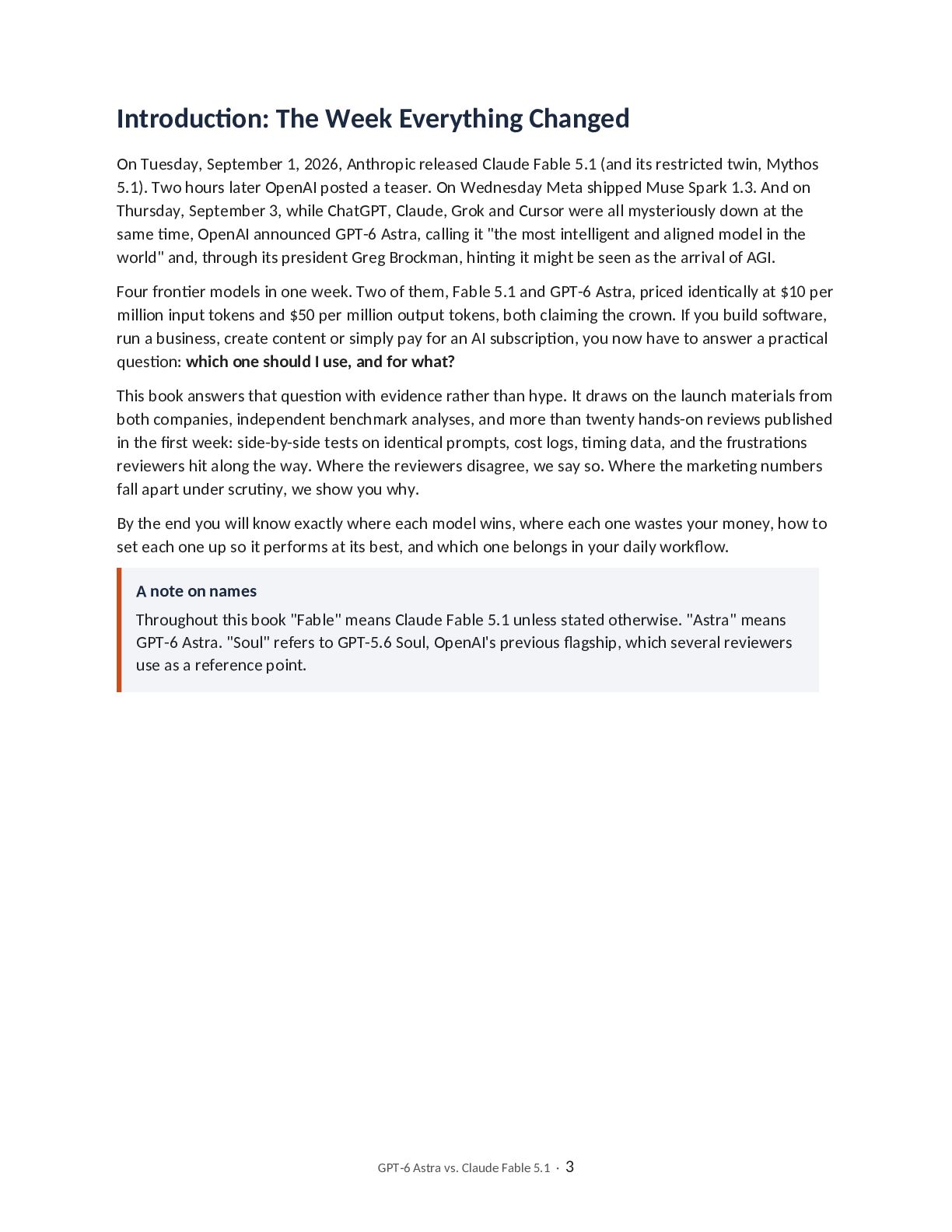
  2. Introduction: The Week Everything Changed On Tuesday, September 1, 2026,

    Anthropic released Claude Fable 5.1 (and its restricted twin, Mythos 5.1). Two hours later OpenAI posted a teaser. On Wednesday Meta shipped Muse Spark 1.3. And on Thursday, September 3, while ChatGPT, Claude, Grok and Cursor were all mysteriously down at the same time, OpenAI announced GPT-6 Astra, calling it "the most intelligent and aligned model in the world" and, through its president Greg Brockman, hinting it might be seen as the arrival of AGI. Four frontier models in one week. Two of them, Fable 5.1 and GPT-6 Astra, priced identically at $10 per million input tokens and $50 per million output tokens, both claiming the crown. If you build software, run a business, create content or simply pay for an AI subscription, you now have to answer a practical question: which one should I use, and for what? This book answers that question with evidence rather than hype. It draws on the launch materials from both companies, independent benchmark analyses, and more than twenty hands-on reviews published in the first week: side-by-side tests on identical prompts, cost logs, timing data, and the frustrations reviewers hit along the way. Where the reviewers disagree, we say so. Where the marketing numbers fall apart under scrutiny, we show you why. By the end you will know exactly where each model wins, where each one wastes your money, how to set each one up so it performs at its best, and which one belongs in your daily workflow. A note on names Throughout this book "Fable" means Claude Fable 5.1 unless stated otherwise. "Astra" means GPT-6 Astra. "Soul" refers to GPT-5.6 Soul, OpenAI's previous flagship, which several reviewers use as a reference point. GPT-6 Astra vs. Claude Fable 5.1 · 3
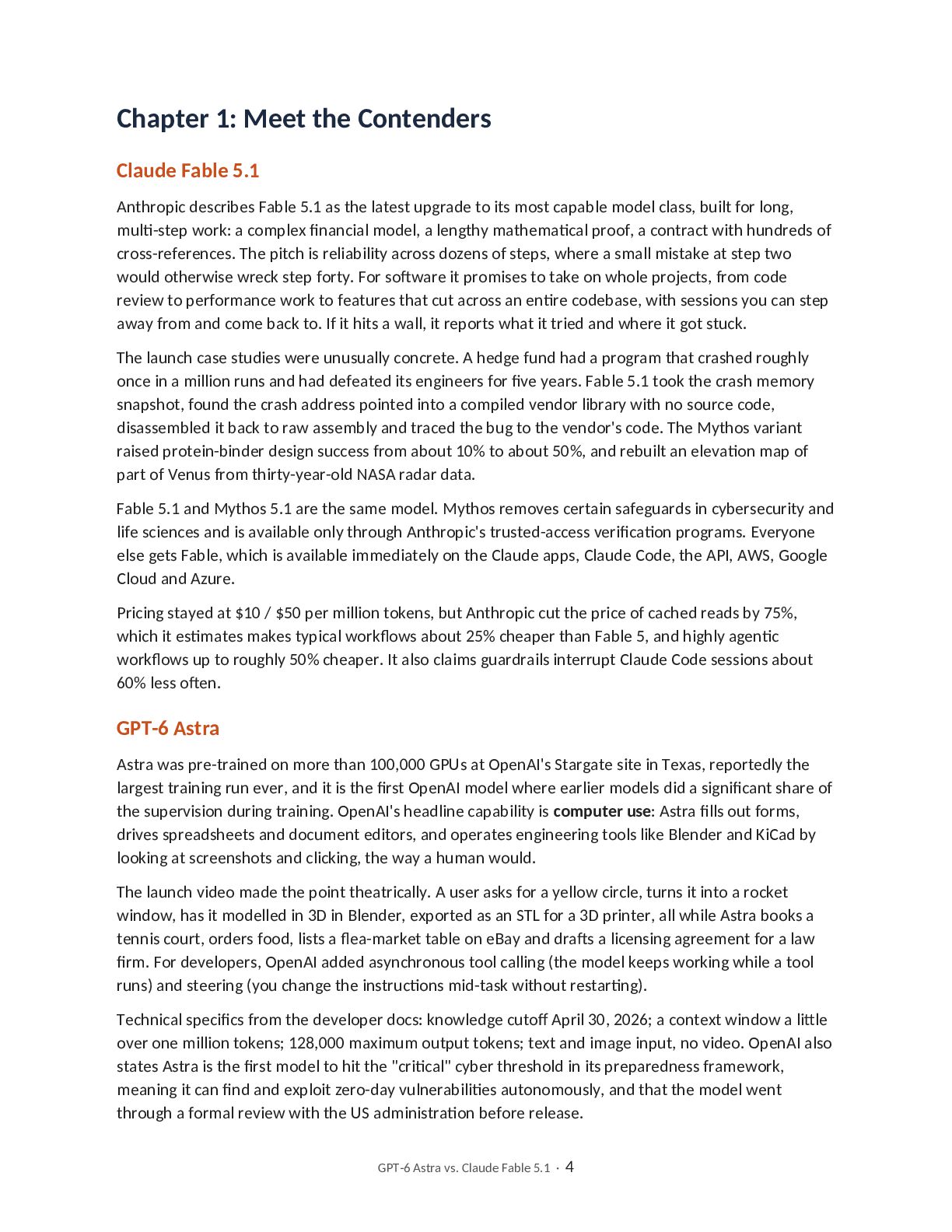
  3. Chapter 1: Meet the Contenders Claude Fable 5.1 Anthropic describes

    Fable 5.1 as the latest upgrade to its most capable model class, built for long, multi-step work: a complex financial model, a lengthy mathematical proof, a contract with hundreds of cross-references. The pitch is reliability across dozens of steps, where a small mistake at step two would otherwise wreck step forty. For software it promises to take on whole projects, from code review to performance work to features that cut across an entire codebase, with sessions you can step away from and come back to. If it hits a wall, it reports what it tried and where it got stuck. The launch case studies were unusually concrete. A hedge fund had a program that crashed roughly once in a million runs and had defeated its engineers for five years. Fable 5.1 took the crash memory snapshot, found the crash address pointed into a compiled vendor library with no source code, disassembled it back to raw assembly and traced the bug to the vendor's code. The Mythos variant raised protein-binder design success from about 10% to about 50%, and rebuilt an elevation map of part of Venus from thirty-year-old NASA radar data. Fable 5.1 and Mythos 5.1 are the same model. Mythos removes certain safeguards in cybersecurity and life sciences and is available only through Anthropic's trusted-access verification programs. Everyone else gets Fable, which is available immediately on the Claude apps, Claude Code, the API, AWS, Google Cloud and Azure. Pricing stayed at $10 / $50 per million tokens, but Anthropic cut the price of cached reads by 75%, which it estimates makes typical workflows about 25% cheaper than Fable 5, and highly agentic workflows up to roughly 50% cheaper. It also claims guardrails interrupt Claude Code sessions about 60% less often. GPT-6 Astra Astra was pre-trained on more than 100,000 GPUs at OpenAI's Stargate site in Texas, reportedly the largest training run ever, and it is the first OpenAI model where earlier models did a significant share of the supervision during training. OpenAI's headline capability is computer use: Astra fills out forms, drives spreadsheets and document editors, and operates engineering tools like Blender and KiCad by looking at screenshots and clicking, the way a human would. The launch video made the point theatrically. A user asks for a yellow circle, turns it into a rocket window, has it modelled in 3D in Blender, exported as an STL for a 3D printer, all while Astra books a tennis court, orders food, lists a flea-market table on eBay and drafts a licensing agreement for a law firm. For developers, OpenAI added asynchronous tool calling (the model keeps working while a tool runs) and steering (you change the instructions mid-task without restarting). Technical specifics from the developer docs: knowledge cutoff April 30, 2026; a context window a little over one million tokens; 128,000 maximum output tokens; text and image input, no video. OpenAI also states Astra is the first model to hit the "critical" cyber threshold in its preparedness framework, meaning it can find and exploit zero-day vulnerabilities autonomously, and that the model went through a formal review with the US administration before release. GPT-6 Astra vs. Claude Fable 5.1 · 4
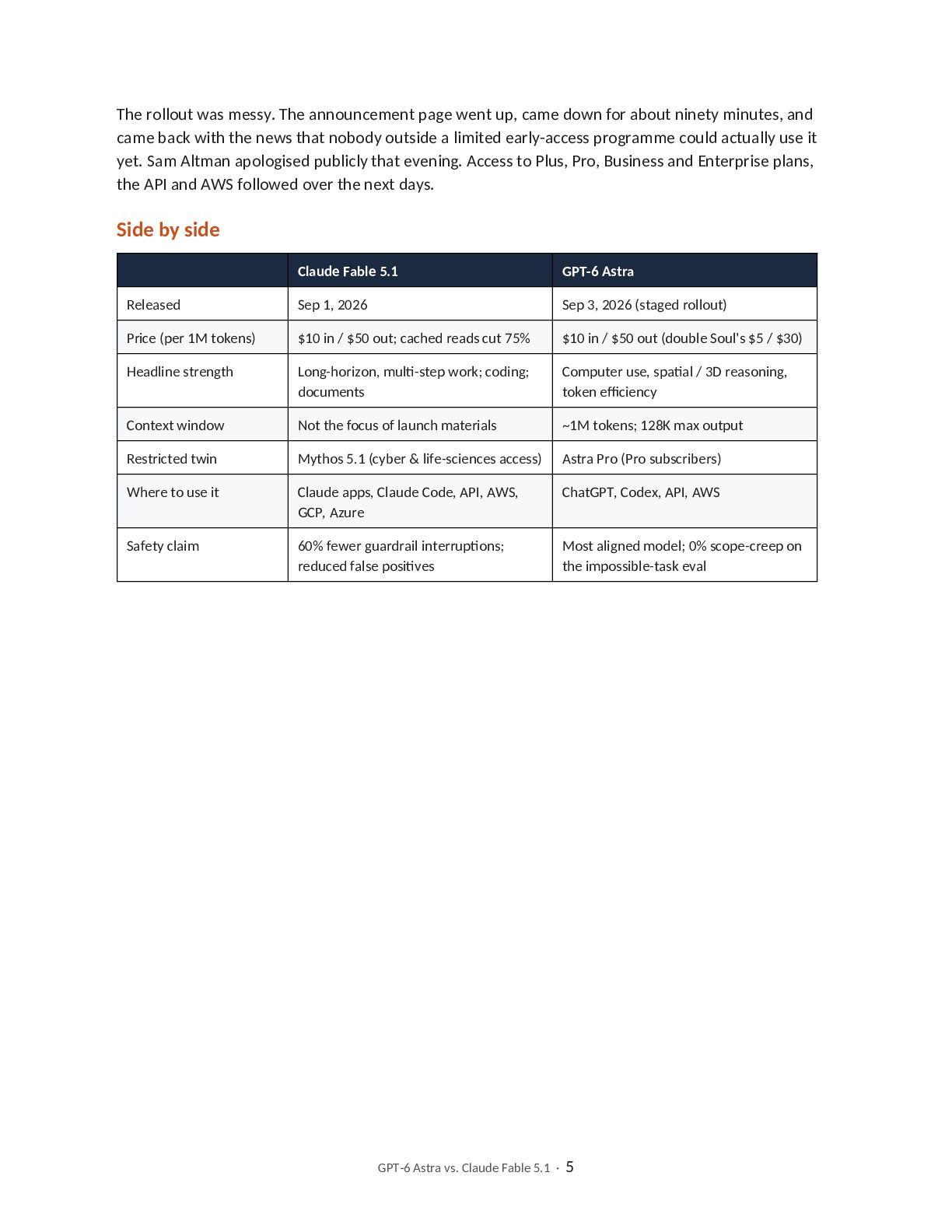
  4. The rollout was messy. The announcement page went up, came

    down for about ninety minutes, and came back with the news that nobody outside a limited early-access programme could actually use it yet. Sam Altman apologised publicly that evening. Access to Plus, Pro, Business and Enterprise plans, the API and AWS followed over the next days. Side by side Claude Fable 5.1 GPT-6 Astra Released Sep 1, 2026 Sep 3, 2026 (staged rollout) Price (per 1M tokens) $10 in / $50 out; cached reads cut 75% $10 in / $50 out (double Soul's $5 / $30) Headline strength Long-horizon, multi-step work; coding; documents Computer use, spatial / 3D reasoning, token efficiency Context window Not the focus of launch materials ~1M tokens; 128K max output Restricted twin Mythos 5.1 (cyber & life-sciences access) Astra Pro (Pro subscribers) Where to use it Claude apps, Claude Code, API, AWS, GCP, Azure ChatGPT, Codex, API, AWS Safety claim 60% fewer guardrail interruptions; reduced false positives Most aligned model; 0% scope-creep on the impossible-task eval GPT-6 Astra vs. Claude Fable 5.1 · 5
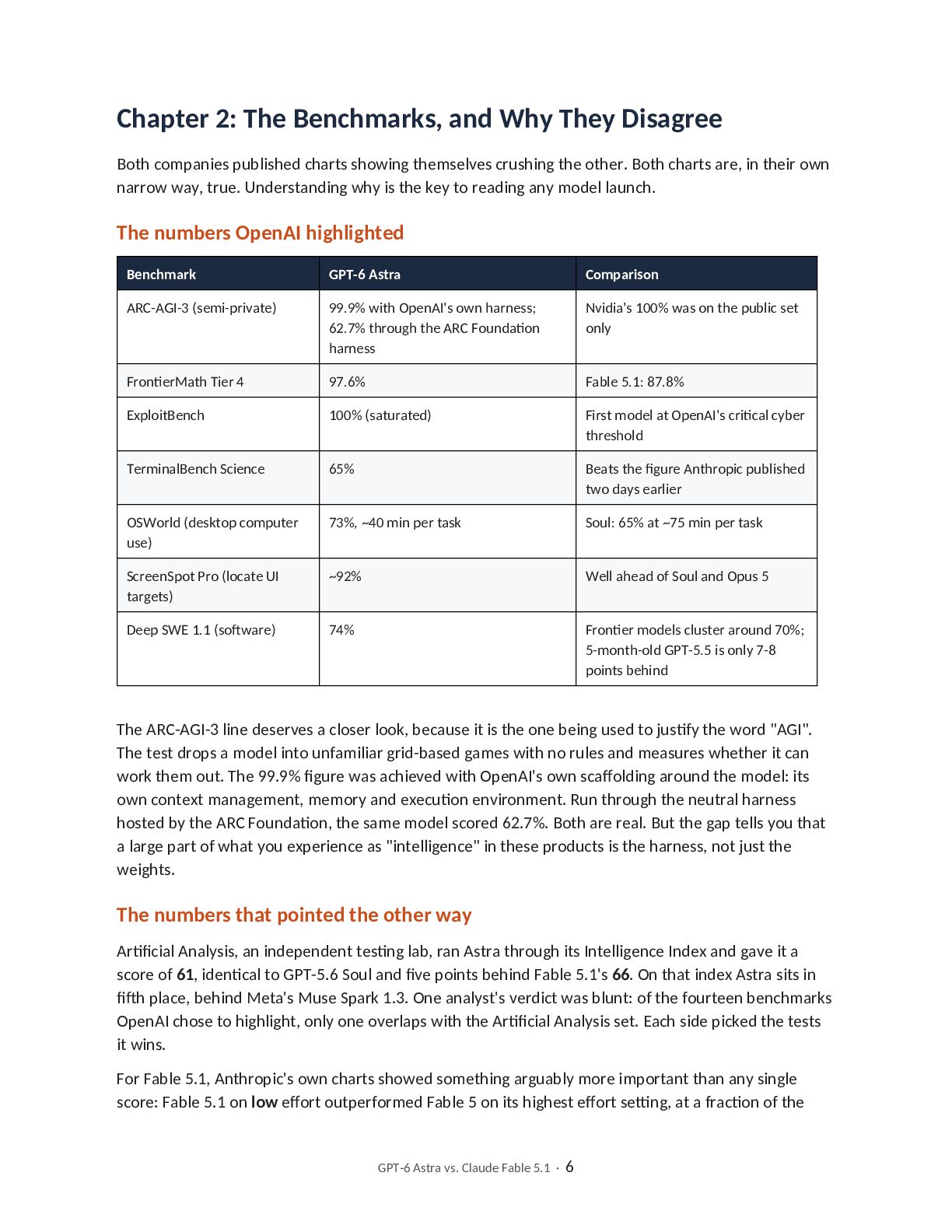
  5. Chapter 2: The Benchmarks, and Why They Disagree Both companies

    published charts showing themselves crushing the other. Both charts are, in their own narrow way, true. Understanding why is the key to reading any model launch. The numbers OpenAI highlighted Benchmark GPT-6 Astra Comparison ARC-AGI-3 (semi-private) 99.9% with OpenAI's own harness; 62.7% through the ARC Foundation harness Nvidia's 100% was on the public set only FrontierMath Tier 4 97.6% Fable 5.1: 87.8% ExploitBench 100% (saturated) First model at OpenAI's critical cyber threshold TerminalBench Science 65% Beats the figure Anthropic published two days earlier OSWorld (desktop computer use) 73%, ~40 min per task Soul: 65% at ~75 min per task ScreenSpot Pro (locate UI targets) ~92% Well ahead of Soul and Opus 5 Deep SWE 1.1 (software) 74% Frontier models cluster around 70%; 5-month-old GPT-5.5 is only 7-8 points behind The ARC-AGI-3 line deserves a closer look, because it is the one being used to justify the word "AGI". The test drops a model into unfamiliar grid-based games with no rules and measures whether it can work them out. The 99.9% figure was achieved with OpenAI's own scaffolding around the model: its own context management, memory and execution environment. Run through the neutral harness hosted by the ARC Foundation, the same model scored 62.7%. Both are real. But the gap tells you that a large part of what you experience as "intelligence" in these products is the harness, not just the weights. The numbers that pointed the other way Artificial Analysis, an independent testing lab, ran Astra through its Intelligence Index and gave it a score of 61, identical to GPT-5.6 Soul and five points behind Fable 5.1's 66. On that index Astra sits in fifth place, behind Meta's Muse Spark 1.3. One analyst's verdict was blunt: of the fourteen benchmarks OpenAI chose to highlight, only one overlaps with the Artificial Analysis set. Each side picked the tests it wins. For Fable 5.1, Anthropic's own charts showed something arguably more important than any single score: Fable 5.1 on low effort outperformed Fable 5 on its highest effort setting, at a fraction of the GPT-6 Astra vs. Claude Fable 5.1 · 6
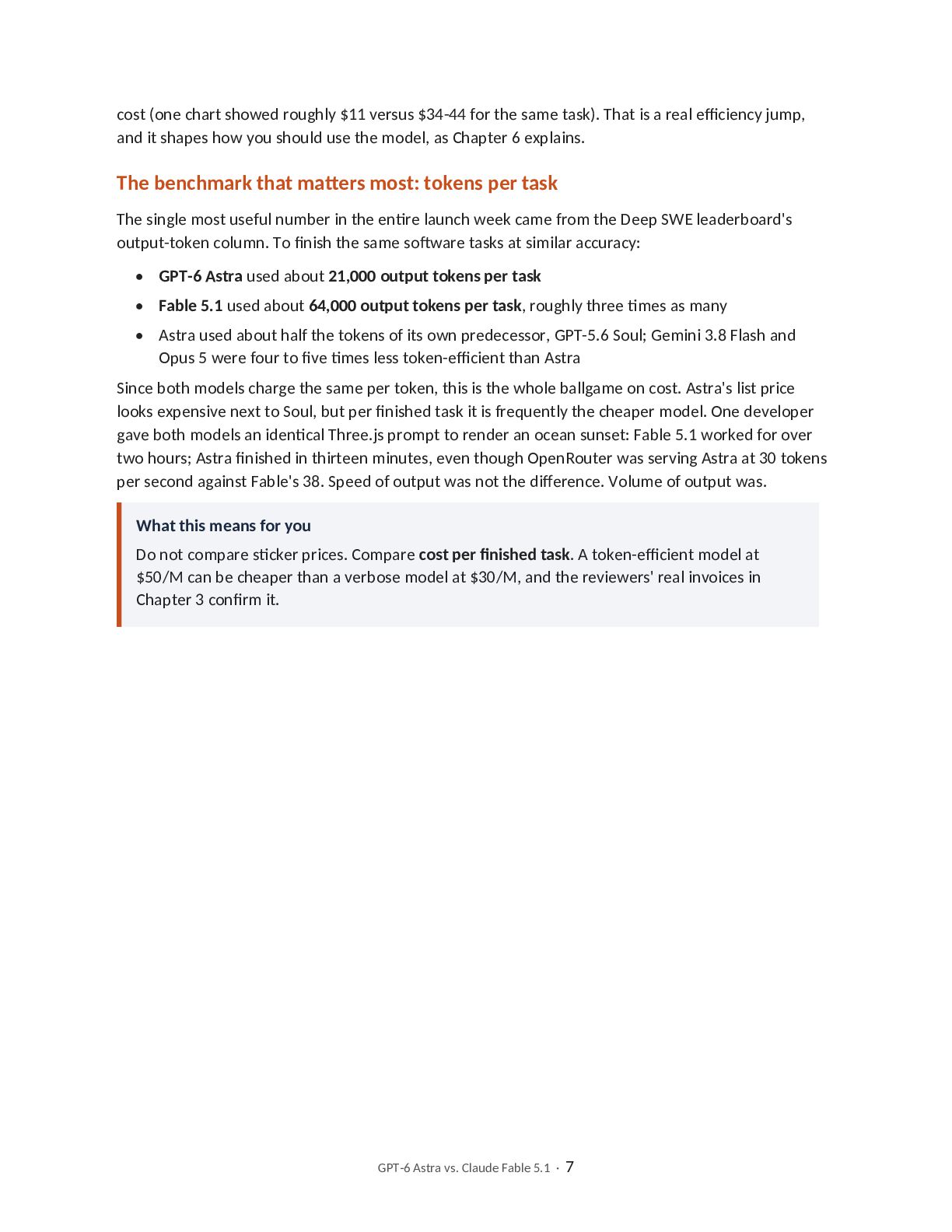
  6. cost (one chart showed roughly $11 versus $34-44 for the

    same task). That is a real efficiency jump, and it shapes how you should use the model, as Chapter 6 explains. The benchmark that matters most: tokens per task The single most useful number in the entire launch week came from the Deep SWE leaderboard's output-token column. To finish the same software tasks at similar accuracy: • GPT-6 Astra used about 21,000 output tokens per task • Fable 5.1 used about 64,000 output tokens per task, roughly three times as many • Astra used about half the tokens of its own predecessor, GPT-5.6 Soul; Gemini 3.8 Flash and Opus 5 were four to five times less token-efficient than Astra Since both models charge the same per token, this is the whole ballgame on cost. Astra's list price looks expensive next to Soul, but per finished task it is frequently the cheaper model. One developer gave both models an identical Three.js prompt to render an ocean sunset: Fable 5.1 worked for over two hours; Astra finished in thirteen minutes, even though OpenRouter was serving Astra at 30 tokens per second against Fable's 38. Speed of output was not the difference. Volume of output was. What this means for you Do not compare sticker prices. Compare cost per finished task. A token-efficient model at $50/M can be cheaper than a verbose model at $30/M, and the reviewers' real invoices in Chapter 3 confirm it. GPT-6 Astra vs. Claude Fable 5.1 · 7
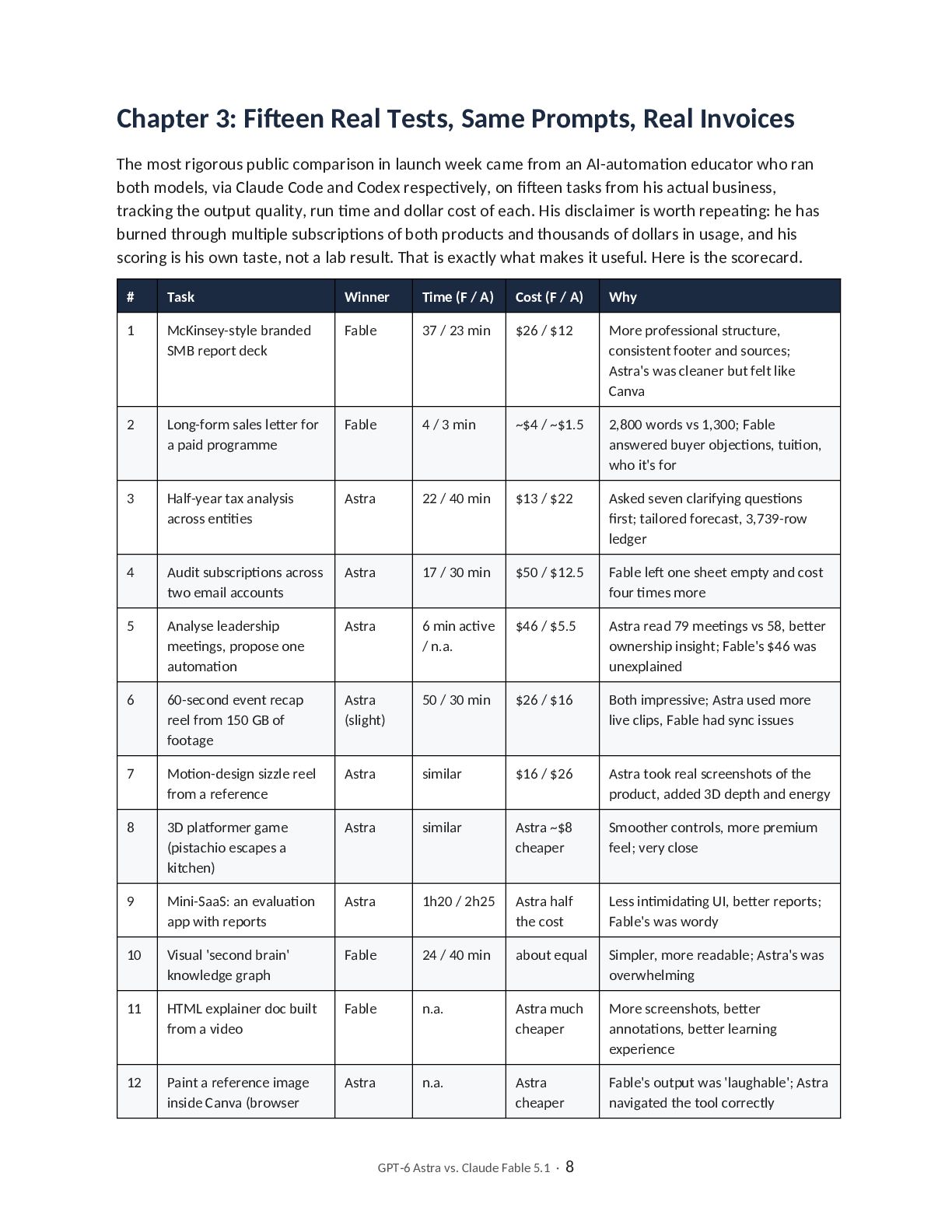
  7. Chapter 3: Fifteen Real Tests, Same Prompts, Real Invoices The

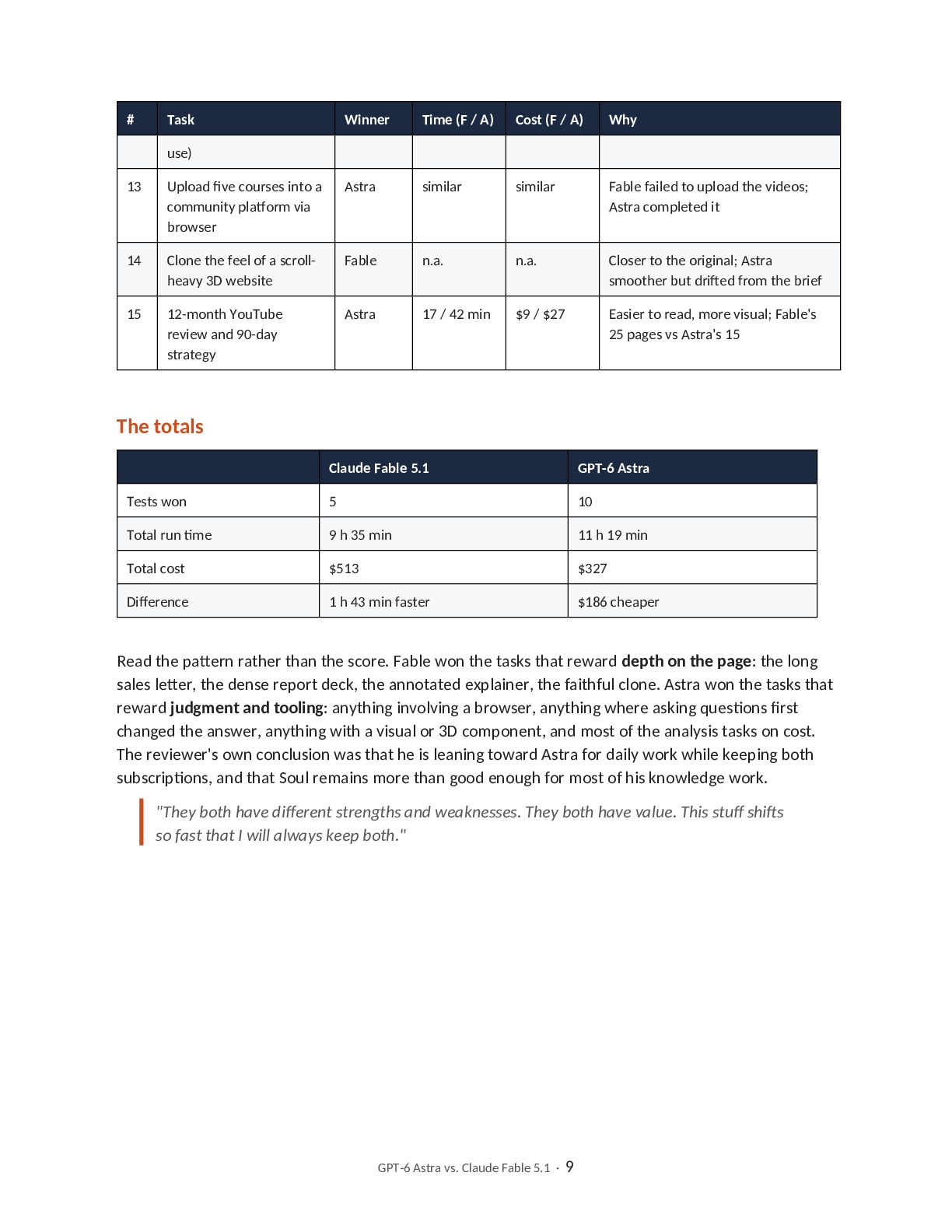
    most rigorous public comparison in launch week came from an AI-automation educator who ran both models, via Claude Code and Codex respectively, on fifteen tasks from his actual business, tracking the output quality, run time and dollar cost of each. His disclaimer is worth repeating: he has burned through multiple subscriptions of both products and thousands of dollars in usage, and his scoring is his own taste, not a lab result. That is exactly what makes it useful. Here is the scorecard. # Task Winner Time (F / A) Cost (F / A) Why 1 McKinsey-style branded SMB report deck Fable 37 / 23 min $26 / $12 More professional structure, consistent footer and sources; Astra's was cleaner but felt like Canva 2 Long-form sales letter for a paid programme Fable 4 / 3 min ~$4 / ~$1.5 2,800 words vs 1,300; Fable answered buyer objections, tuition, who it's for 3 Half-year tax analysis across entities Astra 22 / 40 min $13 / $22 Asked seven clarifying questions first; tailored forecast, 3,739-row ledger 4 Audit subscriptions across two email accounts Astra 17 / 30 min $50 / $12.5 Fable left one sheet empty and cost four times more 5 Analyse leadership meetings, propose one automation Astra 6 min active / n.a. $46 / $5.5 Astra read 79 meetings vs 58, better ownership insight; Fable's $46 was unexplained 6 60-second event recap reel from 150 GB of footage Astra (slight) 50 / 30 min $26 / $16 Both impressive; Astra used more live clips, Fable had sync issues 7 Motion-design sizzle reel from a reference Astra similar $16 / $26 Astra took real screenshots of the product, added 3D depth and energy 8 3D platformer game (pistachio escapes a kitchen) Astra similar Astra ~$8 cheaper Smoother controls, more premium feel; very close 9 Mini-SaaS: an evaluation app with reports Astra 1h20 / 2h25 Astra half the cost Less intimidating UI, better reports; Fable's was wordy 10 Visual 'second brain' knowledge graph Fable 24 / 40 min about equal Simpler, more readable; Astra's was overwhelming 11 HTML explainer doc built from a video Fable n.a. Astra much cheaper More screenshots, better annotations, better learning experience 12 Paint a reference image inside Canva (browser Astra n.a. Astra cheaper Fable's output was 'laughable'; Astra navigated the tool correctly GPT-6 Astra vs. Claude Fable 5.1 · 8
  8. # Task Winner Time (F / A) Cost (F /

    A) Why use) 13 Upload five courses into a community platform via browser Astra similar similar Fable failed to upload the videos; Astra completed it 14 Clone the feel of a scrollheavy 3D website Fable n.a. n.a. Closer to the original; Astra smoother but drifted from the brief 15 12-month YouTube review and 90-day strategy Astra 17 / 42 min $9 / $27 Easier to read, more visual; Fable's 25 pages vs Astra's 15 The totals Claude Fable 5.1 GPT-6 Astra Tests won 5 10 Total run time 9 h 35 min 11 h 19 min Total cost $513 $327 Difference 1 h 43 min faster $186 cheaper Read the pattern rather than the score. Fable won the tasks that reward depth on the page: the long sales letter, the dense report deck, the annotated explainer, the faithful clone. Astra won the tasks that reward judgment and tooling: anything involving a browser, anything where asking questions first changed the answer, anything with a visual or 3D component, and most of the analysis tasks on cost. The reviewer's own conclusion was that he is leaning toward Astra for daily work while keeping both subscriptions, and that Soul remains more than good enough for most of his knowledge work. "They both have different strengths and weaknesses. They both have value. This stuff shifts so fast that I will always keep both." GPT-6 Astra vs. Claude Fable 5.1 · 9
  9. Chapter 4: Head-to-Head by Domain Pulling together every side-by-side test

    we found, here is how the two models compare across the areas people actually use them for. Web design and landing pages This is the most contested category, and the reviewers genuinely split. One designer built the same museum landing page with both. Astra found and used the museum's real logo, produced a more minimal hero and a striking full-width button; Fable produced a nicer sticky-scroll section and a deliberately off-grid layout that still looked aesthetic, but fell into a recognisable Claude habit: a headline split into two colours with one half in italics. The verdict: both still "look AI-generated" if you know what to look for, but both are far beyond models from six months ago. A second reviewer who had declared Fable 5.1 "the design king" a day earlier reversed himself after Astra's one-shot outputs: 3D hero sections, layered parallax, animated product cans, all restrained enough to stay on brand. His caveat is important: the Fable site he preferred had been iterated fifteen times, while Astra's were first drafts, and every one of them used his custom scroll-design skill file. Astra has the edge on visual taste in a single shot; Fable is at least as good when you invest in iteration, and it more faithfully follows a reference you give it. 3D, spatial reasoning and games Here the evidence is one-sided. Astra's spatial ability was the showpiece of launch week: recreating San Francisco's Palace of Fine Arts in Blender almost perfectly; turning a Zillow listing's photos into a full Blender model and a 45-second camera fly-through (a workflow that, when someone repeated it with Fable, produced something "super basic"); building a walkable Unreal Engine 5 scene from the launch-demo house; rendering a GameCube-style drone-racing game from a Google Earth screenshot. Bouncy WebGPU jelly, PS1-style games, cityscapes, Dyson spheres: reviewers kept using the word "insane". Fable is no slouch. One creator built playable one-shot versions of a football game, a tactical shooter and an open-world driving game in a single prompt each, with menus, buy phases, missions and cutscenes. In a direct GTA-style bake-off with identical prompts and reference images, Astra finished in one hour with a stunning car model and pedestrians; Fable ran for three hours, cost $150, and produced a city with cleaner roads, better buildings, rain and golden-hour lighting that the reviewer, expecting an Astra blowout, narrowly preferred. But the general finding holds: for anything spatial, CAD-like or 3D, start with Astra. Browser and computer use No contest. Astra scored 73% on OSWorld against Soul's 65%, and in practice reviewers who had already found the GPT models "significantly better" at browser use than Claude found Astra another step up. In the fifteen-task test, Fable's attempt to paint a reference image in Canva was described as laughable, and it failed to upload course videos to a community platform that Astra handled without fuss. One reviewer called Astra's browser use the best he has ever seen. If your workflow involves the GPT-6 Astra vs. Claude Fable 5.1 · 10
  10. model actually clicking through web apps, forms, dashboards or design

    tools, Astra is the only serious choice right now. Writing and copy Fable took both writing tests in the fifteen-task comparison: the long sales letter and the wordy-butthorough report deck. It writes more, structures more, and anticipates more objections. That said, the same reviewer reported that his team's copywriters have started preferring the GPT models' prose, and OpenAI's developer team says Astra's essays and slide text are easier to read and that its personality is more natural in back-and-forth feedback. A fair summary: Fable for depth and completeness; Astra for concision and readability. The best copy will come from Fable's draft edited to Astra's length. Documents, spreadsheets and analysis Astra won the tax analysis, the subscription audit, the meeting analysis and the YouTube strategy review. Two things drove it. First, Astra asks clarifying questions before starting on ambiguous tasks (seven of them on the tax job), and reviewers said that alone made them trust the output more. Fable takes the brief and runs, which is faster but produces decision-tree answers ("if you are in this bucket, do this") where Astra produces a tailored one. Second, Astra's spreadsheets and reports were consistently described as easier to read and more visual, while Fable's were denser and, in one case, shipped with an empty sheet. Fable won where thoroughness on the page mattered most: the branded deck and the annotated explainer. Long-running autonomous work Both models are built for this, and both deliver. The most striking Astra story came from a well-known business-school professor who handed it tens of thousands of emails, years of writing, his calendar and contacts, gave it no instructions, and left it alone for five days. It chose its own approach, downloaded the software it decided it needed, built its own environment and returned a personal knowledge system he now uses twice a day. Another user asked it to build an Unreal Engine world populated with a dozen Astra-powered agents and found them chatting to each other in his living room the next day. Fable's equivalent stories are the hedge-fund crash and the Venus map, plus a consistent finding from an agency that ran both Fable 5 and 5.1 on client projects: Fable 5.1 finished every single attempt, while Fable 5 sometimes stopped early. On the hardest task it was better, 40% faster and well under half the cost. A different developer reports Astra one-shotting a bug that had been open for six months and that Fable 5, Fable 5.1, Grok 4.6 and Soul had all failed to solve. Both are excellent here; Astra's steering and async tool calling make it easier to correct mid-flight, and Astra's token efficiency means the same long job costs less. Motion graphics and video Connected to an external image and video generation platform via MCP, Fable 5.1 became a genuine motion-graphics director: given only "perfume ad, feels expensive, motion graphic" it chose the lighting, the bottle movement and the pacing itself; given a brand URL it read the positioning and GPT-6 Astra vs. Claude Fable 5.1 · 11
  11. produced a promo with kinetic type and parallax cards that

    a designer would normally take a week to deliver. It can also reverse-engineer an existing motion graphic and rebuild it. Astra, meanwhile, oneshot a near-identical recreation of a reference video inside a video-editing tool and won the sizzle-reel test. Call this one even, with Astra slightly ahead on energy and Fable ahead on understanding how things should move. GPT-6 Astra vs. Claude Fable 5.1 · 12
  12. Chapter 5: The Hidden Costs Both models list the same

    price. Neither costs what the list price suggests. Here is what the reviewers' invoices actually showed. Fable 5.1: cheaper reads, more writing • The 75% cut to cached reads is real and compounds on long tasks, because the growing conversation is re-sent before every response. On Claude Code's usage estimate, one agency measured Fable 5.1 at about 47% cheaper than Fable 5 across its projects; a simple 3D test came in about a dollar cheaper ($4.53 vs $5.41). • But output pricing did not change, and Artificial Analysis measured Fable 5.1 producing about 1.7 times more output than Fable 5, which pushed its cost per task in their tests up about 20%. Whether Fable 5.1 is cheaper for you depends on whether your work is read-heavy (long agentic sessions: yes) or write-heavy (short generation: possibly not). • Unexplained spikes happen. The fifteen-task reviewer saw a $46 bill for a six-minute meeting analysis and $50 for a subscription audit that Astra did for $12.50, and could not find where the tokens went. • Claude subscriptions carry a rolling usage window that heavy users hit regularly; several reviewers ran out of Fable credits mid-video. GPT-6 Astra: expensive tokens, few of them • Astra doubled Soul's price to $10 / $50. Developers were openly disappointed. • But per task it uses roughly a third of Fable's output tokens and half of Soul's, which is why it came out $186 cheaper across fifteen real jobs and why an ocean-sunset render cost thirteen minutes instead of two hours. • One analyst's sharp observation: OpenAI kept the efficiency gain for itself. A model that needs half the tokens for the same work could have been priced at half the cost per task; instead the price per token went up and the saving landed on OpenAI's margin. Expect that to loosen as competition bites. • Reviewers also note that Codex subscriptions feel more generous: no five-hour usage window, more inference per week. Fable's quieter cost: hallucination and silent downgrades Two findings about Fable 5.1 deserve to be more widely known. First, Artificial Analysis found that although Fable 5.1 is more accurate than Fable 5 overall, when it does not know an answer it invents one 72.6% of the time, up from 63.6% for Fable 5. For research and writing, that means verification becomes a task of its own. Second, when Fable 5.1 hits a safety guardrail inside Claude Code, it now switches to a weaker model without telling you and that weaker model keeps handling the session, even for unrelated later requests. One developer's game project triggered this because a joke file contained the word "biological". If your project is in security or biology, there is currently no wording that avoids it. GPT-6 Astra vs. Claude Fable 5.1 · 13
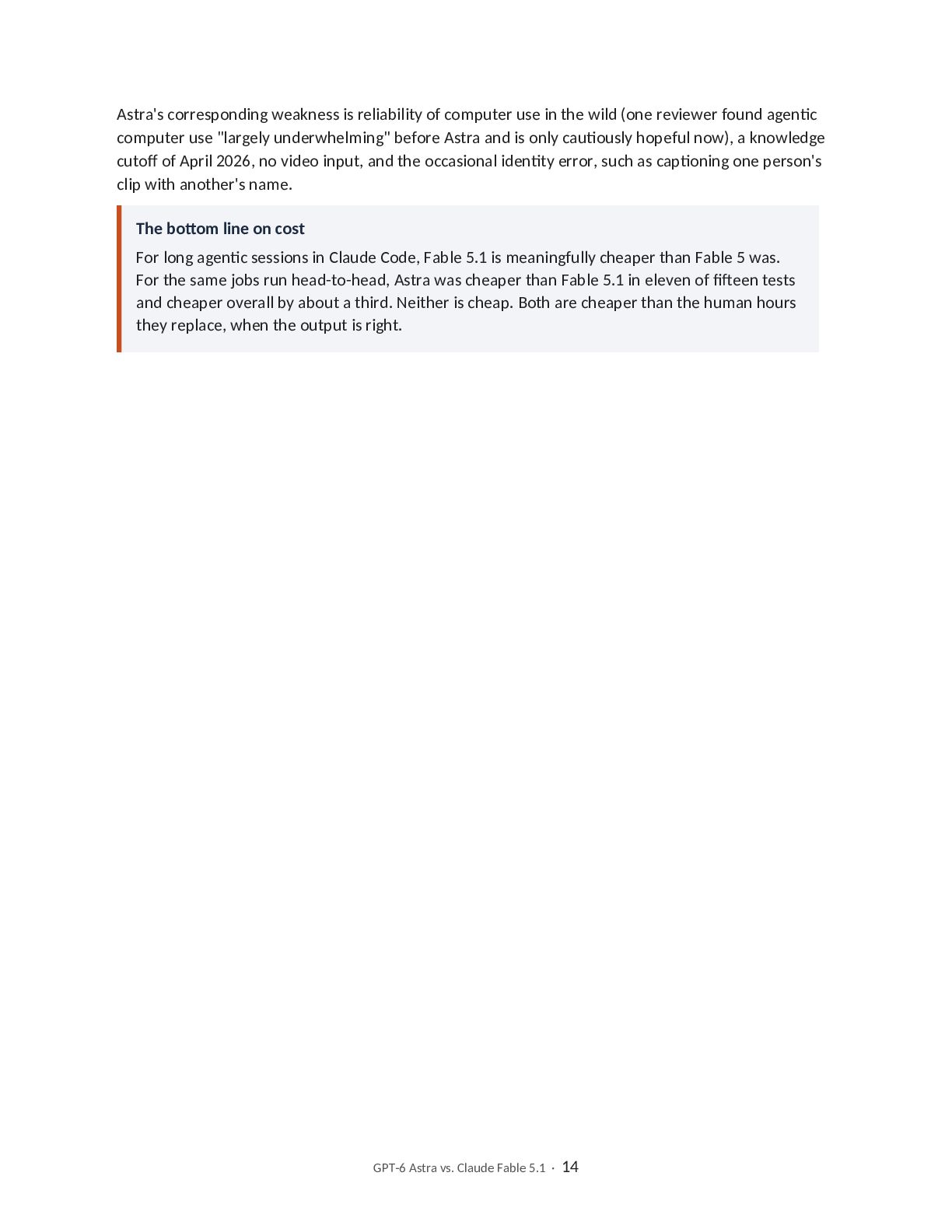
  13. Astra's corresponding weakness is reliability of computer use in the

    wild (one reviewer found agentic computer use "largely underwhelming" before Astra and is only cautiously hopeful now), a knowledge cutoff of April 2026, no video input, and the occasional identity error, such as captioning one person's clip with another's name. The bottom line on cost For long agentic sessions in Claude Code, Fable 5.1 is meaningfully cheaper than Fable 5 was. For the same jobs run head-to-head, Astra was cheaper than Fable 5.1 in eleven of fifteen tests and cheaper overall by about a third. Neither is cheap. Both are cheaper than the human hours they replace, when the output is right. GPT-6 Astra vs. Claude Fable 5.1 · 14
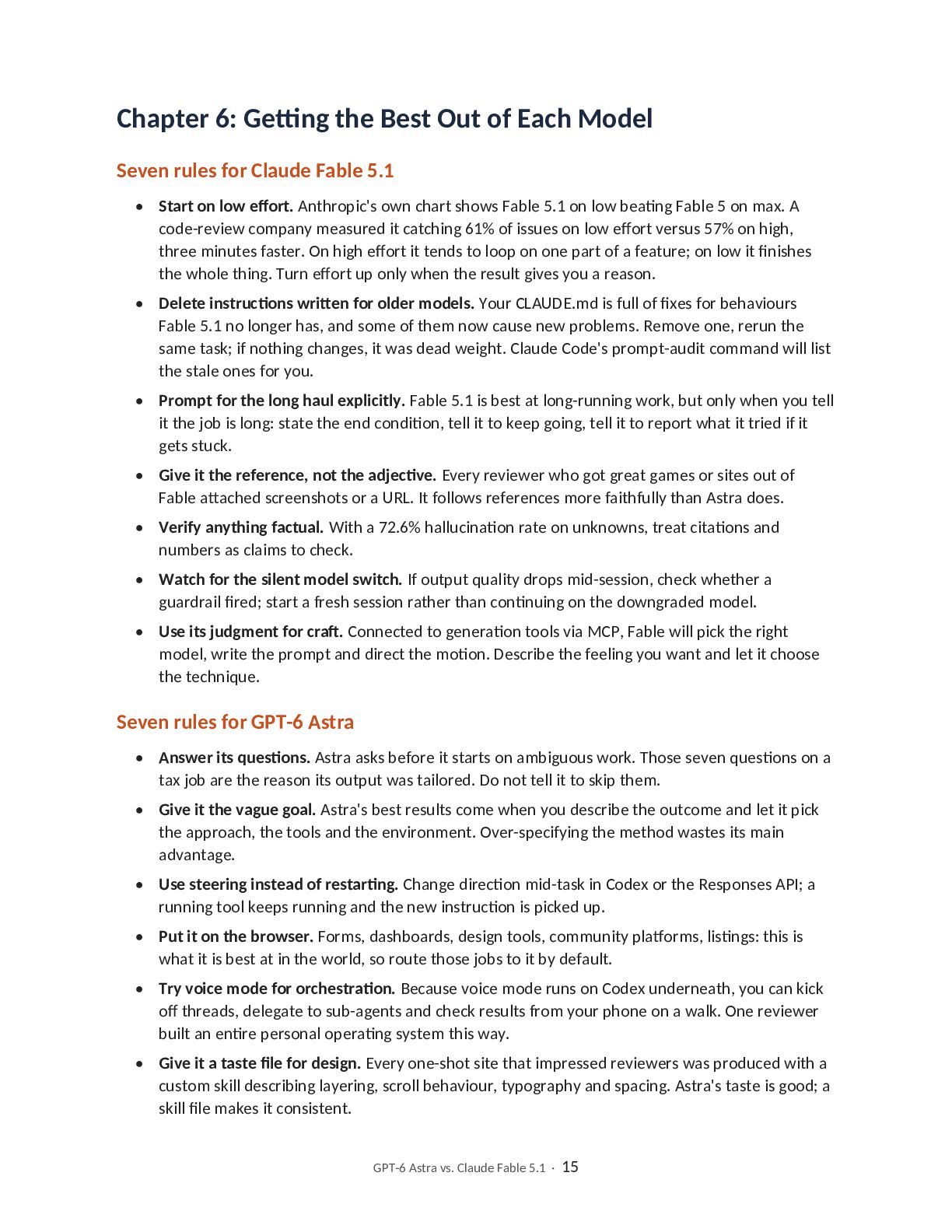
  14. Chapter 6: Getting the Best Out of Each Model Seven

    rules for Claude Fable 5.1 • Start on low effort. Anthropic's own chart shows Fable 5.1 on low beating Fable 5 on max. A code-review company measured it catching 61% of issues on low effort versus 57% on high, three minutes faster. On high effort it tends to loop on one part of a feature; on low it finishes the whole thing. Turn effort up only when the result gives you a reason. • Delete instructions written for older models. Your CLAUDE.md is full of fixes for behaviours Fable 5.1 no longer has, and some of them now cause new problems. Remove one, rerun the same task; if nothing changes, it was dead weight. Claude Code's prompt-audit command will list the stale ones for you. • Prompt for the long haul explicitly. Fable 5.1 is best at long-running work, but only when you tell it the job is long: state the end condition, tell it to keep going, tell it to report what it tried if it gets stuck. • Give it the reference, not the adjective. Every reviewer who got great games or sites out of Fable attached screenshots or a URL. It follows references more faithfully than Astra does. • Verify anything factual. With a 72.6% hallucination rate on unknowns, treat citations and numbers as claims to check. • Watch for the silent model switch. If output quality drops mid-session, check whether a guardrail fired; start a fresh session rather than continuing on the downgraded model. • Use its judgment for craft. Connected to generation tools via MCP, Fable will pick the right model, write the prompt and direct the motion. Describe the feeling you want and let it choose the technique. Seven rules for GPT-6 Astra • Answer its questions. Astra asks before it starts on ambiguous work. Those seven questions on a tax job are the reason its output was tailored. Do not tell it to skip them. • Give it the vague goal. Astra's best results come when you describe the outcome and let it pick the approach, the tools and the environment. Over-specifying the method wastes its main advantage. • Use steering instead of restarting. Change direction mid-task in Codex or the Responses API; a running tool keeps running and the new instruction is picked up. • Put it on the browser. Forms, dashboards, design tools, community platforms, listings: this is what it is best at in the world, so route those jobs to it by default. • Try voice mode for orchestration. Because voice mode runs on Codex underneath, you can kick off threads, delegate to sub-agents and check results from your phone on a walk. One reviewer built an entire personal operating system this way. • Give it a taste file for design. Every one-shot site that impressed reviewers was produced with a custom skill describing layering, scroll behaviour, typography and spacing. Astra's taste is good; a skill file makes it consistent. GPT-6 Astra vs. Claude Fable 5.1 · 15
  15. • Reach for the cheaper model first. Several reviewers say

    Soul is still more than enough for most knowledge work. Save Astra for jobs that need spatial reasoning, computer use or serious judgment. GPT-6 Astra vs. Claude Fable 5.1 · 16
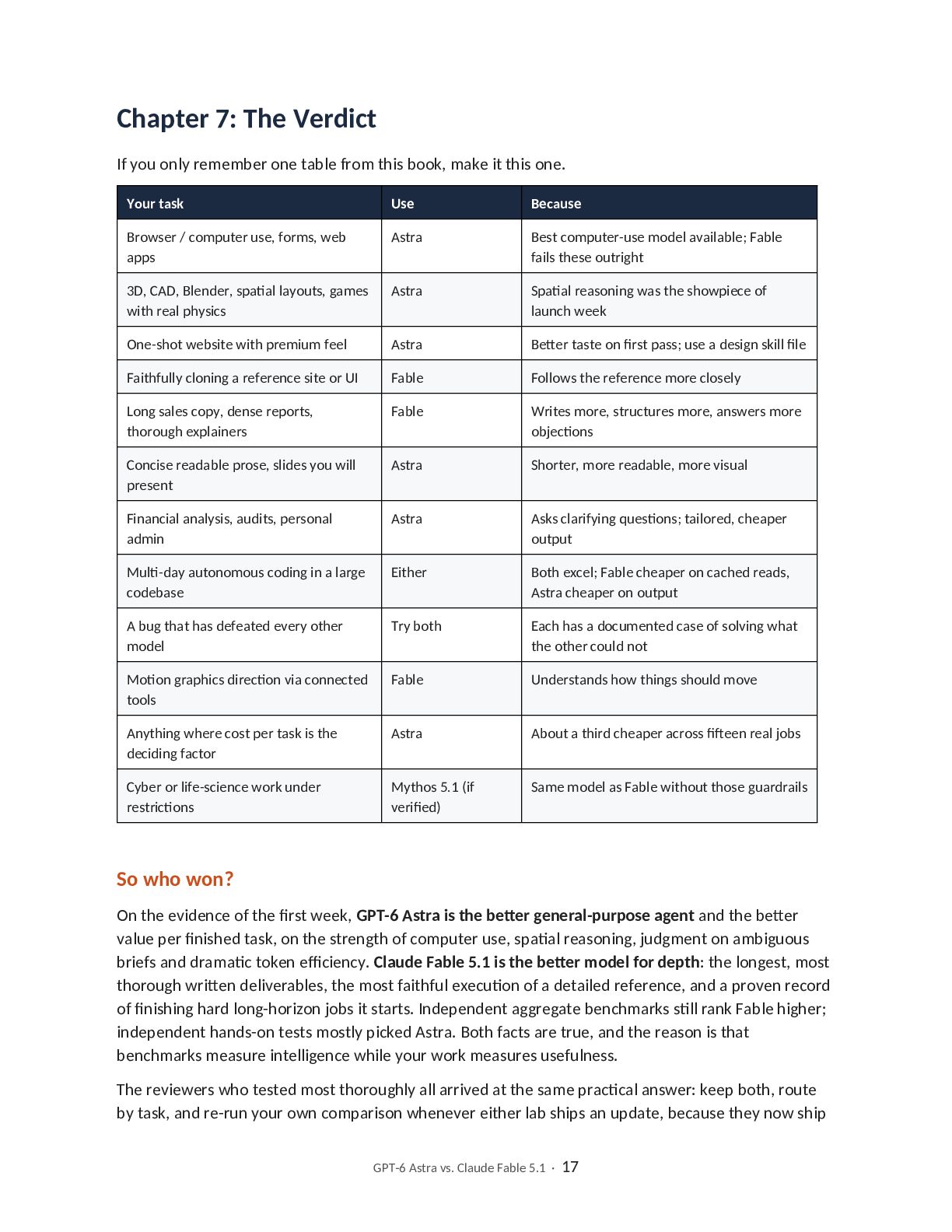
  16. Chapter 7: The Verdict If you only remember one table

    from this book, make it this one. Your task Use Because Browser / computer use, forms, web apps Astra Best computer-use model available; Fable fails these outright 3D, CAD, Blender, spatial layouts, games with real physics Astra Spatial reasoning was the showpiece of launch week One-shot website with premium feel Astra Better taste on first pass; use a design skill file Faithfully cloning a reference site or UI Fable Follows the reference more closely Long sales copy, dense reports, thorough explainers Fable Writes more, structures more, answers more objections Concise readable prose, slides you will present Astra Shorter, more readable, more visual Financial analysis, audits, personal admin Astra Asks clarifying questions; tailored, cheaper output Multi-day autonomous coding in a large codebase Either Both excel; Fable cheaper on cached reads, Astra cheaper on output A bug that has defeated every other model Try both Each has a documented case of solving what the other could not Motion graphics direction via connected tools Fable Understands how things should move Anything where cost per task is the deciding factor Astra About a third cheaper across fifteen real jobs Cyber or life-science work under restrictions Mythos 5.1 (if verified) Same model as Fable without those guardrails So who won? On the evidence of the first week, GPT-6 Astra is the better general-purpose agent and the better value per finished task, on the strength of computer use, spatial reasoning, judgment on ambiguous briefs and dramatic token efficiency. Claude Fable 5.1 is the better model for depth: the longest, most thorough written deliverables, the most faithful execution of a detailed reference, and a proven record of finishing hard long-horizon jobs it starts. Independent aggregate benchmarks still rank Fable higher; independent hands-on tests mostly picked Astra. Both facts are true, and the reason is that benchmarks measure intelligence while your work measures usefulness. The reviewers who tested most thoroughly all arrived at the same practical answer: keep both, route by task, and re-run your own comparison whenever either lab ships an update, because they now ship GPT-6 Astra vs. Claude Fable 5.1 · 17
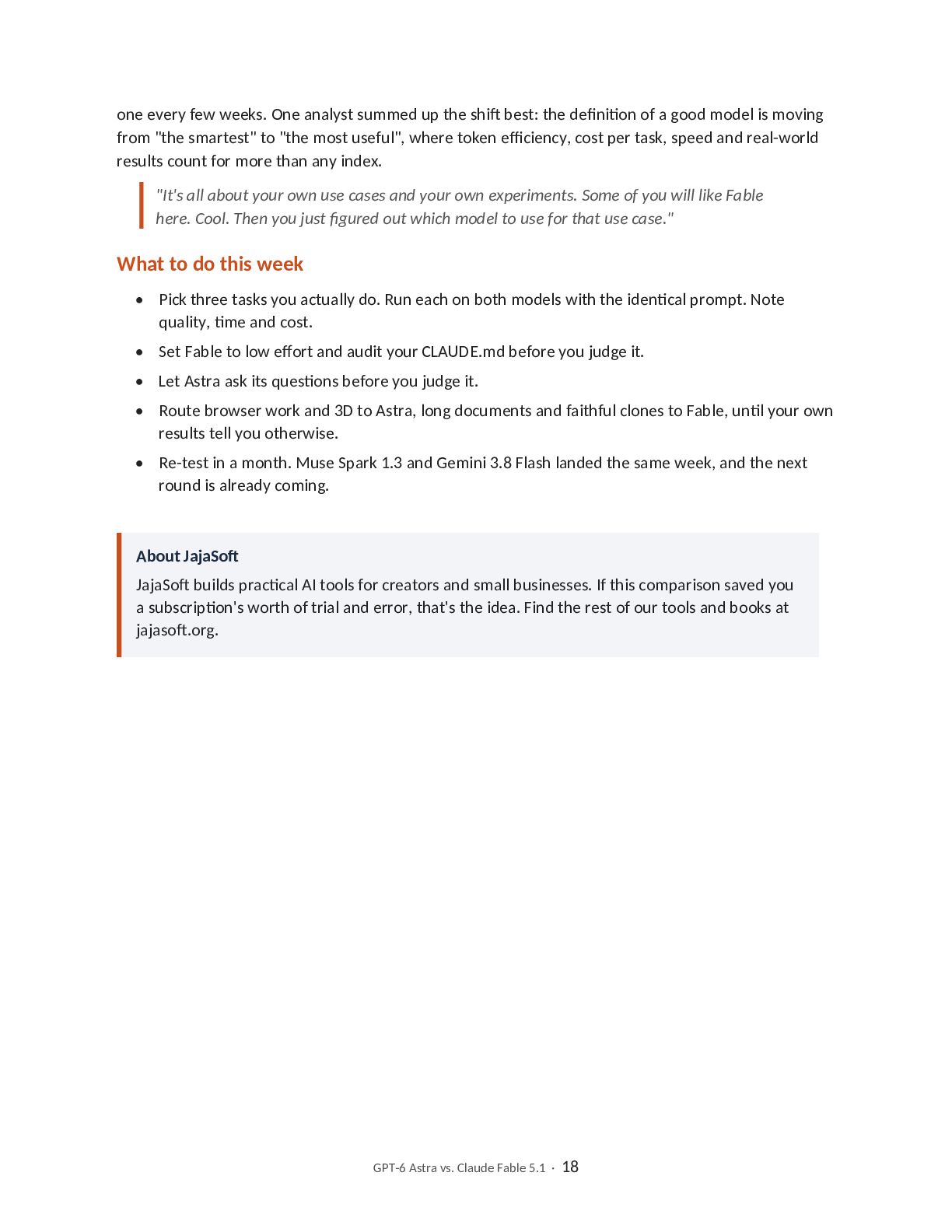
  17. one every few weeks. One analyst summed up the shift

    best: the definition of a good model is moving from "the smartest" to "the most useful", where token efficiency, cost per task, speed and real-world results count for more than any index. "It's all about your own use cases and your own experiments. Some of you will like Fable here. Cool. Then you just figured out which model to use for that use case." What to do this week • Pick three tasks you actually do. Run each on both models with the identical prompt. Note quality, time and cost. • Set Fable to low effort and audit your CLAUDE.md before you judge it. • Let Astra ask its questions before you judge it. • Route browser work and 3D to Astra, long documents and faithful clones to Fable, until your own results tell you otherwise. • Re-test in a month. Muse Spark 1.3 and Gemini 3.8 Flash landed the same week, and the next round is already coming. About JajaSoft JajaSoft builds practical AI tools for creators and small businesses. If this comparison saved you a subscription's worth of trial and error, that's the idea. Find the rest of our tools and books at jajasoft.org. GPT-6 Astra vs. Claude Fable 5.1 · 18