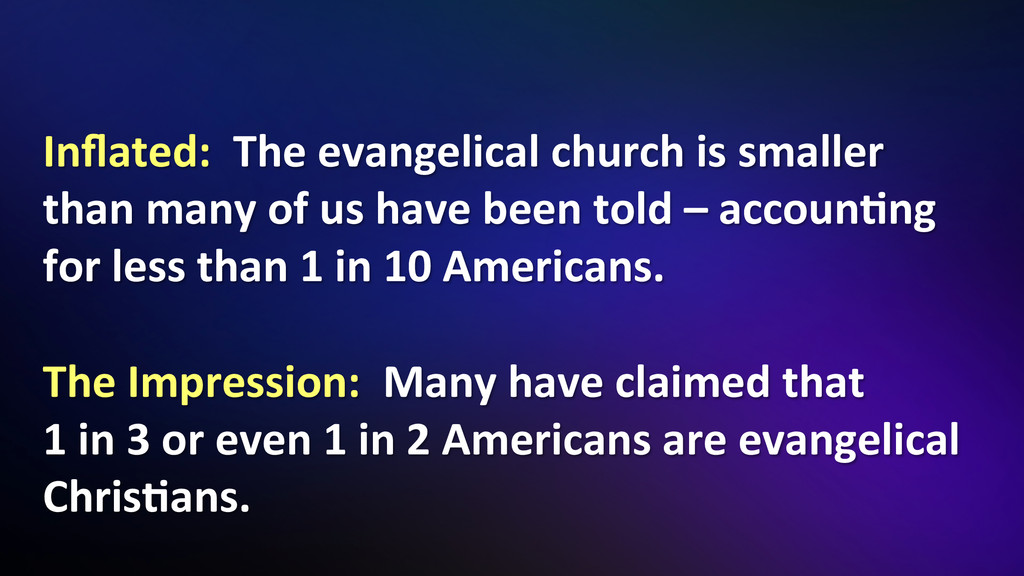
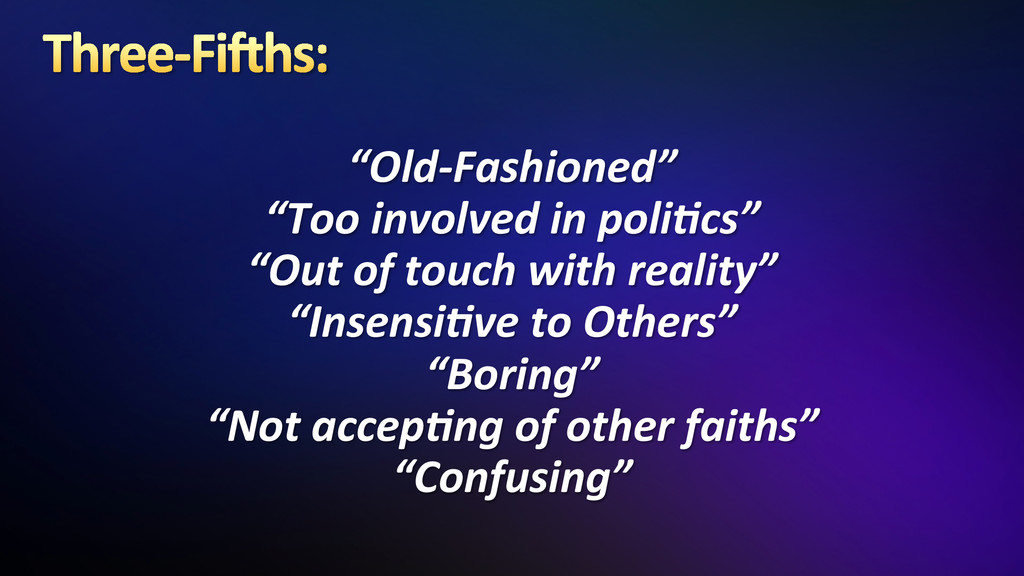
of us have been told – accounGng for less than 1 in 10 Americans. The Impression: Many have claimed that 1 in 3 or even 1 in 2 Americans are evangelical ChrisGans.
populaGon, less than 1 in 10. If every evangelical moved to New York State, there would not be a single evangelical among the roughly 300 million Americans in the other 49 states.
the enGre United States than there are Muslims in greater Cairo. Evangelical populaGon esGmates by Dr. ChrisGan Smith, Notre Dame, The Barna Group, American Church Research Project.
to the Church in their 30s, the majority no longer do. Those who return oben suffer from divorce and a decade of lifestyle habits made apart from Christ. Youth TransiGon Network, Lifeway
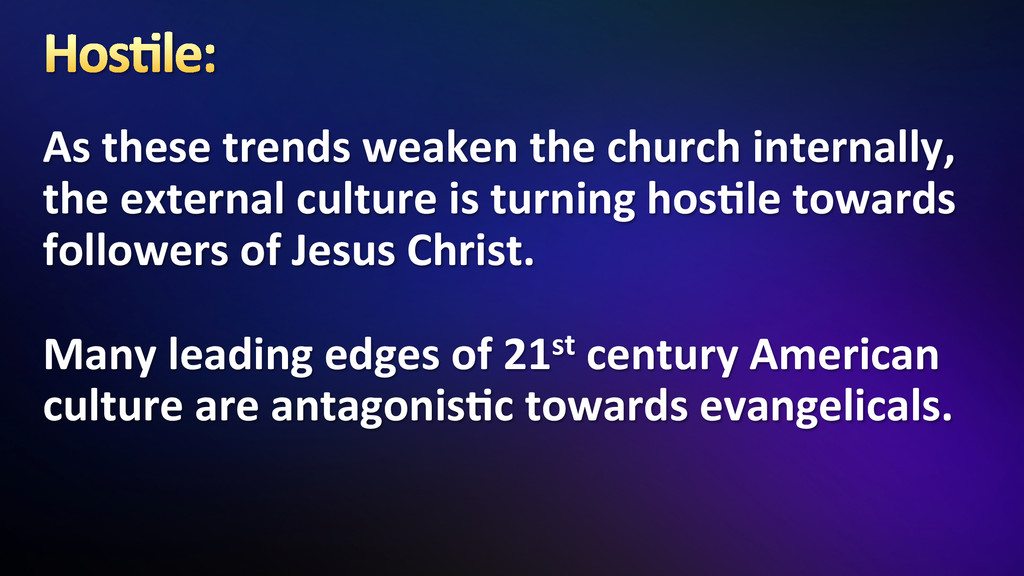
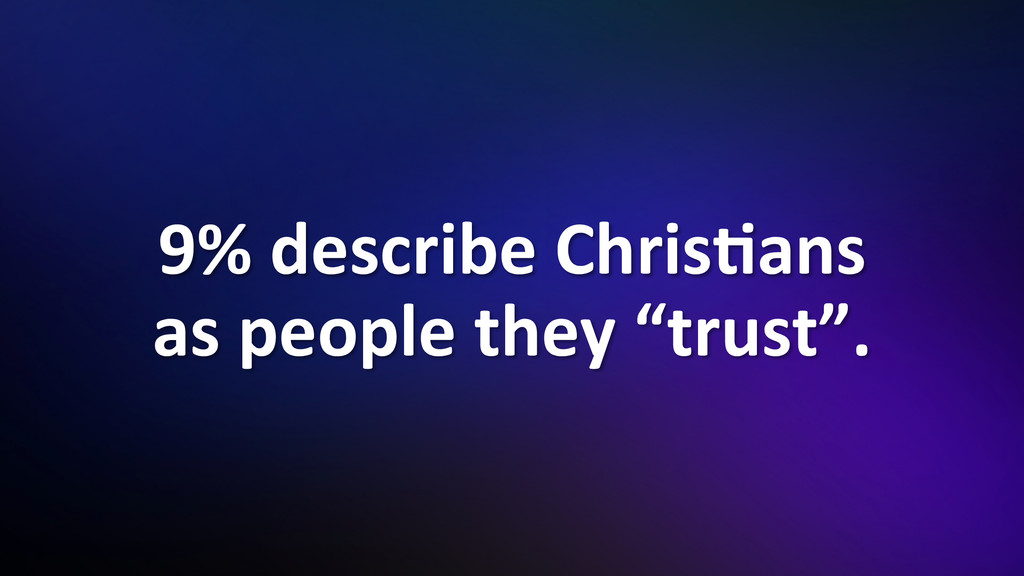
college and university professors if they had “unfavorable feelings” toward various religions. 3% held unfavorable feelings for Jews. 9% held unfavorable feelings for non-evangelical Christians. 22% held unfavorable feelings for Muslims. 53% held unfavorable views toward evangelical Christians. Alan Cooperman, “Is There Disdain for Evangelicals in the Classroom?,” The Washington Post, May 5, 2007
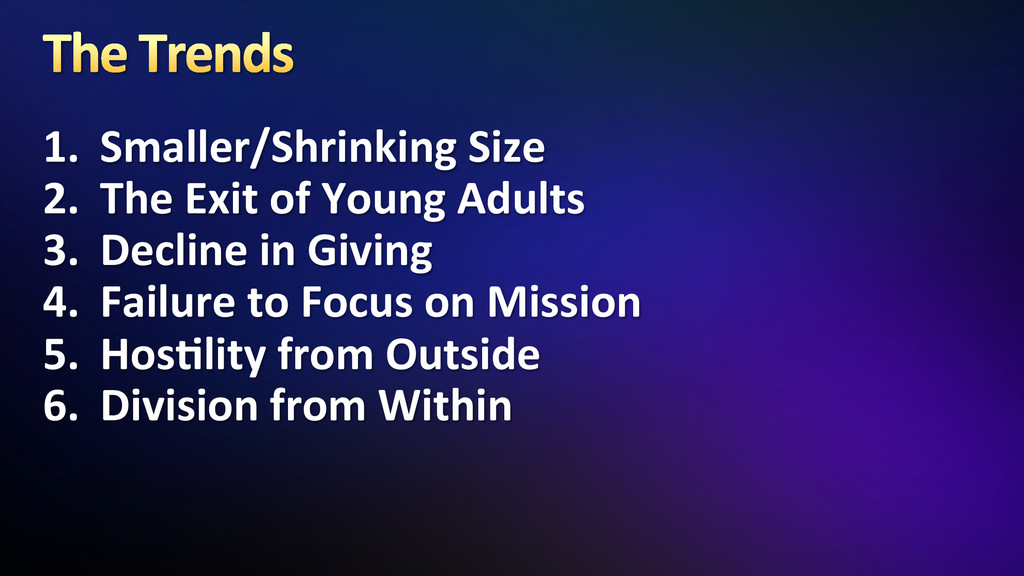
groups of evangelicals are sharply divided over how to respond to the rapidly changing culture. As a result, evangelicals are infighGng when we most need to be uniGng.
Gthing and supporGng evangelical works, conGnues to decline. 17% of ChrisGans say they “Gthe” but only 3% actually give 10% or more of their income to the Lord’s work. Brian Kluth, Kingdom Seekers
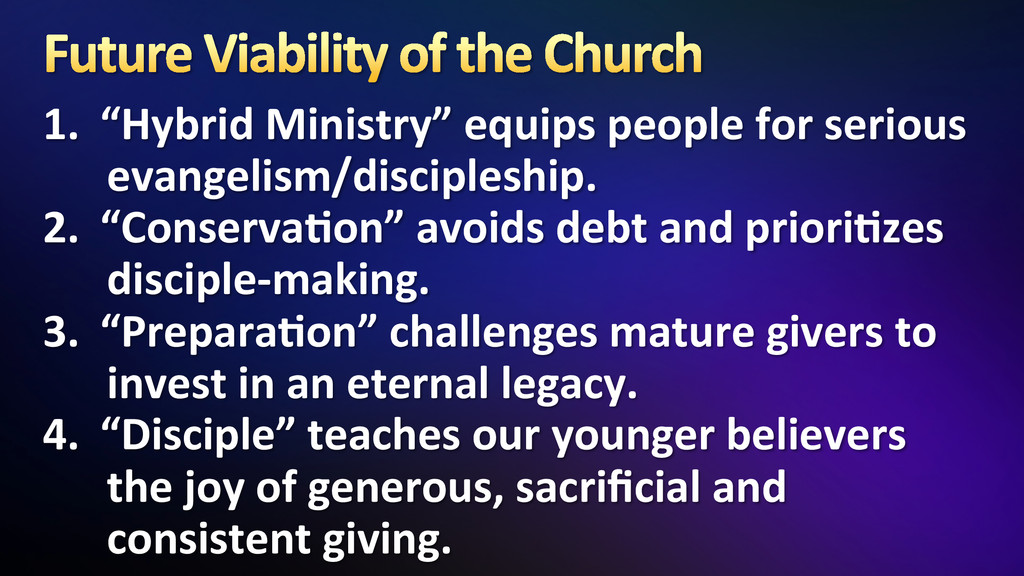
2. “ConservaGon” avoids debt and prioriGzes disciple-‐making. 3. “PreparaGon” challenges mature givers to invest in an eternal legacy. 4. “Disciple” teaches our younger believers the joy of generous, sacrificial and consistent giving.
and worshippers, who are increasingly transformed by God’s grace and Holy Spirit to become more like Jesus, and whose hearts, minds, relaGonships and lifestyles reflect the character and mission of Jesus. “Follow me and I will make you fishers of people.”
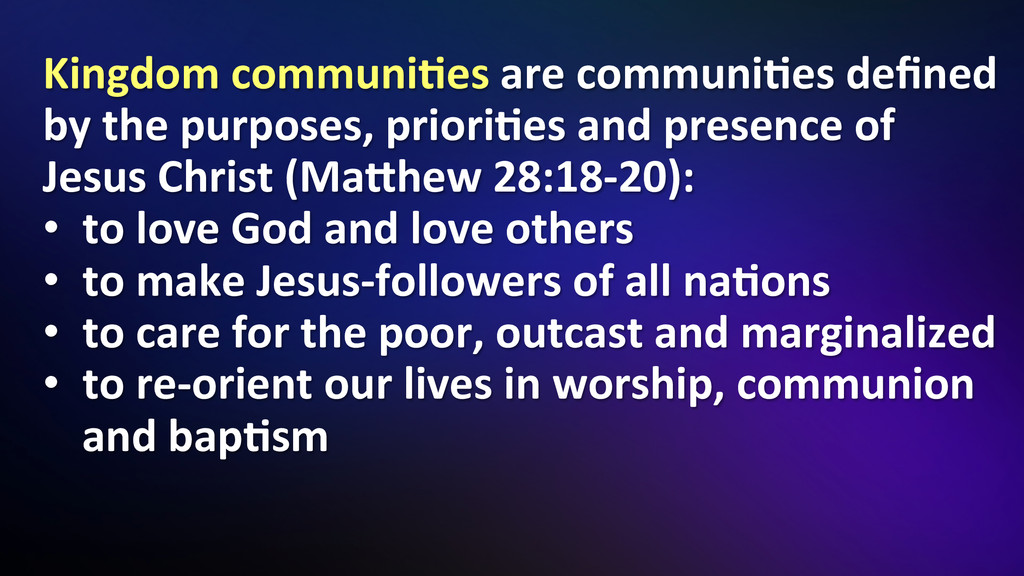
and presence of Jesus Christ (Manhew 28:18-‐20): • to love God and love others • to make Jesus-‐followers of all naGons • to care for the poor, outcast and marginalized • to re-‐orient our lives in worship, communion and bapGsm
globally • to sit under the authority of God’s Word as it is regularly taught • to reproduce other thriving kingdom communiGes • to foster a partnership of generaGons to fulfill God’s mission in the world
to others what God has given to us; is our recogniGon that God is at work in the world and is looking for cooperaGve parGcipants in His mission; is our idenGty as ambassadors and missionaries to our world.
on Mission :: We believe that the church exists to parGcipate in the mission of God in Christ by redempGvely engaging all aspects of society with the intent of proclaiming and demonstraGng the good news about Jesus Christ. We believe all of God’s people are called to be ambassadors of
Kingdom of God (God’s rule and authority manifest on earth) was (and is) the focus of the work and teaching of Jesus on earth. Our purpose as His community is to parGcipate with God in the advancement and extension of His kingdom into the world. We seek to serve His
is the most important authority for life and faith. We believe that the Bible is to be read and studied for formaGon, not just informaGon. We seek to be culturally relevant in our teaching while remaining faithful to the inspired text. We recognize the centrality of
church to be a spiritual family where all are welcome and loved. We believe that transformaGon happens best when people meet and are honest and vulnerable with each other, speaking the truth to each other in love. We believe the best expressions of community
people from all ethniciGes, generaGons and socio-‐economic statuses. We believe that the church is a picture of the new humanity, where previous ways of dividing humanity no longer apply in Christ.
believe in the power of God’s grace to transform lives, and reject anempts to legislate the ChrisGan life through human rules. We respect differences of theology and pracGce in nonessenGals and secondary maners. We seek to deal with issues redempGvely and allow
in the gibs, power, and presence of the Holy Spirit to bring about the transformaGon of God’s people. We believe that God is the iniGator of worship and mission. We believe the calling of God’s people is to parGcipate with God in His work in the world.
a theology of reacGon regarding the role of the Holy Spirit today. We seek the Holy Spirit’s filling and empowering without dictaGng how that should occur.
each person has a unique contribuGon to make in God’s Kingdom, and that the role of the church is to inspire, teach and empower people for ministry in whatever place in life that God has called them. We oppose anything that places limits on the
(or ‘clergy’ and ‘laity’) disGncGons common to American church culture. We seek to grow a courageous, generous and faithful community that emphasizes lifelong learning and development, the discovery and pracGce of spiritual gibs, and decentralized ministry.
organizaGon and organism; therefore, we seek to be pracGcal and wise, while at the same Gme expecGng and praying that God would move, speak and lead us in surprising ways. We believe in prayer meeGngs and planning meeGngs. We want to be spiritual and spirit-‐led while at the same Gme being diligent and strategic.
both cultural withdrawal and cultural accommodaGon. We desire to be discerningly and selecGvely engaged in culture without being formed by its prioriGes and values. We seek to be a propheGc alternaGve to the ideals and ways of the world without
marginalized :: We believe we best embody the heart of God to the world by serving the poor and marginalized. We believe the wealthy need the poor as much as much as the poor need the wealthy. We seek to be known for our
injusGces of our world by showing love in pracGcal, tangible ways. We believe the church is to seek the public good and promote human flourishing in every sphere of human society.
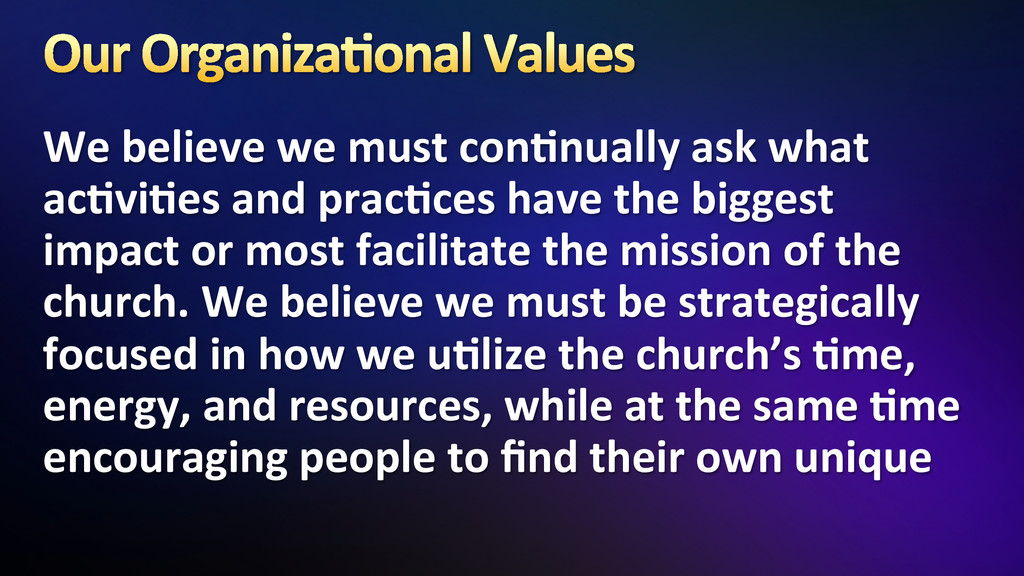
pracGces have the biggest impact or most facilitate the mission of the church. We believe we must be strategically focused in how we uGlize the church’s Gme, energy, and resources, while at the same Gme encouraging people to find their own unique
and ministry of the church should exist in harmony with and in support of the overall mission of the church. We believe in focused, simple, and flexible ministry structures in order to best facilitate mission and the empowerment of people.
we’ll value: 1. Alignment around common mission 2. Risk/experimentaGon that leads to innovaGon 3. CreaGng adaptable, flexible and simple structures 4. SimplificaGon that leads to greater focus and empowerment
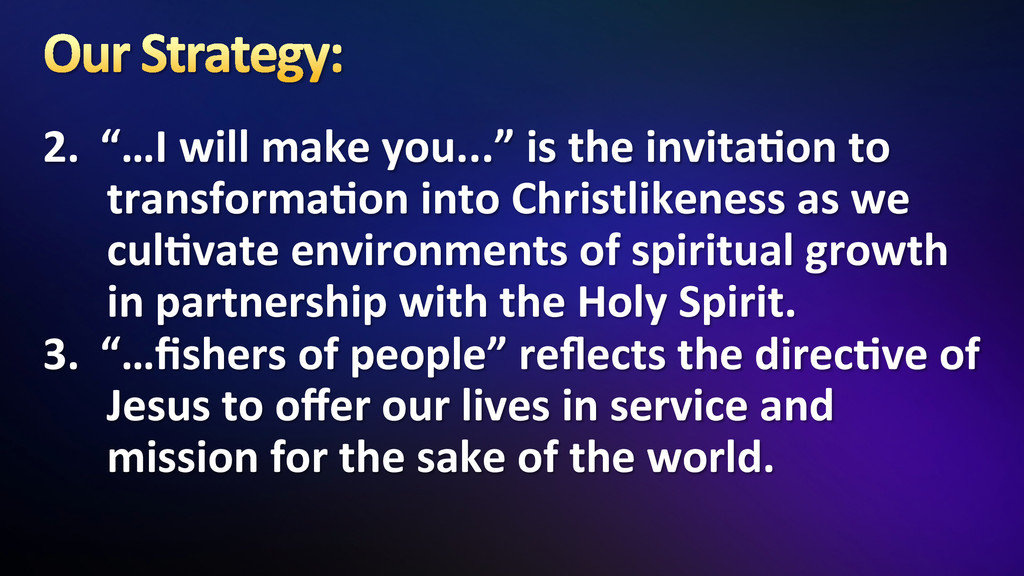
transformaGon into Christlikeness as we culGvate environments of spiritual growth in partnership with the Holy Spirit. 3. “…fishers of people” reflects the direcGve of Jesus to offer our lives in service and mission for the sake of the world.


 evfreefullerton
 tbpgr
 emi0726
 asiaquest
 chibanba1982
 loglass2019
 tsogo817421
 o2mami
 flux
 smartcamp
 sixtypercent
 smartgate
 inesmontani
 bcantrill
 denniskardys
 kastner
 techseoconnect
 bkeepers
 andyhume
 tammyeverts
 chriscoyier
 jacobtomlinson
 lara
 trishagee