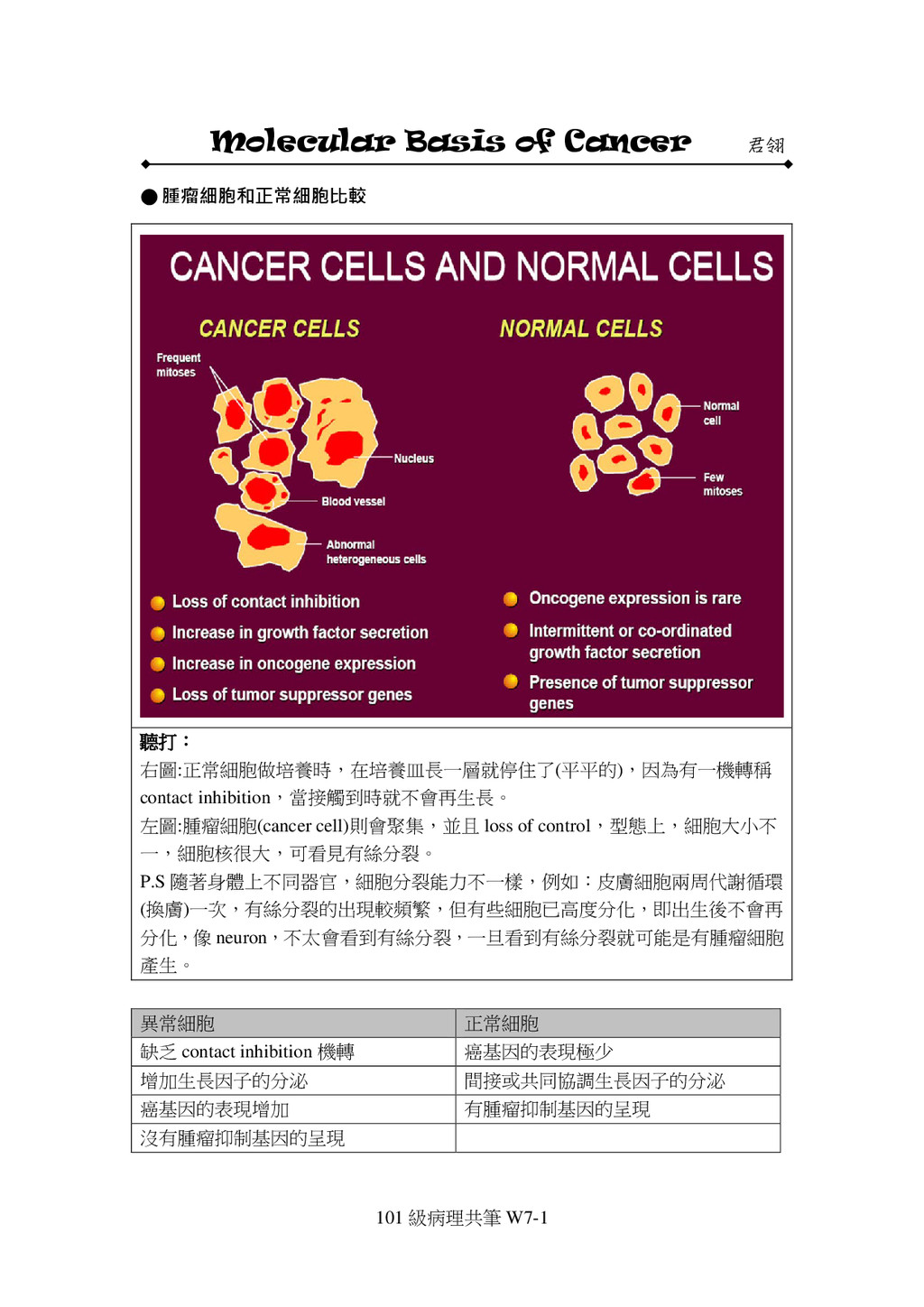
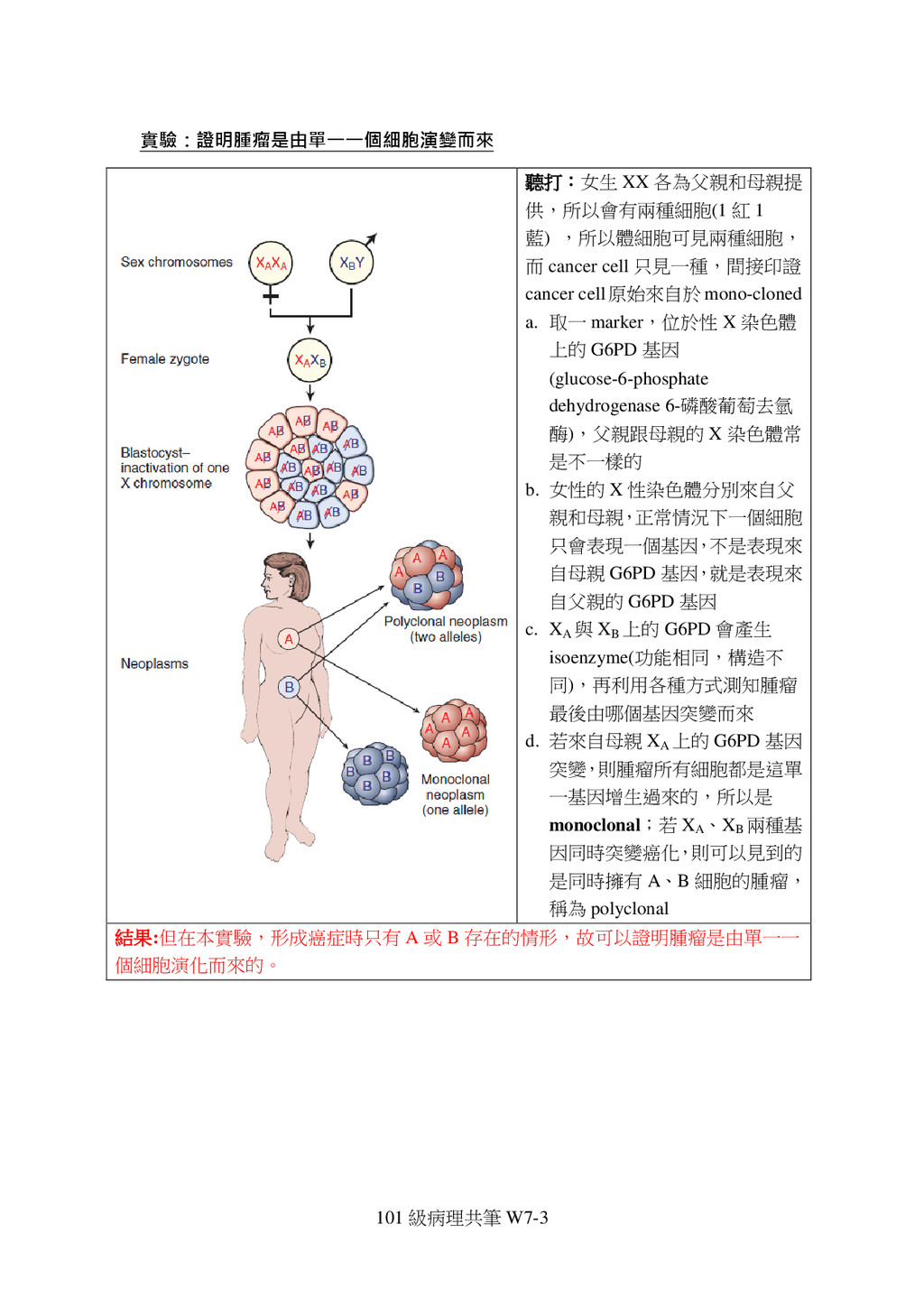
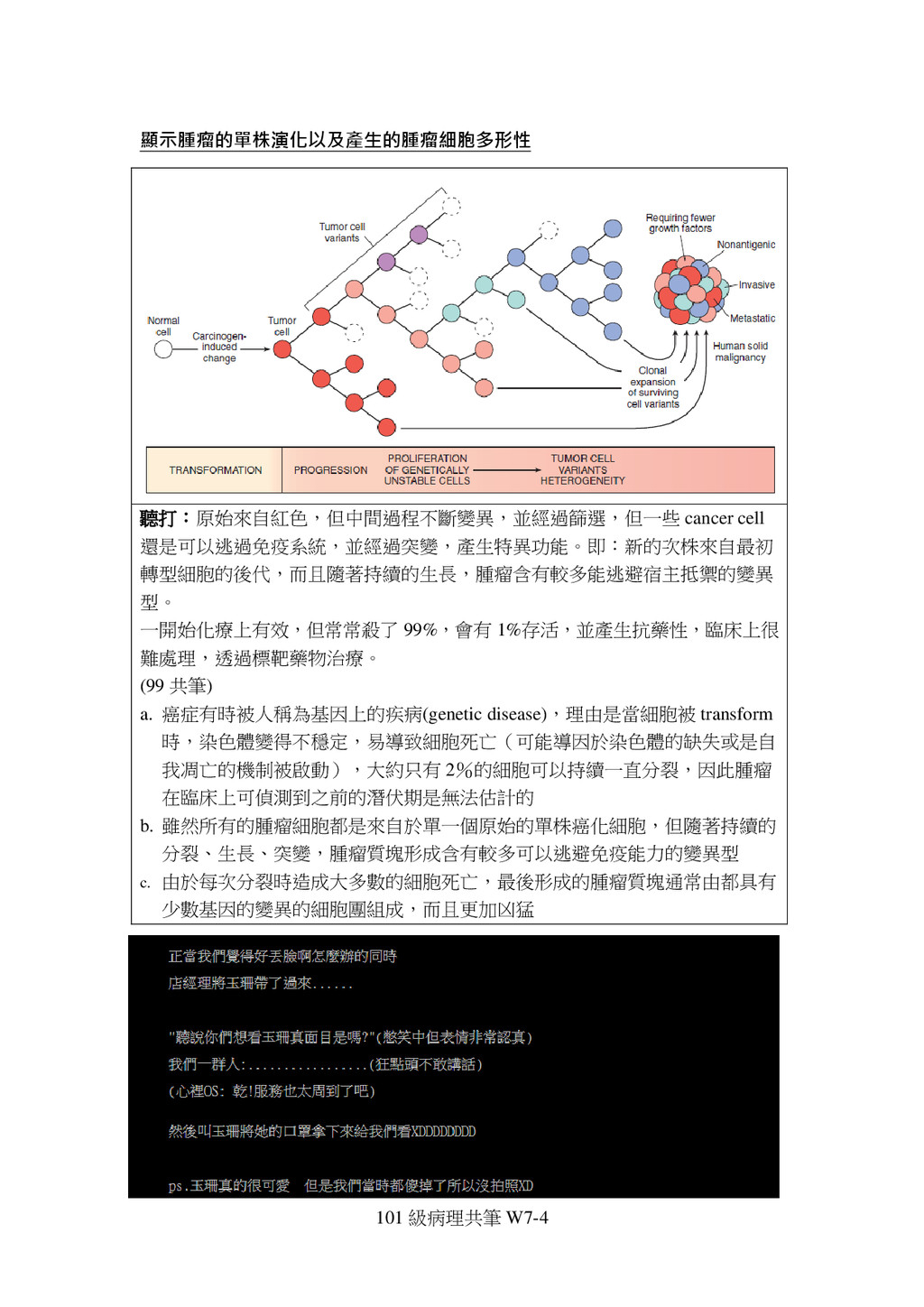
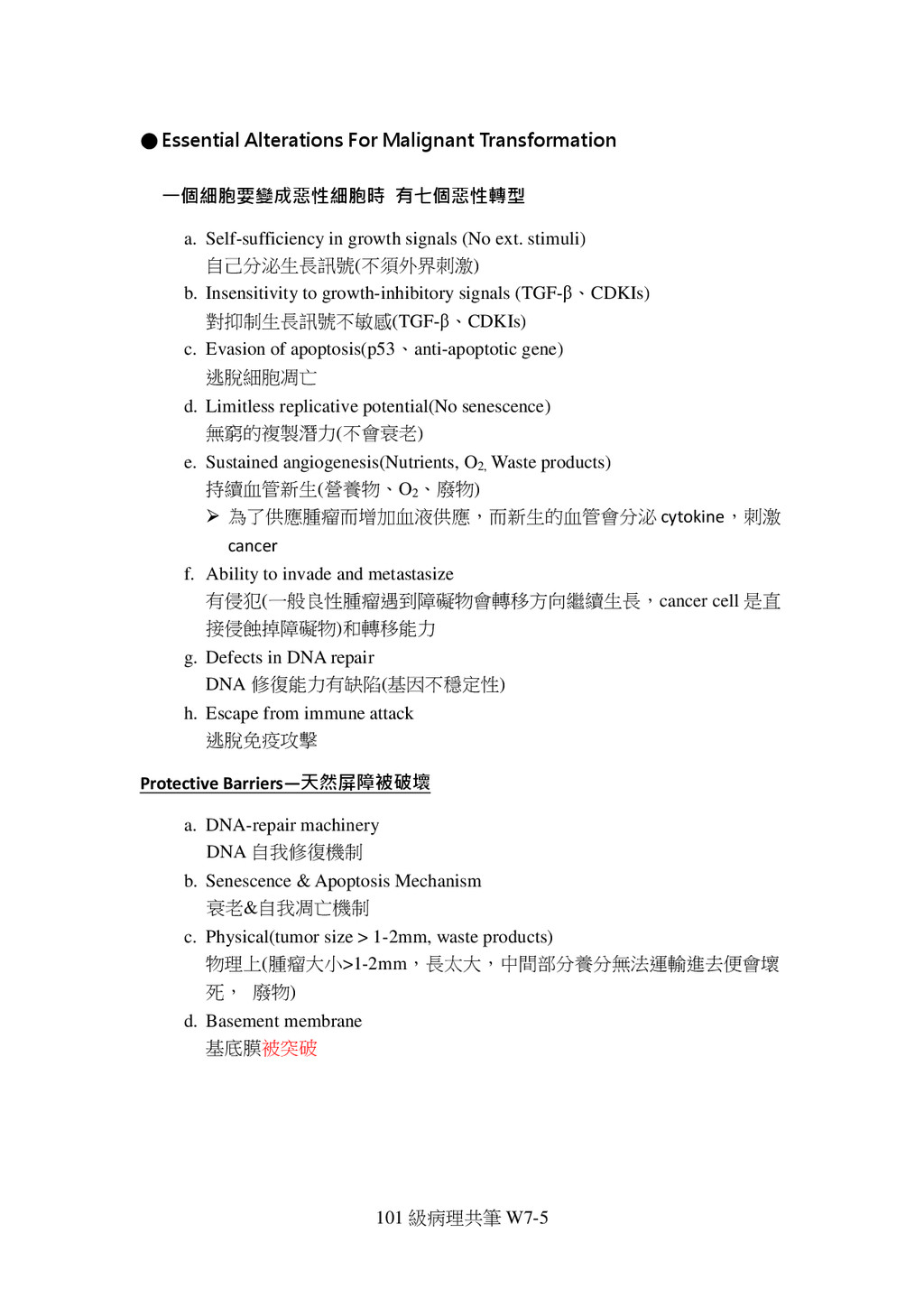
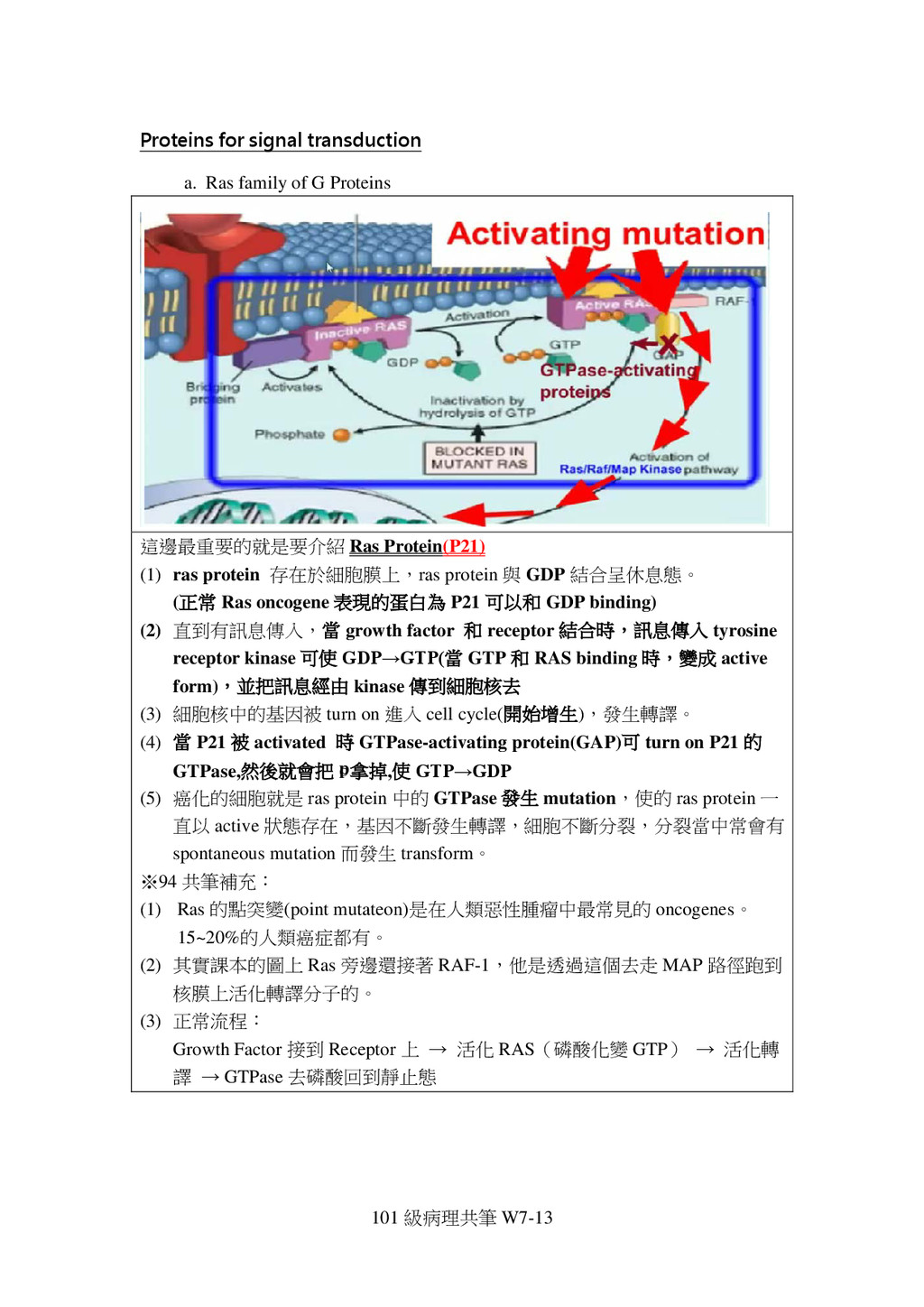
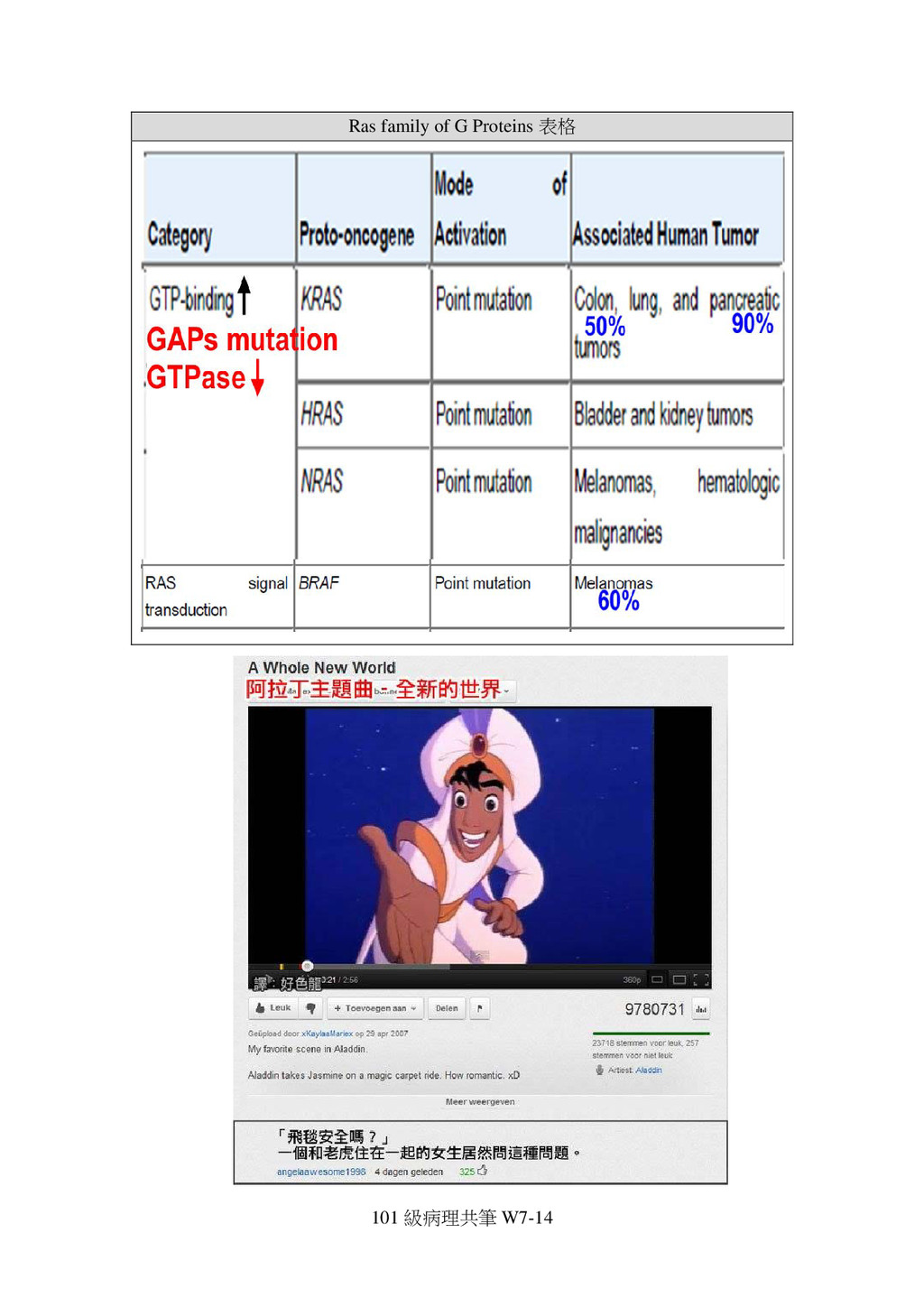
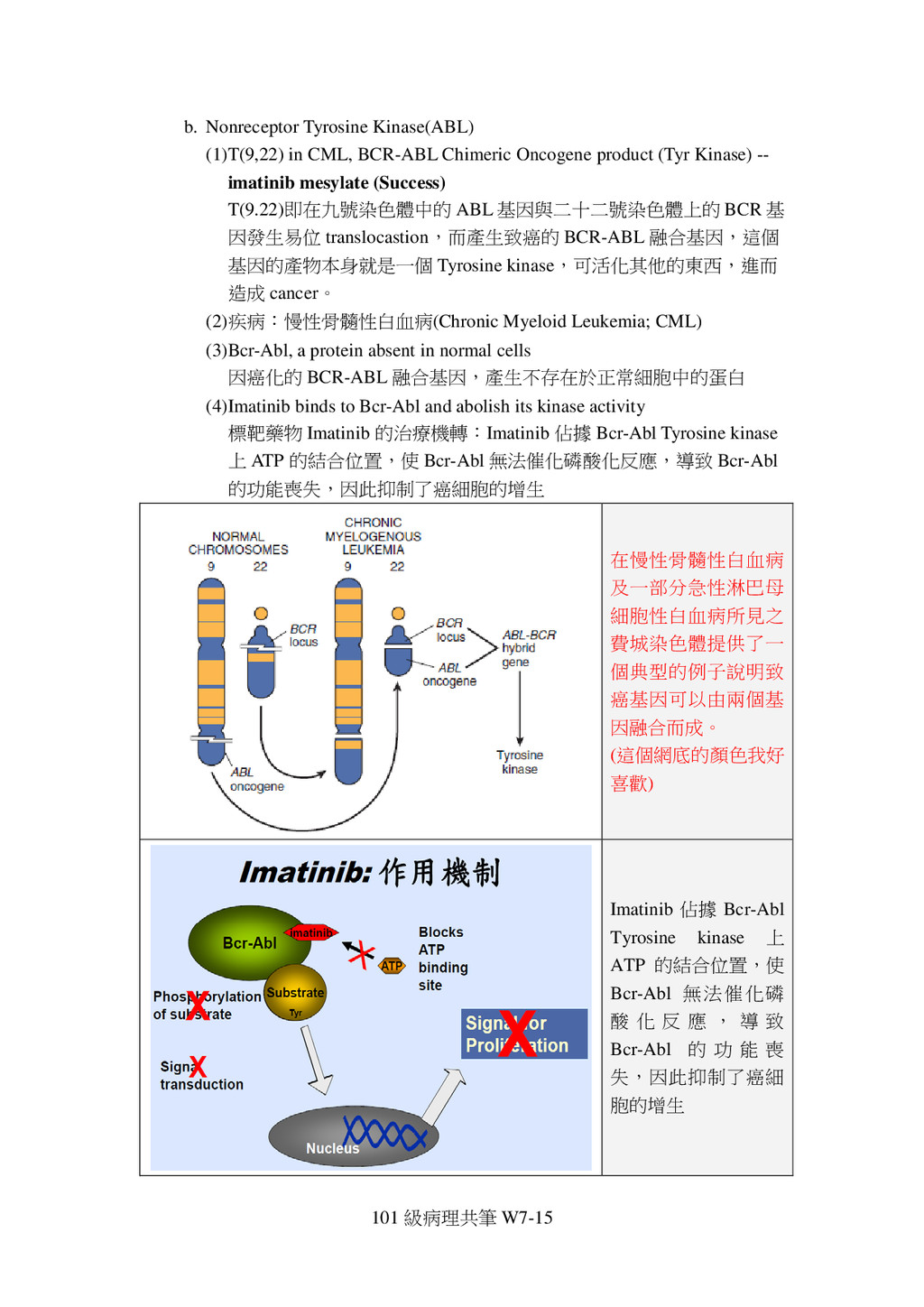
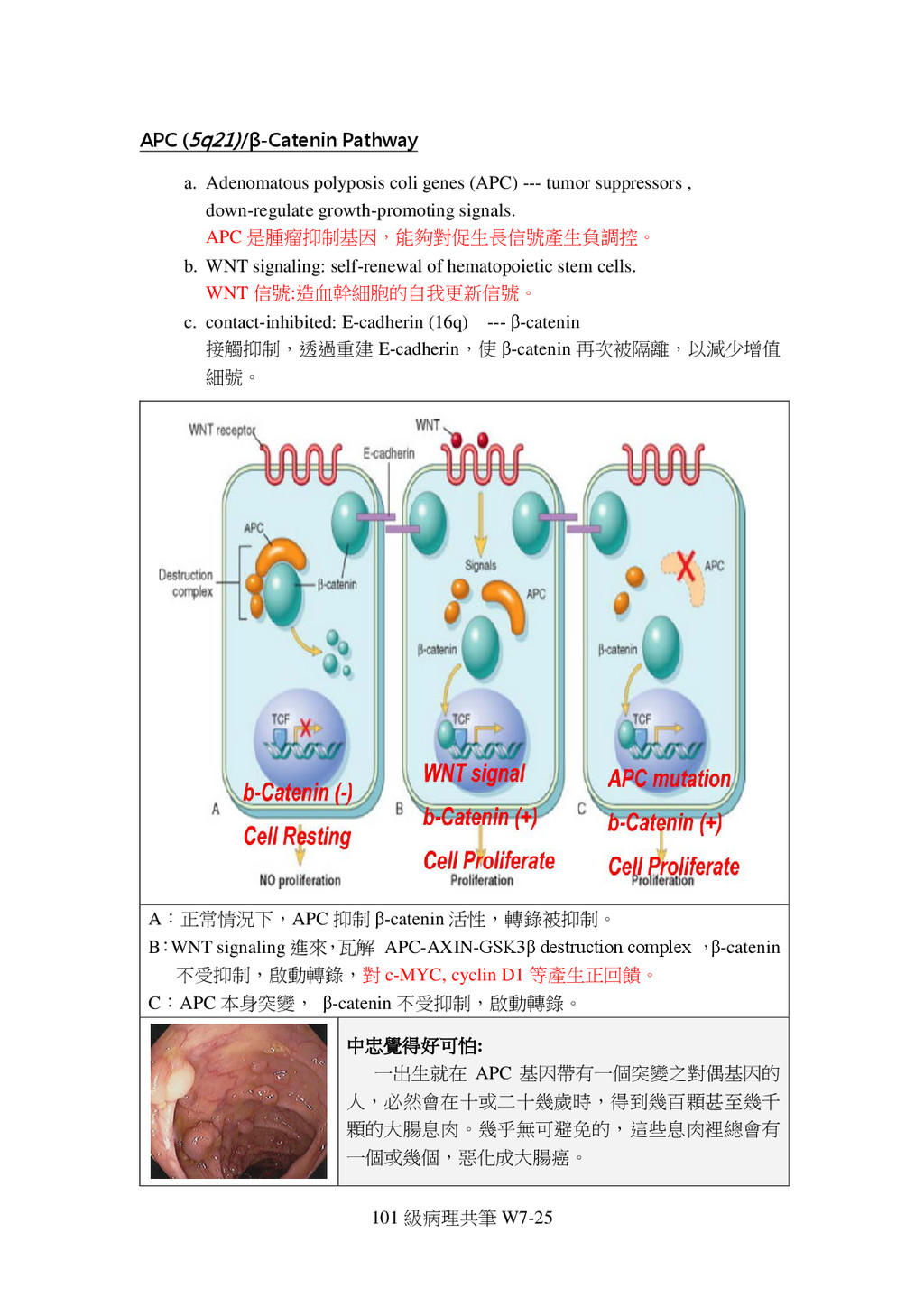
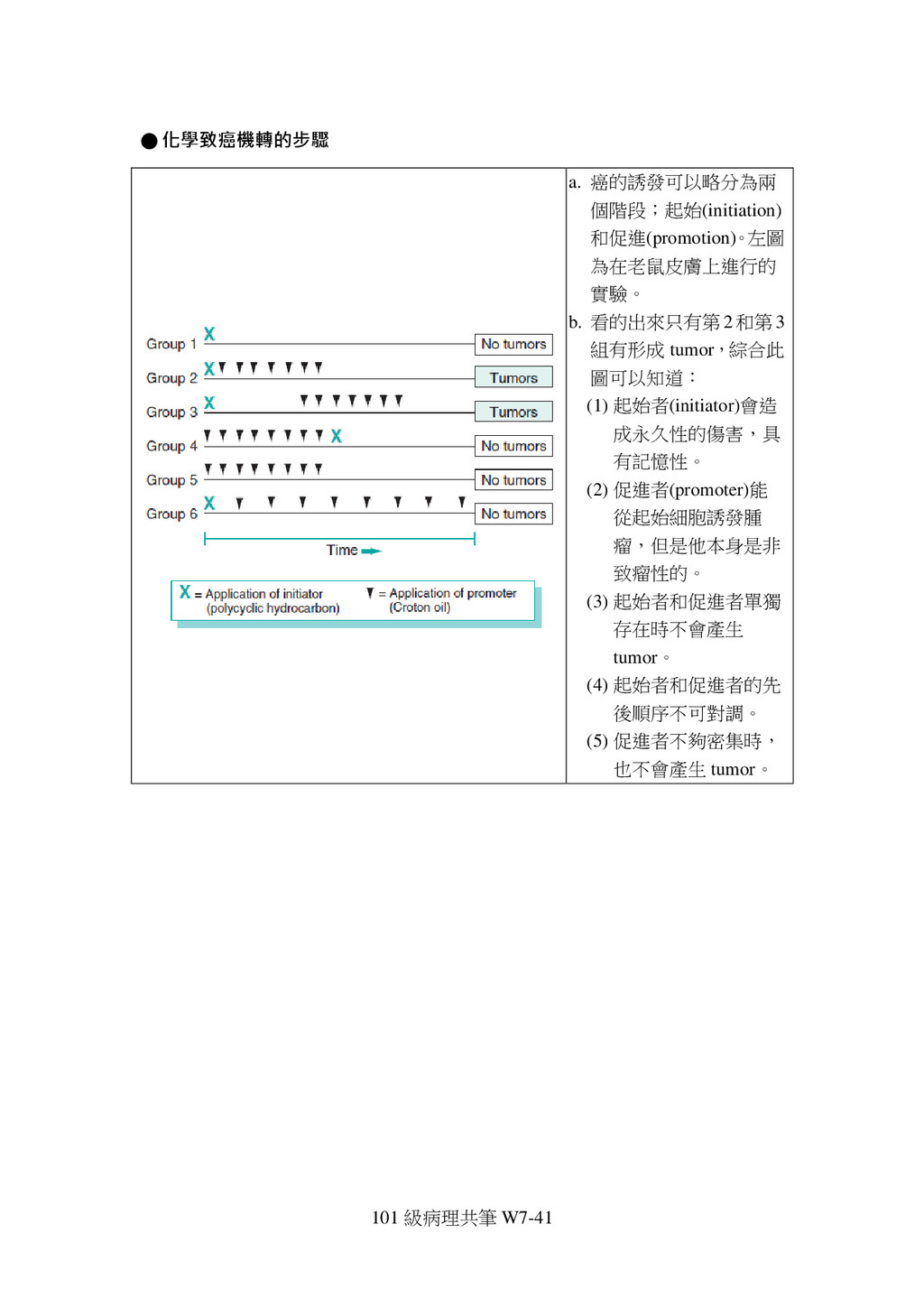
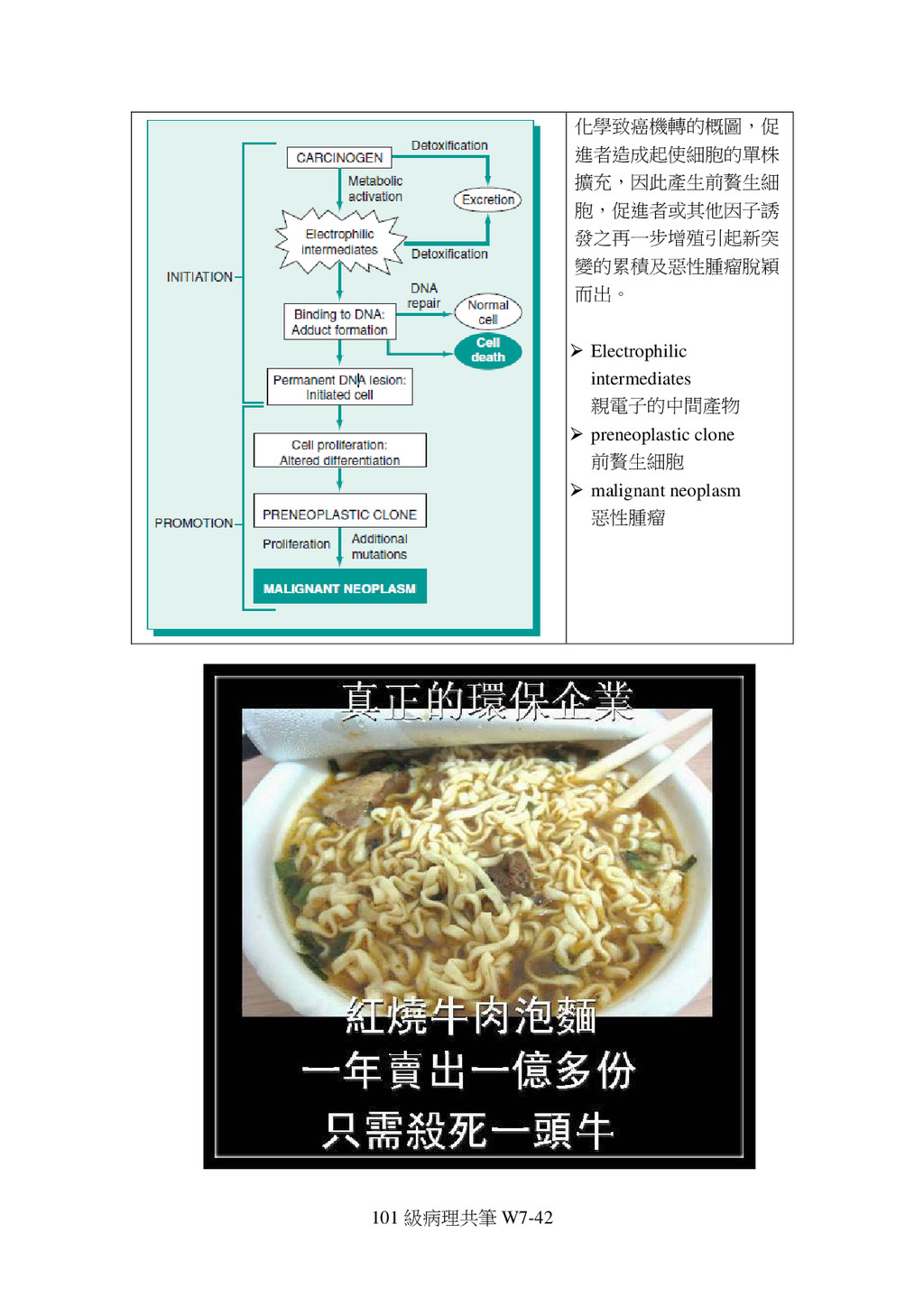
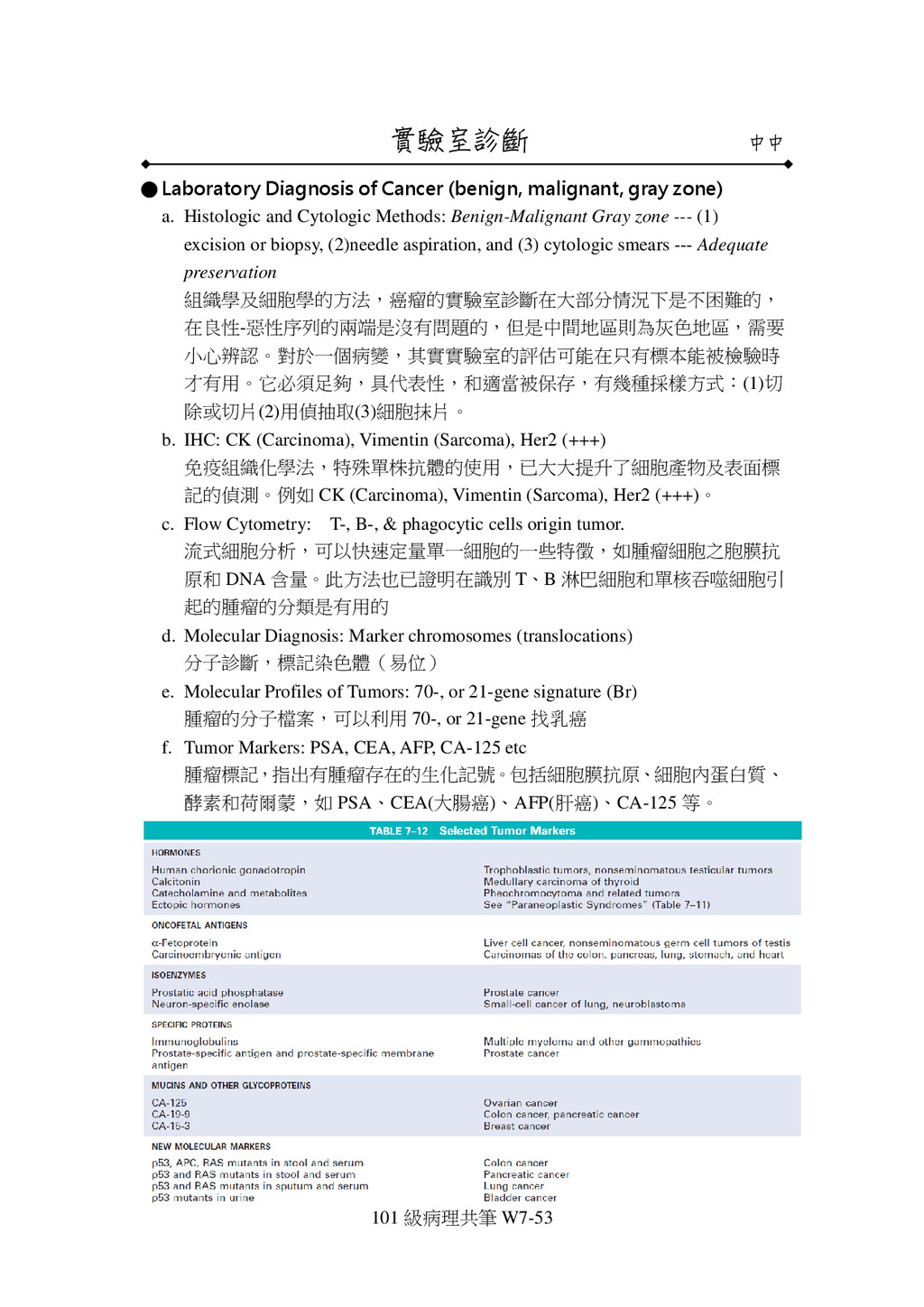
in growth signals (No ext. stimuli) 自己分泌生長訊號(不須外界刺激) b. Insensitivity to growth-inhibitory signals (TGF-β、CDKIs) 對抑制生長訊號不敏感(TGF-β、CDKIs) c. Evasion of apoptosis(p53、anti-apoptotic gene) 逃脫細胞凋亡 d. Limitless replicative potential(No senescence) 無窮的複製潛力(不會衰老) e. Sustained angiogenesis(Nutrients, O2, Waste products) 持續血管新生(營養物、O2、廢物) 為了供應腫瘤而增加血液供應,而新生的血管會分泌 cytokine,刺激 cancer f. Ability to invade and metastasize 有侵犯(一般良性腫瘤遇到障礙物會轉移方向繼續生長,cancer cell 是直 接侵蝕掉障礙物)和轉移能力 g. Defects in DNA repair DNA 修復能力有缺陷(基因不穩定性) h. Escape from immune attack 逃脫免疫攻擊 Protective Barriers—天然屏障被破壞 a. DNA-repair machinery DNA 自我修復機制 b. Senescence & Apoptosis Mechanism 衰老&自我凋亡機制 c. Physical(tumor size > 1-2mm, waste products) 物理上(腫瘤大小>1-2mm,長太大,中間部分養分無法運輸進去便會壞 死, 廢物) d. Basement membrane 基底膜被突破 101 級病理共筆 W7-5
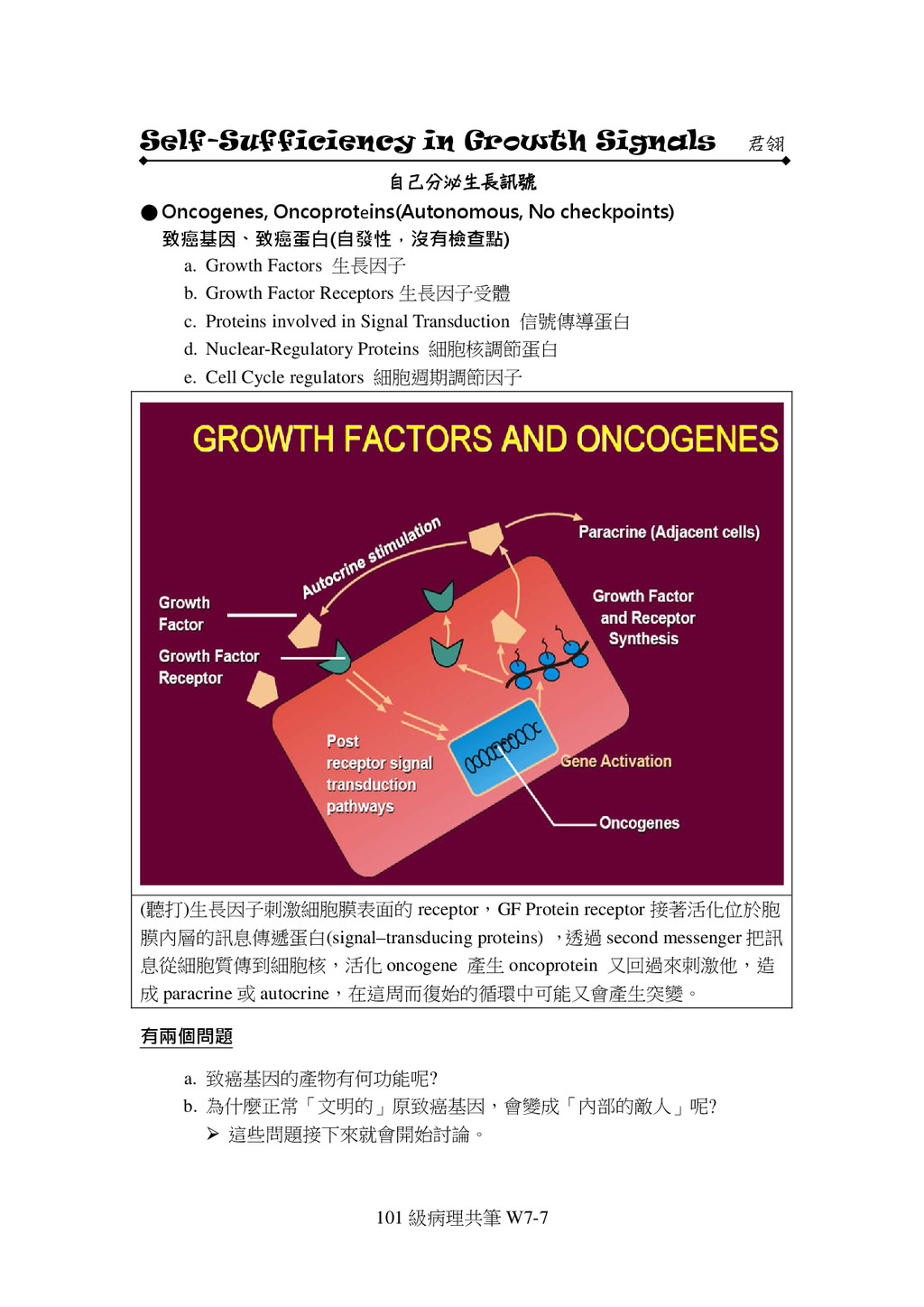
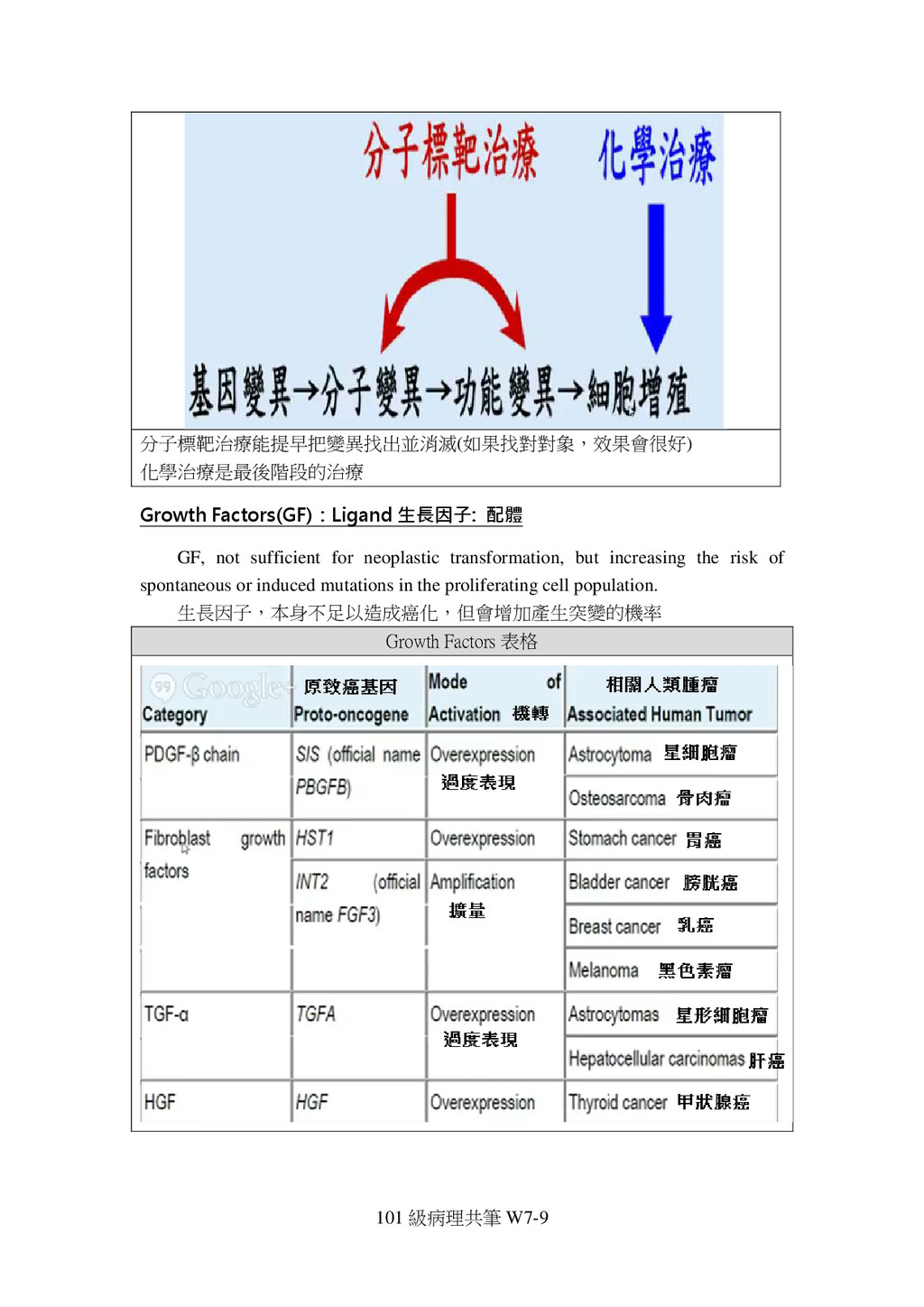
neoplastic transformation, but increasing the risk of spontaneous or induced mutations in the proliferating cell population. 生長因子,本身不足以造成癌化,但會增加產生突變的機率 Growth Factors 表格 101 級病理共筆 W7-9
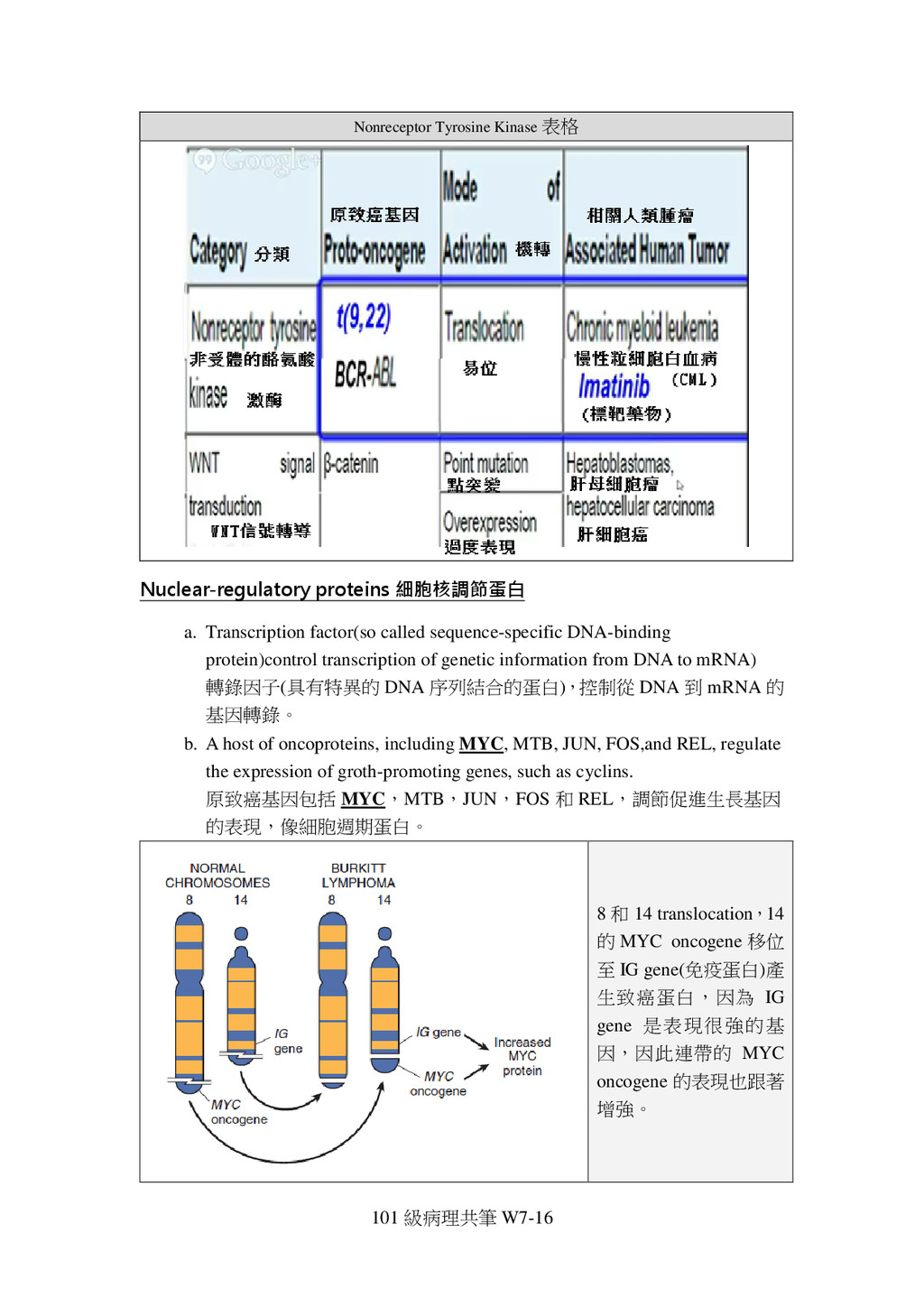
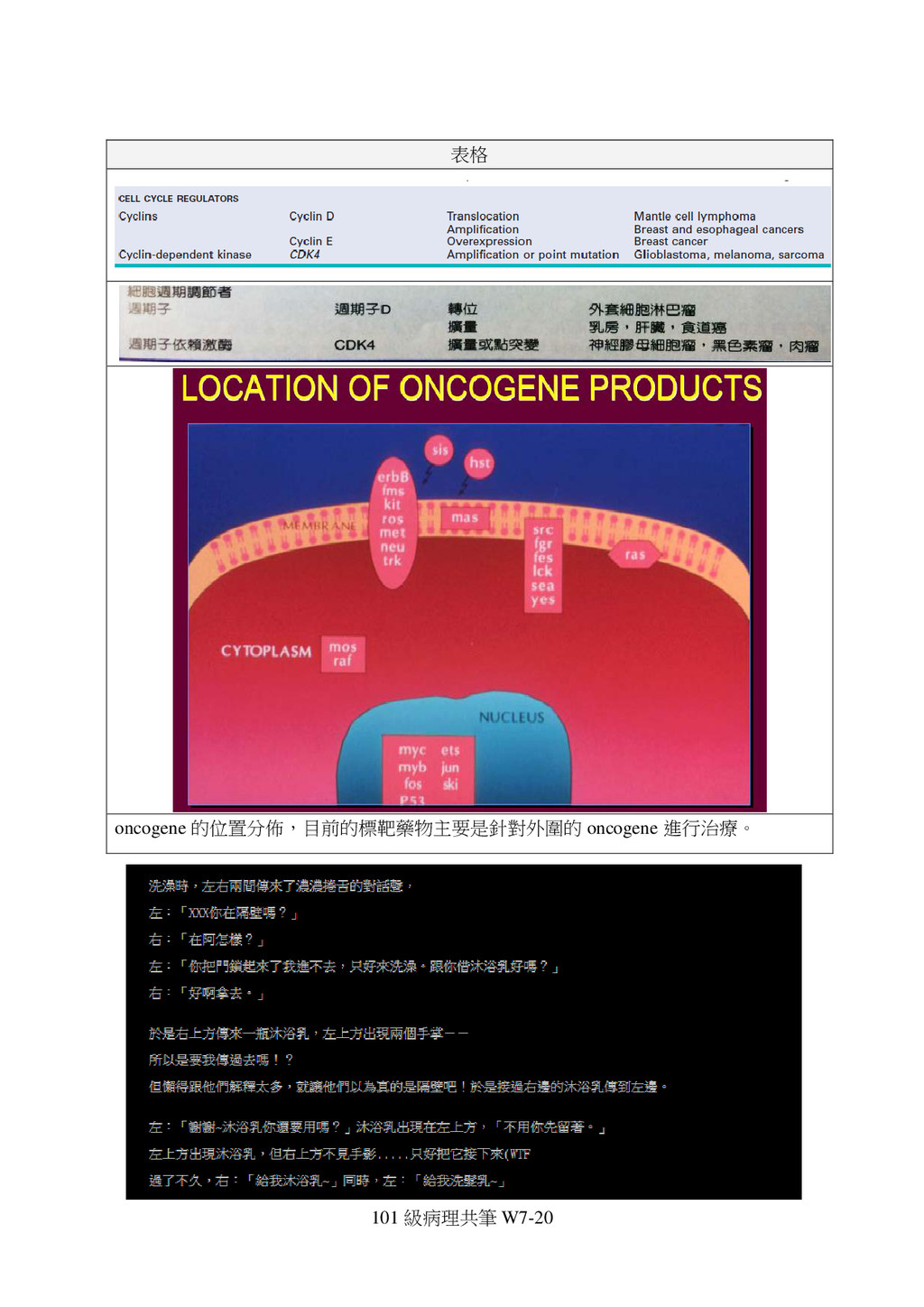
called sequence-specific DNA-binding protein)control transcription of genetic information from DNA to mRNA) 轉錄因子(具有特異的 DNA 序列結合的蛋白),控制從 DNA 到 mRNA 的 基因轉錄。 b. A host of oncoproteins, including MYC, MTB, JUN, FOS,and REL, regulate the expression of groth-promoting genes, such as cyclins. 原致癌基因包括 MYC,MTB,JUN,FOS 和 REL,調節促進生長基因 的表現,像細胞週期蛋白。 8 和 14 translocation,14 的 MYC oncogene 移位 至 IG gene(免疫蛋白)產 生致癌蛋白,因為 IG gene 是表現很強的基 因,因此連帶的 MYC oncogene 的表現也跟著 增強。 101 級病理共筆 W7-16
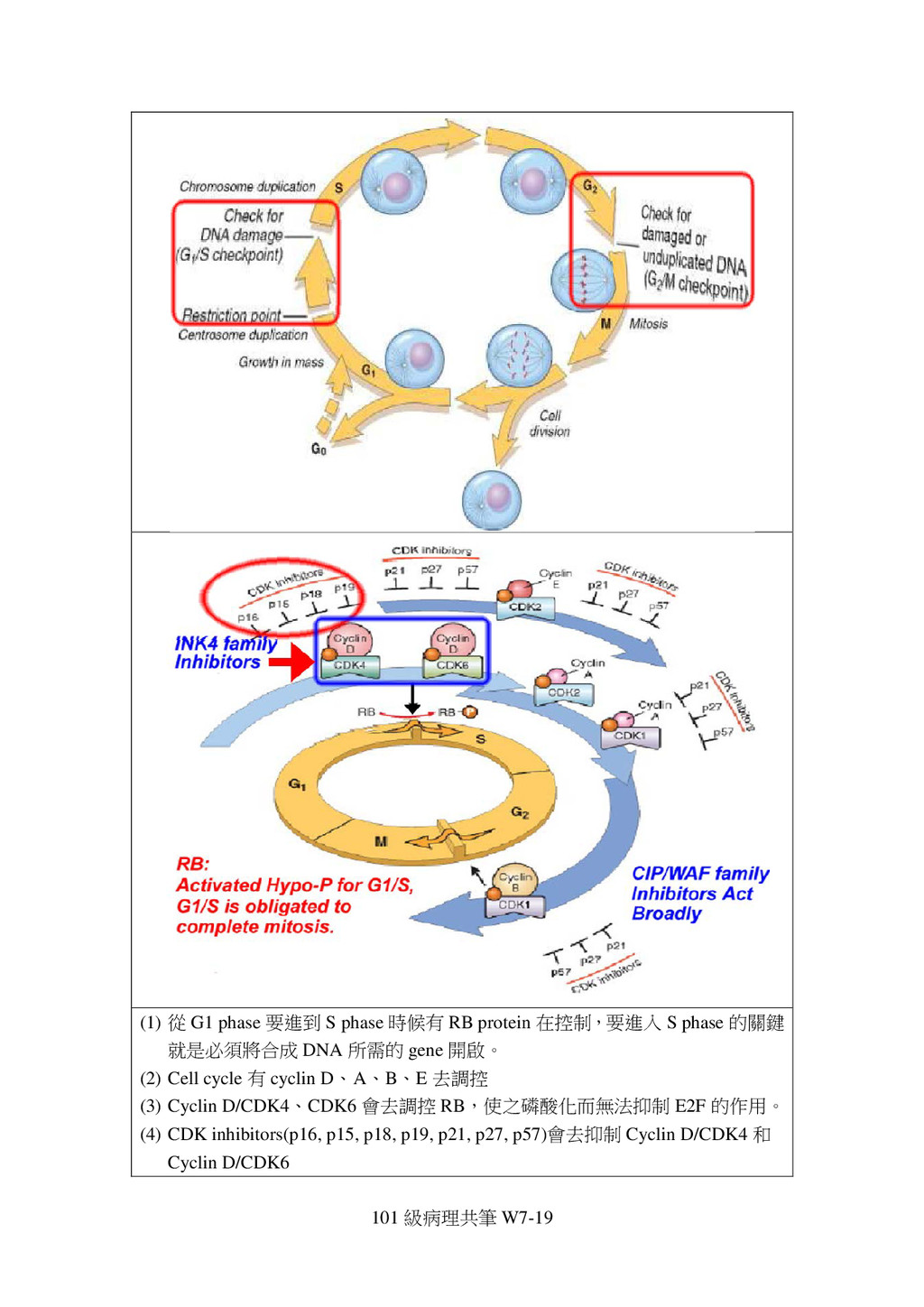
delays cell cycle, triggers repair mechanisms, apoptosis,or senescence maintaining genomic integrity,not lead to neoplasia. 細胞週期的檢查點:能感應 DNA 延遲的細胞週期,觸發修復機制,細 胞凋亡,衰老,以維持基因組的完整性,才不會導致腫瘤 b. 2 main cell cycle checkpoints, G1/S Check for DNA damage; Repair before replication& prevents defected cells proliferate or apoptotic kill. G1/S 檢查 DNA 是否有受損;在複製前修復及引發凋亡機制,以避免 有缺陷的細胞增生 G2/M Check for safe mitosis; Arrest in G2,after replication;ex:ionizing radiation.If defect,lead to chromosomal abnormal. G2/M 檢查是否正確進行有絲分裂。若被放射線游離化,複製後會停 在 G2 階段;若細胞產生缺陷,常會造成染色體的變異 Spindle checkpoint delays anaphase onset till allchromosomes are correctly attached in a bipolar fashion to the mitotic spindle. 紡錘體檢查點,開始於有絲分裂後期,檢查所有染色體是否都正確附 著在雙極性的紡錘體上 101 級病理共筆 W7-18
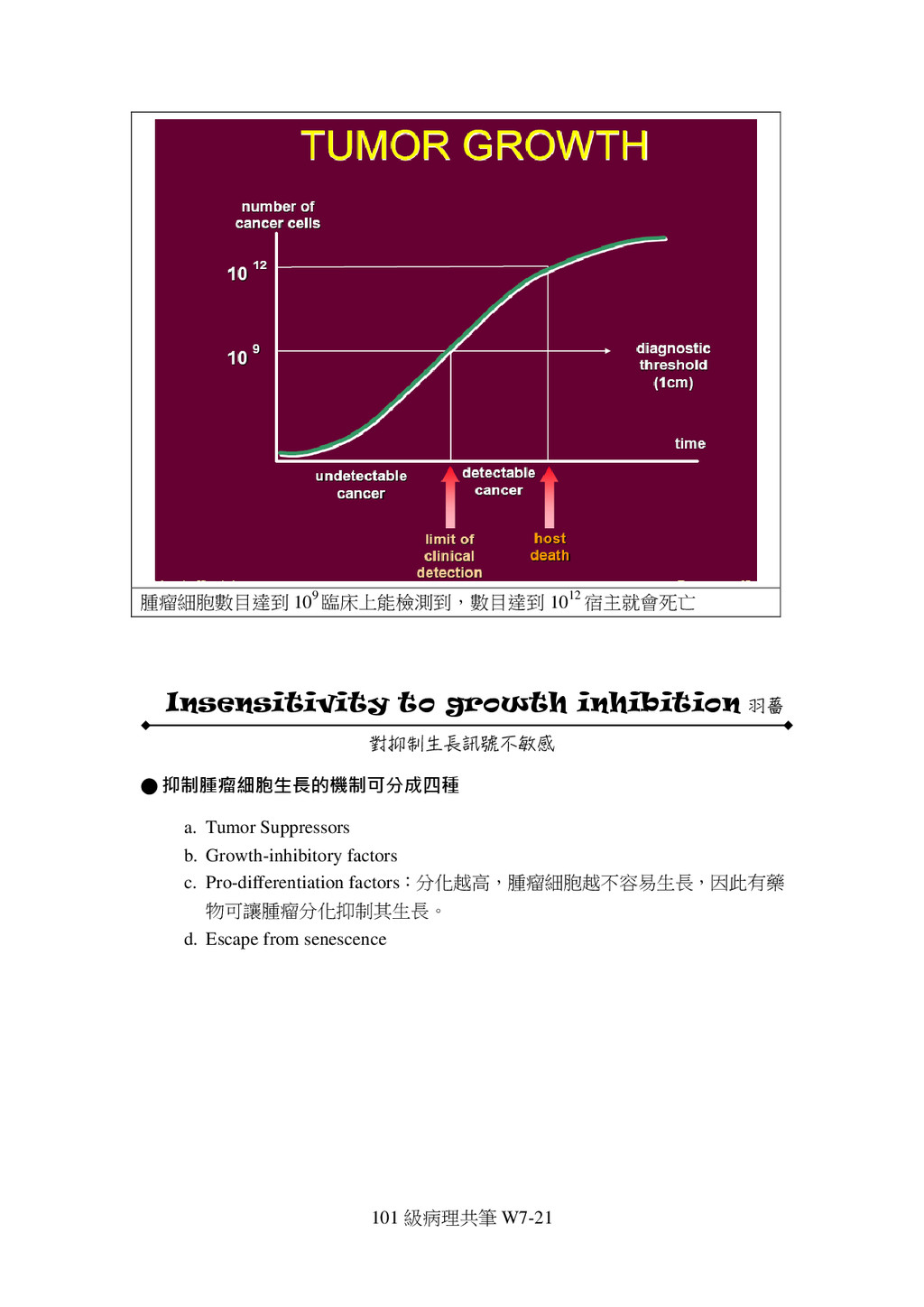
對抑制生長訊號不敏感 • 抑制腫瘤細胞生長的機制可分成四種 a. Tumor Suppressors b. Growth-inhibitory factors c. Pro-differentiation factors:分化越高,腫瘤細胞越不容易生長,因此有藥 物可讓腫瘤分化抑制其生長。 d. Escape from senescence 101 級病理共筆 W7-21
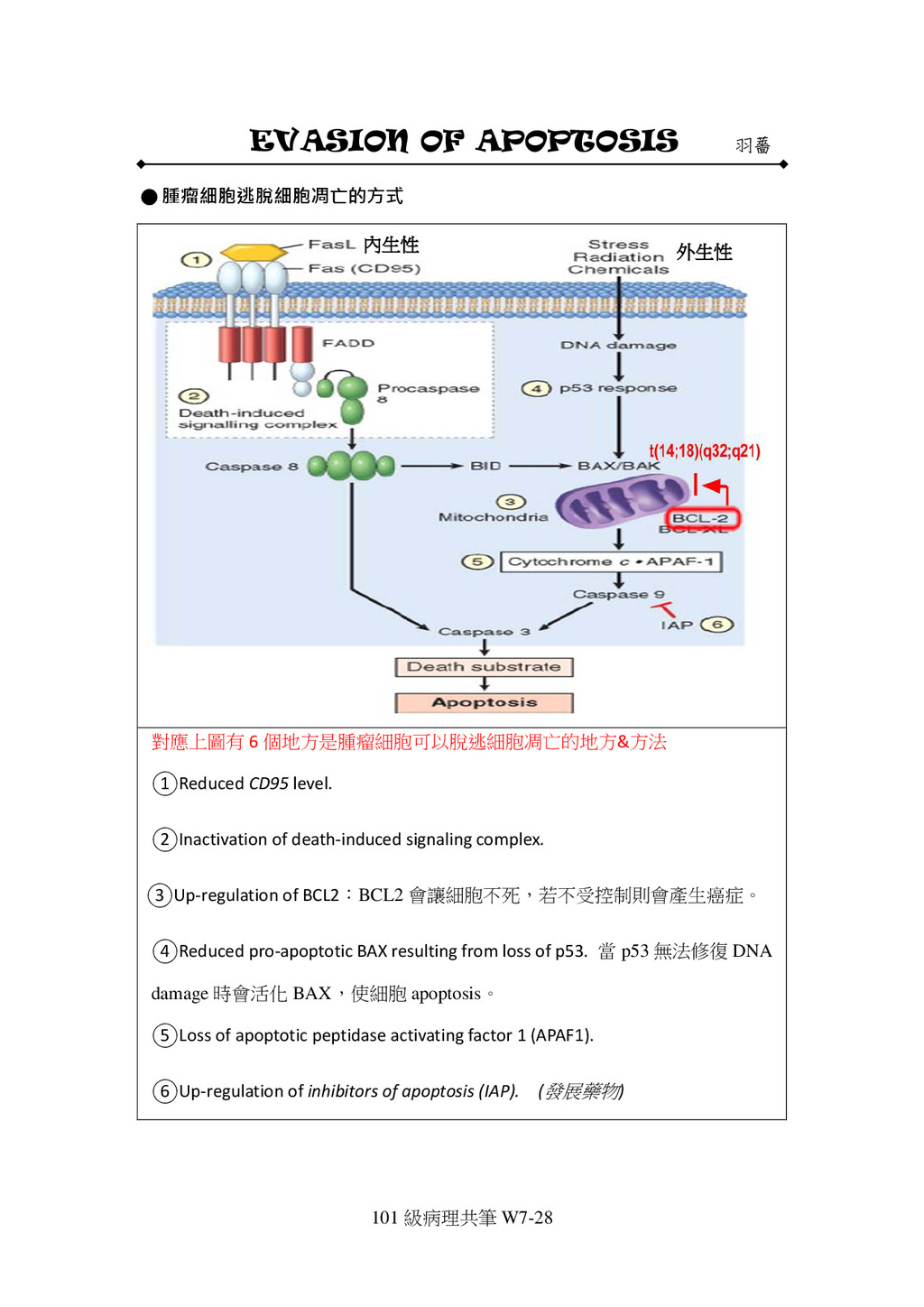
1 E A Reduced CD95 level. A ◦ 2 E A Inactivation of death-induced signaling complex. A ◦ 3 E A Up-regulation of BCL2:BCL2 會讓細胞不死,若不受控制則會產生癌症。 A ◦ 4 E A Reduced pro-apoptotic BAX resulting from loss of p53. 當 p53 無法修復 DNA damage 時會活化 BAX,使細胞 apoptosis。 A ◦ 5 E A Loss of apoptotic peptidase activating factor 1 (APAF1). A ◦ 6 E A Up-regulation of inhibitors of apoptosis (IAP). (發展藥物) 內生性 外生性 101 級病理共筆 W7-28
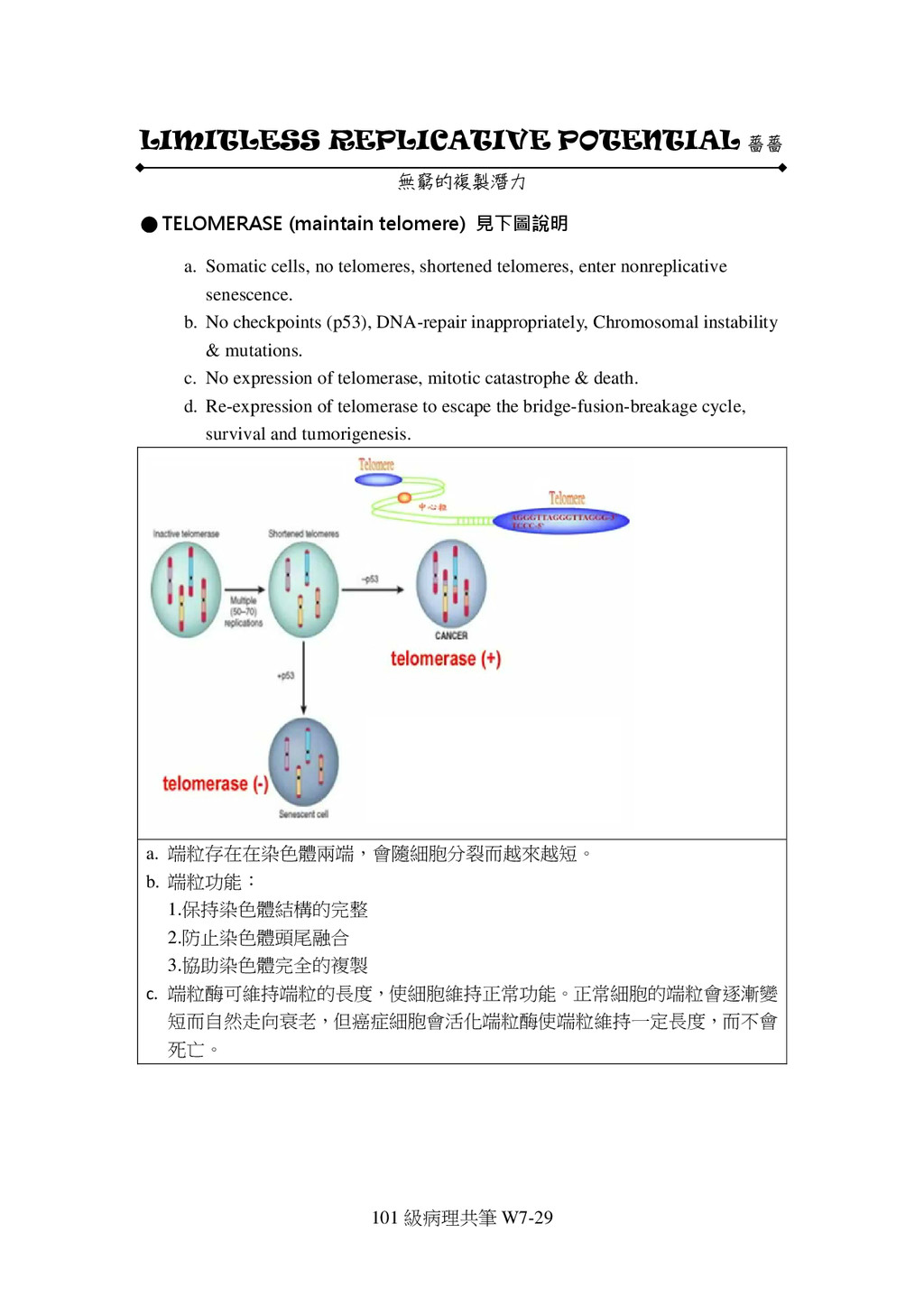
a. Somatic cells, no telomeres, shortened telomeres, enter nonreplicative senescence. b. No checkpoints (p53), DNA-repair inappropriately, Chromosomal instability & mutations. c. No expression of telomerase, mitotic catastrophe & death. d. Re-expression of telomerase to escape the bridge-fusion-breakage cycle, survival and tumorigenesis. a. 端粒存在在染色體兩端,會隨細胞分裂而越來越短。 b. 端粒功能: 1.保持染色體結構的完整 2.防止染色體頭尾融合 3.協助染色體完全的複製 c. 端粒酶可維持端粒的長度,使細胞維持正常功能。正常細胞的端粒會逐漸變 短而自然走向衰老,但癌症細胞會活化端粒酶使端粒維持一定長度,而不會 死亡。 101 級病理共筆 W7-29
needed nutrients and oxygen. 持續供應氧氣、養分 b. Newly formed endothelial cells stimulate tumor cells by secreting GF (IGFs, PDGF, & GMCSF). 新形成的血管內皮細胞會分泌 IGF、PDGF、GM-CSF、IL-1 來刺激腫瘤 細胞的生長。 老師說雞生蛋蛋生雞,很複雜 der。 c. Angiogenesis is required for continued tumor growth & metastasis. 血管新生對腫瘤成長是必要的。 d. Bevacizumab (anti-VEGF mAb) been approved to treat of multiple cancers. 抑制血管新生→治療癌症藥物 101 級病理共筆 W7-30
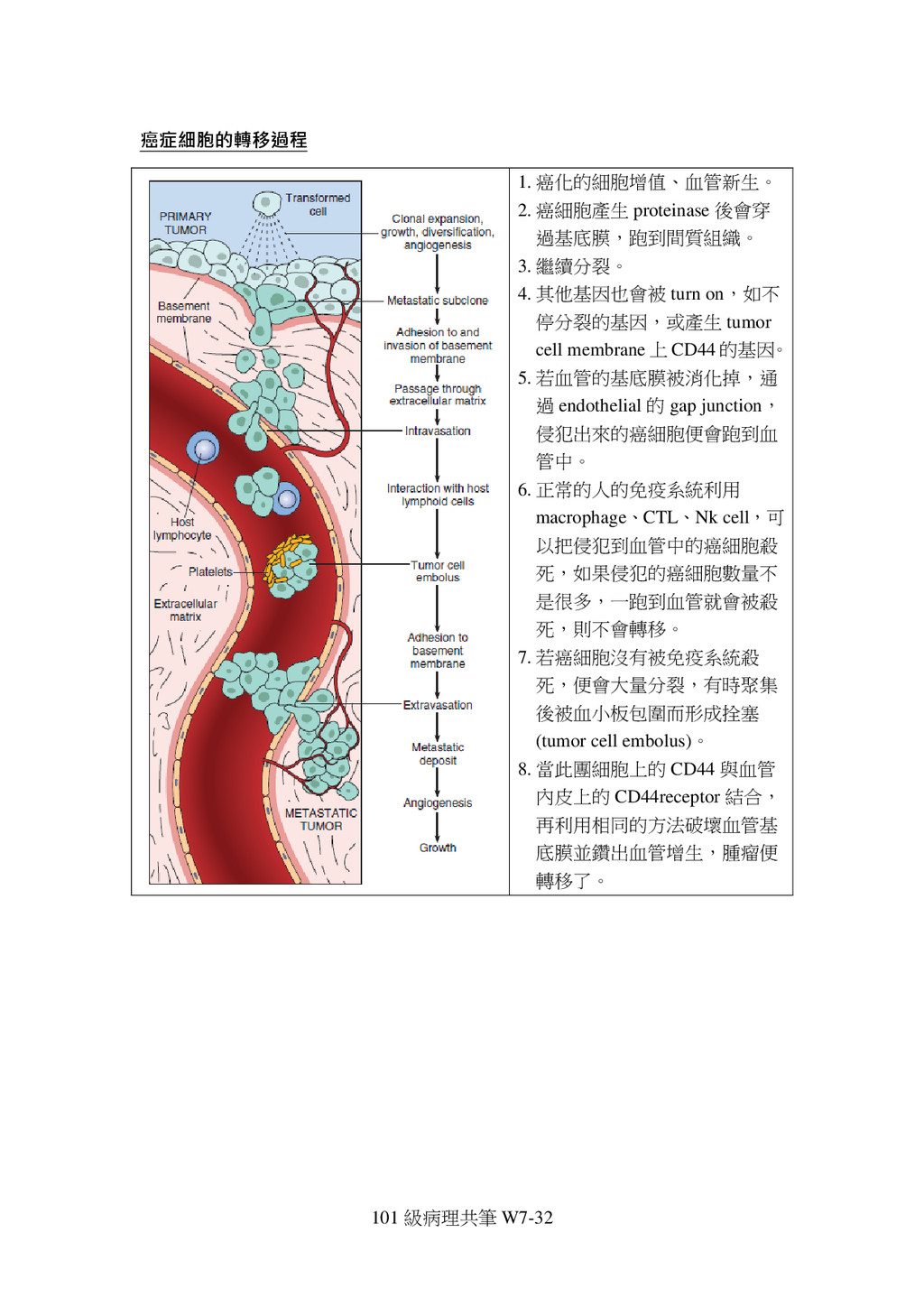
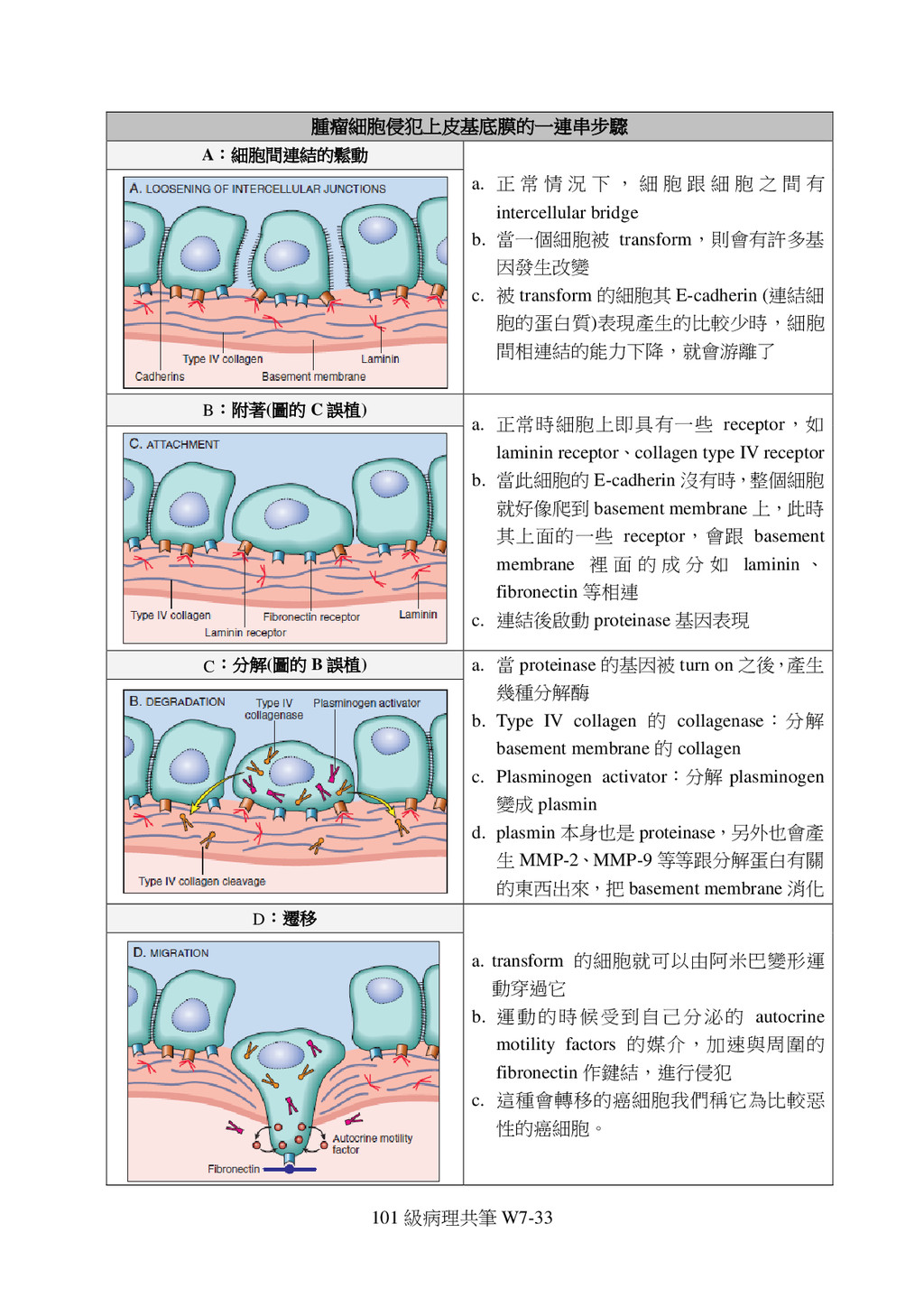
& grow on distant site. b. Metastatic cascade 2 phases: 我們可以把涉及轉移的一連串步驟分成兩期: (1) invasion of ECM (collagens, glycoproteins & proteoglycans); 侵犯細胞外基質 (2) Vascular dissemination, homing of tumor cells, and colonization. 腫瘤細胞的血液擴散和歸宿 c. Ameboid migration: squeezes (not cut) through its way 癌症會向阿米巴一樣透過內皮細胞穿過血管 d. ECM and stromal cells not only static barrier but dynamic (proteases, GF, Immune cells, etc --- Cross Talk) ECM 和間質細胞不僅是靜態的屏障,而是動態的 101 級病理共筆 W7-31
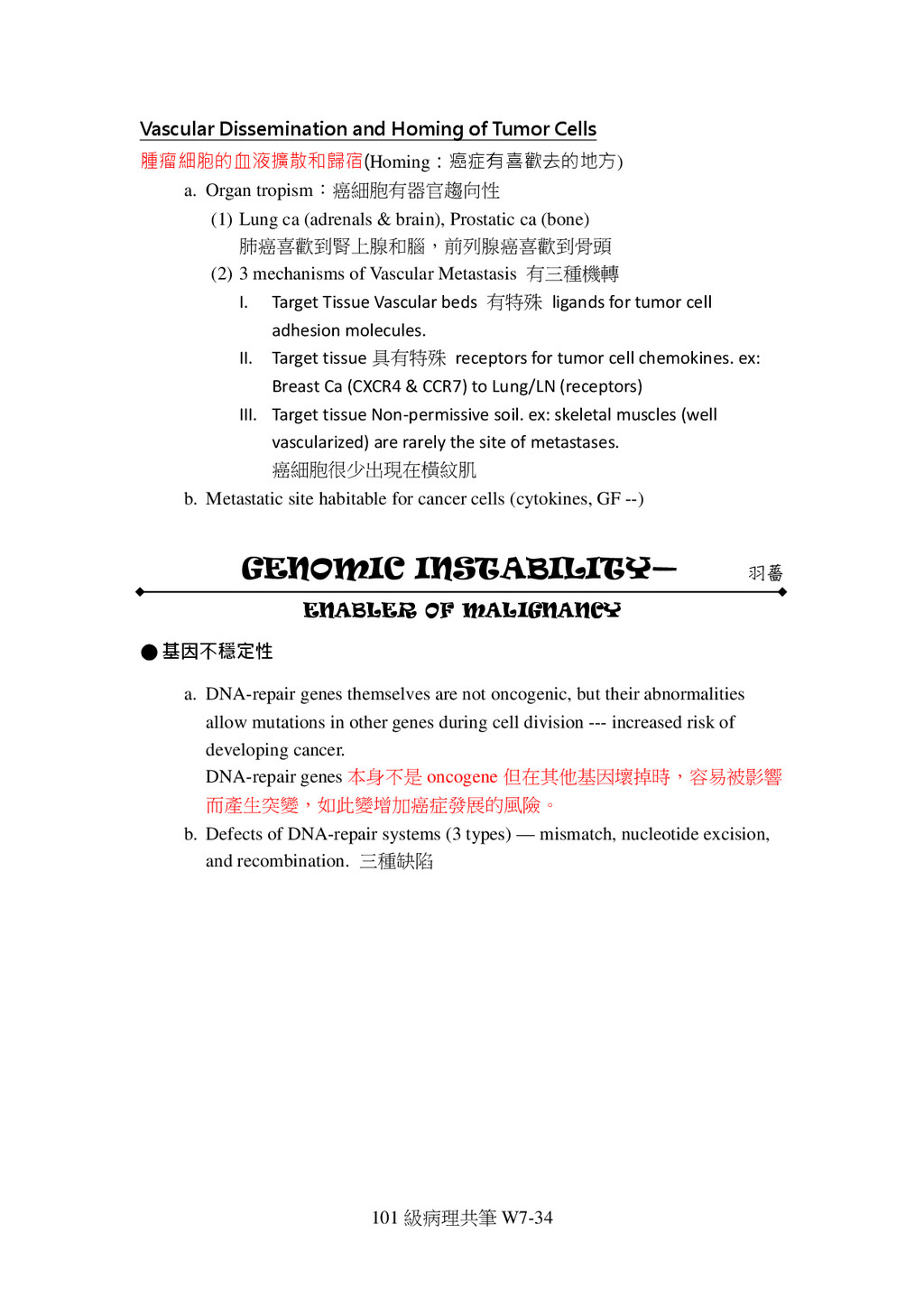
tropism:癌細胞有器官趨向性 (1) Lung ca (adrenals & brain), Prostatic ca (bone) 肺癌喜歡到腎上腺和腦,前列腺癌喜歡到骨頭 (2) 3 mechanisms of Vascular Metastasis 有三種機轉 I. Target Tissue Vascular beds 有特殊 ligands for tumor cell adhesion molecules. II. Target tissue 具有特殊 receptors for tumor cell chemokines. ex: Breast Ca (CXCR4 & CCR7) to Lung/LN (receptors) III. Target tissue Non-permissive soil. ex: skeletal muscles (well vascularized) are rarely the site of metastases. 癌細胞很少出現在橫紋肌 b. Metastatic site habitable for cancer cells (cytokines, GF --) GENOMIC INSTABILITY— 羽薔 ENABLER OF MALIGNANCY • 基因不穩定性 a. DNA-repair genes themselves are not oncogenic, but their abnormalities allow mutations in other genes during cell division --- increased risk of developing cancer. DNA-repair genes 本身不是 oncogene 但在其他基因壞掉時,容易被影響 而產生突變,如此變增加癌症發展的風險。 b. Defects of DNA-repair systems (3 types) — mismatch, nucleotide excision, and recombination. 三種缺陷 101 級病理共筆 W7-34
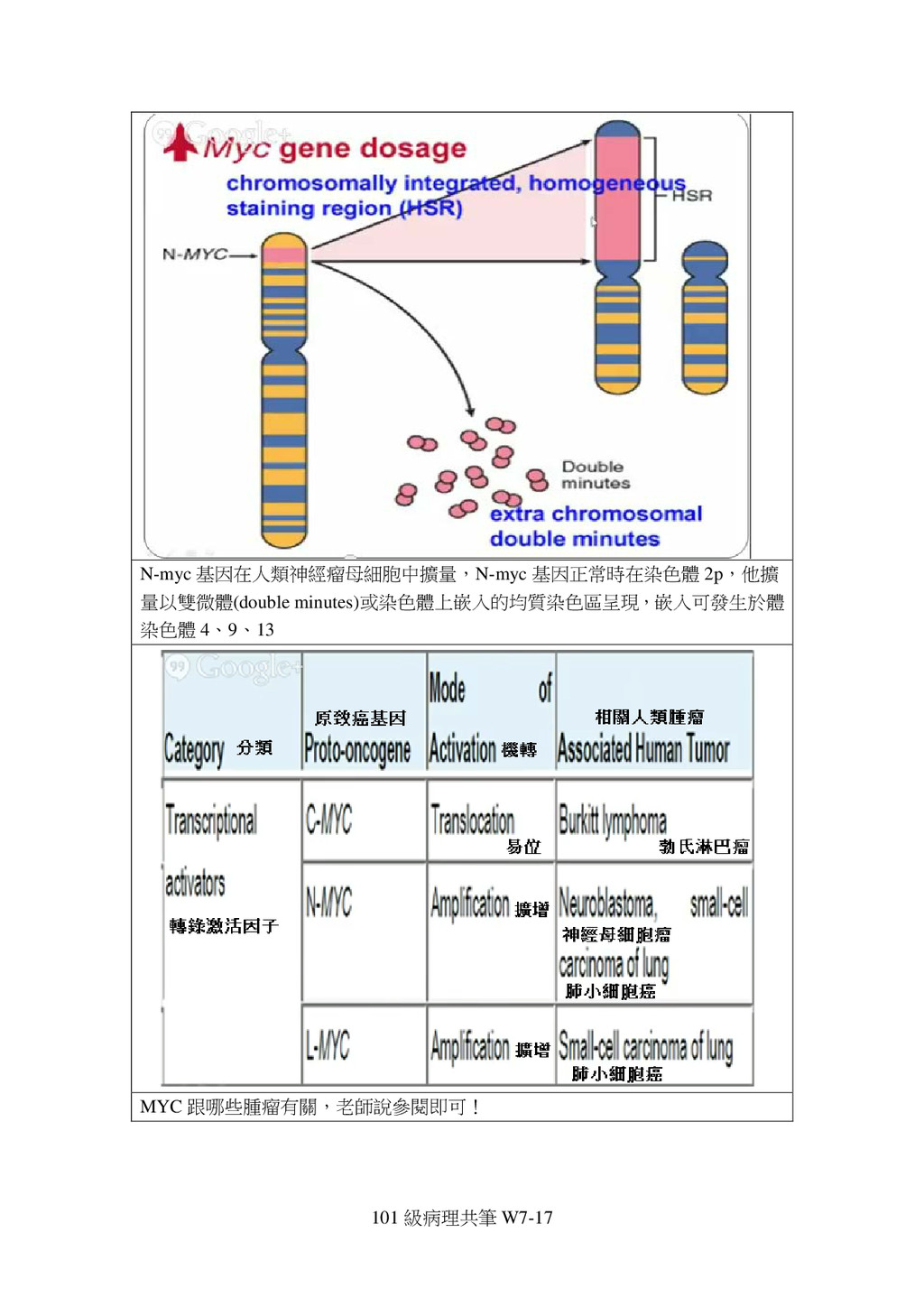
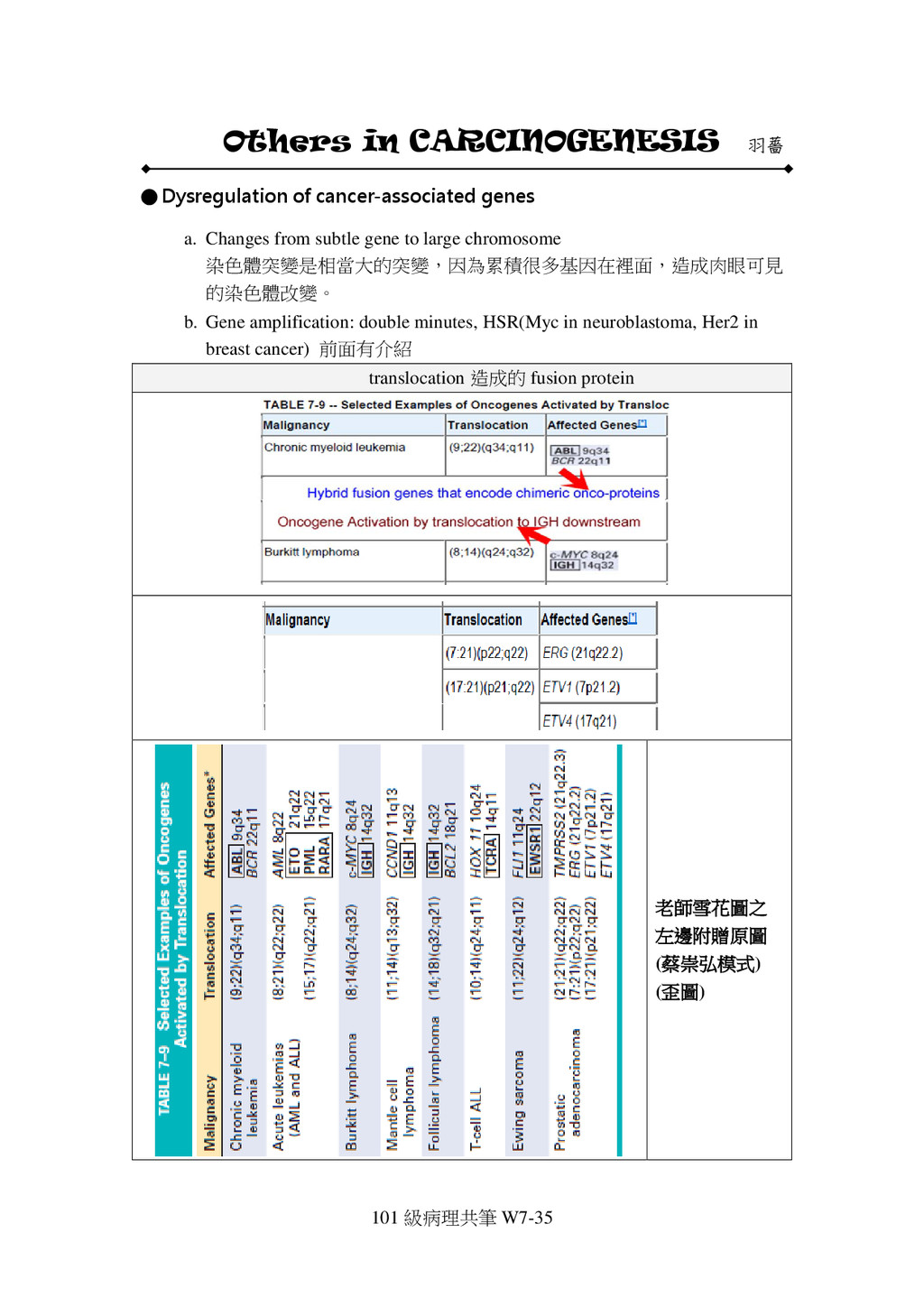
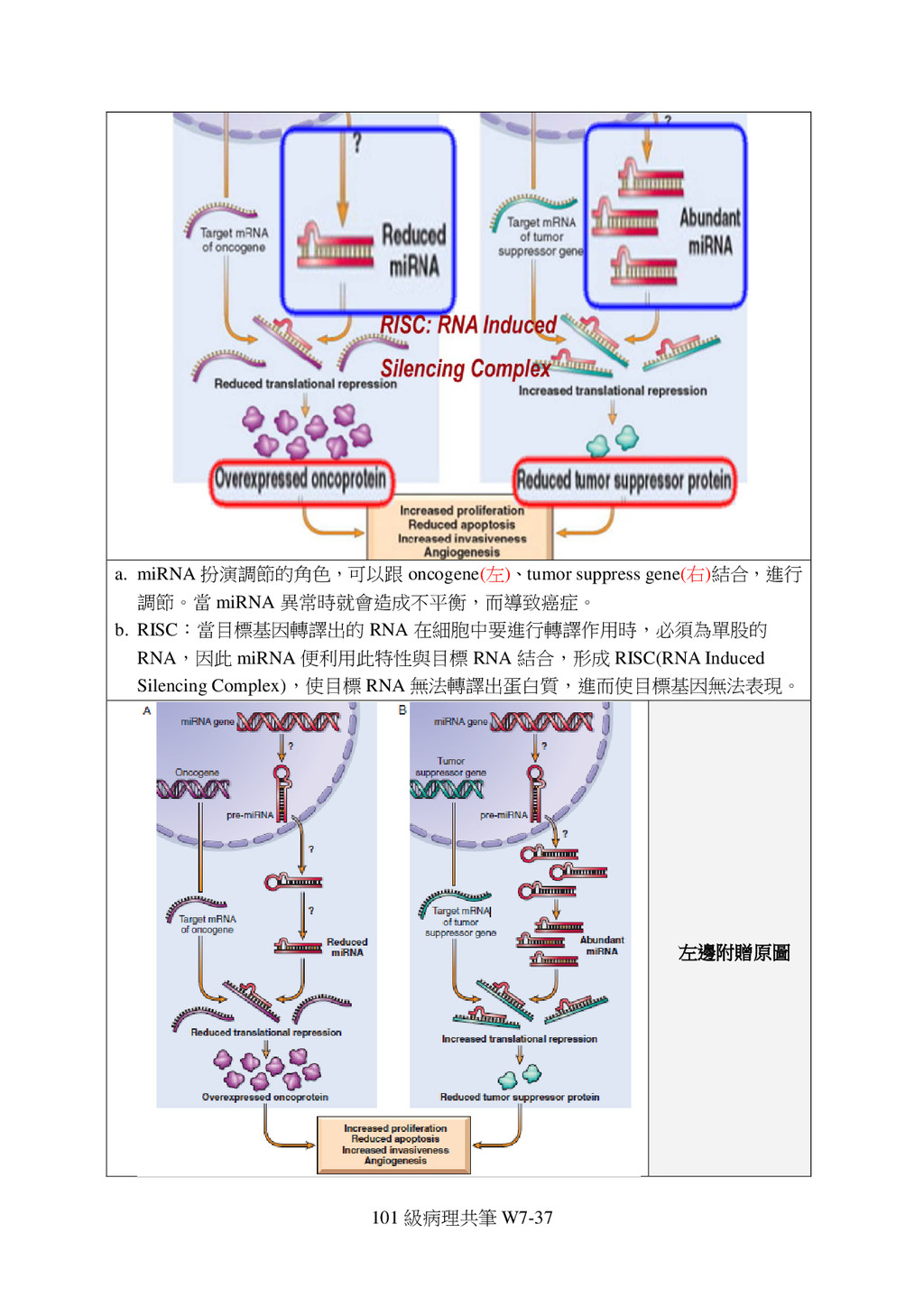
Changes from subtle gene to large chromosome 染色體突變是相當大的突變,因為累積很多基因在裡面,造成肉眼可見 的染色體改變。 b. Gene amplification: double minutes, HSR(Myc in neuroblastoma, Her2 in breast cancer) 前面有介紹 下表列出 translocation 造成的 fusion protein 老師雪花圖之 左邊附贈原圖 (蔡崇弘模式) (歪圖) 101 級病理共筆 W7-35
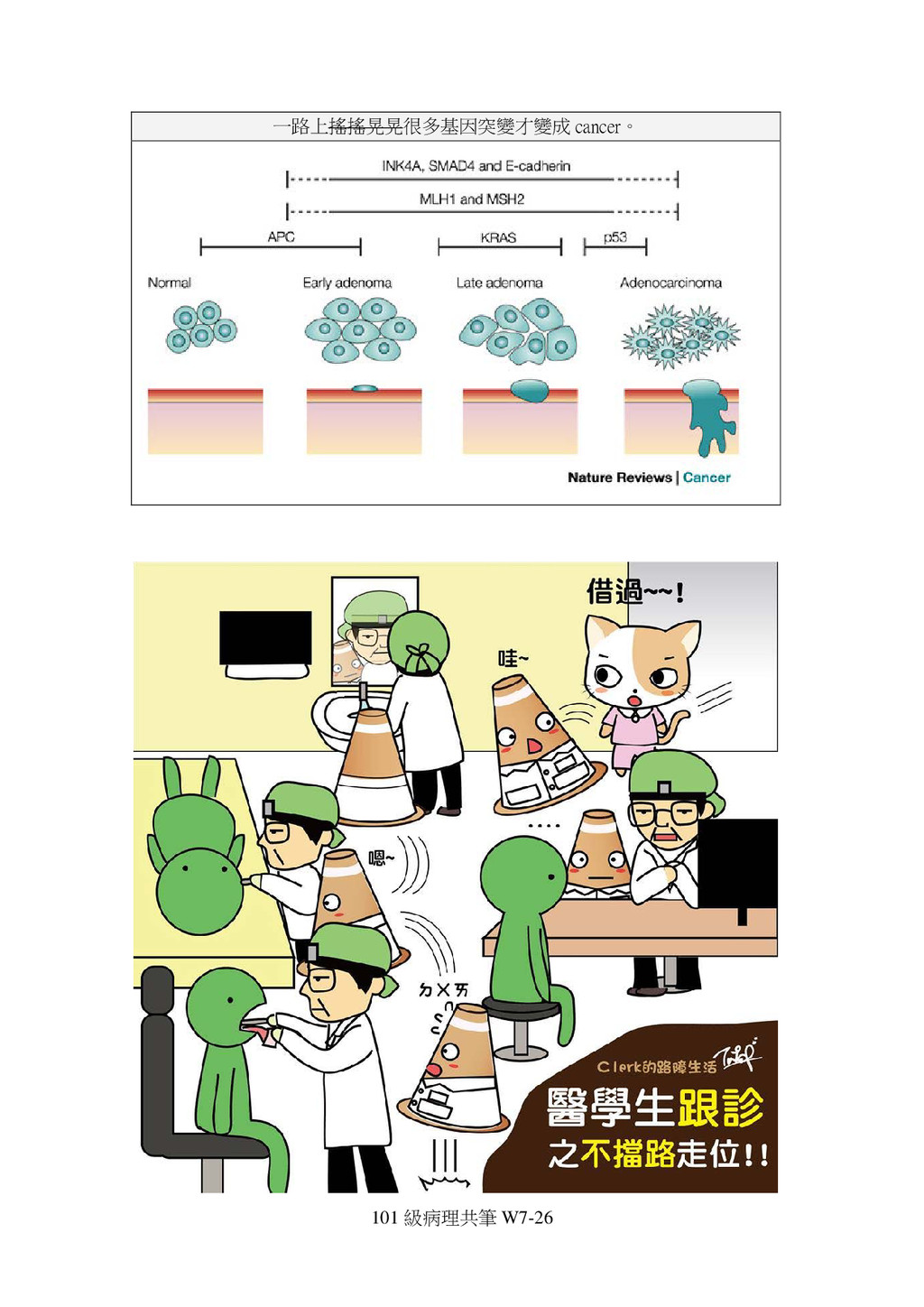
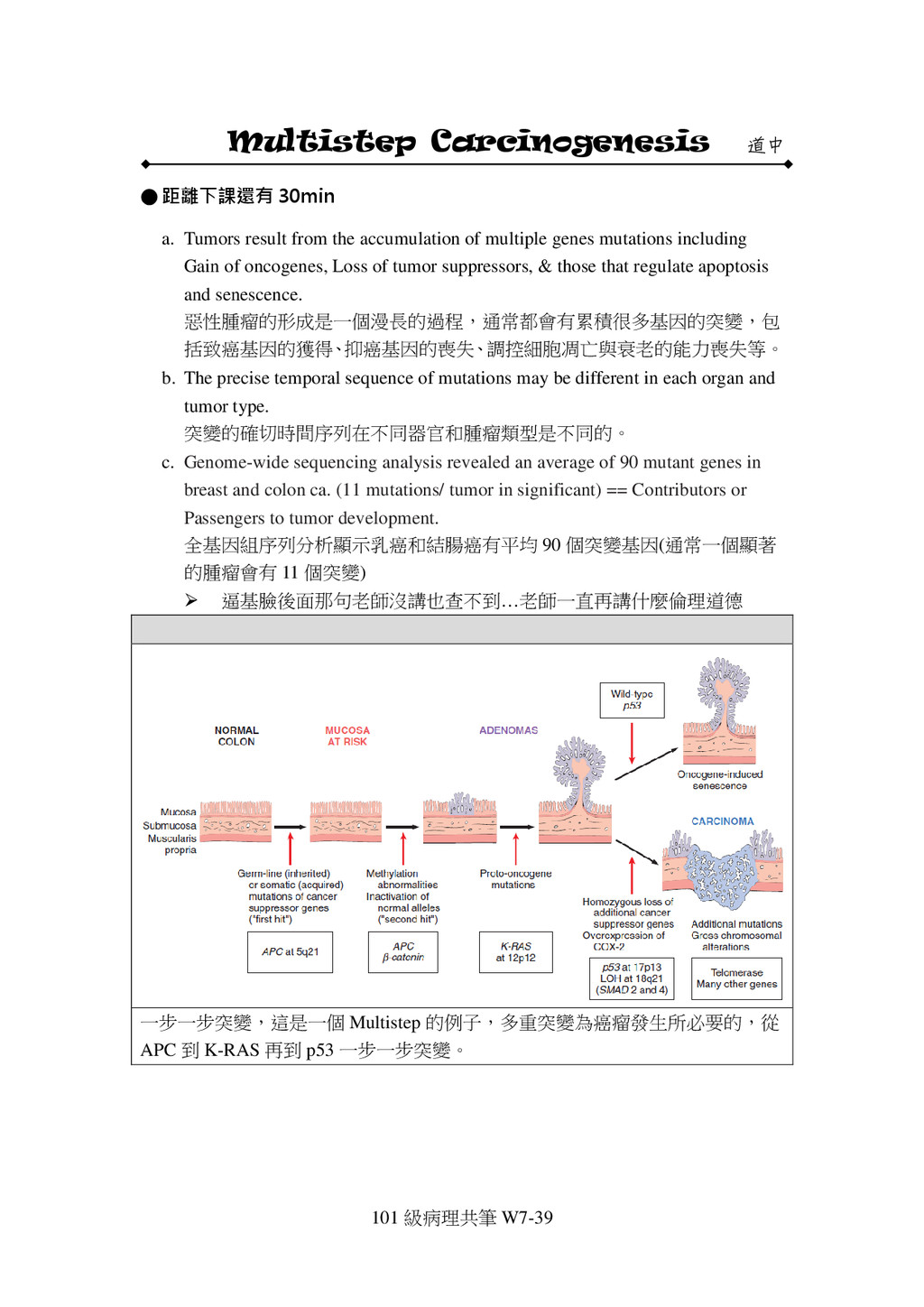
accumulation of multiple genes mutations including a. Gain of oncogenes, Loss of tumor suppressors, & those that regulate apoptosis and senescence. 惡性腫瘤的形成是一個漫長的過程,通常都會有累積很多基因的突變,包 括致癌基因的獲得、抑癌基因的喪失、調控細胞凋亡與衰老的能力喪失等。 The precise temporal sequence of mutations may be different in each organ and b. tumor type. 突變的確切時間序列在不同器官和腫瘤類型是不同的。 Genome-wide sequencing analysis revealed an average of 90 mutant genes in c. breast and colon ca. (11 mutations/ tumor in significant) == Contributors or Passengers to tumor development. 全基因組序列分析顯示乳癌和結腸癌有平均 90 個突變基因(通常一個顯著 的腫瘤會有 11 個突變) 逼基臉後面那句老師沒講也查不到…老師一直再講什麼倫理道德 Adenoma-carcinoma sequence in colon ca 一步一步突變,這是一個 Multistep 的例子,多重突變為癌瘤發生所必要的,從 APC 到 K-RAS 再到 p53 一步一步突變。 101 級病理共筆 W7-39
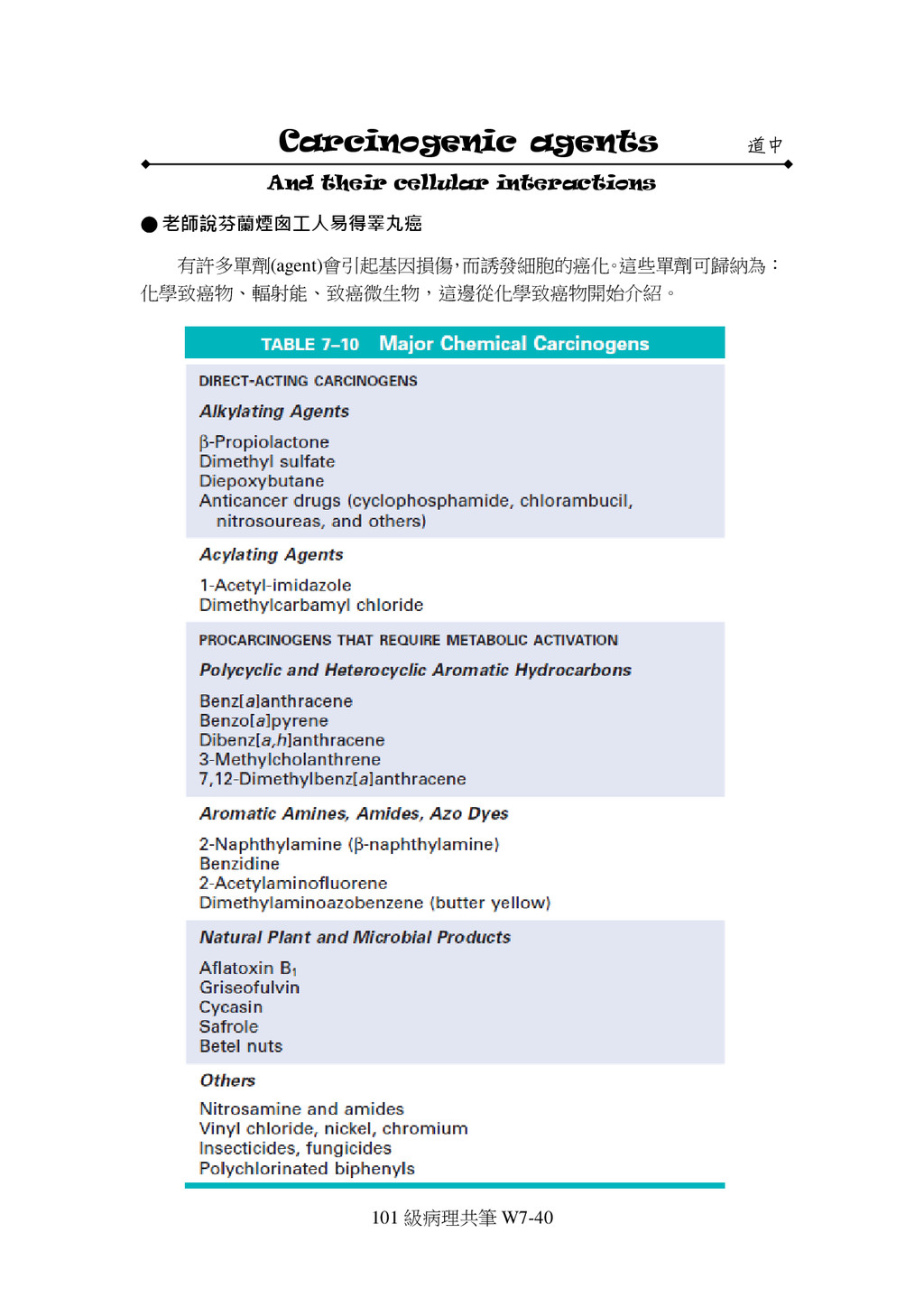
chemical is determined not only by the inherent a. reactivity of its electrophilic derivative but also by the balance between metabolic activation and inactivation reactions. 一個化學物的致癌強度不單是由其親電子處自有的反應來決定,也受到代 謝活化與去活化反應兩者間平衡影響。 Genetic P-450 gene polymorphisms can assess cancer risk, ex:benzo[a]pyrene b. & CYP1A1, permissive genotype, increased risk of lung cancer in light smokers(7 倍). 大多數已知的致癌物是由細胞色素 P-450 來代謝,故 P-450 基因多型性的 能夠評估癌症的風險。CYP1A1 為一個 P-450 基因的產物,他可以代謝多 環芳香性碳氫化合物,諸如:苯芘。大約有 10%的白人含有高誘發性型態的 這種酵素,而此與較易發生肺癌的吸菸者有關。輕度吸菸者若帶有易罹病 基因的 CYP1A1,比不帶這種基因的吸菸者有高出 7 倍的機會得到肺癌。 Molecular targets of chemical carcinogens, ---Aflatoxin B1→p53(G:C→T:A at c. codon249); 249(ser) p53 mutation in 90%, called signature mutation; useful tools in epidemiologic studies. 化學致癌物的分子標靶:肝癌的病例和 p53 的突變有關,在黃麴毒素 B1 高暴露地區,在 90%中,腫瘤細胞 p53 基因的 249 密碼子,顯示有具特徵 性的 G:C→T:A 轉換(所謂的 249serp53 突變) 。 這在流行病學研究上是很有用 的工具。 101 級病理共筆 W7-43
of observation & make it a. difficult to ascertain its full significance.( Possible additive or synergistic effects with other potential carcinogenic influences) 輻射能的潛在性對其累積的影響,需要及長期的觀察。因此很難確定他的 整體意義。(輻射對其他潛在的致癌因素或有加成的效果) UV(sun)→UVB, 280-320 nm;skin SCC, BCC, and possibly melanoma, 3-5 b. step (30 or more preteins) in nucleotide excision repair, been overwhelmed. (pyrimidine dimers) (1) 流行病學指出陽光的紫外線會增加皮膚鱗狀上皮癌、基底細胞癌、和可 能會增加惡性黑色素瘤的發生。 (2) 在光譜的紫外線部分有三個不同的波長區域:UVA, UVB, UVC, 其中 UVB(280-320 nm)被認為與皮膚癌的發生有關。 (3) UVB 的致癌性歸因於使 DNA 形成嘧啶雙體(pyrimidine dimer)。這種 DNA 損傷乃由核苷酸切除修復(nucleotide excision repair, NER)途徑來修 理。其中有 5 個步驟,以及可以涉及 30 個或更多的蛋白質。 (4) 有一假說,在太多陽光的曝曬下,NER 途徑的負擔過重,因此有些 DNA 損害沒有被修復,這導致許多的轉錄錯誤。 Ionizing radiation (x-rays, γ rays) and particulate (α particles, β particles, c. protons, neutrons) radiations are all carcinogenic.→ atomic bombs → AML, CML → 7 years. subsequently breast, colon, thyroid, & lung ca. 離子化輻射(X 光、γ 射線)和粒子(α 粒子, β 粒子, 質子, 中子)都具致癌性。 就像原子彈爆炸的生還者,最初是過了七年之久的潛伏期之後,開始出現 白血病(主要是急性和慢性骨髓性白血病)的發生率有明顯的增加 。 接著乳癌, 大腸癌,甲狀腺癌和肝癌的發生率也增加了。 101 級病理共筆 W7-44
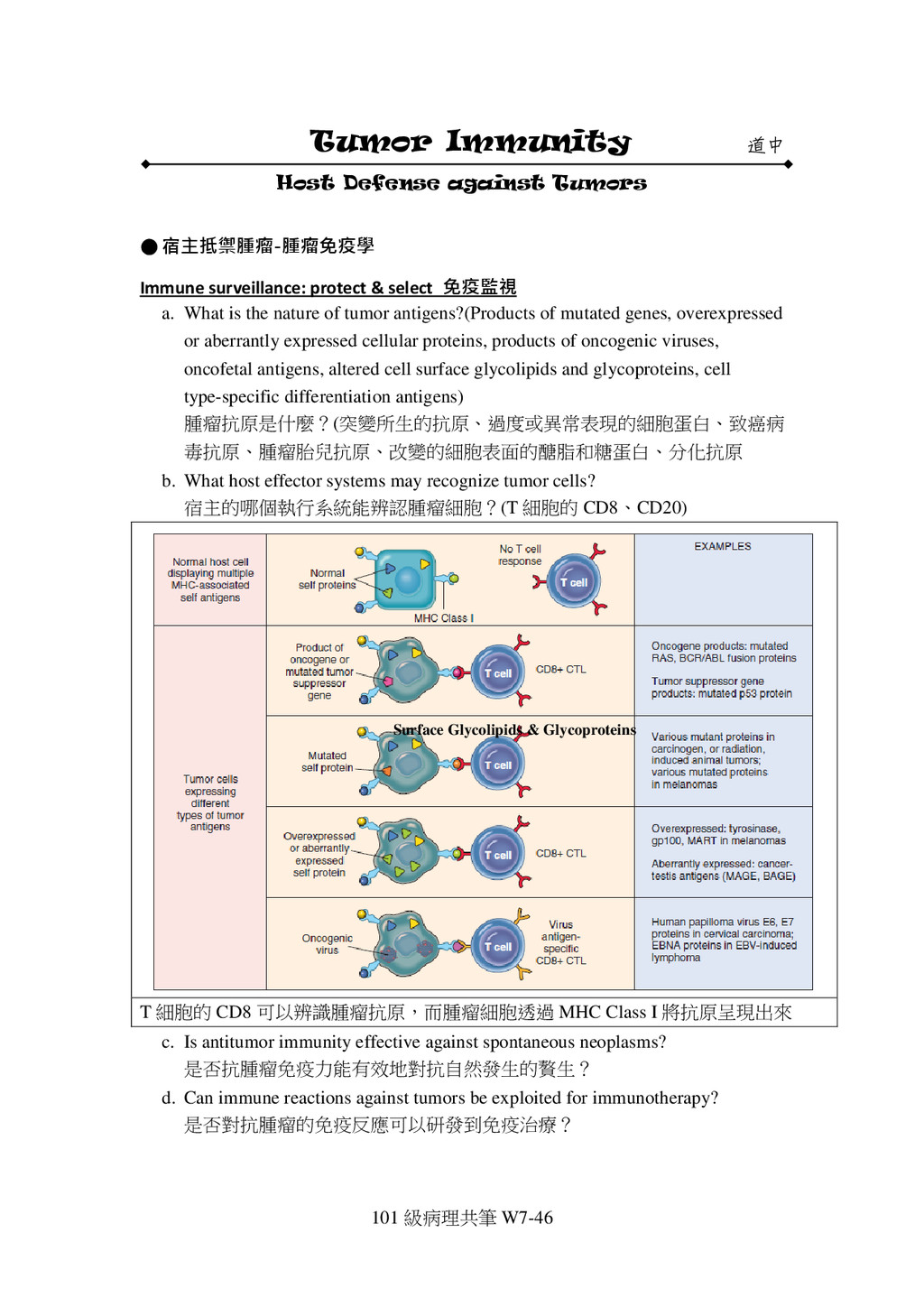
surveillance: protect & select 免疫監視 What is the nature of tumor antigens?(Products of mutated genes, overexpressed a. or aberrantly expressed cellular proteins, products of oncogenic viruses, oncofetal antigens, altered cell surface glycolipids and glycoproteins, cell type-specific differentiation antigens) 腫瘤抗原是什麼?(突變所生的抗原、過度或異常表現的細胞蛋白、致癌病 毒抗原、腫瘤胎兒抗原、改變的細胞表面的醣脂和糖蛋白、分化抗原 What host effector systems may recognize tumor cells? b. 宿主的哪個執行系統能辨認腫瘤細胞?(T 細胞的 CD8、CD20) T 細胞的 CD8 可以辨識腫瘤抗原,而腫瘤細胞透過 MHC Class I 將抗原呈現出來 Is antitumor immunity effective against spontaneous neoplasms? c. 是否抗腫瘤免疫力能有效地對抗自然發生的贅生? Can immune reactions against tumors be exploited for immunotherapy? d. 是否對抗腫瘤的免疫反應可以研發到免疫治療? Surface Glycolipids & Glycoproteins 101 級病理共筆 W7-46
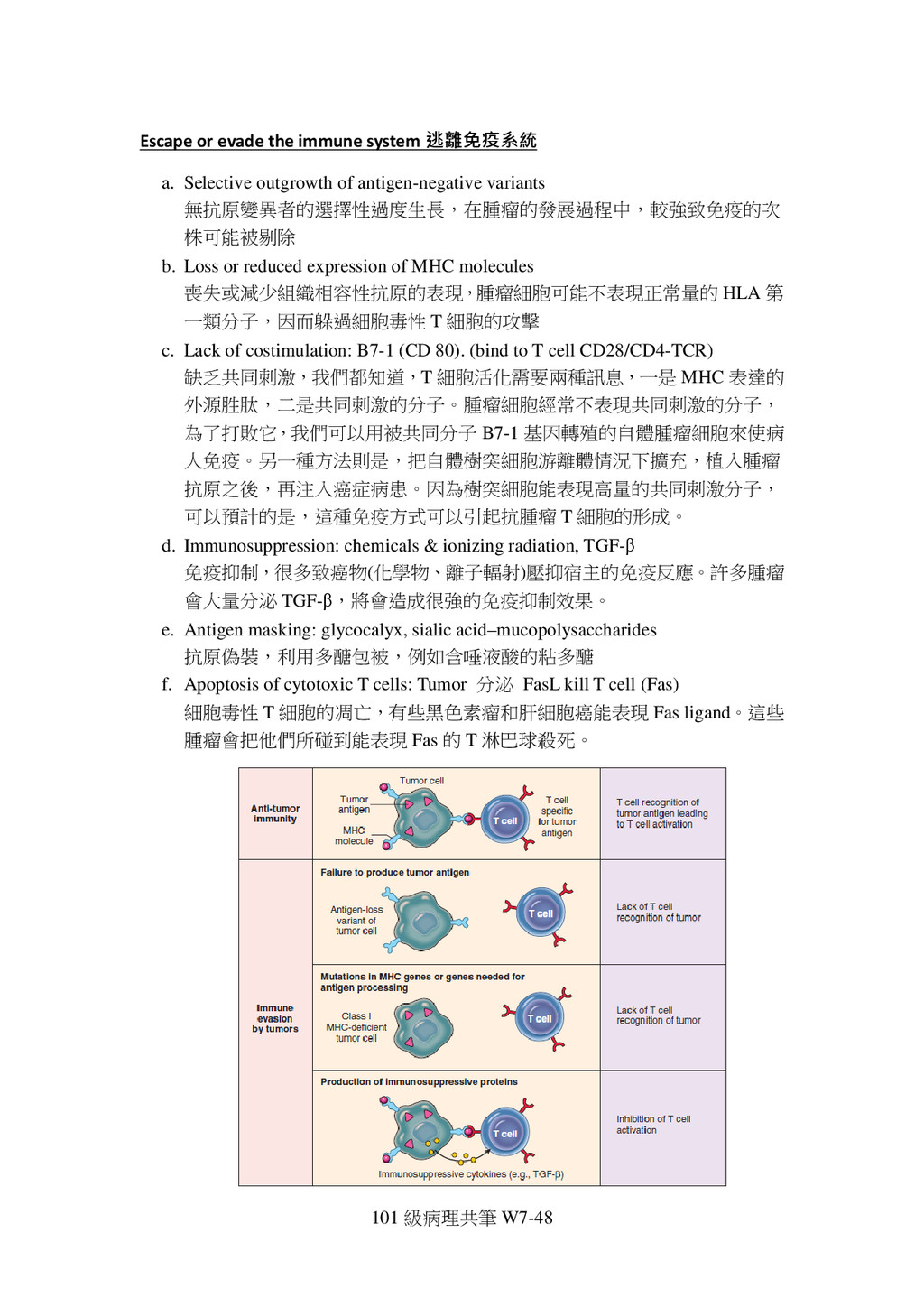
antigen-negative variants a. 無抗原變異者的選擇性過度生長,在腫瘤的發展過程中,較強致免疫的次 株可能被剔除 Loss or reduced expression of MHC molecules b. 喪失或減少組織相容性抗原的表現,腫瘤細胞可能不表現正常量的 HLA 第 一類分子,因而躲過細胞毒性 T 細胞的攻擊 Lack of costimulation: B7-1 (CD 80). (bind to T cell CD28/CD4-TCR) c. 缺乏共同刺激,我們都知道,T 細胞活化需要兩種訊息,一是 MHC 表達的 外源胜肽,二是共同刺激的分子。腫瘤細胞經常不表現共同刺激的分子, 為了打敗它,我們可以用被共同分子 B7-1 基因轉殖的自體腫瘤細胞來使病 人免疫。另一種方法則是,把自體樹突細胞游離體情況下擴充,植入腫瘤 抗原之後,再注入癌症病患。因為樹突細胞能表現高量的共同刺激分子, 可以預計的是,這種免疫方式可以引起抗腫瘤 T 細胞的形成。 Immunosuppression: chemicals & ionizing radiation, TGF-β d. 免疫抑制,很多致癌物(化學物、離子輻射)壓抑宿主的免疫反應。許多腫瘤 會大量分泌 TGF-β,將會造成很強的免疫抑制效果。 Antigen masking: glycocalyx, sialic acid–mucopolysaccharides e. 抗原偽裝,利用多醣包被,例如含唾液酸的粘多醣 Apoptosis of cytotoxic T cells: Tumor 分泌 FasL kill T cell (Fas) f. 細胞毒性 T 細胞的凋亡,有些黑色素瘤和肝細胞癌能表現 Fas ligand。這些 腫瘤會把他們所碰到能表現 Fas 的 T 淋巴球殺死。 101 級病理共筆 W7-48
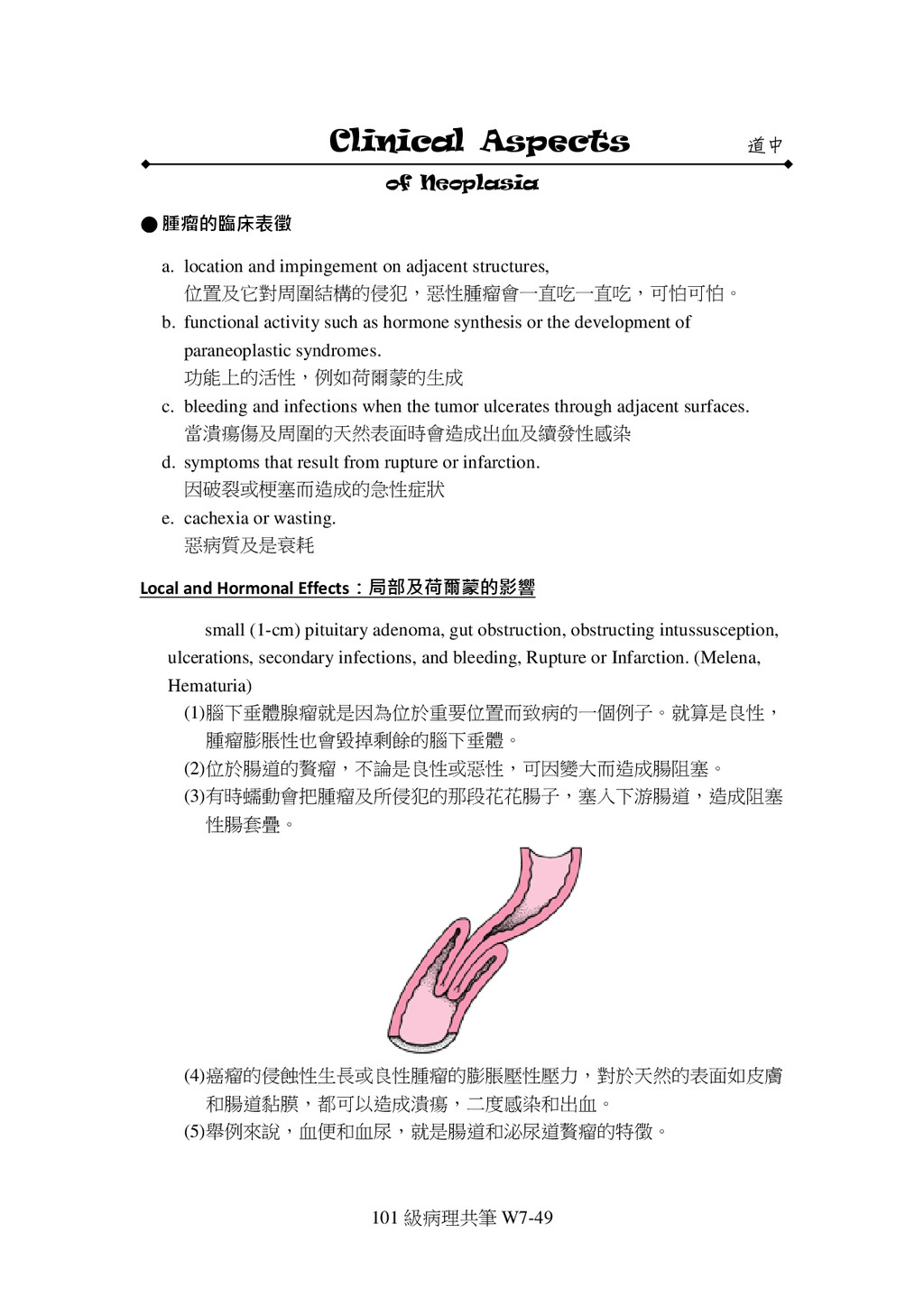
on adjacent structures, a. 位置及它對周圍結構的侵犯,惡性腫瘤會一直吃一直吃,可怕可怕。 functional activity such as hormone synthesis or the development of b. paraneoplastic syndromes. 功能上的活性,例如荷爾蒙的生成 bleeding and infections when the tumor ulcerates through adjacent surfaces. c. 當潰瘍傷及周圍的天然表面時會造成出血及續發性感染 symptoms that result from rupture or infarction. d. 因破裂或梗塞而造成的急性症狀 cachexia or wasting. e. 惡病質及是衰耗 Local and Hormonal Effects:局部及荷爾蒙的影響 small (1-cm) pituitary adenoma, gut obstruction, obstructing intussusception, ulcerations, secondary infections, and bleeding, Rupture or Infarction. (Melena, Hematuria) (1) 腦下垂體腺瘤就是因為位於重要位置而致病的一個例子。就算是良性, 腫瘤膨脹性也會毀掉剩餘的腦下垂體。 (2) 位於腸道的贅瘤,不論是良性或惡性,可因變大而造成腸阻塞。 (3) 有時蠕動會把腫瘤及所侵犯的那段花花腸子,塞入下游腸道,造成阻塞 性腸套疊。 (4) 癌瘤的侵蝕性生長或良性腫瘤的膨脹壓性壓力,對於天然的表面如皮膚 和腸道黏膜,都可以造成潰瘍,二度感染和出血。 (5) 舉例來說,血便和血尿,就是腸道和泌尿道贅瘤的特徵。 101 級病理共筆 W7-49
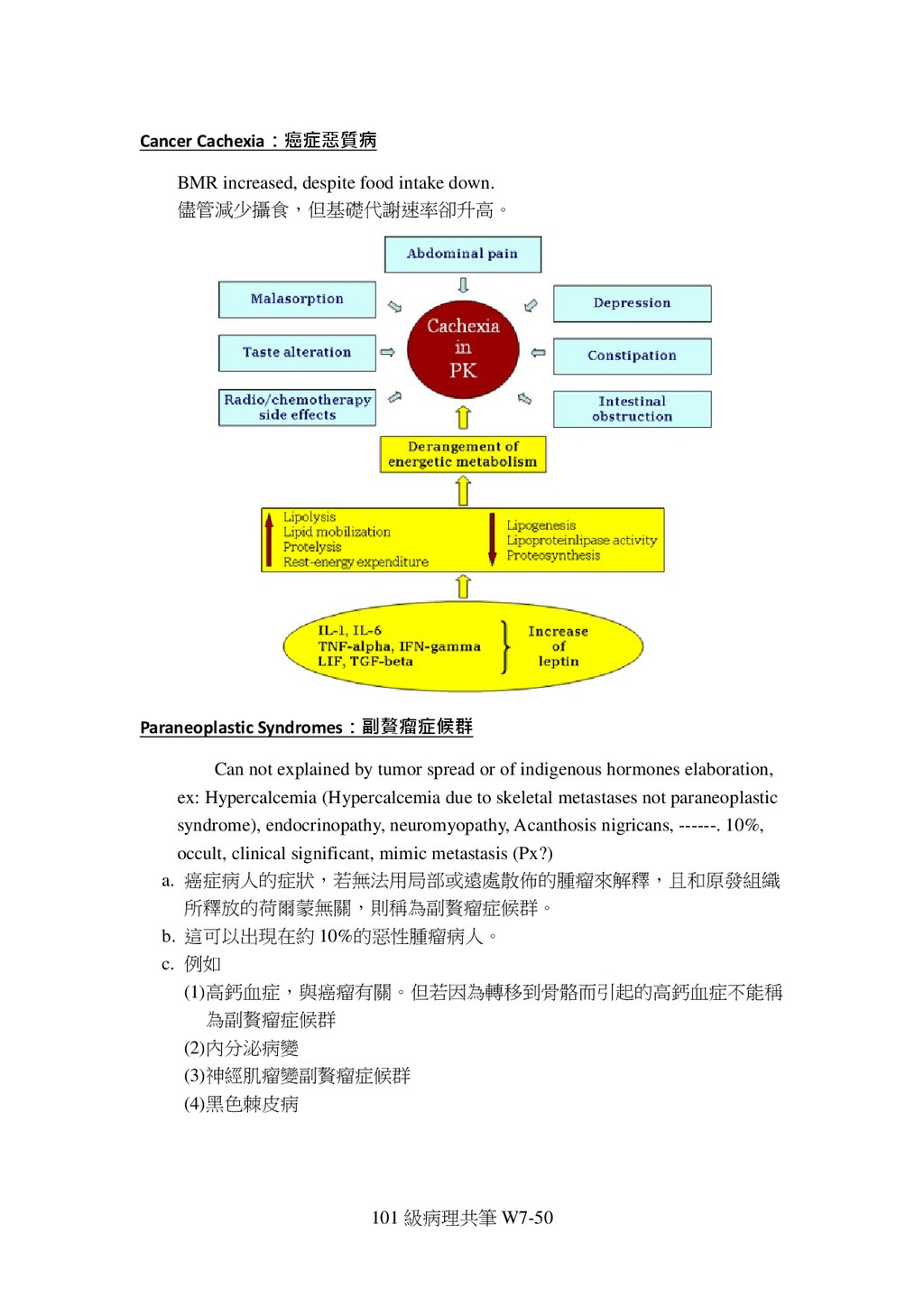
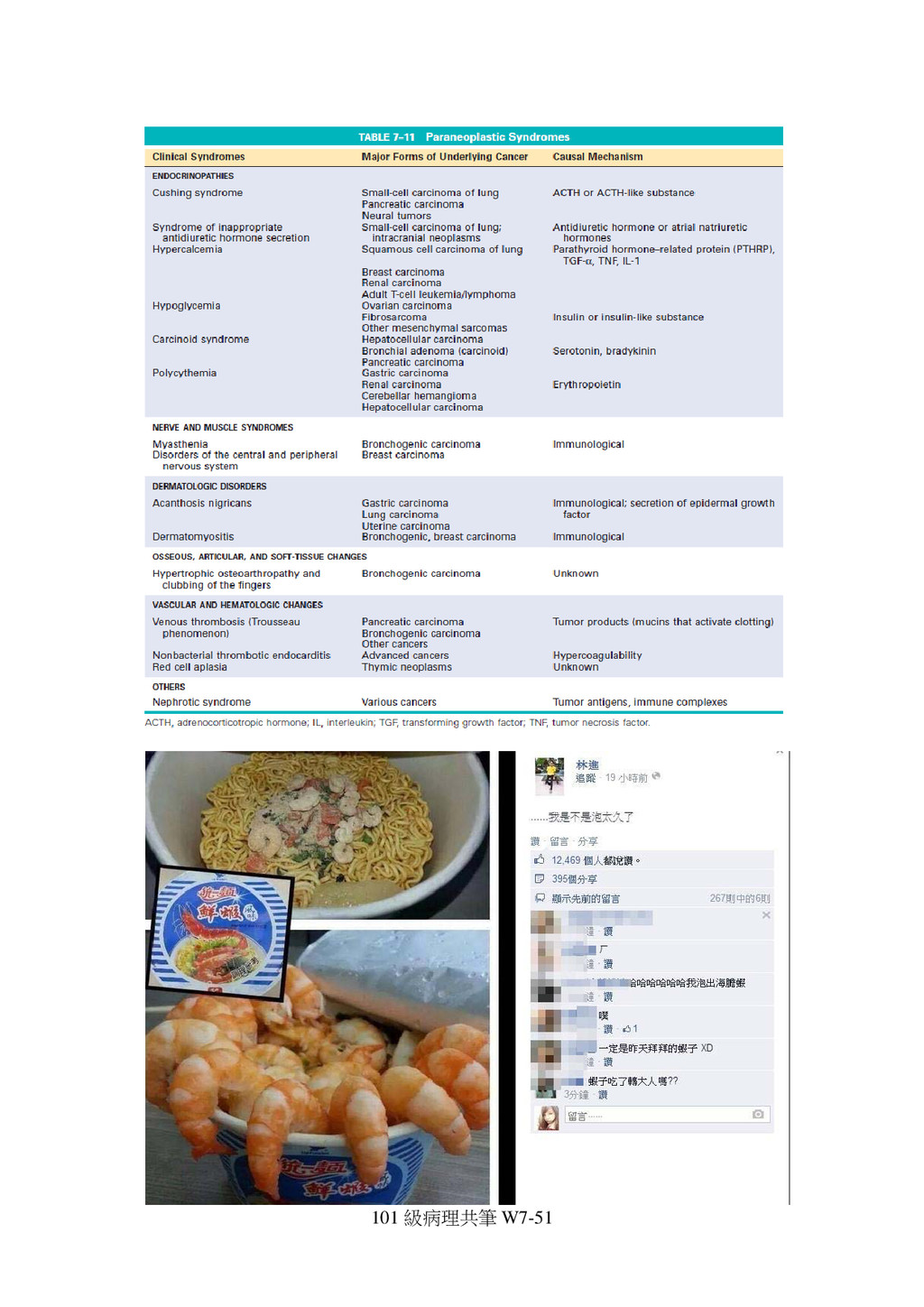
Syndromes:副贅瘤症候群 Can not explained by tumor spread or of indigenous hormones elaboration, ex: Hypercalcemia (Hypercalcemia due to skeletal metastases not paraneoplastic syndrome), endocrinopathy, neuromyopathy, Acanthosis nigricans, ------. 10%, occult, clinical significant, mimic metastasis (Px?) 癌症病人的症狀,若無法用局部或遠處散佈的腫瘤來解釋,且和原發組織 a. 所釋放的荷爾蒙無關,則稱為副贅瘤症候群。 這可以出現在約 10%的惡性腫瘤病人。 b. 例如 c. (1) 高鈣血症,與癌瘤有關。但若因為轉移到骨骼而引起的高鈣血症不能稱 為副贅瘤症候群 (2) 內分泌病變 (3) 神經肌瘤變副贅瘤症候群 (4) 黑色棘皮病 101 級病理共筆 W7-50
quantify the aggressiveness & prognosis for Px a. 分級及分期為用來量化侵襲性和預後的方法 Grading: methods to quantify clinical aggressiveness, but correlation b/w b. histologic appearance & biologic behavior non-perfect. Based on the degree of differentiation, the number of mitoses or architectural features. (2-,3- or 4-categories), well/low, moderately /intermediate, poorly/high differentiated-grade, anaplasic. (1) 癌瘤的分級是基於腫瘤細胞的分化程度及腫瘤內的有絲分裂數目,此或 與贅瘤的侵犯性有關。因此癌瘤可以區分為第一級到第四級。 (2) 雖然組織學上的分級是有用的,但是組織學上的外觀和生物學的行為, 其相關性並不如想像的理想。 (3) 常用的方法是用敘述的方法來描述一特定的贅瘤,例如:分化良好的, 分泌黏液的。 Staging is based on the size of the primary lesion, its extent of spread to c. regional lymph nodes, and the presence or absence of blood-borne metastases. (AJCC-TNM) (1) 癌瘤的分期是依據原發病變的大小、侵犯周圍淋巴球的程度和有無血行 轉移。目前使用的有兩類分期系統,一個是 UICC 所建立的 TNM 系統, 以及 AJCC 的系統。 (2) 越早期的癌症預後越佳,越末期的預後越差 In general, soft-tissue sarcomas, grading of cancers has proved of less clinical d. value than has staging. 一般來說,軟組織內瘤的分期已經被證實比分級有更高的臨床價值。 101 級病理共筆 W7-52
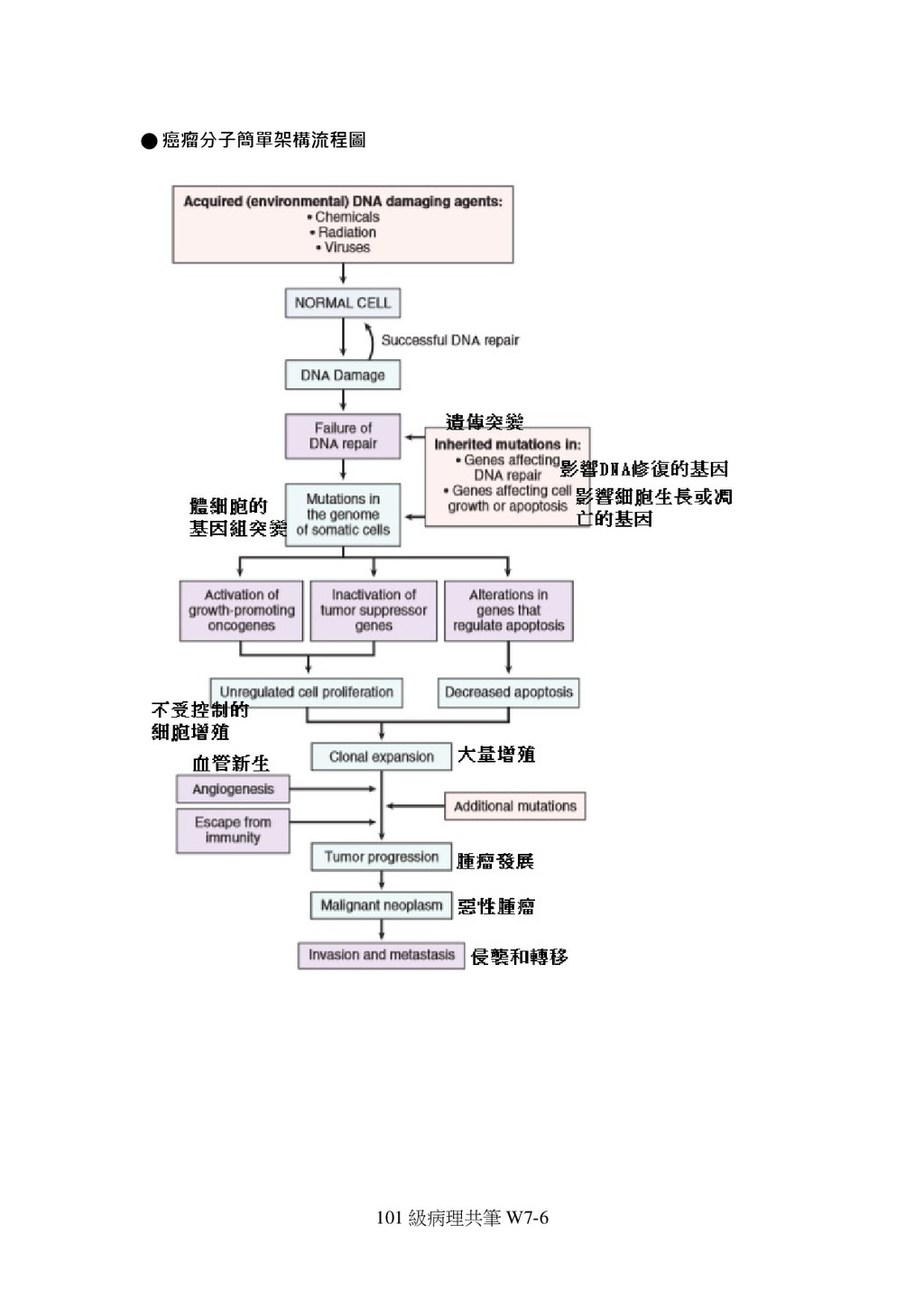
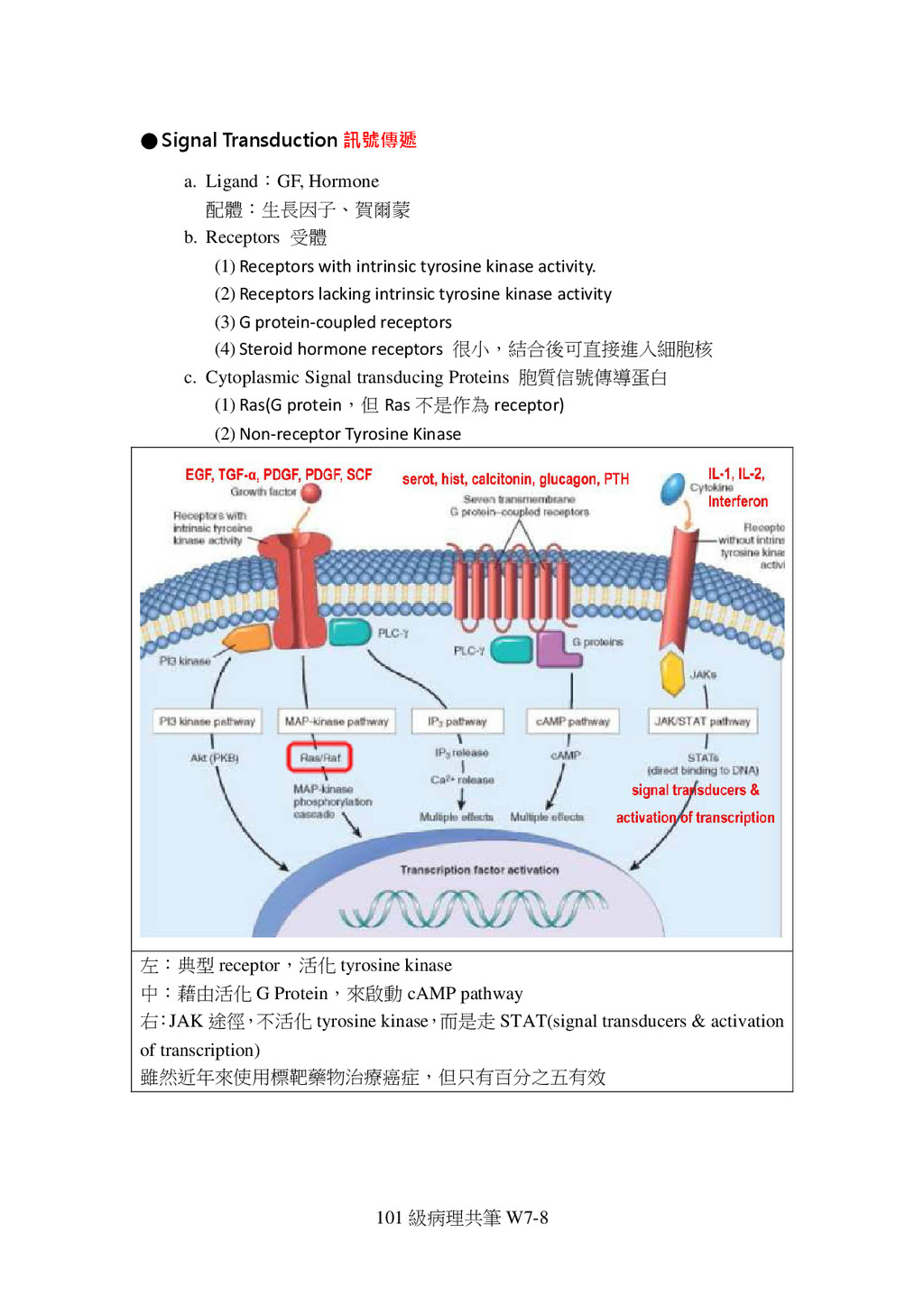
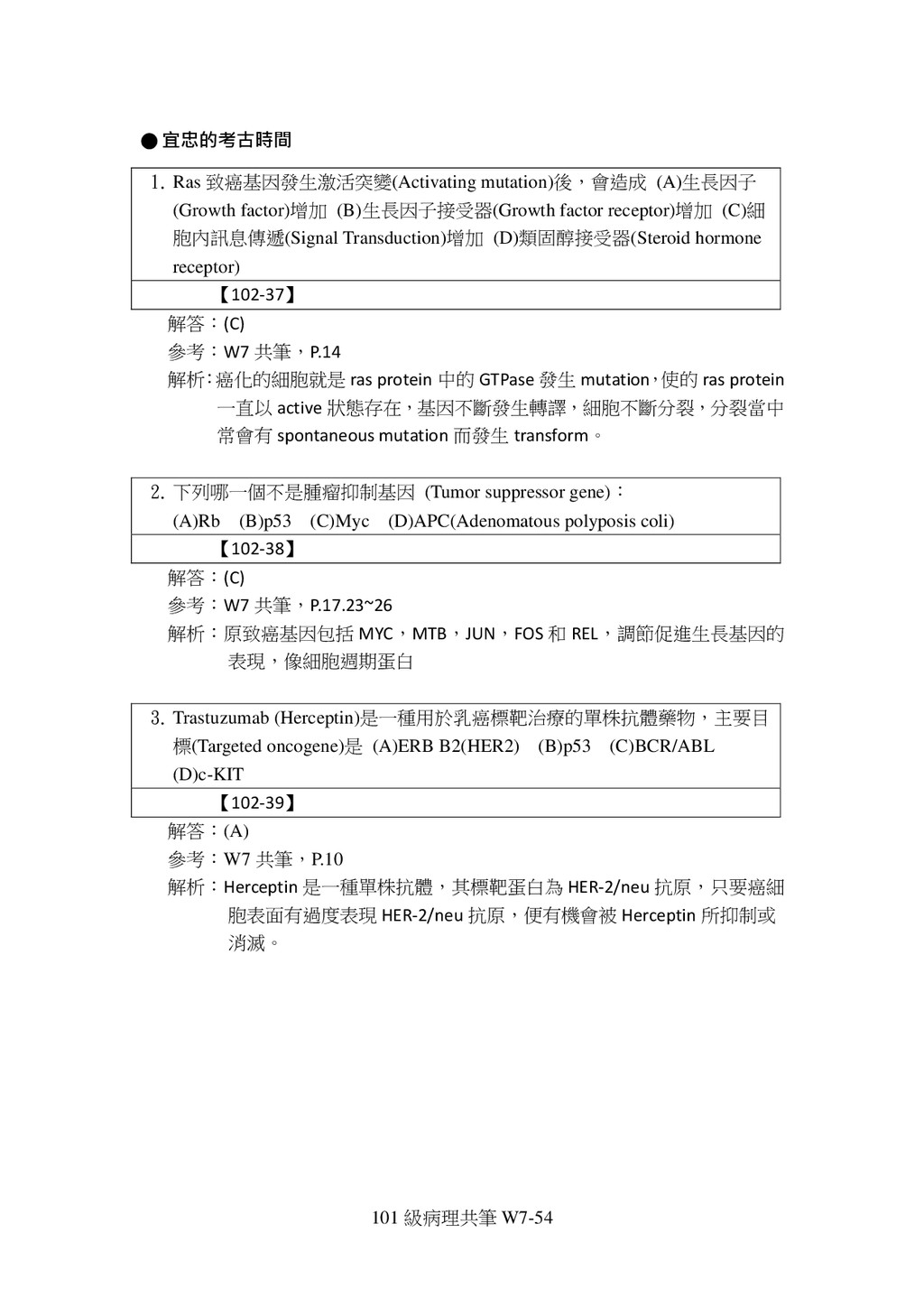
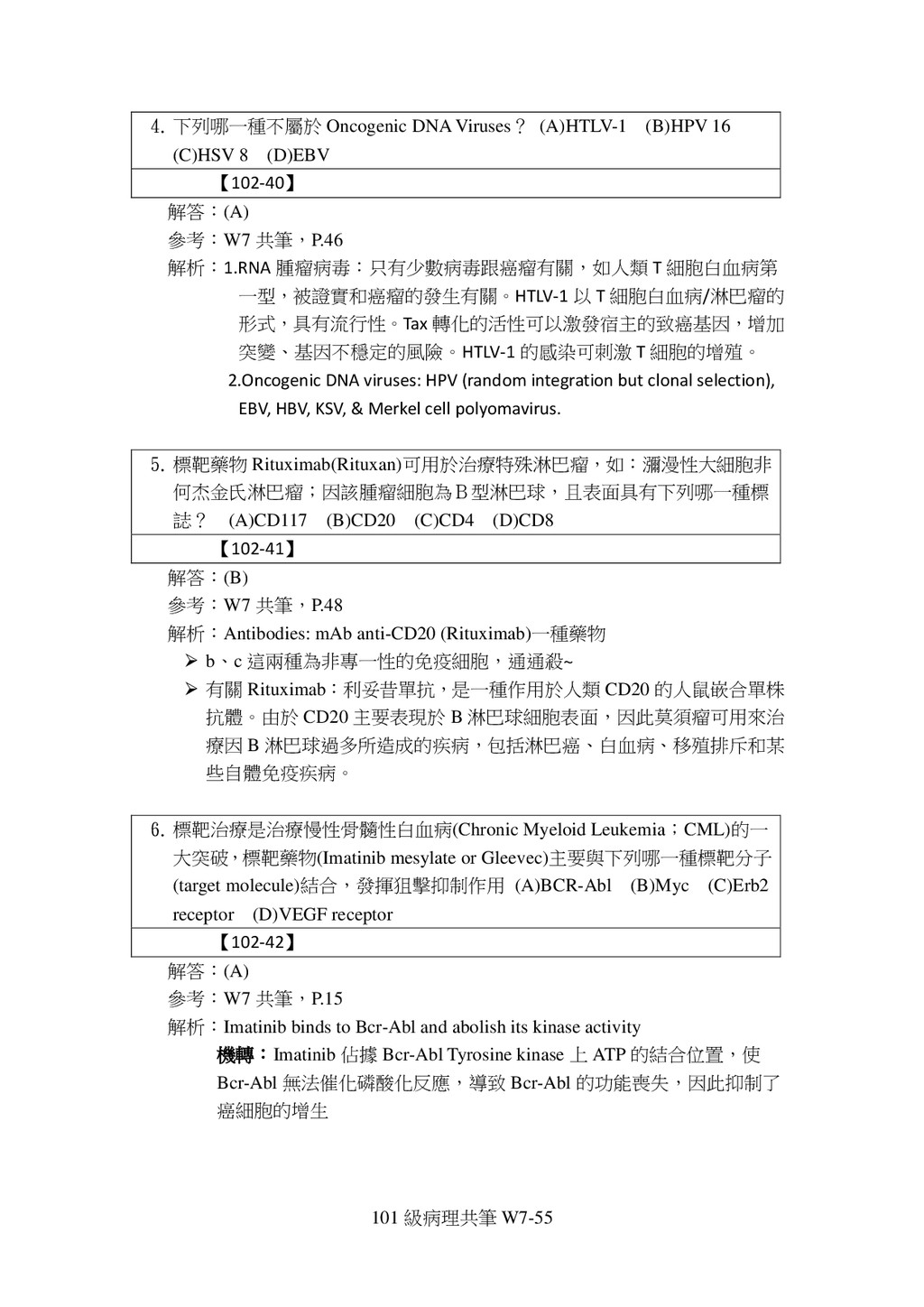
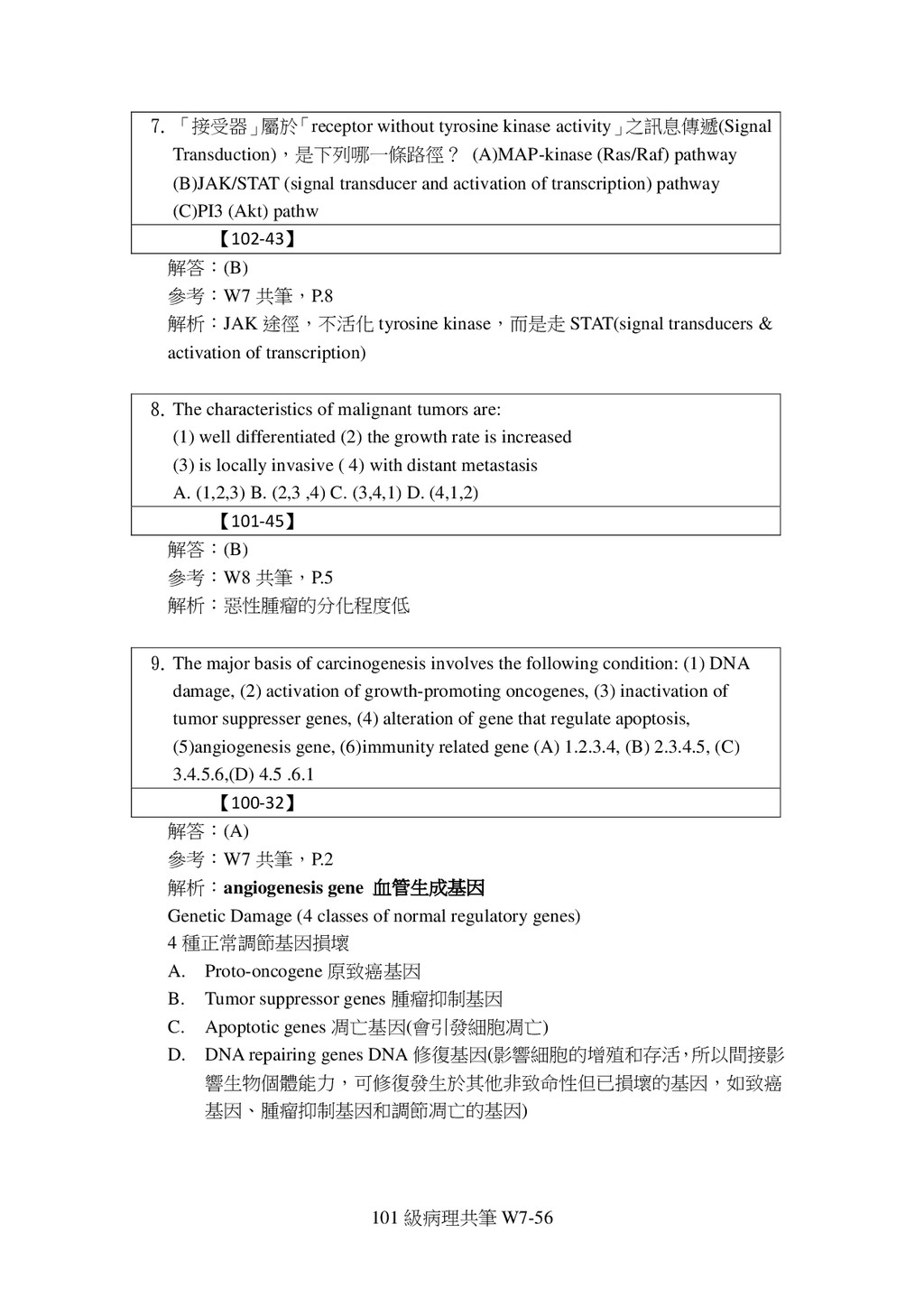
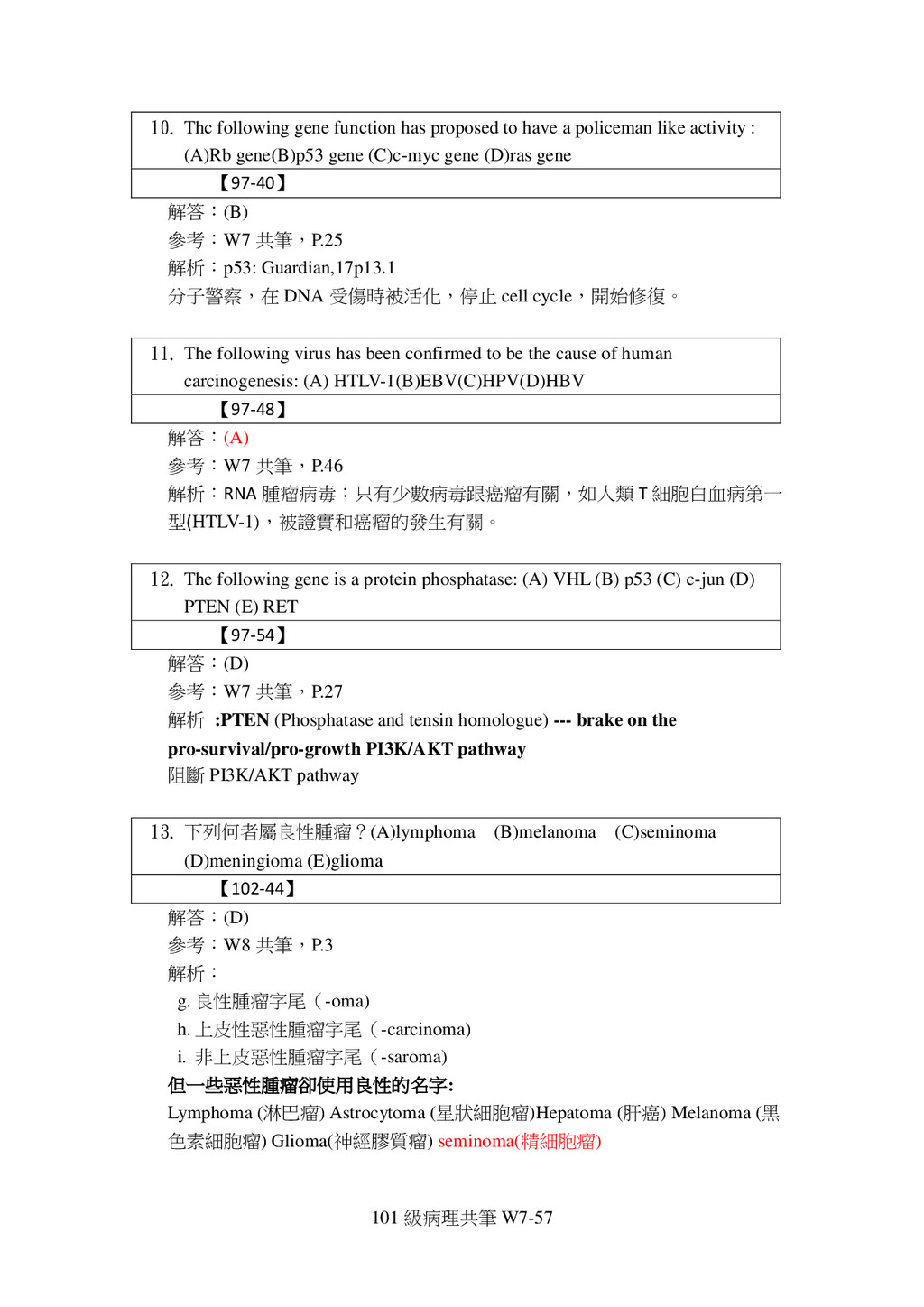
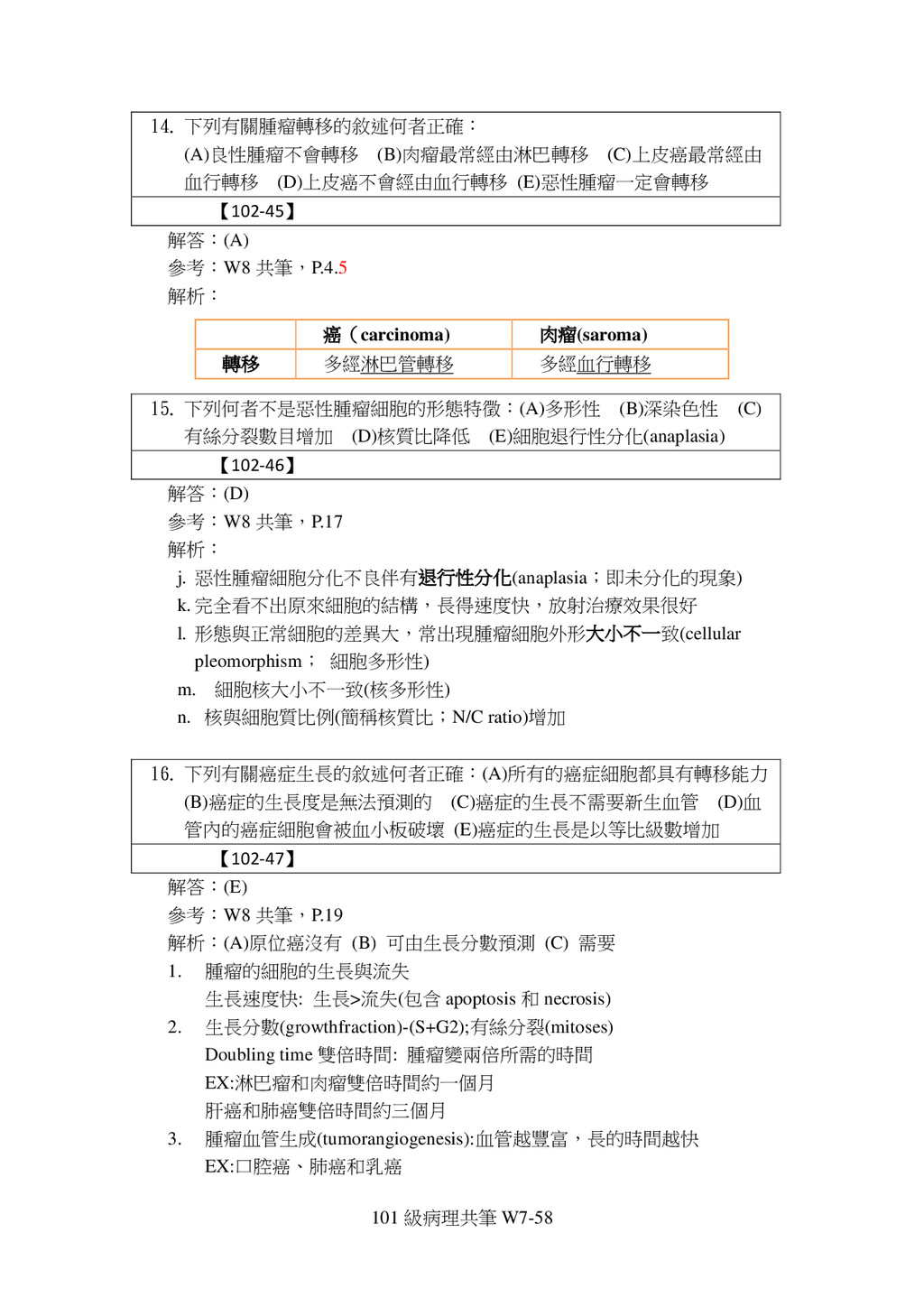
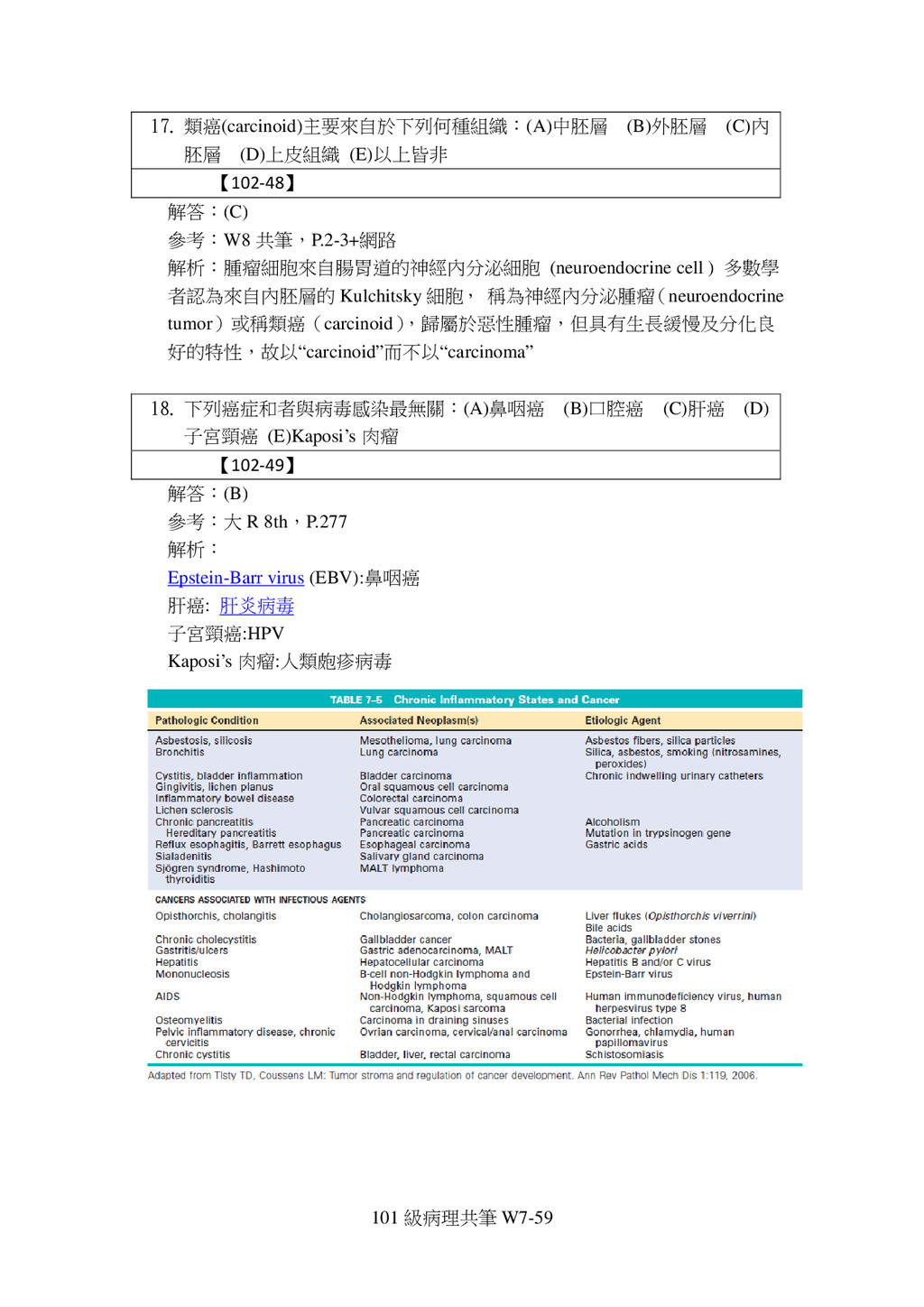
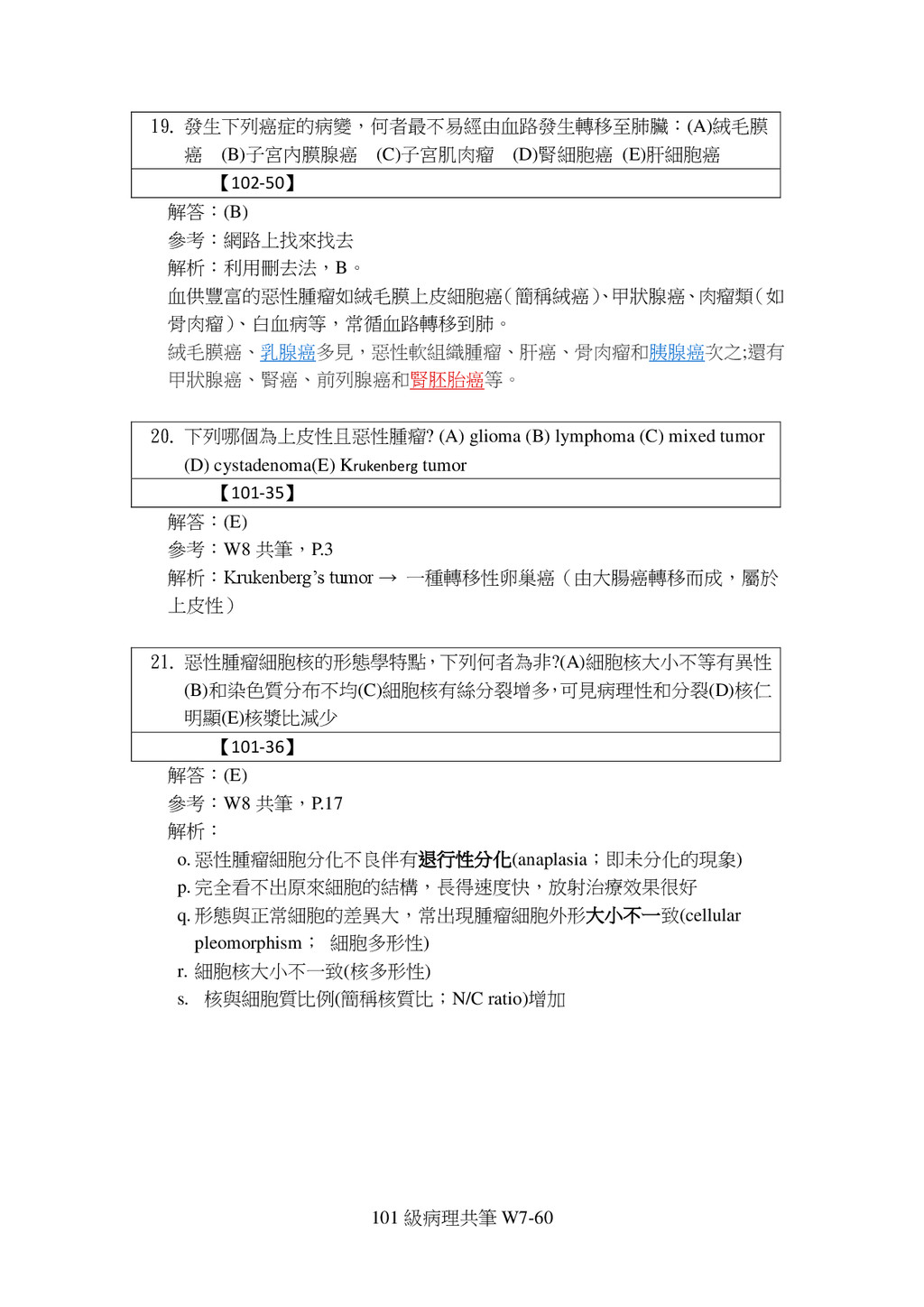
(A)MAP-kinase (Ras/Raf) pathway (B)JAK/STAT (signal transducer and activation of transcription) pathway (C)PI3 (Akt) pathw 【102-43】 解答:(B) 參考:W7 共筆,P.8 解析:JAK 途徑,不活化 tyrosine kinase,而是走 STAT(signal transducers & activation of transcription) 8. The characteristics of malignant tumors are: (1) well differentiated (2) the growth rate is increased (3) is locally invasive ( 4) with distant metastasis A. (1,2,3) B. (2,3 ,4) C. (3,4,1) D. (4,1,2) 【101-45】 解答:(B) 參考:W8 共筆,P.5 解析:惡性腫瘤的分化程度低 9. The major basis of carcinogenesis involves the following condition: (1) DNA damage, (2) activation of growth-promoting oncogenes, (3) inactivation of tumor suppresser genes, (4) alteration of gene that regulate apoptosis, (5)angiogenesis gene, (6)immunity related gene (A) 1.2.3.4, (B) 2.3.4.5, (C) 3.4.5.6,(D) 4.5 .6.1 【100-32】 解答:(A) 參考:W7 共筆,P.2 解析:angiogenesis gene 血管生成基因 Genetic Damage (4 classes of normal regulatory genes) 4 種正常調節基因損壞 A. Proto-oncogene 原致癌基因 B. Tumor suppressor genes 腫瘤抑制基因 C. Apoptotic genes 凋亡基因(會引發細胞凋亡) D. DNA repairing genes DNA 修復基因(影響細胞的增殖和存活,所以間接影 響生物個體能力,可修復發生於其他非致命性但已損壞的基因,如致癌 基因、腫瘤抑制基因和調節凋亡的基因) 101 級病理共筆 W7-56
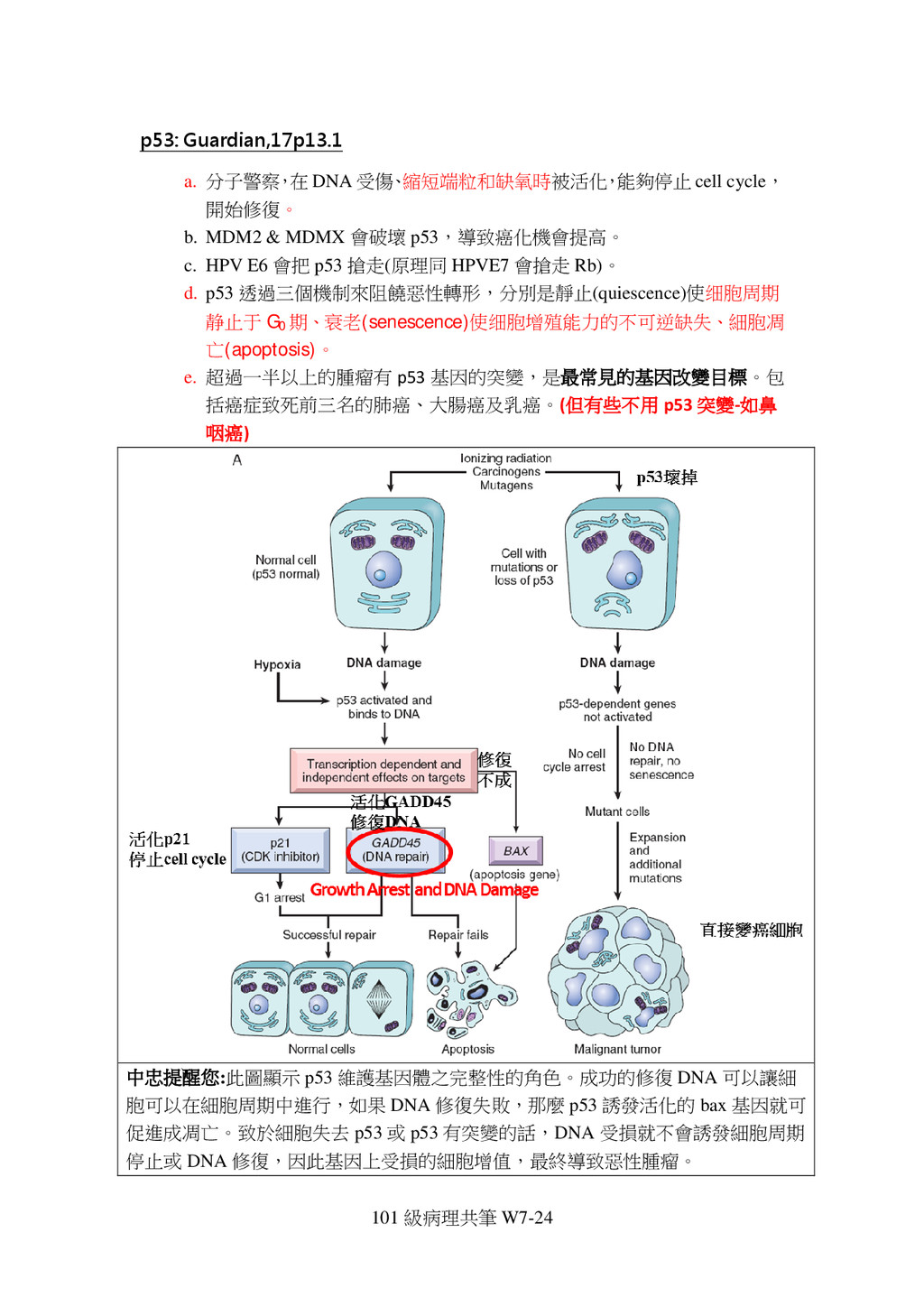
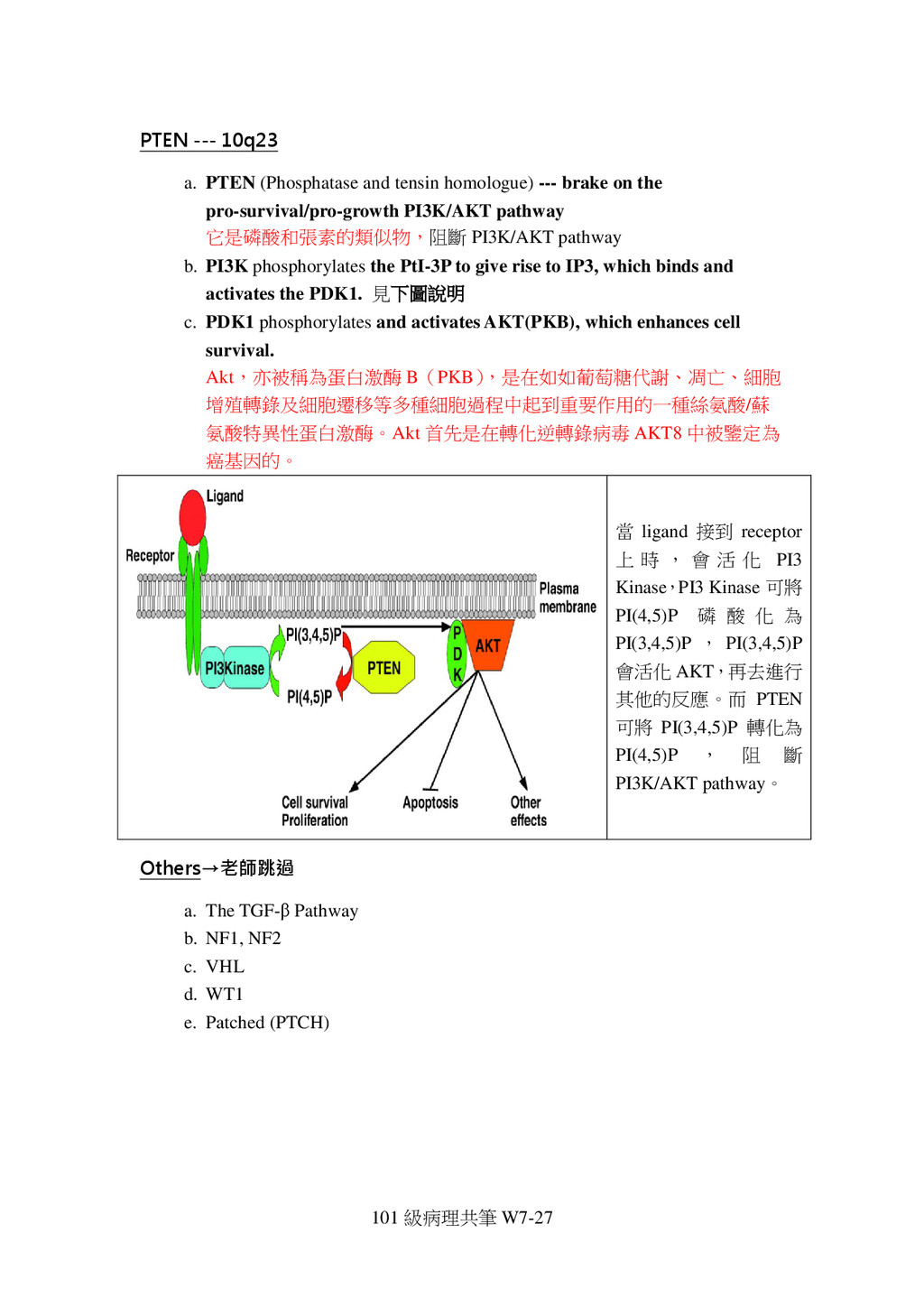
policeman like activity : (A)Rb gene(B)p53 gene (C)c-myc gene (D)ras gene 【97-40】 解答:(B) 參考:W7 共筆,P.25 解析:p53: Guardian,17p13.1 分子警察,在 DNA 受傷時被活化,停止 cell cycle,開始修復。 11. The following virus has been confirmed to be the cause of human carcinogenesis: (A) HTLV-1(B)EBV(C)HPV(D)HBV 【97-48】 解答:(A) 參考:W7 共筆,P.46 解析:RNA 腫瘤病毒:只有少數病毒跟癌瘤有關,如人類 T 細胞白血病第一 型(HTLV-1),被證實和癌瘤的發生有關。 12. The following gene is a protein phosphatase: (A) VHL (B) p53 (C) c-jun (D) PTEN (E) RET 【97-54】 解答:(D) 參考:W7 共筆,P.27 解析 :PTEN (Phosphatase and tensin homologue) --- brake on the pro-survival/pro-growth PI3K/AKT pathway 阻斷 PI3K/AKT pathway 13. 下列何者屬良性腫瘤?(A)lymphoma (B)melanoma (C)seminoma (D)meningioma (E)glioma 【102-44】 解答:(D) 參考:W8 共筆,P.3 解析: 良性腫瘤字尾(-oma) g. 上皮性惡性腫瘤字尾(-carcinoma) h. 非上皮惡性腫瘤字尾(-saroma) i. 但一些惡性腫瘤卻使用良性的名字: Lymphoma (淋巴瘤) Astrocytoma (星狀細胞瘤)Hepatoma (肝癌) Melanoma (黑 色素細胞瘤) Glioma(神經膠質瘤) seminoma(精細胞瘤) 101 級病理共筆 W7-57


 john0906
 uchi8977
 kentaroy47
 matleenalaakso
 juanmartin2026
 bvr7352
 moriyuya
 coderdojojapan
 hiola
hiola
 ytapples613
 pawan_pharm
 ssmedikasda
 madhuri28
 madoxten
 tapps
tapps
 ivargrimstad
 keathley
 rasagy
 panda_program
 62gerente
 aleyda
 lcolladotor
 lara
lara
 matthewcrist
 portentint