Upgrade to Pro — share decks privately, control downloads, hide ads and more …

How to save your money?

Avatar for Jon Jon
February 25, 2020

How to save your money?

Teaching your little ones the value of conserving and also the price of cash at an early age is definitely a smart thought since you will not be only molding your children to get accountable citizens however you will also be teaching your little ones to become conscious of how a person’s action can substantially have an impact on the entire local community and even the entire earth.

An individual fundamental factor you really need to train your young children is tips on how to effectively use electrical power. It doesn’t matter what the age of one’s youngster, it doesn’t make a difference there is certainly continuously a means to suit your needs to describe for your kid regarding the significance of developing electrical power.

Not merely to spend less but additionally to reduce the greenhouse impact. Very nearly every little thing right here within our region is driven by electrical energy and may you think about simply how much pollution and fossil each and every home is burning on a daily basis?

Molding children to become accountable grown ups begins in your house, therefore, you should certainly start disciplining them though they can be even now youthful.

Stroll the converse
Display your youngsters that you’re an accountable citizen by undertaking your honest share of electricity conserving. It is possible to do that by changing your normal light bulbs with LED light bulbs. It truly is an actuality that LED light bulbs are power successful when compared to customary lights. Confident it can charge somewhat substantial when compared to the previous ones but believe that regarding the month to month electricity lower it could possibly allow you to.

Apart from that this sort of light is far more sturdy and may final lengthier than every other sort of light. When you have replaced all of your standard light bulbs with LED lights be sure that you examine along with the entire household members to get started on turning off each of the appliances which have been not in use. Pcs must be turned off rather than putting it in a very standby mode. Air conditioner and lights also need to be turned off when no person is working with it.

Be considered an excellent part model
In contrast to taking the auto to visit a close-by grocery keep get a stroll. It is really not just wonderful for one's pocket however it can be fantastic on your human body. You could cut costs even in compact strategies.

Minimize out coupons
You’ll be able to essentially conserve a lot of funds once you get time for you to reduce out low-cost coupons. In case you possess a youngster underneath our roof get her the subsequent time you go searching. Demonstrate her that gathering coupon can really help you to lower your expenses. And store only for factors that you genuinely have.
Avatar for Jon
Jon

February 25, 2020

Other Decks in Business

Transcript

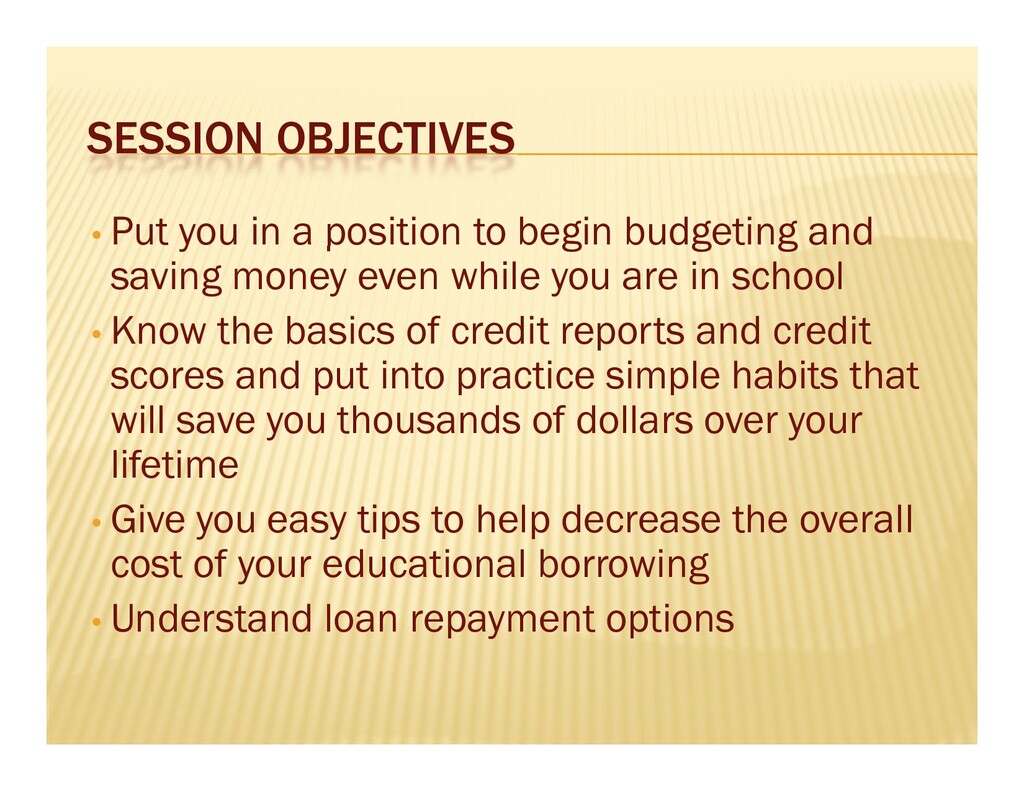
  1. SESSION OBJECTIVES SESSION OBJECTIVES •Put you in a position to

    begin budgeting and y p g g g saving money even while you are in school •Know the basics of credit reports and credit p scores and put into practice simple habits that will save you thousands of dollars over your lifetime •Give you easy tips to help decrease the overall cost of your educational borrowing •Understand loan repayment options
  2. WHY BUDGET? WHY BUDGET? ´ Tracking your expenses gives you

    a strong ´ Tracking your expenses gives you a strong sense of where your money goes and can help you reach your financial goals you reach your financial goals
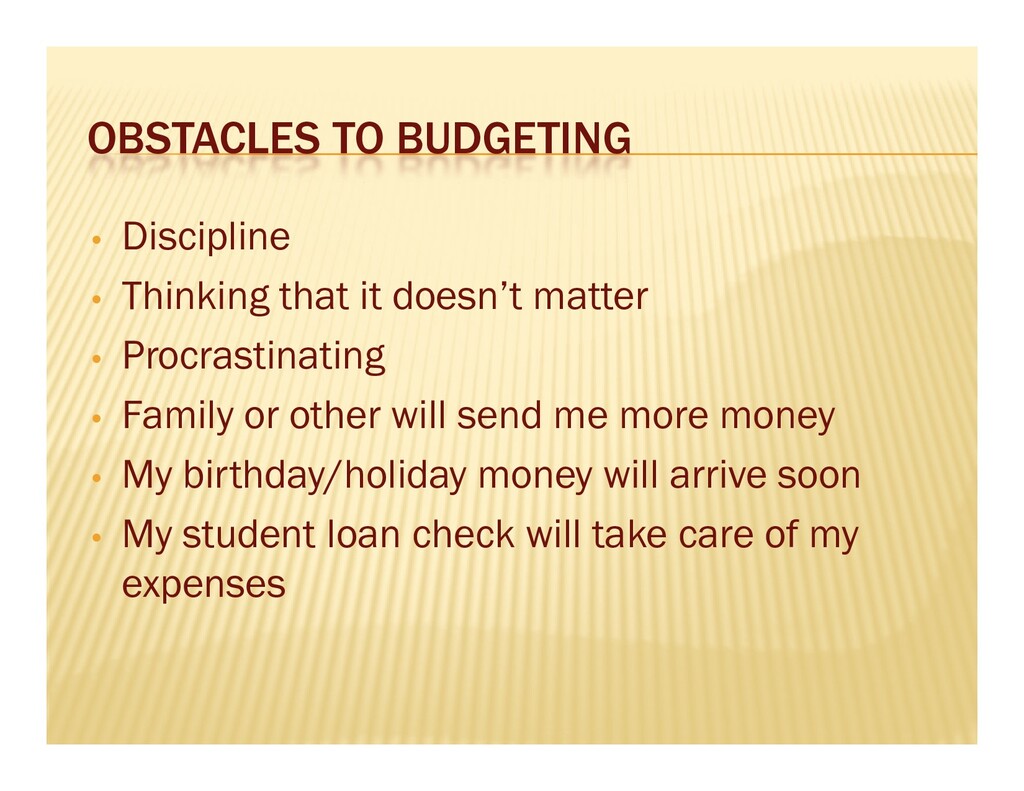
  3. OBSTACLES TO BUDGETING OBSTACLES TO BUDGETING • Discipline Discipline •

    Thinking that it doesn’t matter P ti ti g • Procrastinating • Family or other will send me more money • My birthday/holiday money will arrive soon • My student loan check will take care of my My student loan check will take care of my expenses
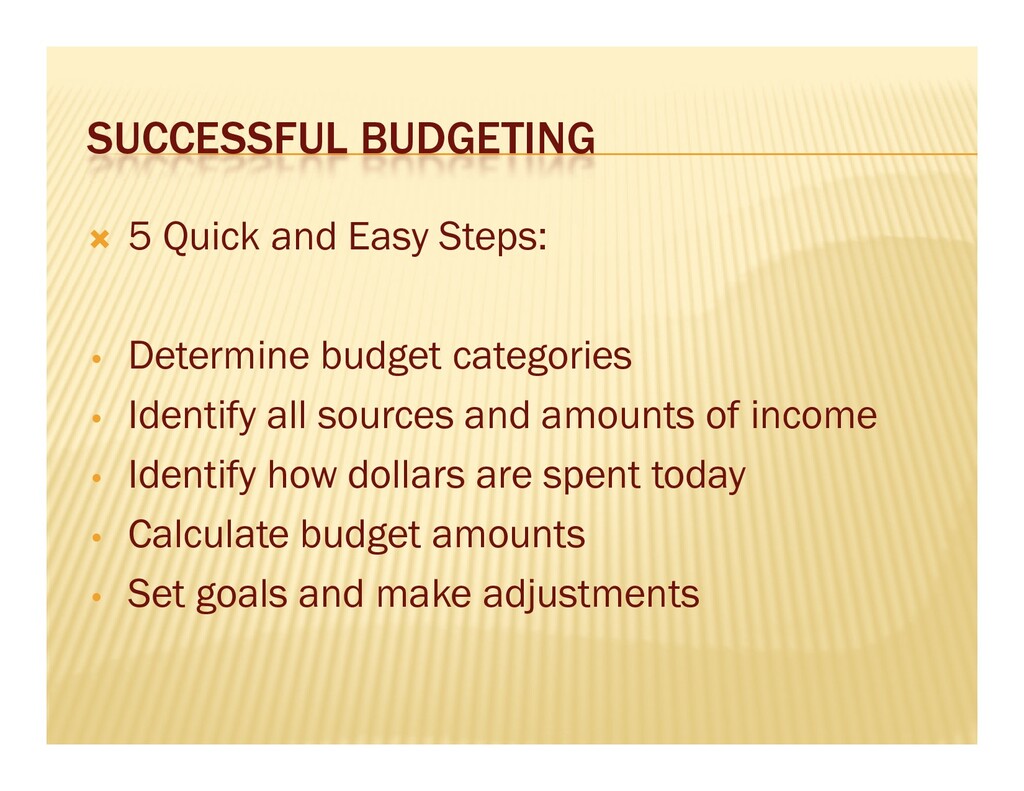
  4. SUCCESSFUL BUDGETING SUCCESSFUL BUDGETING ´ 5 Quick and Easy Steps:

    ´ 5 Quick and Easy Steps: D t i b dg t t g i • Determine budget categories • Identify all sources and amounts of income • Identify how dollars are spent today • Calculate budget amounts Calculate budget amounts • Set goals and make adjustments
  5. DETERMINE BUDGET CATEGORIES DETERMINE BUDGET CATEGORIES •Common mistake: Fit your

    spending into Common mistake: Fit your spending into somebody else’s categories •Successful budgeting includes categories that fl t th d reflect the way you spend money
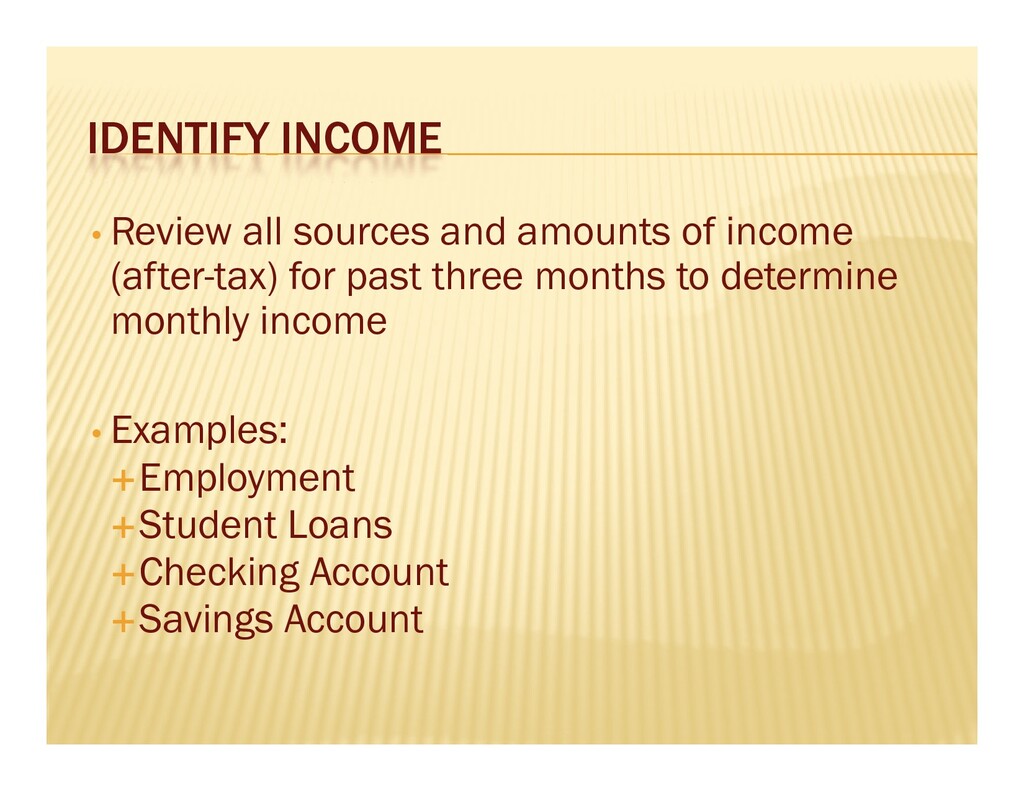
  6. IDENTIFY INCOME IDENTIFY INCOME •Review all sources and amounts of

    income (after-tax) for past three months to determine monthly income •Examples: p «Employment «Student Loans «Checking Account «Savings Account
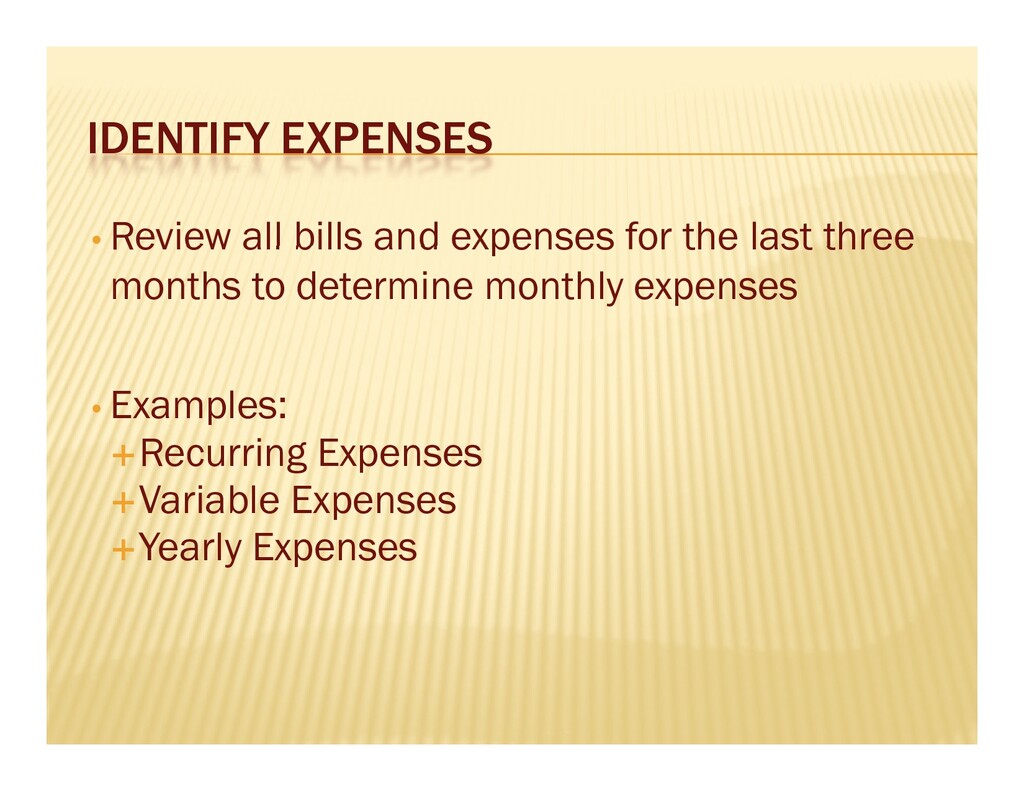
  7. IDENTIFY EXPENSES IDENTIFY EXPENSES •Review all bills and expenses for

    the last three Review all bills and expenses for the last three months to determine monthly expenses •Examples: «Rec rring E penses «Recurring Expenses «Variable Expenses «Yearly Expenses «Yearly Expenses
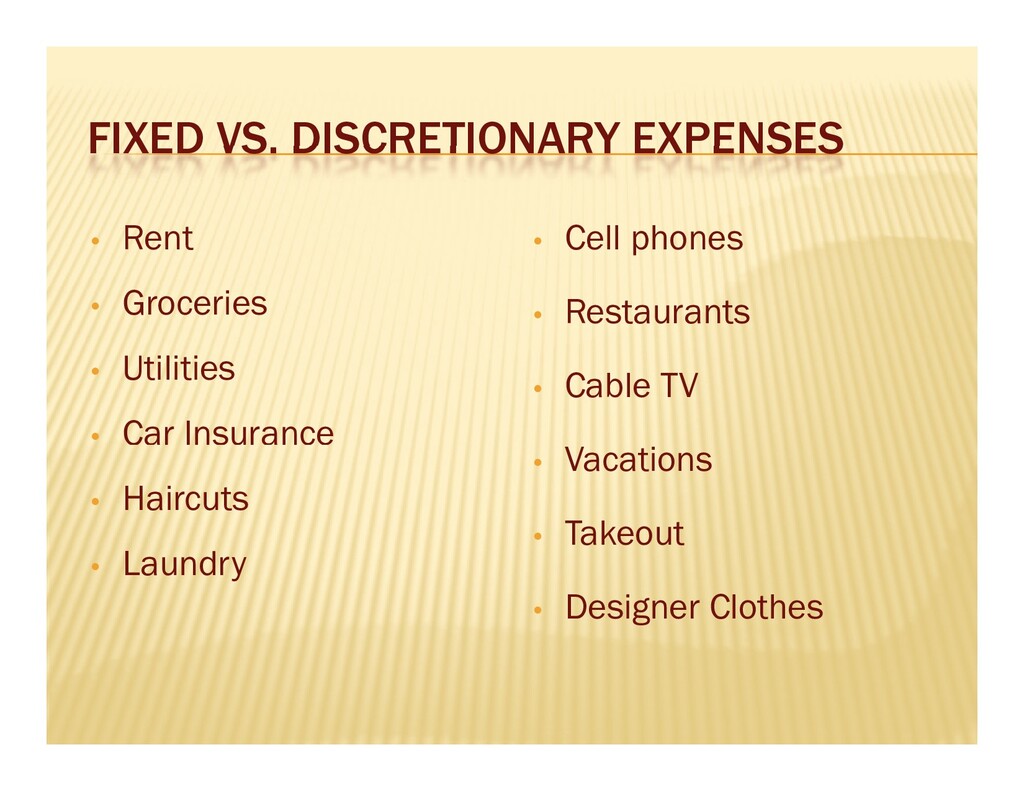
  8. FIXED VS DISCRETIONARY EXPENSES FIXED VS. DISCRETIONARY EXPENSES • Rent

    • Cell phones Rent • Groceries Cell phones • Restaurants • Utilities • Car Insurance • Cable TV • Haircuts • Vacations • Takeout • Laundry a eout • Designer Clothes
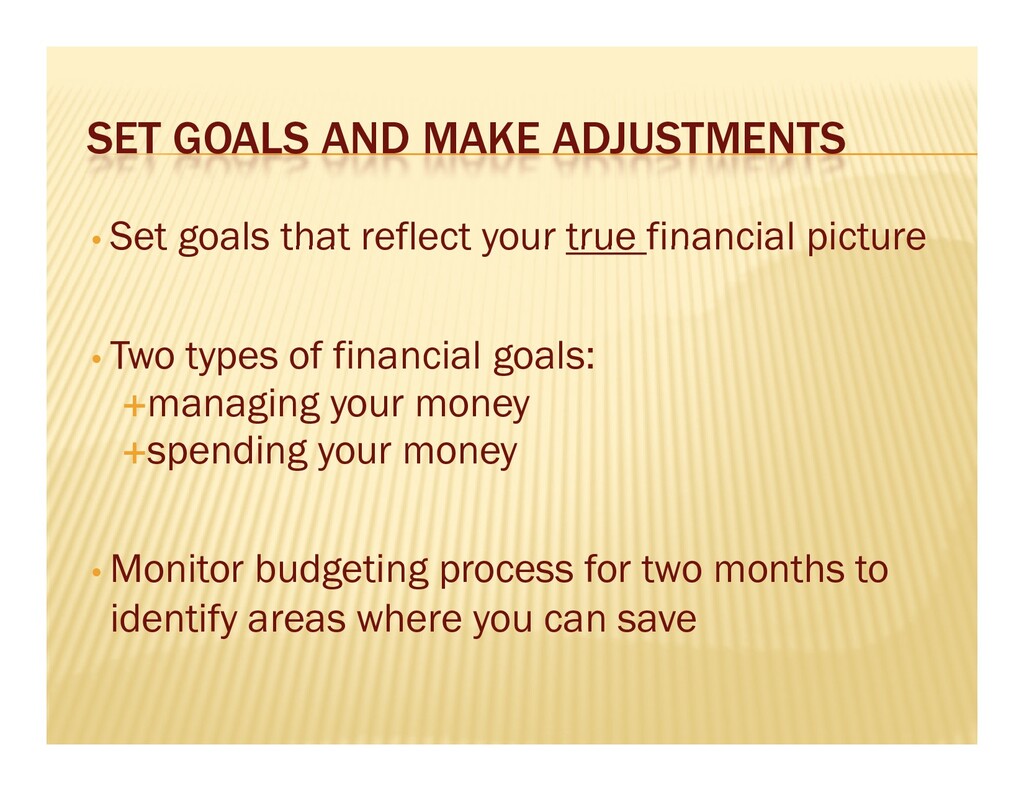
  9. SET GOALS AND MAKE ADJUSTMENTS SET GOALS AND MAKE ADJUSTMENTS

    •Set goals that reflect your true financial picture Set goals that reflect your true financial picture T t f fi i l g l •Two types of financial goals: «managing your money «spending your money «spending your money •Monitor budgeting process for two months to identify areas where you can save
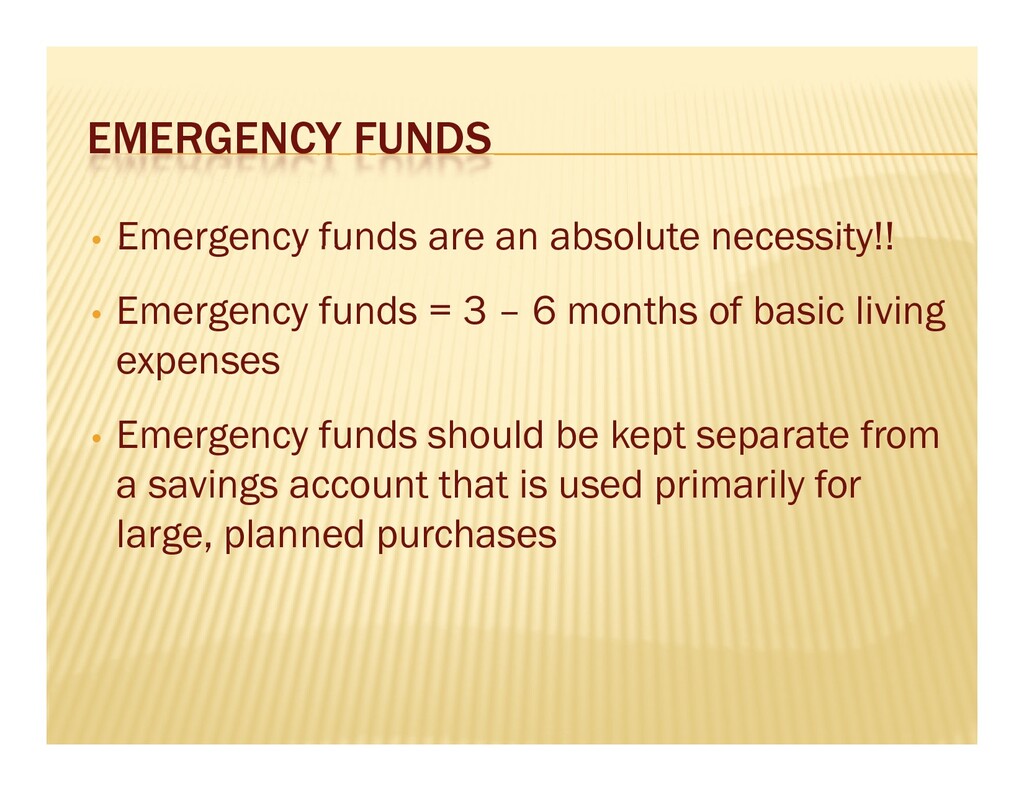
  10. EMERGENCY FUNDS EMERGENCY FUNDS • Emergency funds are an absolute

    necessity!! Emergency funds are an absolute necessity!! • Emergency funds = 3 – 6 months of basic living expenses • Emergency funds should be kept separate from Emergency funds should be kept separate from a savings account that is used primarily for large, planned purchases large, planned purchases
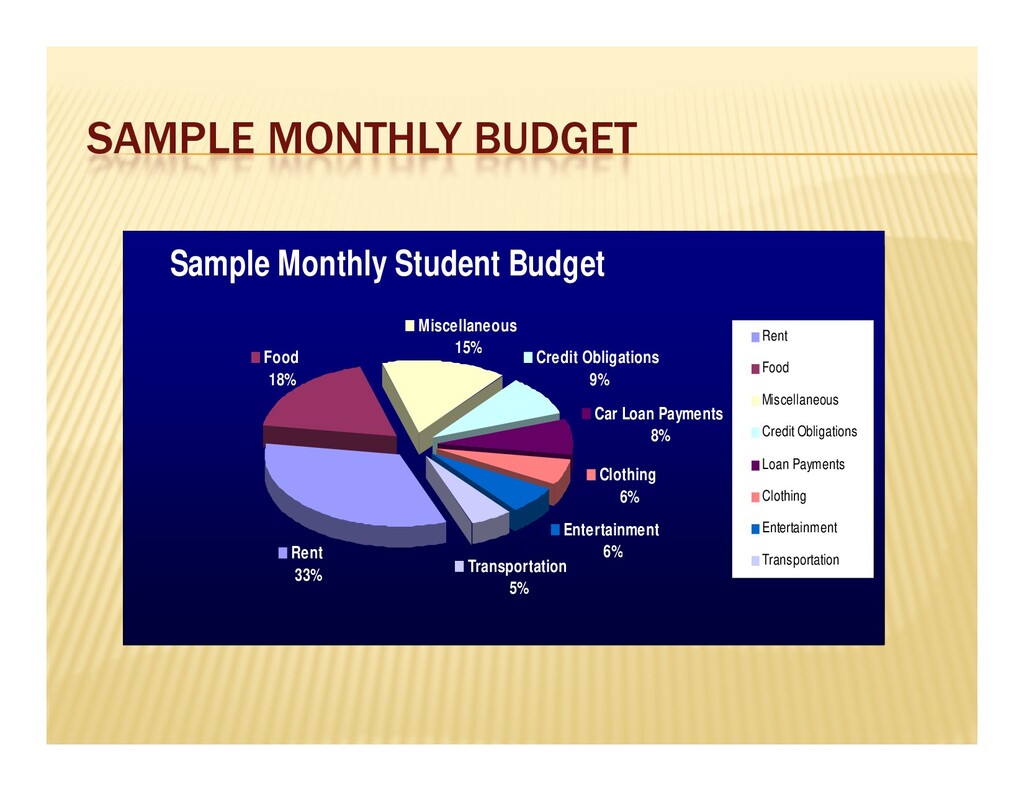
  11. SAMPLE MONTHLY BUDGET SAMPLE MONTHLY BUDGET Sample Monthly Student Budget

    Miscellaneous 15% Rent 15% Car Loan Payments 8% Credit Obligations 9% Food 18% Food Miscellaneous Credit Obligations Entertainment Clothing 6% Loan Payments Clothing Entertainment 6% Transportation 5% Rent 33% Transportation
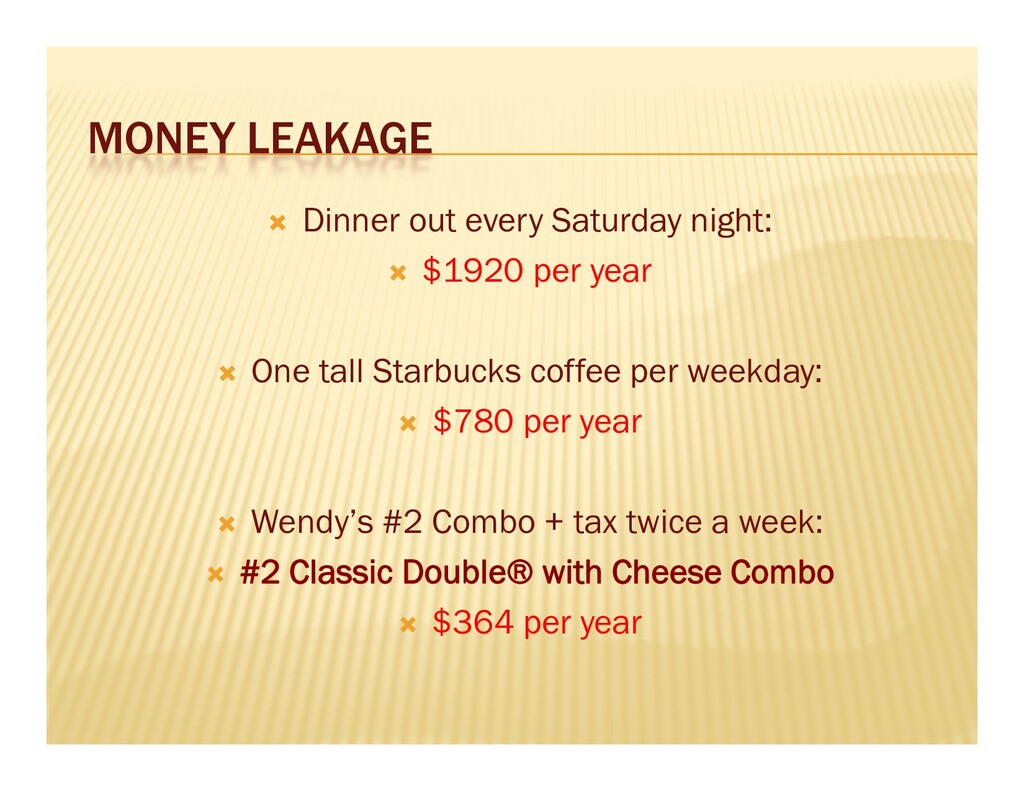
  12. MONEY LEAKAGE MONEY LEAKAGE ´ Dinner out every Saturday night:

    ´ $1920 per year ´ One tall Starbucks coffee per weekday: ´ $780 per year ´ Wendy’s #2 Combo + tax twice a week: ´ #2 Classic Double® with Cheese Combo ´ $364 per year
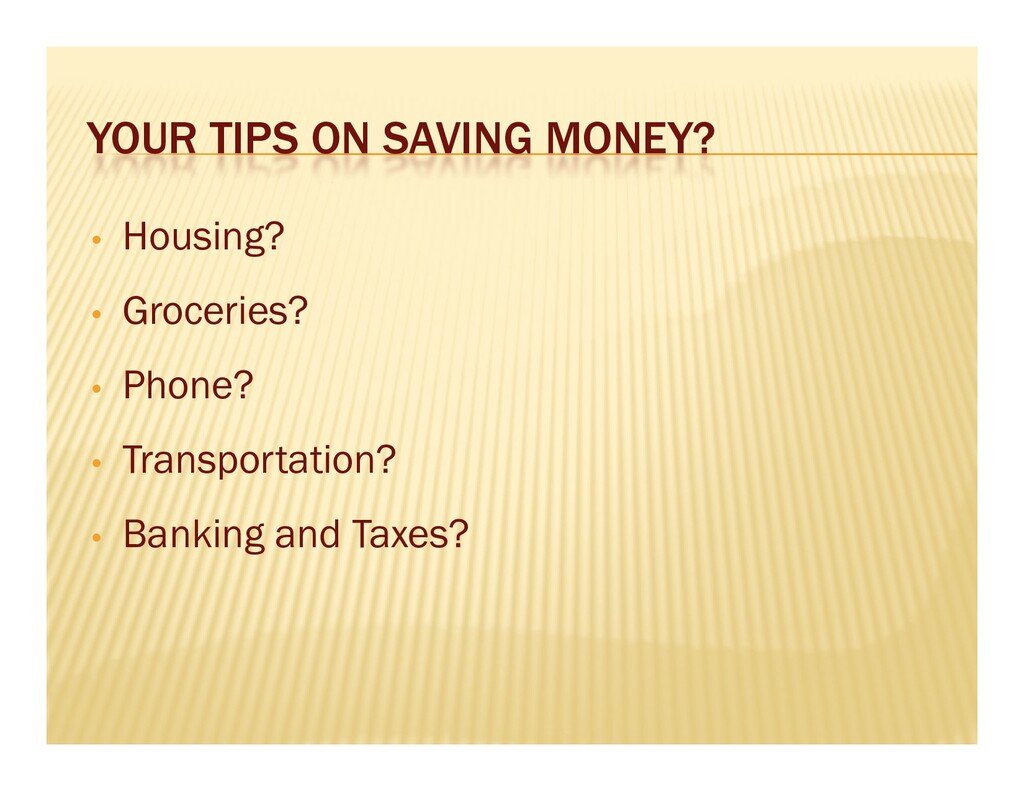
  13. YOUR TIPS ON SAVING MONEY? YOUR TIPS ON SAVING MONEY?

    • Housing? Housing? • Groceries? • Phone? ? • Transportation? • Banking and Taxes? Banking and Taxes?
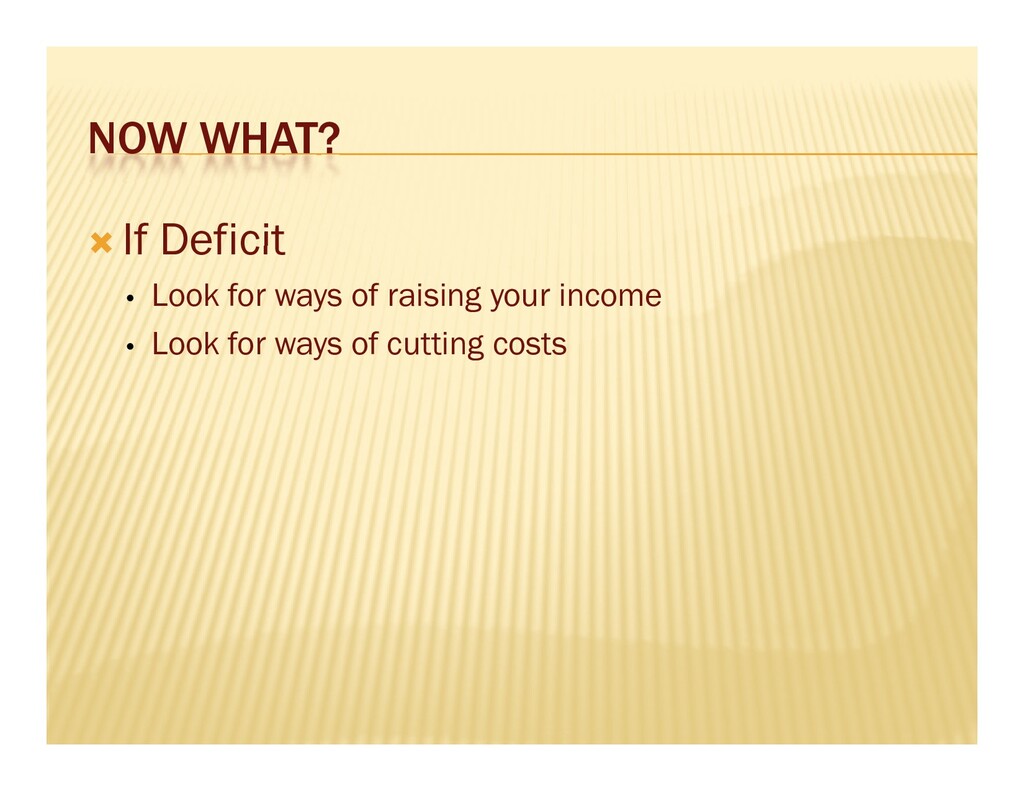
  14. NOW WHAT? NOW WHAT? ´ If Deficit ´ If Deficit

    • Look for ways of raising your income • Look for ways of cutting costs • Look for ways of cutting costs
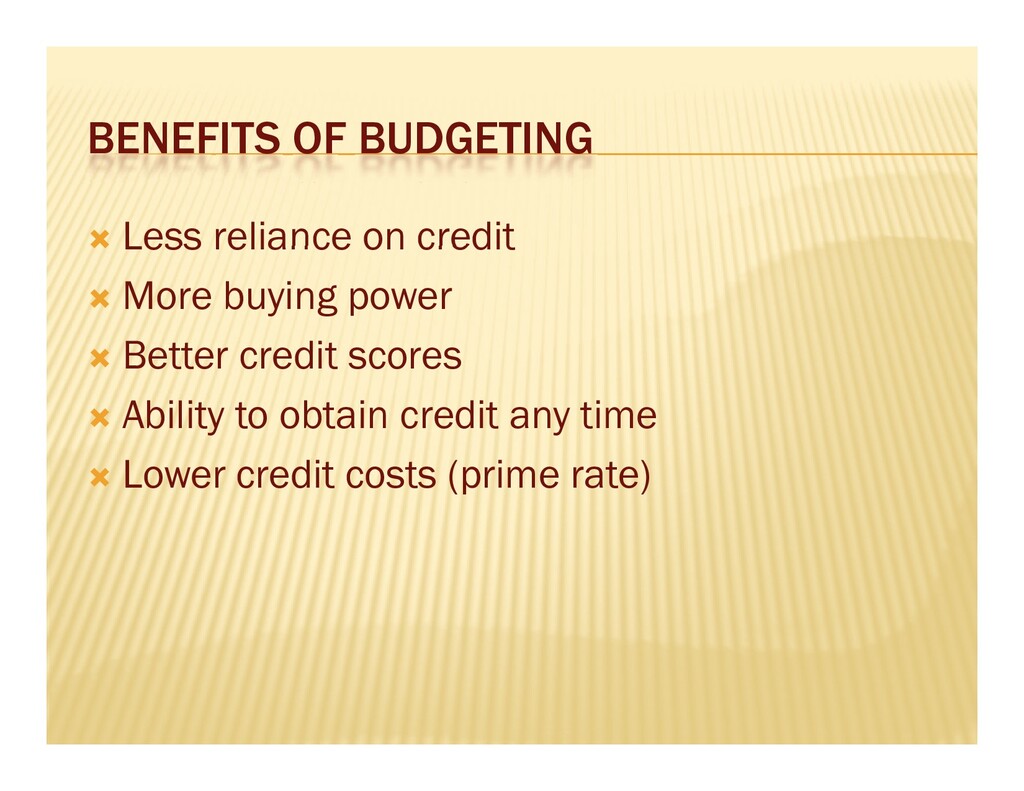
  15. BENEFITS OF BUDGETING BENEFITS OF BUDGETING ´ Less reliance on

    credit ´ Less reliance on credit ´ More buying power B tt dit ´ Better credit scores ´ Ability to obtain credit any time ´ Lower credit costs (prime rate)
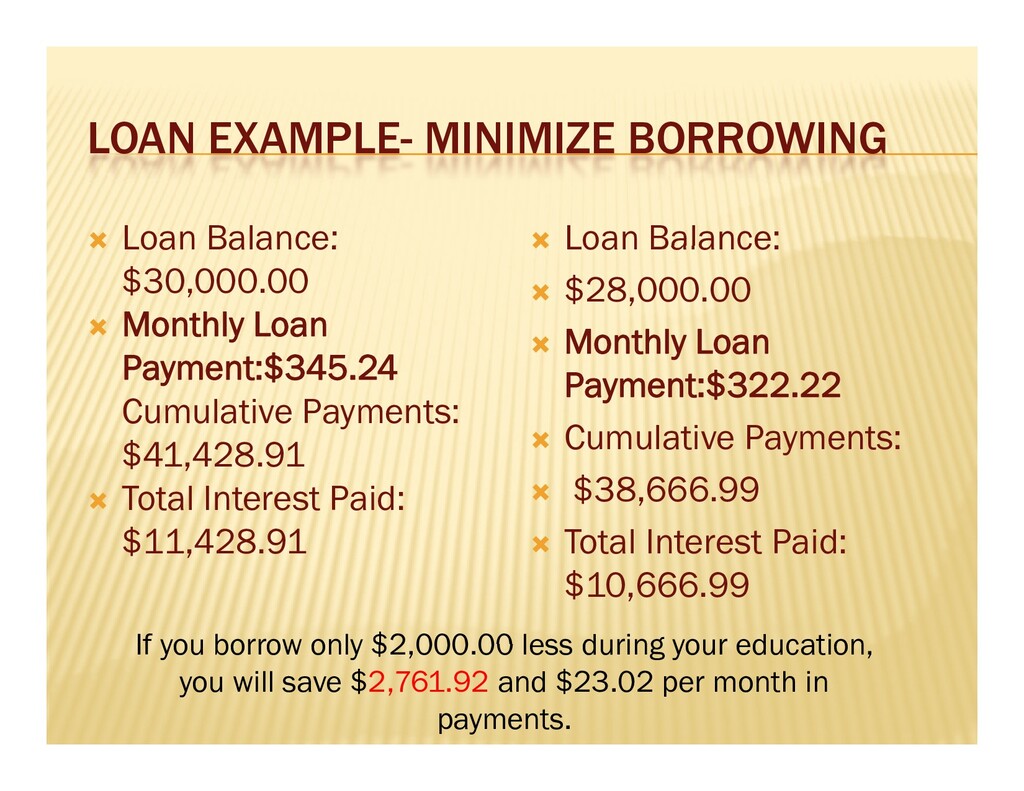
  16. LOAN EXAMPLE- MINIMIZE BORROWING LOAN EXAMPLE MINIMIZE BORROWING ´ Loan

    Balance: ´ Loan Balance: ´ Loan Balance: $30,000.00 ´ Monthly Loan ´ Loan Balance: ´ $28,000.00 ´ Monthly Loan Payment:$345.24 Cumulative Payments: $41 428 91 ´ Monthly Loan Payment:$322.22 ´ Cumulative Payments: $41,428.91 ´ Total Interest Paid: $11 428 91 ´ Cumulative Payments: ´ $38,666.99 ´ Total Interest Paid: $11,428.91 ´ Total Interest Paid: $10,666.99 If you borrow only $2 000 00 less during your education If you borrow only $2,000.00 less during your education, you will save $2,761.92 and $23.02 per month in payments.
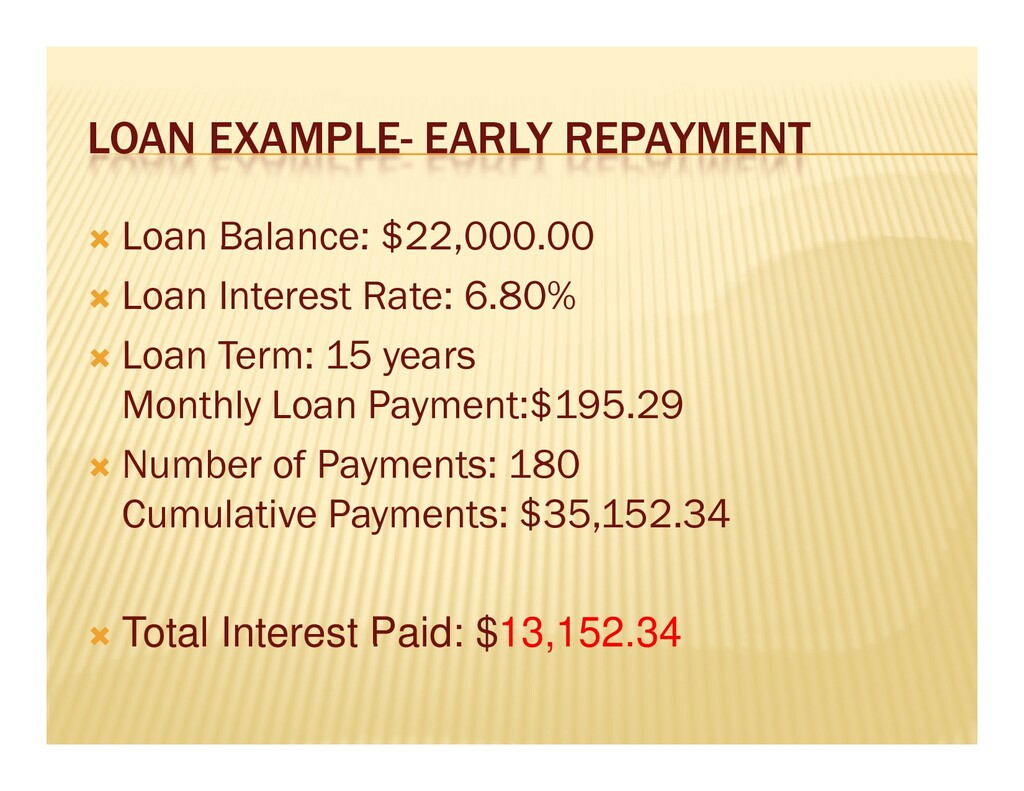
  17. LOAN EXAMPLE- EARLY REPAYMENT LOAN EXAMPLE EARLY REPAYMENT ´ Loan

    Balance: $22,000.00 ´ Loan Balance: $22,000.00 ´ Loan Interest Rate: 6.80% L T 15 ´ Loan Term: 15 years Monthly Loan Payment:$195.29 ´ Number of Payments: 180 Cumulative Payments: $35,152.34 ´ Total Interest Paid: $13,152.34 ´ Total Interest Paid: $13,152.34
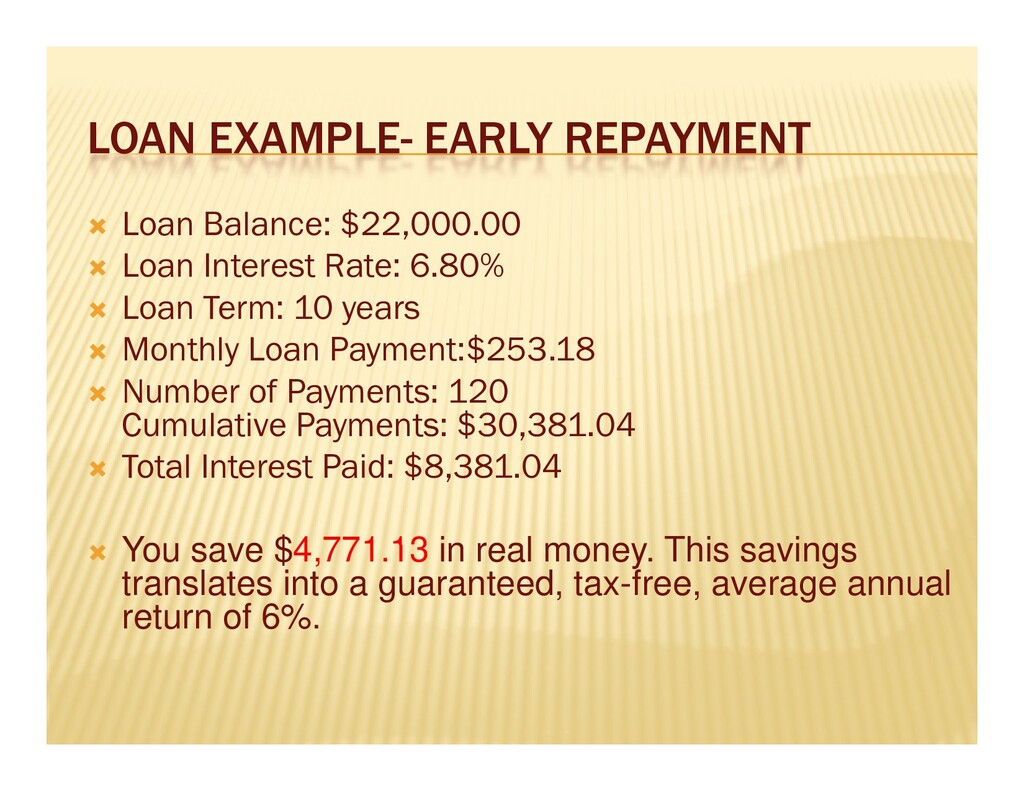
  18. LOAN EXAMPLE- EARLY REPAYMENT LOAN EXAMPLE EARLY REPAYMENT ´ Loan

    Balance: $22,000.00 ´ Loan Interest Rate: 6.80% ´ Loan Term: 10 years ´ Monthly Loan Payment:$253 18 ´ Monthly Loan Payment:$253.18 ´ Number of Payments: 120 Cumulative Payments: $30,381.04 ´ Total Interest Paid: $8,381.04 You save $4 771 13 in real money This savings ´ You save $4,771.13 in real money. This savings translates into a guaranteed, tax-free, average annual return of 6%.
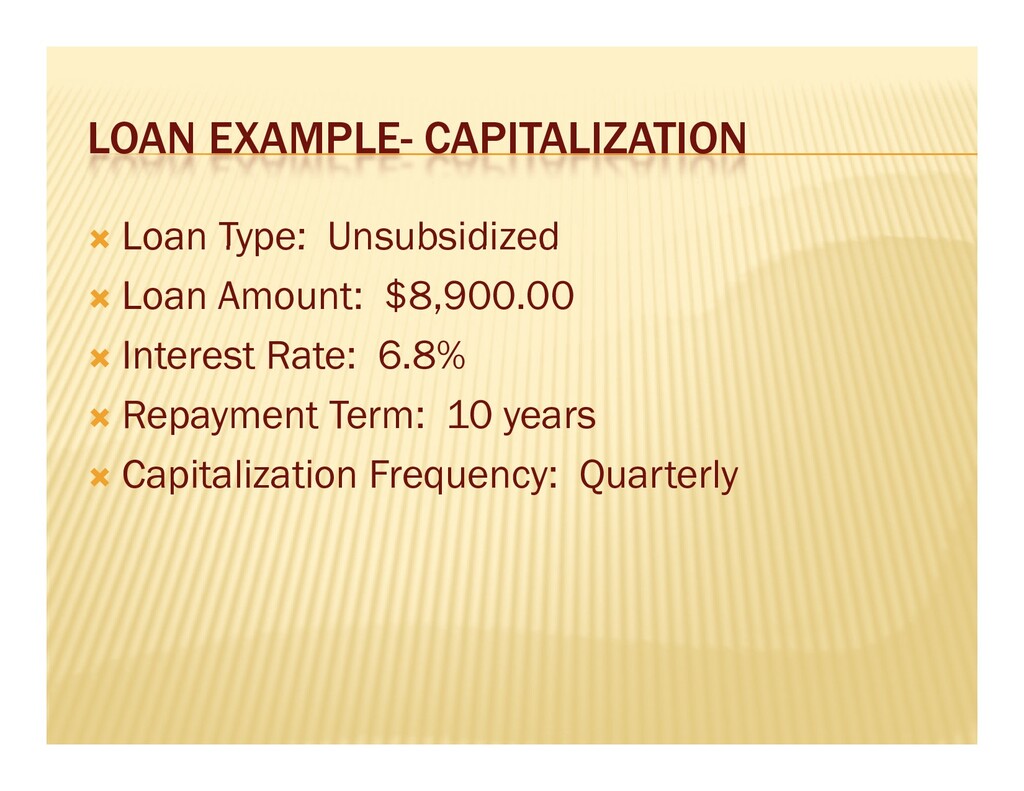
  19. LOAN EXAMPLE- CAPITALIZATION LOAN EXAMPLE CAPITALIZATION ´ Loan Type: Unsubsidized

    ´ Loan Type: Unsubsidized ´ Loan Amount: $8,900.00 I t t R t 6 8% ´ Interest Rate: 6.8% ´ Repayment Term: 10 years ´ Capitalization Frequency: Quarterly
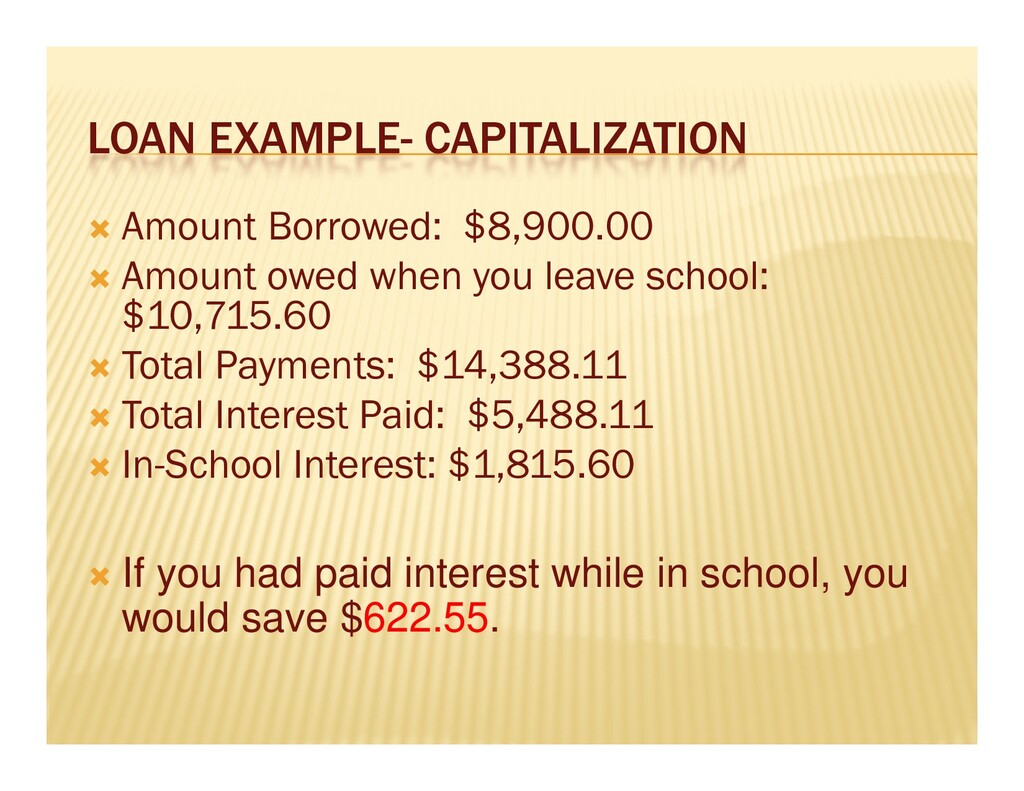
  20. LOAN EXAMPLE- CAPITALIZATION LOAN EXAMPLE CAPITALIZATION ´ Amount Borrowed: $8,900.00

    ´ Amount owed when you leave school: $10,715.60 ´ Total Payments: $14,388.11 ´ Total Interest Paid: $5,488.11 ´ In-School Interest: $1,815.60 ´ If you had paid interest while in school, you would save $622.55.
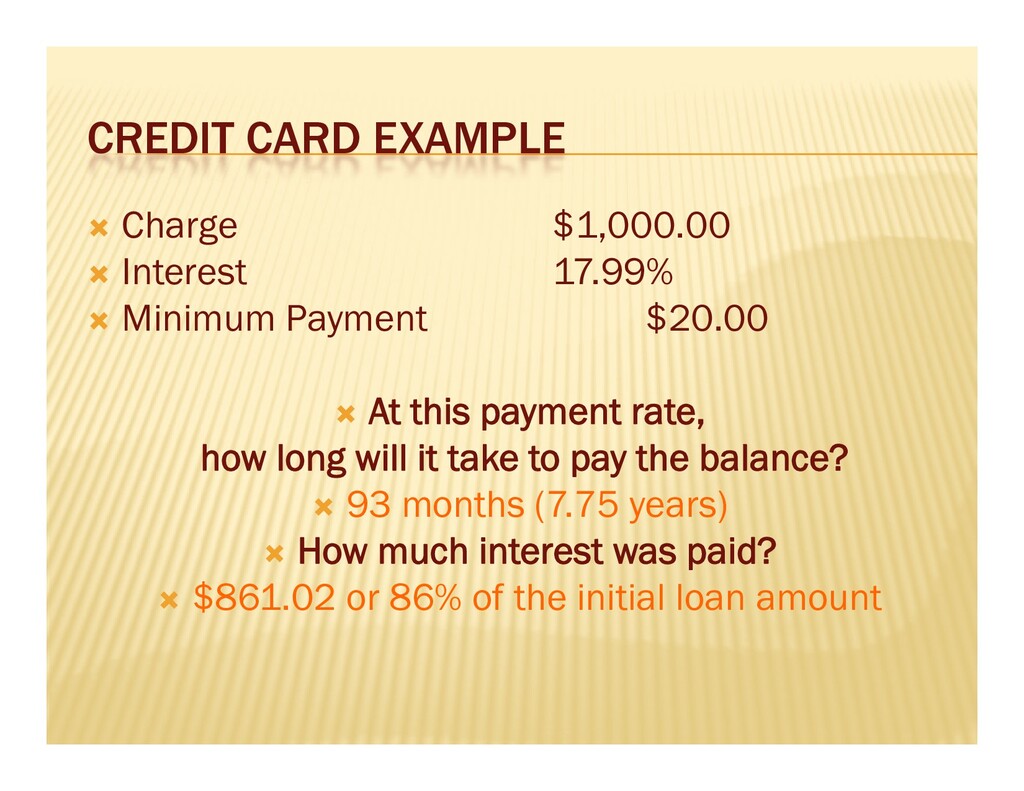
  21. CREDIT CARD EXAMPLE CREDIT CARD EXAMPLE ´ Charge $1,000.00 ´

    Interest 17.99% ´ Minimum Payment $20.00 ´ At this payment rate, h l ill i k h b l ? how long will it take to pay the balance? ´ 93 months (7.75 years) How much interest was paid? ´ How much interest was paid? ´ $861.02 or 86% of the initial loan amount
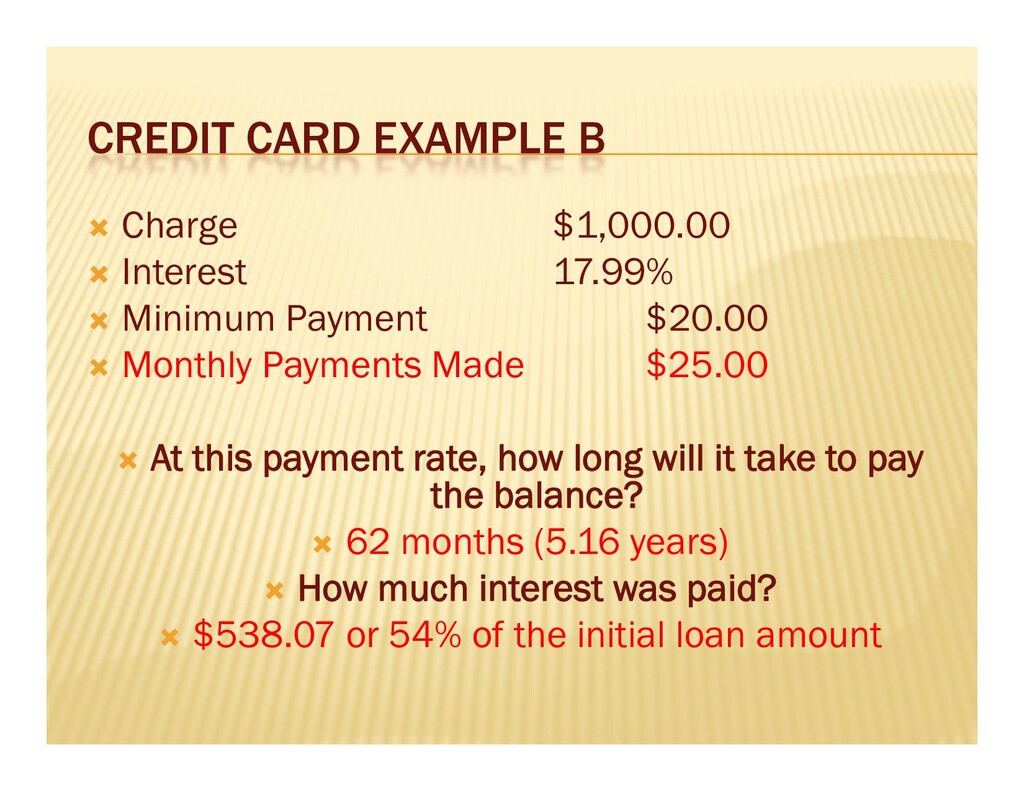
  22. CREDIT CARD EXAMPLE B CREDIT CARD EXAMPLE B ´ Charge

    $1,000.00 ´ Interest 17.99% ´ Minimum Payment $20.00 ´ Monthly Payments Made $25.00 A hi h l ill i k ´ At this payment rate, how long will it take to pay the balance? ´ 62 months (5 16 years) ´ 62 months (5.16 years) ´ How much interest was paid? ´ $538.07 or 54% of the initial loan amount ´ $538.07 or 54% of the initial loan amount
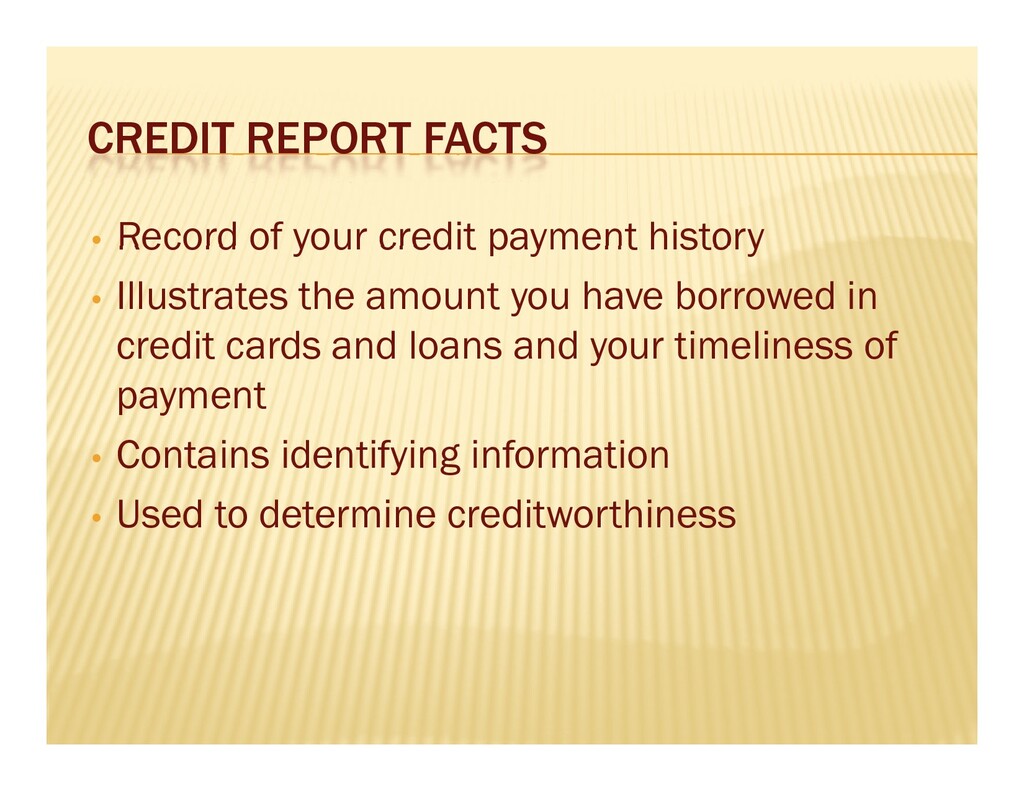
  23. CREDIT REPORT FACTS CREDIT REPORT FACTS • Record of your

    credit payment history Record of your credit payment history • Illustrates the amount you have borrowed in credit cards and loans and your timeliness of credit cards and loans and your timeliness of payment C t i id tif i g i f ti • Contains identifying information • Used to determine creditworthiness
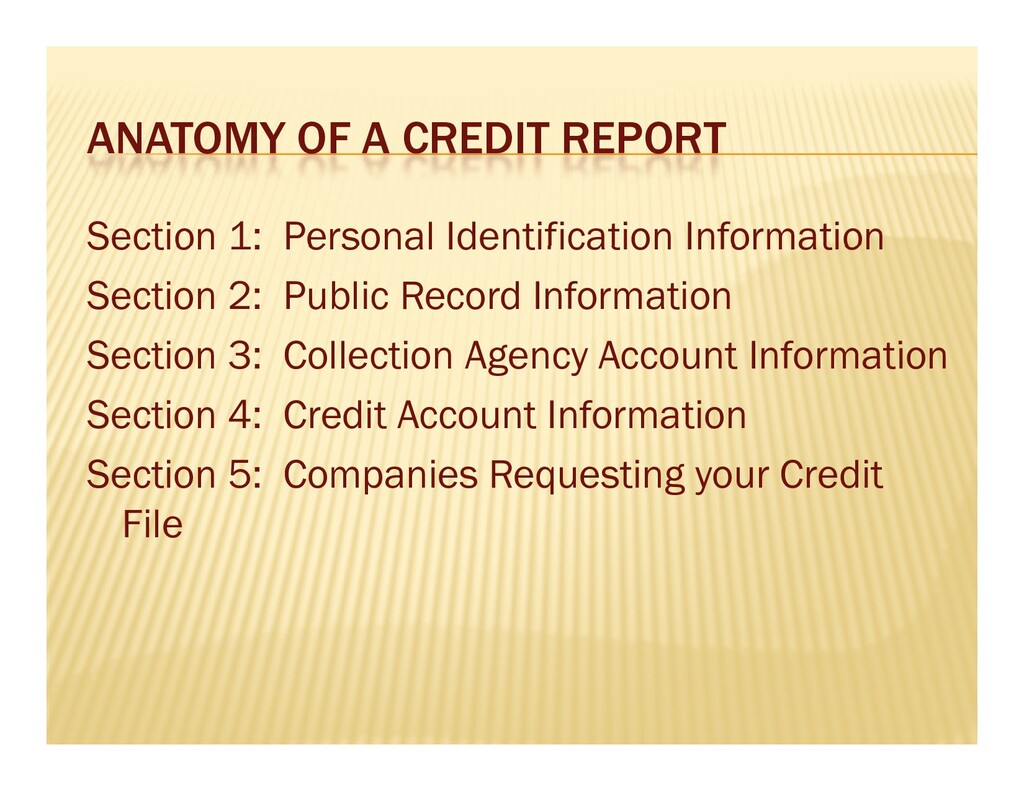
  24. ANATOMY OF A CREDIT REPORT ANATOMY OF A CREDIT REPORT

    Section 1: Personal Identification Information Section 1: Personal Identification Information Section 2: Public Record Information S ti 3 C ll ti Ag A t I f ti Section 3: Collection Agency Account Information Section 4: Credit Account Information Section 5: Companies Requesting your Credit File
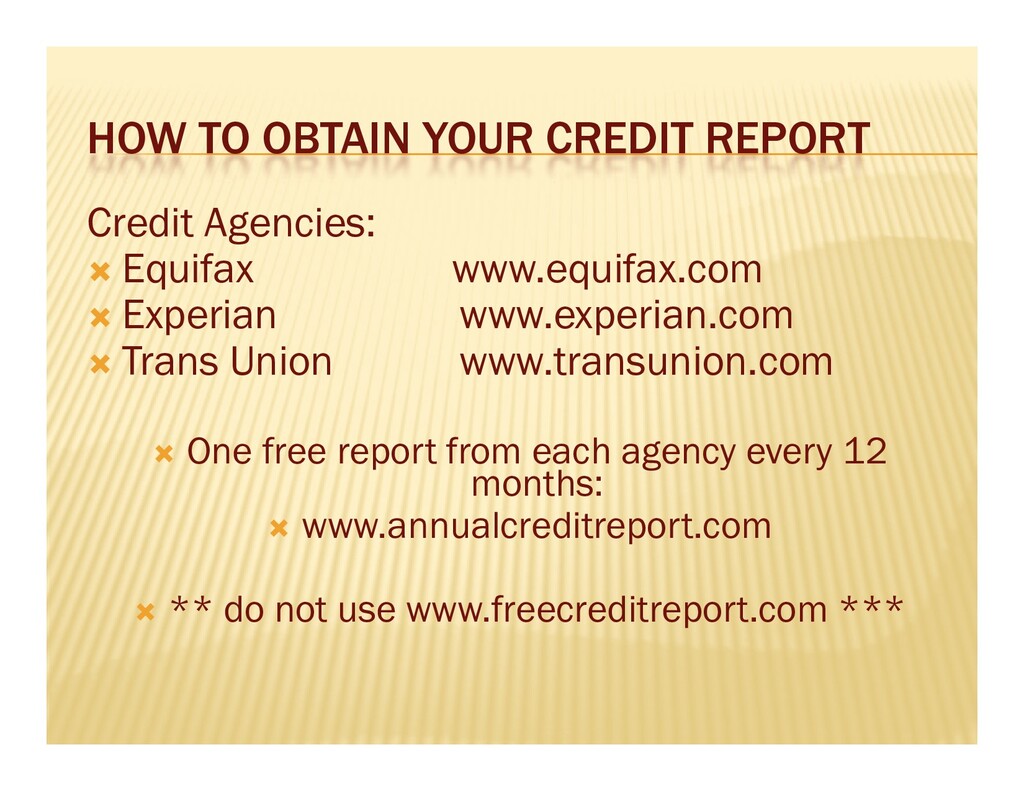
  25. HOW TO OBTAIN YOUR CREDIT REPORT HOW TO OBTAIN YOUR

    CREDIT REPORT Credit Agencies: ´ Equifax www.equifax.com ´ Experian www.experian.com ´ Trans Union www.transunion.com ´ One free report from each agency every 12 ´ One free report from each agency every 12 months: ´ www.annualcreditreport.com ´ ** do not use www.freecreditreport.com ***
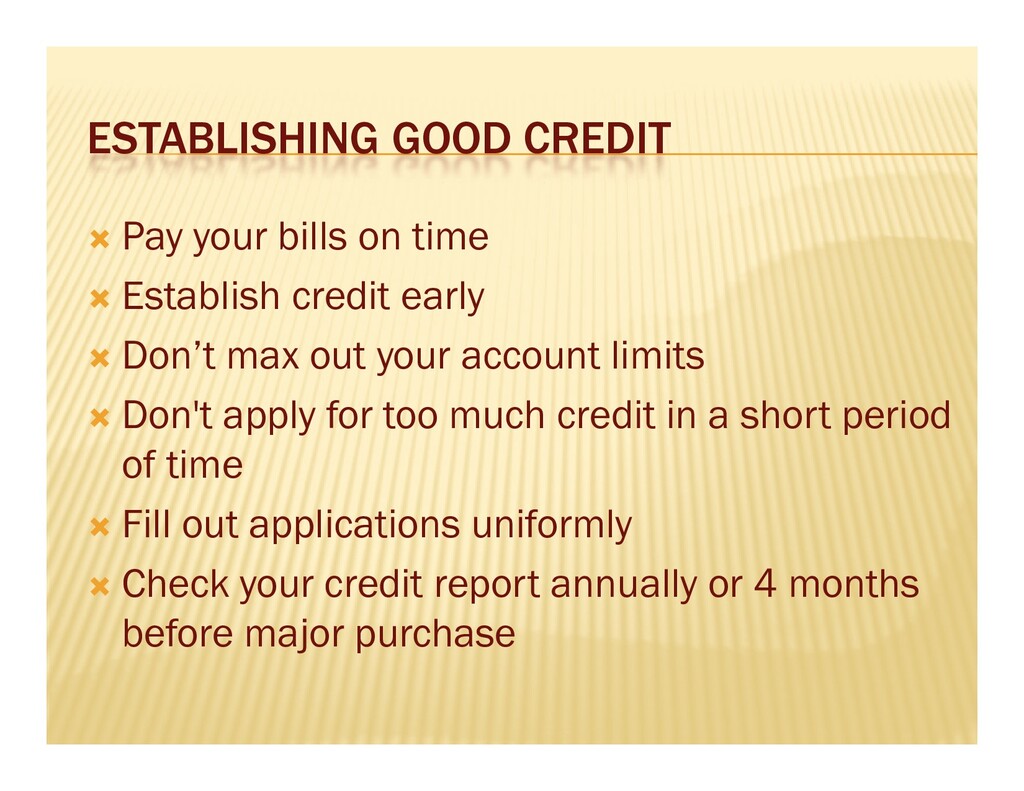
  26. ESTABLISHING GOOD CREDIT ESTABLISHING GOOD CREDIT ´ Pay your bills

    on time ´ Pay your bills on time ´ Establish credit early D ’t t t li it ´ Don’t max out your account limits ´ Don't apply for too much credit in a short period of time ´ Fill out applications uniformly ´ Check your credit report annually or 4 months before major purchase before major purchase
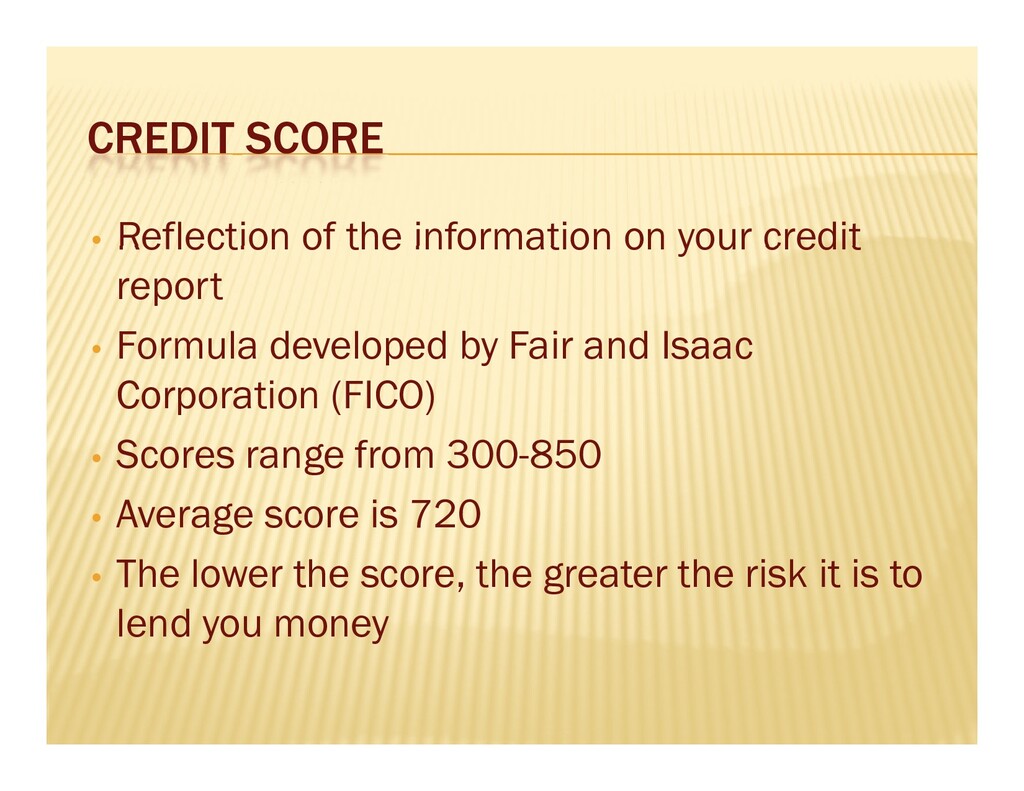
  27. CREDIT SCORE CREDIT SCORE • Reflection of the information on

    your credit Reflection of the information on your credit report • Formula developed by Fair and Isaac • Formula developed by Fair and Isaac Corporation (FICO) S g f 300 850 • Scores range from 300-850 • Average score is 720 • The lower the score, the greater the risk it is to lend you money
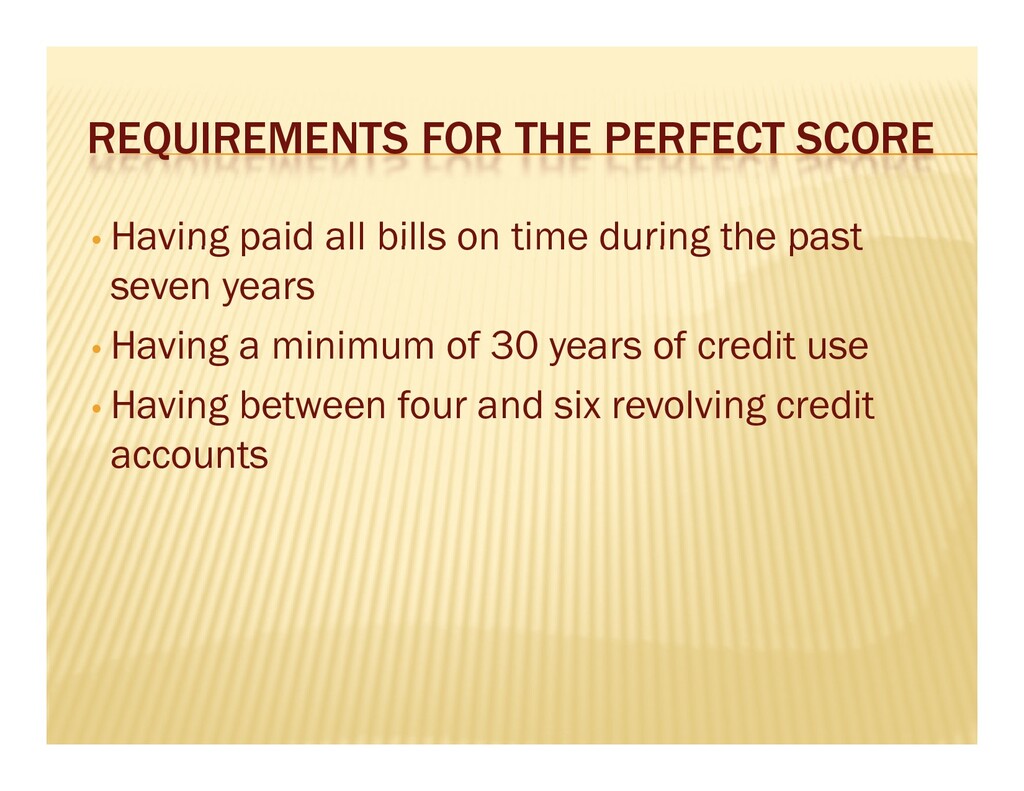
  28. REQUIREMENTS FOR THE PERFECT SCORE REQUIREMENTS FOR THE PERFECT SCORE

    •Having paid all bills on time during the past Having paid all bills on time during the past seven years •Having a minimum of 30 years of credit use •Having a minimum of 30 years of credit use •Having between four and six revolving credit t accounts
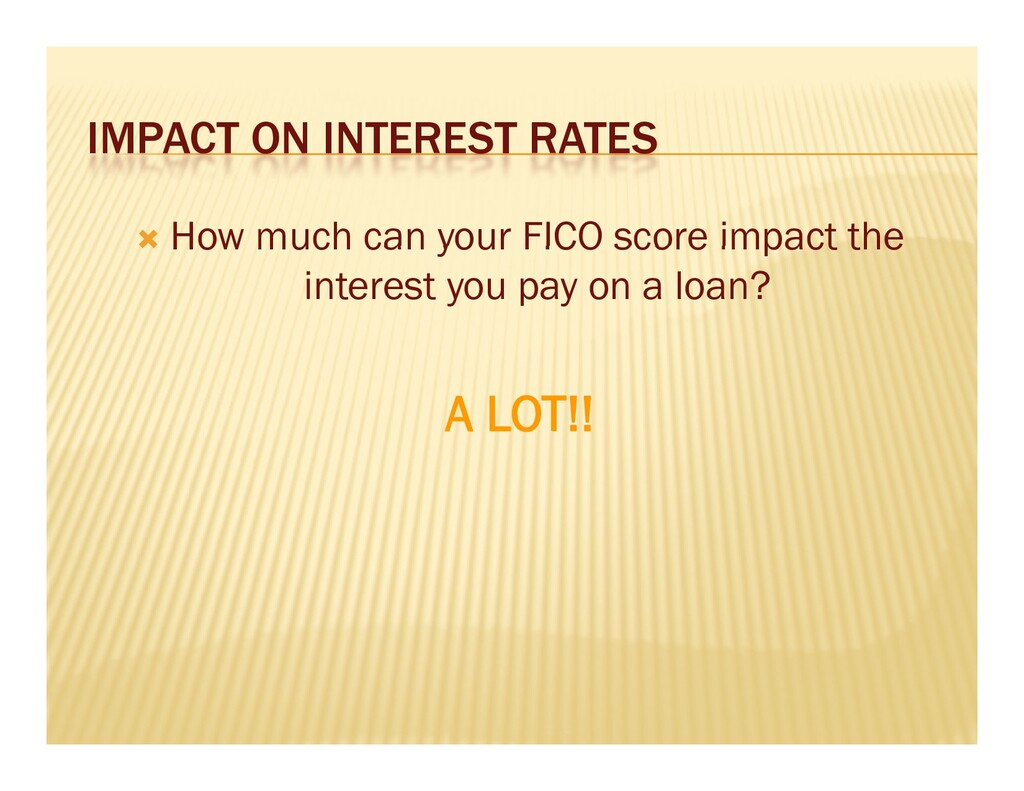
  29. IMPACT ON INTEREST RATES IMPACT ON INTEREST RATES ´ How

    much can your FICO score impact the ´ How much can your FICO score impact the interest you pay on a loan? A LOT!!
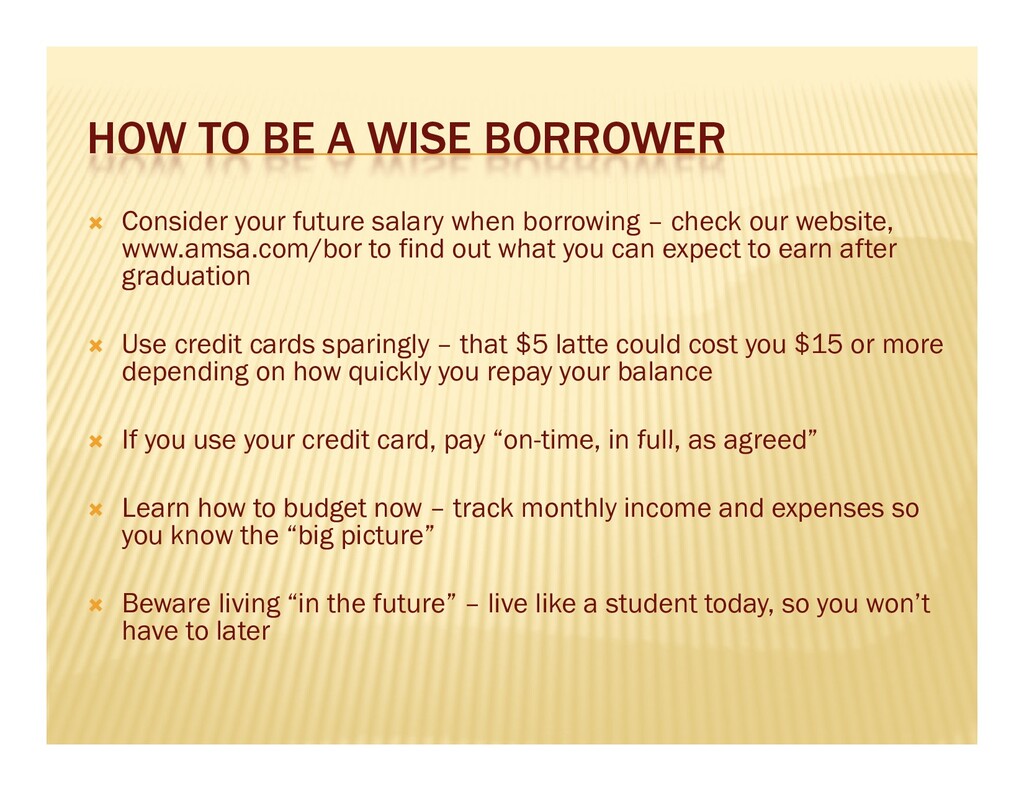
  30. HOW TO BE A WISE BORROWER HOW TO BE A

    WISE BORROWER ´ Consider your future salary when borrowing – check our website, www amsa com/bor to find out what you can expect to earn after www.amsa.com/bor to find out what you can expect to earn after graduation ´ Use credit cards sparingly – that $5 latte could cost you $15 or more ´ Use credit cards sparingly – that $5 latte could cost you $15 or more depending on how quickly you repay your balance ´ If you use your credit card pay “on-time in full as agreed” ´ If you use your credit card, pay on time, in full, as agreed ´ Learn how to budget now – track monthly income and expenses so you know the “big picture” y g p ´ Beware living “in the future” – live like a student today, so you won’t have to later
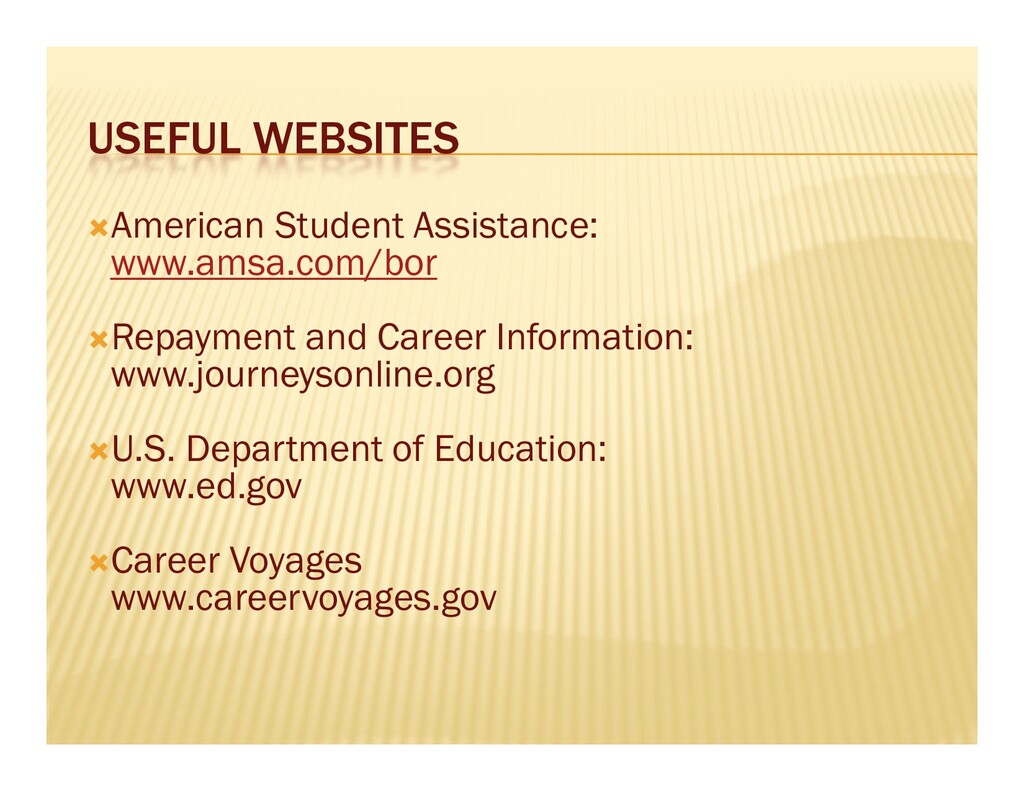
  31. USEFUL WEBSITES USEFUL WEBSITES ´American Student Assistance: www.amsa.com/bor ´Repayment and

    Career Information: ´Repayment and Career Information: www.journeysonline.org ´U S Department of Education: ´U.S. Department of Education: www.ed.gov ´Career Voyages www.careervoyages.gov
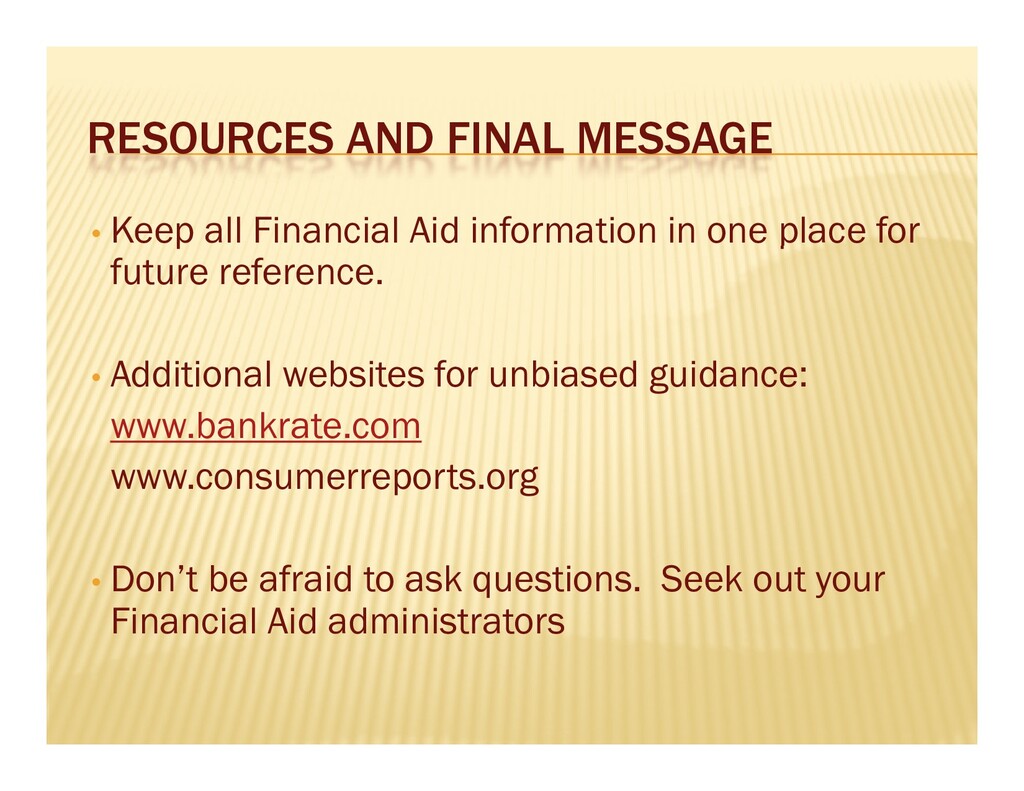
  32. RESOURCES AND FINAL MESSAGE RESOURCES AND FINAL MESSAGE • Keep

    all Financial Aid information in one place for p p future reference. • Additional websites for unbiased guidance: www.bankrate.com www.consumerreports.org • Don’t be afraid to ask questions. Seek out your Financial Aid administrators
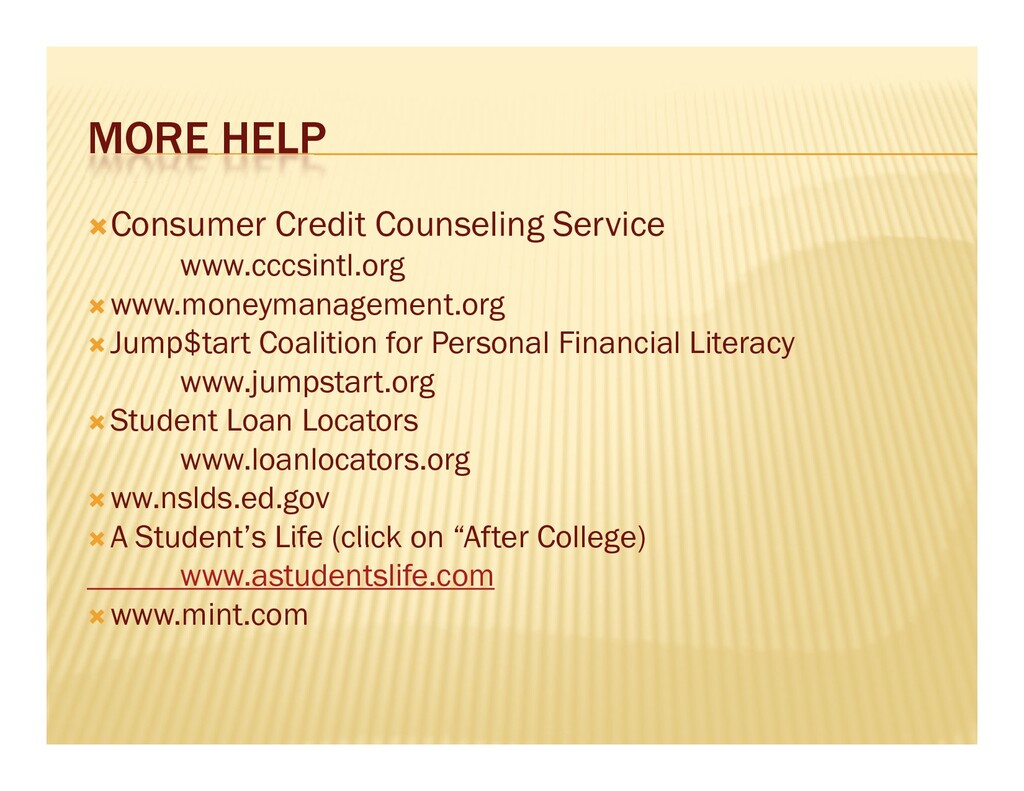
  33. MORE HELP MORE HELP ´Consumer Credit Counseling Service www.cccsintl.org ´www.moneymanagement.org

    ´Jump$tart Coalition for Personal Financial Literacy ´Jump$tart Coalition for Personal Financial Literacy www.jumpstart.org ´Student Loan Locators www.loanlocators.org ´ww.nslds.ed.gov ´A Student’s Life (click on “After College) ´A Student s Life (click on After College) www.astudentslife.com ´www.mint.com