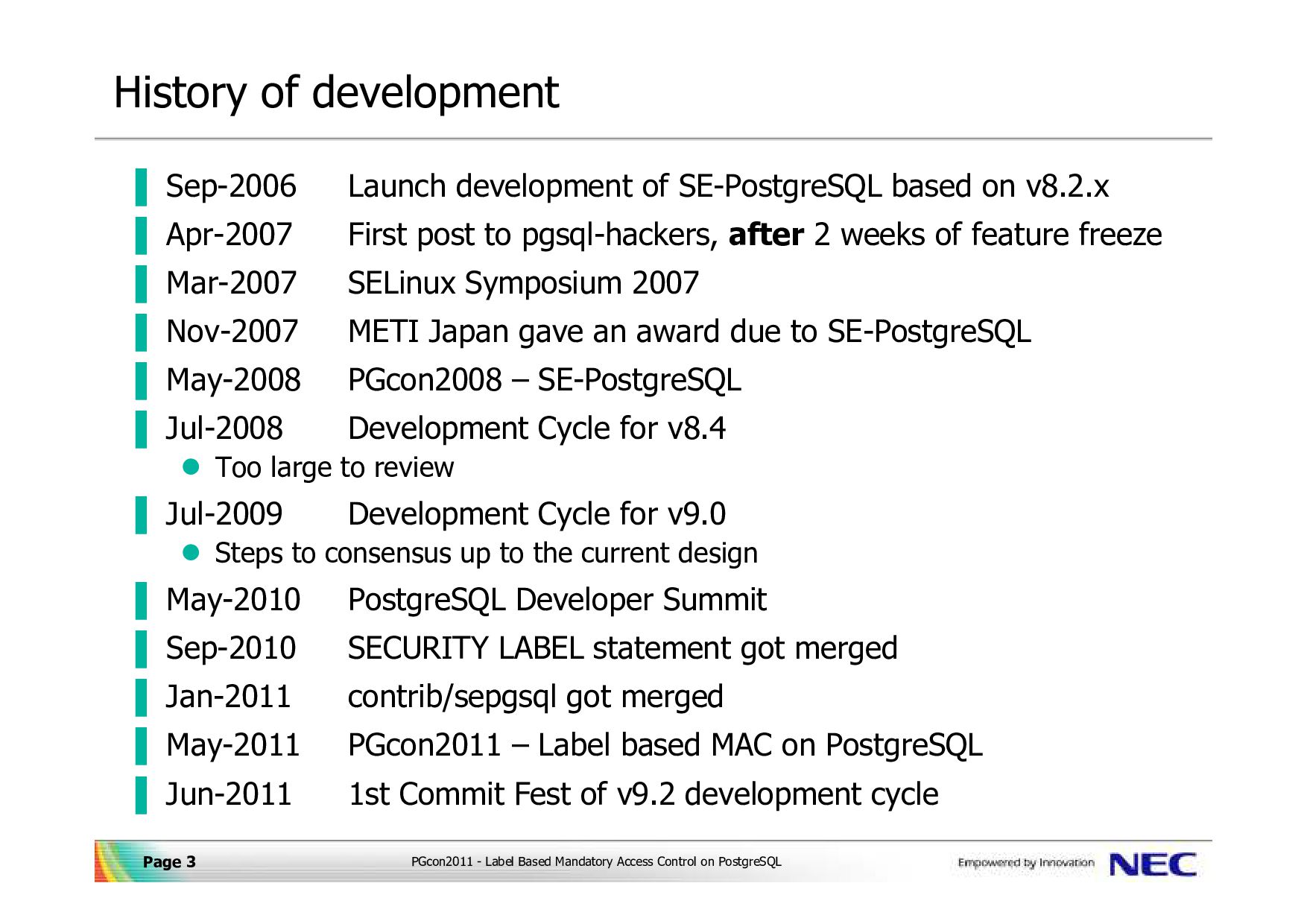
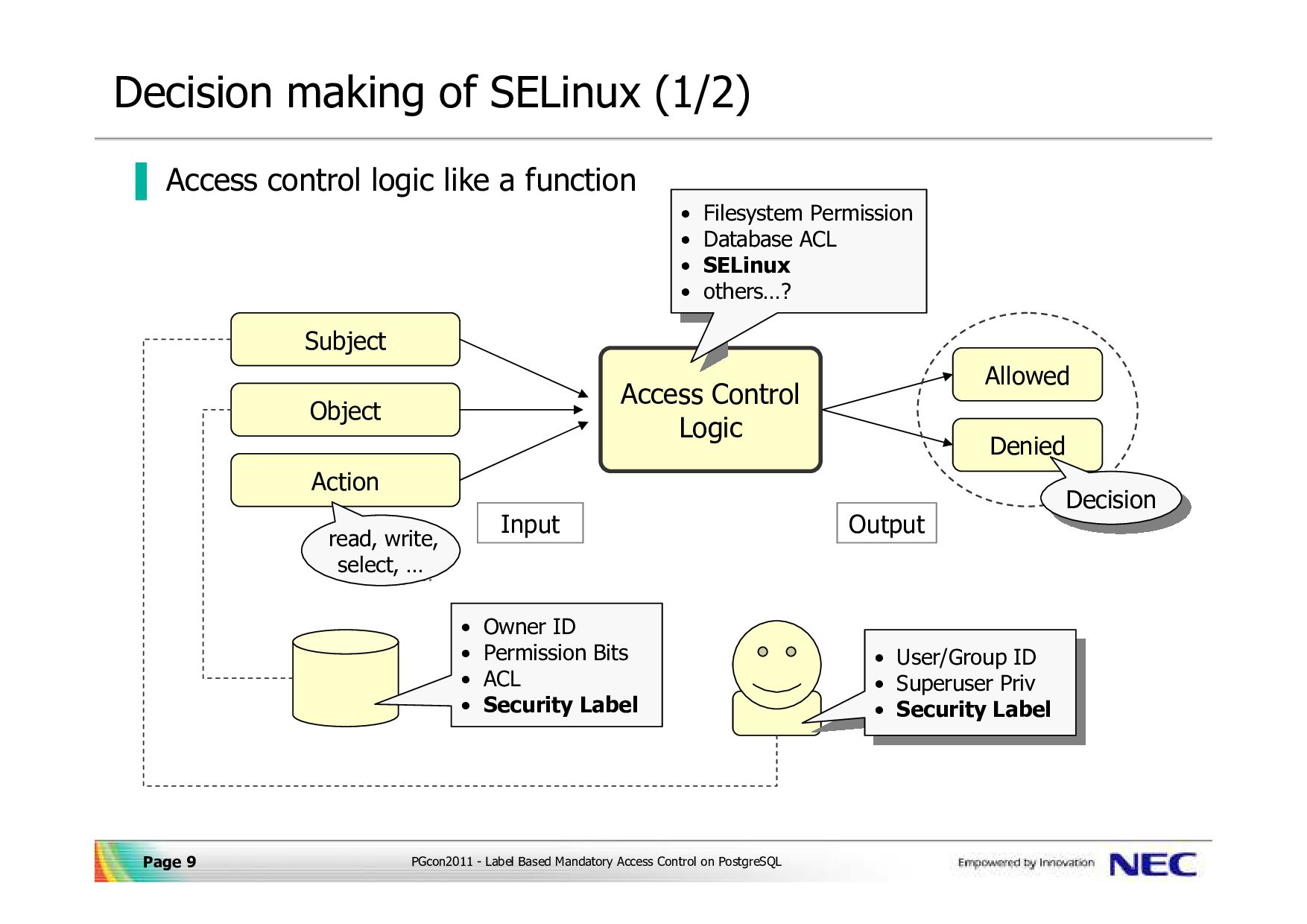
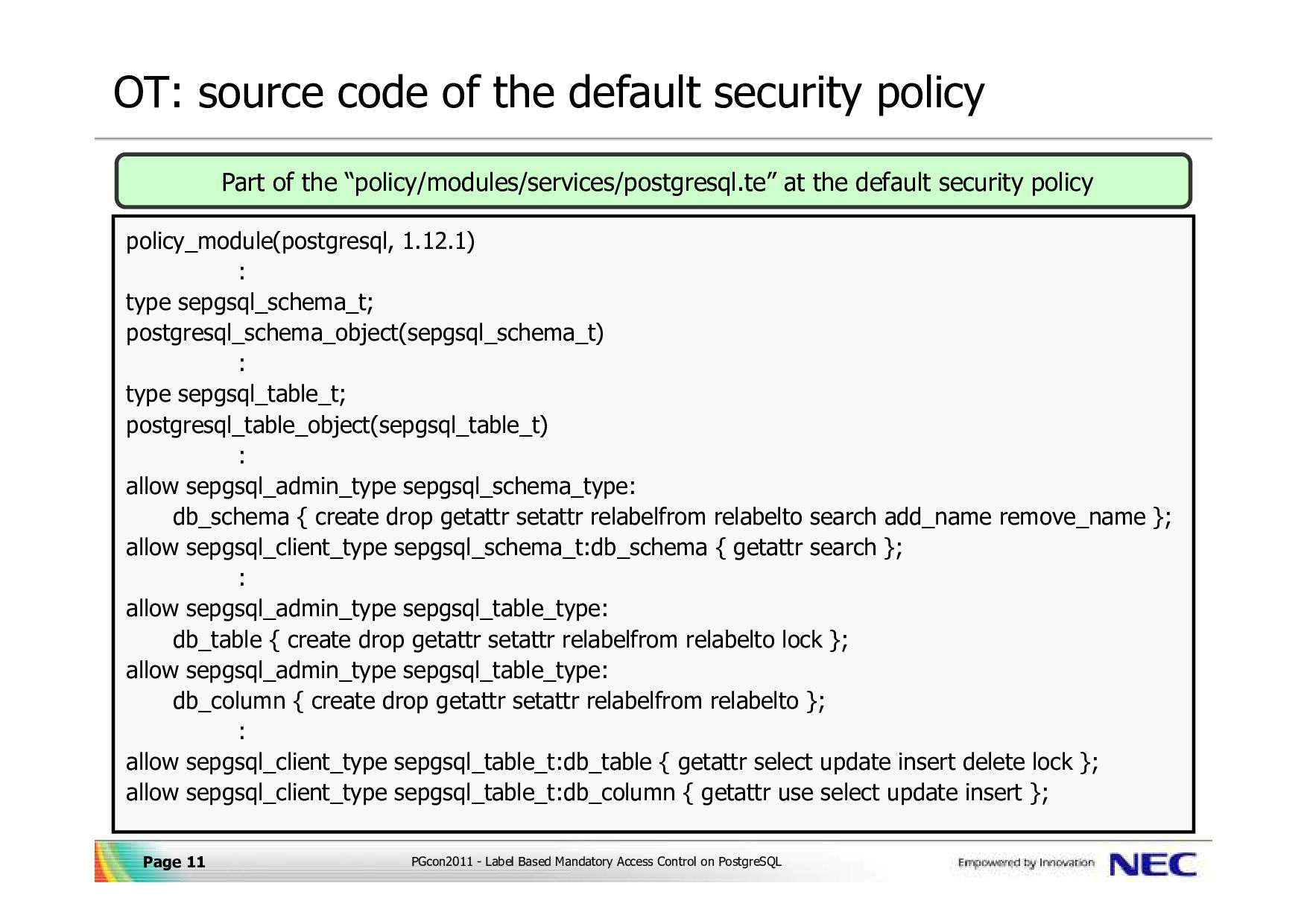
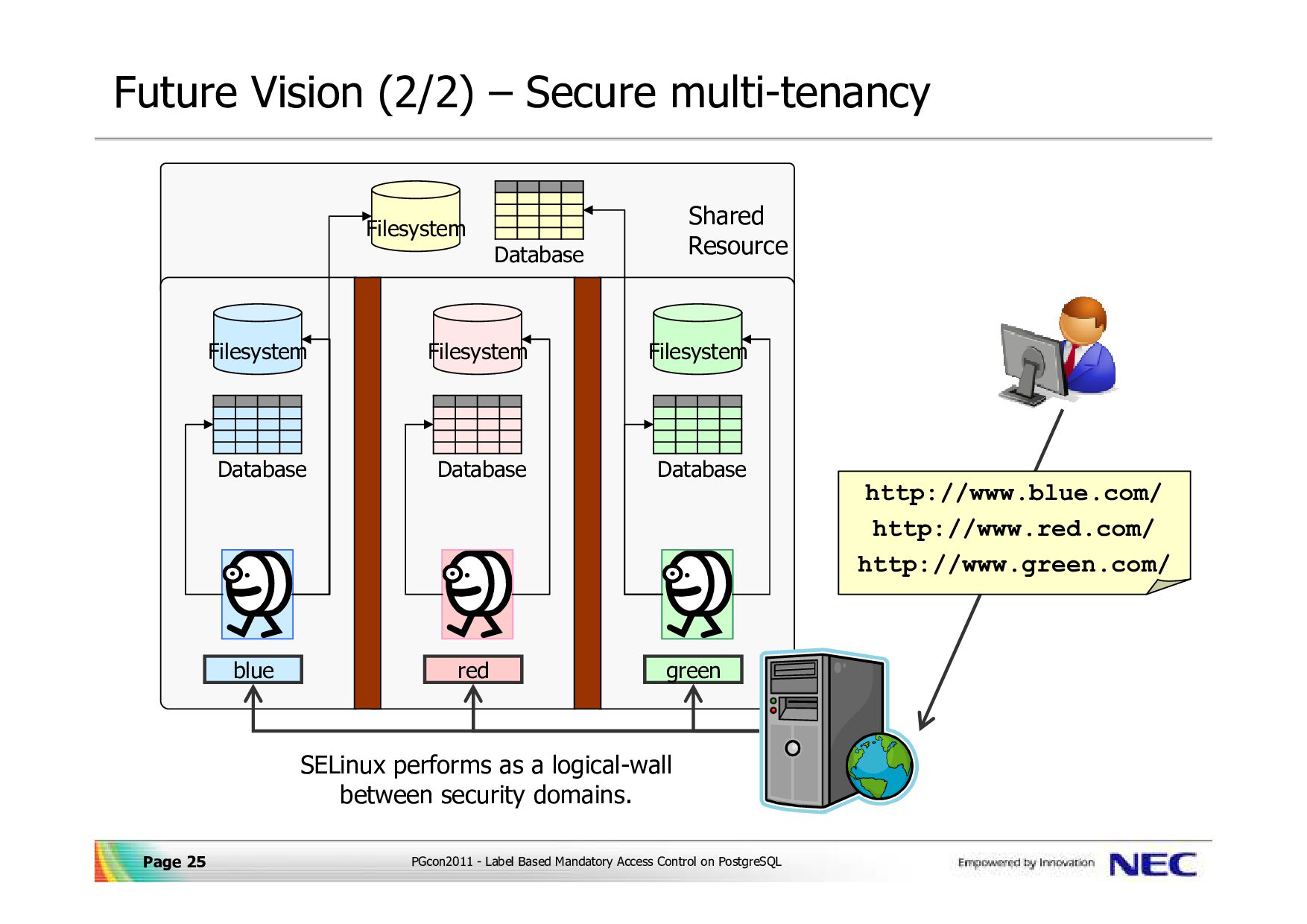
3 History of development ▐ Sep-2006 Launch development of SE-PostgreSQL based on v8.2.x ▐ Apr-2007 First post to pgsql-hackers, after 2 weeks of feature freeze ▐ Mar-2007 SELinux Symposium 2007 ▐ Nov-2007 METI Japan gave an award due to SE-PostgreSQL ▐ May-2008 PGcon2008 – SE-PostgreSQL ▐ Jul-2008 Development Cycle for v8.4 Too large to review ▐ Jul-2009 Development Cycle for v9.0 Steps to consensus up to the current design ▐ May-2010 PostgreSQL Developer Summit ▐ Sep-2010 SECURITY LABEL statement got merged ▐ Jan-2011 contrib/sepgsql got merged ▐ May-2011 PGcon2011 – Label based MAC on PostgreSQL ▐ Jun-2011 1st Commit Fest of v9.2 development cycle
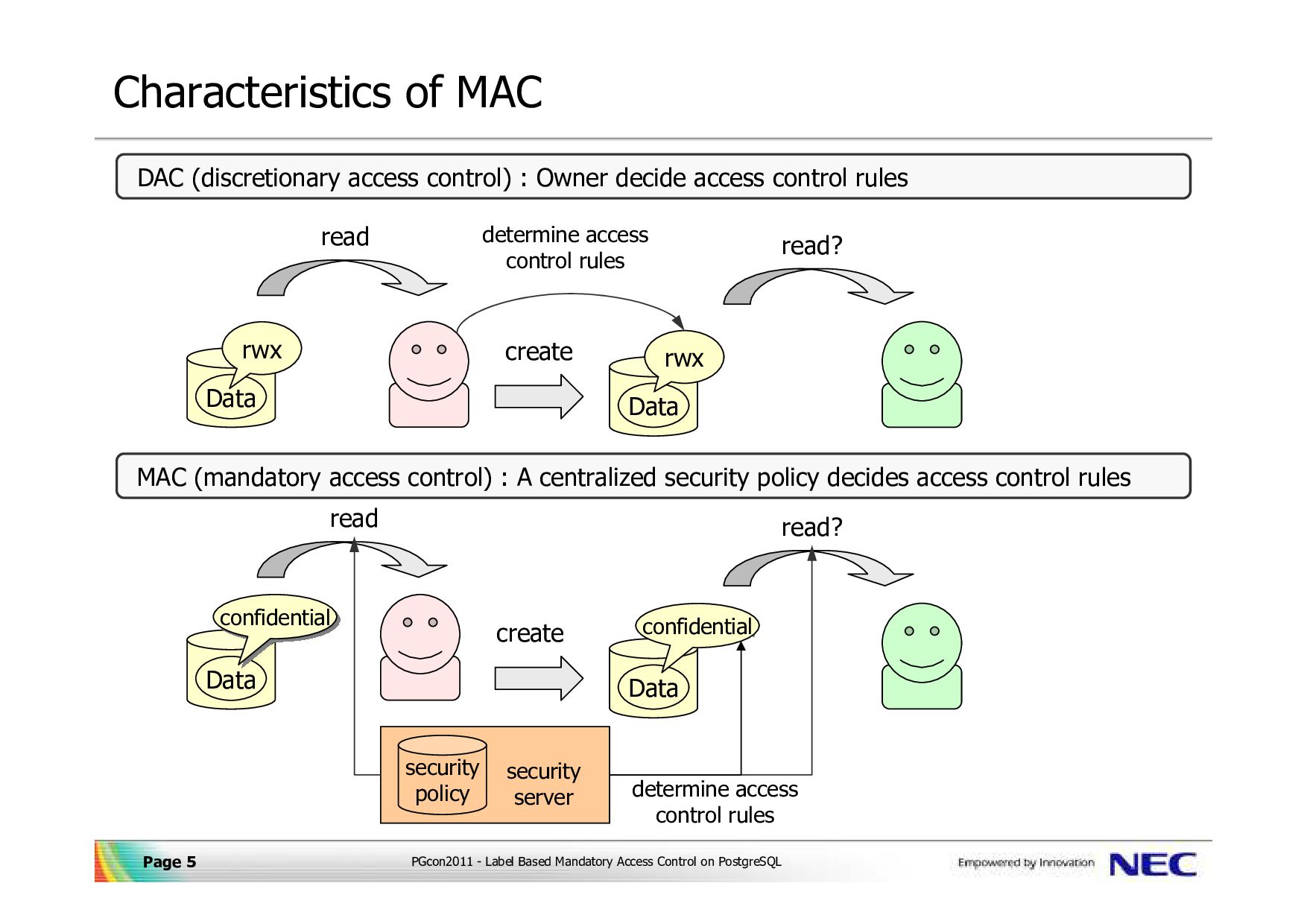
5 Characteristics of MAC read read Data Data rwx rwx confidential confidential Data confidential confidential Data rwx rwx create create DAC (discretionary access control) : Owner decide access control rules MAC (mandatory access control) : A centralized security policy decides access control rules read? read? determine access control rules security server security policy determine access control rules
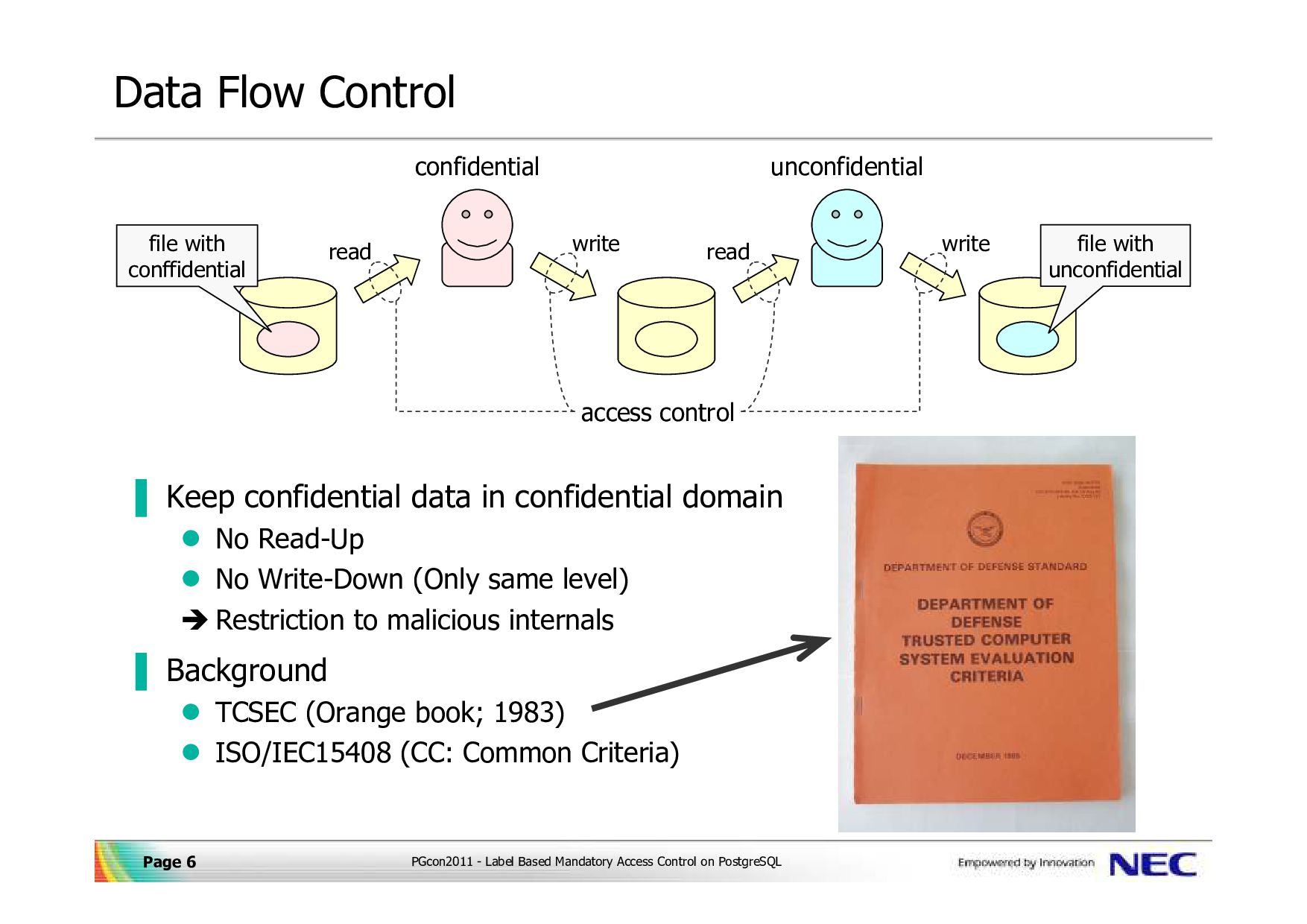
6 Data Flow Control ▐ Keep confidential data in confidential domain No Read-Up No Write-Down (Only same level) Restriction to malicious internals ▐ Background TCSEC (Orange book; 1983) ISO/IEC15408 (CC: Common Criteria) access control confidential unconfidential read read write write file with conffidential file with conffidential file with unconfidential file with unconfidential
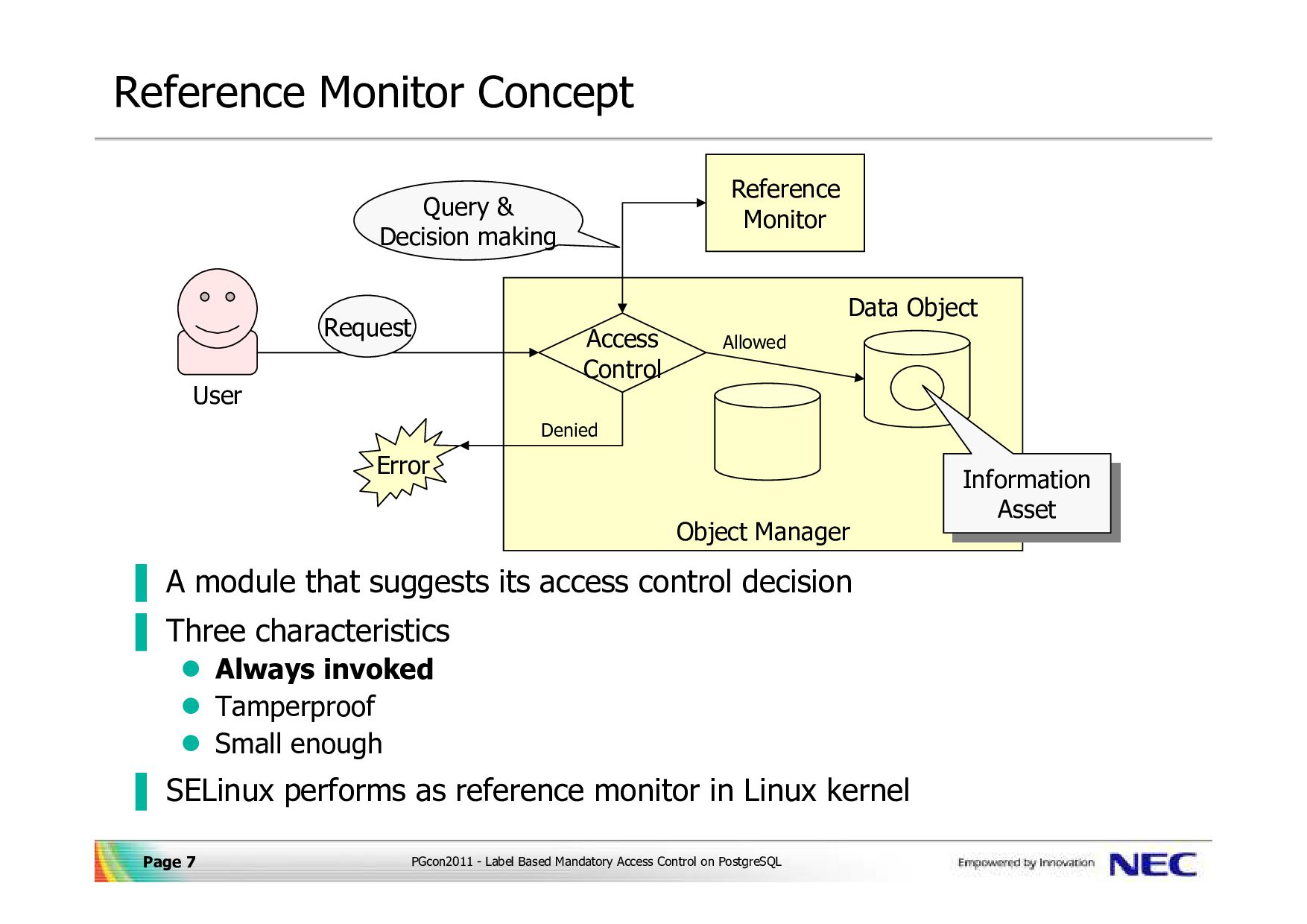
7 Reference Monitor Concept ▐ A module that suggests its access control decision ▐ Three characteristics Always invoked Tamperproof Small enough ▐ SELinux performs as reference monitor in Linux kernel Object Manager Information Asset Information Asset Data Object Access Control Error User Request Reference Monitor Allowed Denied Query & Decision making
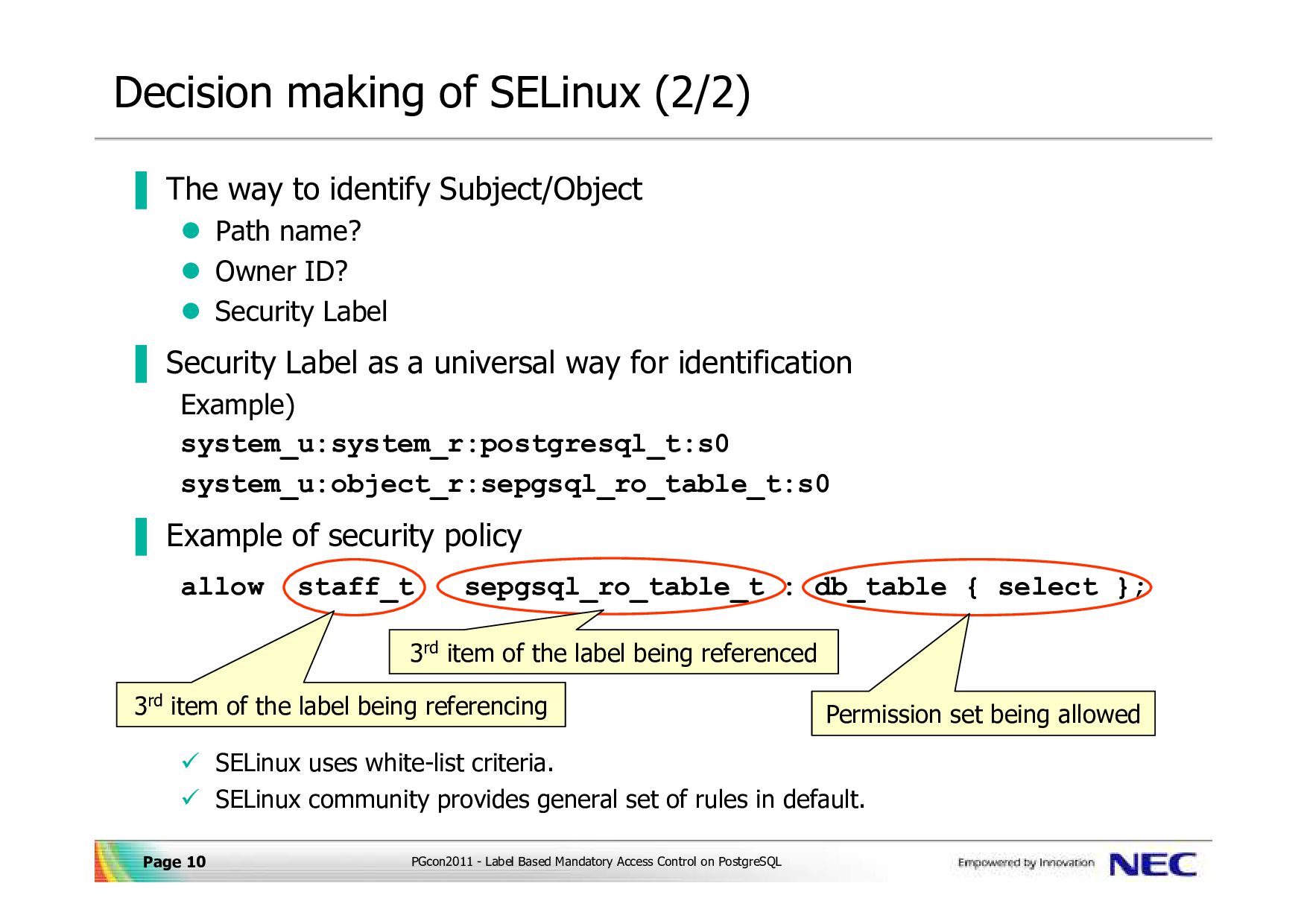
10 Decision making of SELinux (2/2) ▐ The way to identify Subject/Object Path name? Owner ID? Security Label ▐ Security Label as a universal way for identification Example) system_u:system_r:postgresql_t:s0 system_u:object_r:sepgsql_ro_table_t:s0 ▐ Example of security policy allow staff_t sepgsql_ro_table_t : db_table { select }; SELinux uses white-list criteria. SELinux community provides general set of rules in default. 3rd item of the label being referenced 3rd item of the label being referencing Permission set being allowed
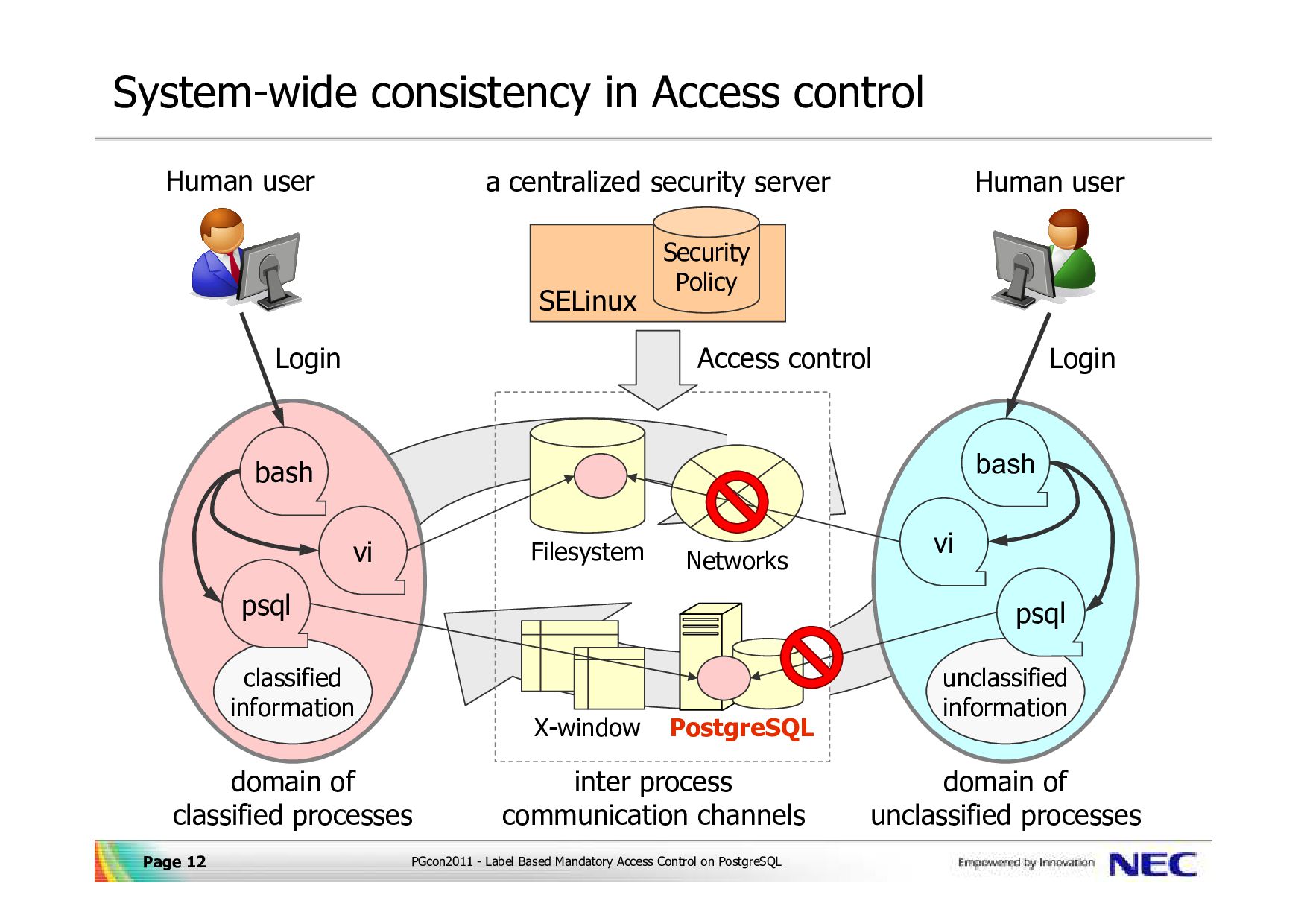
12 System-wide consistency in Access control Human user Human user bash domain of classified processes classified information psql bash domain of unclassified processes unclassified information vi inter process communication channels Filesystem Networks PostgreSQL X-window SELinux Security Policy a centralized security server Login Login Access control psql vi
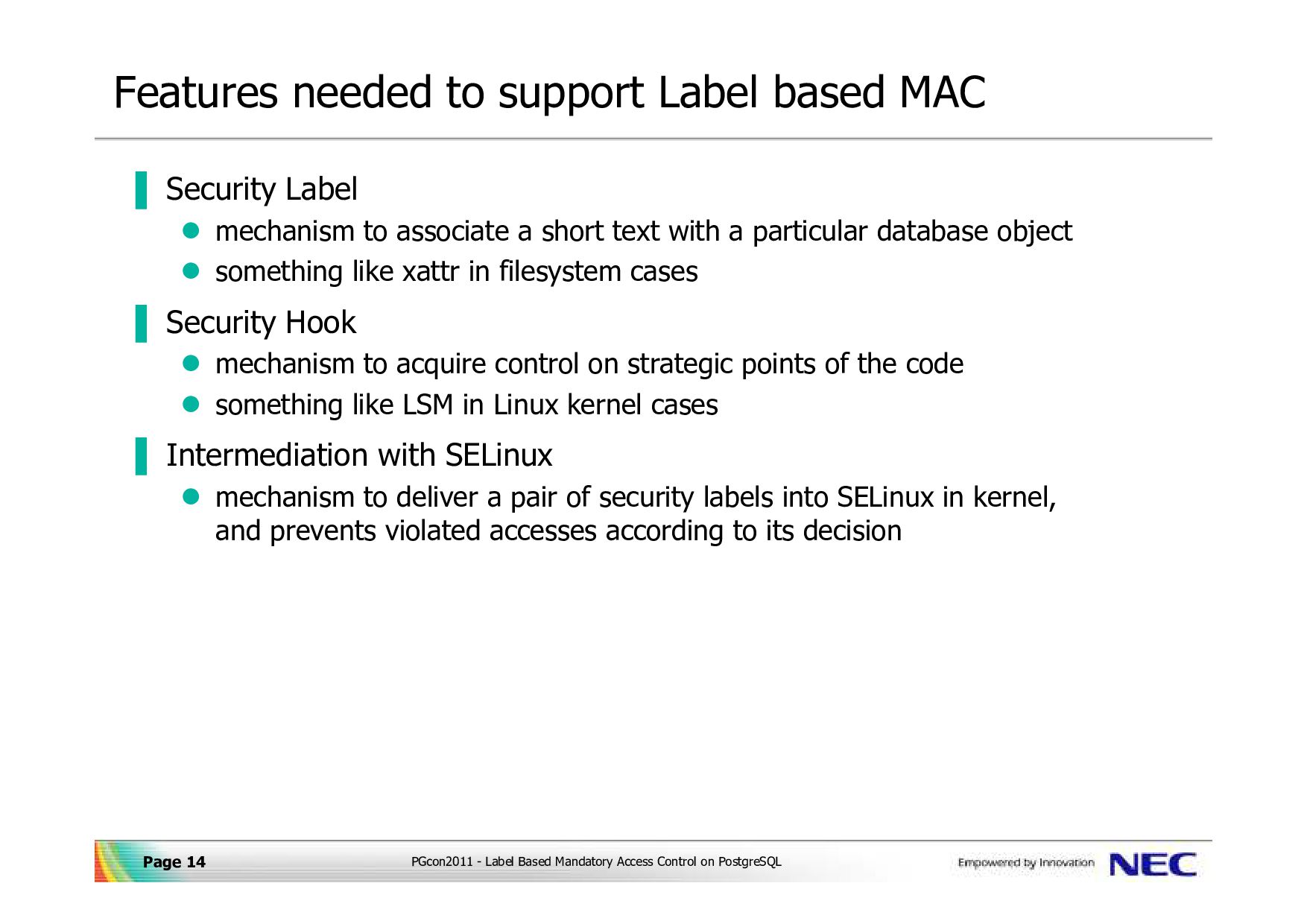
14 Features needed to support Label based MAC ▐ Security Label mechanism to associate a short text with a particular database object something like xattr in filesystem cases ▐ Security Hook mechanism to acquire control on strategic points of the code something like LSM in Linux kernel cases ▐ Intermediation with SELinux mechanism to deliver a pair of security labels into SELinux in kernel, and prevents violated accesses according to its decision
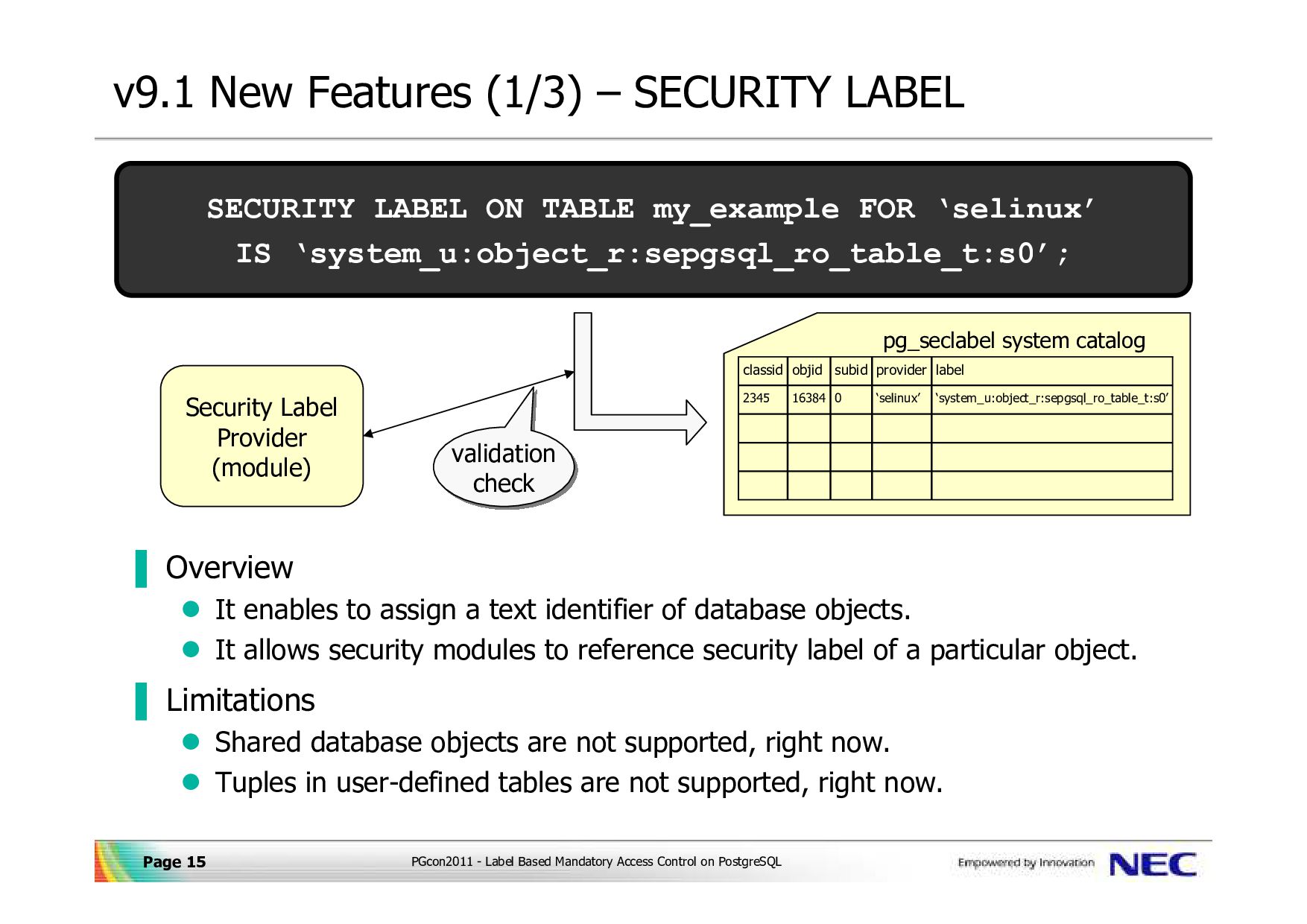
15 v9.1 New Features (1/3) – SECURITY LABEL ▐ Overview It enables to assign a text identifier of database objects. It allows security modules to reference security label of a particular object. ▐ Limitations Shared database objects are not supported, right now. Tuples in user-defined tables are not supported, right now. SECURITY LABEL ON TABLE my_example FOR ‘selinux’ IS ‘system_u:object_r:sepgsql_ro_table_t:s0’; ‘system_u:object_r:sepgsql_ro_table_t:s0’ ‘selinux’ 0 16384 2345 label provider subid objid classid pg_seclabel system catalog Security Label Provider (module) validation check validation check
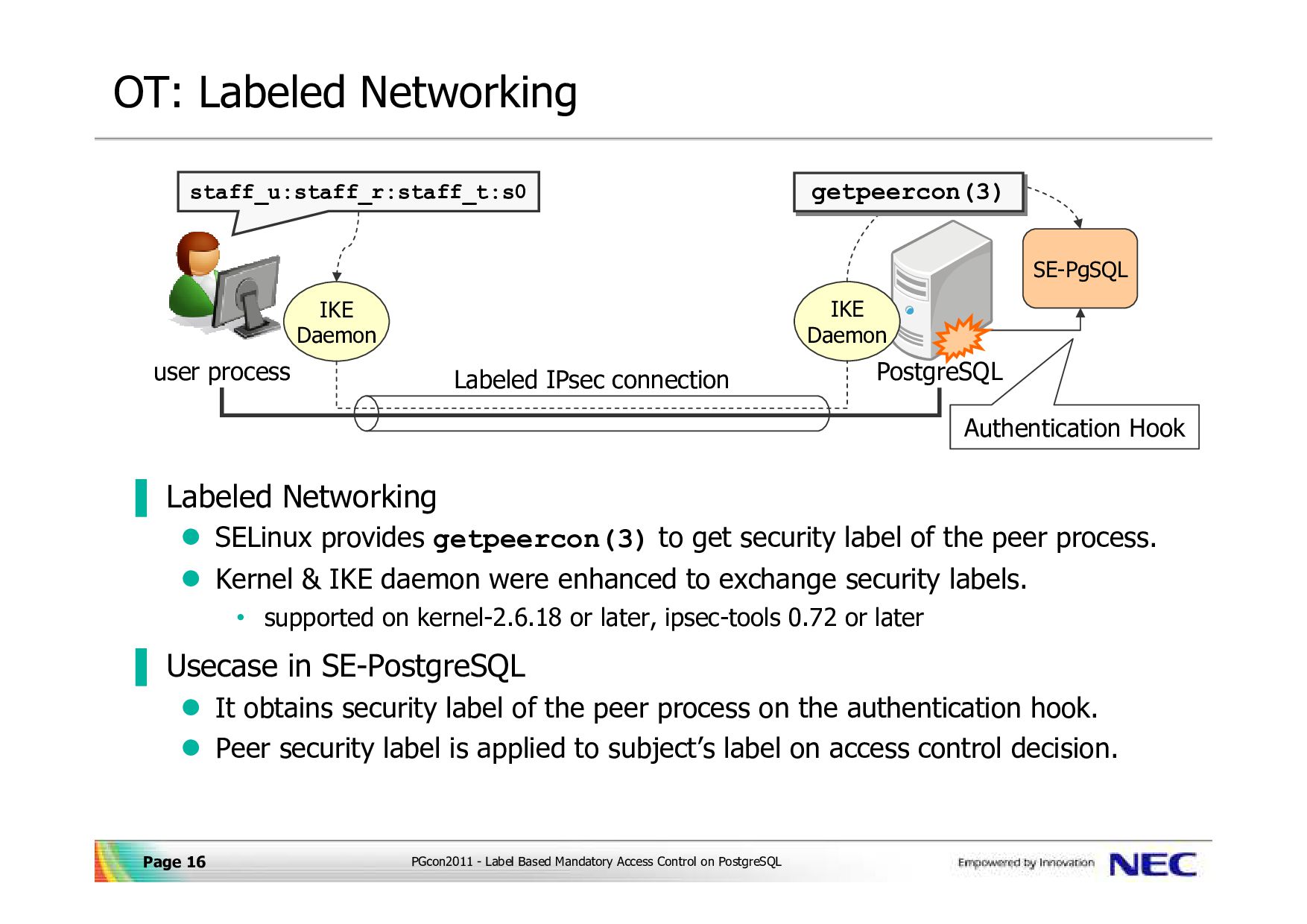
16 OT: Labeled Networking ▐ Labeled Networking SELinux provides getpeercon(3) to get security label of the peer process. Kernel & IKE daemon were enhanced to exchange security labels. • supported on kernel-2.6.18 or later, ipsec-tools 0.72 or later ▐ Usecase in SE-PostgreSQL It obtains security label of the peer process on the authentication hook. Peer security label is applied to subject’s label on access control decision. user process IKE Daemon IKE Daemon Labeled IPsec connection staff_u:staff_r:staff_t:s0 getpeercon(3) getpeercon(3) SE-PgSQL Authentication Hook PostgreSQL
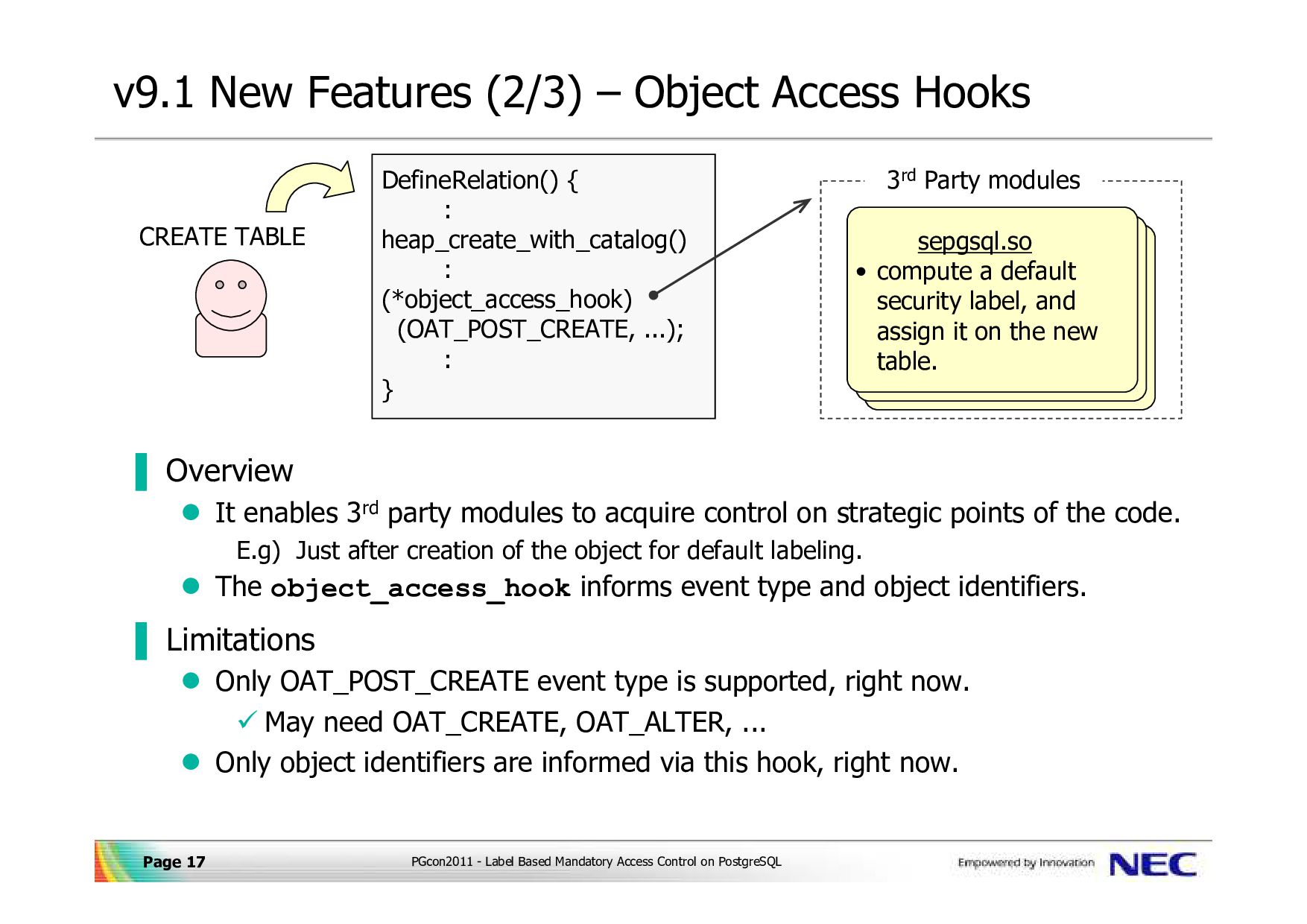
17 v9.1 New Features (2/3) – Object Access Hooks ▐ Overview It enables 3rd party modules to acquire control on strategic points of the code. E.g) Just after creation of the object for default labeling. The object_access_hook informs event type and object identifiers. ▐ Limitations Only OAT_POST_CREATE event type is supported, right now. May need OAT_CREATE, OAT_ALTER, ... Only object identifiers are informed via this hook, right now. DefineRelation() { : heap_create_with_catalog() : (*object_access_hook) (OAT_POST_CREATE, ...); : } CREATE TABLE 3rd Party modules sepgsql.so • check permission to create a new table • assign security label of the new table sepgsql.so • check permission to create a new table • assign security label of the new table sepgsql.so • compute a default security label, and assign it on the new table.
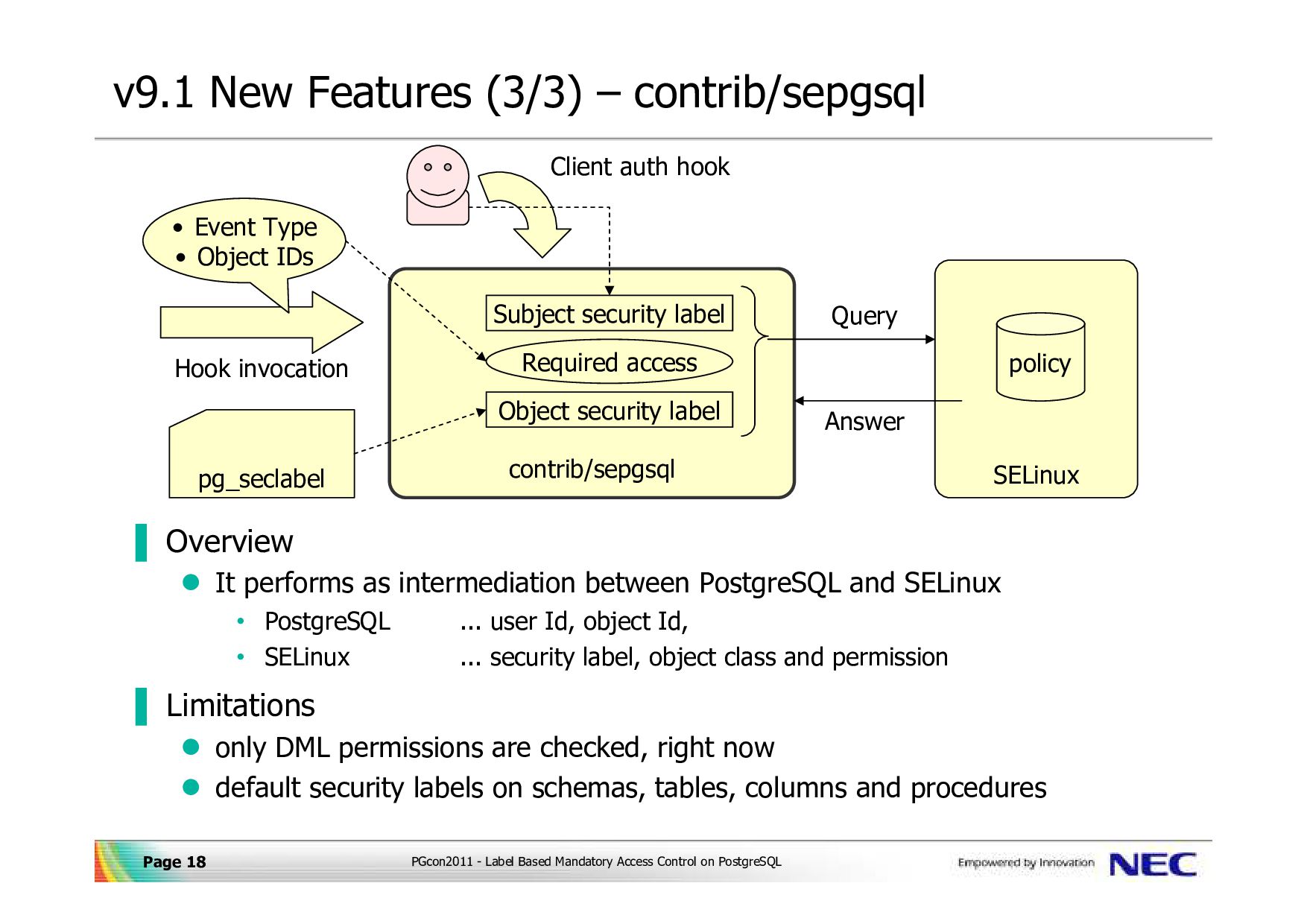
18 v9.1 New Features (3/3) – contrib/sepgsql ▐ Overview It performs as intermediation between PostgreSQL and SELinux • PostgreSQL ... user Id, object Id, • SELinux ... security label, object class and permission ▐ Limitations only DML permissions are checked, right now default security labels on schemas, tables, columns and procedures contrib/sepgsql SELinux • Event Type • Object IDs Hook invocation pg_seclabel Client auth hook Subject security label Object security label Required access policy Query Answer
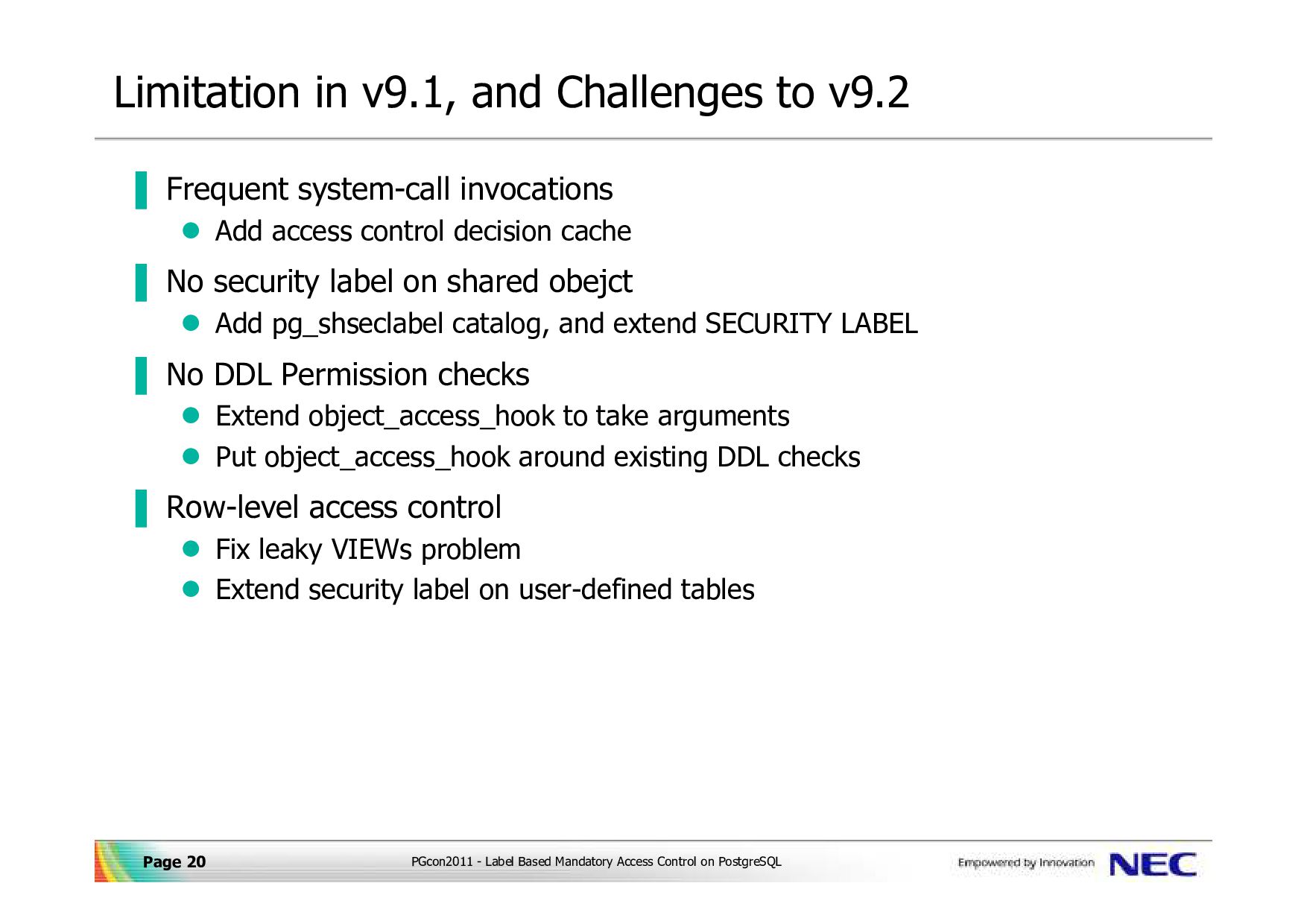
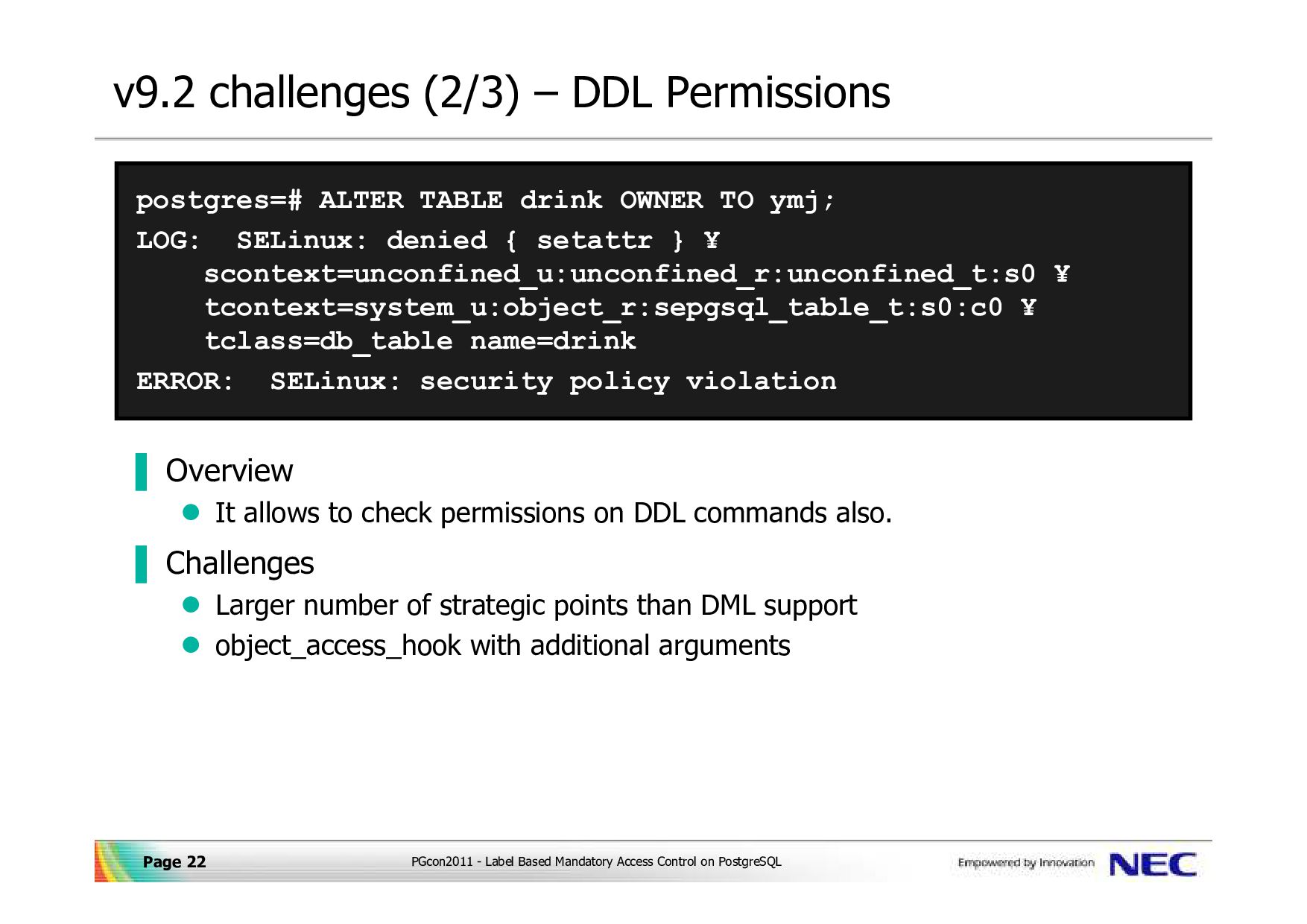
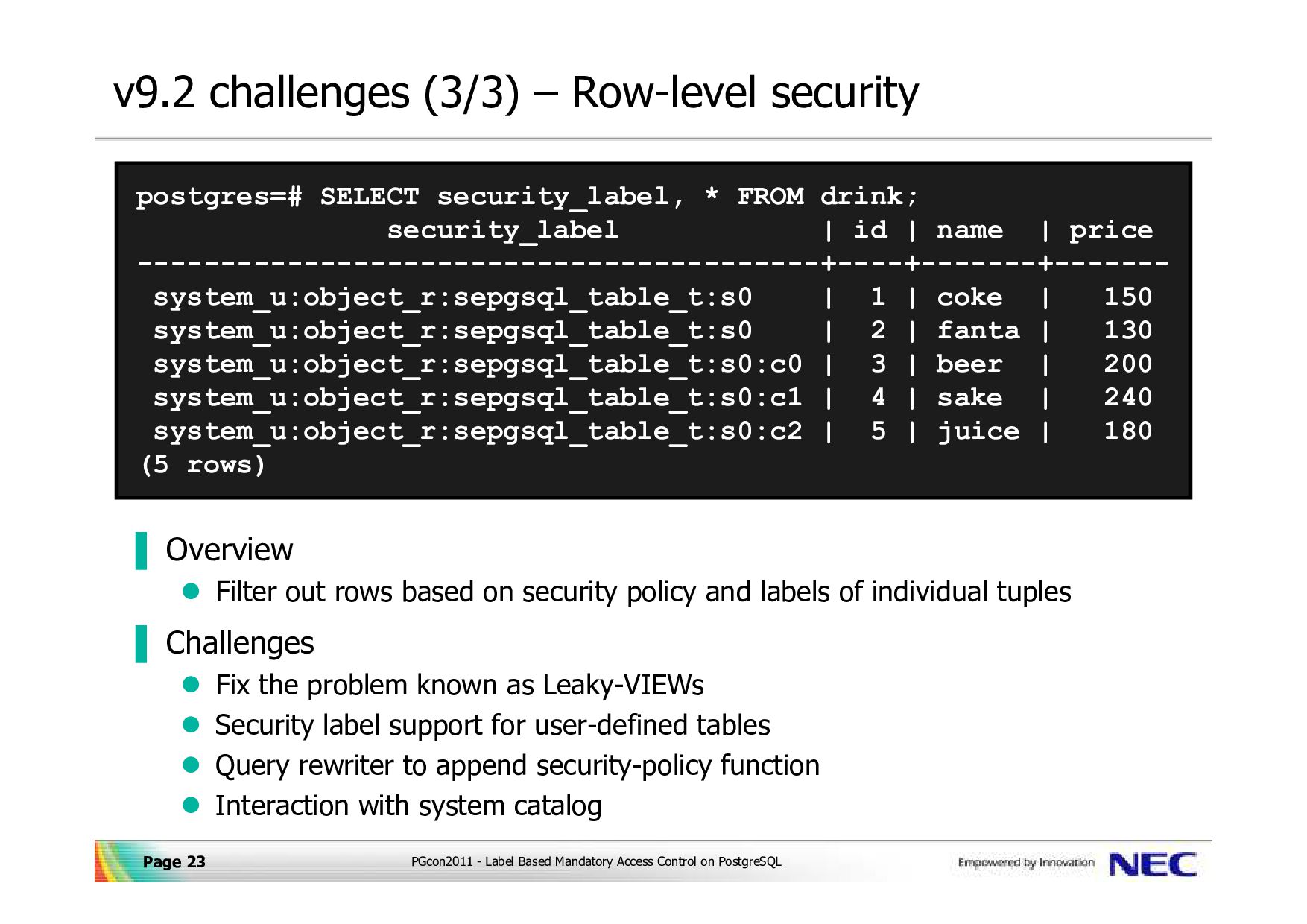
20 Limitation in v9.1, and Challenges to v9.2 ▐ Frequent system-call invocations Add access control decision cache ▐ No security label on shared obejct Add pg_shseclabel catalog, and extend SECURITY LABEL ▐ No DDL Permission checks Extend object_access_hook to take arguments Put object_access_hook around existing DDL checks ▐ Row-level access control Fix leaky VIEWs problem Extend security label on user-defined tables
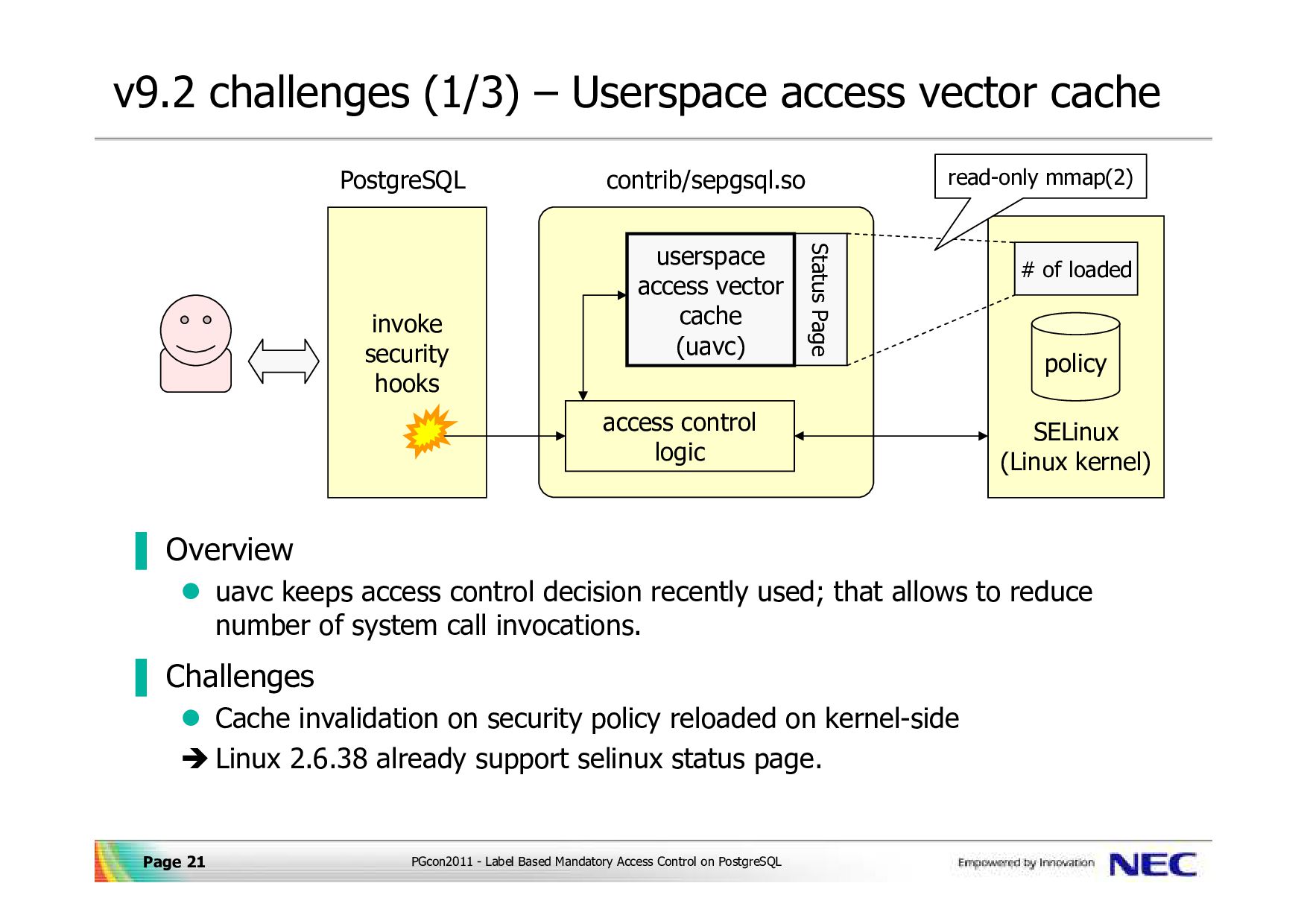
21 v9.2 challenges (1/3) – Userspace access vector cache ▐ Overview uavc keeps access control decision recently used; that allows to reduce number of system call invocations. ▐ Challenges Cache invalidation on security policy reloaded on kernel-side Linux 2.6.38 already support selinux status page. invoke security hooks SELinux (Linux kernel) policy # of loaded Status Page read-only mmap(2) read-only mmap(2) access control logic userspace access vector cache (uavc) PostgreSQL contrib/sepgsql.so
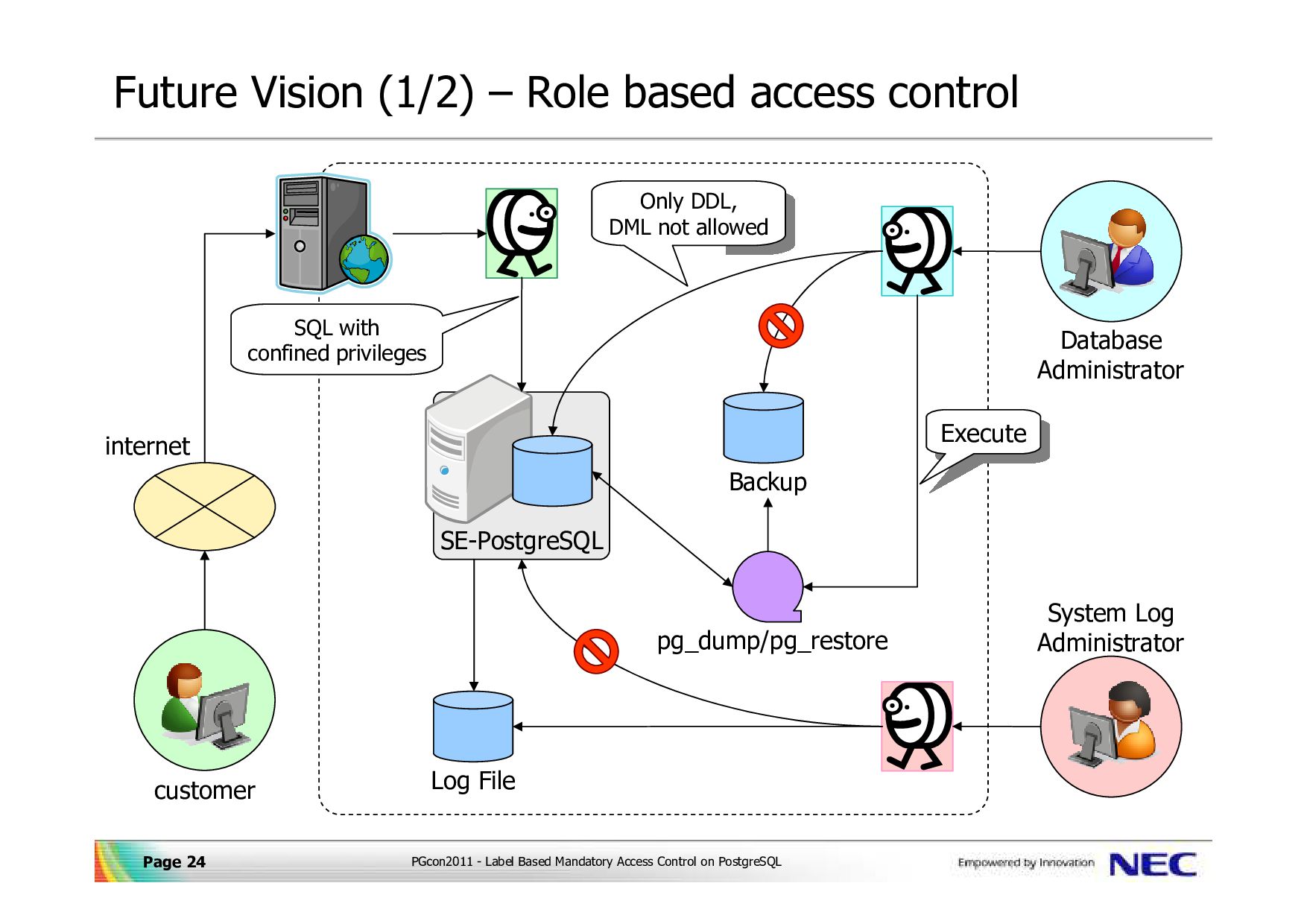
24 Future Vision (1/2) – Role based access control customer internet SE-PostgreSQL pg_dump/pg_restore Log File Backup Execute Execute Only DDL, DML not allowed Only DDL, DML not allowed SQL with confined privileges SQL with confined privileges Database Administrator System Log Administrator
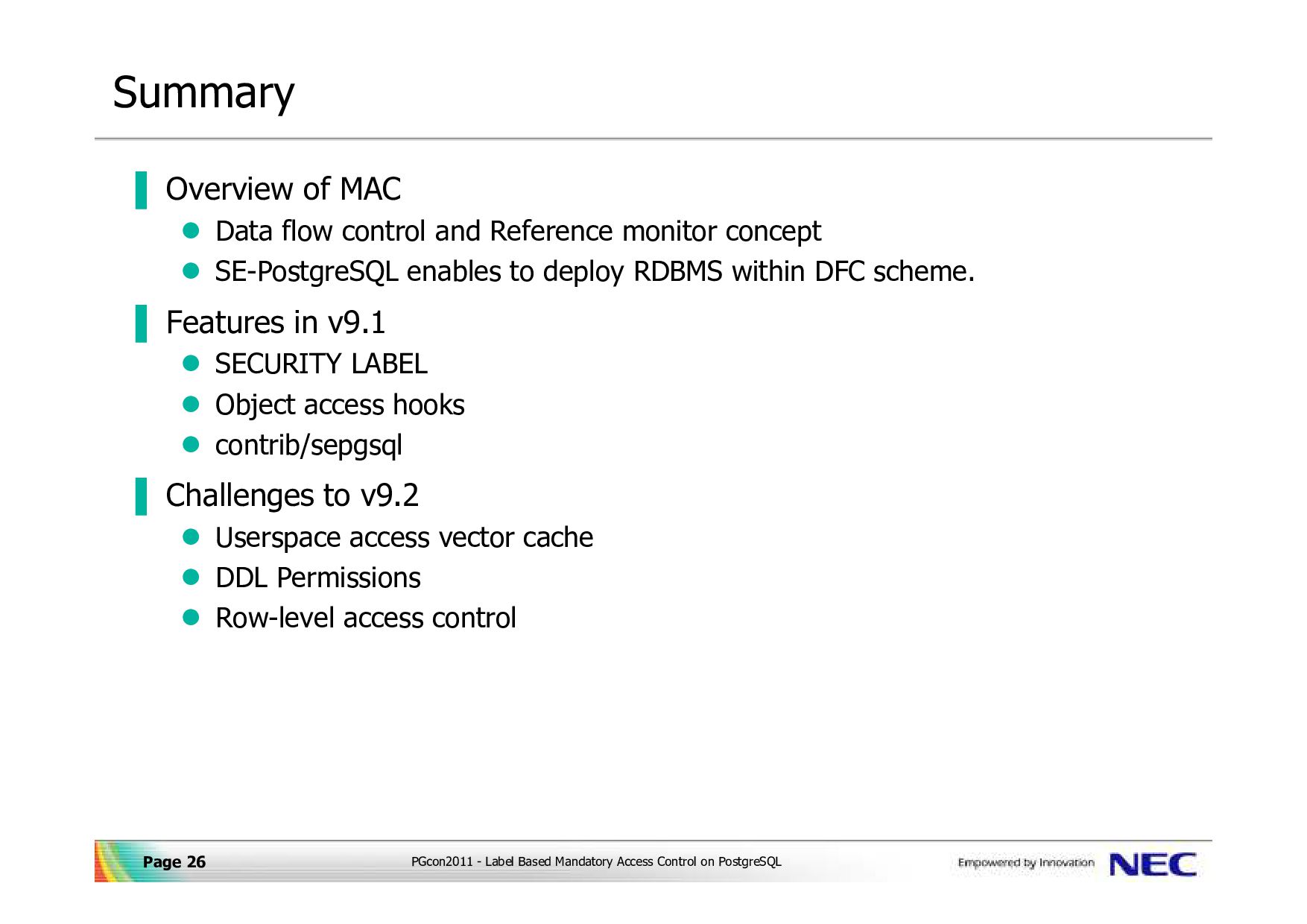
26 Summary ▐ Overview of MAC Data flow control and Reference monitor concept SE-PostgreSQL enables to deploy RDBMS within DFC scheme. ▐ Features in v9.1 SECURITY LABEL Object access hooks contrib/sepgsql ▐ Challenges to v9.2 Userspace access vector cache DDL Permissions Row-level access control


 kaigai
 oracle4engineer
 nttcom
 harutiro
 masakiokuda
 dtunkelang
 leveragestech
 marceloancelmo
 tomzoh
 mot_techtalk
 occhi
occhi
 recruitengineers
 addyosmani
 baasie
 axbom
axbom
 emna__ayadi
 jct
jct
 tammyeverts
 ammeep
 marcduiker
 minecr
 portentint
 skipperchong
 aleyda