Upgrade to Pro — share decks privately, control downloads, hide ads and more …

Social Change through Free Software and Open St...

Sponsored · Ship Features Fearlessly Turn features on and off without deploys. Used by thousands of Ruby developers.

Social Change through Free Software and Open Standards

The open-source software project "Global Commoning System" (GCS) is all about fostering a way of life based on sharing and voluntary participation—one that can lead us out of capitalist conditions. In this talk, the structure of the GCS will be explored through three so-called functional complexes.

Reviewed DeepSeek-Translation of a german presentation, given at the Grazer Linux Tage 2023:
deck: https://speakerdeck.com/marcusmeindel/gesellschaftlicher-wandel-durch-freie-software-und-offene-standards
video: https://media.ccc.de/v/glt23-366-gesellschaftlicher-wandel-durch-freie-software-und-offene-standards

Avatar for Marcus Meindel

Marcus Meindel

April 25, 2026

More Decks by Marcus Meindel

Other Decks in Technology

Transcript

  1. Social Change through Free Software and Open Standards Complexes of

    Functions for Networking the Commons Marcus Meindel April 25, 2026, Public Domain
  2. What’s it about? Using information technology to build a foundation

    for overcoming capitalism Where are we heading? Toward a way of life based on Commoning
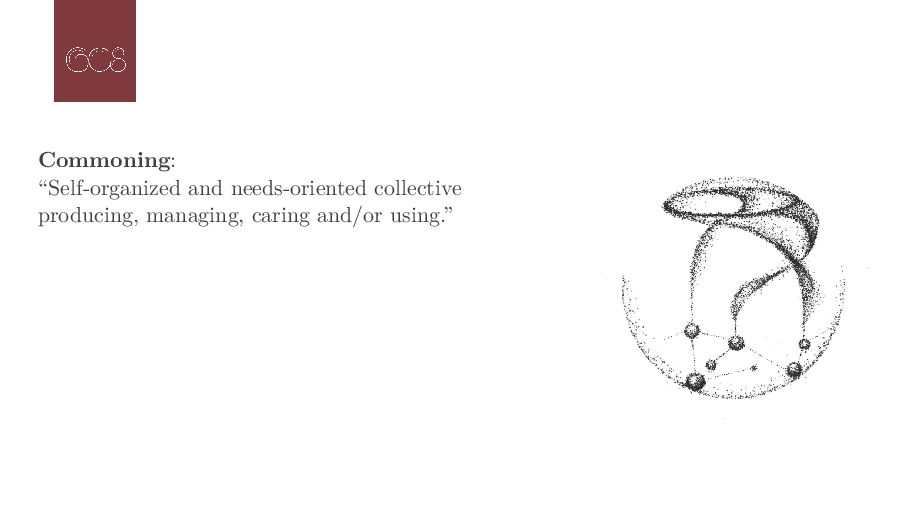
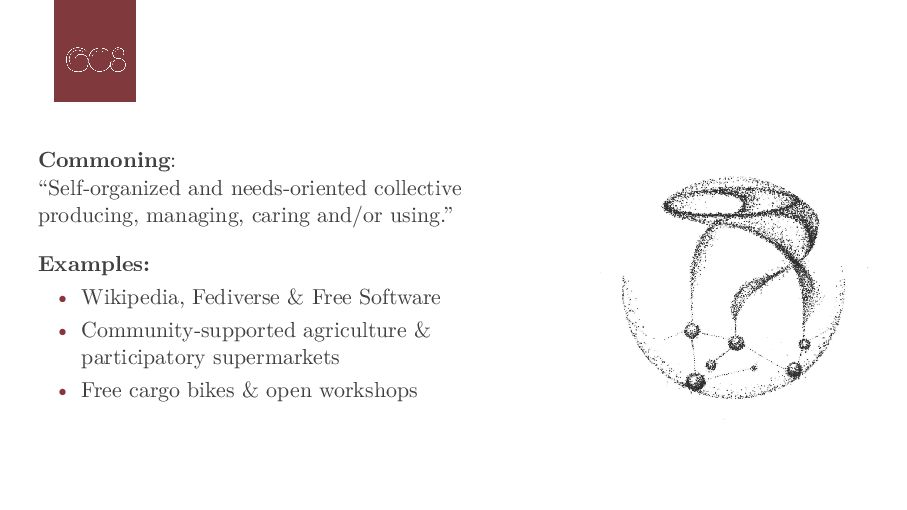
  3. Commoning: “Self-organized and needs-oriented collective producing, managing, caring and/or using.”

    Examples: • Wikipedia, Fediverse & Free Software • Community-supported agriculture & participatory supermarkets • Free cargo bikes & open workshops
  4. Commoning: “Self-organized and needs-oriented collective producing, managing, caring and/or using.”

    Examples: • Wikipedia, Fediverse & Free Software • Community-supported agriculture & participatory supermarkets • Free cargo bikes & open workshops Principles of Commoning: • Voluntariness • Inclusivity • Equality • Needs orientation • Self-organization (after J. Euler)
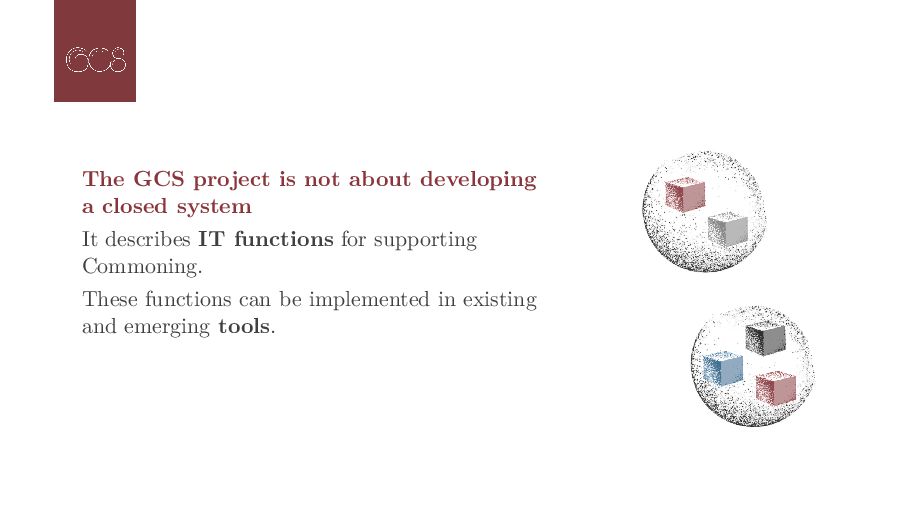
  5. The GCS project is not about developing a closed system

    It describes IT functions for supporting Commoning.
  6. The GCS project is not about developing a closed system

    It describes IT functions for supporting Commoning. These functions can be implemented in existing and emerging tools.
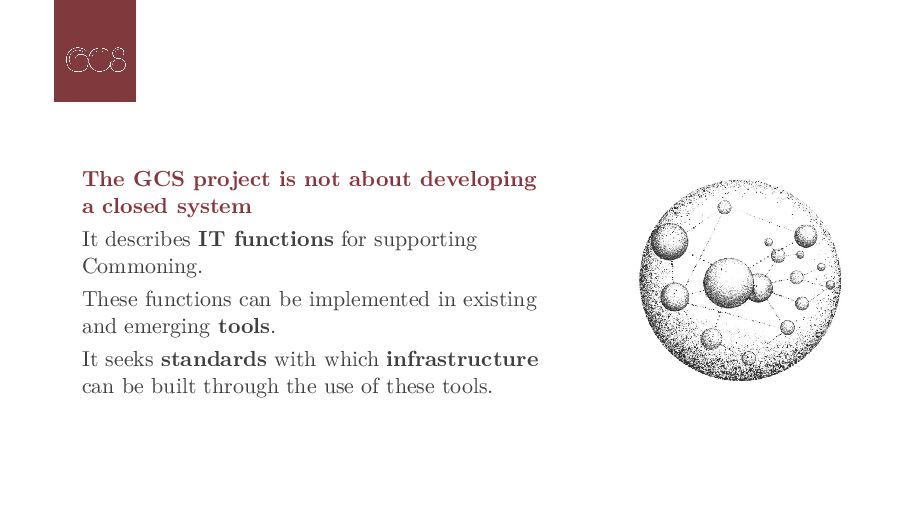
  7. The GCS project is not about developing a closed system

    It describes IT functions for supporting Commoning. These functions can be implemented in existing and emerging tools. It seeks standards with which infrastructure can be built through the use of these tools.
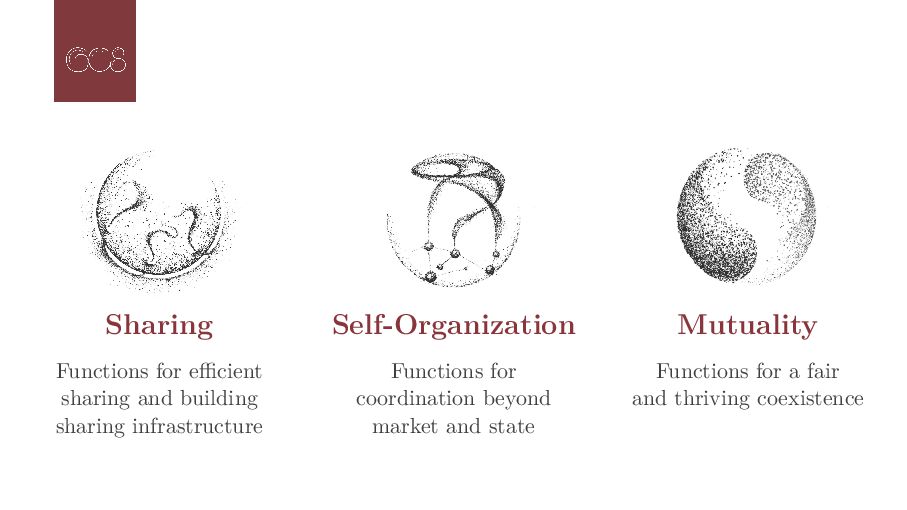
  8. Sharing Functions for efficient sharing and building sharing infrastructure Self-Organization

    Functions for coordination beyond market and state Mutuality Functions for a fair and thriving coexistence
  9. Overview 1 complex of functions: Sharing & Rules ▶ complex

    of functions: Sharing & Rules ▶ complex of functions: Self-Organization ▶ complex of functions: Mutuality ▶ Conclusion
  10. Rules 1 complex of functions: Sharing & Rules In every

    kind of society, rules guide the actions of people’s interaction.
  11. Rules 1 complex of functions: Sharing & Rules In every

    kind of society, rules guide the actions of people’s interaction. • Private property is a complex of rules
  12. Rules 1 complex of functions: Sharing & Rules In every

    kind of society, rules guide the actions of people’s interaction. • Private property is a complex of rules • The process of sharing is subject to rules
  13. Rules 1 complex of functions: Sharing & Rules In every

    kind of society, rules guide the actions of people’s interaction. • Private property is a complex of rules • The process of sharing is subject to rules • A common world involves an ongoing process of negotiation, conflict resolution, re-regulation, etc.
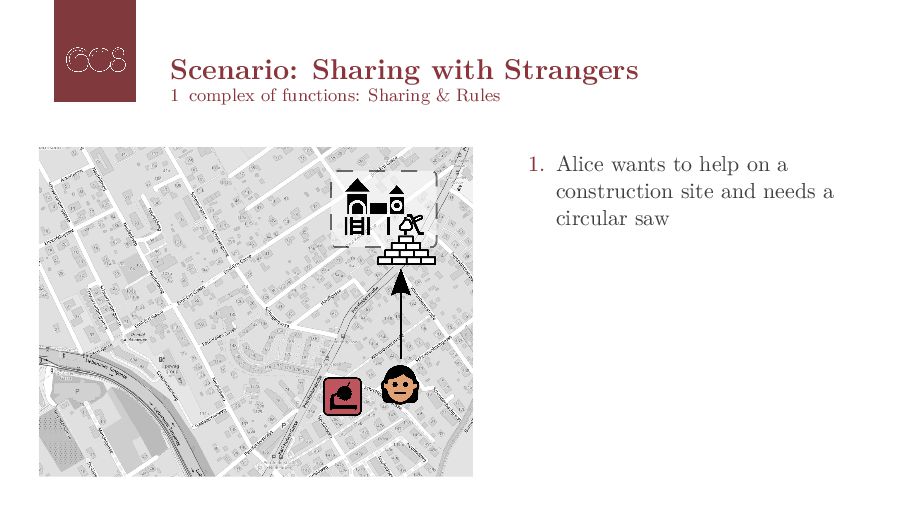
  14. Scenario: Sharing with Strangers 1 complex of functions: Sharing &

    Rules 1. Alice wants to help on a construction site and needs a circular saw
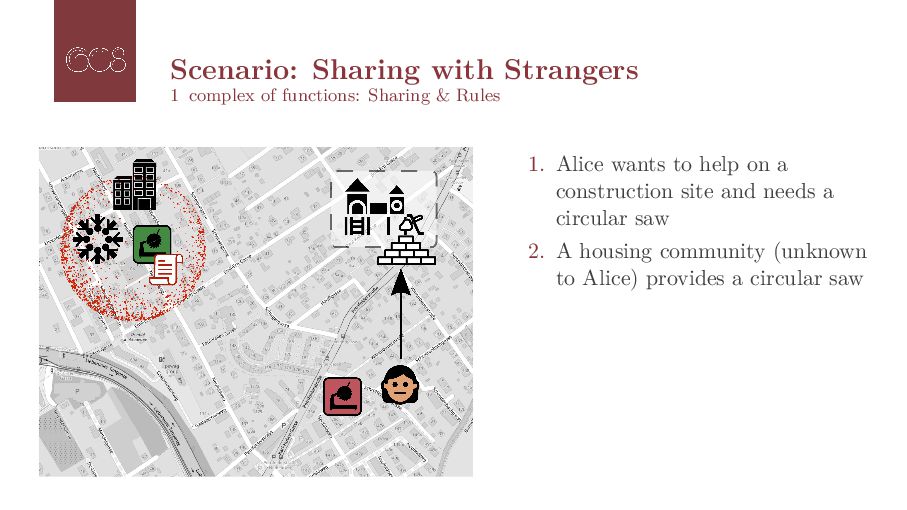
  15. Scenario: Sharing with Strangers 1 complex of functions: Sharing &

    Rules 1. Alice wants to help on a construction site and needs a circular saw 2. A housing community (unknown to Alice) provides a circular saw
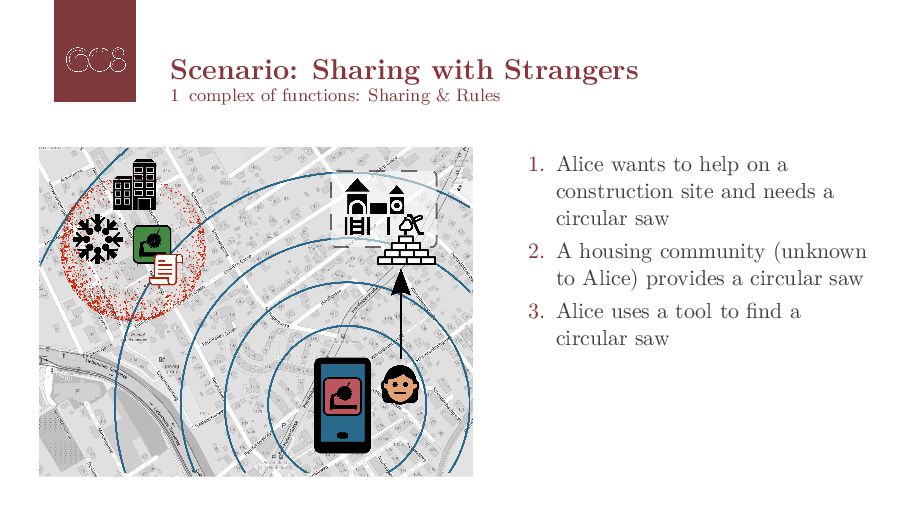
  16. Scenario: Sharing with Strangers 1 complex of functions: Sharing &

    Rules 1. Alice wants to help on a construction site and needs a circular saw 2. A housing community (unknown to Alice) provides a circular saw 3. Alice uses a tool to find a circular saw
  17. Prerequisites for IT-based Sharing 1 complex of functions: Sharing &

    Rules What are the prerequisites for an infrastructure of sharing?
  18. Prerequisites for IT-based Sharing 1 complex of functions: Sharing &

    Rules What are the prerequisites for an infrastructure of sharing? 1. Recognize equivalence between what is needed and what is available
  19. Prerequisites for IT-based Sharing 1 complex of functions: Sharing &

    Rules What are the prerequisites for an infrastructure of sharing? 1. Recognize equivalence between what is needed and what is available 2. Understand and process rules, even if they were agreed upon in person
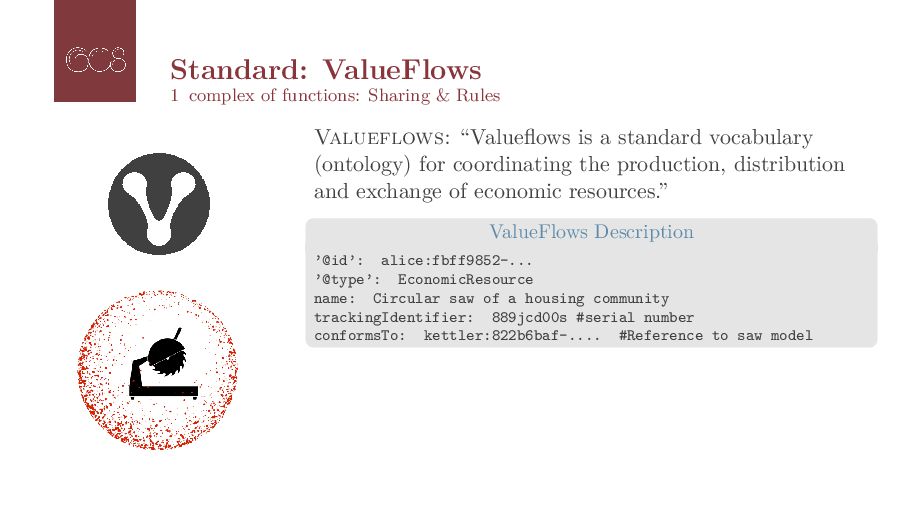
  20. Standard: ValueFlows 1 complex of functions: Sharing & Rules Valueflows:

    “Valueflows is a standard vocabulary (ontology) for coordinating the production, distribution and exchange of economic resources.” ValueFlows Description ’@id’: alice:fbff9852-... ’@type’: EconomicResource name: Circular saw of a housing community trackingIdentifier: 889jcd00s #serial number conformsTo: kettler:822b6baf-.... #Reference to saw model
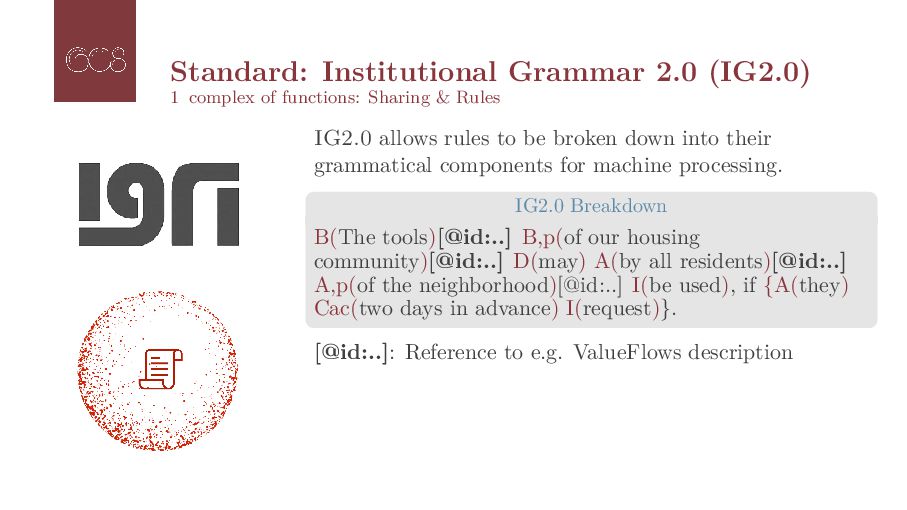
  21. Standard: Institutional Grammar 2.0 (IG2.0) 1 complex of functions: Sharing

    & Rules IG2.0 allows rules to be broken down into their grammatical components for machine processing. IG2.0 Breakdown The tools of our housing community may be used by all residents of the neighborhood, provided they request them two days in advance.
  22. Standard: Institutional Grammar 2.0 (IG2.0) 1 complex of functions: Sharing

    & Rules IG2.0 allows rules to be broken down into their grammatical components for machine processing. IG2.0 Breakdown B(The tools)[@id:..] B,p(of our housing community)[@id:..] D(may) A(by all residents)[@id:..] A,p(of the neighborhood)[@id:..] I(be used), if {A(they) Cac(two days in advance) I(request)}. [@id:..]: Reference to e.g. ValueFlows description
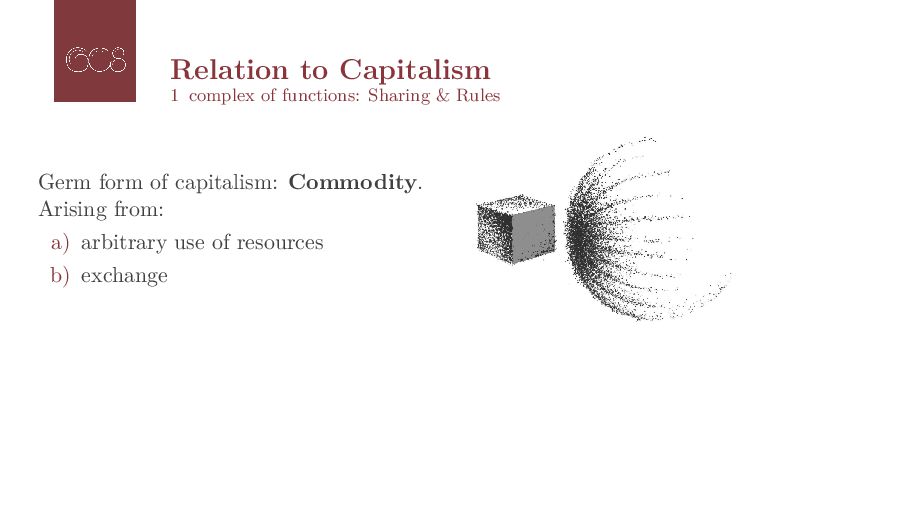
  23. Relation to Capitalism 1 complex of functions: Sharing & Rules

    Germ form of capitalism: Commodity. Arising from: a) arbitrary use of resources b) exchange
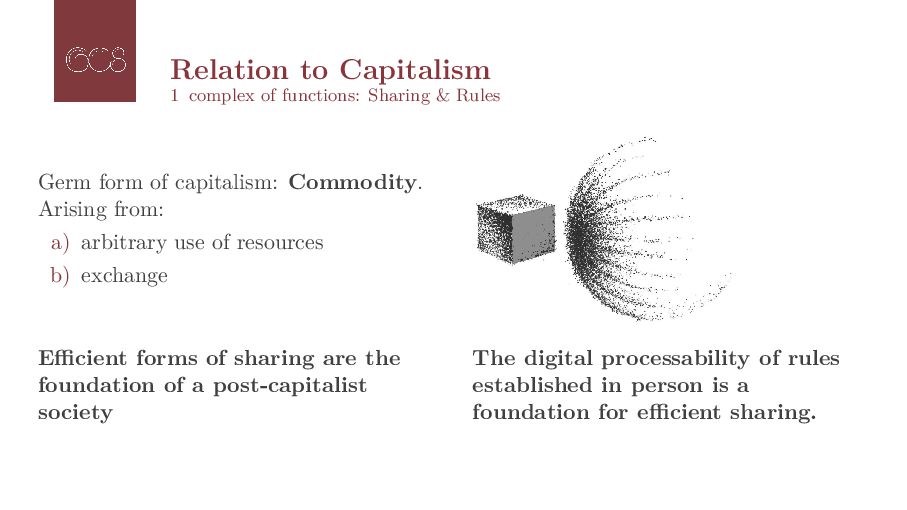
  24. Relation to Capitalism 1 complex of functions: Sharing & Rules

    Germ form of capitalism: Commodity. Arising from: a) arbitrary use of resources b) exchange Efficient forms of sharing are the foundation of a post-capitalist society The digital processability of rules established in person is a foundation for efficient sharing.
  25. Overview 2 complex of functions: Self-Organization ▶ complex of functions:

    Sharing & Rules ▶ complex of functions: Self-Organization ▶ complex of functions: Mutuality ▶ Conclusion
  26. Activity and Society 2 complex of functions: Self-Organization In every

    form of society something has to be done... How can this be organized?
  27. Activity and Society 2 complex of functions: Self-Organization In every

    form of society something has to be done... How can this be organized? • Personal domination
  28. Activity and Society 2 complex of functions: Self-Organization In every

    form of society something has to be done... How can this be organized? • Personal domination • Profit-seeking, wage dependency (“silent compulsion”)
  29. Activity and Society 2 complex of functions: Self-Organization In every

    form of society something has to be done... How can this be organized? • Personal domination • Profit-seeking, wage dependency (“silent compulsion”) • Self-organization ‘between desire and necessity’ (Kratzwald)
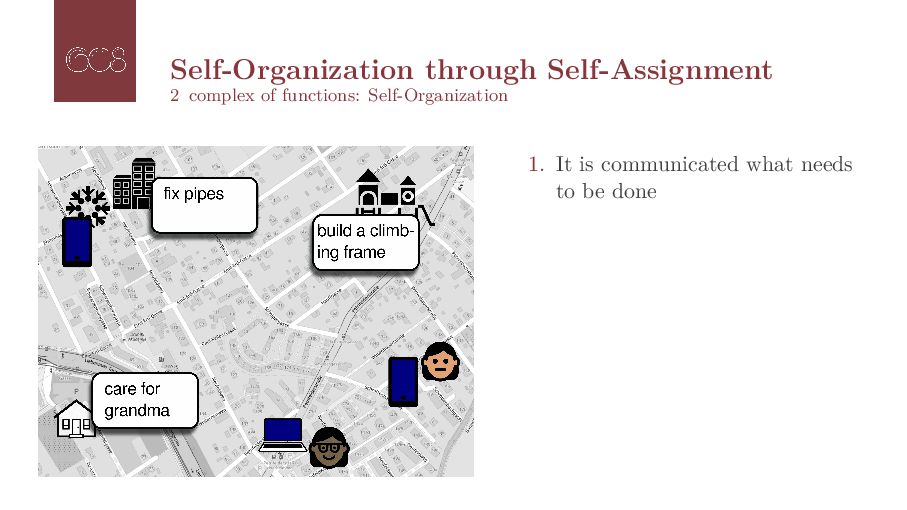
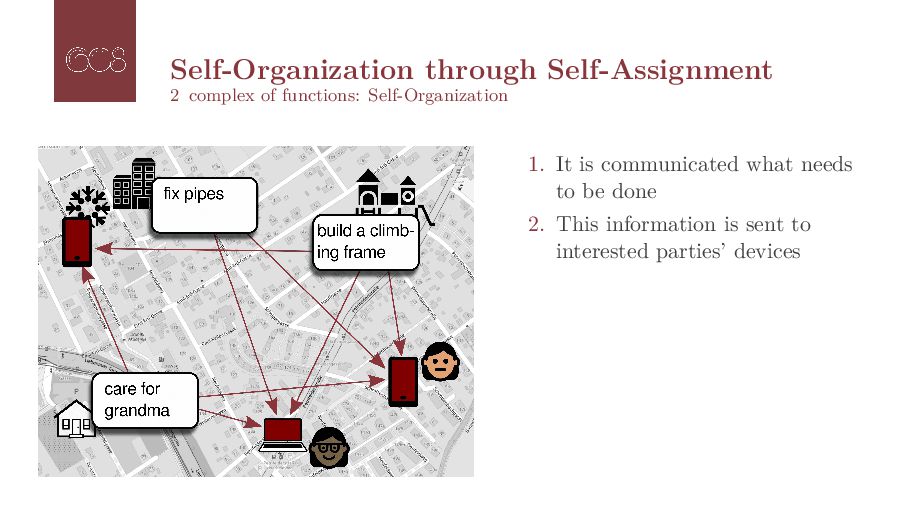
  30. Self-Organization through Self-Assignment 2 complex of functions: Self-Organization 1. It

    is communicated what needs to be done 2. This information is sent to interested parties’ devices
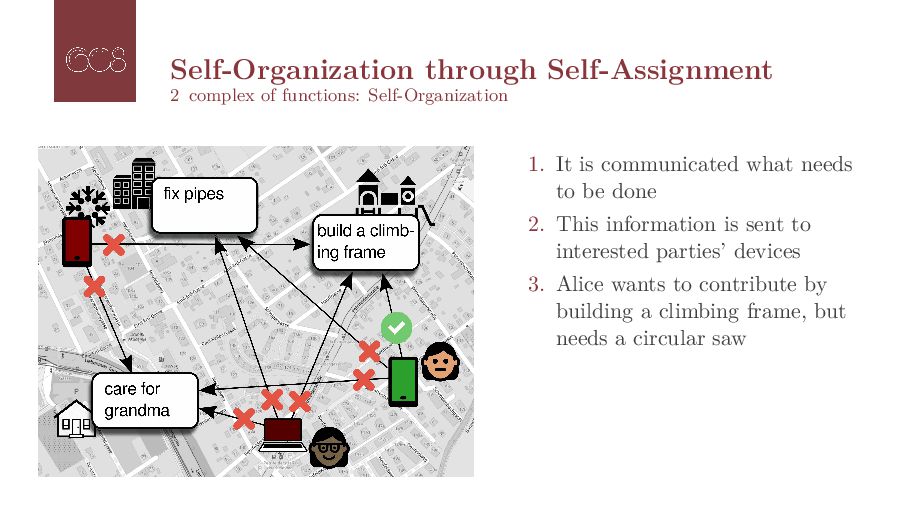
  31. Self-Organization through Self-Assignment 2 complex of functions: Self-Organization 1. It

    is communicated what needs to be done 2. This information is sent to interested parties’ devices 3. Alice wants to contribute by building a climbing frame, but needs a circular saw
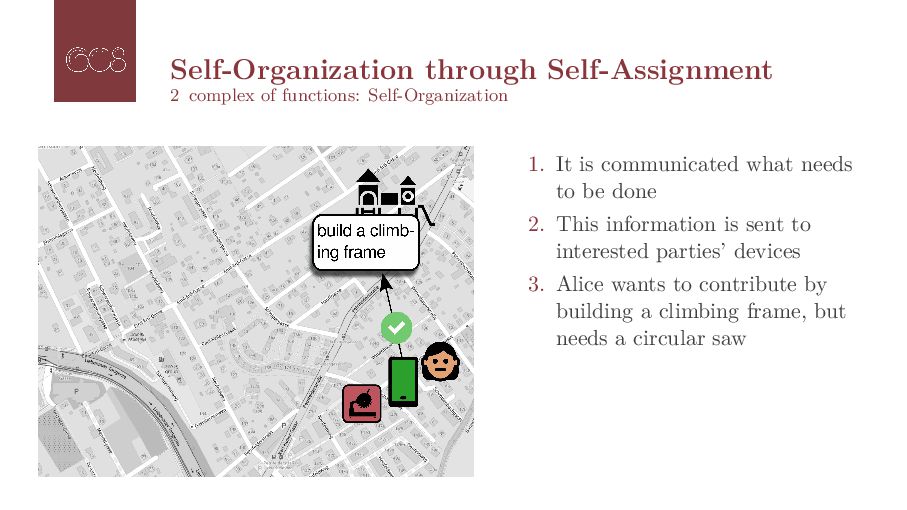
  32. Self-Organization through Self-Assignment 2 complex of functions: Self-Organization 1. It

    is communicated what needs to be done 2. This information is sent to interested parties’ devices 3. Alice wants to contribute by building a climbing frame, but needs a circular saw
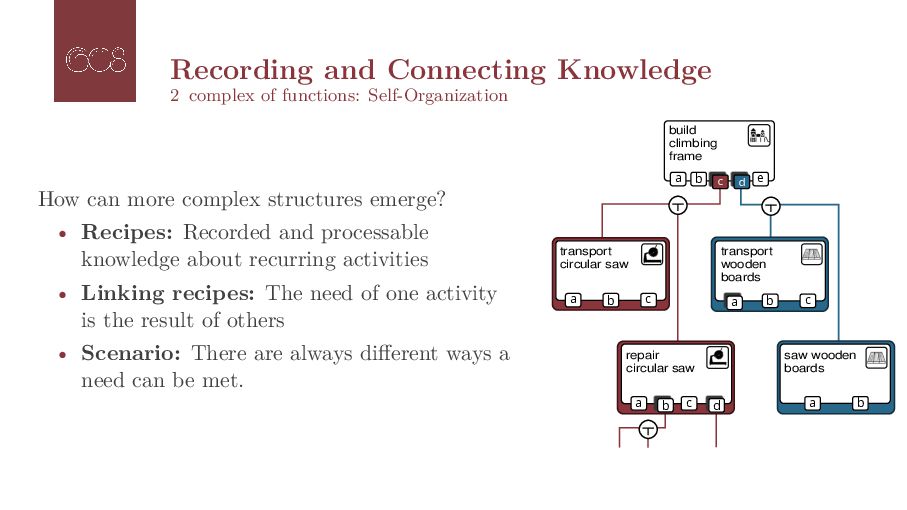
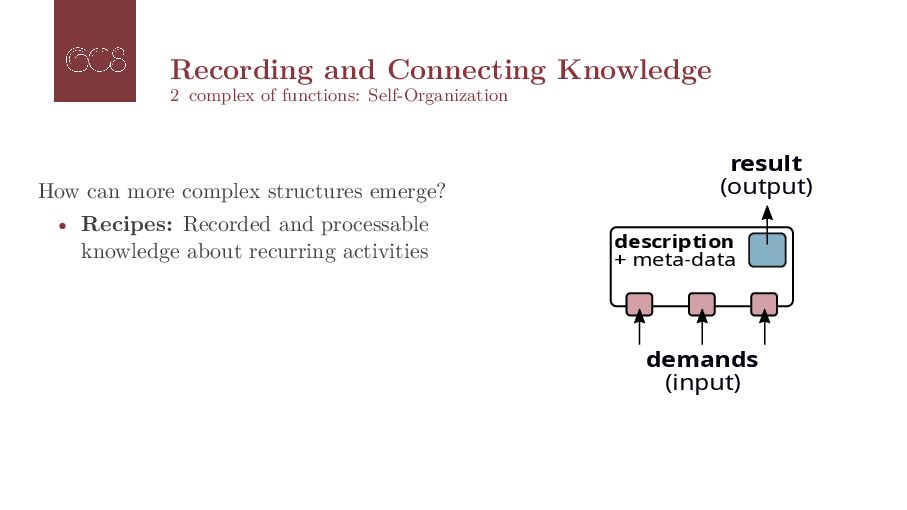
  33. Recording and Connecting Knowledge 2 complex of functions: Self-Organization How

    can more complex structures emerge? • Recipes: Recorded and processable knowledge about recurring activities description + meta-data demands (input) result (output)
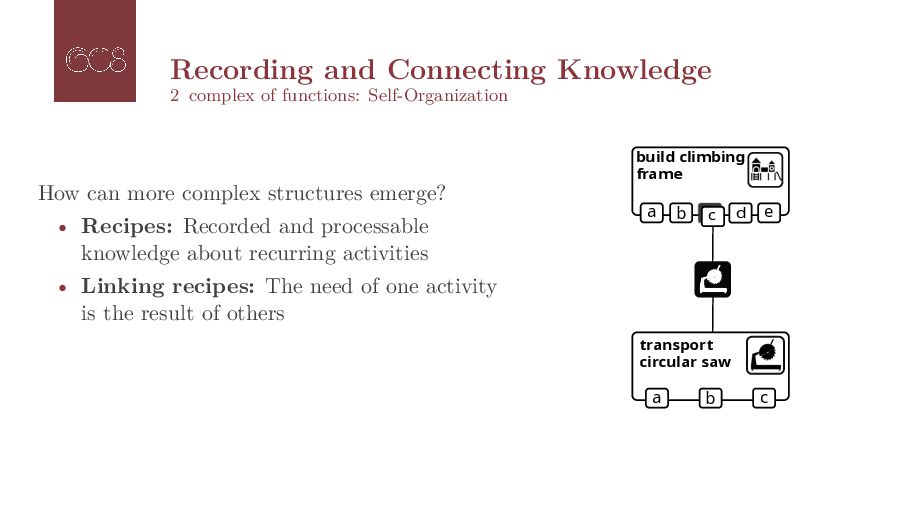
  34. Recording and Connecting Knowledge 2 complex of functions: Self-Organization How

    can more complex structures emerge? • Recipes: Recorded and processable knowledge about recurring activities • Linking recipes: The need of one activity is the result of others transport circular saw a b c c a b e d build climbing frame
  35. Recording and Connecting Knowledge 2 complex of functions: Self-Organization How

    can more complex structures emerge? • Recipes: Recorded and processable knowledge about recurring activities • Linking recipes: The need of one activity is the result of others • Scenario: There are always different ways a need can be met. c a b e d transport circular saw a b c repair circular saw a c d b transport wooden boards a b c saw wooden boards a b build climbing frame
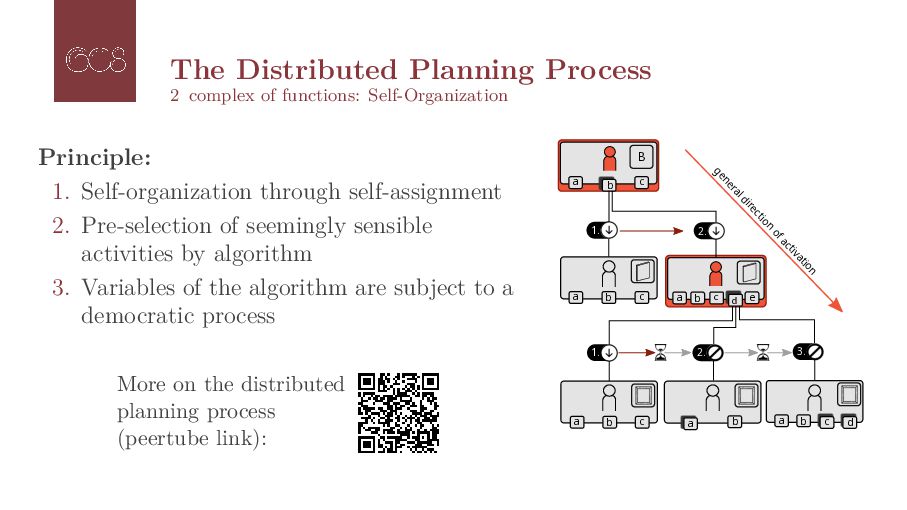
  36. The Distributed Planning Process 2 complex of functions: Self-Organization Principle:

    1. Self-organization through self-assignment 2. Pre-selection of seemingly sensible activities by algorithm 3. Variables of the algorithm are subject to a democratic process More on the distributed planning process (peertube link): c a b e d a c B b general direction of activation a b c b c a b a a c b d 1. 2. 1. 2. 3.
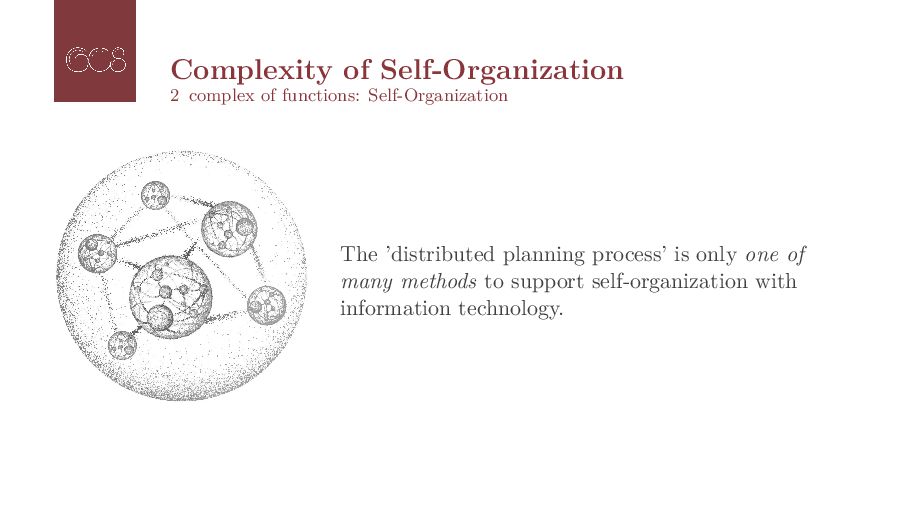
  37. Complexity of Self-Organization 2 complex of functions: Self-Organization The ’distributed

    planning process’ is only one of many methods to support self-organization with information technology.
  38. Overview 3 complex of functions: Mutuality ▶ complex of functions:

    Sharing & Rules ▶ complex of functions: Self-Organization ▶ complex of functions: Mutuality ▶ Conclusion
  39. Mutuality & Consideration 3 complex of functions: Mutuality Goal: social

    sublimation – no justification of one’s existence.
  40. Mutuality & Consideration 3 complex of functions: Mutuality Goal: social

    sublimation – no justification of one’s existence. Transformative direction of action: To act for the freedom of those who create freedoms for others.
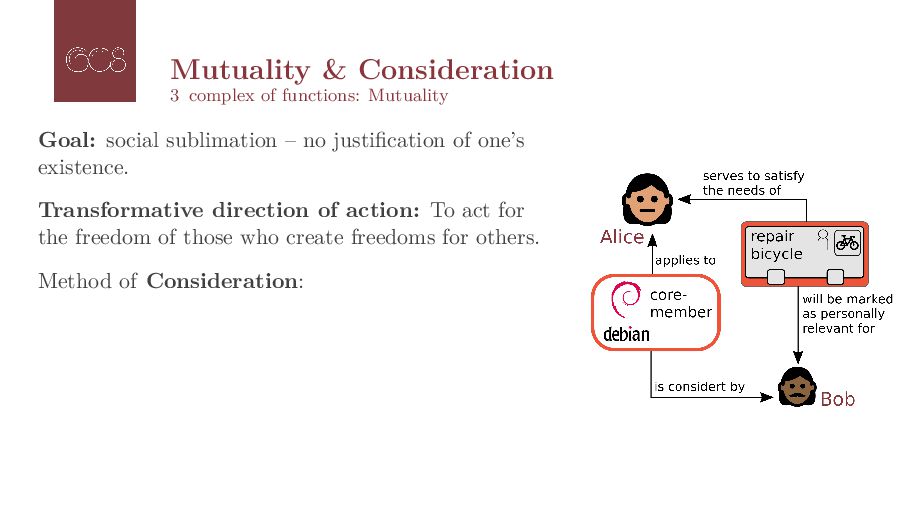
  41. Mutuality & Consideration 3 complex of functions: Mutuality Goal: social

    sublimation – no justification of one’s existence. Transformative direction of action: To act for the freedom of those who create freedoms for others. Method of Consideration:
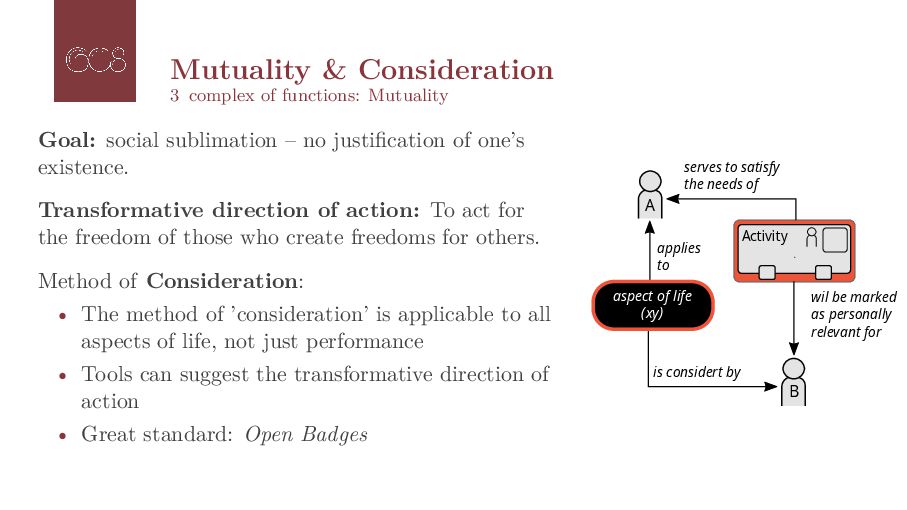
  42. Mutuality & Consideration 3 complex of functions: Mutuality Goal: social

    sublimation – no justification of one’s existence. Transformative direction of action: To act for the freedom of those who create freedoms for others. Method of Consideration: • The method of ’consideration’ is applicable to all aspects of life, not just performance • Tools can suggest the transformative direction of action • Great standard: Open Badges A B aspect of life (xy) applies to is considert by serves to satisfy the needs of wil be marked as personally relevant for Activity
  43. Data Protection 3 complex of functions: Mutuality Ensuring data protection

    is a challenge within the consideration method!
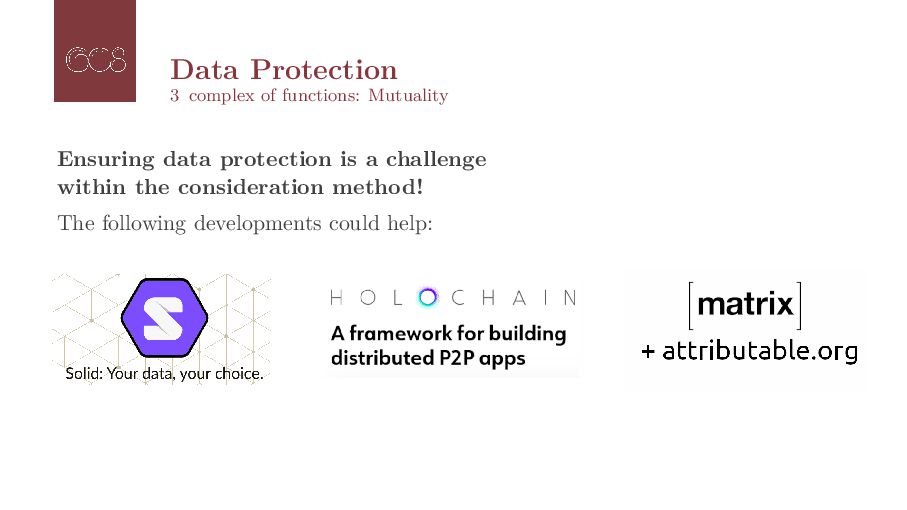
  44. Data Protection 3 complex of functions: Mutuality Ensuring data protection

    is a challenge within the consideration method! The following developments could help:
  45. Overview 4 Conclusion ▶ complex of functions: Sharing & Rules

    ▶ complex of functions: Self-Organization ▶ complex of functions: Mutuality ▶ Conclusion
  46. Moving Forward with Questions... 4 Conclusion There are more questions

    than answers But there are ways to support social change through information technology
  47. Moving Forward with Questions... 4 Conclusion There are more questions

    than answers But there are ways to support social change through information technology There is no (progressive) social change without infrastructure.
  48. What to do? 4 Conclusion GCS project status: networking node/inactive

    If you share the concern: • Build infrastructure to connect knowledge • Targeted participation in existing projects toward infrastructure • Specifically: Create ways to deal with rules and resources as commonly usable information sources • Do not lose sight of the goal of a different way of life.
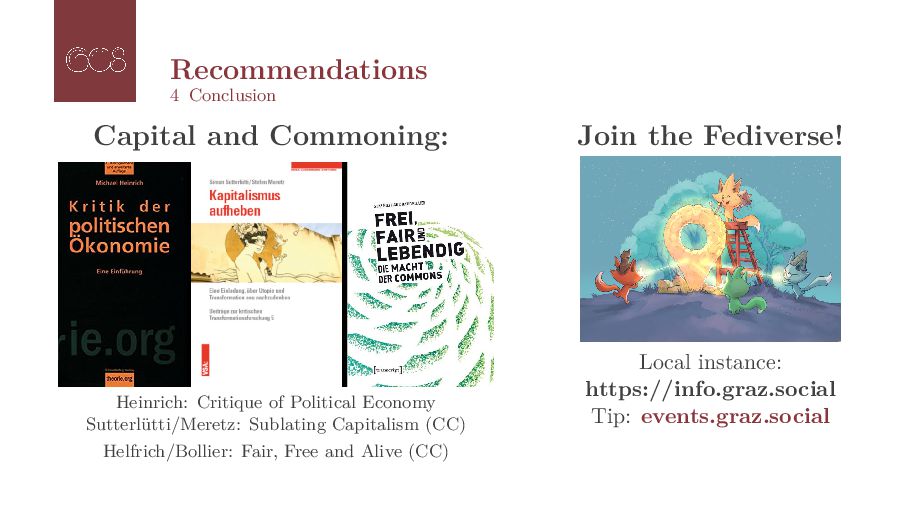
  49. Recommendations 4 Conclusion Capital and Commoning: Heinrich: Critique of Political

    Economy Sutterl¨ utti/Meretz: Sublating Capitalism (CC) Helfrich/Bollier: Fair, Free and Alive (CC) Join the Fediverse! Local instance: https://info.graz.social Tip: events.graz.social
  50. Thank you for your attention 4 Conclusion Speaker: Marcus Meindel

    Project: Global Commoning System L A TEX-Template by Federico Zenith (CC BY 4.0) Graphics/Photos: Sample graphics by Merc´ e M. Tarr´ es (PPL), Mobilizon by David Revoy (CC BY) Icons by: AomAm, Zahroe, Andreea Laura Parlafes, keenicon, andrewcaliber, useiconic.com, Adrien Coquet, Random Panda, Gerald Wildmoser, Youngky Kurniawan, Pro Symbols, Krista Glanville (all CC BY, thenounproject.com) Texts within the GCS framework: • “Conception of the Global Commoning System” (working draft) • 2023: Ostrom for Practitioners & Advanced Sharing (tba) • 2020: The Timeless Way of Re-Production • 2018: The Drive for Expansion of Modern Commons Talk handout: